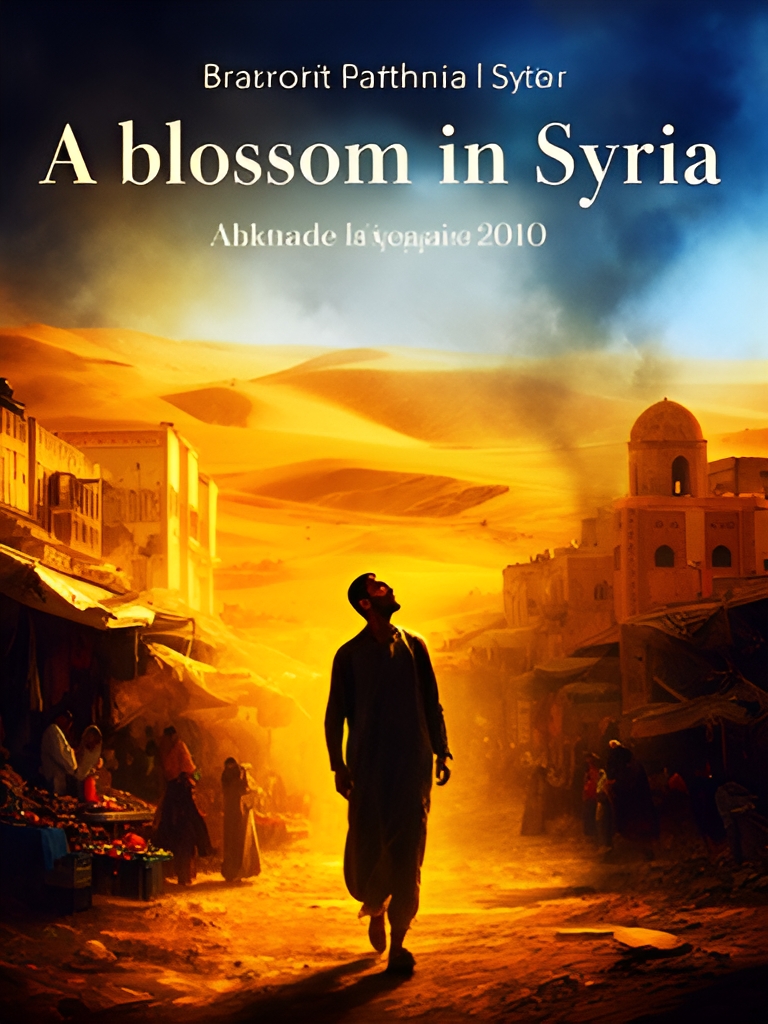
Memoir
A blossom in Syria
by Arti Kasa
3 chapters1.1 hr read
Chapter 1
The Country I Remembered
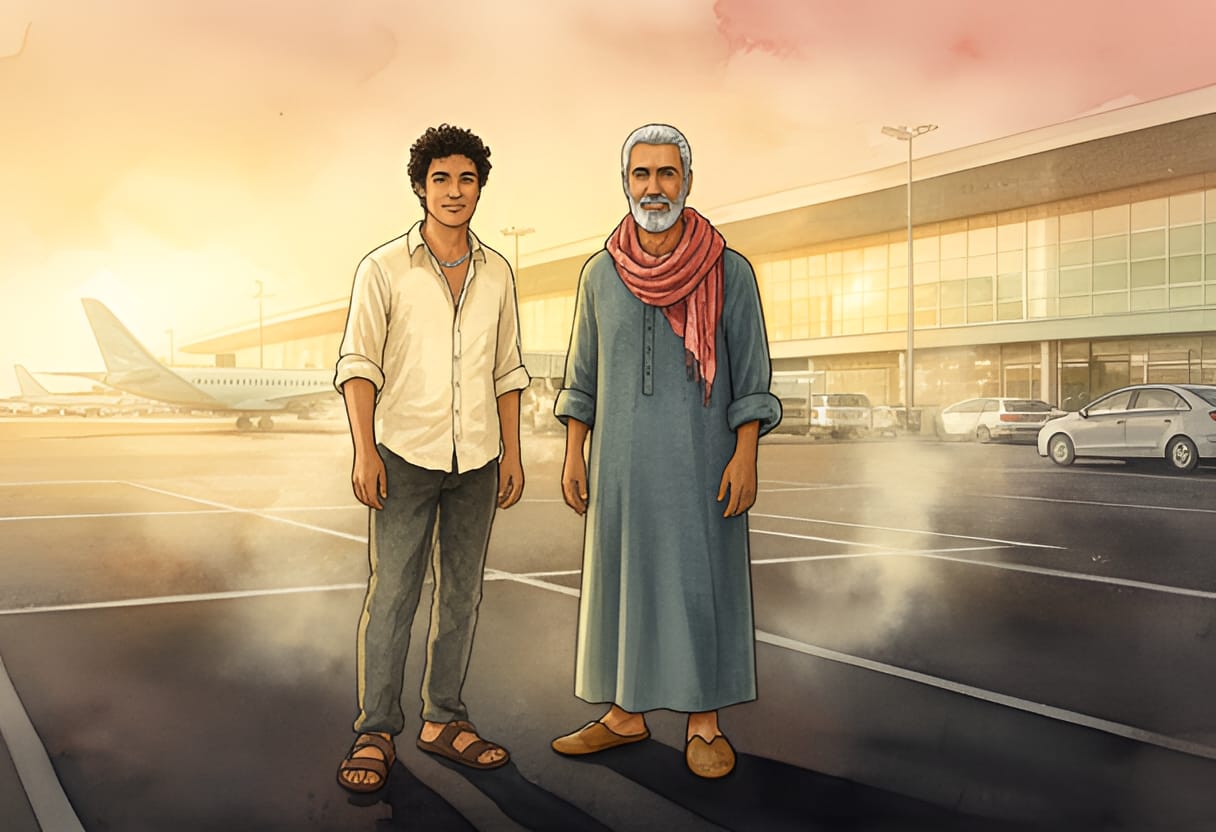
The plane touched down with a soft sigh, and Daniel unbuckled his seatbelt, the familiar hum of the cabin falling away as the doors hissed open. A wave of warm, dry air brushed his face, carrying the faintest trace of diesel and something sweeter — perhaps orange blossom, or the dust of ancient stone. He stepped into the terminal, blinking against the harsh fluorescent light, and scanned the arrivals hall for a face he hadn’t seen in fifteen years.
Then Karim was there, pushing through the crowd with a grin that crinkled the corners of his eyes. He was taller than Daniel remembered, his dark hair threaded with silver at the temples, but his smile was unchanged — open, immediate, like sunlight breaking through cloud.
“Ya habibi!” Karim exclaimed, pulling Daniel into a fierce embrace that smelled of sandalwood and old books. “You made it. After all this time.”
Daniel laughed, the sound rough in his throat. “I told you I would.”
They clung for a moment longer than necessary, two men who had grown up chasing each other through the alleys of Old Damascus, now reunited across the gulf of years and distance. When Karim finally stepped back, he held Daniel at arm’s length, studying him. “You look like your father. The same stubborn jaw.”
“And you look like you’ve been running a tour guide business into the ground,” Daniel said, teasing. “When did you start dressing like a sheikh?”
Karim shrugged, gesturing to his cream-colored dishdasha and embroidered waistcoat. “Comfort. And respect. The city notices when you honor its ways.” He glanced at Daniel’s backpack and jeans. “Though I see you’ve brought the West with you.”
“Only the parts that fit in a carry-on.” Daniel hefted his bag. “Lead the way.”
Outside, the airport parking lot shimmered under a late afternoon sun. Karim’s old Peugeot waited, its paint faded to the color of sun-bleached bone. They loaded Daniel’s bag into the trunk and slid into the front seats. The engine coughed to life, and they pulled into the stream of traffic heading west toward the city.
New Damascus unfolded in orderly blocks — wide avenues lined with saplings, whitewashed buildings with green shutters, the occasional billboard advertising mobile phones or dairy products. Daniel watched the city pass, noting how the modern and the ancient seemed to coexist without conflict: a minaret piercing the sky beside a glass-fronted bank, a donkey cart creeping past a sleek sedan.
“It’s changed,” he said quietly.
Karim nodded. “And yet, not as much as you’d think. The heart still beats in the old places.”
They turned south, following the Barada River as it snaked toward the ancient core. The suburbs thinned, giving way to orchards and low stone walls draped with bougainvillea. Then, suddenly, the city pressed in again — narrower streets, taller buildings, the air thick with the scent of grilled meat, cumin, and woodsmoke.
They passed through Bab Sharqi, the eastern gate of the Old City, where Roman stones still formed the archway beneath a bustling thoroughfare. Karim slowed the car, navigating through a labyrinth of alleys so narrow the walls almost touched. Laundry fluttered above them in bright stripes, and children played football in the shadow of a mosque whose minaret leaned slightly, as if tired from centuries of prayer.
At last, they pulled up outside a tall, ochre-colored house with a carved wooden door and a fountain trickling in the courtyard beyond. Jasmine vines climbed the walls, their perfume heavy in the evening air.
“Home,” Karim said, switching off the engine.
Daniel followed him inside, where the coolness of the thick stone walls wrapped around him like a welcome. The foyer was tiled in black and white, a brass lantern hanging from the ceiling. A woman appeared from an inner room — small, bent with age, her hair pinned under a floral scarf. Her eyes, though, were sharp and bright.
“Daniel!” she cried, her voice trembling. She rushed forward and pressed her palms to his cheeks, studying him as if memorizing the lines of his face. “Allah has kept you safe. Look at you — tall as a cypress.”
“Amti,” Daniel whispered, his throat tight. He bent to kiss her forehead, feeling the familiar roughness of her skin, the faint scent of henna and rosewater.
Behind her, a man emerged — taller, broader, with kind eyes and a mustache streaked with grey. He wore a faded cardigan over a collarless shirt.
“Uncle Farid,” Daniel said, stepping forward.
Farid embraced him firmly, patting his back. “You’ve grown. Your father would be proud to see you here.”
They moved into the courtyard, where a low table was set beneath a trellis of grapevines. Plates of kibbeh — bulgur stuffed with spiced lamb and pine nuts, fried to a golden crisp — sat beside bowls of hummus, fattoush salad, and warm flatbread. The scent of parsley and lemon made Daniel’s mouth water.
They ate in comfortable silence at first, the only sounds the clink of spoons, the occasional laugh from Karim as he recounted a childhood misadventure involving a stolen watermelon and a very angry goat. Daniel listened, savoring each bite, the flavors bursting on his tongue — earthy, tangy, rich with memory.
Between mouthfuls, Amti asked about his life in London — his work as a photographer, the flat he shared with a friend, the rainy winters he complained about but secretly missed when the sun shone too brightly.
“I keep a jar of za’atar on my windowsill,” Daniel said, smiling. “Just to smell it sometimes.”
Amti nodded, eyes glistening. “That’s how you know you’re still connected. Not by the land alone, but by the taste of it.”
After dinner, Karim insisted on a walk. “The city comes alive at night,” he said, brushing crumbs from his vest. “And you need to see the souq when the lanterns are lit.”
Daniel hesitated — he was tired, full, his limbs heavy with the journey — but the look in Karim’s eyes, eager and proud, won him over. He thanked Amti and Farid, promising to return for tea in the morning, and stepped back into the night air.
The Old City was transformed. Strings of lanterns cast a golden glow over the cobblestones, turning the souq into a river of light. The air hummed with life — vendors calling out prices in melodic Arabic, the clatter of copper trays, the murmur of conversations in dozens of dialects. The scent of roasting coffee mingled with incense and the sharp tang of pomegranate molasses.
Daniel walked slowly, letting the rhythm of the place wash over him. He ran his fingers along the cool stone of a shopfront selling inlaid mother-of-pearl boxes, paused to admire a pile of hand-dyed silk scarves spilling from a vendor’s basket, and smiled when a stray cat wound itself around his ankles, seeking warmth.
He passed a café where old men played backgammon under the shade of a fig tree, their laughter low and rhythmic. A boy no older than ten offered him a small cup of sweet tea, insisting it was a gift. Daniel accepted, the warmth spreading through his chest as he sipped.
For the first time in years, he felt it — not just recognition, but belonging. This was not a place he was visiting. It was a place that had been waiting for him.
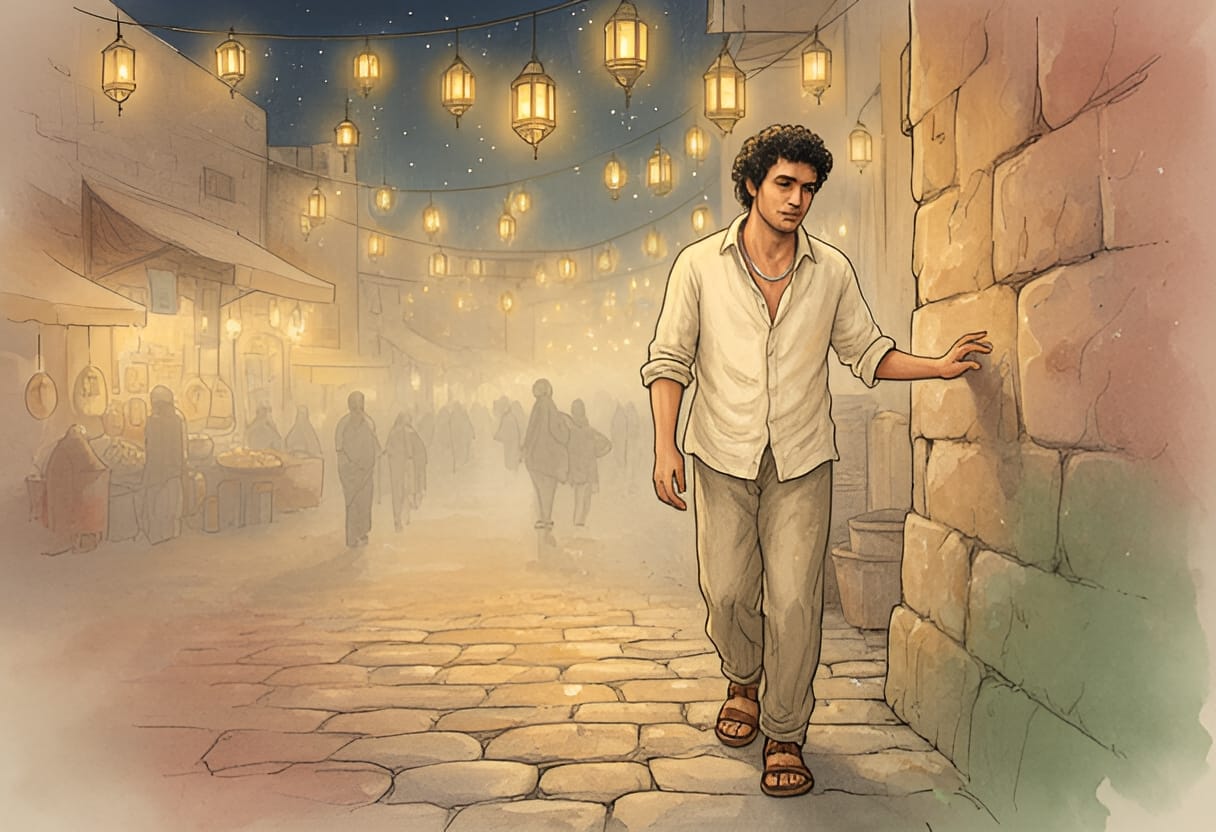
He paused beneath an archway carved with intricate geometric patterns, the calligraphy above it quoting a verse from the Quran: “And We have certainly honored the children of Adam.” He touched the stone, feeling the centuries of hands that had done the same.
A distant call to prayer rose from a nearby mosque, pure and unfolding, weaving through the night like a thread of gold. Daniel closed his eyes, letting the sound settle in his bones.
When he opened them again, the souq still breathed around him — alive, ancient, unafraid.
He turned back toward the courtyard house, his steps light, his heart full. Tomorrow, he would see more. But tonight, he had come home.
The first light of dawn was just beginning to blush the sky when Daniel woke, the memory of last night’s lantern-lit souq still humming behind his eyelids. He lay still for a moment, listening to the quiet stir of the house — the creak of a floorboard, the distant murmur of Karim’s voice low in the courtyard. Outside, the city was still wrapped in shadow, but the air already carried the promise of heat.
He dressed quickly, pulling on his linen shirt and sturdy boots, and stepped into the courtyard where Karim waited beside the car, a thermos in hand and a grin already spreading across his face.
“Ready?” Karim said, his dark eyes bright with anticipation. “The desert waits for no one.”
Daniel laughed, the sound light and unburdened. “Lead the way.”
They pulled out of the Old City just as the call to prayer faded into the morning, the streets still quiet save for the occasional sweep of a broom or the clatter of a cart being readied for the day. The modern outskirts of Damascus gave way to open road, and then, sooner than Daniel expected, to the desert proper — a vast, ochre expanse where the earth seemed to stretch infinitely under a sky that was already turning from deep blue to pale gold.
The car hummed steadily eastward, the landscape unfolding in waves of sand and stone, dotted with hardy shrubs and the occasional cluster of black tents clinging to the horizon. Karim pointed out a distant ridge where ancient watchtowers once stood, their stones long since reclaimed by wind and time. Daniel watched in silence, feeling the rhythm of the journey settle into his bones — a familiar pulse, though he couldn’t say from where.
After nearly two hours, Karim eased the car to a stop beside a simple structure built of sun-baked brick, its roof thatched with palm fronds. A faded sign swayed in the breeze: Café al-Wadi. A few low tables stood outside, shaded by a canvas awning, and behind them, a man in a faded thobe tended a small fire over which a pot of tea simmered.
“Breakfast,” Karim said, stepping out and stretching his arms wide. “The best in the desert.”
They approached, and the man looked up, his face weathered but kind, his eyes crinkling as he saw Karim.
“Karim ibn Yusef!” he exclaimed, wiping his hands on his apron. “You bring the city boy back to see the sands again?”
Karim clasped his forearm in greeting. “Only if you promise not to charge him double for being out of practice.”
The man chuckled, pouring two small glasses of tea from the pot, the liquid dark and sweet, steaming in the cool morning air. He handed one to Daniel, then another to Karim, and set a plate of fresh flatbread and dates between them.
“You travel far today?” the man asked, settling onto a low stool beside them.
“To Palmyra,” Karim said. “Daniel wants to see the ruins.”
The man nodded slowly, his gaze drifting toward the endless horizon. “Palmyra remembers. It has seen emperors come and go, armies rise and fall. But the desert? The desert does not forget. It waits.”
Daniel sipped the tea — sweet, fragrant with mint, warming him from the inside out. Around them, the silence was deep, broken only by the occasional cry of a bird or the distant lowing of camels. A group of Bedouin herders arrived shortly after, leading a small flock of goats that moved with deliberate grace across the sand. They paused at the edge of the café, greeting Karim with nods and murmurs, their faces lined but serene.
One of them, an older man with a white beard braided with beads, offered Daniel a date from his palm. “Eat,” he said in accented Arabic. “The desert gives little, but what it gives is good.”
Daniel accepted, the fruit soft and honeyed on his tongue. They spoke little — Karim translated when needed, but much passed in glances and gestures: the tilt of a head toward a distant dune, the way a herder shaded his eyes to scan the horizon, the quiet pride in how they tied their tents or coiled their ropes.
When they finally rose to leave, the café owner pressed a small bundle of extra bread into Karim’s hand. “For the road,” he said. “And tell the ruins I said hello.”
Back in the car, the desert opened up again, wider now, the sun climbing higher and turning the sand to molten copper. Karim drove with one hand on the wheel, the other resting on the sill, humming a tune Daniel didn’t know but felt in his chest like a heartbeat.
Hours passed. The landscape shifted subtly — fewer shrubs, more exposed rock, the ground taking on a pale, almost luminous quality. Then, on the horizon, a line of columns emerged, standing like sentinels against the sky.
“There,” Karim said, his voice softer now. “Palmyra.”
As they drew closer, the scale of the place took Daniel’s breath away. The monumental arch — the Tetrapylon — stood ahead, its four sets of columns framing the sky like a gateway to another world. Beyond it, the Great Colonnade stretched into the distance, row upon row of towering pillars rising from the pale earth, their capitals carved with acanthus leaves and faint traces of gilding still clinging to the stone.
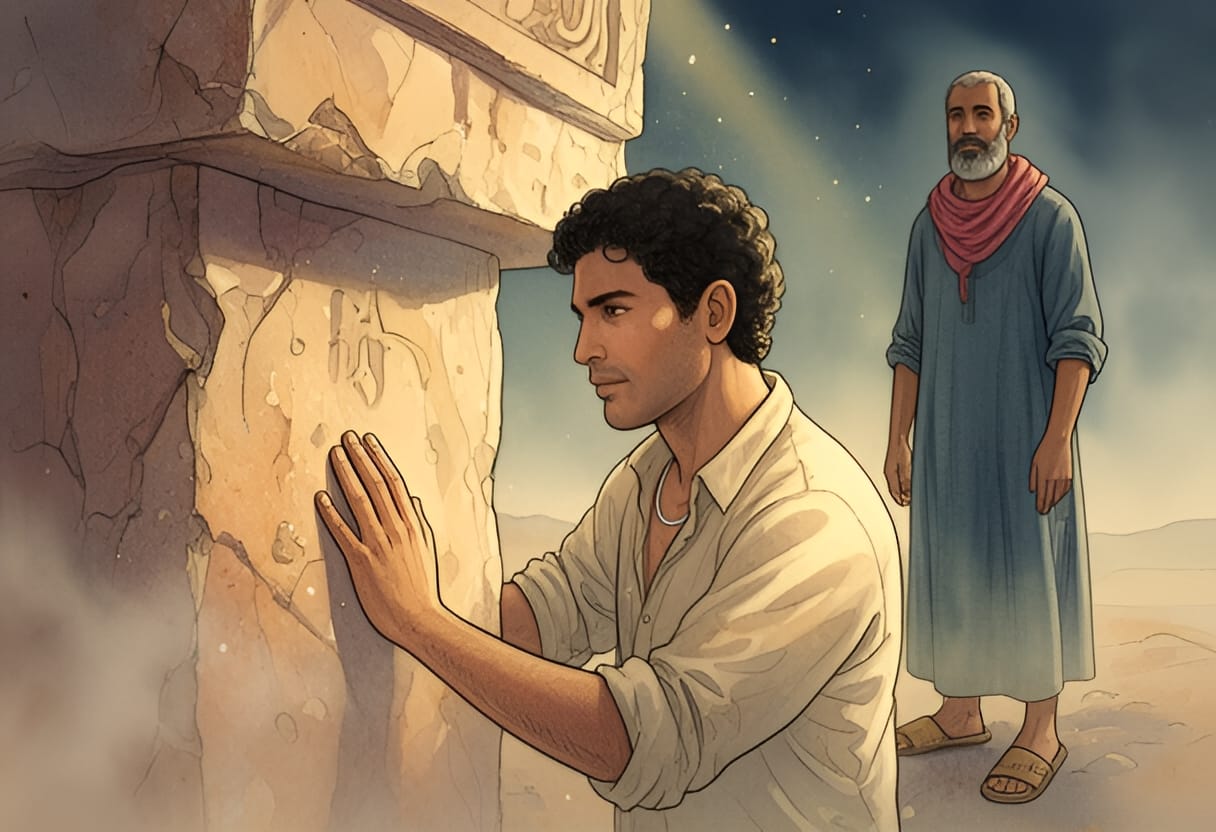
They parked near the edge of the site and stepped out into the profound quiet. The air was dry and clear, carrying the scent of sun-warmed stone and distant thyme. Daniel walked slowly between the columns, his footsteps echoing softly on the ancient paving. He ran his fingers along the surface of a pillar, feeling the grooves left by centuries of wind and touch, the faint carvings of laurel wreaths and Greek inscriptions half-buried in sediment.
Karim walked beside him, silent for once, letting Daniel absorb it in his own way. They passed the Temple of Bel, its massive sanctuary still imposing despite the damage to its roof, the reliefs along its walls depicting processions of gods and emperors, their faces worn but dignified. Daniel lingered before a carved lion, its muscles taut with stone strength, guarding the approach to the temple as it had for nearly two millennia.
They continued to the Valley of the Tombs, where towering funerary towers rose from the earth like stone trees, each tier pierced with narrow openings that once held the sarcophagi of Palmyrene nobility. Daniel climbed the shallow steps of one, peering into the dim interior where niches lined the walls, some still holding fragments of bone or faded plaster painted with solemn faces.
He touched the cool stone of a lintel above one opening, where a portrait of a woman stared out — her eyes wide, her hand raised in a gesture of blessing. Her jewelry was detailed down to the smallest bead, her veil rendered in delicate folds. She seemed not dead, but waiting.
A breeze stirred, lifting a thread of sand across the valley floor, and for a moment, the silence felt less like emptiness and more like presence — as if the people who had built this, lived here, loved here, were still nearby, just beyond sight.
When the sun began its descent, they made their way back toward the Temple of Bel, finding a spot on the eastern edge of the colonnades where the light would fall fullest on the sanctuary facade. Daniel sat on a low block of stone, Karim beside him, and watched.
The sun lowered, gilding the columns, turning the limestone to honey and flame. Shadows stretched long and deep, etching every groove and fissure in sharp relief. The temple, though missing its roof, still held its grandeur — the massive doorway framed by intricate carvings of eagles and lions, the walls alive with myth and memory.
Daniel felt a stillness settle over him, deep and quiet, not unlike the peace he had felt in the souq the night before, but older, deeper — a sense of continuity that defied the fractures of time. He thought of his father, of the stories he’d heard as a child about a homeland he’d never seen, of the jar of za’atar on his windowsill in London, of Amti’s words: Not by the land alone, but by the taste of it.
He realized then that it wasn’t just memory that had brought him here. It was recognition.
A soft shift in the light made him turn. Karim was watching him, not with curiosity, but with something like understanding.
“You’re quiet,” Karim said.
Daniel smiled, his throat tight. “I’m listening.”
Karim nodded, and they sat together in the deepening hush, the sun slipping below the horizon, the first stars pricking the violet sky above the ancient stones. The desert cooled around them, and the wind carried, faint and far, the echo of a song — or perhaps only the wind through the columns, singing in a language older than words.
The stars had already begun to prick the sky when Daniel and Karim pulled into Homs, the city’s lights blinking like fireflies against the darkening hills. The drive from Palmyra had been long, the desert giving way to rolling plains dotted with olive groves and the occasional flock of sheep moving like slow thoughts across the land. Karim turned off the main road onto a narrower street lined with fig trees, their leaves whispering in the evening breeze, and pulled up before a modest stone house with a wooden door painted a faded blue.
A woman appeared in the doorway, wiping her hands on her apron. She was of medium height, her dark hair tucked neatly under a kerchief, her eyes warm and quick to smile. “Karim! You brought him,” she said, her voice ringing with affection. She stepped forward and embraced Daniel before he could speak, her grip firm, her cheek brushing his. “Welcome, habibi. You look just like your father did at your age.”
Inside, the air was cool and carried the scent of cedar and dried mint. A man rose from a low cushion near the hearth, his hands dusted with ochre and indigo, his nails stained from years at the loom. He bowed his head slightly as Daniel approached. “I am Elias,” he said. “Weaver of threads, keeper of patterns. Karim has told me much about you — how you carry your home in your heart, even when you are far.”
Daniel felt a lump rise in his throat. “It’s an honor to be here,” he said. “Thank you for opening your home to us.”
Elias smiled, revealing a gap between his front teeth. “In Homs, we say the guest is a blessing from God. You are not just passing through — you are part of the weave now.”
They shared a simple meal of lentil soup, warm flatbread, and pickled turnips, eaten in companionable silence broken only by the occasional clink of spoon against bowl. Afterward, Elias led Daniel to a back room where a large wooden loom stood beneath a window that opened onto a courtyard blooming with jasmine. The frame was worn smooth by decades of use, the beams polished by hands that had passed the shuttle back and forth for generations.
“Watch first,” Elias said, sitting beside him. “The pattern lives in the hands before it lives in the cloth.”
Daniel observed as Elias moved with practiced ease, his feet pressing the treadles in a rhythm that lifted and lowered the warp threads. His fingers darted across the weft, catching the colored yarn and sending it flying through the shed with a soft thwack of the beater. The design emerged slowly — a repeating motif of interlocking diamonds, each containing a tiny star at its center, woven in deep blue and saffron against a cream ground.
“This is the ‘Homs Star,’” Elias murmured, not looking up. “It has been on our shawls for over a hundred years. My father taught it to me, and I to my sons. Even when the mills came and the machines hummed louder, we kept this one alive by hand.”
Daniel reached out hesitantly, his fingers hovering over the warp. “May I?”
Elias nodded. Daniel placed his hands on the threads, feeling their tension, the faint resistance as he tried to lift them with his feet. His movements were stiff at first, the rhythm elusive. Elias guided his ankles, whispering corrections — left, now right, breathe with it — until gradually, the motion began to feel less like struggle and more like conversation. The shuttle flew from his grasp, landed unevenly, and Elias chuckled softly.
“First try,” he said. “Even the best weavers snap a thread now and then. It’s not about perfection. It’s about showing up.”
They worked in silence for a while, the only sounds the creak of the loom, the soft pull of thread, and the distant call of a muezzin from a nearby minaret. Daniel found himself slipping into a quiet focus, the worries of airports and passports and years apart fading into the background. For the first time since arriving in Syria, he felt not like a visitor, but like someone who belonged to a rhythm older than nations.
When the sun began to slant through the window, Elias rose and wiped his hands on a rag. “Come,” he said. “The roof awaits.”
They climbed a narrow staircase to the flat roof, where a mat had been laid out and cushions scattered around a low copper tray holding tea, fresh figs, and a plate of za’atar-spiced labneh. Karim’s mother, Amti, was already there, her floral scarf pinned neatly under her chin, her eyes crinkling as she saw them. Farid sat cross-legged nearby, rolling a cigarette with deliberate care.
“You’ve been busy,” Amti said, pouring tea into small glasses. “I heard the loom singing all afternoon.”
Daniel smiled, accepting the glass. “Elias taught me a pattern. I think I broke more thread than I wove.”
“That’s how we learn,” she said, handing him a fig. “By breaking things and tying them back together.”
As the sun dipped below the rooftops of Homs, painting the sky in shades of rose and lavender, the city began to quiet. The call to prayer echoed from the minarets, soft and resonant, followed by the murmur of families settling into their homes. Amti began to speak, her voice low and rhythmic, drawing them into a tale of a clever fox who outwitted a lion not by strength, but by knowing the names of all the stars.
Daniel listened, the warmth of the tea in his palms, the scent of jasmine and woodsmoke in the air, the distant hum of a generator somewhere in the neighborhood. Karim rested his head back against the parapet, his eyes closed, smiling faintly at the story. Farid nodded occasionally, as if recalling hearing it long ago.
When the tale ended, Amti fell silent for a moment, gazing out over the darkening city. Then, softly, she said, “There have been whispers. From Daraa. Boys writing slogans on walls. Things about dignity, about bread.”
Farid’s fingers stilled on his cigarette. “Daraa? That’s far south.”
“Yes,” Amti said. “But the words travel. Like seeds on the wind. People say the children were taken for questioning. That the response was… harsh.”
Karim opened his eyes. He looked at Daniel, then at his mother. “It’s gossip,” he said, though his voice lacked its usual certainty. “People talk. The government knows how to keep order. This is not 1982.”
Amti reached over and touched his hand. “I hope you’re right, habibi. I hope it’s nothing. But I also know that sometimes, the smallest thread, if pulled, can unravel an entire blanket.”
Daniel felt a chill, despite the warmth of the day still lingering in the stone. He thought of the woman in the tomb at Palmyra, her hand raised in blessing, her eyes wide and waiting. He thought of the za’atar jar on his windowsill in London, of the taste of home that was more than flavor — it was memory, it was promise.
No one spoke for a long time. The stars came out fully now, sharp and clear above Homs, the ancient city breathing softly beneath them. Somewhere, a loom clacked in the dark. Somewhere, a mother tucked her child in. And somewhere, far to the south, a thread had begun to tug.
The cool evening air of Homs clung to Daniel’s skin as he and Karim descended the narrow staircase from Elias’s roof. The city’s lights were just beginning to flicker on in windows below, casting amber pools along the stone alleys. Elias walked with them to the gate, his hand firm on Daniel’s shoulder for a moment before releasing it.
“Take care of each other,” Elias said, his voice low. “And remember the rhythm. It will hold you when the noise grows loud.”
Daniel nodded, unable to speak past the lump in his throat. Karim clasped his forearm in the traditional greeting, eyes searching his face. “We’ll be in touch,” he said. “If you ever need a place to rest, you know where to find us.”
Daniel turned and walked with Karim toward the waiting car, the weight of Amti’s words settling like dust on his shoulders. The smallest thread, if pulled, can unravel an entire blanket. He glanced back once at the silhouette of Elias’s house against the darkening sky, then slid into the passenger seat as Karim started the engine.
The drive back to Damascus stretched through the night, the highway cutting through valleys where the stars burned bright and unobstructed. Karim drove in silence for a long while, his hands steady on the wheel, his jaw occasionally tightening as he glanced at the rearview mirror. Daniel watched the landscape pass — the occasional glow of a village, the dark hump of distant hills — and felt the familiar ache of return, not just to a city, but to a version of himself he had feared was lost.
The first sign of change came not in the city center, but on its outskirts. As they approached Damascus from the south, the usual fluidity of traffic faltered. Concrete barriers, newly erected, channeled cars into narrow lanes where young men in crisp uniforms stood with clipboards, their eyes scanning each vehicle with deliberate slowness. A checkpoint — unfamiliar, rigid — stood where none had been before.
Karim slowed as they neared the barrier. A soldier stepped forward, hand raised, his face expressionless beneath the peak of his cap. “Passport,” he said, his voice flat.
Karim handed over his documents. The soldier examined them, then turned to Daniel. “And you?”
Daniel opened his bag and retrieved his British passport. The soldier flipped through it, frowning at the visa stamp, then at Karim’s Syrian ID. He exchanged a few quick words with Karim in Arabic, his tone edged with suspicion. Daniel caught only fragments — why so long? family ties? — before the soldier handed the papers back with a curt nod.
“Move on,” he said.
Karim exhaled as they pulled away, his fingers tapping once against the steering wheel. “New orders,” he murmured. “They’re tightening the south. Saying there’s unrest near the border.”
Daniel looked back in the mirror. The checkpoint receded, its lights like watchful eyes in the dark. “They were thorough.”
“They have to be,” Karim said, though his voice lacked conviction. “After what happened in Daraa, they can’t take chances.”
Daniel hesitated. “What happened?”
Karim’s gaze flicked to him, then away. “Nothing confirmed. Just… reports. Boys writing on walls. Slogans. The usual teenage nonsense, blown out of proportion.”
“Amti said they were taken for questioning. Harshly.”
Karim’s jaw tightened. “She hears more than she should. Old women and their tea-fueled imaginations.” He paused, then added, quieter, “But even if it’s true… it’s isolated. The government knows how to handle these things. It won’t spread.”
Daniel wanted to believe him. He wanted to trust the ease of their reunion, the laughter over tea, the rhythm of the loom under his fingers. But the soldier’s stare, the sudden barrier where none had been — it lodged in his chest like a stone.
They arrived at Karim’s family home in the Old City just before dawn, the sky a washed-out indigo over the domes and minarets. Amti was waiting, wrapped in her shawl, a cup of tea steaming in her hands. She said nothing as they entered, only pressed a warm glass into Daniel’s palm and kissed his cheek.
“You’re late,” she murmured, her eyes tired but kind. “The city sleeps uneasy tonight.”
They sat in the dim salon, the air thick with the scent of cardamom and old wood. Karim washed and changed, then joined them, his usual animation replaced by a quiet preoccupation. They drank tea in silence for a while, the only sound the occasional crackle of the charcoal brazier.
Then, as if unable to bear it any longer, Karim spoke. “I went to the café near the university this afternoon. Just to hear what people are saying.”
Daniel leaned forward. “And?”
Karim’s lips pressed into a thin line. “It’s not gossip anymore. Not entirely. Three boys from Daraa were picked up — students, they say. For writing ‘The people want the fall of the regime’ on a school wall. One of them… his father says he came back with marks. Bruises. Like they tried to break him.”
Amti set her cup down slowly. “I told you. Seeds on the wind.”
Karim ran a hand over his face. “And yet… look at state TV. All you see are rallies. Thousands in the squares, waving flags, chanting loyalty. The president speaking of unity, of conspiracies from abroad.”
Daniel frowned. “But if it’s all lies… why show it at all?”
“Because they need us to believe it,” Karim said quietly. “They need us to look away.”
Later that night, after Karim had retired to his room, Daniel found Amti in the small kitchen, washing dishes by the dim glow of a single bulb. She moved with deliberate care, her motions economical, her silence not unkind, but heavy.
He hesitated, then sat at the table. “May I join you?”
She glanced over, nodded, and pushed a second cup toward him. He poured tea from the pot, the steam curling in the cool air.
She didn’t look at him as she spoke. “I watched the news tonight. Again. Same as always. The anchor smiling, talking about how the enemies of Syria are failing. How the traitors are isolated.”
Daniel stirred his tea. “And what do you see?”
She finally met his eyes, her gaze sharp despite the fatigue. “I see the streets behind them. Empty. No crowds. No banners. Just… quiet. Like they filmed it hours ago, before anyone woke up. Or after everyone went home.”
Daniel felt a chill, though the kitchen was warm. “You think it’s staged?”
“I think,” she said, her voice low, “that when a government has to show you crowds to prove it has them… the crowds may already be gone.”
She dried her hands on a towel and folded it neatly. “You’ve been away too long, habibi. You don’t feel it yet — the way the air changes before a storm. But you will. You already are.”
She touched his wrist, her skin papery but warm. “Trust what you see. Not what they tell you to see.”
Daniel lay awake long after the house had fallen silent. The city outside breathed in its sleep — distant traffic, the occasional bark of a dog, the whisper of wind through the narrow streets. He thought of the checkpoint, the soldier’s flat stare. He thought of the café, the boys from Daraa, the marks on their bodies. He thought of the empty streets behind the smiling anchors on state TV.
And he thought of the za’atar jar on his windowsill in London — not just a taste of home, but a promise he had made to himself, to his father, to the boy who had once run barefoot through these same alleys, convinced the world was kind and steady.
He was no longer that boy. But he was still here. And the thread Amti had spoken of — thin, nearly invisible — was tugging now, insistently, at the edge of his consciousness.
He turned onto his side, facing the wall, and whispered into the dark: I’m still listening.
Outside, the city turned in its sleep, unaware that the first true tremor had already passed beneath its foundations.
Chapter 2
The War That Found Me
He turned onto his side, facing the wall, and whispered into the dark: I’m still listening.
Outside, the city turned in its sleep, unaware that the first true tremor had already passed beneath its foundations.
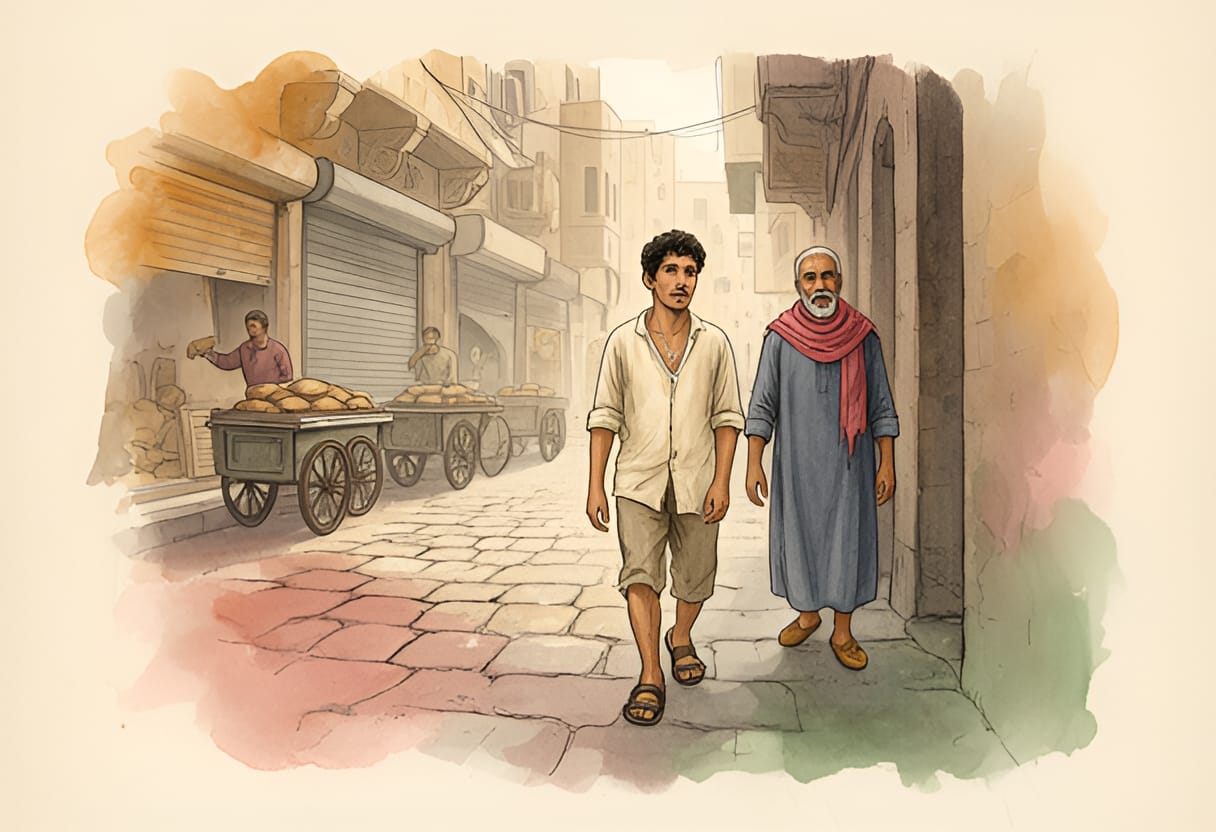
The call to prayer curled through the alleys of Old Damascus like smoke from a brazier, rising above the hum of waking shops and the clatter of carts on cobblestones. Daniel followed Karim through the arched gateway of the Omayyad Mosque, the cool stone beneath his sandals familiar from childhood visits. The courtyard shimmered with morning light, columns standing like sentinels around the vast open space where men in dishdashas and knotted headscarves flowed in rhythmic unison toward the qibla. Daniel moved with them, forehead touching cool stone, the weight of the past week lifting slightly in the shared silence of prayer.
When they rose, Karim gripped his arm. “Stay close today,” he murmured, eyes scanning the crowd. “Something’s in the air.”
Daniel nodded, though he felt only the usual peace of the mosque — the scent of incense, the murmur of voices, the sun warming the ancient stones. They stepped back into the street, where vendors were already arranging pyramids of oranges and stacks of flatbread. A group of boys laughed near a tea stall, kicking a dented can between them. Life, it seemed, had not paused.
But as they walked toward the souq, the tone shifted. A man stood on a crate near the mosque’s outer wall, voice raised not in prayer but in protest. “Enough!” he shouted. “Enough humiliation! Enough fear!” Others gathered — shopkeepers, students, women in headscarves — their faces tight with anger. Daniel’s pulse quickened. This was not the organized rally he’d seen on television; this was raw, unplanned, rising from the stones themselves.
Karim’s hand tightened on his elbow. “Come on,” he said, low and urgent. “We need to get out.”
But Daniel couldn’t move. The man on the crate was speaking of Daraa — of children taken from their homes for writing slogans on school walls, of fathers beaten in front of their families. The crowd swelled, voices rising in unison: “Ash-sha’ab yurid isqat an-nizam!” The people want the fall of the regime!
Then came the shout — not from the crowd, but from the side street. Armored vehicles rolled into view, black and menacing, tires crunching over gravel. Soldiers poured out, rifles at their shoulders, faces hidden behind mirrored visors. A canister arced through the air — white smoke blooming where it struck the ground. Tear gas. Daniel’s eyes burned, his throat seized. He coughed, stumbling backward as the wind shifted, carrying the acrid cloud toward them.
Karim shoved him behind a column. “Breathe through your shirt!” he yelled over the rising panic. Daniel did as he was told, pulling his cotton collar over his nose and mouth, tears streaming down his face. People screamed, some fleeing, others standing their ground, waving makeshift banners — bits of cloth tied to sticks. A young man in a stained shirt climbed onto a low wall, arms raised, shouting something Daniel couldn’t hear over the roar of the crowd and the hiss of more gas canisters landing nearby.
Then — a crack. Sharp. Instant.
The young man jerked, as if pulled by an invisible string, and crumpled against the wall. Blood bloomed dark on his chest, spreading fast. Someone yelled, “Medic!” but the soldiers were advancing now, boots pounding, rifles leveling not into the air but into the crowd.
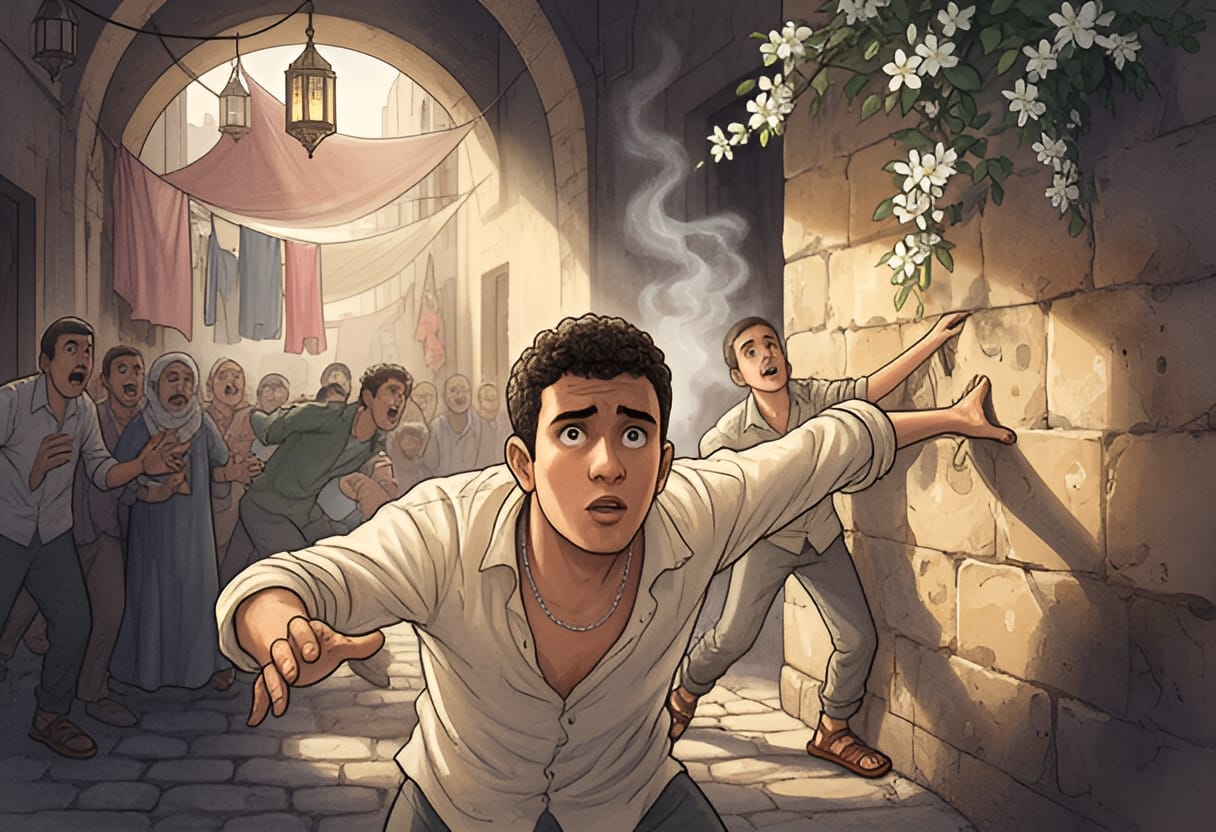
Daniel’s breath came in ragged gasps. His eyes burned not just from gas, but from shock. He lunged forward, ignoring Karim’s shout, and dropped to his knees beside the fallen boy. The boy’s breathing was shallow, wet. Daniel pressed his hands to the wound, feeling the slick warmth, the frantic flutter beneath his palms. “Hold on,” he whispered, though he knew it was useless. “Help is coming.”
Two men arrived — one with a red cloth tied around his arm, the other carrying a folded stretcher. Together, they lifted the boy, Daniel supporting his shoulders, the boy’s head lolling back, eyes half-open, unfocused. They moved as quickly as they could through the chaos, dodging running figures and the occasional spray of gas. Bullets kicked up dust near their feet. Daniel’s heart hammered against his ribs — not with fear, but with a fierce, dizzying urgency. This was not abstract. This was real. This was blood on his hands, a life slipping away in the sunlight of a Damascus morning.
They reached a clinic tucked behind a shuttered pharmacy — a room with whitewashed walls, a cot in the corner, a shelf of dusty medicines. The men laid the boy down. Daniel knelt beside him, wiping sweat and grime from his forehead with the edge of his shirt. The boy’s lips moved. Daniel leaned in.
“Tell my mother…” the boy gasped, then fell silent. His chest stilled.
Daniel sat back on his heels, blood drying sticky on his palms. The room smelled of antiseptic and sweat. Outside, the sounds of gunfire had faded into the distance, replaced by the wail of sirens and the distant rumble of engines retreating.
Karim stood in the doorway, face pale, eyes wide. “We have to go,” he said, voice tight. “Now. They’ll be searching for anyone who was there. Anyone who helped.”
Daniel looked down at his hands — still trembling. He thought of the za’atar jar on his windowsill in London. He thought of his father’s voice, quiet and steady, teaching him the names of stars. He thought of the boy’s last words, half-formed, directed at a mother who would never hear them.
“I’m ready,” he said, standing.
Karim nodded, already moving toward the door. “Then let’s get out of Damascus. Before it’s too late.”
They stepped back into the street. The sun hung high now, harsh and unforgiving. The souq was empty — stalls abandoned, goods left behind. A single sandal lay in the gutter. Daniel walked beside Karim, his steps quick, his mind racing. The city he had loved, the streets he had walked as a boy, had cracked open beneath his feet. And there was no going back to the way things were.
They moved west through back alleys, avoiding the main roads where checkpoints were already being set up. Karim led him past bakeries with their doors shut, past homes where curtains twitched nervously behind cracked shutters. No one spoke. The weight of what they’d seen pressed between them like a stone.
By late afternoon, they reached the outskirts of the city, where orchards gave way to rocky hills. Karim stopped beside a dry streambed, breathing hard. “We can’t go back,” he said, not as a question, but as a statement. “Not anymore.”
Daniel looked toward Damascus — a haze of dust and distance on the horizon. The minarets were still visible, the domes gleaming faintly in the sun. But the city felt like a memory already, slipping away.
He touched the pocket where his passport lay — British, blue and solid — and thought of the jar on his sill in London. It wasn’t just a promise to his father anymore. It was a promise to the boy who had whispered his mother’s name into the silence.
He turned to Karim. “Then we keep going.”
Karim nodded. “To Aleppo. My cousin has a garage there. We can lie low.”
Daniel didn’t answer. He was already walking, boots crunching on stone, heading west — not because he knew what lay ahead, but because staying still was no longer an option. The tremor had passed. The storm was coming. And for the first time in years, Daniel was not just watching the sky.
He was moving through it.
The old sedan sat abandoned beside the orchard wall, its driver’s door ajar, keys still in the ignition. Karim moved first, slipping inside and turning the key. The engine coughed once, then caught with a ragged growl. Daniel climbed in beside him, shutting the door softly. No lights. They pulled away in darkness, tires whispering over gravel and dry grass, heading north.
The city lights of Damascus faded behind them, swallowed by the rolling hills. Karim drove with one hand on the wheel, the other resting on the gearshift, eyes fixed ahead. Daniel stared out the window, the night air cool through the cracked glass. The za’atar jar in London felt suddenly distant, not just in miles but in meaning — a relic of a life that now seemed to belong to someone else.
They passed through small villages where doors remained shuttered and no lights showed in windows. Occasionally, the distant pop of gunfire echoed from the south, muffled by distance but unmistakable. Karim didn’t speak. Neither did Daniel. The silence between them was not empty; it was filled with the weight of what they’d left behind and the uncertainty of what lay ahead.
After an hour, Karim turned onto a narrow track that wound between olive groves and stone walls. The sedan lurched over ruts, headlights off, relying only on the faint starlight and Karim’s knowledge of the land. Daniel thought of his father teaching him to navigate by the stars in the desert of southern Syria, long ago. Now, the sky felt less like a guide and more like a witness.
They bypassed Homs entirely, taking a circuitous route through farmland and rocky passes. Near the industrial outskirts, Daniel saw it — a thin plume of smoke rising from a factory complex, orange at the base, gray above. No flames visible, but the smoke curled steadily upward, deliberate. Karim glanced at it, jaw tightening, then returned his focus to the road.
“We’ll go around,” he said quietly. “No need to draw attention.”
Daniel nodded. He thought of the weaver’s roof in Homs, the tea and figs, Amti’s folktale half-told. It felt like another lifetime.
As they neared Hama, the terrain opened into flatter plains crossed by irrigation canals. Karim slowed as they approached the Nahr al-Bared bridge, a stone arch spanning the river. Daniel tensed, expecting a checkpoint, but saw none — only stillness. Then, through the trees on the far bank, he saw them: armored vehicles, low and angular, their guns covered but unmistakable. Soldiers moved with purpose, unloading equipment, checking ropes and chains. A tank sat idle near the approach, its barrel pointed skyward like a question.
Karim eased the sedan to a stop behind a bend in the road, where a clump of fig trees concealed them. He killed the engine.
“They’re deploying,” he whispered. “Not just patrolling. This is buildup.”
Daniel watched as a second truck rolled up, its tarp flapping in the night breeze. Men in uniform jumped down, shouting orders that carried faintly across the water. No lights. No sirens. Just the quiet efficiency of forces taking ground.
“They’re sealing the north,” Karim said. “Cutting off routes. Making it harder to move.”
Daniel turned to him. “What do we do?”
Karim was already turning the key. “We go now. Before they close it completely.”
They crept forward, lights still off, tires whispering on the damp road. As they passed the bridge, Daniel held his breath. No one challenged them. The soldiers appeared absorbed in their work, backs turned, radios crackling. The sedan rolled past, invisible in the dark, and they were through.
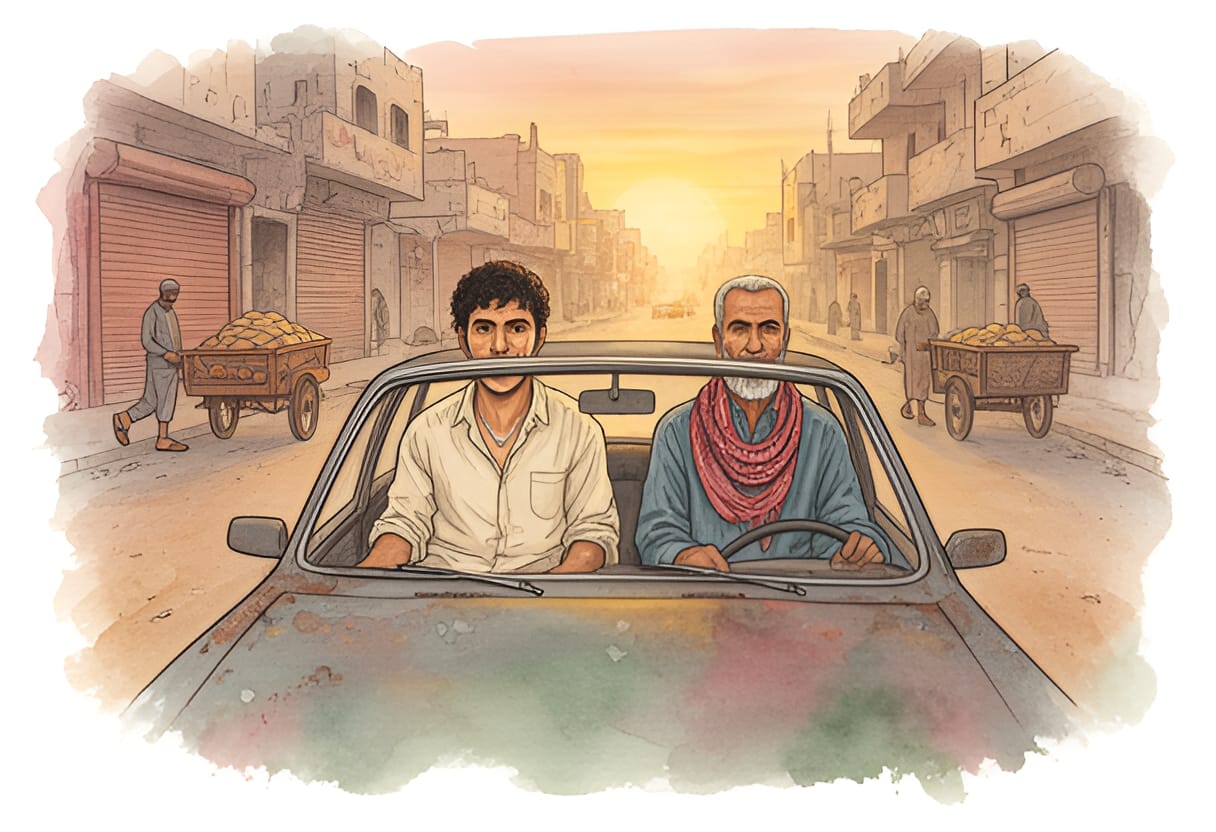
After that, the road opened. They drove faster, sticking to secondary routes, avoiding towns where patrols might be set up. The sky began to lighten in the east, a slow bleaching of indigo to gray. By the time they approached Aleppo, the first true light of dawn was touching the minarets and domes, gilding the edges of the city like a promise.
Aleppo was awake, but not alarmed. Shopkeepers rolled up metal shutters. Bread carts clattered over cobblestones. A call to prayer drifted from a nearby mosque, clear and strong. Yet there was tension in the air — a stiffness in the way people walked, eyes darting, conversations cut short when strangers passed. Daniel noticed the absence of women in the streets, the prevalence of men in plain clothes who watched too closely.
Karim guided the sedan through narrow alleys toward the Christian quarter, where the buildings were older, the stones worn smooth by centuries. He turned into a courtyard tucked behind a bakery, where a man in his fifties stood wiping his hands on an apron, his face breaking into relief when he saw Karim.
“Ya Karim! I thought the worst,” the man said, embracing him briefly. “You made it.”
“Thanks to God and back roads,” Karim replied. “This is Daniel. An old friend. He needs a place to lay low for a few days.”
The man studied Daniel — his dusty clothes, the dried blood still faintly visible under his nails, the exhaustion in his eyes. Then he nodded. “George. My garage is behind the house. You can stay in the room above it. Quiet. No one comes unless called.”
Daniel followed George through a side door into a cool, dim space smelling of oil and rubber. The garage held two old cars under tarps, tools hanging in orderly rows on the wall. A narrow staircase led up to a small room with a bed, a washbasin, and a window overlooking a garden of jasmine and lemon trees.
“I’ll bring tea and bread,” George said. “Rest now. You’ve earned it.”
Daniel sat on the edge of the bed, the mattress firm beneath him. The events of the last hours replayed — the boy’s whisper, the weight of his body, the frantic drive through darkness. He thought of his sister Layla in London, wondering if she knew what was happening, if she prayed for him each night as their mother once did. He touched his pocket — the passport was still there, British and blue, a quiet anchor.
Outside, the call to prayer faded. A rooster crowed. Somewhere, a hammer tapped on metal — life continuing, indifferent or unaware.
He lay down, fully clothed, and slept without dreaming.
I woke with the first light filtering through the jasmine leaves, the scent sharp and sweet in the cool air. My body ached from sleeping fully clothed, but my mind was clearer than it had been in days. I sat up, rubbing the sleep from my eyes, and listened. The garage was quiet now — no hammering, no voices. Just the distant murmur of the city beginning its day.
George appeared in the doorway with a tray holding two glasses of tea and a plate of warm flatbread. He set it down on the washbasin and nodded toward the bed.
“You slept deep,” he said. “Good. You needed it.”
I took the tea, the warmth seeping into my palms. “Thank you. For everything.”
He waved a hand. “Karim is family. You are, too, now. We help our own.”
I sipped the tea, sweet and strong, and felt the tension in my shoulders ease, just a little. But beneath it, a thought had been growing since we crossed the bridge at Nahr al-Bared — insistent, unavoidable.
I set the glass down. “I need to go back to Damascus.”
George paused, the cloth he’d been wiping his hands with still in his grip. “Back? Why?”
“My passport,” I said. “It’s still at Karim’s apartment. And my notebook. I left them in my bag by the door when we fled. I didn’t think — ”
“You thought you’d be back in a day,” George finished for me. “We all did.”
I nodded. “I can’t leave them there. Not just the passport — though I’ll need it if I’m to leave the country — but the notebook. It has everything. Addresses, names, the stories Karim told me about the souq, the weaver in Homs… even Amti’s folktale. It’s not just paper. It’s memory.”
George looked at me for a long moment, then sighed. “You’re right. It’s not just paper. But Damascus isn’t safe. Not for you. Not for anyone with a foreign passport.”
“I’ll be careful,” I said. “I’ll go at night. Take back roads. Karim knows the ways — he can guide me remotely, if we can get a signal.”
He studied me, then nodded slowly. “I’ll lend you the sedan. It’s got half a tank, and I’ve filled a jerrycan. But you go alone. I won’t risk Karim’s cousin being seen helping a foreigner double back into the belly of the beast.”
“Thank you,” I said, standing. “I won’t be long.”
I packed quickly — a spare shirt, the length of cord from the pouch, the dried dates, and the smooth dark stone Karim had given me at Tanf. I left the notebook and passport where they were, of course, but I carried the stone in my palm as I walked out into the courtyard. The sun was higher now, painting the stone walls gold. A woman hung laundry on a line between two buildings, her face turned away as I passed.
George waited by the car, keys in hand. “Drive slow. Keep your head down. And if you see a checkpoint — any checkpoint — turn around. No arguments.”
I got behind the wheel, the familiar weight of the steering wheel grounding me. “I will.”
We drove in silence through the quiet streets of the Christian quarter, past bakeries just opening, past men sweeping dust from their doorsteps. George pointed out a side street that would take us toward the western outskirts, avoiding the main routes where patrols were likeliest.
“Go with God,” he said, placing a hand on my shoulder. “And come back whole.”
I gripped his forearm. “I will.”
Then I was alone, the sedan eating up the kilometers as we left Aleppo behind. The road climbed gently, passing through orchards and stone villages where life seemed to move at its own unhurried pace. Children waved from the edges of fields. An old man led a donkey cart loaded with sacks of grain. For a moment, I could almost believe the war was a rumor, a bad dream I’d shaken off.
But then, near the town of Ramtha, the sky darkened — not with clouds, but with smoke. Thin, gray tendrils curled above a cluster of buildings to the east. I slowed, frowning.
“It’s just a burning tire,” I muttered to myself. “Or trash. Nothing to worry about.”
I kept going, following the narrow track Karim had described — the one that wound through farmland and crossed a dry wadi before rejoining the main road farther north. The sedan shuddered over potholes, kicking up dust. I rolled down the window, letting the hot, dry air fill the cabin.
Then, suddenly, there it was — a checkpoint. Not the formal kind with concrete barriers and uniformed soldiers, but a makeshift blockade of sandbags and overturned carts, strung with barbed wire. Three men stood beside it, wearing black uniforms without insignia, their faces wrapped in keffiyehs. They held rifles loosely, but their eyes were sharp, scanning every vehicle that approached.
My heart jumped. I eased off the accelerator, letting the car coast to a stop ten meters away.
One of them stepped forward, gesturing with the barrel of his gun. “Out. Now.”
I swallowed, my mouth dry. “I’m just passing through. I have family in Aleppo.”
“Out,” he repeated, his voice flat. “Hands where I can see them.”
I did as told, opening the door slowly and stepping onto the hot asphalt. My palms were slick. I lifted my hands, fingers spread.
Two of them came to either side of me, rough hands grabbing my arms. “Search him,” the leader said.
They patted me down — pockets, waistband, ankles — then turned to the car. I watched helplessly as they flung open the doors, tore off the tarps, and scattered my belongings across the ground. The spare shirt, the cord, the dates — all tossed aside like rubbish.
Then one of them held up my phone, the screen cracked from when I’d dropped it in the rush to leave Damascus. He flicked it on. The wallpaper was a photo of Layla and me, taken on Primrose Hill the summer before I left London.
“You were filming,” the man accused. “Filming our positions. Our movements.”
“I wasn’t,” I said, my voice tight. “I was just… checking the time. I wasn’t even recording.”
He didn’t listen. He shoved the phone into his pocket and nodded to his companions. “Blindfold him. Put him in the van.”
Panic flared, hot and sharp. “No — please — I’m not a spy. I’m a British citizen. I have my passport — ”
“Your passport is in Aleppo,” he said, almost smiling. “And you’re not going there.”
They grabbed me from both sides, despite my struggling. A rough cloth was pressed over my eyes, cutting off the world. I smelled sweat and dust, and something metallic — fear, maybe, or blood. My arms were wrenched behind my back, and I was lifted, feet dragging, then shoved hard into the back of a van. The door slammed shut, plunging me into darkness and the smell of rubber and oil.
The engine coughed to life. The vehicle lurched forward, throwing me against the side. I curled inward, protecting my head, my breath coming in short gasps.
Time lost meaning. The van rattled over rough tracks, then smoothed onto pavement. I could tell we were moving fast — too fast for back roads. My shoulders ached from being bound, and the blindfold was damp with sweat. I tried to steady my breathing, to think of Layla’s face, of the za’atar jar on my windowsill in London, of the stone still warm in my fist — had I kept it? I couldn’t remember letting go.
Then the van slowed, turned, and stopped. The doors flew open. Light stabbed through the blindfold as hands grabbed me again, hauling me to my feet.
“On your knees,” a voice barked.
I stumbled forward, hitting something hard — concrete, maybe — and went down. The impact knocked the wind from me. I gasped, tasting dirt.
“Who sent you?” another voice demanded. “MI6? CIA? Tell us, and we’ll make it quick.”
“I’m not a spy,” I choked out. “I’m a traveler. I was visiting my friend. I only went back for my passport — ”
“Liar,” the first voice snapped. “You were filming. We saw the lens pointed at our checkpoint. You were counting vehicles. Noting directions.”
“I wasn’t!” I protested, twisting my head toward the sound. “I swear on my mother’s grave — ”
A boot connected with my ribs. I curled inward, a cry tearing from my throat.
“Enough,” said a third voice, calmer. “We’ll get the truth out of him. Take him inside.”
They hauled me up, my legs weak, and half-carried, half-dragged me across uneven ground and up a flight of stone steps. The air smelled of damp and mildew. A door creaked open, and I was shoved forward into a room that smelled of sweat and smoke.
The blindfold was ripped off.
I blinked against the sudden light. The room was bare — concrete walls, a single bulb hanging from the ceiling, a metal chair in the center. On a wooden table sat a notebook, a pen, and a small glass of water.
And standing beside the table, arms crossed, was a man I knew all too well.
Karim.
But his eyes were hollow. His face was bruised. And he wasn’t looking at me.
He was looking past me — at the men in black who had brought me here.
And in his gaze, I saw not recognition.
But betrayal.
The bulb swung slightly, casting long, trembling shadows across the concrete. Karim didn’t move. His gaze remained fixed on the three men in black, his jaw tight, his shoulders hunched as if bracing for a blow that had already landed.
“You know him?” the leader asked, stepping closer to the table. His voice was low, but it cut through the silence like a blade.
Karim didn’t answer. He swallowed hard, his Adam’s apple bobbing. When he finally spoke, his voice was rough, scraped raw.
“I… I grew up with him. In Damascus. We went to the same school.”
The man’s eyes narrowed. He turned to me, studying my face as if seeing me for the first time. “And yet you were filming us. Counting our cars. Mapping our routes.”
“I wasn’t,” I said, my throat raw from shouting, from dust, from fear. “I swear. I was only trying to get to Aleppo. To find my passport. My notebook — ”
“The notebook,” the leader said, picking it up. He flipped it open. Pages fluttered — sketches of ruins, notes in English, a pressed flower between the lines. He frowned. “This is not the work of a tourist.”
“I study architecture,” I said. “I’ve loved these stones since I was a boy. My father — ”
“Your father?” The man snorted. “What does he have to do with this? You think blood washes clean every sin?”
I felt the stone in my pocket — smooth, warm from my fist. I hadn’t let go. Not once.
The leader slammed the notebook shut. “You have two choices. Sign the confession. Say you were sent by MI6. That you were gathering intel for a foreign power. Or we make you disappear. Quietly. Like so many others.”
I looked at Karim. He wouldn’t meet my eyes.
“I won’t lie,” I said. “I’m not a spy. I’m Daniel Karim Haddad. I was born in London, but my family is from here. From Deir ez-Zor. My grandfather was Sheikh Suleiman al-Haddad. He taught the Quran in the old mosque near the river. He helped the poor. He kept the peace.”
A flicker passed through the leader’s expression — not belief, but calculation. He exchanged a glance with his second.
“Prove it,” he said. “Or we’ll break you until you wish you had.”
They left me alone then. The door clanged shut. The bulb buzzed overhead. I sank into the chair, the cold seeping through my shirt. My ribs throbbed with every breath. I pressed the stone into my palm and closed my eyes.
They came for me at dawn — or what passed for dawn in that windowless room. The light under the door shifted from black to gray. Two men unlocked the door, yanked me to my feet, and shoved me toward the table again.
“Last chance,” the leader said, sliding a paper and a pen toward me. “Sign. Or we start again.”
I picked up the pen. My hand shook. I could write my name. I could write a lie. I could save myself — if saving myself meant becoming something I wasn’t.
I set the pen down.
“I won’t sign a lie,” I said.
The leader’s face hardened. He nodded.
The first blow came across my cheek — sharp, burning. My head snapped to the side. I tasted blood. They didn’t ask again. They just hit me. Again and again. Not to get answers. To break me.
They dragged me to the floor. Kicked my ribs. Stomped on my ankle. I curled into a ball, protecting my head, whispering Layla’s name under my breath. I thought of the za’atar jar on my windowsill. I thought of Primrose Hill. I thought of the stone — still in my fist, still warm.
They left me there. Bleeding. Shaking. The bulb swung. Time dissolved.
They returned hours later. Same routine. Paper. Pen. Silence. I didn’t move. They beat me again — less this time, but enough to leave me gasping, my lip split, my eye swelling shut.
Night came. Or I thought it did. The light never changed. But the air grew cooler. My body ached in places I couldn’t name. I drifted in and out, haunted by fragments — Karim’s hollow eyes, my mother’s voice singing an old lullaby, the call to prayer drifting over Damascus rooftops.
On the third night, the door opened differently.
Not with boots. Not with shouts.
A single figure stepped in — old, wrapped in a woolen cloak, his face lined like dried earth, his eyes sharp despite the gray in his beard. He carried a wooden staff and smelled of sand and sage.
He didn’t look at me at first. He looked at the three men in black, who stood stiffly, almost deferentially.
“Sheikh Suleiman’s grandson,” the old man said, his voice low and rough, like stone grinding on stone. “I knew him well. He buried two of my brothers during the fever of ’58. He gave my daughter her wedding gold when her husband left us.”
The leader shifted. “This boy claims kinship. We have no proof.”
The old man turned to me. His gaze was piercing, not unkind, but searching — as if he could see into my bones.
“Tell me,” he said. “What did your grandfather say when the wind blew strong from the east?”
I swallowed. My throat was raw. My tongue felt thick.
“He said,” I whispered, “that the east wind carries the voices of the ancestors. That we must listen, even when we are afraid.”
The old man closed his eyes. A slow nod. When he opened them, there was tears in them — or maybe just the damp of the cell.
“He was a just man,” the elder said. “And you carry his silence well.”
He turned to the commander. “Release him. Let him go west. Toward the desert. Tell him to walk until he finds the Euphrates. Let him pray at the old well. If he is true, he will know the way.”
The leader hesitated. “He was seen near our lines. He has a British passport. He was filming.”
“The passport proves nothing but travel,” the elder said. “And if he were a spy, he would not have come back for a notebook full of ruins and a photo of his sister. Spies do not weep for their families. They do not keep stones from Palmyra in their pockets.”
A long silence. The three men exchanged looks. Then the leader sighed — a sound of resignation, not agreement.
“One hour,” he said. “Then he walks. No supplies. No escort. If he is caught again, we will not be responsible.”
The elder bowed his head slightly. “That is all I ask.”
They untied my wrists. My ankles. They gave me back my phone — cracked, useless — and the stone, which I realized I had never lost. They shoved a dented flask of water into my hand and pointed to a narrow trail behind the building.
“Go,” the leader said. “And do not look back.”
I stepped into the night air — cool, sharp, smelling of dust and distant woodsmoke. The stars were blazing overhead, unblinking. I didn’t look back at the building. I didn’t look for Karim.
I touched the stone in my palm. I felt the weight of the flask. I whispered, not to them, not to God, but to the wind — to the east wind — the same words my grandfather had taught me:
I am still listening.
Then I turned west and began to walk.
Chapter 3
Years in the Dark
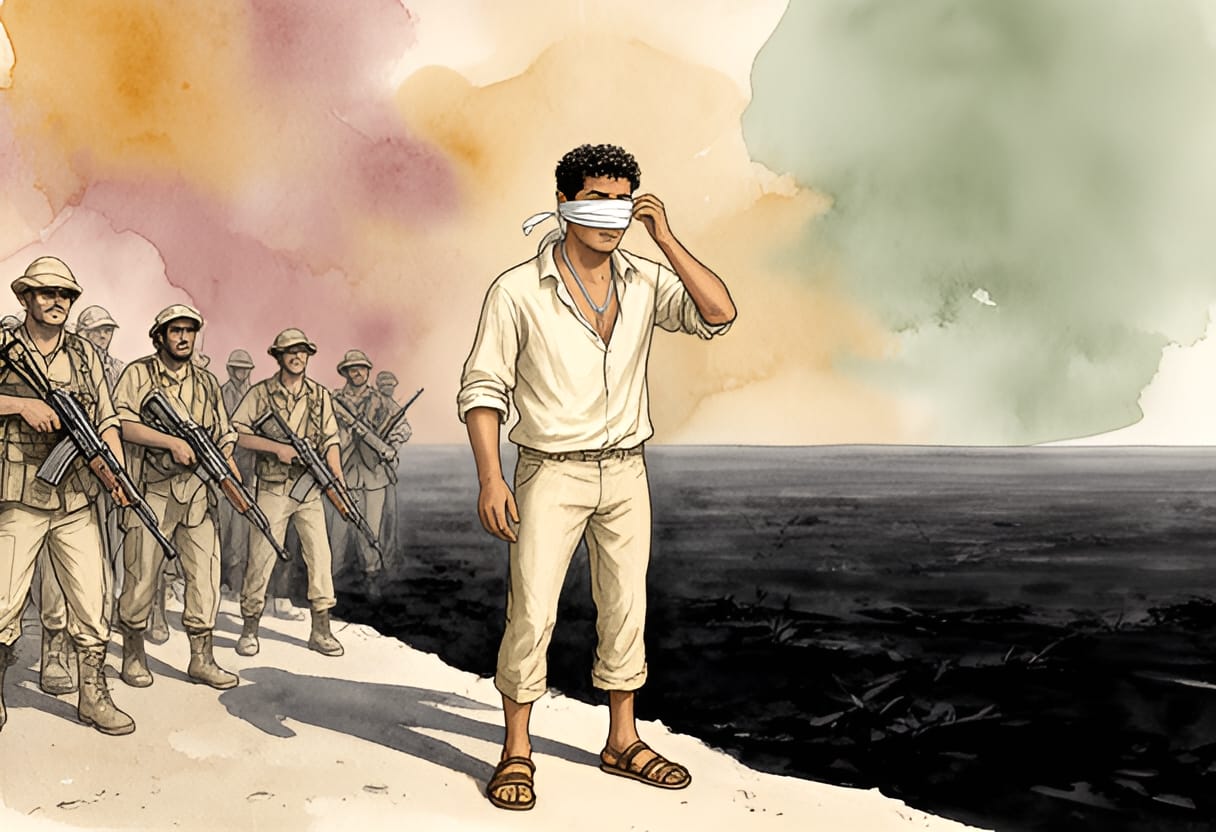
The blindfold came off with a snap of elastic against my temple. Blinding sunlight flooded in, and I blinked against it, my head pounding from the blow that had felled me. I was on my knees in the dust, hands still bound behind my back, the acrid smell of gunpowder and sweat thick in my throat. Around me, voices shouted in rapid Arabic—accusations, questions, the cocking of rifles. A boot nudged my ribs. “Spy,” someone spat. “British spy.” The word hung in the air like a curse.
I tried to speak, to explain that I was just a traveler, that I had come to see my homeland, but a fist struck the side of my head and the world tilted. I fell sideways, cheek pressed to the hot earth, tasting blood and grit. Then, as suddenly as it had begun, the chaos shifted. Shouts turned to murmurs. Rifles were lowered. A new voice, older, calmer, cut through the tension: “Enough. He is not armed. He is not wearing a uniform. Let the sheikhs decide.”
Strong hands hauled me to my feet. The blindfold was retied, tighter this time, and I was shoved forward, stumbling over rocks and scrub. We walked for hours, maybe more, the sun beating down relentlessly. My captors spoke little, their steps sure and silent across the desert floor. I could feel the land rise and fall beneath my boots—hard basalt plains giving way to softer, sandy wadis, the silence broken only by the rasp of our breath and the occasional cry of a distant bird.
When the blindfold was finally removed, we stood at the edge of a vast, blackened plain. Jagged flows of ancient lava stretched to the horizon, frozen in time like the petrified ribs of some great beast. The sky above was a bowl of hard blue, empty save for a single circling vulture. To the west, the land dropped away into a deeper gloom—a depression in the earth where shadows pooled like water.
“Tanf,” said the man who had spoken before. He was older than the others, his face leathered by sun and wind, a white scar slicing through his right eyebrow. He wore a faded keffiyeh and a wool cloak despite the heat. “This is where the earth opens. Follow.”
We descended into the depression, the temperature dropping noticeably as we went. The basalt walls rose sheer on either side, their surfaces glassy and dark, reflecting the weak light like mirrors. After a time, the passage opened into a wide cavern, its ceiling lost in gloom. Flickers of flame danced ahead—small fires set in recesses, casting long, dancing shadows on the walls. The air was cool and damp, smelling of stone and woodsmoke and something sweet—dates, maybe, or dried figs.
People emerged from the shadows. Men, women, children. Their clothes were plain, patched in places, but clean. They watched us without fear, their eyes assessing but not hostile. The elder stepped forward, placing a hand over his heart. “Marhaban,” he said. “You are safe here, for now.”
He led me to a fire where an old woman sat grinding grain between two stones. She looked up, her face a map of wrinkles, and nodded. “Sit,” she said in a voice like dry leaves. “You look like the wind has carried you far.”
I lowered myself onto a woven mat, my shoulders trembling with exhaustion. She handed me a piece of flatbread, still warm, and a small bowl of thick white cheese. I tore off a piece and ate slowly, the salt and fat grounding me. Around us, voices rose and fell in quiet conversation. A girl no older than ten braided her sister’s hair near the fire. An old man smoked a long-stemmed pipe, his eyes half-closed. Life persisted here, stubborn and quiet.
After I had eaten, the woman gestured for me to follow. She took me to a narrow cleft in the rock where several families had carved out living spaces—sleeping pallets, low shelves holding clay pots, niches for lamps. In one corner, a young woman sat weaving on a small loom, her fingers flying across the threads. The pattern she was making was unfamiliar—geometric, stark, like a star trapped in a diamond.
“I am Elias’s sister,” she said, noticing my gaze. “He taught you the Homs Star, yes? This is something older. We call it the Desert Rose. It blooms only in hard ground.”
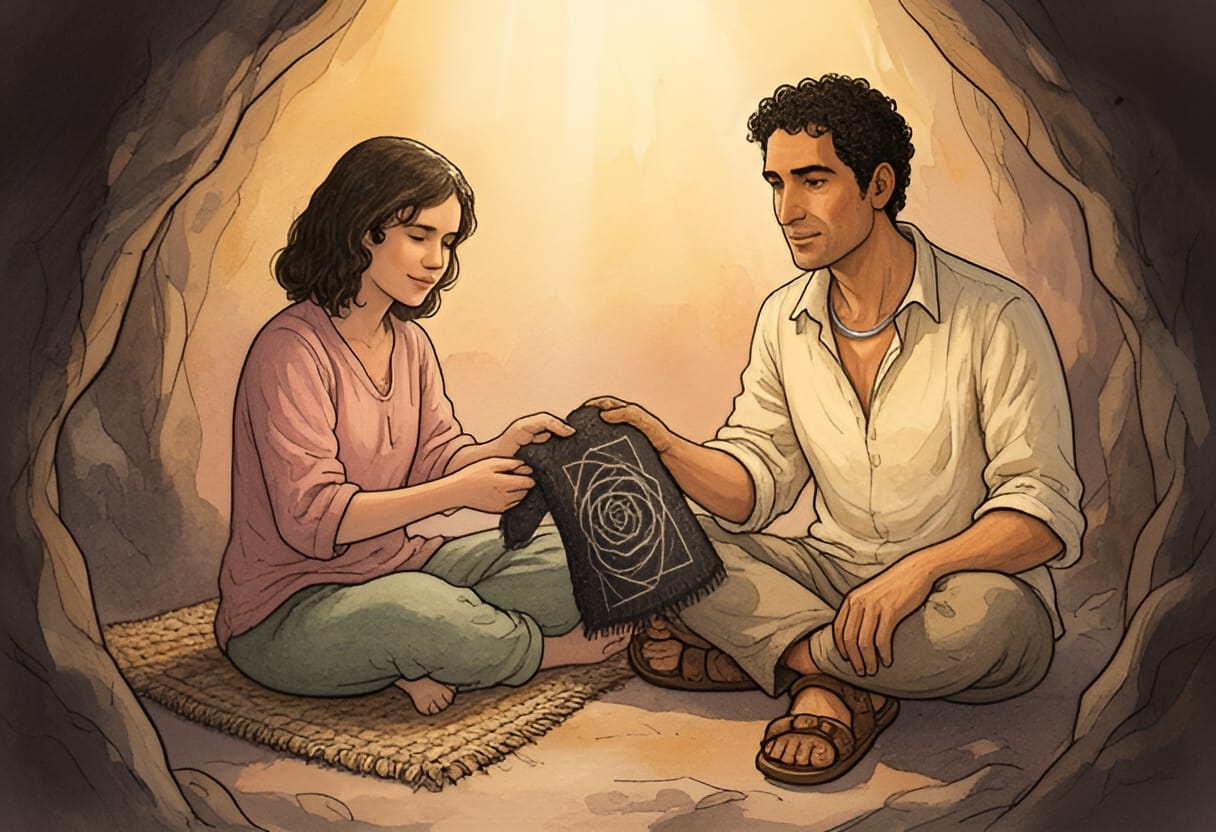
I touched the edge of the fabric. It was rough but fine, the wool spun tight. “It’s beautiful,” I said.
She smiled faintly. “We make it to remember. Not just what we lost, but what we still carry.”
Later, as the fire dimmed to embers, the elder sat beside me. He did not speak at first, just stared into the dying glow. Then, softly: “You are not the first foreigner to come here seeking refuge. Nor will you be the last. But you are the first who asked about the pattern.”
“I was told to look for signs,” I said. “That the land remembers what people forget.”
He nodded. “The land remembers. But people? They forget quickly when they are afraid. Or when they are told to forget.”
I thought of Karim, of the souq in Damascus, of the way the stars had come out over Palmyra’s colonnades. I thought of the za’atar jar on my windowsill in London, how I had not touched it since I left, afraid that if I opened it, the scent would break something inside me.
“I need to go north,” I said finally. “To Aleppo. I heard there are journalists there—foreigners who are allowed to bear witness.”
The elder’s eyes narrowed. “Aleppo is a broken city now. The rebels hold parts of it, but the ring is tightening. The roads are watched. You will not pass easily.”
“I have to try,” I said. “My sister… she is in London. But I need to know what is happening. I need to see it with my own eyes.”
He was silent for a long time. Then he stood and walked to the mouth of the cavern, where a narrow slit in the rock framed a sliver of starlight. When he returned, he placed a small leather pouch in my palm. Inside were a few dried dates, a length of cord, and a smooth, dark stone worn flat by water.
“Take this,” he said. “It is not much. But it is ours. And if you are stopped, show it to those who know the old ways. They will understand.”
I closed my fingers around the pouch. “Thank you.”
He placed a hand on my shoulder, his grip firm but kind. “Go with care. The desert does not forgive arrogance. But it honors those who listen.”
Two months later, I crouched behind a crumbling wall on the outskirts of a town whose name I dared not speak. The sky was turning pink at the edges, the first light of dawn spilling over the rooftops. Below, in the narrow street, a pickup truck rumbled past, its bed filled with fighters in mismatched uniforms, a black flag snapping from the cab. I held my breath until it was gone, then melted back into the alley.
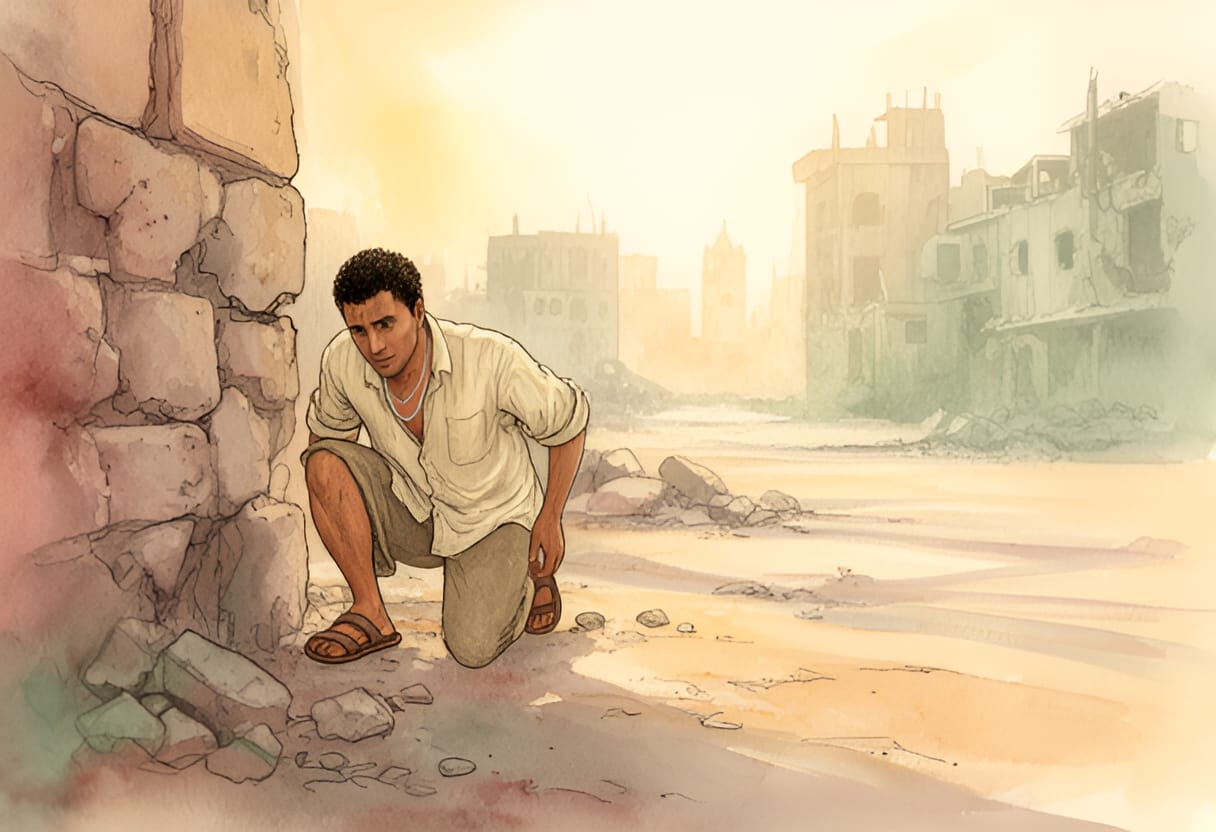
I had made it this far—through the desert, past checkpoints where I showed the stone and was nodded through, through villages where people shared their bread and warned me of patrols. Now, Aleppo lay ahead, a city half in ruin, half in defiance.
I had heard whispers in the cave settlement, then in the rebel-held towns I passed through: there was a corridor. Not for arms, not for fighters, but for stories. Journalists, activists, even ordinary people with cameras—smuggled in through the north, out through the same routes, their footage and testimony reaching the outside world. It was thin, fragile, but it existed.
I touched the stone in my pocket. It was warm from my skin.
I was not a fighter. I was not a spy. I was a man who had once traced the columns of Palmyra with his fingertips, who had woven a star pattern with an old weaver in Homs, who had sat on a rooftop eating figs while his friend’s aunt told tales of jinn and justice.
But now, I carried something else. A debt. A need to bear witness.
I straightened my back, adjusted the strap of the battered bag at my feet—inside, a notebook, a pen, a spare shirt—and stepped into the street.
The city did not greet me with fanfare. But it did not turn me away.
I walked on.
I walked on, the early light catching dust in the air like scattered gold. The streets of Aleppo were quieter than I remembered, the usual hum of commerce replaced by the occasional bark of a dog or the distant echo of artillery. Shops stood shuttered, their metal doors pulled down like blinds against a storm. Graffiti scarred the walls—slogans in Arabic I could not read, stenciled hands, the occasional dove with a broken wing. I kept my head low, the collar of my jacket turned up against the chill, and moved with the flow of the few people still out: women wrapped in thick shawls hurrying home with baskets, an old man pushing a cart stacked with scavenged wood, a boy no older than ten carrying a jerrycan with both hands, his face set in grim concentration.
I had been walking for hours when the first checkpoint appeared—a sandbagged barrier across the road, flanked by two concrete bunkers. A faded government flag hung limp from a pole between them. Soldiers in mismatched fatigues lounged against the sandbags, one cleaning a rifle with a rag, another sipping tea from a glass held in both hands. They straightened as I approached, eyes sharp, hands drifting toward the butts of their weapons.
“Halt,” said the one nearest me, his voice flat. He was younger than the others, clean-shaven, with a scar that ran from his temple to his jaw. “Identification.”
I stopped, hands open at my sides. “I am a civilian,” I said, keeping my tone even. “I am trying to reach Homs. My sister lives there.”
He didn’t move. “Papers.”
I reached slowly into my inner jacket pocket, the one closest to my heart, and pulled out the leather pouch the elder had given me. I unfolded it just enough to show the smooth stone, the dried dates, the cord. I held it out, palm up.
The soldier frowned. “What is this?”
“It is a sign,” I said. “From the desert. It means I mean no harm.”
He snorted and waved it away. “We don’t care for signs. We care for papers. Passport. ID.”
“I don’t have one,” I said. “I left it in Damascus when I fled. I have only this.” I tapped my chest. “And the truth.”
The older soldier, the one with the pipe, pushed himself up. He walked over, his boots crunching on gravel. He took the pouch from the younger man’s hand and turned it over in his palm. He sniffed at the dates, then looked at me, his eyes narrow.
“You are not from here,” he said. “Your accent… it is not Syrian. Not fully.”
“I am of Syrian blood,” I said. “My mother was from Homs. My father… he was from Aleppo. I was born in London, but I came back in 2010 to see my homeland. I have been trying to return ever since.”
The older soldier studied me. Then, suddenly, he laughed—a short, sharp sound. “You think we don’t know your type? We have seen your face before. In the databases. You were photographed at the airport in Damascus, five years ago. British passport. Name: Daniel Karim Haddad.”
My blood turned to ice. I had not thought of that scan—the routine check at immigration, the flash of the camera, the bored officer waving me through. I had forgotten it existed.
“That was five years ago,” I said, my voice tight. “I was a tourist then. I meant no harm.”
“The war changes nothing for us,” the older soldier said. “If you were ever in their system, you are suspect. Especially now. You have been moving through rebel-held areas. You have spoken with foreigners. You carry a notebook.” He nodded toward my bag, where the pen peeked out from the side pocket. “You are not here to visit family. You are here to spy.”
“I am not a spy,” I said, feeling the words scrape my throat raw. “I am a man trying to find his sister. I have not touched a weapon. I have not spoken against the state. I only want to know if she is alive.”
The younger soldier stepped forward, his hand on his rifle. “Then why were you heading toward al-Rastan? That is not the way to Homs from here. That is the way into the north, where the terrorists hold sway.”
“I was told there was a route,” I said. “Through the villages. People said it was safer than the highway. I was trying to avoid the main roads.”
“Safer for whom?” the older soldier said. “For you, or for the ones who send you?”
Before I could answer, two more soldiers appeared from behind the bunkers, each holding a length of rope. They moved fast, grabbing my arms, twisting them behind my back. I did not struggle—I knew it would only make it worse—but my shoulders screamed as they pulled my wrists tight and bound them with rough cord that bit into my skin.
“I am not resisting,” I gasped.
“Save it for the interrogation,” the younger soldier said, shoving me forward toward the truck parked behind the bunkers. It was an old military vehicle, its canvas top faded and patched, the metal dulled by rust. The rear doors stood open, revealing a bare metal interior, slick with oil and something darker that I did not want to identify.
They shoved me inside. I hit the floor hard, my shoulder striking a bolt head. I curled onto my side, pressing my cheek against the cold metal, listening to the soldiers’ voices fade as they climbed into the cab. The engine coughed to life, a harsh, rattling sound that made my teeth vibrate. The truck lurched forward, throwing me onto my back. I rolled onto my stomach and pushed myself up onto my elbows, staring out through the rear flap as the city receded.
We left Aleppo behind, bouncing over potholes and cracked asphalt. The landscape flattened into scrub and stone, the occasional olive tree clinging to life in the gullies. I could not see where we were going, only feel the rhythm of the road—the lurch, the sway, the sudden jolt when we hit a rut. My wrists throbbed where the cord cut into my flesh. I shifted my weight, trying to ease the pressure, but the rope only tightened.
After what felt like an hour, the truck slowed and turned onto a dirt track. The trees grew denser here, their branches scraping the canvas top. We passed a ruined mosque, its minaret snapped clean in half, and then a stretch of road lined with the skeletons of cars, their windows shattered, their interiors picked clean. Finally, the truck came to a halt in front of a low stone building surrounded by a high wall topped with barbed wire. A rusted gate creaked open, and we rolled inside.
The courtyard was packed with men in similar uniforms, some sitting on benches, others pacing, their faces hollow. A few looked up as we passed, their eyes flat, uninterested. No one spoke. The truck stopped beside a loading dock, and two guards in clean uniforms stepped forward. They opened the rear doors and hauled me to my feet.
My legs trembled. I leaned against the truck for support, my head swimming. One of the guards searched me, patting down my pockets, taking the notebook, the pen, the spare shirt. He paused at the leather pouch in my hand, turned it over, then shoved it back at me. “Keep your charm,” he said, his voice flat. “It won’t help you here.”
They led me through a heavy door into a dim hallway lined with cells. The air smelled of damp stone, sweat, and something sharp and chemical—disinfectant, or fear. Fluorescent lights buzzed overhead, casting a harsh glare that made my eyes water. At the end of the hall, a man in a crisp uniform stood behind a desk, his insignia marking him as an officer. He did not rise as we approached. He simply watched me with eyes that had seen too much.
The guards stopped me in front of the desk. One of them spoke in low, rapid Arabic. The officer listened, then flicked a switch on a console beside him. A screen flickered to life, showing a grainy black-and-white image: a younger version of myself, standing in front of the Damascus airport, smiling slightly, holding a small bag. Below it, my name and passport number blinked in green digits.
The officer leaned forward, his fingers steepled. “Daniel Karim Haddad,” he said, his voice low and deliberate. “British citizen. Born in London. Visited Syria in 2010. Returned illegally in 2012. Flagged for possible insurgent contact. Now apprehended near al-Rastan attempting to cross into government-held territory under false pretenses.”
“I was not trying to cross falsely,” I said. “I was trying to reach my sister. She lives in Homs—or she did. I have not heard from her in years.”
The officer’s lip curled. “Your sister is not your concern. The state is. And the state sees you as a threat. You have been in contact with foreign journalists. You have carried recording equipment. You have sought to spread lies about our army.”
“I have carried only a notebook,” I said. “I have written nothing but what I have seen. And what I have seen is not lies. It is truth.”
The officer laughed again, humorless. “Truth is what we say it is. You will learn that here. Now take him to Processing. And remember—no one leaves until we are done with them.”
Two guards took my elbows again, their grips like vises. They turned me down the hall, past the cells where men sat on the floor, their backs against the walls, their eyes staring into middle distance. One man rocked slowly, muttering to himself. Another pressed his forehead to the bars, whispering prayers I could not hear.
We reached a small room at the end of the hall. A metal table stood in the center, two chairs on either side. A lamp hung overhead, its light harsh and direct. The guards shoved me into one chair and snapped a cuff around my right wrist, linking it to the ring bolted to the table. They did the same with my left, spreading my arms wide. My shoulders screamed from the strain.
One guard stepped back. The other stayed, his hand resting on the butt of his pistol. The officer entered, carrying a folder. He sat opposite me, placed the folder on the table, and opened it. Inside were pages of text, photographs, a printout of my passport scan. He did not look at them. He looked at me.
“You will stay here,” he said. “Until we decide what to do with you. You will answer our questions. You will not lie. If you do, we will know. And we will make you wish you had never been born.”
I swallowed, my mouth dry. “I have nothing to hide.”
“We shall see,” he said. He closed the folder and stood. “Take him to Cell Block B. Isolation. Let him think about what he has done.”
The guards uncuffed me from the table, but only to snap new cuffs onto my wrists, this time connecting them behind my back. They half-led, half-dragged me down another corridor, past more doors, more cells, until we stopped at a heavy steel door painted gray. A slot near the bottom clanked open, and a tray with a lump of bread and a cup of water was shoved inside.
The door opened just enough for me to slip through. I stumbled into a cell no larger than a coffin. The walls were bare concrete, the floor slick with damp. A thin mattress lay rolled in the corner. A toilet—a hole in the floor—sat in the far corner, screened by a rusted partition. The door slammed shut behind me, the sound of the bolt throwing echoing like a tomb lid sealing.
I sank to my knees, pressing my forehead against the cold wall. My wrists burned. My shoulders ached. The stone from the pouch was still in my fist—I had not let go. I opened my fingers and looked at it in the dim light that seeped under the door. It was smooth, dark, cool.
I closed my hand around it again and whispered, so low I could barely hear it myself: “I’m still listening.”
Outside, footsteps passed. A door clanged. Somewhere, a man began to sing—a low, broken tune that faded after a few notes. I pulled my knees to my chest and wrapped my arms around my legs, trying to make myself small. The light under the door flickered, then went out.
Darkness swallowed me whole. And in that dark, I held onto the stone, and to the memory of a rooftop in Homs, of figs shared with Karim’s family, of a woman’s quiet voice saying, We make it to remember. Not just what we lost, but what we still carry.
I did not know how long I would be here. I did not know if I would ever see my sister again. But I knew this: I would not forget. And as long as I remembered, I was not yet lost.
I woke to the clang of metal on metal, a sound that seemed to come from everywhere and nowhere at once. My body ached in places I hadn’t known could ache—shoulders, lower back, the soles of my feet. The stone was still in my fist, worn smooth now from constant pressure. I opened my hand and pressed it to my sternum, feeling its coolness against my skin.
The door to my cell slid open with a groan. Two guards stood in the corridor, their faces expressionless beneath the harsh fluorescent light. One held a bundle of rough-spun fabric and a pair of rubber sandals. The other carried a clipboard and a pen that clicked when he moved it.
“Strip,” the first guard said, his voice flat, devoid of inflection. Not Arabic. Not English. Something in between—perhaps a dialect, perhaps just exhaustion wearing down language to its bones.
I did as I was told. My shirt, frayed at the cuffs from weeks of wear, was taken without comment. My trousers, stiff with dried sweat and dust, followed. They ran gloved hands over my arms, my legs, my torso—not searching, it seemed, but cataloguing. Like I was inventory. Like I was already gone.
They gave me the uniform: a thin, faded blue shirt and pants, so thin I could see the weave when held to the light. The sandals were too big, the straps worn thin. No underwear. No socks. Just the fabric and the stone, which I kept clenched in my right hand as they led me down a long hallway lined with doors.
At the end, a man in a slightly cleaner uniform sat behind a desk. He didn’t look up as I approached. He dipped a stamp in ink and pressed it hard against my left forearm.
“14,” he said finally, without lifting his eyes. “Cell 14. Block B. You will eat when they tell you. You will sleep when they tell you. You will speak when they tell you. Until then, you are nothing but a number.”
I looked down at the mark. Bold. Permanent-feeling, though I knew it would fade. Fourteen. Not a name. Not a soul. Just a place in a line.
They took me to a cell at the end of the corridor. The door slammed shut behind me with a finality that made my stomach drop.
Inside, six men sat on the floor, backs against the wall, eyes hollow but alert. They shifted slightly as I entered, making space. No one spoke. The air was thick with the smell of sweat, mildew, and something sour—perhaps urine, perhaps despair.
I sat beside a man with a beard streaked with gray. He nodded at me, then handed me a piece of bread. It was gray at the edges, dense, barely risen. I broke it in half without thinking and gave him back half. He closed his eyes as he ate, as if savoring not the food, but the act of being given something.
Meals came twice a day, if we were lucky. A ladle of thin lentil soup, lukewarm and salty. A piece of bread, sometimes with a smear of something that might have been oil. Once a week, a single boiled egg, split six ways. We ate in silence, our eyes down, our jaws working slowly, as if chewing could stall time.
At night, the cold seeped through the thin mattress. I curled onto my side, pulling the blanket—if you could call it that—over my shoulders. The stone rested in my palm, a small, solid thing in the dark.
It was then that I began to recite.
At first, it was just fragments—lines from poems my father used to read aloud in the kitchen, his voice low and rhythmic as he stirred tea. Then, one dusk, when the light under the door had faded to a bruised purple, I found myself whispering Mahmoud Darwish without thinking:
“On this earth, there is what makes life worth living: April’s hesitation, the scent of bread at dawn, A woman’s point of view on a man’s shortcomings, The works of Ayyoub, sunlight in prison cells…”
I stopped, startled by my own voice. The men around me had gone still. One of them—the bearded man who had shared his bread—gave the faintest nod.
I began again, softer this time, letting the words rise and fall like breath:
“And a prisoner’s dream of a tree that sees…”
I didn’t know if I remembered it all right. I didn’t have the book. I had only the echoes, the fragments my mind had stored over years of reading, of listening, of loving the sound of language. But I said what I could, each night at the same time, when the light under the door turned to shadow and the world outside felt far enough away to let me remember who I had been.
It became a ritual. A way to mark the hours. A way to say, I am still here. I still know beauty.
Weeks passed. Or maybe months. Time had no texture here—only the cycle of light and dark, the ache in my belly, the way my throat tightened when I thought of Layla’s face, of Karim’s laugh, of the figs on the Homs rooftop.
Then, one morning, as I sat near the drain, washing my face with the thin trickle of water that came from the pipe, I saw him.
Guard Farouk. Younger than the others, maybe in his early twenties. Clean-shaven, with a scar that ran from his temple to his jaw—pale and raised, like a line drawn too hard with a pen. He passed by the cell every morning and evening, his eyes fixed straight ahead, his hand never resting on his weapon unless someone stirred.
That day, he paused.
He didn’t look in. Didn’t speak. But as he turned to walk away, he let something slip from his fingers—a half-loaf of bread, wrapped in a scrap of oilcloth. It landed near the drain, just inside the cell’s threshold, where the water pooled and the smell was worst.
I didn’t move. I couldn’t. If I reached for it, if I showed too much interest, it might be taken away. Or worse—it might be a trap.
But after he had gone a few paces, I crept forward on my knees and pulled the cloth back. The bread was warm. Fresh. Still steaming slightly in the cold air.
I broke off a piece and ate it slowly, savoring the yeasty smell, the softness inside. Then I divided the rest into six equal parts and left them where the others could find them, near their sleeping spots.
That night, when I whispered Darwish into the dark, I added a line I wasn’t sure was in the poem:
“And the guard who leaves bread where the water runs…”
I didn’t know if he heard. I didn’t know if he cared.
But the next evening, he did it again.
And the night after that.
Sometimes, it was bread. Sometimes, it was a boiled egg, peeled and wrapped in cloth. Once, it was a handful of dates—dry, sweet, sticky on my fingers.
I never thanked him. I never looked up when he passed. But I began to save a cigarette from the rare times a guard would toss a pack into the yard during yard time—rare, but not unknown. I rolled it tight in a scrap of paper from a flour sack, tucked it behind the loose brick near my sleeping spot.
And one evening, as he passed, I let it fall into my palm and, without looking up, dropped it softly at the heel of his boot.
He stopped. Just for a breath. Then he kept walking.
But the next morning, there was bread again.
And the morning after that.
We never spoke. We never looked at each other. But in the silence between his steps and my whispers, something passed—small, fragile, but real. A kind of truce. Not of loyalty. Not of friendship. But of recognition: I see you. You are still human. I have not forgotten how to be one either.
I kept the stone in my hand. I kept reciting the poems. I kept counting the cracks in the wall—twenty-three vertical, eleven horizontal, one diagonal that looked like a bird in flight.
And I kept listening.
Not just to the echoes in the stone, or the rhythm of Darwish’s words, but to the faintest sounds beyond the door—the shuffle of feet, the murmur of voices, the occasional laugh, sharp and sudden, then choked off.
I was still listening.
And as long as I listened, I was not yet gone.
I kept the stone in my palm as the seasons turned inside those four walls. Winter came again, sharper this time, the cold seeping through the cracks in the door like a living thing. I wrapped the thin blanket tighter around my shoulders and pressed the stone to my chest, feeling its weight, its constancy. Outside, the world was shifting in ways I could only guess at, through the scraps of paper that slipped beneath the door or were passed hand to hand in the yard during those brief, guarded moments when we were let out to blink at the weak sun.
It was in the yard, early in 2020, that I first saw the headline. A scrap of newspaper, smudged with oil and folded small, had been tucked into the palm of the bearded man who shared his bread. He passed it to me without a word, his eyes downcast, as if afraid the paper itself might burn his fingers. I unfolded it slowly, the ink blurred in places, but the words were clear enough: Protests in Sweida over fuel prices turn deadly; residents block main highway. Below it, in smaller type: Unrest spreads to Deir ez-Zor as civilians demand end to subsidies cuts.
I read it twice. My throat tightened. Sweida—druze mountains, quiet for so long. Deir ez-Zor—where the Euphrates bends east, where I had once driven with Karim, past ancient tells and shepherds tending flocks. The fact that people there were rising, not for politics alone but for bread, for fuel, for the right to breathe without choosing between heat and hunger—it felt like a crack in the dam.
I looked up. The bearded man was watching me, his gaze steady. He gave the tiniest nod. Not of triumph. Of recognition. You see? It’s not over.
That night, I whispered Darwish again, but my voice shook on the line about bread at dawn. I thought of Layla, of how she must be counting the cost of everything—bread, medicine, the phone calls she could no longer afford to make. I thought of the za’atar jar in our London kitchen, how she might still keep it on the windowsill, waiting for me to come home and refill it myself.
Months passed. The scraps came less often, but when they did, they carried weight. In the autumn, another slip: Russian military advisors begin withdrawal from southern fronts; officials cite “shifting priorities.” I read it three times. My hands trembled. Not because I believed the war was over—God no—but because if even their allies were leaving, if the Russians were packing their bags, then perhaps the regime’s grip was loosening. Not broken. Not yet. But fraying.
I told no one. I couldn’t risk it. But I saved the clipping, folding it small and tucking it behind the loose brick where I kept my cigarette papers. Sometimes, when the dark felt too heavy, I would take it out in my mind, unfold it, and let the words settle like dust on my tongue: withdrawal… shifting priorities…
By late 2021, the interrogations stopped. No more sudden yanks from sleep, no more blindfolded walks down corridors that smelled of bleach and fear. The guards still came, still counted us, still shoved the food tray through the slot—but the men in civilian clothes, the ones with the cold eyes and the notebooks full of accusations, they vanished. Their absence was louder than their presence had been. The cell grew quieter. No more shouting through walls. No more midnight summons. Just the rhythm of breath, the distant drip of water, the occasional murmur of a dream half-remembered.
I kept reciting Darwish. I kept the stone in my fist. I kept listening.
And then, one morning in February 2022, the routine broke.
I was washing my face at the drain when the slot clanged open—not with the usual toss of bread or the scrape of the tray, but with a sharp, metallic jerk. Two guards stood there, their faces unreadable behind mirrored sunglasses, even though the hall was dim. One held a clipboard. The other, a younger man with a twitch in his jaw, gripped a baton loosely at his side.
“Prisoner Fourteen,” the older one said, his voice flat. “Pack your things.”
My heart lurched. Pack? For what? Release? Transfer? I had dreamed of this moment for years—bare feet on stone, the weight of a bag in my hand, the smell of air that wasn’t recycled—but now, when it came, it felt like a trap.
“I have nothing,” I said, my voice rough from disuse.
The younger guard stepped forward. “You have the uniform. The blanket. The stone.” He nodded at my fist, where the dark stone had lain unseen for years. “Give it to me.”
I didn’t move. I couldn’t. It was the last thing I had that was truly mine—not given, not issued, not taken. It was from the pouch. From Karim’s apartment. From before all of this.
The older guard sighed, impatient. “It’s contraband. Hand it over or we’ll take it.”
I looked down at my fist. The stone was smooth, cool, familiar. I thought of the desert, of Tanf, of Elias’s sister teaching me the Desert Rose pattern. I thought of the figs on the Homs rooftop, of Layla’s laugh over a burnt batch of tea, of my father’s voice reading poetry in the kitchen.
I opened my hand.
The stone lay there, unremarkable to anyone else. To me, it was a compass.
I didn’t give it up.
Instead, I closed my fingers tight around it and said, “It’s not contraband. It’s a reminder.”
The younger guard’s jaw tightened. The older one exchanged a glance with him, then nodded. “Fine. Keep it. But move.”
They stepped aside. I rose slowly, legs stiff from sitting on the floor. I folded the thin blanket as neatly as I could, tucked it under my arm. I had no other possessions—no notebook, no letters, no photographs. Just the uniform, the blanket, the stone, and the number 14 stamped faintly blue on my left forearm.
As I walked past them, the younger guard whispered, so low I wasn’t sure I’d heard it: “God be with you.”
I didn’t look back. I couldn’t.
The corridor was longer than I remembered, or maybe I felt every step. Fluorescent lights buzzed overhead. The air smelled of disinfectant and damp concrete. At the end, a heavy door stood open, and beyond it, a vehicle waited—black, armored, its engine idling softly.
Two more guards flanked me as I descended the steps. No blindfold. No cuffs. Just the weight of their presence on either side, the rhythm of our boots on stone.
The vehicle’s doors opened. Inside, it was empty but for a single bench and a guard with a rifle resting between his knees. I climbed in. The doors shut. The engine hummed.
We began to move.
I pressed my forehead to the cool glass and watched the prison recede—Saydnaya’s stark walls, the watchtowers, the barbed wire stretching like a broken promise across the horizon. I thought of the cracks in my cell wall—twenty-three vertical, eleven horizontal, one diagonal like a bird in flight. I had counted them so many times they had become a kind of prayer.
Now, as the prison faded behind us, I whispered, not Darwish this time, but something simpler, something I had said to Layla once, long ago, when we were children and she was afraid of the dark:
“I’m still here.”
The stone was warm in my fist.
Outside, the world was changing. I could feel it in the way the guards sat a little straighter, in the way they spoke less, in the way they sometimes glanced at the news with something like unease. I didn’t know what waited for me at the military intelligence facility. I didn’t know if I would see Layla’s face again, or hear Karim’s voice, or walk the streets of Damascus without fear.
But I was still listening.
And as long as I listened, I was not yet gone.