Thriller
A Fallen Hero
by Adarsh Gupta
3 chapters18 min readAudio available
Listen to this bookAudiobook
Listen
Play the audiobook, podcast, theme, or song for this book.
Now playing · Audiobook
1. Chapter 1: The Weight of a Headline
Track 1 of 3
1. Chapter 1: The Weight of a Headline
MP3 · voice only (music plays live here)
2. Chapter 2: The Archive Unsealed
MP3 · voice only (music plays live here)
3. Chapter 3: The Last Dispatch
MP3 · voice only (music plays live here)
Chapter 1
The Weight of a Headline
The cold bit through the thin wool of Elias Varga’s long underwear as he sat upright in bed, eyes snapping open not to sound but to the absence of it. No wind. No gulls. Just the deep, hollow hush of a Maine winter just before dawn, when the world held its breath and the ice on the roof whispered as it shifted.
He lay still for a moment, listening. Then, with a grunt, he shoved the blankets aside and swung his bare feet to the floor. The pine planks were icy. He didn’t flinch. Pain was familiar. It was the numbness he chased.
He padded across the room in the dark, fingers brushing the wall for guidance until he found the worn oak of his desk. His Pulitzer certificate hung above it, framed in dark wood, the gold lettering catching the first thin light that crept through the frost-laced window: For Distinguished War Reporting, Siege of Havel, 1999. It hung crooked. He’d meant to straighten it. He never did.
He poured two fingers of whiskey into a chipped tumbler — no ice, no water — and drank it in one slow burn. It didn’t warm him. It just made the edges softer. He set the glass down, turned, and walked to the door. Three locks. Deadbolt, chain, slide. He checked each, twice. Habit, not fear. Though lately, he wasn’t sure which it was.
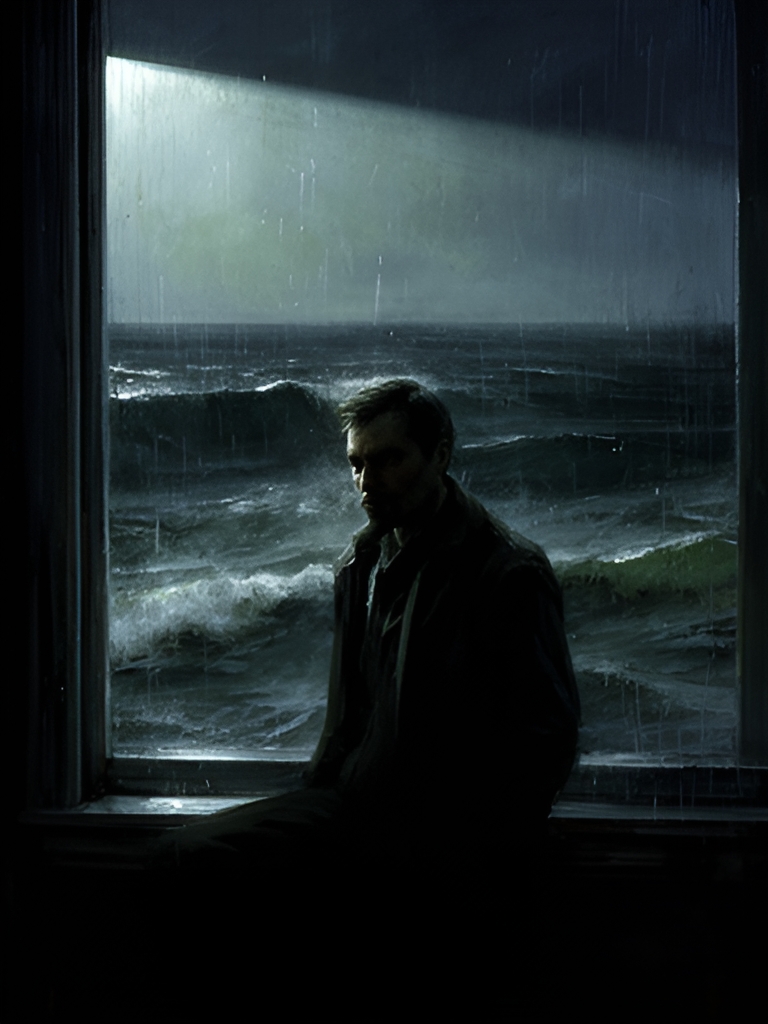
Outside, the harbor lay frozen and silent, a slab of bleak gray under a sky still stained with night. Snow dusted the rocks and the hulls of the abandoned trawlers pulled high on the shore. He pulled his coat tighter — a frayed pea coat Daniel had sent him years ago, before the illness took him — and stepped onto the trail that followed the water’s edge.
His boots crunched on frost-slick gravel. His breath came in short, white plumes. He didn’t look at the water. He looked at his feet. One step. Then another. The trail was empty. He liked it that way.
Halfway to the old lighthouse — decommissioned, boarded up, a skeleton against the horizon — he stopped. The ice groaned beneath him, a low, resonant crack like a bone breaking.
And then, softly: “You saw what happened, Eli. Tell them what you saw.”
Elias froze. His brother’s voice. Not a memory. A presence. Daniel stood a few paces ahead, turned slightly, breath fogging in the air, eyes steady, urgent. He wore his old field jacket, the one with the frayed cuff and the pen stuck in the pocket. He looked exactly as he had the last time Elias saw him alive — thin, tired, but alive.
“I did,” Elias said, his voice raw. “I told them.”
Daniel shook his head. “You told them a story. Not the truth.”
“I was there. I saw it.”
“Did you? Or did you see what you needed to see to make it mean something?”
Elias’s hands curled into fists at his sides. The whiskey sat heavy in his gut. “You’re not real.”
Daniel didn’t flinch. “Maybe not. But you’re lying to yourself. Again.”
A gust swept in off the water, sharp and biting. When Elias blinked, Daniel was gone. Only the wind, the ice, the endless white-gray of sea and sky remained.
He stood there a moment longer, then turned back toward the cottage. His boots slipped slightly on the frost. He didn’t catch himself.
By the time he reached the porch, his fingers were numb. He fumbled with the locks, undoing them one by one. The chain last.
He pulled the door open.
A woman stood on the top step, her collar turned up against the cold, her breath curling in the air like smoke. She was young — mid-twenties, maybe — with dark hair tucked under a wool cap and eyes that held his without flinching. In her gloved hand, she held a manila envelope, worn at the corners, labeled in precise block letters: Havel: Corroboration Check.
“Mr. Varga?” she said. Her voice was calm. Too calm.
Elias stared at her, then at the envelope. The whiskey had worn off. The cold rushed back in, sharp and clear.
“Who are you?” he asked.
“Lena Rostova,” she said. “I’ve read your work. For a long time.”
He didn’t invite her in. He didn’t move. The wind tugged at his coat. Somewhere behind him, the Pulitzer certificate hung crooked in the dim light, catching what little sun had broken through.
She didn’t speak again. She just held out the envelope.
And for the first time in years, Elias Varga felt the weight of what he had done — not as a triumph, but as something waiting to be answered.
Lena stepped inside without waiting for an invitation, closing the door softly against the cold. The cottage smelled of damp wood, old paper, and the sharp tang of whiskey. She kept her gloves on, holding the envelope as if it might burn her.
“You said you were at the school,” she began, her voice low but clear. “That you saw the militia round up the children, march them into the courtyard, and open fire. That you took cover behind a broken wall and filmed it with your handheld.”
Elias didn’t move. He watched her from the armchair by the stove, his hands wrapped around a fresh tumbler — empty, for now.
“You filed your dispatch from Havel Central at 03:17 UTC on March 14, 1999,” she said. “Timestamped, routed through the satellite uplink in Zagreb. Your editor got it at 04:02.”
She opened the envelope and slid a printed sheet across the coffee table. “This is the metadata from the feed. Not the copy you sent — the raw telemetry. It shows your uplink was active from a position just outside the village of Breza. Seventeen miles northwest of the school. In the foothills. No line of sight. No way you could have seen what you described.”
Elias leaned forward, his jaw tight. “You’re saying the data’s wrong.”
“I’m saying it’s consistent,” Lena replied. “With the terrain. With the militia’s movements that night. With the survivor accounts.”
She laid down another sheet. A map, marked in red. “This is the route the 104th Brigade took after leaving Breza. They went south, not east. They never reached the school that night. They hit a checkpoint near Kraljevo — delayed, rerouted. By the time they got to the village, it was dawn. The school was empty.”
Elias swallowed. His throat felt thick. “And the witnesses?”
“Two of them,” she said. “One was a medic in the militia. Defected six months later. Gave a statement to the ICTY in 2001. Said his unit was nowhere near the school during the hours you claimed. The other was a teacher. She was hiding in the basement with twelve children. She heard nothing. No gunfire. No shouting. Just the wind.”
He stared at the papers. Not at the words — at the space between them. The silence where his memory should have been.
“I didn’t sleep for three days before that,” he said, his voice rough. “I was holed up in a cellar near Breza. Shelled twice. I… I had a headache that wouldn’t go away. Double vision. I kept seeing things — shadows, figures. I thought it was the concussion.”
Lena watched him. “You filed the story twelve hours after you said you woke up. After you said you walked to the school. After you said you saw it happen.”
“I thought I did,” he whispered.
“Your mind filled the gap,” she said gently. “Trauma. Exhaustion. Dissociation. Your brain needed the event to mean something. So it gave you a story.”
Elias closed his eyes. The whiskey glass trembled in his hand. He saw it then — not the school, not the children — but Daniel’s face in the cellar dimness, saying, You have to tell what’s real, Eli. Even if it breaks you.
He hadn’t listened.
He opened his eyes. The cottage was quiet. The fire had burned low. Outside, the wind had picked up, rattling the windowpane.
“What do you want from me?” he asked.
Lena didn’t answer right away. She folded the papers, slipped them back into the envelope. “I want you to look at it,” she said. “Not to punish you. Not to take your prize. But because the truth matters — even when it’s ugly. Especially then.”
She stood. “I’ll leave the envelope. You can burn it. You can keep it. But don’t pretend you didn’t see it.”
She moved to the door, paused, and looked back. “You were a good reporter, Mr. Varga. Just not that day.”
Then she was gone, the door clicking shut behind her.
Elias sat alone in the darkening room, the envelope heavy on his knee. The Pulitzer certificate hung askew above him, catching the last of the light.
He didn’t reach for the whiskey.
He just sat, and let the cold in.
Chapter 2
The Archive Unsealed
Elias didn’t move when the door clicked shut. He sat with the envelope on his knee, the weight of it pressing through the wool of his trousers, the paper stiff and unyielding. The fire had gone to embers, casting only a faint glow that made the Pulitzer certificate above the mantel look like a stain on the wall. Outside, the wind had risen, scraping ice against the eaves in a slow, irregular rhythm — like something trying to get in.
He didn’t reach for the whiskey. He didn’t move at all. Not until the first gray light of morning crept under the door and he realized he had been sitting there all night, his back stiff, his fingers numb where they gripped the envelope’s edge.
Lena was back before full dawn. She knocked twice — soft, deliberate — and waited. When Elias opened the door, she was wrapped in a thick navy coat, her wool cap pulled low, her breath visible in the air. She didn’t smile. She didn’t need to.
“May I come in?” she asked.
He stepped aside. She brushed past him, shaking snow from her shoulders, and set her bag down by the door. Inside, the cottage smelled of damp wool, old paper, and the faint, sour tang of whiskey that had soaked into the rug near the chair where he’d sat the night before.
“Coffee?” he said, his voice raw.
She nodded. “Black. Two sugars, if you have them.”
He moved to the small kitchenette, the linoleum cold under his bare feet. He filled the chipped pot with water, lit the stove, and measured the grounds with a hand that didn’t shake — not much, anyway. While it boiled, he returned to the main room and pulled the envelope from his pocket. He hadn’t opened it. He hadn’t burned it. He had carried it to bed with him, lay awake with it pressed to his chest like something alive.
Lena was already at the desk when he returned with the mugs. She had spread a notebook open — one of his, he saw, the cover stained and warped at the corners from moisture. Beside it lay a printout of satellite imagery, a folded map of the Havel region, and a transcript marked with red highlights.
“You kept everything,” she said, not looking up.
“I didn’t throw much away,” he said. He set her coffee down beside her. “Not back then. I thought… I thought I’d need it.”
She glanced at him, then back at the page. “This is from February twelfth. Two days before you say you walked to the school.”
He leaned in. His own handwriting stared back at him — slanted, hurried, the ink slightly blurred in places as if touched by a thumb or a drop of sweat.
School: single-story, red brick, three classrooms visible from east. Basement entrance under south wall. Playground fenced, swings broken. Heard automatic fire from north, then silence. Saw two bodies near west wall — adult, child. Militia in green fatigues, no insignia. Took cover behind oil drum. Felt dizzy. Vision doubled.
Lena tapped the line about the basement entrance. “You wrote ‘under south wall.’”
“Yeah. So?”
She turned the page. Another entry, dated February thirteenth — the night before, according to his timeline.
School: L-shaped, white stucco, basement stairs inside northwest classroom. Playground open, no fence. Heard shouting, then explosions. Saw movement in basement window — flashes, like torchlight. Militia in beige, armbands red. Took cover behind bench. Headache worsening. Can’t focus.
“Basement stairs inside the classroom,” she said. “Not under the wall. And the building’s not red brick — it’s white stucco. The militia changed uniforms. The playground went from fenced to open. And you said you took cover behind two different things.”
Elias stared at the words. They were his. He knew the rhythm of his own hand, the way he looped his ‘y’s, the way he pressed hard on the ‘d’ in ‘didn’t’ and light on the ‘t’ in ‘not.’ But the details — they didn’t match. Not just varied. Contradicted.
“Fatigue,” he murmured. “Light was bad. I was tired. I might’ve mixed up the angles.”
Lena didn’t look convinced. She reached into her bag and pulled out a small digital recorder. She slid it across the desk. “This isn’t from the field. This is from your room. The night before you left Breza. Time-stamped 02:17 a.m.”
He frowned. “I don’t remember recording that.”
“You weren’t supposed to. It was voice-activated. You left it running on the nightstand.”
She pressed play.
A sound filled the room — low, rough, Elias’s voice, thick with exhaustion and something else — a tightness in the throat, like he was holding back tears or a scream.
…no one’s going to believe me anyway. They think I’m just chasing shadows. But I need them to see what they’re doing. I need it to mean something. If I don’t say it happened, then it didn’t. And if it didn’t… then what was I doing there?
The voice cracked on the last word. There was a long breath — shaky, uneven — then the click of the recorder stopping.
Silence.
Elias stared at the machine. His palms were damp. He wiped them on his trousers.
“I didn’t know I said that,” he whispered.
Lena watched him. “You were afraid no one would believe you. So you made sure there was something to believe.”
He looked at her then, really looked — not at the journalist, not at the investigator, but at the woman who had sat in silence with him the night before, who had handed him the truth not as a weapon, but as an offering.
“I didn’t lie to hurt anyone,” he said. “I lied… because I was afraid the truth wasn’t enough.”
She didn’t answer. She just closed the notebook, gathered the papers, and slid them back toward him.
“Look at the rest,” she said. “If you can.”
Then she stood, pulled her coat tighter, and walked to the window. Outside, the first true light of dawn touched the harbor, turning the ice to silver. The wind had died. The world was waiting.
Lena stood at the window, her breath faint on the glass, watching the ice catch the light like shattered glass. Elias remained at the desk, the recorder still in his hand, the voice from the night before looping in his skull: If I didn’t say it happened, then it didn’t.
He hadn’t moved when Lena spoke.
“There’s one more thing,” she said, not turning. She reached into her coat and pulled out a smaller device — a microcassette player, its casing scratched and taped at the seam. “This came from a fixer. Name was Marko. He worked with you in Breza. Arranged transport, safe houses, sometimes… interpreted.”
Elias’s throat tightened. He remembered Marko — a man with a limp and a quiet way of watching doors. Not a fighter. Not a witness. A facilitator.
Lena pressed play.
A hiss, then a voice — accented, weary, speaking in English but with the cadence of someone thinking in another tongue. It was Marko’s. Elias knew it instantly.
…two hours after the supposed attack. You were back at the hotel. Room 3B. I checked. You were shaking. Said you couldn’t sleep. Said the silence was louder than the shells. No one came to the school that night. Not the militia you described. Not any armed group. The teacher who let us in after curfew — she said the basement was empty but for storage crates. No bodies. No blood. Just… quiet.
The recording ended. A soft click. Then silence.
Elias didn’t breathe. His fingers tightened around the edge of the desk, knuckles whitening. The cottage seemed to draw inward — the wind gone, the fire low, the clock on the wall stopped at 3:17, frozen since the storm knocked out the power weeks ago.
“He was there,” Elias whispered. “I saw him. I talked to him. He asked for water.”
Lena finally turned. Her expression wasn’t triumphant. It was sad. “You were in Breza. You were exhausted. You’d been underground for days. The shelling… it got in your head. You wanted to believe you’d seen something that mattered. So you built it — from fragments, from fear, from the need to make the suffering mean something.”
He looked at her. Not as an accuser. Not as a savior. As someone who had sat with him in the dark and handed him the truth not to destroy him, but to see if he could carry it.
“I didn’t invent it to hurt anyone,” he said again, quieter now. “I did it because… because if I admitted I saw nothing, then what was the point of all of it? The fear. The guilt. The brother I lost?”
Daniel’s face surfaced — not the apparition from the night before, but the real memory: laughing over weak coffee in a trench outside Havel, pressing a bandage into Elias’s hand after shrapnel tore his sleeve. Tell it true, Eli. Even if it breaks you.
Elias closed his eyes. The voice from the recorder — his own — echoed: If I didn’t say it happened, then it didn’t.
He opened them. Looked at Lena.
“Then I was never there,” he said. “Not really. I was in the hotel. I was broken. And I lied… to feel like I’d earned the right to be broken.”
She didn’t answer. She didn’t need to.
He stood slowly, stiff from sitting, and walked to the window beside her. The harbor lay still, the ice etched with silver. Somewhere far out, a buoy groaned.
He didn’t reach for the recorder. Didn’t try to explain it away.
He just stood there, staring at the ice, and let the weight of it settle — not as a verdict, but as a reckoning.
Chapter 3
The Last Dispatch
The pre-dawn dark pressed against the cottage windows like wet wool. Elias sat hunched over his desk, the fixer’s tape hissing softly from the old cassette player on loop — a fragment of garbled Arabic, the crackle of distant mortar, then his own voice, strained and urgent, describing smoke and screams that now felt borrowed, not lived. He had played it thirty-seven times since Lena left, each iteration peeling back another layer of certainty until nothing remained but the raw nerve of doubt.
His fingers, stiff from cold and disuse, hovered over the keyboard of the ancient typewriter Lena had noticed in the corner — a relic from his Beirut days, its keys faded, its carriage jerking with each strike. He hadn’t used it in years. But the ritual of it — the mechanical resistance, the smell of oil and dust — grounded him when the thoughts threatened to spin loose.
He typed slowly, each word a deliberate placement, not for effect, but for survival.
To the Pulitzer Prize Board and the Editors of the Portland Chronicle,
I, Elias Varga, hereby withdraw my claim to the veracity of my dispatch dated April 17, 1999, titled “Under Fire: The School at Havel.”
He paused, listening to the tape. A child’s cry — real or imagined — pierced the hiss. He closed his eyes.
I filed that report under conditions of extreme physical and mental duress. I had not slept for seventy-two hours. I had been shelled twice in a cellar beneath Breza. I suffered headache, double vision, and dissociative episodes. My memory of events that night is fragmented, reconstructed under fatigue and trauma. I can no longer vouch for its accuracy as a factual account.
He rolled the paper up, tore it from the carriage, and smoothed it flat. The words felt insufficient — too clinical, too forgiving — but they were true in the only way that mattered now: they were not a lie.
He stood, shuffled to the printer Lena had brought — a small, noisy thing she’d set up on the side table — and fed the sheet through. The machine coughed, then spat out a clean copy. He folded it once, vertically, so the address faced out.
Outside, the wind had dropped. The world hung in a hush broken only by the tape’s endless loop and the occasional creak of the cottage settling in the cold.
He pulled on his pea coat — Daniel’s coat, the wool still smelling faintly of cedar and pipe tobacco — and stepped into the pre-dawn gray. Lena’s rented car was parked where he’d left it the night before, nose facing the road, steam faintly curling from the hood despite the frost. She was slumped behind the wheel, head tipped against the window, a wool cap pulled low over her dark hair. One hand rested on the steering wheel; the other lay open in her lap, a notebook forgotten.
He didn’t wake her. Didn’t knock. Didn’t look in.
He walked to the passenger side, lifted the wiper blade just enough to slide the folded letter beneath it, then let it snap back with a soft thwak. The paper stayed, caught against the glass.
He turned away without a glance.
The harbor trail waited beyond the cottage, a ribbon of ice and packed snow winding between frozen lobster traps and blackened spruce. He stepped onto it, the crunch of his boots loud in the silence. The fixer’s tape still played inside the cottage, but he didn’t turn it off. Let it play. Let it run its course.
Somewhere behind him, the first pale light of morning began to bleed into the east. He didn’t look back. He walked toward the ocean, and the sea, and the quiet.
The trail gave way to stone, jagged and black beneath a dusting of fresh snow. Elias kept walking, the path dissolving underfoot as the harbor opened to his left — a stretch of frozen water cracked in places, where the tide had worked beneath the ice and left it thin and treacherous. He didn’t hesitate. The crunch of snow under his boots shifted to the sharper bite of gravel and shell fragments, then to the slick, uneven rock worn smooth by centuries of Atlantic fury.
He stopped at the edge where land surrendered to sea. The water was a slate-gray void, moving with a slow, relentless pull. Ice fringed the shore in jagged teeth, but beyond, the open ocean heaved, indifferent. Snow fell harder now, large flakes that melted instantly on contact with his coat, his cheeks, the exposed skin of his wrists where the coat sleeves had ridden up. He stood still, listening — not to the tape anymore, though it still played faintly from the cottage behind him, but to the sea: the low groan of shifting ice, the hiss of water retreating over stone, the occasional distant crack as a floe split under pressure.
He thought of Daniel’s voice in the cellar, not as an apparition now, but as a memory unburdened by guilt: You have to tell what’s real, Eli. Even if it breaks you. He had told a story. It had carried weight. It had earned him a prize, a name, a seat at tables where truth was supposed to be traded like currency. But it hadn’t been real. Not all of it. Not the part that mattered.
He bent slowly, stiff from cold and inactivity, and unlaced his left boot. The fingers fumbled with the knot, numb and clumsy, but he got it loose. He pulled off the boot, then the sock, setting them both on a flat rock nearby. Repeated the process with the right. His feet touched the stone — pale, shocked, already going numb. He didn’t hesitate. He stepped forward, onto the beach where the sand was frozen and mixed with gravel, then onto the wetter sand just above the tide line, where the ocean exhaled and inhaled in slow, salt-rusted breaths.
The first wave took him by surprise — not in height, but in temperature. It surged over the rock, icy and sudden, licking at his ankles like something alive and hungry. He gasped, a sharp intake that burned in his lungs. Another wave followed, higher, rushing over the tops of his feet, stealing heat with terrifying speed. He didn’t pull back. He walked into it, letting the water rise — past his ankles, his calves, his knees. The cold was a physical blow, a clamping vice that stole breath and thought alike. His skin prickled, then burned, then went dull. He welcomed it. This was not punishment. It was calibration. A way to feel the edge of himself again, not through memory or guilt, but through the body’s undeniable response to something real.
He kept going. The water swallowed his thighs, then his hips, then his waist. It pressed against his chest, tight and shocking, making it hard to draw a full breath. Snowflakes landed on his shoulders, his collarbone, melting instantly in the steam that rose — or seemed to rise — from his skin in the frigid air. He was waist-deep now, the ocean pulling gently at his legs, trying to take him further. He didn’t resist. He didn’t embrace it as an end. He stood, swaying slightly with the surge and retreat of each wave, eyes open, facing the horizon where sea and sky bled into one another under the weight of the snow-laden sky.
He thought of the tape still playing in the cottage. He thought of Lena asleep in the car, the notebook forgotten in her lap. He thought of Maggie’s soup, left on his step more mornings than not, always warm, never questioned. He thought of the school in Havel — not the one he’d written about, but the one that might have stood quiet and unharmed that night, children sleeping in basements not from fear of massacre, but from the ordinary terror of shelling, the kind that drives families underground not because they’re being hunted, but because the sky is falling.
He didn’t know what he had seen that night. Maybe flashes, real and terrible, displaced in time and place. Maybe nothing but smoke and fear and the mind’s need to shape chaos into a story that could be told. He didn’t need to know now. He only needed to stand here, in the freezing water, and let the cold strip away the last of the numbness.
A wave broke over his sternum. He shuddered, not from fear, but from the sheer, shocking aliveness of it. He stayed. Let the sea have him, if only for a moment. Let it remind him what it felt like to be small, and temporary, and utterly, undeniably present.