Fiction
Baralho cigano_Caminhos de Osvaldo
by Osvaldo Junior
3 chapters19 min read
Chapter 1
The Foundations
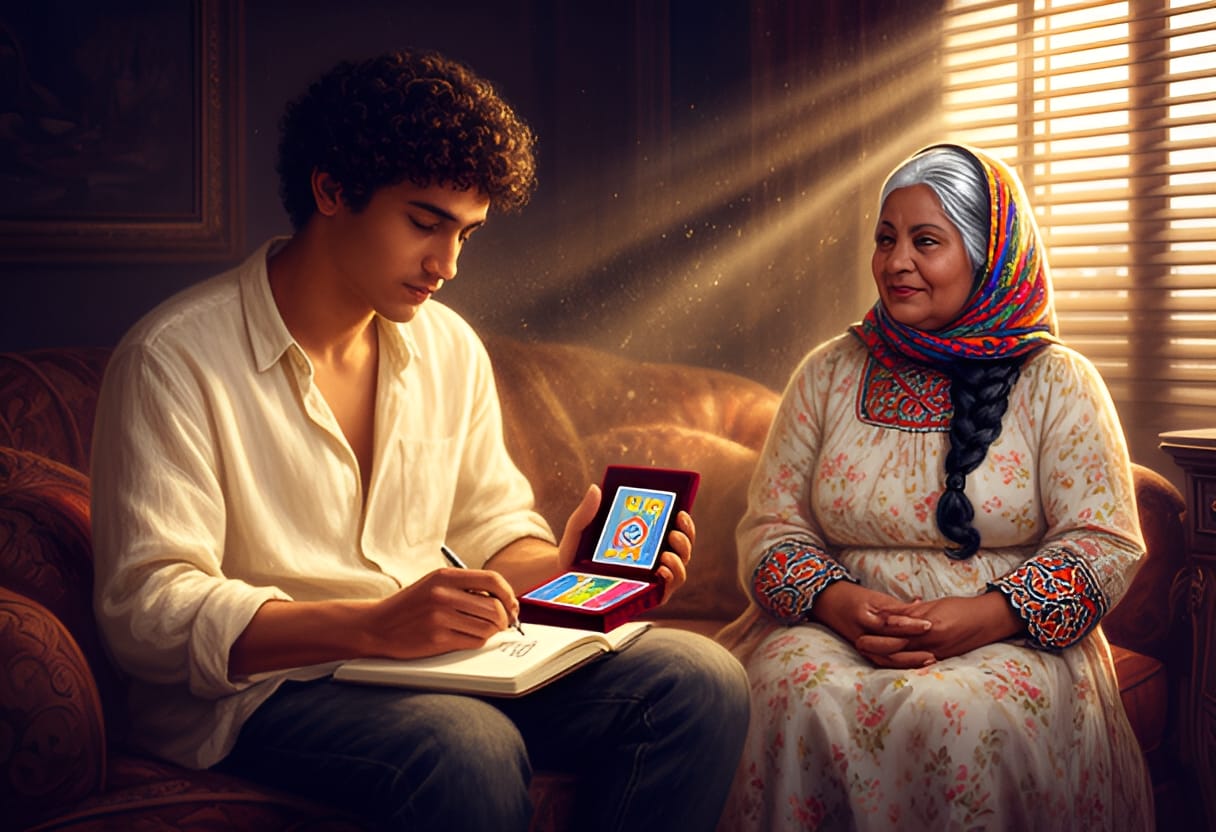
Osvaldo lifted the velvet-wrapped box from the shelf in his aunt’s living room, the fabric cool against his fingertips. Sunlight slanted through the blinds, catching dust motes that danced above the coffee table where he set the box down. Inside, the Petit Lenormand deck lay nestled in a fitted compartment, its cards smooth-edged and slightly worn at the corners. He traced the floral border on the top card with his thumb before turning it over.
The Rider. A dark horse mid-gallop, mane streaming, rider in a red coat holding a raised sword. Below it, in delicate script: O Cavaleiro. He opened his notebook to a fresh page and wrote the name, then sketched the horse’s arched neck and the flutter of the rider’s cape. Next came the Clover — a simple three-leaf sprig, stem curved, one leaf slightly overlapped. O Trevo. Then the Ship, its square sail full, hull cutting through waves. O Navio. He worked slowly, committing each image to memory: the House with its steep roof and chimney, the Tree with deep roots and spreading branches, the Clouds — two soft ovals, one dark, one light, drifting apart.
By mid-morning, he had filled two pages. The Snake coiled in an S, its head raised, tongue flickering. The Coffin, long and narrow, lid slightly ajar. The Bouquet, a handful of wildflowers tied with ribbon. The Scales, balanced, pans holding equal weight. He whispered each name as he wrote it, feeling the shape of the syllables on his tongue — A Chuva for the Rain, O Anel for the Ring, O Livro for the Book. When he reached the Cross, two intersecting beams stark against a pale sky, he paused. His grandmother had touched this card often, he remembered, her thumb rubbing the wood grain where the beams met.
He closed the notebook and stood, stretching. The apartment was quiet except for the hum of the refrigerator in the kitchen. Dona Lurdes moved softly in the hallway, her slippers whispering against the tile. “Encontrado algo interessante?” she called, peeking into the room.
“Just the cards,” Osvaldo said, holding up the deck. “Avó left me her Lenormand.”
She smiled, eyes crinkling. “She used to lay them out on the kitchen table after Mass. Said they whispered advice, not orders.” She hesitated, then added, “Your great-grandmother carried a deck like this when she came from Minas Gerais. Said it helped her read the roads ahead.”
Osvaldo nodded, tucking the notebook under his arm. “I’m going to the library. Want to see what the books say about where they really came from.”
The Municipal Library of São Paulo was cool and hushed, rows of wooden shelves rising in quiet order. Osvaldo found a section on divination practices and pulled a thin volume titled Cartomancy in Europe: From Playing Cards to Prophecy. He flipped to the index, traced his finger down to “Lenormand, Mlle,” and read aloud softly: “Marie Anne Lenormand, born 1772 in Alençon, was a renowned French clairvoyant who advised figures such as Josephine Bonaparte and Tsar Alexander I. Though she used various decks, the Petit Lenormand bearing her name was not designed by her but emerged after her death, circa 1799, in Germany and France as a simplified divinatory adaptation of the game of Das Spiel der Hoffnungen.”
He crossed-referenced with a tarot history, noting the contrast: tarot’s roots in 15th-century Italian trick-taking games, its esoteric reinterpretation in the 18th century by figures like Court de Gébelin, its seventy-eight cards divided into Major and Minor Arcana. The Petit Lenormand, by contrast, was always thirty-six, its symbols drawn from everyday life — animals, objects, natural phenomena — never allegorical figures like the High Priestess or the Tower. It was standardized in the mid-1800s as both a parlor game and a tool for cartomancers, its simplicity making it accessible across social classes.

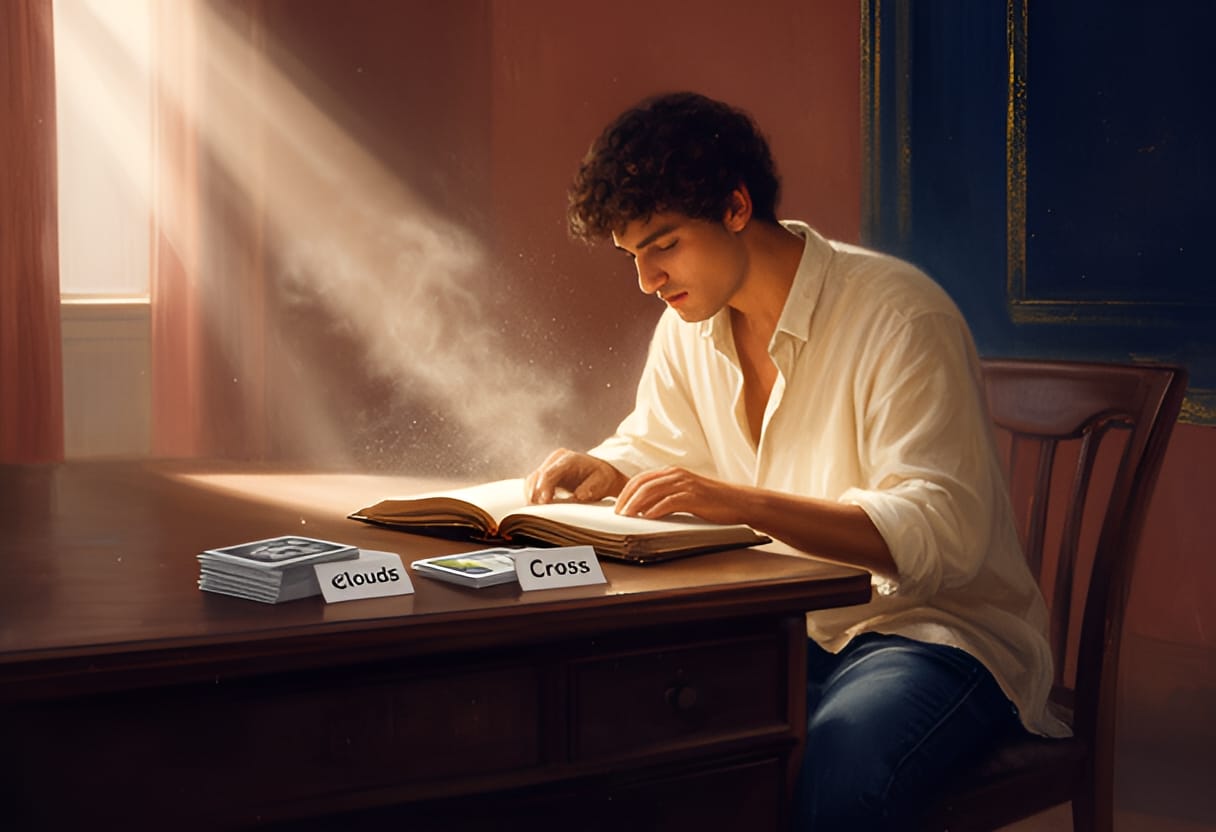
By closing time, Osvaldo had copied the names and symbols of all thirty-six cards into his notebook, double-checking each against the deck. He recited them silently on the walk home: Rider, Clover, Ship, House, Tree, Clouds, Snake, Coffin, Bouquet, Scales, Whip, Birds, Child, Fox, Bear, Stars, Stork, Dog, Garden, Mountain, Crossroads, Mice, Heart, Ring, Book, Letter, Man, Woman, Lily, Sun, Moon, Key, Fish, Anchor, Cross.
He paused at the corner of his street, breath visible in the late afternoon air. The deck felt lighter now in his coat pocket, not because he knew the cards, but because he had begun to understand where they came from — not from mystery alone, but from history, from hands that had shuffled them before his. He thought of his grandmother’s quiet smile when she dealt the spread, and for the first time, he wondered what she had seen in them.
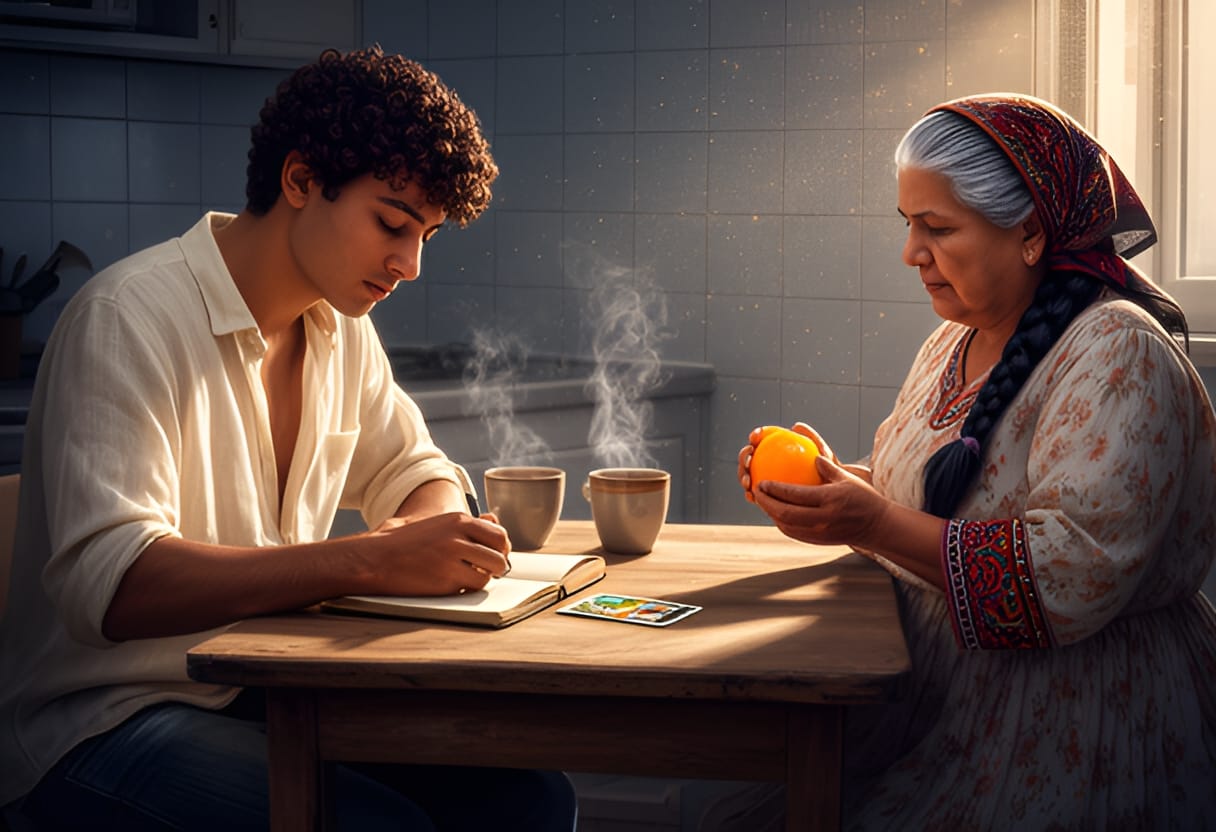
Osvaldo set the notebook on the kitchen table and poured two cups of strong coffee, the steam curling in the morning light. Dona Lurdes sat across from him, peeling an orange with deliberate care. He flipped open to a clean page and wrote at the top: Love – Work – Health. Beneath it, he began to list.
For love, he chose the Heart, the Ring, and the Bouquet. The Heart spoke plainly — affection, emotional truth, the quiet pulse between two people. The Ring suggested commitment, cycles, promises made or renewed; not always marriage, but the sense of something returning, of bonds that loop back. The Bouquet brought joy, small gifts, flirtation, the kind of happiness that comes in bunches — unexpected, fragrant, fleeting if not noticed.
For work, he turned to the Fox, the Fish, and the Anchor. The Fox was caution — a need to watch for hidden motives, to navigate office politics with sharp eyes, not paranoia but awareness. The Fish represented flow, intuition, and abundance that came not from force but from sensing the current; in a job, it might mean a side project that suddenly gains traction, or a feeling that it’s time to swim toward something new. The Anchor stood for stability, endurance, the job that holds you in place — sometimes comforting, sometimes restrictive, depending on the tide.
For health, he selected the Tree, the Lily, and the Cross. The Tree was growth, resilience, deep roots and steady expansion — not just physical vitality but the kind of well-being that develops over years, like rings in wood. The Lily suggested peace, recuperation, the need for quiet and clean surroundings; it whispered of rest, of healing that happens in stillness, often overlooked in a culture that prizes hustle. The Cross, heavier, pointed to burden, sacrifice, or a crossroads where one must choose — not always suffering, but the weight of responsibility, or the moment when healing requires facing something difficult.
He closed the notebook and looked up. “So it’s not about predicting,” he said. “It’s about noticing patterns — where energy gathers, where it’s blocked, where it might shift.”
Dona Lurdes nodded, sucking juice from an orange segment. “Like reading the sky before a storm. You don’t change the weather, but you know whether to bring a coat.”
That morning, he drew the first card for his journal: the Road. It lay on the table — a winding path disappearing into the distance, a figure small and alone upon it. He wrote: Detour. Not lost, but delayed. Today’s schedule feels rigid — maybe I need to leave room for the unexpected. Say yes to the invitation after class, even if it’s not on the list. He crossed out a rigid block of study time and instead met Mateo for coffee, talking about nothing and everything until the sun dipped low.
The next day, the Lily appeared. He paused, feeling the weight of a headache he’d ignored since waking. The card seemed to say: Stop. Breathe. Let the mind settle. He canceled his afternoon lab session, went home, and lay in the dark with a cloth over his eyes. When he woke, the pressure had eased.
On the third day, the Fox slipped from the deck. He frowned. Someone’s not being straight. Later, in a group meeting, a teammate claimed credit for an idea Osvaldo had raised the day before. He didn’t confront him — just made a mental note, adjusted his approach, and shared his next thought only with the professor after class.
By the fifth day, he drew the Cross. He sat back, the card heavy in his palm. That evening, over beans and rice, Dona Lurdes said, “I’ve been thinking — you should apply for that exchange program in Lisbon. Your grandmother would have loved it. You’d be close to where the cards first spread.”
Osvaldo felt the familiar tighten in his chest. The program meant leaving São Paulo, delaying his thesis, stepping into uncertainty. “I don’t know if I’m ready,” he said. “It’s a big move. What if I lose focus here?”
She reached across the table, her hand warm over his. “The Cross isn’t just a weight. It’s also where you decide which way to turn. Sometimes, you have to carry it to get to the other side.”
He looked down at the card — the two beams stark against the pale sky. Not an order, not a fate, but a marker. A place to pause, to feel the strain, and then choose.
He slipped the Cross back into the deck, closed his notebook, and for the first time, didn’t reach for it again that night. The decision wasn’t made — but the space to make it had appeared.
Chapter 2
The Practice Deepens
The morning light slanted through Osvaldo’s bedroom window, catching dust motes above the open notebook on his desk. He had kept the Cross in the deck overnight, as he had promised himself, and now, with the decision still unmade but no longer avoided, he turned to the next step: understanding how the cards spoke to one another.
He flipped to a clean page and wrote at the top: Duads — meaning in relation. Beneath it, he drew two columns. In the left, he listed card names; in the right, he began to explore how their energies shifted when paired.
First, Snake and Heart. He placed them side by side. The Snake, coiled and watchful, spoke of hidden influences, jealousy, or intuition that stirred beneath the surface. The Heart, open and warm, was love, connection, the pulse of feeling. Together, they did not simply add — they transformed. The Snake coiled around the Heart suggested not betrayal, but tension: a love tested by doubt, or a relationship where one partner sensed something unspoken. He wrote: Emotional unease. Not a lack of feeling, but fear that it is not returned — or that it is being manipulated. He paused, thinking of Mateo’s recent hesitation about the internship in Lisbon, the way he had smiled too quickly when asked if he was excited.
Next, Bird and Letters. The Bird, wings slightly spread, carried messages, nervous energy, gossip. The Letters, sealed and formal, stood for documents, contracts, written words. Alone, the Bird could mean anxiety; the Letters, delay or bureaucracy. Together, they became something more precise: a message that caused worry, or news that arrived too late to ease the mind. He noted: Anxious waiting for news. A letter that brings more questions than answers. The mind racing over what might be written. He remembered the email he had waited for from the exchange program — the one that had not come, leaving him to imagine refusals that were never sent.
Finally, Clouds and Cross. He laid them out slowly. The Clouds, blurred and drifting, were uncertainty, confusion, things not yet seen. The Cross, as he had come to understand it, was not fate, but a point of strain — a decision that demanded effort, a burden that needed to be carried to reach clarity. Together, they did not deepen the gloom; they clarified it. The Clouds did not obscure the Cross, but made its weight felt more acutely: the hesitation before a choice, the fog of not knowing which path would ease the load. He wrote: The burden of uncertainty. Not the decision itself, but the strain of not seeing the way forward. The weight lingers because the direction is hidden. He set the cards down and leaned back, the interpretation feeling less like a rule and more like a recognition — as if he had named something he had already felt.
A soft knock came at the door. Mateo peered in, holding two mugs. “Heard you were up. Thought you might want company. Or silence. Either works.”
Osvaldo smiled. “Come in. I’m just trying to make sense of how the cards talk to each other.”
Mateo sat on the edge of the bed, blowing steam from his chocolate. “Like, do they gossip?”
“Sometimes,” Osvaldo said. “But more like they modify. One card doesn’t just add its meaning — it changes how the other is read.”
Mateo tilted his head. “Give me an example.”
Osvaldo picked up the Clouds and Cross again. “You said last week you were torn between the internship here and the one in Porto Alegre. You kept saying you didn’t know what to do.”
Mateo nodded slowly. “Yeah. My parents want me to stay close. The other offer pays more, but it’s farther. I keep going back and forth.”
Osvaldo placed the cards between them. “This is what I see: the Clouds — the not knowing, the back-and-forth, the way your mind keeps circling. And the Cross — not the choice itself, but the effort it takes to hold it. The strain of feeling pulled. Together, it’s not that you’re lost. It’s that you’re carrying the weight of not seeing clearly yet.”
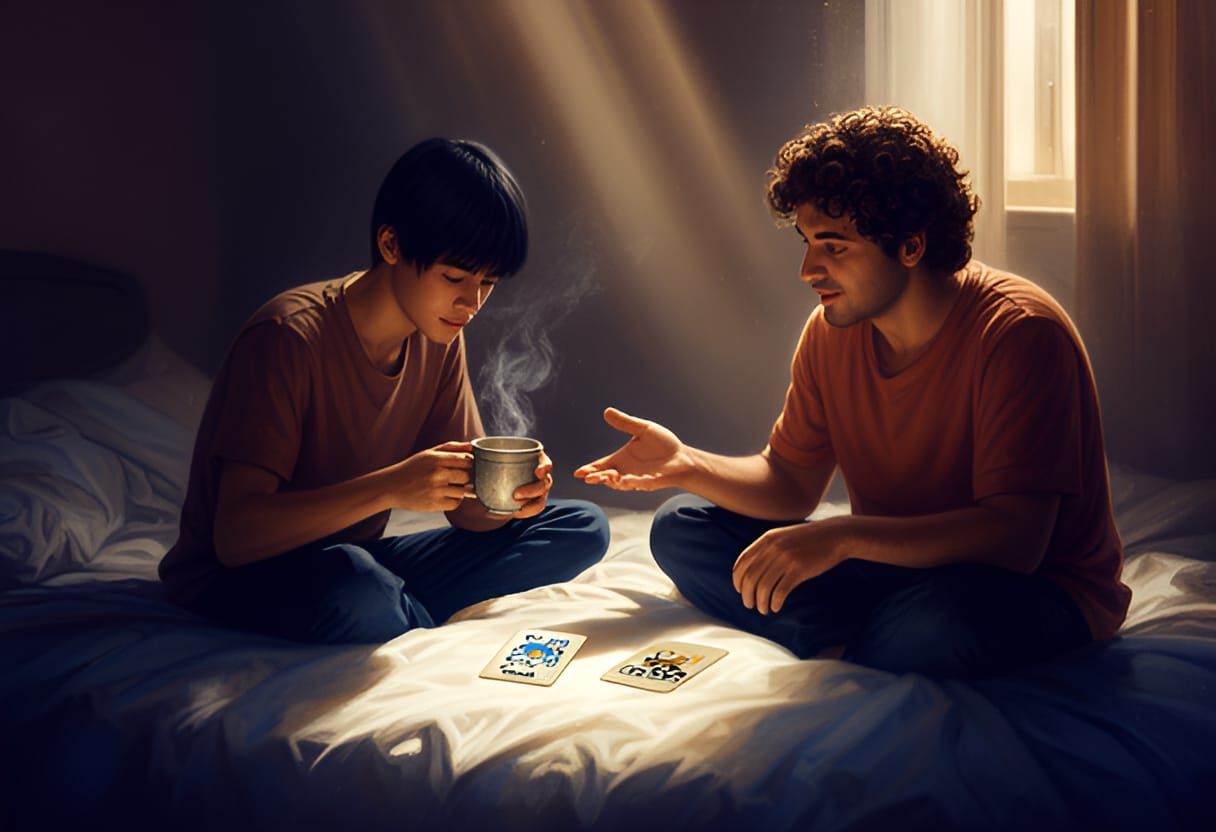
Mateo was quiet for a moment, staring at the cards. Then he said, voice low, “Yeah. That’s… exactly how it feels. Like I’m not just deciding — I’m holding my breath while I do it.”
Osvaldo didn’t offer advice. He just nodded, the validation settling in his chest like a quiet affirmation. The cards weren’t predicting. They were naming.
He gathered the duads, slipped them back into the deck, and closed the notebook. The morning was warming, and somewhere below, Dona Lurdes was already moving about the kitchen. The next step, he knew, would be to lay more than two cards at once — to see how the story unfolded across a wider spread. But for now, the pairs had spoken clearly enough.
The afternoon light had shifted, slanting lower across the wooden floor of Osvaldo’s bedroom, warming the rug near the window. Dona Lurdes had left a plate of pão de queijo on the desk, still faintly steaming, and the quiet hum of the city drifted in through the open pane — distant traffic, a vendor’s call, the occasional laugh from the street below. Osvaldo shuffled the deck slowly, the cards soft against his palms, focusing on Mateo’s question: Which path will bring the steadier growth — the internship here or the one in Porto Alegre? He didn’t seek a yes or no, but a sense of movement, of what lay ahead if he chose either way.
He laid out the nine cards in three rows of three, the traditional box spread. The first row — theme — would show the core energy of the situation. The second — influence — the forces at work, seen and unseen. The third — outcome — the likely direction if the current path continued. Columns, left to right, were past, present, future.
He turned them over one by one.
In the theme row: past, the Rider — news arriving, a message that had already set things in motion. Present, the Ship — journey, departure, a transition already underway. Future, the Mountain — obstacle, delay, something that would require effort to overcome or go around.
Influence row: past, the Clover — small luck, a fortunate break that had helped him get this far. Present, the Bear — authority, strength, the weight of expectation, possibly from family or his own ambition. Future, the Lily — peace, rest, a need for clarity or a period of withdrawal after strain.
Outcome row: past, the Heart — emotion, connection, what had mattered most in his earlier considerations. Present, the Key — solution, insight, the moment when understanding would click. Future, the Fish — resources, value, tangible results, possibly financial gain or security.
Osvaldo leaned back, tracing the pattern with his eyes. The Ship in the present of the theme row felt immediate — Mateo was already in motion, caught between two offers, preparing to leave one life behind for another. The Mountain in the future of that same row spoke not of impossibility, but of a hurdle: the distance, the unfamiliar city, the loneliness of starting over. Yet just below it, in the influence row, the Lily offered balance — a need to pause, to breathe, to honor his own limits. And in the outcome, the Key resting over the Heart suggested that the right choice would not only make sense logically, but feel true emotionally. The Fish beyond it hinted that stability and reward would follow, if he could push through the strain.
He looked up. Mateo was watching him, hands wrapped around his mug, eyebrows slightly furrowed.
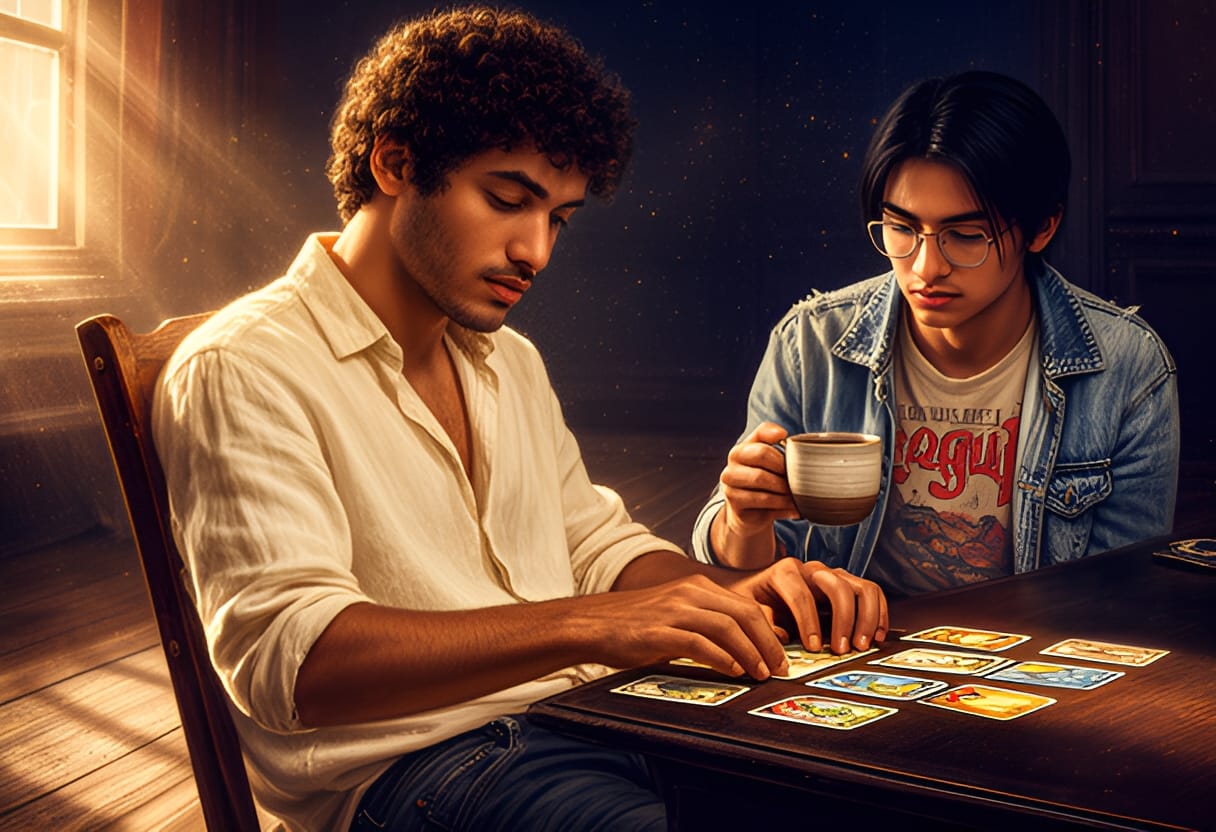
“So?” Mateo prompted. “What does it say?”
Osvaldo chose his words carefully. “It starts with movement — the Ship is here, in the present. You’re not stuck; you’re already preparing to go. But the Mountain ahead… it’s not a wall. It’s a climb. The distance, the adjustment — it’ll take effort. The Bear shows that pressure is real, maybe from your parents, maybe from yourself, wanting to prove something. But the Lily under it… that’s your mind asking for rest. Not laziness — a need to protect your peace while you decide.”
He paused, letting the words settle.
“Then, in the outcome… the Key over the Heart. That’s interesting. It’s not just about what works on paper. It’s about what fits — what aligns with what you truly want. And after that, the Fish. Not riches, but security. The sense that, once you’ve made the call and walked through the difficulty, you’ll find your footing.”
Mateo was silent for a long moment. He stared at the cards, then at his hands, then back at Osvaldo.
“Yeah,” he said quietly. “That… actually makes sense. I keep thinking about Porto Alegre — the pay, the experience — but I also keep imagining showing up there and feeling… untethered. Like I’d be good at the job, but lonely. And then I feel guilty for even thinking that, because my parents sacrificed so much for me to have these options.”
He swallowed. “The Mountain… yeah. That’s exactly what I’m afraid of. Not failing. Just… struggling silently. And the Lily… I didn’t realize how much I’ve been ignoring that part. I’ve been pushing through headaches, skipping meals, just to keep comparing spreadsheets. Like if I think hard enough, the answer will appear.”
Osvaldo nodded. “The cards don’t tell you what to pick. But they show where the weight is.”
Mateo let out a breath, almost a laugh. “And the Key over the Heart… you’re right. I keep going back to what feels right, not just what looks right. Even when I try to talk myself out of it.”
A small smile touched his lips. “Thanks for not telling me what to do. It… helps to see it laid out like this. Not as a prophecy. As a map of how I’m already feeling.”
Osvaldo gathered the cards slowly, stacking them back into the deck. The pão de queijo had cooled, but he broke off a piece anyway, the cheese stretching slightly as he pulled it away. The sunlight had deepened to gold, gilding the edge of the desk, the notebook, the velvet cloth where the cards had lain.
He didn’t need to say anything else. The spread had spoken. And Mateo had heard it.
Chapter 3
The Mesa Real and Ethical Practice
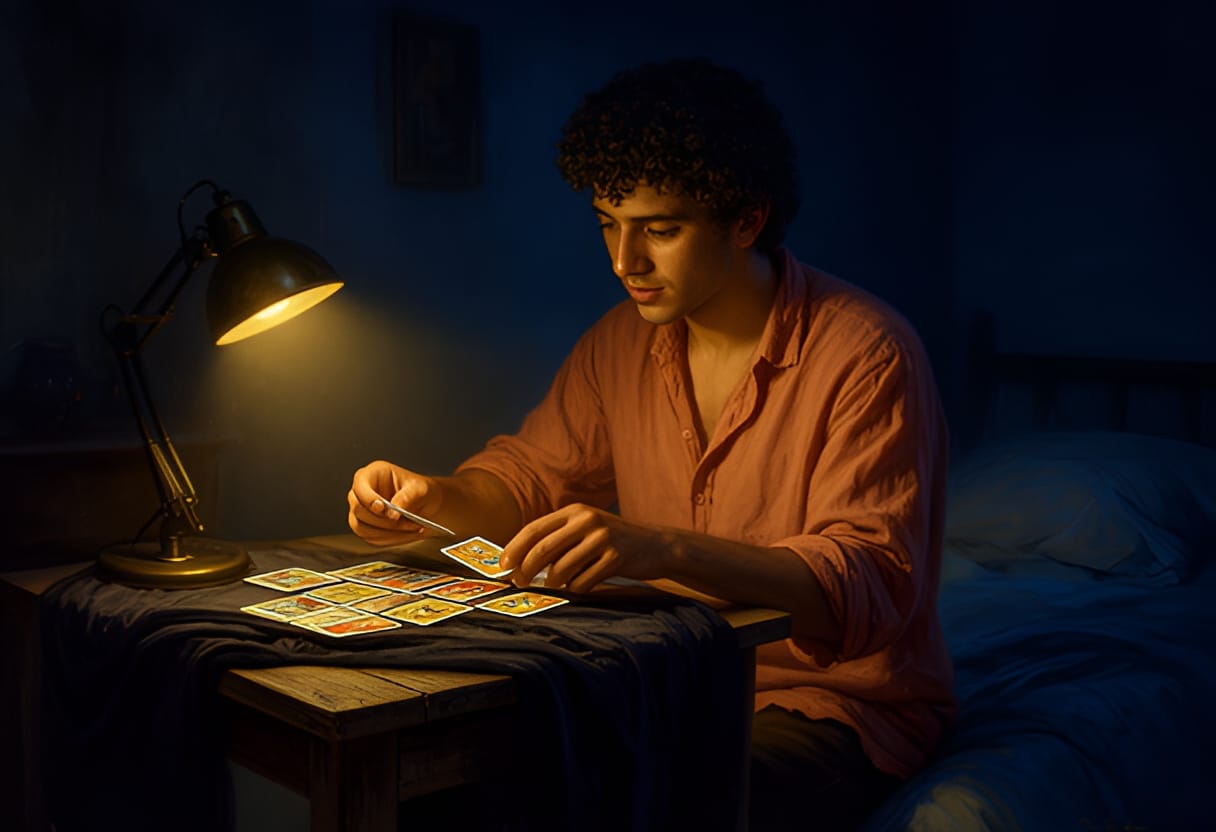
The soft glow of the desk lamp pooled over the dark cloth Osvaldo had laid across his small wooden table. Outside, the city hummed through the open window—distant sirens, the murmur of late-night traffic—but inside his room, there was only the quiet rhythm of his breath and the faint rustle of cardstock as he lifted the first card from the deck.
He had done this before, in pieces, but never all at once. The Mesa Real waited in his mind like a map he had yet to walk. Thirty-six cards. Four rows of eight, then a final row of four centered beneath, like a foundation stone. He began at the top left, placing the Rider face up, then the Clover, the Ship, the House—each card laid with deliberate care, not rushed, not performative. His fingers traced the edges, feeling the slight texture of the aged paper, the faint wear where his grandmother’s thumb had once rested.
As the first row filled, he paused. The Ship touched the House at its corner. Not overlapping, but near enough to suggest a journey toward stability. He didn’t label it. He only noticed.
The second row followed: Tree, Clouds, Snake, Coffin. He watched how the Clouds hovered above the Snake, as if obscuring its path. The Coffin sat just below the House, aligned vertically—an ending resting beneath a beginning. He let the image settle, not as prophecy, but as reflection.
By the third row, the rhythm had found him. Bouquet, Scythe, Whip, Birds—each placement a quiet conversation with the one before. The Whip angled toward the Birds, sharp lines meeting soft curves. He thought of arguments that cleared the air, of words that needed to be spoken.
When he reached the fourth row—Child, Fox, Bear, Stars—he slowed further. The Bear sat just above the Stars, large and grounded beneath a scatter of light. Nearby, the Fox looked toward the Bear, not confronting, but observing. He didn’t force a story. He let the proximity speak: caution near strength, wisdom watching over innocence.
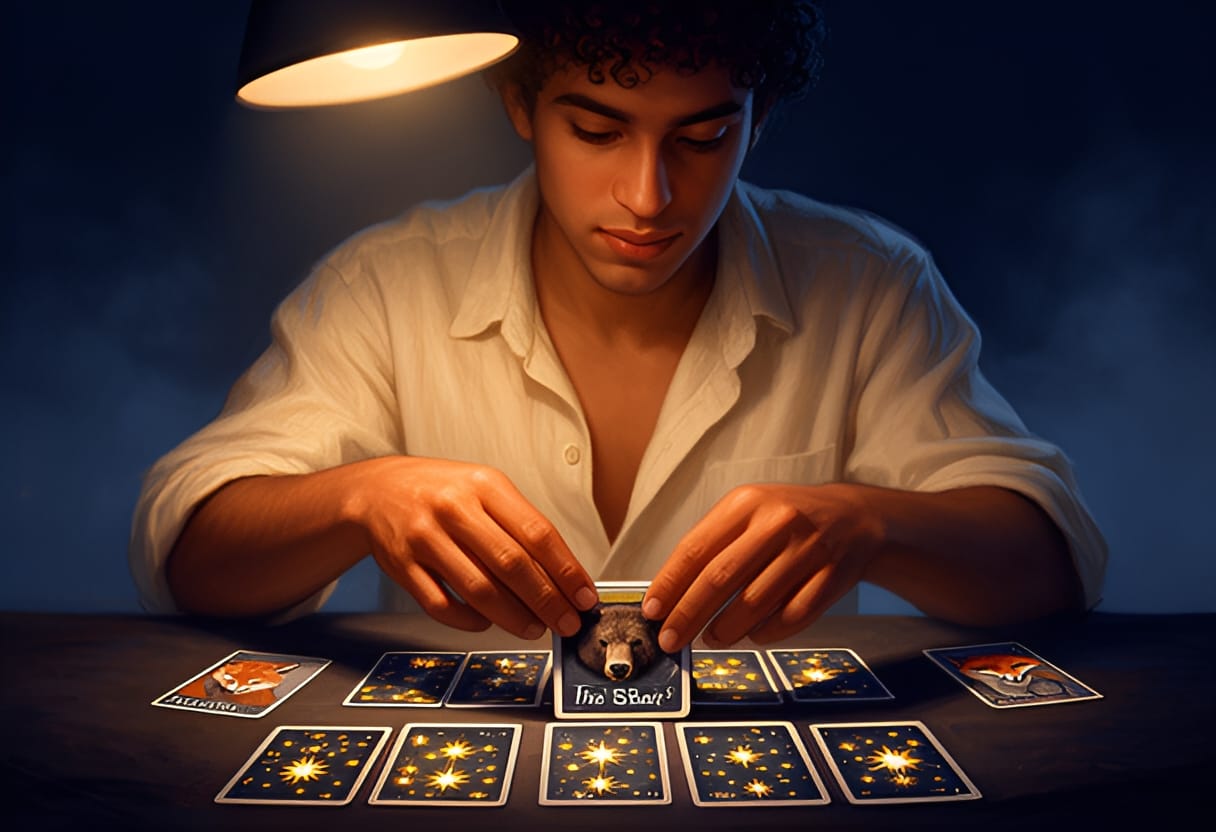
Then came the final row: Moon, Sun, Key, Ring. He placed them slowly, centering the four below the rectangle above. The Moon and Sun faced each other, opposite yet balanced. The Key stood between them, vertical, pointing upward. The Ring curled beside the Key, open on one side, as if waiting to be closed—or opened.
He stepped back. The full spread lay before him, not as a rigid grid, but as a field of relationships. Cards touched at corners, faced across rows, echoed in suit or symbol. He saw the Queen of Hearts near the Bear, her gaze drifting toward the Lily just above her. The Lily, soft and vertical, seemed to offer calm to the Queen’s quiet strength. Below, the Cross stood near the Path, not blocking it, but marking it—a reminder, not a barrier.
He didn’t go card by card. He moved in clusters, letting his eyes drift where they were drawn. Moon, Star, Sun—three lights in a diagonal line, growing in brightness. Emotional clarity, hope, vitality. Not a prediction, but a resonance.
Near the center, the Bear, the Tree, and the Mountain formed a triangle of weight and endurance. Strength rooted in persistence, faced with stillness. He thought of the weeks of practice, the silence he had kept each morning, the way he had learned to listen before speaking.
And there, where the Lily met the Queen and the Bear touched the Stars, he felt it—not a message, but a cohesion. The spread held together, not because it fit a rule, but because it felt true to the quiet attention he had brought to it.
He didn’t speak. He only sat, the lamp warm on his shoulders, and let the silence deepen. The cards were laid. The work had begun.
The lamp’s glow had softened to a pool of amber as Osvaldo closed his eyes, resting his palms flat on the table beside the spread. He breathed in slowly, feeling the coolness of the wood, the faint scent of beeswax from its unfinished surface. Outside, a tram rattled down Avenida Paulista, its metallic groan swallowed by the distance. Inside, he turned his attention inward—not to still the mind, but to notice its movements: the tug of anticipation, the habit of seeking meaning, the quiet pride in having laid the cards with care.
He thought of Dona Lurdes, who had never claimed the cards as her own tradition, only as a bridge to memory. He thought of the library’s brittle pages, the footnotes tracing the deck’s path from German parlors to French salons, its adoption by fortune-tellers in carnival tents, never rooted in Romani spirituality but often mistaken for it. He had read the warnings in ethnographic texts—how easily symbols get plucked, repackaged, sold back as exotic wisdom. He would not add to that.
Three boundaries formed in his silence, clear as the lines between the cards: He would not read for illness or death, not because he doubted the cards could reflect such things, but because to do so would risk fear, false hope, or the erosion of professional care. He would not read to influence another’s choices—no steering a lover’s heart, no advising on contracts or legal disputes. The cards offered reflection, not leverage. And he would never read without consent, not even a single draw for curiosity’s sake. If someone sat before him, it would be because they asked, and he would explain, plainly, what he was doing: not predicting, but listening—with the cards as a focus, not an authority.
He opened his eyes. The Mesa Real still lay before him, a constellation of images neither confirming nor denying. He picked up the deck, squared it in his hands, and began a mindfulness practice he had read about in a book on contemplative cartomancy: three breaths, each longer than the last, focusing not on outcome but on presence. On the inhale, he acknowledged whatever tension lived in his shoulders, the slight ache behind his eyes from concentration. On the exhale, he imagined it flowing out through his fingertips, into the cards—not charging them, but meeting them with openness.
When he felt ready, he shuffled. Not the quick, practiced flick of a performer, but a slow overhand shuffle, thumbs guiding the cards in small groups, letting them interlace naturally. He thought of Mateo, hunched over his laptop two nights ago, torn between the internship in Porto Alegre and the one near home. Osvaldo had wanted to offer clarity, had almost spoken—but stopped himself. Consent wasn’t just a formality; it was respect. And reflection worked best when invited, not imposed.
He cut the deck with his left hand, placed the pile to the right, and squared it again. Then, without looking, he drew the top card and laid it face down beside the notebook where he recorded his practices. Not for interpretation now, but as a gesture—a commitment to proceed only when asked.
A soft knock came at the door. Osvaldo looked up. Mateo stood in the threshold, holding two paper cups from the all-night café down the street.
“You still up?” Mateo asked, smiling. “Thought I’d bring you a coffee. You look like you’ve been deep in thought.”
Osvaldo glanced at the table—the Mesa Real still intact, the single face-down card beside his notebook. He felt no urge to explain, no pressure to perform. Only the quiet certainty that came not from knowing what the cards meant, but from honoring how they were meant to be used.
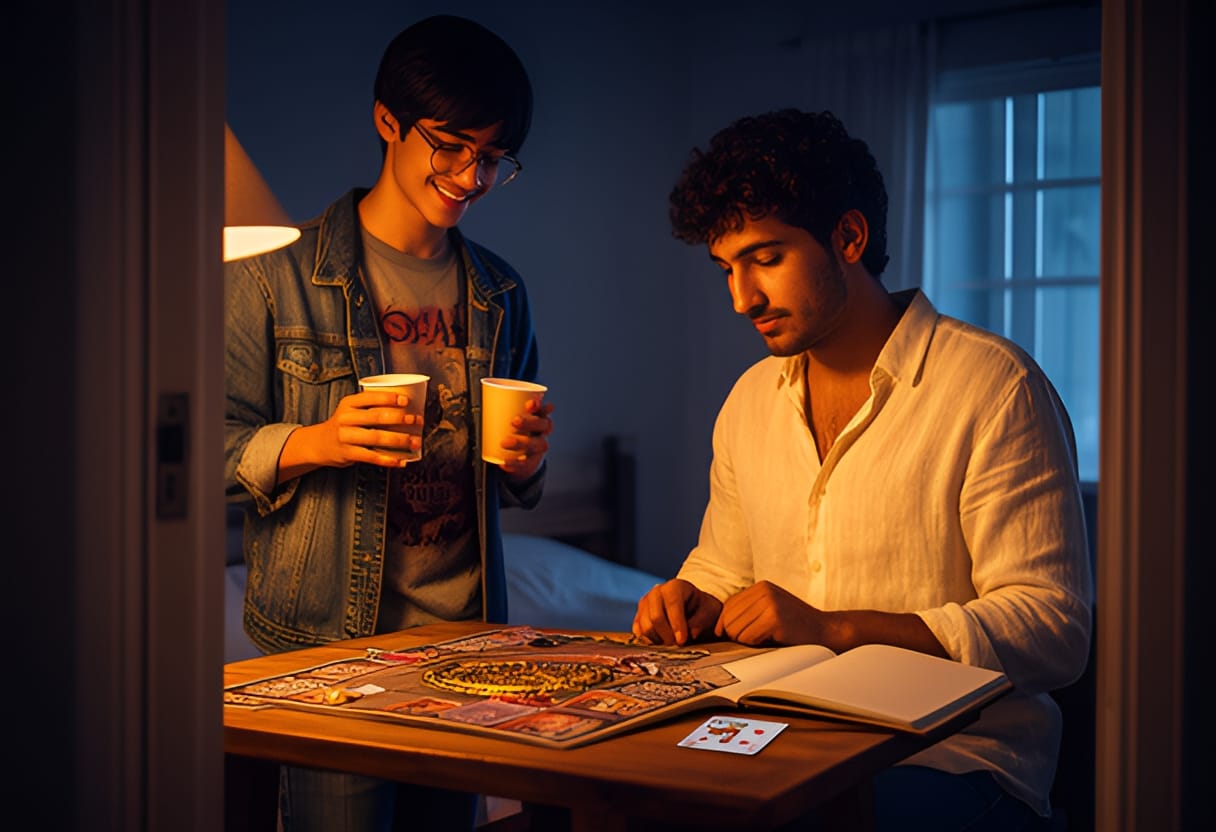
“I am,” he said, closing his notebook. “And I’d love that coffee.”
Mateo stepped in, closing the door softly behind him. The city’s hum returned, steadier now, as if the night itself were settling into rhythm. Osvaldo reached for the deck, not to shuffle, but to gather it slowly, card by card, returning it to its box with the same care he had used to lay it out.
He would wait. He would ask nothing. But if Mateo ever came and said, Read for me, Osvaldo would be ready—not with answers, but with attention. And that, he realized, was enough.