Fiction
قوة الانضباط الصباحي
by mo. alkinj
3 chapters1.1 hr read
Chapter 1
البذرة
The alarm had screamed for twenty-three minutes before Youssef finally dragged himself from bed, his limbs heavy as wet clay. He stumbled to the bathroom, splashed cold water on his face, and stared at the hollow-eyed man in the mirror — hair sticking up in uneven tufts, shirt half-buttoned, tie knotted loosely around his neck like an afterthought. He yanked on his trousers, missed the belt loops twice, and shoved his feet into shoes still damp from yesterday’s rain. In the kitchen, he grabbed a paper cup, poured scalding coffee to the brim, and lunged for the door, only to jerk back as the liquid sloshed over the rim, searing his thumb.
He sucked the burn, cursed under his breath, and snatched a stack of sketches from the table — the facade revisions for the Nile Plaza project, due at nine. They fluttered in his grip as he hurried down the stairs, two at a time, nearly colliding with Mrs. Gohar from third floor, who clutched her rosary and muttered, “Allah yostur,” as he blew past.
The streets of Zamalek were already thick with honking taxis and pedestrians weaving between carts laden with mangoes and bunches of mint. Youssef shoved his way forward, coffee cup clamped in one hand, sketches clutched to his chest with the other, his heart hammering not just from exertion but from the familiar, sour dread of being late — again. He checked his watch: 8:47. The firm opened at eight. Mr. Hassan’s office was on the third floor, glass-walled, impossible to miss.
He burst through the revolving doors of the architecture firm at 8:52, breathless, a dark stain blooming across the front of his shirt where the coffee had spilled. The open-plan studio hummed with activity — draftsmen bent over tables, phones ringing, the soft whir of the printer. Heads turned. Layla looked up from her screen, eyebrows rising. She opened her mouth, but Youssef waved her off, already striding toward Mr. Hassan’s office, rehearsing excuses.
The door was ajar. Mr. Hassan sat behind his desk, steepling his fingers, a frown carved deep into his weathered face. His salt-and-pepper hair was immaculate, his tie perfectly knotted, his cufflinks catching the morning light. He didn’t look up as Youssef approached.
“You’re late,” Mr. Hassan said, voice low but cutting. “Again.”
Youssef stopped, forced a smile. “Traffic on the Sixth of October Bridge was a nightmare. Accident near Maadi. You know how it gets.”
Mr. Hassan finally lifted his gaze. His eyes were sharp, unimpressed. “You said the same thing yesterday. And the day before. Three times this week, Youssef. Three times you’ve walked in after nine, apologizing, blaming the city, the weather, the alignment of the stars.”
“I know, I’m sorry — ”
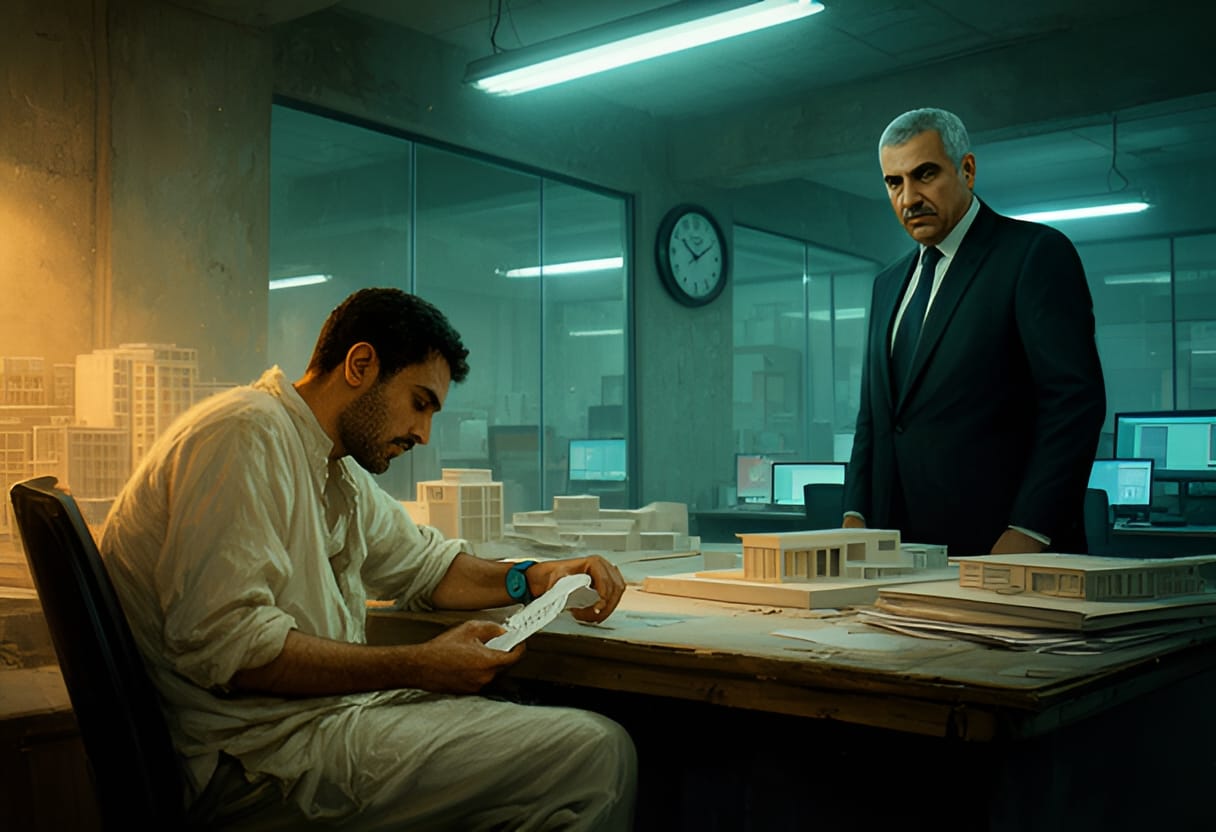
“Sorry doesn’t redraw the plans,” Mr. Hassan interrupted. “Sorry doesn’t get the structural calculations signed off. Sorry doesn’t explain why the client called me this morning wondering if we’ve abandoned the project.” He slid a folded memo across the desk. “This is your final warning. Be here by eight sharp tomorrow — or don’t bother coming back.”
Youssef felt the blood drain from his face. He picked up the memo, his thumb smudging the ink. “I’ll be here. I promise.”
Mr. Hassan studied him for a long moment, then gave a single, curt nod. “We’ll see.”
Youssef backed out of the office, the door clicking shut behind him. He leaned against the cool plaster of the hallway, closing his eyes. The studio noise faded into a muffled roar. His hands trembled. Not just from fatigue — from shame. He’d let them down again. Let himself down.
Layla appeared beside him, concern softening her features. “You okay? You look like you saw a ghost.”
“I’m fine,” he said too quickly. “Just… need air.”
He didn’t wait for her reply. He walked past the rows of desks, past the half-finished models of bridges and towers, out into the blazing Cairo sun. He found a bench beneath a jacaranda tree in the small courtyard, its purple blossoms drifting down like slow snow. He unfolded the memo, read it again, then crumpled it in his fist.
His phone buzzed in his pocket. Karim’s name glowed on the screen. He hesitated — his grandfather rarely called during the day — then answered.
“Youssef habibi?” Karim’s voice came warm and steady, tinged with the faint crackle of distance. “Everything alright?”
“Yeah, I’m… I’m fine,” Youssef lied. “Just… had a rough start.”
“Rough how?”
He exhaled, staring at a line of ants marching across the stone. “I was late again. Mr. Hassan… he gave me a warning. Said if I’m late tomorrow, I’m fired.”
Silence. Then Karim chuckled — soft, knowing. “Ah. The alarm didn’t win this morning, did it?”
Youssef froze. “How did you — ”
“I know your habits, ya habibi. You think I don’t hear you tossing and turning through the wall when you visit? You think I don’t know the sound of that alarm being slapped into submission?”
A flush crept up Youssef’s neck. “I… I hit snooze. Three times. Then I rushed, spilled coffee on my sketches — ”
“And now you feel like a fool,” Karim finished gently. “I know that feeling. I used to be just like you — until I learned the morning doesn’t belong to the one who wakes first. It belongs to the one who shows up for it.”
Youssef swallowed. “I tried setting it earlier. I really did. But when it goes off… it’s like my brain just shuts down. I tell myself five more minutes. Then ten. Then suddenly it’s half past six and I’m panicking.”
“What do you say to yourself when the alarm rings?” Karim asked, so quietly Youssef had to lean in to hear.
He paused. The words came unbidden, raw. “I say… I’m not ready. I need more sleep. I can start tomorrow.”
Karim was silent for a beat. Then, softly: “And what if tomorrow never comes because you keep waiting for it to be easy?”
Youssef stared at the blossoms falling around him, each one a tiny violet sigh. The shame burned hotter now, not just for being late, but for the truth in his grandfather’s voice — the way it laid bare the lie he’d been telling himself for years.
“I’ll try again tomorrow,” he said, voice thick.
“I know you will,” Karim replied. “But try not just with the alarm. Try with what you say to yourself when it rings.”
The line went quiet. Youssef didn’t hang up right away. He listened to the distant hum of the city, the rustle of leaves, the steady rhythm of his own breath. Then he whispered, “Thank you, Jaddo,” and ended the call.
He sat there a moment longer, the memo still clenched in his fist, the weight of it pressing into his palm. He didn’t feel hopeful. Didn’t feel resolved. Just… seen. And for the first time in a long time, that felt like enough to start with.
Youssef knocked on the wooden door just as the first hint of dawn bleached the sky over Cairo. The city was still wrapped in a hush, the usual symphony of horns and vendors not yet begun. He shifted his weight from foot to foot, the cool air nipping at his wrists where his shirt sleeve had ridden up. He had left his apartment in a hurry, still wearing the same clothes from yesterday, his hair uncombed, the memo from Mr. Hassan crumpled in his pocket like a guilty secret.
The door opened before he could knock again. Karim stood there, already dressed in a faded cotton galabeya, his white hair neatly combed, his feet bare on the cool tile. He smelled of sandalwood and damp earth.
“You’re here early,” Karim said, not surprised. “Come in. I was just finishing my prayer.”
Youssef stepped inside, the scent of mint tea and old books wrapping around him like a familiar embrace. The small apartment was orderly, every thing in its place — the Quran on a low shelf beside a chipped teacup, a row of succulents lined up on the windowsill, their leaves catching the pale morning light.
Karim led him to a low table where a glass of water waited. He sat cross-legged on a cushion, his hands resting on his knees, eyes closed. Youssef hesitated, then mirrored him, the silence between them thick with the weight of last night’s conversation.
When Karim opened his eyes, there was no judgment, only calm.
“You look like you carried the whole night on your shoulders,” he said.
Youssef let out a breath he hadn’t realized he’d been holding. “I didn’t sleep well. I kept thinking about the memo. About eight o’clock.”
Karim nodded slowly. “Fear makes a poor alarm clock. It wakes you, but it doesn’t keep you going.”
He rose and walked to the door, pulling it open to reveal a tiny courtyard tucked behind the building. A few pots lined the walls, a small fountain burbled softly in the corner, and a patch of earth held sprouts of green pushing through the soil. Karim moved among them with quiet purpose, pouring water from a small can, his movements unhurried, deliberate.
Youssef followed, leaning against the doorframe. He watched his grandfather’s hands — not young, not steady as they once must have been, but sure. Each plant received the same attention, whether it was a thriving basil or a struggling shoot. Karim paused, touched a leaf, then smiled.
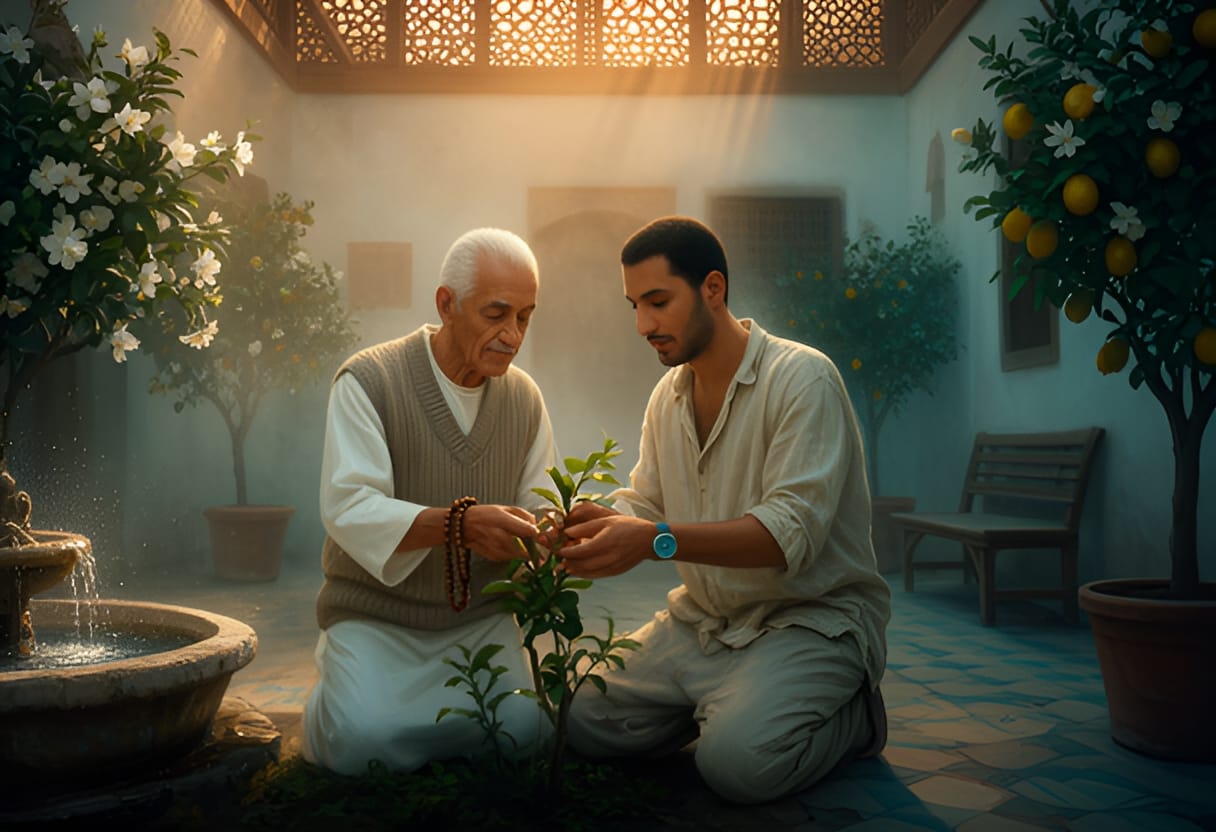
“This one needed more than the others,” he murmured. “Not because it asked. But because I saw it needed.”
Youssef frowned. “You don’t wait for motivation to water them?”
Karim chuckled, a soft sound like dry leaves skittering across stone. “Motivation? No. I water them because it’s time. Because if I waited until I felt like it, some days I wouldn’t. Some days I’d be tired, or sad, or distracted by the news, or remembering things better left asleep. But the plants don’t care how I feel. They only care if I show up.”
He turned, wiping his hands on his trousers. “Discipline isn’t about feeling strong. It’s about showing up when you don’t feel like it. That’s where the power is — not in the burst of inspiration, but in the return, again and again.”
Youssef stared at his own hands, calloused from drafting pencils and late-night sketching. “I want to believe that. I really do. But every time I try, it feels like I’m fighting myself. The alarm goes off, and my mind just… rebels.”
Karim sat on the edge of the fountain, patting the space beside him. Youssef sat, the cool stone seeping through his trousers.
“Tell me,” Karim said, “what’s the smallest thing you could do tomorrow morning — not to fix everything, not to become someone else — just to prove to yourself that you can keep a promise to the day?”
Youssef thought of the memo, of Mr. Hassan’s cold stare, of the way his chest tightened every time he saw the clock crawl past eight. “I don’t know. Get out of bed when the alarm rings? Without hitting snooze?”
Karim shook his head. “Too big. Too much room for failure. You’re setting yourself up to fall short before you’ve even begun.”
He picked up a smooth stone from the fountain’s edge and placed it in Youssef’s palm. It was cool, worn soft by water.
“Begin with this,” Karim said. “Hold it. Feel its weight. Just for thirty seconds. That’s all. No judgment, no goal — just hold it and be here. Do that tomorrow when you wake up. Before you check your phone. Before you think about the day. Just hold the stone.”
Youssef turned the stone over in his fingers. It felt absurdly simple. Insultingly small. “That’s it?”
“That’s where it starts,” Karim said. “Not with grand gestures. Not with overhauling your life. With one small act done with full attention. You build trust not by succeeding at something huge, but by proving to yourself, again and again, that you can do what you say you’ll do. Even when it’s small. Especially when it’s small.”
A bird called from somewhere beyond the courtyard wall. The fountain gurgled. Somewhere in the distance, the first call to prayer drifted over the rooftops, soft and rising.
Youssef closed his hand around the stone. It was nothing. And yet, in his palm, it felt like the first real thing he’d held in a long time.
“I’ll try,” he said.
Karim nodded, his eyes kind but firm. “Not ‘I’ll try.’ You will. Because you’re here now, aren’t you? At five in the morning, holding a stone because your grandfather asked you to. That’s not trying. That’s beginning.”
Youssef looked up, the first true light of day spilling over the rooftops, turning the jacaranda blossoms in Karim’s courtyard to glowing embers. For the first time since the memo, since the warning, since the endless cycle of lateness and shame, he felt not the weight of failure, but the quiet possibility of a start.
He stood, the stone still warm in his hand. “Thank you, Jaddo.”
Karim placed a hand on his shoulder, grip light but sure. “Go home. Get some rest. And tomorrow — hold the stone.”
Youssef walked back through the quiet apartment, out into the awakening street. The city was stirring now — a delivery truck rumbled down the alley, a woman called to her child from a balcony, the scent of fresh bread drifted from a nearby bakery.
He didn’t feel fixed. Didn’t feel cured. But for the first time in years, he felt like he was moving in the right direction — not because he had been inspired, but because he had shown up.
And that, he realized as he turned the corner toward home, was something no alarm could ever take from him.
Youssef set three alarms on his phone, each five minutes apart, and placed it face down on the dresser across the room, as Karim had suggested. He lay on his back, staring at the ceiling, the smooth stone Karim had given him cool against his palm where it rested on his chest. The city outside his window was still wrapped in darkness, the only light the faint glow of the alarm clock on his nightstand blinking 4:55 AM.
He told himself he would not think about the day. He would not reach for his phone. He would simply hold the stone, feel its weight, and be present — just for thirty seconds. It sounded so small, so easy, that part of him resisted it, as if the simplicity were a trick. But another part, quieter, urged him to try. Just this once.
The first alarm blared at 5:00 AM — a harsh, repetitive beeping that sliced through the quiet. Youssef’s eyes snapped open. His arm twitched toward the phone, but he stopped himself. He took a breath. Then another. He turned onto his side, curled his fingers around the stone, and held it to his palm. It was cool, solid, real.
He focused on the weight of it, the way it fit in his hand, the faint grooves worn into its surface by water and time. He counted silently: one… two… three… His mind began to drift — to the memo on his desk, to Mr. Hassan’s stare, to the facade revisions still unfinished — but he gently pulled his attention back to the stone. Five… six… seven… He felt the rise and fall of his breath, the pulse in his thumb where it pressed against the stone.
Ten… eleven… twelve… A yawn crept up his throat. His eyelids felt heavy. The warmth of the blanket pulled at him. Thirteen… fourteen… fifteen… He reminded himself: this is the beginning. This is showing up.
Sixteen… seventeen… eighteen… The alarm was still beeping. Nineteen… twenty… twenty-one… He could just reach over and hit snooze. It would be so easy. Twenty-two… twenty-three… twenty-four… His fingers twitched. Twenty-five… twenty-six… twenty-seven… The stone felt heavier now, not in weight, but in meaning. Twenty-eight… twenty-nine… thirty.
He opened his hand. The stone lay in his palm, warm from his skin. He had done it. He had held it for thirty seconds. A quiet surge of pride rose in his chest — small, but real.
Then, without thinking, he reached for his phone and hit snooze.
The alarm fell silent. He lay there, the stone still in his hand, and told himself: just five more minutes. I’ll get up after this. I’ve already started.
He closed his eyes.
The second alarm screamed at 5:05 AM. Youssef groaned and slapped the snooze button without opening his eyes. He turned onto his stomach, burying his face in the pillow. The stone had slipped from his hand during the night and now lay on the floor beside the bed. He didn’t notice.
The third alarm blared at 5:10 AM. This time, he didn’t even move. He let it ring, the sound blending into the half-dreams that clung to him — dreams of falling, of being late, of Karim’s voice saying, “You will.” He eventually fumbled for the phone, his movements slow and thick, and hit snooze again. He muttered something unintelligible into the pillow, then drifted back into sleep.
The fourth alarm sounded at 5:15 AM. Youssef stirred, blinked against the harsh light of the room, and saw the time glowing in red: 5:15. He sat up slowly, rubbing his face. The stone was still on the floor. He picked it up, turned it over in his fingers. A wave of shame washed over him, hot and sudden.
“I said I would,” he whispered to the empty room. “I said I would hold it.”
He looked at the alarm clock. It was 5:16. He had thirty seconds. He could still do it. He could hold the stone now, before the day got away from him.
He opened his palm. The stone was cool again. He closed his fingers around it and began to count.

One… two… three…
His mind immediately jumped to the day ahead — the draft he needed to finish, the email he forgot to send, the way Layla would look at him when he walked in late again. He forced his focus back to the stone. Four… five… six… The weight of it felt familiar now, comforting in its simplicity.
Seven… eight… nine… He thought of Karim’s hands in the courtyard, pouring water without hesitation. Ten… eleven… twelve… He thought of the memo on his desk, the final warning, the way his chest had tightened when Mr. Hassan said, “Not return.”
Thirteen… fourteen… fifteen… He felt the urge to check his phone, to see if anyone had messaged him, to see what time it really was, to distract himself with the noise of the world. He resisted. Sixteen… seventeen… eighteen… He breathed in, breathed out. Nineteen… twenty… twenty-one… The alarm was still silent — he had not let it ring again. He was awake. He was trying.
Twenty-two… twenty-three… twenty-four… His eyelids felt heavy again. Twenty-five… twenty-six… twenty-seven… He could feel the pull of sleep, soft and insistent, like a hand on his wrist. Twenty-eight… twenty-nine… thirty.
He opened his hand. The stone lay in his palm, warm from his grip. He had done it again. He had held it for thirty seconds.
A small, fragile sense of accomplishment settled in his chest. Not enough to erase the failure of oversleeping, but enough to whisper: you kept a promise. You showed up, even if it was late.
He stood, stretched, and walked to the bathroom. He splashed water on his face, brushed his teeth quickly, and pulled on the same clothes he had worn the day before — the wrinkled shirt, the trousers with the faint stain near the cuff. He didn’t have time to think about appearance. He had to get to work.
He grabbed his bag, glanced at the stone on the sink, and paused. He could take it with him. He could hold it again later, before he walked into the office, before he sat at his desk. It might help him center himself.
He picked it up, slipped it into his pocket, and left the apartment.
The street was already alive with the rhythm of the morning — the honk of cars, the call of a vendor selling foul and ta’amiya, the distant echo of the morning prayer from a nearby mosque. Youssef walked quickly, his hands in his pockets, his fingers brushing the stone now and then as he walked. It grounded him, just a little.
He reached the firm in Zamalek at 8:47 AM. Fifteen minutes late. Again.
He slipped inside, hoping to avoid notice, and made a beeline for his desk. Layla looked up from her screen, her eyebrows raised.
“Rough morning?” she asked, her tone light but knowing.
Youssef forced a smile. “You could say that.”
He sat down, pulled out his sketchbook, and opened the Nile Plaza facade revisions. The deadline was 9:00 AM. He had thirteen minutes.
He began to work, but his focus was scattered. His eyes kept drifting to the clock. His hand moved mechanically over the paper, lines hesitant, unsure. He tried to recall the changes Mr. Hassan had requested — the shading on the east wing, the adjustment to the balcony railings — but his mind felt foggy, as if wrapped in cotton.
He made a correction to the window spacing, then second-guessed himself and erased it. He redid it, then hesitated again. Each decision felt heavier than it should, each small choice a battle against the lingering weight of his failure.
He glanced at the clock: 8:58 AM. Two minutes left.
He rushed to finish the final detail — a small cornice detail near the roofline — and in his haste, he misaligned the scale. The line he drew was too long, throwing off the proportion of the entire section. He didn’t notice until he leaned back, squinting at the drawing, and felt a flicker of something wrong.
He leaned closer. The cornice jutted out where it should have recessed. It was a minor error, easily fixed, but in the context of the deadline, it felt like a crack in a dam.
He grabbed his eraser, began to correct it, but the clock ticked over to 9:00 AM.
He froze.
The drawing was still imperfect. The line was still off.
He sat back, his heart pounding. He had made it to work — barely — but he had not delivered what was promised. Not on time. Not right.
He heard footsteps approaching. He didn’t look up. He knew, without seeing, that it was Mr. Hassan.
The stone in his pocket felt suddenly useless. He had held it. He had tried. But none of it mattered if the work wasn’t done.
He closed his sketchbook slowly, the stone pressing against his thigh through the fabric of his pocket, a small, silent weight.
He sat at his desk long after the office had emptied, the sketchbook open before him, the flawed line still visible beneath the smudge of his eraser. The fluorescent lights hummed overhead, casting a pale glow over the half-finished revision. Outside, the Zamalek streets had begun to quiet, the call to evening prayer drifting faintly through the open windows. He hadn’t moved. Couldn’t.
The stone in his pocket had grown warm again, not from grip this time, but from the length of time it had lain there — a quiet accusation. He had held it. He had woken. He had made it to work. And still, he had failed.
He pushed the sketchbook away and stood, the chair scraping softly against the tile. He needed air. He needed to walk. But more than that, he needed to see Karim.
The walk to his grandfather’s building was short, but it felt longer tonight. Each step echoed the rhythm of his disappointment — uneven, hesitant. He passed the same vendor who had sold him foul and ta’amiya that morning, now packing up his cart, the last of the pita bread tucked beneath a cloth. The scent of cumin and lemon lingered in the air, but it did not comfort him.
He reached Karim’s door and knocked, not with the usual ease, but with a hesitation that surprised him. The door opened almost immediately.
Karim stood in the doorway, wearing the same faded cotton galabeya, the scent of sandalwood and damp earth wrapping around him like a familiar prayer. His eyes, sharp despite the hour, searched Youssef’s face without judgment.
“I didn’t expect to see you again so soon,” Karim said, his voice low, calm. “Come in.”
Youssef stepped inside, the familiar order of the apartment wrapping around him — the Quran on the low shelf beside the chipped teacup, the row of succulents on the windowsill catching the last light of day. He moved to the small courtyard, the place where Karim had shown him the rhythm of morning, and stood near the edge, his hands shoved deep into his pockets, fingers brushing the stone.
“I tried,” he said, the words rough. “I really did. I woke up. I held the stone. I made it to work. But I was late. Again. And I messed up the drawing. The cornice — I got the scale wrong. Mr. Hassan saw it. He didn’t say anything yet, but I know. I know what it means.”
Karim was silent for a moment. He moved to the low table and poured two glasses of water, the condensation beading on the outside. He handed one to Youssef, then sat cross-legged on the cushion opposite him.
“You held the stone,” Karim said, not unkindly. “You woke. You walked. You arrived. These are not small things. They are the beginning.”
Youssef looked down at his glass, at the way his fingers trembled slightly around it. “But it wasn’t enough. I was still late. I still failed. The work wasn’t right. And if I lose this job — ”
“You think the stone is the point,” Karim interrupted gently. “You think if you hold it long enough, if you wake early enough, the world will bend to your effort. But discipline is not a transaction. It is not ‘I did this, so I deserve that.’”
Youssef swallowed. “Then what is it?”
Karim’s gaze held his. “It is about what you tell yourself when the alarm rings. Before you move. Before you think of the day. Before you blame the clock, the traffic, the tiredness. What do you say in that first breath of waking?”
Youssef frowned. He hadn’t considered that. He had been so focused on the action — holding the stone, getting out of bed — that he hadn’t listened to the voice inside.
“I… I don’t know,” he admitted. “I just hit snooze. I just went back to sleep.”
“Try to remember,” Karim urged. “Not what you did. What you thought.”
Youssef closed his eyes. He saw the darkness of his room, the glow of the alarm clock: 5:00 AM. The sound — sharp, insistent — cutting through the haze of sleep. And then, the thought, automatic, unexamined:
“Just five more minutes.”
He opened his eyes. The words hung between them, fragile but undeniable.
“I thought… I thought I needed five more minutes,” he whispered. “I told myself I wasn’t ready. That I could start tomorrow. That it wouldn’t matter if I delayed — just this once.”
Karim nodded slowly. “And in those five minutes, what happened?”
“I went back to sleep,” Youssef said. “And when I woke again, it was worse. I felt guilty. I felt behind. I rushed. I forgot things. I spilled coffee. I showed up already defeated.”
“So the alarm did not make you late,” Karim said softly. “Your thought did. The story you told yourself in that moment — that you could put it off, that you were not ready, that tomorrow would be better — that is what stole your morning. Not the clock. Not the bed. The voice inside.”
Youssef stared at his hands. The stone in his pocket pressed against his thigh, no longer a symbol of effort, but of exposure. He had been fighting the wrong battle. He had been wrestling with the alarm, with the blankets, with the clock — when the real enemy had been whispering in his ear all along.
“It’s not about waking early,” he said, the realization dawning like light through a crack in the curtains. “It’s about what I believe when I wake. If I believe I can delay, I will. If I believe I’m not ready, I never will be.”
Karim smiled, just slightly. “Now you see. The stone is not a charm. It is a reminder. A pause. In that pause, you have a choice: to listen to the voice that says ‘later,’ or the one that says ‘now.’ You don’t have to feel ready. You just have to choose.”
Youssef exhaled, long and slow. The weight in his chest hadn’t vanished — but it had shifted. It was no longer just shame. It was awareness. And for the first time, it felt like something he could work with.
He reached into his pocket and pulled out the stone. It was smooth, cool now, worn slightly from his grip. He placed it gently on the table between them.
“I’ll try again tomorrow,” he said. Not a promise. Not a vow. Just a statement. A beginning.
Karim reached out, not to take the stone, but to cover Youssef’s hand with his own for a brief moment — warm, steady, grounding.
“Good,” he said. “Now go home. Rest. And listen.”
Youssef stood, the courtyard air cool against his skin. He didn’t look back as he walked to the door. He didn’t need to. The stone was no longer in his pocket. But its weight remained — not as a burden, but as a reminder.
He stepped into the night, the city breathing around him, and for the first time in a long while, he walked not toward sleep, but toward the sound of his own voice — and the choice to change it.

Chapter 2
الصراع
Youssef stood, the courtyard air cool against his skin. He didn’t look back as he walked to the door. He didn’t need to. The stone was no longer in his pocket. But its weight remained — not as a burden, but as a reminder.
He stepped into the night, the city breathing around him, and for the first time in a long while, he walked not toward sleep, but toward the sound of his own voice — and the choice to change it.
The alarm cut through the dark at 5:00 AM. Not a scream this time, but a steady, insistent pulse — like a heartbeat he had asked for. Youssef kept his eyes closed, feeling the weight of the stone on the nightstand beside him, cool and smooth under his fingertips from the night before. He remembered Karim’s hand over his, the quiet certainty in his voice: You don’t have to feel ready. You just have to choose.
He exhaled through his nose, pushed the blanket aside, and sat up. The movement was small, but it felt like crossing a threshold. His feet touched the floor — cold tile, familiar in the pre-dawn hush. He didn’t think about the day. Didn’t check his phone. Didn’t let the mind spin its usual tale of not enough time, not enough sleep, not ready.
Instead, he reached for the glass of water he had set out the night before. It was slightly warm now, but he drank it slowly, feeling it travel down his throat, a quiet signal to his body: We are here. We are starting.
Then, he stood and stretched — arms overhead, spine lengthening, a slow roll of the shoulders, a gentle twist to each side. Five minutes. That was all he had promised himself. No more. No less. When the timer on his old wind-up clock — the one Karim had given him years ago, its face faded but still ticking — clicked to five, he stopped. Not because he felt done, but because he had kept his word.
He folded the blanket neatly, placed the stone back in his pocket, and stepped into the bathroom to splash his face. The water shocked him awake, not unpleasantly. He looked at himself in the mirror — hair messy, eyes still heavy, but there, present. Not defeated. Not yet.
He made tea — mint, strong — and sat by the window, watching the sky shift from indigo to a pale, washed-out blue. No phone. No thoughts of deadlines or designs. Just the quiet, and the warmth of the cup in his hands. When he finished, he kissed his fingertips and touched them to his forehead, a small habit he’d picked up from watching Karim pray — not prayer, exactly, but acknowledgment. A thank you for the morning, for the chance.
He left for work at 7:45 AM. Ten minutes early. Mr. Hassan didn’t say anything as he passed, just gave a single nod — not approval, not yet, but acknowledgment. Youssef felt it settle in his chest, not as pride, but as proof. I showed up.
The second morning was harder. His body protested. His eyelids felt glued. The voice came sooner, softer: Just five more minutes. You earned it. But he remembered the stone. He remembered the pause. He sat up anyway. Drank the water. Stretched. Five minutes. The timer clicked. He stopped.
He didn’t do the tea or the quiet sitting this time. He was tired. But he made it to work by 7:50 AM. Mr. Hassan glanced up from his desk, eyes narrowing slightly as Youssef passed — not unkindly, but calculating. Youssef held his gaze for a second longer than usual. No apology. No excuse. Just presence.
That night, he told Layla over lukewarm tea in the breakroom, “I did it. Two days in a row.”
She stirred her tea, eyes sharp behind her glasses. “Two days? That’s it?”
He shrugged. “It’s a start.”
She studied him for a moment. “You look… lighter. Less like you’re carrying the whole city on your shoulders.”
He smiled, small but real. “I’m trying to put it down.”
The third night, the Nile Plaza project came back to haunt him.
The cornice revision — the one he had scaled wrong, the one Mr. Hassan had noticed but not yet commented on — had resurfaced in a senior partner’s email. The client wanted a last-minute adjustment: a deeper overhang to shade the upper windows, a change that would affect the load distribution, the detailing, the timeline. It wasn’t a mistake, exactly, but it was a complication. And it had landed in his lap at 8:00 PM.
He told himself it would take an hour. Just a quick recalculation. A tweak to the CAD file. He could still wake early. He could still keep the chain.
But one hour became two. Then three. The numbers wouldn’t align. He redrew the section three times. Each version felt worse than the last. Frustration coiled tight in his shoulders. He drank cold coffee from a mug that had been sitting since noon. His eyes burned. The city outside his window had long since surrendered to darkness, but his lamp blazed like a defiant star.
At 11:45 PM, he finally had something workable. Not perfect. Not elegant. But it would satisfy the client’s request without compromising safety. He saved the file, leaned back, and stared at the ceiling. His alarm was set for 5:00 AM. Five and a half hours of sleep. If he fell asleep now.
He didn’t move right away. The silence after the work felt heavy, not peaceful. He thought of the stone. Of the pause. Of Karim’s voice: You don’t have to feel ready. But he didn’t feel ready to sleep. He felt wired, hollowed out, like he had scraped the inside of his skull clean and found nothing left.
He reached for his phone — just to check the time, he told himself. One quick look. Then he saw Layla’s name in a group chat: Anyone up? Saw this amazing facade detail in Beirut — thought of your Nile Plaza work. Below it, a string of laughing emojis and a photo of a building with flowing, organic lines.
He smiled despite himself. Then he opened the photo. Then another. Then a video of a timelapse sunset over the Mediterranean. Twenty minutes passed. Then thirty. His eyelids drooped, but he fought it. Just one more. He told himself he was relaxing. That he deserved it.
When he finally put the phone down, it was 1:15 AM.
He set the alarm for 5:00 AM anyway. He told himself he could still make it. Five hours. That was enough. He had done less before.
The alarm screamed at 5:00 AM.
Youssef didn’t hear it at first. He was deep in a dream where he was presenting the Nile Plaza design to a panel of judges, and every time he spoke, his voice came out muffled, like he was underwater. Then the sound pierced through — insistent, cruel, familiar.
He groaned and shoved his face into the pillow. Five more minutes. Just five. I earned it after last night.
He didn’t reach for the stone. Didn’t think about the pause. He thought only of the weight of his eyelids, the pull of the mattress, the injustice of being asked to wake after so little.
When he finally dragged himself upright, it was 5:47 AM. Forty-seven minutes late. The timer on his nightstand blinked mockingly: 00:00 — the five minutes he had promised himself, long gone.
He sat on the edge of the bed, head in his hands. The stone was still in his pocket from the night before. He hadn’t taken it out. He hadn’t even remembered it was there.
A wave of shame washed over him, hot and sharp. Two days. That’s all I managed. Two lousy days. He thought of Mr. Hassan’s narrow eyes. Of Layla’s hopeful look. Of Karim’s steady hand over his.
He had broken the chain. Not with a grand failure, but with a whisper: later. Just like before.
He wanted to throw the stone against the wall. To scream. To give up. To tell himself he was never meant for this — for mornings, for discipline, for being the kind of man who showed up before the world demanded it.
But beneath the shame, quieter but insistent, came another thought: What if I don’t have to get it right every time? What if the choice isn’t in the perfection, but in the return?
He didn’t stand. Didn’t wash his face. Didn’t try to salvage the morning. He just sat there, the stone warm in his palm, and let the silence settle — not the silence of failure, but the silence before a decision.
He didn’t know what he would do tomorrow. But for the first time since the alarm had screamed, he wasn’t already planning to fail.
He didn’t know what he would do tomorrow. But for the first time since the alarm had screamed, he wasn’t already planning to fail.
The morning light came thin and gray through the blinds, catching dust in the air like suspended ash. Youssef sat on the edge of the bed, the stone still warm in his palm, its smooth edges worn from years of Karim’s touch. He had not moved for nearly twenty minutes. The silence in the apartment was thick, not peaceful, but heavy with the weight of what he had not done.
He got up slowly, as if each limb protested the motion. His feet found the floor, cold against his soles. He shuffled to the bathroom, turned on the tap, and let the water run over his wrists. It was shockingly cold. He stared at his reflection in the mirror — eyes shadowed, jaw tight, hair flattened on one side from where he had slept against the pillow. He looked like someone who had survived something, not someone who had begun again.
He did not drink the water. Did not stretch. Did not hold the stone and breathe. He washed his face, brushed his teeth mechanically, and pulled on the same wrinkled shirt from the day before. The routine was gone. Replaced by a hollow imitation — the motions without the meaning.
In the kitchen, he filled the kettle and set it to boil. While it heated, he opened the cabinet and took out a packet of biscuits — the sweet, cardamom-flavored kind Layla always teased him for liking. He ate two, standing at the counter, crumbs falling onto his shirt. The kettle whistled. He poured the water over instant coffee, added too much sugar, and carried the mug to the small table by the window.
He sat. The steam curled up, blurred the view of the street below. A delivery boy on a motorbike weaved between cars. A woman in a headscarf hurried past, clutching a bag of bread. The city was already awake, moving, indifferent.
He took a sip. The coffee was bitter, overly sweet, lukewarm by the time he finished it. He checked his phone. 7:20 AM. He had meant to leave by 7:45. He still had time. But the thought of the stone, of the pause, of Karim’s voice saying You don’t have to feel ready — it felt like a reprimand now, not an invitation.
He stood, took the mug to the sink, and rinsed it quickly. He grabbed his bag, slipped his feet into his shoes, and left the apartment without locking the door behind him — a small, careless thing, but symptomatic. He was already behind.
The walk to the firm was shorter than he remembered, or perhaps he walked faster, driven by the low hum of anxiety that had settled in his chest. He arrived at 7:58 AM. Just under the wire. Mr. Hassan was already at his desk, sleeves rolled up, reviewing a set of prints. He looked up as Youssef passed, eyes flicking to the clock on the wall, then to Youssef’s face. There was no nod this morning. Only a slight tightening around the eyes — not anger, not yet, but disappointment, quiet and precise.
Youssef nodded back, curt, and hurried to his desk. He set down his bag, pulled out his chair, and sat. The screen glowed to life. He opened the Nile Plaza file. The revision was there, saved, labeled Final_Client_v3. It was not elegant. It was not even particularly good. But it was complete. It would pass.
He leaned back, rubbed his temples. The fatigue was not just in his eyes — it was in his thoughts, thick and slow, like wading through water. He tried to focus on the next task: a facade detail for the new cultural center in Maadi. But his mind kept drifting — to the photo of the Beirut building, to the timelapse of the sunset, to the way the light had caught the water, turning it to molten silver.
He caught himself. Shook his head. Get it together.
The team meeting began at 10:00 AM in the small conference room off the main floor. Layla was already there, seated at the end of the table, notebook open, pen in hand. Karim’s words echoed in Youssef’s mind — not as comfort, but as a challenge: The choice isn’t in the perfection, but in the return. He had not returned. He had not even tried.
Mr. Hassan stood at the whiteboard, sketching a rough section of the cultural center’s entrance. “We need to finalize the shading device by Thursday,” he said, voice calm but firm. “Youssef, you’re on the detailing. Layla, you’re coordinating with the structural team. We’ve lost too much time already on the Nile Plaza revisions. I won’t have it happen again.”
Youssef nodded, though his attention was half elsewhere. He was thinking about the biscuit crumbs still on his shirt. About how his mouth felt dry, despite the coffee. About how the stone was still in his pocket — he had forgotten to take it out again.
Layla turned to him. “You okay? You seem… distant.”
He forced a smile. “Fine. Just tired.”
She studied him for a second. “You didn’t do the stretching this morning, did you?”
He blinked. How did she know? “I… overslept a little.”
She didn’t press. Just nodded, turned back to her notes. But the moment lingered — a quiet accusation, not unkind, but true.
The meeting dragged on. They discussed load paths, material finishes, accessibility ramps. Youssef contributed when asked, but his answers were short, lacking the usual spark. He felt detached, as if he were watching himself from above — a man going through the motions, hollow inside.
Then Layla said, “I was thinking about the brise soleil on the west facade. What if we angled the slats slightly more — not for shade, but to catch the breeze? Could help with passive ventilation.”
It was a good idea. Thoughtful. Youssef opened his mouth to respond — to build on it, to say something encouraging, to show he was still present — but the words came out sharp, clipped.
“It won’t work. The wind here doesn’t come from that angle. You’d just be adding weight for no reason.”
The table went quiet. Layla’s pen stopped moving. She looked at him, not hurt, not angry — surprised. Then, slowly, her expression closed. Her eyes flicked to Mr. Hassan, who had paused mid-sentence, eyebrows slightly raised.
Youssef realized immediately what he had done. Not just the contradiction — though the breeze did come from the west in the afternoons, he had checked the climate data himself — but the tone. The dismissal. The way he had shut her down not with thought, but with irritation.
He opened his mouth to apologize, to explain, but Mr. Hassan spoke first.
“Let’s table that for now,” he said. “Youssef, send me the updated detailing by noon. Layla, keep looking into the ventilation — we’ll revisit it after lunch.”
The meeting ended shortly after. Youssef gathered his things slowly, his face burning. Layla stood, tucked her notebook under her arm, and waited until the others had filtered out before she spoke.
“Hey,” she said, voice low. “You okay? That wasn’t like you.”
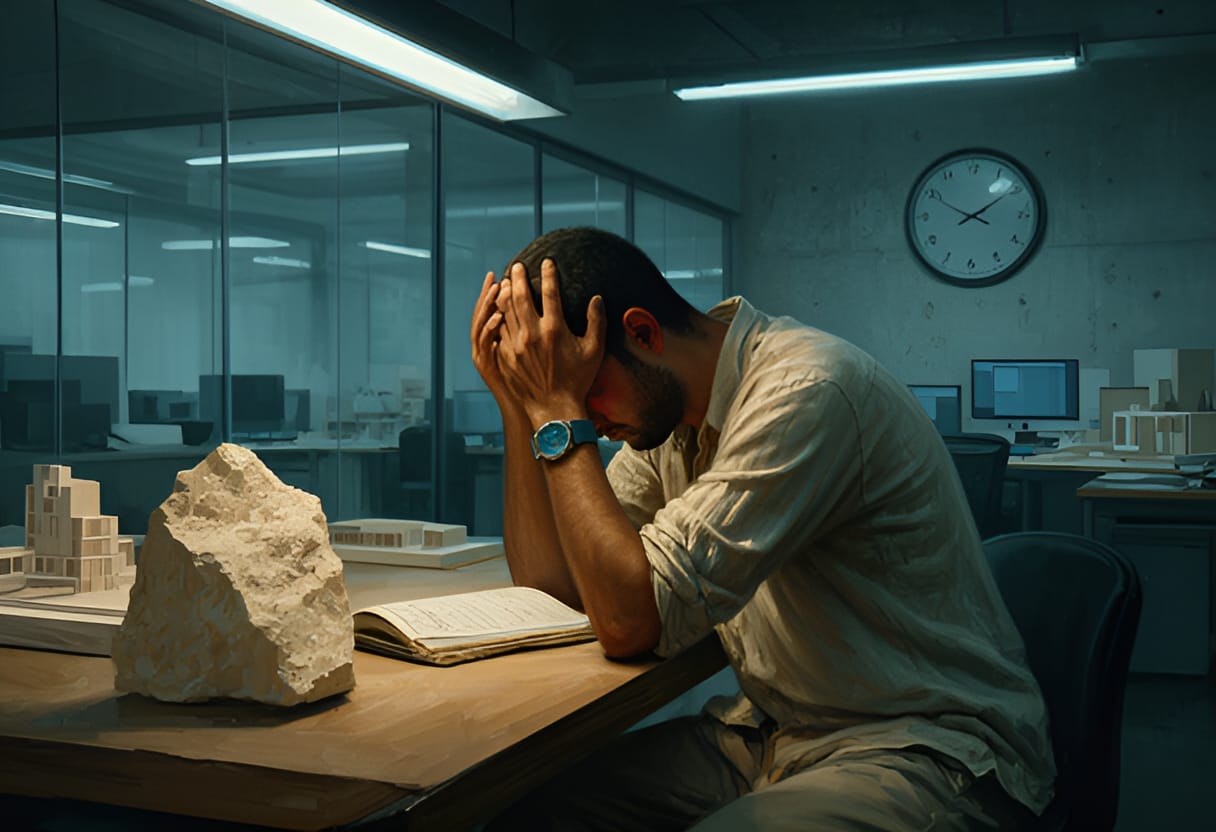
He avoided her eyes. “I’m sorry. I didn’t mean to snap.”
She tilted her head. “You’ve been snapping a lot lately. At the alarm. At the phone. At me.”
“I know.” He ran a hand over his face. “I’m exhausted. I stayed up too late again. Scrolled through… nothing. Just… killing time. And then I woke up feeling like I’d already lost the day.”
She was quiet for a moment. Then she said, “You know, when you did the routine — even just the water and the stretch — you seemed… lighter. Like you were actually there. Today you seem like you’re trying to get through it.”
He looked at her then, really looked. Her glasses caught the light. Her expression was open, not judgmental. He thought of Karim’s hand over his, the weight of it, the steadiness.
“I think,” he said slowly, “that I’m sabotaging myself. Not with the alarm. Not with the work. But with what I do after the work. I tell myself I’m relaxing. But I’m not resting. I’m just… escaping. And then I wake up and I’m already behind before I’ve begun.”
She nodded. “That’s the thing about habits. They don’t just live in the morning. They live in the night, too.”
He let out a breath, shaky. “I don’t want to lose this. Not the job. Not… the chance to feel like I’m not always playing catch-up.”
She smiled, small but sure. “Then don’t give up on the return. Even if it’s messy. Even if it’s late. Just… come back.”
He nodded. “I will.”
She patted his arm once, briefly, then turned and walked away.
He stood there for a moment, the silence between them not empty, but full — of what had been said, what had been felt, what might still be possible.
He slipped the stone from his pocket. Held it in his palm. Felt its weight, its coolness, its quiet insistence.
He did not put it back in his pocket.
Instead, he placed it on the edge of his desk, where he could see it.
And when he sat down to work, he did not open the Nile Plaza file first.
He opened a blank document.
And he began to write — not an email, not a revision, not a demand from a client — but a list.
One thing.
Then another.
Small things.
Things he could do.
Things he would do.
Not tomorrow.
Not later.
Now.
He stared at the list. One thing. Then another. Small things. Things he could do. Things he would do. Not tomorrow. Not later. Now.
The words blurred. The ink smudged slightly where his thumb had pressed too hard. He had written: drink water upon waking, stretch for five minutes, leave the house by 7:45, check email only after breakfast. Simple. Achievable. And yet, the night before, he had shattered them all — not with grandeur, but with the slow, quiet surrender of scrolling, of biscuits, of stone forgotten in pocket, of self forgiven too easily.
A shadow fell across his desk.
He looked up.
Mr. Hassan stood there, arms crossed, face unreadable in the harsh overhead light. The usual warmth of morning had long since drained from the office — replaced by the low hum of printers, the distant ring of phones, the sharp scent of toner and dust. Mr. Hassan’s eyes flicked to the stone on the edge of the desk, then to the open notebook, then back to Youssef’s face.
“Come with me,” he said. His voice was low, but it cut through the ambient noise like a blade.
Youssef’s stomach dropped. He swallowed. Nodded. Pushed back his chair. The stone remained where it lay.
They walked in silence past Layla’s station — she glanced up, eyes wide, then quickly looked down at her screen. Past the junior draftsmen hunched over their tablets. Past the break room where the coffee machine gurgled. Mr. Hassan did not look at him once. His pace was steady, deliberate, leading Youssef down the corridor to the glass-walled office at the end — the one with the blinds always half-closed, the one that smelled of old books and sandalwood polish.
Inside, Mr. Hassan gestured to the chair opposite his desk. Youssef sat. The leather creaked. He kept his hands folded in his lap, knuckles white.
Mr. Hassan did not sit. He leaned against the edge of his desk, shoulders tight. He did not look at Youssef. He looked past him, at the wall behind, where a framed schematic of the old Cairo University library renovation hung — a project Youssef had been lead on for the past six months.
“The library project,” Mr. Hassan said finally. His voice was calm. Too calm. “The deadline for the final structural drawings was yesterday, 5 PM.”
Youssef’s throat tightened. He remembered. He had promised to send them by 3 PM. He had told himself he’d finish after dinner. After one episode. After checking the news. After the clock had struck 9, then 10, then 11. He had opened the file at 11:45 PM. He had worked until 1:30 AM. He had sent them at 2:07 AM.
“Two hours and seven minutes late,” Mr. Hassan said. He finally turned his head. His eyes were not angry. They were tired. Disappointed. “That’s not the first time, Youssef. It’s the third this quarter. The plaza cornice revision was late. The Maadi center details were submitted after the client meeting. And now this.”
Youssef opened his mouth. Closed it. What could he say? That he had been trying? That he had woken early two days in a row? That he had placed the stone on his desk as a promise? That he had written a list?
Mr. Hassan pushed off the desk. He began to pace — slow, deliberate steps. “You’re talented. I’ve said that before. You see solutions others miss. Your sketches have life. But talent means nothing if it arrives after the door is closed.”
He stopped. Turned. Looked directly at Youssef.
“One more miss,” he said, each word deliberate, “and you’re out.”
The air in the room seemed to thin. Youssef felt the blood rush to his ears. His vision narrowed slightly at the edges. Out. Not a warning. Not a probation. Not a second chance. Out.
He thought of the stone on his desk at home. Of Karim’s quiet mornings. Of Layla’s soft voice saying, You seemed lighter. Of the list he had just begun — the first honest attempt to reclaim his days.
And now this.
Mr. Hassan waited. Not for an answer. For a reaction.
Youssef forced himself to breathe. In. Out. His palms were slick. He wiped them on his trousers.
“I understand,” he said. His voice sounded distant, even to himself. “I won’t let it happen again.”
Mr. Hassan studied him for a long moment. Then he gave a single, sharp nod. “See that you don’t.”
He turned back to his desk, picked up a pen, and began to write — as if the conversation had never happened.
Youssef rose. His legs felt unsteady. He walked to the door, hand trembling on the handle. He paused, not looking back.
Then he stepped out.
The office noise washed over him again — sharper now, more intrusive. He walked slowly back to his desk, each step heavy. He did not see Layla’s concerned glance. Did not hear the murmured conversation between two interns near the water cooler.
He sank into his chair. The stone still lay on the edge of the desk, catching the light. His notebook lay open beside it — the list of small things, of nows, still unfinished.
He picked up his pen. Tried to focus on the library file. Tried to open it. Tried to read the comments from the structural engineer.
The words swam. His heart hammered against his ribs. He could feel it in his throat, in his temples. One more miss. The phrase echoed, not as a threat, but as a prediction — inevitable, unless something changed.
He set the pen down. Stared at the stone.
He had not put it back in his pocket.
He had left it out.
As if, by leaving it visible, he were making a vow — not to Mr. Hassan, not to Layla, not even to Karim — but to the version of himself that had, for two mornings, risen before the city, drunk water, stretched, and walked into the light with purpose.
He picked up the stone. Held it in his palm. Cool. Solid. Real.
Then, slowly, he placed it back where it had been — on the edge of the desk.
And this time, he did not look away.
He left the pen beside the stone and pushed back from the desk. The office lights hummed overhead, indifferent. Outside the glass walls, the city had dimmed but not slept — taxis drifted like slow fish along Corniche el-Nil, their taillights leaving streaks of red on the wet pavement. Somewhere, a muezzin’s call had just finished, its echo swallowed by the concrete. It was past midnight. He should have been home hours ago.
He gathered his things slowly, the weight of the stone in his pocket an unfamiliar anchor. As he passed Layla’s station, she didn’t look up. He paused, hand on the back of her chair.
“You okay?” he whispered.
She glanced at him, eyes tired but kind. “I’ll be better when you stop snapping at me in meetings.”
“I’m sorry,” he said. It felt too small, but it was true.
She nodded once. “Get some sleep, Youssef. Not for Hassan. For you.”
He managed a weak smile and walked out into the night air.
The walk home was a blur of streetlights and half-heard conversations. His feet knew the route — past the fruit stall with its pyramids of oranges, the shuttered tailor’s shop where the needle had jumped the last time he’d tried to mend his shirt, the corner where Karim used to sit and shell peas in the summer. He didn’t notice them. His mind was a loop: the stone on the desk, the threat of out, the list unfinished, the file unopened.
He let himself into the building with a key he’d nearly forgotten he carried. The hallway smelled of boiled cabbage and disinfectant. He climbed the stairs two at a time, not from energy, but from the need to move, to outpace the thought that followed him like a shadow: One more miss.
He fumbled with his apartment lock, pushed inside, and leaned against the door for a moment, breathing in the familiar scent of dust and old books — his refuge, his prison. The stone was still in his pocket. He took it out and held it in his palm, feeling its weight, its temperature. It had been cool on the desk. Now it was warm from his skin.
He didn’t put it back in his pocket.
Instead, he walked to the small balcony off his bedroom — a narrow slab of concrete shaded by a bougainvillea that had long since lost its blooms. He sat on the worn plastic chair, drew his knees up, and let the stone rest in his open hand.
The city breathed around him. Distant horns, the murmur of a television through an open window, the rustle of a plastic bag caught in the branches of a sickly acacia. Above, the sky was a starless indigo, the moon a thin fingernail clipped from silk.
He thought of Karim rising before the call to prayer, not because he felt ready, but because the hour belonged to him — a quiet claim staked before the world could demand its due. He thought of the two mornings he’d managed it: the water, the stretch, the stone held tight in his fist as he walked into the light. Not perfect. Not heroic. Just done.
And then the third night — the biscuits, the scrolling, the file opened at midnight like a plea to a god who had already turned away.
He had tried to change for Hassan. For Layla. For the vague, shimmering idea of success that always seemed to recede when he reached for it. But the stone on the desk hadn’t been for them. It had been for the version of himself who had shown up — not because he felt worthy, but because he had chosen to.
A wave of exhaustion washed over him, not just in his limbs, but behind his eyes, in the hollow of his chest. He was tired of lying to himself. Tired of saying tomorrow when he meant never. Tired of mistaking escape for rest.
He looked at the stone. It was just a river-worn piece of basalt, nothing special. But for two mornings, it had been a talisman. A touchstone. A silent promise: I was here. I did this.
He closed his fingers around it.
“I can’t keep doing this,” he whispered to the night. Not to Karim. Not to Hassan. Not even to himself, not really. To the quiet between heartbeats.
He thought of the list on his desk — the unfinished nows. He thought of the file he hadn’t opened. He thought of the work that would still be there in the morning, whether he stayed up until two or went to bed at eleven.
And then, clearly, as if spoken by someone who had waited a long time to be heard: Mornings are not negotiable.
He opened his hand and let the stone fall onto the concrete balcony floor. It made a soft click, barely audible over the distant hum.
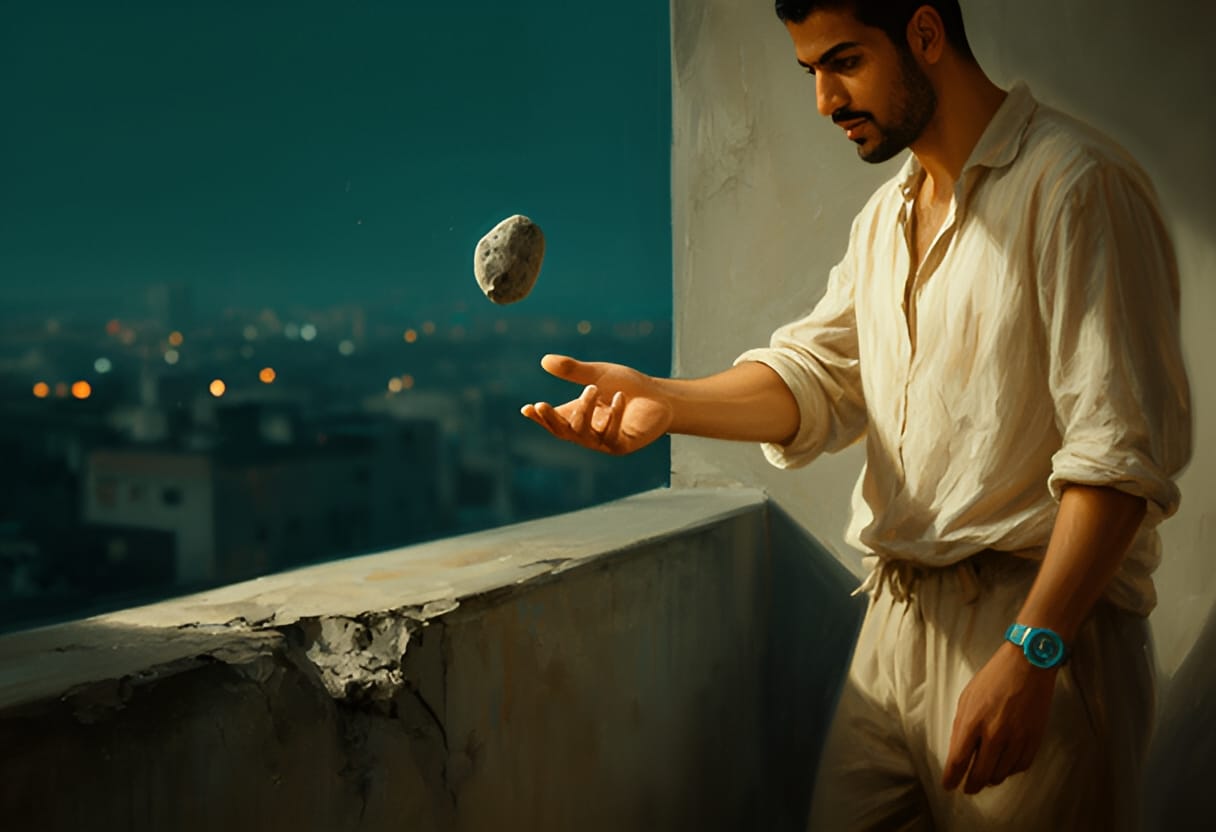
He stood, brushed off his trousers, and went inside.
He didn’t check his phone. Didn’t open the laptop. Didn’t turn on the television.
He went straight to the bathroom, washed his face, brushed his teeth with deliberate slowness. He poured a glass of water from the filter and drank it slowly, feeling it cool his throat. He returned to the bedroom, pulled back the sheet, and lay down.
He didn’t set an alarm.
He didn’t need to.
He closed his eyes and held the image of the stone where it had fallen — not lost, not discarded, but placed. A marker. A boundary.
Somewhere in the dark, the city exhaled.
And for the first time in months, Youssef did not fight the pull of sleep. He let it take him — not as a surrender, but as a return.
His breath slowed, deepening into the rhythm of someone who has finally stopped struggling against the current. Behind his eyelids, the city’s noise softened — not vanished, but transformed into a kind of distant hush, like the sound of waves heard through thick glass. He was not asleep yet, but he was no longer fighting it. The weight of the day, the shame, the frayed ends of his resolve — they did not vanish, but they no longer commanded his attention. He simply lay there, feeling the cool cotton of the sheet, the faint pressure of the mattress, the quiet insistence of his own breath.
In the half-light behind his lids, images came uninvited: Karim’s hands, knuckles swollen with age, turning the soil in his small balcony garden; the way the morning light caught the dust in the air above the prayer rug; the weight of the stone, first cool in his palm, then warm, then gone. Not lost. Placed.
He thought of the list on his desk — the unfinished nows. Not as a failure, but as a map. One he could redraw. Not with grand gestures, but with the quiet insistence of return. He did not need to feel ready. He only needed to show up.
A thought rose, soft and insistent: The choice isn’t in the perfection, but in the return. He didn’t know where it had come from — Karim’s voice? His own, finally catching up? It didn’t matter. It fit the shape of the silence he was keeping.
His body began to sink. Not into oblivion, but into rest — real rest, not the hollow escape of scrolling or the bitter exhaustion of pushing past midnight. This was different. This was surrender to something that had always been there, waiting for him to stop running.
He thought of the balcony, the stone on the concrete, the night air on his skin. He thought of walking into work not because he had conquered the night, but because he had honored the morning — not as a reward for good behavior, but as the ground he stood on.
Somewhere, a door clicked shut in the building below. A cat yowled, then fell silent.
His thoughts began to drift, unmoored, like leaves on slow water. He did not chase them. He did not grasp at them. He let them go.
And then, without fanfare, without a struggle or a sigh that marked the end — he slept.
Not the sleep of exhaustion, but the sleep of someone who has, at last, stopped earning the right to rest.
Chapter 3
الانتصار الهادئ
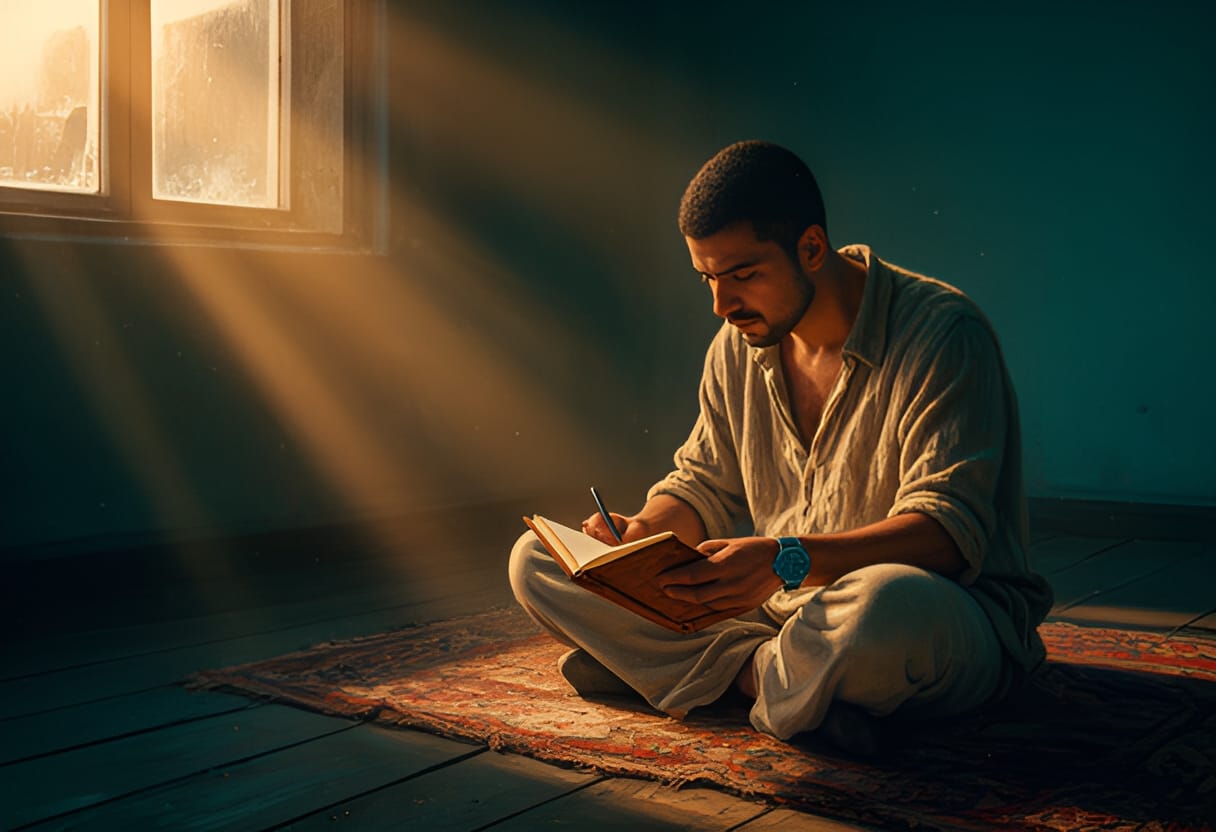
Youssef’s alarm cut through the dark at 5:00 AM, sharp and insistent. He lay still for a breath, the weight of yesterday’s failure pressing against his ribs — the missed deadline, the tight line of Mr. Hassan’s mouth, the way Layla had looked at him over her coffee cup, not unkindly, but with that quiet pity that made him want to disappear. Then he remembered the stone. Cool and smooth beneath his fingertips where it sat on the nightstand. He picked it up, turned it over once, and let the weight remind him: now, not later.
He swung his legs over the side of the bed, feet finding the wooden floor. The apartment was still wrapped in the hush of early morning, the city beyond the window not yet stirring. He walked to the small sink in the corner, filled a glass with water, and drank it slowly, feeling it travel down his throat, clearing the fog of sleep. Then he moved to the worn rug beside his bed, rolled his shoulders, and began to stretch — slow, deliberate movements that woke the muscles in his back and neck, the ones that always tensed when he rushed.
When he finished, he sat cross-legged on the rug and opened the small notebook he kept for mornings. He didn’t write much — just three lines: Review facade details for Nile Plaza. Call supplier about glass sample. Sketch one new idea for courtyard shading. He read them aloud, low and steady, the words grounding him in the day before it began. Then he closed the notebook, stood, and began to prepare for work.
He was out the door by 5:45, the streets quiet, the air cool and carrying the faint scent of baking bread from a distant bakery. He walked the ten minutes to the firm, passed the sleeping shops and the empty café where he usually grabbed coffee on the run, and let the rhythm of his steps match the quiet inside him. No panic. No mental checklist of what he’d forgotten. Just the steady pace of his breath and the weight of the stone still warm in his pocket.
He swiped his card at the entrance at 7:58 AM. The lobby was empty, the lights soft. He walked to his desk, set down his bag, and opened his laptop without hesitation. The Nile Plaza file was already open from the night before — he’d left it that way, a small act of trust in himself. He reviewed the cornice measurements, the ones he’d second-guessed after Karim’s quiet question about whether he’d been listening to the design or just trying to finish. He found no error this time. Only clarity.
At 8:15, Layla appeared in the doorway of the open-plan space, mug in hand. She paused, seeing him already at work, focused, the usual frantic energy absent.
“You’re here early,” she said, not surprised, but noticing.
Youssef looked up, surprised at how calm his voice sounded. “Yeah. Tried something different.”
She stepped closer, lowering her voice. “It’s working, isn’t it? You seem… lighter.”
He hesitated. “I don’t know. Five days. It could vanish by noon.”
She smiled, faint but sure. “Then enjoy it while it lasts. And maybe it’ll last longer if you stop waiting for it to disappear.”
She walked away, leaving him with the hum of the computer and the quiet certainty that, for now, the morning was his. He returned to the screen, refined a line in the drawing, and let the focus settle over him like a familiar garment — not perfect, not permanent, but his to wear. *
The second morning began the same way — alarm, stone, water, stretch, notebook. But this time, as he stood at the sink, he noticed how the water felt colder, sharper, waking him more completely. He stretched longer, feeling the release in his shoulders, the ease in his spine. When he sat to review his goals, he added a fourth item: Listen more in today’s team meeting.
He arrived at work at 7:55. Mr. Hassan was already there, pouring coffee at the machine, his back turned. Youssef paused, unsure whether to speak, then decided on a simple nod as he passed. Mr. Hassan glanced over, eyes sharp, then gave the smallest incline of his head — not a smile, not approval, but acknowledgment. Youssef felt it settle in his chest, quiet and unexpected.
At the team meeting at 9:00, he spoke when asked about the courtyard shading options. His voice was clear, his ideas concrete. He didn’t rush to fill silence, didn’t apologize for taking space. When Layla leaned over and whispered, “That was good,” he nodded, not dismissing it, but letting it sit.
By noon, the familiar pressure began to creep in — the urge to check his phone, to wonder if he was falling behind, if the calm was a fluke. He paused, pressed his thumb to the stone in his pocket, and reminded himself: Now. He returned to his drawing, refined the angle of the overhang, and let the work absorb him.
He left at 6:00, not because he’d finished everything, but because he’d done what he could with clarity. The stone felt warm in his palm as he walked home. *
On the third day, Youssef woke before the alarm. He lay awake for a moment, listening to the silence, then reached for the stone without thinking. The routine felt less like an effort now, more like returning to a place he’d forgotten he knew.
He drank his water, stretched until his spine sighed, and wrote in his notebook: Finish cornice revision. Prepare material sample labels. Ask Karim about the jasmine in his courtyard — does it bloom this month? The last line surprised him. He hadn’t thought of his grandfather’s garden in days. He smiled, low and quiet.
At the firm, he arrived at 7:50. Mr. Hassan was at his desk, reviewing blueprints. Youssef set up quietly, opened his file, and began to correct the cornice detail — not because he’d been told to, but because he’d seen it clearly in the morning light. He worked slowly, deliberately, double-checking each measurement against the original specs.
At 10:30, Mr. Hassan walked past, stopped, and looked at the screen. “You changed the radius here,” he said, not unkindly.
Youssef nodded. “It was off by two millimeters. Would’ve thrown off the alignment.”
Mr. Hassan studied the correction, then said, “Good catch.” He didn’t linger, but the words stayed.
Youssef didn’t tell Layla about it. He didn’t need to. The stone in his pocket was enough. *
By the fourth morning, the routine had a rhythm that felt less like discipline and more like listening. He woke, touched the stone, drank, stretched, wrote: Review client feedback on massing. Draft email to structural consultant. Sketch one option for the entrance canopy. He didn’t question whether he’d stick with it. He simply did it.
He arrived at work at 7:48. The office was still dim, only a few lights on. He sat, opened his laptop, and began to work on the canopy sketch — not because it was urgent, but because the quiet morning had given him the space to let an idea form. He drew a series of thin, interlocking slats that would filter light without blocking airflow. It wasn’t brilliant, not yet, but it was his.
When Layla arrived at 8:10, she paused behind him. “You’re sketching,” she said.
“Just playing with an idea,” he murmured, not looking up.
She leaned in. “It looks… intentional.”
He finally met her eyes. “It is.”
She smiled, touched his shoulder briefly, and went to her desk. Youssef returned to the drawing, let his hand move freely, and felt, for the first time in months, that he was not chasing the day — he was meeting it. *
On the fifth morning, Youssef did not think about whether it would last. He woke, touched the stone, drank, stretched, and wrote: Finalize canopy sketch for team review. Send material queries. Remember to breathe. He did not analyze the words. He did not wonder if today would be the day it broke. He simply began.
He arrived at work at 7:45. Mr. Hassan was already at his desk, sleeves rolled up, reviewing a set of permits. Youssef set down his bag, took out his notebook, and began to transcribe the canopy idea into a clean draft — neat lines, labeled dimensions, a short note on material feasibility.
At 9:00, the team gathered for the weekly check-in. Layla went first, presenting her updates on the facade cladding. Then it was Youssef’s turn. He stood, clicked to the first slide, and spoke.
“Here’s one option for the entrance canopy,” he said, voice even. “It uses recycled aluminum slats, angled to catch winter sun and block summer heat. The pattern is inspired by mashrabiya screens — traditional, but adapted for modern fabrication.”
He walked them through the shading analysis, the material cost, the installation sequence. He answered questions without hesitation, admitted when he didn’t know something — “I’ll check with the supplier and get back to you by noon” — and offered alternatives when asked.
When he finished, there was a brief silence. Then Mr. Hassan said, “This is thoughtfully resolved. Send it to me in PDF by end of day. We’ll show it to the client tomorrow.”
Youssef nodded. “Thank you.”
As he sat down, Layla squeezed his wrist under the table. He didn’t look at her, but he felt it — the quiet affirmation, the shared understanding.
Later, as he packed up to leave, Mr. Hassan called him over. “You’ve been punctual all week,” he said, not looking up from his screen. “Keep it up.”
Youssef hesitated. “I’m trying.”
Mr. Hassan finally looked at him. “Trying is not enough. But it’s a start.”
He turned back to his work. Youssef stood there a moment longer, then nodded and walked away.
Outside, the sun was low, casting long shadows across Zamalek. He walked slowly, the stone warm in his palm, the day’s quiet focus still humming in his wrists and behind his eyes. He didn’t know if tomorrow would be the same. He didn’t need to. For now, he had shown up. And that was enough.
He woke before the alarm, the stone cool against his thumb as he lay still in the dark. The city outside had not yet stirred — no horns, no calls to prayer drifting through the open window, only the hush of predawn settling over Zamalek. He rose without hesitation, moved to the small table by his bed, and picked up his sketchbook. The stone rested in his palm for thirty seconds, then was set aside. He drank his water, stretched until his shoulders released, and opened to a fresh page.
The cultural center proposal had been mentioned in passing at Monday’s meeting — a vague brief, a tight deadline, a sense of urgency that made most of the team mutter about overtime and caffeine. Youssef had heard it, filed it away, and now, in the quiet, he let it unfold.
He began with the site: a triangular plot along the Nile Corniche, bordered by a busy street on one side and a public park on the other. He drew the boundary lightly, then paused. Instead of jumping to massing or materials, he closed his eyes and imagined walking through it — not as an architect checking boxes, but as a visitor. What would they feel first? The river’s presence? The shade? The rhythm of movement?
He opened his eyes and sketched a single curved wall, low and thick, following the river’s edge. Not a barrier, but a bench, a place to sit and watch the water. From it, the building would rise — not as a block, but as a series of staggered volumes, like stones placed by hand along the shore. He shaded the undersides lightly, suggesting overhangs that would catch the breeze and cast shifting patterns on the ground.
He did not label it. He did not show it to anyone. He simply closed the book and went to work, the idea humming behind his ribs like a second pulse.
On Tuesday morning, he returned to the sketch. The curved wall was still there, but now he had added a canopy above it — not solid, but slatted, angled to block the high summer sun while letting in the low winter light. He drew a few figures beneath it: an old man reading, a woman tying her shoe, a child pointing at a boat on the river. He smiled, then erased the child. Too sentimental. He kept the man and the woman.
He turned to the building itself. The staggered volumes needed connection. He sketched a glass corridor between the first and second mass, narrow and transparent, so that moving from one section to the next felt like stepping outdoors — but sheltered. He played with the roof: flat, then pitched, then a series of shallow domes, like inverted bowls, to collect rainwater and diffuse light. He settled on the domes. They felt right — quiet, unassuming, yet deliberate.
He added a courtyard at the heart of the plan, open to the sky, bordered by the glass corridors. In the center, a single palm tree, drawn with a few confident strokes. Not for shade alone, but as a marker — a living thing that would grow with the building, unchanged in essence even as the city changed around it.
He did not think about whether it was good enough. He only thought about whether it was true.
By Thursday, the sketch had grown. He had added a second layer of slats to the canopy, adjustable, so the angle could shift with the seasons. He had detailed the entrance: not a grand door, but a recessed gap in the wall, where one would have to turn the corner to see inside — a moment of discovery. He had drawn the facade in section, showing how the double skin of the glass corridor would ventilate naturally, how the thermal mass of the curved wall would store coolness from the night and release it by day.
He had not slept much the night before, not from anxiety, but because the design kept unfolding in his mind like a letter he was writing to himself. He had sketched in the margins of his notebook during breakfast, on napkins at the café, on the back of a receipt while waiting for the bus. Each version was not a replacement, but a refinement — a sentence rephrased, a detail clarified.
When he arrived at the firm that morning, Layla was already at her desk, surrounded by printouts and sticky notes. She looked up as he passed.
“You look like you’ve been somewhere,” she said.
He paused, sketchbook under his arm. “Just thinking.”
She tilted her head. “About the cultural center?”
He nodded. “Yeah. I think I have something.”
She didn’t press. She only said, “I’ll be interested to see it,” and returned to her notes.
At his desk, he opened the sketchbook to the latest version. The curved wall was now annotated: local limestone, honed finish. The canopy slats: recycled aluminum, powder-coated to match the limestone. The courtyard: date palm, native planting beneath. He had written a short note in the corner, in Arabic: A place to wait, not just to pass through.
He did not show it to anyone. He let it sit, open but unclaimed, like a prayer left in a mosque — not for praise, but because it had been offered.
Friday morning came with a clarity that surprised him. He did not wake with the urge to change anything, to add or subtract. He woke and knew.
He sketched quickly, not because he was rushing, but because the lines were already there, waiting. He drew the site plan in ink: the triangular lot, the curved wall tracing the river’s edge, the three volumes stepping back like terraces, the glass corridors linking them, the courtyard at the center, the canopy stretching along the entire river facade. He added the orientation arrow, the scale bar, a few key dimensions. He labeled the main spaces: exhibition hall, library, workshop rooms, café overlooking the water.
He did not linger. He closed the book, tucked it into his bag, and left for work before the sun had fully cleared the buildings.
When he arrived, the usual morning buzz was already in motion. Layla was at the whiteboard with two junior architects, markers in hand, sketching bubbles and arrows. Near the window, Mr. Hassan stood with his arms crossed, listening as one of them explained a concept involving a floating roof and a spiral ramp.
Youssef set down his bag, took out his notebook, and opened to a clean page. He did not join the discussion. He began to write — not a design, but a list: What does the building say? Who is it for? What stays with them after they leave?
He heard Layla say, “We need something iconic, but not loud.”
Someone else replied, “What if we make the roof a garden?”
“Too heavy,” another said. “And we don’t have the load capacity.”
Youssef kept writing. He did not look up. He did not need to.
When the meeting ended an hour later, the whiteboard was full of half-formed ideas, question marks, and arrows pointing nowhere. No one had a plan. No one had a vision.
He packed his things slowly. As he stood, Layla gathered her markers and walked over.
“You were quiet,” she said.
He shrugged. “I was thinking.”
She glanced at his notebook, saw the list, then the corner of yesterday’s sketch peeking out from beneath it. She didn’t ask to see it. She only said, “Whatever you’ve got, it’s already further than what we’ve got on the board.”
He looked at her then. “I didn’t do it for the meeting.”
She smiled, soft and knowing. “I know. But it’s going to help.”
He nodded, shouldered his bag, and walked out into the morning sun. The stone was warm in his pocket. The day had not yet begun, but he had already met it.
Youssef stood before the conference table, the room hushed except for the faint hum of the air conditioner and the rustle of paper as colleagues adjusted their folders. The whiteboard behind him bore only the title of the proposal: Cultural Center, Nile Corniche, Zamalek. No sketches, no diagrams—just those words, stark and waiting. He had not needed them. The design lived in his hands, in the weight of the sketchbook resting on the table before him, in the quiet certainty that had settled into his bones over countless early mornings.
He opened to the first page—the site plan drawn in ink, precise and unhurried. “The site is triangular,” he began, voice low but clear, “bound by the Corniche road to the east, the public park to the west, and the Nile to the north. The challenge wasn’t just to build on the land, but to listen to it—to let the river, the light, the movement of people shape the form.”
He turned the page. The curved wall unfolded in detail: local limestone, honed to a soft sheen that would catch the morning sun and cool in the afternoon shade. “This wall follows the river’s edge not as a barrier, but as a threshold,” he said. “It invites. It shelters. Its mass stores the cool of night and releases it by day, reducing the need for mechanical ventilation. The material is local, durable, and requires minimal maintenance—a choice not just of aesthetics, but of stewardship.”
A junior architect leaned forward. “And the canopy?”
Youssef turned again. The double-layered slatted system, adjustable for seasonal angles, stretched across the river facade. “Recycled aluminum, powder-coated to match the limestone,” he replied. “It filters the light, creates shifting patterns on the ground and wall—like sunlight through palm fronds. In winter, the angle opens to let in warmth; in summer, it closes to provide shade. It’s not decoration. It’s climate response.”
He paused, letting the image settle. Then he turned to the courtyard. “At the heart, a single date palm. Native planting beneath—grasses, shrubs that need little water. This isn’t a garden for show. It’s a place to pause. To wait. To be still before moving on.”
He heard Layla’s voice from earlier, soft and knowing, and felt, not pride, but a quiet alignment—as if the words he spoke were not his alone, but shaped by the silence he had kept, the lines he had redrawn, the mornings he had shown up for even when no one was watching.
He turned to the program. “The building steps back in three volumes—exhibition hall, library, workshop rooms—each framed by glass corridors that double as thermal buffers. The corridors ventilate naturally: warm air rises and exits through high vents, drawing in cooler air from the courtyard. The café overlooks the water, its terrace shaded by the canopy, its walls opened to the breeze.”
He did not rush. He did not gesture wildly. He pointed to details with a calm hand, his voice steady, his eyes meeting those who asked—not to convince, but to clarify. When questioned about structural load, he referenced the careful distribution of weight, the use of lightweight roofing in the garden areas, the way the glass corridors transferred lateral forces to the curved wall. When asked about cost, he spoke of phased construction, local labor, materials sourced within fifty kilometers. Each answer was not recited, but recalled—as if he had lived inside these details for weeks, walked through them in the half-light before dawn, tested them against the quiet of his own thoughts.
Mr. Hassan stood near the window, arms no longer crossed, but loose at his sides. He did not speak. He did not take notes. He only listened, his head slightly tilted, as if hearing not just the words, but the space between them—the discipline that had shaped them.
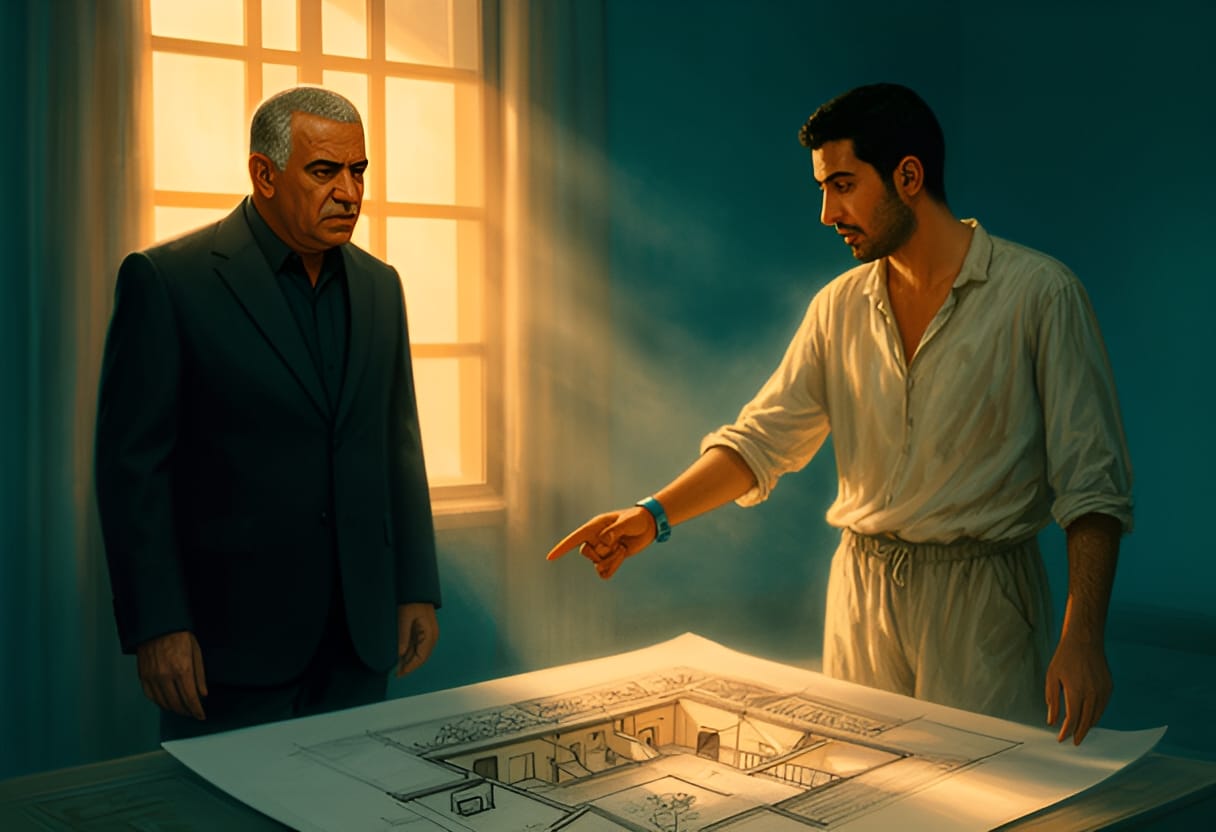
When Youssef finished, the room was silent for three breaths. Then Layla said, “It’s complete.”
Not brilliant. Not bold. But complete.
Mr. Hassan pushed away from the window and walked slowly to the front of the room. He picked up the sketchbook, turned it gently in his hands as if weighing something unseen. He lingered on the courtyard sketch, on the Arabic phrase in the corner: A place to wait, not just to pass through.
He closed the book and placed it back on the table. Then he looked at Youssef, not with the sharp appraisal of a boss measuring output, but with something rarer—recognition.
“The commission is yours,” he said. His voice was low, but it carried in the quiet room. “The committee has decided. We’re building this.”
A murmur rose—not surprise, but assent. The junior architects exchanged glances. Layla gave a small, sincere smile.
Youssef felt no surge of triumph, no need to speak. Only a deep, quiet settling, like the stone in his pocket after a long morning—warm, solid, real.
He nodded. “Thank you, sir.”
Mr. Hassan hesitated, then gave a single nod in return. Not praise. Not friendship. But acknowledgment. As if he had seen, at last, not just the work, but the way it had been made.
Youssef gathered his things slowly. As he turned to leave, Layla fell into step beside him.
“You didn’t look at your notes once,” she said.
He smiled. “I didn’t need to.”
They walked out into the hallway, where the morning sun slanted through the high windows, painting long stripes across the marble floor. The firm stirred around them—phones ringing, voices rising—but for a moment, Youssef walked as if through a courtyard open to the sky, bordered by glass, shaded by slats, centered by a palm tree that would grow with the building, unchanged in essence even as the city changed around it.
He had not waited to feel ready. He had only shown up.
And the day had met him back.
They paused at the elevator, the doors sliding open with a soft sigh. Inside, the mirrored walls reflected their tired but upright postures. Layla pressed the button for the ground floor, and the car began its slow descent.
“You know,” she said, breaking the quiet, “I used to think discipline was about rigidity. Waking early, checking boxes, never bending. But what you’ve done… it’s not like that.”
Youssef leaned back against the cool metal wall. “What is it like, then?”
“It’s like you made space—not just in your day, but in your head. For the work to breathe. For the idea to grow on its own terms.” She glanced at him. “You didn’t force the design. You tended it. Like Karim tends his garden.”
The name landed softly, not as a surprise, but as an echo. He hadn’t thought of his grandfather in that moment, not consciously. But now, seeing the connection laid bare, he felt a quiet warmth spread through his chest—not pride, not relief, but the deeper recognition of continuity. Of something passed not in words, but in rhythm.
The elevator dinged. The doors opened onto the lobby, where the marble floor cooled underfoot and the morning light pooled near the revolving doors. A few early clients sat in the waiting area, sipping tea, flipping through portfolios. The receptionist looked up and smiled—not at them specifically, but at the air, as if sensing a shift.
Layla stopped at the threshold. “I’ll see you tomorrow. Same time?”
He nodded. “Same time.”
She gave him a small wave and stepped out into the sun, her silhouette cutting sharp against the brightness.
Youssef lingered a moment longer, watching her go. Then he turned and walked toward the side entrance, where a narrow passage ran between the firm and the adjacent building, lined with pots of herbs and a single fig tree in a wooden crate—Karim’s doing, from a visit months ago, when he’d insisted every office needed a bit of stubborn green.
He paused beside the crate, ran his fingers over the rough bark, and reached into his pocket. The stone was still there, warm from his body, smooth from constant touch. He held it for a moment, feeling its weight, its quiet insistence—not as a talisman, but as a reminder.
Then he placed it gently on the soil beside the fig tree, where it would stay, not lost, but returned—to the earth, to the rhythm, to the quiet cycle of things that endure.
He walked on, into the morning, without looking back.
Youssef closed the apartment door behind him and leaned against it for a moment, the quiet of the hallway pressing in after the day’s hum. The stone beside the fig tree had felt like a release, not a loss. He had left it there not as a farewell, but as an acknowledgment—that the morning’s weight could be carried elsewhere now, that it had taken root.
He pushed off and walked to the small kitchen, filling the kettle without thinking. The routine was still there, softer now, like a breath held and then let go. He set out two glasses, though he lived alone. Habit, or something deeper—a space kept open.
A knock came not long after, soft and deliberate. He wiped his hands on his trousers and opened the door.
Karim stood there, his usual wool coat draped over his shoulders despite the evening’s warmth, his hands clasped behind his back. He smiled when he saw Youssef, not with surprise, but with the quiet certainty of someone who had expected to be let in.
“You didn’t have to come,” Youssef said, stepping aside.
“I wanted to see the light on in your window,” Karim said, entering. “It’s rare these days.”
Youssef closed the door and led him to the small sitting area where a low table held a half-read book and a sketchpad left open to a corner study of the cultural center’s canopy. Karim glanced at it, then sat in the armchair by the window, the one that faced the street and caught the last of the sun.
Youssef went to the kitchen and returned with two glasses of water, setting one on the coaster in front of his grandfather.
“You saw the announcement,” he said.
Karim took a slow sip. “I did. The firm’s board posted it this morning. ‘Cultural Center, Zamalek—Lead Architect: Youssef El-Sayed.’ I read it twice. Not because I doubted, but because it felt… right. Like hearing a familiar verse after a long silence.”
Youssef sat on the edge of the sofa, his hands wrapped around his glass. “I still can’t believe it. After everything—”
“After the library,” Karim finished gently. “After the cornice. After the Maadi details. After the mornings you missed and the alarms you silenced.”
Youssef looked down. “I thought I’d blown it. For good.”
Karim set his glass down. “You came close. But you didn’t go over the edge. And that’s not nothing.”
A silence settled, not uncomfortable, but full—the kind that comes when something true is hovering just beneath the surface, waiting to be named.
Youssef took a breath. “I kept showing up. Even when I was tired. Even when I didn’t feel like it. I woke up. I held the stone. I drank the water. I wrote the three things. It wasn’t much, but it was mine.”
Karim nodded. “You did the work. And the work showed.”
Youssef frowned slightly. “It was more than that, though. The design… it just came together. The curve of the wall, the way the light falls through the slats—I could see it before I even put pencil to paper. That’s talent, isn’t it? That’s what made the difference.”
Karim shook his head, a small, patient motion. “No. It was the mornings.”
Youssef blinked. “What?”
“The mornings,” Karim repeated. “Not the flash. Not the sudden clarity. It was the light you turned on every day, even when you couldn’t see the room yet. You didn’t wait for the idea to arrive fully formed. You made space for it to arrive at all.”
Youssef stared at his grandfather, the words landing like stones in still water—ripples spreading outward.
“I used to think,” he said slowly, “that if I just waited long enough, I’d wake up one day and feel ready. Like creativity was a guest that only came when the house was clean and the tea was brewed just right.”
Karim smiled. “And what did you learn?”
“That the guest never comes if you keep waiting for the perfect moment. You have to leave the door open. You have to show up, even in your robe, even with sleep in your eyes.”
Karim leaned forward. “Exactly. And you did. Not perfectly. Not every day. But enough. You kept returning. That’s what shaped the design—not a single moment of genius, but the quiet accumulation of attention. The way you noticed how the light hit the fig tree at 5:15 a.m., how the shadows stretched across the courtyard in your sketchbook. You weren’t waiting for inspiration. You were practicing presence.”
Youssef looked out the window. The street below was quiet now, the day’s rush long gone. A cat slipped between the parked cars, pausing to groom itself near the fig tree’s crate. The stone sat where he had left it, small and unremarkable against the soil.
“I placed it there today,” he said. “Beside the tree. I didn’t put it back in my pocket.”
Karim’s eyes softened. “Good. It belongs there now. Not as a charm, not as a promise to be perfect—but as a marker. A place where you said, ‘I was here. I tried.’ And then you came back the next day, and the next, until the trying became the way.”
Youssef turned back. “I keep thinking about what Layla said—that I tended the design like you tend your garden. I didn’t get it then. But now… I see it. It’s not about forcing growth. It’s about showing up with water, with patience, with the willingness to return even when nothing seems to be happening.”
Karim nodded. “And that’s the part no one sees. The early light on the page. The silence before the city wakes. The stone in the palm, warm from sleep. Those are the moments that make the work possible—not because they’re glorious, but because they’re honest.”
Youssef felt something loosen in his chest, a tightness he hadn’t even realized he’d been carrying. Not pride, not triumph, but a quiet alignment—like a door finally swinging shut without resistance.
“I don’t know if I’ll always wake at five,” he said. “I don’t know if I’ll never hit snooze again.”
Karim stood, gathering his coat. “You don’t have to promise perfection. You only have to promise return.”
Youssef rose with him, walking him to the door. “Thank you—for seeing me. For hearing me, even when I wasn’t saying much.”
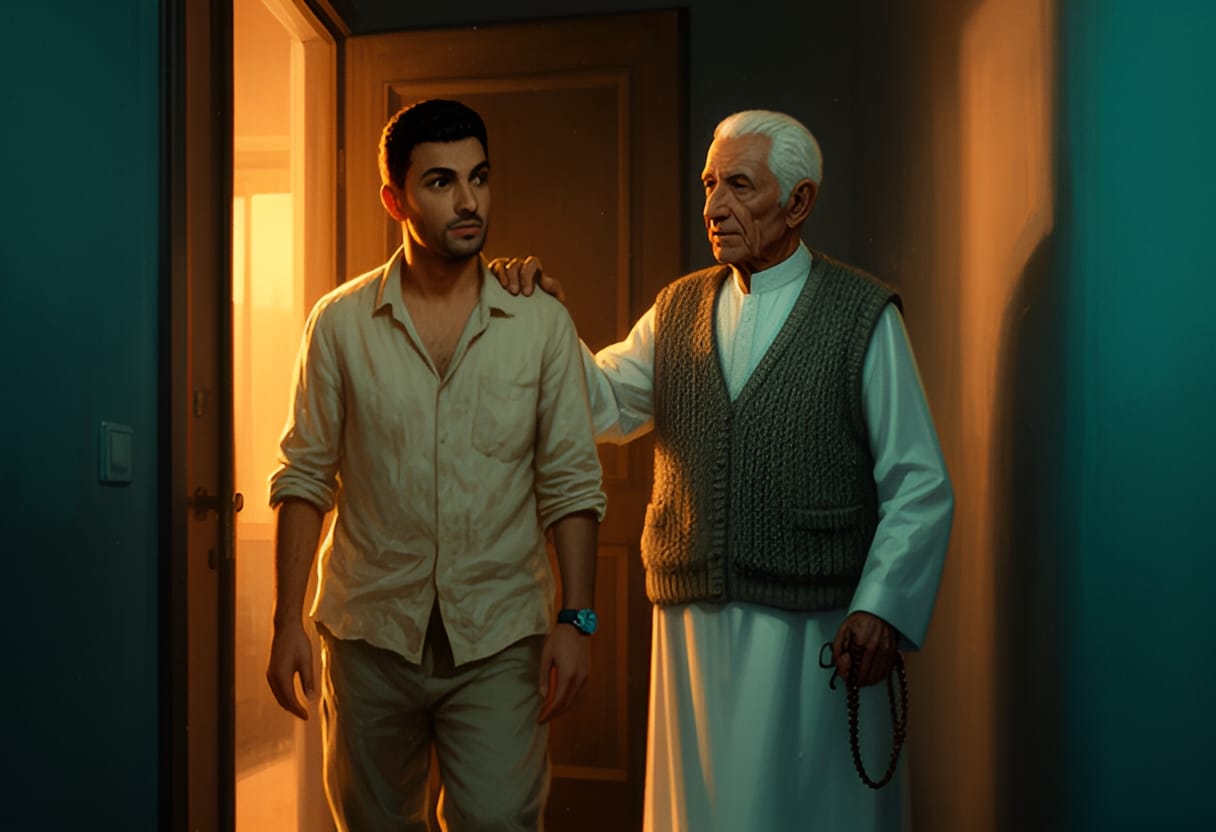
Karim placed a hand on his shoulder, grip firm but gentle. “I’ve always seen you, Youssef. I just waited for you to see yourself.”
He stepped out into the hall, closing the door softly behind him.
Youssef stood there a moment longer, listening to the fading echo of footsteps on the stairs. Then he turned and walked back to the sitting area. He picked up the sketchpad, flipped past the finished drawings to the blank pages at the back. He took a pen from the cup on the table and, without thinking, wrote in the corner in clear, steady letters:
Not talent. Not luck. Just showing up.
He set the pad down and went to the window. The night had deepened, the city lights blinking on one by one like stars fallen to earth. Below, the fig tree stood in its crate, the stone resting beside it, catching the glow from a nearby lamp.
Youssef did not touch it. He did not need to.
He turned away from the window and walked to the small shelf by the door where he kept his keys. He paused, then reached into his pocket—not for the stone, but for his phone. He opened a blank message and typed slowly, deliberately:
Thanks for believing in me, even when I didn’t.
He sent it to Karim’s number, then locked the phone and put it back.
He did not wait for a reply.
Instead, he walked to the bedroom, changed into his sleepwear, and slid under the covers. The room was dark, quiet. He lay still for a while, listening to the faint hum of the refrigerator, the distant murmur of traffic.
And then, without forcing it, without waiting to feel ready, he closed his eyes.
The morning would come. And he would be there.