Fiction
Book 2 -THE POSITIVE MIND: THE CITY OF UNFINISHED WORDS
by priti markar
3 chapters16 min read
Chapter 1
Chapter 1: The Girl Who Heard Silence
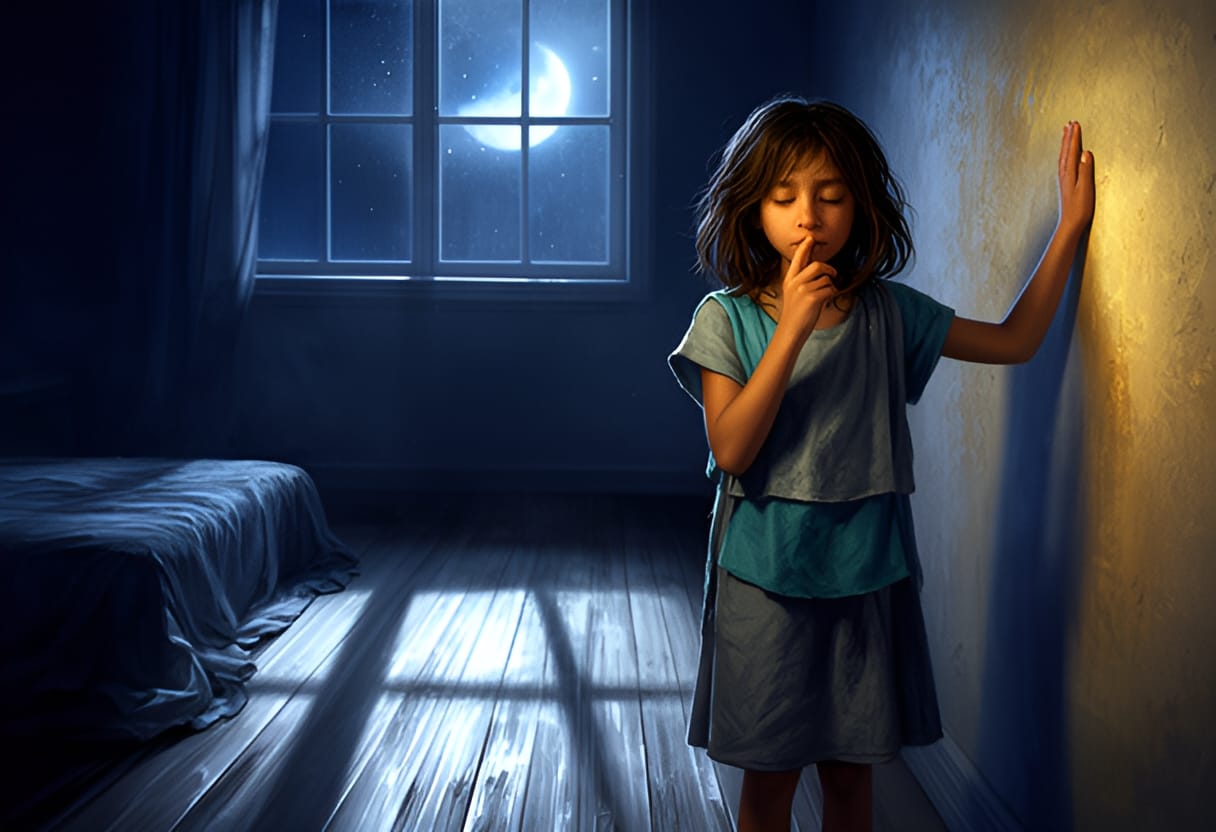
Lira pressed her palm flat against the cool plaster of her bedroom wall, eyes closed, trying to block out the argument still echoing down the hall. Her aunt’s voice, sharp and tired, had faded, but the tension lingered like static in the air. She’d been sent here after the fight with her mother—after the words she couldn’t get out, the ones that tangled in her throat and came out wrong, or not at all.
It was past midnight. The house should have been silent.
But the humming hadn’t stopped.
It wasn’t loud, not exactly. More like a vibration in the bones, a low thrumming that seemed to rise from the floorboards and settle behind her ribs. She’d first noticed it three nights ago, dismissing it as pipes or the old house settling. But tonight, it was clearer. Melodic, almost. Like a hundred voices singing just beneath hearing.
She pressed her ear to the wall.
And froze.
Not music. Voices. Dozens of them, layered and faint, each cutting off mid-thought.
—I’m scared that—
—Nobody would understand if I—
—What if they laugh—
The fragments hung in the air like smoke, incomplete, trembling. Her chest tightened. She knew that feeling. The weight of words you start but never finish, afraid of where they might lead.
Without thinking, she whispered the first completion that came to mind—not loud, not bold, just soft enough for the wall to hear.
"...that I’m not alone."
The moment the words left her lips, the wall shivered.
Not metaphorically. It shivered—a faint ripple, like water disturbed by a fingertip. Then, from the point where her fingers touched the plaster, a thin line of light broke through. Soft gold, warm as candlelight, it traced outward in a slow, branching pattern, like veins or roots spreading beneath the surface. It didn’t burn. It pulsed, gentle and steady, as if the wall itself were breathing.

Lira jerked her hand back, heart hammering. The light faded where she’d pulled away, but the main line remained, glowing faintly along the seam between two boards.
She stared at her palm. Nothing looked different. No heat, no mark. Yet the air smelled faintly of ozone, like after a storm.
A whisper came again, clearer now, from the other side of the wall.
—Thank you.
She didn’t know if it was real. Didn’t know if she’d imagined it. But the light was real. And for the first time since the fight, since the words got stuck, since she’d started hiding her stutter behind silence, Lira felt something shift inside her—not fear, not exactly, but a quiet, insistent pull.
Like she’d just stepped onto a path she hadn’t known was there.
She leaned back toward the wall, fingertips hovering, and waited. The humming continued, deeper now, richer. Waiting for her to answer.
She didn’t pull her hand away from the wall this time. Instead, she pressed harder, feeling the warmth of the golden line pulse beneath her palm like a second heartbeat.
The humming swelled, no longer a vibration but a song—hundreds of half-sentences rising and falling in layered sighs. The light along the seam widened, spreading like ink in water, then suddenly parted, not breaking but opening, as if the wall itself had inhaled and drawn back.
Beyond it was not her bedroom, not the hallway, not even the inside of the house.
It was a street.
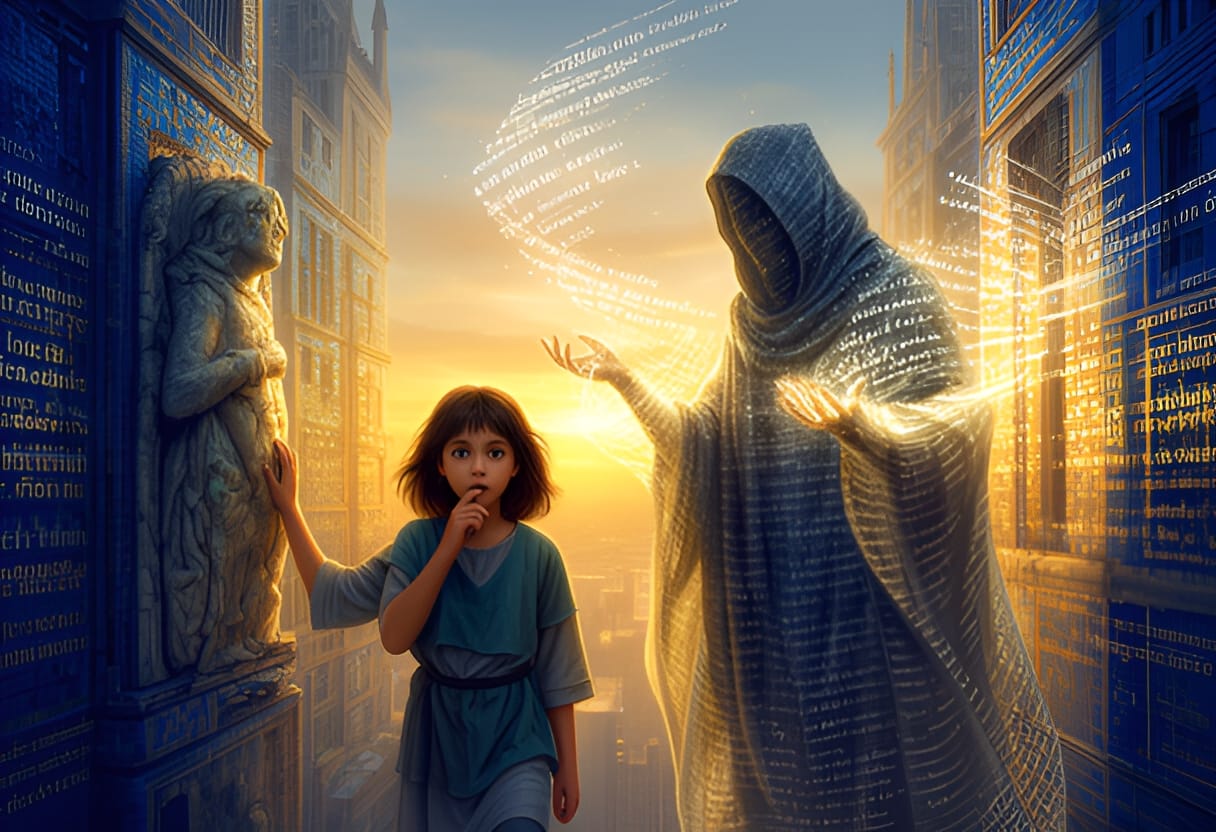
Narrow and winding, paved with stones that glowed faintly blue where shadows pooled and gold where the light touched them. Buildings rose on either side, not built of brick or wood, but of words—half-formed phrases carved into arches, facades, and stairways, some complete and solid, others dissolving mid-sentence into mist. A balcony hung from a clause that ended in “if only I had—” and faded into nothing beneath it. A doorway stood ajar, its lintel inscribed with “I meant to say—” before the letters grew thin and blurred.
The air hummed with the same voices from behind the wall, but now they were clearer, closer—whispers, stammers, aborted confessions—each one leaving a trace in the atmosphere like breath on cold glass.
Lira stumbled forward, her breath short, her fingers still tingling where they’d touched the wall. The opening behind her shimmered once, then sealed shut with a soft click, like a latch falling into place. No plaster. No seam. Just smooth, unbroken wall again.
She turned, heart pounding, and saw him.
He stood beneath an archway that read, in flowing script: “You are heard here.” His robes were not woven of thread, but of shifting text—sentences that formed, dissolved, and reformed in real time, looping around his shoulders and sleeves like living braille. His face was hooded, but she felt his gaze, calm and knowing, resting on her.

He did not speak.
Instead, a sentence appeared in the air between them, glowing faintly gold: You completed the first.
Not a question. A statement. And yet, it waited.
Lira swallowed. “I… I didn’t mean to. I just said what felt true.”
The Archivist tilted his head slightly. Another sentence formed: Truth is the only key that turns in this city’s lock.
He turned and began to walk down the street, his robes leaving faint trails of light where they brushed the ground. Lira hesitated only a moment before following.
As they walked, he gestured to a bridge ahead—half-built, its arches ending abruptly over a narrow canal. Where the stone should have continued, there was only air, and beyond it, the other side of the bridge dissolved into static, like a film torn mid-frame.
The thought stopped mid-sentence, the Archivist’s words appeared, and so did the structure.
Lira frowned. “You mean… if someone starts to say something but doesn’t finish… the thing they were building just… stops?”
Yes. The letters shimmered. Speech shapes the City. Withheld words unmake it.
They reached the plaza at the center of the district. It was wide and open, paved with mosaic tiles that shifted color beneath their feet—blue to gold to soft violet, like mood rings reacting to unseen emotions. In the center stood a figure frozen in mid-step, one foot lifted, hand half-raised as if about to speak. The figure was made of the same word-stone as the buildings, but its surface was cracked, dull, the inscriptions along its limbs faded and broken.
On its chest, carved deep but incomplete, read: I wish I could say—
Lira felt the pull again, quieter this time, but insistent. She stepped forward, ignoring the way her throat tightened, the old fear of stumbling over sounds, of being laughed at, of being too much or not enough.
She leaned close, her lips near the stone’s cool surface.
“...that I miss my mother.”
The words were soft, barely more than a breath. But as they left her, the gold light from the Archivist’s robes flared briefly, and the figure’s hand twitched—not a jerk, but a slow, deliberate lift, fingers uncurling slightly as if testing the air. A single tear-shaped crack in its cheek sealed itself with a seam of glowing resin.
The Archivist inclined his head. One sentence appeared, then faded, replaced by another: Well begun.
Lira looked at her own hands. They didn’t glow. But the air around them felt lighter, and for the first time that night, she didn’t feel the weight of the words she hadn’t said.
She felt the weight of the one she had.
Chapter 2
Chapter 2: The Weight of Almost
Lira’s fingers brushed the cool stone of the figure’s chest one last time before she pulled back. The Archivist gave a small nod, then turned toward the rising sun spilling gold across the plaza’s mosaic tiles. The air hummed faintly, not with voices this time, but with the quiet resonance of something real having shifted.
They walked in silence through the waking streets, past buildings whose facades shimmered with half-formed sentences—flickers of regret, hope, apology—visible only when the light caught them just right. Lira kept her hands loose at her sides, feeling the echo of her own words still vibrating in her ribs. That I miss my mother. It had been true. And saying it hadn’t shattered her. It had… loosened something.
The Archivist paused at the mouth of a narrow alley draped in fabric strips inscribed with tiny, shifting phrases. Beyond it, the Market of Almost-Saids unfolded—a maze of stalls under awnings of woven light, where glass orbs hung on cords like fruit, each containing a swirl of mist and a fragment of speech.
“Begin here,” the Archivist’s presence seemed to say, though no words formed. Instead, a single sentence hovered in the air before Lira: Speak what is small, and the large will learn to come.
She stepped forward.
A vendor, her hair threaded with silver filaments that pulsed when she spoke, lifted an orb from her tray. Inside, words drifted like smoke: I wanted to thank you for…
Lira hesitated, then said, voice soft but clear, “…holding the door when my hands were full.”
The orb flared warm gold. A tiny crystal, no larger than a seed, detached from the mist and landed in her palm. It thrummed gently, like a heartbeat.
Another stall. An orb: I wish you knew how hard I tried…
Lira swallowed. “…to fix the bike before your birthday.”
The crystal that formed was brighter, warmer. She closed her fingers around it, feeling the pulse travel up her wrist.
She moved quickly from stall to stall, completing phrases about missed buses, unsent letters, apologies for lateness, gratitude for quiet kindnesses. Each honest completion yielded a light-shard, each adding a faint glow to her skin, visible only when she passed beneath a lantern or caught her reflection in a puddle after the morning’s light rain. By midday, her palms felt warm, and the tightness in her chest had eased—not gone, but quieter, like a bell whose ringing had faded to a hum.
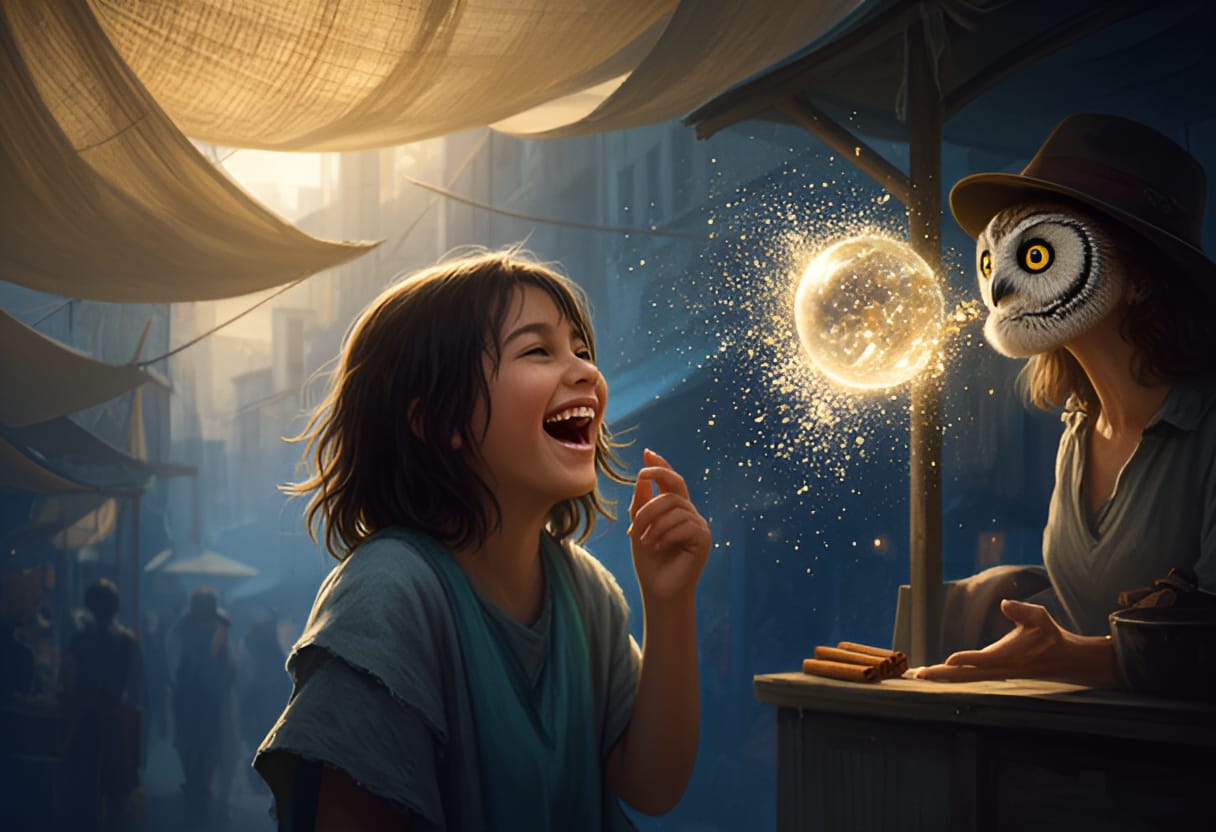
She laughed once, genuinely, when she helped a woman complete I was going to say… with “…that your hat looks like a startled owl,” and the woman’s orb burst into a shower of tiny crystals that smelled like cinnamon.
But as the sun began its slow descent, casting long shadows between the stalls, Lira paused before a cart draped in deep blue cloth. The orbs here were darker, their mist thicker, slower. She reached out, then stopped.
One orb hung slightly apart from the others, its surface rippling with a phrase she knew too well: I’m sorry I couldn’t protect you…
Her breath hitched. Her fingers tingled, not with the usual anticipation, but with a sudden, cold pressure—as if the air itself had thickened. She could feel the words behind the phrase, not as abstract regret, but as a weight: the night her mother had raised her voice, the way Lira had fled to her room, the silence that had stretched afterward like a wound left open.
She turned away.
Not because she couldn’t complete it. But because she wasn’t ready to mean it.
Instead, she chose another orb: I wish I had said…
She looked at the vendor, who waited with patient eyes. Lira took a breath. “…that I was scared, not angry.”
The orb glowed soft blue. A crystal formed, smooth and clear, and settled into her palm. It was the smallest one yet. But when she closed her fingers around it, she felt it—not as a reward, but as a question.
What else am I sorry for? she wondered, staring at her glowing hand. And what would happen if I finally said it?
She tucked the crystal into her pocket and walked on, the market’s hum fading behind her, the unfinished words of others lighting her path—while her own remained, for now, safely unspoken.
Lira found a bench beside the central fountain, its water murmuring over smoothed stone, and sat with her back straight, hands resting on her knees. The market’s hum had softened into evening, the stalls folding their awnings as vendors packed away unsold orbs. Light-shards glowed faintly in her pocket, warm against her thigh.
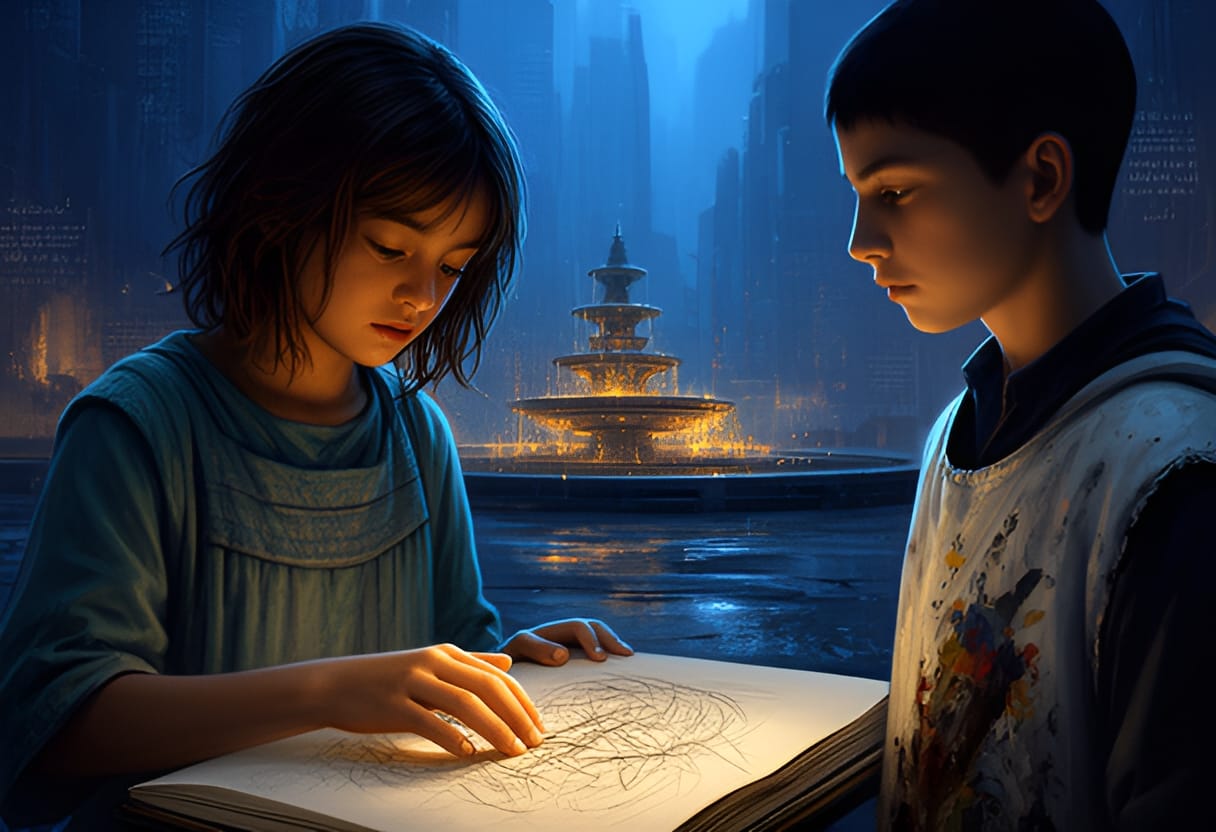
She opened her sketchbook to a blank page, not to draw, but to feel the weight of the paper, the slight resistance of the pencil when she pressed too hard. A movement to her left caught her eye.
Joren sat on the fountain’s edge, knees drawn up, a worn notebook balanced on his lap. His pencil hovered above the page, then dropped, leaving only a faint smudge. He didn’t look up. His shoulders were tight, as if bracing.
Lira waited. The fountain’s rhythm filled the space between them. Then, softly, almost to herself, she said, “…that I think your drawings are beautiful.”
He froze. The pencil slipped from his fingers and clattered to the stone. He didn’t speak. Didn’t look at her. But after a long breath, he turned the notebook toward her.
On the page: a small, careful heart, its lines uneven but deliberate.
Lira smiled, not too wide. “Thank you,” she whispered.
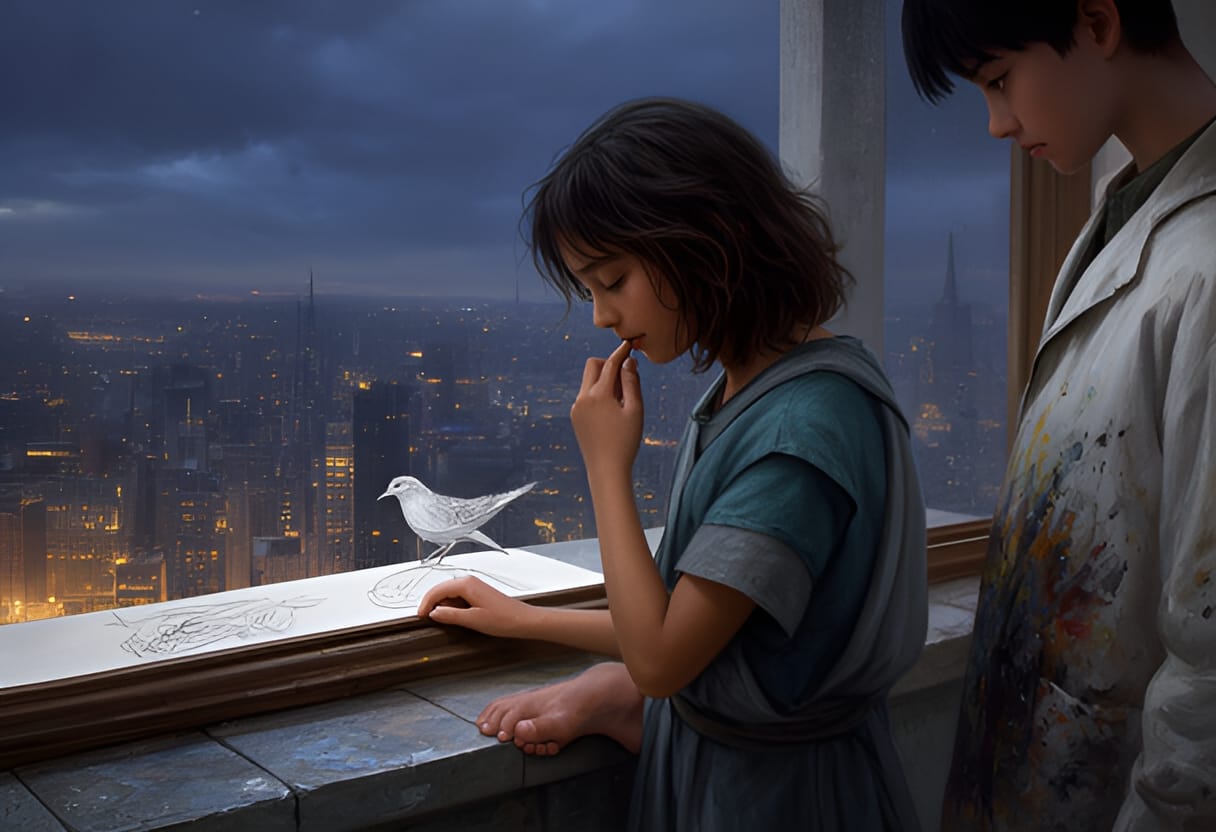
He nodded once, quick and sharp, then turned the page and began to sketch again—faster this time, lines flowing as he drew a bird with one wing slightly lifted, as if caught mid-flap.
She didn’t interrupt. She watched the way his wrist moved, how he shaded the underside of the wing with short, careful strokes. When he finished, he held the book out.
The bird was simple, but alive in its motion. Beneath it, in the same hand, he had written two words: Thank you.
Her throat tightened. She didn’t trust her voice, so she pressed her palm flat against the page, feeling the ridges of the pencil lines, the slight dent where he’d pressed too hard on the tail feather.
Then, as she pulled her hand back, she heard it—not from the air, not from an orb, but from the quiet space beside him, where his thoughts gathered like dust in sunlight: I am afraid…
She didn’t guess. She waited.
When the silence stretched, she said, voice low, “…that I will break something if I speak.”
He stilled. The pencil hovered again, tip touching the page but not moving. Then, slowly, he turned the notebook once more.
On the fresh page: a bird in full flight, wings wide, tail streamers trailing. Below it, not words, but a single, unbroken line that curled like smoke into the shape of a question mark—then dissolved into a series of small, ascending dots, like notes rising.
He looked at her. His eyes were dark, wide, but not afraid. He gave the barest lift of his chin.
Lira didn’t speak. She didn’t need to. Instead, she reached into her pocket, took out the smallest light-shard—the one from the orb where she’d said that I was scared, not angry—and placed it gently on the notebook beside his drawing.
It glowed soft blue against the paper.
He looked at it, then at her. He didn’t take it. But he didn’t push it away.
The fountain whispered behind them. Somewhere, a lantern flickered on.
Lira stood. She tucked her sketchbook under her arm.
“Come with me,” she said, not as a question, but as an offer.
He hesitated. Then, slowly, he closed his notebook, stood, and fell into step beside her.
They didn’t speak. But as they walked past the last of the stalls, the air between them felt less like silence and more like something waiting to be filled—not with words, not yet, but with the quiet understanding that they could be.
Chapter 3
Chapter 3: The Truth That Held the City
Lira traced the edge of Joren’s sketch with her thumb, the paper warm from his touch. The bird hung suspended in mid-flight, wings spread wide against a sky she had drawn in faint pencil strokes at the top of the page. He had left it on her windowsill that morning, silent as ever, but the gesture had settled in her chest like a seed cracking open.
She had avoided the deeper phrases in the Market of Almost-Saids, afraid of what might rise if she let herself go further. But the weight of her own silence had grown heavier, not lighter, with each completed sentence. It was as if the city’s light, gathered in her palms like scattered shards, was beginning to burn.
The Archivist found her there, just after dusk, standing barefoot on the cool stone of her balcony. They did not speak. Instead, a sentence formed in the air between them, letters shimmering like heat haze: The Heartstone waits. It knows you are ready.
Lira’s breath caught. She had heard whispers of the Heartstone—the city’s pulse, the source of the golden light that answered her words—but no one had ever taken her there. Not even in the Hall of Echoes, where the Archivist lived among shelves that breathed with dormant voices.
They moved through the sleeping city in silence, the streets soft underfoot, the buildings leaning in as if to listen. The unfinished words floated above the cobblestones like fireflies, fragments of regret and longing: I wish I had said…, I’m sorry I didn’t…, If only I could tell you… Lira wanted to reach out and complete them all, but the Archivist guided her past, toward the western edge of the city where the Hall of Echoes rose like a shell against the cliffside.
Inside, the air thrummed. Not with sound, but with the pressure of unsaid things—thousands of them, suspended in the dim light. The Archivist led her down a spiral stair carved from pale stone, each step echoing not with footfall but with the faintest vibration, as if the walls remembered every voice that had ever trembled in them.
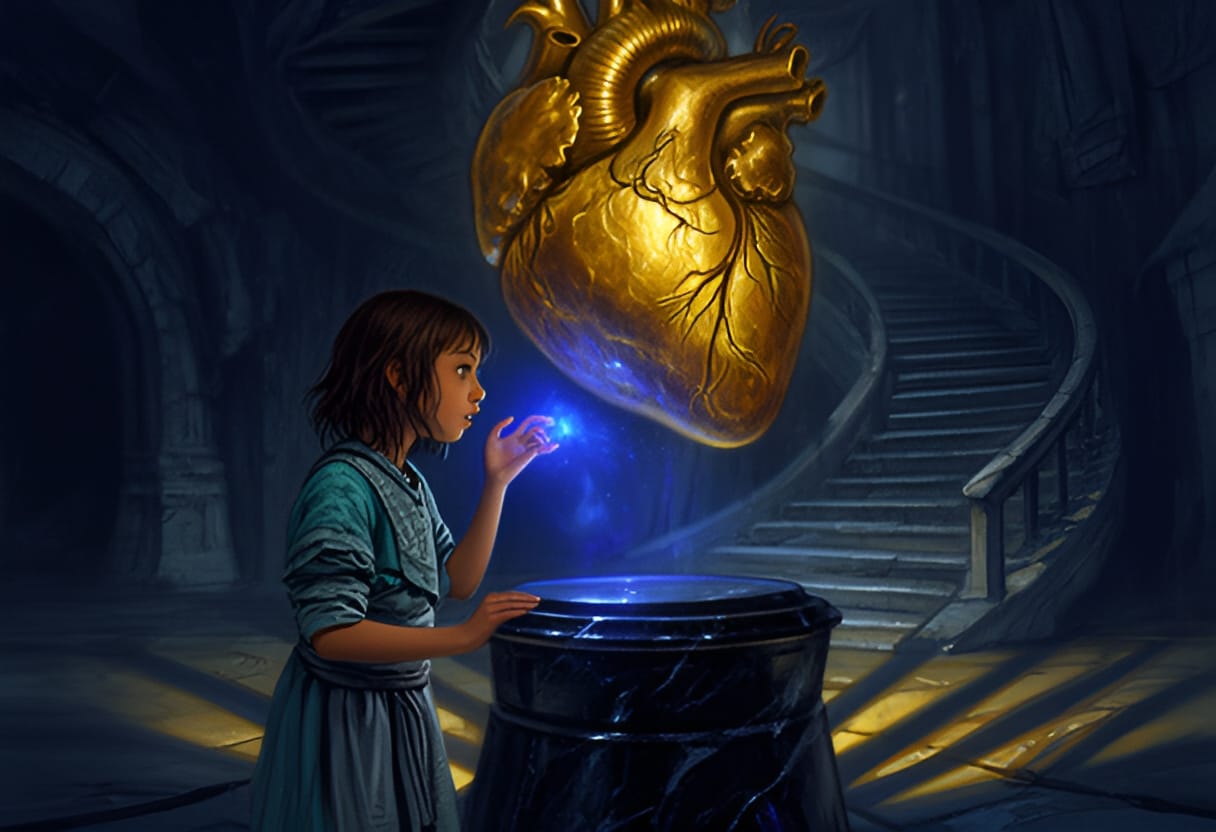
At the bottom, a chamber opened—a vast cave where the ceiling dissolved into darkness, and in the center, suspended on a pedestal of obsidian, floated a crystal taller than Lira herself. The Heartstone. It pulsed faintly, a slow, uneven throb, like a heart struggling to beat.
“It should be bright,” the Archivist’s sentence appeared, forming slowly, each letter taking its time. But it is blocked. By a thought that was never finished.
Lira stepped forward. The light from the crystal washed over her, cool and silver, and as she drew nearer, she felt it—not just see it—a weight in the air, a sentence caught mid-break, vibrating with the echo of a voice that had shattered.
I am ready to be heard.
The words hung in the space before the crystal, not spoken, but felt, as if the air itself had memorized them. And with them came a rush—not of sound, but of recognition. The cadence. The hesitation. The way the last word had trailed off, not with defiance, but with defeat.
Her breath came short. She knew that rhythm. She had heard it in the quiet after her mother’s voice cut off mid-sentence at the kitchen table, in the way Mira would look away when Lira stumbled over her words, in the years of silence that had grown between them like a wall.
The Archivist’s next sentence formed, gentle but inevitable: She fled here after the square. She thought she had broken the bond. Her fear became the city’s.
Lira’s vision blurred. The crystal’s pulse stuttered in time with her own. She had thought her fear was hers alone—that her stutter, her silence, the way she swallowed her words before they left her lips, was a flaw in her, a weakness she had to fix alone.
But it wasn’t hers. It was hers. Mira’s. Her mother’s.
The thought struck her like a physical blow. The woman who had shouted in frustration, who had sent her to her room after the argument, who had seemed unable to bear the sound of her own daughter’s voice—she was the one who had once stood before thousands and tried to speak. She was the City Speaker. And she had fled not because she had failed the city, but because she believed she had failed her.
Lira’s hand lifted, trembling, toward the Heartstone. The light flared at her fingertips, not gold this time, but a deep, resonant blue—the color of a voice finally finding its depth.
She had come to fix the city. But the city had been waiting for her to fix the thing she carried inside. The sentence she had been too afraid to finish.
I’ve been afraid to tell you… she whispered, not to the crystal, not to the city, but to the ghost of the woman who had once stood where she now stood—and to the woman who, she realized with a sudden, tearing clarity, was searching for her right now, just beyond the walls of the chamber. …that I believed you stopped loving me when I stuttered.
The words hung in the air. And for the first time, the Heartstone did not just pulse.
It sang.
Lira’s voice, raw and trembling, had cracked the silence like stone. The Heartstone’s song swelled, not in notes but in light—ripples of cerulean and violet surging outward from the crystal, threading through the chamber’s arches, spilling down the spiral stair, and seeping into the city’s foundations. Above, the unfinished words hanging in the air stilled, then began to glow, one by one, as if each had been waiting for this exact frequency to find its voice.
She didn’t look away from the crystal, but she felt it—the shift in the air, the soft scrape of stone, the uneven breath that wasn’t her own.
Mira stood at the chamber’s threshold, framed by the dim glow of the Hall of Echoes behind her. Her robes, once the flowing white of the City Speaker, were dulled at the edges, frayed from travel and tears. Her hands were clasped tight at her waist, knuckles white. She hadn’t dared cross the obsidian threshold. Not after what she’d done. Not after the square, after the silence she’d chosen over the risk of breaking her daughter further.
But the light had found her. It had traced her path through the sleeping streets, a ribbon of blue that had led her here, to the edge of the thing she’d spent years running from.
Lira lowered her hand from the Heartstone. The crystal’s pulse slowed, steady now, bathing them both in a soft, enduring radiance.
“I was afraid to fail you,” Mira said, her voice rough, unused, but clear. Each word seemed to be pulled from deep within, like a root finally loosened from stone. She took one step forward, then another, until she stood before Lira, close enough to see the faint tremor in her chin, the wet tracks on her cheeks.
“I thought if I stayed silent, if I disappeared, you wouldn’t have to hear me stumble. You wouldn’t have to see me fall. I thought silence was protection. But all it did was teach you that your voice was dangerous. That love had conditions.”
Lira’s breath hitched. She reached out, not to touch, but to open her palm—an offering. Mira hesitated, then placed her own hand in it, fingers cold and trembling.
The moment their skin met, the Heartstone flared—not with a burst, but with a slow, golden expansion, like dawn rising beneath the earth. Light shot upward through the Hall of Echoes, through the spires and domes and arches of the City of Unfinished Words. Buildings that had slumped under the weight of unsaid things straightened, their facades glowing with renewed pigment—cobalt, saffron, emerald—each hue a completed thought, a reclaimed voice.
From the streets below, a sound rose—not a cheer, but a murmur, growing into a hum, then a song. Not one voice, but many, overlapping, imperfect, alive. A baker calling out to a child. A scholar laughing at a joke. Joren, somewhere in the Market of Almost-Saids, raising his sketchpad not to hide, but to show—a drawing of two figures holding hands beneath a sky full of words.
Lira leaned into her mother’s shoulder. Mira’s arms closed around her, fierce and hesitant at first, then sure. The Archivist stood a few paces back, their shifting-script robes shimmering with sentences that no longer needed to be spoken—Thank you. You are home. The city remembers.
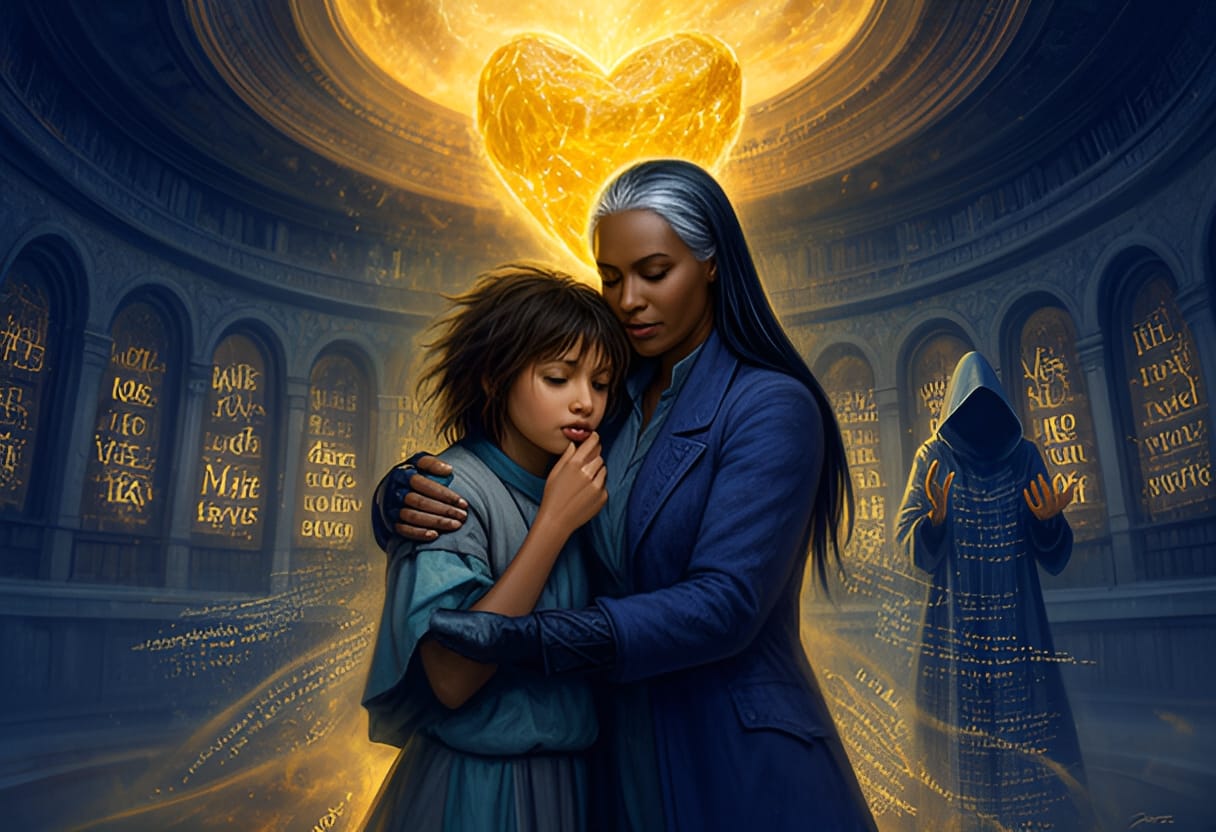
No further words were needed. The Heartstone pulsed in time with their joined heartbeats. The city breathed. And for the first time in years, neither of them feared the silence between them—because now, it was not empty. It was waiting.