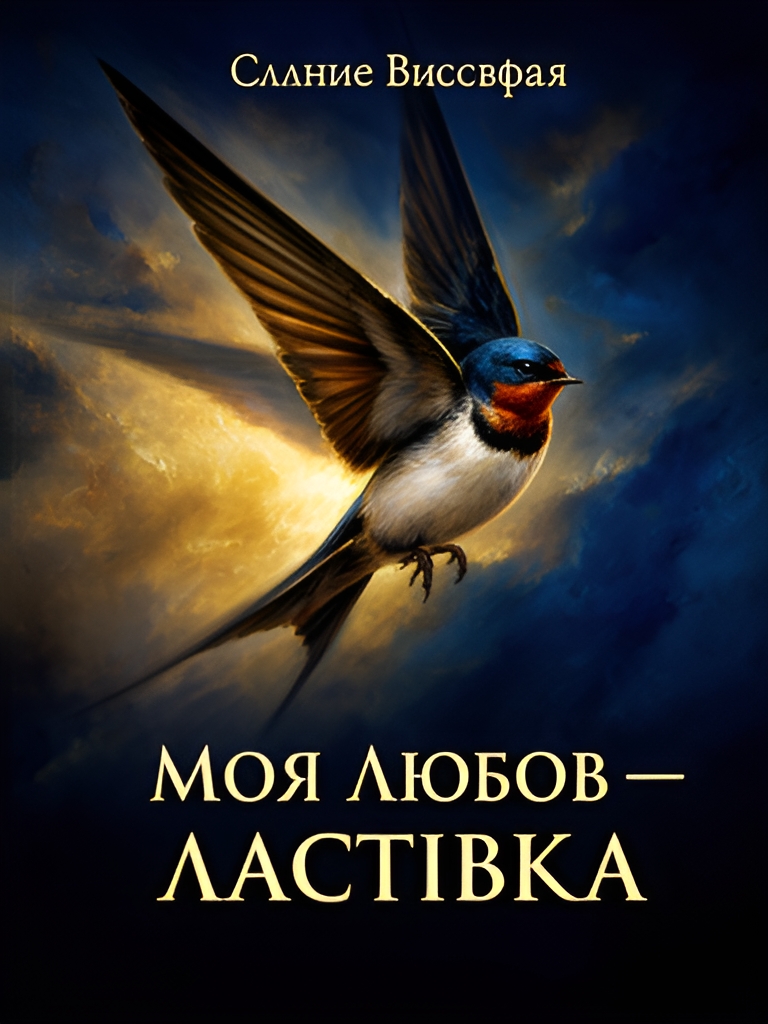
Romance
Моя Любов - Ластівка
by Віталік Кавний
2 chapters1.1 hr read
Chapter 1
Threads of Return
Olena’s fingers moved over the loom with the certainty of muscle memory, each pass of the shuttle a quiet punctuation in the morning stillness. Sunlight, thin and gold, slipped through the cottage window and fell across the half-finished rushnyk, illuminating the dust motes that danced above the white linen. The pattern—interlocking diamonds and stylized birds in deep red thread—was one she had woven since she was a girl, her mother’s hands guiding hers then, now only her mother’s voice, soft but insistent, from the rocking chair by the stove.
“You’ll make a fine wife, Olena,” Marichka said, stirring the pot of borscht that simmered low and sweet. “Yaroslav the blacksmith has asked again. His forge is steady, his family respected. You’d want for nothing.”
Olena didn’t look up. Her thumbs guided the weft, tightening the last pick before lifting the shed. The cloth whispered as it beat into place. “He’s a good man,” she said, though the words felt borrowed, like someone else’s voice. “I know.”
“Then why wait?” Marichka’s voice softened, not unkind, but firm as the oak beams overhead. “You’re not getting younger. The village talks. A woman your age, still unwed… it raises questions.”
The shuttle flew back. Olena’s jaw tightened just enough to tug at the thread, pulling a tiny pucker in the red diamond. She eased it loose with her fingernail, irritated by the imperfection, by the way her mother’s words always seemed to snag in the quiet spaces between her breaths.
Outside, a shadow passed over the window—swift, dark against the light. Olena paused, shuttle halfway across. Her breath hitched.
A swallow.
She had seen it just after dawn, low over the rye fields, wings slicing the air with effortless grace. It had circled the old bell tower once, twice, then vanished toward the forest. Not a pair. Not nesting. Just one, alone, returning.
Her mother followed her gaze. “What is it?”
“Nothing,” Olena said, too quickly. She brought the shuttle home, beat the weft down firmly. “Just a bird.”
“Swallows mean luck,” Marichka murmured, almost to herself. “Return. Faithfulness. Your grandmother used to say they carried the souls of the departed back to bless the living.”
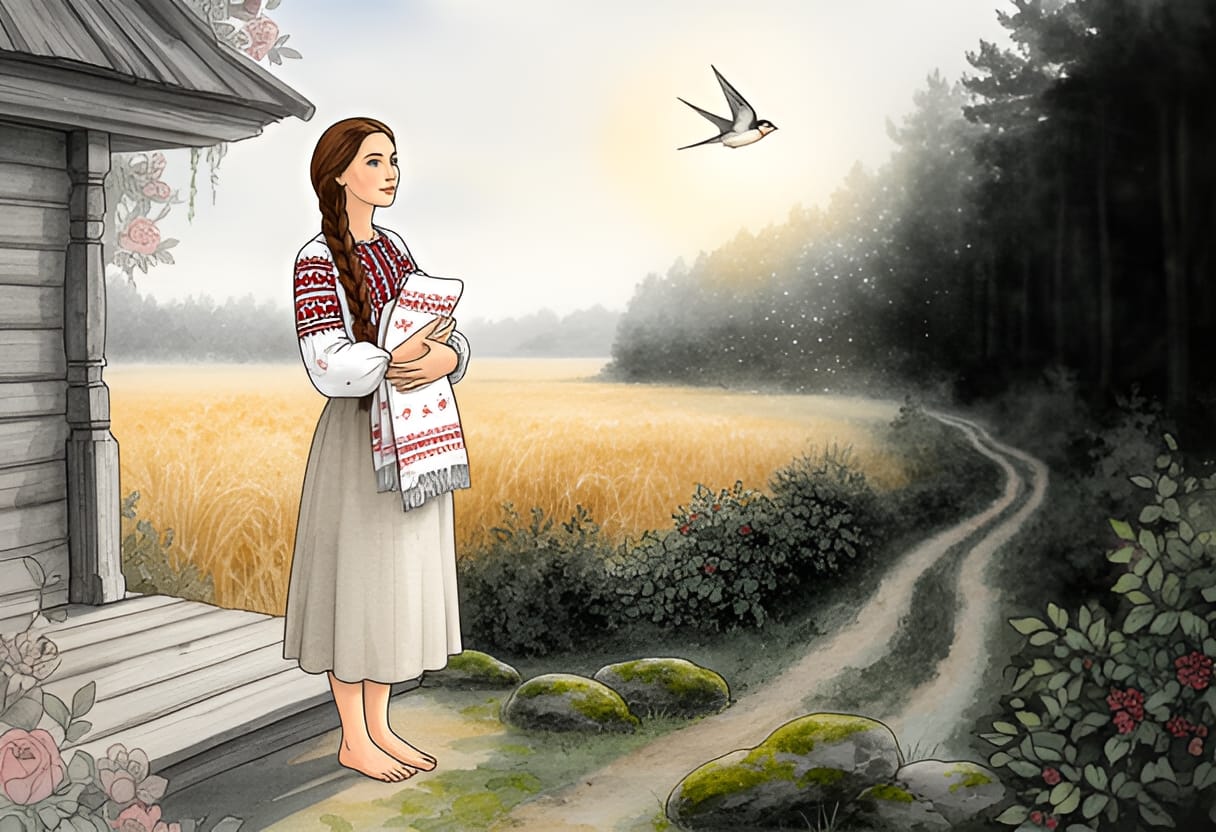
Olena didn’t answer. She couldn’t tell her mother that the sight of that lone bird had left her chest hollow, not with sorrow, but with a strange, quiet yearning—like the thread of a song she’d almost remembered. She had stood barefoot on the porch, the dew cold under her toes, and felt, for a moment, as if something essential had brushed past her and gone on without her.
The loom clicked. She lifted the warp, sent the shuttle flying again. The rhythm returned, but her mind stayed with the bird—how it had turned, just once, as if checking behind it, before disappearing into the light.
By midmorning, the rushnyk was done. The final knot tied, the ends trimmed neat. Olena lifted it from the loom, the linen cool and slightly stiff from the tension. She held it up to the light. The pattern was true, the tension even—work worthy of any bride’s dowry.
Marichka rose, her joints creaking like the old floorboards. “It’s beautiful,” she said, touching the embroidery with a fingertip. “Your father would have been proud.”
Olena swallowed. She folded the rushnyk lengthwise, then again, smoothing each crease with her palm. The red stood out stark against the white, like a vow. Like a demand.
“I’ll take it to the neighbor’s cottage after lunch,” she said, her voice even. “They’re expecting it today.”
Marichka nodded, studying her daughter’s face. “You’ve been distant lately. Since the front… since Maksym left.”
Olena’s hands stilled on the cloth. The name landed like a stone in still water—familiar, unexpected, sending ripples she hadn’t invited. Maksym Voronov. The soldier who’d come back two years ago, quiet and watchful, who’d traded his uniform for binoculars and a notebook full of sketches. He’d left just last month, said he was going west to study migration patterns near the Carpathians. Said he’d return in the fall.
“I haven’t thought of him,” Olena said, too quickly. She stood, rushnyk held to her chest. “I have work to do.”
But as she walked toward the door, the swallow returned to her mind—not as a symbol, not as an omen, but as a living thing, cutting through the air with purpose, unafraid of the wind. And she wondered, not for the first time, what it would feel like to be that sure of where you belonged.
She stepped onto the porch, the rushnyk secure in her arms, and paused. The village lay quiet beneath the sun—hens scratching in the dirt, a cart creaking down the lane, smoke curling from a chimney toward the blue. Somewhere, far off, a swallow called.
Olena didn’t move. She just stood there, the weight of the cloth, the weight of her mother’s hope, the weight of all the unspoken things pressing down—not enough to break her, but enough to make her bend, just slightly, as she waited for the moment to pass.
She drew a slow breath, the air cool and smelling of damp earth and woodsmoke. The rushnyk pressed against her ribs, a solid weight she could almost resent for its symbolism—this cloth meant to bind two lives, now binding her to expectation. Her mother stood in the doorway behind her, silent, giving her space but not releasing her gaze.
Olena turned her face toward the sound of the swallow’s call again, fainter now, carried on a breeze that stirred the lace curtains at the window. She thought of the bird’s wings—how they didn’t hesitate, how they beat not for show but for passage. She had never flown, not truly, but she knew the pull of a current stronger than will.
“Mother,” she said, voice low but clear, “I saw the swallow this morning. Alone.”
Marichka tilted her head, considering. “It’s early for them to be passing through. Most are still at the tower.”
“It was going west,” Olena said. “Toward the woods.”
A flicker of something crossed her mother’s face—recognition, perhaps, or worry. “The tower’s where they nest. Always has been. If one’s wandering, maybe it’s lost. Or scouting.”
“Or returning,” Olena whispered.
Marichka stepped forward, her hand hovering near Olena’s shoulder before settling, light as a moth’s wing, on the fabric she held. “You think too much on signs,” she said gently. “The Lord gives us sense for a reason. Yaroslav works with his hands, builds things that last. He won’t leave you wondering where his heart is.”
Olena looked down at her mother’s hand, rough from years of spinning and dyeing, resting on the rushnyk like a benediction. She remembered her father’s hands too—how they had shaped wood and held hers when she was small, how they had gone still too soon. Duty had been his language. Love, the quiet kind, had lived in what he made, not what he said.
She lifted her gaze to her mother’s eyes. “I know what duty looks like.”
Marichka’s expression softened, not with surrender, but with something like pity. “Then why does it feel like you’re running from it?”
Because, Olena wanted to say, duty doesn’t ask if your soul is listening. It only asks if your hands are ready.
Instead, she folded the rushnyk once more, tucked it securely under her arm, and stepped past her mother onto the path. “I’ll return it before noon,” she said. “Then I’ll check the nets by the creek. The fry need sorting.”
Marichka watched her go, her fingers still hovering in the air where Olena had been. “Be careful,” she called after her. “The banks are slick from last night’s rain.”
Olena didn’t look back. She walked toward the forest edge, the rushnyk a steady presence against her side, the echo of the swallow’s wings still humming in her blood. The village faded behind her—its expectations, its watchful eyes—and for the first time that morning, she moved not because she was expected to, but because she chose to.
Olena’s boots sank slightly into the damp earth as she followed the narrow path toward the creek, the rushnyk tucked under her arm like a secret. The air hung heavy with the scent of wet soil and crushed mint from the bank. Dragonflies skimmed the water’s surface, their wings catching the light in sudden flashes of blue and gold. She paused at the edge, kneeling to check the submerged nets—small, hand-woven traps meant to catch the fry before they scattered too far into the current. Her fingers moved deftly, sorting the silver slivers into baskets, her mind half on the task, half on the swallow’s westward flight.
A sudden clatter of wheels on the village lane made her glance up. A man on a rented bicycle struggled to keep balance as he turned onto the muddy track that led past her cottage. His coat was dark with rain, the collar turned up against the wind, and a waterlogged pack sagged on the rear rack. He wore no hat, and his dark hair clung to his forehead in damp strands. He pedaled slowly, eyes scanning the houses as if searching for something specific.
He dismounted near the well, wiping water from his face with a grimy sleeve. The bicycle leaned against the stone curb, its chain rattling faintly as it settled. He looked up then, and his gaze swept over the cottage—the whitewashed walls, the thatch roof patched with reeds, the linen drying on the line beside the door. His expression shifted, just slightly, as if recognition had stirred beneath the exhaustion.
Olena stood, hands still damp from the creek, and watched him approach. He moved with a soldier’s economy—no wasted motion, shoulders squared despite the fatigue in his step. When he was close enough, he lifted his hand in a tentative greeting.
“Dobryi den,” he said, his Ukrainian accent thick but clear, softened at the edges by something else—perhaps time spent away, or the quiet habit of speaking to oneself. “I’m sorry to intrude. The rain came on sudden, and I’m far from any shelter.”
Olena glanced at the sky. Though the downpour had eased to a mist, the clouds still hung low and heavy. “You’re soaked through,” she said. “Come in. You can dry off.”
He hesitated, then nodded. “Thank you. I’m Maksym Voronov. I’m studying the swallows at the bell tower.”
The name sent a quiet jolt through her, though she kept her face calm. She stepped aside, gesturing toward the door. “Olena Petrenko. Come in. The fire’s low, but it’ll warm you.”
Inside, the cottage smelled of beeswax and dried lavender. She hung his coat on a peg near the hearth, where the embers glowed faintly. He removed his boots, leaving damp prints on the packed earth floor, and stood shivering slightly as she fetched a towel from the chest by the bed.
“Here,” she said, handing it over. “And I have a spare shirt—my father’s old one. It’s dry.”
He accepted both with a murmured thanks, disappearing behind the screen to change. When he returned, the shirt hung loose on his frame, the sleeves rolled to the elbows. His eyes, when they met hers, were the color of storm clouds just before they break—gray, deep, holding something unreadable.
She poured tea into two chipped cups, the steam curling into the air like a quiet question. “You said you’re studying the swallows?”
He took the cup, cradling it in both hands. “Yes. I was a soldier—front lines, near Donetsk. Two years ago, I was wounded. When I came home… I couldn’t bear the noise of the village, the way people looked at me like I was broken. So I went to the tower. I remembered how, as a boy, I’d watch the swallows return each spring. They always came back to the same eaves, the same nests. No matter how far they flew, they remembered.”
He paused, staring into his tea. “I started sketching them. Tracking their flights. I realized they weren’t just returning—they were choosing to come back. That struck me. After everything I’d seen… to have a place that calls you home, not because you’re forced, but because you want to… it felt like a kind of grace.”
Olena listened, the warmth of the cup seeping into her palms. She thought of the rushnyk folded under her arm, the red thread like a vow stitched into cloth. “Do they ever fail to return?”
He looked up, surprised by the question. “Sometimes. Storms. Predators. But most do. And when one doesn’t, the others still come. The tower isn’t just wood and stone—it’s become a promise.”
Outside, the rain began again, softer this time, tapping against the roof like fingertips testing a surface. The sound was steady, rhythmic—a lullaby of water on straw and clay. They sat in silence for a moment, the only noise the hiss of the fire and the distant low of a cow in the pasture.
Then Maksym reached into his pack and pulled out a small notebook, its cover worn at the corners. He opened it to a page filled with careful sketches—cross-sections of nests, arrows indicating wind flow, notes in a tight, precise script. He flipped to a clean page and began to draw.
Olena watched him from her chair, the rushnyk forgotten in her lap. His pencil moved with deliberate grace, lines building the tower’s silhouette—the square base, the arched windows, the conical roof where the swallows clustered beneath the eaves. He shaded the underside of the roof with soft strokes, indicating where the nests clung to the beams and stones. A swallow in mid-flight hovered near the corner, wings angled just so.
She noticed how he didn’t rush. Each mark seemed weighed, considered. There was no frustration in his posture, no impatience—only focus, as if the act of drawing were a form of listening.
“You’re very good,” she said softly.
He glanced up, pencil hovering. “I’ve had practice. My mother was an artist. She taught me to see before I learned to speak.”
“And now you see the birds?”
He smiled, just slightly. “Now I see what they carry. Not just insects for their young—but direction. Purpose. The way they cut through wind without fighting it.”
She thought of her own path that morning—how she had walked not because she was expected to, but because she had chosen to. “Do you ever wish you could be that sure?”
He was quiet for a long moment. Then he shook his head. “I don’t know if I’m sure. I just know that when I’m here, in this tower, watching them… I feel less like I’m pretending to be whole.”
She nodded, understanding more than she could say. The rain softened to a whisper. The fire crackled. And in the quiet space between them, threaded with shared silence and the faint scent of damp wool and tea, something tentative began to form—not quite trust, not yet, but the willingness to extend a hand toward it.
Maksym lowered his pencil, closing the notebook with care. “Thank you for the shelter,” he said. “And the tea. I should be getting back. The light’s fading.”
Olena stood, gathering the rushnyk. “I’ll show you the safest way to the tower tomorrow, if you’d like. There’s a path behind the orchard—less muddy, and you can see the nests from the south face.”
He looked at her, something warm stirring in his eyes. “I’d like that.”
She walked him to the door, where he retrieved his bicycle and helped steady it as he mounted. The rain had stopped entirely, leaving the world washed and gleaming under a sky that was beginning to clear, the first stars prickling through like distant hope.
“Be careful,” she said. “The stones are slick.”
He nodded, pushing off slowly. “I will. And thank you again, Olena.”
As he rode away, his silhouette growing smaller against the fading light, she turned back toward the cottage. The rushnyk felt lighter now, not because its meaning had changed, but because for the first time, she wasn’t carrying it alone.
She stepped inside, closing the door softly behind her. The fire had dimmed to embers, but the warmth remained. She walked to the window and looked out toward the tower, its dark shape rising against the horizon like a quiet sentinel. Somewhere in the stonework, a stir of wings—soft, certain, returning.
She did not speak. She only watched, and waited.
Olena slipped her feet into her worn leather boots and stepped back into the morning light. The cottage door clicked shut behind her, and she paused on the threshold, letting the cool air brush her cheeks. The sky was pale gold, the kind of light that made the dew on the grass look like scattered salt. She walked quickly down the narrow path between the cottage and the orchard, her breath steady, her mind still half-lost in the quiet of the night before—the way Maksym’s voice had softened when he spoke of choice, the weight of the rushnyk no longer feeling like a burden but something shared.
She found him already waiting near the orchard’s eastern fence, his bicycle leaned against a gnarled apple tree. He wore the same faded field jacket, its shoulders softened by wear, and his hands were tucked into the pockets of his trousers. When he saw her, he straightened, the tension in his shoulders easing just a fraction.
“You’re early,” he said.
“I wanted to show you the way before the sun climbs too high,” she replied. “The path behind the orchard is drier, and you can see the tower clearly from the south face. Less chance of slipping on wet stones.”
He nodded, swinging his leg over the bike. “Lead the way.”
They walked in silence for a few moments, the only sound the crunch of gravel underfoot and the distant call of a meadowlark. Olena kept to the left, her hand brushing the low branches of the orchard trees as they passed. The air smelled of damp earth and crushed mint, and somewhere nearby, a rooster crowed, sharp and clear.
When they reached the stile that marked the edge of the orchard, she paused and turned to him. “There’s something the old ones used to say,” she began, her voice low, as if sharing a secret. “They believed the swallows weren’t just birds—that they carried the souls of those who had left too soon. That when a swallow flew low over a field, it was someone coming home, even if only for a moment.”
Maksym slowed his pace, turning to look at her fully. His eyes, usually so focused on the horizon or the page of his notebook, held hers with quiet intensity. “And do you believe that?”
She hesitated, then shook her head. “I don’t know. But I like the thought. It makes their return feel less like instinct and more like… a promise kept.”
He smiled, just a flicker at the corner of his mouth. “That’s not far from what I’ve come to think.”
They continued toward the tower, the path narrowing as they entered the tree line. The ground softened underfoot, mossy and cool, and the light grew dappled, shifting through the leaves above. Olena pointed out the faint trail worn by generations of villagers—narrow, but sure-footed, winding behind the orchard and up the gentle slope toward the stone structure that rose like a sentinel against the sky.
“This is the way,” she said, tapping the toe of her boot against a flat stone. “Less mud after rain. And from here—” she gestured toward the south face of the tower, where the morning sun caught the edge of the eaves—“you can see where the nests cluster. The swallows come in low, just above the roofline, and tuck themselves into the cracks beneath the tiles.”
Maksym nodded, studying the tower with a weaver’s eye for detail. “I’ve seen the damage from last year’s storm,” he said. “The western eave took the worst of it. Some of the nesting beams are splintered, and the mortar’s washed out in places. If the nests aren’t secure, the birds might not risk returning.”
They reached the base of the tower, and Olena stepped back to let him examine it more closely. He ran a calloused finger along a cracked stone near the bottom of the arch, then traced the line where the roof met the wall. “See here?” he said, pointing to a gap where a nest should have been. “This one collapsed entirely. The swallows tried to rebuild on the ledge below, but it’s too exposed. Wind and rain would tear it apart.”
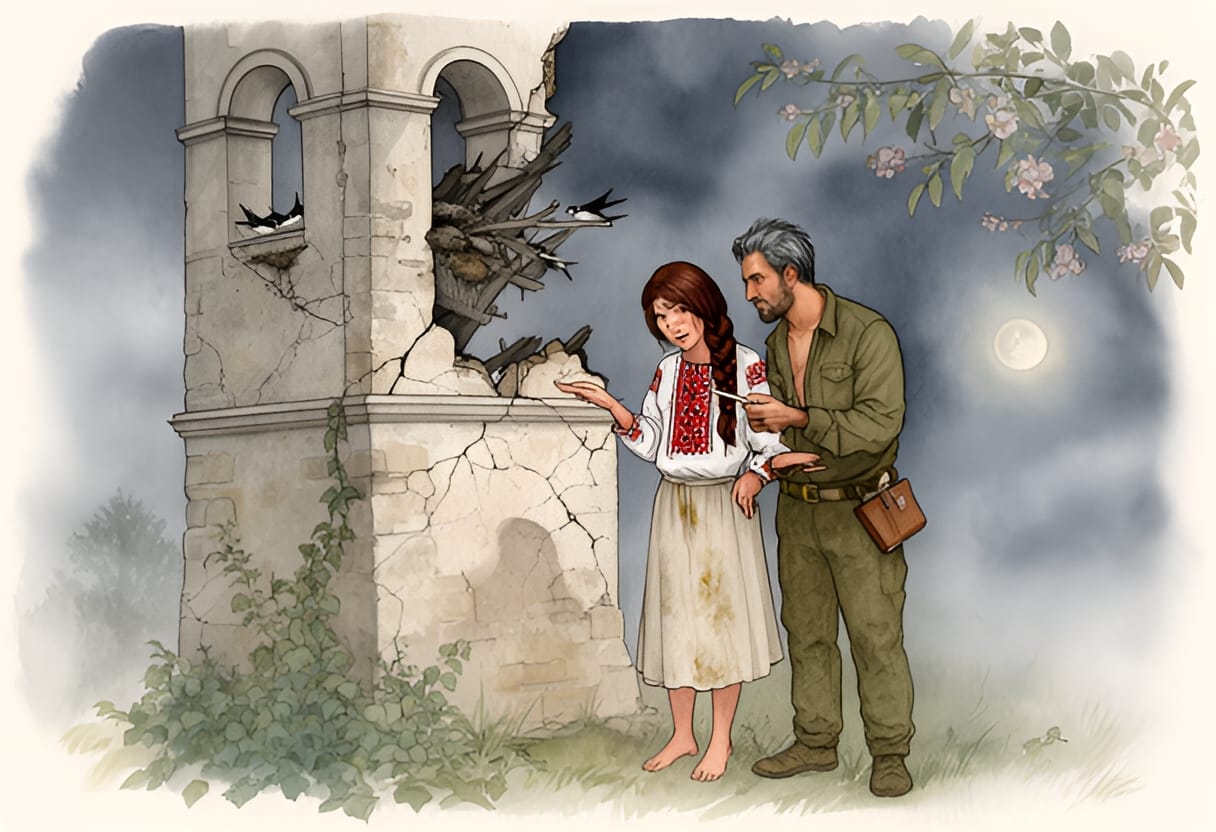
Olena leaned in, her brow furrowed. “It’s not just the storm. The tower’s old. The wood’s been weakened by years of damp. But the birds keep coming back to the same spots—it’s like they remember where they belonged, even if it’s no longer safe.”
Maksym looked at her, surprised. “You’ve watched them closely.”
“I’ve lived here all my life,” she said. “I notice when things change. And I’ve seen the same pairs return year after year. One male—he has a nick in his left wing, I think from a hawk—he always arrives three days before the others. He perches on the same stone, just to the east of the door, and waits.”
A soft chirrup echoed from above, and both of them looked up. A swallow darted past the tower’s arched window, its wings cutting clean arcs through the air. Another followed, then another, their bodies flashing like dark needles against the brightening sky.
“They’re testing the wind,” Maksym murmured. “Seeing if it’s safe to commit.”
Olena thought of her loom, of the way she pulled each thread just tight enough to hold, but not so tight that it snapped. “What if we could make the nests stronger?” she said, surprising herself with the boldness of the idea. “Not replace them—just reinforce them. I work with flax fiber every day. It’s strong when it’s woven tight, and it breathes. It wouldn’t trap moisture like clay or plaster. We could weave small pads to slip under the nests, or braid cords to tie the loose beams together. It would flex with the wind, not fight it.”
Maksym was silent for a moment, studying her face. Then he nodded slowly. “That… might actually work. Flax has tensile strength. And if it’s treated with a bit of beeswax, it’d resist water. I’ve seen similar methods used in old barn repairs in the Carpathians.”
He reached into his pack and pulled out his notebook, flipping to a fresh page. “Show me where you’d start.”
Olena crouched beside him, pointing to the damaged section of the eave. “Here—where the beam’s split. If we wrap it with flax twine, soaked in linseed oil, it’ll hold the wood together without adding too much weight. And for the nest itself—” she traced a half-circle in the air with her finger—“we could make a shallow bowl of woven flax, lined with soft grass and feathers. It would cradle the eggs, but still let the parents shape it to their liking.”
He sketched quickly, his pencil moving with the same deliberate grace as the day before. “And you’d have the fiber?”
“I have a bundle drying in the cottage,” she said. “I was saving it for a new rushnyk, but… this feels more important right now.”
He looked up, his eyes meeting hers. “Thank you.”
She felt a warmth spread through her chest, unfamiliar but not unwelcome. “We’ll start after breakfast. Bring your tools. I’ll bring the fiber.”
They spent the next hour working in silence, side by side on the low scaffolding Maksym had erected against the tower’s western face. Olena handed him lengths of flax twine, her fingers brushing his as she passed each coil. He tied knots with practiced ease, his movements economical, his focus absolute. She watched the way his jaw tightened when a knot slipped, the way he exhaled when it held.
Above them, the swallows circled, their flight patterns growing bolder as the sun climbed higher. One pair hovered near the damaged eave, tilting their heads as if inspecting the repairs. Another landed briefly on the stone ledge where Olena had seen the male with the nicked wing perch, then took off again, chasing its companion in a dance of sharp turns and sudden glides.
“They’re watching us,” Maksym said softly, not lowering his hands from the beam he was securing.
“I think they’re deciding whether to trust us,” Olena replied.
He smiled then, a real smile that crinkled the corners of his eyes. “Let’s give them a reason to.”
They worked until the sun stood high in the sky, their shoulders aching, their hands dusted with flax fiber and dried clay. When they finally stepped back to admire their work, the western eave looked stronger—reinforced with neat, tight wraps of twine, the nest bowl nestled securely in its cradle, ready to receive its inhabitants.
A swallow landed on the edge of the repaired nest, tilted its head, then hopped inside. It settled, feathers ruffling slightly, and began to arrange a stray feather with its beak.
Olena exhaled, a quiet laugh escaping her lips. “They’re already moving in.”
Maksym watched the bird for a moment, then turned to her. His expression was soft, unguarded. “They know a good foundation when they see it.”
She nodded, her heart full in a way she couldn’t quite name. The rushnyk lay folded in her pack, its red thread a quiet weight against her hip. But for the first time in weeks, it didn’t feel like a promise she was being asked to keep alone.
Instead, it felt like the beginning of something they were weaving together—thread by thread, choice by choice—into something that might, just might, last.
Olena folded the repaired nest’s description into her notebook and tucked it beside her loom, the rough paper catching on the smooth wood. The cottage smelled of linseed oil and dried grass, remnants of the morning’s work clinging to her sleeves and the hem of her skirt. She sat at the loom, the warp threads stretched taut and white, waiting for the weft. Her fingers moved to the shuttle, but the rhythm was gone. Instead of the steady throw and beat, her hands hesitated, the shuttle catching slightly as it passed through the shed.
She thought of Maksym’s hands—how they had moved with such certainty along the beam, how the tendons in his wrist had stood out when he pulled the twine tight. She remembered the way his breath had hitched when the knot held, the quiet pride in his eyes when the swallow had settled into the nest. The image looped, unbidden, and she pulled the shuttle too hard. The thread snapped.
A soft curse escaped her lips. She leaned back, the shuttle dangling from her fingers, and stared at the broken thread lying across the warp like a mistake waiting to be corrected. Outside, a breeze stirred the linen on the line, making it snap and flutter like a signal.
Marichka appeared in the doorway, her arms crossed, a basket of dried herbs in one hand. She didn’t ask what was wrong. She never did. She simply stepped inside, the scent of thyme and mugwort clinging to her skirts, and placed the basket on the table beside the loom.
“You’re distracted again,” she said, her voice low, not unkind. “This isn’t like you. You used to weave for hours without lifting your head.”
Olena bent to pick up the broken thread, her cheeks warming. “I’m tired, mamo. Didn’t sleep well.”
Marichka’s eyes flicked to the rushnyk folded in Olena’s pack, the red thread visible at the corner. “Or you’re thinking too much. About the blacksmith’s offer. Yaroslav’s been waiting two weeks for an answer. He’s a good man. Steady. His forge never goes cold, even in winter. He’d give you security. Children. A roof that doesn’t leak when the rains come.”
Olena’s fingers tightened on the broken thread. “I know what he offers.”
“Then why delay?” Marichka leaned against the doorframe, her voice dropping to a murmur. “You’re not getting younger, Olena. And the village talks. They see you walking from the tower with that soldier every morning. They wonder what you’re doing there. They wonder if you’ve already given your heart away to someone who might leave again, just like the last time.”
Olena’s breath hitched. She looked down at her hands, at the flax dust ground into her palms. “He’s not a soldier anymore. He studies birds.”
“And what does that pay?” Marichka’s tone softened, but her gaze remained firm. “Admiration from strangers? Praise in journals he’ll never see? You need a man who plants his feet in the soil, not one who chases the sky.”
Olena opened her mouth to speak, but the words tangled—frustration, guilt, a sudden, fierce protectiveness of the quiet moments she’d stolen with Maksym: the way he’d listened when she spoke of the nicked-wing swallow, how he’d sketched her ideas without judgment, how his silence hadn’t felt empty, but full of something she couldn’t name.
“I’m not ready,” she said finally, her voice barely above a whisper. “I need… time.”
Marichka sighed, the sound soft but heavy with resignation. She reached out and touched Olena’s shoulder, her fingers calloused from years of work. “Time for what? To wait for a fantasy? Life isn’t a rushnyk, mala. You don’t get to pull the threads and reweave the pattern when you don’t like how it looks. Sometimes you have to accept what’s in front of you.”
She picked up the basket and turned to leave, pausing at the threshold. “Think about it. Yaroslav won’t wait forever.”
The door clicked shut behind her. Olena remained still, the broken thread still coiled in her fist. The rushnyk in her pack felt suddenly alien, its red thread no longer a symbol of celebration, but a tether. She stood, the loom forgotten, and shoved her feet into her boots without lacing them. She needed air. She needed space where the expectations didn’t follow her like shadows.
She walked past the cottage, down the narrow path that wound between the gardens and the edge of the forest. The trees stood sentinel, their leaves just beginning to unfurl, a pale green that seemed to glow in the late afternoon light. Birds called from the underbrush—chiffchaffs, a distant cuckoo—and somewhere nearby, a woodpecker tapped its steady rhythm against dead wood.
She didn’t go far. Just far enough that the cottage was a blur of whitewashed walls and thatch behind her, far enough that she couldn’t hear Marichka’s voice, only the wind in the new leaves and the occasional rustle of something small moving in the bracken.
And there he was.
Maksym sat on a fallen log near the edge of the tree line, his back straight, his gaze fixed on the ground. He wasn’t looking at the sky today. Instead, his fingers traced the imprints in the soft earth—bird tracks, tiny and delicate, like forgotten writing. A notebook lay open on his knee, but he wasn’t writing. He was listening.
Olena hesitated, then stepped forward, announcing her presence with the crunch of a twig underfoot.
He looked up, and for a moment, his expression was unguarded—surprise, then relief, then something quieter, deeper. “You came,” he said.
She sat on the opposite end of the log, keeping a respectful distance. “I needed to walk.”
He nodded, his eyes returning to the tracks. “I was trying to figure out if this is a thrush or a blackbird. The stride’s too long for a thrush, but the toes splay too wide for a blackbird. Maybe a fieldfare passing through?”
She watched him—the furrow between his brows, the way his lower lip caught slightly when he concentrated. “You know so much.”
He gave a small, wry smile. “I know how to look. Not always what it means.”
A beat of silence passed, filled only by the wind and the distant call of a jay. Then, quieter: “I had a brother. Younger than me. Two years. He loved to draw birds too. Said he could see their souls in the way they tilted their heads.”
Olena turned to him, her breath catching. “I’m sorry.”
He nodded, his jaw tightening just slightly. “He didn’t make it out of Mariupol. They said it was quick. I like to think he saw the sky one last time.”
She didn’t know what to say. Words felt too clumsy, too heavy. Instead, she thought of her own losses—not of people, but of possibilities. The dreams she’d tucked away like threads in a drawer, promising herself she’d return to them later. The rushnyk she’d started for herself, years ago, abandoned when Marichka began speaking of suitors. The way she sometimes woke with a sense of missing something she couldn’t name.
“I feel… trapped,” she admitted, her voice rough. “Like I’m living someone else’s life. My mother wants me to marry Yaroslav. Says it’s sensible. Safe. But I don’t know if I want safe. I want… I don’t even know what I want.”
Maksym was silent for a long moment. When he spoke, his voice was low, rough at the edges. “I used to think if I could just understand the swallows—why they come back, why they choose the same beam, the same mate—then I’d understand how to fix what’s broken in me. But maybe it’s not about understanding. Maybe it’s about choosing to stay, even when you’re afraid.”
She looked at him then, really looked—the faint scar above his eyebrow from shrapnel, the way his hair fell just a little too long over his collar, the quiet intensity in his eyes when he spoke of birds, of loss, of things that mattered.
“I’m afraid,” she whispered.
He didn’t look at her. But after a pause, he shifted slightly on the log, and his hand moved—just a fraction—toward hers. His little finger brushed the back of her knuckles, warm and tentative, like testing the wind before flight.
Then, as if burned, he pulled his hand back, folding both tightly in his lap. His eyes dropped to the notebook, his cheeks flushed faintly in the fading light.
Olena’s heart hammered against her ribs, not with fear, but with something else—recognition, and a sudden, terrifying hope.
He stood slowly, brushing dirt from his trousers. “I should go back. Check the nests before dark.”
She rose as well, her legs stiff from sitting. “I’ll walk you part of the way.”
They moved silently through the forest edge, the path narrowing as the trees closed in. The sun was low now, gilding the trunks, turning the shadows long and blue. A bat flicked past them, silent and swift.
When they reached the cottage’s garden gate, Maksym stopped. He didn’t turn to her, but he spoke softly, his voice rough. “Thank you for coming out here. For… listening.”
Olena swallowed. “Anytime.”
He hesitated, then turned. His eyes met hers, dark and earnest in the dim light. For a heartbeat, neither of them moved. Then he nodded, a small, sharp gesture, and turned toward the tower.
Olena watched him go, her hand lifting unconsciously to her lips, as if she could still feel the ghost of his touch there. The rushnyk in her pack seemed to pulse against her hip, its red thread no longer a burden, but a promise—one she was only beginning to understand.
Olena woke before dawn, the cottage still wrapped in the hush of early morning. She slipped on her woolen shawl, tucked the rushnyk with its red thread safely into her pack, and stepped into the cool air scented with damp earth and distant woodsmoke. The path to the bell tower was familiar now—worn smooth by repeated footsteps, hers and his. She carried a small loaf of bread, a wedge of cheese, and a flask of herbal tea her mother had pressed into her hands that morning, though Marichka had said nothing more about Yaroslav since their last tense exchange.
Maksym was already there when she arrived, perched on the lowest step of the tower, his notebook open, his gaze fixed on the eastern sky where the first swallows were beginning to stir. He looked up as she approached, a quiet smile touching his lips.
“You’re early,” he said.
“I could say the same,” she replied, sitting beside him. “You’re usually not here until after sunrise.”
He shrugged, closing the notebook. “Old habits. The light is best for observing now—before the wind picks up.” He glanced at her pack. “Did you bring anything to eat?”
She handed him the bread and cheese. “And tea. For later.”
They ate in silence for a moment, watching the sky lighten. Then Maksym pointed to a cluster of nests tucked beneath the western eave. “See how they’ve reinforced the mud with bits of grass and feather? It’s not just instinct. They’re adapting—learning from last year’s storms.”
Olena leaned closer, tracing the shape of a nest with her eyes. “I’ve seen them do that. The ones that return early—like the nicked-wing male—seem to teach the others, somehow. Not with sound, but with presence. As if they say, This is how we rebuild.”
He turned to her, his expression thoughtful. “You notice things most people overlook.”
“I’ve watched them since I was a girl,” she said softly. “My grandmother used to say the swallows carried the souls of the departed home each spring. I didn’t believe her then. Now I wonder if she meant something else—that they return not because they have to, but because they remember what home feels like.”
He didn’t answer right away. When he did, his voice was low. “Maybe that’s what I’m looking for. Not just to understand them, but to remember what it feels like to choose a place—and stay.”
She looked at him then, really looked—the way the morning light caught the silver in his stubble, the quiet strength in his posture. “You already have,” she said without thinking. “You chose to come here.”
He didn’t smile, but his eyes softened. “For now.”
They spent the morning together—Olena showing him where the flax grew thickest near the forest edge, Maksym explaining how to distinguish the sharp, staccato call of a house martin from the softer, more liquid twitter of a barn swallow. By midday, they had repaired a loose section of nesting shelf using twine and salvaged wood, their fingers brushing more than once as they passed materials back and forth. Each touch lingered a fraction longer than necessary, neither pulling away.
When they parted at dusk, Maksym walked her to the garden gate. “Same time tomorrow?” he asked.
“If you’ll have me,” she said, her voice lighter than it had been in weeks.
He nodded. “I’ll be here.”
The next few days settled into a quiet rhythm. At dawn, Olena arrived with supplies—bread, cheese, sometimes a jar of wildberry jam she’d made the previous summer. Maksym met her with observations: a new scratch on a nest wall, a shift in flight patterns, the return of a particular bird with a frayed tail feather. He taught her to listen for the subtle differences in their calls—the urgent chirp of a parent returning with food, the low trill of mates greeting each other at the nest. She, in turn, shared what she’d noticed over the years: how the swallows seemed to favor the warmest stones at dawn, how they avoided the north side of the tower when the wind came from the northwest, how the earliest arrivals often perched on the same lichen-covered stone east of the door, as if waiting for something.
By late afternoon, they would meet again—sometimes on the tower steps, sometimes along the orchard path—talking less about birds and more about everything else. He told her about his mother, an artist who had taught him to see shadow and shape before he could read. She told him about the rushnyk she’d started for herself, the one with the red thread still tucked in her pack, abandoned when the talk of suitors began. He listened without judgment, his eyes holding hers in a way that made her feel both seen and unmoored.
Villagers began to notice.
It started with sideways glances at the market—Olena buying extra bread, Maksym lingering near the well after filling his flask. Then came the whispers: Too much time together. Not proper. She’s practically engaged to Yaroslav. Olena heard them, felt the heat rise in her cheeks, but she didn’t stop going to the tower.
One morning, as she passed Yaroslava at the clinic, her friend caught her arm, eyes sparkling. “So. The blacksmith’s waiting, and you’re off playing birdwatcher with the soldier?”
Olena sighed. “It’s not like that.”
Yaroslava snorted. “Oh, it’s exactly like that. And I love it. You’ve had your head down for too long, Olena. It’s good to see you… alive.” She lowered her voice. “And if Marichka gives you trouble, tell her I said you’re old enough to make your own mistakes.”
Olena laughed, the sound bright and unexpected. “Thank you.”
One evening, as twilight deepened into true dark, Maksym appeared at the garden gate not with his notebook, but with something small cradled in his palm. He looked hesitant, almost shy.
“I found this today,” he said, opening his hand.
Resting in his palm was a single feather—pure white, soft as down, tipped with a faint silver sheen. It was unlike any swallow feather Olena had ever seen.
“It’s… albino,” she breathed.
He nodded. “Extremely rare. One in ten thousand, maybe more. The pigment doesn’t form. But it’s not weak—this one flew just as strong as the others. Maybe stronger, to have made it this far.”
He looked at her, his gaze intense. “I took it as a sign. Not of luck, but of uniqueness. Of being seen, even when you’re different.”
Olena’s throat tightened. She remembered the rushnyk in her pack, the red thread a stark contrast to the white feather in his hand. “Do you believe in signs?” she asked.
“I used to think they were just stories we told ourselves to make sense of chaos,” he said. “Now I’m not so sure. Maybe they’re just… moments when the world whispers back.”
She looked down at her hands, then back at him. “I look forward to this,” she admitted, her voice quiet. “To seeing you. To our mornings here. To the way you make me notice things I’ve walked past my whole life.”
His breath hitched, just slightly. “I feel the same.”
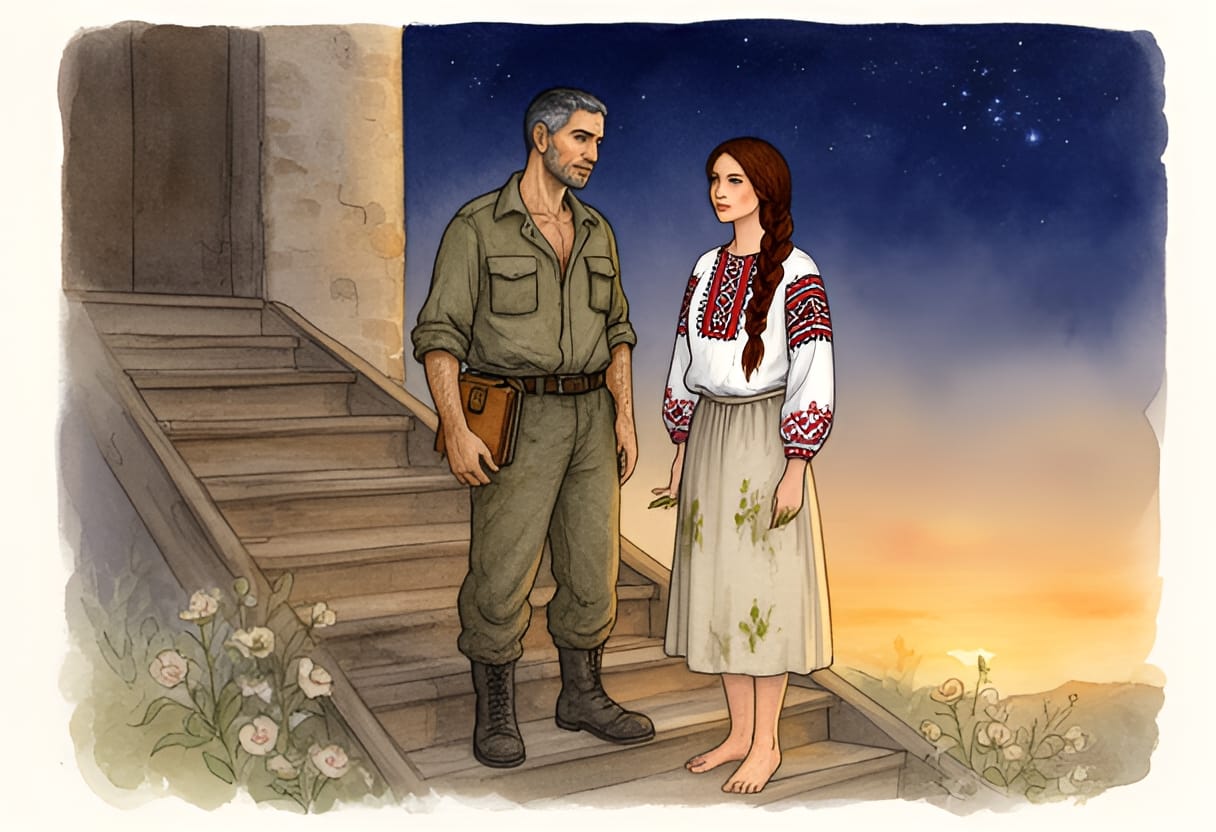
They didn’t speak again as they climbed the tower steps together. The wood was warm beneath their palms from the day’s sun. At the top, they sat side by side on the worn stone, shoulders nearly touching, hands resting in their laps but turned slightly toward each other, as if drawn by an invisible current.
Above them, the first stars appeared—faint at first, then growing clearer as the light faded. A swallow darted past the tower silhouette, its wings cutting clean arcs through the dusk. Another followed, then another, their voices rising in a soft, evening chorus.
Olena turned her head, just enough to see his profile in the starlight—the strong line of his jaw, the way his eyes reflected the sky, the quiet intensity that had drawn her in from the first moment she’d seen him standing in the rain at her door.
She didn’t move closer. Didn’t dare.
But she didn’t pull away either.
And when his little finger, almost imperceptibly, brushed the back of her hand once more—just as it had at the forest edge—she let her own fingers curl inward, ever so slightly, until they nearly touched his.
The night deepened.
The swallows returned to their nests.
And somewhere in the dark, a single, pure white feather lay tucked in a soldier’s palm, a silent promise caught between breath and starlight.
The garden gate clicked shut behind Maksym as he slipped back down the orchard path, his silhouette softening in the moonlight until he was no more than a shadow among the trees. Olena lingered on the stone step a moment longer, the cool night air kissing her damp cheeks, the echo of his touch still humming beneath her skin. The white feather felt like a secret pressed into her palm where she’d tucked it away, warm from his hand.
Inside, the cottage was quiet. The fire had burned low to embers, casting a faint, wavering glow across the packed-earth floor. Marichka sat by the hearth, her shawl pulled tight around her shoulders, her hands folded in her lap. She hadn’t been sleeping. Olena could tell by the way her mother’s eyes—usually so quick to dart to the loom or the dough or the crying hen—were fixed on the door, waiting.
Olena stepped inside, closing the door softly behind her. The scent of woodsmoke and dried lavender from the sachet Marichka kept tucked in her bodice wrapped around her like a familiar embrace. But it did not calm her.
“You’re late,” Marichka said, her voice low, devoid of its usual warmth. “And you walked home with him again.”
Olena swallowed, setting her small clay jug of water on the table. “We were watching the swallows return to their nests. It’s late, but not late enough to warrant worry.”
“It’s not the hour,” Marichka said, her voice sharpening. “It’s the way you walk. Side by side. Shoulders nearly touching. Like you belong to each other already.” She rose slowly, the movement stiff with years and worry. “I saw you from the window. You were laughing. He was laughing. As if there were no tomorrow, no responsibilities, no—”
“No what?” Olena asked, her voice quieter than she felt. “No Yaroslav waiting with his hammer and his forge and his promise of a roof that won’t leak?”
Marichka flinched as if struck. “Don’t speak of him that way. Yaroslav is a good man. Honest. Steady. His father left him nothing but the anvil and the bellows, and he’s built a life from it. He offers you security. Children who won’t go to bed hungry. A name that won’t be whispered about behind your back.”
Olena’s hands curled into fists at her sides. “And what do I offer him? My silence? My obedience? The rushnyk I never finished because my heart wasn’t in it?”
“You offer him respect,” Marichka said, stepping closer. “You offer him the chance to be a wife in the eyes of God and the village. You offer him the chance to make your father’s sacrifice mean something.”
The name hit like a stone in the chest. Olena’s breath hitched. Her father—dead these ten years, taken by fever after the harvest, his hands still blackened from the forge where he’d worked side by side with Yaroslav’s own father. Marichka had worn black for a year. Had never remarried. Had raised Olena alone, stitching by candlelight, trading embroidery for sacks of grain, refusing charity even when the winter bit deep.
“I know what he gave,” Olena whispered. “I carry it every day. In the way I keep the cottage warm. In the way I save scraps of fabric for the stall. In the way I still say his prayers before bread.”
“Then honor it,” Marichka said, her voice dropping, pleading now. “Honor him by choosing what is right, not what is easy. Yaroslav loves you. He has loved you since you were girls braiding each other’s hair by the well. He would give you everything.”
“And what if I don’t want everything he offers?” Olena said, the words tearing free before she could stop them. “What if I want… more? Not riches. Not grandeur. Just… to feel like I’m choosing my own life, not just fulfilling someone else’s idea of it?”
Marichka’s face crumpled. “You think this is about you? That your happiness is the only thing that matters? Your father worked his fingers to the bone so you wouldn’t have to beg. So you could have a dowry, a chest of linens, a man who would treat you well. And now you throw it away for… for a soldier with dreams in his head and dust on his boots?”
“He’s not just dreams,” Olena said, her voice breaking. “He sees me. Not the daughter you want me to be. Not the bride Yaroslav expects. But me. The one who notices the swallow with the nicked wing. The one who still keeps that red thread, not because I’m waiting for a proposal, but because it’s the color of the poppies that grew beside Father’s grave.”
Silence fell, thick and heavy as wet wool. Marichka looked away, her gaze fixed on the half-woven rushnyk draped over the back of the chair—the one Olena had started for herself years ago, abandoned when the talk of suitors began. The red thread gleamed faintly in the ember-light, a wound of color in the neutral weave.
“You’re being selfish,” Marichka finally said, not unkindly, but with the weight of truth. “And selfishness doesn’t build homes. It doesn’t feed children. It doesn’t keep a woman from ending up alone when her beauty fades and her youth is gone.”
Olena turned and walked to her small chamber without another word. She closed the door softly, leaned her forehead against the cool wood, and listened as her mother’s footsteps retreated to the hearth. The silence that followed was not peaceful. It was the silence of a heart splitting open.
She undressed slowly, the night air raising gooseflesh on her arms. The cottage slept around her—the creak of the settle, the distant hoot of an owl in the old linden tree, the soft, rhythmic breathing of her mother from the other room. Olena slipped beneath the covers, but sleep would not come.
Instead, she dreamed.
She was standing in the meadow beyond the orchard, the grass tall and wet with dew. The sky was the color of bruised plums, heavy with clouds that boiled and twisted like wool in hot water. The air smelled of ozone and wet earth, of rain about to break.
And then they came.
The swallows.
Not in their usual graceful arcs, but in a frantic, tangled flock, wings beating desperately against the wind. They screamed—not their usual cheerful chirps, but cries of panic, of disorientation. One by one, they were flung from the sky, dashed against the invisible force of the storm, their tiny bodies spinning helplessly before vanishing into the gloom.
Olena reached out, her fingers closing on nothing but air. She tried to call Maksym’s name, but her voice was swallowed by the wind. She saw him then—standing barefoot in the mud near the bell tower, his coat torn, his face turned upward as if begging the heavens to stop. A swallow with a nicked left wing struggled in his cupped hands, its breath fluttering weak and fast.
She lunged forward—
And woke with a gasp, her heart hammering against her ribs, her cheeks wet with tears she didn’t remember shedding.
The cottage was dark now, the fire long dead. Only the faintest glow of dawn crept through the edges of the shutters, painting the floor in silver-gray stripes. The dream clung to her like damp cloth—its terror, its urgency, the awful sense that something precious was being torn apart before her eyes.
She threw back the covers and dressed in silence, her movements careful not to wake Marichka. She pulled on her shift, her woolen skirt, her bodice, lacing it tight as if to hold herself together. Her feet found her worn leather boots by the door. She stepped outside into the chill dawn, the grass damp beneath her soles, the world hushed and waiting.
She walked not to the orchard path, not to the garden gate, but to the cottage’s rear, where her loom stood beneath the window—a sturdy frame of oak, its beams worn smooth by years of use. The warp was already threaded, the heddles raised, the shuttle waiting. A half-finished length of linen lay on the breast beam, its pattern intricate—geometric diamonds threaded with thin lines of crimson, like drops of blood on snow.
Olena sat. She picked up the shuttle, felt its familiar weight in her palm. She drew a breath, preparing to throw it across the shed.
But her hands wouldn’t move.
The threads blurred before her eyes. She saw not the weave, but the flash of white feather in Maksym’s palm. She heard his voice, soft and certain: Maybe they’re just moments when the world whispers back.
She thought of the rushnyk in her pack, the red thread a secret vow. She thought of her father’s hands, blistered and strong, shaping iron into tools that fed a village. She thought of Yaroslav’s steady gaze, his promise of a life without want. She thought of the swallow with the nicked wing, returning year after year to the same stone, not because it had to, but because it chose to.
And she thought of the storm in her dream—not just of wind and rain, but of something deeper. A breaking. A scattering. A choice that could not be undone.
Her fingers tightened on the shuttle. Then, slowly, deliberately, she lowered it to her lap.
She did not weave.
She simply sat, her hands resting in her lap, turned slightly toward each other, as if drawn by an invisible current.
The first true light of dawn touched the horizon.
And in the quiet, Olena Petrenko made no move to begin.
She only waited.
The thread held its breath.
Chapter 2
Wings of Choice
Olena sat, her hands resting in her lap, turned slightly toward each other, as if drawn by an invisible current.
The first true light of dawn touched the horizon.
And in the quiet, Olena Petrenko made no move to begin.
She only waited.
The thread held its breath.
Midnight came not with silence, but with a roar that split the sky like a whip. Olena jerked awake, heart hammering against her ribs as the cottage shuddered. Rain lashed the thatch roof in torrents, drumming a frantic rhythm on the walls. Thunder cracked overhead, close enough to make the whitewashed walls tremble. She flung back the covers and scrambled for her boots, feet bare on the cold stone floor.
Marichka was already stirring in the narrow bed beside hers, eyes wide in the gloom. “The tower—” she began, voice raw with fear.
“I know,” Olena said, pulling on her woolen skirt and bodice with trembling hands. She snatched her shawl from the hook by the door and shoved her feet into her boots, laces flying. “Come on.”
They burst into the night, the wind snatching at Olena’s hair and tearing the shawl from her shoulders. The world was a blur of black water and jagged lightning—each flash revealing the village in stark, terrifying relief: roofs bowed under the weight of rain, the orchard trees thrashing like wounded beasts, the river beyond the fields a churning, brown fury. The air smelled of wet earth and something sharper—ozone, and beneath it, the iron tang of fear.
The bell tower loomed ahead, a dark sentinel against the storm. But even as they ran, a blinding fork of lightning struck its crown. Stone exploded outward in a shower of glittering shards, raining down like deadly hail. A deep, groaning groan echoed from within the structure as the upper walls shuddered. Olena threw herself sideways, pulling Marichka with her, as a slab of masonry the size of a door crashed to the ground where they had stood.
“Sweet saints,” Marichka whispered, pressing a hand to her mouth.
Olena didn’t answer. She sprinted forward, slipping on the slick grass, her boots churning mud. The tower’s base was already half-collapsed—arrows of light from another strike illuminated the gaping wound where the western eave had been. And where the swallows’ nests had clung for generations, woven into the cracks and beams with mud and straw, there was only ruin. Shattered pottery, splintered wood, and tatters of flax and feather hung in the wind like broken wings.
Then came the cries.
Not human. Thin, desperate peeps from below.
Olena dropped to her knees in the mire, scrambling through debris. A fledgling lay half-buried under a fallen beam, its tiny chest rising and falling in shallow gasps. Its down was soaked through, plastered to its skin, one wing bent at an unnatural angle. She cupped it gently in her palms, feeling the frantic flutter of its heartbeat against her thumbs.
“Maksym!” she shouted over the storm. “Maksym, help!”
From the shadow of the tower’s ruined arch, a figure lunged forward—Maksym, bareheaded, his shirt plastered to his chest with rain. He moved with the sharp, urgent grace of a soldier, eyes scanning the wreckage. He dropped to his knees beside her, fingers brushing the bird’s back with astonishing tenderness.
“It’s alive,” he murmured. “But it’s hurt. We need shelter—now.”
Another flash of lightning revealed more of the small bodies scattered in the mud—three, maybe four, trembling and silent. Olena snatched up another, this one softer, its eyes squeezed shut against the pain. Maksym took it from her, cradling both against his sternum where the rain could not reach.
“We have to get them somewhere warm,” he said, voice tight. “The cottage—yours. Hurry.”
They ran, bent double against the wind, the fledglings tucked close to their chests. Olena’s lungs burned, her boots sucking at the mud with each step. Thunder boomed again, closer this time, and she stumbled, nearly dropping her burden. Maksym’s hand shot out, gripping her elbow to keep her upright. His grip was firm, warm through the thin fabric of her bodice.
“Thanks,” she gasped.
He didn’t answer. His jaw was set, eyes fixed on the cottage lights glowing faintly through the storm—Marichka’s silhouette already visible in the window, arms outstretched.
Inside, the cottage smelled of woodsmoke and damp wool. Marichka had cleared the table and laid out clean linens by the hearth, where the fire had been banked low but still breathed warmth. Olena laid her bird gently on the cloth, its tiny body shivering. Maksym did the same with his two, arranging them side by side. He tore a strip from his shirt and wrapped it carefully around the broken wing of the first, then the second, his movements precise despite the shaking in his hands.
“They’re hypothermic,” he said, voice low. “We need to warm them slowly. Too fast and they’ll go into shock.”
Olena nodded, tearing strips from her own shift to swaddle the smallest. The fledgling in her lap let out a weak chirp—more a vibration than a sound—and nuzzled into the wool. Tears burned her cheeks, but she blinked them away. She thought of the nicked-wing male, the one who waited on the stone each spring. Was he among the lost? Or had he flown ahead, sensing the storm’s fury before it broke?
Outside, the wind screamed like a living thing. Rain hammered the roof in relentless sheets. When the thunder finally rolled away into the distance, leaving only the steady patter of rain on stone, Olena crept to the window and peered out.
The bell tower was a skeleton. The upper third had sheared clean off, leaving jagged edges like broken teeth. The western eave was gone entirely—no trace of the beams where the nests had lived. Only the eastern face remained standing, half-collapsed, its stones slick and black in the gloom. And in the air above it, a dozen swallows wheeled in tight, confused circles, their cries sharp and discordant against the quieting storm. They dipped low, as if searching for familiar cracks in the stone, then rose again, wings beating the air in frantic, useless loops.
Olena turned away, her throat tight.
Maksym stood in the doorway, his silhouette framed by the dim glow of the hearth. He held something in his cupped palms—a fragment of nest, no larger than her fist, woven from straw and mud and a single strand of faded blue thread. He turned it slowly, as if reading braille in the dark.
“I’ll rebuild it,” he said, not looking up. His voice was quiet, but it cut through the hush of the cottage like a vow. “Every beam. Every nest. I’ll weave them stronger. I’ll use the flax. The linseed oil. The beeswax. However long it takes.”
Olena stepped forward, her bare feet silent on the earthen floor. She reached out, not to touch the nest, but to cover his hand with hers. His skin was cold, damp from the rain, but his grip tightened instantly around hers.
“We’ll do it together,” she whispered.
He finally looked at her then. In the firelight, his eyes were dark and deep—worn, yes, but alive with something fierce and tender. A promise, not spoken, but felt in the press of his palm against hers, in the way his breath hitched just slightly.
Outside, the swallows still circled. But beneath the ruin, in the warmth of the cottage, two hearts beat in time with the fragile lives they held—and the quiet, unshakable resolve to bring them home.
Olena stepped back from Maksym’s hand, the warmth of his palm still humming against her skin, and turned to the hearth where the fledglings lay swaddled in wool and linen. Their breathing had steadied, shallow but sure. She brushed a stray lock of hair from her forehead and looked at Marichka, who stood near the door, wringing her hands.
“We need to act fast,” Olena said. “The swallows won’t wait. If we don’t give them shelter soon, they’ll scatter—or worse.”
Marichka nodded, her eyes darting to the window where the ruined tower loomed like a wounded beast. “What can we do? The beams are gone. The nests are dust.”
Olena’s gaze fell to the loom in the corner, its wooden frame worn smooth by years of use, skeins of flax thread coiled like sleeping snakes along the bench. She remembered the rushnyk she’d abandoned, the red thread still tucked in her pack—a promise half-kept. But this was different. This wasn’t for show. This was for life.
“I can weave,” she said, her voice gaining strength. “Not cloth—foundations. Flax, braided tight, soaked in linseed oil and beeswax. It’ll flex in the wind but hold fast. Like the rushes in the Carpathian barns Maksym told me about. Strong, but alive.”
Maksym straightened from where he’d been tending the birds. His shirt was still damp, his hair plastered to his temples, but his eyes were sharp. “It’ll work. Flax has tensile strength—more than wet wood. And the oil and wax will repel rain without sealing it shut. The nests need to breathe.”
Olena turned to Marichka. “We’ll need flax stalks—long, clean ones. And beeswax from the hives by the east field. Linseed oil… I think Father Havrylo keeps a jar in his shed for his tools.”
Marichka hesitated, then squared her shoulders. “I’ll send Yaroslava to the hives. And I’ll barter for the oil—two yards of my best linen. As for the flax… the field behind the mill was retted last week. It’s ready to pull.”
Maksym was already moving, pulling his boots back on despite the wet. “I’ll organize the men. We’ll need to clear the debris first—safe the eastern face, then rebuild the eave frame. If we start at first light, we can have the supports up by noon.”
Olena handed him the fragment of nest he’d saved. “This strand of blue thread—it’s from last year’s nest. The male with the nicked wing used it. I’ve seen him bring it back, spring after spring.”
He closed his fingers around it, his thumb brushing the faded dye. “Then we’ll weave it in. A marker. For him.”
At dawn, the village stirred not with fear, but with purpose. Men and women arrived at the tower’s base with baskets, sickles, and lengths of rope. Olena stood on a stone near the eastern wall, her loom disassembled and laid flat before her, the flax stalks soaked in warm water to make them pliable. Marichka handed out bowls of beeswax melted in linseed oil, the mixture golden and fragrant, smelling of summer fields and honey.
“Watch the twist,” Olena instructed a group of young women, her fingers flying as she demonstrated. “Three strands, not four. Over-under, then turn the bundle—like you’re braiding hair, but tighter. You want it to hold its shape when dry, but not snap when the wind blows.”
She moved from pair to pair, correcting a loose braid here, praising a tight, even plait there. Her voice was calm, patient—like she was teaching a child to tie a knot, not directing a village’s revival. Sweat beaded on her brow despite the chill morning air, but she didn’t wipe it away. Her hands knew this work. Her blood remembered it.
Near the tower’s base, Maksym directed the men as they lifted salvaged stones and fitted new timbers into the scarred eastern face. He moved with the quiet authority of someone who’d once commanded under fire—not shouting, but pointing, adjusting, confirming. When a beam slipped, he caught it with his forearm and bellowed a warning that made the men freeze, then reset with care.
By midday, the first section of the new eave was in place—a lattice of flax braids woven between the beams, each strand coated in the wax-oil blend, glistening faintly in the sun. The swallows circled above, wary but curious, their cries less frantic now, more investigative.
Olena wiped her hands on her apron and looked up. “They’re coming closer,” she murmured to Maksym, who stood beside her, his arms crossed over his chest.
He nodded, his gaze fixed on a pair of birds darting low over the western gap. “They’re testing the wind. Checking if the air feels right.”
By the third evening, the tower stood whole again—not as it had been, but truer. The eastern face was reinforced with vertical flax braids running like ribbons between the stones. The new eave jutted out in a gentle curve, its underside a lattice of woven nests, each bowl shaped and sealed, ready. The air smelled of linseed, wax, and earth—of mending.
Olena sat on the lowest step, her back against the cool stone, her hands empty for the first time in days. Maksym sat beside her, shoulder nearly touching hers, his own hands resting on his knees, stained with wax and mud.
A silence settled, not empty, but full—of wings beating overhead, of distant laughter from the village celebration already beginning down the path, of the soft peeping of the fledglings back at the cottage, now strong enough to beg for food.
Then, a shadow detached itself from the flock. A single swallow, smaller than the rest, its left wing bearing a faint nick near the tip. It hovered at the edge of the new eave, head cocked, eyes bright and alert. It dipped toward the nearest nest, paused, then stepped inside, turning once to adjust its weight before settling, tail flicking once in satisfaction.
Olena held her breath. Maksym didn’t move. But when the bird began to preen, its beak tracing the edge of the woven bowl, he exhaled—a slow, soft sound—and turned his head toward her.
Their hands were inches apart on the stone step. Neither reached. But when Olena turned her palm slightly upward, Maksym did the same, his fingers brushing hers—just once, like a swallow’s wing grazing the sky.
Above them, the bird sang—a thin, clear note that cut through the dusk and settled into the stones, into the flax, into the quiet promise of return.
The scent of yaroslavna bread still clung to the air, warm and yeasty, mingling with the sharp sweetness of honey tea steaming in clay mugs. Villagers lingered on the bell tower steps, laughing softly, passing bowls of preserves and slices of cheese wrapped in cabbage leaves. Children darted between legs, chasing a rag ball stuffed with straw. Olena sat on the lowest step, her back against the sun-warmed stone, a mug cradled in both hands. Maksym sat beside her, shoulder nearly touching, his own mug forgotten, steam long gone.
Yaroslava had brought the bread—her mother’s recipe, studded with raisins and brushed with egg wash until it gleamed like amber. “For strength,” she’d said, winking at Olena. “And for sweetness after all that salt and sweat.”
Marichka moved among the group, refilling mugs, her smile wide but her eyes often drifting to Olena, searching. Father Havrylo stood near the tower’s arched doorway, blessing the rebuilt eave with a quiet murmur, his hand tracing the flax lattice as if feeling for weaknesses.
Olena watched the swallows—dozens now, darting in and out of the new nests, their wings cutting the evening air with sharp, quick beats. The nicked male was there, perched on the very stone where she’d first seen him wait, head cocked, one foot tucked beneath him. He preened, then launched, joining the others in a low, looping flight over the orchard.
“They’ve claimed it,” Olena murmured, not looking at Maksym. “All of it.”
He turned his head slightly, his profile sharp in the fading light. “They chose it. Not just came back—chose to stay.” His voice was low, rough at the edges, as if the words had been scraped free from somewhere deep.
She felt it then—the quiet certainty in his tone, the way his gaze lingered on the birds, not with the detachment of observer, but with something like kinship. Her chest tightened, not with fear, but with a sudden, startling fullness, as if her ribs had expanded to hold something too large for them.
A villager called out—a joke about wedding bells and swallow omens—and laughter rippled again. Olena forced her shoulders to relax, took a sip of tea. It was sweet, almost cloying.
Then Maksym shifted. He reached into the inner pocket of his coat—not the one stained with wax and mud, but the cleaner one near his heart—and pulled out an envelope. It was thick, sealed with red wax stamped with a crest she didn’t recognize: a silver compass rose over an open book.
His fingers paused over the seal. He didn’t break it right away. Instead, he turned the envelope slowly, as if weighing its weight, feeling its edges.
Olena’s tea went cold in her hands. She didn’t dare look at him directly. She stared at the nicked swallow, now hopping along the stone ledge, tapping its beak lightly against the wood as if testing its strength.
He broke the seal with his thumb, the wax cracking softly. The sound seemed too loud in the hush between laughter and birdsong.
He unfolded the letter inside—a single sheet of fine, cream-colored paper, covered in neat, slanted script. He held it with both hands, elbows on his knees, head bowed. His shoulders were still, but she saw the tension in the line of his jaw, the way his thumb rubbed once, twice, over the lower corner of the page.
She waited. Her breath had gone shallow. She could feel the pulse in her throat, slow and insistent.
The village noise faded—not gone, but muted, as if heard through wool. All she could see was the top of his head, the dark hair catching the last light, the rigid line of his spine. All she could hear was the faint rustle of paper, the occasional dip of a pen as if someone, somewhere, were still writing.
Minutes passed. Or maybe only seconds. Time had stopped measuring itself in heartbeats.
Then he exhaled—a long, slow release—and folded the letter once, neatly, vertically. Then again, horizontally. He did it slowly, deliberately, each crease sharp and precise. When it was small enough to fit in his palm, he turned it over, as if checking for more writing on the back.
His face was unreadable. Not angry. Not sad. Something quieter. Resigned, perhaps. Or resolved.
“It’s from the Bern Institute,” he said finally, his voice low, meant only for her. “They’ve been tracking the Carpathian flyway for years. Want me to lead a new study—migratory fidelity, climate adaptation. Two years, fully funded. Housing, equipment, a team.” He paused. His eyes flicked to the nest where the nicked male had settled, then back to her. “They say my work on the eastern swallows could inform continental conservation efforts.”
Olena swallowed. Her mouth felt dry. “That’s… important work,” she managed. “Real impact.”
He nodded once, sharply. “It is. The data could help protect routes across Europe and Western Asia. Help predict where habitats will vanish.” He looked down at the folded letter in his hand. “It’s exactly what I trained for. What I hoped for, after… after everything.”
She waited for the rest. The but. The turn.
He didn’t speak right away. Instead, he slipped the letter back into his coat pocket, close to his chest, over his heart. His fingers lingered there for a moment, pressing gently against the fabric, as if feeling the shape of it through the wool.
Then he stood. The movement was smooth, economical—no wasted motion. He brushed nonexistent dirt from his knees, though his trousers were still streaked with dried wax and clay.
Olena stayed seated, her hands loose in her lap. She didn’t look up. She couldn’t.
“I should walk,” he said. Not a question. Not an invitation. A statement of need.
She finally lifted her gaze. His eyes were tired, but clear. There was no deception in them—only a deep, quiet sorrow, like the hush before snow.
“Okay,” she whispered.
He didn’t reach for her hand. Didn’t touch her arm. He simply turned and walked away from the tower, from the warmth of the gathering, from the swallows singing in the eaves.
His boots struck the packed earth of the path, steady and unhurried. He didn’t look back.
Olena watched him go, her hands clenched now, nails biting into her palms. The letter burned a secret against his thigh, a weight she couldn’t see but felt all the same—like a stone dropped into still water, the ripples just beginning to spread.
The nicked swallow took flight from the stone, wings flashing in the last light, and followed his path—not after him, but parallel, as if keeping pace with something unseen.
Olena did not follow him then. She stayed on the steps until the last of the villagers drifted home, their laughter fading into the hush of the fields. The tea in her cup had long gone cold, the sweetness cloying now, like regret. She watched the nicked swallow disappear into the deepening blue, its flight steady, unwavering. When at last she rose, her limbs felt stiff, as if she had been carved from wood and left too long in the damp.
The path to Maksym’s usual watchpoint was narrow, worn smooth by generations of feet seeking the tower’s shadow. She moved slowly, her boots stirring dust that hung in the air like forgotten breath. The storm had stripped the western face of the bell tower bare, leaving splintered beams and ragged stone where the nests had clung. But the eastern side, where they had woven the flax lattices and sealed them with wax, held. Under the moon, it looked less like repair and more like promise—subtle, enduring, quiet in its insistence.
She found him on the far side of the base, where the ground sloped slightly toward the old orchard. He sat with his back against the cool stone, knees drawn up, the letter resting loose in his palms. He had not lit a lamp. The only light came from above—soft, silver, pooling in the hollows of the tower’s arches and catching the edge of his jaw, the line of his throat. He did not hear her come. Or if he did, he did not move.
Olena paused a breath away, her hands twisting the hem of her skirt. Fear coiled low in her belly—not the sharp, sudden kind, but a slow, sinking dread, like water rising in a cellar. What if he had already decided? What if the letter had already answered the question he had not yet voiced?
She swallowed. “You should be inside,” she said, her voice softer than she meant it to be. “The night’s damp. It’ll settle in your bones.”
He did not start. Only his fingers tightened, just slightly, around the paper. Then he exhaled—a sound almost lost to the night—and shifted, making space.
She sat beside him, careful not to touch. The stone was cold through her skirt, seeping into her thighs. Above them, the tower rose, its wounds visible in the moonlight—jagged where the lightning had sheared off the upper third, but whole where their hands had worked. The new eave curved gently outward, the flax braids darkened with oil and wax, swallowing the light. And there, in the sheltered corner beneath it, the nicked male sat hunched on the woven nest, his head tucked under his wing. One eye gleamed, bright and aware, watching them.
“They’re back,” Maksym said quietly. Not a question. An observation. His voice was rough, as if he had been holding it in for hours.
Olena nodded. “They came at dusk. One by one. Testing the strands, tugging at the wax. As if they remembered.”
He was silent for a long moment. Then, without looking at her, he unfolded the letter again. The paper was crisp, the creases sharp from his folding. He held it out, not quite offering it, but not keeping it to himself either.
“Read it,” he said. “If you want to know what I’m carrying.”
She took it. The wax seal had been broken, but the red remained, deep as dried blood, the compass rose and open book stark against it. Her fingers trembled slightly as she unfolded it. The script was neat, slanted, formal yet personal—each letter deliberate, as if the writer had weighed the worth of every word.
Dear Mr. Voronov,
Following your presentation at the Zurich Ornithological Symposium and your published work on the eastern swallow colonies of the Carphatian arc, the Bern Institute is pleased to offer you a two-year research fellowship…
Her eyes skimmed the lines—funding, equipment, housing, a team of assistants, access to satellite tracking data. The offer was everything he had spoken of wanting: purpose, impact, a chance to turn his grief into something that might protect others. Her vision blurred. She blinked hard, forcing the words back into focus.
When she finished, she folded the letter slowly, mirroring his earlier precision. The paper felt light in her hands, too light for what it contained.
“I read it,” she said. Her voice sounded distant, even to herself. “It’s… remarkable. Exactly what you’ve worked for.”
He let out a breath that was not quite a laugh. “You make it sound like a gift.”
“Isn’t it?”
He turned his head then, just enough to catch her profile in the moonlight. His eyes were dark, shadowed, but she saw the fracture in them—the raw, exposed place where hope and fear met. “It is. And that’s what makes it impossible.”
She waited. The night breathed around them—the rustle of leaves in the orchard, the distant low of a cow, the soft, restless stirring of the swallows in their nests.
“I’ve dreamed of this,” he said, finally. “Not the letter. Not the institute. But… this. The chance to go somewhere and do. To use what I learned, not just to survive, but to understand. To make sure what happened to my brother… to so many… wasn’t just pain for pain’s sake. That it meant something.”
His voice dropped, rough with something she could not name—grief, perhaps, or the weight of a life half-lived. “But then I came here. And I found… this.” He gestured weakly toward the tower, the nests, the village asleep in the valley below. “I found mornings with tea on the steps and swallows arguing over nesting spots. I found a woman who sees the way a bird tilts its head before it sings and knows what it means. I found… quiet. Not the absence of pain, but the presence of something that makes it bearable.”
He looked at her then, really looked, and Olena felt it—not as a thought, but as a truth settling in her bones: he was afraid. Not of leaving, but of staying. Of choosing her and discovering, too late, that it was not enough.
“I’m terrified,” he admitted, the words scraped raw. “Terrified that if I go, I’ll spend the rest of my life wondering what it would have been like to stay. And terrified that if I stay, I’ll wake up one day and realize I gave up everything I was meant to be—for a feeling. For a girl with ink-stained fingers and a heart too full for her chest.”
Olena’s own chest ached. She wanted to reach for him, to press her palm to his cheek and tell him he was wrong—that love was not a surrender, but a return. But she held back. This was not her choice to make. It was his.
She placed the letter gently between them on the stone. “Then don’t choose for me,” she said. “Don’t choose for the village, or the birds, or even for the man you were before the war. Choose for the one who sits here now, staring at a letter like it’s a verdict. Ask yourself: when you imagine your life five years from now, what do you see yourself doing? Not what you think you should do. Not what others expect. But what makes your breath come easier? What makes you forget to check the time?”
He was silent. The moonlight washed over his face, turning the stubble on his jaw to silver, tracing the tired line of his mouth. His hands lay open in his lap, palms up, as if waiting to be filled.
“I see,” he said slowly, “a workshop in Bern. Bright, filled with maps and screens showing flight paths over mountains and deserts. I see myself pointing at a screen, explaining how a shift in wind patterns could doom a whole cohort of juveniles. I see papers published, grants renewed, colleagues nodding in approval.”
He paused. Swallowed. “And I feel… proud. But also… distant. Like I’m watching it through glass.”
He turned his head toward her. “And when I imagine myself here? I see the tower in spring, wrapped in mist. I see you at the loom, the shuttle flying, the red thread catching the light. I see the nicked male returning, year after year, and I know—without needing to be told—that he’ll be waiting on that stone, just as he always has. I see your hand brushing mine as you pass me a cup of tea. I hear the swallows in the eaves, not as data, but as voices. As neighbors.”
His voice broke, just slightly, on the last word. “And I feel… known. Not as a soldier. Not as a scientist. But as myself. For the first time since before the front.”
Olena’s breath caught. She had not dared to hope for this—not the words, not the honesty, not the way his eyes held hers, not begging, not pleading, but simply seeing her.
She did not speak. Could not. Instead, she turned her hand slowly, palm up, and laid it on the stone between them.
He stared at it for a long heartbeat. Then, as if afraid it might vanish, he reached out. His fingers were rough from work, stained faintly with wax and clay, but they trembled as they closed over hers.
The contact was simple—skin on skin, warm and solid—but it sent a current through her, sharp and sweet, like the first sip of honeyed tea after a long winter. His grip was firm, not desperate, but certain, as if he had been waiting for this touch longer than he knew.
They did not look at each other. They looked ahead, at the tower, at the nests, at the swallow who had flown parallel to his path that evening and now slept safe in the wax-reinforced bowl they had built together. The moon cast their shadows long and joined across the stone—two figures, not quite touching, but held.
Somewhere in the village, a clock struck midnight. The sound was deep, resonant, unhurried. Like a promise keeping time.
He did not sleep. The stone had grown cold beneath them, and when the first pale light crept over the orchard, Maksym rose without waking her. Olena stirred only slightly, turning toward the hollow where his warmth had been, then settled again into sleep. He watched her for a moment—the rise and fall of her breath beneath the thin wool of her shift, the way a strand of dark hair had escaped her braid and lay across her cheek—and then he pulled his cloak tighter and walked away, barefoot at first on the damp grass, then stopping to pull on his boots by the cottage door.
The village was quiet. Smoke curled lazily from a few chimneys, and the scent of woodsmoke mixed with the wet earth and the faint, lingering sweetness of last night’s honeyed tea. He walked without purpose at first, down the lane past Marichka’s stall, where bolts of linen and embroidered rushnyks lay folded beneath oilcloth, past the well where children had drawn water the day before, and out toward the fields where the winter wheat slept under a frost-hardened crust.
He went not to think, but to feel the weight of his boots on the furrowed earth, the bite of air in his lungs, the way the world kept turning whether he decided to stay or go. The orchard lay to his left, its trees bare and black against the sky, and he turned into it, walking between the rows until he reached the old stone wall that marked the edge of the Petrenko land. There, he sat on the mossy stone and looked out over the valley, where the bell tower rose like a broken tooth against the waking light.
He thought of his brother—Oleh—lying beneath the white cross in the village cemetery, not far from where he sat. Oleh had loved birds, too. As boys, they had climbed the bell tower together, not to study them, but to steal eggs from the swallow nests, laughing when the parents swooped and scolded. Oleh had wanted to be a pilot. Said he wanted to fly with them, not just watch. Maksym had laughed and called him foolish—until the war came, and Oleh signed up, and Maksym followed, not out of patriotism, but because he could not let his brother go alone.
He had been there when the shell hit the trench. Not close enough to see the blast, but close enough to hear it—a deep, tearing sound, like the world ripping open. He had crawled forward through mud and smoke, calling his brother’s name, and found him half-buried, one arm flung out, his face turned toward the sky as if he had been watching something fly overhead.
He had not cried then. He had wrapped Oleh in his own coat and carried him back, step by agonizing step, and laid him down in the medic’s tent. He had held his hand until the breath left him, and then he had sat in silence for hours, his fingers stained with blood and dirt, staring at the ceiling and thinking: I should have been the one to go.
He stayed two years after that. Not because he was brave, but because he was afraid—to go home and face the quiet, to face his mother’s eyes, to face the village that had sent two sons and gotten back only one broken shell. He had come to the bell tower not for the birds, but because it was high, and silent, and no one came there except the wind and the swallows.
And then Olena had appeared, not with questions or pity, but with a rushnyk in her hands and a question about whether the male swallow with the nicked wing had returned yet.
He had not known then that he was already lost.
He stayed until the sun climbed higher, until the frost burned off the fields and the larks began to sing. Then he rose and walked back toward the village, not to the cemetery, but to the edge of the woods where Yaroslava often gathered herbs for the clinic.
He found her kneeling by a patch of feverfew, her basket half-full, her braid swinging as she reached for a low stalk.
“You look like a man who’s been talking to ghosts,” she said, not looking up.
He sat back on his heels and did not deny it.
“It’s not the dead I’m afraid of,” he said finally. “It’s the living. The ones who stay.”
Yaroslava paused, then plucked the plant and placed it gently in her basket. She wiped her hands on her apron and turned to face him, her arms crossed.
“You think staying is the easy part?” she said. “You think it’s just… giving up? Letting the world pass you by while you sit here drinking tea and mending nests?”
“I don’t know what it is,” he said. “I only know that when I imagine myself in Bern—really imagine it, not just the title or the funding, but the days, the hours—I feel like I’m watching my life through a window. Clean glass. Bright light. But I can’t touch anything. I can’t feel the air. I can’t hear the swallows unless I press my ear to the pane.”
Yaroslava softened. “And here?”
“Here, I feel the wind on my neck when I climb the tower. I feel the wax under my fingernails. I hear Olena humming when she passes me the linseed oil. I see the way the light hits the red thread in her rushnyk when she bends over the loom.”
“Then why is it so hard?” she asked.
“Because choosing this feels like admitting I’m not enough for the world out there. That I need this—her, the tower, the birds—to be whole. And what if I’m wrong? What if I stay and wake up in ten years and realize I hid here because I was afraid to try?”
Yaroslava stepped closer. She put her hands on his shoulders, firm and warm.
“You think love is a hiding place?” she said. “No. Love is the thing that makes you brave enough to face the world. Not the thing that keeps you from it. You think your brother would want you to spend your life chasing proof that your pain meant something? He would want you to live. To build. To love something so much that you don’t need to prove your worth to anyone—not the institute, not the war, not even yourself.”
She let go and picked up her basket.
“Go back to her,” she said. “And this time, don’t wait for a sign. Make the choice.”
He watched her walk away, her boots stirring up dust, her braid swinging against her back. Then he turned and walked not to Olena’s cottage, but to the bell tower.
He climbed the wooden ladder they had rebuilt, the flax-reinforced beams solid beneath his palms. The western third was still gone—jagged stone and broken timber open to the sky—but the eastern face held, the wax-coated lattices gleaming faintly in the sun. Swallows darted in and out of the eaves, chirping as they inspected the nests. The nicked male was there, perched on the stone ledge just inside the eastern arch, his head tilted as he watched Maksym approach.
Maksym paused at the top and looked down. Olena was in the garden behind her cottage, her back to him, seated at the loom. The shuttle flew back and forth, a blur of blue and red thread. The rushnyk lay half-finished on her lap, the red thread catching the light like a pulse.
He did not call to her. Instead, he reached into his coat and pulled out the small square of linen he had been carrying since the storm—the embroidered handkerchief she had given him the first morning they met, the one with the tiny swallow stitched in the corner, now stained with wax and dirt and a smear of dried blood from where he had used it to bind a fledgling’s wing.
He had kept it close. Not as a talisman, but as a reminder.
He descended the tower and walked slowly to the garden. She heard him stop and turned, her hands still on the loom, her eyes wide.
“I found this,” he said, holding it out.
She took it slowly, her fingers brushing his. Her gaze dropped to the cloth, then to his face.
“I lost it during the repair,” he said. “The day we fixed the western eave. I must have dropped it when I was lifting the beam.”
She looked down at the handkerchief, then back at him. “You kept it.”
“I carried it in my pocket every day. Even when I thought I might leave.”
She swallowed. “And now?”
He looked at her, really looked—at the faint freckles across her nose, the way her lower lip trembled slightly, the ink stain on her thumb from the loom.
“I’m not going,” he said. His voice was low, but steady. “I turned down the offer. This morning. Before I came here.”
She did not speak. Her breath hitched, just once.
“I stayed,” he continued, “not because it’s easy. Not because I don’t still wonder what it would be like to point at a screen and know I’m helping something bigger than myself. But because when I imagine my life five years from now, I don’t see a lab in Bern. I see this tower. I see you at the loom. I see the nicked male returning, and I know he’ll be waiting on that stone. I see your hand brushing mine when you pass me the tea.”
He stepped closer. The scent of her—linseed oil, dried herbs, and something sweet, like sun-warmed linen—filled his senses.
“I stayed,” he whispered, “because I finally understand what my brother meant when he said he wanted to fly. It wasn’t about the wings. It was about the sky. And I’ve found mine—not in the flight paths of strangers, but in the quiet here. In this garden. In this woman.”
He lifted his hand, slow, as if afraid she might vanish. He touched the corner of her mouth with his thumb, felt the warmth of her skin, the quick catch of her breath.
Then he leaned in.
Her eyes closed. Her lips parted slightly, and when his touched them, soft and uncertain at first, then deeper, surer—she sighed against him, her hands coming up to rest on his chest, feeling the beat of his heart beneath the wool of his coat.
Above them, the swallows wheeled in the twilight sky, their wings cutting the air in tight, looping turns. The nicked male led the flock, his damaged wing held steady, flying not away, but home.
They broke apart slowly, foreheads resting together, breath mingling in the cooling air.
“I was afraid,” she whispered.
“I know,” he said. “So was I.”
He kissed her again—brief, firm, a promise.
And somewhere in the distance, the village clock began to chime—not midnight this time, but the quiet, steady hour of evening, marking time not as a countdown, but as a return.
Olena’s fingers moved with practiced ease over the loom, the shuttle flying back and forth as she wove a fine linen rushnyk. Sunlight streamed through the cottage window, catching dust motes in the air and gilding the edges of the half-finished cloth. The pattern was simple yet deliberate—interlocking swallows in flight along the border, their wings touching at the tips to form a continuous circle. In the center, she had begun a motif of two trees growing from a single root, their branches intertwining above a small nest.
She paused, the shuttle hovering in her palm, and listened. From the bell tower came the soft, insistent peeping of chicks—a sound that had become the village’s morning hymn. Maksym was already there, she knew, notebook in hand, recording the feeding patterns of the parents, noting which fledglings begged loudest, which wings unfurled strongest at first flight. He had spent the past weeks not just observing, but protecting—mending loose strands of flax reinforcement after sudden gusts, shading nests with broad leaves during the hottest afternoons, even sitting silent vigil during storms, his presence a quiet assurance to the birds and to her.
A soft knock at the door made her look up. Marichka stood there, her shawl pulled tight against the lingering chill of early summer, a basket of warm bread and honey in her arms.
“You’ve forgotten to eat again,” she said, stepping inside without waiting for an invitation. She set the basket on the table and glanced at the loom. “That’s beautiful, Olena. The birds… they look like they’re dancing.”
Olena smiled, a quiet warmth spreading in her chest. “I wanted it to be ready for him.”
Marichka’s eyes softened. She moved to the loom and ran her fingers lightly over the linen, not touching the embroidery, just feeling the weave. “You’ve been working on this since the tower was repaired. I saw you up late more than once, needle in hand, the rushnyk draped over your knees like a secret.”
“I didn’t know if I’d ever give it to her,” Olena admitted. “After everything… after his letter, after his doubt… I thought maybe I was weaving for a future that wouldn’t come.”
Marichka turned to her then, her gaze steady and kind. “You were weaving for hope. And hope, my dear, is the bravest thing we make.” She picked up the basket. “Eat. Then go to him. He’ll be coming down from the tower soon. I saw him packing his notebook away just now.”
Olena nodded, taking a piece of bread and spreading it with thick, golden honey. As she ate, her mother bustled about the cottage—tucking in the loom’s bench, straightening the rushnyk on her lap, even brushing a stray thread from Olena’s shoulder. When she was done, Marichka paused in the doorway, her hand on the frame.
“I used to worry you’d marry a man who’d take you away from all this,” she said, her voice thick. “From the loom, from the garden, from the way you hum old songs when you think no one’s listening. But I see now… you weren’t meant to leave. You were meant to grow roots here. And he… he sees them. He sees you.”
She stepped forward and kissed Olena’s temple. “Go on. The swallows are waiting. And so is he.”
The bell tower stood tall against the sky, its eastern face whole and strong, the wax-coated flax lattices gleaming like honey in the sun. Swallows darted in and out of the eaves in constant motion—parents arriving with beaks full of insects, chicks craning their necks from the nests, their tiny bodies trembling with the effort of lifting their heads. The nicked male perched on his usual stone ledge, head tilted, watching the sky with quiet vigilance.
Maksym sat on the bottom step of the tower, his notebook closed beside him. He was not writing now, just watching. His eyes followed a pair of swallows as they swooped low over the orchard, then climbed sharply toward the tower, their wings beating in perfect unison. A faint smile touched his lips.
Olena approached slowly, the rushnyk folded carefully in her hands. She stopped a few paces away, hesitating only a breath before speaking.
“You seemed deep in thought.”
He looked up, and his expression shifted—softening, brightening—as if the sun had broken through clouds. “I was just thinking about how quiet it used to be here. Before the nests were rebuilt. Before… before we started working together.”
She stepped onto the stone and sat beside him, not too close, but close enough to feel the warmth radiating from his coat. “It’s loud now,” she said. “In the best way.”
He chuckled, a low, warm sound. “It is. I’ve counted seventeen nesting pairs so far. Twenty-three chicks that have fledged. Eight more still in the nest, getting their feathers. The nicked male’s mate is sitting tight—I think they’ll hatch any day.”
Olena nodded, her gaze drifting to the nest beneath the eave where the male waited. “He’s been there every morning. Same stone. Same time.”
“He remembers,” Maksym said quietly. “And he returns. Not because he has to—but because he chooses to.”
She turned to him then, her heart pounding. “I made something for you.”
She unfolded the rushnyk and held it out. The linen was smooth and pale, the embroidery vivid—the swallows in flight along the border, the twin trees in the center, their roots deep and joined. In one corner, almost hidden in the weave, she had stitched a tiny, nicked wing.
Maksym took it slowly, his fingers tracing the outline of the birds, feeling the raised threads of the trees, pausing at the mark of the swallow’s imperfection. His breath caught.
“You remembered,” he whispered.
“I remembered everything,” she said. “The way you held the fledgling’s wing with that handkerchief. The way you looked at the tower after the storm—not with despair, but with a plan. The way you stayed, even when you were afraid.”
He looked up, his eyes glistening. “I stayed because of you. Because you showed me that rebuilding isn’t just about beams and nests. It’s about choosing to make something beautiful from what’s broken.”
He leaned forward and pressed his lips to her forehead, then her cheeks, then finally her mouth—soft, sure, a promise sealed not in words but in the quiet pressure of his mouth against hers.
When they pulled back, he folded the rushnyk carefully and tucked it into the inner pocket of his coat, over his heart. “I’ll carry this always,” he said. “Not as a reminder of what we’ve survived, but of what we’ve built. Every day, I’ll touch it and remember—this is where I belong.”
He stood and offered her his hand. She took it, rising to her feet, and together they walked down the stone path toward the cottage. The village was alive with the hum of summer—women calling from doorways, goats bleating in the pasture, the distant clang of a blacksmith’s hammer. But above it all, the swallows sang—their voices weaving through the air like threads in a loom.
Olena leaned into Maksym’s shoulder, her head resting against the wool of his coat. She could feel the steady beat of his heart, the rise and fall of his breath. Around them, the flock wheeled in the sky, the nicked male leading the way, his damaged wing held steady, not hiding, not fleeing—flying home.
They passed Marichka, who stood at her stall in the square, smiling as she watched them go. She lifted a hand in quiet farewell, her eyes bright with unshed tears, but her smile wide and sure.
And as they turned the corner onto the path that wound through the orchard and toward the cottage, the sun began its slow descent, casting long shadows across the earth and painting the sky in hues of amber and rose—colors that matched the thread in Olena’s rushnyk, colors that spoke not of endings, but of the quiet, enduring promise of return.