Fiction
Book
by Doha
2 chapters59 min read
Chapter 1
Foundations of English: Alphabet to Phonics
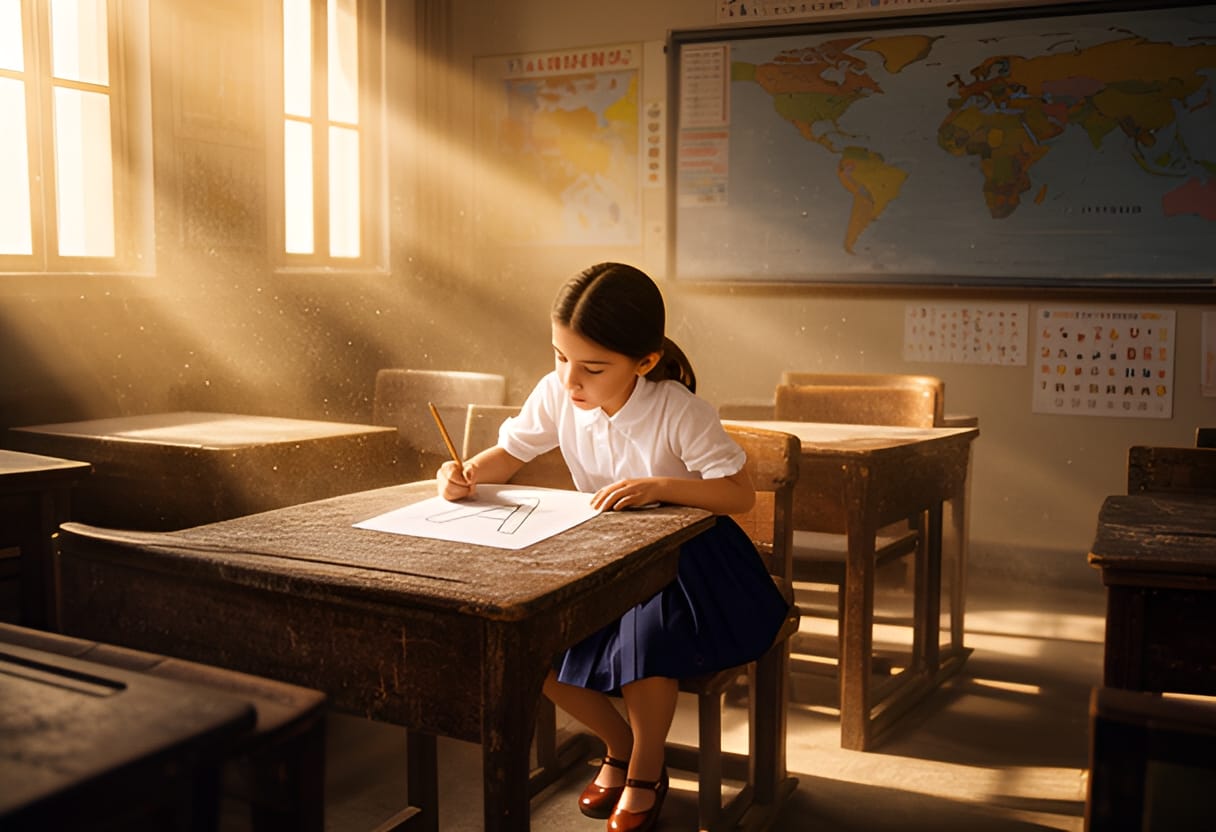
The classroom smelled of chalk dust and fresh paper. Sunlight slanted through the tall windows, casting long bars across the rows of wooden desks. At the front, a teacher stood beside a large chart pinned to the board, her sleeves rolled up, a marker in her hand. Twenty pairs of young eyes watched her, some bright with curiosity, others heavy with the weight of not knowing.
"Today," she said, her voice clear and warm, "we begin with the very first step. The English alphabet. Twenty-six letters. We will learn their names, their shapes, and the sounds they make. This is how we unlock words."
She uncapped the marker and drew a tall, straight line down the left side of the chart. Then, from the top, she added a slant inward and another back out, forming a peak. Finally, she connected the bottom with a horizontal line.
"This," she said, pointing to the shape, "is the capital letter A."
She turned and wrote the same shape again, smaller, with a curved left side and a pointed top, the crossbar sitting lower.
"And this," she said, "is the small letter a."
A murmur rippled through the room. A girl in the second row leaned forward, her pencil tapping her notebook.
"Like this?" she whispered, already tracing the shape in the air with her finger.
"Exactly like that," the teacher smiled. "Now, we say its name. Listen: /eɪ/."
She opened her mouth wide, lips stretching into a smile as she voiced the long A sound.
"/eɪ/," the class repeated, some stretching their mouths awkwardly, others mimicking her with surprising ease.
"Good," she said. "Now, the sound it makes in words. Short sound: /æ/. Like in apple."
She held up a flashcard. A bright red apple was drawn on it, with the word written underneath in clear print.
"Apple," she said, emphasizing the first sound. "/æ/–/pəl/. Apple."
She flipped the card. On the back, in neat Arabic script, was written: تفاحة.
"Apple. تفاحة."
She held up another card. This one showed a smiling child holding a book, surrounded by letters and stars.
"Animal," she said. "/æ/–/nɪməl/. Animal."
The back read: حيوان.
"And one more," she said, revealing a card with a question mark and a speech bubble. "Answer. /æ/–/ˈsɜːr/. Answer."
The back: جواب.
She tapped the chart again. "Capital A, small a. Name: /eɪ/. Sound: /æ/. Apple. Animal. Answer. تفاحة. حيوان. جواب."
She stepped aside. "Now, your turn. Take your pencils. We will trace."
On each desk lay a worksheet with faint gray outlines of letters. Lines guided the hand: two solid lines for the top and bottom, a dotted line in the middle for the crossbar.
"Start at the top," the teacher instructed. "Pull down, slant in, slant out, then lift. For the small a: curve up and around, touch the bottom, then straight up and across."
The room filled with the soft scratch of pencils on paper. Heads bent. Tongues poked from corners of mouths in concentration.
A boy in the third row frowned, his small letter lopsided, the crossbar floating too high.
"Like this?" he asked, holding up his paper.
The teacher leaned over. "Almost. Try starting the curve a little lower. Feel the roundness."
She guided his hand gently, then let go. He tried again. This time, the curve sat just right.
"Better," she said. "Now, on your own. Three more."
He nodded, brow furrowed in determination. The pencil moved slowly, then with growing confidence.
After tracing, the worksheet asked them to copy. Empty lines waited beneath the examples.
"Write five capital A's. Then five small a's. Take your time. Make them match."
Silence returned, deeper now. Only the sound of writing and the occasional sigh of effort.
When most had finished, the teacher clapped her hands softly.
"Let’s play a game. I will show you a picture. You tell me if it starts with the /æ/ sound. If it does, raise your hand and say the word."
She held up a card: an ant, tiny and black, crawling on a leaf.
Hands shot up.
"Ant!" called a girl in the front.
"Correct! /æ/–/nt/. Ant. نملة."
Next: a picture of a ball.
No hands went up.
"Ball starts with /b/," the teacher said. "Not our sound today."
Then: an alligator, jaws wide open.
"Alligator!" shouted two voices at once.
"Yes! /æ/–/lɪˈɡeɪtər/. Alligator. تمساح."
She held up a sock.
A boy giggled. "Sock!"
"Good listening," she said. "But /s/ is not /æ/. Try again next time."
The game continued — apple, axe, arrow, airplane — each met with eager responses. When a picture of an elephant came up, a boy started to raise his hand, then paused.
"Wait," he said. "Elephant starts with /e/. Not /æ/."
"Exactly," the teacher said, smiling. "You’re listening to the sound, not just the letter. That’s what matters."
The sun had moved higher in the sky. The chalk dust hung in the air like gold. The worksheets were filled now — some neat, some wobbly, all earnest.
She gathered the papers, stacking them neatly.
"Today, you met the first letter of the alphabet. You know its name. You know its sound. You can write it. You can hear it in words. That is a beginning."
She looked around the room. "Tomorrow, we meet Bb. But tonight, look around you. See if you can find something that starts with the /æ/ sound. An apple. An animal. Even your answer, if you’re ready to speak."
The bell rang. Chairs scraped. Backpacks were Shouldered. As the students filed out, the girl from the second row paused at the door.
"Teacher?" she said.
"Yes?"
"I wrote my name today. It starts with A."
The teacher looked at her, really looked. "Did you now?"
"Yasmine," the girl said, touching her chest. "Yasmine. Starts with /æ/."
The teacher’s smile widened. "Then you already know more than you think."
The girl beamed, tucked her worksheet into her bag, and stepped into the sunlight, already sounding out the word in her head: /æ/–/zæˈmiːn/. Yasmine. ياسمين.
The hallway buzzed with the chatter of students changing classes. Lockers slammed, sneakers squeaked on tile, and somewhere down the hall, a teacher called out a reminder about homework. Yasmine paused at the water fountain, cupping her hands to catch the cool stream. As she drank, she watched her reflection in the curved metal — her dark hair tied in two braids, her school uniform neat, her eyes bright.
She wiped her mouth on her sleeve and turned toward the stairwell. Halfway up the first flight, she stopped again. A poster was taped to the wall beside the fire exit: a cartoon apple wearing glasses, holding a book that read English Fun! Below it, in bold letters, said: A is for Apple! Underneath, in smaller Arabic script: التفاحة تبدأ بحرف ألف.
She pointed at it without thinking. "/æ/–/pəl/," she whispered. "Apple. تفاحة."
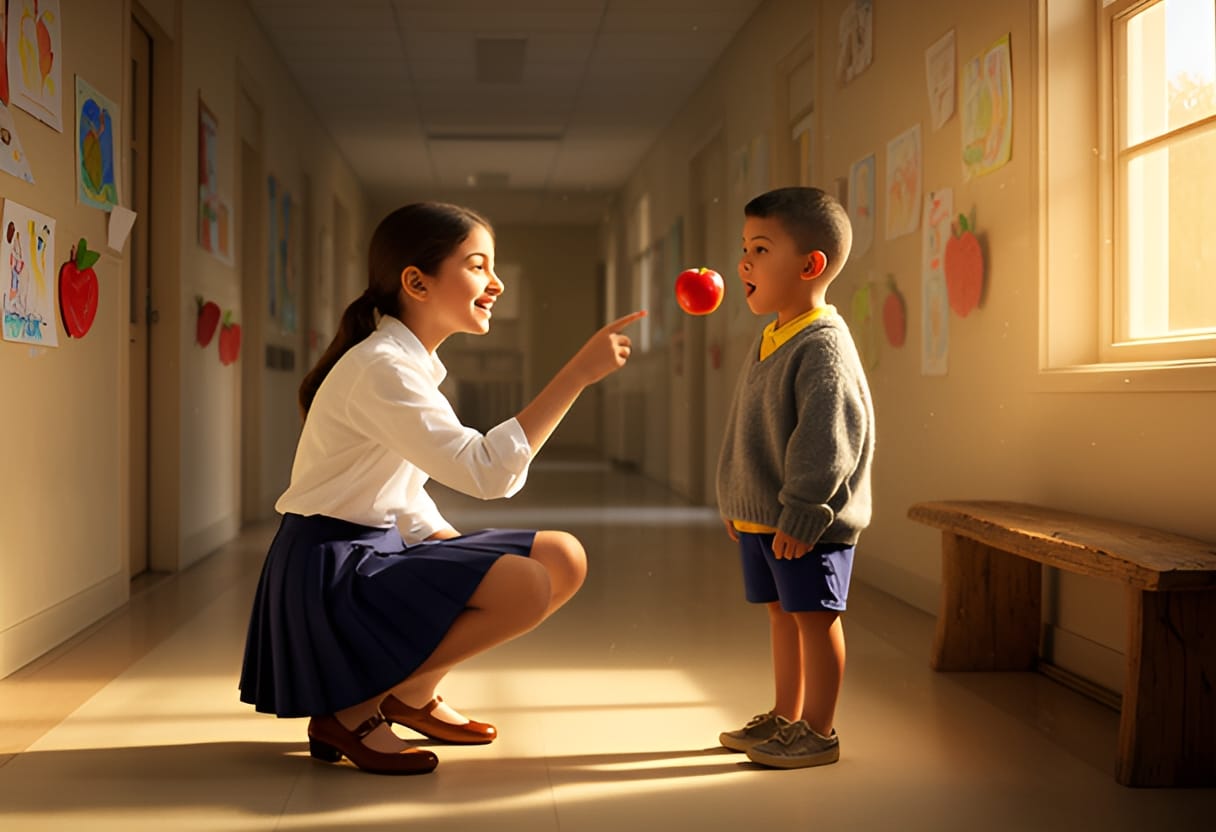
A younger boy, no older than six, tugged his mother’s hand nearby. He had been watching her.
"You know English?" he asked, his voice shy.
Yasmine blinked. "A little. Just the first letter."
"Can you teach me?" he asked. "My brother says it’s hard."
She crouched down to his level. "Well," she said, "we started today. The capital A looks like a triangle with a belt. Like this." She traced the shape in the air with her finger: two slants and a crossbar. "And the small a is like a circle with a stick. Up, around, down, and across."
He copied her, his small hand wobbling in the air. "Up… around… down… across."
"Good!" she said. "Now, the sound. Not the name. The sound it makes in apple."
She opened her mouth wide. "/æ/."
He copied her, scrunching his nose. "/æ/!"
"Exactly!" she said, laughing. "Now, try a word. Apple."
He looked puzzled. "Apple?"
"Yeah. Like the fruit."
His eyes lit up. "Ah… /æ/–/pəl/!"
She nodded. "That’s it. You just read your first English word."
He beamed, showing a gap where a front tooth was missing. "I read English!"
"Almost," she said, standing. "You sounded it out. That’s how we start."
His mother smiled, placing a hand on his shoulder. "Thank you, sister. He’s been nervous about starting school."
"It’s not scary," Yasmine said. "It’s just sounds and shapes. Like learning to draw."
She continued up the stairs, her steps lighter. At the top, she paused by the classroom door. Inside, the teacher was erasing the board, humming softly. Yasmine pushed the door open just enough to peek in.
On the teacher’s desk sat a small stack of worksheets — the same ones they had used today. On the top sheet, someone had drawn a smiley face in the corner. And beneath it, in wobbly but clear letters, was written: A a A a A a.
Yasmine’s breath caught. She stepped inside quietly and walked to the desk. She picked up the worksheet. The letters weren’t perfect — some were too tall, some too wide — but they were there. Attempted. Practiced. Belonged to someone who had tried.
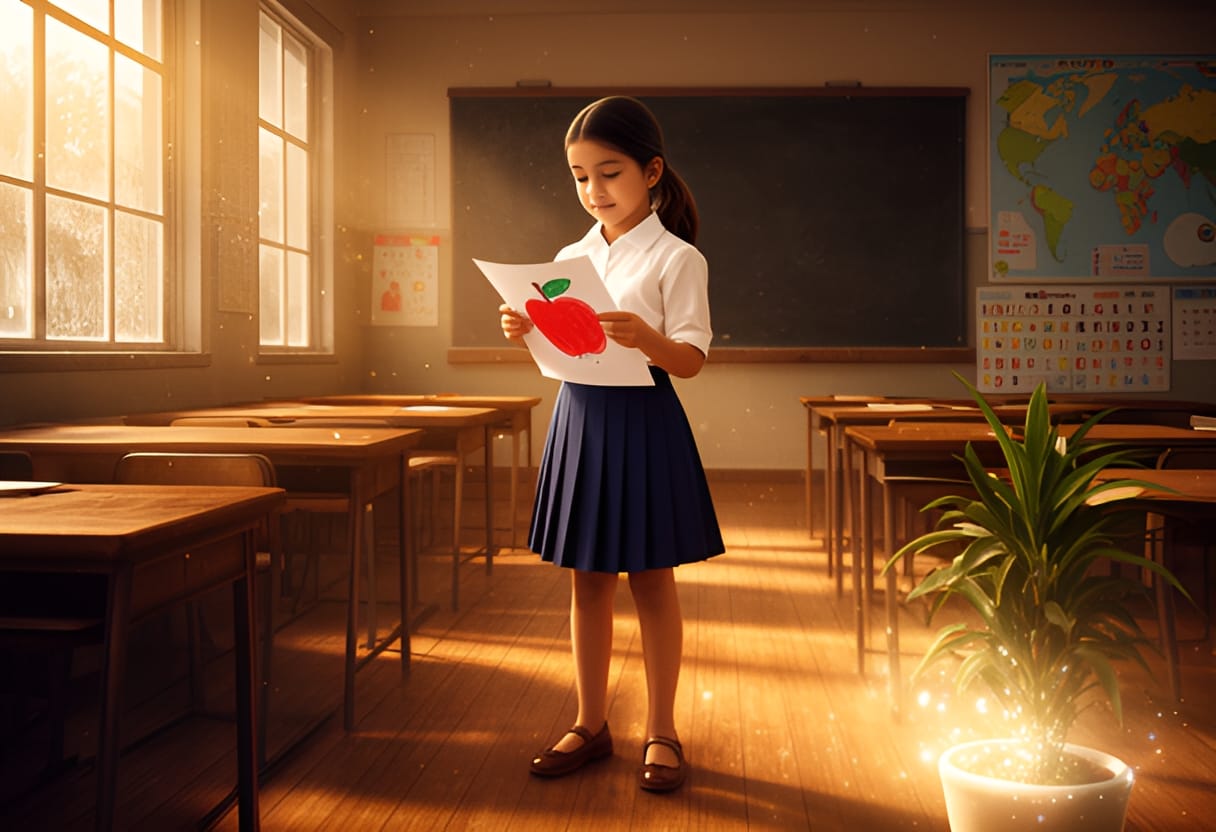
She flipped the page over. On the back, in the same childish hand, was a drawing: an apple, a stick-figure girl, and a speech bubble that said, "/æ/".
A warm lump formed in her throat. She laid the worksheet back down, smoothed it once, and turned to leave.
As she reached for the door handle, the teacher looked up.
"Forgot something?" she asked gently.
Yasmine shook her head. "No. I just… wanted to see."
The teacher nodded, understanding. "They’re doing better than they think. So are you."
Yasmine smiled. "Yeah. I guess we are."
She stepped back into the hall, the afternoon sun warm on her face. The bell would ring soon for the next class. But for now, she walked slowly, feeling the weight of her backpack, the echo of the pencil on paper, and the quiet pride of a beginning that had already taken root.
She glanced at her notebook peeking out of her bag. On the cover, in pencil, she had written her name: Yasmine. And beneath it, in smaller letters, she had added: A a.
She didn’t erase it. Didn’t fix it. Just let it be. A start. A sound. A letter. A step.
Yasmine slipped her notebook back into her bag and adjusted the strap on her shoulder. The hallway lights hummed overhead, casting a steady glow on the linoleum floor. She paused outside the classroom door, listening to the murmur of voices from within — another lesson beginning. Inside, she could see the teacher arranging flashcards on the ledge: bold, colorful letters paired with familiar objects.
She pushed the door open just enough to slip inside, careful not to draw attention. The room smelled of chalk and sun-warmed paper. Students were settling into their seats, pencils poised over fresh worksheets. Yasmine took her usual place in the second row, her notebook already open to a clean page.
The teacher turned, smiled, and held up the first card.
"Today," she said, "we meet Bb."
The card showed a bold capital B and a rounded lowercase b, with a picture of a red ball beneath it.
"This is the letter B," the teacher said. "Its name is /biː/. Listen: /biː/."
The class repeated in unison: "/biː/."
"Now, its sound," the teacher continued. "Not the name. The sound it makes at the beginning of words. Like in ball."
She opened her mouth sharply. "/b/."
"/b/," the class echoed.
"Book," the teacher said, flipping to the next card. A blue-covered book lay open on the image. "/b/–/ʊk/. Book. كتاب."
A ripple of recognition passed through the room. Yasmine whispered the word to herself: /b/–/ʊk/. كتاب.
"Bus," the teacher said, holding up a third card. A yellow school bus rolled down a street. "/b/–/sʌs/. Bus. حافلة."
Yasmine traced the shape of the letter in the air with her index finger — two rounded bumps coming down from a straight line. Capital B: a vertical stroke with two loops. Lowercase b: a straight line down, then a belly to the right.
"Your turn," the teacher said. "Let’s write Bb."
Pencils scratched against paper. Yasmine focused on her worksheet. She drew the capital B carefully: down, then around to the top, around again to the middle. For the lowercase b, she made a tall line down, then looped to the right, closing the circle at the midpoint. It wasn’t perfect — the top loop was a little too wide — but it was recognizably B.
The teacher walked between the rows, pausing at each desk. When she reached Yasmine, she pointed to the lowercase b.
"Good start," she said. "But see how the loop touches the line? Try to keep it round, like a ball touching the stick — not squashed."
Yasmine erased gently and tried again. This time, the loop floated just above the baseline, round and full. The teacher nodded. "Much better."
"Now," the teacher said, returning to the front, "let’s listen for the /b/ sound."
She held up a series of pictures: a banana, a fish, a bird, a house.
"Which of these start with /b/?"
Hands shot up. Yasmine waited, then raised her own when the teacher pointed to the bird.
"The bird," she said clearly. "/b/–/ɜːrd/. Bird. عصفور."
"Correct!" the teacher said. "And the banana?"
"/b/–/bəˈnɑːnə/," Yasmine said. "Banana. موز."
The teacher smiled. "Excellent. You’re hearing the sound at the start."
The lesson shifted. The teacher cleared the ledge and laid out a new set of cards.
"Now we move to Cc."
She held up a card with a bold C and c, above a picture of an orange cat.
"This is the letter C. Its name is /siː/. Listen: /siː/."
"/siː/," the class repeated.
"But its sound," the teacher said, "can be tricky. Sometimes it’s /k/, like in cat. Sometimes it’s /s/, like in city. Today, we’re learning the /k/ sound."
She tapped the card. "/k/."
"/k/," the class echoed.
"Cat," she said. "/k/–/æt/. Cat. قطة."
"Car," she said, flipping to the next card. A red sedan sat on a road. "/k/–/ɑːr/. Car. سيارة."
"Class," she said, holding up the third. A group of children sat at desks. "/k/–/læs/. Class. فصل."
Yasmine whispered the words, feeling the /k/ kick at the back of her throat. She noticed how her tongue lifted briefly, then released — a quick burst of air.
"Let’s write Cc," the teacher said.
Yasmine formed the capital C: a single open curve, like a half-moon. The lowercase c was the same, just smaller. She practiced both, trying to keep the curve smooth and even.
When she finished, she held up her worksheet. The teacher paused at her desk.
"Your C is very round," she said. "That’s good. But make sure it doesn’t look like an O. The opening should face the right — like it’s ready to eat something."
Yasmine adjusted her letter, opening the gap slightly. "Like a cookie missing a bite?"
"Exactly," the teacher said, smiling.
They moved to sound identification. The teacher held up pictures: a car, a sun, a cup, a fish.
"Which start with /k/?"
Yasmine pointed to the car and the cup. "/k/–/ɑːr/. Car. سيارة. /k/–/kʌp/. Cup. كوب."
The teacher nodded. "You’re getting good at this."
The teacher gathered the cards and stacked them neatly. "Next is Dd."
She held up a card with a bold D and d, above a picture of a wagging tail.
"This is the letter D. Its name is /diː/. Listen: /diː/."
"/diː/," the class said.
"The sound is /d/," the teacher said, making a quick tap with her tongue against the roof of her mouth. "/d/."
"/d/," the class echoed.
"Dog," she said. "/d/–/ɒɡ/. Dog. كلب."
"Door," she said, flipping to the next card. A brown wooden door stood slightly ajar. "/d/–/ɔːr/. Door. باب."
"Desk," she said, holding up the third. A simple wooden desk with a pencil cup. "/d/–/esk/. Desk. مكتب."
Yasmine repeated each word, feeling the /d/ vibrate in her tongue. She noticed how it was similar to /b/, but made with the tongue tip instead of the lips.
"Let’s write Dd," the teacher said.
Yasmine made the capital D: a straight line down, then a large curve to the right, closing at the top and bottom. For the lowercase d, she started with a circle — like a lowercase a — then added a tall line rising from its left side. It felt like making a b in reverse.
She concentrated on the loop, making sure it was full and round. When she finished, she held up her work.
The teacher stopped behind her chair. "Your d has a tall stem," she said. "That’s important. It helps us tell it apart from a or cl."
Yasmine glanced at her letter. The stem did rise high above the circle, straight and firm. "Like a flagpole?"
"Exactly," the teacher said. "Good observation."
They practiced listening for /d/. The teacher showed pictures: a dog, a fish, a desk, a tree.
"Which start with /d/?"
Yasmine chose the dog and the desk. "/d/–/dɒɡ/. Dog. كلب. /d/–/esk/. Desk. مكتب."
"Perfect," the teacher said.
The final card came out. The teacher held it up with a smile.
"Last one for today: Ee."
The card showed a bold E and e, above a picture of a broken eggshell with yolk spilling out.
"This is the letter E. Its name is /iː/. Listen: /iː/."
"/iː/," the class said, stretching the sound long and clear.
"But its sound," the teacher said, "is /e/ — short and quick, like in egg."
She opened her mouth slightly. "/e/."
"/e/," the class echoed.
"Egg," she said. "/e/–/ɡ/. Egg. بيضة."
"Elephant," she said, flipping to the next card. A gray elephant stood with its trunk curled. "/e/–/ɪlɪfənt/. Elephant. فيل."
"Ear," she said, holding up the third. A simple line drawing of a human ear. "/e/–/ɪər/. Ear. أذن."
Yasmine whispered the words, feeling the /e/ sit low in her mouth, relaxed and open. It reminded her of the /æ/ in apple, but softer, less stretched.
"Let’s write Ee," the teacher said.
Yasmine made the capital E: a vertical line down, then three horizontal strokes — top, middle, bottom — each sticking out to the right. She kept them even, spacing them carefully.
For the lowercase e, she started with a loop, like a cursive l, then added a horizontal line across the middle. It felt like making a c with a shelf inside.
She wrote slowly, focusing on the balance. When she finished, she held up her worksheet.
The teacher leaned in. "Your E has even arms," she said. "That’s harder than it looks. And your e — the loop is closed, but not too tight. Nice work."
Yasmine felt a quiet warmth spread through her chest.
They did a final sound round. The teacher held up pictures: an egg, a fish, an elephant, a hat.
"Which start with /e/?"
Yasmine chose the egg and the elephant. "/e/–/ɡ/. Egg. بيضة. /e/–/ɪlɪfənt/. Elephant. فيل."
"Exactly right," the teacher said. "You’re listening carefully."
The bell rang, sharp and clear. Students began to pack their books, folding worksheets into notebooks.
Yasmine slipped her sheet into her folder, then paused. On the back, she had doodled in the corner: a small egg, a stick-figure elephant, and a speech bubble that said, "/e/".
She smiled, touched the pencil mark gently, and closed her folder.
As she stood, the teacher called out, "Don’t forget — tonight, look for things that start with /b/, /k/, /d/, or /e/. See how many you can find."
Yasmine nodded. "I will."
She stepped into the hallway, the afternoon light slanting through the windows. The lockers echoed with closing doors, and somewhere nearby, a boy laughed as he chased a rolling ball.
Yasmine touched the cover of her notebook. Inside, the letters A a were still there, unchanged. Now, she added beneath them, in the same quiet pencil: B b C c D d E e.
She didn’t erase. Didn’t fix. Just let them be.
A line of letters. A row of sounds. A beginning, growing.
The next morning, the classroom buzzed with the rustle of notebooks and the scrape of chairs. Sunlight pooled on the teacher’s desk where a new set of flashcards waited, each showing a bold letter pair and a bright picture. Yasmine took her usual seat near the window, her notebook open to a clean page.
"Good morning," the teacher said, clapping her hands softly. "Yesterday we finished Ee. Today, we begin with Gg."
She held up a card. A capital G and lowercase g stood above a picture of a girl jumping rope, her ponytail flying.
"This is the letter G. Its name is /dʒiː/. Listen: /dʒiː/."
"/dʒiː/," the class echoed, some students curling their tongues slightly.
"But its sound," the teacher said, "is /g/ — like the start of girl. Listen: /g/."
She made a soft sound at the back of her throat. "/g/."
"/g/," the class repeated, feeling the vibration.
"Girl," she said. "/g/–/ɜːl/. Girl. بنت."
"Game," she said, flipping to the next card. A board game with colorful pieces lay open on a table. "/g/–/eɪm/. Game. لعبة."
"Give," she said, holding up the third. Two hands exchanged a small wrapped box. "/g/–/ɪv/. Give. يعطي."
Yasmine whispered the words, feeling the /g/ form deep in her mouth, soft but firm. It reminded her of /k/, but voiced, warmer.
"Let’s write Gg," the teacher said.
Yasmine made the capital G: a circle like C, then a horizontal line inward from the left. She paused, checking the shape. For the lowercase g, she started with a circle like a, then drew a line down, curving left at the bottom into a closed loop — like a pretzel with a tail.
She wrote slowly, focusing on the loop. When she finished, she held up her worksheet.
The teacher leaned in. "Your g has a full lower loop," she said. "That’s important. It keeps it from looking like y or q."
Yasmine glanced at her letter. The loop was round and complete, the stem straight. "Like a rollercoaster?"
"Exactly," the teacher said. "Good observation."
They practiced listening for /g/. The teacher showed pictures: a girl, a ball, a game, a fish.
"Which start with /g/?"
Yasmine chose the girl and the game. "/g/–/ɜːl/. Girl. بنت. /g/–/eɪm/. Game. لعبة."
"Perfect," the teacher said.
Later that morning, after a short break, the teacher returned with another set of cards. She held up one showing a bold H and h above a picture of a red hat on a hook.
"This is the letter H. Its name is /eɪtʃ/. Listen: /eɪtʃ/."
"/eɪtʃ/," the class said, some stretching the sound.
"But its sound," the teacher said, "is /h/ — soft, like breath on glass. Listen: /h/."
She exhaled gently. "/h/."
"/h/," the class echoed, feeling the air move.
"Hat," she said. "/h/–/æt/. Hat. قبعة."
"House," she said, flipping to the next card. A simple drawing of a house with a door and two windows. "/h/–/haʊs/. House. بيت."
"Hand," she said, holding up the third. A child’s hand waved palm out. "/h/–/ænd/. Hand. يد."
Yasmine whispered the words, feeling the /h/ as a puff of air, almost silent. It was softer than /d/, more like a sigh.
"Let’s write Hh," the teacher said.
Yasmine made the capital H: two vertical lines, then a horizontal line connecting them in the middle. She kept the crossbar straight and level. For the lowercase h, she drew a tall line down, then a curve up and over to the right, like a small hill — just like n, but taller.
She wrote slowly, focusing on the height. When she finished, she held up her worksheet.
The teacher stopped behind her chair. "Your h is tall and clear," she said. "That’s important. It helps us tell it apart from n."
Yasmine glanced at her letter. The stem rose high, the arch smooth. "Like a chair?"
"Exactly," the teacher said. "Good observation."
They practiced listening for /h/. The teacher showed pictures: a hat, a cup, a house, a fish.
"Which start with /h/?"
Yasmine chose the hat and the house. "/h/–/æt/. Hat. قبعة. /h/–/haʊs/. House. بيت."
"Perfect," the teacher said.
After lunch, the classroom was quieter, the air warm with sunlight. The teacher held up a card showing I and i above a picture of a bottle of blue ink spilling slightly.
"This is the letter I. Its name is /aɪ/. Listen: /aɪ/."
"/aɪ/," the class said, some smiling at the diphthong.
"But its sound," the teacher said, "is /ɪ/ — short and relaxed, like in ink. Listen: /ɪ/."
She opened her mouth slightly, tongue forward. "/ɪ/."
"/ɪ/," the class echoed, feeling the sound sit low and central.
"Ink," she said. "/ɪ/–/ŋk/. Ink. حبر."
"Insect," she said, flipping to the next card. A green grasshopper clung to a leaf. "/ɪ/–/ˈsɛkt/. Insect. حشرة."
"In," she said, holding up the third. A cat peered into a cardboard box. "/ɪ/–/n/. In. داخل."
Yasmine whispered the words, feeling the /ɪ/ as a quick, neutral vowel, shorter than /iː/ but longer than /e/. It reminded her of the Egyptian Arabic إ in كلمات like كتاب.
"Let’s write Ii," the teacher said.
Yasmine made the capital I: two short horizontal lines, one at the top and one at the bottom, connected by a vertical line in the middle. She kept the serifs small and even. For the lowercase i, she drew a short line down, then added a dot above — not too far, not too close.
She wrote slowly, focusing on the dot. When she finished, she held up her worksheet.
The teacher leaned in. "Your i has a clear dot," she said. "That’s important. It keeps it from looking like l or 1."
Yasmine glanced at her letter. The stroke was straight, the dot perfectly placed. "Like an eye?"
"Exactly," the teacher said. "Good observation."
They practiced listening for /ɪ/. The teacher showed pictures: ink, a hat, an insect, a fish.
"Which start with /ɪ/?"
Yasmine chose the ink and the insect. "/ɪ/–/ŋk/. Ink. حبر. /ɪ/–/ˈsɛkt/. Insect. حشرة."
"Perfect," the teacher said.
The final lesson of the day came as the sun began to slant lower. The teacher held up a card showing J and j above a picture of a jar of strawberry jam, spoon halfway in.
"This is the letter J. Its name is /dʒeɪ/. Listen: /dʒeɪ/."
"/dʒeɪ/," the class said, some mimicking the j-glide.
"But its sound," the teacher said, "is /dʒ/ — like the start of jam. Listen: /dʒ/."
She made the sound, tongue touching the roof then releasing. "/dʒ/."
"/dʒ/," the class repeated, feeling the affricate build and release.
"Jam," she said. "/dʒ/–/æm/. Jam. مربى."
"Juice," she said, flipping to the next card. A glass of orange juice stood sweating slightly. "/dʒ/–/dʒuːs/. Juice. عصير."
"Jump," she said, holding up the third. A boy mid-leap, arms wide, face grinning. "/dʒ/–/ʌmp/. Jump. يقفز."
Yasmine whispered the words, feeling the /dʒ/ as a blend of /d/ and /ʃ/, sudden and bright. It reminded her of the ג in Arabic كلمات like جمل, but softer.
"Let’s write Jj," the teacher said.
Yasmine made the capital J: a vertical line down, then a curve to the left at the bottom, like a hook. She kept the curve smooth and rounded. For the lowercase j, she drew a line down, then curved left at the bottom, and added a dot above — like i, but with a tail.
She wrote slowly, focusing on the curve and the dot. When she finished, she held up her worksheet.
The teacher stopped behind her chair. "Your j has a clear descender and dot," she said. "That’s important. It helps us tell it apart from i."
Yasmine glanced at her letter. The stem dropped below the line, the curve full, the dot precise. "Like a fishing hook?"
"Exactly," the teacher said. "Good observation."
They practiced listening for /dʒ/. The teacher showed pictures: jam, a cup, juice, a fish.
"Which start with /dʒ/?"
Yasmine chose the jam and the juice. "/dʒ/–/æm/. Jam. مربى. /dʒ/–/dʒuːs/. Juice. عصير."
"Perfect," the teacher said.
The bell rang, sharp and clear. Students began to pack their books, folding worksheets into notebooks.
Yasmine slipped her sheet into her folder, then paused. On the back, she had doodled in the corner: a girl jumping rope, a red hat on a hook, a bottle of ink, and a jar of jam — each with a speech bubble: /g/, /h/, /ɪ/, /dʒ/.
She smiled, touched the pencil mark gently, and closed her folder.
As she stood, the teacher called out, "Don’t forget — tonight, look for things that start with /g/, /h/, /ɪ/, or /dʒ/. See how many you can find."
Yasmine nodded. "I will."
She stepped into the hallway, the afternoon light slanting through the windows. The lockers echoed with closing doors, and somewhere nearby, a boy laughed as he chased a rolling ball.
Yasmine touched the cover of her notebook. Inside, the letters A a were still there, unchanged. Now, she added beneath them, in the same quiet pencil: B b C c D d E e F f G g H h I i J j.
She didn’t erase. Didn’t fix. Just let them be.
A line of letters. A row of sounds. A beginning, growing.
The afternoon sun had softened to a honeyed glow by the time Yasmine reached her locker. She turned the combination slowly, the clicks familiar now, and pulled the door open. Inside, her notebook lay on the top shelf, the cover worn at the corners from daily use. She slipped her folder inside and closed the door with a quiet click.
"Ready for the last letters?" a voice asked beside her.
Yasmine turned. It was Farida, her friend from the front row, holding her own notebook close to her chest.
"Almost done," Yasmine said, smiling. "Just M to Z."
Farida nodded. "I like the ones at the end. They feel… important. Like the finish line."
Yasmine laughed softly. "Yeah. Like we’ve been walking all this time and now we can see the gate."
They walked down the hall together, the murmur of other students fading as they approached the classroom. The door stood open, and inside, the teacher was already at the front, arranging cards on the ledge beneath the chalkboard.
"Good afternoon," the teacher said as they entered. "Please take your seats. We have a few friends to meet today."
Yasmine slid into her usual seat, her notebook open to a clean page. Farida sat beside her, already tapping her pencil against her notebook in anticipation.
The teacher held up the first card. It showed a bold M and m above a picture of a man waving from a doorway.
"This is the letter M. Its name is /ɛm/. Listen: /ɛm/."
"/ɛm/," the class responded, the sound nasal and warm.
"But its sound," the teacher continued, "is /m/ — like the start of man. Listen: /m/."
She pressed her lips together gently, humming the sound. "/m/."
"/m/," the class echoed, feeling the vibration in their lips and nose.
"Man," she said. "/m/–/æn/. Man. رجل."
"Mother," she said, flipping to the next card. A woman knelt beside a child, braiding her hair. "/m/–/ˈmʌðər/. Mother. أم."
"Mouse," she said, holding up the third. A small gray mouse peeked from behind a piece of cheese. "/m/–/aʊs/. Mouse. فأر."
Yasmine whispered the words, feeling the /m/ as a soft closure, the lips sealing briefly before releasing. It reminded her of the Arabic م in كلمات like بيت.
"Let’s write Mm," the teacher said.
Yasmine made the capital M: two vertical lines down, with two diagonal lines meeting in the middle like a valley. She kept the angles sharp but not harsh. For the lowercase m, she drew two humps, one after the other, like waves rolling in.
She wrote slowly, focusing on the symmetry. When she finished, she held up her worksheet.
The teacher paused at her desk. "Your m has even humps," she said. "That’s important. It keeps it from looking like n or r."
Yasmine glanced at her letter. The downstrokes were straight, the curves smooth and matched. "Like mountains?"
"Exactly," the teacher said. "Good observation."
They practiced listening for /m/. The teacher showed pictures: man, a cup, mother, a fish.
"Which start with /m/?"
Yasmine chose the man and the mother. "/m/–/æn/. Man. رجل. /m/–/ˈmʌðər/. Mother. أم."
"Perfect," the teacher said.
The next card appeared: N and n above a picture of a nose, slightly wrinkled as if smelling something strong.
"This is the letter N. Its name is /ɛn/. Listen: /ɛn/."
"/ɛn/," the class said, the sound familiar from Mm but with a different tongue position.
"But its sound," the teacher said, "is /n/ — like the start of nose. Listen: /n/."
She touched the tip of her tongue to the roof of her mouth, just behind the teeth. "/n/."
"/n/," the class repeated, feeling the tap of the tongue.
"Nose," she said. "/n/–/oʊz/. Nose. أنف."
"Name," she said, flipping to the next card. A girl stood at a desk, raising her hand. "/n/–/eɪm/. Name. اسم."
"Night," she said, holding up the third. A crescent moon hung over a quiet town, stars beginning to blink. "/n/–/aɪt/. Night. ليلة."
Yasmine whispered the words, feeling the /n/ as a quick touch, lighter than /m/ but just as definite. It reminded her of the Arabic ن in كلمات like نور.
"Let’s write Nn," the teacher said.
Yasmine made the capital N: two vertical lines down, with a diagonal line connecting the top of the left to the bottom of the right. She kept the diagonal firm, not wobbling. For the lowercase n, she drew a downstroke, then a single hump — like half of m.
She wrote slowly, focusing on the diagonal. When she finished, she held up her worksheet.
The teacher leaned in. "Your n has a clean diagonal," she said. "That’s important. It keeps it from looking like h or r."
Yasmine glanced at her letter. The verticals were parallel, the diagonal smooth and straight. "Like a slide?"
"Exactly," the teacher said. "Good observation."
They practiced listening for /n/. The teacher showed pictures: nose, a hat, name, a fish.
"Which start with /n/?"
Yasmine chose the nose and the name. "/n/–/oʊz/. Nose. أنف. /n/–/eɪm/. Name. اسم."
"Perfect," the teacher said.
The lesson settled into a rhythm. One by one, the teacher introduced the remaining letters, each with its name, sound, and three anchor words — always paired with their Arabic meanings. Yasmine tracked each one in her notebook, writing the letters carefully, whispering the sounds, letting the shapes and meanings settle into her muscle memory.
Oo came next: /oʊ/, /ɒ/ or /ʌ/ depending on the word — but for now, the short /ɒ/ as in orange, ostrich, octopus (برتقال، نعامة، أخطبوط). The teacher emphasized the rounded lips, the open mouth.
Pp: /piː/, /p/ as in pen, pan, panda (قلم، مقلاة، باندا). The burst of air, the lips popping open.
Qq: /kjuː/, /kw/ as in queen, quilt, question (ملكة، لحاف، سؤال). The quick /k/ followed by the /w/, like a whisper behind the sound.
Rr: /ɑːr/, /ɹ/ as in rat, ring, rabbit (فأر، خريطة، أرنب). The tongue curling slightly, the sound vibrating.
Ss: /ɛs/, /s/ as in sun, sock, snake (شمس، حذاء، ثعبان). The hiss, the air sliding through the teeth.
Tt: /tiː/, /t/ as in top, tree, tiger (قمة، شجرة، نمر). The tap of the tongue behind the teeth, quick and clean.
Uu: /juː/, /ʌ/ as in up, umbrella, umbrella (على، مظلة، عنكبوت — though the teacher noted the spelling quirk, the sound was clear). The tongue relaxed, the jaw low.
Vv: /viː/, /v/ as in van, vet, vase (عربة، طبيب،花瓶). The teeth on the lip, the hum like a bee.
Ww: /ˈdʌbəl.juː/, /w/ as in window, water, whale (نافذة، ماء، حوت). The lips rounding, the sound gliding.
Xx: /ɛks/, /ks/ as in box, fox, six (صندوق، ثعلب، ستة). The two sounds together, like a cough at the end.
Yy: /waɪ/, /j/ or /ɪ/ as in yes, yellow, yoyo (نعم، أصفر، لعبة دوارة). The teacher explained the dual nature — sometimes a consonant, sometimes a vowel sound — but for now, the /j/ as in yes.
Zz: /ziː/, /z/ as in zoo, zebra, zip (حديقة حيوان، زرافة، سحاب). The buzz, the voice vibrating like a bee but louder.
With each letter, Yasmine wrote, listened, whispered, and felt. She noticed how the sounds formed patterns — the nasals (/m/, /n/, /ŋ/ though not yet taught), the stops (/p/, /b/, /t/, /d/, /k/, /g/), the fricatives (/f/, /v/, /s/, /z/, /ʃ/, /ʒ/), the approximants (/l/, /r/, /w/, /j/). She didn’t know the terms yet, but she felt the differences in her mouth, her tongue, her breath.
When the teacher flipped to the final card — Zz above a zebra grazing near a tree — the classroom felt full, not just with letters, but with possibility.
"Let’s write Zz," the teacher said.
Yasmine made the capital Z: two horizontal lines, one top and one bottom, connected by a diagonal line slanting from top right to bottom left. She kept the diagonal firm, not wobbling. For the lowercase z, she drew the same — two horizontals, one diagonal — just smaller.
She wrote slowly, focusing on the angle. When she finished, she held up her worksheet.
The teacher smiled. "Your z has a strong diagonal," she said. "That’s important. It keeps it from looking like 2 or 3."
Yasmine glanced at her letter. The lines were straight, the diagonal smooth and sure. "Like a lightning bolt?"
"Exactly," the teacher said. "Good observation."
They practiced listening for /z/. The teacher showed pictures: zoo, a cup, zebra, a fish.
"Which start with /z/?"
Yasmine chose the zoo and the zebra. "/z/–/uː/. Zoo. حديقة حيوان. /z/–/ˈziːbrə/. Zebra. زرافة."
"Perfect," the teacher said.
The bell rang, soft and final. Students began to gather their things, the rustle of paper and the click of zippers filling the air.
Yasmine slipped her worksheet into her folder, then paused. On the back, she had doodled a small alphabet train — each car carrying a letter, from A to Z, each with its sound written beneath in tiny letters. She traced the line of cars with her fingertip, feeling the weight of what they’d done.
As she stood, the teacher called out, "Before you go — let’s do something special. We’ve learned all twenty-six letters. Let’s see if we can put them in order, together."
A murmur of excitement rippled through the room. The teacher drew a long blank line on the chalkboard, divided into twenty-six boxes.
"Who wants to start?" she asked.
A boy in the front row shot his hand up. "A!"
The teacher wrote A in the first box. "Good. Next?"
"B!" called a girl near the window.
"B." The teacher wrote it. "Keep going."
The class responded in a wave — C, D, E, F — their voices rising and falling like a chant. When they reached L, there was a brief pause, then M, N, O — the rhythm steadying again. By S, the pace quickened, T, U, V — then a slight stumble at W.
"W," someone said, but hesitantly.
"W," the teacher confirmed, writing it. "X?"
"X," came the reply, more confident now.
"Y?"
"Y."
"Z?"
"Z." The class said it together, firm and clear.
The teacher stepped back. "A to Z. All twenty-six. In order."
Yasmine looked at the board. The line of letters stretched across it, bold and complete. It wasn’t just a sequence — it was a path. One she had walked, step by step, sound by sound.
"Now," the teacher said, "let’s try dictation. I’ll say letters — not in order this time. You write them down. Ready?"
The class nodded, pencils poised.
"M."
Yasmine wrote m, the humps even.
"F."
f, the top and middle horizontals just right.
"S."
s, the curves smooth like a snake.
"J."
j, the hook and dot in place.
"Q."
q, the circle with the tail — she remembered to pull it down, not up like p.
"K."
k, the vertical with the two arms — one in, one out.
"Z."
z, the diagonal strong.
"N."
n, the single hump.
"V."
v, the two diagonal lines meeting at the bottom.
"R."
r, the downstroke with the small arch.
The teacher continued, calling out letters at random, sometimes repeating, sometimes skipping. Yasmine wrote each one, feeling the shape in her hand before it touched the paper. She made mistakes — once she wrote b instead of d, once she flipped p and q — but she erased gently, tried again, and got it right.
When the teacher finished, she held up a master sheet. "Let’s check."
They went through the list together. Yasmine’s paper matched, letter for letter.
"Excellent work," the teacher said. "You’ve learned the alphabet. Not just the names, not just the shapes — but the sounds. The way they feel in your mouth. The way they connect to words. To meaning."
Yasmine looked down at her notebook. The letters A a through Z z were written in order on the inside cover, each one paired with a word and its Arabic translation — a quiet dictionary she had built herself.
She thought of the hallway, the boy chasing the ball, the slanting light. She thought of the sounds she’d been asked to listen for tonight: /g/, /h/, /ɪ/, /dʒ/. She wondered what she would find.
The teacher gathered the cards, stacking them neatly. "Remember," she said, "letters are not just symbols. They are keys. They open doors to words, to sentences, to stories. You now hold the first set of keys."
Yasmine closed her notebook slowly. The cover felt solid in her hands. Inside, the alphabet was complete — not as a list to memorize, but as a friend she had come to know, letter by letter, sound by sound.
She slipped the notebook into her bag, shouldered the strap, and walked toward the door.
Outside, the hallway was quieter now, the last of the students drifting toward the exits. The afternoon light had deepened, gilding the edges of the lockers, casting long shadows across the floor.
Yasmine paused at the classroom threshold, one hand on the doorframe. She looked back at the empty room, the chalkboard still bearing the alphabet in order, the teacher’s desk tidy, the windows glowing.
Then she turned and stepped into the hall.
Her steps were light, but sure. The letters were with her — not just in her book, but in her ears, her mouth, her hands. She could feel them, quiet and constant, like a pulse.
As she walked, she whispered the first few sounds to herself, just under her breath:
/æ/… /b/… /k/… /d/… /e/…
And then, smiling, she added the next:
/f/… /g/… /h/… /ɪ/… /dʒ/…
The sounds curled around her like a familiar tune, leading her forward.
Chapter 2
From Sounds to Sentences: Building Reading and Writing Skills
Yasmine’s whisper faded as she reached the end of the hall, the last sound — /dʒ/ — dissolving into the murmur of lockers closing and sneakers on tile. She paused at the intersection, the weight of her notebook warm against her spine, and listened. Down the left corridor, a group of older students laughed, their voices sharp and quick. To the right, the science lab door stood ajar, revealing a flicker of movement and the scent of something sharp and clean.
She turned right, drawn not by curiosity but by habit — the same pull that had led her to the empty classroom yesterday. The lab was empty now, the stools pushed in, the gas jets capped. Only the teacher’s desk remained occupied, a single figure bent over a stack of papers.
Mr. Ibrahim looked up as she approached, his glasses catching the low light. “Yasmine. Still practicing your sounds?”
She nodded, slipping her notebook from her bag. “I was walking home. I kept hearing them.”
He smiled, gesturing to the chair beside him. “Good. That means they’re sticking. Today we begin Chapter Two — not just recognizing letters, but understanding how they work together. Vowels and consonants. The heart of the code.”
She sat, the chair scraping softly on the linoleum. Outside, the sun had dipped lower, painting the blinds in stripes of gold and shadow. The air smelled of chalk dust and lemon polish.
“You know the alphabet,” he said, tapping the open workbook on his desk. “But knowing the letters is like knowing the bricks. Now we learn how to build with them. Some letters are open — they let the air flow freely. Others stop it, or shape it. That’s the difference between vowels and consonants.”
He turned the page to a clean diagram: two side-by-side illustrations of a head in profile, arrows tracing the path of air from lungs to lips.
“When you say a vowel,” he explained, “your mouth is open. Your tongue doesn’t touch your teeth or palate. The air flows out smooth and uninterrupted. Like /æ/ in apple — try it.”
Yasmine shaped her lips, feeling the stretch. /æ/. Her jaw dropped slightly, tongue low and flat. The sound rang clear in the quiet room.
“Now a consonant,” he continued. “Your tongue, lips, or teeth block or redirect the air. Like /b/ in book — your lips press together, then release. Or /s/ in sun — air hisses through a narrow gap.”
He tapped the diagram again. “Vowels are the peaks in a word’s sound. Consonants are the slopes that lead up to and away from them. Without vowels, you can’t sustain a sound. Without consonants, you can’t distinguish one word from another.”
Yasmine thought of the boy in the hallway, his voice eager as he repeated apple. She had felt the /æ/ bloom in her mouth, open and unhindered. Then the /p/ — a quick snap of lips. The contrast was clear now, not just heard but felt.
“There are five main vowels,” Mr. Ibrahim said, writing on the notepad beside him: A, E, I, O, U. “Each has at least two sounds — short and long. The short sounds are the ones you’ve already heard in simple words.”
He spoke each clearly, pairing them with familiar examples.
“Short A: /æ/ as in apple, ant, bag.” He paused. “Say it with me.”
“/æ/… /æ/… /æ/,” Yasmine echoed, feeling the vibration in her chest.
“Short E: /ɛ/ as in egg, bed, pen.” Her mouth widened slightly, tongue rising just behind the teeth. /ɛ/ — thinner than /æ/, but still open.
“Short I: /ɪ/ as in in, sit, pin.” Her tongue arched higher, lips relaxed. A crisp, quick sound.
“Short O: /ɒ/ as in orange, hot, box.” Her lips rounded slightly, the sound deeper, fuller.
“Short U: /ʌ/ as in up, cup, bug.” Her jaw relaxed, tongue resting low in the center of her mouth. A soft, relaxed hum.
He waited, letting the sounds settle. “Now the long sounds. These say the letter’s name.”
He pointed to the top of the page where the vowel names were written: /eɪ/, /iː/, /aɪ/, /oʊ/, /juː/.
“Long A: /eɪ/ as in cake, name, play.” His voice glided from /e/ to /ɪ/, a smooth glide. Yasmine mimicked it, feeling her jaw shift mid-sound.
“Long E: /iː/ as in see, tree, bee.” A steady, smiling sound, lips stretched wide.
“Long I: /aɪ/ as in sky, fly, mine.” From low /a/ to high /ɪ/, her mouth opened then narrowed.
“Long O: /oʊ/ as in go, home, boat.” Lips starting neutral, then rounding — a slow curl.
“Long U: /juː/ as in cube, music, use.” A glide from /j/ to /uː/, like a sigh releasing.
Yasmine repeated each after him, her voice growing steadier. She could feel the difference — not just in pitch, but in the shape of her mouth, the tension in her tongue. The long vowels carried motion; the short ones were pure and still.
“Good,” Mr. Ibrahim said. “Now, not all vowels are always A, E, I, O, U. Sometimes Y and W step in.”
He turned to a fresh page. “Y is usually a consonant — like in yes, yellow, yard. Your tongue touches the roof of your mouth just behind the teeth, air pushing through. /j/.”
He said it crisply, tongue flicking forward.
“But Y can also be a vowel. When it comes at the end of a word or syllable, it often takes the sound of long I or long E.”
He wrote: sky, my, cry — /skaɪ/, /maɪ/, /kraɪ/. And: baby, happy, funny — /ˈbeɪbi/, /ˈhæpi/, /ˈfʌni/.
“In sky,” he said, “Y stands for /aɪ/ — the long I sound. In baby, the first Y is /eɪ/, but the second? That’s /iː/ — long E.”
Yasmine traced the letters with her fingertip. In yes, Y was a consonant — a quick push of air. In sky, it was a vowel — holding the sound, open and free.
“W works similarly,” he continued. “It’s almost always a consonant — /w/ as in win, wet, wagon. Your lips round tightly, then open.”
He demonstrated, lips forming a small circle.
“But in certain combinations, W helps create vowel sounds. We call these digraphs — two letters working as one sound.”
He wrote: cow, now, how — /kaʊ/, /naʊ/, /haʊ/. And: dawn, saw, law — /dɔːn/, /sɔː/, /lɔː/.
“In cow,” he said, “the O and W together make /aʊ/ — a glide from /a/ to /ʊ/. W isn’t saying its own sound here; it’s changing how the O is pronounced.”
He looked up. “Same with law — AW gives us /ɔː/, a sound we don’t get from O alone.”
Yasmine thought of the word cow she’d seen on a flashcard weeks ago. She had said it without thinking — /kaʊ/ — but now she understood: the W wasn’t just along for the ride. It was shaping the vowel, changing the sound.
Mr. Ibrahim closed the workbook gently. “For now, your job is to listen. To feel. To sort.”
He slid a sheet of paper toward her. At the top, two columns: Vowels | Consonants. Below, a scrambled list of letters: A, B, D, E, G, H, I, J, L, M, N, O, P, Q, R, S, T, U, V, W, X, Y, Z.
“Classify each,” he said. “Say the sound it makes in your mind. Is the air flowing freely? Or is it stopped or shaped?”
Yasmine picked up her pen. She began with A.
Apple — /æ/. Jaw open, tongue low. Vowel.
B — /b/. Lips press, then pop. Consonant.
D — /d/. Tongue taps the roof. Consonant.
E — /ɛ/. Mouth slightly open, teeth near. Vowel.
G — /ɡ/. Back of tongue rises, air released. Consonant.
H — /h/. Breath only, no obstruction — but wait. She frowned. Air flowed freely, yet H was never a vowel sound in English.
Mr. Ibrahim noticed her hesitation. “H is a special case. The air passes through the vocal cords, which vibrate — but your mouth stays open, unchanged. Linguists call it a glottal fricative. For our purposes, it behaves like a consonant because it never stands alone as a syllable peak. It always modifies what comes after.”
She nodded. H — consonant.
I — /ɪ/. Tongue high, front. Vowel.
J — /dʒ/. Tongue presses, then releases with a stop. Consonant.
L — /l/. Air flows around the sides of the tongue. Consonant — though she felt it was softer than others.
M — /m/. Lips together, hum. Consonant.
N — /n/. Tongue on ridge, hum. Consonant.
O — /ɒ/. Lips rounded, open. Vowel.
P — /p/. Lips press, release. Consonant.
Q — /kw/. Lips round for /w/, then tongue back for /k/. Consonant — though it carries a vowel-like glide.
R — /ɹ/. Tongue curls, air flows over it. Consonant — the sound is smooth, but shaped.
S — /s/. Air hisses through teeth. Consonant.
T — /t/. Tongue taps teeth. Consonant.
U — /ʌ/. Jaw relaxed, tongue low. Vowel.
V — /v/. Bottom lip to top teeth, buzz. Consonant.
W — /w/. Lips round, then open. Consonant — though she remembered its role in digraphs.
X — /ks/. Two sounds: /k/ then /s/. Consonant.
Y — She paused. In yes, it was /j/ — consonant. In sky, /aɪ/ — vowel. Which to choose?
Mr. Ibrahim saw her pause. “When in doubt, look at the word’s role. But for classification, we treat Y as a consonant by default — because it can function that way, and its vowel use is contextual. For now, mark it as consonant. We’ll explore its dual role more later.”
She wrote Y in the consonant column.
Z — /z/. Tongue near teeth, buzz. Consonant.
She stepped back, eyes scanning the two columns.
Vowels: A, E, I, O, U Consonants: B, C, D, F, G, H, J, K, L, M, N, P, Q, R, S, T, V, W, X, Y, Z
“Not bad,” Mr. Ibrahim said, glancing at her list. “You’ve got the core five. Remember — Y and W are unique. They’re consonants that sometimes help vowels say their names.”
He tapped the workbook. “Tomorrow, we’ll start blending. Taking these sounds — vowels and consonants — and putting them together to form real words. But tonight?” He closed his notebook. “Keep listening. The sounds are everywhere. In the wind, in the footsteps, in the quiet between heartbeats.”
Yasmine stood, shouldering her bag. The hallway lights buzzed overhead, casting a steady hum — not a speech sound, but a vibration nonetheless. She paused at the door, hand on the knob.
Behind her, Mr. Ibrahim called softly, “And Yasmine?”
She turned.
“Trust your ears. They know more than you think.”
She smiled, pushed the door open, and stepped into the cooling dusk. The school grounds were emptying, the last buses pulling away. A cricket chirped from the hedges — a short, sharp /ɪ/. A car passed on the street, its tires humming a low /ʌ/ — or was it just the engine?
She closed her eyes, letting the sounds wash over her. Not as letters, not yet as words — but as motion, as breath, as life.
And then, softly, she began again:
/æ/… /b/… /k/… /d/… /e/… /f/… /g/… /h/… /ɪ/… /dʒ/…
The sounds curled around her, familiar and sure, guiding her home.
Yasmine walked home under a sky streaked with the last light of dusk, the sounds of the day still echoing in her mind. The crisp snap of a twig underfoot registered as /t/, the distant call of a night bird as a rising /iː/. She paused at the corner of her street, listening. A bicycle bell rang — /b/ followed by a bright, ringing /ɛl/. She smiled. Even the world seemed to be practicing.
When she reached her building, she climbed the stairs slowly, turning the phonics lesson over in her thoughts. Mr. Ibrahim had spoken of blending and segmenting — of taking sounds apart and putting them together like pieces of a puzzle. She fumbled with her keys, the metallic jangle a soft /ʤ/ followed by the tumble of /k/ and /l/. Inside her apartment, she set her bag down and pulled out her notebook. The page from today’s exercise lay open — the vowel-consonant classification, her pen marks neat but hesitant in places. She flipped to a clean sheet and began to write, not letters this time, but symbols: slashes enclosing sounds, the way Mr. Ibrahim had shown her.
/k/ + /æ/ + /t/ She said it slowly. /k/ — tongue at the back, air stopped, then released. /æ/ — jaw open, tongue low. /t/ — tongue tapping the teeth. Then faster: /kæt/. Cat. She’d seen the word on a flashcard, heard it in a story. Now she could build it herself, sound by sound.
A soft knock at the door made her look up. Her younger brother, Karim, stood there, rubbing his eyes. “Yasmine? Can I sleep with you tonight? I heard a loud noise.”
She patted the mattress beside her. “Of course. What did it sound like?”
“Like… /b/… /æ/… /m/…” He frowned, concentrating. “Boom? From downstairs?”
She laughed softly. “That’s /b/ + /æ/ + /m/. Boom. Yes. You just segmented it.”
He blinked. “I did?”
“You broke the word into its sounds. That’s called segmenting. And if you put those sounds back together — /bæm/ — you get the word. That’s blending.”
He crawled under the blanket, pulling it to his chin. “So… blending is putting sounds together? And segmenting is taking them apart?”
“Exactly.” She paused, then added, “It’s how we read and spell. We don’t memorize every word as a picture. We learn the sounds and how they fit together.”
He was already half-asleep, but his voice came back, thick with drowsiness. “Like… /k/… /ɪ/… /t/…?”
“Kitten?” she prompted.
“Yeah. /kɪtən/.” He yawned. “That’s… hard.”
“It is,” she said. “But we’ll start small. Tomorrow, we’ll practice with just three sounds.”
She lay awake for a while, listening to Karim’s even breathing. In the quiet, she played with the idea: language not as a list of rules to memorize, but as a system of building blocks. Sounds could be combined and recombined — /s/ + /æ/ + /t/ made sat, but change the vowel and it became sit. Same consonants, different sound in the middle, whole new word.
The next morning, Mr. Ibrahim greeted her at the classroom door with a small stack of cards. Each had a letter printed in bold, black type. “Today,” he said, “we begin blending. We take individual phonemes — the smallest units of sound — and blend them into recognizable words.”
He placed three cards on the desk: C, A, T.
“Watch,” he said. He touched the C. “/k/.” Then the A. “/æ/.” Then the T. “/t/.” He ran his finger smoothly beneath them. “/kæt/. Cat.”
He did it again, slower, exaggerating each transition. “/k… æ… t… /kæt/.” Then faster, until the three sounds fused into one word.
Yasmine tried. She touched C: /k/. A: /æ/. T: /t/. Then, gliding her finger: /kæt/. It felt mechanical at first, but on the third attempt, the sounds flowed. Cat. Not three separate noises, but one familiar word.
“Good,” Mr. Ibrahim said. “Now, let’s change one sound.”
He replaced the A with an I. C, I, T.
“/k/… /ɪ/… /t/,” he said. “/kɪt/. Kit.”
Yasmine repeated it. /kɪt/. She thought of the small plastic animals she’d seen in the market — not kittens yet, but young cats. Kit. A shortening, but a real word nonetheless.
He smiled. “Now, change the first sound.”
He swapped the C for an S. S, I, T.
“/s/… /ɪ/… /t/,” he said. “/sɪt/. Sit.”
Yasmine said it with him. /sɪt/. She pictured herself on the classroom floor, back straight, hands in lap. Sit. A command she heard often. Now she could see how it was built.
“One more,” Mr. Ibrahim said. He returned the C but replaced the I with an A. C, A, T again — but then he tapped the T and replaced it with a P. C, A, P.
“/k/… /æ/… /p/,” he said. “/kæp/. Cap.”
Yasmine said it slowly, then faster. /kæp/. She thought of the sunhat she wore to school, the one with the stiff front. Cap. Another word, same first and last sounds, different vowel.
He gathered the cards. “You’ve just blended four words: cat, kit, sit, cap. All from the same set of consonants — C and T — with different vowels in the middle. That’s the power of phonics. A few sounds, many combinations.”
He handed her the cards. “Now you try. Blend these: /p/… /æ/… /t/.”
She picked up P, A, T. Touched each in turn: /p/, /æ/, /t/. Then blended: /pæt/. Pat.
“Good,” he said. “Now /s/… /æ/… /t/.”
S, A, T. /sæt/. Sat.
“/p/… /ɪ/… /n/.”
P, I, N. /pɪn/. Pin.
“/p/… /æ/… /t/ again.” Pat, she realized. But she did it anyway: /pæt/.
Mr. Ibrahim nodded. “You’re seeing how vowel changes create new words. This is called a minimal pair — when one sound difference changes the meaning. Pat and pet, for example. But we’ll get to E later.”
He cleared a space on the desk and laid out a new set of cards: D, O, G.
“Now, let’s try segmenting. This is the reverse. I’ll say a word. You break it into sounds and show me with the cards.”
He said, “Dog.”
Yasmine said it slowly, feeling each position. /d/ — lips and tongue. /ɒ/ — lips rounded. /g/ — back of the tongue. She placed D, then O, then G beneath it.
“Correct,” Mr. Ibrahim said. “Now, log.”
L, O, G. She said it: /l/… /ɒ/… /g/. Laid them out.
“Sun.”
S, U, N. /s/… /ʌ/… /n/. She hesitated on the U — was it /ʌ/ or /juː/? But in sun, it was clearly the short sound. She chose U.
“Yes,” he said. “Notice how the vowel in the middle changes the word’s quality. Back, rounded, neutral.”
He said, “Tap.”
T, A, P. /t/… /æ/… /p/. She laid them out quickly.
“Now you,” he said. “I’ll give you the sounds. You make the word.”
He said: /b/… /æ/… /g/.
Yasmine thought. /b/ — lips. /æ/ — open jaw. /g/ — soft stop in the throat. She picked up B, A, G. Bag.
“Correct,” he said. “Now /h/… /ɛ/… /l/.”
H, E, L. /hɛl/. Help.
She said it, then built it. Help — a word she knew well, often whispered by teachers when someone struggled.
“/m/… /æ/… /p/.”
M, A, P. /mæp/. Map.
“/f/… /ɪ/… /sh/.”
F, I, and then — he paused. “We haven’t learned SH yet as a digraph. But for now, let’s use S and H separately, even though together they make /ʃ/. So: F, I, S, H.”
Yasmine frowned. “But that’s four letters.”
“For now, yes,” he said. “Later, we’ll treat SH as one sound. But today, we’re sticking to single-letter graphemes. So: /f/… /ɪ/… /s/… /h/.”
She said it slowly. /fɪʃ/. Fish. She laid out F, I, S, H. It felt awkward, but she understood the logic — for now, one letter, one sound, even if some sounds need two letters. The system would grow more sophisticated.
Mr. Ibrahim clapped his hands softly. “Excellent work. You’ve blended and segmented. You’ve seen how sounds build words and how words break down into sounds. This is the heart of phonics.”
He gathered the cards. “For practice tonight, I want you to blend and segment three words: sat, sit, and pin. Say the sounds, then the word. Then take the word and break it apart again.”
He paused at the door. “And Yasmine? Listen for blends in the world. Not just isolated sounds — but how they flow. The wind in the trees isn’t just /w/ and /ɪ/ and /n/ and /d/. It’s a blend. A flow. Like language itself.”
She nodded. “I will.”
That evening, Yasmine sat at the small desk in her room, her notebook open, Karim curled on the floor beside her with a picture book. She had her set of homemade cards — scraps of paper with letters written in marker.
She began with sat.
/s/… /æ/… /t/. She tapped her thumb, index, and middle finger in sequence, as Mr. Ibrahim had suggested for segmenting. Then she blended: /sæt/. Sat.
She wrote it: s-a-t.
Next, sit.
/s/… /ɪ/… /t/. Tap-tap-tap. /sɪt/. Sit. S-i-t.
Then pin.
/p/… /ɪ/… /n/. Tap-tap-tap. /pɪn/. Pin. P-i-n.
She said each word aloud, then whispered the sounds, then shouted the blended version, laughing when Karim echoed her.
“Now,” she said, turning to him, “you try. I’ll say the word. You break it.”
“Okay,” he said, eager.
“Cat.”
He paused. /k/… /æ/… /t/. He held up three fingers. “C-A-T.” He looked to her for approval.
“Perfect,” she said. “Now, log.”
L, O, G. He said it slowly, then snapped his fingers three times. “L-O-G.”
“Yes!” she said. “Now, hop.”
H, O, P. He said it, then grinned. “H-O-P.”
“You’re getting it,” she told him. “Your ears are learning to hear the pieces.”
He beamed. “Can we do more?”
“Not tonight,” she said, closing her notebook. “But tomorrow, we’ll add more letters. And soon, we’ll make sentences.”
He yawned. “Like… /kæt/… /sɪt/…?”
“Exactly,” she said. “The cat sits. But first, we master the words.”
He rested his head on her knee. “I like the sounds,” he murmured. “They’re like music.”
She stroked his hair. “They are. And now, we’re learning to play the tune.”
Outside, the night deepened. Somewhere, a door shut — /d/… /ɒ/… /ʃ/. A cat yowled — /kæt/. A breeze stirred the leaves — /w/… /ɪ/… /n/… /d/. Not random noise, but language in motion, waiting to be understood.
Yasmine closed her eyes. The sounds were no longer just noise. They were building blocks. And she was learning to build.
Yasmine opened her notebook to a fresh page. The evening light from her desk lamp pooled over the paper, casting a soft glow on the lines she had just written: s-a-t, s-i-t, p-i-n. She traced the letters with her fingertip, feeling the slight ridges where her pencil had pressed too hard in places. Karim’s breathing had slowed beside her, his picture book forgotten on the floor.
She turned the page and wrote at the top, in careful print: Short Vowels.
Mr. Ibrahim’s voice echoed in her mind: Vowels are the heart of the word. They give it voice.
She began with A.
“Short A,” she whispered, as if naming a friend. “/æ/. Like in ant.”
She drew a small ant in the margin — six legs, curved antennae — and wrote beneath it: نملة (namla).
Next to it, she sketched a rough apple, stem and leaf included. تفاح (tuffāḥ).
Then an axe, blade sharp, handle worn. فأس (fa’s).
She said the sounds slowly: /æ/… /n/… /t/. Ant. /æ/… /p/… /l/… /ə/. Apple. /æ/… /k/… /s/. Axe.
Each time, her jaw dropped just a fraction, her tongue low and forward. She could feel the stretch in her mouth, the openness of the sound.
She turned to a new list and wrote:
Short A Words
| Word | Picture Idea | Arabic |
|---|---|---|
| bag | a sack with handles | كيس (kīs) |
| bat | a wooden bat or flying animal | مضرب / خفاش (miḍrab / ḵafāsh) |
| cat | a small animal with whiskers | قِطّ (qiṭṭ) |
| hat | something worn on the head | قبعة (qubba‘a) |
| man | an adult male human | رجل (rajul) |
| map | a drawing showing places | خريطة (khārīṭa) |
She said each word aloud, exaggerating the /æ/ sound. Bag. Bat. Cat. Hat. Man. Map.
Her voice sounded loud in the quiet room. Karim stirred but didn’t wake.
She moved to the next vowel.
“Short E,” she said. “/ɛ/. Like in egg.”
She drew an oval, slightly pointed at one end. Inside, she added a wavy line to suggest yolk and white. بيضة (bayḍah).
Then an elephant — large ears, trunk curling, thick legs. فيل (fīl).
Finally, an elbow, bent at a joint, sleeve pulled back. مرفق (mirfaq).
She formed the sound: lips relaxed, tongue mid-high, voice soft. /ɛ/. Egg. /ɛ/… /l/… /ɛ/… /fənt/. Elephant. /ɛ/… /l/… /b/… /oʊ/. Elbow.
She noticed how her mouth didn’t open as wide as for /æ/. The tension was more in the middle of her tongue, the jaw less dropped.
She made another list.
Short E Words
| Word | Picture Idea | Arabic |
|---|---|---|
| egg | oval, white or brown | بيضة (bayḍah) |
| elf | small, pointed ears, magical | قزم (quzm) — note: not exact, but closest concept |
| end | tip of a rope, finish line | نهاية (nihāyah) |
| net | woven mesh for catching | شبكة (shabaka) |
| pen | tool for writing | قلم (qalamm) |
| pet | animal kept at home | حيوان أليف (ḥayawān alīlīf) |
She said them: egg, elf, end, net, pen, pet. Each time, she felt the /ɛ/ sit firmly in the middle of her mouth, neither too open nor too closed.
She paused. The two sounds were close. She could confuse them if she wasn’t careful.
She tapped her pen against the notebook. Bag and beg. Cat and cet — not a word, but set was. Hat and het — not a word, but let was.
She needed to practice telling them apart.
She turned the page and drew a simple table.
| Word | Sound | Correct? |
|---|---|---|
| bat | /bæt/ | Yes |
| bet | /bɛt/ | Yes |
| bit | /bɪt/ | No — that’s short I |
| mat | /mæt/ | Yes |
| met | /mɛt/ | Yes |
| mitt | /mɪt/ | No — short I |
| cat | /kæt/ | Yes |
| cet | /kɛt/ | No — not a real word, but sound is possible |
| set | /sɛt/ | Yes |
| sat | /sæt/ | Yes |
She covered the third column with her hand and tried to say each word, then guess whether it used short A or short E.
Bat — /bæt/ — A. Bet — /bɛt/ — E. Bit — /bɪt/ — neither, she reminded herself. That was short I, coming later. Mat — /mæt/ — A. Met — /mɛt/ — E. Mitt — /mɪt/ — short I. Cat — /kæt/ — A. Cet — /kɛt/ — not a word, but if it were, it would be E. Set — /sɛt/ — E. Sat — /sæt/ — A.
She uncovered the answers. All correct.
She smiled. The exercise felt like a game — listening closely, deciding.
She flipped to a clean page and wrote at the top: Sentences with Short A and E.
Below, she began:
The cat is fat.
She said it slowly. /ðə/… /kæt/… /ɪz/… /fæt/.
The — she knew that word, though the ‘th’ was tricky. Cat — short A. Is — short I, but she’d learned it as a sight word. Fat — short A.
She wrote it again, neater: The cat is fat.
Next: The man has a map.
/ðə/… /mæn/… /hæz/… /ə/… /mæp/.
Man — short A. Has — short A. A — schwa, but she’d learned it as ‘uh’. Map — short A.
She wrote: The man has a map.
Then: The pet is wet.
/ðə/… /pɛt/… /ɪz/… /wɛt/.
Pet — short E. Is — short I. Wet — short E.
She paused. Wet — she pictured a sponge left in the sink, dripping. She added a small sketch of a dog shaking water from its fur.
She wrote: The pet is wet.
Next: Ben can juggle.
She frowned. Juggle had a /ɡ/ and a /l/ and a silent e — too complex. She simplified.
Ben can run.
/bɛn/… /kæn/… /rʌn/.
Ben — short E. Can — short A. Run — short U, but she’d learned it as a sight word for now. She’d worry about U later.
She wrote: Ben can run.
Then: Ten men sat.
/tɛn/… /mænz/… /sæt/.
Ten — short E. Men — short E (though plural, the vowel stayed the same). Sat — short A.
She wrote: Ten men sat.
She read them aloud, one by one, listening for the vowel sounds in each word.
The cat is fat. The man has a map. The pet is wet. Ben can run. Ten men sat.
She noticed how the short vowels gave the sentences a steady rhythm — short, crisp beats. Like footsteps on stone.
She looked over at Karim. His breathing was even, his hand curled near his mouth. The picture book lay open to a page showing a brown bear catching a fish in a river.
She didn’t want to wake him. Instead, she whispered the sentences again, just to hear them.
The cat is fat. The man has a map. The pet is wet. Ben can run. Ten men sat.
Each one felt like a small victory — a thought built from sounds she now knew how to name and shape.
She closed her notebook slowly, savoring the weight of it in her hands. The cover was slightly worn at the corners, the pages soft from use. Her father had given it to her last Eid, saying, “Write your thoughts in it. One day, you’ll be proud of what you’ve filled it with.”
She ran her thumb over the cover, feeling the faint indent where she had once tried to write ‘A a’ — lopsided, eager, full of hope.
Now, the letters inside were straighter. The sounds clearer.
She stood, tucked the notebook under her arm, and walked to the window. The night was deep, the stars faint above the rooftops. Somewhere, a television murmured in a neighbor’s house. A cat prowled along the wall below, tail high.
She listened.
Not to the noise, but to the pieces.
The cat’s paw on concrete: /kæt/… /æ/… /t/ — wait, no, that was the word. The sound was softer: a whisper of fur, a tap of claw.
She smiled. She was learning to listen — not just for words, but for the life inside them.
She turned off the lamp.
In the dark, she whispered one last sentence, more to herself than anyone else:
The ant is under the egg.
She felt the sounds form in her mouth, soft and sure: /ði/… /æt/… /ɪz/… /ʌndəɹ/… /ði/… /ɛɡ/.
Ant — short A. Is — short I. Under — schwa and short U, but she’d get there. Egg — short E.
It wasn’t perfect. But it was hers.
And it was true.
She opened her eyes to morning light spilling across the windowsill, gilding the edge of her notebook where it lay open on her lap. The house was quiet. Karim still slept on the floor beside her mat, one arm flung over his face. Outside, the neighbor’s hen clucked softly, scratching at the dust near the back door.
Yasmine sat up slowly, stretching her arms above her head. Her neck clicked. She glanced at the clock on the wall — still early. Mr. Ibrahim’s lesson on short vowels would not begin until after breakfast.
She picked up her notebook and turned to a fresh page. Yesterday’s sentences with short A and E still lingered in her mind, clear as bell tones. Now it was time for the others: short I, short O, short U.
She whispered the sounds to herself, testing the shape of her mouth.
/ɪ/ — like the ‘i’ in pin. Tongue high, lips relaxed. /ɒ/ — like the ‘o’ in hot. Jaw slightly open, lips rounded. /ʌ/ — like the ‘u’ in cup. Tongue central, mouth neutral.
She smiled. It felt like meeting three new friends.
Later that morning, under the shade of the sycamore tree in the schoolyard, Mr. Ibrahim gathered a small group of students for vowel practice. Yasmine sat cross-legged on the grass, her notebook balanced on her knees. Layla and Omar were beside her, and Karim, having woken with the sun, sat a little behind, sucking on a date stone.
Mr. Ibrahim held up a card with a large, printed I in red.
“Today,” he said, “we meet the short I. Listen: /ɪ/. Like the hiss of a snake, or the sound you make when something is too hot — ih!”
He demonstrated, lips barely parted, tongue tense just behind the teeth.
“Insect,” he said. “/ˈɪn.sɛkt/.” He tapped the card. “The first sound is short I. In Arabic: حشرة.”
Yasmine repeated it slowly: /ɪn/… /sɛkt/. She felt the tightness in her jaw, the brief burst of air.
“Ink,” Mr. Ibrahim continued. “/ɪŋk/.” He mimed writing with a pen. “As in, ‘I spilled ink on my notebook.’ Arabic: حبر.”
Yasmine pictured the blue smudge on her father’s old ledger. She said it aloud: /ɪŋk/. The nasal finish tickled the roof of her mouth.
“Pin.” He held up a safety pin from his pocket. “/pɪn/.” He pointed to the sharp end. “Be careful — it’s sharp, like the sound itself. Arabic: دبوس.”
Yasmine reached out and touched the blunt head. “/pɪn/,” she whispered. It sounded small, precise — like the object.
Mr. Ibrahim flipped the card. Now it showed a bold O.
“Short O,” he said. “/ɒ/. Think of an orange — round, juicy, the sound when you say ‘aww’ at something cute.”
He opened his mouth slightly, lips forming a soft circle. “/ɒ/.”
“Orange.” He held up a bright, plastic replica. “/ˈɒr.ɪndʒ/.” He peeled back an imaginary rind. “Sweet and sour. Arabic: برتقال.”
Yasmine imagined the cool burst of juice. She said it: /ɒr/… /ɪndʒ/. The /ɒ/ felt warm, rounded in her throat.
“Ox.” He drew a quick sketch in the dirt with a stick — a sturdy animal with curved horns. “/ɒks/.” He stamped his foot. “Strong, steady. Arabic: ثور.”
Yasmine said it slowly: /ɒ/… /ks/. The ending was crisp, like hooves on stone.
“On.” He snapped his fingers. “/ɒn/.” He pointed to the book resting on Layla’s lap. “The book is on her lap. Arabic: على.”
Yasmine touched the cover. “/ɒn/.” Simple. Grounded.
Mr. Ibrahim turned to the final card: a wide U.
“Short U,” he said. “/ʌ/. Not the ‘u’ in you or blue — this is softer. Like the sound you make when you’re tired: uh.”
He slumped slightly, shoulders dropping. “/ʌ/.”
“Umbrella.” He opened a small, folded one with a snap. “/ʌmˈbrɛlə/.” He held it over Yasmine’s head as if shielding her from sun. “Keeps you dry. Arabic: مظلة.”
Yasmine felt the fabric brush her wrist. She said it: /ʌ/… /m/… /brɛ/… /lə/. The first sound was soft, unstressed — like a sigh.
“Up.” He pointed to the sky, where a swallow cut an arc. “/ʌp/.” He jumped slightly. “As in, ‘Look up!’ Arabic: فوق.”
Yasmine echoed it: /ʌp/. Short. Lifting.
“Under.” He lowered his voice, eyes dropping to the ground. “/ˈʌn.də/.” He swept his hand beneath the sycamore roots. “As in, ‘The rabbit is under the bush.’ Arabic: تحت.”
Yasmine pictured the hen’s chick, tucked beneath its wings. She said it: /ʌ/… /n/… /də/. The schwa at the end was light, almost forgotten.
Mr. Ibrahim clapped his hands once. “Good. Now — let’s see if you can spot them.”
He pulled out a small bag of wooden tiles, each printed with a single letter. He scattered them on a flat stone: s, i, t, h, o, p, b, u, n.
“Make the word sit,” he said.
Yasmine’s fingers moved quickly. She found s, i, t and lined them up. /s/… /ɪ/… /t/. She said it aloud. “Sit.”
“Hot,” Mr. Ibrahim said next.
She grabbed h, o, t. /h/… /ɒ/… /t/. “Hot.”
“Bus.” She took b, u, s. /b/… /ʌ/… /s/. “Bus.”
He nodded. “Now — change one letter to make a new word.”
She stared at sit. If she changed the i to o… /s/… /ɒ/… /t/. “Sot?” She frowned. “That’s not a word.”
“Try a,” Mr. Ibrahim suggested.
She replaced i with a. /s/… /æ/… /t/. “Sat.” She smiled. “That’s a word.”
“Good,” he said. “Now take hot. Change the vowel.”
She swapped o for i. /h/… /ɪ/… /t/. “Hit.” She said it, picturing Karim tapping the date stone against his palm.
“Change it to u,” he said.
She did. /h/… /ʌ/… /t/. “Hut.” She imagined a small shelter of reeds by the Nile. “Hut.”
Mr. Ibrahim laughed. “You’re thinking like a reader now.”
After the lesson, Yasmine stayed behind to practice alone. She copied the vowel sounds into her notebook, each with a keyword and its Arabic translation.
Under Short I, she wrote:
- insect /ˈɪn.sɛkt/ — حشرة
- ink /ɪŋk/ — حبر
- pin /pɪn/ — دبوس
- fish /fɪʃ/ — سمك
- win /wɪn/ — يفوز
- miss /mɪs/ — تفوت
- gift /ɡɪft/ — هدية
- lift /lɪft/ — يرفع
She said each word slowly, feeling the /ɪ/ sit high and tight in her mouth, like a small stone behind her teeth.
Under Short O, she added:
- orange /ˈɒr.ɪndʒ/ — برتقال
- ox /ɒks/ — ثور
- on /ɒn/ — على
- hot /hɒt/ — حار
- pot /pɒt/ — قدر
- top /tɒp/ — cima
- stop /stɒp/ — يتوقف
- shop /ʃɒp/ — متجر
She lingered on stop. The /ɒ/ felt full, deliberate — like pressing a heel into sand.
Under Short U, she wrote:
- umbrella /ʌmˈbrɛlə/ — مظلة
- up /ʌp/ — فوق
- under /ˈʌn.də/ — تحت
- bus /bʌs/ — حافلة
- cup /kʌp/ — فنجان
- sun /sʌn/ — شمس
- run /rʌn/ — يركض
- jump /dʒʌmp/ — يقفز
She whispered sun, feeling the /ʌ/ rise from her chest, soft and warm — like the first light on her notebook that morning.
Then she turned to a new page and drew three columns.
| Short I | Short O | Short U |
|---|---|---|
| fish | hot | bus |
| win | pot | cup |
| miss | top | sun |
| gift | stop | run |
| lift | shop | jump |
She covered the first column with her notebook and tried to identify the vowel sound in each word from the other two.
Hot — /hɒt/ — O. Pot — /pɒt/ — O. Top — /tɒp/ — O. Stop — /stɒp/ — O. Shop — /ʃɒp/ — O. Bus — /bʌs/ — U. Cup — /kʌp/ — U. Sun — /sʌn/ — U. Run — /rʌn/ — U. Jump — /dʒʌmp/ — U.
She uncovered the answers. All correct.
Then she switched: covered the O column and tested the I and U words.
Fish — /fɪʃ/ — I. Win — /wɪn/ — I. Miss — /mɪs/ — I. Gift — /ɡɪft/ — I. Lift — /lɪft/ — I. Bus — /bʌs/ — U. Cup — /kʌp/ — U. Sun — /sʌn/ — U. Run — /rʌn/ — U. Jump — /dʒʌmp/ — U.
Again, she was right.
She grinned. The patterns were becoming second nature.
That afternoon, Mr. Ibrahim called the class to attention. “Now — dictation. Listen carefully and write what you hear.”
He spoke clearly, enunciating each word.
“First: sit.” Yasmine wrote: s-i-t. /s/… /ɪ/… /t/.
“Second: hot.” h-o-t. /h/… /ɒ/… /t/.
“Third: bus.” b-u-s. /b/… /ʌ/… /s/.
“Fourth: pin.” p-i-n. /p/… /ɪ/… /n/.
“Fifth: cup.” c-u-p. /k/… /ʌ/… /p/.
“Sixth: stop.” s-t-o-p. /s/… /t/… /ɒ/… /p/.
“Seventh: win.” w-i-n. /w/… /ɪ/… /n/.
“Eighth: sun.” s-u-n. /s/… /ʌ/… /n/.
“Ninth: lift.” l-i-f-t. /l/… /ɪ/… /f/… /t/.
“Tenth: jump.” j-u-m-p. /dʒ/… /ʌ/… /m/… /p/.
When he was done, he held up a small board with the correct spellings.
Yasmine checked her work. Every word was right.
She looked up. Karim was watching her from his seat, a date stone still in his hand. He gave a small, slow nod.
She nodded back.
Mr. Ibrahim smiled. “You’ve done well today. You’ve met all five short vowels now: /æ/, /ɛ/, /ɪ/, /ɒ/, /ʌ/. You can hear them. You can write them. You can use them in words.”
He paused. “But language is not just sounds. It is meaning. It is sentences.”
He turned to the board and wrote:
The fish is in the pot.
Yasmine read it silently. /ðə/… /fɪʃ/… /ɪz/… /ɪn/… /ðə/… /pɒt/.
Fish — short I. Is — short I. In — short I. The — schwa. Pot — short O.
She imagined a silver fish darting beneath the surface of warm water in a clay pot.
“Now you try,” Mr. Ibrahim said. “Write a sentence using one short I word, one short O word, and one short U word.”
Yasmine lowered her pencil to the page.
She thought of the hen scratching near the wall, the sun high above, the bus rumbling down the street.
She wrote:
The hen pecks under the bus.
She said it slowly, feeling each sound.
/ðə/… /hɛn/… /pɛks/… /ʌndəɹ/… /ðə/… /bʌs/.
Hen — short E, but she’d learned it. Pecks — short E. Under — schwa and short U. The — schwa. Bus — short U.
She paused. Under had the /ʌ/ she’d just learned. It felt soft, grounded — like the earth beneath her feet.
She liked the sentence. It was true. She’d seen the hen do it that morning.
She wrote it again, neater: The hen pecks under the bus.
Mr. Ibrahim walked over and peered at her notebook.
“Good,” he said. “You’re using the sounds to build real meaning.”
He pointed to the word pecks. “That’s /pɛks/ — short E. You’re mixing vowels now — just like real speech.”
Yasmine felt a warmth spread through her chest. Not pride, exactly. Something quieter. More solid.
Like the notebook in her lap. Like the weight of knowing.
That evening, after the call to prayer had faded and the stars were bright, Yasmine sat on the steps outside her home. Karim lay beside her, tracing circles in the dust with a stick. The neighbor’s cat curled on the step above them, tail wrapped around its paws.
She opened her notebook to a clean page and wrote at the top, in careful letters:
All Five Short Vowels
Below, she made a list.
| Sound | Example Word | Arabic Translation |
|---|---|---|
| /æ/ | ant | نملة |
| /ɛ/ | egg | بيضة |
| /ɪ/ | insect | حشرة |
| /ɒ/ | orange | برتقال |
| /ʌ/ | umbrella | مظلة |
She said each word aloud, feeling the shape of each vowel in her mouth — the jaw drop of /æ/, the relaxed middle of /ɛ/, the tense lift of /ɪ/, the rounded curl of /ɒ/, the soft center of /ʌ/.
She thought of the sentences she had written over the past days:
- The cat is fat.
- The man has a map.
- The pet is wet.
- Ben can run.
- Ten men sat.
- The hen pecks under the bus.
Each one was a small world. Each one was true.
She added a final line at the bottom of the page, not as a rule, but as a promise to herself:
I can hear the sounds. I can write the words. I can make sentences that are mine.
She closed the notebook and held it to her chest for a moment. The cover was warm from her hands. Inside, the pages were filled with marks that were no longer just marks — they were sounds, meanings, moments.
Karim nudged her shoulder with his head. “Tomorrow,” he mumbled, already half-asleep, “can we learn about sh and ch?”
Yasmine looked down at him. His eyes were closed, but his mouth was curved in a smile.
She whispered, “Yes. Tomorrow.”
Then she lay back, her arms spread wide, and stared up at the sky.
Somewhere, a hen clucked. A door creaked. A breeze stirred the leaves of the sycamore tree.
And in the quiet, Yasmine listened — not just to the night, but to the quiet, steady rhythm of her own breath, forming words she now knew how to name.
/æ/… /ɛ/… /ɪ/… /ɒ/… /ʌ/…
She did not say them aloud.
She did not need to.
They were already inside her.