
Fiction
دبلوم مقبنه الإنجليزية للتعليم والتدريب
by امبرطوريه
3 chapters20 min read
Chapter 1
Foundations of Language Teaching
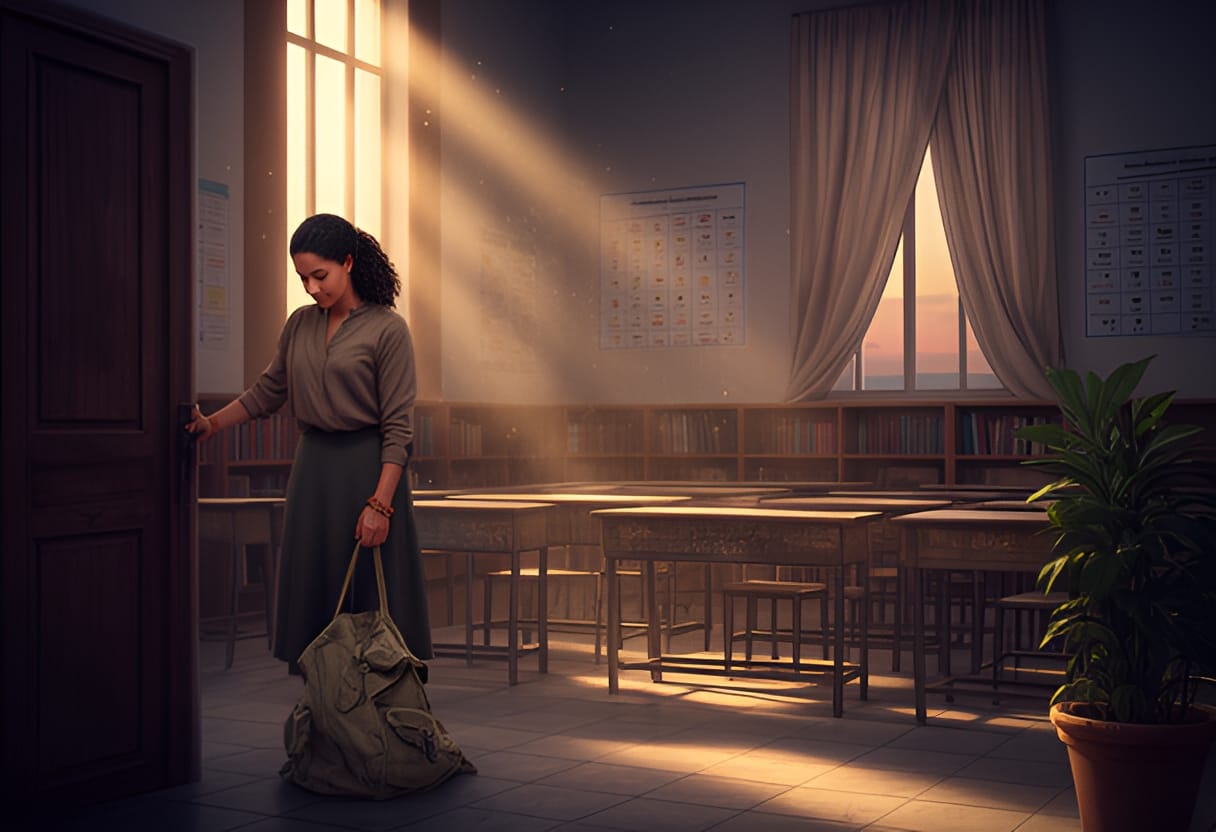
Layla adjusted the strap of her worn canvas bag as she stepped through the wooden door of the Maqbanah Teacher Training Center. The scent of chalk dust and brewed cardamom coffee hung in the air, mingling with the quiet hum of voices from inside. She paused just beyond the threshold, fingers brushing the rough plaster of the wall, and glanced down at her shoes — scuffed but clean — before pushing forward.
Inside, the training room was already filling. Sunlight slanted through high windows, catching motes in the air and illuminating rows of wooden desks arranged in a semi-circle. Posters with verb charts and phonetic symbols lined the walls, some faded at the edges. A few teachers sat already, sipping from plastic cups, their heads bent over notebooks. Layla’s throat tightened. They seemed so sure of themselves — notebooks open, pens poised, voices low but confident.
She slid into an empty seat near the back, setting her bag carefully beside her. A woman with kind eyes and a hijab pinned neatly at the side turned and smiled. “Salam alaykum. I’m Aisha. Are you here for the diploma too?”
Layla nodded, voice barely above a whisper. “Layla Nasser. I teach grades four to six at Maqbanah Basic School.”
“Me too — well, I’m from Beit al-Faqih, but same levels. First day nerves?” Aisha’s smile widened. “I kept rehearsing what to say in English all morning. Forgot how to say ‘I’m a teacher’ until I saw it on my notebook.”
A soft laugh escaped Layla. “I wrote mine three times. Still not sure it’s right.”
Before she could say more, a man entered from the side door. He moved with calm purpose, mid-fifties, salt-and-pepper hair neatly combed, wearing a pressed shirt and vest. His eyes swept the room, warm and assessing, then settled on the group. “Sabah al-khair, everyone. Welcome to the first day of the Maqbanah English Language Education and Training Diploma. I’m Mr. Sami Al-Mutawakel.”
He placed a folder on the desk at the front and turned to face them. “I know many of you are wondering if you belong here. If your English is good enough. If you’ll keep up.” His gaze swept slowly across the room, meeting Layla’s for a moment. “Let me say this plainly: this course is not about perfection. It’s about growth. About trying. About making mistakes — and learning from them together.”
A murmur rippled through the room. Layla felt her shoulders drop, just slightly.
“To begin,” Mr. Sami continued, “we’ll do a simple icebreaker. No pressure. Just speak from the heart, in whatever English you can. I’ll go first.”
He paused, smiling. “When I was young, I dreamed of being a teacher who could help students not just pass exams, but actually use English to talk to the world. To share their stories, their hopes. That’s still my dream.”
One by one, they spoke. A young man from Zabid said he wanted his students to stop being afraid of English movies. A woman from Taiz whispered that she hoped to read a story aloud without stumbling. When it was Layla’s turn, she stood, her palms damp on the desk.
“I… I teach children,” she began, voice thin but clear. “They know words — colors, numbers — but they freeze when I ask a question. I dream… I dream of hearing them answer without fear. Even if it’s just one sentence. ‘I like apples.’ ‘My father is a farmer.’ That would mean everything.”

She sat down, cheeks warm. Aisha gave her a small, encouraging nod. Mr. Sami smiled. “Thank you, Layla. That is exactly the kind of dream we’re here to nurture.”
As the icebreaker wound down, the room felt less like a test and more like a shared beginning. Layla glanced around — at Aisha’s attentive face, at the others relaxing into their chairs — and for the first time that morning, she allowed herself to believe, just a little, that she might belong here after all.
Mr. Sami tapped the remote, and the screen at the front of the room flickered to life. A grainy but clear video played — two teenagers in a classroom much like Layla’s, desks pushed together, laughing as they arranged cut-out pictures of food on a paper plate. One pointed to an image of rice and said, “I like this with yogurt.” The other nodded, replying, “Me too. My mother makes it every Friday.” They switched roles, corrected each other gently, and kept talking in English, their voices rising and falling with natural rhythm.
“Notice,” Mr. Sami said, his voice calm over the playback, “they are not reciting rules. They are using language to share something real — their preferences, their routines. The focus is on meaning, not form. Mistakes happen, but communication continues.”
Layla watched the boy stumble over the word ‘yogurt,’ then try again, smiling when his partner nodded in understanding. In her own classroom, such hesitation would have earned a correction, a repetition until the pronunciation was perfect — or so she had been taught. She remembered standing rigidly at her desk in secondary school, reciting dialogue after the teacher, afraid to deviate, afraid to sound foolish. Fluency had never been the goal; accuracy had been everything.
Mr. Sami paused the video. “This is communicative language teaching. We create opportunities for students to use English for genuine interaction — to ask, to answer, to negotiate meaning. Grammar is still important, but it serves communication, not the other way around.”
A murmur spread through the room. Layla felt a familiar tightness in her chest, not from fear this time, but from recognition. She thought of her lesson plans — lists of vocabulary to memorize, verb tables to copy, sentences to translate from Arabic into English and back again. Her students could often fill in the blanks correctly, but when she asked them, “What did you do yesterday?” they would stare at the floor, mute.
“But how do we start?” Aisha asked, leaning forward. “Our students are shy. They worry about making mistakes.”
Mr. Sami smiled. “We begin small. We build confidence through success. Instead of drilling the word ‘apple’ in isolation, we give them a reason to use it — to ask a partner what fruit they like, to share what they ate at breakfast. The language becomes a tool, not a test.”
Layla’s mind drifted to tomorrow’s lesson — a review of food vocabulary. She had planned to have the students write the words five times each, then match them to pictures. It was safe. It was familiar. But as she watched the video again in her mind — the ease of the exchange, the light in the students’ eyes — she felt a shift.
After the session ended and the teachers began to gather their things, Layla lingered. Mr. Sami was packing his folder when she approached.
“Excuse me, Mr. Sami,” she said, keeping her voice steady. “If I wanted to try something like that in my class — a speaking activity instead of a writing drill — would that be alright?”
He looked up, pleased. “More than alright. It’s exactly what we’re here for. Start simple. Pair them up. Give them a clear task — like finding out their partner’s favorite food and reporting it back. Walk around, listen, offer gentle support. Don’t correct every error. Let them communicate.”
Layla nodded, already imagining it — the desks turned inward, the murmur of voices, the chance to hear her students actually use the words they had been copying for weeks. “Thank you,” she said. “I’ll try it tomorrow.”
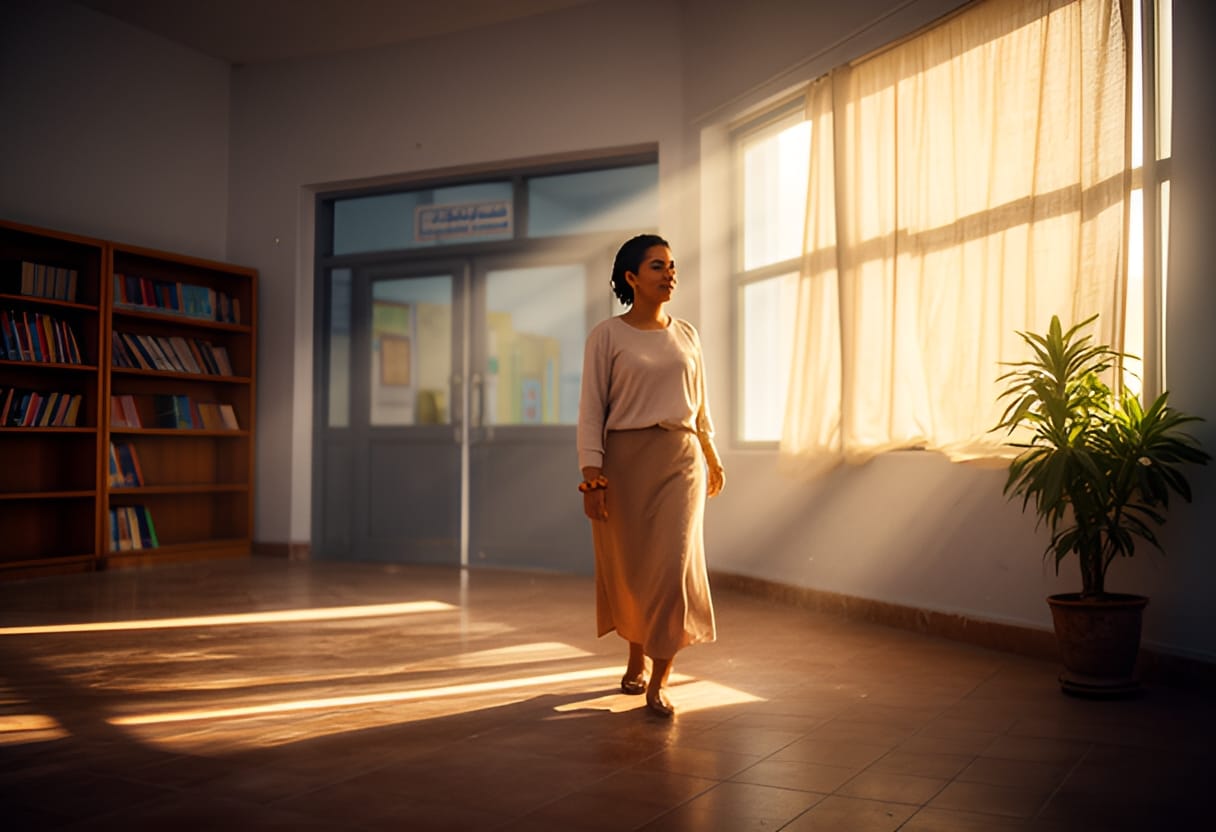
As she stepped back into the sunlight, the weight of her bag felt different — not lighter, but purposeful. She walked toward the bus stop, her mind already shaping the first words she would say to her class: “Turn to your partner. Ask them what they like to eat.” The sentence felt strange on her tongue, yet possible. And for the first time since she had entered the training room, she believed it might work.
Chapter 2
Building Practical Classroom Skills
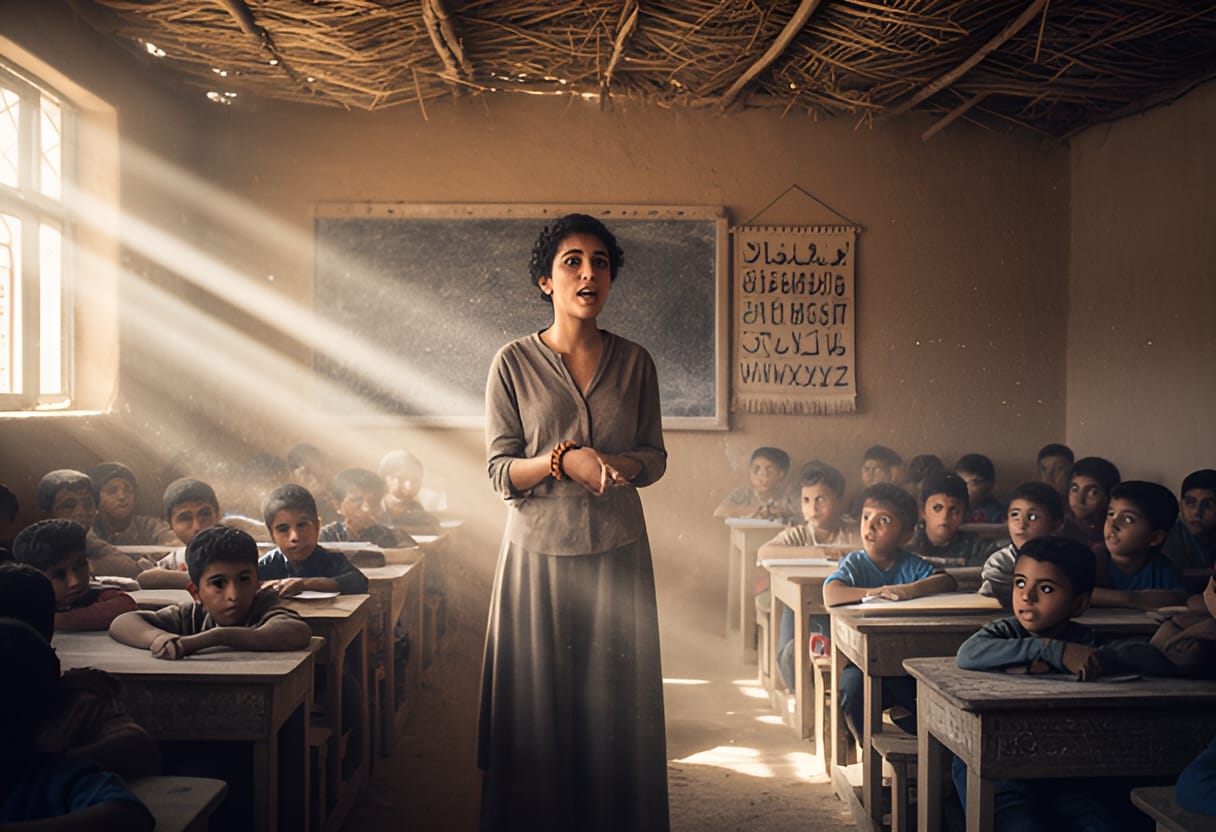
Layla stood at the front of her classroom the next morning, the chalk dust catching in the slanted light through the high windows. Her students, forty-two in all, shifted on their wooden benches, eyes down or darting toward the door. She had moved the desks into pairs, pushing them together so knees nearly touched, and written on the board in careful block letters: Ask your partner: What do you like to eat? Then tell the class.
She took a breath. “Turn to your partner. Ask them what they like to eat.” Her voice sounded louder than she intended, and a few heads snapped up.
Silence. Then a ripple of laughter — nervous, high-pitched — spread through the room. Layla felt her cheeks warm. She had imagined murmurs of English, not this.
“Like… like apples?” a boy in the front whispered to his partner, eyes wide.
His partner shrugged, smiling too broadly. “I… I like bread.”
Layla nodded, encouraging. “Good. Now tell me what your partner likes.”
The boy turned to her, voice dropping. “He like bread.”
“He likes bread,” Layla corrected softly, smiling. “Well done.”
She moved between the pairs, listening. Some students pointed at their lunchboxes, saying “egg,” “cheese,” with hesitant pride. Others buried their faces in their arms. A pair of girls giggled uncontrollably, covering their mouths as they tried to form the words. Layla crouched beside them.
“It’s okay to feel shy,” she said in Arabic, keeping her tone light. “Just try one word. What do you like?”
One girl peeked out. “Banana.”
“Banana,” Layla repeated. “Your partner likes banana. Can you say that?”
The girl looked at her friend, took a breath. “She like banana.”
“She likes banana,” Layla prompted. “Good.”
She made her way back to the front, heart pounding. Only a handful of pairs had spoken to her. The rest sat frozen, or had reverted to Arabic, murmuring explanations to each other. The noise level had risen — not with English, but with side conversations and shuffling feet.
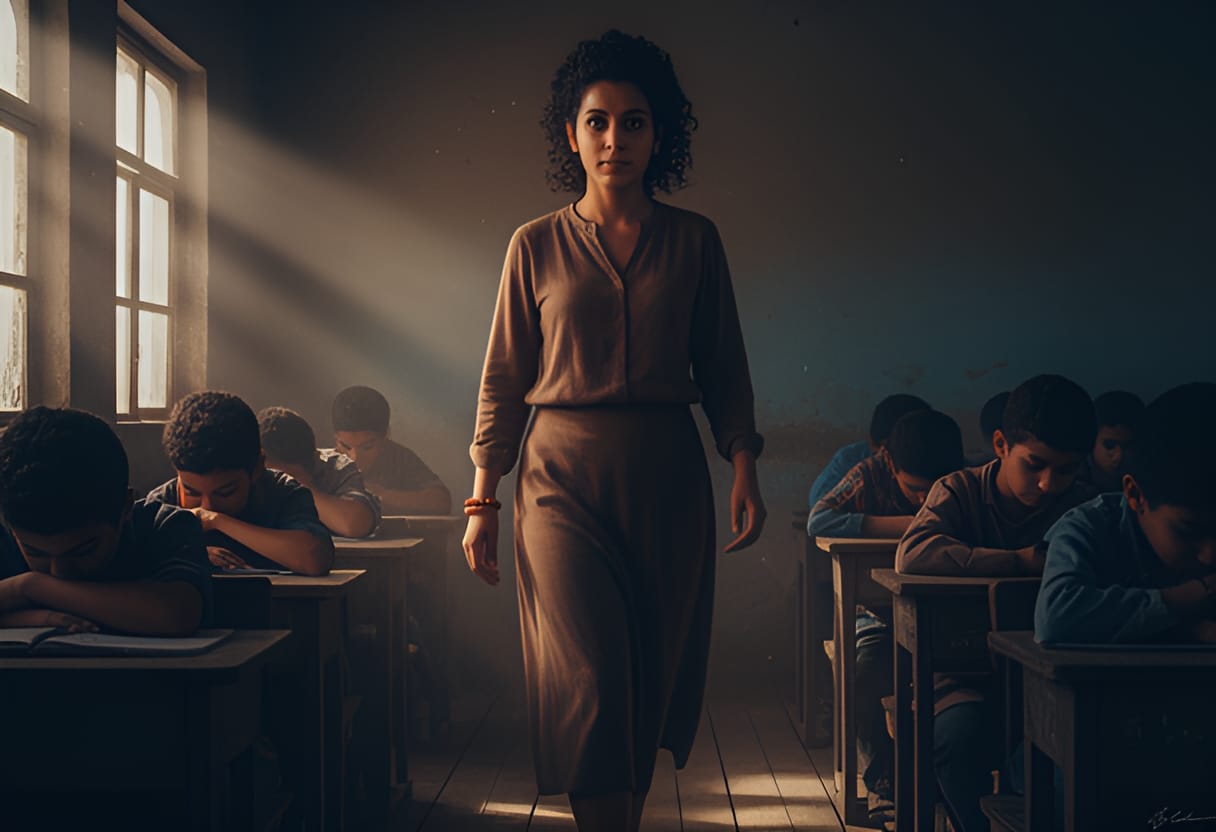
She clapped her hands once. “Okay, let’s try again. This time, I’ll walk around and listen. When I tap your shoulder, stand up and tell me what your partner likes.”
She tapped a boy near the window. He stood, blinking. “My partner like… rice.”
“Your partner likes rice,” Layla said. “Thank you.”
Another tap. A girl mumbled, “He like fish.”
“He likes fish,” Layla repeated. “Good job.”
After three more attempts, she saw a pattern: the same eager few were responding, while the majority remained locked in silence or laughter. The activity was not spreading as she had hoped. It felt like pulling teeth.
When the bell rang, she gathered her things slowly. Aisha appeared in the doorway, wiping chalk from her hands.
“How did it go?” Aisha asked, leaning against the frame.
Layla sighed. “Not well. Most of them didn’t speak. They laughed or just stared. I don’t know if it was the activity or if I didn’t explain it right.”
Aisha pushed off the door. “Maybe the instructions weren’t clear enough. Or they need more time to feel safe. You could try modeling it first — show them exactly what you want.”
Layla nodded, the idea forming. “And maybe smaller groups? Or change the pairs so they’re with someone they trust?”
“Exactly,” Aisha said. “And don’t forget to praise the effort, not just the accuracy.”
Layla managed a smile. “Thank you. I’ll try again tomorrow.”
That evening, after the last of her chores were done and the children were asleep, Layla sat by the kerosene lamp with her notebook. She wrote slowly, carefully, in English:
Today I tried the speaking activity. Many students were shy or laughed. Only a few pairs spoke to me. But those who did tried hard — one boy said ‘rice,’ a girl said ‘banana.’ I need to give clearer instructions. Maybe show an example first. Also, think about pairing — maybe let them choose partners next time to reduce anxiety. I will try again. I believe it can work.
She closed the notebook, the weight of the day settling into something quieter, more determined. The lamp flickered, casting long shadows on the wall, and for the first time since she had returned from training, she did not feel alone in the effort.
The next morning, Layla arrived early, her notebook tucked under her arm and a small stack of hand-drawn picture cards in her bag — apples, bread, fish, rice, banana, egg — each labeled clearly in bold print. She had stayed up late sketching them by lamplight, wanting to make the language tangible, to give her students something to hold onto when the words felt slippery.
As the students filed in, Layla greeted them at the door, her voice calm. “Good morning. Please sit with your partner today.” She had let them choose their own seats, watching as friends gravitated toward each other, shoulders relaxing, murmurs of Arabic fading into the rustle of books.
When the bell rang, she stood beside her desk, not at the front, and held up the first card — a bright red apple. “This is an apple,” she said, pointing to the word, then to the fruit. “I like apples.” She tapped her chest, smiled, and held the card out. “Who likes apples?” A few hands lifted hesitantly. She nodded to a girl in the third row. “You. Say it with me: I like apples.”
The girl whispered, then repeated it louder, her voice gaining strength. Layla echoed her approval, then turned to the boy beside her. “And you? What do you like?” She held up the fish card. He blinked, then said, “I like fish,” his pronunciation careful but clear.
Layla moved through the room, not correcting every error immediately, but modeling the structure again and again with the cards, using gestures — pointing to her mouth when saying “like,” spreading her hands wide for “apple,” shrugging when a student struggled. She tapped shoulders gently, not to demand speech, but to invite it. When a pair froze, she knelt beside them, showed the card, and said the sentence slowly, letting them match the sound to the image.
By the end of the activity, nearly half the class had stood to share what their partner liked. A boy who had buried his face in his arms the day before now stood straight, saying, “She like egg,” and when Layla prompted, “She likes egg,” he nodded and repeated it correctly. The laughter was still there, but softer now — less nervous, more like the ripple of shared effort.
After class, Layla packed away the cards, her chest light. She was wiping the board when Mr. Sami appeared in the doorway, his pressed vest crisp, a notebook in hand.
“May I come in?” he asked.
She nodded, wiping her hands on her apron. “Of course, Mr. Sami.”
He stepped inside, scanning the room — the paired desks, the picture cards stacked in the corner, the chalkboard still bearing the sentence frame. “I heard you tried something different today,” he said. “I wanted to see how it went.”
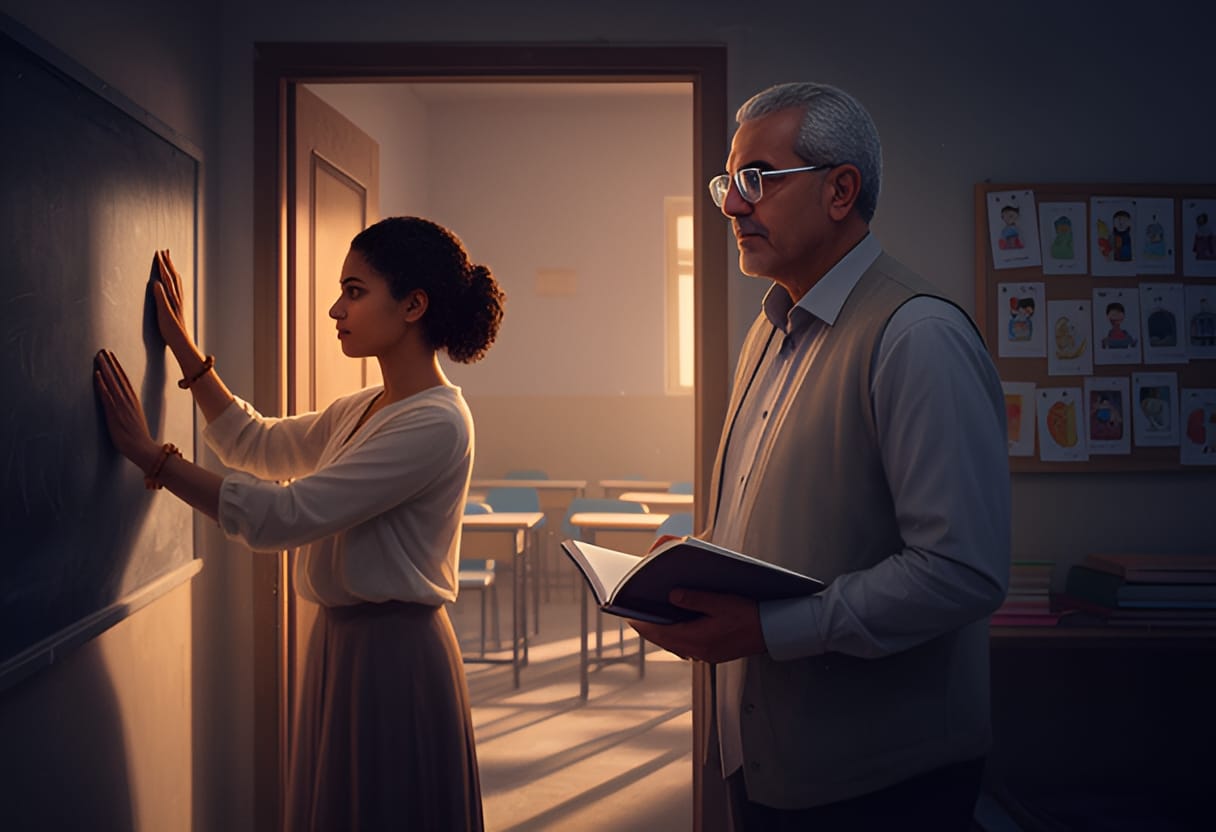
Layla hesitated, then said, “It was better. Much better. I let them choose partners, and I used pictures… and I modeled it first. More students spoke.”
Mr. Sami smiled. “That’s scaffolding. You gave them support — visual, linguistic, emotional — so they could reach the goal. You didn’t lower the expectation; you made the path clearer.”
She looked down, pleased. “I was worried they’d still be shy. But when they saw the apple, heard me say it… it was like they had a hook.”
“Exactly,” he said. “Language isn’t just in the head. It’s in the hands, the eyes, the body. You tapped into that.”
He flipped open his notebook. “I’d like to suggest one more thing — when you correct, try repeating the correct form immediately after their attempt, without making it a big deal. Like if they say ‘He like bread,’ you say, ‘Yes, he likes bread,’ and move on. It keeps the flow.”
Layla nodded. “I’ll try that.”
He closed his notebook. “You’re doing important work here, Layla. Not just for your students — for the others watching. Aisha mentioned you’ve been sharing what you learn.”
A warmth spread through her. “I showed her the cards this morning. She wants to try them in her class tomorrow.”
Mr. Sami’s eyes softened. “Then you’re already becoming a teacher of teachers. That’s the goal of this diploma — not just to change one classroom, but to start a ripple.”
As he turned to leave, Layla called out, “Thank you, Mr. Sami. For coming.”
He paused at the door. “Anytime. Keep going.”
After he left, Layla stood quietly, the picture cards in her hands. She thought of the boy who had said “She like egg” and then corrected himself — not because she scolded him, but because he had heard the right form, seen the card, felt safe to try again.
She slipped the cards into her bag, already thinking of how to adapt them for weather, for family, for the stories her students loved to tell in Arabic but were beginning to whisper in English.
Outside, the sun hung low over the rooftops of Maqbanah, gilding the edges of the schoolyard. Layla took a deep breath and walked toward the village, her steps lighter, her mind already drafting tomorrow’s lesson.
Chapter 3
From Practice to Leadership
Layla adjusted the edge of her notebook as she walked into her classroom the following morning, the sun already high enough to cast sharp rectangles of light across the packed-earth floor. The air smelled of chalk dust and the faint tang of woodsmoke from someone’s breakfast fire outside. Her students, grades four through six, were already seated, their small benches creaking slightly as they shifted to see what she held in her hands.
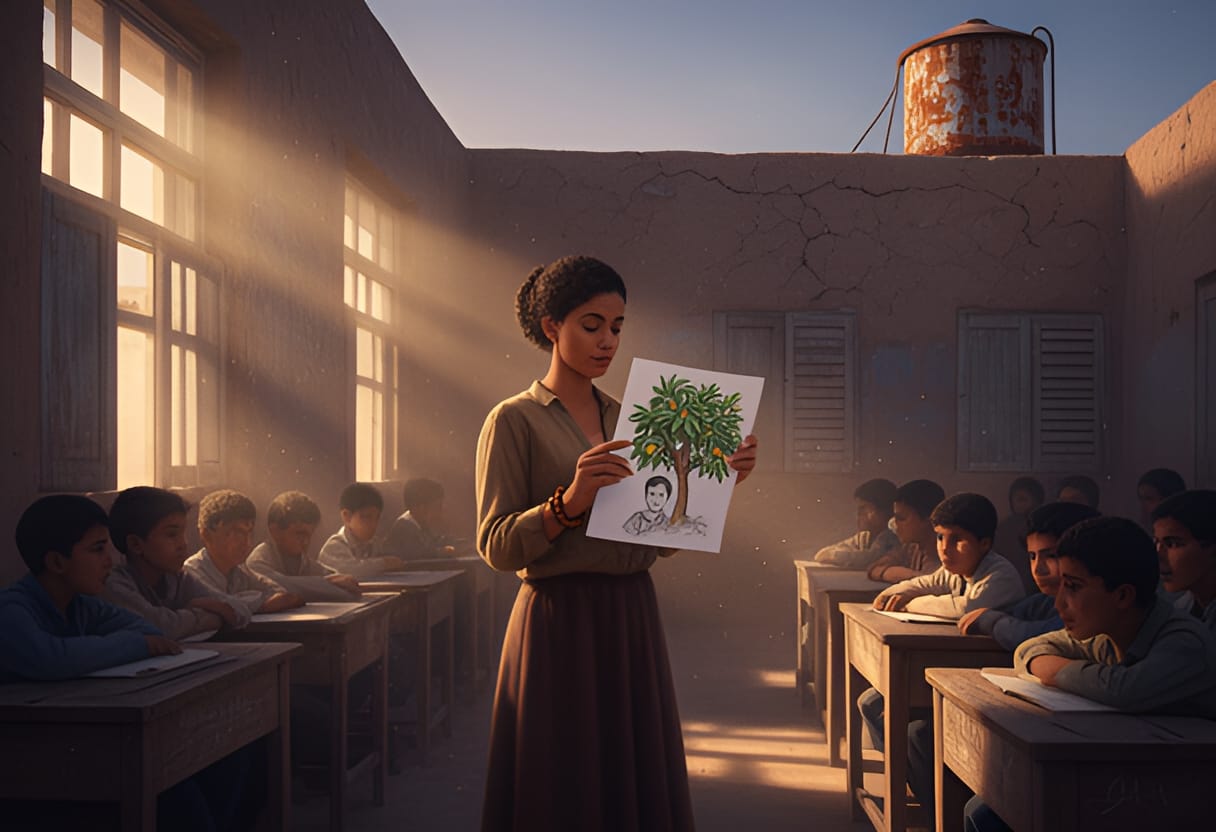
She had spent the previous evening sketching simple drawings on scraps of paper — a boy under a mango tree, a woman carrying a water jug, a goat nibbling at a patch of grass. Beneath each, she had written a short sentence in clear, printed letters: The boy is resting. The woman is working. The goat is eating. She had also prepared sentence starters on the blackboard: I see…, He/She is…, It is… — left over from yesterday’s speaking practice about favorite foods, where students had practiced saying, I like bread and My mother cooks rice.
“Good morning,” Layla said, her voice steadier than it had been weeks ago. “Today, we are going to read and write about pictures.”
She held up the first drawing — the boy under the tree. A murmur rippled through the room. Some students leaned forward; others tucked their chins down, eyes flicking to their notebooks as if bracing for difficulty.
“What do you see?” Layla asked, pointing to the boy.
A few hands rose slowly. “Boy,” said one girl softly.
“Yes,” Layla smiled. “A boy. Where is he?”
“Under tree,” another offered.
“Good,” Layla said. “Now, let’s read together.” She pointed to the sentence beneath the picture. The boy is resting. She tapped each word as she said it slowly, then invited the class to repeat. After two rounds, she erased the words and left only the frame: The ___ is ___.
“Now,” she said, “who can tell me what the boy is doing? Use the frame.”
Hands lifted more confidently this time. A boy in the front row stood, shy but clear: The boy is sleeping.
Layla nodded. “Close. But look — his eyes are open, his hands are behind his head. What word fits better than sleeping?”
A pause. Then, from the back, Amira’s friend Salma — usually quiet — whispered, Resting.
“Resting,” Layla echoed, writing it on the board. “Yes. The boy is resting.” She turned to the class. “Who would like to try writing it?”
She passed out slips of paper and pencils. For a moment, the only sound was the scratch of lead and the occasional sigh. Then, slowly, heads began to bow over desks. Layla walked between the rows, pausing behind each student. She saw one girl carefully copy The boy is resting, her letters uneven but deliberate. Another boy had written The boy is eat — then paused, looked at the picture of the goat, and corrected himself: The boy is not eating. Layla smiled. He was thinking.
When she reached Amira, she saw the girl had written two sentences: The boy is resting. The sun is hot. Layla touched her shoulder gently. “You added your own idea. That is excellent.”
Amira glanced up, a flicker of pride in her eyes before she looked back down.
After ten minutes, Layla collected the papers. She did not correct every error aloud — instead, she made mental notes: resting was spelled correctly by most; sun appeared frequently; several students had attempted to describe color or size without prompting. She would use these observations tomorrow.
Two weeks later, the classroom hummed with a different energy. Layla stood to the side as a small group of students took turns at the front, each holding up a drawing they had made themselves — a house, a bicycle, a plate of food — and reading the sentence they had written beneath it.
One boy, who had barely spoken during the first communicative activity, held up his drawing of a man with a basket. “The man is selling tomatoes,” he said, his voice clear enough to reach the back.
Layla felt a warmth spread through her chest. She remembered how he had stared at his feet when asked to say I like bread just weeks ago.
After the last student sat down, Layla turned to the board and wrote the frame they had practiced: I see a ___. It is ___. She invited the class to create their own sentences using the frame and any of the drawings on the wall.
Hands shot up. Words flowed — not perfectly, but freely. A girl described a yellow pot as hot. A boy said his drawing of a tree was tall and green. When Layla invited them to write, they reached for their pencils without hesitation.
As she walked among them, Layla paused behind a boy who had written, I see a bird. It is flying fast. She leaned in. “Fast,” she repeated. “That is a good word. How do you know it is fast?”
He shrugged, grinning. “Wings are blurred.”
She laughed softly. “You observed well.”
The bell rang soon after, but no one rushed to pack up. Instead, a few students lingered, showing each other their work, pointing at details in the drawings, whispering corrections and compliments in a mix of Arabic and English.
Layla leaned against her desk, watching them. The noise was not the chaotic clamor of before — it was the sound of minds engaging, of language being tried, shaped, and shared. She thought of the video Mr. Sami had shown on the first day — teenagers chatting over food — and realized her classroom, in its own quiet way, was beginning to echo that same ease.
She did not yet know if this would last, or if other teachers would follow. But for now, as she gathered her papers and stepped into the sunlight, she carried with her the quiet certainty that something had shifted — not just in her students’ English, but in her own belief that they could learn, and that she could help them.
Layla stood at the front of the training room, her notes folded neatly in her palm. Around her, the other diploma participants sat in a semi-circle, some sipping tea, others flipping through their workbooks. Mr. Sami leaned against the whiteboard, arms crossed, his expression attentive.
“I want to share what happened in my classroom after we learned about sentence frames,” Layla began, her voice clear despite the flutter in her chest. “I teach grades four to six at Maqbanah Basic School. When I first tried the communicative activities, my students were silent. They feared mistakes. They waited for me to give them the right answer.”
She paused, recalling the boy who had stared at his shoes when asked to say I like bread. “I realized I needed to lower the pressure. So I started with pictures — simple drawings I made myself. A boy under a tree. A man selling tomatoes. I asked, What do you see? and let them answer in single words if they needed to.”
A murmur of recognition passed through the room. Amira nodded from her seat beside Salma.
“I used the frame The ___ is ___ to guide them. At first, one boy said The boy is sleeping — but when I pointed to the boy’s open eyes, Salma whispered resting. That moment changed how I saw them. They weren’t just guessing; they were observing.”
Layla flipped to a page in her notebook and read aloud a few student sentences: I see a bird. It is flying fast. The man is selling tomatoes. The sun is hot. “They began to add their own ideas. Not because I told them to, but because they felt safe to try.”
She looked up. “The noise in my classroom changed. It wasn’t chaos — it was the sound of students leaning over desks, comparing drawings, whispering corrections in Arabic and English. One boy who hardly spoke before stood up and read his sentence clearly. I remembered how far he’d come.”
When she finished, Mr. Sami pushed off the board and smiled. “Layla, thank you. You showed us that adaptation isn’t about copying a method — it’s about listening to your students and finding what works in your context. That’s the heart of teaching.”

Applause rippled around the room. Amira squeezed Layla’s hand. “You made it real,” she whispered.
Later that afternoon, after certificates were handed out and group photos taken, Layla lingered by the door. Mr. Karim, her principal, approached her, his usual reserve softened.
“You spoke well today,” he said. “I saw the videos you sent — the students reading their sentences. I didn’t expect such progress so quickly.”
“Thank you, sir,” Layla replied. “I think the key was letting them start small — with words they knew — and build from there.”
Mr. Karim stroked his chin. “If you’re willing, I’d like you to share what you’ve learned with the other teachers in the district. Not as a lecture — more like a conversation. Maybe next week?”
Layla’s heart lifted. “I would be honored.”
The following Saturday, under the shade of a sidr tree beside the village well, Layla greeted six teachers from nearby hamlets. They sat on woven mats, notebooks on their laps, curious but wary. A thermos of sweet tea steamed in the center.
“I’m not here to tell you what to do,” Layla said, unfolding a sheet of paper with a simple drawing of a girl carrying a water jug. “I’m here to share what worked in my classroom — and what didn’t.”
She showed them the picture. “What do you see?”
A teacher from Beit al-Faqih ventured, “Girl. Water jug.”
“Good,” Layla said. “Now, where is she?”
“By well.”
“Yes. Let’s use the frame: The ___ is ___. What is the girl doing?”
After a pause, someone said, “Carrying.”
“Exactly. The girl is carrying.” Layla wrote it on her clipboard. “Now, who would like to try writing it?”
She passed out slips of paper. As they wrote, she moved among them, offering quiet prompts — Look at the jug. Is it full or empty? — just as she had with her students.
When they finished, she invited volunteers to read aloud. One woman, hesitant at first, said, The girl is carrying. The sun is bright. Another added, The jug is heavy.

Layla smiled. “You see? They began to add details — not because I told them to, but because they felt safe to try.”
Afterward, as they packed up, Amira fell into step beside her. “You did it again,” she said. “Made it feel possible.”
Layla glanced back at the group, already chatting as they walked toward their respective villages. “It’s not about having all the answers,” she said softly. “It’s about creating space for others to find their own.”
The sun hung low, casting long shadows across the dusty path. Layla adjusted her bag and began the walk home, her steps steady. In her mind, she already pictured next week’s lesson — a new picture, a new frame, and the quiet hum of students trying, failing, and trying again.
She thought of the boy who had once stared at his feet, now speaking clearly. She thought of Amira’s pride when she added her own idea to a sentence. She thought of the teachers under the sidr tree, passing pens and sharing ideas.
And for the first time in years, Layla felt not just hopeful, but certain — that the change she had begun in her classroom was no longer hers alone. It was growing.