
Fiction
هندسة الثروات
by Layla Zaim Zaim
3 chapters19 min read

Chapter 1
The Audit
Layla Zaim pushed through the narrow door of the Gemmayze office and was hit by the scent of turmeric and wet wool. Artisans hunched over looms in the back room, their fingers flying as they threaded indigo through cotton. Near the window, a designer leaned over a sketchpad, charcoal smudging her wrist as she redrew the curve of a ceramic vase. The space was small, walls lined with mismatched shelves holding jars of spices, spools of thread, and half-finished prototypes. No reception desk. No corporate signage. Just the quiet hum of creation.
She checked the address on her phone again. This was the place. Karim Hassan’s startup—Nasma Collective—listed as a struggling e-commerce platform in her audit file. Revenue down 40% quarter-over-quarter. Burn rate unsustainable. Another casualty of overambition and underfunding, her corporate template whispered.
But the room didn’t feel like failure. It felt like concentration.
“You’re Layla?” A man stepped forward from behind a stack of woven baskets. His sleeves were rolled to the elbows, forearms dusted with clay. He wiped his hands on his apron before extending one. “Karim Hassan. Thanks for coming on such short notice.”
His grip was firm, eyes sharp behind thin-rimmed glasses. He didn’t offer a chair. Instead, he nodded toward a low table cluttered with notebooks, a half-drunk cup of cardamom coffee, and a ledger bound in faded blue cloth.
“Please. Sit. I know auditors like their tables.”
She lowered herself onto the cushion, notebook open, pen ready. “Let’s start with the basics. Cash flow, payables, receivables—standard items. I’ll need to see your bank statements, payroll records, any outstanding invoices.”
Karim smiled, but it didn’t reach his eyes. “We don’t keep those the way you expect. Let me show you.”
He slid the ledger toward her. Inside, columns were labeled not in currency but in hours, skills, and promises. One entry read: Leila, weaving – 12 hrs → credit: 1.5 skill units. Debt: none. Equity: +0.02%. Another: Youssef, glaze mixing – 8 hrs → credit: 1 skill unit. Deferred comp: future profit share.

Layla frowned. “This isn’t accounting. This is… barter.”
“It’s reciprocity,” Karim said. “We pay in equity and skill credits. When someone teaches a technique, they earn credit to learn another. When they weave a rug, they earn a share of its eventual sale. No cash changes hands until the product leaves Beirut.”
She flipped ahead. Pages of similar entries. Salaries replaced by time-banking. Overhead measured in shared tools and communal meals. “But how do you pay rent? Utilities? Materials?”
“We pool,” he said. “Those who have extra time cover shifts at the workshop. Those with savings front material costs, recorded as loans to be repaid in kind or equity. We don’t burn cash because we’re not trying to scale like a tech VC dream. We’re trying to sustain a craft economy.”
Layla’s pen hovered. Her training screamed insolvency. Negative operating cash flow. No receivables. Assets illiquid and non-transferable. Yet the workshop buzzed. Orders were packed and labeled for shipment to Barcelona and Toronto. A WhatsApp group pinged constantly—artisans confirming pickup times, designers adjusting patterns based on client feedback.
“Your burn rate must be terrifying,” she said quietly.
Karim leaned back. “You’re measuring the wrong engine. Our wealth isn’t in the bank. It’s in the loom, the kiln, the hands that know how to shape clay without cracking it. We convert idle time and inherited skill into value the market wants—without extracting it from people. That’s solvency, Layla. Not survival. Production.”
She looked down at her own hands—neat, uncalloused, used to scrolling through spreadsheets that justified layoffs and budget cuts. For the first time in years, she wondered what her own idle skills might be worth if they weren’t being used to optimize someone else’s austerity.
Later, as she packed her bag, Karim handed her a small ceramic cup—glazed deep green, rimmed with gold. “For the road. It’s Leila’s work. She traded her weaving credit for glaze lessons. Now she teaches both.”
Layla turned it in her palm. Warm from the kiln. Light but solid. “How do you audit this?” she asked.
He smiled. “You don’t. You engineer it.”
Outside, the Gemmayze street buzzed with evening life—motorbikes weaving between cafes, the call to prayer drifting from a nearby mosque. Layla slipped the cup into her bag, opened her notebook, and began to sketch—not numbers, but a flow: time → skill → trust → value. A different kind of balance sheet. One that didn’t add up in her ledger… but felt, somehow, true.
Karim led her up a narrow stairwell behind the workshop, the walls rough with plaster and the air growing cooler as they rose. At the top, a flat roof opened to the city’s evening hush—minarets silhouetted against a violet sky, the Mediterranean a faint shimmer to the west. Strings of bare bulbs cast pools of light over potted herbs and a low wooden table scattered with sketches, spools of dyed thread, and a clay model of a kiln.

He poured tea from a brass pot into two small glasses, the steam carrying the sharpness of mint. “You asked how we audit this,” he said, handing her one. “Not with debits and credits. With laws.”
Layla took the glass, warmth seeping into her palms. “Laws?”
“The three laws of wealth engineering. First: latent asset activation. Every person, every place, holds unused value—time between tasks, skills never monetized, networks asleep. Wealth begins when you wake them.”
She thought of her own evenings, spent scrolling through financial reports in her Hamra apartment, her fluency in French and English gathering dust, her calligraphy pen capped since university. “Like Leila’s weaving credit?”
“Exactly. Second: reciprocal matching. You don’t assign value arbitrarily. You match an activated asset to an unmet need—someone needs glaze mixed, another has the skill, a third has time to fire the kiln. The exchange isn’t charity. It’s structured reciprocity: I give you credit now, you owe me value later, recorded not in cash but in trust and future yield.”
He traced a finger along the rim of his glass. “Third: value recycling. Unlike extractive models that treat labor as a cost to minimize, here every exchange leaves more value behind. The weaver learns glaze, teaches it to another, earns equity in a rug sale—each cycle compounds. The system doesn’t consume; it builds.”
Layla sipped her tea, the bitterness cutting through the mint. “And if no one has savings to front material costs?”
“Then time becomes the capital. Someone stays late to load the kiln. Someone else wakes early to prep the clay. We don’t eliminate need—we redefine how it’s met. No interest, no extraction. Just delayed reciprocity, scaled by trust.”
She turned the cup in her hands, feeling the ridge where Leila’s thumb had pressed the clay. “It sounds… idealistic.”
Karim’s eyes darkened. “Idealism is what you call a system that works outside your spreadsheets. Try it. Not for Nasma. For you.”
Back in her apartment later that night, Layla sat at her desk, the ceramic cup beside her, and opened a fresh notebook. She drew three columns: Latent Assets, Unmet Needs, Possible Exchanges.
Under assets, she wrote: Fluent in Arabic, French, English. Skilled in financial modeling. Practiced in Arabic calligraphy. Familiar with Beirut’s informal networks. Owns a DSLR camera, unused for months.
Needs came slower, then flowed: Friends struggling to translate visa documents. Local NGOs needing grant proposals in English. Small traders wanting to price handmade goods for export. Expats seeking authentic Arabic script for gifts. Startups requiring low-cost financial templates.
She drew lines between them. Translation for visa help → calligraphy lessons in exchange. Financial models for NGOs → credit toward future consulting. Camera use for product photos → equity in a fledgling online souk.
Her pen hovered over the last idea: a weekend workshop teaching calligraphy to designers, paid not in cash but in skill credits—each participant owing her an hour of design work for her own nascent venture.
A smile touched her lips. Not profit. Not yet. But value—activated, matched, recycling. She wrote at the top of the page, in bold letters: Engineering Wealth: Pilot.
Outside, the city hummed. Somewhere below, a loom clicked. Somewhere else, a kiln fired. And for the first time in years, Layla Zaim did not feel like she was auditing failure. She felt like she was drafting a balance sheet that mattered.

Chapter 2
The Leap
Layla Zaim stared at the spreadsheet glowing on her dual monitors, the numbers blurring as she rubbed her temples. The client’s presentation loomed on the screen behind her—slides titled “Optimizing Supply Chain Resilience in Tripoli” that, in reality, proposed terminating contracts with forty-two small-scale textile and food producers to consolidate logistics under a single multinational distributor. The projected quarterly profit bump was stark: 18%. The human cost, buried in footnotes, was the abrupt loss of livelihood for nearly three hundred families already reeling from currency collapse and inflation.
She had run the models herself. The math was clean. The ethics were not.
“Layla?” Her manager, Daniel Voss, leaned against the partition of her cubicle, coffee in hand. “You’re quiet. Everything alright with the Tripoli model?”
She closed the laptop lid slowly. “I’ve been thinking about the long-term ripple effects. These suppliers aren’t just vendors—they’re embedded in local economies. If we pull out, who feeds their families? Who pays rent? The distributor you’re proposing doesn’t hire locally; they’ll import labor from their free zone.”
Daniel’s smile tightened. “We’re not here to run social programs, Layla. We’re here to maximize shareholder value. The client wants efficiency. This plan delivers it.”
“Efficiency at what cost?” she asked, keeping her voice level. “If we keep extracting value without reinvesting in the systems that create it, we’re not building resilience—we’re accelerating decay. Karim at Nasma showed me another way. Time, skill, trust—those aren’t line items, but they’re real assets. Ignoring them doesn’t make them disappear; it just hides the debt.”
Daniel set his cup down, the ceramic clink sharp in the open office. “You’re starting to sound like one of those NGO types. Look, I liked you better when you trusted the numbers. Sign off on this, and we’re golden. Push back, and you’re not just slowing the deal—you’re questioning the whole damn model.”
The room felt suddenly loud—the clack of keyboards, the murmur of voices, the hiss of the espresso machine in the breakroom. Layla thought of the ceramic cup on her nightstand, the ridge of Leila’s thumb still visible in the clay. She thought of the notebook open on her desk at home, the columns waiting to be filled.
“I can’t sign off on something I know will cause harm,” she said. “Not in good conscience.”
Daniel exhaled through his nose. “Fine. Have it your way. But don’t be surprised when you find yourself off the next high-visibility project. We need people who can execute, not philosophize.”
She nodded. “Understood.”
Two weeks later, Layla sat in an empty conference room after hours, the city lights of Gemmayze flickering below like distant stars. Her resignation letter was drafted on her laptop, revised three times. She had already cleared her desk, returned her badge, and forwarded her files to her successor. All that remained was to hit send.
She opened a new document and began typing, not to her manager, but to the network she had been quietly building—the friends, the NGOs, the traders, the expats whose needs she had mapped in her notebook.
Tharwa Labs Mission Statement: To engineer wealth from Lebanon’s abundant human capital by activating latent skills, matching unmet needs through reciprocal exchange, and circulating value without extraction. We do not measure success in currency alone, but in the strength of our connections, the dignity of our work, and the resilience of our communities.
She paused, cursor blinking. Below, she added: Launching soon. Pilot phase: skill-based micro-tasks paid in local currency, time credits, or swaps. First workshop: Arabic calligraphy for designers, payment in design hours for Tharwa Labs’ nascent platform.
She saved the file, opened her email, and addressed it to Daniel Voss, with a copy to HR.
Subject: Resignation – Layla Zaim
Body: Dear Daniel,
Please accept this letter as formal notice of my resignation from my position as Financial Analyst, effective two weeks from today.
This decision comes after careful reflection on the role I wish to play in shaping economic systems, particularly in times of crisis. I can no longer, in good conscience, participate in models that prioritize short-term financial extraction over long-term human and communal value.
I am leaving to pursue a project rooted in the belief that wealth is not created through austerity, but through the activation of latent assets—skills, time, trust—and their reciprocal matching within communities. I hope to build something that honors the dignity of work and the interconnectedness of our lives.
Thank you for the opportunities I’ve had during my tenure. I wish the team continued success.
Sincerely, Layla Zaim
She hovered over the send button. The apartment was silent except for the hum of the refrigerator and the occasional bark of a dog downstairs. Outside, a call to prayer drifted up from a nearby mosque, its melody winding through the narrow streets.
At 2:07 a.m., she clicked send.

The message vanished into the dark. A quiet relief washed over her, followed by a sharp, unfamiliar tremor—liberation tangled with terror. She leaned back in her chair, the ceramic cup warm in her hands from where she had held it earlier, and stared at the ceiling.
Somewhere across the city, a loom clicked. Somewhere else, a kiln fired.
And for the first time in years, Layla Zaim was not auditing failure.
She was building something new.
Layla opened Tharwa Labs on a Tuesday morning with a pot of strong coffee and a notebook full of names. The first sign-ups came slowly—her friend Rima offering visa translation in exchange for graphic design hours, a Syrian tailor in Sabra willing to mend clothes for tutoring in French, a retired accountant in Achrafieh who wanted to learn Arabic calligraphy and could template financial sheets for startups. By week’s end, over two hundred users had created profiles, listing skills and needs in equal measure. The platform buzzed with tentative exchanges: a Palestinian refugee in Bourj Hammoud transcribed a NGO’s grant proposal in return for three hours of webinar coaching; a university student traded drone footage of Tripoli’s old souk for help drafting a business plan in English.
Layla watched the dashboard with cautious hope. Transactions flowed, not in currency, but in credited hours and swapped competencies. She felt the familiar thrill of seeing abstract principles take shape—latent skills activating, needs finding matches, value circulating without extraction. For the first time since leaving her corporate job, she allowed herself to believe the model might work.
Then, in the third week, the flow stalled.
She logged in one rainy Thursday to find the activity feed eerily still. No new swaps had been posted in over forty-eight hours. The total volume of exchanged time had dropped from an average of fifty credits a day to twenty. She messaged Rima: “Everything okay? Not seeing any requests come through.”
Rima replied within minutes: “Sorry, been holding onto my credits. Heard some people are worried the system might collapse if too many cash out at once. Better to keep them safe.”
Layla’s stomach tightened. She scanned the user forum. A thread titled “Is Tharwa Labs a Ponzi scheme?” had garnered thirty responses. One user wrote: “I translated three documents last week. Got twelve hours. Now I’m scared to spend them. What if no one wants my French tutoring next month?” Another: “I’ve got twenty hours banked. I’ll wait until I really need something—like medicine or rent. No point wasting them on frivolous swaps.”
Layla felt the old panic rise—the same cold dread she’d felt watching balance sheets hemorrhage value in her analyst days. But this was different. This wasn’t about numbers on a screen; it was about trust. The platform’s entire premise relied on velocity—the belief that credits would be spent, not hoarded, keeping the reciprocity loop alive. If people treated time like scarce currency instead of circulating wealth, the engine would seize.
She called Karim that evening. He answered on the second ring, his voice calm despite the late hour in Gemmayze.
“You’re seeing the hoarding,” he said before she could explain.
“How did you know?”
“Because it happens every time. When people first encounter a new system of value, they try to fit it into old mental models. Scarcity mindset kicks in. They forget that trust isn’t depleted by use—it’s strengthened.”
“But if no one spends, the matches stop. The platform dies.”
Karim was silent for a beat. “You don’t fix it by scolding people for being cautious. You fix it by redesigning the incentives. Ask yourself: what makes money velocity slow in a crisis? Fear of future worthlessness. What speeds it up? Either a penalty for holding, or a reward for spending.”
Layla leaned her forehead against the cool window. “Demurrage. Like the Wörgl experiment. A fee on idle holdings.”
“Exactly. And complementary rewards for early circulation—bonus credits for swaps completed within seventy-two hours of earning. Not punishment. A nudge. Make it costly to hold, beneficial to flow.”
She ended the call with a notebook open, sketching adjustments. By Friday, she’d pushed an update: a 0.5% weekly demurrage on idle time credits, visible in each user’s balance as a slow, steady drain unless spent; and a 10% bonus awarded automatically for any credit used within three days of receipt.
The first day after the change, nothing. Layla stared at the stagnant feed, doubting herself.
Then, at 3:14 p.m., a notification pinged: Youssef Chahine spent 2 hours of web design credit on Arabic proofreading from Nadia El-Sayed—bonus +0.2 credits awarded.

Ten minutes later, another: Leila Hassan traded 3 hours of weaving instruction for 2 hours of DSLR photography lessons from Samir Khoury—both parties earned spending bonuses.
By evening, the volume had crept back to thirty credits a day. The next morning, it reached forty-two. The forum thread shifted tone: users began sharing tips on how to spend credits quickly to avoid the fee and earn the bonus. One posted a photo of a hand-thrown mug she’d received in exchange for resume help, captioned: “First spend! Felt good to keep the circle going.”
Layla leaned back in her chair, the ceramic cup from Leila warm in her hands. The system wasn’t perfect—some still grumbled about the “tax”—but the flow had returned. Not through coercion, but by aligning self-interest with collective health. She thought of Daniel Voss’s insistence that shareholder value required extraction. Here, value grew precisely because nothing was taken—only circulated.
She opened a new document and began typing, not a resignation this time, but a proposal: Phase Two: Scaling the Velocity Mechanism. The cursor blinked, steady and sure. Outside, the call to prayer rose again, winding through the streets of Gemmayze, and for the first time in weeks, Layla did not feel terror beneath the relief. She felt the quiet hum of something working.
Chapter 3
The Return
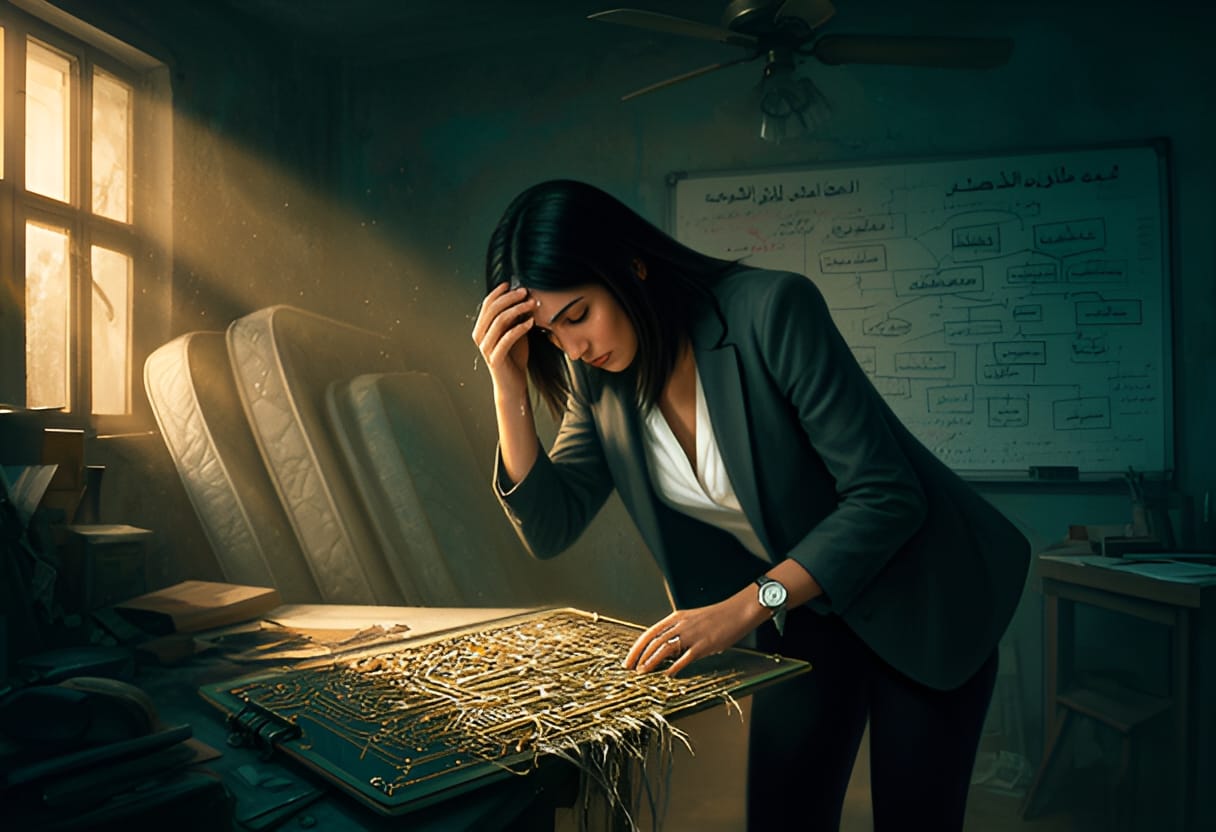
Layla wiped sweat from her brow with the back of her hand as she leaned over the worktable, her eyes tracing the frayed edge of a printed circuit board she’d been trying to salvage for hours. The hum of the ceiling fan was the only sound in the cramped Gemmayze loft besides the occasional tap of keys from her laptop, where lines of code scrolled too fast to read. Outside, the call to prayer drifted up from the mosque down the hill, mingling with the distant blast of a horn and the laughter of children playing in the narrow street.
She’d been at it since dawn, trying to patch the server instability that had plagued Tharwa Labs for the past week. The liquidity crunch from the hoarded credits had forced her to shut down non-essential features, and now users were complaining about slow response times. She needed to hire a backend developer—someone who could optimize the database queries and shore up the infrastructure—but the last tranche of her personal savings had gone to cover three months of hosting fees, and there was nothing left.
A soft knock at the door made her start. She wiped her hands on her jeans and opened it to find Nadia El-Sayed standing in the hallway, holding a paper bag that smelled of za’atar and olive oil.
“You look like you’ve been wrestling with ghosts,” Nadia said, smiling as she stepped inside. She kicked off her sandals and glanced around the space—mattresses stacked against one wall, a whiteboard covered in scribbled flowcharts and Arabic proverbs, a shelf holding jars of dried herbs and a single ceramic cup Layla knew had come from Leila at the Nasma Collective.
“I’m trying to keep the lights on,” Layla said, gesturing toward the laptop. “This thing keeps crashing when more than fifty users are online at once.”
Nadia set the bag down on the table and pulled out two containers of fatayer. “I brought lunch. And maybe a solution.”
Layla frowned. “You’re not here to offer me a job back at Crescent Capital, are you?”
Nadia laughed, unfolding a napkin. “No. Quite the opposite. I’m here because I’ve been watching. Tharwa Labs isn’t just surviving—it’s adapting. I saw the uptake in the Bekaa last month. Farmers trading language lessons for seed storage advice. That’s not just engagement—it’s reciprocity in motion.”
Layla hesitated. She had heard Nadia’s fund had started taking an interest in alternative economies, but she’d braced herself for the usual strings.
“I’ve been talking to my partners,” Nadia continued, unwrapping her fatayer. “We want to do a seed round—fifty thousand USD. Convertible note, 20% discount. Standard terms.”

Layla’s chest tightened. Fifty thousand would cover six months of server costs, hire a developer, maybe even let her pay herself a stipend. But she knew what came with it.
“And the metrics?” she asked, keeping her voice even.
Nadia paused, chewing. “Monthly active users. Dollar-equivalent transaction volume. Customer acquisition cost. The usual. We need to show our LPs we’re backing scalable models.”
Layla pushed her container away. “Those metrics would force me to monetize the credit system. To push users toward cashing out, to track their behavior for ad targeting, to prioritize volume over trust. If I start measuring success in dollars exchanged, I’m not engineering wealth—I’m just replicating the extractive model I walked away from.”
Nadia set her food down, her expression shifting from optimism to concern. “You’re saying you’d rather stay broke than compromise?”
“I’m saying I’d rather build something that lasts than scale something that hollows out.” Layla stood and began pacing, her sandals slapping softly on the concrete floor. “What if we measured success differently? Not in revenue, but in skill hours activated. In the number of local businesses reporting revived demand. In how many users say they feel more in control of their livelihoods—not because they earned more cash, but because they exchanged something meaningful.”
Nadia watched her, eyes sharp. “You want to replace KPIs with… what? Qualitative surveys?”
“Not replace. Complement. Let’s track both—but weight the non-monetary outcomes as primary for the first three months. If the circles are tightening, if trust is growing, if people are using their gifts again—that’s the real return on investment. The cash flow can follow.”
Nadia was quiet for a long moment. Then she reached into her bag and pulled out a small notebook—the same kind Layla used for her balance sheet sketches. She flipped it open and began to write.
“Three months,” she said, sliding it across the table. “We pilot your framework. You show me the data on skill exchange, community resilience, local revitalization. If it holds, we fund—not despite the model, but because of it.”
Layla picked up the notebook. Her name was written at the top in Nadia’s precise hand. Below it, three columns: Skill Hours Exchanged, Local Business Revitalization Index, User-Reported Agency Score.
She looked up, meeting Nadia’s gaze. “You really believe this can work?”
Nadia smiled, faint but sure. “I believe you’ve already proven it can. Now let’s measure what matters.”
Layla closed the notebook and held it to her chest. Outside, the sun had shifted, casting long shadows across the rooftops of Gemmayze. The server fan whirred on, steady now—for the moment.
Layla adjusted the strap of her bag as she stepped into the co-working space in Tripoli, the scent of roasting coffee and salt air drifting in from the nearby port. Three months had passed since the pilot began, and the data lay warm in her notebook—skill hours exchanged up 40%, local businesses reporting revived demand in nearly half the surveyed districts, and 70% of users saying they felt more in control of their livelihoods. Not a single metric showed growth in cash revenue, but the non-monetary returns were undeniable.
Nadia sat beside her at a low table, tablet in hand, reviewing the live dashboard. “Look at this,” she said, pointing. “A user in Sidon traded three hours of accounting help for sewing lessons. Then used those lessons to repair fishing nets for a cooperative. Now they’re teaching net-mending to teenagers in exchange for Arabic tutoring. The circle’s not just closing—it’s multiplying.”
Layla smiled, tracing the ripple effect with her finger. “It’s not about tracking value. It’s about releasing it.”
A young woman approached, her hijab pinned with a handmade brooch shaped like a gear. “Sorry to interrupt. I’m Yara. I heard you’re the one who started this?” She glanced at the tablet, then at Layla. “I used to work as a teller at a bank that froze last winter. Now I run the financial literacy circle here. Last week, I helped a woman balance her time-credit ledger so she could trade tutoring for childcare. I didn’t create money today—but I created value.”
Layla felt something loosen in her chest, a tension she hadn’t realized she’d been carrying since leaving Crescent Capital. She knelt to meet Yara’s eyes. “You did more than that. You reactivated a skill the market had sidelined. That’s the engine.”
Yara nodded, eyes bright. “I feel like myself again.”
Before Layla could respond, a notification pinged on Nadia’s tablet—a message from their regional partner in Amman: Request to adapt model for refugee skill pools. Can we schedule a call?
Nadia looked up, grinning. “Looks like the circles are widening.”
Layla closed her notebook and stood. The afternoon light slanted across the room, catching dust in the air and glinting off the copper tray of tea being poured in the corner. Somewhere nearby, a man laughed as he traded a oud lesson for help drafting a resume in French.

She turned to Nadia. “We don’t need to scale fast. We need to scale deep—let the model prove itself in the soil of real need.”
Nadia snapped her tablet shut. “Then let’s build the framework so others can plant it too.”
They stepped into the hallway, where a bulletin board fluttered with hand-drawn cards: offers of calligraphy lessons, requests for help with residency paperwork, an invitation to a pottery exchange in the Bekaa. Layla paused at one corner, where a child’s drawing showed two hands exchanging a sun over a market stall. Beneath it, in wobbly letters: This is how we grow.
She touched the paper gently. The server fan back in Gemmayze would still whir at night. The liquidity crunch might return. But here, in this hallway, in this exchange, wealth was not hoarded or extracted—it was passed hand to hand, skill to skill, breath to breath.
And for the first time in years, Layla did not feel like she was auditing a system.
She felt like she was tending one.