Fiction
من الصفر إلى أول دخل
by Waseem Ipraheem
3 chapters18 min read

Chapter 1
The Weight of Starting
Layla stared at the screen, the words blurring as she read them for the third time: We regret to inform you that we have decided to move forward with other candidates. The email sat in her inbox like a verdict—polite, final, and utterly familiar. It was the third rejection that week, each one a quiet confirmation that she wasn’t good enough, or experienced enough, or connected enough. She leaned back in her chair, the cheap plastic creaking under her weight, and let out a breath that sounded like surrender.
Her apartment was small, the kind of studio where the kitchen bled into the living space and the bedroom was tucked behind a folding screen. Dust motes drifted in the slant of late afternoon light that came through the grimy window. On the table beside her laptop lay a half-empty cup of cold tea, a stack of unpaid bills, and a notebook filled with frantic lists: Apply to ten jobs today. Update LinkedIn. Call Mr. Karim about tutoring leads. None of it had moved the needle. Rent was due in five days. She had forty-two dinars left in her account, and after rent, utilities, and the minimum payment on her student loan, there would be nothing left for food, let alone transportation to interviews.
She picked up her phone, thumb hovering over Nadia’s contact. She didn’t want to burden her friend again—Nadia had already lent her money last month, offered to review her resume, told her about three different openings. But the silence in the room was too loud, and the weight of another “no” pressed hard against her chest.
“Hello?” Nadia’s voice came through, warm and immediate.
“Hey,” Layla said, her voice thinner than she meant it to be. “You free for tea?”
“Always,” Nadia replied. “That little place near the university? Mint tea and baklava? My treat.”
Layla managed a weak smile. “Thanks.”
The café was modest, its windows fogged slightly from the steam inside. The scent of cardamom and boiled milk hung in the air, mingling with the faint fry of sambousek from the kitchen. Nadia waved from a corner table, her dark hair tucked under a scarf, her laptop open beside a steaming glass. She looked tired but alive, her eyes bright as she pushed back her chair.
“You look like you’ve been carrying the world,” Nadia said, sliding into the seat opposite.
Layla wrapped her hands around her glass, feeling the heat seep into her palms. “Third rejection this week. Junior marketing coordinator. I met all the requirements. I even did the extra certification they asked for.”
Nadia nodded, stirring sugar into her tea. “I got those too. So many. Felt like I was shouting into a well.”
Layla snorted. “How’d you get out?”
Nadia took a slow sip. “I didn’t wait for someone to hand me a chance. I started small. Really small. I had this old laptop—barely ran Photoshop—and I offered to design logos for friends’ Instagram shops. Free at first. Just to build something to show.”
“But how did you get paid?” Layla asked, skeptical.
“I didn’t, at first. But after three free ones, one friend said, ‘Hey, can you do my cousin’s boutique? I’ll pay you ten dinars.’ I said yes. Then another. Then someone saw it and referred me to a café owner who needed a menu redesign. Fifteen dinars. Then twenty. It wasn’t much, but it was mine. And it kept coming.”
Layla stared into her tea, watching the mint leaves swirl. “I don’t even know where to begin. I feel like I need money to make money.”
Nadia leaned forward, her expression earnest. “You don’t need money. You need to start. With what you have. A skill. An hour. A willingness to try something small and see what happens.”

Layla exhaled, the tension in her shoulders easing just a fraction. “What if I’m not good enough?”
Nadia smiled, soft but firm. “You won’t know until you try. And if you fail? You try again. That’s how it begins.”
Outside, the call to prayer drifted over the rooftops, soft and persistent. Layla looked at her friend—the way she sat upright, the calm in her gaze—and for the first time in days, felt a flicker of something that wasn’t dread. Not certainty. Not yet. But possibility, quiet and insistent, like a match struck in the dark.
Layla pushed open the heavy glass doors of the public library, the cool air a relief from the afternoon heat. The scent of polished wood and old paper greeted her as she made her way to the computer lab, her steps echoing slightly on the tiled floor. She signed in at the desk, handed over her student ID, and took a seat at one of the borrowed terminals. The screen flickered to life, and she typed slowly, searching for stories of people who had built something from nothing.
She clicked on an article about Sara Blakely. The headline read: How Spanx Was Born from $5,000 and a Frustration with Pantyhose. Layla leaned in as she read. Blakely had failed the LSAT twice, sold fax machines door-to-door for seven years, and spent her savings on prototype hosiery she couldn’t even wear comfortably. She’d written her own patent, cold-called hosiery mills, and pitched her idea to men who laughed at her. Yet she persisted. Layla noted the dates: Blakely was twenty-seven when she started, working from her apartment, using her own body as a fit model. No investors. No team. Just an idea and the refusal to quit.
She opened another tab. Jack Ma. The search returned a timeline of rejections: turned down by Harvard ten times, rejected by KFC when twenty-four people applied and he was the only one not hired. He applied for a police job—three spots, over two thousand applicants, and he was number two thousand and one. Layla frowned. Even after founding China Yellow Pages, he struggled to convince businesses to pay for online listings. It wasn’t until he helped foreign companies navigate China’s market—translating, fixing websites, acting as a bridge—that he began to earn. Alibaba came later, born not from a flash of genius, but from years of doing small, unglamorous work that others overlooked.
Layla paused, staring at the screen. She thought of her own notebook back home—the frantic lists of job applications and LinkedIn updates. What if, instead of chasing roles that kept saying no, she started building something that said yes to her?
She minimized the browser and opened a blank document. Her fingers hovered over the keyboard. Then she began to type.

Skills I already have:
- Tutoring: I’ve helped cousins with math and English. I can explain things clearly.
- Organizing: I kept my study group’s schedule, tracked assignments, even color-coded notes for finals.
- Design: I made flyers for Nadia’s cousin’s boutique. I used Canva—it’s free, and I learned fast.
She stared at the list. It felt small. Too simple. But then she remembered Nadia’s words: Start with what you have. A skill. An hour. A willingness to try.
A notification chimed—her session was ending in ten minutes. She saved the document to the library’s cloud drive, emailed the link to herself, and shut down the terminal. As she gathered her things, she passed a bulletin board covered in flyers: language exchanges, weekend markets, calls for freelance translators. One caught her eye: Need help organizing community workshop—pay negotiable.
Her pulse quickened. She tore the flyer from the board, folded it neatly, and slipped it into her bag.
Outside, the sun was low, casting long shadows across the sidewalk. Layla walked slowly, the flyer crisp in her hand. She didn’t have a plan yet. She didn’t know if anyone would say yes. But for the first time that week, she wasn’t waiting for permission to begin.

Chapter 2
The Global Pattern
Layla stepped into her building’s narrow stairwell, the flyer still warm from her palm. The scent of cumin and frying onions drifted up from the ground-floor shop where Mrs. Halim made her daily foul. She paused on the second landing, pulled out her phone, and opened the library’s cloud drive. The document she’d emailed herself glowed on the screen: Skills I already have. Below it, she typed a new heading.
Who started with less?
She tapped into the library’s research database and searched for women who built businesses from nothing. The first name that arrested her was Folorunsho Alakija. A photograph showed a regal woman in a vibrant gele, standing beside an oil rig. The caption read: Nigeria’s first female billionaire, built her fortune in fashion and oil.
Layla leaned against the cool concrete wall and began to read.
Alakija had worked as a secretary at a merchant bank in Lagos in the early 1980s. She earned a modest wage, but instead of spending it all, she enrolled in fashion design courses at a college in Britain, attending classes during her annual leave. Layla imagined her—trading the hum of air-conditioned offices for the scent of dye and the snap of scissors on fabric, sketching designs in the margins of her notebook between calls.
What struck Layla most was how Alakija didn’t wait for permission. She started small, using her secretary’s salary to buy fabric and thread. She tailored dresses for female colleagues, charging just enough to cover her costs and save a little extra. Layla pictured her pinning a hem during lunch break, a coworker turning slowly in front of her, the quiet exchange of money folded into a palm.
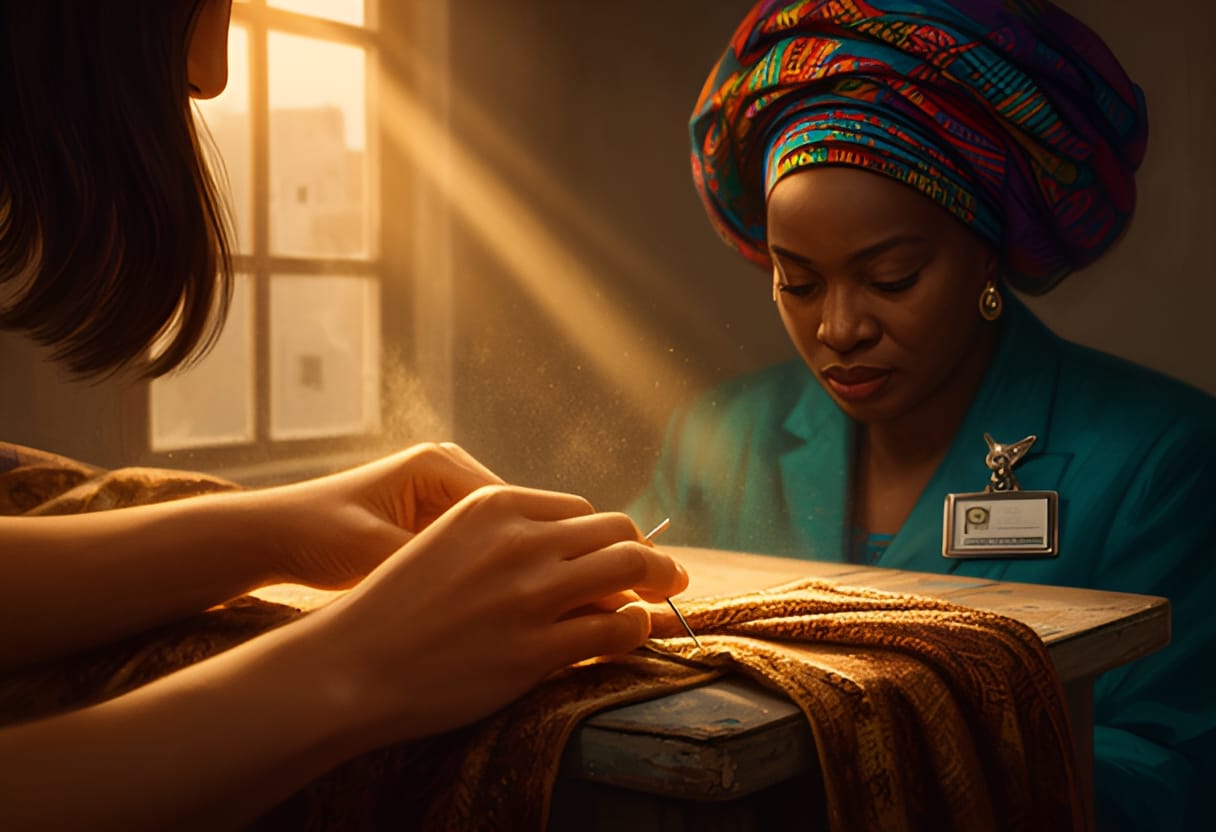
I sold my first dress before I had a shop.
Layla underlined the phrase in her mind. It wasn’t about waiting for a storefront, a loan, or a degree. It was about making something someone else valued—right then, with what she had.
She read on. Alakija’s tailoring side hustle grew. She reinvested every profit into better materials, then hired an assistant. Soon, she was dressing wives of diplomats and executives, her label becoming synonymous with understated elegance. The income from those garments funded her next bold move: a application for an oil prospecting license. When it was granted—a rare feat for a Nigerian woman at the time—she used her fashion earnings to cover the initial fees, partnering later with a major corporation.
Layla felt a quiet heat rise in her chest. It wasn’t envy. It was recognition. Alakija hadn’t begun with a vision of oil rigs. She began with a needle and thread, and each step paid for the next.
She closed her laptop and tucked the flyer deeper into her bag. The stairwell echoed with the distant call to prayer from a nearby mosque. Below, Mrs. Halim called out to a customer, her voice warm and familiar.
Layla descended the last flight, stepped into the fading light, and turned left toward home. The flyer crinkled softly in her pocket. She didn’t know yet what her first dress would be—her first small thing offered for value—but she knew, now, that it didn’t need to be perfect. It just needed to be begun.
Layla fumbled with her keys at the apartment door, the flyer pressing against her thigh through her pocket. Inside, the air was still and warm, the ceiling fan turning lazily above the small living room where a folded prayer rug lay near the window. She dropped her bag on the worn sofa and kicked off her sandals, then went straight to the small desk in the corner where her laptop waited, still open from earlier.
She didn’t turn on the light. Instead, she pulled the flyer from her pocket and smoothed it on the desk, the cheap paper already creased from being folded and unfolded. The library’s glow from the screen painted blue rectangles on the wall as she typed again—this time, Ingvar Kamprad.
The results loaded slowly. A black-and-white image appeared: a young boy in a flat cap, standing beside a wooden bicycle loaded with small boxes. The caption read: Ingvar Kamprad, age five, selling matches to neighbors in Agunnaryd, Sweden.
Layla leaned forward. She read how Kamprad, as a child, bought matches in bulk from Stockholm and resold them one by one to people in his village, making a small profit on each box. By ten, he had expanded to selling fish, Christmas tree decorations, and pencils, using mail-order ads in local newspapers to reach customers beyond his immediate reach. At seventeen, he used a small gift from his father to register a company—IKEA, an acronym of his initials and the names of the farm and village where he grew up. He started by selling pens, wallets, and picture frames through a mail-order catalog, delivering them himself on the milk run.
Layla traced the edge of the flyer with her thumb. It wasn’t genius, she thought. It wasn’t even original. It was just noticing what people needed nearby and finding a way to give it to them—again and again, a little better each time.
A knock came at the door. She shoved the flyer under the laptop and called out.
“It’s open.”
Nadia pushed in, wiping sweat from her forehead with the back of her hand. Her tote bag swung from her shoulder, half-filled with fabric swatches and a sketchpad.
“You look like you’ve seen a ghost,” Nadia said, dropping onto the edge of the sofa. “Or a revelation.”
Layla smiled, pulling the flyer back out. “I was just reading about this guy who started IKEA by selling matches from his bike when he was five.”
Nadia raised an eyebrow. “Matches?”
“Yeah. He bought them cheap, sold them one by one. Then fish, then pencils. All through mail order. He didn’t wait for a shop. He just started with what he could carry.”
Nadia leaned forward, elbows on her knees. “And what does that have to do with you?”
Layla hesitated, then said, “I could do something like that. Not matches. But… resume help. For graduates. People I already know.”

Nadia tilted her head. “You mean like editing CVs? Interview prep?”
“Yeah. I’ve done it before—for free. For cousins, for Nadia’s friend’s cousin. I know what works. I could charge five dinars a session. Print a few more flyers. Put them up at the university, the career center…”
Nadia was already nodding. “You’ve got the skill. You’ve got the time. And you’ve got the proof—you helped me redo my CV last year when I applied to that agency. Got the interview, didn’t you?”
Layla felt a warmth spread behind her ribs. “I did.”
“Then why wait for permission?” Nadia said, standing. “Start with the five people you already know. Ask them to pay you five dinars each. If they say no, you lose nothing. If they say yes—you’ve got your first income.”
Layla looked down at the flyer in her hand. The words negotiable pay stared back at her. She thought of Alakija’s first dress, sold for the cost of fabric and a little extra. She thought of Kamprad’s first matchbox, handed over with a smile and a small coin.
She met Nadia’s eyes. “Okay.”
Nadia grinned. “Okay what?”
“I’ll make ten more flyers tonight. Tomorrow, I’ll put them up. And I’ll message Samir and Dia and Yusra—see if they want help with their grad applications.”
Nadia clapped her once on the shoulder. “That’s the spirit. Now, how about some tea? I think Mrs. Halim’s making extra foul today.”
Layla closed her laptop. The screen went dark. She stood, stretching, and followed Nadia to the door, the flyer tucked safely in her pocket—not as a promise, but as a beginning.

Chapter 3
First Steps, First Income
Layla sat cross-legged on the floor of her small apartment, the afternoon light slanting through the window and catching dust motes above the low table. On it lay a single sheet of paper, blank except for the faint grid lines from the library printer. She had opened Canva on the borrowed laptop, chosen a clean template, and typed in bold, simple Arabic: مساعدة في السيرة الذاتية والتحضير للمقابلات – 5 دينار. Below it, the English translation: Resume Help & Interview Prep – 5 JOD. She added a small icon of a document with a checkmark and her phone number at the bottom, then saved the file as Flyer_ResumeHelp_v1.
She walked to the library’s printing room, fed ten sheets into the machine, and watched as they emerged warm and slightly smelling of toner. Stacking them neatly, she tucked the pile into her tote bag and stepped back into the late morning sun.
Al-Balad market buzzed with the usual rhythm—vendors calling out prices, the scent of za’atar and fried falafel drifting from street carts, students in backpacks hurrying between the university gates and the nearby career center. Layla moved slowly, purposefully. She pinned one flyer to the corkboard outside a quiet café where students often studied between classes, another near the entrance of the university’s student affairs office, and a third on the glass pane of a juice stand frequented by graduates polishing their LinkedIn profiles. She paused at each, smoothing the paper flat, checking that the text was legible, the number clear.
By the time she reached the career center’s bulletin board—already layered with faded announcements for internships and volunteer programs—she had placed six flyers. Four remained in her bag. She considered the library again, but decided against it; she wanted to be where people actively sought work, not just passed through.
Returning home, she laid the remaining flyers on her table and stared at them. The silence of the apartment pressed in. She checked her phone. No notifications. No missed calls. She opened WhatsApp, scrolled to her chat with Nadia, and typed: I put up the flyers today. Five dinars per session. Then deleted it. What if no one replies? What if they see the price and think it’s not worth it? Or worse—what if they see it and think I’m not qualified?
She lay back on her mattress, arm over her eyes. The call to prayer had echoed over the city hours ago, but the quiet that followed felt different now—not peaceful, but expectant, like waiting for a door to open that might never budge.
She thought of Sara Blakely, standing in fax offices day after day, pitching a product no one seemed to need. Years of silence before the first “yes.” Layla had read that story in the library just two days ago, printed it out, and highlighted the line: “You don’t have to get it right. You just have to get it going.”
She picked up her phone again. This time, she sent the message to Nadia: I put up the flyers. Five JOD. No replies yet. But I’m not taking them down.

Nadia’s reply came fast: Good. Remember—your first ten clients aren’t about the money. They’re about proof. That you can do it. That someone will pay.
Layla smiled faintly. She gathered the remaining four flyers, slipped them into her bag, and told herself she’d try again tomorrow. Not because she was sure it would work, but because giving up now would mean letting the silence decide for her. And she was done letting fear have the last word. * The next morning, Layla returned to Al-Balad with the last four flyers. She replaced one that had curled at the corner near the juice stand, added another to the community board at the laundromat where students often waited while washing clothes, and placed the final two near the entrance of the career center—one at eye level, one slightly lower, where someone bending to tie their shoe might see it.
She walked back toward her apartment, passing a group of graduates laughing outside a falafel shop. One held a printed resume, frowning as he pointed at something on the page. Layla hesitated, then kept walking. Not yet.
By early afternoon, she was back at her desk, laptop open, a cold glass of mint lemonade sweating beside her. She refreshed her phone screen every few minutes. Nothing.
She thought of Ingvar Kamprad, selling matches to neighbors on his bicycle, learning what people needed by asking, not assuming. Maybe she was waiting for them to come to her. Maybe she needed to go to them.
She opened her notes app and typed: Who needs this most? Recent grads. Career changers. People applying to banks, NGOs, hotels. Where do they hang out? Career fairs. Alumni groups. The university’s job portal.
She closed the laptop. Not today. Tomorrow, she’d try something different. For now, she would wait—not passively, but with purpose. She saved her flyer design, labeled it Final_v1, and closed the laptop. The silence remained, but it no longer felt like rejection. It felt like the space before a response. And she was learning how to sit in it.
She woke before the alarm, the weight of yesterday’s silence still lingering, but lighter now—like a stone she had set down, not thrown away. She made tea, the steam curling in the quiet kitchen, and reviewed her notes: recent grads, banking, NGOs, hotels. She would go where they were. Not wait.
By mid-morning, she was back at the juice stand near Al-Balad, the same one where she’d replaced her flyer. She leaned against the cool tile wall, watching the stream of students—some with resumes tucked under their arms, others scrolling on their phones, brows furrowed. She didn’t approach. She waited, as Nadia had said, for proof—not of perfection, but of possibility.
A young woman in a navy blazer paused at the stand, eyes scanning the board. She tapped the flyer, then looked around, as if checking if anyone was watching. Layla pushed off the wall and stepped forward.
“You took one?” the woman asked, voice low.
“I put it up,” Layla said. “Resume and interview help. Five dinars a session.”
The woman hesitated. “I saw it yesterday. I… I have an interview in two days. For a teller position at Jordan Ahli Bank. I’ve never done this before.”
Layla nodded. “What’s making you nervous?”
The woman—Layla later learned her name was Dana—pulled a crumpled printout from her bag. Her resume listed volunteer work at a youth center, organizing food drives, tutoring kids in math. But the bullets were flat: Helped with events. Taught children. No sense of impact, no scale.
“You did more than help,” Layla said, pointing. “You coordinated logistics for drives that served over two hundred families. You managed a team of five tutors and improved attendance by forty percent. That’s not just volunteering. That’s leadership.”
Dana’s eyes widened. “I never thought of it that way.”
They found a quiet corner in a nearby café. Layla didn’t use a template. She asked questions: What did you enjoy? What was hard? What did you learn about yourself? Slowly, Dana’s experience took shape—not as a list of tasks, but as proof of responsibility, initiative, and people skills. Layla helped her reframe each bullet with action verbs and results. Then they practiced.
“Tell me about a time you dealt with a difficult person,” Layla said, playing the interviewer.
Dana stumbled at first, then found her rhythm: a story about calming a frustrated parent during a food drive, listening, offering alternatives, turning tension into trust. Layla nodded. “That’s customer service. That’s exactly what a bank wants.”
By the end of the session, Dana’s resume looked different—clearer, stronger. Her voice had steadied. She smiled, hesitant but real.
“Thank you,” she said. “I feel… ready.”

Two days later, Layla was folding laundry when her phone lit up. An unknown number.
“Hello?” she answered.
“Layla? It’s Dana! I got the job! They called this morning—I start next week!”
Layla’s breath caught. “You did it. I knew you would.”
“I couldn’t have without your help,” Dana said, voice bright with disbelief and joy. “I want to pay you. More than five. Ten. For the time, the advice—it was worth so much more.”
Layla hesitated, then smiled. “Ten dinars is fine. Thank you.”
After they hung up, Layla sat on the edge of her bed, the phone still warm in her hand. She looked at the four remaining flyers in her bag. She didn’t need to put them up today. She could rest.
But she wouldn’t.
She opened her notes and typed: Dana referred two friends. One wants help with an NGO interview. One with a hotel front desk role.
She saved the note. Then she walked to the window, where the late afternoon sun painted the buildings gold. Below, the city moved—people rushing, laughing, arguing, hoping. She was no longer just watching it. She was in it.
She had earned her first income not from luck, but from showing up, listening, and turning someone else’s doubt into direction. It wasn’t much. But it was hers.
And it was only the beginning. * The next morning, Layla returned to the juice stand with her last two flyers. She pinned one to the board, the other she handed directly to a young man in a wrinkled shirt who was staring at his phone, sighing.
“I help with resumes and interviews,” she said. “Five dinars. If it doesn’t help, you don’t pay.”
He blinked, then managed a small smile. “I have an interview tomorrow. For a receptionist role at a clinic.”
She sat with him for twenty minutes. Drew out his experience volunteering at a hospital pharmacy. Helped him speak of it with confidence. He left with a straighter posture and a promise to text her if he got the job.
She didn’t wait to see.
Walking home, she passed the falafel shop where she’d seen the graduates laughing days before. Now, she smiled at them—not with envy, but with kinship. One caught her eye and raised his cup in a quiet toast.
She didn’t stop. She kept walking, her bag lighter, her steps surer.
The rent was still due in three days. She had forty-two dinars, plus ten. Not enough. But she had something she hadn’t had before: proof that she could create value from nothing but her attention, her time, and her willingness to begin.
She opened her apartment door, set down her bag, and took a deep breath. The silence inside was no longer empty. It was full of echoes—of Dana’s laughter, of the young man’s grateful nod, of her own voice, steady and sure, saying: Try again.
And she would.