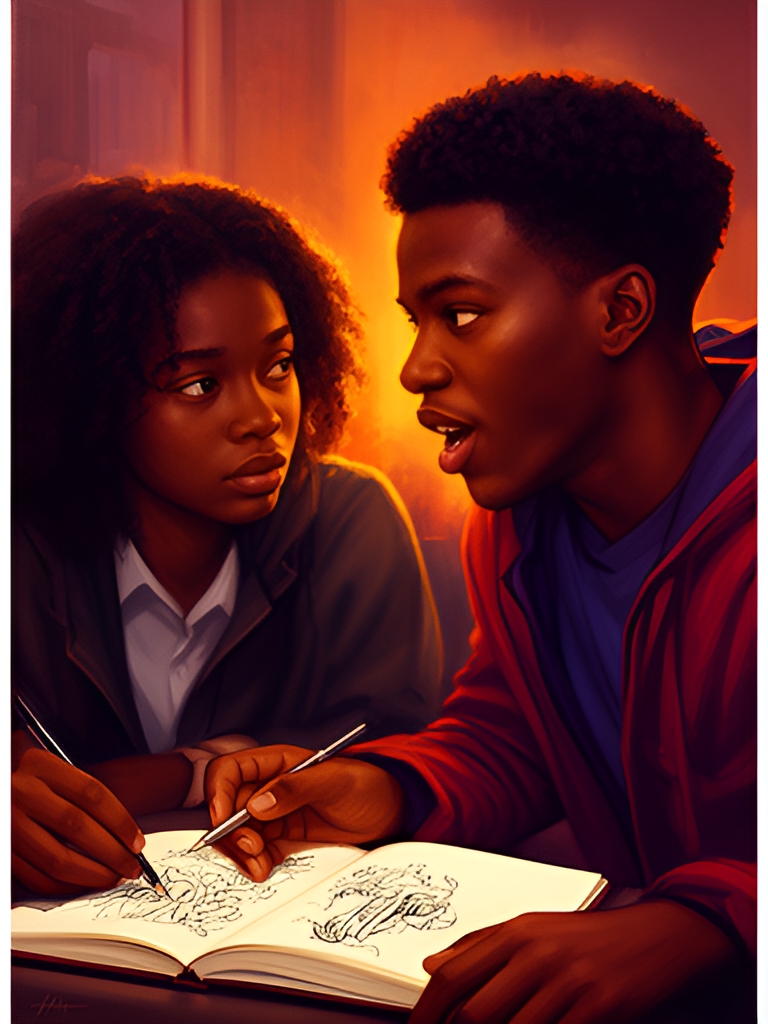
Romance
camp
by Kaylee Mwebaza
3 chapters18 min read
Chapter 1
Parallel Lines
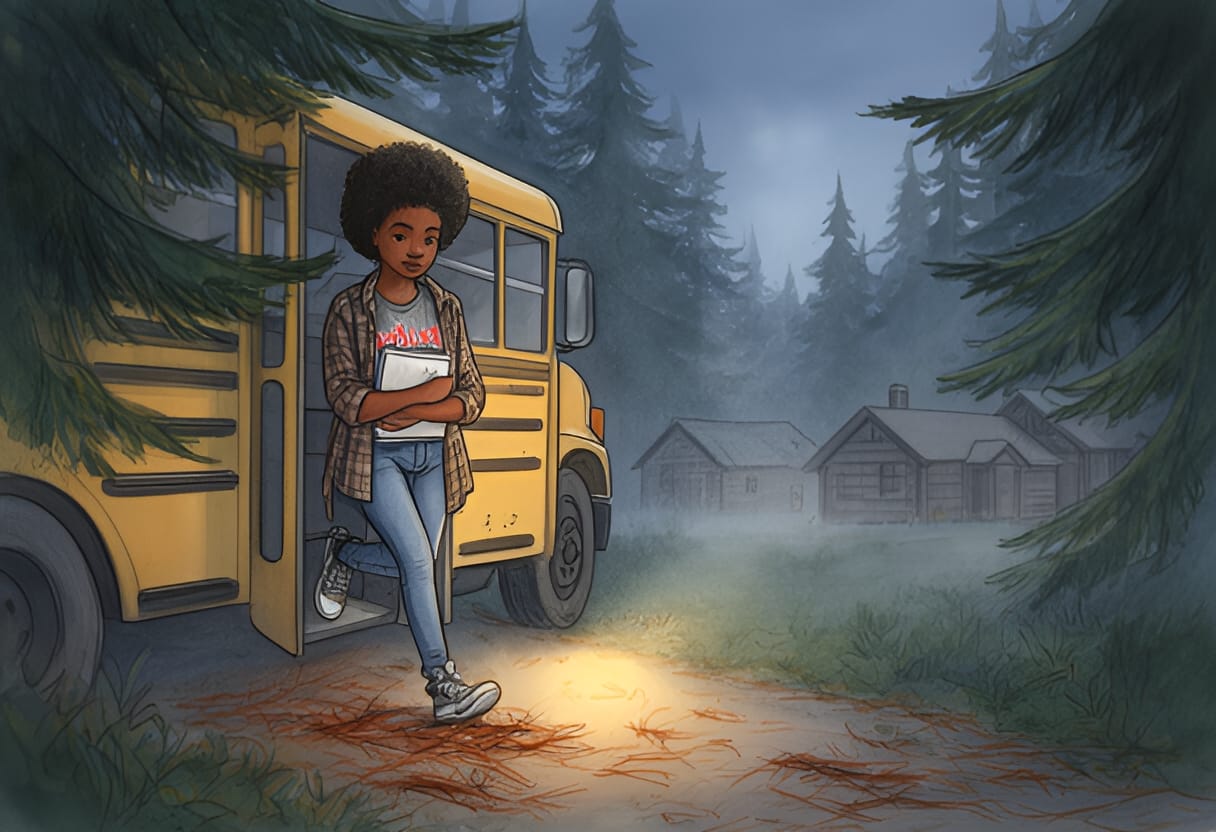
Kaylee stepped off the bus and inhaled the sharp, damp scent of pine and wet earth. The Adirondacks stretched around her in a hush of green and gray, the kind of quiet that pressed against the ears. She adjusted the strap of her backpack, fingers brushing the worn cover of her sketchbook tucked inside, and let her gaze drift to the tree line where the woods began in earnest. Without thinking, she pulled the notebook from her bag and began to draw—quick, loose lines capturing the way the light fractured through the branches, the uneven trunks standing like sentinels. Her pencil moved on its own, a habit born of needing to say something when words felt too heavy or too exposed.
A counselor in a faded camp T-shirt approached, clipboard in hand. “Kaylee Morgan?” She looked up, pencil hovering. “Yeah.” “Cabin Four. You’re with Caleb Jennings.” She nodded, tucking the sketchbook back into her bag without showing the drawing. “Thanks.”
The bus doors hissed shut behind her, and another student stepped down—tall, shoulders hunched beneath a too-big hoodie, arms crossed like he was bracing for impact. Caleb. She’d seen him around school, always on the periphery, a sharp retort looping behind his eyes like a warning sign. He never looked at her, and she’d learned not to look too long at him either.
He muttered something to the counselor—something dry, maybe sarcastic—that earned a tight smile and a shrug. Then he turned away, jaw set, and began walking toward the cluster of cabins without waiting to see if she followed.
Kaylee watched him go, the space between them already feeling like a canyon. She fell into step a few paces behind, hands shoved deep in her pockets, sketchbook pressed against her thigh.
Cabin Four sat apart from the others, a squat wooden building with a sagging porch and windows that looked too dark to be inviting. Caleb stopped at the door, didn’t knock, just pushed it open and stepped inside. Kaylee lingered on the threshold, listening to the creak of the floorboards, the silence that swallowed sound whole.
Inside, the cabin was spare: two sets of bunk beds against the far wall, a small table with two chairs, a shelf holding a few board games and a lantern. Caleb had already claimed the bottom bunk nearest the window. He was unpacking with quick, efficient motions—shoving clothes into the narrow dresser, stuffing a toothbrush into a chipped mug. He didn’t look up when she entered.
Kaylee set her bag down on the other bottom bunk, the one farthest from him. She unfolded her sleeping bag with deliberate slowness, smoothing out the wrinkles as if buying time. Her sketchbook lay open on her lap again, though she wasn’t drawing. She could feel his awareness like a faint pressure at the edge of her vision—sharp, wary, then retreating.
She pulled out a change of clothes, folded them neatly, and placed them on the pillow. The cabin smelled of old wood and dust, the kind of quiet that made every small sound loud—the zipper of her bag, the rustle of fabric, the uneven rhythm of his breathing across the room.
She wanted to say something. Anything. This is weird, huh? Or even just Hey. But the words stayed locked behind her teeth, useless and heavy. Instead, she stared at the grain of the wooden bunk above her, tracing the knots and whorls with her eyes, waiting for the silence to become something else— or for the courage to break it.
Caleb zipped his bag shut with a final snap. He sat on the edge of his bed, elbows on knees, staring at his boots. Then, without looking at her, he said, “Weird assignment, huh?”
Kaylee blinked. She hadn’t expected him to speak first.
She kept her eyes on the bunk above. “Yeah.”
A pause. The wind shifted outside, making the pines sigh.
He didn’t look at her. Didn’t wait for more. Just stood, grabbed his hoodie, and walked out onto the porch, the screen door clicking shut behind him.
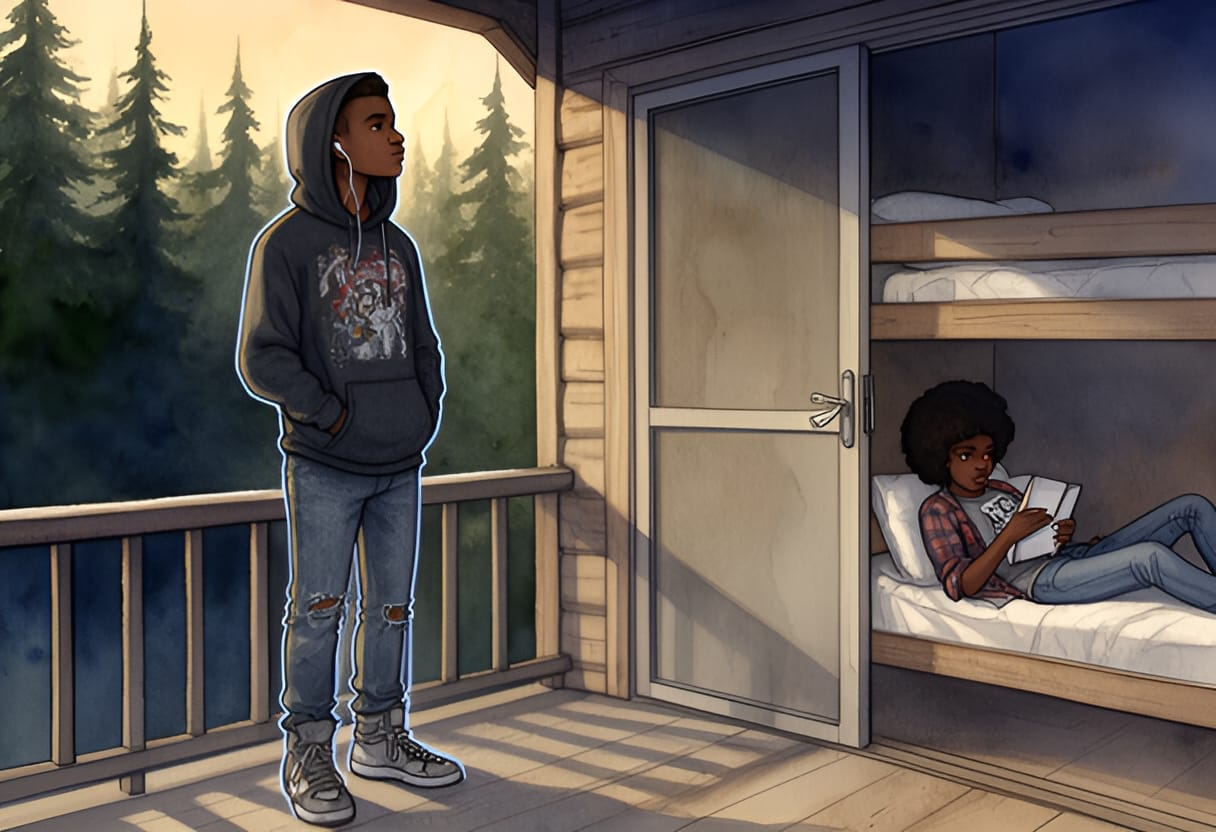
Kaylee let out a breath she didn’t realize she’d been holding. She closed her sketchbook, pressed it to her chest, and lay back on the bunk, staring up at the ceiling where the shadows pooled thick and still.
Somewhere in the woods, a twig snapped.
She didn’t move.
She just listened.
Kaylee lay very still, listening to the forest breathe. The snap of the twig had faded, replaced by the slow, settling creak of the cabin itself—wood contracting in the night air. She kept her sketchbook pressed to her chest, the familiar weight a small comfort against the prickle at the base of her skull. Sleep tugged at her, heavy and soft, but she resisted, wary of what might come in the dark.
Then, a shift—not in the woods, but in her lap.
Her eyes flew open.
The sketchbook was open.
Not where she’d left it, closed and held tight. Now it lay across her knees, pages turned, the pencil resting on the blank sheet as if waiting. Her breath hitched. She hadn’t moved. She was certain of it.
She lifted the cover slowly, heart hammering against her ribs.
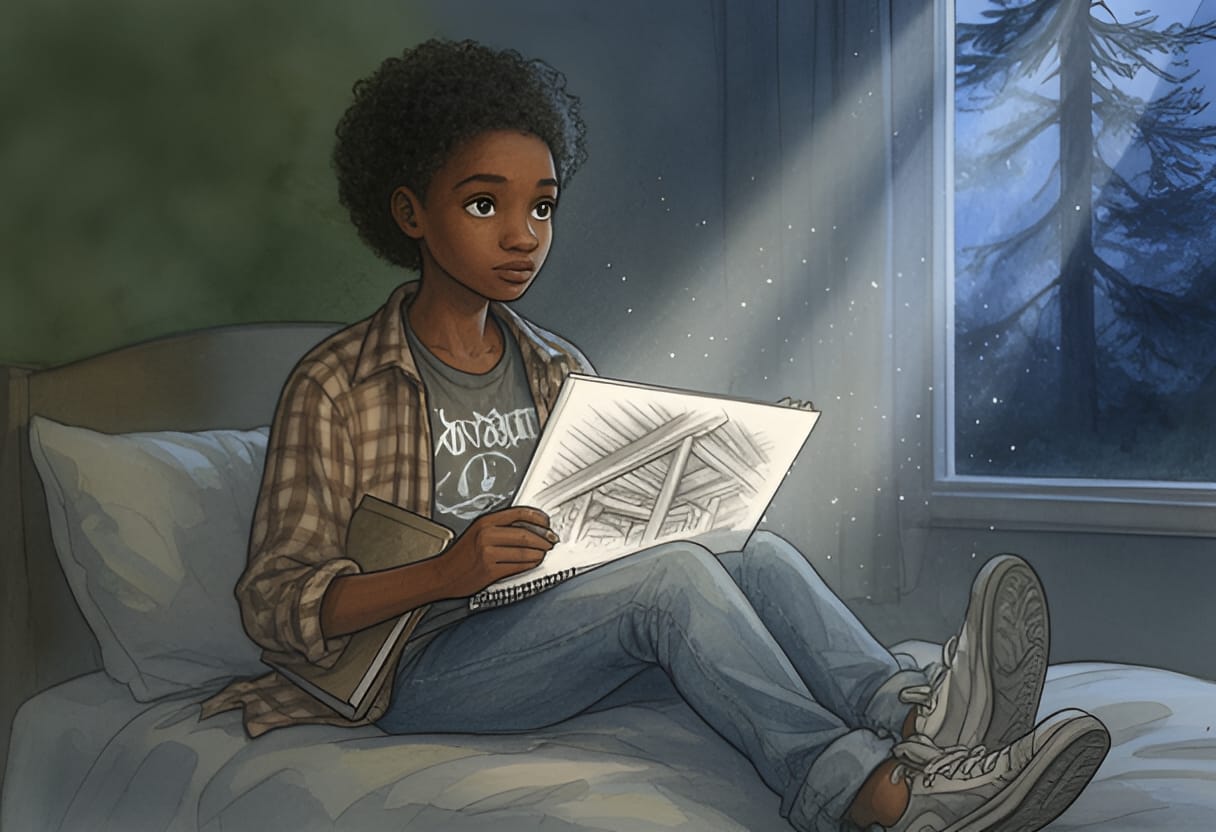
There, on the left-hand page, was a drawing.
Not hers.
Not the loose, quick lines of the pines she’d sketched on the bus. This was deliberate. Precise. A close-up of one of the cabin’s ceiling beams—the one directly above her bunk—rendered in careful shading, every knot and whorl of the wood mapped out. But carved into the beam, where no carving existed, were symbols. Angular. Interlocking. Like nothing she’d ever seen, yet somehow familiar, as if pulled from a dream she couldn’t recall.
Her fingers trembled as she touched the page. The graphite felt real. Smudged at the edges, as if rubbed there with pressure, with intent.
She hadn’t drawn this.
She hadn’t even been thinking of the beam.
A cold spot bloomed between her shoulder blades.
She didn’t call out. Didn’t want to sound foolish, to give Caleb the satisfaction of thinking she’d lost her mind. Instead, she slipped from the bunk, bare feet silent on the floor, and crossed the room in three steps.
Caleb was still on the porch, leaning against the rail, staring into the trees. His hoodie was up, hands buried in the pockets, shoulders tense. He hadn’t moved since he went out.
She knocked softly on the screen door.
He didn’t jump. Just turned his head, eyes catching the faint glow from the lantern inside. “You’re up,” he said, voice low. “Couldn’t sleep either?”
She held out the sketchbook, pages flat against her palm. “Did you… did you draw this?”
He took it, brow furrowing as he glanced at the image. Then he froze.
His thumb traced the edge of the page, not the drawing, but the paper itself—checking, maybe, if it had been torn and replaced. When he looked up, his expression had shifted. The usual guard was still there, but beneath it, something else: recognition. Unease.
“I didn’t draw that,” he said quietly. “But I know those marks.”
Kaylee’s stomach dropped. “You do?”
He nodded, jaw tight. “This morning. When I walked the trail behind the cabins—I saw them. Carved into an old oak, halfway up the trunk. Same pattern. Same… weight.” He hesitated. “I thought it was just some kid’s dumb prank. Gang signs or whatever. But this… this isn’t random.”
He handed the book back, his fingers brushing hers. A spark of something—not shock, not fear, but a sudden, sharp alignment—passed between them. Like two wires touching in the dark.
“We should lock the door,” he said.
Kaylee nodded, her throat tight. “Yeah. Yeah, we should.”
Inside, she slid the bolt into place with a soft click. Caleb checked the window latch, gave it a firm push to make sure it held. They didn’t speak. Didn’t need to. The air between them had changed—not warm, not friendly, but charged with a shared alertness, like two animals sensing the same shift in the wind.
They returned to their bunks in silence. Kaylee clutched the sketchbook to her chest again, but now it wasn’t just a shield. It was evidence. A question. A thread.
Caleb lay still on his bunk, eyes fixed on the ceiling beam—the one in the drawing. After a long while, he whispered, so low she almost missed it: “You sure you didn’t draw it?”
She swallowed. “Positive.”
Another pause. Then, quieter: “Then who did?”
She didn’t answer. Couldn’t.
Outside, the wind dropped. The pines held their breath.
And somewhere, deep in the dark, the woods listened.
Chapter 2
Threads of Contact
They didn’t sleep right away. The silence after Caleb’s whisper pressed against the walls, thick and listening. Kaylee stared at the ceiling beam, tracing the symbols in her mind—each line, each angle—wondering if they pulsed when no one was looking. Caleb’s breathing eventually slowed into the uneven rhythm of sleep, but she remained awake, sketchbook clutched like a talisman, until the first gray light seeped through the window.
Morning came without fanfare. No birdsong, just the hush of pines and the distant clatter of dishes from the mess hall. Kaylee dressed slowly, folding her pajamas with care, her eyes catching on the sketchbook where it lay on her lap. She didn’t open it. Didn’t need to. The image was burned behind her latches.
At breakfast, Caleb sat two tables away, shoulders hunched over a bowl of oatmeal, spoon moving in slow circles. He looked up once, caught her gaze, and gave the barest lift of his chin—acknowledgment, not invitation. She nodded back, then looked down at her tray. The food tasted like cardboard.
The ropes course was supposed to build trust. That’s what the counselor had said, voice bright and fake as plastic wrap. Kaylee had rolled her eyes when she heard it. Trust. As if falling backward into a stranger’s arms could fix what was broken.
They were paired during the low-element segment—spotter and climber. Caleb took the first turn climbing, his movements economical, silent. Kaylee stood below, hands raised, ready to catch. Her palms itched. Not from nerves, not exactly. From the memory of his fingers brushing hers on the sketchbook page—how the air had thickened, how time had stuttered.
When it was her turn, she climbed slowly, testing each rope and rung. Caleb stood firm below, eyes locked on her hips and shoulders, ready to shift his weight at a twitch. Halfway up, her foot slipped on a frayed knot. She gasped, legs scrambling, and instinctively reached out—not for the rope, but sideways, toward the spotter’s arms.
His hands shot up. Their palms met mid-air—just a graze, really—but it landed like a current. Hot. Sharp. She froze, toes barely gripping the rope, breath caught in her throat. His fingers twitched against hers, then pulled back as if burned.
“Sorry,” he muttered, eyes dropping to his boots.
“Me neither,” she whispered, voice raw.
They didn’t speak for the rest of the exercise. When they finished, Caleb stepped back, wiping his hands on his jeans like he’d touched something dirty. Kaylee climbed down slowly, legs trembling, and went straight to the cabin.
She dropped onto her bunk, heart still hammering. Then she saw it.
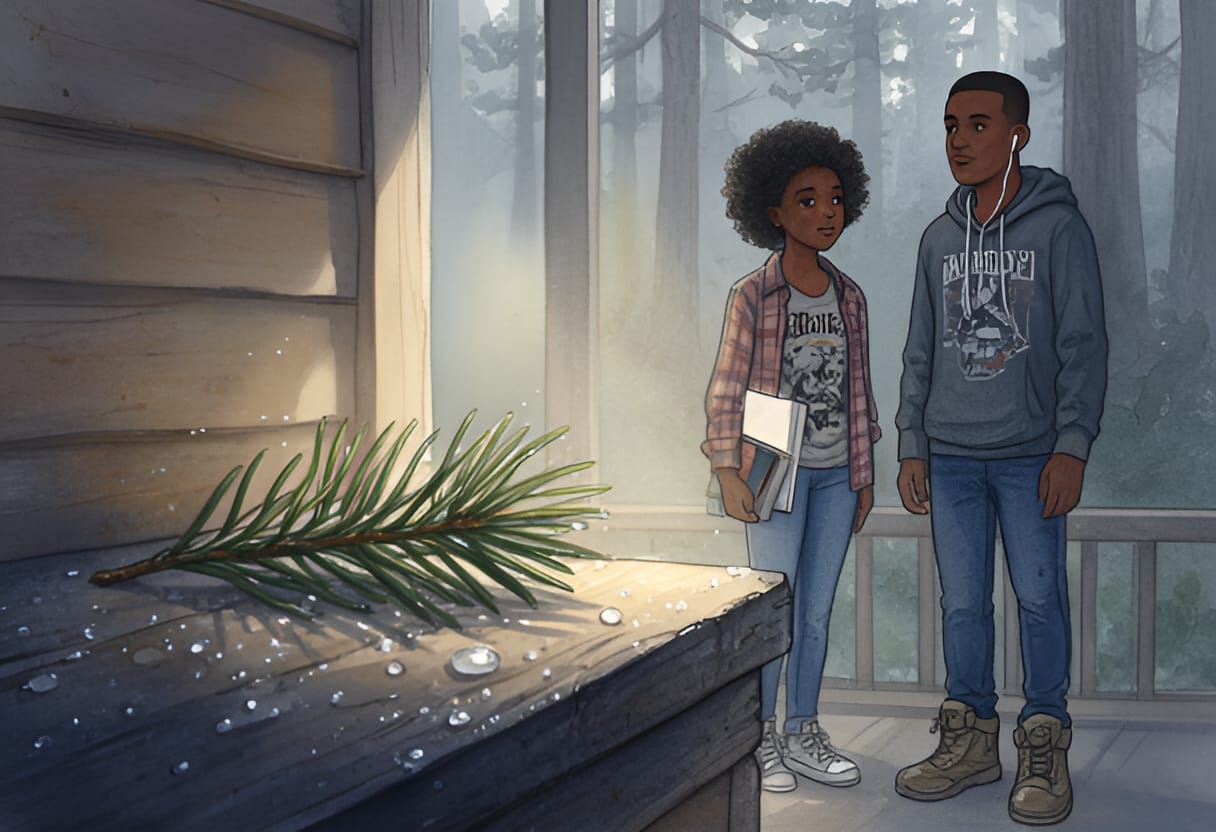
A single pine needle, dark green and glossy, resting near the pillow’s fold. She hadn’t brought any inside. Hadn’t walked through the woods barefoot or brushed against trees on the way in. She picked it up between thumb and forefinger—cool, damp with dew—and held it up to the light.
The door creaked.
Caleb stood in the frame, hoodie pulled low, eyes flicking to her hand. “You okay?” he asked, voice rough.
She held out the needle. “Did you put this here?”
He frowned, took it, turned it over. “No. I didn’t even go outside this morning.” He paused, jaw tightening. “Windows latched?”
She nodded. “I checked after breakfast. Twice.”
He stepped inside, pushed the window up just enough to feel the latch, then let it fall with a soft click. Checked the door—bolt slid smooth. Nothing disturbed. No tracks on the sill, no sign of entry.
He handed the needle back. “Weird.”
“Yeah,” she said. “Weird.”
That night, they didn’t talk about it. Kaylee left her lamp on low, the glow pooling on her sketchbook. Caleb left his door cracked—a sliver of darkness spilling into the hall. She saw it from her bunk. Didn’t mention it. He didn’t look over.
Sleep came in fragments. Dreams, when they came, were disjointed—fragments of bark, whispers just below hearing, the weight of being watched.
Then, suddenly: clarity.
They stood at the tree line, side by side, though neither remembered agreeing to meet. The pines loomed, black and close, their needles whispering in a wind that didn’t touch their skin. The air smelled of wet earth and iron.
A voice came from the shadows—not loud, not soft, but there, shaping itself from the silence.
“Kaylee.”
“Caleb.”
Each heard their own name, spoken in a tone that was neither male nor female, young nor old—something older than language, shaped from root and breath and long-buried song.
They turned toward each other, eyes wide. Caleb’s lips parted. Kaylee’s hand twitched at her side.
Then the dream frayed at the edges, the voice dissolving into rustle and sigh, and they woke—together—gasping, eyes flying open in the dark.
Kaylee’s breath hitched. Caleb’s chest rose fast beneath his blanket.
Neither spoke. But in the quiet, thick with the scent of pine and something older, she felt it—not fear, not exactly, but the quiet, seismic shift of two hearts beating in the same rhythm, pulled from the same dream by a voice that knew their names before they did.
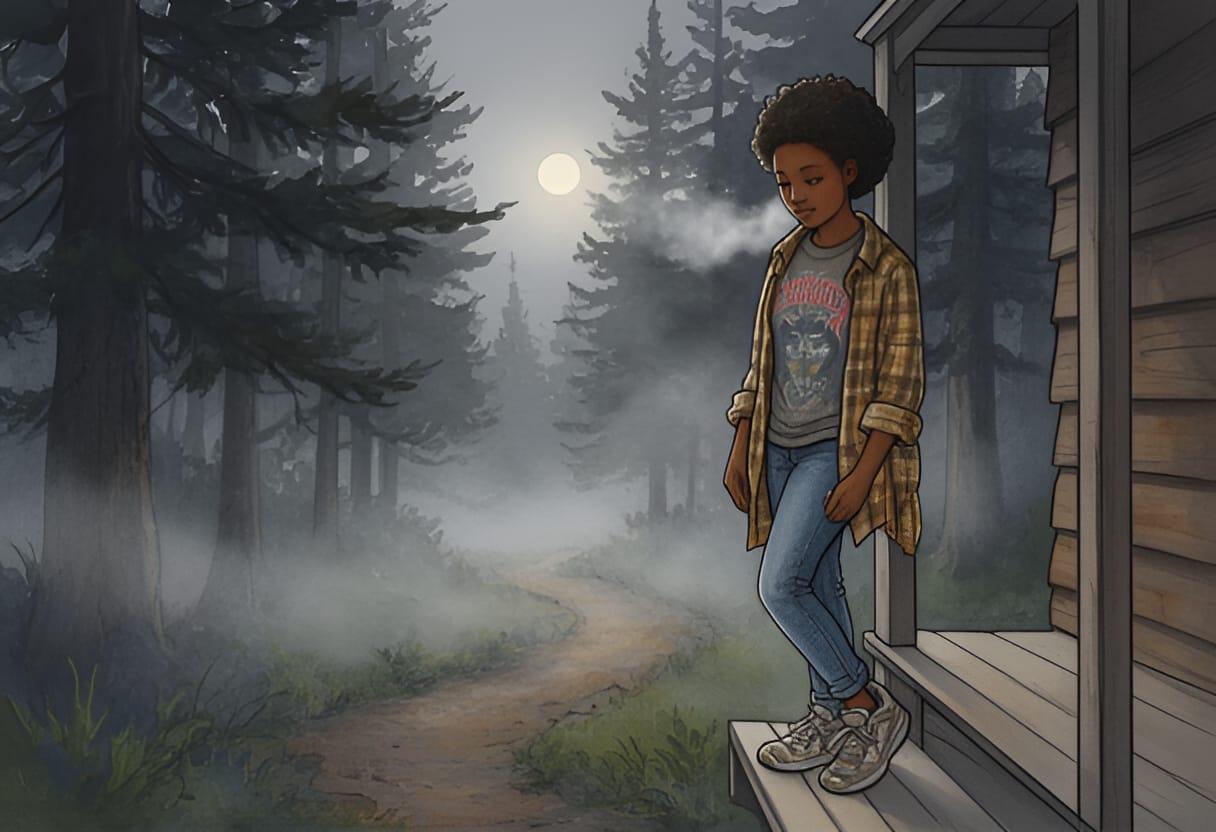
The next morning, Kaylee woke before dawn, the cabin still wrapped in gray hush. She slipped on her shoes and stepped onto the porch, breath fogging in the chill. The woods pressed close, trunks rising like sentinels. She didn’t go far—just to the edge of the clearing where the pines thinned—and stood still, letting her eyes adjust.
It wasn’t the trees she saw first, but the spaces between them. Negative shapes. Tall, slender, standing just off the trail where no growth should allow it. Like figures woven from absence. She blinked. They shifted, not with wind, but as if adjusting weight from one foot to the other.
Her sketchbook was in her hand before she thought to reach for it. She flipped to a fresh page and began to draw—not the trees, but the gaps. The hollows where something stood just behind the bark, just beyond sight. Lines came fast, urgent, angular. When she lowered the pad, her chest felt tight, not with fear, but with the eerie certainty of being seen in return.
She tucked the book under her arm and turned back toward the cabin. Halfway there, she paused. Caleb was already on his own porch, leaning against the rail, staring into the woods with the same stillness. He hadn’t seen her yet. His shoulders were tight, jaw set.
Then, almost imperceptibly, he tilted his head—not toward her, but slightly down the trail, where the pines clustered thick. His eyes narrowed. Not in anger. In recognition.
She didn’t wave. Didn’t call out. Instead, she lifted her sketchbook just enough for him to see the page—quick, deliberate—then let it fall against her side.
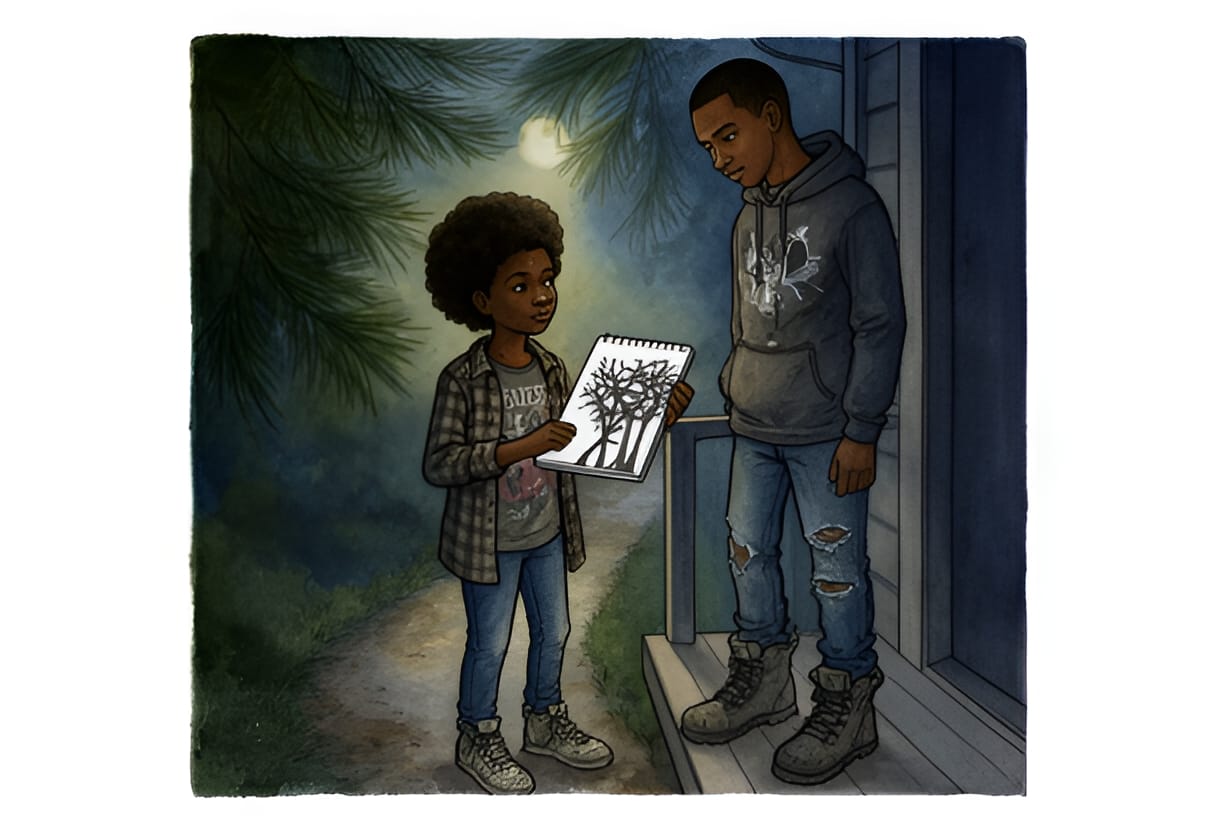
He glanced down. Saw the drawing. His breath hitched, so faint she might have imagined it. He gave the tiniest nod. Not thanks. Not agreement. Just: I see it too.
They went inside without a word.
That evening, after dinner, Kaylee left her flashlight on the bunk, beam angled toward the door. Not bright. Just enough to catch movement in the dark. She didn’t look to see if Caleb noticed. But when she passed his bunk later, she saw his door open a crack—wider than before—and a small stack of river stones just inside the threshold. Three flat, one balanced atop another, then another, then a fourth, slightly off-center. A pattern. Not random. She knew it instantly: her grandmother used to stack stones like that when she wanted to mark a place as watched-over. For protection, she’d said. Or to say, I was here.
Kaylee didn’t mention it. Just smoothed her blanket and lay down.
But in the deep dark, just before sleep, she felt it—the shift in the air. Not cold. Not a draft. But the quiet sense of something having passed through the room, disturbed the stillness.
She didn’t open her eyes. Didn’t need to.
Morning light came thin and silver. Kaylee woke first, blinking against the pale glow filtering through the window. For a long moment, she lay still, listening. The cabin was quiet. Too quiet.
Then she turned her head.
Her breath stopped.
The stones were gone from Caleb’s doorway.
She sat up slowly, heart dragging itself up from deep water. Her flashlight was still on the bunk, beam still pointing at the door—but now, the light fell on something new.
The stones were arranged in a line across the threshold, just inside the door. Not stacked. Laid flat, end to end, forming a low barrier. And leading away from the door, toward the window, were two more—placed heel to toe, like footsteps.
Someone had come in. Or something.
She didn’t cry out. Didn’t move. Just watched the stones, her mind racing—not with fear, but with a dawning, unsettling clarity: whatever was shaping itself in the woods wasn’t just watching them anymore.
It was learning how to answer.
Beside her, Caleb stirred. He blinked awake, frowned at the ceiling, then sat up slowly, rubbing his eyes. His gaze swept the cabin—lamp, bunk, shelf—and then dropped to the floor.
He saw the stones.
He didn’t jump. Didn’t yell. Just went very still. His hand drifted to the bunk beside him, where Kaylee sat, and hovered there for a second—almost touching her shoulder—before falling back to his lap.
He looked at her. Not with panic. Not with disbelief.
With something quieter. Something like resolve.
He didn’t say anything.
She didn’t either.
But when he stood, he didn’t go for his shoes first. He went to the door, picked up the lowest stone in the line, and placed it gently in her palm.
It was cool. Smooth. Wet with dew that hadn’t been there when she fell asleep.
He gave her a look—short, sharp, meaningful—then stepped past her and out into the morning.
Kaylee stayed where she was, the stone warm in her hand, and watched him walk toward the tree line.
He didn’t look back.
But she knew, without seeing it, that he was leaving his own mark now. Not stones. Not yet.
Something else.
And when she finally stood and followed, barefoot on the damp porch, she saw it: a single pine needle, freshly placed, tucked beneath the edge of the cabin’s threshold—pointing inward.
Like a message.
Like a trail.
Chapter 3
What the Woods Remember
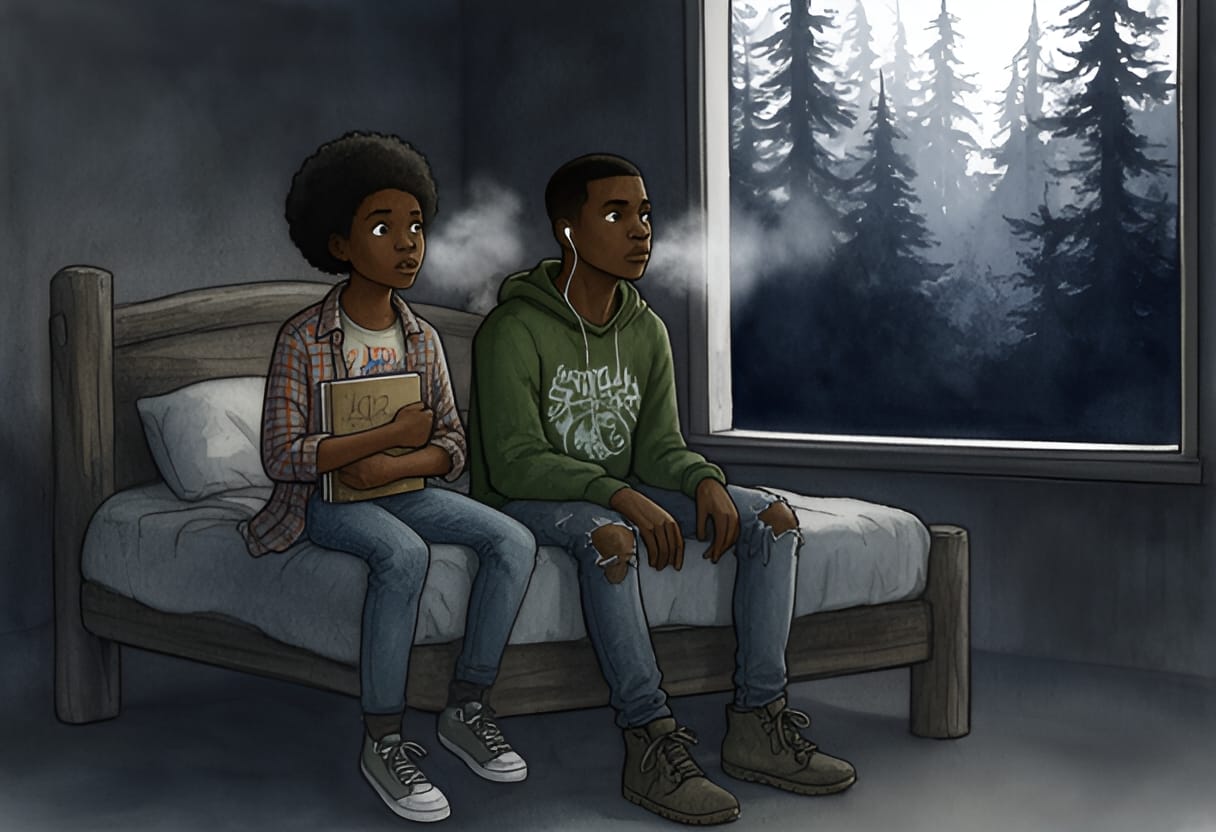
They woke at the same time, breath catching in unison, the dream still humming in their ears—a voice, low and familiar yet not, calling their names from the tree line. Kaylee sat up slowly, her sketchbook clutched to her chest as if it could anchor her to something real. Caleb was already upright on his bunk, eyes wide in the dim glow of the cabin nightlight she’d left burning. Neither spoke. The air between them felt thinner, charged, like the moment before lightning.
At breakfast, no one mentioned the dream. The counselors moved with their usual calm, serving oatmeal and juice, asking about trust exercises and goal-setting. But Kaylee noticed how Caleb kept glancing at the tree line beyond the mess hall, how his fingers tapped a quiet rhythm against his thigh—tap-tap-tap—like he was listening for something.
By afternoon, the unease had settled into their bones. They avoided each other’s eyes during trust falls, during the partner-led hikes, during the silent journaling by the lake. But at night, they found themselves drawn to the same quiet space: the porch steps, where they sat apart but not far, shoulders nearly touching, listening to the woods breathe.
Then, just after dinner, Counselor Ruiz appeared at their cabin door, smile too wide, voice too bright. “Evening reflection, everyone. Clearing by the fire. Don’t be late.”
Kaylee exchanged a look with Caleb. His jaw tightened. “Reflection?” he murmured.
She shook her head. “Feels like a summons.”
They went anyway, pulled along with the others like driftwood in a current. The path to the clearing was lit by lanterns hung low in the pines, casting long, swaying shadows. When they arrived, the fire burned low in a stone ring, its embers pulsing like a slow heartbeat. Around it, the other students sat cross-legged on blankets, already murmuring, already swaying slightly as if caught in a current only they could feel.
Kaylee and Caleb hovered at the edge, reluctant. Caleb muttered, “This ain’t team-building,” under his breath—just for her—and she almost laughed, nervous and sharp.
Then the chant began.
It started soft, a hum rising from the counselors’ throats, low and rhythmic, not in English but in something older, something that seemed to vibrate in the molars. The students joined in, voices blending, rising and falling in a pattern that felt less like song and more like remembering. Kaylee’s breath hitched. Her skin prickled.
And then she saw it—not with her eyes, but behind them: a flash of hands, dark against firelight, raised in the same gesture—palms outward, fingers spread—repeating across time. Not faces. Not names. Just hands. Generations of them. Raised, waiting, calling.
She gasped. Beside her, Caleb jerked.
Their wrists brushed. Without thinking, she grabbed his. He turned his palm up and laced their fingers together, grip tight, desperate. His breath was hot against her ear when he whispered, “They’re not just saying words. They’re calling.”
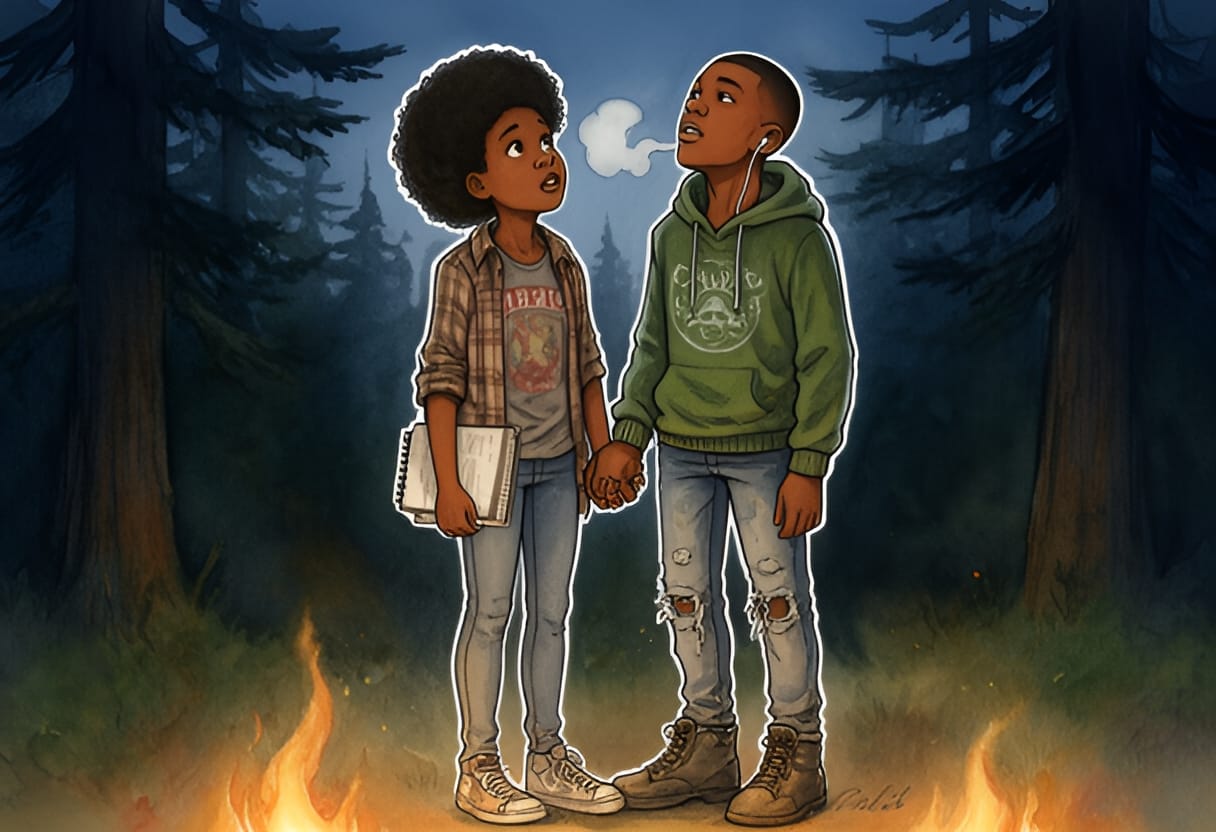
She squeezed back. Yes. This was no ritual. This was a summons. And they had been chosen not by accident, but by design—by the quiet way they moved through the world, by the things they noticed, by the silence they carried like a second skin.
The chant swelled. The fire flared. And somewhere in the dark beyond the clearing, the woods answered.
The fire had burned to embers by the time the others stirred. Murmurs of “clear-headed” and “lighter” drifted from the blankets as students rose, stretching, blinking as if waking from a deep nap. Counselor Ruiz moved among them, placing a hand on shoulders, whispering, “You felt it, didn’t you? The remembering.” No one looked startled. No one questioned why their voices had sounded like stones grinding together, or why the chant had left a metallic taste in their mouths.
Kaylee and Caleb stayed where they were, hands still clasped, knees drawn up. The warmth of his palm against hers was the only thing that felt real. The chant had stopped, but the air still vibrated, low and deep, like the hum of a wire under tension.
“We should go back,” Caleb said finally, his voice rough. “Before they notice we’re not with the group.”
Kaylee nodded, but didn’t move. Her sketchbook lay open in her lap, the page blank. She had spent the chant not seeing the clearing, not hearing the words, but feeling the weight behind her eyes—the press of something old and awake, pressing against the thin skin of the world.
They walked back in silence, the lanterns now dark, the path swallowed by night. The cabin door stood ajar, just as Caleb had left it. Inside, the air felt thick, settled. Their bunks were untouched. Neither spoke as they changed, slipped under the covers, lay staring at the ceiling where the symbols had appeared—now faded, as if never drawn.
Sleep didn’t come. Instead, they listened. To the creak of the pines, to the distant call of a night bird, to the silence between heartbeats. And beneath it all, a presence—not threatening, not hostile, but aware. As if the woods had inhaled and were now holding its breath, waiting.
At first light, they were dressed and at the trailhead before anyone else stirred. Caleb led, shoulders tight, eyes scanning the tree line. Kaylee followed, her sketchbook tucked under her arm. The path they’d taken the day before—marked by crushed pine needles and bent ferns—was gone. In its place stood a wall of thicket, thorny and dense, where no brush had been the night before.
“Must’ve missed the turn,” Caleb said, too loud. He veered left, pushing through saplings that snapped back like whips. Kaylee trailed, watching as he stopped, turned, and frowned. The trail had looped. They were back at the cabin clearing, the fire ring cold and empty before them.
“This isn’t right,” she said, her voice barely above a whisper.
Caleb ran a hand over his face. “Yeah. Yeah, it’s not.” He kicked at a stone. “We walked out yesterday. Same path. Same damn path.”
They tried again, this time following the sun, keeping the lake on their left. But the woods shifted. A fallen log that had blocked the way yesterday was now gone, replaced by a standing sapling where none had grown. The sound of water led them in circles. The air grew still, then thick, as if the trees were leaning in.
Caleb stopped, breathing hard. “This is bullshit.” He shoved his hands in his pockets. “We’re not doing the horror movie thing. No splitting up. No ‘let’s see what’s in the shed.’”
Kaylee looked at him—really looked. The guard was still there, but cracked. Beneath the sarcasm, she saw the same thing she felt: not fear, exactly, but recognition. As if something long buried had finally surfaced, not to frighten, but to be seen.
She closed her sketchbook. Not to draw what was in front of her—the twisted pines, the mist clinging to the ground—but what was behind her eyes: two figures, side by side, facing the tree line. Not holding hands. Not fleeing. Just standing. Watching. Waiting.
She opened the book again, pressed pencil to page. The lines came fast, not careful, not precise—but true. When she finished, she showed it to Caleb.
He studied it. Then, quietly, he said, “We ain’t running.”
She shook her head. “No.”
He sat down on a root, pulled off his boot, and shook out a pebble. Kaylee sat beside him, shoulder to shoulder, and began to draw again—not to capture, but to witness. To say, without words: I am here. I see you.
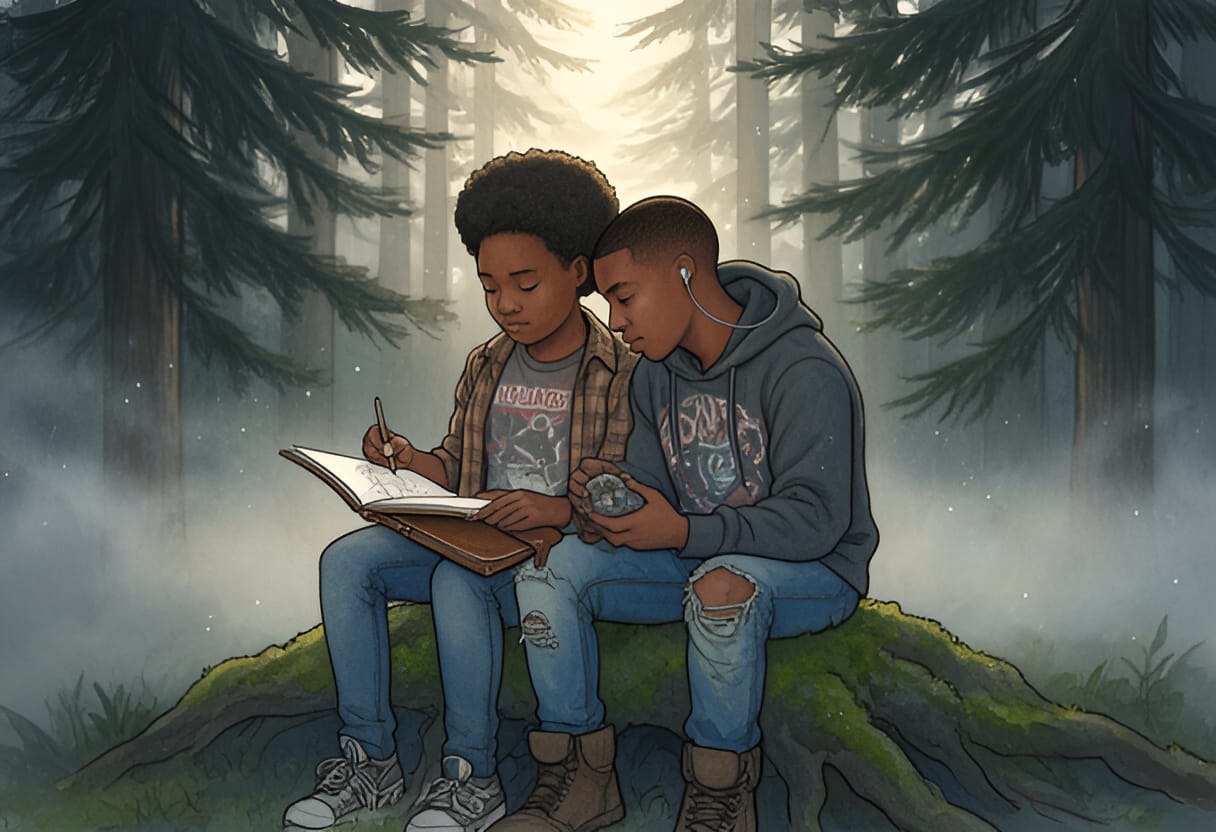
The woods did not part. The path did not reappear. But the weight in the air shifted. No longer a summons. No longer a threat.
Just presence.
And for the first time since they’d arrived, they were not alone in it.