
Education
Coloring book for children
by Amine Son
2 chapters49 min read
Chapter 1
The Lost Acorn
Pip’s Morning Jump
Pip’s paws tingled as he stretched awake in his leaf-lined nest, the morning sun filtering through the canopy above. Today felt different. He had been practicing his jumps all week, and now he was ready to show Luna and Ben how high he could leap from the old oak stump near the brook.
He scrambled out of his nest, his bushy tail swaying with excitement. The acorn he kept tucked safely in his favorite hollow — small, brown, and shiny with a tiny cap like a polished button — felt warm against his chest as he hurried toward the Whispering Woods.
The Jumping Practice
The Whispering Woods greeted Pip with soft moss underfoot and dappled sunlight dancing through the tall trees. Near the brook, where the grass grew tall and swayed in the gentle breeze, Pip found Luna perched on a low branch and Ben sniffing curiously at a cluster of mushrooms.
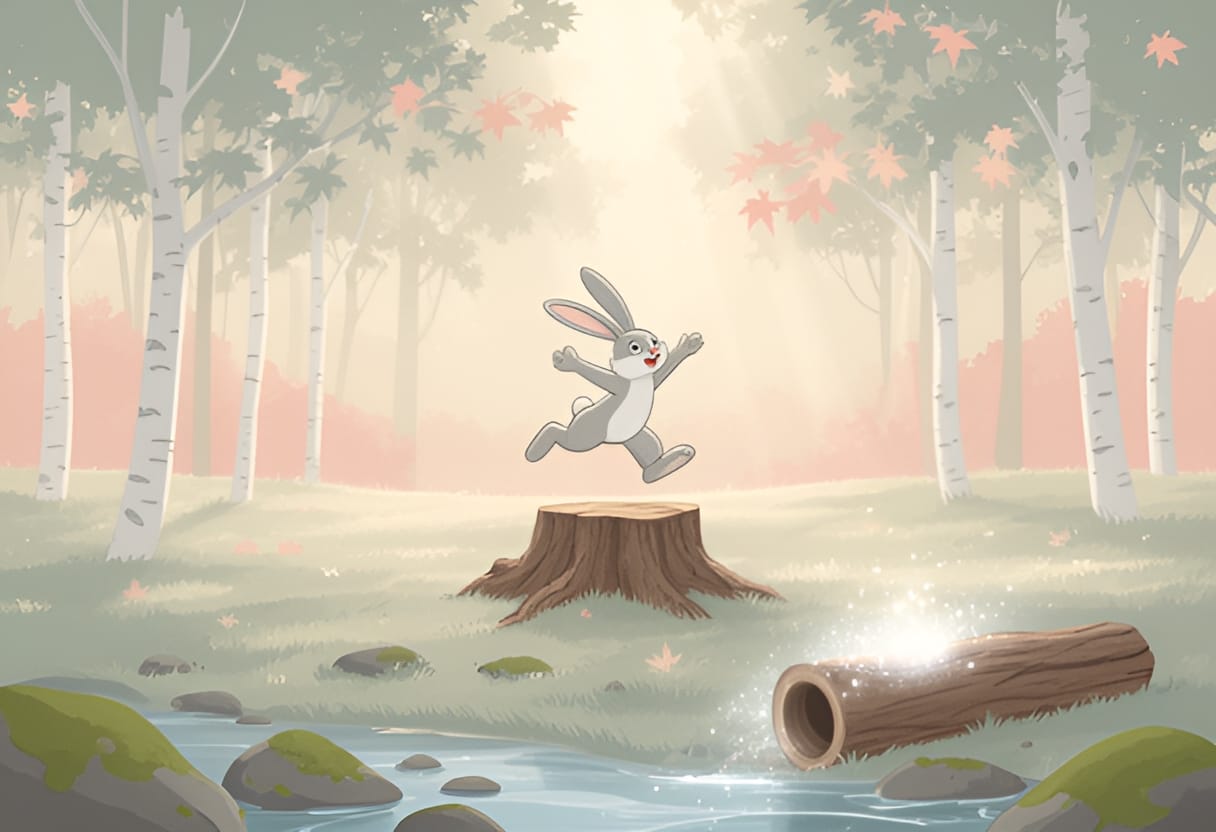
“Watch this!” Pip chirped, bounding toward the oak stump. He crouched, coiled his springy legs, and launched himself into the air. For a moment, he flew — paws outstretched, tail streaming behind him — before landing softly on the mossy ground with a triumphant squeak.
“Again!” he cried, already turning for another jump. This time, he pushed off harder, soaring just a little higher. Luna blinked slowly from her perch, her soft eyes tracking his arc. Ben gave a quiet rumble of approval, shifting his weight from one paw to the other.
On his third jump, Pip felt the acorn shift in his grip. He had been holding it tightly in his front paws, a habit he’d formed to feel brave while jumping. But as he extended his legs for takeoff, the acorn slipped — just slightly — and tumbled from his grasp.
It fell not to the moss below, but sideways into the tall grass fringing the brook, where the blades stood thick and swaying like green waves.
Pip landed hard, his heart jumping into his throat. “My acorn!” he gasped, scrambling to his feet and diving nose-first into the grass.
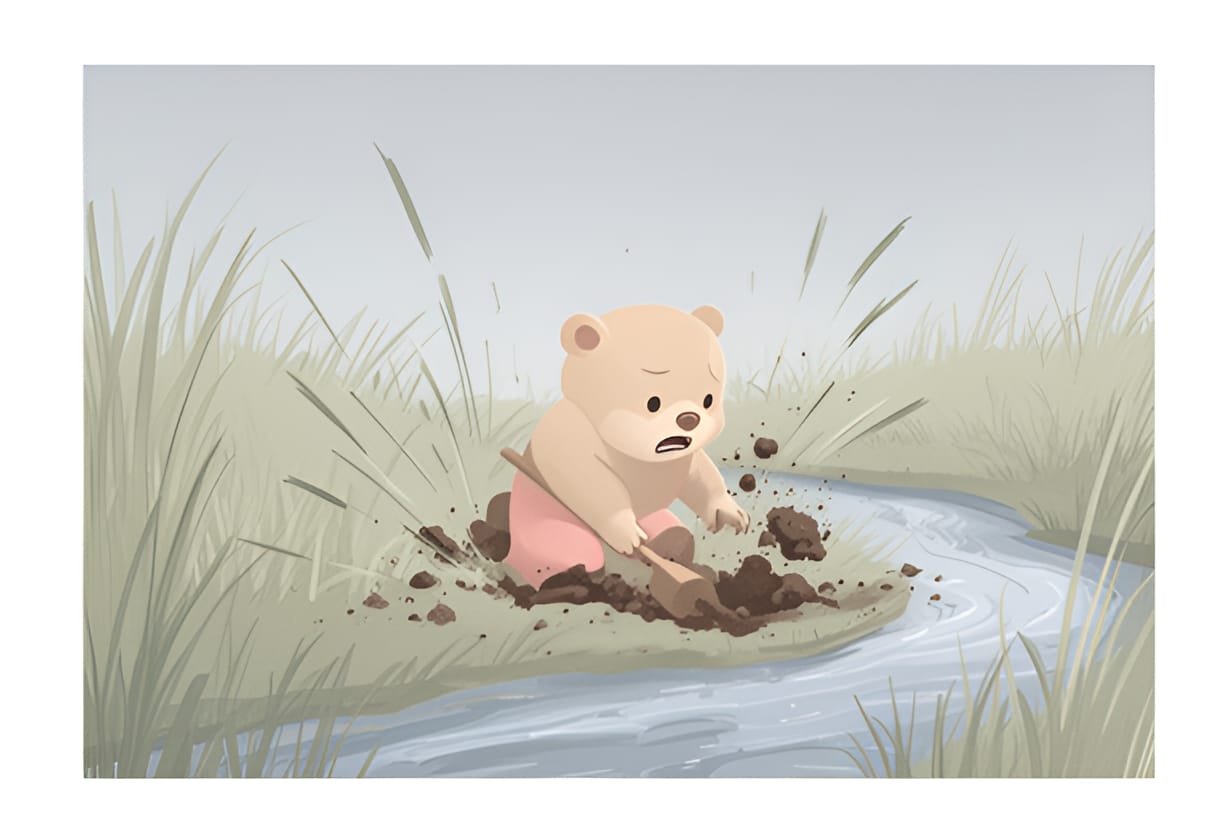
He pushed aside blades with his snout, then his paws, frantically digging and sniffing. The grass was taller than he remembered, and the acorn was small — no bigger than his thumbnail. He pushed deeper, his breath coming in short bursts, but all he found was damp earth and the occasional wriggling worm.
His excitement curdled into frustration. He scratched at the ground with both paws, sending clumps of moss flying. “It’s gone! I had it, and now it’s gone!” His voice cracked, high and tight with worry. He sat back on his haunches, ears flat against his head, staring at the empty space where he’d last felt the acorn.
Luna watched from her branch, her head tilted slightly. She didn’t swoop down or call out. Instead, she simply observed — noticing how Pip’s usual energy had drained, how his paws dug uselessly at the grass, how his bright eyes had clouded with sadness.
Ben, meanwhile, ambled closer. He didn’t speak. He simply sat down beside Pip, not too close, not too far, and gave him a gentle nudge with his muzzle — soft, steady, like a whisper saying, I’m here.
The Weight of Losing Something Small
Pip’s favorite acorn wasn’t just any acorn. It was the one he’d found on the first crisp morning of autumn, the one with the tiny cap that caught the light just right when he held it up to the sun. He kept it in a special leaf-lined box in his treehouse, taking it out only when he needed to feel brave or remember a happy day.
Losing it felt like losing a piece of himself.
His chest tightened as he thought of the acorn’s smooth surface, the way it fit perfectly in his paw. He remembered showing it to Luna last week, how she’d nodded and said, “It’s lovely, Pip. Like a little piece of the tree’s heart.” He remembered Ben trying to balance it on his nose and giggling when it wobbled and fell.
Now, it was lost in the tall grass, and Pip didn’t know how to find it.
He lowered his head, his paws dangling between his knees. The excitement of his jumps felt silly now, childish. What if he never found it? What if he’d been careless? A hot prickle formed behind his eyes, but he blinked it back. Squirrels didn’t cry over acorns, did they?
Luna finally spoke, her voice low and calm, like wind through pine needles. “You look upset, Pip. Would you like to tell me what happened?”
Pip hesitated. Then, in a small voice, he said, “I lost my acorn. I was jumping, and it fell… and I can’t find it.”
“I see,” Luna said. She didn’t offer solutions right away. Instead, she asked, “Can you show me where you were when you last felt it?”
Pip pointed a trembling paw toward the oak stump. “I was right here. I was about to jump… and then it was gone.”
Luna nodded slowly. “Then let’s start there. Together.”
Ben shifted his weight, ready to move. He didn’t offer to take over or tell Pip what to do. He simply stayed beside him, a quiet presence that said, We’ll look with you.
Why Asking for Help Matters
When Pip felt the acorn slip, his first instinct was to search alone — to fix the problem by himself, as if admitting he needed help would mean he’d failed. But Luna’s quiet question changed that. She didn’t jump in to solve it for him. She invited him to remember, to retrace his steps, to think.
This is how small disappointments become chances to grow: not by avoiding frustration, but by learning to move through it with others nearby.
Pip’s frustration wasn’t just about the acorn. It was about the fear that he’d lost something important because he wasn’t careful enough. By asking him to recall the last moment he felt the acorn, Luna helped him shift from panic to purpose. She turned a chaotic search into a calm investigation.
Ben’s quiet nudge wasn’t just comfort — it was reinforcement. It told Pip, without words, that he wasn’t alone in his frustration. That his feelings were seen, and that friendship means staying beside someone even when they don’t have the answer yet.
For children, moments like this teach that it’s okay to feel upset when something small goes wrong. What matters is what happens next: the willingness to pause, to ask, “Can you help me think?” and to let a friend stay close while you figure it out.
In the Whispering Woods, Pip sat still for a moment, his breathing slowing. The tall grass still hid his acorn. But for the first time since it fell, he didn’t feel entirely alone in looking.
Illustration
Pip sitting in the tall grass near the brook, head lowered and paws resting on his knees. Luna watches from a low branch above, her eyes soft and attentive. Ben sits beside Pip on the mossy ground, his muzzle gently touching Pip’s shoulder in a gesture of support. Dappled sunlight filters through the trees, casting shifting patterns on the moss and grass.
Luna’s Quiet Question
Pip’s breathing had steadied somewhat, though his eyes remained fixed on the empty space where his acorn had vanished. Luna waited, her gaze patient and unwavering from her low perch. When she finally spoke, her voice was softer than before, almost a murmur that seemed to blend with the rustle of leaves above.
“Pip,” she began, “when you last felt the acorn in your paw, what else do you remember? Not just where you were, but what it felt like, what you heard, what you saw?”
Pip blinked, surprised by the question. He had been so focused on the loss that he hadn’t thought to recall the moment before. He closed his eyes, as Luna had silently urged him to do, and let his mind drift back.
“I was on the oak stump,” he said, his voice still small but gaining focus. “I’d just finished my second jump… I was crouching, getting ready for the third. The acorn was in my right paw — I always hold it there when I jump, for luck. It felt… smooth and cool, like river stone. And I heard the brook laughing over the rocks, just behind me. The sun was warm on my back, and I could smell the damp moss from the stump.”
Luna nodded, her feathers ruffling slightly in a breeze that carried the scent of pine and wet earth. “Good,” she said. “Now, what happened right after you felt it in your paw? What was the very next thing you noticed?”
Pip’s brow furrowed as he concentrated. “I pushed off… with my hind legs… and as I jumped, my paw opened just a little — I must have relaxed my grip without realizing it. And then… nothing. Just air where the acorn should have been.”
“So,” Luna said gently, “it slipped during the jump, not after you landed. That means it likely fell in an arc — forward and down — from the stump toward the brook.”
Pip’s eyes snapped open. “You mean… it didn’t fall straight down? It went out?”
“Exactly,” Luna replied. “When we remember the sensory details — the feel, the sound, the smell — we often uncover clues our panic overlooks. You didn’t just lose the acorn; you felt it leave your paw. That memory is a map.”
This technique of retracing steps through sensory recall is more than a search strategy; it builds emotional regulation. By anchoring Pip in a concrete, recent memory, Luna helped shift his brain from the amygdala-driven panic of loss to the prefrontal cortex’s problem-solving mode. For children, this mirrors how naming emotions (“I feel frustrated because…”) creates psychological distance, making overwhelm manageable. In classrooms or homes, caregivers can use this by asking, “What was the last thing you saw/felt/heard before it happened?” after a minor mishap — turning frustration into focused reflection.
Ben, who had been watching Pip’s face intently, shifted his weight. “If it flew forward from the stump,” he said, “then we should look ahead of where you jumped, not just around where you landed. But the grass is thick — we could miss it if we just wander.”
He lifted a broad paw and gestured toward the brook’s edge, where the tall grass gave way to smoother stones and shallower water. “What if we split the area into sections? I’ll take the zone closest to the stump — where the grass is thickest but the ground is flat. Luna, you check the middle stretch, where the stones start to show. Pip, you take the edge near the water — you know that spot best, and your eyes are sharpest for small things.”
Pip looked from Ben’s earnest face to Luna’s approving nod. The idea of having a role, a specific place to search, made the task feel less like grasping at straws and more like a mission. “Okay,” he said, standing a little taller. “I’ll check the water’s edge.”
Ben’s suggestion of dividing the search area into zones exemplifies systematic problem-solving — a skill that transfers far beyond finding lost acorns. By breaking a large, chaotic space into manageable parts, children learn to approach overwhelm with structure. This mirrors real-world strategies like using a grid to find a lost toy in a room or dividing homework into timed intervals. The key is making the zones clear and meaningful: Ben didn’t just say “split up”; he assigned each friend a zone based on their strengths (Pip’s familiarity, Luna’s vantage, Ben’s strength in thick grass). In practice, parents can apply this by saying, “Let’s split the living room: you check under the couch, I’ll look behind the chairs, and we’ll meet at the bookshelf in two minutes,” turning anxiety into coordinated action.
As they moved to their zones, the meadow brook revealed itself in quiet detail. The water was shallow here, just deep enough to ripple softly over smooth, water-worn stones that ranged from speckled gray to warm beige. Moss clung to the northern sides of the rocks, emerald and soft, while the grass along the banks bent gently toward the current, its tips damp with spray. Dragonflies hovered above the surface, their wings catching the light like bits of stained glass.
Pip knelt at the water’s edge, parting the grass with careful, deliberate motions — no longer frantic, but methodical, as Luna had modeled. He scanned the stones, noting how each one sat in its niche, some half-buried in silt, others tilted slightly from the flow. He remembered skipping stones here with Luna last week, how they’d plunged into the deeper pools with a plink.
Ben worked his way through the thicker grass near the stump, using his broad muzzle to lift blades aside in slow, sweeping arcs. He paused often to sniff the air, his nose twitching at the mingled scents of crushed grass, wet soil, and distant wild mint. Luna, from her branch, could see the pattern of his search — neat, overlapping strips, like a farmer plowing a field.
After several minutes of silence broken only by the brook’s murmur and the occasional rustle of grass, Luna suddenly stilled. Her head tilted, eyes locked on a point near a particularly flat, sun-warmed stone about halfway between the stump and the water’s edge.
“Wait,” she whispered, her voice barely audible over the water. “Look there.”
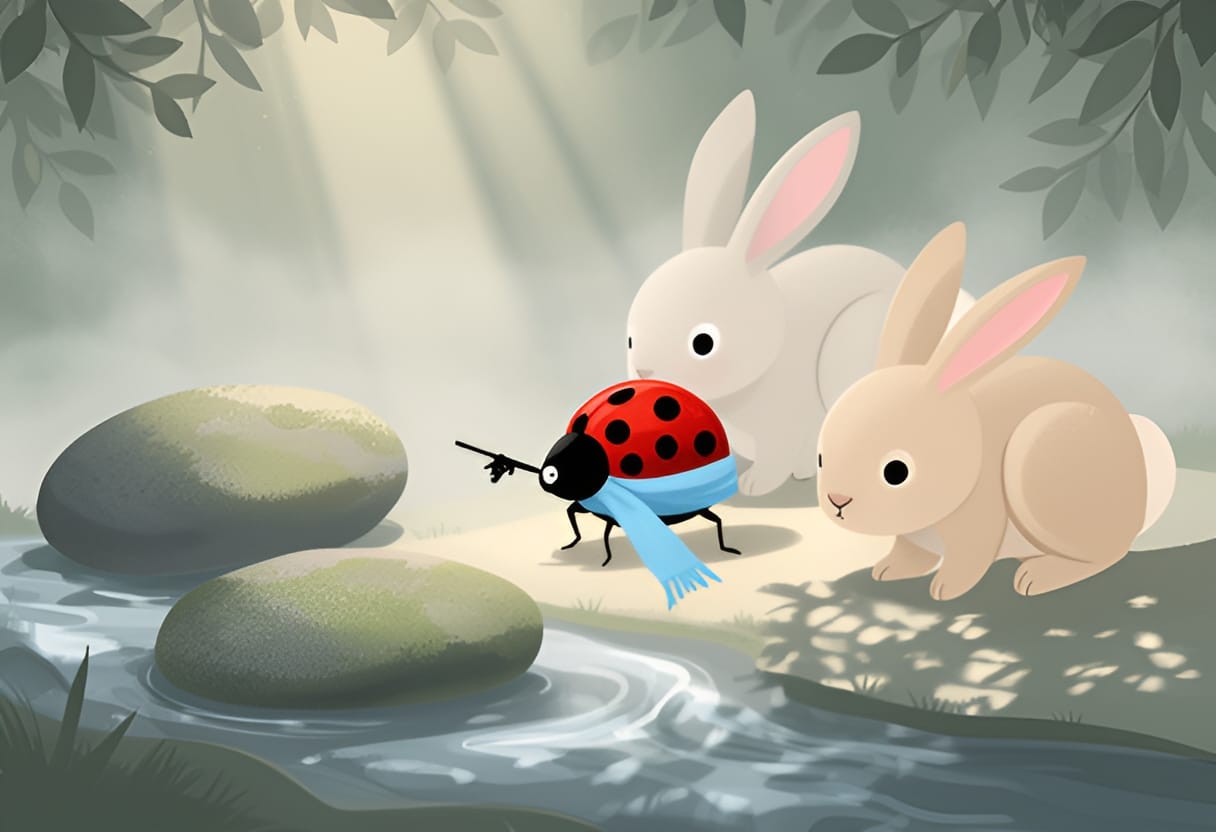
Pip and Ben froze, turning toward her direction. Nestled in the crook of two stones, half-shadowed by a blade of bent grass, lay a small, brown object. It was acorn-shaped — the familiar tapering form, the tiny cap still intact — but from this distance, it was impossible to tell if it was the acorn or just a look-alike, a seed or a pebble worn smooth by time.
Pip’s breath caught. His paw lifted instinctively, then hovered, unwilling to trust his eyes after so much disappointment. “Is it…?” he began, his voice barely a breath.
Luna didn’t move from her perch, but her tone held a quiet steadiness. “We’ll know soon enough. Let’s not rush it. Pip, would you like to go see?”
The question was an offering — not a demand, not a rescue, but an invitation to reclaim agency. Pip looked at Ben, who gave a small, encouraging dip of his head. Then, slowly, Pip stepped forward, his paws sinking slightly into the cool, soft earth at the bank. The brook gurgled beside him, steady and sure, as if it, too, were waiting to see what lay in the grass.
Ben’s Careful Check
Ben lowered his muzzle toward the object nestled between the stones, his nostrils flaring as he drew in the scents of the brook’s edge. The air here carried the cool dampness of water-worn stone, the green sharpness of crushed mint, and beneath it all, a deeper, richer aroma that spoke of time and soil. He paused, letting the smells settle, then inhaled again, more deliberately. There it was — a faint, dry sweetness like sun-warmed bark, layered with the loamy scent of forest floor where leaves had broken down over seasons. It was not the sharp citrus of pine needles, nor the sugary perfume of wildflowers that grew in sunlit patches nearby. This smell was quiet, steady, and familiar — the same scent that clung to Pip’s favorite acorn when he tucked it behind his ear or rubbed it between his paws before a jump.
He lifted his head slightly, eyes meeting Pip’s across the short distance. “It smells like tree and earth,” Ben rumbled, his voice low so as not to startle the moment. “Like the acorns that fall from the old oak near the meadow. Not sharp like pine, not sweet like clover. Just… wood and dirt, the way it should be.”
Pip’s breath hitched. He had watched Ben work — the careful arcs of his muzzle parting the grass, the way he paused to sniff, not rush. Now, seeing his friend’s focused expression, hearing the certainty in his voice, something tight in Pip’s chest began to unwind. It wasn’t just that Ben might have found it; it was how he had looked for it. Ben hadn’t grabbed or guessed. He had used what he knew — his nose, his patience — to test a hypothesis. That mattered. It showed Pip that even when you’re upset, you can still think clearly if you slow down and use your senses. Later, if Pip ever lost his favorite smooth stone by the brook, he might remember to kneel, close his eyes, and sniff for the cool, wet scent of water-worn rock instead of just grabbing at random.
Ben didn’t wait for Pip to answer. He leaned forward again, this time opening his mouth just enough to let his lips close gently around the acorn. He felt its familiar shape — the smooth, tapered body, the slight ridge where the cap met the nut, the tiny dimple at the tip. It was light but solid, not hollow like some old shells he’d found, and it fit neatly between his tongue and palate without pressure. The cap was rougher than the body, a texture like tiny scales under his lips, which told him it hadn’t been tumbled in water too long — this acorn had fallen recently, likely from the very tree Pip liked to climb. He held it steady, mindful of jostling, and lifted his head, carrying it back toward Pip with the same care he’d use to move a newborn fawn or a fallen egg from a nest.
As Ben approached, Pip’s eyes widened. His ears, which had been flattened against his head in worry, lifted and turned forward. He took a half-step, then another, until he stood upright on his hind legs, both paws outstretched. When Ben dropped the acorn into his waiting paws, Pip’s fingers closed around it instantly — not tightly, but with a reverent gentleness, as if holding something alive. He brought it close to his chest, his muzzle trembling slightly as he pressed his forehead to the nut. A soft, shuddering breath escaped him, and for a moment, he said nothing. His eyes shone, not with tears this time, but with the quiet light of relief and recognition.
“Thank you,” Pip whispered, his voice thick but clear. He looked up at Ben, then at Luna, who had remained still on her branch, watching with soft, approving eyes. “You found it. You really found it.” He shifted the acorn to one paw and reached out with the other, first squeezing Ben’s forearm in a grateful grip, then reaching up to nudge Luna’s wing with his nose — a silent thanks she always understood. His body, which had been coiled like a spring ready to snap, now softened. His shoulders dropped, his tail uncurled and swept the grass in a slow, lazy arc, and he sank back onto all fours, cradling the acorn in both paws as if it were the most precious thing in the world.
The three friends settled into a quiet circle on the bank of the brook. The water continued its steady murmur over the stones, dragonflies still hovered like living jewels, and the sun warmed their backs where it broke through the canopy. Pip sat between Ben and Luna, the acorn held firmly in his paws, his thumbs rubbing slow circles over its smooth surface. He didn’t speak. He didn’t need to. The tension had drained from his limbs, replaced by a deep, quiet steadiness. Ben shifted his weight, leaning slightly against Pip’s side — not enough to crowd, but enough to say I’m here. Luna blinked slowly from her perch, her feathers ruffling in a gentle breeze, her gaze soft and steady.
This quiet togetherness did more than mark the end of a search. It rebuilt a sense of safety. After the spike of fear and frustration, Pip’s nervous system could finally reset. The presence of his friends — their steady breathing, the warmth of their bodies nearby, the absence of demands or questions — told his body that the threat had passed. It was a lesson in co-regulation: how connection with others can calm the inner storm when words alone aren’t enough. Later, if Pip ever felt overwhelmed again — whether by a lost toy, a scraped knee, or a sudden thunderstorm — he might remember this moment: how sitting close, sharing silence, and feeling the steady presence of friends could bring him back to himself. He might even invite a friend to sit with him, just as Luna and Ben had done for him, knowing that sometimes, the bravest thing you can do is let someone stay near while you find your calm.
As the light shifted and the shadows lengthened just a fraction, Pip finally spoke. “I’m going to put it somewhere safe,” he said, his voice lighter now. “In my leaf-lined box, where it belongs.” He stood carefully, the acorn cradled like an egg in his paws, and looked at his friends. “Will you walk with me to the treehouse?”
Ben rose to his feet, giving a small, pleased snuffle. Luna spread her wings and lifted silently from her branch, landing on a low limb beside the path that wound toward the trees. Together, the three of them began the slow walk home, Pip stepping softly between them, the recovered acorn safe in his grasp, the weight of worry lifted, replaced by the quiet pride of something found — not just by luck, but by looking, listening, and helping each other see.
The path to Pip’s treehouse wound through a curtain of hanging ferns and past a cluster of mossy rocks where a family of beetles scurried under decaying bark. As they walked, Pip kept the acorn cradled in both paws, his thumbs moving in slow, comforting circles over its cap. He didn’t look down at it constantly anymore; instead, he glanced up at his friends every few steps, as if drawing reassurance from their steady presence. Ben matched his pace, his steps deliberate and quiet, while Luna flew ahead in short bursts, scanning the trail for obstacles and calling back soft warnings about low roots or slick stones.
When they reached the base of the great oak that held Pip’s treehouse, Luna landed on the lowest rung of the rope ladder and waited. Ben stepped forward and, with surprising gentleness for his size, took the acorn from Pip’s paws using only his lips and front teeth. He held it steady as Pip began to climb, his claws finding the familiar knots and grooves in the bark. Halfway up, Pip paused, his breath coming a little faster from the exertion, and Ben called up, “Take your time. I’ve got it safe.” The words were simple, but they settled something in Pip’s chest — a reminder that he didn’t have to rush, that he could trust his friends to hold things for him when he needed to.
At the top, Pip pulled himself onto the platform of his treehouse and settled onto his favorite patch of soft moss beside the leaf-lined box — a shallow container woven from twigs and padded with the downiest leaves he could find. Ben climbed up beside him and placed the acorn carefully into Pip’s waiting paws. Pip lowered it into the box, arranging the leaves around it until it lay snug and secure, just as it had before it was lost. He sat back on his heels, his paws resting on his knees, and looked at the acorn one last time — not with fear of losing it again, but with quiet appreciation for its smooth curve, its tiny cap, the way it felt solid and real in his hands.
Luna fluttered up and landed on the edge of the box, her head tilted as she watched Pip. “You kept it safe,” she murmured. “Not just by finding it, but by letting us help.”
Pip nodded, his gaze soft. “I know now that asking for help isn’t giving up. It’s letting someone else share the weight so you don’t have to carry it alone.”
Ben shifted his weight, his big frame settling comfortably against the tree trunk behind them. The late afternoon sun filtered through the leaves above, painting dappled gold on the moss, the box, and Pip’s fur. For a long while, none of them spoke. The only sounds were the distant call of a woodpecker, the rustle of a squirrel’s tail in the upper branches, and the slow, steady rhythm of their breathing — in, out, in, out — like the brook below, constant and sure.
In that stillness, Pip felt something settle deep inside him, not just relief, but a quiet kind of strength. He had been sad. He had been frustrated. He had almost given up. But by letting his friends in — by allowing Luna’s questions, Ben’s zones, and Ben’s careful check — he hadn’t just found his acorn. He had remembered how to belong. And as the light began to fade, he knew, without doubt, that wherever he went in the forest, he carried that knowing with him: he was not alone.
The Leaf-Lined Box
Pip’s treehouse sat high in the great oak, its platform worn smooth by seasons of small paws and busy tails. At the far end, nestled against the trunk where the branches thickened, was his special storage: a shallow box woven from flexible twigs and lined with layers of soft, folded leaves. The leaves were chosen for their downy texture—mostly from the silver birch and young maple saplings that grew near the brook—and arranged so they cushioned anything placed inside. Pip had spent an entire morning gathering them, pressing each one flat between two stones before tucking it snugly against the next. The result was a nest-like cradle that held his treasures without bruising or shifting.
When Ben placed the recovered acorn into Pip’s waiting paws, Pip did not rush to store it. Instead, he held it for a moment, feeling its familiar weight and texture—the slight ridge along its seam, the smooth curve of its cap, the cool solidity that spoke of earth and time. Then, with deliberate care, he lowered it into the box. He arranged the leaves around it, folding the edges inward until the acorn lay completely hidden, protected on all sides. Only the very top of its cap peeked out, like a secret waiting to be discovered.
“It fits just right,” Pip murmured, more to himself than to his friends. He ran a fingertip over the leaves, smoothing them into place. “Not too tight, not too loose. Just… safe.”
Luna, who had landed on the edge of the box earlier, tilted her head. “You made this box to keep things safe,” she said softly. “And now you’ve used it exactly as it was meant to be used.”
Pip nodded. The act of storing the acorn wasn’t just about putting it away. It was a closing of the loop—a return to order after the disruption of loss. By placing it in the box, he was saying, This matters. I will keep it close. And in doing so, he was also saying, I trust myself to care for what’s important.
Asking for Help Is Courage
As the sun dipped lower, casting longer shadows through the oak’s leaves, Luna spoke again. Her voice was quiet, but it carried in the stillness. “Pip,” she began, “you said something important back there. About asking for help not being giving up.”
Pip looked at her, his ears twitching slightly. “I did?”
“You did,” Luna confirmed. “And I want you to know something: what you did wasn’t just smart. It was brave.”
Pip frowned, confused. “Brave? I was crying. I couldn’t find it. I felt… weak.”
Luna blinked slowly, her golden eyes holding his. “It takes courage to admit you don’t know where something is. It takes strength to say, I need you, instead of pretending you’ve got it all figured out. Most animals would have kept searching alone, getting more and more frustrated, until they gave up or hurt themselves trying. But you stopped. You let us in. That’s not weakness—that’s wisdom.”
Ben, who had been quietly grooming a paw, lifted his head. “Yeah,” he rumbled. “Think about it. If you’d kept looking by yourself, you might have missed the acorn entirely. Or you might have worn yourself out so much that when you did find it, you wouldn’t have had the energy to enjoy it. But because you asked, we could split up. Luna remembered the arc of your jump. I checked the scent near the brook. And together, we found it faster—and with less stress.”
Pip absorbed this. He had thought of asking for help as a last resort, something you did only when you’d failed on your own. But Luna and Ben were reframing it: not as a sign of inadequacy, but as a skill—a way of using the resources around you wisely.
He thought of the acorn again, now safe in its leaf-lined bed. “So… asking for help is like… using the right tool for the job?”
“Exactly,” Luna said. “Your claws are great for climbing. Your nose is great for sniffing out berries. But sometimes, you need eyes that see farther, or a nose that smells closer to the ground, or wings that can scout ahead. Using those isn’t cheating. It’s how the forest works.”
Pip let out a slow breath. The tightness in his chest eased a little more. He wasn’t just relieved to have his acorn back. He was beginning to see that his ability to connect with others—to rely on them, and let them rely on him—was its own kind of strength.
The Value of Shared Effort
Ben shifted his weight against the tree trunk, his dark fur blending with the shadows deepening in the crevices of the bark. He had been quiet for a while, not out of disinterest, but because he was letting the moment settle. Now, he spoke, his voice low and warm.
“I’m glad we could help,” he said. “Not just because Pip got his acorn back—but because we did it together.”
Pip looked at him. “What do you mean?”
“I mean,” Ben continued, “that the win wasn’t just in finding the acorn. It was in how we found it. Luna’s questions helped Pip remember what happened. My sniffing confirmed it was the right one. And Pip’s willingness to listen—well, that let us actually do the helping. If any one of us had insisted on going solo, we might still be out there, poking at grass and getting nowhere.”
He paused, then added, “And honestly? It felt good to be useful. To use what I’m good at—my nose, my carefulness—for someone I care about. That’s not just helping Pip. That’s being part of something bigger.”
Luna fluttered down from the box and landed softly on Pip’s shoulder. “Ben’s right,” she murmured. “When we share the work, we share the joy too. The acorn isn’t just Pip’s anymore—it’s a little bit ours, because we helped bring it home.”
Pip thought about that. He had been so focused on the acorn as his thing—his lucky charm, his proof of skill—that he’d forgotten how much meaning could come from the way it was found. Now, holding the memory of the search—the way Luna had calmly guided him back to the moment of loss, the way Ben had moved with such quiet precision near the brook—he felt a warmth that went beyond possession.
It wasn’t just that he had his acorn back. It was that he hadn’t been alone in the looking. And that made the recovery feel deeper, more lasting.
As if to mark the shift, a breeze stirred the leaves above, sending a shower of golden light down through the canopy. It danced across the moss, the box, and the three friends, turning everything soft and glowing.
Try This
This week, try turning a moment of frustration into a chance to practice asking for help—and noticing how it feels.
- Notice the urge to go it alone: The next time you’re stuck on something—whether it’s a puzzle, a chore, or a feeling—pause and ask yourself: Am I trying to solve this alone because I think I should, or because it’s truly the best way?
- Ask for one specific thing: Instead of saying, “I need help,” try, “Could you show me how to start this?” or “Can you watch me try and tell me if I’m doing it right?” Being clear makes it easier for others to respond well.
- Reflect afterward: After you’ve gotten help, take a moment to ask: Did sharing the load make it easier? Did I learn something I wouldn’t have on my own? You might be surprised by the answer.
Key Takeaways
- Asking for help is not a sign of weakness but an act of courage and wisdom, allowing others to share the weight of a challenge.
- Storing meaningful items in a special place, like Pip’s leaf-lined box, reinforces a sense of safety and care for what matters.
- Success is often richer when achieved through teamwork, as shared effort builds connection and mutual pride.
- Emotional regulation grows when children recognize that frustration can be eased not just by solving a problem, but by letting others support them through the process.
- The changing light of day—from golden afternoon to long shadows—can mirror an internal shift from distress to calm, marking a natural closure to an experience.
Chapter 2
The Brook Crossing
The Rising Water
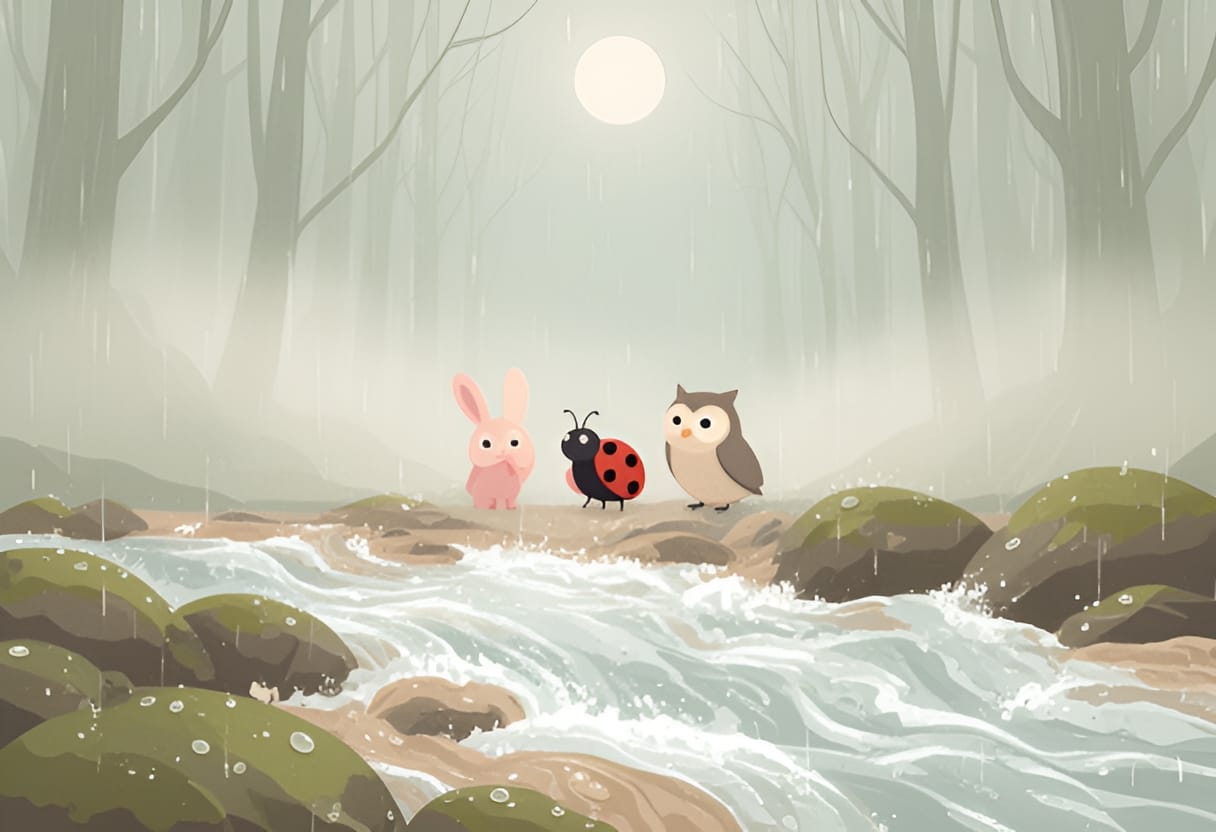
A soft rain began to fall over Whispering Woods, pattering gently on the mossy stones and the broad leaves of the ferns. The sound was quiet at first, like fingertips tapping a steady rhythm on the earth. Pip and Luna had been making their way toward the meadow brook, hoping to skip stones and watch the minnows dart in the shallow pools. But as they rounded the bend near the old willow, they stopped short.
The brook was no longer the steady murmur they knew. It had swollen with the rain, rushing over the stones in a louder, faster chuckle. Water lapped at rocks that usually stood dry and warm in the sun, and the current tugged at floating leaves, spinning them in quick circles before pulling them downstream.
Pip tilted his head, his ears twitching. “It’s… louder than usual,” he said.
Luna nodded, her feathers slightly damp from the mist. “The rain has filled it quickly. The flow is stronger, and the water is higher.”
From behind a cluster of reeds, Ben’s voice came soft and hesitant. “It looks… deep.”
Pip turned to see his friend standing at the water’s edge, one paw hovering just above the first stepping stone. Ben’s usual calm was replaced by a tightness in his shoulders, and his eyes were fixed on the churning water as if waiting for it to lunge forward.
“I don’t like how it’s moving,” Ben admitted, his voice low. “What if I slip? What if my paw slides off the stone and I fall in? I could get hurt… or worse, swept away.”
His fear hung in the air between them, real and quiet. It wasn’t loud or dramatic—just a small, steady worry, like a stone in the paw that makes every step uncomfortable.
Luna stepped forward slowly, her wings folding close to her body. She didn’t rush to fix it or tell him not to worry. Instead, she sat down on the bank, her tail wrapping neatly around her paws, and looked at Ben with soft, steady eyes.
“I hear you,” she said. “The water is higher. It is moving faster. And it’s okay to feel nervous about that. Fear isn’t silly—it’s your body’s way of saying, Pay attention. This might not be safe.”
She paused, letting the words settle. Then she added, “But fear doesn’t have to decide what we do. We can listen to it, understand it, and then choose our next step together.”
Pip moved to sit beside Ben, not too close, but close enough that their sides nearly touched. He didn’t offer solutions or tell Ben to be brave. He simply said, “I’ll stay right here with you. We don’t have to cross today. We can wait and see what the water does.”
Ben let out a slow breath, his ears lowering just a fraction. “You’ll stay?” he asked.
“Yeah,” Pip replied. “I’ll wait. We can watch the water, talk, or just sit. Whatever you need.”
The three friends settled onto the mossy bank, the rain now a steady hush around them. Pip tucked his paws beneath him, Luna folded her wings, and Ben lowered himself slowly, as if testing the ground before trusting it.
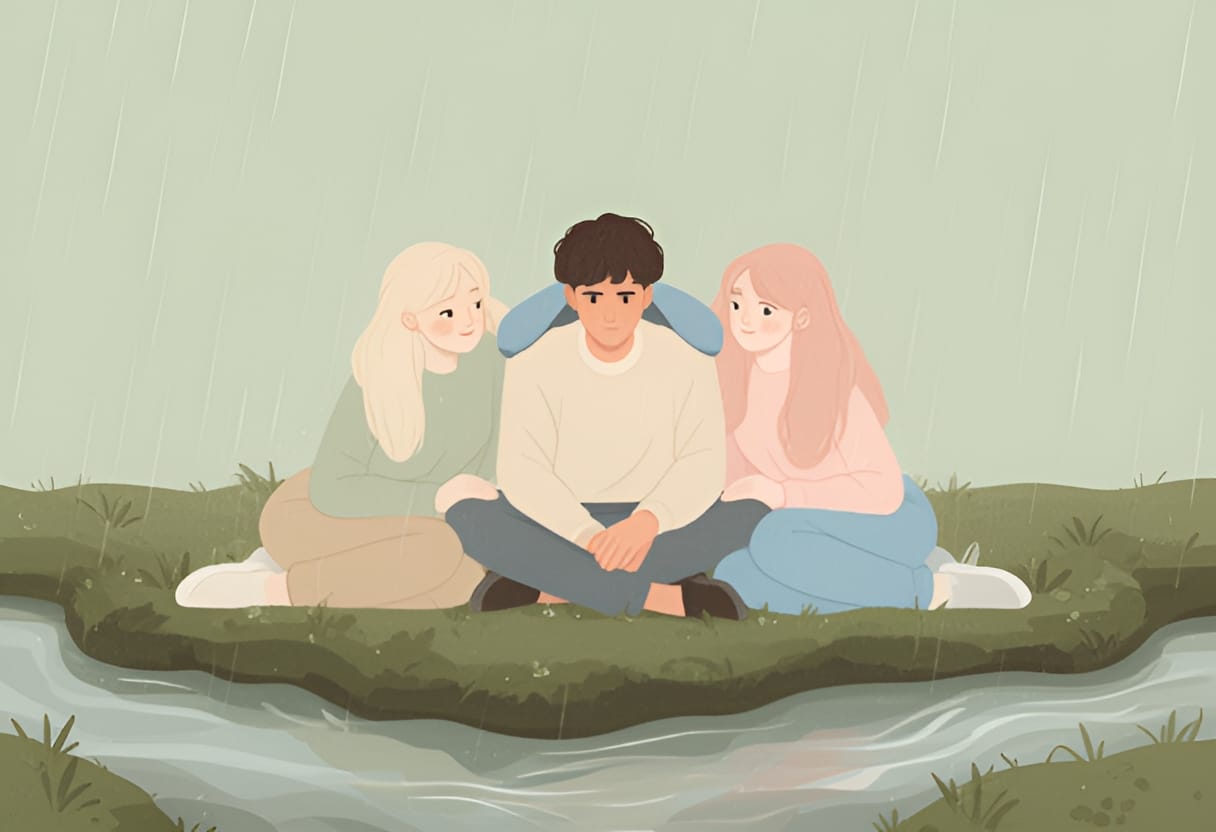
They watched the brook together.
The water rushed past in ribbons of white and brown, swirling around the stones like restless energy. Where the current hit the rocks, it flung up tiny sprays that caught the dim light and vanished like breath in cold air. Normally dry stones now stood half-submerged, their tops slick and gleaming. Even the largest stone in the middle—the one they always used as a resting point—was nearly covered, its usual flat surface hidden beneath a tumble of flow.
“It’s touching the stones that were dry yesterday,” Pip observed, pointing a claw toward a flat rock near the bank that usually sat high and dry, perfect for resting a paw or placing a found acorn.
“Yes,” Luna said. “And see how the water doesn’t just flow straight? It curls and pushes back in places—those are eddies. They can make footing tricky, even on stones that seem solid.”
Ben nodded, his eyes tracking a leaf as it spun in a tight circle before being sucked under. “It feels… alive,” he murmured. “Like it’s got a mind of its own.”
“It does have strength,” Luna agreed. “And when things change quickly—like the brook after rain—it’s wise to pause. Rushing in when we’re unsure can lead to mistakes. But stopping? That’s not giving up. That’s gathering information.”
Pip tilted his head. “Like when I lost my acorn? I wanted to keep searching right away, but I was too upset to think clearly.”
“Exactly,” Luna said. “You needed to calm your heart before your mind could help. Here, Ben’s body is telling him to be careful. Listening to that doesn’t mean we avoid the brook forever. It means we wait until we feel ready—and we figure out how to cross safely, together.”
Ben let out another breath, longer this time. His shoulders eased, just a little. “I still don’t want to slip,” he said. “But… I don’t feel like I have to decide right now.”
“No,” Pip said softly. “We don’t.”
They sat in silence for a while, the rain softening to a mist, the brook’s song steady but less frantic as the clouds began to thin overhead. Luna pointed to a patch of foam caught behind a rock.
“See that? It’s been there a while. That means the current is slowing just a bit behind the stone—like the water is taking a breath.”
Ben leaned forward, his nose twitching. “It’s… not moving as fast there.”
“Good observation,” Luna said. “That’s called a sheltered spot. If we had to cross, we might use places like that to rest our paws.”
Pip smiled. “So even when the water’s high, there are still ways to be careful.”
Ben looked at his friends—Pip’s steady gaze, Luna’s calm presence—and felt something shift inside him. The fear hadn’t vanished, but it was no longer alone. It was held by quiet understanding, by the simple fact that he wasn’t facing it by himself.
“We don’t have to cross today,” he said quietly. “But… I think I’d like to try. Not now. Maybe later. When the water goes down a little.”
Luna blinked slowly, her eyes warm. “That sounds like a wise plan.”
Pip bumped his shoulder gently against Ben’s. “And I’ll be right here when you’re ready.”
The rain stopped completely. A single drop fell from a leaf above, plopping into the brook with a soft blip. The friends watched the ripple spread outward, then fade.
They didn’t move yet. They stayed on the bank, side by side, watching the water, listening to its song, and letting the moment hold them—just as it was.
The mist lifted just enough for a slant of pale sunlight to break through the thinning clouds, catching the brook’s surface in scattered glints that danced like tiny, restless stars. Pip shifted his weight, feeling the cool damp of the moss seep into his fur, but he didn’t mind. He liked the way the world felt washed and quiet, as if the forest were holding its breath alongside them.
Ben remained still, but his eyes were no longer locked on the water’s rush. Instead, he watched a water strider skim across a calm patch near the bank, its long legs dimpling the surface without breaking through. “They don’t sink,” he murmured. “Even when the water’s moving, they just… glide.”
Luna tilted her head. “They spread their weight. Their legs are wide and light, so the water holds them up. It’s not about fighting the current—it’s about working with it.”
Pip’s ears perked. “Like how I don’t jump straight across the brook when I’m carrying something heavy? I hop from stone to stone, slow, so I don’t lose my balance.”
“Exactly,” Luna said. “Balance isn’t just about strength. It’s about timing, placement, and knowing when to adjust.”
Ben lifted his head slightly, considering. “So if I went slow… and put my paws down carefully… and maybe used something to feel the stones before I put my weight on them…?”
“You’d be giving yourself a better chance,” Luna said gently. “Not a guarantee—nothing ever is—but a better chance. And we could help. I could fly ahead and call out if I see a loose stone. Pip could stay close on the bank, ready to hand you a stick or just be there if you wobble.”
Ben looked at Pip, then at Luna, and gave a small, slow nod. “I’d like that. Not to rush. But to try… when I feel ready.”
Pip smiled. “We’ll wait for your signal. No pressure. Just… when you say ‘now,’ we’ll be here.”
The sunlight grew a little stronger, turning the brook’s churned water into a shifting mix of gray and silver. A minnow darted near the surface, then vanished under a swirl of foam. The friends watched in silence, each lost in their own thoughts but connected by the quiet rhythm of waiting.
After a time, Ben shifted his weight onto his hind legs, testing his balance on the soft bank. He rocked slightly from side to side, then steadied himself. “My legs feel… okay,” he said. “Not shaky. Just… aware.”
“That’s good awareness,” Luna said. “Not fear. Not excitement. Just noticing how your body feels. That’s the first step to moving wisely.”
Pip stood slowly, stretching his front legs forward, then back. “I’ll go first, if you want to watch how I place my paws. No pressure to follow. Just… see.”
Ben’s eyes widened slightly, then softened. “Yeah. I’d like that.”
They didn’t move toward the water yet. But the stillness had changed. It was no longer a pause born of hesitation. It was a pause of preparation—quiet, purposeful, and shared. The brook still rushed beside them, strong and full, but on the bank, three friends sat ready, not to conquer the water, but to learn how to meet it—together.
Trying Together
Pip stepped onto the first stone, his paws finding the cool, wet surface with a lightness that surprised even him. He kept his arms slightly out to the sides, not stiff, but relaxed like branches swaying in a breeze. His eyes stayed fixed on the next stone, not darting down at the rushing water below. Each step was deliberate: toe, then heel, a brief pause to settle his weight before lifting the other foot. He moved as if walking along a narrow log, aware that balance lived in the small adjustments, not in forcing his body to stay still.
When he reached the middle stone, the current tugged at his legs, but he didn’t panic. He lowered his center of gravity, bent his knees just a fraction, and shifted his weight toward the upstream side, letting the water flow around him rather than against him. His arms moved subtly—one rising as the other fell—to counter the gentle push of the brook. By the time he hopped onto the far bank, his breath was steady, and a quiet smile touched his muzzle.
“I made it,” he said, turning to face Luna and Ben. “Not fast. But smooth.”
Luna nodded from the bank, her feathers slightly ruffled from the mist. “Your pace was just right. You let the stones guide you, rather than fighting them.”
Ben watched his friend’s retreat, his heart pounding not with dread, but with a new kind of attention. He noticed how Pip didn’t stare at his feet, but looked ahead, how his arms moved like a tightrope walker’s, how he paused—not to hesitate, but to reset. It wasn’t magic. It was method.
Luna was next. She stepped onto the first stone with the careful precision of someone testing thin ice. Her right paw pressed down, then lifted slightly to feel for any give or slip. Finding none, she placed her full weight. She repeated the motion with her left paw, then shifted her body forward, hips aligned over her feet, before lifting the right foot to reach for the second stone. Each movement was isolated, deliberate, as if she were solving a puzzle one piece at a time.
When she reached the second stone, she paused again, this time turning her head to scan the water’s edge. “This one’s a bit slick near the edge,” she murmured, more to herself than anyone else. She adjusted her paw inward, onto the drier, rougher center of the stone, and tested it again with a slow roll of her ankle. Satisfied, she lifted her back paw and brought it forward, her movements flowing like a slow dance.
On the third stone, the water swirled more fiercely beneath her, but she didn’t rush. She lowered her body, spread her talons wide for stability, and used her wings slightly outstretched—not to fly, but to sense the air’s movement, which helped her anticipate shifts in the current. Her gaze never dropped below the next stone; she trusted her feet to feel what they needed to know.
When she reached the far bank, she turned and gave Ben a slow, deliberate blink. “Your turn when you’re ready,” she said. “We’re right here.”
Ben didn’t speak. He couldn’t. His throat felt tight, but not with fear alone. There was something else—curiosity, maybe, or the quiet thrill of seeing something difficult made to look possible. He watched Luna’s retreat, replaying it in his mind: the way she tested each stone, how she adjusted her stance when the surface felt uncertain, how she used her body not to resist the brook, but to listen to it.
He looked at his own paws—large, dark, and suddenly feeling alien on the mossy bank. He remembered Pip’s light steps, Luna’s wide stance, how both had kept their eyes forward. He remembered the sheltered spot behind the rock, how the water had slowed there, how even in a rushing stream, there were places of calm.
He took a breath—deep, slow, through his nose—and let it out through his mouth. His shoulders dropped. His claws extended slightly into the soft earth, not to dig in, but to feel the ground beneath him.
“Okay,” he said, his voice softer than he expected. “I’ll try.”
He didn’t look at the water. He looked at Luna, who had stepped back onto the bank and was waiting, her paw held out toward him, low and steady. Not to pull, not to push, but to meet his.
Ben lifted his right paw. It trembled once, then twice. He focused on Luna’s eyes, not her paw, not the water, not the stones beyond. He placed his foot down—slowly, flat, with the whole pad making contact. The stone was cool and solid under him. He didn’t shift his weight yet. He just… stayed.
Luna’s paw remained where it was, a quiet anchor. “Good,” she whispered. “Feel it?”
Ben nodded. “It’s not moving.”
He lifted his left paw. This time, he hesitated less. He placed it beside the right, shoulder-width apart, knees slightly bent. He didn’t look down. He kept his gaze on the next stone, just as Pip and Luna had done. His arms lifted naturally to his sides, not because he was told to, but because his body seemed to remember what it had seen.
He didn’t take the next step yet. He stayed there, both paws on the first stone, breathing, feeling, waiting for the signal from within himself that it was time to move forward. The brook rushed beside them, loud and full, but on the bank, in that moment, there was only the touch of paw on stone, the warmth of a friend’s presence, and the quiet courage of a beginning.
Ben shifted his weight forward, testing the balance of his stance. The stone held firm beneath his paws, unyielding and steady. He noticed how his weight naturally settled toward the balls of his feet, how his heels wanted to lift slightly unless he consciously kept them down. He bent his knees a little more, lowering his center of gravity, and felt the immediate difference—less strain in his legs, more control in his stance. It reminded him of how Pip had crouched slightly when crossing, not out of fear, but to stay grounded.
He looked ahead to the second stone, about a fox’s length away. The water rushed between them, white and churning, but he didn’t fixate on it. Instead, he focused on the stone itself—its shape, its color, the way the current split around it. He remembered Luna’s pause, how she had tested the surface before committing. He lifted his right paw just an inch, hovered it over the stone, then brought it down slowly, toe first, letting the pad make contact. It felt solid, dry on top despite the mist. He repeated the motion with his left paw, placing it beside the right, shoulder-width apart, knees bent, back straight.
He paused. Not because he was afraid, but because he was checking in. His breath was even. His shoulders were relaxed. His gaze remained forward, soft but alert. He could feel the subtle pulse of the brook through the stone—a vibration, not a threat. It was the water moving, not attacking.
Luna stayed where she was, her paw still extended, not touching, but ready. Pip stood a few steps behind her, silent, his tail wrapped neatly around his paws. Neither spoke. Neither moved to hurry him. Their stillness was not empty; it was full of trust.
Ben took another breath. Then, slowly, he began to move.
He lifted his right paw, not high, just enough to clear the surface of the stone. He swung it forward in a smooth arc, aiming for the center of the second stone. As he did, he let his left paw bear most of his weight, feeling how the shift changed the pressure in his hips and spine. He landed—heel first this time, then rolling onto the ball of his foot—just as Pip had described. The stone held. He didn’t wobble.
He repeated the motion with his left paw. This time, he noticed how his arms moved instinctively—his right arm swinging slightly back as his left leg stepped forward, his left arm coming forward to counterbalance. It wasn’t something he had thought about; it just happened, as if his body had been watching and learning all along.
He was on the second stone now. The water rushed louder beneath him, but he didn’t look down. He stayed low, knees bent, arms loose at his sides, eyes on the third stone. He felt the spray on his fur, cool and fine, like mist from a waterfall. He blinked it away without breaking his rhythm.
He paused again—not to rest, but to assess. He pressed down slightly with his right paw, feeling for any give. The stone was firm. He shifted his weight to test the left. Same result. Solid. He nodded to himself, almost imperceptibly.
He took the next step. Then the next.
By the time he reached the third stone, his movements were no longer cautious imitations. They were his own. His pace was slow, but unhurried. His steps were light, but sure. When his right paw slipped slightly on the damp edge of the stone, he didn’t freeze. He adjusted—turned his paw inward, gripped with his claws just enough to hold, and rebalanced. It took a second. No one rushed him. When he was steady, he continued.
He made it to the far bank.
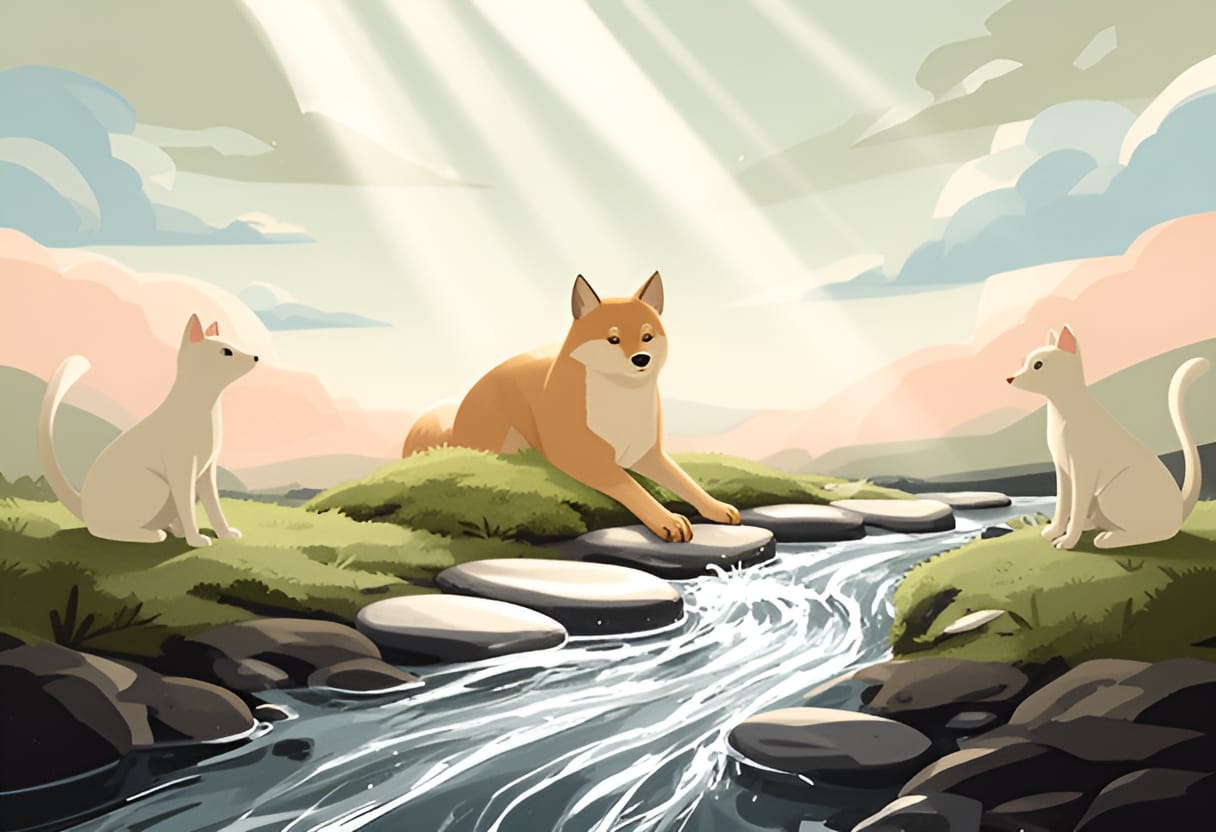
His paws touched the soft moss, and he didn’t celebrate. He didn’t need to. He stood still, chest rising and falling, eyes closed for a moment, feeling the quiet strength in his legs, the steadiness in his breath. When he opened his eyes, Luna was smiling—not wide, not loud, but deep and warm, like sunlight through thick leaves. Pip gave a small, solemn nod, the kind reserved for moments that mattered.
Ben looked down at his paws, then back at the brook. It was still rushing, still high, still powerful. But it no longer felt like something to defeat. It felt like something to move with—like the water strider, like the leaf carried gently downstream, like the breath that flows in and out without force.
He turned to Luna and Pip. “I did it,” he said, his voice quiet but clear.
Luna stepped forward and touched her wing to his shoulder. “You didn’t just cross,” she said. “You found your way.”
Pip nudged him gently with his nose. “And we were right here.”
Ben didn’t let go of the feeling. He held it—the warmth of their presence, the solidity of the stone under his memory, the rhythm of his own breath and steps. He knew the next time wouldn’t be the same. The brook might be higher. The stones might be slicker. But he also knew now that he wasn’t starting from nothing. He had a way. He had friends. And he had, most importantly, begun to trust himself.
The Stick for Balance
Luna’s wing had barely left Ben’s shoulder when his right paw slipped on the damp edge of the third stone. The motion was small—a fraction of an inch—but enough to send a jolt up his leg. His breath hitched, and for a heartbeat, he froze, claws scraping uselessly against the smooth surface.
Luna didn’t move toward him. Instead, her head turned, eyes scanning the bank just behind Pip. A moment later, she lifted her wing and pointed with her beak toward a cluster of fallen branches near the water’s edge.
“There,” she said softly. “That one looks straight and strong.”
Pip hopped down from the mossy bank and padded over to the driftwood. He nudged aside a few smaller twigs until he uncovered a stick about the length of Ben’s forearm, smooth from years of water and sand. He carried it back in his mouth and dropped it gently at Ben’s feet.
Ben looked down at the wood, then up at Luna. “How does this help?”
Luna stepped closer and lowered her head so her beak was level with his paw. “Hold it like this,” she whispered. She demonstrated with her own wing, gripping the stick near the middle but keeping her wrist loose. “Not tight. Not high. Low and ready, like a third leg that feels the ground before you trust it.”
She tapped the stick lightly against the stone beneath Ben’s left paw. “See? You touch first. You test. You don’t commit your weight until the stick tells you it’s safe.”
Ben picked up the stick with his mouth, then shifted it to his front paws, holding it horizontally just above the moss, his elbows bent and close to his body. The wood was cool and solid, familiar like a branch he might drag back to his den.
“Now,” Luna said, “try it on the next stone. Point. Tap. Listen.”
Ben looked ahead to the fourth stone, about two fox-lengths away. The water between churned white, spitting mist into the air. His old instinct was to look down, to fixate on the danger. But Luna’s voice stayed with him: feel, don’t fight.
He lifted the stick in his right paw, arm relaxed, and swung it forward in a low arc. The tip tapped the upper surface of the fourth stone—a soft tok—then bounced slightly as it hit the edge. He adjusted his aim, tapping again, this time nearer the center. Solid. No wobble in the wood.
He shifted his weight slightly onto his left paw, keeping the stick low in his grip, and lifted his right foot. He hovered it over the stone, toe down, just as he had before. Then, slowly, he brought it down—heel first, rolling to the ball—feeling for give. The stone held firm.
He didn’t look at his feet. He kept his eyes on the fifth stone, the stick extended low in his left paw, ready to probe.
Pip stood on the far bank, tail curled around his paws, watching without moving. He didn’t call out. Didn’t shift his weight forward. He simply stayed—present, quiet, ready to step in only if the stick tapped air instead of stone.
Ben took another breath, in through the nose, out through the mouth, slow and deep. He tapped the stick against the fifth stone—once, twice—feeling for firmness. The wood didn’t bend. The stone didn’t shift.
He stepped.
This time, when his paw landed, there was no slip. No panic. Just the quiet press of pad against stone, the stick tapping ahead like a metronome marking his progress.
He repeated the motion with his left paw. Tap. Step. Tap. Step.
By the time he reached the sixth stone, the rhythm had changed. It wasn’t mechanical anymore. It was his. The stick wasn’t a crutch—it was an extension of his senses, a way to translate the brook’s chaos into information he could use.
Luna remained on the third stone, her wings tucked close, her gaze steady. She didn’t cheer. Didn’t call instructions. She only nodded, once, when Ben’s paw found solid ground on the sixth.
Ben didn’t look back. He didn’t need to. He could feel the weight of their trust behind him like a warm current in the water.
When his paw landed on the seventh stone, he paused—not to rest, but to notice. His shoulders were loose. His breath was even. The stick in his paw moved with him, not ahead of him, not dragging behind. It was part of his balance, not a replacement for it.
He tapped the stick against the eighth stone. Solid. He stepped.
And then, without thinking, he smiled.
It wasn’t a loud or proud smile. It was small, quiet, the kind that comes when something difficult becomes possible. He felt it in his chest, a soft unfurling, like a leaf opening in the sun.
He looked ahead. Two more stones to the bank.
He didn’t rush. He didn’t freeze. He lifted the stick, tapped, stepped. Tap. Step.
And when his paws finally touched the soft moss of the far bank, he didn’t look at the brook. He looked at Luna and Pip.
Luna was still on the third stone, but she had lifted her wing in a slow, quiet salute. Pip had stepped forward halfway down the bank, his nose twitching, his eyes bright.
Ben lowered the stick to the moss beside him. It lay there, straight and true, no longer needed as a probe—but not forgotten, either.
He sat down, chest rising and falling, and for the first time since they’d arrived at the brook, he let himself simply be.
The water still rushed. The stones were still wet. But the fear was no longer a wall. It was a feeling he now knew how to walk beside.
Ben stayed seated on the moss, the stick resting across his paws like a fallen branch returned to the earth. He didn’t reach for it again. Not yet. Instead, he let his gaze drift to the brook, not with the old tension of threat, but with the quiet curiosity of someone who had begun to understand its language.
Luna hopped down from the third stone and padded silently over to sit beside him, her feathers brushing the damp moss. She didn’t speak right away. She simply pointed her beak toward a smooth, flat stone half-submerged near the edge, where the current slowed just enough to let a minnow dart back and forth in the sheltered pocket behind it.
“See that?” she murmured. “The water doesn’t stop there. It just… changes shape.”
Ben watched the fish flick its tail and disappear into the shadow of the stone. Then, slowly, he nodded.
“It’s still moving,” he said. “But it’s not fighting.”
Luna tilted her head. “Exactly. And neither are you.”
Pip ambled over and settled on Ben’s other side, his tail curled neatly around his feet. He nudged the stick with his nose, not to take it, but to check that it was still there—still whole, still useful. Then he looked up at Ben, his eyes soft.
“You don’t have to hold it all the time,” Pip said. “But it’s good to know it’s yours.”
Ben looked down at the stick. It was ordinary, really—just a piece of wood, worn smooth by water and time. But in his paws, it had become something else: a bridge between fear and steadiness, between hesitation and motion. He picked it up again, not to use it as a probe, but to feel its weight, its balance, its quiet reliability.
He turned it over in his paws, noting how the thickness varied slightly near the ends, how one side was a little flatter from resting against stones. He thought about how Luna had shown him to hold it low, how Pip had waited without pressure, how the stick had given him information his eyes alone couldn’t trust in the spray and rush.
“I think,” he said slowly, “I could make another one. If I needed to.”
Luna’s eyes softened. “You already know how.”
Ben smiled. Not because he was proud of the stick, but because he realized the real tool hadn’t been the wood at all. It was the pause before the step. The breath that steadied the body. The trust that let him listen to his own paws, to the stones, to the quiet voice that said, Try again. Just this much.
He stood, the stick held loosely in his right paw, and turned to face the brook once more. The water still sang over the stones, still pushed and pulled, still carried leaves and twigs downstream in its endless, gentle hurry. But now, when he looked at it, he didn’t see only force. He saw rhythm. He saw pattern. He saw places where the current eased, where a paw could find purchase, where a stick could tap and tell the truth.
He took one step toward the water—not to cross, not yet—but to touch the edge of the nearest stone with the tip of the stick. Tap. Solid. He stepped back. Tap again on the moss. Solid in a different way.
He did it three times. Each tap a sentence. Each pause a breath.
Then he turned to his friends.
“I’m ready to try again,” he said. “Without the stick leading. Just… knowing it’s there if I need it.”
Luna rose and stretched her wings, not to fly, but to shake out the damp. “We’ll be right here,” she said. “Not to carry you. Not to show you. Just to see you.”
Pip gave a small, firm nod. “We believe in your steps.”
Ben took a breath in, slow through the nose, out through the mouth. He stepped toward the first stone—not with the stick out front, but held low, ready. He tapped it once. Felt the firmness. Stepped.
He didn’t look down. He didn’t rush. He moved as if the brook were not an obstacle, but a path—one he was learning to walk, one stone, one breath, one quiet trust at a time.
The Last Stones
Ben’s paw hovered above the fourth stone, the stick held low and loose in his right paw as Luna had taught him. He tapped once—solid. He stepped. The stone shifted slightly under his weight, but he rolled onto the ball of his foot, just as he had practiced, and found his balance. His breath stayed even, in through the nose, out through the mouth.
The fifth stone was slick with moss, but Ben remembered Pip’s subtle arm movements—one rising as the other fell—to counter the brook’s push. He lifted his left arm slightly as he stepped, feeling the current tug at his fur, and compensated with a small shift of his weight to the right. He tapped the stone twice before committing, feeling for any give. It held.
On the sixth stone, his paw slipped just a fraction as he landed. Instead of freezing, he turned his paw inward, gripped with his claws, and pushed off the ball of his foot to rebalance. The stick tapped the stone beside him—a quick check—and he steadied. He did not look down at the water. He looked ahead, at the next stone, then at Luna’s calm eyes on the bank.
Pip had moved to the mossy edge, his nose twitching as he watched. He did not call out. He did not rush forward. He simply nodded, once, when Ben found his footing again.
The seventh stone was wider, flatter. Ben stepped onto it with confidence, feeling the solidity under his paw. He paused, just for a breath, and let the stick tap the surface twice. Solid. He rolled onto the ball of his foot and pushed off, his arms moving in their slow, countering rhythm.
The eighth stone was the last before the bank. Ben tapped it three times—fast, then slow, then fast—feeling for any weakness. It felt firm, unyielding. He took a slow breath in, held it for a moment, then exhaled through his mouth. He stepped.
His paw landed. He rolled. He pushed.
And then he was on the moss.
Quiet Cheers
Luna was already halfway down the bank, her wings slightly outstretched not to fly, but to sense the air above the water. When Ben’s paw touched the moss, she lifted her head and gave a slow, soft blink—her version of a smile. She did not hoot. She did not flutter excitedly. She simply padded forward and sat beside him, her feathers brushing his shoulder.
Pip arrived a moment later, his tail curled neatly around his feet. He nudged the stick with his nose, not to take it, but to confirm it was still there. Then he looked up at Ben, his eyes bright but calm. He gave a small, firm nod—no more, no less.
Ben sat down, the stick resting across his paws. He did not reach for it again. He let his gaze drift to the brook, not with the old tension of threat, but with the quiet curiosity of someone who had begun to understand its language.
“I didn’t fall,” he said, his voice low and steady. “I did it myself.”
Luna tilted her head. “You had the stick. You had us.”
Ben shook his head slowly. “I had the stick in my paws, yes. But I didn’t use it to probe. I used it to feel. And you… you didn’t tell me where to step. You just… stayed.”
Pip ambled over and settled on Ben’s other side. He nudged the stick again, then looked at Ben. “You don’t have to hold it all the time,” he said. “But it’s good to know it’s yours.”
Ben looked down at the stick. It was ordinary, really—just a piece of wood, worn smooth by water and time. But in his paws, it had become something else: a bridge between fear and steadiness, between hesitation and motion.
“I think,” he said slowly, “I could make another one. If I needed to.”
Luna’s eyes softened. “You already know how.”
Ben smiled. Not because he was proud of the stick, but because he realized the real tool hadn’t been the wood at all. It was the pause before the step. The breath that steadied the body. The trust that let him listen to his own paws, to the stones, to the quiet voice that said, Try again. Just this much.
Shaking Out the Tension
Ben stood, the stick held loosely in his right paw, and turned to face the brook once more. The water still sang over the stones, still pushed and pulled, still carried leaves and twigs downstream in its endless, gentle hurry. But now, when he looked at it, he didn’t see only force. He saw rhythm. He saw pattern. He saw places where the current eased, where a paw could find purchase, where a stick could tap and tell the truth.
He took one step toward the water—not to cross, not yet—but to touch the edge of the nearest stone with the tip of the stick. Tap. Solid. He stepped back. Tap again on the moss. Solid in a different way.
He did it three times. Each tap a sentence. Each pause a breath.
Then he turned to his friends.
“I’m ready to try again,” he said. “Without the stick leading. Just… knowing it’s there if I need it.”
Luna rose and stretched her wings, not to fly, but to shake out the damp. “We’ll be right here,” she said. “Not to carry you. Not to show you. Just to see you.”
Pip gave a small, firm nod. “We believe in your steps.”
Ben took a breath in, slow through the nose, out through the mouth. He stepped toward the first stone—not with the stick out front, but held low, ready. He tapped it once. Felt the firmness. Stepped.
He didn’t look down. He didn’t rush. He moved as if the brook were not an obstacle, but a path—one he was learning to walk, one stone, one breath, one quiet trust at a time.
When he reached the mossy bank on the far side, he did not stop. He shook out his fur, sending droplets flying into the air like tiny diamonds. He shook again, harder this time, feeling the tension in his shoulders release with each shake. His fur settled, fluffy and damp, but lighter.
Luna shook her wings, sending a fine mist into the air. Pip gave a full-body shiver, his tail flicking as water sprayed from his bushy tip. They stood for a moment, breathing in the cool, wet scent of the brook and the moss, the sound of the water now a companion rather than a threat.
Trying This: Your Own Stick and Stones
You can practice Ben’s lesson in your own way, even without a brook or a stick. Here’s how to try it this week:
- Find your “stick”: Choose one small object that feels steady in your hand—a smooth stone, a favorite pencil, a stuffed animal’s paw. Hold it low and loose, and use it to test your balance before stepping onto something unfamiliar, like a curb or a low log.
- Tap, breathe, step: Before you try something that feels a little scary, tap your object three times on the ground or floor. With each tap, take a slow breath in through your nose and out through your mouth. Then step forward, focusing on how your feet feel, not on what might go wrong.
- Notice the rhythm: When you’re walking or moving, pay attention to the pattern of your steps. Are they even? Do you pause between them? Try walking slowly for ten steps, syncing your breath with each step—inhale for two steps, exhale for two steps. See if it makes you feel calmer, like Ben did by the brook.
Key Takeaways
- Fear can be a useful signal, not a wall to stop at—it gives us information to prepare and proceed with care.
- Tools like a stick or a breath are most helpful when they build our own skills, not when we rely on them to do the work for us.
- Quiet, steady support from friends often means more than loud praise—it tells us we are seen and believed in, without pressure to perform.
- Success feels strongest when we know we tried ourselves, even if we had help along the way.
- Shaking out tension—literally or figuratively—helps us move from challenge to calm, ready for what comes next.