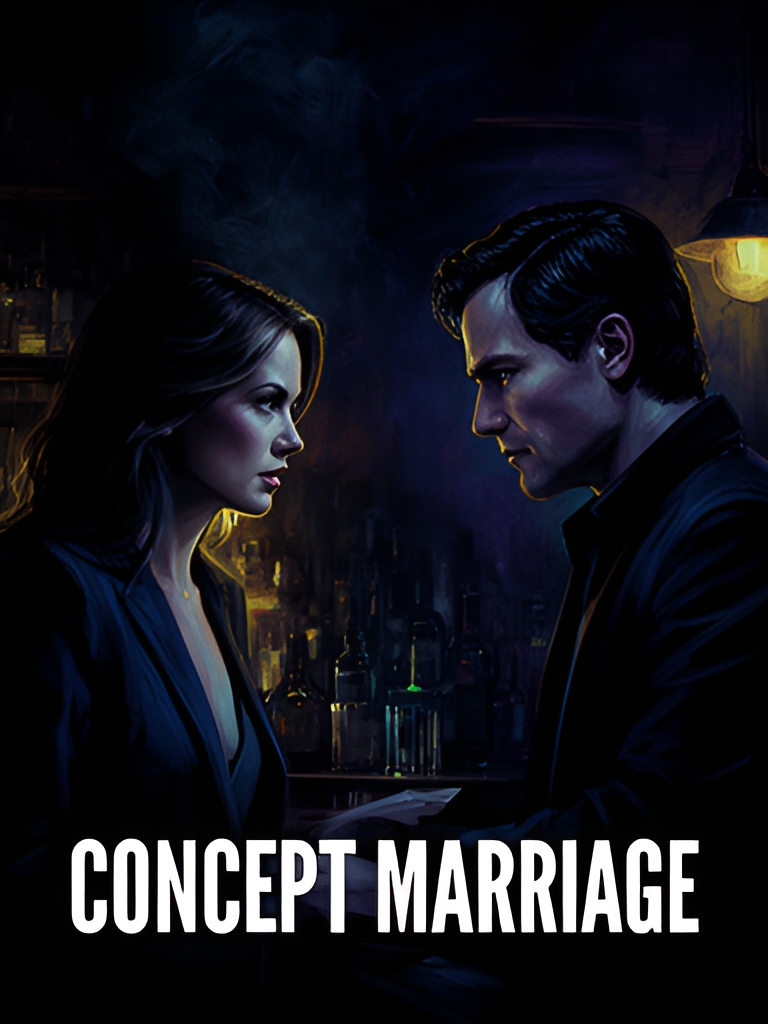
Thriller
Concept Marriage
by Sihle
3 chapters1.2 hr read
Chapter 1
Chance Encounter
The dimly lit bar was a haven for Emily, a place where she could escape the memories of her recent break-up. She had spent the day wandering aimlessly, trying to clear her mind, but the thoughts of her ex lingered. As she sat on the stool, nursing a whiskey on the rocks, she felt a sense of relief wash over her. The bartender, a friendly woman with a warm smile, chatted with her about everything and nothing, helping to distract Emily from her troubles. Just as Emily was starting to feel like herself again, a man sat down beside her, his presence commanding attention.
"Mind if I join you?" he asked, his deep voice sending a shiver through Emily's body. She turned to face him, and their eyes met for the first time. His piercing blue gaze seemed to see right through her, and Emily felt a spark of attraction. "Not at all," she replied, trying to sound casual despite the flutter in her chest. The man smiled, and Emily's heart skipped a beat. He was charming, confident, and undeniably handsome.
As they introduced themselves, Emily learned that his name was Jack, and he was also nursing a broken heart. They commiserated about their shared experiences, laughing and joking like old friends. The conversation flowed effortlessly, and Emily found herself opening up to Jack in ways she never thought possible. They talked about everything from their jobs to their favorite books, and Emily was struck by the ease with which they connected. As the night wore on, the bar began to fill with more people, but Emily and Jack remained lost in their own little world.
As the hours passed, the music grew louder, and the crowd more rowdy. Emily and Jack decided to take a walk outside, escaping the chaos of the bar. The cool night air was a welcome respite, and they strolled through the quiet streets, enjoying each other's company. They walked in comfortable silence, the only sound being the distant hum of the bar and the occasional passerby. Emily felt a sense of peace wash over her, and she couldn't help but notice the way Jack's eyes crinkled at the corners when he smiled. She was drawn to him, and she could tell that he felt the same way.
As they turned a corner, Jack stopped and turned to face Emily. "I'm having an amazing time tonight," he said, his voice low and sincere. "Would you like to grab coffee with me sometime this week?" Emily's heart skipped a beat as she met his gaze. She felt a spark of excitement, and she knew that she wanted to see him again. "I'd love to," she replied, trying to sound casual despite the butterflies in her stomach. Jack smiled, and they exchanged numbers, their fingers touching briefly as they handed each other their phones. The touch sent a jolt of electricity through Emily's body, and she knew that she was in trouble. She was already falling for Jack, and she couldn't wait to see where things would go.
Jack's thumb brushed hers as they passed the phone back, a fleeting contact that left a lingering warmth. Emily glanced at the screen, seeing her own name appear under his contact: Jack. The simplicity of it felt oddly intimate, like a secret shared between them in the dim glow of the streetlamp overhead. He shoved his hands into his pockets, rocking slightly on the balls of his feet, and she noticed how the light caught the faint stubble along his jaw, how his eyes seemed to hold hers a beat longer than necessary.
"Same time tomorrow?" he asked, voice dropping just enough that she had to lean in to hear over the distant hum of a passing car. "Or does that feel too… soon?"
She let out a soft laugh, the sound caught between nerves and something brighter. "Too soon for what? For regretting not asking?" When he didn’t answer right away, she added, "I’m not one for games, Jack. If I like someone, I say so." The words came easier than she expected, honesty spilling out like it had been waiting for release.
He nodded, a slow, approving tilt of his head. "Fair. I respect that." He paused, then continued, his tone shifting to something more deliberate. "How about Friday? Same place? We could try that new tapas place on 5th—heard they do amazing patatas bravas."
"Friday works," she said, already imagining it—the clink of glasses, the shared plates, the way conversation might flow even easier over food. "And I’ll hold you to the patatas bravas."
He grinned, and this time it reached his eyes, crinkling the corners in a way that made her stomach flip. "Consider it a promise." He shoved his hands deeper into his pockets, rocking back on his heels again. "Well, I should probably let you get back to… whatever it was you were doing before I interrupted your peaceful whiskey contemplation."
Emily laughed, genuinely this time. "I wasn’t contemplating anything profound. Just trying not to think about the fact that my ex’s favorite bar is two blocks from here."
Jack’s expression softened, sympathy flickering across his features. "Yeah, I know that feeling. Mine’s got the worst trivia night in the city. Went there last week and nearly walked out after round two." He shuddered dramatically, then sobered. "Thanks for not making it weird, by the way. Talking about the break-up stuff. It’s… nice to not have to pretend."
She met his gaze, seeing the vulnerability there, and felt a surge of protectiveness she hadn’t expected. "Same here. It’s refreshing to talk to someone who actually gets it." She hesitated, then added, "Thanks for not pretending either."
They stood there for a moment, the night air cool against their skin, the streetlamp casting long shadows that seemed to pull them slightly closer without either of them moving. Emily noticed how his breath fogged just a little in the chill, how the pulse in his throat jumped when she glanced at it. She was acutely aware of the space between them—close enough to feel his warmth, far enough that she could still think clearly.
"Text me when you get home?" he asked, voice low.
"I will," she promised. "And you do the same."
He nodded, then shoved his hands into his jacket and pulled out a small, worn leather wallet. From it, he extracted a business card—simple, white with black text: Jack Hale, Senior Architect, Vertex Design. He handed it to her, his fingers brushing hers again. "Just in case you lose my number. Or want to see some of my work. Not that I’m suggesting you stalk my portfolio or anything."
She tucked the card into her purse, smiling. "Noted. Though I might take you up on that offer… professionally speaking."
He laughed, a rich, warm sound that seemed to vibrate in the space between them. "Deal. Now go—before I talk you into staying out all night and we both regret it in the morning."
She started to walk away, then paused after a few steps, turning back. He was watching her, hands still in his pockets, a quiet smile on his face. "Hey Jack?"
"Yeah?"
"Thanks for the night." She meant it—not just for the distraction, but for the ease, the laughter, the way he’d made her feel seen without trying to fix her.
He nodded, his expression softening. "Anytime, Emily. Really."
She turned and walked toward her apartment, the city lights blurring slightly as she walked. She didn’t look back, but she could still feel his gaze on her, a quiet weight that was comforting rather than heavy. When she reached her building, she fumbled for her keys, her mind buzzing with fragments of the night—his laugh, the way he leaned in when she talked about her job, the easy rhythm of their conversation.
Inside her apartment, she kicked off her shoes and leaned against the closed door, letting out a breath she hadn’t realized she’d been holding. She pulled out her phone, saw his name glowing in the contacts, and hesitated before typing a quick message: Made it inside. Thanks again for tonight. She hit send, then waited, watching the screen until three dots appeared, then vanished, then reappeared. A moment later, his reply came: Anytime. Sleep well. She smiled, typing back: You too. She locked her phone and headed to bed, the events of the night playing softly behind her eyelids as she drifted off—his voice, his eyes, the easy way they’d talked like they’d known each other for years. Not fireworks, not yet, but something steadier, something that felt like the beginning of a slow burn she wasn’t afraid to follow.
Emily’s phone buzzed against the nightstand, pulling her from the edge of sleep. She blinked into the dark, the screen casting a pale glow on the ceiling. Jack Hale blinked back at her. Her thumb hovered over the notification before she opened it.
You up? it read. Sent two minutes ago.
A smile tugged at her lips. She typed back, Just now. Couldn’t sleep. You? and set the phone down, listening to the quiet hum of the refrigerator downstairs. The city outside her window had softened into a low thrum—distant sirens, the occasional car passing too fast. Inside, the apartment felt suspended, wrapped in the hush that comes just before dawn.
Three dots appeared. Then vanished. Then came his reply: Same. Thinking about tonight.
She sat up, pulling the blanket to her chest. Me too. Funny how a bar stool can feel like confession.
His response was nearly instant: Funny how easy it was. Felt less like talking and more like… remembering how to breathe.
She laughed softly, the sound muffled by the fabric. That’s poetic. You an architect or a poet on the side?
Both, he replied. Architecture pays the bills. Poetry keeps me sane.
She stared at the words, warmth spreading through her ribs. I’ll hold you to that. Send me a stanza sometime.
Only if you send me a blueprint of your soul in return.
She shook her head, smiling despite herself. Deal. Though fair warning—it’s under renovation.
His next message came with a delay, as if he were choosing each word carefully. I don’t mind fixer-uppers. As long as the foundation’s solid.
She stared at the screen, the words landing deeper than she expected. You don’t know me well enough to judge my foundation.
True, he admitted. But I liked what I saw tonight. Honesty. No performance. That’s rare.
She swallowed, the honesty of it catching in her throat. Thanks for seeing it. I’ve been… guarded lately. After everything.
Me too, he wrote. My last relationship ended because I stopped showing up. Not physically—emotionally. I was there, but I wasn’t present. Like I was waiting for something better to come along.
She paused, fingers hovering over the keyboard. That takes courage to admit.
Does it? he replied. Or just clarity? Either way, I don’t want to repeat it. Not with you.
Her breath hitched. You barely know me.
I know enough, he said. I know you laughed at my terrible trivia joke. I know you didn’t flinch when I talked about my ex. I know you held my gaze when you said you weren’t into games. And I know that when you touched my arm outside the bar, it felt like coming home to a place I’d never been.
She closed her eyes, the words echoing in the quiet. You’re dangerous, Jack Hale.
Only if you let me be, he replied. But I promise—I won’t pretend. I’ll show up. Even when it’s hard.
She typed slowly, each letter deliberate. Then let’s start with coffee. Tomorrow? Morning? Before work?
The new place on 8th? The one with the oat milk latte you like?
How did you—
You mentioned it when you were talking about your morning routine. You said it’s the only place that doesn’t burn the beans.
She laughed again, softer this time. You pay attention.
When it matters, he said. I’ll be there at 7:30. Save me a seat near the window.
Done, she replied. And Jack?
Yeah?
Thanks for last night. Really.
Anytime, Emily. Really.
She locked her phone and lay back down, the blanket cool against her skin. The city was beginning to stir— a distant train, a neighbor’s door closing—but inside, there was only the steady rhythm of her own heartbeat, and the quiet certainty that, for the first time in a long time, she wasn’t alone in the dark.
The next morning, Emily arrived at the café ten minutes early, her coat still damp from the drizzle that had begun just as she left her building. She chose a corner table by the window, where she could watch the street wake up—delivery trucks rolling past, a woman walking two small dogs, a man in a suit hurrying with coffee and a newspaper. She wrapped her hands around a ceramic mug, the warmth seeping into her palms, and watched the rain blur the city into watercolor strokes.
When Jack walked in, she stood without thinking. He shook water from his coat, smiled when he saw her, and crossed the floor with easy strides.
“You look like you’ve been here awhile,” he said, sliding into the seat opposite her. “Hope I didn’t keep you waiting.”
“Just long enough to people-watch,” she replied. “It’s surprisingly entertaining at this hour.”
He flagged down a barista and ordered—black coffee, no sugar, just as she remembered him saying the night before. When he turned back, his eyes were steady, open. “So. Tell me about your ex. Not the details—unless you want to—but what it taught you.”
She hesitated, then nodded. “He was… safe. Predictable. We fell into a rhythm that felt comfortable, but after a while, it felt like we were just… existing side by side. Not growing. Not really seeing each other. I stayed longer than I should have because I was afraid of being alone. Afraid that if I let go, I wouldn’t find someone who actually knew me.”
Jack nodded slowly. “I get that. My ex… she was brilliant. Funny. We could talk for hours about anything—art, politics, the meaning of life. But when it came to the small stuff? The day-to-day? I checked out. I’d sit there nodding, but my mind was somewhere else—work, the next project, whatever. I mistook presence for proximity. And she felt it. She stopped trying after a while. Stopped asking how my day was. We became roommates who shared a toothbrush holder.”
Emily leaned forward, her voice quiet. “Did you love her?”
“Yes,” he said without hesitation. “But love isn’t enough if you’re not there. I thought showing up meant being in the same room. Turns out, it means being in the same moment.”
She reached across the table, her fingers brushing his knuckles. “You’re being really honest with me.”
He turned his hand, lacing his fingers through hers. “You make it easy. You don’t judge. You just… listen.”
She squeezed his hand. “I’ve spent too long pretending I was fine. I’m tired of the act.”
His thumb stroked slow circles over her skin. “Then don’t pretend with me. Not about the hard stuff. Not about the fears. I want to know the real you—even when it’s messy.”
Her throat tightened. “I’m scared,” she admitted. “Scared I’ll mess this up. Scared I’ll push you away without meaning to. Scared that once you really know me, you’ll decide I’m not worth the effort.”
He leaned in, his voice low and fierce. “You think I’m not scared too? Of failing you? Of repeating the same mistakes? But here’s what I know—I’d rather try and stumble than never try at all. Especially with you.”
She searched his eyes, seeing not just desire, but something deeper—a willingness to be vulnerable, to risk. “Okay,” she whispered. “Okay, I’ll try. If you will.”
“I will,” he promised. “Starting now.”
They sat like that for a long moment, hands joined, the café fading around them—the hiss of the espresso machine, the murmur of other conversations—until it was just the two of them, anchored in the quiet intensity of what was beginning.
Later, after they’d finished their coffee and walked slowly back toward her building, Jack stopped her under the awning of a closed bookstore, where the rain had eased to a mist.
“Friday,” he said, his voice low. “Same time? Seven? Or should we make it earlier? I could pick you up if you want.”
“I’d like that,” she said. “But I’ll meet you there. Just in case… you know. If I need to make a quick escape.”
He smiled, understanding. “No pressure. Just us. Good food. No expectations beyond seeing if we still want to keep talking after the meal.”
She nodded. “I’d like that.”
He reached up, gently tucking a strand of wet hair behind her ear. His fingertip lingered at her jaw, warm and deliberate. “Text me when you’re on your way. And if you change your mind—if you decide you’d rather stay in and watch bad TV—just say the word. I’ll understand.”
“I will,” she promised. “And I’ll hold you to the patatas bravas.”
He laughed, the sound bright and unguarded. “Consider it a vow.”
They stood there for a moment longer, the city breathing around them—the distant rumble of a bus, the drip of water from a fire escape, the quiet pulse of life continuing. Then, with a final squeeze of her hand, he stepped back.
“I’ll see you Friday,” he said.
“Friday,” she echoed.
He turned and walked away, his collar turned up against the damp, his steps unhurried. Emily watched him go until he disappeared around the corner, then pressed her palm to her chest, feeling the steady thrum of her heart beneath her skin.
She didn’t go inside right away. Instead, she tilted her face to the sky, let the mist kiss her skin, and whispered into the quiet: Here goes nothing.
Emily tucked her phone into her coat pocket and stepped out into the misty evening, the city lights blurring into halos through the damp air. She walked toward the tapas place on 5th, her heels clicking softly on the wet pavement. The restaurant glowed warmly against the night, its windows fogged at the edges, spilling amber light onto the sidewalk. A small chalkboard outside listed the evening’s specials in looping script: patatas bravas, chorizo al vino, gambas al ajillo.
Jack was already there, leaning against the brick facade just inside the awning, his hands in his coat pockets. He looked up as she approached, and a slow smile spread across his face.
“You made it,” he said, pushing off the wall.
“I did,” she replied, returning his smile. “And I brought my appetite.”
He held the door open for her, his touch brief but warm against the small of her back as she passed. Inside, the air was rich with the scent of garlic, smoked paprika, and simmering tomatoes. Soft jazz played from a speaker in the corner, and the low hum of conversation created a cocoon of intimacy. They were led to a corner booth upholstered in deep red leather, the kind that swallowed sound and held them close.
A server arrived with a basket of warm bread and two glasses of deep red wine. Jack poured, his movements sure and unhurried.
“To second chances,” he said, lifting his glass.
Emily clinked hers against his. “To seeing where this goes.”
They ate slowly, sharing plates of patatas bravas—crispy potatoes doused in smoky aioli and spicy tomato sauce—and gambas al ajillo, shrimp sizzling in garlic and olive oil. Between bites, they talked—not the heavy confessions of the night before, but lighter threads: the books they’d read recently, the cities they’d wanted to visit, the small absurdities of their jobs.
Emily laughed when Jack confessed he once tried to assemble a bookshelf from a Scandinavian furniture store and ended up with a lopsided structure that leaned like the Tower of Pisa.
“I blamed the instructions,” he said, grinning. “But really, I just didn’t want to admit I needed help.”
“I think there’s dignity in asking,” she said. “It means you care enough to get it right.”
He studied her for a moment, his gaze soft. “You say that like it’s a revelation.”
“Maybe it is,” she replied. “I spent so long pretending I had it all figured out. Now I’m learning it’s okay to not know.”
He reached across the table, his thumb brushing her knuckles. “Then let’s figure it out together. One messy step at a time.”
The conversation flowed easily, punctuated by comfortable silences that didn’t need filling. When the server cleared their plates, Jack ordered two flans for dessert—creamy, caramel-topped custards that arrived with a soft clink of spoons.
“You know,” Jack said, breaking the spoon through the golden top, “I used to think love was about grand gestures. Fireworks. Declarations in the rain.”
Emily smiled, spooning up a bite of flan. “And now?”
“Now I think it’s in the quiet things. Like remembering how someone takes their coffee. Or noticing when they’ve had a long day, even if they don’t say it. It’s in choosing to stay, even when it’s hard.”
She looked at him, really looked—at the crinkles at the corners of his eyes when he smiled, the way his hair fell just slightly over his forehead, the steady warmth of his presence. A quiet certainty settled in her chest, not loud or dramatic, but deep and true.
When dessert was finished, Jack signaled for the check. He reached for his wallet, but Emily stopped him with a touch to his wrist.
“Let me get this,” she said. “My turn.”
He hesitated, then nodded. “Only if you let me get the next one.”
“Deal.”
Outside, the mist had softened to a drizzle, the streets glistening under the sodium glow of streetlamps. Jack hailed a ride, and they stood close under the awning of the restaurant, shoulders nearly touching, waiting.
When the car pulled up, he opened the door for her. She slid in, and he followed, closing the door softly behind him. The interior was quiet, the city lights streaming past the windows in streaks of gold and red.
He didn’t reach for her right away. Instead, he turned slightly toward her, his voice low.
“Thank you for tonight,” he said. “I really enjoyed it.”
“I did too,” she said. “More than I expected.”
His hand found hers, fingers lacing through hers with familiar ease. “I’d like to do it again. Soon.”
“I’d like that,” she whispered.
He leaned in, slowly, giving her time to turn away if she wanted to. But she didn’t. She tilted her face up, her breath catching as his lips brushed hers—soft at first, then deeper, slow and sure. The kiss was tentative, exploratory, a question and an answer all at once. When they pulled back, their foreheads rested together, eyes closed, sharing the same quiet rhythm of breath.
“Friday again?” he murmured.
“Friday,” she echoed, her voice thick.
He smiled, brushing a thumb across her lower lip. “I’ll text you the details.”
She nodded, unable to speak, the warmth of his touch still humming in her skin.
When the car pulled up to her building, he walked her to the door. They stood under the small awning, the rain having stopped entirely, leaving the air fresh and cool.
“I had a really nice time,” he said.
“Me too,” she replied. “Thank you for not giving up on the patatas bravas.”
He laughed, low and warm. “Wouldn’t dream of it.”
He leaned in again, this kiss slower, more deliberate—his hand cupping her jaw, hers resting on his chest, feeling the steady beat of his heart. When they finally parted, both were a little breathless, their eyes locked.
“I’ll see you soon,” he said.
“I’ll be waiting,” she said.
He gave her hand one last squeeze, then turned and walked away, his collar turned up against the night. Emily watched him go until he disappeared down the block, then turned and unlocked her door.
Inside, she leaned against it for a moment, eyes closed, the echo of his touch still alive on her lips. She pressed her fingers to her mouth, smiled softly, and whispered into the quiet apartment:
“Here goes something.”
Emily stirred to the soft press of sunlight against her eyelids, the kind that filtered through thin curtains and painted the bedroom in a quiet gold. For a moment, she lay still, listening—the hum of the city waking beyond her window, the distant rumble of a delivery truck, the steady rhythm of breath beside her. She turned her head slowly and saw Jack on his back, one arm flung above his head, the other resting loosely on her hip where it had slipped during the night. His breathing was even, his face relaxed in sleep, the faint stubble on his jaw catching the light.
She didn’t move. Didn’t want to break the spell. Instead, she let her eyes trace the familiar yet still surprising contours of his face—the straight line of his nose, the way his lips parted slightly, the faint scar above his eyebrow she hadn’t noticed before. Last night had felt like a threshold, and now, waking beside him, it seemed less like a leap and more like a step onto something solid.
A shift in the mattress told her he was waking. His eyes opened, slow and dark, and when they found hers, a smile tugged at the corner of his mouth—soft, unguarded.
“Morning,” he murmured, voice rough with sleep.
“Morning,” she replied, her own voice thick.
He shifted, turning onto his side to face her, propping his head on his hand. His fingers drifted lazily from her hip to her waist, tracing idle circles just above the hem of her shirt. “Did you sleep okay?”
“Better than I have in a long time,” she said, and it was true. Not just the sleep—though it had been deep and untroubled—but the quiet certainty that had settled in her chest, the kind that didn’t demand analysis or justification.
He nodded, his gaze dropping to her lips for a heartbeat before lifting again. “Me too. I kept waiting for the other shoe to drop—you know? That moment when I’d wake up and realize it was all a dream. Or that you’d regret it.”
She laughed, a quiet sound. “I was waiting for the same thing. But… I don’t regret it. Not one bit.”
His thumb brushed her cheek, slow and deliberate. “Good. Because I don’t want this to be just… a nice night. I want to see where it goes. Really see it.”
She turned her face into his palm, pressing a kiss to his skin. “Me too. But I’m scared, Jack. Not of you. Of messing this up. Of bringing my old fears into something that feels… new.”
He didn’t pull away. Instead, he leaned in, his forehead resting against hers. “We all bring something. The trick isn’t to leave it at the door—it’s to lay it out on the table and say, This is me. This is what I’m afraid of. And then let the other person decide if they can carry some of it with you.”
She exhaled, a shaky breath that warmed his skin. “What if I’m not ready for what you want?”
He lifted his head just enough to look at her, his expression earnest. “Then we talk about it. I’m not looking to rush into anything. I want to know you—really know you. The parts you hide, the parts you’re proud of, the parts that scare you. And I want you to know me, too. Not the version I think you want to see. The real one. Even when it’s messy.”
She searched his eyes, seeing not just desire, but patience. A willingness to wait. It unsettled her, in the best way.
“So… slow?” she asked.
He smiled, a real one this time—warm, unhurried. “Slow. But steady. Let’s see how we fit, day by day. No grand promises. Just… showing up.”
She nodded, the tension in her shoulders easing. “I can do that.”
He brushed a strand of hair from her face. “Good. Because I’d like to take you to breakfast. My treat. There’s this little place on 9th—great coffee, even better avocado toast. Unless you have plans?”
She glanced at the clock on her nightstand—just past eight. “No plans. I’d like that.”
“Then it’s a date,” he said, though the word felt inadequate. It was more than that. It was a continuation.
They lingered a moment longer, foreheads touching, breathing in sync. Then, with a soft sigh, Jack rolled to the edge of the bed and sat up, running a hand through his hair. Emily watched him pull on his jeans from the floor, the muscles in his back shifting beneath his skin. When he stood, he offered her a hand to help her up.
“Same time tomorrow?” he asked, pulling on his shirt.
She hesitated only a second. “I’d like that.”
He leaned in and kissed her—brief, tender, a promise rather than a passion. “Good. I’ll text you when I’m on my way.”
After he left, Emily stood in the doorway, watching him walk down the sidewalk, his collar turned up against the morning chill. She waited until he turned the corner and disappeared from sight before closing the door.
Back inside, she poured herself a glass of water and leaned against the counter, the cool ceramic grounding her. The events of the night before replayed—not as a fantasy, but as a sequence of real, tangible moments: the press of his hand on her back as they walked to the car, the warmth of his breath against her neck, the way he’d looked at her when he thought she wasn’t watching.
She wasn’t naive. She knew things could still go wrong. That old wounds could resurface. That expectations, unspoken, could curdle into resentment. But for the first time in months, she didn’t feel the need to armor up. She felt… open. Vulnerable, yes, but not afraid of it.
She took a slow sip of water, then pulled out her phone. A message from Jack already waited on the screen: Made it home okay. Still smiling.
She typed back, her fingers light: Me too. See you tomorrow.
She hit send, then walked to the window and pressed her palm against the glass, feeling the faint vibration of the city below. Outside, the world was waking—cars starting, distant voices, the rhythm of life resuming. And somewhere in it, Jack was walking toward his own day, carrying the echo of last night with him.
She didn’t know what the future held. But for now, it was enough to stand here, quiet and unafraid, and let the day begin.
Chapter 2
Challenging Concepts
Emily’s thumb hovered over the phone screen, the message from Jack glowing softly in the dim kitchen light. Me too. See you tomorrow. She pressed send, then set the device down, the quiet click of the button sharp in the stillness. The city’s morning hum filtered through the glass—buses sighing to a stop, a distant siren, the rhythmic thump of a delivery truck idling at the corner. She watched her breath fog the pane where her palm rested, then wiped it away with the heel of her hand.
A week had passed since that morning. Their days had settled into a rhythm: coffee at the corner café on 9th Street, long walks along the riverfront, lazy Sundays tangled in sheets and quiet conversation. They hadn’t rushed. Jack honored his word—slow but steady—showing up with remembered details: how she took her tea, the name of her childhood dog, the way she tapped her fingers when thinking. Emily found herself sharing more than she intended—stories of her parents’ brittle silence after divorce, the fear that love inevitably eroded into obligation, the quiet shame of still checking her ex’s social media late at night, even though she knew it only hurt her.
They’d avoided the big words. No talk of forever. No mention of rings. But today, over tapas at the new place on 5th—the one with the exposed brick walls and the single flickering bulb over their table—Jack had ordered the patatas bravas, just as he’d promised, and pushed the plate toward her with a smirk. “You said you liked them spicy.”
“I did,” she said, spearing a potato. “You remembered.”
“I listen,” he said, wiping his mouth with his napkin. “When it matters.”
The compliment warmed her, but it also nudged something loose inside—a question she’d been turning over since Friday night, when Jack had told her, over drinks after a museum exhibit, that he couldn’t imagine marriage without partnership in the truest sense: equal say, shared dreams, a joint vision for the future. She’d nodded, smiling, but inside, a quiet alarm had rung. Her parents’ marriage had been a coexistence of parallel lives—her mother managing the household, her father deferring to his business, conversations reduced to logistics. Love, as she’d known it, had been a feeling you had despite the arrangement, not because of it.
Now, as she chewed, the potato suddenly too hot, she set her fork down. “Jack?”
He looked up, eyes attentive. “Yeah?”
“What does marriage mean to you?” The words came out softer than she meant them to, but she couldn’t take them back.
He paused, fork halfway to his mouth. The sauce from the bravas glistened on his chin. He didn’t wipe it away. “Honestly?” he said. “I never thought I’d get there. After… after things ended with Lisa, I figured I was done with all that. The expectations. The performance. But then I met you. And I started wondering… what if it didn’t have to be the old script? What if it could be us building something that actually fits?”
Emily waited, encouraging him with a glance.
He swallowed. “To me, marriage isn’t about the ceremony or the paper. It’s a daily choice. It’s waking up and deciding, again, to put the ‘we’ before the ‘me’—not losing yourself, but finding a way to grow together. It’s trust so deep you can say the ugly things and know they won’t be used against you. It’s building a life where your dreams aren’t just tolerated—they’re woven into the same fabric. I want someone who challenges me, who sees my blind spots, and who lets me do the same for her. Not someone who just… endures me.”
Emily nodded slowly. “That… actually sounds really good. Really mature.”
He smiled, a little rueful. “Thanks. I’ve had time to think about it. Lisa and I… we never really talked about what we wanted. We just fell into roles—her wanting stability, me wanting freedom, and neither of us saying it out loud until it was too late. I don’t want to repeat that.”
She appreciated his honesty. It made her chest feel tight, not with fear, but with the weight of her own unspoken truth. “My idea… it’s different,” she said, choosing her words carefully. “Not wrong. Just… different.”
He leaned forward, elbows on the table, inviting her in. “Try me.”
She took a breath. “I grew up watching my parents stay married because they thought they had to. Not because they wanted to, but because divorce felt like failure. So for me, marriage has always been… a safety net. A promise that no matter what happens, this person won’t leave. It’s not about passion or adventure—it’s about knowing you’re not alone when the world gets heavy. I don’t need us to build a shared dream. I just need to know that if I fall apart, you’ll still be here. That’s what I’m scared of losing—not the relationship, but the certainty.”
Jack was quiet for a long moment. He picked up his water glass, turned it slowly in his hands, condensation beading under his fingertips. When he spoke, his voice was low, thoughtful. “I get that. I really do. But… what if the safety net becomes a cage? What if staying together because you’re afraid to be alone ends up making you both miserable? I don’t want to be someone’s refuge. I want to be their partner in becoming.”
Emily felt a flush rise—not anger, but recognition. He wasn’t dismissing her fear; he was reframing it. And in that reframing, she felt seen, but also unsettled. “So you think security and growth are opposites?”
“I don’t think they have to be,” he said. “But I think they need to be negotiated. If one person’s need for safety means the other has to shrink their dreams… that’s not balance. That’s sacrifice. And I don’t want a marriage where one of us is always giving in.”
She looked down at her hands. “What if I’m not ready to negotiate? What if I just need to know you’re not going anywhere?”
He reached across the table, not to take her hand, but to rest his own near hers, palm up, an open invitation. “Then we figure it out together. That’s the point. We don’t have to have the answer today. We just have to be willing to ask the questions.”
She looked up, met his gaze. The flickering bulb above them cast shifting shadows across his face—highlighting the line of his jaw, the thoughtful furrow between his brows. He wasn’t pushing. He wasn’t demanding. He was offering a space to explore.
A slow breath eased through her. “Okay,” she said. “Okay, let’s talk about it. Not to fix it. Just… to understand.”
He smiled, genuine this time. “That’s all I’ve ever wanted.”
They fell into silence, not awkward, but full—the kind that comes when two people are standing at the edge of something real, peering into the fog, deciding whether to step forward together.
Outside, a bicycle bell rang. A laugh drifted from the sidewalk. The city breathed on, indifferent, alive.
Emily picked up her fork again. The potatoes were cold now. She ate them anyway.
Emily lifted the fork to her mouth again, the cold potato bland against her tongue. She chewed slowly, buying time. Across the table, Jack watched her, not impatient, just present. The hum of the tapas bar—clinking glasses, low laughter, the hiss of the espresso machine—settled into the background. The warmth of the earlier conversation lingered, but now a quiet space had opened between them, not empty, but charged with the weight of what they’d just said.
“You said you don’t want to be someone’s refuge,” she said finally, her voice low. “But what if… what if being someone’s refuge is part of being their partner? Not the whole thing, but… part of it?”
Jack tilted his head, considering. His thumb brushed the rim of his water glass. “I guess it depends on what you mean by refuge. If it’s a place you go to hide from yourself, then no—I don’t want that. But if it’s a place you go to feel safe enough to face yourself… then maybe. I just don’t want to be the reason someone stays small because they’re afraid to leave.”
Emily nodded slowly. “I don’t want to stay small either. I just… I’m scared that if I let myself want more—more passion, more adventure, more of us building something—then I’ll lose the safety net. And if I lose that, I’ll be alone again. And I don’t think I can survive that twice.”
Jack reached across the table then, not to take her hand, but to rest his fingers lightly on her wrist, just below the pulse point. His skin was warm, calloused from work, and the touch sent a quiet shiver through her—not fear, but recognition. “You won’t be alone,” he said. “Not with me. Not unless you choose to be.”
She looked down at his hand on her arm. “How can you be sure?”
“I can’t be sure of anything,” he said. “That’s the point. But I can choose, every day, to show up. To listen. To try. And if you’re doing the same… then we’re not relying on certainty. We’re building something stronger than guarantees.”
Emily exhaled, a breath she hadn’t realized she’d been holding. Her eyes prickled. She blinked fast, staring at their joined hands—his rough, hers soft—lying on the scarred wood of the table. “I’ve spent so long preparing for the worst,” she whispered. “I thought if I expected abandonment, it wouldn’t hurt as much when it came. But… I think I’ve been hurting myself all along, just to feel in control.”
Jack’s fingers tightened slightly, not painfully, but firmly. “You don’t have to control it,” he said. “You just have to be here. With me. Right now.”
She lifted her gaze to his. His eyes were steady, open, holding hers without demand. In them, she saw not pity, but something quieter: respect. And beneath that, a flicker of something she hadn’t allowed herself to name—hope.
The tapas plates were cleared, replaced with two small glasses of sherry. They didn’t order dessert. Instead, they lingered, shoulders occasionally brushing as they shifted in their seats. The conversation had softened, turned inward.
“Tell me about your parents,” Jack said suddenly. “Not just the marriage part. Who were they, outside of that?”
Emily surprised herself by smiling. “My mom was a librarian. Loved old mysteries. Agatha Christie, mostly. She’d read aloud to me when I was little, doing all the voices. My dad… he fixed things. Cars, appliances, the wobbly leg on the kitchen table. He never said much, but he’d show up with a toolbox and a quiet kind of pride when he got it right.”
Jack nodded. “My mom taught piano. Strict, but she had this laugh—like a bell when she was really amused. My dad… he was an architect. Built things that were supposed to last. Funny, considering how things ended with Lisa.”
Emily frowned slightly. “You said things ended with Lisa. But you never said why.”
Jack stared into his sherry glass, the golden liquid catching the light. “We stopped talking about the hard stuff. I wanted to travel, to take risks—design something bold, something that mattered. She wanted a house in the suburbs, two kids, a predictable life. We kept pretending we could compromise, but we weren’t really listening. I thought if I worked harder, earned more, she’d see my vision. She thought if she waited long enough, I’d come around. We were both wrong.”
Emily reached out, her fingers finding his again. “I’m sorry.”
He shook his head. “Don’t be. It taught me something important. I don’t want to wake up in ten years and realize I’ve been living someone else’s version of my life. Or worse—have you living yours.”
She swallowed. “I don’t want that either. I just… I don’t know how to want things without being afraid they’ll slip away.”
Jack turned his hand, lacing his fingers through hers. “Then let’s want them together. Not because we’re sure they’ll last, but because they’re worth having while we’ve got them.”
She looked at their joined hands—his thumb tracing slow circles on her knuckle. “It feels dangerous,” she admitted. “To want like that.”
“Yeah,” he said softly. “It does.”
They left the bar just as the sky began to deepen into true night. The air was cool, carrying the faint scent of rain and distant diesel. Jack walked her to the corner where she’d caught the cab earlier, his hand resting lightly on the small of her back—not possessive, but grounding.
“Breakfast tomorrow?” he asked, stopping under the flickering glow of a streetlamp.
Emily nodded. “9th Street café. Eight?”
He smiled, a real one this time, crinkling the corners of his eyes. “I’ll be there. And Emily?”
“Yeah?”
“Thank you. For trusting me enough to say the scary stuff.”
She leaned in, pressing a quick kiss to his cheek—soft, brief, but deliberate. “Thank you for not running when I did.”
He watched her get into the cab, waving as it pulled away. Inside, she pressed her forehead to the cool glass, watching his receding figure until he turned the corner and disappeared into the flow of the night.
The next morning, Emily arrived at the café ten minutes early. She chose a table by the window, ordered tea, and watched the street wake up—delivery trucks rumbling past, a jogger in bright leggings, an elderly couple walking a small, fluffy dog. Her thoughts drifted, not to fears, but to fragments of the night before: Jack’s hand on her wrist, the way his eyes had softened when she spoke of her father’s quiet pride, the warmth of his thumb on her skin.
She was still sitting there, cup half-finished, when Jack appeared, stepping off the curb with a paper cup in each hand. He wore a dark sweater and jeans, his hair slightly tousled from the wind. He looked, she thought, impossibly calm.
“You look like you’re waiting for something,” he said, sliding into the seat across from her. He set one cup down in front of her—a chai latte, extra cinnamon, just how she’d mentioned liking it once.
Emily blinked. “How did you—”
“I remembered,” he said simply. “You told me about your mom reading Christie. Said you liked the smell of old books and cinnamon together.”
A warmth spread through her chest, unrelated to the tea. “You remember everything.”
“I try to,” he said. “When it matters.”
They fell into easy conversation—about work, about the strange dream she’d had the night before (flying over a city made of glass), about the way the light hit the buildings on 9th Street in the morning. They didn’t avoid the hard topics, but they didn’t seek them out either. Instead, they let the connection build in the quiet spaces between words, in the shared silence over second cups, in the way Jack pushed the sugar bowl toward her without being asked, in the way she found herself laughing—a real, unguarded laugh—at his story about trying to assemble IKEA furniture with Lisa and ending up with three extra screws and a profound sense of failure.
When they left, he walked her to the corner again, but this time didn’t stop there. He turned with her, walking two blocks toward her office building, talking about nothing in particular.
At the entrance to her building, he stopped. “Same time tomorrow?” he asked.
Emily smiled, reaching up to adjust the strap of her bag. “Only if you promise not to talk about flat-pack furniture again.”
He grinned. “No promises. But I’ll try to keep it interesting.”
She leaned in, kissing him this time on the lips—brief, but sure. When she pulled back, his eyes were open, searching hers. “See you tomorrow,” she said.
“Yeah,” he said. “See you tomorrow.”
She watched him walk away, his steps unhurried, his posture relaxed. For the first time in months, she didn’t feel the need to brace herself. She felt… light. Not because the fears were gone, but because, for now, they didn’t have to be faced alone.
She turned and went inside, the glass doors sighing shut behind her.
Emily stood by the window of her office, watching Jack disappear down the street, his shoulders relaxed, his pace unhurried. The morning light caught the edge of his sweater, turning the wool to silver. For a long moment, she just breathed—slow, deep, the kind of breath that came when something inside her had finally unclenched. She turned away from the glass, the hum of the building settling around her: keyboards clicking, phones ringing, the low murmur of voices in the hallway. She felt, impossibly, steady.
She didn’t check her phone. Didn’t replay the kiss, the way his lips had pressed against hers—sure, but not demanding. Instead, she poured herself a glass of water, carried it to her desk, and opened her laptop. Work waited. Emails piled. But for the first time in months, the thought of diving into it didn’t feel like an escape. It felt like a choice.
By noon, she had cleared half her inbox. She leaned back, stretching her arms overhead, and caught her reflection in the darkened screen—tired eyes, but clear. She thought of Jack’s quiet certainty, the way he’d said, Let’s want them together. It had sounded simple. It had felt like a lifeline.
She pulled out her phone, thumb hovering over his name. Then she paused. What would she say? Thanks for the coffee? Too small. I had a good morning? Too vague. She wanted to say something that mattered—something that matched the weight of what had passed between them. But the words kept dissolving, like sugar in hot tea.
She locked the screen and stood. Maybe a walk would help. Clear her head before the afternoon meetings.
She was halfway down the block when her phone buzzed. A text from Jack: Thinking about your glass city dream. Made me wonder—what would you build if you could design anything?
A smile tugged at her lips. She typed quickly: A library. With spiral staircases and hidden rooms. And a fireplace that never goes out. She hit send.
His reply came almost instantly: Sounds like a place where stories come to life. I’d visit.
She laughed softly, the sound surprising her. She kept walking, but her steps were lighter now. The city felt open, not threatening. She passed a bookstore with a display of Agatha Christie novels in the window, their spines faded but proud. She paused, remembering how Jack had connected the scent of old paper and cinnamon to her mother. It had felt like being seen—not just heard, but known.
She continued on, her mind drifting through the morning’s quiet moments: the shared silence over second cups, the way he’d pushed the sugar bowl without being asked, the laugh she hadn’t known she was holding back. It wasn’t perfection. It wasn’t even certainty. But it was them—two people trying, clumsily and honestly, to meet in the middle.
She turned the corner toward her building, her thoughts soft and unfocused, when her phone buzzed again.
Can we talk tonight?
The message was plain. No emoji. No explanation. Just those three words, centered on the screen like a question mark.
Her breath caught. Not fear, exactly—but a sudden tightening in her chest, as if the air had thickened. She read it again. Can we talk tonight? Not Hey, how was your day? Not Thinking of you. Just… Can we talk?
She stopped walking. People flowed around her, oblivious. Her thumb hovered over the keyboard. What did he want to talk about? Had she said something wrong yesterday? Had he changed his mind?
She typed: Sure. What’s up? Then deleted it. Too casual. Too dismissive.
She tried again: Of course. What’s on your mind? Better. But still… neutral. Like she was bracing.
Before she could send it, another message arrived: Important. Can we meet at the bar? The one from Friday? 7?
Her stomach dropped. The bar. Dim light. Low voices. The place where they’d first bared their scars.
Yes, she typed. I’ll be there.
She didn’t wait for a reply. She turned and walked quickly back to her office, her earlier lightness gone, replaced by a quiet dread that settled in her ribs like stone.
The hours dragged. Meetings blurred. She spoke when needed, nodded, took notes—but her mind kept circling back to that text. Important. The word echoed. Not urgent. Not serious. But important. As if he had weighed it, chosen it carefully.
By five, she was packed and ready. She left the office without stopping at her desk, the elevator ride down feeling too long, too quiet. She stepped into the evening air, the sky a washed-out blue, the first stars prickling above the rooftops. She walked fast, not wanting to be late, not wanting to keep him waiting.
The bar was quieter than it had been on Friday. A few patrons hunched over drinks, the jukebox murmuring old jazz in the corner. She spotted him immediately—sitting at the same booth, near the back, where the light was low and the shadows deep. He wasn’t drinking. Just sat with his hands wrapped around a glass of water, his gaze fixed on something distant.
She slid into the booth opposite him. The vinyl was cool beneath her palms.
“Hey,” she said, her voice softer than she meant it to be.
He looked up. His eyes were tired, but clear. “Hey.” He paused. “Thanks for coming.”
“You said it was important.” She kept her tone even. “What’s going on?”
He didn’t answer right away. He picked up his glass, turned it slowly in his hands, watching the ice shift. When he spoke, his voice was low, careful. “I’ve been thinking… a lot. About us. About where this is going.”
Her stomach tightened. Here it comes.
“I like you, Emily. A lot. More than I’ve liked anyone in a long time.” He met her eyes. “That’s not the problem.”
“Then what is?” Her voice came out tighter than she intended.
He swallowed. “It’s the future.” He said the word like it was heavy. “You see marriage as a safety net. I see it as a daily choice. And I keep wondering… are we talking about the same thing? Or are we just using the same word to mean two different things?”
She felt a flush rise in her neck. “I don’t see it as just a safety net. I told you—it’s more complicated than that.”
“I know. I heard you.” He leaned forward, elbows on his knees. “But I also heard you say you’re scared of abandonment. That you’d rather have something steady than something passionate. And I… I can’t live like that. Not anymore. After Lisa… I realized I’d been pretending. Pretending we were okay when we weren’t. Pretending I wanted what she wanted just to keep the peace. I won’t do that again.”
She stared at him. “Are you saying I’m pretending?”
“No.” He shook his head, sharp. “I’m saying I don’t want either of us to pretend. I want us to be honest—even when it’s hard. Even when it hurts.”
A silence fell. Not the easy kind from the café. This one was thick, charged. She could feel her pulse in her throat.
“I’m not pretending,” she said quietly. “I’m trying. I’m letting myself want something—someone—without knowing how it ends. That’s not nothing, Jack. That’s… a lot for me.”
“I know.” His voice softened. “And I admire that. Really. But I also see you holding back. I see you bracing for the fall before we’ve even taken the step.”
She looked down at her hands. “I’m scared. Okay? I’m scared of messing this up. Of pushing you away with my fears. Of becoming the thing I hated in my parents’ marriage—two people living parallel lives, never really touching.”
He reached across the table, but didn’t touch her. “I’m scared too,” he said. “Of not being enough. Of loving you the way you need—and failing at it.”
She looked up. His eyes were glistening, but his jaw was set. Determined.
“I don’t want to lose you,” she whispered.
“I don’t want to lose you either.” He paused. “But I also don’t want to wake up in five years and realize we’ve been avoiding the hard stuff. That we’ve built something nice on top of something hollow.”
She felt it then—the sharp, sudden ache of understanding. They weren’t fighting about whether they cared. They were fighting about how to care. About what it meant to build something real.
“I don’t know if we’re on the same page,” she admitted. Her voice sounded small, even to herself.
He nodded slowly. “I don’t think we are. Not yet.”
Another silence. This one felt less like a chasm and more like a threshold.
“What do we do?” she asked.
He leaned back, rubbing his temples. “I think… we need to stop. For a little while. Not to break up. Not to end it. But to… think. To figure out what we each need, without the noise of us in the way.”
Her chest ached at the thought of distance. But beneath it, a reluctant clarity. Maybe he’s right. Maybe they were moving too fast, trying to stitch together a future before they’d even mended the frayed ends of their pasts.
“How long?” she asked.
He hesitated. “I don’t know. A week? Two? Just… until we can talk about this without it feeling like a crisis.”
She nodded. “Okay.”
He reached out then, not to hold her hand, but to rest his fingertips lightly on her knuckle—just for a second. “Thank you for being honest,” he said. “Even when it’s hard.”
She managed a small smile. “Thank you for not running.”
He didn’t smile back. But his eyes held hers—steady, open, full of something that might have been hope, or might have been grief. She couldn’t tell which.
They sat like that for a moment longer—two people in a dim booth, the city murmuring beyond the glass, the weight of what they’d said settling between them like dust.
Then she stood. “I’ll… see you around,” she said. It felt inadequate. A placeholder.
He stood too. “Yeah. See you around.”
She walked out into the night, the air sharp against her skin. She didn’t look back. She couldn’t.
She walked until her lungs burned, until the city lights blurred into streaks of gold and white. She didn’t know what came next. She didn’t know if they’d find their way back to each other.
But for the first time since she’d met him, she wasn’t pretending she wasn’t afraid.
And that, she realized with a quiet shock, was the only honest thing she’d done all day.
Emily stood on the sidewalk, breath fogging in the cold air, the echo of Jack’s footsteps fading behind her. She kept walking, not toward home, not toward anywhere in particular, just moving to outrun the hollow thud in her chest. The disagreement had settled into her bones—a dull, persistent ache—but beneath it, something unfamiliar was stirring: not relief, not exactly, but the quiet hum of having been truly heard. For the first time, Jack hadn’t tried to fix her fear; he’d named it, and in naming it, made it less a monster and more a message.
She pulled her coat tighter and turned a corner, the city’s nocturnal rhythm wrapping around her—distant sirens, the hiss of a bus braking, laughter spilling from a late-night diner. Her phone buzzed in her pocket. She didn’t check it. Let him wonder. Let him sit with the silence too.
The next morning, Emily sat at her kitchen table, steam curling from a chai latte—extra cinnamon, just as Jack had remembered. She hadn’t planned to make it. Her hand had moved on its own, measuring the spice, pouring the milk, as if her body remembered what her mind was still sorting. She cradled the mug, warmth seeping into her palms, and opened her notes app—not for work, but for herself. She typed slowly, haltingly:
I am scared of becoming my parents. Not because their marriage was bad, but because it was quiet in the way that meant emptiness. I don’t want steady if it means stagnant. I don’t want safety if it means surrender.
She deleted it. Retyped:
I want to choose Jack—not because I’m afraid of being alone, but because being with him makes me want to be braver.
She stared at the words. They felt true. Fragile, but true.
Her phone lit up. Jack’s name. She hesitated, then answered.
“Hey,” she said, her voice softer than she expected.
“Hey.” His tone was careful, tentative. “I made coffee. Black. Two sugars. Just how you like it.” A pause. “I remembered you mentioned it once. Weeks ago. At the bar.”
A small, genuine smile touched her lips. “You remembered.”
“I listen,” he said. “Even when you think I’m not.”
“I know.” She swallowed. “I’m sorry I walked out like that. I just… needed air.”
“I know that too.” He paused. “Can we talk? Not about the big stuff. Not yet. Just… us. Today. If you’re free.”
She glanced at the clock. Ten o’clock. Her morning was open. “Yeah. I’m free.”
“Good. Meet me at the riverwalk? The bench near the old oak? Same place we sat after our first coffee?”
She remembered—the dappled light, the way he’d pointed out how the light caught the gold in her hair. “Okay. I’ll be there.”
The riverwalk was quiet, mist hovering over the water like held breath. Jack was already there, sitting on the bench, hands wrapped around a paper cup. He looked up as she approached, and for a moment, just a moment, the tension between them softened—not gone, but transformed, like stone worn smooth by water.
“You remembered the bench,” she said, sitting beside him, not touching, but close enough to feel his warmth.
“I remember the way you laughed when the duck almost stole your scone,” he said. “That mattered.”
She let out a breath she hadn’t realized she’d been holding. “I was trying not to choke on laughter. It was undignified.”
“It was perfect.” He turned to her, eyes searching. “I’ve been thinking about what you said. About your parents. About how you saw their marriage—not as a failure, but as a warning. And I get it now. Not just with my head. With my chest.”
She turned to him. “And what about you? What did you realize?”
He rubbed his thumb over the rim of his cup. “I realized I’ve been protecting myself by pretending I didn’t want more. After Lisa, I told myself I was fine with casual. That I didn’t need the depth. But the truth is, I was scared. Scared that if I let myself want it all—love, honesty, growth—I’d lose it. Or worse, that I wouldn’t be enough to keep it.”
She looked at him, really looked. The lines around his eyes when he smiled. The way his hair fell just slightly over his forehead. The quiet intensity in his gaze. “You are enough,” she said quietly. “Not because you’re perfect. But because you show up. Even when it’s hard.”
He exhaled, a sound like release. “And you?” he asked. “What do you need from me? Not what you think you should want. What you actually need.”
She thought of the library dream she’d whispered to him—the one about rows of old books, the smell of paper and dust, the quiet joy of discovering a forgotten story. She thought of how he’d connected it to her mother, how he’d said, She’d love that you want to build something that lasts. “I need to know,” she said, “that we can talk about the hard things without it meaning we’re falling apart. That honesty isn’t a threat—it’s the foundation. And I need to know you won’t shut down when I’m afraid. Not fix me. Just… stay.”
Jack nodded slowly. “I can do that. Not perfectly. But I’ll try. Every day.”
She reached out then, not for his hand, but to touch his forearm—just beneath the sleeve of his jacket. Warm. Solid. “And I’ll try to stop bracing for the fall. To let myself believe we might actually fly.”
He turned his hand under hers, lacing their fingers together. Not tight. Not desperate. Just… there. A promise in motion.
A breeze lifted off the water, carrying the scent of damp earth and distant rain. Somewhere, a bell tolled. The city stirred, but here, on this bench, time felt suspended—not frozen, but full of possibility.
“I don’t know if we’ll get it right,” she murmured.
He squeezed her hand. “We don’t have to get it right. We just have to be willing to keep trying. Together.”
She leaned into him, just slightly, feeling the steady beat of his pulse against her temple. Not a safety net. Not a fantasy. Something quieter, more daring: a choice, remade each morning.
And for the first time since the disagreement, she didn’t feel afraid of the future.
She felt curious.
Later that afternoon, Emily sat in her office, the city spread out below her like a circuit board of light and shadow. She opened her laptop—not to work, but to draft an email to Jack. Not a text. Something longer. Something meant to be read slowly.
Jack,
Today, on the bench by the river, I realized something: I don’t want to marry you because I’m afraid of being alone. I want to marry you because being with you makes me want to become more—not less—of myself. You don’t calm my fears. You challenge them. And I think… I need that.
I still don’t know what marriage will look like for us. But I know I want to find out. Not tomorrow. Not next week. But someday. When we’re ready—not because we’re scared of being apart, but because we’re excited to be together.
No pressure. No rush. Just truth.
Em
She read it over. It was honest. It was hers. She hit send, then leaned back in her chair, hands folded in her lap.
Outside, a bird circled the spire of a distant church. The sun slanted gold across her desk.
She didn’t know what came next.
But for the first time in a long time, she wasn’t afraid to find out.
Chapter 3
The Final Decision
The morning after their argument, Emily sat at her kitchen table, the steam from her untouched coffee curling in the weak sunlight. The disagreement from the night before still lingered—Jack’s voice raised not in anger, but in frustration, his hands gesturing as he tried to explain why he felt marriage wasn’t a necessity for their happiness. She had countered with the quiet conviction that security, the kind that came from a public vow, wasn’t just tradition—it was a shield against the uncertainty she’d carried since her last relationship collapsed. He’d called it fear. She’d called it wisdom. Neither had budged.
She traced the rim of her mug with her thumb, remembering how he’d looked at her then—not with disappointment, but with something like sorrow, as if she were choosing a ghost over the person sitting across from her. You’re protecting yourself from a pain that hasn’t happened yet, he’d said. And she hadn’t known how to answer, because he was right. And yet, wasn’t that what love sometimes required? A willingness to step into the unknown, not because it was safe, but because the person beside you made the risk worth taking?
A soft chime from her phone pulled her from her thoughts. A text from Jack: Thinking about last night. Can we talk? No emojis. No softening. Just the plain weight of his words, hanging in the air between them.
She typed back slowly: Meet me at the park? The bench by the fountain. Ten? His reply came almost instantly: I’ll be there.
The park was quiet at that hour, the kind of stillness that only comes just after dawn, when the world hasn’t decided whether to wake up fully. Dew clung to the grass, silvering the tips of the blades. Emily arrived first and sat on the familiar bench, her hands folded tightly in her lap. She watched a jogger pass, then a woman walking a small, scruffy terrier, and felt the familiar tightness in her chest—the same one that had gripped her during the breakup, the one that whispered you’re not enough, you’ll mess it up again.
She hadn’t realized she was holding her breath until Jack appeared, stepping onto the path with his hands in his pockets, his posture open but cautious. He didn’t sit right away. He stood a few feet away, looking at her as if trying to read something in her face that words couldn’t carry.
“Hey,” he said, voice low.
“Hey,” she replied.
He finally sat, leaving a careful space between them. Neither spoke for a moment. The fountain behind them murmured, a steady, liquid rhythm. A breeze stirred the leaves overhead, scattering light and shadow across the path.
“I’ve been thinking,” Jack began, his gaze fixed on the water. “About what you said. About security. About… the vow.”
Emily turned her head slightly to look at him. His profile was sharp in the morning light, the line of his jaw tense.
“I get why it matters to you,” he continued. “Not just the ceremony, but what it means. The promise. The… commitment. I’ve always seen marriage as something you do when you’re sure. When there’s no doubt left. And I guess I thought… if there’s still doubt, then maybe we’re not ready.”
Emily swallowed. “And now?”
He turned to look at her then, his eyes searching hers. “Now I’m not so sure it’s about being ready. Maybe it’s about being willing. Willing to say, I don’t know what’s ahead, but I want to face it with you. Even if it scares me. Especially if it scares me.”
A lump formed in her throat. She remembered the night they’d met—the way he’d listened, not just to her words, but to the silence between them. The way he’d said he wanted to know her fears, not despite them, but because they were part of her.
“I’m scared,” she admitted, her voice barely above a whisper. “Scared that I’ll bring my old fears into this. That I’ll push you away without meaning to. That I’ll ruin what we have by trying too hard to protect it.”
Jack leaned forward, resting his elbows on his knees. “I’m scared too,” he said. “Scared that I won’t be enough. That I’ll miss something important. That I’ll love you the wrong way.” He paused, then added, quieter, “But I’d rather be scared with you than sure without you.”
Emily let out a breath she hadn’t realized she’d been holding. It shuddered out of her, fragile and raw. She looked down at her hands, then back at him.
“I don’t want to lose this,” she said. “I don’t want to lose you.”
He reached out then, slowly, and covered one of her hands with his. His skin was warm, calloused from work, steady.
“Then don’t,” he said. “Let’s not lose it. Let’s… take the chance. Together.”
She turned her hand in his, lacing her fingers through his. The contact was simple, but it grounded her—like a current completing a circuit. In that touch, she felt not just his presence, but the possibility of something enduring.
“I’m in,” she said. “If you are.”
Jack smiled then—soft, real, a little weary, but full of something like hope. “I am.”
They sat like that for a while, hands joined, watching the water catch the light. No grand declarations. No promises etched in stone. Just two people, choosing, again and again, to show up—not because the fear was gone, but because they had decided it was worth walking through.
Later that morning, Emily walked back to her apartment with a lightness she hadn’t felt in months. The city was waking up around her—buses hissing to a stop, shop owners rolling up shutters, the distant hum of construction. But inside her, there was a quiet steadiness, like a stone worn smooth by water.
She pulled out her phone and opened Jack’s contact. Her thumb hovered over the screen for a moment, then she typed:
Good talk today. Thank you for listening.
She hit send.
A moment later, her phone buzzed.
Anytime. Always.
She smiled, tucked the phone away, and kept walking—toward the day, toward him, toward the chance they were choosing to take.
She turned her key in the lock of her apartment door and stepped inside, the familiar scent of lavender and old books wrapping around her like a quiet exhale. The morning light pooled across the hardwood floors, catching dust motes in slow motion. She kicked off her shoes by the mat and hung her coat on the hook, the weight of the day already lifting from her shoulders. For the first time in months, the silence of her apartment didn’t feel empty—it felt like a pause, a held breath before something new began.
She moved to the kitchen, filling the kettle and setting it on the stove. While it heated, she pulled out two mugs—one chipped at the rim, the other plain white—and set them on the counter. She hadn’t planned to make tea, but the ritual felt right, a small anchor in the shifting current of her thoughts. The whistle of the kettle cut through the quiet, and she poured the hot water, watching the leaves unfurl in the clear liquid.
Her phone buzzed again on the counter. She picked it up, expecting another message from Jack, but it was a notification from her calendar: Tapas Friday – 7 PM – 5th Street. Her thumb lingered on the screen. She hadn’t replied yet, not since their talk in the park. But now, the idea of Friday didn’t bring the old flutter of nervous anticipation—it brought a quiet certainty. She typed a quick reply: Looking forward to it. See you then. She hit send and set the phone down, the screen dimming in her palm.
She carried her mug to the window and leaned against the sill, watching the street below. A cyclist rang his bell as he passed a delivery van. A woman walked two golden retrievers, their tails wagging in sync. Life moved in its ordinary rhythm, and for the first time in a long while, Emily didn’t feel like she was standing outside it, watching. She felt like she was stepping into it.
The tea warmed her hands. She took a slow sip, the bitterness grounding her. Her mind drifted back to the bench, to Jack’s hand in hers, to the way his voice had softened when he said, I am. Not I think so. Not Maybe. Just I am. It had settled in her chest like a stone placed gently on still water—no ripples, just depth.
She wasn’t sure what came next. She didn’t need to be. All she knew was that she wanted to walk forward with him, not because the path was clear, but because she trusted the step she was taking with him beside her.
Her phone buzzed again. This time, it was a call. Jack’s name glowed on the screen.
She smiled and answered.
“Hey,” she said, her voice lighter than it had been in months.
“Hey,” he replied. His voice was calm, but she could hear the smile in it. “I was just thinking about what you said this morning. About not wanting to lose this.”
“I meant it,” she said. “Every word.”
“I know,” he said. And then, after a pause that wasn’t quite hesitation but something deeper—something like reverence—he continued. “I’ve been thinking… about us. About what we’re building. Not just the fun parts, or the easy parts, but the hard ones too. The ones where we don’t have answers. The ones where we’re scared.”
Emily sat down on the edge of her bed, the mug cradled in both hands. “Yeah?” she prompted softly.
“I don’t want to wait for certainty,” he said. “I don’t want to wait until I’m sure I won’t mess up. Because I know I will. I’ll say the wrong thing. I’ll misunderstand you. I’ll forget to listen when you need me most. And I hate that thought—not because I’m afraid of failing you, but because I don’t want to miss a single day of trying.”
His voice dropped, quieter now, as if he were speaking not just to her, but to something he’d been carrying for a long time. “I love you, Emily. Not the version of you I think you should be. Not the one from before the breakup, or the one I imagine when I’m lonely. I love you—right now. The one who overthinks texts. The one who still flinches at loud voices. The one who makes tea just to feel grounded. I love all of it. And I don’t want to spend another day not telling you that.”
She closed her eyes. A prickle rose behind her eyelids, not from sadness, but from the overwhelming weight of being seen—truly seen—and not found wanting.
“Jack,” she whispered.
“I know this isn’t how it’s supposed to go,” he said, a faint laugh catching in his throat. “No candlelit dinner. No ring hidden in dessert. Just me, standing here in my kitchen, probably still in yesterday’s shirt, asking you something huge over a phone call. But I couldn’t wait. I needed you to hear it from me, straight. No filters.”
He took a breath. “Emily… will you marry me?”
The question hung in the air between them, not loud, not demanding—but vast. Like the sky opening up after a long storm.
For a moment, she couldn’t speak. The tea had gone cold in her hands. The city outside her window continued its rush—horns blaring, laughter drifting from an open window, the distant wail of a siren. But inside, everything had stilled. Not frozen. Not halted. But chosen.
She thought of the bench. Of his hand covering hers. Of his voice saying, I’d rather be scared with you than sure without you. She thought of the way he’d listened—not just to her words, but to the silence between them. Of how he hadn’t tried to fix her fears, but had sat with them, as if they were something sacred.
And she thought of the future—not as a fixed destination, but as a path they would walk together, step by uncertain step, hand in hand.
“I’ll marry you,” she said, her voice clear now, steady. “Yes. A thousand times, yes.”
She heard him exhale on the other end—a long, slow release, like a man surfacing after holding his breath too long. Then came his voice, rough with emotion, but bright. “Yeah? Really?”
“Really,” she said, smiling now, tears tracing warm paths down her cheeks. “I love you. I’m in. I’m not going anywhere.”
“I love you too,” he said. “More than I can say. More than I know how to show—yet. But I’m going to try. Every day.”
They stayed on the line for a while after that, not saying much, just listening to each other breathe. The silence wasn’t empty—it was full. Full of plans not yet made, of fears not yet faced, of a future they were choosing to build, brick by quiet brick.
When they finally said goodbye, it wasn’t with haste, but with the reluctance of two people who didn’t want to let go of the moment.
Emily hung up and sat there for a long time, the phone still warm in her hand. She looked around her apartment—the books on the shelf, the photograph of her and her sister on the mantel, the half-finished sketchbook on the coffee table—and saw it all differently now. Not as remnants of a life lived alone, but as the backdrop to a life being shared.
She stood and walked to her closet, pulling out a small box she hadn’t opened in years. Inside lay a few keepsakes: a ticket stub from her first concert, a pressed flower from a trip to the coast, a locket with a faded picture of her parents. She lifted the lid and stared at them, then gently closed it again. She didn’t need to keep the past locked away to honor it. She could carry it forward—into this new chapter.
She walked to her desk and opened her laptop. Not to work, not yet—but to search. She typed: small wedding venues near me. Then, after a pause, she added: outdoor ceremonies. She clicked on a link to a botanical garden with a glass conservatory, its interior filled with trailing vines and soft light. She imagined walking down a path lined with white roses, Jack waiting at the end, his hands clasped in front of him, his eyes bright.
She opened a new document and began to type—not a list, not a plan, but a letter. To Jack. To herself. To the version of them they were becoming.
Dear Jack, I still can’t believe you asked me. I still can’t believe I said yes. But here we are. Not because we had it all figured out, but because we chose each other anyway. I don’t know what tomorrow will bring, or the day after that. But I know I want to face it with you. Not as someone who has all the answers, but as someone who’s willing to learn. To listen. To stay. I love you. And I’m so excited to start this—with you.
She saved the file, then leaned back in her chair, her hands resting on her knees. A quiet thrill hummed beneath her ribs, not the frantic flutter of anxiety, but the steady thrum of possibility. She thought of Friday’s tapas date—not as a test, but as a celebration. Of the way Jack would laugh when he tried the spicy patatas bravas and reached for his water too late. Of how she’d steal a bite of his garlic shrimp and pretend to scold him for ordering something so messy.
She thought of mornings like this one—tea in hand, sunlight on the floor, the quiet hum of a life being built.
And she thought of the word wife. Not as a title to earn, but as a role to grow into—side by side with the man who had looked at her, really looked at her, and said, I am.
She stood, stretched, and walked to the window again. The city was alive now—buses pulling away from curbs, shopkeepers arranging displays, a jogger pausing to tie her shoe. Emily pressed her palm to the cool glass and whispered, so softly even she could barely hear it:
“Thank you.”
Then she turned, ready for the day—and for everything that came after.
Emily woke to sunlight pooling across the bedroom floor, warm and golden, catching dust motes in slow dance. She lay still for a moment, listening to the quiet hum of the house—the distant chirp of birds, the occasional creak of floorboards from downstairs where someone was already moving about. Her hand drifted to the space beside her, still cool where Jack had risen earlier. She smiled, remembering the weight of his arm around her waist as they’d fallen asleep, the steady rhythm of his breathing against her back.
She stretched, toes curling against the soft cotton sheets, and slipped out of bed. The robe she pulled on was soft, familiar, but today it felt different—like wearing something borrowed for a role she was finally ready to play. She padded barefoot down the hall, pausing at the mirror to adjust the simple silver pendant at her throat—a gift from Jack, delivered the night before with a note that read: For the woman who makes my world make sense.
Downstairs, the scent of coffee and toast drifted from the kitchen. Her mother stood at the counter, slicing strawberries into a bowl, her hair pinned back in its usual practical twist, though today she wore a dress of soft lavender that brought out the green in her eyes. Jack’s father leaned against the doorway, arms crossed, watching her with a quiet intensity that made Emily’s chest tighten. He nodded when he saw her, a small, almost imperceptible lift of his chin.
“Morning,” her mother said, turning with a smile. “You’re up early. Jack’s already out with his dad—something about checking the flowers?”
Emily poured herself a mug of coffee, the warmth seeping into her palms. “They’re making sure the arch doesn’t wobble in the breeze. Jack’s been obsessed with structural integrity since breakfast.”
Her mother chuckled, wiping her hands on a dish towel. “He’s always been like that. His father says he used to measure the spacing between fence posts when he was six, just to make sure they were even.” She paused, her expression softening. “He talks about you a lot, you know. Not just the big things—though he does that too—but the little things. How you take your tea. The way you hum when you’re concentrating. He says it’s like watching someone come home after a long journey.”
Emily felt a prickle behind her eyes. She set her mug down and stepped forward, wrapping her arms around her mother. “Thank you,” she murmured into her shoulder. “For everything.”
Her mother held her tight. “You’ve always deserved this, Emily. Not because it’s perfect, but because you’ve earned it—by showing up, by being brave enough to try again.”
They separated, and her mother brushed a stray strand of hair from Emily’s forehead. “Now go on. Get ready. I’ll keep an eye on things here.”
Emily climbed the stairs two at a time, her heart light but steady, like a drumbeat finding its rhythm. She opened the closet and ran her fingers over the garments inside—suits, dresses, clothes for meetings and dinners and weekends away. Then she reached to the back and pulled out the garment bag she’d had altered weeks ago, the one she hadn’t dared to look at until now.
The dress was ivory silk, cut in a simple A-line that flowed over her hips and pooled slightly at the feet. The bodice was delicately embroidered with tiny ivory beads that caught the light like frost. No veil, no train—just her, and the dress, and the promise she was about to make. She slipped into it slowly, savoring the way the fabric whispered against her skin, the way it made her feel both exposed and protected.
When she stepped into the bathroom, she paused at the mirror. The woman staring back was familiar—the same sharp jawline, the same dark eyes that had always seemed too old for her face—but softened now, lit from within. Her hair was loose, falling in soft waves over her shoulders, a single white rose tucked behind her ear, a nod to the flower Jack had given her on their first real date. Her makeup was minimal—just enough to highlight what was already there.
She touched her reflection gently. “Okay,” she whispered. “Let’s do this.”
The botanical garden was alive with color and light. The glass conservatory arched overhead like a ribcage of sunlight, vines dripping with green and white blossoms trailing down the sides. White roses lined the aisle, their petals soft and unfurled, filling the air with a sweet, faintly spicy scent. Chairs were arranged in two gentle curves, filled with faces Emily knew—her sister, her closest friends from work, a few old professors who had encouraged her early ambitions. On Jack’s side, his father sat upright and proud, his mother beside him, dabbing at her eyes with a lace handkerchief. Lisa, Jack’s ex, was there too—invited at Jack’s insistence, though Emily had hesitated. She sat near the back, composed, her presence a quiet acknowledgment of the past, not a threat to the present.
Emily stood just beyond the curtain of hanging ferns, her bouquet of white ranunculus and eucalyptus held loosely in front of her. Her palms were damp, but her breath was even. She could hear Jack shifting on the other side, the soft scrape of his shoe against the stone path.
Then the music began—a solo piano piece, something Jack’s mother had played for him as a child, simple and achingly tender. Emily started forward, each step deliberate, each breath a quiet affirmation. She didn’t look at the crowd. She looked ahead, where Jack waited beneath the glass dome, his hands clasped in front of him, his eyes fixed on her with an intensity that stole her breath.
He was wearing a charcoal suit, the tie a deep burgundy that matched the flush in his cheeks. His hair was slightly tousled, as if he’d run his fingers through it too many times already. When she reached him, he took her hands in his, his thumbs brushing over her knuckles.
“You look like sunlight,” he murmured, so low only she could hear.
She smiled, blinking fast. “You clean up nicely yourself.”
The officiant—a friend of Jack’s mother, a woman with a calm voice and kind eyes—stepped forward. She spoke of love not as a destination, but as a practice. Of choosing, again and again, to show up. Of listening not just to words, but to the silence between them. Emily felt each word settle into her bones, not as rhetoric, but as truth.
When it came time for vows, Jack went first. His voice started low, a little rough, but steadied as he went on.
“I used to think love was about finding someone who completed me,” he said. “Someone who filled the gaps. But with you, I’ve learned it’s not about filling gaps—it’s about building something new, together. You don’t fix me. You inspire me to be better, not because I’m not enough, but because I want to be worthy of the way you see me.”
He squeezed her hands. “I promise to listen—really listen—even when it’s hard. To stay curious about you, even when I think I know you already. To laugh with you at the stupid things, and hold you through the hard ones. I won’t always get it right. But I promise to keep trying. Every day. To love you not in spite of our uncertainties, but because we choose each other anyway.”
Emily felt tears spill over, warm and silent. When it was her turn, she lifted her chin and spoke, her voice clear despite the tremor in her throat.
“I spent so long afraid of repeating the past,” she began. “Afraid that if I let myself hope, I’d only set myself up to lose again. But you didn’t ask me to forget my fears. You asked me to bring them with you—and that made all the difference.”
She looked into his eyes, seeing not just the man she loved, but the partner she was choosing. “I promise to be honest, even when it’s scary. To trust you with my soft places, and to honor yours. To celebrate your wins like they’re my own, and to stand beside you—not in front, not behind—when the road gets steep. I won’t pretend to have all the answers. But I promise to stay curious. To keep learning how to love you better, not because I have to, but because I want to.”
She brought their joined hands to her lips, kissing his knuckles. “I love you. Not as a fantasy, not as an escape—but as a real, breathing, complicated, beautiful truth. And I choose you. Today, and every day after.”
The officiant smiled. “By the power vested in me, I now pronounce you partners in life. You may kiss each other.”
Jack didn’t hesitate. He cupped her face in his hands, his thumbs brushing away her tears, and kissed her—deep, unhurried, full of everything they’d survived to get here. When they pulled apart, foreheads resting together, he whispered, “My wife.”
She laughed, soft and watery. “My husband.”
Later, under a canopy of fairy lights strung between the trees, they moved through the crowd, accepting hugs, sharing quiet words. Emily’s mother pressed a glass of chilled white wine into her hand, her eyes glistening. “You look happy,” she said simply.
Emily leaned into her touch. “I am. More than I thought I could be.”
Jack appeared beside her, slipping an arm around her waist. He kissed her temple. “Ready to dance?”
She laughed. “Only if you promise not to step on my feet.”
He grinned. “No promises. But I’ll try.”
They moved to the open space near the fountain, where a small band played something soft and swaying. Jack’s hands found her waist, hers resting on his shoulders, and they began to sway—slow, unhurried, just feeling the music and each other. Around them, people laughed and talked, glasses clinked, a child chased bubbles near the rose bushes. But in that circle of arms, the world narrowed to warmth, to breath, to the steady beat of two hearts finding the same rhythm.
Jack rested his chin on the top of her head. “I keep thinking about this morning,” he murmured. “You in that robe, sleepy and sure. I wanted to freeze it.”
Emily tilted her head back to look at him. “I keep thinking about the first time you held my hand at the tapas place. How nervous you were. How you kept knocking over your water glass.”
He groaned playfully. “Hey, I was nervous. You were wearing that red sweater—it was unfair.”
She laughed, the sound light and free. “We were such a mess.”
“We still are,” he said, brushing his nose against hers. “And I wouldn’t have it any other way.”
They danced until the sky deepened to indigo, until the first stars blinked awake above them. When the music faded, Jack led her to a quiet bench beside the fountain, where the water murmured over smooth stone. He sat, pulling her down between his legs, her back against his chest. He wrapped his arms around her, his hands resting low on her belly, his chin resting on her shoulder.
“This is it, isn’t it?” he whispered. “Not the end of anything. Just… the beginning.”
Emily turned her head slightly, brushing her lips against his jaw. “Yeah. The beginning of us.”
She thought of the letter she’d written that morning, still saved on her laptop. She thought of the bench where they’d talked through their fears, of the cold tea in her hands, of the way he’d said he’d rather be scared with her than sure without her. She thought of all the quiet choices that had brought them here—not one grand gesture, but a thousand small ones: showing up, listening, staying.
She laced her fingers with his where they rested on her stomach. “I’m not scared anymore,” she said softly.
Jack pressed a kiss to her temple. “Good. Because I’m not letting go.”
They sat like that for a long time, wrapped in silence and shadow and the quiet hum of a life begun—not with certainty, but with choice. With love. With the steady, brave decision to walk forward, hand in hand, into whatever came next.
The morning light filtered through the bedroom curtains in soft gold ribbons, catching dust motes that danced above the rumpled sheets. Emily stirred slowly, the weight of Jack’s arm draped over her waist familiar and grounding. She didn’t open her eyes right away, instead listening—the quiet rhythm of his breathing, the distant hum of the city beginning to wake, the faint creak of the old floorboards downstairs as someone moved about.
It was their first morning as husband and wife.
She turned her head slightly, pressing her cheek into the pillow, and watched him sleep. His brow was smooth, unguarded, his lips slightly parted. A strand of dark hair had fallen across his forehead. She reached up, fingertips brushing it back, and felt the quiet thrill of intimacy—not just touch, but the right to touch, the permission to linger.
She remembered the night before: the way the fairy lights had blinked like fallen stars, the warmth of his hands on her waist, the murmur of the band fading into laughter and clinking glasses. She remembered the bench by the fountain, the water’s steady murmur, his voice low against her ear: This is just the beginning.
And now, here they were.
She slipped carefully from under his arm, not wanting to wake him, and padded barefoot to the window. The city below was just stirring—delivery trucks humming, a bicycle bell ringing, a woman walking a small dog that tugged eagerly at its leash. The air smelled faintly of rain from the night before and something sweet—blooming linden trees along the sidewalk.
She leaned her forehead against the cool glass and let herself feel it all: the lightness in her chest, the absence of the old dread that used to coil in her stomach at the thought of forever. Not because fear had vanished, but because it had changed shape. It was no longer a warning to retreat, but a signal to pay attention—to listen, to show up, to choose again and again.
A soft rustle behind her made her turn.
Jack stood in the doorway, hair tousled, wearing only boxers and an old T-shirt faded at the collar. He rubbed his eyes with one hand, the other resting on the doorframe. “You’re up early,” he said, voice thick with sleep.
“I couldn’t help it,” she replied, smiling. “You look like you’re dreaming about stealing the covers again.”
He blinked, then glanced down at himself, then at the rumpled spot beside him where she’d been. A slow grin spread across his face. “Guilty. Though in my defense, you were radiating serious body heat last night. Like a furnace.”
She laughed, pushing off the window and walking toward him. “I’ll have you know I prefer to think of it as radiant warmth.”
He caught her hands as she reached him, pulling her close. “Well, whatever you call it, it was very effective. I had some… vivid dreams.”
Her cheeks warmed. “Oh really? And what were they about?”
He tilted her chin up, his thumb brushing her lower lip. “Let’s just say they involved a certain red sweater, a very nervous man, and a water glass that refused to stay upright.”
She swatted his chest playfully. “You are impossible.”
“But you love me,” he murmured, leaning in.
Their kiss started soft, tentative—a question. Then deepened, slow and sure, as if they had all the time in the world. When they broke apart, foreheads touching, she breathed against his mouth, “I do. More than I know how to say.”
He nodded, eyes searching hers. “Then let’s not waste the morning.”
They made tea together in the small kitchen—Jack grinding the cinnamon sticks fresh, just as she liked it, Emily warming the milk on the stove. The scent of spice and sweetness curled through the air, familiar and comforting. They didn’t speak much, just moved around each other with ease—passing the honey, wiping a stray drop of milk from the counter, stealing quick touches as they worked.
When they sat at the small table by the window, steaming mugs in hand, the quiet felt full, not empty.
Jack stirred his tea, watching the swirl of cinnamon. “I’ve been thinking,” he said slowly. “About what comes next.”
Emily nodded, cradling her mug. “Me too.”
“I don’t mean the big stuff—though I’ve thought about that too. The trips we talked about. The house with the weird little garden in the back. Maybe adopting a dog that snores louder than I do.” He glanced at her, smiling. “But I mean the everyday. How we want to live. Not just what we want, but how we get there.”
She sipped her tea, letting the warmth spread through her. “I want us to keep talking. Even when it’s hard. Especially when it’s hard.”
He reached across the table, covering her hand with his. “I want us to keep choosing each other. Not because it’s easy, but because it’s worth it.”
She squeezed his fingers. “I want us to leave room for surprises. For the things we can’t plan.”
He nodded. “Like last night. Who knew a fountain bench could feel like the start of everything?”
She laughed softly. “I didn’t. But I’m glad we listened.”
They sat like that for a while, sipping tea, watching the light climb higher on the wall, painting the kitchen in shifting shades of gold and amber. Outside, a delivery van pulled up, and a man carried a box up the steps of the building across the street. A cat slunk along the fence, tail high. Life moved on, ordinary and persistent.
But inside this room, something had shifted—not dramatically, not with fanfare, but deep in the marrow of things.
Weeks later, they stood in the empty shell of what would become their home—a narrow brick townhouse on a quiet street just west of the park. Exposed pipes ran along the ceiling, plastic sheeting fluttered in drafts from missing windows, and the smell of sawdust and damp plaster hung in the air. Jack’s father stood nearby, arms crossed, head tilted as he studied the layout.
“Load-bearing wall here,” he said, pointing. “But we could open it up—make the kitchen flow into the living room. More light. Better for entertaining.”
Emily ran her hand along the rough plaster where a doorway would be. “I like that. I want it to feel open. But cozy, too. Like… a place you want to linger.”
Jack crouched, tracing a line on the floor with his finger. “What if we put the bookshelf here? Floor to ceiling. You could have your mystery section—Agatha Christie, all the old ones—and I could have my architecture books. And maybe a little nook in the middle for reading together?”
She looked at him, her chest tightening. “You remembered.”
He grinned, standing. “How could I forget? You once fell asleep reading The Murder of Roger Ackroyd on the couch and snorted when Poirot revealed the killer.”
She playfully shoved his shoulder. “I did not snort.”
“You absolutely did. It was adorable.”
Her mother arrived shortly after, carrying a tote bag filled with fabric swatches and a notebook. “I’ve been thinking about curtains,” she announced, unfolding a bolt of ivory linen. “Something light, but with texture. Lets the light in, but gives you privacy when you need it.”
Emily touched the fabric, soft under her fingertips. “It’s perfect.”
They spent the afternoon measuring, sketching, arguing good-naturedly over tile patterns and paint colors. Jack’s father offered advice on plumbing and wiring, his voice calm and precise, shaped by decades of drafting plans. Emily’s mother paused often, listening, then offering her own thoughts—practical, warm, rooted in years of arranging spaces for quiet lives lived well.
At one point, Jack handed Emily a level to hold while he marked a line on the wall. Their fingers brushed. She looked up, and he was already looking at her, eyes soft.
“I love this,” he murmured. “Building it with you.”
She leaned in, kissing his cheek. “Me too.”
When they finally stepped back to survey the room—a rectangle of possibility framed by studs and wire—they didn’t see just a renovation. They saw the shape of a life: mornings with tea and quiet conversation, evenings lost in books or music, friends gathered around a table piled with food and laughter, the quiet comfort of knowing someone was there, not just in joy, but in the messy, uncertain middle.
Months passed. The townhouse became a home. Books lined the shelves—mysteries beside blueprints, cookbooks nestled between poetry collections. A small table by the window held two chipped mugs, always ready. In the backyard, they’d planted a dwarf lemon tree and lavender that attracted bees in the summer. Jack had restored an old upright piano he found at a flea market, and now, on Sunday evenings, he played—sometimes jazz, sometimes Chopin, sometimes silly made-up tunes that made Emily laugh until she cried.
They still argued. Sometimes about small things—whose turn it was to take out the recycling, whether to leave the porch light on for the stray cat that had adopted them. Sometimes about bigger things—how much to save versus spend, whether to take that job offer in another city, how to handle the guilt when Emily’s mother needed more help than they could give.
But they talked. They listened. They apologized when they were wrong. They held on when it was hard.
One rainy October afternoon, they sat on the couch under a shared blanket, the piano softly playing a record of Bill Evans in the background. Emily had her feet tucked under her, a book open in her lap though she wasn’t reading. Jack traced patterns on her arm with his fingertips.
“We made it,” he said quietly.
She turned her head to look at him. “We did.”
He smiled, a little wistful. “I used to think love was about finding the person who completed you. Like you were a puzzle and they were the missing piece.”
She tilted her head. “And now?”
He shrugged. “Now I think it’s about finding someone who doesn’t mind helping you put the pieces back together when you fall apart. Someone who doesn’t mind if the picture changes over time.”
She laced her fingers with his. “I like that version better.”
He kissed her temple. “Me too.”
Outside, the rain softened to a mist. The lemon tree glistened, droplets clinging to its leaves like tiny lanterns. Somewhere down the street, a child laughed. The piano played on, notes spilling into the quiet, filling the space between them not with noise, but with presence.
They didn’t need to say more. The future wasn’t a single destination, but a thousand small decisions made together—showing up, staying soft, choosing kindness over being right, laughter over perfection.
And as the light faded and the lamps came on, casting warm pools across the floor, Emily rested her head on Jack’s shoulder and thought not of guarantees, but of grace.
Of the quiet courage it took to say I choose you not just once, but every day after.
And of how, somehow, it had become the easiest thing in the world to do.