Fiction
Cute Baby Animals - My Happy Little World
by Nadia Tamym
5 chapters31 min read
Chapter 1
Morning in the Garden
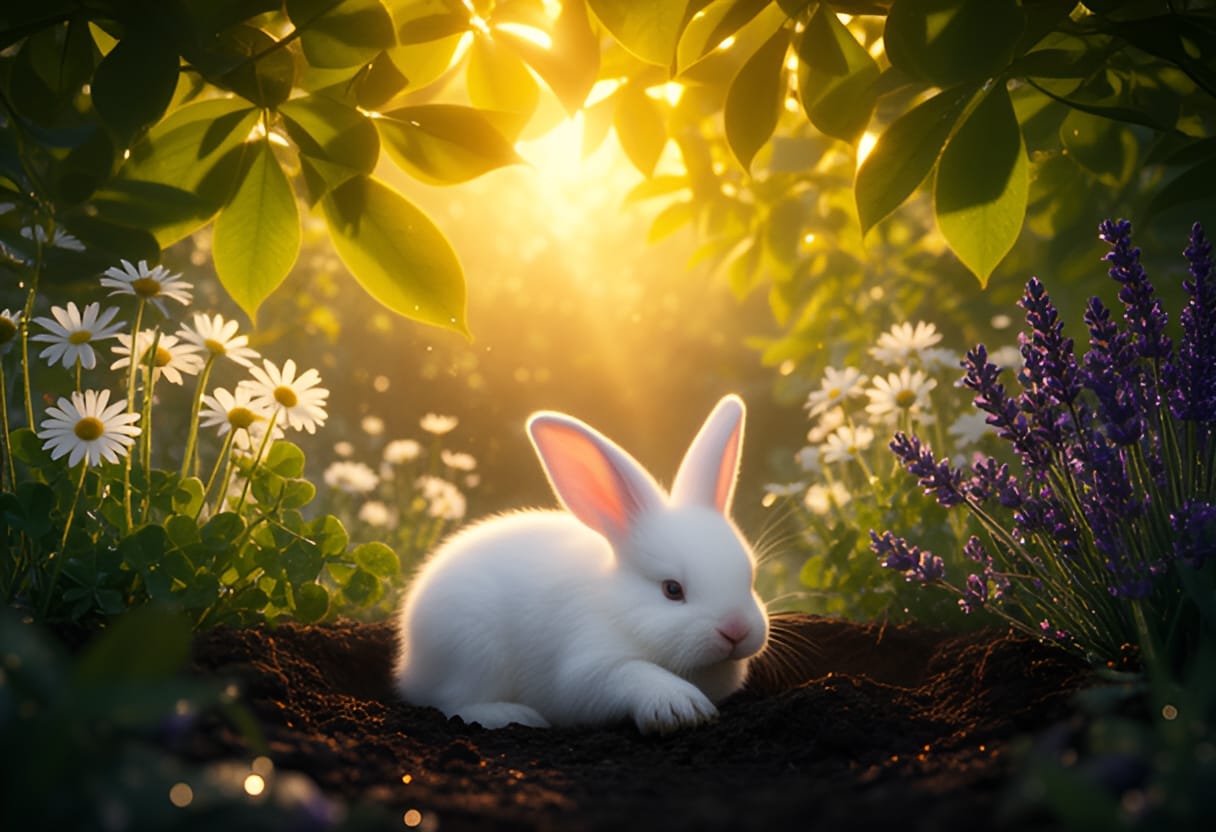
The first light of morning slipped through the leaves, painting the garden in soft gold. Baby Bunny stirred in the shallow hollow where it had curled the night before, its nose twitching as the scent of damp earth and sweet clover rose on the cool air. One paw pushed against the soil, then the other, and it blinked slowly, wide eyes adjusting to the brightness. The world was quiet but alive — a bee hummed somewhere nearby, a breeze rustled the clover like a whisper, and the morning felt new and waiting.
It lifted its head, nostrils flaring. The smell of clover was strongest just ahead, where the shoots pushed tender and green through the soil. Without hesitation, Baby Bunny lowered its muzzle and took a cautious bite. The leaf was crisp and sweet, bursting with freshness. It chewed slowly, savoring the taste, then nibbled another, and another, each small mouthful a quiet celebration of the morning.
A shadow passed over its head. Baby Bunny froze, ears snapping upright, then relaxed as a flash of orange and black drifted down — a butterfly, wings opening and closing like stained glass in the sunlight. It hovered for a moment, then settled delicately on the tip of the bunny’s nose.
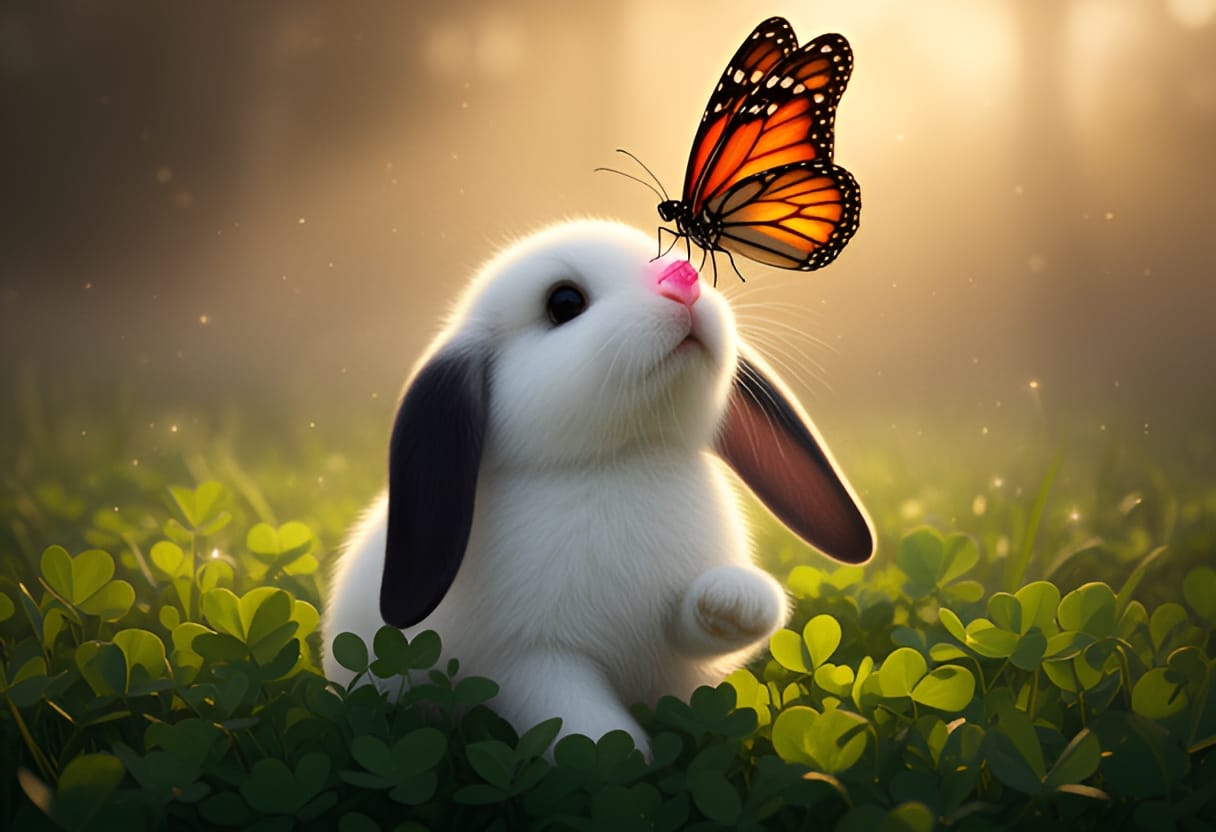
Baby Bunny went cross-eyed, trying to see it. Its whiskers twitched. A soft, silent puff of breath escaped its nose, and the butterfly lifted — just slightly — before settling again. A tiny tremor of delight ran through the bunny’s frame. It did not move. It did not breathe too deeply. It simply sat, nose to the sky, eyes crossed in wonder, as the butterfly rested there, a living jewel on its face.
The sun climbed higher, warming the clover, the soil, the soft fur on Baby Bunny’s back. Somewhere in the distance, a bird called — clear and bright — but for now, the garden held its breath, and the baby bunny was exactly where it was meant to be.
The butterfly’s wings gave a faint tremor, as if testing the air, then lifted in a slow, drifting spiral. Baby Bunny watched it go, eyes still slightly unfocused, the memory of its touch lingering like a faint tickle on the nose. It lowered its head back to the clover, nibbling thoughtfully, ears swiveling toward the sound of a distant rustle in the hedgerow.
A ladybug, no larger than a pebble, climbed slowly up a nearby stem. Its shell gleamed like polished mahogany, dotted with seven perfect black spots. Baby Bunny leaned forward, nose almost touching the leaf, and watched as the tiny creature paused, antennae quivering, before continuing its quiet ascent. The bunny did not move to disturb it. Instead, it sat back on its haunches, forepaws tucked gently beneath its chest, and observed the small world unfolding at ground level.
A bead of dew clung to the tip of a clover leaf, catching the light like a miniature prism. Baby Bunny leaned in and touched it with the very tip of its tongue — cool, clean, tasting faintly of sky and stone. It blinked, surprised by the sudden brightness of the flavor, then licked again, more deliberately, savoring the quiet luxury of the morning’s gift.
Nearby, a spider had begun to spin a thread between two blades of grass. The silk glistened, nearly invisible, trembling in the faintest breath of wind. Baby Bunny tilted its head, fascinated by the delicate dance of the creature as it moved backward, laying down its invisible line with patient precision. It did not reach out. It did not hurry the process. It simply waited, breath soft, heart calm, as if understanding, in its own wordless way, that some things are meant to be watched, not touched.
The breeze shifted, carrying with it the faint, sweet scent of honeysuckle from beyond the garden wall. Baby Bunny’s nose twitched once, twice, then it turned its head slightly, listening. A bird called again — nearer this time — and the leaves above shivered in response. The bunny’s ears lifted, swiveling like satellite dishes, catching the sound, triangulating its source. Not alarm. Not fear. Just awareness. A quiet acknowledgment that the world extended beyond the clover patch, beyond the dew, beyond the butterfly’s flight.
It settled again, lowering its chin to rest lightly on its paws. The sun warmed its back. The earth smelled rich and alive. Somewhere, a bee drowsed in a blossom. Somewhere, a worm tunneled through the dark loam. And here, in this small circle of green and light, Baby Bunny sat — not doing much, not needing to — simply being. Present. Peaceful. A small, soft heartbeat in the hush of the morning.
Baby Bunny lifted its gaze from the clover, eyes soft and unfocused, and let them drift upward. The sky above was a vast, pale blue, brushed with wisps of white that floated like thoughts half-formed. A slow breath eased from its nostrils as it watched, ears relaxed, paws resting gently on its knees.
One cloud, thick and rounded at the base, tapered into a soft point above — and for a moment, it looked just like a rabbit sitting upright, ears perked, nose twitching at the breeze. Baby Bunny’s own ears gave a faint lift in response, not from alarm, but from recognition. It blinked, and the shape softened, the edges blurring as the wind tugged the cloud apart.
Then, higher and to the left, a puff drifted into view — plump and smooth, with a slight indentation on one side. It rolled slowly across the blue, and Baby Bunny’s eyes widened just a fraction. A ball. Perfect and round, bouncing nowhere, held aloft by nothing but air. It imagined nudging it with its nose, watching it wobble and roll across the grass, but the cloud remained still in its journey, unchanged, untouchable.
A yawn crept up, slow and deep, stretching its jaws wide. Teeth glinted faintly in the light, and its eyes squeezed shut for just a heartbeat. When they opened, the sky had shifted again.
Now, near the horizon where the blue began to pale into white, a cloud lay stretched out, front paws extended, hind legs curled, one ear flopped over as if in sleep. A puppy. Dreaming. Its chest rose and fell with the slow rhythm of imagined breath, and Baby Bunny felt a quiet warmth spread through its chest, soft as the fur on its belly.
It didn’t move to chase it. Didn’t bark or leap. It simply watched, heart light, as the cloud-puppy dreamed on, unaware of the world below.
The sun warmed its forehead. A ladybug, having finished its climb, took flight from the stem and vanished into the blossoms beyond. Somewhere, a bee stirred in the clover. The breeze lifted a few loose strands of fur from Baby Bunny’s neck, and it shuddered slightly, not from cold, but from the sheer, quiet pleasure of being here — of being part of this slow, turning moment.
It stretched its forelegs out in front, toes spreading in the damp earth, then drew them back, rolling its shoulders with a soft grunt. One hind leg kicked out, then the other, a tiny burst of movement before stillness returned. It lowered its chin to rest on its paws, eyes half-lidded, gazing not at anything in particular, but at the feeling of light on its eyelids, the hum of the garden, the quiet pulse of the earth beneath it.
A bird called again — clear, bright, unafraid — and this time, Baby Bunny didn’t turn its head. It let the sound wash over it, a note in the morning’s song, and sighed, a long, quiet exhalation that seemed to melt into the grass.
The clouds drifted on. The rabbit was gone. The ball had dissolved into mist. The puppy-cloud had stretched and faded, its dream dissolving into the sky.
And Baby Bunny sat — not waiting, not wondering, just being. Its breath came slow and even. Its fur, warmed by the sun, felt light and loose. Its mind, so full of fluttering wonders just moments ago, now rested, open and quiet, like a flower closed at dusk.
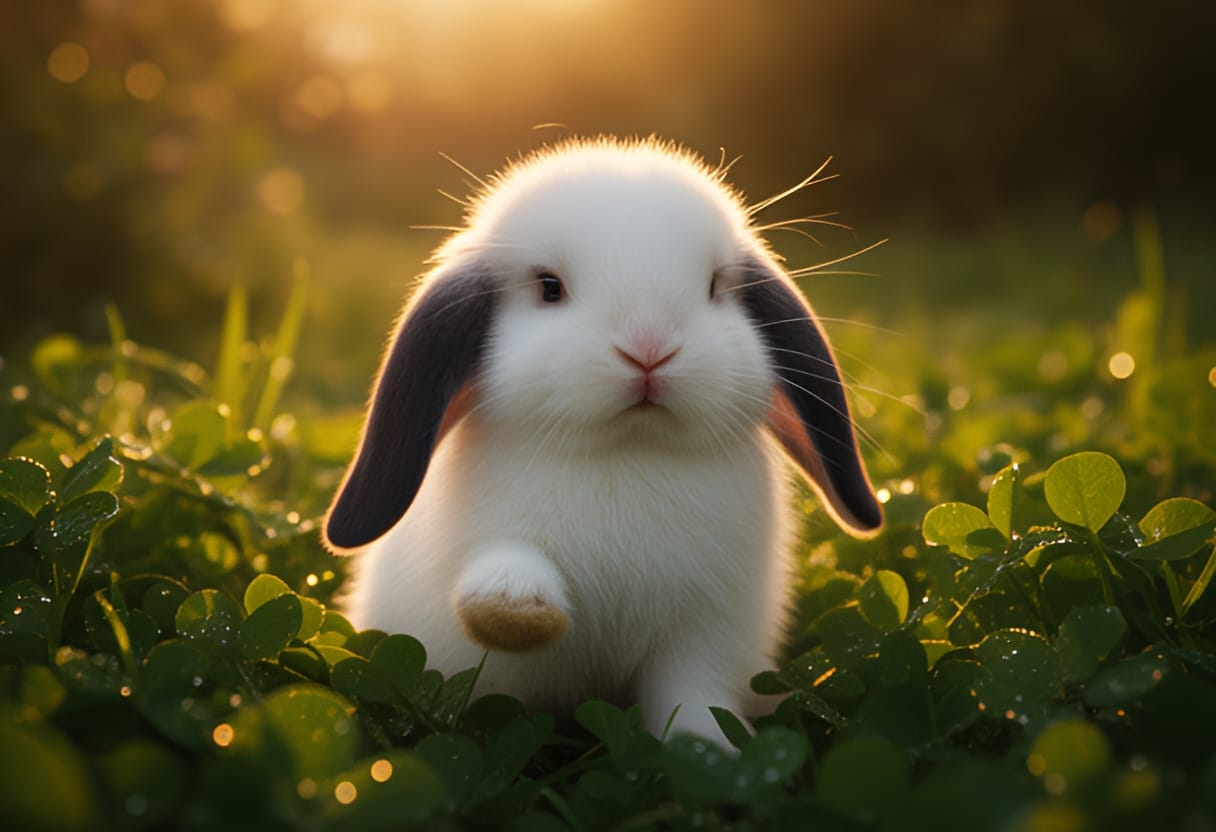
Somewhere beyond the hedgerow, the world turned. But here, in this small circle of clover and sky, time had softened at the edges. And for now, that was enough.
Chapter 2
Nap Time in the Nook
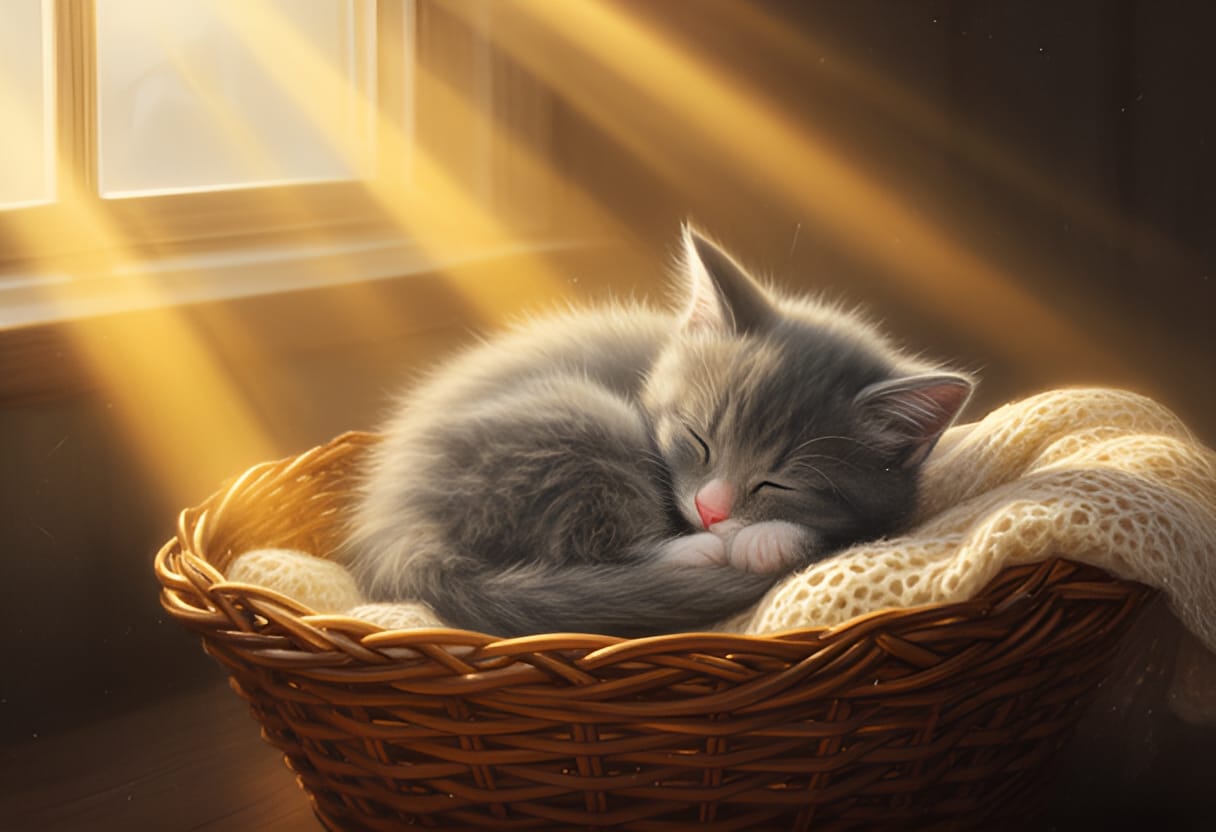
The morning light had softened now, spilling in through the window like warm honey, gilding the edge of the woven basket where Baby Kitten lay curled. Its tiny body pressed into the soft hollow it had made, nose tucked just beneath a paw, ears flicking at the distant murmur of the house — a creak of floorboards, the low hum of the refrigerator, the sigh of wind outside. The air smelled of dust and sun-warmed cotton, of lavender from the sachet tucked in the corner of the room, and beneath it all, the clean, milky scent of its own fur.
It stirred, not with urgency, but with the slow, deliberate grace of waking. A paw extended, claws barely catching the blanket’s weave, then retracted. The kitten rolled onto its side, then back, tracing a slow circle in the nest of fabric, each turn settling it a little deeper into the warmth. Its tail flicked once, twice, then curled snugly against its flank as it pressed its forehead into the blanket, inhaling deeply.
Then came the kneading — tiny, rhythmic pushes of front paws, alternating left and right, sinking into the softness and releasing with a quiet flex of toes. The motion was instinctive, comforting, like the memory of milk and safety. With each press, a faint vibration began in its chest, a soft tremor that started low and grew with the rhythm of its paws.
A quiet sound escaped — not a mew, not a cry, but a low, rumbling purr, felt more than heard at first. It vibrated through its ribs, up through its throat, and into the blanket beneath it, making the fibers tremble ever so slightly. The kitten’s eyes, half-lidded, drifted closed as the sensation spread, warm and steady, like sunlight sinking into stone.
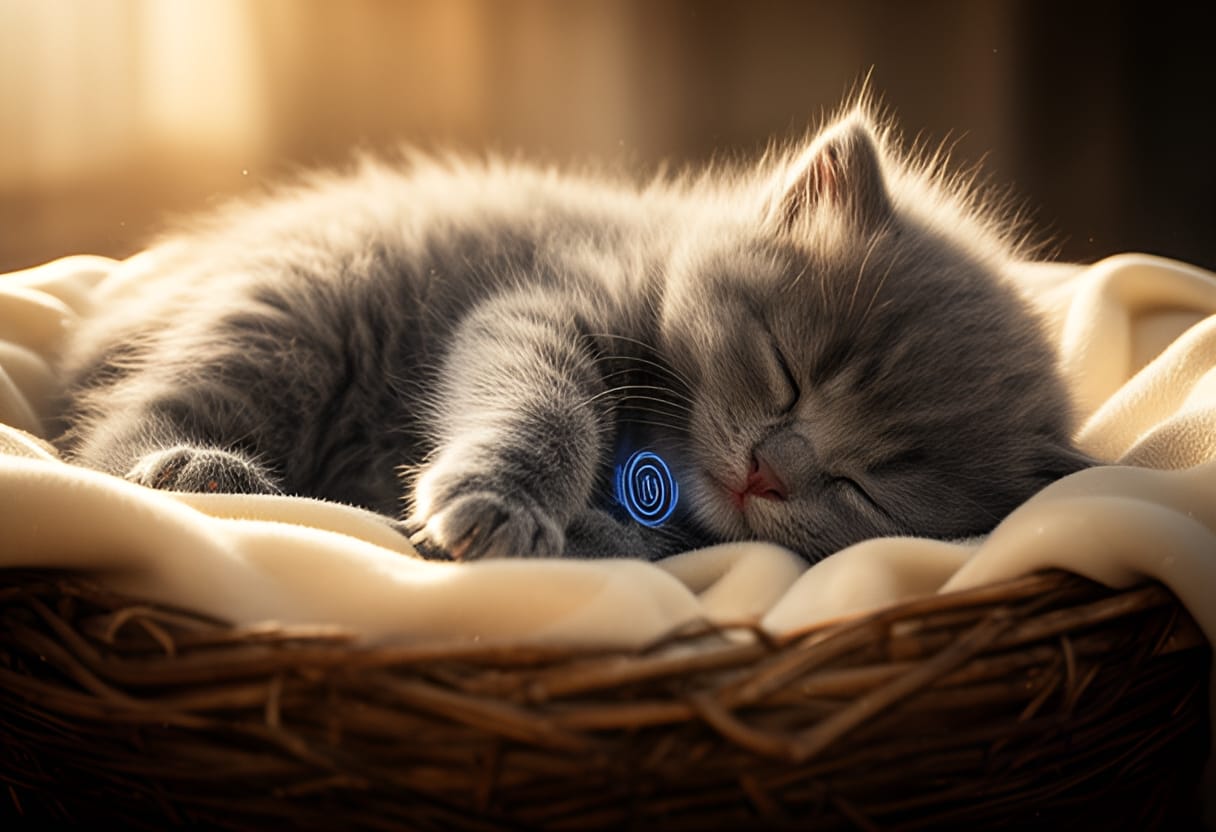
The purr deepened, resonating in its small throat, a steady, thrumming pulse that filled the quiet room. It no longer needed to knead to keep it going — the sound now fed itself, a loop of comfort and release. Its body softened completely, limbs loose, breath slowing to match the purr’s rhythm. The world beyond the basket faded — the light, the sounds, the distant life of the house — all softened at the edges, absorbed into the gentle, vibrating hum coming from within.
It did not think of what came next. It did not wonder if it would wake hungry or if the sun would move. It only knew this: the press of paws, the rumble in its chest, the smell of cotton and lavender, the way the blanket held it like a promise. And so it stayed, paws moving in their slow, sure rhythm, purr growing full and deep, a quiet song woven into the fabric of the morning.
The sunbeam, which had lain like a ribbon across the floor, began its slow creep, inch by inch, toward the basket. It touched the edge of the blanket first, a pale gold finger brushing the weave, then pooled gently over the kitten’s raised hip as it shifted in its sleep. The warmth seeped through the fabric, soft and insistent, spreading like a sigh into its fur. The kitten’s paw, mid-knead, paused — not in disturbance, but in surrender — as the heat traveled up its leg, loosening the last traces of tension.
Its purr, now a low, resonant thrum, seemed to harmonize with the light. Each breath drew in the sun-warmed air, and each exhale sent the vibration rippling outward, faint but steady, like a stone dropped in still water. The blanket, once merely soft, now felt alive with warmth, holding the kitten not just in shape, but in sensation — a cocoon of heat and hum.
A fly buzzed lazily against the windowpane, then drifted away. Somewhere downstairs, a door clicked shut. The kitten’s ear twitched once, then stilled. Its nose, pink and damp, rested against its foreleg, whiskers relaxed. The kneading had softened to almost nothing — just the faintest flex of toes, like a dream of motion. But the purr remained, deep and unwavering, a vibration in the chest that had become its breath, its pulse, its very presence.
The light climbed higher now, spilling across the kitten’s shoulder, then sliding along the curve of its spine. It warmed the patch of fur where the blanket had folded under its side, turning the gray to a soft, luminous silver. The kitten did not stir toward it, nor away. It simply was — held in the quiet alchemy of warmth, touch, and sound, each element blending into the next until the boundary between inside and out, between body and light, had blurred into something soft and seamless.
Its eyes remained closed, not from heaviness, but from peace. The world had narrowed to this: the press of paws, the drone of purr, the slow advance of sun. And in that narrow space, there was no need for more. Only this — the steady, deepening thrum in its chest, the warmth spreading through its limbs, the quiet certainty of being exactly where it was meant to be, wrapped in the soft, singing hush of morning.
The sunbeam, now a thin ribbon of light, slipped forward along the blanket’s edge, seeking the curve of the kitten’s flank. It found the soft fur just behind the shoulder, where the coat was thickest and still held the night’s coolness. The warmth touched first as a whisper, then settled, seeping into the roots of the fur, spreading outward like ink in water. The kitten’s side softened under the press of light, muscles unwinding thread by thread. A faint tremor passed through its body — not from discomfort, but from release — as if the heat were loosening knots it hadn’t known were tied.
The purr, now a deep, steady thrum, seemed to draw strength from the sun. Each pulse of vibration matched the slow creep of light, as though the two were breathing together. The kitten did not move toward it, nor pull away. It simply allowed the warmth to claim what it would, sinking deeper into the basket’s embrace. The blanket, now alive with heat, cradled it not just in shape but in sensation — a slow, golden seep that turned the gray of its fur to a pale, luminous silver where the light pooled thickest.
A fly stirred against the glass, its wings catching the sun in a flicker of iridescence before it vanished toward the sill. Somewhere in the walls, a pipe sighed. The kitten’s ear twitched — once, faintly — then lay still. Its nose, damp and pink, rested against its foreleg, whiskers no longer tracing the air but lying soft and loose, like threads abandoned mid-stitch. The kneading had ceased entirely. Not a single paw flexed. Only the purr remained — low, resonant, a vibration that had become less a sound and more a presence, filling the chest, the ribs, the very hollow of its bones.
The light climbed. It slid along the spine, warming each vertebra in turn, turning the shadow beneath the fur into a soft, glowing haze. It reached the base of the tail, where the fur flared slightly, and lingered there, gilding the fine hairs until they seemed to glow from within. The kitten’s tail, which had curled snugly against its flank, now lay slightly more open, the tip relaxed, no longer guarding but simply resting. The warmth reached the hind legs, then the paws, one of which had drifted forward in sleep and now lay open-palmed against the blanket, toes slightly curled, pads soft and pink in the glow.
And then — the eyes. Not with a snap, but a slow surrender. The lids, already heavy, began to lower. Not from heaviness, but from peace. The lashes, so pale they were almost white, brushed the cheeks in a whisper of motion. Beneath them, the eyes rolled slightly upward, as if seeking the source of the light not with sight, but with sensation. The last sliver of gray iris vanished, then the pupil — a dark pool swallowed by the lid. The face smoothed. The brow, which had held the faintest tension of waking dreams, now lay flat and quiet. The mouth, slightly parted, exhaled a breath so soft it barely stirred the fur beneath the chin.
The breath deepened. Not forced, not sought — simply arrived, as if the body had finally remembered how to trust itself. Each inhale drew in the sun-warmed air, scented now with cotton, lavender, and the quiet musk of sleep. Each exhale released it in a slow, steady sigh, the purr riding the outward breath like a current. The chest rose and fell with a rhythm that was no longer effort, but ease — a tide that needed no pulling, only surrender.
The sunbeam, having crossed the hip, the spine, the shoulder, now reached the head. It touched the crown, then slid down the forehead, warming the space between the ears. The fur there, shortest and finest, took on a translucent glow, as if lit from behind. The kitten’s head, which had rested slightly askew, now settled, turning just enough so that one cheek pressed fully into the blanket, the other lifted just enough to catch the light along the jawline. A paw — the left — had drifted upward in its sleep and now lay tucked beneath the chin, the pads soft against the fur, the toes relaxed, the claws sheathed and hidden.
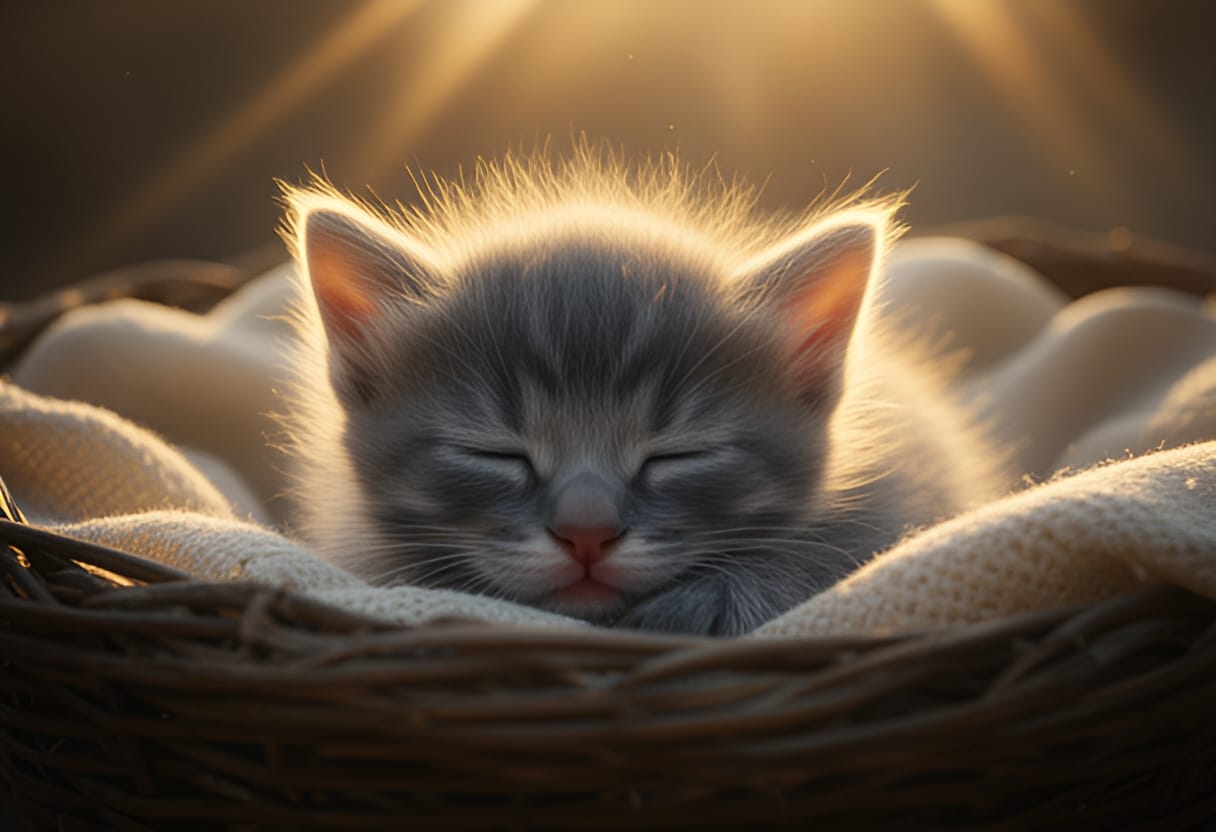
The room was quiet. Not empty, but full — full of light, of warmth, of the deep, vibrating hum of a small body at peace. The house beyond the window breathed on, unaware. Time, which had been a creeping thing, now stood still. The basket held not just a kitten, but a moment — rounded, complete, unbroken. The purr had faded not into silence, but into the breath itself, no longer separate, but woven into the rise and fall of the chest, the flutter of the lashes, the quiet pulse in the throat.
The kitten did not dream. It did not need to. It was already where it wanted to be — not in a place, but in a state: warm, safe, held. The sun had done its work. The light had crossed the blanket, the fur, the body. And now, it rested there, not as a visitor, but as a home. The kitten slept — not deeply, not lightly, but utterly. One paw under the chin, breath slow, fur glowing, heart quiet. The world could wait. Here, in this circle of warmth and wool and light, there was only this: the slow rise and fall of a small life, at peace.
Chapter 3
Playtime in the Meadow
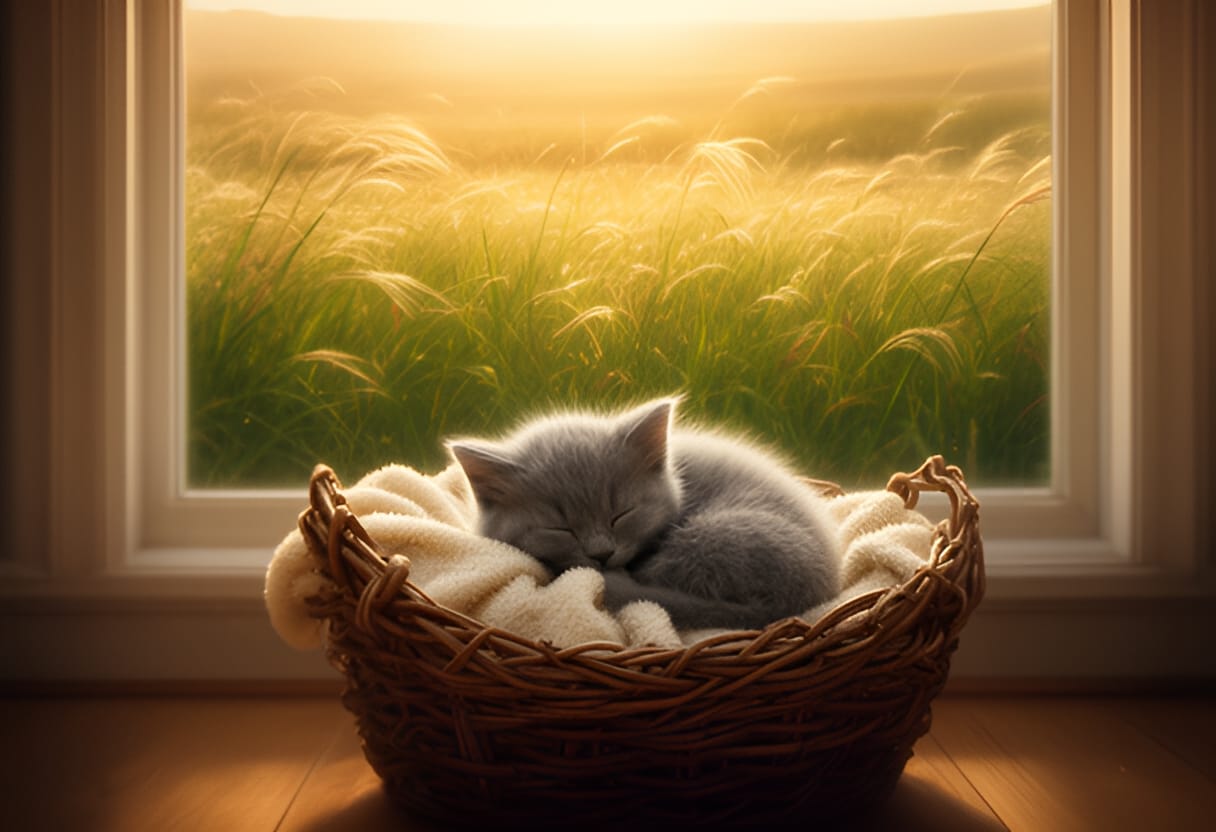
The kitten slept on, breath rising and falling gently in the sunlit room, the woven basket cradling its small form as warmth seeped into every fur-lined curve. Outside, beyond the threshold of the quiet house, the meadow awoke in a hush of green and gold. Tall grasses swayed in a breeze that carried the scent of earth and distant clover. Wildflowers nodded — buttercups, daisies, the occasional purple vetch — their heads bobbing like sleepy sentinels keeping watch over the waking world.
Near the edge of the meadow, where the grass softened into a slight hollow shaded by a low hawthorn bush, sat a small, weathered doghouse. Its wood was sun-bleached and slightly warped at the corners, the roof patched with dried moss that had taken hold in the crevices. From within, a muffled stir — a soft whuffle, a shift of weight — then a nose pushed against the flap, followed by a wobble of golden fur.
Baby Puppy tumbled out with a sudden, uncoordinated lurch, its oversized paws splaying as it tried to find purchase on the dew-damp earth. For a heartbeat, it teetered, ears flopping sideways, eyes wide and bright as it took in the world beyond the doghouse — the sky a soft blue, the sun warm on its back, the grass whispering against its belly.
And then — there.
A flash of red, rolling slow and tantalizing just beyond the patch of clover where the grass grew thicker. The ball had come from somewhere beyond the hawthorn, perhaps nudged by a breeze or kicked loose from a forgotten game. It paused, wobbled, then began to roll again, slow and sure, as if inviting chase.
Baby Puppy let out a sharp, excited yip — a sound pure and bright, like a bell rung in joy — and launched forward. Its legs moved in a frantic, uncoordinated scramble, paws kicking up tiny sprays of dirt and grass as it lunged after the bouncing treasure. The puppy’s tongue lolled, tail wagging so hard its whole rear wiggle with each step.
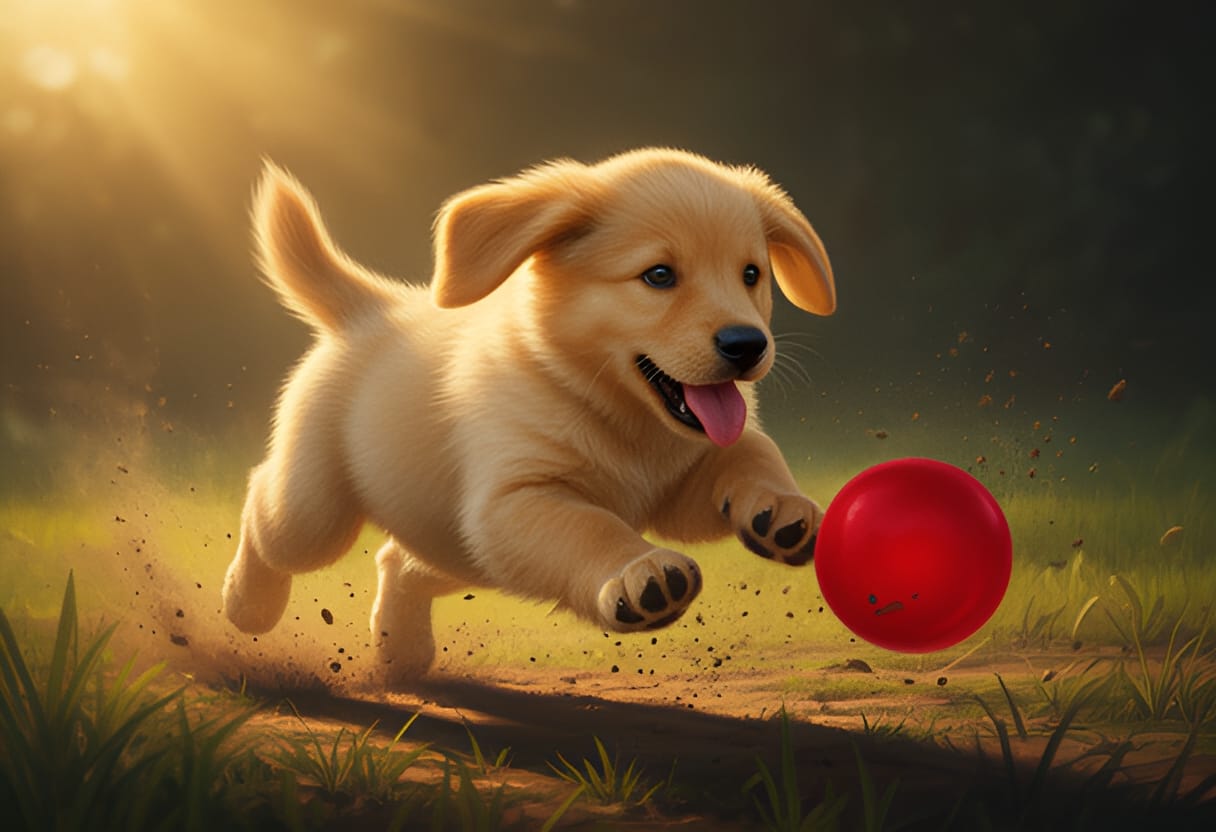
But the grass, slick with morning damp, betrayed it. One paw slid sideways on a hidden patch of moisture near a clump of thick-stemmed grass. The puppy’s legs flew out from under it, and it rolled sideways in a tumble of golden fur and flailing limbs, coming to rest with a soft puff of dust and a surprised little yelp.
For a moment, it lay still, chin on the earth, ears flattened, breath quick. Then, nose twitching, it lifted its head. The red ball was still moving — just ahead, now bouncing toward a tuft of taller grass where the ground dipped slightly.
Determination flared in its wide eyes. With a push of its hind legs, it scrambled up, paws scrabbling for grip, and launched itself forward again. This time, it lowered its body, ears flung back, eyes locked on the rolling red sphere as it arced toward a small rise.
The puppy lunged — jaws open, paws outstretched — but the ball, catching a tiny ridge in the soil, hopped sideways just as the puppy’s snout closed on air. It bounced once, twice, then rolled past the puppy’s outstretched paws and disappeared into the taller grass beyond the rise.
Baby Puppy skidded to a halt, hind legs digging in, front paws scraping the earth. It stood for a breath, chest heaving, tongue lolling, eyes fixed on the spot where the ball had vanished. A low whine escaped its throat — not of frustration, but of eager anticipation. The game was still on. The chase was far from over.
It took a single, deliberate step forward, then another, nose low to the ground, ears swiveling as it listened for the faintest roll, the softest bounce — any sign that the red treasure was still near, still waiting to be caught.
Baby Puppy’s nose twitched as it caught the faint, rubbery scent of the ball, mingled now with crushed clover and damp soil. It lowered its head, ears swiveling forward, and crept the last few steps through the taller grass, each movement deliberate, paws placing softly to avoid disturbing the hidden prize. The ball lay half-buried against the stem of a thick tuft, its red surface gleaming faintly where a shaft of sunlight pierced the blades.
With a sudden, soft lunge, the puppy snapped its jaws shut around the ball. A small, satisfied grunt escaped as the rubber yielded slightly between its teeth, firm and familiar. It held the prize gently, not crushing it, eyes gleaming with quiet pride as it lifted its head, the ball dangling slightly from its mouth.
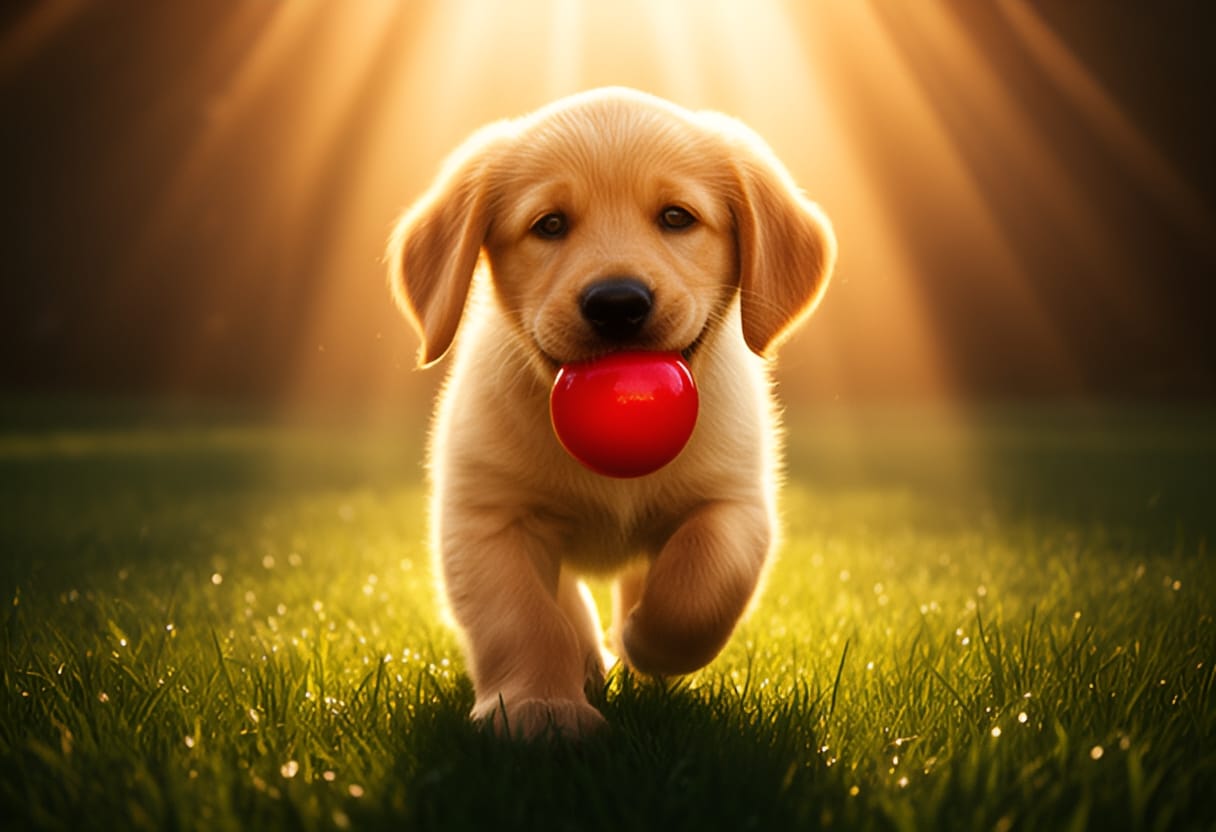
For a moment, it stood still, chest rising and falling, tongue lolling at the corner of its mouth. Then, with a careful shake of its head, it released the ball. It dropped to the earth at its paws, rolling just a fraction before coming to rest upright, as if offering itself back to the game.
Baby Puppy lowered its forelegs, then its hindquarters, and sank slowly onto its belly. It stretched one paw forward to nudge the ball closer, then another, guiding it until it lay snug between its forepaws. The puppy lowered its muzzle, began to chew — slow, rhythmic bites — the rubber softening slightly with each press of its teeth. A low, contented rumble vibrated in its throat, half-purr, half-growl, the sound of exertion given way to ease.
Its eyes drifted half-closed, the bright gold of its fur catching the sun in warm patches along its back. The meadow breathed around it — the whisper of grass, the distant hum of bees, the soft rustle of a ladybug climbing a stem nearby. The ball, now slick with a little drool, rested securely between its paws, a trophy claimed not by speed, but by persistence.
A single, sharp bark rang out — bright, clear, not loud, but full of pure, uncomplicated joy. It echoed briefly off the hawthorn bush, then faded into the quiet air. The puppy’s tail gave one last, slow thump against the earth before going still.
It did not move again. The chewing slowed, then stopped. The puppy lay curled slightly on its side, the ball cradled against its chest, breath deep and even. The sun warmed its back, the meadow held its breath, and for now, the chase was over. The world felt soft, full, and exactly as it should be.
The puppy’s eyelids fluttered, heavy with the soft weight of satisfaction, but not yet sealed shut. A faint breeze stirred the grass nearby, carrying with it the sweet, green scent of crushed clover and the distant, honeyed warmth of sun-baked earth. Somewhere beyond the hawthorn, a bird called — a clear, two-note phrase that hung in the air before dissolving into the hum of insects.
Baby Puppy’s nose twitched once, then again, drawing in the meadow’s breath. Its paw, resting loosely over the ball, gave a tiny, unconscious flex, as if testing the rubber’s give one last time. The ball, warm now from the sun and the press of its hold, fit perfectly in the cradle of its paws — not too big, not too small, just right for a mouth that had chased it, missed it, and finally, triumphantly, caught it.
A ladybug, its shell a polished dome of scarlet with seven neat black spots, climbed slowly up a nearby grass stem. It paused at the tip, antennae waving, unaware of the watchful eyes half-lidded above it. The puppy did not move to disturb it. Instead, it watched — slow blinks, soft focus — the tiny creature a quiet companion in the stillness.
Its tail, no longer wagging with frantic energy, gave a slow, lazy sweep from side to side, brushing the earth in a rhythm that matched its breathing. The sun, now slightly lower in the sky, painted long, soft shadows across the meadow, turning the gold of its fur into something deeper, richer — like honey left to thicken in the comb.
A memory flickered, not as a thought, but as a sensation: the first wobble out of the doghouse, the slip on damp grass, the startled yelp, the sudden flare of determination. All of it had led here — to this quiet moment, the ball between its paws, the meadow humming around it, the world not demanding anything more than to be felt.
The puppy’s breathing deepened. Its jaws relaxed slightly, the ball resting now without pressure, held not by grip but by trust. Its ears, still flopped softly to the sides, twitched at a far-off sound — perhaps the rustle of a vole in the roots, perhaps nothing at all. It did not stir to investigate.
Instead, it let its head sink just a fraction lower, cheek resting gently on the warm earth beside the ball. The last of the light caught the edge of its ear, translucent and thin, glowing like spun amber. And in that hush, with the scent of thyme and sun-warmed stone in its nose, Baby Puppy slept — not deeply, not yet, but peacefully, as only the truly content can.
Chapter 4
Honey Time with Mama Bear
The puppy lay still, ball cradled between its paws, tongue lolling in a lazy, happy grin. The meadow hummed with the quiet thrum of late morning — bees drifting between clover, a breeze stirring the tall grass like a slow breath. Somewhere nearby, the mother dog gave a soft, contented sigh and shifted in the shade of the doghouse, one ear twitching at a distant sound.
A new warmth touched the air, deeper and richer than sun on grass. It carried the scent of damp earth and wild thyme, but underneath, something sweet and thick — like sunlight made liquid. The puppy’s nose twitched. It lifted its head, blinking, and sniffed again. Not far off, where the meadow softened into the edge of the woods, a great tree stood with bark furrowed like old leather, its branches dappled with light. And there, near its base, a small, dark shape clung to the trunk — not a knot, not a shadow, but something alive.
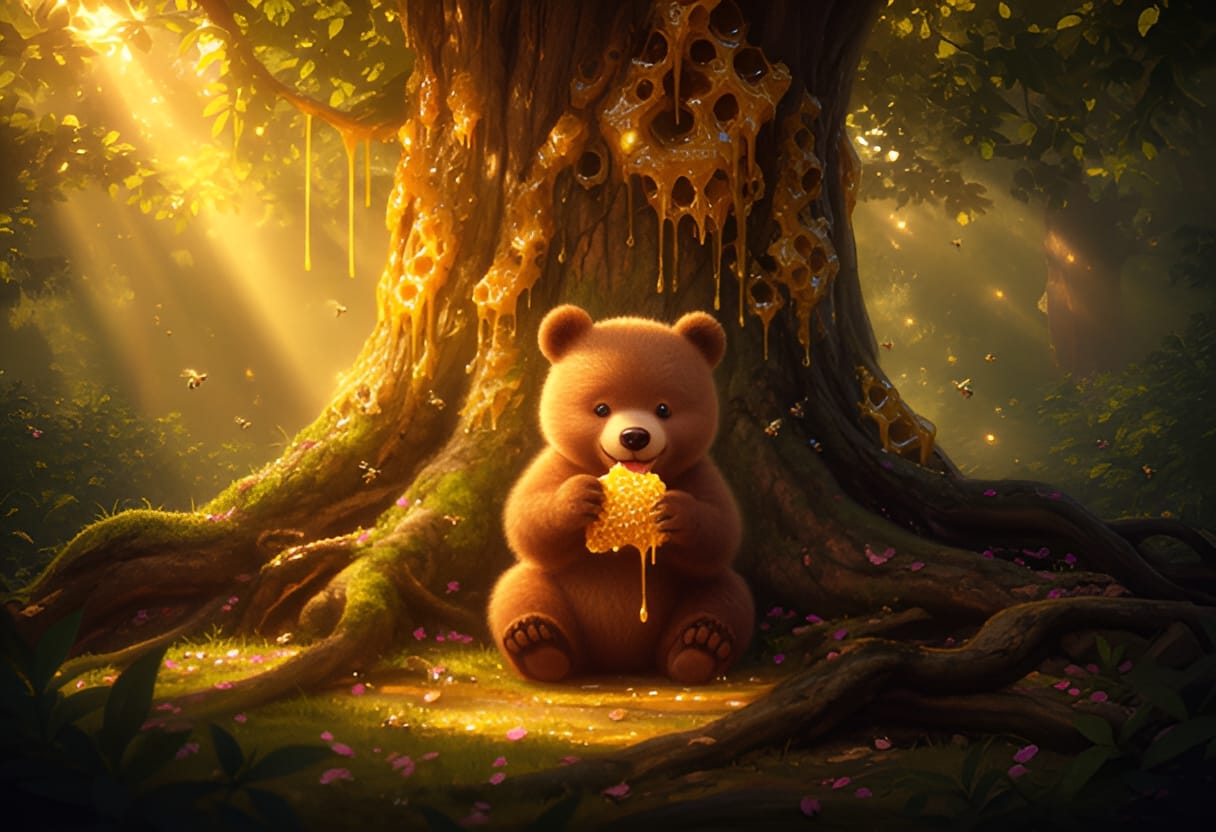
The puppy pushed itself up, wobbling slightly on legs still loose from play. It took a few uncertain steps, then another, drawn by the smell and the quiet curiosity that lived in its chest. As it drew closer, the shape resolved: a tiny bear cub, no bigger than a loaf of bread, sitting upright at the tree’s roots. Its fur was the color of cinnamon and cream, round ears tucked close to its head, eyes wide and focused on its paws.
In those paws, the cub held a small, hexagonal piece of honeycomb, golden and glistening. Tiny beads of honey clung to the edges, catching the light like scattered amber.
The puppy stopped, ears pricked, tail giving a tentative thump against the grass. It didn’t bark. Didn’t lunge. Just watched, head tilted, as the cub brought the comb slowly to its muzzle.
A pink tongue flicked out — tentative at first — then swept across the comb. The cub’s eyes fluttered shut. Its whole body seemed to soften, shoulders dropping, breath hitching in a quiet, delighted gasp. A low, rumbling hum began in its chest, not quite a growl, not quite a purr, but something deep and sweet, like the hum of the hive itself vibrating through its bones.
It licked again. Longer this time. The honey stretched, thick and slow, clinging to its lips, stretching in a golden thread as it pulled back. The cub blinked, eyes opening wide — not in surprise, but in wonder, as if the taste had unlocked something warm and bright behind its ribs.
Another lick. Then another. The cub’s nose wrinkled as honey smeared across its muzzle, dripping down to coat its chin and chest. Its front paws, sticky now, rubbed together instinctively, spreading the gold across the pads and between the toes. It licked its paw, then the other, making small, pleased noises — soft chuffs and hums that rumbled in its throat like a bee trapped in sunshine.
The puppy took one more step forward, then sat, watching. Its tail gave a slow, steady wag. No sound came from it — just the quiet joy of witnessing something pure.
The cub paused, breath coming in short, happy puffs. It looked down at its paws, then at the comb still half-held in its grip. A slow, dazed smile spread across its face, honey glistening on its lips and the tip of its nose. It blinked once, slowly, as if trying to hold the moment inside itself — the sweetness, the warmth, the quiet hum of the tree above, the dappled light dancing on its fur.
Then, with a small, satisfied sigh, it lowered the comb to its lap and began to lick its paws in earnest, cleaning them with slow, deliberate strokes, eyes half-closed, utterly at peace.
The cub’s tongue swept one last slow circle around its paw, gathering the lingering honey into a sweet, sticky bead. It held the paw up, trembling slightly, golden droplets catching the light like tiny suns. Its eyes, still soft with the haze of delight, turned toward the shadowed shape nearby where the mother bear lay half-reclined against the roots, her dark fur blending with the earth, her breath slow and steady.
A low, questioning hum rose in the cub’s throat—not a call, not a demand, but an offering. It shifted its weight, wobbling on unsteady legs, and took a few small steps forward. The paw extended, sticky and glistening, hovered just above the mossy ground between them.
The mother bear’s eyes opened. Not sharply, not with alarm, but with the slow, soft unfolding of petals in morning sun. She lifted her head, nostrils flaring slightly as the rich scent of honey drifted on the air—honey on her child’s fur, honey in the light, honey in the quiet hum of the world.
She didn’t move at once. Just watched. Then, with deliberate gentleness, she leaned forward. Her tongue, broad and warm and rough as bark softened by rain, touched the cub’s paw. A slow, deliberate stroke—from wrist to toes—gathering the gold, savoring it, her eyes closing halfway as the taste spread through her own senses.
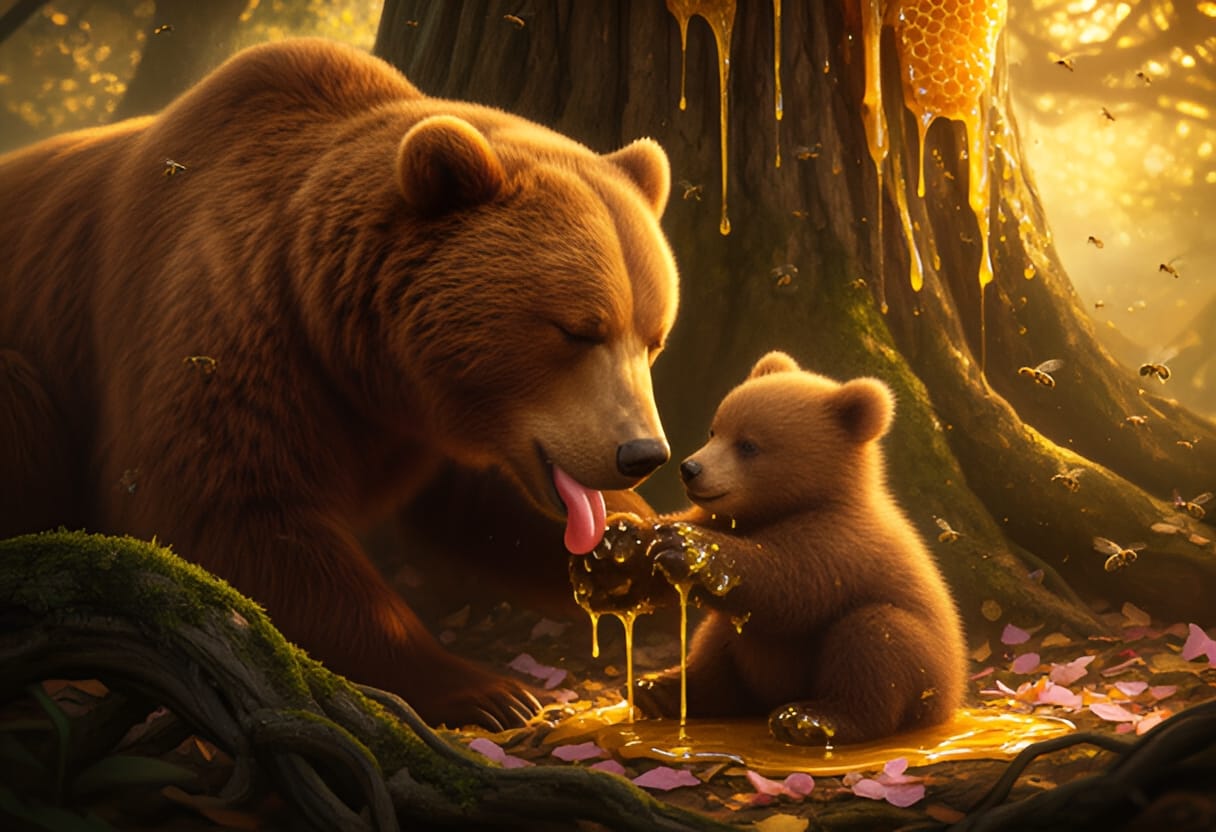
A soft, contented rumble rose in her chest, deeper than the cub’s, older and full of roots and rivers and long summers spent beneath this same tree. She licked again, slower this time, as if memorizing the sweetness not just on the skin but in the moment—the weight of the cub’s trust, the quiet joy in its stillness.
When she finished, she didn’t pull away. Instead, she turned her head and nuzzled the cub’s ear, her breath warm against the fine fur there. A soft, almost soundless chuff escaped her—like wind through pine needles, like a promise kept. The cub shivered, not from cold, but from the wave of warmth that spread from ear to toe, from touch to heart. It leaned into the nuzzle, eyes drifting shut, its own breath coming in soft, even puffs.
Then, as if guided by something older than thought, the cub turned and pressed its muzzle against the mother’s shoulder, where the fur was thick and soft and smelled of sun-warmed earth and wild berries. The mother shifted, making space, and lowered her head to rest gently atop the cub’s back. One paw curled loosely over the cub’s hindquarters, the other tucked beneath her chin.
The honey still glistened on the cub’s muzzle—a faint gold trail from nose to chin, catching the dappled light that filtered through the leaves above. A bee drifted lazily past, drawn by the scent, then veered off toward a clover bloom nearby. The grass whispered. The tree sighed.
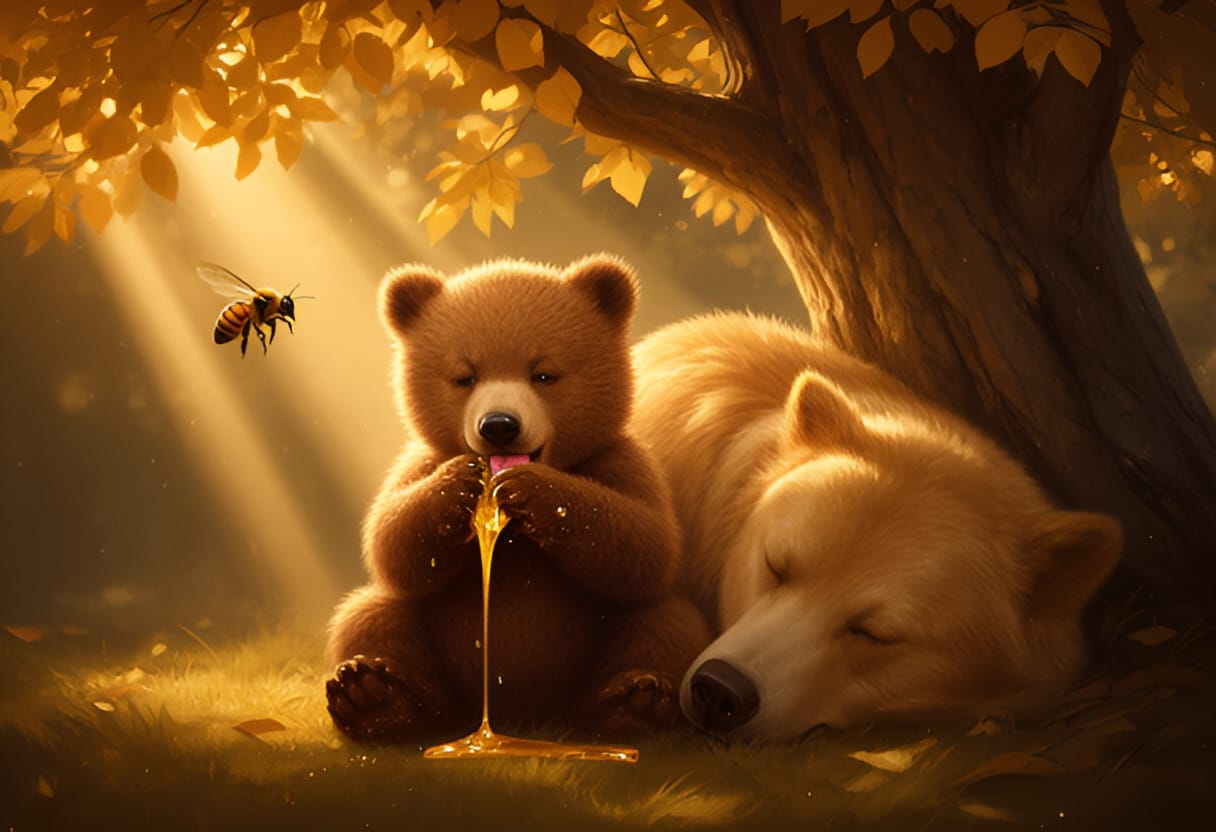
The cub’s eyelids fluttered. Once. Twice. Then stayed closed. Its breathing deepened, soft and rhythmic, matching the slow rise and fall of its mother’s sides. The mother’s own eyes remained half-lidded, her gaze soft and unfocused, not on anything in particular, but on the feeling—the weight, the warmth, the quiet hum of life pressed close.
They did not speak. They did not need to. The tree stood guard. The meadow breathed. And in the shade of the great trunk, where the light fell in patches and the air clung with sweetness, two bears slept—one small and sticky with joy, the other large and quiet with peace—curled together like roots and earth, like breath and dawn, like something meant to be held.
A soft twitch rippled through the mother bear’s muzzle as a dream stirred—perhaps of rivers swollen with spring melt, or of berries bursting dark and sweet beneath her claws. Her breathing slowed further, the rise and fall of her ribs becoming nearly imperceptible, like the tide pulling back from sand. The cub, nestled deeper into the curve of her shoulder, let out a faint, almost soundless sigh, its honeyed muzzle pressing just a fraction closer into the warmth of her fur. A single drop of honey, missed in the cleaning, caught the last slant of light and glittered like a tiny star on the tip of its nose. The world hushed—not empty, but full: the distant call of a jay, the slow turn of a beetle on a sun-warmed stone, the quiet, steady pulse of two hearts beating in the same rhythm, deep in the wood’s embrace. Sleep held them, not as an end, but as a soft, golden continuation.
Chapter 5
Ducklings on the Pond
The cub’s breathing slowed, warm and steady against its mother’s side, the last traces of honey catching the dappled light like tiny beads of amber. A soft breeze stirred the leaves above, sending a flutter of shadow across their curled forms. The forest hummed with the quiet of afternoon — a distant birdcall, the rustle of something small in the underbrush, the slow sigh of wind through branches.
Then, a shift in the air. A coolness, not from shade but from water. The scent of damp earth and stillness, of reeds and open sky. The cub’s ear twitched once, then settled. Its mother shifted slightly, a soft rumble in her chest, and the cub blinked awake — not to the garden, not to the basket, but to the edge of a pond where the world was all water and light.
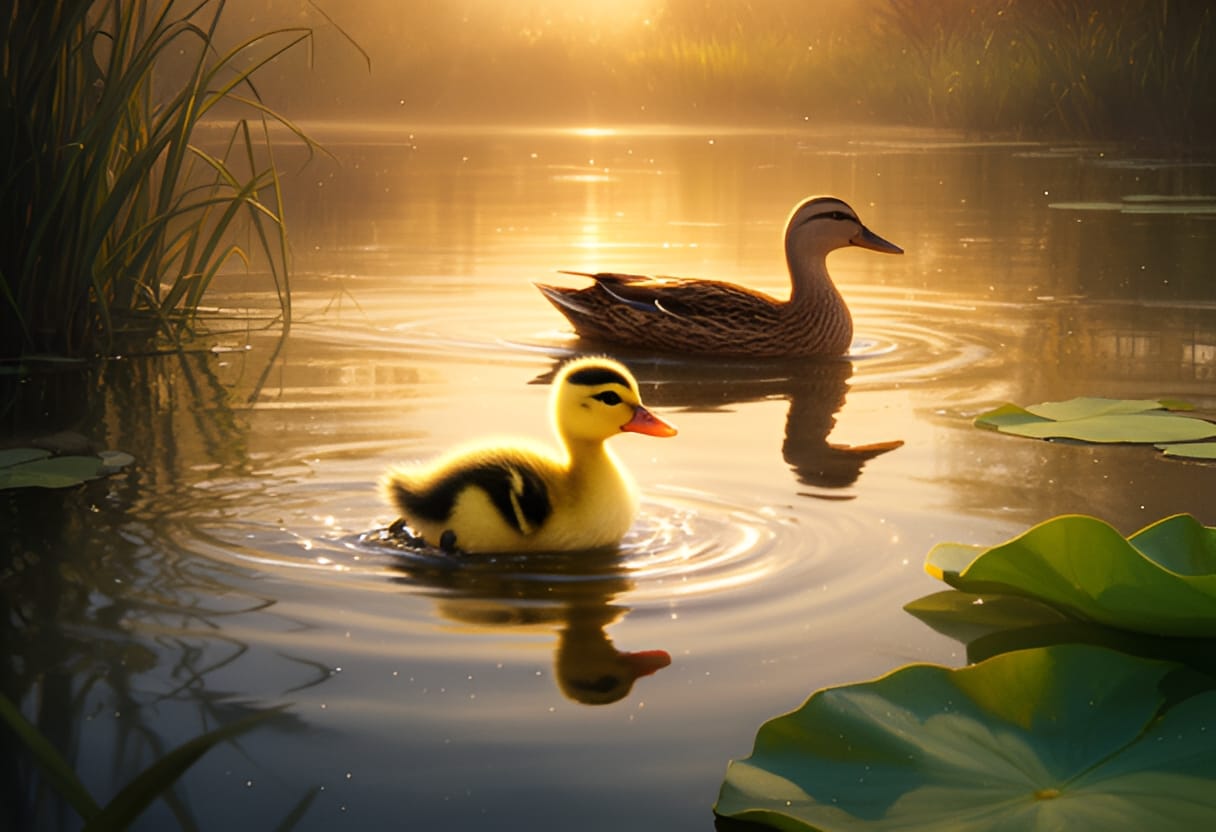
Here, the light didn’t filter through leaves but lay flat and golden on the surface, unbroken except where something moved. A line of soft brown ripples fanned out from ahead, steady and sure. And just behind, smaller kicks stirred the water — quick, eager, a little uneven.
The baby duckling paddled, its webbed feet pushing beneath the mirror-smooth surface, each stroke a small effort to match the glide of the one in front. Its mother moved with ease, neck curved low, feathers sleek and dry, cutting through the water like a thought made visible. The duckling tried to follow, to be in that same quiet rhythm, but its body bobbed slightly with each kick, its downy chest rising and falling as it strained to keep up.
It blinked. There — just below — its own face stared back: wide black eyes, a soft yellow blur of down, a beak slightly open in concentration. The reflection wobbled as it kicked, breaking into pieces before smoothing again. The duckling watched it, fascinated. If I kick like her… if I stretch my neck just so… It lifted its chin, tucked its feet in a little tighter, and pushed again — harder this time, toes splaying as it chased the smooth V behind its mother.
For a moment, it almost had it. The water clung less chaotically to its sides. Its wake narrowed, tracing a thinner line. It felt, just for a breath, like it was gliding.
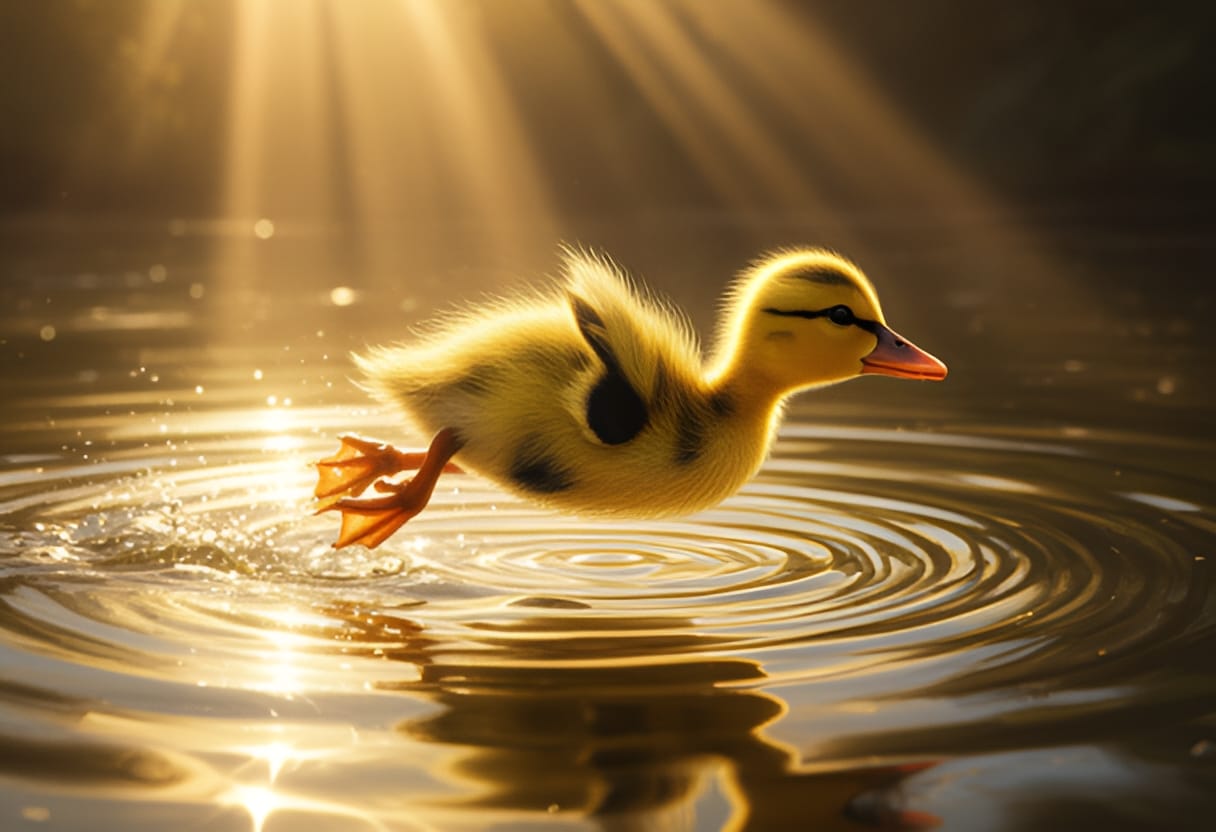
Then — a pause. A hesitation. The reflection dipped, and so did it, its feet slipping slightly out of rhythm. The mother’s wake pulled ahead, just a few inches, then more. The duckling’s legs churned, small wings flaring for balance, beak pointed forward in quiet determination. It paddled harder, toes spreading wide, sending up tiny sprays that caught the light like mist.
One kick. Two. Three. The gap shrunk. The water stilled behind it again, smooth and unbroken, as it drew even — not quite ahead, but close enough to feel the gentle pull of its mother’s movement, the quiet assurance of being in the line.
It didn’t look back. It didn’t need to. The water supported it. The light held it. And ahead, the mother floated on, steady and sure, leading the way into the reeds where the water grew still and the shadows long.
The duckling’s breath came in soft puffs, visible in the cool air above the water, each one vanishing before it could ripple the surface. Its eyes stayed fixed on the white tip of its mother’s tail feather, a steady marker in the shifting light. The pond stretched wide and quiet around them, lily pads dotting the far edges like green coins dropped by accident, their flowers closed against the afternoon.
A dragonfly hovered suddenly near the duckling’s eye — a flash of iridescent blue, wings moving too fast to follow. The duckling stilled its feet, just for a heartbeat, head tilting as the insect hovered, then darted sideways in a zigzag before vanishing over the reeds. The duckling blinked, then resumed its kick, rhythm returning as if the pause had been only a breath.
The mother duck slowed, just slightly, and angled toward a cluster of tall reeds where the water grew shallow and still. The duckling followed, its feet now touching the soft bottom in places, pushing off with quiet little pushes that sent up tiny clouds of silt. It ducked its head under once, blinking open-eyed in the green-tinged light, then surfaced with a soft puff and a shake that sent droplets flying.
They moved into the reed bed, where the stems closed in like a wall of soft spears. The water slowed, cradling them. The mother turned her head, eyes warm, and gave a low, soft quack — not a call, but a sigh of arrival. The duckling answered with a faint peep, then tucked itself close, its down brushing against her warm feathers as the reeds whispered above and the water lapped gently at their sides.
The duckling pressed closer to its mother’s side, feeling the steady thrum of her heartbeat through the soft down of her breast. The reeds swayed in a slow, silent dance, their tips brushing the water’s surface and sending tiny rings outward, like the breath of the pond itself. The water here was still, dark and deep where the stems grew thick, but warm where the sun slipped through in slanted fingers, gilding the edges of feathers and the curve of a wing.
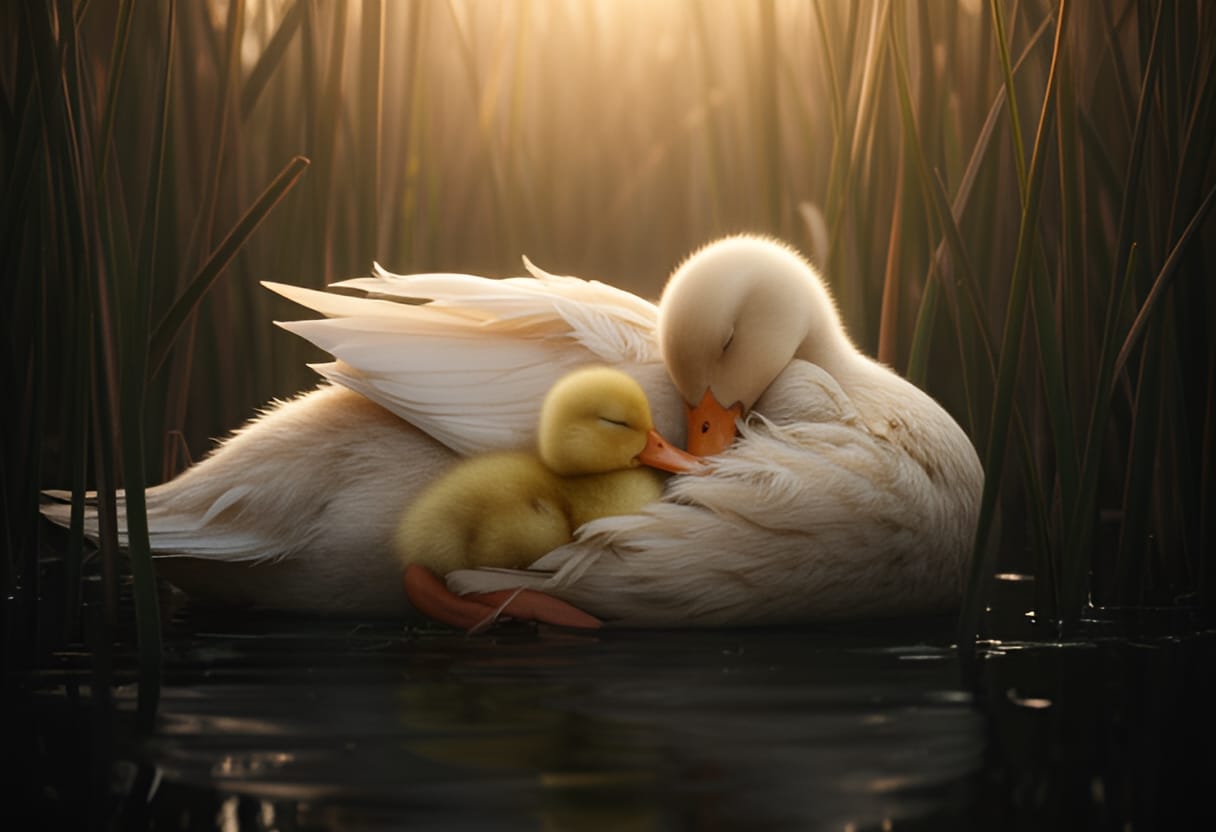
The mother duck shifted slightly, settling lower into the nest of reeds, and the duckling wriggled beneath her wing, seeking the hollow where warmth pooled deepest. It tucked its beak into the soft, fluffy feathers just below her shoulder, inhaling the familiar scent of pondweed and sun-warmed down. A shiver ran through its body — not from cold, but from the deep, quiet ease of being exactly where it was meant to be.
It began to preen.
Slowly, deliberately, it lifted its head and nibbled at the tip of a wing feather, working the tiny barbs back into place with the delicate precision of its beak. A loose bit of fluff came free, and it shook itself — a small, vigorous shiver that sent a puff of yellow down floating into the air like dandelion seed. It watched it drift, caught for a moment in a sunbeam, before it sank gently onto the water and dissolved into the ripples.
Another feather, slightly ruffled near the tail, received the same careful attention. The duckling twisted its neck, reached back, and smoothed the down with quick, light strokes. It paused, head cocked, as a tiny bead of water clung to the tip of its beak. It blinked it away, then gave a soft, contented peep — not a call, but a sigh of satisfaction, like the release of a held breath.
The mother duck stirred, just enough to tuck her wing a little tighter around her child. Her feathers, soft and dense as moss, enclosed the duckling in a living tent. The world narrowed to the rhythm of breathing — hers, slow and deep; its own, matching in quiet imitation. The pond murmured beyond the reeds, a low, liquid lullaby of water kissing stem and stone.
The duckling’s eyes grew heavy. Its beak, still slightly open from its peep, now rested against its mother’s feather. One tiny foot twitched, then stilled. The other drew up, tucked close beneath its downy chest. Its breathing slowed, deepened, became the soft, even rhythm of sleep.
Above, the light began to shift. The golden afternoon waned, the sun lowering toward the treeline, casting longer shadows across the pond. The dragonflies had gone. Even the wind seemed to hush, as if the world were holding its breath to honor this small, sacred quiet.
The duckling was asleep.
Its mother remained still, head lowered, eyes half-closed, watching the water where the last faint ripples from their passage had finally smoothed away. She did not move. She did not need to. The reeds held them. The water cradled them. And in the fading light, with the pond breathing softly around them, they rested — safe, warm, and utterly at peace.
The mother duck’s eyelids grew heavy, but she did not surrender to sleep just yet. She remained alert, a quiet sentinel in the hush of the reeds. Her ear twitched at the faintest disturbance — a fish breaking the surface far out in the open water, the distant call of a night heron winding its way through the trees. Each sound was measured, assessed, and released, none near enough to disturb the fragile peace they had found.
She shifted her weight minutely, adjusting her wing to shield the duckling more fully from a stray draft that slipped through the reeds. Her feathers, still warm from the day’s sun, formed a soft, insulating barrier. The duckling, deep in sleep, let out a faint, almost inaudible murmur — a dreamy peep that vibrated against her down.
A single drop of water fell from the tip of a reed above, plinking softly onto the pond nearby. The sound was small, but in the stillness, it rang like a bell. The mother duck turned her head just enough to watch the ripple spread, soft and slow, until it dissolved into the darkness gathering at the water’s edge.
The light had gone now, replaced by a deepening blue that settled over the pond like a blanket. The first stars blinked into view, reflected faintly in the still surface — tiny, trembling lights mirrored below. The air cooled, carrying the scent of wet earth and crushed mint from the bank.
Still, she did not move. Her neck rested along her back, her beak tucked into her feathers, but her eyes remained open, soft and watchful. The duckling breathed on, untroubled, one paw curled beneath its chest, the other relaxed against her flank.
And in that quiet, between the hush of the water and the whisper of the reeds, the world felt small, safe, and complete — not because anything had changed, but because, for now, nothing needed to.