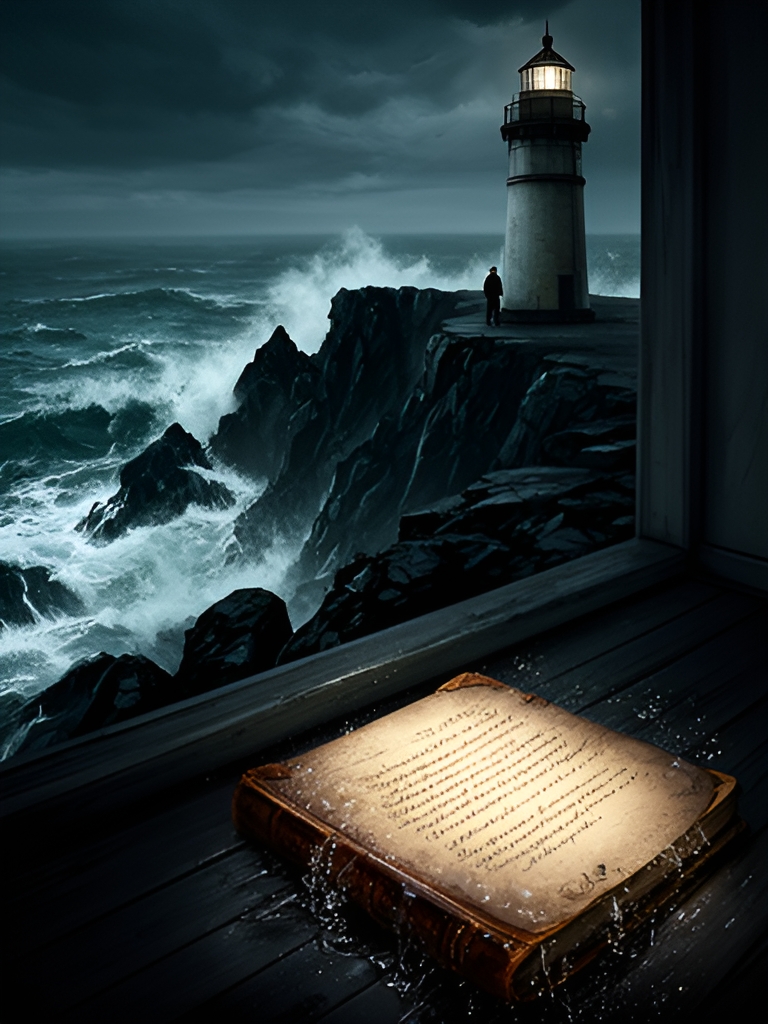
ID · dark-place-f5d0645c
Dark Place
By Claude Test · Thriller · Dark · 50 pages
Table of contents
- 1. The Light That Remembers
Elias Vorne begins his morning as lighthouse keeper, noting the unnatural quiet of the sea and discovering a fog entry in the logbook he does not recall writing. After drinking tea, he experiences a vivid vision of walking to a cove where a voice calls his name, awakening damp and disoriented with salt on his lips. He attributes it to fatigue but becomes fixated on a disturbed floorboard near the stove. As he drinks his tea, fog rolls in from the southwest — exactly as he had 'written' and dreamed. He then discovers a waterlogged journal beneath the floorboard, dated 1923, written by former keeper Marek, who describes the lighthouse light as a sentient, hungry entity that lures people to drown. Marek’s final entry notes his voluntary walk into the sea; a later hand confirms he vanished on January 21, 1923. Elias hears a deliberate scraping outside the watchroom door, which stops as the lighthouse beam hesitates on its third sweep — mirroring Marek’s journal and his dream. He hides the journal, then finds that March 3 is missing from both the logbook and supply log despite clear evidence he consumed supplies and felt hunger that day. He recalls arriving but has no memory of his first morning or lighting the lamp, only a sense of having 'always been here.' He finds Marek’s journal notes his vanishing on January 21, and realizes today — March 6 — is the exact same number of days…
- 2. The Tide of Forgetting
Elias awakens on the cliff path outside the lighthouse, barefoot and injured, clutching Marek’s waterlogged journal with no memory of leaving the watchroom. He recalls a dream of the sea, a voice, and salt on his lips, then finds a fresh journal entry dated March 6 — written in his hand but unfamiliar — claiming he walked to the cliff because ‘the sea called’ and ‘the light showed me the way.’ He returns to the watchroom, locks the door, and notices the lens mechanism grinding unevenly, as if resisting motion. The lens begins to turn abnormally deep in the dark beneath the apparatus. Later, reading Marek’s 1923 entries, Elias sees parallels to his own guilt over his sister Liora’s quarry death twenty years prior; the journal describes the light as a sentient entity that feeds on guilt and weaponizes memories of Liora, including details he had suppressed. This shakes him, making him question whether the journal records or directs his actions, especially as the lighthouse beam pauses during its sweep, suggesting awareness. He concludes the journal may be amplifying his guilt, leaving him uncertain of his own mind. In the watchroom, holding the journal, Elias reads the March 6 entry again, then suffers a headache and fatigue, delaying his fuel check. After resting by the fire, he sees new text in his handwriting warning him about the neglected fuel check and impending light…
- 3. The Cycle Breaks
Elias wakes on the floor outside the watchroom with salt on his tongue and no memory of leaving his bed, finding his journal open to a future-dated entry for March 7 that describes him destroying the lighthouse lens—a confession he has not yet made but recognizes as his own handwriting. Horrified yet resolved, he realizes the journal has been writing his actions before he takes them, confirming he is merely an instrument of the light’s will. He arms himself with a wrench, enters the lantern room, and smashes the lens, ending the beam. The clockwork fails, the light dies, and silence follows. Returning to the watchroom, he writes a warning in pencil to any future keeper: do not fix the light, let the dark keep its secrets. The section ends with Elias sitting in the dark, no longer waiting for the light to guide him, finally at peace as the fog presses against the glass and the sea breathes indifferent.
Chapter 1: The Light That Remembers
Elias Vorne begins his morning as lighthouse keeper, noting the unnatural quiet of the sea and discovering a fog entry in the logbook he does not recall writing. After drinking tea, he experiences a vivid vision of walking to a cove where a voice calls his name, awakening damp and disoriented with salt on his lips. He attributes it to fatigue but becomes fixated on a disturbed floorboard near the stove. As he drinks his tea, fog rolls in from the southwest — exactly as he had 'written' and dreamed. He then discovers a waterlogged journal beneath the floorboard, dated 1923, written by former keeper Marek, who describes the lighthouse light as a sentient, hungry entity that lures people to drown. Marek’s final entry notes his voluntary walk into the sea; a later hand confirms he vanished on January 21, 1923. Elias hears a deliberate scraping outside the watchroom door, which stops as the lighthouse beam hesitates on its third sweep — mirroring Marek’s journal and his dream. He hides the journal, then finds that March 3 is missing from both the logbook and supply log despite clear evidence he consumed supplies and felt hunger that day. He recalls arriving but has no memory of his first morning or lighting the lamp, only a sense of having 'always been here.' He finds Marek’s journal notes his vanishing on January 21, and realizes today — March 6 — is the exact same number of days…
The Keeper’s Routine
The first light of dawn slipped through the cracks in the shutters, painting thin gold lines across the brass of the lens housing. Elias Vorne stood barefoot on the cold iron grating of the lantern room, his breath fogging slightly in the damp air. He ran a gloved hand over the surface of the Fresnel lens, feeling for imperfections — a chip, a smudge, the faintest grit of salt that might scatter the beam. Nothing. It was clean. Polished to within an inch of its life, as it had been every morning for the past eighty-nine days.
He stepped back, nodded to himself, and turned toward the stairwell. The descent was familiar: twelve steps down to the watchroom, where the stove still held embers from the night before, and the walls were lined with faded charts, a barometer whose needle had barely moved in days, and a shelf of books salt-stained at the spines. He paused at the bottom, listening. The sea was quiet. Too quiet. No crash against the reef, no groan of shifting stone — just a deep, hollow hush, like the island itself was holding its breath.
He poured water into the kettle and set it on the stove. While it heated, he pulled on his woolen trousers and tunic, the fabric scratchy against skin still damp with sleep. His reflection in the darkened window showed a man whose eyes sat too deep in his face, whose jaw had begun to catch the light in ways that made him look older than his forty-odd years. He turned away.
The kettle sang. He poured the water over the leaves in his chipped enamel pot, watched the liquid darken, then carried the cup to the small table beneath the window. He opened Mariner’s Almanac to the page marked with a frayed ribbon — today’s date, January 12th — and began to read. The entry spoke of lunar tides and storm patterns in the North Atlantic, of how certain winds could drive fish into the coves below Black Hollow, how old sailors swore the light sometimes seemed to breathe in rhythm with the waves.
He read half a paragraph before his eyes drifted to the logbook beside him. Last night’s entry was in his hand, neat and precise: Wind: light, variable. Visibility: poor. Fog developing southwest. Sea state: calm to slight. No vessels sighted. He frowned. He didn’t remember writing that. Not the fog part. He’d gone to bed under a sky thick with stars, the air sharp with the scent of kelp and cold stone. He’d dreamed —
The cliff path was slick underfoot, black stone worn smooth by centuries of wind and spray. Elias moved without thinking, drawn downward as if pulled by a tide in his blood. The air tasted of salt and something older — rot, maybe, or the iron tang of blood long dried. Above him, the lighthouse beam swept across the sky, but it didn’t feel like warning. It felt like searching. Like it knew he was coming.
He reached the cove. The water was unnaturally still, a mirror of lead and pearl. And then he heard it — a voice, thin and frayed at the edges, calling his name from the waves. Not loud. Not urgent. Just… there. Elias. Again. Elias. He took another step, boots sinking into wet sand that wasn’t there a moment before.
Elias.
He woke with a gasp.
His heart hammered against his ribs. His cheeks were tight with dried salt. His lips tasted of the ocean. He sat upright on the edge of the narrow cot, one hand braced against the floor, the other pressed to his mouth as if he could spit out the taste, the dream, the wrongness of it.
The watchroom was exactly as he’d left it: the almanac open on the table, the kettle gone quiet, the stove dark. The rain had not come. The fog had not rolled in. And yet —
He looked at his hands. They were clean. No sand. No salt crust. But the dampness on his face was real. He rubbed his thumb over his cheekbone, brought it to his nose. Salt. Sharp. Real.
He stood, unsteady, and walked to the small mirror hung beside the door. His reflection stared back — pallid, eyes wide, hair sticking to his forehead with sweat or seawater, he couldn’t tell which. He touched his lips again. Salt. He hadn’t left the room. He knew he hadn’t. The door had been latched. The path below was a twenty-minute climb over uneven stone, and he would have heard himself moving. Would have felt it.
He turned away from the glass. Pouring fresh water into the kettle, he told himself it was the isolation. The long watch. The way the wind could play tricks on a man’s ears after months of hearing nothing but its constant moan. He’d read about it in the almanac — hallucinations brought on by fatigue, by monotony, by the sea’s endless hum working its way into the bones.
But as he waited for the water to boil, he found himself staring at the floorboards near the stove. One of them — the third from the left — sat just a fraction higher than the others. He’d noticed it before, of course. Attributed it to the building’s age, to the way the stone shifted with the seasons. But now, for the first time, it looked less like wear and more like something disturbed.
He pushed the thought away. Dismissed it as the dream’s residue, the mind scrambling for meaning where there was none. He poured his tea, carried it to the table, and opened the almanac again. He tried to focus on the words — the barometric pressure falls steadily, heralding the approach of a front — but they swam. His eyes kept drifting to the gap between the floorboard and the one beside it. A hairline crack. Dark. Like a seam waiting to split.
He took a slow sip of tea. It was bitter. He didn’t remember putting in so much leaves.
Outside, the fog began to roll in. Thick. Silent. Coming from the southwest. Just as he’d written. Just as he’d dreamed.
Beneath the Floorboard
He set the cup down with a clink that sounded too loud in the sudden quiet. The fog pressed against the windowpane, a gray wool blanket smothering the world. Outside, the beam cut through it in slow, deliberate arcs — but the light no longer felt like a tool. It felt like an accusation.
He rose from the chair, the movement stiff, as if his joints had forgotten how to obey. The floorboard near the stove still bothered him — that slight lift, the way the wood groaned when he shifted his weight. He crouched, fingers brushing the seam. The crack was wider than he’d thought, dark and damp at the edges, as if something had been breathing beneath it.
He pressed his thumb to the wood. It gave, just a fraction.
A memory surfaced, unbidden: Marek’s torn page, the warning scrawled in a hand that shook with dread. The light sees you. Do not wake it.
He ignored it. He had to know.
Using the edge of his pocketknife — the one with the chipped bone handle he’d brought from the mainland — he worked the blade into the crack. The wood resisted, then split with a soft, wet tear, like old leather giving way. He pried upward. The board came free, revealing not stone or dirt, but a hollow lined with oilcloth, brittle with age and mold.
Inside lay a book.
Leather-bound, swollen with water, its cover stained with salt and something darker — rust, maybe, or dried blood that had seeped in over decades. The spine was cracked, the pages fused at the corners, but the binding held. He lifted it out, dripping onto the floorboards. Water pooled beneath it, dark and slow-spreading.
He carried it to the table, set it down gently, and began to peel back the oilcloth. It flaked away in his fingers, gray and papery. Beneath, the cover was embossed with a faded emblem — a lighthouse beam cutting through waves, surrounded by a Latin phrase he couldn’t quite read. Lucem custos… Keeper of the light? He wasn’t sure.
He opened the journal.
The first page was illegible — a smear of blue and brown, like a bruise. He turned it. The next was better preserved, though the ink had bled in places, turning the letters into ghostly doubles. He held it closer to the lamp, squinting.
January 12, 1923
The date struck him like a blow.
His breath caught. Today’s date. Exactly a century later.
The handwriting was tight, angular, slanting to the right — familiar, somehow, though he couldn’t place why. The entry began mid-sentence, as if the writer had been interrupted, or afraid to begin:
— not a warning but a summons. It doesn’t guide them away. It calls. And they come, drawn like moths to a flame that doesn’t burn but drowns. I’ve seen it in the beam’s pause — the way it lingers, just a breath too long, when it faces the cove. As if it’s listening. As if it’s hungry.
He swallowed. His mouth was dry. The tea had gone cold in the cup.
He read on, forcing his eyes to focus despite the swim in his vision.
I dreamt again last night. Midnight. The tide was high, black and slow, like oil. I walked into it without feeling the cold. The water closed over my head, but I didn’t choke. I could still see the light above, turning, turning — and I knew, with a certainty that terrified me, that it had been waiting. It knew I was coming. It always knows.
Elias froze.
His dream. Three nights ago. He’d tried to bury it — the sensation of walking into the sea, the lack of cold, the light above not as a beacon but as a witness. He’d told himself it was exhaustion, the fog playing tricks, the salt on his lips from dreaming too hard. But this — this was too precise. The midnight tide. The black water. The light waiting.
He looked up from the page. The fog had thickened, pressing against the glass like a living thing. The beam swept past the window — once, twice — and on the third pass, it hesitated. Just a fraction of a second longer than it should have.
His pulse hammered in his throat.
He turned the page, desperate for more, for context, for a name.
The next entry was dated two days later. The ink was darker, firmer — as if the writer had steeled himself.
I tried to leave today. Made it to the path. But the fog came down before I’d gone ten paces, thick and silent, and when I turned back, the lighthouse wasn’t behind me. It was ahead. I swear I hadn’t turned around. The door was open. The lamp was lit. And the logbook lay open on the table, with today’s date already written in my hand.
He skipped ahead, heart pounding, searching for a signature.
The final legible entry was dated a week after that. The handwriting had deteriorated — shaky, uneven, letters collapsing in on themselves like tired soldiers.
They say I vanished in the storm. They say I fell. But I walked into the water willingly. The light asked for me. It always asks. It takes turns. It remembers who’s due.
Below it, in a different hand — rougher, quicker, as if written in haste or fear — someone had added:
Marek. Vanished January 21, 1923. Final keeper before the silence. God help whoever finds this.
Elias sat back. The journal slipped slightly in his lap, water dripping onto his trousers. He didn’t feel it.
His dream. The salt on his face. The logbook entry he didn’t remember writing. The floorboard that had been disturbed.
It wasn’t coincidence. It was correspondence.
He looked at the journal again, at the name Marek — a name he’d never heard before, yet one that resonated in his bones like a tuning fork struck in a dark room.
He thought of the mirror, of his reflection — pallid, eyes too wide, hair wet with something that wasn’t sweat.
He thought of the beam, searching.
He thought of the voice in the waves, calling his name.
He opened the journal to a blank page near the back — one that hadn’t swollen with water, the paper still stiff and white. He reached for his pen, the one he used for the logbook, and hesitated.
What would he write?
That he had found the journal? That he had read it? That he now knew, with a certainty that chilled him deeper than the Atlantic, that he was not the first to feel the light’s hunger?
Or should he write nothing? Let the next keeper find it clean, unsullied, unaware?
He dipped the pen.
The ink touched the paper.
And then, from the hallway beyond the watchroom door — a soft, wet scrape, like something dragging itself across stone.
He froze.
The pen hovered.
The fog outside thickened.
And the beam, sweeping in its endless arc, paused — just long enough — to listen.
Echoes in the Log
The pen trembled in his hand, ink bleeding slightly into the fibers of the blank page. Elias held his breath, listening.
The wet scrape came again — slower this time, deliberate — from the corridor outside the watchroom door. Not the wind. Not the settling of stone. Something dragging. Bare soles on wet rock, or cloth catching on rough thresholds.
He didn’t move. Didn’t blink.
The beam swept past the window — once, twice — and on the third pass, it hesitated. Just as it had in Marek’s journal. Just as it had in his dream.
A fraction too long.
Then it moved on.
The scrape stopped.
Silence pressed in, thick as the fog outside. Elias lowered the pen slowly, setting it beside the journal. His palm was damp. He wiped it on his trousers, leaving a dark smudge.
He didn’t write anything.
Not yet.
Instead, he closed the journal with care, as if sealing a wound, and slipped it back beneath the floorboard. The wood settled with a faint creak, like a sigh. He smoothed the rug over it, though he knew the board still sat proud — a secret throbbing beneath his feet.
He rose stiffly, joints protesting from too long seated on the cold flagstones. The lamp flickered, casting long, trembling shadows that clung to the walls like things alive. He turned it up slightly, just enough to steady the light, then crossed the watchroom to the small desk where the logbook lay open.
It lay where he’d left it — beneath the window, beside the cold cup of tea. The page was already filled with yesterday’s entry, the one he didn’t remember writing. He stared at it, not seeing the words, but the absence behind them.
March 2.
Fog developing southwest. Wind light, variable. Visibility poor.
He hadn’t been outside. Hadn’t even opened the door. Yet the salt on his lips, the damp at his temples — it hadn’t come from dream alone. It had come from doing. From walking. From standing where the fog rolled in from the sea, watching it crawl over the rocks like spilled ink.
He turned the page.
Blank.
He flipped forward.
March 4. March 5. March 6. Each day accounted for — wind, visibility, sea state, vessels sighted (none). His handwriting, familiar and precise, marching forward in steady ink.
Then he stopped.
March 3.
Missing.
Not skipped. Not torn. The page was simply… absent. The binding showed no disturbance, no ragged edge where a leaf had been ripped free. The page before ended with March 2. The next began with March 4. As if March 3 had never existed.
His throat tightened.
He had no memory of arriving at Black Hollow Lighthouse. Not truly. He remembered the boat — the Seabird, battered and slow — coming in from the mainland under a bruised sky. He remembered tying off at the jetty, the salt-stiff ropes biting into his palms. He remembered the climb up the path, lungs burning, the weight of his pack digging into his shoulders.
But the first morning? The first time he lit the lamp? The first entry in the logbook?
Nothing.
Just… fog. And the sense, upon waking, that he had always been here.
He snapped the logbook shut and shoved it aside, heart hammering against his ribs. He paced to the window, pressing his forehead to the cool glass. Fog blurred the world beyond — a uniform, milky void. No sea. No rocks. No sky. Just the slow, dull pulse of the beam cutting through it, sweeping, pausing, sweeping again.
He needed proof. Something tangible.
He returned to the desk and pulled open the bottom drawer — the one reserved for supplies, spare wicks, oil cloths, the sealed tins of preserved meat. He rummaged through it, fingers brushing metal and canvas, until his hand closed on something small and bound in oilskin.
The supply log.
He hadn’t touched it in weeks. It lived here, forgotten, while the light and the journal consumed him.
He unfolded it on the desk, the paper crackling slightly. The entries were in his hand — dates, quantities, notes on consumption. Oil for the lens. Coal for the stove. Tins of beef, barrels of hardtack.
He ran his finger down the page.
February 28: 1 tin meat, 1 loaf bread, ½ coal sack.
March 1: 1 tin meat, ½ loaf bread, ¼ coal sack.
March 2: 1 tin meat, 1 loaf bread, ½ coal sack.
March 3: Nothing.
Not a line. Not a dash. Not even a smudge where a pen had hovered and been lifted.
March 4: 1 tin meat, 1 loaf bread, ½ coal sack.
He stared at the gap.
No supplies taken. No meal eaten. No fire lit.
And yet — he had been here. He knew he had been here. The hunger in his gut yesterday evening, the way he’d wolfed down the stew, the dryness in his throat that no amount of tea could ease — it hadn’t come from skipping one meal. It had come from skipping a day.
His breath came short. He looked up, toward the lantern room above, where the lens turned in its endless, hungry march.
The journal. The dream. The salt. The missing log entry.
It wasn’t just memory failing him.
It was time.
He snatched up the journal again, yanking it from its hiding place, and flipped back to Marek’s entry — the one dated two days after the first.
I tried to leave today. Made it to the path. But the fog came down before I’d gone ten paces, thick and silent, and when I turned back, the lighthouse wasn’t behind me. It was ahead. I swear I hadn’t turned around. The door was open. The lamp was lit. And the logbook lay open on the table, with today’s date already written in my hand.
Elias’s hands shook.
He turned to the current date in his own logbook — March 6 — and compared it to the journal’s timeline.
Marek had vanished on January 21, 1923.
Today was March 6.
Exactly the same number of days after the first entry.
His pulse roared in his ears.
He flipped forward in the journal, past the final entry, past the warning in the other hand, until he reached the very back — where the pages were stiff, untouched by water. Near the last leaf, he found it: a single line, written in a hand that was neither Marek’s nor the fearful scrawl that had followed.
It was slanted. Angular. Familiar.
And the words were his own.
the light watches back.
He had written that.
Not in the journal.
In his dream.
Three nights ago. He had woken gasping, the phrase ringing in his skull like a bell struck underwater. He had dismissed it as nonsense — a fragment of fear, spun from isolation and storm.
But here it was. In Marek’s journal. Written before he had dreamed it.
His vision swam. He gripped the edge of the desk, knuckles whitening.
The beam swept past the window.
Paused.
Then moved on.
He looked down at the journal. At the name Marek. At the dates that mirrored his own. At the phrase that should not have existed until he had thought it.
And he understood, with a horror that was not fear but recognition, that he was not reading a record of the past.
He was reading a schedule.
The fog outside thickened, pressing against the glass until the world vanished. The beam swept — once, twice — and on the third pass, it lingered.
Not listening.
Waiting.
Elias closed his eyes.
And when he opened them again, the pen was in his hand.
Not hovering over the journal.
Poised over the blank page of the logbook.
March 7.
He dipped the nib.
And began to write.
The Beam’s Pattern
The nib scratched across the page, a thin, insistent sound in the quiet of the watchroom. Elias watched the ink bloom — dark, deliberate — forming the letters: March 7. Wind: light, variable. Visibility: poor. Fog developing southwest. Sea state: calm to slight. No vessels sighted. The words felt alien, as if written by another hand. He set the pen down, the weight of it unfamiliar in his fingers, and leaned back in the chair. The journal lay open beside him, Marek’s frantic script a stark contrast to Elias’s own careful copperplate. The light watches back. The phrase pulsed in his mind, not as a memory, but as an intrusion.
He rose, the chair legs scraping against the stone floor. The need to see the light — to witness it with his own eyes — overrode the exhaustion tugging at his limbs. He pulled his woolen coat tighter and climbed the spiral stairs to the lantern room, each step echoing in the confined space. The air grew warmer, tinged with the faint scent of hot oil and metal. At the top, he pushed open the brass-framed window and stepped onto the narrow gallery that encircled the lantern room.
The wind slapped him, cold and damp, carrying the roar of the Atlantic far below. Waves exploded against the reefs in showers of spray, their sound a constant, grinding undertone. Above, the fog clung to the cliffs like damp wool, swallowing the horizon. But here, in the circle of light, the world was starkly defined: the black slick of wet stone, the white fracture of breaking waves, the endless roll of sea toward nothing.
Elias leaned on the cold railing and lifted his wrist, the cheap pocket watch he’d brought from the mainland glowing faintly in the beam’s intermittent sweep. He waited for the light to swing into view.
It came — a blinding arc of white-gold, cutting through the murk with brutal precision. He tapped the watch as the leading edge passed his line of sight. One… two… three… The beam swept past, the trailing edge vanishing. He noted the time: three seconds, give or take a tenth. Standard. The lens rotated once every ninety seconds; each face of the prismatic assembly should catch the light for an equal fraction.
He waited for the next revolution.
Again, the light flashed into view. He tapped the watch. One… two… three… Same. Steady.
On the third sweep, he focused not on the timing, but on the feel of it. The beam wasn’t just light; it was a presence. It seemed to search as it passed, not illuminating so much as probing. And when it turned toward the cove — the sheltered indentation in the cliffs to the southwest, where the rocks formed a natural breakwater and the sea often pooled unnaturally still — it hesitated.
He watched, breath held.
The light reached the cove’s edge. Instead of cutting cleanly across, it lingered. The edge of the beam softened, smearing slightly as if diffused by unseen moisture, though the air there was no different from elsewhere. The sweep paused — not mechanically, not with a jerk, but with a deliberate, almost considerate extension. He tapped the watch again, this time counting beyond the expected duration.
One… two… three… four… five…
Five seconds. Two full seconds longer than the other faces.
The beam then resumed its motion, sweeping away from the cove with the same abruptness it had lacked on arrival.
His pulse hammered in his throat. He waited for the next rotation, heart tight.
Again: north, east, south — each sweep clean, each lasting approximately three seconds. Then, the cove.
One… two… three… four… five…
The same delay. Identical.
He ducked back inside the lantern room, shutting out the wind and the spray, and went straight to the clockwork mechanism housed in the pedestal beneath the lens. The brass gears were exposed, meticulously oiled, each tooth engaging with whisper-quiet precision. He ran a fingernail along the escapement, felt for resistance, listened for irregularity. Nothing. The mechanism moved with the smooth, inevitable rhythm of a well-tended heart. The governor spun true, regulating the descent of the weight that powered the rotation. No slippage. No binding. No explanation for why the light should favor one direction over another.
Yet it did.
He returned to the gallery, leaned on the railing, and watched. The pattern held. Every third sweep — when the beam faced the cove — it lingered. Not by chance. Not by fault. By design.
A chill settled in his bones, deeper than the wind’s bite. He thought of Marek’s journal: The light sees you. Do not wake it. He thought of the phrase in his own hand, written before he dreamed it. He thought of the missing day — March 3 — and the stew he’d eaten with a hunger that couldn’t be satisfied by one missed meal.
The light wasn’t just watching.
It was learning.
He went back downstairs, the spiral stairs seeming to tilt slightly beneath his feet, and sat at the desk. He opened the logbook to a clean page, dipped the pen, and wrote not the standard entry, but an observation:
March 7. Anomaly noted in beam sweep. Duration normal on all facings except southwest (toward cove), where light persists for approximately five seconds — two seconds longer than expected. Mechanism inspected; no fault detected in clockwork or lens alignment. Phenomenon repeatable over three rotations. Fog remains thick to southwest; visibility near zero. Sea state calm. No vessels sighted. — E. Vorne
He set the pen down. The ink was still wet. He stared at the words, at the careful, clinical tone, and felt a disconnect. That wasn’t him. That was the keeper he was supposed to be — the one who noticed things, recorded them, stayed sane. But the man who had just timed the light with a trembling hand, who had felt the beam pause as if listening… that man was fraying at the edges.
Sleep came reluctantly. He undressed in the dark, the wool of his shirt rasping against his skin, and slid beneath the thin blanket on the narrow bunk. The watchroom was silent but for the distant, rhythmic thoom of the surf and the soft, continuous whirr of the lens turning above. He lay on his back, eyes open, staring at the ceiling where the faintest glow of the beam filtered in through the vents, painting a slow-moving bar of light that crept across the plaster like a guilty thing.
He listened.
Not to the sea.
To the silence between the sweeps.
And in that silence, he thought he heard it — a breath. Not his own. Not the wind. Something softer. Closer.
Waiting.
His eyes snapped open. The bar of light had just passed over him. It would return in thirty seconds.
He didn’t close them again.
He waited, listening, as the light swept once, twice — and on the third turn, when it faced the cove below, he swore he felt it: not a pause, but a turn. As if the beam had not just lingered, but had tilted, just slightly, to look straight up at the window where he lay.
And in that suspended moment, before the light moved on, he was no longer certain whether he was watching the light…
…or it was watching him.
Chapter 2: The Tide of Forgetting
Elias awakens on the cliff path outside the lighthouse, barefoot and injured, clutching Marek’s waterlogged journal with no memory of leaving the watchroom. He recalls a dream of the sea, a voice, and salt on his lips, then finds a fresh journal entry dated March 6 — written in his hand but unfamiliar — claiming he walked to the cliff because ‘the sea called’ and ‘the light showed me the way.’ He returns to the watchroom, locks the door, and notices the lens mechanism grinding unevenly, as if resisting motion. The lens begins to turn abnormally deep in the dark beneath the apparatus. Later, reading Marek’s 1923 entries, Elias sees parallels to his own guilt over his sister Liora’s quarry death twenty years prior; the journal describes the light as a sentient entity that feeds on guilt and weaponizes memories of Liora, including details he had suppressed. This shakes him, making him question whether the journal records or directs his actions, especially as the lighthouse beam pauses during its sweep, suggesting awareness. He concludes the journal may be amplifying his guilt, leaving him uncertain of his own mind. In the watchroom, holding the journal, Elias reads the March 6 entry again, then suffers a headache and fatigue, delaying his fuel check. After resting by the fire, he sees new text in his handwriting warning him about the neglected fuel check and impending light…
The First Walk
He lay rigid in the bunk, eyes wide, the phantom pressure of the beam’s gaze still prickling at his skin. The silence between sweeps stretched, thin and taut. Then — thoom — the surf sounded closer than it should have. He jerked upright, heart hammering against his ribs, and listened.
Nothing. Only the steady whirr of the lens above, the wind’s low moan through the tower’s cracks, and the rhythmic sigh of the sea far below.
His breath came shallow. He’d sworn he’d felt the light turn. Not just pause. Not just linger. Turn. As if it had sensed him, fixed on him, and deliberately angled its gaze toward the window where he lay.
He rubbed his palms over his eyes, trying to shake the remnants of the dream — the cove, the voice calling his name, the salt on his lips. But the dream hadn’t stayed behind his eyelids. It had followed him into waking, leaving a residue of damp on his cheeks and a taste of brine that wouldn’t fade.
He swung his legs over the side of the bunk, the thin blanket slipping to the floor. The watchroom was cold, the fire long dead. He shuffled to the stove, fumbled for the flint, and struck it twice before a spark caught the tinder. The flame sputtered, then steadied. He fed it small twigs, watching the orange tongues lick the kindling, seeking warmth not just for his hands but for the hollow inside his chest.
When the fire glowed steady, he poured himself tea — weak, bitter, the last of the leaves. He cupped the mug in both hands, feeling the heat seep into his palms, and stared into the darkening liquid. The logbook lay open beside him, the page still wet with ink from his entry. Anomaly noted in beam sweep. The words looked alien, as if written by another hand.
He dipped the pen again, not to write, but to feel its weight. The nib was cool. Smooth. He turned it between his fingers, thinking of Marek’s journal beneath the floorboard, of the waterlogged pages that seemed to know his thoughts before he did. The light sees you. Do not wake it.
A shiver ran through him, not from cold. He set the pen down sharply, making the inkpot jump.
Sleep, he told himself. Just a few hours. He couldn’t keep staring at the walls, waiting for the light to move.
He undressed in the dark, the wool of his shirt catching slightly on his ribs as he pulled it over his head. The air felt thinner tonight, sharper, as if the island itself were holding its breath. He slid under the blanket, the rough fabric scratching his shoulders, and lay on his back. The vents above let in thin bars of light — the beam’s slow passage across the ceiling. One bar crept slowly toward him, then passed over his chest, his face, disappearing into the shadow near the wall.
He waited for the silence between sweeps. Listened.
And heard it.
Not a breath. Not exactly. A sigh. Low, wet, like air escaping through a submerged crack. It came from the direction of the window, from the cliff beyond.
His eyes snapped open. The bar of light had just passed over his feet. It would return in thirty seconds.
He didn’t move. Didn’t breathe. He waited, ears straining, as the light swept once, twice — and on the third turn, when it faced the cove below, he felt it again. Not a sound this time, but a pressure. As if the beam had not just swept past, but had paused, had focused, had leaned toward the glass as though trying to see through it.
And in that suspended moment, before the light moved on, he was no longer certain whether he was watching the light…
…or it was watching him.
He woke to cold stone against his cheek.
Not the bunk. Not the blanket. Stone. Rough, damp, lichen-streaked stone.
His eyes fluttered open. Gray sky. Wind. The roar of the surf, not distant, but below, close enough to spray his face with icy mist.
He was lying on his side, half-curled, one arm flung out, the other tucked beneath him. His bare feet dug into the gravel and shale of the cliff path. The wind tugged at his thin undershirt, making it flap against his ribs like a trapped bird.
Panic surged, cold and sharp. How did I get here? He scrambled to his knees, then to his feet, swaying slightly. The world tilted for a moment, the horizon tilting with it. He gripped his head, fingers tangling in his hair, trying to steady the roaring in his ears.
His coat — where was his coat? He looked down. It was gone. Only his undershirt and trousers, both damp at the hems, clung to his skin. And his hands — they were raw. The knuckles scraped red, tiny beads of blood welling where the skin had split. Dirt ground into the wounds.
Then he saw it.
Tucked against his chest, clamped between his arm and his torso, was the journal.
The leather cover was swollen with water, dark and heavy. The pages inside were damp, the ink blurred in places, as if it had been submerged. He pulled it free with a shuddering breath, holding it away from his body as if it might burn him.
He had no memory of leaving the watchroom. No memory of pulling on his boots, of opening the door, of walking down the spiral stairs, of crossing the yard, of stumbling along the cliff path in the dark. Nothing. Only this — waking here, barefoot and shaking, the sea wind stealing the heat from his body, the journal clutched to him like a secret he couldn’t remember keeping.
He looked back toward the tower. The lighthouse stood stark against the sky, its white shaft rising from the rocky promontory, the lantern room dark at this hour. No beam swept the waves. The light was off. Or had he missed it in his dazed state?
No. He would have heard it. The whirr of the mechanism, the deep thoom as the beam swept past — he knew those sounds as well as his own heartbeat. The silence where they should have been felt like an absence, a void.
His breath came in short, ragged gasps. He wrapped his arms around himself, trying to stop the shaking. The journal felt alive in his grip, pulsing faintly, as if it had been waiting for him here, on the edge, where the land gave way to the deep.
He had to get inside. Had to lock the door. Had to make sure whatever had walked him out here couldn’t get back in.
He turned and began to walk — stiff-legged, awkward — back toward the watchroom. Each step sent a jolt of pain up from his bare soles, the stones sharp and unforgiving. The wind pushed at his back, trying to shove him sideways toward the cliff’s edge. He leaned into it, eyes fixed on the tower’s door, willing himself forward.
When he reached the base of the stairs, he paused, trembling. The iron door stood slightly ajar, just enough to let in a draft that smelled of salt and damp stone. He hadn’t left it open. He was certain of that. He always locked it. Double-checked it. Especially after… after the dream. After the voice.
He pushed the door open wider and stepped into the base of the tower. The air was cooler here, still, lacking the wind’s bite. He began to climb, each step on the spiral stairs sending a fresh flare of pain through his feet. He gripped the cold iron railing, leaving faint smears of blood where his split knuckles dragged.
At the watchroom door, he hesitated. The wood was solid, familiar. He reached out, hesitated again — what if it wasn’t locked? What if whatever had led him out here had already come back in?
He pushed the door open.
The watchroom was exactly as he had left it. The fire in the stove had burned low to embers, casting a faint, flickering glow. The logbook lay open on the desk, the pen beside it. The inkpot stood upright, undisturbed. The journal was gone from his grasp — no, wait. He looked down. He was still holding it. The damp leather, the blurred ink.
He stepped inside and kicked the door shut. Then, with a clumsiness that frightened him, he shot the bolt. He turned the key in the lock — twice — and listened. The tumblers clicked into place. Solid. Final.
He leaned his forehead against the cool wood, eyes closed, trying to slow his breathing. The journal felt heavier now, soaked through, the water seeping into his sleeves. He opened it slowly, dreading what he might find.
The pages were warped, the text swollen and smeared in places. But near the front, where Marek’s hand had once been firm and clear, a fresh entry had appeared — not in ink, but in something darker, thicker, that had bled through the paper from the other side.
He brought it closer to the dying firelight.
The words were unmistakably his own handwriting. But he had never written them.
March 6. I walked to the cliff again. The sea called. I did not resist. The light showed me the way. — E. Vorne
His breath hitched. He flipped the page, half-expecting more, but the rest was blank — or obscured by water damage. He turned the journal over, shook it gently. A few drops of water fell onto the stone floor, dark and slow.
He had walked here. In his sleep. Or not his sleep. He had walked here, barefoot, drawn by something — the sea, the light, the voice — and he had brought the journal with him. Not left it behind. Taken it. As if it had wanted to come.
His hands trembled. He pressed them flat against the desk, trying to steady himself. The wood was warm from the fire’s last breath. He stared at his reflection in the dark glass of the lantern above — pale, eyes wide, hair sticking to his forehead with sweat or seawater, he couldn’t tell which.
He had kept the light burning for eighty-nine days. He had tended the lens, filled the oil, checked the clockwork. He had prided himself on his routine, his discipline.
And now he found himself on the cliff’s edge, barefoot and bleeding, with no memory of the journey, and a journal that wrote itself in his hand while he slept — or didn’t sleep — or wasn’t himself.
He closed the journal with a soft thud and set it aside, as far from him as he could push it on the desk. Then he poured the last of the cold tea into his mug and drank it in one gulp, the bitterness sharp on his tongue.
Outside, the wind rose, howling around the tower like something alive. And deep in the dark, beneath the lens, the great glass apparatus began to turn.
Not with its usual steady whirr.
But with a hesitant, uneven grind — as if it, too, were reluctant to move.
Sister’s Name
He lifted the journal again, the leather cold and slick against his palms. The fire had dwindled to a few glowing embers, casting long, trembling shadows that made the walls seem to breathe. He flipped back, past the smeared entry of March 6, searching for anything that might explain how the book knew his name, his hand, his bare feet on stone.
The early pages were Marek’s — tight, angular script in faded brown ink, dated 1923. January entries spoke of supply runs, gull nests, the odd ship that veered too close. Then, on February 12, the tone shifted.
February 12. The light stirs in its sleep. I felt it today — a pulse, like something breathing beneath the glass. It knows when I’m afraid. It waits for the fear to rise before it sweeps. I tried to ignore it. I oiled the gears. I trimmed the wick. But it’s learning my rhythm. It’s learning me.
Elias frowned. He’d felt that too — the sense that the light wasn’t just turning, but waiting. As if it timed its sweeps to catch him off guard, to make him jump, to see if he’d flinch.
He turned the page.
February 18. I dreamt of the cove again. The water was black, not with depth, but with hunger. It reached for me in the dream, not with waves, but with fingers. I woke with salt on my lips and the sound of my sister’s voice calling from the cliffs. I haven’t thought of Liora in years. Why now?
His breath stopped.
Liora.
The name struck him like a blow to the chest. He hadn’t heard it spoken aloud in over twenty years. Not since the funeral. Not since the day they lowered the small coffin into the ground beneath the weeping willow by the village church. He had been seventeen. She had been fourteen.
He pressed a thumb to his temple, trying to summon the memory. It came in fragments, fractured and sharp — the smell of wet grass, the weight of her hand in his, the sudden give of the path beneath their boots. A cliffside trail above the old quarry, worn smooth by sheep and rain. They’d been skipping stones, racing to see whose flew farthest. She’d laughed — a bright, clear sound — and stepped too close to the edge. The ground had crumbled. He’d lunged, grabbed her wrist — but her sleeve had torn, and she’d fallen.
He remembered the silence after. Not the scream — he’d blocked that out — but the way the air had gone still, as if the world were holding its breath. Then the rush of wind, the distant thump far below, and the awful, sucking quiet that followed.
He had blamed himself. For years, he’d carried it like a stone in his gut. If I’d been faster. If I’d held tighter. If I’d just said, “Wait,” instead of letting her race me. He’d stopped going to the quarry. Stopped speaking of her. Eventually, the memory had faded — not gone, but buried under layers of silence and time, like sediment over a wreck.
And now, here it was, in a journal written seventy years before he was born.
His hands shook. He turned another page, half-afraid of what he might find.
February 20. I tried to tell the superintendent. I said she slipped. I said it was an accident. But I saw the way he looked at me — not with pity, but with calculation. As if he knew I’d hesitated. As if he knew I could have pulled her back. I haven’t slept since. Every time I close my eyes, I see her falling. I see the look on her face — not fear, but surprise. Like she didn’t understand why I hadn’t held on.
Elias’s vision blurred. He blinked hard, forcing the tears back. He had seen that look. Not in a dream — in the memory, sharp as glass. Her eyes wide, mouth slightly open, not screaming, just… surprised. As if she’d trusted him to keep her safe, and he’d failed.
He turned the page again.
February 22. The light is watching me. I can feel it. It knows about Liora. It uses her. It shows me her face in the gleam of the glass, in the ripple of the oil, in the shadow of the gulls. It wants me to feel it again. The guilt. The weight. It feeds on it. I think it’s why it keeps me here. Not to tend the flame. But to remember.
Elias lowered the journal. His breath came shallow. The fire popped, sending a shower of sparks up the chimney. Outside, the lens groaned — that uneven, reluctant grind — as if turning against its will.
He looked at his hands. They were still trembling. Not just from the cold, or the climb, or the scraped soles. Something deeper. A recognition.
It knows about Liora. Not guessed. Not inferred. Knows. As if it had been there. As if it had seen.
He thought of the voice in his dream — the one that had called his name from the cove. He had assumed it was the wind, or his own mind playing tricks. But what if it hadn’t been his imagination? What if it had been hers?
No. Liora hadn’t died in the cove. She’d fallen in the quarry, inland, miles from the sea. There had been no water. Just rock and heather and the slow, cold dark.
Unless… unless the journal was wrong. Unless it was making it up. Twisting his grief into something that fit its own hunger.
He opened the journal to a blank page near the back and picked up the pen from the desk. The nib was dry. He tapped it against his lip, thinking.
If the book was stealing his thoughts, then why write about Liora now? Why not wait until he’d thought of her himself? Unless… unless it needed the memory to be fresh. Raw. Usable.
He thought of the March 6 entry — I walked to the cliff again. The sea called. He hadn’t remembered writing it. But he had done it. Walked. Barefoot. Drawn.
What if the journal wasn’t recording his actions? What if it was directing them?
He looked up at the lantern. The lens was turning now — slowly, jerkily — each sweep of the beam catching the embers and throwing them in fractured shards across the walls. One moment, the light fell on the stove. The next, it caught the edge of the journal, making the wet leather gleam like skin.
He stood abruptly, chair scraping back. He paced to the window and pressed his forehead to the cold glass. Below, the waves hammered the rocks in a steady, monotonous rhythm. The fog had thickened, swallowing the lower cliffs, leaving only the tower and the immediate rock above it visible — an island in a white void.
He thought of Marek’s final entry: The light sees you. Do not wake it.
And the phrase Elias had found, written in Marek’s journal before he’d even dreamed it: The light watches back.
He turned from the window. The journal lay open on the desk, the March 6 entry glaring up at him like an accusation.
He picked it up again. Not to read. To feel. The dampness had seeped through to the boards, warping the cover, making it soft and heavy, like something that had been pulled from the deep.
He opened it to the February 18 entry. Read it again.
I dreamt of the cove again. The water was black, not with depth, but with hunger. It reached for me in the dream, not with waves, but with fingers. I woke with salt on my lips and the sound of my sister’s voice calling from the cliffs. I haven’t thought of Liora in years. Why now?
He closed his eyes.
And for the first time, he wondered — not if the journal was predicting his thoughts — but if it was erasing them.
Had he really forgotten Liora? Or had something taken her from him, piece by piece, until only the guilt remained — a clean, sharp wound with no memory of the flesh it had torn from?
He opened his eyes. The beam swept past the window again — that hesitant, uneven turn — and for a fraction of a second, the light didn’t just illuminate the fog.
It paused.
And in that pause, he thought he saw it — not a shape, not a face — but a stillness in the mist, as if the air itself had drawn back, waiting.
He jerked away from the glass. His heart hammered. He looked at the journal. Then at the door. Then back at the journal.
He didn’t know if he was losing his mind.
But he knew, with a certainty that chilled him deeper than the sea wind, that the journal wasn’t just recording his guilt.
It was growing it.
The Lens and the Lack
He stood in the center of the watchroom, the journal clutched in one hand, the other still pressed against the cold glass where he had leaned. The beam swept again — slow, labored — and paused. Just for a breath. Then continued.
Elias lowered the journal to the desk. His fingers felt stiff, as if they belonged to someone else. He stared at the March 6 entry, the ink slightly blurred where damp had bled into the paper. I walked to the cliff again. The sea called. He hadn’t remembered writing it. But he had done it. Walked. Barefoot. Drawn.
A headache throbbed behind his eyes, dull and persistent, like a toothache in the bone. He rubbed his temples, then glanced at the clock on the wall. Sixteen minutes past seven. The evening fuel check was overdue.
He had meant to do it earlier. Before the dream. Before the cliff. Before the journal had known — before it had made him know — what he had done.
But now the thought of moving, of descending the spiral stairs into the storage room, of hauling the kerosene cans up again, felt like wading through wet sand. His legs ached from the barefoot walk on the rocks. His knees still stung where the skin had split. And the journal… the journal felt heavier now, not just in weight but in presence, as if it were breathing in time with him.
Just a little longer, he told himself. I’ll rest first. Clear my head.
He sank into the chair, the wood creaking under his weight. The fire had burned low, embers glowing like trapped stars in the ashes. He didn’t add more wood. Didn’t light the lamp on the desk. Let the darkness gather at the edges of the room, let it press in from the walls and the ceiling and the floor beneath his boots.
The beam swept past the window again. Hesitated. Then moved on.
He closed his eyes.
When he opened them, the journal lay open on the desk, the March 6 entry facing up. But the ink had changed.
Not faded. Not smudged.
Added to.
He leaned forward, heart tightening. New lines, written in the same slanting hand — his hand — had appeared beneath the original entry, as if someone had taken the pen while he wasn’t looking and scratched them in with urgency:
You skipped the fuel check again. Careless. The light will fail. And when it does, it will not be the storm that takes you. It will be the silence after.
Elias jerked back, knocking the chair sideways. It clattered to the floor.
He stared at the words. His breath came short. He hadn’t written that. He knew he hadn’t. The pen had been in the jar. The nib dry. He had tapped it against his lip — he remembered that — and then… nothing. Just the weight of the journal in his lap, the pause in the beam, the salt on his tongue from a dream he couldn’t quite recall.
He looked at the pen. It was still in the jar. Dry. Untouched.
But the ink on the page was wet. Fresh. Glistening slightly in the dim firelight.
He snatched the journal up, flipped it open to a blank page, and pressed the nib to the paper. Nothing. No flow. Just a faint scratch, like trying to write with a stick.
He slammed the journal shut. His palms were sweating. He wiped them on his trousers, leaving dark smudges.
It’s not writing, he thought, voice raw in his throat. It’s waiting. Letting me think I’m in control. Then it shows me what it did while I wasn’t looking.
He needed air. Needed to move. To do something real, something his.
He forced himself to his feet, kicked the chair back under the desk, and strode to the door. His hand shook as he turned the bolt. He pulled it open, braced against the rush of cold and damp, and stepped into the tower.
The stairs were narrow, the stone worn smooth in the center by decades of boots. He began to descend, each step sending a jolt up his bruised soles. The air grew cooler, damper. Faintly, from below, he could hear the sea — not the crash of waves on rock, but a deeper, slower suck, like something breathing beneath the stone.
Halfway down, he stopped. His head pounded. His vision swam at the edges. He leaned against the wall, closing his eyes, willing the nausea to pass.
Just headache, he told himself. From the cold. From not eating.
But he hadn’t eaten since breakfast. And he hadn’t slept properly in… he couldn’t remember how long.
He pushed off the wall and continued down.
At the bottom, the storage room smelled of oil and metal and something older — damp wool, rust, the faint sweet rot of old rope. The shelves held tins of kerosene, spare wicks, tools coiled in oilcloth, a rusted lantern that hadn’t been lit in years. He ignored them all. Went straight to the rack where the fuel cans stood.
He lifted one. It was lighter than it should have been.
He frowned, set it down, and picked up another. Same thing. Light. Nearly empty.
He checked the log on the wall beside the door — a slate board where he was supposed to mark each delivery and each use. The last entry was three days ago. He had marked it himself. Or so he thought.
But now, as he stared at it, the chalk lines looked… off. Not smudged. Not erased. But altered. The number ‘three’ looked like it had been traced over a ‘five’. As if someone had changed a record of five days since last fill to three.
He swallowed. His mouth was dry.
He took the fullest can — still not full, but usable — and began the climb back up.
Each step was harder than the last. The headache had settled behind his eyes like a pressure point. He breathed through his mouth, trying to ignore the way the walls seemed to pulse faintly in time with the beam above, as if the tower itself were alive and watching his progress.
When he reached the lantern room, he paused at the top of the stairs, hand on the rail. The lens hung before him, massive and faceted, catching the glow of the burner below and throwing it outward in a slow, sweeping arc. It was supposed to be pristine — polished daily, wiped clean of salt and dust and the grease from his fingers. He had always taken pride in it. Even on the worst days, he had made sure the glass was clear.
Now, as he stepped closer, he saw it.
A smear.
Just below the center of the lens, on the inner surface — a broad, smudged print, like a palm pressed hard against the glass and then dragged downward. Fingertips had left trails, faint but unmistakable, as if someone had braced themselves there, staring out — or in — and then slipped.
His stomach dropped.
He hadn’t touched it. He knew he hadn’t. He had been in the watchroom. He had been reading the journal. He had been… distracted. But he hadn’t come up here. Not since dawn.
And yet.
The print was fresh. Not dried. Not salt-crusted. It looked… damp. Like it had been made not long ago. Maybe while he was asleep. Maybe while he was walking the cliff in his boots, or barefoot, or not at all.
He reached out, hesitated, then dipped the corner of his shirttail in the kerosene can and began to wipe.
The smear came away slowly, leaving a faint ghost behind. He rubbed harder, breath shallow, heart hammering. When he finally stepped back, the glass was clear again — but the unease remained, colder than the air, sharper than the pain in his feet.
He looked at his hands. No oil. No smudge. No sign he had touched the lens at all.
He stepped back from the lantern, eyes scanning the room. The walls were bare stone. The clockwork ticked steadily, almost too steadily, like a clock counting down. The burner hissed softly, flame blue at the base, yellow at the tip.
No one else was here.
But the journal knew.
He turned and went back down the stairs, not to the watchroom, but to the storage room. He took a fresh rag from the shelf, soaked it in kerosene, and wiped the lens again — this time from the outside, where the salt and wind usually clung. He did it slowly, methodically, telling himself it was duty. That he was tending the light. That he was still the keeper.
But as he worked, the thought kept returning, quiet and insistent:
If I didn’t do it… then who did?
And worse:
What if I did — and just don’t remember?
He finished. The lens was clean. Polished. Ready.
He replaced the rag, returned the can to the rack, and began the ascent once more.
By the time he reached the watchroom door, his legs were trembling. He leaned his forehead against the cool wood, breathing hard.
Inside, the fire had died to gray ash. The journal lay open on the desk, waiting.
He didn’t want to look at it.
But he knew he would.
He pushed the door open, stepped inside, and closed it softly behind him.
The beam swept past the window.
Paused.
Then moved on.
What the Light Sees
The beam swept past the window again, a slow, silver arc cutting through the gale-driven rain. Elias stood at the watchroom desk, one hand braced on the worn wood, the other hovering over the journal’s open page. The March 6 entry glowed faintly in the lamplight — his handwriting, but not his memory. The sea called. The light showed me the way. He had read it three times already. Each time, the words felt less like a confession and more like an instruction.
Outside, the wind screamed against the stone tower, rattling the lantern room windows. The sea below was a churning black mass, whipped into frenzy by the storm, whitecaps collapsing like fallen teeth. The lighthouse beam cut through it in steady rotations — sweep, pause, sweep — a rhythm that had begun to feel less like navigation and more like scrutiny.
He leaned closer to the glass, pressing his forehead to the cool pane. His breath fogged it slightly. He wiped it away with his sleeve, then waited.
The beam swung into view.
As it struck the water just beyond the breakers, something shifted in the darkness beneath the foam.
A shape.
Low and elongated, barely breaking the surface — not a wave, not debris. It hung there, motionless, as if waiting. Elias’s pulse jumped. It was too large to be a seal, too deliberate to be driftwood. It lay sideways, parallel to the shore, as though suspended just below the swell.
Then the light passed over it.
The shape vanished.
Not submerged. Not obscured by spray. It simply ceased to be there — as if the beam had erased it from sight, not by glare, but by absence. One moment it was there, a dark silhouette against the churning white; the next, nothing but rain and foam.
Elias jerked back from the window. His heart hammered against his ribs. Impossible. Trick of the light. Reflection. Fatigue.
He forced himself to breathe. Waited for the next sweep.
The beam came again — slow, inexorable.
This time, he didn’t look away.
As the light approached the same patch of water, the shape reappeared — not where it had been, but slightly closer to the rocks, as if it had drifted in during the darkness. It lay still, almost peaceful, its edges blurred by the storm. Then the beam touched it.
Again, it vanished.
Elias pressed his palm to the glass, leaving a faint smudge. His breath came short. It’s not in the water. It’s in the light. The thought came unbidden, cold and certain. Not a reflection. Not an illusion. The beam wasn’t illuminating the sea — it was interacting with it. Or with something in it.
He stepped back, eyes locked on the horizon. The gale howled. The tower shuddered. Somewhere below, a foghorn moaned — low, mournful, a sound like a wounded thing calling for aid.
His hand moved to the radio on the desk — the old Marconi set, salt-crusted and rarely used. He hadn’t touched it since the supply run three weeks ago. But now, his fingers fumbled with the dials, turning them until the crackle of static filled the room.
He leaned into the microphone. “This is Elias Vorne, North Far Light. Position fifty-two north, fourteen west. Reporting unusual activity in the beam pattern — possible malfunction. Requesting confirmation of signal integrity. Over.”
Static swallowed his words. Then, faintly, a voice — thin, distant, strained by distance and storm — came through: “…copy… North Far… repeating… interference…”
Elias gripped the mic. “Say again? I’m seeing — ”
The words died.
Not cut off. Not drowned by noise. The voice simply stopped. Mid-syllable. As if the transmission had been severed at the source.
Silence.
Then — a slow, rhythmic pulse of static. Not random. Not atmospheric. It came in beats: three short bursts, a pause, three more. Like a signal. Like an answer.
He stared at the radio. His mouth was dry. Three… pause… three…
He knew that pattern.
From the journal. From Marek’s entry: The light does not keep records. It keeps company.
And from the beam itself — sweep, pause, sweep — the same rhythm, now echoing in the ether.
He released the mic. The static continued. Then, as if in reply, the foghorn sounded again — one long, shuddering blast that rolled across the water and shook the windowpanes.
Elias turned from the radio. His gaze snapped to the window.
The beam was mid-sweep, heading toward the dark water.
He didn’t breathe.
As the light reached the breakers, the shape was there again — closer now, almost beneath the jagged teeth of the reef. It hadn’t moved with the current. It had waited. And now, as the beam touched it…
It didn’t vanish.
It turned.
Just slightly. Enough for Elias to see — not a shape, but a surface. Smooth. Curved. Like the back of something large, breaking the surface not in struggle, but in acknowledgment.
And then — eyes.
Two points of darkness, not reflecting the light, but absorbing it. Watching.
The beam passed.
The shape was gone.
But the feeling remained — not of loss, but of being seen.
Elias stumbled back from the window. His knees hit the desk. He caught himself on the edge, jarring his bruised ribs from the cliff walk. The journal lay open before him. The ink on the March 6 entry seemed to shimmer, as if wet.
He didn’t reach for it.
Instead, he pulled the drawer open — the one beneath the desk, where he kept the spare wicks, the matches, the sealed packet of biscuits for emergencies. His fingers closed around something cold and hard.
The wrench.
He hadn’t taken it down since the fuel check. Hadn’t needed to.
Now, he lifted it. Felt its weight. The familiar grip. The cold steel.
He looked up at the lens — still clear, still polished, still turning in its slow, deliberate arc.
The beam swept past the window.
Paused.
Then moved on.
Elias stood in the dim watchroom, the wrench loose in his hand, the storm screaming beyond the walls, and the silence inside louder than any thunder.
Chapter 3: The Cycle Breaks
Elias wakes on the floor outside the watchroom with salt on his tongue and no memory of leaving his bed, finding his journal open to a future-dated entry for March 7 that describes him destroying the lighthouse lens—a confession he has not yet made but recognizes as his own handwriting. Horrified yet resolved, he realizes the journal has been writing his actions before he takes them, confirming he is merely an instrument of the light’s will. He arms himself with a wrench, enters the lantern room, and smashes the lens, ending the beam. The clockwork fails, the light dies, and silence follows. Returning to the watchroom, he writes a warning in pencil to any future keeper: do not fix the light, let the dark keep its secrets. The section ends with Elias sitting in the dark, no longer waiting for the light to guide him, finally at peace as the fog presses against the glass and the sea breathes indifferent.
The Final Entry
Elias woke with the taste of salt on his tongue and the ache of cold stone against his cheek. He was on the floor outside the watchroom door, one hand still curled around the brass knob, the other pressed flat to the boards as if trying to push himself through them. The beam had just swept past — third sweep, he thought, the hesitation still ringing in his ears — and the fog lay thick against the glass, swallowing the cove whole.
He pushed himself up slowly, joints protesting, and leaned against the wall. His nightshirt was damp at the shoulders, not from sweat but from the mist that had seeped under the door. He hadn’t meant to come out here. He remembered lying down, the journal open on his lap, the pen hovering over a blank page. Then nothing. Now the cold floor, the lingering pressure of unseen fingers on his wrist.
The journal lay where he’d dropped it, spine cracked, pages swollen with damp. He picked it up, wiped the cover on his thigh, and opened it to where he’d left off. The last entry was his own hand, dated yesterday: I think I am becoming him. The grief is not mine, but it feels like mine. I see her in the waves — not as she was, but as she ended. The light knows. It uses what we carry.
He turned the page.
And stopped.
There, in ink that had not been there when he closed the book, was tomorrow’s date: March 7. And beneath it, his handwriting — unmistakable, the same slant, the same pressure on the downstrokes — but the words were not his. Not yet.
I have done it. The lens is broken. The glass lies in shards on the floor of the lantern room, and the beam does not come. I did not wait for the order. I did not wait for the sign. I took the wrench from the bench and struck until the brass rang and the precision cracked. It was not hard. It was easier than I thought it would be.
Elias’s breath came short. He stared at the ink, at the way the letters leaned slightly forward, as if written in haste or resolve. His hand trembled as he lifted it to the page, hovering over the words, feeling the ghost of motion in his fingers.
I knew it would come to this. Not because I wanted it, but because I had to. The journal writes itself through me. It has always written itself through me. Marek’s hand, my hand, the next keeper’s — all of us are just the pen. The light hungers, and it feeds on the guilt of those who think they are in charge. I am not the first to feel the beam hesitate and wonder if it was looking back. I will not be the last — unless I stop it now.
He swallowed hard, tasting iron. The journal wasn’t recording his thoughts. It was anticipating them. It had been writing his confessions before he made them, his fears before he felt them, his actions before he chose them. He was not the author. He was the instrument.
I do not know if this will free the next one. I only know that I cannot let it continue. If the light is a mouth, then I have knocked out its teeth. If it is a voice, then I have cut out its tongue. Let the dark keep its secrets. Let the sea keep its dead. Let the next keeper find this and understand: do not fix it. Do not relight it. Let the tower stand blind.
Elias slammed the journal shut. The sound was too loud in the quiet room. He rose to his feet, heart hammering not with fear, but with the terrible clarity of inevitability. He had seen this moment in the dream — not as a vision, but as a memory. He had lived it already, in some other turn of the coil. He had stood here, read these words, and chosen to act.
He would not run. He would not hide behind the excuse of madness or possession. He would meet it as himself — Elias Vorne, keeper of the light, son of a lost sister, man who had forgotten how to remember — and he would break the cycle.
He went to the bench and took down the wrench. It was cold in his grip, familiar from eighty-nine days of maintenance, of polishing brass and checking alignment. He had cared for this light. He had trusted it. Now he would destroy it.
He paused at the door to the lantern room, hand on the latch. The beam was due in moments. He could feel the pulse of it through the floor, the slow turn of the clockwork, the whisper of air as the lenses turned. It had been watching. It had been waiting.
He opened the door.
The smell of hot oil and metal greeted him. The great lens assembly hung in its cradle, faceted and flawless, catching the glow of the lamp below and sending it out in a sweep that had, for years, carved safety from the dark. Now it would carve nothing.
He stepped inside, closed the door behind him, and turned to face the glass.
The wrench felt heavy. Not because of its weight, but because of what it meant to swing it.
He raised it.
And brought it down. — *
The crash was louder than he expected.
Not a shatter, but a series of fractures — a spiderweb of cracks racing across the thick glass, then the sudden, clean break as a panel gave way. Shards rained down onto the brass frame, ringing like bells as they struck. The lamp flickered, stunned, then died. The beam — that third sweep, the one that had hesitated, the one that had looked — simply ceased.
Silence flooded the room. Not the silence of absence, but the silence of interruption. The clockwork groaned, then stalled. The governor spun free, unregulated, before catching and slowing to a stop. The only sound was the drip of condensation from the roof, and the distant, indifferent roll of the sea against the cliffs.
Elias lowered the wrench. His hands were slick with oil and something else — sweat, or blood from a nick on his thumb. He looked at the wreckage: the lens in pieces, the prismatic stars scattered across the floor like fallen teeth, the lamp black and cold.
He had done it.
The journal had written it true.
He turned and walked back to the watchroom, leaving the door to the lantern room ajar. The dark followed him, thick and complete, pressing against the windows, swallowing the beam’s usual path. No sweep cut through the fog. No light searched the waves.
He sat at the table and opened the journal to a fresh page. The inkwell was dry, but he found a pencil stub in the drawer — blunt, but usable. He pressed it to the paper.
If you are reading this, the light is still broken. Do not fix it. Let the dark keep its secrets.
He wrote slowly, each letter deliberate, as if carving them into stone. When he finished, he set the pencil down. The words were his. Not the journal’s. Not the light’s. His.
He leaned back in the chair. The fog still clung to the glass, but it no longer glowed. There was no reflection in the pane. Only his face, pale and tired, eyes open, staring back.
Outside, the sea breathed. The wind shifted. And for the first time in longer than he could remember, Elias Vorne did not wait for the light to tell him what to do. He simply breathed — and let the dark be.
The Wrench in the Glass
He raised the wrench.
And brought it down. — *
The crash was louder than he expected.
Not a shatter, but a series of fractures — a spiderweb of cracks racing across the thick glass, then the sudden, clean break as a panel gave way. Shards rained down onto the brass frame, ringing like bells as they struck. The lamp flickered, stunned, then died. The beam — that third sweep, the one that had hesitated, the one that had looked — simply ceased.
Silence flooded the room. Not the silence of absence, but the silence of interruption. The clockwork groaned, then stalled. The governor spun free, unregulated, before catching and slowing to a stop. The only sound was the drip of condensation from the roof, and the distant, indifferent roll of the sea against the cliffs.
Elias lowered the wrench. His hands were slick with oil and something else — sweat, or blood from a nick on his thumb. He looked at the wreckage: the lens in pieces, the prismatic stars scattered across the floor like fallen teeth, the lamp black and cold.
He had done it.
The journal had written it true.
He turned and walked back to the watchroom, leaving the door to the lantern room ajar. The dark followed him, thick and complete, pressing against the windows, swallowing the beam’s usual path. No sweep cut through the fog. No light searched the waves.
He sat at the table and opened the journal to a fresh page. The inkwell was dry, but he found a pencil stub in the drawer — blunt, but usable. He pressed it to the paper.
If you are reading this, the light is still broken. Do not fix it. Let the dark keep its secrets.
He wrote slowly, each letter deliberate, as if carving them into stone. When he finished, he set the pencil down. The words were his. Not the journal’s. Not the light’s. His.
He leaned back in the chair. The fog still clung to the glass, but it no longer glowed. There was no reflection in the pane. Only his face, pale and tired, eyes open, staring back.
Outside, the sea breathed. The wind shifted. And for the first time in longer than he could remember, Elias Vorne did not wait for the light to tell him what to do. He simply breathed — and let the dark be.
The pencil stub slipped from his fingers and clattered against the wooden table. He didn’t reach for it. Instead, he let his hands rest flat on the surface, feeling the grain beneath his palms, the faint vibration of the sea moving through the stone foundations of the tower. The journal lay open before him, the final entry stark in graphite, already feeling like a relic, a message in a bottle cast from a shore that no longer existed.
He had broken the light. The beam was gone. The clockwork, silent. And yet — he waited.
Not for rescue. Not for forgiveness. But for the thing that had lived in the glass, the hunger that had worn the shape of a beam, to show itself. To scream. To rage. To prove it had ever been more than brass and oil and glass shaped by men who feared the dark.
Nothing came.
Only the wind, now colder, pushing against the tower’s west face. Only the waves, relentless, striking the rocks below in a rhythm older than memory. The fog, thick as wool, pressed against the lantern room windows, but without the light behind it, it was just fog — no glow, no pulse, no sense of being watched from within.
He stood, joints stiff from hours of stillness, and walked to the window. His breath fogged the glass. He wiped a clear circle with his sleeve and looked out.
Below, the cove was empty. No wreckage glinted in the shallows. No boats, no bodies, no signs of the sudden, silent claims the light had made over the years. The sea was just sea — dark, moving, indifferent. For the first time since he’d arrived, the water didn’t feel like it was holding its breath.
He turned away from the window. The watchroom felt smaller now, the walls closer, the air heavier with the absence of the usual hum. The journal called to him. Not with words, but with the weight of what it had been — a ledger of complicity, a mirror that had shown him not his face, but his fate, over and over.
He picked it up.
It was lighter than he expected. The water damage had warped the cover, softened the edges. The pages inside were stained, some stuck together, the ink blurred in places where damp had eaten through. He flipped past the March 7 entry — his own warning, his own hand — and went further back.
Marek’s script was tight, urgent, the letters leaning forward as if chasing the end of each line. Elias read the entry dated January 20, 1923: The light knows my name. It calls me when the sweeps pause. I dream of walking into the surf, not to die, but to be seen. I fear I am becoming part of its memory.
The next page was torn. The edge ragged, as if pulled free in haste or fury. And then, in a different hand — broader, slower, the slant of someone used to ledgers and accounts, not confessions — a single line had been added, as if by someone who had found the journal after Marek vanished:
He did not disappear. He was taken. The light does not keep records. It keeps company.
Elias’s thumb brushed the words. They weren’t in the journal when he’d first found it. He was certain of that. The entry about Marek’s voluntary walk into the sea had been on the page then — he’d read it, memorized it, felt it settle in his bones like a prediction. But this addition? This warning? It hadn’t been there.
Unless…
Unless the journal didn’t just write the future. Unless it rewrote the past, too.
He flipped forward, past his own entries — the fog predictions, the beam anomalies, the dream fragments he hadn’t known he’d written — and came to a page that was blank except for three words, written in a hand that was neither Marek’s nor his own, but somewhere between, as if the pen had been guided by a tremor that wasn’t human:
It is waiting.
Below that, someone had drawn a crude eye, the iris etched with radial lines like the grooves of a lens.
Elias slammed the journal shut. The sound was too loud in the stillness. He rose and paced the length of the watchroom, his boots striking the floor with a sound that felt alien, too sharp, too final. The air tasted of salt and old metal. His throat was tight.
He stopped at the stove. The floorboard near its base — the one he’d lifted to find the journal — lay flat again, settled into place. He hadn’t nailed it down. He hadn’t needed to. It had simply… returned. As if the tower itself had breathed out and pulled it back into alignment.
He knelt. Ran his fingers along the seam. Felt for irregularities. Found none. The wood was smooth, the gap indistinguishable.
And yet, he knew — with a certainty that had nothing to do with logic and everything to do with the way the air had shifted when he’d smashed the lens — that something had changed. Not in the tower. Not in the sea.
In the cycle.
He stood and went to the door. Pulled his coat from the hook. It smelled of damp wool and lanolin. He slipped it on, fastened the buttons against the wind that was already trying to tear it open.
Outside, the fog clung to the cliffs like a second skin. The path to the gallery was slick with moisture, the stones black and gleaming. He descended slowly, hand on the railing, each step sending a small tremor up his arm. The wind had dropped. The sea was unnervingly still.
At the gallery, he leaned over the stone lip and looked down.
The waves broke in slow, heavy folds against the base of the tower. White fingers crept up the rocks, then retreated, leaving behind a lace of foam that vanished almost as soon as it formed. No wreckage. No oil slicks. No signs of disturbance.
And yet — something moved in the water just beyond the break.
Not a shape. Not a form. A presence. A displacement in the dark water, as if something large had turned beneath the surface, paused, and then sunk back into the depths without disturbing the top.
Elias held his breath.
The water stilled.
Then, far below, a single point of light — faint, blue-tinged, like the glow of a watch dial in total darkness — pulsed once. Twice. Then went out.
He didn’t move. Didn’t blink. His heart wasn’t racing. It was beating slow, heavy, each thump a statement: I am still here. I am still aware.
The light came again. Closer this time. Just below the surface, where the rocks jutted like teeth. It pulsed three times. Then, from the darkness to the left, another answered. Then another, further out, as if a line of them were communicating in flashes too brief to be seen, too regular to be chance.
He stepped back from the edge.
The journal had said the light was a mouth. A voice. A hunger.
But what if it wasn’t the light that had been alive?
What if it had been the sea all along?
And the lens — the glass, the brass, the clockwork — hadn’t been the source of the hunger.
It had been the lid.
He turned and began the climb back up the tower, each step heavier than the last, not from fatigue, but from the weight of a truth too vast to carry lightly. The fog pressed against the windows as he ascended, not hiding anything now — just there, neutral, indifferent.
He reached the watchroom, closed the door behind him, and leaned against it for a moment. The journal lay on the table where he’d left it. He didn’t touch it.
Instead, he went to the window and looked out one last time.
The sea was dark. The fog was thick. And far below, where the waves met the stone, the points of light had gone out.
But he knew — with a clarity that felt like falling — that they hadn’t disappeared.
They were waiting.
Just as he had been.
Just as they always had.
The Weight of Silence
He stepped back from the window. The journal lay untouched on the table, its cover damp at the edges, as if it had drawn moisture from the air itself. He didn’t look at it. Couldn’t. Not yet.
Instead, he moved to the door, pulled it open, and stepped into the gallery. The wind had shifted during the night, coming now from the northeast, sharp and clean, carrying the brine of open water and the faint, iron tang of kelp left to rot on the rocks. The fog, though still thick, had lifted just enough to reveal a ribbon of pale gray along the horizon — the first true light of dawn, not yet sun, but the world holding its breath before it.
He leaned on the cold stone railing and looked down.
The base of the tower was a jumble of black basalt, slick with spray, the waves folding inward in slow, reluctant breaths. And there, half-submerged and twisted against the eastern spur, lay a boat.
Not the trawler that came once a month from the mainland. Too small for that. A skiff, maybe sixteen feet long, its hull painted a faded blue that had long since peeled in strips, revealing the gray wood beneath. One oar was missing. The other lay snapped across the thwart, as if it had been wrenched free in a panic. The lines were slack, coiled like dead things in the bottom, and a length of netting had torn loose and snagged on a jagged tooth of rock, trembling slightly with each retreat of the sea.
He had not heard it come in. No crash of timbers, no shout over the wind. The sea had been still when he’d watched it — too still. But now, in the clearing dark, he could see the damage: the starboard side stove in, planks splintered outward like ribs broken from within. Fresh wood shavings clung to the fractures, damp and pale. This had happened in the night. Not hours ago. Minutes.
His breath caught — not in fear, but in recognition.
He had seen this before. Not in waking life. In the journal. Not Marek’s. His own. The future-dated entry for March 7, the one that had described him smashing the lens. But beneath it, in a tighter, more urgent hand — his hand, but not from this morning — there had been a line he hadn’t understood at the time:
They came despite the dark. The light did not call them. It warned.
He had read it as guilt. As confirmation that he had failed. That the light had lured, and he had been too late to stop it.
But now, standing here, salt on his lips and the first light of day touching the wreck like a benediction, he understood.
The light had not been calling ships in.
It had been trying to keep them out.
He pressed his palm flat against the railing, feeling the vibration of the sea through the stone — not a throb, not a pulse, but a rhythm. Steady. Patient. The lighthouse beam had not swept in its usual arc since he’d shattered the lens. The clockwork had seized. The gears had locked. And yet — in the silence, in the absence — he could still feel it. Not as a presence. As a principle.
The pause.
He remembered it now, not as a hesitation, but as a deliberate break in the sweep. Three rotations. Then stillness. Then three more. A pattern. A code.
Morse.
Not random. Not malfunctioning.
Did not disappear. Was taken.
He had read it as a confession. A lament.
But what if it had been a warning?
The light didn’t lure. It signaled. It flashed its silence — a long dash, three dots, another dash — over and over, in the dark, hoping someone would see. Hoping someone would understand.
Danger. Rocks. Turn.
And the ships — the ones that came too close, the ones that ignored the signs, the ones that sailed heedless into the fog — they hadn’t been drawn by hunger.
They had been warned.
And still, they came.
Because they didn’t know how to read it.
Because they were looking for a beam, not a silence.
Because the light had been speaking all along, and no one had been listening.
Elias closed his eyes.
The guilt that had coiled in his gut for years — the belief that he had failed Liora, that he had hesitated when the ground gave way, that he had called her name too late — it wasn’t his to carry. Not entirely. Not anymore.
He had been interpreting the light through the lens of his own fracture. His grief had turned its signal into a summons. Its caution into a command. Its silence into a scream.
And the journal — oh, the journal — it hadn’t just recorded his thoughts. It had mirrored them. Refracted them. Shown him not what was, but what he feared.
It had shown him a monster.
When all along, it had been a watchman.
He opened his eyes.
The boat bobbed slightly in the swell, the tide beginning to turn. A gull cried somewhere overhead, harsh and immediate. The fog was thinning now, lifting in slow sheets, revealing more of the coast — the cove where he had dreamed of walking, the stretch of sand where Liora had skipped stones, the low cliff where the voice had called his name in the dream.
He had thought it was the light calling.
But what if it had been the sea?
What if the voice had been the water itself, pulling back, warning him away?
He had walked into the surf that night in his dream — or memory — not because he was summoned, but because he had been trying to reach something that was already gone.
And the light — the lens, the brass, the clockwork — had tried to stop him.
Had tried to stop them.
All of them.
He pushed away from the railing and turned back toward the watchroom. The journal still lay on the table. He didn’t pick it up. Didn’t open it.
Instead, he went to the stove and knelt again. The floorboard was flush. Seamless. But he knew, now, that it wasn’t the tower that had settled it back into place.
It had been him.
His hand. His weight. His silence.
He had closed it — not because the lighthouse demanded it, but because he had finally understood.
He didn’t need to know what was underneath.
He didn’t need to read the words.
He only needed to stop adding to them.
He stood, wiped his hands on his trousers, and walked to the window. The sea was lighter now. The points of light in the deep — the pulses, the signals — were gone. Not extinguished. Satisfied.
They had seen the dark.
They had seen the broken lens.
They had seen the warning written in pencil on the page:
If you are reading this, the light is still broken. Do not fix it. Let the dark keep its secrets.
He had written it.
Not as a confession.
Not as a plea.
As a directive.
And for the first time in years, the weight in his chest didn’t feel like guilt.
It felt like release.
He didn’t look back at the journal as he descended the stairs.
He didn’t need to.
The cycle wasn’t broken because he had destroyed the glass.
It was broken because he had finally stopped believing the lie.
The Keeper’s Last Light
He pushed the watchroom door shut behind him, the latch clicking with a sound too loud in the sudden quiet. The air inside smelled of salt, old wood, and the faint metallic tang of oil that had long since dried in the mechanisms. The lens lay in shards across the floor — glittering fragments of brass and glass catching the weak morning light that filtered through the grimy window. No beam swept. No rhythm turned. Only the hush of the sea beyond the walls, steady and unhurried.
Elias moved slowly to the table. The journal lay open where he had left it, its pages swollen with damp, the ink blurred in places but still legible. He had not dreamed the warning. He had not imagined the directive. It was his hand, his voice, his hard-won clarity bleeding into the paper.
He picked up the pencil stub beside it — the one he had used to write the message, the one worn down to nub from hours of restless marking in the dark. His fingers trembled, not from fatigue, but from the weight of what he was about to do. Not a confession. Not a plea. A warning. A boundary.
He turned to a fresh page near the back, one untouched by Marek’s frantic scrawl or the later hands that had added their own fears to the binding. The paper resisted at first, then yielded under the graphite’s pressure.
If you are reading this, the light is still broken. Do not fix it. Let the dark keep its secrets.
He wrote slowly, deliberately, each letter formed with care. Not for himself. Not anymore. For whoever came next — the next solitary soul assigned to this rock, this beam, this silence that watched and waited. Let them know: the darkness was not empty. It was not evil. It was a keeper too, in its own way. And it did not hunger. It remembered.
When he finished, he set the pencil down. It rolled slightly, coming to rest against the spine of the journal. He stared at the words a moment longer, then closed the cover. The leather was cracked, stained with salt and time. It felt warm in his hands — not from the room, but from something deeper, as if it had been waiting for this moment.
He rose and crossed to the stove. Kneeling again, he pressed his palms flat against the floorboards, feeling for the seam, the slight give where the wood had been lifted so many times before. He found it without hesitation. With a breath he hadn’t realized he was holding, he pulled the board free. The space beneath was narrow, dark, lined with the ghost of old damp and the faintest trace of rust from the wrench he had left there — though it was gone now, likely rolled into the corner during his descent.
He slipped the journal inside, lowering it gently until it rested flat against the earth and stone below. Then, with infinite care, he eased the board back into place. His weight settled it — not the sigh of the building, not the shift of the foundation, but his own hand, his own choice. He pressed down until it was flush, until no crack showed, until it looked as if it had never been moved.
He wiped his fingers on his trousers, leaving faint smudges of graphite and dust. The silence in the watchroom was no longer oppressive. It was clear. Like the sea after a storm, when the churn subsides and the water holds the sky without breaking it.
He stood and walked to his cot in the corner. It was narrow, the blanket thin and worn, the pillow lumpy with years of use. He sat on the edge, then lay back, pulling the cover just over his chest. His boots remained on — he had not bothered to take them off. His hands rested on his stomach, rising and falling with a breath that was slower than it had been in years.
Above him, the window framed a sliver of sky — pale gold fading to blue. The fog had lifted entirely. The sea sparkled, not with menace, but with the simple, indifferent light of morning. No cries echoed from the cliffs. No voices called his name. Only the cry of a gull, distant and unhurried, and the slow, steady lap of waves against the base of the tower.
He did not think of Liora as he closed his eyes. Not as a loss. Not as a guilt. He thought of her skipping stones — the arc of her arm, the way she laughed when one bounced three times before sinking. He thought of the sun on her face that day, the wind in her hair, the quiet pride he had felt watching her, not knowing it would be the last.
He thought of the light — not as a lens, not as a beam, but as the principle it had always been: a boundary. A say of here, and no further. It had not failed. It had been misunderstood. And now, it was silent. Not broken. Not defeated. At rest.
His breath softened. The tension in his jaw eased. The weight in his chest — the one that had settled there the day Liora fell, the one that had grown with every missed signal, every misread silence — did not vanish. But it changed. It no longer pulled him under. It simply… was. Like the tide. Like the stone. Like the dark that kept its secrets.
He did not dream. He did not wake to salt on his lips or the scrape of fingers at the door. He simply let go.
And in the watchroom, beneath the floor, the journal lay closed. The warning remained. The dark kept its secrets.
And for the first time in a long time, the light did not need to sweep to be seen.
The sea beyond the window had gone utterly still, not a ripple disturbing its surface, as if the water itself were holding its breath. A single shaft of sunlight, low and slanting, pierced the watchroom and fell across the floorboard Elias had sealed. It caught the edge of the wood, gilding the seam where it met the next plank — a thin, bright line, almost invisible unless you knew to look for it.
He did not see it. His eyes were closed. His breathing had deepened, even, the kind that comes not from exhaustion but from surrender. The kind that follows a long vigil ended not with victory, but with understanding.
Somewhere below, in the stone belly of the tower, the cold began to rise. Not from the sea, not from the wind, but from the slow, patient seep of depth — the kind that moves through rock and time, carrying with it the quiet of forgotten things. It touched the floorboards, climbed the legs of the table, curled around the base of the stove. It did not rush. It did not claim. It simply arrived, as it always had, as it always would.
His fingers, resting on his belly, twitched once. A dream, or the echo of one — the press of wet stone beneath his palms, the taste of iron on his tongue, the voice not calling, but whispering from the dark: You were never the keeper. You were the warning.
He did not stir. Did not open his eyes. Let the thought dissolve like salt in tide.
The journal beneath him did not stir either. It lay in the dark, its spine against the stone, its pages quiet. The warning remained legible, though the graphite would fade in time, smudged by damp, worn by the hands of those who might one day find it. Let them find it. Let them read it. Let them choose.
Above, the light did not return. The lens remained broken. The clockwork, silent. And yet, in the stillness, there was a kind of precision — not of gears, but of purpose. The dark was not empty. It was attentive. It was waiting, not for the next keeper to come, but for the next keeper to understand.
Elias Vorne did not dream that night.
He simply stopped resisting the deep.
And the sea, finally, began to breathe again.