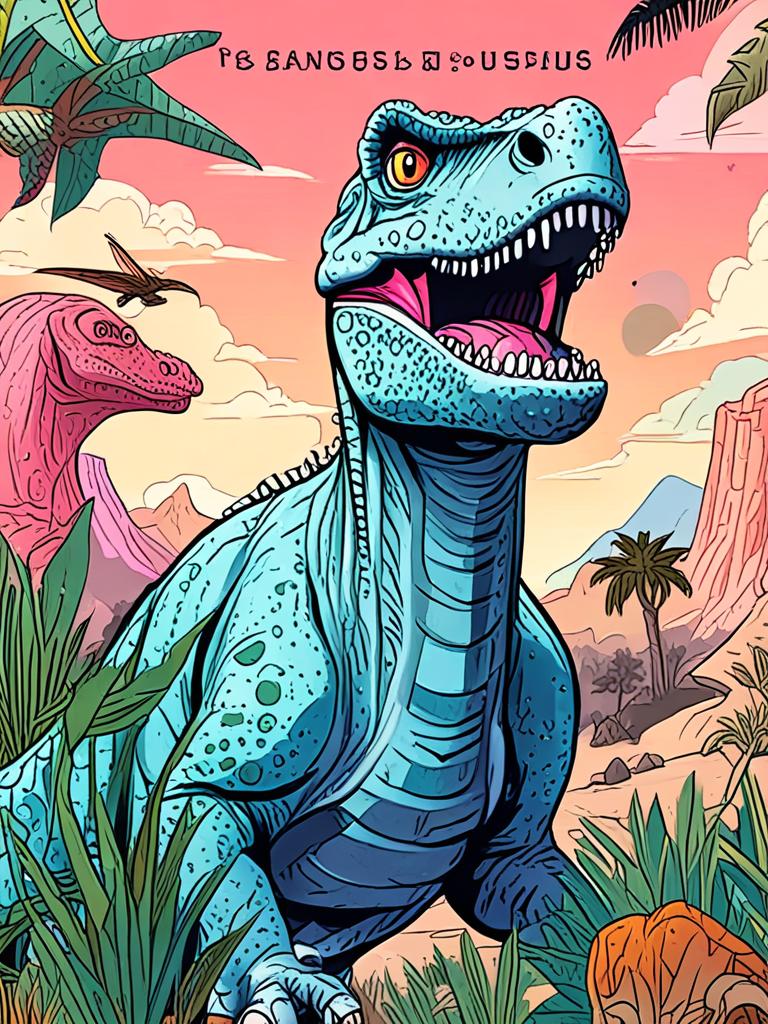
ID · dinosaurs-a-z-a-coloring-book-for-curious-kids-36823fe1
Dinosaurs A-Z: A Coloring Book for Curious Kids
By Mohammed joromi · Education · Neutral · 24 pages
Table of contents
- 1. Dinosaur Discovery
The chapter began with an introduction to the world of dinosaurs, where kids learned about these prehistoric creatures through colorful pictures and fun facts. It sparked their curiosity and encouraged them to learn more. Children in a classroom learn about dinosaurs from their teacher, Mrs. Johnson, and discover different types and characteristics of these prehistoric creatures. Mrs. Johnson and her students explore the habitats of dinosaurs during the Mesozoic Era, discussing the earth's warmer and more humid climate, and seeing pictures of different dinosaurs in various habitats such as forests, plains, mountains, and deserts. Mrs. Johnson teaches her class about herbivorous dinosaurs, explaining their plant-eating diet and special adaptations, and shows them pictures of various herbivores like Parasaurolophus, Apatosaurus, Stegosaurus, and Triceratops. Mrs. Johnson's class explores the senses of dinosaurs, discussing their eyesight, hearing, and smell, and how these senses helped them survive in their environments.
- 2. Dinosaur Encyclopedia
This chapter presented an alphabetical guide to various dinosaurs, each with its own illustration and fun facts. Kids could color and learn about their favorite dinosaurs, from A to Z. Students learn about different dinosaurs from A to E, including Ankylosaurus, Corythosaurus, Dilophosaurus, and Eoraptor, each with unique characteristics and features. Mrs. Johnson teaches her students about dinosaurs starting with the letter F, including Fabrosaurus, Gallimimus, Hypsilophodon, Iguanodon, and Janenschia, discussing their characteristics, diets, and habitats. Students learn about dinosaurs from K to O, including Kentrosaurus, Lambeosaurus, Maiasaura, and Olorotitan, discovering their unique features and habitats Students learn about various dinosaurs from Pachycephalosaurus to Tyrannosaurus, exploring their unique characteristics, diets, and habitats, and imagining what it would be like to live among them.
- 3. Dinosaur Adventures
The final chapter invited kids to imagine themselves in a world filled with dinosaurs, using their coloring skills to bring these prehistoric creatures to life. It concluded the book on a creative and engaging note. A group of children are transported back in time to the Mesozoic Era to spend a day with a Diplodocus, learning about its habits and characteristics with the guidance of their teacher, Mrs. Johnson. Children imagine having a Diplodocus as a pet and explore what it would need to be happy and healthy, leading to a discussion about Diplodocus living in communities and interacting with other herbivores. Children share their drawings and discuss what they've learned about Diplodocus, showing their understanding of its social behavior and unique characteristics, and imagine what it would be like if dinosaurs still existed. Children discuss and plan a dinosaur coloring contest with their teacher, Mrs. Johnson, and become excited about an upcoming dinosaur exhibit at the local museum.
Chapter 1: Dinosaur Discovery
The chapter began with an introduction to the world of dinosaurs, where kids learned about these prehistoric creatures through colorful pictures and fun facts. It sparked their curiosity and encouraged them to learn more. Children in a classroom learn about dinosaurs from their teacher, Mrs. Johnson, and discover different types and characteristics of these prehistoric creatures. Mrs. Johnson and her students explore the habitats of dinosaurs during the Mesozoic Era, discussing the earth's warmer and more humid climate, and seeing pictures of different dinosaurs in various habitats such as forests, plains, mountains, and deserts. Mrs. Johnson teaches her class about herbivorous dinosaurs, explaining their plant-eating diet and special adaptations, and shows them pictures of various herbivores like Parasaurolophus, Apatosaurus, Stegosaurus, and Triceratops. Mrs. Johnson's class explores the senses of dinosaurs, discussing their eyesight, hearing, and smell, and how these senses helped them survive in their environments.
What is a Dinosaur?
As children opened the book, they were immediately transported to a world of giant creatures that roamed the earth millions of years ago. The first page introduced them to the concept of dinosaurs, with a large, colorful illustration of a Tyrannosaurus Rex. "What is a dinosaur?" a curious voice asked, belonging to a young boy named Timmy, who was sitting in a classroom surrounded by his friends. Their teacher, Mrs. Johnson, smiled and began to explain, "A dinosaur is a type of reptile that lived a long, long time ago. They came in all shapes and sizes, from the tiny Compsognathus to the giant Diplodocus." The children's eyes widened as they listened, fascinated by the idea of such enormous creatures. Mrs. Johnson continued, "Dinosaurs lived during a time called the Mesozoic Era, which lasted from about 252 million to 66 million years ago. Can you imagine what the world would have been like back then?" The children looked at each other, their minds racing with thoughts of giant beasts and ancient landscapes. One of them, a girl named Emma, asked, "What did they eat?" Mrs. Johnson replied, "Some dinosaurs were herbivores, which means they ate plants, while others were carnivores, which means they ate meat. And then there were some that ate both plants and animals, called omnivores." The children nodded, taking in this new information, and began to flip through the pages of the book, eager to learn more about these fascinating creatures. As they turned the pages, they saw pictures of different dinosaurs, each with its own unique characteristics and features. "Look, a Stegosaurus!" exclaimed Timmy, pointing to a picture of a dinosaur with a row of plates on its back. "And what's that one?" asked Emma, pointing to a picture of a dinosaur with a long, curved claw. Mrs. Johnson smiled and said, "That's a Therizinosaurus. Isn't it amazing how many different types of dinosaurs there were?" The children nodded in agreement, their curiosity and excitement growing with each new discovery.
Dinosaur Habitats
As the children continued to explore the world of dinosaurs, Mrs. Johnson asked them to imagine what kind of habitats these creatures might have lived in. "What do you think the world was like during the Mesozoic Era?" she asked, sparking a lively discussion among the students. Timmy suggested that it might have been a desert, with sandy dunes and cacti, while Emma thought it could have been a lush, green forest. Mrs. Johnson smiled and said, "Actually, during the Mesozoic Era, the earth's climate was much warmer and more humid than it is today. There were no polar ice caps, and the sea levels were much higher." She showed them a picture of a dinosaur standing in a lush, green valley, surrounded by towering volcanoes and sparkling rivers. "This is what the world might have looked like during the time of the dinosaurs," she explained. The children's eyes widened as they took in the breathtaking scenery. "Wow, it looks like a paradise," exclaimed Emma. Mrs. Johnson nodded, "Yes, it was a very different world from the one we live in today. The dinosaurs lived in all sorts of habitats, from dense forests to open plains, and even in the mountains and deserts." As they turned the pages of the book, the children saw pictures of different dinosaurs in their natural habitats. They saw a picture of a Diplodocus roaming through a savannah, its long neck bending as it reached for leaves on the treetops. They saw a picture of a Tyrannosaurus Rex stalking its prey through a dense forest, its sharp eyes scanning the underbrush for any sign of movement. And they saw a picture of a Stegosaurus standing on a rocky outcrop, its plates glistening in the sunlight. "Look, a desert dinosaur," exclaimed Timmy, pointing to a picture of a dinosaur with a spiky, armored hide. "That's a Carcharodontosaurus," said Mrs. Johnson. "It lived in what is now North Africa, during a time when the desert was much more lush and green than it is today." The children nodded, fascinated by the diversity of habitats and the different adaptations that the dinosaurs had developed to survive in them. As they continued to explore the book, they began to realize just how complex and fascinating the world of the dinosaurs was, and how much there was still to learn about these incredible creatures.
Meet the Herbivores
As the class continued to explore the world of dinosaurs, Mrs. Johnson turned to a new page in the book and said, "Now, let's meet some of the herbivores." The children leaned in, eager to learn about the plant-eating dinosaurs. "Herbivores are dinosaurs that only eat plants," Mrs. Johnson explained. "They don't eat meat, and they have special adaptations that help them digest the tough cellulose in plant cell walls." Emma's eyes lit up, "Like cows and horses?" she asked. Mrs. Johnson nodded, "Exactly, Emma. Just like cows and horses, herbivorous dinosaurs had specialized teeth and digestive systems that allowed them to break down and extract nutrients from plants." Timmy pointed to a picture of a dinosaur with a long, crested head and a distinctive frill on its neck, "What's that one, Mrs. Johnson?" he asked. "That's a Parasaurolophus," she replied. "It was a type of hadrosaur, or duck-billed dinosaur, that lived in what is now North America during the Late Cretaceous period." The children oohed and ahhed as they looked at the picture, taking in the intricate details of the dinosaur's crest and frill. "What was the crest for?" asked Emma. "Well, scientists think that the crest might have been used to make loud noises, like a horn or a trumpet," said Mrs. Johnson. "Maybe it was used to communicate with other Parasaurolophus, or to warn off predators." The children nodded, fascinated by the idea of a dinosaur making loud noises to communicate. As they turned the page, they saw a picture of a massive Apatosaurus, its long neck bending as it reached for leaves on the treetops. "Wow, look at that one," exclaimed Timmy. "It's so long and skinny." Mrs. Johnson smiled, "Yes, the Apatosaurus was a type of sauropod, or long-necked dinosaur. It was one of the largest land animals of all time, and it used its long neck to reach high into the trees to feed on leaves and fruits." The children's eyes widened as they took in the sheer size of the Apatosaurus, and they couldn't help but wonder what it would have been like to see such a massive creature roaming the earth. As they continued to explore the book, they met more herbivorous dinosaurs, each with its own unique adaptations and characteristics. They saw a picture of a Stegosaurus, with its row of plates running down its back, and a picture of a Triceratops, with its distinctive frill and horns. With each new discovery, the children's fascination with the world of dinosaurs grew, and they began to realize just how diverse and complex the plant-eating dinosaurs were.
Dinosaur Senses
As the class delved deeper into the world of dinosaurs, Mrs. Johnson asked, "Have you ever wondered how dinosaurs saw, heard, or smelled their surroundings?" The children looked at each other, intrigued by the question. Timmy raised his hand, "Did they have good eyesight, Mrs. Johnson?" he asked. Mrs. Johnson nodded, "Yes, many dinosaurs had excellent eyesight. Some, like the Troodon, had eyes that were positioned on the front of their skull, allowing them to have binocular vision, just like humans." Emma's eyes widened, "That's so cool! What about hearing?" she asked. "Well, scientists believe that some dinosaurs, like the Hadrosaurs, had a keen sense of hearing," Mrs. Johnson explained. "They had a specialized ear structure that allowed them to detect low-frequency sounds, like the rumble of thunder or the call of another dinosaur." The children imagined what it would be like to hear the sounds of a dinosaur calling out to its friends. Mrs. Johnson continued, "And as for smell, some dinosaurs had a highly developed sense of olfaction. The Oviraptor, for example, had a keen sense of smell that it used to find food and detect predators." The children's minds were filled with questions about how these senses helped dinosaurs survive in their environments. As they turned the page, they saw a picture of a Tyrannosaurus Rex, its eyes fixed intently on its prey. "Look, Mrs. Johnson, the T-Rex is stalking its prey," said Timmy. Mrs. Johnson smiled, "Yes, the T-Rex was a formidable hunter, with excellent eyesight and a powerful sense of smell. It could detect the scent of its prey from far away and track it down with ease." The children shuddered at the thought of being hunted by such a fierce predator. As they continued to explore the senses of dinosaurs, they began to appreciate the complex and fascinating world of these prehistoric creatures. They realized that dinosaurs were not just massive beasts, but living, breathing animals that interacted with their environments in intricate and fascinating ways. With each new discovery, the children's wonder and awe of the dinosaur world grew, and they couldn't wait to learn more about these incredible creatures. As the class came to a close, Mrs. Johnson smiled, "I think that's all the time we have for today, class. But don't worry, we'll continue our journey through the world of dinosaurs tomorrow." The children cheered, eager to return to the fascinating world of dinosaurs and uncover more of its secrets.
Chapter 2: Dinosaur Encyclopedia
This chapter presented an alphabetical guide to various dinosaurs, each with its own illustration and fun facts. Kids could color and learn about their favorite dinosaurs, from A to Z. Students learn about different dinosaurs from A to E, including Ankylosaurus, Corythosaurus, Dilophosaurus, and Eoraptor, each with unique characteristics and features. Mrs. Johnson teaches her students about dinosaurs starting with the letter F, including Fabrosaurus, Gallimimus, Hypsilophodon, Iguanodon, and Janenschia, discussing their characteristics, diets, and habitats. Students learn about dinosaurs from K to O, including Kentrosaurus, Lambeosaurus, Maiasaura, and Olorotitan, discovering their unique features and habitats Students learn about various dinosaurs from Pachycephalosaurus to Tyrannosaurus, exploring their unique characteristics, diets, and habitats, and imagining what it would be like to live among them.
A to E: Amazing Dinosaurs
As the students delved into the world of dinosaurs, they were fascinated by the diverse range of species that existed. Mrs. Johnson began to show them pictures of different dinosaurs, each with its unique characteristics and features. "Let's start with the letter A," she said, holding up a picture of an Ankylosaurus. "This armored dinosaur was a plant-eater, with a club-like tail and protective plates on its body." The students were amazed by the Ankylosaurus's distinctive appearance and eagerly began to color the illustration.
Next, Mrs. Johnson showed them a picture of a Corythosaurus, a crested dinosaur that lived during the Late Cretaceous period. "This dinosaur had a distinctive crest on its head, which was likely used to make sounds," she explained. The students were fascinated by the Corythosaurus's unusual appearance and began to discuss what kind of sounds it might have made. "Maybe it sounded like a bird," suggested one student. "Or maybe it was more like a loud roar," added another.
As they continued through the alphabet, the students encountered a Dilophosaurus, a carnivorous dinosaur with a pair of crests on its head. "This dinosaur was a meat-eater," Mrs. Johnson explained, "and its crests might have been used to attract mates or intimidate rivals." The students were impressed by the Dilophosaurus's fierce appearance and began to color its sharp teeth and powerful legs.
The next dinosaur they encountered was the Eoraptor, a small, meat-eating dinosaur that lived during the Early Triassic period. "This dinosaur was one of the earliest known dinosaurs," Mrs. Johnson said, "and it was likely a very agile and active creature." The students were fascinated by the Eoraptor's small size and began to discuss what kind of prey it might have hunted. "Maybe it ate insects or small lizards," suggested one student. "Or maybe it hunted larger prey in groups," added another.
As they finished coloring the Eoraptor, the students looked up at Mrs. Johnson with excitement. "What's next?" they asked in unison. Mrs. Johnson smiled and held up a picture of a new dinosaur, one that started with the letter F. "Let's see," she said, "what amazing characteristics this dinosaur has." The students leaned forward, eager to learn more about the fascinating world of dinosaurs.
F to J: Fierce and Fascinating
As Mrs. Johnson held up the picture of the dinosaur starting with the letter F, the students' eyes widened with excitement. "This is the Fabrosaurus," she said, "a small, plant-eating dinosaur that lived during the Early Jurassic period." The students began to color the Fabrosaurus's long tail and powerful legs, asking questions about its diet and habitat. "What kind of plants did it eat?" asked one student. "And where did it live?" added another. Mrs. Johnson explained that the Fabrosaurus likely lived in a warm, humid climate, eating ferns and cycads that grew in the area.
Next, Mrs. Johnson showed them a picture of the Gallimimus, a large, omnivorous dinosaur with powerful legs. "This dinosaur was a fast runner," she explained, "and its long legs would have allowed it to catch prey quickly." The students were impressed by the Gallimimus's speed and began to discuss what kind of prey it might have hunted. "Maybe it ate small dinosaurs or lizards," suggested one student. "Or maybe it hunted larger prey in groups," added another.
As they continued through the alphabet, the students encountered the Hypsilophodon, a small, plant-eating dinosaur with a distinctive beak. "This dinosaur had a special beak that allowed it to eat tough plant material," Mrs. Johnson explained. The students were fascinated by the Hypsilophodon's unique appearance and began to color its beak and sharp teeth. "What kind of plants did it eat?" asked one student. "And how did it use its beak to eat them?" added another.
The next dinosaur they encountered was the Iguanodon, a large, plant-eating dinosaur with a distinctive thumb spike. "This dinosaur had a special thumb spike that it used for defense," Mrs. Johnson said. The students were impressed by the Iguanodon's size and began to discuss what kind of predators it might have faced. "Maybe it was hunted by large carnivores," suggested one student. "Or maybe it lived in herds to protect itself," added another.
As they finished coloring the Iguanodon, the students looked up at Mrs. Johnson with excitement. "What's next?" they asked in unison. Mrs. Johnson smiled and held up a picture of the last dinosaur in the section, the Janenschia, a large, plant-eating dinosaur with a distinctive crest on its head. "Let's see," she said, "what amazing characteristics this dinosaur has." The students leaned forward, eager to learn more about the fascinating world of dinosaurs. "This dinosaur lived during the Late Jurassic period," Mrs. Johnson explained, "and its crest might have been used to make sounds or attract mates." The students began to color the Janenschia's crest and powerful legs, asking questions about its habitat and diet. "What kind of plants did it eat?" asked one student. "And where did it live?" added another. Mrs. Johnson explained that the Janenschia likely lived in a warm, humid climate, eating ferns and cycads that grew in the area. The students nodded, taking in the new information and eagerly anticipating the next section of their dinosaur journey.
K to O: Kings of the Ancient World
As the students finished learning about the Janenschia, Mrs. Johnson smiled and said, "Now, let's move on to the next section of our dinosaur journey, from K to O." The students cheered and clapped, excited to learn about more fascinating creatures. Mrs. Johnson held up a picture of the Kentrosaurus, a small, plant-eating dinosaur with a distinctive set of spikes on its body. "This dinosaur lived during the Late Jurassic period," she explained, "and its spikes might have been used for defense against predators." The students began to color the Kentrosaurus's spikes and powerful legs, asking questions about its habitat and diet. "What kind of plants did it eat?" asked one student. "And where did it live?" added another. Mrs. Johnson explained that the Kentrosaurus likely lived in a warm, humid climate, eating ferns and cycads that grew in the area.
Next, Mrs. Johnson showed them a picture of the Lambeosaurus, a large, plant-eating dinosaur with a distinctive crest on its head. "This dinosaur had a special crest that might have been used to make sounds or attract mates," she said. The students were fascinated by the Lambeosaurus's unique appearance and began to color its crest and long neck. "What kind of sounds do you think it made?" asked one student. "And how did it use its crest to attract mates?" added another.
As they continued through the alphabet, the students encountered the Maiasaura, a large, plant-eating dinosaur with a distinctive set of horns on its head. "This dinosaur had a special set of horns that might have been used for defense or to attract mates," Mrs. Johnson explained. The students were impressed by the Maiasaura's size and began to discuss what kind of predators it might have faced. "Maybe it was hunted by large carnivores," suggested one student. "Or maybe it lived in herds to protect itself," added another.
The next dinosaur they encountered was the Olorotitan, a large, plant-eating dinosaur with a distinctive set of teeth. "This dinosaur had a special set of teeth that allowed it to eat tough plant material," Mrs. Johnson said. The students were fascinated by the Olorotitan's unique appearance and began to color its teeth and powerful legs. "What kind of plants did it eat?" asked one student. "And how did it use its teeth to eat them?" added another.
As they finished coloring the Olorotitan, the students looked up at Mrs. Johnson with excitement. "What's next?" they asked in unison. Mrs. Johnson smiled and said, "Now, let's move on to the final section of our dinosaur journey, from P to Z." The students cheered and clapped, eager to learn about more fascinating creatures and complete their dinosaur encyclopedia. Mrs. Johnson held up a picture of the Pachycephalosaurus, a small, plant-eating dinosaur with a distinctive set of spikes on its body. "This dinosaur lived during the Late Cretaceous period," she explained, "and its spikes might have been used for defense against predators." The students leaned forward, eager to learn more about the fascinating world of dinosaurs.
P to T: Prehistoric Giants
As the students learned about the Pachycephalosaurus, they began to notice the unique characteristics of each dinosaur. "What kind of plants did it eat?" asked one student. "And how did it use its spikes for defense?" added another. Mrs. Johnson explained that the Pachycephalosaurus likely ate fruits and seeds, and its spikes might have been used to deter predators. The students began to color the Pachycephalosaurus's spikes and powerful legs, imagining what it would be like to live in a world with such fascinating creatures.
Next, Mrs. Johnson showed them a picture of the Quetzalcoatlus, a large, flying reptile with a distinctive set of wings. "This creature was not a dinosaur, but a type of pterosaur," she explained. "It lived during the Late Cretaceous period and might have been used for transportation or to catch prey." The students were amazed by the Quetzalcoatlus's massive wingspan and began to discuss what it would be like to fly through the air like a pterosaur. "Maybe it could fly for hours without getting tired," suggested one student. "Or maybe it could dive down to catch fish in the water," added another.
As they continued through the alphabet, the students encountered the Rajasaurus, a large, carnivorous dinosaur with a distinctive set of teeth. "This dinosaur was a fierce predator," Mrs. Johnson explained. "It lived during the Late Cretaceous period and might have been used to hunt large herbivores." The students were impressed by the Rajasaurus's powerful jaws and began to discuss what kind of prey it might have hunted. "Maybe it hunted in packs," suggested one student. "Or maybe it was a solitary hunter," added another.
The next dinosaur they encountered was the Spinosaurus, a large, carnivorous dinosaur with a distinctive set of spines on its back. "This dinosaur was a fish-eater," Mrs. Johnson said. "It lived during the Early Cretaceous period and might have been used to catch fish in the water." The students were fascinated by the Spinosaurus's unique appearance and began to color its spines and powerful tail. "What kind of fish did it eat?" asked one student. "And how did it use its spines to catch them?" added another.
As they finished coloring the Spinosaurus, the students looked up at Mrs. Johnson with excitement. "What's next?" they asked in unison. Mrs. Johnson smiled and said, "Now, let's learn about the Therizinosaurus, a large, herbivorous dinosaur with a distinctive set of claws on its hands." The students leaned forward, eager to learn more about this fascinating creature. "This dinosaur lived during the Late Cretaceous period," Mrs. Johnson explained, "and its claws might have been used to gather plants or defend itself against predators." The students began to color the Therizinosaurus's claws and powerful arms, imagining what it would be like to live in a world with such incredible creatures.
Finally, the students encountered the Tyrannosaurus, a large, carnivorous dinosaur with a distinctive set of teeth. "This dinosaur was a fierce predator," Mrs. Johnson explained. "It lived during the Late Cretaceous period and might have been used to hunt large herbivores." The students were impressed by the Tyrannosaurus's powerful jaws and began to discuss what kind of prey it might have hunted. "Maybe it hunted in packs," suggested one student. "Or maybe it was a solitary hunter," added another. As they finished coloring the Tyrannosaurus, the students looked up at Mrs. Johnson with a sense of accomplishment, knowing they had completed their dinosaur encyclopedia and learned about the fascinating world of prehistoric giants.
Chapter 3: Dinosaur Adventures
The final chapter invited kids to imagine themselves in a world filled with dinosaurs, using their coloring skills to bring these prehistoric creatures to life. It concluded the book on a creative and engaging note. A group of children are transported back in time to the Mesozoic Era to spend a day with a Diplodocus, learning about its habits and characteristics with the guidance of their teacher, Mrs. Johnson. Children imagine having a Diplodocus as a pet and explore what it would need to be happy and healthy, leading to a discussion about Diplodocus living in communities and interacting with other herbivores. Children share their drawings and discuss what they've learned about Diplodocus, showing their understanding of its social behavior and unique characteristics, and imagine what it would be like if dinosaurs still existed. Children discuss and plan a dinosaur coloring contest with their teacher, Mrs. Johnson, and become excited about an upcoming dinosaur exhibit at the local museum.
A Day with Diplodocus
As the sun rose over the vast, open plains, a group of children found themselves transported back in time to the Mesozoic Era, surrounded by the majestic creatures they had learned so much about. They were excited to spend a day with one of the most fascinating dinosaurs of all - the Diplodocus. Mrs. Johnson, their teacher, stood beside them, a big smile on her face. "Today, class, we're going to imagine what it would be like to live among these incredible animals," she said, her eyes sparkling with enthusiasm. The children nodded eagerly, their pencils and crayons at the ready. As they began to color, they noticed the Diplodocus roaming freely in the distance, its long, slender body swaying gently as it moved. "Wow, look at that!" exclaimed one of the children. "It's so big and gentle-looking!" Mrs. Johnson nodded. "Yes, Diplodocus was a herbivore, which means it only ate plants. It used its small teeth to crop ferns and cycads, and its long neck to reach high into the trees to feed." The children watched in awe as the Diplodocus began to move closer, its tail swishing back and forth behind it. "I wonder what it would be like to ride on its back," said another child, a look of wonder on her face. Mrs. Johnson smiled. "Well, let's use our imaginations and find out!" And with that, the children began to color and draw, bringing the Diplodocus to life in a world of vibrant colors and endless possibility. As they worked, they chatted excitedly about what they had learned, asking questions and sharing their thoughts about these incredible creatures. "Do you think Diplodocus lived alone or in groups?" asked one child. "I think it lived in groups," replied another. "It would have been safer that way, don't you think?" Mrs. Johnson nodded, impressed by their thoughtful discussion. "That's a great point," she said. "Many herbivorous dinosaurs, like Diplodocus, likely lived in herds for protection and companionship." As the day wore on, the children continued to explore and learn, their creativity and curiosity inspired by the amazing world of dinosaurs. And as they colored and drew, they brought the Diplodocus to life, imagining what it would be like to walk among these incredible creatures, to see them roam and thrive in their natural habitats. The Diplodocus, with its gentle eyes and swishing tail, seemed to come alive on the page, a testament to the power of imagination and the magic of the dinosaur world.
Dinosaur Friends
As the children continued to color and draw, they began to imagine what it would be like to be friends with the Diplodocus. "I think it would be so cool to have a Diplodocus as a pet," said one child, a look of excitement on her face. Mrs. Johnson smiled. "Well, let's think about what that would be like," she said. "What do you think the Diplodocus would need to be happy and healthy?" The children thought for a moment, and then one of them spoke up. "It would need lots of food, like ferns and cycads," he said. "And it would need a big space to roam, like a giant backyard," added another child. Mrs. Johnson nodded. "That's right," she said. "Diplodocus was a large animal, and it would have needed a lot of space to move around. And it would have needed to eat a lot of plants to survive." The children nodded, taking in this information. As they continued to color and draw, they began to imagine what it would be like to explore the Mesozoic Era with the Diplodocus as their guide. "I think we could learn so much from the Diplodocus," said one child. "It could show us all the secret places it likes to go, and all the yummy plants it likes to eat." Mrs. Johnson smiled. "That's a great idea," she said. "Let's use our imaginations to explore the Mesozoic Era with the Diplodocus as our guide." And with that, the children began to draw and color, creating a world of wonder and discovery as they imagined themselves on an adventure with the Diplodocus. As they worked, they chatted excitedly about what they had learned, asking questions and sharing their thoughts about these incredible creatures. "Do you think the Diplodocus would have been friends with other dinosaurs?" asked one child. "I think it would have been friends with the other herbivores," replied another. "They could have all eaten together and played together." Mrs. Johnson nodded, impressed by their thoughtful discussion. "That's a great point," she said. "Many dinosaurs, like the Diplodocus, likely lived in communities and interacted with each other in complex ways." As the day wore on, the children continued to explore and learn, their creativity and curiosity inspired by the amazing world of dinosaurs. And as they colored and drew, they brought the Diplodocus and its friends to life, imagining what it would be like to live among these incredible creatures, to see them roam and thrive in their natural habitats. The Diplodocus, with its gentle eyes and swishing tail, seemed to come alive on the page, a testament to the power of imagination and the magic of the dinosaur world.
The Last Dinosaurs
As the children finished their coloring and drawing, they gathered around Mrs. Johnson, eager to share their creations with the class. "Look, Mrs. Johnson, I drew a Diplodocus eating ferns and cycads," said one child, holding up his picture. Mrs. Johnson smiled and examined the drawing. "That's wonderful," she said. "You've really captured the Diplodocus's long neck and tail." Another child spoke up, "I drew a picture of a Diplodocus living with other herbivores, like a big happy family." Mrs. Johnson nodded, impressed by their understanding of dinosaur social behavior. "That's a great idea," she said. "Many dinosaurs, like the Diplodocus, likely lived in communities and interacted with each other in complex ways." As the children continued to share their drawings, they began to discuss what they had learned about the Diplodocus and its friends. "I think the Diplodocus was one of the most amazing dinosaurs," said one child. "It was so gentle and had such a long neck," added another. Mrs. Johnson smiled, pleased with their enthusiasm. "The Diplodocus was indeed an incredible creature," she said. "And it's wonderful that you've all learned so much about it." As the class came to a close, Mrs. Johnson asked the children to imagine what the world would be like if dinosaurs still existed. "Would you want to see a Diplodocus roaming in the wild?" she asked. The children nodded eagerly, their eyes wide with excitement. "That would be amazing," said one child. "We could learn so much from them and see how they interact with each other and their environments." Mrs. Johnson smiled, knowing that the children had developed a deep appreciation for these prehistoric creatures. "Who knows," she said. "Maybe one day we'll discover new ways to learn about dinosaurs and their worlds." And with that, the children packed up their coloring books and pencils, already looking forward to their next adventure in the world of dinosaurs. As they left the classroom, they chatted excitedly about what they had learned, their minds filled with visions of Diplodocus and its friends roaming the ancient landscapes. The Diplodocus, with its gentle eyes and swishing tail, seemed to linger in their imaginations, a symbol of the magic and wonder of the dinosaur world.
Coloring Contest
The children's enthusiasm for dinosaurs only grew stronger as they left the classroom, and soon they began to talk about having a coloring contest to see who could create the most realistic and colorful dinosaur picture. "We could have a contest to see who can draw the best Diplodocus," suggested one child. "Or we could draw our favorite dinosaurs and see who can make them look the most alive," added another. Mrs. Johnson, who was walking with them, overheard their conversation and smiled. "That's a wonderful idea," she said. "We could have a coloring contest next week and invite the whole school to participate." The children cheered and began to make plans for the contest, discussing what rules they would have and how they would judge the pictures. As they walked, they imagined all the different dinosaurs they could draw and color, from the towering Brachiosaurus to the tiny Compsognathus. "I'm going to draw a Tyrannosaurus Rex," said one child. "I'm going to draw a Triceratops," said another. Mrs. Johnson listened to their plans and offered words of encouragement, reminding them that the most important thing was to have fun and be creative. "Don't worry too much about making your pictures perfect," she said. "Just enjoy the process of creating and learning about these amazing creatures." The children nodded, already looking forward to the contest and the opportunity to show off their artistic skills. As they approached the school entrance, they saw a poster on the wall advertising a new dinosaur exhibit at the local museum. "Look, a dinosaur exhibit!" exclaimed one child. "Can we go see it, Mrs. Johnson?" asked another. Mrs. Johnson smiled and nodded. "We'll definitely plan a field trip to the museum soon," she said. "It will be a great way to learn even more about dinosaurs and see some real fossils and artifacts up close." The children cheered and began to talk about what they might see at the exhibit, from dinosaur bones to ancient plants and insects. As they entered the school, they were already making plans for their next dinosaur adventure, eager to continue exploring the fascinating world of these prehistoric creatures. The coloring contest was just the beginning, and they knew that there were many more exciting discoveries to be made. With their minds full of dinosaurs and their hearts full of wonder, the children went their separate ways, already looking forward to their next encounter with the magic and mystery of the ancient world.