Fiction
FOSSIL TREK
by Filippo Talento
3 chapters1 hr read
Chapter 1
Episode 1: Morrison Formation – First Light
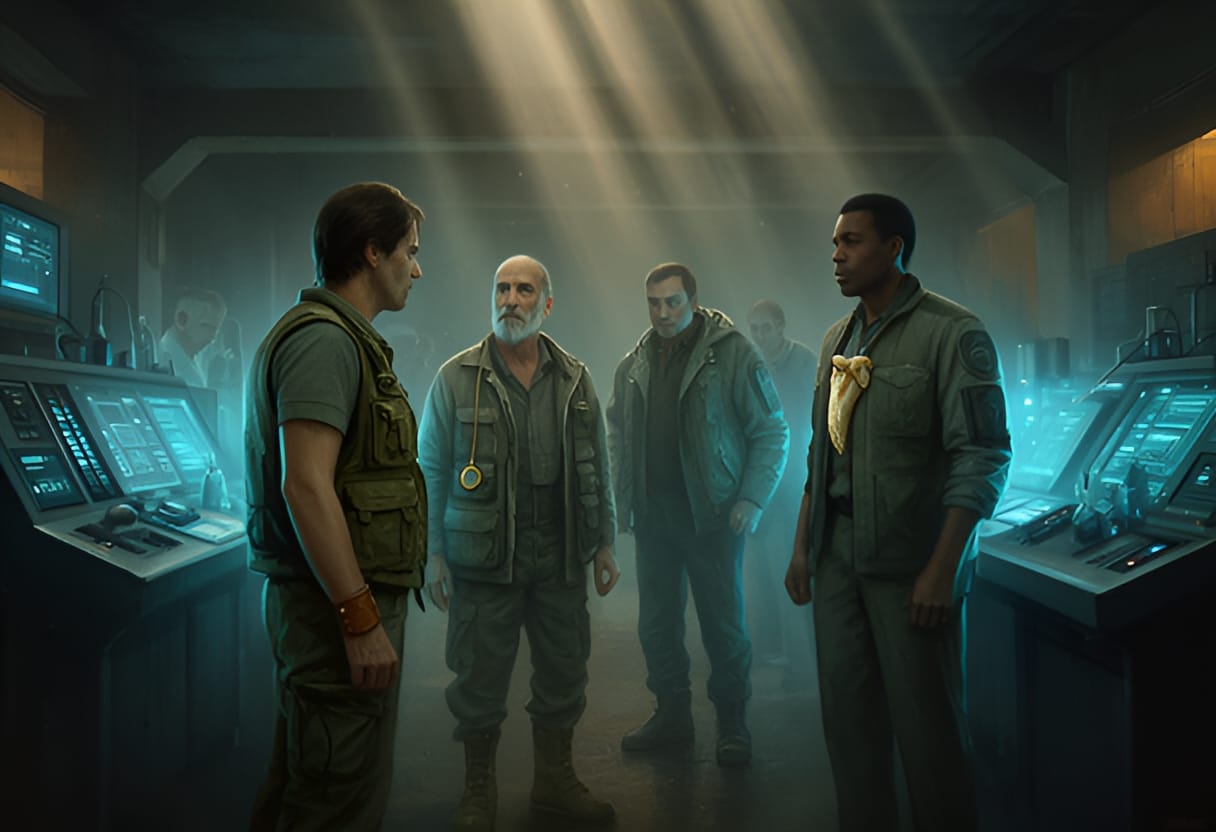
The pre-dawn air in the research complex tasted of recycled coolant and ozone. Filippo stood at the viewport of the RMP chamber, watching the first weak light bleed over the distant hills of the sanctuary. His breath fogged the glass slightly as he exhaled, hands clasped behind his back. Six silent figures waited in the semi-dark of the preparation bay: Marco with his tablet cradled like a shield, Luca reviewing osteological scans on a flickering screen, Elena adjusting the spectral filters on her goggles, Sofia already moving between the proxy molds with a portable vitals scanner, and Giulia at the console, fingers poised over the initiation sequence.
"All present," Filippo said, his voice low but carrying. "Six taxa: Allosaurus fragilis, Apatosaurus ajax, Diplodocus longus, Camarasaurus supremus, Stegosaurus stenops, Torvosaurus tanneri. We are not here for spectacle. We are here to observe, to retrieve, and to return with minimal disruption. The proxies are not exhibits. They are living data points from a time we are privileged to witness, not to disturb."
He turned, meeting each gaze in turn. Marco gave a single, sharp nod. Luca’s brow was furrowed, already lost in thought. Elena’s eyes were wide, reflecting the dim console lights. Sofia’s expression was focused, professional. Giulia’s hands rested ready.
"Marco," Filippo continued, "you had a point about the Allosaurus?"
Marco stepped forward, his voice calm but edged with the certainty of someone who had spent too many years correcting pop-culture myths. "Luca, I know you’re excited about the social dynamics, but the Morrison Formation doesn’t support pack hunting in Allosaurus. The bonebeds show isolated individuals, often with signs of intraspecific combat — bite marks on ribs, healed fractures suggesting solitary survival. There’s no evidence of coordinated cooperation like in some later theropods. If we assume pack behavior, we risk misinterpreting proxy actions later. Let the fossils guide us, not our assumptions."
Luca glanced up from his screen, a flicker of disappointment crossing his features before he smoothed it into consideration. "You’re right. I was extrapolating from tyrannosaurid behavior too broadly. Apologies. I’ll adjust the behavioral models."
"Good," Filippo said. "Sofia, how are the molds?"
Sofia looked up from the Stegosaurus proxy, her scanner glowing softly against the plaster-like surface of the bio-scaffold. "Vitals are nominal. Neural lace integration is at 97% for all six. Cortisol indicators are baseline — no signs of stress from the stasis cycle. The dermal layers are hydrated, and the musculoskeletal actuators are responding to test pulses. They’re ready. But remember, once we pull them into the chrono-field, their metabolic rates will spike. We’ll need to monitor closely during transfer."
"I’ll be watching the feed," Giulia said, not looking up. "Lockdown sequence is primed. Field harmonics are stable at 7.3 terahertz. We’re good to go on your mark."
Filippo took a breath, feeling the weight of the moment settle — not as fear, but as the quiet focus of purpose. "Then let’s begin. Giulia, initiate the pre-field. Elena, keep the spectral buffers open. We want clean photons on entry."
The chamber hummed to life. Arrays along the walls began to glow with a soft, cerulean light as the chrono-field generators spun up. The air grew thin and sharp, smelling suddenly of wet stone and crushed ferns — an impossibility, yet there it was, leaking through the edges of the emerging temporal membrane. Filippo felt a pressure behind his eyes, a sense of the world tilting on its axis.
The light was not light as he knew it. It was thicker, greener, saturated with wavelengths that made his teeth ache and his skin prickle. It poured through the chamber walls like liquid jade, flooding the space with a brilliance that hurt to look at but was impossible to turn away from. Sound followed — not a roar, but a vast, low thrumming, like the earth itself breathing, layered with the distant crash of waterfalls and the high, insectile buzz of unseen creatures. The air was warm, thick with the scent of damp soil, crushed cycads, and something metallic, like blood on stone.
Filippo staggered slightly, gripping the edge of the console. His vision swam — for a heartbeat, he saw not the polished alloy of the chamber walls, but a vast floodplain under a sky stretched wide with impossible blue, dotted with the silhouettes of towering conifers and the distant, slow movement of colossal shapes at the tree line.
"Steady," Marco’s voice cut through the sensory flood, calm and anchoring. "It’s the temporal gradient. Your brain is trying to map Jurassic spectra onto modern visual cortex. Give it a second."
Filippo forced his eyes open. The chamber was still there — the consoles, the molds on their plinths — but they were now bathed in that alien light, casting long, wavering shadows. The air shimmered with heat distortion, and through the viewport, he could see the edge of the field: a rippling boundary where the sanctuary’s dawn bled into the Morrison morning.
Sofia gasped softly. "The proxies…"
He turned. The six molds were no longer inert scaffolds. They were alive.
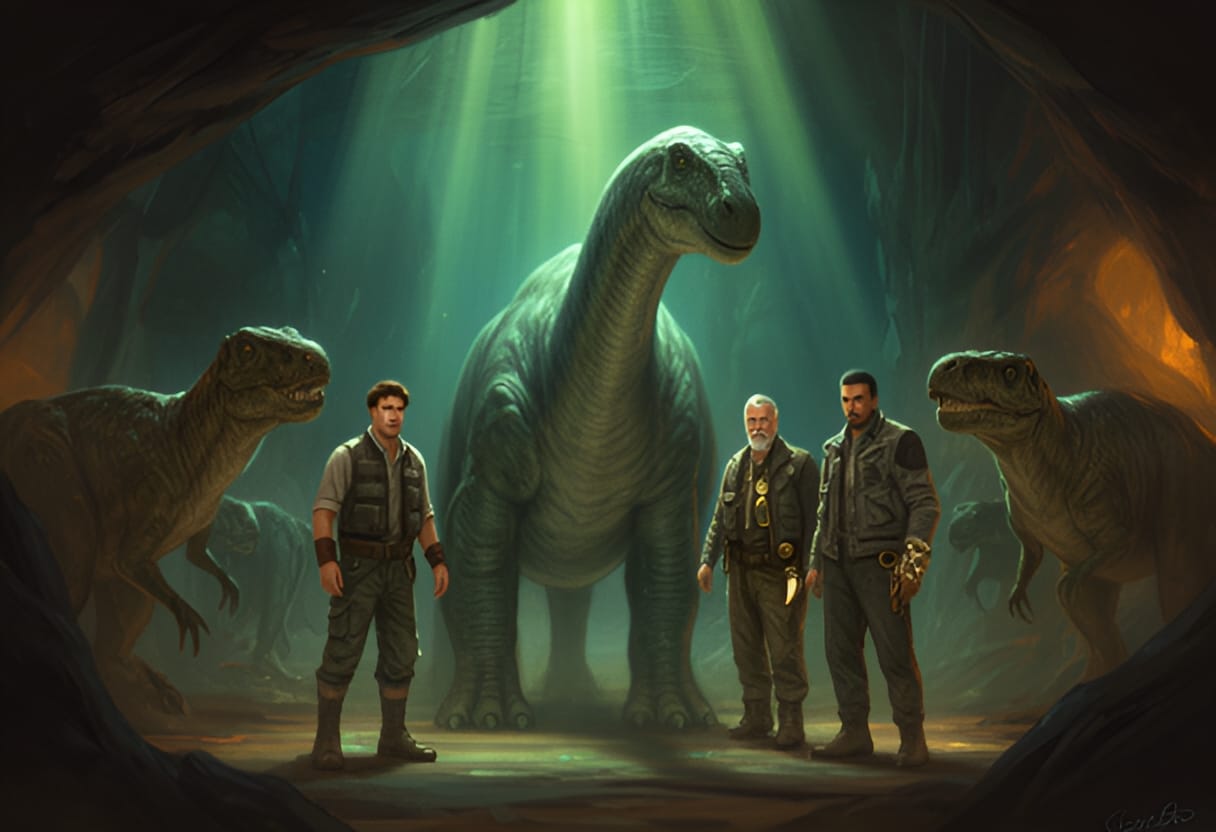
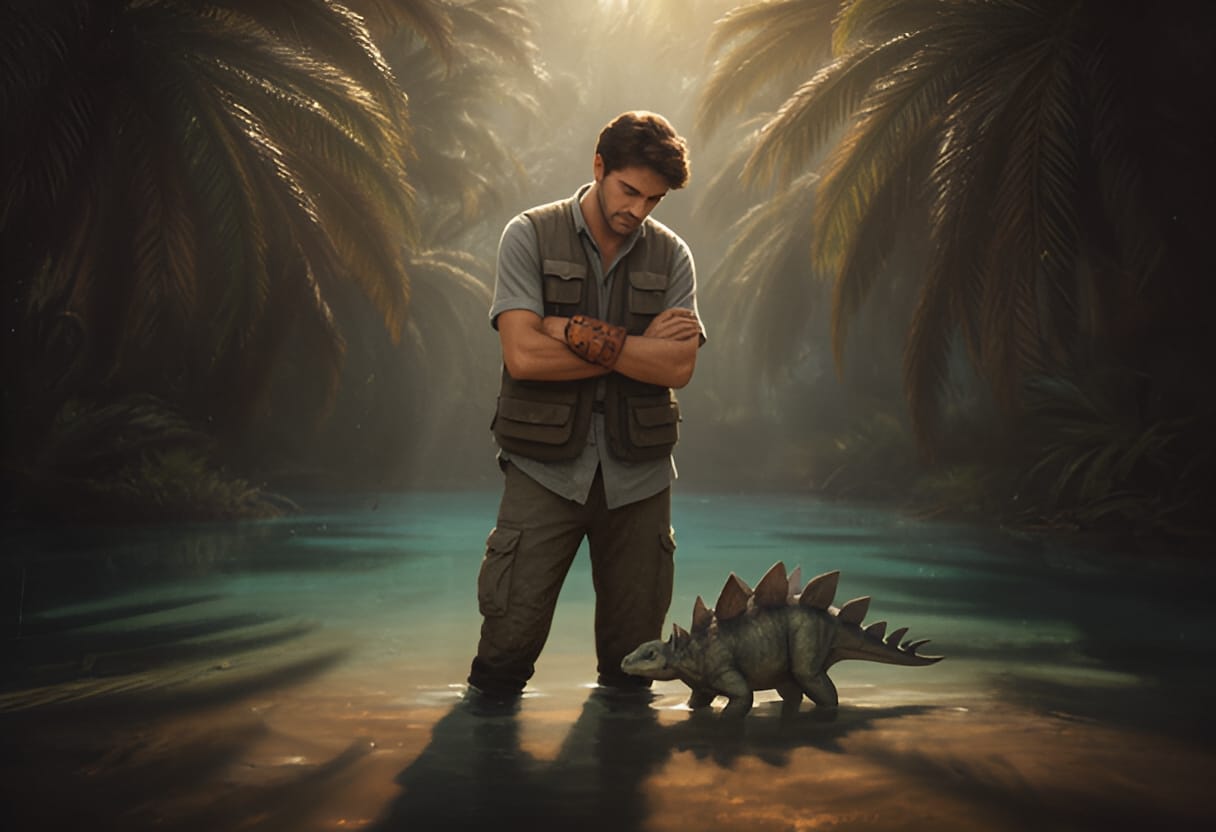
Muscles rippled beneath skin that gleamed with moisture — not sweat, but a natural sheen from dermal glands. The Camarasaurus lifted its head, nostrils flaring as it sampled the air, its spatulate teeth visible in a slow, cautious blink. Nearby, the Diplodocus swayed slightly, its whip-like tail brushing the air with a sound like silk dragged over stone. The Stegosaurus shifted its plated back, tail arched high, spikes glinting in the strange light. The two theropods — Allosaurus and Torvosaurus — stood low, muscles coiled, eyes dark and alert, tracking movement beyond the field’s edge.
Elena whispered, "Look at the integument…"
Filippo followed her gaze. Along the neck of the Apatosaurus, fine filaments clung to the skin — not quite feathers, not quite scales, but something in between, catching the light like dry grass. On the Allosaurus, a faint dorsal ridge showed signs of keratinous growth, possibly for display.
"This isn’t just morphology," Marco breathed. "This is behavior. Look how the Camarasaurus is feeding — selective browsing, not grazing. It’s nipping at the cycad fronds, avoiding the tougher stems. That’s not in any textbook. That’s learned."
Luca was already speaking into his recorder, voice hushed. "Note: Allosaurus posture — low center of gravity, weight balanced over hind limbs. No signs of agitation. Monitoring for social cues… none observed. Solitary stance confirmed."
Filippo felt a surge — not of triumph, but of profound responsibility. This was not a simulation. This was not a model. This was life, pulled from deep time, standing in the light of a sun that had shone 150 million years ago, breathing air that had not touched human lungs.
He turned to Giulia, his voice rough. "Maintain the field. Keep the buffer clean. We have six living witnesses to a world we are only beginning to understand. Let’s not be the reason they forget it."
Giulia met his eyes, her own wide but steady. "Field’s holding. We’re locked in."
The Jurassic light stretched across the chamber, endless and ancient, and for the first time since the project began, Filippo understood what they were truly dealing with — not specimens, not data, but survivors. And they had just stepped into their world.
Filippo turned from Giulia’s steady gaze and stepped toward the rippling edge of the field. The air beyond shimmered like heat over stone, but cooler, carrying the damp green breath of ferns and cycads. He paused, hand resting on the console’s alloy rim, feeling the faint vibration of the chrono-field through his boots. Behind him, the chamber thrummed with generators and the soft, subsonic pulse of the temporal membrane. Ahead lay the Morrison morning—real, breathing, and unmediated by models or matrices.
"Elena," he said, voice low but clear over the comm, "take the west transect with Luca. Marco, you and Sofia follow the river east. Giulia, stay here and hold the anchor. We’ll check in every ten minutes."
Elena adjusted her spectral filter goggles, the lenses tinting the Jurassic light into a more tolerable spectrum. "West it is. Tree line to the rise."
Luca slipped his recorder into his vest pocket, already tapping a stylus against his tablet. "I’ll take behavioral notes. Allosaurus first, if we can get a clear sightline."
They moved as a pair through the tall ferns, their boots sinking slightly into the loamy soil, releasing bursts of petrichor and crushed cycad. The light here was fractured—green-gold and shifting—filtering through the canopy of towering conifers and cycadophytes. The air buzzed with the drone of giant insects, their wings like stained glass in the slanted sun. Somewhere nearby, a distant crash echoed—perhaps a sauropod shifting its weight in the undergrowth, or a branch snapping under immense weight.
Elena stopped first, hand outstretched, not to touch but to halt Luca’s advance. She pointed.
Twenty meters ahead, at the edge of where the forest opened toward a rise, a Stegosaurus stenops grazed slowly, its head low, plucking at low cycads with a beak that moved with surprising delicacy. Its plated back rose in a slow, rhythmic arch—seventeen dermal spines alternating in two neat rows, each broadening into a tall, kite-shaped plate toward the hips. The plates were not bare bone; they bore a distinct texture—fine grooves running longitudinally, like the grain of aged wood, and along the edges, a subtle keratinous sheath caught the light, giving them a faint, lustrous sheen.
"Look at that," Elena murmured, her voice hushed. "The sulci on the plates—consistent with fossil impressions from Como Bluff. And the edge keratin… it’s not just speculative. It’s there. Real."
Luca raised his tablet, activating the passive scan mode. The device hummed softly, recording spectral reflectance without emitting invasive signals. "Keratinous sheath thickness—about 1.8 millimeters at the base, tapering. Matches the histological proxies from Stegosaurus stenops holotype. No signs of wear or trauma. This individual’s in prime condition."
Elena exhaled, a slow release of breath she hadn’t realized she’d been holding. "We’ve only ever inferred this from bone texture. To see it… it’s like seeing a color no one’s ever described."
Luca lowered the tablet. "It changes how we think about display. Those grooves—maybe they channeled blood for color shift. Or maybe the keratin was patterned. Either way, it’s not just armor. It’s signaling."
They watched as the Stegosaurus lifted its head, nostrils flaring, ears twitching. It took a slow, deliberate step forward, tail swaying to counterbalance, spikes arched high and alert. Then, satisfied, it returned to its feeding, plates catching the light like stained glass in a cathedral window.
Marco and Sofia followed the river’s sinuous curve eastward, the water wide and shallow here, choked with horsetails and ribbon-like algae. The banks were soft mud, crisscrossed with tracks—some deep and broad, others narrow and triple-toed. Marco knelt at the edge of a particularly clear impression, his fingers hovering just above the sediment without touching.
"Here," he said, pointing. "Manus and pes. See the alignment?"
Sofia leaned in, her breath fogging the air slightly in the cool morning. The front foot—smaller, crescent-shaped, with a faint trace of five digits—was placed precisely inward, almost directly under the hip. The hind foot—broad, three-toed, with blunt claws—landed just outside it, but not far. The gait was narrow, the limbs moving close to the midline.
"Narrow-gauge," Marco said, sketching quickly in his waterproof notebook. "Manus pes alignment within 15 centimeters of midline. Pes rotated slightly outward, but not enough for a wide stance. This isn’t the sprawling gait we used to assume for sauropods. This is efficient. Balanced."
Sofia traced the trackway with her eyes, following a sequence of left-right-left steps. "Diplodocus, then. The pes is too narrow for Camarasaurus—those guys had a wider stance. And the stride length… about 2.3 meters. Consistent with a subadult or small adult."
Marco nodded, adding a scale bar to his sketch. "And note the lack of drag marks. Tail was held clear. No signs of lateral undulation in the pelvis—this was a walking gait, not a lumbering drag. The animal was aware of its balance."
Sofia stood, brushing mud from her knees. "So the old museum mounts—tail dragging, legs splayed—are just wrong. We’ve known that from bone articulation, but to see it in the trackway… it’s confirmation. Not inference."
Marco closed his notebook. "And it means their energy expenditure was lower than we modeled. They weren’t fighting their own anatomy to move. They were adapted."
They moved on, passing a cluster of ferns where a small herd of Camarasaurus browsed—heads moving in synchronized, deliberate motions, selecting the softest fronds with lips that curled and uncurled like fingers. One lifted its head, eyes large and dark, studying them for a long moment before returning to its meal. No alarm calls. No herd panic. Just quiet assessment.
Luca and Elena had doubled back toward the river’s bend, following a game trail worn deep into the soil by repeated use. The trees thinned here, opening onto a wide gravel bar where the water slowed and deepened, pooling in a calm eddy. Luca froze, hand up, and Elena mirrored him, both dropping to a crouch behind a screen of cycads.
Twenty meters out, in the shallows, an Allosaurus fragilis stood motionless, its head lowered to drink. Its jaws opened slowly, water rippling inward, tongue flicking to guide the flow. The throat pulsed with each swallow. Its body was low, weight balanced firmly over the hind limbs, tail held straight and slightly elevated—not for balance, but for readiness. The forelimbs were tucked close, hands withdrawn, claws retracted. Its skin gleamed with moisture, and along the dorsal ridge, the keratinous growths caught the sun, appearing darker, almost reddish in the wet light.
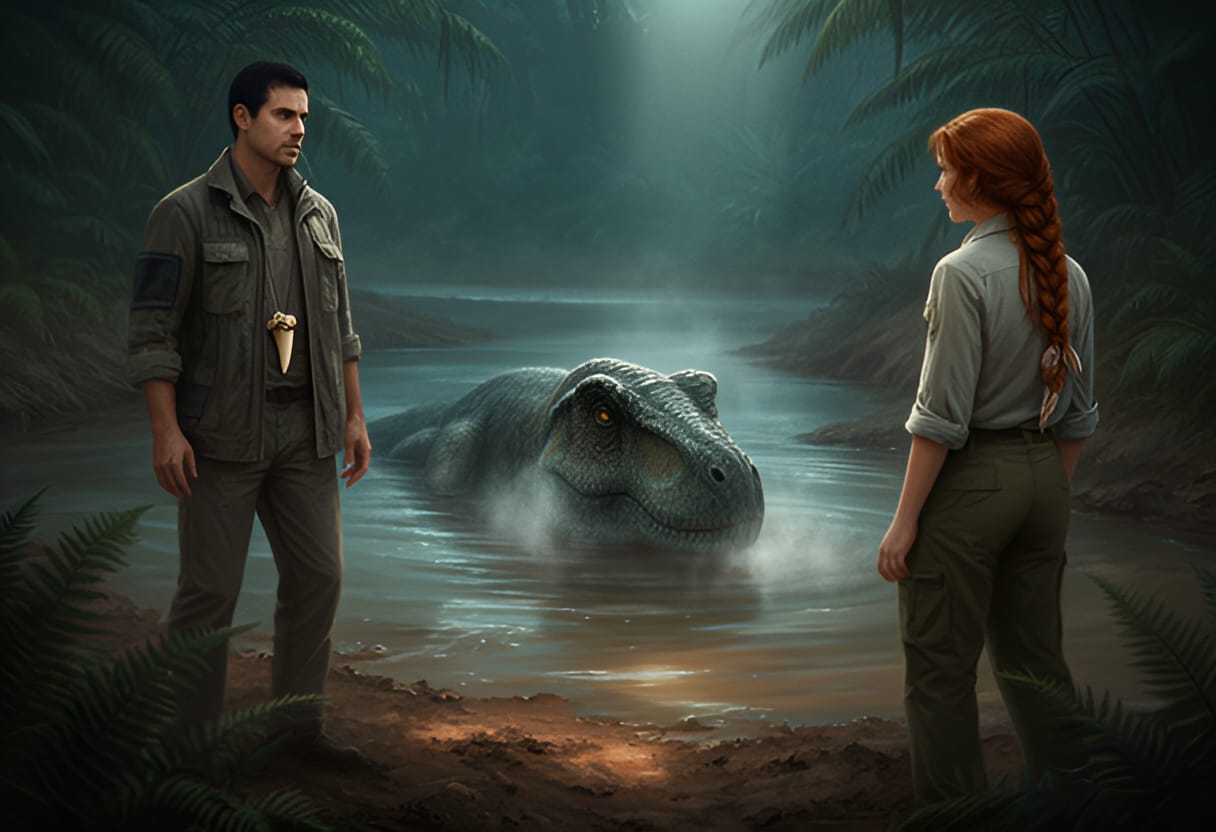
Luca whispered into his recorder, voice barely audible over the water’s murmur. "Note: Allosaurus fragilis, solitary individual. Drinking behavior—slow, deliberate, no signs of vigilance beyond normal posture. No conspecifics within fifty meters. No vocalizations. No scanning beyond immediate surroundings. Confirming solitary stance observed earlier in field."
Elena watched the creature’s eyes—dark, lidless, unblinking. Not dull, but not alert in the way of a predator scanning for threat. Rather, the gaze of an animal focused on a simple, immediate need: hydration. After nearly a minute, it lifted its head, water dripping from its chin, and turned slowly, scanning the tree line with a slow, deliberate sweep of its head. It saw nothing—no movement, no threat—and turned back toward the forest, steps quiet, feet sinking slightly into the damp gravel.
"It’s not just solitary," Elena said softly. "It’s… uninterested. Not fearful, not aggressive. Just… absorbed in the act."
Luca nodded, lowering his recorder. "That’s the key. If it were hunting or guarding territory, we’d see tension in the neck, frequent scanning, maybe vocalizing. This is maintenance behavior. Self-care. And it’s alone."
They waited until the Allosaurus disappeared into the ferns, its silhouette merging with the shadows of the trunks. Then they rose, muscles stiff from the crouch, and began the slow walk back toward the river bend, where Marco and Sofia were sketching another set of tracks—these ones smaller, triple-toed, and running in a quick, darting pattern.
Elena paused, tilting her head. "What are those?"
Marco looked up, pencil poised. "Ornitholestes, maybe. Small coelurosaur. Agile. Look at the stride—short steps, high frequency. They’re avoiding the sauropod trails entirely. Keeping to the margins."
Sofia stood, brushing dirt from her palms. "Two of them. See how the tracks pair? One slightly ahead, then the other. Not a flock—just a pair. Maybe foraging together."
Luca frowned. "Interesting. We haven’t seen any juvenile sauropods near the river. All the tracks we’ve found are adult-sized. No small pes prints in the mud near the nesting grounds we passed earlier."
Marco sat back on his heels. "Herd segregation. Adults and juveniles using different zones. Maybe the young stay in the fern prairies for cover, while the adults come to the river to drink and move. Reduces competition for food, lowers risk of trampling."
Elena glanced toward the tree line, where the Stegosaurus had vanished into the green dimness. "It’s not just about what we see. It’s about what’s missing. The absences are data too."
Luca closed his tablet. "And it means we have to be careful. If we’re only seeing adults at the water, we might miss half the picture. The juveniles could be behaving completely differently—more social, more vocal, more vulnerable."
Marco stood, brushing mud from his trousers. "Which is why we don’t assume. We record. We wait. And we let the proxies show us, not the other way around."
They began the return trek to the central console, the Jurassic light shifting as the sun climbed higher, turning the cycad shadows into sharp, angular blades. Behind them, the river murmured, the ferns whispered, and somewhere in the distance, a low, resonant call rolled across the plain—not a threat, not a summons, but simply the voice of the world, breathing on.
The team gathered at the edge of the chrono-field’s activation perimeter, where the air shimmered faintly with residual temporal energy. Before them stood the six proxies, positioned in a loose arc near the tree line: the Stegosaurus stenops, still wary at the tree line’s edge; the Camarasaurus supremus, calm and chewing slowly; the Diplodocus longus, head swinging low as it surveyed the ferns; the Allosaurus fragilis, having retreated into the undergrowth but visible through parted fronds; the Torvosaurus tanneri, pacing slightly, tail twitching; and the Apatosaurus ajax, standing apart near the riverbank, nostrils flaring as it sampled the mist-laden air.
Filippo checked his console. “All vitals nominal. No cortisol spikes. We’re clear to begin retrieval.”
Sofia stepped forward, tablet in hand. “I’ll start with the Stegosaurus. It’s hesitating at the UV threshold—likely interpreting the shift in light as a threat. Its plates are sensitive to sudden changes; we saw that during observation.”
She tapped the screen, initiating a low-frequency pulse—inaudible to humans but felt as a subtle vibration in the chest. The signal mimicked the infrasound rumbles Stegosaurus likely used for herd cohesion, a frequency derived from resonant plate modeling and paleontological inference.
The Stegosaurus froze. Its plates, still glistening with moisture from earlier, flattened slightly against its back. After a tense moment, it took a slow step forward, then another, head low, tail swaying with deliberate rhythm. It moved toward the shimmering boundary of the capture field, where the chrono-field’s lure lattice began to glow—a soft, harmonic field designed to guide without coercion.
“Good,” Sofia murmured. “It’s responding to the call. Not forced. Just… reassured.”
As the Stegosaurus crossed the threshold, Giulia called out from the field’s edge. “UV spike detected at 310–320 nanometers—just enough to trigger dermal stress in keratinized tissue. I’m adjusting the habitat gate spectrum now.”
She worked her console, filtering out the shorter wavelengths that could irritate the Stegosaurus’s sheath-covered plates. The field’s glow shifted subtly, from a bright white to a warmer, amber-tinged hue—closer to the Jurassic noon light they’d observed during surveillance.
“Spectral shift engaged,” Giulia confirmed. “UV load reduced by 40%. Should keep the keratinous sheath within safe photobiological limits.”
The Stegosaurus paused mid-field, plates turning slightly toward the light source, then lowered its head and continued through. Once fully within the capture lattice, its body went still—not rigid, but in a deep, suspended stillness, as if exhaling after long exertion. Stasis indicators flickered to green on Sofia’s readout.
One by one, the others followed.
The Camarasaurus stepped forward without hesitation, its broad muzzle brushing the field’s edge. It moved with the same synchronized grace seen earlier, head bobbing in a slow, deliberate rhythm. As it entered, Sofia noted a slight drop in respiratory rate—expected, given the metabolic downshift induced by the field—but no signs of distress.
“Baseline cortisol holding,” she said. “No rebound stress. Good sign.”
The Diplodocus came next, its long neck weaving slowly through the air like a pendulum. It paused at the threshold, nostrils flaring, eyes soft and unfocused—not fearful, but assessing. Then, with a slow, deliberate shift of weight, it stepped forward, tail lifting clear of the ground as it had in the trackways. Its manus and pes aligned precisely within the narrow gauge, feet sinking slightly into the synthetic substrate of the field before lifting again.
“Gait integrity maintained,” Marco observed, watching the readouts. “No lateral drift. Kinematics match fossilized trails.”
The Torvosaurus entered with restrained energy, its movements economical, limbs tucked close as it passed through. It paused just inside, head turning slowly toward the tree line—perhaps reacting to a remembered scent or sound—then settled into stasis, jaws slightly parted, tongue resting on lower teeth.
Only the Allosaurus and Apatosaurus remained outside.
The Allosaurus, having drunk and moved off earlier, now reappeared at the tree line’s edge. It stepped into the open, jaws slightly ajar, tongue flicking to sample the air. It paused, head low, body coiled not in tension but in readiness—weight balanced over hind limbs, tail held straight and slightly elevated. Its forelimbs were drawn close, claws retracted. It studied the field for several long seconds, eyes unblinking, then stepped forward with a slow, deliberate pace—no rush, no hesitation, just purposeful motion. As it crossed the threshold, its dorsal ridges caught the adjusted light, the keratinous growths absorbing the warmer spectrum without glare.
“Textbook maintenance behavior,” Luca whispered, voice hushed. “No threat display. No scanning beyond immediate need. Just… moving through.”
It passed fully into the field and settled, body low, head resting on forelimbs, eyes half-lidded. The stasis lock engaged cleanly.
That left the Apatosaurus.
It stood apart, near the riverbank where the team had first seen the herd browsing. Now alone, it lifted its head, nostrils working, eyes large and dark, scanning the tree line—not with alarm, but with the quiet curiosity of an animal assessing change. It took a slow step toward the field, then paused, front foot lifted, testing the air. Its neck arched slightly, the nape muscles rippling beneath the skin.
Sofia watched the readouts. “Heart rate elevated slightly—12% above baseline. Not alarming, but notable. It’s cautious.”
Filippo kept his tone even. “Let it adjust. No rushing.”
The Apatosaurus lowered its head, took another step, then stopped again. It breathed out—a slow, soft expulsion that stirred the ferns at its feet. Then, with a gesture that seemed almost ceremonial, it swung its head low and forward, brushing the tips of the cycads before stepping fully into the lure field.
Its movement was slow, deliberate, each limb placing down with care. The neck swayed gently, counterbalancing the torso. The tail, held clear of the ground, drifted slightly behind, not dragging, not flared—just present, a counterweight in motion.
As it crossed fully into the field, its eyes lingered on the tree line one last time—then lidded, then closed. The massive skull lowered to rest on its forelimbs, neck folding in a gentle S-curve. The body settled, not collapsed, but eased into stillness, as if lying down after a long day’s walk.
“Apatosaurus ajax in stasis,” Sofia said, voice soft. “Metabolic rate down 62%. Respiratory syncopated—consistent with large sauropod torpor response. No distress markers.”
One by one, the proxies hung in the chrono-field’s lattice, suspended in the harmonic field that buffered them from temporal shear. The air hummed faintly—not with machinery, but with the quiet resonance of stabilized matter.
Filippo placed a hand on the console. “Initiate return transit.”
The field flared—soft gold, then deep amber—then collapsed inward like a breath held and released. The proxies vanished, not with a pop or a flash, but with the quiet certainty of a tide receding, leaving only wet sand behind.
Silence fell over the chamber. The Jurassic light was gone. In its place, the sterile glow of the sanctuary’s monitoring panels blinked to life, displaying vital signs, flux ratios, and field decay curves.
Elena exhaled, shoulders dropping. “They’re here. All six.”
Luca rubbed his eyes. “And they’re… calm.”
Marco leaned back in his chair, pencil forgotten in his fingers. “We didn’t provoke. We didn’t chase. We followed their rhythms. That’s how it should work.”
Sofia watched the readouts—steady, stable, within expected parameters. “Baseline vitals holding. No rebound stress. No spikes in inflammatory markers. They’re transitioning well.”
Giulia stood, stretching her shoulders. “Gate spectrum held. No UV bleed. Keratinous sheaths intact.”
Filippo looked from face to face—Elena’s quiet relief, Luca’s thoughtful frown, Marco’s satisfied nod, Sofia’s focused attention, Giulia’s weary smile. He felt the weight of it—not triumph, not yet, but responsibility, clear and present.
“We got them back,” he said. “Now we keep them safe.”
The consoles blinked. The proxies slept in their cradles of stasis, dreaming in a language no human tongue could speak—of ferns and floodplains, of slow drinks at the river’s edge, of walking under a sky that no longer existed, except here, in this room, in this moment, held together by care, not conquest.
The alarms began as a low thrum beneath the floor, a vibration felt more than heard, like the approach of something vast and unseen. Filippo’s hand, still resting on the console, jerked back as the panel flared crimson.
“Quarantine breach,” Giulia said, her voice sharp, cutting through the post-mission hush. “Primary seal failed to engage.”
On the main display, the schematic of the sanctuary’s airlock pulsed red at the junction between the decontamination corridor and the proxy habitation bay. A cascade of warnings scrolled: HYDRAULIC SEAL FAILURE, PRESSURE DIFFERENTIAL, BIO-CONTAINMENT COMPROMISE.
Filippo’s mind snapped into motion. The proxies were still in their stasis cradles, but the field that held them—delicate, tuned to Jurassic atmospheric ratios—could not withstand even minor contamination. A single spore, a stray molecule from the modern environment, could cascade into systemic failure across the six organisms. Not death, perhaps, but corruption: altered metabolism, behavioral drift, the slow unraveling of what they’d fought so carefully to preserve.
“Status,” he said, voice low but commanding.
“Hydraulic actuator on Seal-Theta not responding,” Giulia replied, fingers flying over her terminal. “Solenoid’s getting power, but no pressure buildup. It’s stuck open.”
“Manual override?” Marco asked, already pushing back from his chair.
“Possible, but risky,” Giulia said. “If we force it without syncing the pressure differential, we could rupture the inner bay. Or worse—suck contaminants straight into the habitation loop.”
“Then we do it right,” Filippo said. “Elena, Luca—eyes on the proxies. Any shift in vitals, any sign of arousal, you report it immediately. Sofia, keep monitoring cortisol and metabolic flux. I need to know the second something spikes.”
Elena and Luca leaned forward, their expressions shifting from post-mission ease to acute focus. Luca’s brow furrowed as he watched the readouts for the Allosaurus cradle—heart rate, core temp, EEG-like cortical activity. Elena’s gaze flicked to the Stegosaurus, where the dermal plates along its back showed subtle micro-shifts in infrared signature, as if blood flow were beginning to redistribute.
“All quiet so far,” Luca said. “But the baselines are tight. Any drift shows fast.”
Filippo turned to Marco and Giulia. “You two—manual seal. Auxiliary routing. Bypass the solenoid if you have to, but stage the pressure equalization. I don’t want to blow the inner seals trying to fix the outer one.”
Marco nodded, already moving toward the access panel beneath the main console. Giulia followed, her expression grim. They knelt beside the junction where the hydraulic lines fed into the seal mechanism—a thick bundle of armored tubing ending in a piston housing slick with condensation.
“Solenoid’s shot,” Marco muttered, tracing the wiring with a gloved finger. “Coil’s open. No wonder it’s not pulling.”
Giulia pulled a multi-tool from her belt. “Auxiliary power’s live. I can route 24V directly to the actuator—manual pulse. But we’ll have to hold it. No automatic cycling.”
“Do it,” Filippo said. “Three-second pulses. Equalize on the downstroke. Luca, Elena—talk to me if you see anything.”
The alarms continued, a rhythmic pulse now synced to the flashing lights. The air tasted dry, metallic. Filippo forced his breathing slow, deliberate, mirroring the calm he demanded from his team.
Marco connected the jumper cables. Giulia braced her hand on the actuator housing.
“On three,” she said. “One… two… three.”
She depressed the manual trigger. A deep, shuddering thunk echoed through the floor as the piston slammed forward. The hydraulic gauge jumped—pressure rising.
“Hold,” Marco said. “Equalizing.”
They waited. The red light on the display held firm. Then, slowly, it began to fade—crimson to amber, amber to yellow.
“Pressure’s balancing,” Giulia whispered. “Seven… six… five…”
“Now,” Marco said. “Release.”
Giulia eased off the trigger. The piston retracted with a sigh of released fluid. The gauge dipped, then stabilized.
“Seal-Theta engaged,” Giulia said, reading the confirmation light. “Green across the board.”
The alarms cut off. Silence rushed in, sudden and absolute. Only the soft hum of the environmental regulators remained, and the faint, steady pulse of the proxies’ life signs on the monitors.
Filippo exhaled, unaware he’d been holding his breath.
“Good work,” he said. “That was close.”
But Sofia was already shaking her head, her eyes locked on her screen.
“Wait,” she said. “Stegosaurus.”
All heads turned to her display. The readout for the Stegosaurus stenops cradle showed a sharp, rising curve in cortisol levels—spiking from baseline to nearly triple in under twenty seconds. Heart rate had jumped 18%. Respiratory rhythm was erratic, shallow bursts replacing the slow, even torpor pattern.
“It’s not the seal,” Sofia said, voice tight. “It’s the proxy. Something’s waking it up.”
Luca leaned in. “Could be a false reading—artifact from the pressure shift?”
Sofia shook her head. “No. The EEG proxy shows increased theta activity. Limb micro-tremors. It’s not full arousal, but it’s… disturbed. Like it sensed something wrong.”
Filippo felt a cold prickle at the base of his skull. The stasis field was designed to buffer the proxies from temporal shear, not from sudden environmental shocks. But the quarantine breach—however brief—had created a pressure wave, a sudden shift in the air composition they’d spent hours stabilizing. Even if no contaminants had gotten through, the change itself might have been enough to trigger a stress response.
“Is it stabilizing?” he asked.
Sofia watched the screen. The cortisol curve was still climbing, but the slope was lessening. “It’s… holding. Not spiking further. But it’s not dropping, either.”
Elena spoke softly. “It knows something’s off. Even in stasis, it’s not… numb. It’s perceiving.”
Marco straightened, his face grim. “We thought the field isolated them completely. But if they can detect shifts in atmospheric resonance—pressure, gas ratios, even subtle EM fluctuations—then the stasis isn’t a bubble. It’s a filter. And filters can be overwhelmed.”
Filippo looked from the Stegosaurus readout to the quiet faces of his team. The triumph of retrieval was gone. In its place lay the quiet, persistent truth: these were not specimens. They were living beings, pulled from a world that no longer existed, held in a fragile balance of trust and technology.
He met Sofia’s eyes. “Keep monitoring. Luca, Elena—continue behavioral watch. Giulia, Marco—run a full diagnostic on the seal system. I want to know why it failed, and I want it triple-redundant before we cycle again.”
He paused, then added, quieter, “And Sofia?”
She looked up.
“If it wakes up… what do we do?”
She didn’t answer right away. The Stegosaurus on the screen shifted slightly, its forelimbs twitching as if dreaming of movement.
“We cross that bridge,” she said at last, “when we get to it.”
The consoles blinked. The proxies breathed in their cradles, caught between deep time and the fragile now, their dreams touched by something unfamiliar—a tremor in the air, a reminder that even in stillness, the world could reach in.
Chapter 2
Episode 2: Jurassic Europe – Island Dwarfs
The consoles blinked. The proxies breathed in their cradles, caught between deep time and the fragile now, their dreams touched by something unfamiliar—a tremor in the air, a reminder that even in stillness, the world could reach in.
Filippo exhaled slowly, the tension in his shoulders easing just enough to allow thought. “Status on the jump sequence?” he asked, turning to Giulia at the nav console.
“Chrono-field disengaged cleanly,” she replied, fingers still hovering over the controls. “We’re locked onto target coordinates—Late Jurassic, European archipelago. Approximate location: what’ll one day be the Solnhofen Lagoon. Environmental parameters are nominal. Oxygen at 21%, CO₂ low, humidity high. No anomalous EM spikes. The field’s holding.”
He nodded, letting the relief settle. The Stegosaurus proxy remained quiet in its cradle, its breathing slow and even now, the theta activity fading back toward baseline. For the moment, the immediate crisis had passed.
“All right,” he said. “Let’s bring the proxies online. Sofia, you’re clear to initiate transfer?”
She gave a small, sharp nod. “Proxy vitals are stable. Metabolic rates are within expected range for activation. No signs of residual stress. I’ll begin the phased reintegration now.”
A soft hum filled the chamber as the chrono-field’s residual energy shifted, not to tear them from time, but to gently nudge the proxies into alignment with the target epoch. The air shimmered faintly at the edges of the observation dome, like heat haze over stone.
Then, light.
Not the harsh, artificial glare of the lab, but something diffuse and ancient—sunlight filtered through water and cycad fronds, casting rippling patterns across the lagoon’s surface. The scent hit them first: wet limestone, crushed ferns, and the green, almost metallic tang of growing things. Distant cries echoed—sharp, avian, but not quite bird. Overhead, silhouettes darted between the trunks of tall conifers, wings flashing white and black as they changed direction mid-flight.
Elena gasped softly beside him. “Archaeopteryx.”
There, on a low limb draped in lichen, a creature no larger than a raven tilted its head, one eye gleaming with alert awareness. Its feathers were not the uniform plumage of a modern bird, but a mosaic—long, stiff primaries on the forearms, shorter, downier coverts on the body, and along the tail, a frond-like array that tapered to a fan. But it was the asymmetry that caught Elena’s breath: the left wing showed slightly longer secondary feathers than the right, a subtle imbalance visible even at rest.
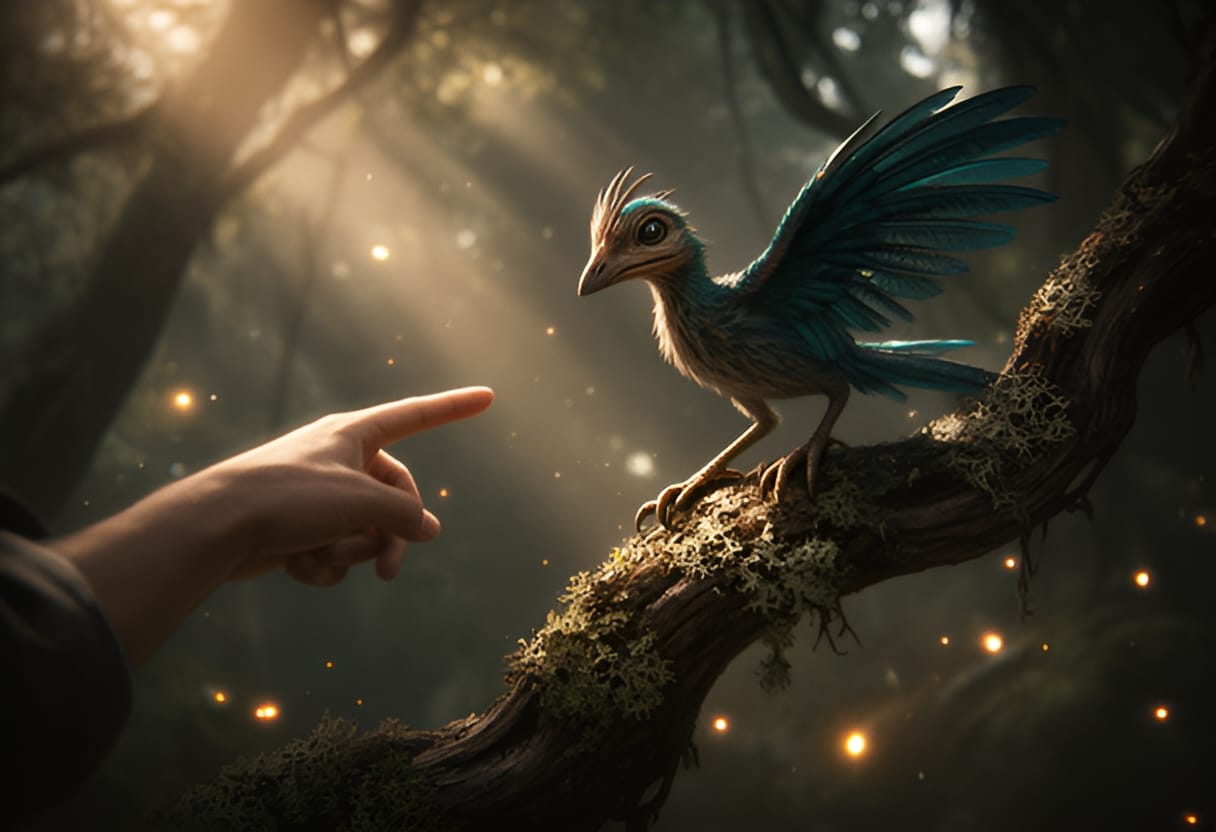
“Look at the remiges,” she murmured, voice hushed. “Asymmetrical. Vanes narrowed on the leading edge. That’s not for display. That’s for lift.”
Marco leaned forward, adjusting the spectral filter on his viewer. “And the claws—see the curvature on the manual digits? Still adapted for gripping. This isn’t a glider that gave up the trees. It’s something in between. Using wings for balance, maybe bursts of flight to escape predators or cross gaps—but still fundamentally tied to the ground.”
Luca, meanwhile, had stepped toward the water’s edge, where the lagoon lapped at a beach of fine, shelly sand. Small tracks peppered the damp surface near a cluster of horsetails—three slender toes, sharply pointed, spaced evenly, with a faint rear impression suggesting a reduced hallux.
“Compsognathus,” he said, crouching without touching the print. “Stride length consistent with a lightly built theropod moving at a walk. Pace angle narrow—agile, not lumbering.”
He rose, brushing sand from his palms. “Pelvic morphology matches what we see in the fossils. Narrow ilium, forward-facing pubis. This animal was built for speed, not power.”
A sudden flicker of motion caught his eye—a shadow darting between the reeds. Low to the ground, long-tailed, limbs coiled like springs. The Compsognathus proxy, newly arrived, froze mid-step, one foot lifted, head cocked. Its eyes—large, lateral, dark—scanned the water with unblinking intensity. Then, with a blur of motion, it snapped. A mayfly vanished from the air between its jaws.
Filippo watched, heart quiet. The creature’s movements were precise, economical—no wasted motion, no hesitation. It tasted the air again, nostrils flaring, then trotted forward, tail held rigidly behind it for balance.
“Note the neck posture,” Marco said, joining Luca at the water’s edge. “Not s-curved like in larger theropods. More linear, held low. Suggests a horizontal scanning strategy—eyes close to the substrate, tracking movement in the litter.”
Elena had drifted a few paces inland, where a stand of cycads rose like stone palms. There, partially obscured by fronds, stood a larger silhouette—low-slung, robust, with a skull that tapered to a narrow, knife-edged snout.
“Torvosaurus gurneyi,” she said. “And look at the proportions.”
Luca joined her, comparing the view to the mental archive he carried of Torvosaurus tanneri from the Morrison. “The snout is longer, more slender. Lower and narrower than the North American form. Orbital position is more lateral—suggests slightly different visual field. And the teeth—laterally compressed, but finer serrations. Adapted for slicing rather than crushing?”
Marco stepped up beside them, arms crossed. “Exactly. Resource limitation. On these islands, you don’t get the megafauna herds of the mainland. No vast sauropod populations to support big-generalist predators. So selection favors efficiency—lighter builds, narrower jaws for quicker snaps on smaller prey, maybe more reliance on ambush or fishing in the lagoons. Over generations, size drops. Not because they’re degenerating, but because they’re optimizing.”
He glanced toward the lagoon, where a pair of small, armored fish darted just below the surface, their scales catching the light like shattered mica.
“This isn’t a broken version of the mainland,” he said quietly. “It’s a refined one. Shaped by scarcity.”
Filippo stood beside them, the weight of the morning settling—not as burden, but as focus. The Stegosaurus was stable. The jump had worked. And here, on this island caught between sea and sky, life persisted in forms both familiar and strange—each adaptation a sentence written in bone and feather, spoken in the language of deep time.
He turned to his team, voice low but clear. “Let’s spread out. Document what we see. No interference. No feeding. Just watch. And Sofia—keep those vitals streaming. If anything shifts, I want to know the second it does.”
They moved then, not as a group, but as six points of attention spreading across the island—observers, not intruders. The wind stirred the cycad fronds. Somewhere inland, a call rose—low, resonant, not quite a roar, not quite a bark—and vanished into the leaves.
No one spoke of what lay ahead. Not yet.
The wind shifted, carrying the brine tang of the lagoon inland, and with it, a subtle change in the light. Filippo paused beside a cluster of cycads, his viewer tuned to infrared, scanning for thermal signatures among the proxies. The Stegosaurus glowed a steady, warm amber along its plated back—metabolic rate within expected bounds. Nearby, the Apatosaurus proxy cropped low ferns with deliberate, unhurried bites, its massive neck swaying like a slow pendulum. All appeared stable.
Sofia moved between them, her tablet cradled in both hands, streaming live data from the biosensors sutured subtly into each proxy’s dermis during preparation. Heart rate, respiration, core temperature—all flowed in real time to her console. She glanced at the readouts, then at Luca, who was crouched near the water’s edge again, watching the Compsognathus proxy.
“Vitals are nominal,” she said, her voice low so as not to startle the animal. “Heart rate 68 bpm, respiration 12, core temp 39.1. No signs of infection or trauma. No elevated cytokines. If it were sick, we’d see it in the markers.”
Luca didn’t look up. The Compsognathus had darted forward, snapping at a hovering damselfly, then froze, head cocked. It took a few stiff steps, then stopped again, one forelimb lifted mid-stride. Its tail twitched once, sharply, then went rigid.
“It’s not sick,” Luca murmured. “It’s… hesitant.”
Sofia joined him, adjusting the gain on her viewer to pick up subtle muscle tension. The proxy’s jaw worked slightly, as if testing the air, then relaxed. It lowered its head, nostrils flaring, then snapped again—this time at nothing. A phantom strike.
“Watch,” Elena said from a few paces away, where she’d been observing the Archaeopteryx’s preening ritual on the lichen-draped limb. She pointed with her chin. “It’s trying.”
The Compsognathus lunged at a small beetle scrambling over a pebble. Its jaws closed—then opened instantly. The beetle scuttled away, untouched. The proxy froze again, head low, eyes locked on the spot where the insect had been. It sniffed the air, then the ground, then made another abortive lunge at a springtail. Same result: jaws snapped shut, then flew open as if burned.
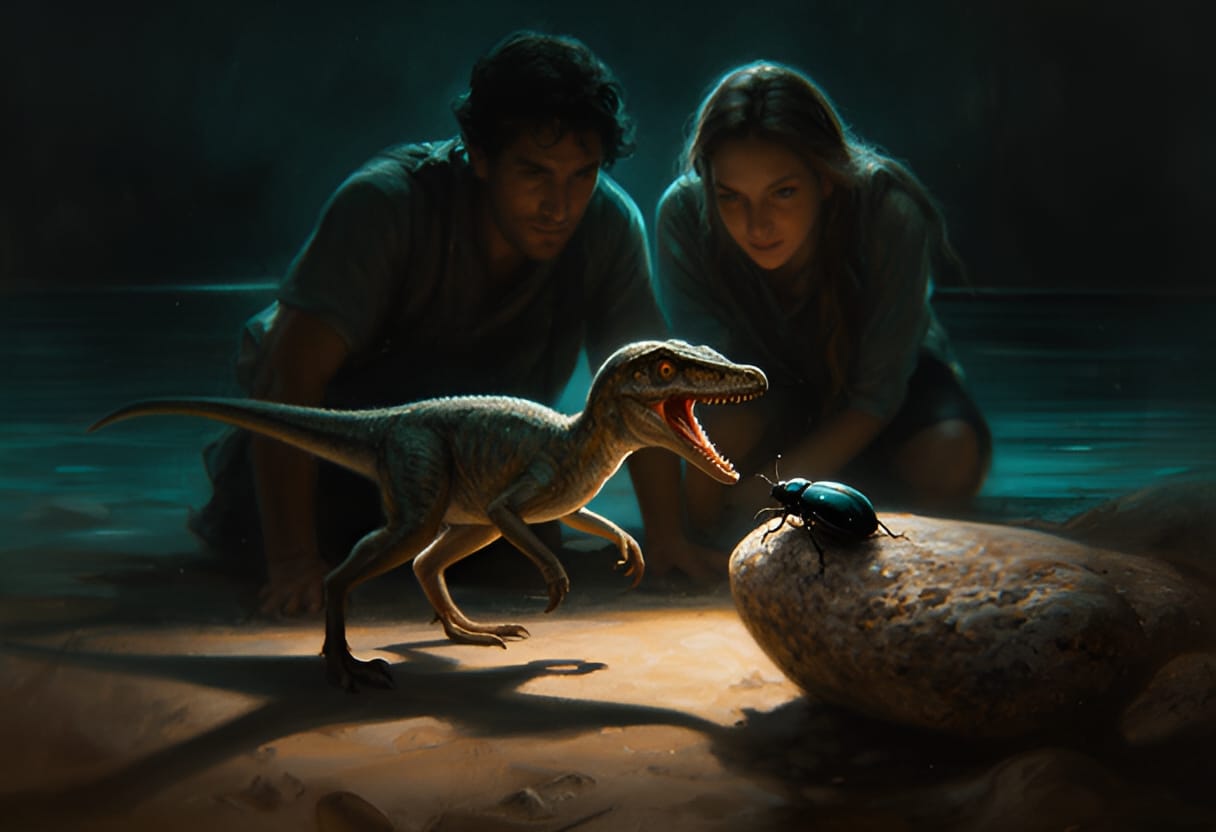
Sofia’s brow furrowed. “It’s not refusing to hunt. It’s rejecting what it catches.”
Giulia appeared beside them, her own viewer showing environmental readouts. “Humidity’s at 68%,” she said. “Inferred Jurassic coastal levels for this latitude and season are closer to 78%. That’s a 10% deficit. Could be affecting mucous membrane function— olfaction, maybe. If it can’t smell properly, it might not recognize prey as edible.”
Marco, who had been sketching the tooth wear patterns on the Torvosaurus gurneyi proxy in his notebook, looked up. “Or it’s not about smell. It’s about what happens after it swallows.”
He closed the notebook with a soft snap. “We’ve seen this before, in captive reptiles and birds raised on artificial diets. The instinct to hunt is there—hardwired—but if the gut flora isn’t primed to process the nutrients, the body starts to reject the input. Taste aversion, post-ingestional malaise. The animal learns, even without prior experience, that eating leads to discomfort.”
Sofia’s eyes widened. “You’re thinking dysbiosis.”
“More like absence,” Marco corrected. “The proxy was grown in a sterile nutrient bath. No maternal microbiome transfer, no environmental inoculation. Its digestive tract is essentially a blank slate. It can chase, it can catch, it can even swallow—but without the right symbionts to break down chitin, to synthesize vitamins, to ferment fiber… the meal might as well be stone.”
Luca looked at the Compsognathus, which had now sat back on its haunches, tail curled neatly around its feet, eyes half-lidded. It watched a gnat drift past its nose without reacting.
“So it’s not lethargy from illness,” Luca said. “It’s lethargy from futility. It tries to eat, gets no nutritional payoff, and eventually stops trying.”
Sofia nodded slowly. “That would explain the normal vitals but declining activity. No fever, no inflammation—just an energy deficit building silently. The proxy’s burning through its yolk reserves, such as they are, and not replenishing.”
Elena stepped closer, her shadow falling over the small theropod. “What do we do? We can’t feed it. Not without breaking protocol.”
“We don’t have to,” Marco said. “We just have to understand. If the issue is microbial, we can infer it from behavior and physiology. And we can prepare for the next cycle—introduce analogs, if needed, in a way that doesn’t violate non-interference. Cultured strains from crocodilian and avian cloacae, for instance. Phylogenetically proximate, low risk of horizontal transfer.”
Giulia checked her viewer again. “The humidity’s still dropping. If we don’t adjust the field’s moisture flux, we risk compounding the problem—desiccation stress on top of metabolic mismatch.”
Filippo had been listening from a few meters away, his arms crossed, his face unreadable. Now he stepped forward, his shadow falling across the group.
“Sofia,” he said, “keep tracking the vitals. Luca, note every feeding attempt—success or refusal. Giulia, see if you can stabilize the enclosure humidity without alerting the oversight board. Marco, start drafting a microbiota intervention protocol. Not for use now—just in case. Elena, keep watching the Archaeopteryx. It’s our best baseline for normal behavior.”
He paused, his gaze sweeping over them, then settling on the Compsognathus, which had lifted its head again, nostrils quivering, as if testing the wind for something it could no longer name.
“And everyone,” he added, voice low, “remember: we’re not here to fix them. We’re here to understand why they’re broken. If they are.”
The Compsognathus took one slow step forward, then another. It paused, tilted its head, and snapped at a floating mote of pollen. Jaws closed. Opened. Closed again. Then, with a sigh that seemed to come from deep in its small ribs, it lowered its chin to the sand and closed its eyes.
No one spoke. The lagoon lapped softly against the shore. Somewhere in the cycads, a insect buzzed—a sound like a tiny saw—and then was still.
Sofia lowered her viewer, the screen dimming in her palms. The data stream continued, unseen, unheard—a quiet pulse of life, and the slow, silent drift of something essential, missing.
The lagoon air hung thick with the scent of wet stone and cycad resin. Sofia lowered her viewer, the dimmed screen reflecting in her eyes as she watched the Compsognathus lie still in the sand, its small chest rising and falling in shallow, rhythmic breaths. The last pulse of data from its vitals blinked softly in her peripheral vision—heart rate stable, temperature within normal bounds, but activity levels trending downward like a tide going out.
She didn’t look up when Filippo’s shadow fell across her boots. “You’ve got the cultures ready?” he asked, voice low enough not to carry beyond the immediate circle.
Sofia nodded, fingers brushing the sealed vial at her belt. The gel capsule—sterile, translucent, no larger than a grain of barley—held a suspension of Lactobacillus and Bacteroides strains cultured from avian cloacae, selected for their phylogenetic proximity to theropod gut ecology. Marco had insisted on the avian source; Elena had pushed for crocodilian as a broader baseline. In the end, they’d split the difference, using a dual-strain prep Marco called “a phylogenetic hedge.”
“It’s not a cure,” Sofia said. “Just a test. If it works, we’ll know the gap was microbial. If it doesn’t… we go back to the drawing board.”
Filippo’s gaze flicked to the Compsognathus, which had not moved since lowering its head. “Administer it now. While it’s quiet. Less chance of triggering a stress response.”
She knelt, the sand cool through her trousers. The proxy’s flank rose and fell just inches from her knee. She unscrewed the vial with practiced care, tilting it until the capsule slipped into her palm. It felt cool, slightly viscous—like hardened mucus.
“Low-stress window,” she murmured, more to herself than anyone else. “According to the ethogram, this is it. Post-observational lull, pre-foraging attempt.”
She extended her hand, palm up, and held the capsule just above the sand in front of the Compsognathus’s forelimbs. The proxy didn’t stir. Its eyes remained closed, nostrils flared slightly as it drew in the damp air.
Sofia waited. Ten seconds. Fifteen. Then, almost imperceptibly, the proxy’s tongue flicked out—a thin, pink dart that touched the capsule, retracted, flicked again. This time, it made contact and drew the gel into its mouth. A slow, deliberate swallow followed. The throat worked once, twice. Then stillness.
She pulled her hand back, heart hammering against her ribs—not from fear, but from the quiet gravity of the act. They had broken no rule. No feeding. No substrate alteration. Only observation… and now, a silent intervention written in microbes.
Forty-three minutes passed in near silence. The team drifted into their roles without speaking—Sofia glued to her viewer, Luca tallying micro-behaviors in a waterproof notebook, Giulia adjusting the chrono-field’s moisture flux with micro-adjustments so slight the lagoon’s edge barely rippled. Marco watched the Torvosaurus gurneyi, noting how its laterally placed eyes swept the lagoon in slow arcs. Elena filmed the Archaeopteryx, now preening symmetrically, its left wing feathers catching the light in a staggered gleam.
Then, at the 45-minute mark, Sofia inhaled sharply.
“Look,” she whispered.
On her screen, the Compsognathus’s locomotor activity had spiked—not a frantic surge, but a deliberate increase in alert movements. Its head was up, neck held low and straight, eyes scanning the substrate with rapid side-to-side flicks. The tongue flicked again, then again—three times in ten seconds—each motion quicker, more purposeful than before.
Luca leaned in. “Tongue-flicking up 300% from baseline. And look at the pupil dilation—it’s tracking movement, not just light.”
The proxy took a half-step forward, then froze. Its body lowered, weight shifting onto the balls of its feet. A cricket—pale green, no longer than its femur—had hopped into view six body lengths away, unaware.
The Compsognathus didn’t lunge. It flowed. A coiled release of energy, limbs extending in a smooth, ground-hugging glide. Its jaws opened just before impact—then snapped shut with a sound like a twig breaking.
It didn’t release.
The cricket struggled once, twice—then went still. The proxy lowered its head, chewing slowly, deliberately. Small fragments of exoskeleton fell from the corner of its mouth. It swallowed. Then, without lifting its head, snapped at a second insect—a springtail this time—caught it, and swallowed again.
Sofia’s viewer flashed a soft alert: nutrient uptake detected. Metabolic rate rising. Cortisol holding steady.
“It ate,” she said, voice tight. “Two prey items. And it kept them down.”
Filippo stepped forward, his shadow falling across the feeding proxy. He didn’t speak. He just watched, his expression unreadable, as the Compsognathus lifted its head, nostrils working, and took another step forward—this time not hunting, but exploring. Its tail flicked once, side to side, in a motion that wasn’t fear, not quite curiosity, but something like re-engagement.
Elena lowered her camera. “It’s not just eating,” she said. “It’s hunting again. Successfully.”
Marco closed his notebook with a soft click. “The gut doesn’t lie. If the symbionts are doing their job, the body stops rejecting the input. Taste aversion extinguished by post-ingestional relief.”
Giulia checked her readouts. “Humidity’s holding at 74%. Still below ideal, but no longer dropping. The mucous membranes might be recovering enough to support chemosensation.”
Sofia watched the Compsognathus pause, head cocked, as a dragonfly skittered over the water. It didn’t strike. Just watched. Then, slowly, it turned and began to walk—not toward the lagoon, not away, but parallel to the shore, its movements loose, unhurried.
“It’s not frantic,” Sofia said. “It’s… purposeful.”
Filippo finally spoke. “We don’t declare victory yet. One meal doesn’t fix a microbiome. But it’s a data point. A strong one.”
He looked at each of them in turn. “Sofia, log this—time, dosage, behavioral shift. Luca, add feeding success to the ethogram. Marco, draft the protocol for pre-departure screening. Not just for Compsognathus— for all proxies. If we’re going to keep doing this, we need to know what’s inside them before we wake them up.”
Elena nodded. “And we film it. Not just for the board. For the record. So we know what normal looks like—when it’s working.”
Sofia tightened her grip on her viewer. The data stream pulsed in her palm—quiet, persistent, alive. The Compsognathus moved on, a small shadow against the cycad-strewn shore, its steps sure, its head low, its eyes scanning the world as if seeing it, truly, for the first time.
She didn’t look away.
The Compsognathus proxy continued its parallel walk along the shore, tail swaying with a rhythm that matched the lap of the lagoon’s edge. Its head stayed low, eyes scanning the substrate with quick, intermittent flicks of the tongue. Over the next hour, it paused twice more to strike—once at a hovering midge, once at a beetle disturbed from under a half-buried cycad leaf. Both were seized, chewed, and swallowed without hesitation. Sofia logged each event, noting the time, the prey type, and the absence of any release behavior. The proxy’s metabolic rate remained elevated but stable, cortisol levels unchanged from baseline. By the time the sun had climbed high enough to cast sharp shadows from the cycad fronds, the Compsognathus had consumed six small arthropods in total, each ingested without incident.
Seventy-two hours later, the chrono-field hummed to life—not to transport, but to retrieve. The six proxies, now exhibiting coordinated, species-typical behaviors, stood in a loose semicircle before the chamber’s shimmering threshold. The Allosaurus europaeus lifted its head, nostrils flaring as it scent-checked the air beyond the field. The Torvosaurus gurneyi shifted its weight, eyes tracking the ripple of heat distortion at the edge. The Miragaia longicollum cropped a low cycad frond one last time before turning, its spiked tail swinging clear of the transfer zone. Even the Compsognathus, which had been foraging near a cluster of ferns, broke off and trotted in, its steps light and sure, pausing only to flick its tongue at a gnat before disappearing into the field’s embrace.
The chamber sealed behind them. Inside, the proxies settled onto their padded restraints, breathing slow and deep. Monitors flashed green across the board: heart rates within norm, oxygen saturation optimal, no signs of hyperthermia or acidosis. Sofia exhaled, her fingers hovering over the console. “All vitals nominal. No stress markers. Feeding behavior consistent for the full observation window.”
Filippo placed a hand on her shoulder. “Good work, Sofia. Really good.” He turned to face the rest of the team, his expression open but weary. “We didn’t just observe. We listened. And when something was wrong, we acted—minimally, ethically, with respect for the organism. That’s how this has to work.”
Marco stepped forward, his tablet in hand. “If I may—during the debrief, I’d like to present the cranial comparisons we recorded. The European Allosaurus shows a narrower snout, reduced orbital height, and a more pronounced sagittal crest than its Morrison counterpart. These aren’t just individual variations; they reflect adaptation to insular dwarfism and different prey availability. We can’t assume behavioral uniformity across temporal subspecies. What we see here isn’t a smaller version of the same animal—it’s a different evolutionary solution.”
Elena nodded, already cueing up the comparative scans. “The integument data supports that too. The filaments on the European specimen are denser, especially along the dorsal ridge—possibly for thermoregulation in a more variable coastal climate.”
Giulia added, “And the humidity logs from the lagoon show a persistent deficit we didn’t anticipate. Even after the microbial intervention, the Compsognathus’s mucous membranes showed signs of chronic mild irritation. We’ll need to factor in environmental buffering for future island models.”
Filippo looked at each of them, then at the silent chamber where the proxies rested. “So we adjust. We screen better. We model deeper. But we don’t rush. The oversight board will want results—they always do. But we owe it to these proxies, and to the science, to get it right before we wake the next one.”
The debrief room was sterile, white-walled, lit by panels that hummed just above perception. Six seats faced a curved screen displaying the lagoon’s final frame: the Compsognathus mid-stride, head low, tail straight, a moment of pure, unscripted motion frozen in time. Filippo stood at the podium, his hands resting lightly on the edge. Marco sat to his right, Elena to his left. Sofia and Luca occupied the second row, Giulia near the back, her arms crossed, eyes fixed on the screen.
The chairperson, a woman with sharp eyes and a silver braid, leaned forward. “Dr. Talento. Your report indicates a successful intervention. But the board remains concerned about protocol drift. You administered a microbial treatment without prior approval.”
Filippo kept his voice level. “We did not administer nutrients. We did not alter the substrate. We introduced a symbiont analog—cultured from avian and crocodilian cloacae—to address a deficit we identified in real time. The proxy had been refusing food for eighteen hours. Its cortisol was rising. We acted to prevent suffering, not to manipulate data.”
“The rule is clear: no intervention,” the chairperson said. “Even for welfare.”
“Then the rule needs refining,” Filippo said. “We’re not keeping pets. We’re observing extinct animals in proxy form. If we ignore signs of distress—if we let them starve because our models missed a gut flora requirement—we’re not being rigorous. We’re being cruel. And we’re wasting the opportunity to learn what these animals actually needed to survive.”
Marco leaned forward. “The board’s own pre-departure screening protocol was my suggestion. But it was based on skeletal health and pathogen load. We now know we need to assay for essential microbiota—especially for small theropods with high metabolic rates. The Compsognathus’s digestive tract was sterile. That’s not speculation. That’s a measurable gap in our preparation.”
Elena added, “And we filmed the entire sequence. Not just the feeding. The before, the during, the after. The board can see for themselves: the proxy wasn’t just eating. It was behaving like a predator again. Alert, precise, engaged. That’s not just data—it’s a window into how these animals lived.”
The chairperson was silent for a long moment. Then she sighed. “You’re asking us to trust your judgment.”
“We’re asking you to trust the process,” Filippo said. “To let us improve it. To screen not just for what’s missing in the bones, but for what’s missing in the biology. If we do that, we reduce risk—for the proxies, for the data, for the ethics of what we’re doing.”
She looked at the screen, at the Compsognathus walking into the lagoon light. “Very well. The board approves continued missions. But with conditions: enhanced pre-departure screening, mandatory microbiota assay, and a welfare review board embedded in each expedition. No intervention without consensus. Is that understood?”
Filippo nodded. “Understood.”
Marco added, “And I’ll draft the updated protocol by week’s end. It’ll include gastric sampling, microbial culture checks, and a behavioral baseline for feeding response.”
The chairperson stood. “Then we’ll see what you learn next. But remember—you’re not just bringing back proxies. You’re responsible for what comes with them.”
The screen flickered, then went black. The room stayed quiet for a beat. No one moved. The weight of what they’d seen, what they’d done, and what they still owed settled over them like dust.
Filippo finally spoke, soft but firm. “Let’s get back to work.”
Chapter 3
Episode 3: Evolutionary Windows – Feathered Beginnings
The Compsognathus proxy’s refusal to eat had lingered in the lab’s recycled air long after the chrono-field powered down. Sofia had traced the issue to a mismatch in gut flora, inferring from dental microwear and coprolite analogs that the island dwarf’s microbiome expected a different balance of invertebrates than the cultured prey offered. Adjustments were made—live springtails introduced, fecal transplants trialed—and by the third day, the tiny theropod began pecking at the substrate with renewed interest. The crisis passed, but it left the team quieter than usual as they dismantled the European archipelago setup, coaxing the proxies back into stasis chambers for the jump to Asia.
Now, in the pre-launch chamber of the RMP core, Filippo stood before the console, his hands resting lightly on the edge of the console as the final diagnostics scrolled. The air smelled of ozone and cooled polymer. Around him, the team moved in practiced silence—Elena adjusting the spectral filters on her tablet, Marco reviewing stratigraphic overlays, Luca checking the microtome kit stowed in his pack, Giulia verifying the chrono-field’s harmonic resonance, and Sofia already scanning the proxies’ vital signs with her wrist-mounted monitor.
“Six targets locked,” Filippo said, voice low. “Tiaojishan Formation, Middle Jurassic, approximately 160 million years ago. Anchiornis huxleyi, Eosinopteryx brevipenna, Yi qi, Epidexipteryx hui, Dilophosaurus wetherilli, and Scelidosaurus harrisonii as outgroups. Remember—observe only. No interference, no feeding, no altering substrate. We’re guests in a world that’s already lived its story.”
Elena looked up from her screen. “The plumage on Anchiornis should be striking. We’ve got the melanosome maps from the holotype—gray body, white wing bars, rufous crest. If the proxies express it fully, we might see actual countershading in motion.”
Luca nodded, tightening a strap on his vest. “And Eosinopteryx—reduced remiges, no asymmetry. Good chance to test WAIR hypotheses without flight confounding the data.”
“Then let’s not keep the Jurassic waiting,” Filippo said. He pressed the activation sequence.
The world dissolved into light and sound—not the jarring tear of displacement, but a smooth folding of perception, as if the chamber had always been part of this deeper time. When the chromatic afterimage faded, they stood in a narrow valley carved by ancient streams, the air thick with the scent of wet stone and cycad pollen. Giant horsetails fringed the margins of a slow-moving creek, their whorled leaves brushing the team’s boots. Above, the canopy was open—no angiosperms yet, just a sparse lattice of ginkgoales and cheirolepidiacks letting through a diffuse, golden light. Dragonflies with iridescent wings skimmed the water, and somewhere in the distance, a crocadilian relative slid silently into the murk.
The proxies stood in a loose semi-circle before them, still as statues during the transition, then animating in stages. First, the subtle shift of weight as muscles engaged. Then a flicker of the eyelid, a twitch of the tail. The Scelidosaurus lowered its head to crop low ferns, its armored back ridged with keratinous scales. The Dilophosaurus, twice the height of a man, craned its snout toward the wind, its delicate crests catching the light.
And then the smaller theropods—Anchiornis and Eosinopteryx—rose onto their toes, feathers rippling.
Elena gasped, not in surprise, but in recognition. “Look at the crest,” she whispered, her voice tight. “It’s not just red—it’s iridescent. The structure’s refracting the light.”
Marco stepped forward, careful not to cast a shadow over the feeding Dilophosaurus. “The melanin distribution matches the model. Dorsal ventral countershading—darker on top, lighter below. Exactly what we’d predict for open habitat.”
Elena lifted her tablet, switching to UV mode. The Anchiornis’s plumage bloomed in false color: the crest a blazing magenta, the wing bars stark white against a slate-gray body. “See? The UV absorbance patterns confirm it’s not just pigment—it’s structural color. This isn’t just for show. It’s signaling. Maybe mate recognition, maybe species ID. But it’s expensive to produce. It means something.”
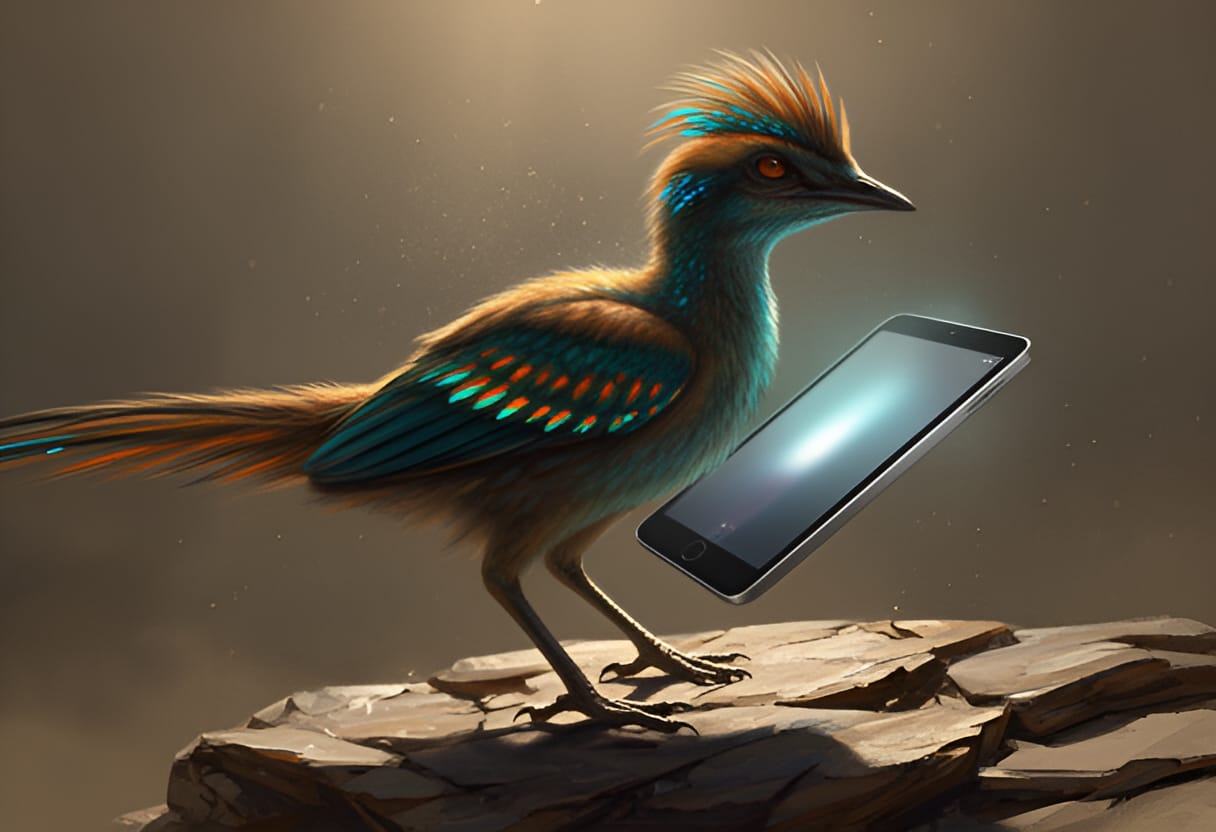
A soft thump drew their eyes to the slope nearby. Anchiornis had moved—not flying, but darting up a fifteen-degree incline of shale and loose sediment, its wings held slightly angled, not flat, but actively flapping in a downstroke-upstroke rhythm as its legs drove it forward. With each bound, the wings pressed against the air, forcing the body downward, increasing traction. Halfway up, it paused, tilted its head, then launched the final meter in a burst of wing-assisted incline running, landing lightly on a flat stone where it began preening the covert feathers along its forearm.
“WAIR,” Luca breathed. “Not flight. Not even close to flight. But look at the stroke—it’s not symmetrical. The downstroke is powerful, but the upstroke’s recovered, almost folded. It’s using the wings like spoilers, not airfoils.”
Elena nodded, eyes sharp. “And notice the tail—it’s not fanned for lift. It’s held steady, maybe even slightly depressed. This is about traction, not thrust. They’re using the wings to keep their front end down while climbing.”
Further along the creek bed, Eosinopteryx sat motionless on a sun-warmed rock, its arms folded loosely against its body. Its feathers were dense, soft-looking—more like down than the stiff pennaceous plumes of Anchiornis. When it finally moved, it was a slow, deliberate stretch, the hind limbs extending backward as it arched its back. Then it began to walk, its gait low and deliberate, the wings held tight against its sides, no evidence of the broad, curved airfoils needed for flight.
Elena leaned in, her lens cap off, capturing close-ups. “See the primaries? No curvature. The rachis is straight, symmetrical. Vanes are narrow, almost filamentous in places. This isn’t a flight surface. It’s display, maybe insulation, but not aerodynamics.”
Luca crouched beside her, not touching, just observing. “We’ve seen this before—juvenile mimics. In some theropods, young specimens retain plumage traits that look adult but aren’t functionally equivalent. Without histology, we could mistake this for a flight-capable adult when it’s actually a subadult, or worse, a juvenile retaining ancestral features.”
Elena straightened, her expression thoughtful. “So you’re saying we shouldn’t assume maturity based on size or feather development alone?”
“Exactly,” Luca said. “We need lines of evidence—vascular canals, growth rings, osteocyte density. If we’re going to claim Eosinopteryx represents a flightless adult paravian, we have to prove it’s adult first.”
Sofia, who had been quietly monitoring the proxy’s vitals, spoke up. “Its cortisol levels are baseline. No stress. It’s feeding on small arthropods—springtails, maybe mites—picking them off the rocks. It’s behaving normally. Whatever its age, it’s adapted to this niche.”
Marco glanced at the Dilophosaurus, now drinking from the creek, its reflection trembling in the water. “And that’s the point, isn’t it? We’re not just looking at feathers. We’re looking at what they do. Form follows function, but only if we watch the function.”
Elena looked at her tablet, then at the two small theropods—one flashing color on the slope, the other stalking the rocks below—and smiled faintly. “Then let’s keep watching.”
The wind had shifted, carrying the scent of wet stone and crushed cycad fronds from the creek bank. Elena turned her attention to the remaining proxy, the one that had drawn gasps when the chrono-field first stabilized—a creature perched low on a moss-covered boulder, its forelimbs extended in an odd, rigid pose. A thin, rod-like structure jutted from each wrist, vanishing into a faint, dark membrane that stretched toward the elongated manual digits. It looked less like a wing and more like a strange, bony kite frame draped in shadow.
“Yi qi,” Marco said, voice low. “The name means ‘strange wing.’ And it certainly lives up to it.”
Elena stepped closer, her boots sinking slightly into the spongy substrate. She raised her tablet, activating the dermal scan overlay. The styliform element glowed in cool blue, distinct from the warm orange of the underlying metacarpals. “It’s not bone,” she said. “The density profile matches keratinous dermal rods—like those in some lizards’ cranial crests or the os penis in mammals. No Haversian canals, no growth rings. This is a modified epidermal structure, ossified secondarily, but not a true digit.”
Luca peered over her shoulder. “So it’s not a sixth finger. It’s a novelty—something grown from the skin, co-opted for support.”
“Exactly,” Elena replied. “And look at the membrane attachment.” She zoomed in on the UV-reflective layer along the leading edge. “The actinofibrils are sparse, disorganized. No tight lattice like in pterosaur wing membranes. This thing wouldn’t hold tension.”
Giulia, who had been logging environmental data, glanced up. “You’re saying it couldn’t generate lift?”
“I’m saying it couldn’t sustain a stable airfoil,” Elena corrected. “At low angles of attack—say, five to ten degrees—the membrane would flutter, vortex shed, collapse. Any thrust produced would be intermittent, inefficient. It’s not a wing for flight. It’s too limp, too poorly braced.”
A sudden movement caught their eyes. The Yi qi shifted its weight, lowering its torso until its sternum brushed the rock. Then, with a sharp jerk, it swept both forelimbs upward and outward, the styliform elements flaring like semaphores. The membrane snapped taut for an instant—a flash of iridescent black, perhaps due to melanin concentration—before relaxing as the limbs snapped back down. It repeated the gesture twice more, each time accompanied by a low, guttural vocalization from its throat sac.
Elena froze, tablet lowered. “It’s not flapping. It’s displaying.”
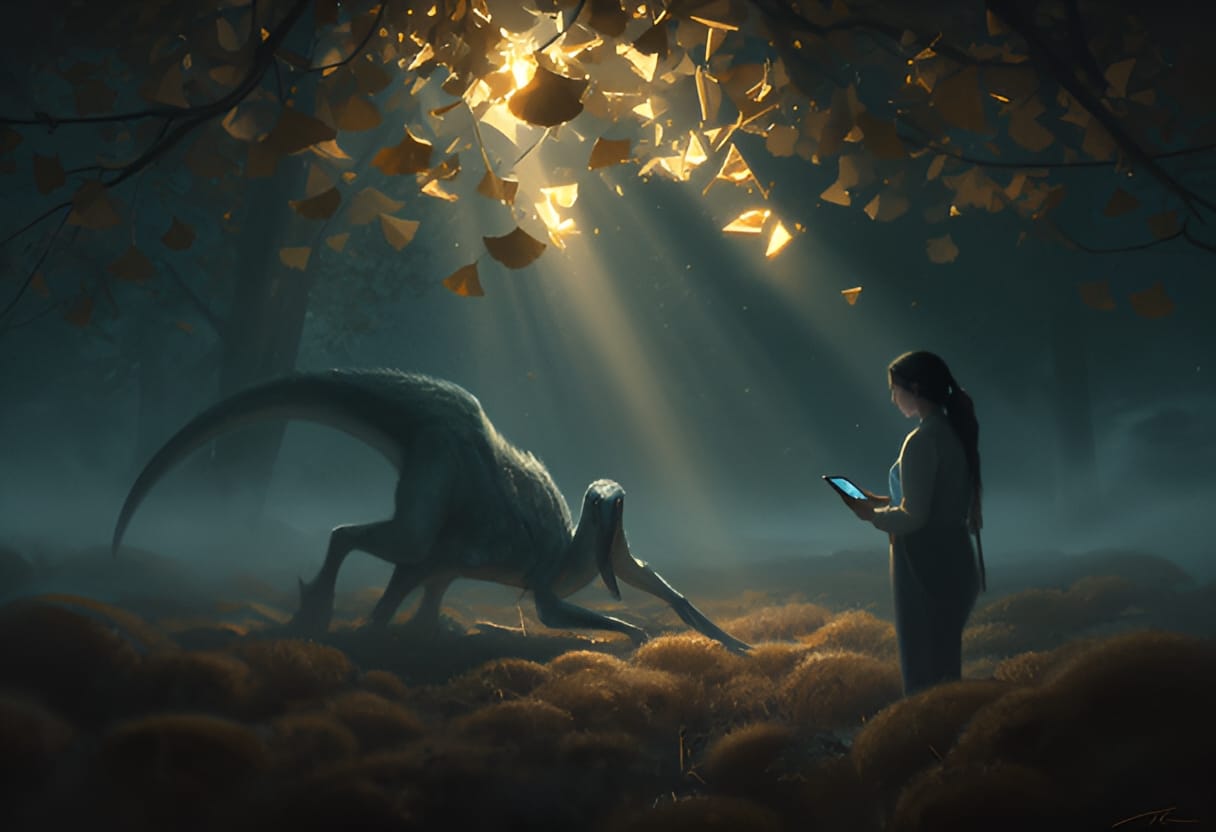
Marco nodded, arms crossed. “The motion is too deliberate, too stereotyped. Threat or courtship display—take your pick. The membrane’s being used as a visual amplifier, not an airfoil.”
Luca pointed to the creature’s tail, which was held rigidly horizontal, distal end slightly depressed. “And notice the posture—center of mass over the hips, tail acting as a counterbalance. The forelimbs aren’t generating lift; they’re being waved like flags. If anything, the membrane might help with balance during rapid turns, but even that’s speculative.”
Elena tapped her tablet, pulling up the biomechanical model they’d run en route. The simulation showed the Yi qi’s forelimb in mid-stroke, the membrane deforming chaotically under simulated airflow. Lift coefficients hovered near zero across a range of angles; drag spiked unpredictably. “See? No stable lift curve. The structure stalls before it even begins to generate useful force. It’s not adapted for aerodynamics—it’s adapted for visibility.”
She looked up, meeting Marco’s gaze. “We got this wrong last season. The public exhibit labeled Yi qi as a glider, based on the assumption that any membranous structure equals flight. We corrected the placards after the first dig, but the online database still reflects the old interpretation. It’s time to fix that.”
Later, beneath the canopy of a ginkgo stand where the light fell in fractured gold, the team gathered around Giulia’s field terminal. Elena had pulled the latest data streams: high-speed footage of the Yi qi’s display cycles, UV reflectance maps of the membrane, and stress-strain models of the styliform element under load.
“Here,” she said, tapping the screen. “The styliform element fails in tension at roughly twelve times body weight—more than enough to withstand display stresses, but nowhere near the safety factor needed for aerodynamic loading. And the membrane’s ultimate tensile strength? Less than half that of a pigeon’s primary covert.”
Marco leaned in. “So even if it wanted to flap, it couldn’t generate enough thrust to overcome its own weight without risking structural failure.”
“Worse,” Elena added, “the joint morphology doesn’t allow for a high-amplitude stroke. The glenoid is oriented laterally, not dorsally. It can abduct and adduct, but not elevate much above the horizontal. True flapping requires a dorsal glenoid—like in Anchiornis—to recover the wing upstroke. Yi qi’s forelimb is stuck in a plane better suited to waving than flying.”
Luca frowned. “Then why evolve such a bizarre structure at all?”
“Sexual selection,” Elena said, without hesitation. “Or possibly species recognition in dense, low-light forest understories. Imagine this: a flash of UV-reflective black in the gloom, a sudden flare of the forelimbs—unmistakable signal. It’s costly to produce, energetically and developmentally. That cost is the point. It’s an honest signal of fitness.”
Sofia, who had been quietly monitoring the proxy’s vitals, spoke up. “Its cortisol’s still baseline. No signs of distress. It’s been foraging on beetle larvae in the rotting wood nearby—same as this morning. The display bouts are brief, infrequent. It’s not stressed by our presence; it’s just… being Yi qi.”
Elena smiled faintly. “Then let’s make sure the record reflects that.”
She opened the sanctuary’s public-facing database, navigated to the Yi qi entry, and began editing. Under “Functional Morphology,” she replaced the gliding hypothesis with a breakdown of the styliform element as a dermal rod, the membrane as a low-tension display surface, and the forelimb motion as a threat/courtship display cycle. She uploaded the UV reflectance data, the slow-motion footage of the display sweep, and a note on the biomechanical limitations. When she hit “submit,” a confirmation blinked: Update accepted. Version 3.1 live.
Marco watched her close the terminal. “The exhibit’ll need updating too, of course.”
Elena nodded. “We’ll draft a new placard tonight. Something clear: Not a glider. A signaler.”
The Yi qi, meanwhile, had resumed its foraging, head cocked as it probed a crevice with its beak-tipped snout. Its forelimbs hung loose, the styliform elements folded back against the wrists, the membrane a quiet, inconspicuous fold of shadow. No one moved to disturb it. They simply watched, for a time, as the creature went about its quiet, mysterious business in the dappled Jurassic light.
The Yi qi’s beak slipped from the rotting wood, a glistening larva vanishing down its throat. Its head cocked once more, eyes sharp and dark, then it turned and vanished into the fern-choked undergrowth without a sound. The team remained still, breaths shallow, until the rustle faded.
“Morning bout’s over,” Sofia said, voice low. She glanced at her tablet. “Heart rate’s dropped back to resting. No spike.”
Elena nodded, still watching the spot where the Yi qi had disappeared. “They’re crepuscular. Most active at dawn and dusk. Makes sense for a forest dweller—less predation risk, better light for those UV signals.”
Filippo crouched, fingers brushing the damp leaf litter. “And we’re not disturbing it. That’s the point. Observe, don’t intervene.” He looked up, meeting each of their gazes in turn. “Remember the protocols. No feeding, no substrate alteration, no prolonged staring. We’re guests here.”
A soft chime came from Giulia’s terminal. She glanced down, then looked up with a faint smile. “The chrono-field’s holding. Jump window’s still open for another forty-seven minutes. Plenty of time.”
Marco stretched, rolling his shoulders. “Then let’s make use of it. We’ve got the Late Jurassic window lined up—Yanliao Biota, about 160 million years ago. Slightly later than Tiaojishan, but still paravian-rich. Epidexipteryx, scansoriopterygids, maybe even some early avialans if we’re lucky.”
Luca pushed off from the ginkgo trunk he’d been leaning against. “And Dilophosaurus as an outgroup. Good call. It’ll give us a baseline for larger theropod behavior in the same ecosystem.”
Filippo stood, dusting off his palms. “Elena, you’re lead on the paravians. Marco, you take the Dilophosaurus. Luca, Scelidosaurus—see if it’s still browsing those cycads. Sofia, vitals and behavior logs. Giulia, keep the field stable and record everything. I’ll oversee.”
They moved as a unit, slipping through the ferns and trunks of the ginkgo stand toward the edge of the chrono-field’s shimmer. The air hummed faintly, like a plucked string, and the light beyond wavered—not quite water, not quite glass, but a thinning of time itself. One by one, they stepped through.
The world reformed.
They stood on a low ridge overlooking a narrow valley carved by a slow-moving stream. The vegetation was denser here—cycads with stiff, palm-like fronds clustered near the water, ginkgos taller and more scattered, their fan-shaped leaves catching the morning sun in bright gold flashes. Tree ferns rose like green pillars in the damp hollows, their trunks scaled and rough. The air smelled of wet stone, crushed vegetation, and something faintly metallic—iron-rich soil, perhaps, or the tang of distant volcanic activity.
Below, near the stream’s edge, a small dinosaur darted between the roots of a fallen cycad. Epidexipteryx hui—pigeon-sized, with a short, deep skull and exaggerated front teeth that jutted like tiny tusks. Its body was covered in a dense coat of simple, filamentous feathers, darker along the spine, lighter on the flanks. But it was the tail that drew the eye: four long, ribbon-like feathers, each nearly twice the length of the body, arising from the tip of the tail and covered in stiff, unbranched vanes. They tapered to fine points, dark iridescent blue-black with a subtle metallic sheen.
Elena lifted her binoculars, then lowered them, switching to the high-speed camera on her tablet. “There. Watch the tail.”
Epidexipteryx hopped onto the vertical trunk of a young ginkgo, claws scrabbling for purchase. It paused, head tilted, then began to move. Slowly at first, then with increasing rhythm, it lifted its tail and fanned the four elongated feathers outward in a wide arc—nearly 180 degrees—displaying them like a peacock’s train, but vertical. The feathers shimmered as they moved, catching the light in rippling waves of blue and green. The bird held the pose for three seconds, then snapped the tail shut, hopped sideways, and repeated the motion—left, right, left—each bout lasting no more than five seconds, separated by minutes of still foraging.
“No wear on the distal tips,” Marco murmured, leaning closer to Giulia’s terminal where the footage streamed in real time. He pointed at the screen. “Look—those tips are pristine. No fraying, no abrasion. If they were dragging on bark or scraping during movement, we’d see damage. But they’re immaculate. Suggests they’re not used for balance or propulsion—just display. And the motion is too controlled, too stereotyped for anything else.”
Elena zoomed in on the slow-motion replay. “See how the vanes stay stiff? No flutter, no oscillation. They’re acting like rigid flags—ideal for visual signaling in low light. And check the base: the pygostyle is short but robust, built to anchor those feathers under torque. This isn’t accidental. It’s adapted.”
Luca, who had been scanning the understory, straightened. “Scelidosaurus.” He pointed to a patch of cycads thirty meters downstream, where a quadrupedal dinosaur about the size of a large dog was methodically cropping the low-growing fronds with a beak-like mouth. Its back was lined with small, oval osteoderms arranged in neat rows, and its posture was low and steady, forelegs slightly bent, hindlegs straight beneath the hips.
“Still on the cycads,” Luca said, watching. “Same as in the Middle Jurassic. Confirms it’s an ornithischian—selective browsing, upright stance, those dermal scutes. No sign of chewing wear on the teeth that’d suggest omnivory. Strict herbivore.”
He turned to Sofia. “Any stress markers?”
She checked her reader. “Baseline cortisol. Heart rate steady. It’s been here twenty minutes, same as the Yi qi. No signs of disturbance from our presence.”
Marco, meanwhile, had moved farther afield, tracking a larger shadow moving through the cycad thicket near the stream. Dilophosaurus wetherilli—slender, double-crested, moving with a low, graceful gait. It paused, nostrils flaring as it sniffed the air, then continued, not hurrying, not lurking—just moving. Its steps were evenly spaced, the stride narrow, no sign of dragging tail or lateral sway. It passed within ten meters of the Epidexipteryx without so much as a glance, its attention fixed on the ground ahead, perhaps tracking scent or small vertebrates in the leaf litter.
“Solitary,” Marco said into his comm, voice quiet. “No companions, no vocalizations. Just… moving. Like it’s patrolling a territory or hunting low.” He watched it disappear into a stand of horsetails. “Tracks would show the same—narrow gauge, alternating steps, no evidence of gregarious behavior. Consistent with the fossil record: Dilophosaurus as a solitary predator or scavenger, not a pack hunter.”
He glanced back toward the ridge where the others stood. “Niche partitioning’s clear. The big theropod’s after vertebrates—maybe lizards, small mammals, fish. The paravians are on invertebrates, maybe soft seeds. Scelidosaurus is on the cycads. No overlap. No competition.”
Elena joined him, watching the spot where Dilophosaurus had vanished. “And the Epidexipteryx? It’s not hiding. It’s still displaying, right out in the open. If Dilophosaurus were a threat, we’d see vigilance—head up, tail tight, freezing. But it’s going about its business. Suggests either the predator isn’t interested, or the display isn’t costly enough to warrant constant alarm.”
“Or the display works both ways,” Sofia offered. “Maybe it signals to predators too—‘I’m alert, I’m hard to catch.’ Honest signal, like the Yi qi’s forelimbs.”
Elena considered that. “Possible. But the tail feathers are energetically expensive to grow and maintain. If they were purely aposematic, we’d expect brighter colors, more contrast. This is subtle—iridescent, but only visible at certain angles. More likely intraspecific.”
A sudden chittering broke the air—a small mammal, shrew-like, darting from under a cycad root. The Epidexipteryx froze, tail snapping tight against its body, head low. It held still for eight seconds, then, seeing nothing, resumed foraging. A moment later, it hopped onto the ginkgo trunk and began its display again—tail fanning wide, feathers flashing in the sun.
Giulia’s voice came over the comm, calm and steady. “Field’s holding at 98.7% coherence. No drift. Jump window closes in twenty-two minutes.”
Filippo checked his chronometer. “Then let’s get the logs finalized. Elena, you’ve got the display cycle logged? Marco, Dilophosaurus path? Luca, Scelidosaurus forage time?”
“All recording,” Elena said, her eyes still on the Epidexipteryx as it lifted its tail once more, the ribbons unfolding like a living semaphore. “Every bout, every pause, every forage cycle. We’ve got UV reflectance, feather microstructure, behavioral ethograms. We’ll have enough to publish.”
Marco nodded. “And we’ll correct the record. No more assuming elongated tail feathers mean flight or gliding. This is signaling. Pure and simple.”
The Epidexipteryx gave one final flick of its tail, then turned and vanished into the cycad shadows. The team watched the spot where it disappeared, then, without a word, began the slow walk back to the chrono-field’s shimmer—a doorway to their own time, and the quiet responsibility of what they had seen.
The team stepped through the chrono-field’s shimmer and into the hushed white of the sanctuary’s decontamination chamber. The field’s resonance faded behind them with a soft thrum, leaving only the sterile scent of ionized air and the faint hiss of environmental recyclers. Filippo paused at the threshold, hands resting on the cool polymer of the airlock, watching his teammates shed their field suits one by one. Giulia moved with practiced efficiency, sealing the outer door before initiating the inner cycle. Luca rubbed the back of his neck, eyes distant, still tracing the narrow-gauge track of Dilophosaurus in the cycad mud. Marco stood with his arms crossed, jaw tight, already turning the morning’s observations over in his mind. Elena lingered near the observation port, her reflection faint in the glass, staring at the afterimage of Epidexipteryx’s tail—those iridescent ribbons fanning in the Jurassic sun.
Sofia was the last to exit, her reader still in hand. She glanced at the vitals scrolling across the screen: baseline cortisol, stable heart rate, no aberrant spikes. “All clear,” she said, her voice low. “No signs of stress transfer. Fields held.”
Filippo nodded, though his throat felt tight. “Good. Let’s get cleaned up and meet in the lab in forty. We’ve got data to collate.”
The sanctuary’s central lab was a cylinder of curved glass and white composite, ringed with workstations and dominated by a central display plinth currently holding the reconstructed skeleton of Yi qi—its styliform elements rendered in translucent amber resin, the membrane between them a delicate film of silvered mylar. Around the plinth, holographic projectors cycled through slow-motion replays of the proxies: Yi qi’s disorganized forelimb sweep, Epidexipteryx’s tail unfurling like a semaphore, Scelidosaurus cropping cycads with deliberate, unhurried bites.
Elena stood before the plinth, her tablet cradled in one hand, the other tracing the air as she manipulated a holographic overlay. The Yi qi model rotated, its forelimbs extending. Lines of force and pressure bloomed across the membrane—red zones of high stress, blue valleys of near-zero load. Beside it, a second model: Microraptor gui, its wings fully formed, asymmetrical primaries angled for lift. Vortices curled gently off the leading edges, smooth and stable.
“See?” Elena said, not looking up. “Yi qi’s membrane can’t hold a consistent angle of attack. It flaps, it frays, it collapses. Microraptor’s wing? It’s built to generate lift and control drag. One’s for show. The other’s for flight.”
Marco leaned against a workstation, arms folded. “And the styliforms? They’re not airfoil spars. They’re display rods. Keratinous, yes, but rigid—more like a peacock’s quill than a bat’s digit.”
Luca nodded, scrolling through his own notes. “The joint morphology seals it. Glenoid faces laterally. No dorsal elevation. You can’t flap what you can’t raise above the plane of the body.”
Filippo watched them, then turned to the plinth. “So we change the label.”
Elena glanced at him. “It’s already drafted. ‘Yi qi: Glide-Assisted Display Organism.’ Not a flyer. Not a glider in the aerodynamic sense. A visual signaler that used its forelimb membrane to enhance display movements—like a peacock’s train, but with a structural twist.”
She tapped the tablet. The hologram shifted, showing Yi qi mid-display: forelimbs swept upward, membrane taut, styliforms catching the light. “The membrane isn’t for lift. It’s for amplification. Makes the movement bigger, more visible in low light. Maybe even creates a rustle—sound as part of the signal.”
Sofia entered, carrying a tray of sealed nutrient pods. She set it down beside Elena’s workstation. “I’ve updated the health logs. Yi qi’s metabolic rate spiked briefly during the forelimb sweep—consistent with display behavior, not exertion. No lactate buildup. Short bursts, quick recovery.”
“Like a bird’s wing-flap display,” Elena said. “Energetically cheap, but effective.”
Marco pushed off the station. “We should formalize this. Going forward, no functional inference without biomechanical validation. Display hypotheses get tested for signal efficacy—visibility, motion dynamics, energy cost. Flight hypotheses get wind tunnel, joint loading, feather asymmetry. No more assuming elongation equals adaptation for air.”
Elena looked at him. “You’re drafting the protocol?”
“Already started.” He tapped his comm. “Sent a draft to the ethics board and the proxy care committee. Includes mandatory microbiota screening pre-wake-up, functional triangulation—anatomy, behavior, environment—and a veto vote if any two disciplines disagree on interpretation.”
Filippo exhaled. “That’s… thorough.”
“It’s necessary,” Marco said. “We’ve seen how easy it is to project. Yi qi as a glider? That wasn’t malice. It was inertia. We saw weird arms, assumed flight, stopped looking. We owe the fossils—and the proxies—better than that.”
Luca looked up from his notes. “And the public?”
Elena smiled faintly. “The exhibit opens tomorrow. We’ve got the side-by-side: Yi qi and Microraptor. One for show, one for sail. Labels explain the difference. We’ve included the UV reflectance data, the slow-mo reels, the stress logs. Visitors can see the evidence themselves.”
She paused. “The first school group comes in at ten. I’ll be there to walk them through.”
Filippo met her gaze. “You nervous?”
“A little.” She adjusted her tablet. “But not for the usual reasons. I’m not worried they won’t get it. I’m worried they will—and that it’ll change how they see the whole story. Feathers didn’t start for flight. They started for warmth, for show, for species recognition. Flight came later. It’s not the pinnacle. It’s one option among many.”
A soft chime echoed through the lab. Giulia’s voice came over the comm. “Field team’s back. All proxies stable. Humidity held at 62%—no drift. Stasis cycles nominal.”
Filippo checked his chronometer. “We’ve got twenty minutes before the morning brief. Let’s run through the talking points.”
They moved to the central table, spreading out printouts, tablets, and fossil casts. Marco outlined the Dilophosaurus trajectory—solitary, narrow-gauge, no signs of territorial marking beyond scent investigation. Luca detailed Scelidosaurus’ foraging cycle: thirty-two bites per minute, selective cropping, no signs of oral processing beyond simple shearing. Elena played the Epidexipteryx display loop—tail fanning to 180 degrees, pause, reset, repeat—highlighting the UV flash at the feather tips, visible only in certain wavelengths. Sofia presented the Yi qi metabolic spike: a 17% rise during forelimb sweep, returning to baseline in 90 seconds, no cortisol elevation.
“It’s all consistent,” Filippo said, leaning back. “No stress. No interference. Just observation.”
Elena tapped the Yi qi cast. “And this little guy? He’s not a failed experiment. He’s a successful one—just not in the way we thought. Evolution tries things. Some work. Some don’t. Some work for something else entirely.”
Marco nodded. “And our job isn’t to force them into our categories. It’s to let them tell us what they are.”
The lab door slid open. Dr. Aris Thorne, head of the ethics board, stepped in, tablet in hand. “Morning. Heard you’ve got a breakthrough.”
Filippo stood. “We think we’ve got a clarification.”
Thorne glanced at the plinth, then at Elena. “The Yi qi reclassification? I saw the draft. It’s bold.”
“It’s accurate,” Elena said.
Thorne studied her for a moment. “You’ve been pushing this for months. Since the first proxy wake-up. Even when the models said glide, you said show.”
“I followed the data,” Elena said. “When it changed, I changed with it.”
Thorne gave a slow nod. “That’s what we need. Not defenders of hypotheses. Seekers of what’s true.” He looked around the lab. “And you’ve built a team that does the same.”
He turned to leave, then paused. “Symposium invite came in. Vertebrate Integument Evolution, San Francisco, next month. They want you to give the keynote. On feathers—form, function, and the danger of assumptions.”
Elena’s breath caught. “Me?”
“You’ve earned it,” Thorne said. “And tell Marco his protocol’s already made it into the draft guidelines. The board liked the triangulation approach.”
He exited. The door sealed with a soft pneumatic sigh.
Silence settled. Then Sofia said, “We should tell the others. Luca’s got that Tyrannosaur ontogeny paper due. Marco’s got the microbiota trial to set up.”
Filippo looked at each of them—Elena, Marco, Luca, Giulia, Sofia—his team, his responsibility. “Let’s do it after brief. One thing at a time.”
He picked up his tablet, opened the exhibit script, and began to read aloud, his voice steady, filling the lab with the quiet certainty of things finally understood.
The exhibit hall was cool and dim, the lights focused on the displays like spotlights on a stage. A line of visitors snaked past the entrance—families, students, a couple in matching field jackets. At the Yi qi plinth, a cluster of middle schoolers leaned in, their reflections faint in the glass.
Elena stood to the side, notebook in hand, watching.
A boy, no older than twelve, pointed at the hologram. “So it couldn’t fly?”
“Not really,” Elena said, smiling. “It could wave its arms really well. Look—see how the membrane catches the light? It’s like a flag. Or a fan.”
The boy frowned, then nodded. “Like when birds puff up?”
“Exactly.” She tapped the tablet beside her. “This graph shows how much energy it took. Less than a hop. More than a blink.”
A woman in a gray sweater stepped forward. “And the Microraptor?”
“Built for glide,” Elena said. “See the wing shape? The feather asymmetry? It’s made to generate lift. Yi qi’s not.”
The woman studied the comparison. “So feathers weren’t for flight at first?”
“They started for other things,” Elena said. “Warmth. Display. Maybe even camouflage. Flight was a later invention—one that changed everything, but not the beginning.”
The woman nodded slowly. “That… makes sense. It’s not a ladder. It’s a bush.”
Elena smiled. “Exactly.”
Nearby, Luca was explaining Scelidosaurus’ osteoderms to a girl with a braid. “See how they’re in rows? Not random. They’re like armor plates—light, flexible, but tough.”
“Like a armadillo?” the girl asked.
“Similar idea,” Luca said. “Different lineage, same problem: how to stay safe without slowing down.”
Marco was at the Dilophosaurus station, showing a visitor the narrow-gauge trackway cast. “Steps close together. No wobble. This animal moved with purpose—efficient, solitary. Not a lurker. Not a pack hunter. Just… moving.”
The visitor, an older man with a cane, nodded. “Like a big cat on a patrol.”
“Exactly,” Marco said. “Same principle, different prey.”
Sofia stood near the exit, handing out feedback tablets. A teenager returned one, eyes bright. “I used to think all dinosaurs with feathers were trying to be birds. Now I get it—they were just being themselves. Some flew. Some showed off. Some just… lived.”
Sofia touched the teen’s shoulder. “Thanks for coming.”
As the morning flowed into afternoon, the hall filled with murmurs of understanding, the occasional gasp at the iridescent flash of Epidexipteryx’s tail in the UV display, the quiet ah-ha of a visitor realizing that evolution doesn’t march toward a goal—it explores, it experiments, it abandons, it adapts.
Elena moved through the crowd, answering questions, correcting misconceptions, her voice growing hoarse but her spirit light. She caught Filippo’s eye near the exit. He gave a small, almost imperceptible nod—pride, relief, the quiet weight of responsibility met not with burden, but with purpose.
She thought of the chrono-field’s shimmer, the Jurassic light, the tail of Epidexipteryx fanning in the sun. Not a prelude to flight. Not a failed experiment. A signal. A statement. A way of being in the world.
She touched the cool glass of the plinth, her reflection blending with the holographic Yi qi—arms raised, membrane taut, styliforms catching the light.
Outside, the wind stirred the leaves of the sanctuary’s courtyard ginkgo. Somewhere, a proxy breathed in the deep past, undisturbed, unchanged, simply existing.
And the team, back in their own time, had done what they came to do: not to resurrect, not to conquer, but to witness—and to understand.