
Romance
Hurt and love
by Jazmine Cooley
3 chapters1.1 hr read
Chapter 1
The Boy Who Had Everything
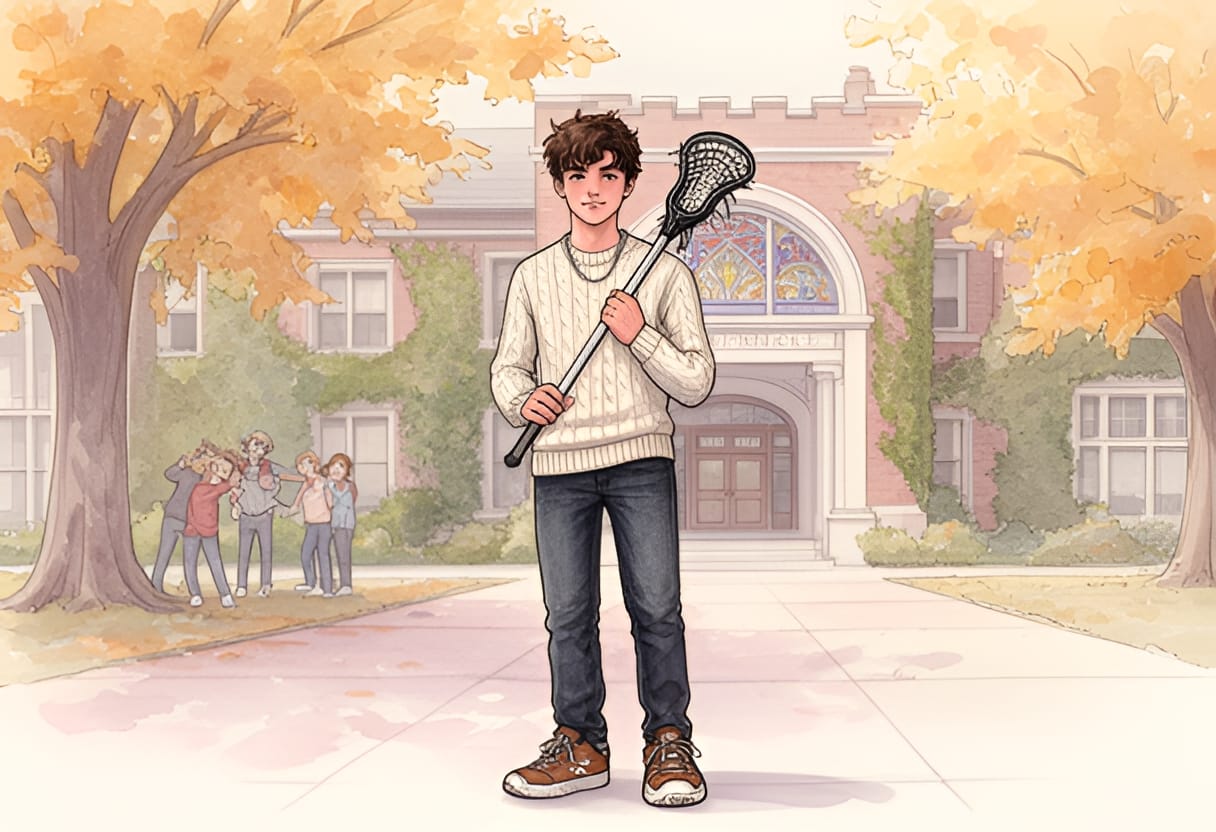
The autumn air carried the crisp scent of fallen leaves and distant woodsmoke as Ethan Cole pushed through the heavy oak doors of Whitman Hall, his lacrosse stick slung over one shoulder and a stack of textbooks clutched in the other. He was already late for English 202, but no one would dare call him on it—not with his jersey still hanging in the equipment room, not with his name on the preseason All-Conference list, not with the way heads turned when he walked through the quad, laughing with Ryan Park and Jenna Torres trailing half a step behind like satellites caught in his orbit.
Inside, the lecture hall hummed with the low murmur of students settling into the worn wooden seats. Sunlight slanted through the tall windows, painting golden bars across the floor and catching dust in its glow. Ethan took his usual seat near the center, third row from the front, where he could see the professor and still feel connected to the buzz of the room. He opened his notebook, already half-listening to the drone of Professor Hale’s voice as she turned to the board to write the day’s topic: Voice and Vulnerability in Modern Poetry.
Then he saw her.
In the back row, near the window, sat a girl he’d never noticed before. She was small, her shoulders slightly hunched as if trying to take up less space. Her dark hair fell in a straight curtain over one eye, and she wore a faded blue sweater that looked too thin for the season. Her hands moved slowly over a sketchpad balanced on her knees, pencil scratching softly against the paper. She wasn’t taking notes. She was drawing—something delicate, maybe a bird in flight, or the curve of a branch outside the window. Her focus was absolute, untouched by the rustle of notebooks or the occasional cough from a student shifting in their seat.
Ethan frowned, not unkindly. He’d seen her around—once in the cafeteria line, once walking past the arts building with her head down—but she always seemed to vanish into the background, as if she’d mastered the art of being overlooked. Now, watching her, he realized it wasn’t just invisibility. It was concentration. She wasn’t avoiding the world; she was listening to something quieter.
Professor Hale called on someone near the front, and Ethan’s pen slipped from his fingers, clattering to the floor between the desks. He bent to pick it up, but before his hand could close around it, a slender fingers slid beneath it and lifted it smoothly onto his palm.
Their skin touched for just a second—her fingertips warm and surprisingly soft, calloused only at the very tips, as if from holding a pencil too long. He looked up.
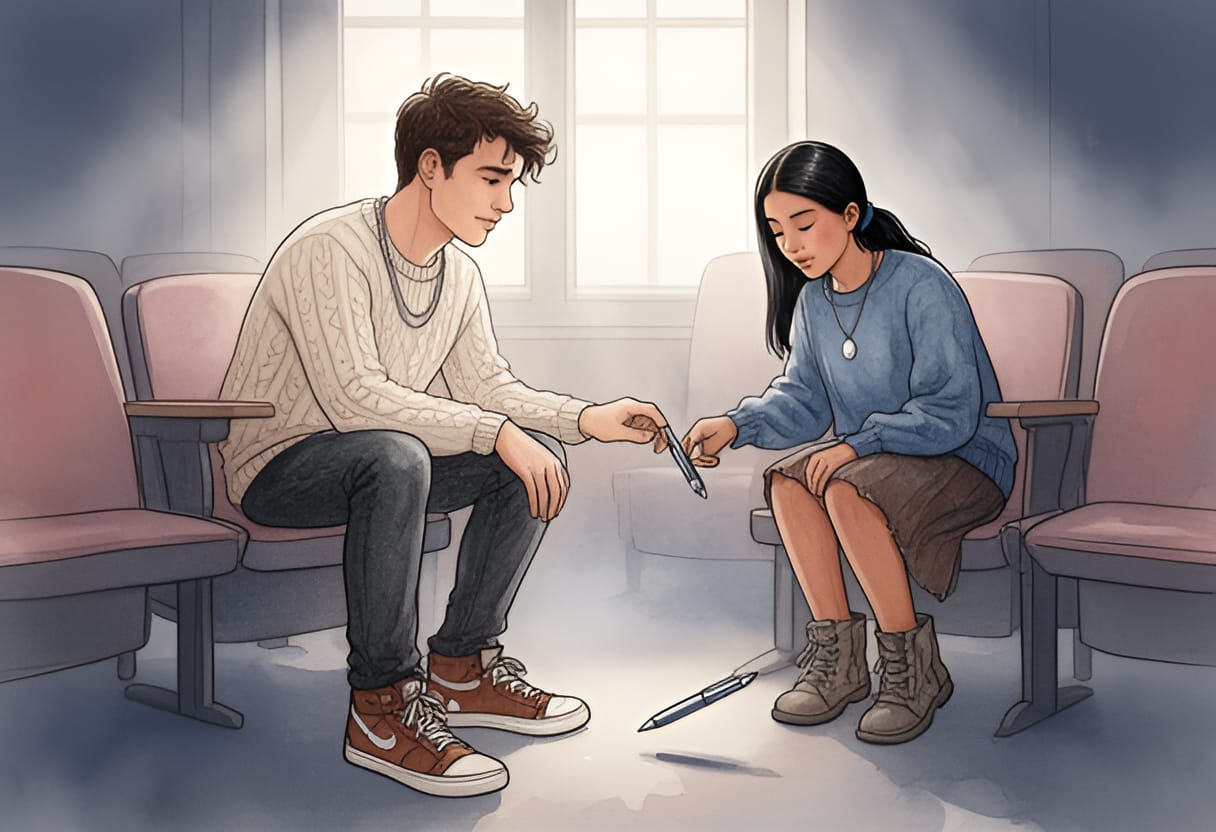
She hadn’t turned her head. Her eyes remained fixed on her sketchpad, though her cheeks had flushed a faint pink. She didn’t smile. Didn’t speak. Just returned the pen and went back to her drawing, as if the exchange had meant nothing.
But it had meant something to Ethan.
He sat back, heart tapping a little faster than it should have. No flirtation. No attempt to draw his attention. Just a quiet, automatic kindness—like holding a door open for someone whose hands were full. He turned his gaze to the front of the class, but his mind kept drifting back to her. The way her eyelashes cast tiny shadows when she blinked. The way she’d bitten her lower lip slightly while shading a feather. The way she existed in the room without demanding anything from it.
The bell rang, sharp and bright, and students began to pack up, chairs scraping, voices rising. Ethan lingered, pretending to organize his notes, waiting for the flow to thin. When the aisle beside her was clear, he stood and slipped out behind her, keeping a few paces back.
She moved quickly through the hall, head down, shoulders tight, as if bracing for impact. He almost lost her near the stairwell, but then she turned left toward the quad, where the afternoon sun pooled over the grass and students lounged on blankets or clustered around picnic tables.
Ethan paused at the edge of the grass, watching.
She didn’t go to the usual spots—the shaded benches near the fountain, the tables under the oak where the lacrosse team often gathered. Instead, she walked toward the far corner, where a freshman boy sat alone on the curb, his backpack open beside him, a half-eaten sandwich in one hand and a textbook in the other. He looked lost, maybe overwhelmed, his eyes darting between the page and the bustling campus as if trying to decode a language he didn’t yet understand.
Maya stopped in front of him.
Ethan couldn’t hear what she said, but he saw her reach into her bag and pull out an apple, a wrapped granola bar, and the remainder of her lunch—a container of rice and beans, still warm. She placed them gently in the boy’s lap. He looked up, startled, then grateful, stammering a thanks that made her smile—just a small, quick thing, like a bird flicking its wings before flying off.
She didn’t wait for a reply. She turned and walked away, back toward the library, her steps lighter now, as if giving away her meal had lifted something.
Ethan stood very still, the quad suddenly too loud, too bright. He’d seen athletes help freshmen move in. He’d seen upperclassmen tutor struggling underclassmen for service hours. But this—this was different. There was no audience. No credit. Just a girl with nothing to prove, giving away her lunch because someone else looked hungry.
A unfamiliar tightness settled in his chest. Not admiration. Not exactly. Something deeper, quieter—a recognition, perhaps, of a kind of strength he’d never had to summon.
That night, Ethan lay awake in his dorm room, the ceiling above him familiar but suddenly uninteresting. Outside, the wind had picked up, rattling the old windowpane. He turned onto his side, staring at the shadow of the lacrosse stick leaning in the corner.
He thought of her hands returning his pen. The way she hadn’t looked up. The way she’d fed a stranger without hesitation.
He thought of the way people avoided her—how they whispered when she passed, how they slid to the other side of the sidewalk. He’d heard the rumors, of course: She’s stuck-up. She thinks she’s too good for us. She cries in the bathroom during lunch. He’d never paid them much mind—until now.
Now, they felt like lies.
He picked up his phone, opened his schedule, and scrolled to tomorrow’s classes. English 202, 10:00 a.m. Same room. Same back row.
He didn’t text anyone. Didn’t talk to Jenna or Ryan about it. He just made a decision, quiet and firm.
Tomorrow, he would sit beside her.
Not to talk. Not yet. Just to be near her. To see if she drew birds again. To see if her pencil still moved like it was trying to catch something fleeting before it vanished.
And if she flinched when he sat down? If she pulled her arms in tighter, like she was bracing for a blow?
He would stay anyway.
Because for the first time in a long time, Ethan Cole wanted to understand something he couldn’t win, couldn’t control, and couldn’t ignore.
Ethan slipped into the café the next morning just as the rush was beginning to fade. The air smelled of roasted beans and cinnamon, low jazz humming from the speakers in the corner. He spotted her almost immediately—Maya Reyes, tucked into a booth near the window, her sketchpad open in front of her, pencil moving in slow, deliberate strokes. She wore the same faded blue sweater, her dark hair falling like a curtain over one eye as she worked.
He hesitated for only a moment before sliding into the seat across from her. The booth creaked softly under his weight. She didn’t look up, but her pencil stilled for a breath before resuming its motion.
“Mind if I join you?” he asked, keeping his voice low.
She finally glanced at him, eyes wide and wary, then gave the tiniest nod. Her lips parted as if to speak, but she shook her head slightly and returned her attention to the page.
Ethan ordered a black coffee, his fingers tapping absently against the ceramic once it arrived. He watched her for a moment—the way her brow furrowed in concentration, the way she bit her lower lip when she shaded a shadow too dark, then lifted it with an eraser to soften it. She was drawing a tree, its branches twisting toward a sky full of stars. Not birds today. Something quieter.
“I’ve been wondering,” he began, hesitant, “why you seem so… sad, sometimes. Not that it’s any of my business. But I’ve noticed. You cry easy. In class. In the hallway. Even when nothing’s happened.”
Her pencil stopped. The eraser hovered above the page. She didn’t look at him, but her shoulders tightened, just slightly.
“I don’t know what you mean,” she said, voice quiet, flat.
“You do,” he said gently. “I see it. And I don’t think it’s weakness. I think it’s the opposite. You feel things deeply. That takes courage.”
She finally lifted her gaze. Her eyes were glistening, but her expression was guarded, bracing.
“It’s not courage,” she whispered. “It’s just… broken.”
Ethan leaned forward, elbows on the table, hands open and empty. “Talk to me,” he said. “If you want to. I’m not going anywhere.”
She looked down at her hands, folded tightly in her lap. The sketchpad lay forgotten between them. A long silence stretched, filled only by the hiss of the espresso machine and the murmur of other conversations. Ethan waited, not pushing, just letting the space be safe.
Then, in a voice so low he had to strain to hear it, she began.
“I lost them,” she said. “Two years ago. My parents. My little brother, Luis. He was ten. He loved space. Used to beg me to point out constellations. I’d lie on the roof with him, wrapped in blankets, naming the stars. He had a glow-in-the-dark map of the solar system on his ceiling.”
Her voice cracked, but she didn’t stop.
“We lived in an old house near the river. Faulty wiring, the investigators said. Started in the basement. I was asleep upstairs. I… I woke up to the smell of smoke. But I didn’t move right away. I thought I was dreaming. I lay there, listening to the crackling, and I just… froze. By the time I got up, the hallway was already full of smoke. I couldn’t get to their room. I couldn’t get to Luis.”
Tears spilled over then, tracing hot paths down her cheeks. She didn’t wipe them away.
“I made it out,” she whispered. “I jumped from the second-floor window. Broke my ankle. But I got out. And they didn’t.”
She gasped for air, her whole body trembling. “I should’ve woken up sooner. I should’ve smelled it. I should’ve known. If I had just… if I had paid attention, I could’ve saved them. I could’ve gotten Luis out. He was so small. He wouldn’t have stood a chance.”
Ethan sat very still, his heart pounding in his throat. He wanted to reach for her, to tell her it wasn’t her fault, but he was afraid of startling her, of breaking the fragile trust she was offering.
When she finally looked up, her eyes were red-rimmed, raw with grief and guilt.
“I cry,” she said, “because I feel it all the time. The heat. The panic. The way Luis called my name before the smoke took his voice. I carry it. Every second. And I hate that I’m still here. That I got to live and they didn’t.”
She swallowed hard, trying to regain control. “That’s why I cry. Not because I’m weak. Because I’m too full. And it never leaves.”
Ethan didn’t think. He just moved.
He reached across the small table, his hand covering hers where it lay limp in her lap. Her skin was cool at first, then warmed under his touch. She flinched—not in pain, but in surprise—but she didn’t pull away.
“It wasn’t your fault,” he said, voice thick. “You were asleep. You were a kid. You couldn’t have known. You couldn’t have stopped it.”
She stared at their joined hands, her breath coming in short bursts. “But I should have,” she whispered. “I’m the older sister. It was my job to protect him.”
“You were ten years old when they died,” Ethan said firmly. “You were a child. You weren’t responsible for anything except being safe yourself. And you tried. You got out. You did everything you could in that moment.”
She shook her head, a broken sound escaping her throat. “It doesn’t feel like enough.”
“I know,” he said. “But it was. It was enough. You survived so you could carry their love forward. Not to punish yourself. To honor them by living.”
She didn’t speak. But her fingers, slowly, hesitantly, began to curl inward—not to push him away, but to hold on. Just slightly. Her thumb brushed the back of his hand, a featherlight gesture, but it was there.
Ethan didn’t let go. He kept his palm pressed against hers, feeling the pulse flutter beneath her skin, the warmth spreading where they touched. He saw the way her eyelashes clung together with wetness, the way her chest rose and fell with effort to steady herself. He saw the strength in her—the way she was still here, still speaking, still letting someone in.
And in that quiet café, with jazz playing softly and rain beginning to tap against the window, Ethan realized something settled deep in his bones, quieter than admiration, more enduring than attraction:
He didn’t just want to be with her.
He wanted to keep her safe.
To be the one who didn’t let her carry it alone.
They sat like that for several minutes, neither speaking, the warmth of their joined hands a quiet anchor in the storm of her grief. Eventually, she pulled back just enough to free her hand, but she didn’t retreat. She wiped her cheeks with the heel of her palm, then tucked a stray strand of hair behind her ear.
“Thank you,” she murmured. “For listening.”
Ethan smiled, soft and genuine. “Anytime.”
She gave a small, watery smile in return—real this time—and picked up her pencil again. She turned to a fresh page in her sketchpad and began to draw. Not a tree this time. Not stars.
Two figures, standing side by side under a sky beginning to lighten with dawn. One taller, shoulders relaxed. The other smaller, head tilted slightly toward the first, as if listening.
Ethan watched her hand move, the pencil gliding with purpose, and felt, for the first time since he’d noticed her in the back row, a quiet hope unfurl in his chest—not for himself, but for them. For what might grow, slowly and tenderly, between two people who had both known loss, and were now learning, together, how to carry it.
The rain had stopped by morning, leaving the quad glistening under a pale sun that struggled through scattered clouds. Puddles rimmed the stone pathways, reflecting the brick façades of Whitman and Hale Halls like shattered mirrors. Students moved in clusters, some hurrying to class, others lingering over coffee at the outdoor tables of the campus café. Ethan walked beside Maya, their shoulders occasionally brushing as they crossed the damp grass toward the quad’s central lawn, where a few benches sat beneath the skeletal branches of old elms.
Maya clung to her sketchpad against her chest, her fingers white at the edges. She wore the same faded blue sweater from the day before, layered over a thin gray long-sleeve, and her dark hair fell in a straight curtain over her left eye, shielding her face as it always did. Ethan noticed how she kept her gaze lowered, avoiding the eyes of anyone who passed—especially the lacrosse players lounging near the fountain, their voices loud and careless.
Ryan Park leaned against the marble base of the fountain, a football tucked under one arm, surrounded by a half-dozen teammates. He was laughing at something one of them said, his eyes scanning the quad until they landed on Maya. His smile vanished, replaced by a slow, knowing smirk.
“Well, look what the cat dragged in,” he called out, his voice carrying just loud enough to turn a few heads. “Charity case chic, Reyes. Did you dig that out of a dumpster behind Goodwill, or did Jenna finally take pity and lend you her cast-offs?”
A ripple of laughter followed. Maya flinched, her shoulders hunching inward. She didn’t look up. Her thumb rubbed absently over the corner of her sketchpad, the paper creasing slightly under the pressure.
Ethan stopped walking. The warmth of the café, the quiet intimacy of their shared silence—it all felt like another world now. His jaw tightened. He’d heard the rumors before—whispers in the hallway, snide comments about her being “stuck-up” or “weird”—but this was different. This was public. This was meant to humiliate.
He took a step forward. “Ryan,” he said, his voice low but clear, cutting through the laughter like a blade. “Shut up.”
The laughter died abruptly. Ryan straightened, surprised, the football slipping slightly in his grip. “What?”
“I said shut up,” Ethan repeated, louder this time. He didn’t look at his friends. His eyes were locked on Ryan’s, hard and unblinking. “You don’t know anything about her. So stop pretending you do.”
Ryan’s jaw worked. A flush crept up his neck. “Come on, man, it’s just a joke. You’re gonna stand there and defend the girl who cries in the bathroom like it’s a hobby?”
“It’s not a joke,” Ethan said, stepping closer now. The quad had gone still. Students nearby had paused mid-conversation, turning to watch. Even a few lacrosse teammates shifted uncomfortably, exchanging glances. “Her family died in a fire. Two years ago. She jumped out a window to get away. She’s been carrying that every single day since. And you’re making fun of her coat?”
Ryan opened his mouth, then closed it. He glanced at his friends, seeking backup, but none met his eyes. One shrugged. Another looked away, pretending to tie his shoe.
Ethan didn’t wait for a reply. He turned to Maya, who stood frozen, her eyes wide and glistening. Not with tears—not yet—but with something deeper: shock. Disbelief. As if she couldn’t process that someone had just stood up for her.
“Come on,” Ethan said, softening his tone. He held out his hand, palm up.
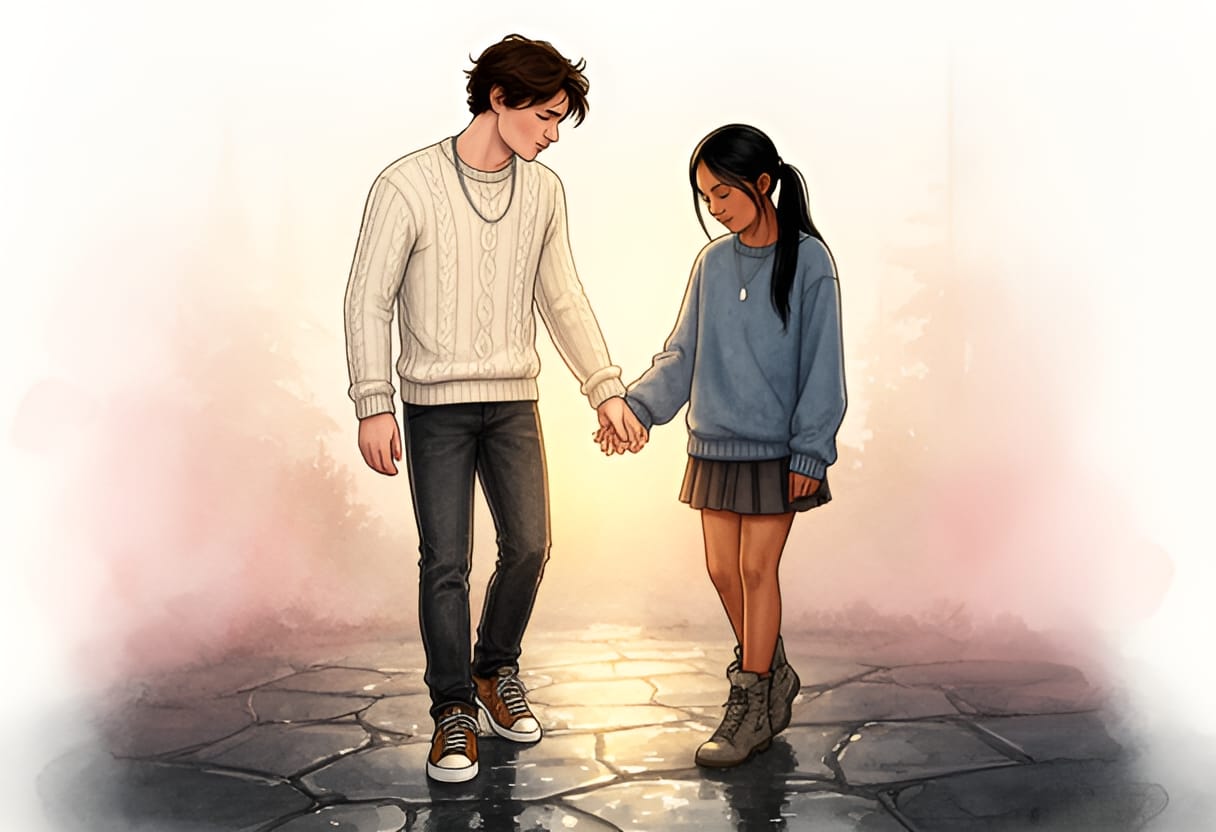
She stared at it for a long moment, as if afraid it might vanish if she reached for it. Then, slowly, she placed her small, cool hand in his. Her fingers curled around his, tentative at first, then firmer—as if anchoring herself to something real.
He laced his fingers through hers and began to walk, pulling her gently forward. They moved past the fountain, past the staring eyes, past the murmurs that began again the instant they were out of earshot. Ethan kept his gaze straight ahead, his grip steady, his thumb brushing rhythmically over the back of her hand—a silent anchor.
Maya walked beside him, her head still down, but her shoulders had eased just a fraction. She didn’t speak. Didn’t pull away. Her grip, though trembling, held fast.
They crossed the quad and cut toward the lecture halls, the stone path slick underfoot from the morning rain. A few students whispered as they passed, heads turning, but Ethan didn’t let it shake him. He’d never felt this kind of protectiveness before—not for a teammate, not for a friend. This was fiercer. More urgent. It lived in his chest like a second heartbeat.
When they reached the hallway outside Whitman Hall, where English 202 met three times a week, Ethan slowed. Maya glanced up at him then, her eyes red-rimmed but clear. She opened her mouth, closed it, tried again.
“Thank you,” she whispered. Her voice was thin, frayed at the edges—like she’d been crying again, or was holding back a storm. But her hand didn’t loosen. If anything, she squeezed his, just once, hard enough to make him look down.
Her thumb brushed his knuckle. A small, shuddering breath escaped her.
“I… I didn’t think anyone would,” she said. “Not for something like that. Not for me.”
Ethan swallowed. The weight of her trust settled on him, heavy and sacred. He didn’t have a grand speech. Didn’t need one.
“You don’t have to thank me,” he said, voice rough. “Just… let me be the one who tries.”
She searched his face for a long moment—then gave the tiniest nod. A flicker of something like hope, fragile but real, passed through her eyes.
“I’ll see you in class,” she said.
He nodded back. “Yeah. I’ll be there.”
She turned and slipped into the lecture hall, the door clicking softly behind her. Ethan stayed where he was, watching through the glass panel in the door as she took her usual seat in the back row. She didn’t pull her sketchpad out right away. Instead, she sat very still, one hand resting on her lap, the other pressed lightly against her chest—over her heart, maybe. Or just trying to feel something real.
He didn’t go to his next class. He leaned against the cool stone wall beside the hallway, closed his eyes, and let the quiet hum of student voices wash over him. For the first time since he’d noticed her in the back row, he didn’t feel the need to perform. To be charming. To be the guy everyone expected.
He just wanted to be the one who saw her.
And who stayed.
He pushed off the wall and stuffed his hands into his pockets, watching the hallway for a few more minutes until the bell rang and students began to pour out of their next classes. He spotted Maya near the doors of the science building, her sketchpad tucked under her arm, moving with her usual quiet pace. He fell into step beside her, matching her stride.
“Hey,” he said, keeping his voice light. “You free after practice tomorrow?”
She glanced at him, her brow slightly furrowed. “Practice?”
“Lacrosse. We’ve got a scrimmage against Ridgeview. Nothing big—just a tune-up. But the team’s grabbing food and hanging out afterward at the field house. Low-key. Pizza, maybe some music. Nothing fancy.”
She hesitated, fingers tightening slightly on the strap of her bag. “I don’t really… do those kinds of things.”
“I know,” he said. “But it’s not a party. Just us. A few guys. You don’t have to talk to anyone if you don’t want to. You can sit. Or leave early. Whatever you need.”
She looked ahead, her gaze distant for a moment. Then she gave a small nod. “Okay. I’ll try.”
“Good,” he said, and meant it. “I’ll walk you to your next class.”
They walked in silence for a stretch, the autumn air crisp around them. Leaves skittered across the pavement, chased by a sudden gust. When they reached the building where her next class was, she paused at the doorway.
“Thanks,” she said. “For asking.”
“Anytime,” he replied. “See you tomorrow.”
The next afternoon, Ethan found her waiting near the bleachers, just as promised. She stood slightly apart from the cluster of teammates laughing and shoving each other near the equipment shed. She wore a dress Jenna had lent her—a soft, moss-green thing that fell just below the knees, with short sleeves and a modest neckline. It was the first time he’d seen her in anything other than sweaters and jeans, and his breath caught, though he forced himself to smile instead of stare.
“You look nice,” he said, keeping his tone easy.
She ducked her head, a faint pink rising in her cheeks. “Jenna picked it out. I… I didn’t want to wear the wrong thing.”
“You didn’t,” he said. “You look great.”
She gave a small, shaky smile. “Thanks.”
One of the guys—Tyler, maybe—called out, “Yo, Cole! You bringing your charity case to the party or what?”
Ethan’s jaw tightened, but before he could respond, Ryan stepped forward, smirking, a plastic cup in his hand. He took a slow sip, eyes flicking over Maya’s dress like he was inspecting a specimen.
“Whoa,” Ryan said, loud enough for a few nearby to hear. “Look at you. All dressed up. Trying to play princess now? Did Jenna lend you her tiara too, or did you have to steal it from the drama club?”
Maya’s fingers twisted the strap of her bag. She opened her mouth, then closed it, her eyes dropping to the ground.
Ethan stepped forward, placing himself between her and Ryan. “Leave her alone.”
Ryan laughed, short and sharp. “Oh, I’m sorry. Did I hurt her fragile little feelings? Boo-hoo. Some of us can’t handle a joke unless it comes with a tissue.”
“It’s not a joke,” Ethan said, voice low but firm. “It’s just mean. And I’m tired of it.”
Ryan’s smirk faltered for a split second—just enough for Ethan to see the flicker of uncertainty—but then he shrugged, playing it off. “Whatever, man. Have fun playing white knight. Doesn’t change what she is.”
Ethan didn’t dignify that with a response. Instead, he turned to Maya, held out his hand, and said, “Come dance with me.”
She blinked. “What?”
“The music’s starting. Come on. Just for a song.”
She looked terrified, but she took his hand. He led her into the open space near the field house where a couple of guys had hooked up a speaker and were playing something slow and acoustic. He placed one hand on her waist, the other holding hers, and began to sway, keeping his movements simple, unhurried.
She was stiff at first, her breath shallow, her eyes darting around as if expecting laughter or ridicule. But Ethan kept his gaze on her, soft and steady, and after a few moments, she began to relax—just a little. Her head tilted up, just enough to meet his eyes. Her lips parted slightly, and he saw it then—not fear, but something softer, something disbelieving, like she couldn’t quite process that this was real.
He leaned in, just enough to brush his forehead against hers. “You’re doing great,” he murmured.
She swallowed. “I don’t know how to do this.”
“You don’t have to know,” he said. “Just be here.”
She nodded, and this time, when he leaned in again, she didn’t pull away.
Their first kiss was awkward—her lips slightly chapped, his a little too eager at first, their noses bumping as they tried to find the rhythm. But then she softened into it, her hands sliding up to rest on his shoulders, her fingers curling into the fabric of his shirt. He deepened it slowly, gently, savoring the warmth of her, the way she tasted—like chapstick and something sweet, like tea or honey. Her breath hitched, and when they finally pulled apart, foreheads still touching, her eyes were wet.
“I’m sorry,” she whispered, her voice thick.
“Hey,” he said, brushing a tear from her cheek with his thumb. “Don’t apologize. You’re not doing anything wrong.”
“I just… I didn’t think anyone like you would ever want to kiss me.” Her voice cracked. “Not really.”
He pulled her closer, wrapping his arms around her. “I do,” he said, voice rough. “I really do.”
She buried her face in his neck, and this time, the tears came—not from sadness, but from the overwhelming, disbelieving weight of being seen, of being wanted, of being held. She clung to him, trembling, and he held her back, rocking them slightly, letting her cry into his shoulder.
Behind them, the music swelled. Somewhere nearby, Ryan laughed again, but Ethan didn’t hear it. All he felt was her—real, trembling, alive in his arms—and the quiet, fierce promise forming in his chest: he would spend the rest of his life earning this trust. Not because he had to, but because he finally wanted to.
They stayed like that for a long time—just the two of them, hidden in the shadow of the bleachers, the world narrowed to the beat of her heart against his chest. When she finally pulled back, she wiped her cheeks with the back of her hand, smiling through her tears.
“Thanks,” she whispered.
“Anytime,” he said, brushing a stray strand of hair from her face. “Really.”
She laughed softly, a sound so quiet and genuine it made his chest ache. “I should probably go. Jenna’s probably wondering where I am.”
He nodded, reluctant to let go. “Walk you back?”
She took his hand, lacing her fingers through his. “Yeah. I’d like that.”
They walked across the fading light of the quad, her hand warm and steady in his. No one bothered them. No one laughed. For the first time since he’d noticed her in the back row of English 202, Ethan didn’t feel like he was performing. He didn’t feel like he had to be charming, or strong, or the guy everyone expected.
He just felt like himself.
And for the first time, that was enough.

Chapter 2
The Weight of Being Seen
They walked across the fading light of the quad, her hand warm and steady in his. No one bothered them. No one laughed. For the first time since he’d noticed her in the back row of English 202, Ethan didn’t feel like he was performing. He didn’t feel like he had to be charming, or strong, or the guy everyone expected.
He just felt like himself.
And for the first time, that was enough.
The next morning, sunlight pooled gold across the quad as students drifted between classes, books tucked under arms or balanced on hips. Ethan waited near the fountain, scanning the flow of people until he saw her approaching from the direction of the dormitories—Maya in her familiar faded blue sweater, jeans, and worn canvas shoes, her hair falling in a straight curtain over her left eye. She moved with a quiet purpose, head slightly down, until she spotted him. Then her pace hesitated, just for a breath, before she quickened her steps.
When she reached him, she didn’t speak right away. Instead, she lifted her hand and slipped her fingers into his, the same easy connection they’d shared the night before. Her palm was warm, her grip light but certain.
“Hey,” Ethan said, smiling.
“Hey,” she replied, her voice soft. She glanced around—at clusters of students laughing on the grass, at a group tossing a frisbee near the oak trees—but no one stared. No one pointed or whispered. A few eyes flicked toward them, curious perhaps, but not unkind. One girl smiled as she passed, nudging her friend and nodding in their direction.
Maya exhaled, a slow release of breath Ethan hadn’t realized she’d been holding. “Nobody’s… laughing,” she murmured.
He squeezed her hand. “Nope. Not today.”
They began walking toward the academic buildings, their shoulders brushing with each step. A couple of guys from Ethan’s lacrosse team passed by, nodding at him. One opened his mouth, likely to say something teasing, but caught sight of Maya’s face—calm, unafraid—and thought better of it. He gave a small, respectful nod instead and kept walking.
Maya glanced up at him, her eyebrows slightly raised. “They didn’t say anything.”
Ethan shook his head. “Nah. They know better than to mess with you when I’m around.”
She didn’t smile, but her thumb stroked the back of his hand, a quiet acknowledgment. Then, after a pause, she said, “It’s… different. Being seen like this. Not as the girl who cries in the library. Not as the charity case. Just… me. With you.”
Her voice dropped, soft and hesitant. “I don’t think I’ve felt safe like this since before the fire.”
Ethan stopped walking, turning to face her fully. The quad buzzed around them—students rushing to class, a barista calling out orders from the campus café—but in that moment, it faded. He lifted his free hand, gently tucking a strand of hair behind her ear. His touch lingered on her jaw, warm and deliberate.
“You’re safe with me,” he said, his voice low and firm. “I promise. Whenever you’re scared, or sad, or just need to scream into a pillow—I’ll be here. I’ll listen. No fixing. No judging. Just… me.”
Her eyes glistened, but she didn’t look away. A small, tremulous smile touched her lips. “Okay,” she whispered. “I believe you.”
He leaned in, pressing a soft kiss to her forehead. “Good. Because I’m not going anywhere.”
Later that afternoon, they settled into a secluded corner of the library’s third floor, where sunlight slanted through tall windows and warmed the worn wooden tables. Ethan had claimed the spot earlier, spreading out his chemistry notes and a half-eaten granola bar. When Maya arrived, she carried two cups of tea from the café—chamomile for her, peppermint for him—and a thin, cream-colored blanket folded over her arm.
She unfolded it across their laps, the fabric soft and slightly frayed at the edges. “Jenna lent it to me,” she said. “Says it’s lucky.”
Ethan smiled, wrapping an arm around her shoulders as she sat beside him. “Then it’s working.”
They fell into a quiet rhythm—him reviewing reaction mechanisms, her highlighting passages in her psychology textbook. Occasionally, she’d point to a diagram and ask a question, her voice low so as not to disturb others nearby. He’d explain, using his pen to trace concepts in the margin of her notebook. When he struggled with a particularly tricky equation, she’d lean over, her hair brushing his shoulder, and offer a different way to approach it. Her quiet focus, the way her brow furrowed in concentration, made his chest feel unexpectedly light.
Between problems, they shared quiet laughter—over a doodle she’d made in the corner of her page (a tiny astronaut floating above a burning house, helmet held in one hand), over the way he’d accidentally underlined the same sentence three times. She rested her head against his arm from time to time, her breathing steady and warm. Once, when she shifted to stretch her legs, her foot brushed his under the table, and she pulled back with a muffled apology. He just shook his head, grinning, and nudged her foot back with his own.
The hours slipped by. The sunlight shifted, crawling across the table like a slow-moving shadow. Maya’s notes grew sparse, her pen resting idle in her fingers. Her eyelids began to droop, the weight of exhaustion—emotional and physical—finally catching up to her after days of restless sleep.
Ethan noticed. He closed his textbook gently, marking his place. “Hey,” he murmured. “You okay?”
She blinked slowly, trying to focus. “Yeah… just tired.” A small, embarrassed smile. “I didn’t mean to fall asleep on you.”
He chuckled softly, shifting slightly to make more room. “Don’t worry about it. You’re safe here.”
She didn’t argue. Instead, she turned her body slightly, tucking her feet up onto the chair, and leaned her head against his shoulder. Her breath warmed the fabric of his shirt, slow and deep. One hand rested loosely in her lap; the other curled lightly near her chest, as if holding onto something precious.
Ethan froze for just a second, not wanting to startle her. Then, carefully, he wrapped his arm around her shoulders again, pulling her just a little closer. He rested his cheek against the top of her head, breathing in the faint scent of lavender from her shampoo.
Around them, the library hummed—the whisper of pages turning, the distant murmur of voices, the occasional squeak of a chair. But in their small bubble of sunlight and wool blanket, the world had narrowed to the rise and fall of her breath against him, the quiet rhythm of her trust.
He didn’t move. Didn’t shift. Didn’t dare to break the spell.
He just held her, and let her sleep.
When she finally stirred nearly an hour later, blinking awake with a soft groan, Ethan was still there, his textbook open in his lap though he hadn’t read a word. She lifted her head, her cheeks slightly flushed, her hair messy from resting against him.
“Sorry,” she mumbled, voice thick with sleep.
He smiled, brushing a stray strand from her face. “Don’t be. You needed it.”
She sat up straighter, pulling the blanket more securely around her shoulders. The sunlight had faded to a softer, amber glow. Outside, the sky was beginning to darken at the edges.
“Thank you,” she said, her voice quiet but clear. “For today. For… not letting me feel alone.”
Ethan reached across the table, covering her hand with his. His thumb traced slow circles on her skin. “Anytime,” he said. “Really.”
She looked at him then—really looked—and something in her expression softened, deepened. It wasn’t just gratitude. It was something quieter, more profound: the beginning of belief.
He didn’t let go of her hand as they packed up their things, as they walked side by side toward the library doors, as they stepped back into the cooling air of the quad. Her fingers laced through his, warm and steady, and for the first time in a long time, neither of them felt the need to look over their shoulders.
They walked in silence toward the chemistry building, their hands still loosely linked, the quad alive with the murmur of students heading to evening classes. The sky had deepened to a cool indigo, the first stars pricking through above the old oaks. Maya tucked a strand of hair behind her ear, her breath visible in the faint chill.
“You still got that lab report due Friday?” she asked, her voice soft.
Ethan nodded, though his mind was elsewhere. “Yeah. Professor Hale’s being brutal about the formatting this time. Says if the margins are off by a millimeter, he’ll send it back.”
She let out a quiet laugh. “Sounds like him. He once made Jenna redo an entire titration because she used the wrong shade of pink in her indicator sketch.”
Ethan smiled, but it didn’t reach his eyes. “You two are lucky you’re both so meticulous. I’d be doomed without your help.”
She glanced at him, head tilted. “You’re doing fine. You just overthink it.”
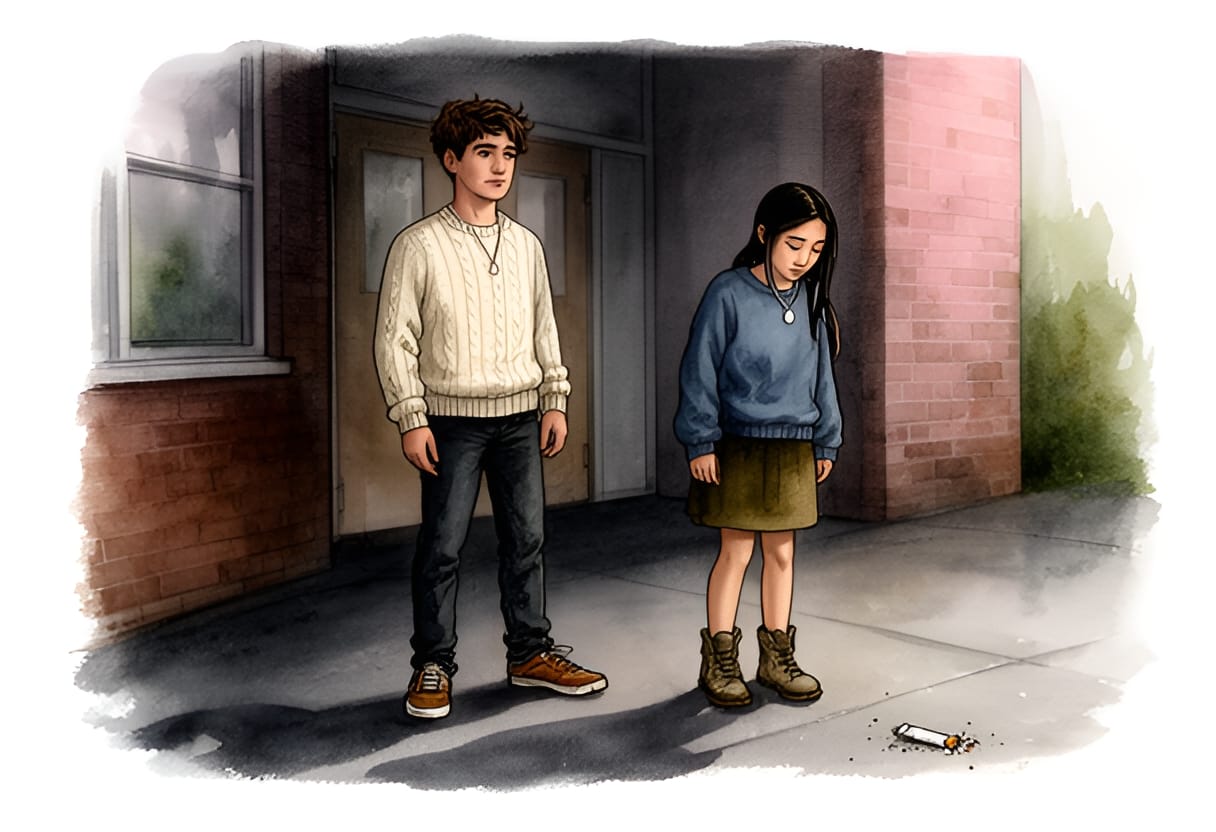
Before he could respond, a familiar laugh cut through the air ahead. Ryan Park leaned against the brick wall of the chemistry building, flanked by two teammates from the lacrosse squad, a cigarette glowing between his fingers. He pushed off the wall as they approached, grinning.
“Well, look who it is,” Ryan said, his tone light but eyes flicking to Maya with something sharp beneath the surface. “Power couple making their rounds. Got a hot date in the chem lab or just coming to admire the periodic table?”
Ethan forced a smile. “Just heading to study. You?”
Ryan took a long drag, exhaling a plume that curled into the damp air. “Same. Though I heard you’ve been spending an awful lot of time in the library with… her.” He nodded toward Maya, his smile tightening. “Jeez, Ethan. I didn’t peg you for the type who needs a charity case to feel smart.”
Maya’s fingers tightened slightly in his. Ethan felt it, a small tremor, and he turned his hand to give hers a reassuring squeeze—too late, maybe.
Ryan chuckled, low and knowing. “Come on, man. Don’t look at me like that. I’m just saying what everyone’s thinking. She’s always got some story, some tear-stained excuse for why she needs extra time, extra help, extra everything. Bet she’s already got Hale wrapped around her finger for that psych quiz last week.”
Ethan’s jaw tightened. “What are you talking about?”
Ryan shrugged, taking another drag. “Oh, you know. Heard she went crying to him after class, said she couldn’t concentrate because she was ‘still traumatized’ by whatever happened to her family. Next thing you know, she’s got a makeup quiz, extra office hours, the whole nine yards. Meanwhile, the rest of us are busting our asses just to keep up.”
A coldness settled in Ethan’s chest, but he pushed it down. “Ryan, that’s not—”
“Hey, I’m not judging,” Ryan interrupted, holding up his hands. “If it works for her, fine. Just… don’t let her drag you down, alright? You’ve got a rep to maintain. Lacrosse, grades, legacy. You don’t need to be wasting your potential on someone who’s just playing the victim card to get ahead.”
He flicked the cigarette to the ground and ground it out with his boot. “Think about it, Ethan. Why else would she be so eager to help everyone? Makes people feel sorry for her. Makes them want to fix her. Smart girl. Too smart, maybe.”
Before Ethan could answer, Ryan clapped him on the shoulder—a gesture that felt more like a warning—and fell into step with his teammates, laughing as they headed toward the gym.
Ethan stood rigid, Maya’s hand still in his, but her grip had gone limp. He looked down at her. Her eyes were fixed on the pavement, her face pale beneath the freckles.
“You okay?” he murmured.
She swallowed. “Yeah. I’m fine.”
He wanted to believe her. He wanted to tell Ryan to go to hell, to defend her the way he had in the quad weeks ago. But a seed had been planted—small, insidious—and it began to sprout almost immediately.
The next afternoon, Ethan found himself in Professor Langford’s office, disputing a grade on his psychology midterm. He’d lost points on a short-answer question about coping mechanisms, arguing that his interpretation of resilience in trauma survivors was valid, even if it diverged from the textbook.
Langford, a sharp-eyed woman in her fifties with silver-streaked hair, listened patiently before shaking her head. “I appreciate your effort, Mr. Cole, but the rubric is clear. You conflated post-traumatic growth with avoidance coping. They’re not the same.”
Ethan frowned. “But I cited the study from Bonanno—”
“Which you misapplied,” she said gently but firmly. “You’re grasping for nuance where there’s a clear distinction in the literature. Respect the framework, even when you disagree with it.”
He sighed, conceding the point. “Alright. I’ll take the loss. Just… frustrating when you feel like you’re being punished for thinking critically.”
Langford offered a small, understanding smile. “Critical thinking is vital. But so is accuracy. You’ll get there.”
As he gathered his things, Maya appeared in the doorway, hesitating before stepping inside. She’d come to ask about a clarification on the upcoming case study, Ethan realized. He moved to make space, but she didn’t come all the way in. Instead, she lingered near the threshold, her hands clasped tightly in front of her, eyes darting between him and the professor.
Langford looked up, surprised. “Maya? Everything alright?”
She swallowed. “Yeah. I just… had a quick question about the DSM-5 criteria for acute stress reaction. Page 142—does it specify whether dissociation has to be persistent, or can it be episodic?”
Langford leaned forward, pleased. “That’s an excellent question. It can be episodic, especially in the immediate aftermath. The key is whether it interferes with daily functioning.”
Maya nodded, scribbling something in her notebook. “Thank you.”
As she turned to leave, Ethan noticed something he hadn’t before: the way her shoulders hunched slightly, as if bracing for rebuke. The way she avoided Langford’s gaze the moment the answer was given, her voice dropping to a whisper even though no one else was near. The way she practically fled the office, closing the door softer than necessary behind her.
Ethan frowned. “Everything okay?” he asked Langford, nodding toward the door.
The professor tilted her head. “She seemed… nervous. More than usual. Did something happen?”
Ethan shook his head, his throat tight. “I don’t think so. Maybe just having a rough day.”
Langford studied him for a moment. “You two close?”
“We’re dating,” he said, surprised by how defensive it sounded.
She nodded slowly. “Well. Just… be kind. Some wounds aren’t visible, even when they look like they’re healing.”
He didn’t respond. He couldn’t get the image out of his head—Maya, small and withdrawn, fleeing the office like she’d done something wrong.
That evening, they met at their usual spot in the library, the third-floor corner where the sunlight had warmed them just days before. Now, the room was dimmer, the overhead lights casting a sterile glow over the worn tables. Ethan had spread out his notes, but he couldn’t focus. Every time he looked up, Maya seemed to be somewhere else—her pen hovering over the page, her gaze fixed on some point beyond the window.
He cleared his throat. “You good?”
She jumped slightly, blinking. “Yeah. Sorry. Just… thinking.”
About what? He wanted to ask. About Ryan’s words? About the way she’d looked in Langford’s office?
Instead, he said, “You seemed off after seeing the professor today.”
She froze. Her pen stopped mid-sentence. “How did you—”
“I saw you,” he said, keeping his voice even. “You looked… upset. After you left his office.”
Her eyes dropped to her lap. She pulled the blanket tighter around her shoulders, though the room wasn’t cold. “I wasn’t upset. I was just… confused. He asked me something I wasn’t sure about.”
“About dissociation?”
She flinched. “How did you—”
“I heard you ask,” Ethan said, his voice low. “And I saw how you left. Like you were… afraid.”
She stared at him, her lips parted. “Afraid? Of what?”
“I don’t know,” he admitted. “But you didn’t look like you were asking a question. You looked like you were bracing for a scolding.”
A silence stretched between them. Then, quietly, she said, “I didn’t cry. I didn’t ask for anything. I just wanted to know if it was normal to still feel… disconnected sometimes. Even when you’re trying.”
Ethan’s chest tightened. “And he made you feel like you shouldn’t have asked?”
She shook her head. “No. He answered. It was… fine. I just don’t like feeling like I’m taking up space. Like my questions are a burden.”
He reached for her hand. She let him take it, but her fingers were stiff, unresponsive.
“I never thought of you as a burden,” he said, his voice rough. “Ever.”
She looked at him then, really looked, and for a moment, he saw the old Maya—the one who had trusted him enough to fall asleep on his shoulder, who had shared her tea and her blanket and her quiet laughter. But it was gone just as fast, replaced by something wary.
“Then why have you been so quiet?” she asked, her voice barely above a whisper. “You haven’t touched me in days. You don’t laugh at my doodles anymore. You flinch when I get too close.”
Ethan opened his mouth, but no words came. He wanted to tell her about Ryan. He wanted to say he was stressed, that midterms were crushing him, that his father had called again, disappointed in his lacrosse stats. He wanted to blame exhaustion, not doubt.
But the truth was worse. He had believed Ryan, just a little. Just enough to pull away.
“I’m sorry,” he said finally. “I’ve been… distracted.”
She searched his face, her eyes glistening. “Is it me? Did I do something wrong?”
He wanted to say no. He wanted to pull her into his arms and swear he’d never let go. But the doubt lingered, a shadow he couldn’t shake.
“I don’t know,” he admitted. “I just… need to figure some things out.”
She withdrew her hand slowly, folding it into her lap. Her voice, when it came, was quiet but steady. “Okay. I’ll give you space.”
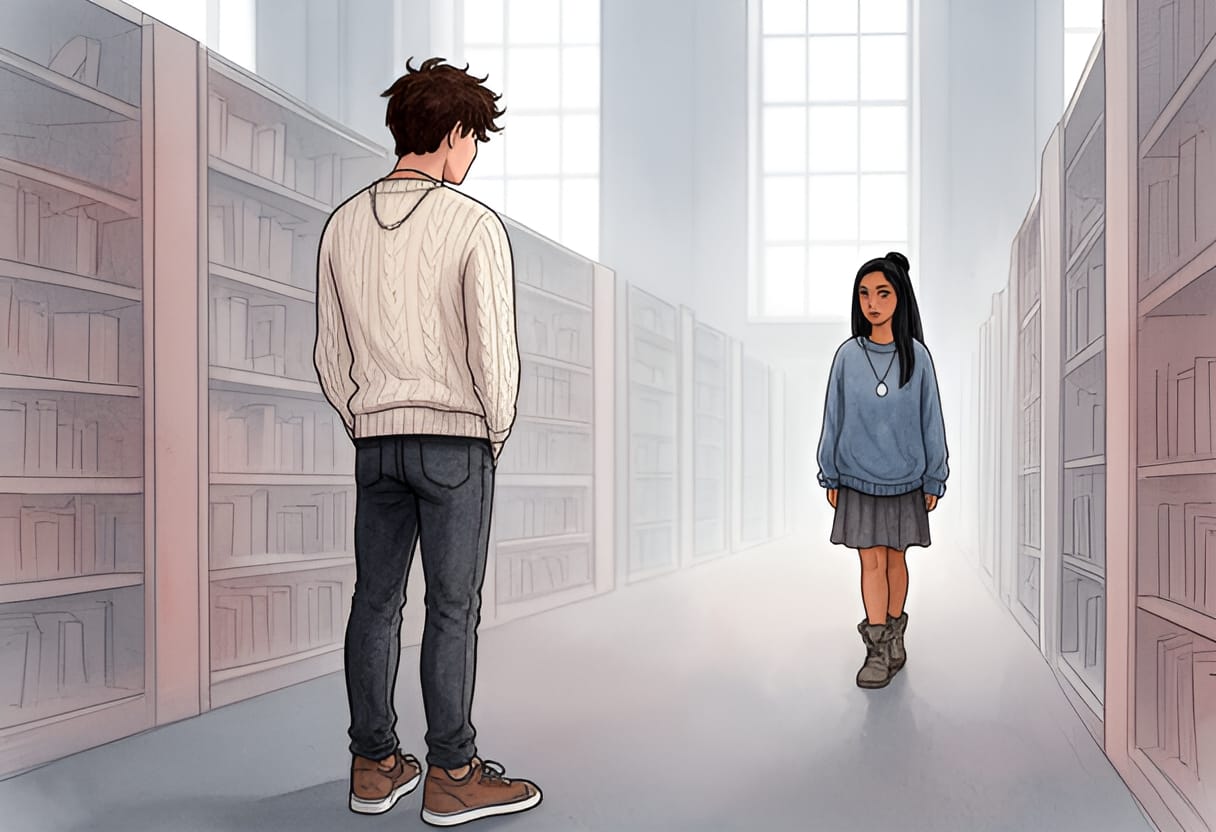
She gathered her things without another word, her movements precise, controlled. She didn’t look back as she walked away, her footsteps soft on the carpet, her silhouette shrinking down the aisle until she vanished behind the stacks.
Ethan stayed where he was, his hands empty, the warmth of hers still ghosting his palms. The library hummed around him—the turning of pages, the distant murmur of voices—but all he could hear was the silence she’d left behind.
Ethan stared at the spot where Maya had disappeared, the library’s fluorescent lights buzzing overhead like a trapped insect. The silence she’d left behind pressed against his chest, heavy and unfamiliar. He hadn’t meant to pull away—not like that. Not with the doubt curling in his gut, fed by Ryan’s whispers and the relentless drum of his father’s expectations. He wanted to call after her, to say he was sorry, that he needed her, not space from her. But his feet stayed rooted, paralyzed by the shame of admitting he’d believed the worst about her, even for a second.
He didn’t move until the library’s intermission bell chimed, signaling the shift change for the student workers. The sound jerked him back. He shoved his notes into his bag with more force than necessary, the corner of his psychology textbook digging into his ribs. Outside, the quad was alive with the late afternoon sun, students sprawled on the grass, laughing over frisbees and iced coffees. It felt like a different world from the quiet, suffocating tension of the library.
His phone buzzed in his pocket. He pulled it out, already knowing who it would be.
Dad: How’d practice go? You still on track for All-Conference honors?
His thumb hovered over the screen. He could lie—say he’d crushed it, that he’d scored two goals, that the coach was singing his praises. But the truth sat sour in his throat. He’d missed three passes, been late to three drills, and spent the last twenty minutes on the bench while the coach barked at the underclassmen. His father’s voice, when it came, would be polite but sharp, the kind of disappointment that didn’t need yelling to wound.
He typed slowly, each word feeling like a concession: Practice was tough. Missed a few shots. Working on it.
The reply came almost instantly: You know what’s at stake, Ethan. Legacy isn’t given. It’s earned. Don’t let the team down. And keep your grades up—Langford’s class is a joke if you apply yourself.
Ethan’s jaw tightened. Legacy. The word echoed in his skull, a ghost of his grandfather’s name etched into the lacrosse trophy case, his father’s All-American photo still hanging in the athletic hall. He’d grown up believing his worth was measured in goals scored, grades earned, and the way people turned when he walked into a room. Maya had made him feel, for the first time, like he could just be—not perform, not prove. But now, that feeling was slipping, replaced by the old, familiar pressure to be flawless.
He shoved the phone back in his pocket and headed toward the locker room, his steps uneven. The weight of his father’s message settled on his shoulders, dense and unyielding. He didn’t notice Maya until he was halfway there, sitting on the bottom step of the stairwell that led to the lower fields, her back against the cold concrete, her shoulders shaking.
She hadn’t seen him. Her face was buried in her hands, her faded blue sweater pulled tight around her as if she could shrink into it. A muffled sob escaped her, raw and broken, the kind of sound that made his chest ache with something deeper than guilt—something like recognition. He’d heard her cry before, soft and hesitant, but this was different. This was the sound of someone who had finally run out of strength to hold it together.
His first instinct was to go to her. To sit beside her, to wrap his arms around her and tell her it was okay to fall apart. But then Ryan’s voice slithered into his mind—She’s using you. She’s addicted to the sympathy.—and his father’s disapproval echoed behind it—Weakness isn’t tolerated in this family.—and his feet froze.
He opened his mouth. No sound came out.
Maya lifted her head just enough to wipe her eyes with the heel of her palm, her breath hitching. She didn’t look up. Didn’t see him standing there, trapped between the man he wanted to be and the man he was afraid of becoming.
A wave of nausea rolled through him. He couldn’t do it. Couldn’t face her tears, couldn’t admit he’d been the one to make her feel like a burden when all she’d done was ask a simple, honest question. So he turned away, his shoes scraping against the concrete as he walked up the stairs, each step louder than the last.
He didn’t look back.
The locker room smelled of sweat and rubber, the air thick with the noise of teammates laughing and towels snapping. Ethan stripped off his jersey mechanically, his movements automatic. His usual post-practice buzz—the endorphin rush, the camaraderie—was gone, replaced by a hollowness that gnawed at his insides.
He was pulling on his hoodie when Maya’s voice, small and hesitant, came from behind him.
“Ethan?”
He froze, his hands still on the zipper. He didn’t turn around.
“You okay?” she asked. Her voice was softer than usual, tentative, like she was afraid of startling him. “You seemed… off after practice.”
He finally turned, forcing a smile that felt like a crack in porcelain. “I’m fine. Just… tired. Lacrosse takes a lot out of you.”
Her eyes searched his face, searching for the truth beneath the words. He saw the flicker of hope in them—the hope that he’d be honest, that he’d let her in—and it made him want to disappear.
“You don’t have to be tough all the time,” she said quietly. “You can tell me if something’s wrong.”
The words undid him. For a second, he saw not the girlfriend who asked too much, but the girl who had shared her tea and her blanket and her quiet laughter, who had trusted him enough to fall asleep on his shoulder. And then the doubt crept back in, sharp and insistent: What if she’s just waiting for you to slip up so she can play the victim? What if she’s using this?
His smile vanished. His voice, when it came, was sharper than he meant it to be—low, tight, edged with frustration he couldn’t name.
“I don’t have time for this, Maya. I’ve got a paper due tomorrow, my dad’s on my case about grades, and I’m not your emotional punching bag. If you need to talk, go find Jenna. I’ve got stuff to do.”
She flinched as if he’d struck her. Her eyes widened, glossy and hurt, her lips parting as if to say something—but no sound came out. She just stared at him, searching his face for the boy who had held her hand in the library, who had kissed her forehead and promised to be there.
He saw it. He saw the moment her hope cracked.
But he didn’t take it back.
Instead, he turned away, grabbing his bag and slinging it over his shoulder. “I’ve got to go. Don’t wait up.”
He walked past her without another look, the door to the locker room swinging shut behind him with a finality that echoed in his bones.
He didn’t stop until he was halfway across campus, his pulse hammering in his ears, the autumn air sharp against his cheeks. He could still see her face—the hurt, the confusion, the quiet devastation—and it looped in his mind like a broken record.
That night, he lay awake in his dorm room, the ceiling a blur of shadows in the dim light from his desk lamp. His phone buzzed on the nightstand. Jenna’s name glowed on the screen.
He hesitated before answering.
“Hey,” he said, his voice deliberately casual. “You heard from Maya?”
There was a pause on the other end. Jenna’s voice, when it came, was calm but wary. “She’s in her room. Said she’s not feeling well. Headache, I think.”
Ethan exhaled through his nose, relief and guilt warring in his chest. “Yeah, she mentioned something like that earlier. Just… overreacting, I think. She’s been kinda sensitive lately.”
“Sensitive?” Jenna repeated, her tone slow, measured. “Ethan, she hasn’t eaten dinner. She’s been lying in the dark since she got back from practice. You sure she’s just being ‘overly sensitive’?”
His throat tightened. He hadn’t thought about her not eating. Hadn’t noticed how quiet she’d been, how she’d pushed her food around at lunch without taking a bite.
“I… I didn’t know,” he admitted, his voice low. “I just… I’ve got a lot on my plate right now. Midterms, lacrosse, my dad… I can’t be her therapist, Jenna. I’m trying, but I can’t fix everything.”
There was a long silence. When Jenna spoke again, her voice was softer, but it carried an edge he couldn’t ignore.
“She doesn’t need you to fix her, Ethan. She just needs you to be there. Not perfect. Not always strong. Just… present.”
He swallowed hard, the words scraping against his pride. “I know. I’m trying.”
“Try harder,” she said. Then, softer: “Call her tomorrow. Even if it’s just to say you’re sorry.”
He didn’t promise. He just said, “I’ll think about it.”
After he hung up, he stared at the ceiling again, the guilt a physical weight in his chest. He wanted to call her. Wanted to tell her he was sorry for snapping, for walking away, for making her feel like she had to shrink herself to fit beside him.
But his pride held him back, a stubborn, foolish thing. Tomorrow, he told himself. Tomorrow, when he wasn’t so tired, so stressed, so afraid of failing.
He closed his eyes, the image of her sitting alone in the stairwell burning behind his lids. And for the first time since they’d started dating, he wondered if he was capable of being the person she needed him to be.
The library was hushed, the kind of quiet that felt intentional, as if the books themselves were holding their breath. Maya sat at a corner table, her psychology textbook open in front of her, a pencil poised over her notebook. She’d been doing well in the class—better than well, really. It was one of the few places where her mind felt sharp, where the theories of cognition and behavior gave her a framework to make sense of her own chaos. But today, the words on the page swam. The multiple-choice questions blurred. She read the same stem three times before realizing she’d missed the negation in the stem, and by then, time was up.
She flipped the quiz over, her cheeks burning. A 62. She’d never scored below an eighty in Professor Langford’s class. Her pencil snapped in her grip, the lead snapping cleanly against the wood of the table. She pressed her palms flat, trying to steady her breath, but the familiar heat prickled behind her eyes—shame, sharp and sudden, like a brand. She hadn’t cried in front of him since the quad, not really. Not since he’d held her after the nightmare. But now, traitorous tears welled, spilling over before she could stop them. She wiped at them angrily with the heel of her hand, but they kept coming, silent and hot, tracing paths down her cheeks.
A shadow fell across the table. She didn’t look up, knowing it was him before she even saw the scuff of his sneakers against the linoleum.
“Maya?” His voice was tight, strained—like he was holding himself back from something. She risked a glance. His jaw was clenched, his eyes darting between her face and the failed quiz on the table. He looked… frayed. Like the edges of him were coming undone.
“I—I didn’t study enough,” she whispered, her voice thick. “I knew the material. I just… froze.”
He exhaled sharply through his nose. “You always know the material. That’s what’s weird.” He ran a hand through his hair, a gesture she’d seen him do when he was frustrated—on the field, after a tough loss, when his father’s voice echoed in his head about expectations and legacy. “It’s like you want to mess up. Like you’re waiting for permission to fall apart.”
Her breath hitched. She opened her mouth to explain—about the way her mind sometimes short-circuited under pressure, how the fire still lived in her nerves like a live wire—but the words choked in her throat. Instead, she looked down at her trembling hands, folded neatly in her lap.
“I’m sorry,” she murmured. “I’ll do better next time.”
“Sorry doesn’t cut it,” he said, and his voice had hardened, sharpened at the edges. He leaned in, not unkindly, but with an intensity that made her want to vanish into the floorboards. “You can’t keep doing this, Maya. You can’t keep falling apart over every little thing. One bad quiz. One rough day. You act like the world’s ending because you got a question wrong.”
“I’m not—” she began, but he cut her off, not unkindly, but with a weary finality that stunned her into silence.
“I’m tired of walking on eggshells,” he said, his voice low but fierce. “I’m tired of feeling like I have to tiptoe around you like you’re made of glass. You’re so fragile, Maya. It’s exhausting. You cry over a quiz. You shut down when Jenna asks if you’ve eaten. You flinch when someone raises their voice. How am I supposed to be with someone who breaks every time the wind blows?”
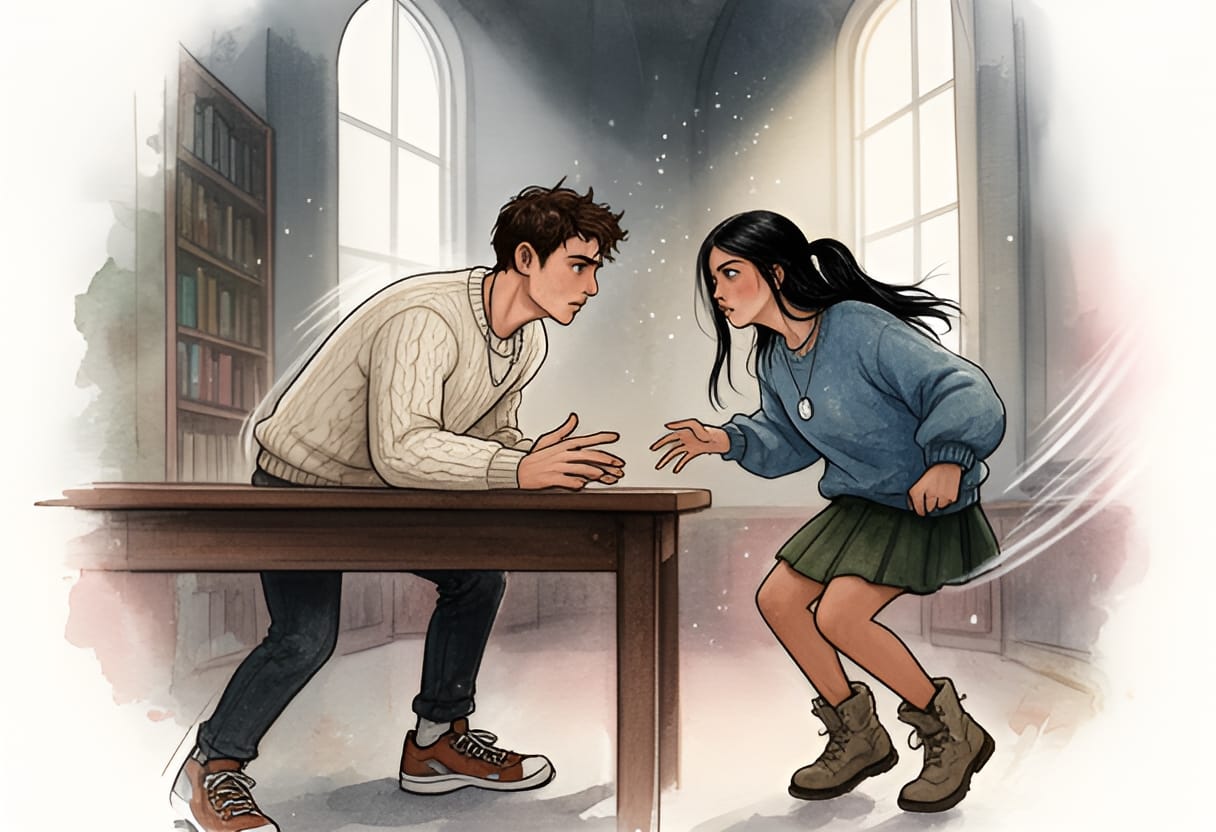
She flinched—really flinched this time—as if he’d struck her. The words landed like stones in her chest, heavy and cold. She felt the color drain from her face. Her breath came short and quick, but she forced it down, swallowing the sob that threatened to tear loose.
“I’m not trying to be… difficult,” she said, her voice barely above a whisper. “I just… I don’t know how to be anything else.”
“Then learn,” he snapped, and the sharpness in his tone made her jump. “You can’t keep using your past as a crutch. You can’t keep expecting people to pick up the pieces every time you crack. At some point, you’ve got to toughen up. Or I can’t do this.”
The words hung between them like smoke. She stared at him, really stared, searching for the boy who had brought her tea when she was sick, who had traced the constellation freckles on her shoulder and called them beautiful, who had held her while she screamed into her pillow after the anniversary of the fire. But all she saw was the tension in his jaw, the impatience in his eyes, the way he was already turning away in his mind.
Her vision blurred again, but this time, no tears came. Instead, a terrifying emptiness spread through her chest—quiet, absolute. She felt hollowed out, as if someone had scooped out her heart and left only a thin shell behind.
Slowly, deliberately, she closed her textbook. She gathered her things—her notebook, her pencil case, the half-finished sketch of him she’d been working on during breaks, the one where he was laughing, eyes crinkled, sunlight in his hair— and slipped them into her bag without a sound. She didn’t look at him. Couldn’t. If she did, she knew she’d shatter.
She pushed back her chair. The legs scraped softly against the floor, a small, ordinary sound that felt deafening in the sudden silence of the space between them.
“I’ll see you later,” she said. Her voice was flat. Empty. Not angry. Not sad. Just… gone.
She walked away.
He didn’t call after her.
He watched her go—her shoulders slumped, her steps too light, like she was trying not to make an impact—and felt the ground tilt beneath him. The library lights seemed too bright, the air too thin. His chest ached, not with anger or frustration, but with something deeper, something colder: recognition.
He’d seen that look before. Not on her face, but in the mirror, after his father had told him he wasn’t living up to the Cole name. After he’d missed the game-winning goal and heard the whispers in the locker room. After he’d realized, with sickening clarity, that he was more afraid of failing than he was of trying.
He had just done to her what had been done to him.
His hands shook as he shoved them into his pockets. He stared at the spot where she had been, at the indent her arms had made in the wood of the table where she’d rested her head when she thought no one was looking. The quiz lay abandoned, the red ink of the graded score a brutal contrast to the white paper.
He had told her to toughen up.
And in that moment, he understood—with a clarity that cut deeper than any insult—that he hadn’t just pushed her away.
He had broken the only person who had ever made him feel like he didn’t have to be perfect to be loved.
He sank into the chair she’d just vacated, the plastic cold against his palms. The library swallowed the sound of his breath—ragged, uneven—as the weight of what he’d done settled over him like a shroud. He hadn’t just lost her trust.
He had lost himself.
And he didn’t know how to get either back.
Chapter 3
The Silence Between Heartbeats
The library lights buzzed overhead, harsh and clinical, as Ethan shoved his chair back and stared at the spot where Maya had been moments before. Her shoulders had shaken with silent sobs over a failed quiz—just a quiz—and he had lashed out, voice raw from exhaustion and the pressure to be perfect, to be the guy everyone expected. Too emotional. I can’t be her therapist. The words echoed in the hollow of his chest, each one a fresh wound. He hadn’t meant to say it like that. He hadn’t meant to say it at all. But the damage was done, and Maya was gone, her books left open on the table, a single tear smudging the page of her notebook.
He didn’t follow her. He couldn’t trust himself not to break further in front of her. So he stayed, frozen, until the librarian cleared her throat and he mumbled an apology, gathering his things like a thief fleeing the scene.
The next day, he waited outside her English class, heart pounding as students filed out. She didn’t come. He checked her usual spots—the quad bench beneath the old oak, the corner booth at the campus café where they’d shared their first real conversation—but she was nowhere. He sent a text: Hey. Can we talk? No reply. He tried again later: I’m sorry. I didn’t mean what I said. Still nothing. By the third day, his messages went unanswered, and he began to notice the small, terrible signs: her locker remained shut, her name absent from roll call in two of his classes, her usual seat in the library empty.
He told Jenna what had happened, voice tight with shame, and she listened, her expression unreadable. “She’s not answering her phone,” he said. “I think she’s avoiding me.”
Jenna didn’t offer platitudes. She just nodded, her eyes dark with concern. “I’ll check on her.”
But Jenna couldn’t reach her either. Maya’s phone went straight to voicemail, her texts left on read. When Jenna knocked on their apartment door, there was no answer. She tried again later, pressing her ear to the wood, listening for any sign of life—nothing. The silence on the other side was thick, absolute.
Maya hadn’t left her bed in four days.
The curtains were drawn, the room dim and stale, smelling of dust and the faint, sour tang of uneaten food. She lay curled on her side, back to the door, the faded blue sweater pulled tight around her as if it could shield her from the world. Outside, life moved on—students laughed in the quad, cars honked on the street—but in here, time had slowed to a crawl, each hour stretching thin and painful.
She hadn’t eaten. Jenna had brought soup twice, setting the container just inside the door with a soft knock and a murmured, “I left you something.” But Maya hadn’t moved to get it. She couldn’t. The thought of chewing, of swallowing, felt like betrayal. She didn’t deserve nourishment. She didn’t deserve kindness. Not after what she’d done—after she’d let herself hope, after she’d allowed Ethan to see her, to hold her, to kiss her, only to shatter it with his words. Too emotional. I can’t be her therapist. The phrase looped in her mind, a broken record, each repetition carving deeper into her chest. She had believed him when he said he liked her. She had believed him when he held her after their first kiss, when her tears had fallen onto his shirt and he had wiped them away with his thumb, murmuring, It’s okay. I’ve got you. But that had been pity, hadn’t it? Pity for the girl who cried too much, who jumped from a window to survive while her family burned. Pity for the charity case who needed fixing.
She had written a letter. Three pages, front and back, in her neat, slanted script. She had started it the morning after the library, her hands shaking as she traced the words onto lined notebook paper. I thought you saw me. I thought you wanted me. But you don’t. You just felt sorry for me. I’m too much. I’m broken. I’m sorry I bothered you. She had written more—about the fire, about the window, about how she still heard her brother’s laugh in the crackle of the campus bonfires, how she woke some nights screaming, convinced the smoke was back. She had written about how she had dared to believe she could be loved, and how stupid that had been. She had folded the letter, tucked it into the pocket of her jeans, and then left it on her desk, untouched. She didn’t have the courage to send it. She didn’t have the courage to do anything.
On the fifth day, Jenna came back.
Maya heard her before she saw her—the faint jingle of her keys, the scrape of her shoe on the welcome mat. She froze, breath catching in her throat. Go away, she thought, but she couldn’t say it. She couldn’t move.
The knock came, soft but insistent. “Maya? It’s Jenna. I’m coming in.”
The door turned. Jenna stepped inside, her eyes scanning the room until they landed on the bed. She didn’t gasp. She didn’t cry out. She just stood there for a moment, her face tightening, then crossed the room and set down a fresh container of soup on the nightstand. “You haven’t touched the last one,” she said, her voice low and even. “I made chicken rice this time. Your favorite.”
Maya didn’t respond. She kept her eyes fixed on the wall, on the crack in the paint that looked like a lightning bolt.
Jenna sat on the edge of the bed, careful not to touch her. “You’re scaring me,” she said. “You haven’t been to class. You haven’t answered your phone. You won’t let me in. I know you’re hurting. I know what he said tore you apart. But you can’t disappear like this. Not on me.”
A sob finally broke free, raw and helpless. Maya turned her face into the pillow, her shoulders jerking. “I don’t deserve help,” she muffled into the fabric. “I’m a burden. I always have been.”
Jenna’s hand hovered over her back, then settled, warm and firm, between her shoulder blades. “You’re not a burden,” she said. “You’re my best friend. You’re the person who shares her last granola bar with a stranger who forgot lunch. You’re the one who stayed up with me when I had the flu and rubbed my back until I fell asleep. You’re not broken. You’re hurting. And hurting people deserve care. Especially from the people who love them.”
Maya shook her head, tears soaking into the pillowcase. “He hates me.”
“He doesn’t hate you,” Jenna said firmly. “He’s scared. He messed up. Badly. But that doesn’t erase what you mean to him—or to me.”
Maya didn’t believe her. She couldn’t. But Jenna’s hand stayed where it was, steady and sure, and for the first time in days, Maya didn’t push her away. She just lay there, trembling, letting the warmth seep into her bones, a small, fragile anchor in the dark. Jenna didn’t leave. She sat there until the light outside began to fade, until the room grew shadowy and quiet, until Maya’s breathing, though still uneven, began to slow.
And when Jenna finally stood to go, she paused at the door, her hand on the knob. “I’m not giving up on you,” she said softly. “Not today. Not ever.”
Then she was gone, and the door clicked shut behind her.
Maya lay still for a long time after that. The soup sat untouched on the nightstand. The letter stayed in her pocket.
But for the first time since the library, she didn’t feel entirely alone.
Maya didn’t hear the key turn in the lock. She didn’t hear the door open, or the soft creak of Jenna’s sneakers on the worn rug. The room had gone quiet, the kind of quiet that pressed against her eardrums, thick and muffled, like being underwater. She lay on her side near the foot of the bed, one arm tucked beneath her, the other lying palm-up on the floor, fingers slightly curled. The sketchbook lay open beside her, the pencil still resting where she’d dropped it mid-line. The drawing was of Ethan—his head tilted back against the library couch, eyes closed, one arm draped over the back, the other resting on his stomach. She’d been trying to capture the way his brow had softened in sleep, the faint crease between his eyebrows gone, his mouth relaxed. She hadn’t finished the shading on his jaw. She hadn’t finished anything.
The room smelled of dust and stale air, the faint citrus of the cleaning spray Jenna used lingers near the door. The soup container on the nightstand had gone cold, a skin forming over the rice. Maya hadn’t moved since Jenna left. She hadn’t wanted to. Every shift of her body reminded her of the weight in her chest, the hollow where her breath should be. She’d taken the pills not long after Jenna’s visit—just enough to make the noise stop, just enough to feel like she was disappearing the way she believed she should. She hadn’t thought about what came after. She hadn’t thought about Jenna finding her.
But Jenna had come back.
The footsteps paused just inside the doorway. Maya didn’t open her eyes. She couldn’t.
“Maya?” Jenna’s voice was low, cautious. “I’m coming in.”
She heard the rustle of Jenna’s jacket as she stepped further in, the soft click of the door closing behind her. Then silence again, broken only by the uneven rise and fall of Maya’s own breathing—too slow, too shallow.
Jenna’s shoes stopped near the bed. Maya felt the shift in air as Jenna leaned over her, the warmth of her presence, the faint scent of her shampoo. She braced for the touch, the voice, the plea to eat, to talk, to please just say something.
But Jenna didn’t speak. She didn’t touch her.
Instead, Jenna inhaled sharply—a short, caught breath—and then moved fast.
Maya felt the sudden pressure of Jenna’s hands on her shoulders, rolling her onto her back. Her head lolled to the side, cheek pressing against the cool wood floor. She tried to turn her face away, to hide, but her limbs felt heavy, detached, like they belonged to someone else.
“Oh god,” Jenna whispered, her voice tight with panic. “Maya? Maya, can you hear me?”
Maya’s eyelids fluttered. She saw Jenna’s face above her—eyes wide, lips parted, strands of dark hair escaping her ponytail. She tried to focus, to say I’m sorry, but her tongue felt thick, her mouth dry. No sound came out.
Jenna’s fingers pressed against her throat, checking for a pulse. Her eyes darted to the nightstand, then to the floor near Maya’s hand. She saw the bottle first—small, white, label peeled halfway off, acetaminophen, the kind you bought in bulk bottles. It lay on its side, empty. Then her gaze dropped to Maya’s clenched fist.
Inside her fingers, crumpled but protected, was the sketch.
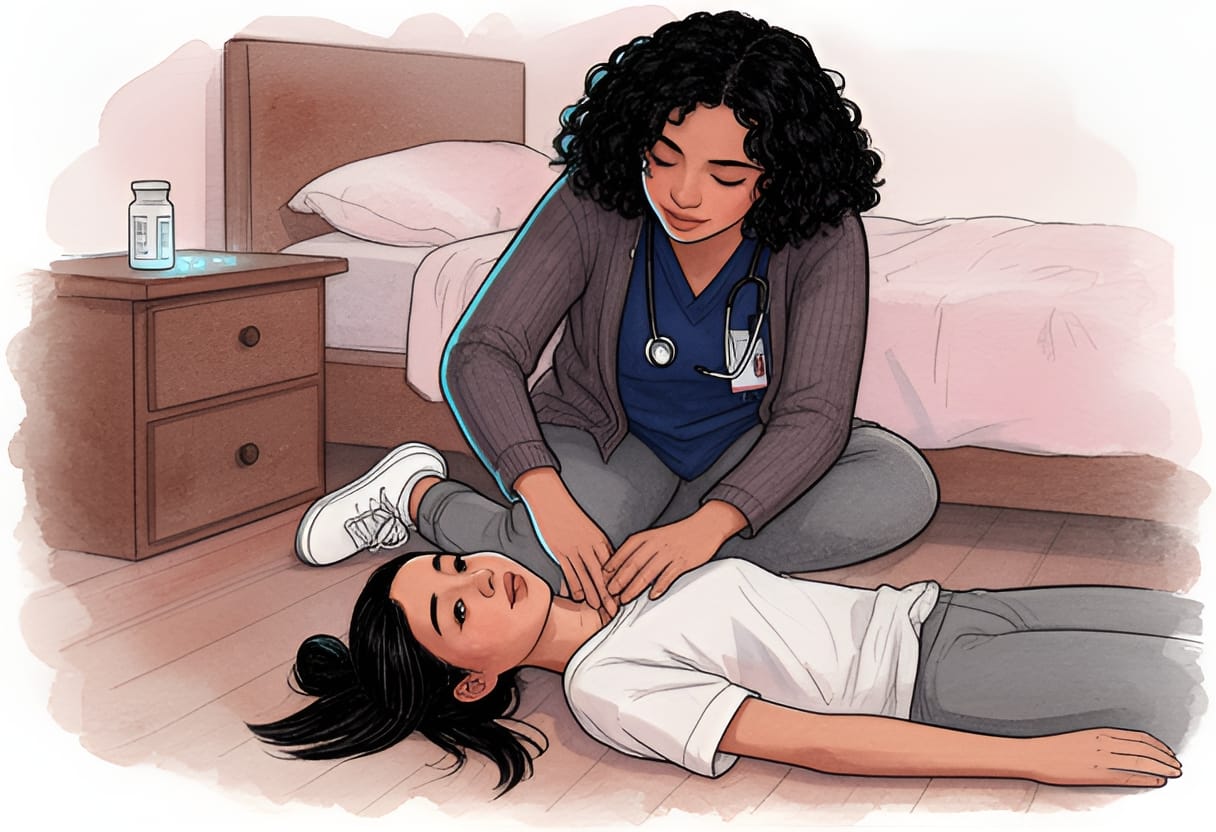
Jenna’s breath hitched. She didn’t pry the drawing loose. Instead, she pressed two fingers to Maya’s wrist again, frowning. “Come on, Maya,” she murmured, more to herself than to Maya. “Stay with me.”
She pulled her phone from her pocket with trembling hands, thumbs flying over the screen. Jenna pressed it to her ear, her voice strained but clear when it connected.
“911, what’s your emergency?”
“My friend,” Jenna said, her voice cracking. “She… she took something. I found her on the floor. She’s barely breathing.”
Her eyes flicked to Maya’s face, to the faint blue tinge at her lips, the way her chest barely rose. “She’s unresponsive. I think it’s an overdose. Please, hurry.”
She gave the address, her voice steadying as she fell into the rhythm of training—her nursing school instincts kicking in. She rolled Maya onto her side, just in case, then tilted her head back, lifting her chin to open the airway. “You’re going to be okay,” Jenna whispered, though her voice shook. “You’re going to be okay.”
She listened for breath, felt for air against her cheek. It was there, but faint, uneven. She started chest compressions—not hard, not fast, just enough to keep the blood moving, to buy time. Her palms pressed against Maya’s sternum, over and over, counting silently in her head. One and two and three and four…
Maya didn’t feel it. She was somewhere else—floating, or sinking, or maybe both. She saw flashes: the bonfire the night before Ethan’s birthday, the sparks rising like fireflies, her brother’s voice laughing as he pointed at a constellation. She saw her mother’s hands, flour on her wrists, pulling a tray of burnt cookies from the oven, grinning like she’d made something perfect. She saw Ethan’s thumb brushing her tears away after their first kiss, his voice soft: I’ve got you.
And then she saw the window.
Not the one she’d jumped from—the one in her bedroom now, the blinds half-open, the last of the daylight bleeding gray across the floor. She saw herself lying there, small and still, and Jenna bent over her, shouting something she couldn’t hear.
The pressure on her chest stopped. Jenna’s voice cut through the haze.
“They’re coming,” she said. “I hear the sirens. Hold on, Maya. Just hold on.”
Maya wanted to tell her she was sorry. For the letter she never sent. For the hope she’d dared to have. For letting Ethan see her, and then breaking it herself.
But her lips wouldn’t move.
The door burst open. Two paramedics rushed in, one dropping to his knees beside Jenna, the other grabbing a bag and pulling out a mask and a bulb.
“What’d she take?” the first one asked, already checking Maya’s pupils with a penlight.
“Acetaminophen,” Jenna said, her voice raw. “Empty bottle. I don’t know how many.”
The second paramedic placed the mask over Maya’s nose and mouth, began squeezing the bulb in rhythm. “She’s got shallow respirations, but she’s still pulling air. Let’s get an IV in her and move.”
Jenna stepped back as they worked, her hands stained from the compressions, her eyes locked on Maya’s face. One of them slid an IV catheter into her vein, tape securing it. They lifted her onto a backboard, strapped her in, and began to move her toward the door.
Jenna grabbed Maya’s hand before they lifted her fully. The sketch was still curled in her fingers. Jenna didn’t try to take it. Instead, she pressed Maya’s fingers gently closed around it, then bent down and brushed a kiss to her forehead.
“I’m right here,” she whispered. “I’m not leaving.”
They wheeled Maya out, Jenna following closely, the paramedics calling out vitals, the sound of the oxygen hissing softly in the mask. The night air hit them as they reached the stairs—cool, sharp, carrying the distant hum of traffic. Jenna climbed into the back of the ambulance beside Maya, the doors closing with a hiss.
The ride was a blur of light and sound—flashing red and blue painting the ceiling in streaks, the murmur of voices, the occasional beep of the monitor. Jenna held Maya’s hand the whole time, her thumb rubbing slow circles over her knuckles. She didn’t let go, not even when they lifted Maya onto a gurney and rolled her through the ER doors, not when the doctors and nurses swarmed around her, asking Jenna questions in rapid succession.
“How much did she take?” “When did you find her?” “Any history of depression?” “Is she on any medication?”
Jenna answered as best she could, her voice tight, her eyes never leaving Maya’s face. They took Maya away for scans, for labs, for fluids to flush her system. Jenna was left in a small cubicle with a plastic chair and a cup of lukewarm water she didn’t drink.
Her phone buzzed in her pocket. She pulled it out, saw the name flashing on the screen: Ethan Cole.
She stared at it for a long moment, her throat tight. She thought of the way he’d looked at Maya in the library—the frustration, the exhaustion, the way he’d raised his voice. She thought of the letter still in Maya’s pocket, the words I’m too much echoing in her own mind.
She answered.
“Jenna?” Ethan’s voice came through, rough, urgent. “Jenna, is she okay? She’s not answering her texts, she missed lab, I—”
Jenna swallowed. Her eyes burned. She looked toward the doors where Maya had disappeared, then back at the silent hallway.
“She’s in the hospital,” Jenna said, her voice low but firm. “She tried to end it. She’s alive, but… she’s not okay.”
There was a silence on the other end—short, but deep enough to swallow a scream.
Then Ethan’s voice, broken and raw: “I’m coming. I’m on my way. Tell her… tell her I’m sorry. Tell her I didn’t mean it.”
Jenna closed her eyes. She didn’t say Tell her yourself. She didn’t say You broke her. She just nodded, even though he couldn’t see it.
“I’ll tell her,” she whispered. “I’ll tell her.”
She ended the call, dropped the phone onto her lap, and folded her hands tightly in her lap, waiting. Waiting for the doors to open. Waiting for Maya to come back to her. Waiting for the moment when she could finally say, You’re not alone.
Jenna’s thumb rubbed slow circles over Maya’s knuckles in the ambulance, but now, in the plastic chair of the ER cubicle, her hands lay flat in her lap, trembling. The call had ended, but the weight of Ethan’s voice—rough, urgent, pleading—still echoed in the small space. She stared at the lukewarm water in the cup beside her, untouched, condensation beading along the sides. The fluorescent light overhead hummed, a steady, grating buzz that seemed to sync with the throb in her temples.
She hadn’t cried yet. Not since finding Maya. Not since performing compressions on her best friend’s chest, feeling the terrifying give of ribs beneath her palms. Not since pressing the sketch into Maya’s clenched fingers and kissing her forehead, whispering, I’m right here. The tears were there, hot and heavy behind her eyes, but she held them back. Maya needed her to be strong. Jenna had always been the strong one.
The doors to the trauma bay swung open. A nurse in teal scrubs stepped out, wiping her hands on her pants. She scanned the cubicle, eyes landing on Jenna. “You’re Jenna Torres?” she asked, voice crisp but not unkind.
Jenna stood, legs stiff from sitting. “Yeah. That’s me.”
The nurse offered a small, tight smile. “Maya Reyes. She’s stable. They’ve got her in ICU now—Room 312. She’s on a monitor, getting fluids to flush the acetaminophen. Labs are being run, but she’s breathing on her own, responding to pain. It’s… hopeful.” She hesitated, then added, “You can see her in a bit. They’re just finishing up.”
Jenna nodded, throat tight. “Thank you.”
The nurse gave a single nod and stepped back toward the bay, her shoes squeaking softly on the linoleum.
Jenna sank back into the chair, elbows on her knees, forehead resting in her palms. The relief was immediate and dizzying, but it was laced with something sharper—anger, guilt, a fierce protectiveness that had been simmering since she’d found Maya’s apartment door ajar, the silence inside too thick, too wrong.
She pulled out her phone again, thumb hovering over Ethan’s contact. She had told him she’d tell Maya he was sorry. She had lied. Not because she wanted to withhold the message, but because she needed him to understand—truly understand—what his words had done. What he had done.
The doors to the ER burst open.
Ethan came through them like a storm—face pale, eyes wide and darting, his lacrosse jacket flung open over a wrinkled shirt, his tie loose at the collar. He didn’t walk; he rushed, skidding to a halt in front of Jenna’s chair, breath coming in short, ragged gasps. His hands hovered, unsure whether to reach for her, to grab her shoulders, to do something—anything—to make this real, to fix it.
“Jenna,” he said, voice raw. “Is she…? How is she?”
Jenna didn’t stand. She kept her eyes locked on his, her expression hard, unyielding. “She’s alive,” she said, each word deliberate. “She’s in the ICU. Stable, for now. But she almost wasn’t.”
Ethan’s face crumpled. He sank into the chair beside her, elbows on his knees, head in his hands. “Oh god,” he breathed. “Oh god, Jenna, I’m so sorry—I didn’t—I didn’t think—”
“You didn’t think,” Jenna cut in, her voice low but cutting. “That’s the problem. You didn’t think. You saw her cry over a quiz and you lost it. You called her too much. You said you couldn’t be her therapist.” She leaned forward, her voice dropping to a fierce whisper. “Do you have any idea what that did to her? After everything? After she finally let someone in—you—and you threw it back in her face like she was a burden?”
Ethan flinched as if struck. He lifted his head, eyes red-rimmed, pleading. “I know. I know I messed up. I’ve been trying to reach her—texts, notes in her locker—but she won’t answer. I just… I need to see her. I need to tell her I’m sorry. That I didn’t mean it. That I—”
“You don’t get to just walk in there and say sorry like it fixes everything,” Jenna said, standing now, her voice rising. “You don’t get to apologize and expect her to be okay with it. You pushed her to the edge, Ethan. You saw her pain, and instead of holding her, you blamed her for it. You made her feel like her grief was too heavy for you to carry.”
Ethan stood too, his hands gripping the edge of the chair until his knuckles whitened. “I know that! I know what I said! I’ve been replaying it over and over—her face when I yelled, the way she just… shut down. I didn’t yell at her because I was embarrassed to be seen with her. I didn’t yell because I was worried about my reputation or what my friends would think.” His voice cracked. “I yelled because I was scared. Scared that if I let myself really see her—really feel what she’s carrying—I’d break too. Scared that if I admitted how much she means to me, I’d lose myself in it. Scared that loving her meant I’d have to be something I’m not sure I can be.”
He sank back into the chair, burying his face in his hands again. His shoulders shook with silent sobs. “I’m not afraid of losing my status, Jenna. I’m afraid of losing her. Of losing the way she makes me feel—like I’m not just Ethan Cole, the lacrosse star, the guy with the perfect grades and the rich parents. With her, I’m just… me. And I screwed it up. I hurt the one person who made me feel real.”
Jenna’s anger didn’t vanish, but it shifted—softened, just a fraction, as she watched him break down. She saw not the golden boy, the campus hero, but a kid who was utterly, devastatingly lost. She remembered Maya’s voice, weeks ago, whispering, He sees me. He really sees me. And now, seeing Ethan like this—shattered, honest, raw—she wondered if maybe, just maybe, he was capable of seeing himself too.
She sat back down beside him, not touching him, but close enough that their shoulders nearly brushed. When she spoke, her voice was quieter, but firm. “Maya doesn’t need your apology right now. Not the kind you’re thinking of. She needs to hear the truth. Not ‘I’m sorry I yelled,’ but ‘I’m scared of how much I care.’ Not ‘I didn’t mean it,’ but ‘I meant every word of how I feel about you—even the parts that terrify me.’ She needs to know you’re not just saying what you think she wants to hear. She needs to know you’re willing to be vulnerable with her—not despite her pain, but alongside it.”
Ethan lifted his head, eyes wet, searching hers. “What if she doesn’t want to hear it? What if she’s done with me?”
Jenna reached out then, not to hold his hand, but to press it gently, firmly, against his chest—over his heart. “Then you tell her anyway. Because if you love her, you owe her the truth. And if you don’t… then you owe it to yourself to be honest about that too.” She paused, her voice dropping. “But I don’t think she’s done with you. I think she’s just… waiting to see if you’re real.”
A long silence stretched between them, filled only by the distant hum of the hospital, the intermittent beep of monitors from somewhere down the hall. Ethan’s breathing slowed, the ragged edges smoothing just a fraction. He looked toward the doors leading to the ICU, then back at Jenna.
“I’ll tell her,” he said, voice quiet but steady. “The truth. All of it.”
Jenna nodded. She didn’t say I hope it’s enough. She didn’t say I hope she forgives you. She just sat with him in the waiting room, two people holding their breath for the same girl, and waited for the doors to open.
The ICU lights were dimmed, casting a soft glow over the room. Maya lay still beneath the thin hospital blanket, the steady rhythm of the heart monitor the only sound breaking the silence. Tubes snaked from her arm to the IV pole, delivering fluids, and a pulse oximeter clipped to her finger pulsed a quiet red with each beat. Her breathing was even, shallow but unassisted—she was on her own now, no machines forcing air into her lungs. The drugs still clung to her thoughts, dulling the edges, but beneath the haze, a slow return of awareness stirred.
Her eyelids fluttered.
Not from pain, not from fear—but from the warmth of a hand holding hers.
She turned her head slightly, blinking against the glare of the monitor, and saw him.
Ethan was slumped in the chair beside her bed, one arm curled around the side rail, his forehead resting on his other forearm. His hand was locked in hers, fingers interlaced so tightly her knuckles ached faintly where his thumb pressed into her skin. His jacket was rumpled, his tie loosened, and dark shadows hollowed his cheeks. He looked exhausted—not the polished, poised version of himself she’d seen in lectures or on the lacrosse field, but raw and worn, as if he hadn’t slept in days.
Her breath hitched.
Not because he was there—but because he hadn’t left.
Her mind, still foggy, tried to piece it together: the bottle of pills, the darkness closing in, Jenna’s voice shouting her name, the sting in her throat as she gagged… and then nothing. Until now. This. His hand in hers. His presence.
She didn’t remember calling for him. She didn’t remember wanting him to find her.
Yet here he was.
A soft sound escaped her—barely a whisper—as she shifted, trying to ease the stiffness in her shoulder. The movement jostled their joined hands.
Ethan jerked awake.
His head snapped up, eyes wide and disoriented for a heartbeat—then locked onto hers. Recognition flooded his face, followed by something deeper: relief so profound it seemed to shake him. His breath caught, and then tears spilled over, tracing hot paths down his cheeks. He didn’t wipe them away. He just stared at her, as if afraid she’d vanish if he blinked.
“Maya,” he breathed. Her name was a broken thing, half-sob, half-prayer.
She wanted to look away. Her instinct was to shrink, to apologize for the trouble, for the fear she’d caused, for being too much even in this—needing him to stay, needing him to see her like this, weak and broken and alive against her will. But his gaze held hers, steady and unwavering, and she couldn’t look from it.
His free hand lifted, trembling slightly, and brushed a stray strand of hair from her forehead. His touch was feather-light, reverent, as if she might shatter.
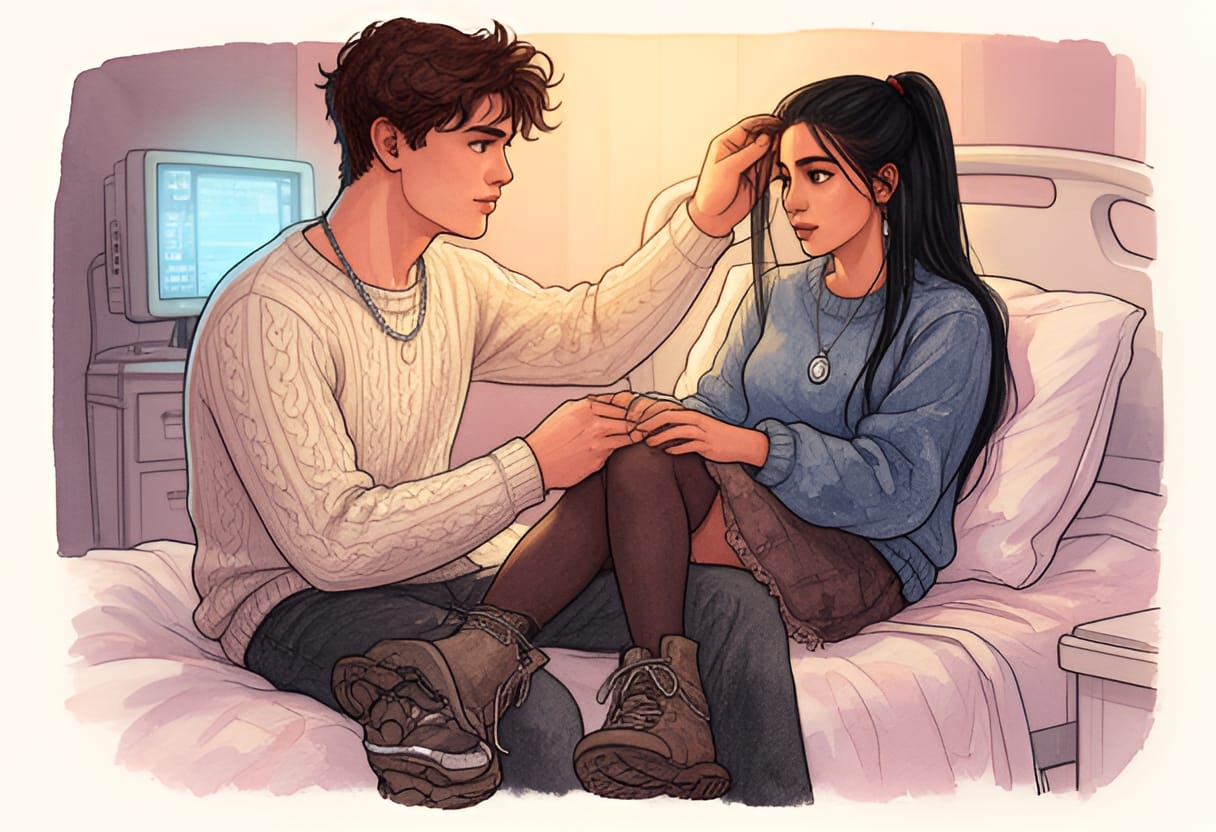
“I love you,” he said, voice low and rough, raw with emotion. “Not despite your tears. Not in spite of your pain. But because of them. Because you feel so deeply. Because you carry so much and still show up. Because you’re the bravest person I’ve ever known.”
Her chest tightened. A sob rose, unbidden, and she couldn’t stop it. Tears spilled over her own lashes, hot and silent at first, then breaking into quiet, shuddering gasps. She hadn’t cried like this in front of anyone since the hospital after the fire—not even Jenna, not in the quietest moments. But here, with Ethan watching her fall apart, she didn’t feel shame. She felt… seen.
And then, impossibly, she reached.
With her free hand, she lifted it slowly, hesitantly, and placed it on his cheek. Her fingertips brushed the stubble along his jaw, felt the dampness of his tears. She didn’t pull away. She leaned into his touch, her thumb tracing the line of his lip.
“I’m sorry,” she whispered, the words fraying at the edges. “I’m so sorry I scared you. I didn’t mean—”
“Shhh,” he murmured, cutting her off. His other hand came up to cradle her face, his palms warm and steady. “Don’t apologize for surviving. Don’t apologize for feeling. You don’t owe me that. You don’t owe anyone that.”
His forehead dipped forward, resting against hers. Their breaths mingled—his ragged, hers slowing as she matched his rhythm. The space between them vanished, not in passion, but in something quieter, more profound: recognition. Two souls, bruised and trembling, finding each other in the stillness.
The heart monitor beeped steadily between them.
Beep… pause… beep… pause…
Each pulse a reminder: she was here. He was here. They were together.
She didn’t know what tomorrow would bring. She didn’t know if the guilt would fade, if the nights would stop feeling so heavy, if she’d ever believe she deserved to take up space. But in that moment, with Ethan’s forehead pressed to hers, his tears mixing with hers on her skin, she felt something she hadn’t felt in a long time—not peace, not exactly, but the fragile, trembling start of it.
She was not too much.
She was enough.
And for now, that was all she needed to hold onto.
The monitor’s steady beep filled the quiet, a metronome marking time they had nearly lost. Maya kept her forehead against Ethan’s, her eyes closed, drinking in the warmth of his skin, the scent of his soap and the faint trace of hospital antiseptic clinging to his clothes. His hands remained cupped around her face, thumbs brushing slow circles just below her eyes, where her tears had traced damp paths. She didn’t pull away. For the first time in years, she didn’t brace for the moment he’d pull back, disgusted or afraid.
Instead, she leaned into it.
A nurse appeared in the doorway—teal scrubs, hair pulled back in a tight braid—her expression softening as she took in the scene. She didn’t speak, didn’t interrupt. Just checked the IV line, adjusted the flow slightly, and gave Maya’s chart a quick glance before stepping back, closing the door with a quiet click. The gesture felt like a gift: privacy, permission.
Ethan’s breath hitched against her skin. “I’ve been so scared,” he murmured, voice rough. “Not of losing my place on the team, or my parents’ disappointment. I was scared of this—of loving you so much it terrified me. Of needing you so deeply I thought I’d drown in it. I thought if I let myself feel it all, I’d break. But being here… seeing you like this… I realize I was already breaking. Without you.”
His words vibrated against her lips, warm and true. She turned her face slightly, just enough to press a kiss to the corner of his mouth—soft, tentative, a question and an answer all at once. He responded instantly, his lips moving against hers with a tenderness that undid her. It wasn’t fiery or demanding. It was soft, searching, a promise whispered in touch: I’m here. I’m not leaving.
When they parted, neither moved far. Their breaths still mingled, foreheads resting together. Maya’s hand, still in his, gave a small squeeze. She wanted to say more—to thank Jenna, to admit how hard it had been to ask for help, to tell him she’d written a letter she never sent, filled with apologies and explanations she now realized she didn’t need to give. But the words weren’t necessary. Not yet.
Instead, she whispered, “Stay?”
Ethan’s eyes opened, bright and wet in the dim light. “I’m not going anywhere,” he said. He shifted slightly, wincing as his stiff joints protested, but didn’t release her. Instead, he lifted their joined hands and pressed a kiss to her knuckles, then to her wrist, where the pulse throbbed strong and steady. “I’ll stay right here. As long as you’ll have me.”
She nodded, a small, shaky movement. The fear hadn’t vanished—it lingered at the edges, a shadow—but for the first time, it didn’t feel like a wall. It felt like something she could face, not alone, but with him beside her.
Outside, the hospital hummed on—pages turning, voices low, machines breathing for those who couldn’t. But in this room, in this quiet space between two hearts that had nearly stopped, there was only this: the rhythm of her pulse, the warmth of his hand, and the quiet, unshakable truth that she was not too much.
She was loved.
And that, for now, was enough to keep her breathing.