Fiction
LES MISÉRABLES
by MAHMD 2006
3 chapters22 min read
Chapter 1
The Bishop’s Mercy
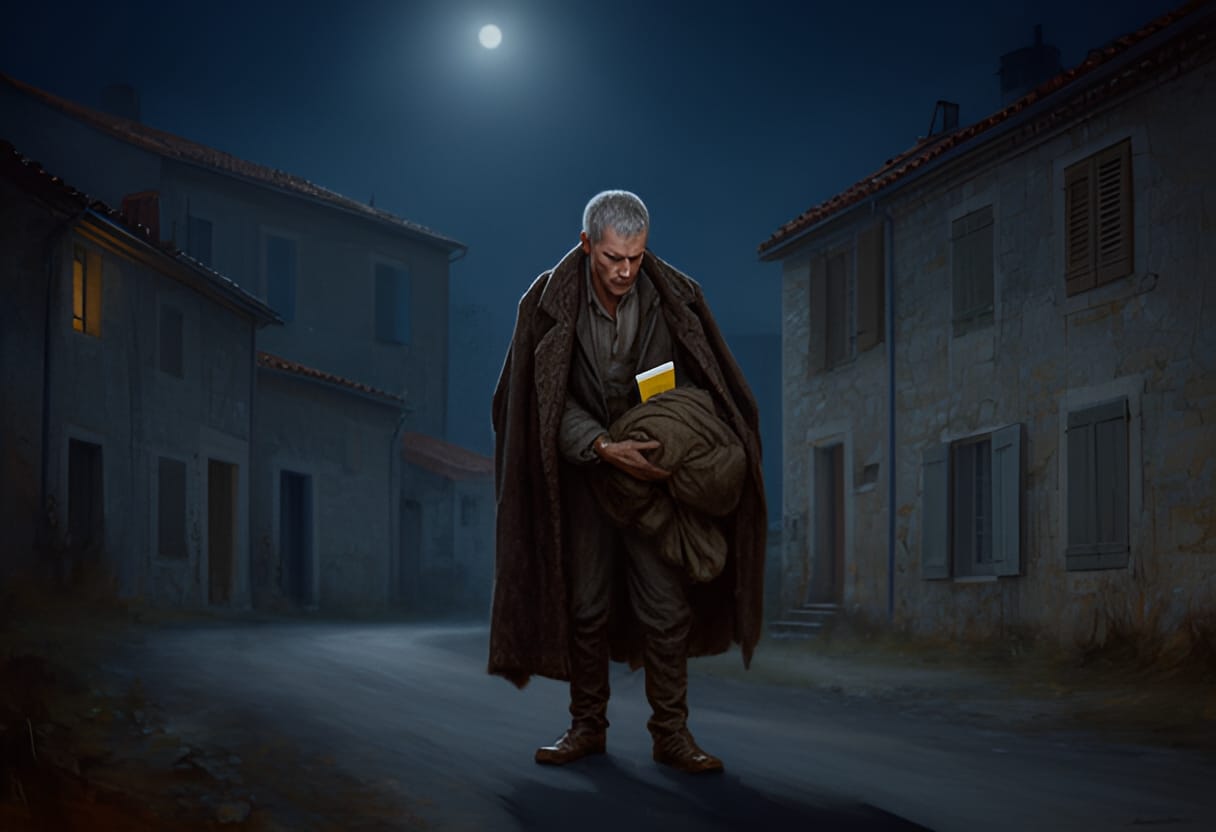
Jean Valjean pressed his palm against the rough wooden door of the inn, knuckles white from gripping the strap of his bundle. The wind off the hills carried the scent of woodsmoke and damp earth, but inside, warmth and light promised rest. He had walked since dawn, his feet blistered in the heavy shoes issued at Toulon, his back bent under the weight of nineteen years. The yellow passport tucked in his coat felt like a brand.
The door opened a crack. A woman’s face, pinched with suspicion, peered out.
“Room for the night?” he asked, voice raw from disuse.
She glanced at the paper he thrust forward. Her eyes narrowed. “You’re from the galleys.”
“I’ve served my time.”
“Nineteen years for bread. That’s what the paper says.” She shook her head. “We don’t take your kind here. Trouble follows.” The door began to close.
“Please,” he said, stepping forward. “I have money. Honest francs.”
She didn’t look at the coins he offered. “Money doesn’t wash out the stain. Go on now.” The door shut with a finality that echoed in his chest.
He stood in the darkening street, the inn’s shuttered windows like blind eyes. Another refuge denied. He had tried three already. Each time, the same look — fear, contempt, the automatic assumption that he would steal, would violence, would bring the gendarmes knocking. It was not the refusal that burned, but the certainty in it, as if his past had erased his present, as if the man who walked was already buried beneath the convict.
He walked on, shoulders hunched against the chill that seeped through his thin coat. The town of Digne lay quiet, its stone houses shuttered, its streets empty save for the occasional stray dog rooting in gutters. He passed a bakery where the scent of bread made his stomach clench. He had not eaten since morning, and the memory of the crusts they gave him in the chain gang — hard, sawdust-laced — made his throat tight. He could steal a loaf. It would be easy. The thought coiled in his gut, familiar and cold.
But he kept walking. Not from virtue, but from a weary pride. He had stolen to survive once. He would not do it again unless he had to. Let them think him a thief. He would not prove them right by hunger’s dictate alone.
Night fell fully. He found no shelter in the stables — chased out by a stableboy with a pitchfork. He tried the church porch, but the priest himself came out and told him the holy house was not a hostel for vagabonds. So he walked until the town gave way to open fields, until the only roof was the sky, hard and indifferent with stars.
He lay in a ditch beside the road, his bundle as a pillow, and stared into the dark. The air smelled of wet grass and distant woodsmoke. Somewhere, a clock struck ten. The sound was thin, lonely. He thought of the galleys — the chain, the oar, the curse of the overseer’s whip, the way the men’s eyes had gone dull, like fish in stagnant water. He had kept his mind by remembering his sister’s face, her children’s hunger. That was why he had taken the bread. That was why he had been caught.
Now, free, and no nearer to peace.
He rose at first light, stiff and sore, and walked toward the town again, not for shelter, but because the roads led there, and walking was better than lying still. He passed the cathedral — a squat, humble building beside a garden wall. A small door stood open. A woman in a dark shawl swept the steps.
“Monseigneur Myriel gives bread to the hungry,” she said, seeing him pause. “But only to those who will work for it.”
“I will work,” he said quickly. “Anything.”
She studied him — the sunken cheeks, the hands cracked from labor and soap, the way he held himself too straight, as if bracing for a blow. “Come back at noon. We’ll see.”
He nodded and walked on, hope a fragile thing in his chest. Maybe, just maybe, this town would be different.
By midday, he returned. The woman led him through a side gate into a modest garden where vegetables grew in neat rows. An old man in a cassock stood by a well, pouring water into a bucket. He turned, and Jean Valjean saw not the severity of the innkeepers, but a face lined with kindness, eyes that looked at him without flinching.
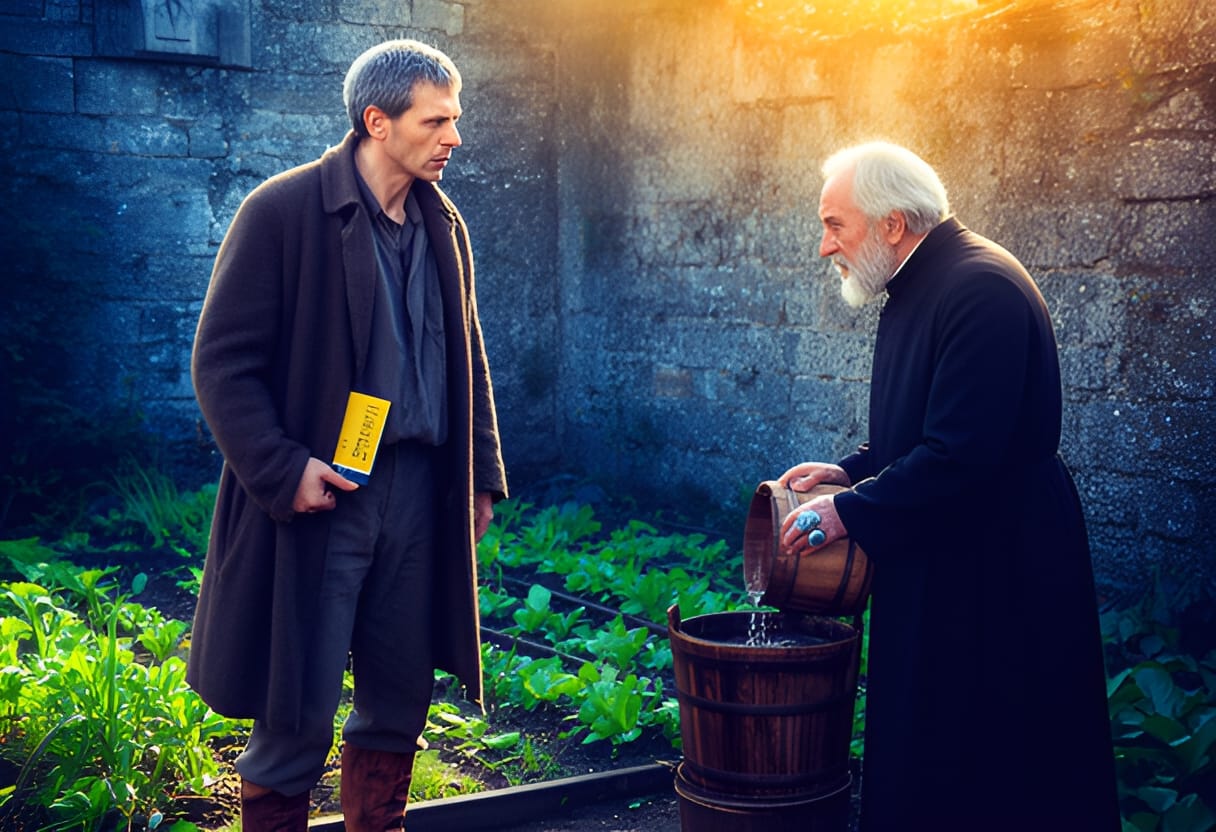
“You are hungry,” the bishop said. His voice was calm, warm as the sunlight on the stone wall.
“I have walked far,” Jean Valjean admitted.
“Come inside. You will eat, and then you can help in the garden. Honest work for honest bread.”
They went into a small house — clean, simple, with a fire low in the hearth. The bishop poured soup into a thick bowl, set down bread and cheese. Jean Valjean ate slowly, surprised by the flavor, by the fact that no one watched him for signs of theft. After, he weeded the garden, his back aching but his mind quieter than it had been in years.
As dusk fell, the bishop showed him to a small room off the hall. A narrow bed, a blanket, a pitcher of water. “You may sleep here,” he said. “The door is not locked.”
Jean Valjean stood in the doorway, the words echoing in his mind. Not locked. No guard. No chain. He had expected a cell, a watchful eye, a trap. Instead, he was given trust.
He lay down, but sleep would not come. The kindness unsettled him, made the old bitterness stir. He had spent so long believing the world was only force and fraud, that mercy was a trick to lower a man’s guard. And yet… the bishop had not flinched. Had not locked the door. Had not even asked his name.
The thought crawled through him like a cold spider: What if I took something? What if I proved them all right?
He rose silently, pulled on his boots, and slipped into the hallway. The moonlight silvered the floor. He paused outside the bishop’s door, then moved on, drawn to the sitting room where the bishop kept his few possessions.
His hand closed around the heavy candlesticks first — solid silver, cool to the touch. Then the plate, the serving spoon.
He stood over the bishop’s possessions, the silver cold in his palm, and for a moment the world narrowed to the weight of the candlesticks, the dull gleam of the plate, the curve of the spoon. His breath came shallow. He had not stolen in anger, not for cruelty, but the act felt like a betrayal of something he could not name — a trust so freely given it made his chest ache. He turned to go, his steps soft on the wooden floor, the silver heavy in his coat.
He had taken only a few steps toward the door when voices rose from the hall — sharp, authoritative, the heavy tread of boots on stone. The bishop’s door opened, and two gendarmes stood in the doorway, their uniforms dull in the moonlight, their faces set. Between them, held firmly by the arm, was Jean Valjean.
“We found this man with your silver, Monsieur le Bishop,” said the taller gendarme, his voice thick with the accent of the countryside. “He was walking toward Toulon. Suspicious, we thought. Stopped him and searched his bundle. This is what we found.”
He held out the plate and the spoon, catching the pale light. The candlesticks were still wrapped in Valjean’s coat, hidden against his thigh.
The bishop stepped forward, his expression not one of anger, but of quiet surprise. He looked from the gendarmes to Valjean, then to the silver in their hands.
“Ah! So you are here!” he said, his voice bright, almost cheerful. “I am delighted to see you. Had you forgotten that I gave you these as well? The candlesticks are silver too, like the rest. Why did you leave them behind?”
He turned and walked quickly into the sitting room, returning a moment later with the two candlesticks in his hands. He held them out toward Valjean, his eyes kind but firm.
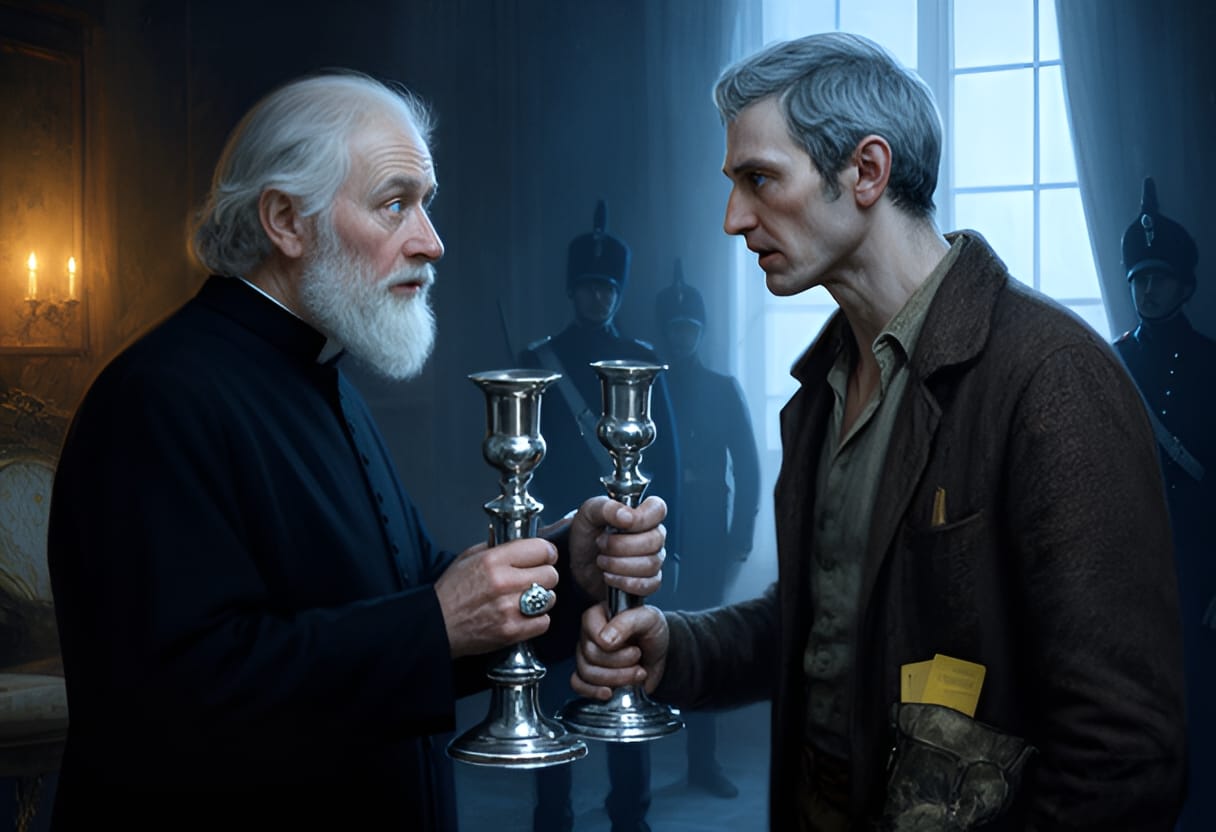
“You forgot these. They are worth at least twenty francs. Did you not notice that they were missing?”
The gendarmes exchanged glances. The taller one frowned. “But Monsieur le Bishop, he said — ”
“The gentleman,” the bishop interrupted gently, “said that I had given him all this silver. And so I have. I was pained that he should have left so hastily. It was wrong of him not to wait for the candlesticks, but he was perhaps afraid I would change my mind.”
He turned fully to Valjean, his gaze steady. “Remember, my brother,” he said, “that you have promised to use this money to make yourself an honest man.”
Jean Valjean could not speak. His throat tightened. The silver burned against his leg. He had expected curses, chains, the familiar taste of despair. Instead, he was met with a voice that did not accuse, but entrusted.
The gendarmes hesitated, then, with a final look at the bishop, stepped back. “If you say so, Monsieur le Bishop,” said the taller one. “We will take our leave.”
They bowed slightly and retreated down the hall, their boots fading on the stone. The bishop closed the door softly behind them.
Silence settled, thick and warm from the dying fire. The bishop walked to the table and set the candlesticks down beside the plate and spoon. He did not look at Valjean at once. When he did, his eyes were wet, but his voice was steady.
“Jean Valjean,” he said, “you belong no longer to evil, but to good. I have bought your soul to save it from black thoughts and the spirit of perdition, and I give it to God.”
He reached out and touched Valjean’s arm, not as a jailer, but as a brother.
Overwhelmed, Jean Valjean turned and fled into the night, the silver clinking softly in his coat. He did not stop until he was far beyond the town’s edge, beneath a sky washed clean with stars. There, he fell to his knees and wept — not for the fear of capture, but for the weight of a kindness that had shattered him, and for the first time in nineteen years, the fragile, terrifying hope that he might yet be worthy of it.

Chapter 2
The Promise to Fantine
Jean Valjean stood very still in the dim light of his study, the silver candlesticks cool against his palm. The memory of the bishop’s touch, the weight of the words spoken in the quiet after the gendarmes left, still pulsed in his chest like a second heartbeat. He had not slept. He had walked the roads until dawn, the silver a constant, unfamiliar burden in his coat, until the exhaustion of body and spirit finally drove him to seek shelter in a humble inn on the outskirts of Digne. There, he had washed his face, changed his clothes, and, with a resolve harder than any he had known in the galleys, set his face toward the north.
Years had passed. The man who had knelt in the dirt beneath a sky washed clean with stars was now Monsieur Madeleine, mayor of Montreuil-sur-Mer and owner of Jettry’s, the largest manufacturer of black glass and jet in the region. His factory, rebuilt from a ruined workshop on the edge of town, employed over a hundred workers. He was known for his fairness — wages paid promptly, no fines for minor infractions, and a discreet fund for the sick or injured. He walked the streets without a guard, greeted by name, and though he kept his private life closely guarded, no ill word was spoken against him. The yellow passport was buried deep in a locked chest, its existence a secret known only to God and, he hoped, the bishop’s enduring mercy.
It was a Tuesday morning in October when the first whisper reached him. He was in the counting house, reviewing the week’s output, when Madame Victurnien, his housekeeper, appeared at the door with a letter in her hand and a troubled furrow between her brows.
“Monsieur le Maire,” she said, her voice low, “there is talk among the women at the factory. About Fantine.”
Jean Valjean looked up. Fantine. He knew the name. A slender girl from Paris, quiet and diligent, who had come to work in the sorting room six months prior. She kept to herself, spoke little, and sent half her wages away each week. He had noticed her pallor, the cough that lingered, but had assumed it was the strain of solitude, not the secret she carried.
“What talk?” he asked, his tone calm, but his hands stilled on the ledger.
“That she has a child,” Madame Victurnien replied. “A little girl. Born out of wedlock. She sends money to a couple in Montfermeil — the Thénardiers, they say — who are to care for her. It is… improper. The other women resent it. They say she steals from her wages to support a bastard, while they struggle to feed their own.”
Jean Valjean felt a coldness spread through his chest, not of anger, but of dread. He had seen the girl’s worn boots, the way she mended her shawl, the hunger in her eyes that went beyond mere fatigue. He had wondered, but had not dared to pry.
“Who told you this?” he asked.
“Madame Victurnien from the spinning room,” the housekeeper said. “She saw Fantine’s locket — a tiny portrait, she says — and pressed her. The girl broke down and confessed. The foreman, Monsieur Soudry, has already been informed. He demands her dismissal. He says it brings shame upon the factory.”
Jean Valjean rose. “Bring her to me,” he said. “Now.”
He waited in his office, the factory’s quiet hum a distant murmur through the walls. When Fantine entered, she was a shadow of herself. Her cheeks were hollow, her eyes bright with fever, and her simple dress was frayed at the hem. She clutched her hands together, knuckles white, and would not meet his gaze.

“You wished to see me, Monsieur le Maire?” she whispered.
He rose and came around the desk, stopping a few feet away. “Fantine,” he said gently, “I have heard that you are sending money to support a child.”
She flinched as if struck. Tears welled, but she did not deny it. “Yes, Monsieur. My little Cosette. She is with good people in Montfermeil. They asked for a hundred francs up front, and then twelve francs a month. I have sent what I could. I sold my locket last week. I… I am trying.”
He saw then the faint scars at her lips, the unevenness of her smile where teeth were missing. His breath tightened. “You have sold your teeth?”
She nodded, unable to speak. A sob broke free. “I had no choice. The Thénardiers wrote — they said Cosette was ill, that they needed money for medicine. I… I could not let her suffer.”
Jean Valjean looked at her — truly looked — and saw not a woman who had broken the rules, but one who had broken herself in service to a love that asked nothing in return. The bishop’s words echoed in his mind: You belong no longer to evil, but to good. He had kept the silver. He had built an honest life. And here, before him, was the living proof that honesty without compassion was a hollow thing.
“I will not dismiss you,” he said, his voice firm. “You will keep your position. And I will see to it that the money you send reaches Cosette regularly, without fail. You need not suffer for her sake.”
Fantine’s eyes flew to his, wide with disbelief and hope. “You… you would do that?”
“I give you my word,” he said. “Now go. Rest. See the factory doctor. And do not worry about the money. It will be sent.”
She fled the room, her sobs quiet but tears streaming freely down her cheeks. Jean Valjean stood alone, the weight of his promise settling on his shoulders like a second coat. He turned to the window, watching the gray October light fade over the town, and for the first time since his release, he felt not the shadow of his past, but the quiet, insistent pull of a future he had dared to hope for.
The respite was brief. Three days later, Madame Victurnien returned, her face grim. “Monsieur le Maire,” she said, “Monsieur Soudry insists. He says the women are in an uproar. They refuse to work while Fantine remains. They say her presence corrupts the morals of the factory. They demand her dismissal, or they will walk.”
Monsieur Soudry stood in the factory yard, his face flushed with indignation, as the women gathered in a tight knot, their arms crossed, their eyes fixed on the door of the counting house. The air smelled of damp wool and coal dust, and a thin drizzle began to fall, blurring the gray outlines of the warehouses beyond.
“She is a poison,” Soudry declared, his voice rising. “She brings shame upon honest labor. She mocks us with her secret while we starve. She must go — today.”
Jean Valjean stepped from the office, his coat buttoned against the chill, his expression calm but unyielding. “She will not be dismissed,” he said. “She remains in her post. Her wages will be paid in full, and the money sent to Cosette will be forwarded without delay. I have given my word.”
A murmur rippled through the women. Some shifted uneasily; others clenched their fists. Soudry’s jaw tightened.
“You defy the consensus, Monsieur le Maire?” he said. “You side with a woman who corrupts the morals of this factory?”
“I side with justice,” Jean Valjean replied. “And with compassion. Return to your work. The matter is settled.”
Soudry opened his mouth to retort, but Jean Valjean raised a hand. “Now.”
The foreman glared, then turned on his heel and strode back toward the sorting room, muttering under his breath. The women hesitated, then, one by one, drifted back to their stations, though glances were thrown over shoulders, and whispers followed them like shadows.
Jean Valjean watched them go, then sighed and turned toward the town. He had not walked far when he heard a sharp cry — a woman’s voice, cracked and desperate — from the alley beside the apothecary.
He rounded the corner and saw Fantine, her shawl pulled thinly over her shoulders, her face gaunt and streaked with tears. Before her, a young man in a fashionable coat laughed, holding up a broken comb he had snatched from her hand.
“Look at her,” he jeered, turning to his companion. “The little saint sells her teeth and still dares to dream of angels. What a sight — holy whore with a bastard’s hope.”
Fantine lunged, her nails scraping at his wrist. “Give it back!” she gasped, her voice raw.
The man shoved her hard against the wet brick wall. She struck out, her palm connecting with his cheek. He stumbled, stunned, then flushed with rage.
“You filthy creature!” he spat. “I’ll have you locked for this!”
He reached for her arm, but before he could seize her, a firm grip closed on his wrist from behind.
“Release her,” said a low, steady voice.
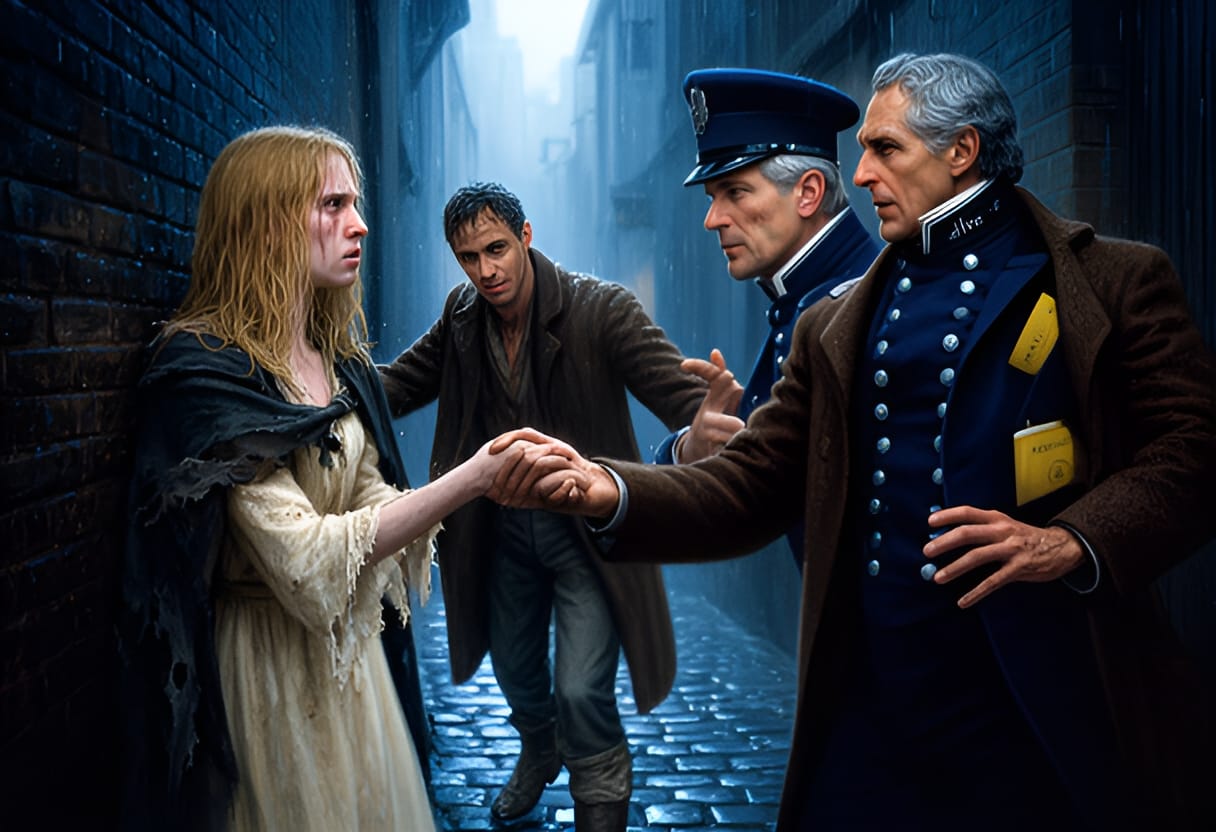
The dandy turned, startled, to see Inspector Javert standing in the alley’s mouth, his greatcoat buttoned to the throat, his hat shadowing eyes that gleamed with cold authority.
“This woman assaulted a citizen,” Javert said. “She is under arrest for violence and public disorder. Six months, at least.”
“She was provoked,” Jean Valjean said, stepping forward. “She was robbed and abused. Take her to the hospital, not the jail.”
Javert’s gaze flicked to him, then narrowed. “You interfere, Monsieur le Maire?”
“I ask for mercy,” Jean Valjean said. “She is ill. She needs care, not punishment.”
Javert studied him a moment — the mayor’s face, the set of his jaw — then gave a curt nod. “Very well. But she will answer for her actions.”
He gestured to two gendarmes who had appeared silently at his heels. They took Fantine’s arms gently, though she trembled violently, her breath coming in ragged gasps.
“Come,” Jean Valjean said to her, his voice soft. “You are safe now.”
He walked beside them as they led her through the slick streets to his house, the rain picking up, turning the cobbles to mirrors that reflected the dim glow of lanterns. Inside, he had her laid on a bed in the spare room, sent for the doctor, and removed her soaked shawl, replacing it with a clean linen cloth.
The doctor came — a man with kind eyes and a tired expression — and after listening to her lungs, he shook his head.
“Consumption,” he said quietly. “She has weeks, perhaps days. She needs warmth, rest, and kindness.”
Jean Valjean thanked him and paid him well, then sat by the bed as Fantine drifted into a fitful sleep. Her lips were cracked, her breathing shallow. When she woke, she stared at him with wide, frightened eyes.
“You… you came for me,” she whispered.
“I promised,” he said. “I will not let you suffer.”
She reached a trembling hand toward him. “Cosette… she… the Thénardiers… they lied. They said she was well, but she is cold, always crying. They beat her. They make her work like a slave. I sent every sou… but they took it. They said… they said I was a bad mother for not sending more.”
Tears slipped from her eyes. “I am dying, Monsieur. I cannot go to her. I cannot see her face.”
Jean Valjean took her hand, his own trembling slightly. “You will see her,” he said, his voice thick. “I swear it before God. I will go to Montfermeil myself. I will take her from them. I will raise her as my own. You have my word.”
A faint, peaceable smile touched her lips. “Thank you… Monsieur… Madeleine…”
Her breathing grew shallower. The fire in the hearth flickered. He held her hand until the last breath left her body, soft as a sigh.
He closed her eyes gently, then bowed his head. The rain tapped against the window, steady and slow. Outside, the town slept. Inside, a promise had been made — and a life, however briefly, had been held in mercy.

Chapter 3
The Barricade and the Soul’s Reckoning
Fantine’s breath grew shallow, her fingers clutching the edge of the blanket as if holding herself to this world. Jean Valjean smoothed the coverlet over her, his voice low and steady. “You must not speak. Rest now. I will find her.”
Her eyes, glassy with fever, found his. “Cosette… my little one…”
“I have sent for her. She will come. You must trust me.”
A weak smile touched her lips. “You… you are good. Like an angel.”
He did not correct her. He could not. Instead, he pressed a kiss to her forehead, the way he had seen mothers do with their children, and whispered, “Sleep. I am here.”
She exhaled, her body going limp. The room fell silent except for the soft rasp of her breathing. Valjean rose, pulled the curtain closed, and stepped into the hall. He needed air. He needed to think.
The night was deep, the streets of Montreuil-sur-Mer quiet beneath a sky washed with stars. He walked without purpose, his hands clenched at his sides, the memory of the bishop’s voice echoing in his chest: You belong not to evil, but to good. He had kept the silver candlesticks. Not sold them. Not melted them down. They sat in a drawer in his room, wrapped in cloth, untouched since that night in Digne. A reminder. A burden. A grace.
He had become Monsieur Madeleine. Mayor. Factory owner. A man respected, even liked. But the past was not a cloak one could shed. It was a scar. And now, Fantine’s dying breath had laid upon him a new weight: a child he had never seen.
He turned back toward the house. Tomorrow, he would find Cosette. He would keep his promise. Not for God, not exactly. Not anymore. But for her. For the woman who had trusted him with her last breath. And for the bishop, whose mercy had not been wasted.
He opened the door. The lamplight spilled onto the threshold. And there, in the glow, stood a small figure in a thin dress, her hair tangled from sleep, her eyes wide and wary.
“Are you my mother’s friend?” the girl asked, her voice small but clear.
Jean Valjean’s breath caught. He sank to one knee, not in prayer, but in presence. “I am,” he said. “And I will take care of you now.”
She stepped forward, hesitantly, and placed her small hand in his. It was cold. He held it tightly.
Years later, the air in the Luxembourg Gardens was warm and thick with the scent of chestnut blossoms. Cosette, now seventeen, sat on a bench beneath a canopy of leaves, her sketchbook open on her lap. She drew absently, her pencil tracing the curve of a swan gliding across the pond. Her hair, the color of honey, caught the sunlight. She wore a simple dress of pale blue, and though she was unaware of it, she turned heads.
She had grown up in quietness. In a apartment on the Rue de l’Homme Armé, where the shutters were kept closed and the visitors few. Jean Valjean had taught her to read, to sew, to pray. He had given her music lessons, though she played poorly and laughed at herself. He had never spoken of her mother. Never spoke of the past. She knew only that he had found her, that he had loved her, that he called her his daughter.
And she loved him in return, with a quiet devotion that asked for nothing.
Today, she had come to the gardens to draw, to escape the confines of the house. She had not expected to be seen.
But she was.
On the path ahead, a young man stopped. He wore a dark coat, his hair slightly too long, his eyes intense behind round spectacles. He was Marius Pontmercy, a law student known for his quiet fervor and his Banquet speeches in favor of the Republic. He had been expelled from his grandfather’s house for his politics, and lived now in a small room near the Sorbonne, surviving on meager allowances and fierce ideals.
He had come to the gardens to think, to breathe air not thick with revolutionary slogans. And then he saw her.
She was not beautiful in the way of painted ladies or opera singers. She was beautiful in the way of dawn—soft, unguarded, alive. Her face was turned toward the light, her lips slightly parted as she concentrated on her drawing. Something in him stopped. His breath halted. He did not move. He did not dare.
She looked up.
Their eyes met.
And in that instant, the world narrowed to the space between two hearts that had, until now, beaten in silence.
Marius lay where he had fallen, his breath shallow against the cold stones of the barricade. Gunfire cracked overhead, splintering wood and sending dust into the air. Jean Valjean knelt beside him, one hand pressing against the wound in Marius’s side, the other gripping the butt of a pistol he had not fired. The boy’s face was pale, his lips parted, eyes fluttering open and shut like a moth against glass.
“Marius,” Valjean whispered. “Can you hear me?”
A faint groan was the only answer. Blood soaked through the young man’s coat, dark and warm against Valjean’s fingers. He had come not to fight, but to find—to take Marius’s place if he could, to beg the gods to let the boy live while he died. Yet now, kneeling in the smoke and stench of powder and blood, he felt only the fierce, helpless need to keep him breathing.
Around them, the defenders fired from behind overturned carts and sandbags. Voices shouted orders, cries of pain rose and fell. A woman’s song drifted from a nearby window—soft, defiant—then cut short by a volley. Valjean glanced up. The barricade held, for now. But the army massed beyond the Rue de la Chanvrerie was relentless. He could not stay.
He slipped his arm beneath Marius’s shoulders, another behind his knees, and lifted. The boy cried out—a short, sharp sound—and went limp. Valjean adjusted his hold, pressing Marius’s head against his shoulder, and moved toward the rear of the barricade where a gap yawned in the stones, covered only by a loose grate.

The sewer.
He had studied the maps of Paris’s undercity, knew the tunnels ran beneath the city like veins. It was foul, dark, and treacherous—but it was a way out. If he could reach the river, perhaps find a boat, he might get Marius to help.
He lowered Marius through the opening first, then followed, pulling the grate into place behind him. The drop was short, but the impact jolted Marius again. Valjean landed in sludge up to his ankles, the water cold and thick with refuse. The air tasted of rot and iron. Above, the muffled thud of cannon fire vibrated through the stone.
He shifted Marius into a firmer hold, one arm under his back, the other supporting his thighs, and began to move. Forward, always forward, guided by memory and the faint slope of the tunnel toward the Seine. His boots slipped on slick stone. Rats scurried in the darkness, brushing past his legs. He ignored them. His whole world was the weight of the boy in his arms, the rise and fall of Marius’s chest, the desperate prayer that he would not grow still.
Hours passed, or perhaps only minutes. Time had no meaning in the dark. Valjean’s muscles burned, his lungs strained against the fetid air, but he did not stop. He paused only to listen—once, for the distant shouts of soldiers, another time for the sound of water ahead, signaling the river’s mouth.
Then, a glimmer. A faint gray light at the end of the tunnel. The grate leading to the riverbank.
He pushed forward, emerging onto the muddy shore just as dawn began to bleed into the sky. The Seine flowed wide and gray, dotted with debris. He laid Marius gently on the bank, checked his breathing—still there, faint but present—and tore a strip from his own shirt to bind the wound more tightly.
“Hold on,” he murmured. “Just hold on.”
He had taken only a few steps toward the city when a voice stopped him.
“Jean Valjean.”
He turned.
Inspector Javert stood a few paces away, his greatcoat soaked, his hat in hand, his face rigid with exhaustion and something deeper—shock, perhaps, or the slow dawning of disbelief. His pistol hung at his side, unused.
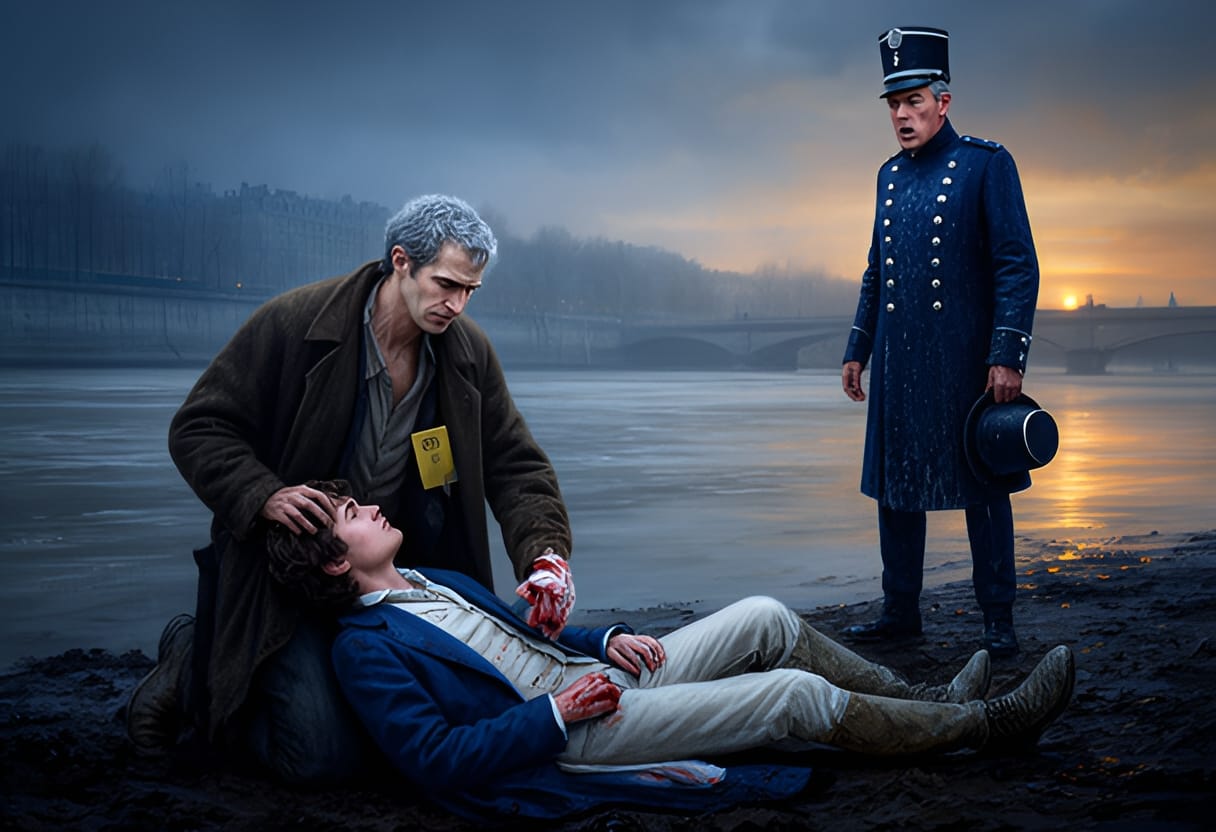
“You… you have him,” Javert said, his voice low. “The boy. Marius Pontmercy. I saw you carry him from the barricade.”
Valjean did not deny it. He only tightened his grip on the makeshift bandage.
“Let me take him to the hospital,” Javert continued. “It is my duty.”
“No,” Valjean said. “Not yet. He needs air. He needs quiet.”
Javert’s eyes flicked to Marius, then back to Valjean’s face. “You risked everything for him. Why?”
Valjean met his gaze. “Because he loves my daughter. And because, once, a bishop told me my soul belonged to good. I have tried to remember that.”
Javert’s jaw worked. He looked from Valjean to the boy, then to the river, where the current carried away the night’s debris. His hand drifted to his pistol—not to draw it, but to rest upon it, as if seeking balance.
“You should have left him to die,” Javert said quietly. “It would have been simpler. Just.”
Valjean said nothing. He could not argue with justice. Only with mercy.
Javert stood very still for a long moment. Then, slowly, he lowered his hand. “Go,” he said. “Take him where he can be cared for. I… I cannot take you today.”
He turned and walked back toward the city, his steps uneven, his posture collapsed. Valjean watched him go, then turned to Marius, who had opened his eyes and was looking at him with a dazed, wondering gaze.
“You came back,” Marius whispered.
“I promised someone I would,” Valjean said. “And I keep my promises.”
He slipped his arms back under Marius and began to walk—not toward the barricade, not toward the fight, but toward the city, toward doctors, toward the quiet apartment where Cosette waited, her heart unaware that it was about to be healed.
The sun rose higher, gilding the water, and for the first time in years, Jean Valjean did not feel the weight of the past as a burden, but as a thread—woven through suffering and grace—leading him, at last, toward peace.