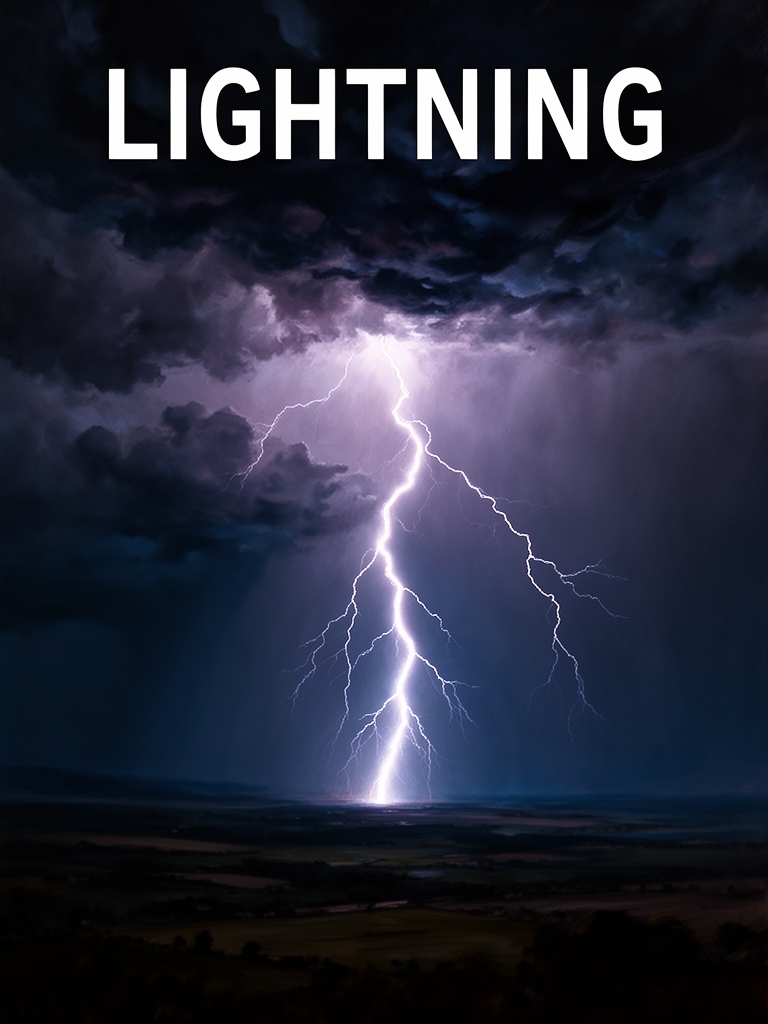
ID · lightning-81093693
LIGHTNING
By Prabu Amarakoon · Fiction · Professional · 10 pages
Table of contents
- 1. Understanding the Power of Nature
This chapter introduces the reader to the awe-inspiring world of lightning and thunderstorms, setting the stage for a deeper exploration of these natural wonders. The introduction to a visual guide about lightning, exploring its beauty, power, and the science behind it, including its various forms and behaviors, and the human experience of lightning throughout history. Dr. Maria Rodriguez explains the complex physics behind thunderstorms, including the formation of convection currents, condensation of water vapor, and generation of static electricity, which ultimately leads to lightning. The visual guide illustrates the process and highlights the importance of understanding thunderstorms and lightning to predict and protect against them.
- 2. The Impact of Lightning
This chapter examines the effects of lightning on the environment and human societies, from the ecological role of lightning in shaping landscapes to its impact on human settlements and activities. Dr. Maria Rodriguez and her team discuss the ecological role of lightning, its impact on the environment, and its effects on human settlements and activities, highlighting the complex and often contradictory nature of lightning's influence. Dr. Maria Rodriguez and her team discuss the ecological and environmental effects of lightning, including its role in shaping landscapes, causing wildfires, and impacting human settlements and agriculture. A sudden storm interrupts their discussion, providing a spectacular display of lightning and leaving the team in awe of its power. Dr. Rodriguez and her team discuss the significance of lightning, its impact on human culture, and the various ways humans have encountered it throughout history. They explore the importance of understanding lightning's behavior, particularly in areas prone to frequent and intense lightning activity, and delve into the mystery of ball lightning.
- 3. Safety and Awareness
Concluding the book, this chapter emphasizes the importance of safety and awareness in the face of lightning and thunderstorms, providing readers with practical advice and insights.
Chapter 1: Understanding the Power of Nature
This chapter introduces the reader to the awe-inspiring world of lightning and thunderstorms, setting the stage for a deeper exploration of these natural wonders. The introduction to a visual guide about lightning, exploring its beauty, power, and the science behind it, including its various forms and behaviors, and the human experience of lightning throughout history. Dr. Maria Rodriguez explains the complex physics behind thunderstorms, including the formation of convection currents, condensation of water vapor, and generation of static electricity, which ultimately leads to lightning. The visual guide illustrates the process and highlights the importance of understanding thunderstorms and lightning to predict and protect against them.
A Visual Guide to Lightning
The world of lightning and thunderstorms was a realm of breathtaking beauty and formidable power, a domain where the forces of nature converged to create spectacular displays of energy and sound. As the reader embarked on this journey to understand the power of nature, it was essential to first grasp the visual aspects of lightning, to witness its awe-inspiring beauty and to comprehend the science behind its mesmerizing displays. The visual guide to lightning was not merely a collection of images, but a gateway to understanding the complex dance of electrical charges, the buildup of massive storm clouds, and the sudden, brilliant flashes of light that illuminated the sky. Through this visual journey, the reader would come to appreciate the intricate relationships between lightning, thunderstorms, and the safety measures that protected humans from the fury of the storms.
As one delved into the world of lightning, the sheer diversity of its forms and behaviors became apparent, from the towering cumulonimbus clouds that gave birth to massive lightning bolts, to the faint, glowing tendrils of ball lightning that seemed to defy explanation. The visual guide would take the reader on a tour of these various manifestations, exploring the science behind each type of lightning and the conditions that gave rise to their unique characteristics. From the anvil-shaped clouds that spawned powerful supercells, to the rolling waves of thunderstorms that swept across the landscape, each image would tell a story of the incredible forces that shaped our planet. "The beauty of lightning lies not just in its visual appeal," said Dr. Maria Rodriguez, a leading expert in the field, "but in the complex physics that underlies its behavior, a dance of electrons and ions that we are still striving to fully understand."
The visual guide would also explore the human experience of lightning, the ways in which it had shaped cultures and inspired art throughout history. From the ancient myths that attributed lightning to the wrath of gods, to the modern-day storm chasers who risked life and limb to capture the perfect shot, the story of lightning was inextricably linked to the story of human fascination and awe. As the reader turned the pages, they would encounter stunning images of lightning-illuminated landscapes, each one a testament to the power and beauty of the natural world. Whether it was a bolt of lightning slicing through a dark sky, or a thunderstorm rolling in across the horizon, each image would evoke a sense of wonder and curiosity, inviting the reader to delve deeper into the mysteries of the stormy weather.
The Science Behind Thunderstorms
As Dr. Maria Rodriguez delved deeper into the world of lightning, she began to explain the complex physics that underlay the behavior of thunderstorms. "You see, the formation of a thunderstorm is a multifaceted process," she said, "involving the interaction of moisture, heat, and wind. It begins with the warming of the ground, which heats the air closest to the surface, causing it to rise and create convection currents." The visual guide illustrated this process with stunning images of towering cumulonimbus clouds, their anvil-shaped tops stretching high into the atmosphere. "As the air rises, it cools, and the water vapor it contains condenses into droplets, forming clouds," Dr. Rodriguez continued. "Within these clouds, the water droplets and ice crystals collide, generating static electricity and creating the conditions for lightning to occur."
The visual guide took the reader on a journey through the inner workings of a thunderstorm, exploring the updrafts and downdrafts that drove the storm's circulation, and the role of ice and water in the formation of lightning. "The ice crystals and water droplets within the cloud collide and transfer electrons, generating a separation of electrical charges," Dr. Rodriguez explained. "The upper part of the cloud becomes positively charged, while the lower part of the cloud and the ground become negatively charged. This separation of charges creates an electric field, which eventually breaks down, resulting in a lightning discharge." The images in the visual guide showed the incredible power of lightning, with bolts of electricity illuminating the dark sky and casting an otherworldly glow over the landscape.
As the reader explored the science behind thunderstorms, they began to appreciate the intricate relationships between lightning, thunderstorms, and the safety measures that protected humans from the fury of the storms. Dr. Rodriguez emphasized the importance of understanding these relationships, saying, "By studying the behavior of thunderstorms and the conditions that give rise to lightning, we can better predict when and where lightning is likely to occur, and take steps to protect ourselves and our communities." The visual guide concluded with a series of images showing the impact of lightning on human societies, from the destruction caused by lightning strikes to the beauty and wonder of lightning-illuminated landscapes. Through these images, the reader gained a deeper appreciation for the power and beauty of lightning, and the importance of respecting and understanding this incredible force of nature.
Chapter 2: The Impact of Lightning
This chapter examines the effects of lightning on the environment and human societies, from the ecological role of lightning in shaping landscapes to its impact on human settlements and activities. Dr. Maria Rodriguez and her team discuss the ecological role of lightning, its impact on the environment, and its effects on human settlements and activities, highlighting the complex and often contradictory nature of lightning's influence. Dr. Maria Rodriguez and her team discuss the ecological and environmental effects of lightning, including its role in shaping landscapes, causing wildfires, and impacting human settlements and agriculture. A sudden storm interrupts their discussion, providing a spectacular display of lightning and leaving the team in awe of its power. Dr. Rodriguez and her team discuss the significance of lightning, its impact on human culture, and the various ways humans have encountered it throughout history. They explore the importance of understanding lightning's behavior, particularly in areas prone to frequent and intense lightning activity, and delve into the mystery of ball lightning.
Ecological and Environmental Effects
The impact of lightning on the environment was a topic of great fascination for Dr. Maria Rodriguez, and she spent a significant amount of time studying the ecological role of lightning in shaping landscapes. As she explained to her team, lightning played a crucial role in maintaining the balance of nature, particularly in areas prone to wildfires. "Lightning-caused fires can be beneficial to the ecosystem," she said, "as they help to clear out dead vegetation and promote new growth." Her team listened intently, taking note of the complex relationships between lightning, vegetation, and wildlife. The visual guide that accompanied Dr. Rodriguez's explanation illustrated the process, showing how lightning could ignite fires that would then burn away dead plant material, allowing new plants to grow in their place.
The team also explored the effects of lightning on human settlements and activities, from the damage caused by lightning strikes to buildings and infrastructure, to the impact of lightning on agricultural productivity. Dr. Rodriguez pointed out that lightning could have a significant impact on crop yields, particularly in areas where lightning was frequent and intense. "A single lightning strike can damage or destroy a significant portion of a crop," she explained, "leading to economic losses for farmers and potentially even food shortages." Her team considered the various ways in which humans could mitigate the effects of lightning on agriculture, from using lightning rods to protect buildings and crops, to developing more resilient crop varieties that could withstand the intense heat and energy released by lightning.
As the team delved deeper into the topic, they began to appreciate the complex and often contradictory nature of lightning's impact on the environment. On the one hand, lightning was a destructive force that could cause significant damage and loss of life. On the other hand, it was also a creative force that played a crucial role in shaping the natural world. Dr. Rodriguez summed up the paradox nicely, saying, "Lightning is a reminder of the awe-inspiring power of nature, and the importance of respecting and understanding that power." Her team nodded in agreement, recognizing that the study of lightning was not just about understanding a natural phenomenon, but also about appreciating the intricate web of relationships that existed between humans, the environment, and the forces of nature.
The team's discussion of lightning's ecological and environmental effects was interrupted by a sudden storm that rolled in, bringing with it a spectacular display of lightning. The team gathered at the window, watching in awe as the lightning illuminated the sky, its brilliant flashes casting an otherworldly glow over the landscape. Dr. Rodriguez smiled, saying, "There's no better way to appreciate the power of lightning than to see it up close." As they watched, the team couldn't help but feel a sense of reverence for the natural world, and a deep appreciation for the complex and often mysterious forces that shaped it. The storm eventually passed, leaving behind a sense of calm and a renewed appreciation for the beauty and power of lightning.
Human Encounters with Lightning
As the storm dissipated, Dr. Rodriguez and her team returned to their discussion, their minds still reeling from the breathtaking display of lightning they had just witnessed. The experience had left them all with a deeper appreciation for the power and beauty of lightning, and a renewed sense of wonder at the complex forces that drove it. "There's something about lightning that has always fascinated humans," Dr. Rodriguez said, "a sense of awe and reverence that is hard to find in our daily lives." Her team nodded in agreement, recognizing that lightning had a way of putting things into perspective, reminding them of the fragility and beauty of the natural world.
The team began to discuss the various ways in which humans had encountered lightning throughout history, from the ancient myths and legends that had grown up around it, to the modern-day efforts to understand and predict its behavior. Dr. Rodriguez pointed out that lightning had played a significant role in shaping human culture, influencing everything from art and literature to science and technology. "Lightning has been a source of inspiration for artists and writers, a symbol of power and energy that has captivated human imagination," she said. Her team considered the various ways in which lightning had been depicted in art and literature, from the dramatic lightning bolts of the Renaissance painters, to the poetic descriptions of lightning in the works of Shakespeare and other writers.
As they delved deeper into the topic, the team began to explore the various ways in which humans had sought to mitigate the effects of lightning, from the use of lightning rods and other protective devices, to the development of more sophisticated warning systems and emergency response protocols. Dr. Rodriguez emphasized the importance of understanding lightning's behavior, particularly in areas prone to frequent and intense lightning activity. "By studying lightning and its effects on the environment, we can develop more effective strategies for protecting people and property," she said. Her team nodded in agreement, recognizing that the study of lightning was not just about understanding a natural phenomenon, but also about saving lives and reducing the economic and social impacts of lightning strikes.
The discussion eventually turned to the topic of ball lightning, a rare and poorly understood form of lightning that had been reported throughout history. Dr. Rodriguez explained that ball lightning was a type of lightning that appeared as a glowing, floating ball of light, often associated with thunderstorms. "Despite extensive research, the exact mechanisms behind ball lightning remain unclear," she said. Her team listened intently, fascinated by the mystery and intrigue surrounding this enigmatic phenomenon. As they talked, they couldn't help but feel a sense of wonder at the complex and often mysterious forces that shaped the natural world, and a deep appreciation for the ongoing efforts to understand and explain them.
As the day drew to a close, Dr. Rodriguez and her team reflected on what they had learned, their minds still buzzing with excitement and curiosity. They had gained a deeper understanding of the complex physics that underlay lightning's behavior, and a greater appreciation for the importance of respecting and understanding the power of nature. The experience had left them all with a renewed sense of awe and reverence for the natural world, and a deeper commitment to ongoing research and exploration. As they packed up their things and headed home, they couldn't help but feel grateful for the opportunity to study this fascinating phenomenon, and to contribute to the ongoing quest for knowledge and understanding.