Fiction
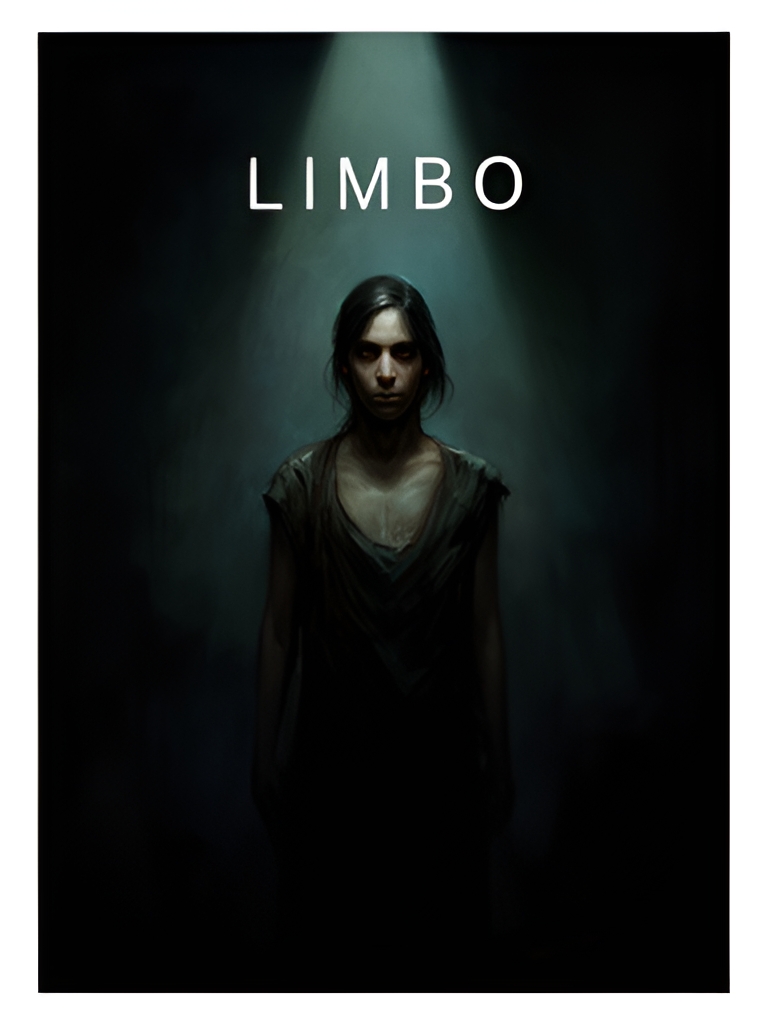
LIMBO
by Thaynara Ferreira do nascimento
3 chapters16 min read

Chapter 1
Awakening in White
The light was everywhere and nowhere, a uniform glare that erased shadows and depth. Daniel blinked against it, his temples throbbing with a dull, persistent ache. He lay on something cool and smooth beneath him—no give, no texture, just a flat surface that seemed to rise from the floor without seam or edge. When he pushed himself up, his fingers found no joint, no crack where wall met floor or ceiling. It was all one substance, seamless and white, extending in every direction until the eye could no longer distinguish where one began and the other ended.
He pushed to his feet, swaying slightly as a wave of nausea passed through him. His forehead felt tight, and when he touched it, his fingertips came away damp. Blood, dried into a stiff line just above his right eyebrow. He didn’t remember getting hurt.
“Hello?” His voice sounded thin, swallowed almost immediately by the space. He tried again, louder. “Is anyone there?”
No answer. No echo. The silence wasn’t empty—it was active, pressing in like a weight. He turned in a slow circle, searching for any variation in the white, any hint of a door, a seam, a shadow. Nothing. The room had no boundaries he could perceive, no furnishings beyond a single bench along one wall—or what he assumed was a wall, though it looked identical to everything else.
He walked toward it, hands outstretched, expecting resistance, but met only open space. When he reached the bench, he sat, the coolness seeping through his thin clothes. He didn’t remember putting them on. Didn’t remember much of anything.
Fragments teased at the edge of his mind: the shriek of metal, a blur of headlights cutting through sheets of rain, the smell of wet asphalt and something metallic—blood, maybe. A woman’s voice, raised in surprise, not fear. Then nothing.
He pressed his palms to his temples, trying to pull the threads together. His name—what was it? It hovered just beyond reach, like a word on the tip of the tongue. Daniel. It came suddenly, startling in its clarity: Daniel Voss. Forty-two. Architect. Or had been. He couldn’t recall designing anything lately. Couldn’t recall waking up today, or yesterday, or the day before.
A sound made him jerk upright—not a noise, but a presence. He hadn’t heard footsteps, hadn’t seen movement, yet there stood a figure where none had been a breath ago.
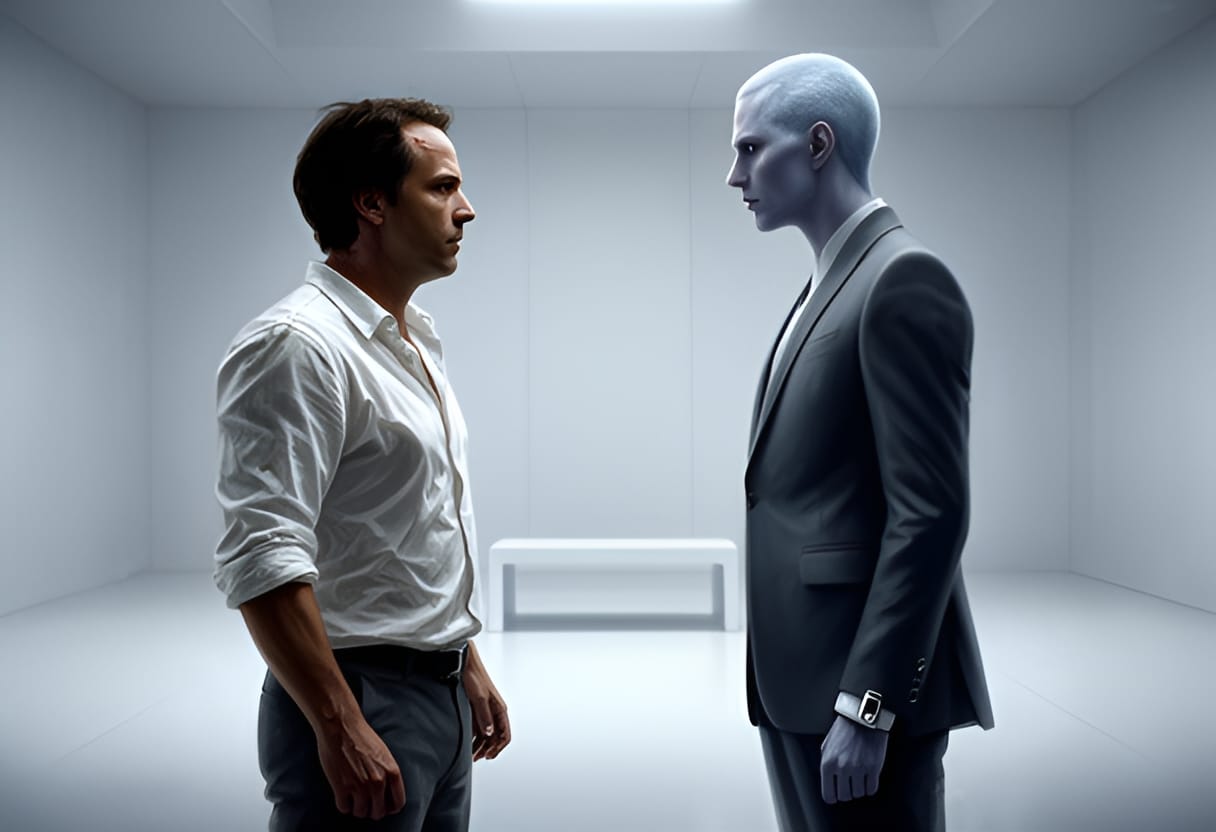
Tall, dressed in a gray suit cut with precise severity, the man—or whatever he was—stood perfectly still. His face was ageless, features smooth and unlined, eyes dark and calm as deep water. He wore no expression, but his gaze fixed on Daniel with quiet intensity.
“You’re awake,” the figure said. His voice was low, measured, neither welcoming nor harsh.
Daniel’s heart hammered. “Where am I? Who are you?”
“You are in Limbo,” the Arbiter replied. “A threshold. A place between what was and what is to come.”
Daniel frowned. “Limbo? Like… purgatory?”
“Not punishment. Not reward. Reckoning.” The Arbiter tilted his head slightly. “You died. But you do not remember how. Or why. That is common here. Those who arrive with unresolved guilt, with denial, find themselves in the White Room first. It strips away distraction. Forces clarity.”
Daniel looked down at his hands. “I don’t remember anything. Just… flashes. Rain. Glass.”
“The White Room holds you until you are ready to proceed. Or until you choose to remain.”
“And if I choose to proceed?”
The Arbiter’s gaze did not waver. “You enter the Processing Corridor. There, you will face what you have done. Not to be judged. To be seen. Release comes only when the truth is met without evasion.”
Daniel swallowed. The ache in his head pulsed again, sharper now. “What if I don’t want to see it?”
“Then you stay. Here. Until you do.”
A long silence passed. The white light pressed in, unblinking. Daniel stood, legs stiff. He looked past the Arbiter—toward a darkness that hadn’t been there before, a corridor stretching into low gray light, lined with identical doors.
“I’ll go,” he said, voice rough. “I want to remember.”
The Arbiter inclined his head once. “Then step forward.”
Daniel took a breath and walked past him, the white fading behind him as the corridor swallowed his steps. He did not look back.
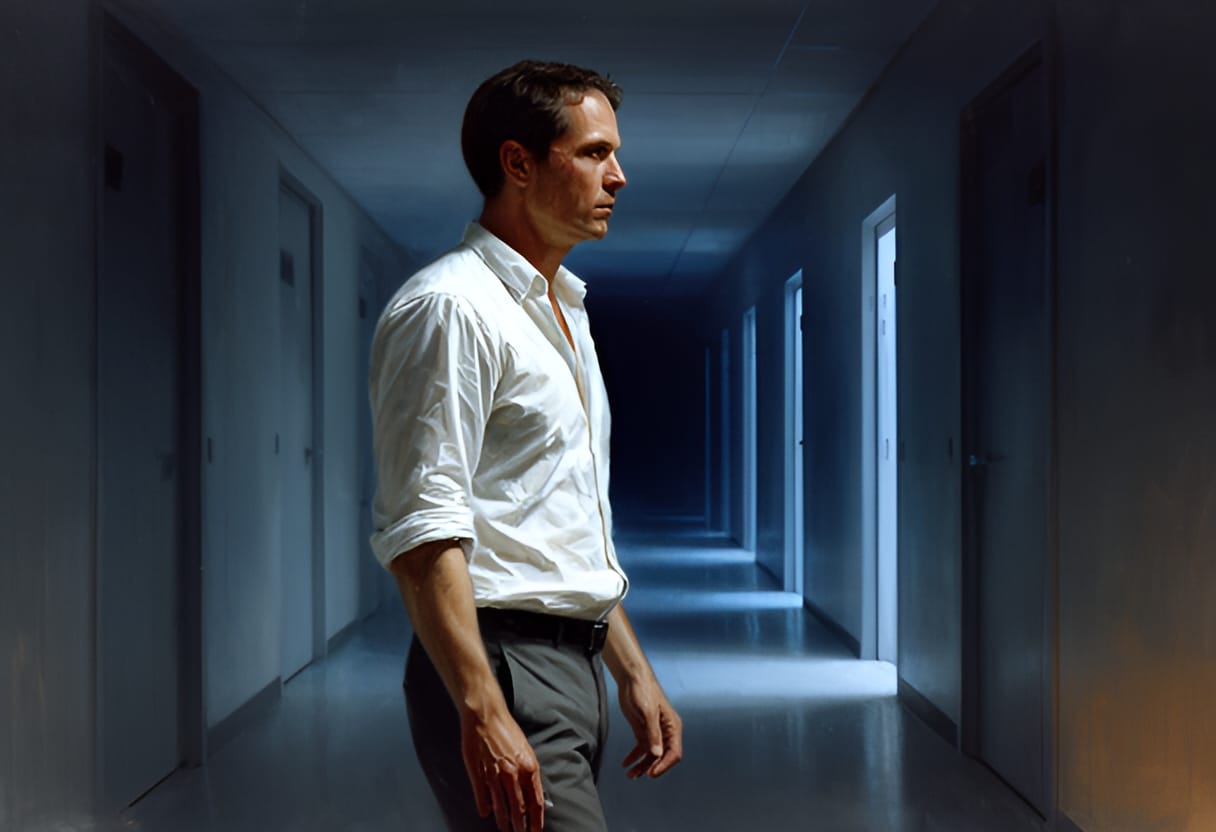
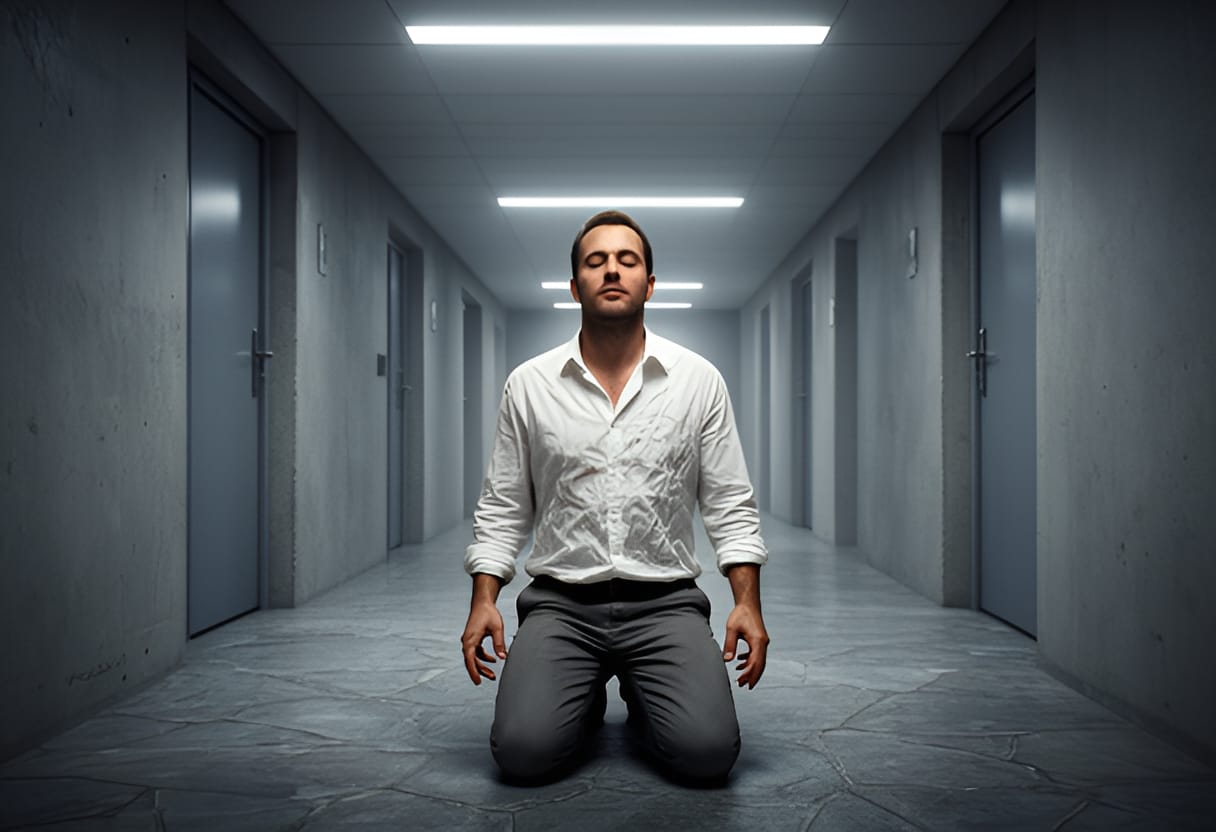
Daniel stepped onto the threshold where the seamless white gave way to dimmer light, the air shifting from sterile to something cooler, tinged with the faint scent of ozone and old stone. The corridor stretched ahead, its walls a uniform gray that absorbed rather than reflected the low illumination. Doors lined both sides, flush with the surface, each indistinguishable from the next—same height, same width, same matte finish. Yet as he moved forward, a soft luminescence began to bloom around one door near the middle of the hall, a gentle pulse like a heartbeat beneath the surface.
He stopped before it, hand hovering inches from the cool metal of the handle. The glow intensified slightly, warm and insistent, as if the door recognized his proximity.
“It responds to readiness,” the Arbiter said, appearing beside him without sound. “Not to guilt. Not to shame. To the willingness to see what lies beyond.”
Daniel turned his head. The Arbiter stood with hands clasped behind his back, expression unreadable, eyes fixed on the door. “How do I know it’s the right one?”
“There is no ‘right’ door in the order of passage,” the Arbiter replied. “Only the one that aligns with the memory you are most avoiding. It will call to you—not with sound, but with presence. You will feel it in your bones before you understand why.”
Daniel swallowed. The ache in his forehead had dulled to a throb, but a new tension coiled in his gut, tight and unfamiliar. He thought of the woman’s voice—raised, not afraid—and the sudden silence that followed. Rain on glass. Metal buckling.
“I don’t know if I’m ready,” he admitted.
The Arbiter tilted his head. “Readiness is not the absence of fear. It is the choice to move despite it.”
Daniel drew a breath that felt too shallow, then another. He reached out, fingers brushing the handle. It was neither hot nor cold, but hummed faintly beneath his palm, like a live wire wrapped in cloth. The glow flared once, steady and gold, then settled into a soft radiance that spilled onto the floor at his feet.
He turned the handle.
The door opened inward, revealing not a room, but a blur of motion and sound—rain slashing diagonally across a windshield, the screech of tires on wet pavement, a flash of chrome and glass. A voice cut through the storm: “Watch out!”—not his own, but familiar, close. Then impact. The world tilted. Light shattered. And beneath it all, a quiet, devastating stillness.
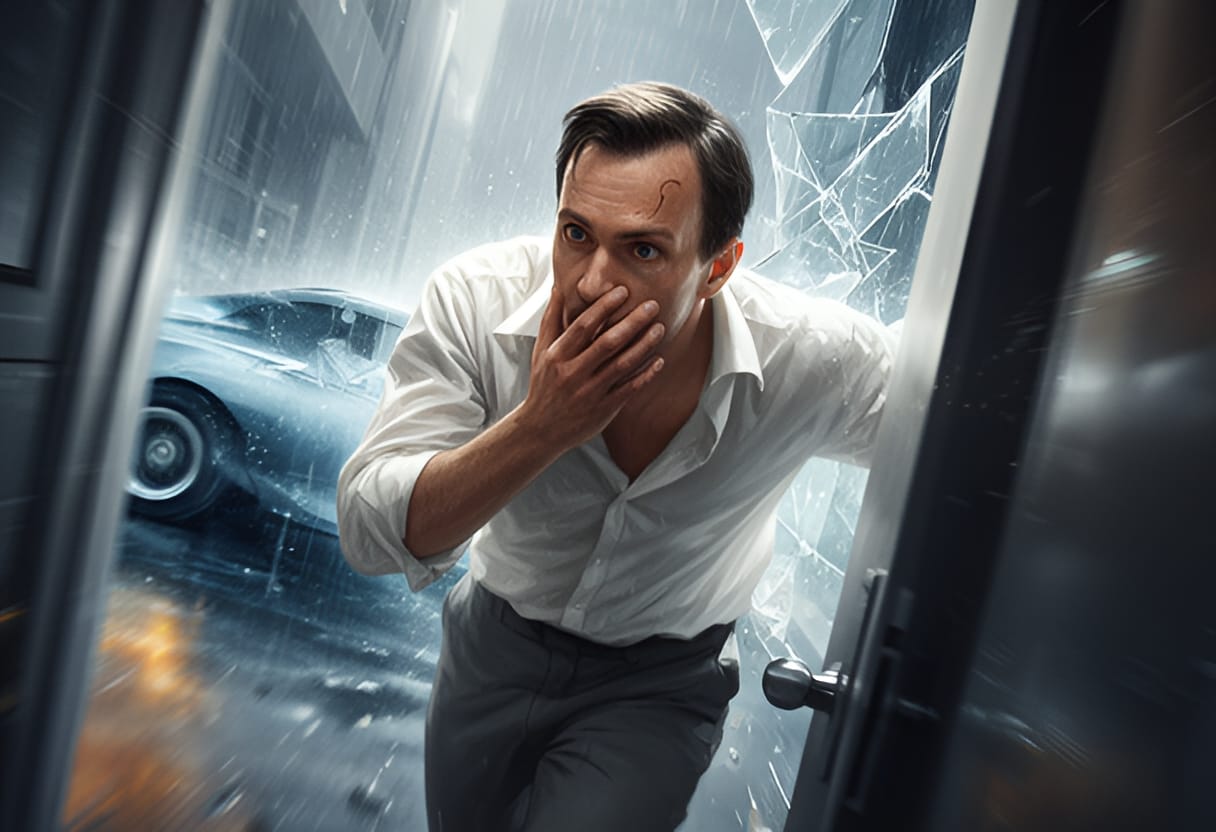
Daniel stumbled back, hand flying to his mouth. His breath came in short, sharp gasps. The corridor swallowed the sound of the door closing behind him, but the images lingered—phosphorescent behind his eyelids.
The Arbiter did not move. “You saw,” he said, not a question.
Daniel wiped his eyes with the heel of his hand, leaving a faint smudge. “I didn’t know it was her.” His voice was raw. “I swear—I didn’t know.”
The Arbiter’s gaze remained steady. “Limbo does not ask what you knew. It asks what you did.”
Daniel looked down at his trembling hands. The guilt had been a shadow before; now it was a weight, pressing down from his chest to his knees. He wanted to turn and run, to flee back into the white emptiness where nothing made sense and nothing was demanded of him. But the Arbiter was right—he had come here not to hide, but to remember.
He lifted his chin. “Then let me see it all.”
The Arbiter inclined his head once. A silent acknowledgment. The first step taken.
Daniel stepped forward, into the corridor, the doors closing behind him with a sound like a breath held, then released. The glow on the door he had just left faded to nothing, as if it had never been. Ahead, the next door waited—dark, silent, but already beginning to stir.
Chapter 2
Doors of Memory
Daniel stepped forward into the corridor, the doors closing behind him with a sound like a breath held, then released. The glow on the door he had just left faded to nothing, as if it had never been. Ahead, the next door waited—dark, silent, but already beginning to stir.
He walked slowly, hands loose at his sides, eyes fixed on the stretch of gray doors receding into dim light. The corridor exhaled a quiet hush, broken only by the occasional shift in air, a faint tremor beneath his boots. Some doors sat cold and inert, their surfaces absorbing sound. Others thrummed with life just beneath the veneer—muffled voices, distant laughter, the sharp crack of an argument cut short. He passed the first without pause, telling himself it was not his. The second held the echo of a child’s giggle, bright and unfamiliar, and he stepped faster, as if pace could outrun recognition. The third pulsed with the rhythm of hurried footsteps on stone, someone breathing hard, a coat brushing against a wall—still not his.
He stopped before the fourth.
It did not flash or call. It simply waited, a low hum vibrating through the metal of the latch, steady as a heartbeat. And beneath it, unmistakable despite the years—the slow, rhythmic swipe of windshield wipers in rain. Not frantic, not panicked. Just… there. Back and forth. Back and forth. Like a metronome counting down to something he had spent his death avoiding.
His fingers curled at his sides. He had told the Arbiter he wanted to see it all. But seeing and stepping through were different things. The corridor had shown him a fragment—impact, noise, a voice warning—but this was the before. The ordinary. The moment when everything was still fixable.
He pressed his palm flat against the door. It was warm. Not burning, not alive, but aware. Like skin after sunlight.
“I don’t have to do this now,” he whispered, though no one was there to hear. “I can wait. Let it come later.”
But the hum did not change. The wipers kept their slow arc. And somewhere behind the door, beneath the rain and the glass and the hush of tires on wet asphalt, he thought he heard it again—a woman’s voice, soft, urgent, not afraid, just trying to be heard.
His breath hitched. The guilt, which had settled in his chest like stone, gave a sudden, sharp jerk upward, stealing his air.
He did not think. He only pushed.
The door opened inward.
Sound and sensation flooded him—not a blur this time, but a surge. Rain on his cheeks. The smell of wet wool and hot metal. The weight of the steering wheel under his palms. The dashboard lights glowing amber in the gloom. And the wipers—yes, there—slashing slow arcs across the windshield, clearing nothing, just moving.
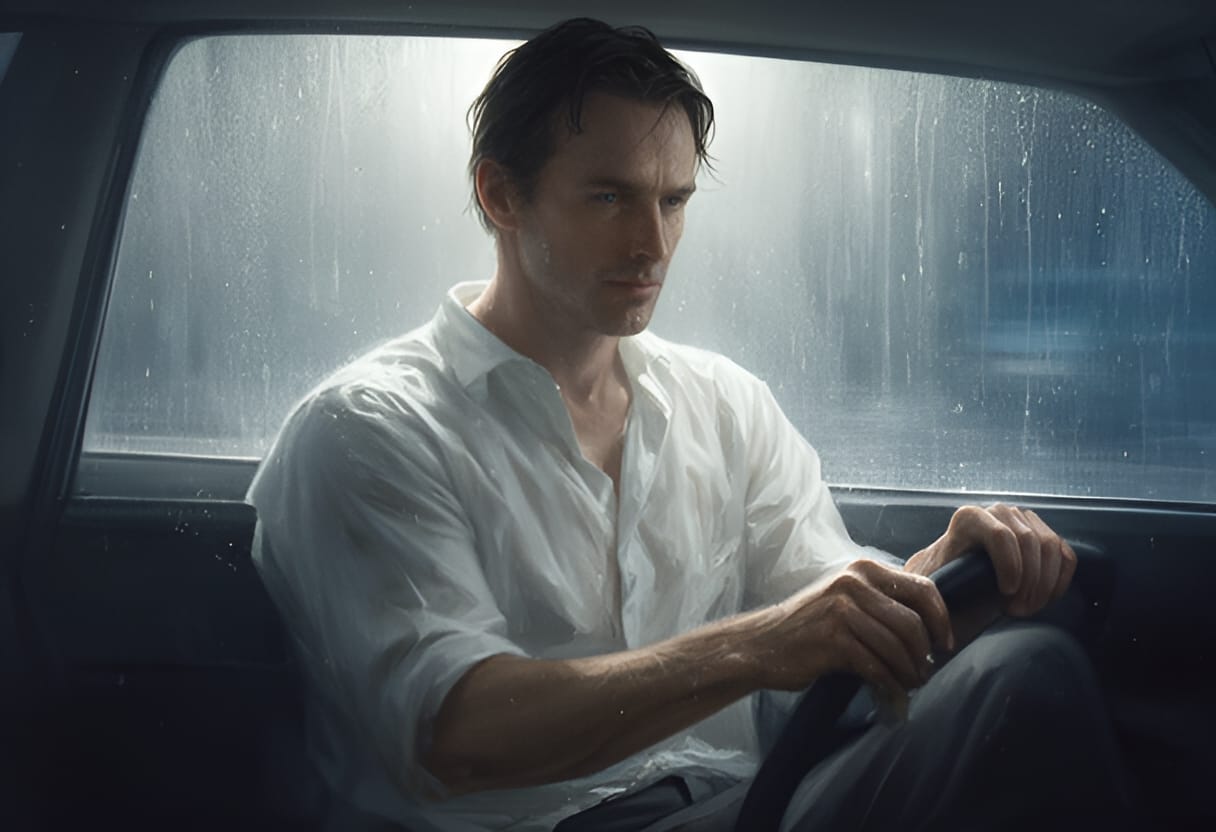
He was driving. Again. And for the first time since waking in white, he knew where he was going.
Home. Or what passed for it.
The radio played low—jazz, something muted. He had turned it down to think. Or to listen. For what, he couldn’t say.
Then, from the passenger seat—clear as if she were speaking into his ear—came the voice.
“Watch out!”
Not a scream. Not a panic. Just a warning. Close. Familiar.
He turned his head—
And the world shattered. — *—
Daniel stumbled into the Memory Room, knees hitting the floor before he could catch himself. The air smelled of ozone and rust. Above him, the intersection swam into view with terrible clarity—streetlights haloed in rain, the glare of oncoming headlights slicing through the downpour, the crosswalk stripes blurred but unmistakable.
And there, in the center of it all, caught in the low beam of his own headlights, stood Elena Ruiz.
She was mid-step, one foot lifted, her head turned toward him—not in fear, but in surprise, as if she had expected him to stop. Her umbrella was half-lowered. Her mouth was open, maybe to speak, maybe just to breathe.
The tires screamed.
He saw it all.
And then, impossibly, he saw her break.
The impact was not a crash, but a crumpling—folding inward like paper in a fist. Her body jerked upward, then fell, not forward, but to the side, rolling once before lying still. The umbrella spun away, landing in the gutter, water pooling black around the tip.
Silence.
Not the silence of absence, but of presence—the kind that follows a sound too large for the world to absorb.
Daniel remained on his knees, hands pressed to the pavement that was not pavement, breath coming in ragged pulls. The rain fell on his face, cold and relentless, but he did not wipe it away. He could not look from her. Could not move.
Somewhere, distant and thin, the wipers kept their slow, useless arc. Back and forth. Back and forth. As if time had forgotten to stop.
The wipers kept their slow arc. Back and forth. Back and forth. As if time had forgotten to stop.
Daniel remained on his knees, hands pressed to the pavement that was not pavement, breath coming in ragged pulls. The rain fell on his face, cold and relentless, but he did not wipe it away. He could not look from her. Could not move.
Then, as if the memory had been waiting for this exact surrender, the scene shifted.
He was no longer on his knees in the rain. He was behind the wheel again, hands gripping the wheel too tight, knuckles white. The windshield blurred with rain, the wipers slashing useless arcs. The radio played low jazz, but he wasn’t listening. His phone buzzed against his thigh—once, twice. A work message. The firm. The project deadline. He glanced down, just for a second, fingers fumbling to unlock the screen.
When his eyes snapped back to the road, she was already in the crosswalk.
One step. Two. Her umbrella half-lowered, head turned—not at him, but toward the sidewalk, as if expecting courtesy, not steel.
He jerked the wheel. Stomped the brake. Too late.
The impact came not as a bang, but a sickening lurch—a shudder through the frame, a thud against the hood, then the wet slap of something soft hitting pavement. The car lurched forward, tires hydroplaning for a split second before catching.
Silence inside the cab. Only the rain on the roof, the idle hum of the engine, and the frantic hammering of his own heart.
He didn’t look in the mirror. Didn’t need to. He knew what he’d seen in the split second before impact—the surprise, not fear, in her eyes. The way her body had folded, not flown.
His breath came in short, sharp gasps. His hands shook on the wheel.
Go, a voice whispered in his head—not his own, but the one he’d buried under years of justification. Now. Drive. Don’t stop.
He put the car in gear. The tires spat water as he pulled forward, just enough to clear the intersection. He didn’t speed. Didn’t screech. Just… left. As if pulling away from a curb.
In the rearview mirror, blurred by rain and distance, he saw her—still lying on her side, one arm flung out, the umbrella nowhere in sight. Her bag had burst open, papers scattering like wounded birds in the gutter. Her glasses lay cracked a few feet away, one lens spiderwebbed.
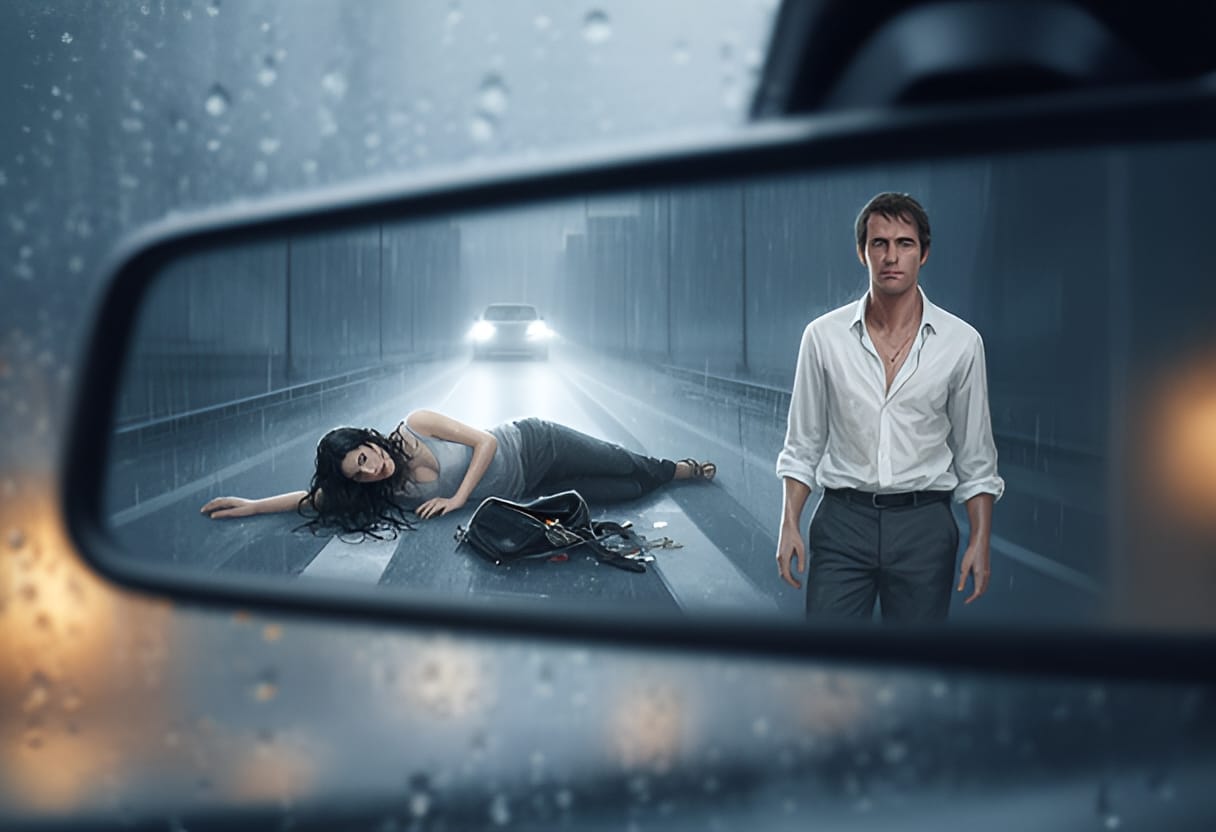
He didn’t stop.
He didn’t call.
He just drove.
The memory snapped back.
Daniel was on his knees again. The rain fell. Elena lay still in the headlights’ glow. The wipers kept their arc. Back and forth. Back and forth.
A sound escaped him—not a sob, not a cry, but something raw and torn, dragged up from somewhere deep and long sealed. His shoulders shook. His forehead pressed toward the wet pavement, though it wasn’t real, not anymore. It was the memory of pavement. The memory of rain. The memory of her.
He had seen it all now. Not just the hit. Not just the panic. But the choice. The quiet, cowardly choice to turn away—to protect his license, his job, his reputation—while she lay broken in the rain, alone.
The guilt wasn’t a stone anymore. It was a flood. It filled his chest, his throat, his behind his eyes. It wasn’t just what he’d done. It was what he’d not done. The call he hadn’t made. The hand he hadn’t reached out. The life he’d left to drown in the dark.
The scene began to shimmer at the edges, as if the Memory Room were resetting, preparing to show it all again—phone, glance, impact, flight—until he could face it without flinching.
But Daniel didn’t wait for the loop to pull him under.
He lifted his head. Rain streaked his face. He looked at Elena—not as a threat, not as a ghost, but as a woman. A teacher. Someone’s daughter, someone’s friend. Someone who had stepped into the street expecting to be seen.
“I saw you,” he whispered, voice broken but clear. “I saw you step out. I saw you fall. And I drove away.”
The words hung in the rain-slicked air.
The wipers kept their slow arc.
But for the first time, the hum didn’t feel like a countdown.
It felt like a reckoning.
Chapter 3
The Weight of Truth
The Memory Room dissolved into gray stone and muted light. Daniel’s knees still pressed against the cold floor, his breath ragged, the image of Elena’s face—eyes open, unseeing—burned behind his licks. He didn’t move. Didn’t dare.
Then, a presence at the end of the corridor. Not a door this time. The Arbiter stood where the passage terminated, hands clasped behind his back, the gray of his suit absorbing the dim light. He had not moved. Had not spoken. But he was there, waiting.
Daniel pushed himself up, legs trembling. He wiped his mouth with the back of his hand, tasting copper. The weight in his chest had not lessened—it had sharpened, become something he could name.
“I saw her,” he said, voice raw. “I saw her step into the road. I heard her—she said something. A warning. I… I swerved. Or I didn’t brake enough. I don’t know. But I hit her. I felt the bump. The glass. The way the car jerked.”
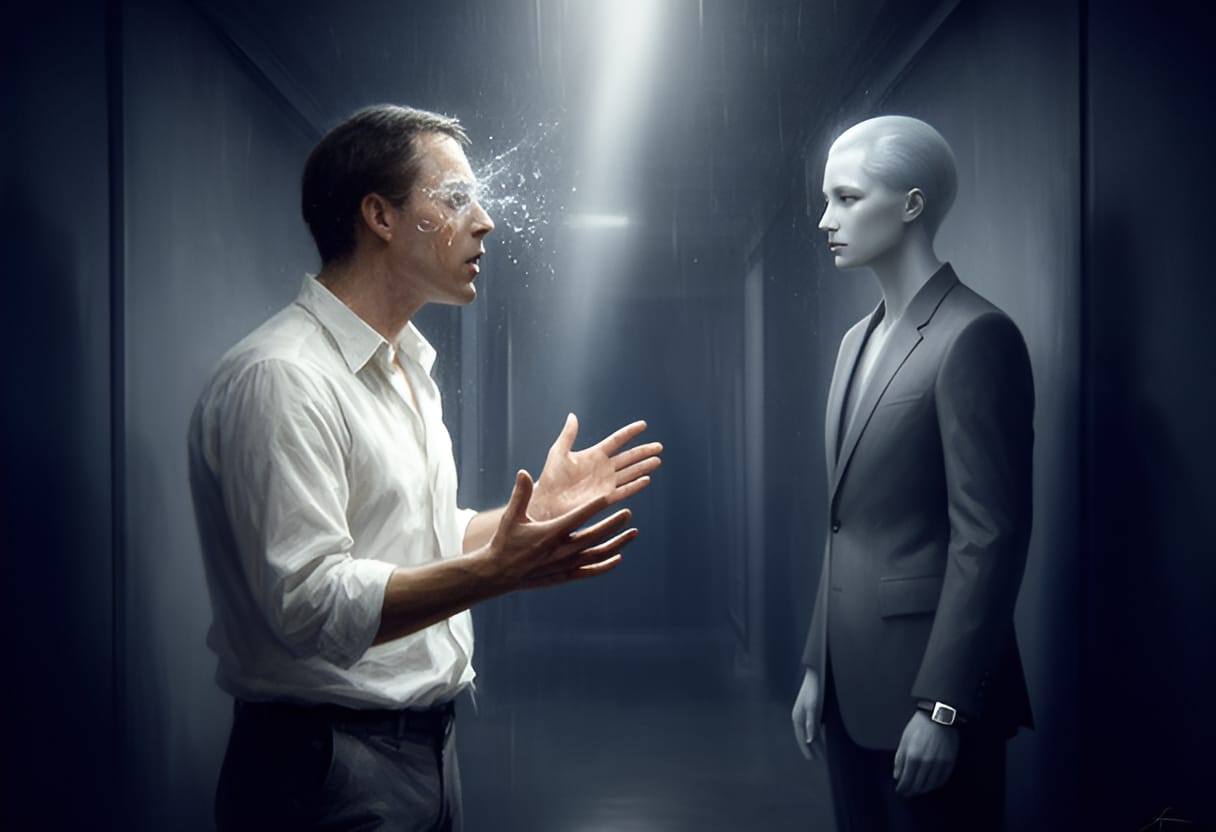
He swallowed, eyes fixed on the Arbiter’s blank expression. The words came faster now, spilling out like water from a cracked dam.
“I got out. Just for a second. The rain was coming down hard. She was lying there, not moving. Her bag was open—papers, a apple, her glasses cracked on the pavement. And I… I looked at her. I knew she was hurt. Badly. Maybe dying. And I thought—if I stay, they’ll find me. They’ll take my license. My firm will drop me. No one will hire an architect with a hit-and-run on his record. My reputation—everything I’ve built—gone.”
A harsh laugh escaped him, broken and ashamed. “So I got back in the car. I locked the door. I drove away. I didn’t call for help. I didn’t look in the mirror. I just… kept going. I told myself it was an accident, that I couldn’t have done anything. But I could have. I chose not to. I left her there to die because I was afraid.”
Silence followed. The corridor hummed softly, the same low vibration as before, but now it felt less like a machine and more like a held breath.
The Arbiter tilted his head slightly, not in judgment, but in acknowledgment. “You have named what you did,” he said. His voice was calm, precise, neither forgiving nor condemning. “Denial ends with acknowledgment. But acknowledgment alone does not release.”
Daniel’s throat tightened. He nodded, unable to speak.
The Arbiter took a half-step forward. “Do you accept responsibility for what you did?”
Daniel’s vision blurred. He saw Elena’s hand, limp in the puddle. He felt the cold press of the steering wheel under his palms that night. He remembered the silence after the impact—not peace, but the awful, ringing quiet of a choice made.
“I do,” he whispered. Then louder, as if claiming it: “I accept it. I did it. I left her. I’m sorry—not because I’m afraid anymore, but because it was wrong. I was wrong.”
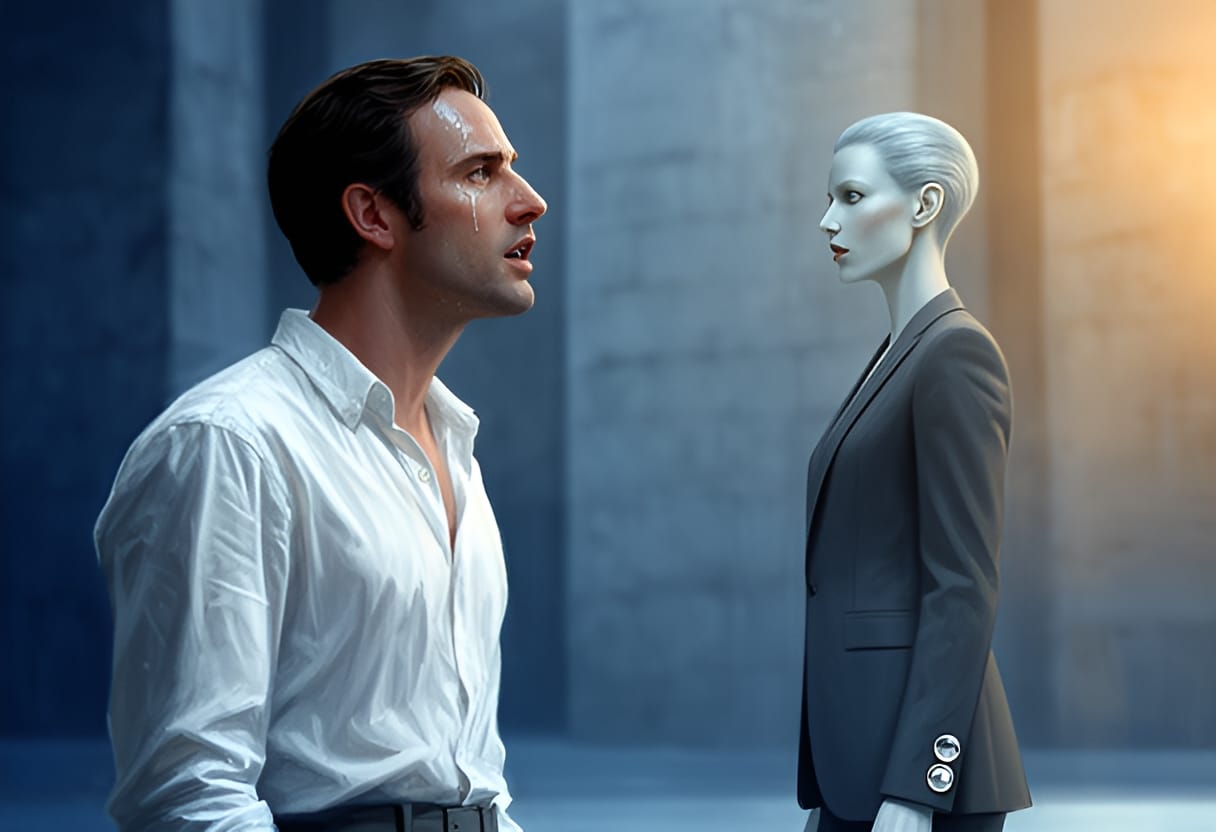
He waited, braced for judgment, for punishment, for some sign that this was not enough.
The Arbiter gave the smallest incline of his head. Not a blessing. Not a pardon. Only recognition.
Then, without another word, he turned and walked slowly down the corridor, his footsteps silent on the stone. The gray walls seemed to soften at the edges, the light ahead growing steadier, less harsh.
Daniel did not follow yet. He stood where he was, the truth no longer a shadow behind him, but a weight he carried openly—and for the first time since he woke in white, he was not afraid to walk forward.
Daniel turned and began to walk. The stone beneath his feet felt less solid, as if the corridor itself were exhaling, releasing the tension that had held it rigid for so long. The gray light ahead no longer seemed a barrier but an invitation—soft, diffused, growing stronger with each step. It did not blind or glare; it simply was, steady and patient, like dawn after a long night.
He did not look back. The Arbiter was gone, vanished into the quiet without a sound, leaving only the echo of his words in the hollow of Daniel’s chest: acknowledgment ends denial. Not salvation. Not forgiveness from another. But the quiet, unshakable ground of having faced what he had done.
His sorrow remained—a deep, dull ache behind the ribs, not sharp with panic now, but steady, like a bruise that would fade only in time. He thought of Elena’s glasses, cracked on the wet pavement. Of her apple, rolled just beyond her reach. Of the silence he had chosen over mercy. He carried it all, not as a chain, but as a truth he would no longer deny himself.
The light swelled ahead, not a door, not a gate, but a presence—warm, unstructured, as if the air itself had begun to glow. No voices called. No figures waited. Only the sense of forward motion, of weight gradually loosening from his shoulders, not erased, but no longer crushing.
He passed the point where the Memory Room had been. The stone walls softened, losing their texture, becoming luminous mist. His footsteps made no sound, yet he felt the rhythm of them—left, right, left—steady as a heartbeat. The air grew lighter, cooler, carrying no scent, no taste, only the impression of clarity.
A thought came, unbidden: I am still here. Not in Limbo. Not in the body he had left behind on that rain-slicked road. But somewhere between, moving not toward judgment, but toward resolution. He did not know what waited. Peace? Oblivion? Something else entirely? It did not matter. For the first time since he had woken in the white room, he was not fleeing. He was walking.
His breath came easier. The copper taste had faded. He lifted his chin, not in defiance, but in surrender—not to punishment, but to the simple fact of what he had done. And in that surrender, there was a kind of freedom.
The light surrounded him then, not violently, but gently, as if stepping into a room where the curtains had finally been drawn. He closed his eyes—not against the brightness, but to feel it fully on his skin, in his bones. And when he opened them again, there was no corridor, no stone, no Arbiter.
Only light.
And the quiet, forward motion of walking.