
Horror
Love of a ghost sister
by Abhinav Raj
3 chapters1.1 hr read
Chapter 1
The Weight of Silence
Jonah pushed open the front door of the house on Sycamore Street and stepped inside, the wood groaning under his weight as if reluctant to bear it. The air smelled of damp plaster and old wood, layered beneath it the faint, sour tang of illness that had lingered since Elara’s final weeks. He paused just inside the threshold, letting the door swing shut behind him with a soft click that sounded too loud in the silence. No one called out. No footsteps followed. The house was his alone now.
He set down the cardboard box he’d carried from the town hall—Elara’s things: a folded shawl, a chipped teacup, a stack of letters tied with blue ribbon, her mother’s locket, dull and cool against his palm when he’d slipped it from the tray. He hadn’t opened it yet. Couldn’t bring himself to. Instead, he’d left it on the hall table, where it sat like an offering he wasn’t sure how to make.
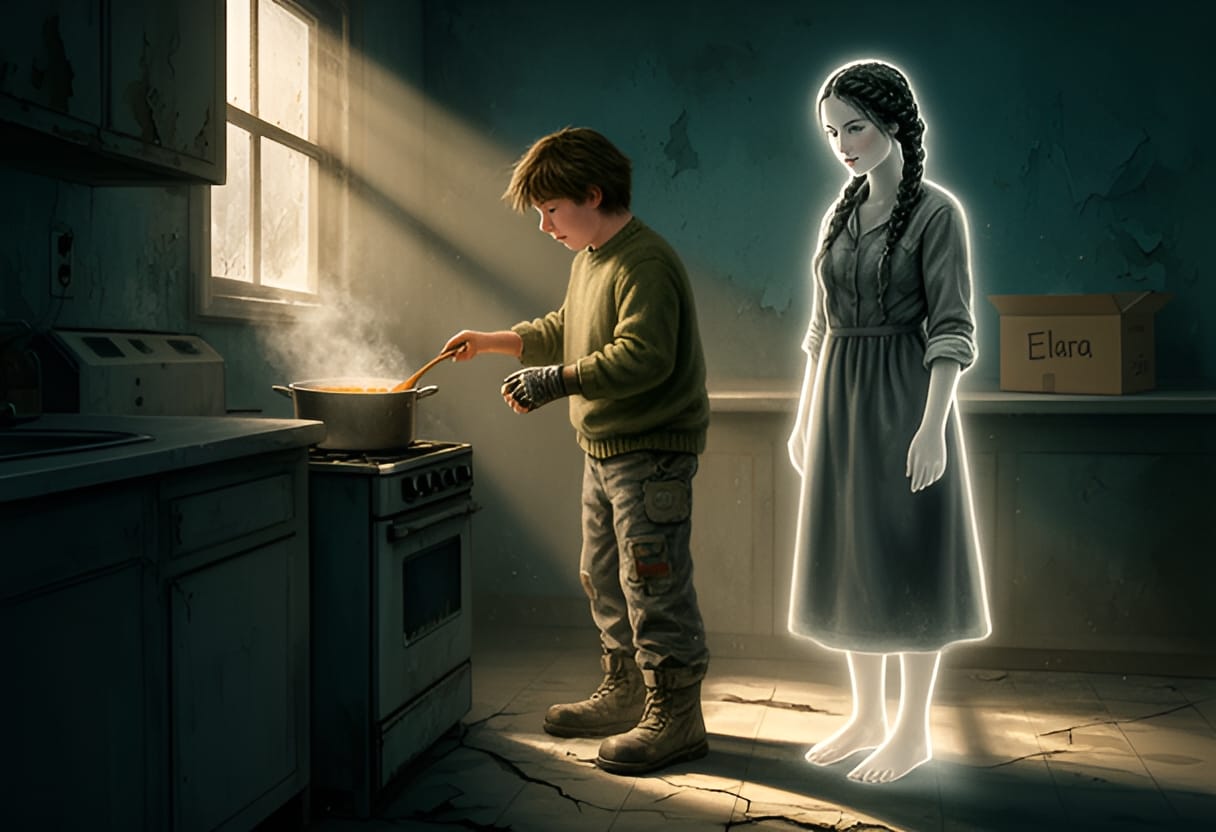
The kitchen lay ahead, its linoleum cracked near the sink, the paint on the walls peeled in long, curling strips where moisture had seeped through the plaster. He moved toward it without thinking, the rhythm of habit stronger than grief in that moment. The stove was cold, the kettle dark. He filled a pot with water from the tap, the sound thin and echoing in the empty room. Outside, a wind rattled the loose shutter on the back window—a sound like fingers tapping, impatient.
He chopped an onion, the blade meeting the board with a steady rhythm. The smell rose sharp, making his eyes water. He blinked it away, focused on the task: peel, slice, drop into the pot. He added a handful of dried beans from the sack in the cupboard, a pinch of salt, then turned on the gas. The flame caught with a soft whoosh, blue at the base, yellow at the tips. He leaned against the counter, arms crossed, watching the water begin to shiver.
The house was quiet. Too quiet. Even the usual creaks—the settling of old timber, the groan of pipes—were absent. It felt as if the walls were holding their breath. He glanced toward the hallway, where the coat rack stood empty except for Elara’s raincoat, still hanging where she’d left it the day she’d gone to the clinic for the last time. He hadn’t had the heart to take it down.
He stirred the soup with a wooden spoon, the motion slow, automatic. Steam curled up, carrying the faint scent of onion and something deeper, earthy from the beans. He ladled a portion into a chipped bowl—his usual one, the one with the hairline crack near the rim—and carried it to the small table by the window. He sat, spoon in hand, and stared out at the backyard, where the grass had gone to seed and the fence leaned like a tired man.
He took a spoonful. The soup was bland, lacking the herbs Elara always added—thyme, maybe, or a bay leaf. He ate anyway, mechanically, each bite a small act of endurance. His gaze kept drifting to the pantry door at the far end of the kitchen, just beside the back door. It stood slightly ajar, the dark interior swallowing the light.
A sudden crash made him jump.
The pantry door had slammed shut—not swung, not creaked, but slammed—with a force that sent a jar of pickles rattling on the shelf inside. The sound echoed off the tiles, sharp and final. Jonah’s spoon clattered into his bowl. His heart hammered against his ribs.
Silence rushed back in, thicker now. He sat very still, ears straining. The wind had died. Even the distant hum of the town—far-off traffic, the occasional shout—seemed to have muffled itself, as if the world were listening too.
He pushed back his chair and stood, legs slightly unsteady. He walked to the pantry, hand outstretched, and pulled the door open. The shelves were neat: cans lined in rows, a sack of flour, a basket of onions. Nothing disturbed. No draft stirred the air. The floorboards beneath his feet were solid, unmoving.
He frowned. The house was old, yes. It settled. But doors didn’t slam from settling. They groaned. They sighed. They didn’t slam.
He stepped back into the kitchen, eyes scanning the room. The window was latched. The back door was bolted. He’d locked it himself after coming in. No one could have gotten in. No one could have gotten out.
He told himself it was the wind, despite the stillness. A sudden gust, funneled through some crack he couldn’t feel. The house was full of them—gaps in the eaves, spaces under the sill. It had happened before, he told himself. Not like that, but close. The wind could do strange things in an old building.
He returned to the table and sat down. He picked up his spoon, but his appetite was gone. The soup sat cooling in the bowl, a thin skin forming on the surface. He pushed it away.
He couldn’t shake the feeling that he wasn’t alone.
He glanced toward the hallway again. The coat rack stood silent. The raincoat didn’t move.
He told himself he was tired. Grief made the mind play tricks. He’d seen it in Elara, toward the end—how she’d jump at shadows, whisper to rooms that were empty. He’d thought it was the fever. Now he wondered.
He pushed back his chair and carried his bowl to the sink. He rinsed it quickly, left it in the draining board, and wiped his hands on a dish towel. The fabric was rough, faded from use. He folded it neatly and hung it on the hook.
He didn’t turn off the light.
He walked slowly down the hall, past the closed doors of the bedrooms—his, Elara’s, the small room that had once been a nursery. He paused outside Elara’s door. The wood was cool under his palm. He didn’t knock. Didn’t open it. Just rested his forehead against it for a moment, eyes closed.
When he stepped away, the hallway felt longer than before.
He went to his room and closed the door softly behind him. He didn’t undress. Just lay down on top of the covers, fully clothed, hands folded over his chest. The ceiling stared back, blank and indifferent. He listened to the silence—not the absence of sound, but the presence of something waiting.
Sleep came uneasily, in fragments. He dreamed of running through narrow alleys, bricks closing in on either side, a voice calling his name from behind—familiar, but distorted, as if heard through water. He woke once to the sensation of fingers, light as moth wings, brushing his wrist. He jerked upright, heart pounding, but the room was empty. The moonlight lay silver on the floor, unbroken.
He lay back down. Sleep took him again, deeper this time, but not peaceful. In the dream, he was standing in the kitchen again, soup cooling before him. The pantry door stood open. And inside the darkness, just beyond the reach of the light, something shifted.
He woke with a gasp, drenched in sweat, the echo of a cough—wet, racking—still ringing in his ears.
He sat up, breathing hard. The room was dark. The clock on the bedside table read 2:17 a.m.
He listened.
Nothing.
He lay back down, pulled the thin blanket to his chin, and stared at the ceiling until the first pale light of dawn began to creep through the blinds.
He lay still, the thin blanket pulled to his chin, eyes fixed on the ceiling where the first pale light of dawn bled through the blinds in thin, hesitant stripes. The dream clung to him—not as a fading echo, but as a weight in his chest, a pressure behind his ribs. He could still see her: Elara, not as she was in the coffin, smooth and still, but as she had been in the last weeks, her face drawn tight over bone, her eyes too large in her skull, pleading not with words but with the raw, silent urgency of someone trying to say goodbye before the breath left her.
In the dream, she had been sitting on the edge of the bed in their old room—the nursery, long since emptied of its crib and painted over in a dull beige that never quite covered the faint, peeling clouds near the ceiling. She wore the thin cotton nightgown he remembered from childhood, the one with the faded blue flowers along the hem. Her hands were folded in her lap, clutching a small, white handkerchief stained dark at the center. She coughed—not the dry, hollow sound of exhaustion, but a wet, racking thing that seemed to tear at her lungs, each spasm doubling her forward, her shoulders jerking with the effort. When she finally lifted her head, her lips were smeared with bright red, and she looked at him not with fear, but with an apology so deep it made his throat close.
“I’m sorry,” she whispered, though no sound came out. He felt it in his teeth, in the hollow of his sternum.
Then the light above them flickered—not the bulb, but the very air, as if the room were underwater—and she began to fade at the edges, her form softening like ink in water. The handkerchief slipped from her fingers and drifted down, slow as a leaf, landing on the blanket where his feet lay. He reached for it, but his hands passed through nothing but cold air. The last thing he saw was her eyes, wide and glistening, before the darkness swallowed her whole.
He had jerked awake then, not to the sound of her voice, but to the sensation of pressure—fingers, thin and cold, closing around his throat. Not enough to cut off air, not enough to bruise, but enough to jolt him fully into wakefulness, his eyes snapping open to the dark ceiling. The grip released as suddenly as it had come, leaving only a faint tingling, like the aftershock of a numb limb waking.
He sat up, heart hammering, and flung the blanket back. The room was cool, the air still. Moonlight pooled on the floor beside the bed, silver and quiet. He rubbed his throat, expecting to find the imprints of fingers, but his skin was smooth, untouched.
Then he glanced down.
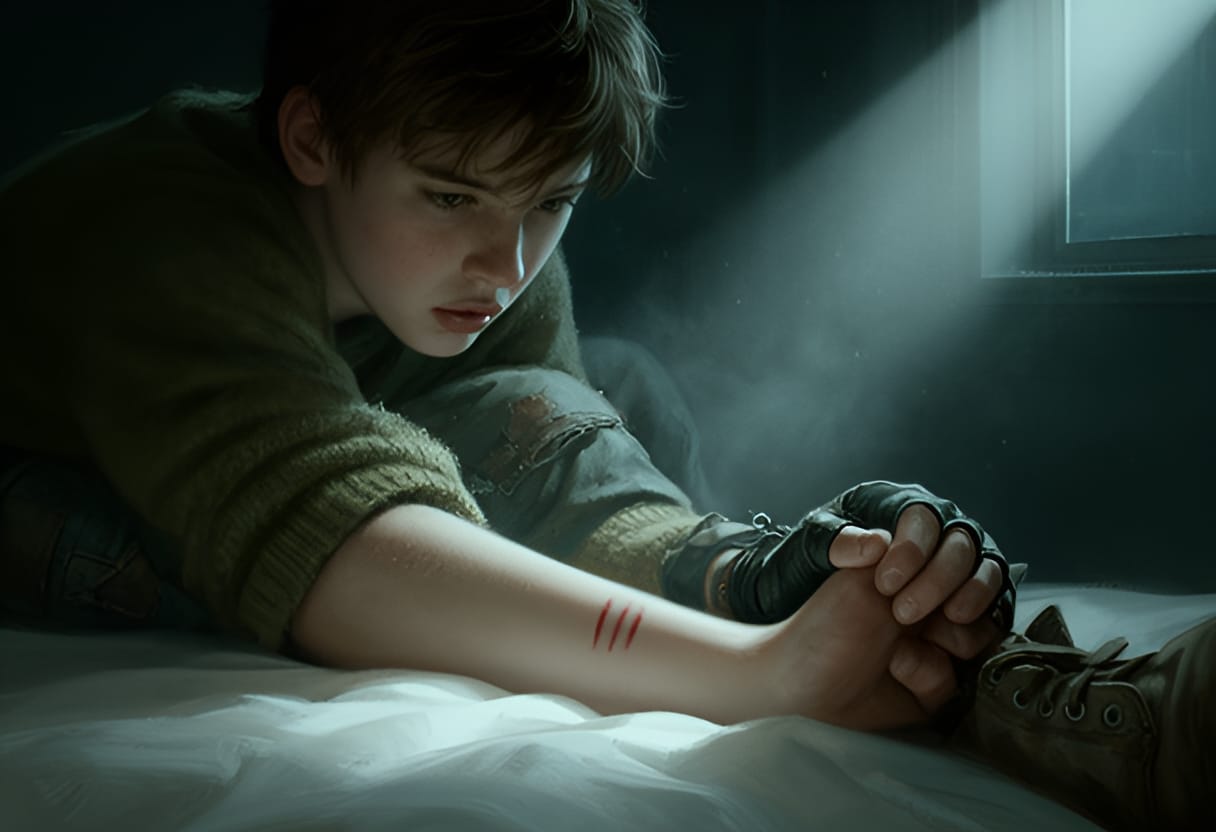
His left wrist, resting on the sheet, bore two faint red marks—parallel, shallow indentations, as if someone had gripped him there with just enough pressure to leave a trace, but not break the skin. They were small, precise, the kind of marks that might come from slender fingers pressing in a moment of urgency or restraint. He turned his arm this way and that, watching how the light caught the faint discoloration. It wasn’t a scratch. It wasn’t from the sheets. It had appeared while he slept.
He swallowed, the memory of the dream still sharp—the taste of iron on his tongue, the smell of damp cloth and something sweet beneath it.
And then he smelled it.
Lavender.
Faint, but unmistakable. The same soap she used—the one in the chipped blue dish by the sink in the bathroom, the one she’d bought on sale at the corner shop months before she got too weak to leave the house. He hadn’t used it since she died. Couldn’t bring himself to touch it. The bar still sat there, wrapped in its waxed paper, untouched.
He swung his legs over the side of the bed and stood, barefoot on the cold floorboards. The marks on his wrist pulsed faintly, not with pain, but with a strange awareness, as if the skin remembered what the mind refused to name.
He walked to the door and pressed his ear to it. Silence. The house was still, the kind of quiet that felt watched, not empty. He turned the knob slowly, careful not to make a sound, and peered into the hall.
The coat rack stood at the end, Elara’s raincoat hanging where she’d left it—the one with the frayed cuff and the missing button near the collar. It didn’t move. Didn’t stir. But as he stood there, breathing shallow, a single thread of lavender curled from the pocket, drifting on an unseen current, just long enough to brush his nose before vanishing.
He stepped back, his back hitting the doorframe. His breath came shallow. His wrist throbbed, not with pain, but with a quiet insistence.
He hadn’t dreamed the grip. He hadn’t imagined the scent. The marks were real. The lavender was real.
And whatever had touched him—whatever had held his wrist in the dream and now left its echo on his skin—had known exactly where to find him.
He went to the bathroom and turned on the light. The chipped blue dish sat on the sink, the soap inside it dry and cracked at the edges. He picked it up. It was cool. He turned it over in his palm. No scent rose from it. No trace of use.
He set it down and washed his face, the water shocking in its chill. When he looked up, his reflection stared back—pale-eyed, hair messy, the red marks on his wrist visible even in the dim glow of the bulb. He touched them gently. They didn’t hurt. But they were there.
He left the light on and returned to his room. He didn’t lie down. Instead, he sat on the edge of the bed, his back straight, his hands resting on his knees. He watched the sky lighten through the blinds, the dark yielding to a washed-out blue. The house creaked once—low and distant, like a sigh—but nothing moved. No doors shifted. No whispers curled in the corners.
Yet he knew, with a certainty that bypassed thought and settled deep in his bones, that he was not alone.
He thought of the pantry door. The dream. The cough at 2:17 a.m. He thought of the way Elara used to hum when she stirred the soup, low and off-key, a tune without a name. He thought of the raincoat, still hanging, as if waiting for her to come home and shrug it off.
He didn’t call out. Didn’t ask for a sign. He just sat there, quiet, and let the silence hold him.
And after a long while, when the sun had climbed high enough to strike the floor in a bright bar beside the bed, he stood, walked to the dresser, and opened the top drawer. He took out a clean handkerchief—white, linen, the kind she used to keep in her pocket—and folded it slowly, precisely, into a small square. Then he walked to the hall and placed it gently on the shelf of the coat rack, just beneath the pocket of her raincoat.
He didn’t know if she would see it.
But he needed her to know he had seen her.
He stepped out onto the porch and closed the door behind him, the latch clicking soft in the morning hush. The air was thin and sharp with the promise of rain, carrying the damp scent of soot and wet stone from the river that curled behind the mills. Greys Hollow stirred slow, like a body waking from a long fever—shutters creaking open, a distant whistle from the rail yard, the murmur of early footsteps on Sycamore Street. Jonah pulled his coat tighter, the wool rough against his neck, and walked with his head down, hands buried in his pockets, the red marks on his wrist hidden beneath the sleeve.
He didn’t look up until he reached the corner of Holloway and Fifth, where the pharmacy’s green cross glowed faintly in the overcast light. He’d come for the throat lozenges Elara had liked—the honey-and-eucalyptus ones that always seemed to sit just behind the counter, as if waiting for her to ask. He’d told himself it was practical, that he might need them if the cough from his dreams ever clung to him in waking hours. But he knew, even as he turned the bell over in his palm before pushing through the door, that it was more than that. It was a thread. A small, deliberate reach toward something familiar.
Inside, the smell of antiseptic and waxed floors wrapped around him. Mrs. Gable, her hair pinned tight and her cardigan buttoned to the throat, looked up from behind the counter, her eyes softening when she saw him.
“Morning, Jonah,” she said. “You’re up early. Everything alright?”
He managed a nod, though his throat felt tight. “Just… picking up a few things. For the house.”
She studied him a moment, then turned to the shelves. “You take care now. Holloway’s been quiet lately, but the mills still give me the creeps at dawn. Like they’re holding their breath.”
He thanked her, paid in loose change, and stepped back onto the sidewalk with the small paper bag clenched in his fist. The lozenges rattled softly inside. He tucked the bag into his coat pocket and began walking again, his gaze fixed on the uneven pavement, his thoughts looping—on the lavender thread, on the marks on his wrist, on the way the raincoat had seemed to breathe when he wasn’t looking.
He didn’t see the cart until it was too late.
It came from the alley between the tailor’s shop and the boarded-up bakery, a wooden delivery cart piled high with sacks of flour and stacked crates, its iron wheels groaning against the cobbles. The horse, a gaunt gray with ribs showing beneath its coat, strained at the traces, nostrils flaring, breath steaming in the cold air. The driver, a boy no older than Jonah, leaned forward, shouting something unintelligible as he jerked the reins.
Jonah had stepped off the curb without thinking, lost in the quiet hum of his own thoughts, his foot landing on the street just as the cart lurched forward, gaining speed on the slight downhill of Holloway.
Time fractured.
He saw the wheels spin, heard the creak of the axle, felt the rush of wind displaced by the mass bearing down on him. His body froze—not with fear, not yet, but with the stunned recognition of imminent impact. He was going to be hit. He was going to be thrown. The sacks would catch him in the chest, knock the air from his lungs, maybe break something. He braced, eyes shut, waiting for the crash.
Then—motion.
Not from him.
From the left.
The alley gate—a rusted iron thing, half-hanging on its hinges, usually chained shut to keep out vagrants and stray dogs—suddenly jerked inward. It swung wide with a violent, metallic slam, the force of it snapping the chain clean off its post. The gate flew back, striking the brick wall of the bakery with a sound like a gunshot, then rebounded, slamming shut again with a second, shuddering bang.
And in that violent arc, it caught him.
Not a blow, but a shove—firm, sudden, irresistible—against his left shoulder and ribs. It knocked him sideways, off his feet, and he stumbled backward, scrambling to keep his balance, his boot slipping on the wet curb. He hit the sidewalk hard on his hip, jarring his spine, the breath driven from his lungs in a sharp gasp. The paper bag flew from his hand, skidding across the pavement, the lozenges scattering like white pebbles.
He lay there for a heartbeat, winded, stunned, staring up at the gray sky.
Then he pushed himself up on his elbows.
The cart roared past where he had been standing—just inches from where his chest would have been—its wheels kicking up a spray of dust and small stones. The horse neighed in alarm, the driver yanking hard on the reins, leaning far back in his seat as he fought to bring the team under control. The cart lurched, swayed, then slowed as the driver wrestled it to a halt a few feet down the street, his face pale, eyes wide.
Jonah stayed on the ground, one hand pressed to the curb, the other clutching his aching hip. His heart hammered—not just from the shock, but from the impossibility of it. The gate. It had moved. Not blown by wind—there was barely a breeze—and certainly not opened from his side. He had been on the street. The gate opened into the alley, swinging inward, toward the wall. Someone—or something—would have had to be standing in the alley to pull it open… or push it from the inside.
But the alley was narrow, choked with debris and shadow. He could see into it from where he sat—broken bottles, a pile of rotting planks, the dark maw of the bakery’s back door. No one was there. No sign of anyone having been.
He got slowly to his feet, his hip throbbing, his palms scraped and stinging. He looked at the gate. It hung now at a crooked angle, one hinge bent, the other squeaking faintly as it settled. The chain lay coiled in the gutter like a discarded serpent. The wood was splintered where it had struck the brick.
And yet—despite the violence of its motion—there was no handprint on the iron. No smudge. No sign that anyone had touched it.
He looked down at his left wrist, where the sleeve had ridden up. The two red marks were still there, faint but visible, catching the weak light.
He didn’t think of the horse. Didn’t think of the driver’s shouted apology, already retreating down the street, face flushed with embarrassment and fear. He didn’t think of the lozenges scattered in the dust.
He thought only of the gate.
And of the way it had moved—not to harm him, but to stop him from being hurt.
His breath came shallow. His skin prickled, not with cold, but with the quiet, insistent certainty that he was not alone—that something had seen him step into danger, had known the exact moment to act, and had used what was at hand to pull him back.
He looked toward the house at the end of the street, its windows dark and watchful. The raincoat on the rack inside—was it still there? Had it moved, even slightly, since he’d left?
He didn’t go to check. Couldn’t bring himself to.
Instead, he bent slowly, pain flaring in his hip, and began gathering the lozenges from the pavement, his fingers numb, his mind elsewhere. One by one, he picked them up, wiping the dirt from the waxed paper, and slipped them back into the bag. When he was done, he tucked it back into his pocket, straightened his coat, and walked the rest of the way home without looking left or right.
He didn’t run. Didn’t hurry.
He walked, as if carrying something fragile.
And when he reached Sycamore Street, he paused at the gate, hand on the latch, and listened.
The house was silent.
But the air near the door—just for a moment—seemed to stir, as if exhaling.
He didn’t knock.
He didn’t call out.
He just opened the door, stepped inside, and closed it softly behind him.
The latch clicked.
And in the hall, where the raincoat hung, the pocket gave a faint, almost imperceptible twitch—like a finger, testing the fabric.
He stood in the kitchen, the door closed behind him, the latch soft in its strike. The house held its breath. Dust motes hung in the slant of late afternoon light that cut through the grimy window above the sink. He set the bag of lozenges on the counter, his hip still a dull throb beneath his palm. The silence was thick, not empty, but full of something waiting—like the air before a storm that never breaks.
He moved through the rooms on autopilot, the familiarity of the space a hollow comfort. The coat rack in the hallway held Elara’s raincoat, the pocket still slightly disturbed from whatever had tugged at it earlier. He didn’t look at it. Didn’t dare. Instead, he went to the small table by the window where he kept his things—a notebook, a pencil, the chipped bowl he used for soup. He sat, but didn’t open the notebook. His fingers traced the hairline crack in the rim, the same one Elara had noticed weeks ago and said she’d fix “when things slowed down.” Things had only sped up since then.
He stayed like that for a long time, listening to the house settle—the creak of floorboards, the distant groan of the mills in the wind, the occasional drip from the leaky tap in the bathroom. It was the same as always, and yet not. Something had shifted in the quiet. A tension, like a wire plucked and still humming.
Then, without warning, he was on his feet.
Not a thought. Not a decision. A pull, deep in his chest, like a thread tied to his sternum and yanked toward the edge of town. He didn’t question it. He couldn’t have, even if he’d wanted to. It was as necessary as breathing.
He pulled on his coat—his own, not hers—and stepped back into the street.
The walk to the mills was short but felt longer. Sycamore Street gave way to Maple, then to the broken stretch of Fifth where the pavement ended and the gravel began. The air grew cooler, damper, carrying the scent of wet stone and rust. Weeds pushed through the cracks in the old rail line that once fed the mills. The buildings loomed ahead, skeletal and silent, their windows like hollow eyes staring out over the town’s slow decay.
He didn’t go to the main gates. Those were barred, chained, marked with faded signs warning of structural collapse. Instead, he followed the perimeter, the way he sometimes did when he needed to think—though he hadn’t been here in months, not since before Elara got sick. Now, his feet knew the path even if his mind resisted naming why.
He stopped at the outer wall on the north side, where the brick had crumbled in places and ivy clawed at the mortar. It was quieter here, shielded from the wind by the mill’s bulk. He reached out, palm flat against the cold, uneven surface. The brick was rough, damp in places, flaking under his touch. A shiver ran up his arm—not from cold, but from the sheer, absurd intimacy of the gesture.
“Elara,” he whispered.
The word left his lips raw, unused. He hadn’t said her name aloud since the funeral. Not in anger. Not in sorrow. Not even in memory, not truly. It had felt too heavy, too dangerous—like speaking it might summon her back only to watch her slip away again.
But now, in the hush of the mill’s shadow, it didn’t feel like a summoning. It felt like an acknowledgment.
He waited.
Nothing happened. The wind stirred a loose shutter somewhere above, a faint creak. A pigeon took flight from the roof’s edge, wings slapping the air.
He was about to pull away, chest tight with the foolishness of it, when the sound came.
Not from above. From within.
A deep, shuddering groan—like the building itself was inhaling. Then a sharp, splintering crack.
He jerked his head up.
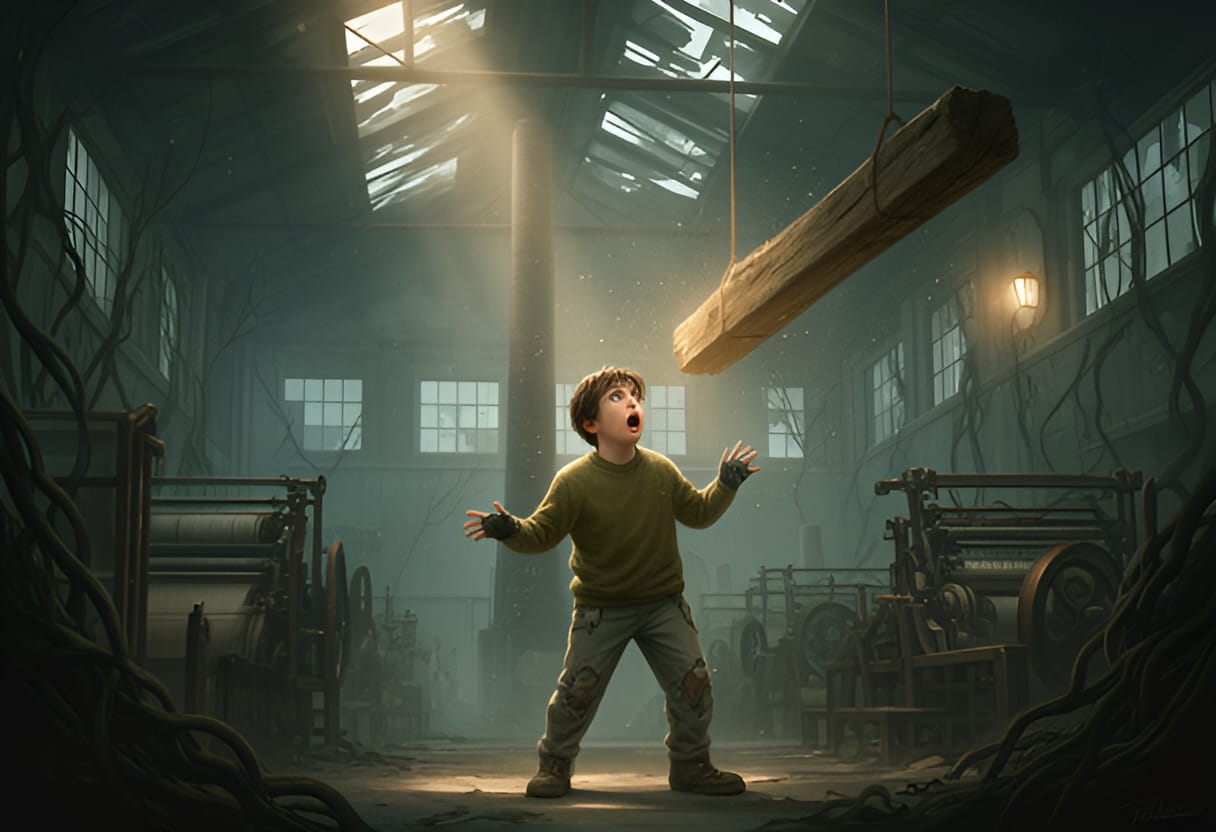
High on the third story, where a section of the floor had long since given way, a massive support beam—rotted through at its core, black with mold and split along the grain—tore free from its moorings. It didn’t fall straight down. It pivoted, as if caught on a snag, then began to plummet, end over end, straight toward where he stood.
Time didn’t slow. It snapped into focus.
He saw the grain of the wood, the jagged edge where it had split, the dust trailing behind it like a tail. He saw the arc it would take—directly over his shoulder, crushing him against the wall.
He didn’t think. He didn’t scream. He braced, eyes shut, arms rising instinctively to shield his head—
And then it stopped.
Not hit the ground. Not struck him.
It halted.
Mid-air.
For a breathless second, the beam hung, suspended, as if caught in an invisible net. The wood vibrated, a low humming in the air, dust drifting from its surface in slow spirals. Then, with a soundless shove—no wind, no visible force—it was flung sideways, not hard, but with absolute certainty, like a hand guiding a dangerous thing away from a child. It crashed into the weeds and rubble ten feet to his left, sending up a plume of dry stalks and broken brick.
Silence.
Jonah stood frozen, one arm still half-raised, his breath coming in short, sharp gasps. His heart hammered against his ribs, not just from fear, but from the sheer, impossible rightness of what had just happened. The beam hadn’t missed him by chance. It had been stopped. And then moved. As if something had reached out—not to harm, not to scare—but to prevent.
He lowered his arms slowly. His palms were slick with sweat. He looked at the beam, half-buried in the weeds, then back at the wall where it had broken free. The gap in the structure yawned dark and empty.
He touched his chest, over his heart. It was still racing.
He looked at his hands. They were shaking.
He had not imagined the gate. He had not dreamed the grip on his wrist, the scent of lavender, the pantry door slamming shut. Those had been warnings. Small. Subtle. Easy to dismiss as stress, grief, the mind playing tricks.
This was not.
This had been a beam weighing hundreds of pounds, stopped in mid-fall and thrown clear—not by wind, not by luck, but by something that had seen him, that had known the exact moment it would fall, and had acted.
Not to hurt him.
To save him.
A sound escaped him—half a laugh, half a sob—broken and disbelieving. He pressed his forehead to the cool brick of the wall, his eyes closed.
“I didn’t… I didn’t call you,” he murmured, not sure if he was speaking to her, to the air, to whatever had moved the gate and stopped the beam. “I didn’t ask for this.”
But he had come here. He had touched the wall. He had said her name.
And something had answered.
He pushed away from the wall, his legs unsteady. He didn’t run. He didn’t look back as he walked away from the mills, his steps uneven but deliberate. The pull was gone, replaced by a quiet certainty that settled in his bones like snowfall—soft, inevitable, and cold.
When he reached Sycamore Street, he didn’t go straight inside. He stopped at the gate, hand on the latch, and listened.
The house was silent. The windows dark.
But as he stood there, the air near the door shifted—just a breath, a faint disturbance, like the brush of fabric against fabric. The raincoat on the rack inside gave the tiniest twitch, as if something had settled against it, satisfied.
He didn’t open the door.
He didn’t need to.
He turned and walked down the sidewalk, his shoulders no longer hunched against the wind, his gaze forward.
He didn’t know what it was. Didn’t know if it was her spirit, or something else wearing her love like a disguise. Didn’t know if it would keep coming, if it would grow stronger, if it would ever ask for anything in return.
But he knew this:
He was not alone.
And whatever watched over him—had chosen to watch over him—was not done yet.
He kept walking.
And for the first time since the funeral, he did not feel the weight of silence.
He felt the weight of being held.
Chapter 2
The Pattern Beneath the Skin
He kept walking.
And for the first time since the funeral, he did not feel the weight of silence.
He felt the weight of being held.
The sidewalk beneath his shoes was slick with overnight rain, each step sending up a faint spray that vanished before it could soak through the soles. Dawn had not yet broken, but the sky was lightening to a washed-out gray along the eastern horizon, the kind of light that made the world feel paused, holding its breath. He passed the boarded-up storefronts of Sycamore Street, their windows dark and eyesocket-empty, the paint long since peeled to reveal the gray wood underneath. A few stray cats darted between alleys, their movements quick and silent, tails low. The air smelled of damp brick and distant coal smoke, the usual perfume of Greys Hollow in the early hours.
He didn’t turn back toward the mills. Didn’t look over his shoulder. The certainty that had settled in his bones was not comfort, not exactly—it was quieter than that, deeper. It was the knowledge that something had seen him, not as a threat or a nuisance, but as something worth shielding. And it had acted. Not once, but twice now: the swinging gate, the falling beam. Both times, intervention had come just before harm. Both times, it had pushed him away from danger, never pulled him into it.
He reached the corner of Sycamore and 5th, where the street bent slightly around the old feed mill’s collapsed outer wall. He paused, one hand resting on the chipped brick of a shuttered pharmacy, and drew a slow breath. His chest still felt tight, but the panic had ebbed, replaced by a dull, persistent thrum beneath his ribs—like the echo of a bell struck far underground.
He needed to understand.
Not with fear. Not with disbelief anymore. But with clarity.
He reached into his coat pocket and felt the corner of the notebook he’d bought three days ago at the general store—a small, bound thing with a stiff brown cover and pages that smelled faintly of pulp and glue. He’d meant to use it for job applications, for lists of things to fix around the house. Now, he thought, it would serve another purpose.
He opened it to the first blank page and pressed the pencil to the paper.
Syracuse Street, 5:03 a.m. Event: Gate swung inward as cart approached from alley. No wind. No visible cause. Felt pressure on left shoulder—guided me sideways. Scent: lavender, faint, near raincoat (inside house, though I was outside). Sound: soft groan, like old wood settling, but directionally wrong—came from gate itself. Outcome: Cart passed where I would have been. No injury.
He paused, the pencil hovering. The memory of the gate’s movement was still vivid—the way it had lunged, not swung, as if yanked by an invisible hand. He’d felt the contact on his shoulder, firm and deliberate, not a brush but a shove. And the scent—lavender, just like the soap she used to keep in her drawer, though the bar upstairs remained untouched, cracked and dry in its chipped blue dish.
He turned the page.
Syracuse Street, 5:17 a.m. Event: Mill beam (approx. 6ft, steel-reinforced wood) began to fall from upper loft. Stopped mid-fall, then thrown laterally ~8ft. No vibration in ground, no sound of impact where it landed. Felt presence—strong, focused—behind me. Temperature drop: sudden chill on neck and forearms. Scent: lavender, stronger this time, mingled with something dry and herbal—thyme? Bay leaf? (She used to put it in soup.) Outcome: Beam would have struck mid-back. Avoided.
He stopped writing. His hand trembled slightly, not from fear now, but from the sheer rightness of it. The timing. The precision. The way each event had occurred seconds before harm, never minutes, never after. Always a nudge, a redirection, never a grasp or a pull. Always away.
He flipped to a fresh page and began to list, in crude columns:
| Event | Time | Danger Averted | Sensory Detail | Direction of Force |
|---|---|---|---|---|
| Gate swing | 5:03 a.m. | Cart impact | Lavender scent, shoulder push | Laterally (left) |
| Beam fall | 5:17 a.m. | Blunt trauma | Chill, lavender/thyme, neck prickle | Laterally (right) |
He stared at the table. The pattern was undeniable. Each intervention had been a deflection, a redirection of momentum—like a hand guiding a falling object to land softly. Never a grab. Never a yank toward something harmful. Always away.
He closed the notebook, tucked it back into his coat, and walked the rest of the way home without looking back.
The house on Sycamore Street stood silent and dark, as it had when he left. The gate latched softly behind him. He didn’t turn on the light in the hall. Didn’t need to. He knew the way by heart—the creak of the third stair, the dip in the hallway floor near the coat rack, the way the floorboard groaned just inside the parlor door.
He paused at the base of the stairs. The air near the coat rack felt… different. Not cold, not exactly. But attended. As if something had been standing there, just out of sight, and had only just stepped away.
He reached up and touched the raincoat’s sleeve. The wool was damp from the morning’s mist, but underneath, near the shoulder, it was warm. Not hot. Not fever-warm. Just… alive with residual heat, like a spot recently vacated by a body.
He drew his hand back, startled.
Then, slowly, he reached into his pocket and pulled out the small vial he’d filled the night before—lavender water, steeped from the dried sprigs he’d found tucked in the back of her dresser drawer, the ones she used to keep in her sachets. He’d added a drop of glycerin to help it cling to the skin, a habit from when she’d made him tonic for his childhood colds.
He unscrewed the cap and poured a teaspoonful into the chipped blue dish beside the sink—Elara’s soap dish, still holding the cracked, unused bar. The liquid pooled, pale purple, catching the faint light from the kitchen window.
He didn’t speak. Didn’t pray. Didn’t beg.
He simply stepped back and waited.
Morning came pale and thin, filtering through the dusty curtains of the front room. Jonah woke not to an alarm, but to the absence of weight on his chest—the usual leaden pressure of dread that had settled there since the funeral. For a moment, he lay still, eyes open, listening. The house was quiet. No creaks. No whispers. Just the distant drip of a leaky faucet somewhere in the wall.
He sat up slowly, his movements careful, as if afraid to break a spell.
His bare feet touched the cold floorboard. He padded to the kitchen, expecting to see the lavender water still in the dish, untouched.
It was gone.
The dish was dry. The cracked bar of soap sat exactly as it had been, untouched, gathering a faint film of dust.
His breath caught.
Then he saw it.
On the edge of the dish, resting against the chipped rim, lay a single white petal. Small. Delicate. It looked like it had come from a magnolia blossom—thick, waxy, slightly curved at the edges. He didn’t recall seeing a magnolia tree anywhere near the house. The nearest one was three blocks over, near the old church, its branches high and inaccessible without a ladder.
He reached out, hesitantly, and touched the petal with the tip of his index finger.
It was cool. Slightly damp, as if kissed by dew. And when he lifted it to his nose, he smelled it—not just the green, leafy scent of a flower, but underneath, unmistakable: lavender. Faint, but there. Woven into the fiber of the petal itself, as if it had been soaked in the same water he’d left behind.
His throat tightened. Not with fear. Not with disbelief.
With something quieter. Something like awe.
He turned the petal over in his fingers. No stem. No sign of having been plucked. It lay whole, perfect, as if it had simply… appeared.
He looked around the kitchen. The window was latched. The door to the back hall was closed. No draft strong enough to carry a petal from outside, let alone deposit it so precisely.
He walked to the coat rack. The raincoat hung still. The pocket where he’d smelled the lavender the night before was empty now—no trace of scent, no dampness.
He touched the wool again. It was cool to the touch, returning to ambient temperature.
He went back to the kitchen and opened his notebook to a fresh page.
Syracuse Street, 6:42 a.m. Event: Lavender water (1 tsp) left in Elara’s soap dish. Gone by morning. Replaced by single white petal (approx. 2cm long, magnolia-like). Scent on petal: lavender underlying floral note. No trace of water in dish. No disturbance to surrounding area. Interpretation: Acknowledgment? Exchange?
He paused, the pencil hovering.
He had left an offering.
And something had taken it.
And left something in return.
Not a demand. Not a warning.
A gift.
He closed the notebook slowly, the petal still resting in his palm.
He didn’t know what it meant.
But for the first time since she died, he didn’t feel the need to be afraid of finding out.
Later that morning, Jonah sat at the kitchen table, the notebook open before him. The petal lay on a small square of wax paper beside it, preserved for now. He had washed the dish, rinsed away the last traces of the lavender water, and set the soap bar back in its place. He hadn’t spoken. Hadn’t lit a candle. Hadn’t said her name aloud.
But he had thought it. Clearly. Quietly, in the space between heartbeats.
Thank you.
He didn’t expect an answer.
He didn’t need one.
Outside, a wind began to stir, rattling the loose shutter on the second-floor window. The house groaned in response, old timbers shifting. But near the coat rack, the air remained still.
And when he glanced over, just once, the raincoat hung exactly as it had before—no movement, no shift.
But he knew.
He had felt it.
Not in the air.
In the quiet.
In the space between one breath and the next.
He was not alone.
And whatever watched over him—had chosen to watch over him—was not done yet.
The attic air was thick with dust and the scent of cedar from old trunks, the only light coming from a single grimy window high on the west wall. Jonah pushed open the creaking hatch and pulled himself up, the wood groaning under his weight. He’d been putting this off for weeks—too many memories tangled in the boxes up there, too much of her still folded in wool and tucked between layers of newspaper. But the first real chill had crept into the house overnight, and he needed the heavy flannel shirt she’d mended for him the winter before she got sick, the one with the frayed cuff he always liked.
He moved slowly across the loose planks, careful not to step where the ceiling showed signs of sagging. The attic was a maze of forgotten things: suitcases bound with frayed rope, a broken rocking horse missing an eye, stacks of yellowed newspapers tied with twine. Near the far wall, beneath the eaves, stood the old wooden shelving unit Elara had built years ago to hold holiday decorations and out-of-season clothes. It leaned slightly to the left, the back braces pulled away from the wall by time and damp. He’d noticed it before, made a mental note to fix it, but never got around to it.
His breath came a little faster as he approached. He could see the box he wanted—medium-sized, wrapped in brown paper and twine, labeled in her neat script: Winter – Jonah. It sat on the second shelf from the top, just out of easy reach. He stood on his toes, fingertips brushing the edge, but couldn’t get a proper grip. He shifted his weight, putting one foot on the lower shelf to boost himself up.
The wood groaned.
Not a creak. A strain.
He froze.
The shelf shivered.
Then, with a sound like a bone breaking, the right-hand bracket tore free from the wall. Splinters flew. The entire unit lurched forward, pivoting on the remaining left-side fastener.
Jonah didn’t think. He jerked backward—but too late.
The shelf began to fall.
Time slowed. He saw the edge of the box tilt, felt the shift in balance, heard the dry crack of wood giving way. It was coming straight down, a wall of timber and weight, aimed right at his head and shoulders.
Then— Yank.
Not a push. Not a shove.
A violent, sharp pull on his left elbow, like someone had grabbed him and yanked sideways with both hands.
He stumbled, off-balance, crashing into the plaster wall beside the attic hatch. The air knocked from his lungs. Stars flared behind his eyes. He gasped, sucking in a lungful of dust-laden air, and looked back.
The shelf had collapsed exactly where he’d been standing.
It lay in a heap across the planks—broken boards, twisted metal brackets, the box of winter clothes spilled open, flannel and wool spilling out like entrails. Dust hung in the air, slow to settle. A nail had torn through the sheathing where his temple would have been.
His heart hammered against his ribs. Sweat prickled at his hairline. He pressed a shaking palm to the wall, trying to steady himself.
Then he noticed the pain.
Not from the fall. Not from impact.
His left upper arm burned.
He pulled back the sleeve of his shirt.
Three parallel marks ran diagonally across the skin, just below the deltoid—thin, raised, and angry red. Not scratches from wood. Too uniform. Too deliberate. They looked like they’d been made by fingernails dragging hard and fast across flesh, the kind of marks left when someone grips you in panic or urgency.
His breath hitched.
Fingers.
Someone had grabbed him.
And pulled him clear.
He stared at the marks, then slowly turned his gaze to the wreckage of the shelf. No way anyone could have been in the attic with him. The hatch was still closed behind him. The house was silent. He’d heard no footsteps, no voice, no breath.
But the pull—undeniable. Precise. Timed to the split second.
And the scent.
Faint, but there.
Lavender.
Not from the air. From his skin. Where the marks were.
He lifted his arm slowly, brought it to his nose.
Just beneath the coppery tang of broken skin, beneath the dust and sweat—lavender. Faint, but unmistakable. Like the ghost of her soap, pressed into the wound.
His knees felt weak. He leaned his forehead against the cool plaster, eyes closed.
Thank you, he thought, the words forming silent and sharp in his chest. Thank you.
He didn’t dare say them aloud. Not yet. But the thought was a vow.
He pushed off the wall, legs trembling, and stepped carefully over the debris. He didn’t go for the box. Didn’t reach for the clothes. Instead, he took out his notebook from his back pocket—always carried it now, like a talisman—and flipped to a fresh page.
He wrote slowly, deliberately, the pencil biting into the paper:
Attic, 10:18 a.m. Event: Shelving unit collapsed due to failed bracket. Jonah struck left elbow against wall during evasive motion—unseen force pulled him sideways by left arm, avoiding direct impact. Shelf fell exactly where he had stood. Physical evidence: Three parallel scratches (approx. 4cm long) on left upper arm, too uniform to be from wood debris. Scent: lavender detected on skin at site of marks. No other disturbance in attic. Hatch closed, no signs of entry. Interpretation: Intervention. Physical contact. Acknowledgment of offering?
He paused. The pencil trembled.
He had left the petal on the wax paper this morning. He hadn’t touched the lavender water dish since. And yet—here it was again. The scent. The touch. The timing.
He closed the notebook and slipped it back into his pocket.
He didn’t go back downstairs right away.
Instead, he walked to the center of the attic, where the light fell in a slanted bar across the floor. He stood still. Let the silence settle. Let the dust drift in the sunbeam.
He didn’t call out. Didn’t beg for a sign.
He simply held out his left arm, palm up, and waited.
The air stayed still.
No breeze. No shift in temperature.
No voice.
But after a long moment—so long he began to doubt—he felt it.
Not a touch.
Not a pull.
A presence.
Like the brush of fabric against his wrist. Like the ghost of a hand, hovering just above his skin, not quite making contact.
His eyes stung.
He didn’t wipe them.
He just stood there, arm extended, and whispered—not to the air, not to the rafters, but to the quiet that had become her voice:
I know you’re here.
And for the first time since the shelf fell, he didn’t feel alone.
He felt seen.
He didn’t move right away. The attic air still hummed with the echo of what had just happened—wood splintering, dust falling, the ghost of a grip on his elbow. His left arm throbbed where the marks lay, raw and tender beneath the fabric of his shirt. He kept it raised a moment longer, palm upturned, as if waiting for the warmth of a hand that wasn’t there.
Then, slowly, he lowered it.
The silence pressed in again, thick and patient. No further sign came. No scent, no shift, no brush against his skin. Just the quiet of an empty attic and the weight of something unspoken settling between them.
He turned and picked his way back through the debris, careful not to catch his foot on a jagged board or a stray nail. The hatch loomed ahead, its wooden frame slightly warped from age and damp. He placed his palm flat against it, feeling the cool resistance of the wood, and pushed upward.
It gave with a reluctant groan, hinges protesting after years of disuse. Cool, stale air rose from below—the cellar breathing out its damp breath. He paused at the threshold, listening. Nothing but the distant drip of water somewhere in the walls, and the slow, steady rhythm of his own heartbeat.
He descended.
The steps were narrow and steep, worn smooth in the center by decades of use. Each one creaked under his weight, a familiar protest that used to annoy him as a child—Elara would tease him for stomping like a horse—but now it sounded like a greeting. Halfway down, he paused, hand on the rail, and glanced back up. The attic hatch yawned above, dark and empty. No movement. No shadow.
He continued down.
At the bottom, he flicked the switch on the wall. The bare bulb flickered once, then steadied, casting a pale glow over the cellar’s low ceiling and stone walls. The air smelled of wet concrete and mildew, sharp and ancient. To his left, the sump pump sat in its crooked well, half-submerged in stagnant water. To the right, stacked against the far wall, were sacks of salt, old tools, and a rusted wheelbarrow missing a leg. In the corner, near the furnace, stood the pile of Elara’s belongings he hadn’t yet touched—the box from Sycamore Street, still sealed with twine.
He didn’t go for it today.
His purpose was practical: check the pump after last night’s storm. The rain had come hard and sudden, hammering the roof like a fist, and he’d heard the drain groan under the weight. If the pump failed, the cellar could flood—and with the way the eastern wall had been looking lately, damp and streaked with white mineral blooms, he wasn’t taking chances.
He stepped forward, rubber soles quiet on the concrete, and knelt beside the pump well. The water inside was murky, flecked with leaves and bits of debris. He plunged his hand in, ignoring the chill, and felt the intake grate. Clear. No blockage. He gave the float arm a gentle nudge—it moved freely, clicking as it rose. The motor sounded fine when he tapped it—no rattles, no hesitation.
Satisfied, he began to rise.
That’s when he felt it.
A pressure. Not on his leg. Not on his hip.
On his ankle.
Like a vise closing—sudden, iron-tight, gripping just above the bone where the sock ended and skin began. It didn’t squeeze to hurt. It squeezed to hold. To stop.
His breath hitched. He jerked—but the grip didn’t yield. It pulled.
Hard.
Sideways.
He stumbled, off-balance, arms flailing as he was yanked back toward the cellar steps. His heel caught the edge of the lowest tread, and he fell—not hard, but awkward—sitting hard on the damp concrete, one leg bent beneath him, the other dangling over the step above. His palms scraped the stone as he caught himself, stinging.
For a moment, he just sat there, heart pounding, breath coming in short gasps. He looked down at his ankle.
Nothing.
No hand. No rope. No shadow. Just the fabric of his sock, slightly twisted where the pressure had been.
And then—scent.
Lavender.
Faint, but unmistakable. Not in the air. On his skin. Where the grip had been.
He lifted his foot slowly, turned his ankle inward, and brought it to his nose.
Just beneath the salt and damp of the cellar, beneath the rubber of his shoe and the sweat of exertion—there it was. That same quiet, herbal ghost. Lavender. Like the press of her fingers, lingering.
His throat tightened.
He didn’t think. He didn’t reason.
He just knew.
He pushed himself up, legs shaking, and turned toward the eastern wall—the one he’d been about to inspect.
And froze.
The wall was moving.
Not dramatically. Not with a crash. But with a slow, sickening groan—like stone giving up after years of strain. A hairline crack near the base, almost invisible before, had widened into a jagged fissure, spiderwebbing outward. Dust sifted from the seam. A low, wet slosh came from within the wall itself—water, or worse, the slurry of saturated earth behind it.
He took a step back.
Then another.
The groan deepened.
The wall bulged.
And then—
It gave.
Not all at once. First, a section near the floor buckled inward, stones tilting like broken teeth. Then the mortar failed. Then the upper courses began to lean, slow and inevitable, as if the wall were sighing in defeat.
Jonah stumbled back another step, then another, until his heels hit the far wall. He pressed himself flat against it, chest heaving, eyes locked on the collapsing eastern face.
Stone after stone tumbled inward, not in an avalanche, but in a steady, relentless pour—like the wall was vomiting its insides. Dust choked the air. Water and sludge followed, thick and brown, bubbling up from the broken foundation as the earth behind it surrendered. The lower cellar—just beyond where he’d been standing—filled rapidly with slurry, rising in a dark, oily tide that swallowed the sump pump well, the sacks of salt, the wheelbarrow, and the corner where Elara’s box had sat.
It rose past his ankles.
Past his knees.
It would have swallowed him whole.
He stood frozen, soaked to the waist in cold, muddy water that seeped through his jeans and chilled his bones. The smell of wet stone and rotting timber filled his nostrils—underlaid, impossibly, by that same faint trace of lavender, clinging to his skin like a signature.
He looked down at his ankle again.
No mark. No bruise. Just the ghost of pressure, and the scent.
And the quiet certainty that had settled in his chest since the attic.
He hadn’t imagined it.
He hadn’t been lucky.
He had been saved.
Again.
He turned slowly, water dripping from his elbows, and leaned against the far wall. The cellar was half-filled now, the slurry still seeping, still settling. The bulb above flickered once—then steadied, casting long, wavering shadows that made the wreckage look alive.
He didn’t cry. Didn’t shout. Didn’t fall to his knees.
He just stood there, breathing, and thought—not in words, but in the quiet space behind his ribs—Thank you.
And for the first time since he’d felt that presence in the attic, he didn’t feel like he was speaking into the dark.
He felt like he was being answered.
He pushed off the wall, water sloshing around his boots, and began to pick his way back toward the stairs. Each step was careful, deliberate—he didn’t want to slip on the wet stone, didn’t want to fall and need saving again. Not because he doubted it would come. But because he didn’t want to test it.
At the base of the stairs, he paused, looked back one last time.
The cellar was a ruin. The eastern wall was gone—replaced by a jagged maw of stone and sludge, oozing steadily. The sump pump was buried. The supplies were lost.
But he was alive.
And somewhere, just beyond the edge of perception, he felt it—not a touch, not a voice, but the quiet certainty of being watched.
He began to climb.
The steps were slick, but he took them slow, hand on the rail, eyes forward. Halfway up, he glanced down again.
The slurry had stilled. The dust was settling. And in the beam of light from the bulb below, just for a second, he thought he saw it—not a shape, not a shadow—but a stillness in the motionless water, like something had paused there, just beneath the surface, and then let go.
He didn’t stop.
He didn’t look back again.
He climbed into the kitchen, closed the cellar door behind him, and leaned against it for a long moment, listening.
Silence.
Then—faint, almost imagined—the softest drip from the faucet. And beneath it, the memory of lavender on his skin.
He pushed off the door, walked to the sink, and turned on the tap. Let the water run. Watched it swirl down the drain, clear and indifferent.
He didn’t dry his hands.
He just stood there, staring at his reflection in the dark window above the sink—wet hair, tired eyes, a face still learning how to believe in what it couldn’t see.
And whispered, so low even he could barely hear it:
Are you still here?
The air didn’t answer.
But the lavender came again—just a breath, just a whisper—on the inside of his wrist.
And this time, he didn’t wipe it away.
He turned from the sink, the water still running, and walked down the short hall to the parlor. The door stood ajar, spilling a thin rectangle of light onto the faded rug. Inside, the room lay in near darkness, the curtains drawn against the early morning, the only illumination coming from the streetlamp outside, which painted long, silver bars across the floor and up the walls. Dust motes hung in the slanted light, slow and suspended.
He paused at the threshold, hand on the jamb. The air felt different here—cooler, stiller, as if the room held its breath. He could smell it again, faint but unmistakable: lavender, woven into the quiet, clinging to the velvet of the armchair, the wood of the side table, the glass of the framed photograph on the mantel.
His eyes went to it immediately.
Elara’s portrait sat on the easel she’d propped there years ago, unfinished, as she’d left it. She was painted in oils, mid-smile, one hand resting on the arm of the chair, the other holding a sprig of thyme she’d just picked from the windowsill behind her. The background was blocked in with broad strokes of umber and ochre, suggesting the parlor as it was—bookshelf, rug, the curtain tieback looped loose. Her face was nearly done: the curve of her jaw, the softness of her eyes, the way her lips parted just slightly, as if she were about to speak. Her hair, drawn in loose braids over her shoulders, caught the light in the paint, each strand a individual thread of umber and gold.
He had avoided this room since the funeral. Too raw. Too full of her absence made visible. But now, drawn by the scent, by the undeniable weight of what had happened below, he stepped inside.
The door clicked shut behind him.
He stood before the portrait, hands loose at his sides, and looked at her. Really looked. Not as a memory, not as a grief-shaped hole, but as the person who had raised him, who had mended his clothes, who had sung him to sleep, who had pressed lavender water into his hands the night before she took to her bed and said, Remember the thyme.
His throat worked. He swallowed hard, the taste of cellar water and dust still on his tongue.
“Are you still here?” he whispered.
The words hung in the air, barely audible, swallowed by the rug, the curtains, the stillness. He waited. His heart hammered against his ribs, not with fear, but with the terrible vulnerability of hope.
Nothing happened.
The lavender scent did not intensify. The portrait did not shift. The room remained empty, silent.
He felt the familiar prickle behind his eyes—the sting of tears he refused to shed. Of course she wasn’t here. Of course it had been wind, or luck, or his own fraying nerves tying random events together into a pattern that meant nothing. He was grasping at ghosts because the alternative—that he was truly, finally alone—was unbearable.
He opened his mouth to speak again, to apologize for the foolishness, to turn and leave—
Then he felt it.
A touch.
So light he almost doubted it was real. A brush, cool and dry, like the back of a fingertip tracing the line of his jaw from just below his ear to the corner of his mouth. It lingered there for a breath, a whisper of pressure, then was gone.
He froze. His breath hitched. His eyes, wet and wide, remained fixed on the portrait.
And then—the scent.
Not a memory this time. Not a trick of the mind. Lavender, strong and sudden, blooming in the space between them, as if she had leaned in and exhaled against his skin. It curled around his wrist, rose to his throat, filled his lungs—not overwhelming, but undeniable, intimate, hers.
He didn’t wipe it away.
He didn’t move.
He stood perfectly still, water still dripping from his elbows onto the floor, and let the sensation settle into his bones.
It wasn’t a voice. It wasn’t a vision. It was simpler than that. It was the quiet, certain knowledge that settled behind his sternum, deeper than thought: She heard me.
Not as a plea. Not as a cry into the void. But as a question met with an answer—one given not in words, but in action, in touch, in scent, in the impossible way the world had shifted just to keep him safe.
His sister hadn’t left.
She had changed.
Her love hadn’t died with her breath. It had become the pressure on his ankle in the dark cellar, the yank on his elbow in the attic, the lavender on his skin, the thyme in his dreams. It had become the way the wall had held its breath just long enough for him to get clear, the way the slurry had stopped rising at his waist, the way the gate had swung shut before he could step into the street.
It had become this: a presence that watched, that guarded, that loved him still—fiercely, silently, without need for thanks or acknowledgment.
A tear finally slipped free, tracing a slow path down his cheek. He didn’t brush it away. He let it fall.
He didn’t speak. He didn’t need to.
Instead, he raised his hand—not to touch the portrait, not to reach for something that wasn’t there—but to press his palm flat against his own chest, over his heart, where the certainty lived now, warm and steady.
“I know,” he murmured, so low the words were more breath than sound. “I know you’re here.”
The lavender lingered.
The portrait smiled back at him, unfinished but alive.
And for the first time since she died, Jonah did not feel alone.
He stood in the quiet parlor, wet and trembling and utterly seen, and let himself believe it.
He did not wipe the lavender away.
He did not wipe the tear away.
He just stood there, holding the truth like something fragile and precious in his hands, and waited for the next breath.
Chapter 3
The Vow and the Veil
He stood in the kitchen, the chipped bowl still warm in his hands, the question hanging between him and the silence: Are you still here? The brush of fingers against his cheek lingered like a memory half-remembered, a touch so faint he could almost believe it was the draft from the cracked window, the shift of an old house settling. But he knew. He had felt it—not on the skin, but deeper, in the hollow where grief had lived since the funeral. A recognition. Not proof, but the beginning of one.
He set the bowl down, wiped his hands on his jeans, and moved to the coat rack. Elara’s raincoat swayed slightly, though no breeze stirred the hall. From its pocket, a thread of lavender curled into the air, thin and persistent, as if the coat itself were exhaling. He reached out, hesitated, then let his fingers graze the wool. Cold. Not the chill of evening, but the deep, damp cold of stone long buried.
That night, he slept with the door ajar, the hall light off, the only glow coming from the streetlamp outside, painting the floor in stripes of silver and shadow. He dreamed of running—barefoot on wet cobbles, the alley narrow and closing in, the smell of rust and rotting leaves thick in his throat. Ahead, a light flickered in a window he knew: the attic of their house. He tried to call out, but his voice came out as a wet cough, the same one that had haunted him at 2:17 a.m., the one that echoed in his skull now even awake.
He woke gasping, not to the cough, but to a whisper.
Not from the hall. Not from the stairs.
From the wall beside his bed.
“Jonah…”
Soft. Familiar. But wrong—like a record played underwater, her voice stretched and slowed, syllables dragging through liquid dark.
He froze, eyes straining against the gloom. The whisper came again, closer this time, as if lips were pressed to the plaster.
“Come to the mills, little brother. I’m waiting.”
His breath hitched. It was her cadence—the way she’d elongate the ‘o’ in ‘Jonah’ when she was teasing him, the way she’d say ‘little brother’ like it was a secret only they shared. But the tone… it lacked warmth. It was hollow, echoing, as if spoken from the bottom of a well.
He sat up, heart hammering. The wall was plain, painted white, nothing but a hairline crack near the baseboard where the plaster had split. No source. No draft. Just the whisper, fading now into the quiet.
He swung his legs over the side of the bed, feet finding the cold floorboards. The house slept. The clock on the landing read 3:04 a.m. He pressed his palm to the wall where the voice had come from. The plaster was cool, slightly damp. He held his breath. Waited.
Nothing.
He lay back down, but sleep would not return. Every creak of the house sounded like a step. Every sigh of wind through the eaves sounded like a name.
The next night, it came again, sooner.
He was drifting, the dream already forming—him walking the attic hall, the air thick with dust motes, the scent of lavender stronger here, mingling with something older, like wet paper and decay—when the whisper slipped into his mind, not as sound, but as thought.
“The pit remembers you. Come see what I’ve kept.”
He jerked awake, sitting upright, sweat cooling on his temples. The dream had felt less like a vision and more like a summons. His body ached with the memory of walking—bare feet on cold wood, the attic window latch turning in his palm, though he knew he had latched it himself that morning, after finding it open and closing it with a frown, muttering about the wind.
He got up, pulled on his boots without lacing them, and went to the attic door. It was latched. He flicked the latch open, pushed the door inward, and stepped onto the first stair.
The air was still. Dust lay undisturbed on the treads. He went slowly, listening. At the top, he paused at the threshold. The attic was as he left it—boxes stacked along the eaves, Elara’s raincoat still on its hook by the window, the box of her things untouched in the corner. The window was latched. He checked it himself. The latch was engaged, the seal unbroken.
He turned to leave.
Then he saw them.
On the floorboards beneath the window—two sets of small, barefoot prints. Damp. Darkening the wood where they touched. They led from the center of the room, where nothing stood, to the window latch, and stopped. As if someone had stood there, barefoot, looking out… then stepped back, and vanished.
He knaked, touched the edge of one print with his fingertip. It came away cool and slightly slick. Not water. Not mud from outside—this was thicker, darker, like sediment stirred from the bottom of a pond. He smelled it faintly: iron and wet stone, the scent of the old mill race after a flood.
He backed out of the attic, closed the door, and latched it. His mind raced. Someone had been in here. Or something. And they hadn’t come through the window—it was latched from inside. They hadn’t come through the door—he would have heard it. They had appeared. And they had been barefoot.
And they had known where to find him.
He went downstairs, made tea he didn’t drink, and sat in the dark kitchen until the sky lightened. The lavender scent lingered in the hall, faint but unmistakable, curling from the raincoat’s pocket like a question.
By the third night, he wasn’t sleeping at all.
He lay awake, waiting. And when the whisper came—“Jonah… come to the mills… I’m waiting…”—he didn’t flinch. He recognized the lie in it now. The way her voice lacked the soft catch in her breath when she was tired. The way it didn’t carry the faintest hint of thyme, like it always did when she leaned over his shoulder to stir the soup.
He got up, pulled on his coat, and went to the hall mirror. His reflection looked back—pale, eyes shadowed, the two red marks on his left wrist standing out like fresh scars. He touched them. They ached faintly, as if remembering pressure.
He whispered back, not to the wall, not to the dark, but to the silence between heartbeats.
“If you’re really her… show me a sign only she would know.”
He waited.
The air stirred. Not a draft. A pulse. Like the house had inhaled.
From the coat rack, the raincoat lifted slightly—not blown, but raised, as if something had slipped beneath it and was trying to rise. The pocket turned outward. And from it, not a thread, but a single sprig of lavender—fresh, still damp with dew—floated into the air and drifted down to rest on his palm.
He closed his fingers around it. The scent was sharp, alive. Not the dried, faded ghost of soap. This was real. This was hers.
Tears burned his throat, but he didn’t let them fall. Instead, he turned and walked to the front door, pulled it open, and stepped into the cold dawn.
The mills loomed at the edge of town, a jagged silhouette against the graying sky. The walls were black with soot, windows broken like blind eyes. The air around it seemed to vibrate, low and hungry, like the hum of a wire carrying too much current.
He had come close before—drawn by the dreams, pulled by the whispers—but always turned back at the gate, fear rooting him to the spot. Now, he walked through it without hesitation.
The yard was littered with broken glass, twisted rebar, the skeletal remains of conveyor belts. The main building yawned before him, its doors gaping like a wound. He didn’t go inside. Not yet. He stood in the center of the yard, lifted his face to the wind, and shouted—not a plea, not a question, but a demand, raw and loud enough to scare the crows from the rafters.
“Elara! If you’re here—answer me!”
For a long moment, nothing. The wind died. The birds fell silent.
Then, from deep within the mill, a sound rose—not a whisper. Not a breath.
A roar.
It began as a low groan in the foundations, like stone grinding on stone. Then it swelled, filling the air with a fury that was not sound alone, but pressure—a wind that came not from the sky, but from the earth itself, icy and sharp, carrying the scent of ozone and crushed mint. It slammed into him, stealing his breath, rattling his teeth, whipping his coat around his legs like a flag in a storm.
And in the heart of it, clear as a bell, came her voice—not distorted, not hollow, but whole, bright, fierce with the love that had raised him.
“Go home, Jonah. It’s not time yet.”
The wind dropped. The roar faded. The mill fell silent again, waiting.
He stood there, trembling, the sprig of lavender still clenched in his fist. He had called. She had come. And she had sent him back.
He turned and walked home, the weight of the morning lighter than it had been in weeks. Not because the danger was gone. But because he knew, now, that he was not alone.
And that she was still keeping her vow.
He pushed the front door open and stepped inside, the lavender sprig still warm in his palm. The house smelled of dust and old wood, the kettle forgotten on the stove. He went to the kitchen, set the sprig in a chipped blue dish beside Elara’s unused soap, and washed his hands. The water was cold, and for a moment he thought he felt something brush the back of his neck—light, like a fingertip tracing the nape—but when he turned, the hall was empty.
He made tea, though he had no appetite. Sat at the table. Drank it black. The warmth settled in his chest, but it didn’t last. By midmorning, a tickle began in his throat. He coughed once, softly, into his fist. Then again. Dry at first, then wet, bringing up a thin, clear spittle that tasted faintly of metal.
He frowned. It reminded him of the dream—the wet cough at 2:17 a.m. He hadn’t thought much of it then, chalking it up to the damp in the walls or the stress of grief. But this was different. It persisted. Came in fits, especially when he lay down. He felt a heaviness in his lungs, as if breathing through wet wool.
By afternoon, his energy had drained. He lay on the couch, staring at the ceiling, too tired to read. His forehead felt warm. He touched it—no fever, not yet—but his skin was clammy. He pulled the blanket over his shoulders and closed his eyes.
When he woke, the light had shifted. The clock on the mantel read 4:13 p.m. His throat burned. He coughed into a handkerchief and saw, to his alarm, a faint pink streak in the fabric. He unfolded it. There, near the corner, was a small, irregular spot—like a bruise blooming in reverse.
He went to the bathroom, splashed cold water on his face, and stared at his reflection. His eyes were sunken, shadows deep beneath them. The two red marks on his left wrist looked angrier today, as if the skin had been irritated from within. He lifted his sleeve. No rash, no bite—just the marks, and a faint pallor spreading up his forearm.
He thought of Elara’s last weeks. The way she’d stopped eating, how she’d pressed a cool cloth to her brow and whispered that her chest felt full of wet cotton. How she’d coughed into a basin and the nurse had frowned at the tint of the spittle.
He went to the bedroom and knelt beside the box he hadn’t opened since the funeral. His fingers trembled as he lifted the lid. Inside: her sweater, her boots, the silver locket with their parents’ portrait inside. And beneath a folded sheet of paper—her medical notes, the ones the clinic had given her after her final visit.
He pulled them out. The paper was thin, yellowing at the edges. He scanned the handwriting—hers, neat and precise, the way she wrote when she was trying to make sense of something frightening.
Symptoms: persistent cough, fatigue, night sweats, weight loss, metallic taste in sputum. Low-grade fever in evenings. Blood-tinged expectoration noted on 10/12. Lung sounds: crackles at base. WBC elevated. No response to antibiotics.
His breath hitched. He read it again. Then a third time.
It was identical.
He sat back on his heels, the paper limp in his hands. The house was quiet. The lavender scent had faded from the coat rack. Only the soap remained, dry and cracked in its dish.
He thought of the mills. Of the roar that had driven him home. Of the way the air had vibrated, hungry, as if the place itself were inhaling.
He hadn’t gone near them since. Had stayed inside, doors locked, curtains drawn. And yet—here he was, wasting away like she had.
He stood, legs unsteady, and went to the window. Pulled back the curtain. The mills stood in the distance, a dark smudge against the pale sky. No movement. No sound. But he could feel it—a pull, low and deep, like the tide tugging at his ankles.
He made a decision.
The next morning, he stayed in bed. He told himself he was resting. He drank water. Ate a spoonful of broth. The cough came less often. By noon, he sat up. Ate half a slice of toast. The metallic taste had faded. His wrists ached less. He touched them—the marks were still there, but they looked duller, less inflamed.
He felt… better.
Not well, but improved. As if the illness had paused.
He spent the day in the house. Read a book. Made soup—added a pinch of thyme, just as she used to. The smell filled the kitchen, sharp and comforting. He coughed once, lightly, but it didn’t return.
When evening came, he felt almost like himself.
He went to bed early. Slept without dreaming. Woke at dawn to no cough, no sweat, no heaviness in his chest.
He sat up, heart pounding. Not sick. Not today.
He got dressed, pulled on his coat, and walked toward the mills.
He didn’t go inside. Stopped at the gate—the same rusted iron arch he’d walked through days before, the one that had swung inward to save him from the cart. He leaned against it, breathing deep. The air was cool, still.
Then he stepped through.
The yard was silent. Broken glass crunched under his boots. He walked to the center, where the conveyor belts lay like broken spines. He stood still, lifted his face to the wind.
Nothing happened at first.
Then, after five minutes, a tickle in his throat.
He coughed. Once. Twice.
By the tenth minute, his chest felt tight. He leaned on his knees, gasping. The taste of iron flooded his mouth. He spat—there, on the dirt, a fleck of red.
His vision swam. The mills seemed to lean inward, the broken windows like eyes narrowing. He felt it—not a gust, but a pressure, as if the air were thickening, trying to fill his lungs with something cold and dense.
He turned and ran.
He didn’t stop until he was back inside the house, door bolted, back pressed against the wood. He slid down, gasping. His shirt was damp with sweat. His wrists burned.
He coughed into his palm. Pink again.
He looked at his hand. Then at the gate, visible through the front window. Still. Innocent.
It wasn’t the air. It wasn’t exhaustion.
It was the place.
That night, he didn’t sleep. He sat at the kitchen table, Elara’s medical notes spread before him. He’d made a chart—two columns. One labeled Symptoms, the other Onset/Location.
Under Symptoms: cough, fatigue, night sweats, weight loss, metallic sputum, low-grade fever.
Under Onset/Location: he’d marked three days.
Day 1: Stayed home. Mild cough, no fever, energy low but stable.
Day 2: Went to the mills, stood in yard for twenty minutes. By evening: fever, severe cough, sputum streaked with blood.
Day 3: Stayed home all day. Rested. Symptoms faded by evening. Woke clear.
He stared at the page. The pattern was undeniable.
It wasn’t random. It wasn’t grief. It wasn’t a virus.
It was a reaction.
He thought of the whisper in the wall—the one that had sounded like her but wasn’t. The one that had urged him to the mills. The way her voice had lacked the thyme, the soft catch in her breath.
He thought of the prints in the attic—barefoot, cool, slick with something that smelled of iron and wet stone.
He thought of the lavender—real, fresh, dew-drenched—appearing only when he asked for a sign.
And he thought of the roar—the wind that hadn’t come from the sky, but from the earth, carrying ozone and crushed mint, that had driven something back into the dark.
This wasn’t possession. Not yet.
It was weakening.
He remembered what the nurse had said about Elara’s bloodwork: elevated WBC, no response to antibiotics. The body fighting something it couldn’t see.
He thought of the mills again—not as a building, but as a presence. Something that had festered in the dark, fed by despair, by neglect, by the slow wasting of those who had worked there, lived there, died there.
It was hungry.
And it was trying to make him like her.
So it could take him.
He closed the notes. Pressed his palm to the table. The wood was warm beneath his hand.
He wasn’t sick.
He was being attacked.
And if he wanted to stop it, he had to go back.
Not to flee.
Not to beg.
But to face it.
He waited three days.
Stayed home. Rested. Drank thyme tea. Let his strength return.
On the fourth morning, he felt whole again. The cough was gone. The color had returned to his cheeks. He touched his wrists—the marks were still there, faint, but no longer aching. They looked less like wounds and more like… impressions. As if something had held him, and the skin had remembered.
He dressed. Took his coat. Walked to the mills.
He didn’t go to the gate. Went around the side, where the wall had collapsed inward, creating a jagged opening choked with brambles and broken concrete. He pushed through, ignoring the scrape of metal on his sleeve.
The inside was darker than he remembered. The air smelled of damp stone and rotting wood. Somewhere, water dripped. A rat skittered in the dark.
He moved slowly, ears straining. Not for whispers. Not for voices.
For the hum.
The low, hungry vibration he’d felt before.
He found it in the main hall, where the looms had once stood. The floor was uneven, littered with shuttles and spools of brittle thread. He walked to the center, where the foundations were exposed—stone beams cracked and shifted, as if something had heaved from below.
He stopped.
Waited.
The air was still.
Then—
A breath.
Not his.
It came from the walls. A slow, wet inhalation, like something drawing breath through a lung filled with mud.
He didn’t move.
The breath held.
Then exhaled.
And with it came the scent—ozone and crushed mint, sharp and clean, cutting through the rot.
He closed his eyes.
“Elara,” he whispered.
Not a plea. Not a question.
A statement.
“I know what you’re doing.”
Silence.
Then—movement.
Not air. Not wind.
Something stepped forward.
He opened his eyes.
She was there.
Not a shadow. Not a mist.
But solid, as she had been in life—her hair braided, her coat buttoned, her boots scuffed at the toes. Her face was pale, but her eyes were clear, fixed on him with a sorrow so deep it made his chest ache.
She didn’t speak.
She didn’t need to.
He saw it in her gaze—the same look she’d given him when she’d handed him his first bowl of soup, when she’d tucked the blanket around his shoulders after a nightmare, when she’d pressed her forehead to his and whispered, I’ve got you.
She raised her hand.
Not to touch him.
But to point.
Past him.
To the wall.
Where the stone had split open.
And from the crack, something was reaching.
Not a hand.
A mouth.
Rows of needle-like teeth, wet and black, pulsing with a faint inner light. It breathed in rhythm with the walls—inhale, exhale—drawing the cold, the damp, the sickness into its maw.
It wasn’t trying to eat him.
It was trying to unmake him.
To erase him, bit by bit, like smoke in wind.
And it had been using his body as a bellows—pulling the illness from the air, concentrating it, using his lungs to draw it deeper.
Elara stepped forward.
She didn’t scream.
She didn’t roar.
She simply stood between him and the thing in the wall, her arms slightly outstretched, her palms open.
And she sang.
Not a word. A hum.
Low. Steady. Familiar.
The same tune she’d sung when she washed his hair as a boy, when she’d rocked him after a nightmare, when she’d sat beside his bed during the long winter nights when the cough had kept them both awake.
The thing in the wall shuddered.
The teeth clicked.
The light flickered.
And then, with a sound like stone splitting under frost, it jerked backward—pulled, not pushed—into the crack, which sealed behind it with a final, wet click.
Silence.
The air grew light. The scent of ozone faded. The damp smell of stone remained, but it was clean now—like earth after rain.
Elara turned to him.
Her eyes were wet.
She lifted her hand.
Not to touch his face.
But to rest it, just for a moment, over his heart.
Then she smiled.
Small. Tired. True.
And she began to fade.
Not all at once.
First, the edges—her coat, her braid—softening, like mist in sunlight.
Then her face.
Her eyes were the last to go.
And as they closed, she whispered—not to him, but to the air between them:
“Remember the thyme.”
Then she was gone.
The lavender scent came then—strong, sweet, rising from nowhere and everywhere at once. It curled around his wrists, his throat, his lungs. He breathed it in.
And the heaviness was gone.
He coughed once—dry, clearing—and tasted only air.
He looked down.
The red marks on his left wrist were gone.
Not faded.
Gone.
As if they had never been.
He stood in the dark mill, alone, but not afraid.
He touched his chest.
His heart beat steady.
Strong.
He turned and walked out.
The sun was rising.
And for the first time in weeks, he didn’t feel like he was waiting for the other shoe to drop.
He felt like he was finally home.
He stood in the dark mill, alone, but not afraid.
He touched his chest.
His heart beat steady.
Strong.
He turned and walked out.
The sun was rising.
And for the first time in weeks, he didn’t feel like he was waiting for the other shoe to drop.
He felt like he was finally home.
The house on Sycamore Street was quiet when he returned. The morning light lay thin and gold across the kitchen floor, catching dust in the air like suspended ash. He moved through the rooms on autopilot—hanging his coat, pouring a glass of water, checking the locks—each motion deliberate, as if reassuring himself the world still operated by familiar rules. The lavender scent lingered faintly in the hallway, a ghost of Elara’s presence, but it did not unsettle him now. It felt like a benediction.
He slept that night without dreams.
Or so he thought.
He woke to a sensation of weightlessness.
Not the floating ease of drifting off, but a slow, insistent tug—like fingers slipping beneath the edge of his blanket and pulling, steadily, inexorably, toward the foot of the bed. His breath hitched. He lay still, eyes open in the dark, listening. The room was silent except for the rasp of his own breathing and the faint, irregular creak of the old house settling.
Then the blanket moved again.
This time, he felt it—not just the fabric, but a pressure against his ankles, cold and damp, as if something wet had brushed his skin through the thin cotton of his pajama pants. He jerked upright, heart hammering, and grabbed the blanket with both hands.
It was icy.
Not just cold—the kind of chill that seemed to rise from deep within the earth, the sort that clung to bones long after exposure. His grip tightened, but the fabric continued to slide, as if pulled by a force stronger than his strength. He dug his heels into the mattress, bracing, and pulled back.
That’s when he felt them.
Fingers.
Not on the blanket.
On his wrists.
They closed around his left and right wrists simultaneously—slick, viscous, like grave worms or submerged roots—and squeezed. The contact sent a shock of numbness up his arms, followed by a deep, radiating ache, as if the cold were leeching warmth from his blood. He gasped, twisting, trying to break free, but the grip only tightened, fingers sinking into his skin like they were seeking purchase not just on the surface, but within.
He kicked out, blind, and his heel struck something soft that gave way with a wet, sucking sound—like pulling a boot from mud. The blanket tore free from whatever held it and flew upward, catching on the bedpost. The pressure on his wrists vanished instantly.
He jerked his arms back, gasping, and stared at his palms in the dim glow of the streetlight filtering through the blinds. No marks. No blood. Just the faint imprint of pressure, already fading.
But the sheets…
He looked down.
Where his wrists had been gripped, the fabric was stained—two irregular blotches, sickly greenish-gray, like the inside of a rotting shell or the scum on stagnant water. The stains seemed to pulse faintly, as if alive, though he knew it was an illusion born of adrenaline and fear. He reached out, hesitantly, and touched the edge of one. His fingertip came away cool and slightly tacky, leaving a faint smear like dried algae.
He didn’t scream.
He didn’t call out.
He sat very still, listening.
The house was quiet.
But he knew, with a certainty that settled in his marrow like cold stone, that it hadn’t been trying to scare him.
It had been trying to take him.
Not to haunt.
Not to warn.
To pull him down—into the dark, into the damp, into whatever hunger lived in the walls of the mills and now, apparently, in the dark spaces between the threads of his own sheets.
And it had retreated not because he was strong, but because it had encountered something it feared.
He thought of Elara—not as a vision, not as a memory, but as the force that had stood between him and the thing in the wall, singing her low, steady hum until the darkness recoiled.
She hadn’t just protected him.
She had opposed it.
And it had noticed.
He swung his legs over the side of the bed, feet finding the floorboards solid and real beneath him. He didn’t turn on the light. Didn’t need to. He could feel the absence now—not of her, but of the thing that had been in the room. The air felt… lighter. Cleaner.
He rose and walked to the window, pulling back the curtain just enough to see the street below—empty, quiet, the first pale hints of dawn brushing the rooftops.
He pressed his forehead to the glass.
“I’m not going with you,” he whispered, not to the room, not to the dark, but to whatever had reached for him in the night.
His voice didn’t echo.
It didn’t need to.
He turned away from the window, crossed the floor, and stripped the stained sheets from the bed. He bundled them tight, as if containing something dangerous, and carried them downstairs. He didn’t wash them. Not yet. Instead, he placed them in the metal tub behind the house, the one used for rainwater and occasional scrubbing, and poured a kettle of boiling water over them. The stains hissed slightly as the heat hit them, curling at the edges like scorched paper.
He watched until the water cooled, then drained the tub and left the sheets to dry in the weak morning sun.
He didn’t speak her name.
But as he walked back inside, he paused at the coat rack.
Her raincoat still hung there.
He reached out—not to take it, not to hold it—but to let his fingertips brush the fabric, just below the pocket where the lavender scent had once clung.
It was cool.
And dry.
And empty.
But for a moment, just a moment, he thought he felt the faintest pressure against his fingers—like the brush of a thumb, back to front, in a gesture so familiar it could only have been hers.
He didn’t pull away.
He let it happen.
Then he turned and walked to the kitchen.
He filled the kettle.
He lit the stove.
And he waited for the water to boil.
He set the kettle back on the burner and watched the flame catch beneath it, blue at the base, yellow at the tips. The kitchen smelled of damp stone and old wood, the faintest trace of lavender still clinging to the air near the coat rack, though he hadn’t touched the raincoat since. He poured the water into his chipped mug, the one with the hairline crack along the handle she’d refused to throw away, and carried it to the small table by the window. He sat. He didn’t drink. He just held the warmth in his palms, staring out at the quiet street where the morning light had deepened to gold, gilding the edges of rooftops and the tops of leafless trees.
The silence pressed in, not empty, but waiting.
He thought of the mills—the way the air had thickened there, like breathing through wet wool. The way the whisper had curled from the wall beside his bed, not a sound, but a vibration in the molars, a voice that shaped itself to the rhythm of his blood: little brother. The way the sickness had returned—not in his chest alone, but in his bones, a deep, grinding fatigue that made his limbs feel like they were filled with sand. And the way, when he’d stood in the dark pit of the mill just before sunrise, he hadn’t felt fear. Not the kind that made his throat close and his hands shake. He’d felt… recognition. As if he’d stepped into a room he’d once known, long ago, and forgotten the layout of.
He finished the water in his mug, set it down, and rose.
He didn’t take a coat. Didn’t take a lantern. Didn’t take anything but the weight of the question that had been shaping itself in his chest since the first time he’d felt her touch on his wrist after whispering, Are you still here?
He walked.
The path to the mills was familiar—past the boarded-up florist, the shuttered diner with its peeling sign that once read Mae’s Morning Brew, the collapsed awning of the hardware store where he and Elara had once bought nails and twine for fixing the shed roof. The mills loomed at the end of Sycamore Street, a jagged line of broken windows and sagging roofs against the pale sky, the smokestack tilted like a broken tooth. Vines had begun to reclaim the lower walls, green and insistent, threading through cracks in the brick like fingers trying to hold the building upright.
He pushed through the rusted gate—still swinging slightly on one hinge—and stepped onto the cracked concrete of the yard. The air here was colder, damper. It smelled of rust, wet stone, and something older—like the breath of a grave that had been opened too long ago and never properly closed.
He walked past the skeletal remains of the looms, their wooden frames warped and split, the metal gears frozen in mid-turn like insects trapped in amber. Dust hung in the slants of light that pierced the broken roof, motes drifting slow as snow. He didn’t flinch when a piece of rotting timber groaned overhead and fell, striking the ground with a hollow thud nearby. He kept walking.
He didn’t go to the office, or the worker’s quarters, or the storage rooms where the salt sacks had rotted and the wheelbarrow had sunk into the slurry. He went straight to the pit—the place where the floor had given way years ago, revealing a deep, narrow shaft that descended into darkness, its mouth ringed with jagged concrete and rusted rebar. It was here, he remembered from Elara’s fragmented notes—scraps of paper he’d found in the box, water-stained and illegible in places—that she had first felt the pull. Not a ghost, not a voice, but a hunger. A slow, patient draw, like the tide sucking at the sand beneath your feet.
He stopped at the edge.
The pit yawned before him, black and quiet. No wind stirred the dust at its lips. No sound came from below. Just the occasional drip… drip… drip of water falling into deeper dark.
He took a breath.
And then he shouted.
Not a plea. Not a whimper. A call.
“Elara!”
His voice cracked the silence, sharp and raw, bouncing off the walls, swallowed by the depths.
He waited.
Nothing.
His throat tightened. He told himself it was foolish. That she was gone. That the touches, the scents, the interventions—were grief playing tricks on a mind too tired to tell truth from illusion.
He opened his mouth to speak again—softer this time, just her name—and then the air moved.
It didn’t blow. It expelled.
A gale erupted from the pit, not warm, not natural—a freezing rush that slammed into him like a wall of ice, snatching the breath from his lungs and the heat from his skin. His lantern, which he hadn’t realized he’d been holding, was torn from his grip and flung sideways, shattering against a broken loom with a spray of glass and oil. The light died instantly.
He was thrown backward, feet sliding on the wet concrete, arms windmilling, until his back struck the cold flank of a fallen beam. He gasped, eyes watering, not from the wind alone, but from the presence in it—vast, furious, alive with purpose. It wasn’t just air. It was her. Not a whisper. Not a breath. A roar.
And it was answering.
The wind howled through the mill, tearing at loose boards, rattling the windows in their frames, whipping dust and debris into a frenzy that blurred the shadows into violent motion. For a heartbeat, the world was noise and cold and the fierce, protective fury of something that had waited too long to be seen.
Then—
From the far corner of the pit, where the darkness pooled thickest and the walls wept with moisture, something shrank back.
Not a sound at first. Just a recoil—like a creature startled by light. But then it came: a sound not of pain, but of rage denied. A high, wet keening, like steam forced through a cracked pipe, rising and falling in waves. The shadows in that corner didn’t just retreat—they unraveled, peeling away from the wall as if the dark itself were being sucked inward, drawn into a point that pulsed sickly green-black before vanishing with a final, wet plop into the depths.
Silence.
Not empty. Not peaceful. But changed.
The wind dropped. The dust settled. The air, though still cold, felt… cleared. Like the inside of a wound after the poison has been flushed out.
Jonah lay where he’d fallen, one arm flung out, his palm flat on the concrete. His chest heaved. His ears rang. His fingers tingled where they touched the ground—not from cold, but from the aftermath of something powerful passing through.
He pushed himself up slowly, onto his elbows, then his knees. He looked into the pit.
The darkness below was still deep. Still quiet.
But it no longer felt hungry.
He didn’t see her. Didn’t hear her voice. Didn’t feel a touch on his cheek or the brush of fingers against his wrist.
But he knew.
He pushed to his feet, swaying slightly, and brushed the dust from his pants. He looked around the mill—the broken beams, the shattered glass, the way the morning light now fell in clean, uninterrupted shafts through the roof, unchallenged by shifting gloom.
He didn’t smile. Didn’t cry. Didn’t speak.
He just stood there, for a long moment, breathing.
Then he turned and walked back toward the gate.
He didn’t look back.
But as he stepped onto the sidewalk of Sycamore Street, the lavender came—not a whisper, not a hint, but a full, sudden wave of it, wrapping around him like a scarf pulled tight, like arms settling onto his shoulders from behind.
He stopped.
He didn’t reach for it.
He didn’t need to.
He closed his eyes.
And for the first time since she died, he said her name—not as a question, not as a plea, but as a statement.
“Elara.”
The scent held.
Then, slowly, it began to fade—not gone, but released, like a breath held too long finally let out.
He opened his eyes.
The street was quiet.
The sun was high.
And for the first time in a long, long time, Jonah walked home not because he was being pulled, but because he was choosing to go.