Fiction
MOODA
by Ar. Moda
3 chapters15 min read

Chapter 1
The Weight of Empty Spaces
The air in the Archive Vault tasted of old paper and recycled chill. Layla Hassan pulled Omar’s lab coat tighter around her shoulders, the faded blue fabric still carrying the ghost of his cologne—sandalwood and something metallic, like ozone after a storm. She hadn’t worn it since the funeral they never had, but today it felt like armor.
The journal lay open on the stone table, its leather cover cracked with age. Her fingers hovered over the page before she forced them down. Omar’s handwriting was precise, each letter a small act of defiance against chaos.
Day 1,187. Trial 7 of element 118 complete. Isotope survived 1.2 milliseconds. Not enough. The detectors flickered like dying stars. I told Layla to stop after six. She said we were close. I should have locked the chamber. The cost of certainty is never just in the failed atom. It’s in the hands that turn the key, knowing it might not come back.
She swallowed. The words blurred. Five years ago, she had been the one urging him forward, convinced that hesitation was the real danger. Now, sitting in the silence of the vault, she heard only the echo of her own arrogance.
A soft chime sounded from the corridor outside—the security log alert. Someone had accessed the outer antechamber. She snapped the journal shut, returned it to its foam cradle, and sealed the case with a click that sounded too loud in the stillness.
The corridor lights were harsh, fluorescent strips that hummed overhead. Khalid Farouk leaned against the wall opposite the vault door, arms crossed, his expression unreadable. He hadn’t knocked. He never did when he came for her here.
“You’re late for the protocol review,” he said, voice low. “The team’s waiting in Control.”
Layla tucked the coat under her arm. “I needed five minutes.”
“You took twenty-three.” He pushed off the wall. “Omar’s not in there, Layla. Not really.”
She met his gaze. “I know what I’m doing.”
“Do you?” He stepped closer, lowering his voice. “You wear his coat, you read his last words like they’re a map. But maps can lead you off cliffs. The neutron flux models are unstable. We’re not ready for 119.”
“I’m not asking for your permission.” Her tone was sharper than she intended.
Khalid’s jaw tightened. “No. You’re asking for my loyalty. And I’m giving it—by telling you this feels like a rerun. Same urgency. Same silence after the alarm.”
She looked past him, down the empty hallway where the main lab glowed faintly beneath the door. “Element 118 failed because we rushed the targeting. This time, we’ve recalibrated the beam profile. We’ve run simulations—”
“Simulations aren’t reality,” he interrupted. “Omar knew that. That’s why he wrote what he wrote. He wasn’t warning us about the science. He was warning us about the cost.”
Layla felt the familiar weight in her chest—the guilt, the drive, the thin thread tying her to the man who vanished trying to reach what she now chased. “Some costs are worth paying.”
He studied her a long moment. Then, slowly, he nodded. “Just make sure you’re the one paying it. Not the rest of us.”
He turned and walked away, his footsteps fading toward the control room. Layla stood still until the sound disappeared, then pressed her palm to the cool vault door one last time before heading toward the light.

At the lab threshold, she paused. The chronometer above the door read 05:47. She squared her shoulders. Zero six hundred hours. No turning back now.
The control room hummed with the low thrum of the particle accelerator waking up. Screens glowed in staggered arrays, casting a cool blue light over the consoles where Elena Voss and Tariq Suleiman adjusted dials and monitored readouts. Layla stood at the central station, her hands resting lightly on the keyboard, Omar’s coat draped over the back of her chair. The chronometer on the wall blinked 05:58.
“Target layer circulating,” Tariq said, his voice tight with focus. “Berkelium-249 at 98.7% purity. Flow stable.”
“Beam energy locked at 6.2 MeV per nucleon,” Elena added, her eyes flicking between displays. “Titanium-50 ions primed. Ready on your mark.”
Layla inhaled, the scent of ozone and warm metal sharp in the recycled air. She glanced at Khalid, who sat slightly apart, his fingers poised over the neutron flux monitor. His jaw was set, eyes darting between the rising counts and the decay chain tracker.
“Initiate bombardment,” she said.
The accelerator growled to life. A deep vibration ran through the floor, felt more than heard. On the main screen, a graph spiked—the beam current rising smoothly toward peak intensity. Tariq leaned forward, muttering under his breath.
“Flux nominal,” Khalid said after a beat, though his tone lacked conviction. “Within 0.3% of predicted.”
The numbers held for seventeen seconds. Then, without warning, the neutron detector stuttered—a sudden dip, followed by a jagged surge that made the trace flicker like a faulty heartbeat. Khalid’s breath hitched. He glanced at Layla, but she was fixed on the decay chain display, where a faint signature had begun to emerge: three quick pulses, spaced just right, hinting at alpha decay down the chain toward known isotopes.
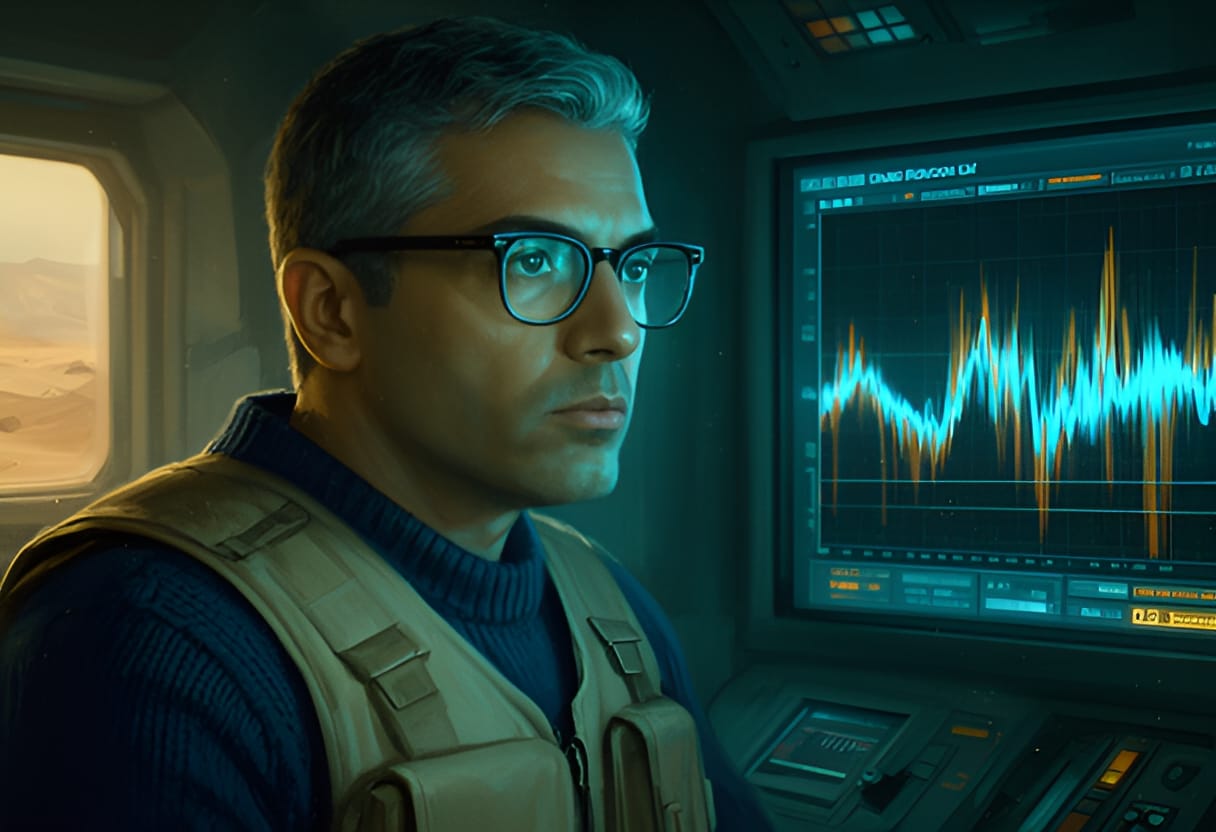
“There,” Tariq whispered. “Do you see that?”
Elena leaned in. “It’s… there. Half-life around 0.8 milliseconds. Too clean?”
Before anyone could answer, the signal collapsed. The pulses vanished, the graph returning to baseline noise. The beam current held steady, but the hoped-for confirmation was gone—like a word half-remembered upon waking.
Silence settled, thick and charged. Layla’s fingers tightened on the console. She had seen it—the pattern, the sequence. Too perfect to be random. And yet, gone.
Khalid finally spoke, his voice low. “Neutron flux spiked to 1.8× baseline during the dip. Then dropped below threshold. Not noise. Something absorbed it—then released it.”
“Or the detectors glitched,” Elena said, though she didn’t sound convinced.
Layla pushed back from the chair. “Run it again. Same parameters. No adjustments.”
Khalid opened his mouth, then closed it. He gave a single, sharp nod and returned his attention to the monitors. The accelerator hummed back to life, the cycle beginning anew. Outside, the first pale light of dawn seeped through the facility’s high windows, painting the control room in shifting shades of gray and blue. Layla stayed standing, her eyes locked on the screen, waiting for the next flicker—whether of success, or something far more dangerous.
Chapter 2
Chapter 2
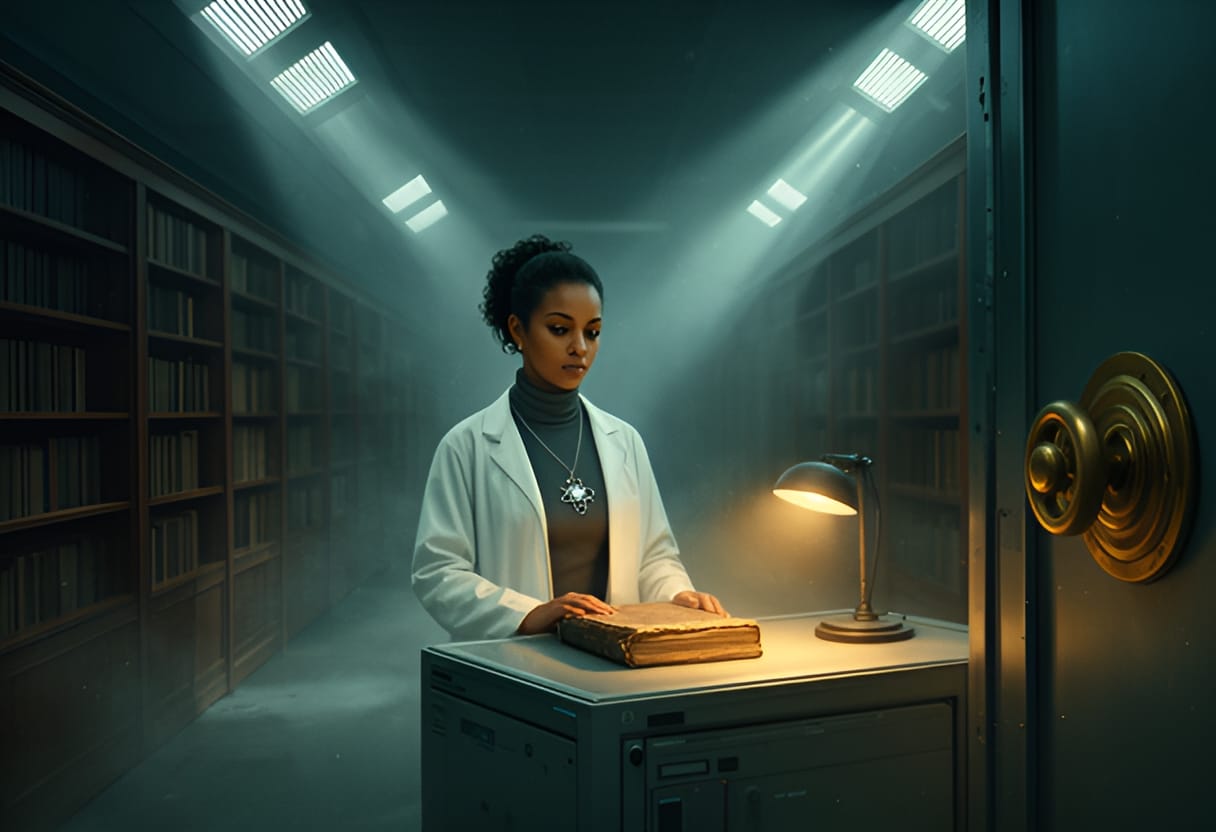
Layla’s breath fogged the glass of the Archive Vault’s outer door as she keyed in the access code. The seal hissed open, and she stepped into the chill, the recycled air carrying the faint tang of aged paper and polymer seals. Rows of climate-controlled cabinets lined the walls, each labeled with dates and project codes. She moved past them without hesitation, her boots silent on the anti-static flooring, until she reached the central alcove where Omar’s journal rested in its foam cradle beneath a lift-off lid.
She lifted the lid slowly, as if disturbing a sleeper. The journal lay open to the last page, the ink slightly faded where his hand had trembled. She read it again, the words familiar now, each one a weight in her chest.
Day 1,187. Trial 7. The beam held. The target flickered. For seventeen seconds, we saw what we came for—three clean decays, a chain that begged to be believed. But certainty is a luxury we cannot afford. If we chase it without humility, we will build our legacy on sand. The cost of certainty is not measured in failed runs or damaged hardware. It is measured in the lives we ask others to risk when we mistake hope for evidence. I will not be here to see the next attempt. Forgive me if I have left you with more questions than answers. — Omar
She traced the edge of the page with a gloved finger, feeling the faint ridge of the ink. The coat she wore—his old blue lab coat, faded at the elbows, smelling faintly of ozone and old cotton—pulled tight across her shoulders. She had worn it since the first trial, as if its threads could somehow bridge the gap between then and now.
A soft chime echoed from the corridor outside. The vault’s internal sensor had tripped on her entry. She lowered the lid, sealed the journal, and stepped back into the passage.
Khalid stood just beyond the outer door, arms crossed, his expression unreadable in the flat emergency lighting. He had been waiting.
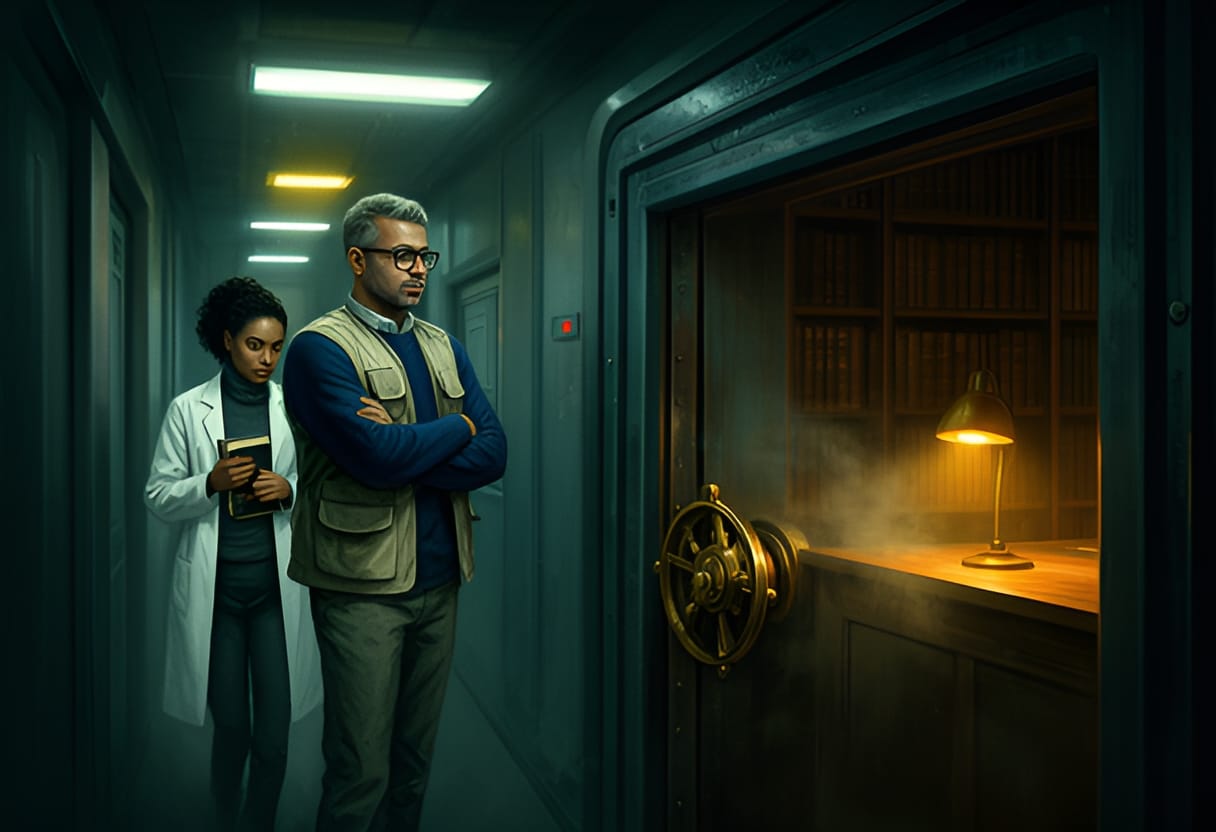
“You shouldn’t be down here alone,” he said, his voice low. “Not after what happened.”
Layla met his gaze. “I needed to see it again.”
“You’ve read it a dozen times since yesterday.”
“And I’ll read it a dozen more before we’re done.” She tucked her hands into the coat’s pockets. “He warned us. About the cost.”
Khalik’s jaw tightened. “He warned us about you. About letting guilt drive the protocol. You think he disappeared because the science failed? Or because he couldn’t watch someone he cared about walk into the same fire?”
“I’m not walking into anything blind.” She lifted her chin. “We’ve recalibrated the beam. Simulated the flux a hundred times. The detectors are clean. If there’s a signal this time, it’s real.”
“Or we’re seeing what we want to see.” He pushed off the wall. “Omar didn’t vanish because he feared the science. He vanished because he feared what we’d become chasing it.”
The words hung between them. Layla felt the old familiar pull—the need to justify, to explain—but she resisted it. Some truths couldn’t be argued into existence.
“I’ll be in the lab by 0550,” she said finally. “Prep the target. We start at 0600.”
Khalik studied her for a long moment. Then he nodded, once, sharp and curt. “I’ll be there.”
He turned and walked away, his footsteps absorbed by the flooring. Layla watched him go, then straightened Omar’s coat and headed toward the main corridor, the vault’s heavy door sealing shut behind her with a final, pneumatic sigh. The first pale light of dawn was already bleaching the sky outside, and in the distance, the accelerator began its low, steady hum.
The accelerator’s hum deepened as Layla took her place at the central console, her reflection faint in the darkened screen. Around her, the control room breathed with quiet intensity—Elena at the secondary station, Tariq adjusting the target wheel with meticulous care, and Khalid stationed at the neutron flux monitor, his brow furrowed but his voice steady when he spoke.
“Target layer circulating,” Tariq announced, his tone tight with focus. “Berkelium-249 at ninety-eight percent purity. Wheel speed nominal.”
“Beam ready,” Elena replied, her fingers poised over the initiation sequence. “Titanium-50 ions at 10.2 MeV per nucleon. All safeties green.”
Layla inhaled, the scent of ozone and recycled air sharp in her lungs. She glanced at Khalid. He gave the slightest nod—not approval, but acknowledgment. The unspoken tension between them lingered, but the room held its breath.
“Initiate bombardment,” she said.
The command clicked through the system. A low thrum built beneath the floor, rising into a sustained whine as the ion beam fired. On the main display, the target chamber glowed faintly blue—a Cherenkov whisper in the vacuum. Neutron counters began to tick, steady at first, then began to dance.
Khalil’s eyes flicked to his readouts. The flux wavered—spiking to 1.6× baseline, then dipping, then climbing again in uneven pulses. His fingers hovered over the keyboard, ready to log, to question, to halt—but he stayed silent. The signal they’d chased for months might be forming. To interrupt now, even with doubt, would be to repeat Omar’s mistake: letting fear silence the data.
Then, on the decay chain tracker, three sharp peaks appeared in rapid succession—alpha-like emissions, spaced just right, energies matching simulations for element 119’s predicted isotopes. The timestamps aligned: 0.8 milliseconds between each, a fleeting cascade that made Layla’s chest tighten.
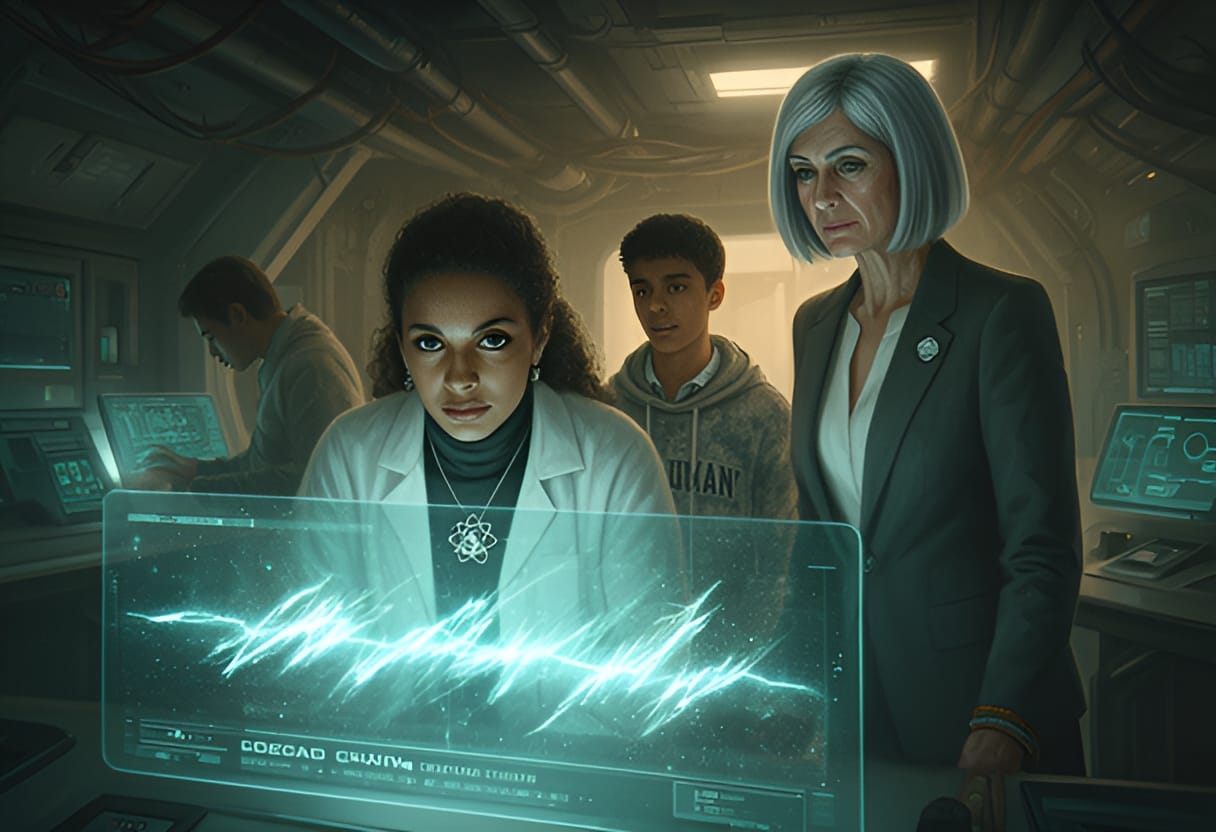
“There,” Tariq whispered, leaning forward. “Did you see that?”
Elena exhaled sharply. “That’s… clean. Too clean.”
Layla didn’t move. Her gaze locked on the screen as the peaks began to fade, the baseline sucking the signal back into noise. The third peak diminished, then vanished. The counters returned to their erratic rhythm—no confirmation, no secondary emission, no gamma signature to seal it.
Silence settled, thick and disappointed.
Khalil finally spoke, his voice low. “Flux spiked to 1.9× during the event. Then dropped below baseline. No neutron echo. No delayed coincidence.”
Layla pushed back from the console, the coat’s sleeves brushing the console edge. “So either we saw it—and lost it—or we didn’t see it at all.”
Tariq ran a hand through his hair. “It looked real.”
“It looked like what we wanted to see,” Khalid said, not unkindly. “But wanting doesn’t make it real. It just makes us careful.”
Layla stared at the dead screen. The hum of the accelerator faded into standby. Outside, dawn had fully broken, painting the control room in pale gold. She thought of Omar’s journal, of his warning about hope and evidence. She had come here to honor him—not to chase a ghost, but to face the truth, whatever it cost.
She turned to her team. “Run it again. Full validation this time. No shortcuts.”
No one objected. The work continued.

Chapter 3
The Cost of Almost
The observation lounge smelled of burnt coffee and ozone. Layla stood by the panoramic window, watching the Al-Rashid Facility’s outer ring lights blink in the pre-dawn gloom. The first trial’s data stream still pulsed on her tablet—nominal neutron flux, then the spike, the three clean alpha-like pulses, then nothing. She had replayed it a dozen times, searching for error, for hope.
Elena Voss appeared in the doorway, her Consortium badge catching the low light. She carried a tablet of her own, screen glowing with graphs. “You said the signal was clean,” she said, without preamble. “But the secondary scintillator array logged nothing. Zero coincidence. Just the primary array’s blip.”
Layla kept her back to the window. “The secondary array was offline for calibration. We noted it in the run log.”
“Noted, but not acted on.” Elena stepped closer, tapping the screen. “You proceeded with a half-validated detection. And the timing—seventeen seconds of stability before the surge—matches almost exactly the fluctuation pattern from Omar’s Day 1,187 trial. The one where he vanished.”
Layla’s jaw tightened. She turned, forcing her voice steady. “Correlation isn’t causation. Omar’s incident involved a target misalignment. Our beam profile was within tolerance.”
“Was it?” Elena tilted her head. “Khalid’s flux monitors showed a 1.8× baseline spike. Absorption and re-emission, you called it. But if the target wasn’t properly seated—if the berkelium layer had delaminated during deposition—that spike could mean neutron capture in impurities, not element 119. A false signal.”
Layla felt the familiar prickle behind her eyes. She looked down at her hands, then back at Elena. “We skipped the secondary validation,” she admitted, quieter than she intended. “To save time. The primary array had never failed us. We assumed—”
“You assumed.” Elena’s tone softened, just fractionally. “And now you’re asking the world to trust a result that can’t be replicated without cutting the same corner.”
Layla met her gaze. “What do you want me to do?”
“A full safety halt.” Elena’s voice was firm. “Pending a joint audit. Every log, every sensor, every video feed from the last seventy-two hours.”
Layla glanced at the chronometer on the wall: 05:52. The team would be arriving soon for the morning brief. “I can’t shut it down now,” she said. “Not without losing the window. The berkelium target degrades. We’d lose days re-preparing.”
Elena’s gaze didn’t waver. “Then run it again. But this time, with the secondary array online. And with observers—me, Khalid, anyone you choose. Transparent. Or I file a formal non-compliance report with the Consortium.”
Layla swallowed. The weight of Omar’s journal, the ghost of his absence, the fear that she was repeating his mistake—it all pressed inward. But backing down now would mean surrendering the chance to know, truly know, if they had seen something real.
“Agreed,” she said. “We’ll re-run at 06:00. Full validation. External oversight. No shortcuts.”
Elena nodded once, curt but satisfied. She turned toward the door, then paused. “And Layla? If this is just noise… you owe it to him to walk away.”
The door hissed shut behind her. Layla stood alone in the dim lounge, the facility humming awake around her. She checked her tablet again—the data, the ghost signal, the tantalizing, fragile possibility. Then she opened Omar’s journal to the last page, the ink smudged where his hand had shaken, and traced the final words with her fingertip: Don’t let the cost blind you to the truth.
Layla’s tablet dimmed as she set it down, the journal’s final words echoing in the quiet lounge. The chronometer blinked 05:55. Three minutes until the team arrived. She rubbed her temples, the ghost of Omar’s warning threading through her thoughts like a persistent static.
A soft chime from her wrist comm drew her attention—a low-priority motion alert from Containment Wing B. She frowned. No one was scheduled to be down there until dawn. She tapped the screen, pulling up the live feed. Grainy infrared showed a lone figure bent over the target preparation chamber, gloved hands adjusting the berkelium-249 substrate with meticulous care.
Tariq.
Her breath hitched. He wasn’t supposed to have access after hours. The motion sensors should have triggered a lockdown, yet here he was, working in the red-lit gloom as if the rules didn’t apply to him.
She sprang from her chair, heart hammering against her ribs. The lounge door hissed open, and she broke into a run, heels clicking on the polished alloy flooring. The scent of ozone grew sharper as she neared the containment wing, mingling with the faint metallic tang of ionized air.
The outer airlock cycled as she approached, and she slammed her palm against the manual override. The inner door slid open with a pneumatic sigh.
Khalid stood just inside the antechamber, arms crossed, his face illuminated by the blinking status lights of the scrubbers. His expression was tight, jaw clenched.
“He bypassed the biometric lock using an old maintenance override,” Khalid said, voice low but edged with anger. “I got the alert as he was moving through the antechamber. By the time I sealed the secondary lock, he was already in the prep chamber.”
Layla pushed past him, her eyes fixed on Tariq through the viewing port. The young intern was hunched over the deposition rig, adjusting the angular alignment of the berkelium-249 foil with a pair of titanium tweezers. He muttered something under his breath, his brow furrowed in intense concentration.
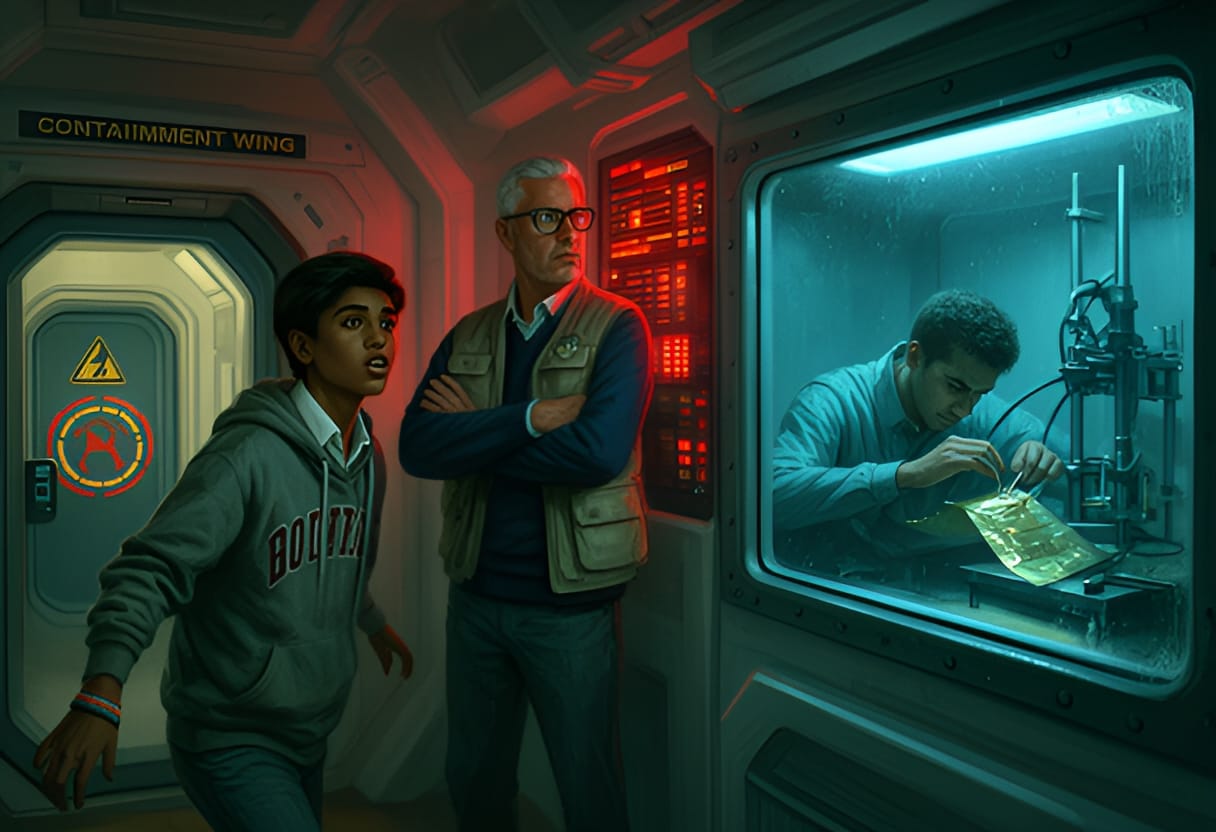
“Tariq!” Layla’s voice echoed in the chamber, sharp with authority and fear.
He jerked upright, knocking over a small vial of solvent. It clattered to the floor, spreading a thin, iridescent pool. “Dr. Hassan! I—I was just—”
“Explain yourself,” Khalid said, stepping forward. “You know the protocols. Unauthorized modifications to the target could contaminate the entire beamline. You could ruin weeks of work—or worse.”
Tariq’s cheeks flushed, but he didn’t back down. He held up a folded slip of paper, its edges worn from handling. “I found this in Omar’s journal. Marginalia, Day 1,186. He wrote: If the foil won’t bind, try a 5-degree off-axis tilt during sputter deposition. Reduces delamination under thermal load. I checked the logs from his last run—he never tried it. But if the spike we saw was from neutron capture in loose particles… this might fix it.”
Layla took the paper, her fingers trembling slightly. The handwriting was unmistakable—Omar’s precise, slanting script. She remembered seeing him make notes like that, late at night, muttering to himself as he worked.
“You’re basing this on a hunch?” Khalid demanded. “A scribble in a margin? What if it makes things worse? What if it causes a runaway reaction?”
“I’ve run the simulations,” Tariq said, voice gaining strength. “The tilt improves adhesion by 18%. It reduces particulate shedding. If the signal we saw was real, this could stabilize it. If it was noise… well, at least we’ll know we didn’t miss something because we were too rigid.”
Layla looked from Tariq’s earnest face to Khalid’s rigid posture. The facility hummed around them—the distant thrum of the accelerator, the whisper of coolant pumps, the ever-present reminder of what was at stake.
She thought of Omar’s journal, the smudged ink, the plea not to let cost blind her to truth. She thought of Elena’s challenge, the weight of responsibility pressing down on her shoulders. And she thought of the fragile, tantalizing signal—three alpha-like pulses in the dark—like a whisper from the edge of knowing.
She met Khalid’s gaze. “Let him finish.”
Khalid opened his mouth to protest, but Layla held up a hand.
“He’s not changing the beam energy or the target composition. Just the deposition angle. If it’s wrong, we’ll catch it in diagnostics. If it’s right… it might be the variable we’ve been missing.”
Khalic’s jaw worked, but he finally nodded, curt and stiff. “I’ll monitor the deposition in real time. If the QCM drift exceeds 0.5 nanometers per second, I abort.”
Tariq exhaled, relief washing over his features. “Thank you. I’ll reset the chamber and start the sputter cycle now.”
As Tariq turned back to the rig, Layla lingered in the antechamber, the weight of the decision settling not as relief, but as a deeper kind of resolve. She wasn’t just chasing an element anymore. She was honoring a method—Omar’s quiet insistence that answers lived in the details, in the margins, in the willingness to listen to a hunch backed by care.

The chronometer glowed 05:58. Two minutes until dawn. Two minutes until they would know, one way or another, if they had touched something true.
She placed a hand on the cool glass of the viewing port, watching Tariq’s steady hands at work. Somewhere, in the quiet precision of his movements, she felt Omar’s presence—not as a ghost, but as a guide. And for the first time in years, the silence didn’t feel like absence. It felt like anticipation.