Horror
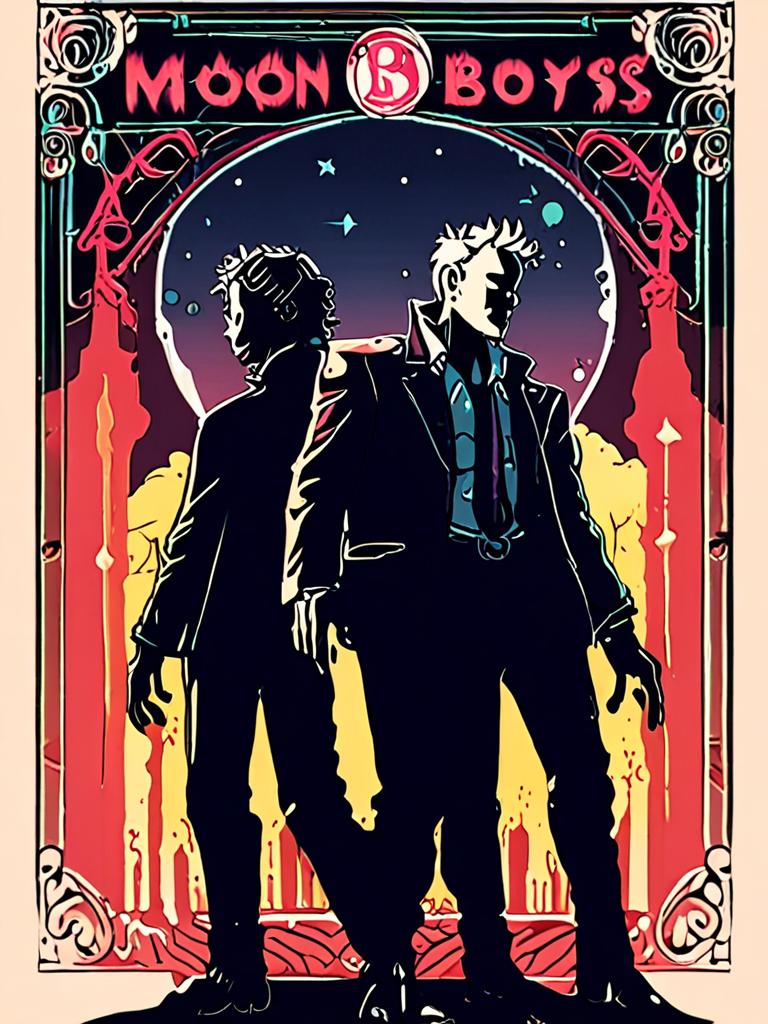
Moon Boys
by aaron c.m
1 chapter1.1 hr read
Chapter 1
The Call of the Basement Beat
The rain came sideways, stinging Jesse’s face as he shoved his hands deeper into the pockets of his too-thin hoodie. He hadn’t meant to linger at the bus stop, but the last one had pulled away just as he rounded the corner, leaving him stranded under the flickering glare of a sodium lamp that buzzed like a trapped wasp. Three guys had been leaning against the brick wall of the closed laundromat, laughing too loud, their voices edged with something that made Jesse’s stomach drop before they even turned.
“Hey, princess,” one had said, stepping forward. His grin was crooked, missing a tooth. “You lost or just looking for a good time?”
Jesse had kept his eyes on the cracked pavement, shoulders hunched. “Just waiting for the bus.”
“Bus don’t come this late on Sundays,” the second guy said, stepping closer. He smelled of cheap beer and motor oil. “You sure you ain’t looking for trouble?”
“I’m not trouble,” Jesse muttered, though his voice shook.
The third guy let out a short, harsh laugh. “Nah, you look like trouble looking for a place to happen.” He flicked ash from his cigarette onto Jesse’s shoe. “You got a name, sweetheart?”
Jesse didn’t answer. He could feel his pulse hammering in his throat, the familiar prickle behind his eyes—the one that came before tears or panic or something worse. He’d learned early that showing fear was like throwing meat to dogs. So he stood still, breath shallow, waiting for the moment to pass.
It didn’t.
The first guy reached out, fingers brushing Jesse’s chin, forcing his face up. “You’re blushing. Cute. Bet you scream pretty.”
Jesse jerked back, but the guy caught his wrist, grip tight enough to bruise. “Let go,” he said, louder than he meant to. His voice cracked.
The laughter that followed was sharp, cruel. “Feisty. I like ‘em feisty.”
Jesse twisted, desperation lending him strength, and broke free. He didn’t look back. He just ran—lungs burning, sneakers slapping wet pavement—as the shouts followed him, fading only when he turned the corner and kept going, heart hammering against his ribs like it was trying to escape.
He didn’t stop until his lungs screamed and his sides ached, doubling over behind a dumpster in an alley that reeked of rotting grease and wet cardboard. He pressed his forehead to the cold brick, trying to suck in air, trying to quiet the roar in his ears. His hands shook. His shirt was damp where he’d gripped it, knuckles white.
He wasn’t safe. He knew that. But for now, he was alone. And alone was better than that.
He pushed off the wall, wiped his face with the heel of his hand, and started walking again—aimless, just needing to put distance between himself and the laughter still echoing in his skull. The city was quiet at this hour, the kind of quiet that felt hollow, like the world had exhaled and forgotten to inhale again. Neon signs blinked in the distance—Open, Pool, 24-Hour Diner—but nothing felt inviting. Everything felt like a trap waiting to snap shut.
Then he saw it.
Tucked between a shuttered bookstore and a shuttered laundromat (ironic, he thought bitterly), a narrow set of stairs descended into darkness, flanked by black-painted walls. Above the doorway, in flickering red neon that pulsed like a heartbeat, a single word glowed: VOID.
He’d passed it a dozen times, maybe more. Always avoided it. It looked like the kind of place where people disappeared. But tonight, the bass from within thumped through the soles of his shoes, a low, steady vibration that seemed to sync with something deep inside him—a pulse he hadn’t noticed before, now hammering in time with the music.
It wasn’t just sound. It was feeling. A hum in his sternum, low and warm, like a tuning fork struck against his breastbone. It pulled at him, insistent and quiet, beneath the panic still coiling in his gut.
He hesitated. One step. Two.
Then he was on the stairs, the door sighing shut behind him with a sound like exhaled breath.
The club swallowed him whole.
Light and sound hit him like a physical blow—strobes slicing through haze, lasers carving ribbons of green and blue across the ceiling, bass so deep it rattled his teeth and made his vision blur at the edges. Bodies moved in the dark, a writhing mass of sweat and glitter and bare skin, lost in the rhythm. The air was thick with sweat, perfume, and something sharper—ozone, maybe, or the metallic tang of static.
Jesse stood frozen near the back, hands shoved in his armpits, trying to make himself small. He didn’t dance. He didn’t belong here. He was too quiet, too soft, too much the boy who flinched at raised voices and kept his eyes down.
But the hum in his chest wouldn’t let him go. It thrummed louder now, a steady thrum beneath his ribs, pulling him not toward the dance floor, but up.
He followed it, pushing through the crowd, shoulders brushing against strangers who didn’t apologize, didn’t notice. The music shifted—less beat, more texture—a low, resonant drone that seemed to vibrate in his molars. The lights dimmed in patches, replaced by pools of amber and deep violet that made the air feel slow, syrupy.
And then he saw it: a door at the top of a short flight of stairs, slightly ajar. Warm light spilled out, golden and flickering. Not the harsh strobes below, but something softer—candlelight, maybe, or strings of old bulbs. And beneath the music, beneath the bass, there was a chant.
Low. Rhythmic. Not in English.
Jesse’s breath hitched. The hum in his chest flared, sharp and sudden, like a spark catching dry tinder.
He climbed the stairs slowly, each step sending a jolt up his spine. The door was open just enough for him to see inside.
The attic was small, circular, walls lined with shelves holding jars of strange liquids, dried herbs, and crystals that caught the light and threw rainbows across the floor. In the center, five people stood in a loose circle, barefoot on a rug woven with symbols he didn’t recognize but felt in his teeth. They wore dark clothes—velvet, lace, leather—nothing like the club below. Their heads were bowed, palms upturned, fingers slightly curled.
And between their hands, hovering just above their palms, were sigils made of glitter—gold, silver, iridescent—pulsing faintly, like breathing.
The chant rose and fell in a language that felt older than words, vibrating in Jesse’s bones. The air shimmered, not with heat, but with pressure—like the moment before a storm breaks, when the sky holds its breath.
Then one of them—a woman with short, dyed-blue hair and a nose ring—turned her head.
Her eyes locked onto Jesse in the doorway.
Not angry. Not afraid. Seeing.
And in that instant, the hum in Jesse’s chest exploded into a roaring wave. He gasped, staggering back a step, vision whitening at the edges. It was like touching a live wire—fire and ice and light all at once, flooding his nerves, making his muscles lock. He couldn’t breathe. Couldn’t move. Couldn’t look away.
The woman’s lips parted. She said something—maybe his name? He couldn’t tell. The sound was drowned in the roar in his ears.
Then strong hands gripped his arms from behind.
“Hey,” a voice said, warm and urgent, close to his ear. “Breathe. Just breathe.”
Jesse shuddered, doubling over as the wave receded, leaving him trembling, slick with sweat, his heart hammering like a trapped bird. He sucked in air, ragged and shallow, his vision swimming.
“You okay?” the voice asked again. Concern, not fear.
He blinked. The woman in the circle was still watching him, but now others had turned— a tall man with dark skin and close-cropped hair, a blonde man in black leather watching from the shadows near the wall, arms crossed, expression unreadable.
The person holding him stepped into the light.
Drew Jensen.
She was soft where others were sharp—round cheeks, bright eyes behind thick-rimmed glasses, a cascade of dark curls escaping a messy bun. She wore a flowing skirt and a band t-shirt two sizes too big, but her grip on his arms was firm, grounded.
“You scared the hell out of us,” she said, but there was no anger in her tone. Only worry. “You just appeared in the doorway like you were pulled here. Your aura went supernova.”
Jesse swallowed, throat dry. “I… I didn’t mean to—”
“Shhh,” Drew murmured, guiding him gently into the circle. “You’re safe. We’ve got you.”
The others shifted to make room. The woman with blue hair—Jesse realized belatedly that her name was probably something fierce, like Riot or Vex—gave him a small, encouraging nod. The tall man stepped forward, placing two fingers lightly on Jesse’s wrist.
Jordan Wong.
His touch was cool, impersonal at first, then his brows furrowed. “Huh,” he murmured. “You’re running hot. Pulse’s thready, but strong. Like a live wire wrapped in silk.”
Jesse blinked up at him. Jordan was broad-shouldered, muscular, the kind of guy who looked like he could bench-press a car. His face was open, honest, but his eyes held a sharp intelligence that made Jesse feel seen in a way that terrified him.
“You got the spark,” Jordan said, not unkindly. “Strong one. Untrained, but there. Like a dam about to burst.”
Before Jesse could respond, a voice cut through the quiet—not loud, but impossible to ignore.
Colby Chambers.
He stepped out of the shadows near the wall, blonde hair catching the candlelight, pale skin stark against the black leather jacket he wore over a mesh shirt. His eyes were the color of stormwater—gray, sharp, assessing. He didn’t smile. Didn’t frown. Just looked, like he was weighing Jesse on a scale only he could see.
“Drew’s right,” Colby said, voice low and smooth, edged with something that might have been amusement or calculation. “You are sensitive. Most humans wouldn’t even feel the thrum, let alone get dragged up here by it. Most would’ve passed out in the hallway.”
Jesse’s face burned. He wanted to vanish into the floor.
“He’s not most humans,” Drew said softly, but firmly. She squeezed his arm. “He felt the pull. He answered it. That means something.”
Colby tilted his head, considering. “Or it means he’s loud. And loud things attract attention. Not all of it good.”
Jesse’s stomach dropped. He opened his mouth to explain—I didn’t mean to come here, I was just running, I just wanted to hide—but the words died. What did it matter? They could see him. Really see him. Not the shy kid who kept his head down, not the boy who flinched at loud noises, but the thing underneath—the part that hummed when the bass dropped, the part that answered to sigils of glitter and ancient chants.
“I… I should go,” he said, voice small. “I’m sorry. I didn’t mean to interrupt.”
He started to step back, but Drew’s grip tightened, just slightly.
“No,” she said. “You don’t have to go. Not unless you want to.”
Jesse glanced at her, then at Jordan, whose expression was thoughtful, then at Colby, who watched him with unblinking intensity.
“Why?” Jesse whispered. “Why let me stay?”
Colby pushed off the wall, stepping into the circle’s edge. He didn’t come close, but his presence filled the space—cool, magnetic, like gravity.
“Because,” he said, voice dropping to a near-whisper, “you’re not just sensitive. You’re resonant. Like a string that’s been waiting to be plucked. And I don’t ignore potential.”
He paused, letting the words settle. The chant had stopped. The glitter sigils above their palms had faded to dull specks, waiting.
“Stay,” Colby said. “Just for tonight. See what we do. See if you feel it again—not the pull, but the purpose behind it.”
Jesse looked from Drew’s warm, encouraging smile to Jordan’s steady, assessing gaze to Colby’s shadowed eyes, holding his like a promise and a threat all at once.
He thought of the bus stop. Of the hands on his wrist. Of the shame burning hot behind his ribs.
And he thought, for the first time in his life, of not being alone.
“I’ll stay,” he said. His voice was quiet, but it didn’t shake.
Colby’s lips twitched—almost a smile, but not quite. “Good.”
Drew beamed. Jordan gave a single, sharp nod.
And somewhere deep in Jesse’s chest, the hum returned—not as a pull, but as a promise.
Low. Steady.
Alive.
The air in the attic shifted—not with sound, but with intention. Drew released Jesse’s arm, stepping back to reclaim her place in the circle. Jordan did the same, his eyes still on Jesse, thoughtful, assessing. Only Colby remained where he was, near the edge, arms loose at his sides now, but his attention sharp as a blade.
“You felt it,” Colby said, not as a question, but a statement. “The surge. The pressure. That wasn’t just the music. That was the veil thinning. Somewhere nearby, something’s pushing through.”
Jesse swallowed, his throat tight. “I… I didn’t do anything. I just stood there.”
“You didn’t have to,” Drew said gently. “Your aura flared like a beacon. You’re not just sensitive—you’re attuned. When the veil shivers, you feel it in your marrow. Most people would’ve passed out. You stayed upright. That means something.”
Jesse glanced at his hands, flexing his fingers as if expecting to see sparks. “I don’t feel anything now. Just… tired. And weird. Like I’ve been running for hours.”
“That’s the aftershock,” Jordan said. “Big surges take it out of you. Especially if you’re untrained. Your body’s trying to ground the excess—like a circuit overloading.”
Colby turned then, moving to the shelf behind him. He ran a finger over a row of small bottles filled with liquids that shifted color when the light hit them—deep indigo, molten gold, shifting to violet like oil on water. He picked one up, unscrewed the cap, and held it out. “Drink this. It’ll help stabilize you. Ground the excess without dulling the edge.”
Jesse hesitated. The liquid inside pulsed faintly, like a slow heartbeat. “What is it?”
“Moonwort infusion,” Colby said. “With a touch of silverroot. Bitter, but effective. Drew brewed it.”
Drew gave him an encouraging thumbs-up. Jordan watched him closely, waiting.
Jesse took the bottle. It was cool in his palms. He brought it to his nose—it smelled of damp earth and crushed mint, with a sharp, clean undertone like lightning after rain. He tipped it back.
It hit his tongue like ice and fire—sharp, herbal, almost metallic—and spread warmth through his chest, settling in his sternum where the hum had been. Almost immediately, the jittery tension in his limbs eased. His breath slowed. The world stopped feeling like it was vibrating at a frequency just beyond hearing.
“Better?” Colby asked.
Jesse nodded. “Yeah. Thanks.”
“Good.” Colby tucked the empty bottle back into the shelf. “Now. Let’s see what you can do.”
Jesse blinked. “Me?”
“You felt the surge,” Colby said, turning to face him fully now. “You responded to it. That means your channels are open—crude, unrefined, but open. We’re going to test them. Gently.”
Jordan stepped forward, placing a hand on Jesse’s shoulder—not to steer, but to ground. “We’ll go slow. No pressure. Just… reach out. See what’s there.”
Jesse glanced at Drew, who gave him a small, reassuring smile. “It’s okay,” she murmured. “We’ve all been where you are.”
He took a breath. Closed his eyes.
And reached inward.
Not with his hands, not with his mind—but with that part of him that had hummed in the stairwell, that had throbbed in time with the bass, that had answered the chant above.
He didn’t think. He listened.
At first, there was nothing but the quiet rush of blood in his ears, the faint thrum of his pulse. Then—beneath it—a vibration. Not sound. Not touch. A presence. Like standing near a live wire, feeling the field around it without making contact.
He focused on it.
And the attic answered.
Not with sound, but with light—behind his eyelids, he saw it: the glitter sigils, not fading this time, but growing. Threads of gold and silver spiraling upward from the palms of the coven, weaving in the air like lace made of starlight. The symbols on the rug pulsed in sync—runes flaring to life, then fading, then flaring again, like breathing.
And beneath it all, a low tone—not heard, but felt—a resonance deep in the earth, like the hum of a great machine turning far below.
Jesse gasped, eyes snapping open.
The sigils above their palms were still there—faint, but visible. And in his own palms, resting loosely at his sides, he saw it: a faint shimmer, like heat haze over asphalt. Gold at the edges, deepening to blue at the center.
“I… I see it,” he whispered.
Colby’s eyes narrowed, not in surprise, but in calculation. “Good. Now hold it. Don’t push. Just hold it. Let it be.”
Jesse tried. He focused on the sensation—the warmth in his chest, the light behind his eyes, the faint tingling in his fingertips. The shimmer in his palms steadied. Didn’t grow. Didn’t fade. Just… was.
Jordan exhaled softly. “Not bad for a first try. Most newcomers either blow out or shut down. You held the line.”
Drew beamed. “See? Told you you had it.”
Colby stepped closer now, entering the circle’s inner ring. He didn’t touch Jesse, but his presence was a force—cool, intense, like standing near a glacier. “You have raw sensitivity,” he said. “That’s rare. Most who come here are seekers—drawn by the vibe, the aesthetic, the promise of power. Few have the gift. And fewer still have the control to keep from burning themselves out—or worse, attracting something they can’t put back.”
Jesse lowered his hands slowly, the shimmer fading as he did. “What happens if you lose control?”
Colby’s gaze flicked to Jordan, then back. “Depends on the working. A minor spell? You might get a nosebleed, a headache. Something bigger? You could rupture a vein in your brain. Or worse—tear a hole in the veil and let something through that we’re not ready to fight.”
Jesse’s stomach clenched. “Like what?”
“Like things that don’t belong here,” Jordan said quietly. “Echoes. Hungry things. Old gods wearing new skin. The veil isn’t just a barrier—it’s a filter. And when it frays, the wrong stuff seeps through.”
Colby nodded. “Which is why we’re here. Not to play with fire. Not to chase thrills. We’re the wardens. The attic isn’t just a room—it’s a nexus. A lens. The energy here doesn’t just amplify—it focuses. And if it’s not stabilized, if it’s not guarded… it becomes a beacon. For everything that’s been locked out.”
Jesse looked around the attic—the jars, the symbols, the faint scent of sage and ozone clinging to the air. It wasn’t just a sanctuary. It was a watchtower.
And he was being asked to stand on the wall.
“Why me?” he asked, voice quiet. “Why not… someone else? Someone who’s been doing this longer?”
Colby’s expression didn’t soften, but his tone lost its edge. “Because you answered. Not because you were summoned. Not because you were called. You heard the thrum and you came. Most people feel nothing. Some feel unease and leave. A few get curious and peek. But you—you stepped into the circle without being invited. That’s not coincidence. That’s resonance.”
He paused, letting the words settle. The candlelight flickered, casting long shadows across Colby’s sharp profile—blonde hair falling across his forehead, jaw tight, eyes distant, not unkind, but guarded.
“We don’t take just anyone,” Colby said. “We take those who can hold the weight. Who won’t break when the pressure comes. Who won’t flinch when the work gets dark.”
Jesse thought of the bus stop. Of the laughter. Of the way his chest had seized when the hands grabbed him—not just from fear, but from the shame of being seen, of being known, even if only for a second.
He thought of the hum in his chest—not fear this time, but something steadier. Something that felt like recognition.
“I don’t know if I can do this,” he said honestly. “I’ve never… I’ve never done anything like this before.”
“Nobody starts knowing,” Drew said softly. “We all start shaking. We all start terrified. But we start together.”
Jordan nodded. “We’ve got your back. As long as you’ve got ours.”
Colby was silent for a moment. Then: “We’ll see. Tonight was just the first test. If you come back, we’ll go further. We’ll teach you to shape the energy—not just feel it, but direct it. To seal, not just sense. To protect, not just perceive.”
He stepped back, retreating into the shadow of the shelf. “But it’s not a promise. It’s a choice. And it’s not one to make lightly.”
Jesse looked from Drew’s open, hopeful face to Jordan’s steady, assessing gaze to Colby’s shadowed silhouette, watching him like a man evaluating a weapon.
He thought of the club below—the noise, the lights, the bodies lost in the beat. It had felt like escape. But it hadn’t felt like home.
This place—strange, quiet, charged with unseen power—had.
Not because it was safe. But because it was true.
“I’ll come back,” Jesse said. His voice was low, but firm. “I want to learn.”
Colby didn’t smile. But his eyes—those storm-gray eyes—held his for a long moment. Then he gave a single, almost imperceptible nod.
“Good,” he said. “We’ll begin at dusk. Three days from now. Bring nothing but yourself. And an open mind.”
Jesse nodded. “I will.”
Drew stepped forward then, pulling him into a brief, fierce hug—her frame soft but strong, her warmth seeping into his bones. “Welcome,” she whispered. “We’re glad you’re here.”
Jordan clasped his forearm in a grip that was firm, brotherly. “Try not to blow up the attic on day one,” he said, trying to joke, but his eyes were serious. “We like this place.”
Jesse managed a shaky laugh. “I’ll do my best.”
Colby said nothing as they moved toward the door. But as Jesse paused on the threshold, looking back, he saw him—still in the shadows, arms crossed, watching.
Not with hostility.
Not with warmth.
But with expectation.
And for the first time in his life, Jesse didn’t flinch from being seen.
He stepped back into the club’s pulse—the bass, the lights, the sway of bodies—and let it wash over him, not as a refuge, but as a contrast.
Below, the night was loud, bright, alive with distraction.
Above, the quiet thrummed with purpose.
And Jesse Edwards, who had spent his whole life trying to disappear, felt, for the first time, like he had been found.
He pushed through the crowd, not running this time, but walking—steady, sure, his shoulders no longer hunched against the world.
The hum in his chest was quiet now.
But it was there.
And it was waiting.
The bass thumped through Jesse’s ribs like a second heartbeat as he pushed through the throng on the dance floor. Bodies swayed, slick with sweat and glitter, faces turned up to the strobing lights that painted the club in violent bursts of crimson and cobalt. The air was thick with perfume, spilled liquor, and the sharp tang of exertion. Somewhere nearby, someone laughed too loud, a sound that grated against the quiet stillness still humming in his chest.
He didn’t go to the bar. Didn’t look for a shadowed corner to disappear into. Instead, he kept moving—steady, deliberate—toward the back of the room where the hallway led to the restrooms and the staff-only stairwell. The music followed him, muffled but insistent, a low thrum beneath the soles of his shoes.
He paused at the entrance to the stairwell. The door was unmarked, just a slab of dark wood recessed into the wall, the kind of detail most patrons would overlook. But Jesse had seen Drew slip through it earlier, her plus-sized frame moving with unexpected grace as she vanished into the dimness beyond.
He reached out, fingers brushing the cool metal of the handle. It turned easily.
The stairwell was narrow, carpeted in faded gray, the walls lined with old posters peeling at the corners—advertisements for long-gone bands, faded flyers for poetry slams and drag nights. A single bulb flickered above him, casting a wavering glow. He began to climb, each step silent despite the rubber soles of his sneakers.
Halfway up, he stopped.
The hum in his chest had grown sharper, not louder, but more defined—like a wire plucked and still vibrating. It centered just below his sternum, a steady pulse that synced, impossibly, with the distant beat of the music below. Not matching it. Answering it.
He pressed a palm flat against the wall, feeling the faint vibration travel up through the plaster, into his fingertips. It wasn’t just in the air. It was in the building itself. In the bones of the place.
He closed his eyes.
And for the first time since he’d stepped into the attic, he didn’t try to shut it out.
He let it in.
The sensation wasn’t visual, not exactly. But behind his eyelids, patterns began to form—flickering geometries of silver and indigo, like circuitry drawn in moonlight. They pulsed in time with the hum, expanding and contracting, branching outward like roots seeking water. One shape repeated: a circle bisected by a vertical line, topped with a crescent. A sigil. He’d seen it etched on the inside of the attic door, worn smooth by years of touch.
His breath hitched.
He wasn’t imagining it.
He was seeing it.
A choked sound escaped him—half gasp, half whimper—and he jerked his hand back as if burned. His eyes flew open. The stairwell was just a stairwell again: dim, dusty, ordinary. But his chest still hummed, softer now, but insistent.
He leaned his forehead against the cool wall and breathed.
What are you? he thought, not in fear, but in awe. What am I becoming?
He pushed off and continued upward.
At the top, another door—this one slightly ajar, a sliver of warm light spilling onto the landing. Voices drifted out, low and familiar.
Drew’s laughter, soft and musical. Jordan’s deeper chuckle in response.
Jesse hesitated. He could go back down. Pretend he’d never come up. Slip into the crowd, lose himself in the noise, pretend the attic had been a dream—or a hallucination born of fear and isolation.
But the hum in his chest disagreed.
It thrummed, quiet but firm: Stay.
He pushed the door open.
The attic was exactly as he’d left it—jars of dried herbs lining the shelves, crystals catching the candlelight, the air rich with sage and something metallic, like rain on stone. The sigils on the floor glowed faintly, not with the blazing intensity from before, but with a steady, inner light, like embers banked for the night.
Drew stood near the center, stirring something in a brass bowl that sent up a curl of blue-tinged steam. Jordan leaned against the wall beside the window, arms crossed, watching her with a small, affectionate smile. Colby was nowhere in sight.
“You came back,” Drew said, not turning. Her voice was warm, but her eyes—when she finally glanced over—were sharp. “I felt you on the stairs. Like a plucked string.”
Jesse swallowed. “I… I needed to see if it was real.”
Drew nodded, setting the spoon down. “Good. Doubt’s healthy. Keeps you from walking blind into things you don’t understand.” She gestured to the floor. “Come. Stand where you stood before.”
He did. The sigils flared slightly under his feet, not painfully, but with a clear acknowledgment—like a dog lifting its head at the sound of its name.
Jordan pushed off the wall. “Feeling it again?”
“Yeah,” Jesse said. “It’s… quieter. But clearer.”
Jordan nodded. “That’s the attic settling. It knows when someone’s sincere. When they’re just playing tourist, it gets… prickly. Like static.” He smirked. “You didn’t get zapped, so that’s a good sign.”
Drew moved to the shelf and pulled down a small cloth bundle. She unwrapped it slowly, revealing a smooth, oval stone the color of storm clouds, veined with faint silver lines that seemed to shift when Jesse looked at them directly.
“This is moonstone,” she said, placing it in his palm. “Not the kind you buy at the flea market. This was charged under the last eclipse, buried in iron-rich soil for thirteen nights, then washed in rainwater collected during a thunderstorm. It doesn’t just store energy—it reflects it. Shows you what you’re carrying inside.”
Jesse closed his fingers around it. The stone was cool at first, then began to warm, not from his grip, but from within—like it was waking up.
He opened his eyes.
The attic had changed.
Not physically. But layered. Overlaid.
The jars on the shelf now glowed with inner light—each containing not just herbs, but tiny, swirling vortices of colored mist: violet for protection, gold for clarity, a sickly green that made his stomach churn. The cords snaking across the floor weren’t just wires for lights—they were thick, glowing conduits, pulsing with energy like veins. And the air itself shimmered, not with heat, but with possibility—faint ripples, like heat haze over asphalt, but colored with hues that didn’t belong to the visible spectrum.
He looked down at his hands.
They were outlined in a soft silver aura, flickering at the edges like a candle in a draft.
“Whoa,” he breathed.
“Easy,” Drew said gently. “Don’t grab at it. Let it show you what’s there.”
He forced himself to still his breath, to stop reaching. And slowly, the aura didn’t fade—it deepened. The silver softened into something more complex: threads of blue and violet weaving through it, like light through a prism. And beneath it, almost hidden, a pulse of deep, resonant red—slow, strong, like a heartbeat buried in stone.
“That’s you,” Drew said quietly. “Not all of it. But the part that’s awake now. The red… that’s your root. Your connection to the earth. Strong. Stable. The blue is your mind—your ability to perceive. The violet… that’s your will. It’s faint, but it’s there. You just have to learn to flex it.”
Jesse looked up, his throat tight. “I felt something like this before. In the attic. When I tried to channel.”
“You did more than feel it,” Jordan said, stepping closer. “You pulled. That’s why the sigils flared. You didn’t just receive—you reached. Most newcomers just get overwhelmed. You actually tried to shape it.”
Jesse looked down at the moonstone. The warmth in his palm had spread up his arm, tingling like pins and needles, but not unpleasant. “It felt… natural. Like I was supposed to do it.”
“That’s the resonance,” Drew said. “It’s not just sensitivity. It’s affinity. The attic doesn’t just respond to you—it recognizes you. Like a instrument that’s been waiting for its player.”
Jordan’s expression softened. “You know, most people who come here looking for power… they want to take. They want to bend things to their will. Flashy stuff. Fireballs. Levitation. Shit you see in movies.” He snorted. “They last about ten minutes before they either blow something up or get themselves cursed.”
Drew shot him a look. “Jordan.”
“What? It’s true.”
Jesse smiled faintly. “I don’t want to blow anything up.”
“Good,” Jordan said. “Because the real work isn’t about power. It’s about balance. It’s about knowing when to hold, when to release, when to let something flow through you without breaking.” He tapped his chest. “That’s where most fail. They think strength is about gripping tighter. But it’s the opposite. It’s about opening your hand and trusting you won’t drop what’s placed in it.”
Jesse turned the moonstone over in his palm. The internal light had dimmed slightly, but the silver veins still glowed, steady and sure.
“So… what now?” he asked. “You said we’d start training in three days.”
“We do,” Drew said. “But that doesn’t mean nothing happens between now and then. Sensitivity like yours… it doesn’t just turn off. It builds. If you don’t learn to manage it, it’ll start managing you.”
Jordan pushed off the wall. “Come on. Let’s get you set up.”
They led him to a small table near the window, where a cloth lay spread with several objects: a small brass bowl, a vial of clear liquid, a bundle of dried moonwort tied with silver thread, and a smooth black stone that drank the light rather than reflecting it.
“This is your starter kit,” Drew said. “Not for spellwork. For grounding. You’re picking up psychic static all the time—emotions, impressions, echoes. Without a way to discharge it, it’ll build up like static in your teeth. Headaches. Nightmares. Intrusive thoughts that aren’t yours.”
She uncorked the vial. “This is silverroot tincture. Not the infusion you had before—this is stronger. Three drops under the tongue, twice a day. It won’t dull your sensitivity. It’ll help you filter it. Like sunglasses for your third eye.”
Jesse took the vial. The liquid inside caught the light, faintly iridescent.
“And the moonwort?” he asked.
“For burning,” Jordan said. “Before sleep. In a bowl, like incense. It doesn’t just calm you—it cleanses. Pulls the sludge out of your aura. Think of it like psychic floss.”
Drew placed the black stone in front of him. “This is obsidian. Not charged. Not special. Just… volcanic glass. Hold it when you feel overwhelmed. It doesn’t absorb energy—it reflects it back at the source. Like a mirror. If something’s trying to latch on, it’ll bounce off.”
Jesse picked it up. It was surprisingly light, and cold—colder than stone should be.
“How do I know it’s working?” he asked.
“You’ll feel it,” Drew said. “Like a weight lifting. Or a noise cutting out.”
Jordan grinned. “Or you’ll suddenly hate the sound of chewing. That’s a common side effect. Temporary, hopefully.”
Jesse managed a real smile this time. “Noted.”
“Now,” Drew said, “we’re going to do a simple exercise. Not to channel. Not to push. Just to notice.”
She guided him to sit cross-legged on the floor, the moonstone in his left hand, the obsidian in his right. The brass bowl sat in front of them, half-filled with water.
“Close your eyes,” she said. “Breathe. In for four, hold for four, out for six. Don’t force it. Just find the rhythm.”
He did. The bass from below throbbed through the floor, a steady thoom-thoom-thoom. He matched his breath to it, not fighting it, but letting it move through him.
“Now,” Drew said, her voice low, “don’t look for anything. Don’t try to see sigils or feel auras. Just… notice what’s already there. The sounds. The smells. The feeling of the air on your skin. The weight of your hands in your lap.”
He did. The scent of sage and old wood. The faint metallic tang—ozone, maybe—from the energy in the walls. The pressure of his socks against his ankles. The pulse in his throat.
And beneath it all, the hum.
Not in his chest this time.
In the space between his breaths.
He opened his eyes slightly. The attic looked the same. But now, when he glanced at the water in the bowl, he saw it—not a reflection of the room, but a distortion. Like heat rising off pavement, but in the liquid itself. Tiny ripples moving against stillness.
“That’s not the air conditioning,” Jordan murmured.
“No,” Drew said. “That’s the ambient bleed. The attic’s always leaking a little. Normally, it’s too faint to notice. But you… you’re tuned to the frequency now.”
Jesse focused on the distortion. Not trying to change it. Just… observing.
And then, without meaning to, he exhaled—a long, slow breath.
The ripples in the water stilled.
For a heartbeat, the surface was perfectly smooth.
Then, as he inhaled again, they began—but slower. Softer.
Drew’s breath hitched. “You did that.”
“I didn’t mean to—”
“Doesn’t matter,” she said, eyes bright. “You affected it. With your breath. With your state. That’s not perception. That’s influence.”
Jordan pushed up onto his elbows, intrigued. “Try it again. But this time, don’t think about the water. Think about… calm. Not the idea of calm. The feeling. Like when you’re lying in the grass and the world feels soft at the edges.”
Jesse closed his eyes again.
He thought of the bus stop. Of the fear, the shame, the way his chest had locked—not from danger, but from being seen. Not known, not understood—but noticed in a way that felt like exposure.
And then he thought of the attic.
Of Drew’s hug, fierce and real. Jordan’s steady grip on his forearm. Colby’s quiet watchfulness—not judgment, not hostility, but expectation, like he was waiting to see what Jesse would become.
He thought of the hum—not as a warning, but as a promise.
And he let go.
Not of the fear. Not of the doubt.
But of the need to hide from it.
He breathed in.
And breathed out.
When he opened his eyes, the water in the bowl was still.
Not frozen. Not dead. But settled. Like a pond after the wind has dropped.
And for the first time in his life, Jesse Edwards didn’t feel like he was pretending to be okay.
He felt like he was becoming it.
Jordan whistled low. “Damn.”
Drew was smiling, but her eyes were wary. “That was strong. For someone with no training.”
“I didn’t do anything,” Jesse said, his voice thick. “I just… stopped fighting.”
“Exactly,” Drew said. “And that’s the hardest part.”
They sat in silence for a while, the only sound the distant music from below and the quiet tick of the old wall clock Jordan had mentioned once—a relic from the club’s earlier days, kept more for sentiment than function.
Jesse turned the moonstone over in his palm. The internal glow had returned, faint but steady. The obsidian in his other hand felt less like a shield and more like an anchor.
“Three days,” he said quietly. “At dusk.”
Drew nodded. “We’ll start with breath and posture. Then movement. Then direction. We won’t jump to big work. Not until you can hold a candle flame steady with your mind for a full minute.”
Jesse let out a shaky laugh. “That… actually sounds harder than it should.”
“It is,” Jordan said. “But it’s the foundation. You can’t seal a rift if your hands are shaking.”
Jesse looked at his palms. They were steady now. Not because he was forcing them to be. But because, for the first time, he wasn’t trying to hold himself together.
He was just… there.
“Okay,” he said. “I’ll be here.”
Drew stood, stretching her arms above her head. “Good. Now go home. Get some rest. And whatever you do—don’t stare at your reflection in the mirror for too long tonight. Not after working with moonstone. You might not like what you see looking back.”
Jordan snorted. “Yeah, if you start seeing horns, don’t panic. It’s just the stone messing with your peripheral. Probably.”
Jesse stood, feeling a little lighter, a little more real.
“Thanks,” he said to both of them. “For… not treating me like I’m broken.”
Drew pulled him into another hug—brief, but deep. “You’re not broken, Jesse. You’re awake. And that’s scary as hell. But you’re not alone in it.”
Jordan clasped his shoulder. “We’ve got your back. Remember that.”
He stepped back toward the stairwell, pausing at the top.
Below, the club pulsed—lights flashing, bodies moving, the bass a physical pressure in the air.
But up here, in the quiet, the attic breathed with him.
He descended slowly, each step a transition.
By the time he reached the bottom, the hum in his chest had softened to a murmur—present, but not demanding.
He pushed through the curtain of beads into the main room.
The world rushed back at him—color, noise, the press of bodies—but it didn’t overwhelm him. It just… was.
He didn’t seek the bar. Didn’t look for an escape.
Instead, he found a booth in the back, dim and secluded, and slid into the seat.
He pulled out his phone—not to distract himself, but to check the time.
11:47 PM.
Three days. At dusk.
He tucked the phone away and sat back, letting the music wash over him—not as an escape, but as a contrast.
Below: chaos, distraction, the frantic pulse of a thousand lives trying not to feel too much.
Above: silence, purpose, the deep, steady thrum of something ancient and watchful.
He touched his chest, just above his heart.
The hum was there.
Quiet.
Patient.
Waiting.
And for the first time in his life, Jesse Edwards didn’t feel the need to run from it.
He smiled—small, real, unafraid.
And closed his eyes.
Not to shut the world out.
But to listen.
…The bass shifted—a deeper, slower pulse that seemed to vibrate not just in the floor but in his molars. Jesse opened his eyes. The booth was dim, but not dark. A woman with silver-streaked dreads laughed loudly at a table nearby, her drink spilling slightly as she gestured. A couple pressed close in the corner, mouths moving but no sound reaching Jesse over the music. He could feel the heat of them, the quickened pulse of excitement or nerves or something else he couldn’t name.
He didn’t flinch.
Instead, he turned his attention inward—not to escape the noise, but to let it flow through him, like wind through a narrow canyon. The hum in his chest wasn’t fighting the music anymore. It was dancing with it, a counter-rhythm beneath the beat.
A thought came, unbidden: I could stay here. Just… let it all go. Blend in. Become part of the noise.
It was tempting. So tempting.
But beneath it, quieter but firmer, came another: And then what? Wake up tomorrow and do it again? Pretend the attic didn’t happen? Pretend I didn’t feel… seen?
He thought of Drew’s warmth, Jordan’s steady grip, Colby’s watchful silence—not approval, not rejection, but the weight of someone who had seen potential and was waiting to see if it would be wasted.
He thought of the sigils in the water, the way the ripples had stilled not from force, but from surrender.
He thought of the bus stop—not with shame this time, but with distance. Like viewing a scar on someone else’s body. It had hurt. It had shaped him. But it didn’t own him anymore.
A server slid past with a tray of glasses, ice clinking. Jesse caught the scent of lime and vodka, and for a second, he was back in his aunt’s kitchen, sneaking sips of cheap wine when he thought no one was looking—trying to feel older, braver, less alone.
He hadn’t been brave then.
He wasn’t sure he was brave now.
But he was here. And that felt like a start.
He checked his phone again.
12:03 AM.
The club showed no signs of winding down. If anything, the energy had intensified—more bodies, tighter movement, a collective release that felt almost ritualistic. Jesse watched a man spin a woman out and back, her laughter bright and sharp. He saw the way her eyes closed when he pulled her close—not in escape, but in arrival.
He wondered if any of them felt it too—the hum beneath the music, the sense that something older than the building, older than the city, was breathing beneath their feet.
Probably not.
Most people danced to forget.
He had come here to remember.
The thought surprised him. He hadn’t realized he’d been searching for anything at all—just running from the pressure in his chest, the way people’s eyes sometimes lingered too long, the way his own reflection in dark windows made his stomach twist.
But here, in the attic, he hadn’t been asked to hide.
He’d been asked to show up.
And for the first time, that didn’t feel like a demand.
It felt like a gift.
A notification buzzed on his phone—a text from an unknown number.
Hey. It’s Jules. You left your jacket at the stop near 5th. I grabbed it. Coffee tomorrow? 10? –J
Jesse stared at it. Jules. From work. The guy who’d once brought him a soup when he was sick and then never mentioned it again. Who always sat two seats over at lunch and laughed just a little too loud at his jokes.
He hadn’t replied to any of Jules’s texts in months. Not since the incident at the bus stop. Not since he’d started flinching at sudden movements, at raised voices, at the way strangers sometimes looked at him like they were trying to solve a puzzle.
His thumb hovered over the keyboard.
He could say yes. Coffee was safe. Public. Neutral.
He could laugh, make small talk, pretend the last few months hadn’t happened. Pretend he wasn’t waking up with phantom hums in his ribs, dreaming of glowing symbols etched into his skin, wondering if the shadows in his closet moved when he wasn’t looking.
Or he could say no.
He could protect himself.
But protection wasn’t the same as peace.
He thought of Drew’s voice: We all start shaking. We all start terrified. But we start together.
He thought of Jordan’s joke: Try not to blow up the attic on day one.
He thought of Colby’s expectation—not cold, not cruel, but present. Like he was waiting to see if Jesse would rise to the weight of what he carried.
Jesse took a breath.
Then another.
And typed:
Sure. 10 AM. Coffee. My treat.
He hit send before he could overthink it.
Then he leaned back, closed his eyes, and let the music wash over him again—not as armor, not as escape, but as a kind of listening.
The hum in his chest was steady now. Not loud. Not demanding.
Just there.
Like a promise.
Like a heartbeat.
Like something that had been waiting for him to notice it all along.
He didn’t know what the next three days would bring.
Didn’t know if he’d be able to shape energy, seal rifts, stand watch over a veil between worlds.
Didn’t know if he’d ever feel completely safe—or if safety was even the point.
But he knew this:
He was no longer trying to disappear.
He was learning how to be seen.
And for now, that was enough.
The bass dropped—a deep, resonant note that seemed to hang in the air.
Jesse smiled.
And let it move through him.
He didn’t know how long he’d sat there, eyes closed, letting the bass vibrate up through the soles of his feet and into his marrow, when the air beside him shifted.
Not a disturbance. Not a shift in the crowd. But a change in the texture of the space—like the moment before lightning strikes, when the static builds and the hairs on your arms rise without wind.
Jesse didn’t open his eyes. He didn’t need to.
He knew that presence.
Colby.
He felt it before he heard it—a coolness cutting through the warmth of the music, a sharpness in the bass that hadn’t been there a second before. Like someone had turned a dial on the world, lowering the volume just enough to hear the silence underneath.
Then, a voice, low and close, threaded with something that might have been amusement—or warning.
“You didn’t have to come back.”
Jesse’s eyes snapped open.
Colby stood just beyond the pool of light cast by the sconce near the stairwell, one hand resting on the carved banister, the other loose at his side. He was dressed all in black—leather boots, tight jeans, a vest with too many buckles over a mesh shirt that caught the club’s strobing light and threw it back in fractured shards. His hair, platinum-blond and cut sharp at the temples, fell just over his brow, shadowing eyes that were the pale green of old glass. They swept over Jesse—not assessing, not yet. Measuring.
“I said I would,” Jesse replied, his voice quieter than he meant it to be. The music thumped on, relentless, but between the beats, his words hung clear.
Colby smiled. Not warm. Not cold. Knowing.
“You did.” He pushed off the banister and took a step forward. The crowd parted slightly—not out of deference, but like water around a stone. People moved around him, not because he commanded it, but because his presence altered the flow. “You meant it. That’s rare.”
Jesse swallowed. “I didn’t know if you’d be here.”
“I’m always here.” Colby stopped just outside the halo of light. “I don’t need to be seen to be watching.”
A flush crept up Jesse’s neck. He looked down at his hands—still resting on his knees, fingers curled slightly, as if holding onto something invisible. “I felt you.”
“Not just me.” Colby tilted his head. “The attic. It felt you too.”
Jesse looked up. “How?”
“The air changed.” Colby’s gaze swept past him, toward the stairwell, then back. “When you walked in, the hum in the walls dropped a half-tone. Like it was holding its breath. Then, when you sat… it exhaled.”
Jesse’s chest tightened. He remembered the sigils in the water, the way the energy had settled—not because he’d forced it, but because he’d stopped fighting it. “I didn’t do anything special.”
“You didn’t have to.” Colby’s smile faded, just a fraction. “That’s the point. You are the special thing. The rest is just… learning how not to break it.”
A server weaved between them, balancing a tray of neon cocktails that smoked at the edges. Jesse caught the tang of citrus and ozone. He glanced at Colby’s wrist—no watch, but a thin silver bracelet etched with symbols he almost recognized. Like the ones in the water. Like the ones he’d seen behind his eyelids when he’d closed them in the attic.
“You’re wearing the sigil,” Jesse said, nodding at the bracelet.
Colby glanced down, then back up, his expression unreadable. “Old habit. Keeps the noise out. When you’re attuned, the world gets loud. Dreams. Whispers. Things that aren’t yours trying to get in.”
Jesse frowned. “Is that why you wear it all the time?”
Colby’s eyes narrowed—just a beat. Then he laughed, soft and dry. “You notice everything, don’t you?”
“I try not to miss what matters.”
Another pulse of bass. The lights flared crimson for a split second, then faded to deep violet. In that flash, Jesse saw it—not on Colby’s skin, but around him, like a second shadow: a flicker of something angular and dark, clinging to his shoulders like a cloak made of static.
He blinked. It was gone.
“You okay?” Colby asked, voice low.
Jesse swallowed. “I thought I saw something.”
“Lights play tricks.” Colby stepped closer, until Jesse could smell him—sandalwood, iron, and something faintly sweet, like crushed violets left too long in the sun. “Or you’re starting to see what’s really there. Which is worse?”
Before Jesse could answer, Colby tilted his head toward the stairwell. “Come on. The attic’s waiting.”
Jesse hesitated. “Now? It’s… still loud down here.”
“Exactly.” Colby held out his hand—not demanding, not commanding. Just there. “That’s why we’re going up. The attic doesn’t care about the beat. It cares about the breath between them. And right now, you’re breathing in time with it.”
Jesse stared at the hand. Not quite touching. Not quite refusing.
He thought of Drew’s warmth. Jordan’s steady grip. The way the water had stilled when he stopped pushing.
And he thought of the hum—not just in his chest, but in his bones, in the space behind his teeth, in the quiet place where fear used to live.
He reached out.
His fingers brushed Colby’s palm—cool, calloused, alive.
Colby closed his fingers gently around Jesse’s, not tight, not possessive. Just sure.
“Good,” he murmured. “Now don’t let go until we’re at the top. The stairs… they don’t like half-measures.”
Jesse nodded. “Why?”
“Because the attic tests intent.” Colby began to move, pulling Jesse lightly with him. “One foot in doubt, and it’ll shake you loose. One foot in fear, and it’ll make you fall. But one foot in truth? It’ll carry you.”
They pushed through the crowd, Jesse stumbling slightly as Colby guided him past a group of dancers lost in a tangle of limbs and laughter. The music throbbed—a living thing, pulsing through the floor, up the walls, into the soles of their feet. Jesse focused on the pressure of Colby’s grip, the rhythm of their steps, the way the hum in his chest synced not with the bass, but with the space between the beats.
Halfway to the stairs, a woman in a sequined dress spun too close, her elbow jabbing Jesse’s ribs. He gasped—pain, surprise, the sudden intrusion of other.
Colby didn’t break stride. But his free hand shot out—not to shove her away, but to press flat against Jesse’s sternum, right over his heart.
“Breathe,” he murmured, lips near Jesse’s ear, voice lost in the music. “Not deep. Not loud. Just… even. Like you’re counting the seconds between heartbeats.”
Jesse did. In. Out. In. Out.
The woman stumbled on, laughing with her friend, unaware.
And just like that, the pressure in Jesse’s chest didn’t vanish—but it shifted. The pain became a point of focus. The hum didn’t fight it—it wove around it, like a root finding purchase in stone.
Colby’s hand stayed there a second longer than necessary. Then it fell away.
“See?” he said, not looking back. “You’re already learning.”
They reached the stairwell—a narrow passage of blackened wood and wrought iron, lit only by a single flickering bulb at the top. The air here was cooler, thinner. The music was muffled, distant—a heartbeat felt through stone.
Colby released Jesse’s hand and stepped onto the first tread. “Last chance to turn back. The attic remembers who comes up with hesitation in their steps. It doesn’t forgive. It just… waits.”
Jesse stared at the stairs. They didn’t look dangerous. Just old. Worn. But he could feel it—the thrum beneath the wood, the quiet watchfulness in the rails.
“I’m not turning back,” he said.
Colby smiled—just a flicker. “Good. Then climb. And don’t look down. Not at your feet. Not at your past. Look at the light. Let it pull you.”
Jesse took a breath. Then another.
And stepped onto the first stair.
The wood groaned—not in protest, but in recognition.
He climbed.
One step. Two. Three.
The air grew thinner. The hum in his chest rose—not in volume, but in clarity, like a tuning fork finding its pitch.
Halfway up, his thigh began to tremble. Not from exertion. From resonance. The stairs weren’t just wood and iron—they were tuned. Each tread emitted a frequency when stepped on, a subsonic pulse that climbed his legs and settled in his spine.
Colby was silent ahead of him, moving with effortless grace, each step deliberate, each breath calibrated. Jesse tried to match him—not in speed, but in rhythm. He focused on the lift of his foot, the moment of contact, the way the energy traveled up his leg and into his core.
By the fifth step, sweat beaded at his temples. His vision pulsed faintly at the edges—not dark, but lit, as if he were seeing the world through a filter of faint gold.
“Steady,” Colby said, without looking back. “You’re fighting the rhythm. Let it move through you, not against you.”
Jesse swallowed. He loosened his grip on the rail. Let his arms hang loose. Let his breath fall into the pattern of the steps—up, pause, down, pause—not as exertion, but as dance.
The trembling didn’t stop. But it changed. It wasn’t fear anymore. It was tuning.
He reached the top.
The attic opened before him—not a room, but a space. A cavern beneath the club’s roof, shaped not by architecture, but by something older. Stone walls, rough and damp, glowed with faint veins of blue light that pulsed like slow blood. In the center, a circle of sigils was etched into the floor—complex, interlocking, humming with contained power. Around the edges, braziers burned with flames that didn’t flicker—they flowed, like liquid shadow tipped with silver.
And standing in the circle, arms loose at his sides, head tilted back, was Drew.
She wasn’t moving. Wasn’t chanting. Just there—eyes closed, face upturned, palms open to the ceiling where a crack in the stone revealed not sky, but a churning vortex of indigo and violet, streaked with lightning that didn’t strike, but throbbed.
The veil.
Jesse’s breath caught.
Not because it was frightening. But because it was alive.
It breathed.
It sang.
And it knew he was there.
Colby stepped past him into the circle, his boots silent on the stone. “You felt it, didn’t you?” he said, voice low, reverent. “Not with your ears. With your marrow.”
Jesse nodded, unable to speak.
Drew opened her eyes. They were the warm brown of river stone, but they held something ancient—something that had seen the world breathe and break and breathe again.
“Welcome back,” she said, her voice soft but carrying, like it was meant for more than just his ears. “We’ve been expecting you.”
Jesse swallowed. “I felt it… pulling me.”
“It wasn’t pulling,” Drew said. “It was answering. You resonate. That’s rare. Most people just… bounce off. You ring.”
Colby circled the edge of the sigil, his gaze sweeping the walls, the brazier, the veil beyond. “The surge is growing,” he said, not to Jesse, but to Drew. “Strongest it’s been since the equinox. If it peaks during the new moon—three nights from now—we won’t be able to hold it without a conduit.”
Drew nodded, her expression grave. “That’s why we needed to test him tonight. Not just sensitivity. Stability. Can he hold the shape without breaking?”
Colby turned to Jesse, his expression unreadable. “You held the water. You stilled the ripples. But that was just a bowl. This…” He gestured to the veil, to the sigils, to the very air thrumming with power. “This is a river. Can you dam it with your breath?”
Jesse’s mouth went dry. He looked from Drew’s steady gaze to Colby’s intense one, then to the veil—where the colors swirled like bruises healing backward.
“I don’t know,” he admitted.
Colby didn’t smile. Didn’t frown. He just nodded, as if Jesse’s honesty was the answer he’d been waiting for.
“Good,” he said. “Because if you thought you knew, I’d have to worry.”
Drew stepped forward, placing a hand on Jesse’s forearm. Her touch was warm, grounding. “We don’t ask you to be perfect. We ask you to be present. Can you do that?”
Jesse looked at her hand on his arm, then up into her eyes. He thought of the bus stop—not with shame, but with the quiet certainty of someone who had carried a weight and was learning to put it down.
“I can try,” he said.
Drew squeezed his arm. “That’s all we ask.”
Colby stepped back into the circle, his movements precise, ritualistic. He began to trace the air above the sigils with his fingers—not touching the stone, but moving in patterns that made the blue veins in the walls pulse in response.
“Watch,” he said, not loudly, but with a tone that commanded attention. “Not with your eyes. With your stillness.”
Jesse did as he was told. He softened his gaze, let his focus drift inward—not to escape, but to receive.
Colby began to move.
Not dance. Not fight. Something older.
His body flowed through a sequence of postures—low, grounded, then rising, arms slicing the air like blades of light. Each motion sent ripples through the sigils, making them flare brighter, then fade, like breath on glass. The veils in the stone flared and dimmed in time with his movements. The brazier flames leaned toward him, then away, as if inhaling and exhaling.
And the veil—oh, the veil answered.
It didn’t just pulse. It rippled, like water struck by a stone. Colors bled and reformed—indigo bleeding into violet, violet tearing open to reveal glimpses of something beyond: not darkness, not light, but a texture—like the inside of a seashell, like the inside of a tooth, like the moment between two heartbeats where everything is possible.
Jesse felt it in his teeth. In the hollow of his throat. In the space behind his eyes where dreams began.
He wasn’t seeing it. He was feeling it—like a vibration in his molars, like a note too low for ears but felt in the chest.
Colby finished the sequence, lowering his arms slowly. The sigils dimmed. The veil stilled—not to calm, but to listen.
“Your turn,” Colby said, not unkindly. “Same pattern. But don’t copy me. Find yours.”
Jesse stepped into the circle.
The stone was cool beneath his bare feet—he hadn’t realized he’d kicked off his shoes somewhere on the stairs. The sigils warmed under his soles, not burning, but awakening.
He looked at Drew, who gave a small, encouraging nod. At Colby, who watched him with unwavering attention—not judgment, not expectation, but focus.
Jesse closed his eyes.
He didn’t try to copy Colby’s form. He didn’t try to be strong, or graceful, or powerful.
He just… listened.
To the hum in his chest.
To the thrum in the stone.
To the breath of the veil beyond.
And then he moved.
Not gracefully. Not perfectly.
But true.
He sank into a low crouch, one hand touching the stone, the other reaching up—not in plea, but in offering. He rose slowly, unfurling like a plant toward light, his spine bending, his breath rising and falling in time with the pulse he felt in the floor.
He didn’t know the names of the postures. Didn’t need to.
He moved as his body remembered—not from this life, perhaps, but from somewhere deeper. A gesture of opening. A motion of shielding. A turn that felt like turning a key in a lock no one had touched in centuries.
As he moved, the sigils flared—not in response to his form, but to his intent. The veil shivered—not violently, but like a curtain in a draft. And for a single, suspended moment, Jesse thought he saw it—not just the texture beyond, but a shape: tall, slender, draped in something that absorbed light, standing still and watching.
He didn’t flinch.
He didn’t stop.
He just kept moving—through the fear, through the wonder, through the dizzying sense that he was not doing this, but allowing it.
When he finished, he was breathing hard, sweat slick on his forehead, his arms trembling—but his chest felt open, not hollow.
The sigils glowed steadily, a soft blue-white light that filled the circle like fog holding the moon.
The veil was still.
But it was no longer churning.
It was waiting.
Colby didn’t clap. Didn’t praise. He simply stepped forward, placed two fingers on Jesse’s forehead—just above the brow—and closed his eyes.
Jesse froze—not from fear, but from the sudden inrush.
Not images. Not voices.
But knowing.
He knew the sigils weren’t just marks—they were anchors. He knew the veil wasn’t a barrier, but a membrane—and it was thinning. He knew that if it tore, it wouldn’t be monsters that came through—but hunger. A hunger that didn’t eat flesh, but meaning. That didn’t destroy bodies, but unmade them—erasing not just life, but the idea of having lived.
And he knew—knew—that Colby wasn’t just trying to protect the coven.
He was trying to control the veil.
Not to seal it.
To use it.
The thought struck Jesse like a physical blow.
He jerked back, gasping.
Colby’s eyes snapped open—green, sharp, knowing.
“You felt it,” he said, not a question.
Jesse stared at him, heart hammering. “You want to open it wider.”
Colby didn’t deny it. Didn’t flinch. He just tilted his head, assessing. “The veil isn’t a wall to be guarded forever. It’s a filter. And right now, it’s clogged. Stagnant. If we don’t flush it, the pressure will build until it bursts—and when it does, it won’t be a gentle seep. It’ll be a flood.”
Jesse shook his head, backing toward Drew. “You can’t know what’s on the other side. You can’t control something that old.”
Colby’s expression hardened. “I don’t need to control it. I need to steer it. Like a river. You don’t stop the flood—you divert it. You use it.”
“You want to use it?” Jesse’s voice rose, raw. “What if it uses you back?”
Colby took a step forward. His voice dropped, low and intense. “Power isn’t given, Jesse. It’s taken. And if we don’t take it, someone else will. Someone who won’t care about the attic. Who won’t care about us. Who’ll tear the veil open just to watch what crawls out.”
He stepped closer, until Jesse could see the flecks of gold in his green eyes, the tension in his jaw, the way his fingers curled slightly at his sides—like he was ready to grab, to take.
“You think I want this?” Colby whispered. “You think I like standing here, feeling the weight of a world that’s barely holding together? I do this because if I don’t, nothing will be left worth protecting.”
Jesse looked past him—to Drew, whose face was tight with concern, to the veil, which was now perfectly still, like glass over deep water.
He thought of the sigils in the water. Of the way they had stilled not from force, but from surrender.
He thought of the hum in his chest—not as a burden, but as a signal.
And he realized, with a clarity that frightened him, that he didn’t have to choose between Drew’s way and Colby’s.
He had to choose his own.
Colby saw it in his face—the shift, the resolve.
His expression didn’t anger. Didn’t plead.
It hardened.
“Then you’ll stand in the way,” he said softly. “And when the veil breaks, you’ll be the first thing it sweeps aside.”
He turned on his heel and walked to the edge of the circle, where he picked up a small obsidian blade from a stone altar—its surface drinking the light, its edge impossibly sharp.
“I’ll be back in three days,” Colby said, not looking at Jesse. “At dusk. When the veil is thinnest. We’ll see whose truth holds.”
Then he stepped out of the circle, melted into the shadows beyond the braziers, and was gone.
Silence fell—not empty, but tense. Like the moment before a storm breaks.
Drew stepped forward, her hand warm on Jesse’s back. “He’s afraid,” she murmured. “Not of the veil. Of being wrong. Of needing help.”
Jesse swallowed. “He’s not wrong about the danger.”
“No,” Drew agreed. “But he’s wrong about what to do with it.”
Jesse looked at his hands—still trembling, still humming with residual energy. He thought of Jules’s text. Of coffee at ten. Of a life that felt like it was slipping sideways into something deeper, darker, and infinitely more real.
He looked up at the veil—still, silent, waiting.
And he made his choice.
Not with words.
With breath.
He stepped fully into the center of the sigils, closed his eyes, and let go.
Not of his fear.
Of his resistance.
He stopped trying to shape the energy.
Stopped trying to control it.
And just… let it flow.
Through him.
Not into him.
Through.
The sigils blazed—not violently, but like a star waking.
The veil shivered—not in fear, but in recognition.
And deep in the stone, in the roots of the building, in the bones of the city below, something answered.
Not a voice.
Not a threat.
A hum.
Low. Deep.
Familiar.
Like a promise.
Like a heartbeat.
Like something that had been waiting for him to notice it all along.
Jesse didn’t open his eyes.
He just listened.
And for the first time in his life, he didn’t feel alone.
He felt called.
Jordan stood in the dim glow of the braziers, his arms crossed over his chest, the heat of the stones seeping into his tattooed forearms. The air still thrummed with the aftershock of Jesse’s surrender—low, resonant, like a bell struck underwater. He hadn’t moved since Colby vanished into the shadows, his jaw tight, his gaze fixed on the spot where the blond had disappeared. Drew’s hand lingered on Jesse’s shoulder, warm and grounding, but Jordan couldn’t tear his eyes from the darkness beyond the circle.
He’d seen that look in Colby’s eyes before—not the flash of anger, not the flash of fear, but that cold, calculating certainty. The kind that came when Colby had already made up his mind and was only waiting for the world to catch up. Jordan had followed him into fights he didn’t understand, stood beside him when others flinched, swallowed his doubts because loyalty had always been easier than honesty. But this… this felt different. This felt like standing at the edge of a cliff and realizing the ground beneath Colby’s feet was already crumbling.
Jesse exhaled—a long, slow breath that seemed to pull the tension from the room like a tide receding. The sigils in the brass bowl pulsed once, softly, then faded to their ordinary gleam. The veil above them, which had shimmered like oil on water, now lay still again, but not dead. Waiting. Watching.
Jordan pushed off the wall and stepped into the circle, his boots stirring faint motes of dust in the brazier light. He stopped just shy of Jesse, close enough to feel the heat radiating from him, close enough to see the sheen of sweat on his temple, the way his chest rose and fell—not with panic now, but with something deeper. Something aligned.
“You okay?” Jordan asked, his voice rougher than he meant it to be.
Jesse opened his eyes. They were dark, wide, but clear. Not the dazed look of someone overwhelmed by power, but the look of someone who had just found their footing on shifting ground.
“I’m… I’m here,” Jesse said. His voice was quiet, but it carried. “I didn’t know it could feel like that. Like… like I was part of it. Not fighting it. Not forcing it. Just… letting it move.”
Jordan nodded, slow. He glanced at Drew, who gave him a small, encouraging smile. Then he looked back at Jesse. “That’s the first step. Not controlling it. Not fighting it. Just… letting it know you’re not a threat.”
Jesse let out a shaky laugh. “And if I am?”
Jordan hesitated. He thought of Colby’s words—Power isn’t given. It’s taken. He thought of the obsidian blade, still resting on the altar, its edge catching the firelight like a promise. He thought of the hunger Colby had described—not one that ate flesh, but meaning. The idea of being unmade, not in body, but in essence. Of ceasing to have ever mattered.
He met Jesse’s eyes. “Then you stop. You step back. You breathe. And you remember why you’re here.”
Jesse looked past him, toward the stairwell that led down to the club—the pulsing bass, the sweat and perfume and laughter of strangers who had no idea what lived beneath their feet. He thought of Jules’s text. Of coffee at ten. Of a life that had felt like a hallway with no doors—until now.
“I don’t know if I can go back to that,” Jesse said softly. “Not after this.”
Jordan felt a pang—not jealousy, not exactly. More like recognition. He’d felt it too, the first time Drew had shown him how to feel the pulse in the stones, how to listen to the hum beneath the city. The world above had suddenly felt thin, like paper over something vast and alive.
“You don’t have to,” Jordan said. “Not if you don’t want to. But you don’t have to stay here forever, either. Not unless you choose to.”
Jesse turned to him, frowning. “What do you mean?”
Jordan shoved his hands into his pockets, the movement familiar, defensive. “I mean… you don’t owe the coven your life. You don’t owe Colby your loyalty. You don’t even owe us your trust—not yet. You get to decide what this means for you. Whether it’s a path, or a phase, or… something else.”
Jesse stared at him. “And what about you? What do you choose?”
Jordan’s breath hitched. He hadn’t expected that. He looked away, toward the veil, where the air shimmered faintly, like heat rising off asphalt. He thought of Colby’s face when he’d said, We’ll see whose truth holds. He thought of the way Colby had gripped that blade—not in fear, but in resolve. He thought of all the nights they’d spent tangled in sheets, whispering secrets in the dark, and all the times Jordan had looked away when Colby’s smile didn’t reach his eyes.
“I don’t know,” Jordan admitted. His voice was low, rough. “I’ve been with Colby a long time. He found me when I was lost. Gave me purpose. Taught me how to fight, how to listen, how to be more than just… a body in a room.” He swallowed. “But lately… I’ve been wondering if I’m staying because I believe in what we’re doing… or because I’m afraid of what happens if I stop.”
Jesse stepped closer. “And what do you think the answer is?”
Jordan looked at him then—really looked. Saw the tremor in his hands, the way his fingers curled slightly, like he was still holding onto the energy. Saw the moonstone at his throat, glowing faintly, like a captured star. And he saw something else: not fear, not doubt, but a quiet, fierce knowing. Jesse wasn’t just sensitive to the veil. He was beginning to understand it.
“I think,” Jordan said, “that Colby’s not wrong about the danger. The veil is thinning. Something’s coming. And if we don’t do something, it won’t just be the attic that suffers. It’ll be everything.”
Jesse nodded. “But you don’t think we should use it.”
Jordan shook his head. “No. I think we should honor it. Like Drew does. Like you just did. Not as a tool. Not as a weapon. But as… a relationship. A balance.”
He paused, choosing his words carefully. “Colby sees power as something to seize. I used to think that was strength. But strength isn’t just taking. It’s also knowing when to hold back. When to listen. When to let something be bigger than you.”
Jesse nodded slowly. “So what do we do?”
Jordan looked past him to Drew, who was watching them with quiet intensity, her hands folded in her lap. “We wait. We train. We get ready—not to fling the veil open, but to mend it if it tears. To steady it. To remind it what it’s for.”
He turned back to Jesse. “And if Colby comes back in three days… ready to force it?”
Jesse’s eyes hardened. The hum in his chest flared, just for a second—a low, steady thrum, like a drumbeat beneath the ribs. “Then we’ll be ready too.”
Jordan let out a breath he hadn’t realized he’d been holding. He reached out, not to touch Jesse’s arm, but to rest his fist lightly over his own heart—a gesture they’d shared before, a silent vow between them. “Then we stand together. Not as Colby’s shadow. Not as Drew’s student. But as… us.”
Jesse mirrored the gesture, his fist pressing gently against his sternum. The moonstone glowed brighter for a heartbeat, then settled.
A sound came from the shadows—a soft scrape of boot on stone. Colby stepped back into the circle, his expression unreadable. He held nothing in his hands. No blade. No threat. Just himself, bare to the waist, his tattooed chest rising and falling with controlled breaths.
He looked at Jesse, then at Jordan, then at Drew. No smile. No smirk. Just… acknowledgment.
“I felt it,” Colby said, his voice low, raw at the edges. “When you let go. I felt the shift. Like the veil took a breath.”
Jesse didn’t flinch. “You wanted to open it.”
Colby’s gaze dropped to the floor for a long moment. When he lifted it again, his eyes were wet. “I wanted to save us. I thought… if we could harness it, direct it—we could build something. A sanctuary. Not just hidden. Strong. Something that could withstand anything.”
He stepped forward, stopping just outside the sigils. “I was wrong. Not about the danger. About the way.”
He looked at Jordan. “You’ve been quiet. You’ve been… watching. I thought you agreed with me.”
Jordan met his gaze, unwavering. “I agreed that we needed to be ready. I didn’t agree that we had to become monsters to do it.”
Colby flinched, just slightly. Then he nodded. “Fair.”
He turned to Drew. “You always knew. You felt it before any of us. Why didn’t you stop me?”
Drew stood, brushing off her jeans. “I tried. You wouldn’t listen. You were too busy believing you had to carry it all alone.”
Colby let out a humorless chuckle. “And Jesse?”
Jesse stepped forward, until he stood toe-to-toe with Colby, the space between them charged—not with hostility, but with the weight of what had been said, and what remained unsaid. “You’re not wrong about the threat,” Jesse said. “But you’re wrong about the cure. Power taken is power corrupted. Even if it starts with good intentions.”
Colby searched his face. Then, slowly, he reached out—not to strike, not to grab—but to press his palm flat against Jesse’s chest, right over the humming moonstone.
The moment their skin touched, the air sang.
Not a shout. Not a war cry. A deep, resonant tone, like the lowest note of a cello vibrating through stone. The sigils in the bowl flared to life, not with fire, but with liquid light—silver and blue, weaving upward like smoke caught in a current. The veil above them shimmered, not in fear, but in recognition—like a dog lifting its head at the sound of its name.
Jordan gasped. Drew put a hand to her mouth.
Colby’s eyes flew open. They were no longer hard. They were wide. Shocked. Awed.
Jesse didn’t pull away. He let the energy flow—through him, from him, into Colby—not as a battle, but as a conversation. He felt it then: not just Colby’s power, but his fear. His loneliness. The weight of believing he had to be the strong one, the one who made the hard choices, the one who bore the burden so others wouldn’t have to.
And beneath it—something softer. A longing. Not for control. But for connection.
When Colby finally pulled back, his breath was ragged. He stared at Jesse, then at his own hand, as if seeing it for the first time.
“I… I didn’t know it could feel like that,” he whispered.
Jesse lowered his hand, but didn’t step back. “It’s not about taking. It’s about meeting.”
Colby swallowed. He looked at Jordan, then Drew, then back at Jesse. “I’ve been so afraid of being useless. Of being weak. Of watching everything I care about get swept away while I stood there, powerless.”
Jordan stepped forward, closing the distance. He didn’t touch Colby—just stood beside him, shoulder to shoulder. “You’re not powerless. You never were. You just forgot how to ask for help.”
Colby’s jaw worked. A muscle ticked in his cheek. Then, slowly, he nodded.
Drew came to stand on Jesse’s other side, forming a line—four of them, facing the veil, hands loose at their sides, hearts open.
The hum in the air deepened—not threatening, not urgent, but present. Like the earth itself was listening.
Jesse closed his eyes. He didn’t try to shape the energy. Didn’t try to steer it. He just breathed—in, and out—and let the rhythm of the attic, the club, the city below, find its own pace in his chest.
And the veil answered.
Not with a roar. Not with a flood.
But with a sigh.
A release.
Like something heavy being set down.
The sigils in the bowl glowed steady, warm, like banked coals. The air smelled of ozone and wet stone, of night-blooming flowers and old paper. Somewhere far below, a pipe groaned. A rat skittered in the wall. The bass from the club throbbed, muffled but steady—a heartbeat beneath the silence.
Jordan opened his eyes. He looked at Jesse, then at Colby, then at Drew. No one spoke. No one needed to.
The choice hadn’t been made with words. It had been made in the space between breaths. In the decision to stop fighting the current and start learning how to swim with it.
Jesse opened his eyes. He looked at Jordan—really looked—and saw not just the muscle, the tattoos, the loyal friend-with-benefits, but the man who had stayed up all night stitching a wound on his arm after a raid, who had brought him soup when he was sick, who had looked at him in the dark and said, You’re not alone, and meant it.
He saw the conflict. The love. The fear. The hope.
And he knew, with a certainty that settled in his bones like stone, that whatever came next, they would face it together.
Not as leader and follower.
Not as master and student.
But as coven.
As family.
As those who had heard the call—and chosen to answer.
Jordan reached out, not to take Jesse’s hand, but to bump his fist gently against Jesse’s shoulder—a gesture of solidarity, of welcome, of we’re in this together.
Jesse smiled. It was small. It was real.
And somewhere, deep in the roots of the building, in the bones of the city, in the thin, trembling membrane between worlds, the hum grew steadier.
Not a warning.
Not a threat.
A promise.
We are here.
We are listening.
We are not alone.
Jordan’s fist lingered on Jesse’s shoulder for a heartbeat longer than necessary, the contact warm and grounding. He could feel the faint thrum of energy still humming beneath Jesse’s skin—not wild or uncontrolled, but steady, like a engine idling at just the right speed. It reminded him of the first time he’d felt true power—not the flashy kind Colby chased, but the deep, resonant kind that lived in the bones of the world and whispered through those who knew how to listen.
He pulled his hand back slowly, letting his arm fall to his side. The motion felt deliberate, intentional. No more hiding behind jokes or casual touches. No more using familiarity as a shield. He was here. Fully.
Colby stood a half-step back, his arms loose at his sides, his gaze fixed on the veil. The air above the sigils no longer shimmered with tension. It was clear, like water that had finally settled after being stirred. But Jesse could still feel it—alive, aware. Not a threat. A presence. Waiting.
Drew stepped forward, barefoot on the cool stone, and knelt at the edge of the brass bowl. She dipped two fingers into the water—now still, perfectly smooth, reflecting the dim light of the braziers like a mirror. When she lifted her hand, droplets clung to her skin, catching the glow of the moonstone at Jesse’s throat. She didn’t wipe them away. Instead, she pressed her wet fingers to her forehead, then her lips, then her heart—a silent blessing, an old gesture Jordan had seen her use only a handful of times, always before something significant.
“It’s listening,” she murmured, not to anyone in particular, but to the room, to the veil, to the hum in the floorboards. “And it’s pleased.”
Jesse exhaled, a slow release of breath he hadn’t realized he’d been holding. “It’s not just listening,” he said. “It’s… responding. Like it knows we’re not here to take. We’re here to… tend.”
Colby turned then, his expression unguarded. “You think it’s conscious?”
“I think it’s aware,” Jesse corrected. “Not like us. Not with thoughts or words. But with patterns. With cycles. With memory. The veil isn’t just a barrier. It’s a… a membrane, like Drew said. And membranes don’t just block things. They exchange. They filter. They respond.”
Jordan nodded. “Like skin. Or a cell wall. It lets some things through, keeps others out—but only if it’s healthy. If it’s torn or poisoned, everything gets messed up.”
Colby rubbed his chin, his gaze drifting to the obsidian blade still resting on the altar where he’d left it. The stone drank the light, deep and void-like. He hadn’t picked it back up. “So what do we do? Just… sit and hum and hope it stays calm?”
“We train,” Drew said, standing. She brushed off her knees, her eyes sharp. “We learn to feel the shifts before they become ruptures. We learn to soothe the turbulence instead of fighting it. And we learn when to step in—and when to let it breathe.”
Jesse looked at her, then at Jordan, then at Colby. “And we do it together. Not because one of us has the answer. But because none of us do alone.”
Colby was quiet for a long moment. The braziers crackled. Somewhere above, the bass dropped—a low, rolling pulse that made the fillings in Jesse’s teeth vibrate. It wasn’t loud. It wasn’t invasive. It was just… there. Part of the rhythm.
Finally, Colby spoke. “I don’t know how to do it your way. I know how to take. How to push. How to make things happen.”
Jesse stepped closer. “Then let us show you. Not as a student. Not as a follower. But as someone who’s willing to try.”
Colby looked at him—really looked. Not with assessment. Not with calculation. With something softer. Something Jordan hadn’t seen in years, not since before the first time they’d sealed a minor tear in the veil during a storm, back when they were still figuring out what they were doing.
“I’m scared,” Colby admitted, so quietly Jordan almost missed it. “Of getting it wrong. Of hesitating when I should act. Of… needing help.”
Jordan stepped forward, closing the gap between them. He didn’t hug him. Didn’t slap him on the back. Instead, he placed his calloused hand flat over Colby’s heart, feeling the rapid hammer beneath the ribs. “You don’t have to be fearless to be strong,” he said. “You just have to show up. Even when you’re terrified.”
Colby covered Jordan’s hand with his own, his grip firm. “And if I fail?”
“Then we’ll be here to pick up the pieces,” Jesse said. “Together.”
Colby let out a breath that sounded like it had been trapped in his chest for years. When he spoke again, his voice was rough, but clear. “Then teach me. Not how to take. How to… listen.”
Drew smiled—a real one, warm and crinkling at the corners. “We’ll start with breath. Posture. Then movement. Then sensing. And only when you can stand in the center of the circle without trembling will we talk about directing energy.”
Colby nodded. “I can do that.”
Jesse glanced at the obsidian blade. “What about that?”
Colby followed his gaze. For a second, his fingers twitched toward it. Then he shook his head. “Not today. Maybe not ever. I don’t need it to be strong. I just need to be… honest.”
Jordan squeezed his hand once before letting go. “Then let’s begin.”
They spent the next hour not casting spells or drawing sigils or chanting in tongues. They simply stood in the circle—Drew in the north, Jesse in the east, Jordan in the south, Colby in the west—feet shoulder-width apart, spines straight, hands loose at their sides or resting gently on their thighs. Drew guided them through a breathing exercise: inhale for four counts, hold for two, exhale for six, pause for two. Again. And again. And again.
At first, Jesse’s mind wandered—to Jules, to the text promising coffee at ten, to the life he’d left behind at the bus stop, to the fear that he was giving up something real for something dangerous. But each time his thoughts drifted, he felt the hum in his chest falter, the energy in the circle stutter like a skipped beat. He’d bring his focus back to the breath, to the press of his feet against the stone, to the cool air filling his lungs—and the hum would return, steadier, clearer.
Jordan struggled too. His mind was used to action—to the rush of a fight, the throb of exertion, the sharp focus of danger. Stillness felt like waiting for a blow that never came. But when he stopped trying to empty his mind and instead focused on the sensation of his heartbeat, the pulse in his throat, the way his ribs expanded and fell, he found a rhythm. It wasn’t peace. It was presence.
Colby struggled the most. His breath was shallow at first, his shoulders tight, his jaw clenched. He kept glancing at the altar, at the blade, as if waiting for permission to act. But Drew didn’t scold him. She just kept her voice calm, even, like a metronome. “Breathe in… two… three… four. Hold… two. Breathe out… two… three… four… five… six. Pause… two.”
After twenty minutes, Colby’s shoulders dropped. Not from exhaustion, but from release. His exhales lengthened. His hands unclenched. And when Jesse glanced over, he saw it—not mastery, but the beginning of understanding. Colby wasn’t fighting the circle anymore. He was in it.
When Drew finally said, “That’s enough for now,” no one moved right away. They just stood, breathing in sync, the hum in the air matching the rhythm of their chests—a low, harmonic thrum that seemed to come from everywhere and nowhere at once.
Then Drew laughed—a soft, surprised sound. “Look.”
They opened their eyes.
The water in the brass bowl wasn’t just still. It was active. Tiny ripples moved across its surface—not from wind or touch, but from beneath, as if something deep in the stone was exhaling. And where the ripples crossed, they caught the light and scattered it like prisms, casting fleeting rainbows on the walls—blue, silver, violet—before fading into the gloom.
Jesse looked at his hands. No tingling. No pressure. Just a quiet awareness, like knowing the time without looking at a clock.
“We did that,” Jordan said, awed.
“We didn’t do it,” Drew corrected. “We allowed it.”
Colby was staring at the water, his reflection fractured and whole in the ripples. “It feels… different. Calmer. Like the air after rain.”
Jesse touched his chest, where the moonstone rested against his sternum. The hum was still there—but now it felt less like a signal and more like a conversation. A quiet exchange. I am here. I am listening.
He looked at Jordan. “You okay?”
Jordan rolled his shoulders, grinning. “Never been better. Feels like I just finished a hard workout—but my soul’s the part that got strengthened.”
Colby let out a short, humorless laugh. “I feel… exposed. Like I’ve been standing naked in a storm.”
“Good,” Drew said. “Means you’re letting things in. That’s the first step.”
They cleaned up together—wiping down the braziers, refilling the oil, straightening the stones of the altar. Colby paused when he saw the obsidian blade. He didn’t pick it up. Instead, he traced a finger along its edge—careful, reverent—then let his hand fall.
“I used to think power was in the taking,” he murmured. “That strength was in the blade.”
Jesse wiped his hands on his jeans. “And now?”
Colby looked at him. “Now I think it’s in the choice not to use it. To hold back. To trust that the strength is already there—if you know how to access it without breaking something.”
Jordan clapped him on the shoulder—lightly this time, friendly, not possessive. “Welcome to the hard way.”
Colby managed a real smile then—small, tentative, but real. “Feels… weirdly good.”
They left the attic not through the hidden stairwell, but through the main club—blending in with the crowd, their energy subdued, their presence unremarkable to the casual eye. The music pulsed, the lights flashed, bodies moved in the haze—but beneath it all, Jordan could feel it: the quiet thrum of the attic below, the steady pulse of the veil, the bond humming between the four of them like a live wire wrapped in insulation.
Outside, the night was cool, the city breathing in its sleep—distant sirens, the hum of a late-night bus, the occasional laugh from a passerby. They stood on the sidewalk beneath the flickering sign of VOID—letters blinking in uneven rhythm: V-O-I-D, V-O-I-D, as if the club itself were breathing.
Jesse turned to them, his expression soft. “I’ve got coffee with Jules tomorrow. At ten.”
Jordan raised an eyebrow. “That’s the guy who texted you about your jacket?”
Jesse nodded. “Yeah. We’ve been talking for a while. He’s… nice. Normal. Works at the bookstore on 5th. Likes bad poetry and fixes vintage typewriters for fun.”
Jordan smirked. “Sounds like a keeper.”
Jesse’s smile was shy but genuine. “I think so. I just… I didn’t want to go without saying thanks. For seeing me. For not treating me like a freak or a tool. For letting me be… me.”
Drew put an arm around his shoulders, pulling him close. “You don’t have to thank us for that. You’re one of us now.”
Colby shoved his hands in his pockets, looking away—but not before Jordan saw the softness in his eyes. “Yeah. And if Jules gives you any guff…”
Jordan cracked his knuckles. “We’ll have a word.”
Jesse laughed—a light, bright sound that seemed to lift the night air around them. “Thanks. But I think I can handle it.”
They stood in silence for a moment, watching the traffic drift by, the city alive and indifferent and beautiful all at once. Then Jesse checked his watch. “I should get going. Don’t want to be late.”
They hugged—not a group embrace, but pairs: Jesse and Drew, Jesse and Jordan, then Jesse and Colby. The last was brief, but firm. Colby gripped his shoulders, eyes locked. “Be careful out there. Not everything that looks safe is safe.”
Jesse nodded. “And you be careful in here. Don’t let the fear make you forget why we’re doing this.”
Colby’s jaw tightened. He didn’t deny it.
Then Jesse turned and walked away, his steps easy, his posture open. He didn’t look back. He didn’t need to. He could feel them—Drew’s steady presence, Jordan’s watchful loyalty, Colby’s lingering uncertainty—like anchors in the dark.
He rounded the corner, disappeared under the glow of a streetlamp, and was gone.
Jordan stood there a moment longer, hands on his hips, staring at the empty sidewalk. Then he turned to Drew and Colby.
“Well,” he said. “Three days till dusk. We’ve got work to do.”
Drew nodded, already pulling her phone from her pocket to check the lunar calendar. “First thing at dawn—grounding exercises. Then breathwork. We’ll build up slowly.”
Colby looked at the club, then at the sky, where the first stars were beginning to show through the haze. “And after?”
Jordan met his gaze. “After, we see what the veil wants to tell us. Not what we want to make it say. But what it’s trying to show us.”
Colby exhaled—a long, slow release that seemed to come from his toes. “Then let’s not waste the night.”
They went back inside—not to the attic, not yet—but to the main floor, where they found a quiet booth in the back, away from the strobes and the crush. They ordered water and tea, no alcohol, and sat in silence for a while, just listening—to the music, to each other’s breathing, to the faint, subsonic thrum that rose from the floorboards like a second heartbeat.
After a while, Drew pulled out a small notebook and began sketching the sigils they’d seen in the water—refining them, noting how they shifted with breath, with mood, with intention. Jordan watched her, then closed his eyes and focused on the sensation of his own energy—not pushing outward, but flowing in a loop, like a circuit with no beginning or end.
Colby sat with his hands wrapped around his tea cup, steam warming his palms. He didn’t speak. Didn’t fidget. Just sat. Present.
And when Jesse’s hum faded from the edges of their awareness—not gone, but integrated, like a tune absorbed into the blood—they knew, without needing to say it, that the real work had begun.
Not to control the veil.
Not to flee from it.
But to stand beside it.
Hand in hand.
Breath in breath.
Heart in heart.
And when the time came—when the pressure built, when the truth was tested, when the choice had to be made again—they would not be four individuals reacting to a crisis.
They would be one.
A coven.
A ward.
A promise kept.
And somewhere, deep in the dark, the veil shivered—not in fear.
In recognition.
In welcome.
In home.