Fiction
mystery book
by Aimane
3 chapters1.1 hr read
Chapter 1
The Journal in the Drawer
The bus shuddered to a halt at the edge of Blackreach, its brakes sighing like something exhausted. Elise Varrick stepped onto the cracked asphalt, the damp air immediately pressing against her skin, thick with salt and the slow rot of kelp left stranded on the rocks beyond the harbor. Fog clung to the streets in ragged sheets, swallowing the edges of buildings whole. She pulled her coat tighter, the wool scratched at her neck, and pulled the collar up against the chill that seemed to rise not just from the air but from the ground itself.
She hadn’t been back in ten years. Not since the funeral. Not since Cora.
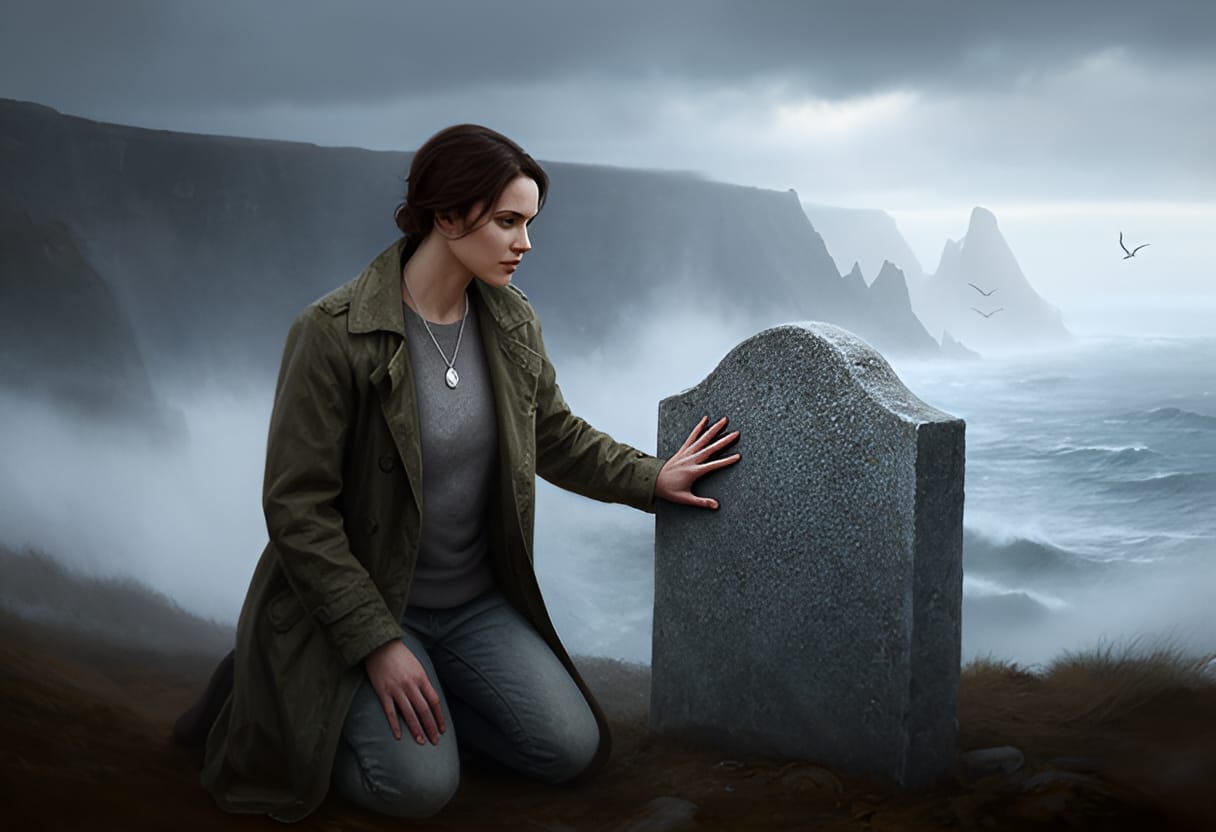
The cemetery lay on a bluff overlooking the sea, a scatter of gray stones tilted by wind and time. Elise walked without hurry, her boots sinking slightly into the soft earth between the graves. She knew the way by heart, though the path had narrowed, overtaken by stubborn patches of sea pink and bent grass. When she saw the stone — small, unadorned, tucked beneath the drooping branch of an ancient cedar — she stopped.
Cora Varrick Beloved Daughter and Sister 2002–2012
Elise sank to her knees, not from weakness but habit, the way she had every year on the anniversary, though this was the first time she’d come in person. She reached out, fingers hovering just above the engraved name, feeling the phantom press of cold stone through the air. The fog curled around her shoulders like a living thing, damp and insistent.
“I’m sorry I took so long,” she whispered, voice raw from disuse. “I wanted to bring you something. Miriam’s… she was going to help me sort through it. Again. I kept putting it off.”
She remembered the day clearly — not the accident itself, but the after. The way Miriam had come to the house two days later, not with platitudes, but with a thermos of tea and a quiet insistence on sitting on the back porch, even when Elise hadn’t wanted company. Miriam hadn’t pushed. She’d just been there, a steady presence in the silence, teaching Elise how to breathe again without forgetting how to feel.
A gull cried overhead, sharp and lonely. Elise pressed her palm flat against the stone, feeling the faint vibration of the sea far below, the constant, grinding pull of the tide.
“I’ll find out what happened to her,” she said, voice dropping to a vow. “I promise.”
She stayed until her legs went numb, then rose slowly, brushing damp from her jeans. The walk back into town was short, but the fog made it feel longer, as if the village were retreating just beyond reach, hiding its face.
The memorial was held in the town hall, a low, timbered building with sagging eaves and windows streaked with salt. Inside, the air was warm and heavy with the scent of beeswax candles and overbrewed tea. People moved in hushed clusters, their voices low, their eyes flicking toward her before darting away. Elise stood near the back, wrapped in the anonymity of the crowd, though she knew she was seen. She was Elise Varrick, Cora’s sister, the one who’d left and never looked back until now. The prodigal, returned too late.
Mrs. Gable, who ran the bakery on Main Street, approached with a plate of shortbread. “It’s so good you came home, dear,” she said, voice tight with pity. “Miriam would have been touched.”
Elise took a cookie, though her mouth felt dry. “Thank you. She meant a lot to me.”
“She helped Cora so much, after… well. After.” Mrs. Gable’s gaze flicked to Elise’s left hand, where no ring glinted. “You know, she used to say you two were like sisters in spirit. That Miriam saw in you what she hoped to nurture in all her students.”
Elise managed a nod, the words catching in her throat. She remembered Miriam staying late after school to help Cora with her reading, the way she’d laugh when Cora mangled the pronunciation of “phosphorescence,” turning it into a game. How she’d sent home a pressed seaflower in a notebook once, with a note that read: For Cora, who sees the light in the water.
“I just wish I’d had more time,” Elise said, the words feeling inadequate, hollow even as she said them.
Mrs. Gable patted her arm. “You were here now. That’s what matters.”
But it didn’t feel like it. It felt like arriving after the tide had already gone out, leaving only wet sand and the impression of where something had been.
When the brief service ended — a few words from the rector, a moment of silence, a single hymn sung off-key by the town choir — Elise lingered, watching as people drifted toward the door, already returning to the rhythm of their lives. No one pressed her to stay. No one asked if she wanted to talk. She was a ghost in her own hometown, recognized but not truly seen.
Outside, the fog had thickened, swallowing the streetlights, turning the world into a monochrome wash of gray and silver. Elise pulled her coat closed and set off toward the school, her steps automatic, her mind drifting back ten years, to the hospital waiting room, to the way Miriam had sat beside her, not speaking, just there, until Elise had finally broken and sobbed into her shoulder, staining her blouse with tears and salt.
The elementary school sat at the far end of town, a squat brick building with a sagging roof and windows boarded up in places where storms had taken their toll. The playground was silent, the swings creaking faintly in a breeze Elise couldn’t feel. She climbed the steps slowly, the wood groaning under her weight, and pushed open the front door.
The hallway smelled of polish and dust, of forgotten lunches and chalk. Student artwork lined the walls — crayon drawings of boats and lighthouses, finger-painted suns with too many rays. Elise paused before one, a messy rendition of a woman with long hair standing on a cliff, waving at a ship in the distance. Miriam’s favorite project, she remembered. “Let them draw what they hope for,” she’d told the class once.
She found Miriam’s classroom at the end of the hall, the door ajar. The room was exactly as she’d left it, though a thin layer of dust now coated everything. The desks were stacked in the corner, chairs upturned on top. Posters of grammar rules and multiplication tables hung crooked on the walls. A single potted plant on the windowsill had long since died, its brown stalks slumped over the edge of the pot.
Elise stepped inside, closing the door softly behind her. She walked to Miriam’s desk, running her fingers over the scarred wood, tracing the initials carved near the edge — M.H. inside a heart, done years ago, probably during a boring faculty meeting.
She opened the top drawer. Pens, a half-eaten bag of peppermints, a comb with a few strands of dark hair caught in its teeth. She paused, then gently lifted the comb, bringing it to her nose. Faintly, she smelled lavender and something else — the brine of the sea, or maybe just memory.
Below, a second drawer was stuck. She tugged, and it gave with a reluctant groan, revealing a stack of graded papers, a rubber band brittle with age, and — beneath a loose floorboard near the leg of the desk — a corner of something dark and waterlogged.
Her breath caught.
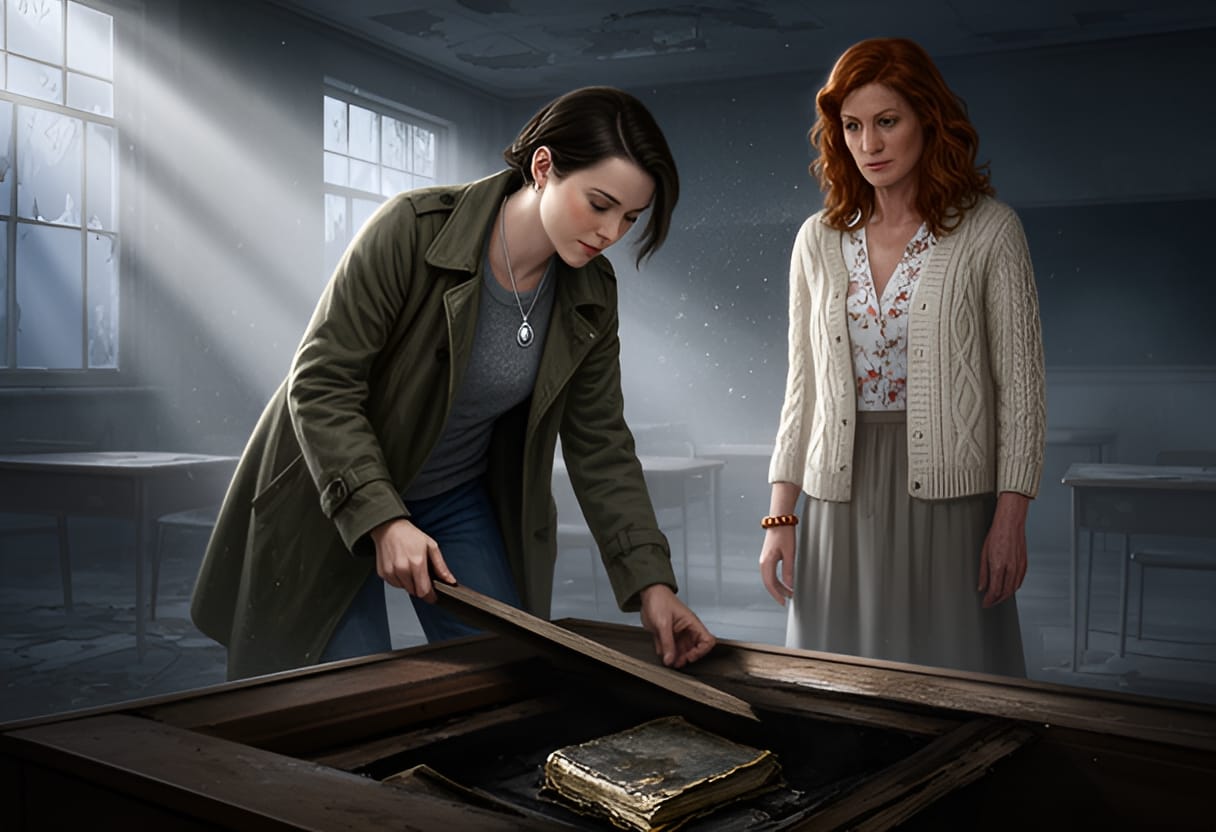
She pulled the board free. It came up with a soft, sucking sound, revealing a cavity beneath. Nestled in the damp darkness was a journal, its leather cover swollen and stained, pages warped from exposure to moisture. She lifted it out, careful not to tear it, and saw the title, barely legible in faded ink: Observations. Keep Watch.
Her pulse throbbed in her throat. She didn’t know why she’d come here. To say goodbye? To find closure? But this — this felt like a beginning.
She tucked the journal under her arm, replaced the board as best she could, and stepped back into the hallway. The fog had not lifted. If anything, it had thickened, pressing against the windows like a hand.
Elise didn’t go home. She walked instead toward the cliffs, toward the place where the lighthouse stood, its beam long dark, its silhouette a broken tooth against the sky.
She needed to see it. Needed to understand why Miriam had been drawing it in secret.
And why, after all these years, it felt like the sea was finally giving up its dead.
Elise paused at the classroom threshold, the fog pressing against the glass beyond like a slow, insistent breath. The air inside was still, thick with the scent of old paper and chalk, and the silence seemed to hold its weight. She stepped fully into the room, letting the door swing shut behind her with a soft click that echoed too loudly in the emptiness.
Her eyes swept the space first — the stacked desks, the upturned chairs, the faded posters curling at the edges. Nothing had been disturbed since Miriam’s last day. It felt less like an abandoned classroom and more like a room holding its breath, waiting for someone to remember how to breathe in it again.
She moved toward the desk, her footsteps muffled by the layer of dust that coated everything. The wood was scarred and worn, smoothed by years of elbows resting, pens clicking, fingers drumming. She ran her palm over the surface, feeling the grain, the grooves, the faint ridge where Miriam’s initials were carved inside that small, secret heart.
The top drawer yielded easily — pens, peppermints, the comb with its trapped strands of dark hair. Elise lifted it again, bringing it to her nose. Lavender, yes, but underneath, something salt-tinged and faintly metallic, like the air after a storm. She swallowed, her throat tight. She set the comb down gently, not wanting to lose the scent, not ready to let go of that fragile tether.
The second drawer was where she’d felt the resistance. She pulled again, harder this time, and it groaned open on its rusted runners. Inside lay a stack of graded papers, their edges curled from humidity, a brittle rubber band snapped and forgotten. And there, pressed into the shadow beneath the desk leg where the floorboard had lifted — a dark corner, swollen and slick.
Her breath hitched. She didn’t think, didn’t hesitate. She slid her fingers under the edge of the board and lifted. It came free with a soft, wet sigh, revealing the hollow beneath. Nestled in the damp darkness lay the journal, its leather cover bloated and stained, pages warped like old leaves left in rain.
She lifted it out, cradling it carefully. The title was barely visible, the ink faded but still legible: Observations. Keep Watch. Her pulse throbbed in her ears. She turned it over in her hands, feeling the uneven swell of the spine, the way the cover clung damp to her palms.
Then she saw it — tucked into the crease where the back cover met the spine, a small rectangle of brass, taped securely with yellowed adhesive. A key. Small, old-fashioned, its bow worn smooth from turning.
Her fingers trembled as she peeled the tape away. The key was cool, solid, real. She turned it over, noting the intricate bit, the slight bend in the shaft — not a modern cut, but something older, perhaps hand-filed.
She didn’t waste time. She fitted the key into the tiny lock hidden along the journal’s fore-edge. It turned with a soft click, and the cover gave slightly under her thumb.
Inside, the first page was blank save for a single line, written in a precise, slanting hand: He watches from the rock.
Elise frowned. She turned the page.
A sketch met her eyes — detailed, shaded with careful cross-hatching. The lighthouse, rendered from a low angle, its beam cutting through fog that swirled like smoke around the base. Rocks jutted jaggedly into the sea below, waves frozen mid-crash in ink. In the margin, Miriam had written in tight script: Tide low, 03:17. Light weak. Shadow long.
Next page: another sketch. This time the lighthouse seen from above, the lantern room exposed, the glass panes marked with cracks. Around it, concentric ripples in the water — not waves, but something else, like disturbances from beneath. He walks the wall when the moon is thin, she’d noted. Salt on the lens. Not from spray.
Elise’s breath came shorter. She flipped forward.
More sketches. Different tides. Different times. Always the lighthouse. Always the rock. Always the sense of being watched — not by the sea, not by the wind, but from the stone itself. Annotations crowded the margins: phrases in Miriam’s hand, sometimes underlined, sometimes circled, sometimes repeated until the ink bled through the page.
He remembers the names. He counts the breaths. He waits for the one who looks back.
Elise’s fingers pressed flat against the page, as if she could feel the pressure of Miriam’s pen, the urgency in her strokes. Her mind raced — not with fear, not yet, but with a dawning, insistent curiosity. Why had Miriam hidden this? Why lock it away? What had she seen that made her feel the need to keep watch?
A sound made her freeze — the creak of the classroom door, slow and deliberate, from the hallway.
She didn’t think. She snapped the journal shut, slipped the key into her pocket, and shoved the journal beneath her coat, against her ribs where she could feel its steady, damp weight. She rose, smoothing her coat, forcing her expression into neutrality.
The door opened a fraction more.
“You all right in there, dear?” Mrs. Gable’s voice, soft with concern, drifted in.
Elise forced a smile she didn’t feel. “Just… gathering my thoughts,” she said. “It’s… quiet in here.”
“It is,” Mrs. Gable agreed. “Miriam always said this room held too many echoes. Hard to leave them behind.”
Elise nodded, her eyes darting to the desk, to the false panel she’d replaced as best she could. It sat flush now, but she knew the gap was there, the cavity waiting.
“I should get going,” she said. “The fog’s thick. Don’t want to get turned around on the cliffs.”
“Be careful,” Mrs. Gable said. “The sea likes to claim what’s hers.”
Elise didn’t answer. She turned and walked swiftly down the hall, her boots silent on the polished floor. She didn’t look back. She couldn’t.
She only knew, with a certainty that settled in her bones like cold stone, that she wasn’t leaving Blackreach again until she understood what Miriam had seen — and why she had felt compelled to keep watch.
Elise fumbled with the latch on her cottage door, the journal pressed hard against her chest beneath her coat. The fog had rolled in thicker since she left the school, swallowing the lane whole, turning the world into a muffled grey void where even the sound of her own footsteps seemed absorbed. She could barely see the gravel path, let alone the cliffs beyond. Her breath came in short, sharp pulls, her pulse still hammering from the close call in the classroom.
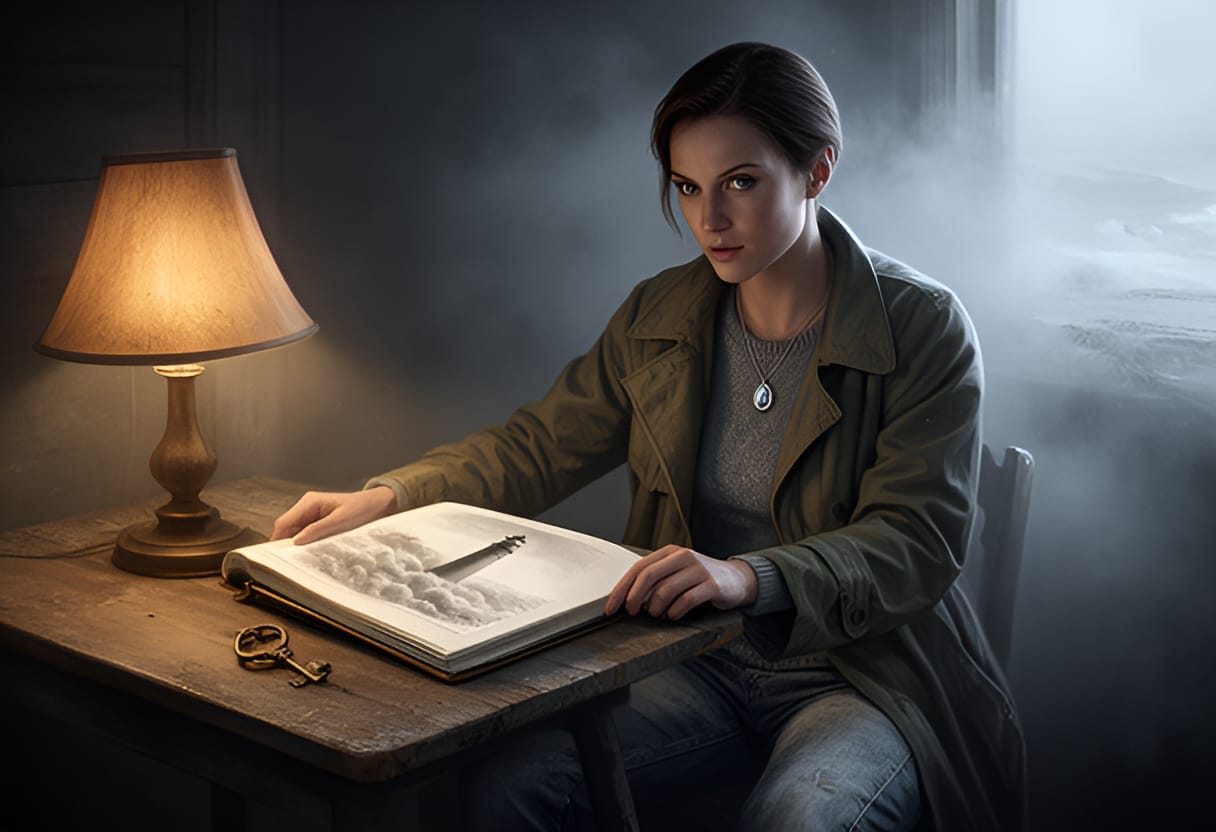
Inside, the cottage smelled of damp wood and old tea. A single lamp stood on the table beside the worn armchair, its shade stained yellow at the edges. She kicked off her boots, hung her coat on the hook by the door, and moved to the light without thinking. The journal felt heavier now, as if it had absorbed not just moisture but something else — a weight of intent.
She set it down gently, as though it might shiver if handled too roughly. The brass key lay beside it, catching the lamplight in a dull gleam. She turned on the lamp, pulled the chair close, and opened the journal again.
The first page still held Miriam’s stark warning: He watches from the rock. Elise’s eyes dropped to the next sketch — the lighthouse from below, the beam slicing through fog. She traced the line of the beam with her fingertip, feeling the slight ridge of ink where Miriam had pressed harder.
Then she turned the page.
The next sketch showed the lighthouse from above, the lantern room exposed, the glass cracked in a spiderweb pattern. Miriam’s annotation ran along the margin: Salt on the lens. Not from spray. Beneath it, in a smaller, tighter hand, she’d added: Elias saw it too. 1994. Same crack. Same salt.
Elise frowned. Elias Greaves. The name stirred something half-remembered from old town whispers — a lighthouse keeper who’d vanished during a storm twenty years ago, his logbook found open on the desk, the beam still turning, but no trace of him except a single wet boot on the rocks below. Official story: swept away in a gale. Unofficial: he’d seen something he wasn’t meant to.
She flipped forward.
More sketches. Different tides. Different hours. Always the lighthouse. Always the rock. Always the sense of being watched from the stone.
Then, on a page stained darker at the corners, as if damp had seeped in unevenly, she found a passage not in sketch but in tight, urgent script:
The debt is due. Every seven years, the sea asks for a name. It doesn’t take — it collects. Elias gave his. Miriam’s turn? No. Not yet. But the mark is set. He remembers the ones who look back. He counts the breaths between waves. He waits for the one who returns the gaze.
Elise’s throat tightened. Seven years. Cora had died in 2012. Ten years ago. But if the cycle was seven… 2012 minus seven was 2005. Had something happened then? Or was it counting forward? 2012 plus seven was 2019. Last year. Had something happened then — something buried?
She turned the page.
Another sketch: the lighthouse beam cutting through fog, but this time, the light didn’t just shine outward — it seemed to pull something in, like ink dropped in water. Miriam had written beside it: The beam doesn’t warn. It summons. He stands in the glow, not to be seen, but to see.
A chill crept up Elise’s arms, unrelated to the damp. She closed the journal slowly, her mind racing. Miriam hadn’t just been researching the lighthouse. She’d been tracking something — something that moved with the tides, that answered to a pattern older than the town, older than the lighthouse itself. And she’d hidden this journal because she knew what she was getting into. She’d known she might not come back.
A soft knock at the door made her jump.
She hadn’t heard anyone approach. The fog deadened sound, but still — she should have heard footsteps on the gravel.
“Elise?” a voice called from the other side — low, rough, edged with something she couldn’t place. Concern? Warning?
She set the journal aside, smoothed her coat, and walked to the door. She opened it just enough to see the sheriff’s face in the dim glow from behind her.
Sheriff Boone stood on the step, his hat pulled low, his collar turned up against the damp. He was a broad-shouldered man in his late fifties, face weathered like driftwood, eyes the colour of wet stone. He’d been sheriff since before she left, and though they hadn’t been close, he’d always nodded to her in the street, called her “Miss Varrick” with a respect that felt habitual, not warm.
“Evening,” he said, his voice tight. “Mind if I come in? It’s foul out there.”
She hesitated, then stepped aside. “Of course. Come in. Can I get you something? Tea? Water?”
He shook his head, brushing rain from his sleeves as he stepped inside. “No, thank you. Just came to talk.” He looked around the cottage — the narrow kitchen, the armchair by the lamp, the journal now lying closed on the table. His eyes lingered on it for a second too long. “Heard you were poking around Miriam’s classroom today.”
Elise kept her expression neutral. “I was collecting her things. For her family. She was… a good teacher.”
“She was,” Boone agreed. “Loved by everyone. Hard to believe she just… walked off.” He paused, choosing his words. “But some things are better left where they are, Elise. You know that as well as anyone.”
She felt her stomach tighten. “What do you mean?”
He didn’t look at her. Instead, he stared into the middle distance, at the wall where the fog pressed against the window like a living thing. “You left Blackreach ten years ago. After your sister.” He paused. “Cora. That was hard on everyone. Hard on you, I imagine. But you stayed away. Didn’t come back for the funeral. Didn’t come back for the anniversary. Not until now.”
His gaze snapped to hers. “Why now? Because Miriam disappeared? Or because you finally decided the sea was done giving up its dead?”
Elise’s breath hitched. She hadn’t told anyone about Cora in years. Not the guilt, not the way she’d lain awake wondering if she’d answered the phone sooner, if she’d insisted Cora stay ashore that day… “I came back to honor her,” she said quietly. “And to find out what happened to Miriam. She was my friend. My mentor.”
Boone let out a breath that sounded like a sigh, or maybe a laugh without humor. “Friends don’t go digging where they ain’t wanted. Miriam knew that. She was careful. Too careful, in the end.” He leaned forward, voice dropping. “You see that journal? It ain’t just notes. It’s a warning. Elias Greaves didn’t vanish because he slipped on the rocks. He vanished because he saw what was under the light. And he tried to warn someone. Miriam heard him. She started asking questions. Started drawing what she saw. And now she’s gone the same way.”
Elise’s hands curled into fists at her sides. “You’re saying someone took her? Because of what she knew?”
Boone didn’t answer right away. He looked toward the window again, where the lighthouse beam swept its slow, steady arc through the fog — three seconds on, three seconds off, a heartbeat of light in the dark. “Let’s just say some folks in this town don’t like the past stirred up. The Thornes, especially. They’ve got a long memory. And they don’t take kindly to folks poking where the tide’s already buried things.”
He stood, his chair scraping back. “I’m not telling you to stop because I don’t care. I’m telling you to stop because I do. And because if you keep going, you’re not just risking yourself. You’re risking the quiet. The peace this town’s built on — fragile as it is.”
He moved to the door, paused with his hand on the knob. “The Thorne boy… he don’t like questions. Neither does his father. You remember Silas Thorne? Ran the salvage yard? Took over after his brother went missing in ’99?” He didn’t wait for an answer. “Just… be careful, Elise. Some doors, once opened, don’t close again.”
He opened the door and stepped out into the fog. The door clicked shut behind him.
Elise stood very still, the silence pressing in on her ears. She walked to the window and pulled aside the curtain just enough to see the lighthouse — a black silhouette against the grey sky, its beam cutting through the fog in slow, steady sweeps. Three seconds on. Three seconds off.
She thought of Miriam’s words: He stands in the glow, not to be seen, but to see. She thought of Boone’s warning: The Thornes don’t like questions. She thought of the key in her pocket, cool and real against her thigh.
She turned away from the window, picked up the journal, and held it to her chest. The leather was damp, the pages warped, but the words inside were clear. Miriam hadn’t just been keeping watch.
She had been waiting for someone to look back.
And now, Elise realized with a quiet, fierce certainty, it was her turn.
Elise carried the journal to Declan Moss’s cottage the next morning, the fog still clinging to the cliffs like wet wool. Smoke curled from the stone chimney of his small, shingled house tucked behind the old net lofts, and the smell of salt and woodsmoke hung in the air. She knocked, hesitating only a moment before the door opened.
Declan stood in the threshold, his wool coat buttoned against the chill, his eyes sharp beneath furrowed brows. He was taller than she remembered, his hair threaded with silver at the temples, but the quiet intensity in his gaze was unchanged. He’d been the lighthouse keeper’s apprentice before the automation, then a historian who spent winters transcribing logs and summers guiding tourists through the maritime museum. Miriam had sought him out often, he’d once told her, drawn to his knowledge of the keeper’s routines.
“Elise,” he said, studying her face. “You look like you haven’t slept.”
“I haven’t,” she admitted, stepping inside. “I found something. Miriam’s journal.”
He led her to a cluttered sitting room where charts and model ships crowded the shelves, a brass telescope trained toward the sea from the windowsill. A kettle whistled on a small stove, and he poured two cups of strong black tea, handing her one without asking.
She opened the journal on his scarred oak table, the pages stiff with salt residue, the sketches smudged but legible. Declan leaned in, his finger tracing the lines of a lighthouse beam cutting through fog, then a series of numbers and symbols along the margin.
“Elias Greaves,” he murmured. “That’s his hand. I’d know it anywhere. The slant of the ‘e’s, the way he loops the ‘g’ in ‘watch’ — it’s all in his logbooks from ’92 to ’94.”
Elise felt a prickle at her scalp. “You’ve seen these before?”
“Not these exact pages, but the style — yes. He kept detailed observation logs. Not just weather and shipping lanes. He noted strange lights, tidal anomalies, even dreams. Said the sea was ‘speaking in cycles.’” Declan fell silent for a moment, his jaw tightening. “He went mad after the Drake’s Misfortune. Wrecked on the rocks just below the lighthouse in ’94. Seventeen souls lost. Cargo never fully recovered.”
He pushed a worn leather-bound log toward her. The ink had faded, but the entries were clear: October 12, 1994 — Wind shifting southeast. Strange humming beneath the hull, like iron singing. Crew uneasy. Captain orders sail reduced. The next entry, three days later: Struck hidden reef at 02:17. Impact forward hold. Water rushing in. Men shouting. Something… down there. Not cargo. Not stone.
Elise’s breath came short. “He wrote about something in the hold?”
Declan nodded. “He insisted it wasn’t just timber or ore. Said it was ‘old,’ that it had been down there longer than the ship. He started having visions — figures in the water, calling names. After the wreck, he was found clinging to the rocks, babbling about a debt to the deep. They took him to the asylum, but he kept asking for his logbook. Said he had to finish the watch.”
He looked up, his eyes grave. “The town never talked about what was really down there. Officially, it was storm damage. Unofficially… the Thornes’ salvage crew was the first on site. Silas’s brother, Jonah, was part of the dive team. He never came back. Officially, lost in the currents. But Declan’s voice dropped. “Some say he saw what was down there and didn’t come up because he knew what it meant.”
Elise’s throat tightened. “And Miriam was drawing the same things?”
“She was trying to make sense of it,” Declan said. “The sketches match his descriptions — the lighthouse beam not just warning ships away, but watching something in the water. The ‘keeping watch’ phrase — it’s not passive. It’s active. Like he was guarding against something rising.”
She closed the journal slowly. “So she wasn’t just researching. She was continuing his work.”
“She was afraid,” he said. “I saw it in her eyes the last time she came here. She said she felt like she was being listened to. Not by people. By the light itself.”
A long silence settled, broken only by the hiss of the kettle and the distant cry of a gull. Elise thought of Cora, of the phone call she hadn’t answered, of the way the sea had taken her sister and given nothing back. She thought of Miriam’s quiet strength, her sudden disappearance, the weight of the journal in her hands.
“Will you help me get inside the lighthouse?” she asked. “Tonight, if possible. While the fog’s thick.”
Declan studied her for a long moment. Then he nodded. “I know the old keeper’s way in — through the service hatch below the rocks. It’s sealed, but not locked. I’ve got the tools.”
He reached into a drawer and pulled out a brass key, heavy and worn. “This opens the inner door. Only the keepers had it. Miriam must have gotten it from somewhere — maybe Elias’s effects, if they were ever returned.”
He hesitated, then added, “But Elise — if we go in and it feels wrong, if the air changes or you hear things that aren’t there… we leave. No questions. No second guesses. Some doors aren’t meant to be opened, and some watches aren’t meant to be kept.”
She met his gaze, the memory of Boone’s warning still sharp in her mind. “I understand.”
He closed his hand around the key, then placed it in her palm. It was warm from his touch.
“Then we go at midnight,” he said. “When the beam is at its lowest. When the watch begins.”
Elise curled her fingers around the key, feeling its weight, its promise. Outside, the fog pressed against the window, soft and relentless. The lighthouse beam swept through the dark — three seconds on, three seconds off — a steady pulse in the heart of the town.
She thought of Miriam’s words again: She had been waiting for someone to look back.
And now, with the key in her hand and the tide turning, Elise knew she was no longer just searching for answers.
She was keeping the watch.
Chapter 2
The Weight of Salt and Secrets
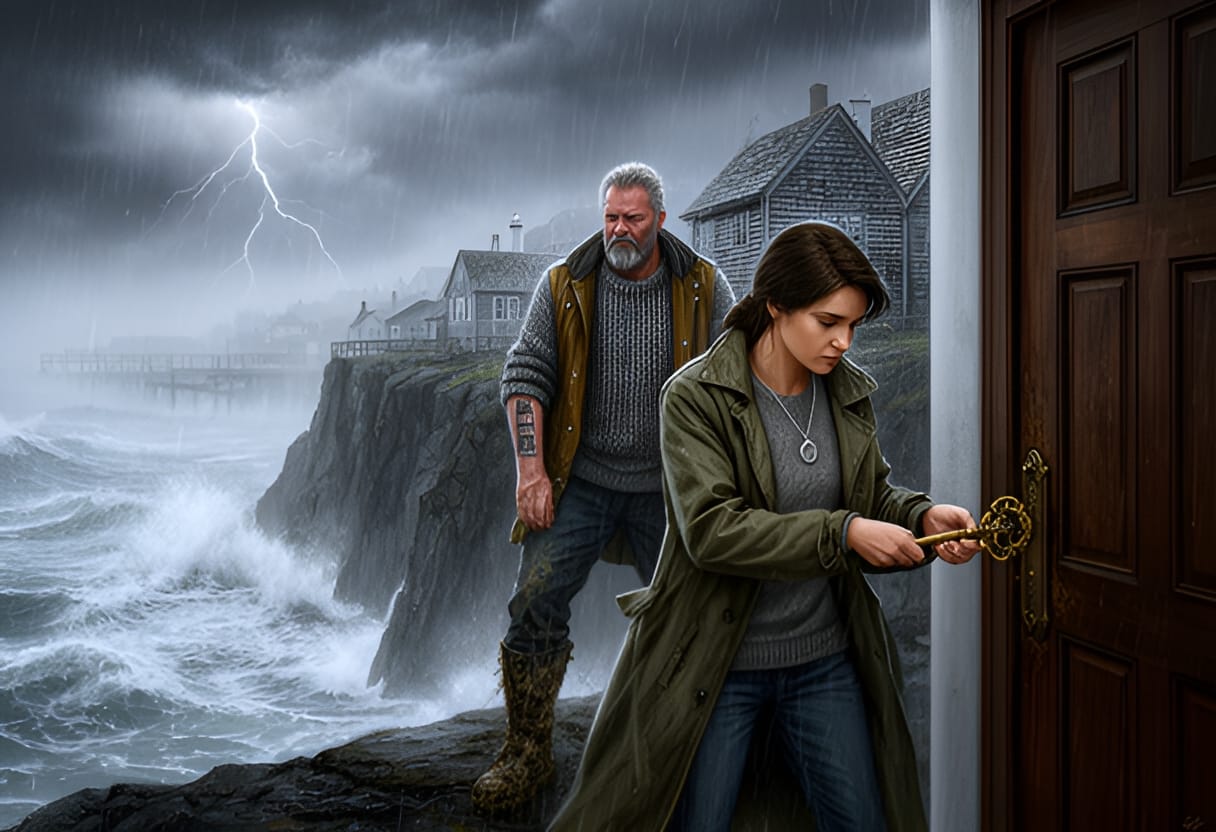
Elise pressed the key into the lock, the brass cold and stiff against her palm. The service hatch groaned as Declan levered it open, salt-crusted bolts protesting after years of disuse. A rush of damp air escaped, thick with the smell of wet stone and ozone, as if the lighthouse had been holding its breath.
They slipped inside one after the other, the hatch swinging shut behind them with a final, resonant clang. Darkness swallowed them, broken only by the faint glow of Declan’s lantern, its beam cutting a narrow cone through the fog that pressed against the narrow slit of the hatch above. The air inside was still and heavy, the silence broken only by the drip of water from the ceiling and the distant, uneven thunder of waves on rock.
“First landing,” Declan murmured, his voice low. “Watch your step.”
They moved cautiously down the narrow passage, the beam swinging across slick flagstones. Elise’s boots found purchase where the stone was less worn, her fingers brushing the rough wall for balance. The beam caught something on the first landing — a series of depressions in the damp sand that had tracked in over the threshold. Boot prints. Fresh. Deep at the toe, lighter at the heel, as if someone had paused there, listening.
Declan crouched, his gloved fingertip tracing the edge of one print. “Not old,” he said. “Last tide wouldn’t have washed them clean if they were from yesterday. These are from tonight.”
Elise straightened, her pulse quickening. “Someone’s been here. Recently.”
He nodded, rising. “And they didn’t leave empty-handed.”
They continued upward, the spiral stairs coiling tight around the central newel post. The steps were iron, worn concave in the center by decades of boots, each one ringing faintly under their weight. The lantern’s light threw long, trembling shadows that stretched and retracted with each pulse of the beam from above — three seconds on, three seconds off — a rhythm that made the dark seem to breathe.
Halfway up, Elise paused. A faint scent drifted on the damp air — lavender, cut through with salt. Miriam’s comb. She pressed a hand to the cold iron railing, her knuckles whitening.
“You feel that?” she whispered.
Declan halted a step above her, the lantern tilting as he listened. “Feel what?”
“Like we’re not alone. Not just the wind. Like… eyes.”
He didn’t answer right away. When he spoke, his voice was quieter than before. “I’ve been here before. Alone. A few weeks ago. After Miriam went missing.”
Elise turned to him, the lantern light catching the tension in his jaw. “You didn’t tell me.”
“I wasn’t sure what I was looking for,” he said. “And I didn’t want to involve you if it was nothing. My father… he was the assistant keeper the night the Drake’s Misfortune went down. They blamed him for not sounding the foghorn in time. Said he was drunk on duty. He lost his license. His boat. His dignity. Died two years later, broken.”
He swallowed, his gaze fixed on the stairs ahead. “I came up here hoping to find something — a log, a note, anything that showed he tried to warn them. That it wasn’t his fault. But the official records were clean. Too clean. Like someone scrubbed them.”
Elise thought of the journal in her pack, of Miriam’s sketches of the lighthouse beam, her notes about the seven-year cycle. “She wasn’t just researching the wreck,” she said softly. “She was looking for who benefited from the silence.”
They reached the watchroom door, its paint peeled and blistered from salt and wind. Declan tried the handle — locked. He produced a second, smaller key from his pocket, slid it into the tumbler, and turned. The bolt retracted with a soft click.
Inside, the room was small and circular, lined with faded charts and a brass telescope aimed permanently seaward. A narrow cot stood against the far wall, its blanket rumpled, a dent in the pillow where a head had recently rested. A chipped mug sat on the shelf beside it, stained dark at the bottom — tea, or something stronger.
Declan stepped forward, his boots silent on the wooden deck. He picked up the mug, sniffed, then set it down with a frown. “Not tea. Smells like whiskey. And… something metallic.”
Elise knelt by the cot, her fingers brushing the blanket. It was warm. Not hot, but holding residual heat, as if someone had risen only moments ago. She pressed her palm to the fabric, feeling the faint imprint of a body.
“They were here,” she said. “Not long ago. Maybe while we were walking to the shore.”
Declan moved to the vent near the ceiling, a narrow opening covered with a rusted grate. He pried it loose with the blade of his knife, the metal protesting with a shrill screech. Inside, wedged between the duct and the outer sheathing, was a scrap of paper. He pulled it free, unfolded it carefully.
It was a page torn from a journal — Miriam’s journal, Elise realized instantly. The handwriting was hers, the ink slightly smudged where moisture had touched it. The words were fresh, the date recent: October 17th, three nights ago.
Met with Thomas Thorne at the old boathouse below the cliffs. He said his father knows I’m digging. Said, “The Thorne boy knows where the bodies are.” I don’t know which boy — he has two sons. But he meant Silas’s boy. He’s warning me to stop. Or else. I showed him Elias’s log entry about the contraband. He went white. Said, “Some names aren’t meant to be collected.” Then he left fast. I don’t trust him. But I think he’s scared. Not of me. Of what his father will do if he talks.
Elise’s breath came short. “He named them. The Thornes. He knew.”
Declan folded the page slowly, his expression grim. “Thomas Thorne. The younger son. He’s been helping his father with the salvage dives. Officially, he’s just deckhand. But Miriam thought he knew where they’d hidden the crew — or what they did with the bodies after the wreck.”
A sudden stillness fell over the room. The lantern’s beam swept past the window — three seconds on — and in that brief flare of light, Elise thought she saw movement below. A shadow against the rocks, just beyond the beam’s reach. Then darkness again.
“Did you see that?” she whispered.
Declan was already moving toward the stairwell, his hand on the lantern. “Stay close.”
They descended in silence, the only sound the rasp of their boots on iron and the relentless thump of the sea below. Elise’s ears strained, catching every creak, every whisper of wind through the cracks in the masonry. The feeling of being watched had not left her — it had intensified, a pressure behind her eyes, as if the walls themselves were inhaling.
They reached the first landing. The boot prints were still there, unchanged.
Then, from the darkness below — a voice. Low, rough, edged with something that might have been amusement or warning.
“You shouldn’t have come back.”
It echoed up the stairwell, bouncing off the stone walls, seeming to come from everywhere and nowhere at once.
Elise froze. Declan shoved the lantern forward, its beam cutting a trembling path down the stairs. But the landing below was empty. Just the sand, the prints, the void beyond the door where the storm raged.
She looked at Declan. His face was pale in the lantern light, his jaw tight.
“Who was that?” she breathed.
He didn’t answer. He was already moving, taking the steps two at a time, back toward the hatch, back toward the boat and the shore and the fragile illusion of safety.
Behind them, the lighthouse stood silent, its beam sweeping outward — three seconds on, three seconds off — a steady pulse in the heart of the dark.
And somewhere in the walls, the watch continued.
Elise’s pulse hammered in her throat as the voice faded into the suck of the tide against the rocks below. Declan’s grip tightened on the lantern, knuckles white. The beam swept the stairwell again, painting the iron rungs in alternating bars of gold and shadow. Nothing moved. Yet the certainty that someone had been there — close enough to feel the heat of their breath on the back of her neck — refused to loosen its hold.
“Stay behind me,” Declan murmured, though his voice lacked conviction. He began to descend again, slower this time, testing each step before committing his weight.
They were halfway down when the hatch above them shuddered. A sharp, metallic clang rang out — the service hatch being dogged shut from the outside. Elise froze. The sound echoed up the shaft like a tomb sealing.
Declan cursed under his breath and lunged for the stairs, taking them two at a time. Elise followed, her boots slipping slightly on the damp iron. By the time they reached the watchroom door, the lantern’s beam was jerking wildly in Declan’s hand, casting frantic shadows that made the charts on the walls appear to breathe.
He fumbled with the key, but the lock wouldn’t turn. He tried again, harder, jiggling the blade. Nothing.
“It’s been thrown,” he said, voice low and strained. “From the outside.”
Elise pressed her ear to the wood. Beyond it, the wind had dropped. All she could hear was the slow, inexorable rise of the sea against the cliffside — a wet, sucking rhythm that seemed to come from within the stone itself.
Then, from the lantern room above, a creak. Not the wind. A footstep on the wooden deck.
Declan shoved her gently but firmly toward the cot. “Get down. Behind it.”
She obeyed, pressing her back against the rough wall, heart hammering against her ribs. The door handle turned slowly, deliberately. The bolt retracted.
The door swung inward.
Silas Thorne stood in the lantern room doorway, silhouetted against the beam’s sweep. He was older than she remembered — deeper lines carved beside his eyes, his silver hair pulled back severely — but the stillness of him, the way he held himself like a man who owned the silence, was unchanged. In one hand he gripped a brass keyring; in the other, a coiled length of rope that smelled of salt and tar.
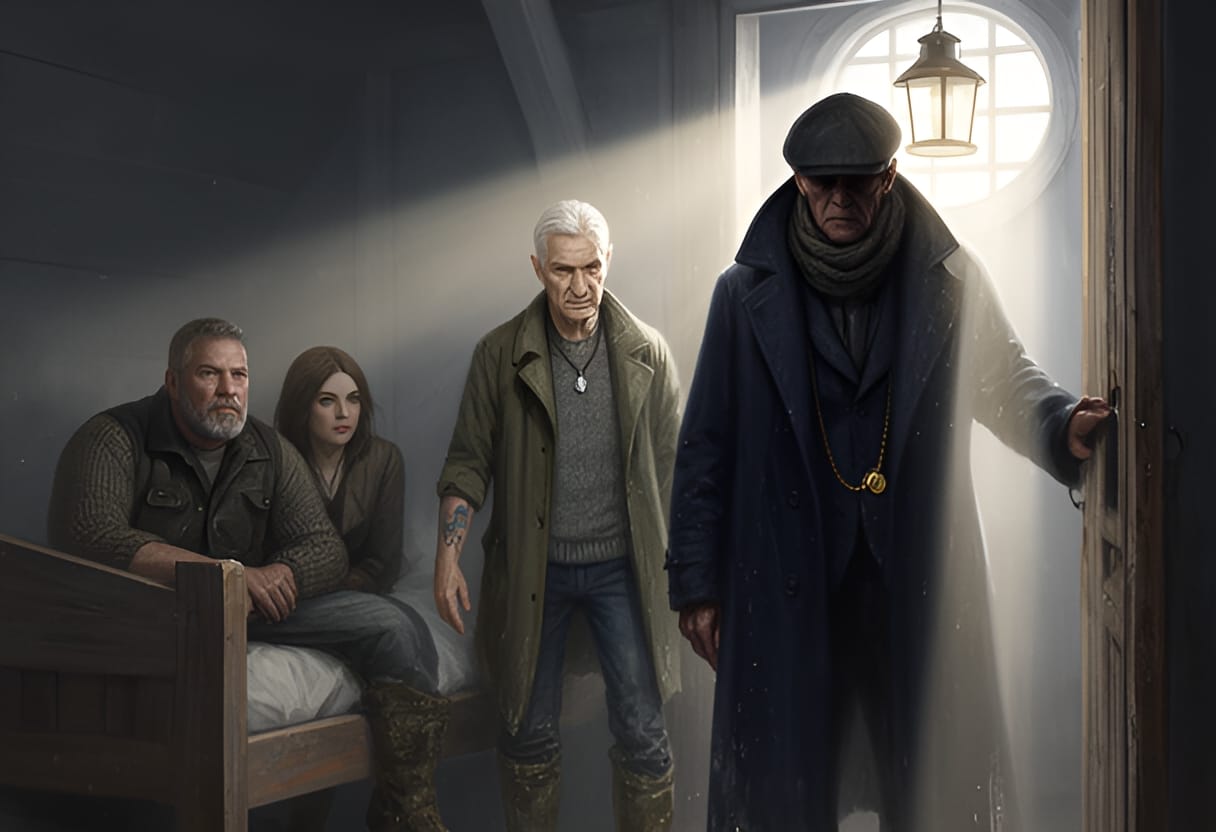
He stepped inside, closing the door softly behind him. The lantern’s light caught the faintest smirk on his lips — not amusement, but the quiet satisfaction of a predator who has cornered its prey.
“You’ve been busy,” he said, his voice low and rough, like stone dragged over stone. “Climbing stairs, reading journals, asking questions that should have stayed buried.”
Elise rose slowly, keeping her hands visible. “We found Miriam’s note. We know Thomas talked to her.”
Silas’s eyes flicked to Declan, then back to her. “Thomas is a boy. Boys say what they think will save them. Or what they think will hurt others.” He paused, letting the words settle. “But you — you’ve been digging where you weren’t invited. Into the Drake’s Misfortune. Into my family’s business.”
Declan stepped forward, jaw tight. “My father was assistant keeper that night. He tried to launch the lifeboat. The log shows he signaled for help — ”
“The log was altered,” Silas said, cutting him off. He lifted his hand, not in threat, but in dismissal. “You think I don’t know what’s in those archives? I’ve seen every page. Every signature. Every ‘lost at sea’ notation written in a hand that wasn’t there that night.” He let out a breath that sounded almost weary. “Your father did what he could. But when the contraband was found in the hold — ”
“Contraband?” Elise said, her voice sharp. “What kind of contraband justifies leaving men to drown?”
Silas’s gaze turned to her, cold and assessing. “The kind that keeps a town alive. The kind that pays for schoolbooks, for repairs to the pier, for the warmth in your cottage when the wind howls off the water.” He took a step closer, the lantern light catching the flecks of gray in his stubble. “The Drake’s Misfortune wasn’t just carrying timber and coal. It was carrying ivory. Unregistered. Untaxed. A fortune, if moved right.” He paused, letting the weight of it sink in. “My father saw it. Saw the chance. And when the ship broke apart on those rocks, he saw the men in the water — injured, clutching at debris, some still alive — and he made a choice. He ordered the sons to pull away. To let the sea take them. Better a few lives lost than the whole town exposed. Better a quiet grave than a scandal that would have ruined us all.”
Elise felt as if the air had been sucked from her lungs. “You let them die to hide ivory?”
Silas’s expression didn’t change. “I let them die to protect Blackreach. To keep the lights on, the nets full, the children fed. You think the town would have survived the inquiry? The fines? The shame? No. We would have become a warning. A footnote in some maritime ledger. Instead, we thrived. Because some burdens must be carried in silence.”
“And Miriam?” Elise whispered. “What did she have to do with ivory?”
Silas’s eyes narrowed. “She didn’t care about the ivory. She cared about the names. She found Elias Greaves’ log — the real one, hidden beneath the false entries. She saw where he wrote about the men calling out for help as the boats pulled away. She saw the sketch he made of the contraband wrapped in oilcloth, lashed to the beams below deck.” He took another step, bringing him level with the cot. “She confronted me at the boathouse. Showed me the page. Said she was going to the press. Going to the sheriff. Going to anyone who would listen.”
“And you stopped her.”
“I gave her a warning,” Silas said, his voice dropping to a near whisper. “I told her some names aren’t meant to be collected. That the sea keeps its own accounts.” He paused, listening — not to the tide, but to something deeper. “She didn’t stop. So the sea took its due.”
A terrible understanding settled over Elise, cold and absolute. Miriam hadn’t just disappeared. She had been silenced. And Silas Thorne had done it — not with a knife or a gun, but with the weight of a town’s complicity, the certainty that no one would look too closely at what the tide had brought back.
Declan’s voice was raw. “You’re going to let the tide take us too, then? Lock us in and let the water rise?”
Silas looked at him then, not with anger, but with something like pity. “You misunderstand me, Declan. I don’t want to hurt you. I want you to understand.” He turned his gaze back to Elise. “You think exposing this will bring justice? It will bring chaos. The Thornes have built this town on that silence. Take it away, and what’s left? Accusations. Ruin. Maybe another boy lost to the sea because his father’s name is dragged through the mud.”
He reached into his coat and produced a small, familiar object — Miriam’s lavender-and-salt comb, the one Elise had found in the classroom drawer. He held it up, the teeth catching the lantern light.
“She left this behind when she came to see me,” Silas said softly. “Twisted in her fist. Like she was trying to hold on to something decent.” He let it fall onto the cot beside her. It bounced once, then lay still.
Then he turned and walked to the door. He paused with his hand on the latch, looking back over his shoulder.
“The tide’s coming in,” he said. “It’ll be high by midnight. Higher than it’s been in years. The old seals on the lower vents — they won’t hold. Water’ll find its way in. Slow at first. Then faster.” He gave a small, almost imperceptible shake of his head. “Think of it as… a second chance. To let the past stay buried. To let the town sleep.”
He opened the door. The beam swept out, cutting a golden path across the rocks and the churning white of the surf beyond. Then he stepped outside, pulled the door shut, and threw the bolt.
The sound was final.
Elise lunged forward, but Declan caught her arm, holding her back. Through the small window in the door, they watched Silas Thorne descend the exterior stairs, his long coat flared slightly in the wind, his steps sure and deliberate. He didn’t look back.
The lantern’s beam swung past the window — three seconds on — and in that flash, Elise saw him reach the bottom, turn toward the village, and disappear into the fog rolling in from the sea.
Then darkness.
The lantern in Declan’s hand sputtered, then steadied. He lowered it, casting the room in a dim, wavering glow.
Elise pressed her palm to the door, feeling the vibrations — faint, but unmistakable — as the first swell of the tide struck the cliffside below. A low groan echoed through the masonry, like the lighthouse itself was drawing a shuddering breath.
She turned to Declan, her voice barely audible over the rising hiss of water forcing its way through cracks in the stone.
“We’re trapped,” she said. “And the tide’s coming in.”
Declan didn’t answer. He was already moving, heading for the vent near the ceiling, his knife in hand, his face set in grim determination.
Above them, the watch continued.
Declan’s knife scraped against the vent cover, the blade catching on rusted bolts. Elise pressed her ear to the stone, listening past the hiss of water forcing its way up through the cracks. The groan of the lighthouse deepened, a slow, shuddering resonance as if the tower itself were inhaling against the sea’s pressure.
“Help me,” she said, her voice tight. “We need to get this open.”
Declan shifted, using the heel of his palm to brace against the vent frame while he worked the knife beneath the flange. Salt spray misted his face, and his jaw clenched as he twisted. The bolts screamed, one giving with a sudden release that sent a shudder through the masonry.
Water surged in faster, a cold rush that licked at Elise’s boots. She stumbled back, pulling Declan with her as the vent yawned open, dark and yawning into the wall’s thickness. For a moment, nothing but blackness and the roar of the tide beyond.
“It’s too narrow,” Declan said, shaking his head. “We’d never fit.”
Elise swept the beam of Declan’s lantern across the watchroom. The light caught on the cot where Miriam’s comb lay, then swept lower, to the space beneath the thin mattress. Something metallic glinted there — a corner, worn smooth, barely visible under the frayed edge of the ticking.
“Wait,” she said, dropping to her knees. She hauled the comb free and shoved it into her pocket, then reached beneath the cot. Her fingers closed around cold iron. With a grunt, she pulled — the chest slid free, heavy and waterlogged, its surface pitted with salt and time.
Declan knelt beside her, the lantern casting long, trembling shadows as he wiped grime from the lid. “It’s sealed,” he muttered. “Waterproof.”
Elise traced the seam with her thumb. A faint sigil was etched into the metal — a wave cradling a star, half-eroded by corrosion. She remembered Miriam’s sketches in the journal: the same symbol, repeated in the margins beside notes about the lighthouse’s foundation stones and the names Elias Greaves had whispered into his log.
“She knew it was here,” Elise breathed. “That’s why she was looking.”
Declan drove the tip of his knife into the seam, levering upward. The lid protested with a shriek of strained metal, then gave. Inside, wrapped in oilcloth that had miraculously kept the damp at bay, lay a stack of brittle papers and a folded letter sealed with deep red wax — the imprint of a ship’s bell, cracked down the middle.
Elise’s breath hitched. She lifted the top manifest, her fingers trembling. The ink had faded but was still legible: Drake’s Misfortune, registered to Thorne & Son Salvage, Port of Blackreach. Cargo: 200 tusks, African elephant, declared value £1,200. Below it, in a different hand, a notation: Cargo offloaded prior to survey. Vessel listed as lost with all hands.
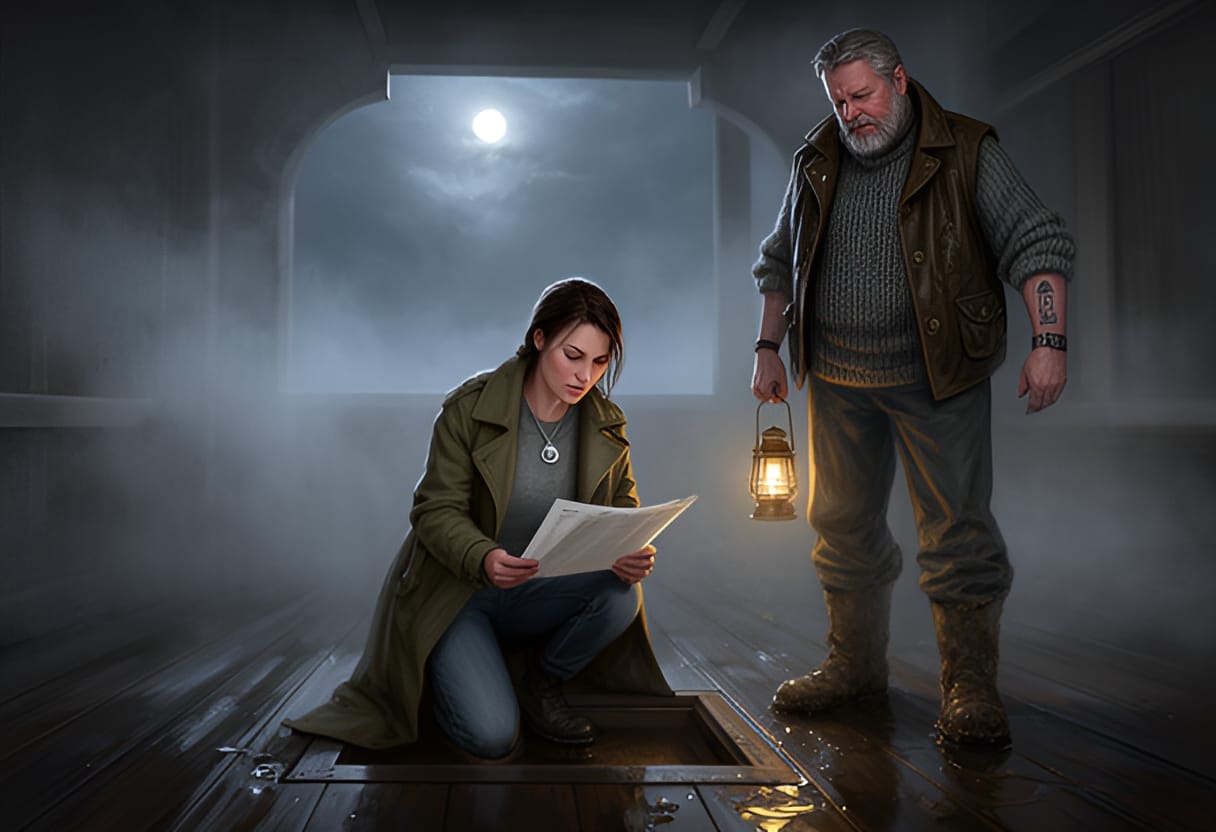
Her stomach clenched. “They lied,” she whispered. “They said the ivory went down with the ship.”
Declan unfolded the letter, the wax cracking as he broke the seal. The paper was thick, handmade, the script precise yet slanted with urgency — Elias Greaves’ hand, unmistakable from the journal’s margins.
My dearest Lillian,
If you are reading this, then the sea has kept its promise and I have not. The Drake’s Misfortune struck the rocks at 02:17 this morning. The impact threw me from the lantern gallery, but I clung to the rigging long enough to see the boats lower — only to pull away before they were halfway to the wreck.
I watched as Mr. Thorne senior signaled from the cliff, his arm raised not in warning, but in command. The coxswain hesitated, then turned the bow seaward. The men in the water — Jenkins, Hale, Ortiz, young Poole — they called for help. Their voices carried on the wind, clear as bells. And still, the boats retreated.
Below deck, the ivory was already being moved. I saw the oilcloth bundles lashed to the beams, the same ones Mr. Thorne claimed were lost in the hold. They lied to the surveyors. They lied to the church. They lied to you, my love, when they said I died trying to save the cargo.
I am writing this by the dim glow of my lamp, water rising fast in the watchroom. I do not know if this will reach you, but I beg you — if you find this, tell the truth. Let the names be known. Let God remember what the town has forgotten.
Your Elias
Elise’s vision blurred. She pressed the letter to her chest, the rough paper scratching against her sternum. Miriam had found this. She had held Elias’s words in her hands, felt the weight of his accusation, and carried it back to Silas — not for vengeance, but for reckoning. And Silas had silenced her for it.
A sudden, violent shudder ran through the lighthouse. The water surged higher, swirling past their knees, dragging at their ankles with icy insistence. The stone groaned again, louder this time, as if the tower were buckling under the tide’s weight.
“We have to go,” Declan said, his voice raw. He shoved the manifests and letter back into the chest, snapping the lid shut. “Now.”
Elise scrambled to her feet, the chest heavy in her arms. Water lapped at her thighs, cold and relentless, tugging at her boots as she turned toward the lantern room wall. The stones there were older, patched with uneven mortar where repairs had been made over the decades. Declan ran his hands along the surface, searching for weakness.
“Here,” he said, pressing his palm to a section near the corner where the wall met the copper roof flashing. The stone felt softer, crumbling slightly under his touch. “It’s been patched before — badly.”
He drove the knife into the seam, twisting until a chunk of mortar gave way. Then another. Dust and grit rained down as he worked, enlarging the hole with desperate, rhythmic blows. Elise shoved the chest against the opening, using her body to brace it while he kicked and pried at the stones.
Water rose to their waists, cold enough to steal their breath. Elise gasped, salt burning her nostrils as a wave slapped against the laneway beyond the glass. The lantern room windows shuddered, the leaded panes flexing under pressure.
“Almost,” Declan grunted, his arms shaking. He heaved a final stone free, and the gap widened — just enough.
Elise shoved the chest through first, wincing as it scraped her forearms. She followed, twisting sideways, the saltwater rushing up to chase her. Declan shoved hard at her heels, and then he was through, tumbling onto the slick stone of the gallery as the sea poured in behind them.
They didn’t stop. Declan hauled Elise to her feet, and they half-ran, half-slid down the exterior stairs, the wind screaming past their ears, the tide boiling white against the rocks below. The lighthouse loomed behind them, a dark sentinel swallowing the light as the sea claimed its base.
Only when they reached the shelter of the boathouse, soaked and shaking, did Elise dare to look back. The tower stood half-submerged, its lower windows gaping mouths where the tide had broken through. The beam was gone. Only the hiss of water and the groan of strained timber reached them across the churning dark.
Elise pressed the letter to her chest again, her heart hammering not just from exertion, but from the terrible, sacred weight of what they now carried. Miriam hadn’t just found the truth. She had died trying to give it voice.
And now, the sea was giving it back.
The boathouse reek of damp rope and rotting wood clung to their clothes as Elise and Declan stumbled onto the gravel path that wound toward town. The storm had eased to a relentless drizzle, each drop stinging Elise’s cheeks where salt had dried into tight lines. Her legs trembled from exertion and cold, but the weight of the letter pressed against her sternum kept her moving forward. Declan walked beside her, silent, his jaw clenched, eyes scanning the shadows between the fisherman’s shacks.
They reached the sheriff’s station just as the rain began to ease. A single lantern burned in the front window, casting a weak glow over the peeling paint of the sign: Blackreach Sheriff’s Office – Est. 1893. Elise hesitated at the top of the steps, the letter feeling suddenly like live wire in her grip.
“Are you sure?” Declan murmured, his voice low. “Once we go in… there’s no taking it back.”
Elise met his eyes. Water dripped from her chin onto her collar. “Miriam didn’t take it back. Neither will I.”
Inside, the air was thick with tobacco and the sour tang of old case files. Sheriff Boone sat behind a scarred oak desk, his boots propped up, a half-empty whiskey glass sweating onto a blotter. He looked up as they entered, his face a mask of weary patience that vanished the moment he saw Elise’s state — soaked, trembling, the letter clutched to her chest like a shield.
“Miss Varrick,” he said, pushing his glasses up his nose. “To what do I owe the pleasure? And might I ask why you’re trailing seawater through my office?”
“We have evidence,” Elise said, her voice steadier than she felt. She set the letter and the manifests on the desk between them. “From the lighthouse. From Elias Greaves’ own hand. It proves the Thorne family didn’t just salvage the Drake’s Misfortune — they let men drown to hide ivory they’d already taken off the ship.”
Boone picked up the letter, turning it over in his calloused fingers. His brow furrowed as he read, his lips moving silently. When he finished, he didn’t look up. He slid the paper back toward her, his voice flat.
“This is tragic, Miss Varrick. Truly. A sad footnote to a bad night.”
“It’s not a footnote,” Elise said, leaning forward. “It’s a confession. Elias Greaves watched them pull away. He heard the men calling for help. And your predecessor — your own deputy’s father — gave the order to turn the boats back.”
Boone finally looked at her, his eyes tired, not unkind, but resigned. “You think I don’t know that story? I’ve heard it since I was a boy. My grandfather kept the logbook that night. He never spoke of it after.”
“Then why not act now?” Declan demanded. “You’ve got proof. A firsthand account. The manifests show the ivory was never on the ship when it went down.”
Boone sighed, pushing himself up. He walked to the window, staring out at the slick street where the rain had left dark mirrors. “Jurisdiction, for one. Salvage rights fall under maritime law — federal territory. And even if we could press charges, who would we charge? Silas Thorne senior’s been dead twenty years. His son’s in a home in Portland. The only Thorne left with any pull is the old man — and he hasn’t set foot on a boat since ’98.”
“He doesn’t need to,” Elise said. “His name’s still on the salvage license. His company still runs the docks. He controls who gets to dive, who gets to speak, who gets to disappear.”
Boone turned back to her, his expression pained. “You’re asking me to go up against the Thornes over a twenty-five-year-old rumor, based on a letter that could’ve been written by anyone. I’ve got a town to keep quiet, Miss Varrick. Not a vendetta to start.”
“It’s not a rumor,” Elise said, her voice dropping. “It’s the truth. And Miriam Hale died for trying to tell it.”
Boone flinched, just slightly. He looked down at the letter again, then back at her. “I’m sorry. I can’t touch this. Not without something solid — a body, a paper trail linking the current Thornes to the crime. And even then…” He trailed off, shaking his head. “You know what happens when you poke at this town’s foundations. The whole thing starts to crumble.”
Elise felt the familiar burn behind her eyes — not tears, but the hot, sharp fury of being unheard. She thought of Cora, ten years gone, the phone call that came too late, the guilt that had settled in her bones like sediment. She thought of Miriam’s lavender comb on the cot, the way she’d whispered “They lied” as if the words themselves were a betrayal.
“I’ll take it to the press,” she said quietly.
Declan’s head snapped toward her. “Elise, no. You can’t — ”
“I can,” she said, meeting his eyes. “And I will. If the sheriff won’t do his job, then I’ll do mine.”
Boone opened his mouth, then closed it. He looked away, rubbing his temple. “Just… be careful. The Thornes don’t take kindly to being called out.”
“I know,” Elise said. She scooped up the letter and manifests, tucking them under her arm. “Thanks for your time, Sheriff.”
They stepped back into the damp air. The drizzle had stopped, leaving the world washed in gray-green light. The harbor lay quiet, the fishing boats bobbing slack against their moorings. Elise walked fast, Declan struggling to keep pace beside her.
“You’re sure about this?” he asked, his voice tight. “Once it’s out… there’s no walking it back.”
“I know,” she said. “But Miriam walked into the lighthouse knowing what she might find. She didn’t walk away. I won’t either.”
They reached Elise’s cottage just as the light began to fade. She fumbled with the key, her hands still shaking from the cold and the adrenaline. Inside, she kicked off her boots, leaving puddles on the worn floorboards. Declan stood in the doorway, water dripping from his coat.
“I’ll use the burner laptop,” she said, heading for the small desk in the corner. “The one I used for the Cora piece. No trace back to the Chronicle.”
Declan followed, hesitating. “Elise, if you send this… Silas Thorne will know it came from you. He’s already watching. He hit me — ”
“I know what he did,” she said, not looking up as she booted the machine. The screen flickered to life, casting a pale glow over her face. “And I know why.”
She opened the encrypted file she’d prepared earlier — the letter, the manifests, her own notes from Miriam’s journal, the photos she’d taken of the footprints in the lighthouse stairwell. She attached it all to a draft addressed to The Salish Current, the independent coastal outlet known for digging into corruption the bigger papers avoided.
Her fingers hovered over the keyboard. Outside, the wind had picked up again, rattling the windowpane. A car engine purred low in the distance — too smooth, too deliberate to be a local fisherman’s truck.
She hit send.
The progress bar crawled across the screen. Elise held her breath, the letter still warm against her ribs from where she’d pressed it there.
Then, through the rain-streaked glass, she saw it.
Silas Thorne’s black sedan, gliding slowly down the road toward the cottage, headlights off. It moved without sound, cutting through the drizzle like a shadow given form. It passed the end of her driveway, slowed — just for a second — as if checking whether the lights were on inside. Then it rolled on, disappearing into the fog that was already beginning to coil around the cliffs.
Elise didn’t move. Her hands hovered over the keyboard, the send button now grayed out, the message gone.
Declan stood behind her, silent, his breath soft in the quiet room.
She finally leaned back in the chair, the letter still clasped in her other hand. Her heart hammered, not just from fear, but from something else — something stark and undeniable.
She had done it.
She had sent the truth into the world.
And for the first time since Cora’s body had been pulled from the water, Elise Varrick felt, with a clarity that cut through the terror, that she was exactly where she was meant to be.
Chapter 3
The Light That Would Not Stay Hidden
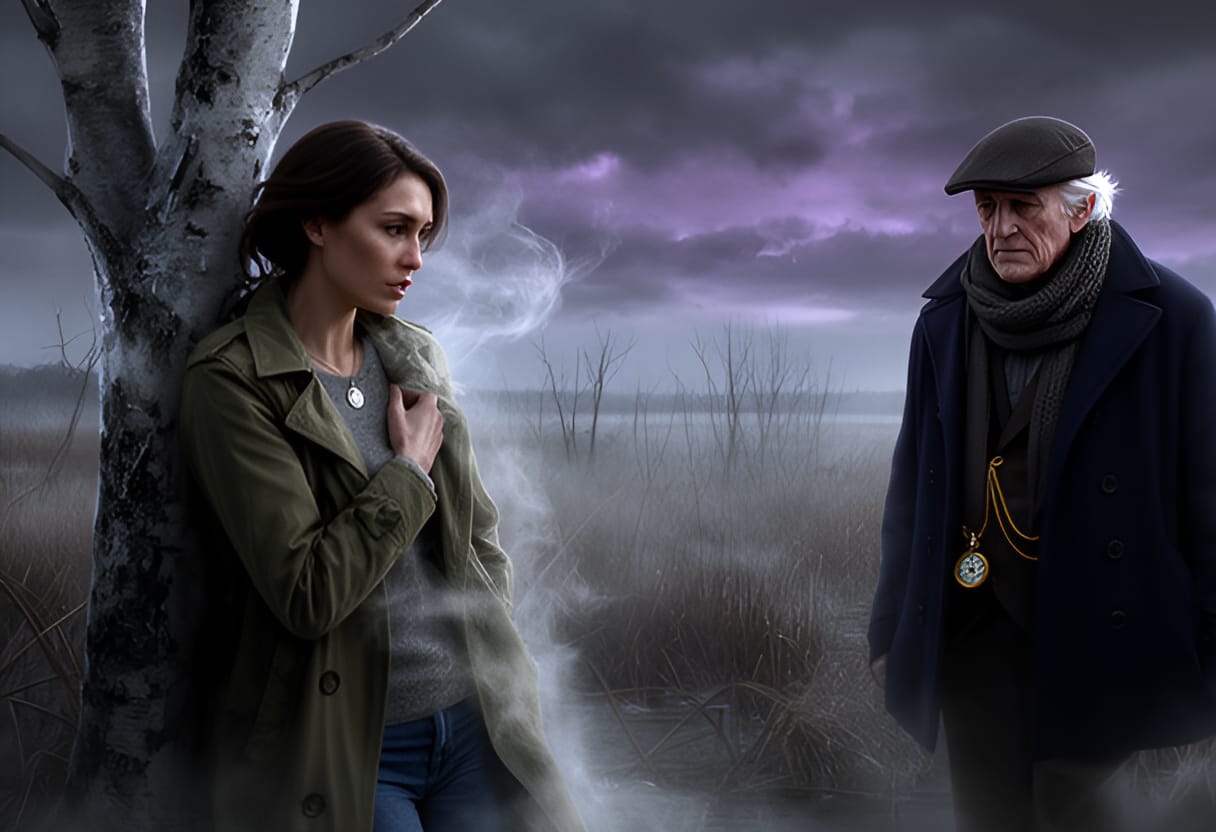
Elise pressed her back against the cold, wet bark of the alder, the salt marsh swallowing her in silence. The reeds hissed around her ankles, slick with brine and mud, as she watched the slow crawl of headlights along the cliff road. Silas Thorne’s black sedan moved with deliberate slowness, tires crunching on gravel, cutting through the fog like a blade. She hadn’t been seen. She knew it. But the certainty of it didn’t stop her heart from hammering against her ribs, each beat a warning: run, run, run.
She didn’t move.
The car passed, taillights fading into the mist. Only then did she allow herself to exhale, a shuddering breath that tasted of iron and damp earth. Her fingers, buried deep in the journal tucked inside her coat, felt the familiar ridge of the leather cover. Observations. Keep Watch. The words had become a pulse in her palm.
She waited until the road was empty, until the wind had swallowed the last echo of the engine. Then, slow and stiff from crouching, she pulled herself upright. Her boots sucked free of the mud with a soft, wet release. She didn’t head for the cottage. Not yet. Instead, she turned inland, following the narrow game trail that wound toward the dunes, putting distance between herself and the road, between herself and the certainty that Silas had been watching—not just the lighthouse, but them. Her and Declan.
Dawn came in layers—first a bruised purple along the horizon, then a slow bleed of gray, then the faintest gold catching the tips of the marsh grass. By the time Elise pushed through the last of the reeds and onto the hard-packed sand near the cottage, the sky had lightened enough to see the shape of things: the curl of smoke from a neighbor’s chimney, the gulls wheeling low over the water, the empty stretch of beach where the tide had pulled back like a held breath.
And there, just above the high-tide line, a shape that didn’t belong.
Declan.
He lay on his side, one arm flung out, the other curled beneath his head. His wool coat was darkened at the shoulder, damp not from the sea but from something thicker, darker. A smear of dried blood crusted near his temple, tracing a slow path down to his ear. The morning light caught the gloss of it, wet and fresh beneath the crust.
Elise froze.
Her breath vanished. Her boots sank slightly into the sand as she took a step forward, then another, until she stood over him. He wasn’t moving. His face was slack, eyes closed, lips parted just enough to show the edge of his teeth. The wind lifted a strand of hair from his forehead.
“Declan?” Her voice came out raw, barely above a whisper. She knelt, ignoring the chill that seeped through her trousers, and touched his shoulder. He was cool, but not cold. Alive.
His eyelids fluttered. Then opened.
They were unfocused at first, scanning the sky, the dunes, as if trying to place himself. Then they found her. Recognition came slow, like a tide returning.
“Elise?” His voice was thin, cracked. He tried to shift, and a sharp intake of breath cut him off. He gasped, fingers curling into the sand.
“Don’t move,” she said, her voice firmer now. She fumbled for her phone in her pocket—no signal, of course. Just a dead rectangle in her palm. “I’ll get help.”
He shook his head, a small, desperate motion. “No… hospital. They’ll ask questions.”
“You need a doctor. You’ve got a concussion—”
“I fell,” he said, louder now, wincing as he pressed a palm to his temple. “Tripped on a rock. Coming back from the nets. That’s all.”
Elise stared at him. The lie hung between them, thin and fraying at the edges. He hadn’t been near the nets. He’d been with her. At the lighthouse. And Silas had found them.
She saw it then—the way his jaw tightened, the flicker of fear behind his eyes, the way he avoided looking directly at her wound. He wasn’t just injured. He was afraid.
“Did someone hit you?” she asked, low.
He didn’t answer right away. The wind tugged at his coat. A distant foghorn moaned from the sea, low and prolonged.
Finally, he whispered, “He was there. Silas. Not in the car. On foot. Came up behind me when I was checking the snare line near the old boathouse. Said I shouldn’t have gone back. Said Miriam knew too much.” He swallowed hard. “Then he said… ‘Some lights are meant to stay dark.’ And then… nothing.”
Elise felt the blood drain from her face. Not from shock—though that was there—but from the awful, settling weight of truth. Silas hadn’t just warned them. He’d followed. He’d waited. And when Declan had tried to pull away, to go back to his nets, to pretend nothing had happened… Silas had reminded him who still held the tide.
She reached out, slow, and covered his hand where it lay in the sand. His skin was rough, calloused from years of rope and net, but trembling.
“I’m not stopping,” she said. “I’m publishing it today.”
His eyes snapped to hers. “Elise, you don’t understand—”
“I understand plenty,” she said, voice low but steady. “I understand that Silas killed Miriam to keep the Drake’s Misfortune buried. I understand that he’s been watching us. I understand that he just tried to break Declan’s skull to send a message. And I understand that if I don’t put this story out—now—then Miriam died for nothing. Cora died for nothing. All of it.”
He opened his mouth to argue, but she pressed on.
“I’ve had the journal for twelve hours. I’ve written the piece. It’s live at noon. I sent it to the Coastal Chronicle, to the regional wire, to three national outlets. It’s already queued. All I have to do is hit send.”
Declan stared at her. Then, slowly, he let out a breath that sounded like surrender—or exhaustion.
“You’re going to get yourself killed,” he murmured.
“Maybe,” she said. “But not before the truth sees light.”
She helped him sit up, wincing as he groaned, his face going pale. She supported his weight, one arm around his back, the other under his arms, and together they staggered toward the cottage. The marsh lay behind them, quiet and watchful. Ahead, the village stirred—shutters opening, smoke rising, the first cars pulling out of driveways. The day was beginning, unaware that it was about to fracture.
Inside her cottage, Elise eased Declan onto the sofa. She fetched water, a clean cloth, and pressed it gently to the wound on his head. He leaned into the touch, eyes closed.
“I’ll stay with you,” she said. “Until the ambulance comes. Or until you can stand.”
He opened his eyes. Looked at her. Then, quietly: “Thank you.”
She didn’t answer. Instead, she went to the table, picked up the journal, and held it to her chest. The leather was warm from her coat. The words inside felt less like secrets now, and more like a promise.
She opened her laptop. The screen glowed faintly in the dim room. The cursor blinked in the document titled The Drake’s Misfortune: How Blackreach Founded Its Fortune on Drowned Men.
She didn’t hesitate.
Her fingers hovered over the keys.
Then, with a breath that felt like a vow, she began to type.
Elise’s fingers hovered over the keys. The cursor blinked, steady and insistent, like a pulse waiting to be felt. She inhaled, drew the breath deep into her lungs, and let it out slow. Then she pressed enter.
The screen flashed: Published.
A quiet thrill ran through her, sharp and bright, not joy but relief—a tension uncoiling in her chest. She leaned back in the chair, the journal still resting against her thigh, and listened. The cottage was silent except for the rasp of Declan’s breathing from the sofa and the distant, muted thrum of the village waking. Somewhere down the lane, a screen door slapped shut. A dog barked, once, then fell quiet.
She didn’t move for a long moment. Just sat, letting the weight of it settle: the words were out. Miriam’s name was in print. The Drake’s Misfortune was no longer a whisper in the fog but a headline in black and white.
She reached for her phone, thumbs flying as she checked the Coastal Chronicle’s website. There it was, at the top of the homepage: her exposé, the headline stark against the gray morning light—The Drake’s Misfortune: How Blackreach Founded Its Fortune on Drowned Men. Below it, the subheading: New evidence reveals illegal salvage operation led to crew abandonment; founding families implicated in cover-up spanning three decades.
She scrolled. Saw the pulled quotes from Elias Greaves’ weathered letter, the transcription of the shipping manifest showing discrepancies in the cargo list, the timeline of Silas Thorne’s salvage license applications filed days after the wreck. And there, near the end, a paragraph dedicated to Miriam: Local schoolteacher Miriam Hale, who vanished two weeks ago, had been researching the lighthouse’s history and the wreck’s true circumstances at the time of her disappearance. Her journal, recovered by investigative journalist Elise Varrick, contains sketches of the lighthouse beam pattern and notes referencing a seven-year cycle tied to tidal returns—suggesting she may have uncovered more than historical interest.
Elise’s throat tightened. She hadn’t expected to see Miriam named so plainly. It felt like an intrusion, yet also a vindication. Miriam hadn’t disappeared into silence. She had been seen. She had been heard.
A soft groan came from the sofa. Declan shifted, his hand flying to his temple before he remembered and let it fall.
“You did it,” he murmured, eyes still closed.
“I did,” Elise said, her voice quiet but firm. She set the phone down and rose, moving to the kitchenette. She filled a glass with water, added two aspirin from the bottle in the cabinet, and carried it back to him. “Here. Take these.”
He took the glass, his fingers brushing hers. His skin was warm now, the color returning to his cheeks. “How long was I out?”
“A few hours. You scared me half to death.”
He managed a weak smile. “Sorry. Didn’t mean to drag you into this.”
“You didn’t,” she said, sitting on the edge of the sofa opposite him. “You tried to warn me. That counts for something.”
He looked at her then, really looked, and she saw the conflict in his gaze—not fear anymore, but something deeper, like regret. “I should’ve pushed harder. When Silas showed up… I should’ve made you leave.”
“And let him think he won?” Elise shook her head. “No. We were close. I could feel it. The truth was right there, in the beam pattern, in the salt on Miriam’s comb… I wasn’t walking away.”
Declan exhaled, a slow release of air. “You’re braver than I am.”
“I’m just tired of running,” she said. “Ten years is enough.”
They sat in silence for a moment, the only sound the tick of the wall clock and the faint, ever-present sigh of the sea beyond the dunes. Then Elise’s phone buzzed on the coffee table—a notification. She picked it up.
Coastal Chronicle: Breaking: Local exposé sparks outrage in Blackreach.
Her stomach flipped. She tapped it open.
The article had already garnered dozens of comments. Some were supportive: Finally, someone’s telling the truth. My grandfather worked the docks—he never talked about ’94, but I always knew something was off. Thank you, Elise. Miriam would be proud.
Others were vicious: This is a disgrace. Elise Varrick’s always been trouble—no wonder she left town. The Thornes built this town. You’re spitting on their graves. Lies and sensationalism. I’ll be seeing you in court, Varrick.
Her jaw tightened. She scrolled down, bracing herself. And then, near the bottom, a comment that made her blood run cold: Watch your back, Elise. The sea doesn’t forget names. Neither do we.
She looked up. Declan was watching her, concern etching his brow.
“What is it?” he asked.
“Nothing,” she said too quickly. She locked the phone and slipped it into her pocket. “Just… noise.”
But it wasn’t noise. It was a promise.
By noon, the story had spread. The Regional Wire picked it up, then the national feeds. Elise watched as the notifications piled up—shares, replies, emails from editors asking for follow-ups. Her phone buzzed incessantly until she silenced it, overwhelmed.
Declan dozed on the sofa, the aspirin taking effect. Elise sat by the window, journal open on her lap, watching the village through the glass. Cars moved with purpose now—delivery vans, the postman’s bike, a few tourists in rental cars slowing to glance at the lighthouse in the distance. But there was tension in the air, palpable even from here. Voices rose from the main street—sharp, argumentative. A car horn blared, prolonged and angry.
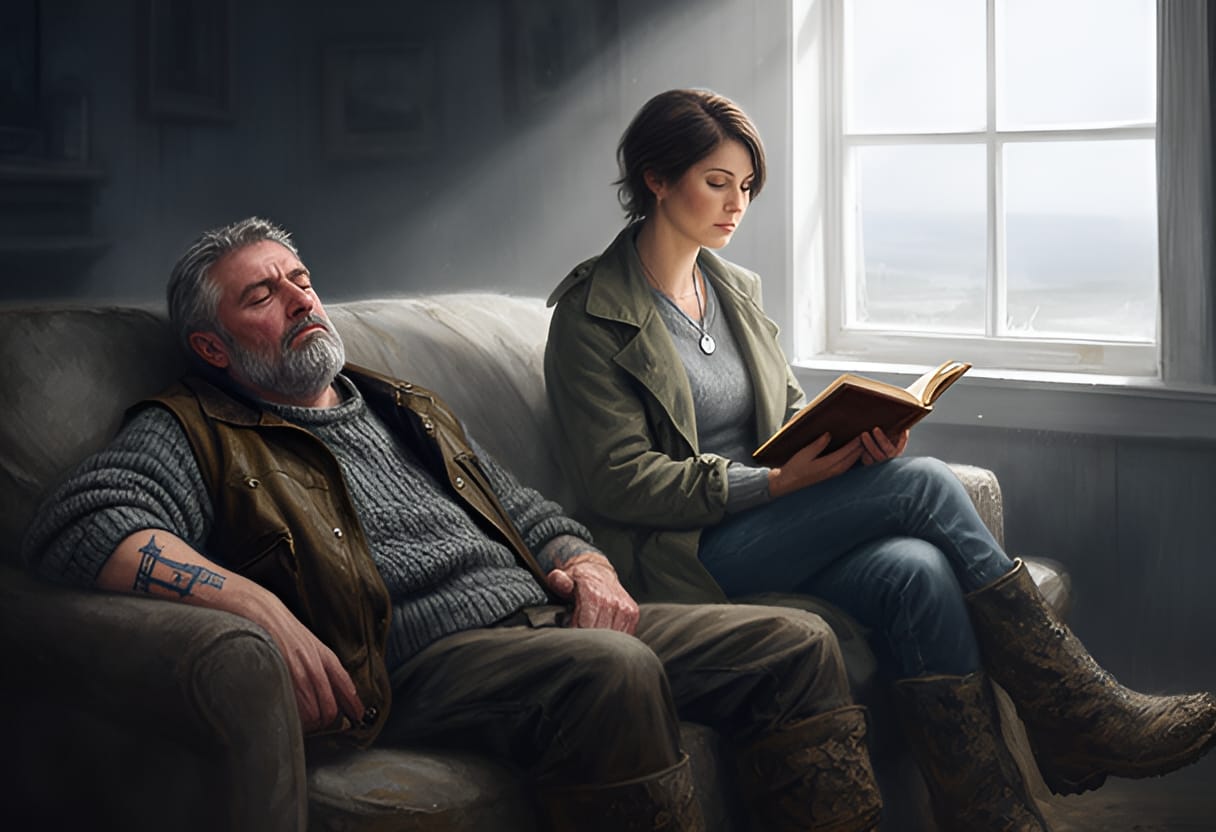
Then, just after one, a black sedan turned onto Elm Street and pulled up outside the Coastal Chronicle’s modest storefront office two blocks away. Elise recognized it instantly—Silas Thorne’s Lincoln, immaculate despite its age, the chrome gleaming under the weak sun.
She stood, heart pounding, and pressed her forehead to the cool glass.
Two men in dark suits stepped out first—lawyers, she assumed, their faces unreadable behind sunglasses. Then Silas himself emerged, leaning heavily on his carved cane. He wore a dark wool coat, his silver hair neatly combed, his expression calm, almost serene. He didn’t look like a man about to storm an office in rage. He looked like a man about to sign a deed.
But Elise knew better. She’d seen the fury in his eyes at the lighthouse, the way his jaw had clenched when he spoke to Declan. This was control. This was the quiet before the tide turned.
She watched as he climbed the three steps to the office door, the lawyers flanking him. He paused, glanced up and down the street—his gaze sweeping past her cottage, though she knew he couldn’t see her through the glare—and then knocked. Three slow, deliberate raps.
Inside, she could imagine the scene: the editor, young and nervous, opening the door to find the patriarch of Blackreach’s most powerful family waiting, lawyers in tow, demanding a retraction. She could hear Silas’s voice, low and reasonable, wrapped in velvet steel: This article is defamatory. It endangers the reputations of respected citizens. We expect a correction by day’s end, or we will pursue all available legal remedies.
She turned away from the window, her hands clenched at her sides. Let them come. Let them threaten. The story was out. It had been sent to national outlets. It was in the archives now, cached, mirrored. No retraction could unring that bell.
But as the minutes stretched and no update came—no urgent call from the editor, no breaking news about a lawsuit filed—Elise began to wonder if Silas was playing a longer game. If the threat wasn’t just legal, but something else. Something quieter. More final.
Evening bled into the village like ink in water. The fog rolled in early, thick and sweet with salt, obscuring the lighthouse until only its occasional blink pierced the gloom—a rhythm Elise now knew too well. She had eaten little, unable to sit still. Declan had woken, groggy but alert, and insisted on walking to the shore to clear his head. She had refused to let him go alone, so they’d walked together along the cliff path, silent, shoulders nearly touching, until the wind grew too sharp and they turned back.
Now, Elise sat at her small wooden desk, the journal open beside her laptop. She was drafting a follow-up piece—something on the town’s oral history, the stories elders told about the sea’s debts—when a draft brushed against her ankle.
She looked down.
A slip of paper, folded once, lay near the leg of her chair. The edges were slightly curled, as if it had been carried in a pocket for a while. Her name was written on the outside in a tight, slanted hand: For Elise Varrick.
Her breath stopped.
She didn’t touch it right away. She stared at it, the air suddenly thick in her lungs. This wasn’t a comment online. This wasn’t a shouted insult. This was personal. Delivered by hand.
Slowly, she reached out and picked it up. The paper was thin, cheap—printer stock, maybe. She unfolded it with deliberate care, as if it might dissolve in her fingers.
The message was brief, written in the same sharp script:
Retract it, or you’ll join Miriam and Cora in the deep.
She read it once. Then again. The words didn’t blur. They stayed, stark and final, like a tide line drawn in wet sand.
Her fingers tightened around the paper. A coldness spread from her chest outward, not fear—though that was there, curling at the edges—but something harder. Resolution. Miriam had vanished for seeking the truth. Cora had been taken by the sea, or so they said, but Elise had always suspected there was more to that story, something the town had never wanted to examine. And now, this note tied them together: three women, silenced by the same current.
She looked up. The cottage was dark except for the lamp over her desk, its glow pooling on the journal, the laptop, the threat in her hand. Beyond the window, the fog pressed close, muffling the world. Somewhere in the mist, the lighthouse swept its beam—once, twice—steady, unwavering.
Elise lowered the note slowly to the desk. She didn’t crumple it. She didn’t tear it. She left it there, flat and visible, a testament.
Then she opened her laptop again. The cursor blinked, waiting.
She began to type.
Elise’s fingers hovered over the keyboard, the threat note still lying flat beside her laptop like a stone dropped in still water. The cursor blinked. She could feel the weight of the fog pressing against the windows, the salt in the air sharp on her tongue. Outside, the lighthouse swept its beam once, twice—steady, unwavering—as if keeping time with her pulse.
She began to type.
Not a retraction. Not an apology. A reckoning.
By dawn, the article had spread beyond the Coastal Chronicle’s site. Regional papers picked it up. National outlets ran excerpts. Comments flooded in—some supportive, some vicious, some demanding proof. Elise read them all, her jaw tight. Then, just after sunrise, she walked to the edge of the property where the marsh met the shore and unfolded a large, weather-resistant banner she’d had printed the night before in secret, using cash and a false name at a print shop in the next town over.
It read: THE DRAKE’S MISFORTUNE: WHAT THE SEA GAVE UP, THE THORNES TOOK.
She secured it between two driftwood posts with twine, letting it snap in the wind like a sail. Then she returned to the cottage and packed a thermos of tea, two woolen blankets, and a stack of photocopies—Elias Greaves’ fragmented log entries, the altered shipping manifest from 1994 showing missing cargo, a list of names of the crew who vanished that night, and a letter Elias had written but never sent, found tucked inside the journal’s back cover.
“I’m going to the shore,” she told Declan, who sat wrapped in a blanket on the porch swing, his temple still tender under the gauze.
He looked up, eyes wary. “You sure? Silas’s men were watching the office last night. They might be watching you now.”
“I know,” she said. “But if they come, let them see what we’re doing. Let them hear what we’re saying.”
He didn’t argue. He just nodded and touched the bandage on his head. “Be careful.”
“I will.”
The walk to the shore was short but felt like crossing into another world. The fog clung low, muffling sound, turning the cliffs into looming shadows. The sand was firm and damp near the water’s edge, perfect for walking. Elise spread the blankets on a flat stretch above the high-tide line, weighted the corners with stones, and arranged the photocopies in a neat pile in the center. She set the thermos down and stepped back, waiting.
At first, no one came.
She sat on the edge of the blanket, knees drawn up, staring at the sea. The waves rolled in with a slow, grinding sigh, dragging pebbles back with them. A gull cried overhead. Somewhere far off, a buoy clanged. She thought of Miriam’s sketches—the way she’d drawn the lighthouse not as a beacon, but as a watchful eye. Keep Watch. She wondered if Miriam had known, even then, that someone would one day come back to finish what she started.
An hour passed. Then two.
Just as she began to doubt, a figure appeared on the path—a woman in a faded raincoat, her hair tucked under a scarf. Elise recognized her: Maren Cho, who ran the bakery and whose son had been in Miriam’s class.
Maren stopped a few feet away, hesitant. “I… I saw your banner. I didn’t know if I should come.”
“You’re welcome,” Elise said, keeping her voice low. “Please.”
Maren sat slowly, pulling her coat tighter. “I used to bring my boy to Miriam’s classroom every Friday for reading hour. She always had tea ready. Lavender and honey. Said it calmed the nerves.”
Elise nodded. “She was kind.”
“Too kind, maybe.” Maren looked out at the water. “I heard things. Whispers. About the wreck. About how the boats didn’t go back for the men in the water. I… I didn’t want to believe it. But I couldn’t unhear it, either.”
She reached out and took one of the photocopies—the list of names. Her finger trembled as she traced the ink. “My great-uncle was on that ship. Jonah Cho. They said he jumped. But… he couldn’t swim. Not well. Not in that swell.”
Elise placed a hand over hers. “He didn’t jump. He was left.”
Maren’s breath hitched. A tear escaped, tracking through the salt on her cheek. “Thank you for saying it.”
Another came—an older man with a cane, his collar turned up against the wind. Hal Voss, the retired fisherman who’d once worked the docks with Silas’s father. He didn’t speak at first. Just sat and stared at the manifest, his jaw working.
“They told us the ivory was lost,” he said finally, voice rough. “Sank with the ship. But I helped unload crates that night. Not ivory. Boxes. Marked with a crown. We hauled them to the Thorne warehouse before dawn. No one was supposed to see.”
Elise’s stomach tightened. “You never said anything.”
Hal shook his head. “Who would’ve believed me? Silas’s father was a pillar. Still is, in some eyes. And I had a family to feed. You don’t bite the hand that… that feeds you, even if it’s bloody.”
He looked at her, eyes wet. “I’m sorry I stayed silent. I’m sorry it took this long.”
She squeezed his shoulder. “You’re here now. That matters.”
More came—slowly, like tide returning. The school librarian. The postmaster’s wife. The teenager who’d delivered Elise’s paper for years. They sat in silence at first, reading, absorbing. Then whispers began—not of fear, but of recognition. “My grandfather mentioned the crown mark.” “My aunt said Miriam asked too many questions.” “I remember the smell of salt and something sweet—like rotting flowers—coming from the warehouse that week.”
No one accused. No one shouted. They just listened. And in that listening, something shifted.
Elise watched from the edge of the group, her heart full but wary. She scanned the dunes, the cliffs, the fog-drenched marsh beyond. And there, half-hidden in the reeds near the old boathouse path, she saw him.
Silas Thorne.
He stood perfectly still, his cane planted in the sand, his dark coat blending with the shadows. He wasn’t close enough to hear details, but close enough to see. To witness. His face was unreadable—no anger, no triumph, just a deep, weary sorrow, as if he’d been waiting for this moment his whole life and now didn’t know what to do with it.
She didn’t look away. Let him see her. Let him see them.
Time passed. The fog thinned slightly, letting through a pale gold light that turned the wet sand to silver. The lighthouse beam swept ashore—once, twice—its rhythm steady, inevitable.
Then, a small hand tugged at her sleeve.
Elise turned.
A girl, no older than eight, stood before her. She wore a yellow raincoat too big for her frame, her braids swinging as she shifted her weight. In her small hand, she held a folded piece of notebook paper.
“I drew this for you,” she said, voice quiet but clear.
Elise took it carefully. Unfolded it.
It was a crayon drawing of the lighthouse—tall and stark against a swirl of blue and gray. But unlike the real tower, this one shone. A thick yellow beam cut through the darkness, reaching into the sea. Below it, in wobbly but deliberate letters: Thank you for remembering.
Elise’s throat tightened. She looked up at the girl. “Did you draw this yourself?”
The girl nodded. “My grandma said you were telling the truth. She said it’s okay to remember now.”
Elise pulled the girl into a quick, fierce hug, breathing in the scent of rain and cotton. When she pulled back, she wiped her eyes with the back of her hand. “Thank you,” she whispered. “Thank you so much.”
The girl smiled, then skipped back toward a woman waiting near the blankets—her grandmother, Elise realized, the same one who’d brought tea to Miriam’s classroom all those years ago.
As the girl rejoined her family, Elise looked out at the gathering. Nearly two dozen people now sat or stood on the shore, some still reading, some talking in low voices, some just staring at the sea as if seeing it for the first time. The banner snapped behind them. The lighthouse swept its light.
And for the first time in thirty years, the beam didn’t just warn.
It bore witness.
Elise rose slowly, her joints stiff from sitting. She folded the girl’s drawing carefully and tucked it into her jacket pocket, over her heart. Then she walked to the edge of the water, where the waves licked at her boots, and lifted her face to the wind.
The fog was lifting.
And the truth, at last, was not hiding.
Elise walked the shore path long after the others had gone, the girl’s crayon drawing warm against her ribs. The tide had turned, pulling back in slow, silver sheets that left the sand ribbed and glistening. Her boots sank slightly with each step, the damp grit cool through the soles. The wind had dropped, leaving the air thick with the scent of kelp and cold stone. Ahead, the lighthouse loomed—not as a threat, but as a sentinel waiting.
She hadn’t planned to come back. Not tonight. But the quiet on the shore had felt like an invitation, not a warning. And the beam—still sweeping, steady, unblinking—had pulled her like a thread.
The iron door stood ajar, just enough for a person to slip through. No chain. No padlock. Silas must have left it that way. Or perhaps the sea itself had loosened the bolts, tired of keeping secrets.
Elise paused on the threshold, hand on the rusted frame. Salt had eaten deep into the metal, but the hinges groaned only once, low and reluctant, as if the building remembered being welcomed.
Inside, the air was still and close, smelling of oil, damp wool, and something older—like the inside of a seashell. Her flashlight cut a cone through the gloom, revealing the spiral staircase coiled like a fossil in the wall. Each step was iron, worn concave in the center by generations of boots. She began to climb.
Halfway up, she paused at a landing where a narrow window looked out over the marsh. The moon had broken through the clouds, silvering the reeds. She thought of Cora, standing here years ago, maybe, pointing out plover nests to a wide-eyed Elise. She thought of Miriam, her hand tracing the curve of this very railing, whispering names into the wind.
She kept going.
At the top, the lantern room smelled of hot metal and glass. The great lens—Fresnel, prismatic, breathtaking in its complexity—hung silent in its brass cradle. Dust lay thick on the panes, but not so thick it couldn’t be wiped. And there, on the control panel beside the lamp housing, a lever labeled Fog Damper was pulled halfway down. She pushed it up. A soft click.
Then she saw the fuel reservoir—half-full of kerosene, clear and golden. The wick, braided cotton, stood upright in its holder, not dried to ash, but pliable. Someone had tended it. Recently.
Her breath caught. Not Silas. Not Declan. Someone who still believed.
She struck a match from the box pinned to the wall—dry, despite the years. The flame caught the wick instantly. A soft whoosh, then a steady bloom of orange light. She adjusted the wick until the flame sat just right—bright, clean, no smoke.
Then she engaged the clockwork mechanism.
A groan, deep and ancient, came from the weight shaft in the center of the tower. The great gears, long dormant, began to turn. Not smoothly—there was hesitation, a grating of rust—but they turned. The weight began its slow descent, pulling the drive train with it. The lens shuddered, then began to rotate.
Light poured out.
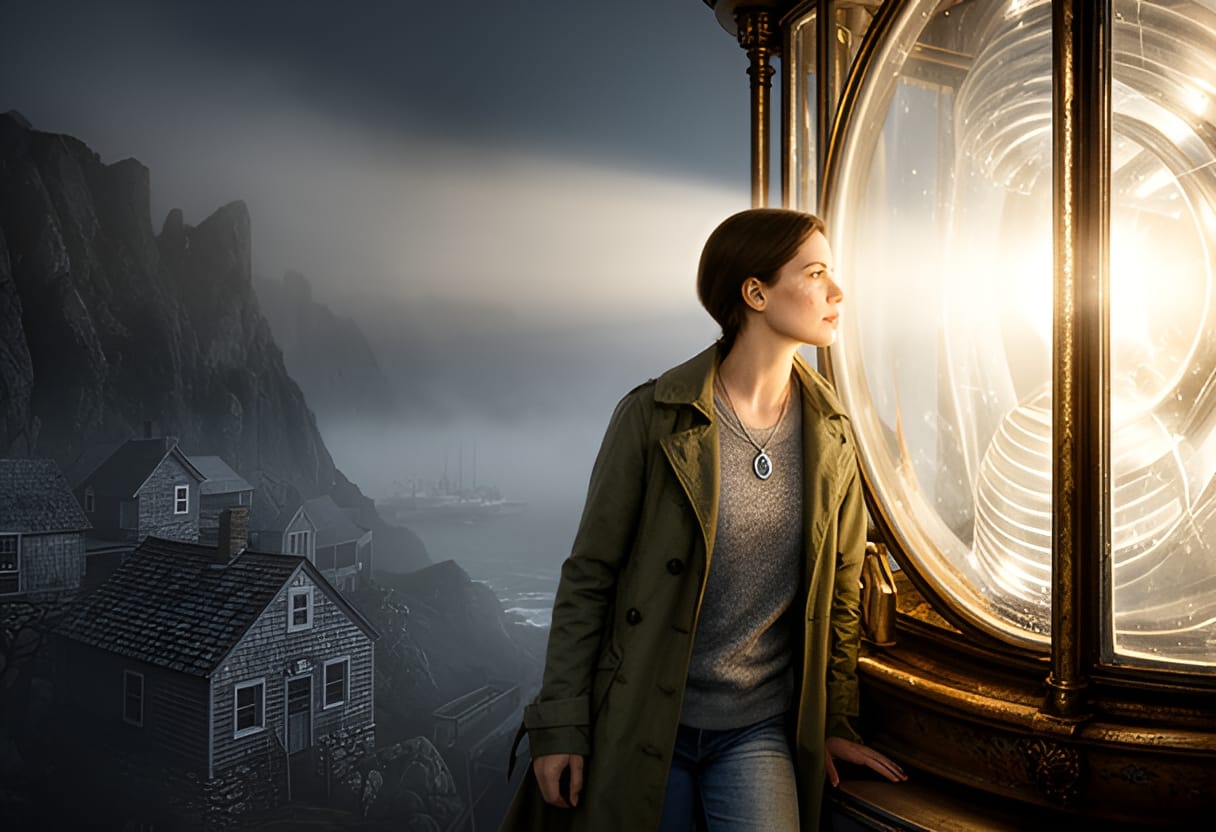
Not the weak, intermittent sweep of a dying bulb, but a true beam—powerful, focused, cutting through the night like a blade. It arced across the waves, struck the far cliff, and swept back, painting the marsh in alternating bands of gold and shadow.
Elise leaned against the cool brass, tears hot on her cheeks. She didn’t wipe them away. Let them fall. Let them mix with the salt on her skin.
Below, the sea breathed. Not angrily. Not hungrily. But with a kind of patience, as if it had been waiting for this exact moment—to be seen, not feared.
She thought of Jonah Cho, left in the swell. Of the men who called for help as the boats pulled away. Of Miriam, who had drawn the light not as a warning, but as a plea.
The beam swept again. And again.
It was not a warning.
It was an answer.
She stayed until her legs ached and the first pale fingers of dawn began to press against the horizon. The light held—steady, unwavering. No falter. No sputter. As if the lighthouse had only been holding its breath, waiting for someone to remember how to turn it on.
When she finally descended, the door stood open behind her, inviting. She didn’t close it. Let it stay that way.
On the shore, the tide had returned, lapping gently at the sand. The group was gone. Only the girl’s drawing remained, tucked in her pocket, and the quiet certainty that some truths, once spoken, cannot be unheard.
She walked home without looking back. Not because she was done. But because she was finally free to move forward.
The light would keep watching.
And so would she.
The cottage door clicked shut behind her, but Elise didn’t turn on the light. She moved through the familiar rooms in the dim gray of early morning, guided by memory and the quiet rhythm of her own breath. The journal lay on the kitchen table where she’d left it, the girl’s crayon drawing now resting atop it, the yellow beam of the lighthouse glowing defiantly against the paper’s edge.
She poured water into the chipped mug she always used—Cora’s, really, though she’d never claimed it as her own—and set it to heat on the stove. While she waited, she walked to the window and pulled back the curtain. The lighthouse stood stark against the lightening sky, its beam still sweeping, now tinged with the soft blue of dawn. It cut across the water, over the marsh, and for a brief moment, touched the very edge of the dunes where she had stood the night before, where Silas had watched.
She didn’t flinch. She met the light.
The whistle of the kettle pulled her back. She poured the water over the tea leaves in the infuser—a blend Miriam had once brought her, chamomile and something citrusy, said to calm the nerves. Elise had laughed then, said she didn’t need calming. Now she understood.
She carried the mug to the table and sat. The journal lay open to a page near the back, where Miriam had sketched the lighthouse not as a tower, but as an eye—lid half-lowered, lashes formed by waves, pupil the lens itself. Beneath it, in Miriam’s precise script: The sea does not forget. It only waits for us to remember to look.
Elise traced the words with her fingertip. Outside, a gull cried. Then another. The sound was ordinary, familiar—part of the fabric of Blackreach, not its secret.
Her phone buzzed once on the table. A notification: Coastal Chronicle—Breaking: Local Historians Confirm Details in Varrick Exposé. She didn’t open it. Let it sit. Let the world catch up.
She thought of Declan, sleeping upstairs, the bandage still faintly pink at the temple. He’d wake soon, groggy but grateful. He’d make coffee, strong and bitter, and they’d sit in silence for a while, not because there was nothing to say, but because some things needed no words.
And Silas? She imagined him in his great house on the cliff, the one with the widow’s walk that faced the sea. Maybe he was standing there now, hands behind his back, watching the beam sweep across his lawn, over his roof, into his windows. Maybe he finally understood that some lights aren’t meant to be kept dark—not because they’re dangerous, but because they’re necessary.
The tea had cooled. She took a slow sip. It was warm, floral, just slightly sweet. Just as Miriam remembered.
She closed the journal gently, then opened it again to the first page. The title, in Miriam’s hand: Observations. Keep Watch.
Elise smiled, small and tired and sure.
She knew what it meant now.
Not to guard against danger.
But to bear witness.
To say: I saw you. I remember you. You were here.
She tucked the drawing back inside, pressed the cover to her chest for a moment, then rose. The beam swept through the window again, painting the table in gold, then shadow, then gold once more.
She walked to the door, pulled on her boots, and stepped into the morning.
The fog was gone.
The sea was quiet.
And the light—steady, unwavering—continued its watch.