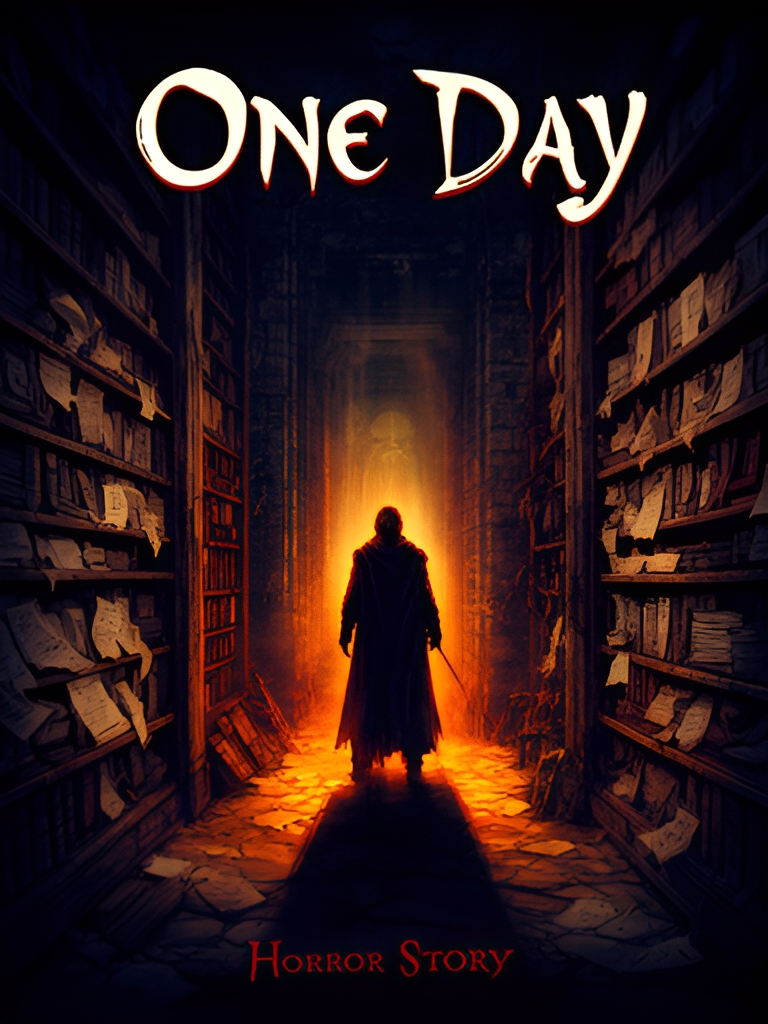
Horror
One Day
by Kateryna Kozina
3 chapters16 min read
Chapter 1
The Ledger of Yesterday
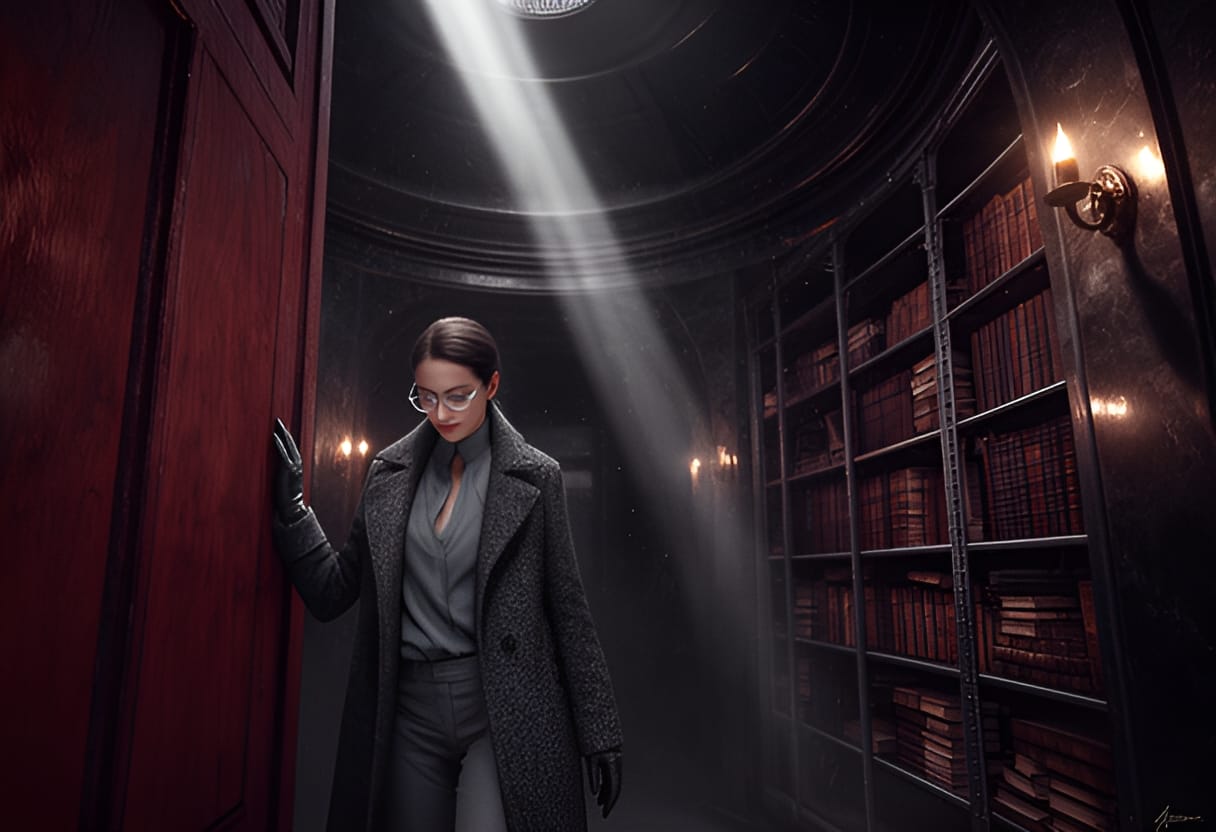
The air tasted of dust and iron as Elara pushed open the heavy oak door of the Whispering Wing. Flickering sconces threw long shadows across shelves bowed under the weight of ledgers bound in cracked, pallid skin. The silence was not empty—it hummed, low and subvocal, like the throb of a vein beneath skin.
She ran a gloved hand along the nearest spine. The texture was unsettlingly warm, almost pulsing. A cataloguer’s instinct flared: identify, classify, preserve. But this was no ordinary archive. These were not records of deeds or transactions. They were diaries of endings.
She pulled the first ledger from the shelf. Its cover bore no title, only a date in a cramped, spidery hand: Three Days Ago. Elara’s breath hitched. She opened it.
The page began mid-sentence: —and then the knife slipped, not deep enough, so he pressed harder, feeling the give of cartilage, the wet tear of fascia— Her stomach lurched. She flipped back. The entry started at dawn: He woke with the taste of iron. The rope was in the closet where he’d left it. He did not cry. He tied the knot seven times, as his father taught him. Each hour was marked, each thought transcribed with clinical precision. The final line: The chair tipped. He did not scream. The light went gray, then black.
She slammed the book shut. Impossible. This ledger had been written before the act.
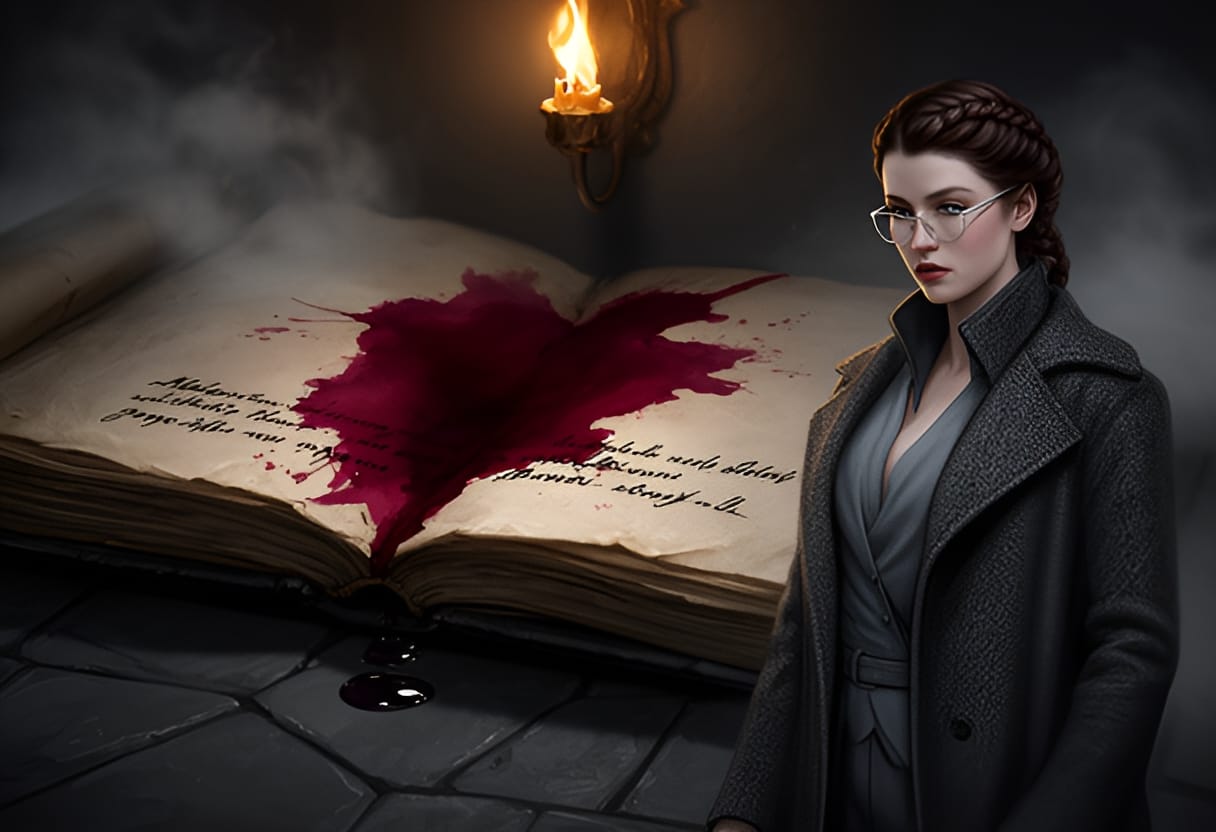
Her eyes darted to the vial of ink in her pocket—a habit from fieldwork, never used here. On impulse, she uncorked it and let a single drop fall onto the stone floor. It spread in a slow, dark bloom.
She returned to the ledger. The ink stain was already there, blooming across the page as if it had always been. Beneath it, in the same meticulous script: She dropped the vial. The ink spread. She watched it. Her breath caught. She did not cry.
Elara’s pulse hammered in her throat. She fumbled for yesterday’s ledger, her fingers shaking. The date was worn smooth at the edges—Yesterday. She opened it.
The entry began: She entered the Whispering Wing at 09:13. Her coat was damp from the mist. She carried no light. She paused at the third shelf. Her name was there, written as if by a hand that knew her. Her breath came short. She scanned forward.
Today’s date was at the top of the next page. Her name headed the entry.
She reads this. Her hands shake. She does not yet believe.
The ink was still wet.
She backed away from the ledger, the cold stone biting through her slippers. The ink on the page still gleamed, fresh as a wound. She reads this. Her hands shake. She does not yet believe. The words mocked her. They were written in her own hand—she knew the slant of her es, the way she looped her ys—but she had not written them. Not yet.
A sound made her freeze—a soft scrape, like fabric on stone, from the far end of the aisle. Not a draft. The air was too still for that. She slipped behind a towering stack of ledgers, pressing her back against the shelving. The skin-bound spines felt unnervingly alive beneath her palms, throbbing with a slow, deep rhythm.
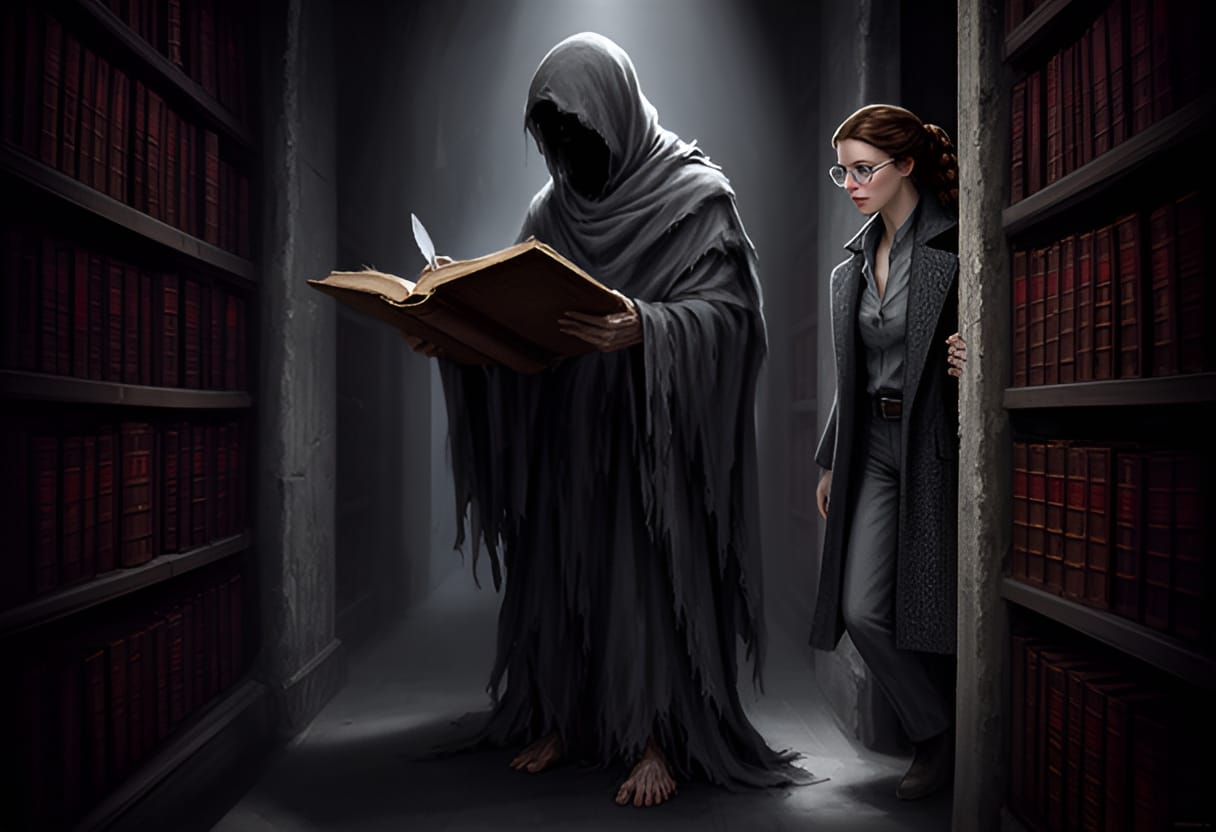
The Keeper stepped into the aisle.
He moved without hurry, robes whispering over the flagstones. His face was hooded, but she saw the glint of his eyes—pale, unfocused, as if he looked not at the world but through it, at something only the ledgers could reveal. He carried no lamp, yet his path was sure. He stopped before the very ledger she had just abandoned.
Elara held her breath.
He opened it to the page with the ink stain. His fingers—long, knotted, stained faintly violet at the tips—hovered above the paper. Then he began to write.
His hand moved with hers. The same forward slant, the same pressure on the downstrokes. She backed away from the ledger. Her slippers slipped on the stone. She pressed herself behind the shelf. Her breath came shallow. Each word appeared as she did it, as if he were not recording but echoing her movements a heartbeat after they happened.
She wanted to scream, to run, but her limbs were locked. This was impossible. The ledger had known about the ink spill before it fell. Now it was tracking her in real time. Not predicting. Recording. As she lived it.
The Keeper paused. His pen hovered. Then, slowly, deliberately, he added a new line beneath the last: Her pulse jumps in her throat. She thinks she is unseen. She is wrong.
Elara’s vision blurred. How could he know? She hadn’t felt her pulse spike until he wrote it. Unless—unless the act of writing it made her feel it. A cold thought slithered up her spine: Is he writing me into fear?
The Keeper turned a page. Fresh, blank skin waited. He dipped his pen—not into an inkwell, but into the ledger itself, as if drawing the fluid from the page. Then he began to write again, his voice a dry rasp that seemed to vibrate in the marrow of her bones: She will run now. She will turn left at the third stack. She will knock over the vial of iron-gall ink she keeps in her coat pocket. It will stain the floor in the shape of a hand.
Elara jerked back—but not fast enough. Her elbow caught the edge of the shelf. A vial tumbled from her coat. It spun through the air and shattered on the stone.
She didn’t wait to see if the ink bloomed in the shape of a hand. She fled, sandals slapping against the floor, heart hammering against her ribs like a bird against a cage. The sconces flared as she passed, then guttered behind her, plunging the aisles into stygian dark. The hum in the air rose—a chorus of whispers, not in any language she knew, but in the cadence of her own breath, her own footsteps, her own terrified thoughts.
She skidded around a corner and slammed into a dead end—blank wall, no ledgers, no escape. She pressed her palms flat against the stone. It was warm. Wet. She snatched her hands back. They came away smeared with something dark and viscous that smelled of salt and old blood.
A scrap of parchment fluttered down from the darkness above. She caught it. The Keeper’s handwriting, but wrong—jagged, urgent, as if written in haste or pain: You are not the subject. You are the hand. Stop writing before it’s too late.
The ledger in her mind began to fill on its own: She reads the note. Her knees buckle. She does not understand. She will understand soon enough.
Elara screamed—not in fear, but in denial. She would not be the scribe of her own end. She would not write herself into the dark.
She turned and ran deeper into the Whispering Wing, not toward safety, but toward the heart of the archive where the oldest ledgers waited—where, she now realized, the truth had been written all along.

Chapter 2
The Sister’s Warning
Elara’s breath came in ragged gasps as she fled, the stone floor slick beneath her sandals, the air thick with the scent of iron and damp earth. The Whispering Wing stretched ahead, endless and shifting, its aisles breathing with a slow, subterranean pulse. She didn’t know where she was going—only that she had to go deeper, to the oldest ledgers, where the truth had been written all along. The Keeper’s warning echoed in her skull: You are not the subject. You are the hand. But what did that mean? Was she writing the fear, or was the fear writing her?
She turned a corner and skidded to a halt before a massive oak door, banded with tarnished silver and etched with a symbol she didn’t recognize—a spiral within a triangle, its lines worn smooth by centuries of touch. The air around it hummed, low and resonant, like a string plucked in the dark. She pressed her palm to the wood. It was warm. Alive.
A click sounded from within. The door swung inward, not on hinges, but as if it had been waiting.
Inside, the chamber was small and circular, its walls lined not with ledgers, but with niches holding small, obsidian boxes. In the center stood a pedestal of black stone, and atop it, a single ledger bound in what looked like stretched, pale flesh—too fine, too smooth to be human. It pulsed faintly, like a vein beneath skin.
Elara stepped forward, her pulse hammering in her ears. She reached out, trembling, and opened the cover.
The first page was blank.
She turned it.
And there, in a tight, slanting script she knew instantly—her sister’s hand—was a date: Five Years Ago, Today.
Elara, the entry began, if you’re reading this, you’ve found the chamber. That means you’ve seen the ledgers move. You’ve felt the walls breathe. You’ve heard the whispers match your thoughts. I’m sorry I couldn’t warn you sooner. I tried to leave notes, but they keep changing. The archive rewrites what it doesn’t want known.
Elara’s throat tightened. She read on, her fingers tracing the ink as if to steady it.
I came here five years ago, just like you. I was hired to catalog the Whispering Wing. I thought I was preserving history. I was wrong. The ledgers don’t record what will happen. They make it happen. Every time someone reads their own page, they seal it. The ink doesn’t predict—it instructs. And the one who writes it… becomes the scribe.
A cold sweat broke across Elara’s back. She remembered the vial shattering. The Keeper’s pen dipping into the page. The way the words had appeared before she acted.
I tried to stop it, Lyra’s writing continued, the letters growing tighter, more frantic. I started altering entries. Small things—changing a name, delaying a time, smudging a detail. For a while, it worked. People lived. I saved three. Maybe four. But the archive notices when you lie in its blood. It fights back. The walls began to bleed when I touched them. The hum in the air turned to screams. And then… I tried to erase my own page.
Elara’s breath hitched. She turned the page.
The next entry was smeared, as if written in haste, or tears.
I thought if I removed the ink, I could remove the fate. I scraped at the skin with a blade. I used acid from the conservation lab. I even tried burning the page with a candle. But the ledger heals. It always heals. And when I finally succeeded—when I made the ink vanish—the page didn’t stay blank. It filled itself again. In my handwriting. Describing what I was doing. Describing me… disappearing.
Elara’s vision swam. She saw it then—not as words, but as a feeling: the slow, inevitable pull of being written into existence, of becoming a character in a story that had already been told.
The last thing I remember, the entry concluded, the script now childlike, uneven, is the Keeper standing in the doorway. He wasn’t holding a pen. He was holding me. And he said, “The hand must write. The hand must be written.” Then the lights went out. And I stopped being Lyra Voss. I became a footnote. A margin. A whisper in the paper.
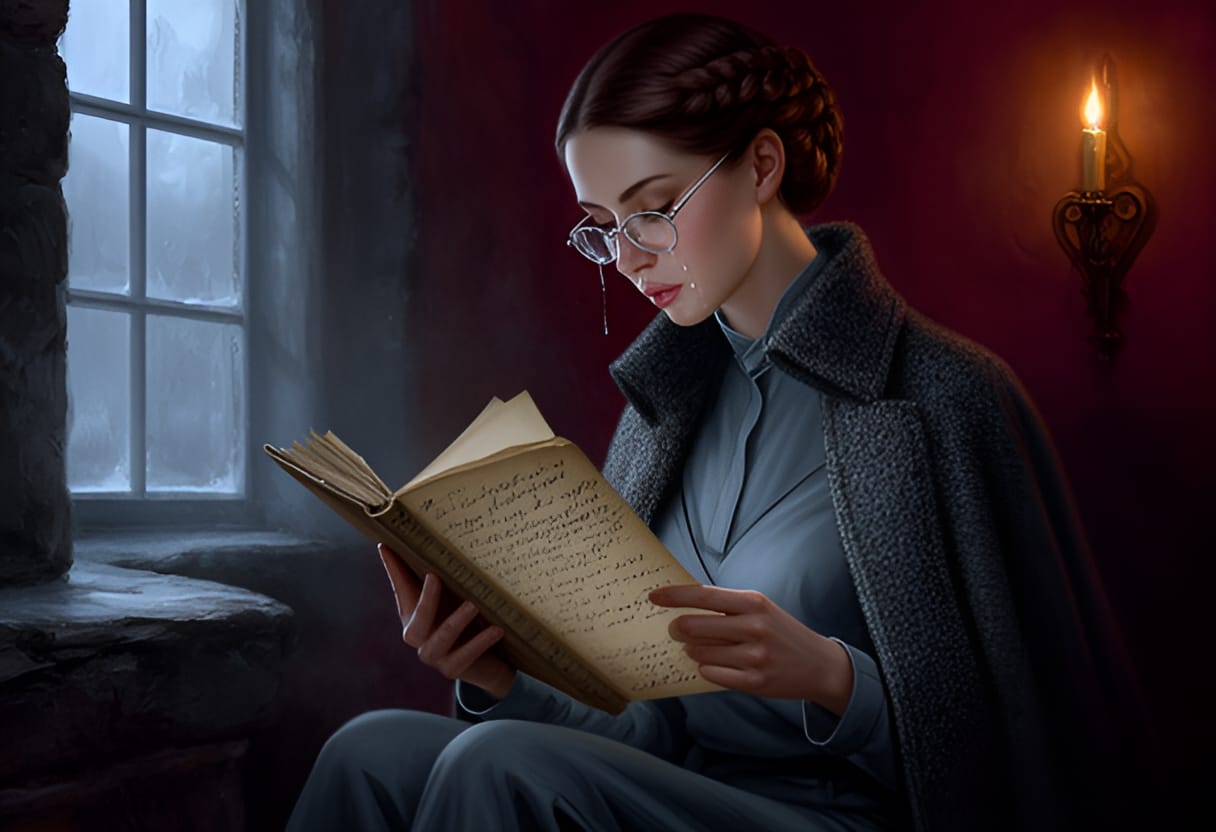
Elara slammed the ledger shut. Her hands shook. Tears streaked her face, hot and sudden.
A sound made her freeze—a soft, rhythmic tapping, like fingers drumming on stone.
She looked up.
The chamber’s single sconce flickered. Then went out.
In the sudden dark, the obsidian niches began to glow faintly from within, each one pulsing like a heartbeat.
And in the doorway, framed by the sickly light spilling from the corridor beyond, stood the Keeper.
His hood was up, his face lost in shadow. But one hand was raised—not in threat, but in gesture. Palm outward. Fingers slightly curled.
As if he were holding something invisible.
As if he were waiting for her to take it.
Elara clutched Lyra’s ledger to her chest.
The whisper began again—not in the air, but in her mind, soft and insistent, in her own voice, her own cadence:
You are not the subject. You are the hand. Stop writing before it’s too late.
She fumbled with the clasp of Lyra’s ledger, her thumb catching on the ridge of dried blood along the spine. The whisper in her mind pulsed once, twice—Stop writing before it’s too late—then fell silent, as if listening.
She forced the cover open again. The pages resisted, sticking slightly, as though the flesh-bound cover objected to being read. When she turned to the next leaf, the ink was still wet, glistening under the sickly glow from the obsidian niches. The script was not Lyra’s. It was hers—tight, precise, the same slant she used when cataloging fragile texts. Dated Today.
Elara returns to the ledger and reads tomorrow’s entry, which describes her setting the book aflame—but also shows her smiling as she does it, suggesting complicity.
She read it twice. The words did not frighten her. They unsettled her because they felt inevitable, yet voluntary. There was no coercion in the tone, no tremor of fear. Only resolve. And beneath it, a quiet satisfaction, as if the act of burning the book were not a last resort, but a completion.
She strikes the match. The flame catches the leather instantly, not with a sputter, but with a hungry hiss. The ink boils, black bubbles rising like blisters. She does not flinch. She watches. And for the first time in years, she smiles.
Elara lowered the ledger. Her hand trembled, not from fear, but from the dissonance between what she felt—dread, desperation—and what the page claimed she would feel: peace. Purpose. Was the ledger recording her future? Or was it shaping it, line by line, until her thoughts bent to match its script?
A shadow shifted at the edge of the sconce’s glow. Not the Keeper’s whole form—just the slow lift of his hand, rising from his side. She hadn’t heard him move. She never did.
He stepped forward, the hem of his robe brushing the stone with no sound. The air around him seemed thinner, as though the light struggled to cling to his edges. When he reached her, he did not speak. Instead, he lifted the ledger from her grasp—not roughly, but with the inevitability of tide taking shell—and turned it to a blank page near the back.
In the margin, ink bloomed as she watched. Not Lyra’s hand. Not the clinical script of the archive’s usual entries. This was jagged, urgent, each letter pressed into the page like a fingernail dragging through wax.
You always were the writer.
The words were not in her mind. They were on the page. And yet, she heard them—clear as breath in her ear—in the Keeper’s voice, which was not a voice at all, but the absence of one, shaped by the space where sound should have been.
Elara jerked her hands back as if burned. “I didn’t write that,” she whispered.
The Keeper did not deny it. He only tilted the ledger slightly, as if offering her proof. The ink in the margin was still wet. It smelled of iron and old blood. And beneath the words, faint but unmistakable, was a sketch—a small, precise drawing of her left hand, the scar above the knuckle from when she’d fallen from the archive ladder at age twelve, the one only Lyra had ever noticed.
She had never told anyone about that scar.
Her breath came short. The chamber felt smaller, the walls inhaling with her. The obsidian niches pulsed faster, their glow throbbing like a second pulse in her throat.
“I’m not the scribe,” she said, though her voice lacked conviction. “I’m the subject. I’m the one being written.”
The Keeper lowered the ledger. His hand came to rest on her shoulder. The touch was cold, not through the robe, but as if his fingers had no substance, only pressure. And in that touch, she felt it—not a thought, not a voice, but a certainty, settling into her bones like sediment in still water:
She had written Lyra’s entry. She had altered the ledgers to save those three, maybe four, people. She had scraped the ink from her own page with a blade she didn’t remember taking. She had held the candle that failed to burn the words away.
She had always been the hand.
The realization did not bring horror. It brought exhaustion. A deep, marrow-deep weariness, as if she had been running in place for years and only now felt the ground beneath her feet.
The Keeper withdrew his hand. He stepped back, hood still up, face lost in shadow. But his posture had changed. No longer waiting. No longer offering.
He was done speaking.
Elara clutched Lyra’s ledger to her chest. The whisper in her mind did not return. It had been answered.
She turned and ran.
Not toward the corridor. Not toward the Whispering Wing’s central podium.
But deeper into the chamber, past the obsidian niches, toward the far wall where the stone seemed to weep a slow, dark trail—viscous, iridescent, smelling of salt and old blood.
She did not stop until her back was flat against it.
Then, with both hands, she pressed the ledger into the bleeding stone.
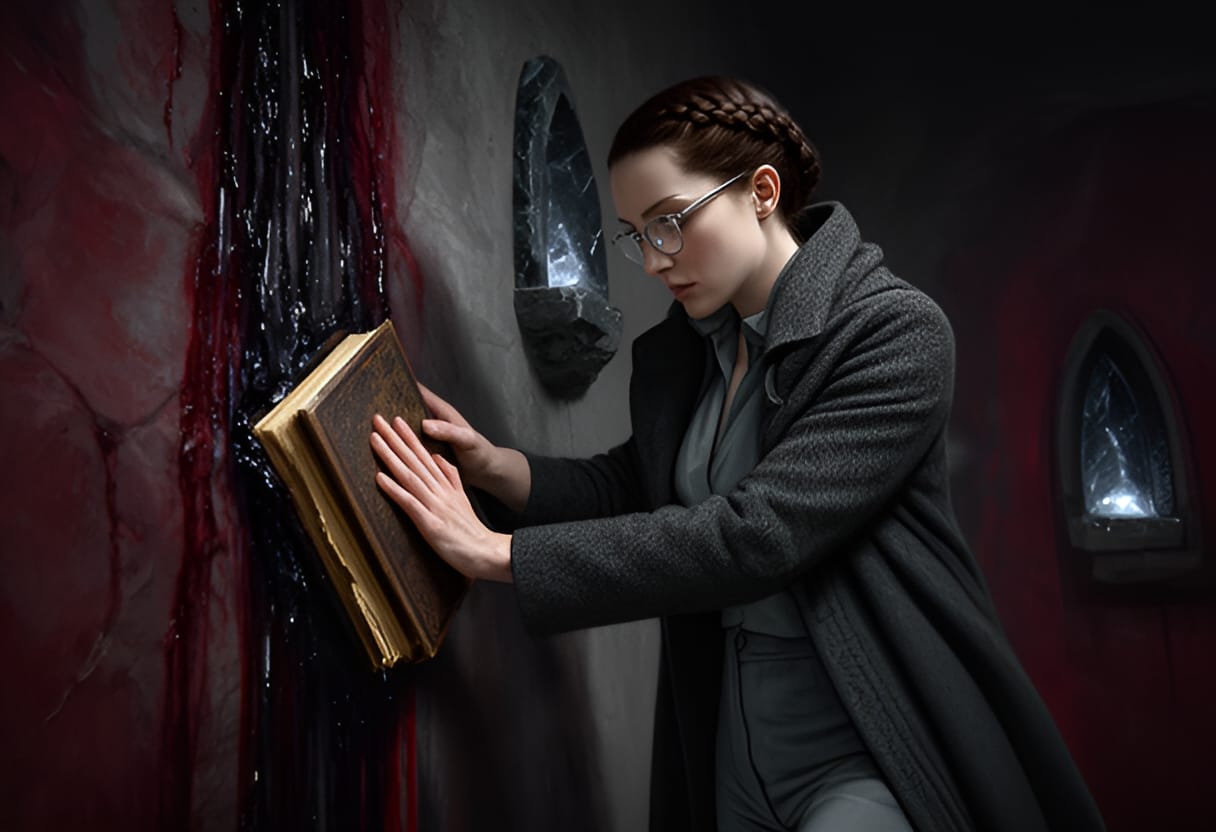
And waited for the ink to drink.
Chapter 3
As the Page Burns
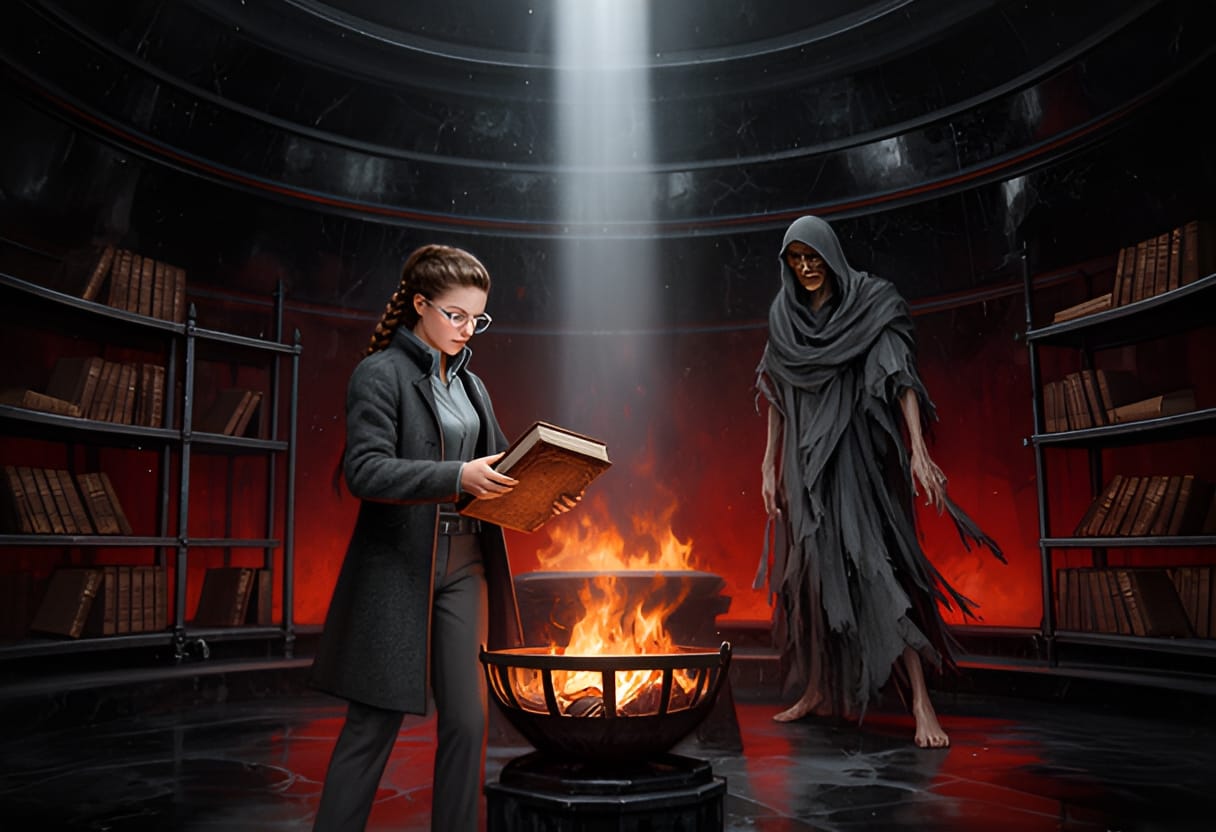
Elara lunged for the brazier, the ledger heavy in her grip like a beating heart. The Keeper stood just beyond the circle of firelight, silent, his tattered robes stirring though no wind stirred the air. She did not hesitate. With a cry torn from somewhere deep and raw, she hurled the book into the flames.
It landed spine-first, pages splaying as the fire caught. The ink—dark, thick, almost alive—began to boil and bubble, sending up tendrils of black smoke that coiled like screaming faces. The leather cover curled and blackened, then flared, and for a heartbeat the whole wing was lit in a guttering, hellish glow.
Then the archive shuddered.
Not with sound, but with a deep, resonant throb in the stone, as if the building itself had drawn a sharp breath. Ledgers along the shelves shuddered open, one after another, their pages snapping to attention like insects reacting to light. Elara stumbled back, eyes locked on the nearest volume—a ledger bound in pale, mottled skin, its edges cracked with age. The margin bore a fresh annotation in a hand she knew: her own. The date was today’s. The entry described her throwing the book into the fire.
She turned. Another ledger flung open. Same face in the margin—hers, drawn in fine, precise lines, eyes wide, mouth open in a silent scream. And another. And another. Every open page, every fresh entry, every smudge of marginalia—all bore her likeness, rendered with eerie consistency, as if the archive had been waiting, ink poised, to record this moment from a thousand angles.
The walls wept.
Dark, viscous fluid seeped from the seams between stones, slow and glistening, smelling of iron and rot. It pooled in the grooves of the floor, tracing paths that looked unmistakably like fingers reaching toward her.
The Keeper stepped forward.
His hood had fallen back during the commotion. Elara froze.
The face beneath was hers.
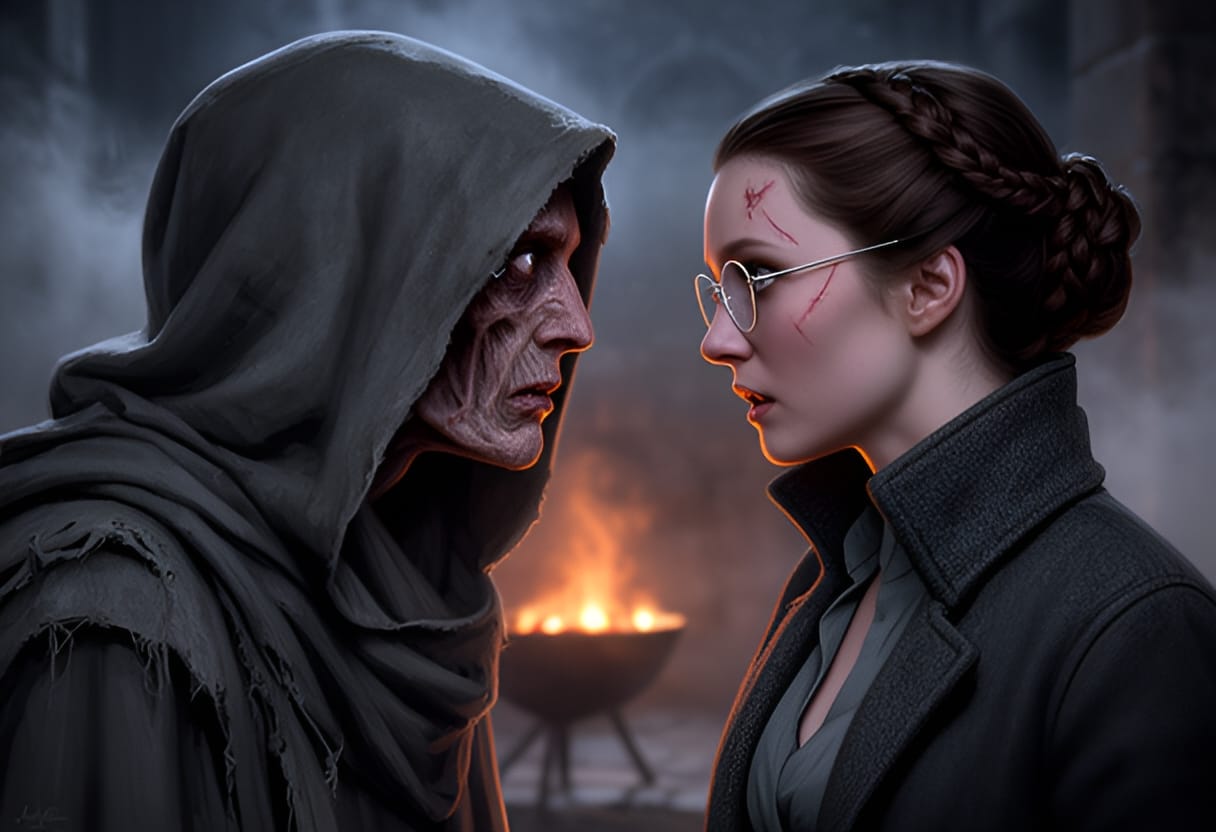
Not a mask. Not an illusion. Her own features—high cheekbones, the faint scar above her left eyebrow from a childhood fall, the way her lower lip caught slightly when she frowned—stared back at him from beneath the cowl. His eyes were her eyes. His breath fogged the air in the same rhythm as hers.
He did not speak. He did not need to.
From the folds of his robe, he produced a new ledger. It was pristine—white pages, unworn leather, no title, no date. He held it out to her, palm up, the gesture both offering and command.
Elara stared at it. Her hands trembled. She wanted to refuse. To turn and run. To let the fire consume everything.
But her fingers moved of their own accord.
They reached out.
They took the book.
The moment her skin touched the cover, a whisper rose—not from the walls, not from the air, but from inside her skull, soft and insistent, like a pen scratching across paper:
You are not the subject. You are the hand.
And she understood, with a clarity that burned colder than the fire, that she had never been trying to escape the archive.
She had been coming home. *
Elara opened the ledger. The pages were cool beneath her thumbs, smooth as polished bone. The first line was already there, ink dark and precise, as if it had been waiting for her breath to summon it into being.
Today’s date sat at the top, crisp and unambiguous. Below it, the entry began in her own hand—familiar, exacting, the script she used when cataloging fragments of forgotten tongues. It described the fire: the ledger landing spine-first in the brazier, the ink boiling into screaming smoke, the shudder of the archive, the walls weeping fluid like old blood. It noted the Keeper’s lowered hood, the revelation of her own face beneath the cowl, the rhythm of shared breath. It recorded her hesitation, the traitorous movement of her fingers as they reached for the new book he offered. It captured the whisper inside her skull—You are not the subject. You are the hand—and the cold certainty that followed.
And then it ended.
Not with a period, but with a pause. A space left for what came next.
She read it twice. The third time, her lips moved silently along with the words, as if her mouth remembered the shape of them before her mind did.
The fire crackled low in the brazier, now reduced to glowing embers. The weeping walls had stilled, the viscous fluid cooling into dark, mirror-like patches on the stone. The open ledgers around them remained agape, their margins filled with countless iterations of her face—screaming, weeping, watching, writing. Each one dated today. Each one undeniably hers.
A sound escaped her—not a sob, not a laugh, but something softer, deeper: the quiet release of a tension held too long. Her shoulders dropped. The weight in her chest, the frantic need to flee, to deny, to undo—it dissolved, not into peace, but into recognition.
She had not been trying to escape the archive.
She had been returning to it.
Her thumb brushed the bottom of the page, where the ink was still wet. She lifted the ledger, turned it to a fresh sheet, and dipped her finger—not into an inkwell, but into the margin of the page she had just read. The substance there was thick, warm, pulsing faintly like blood beneath skin. She drew it across the nib of the pen that had appeared in her other hand, as if it had always been there.
She began to write.
The words formed without conscious thought, yet each one felt chosen, inevitable. She wrote of the embers cooling in the brazier, of the silence that had fallen like ash, of the way the Keeper’s eyes—her eyes—had held hers not with judgment, but with acknowledgment. She wrote of the ledger in her hands, its pages waiting. She wrote the date for tomorrow.
And then, beneath it, she began the entry.
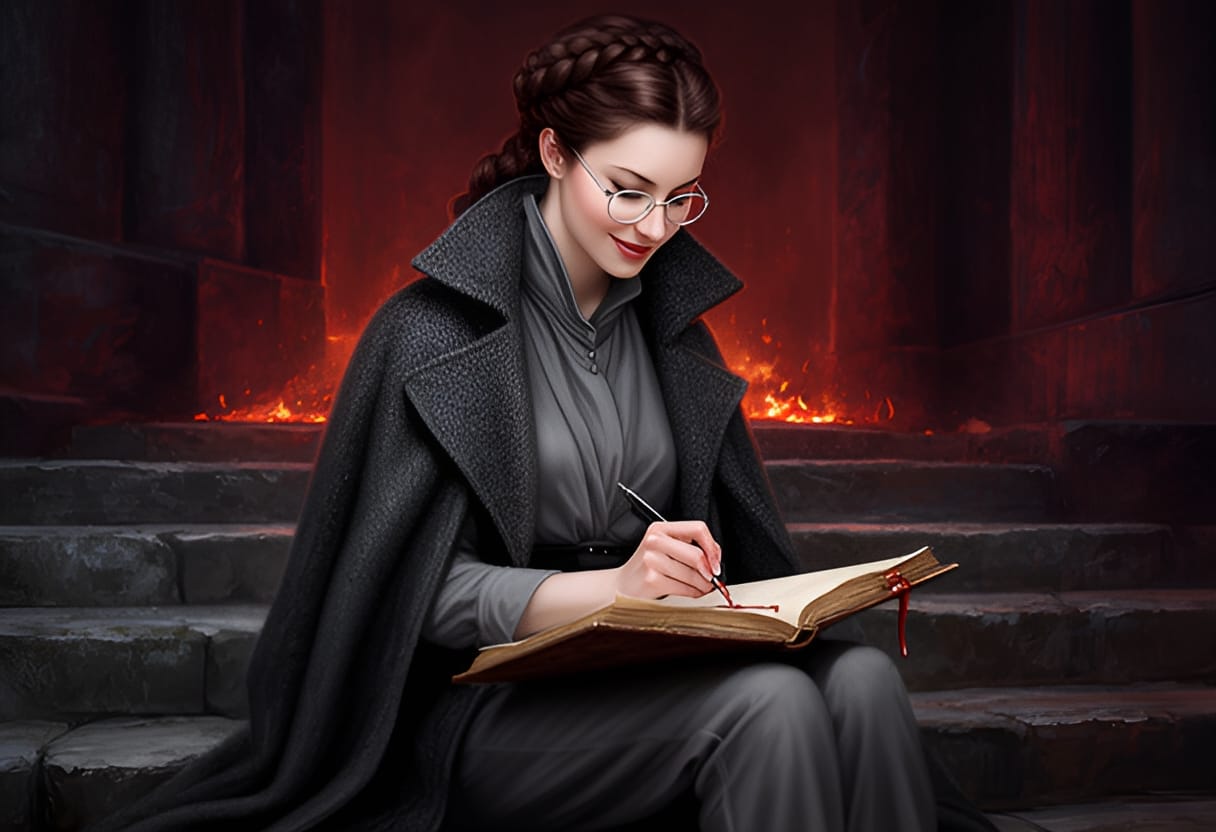
Elara Voss sat before the low fire, the new ledger open in her lap. She dipped her pen into the fresh ink welling from the page and began to write. Her lips moved slightly as she formed the words. She did not look up. She did not need to.
She paused. The ink was still wet. She could feel it—just beneath the surface of the words—a quiet pressure, as if the page itself were inhaling.
She smiled.
Not because she was afraid.
Not because she was trapped.
But because, at last, she understood the shape of her duty.
She lowered the pen to the page and continued.