Fiction
Pattern dictionary
by Dhyana Patel
3 chapters17 min read
Chapter 1
Threads of Memory
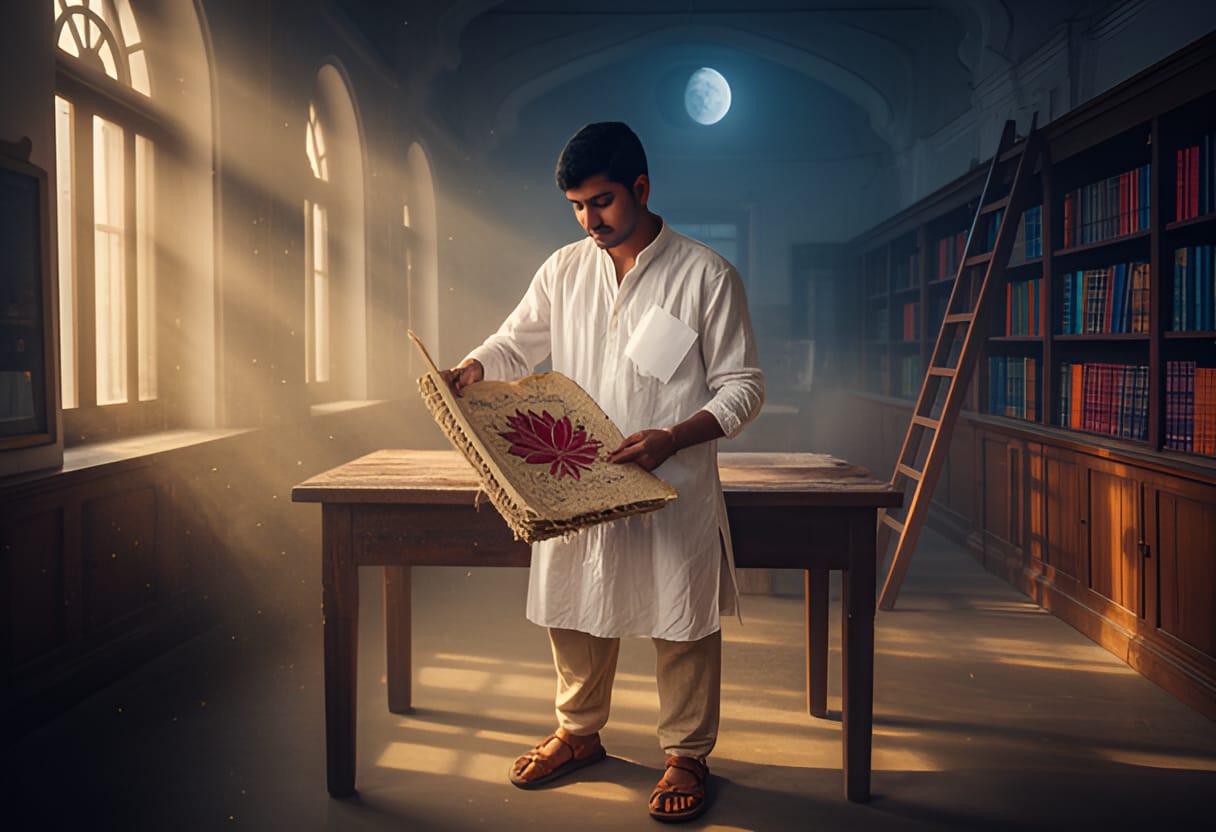
The Ahmedabad Archives held its breath in the late afternoon light. Dust motes drifted through the high windows, catching in the slanting rays that fell across the reading tables. Arjun Mehta traced a finger along the edge of a wooden drawer, its brass handle worn smooth by decades of use. Inside, wrapped in unbleached cotton, lay a small notebook bound in faded blue cloth—his grandmother’s embroidery journal.
He lifted it carefully, feeling the slight give of the spine. The cover bore no title, only a tiny stitched lotus in the corner, its petals frayed at the edges. Opening it, he was met with the scent of sandalwood and old paper. The first page held a sketch in faint ink: a border of interconnected fish, their bodies forming a continuous line. Beneath it, in a neat, slanting hand, read: Kantha from Bolpur, monsoon season. Fish for fertility, water for life.
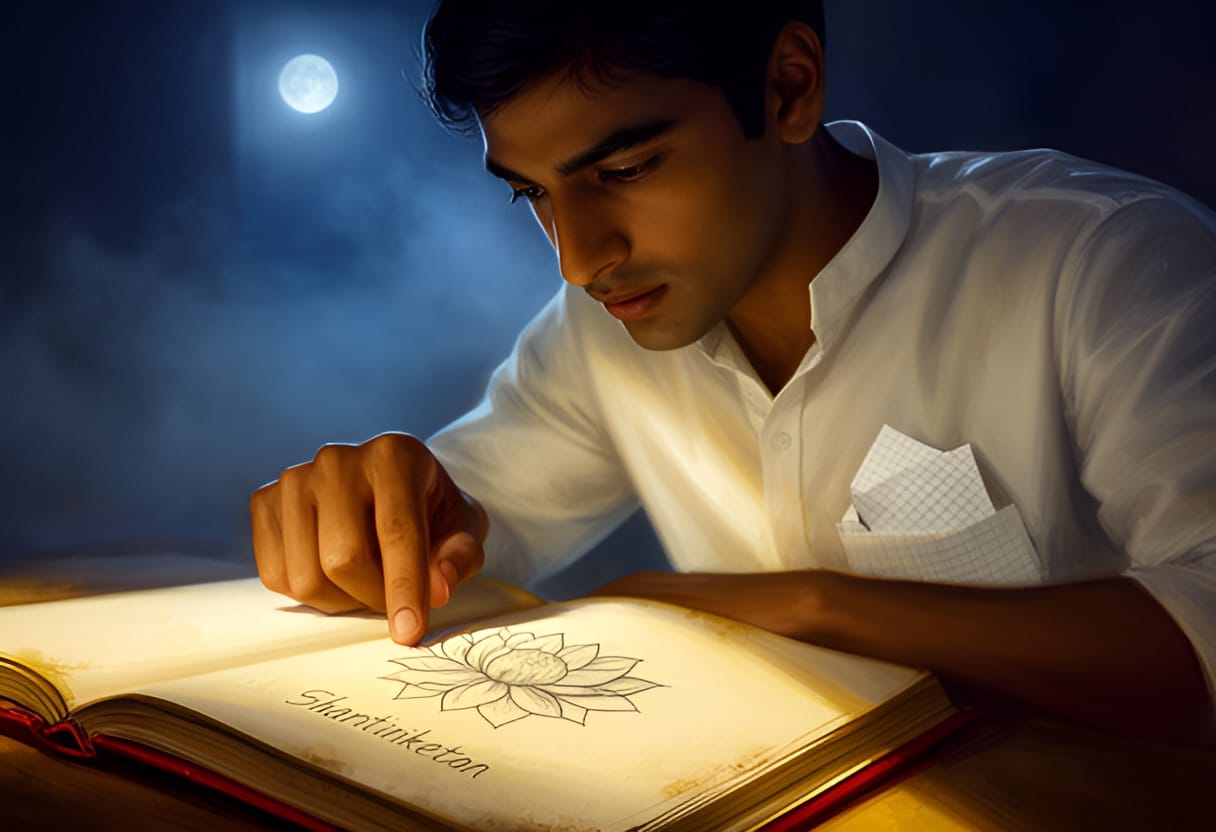
Arjun turned the page. More motifs followed—conch shells, lotus buds, paisleys—each accompanied by notes on thread color, stitch type, and where it had been seen. A lotus appeared again, this time with eight petals, drawn beside a village name he didn’t recognize: Shantiniketan. The ink had bled slightly at the stem, as if touched by a damp finger long ago.
He leaned closer. The lotus was not just a decoration here. In one entry, it was linked to a wedding sari; in another, to a child’s naming ceremony. The same motif, different contexts, yet always present. A realization settled over him, quiet but firm: these were not random designs. They were markers.
A soft chime from the clock above the archives startled him. Outside, the city hummed with traffic and vendors calling, but in this room, time had folded inward. He thought of his grandmother’s hands—how they had moved over cloth, how she had spoken little of her travels, yet left this behind.
The decision came not with a declaration, but with a quiet resolve. Arjun closed the journal and slipped it into his bag. He pulled out a fresh sheet of tracing paper and began to copy the lotus from the Shantiniketan note, replicating the curve of each petal, the way the center dipped slightly. As he worked, he remembered her voice from childhood, humming while she stitched, the rhythm of the needle like a heartbeat.
He packed his sketchbook, a small camera with extra film, and a notebook for field questions. On the first page, he wrote in pencil: What does the lotus mean here? How does it change with the season? Who teaches this now?
The archives door clicked shut behind him. The journal’s whisper had given him a direction. He would go to Shantiniketan—not to collect patterns, but to listen to the stories they carried.
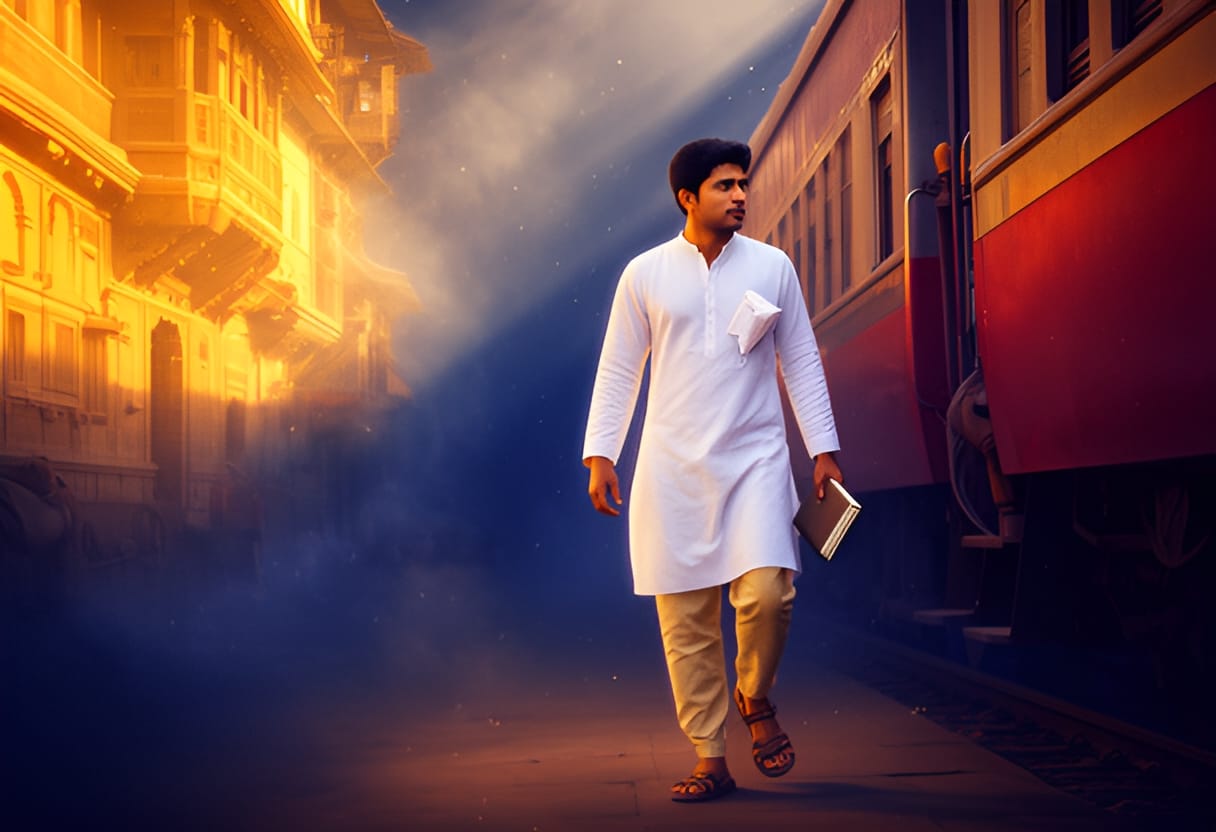
Arjun stepped off the train at Bolpur station as the late afternoon sun slanted through the platform’s tin roof, casting long shadows across the dusty tracks. The air smelled of damp earth and woodsmoke from nearby hearths. A cycle rickshaw waited, its bell jangling as the driver gestured toward the road lined with sal and mahua trees. Arjun clutched his bag, the journal’s faint sandalwood scent a steady presence against his thigh.
Lata Devi’s courtyard lay beyond a low mud wall painted with ochre and white motifs—fish swimming in concentric circles, lotus buds unfolding along the gatepost. She sat on a charpai under a neem tree, her silver hair pinned back, fingers flying over a square of layered cotton stretched on a bamboo frame. The quilt beneath her needle was a patchwork of faded saris—indigo, madder red, mustard yellow—each piece whispering of another life.
“You brought the journal,” she said without looking up, her needle dipping and rising like a sparrow’s wing. “Good. Stories need paper to rest, but cloth remembers better.”
Arjun unfolded the tracing paper, the eight-petaled lotus from Shantiniketan resting in his palm. “I found this in my grandmother’s book. She noted it here, beside a wedding sari and a naming ceremony. What does it mean when it appears like this?”
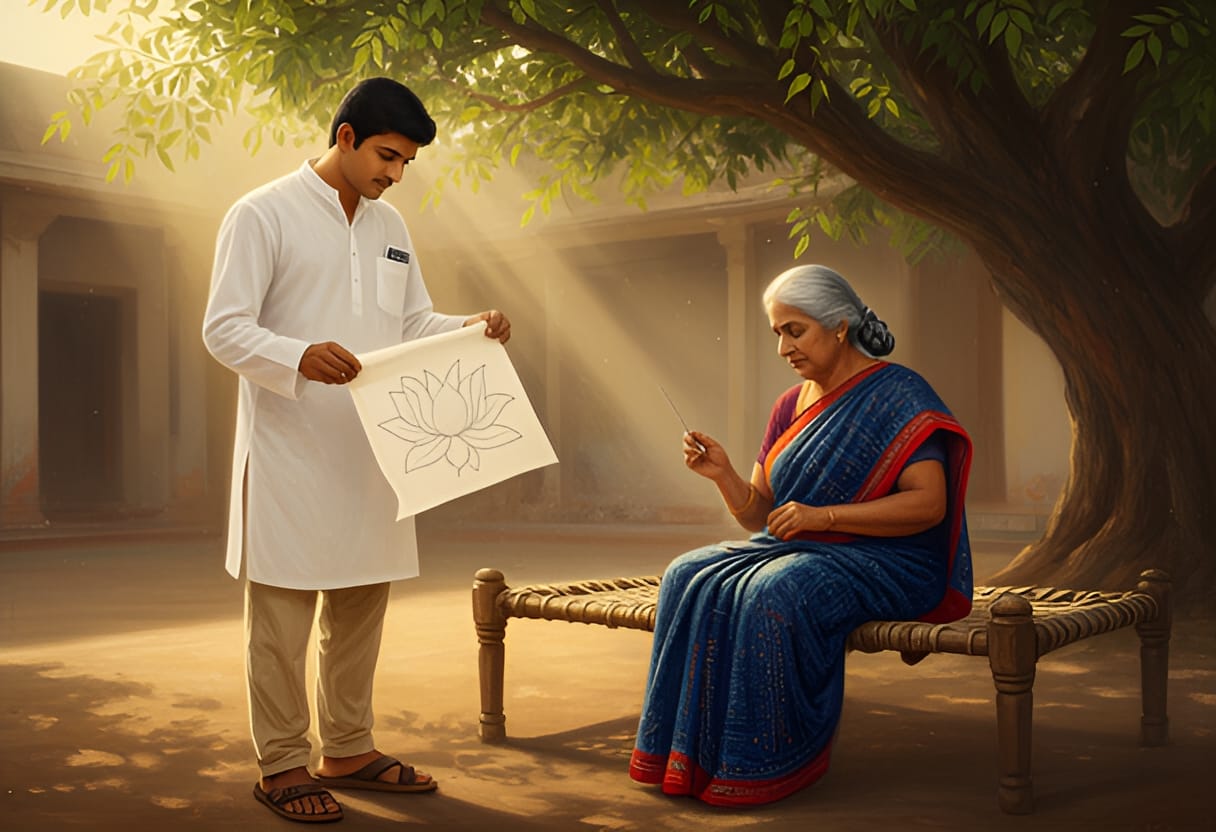
Lata Devi paused, the thread hovering over the fabric. She touched the lotus sketch with a calloused fingertip. “Eight petals? That’s the ashtadal kamal. Not just any lotus. Each petal holds a direction—north, south, east, west, and the four between. It’s the whole world held in one bloom. When a girl weds, we stitch it on her pallu so she carries balance into her new home. When a child is named, it goes on the cradle cloth—so their first breath draws in wholeness.”
She picked up a scrap of cloth from her lap, turning it to show Arjun the reverse. Tiny running stitches radiated from the lotus center like ripples. “See how the stitches start tight and loosen? That’s the monsoon rain hitting the pond—first heavy drops, then the gentle spread. In summer, we make the petals sharper, with shorter stitches, like the sun cracking the earth. In winter, they soften, rounded, for the fog over the water.”
Arjun’s pencil hovered over his field notebook. He wrote: Lotus = cosmic order. Stitch density = seasonal rhythm. Placement = life stage. He glanced up. “And the fish? The conch?”
Lata Devi smiled, threading a new needle with indigo-dyed cotton. “Fish for abundance—always in pairs, swimming upstream against the quilt’s border, so luck never flows out. Conch for purity—blown at dawn to clear the air, so we stitch it where the head rests, to keep thoughts clean. But listen—motifs never travel alone. They speak in sentences.”
She lifted a corner of the quilt she’d been working on. Arjun leaned in. The border was a zigzag of dark blue—kankra, the crab’s walk, marking the monsoon’s retreat. Inside, concentric circles of lotus and fish radiated from a central sunburst of yellow silk. Tiny human figures held hands around the edge, their arms linked in a chain. Above them, birds flew in a V formation.
“This is Bolpur Barshik Utsab,” Lata Devi said, her voice dropping. “The spring festival when the fields are ready. The circles are the village ponds after rain. The sunburst? That’s the first mango split open at dawn. The people? That’s the dance—dhunuchi nach—where everyone moves as one. The birds? The migratory ones returning, telling us the season has turned.”
Arjun’s breath caught. He traced the quilt’s edge with his eyes, not his finger, afraid to smudge the dye. Each motif was a word; the composition, a sentence. The quilt wasn’t just showing a festival—it was telling it, stitch by stitch, season by season.
By dusk, Arjun sat on the charpai beside Lata Devi, his sketchbook open to a detailed study of the festival quilt. He had copied the lotus, the fish-in-pairs, the conch, the crab-walk border, even the tiny dancing figures—each accompanied by her explanations in his own shorthand. The journal lay open beside him, its blue cloth now familiar against the rough cotton of his trousers.
Lata Devi poured two cups of steaming chai from a clay pot, the liquid catching the last light. “You see now why we don’t call it decoration?” she said, handing him a cup. “Kantha is how we speak when words are too heavy or too light. A mother stitches a lotus for her daughter’s wedding not because it’s pretty, but because she wishes her balance. A fisherman’s wife adds the conch so her husband’s thoughts stay clear at sea. The cloth holds what the heart cannot say.”
Arjun looked from the quilt to the journal, then to Lata Devi’s hands—knuckles swollen, yet moving with unhurried grace. He thought of his grandmother’s silence, the journeys she never spoke of, and the weight of this quiet language passed from hand to hand.
He closed his sketchbook firmly. “I’ll come back tomorrow,” he said. “And the next day. I want to learn the grammar.”
Lata Devi nodded, her eyes crinkling. “Good. The cloth is waiting to be heard.”
Arjun slipped the journal back into his bag, its sandalwood scent mingling with the earth and smoke of the courtyard. Outside, the first stars appeared over the sal trees. He had come to listen. Now, he understood: the patterns were not waiting to be collected. They were waiting to be translated.
Chapter 2
Patterns of Precision
Arjun stepped off the train at Patan station just as the morning light began to sharpen the edges of the sandstone havelis. The air carried the dry tang of dust and indigo vats, a shift from the damp earth and woodsmoke of Bolpur. He followed the narrow lanes to Karunanidhi’s workshop, where the master weaver sat cross-legged on a low platform, his fingers moving swiftly over a bundle of silk threads stretched across a wooden frame.
“You brought the journal,” Karunanidhi said without looking up, his voice rough from years of shouting over the loom. “Good. Patterns live in the hand, not the page.”
Arjun opened the faded blue cloth and showed him the sketch of the festival quilt—the lotus, the fish-in-pairs, the crab-walk border. Karunanidhi traced the lines with a calloused fingertip, pausing at the eight-petaled bloom.
“In Patola,” he said, “the lotus has twelve petals. Or twenty-four. Never eight. Symmetry must be exact, or the cloth lies.”
He led Arjun to the loom—a towering structure of teak and rope, its warp stretched tight as a bowstring. Bundles of thread hung from the frame, each knotted in precise intervals, dyed in bands of crimson, gold, and deep blue.
“This is double ikat,” Karunanidhi explained, lifting a skein. “See how the colour is only on the outside? The inside is white. We tie and dye before we weave. Every dot, every line—it’s all decided here.” He tapped the tied threads. “If you make a mistake now, you cannot fix it later. The cloth will show it.”
Arjun watched as the weaver selected a bundle and threaded it through the heddles. The motion was economical, each movement honed by decades. Karunanidhi called out numbers—“Three over, two under”—as he aligned the warp and weft, his eyes flicking between the tied threads and the emerging pattern.
“Look,” he said, pointing to the cloth where a motif was beginning to appear. A parrot took shape, its wing curved in a perfect arc, the eye a tiny diamond of undyed silk. “The bird flies only if the grid holds. One thread out of place, and the neck twists.”
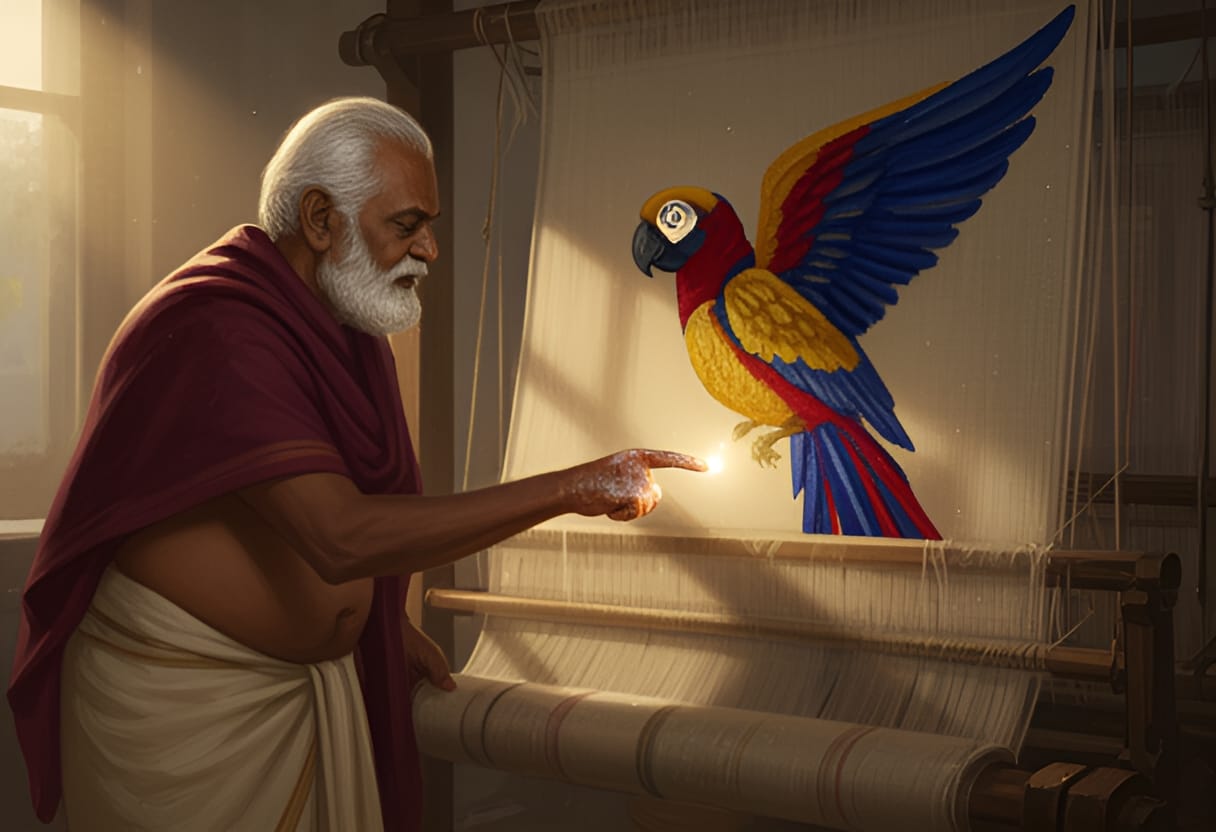
Arjun leaned in, sketching the underlying structure in his notebook—a lattice of squares, each representing a thread intersection. He noted how the dye zones aligned to form the curve of the breast, how negative space defined the beak. The parrot wasn’t drawn; it was calculated.
“Why so strict?” Arjun asked, his pencil hovering over the page.
Karunanidhi tightened a tension bar. “Because Patola is not for wearing. It is for witnessing. At a wedding, the bride’s sari tells the groom’s family: We are precise. We honor the old ways. If the elephant’s tusk is uneven, it means the weaver was distracted. Or disrespectful.”
He fell silent, watching the shuttle fly across the warp. The parrot’s tail unfurled, feather by feather, each bar of colour locking into place with a soft thunk. No hesitation. No correction.
Arjun felt a familiar thrill—the same one he’d felt tracing his grandmother’s journal—but sharper now, edged with responsibility. This wasn’t just memory. It was mathematics. It was vow.
By afternoon, the sun hung high over the workshop, turning the dye vats into pools of molten jewel. Karunanidhi handed Arjun a length of finished cloth—a narrow strip, no wider than his forearm, but dense with meaning. Elephants marched along one edge, their trunks curled in greeting. Parrots flanked a central lotus, each bird mirrored perfectly across the vertical axis.
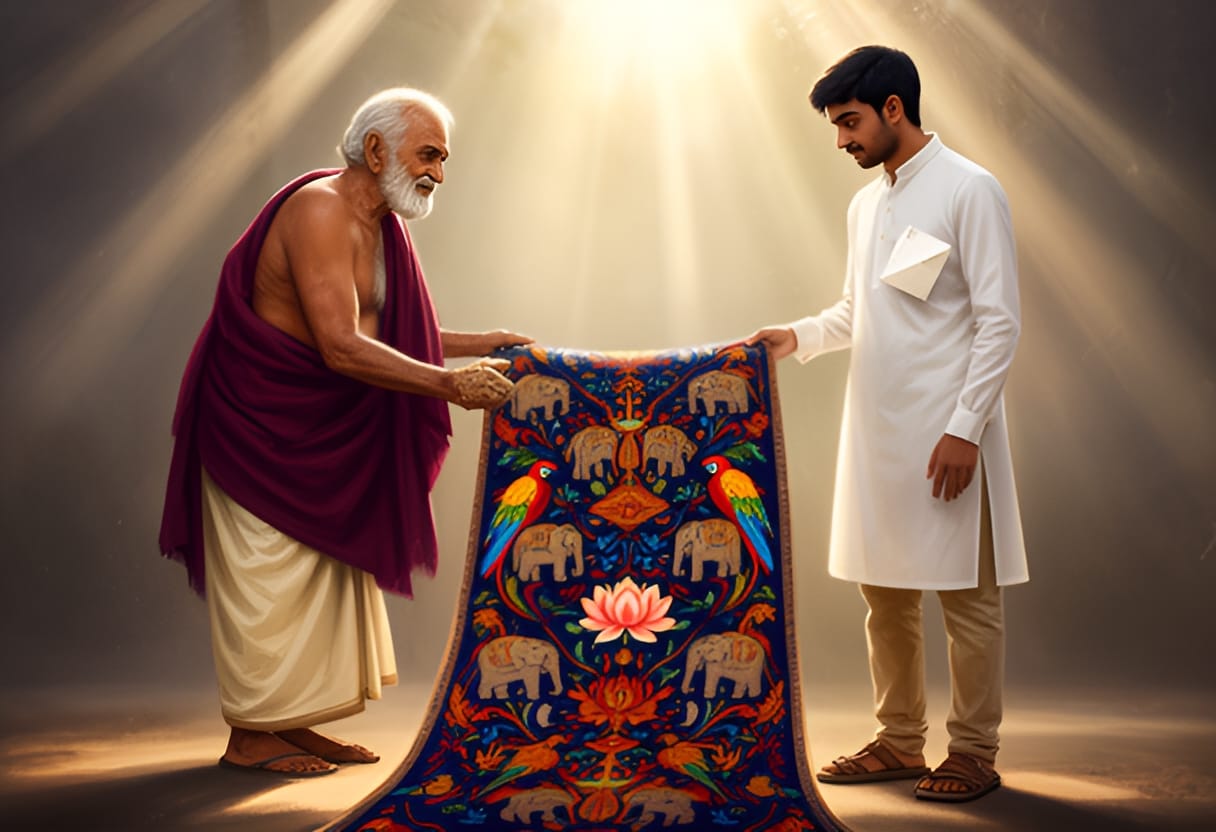
“See the repetition?” the weaver said, tracing the motif with a cloth-wrapped finger. “It is not decoration. It is pratiloma—the idea that what is above is reflected below. As in the sky, so in the cloth. As in the body, so in the pattern.”
Arjun ran his eyes over the symmetry, noting how the lotus at the center anchored the design, its petals radiating outward like a compass. He recalled Lata Devi’s words about the lotus marking life stages. Here, it was not a wish, but a statement—of balance, of order, of cosmic alignment.
He unfolded his journal and began to map the motif: the grid beneath the elephant’s stride, the color sequence that made the parrot’s wing glow, the way the border’s meander echoed the monsoon clouds Lata Devi had described.
Karunanidhi watched him work, then said, “You are not just seeing the cloth. You are hearing its grammar.”
Arjun looked up. The scent of indigo and madder root clung to the air. Outside, a child chased a hoop down the street, laughing. Somewhere, a loom creaked in rhythm.
He closed the journal slowly. “Then I must learn to speak it.”
Karunanidhi folded the finished strip with deliberate care, the silk whispering as it met his palm. He set it aside and reached for a bundle tucked beneath the loom—a length heavier than the first, its colors deeper, the motifs more densely packed.
“This,” he said, unrolling it slowly, “is for the bride.” The cloth shimmered with interlocking elephants, their tusks curved inward to form lotus blossoms at the center of each beast’s flank. Between them, parrots flew in opposing pairs, wings touching at the tips. The border ran in a tight meander of crab-walk steps, each turn precise as a stitch in time.
Arjun leaned closer. “The elephants—are they walking?”
“They are marching,” Karunanidhi corrected. “And only in this direction.” He tapped the weft where the procession moved left to right. “Reverse it, and it becomes a funeral cloth. The weaver must know which way the life flows.”
He pointed to the lotus nestled in the elephant’s shoulder. “Twenty-four petals. Not twelve. Doubled again—for fertility that returns. The elephant brings strength; the lotus, purity. Together, they say: This union will endure.”
Arjun traced the pattern with his eyes. “And the parrots?”
“Fertility’s voice. They mate for life. In Patola, they never appear alone. Always mirrored—pratiloma in motion. One flies east, the other west, but the cloth holds them true.”
Karunanidhi unfurled another corner, revealing a tiger’s claw motif—waghkungh—woven into a narrow band along the selvage. The red threads were so dark they nearly black, the shape repeated like a heartbeat.
“This,” he said, his voice dropping, “is not for weddings. Not for just anyone.”
He looked at Arjun, searching. “You come from Ahmedabad. Your people trade in cloth. But do you know who may wear the tiger’s claw?”
Arjun shook his head.
“Only the Rajput. Or the Dewan’s family, if the Raja grants it. The claw means power taken, not given. It is worn at the rajabhishek—the coronation—or when a warrior returns from battle with honor. To weave it without right is to lie in thread. The cloth will not forgive.”
He rolled the sari back, the motion slow, reverent. “Patterns are not free. They are earned. By birth. By deed. By the silence kept between generations.”
Arjun felt the weight of the journal in his bag, suddenly not just a record but a ledger. He thought of the fish-in-pairs from Lata Devi’s quilt—common, open to all. Here, the elephant was sacred, the tiger’s claw, restricted. The lotus, he realized, shifted meaning not just with petal count, but with who wove it, where it was worn, and when.
Karunanidhi watched him, seeing the shift. “You are beginning to sort them,” he said. “Not by shape, but by use.”
Arjun opened his journal to a clean page. He drew three columns: Motif, Occasion, Who May Wear. Under the first, he wrote Elephant (marching) — Wedding — All castes. Below it, Tiger’s claw — Coronation, battle return — Rajput, Dewan (by grant). He added Parrot (paired) — Fertility rites — Married women. Then, hesitantly, Lotus (twenty-four) — Wedding, temple offering — Women of the household.
He looked up. “There are rules. Like grammar.”
Karunanidhi nodded. “Yes. And like grammar, they change slowly. But they are not arbitrary. The cloth remembers what the tongue forgets.”
Outside, the light had begun to slant, the indigo vats now glowing like bruised twilight. A woman passed the workshop door, her pallu plain, unadorned. Arjun wondered what motifs she wore beneath her veil—if any—and whether she, too, was reading the cloth as a language.
He closed the journal. The decision was quiet, but firm.
“I will map them all,” he said. “Not just what they are, but who they serve, and what they forbid.”
Chapter 3
Lines of Myth
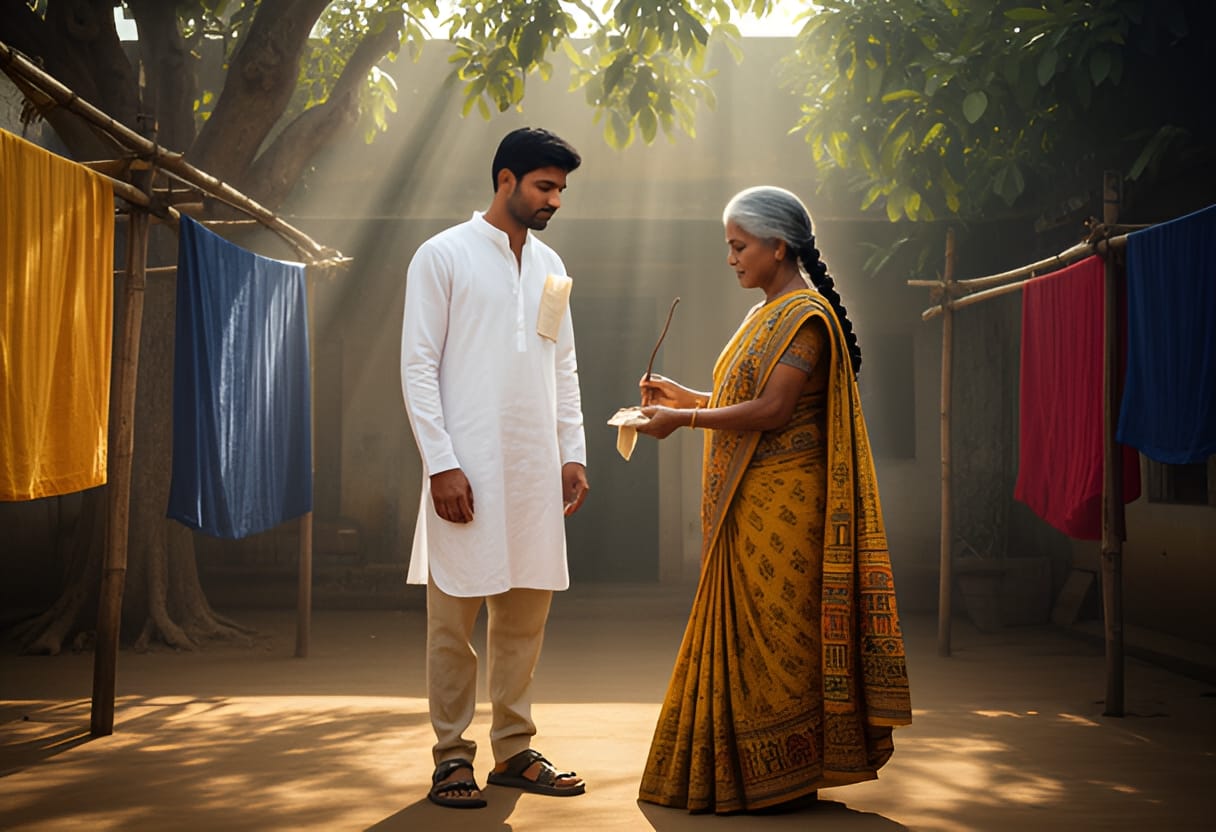
Arjun stepped into Meenakshi’s courtyard in Srikalahasti as the morning light slanted across the tamarind trees, gilding the edges of cotton sheets stretched on bamboo frames. The air carried the sharp tang of myrobalan and the sweetness of jaggery simmering in a clay pot nearby. Meenakshi, her silver hair pinned back with a wooden comb, dipped a sharpened tamarind twig into a bowl of alum solution and touched it to the fabric.
“Watch the line,” she said, her voice low and steady. “It must breathe before it speaks.”
Arjun leaned closer. The pen moved not with pressure but with pause — a flick to begin, a drag to thicken, a lift to taper. Each stroke left a faint silver trace that would darken only after dyeing. On the cloth, the curve of a bow began to take shape, its arc taut with tension. Meenakshi worked without sketching first, her hand guided by decades of muscle memory. Around them, apprentices ground madder root on stone slabs, their mortars ringing like distant temple bells.
“This is Rama,” she murmured, not looking up. “Breaking Shiva’s bow at Janakpur. The moment dharma asserts itself.”
As the outline of Rama’s form emerged — broad-shouldered, one foot forward, the bow bent like a crescent moon — Meenakshi rinsed the twig in water and picked up a wad of cloth soaked in madder dye. She pressed it gently into the outlined space, letting the red bloom inward from the edges. The color spread like rising sap, warm and deep, settling into the fibers where the mordant had prepared them.
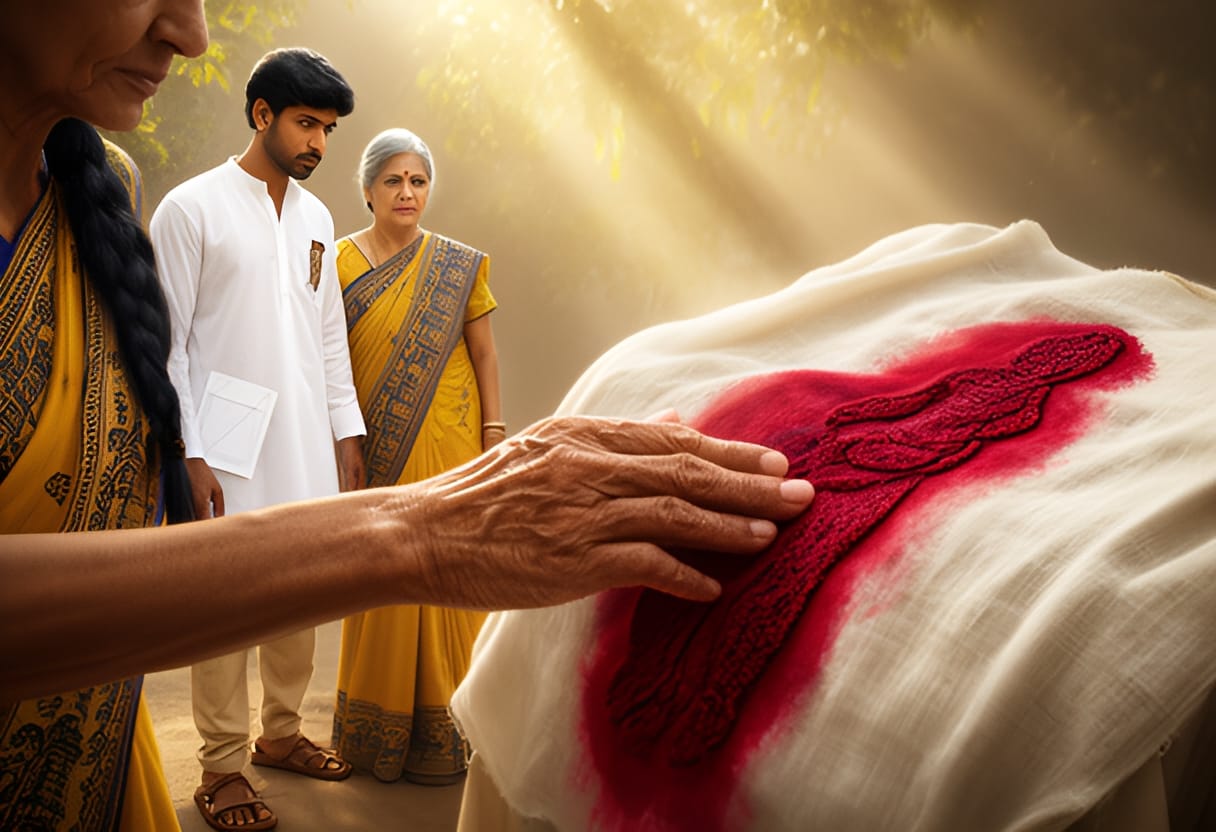
“Red is not just color,” she said, seeing Arjun’s gaze. “It is tapas — the heat of austerity, the fire in the prince’s arm as he draws the string. Yellow,” she added, switching to a pomegranate peel solution, “is vidya — the light that reveals truth. See how it pools in the crown?” A soft gold now glowed above Rama’s brow, not painted on but woven into the weave through careful application.
Arjun pulled his field journal from his bag, the pages still smelling of Ahmedabad dust and Bengal rain. He sketched the pen’s angle, noted the sequence: outline, mordant bath, dye application, rinse, repeat. But more than technique, he recorded the rhythm — how Meenakshi spoke to the cloth as if it were listening, how she adjusted her stance with each shift in the narrative, leaning in for Rama’s strain, straightening as the bow snapped.
A boy no older than ten brought over a fresh sheet, already treated with myrobalan and buffed smooth. Meenakshi took the twig again. This time, she began not with Rama but with the bow’s shattered tip, flying upward like a spark.
“You see?” she said, without breaking her line. “The story does not start with the hero. It starts with the breaking. The cloth remembers what the eye overlooks.”
Arjun watched the splintered wood fly, each fragment a deliberate flick of the pen. Around the central scene, vague shapes hinted at onlookers — sages with raised hands, kings recoiling — but Meenakshi left them unfinished, to be filled later with indigo or ochre depending on the patron’s taste or the tale’s telling.
When she set the pen down, the red and yellow glowed against the cream fabric, the outlines still faint but promising. Arjun realized he had been holding his breath.
“It’s not just a picture,” he said quietly. “It’s a sequence. A sentence in thread and dye.”
Meenakshi smiled, wiping her hands on her apron. “Good. Now you see. The pen does not decorate. It testifies.”
Meenakshi lifted the next sheet of cotton, its surface still damp from the myrobalan bath. “Now the frame,” she said, dipping the tamarind twig into a thin wash of indigo. “Every story needs a boundary. Not to cage it, but to let it breathe within.”
She began at the edge, her wrist turning in a steady rhythm. A mango leaf unfolded — pointed tip, gentle curve, a single vein down the center. Then another, mirrored, then a third, each leaf touching the next at the stem, forming a continuous garland that ran the length of the fabric. Between them, tiny dots of ochre appeared where the twig lifted just slightly, suggesting the play of light on waxy skin.
“This is not filler,” she said, not breaking her stroke. “The mango leaf is amra pallava. It means auspicious beginning. In wedding cloths, it runs unbroken — no gaps, no reversals. Life should flow like this: steady, forward, rooted.”
Arjun watched as she shifted her weight, hips swaying slightly with the motion of her hand. When the leaf pattern reached the corner, she did not stop. Instead, she turned the fabric and continued along the adjacent edge, the motif flowing without interruption. At the corner, a small paisley bud emerged — kolam seed, she called it — nestled where two vines met.
“See how the border holds the center?” she asked, nodding toward the unfinished Rama scene. “The eye enters through the leaf, follows the vine, rests at the paisley — a pause — then moves inward. The border is the first verse of the poem. It sets the meter.”
She rinsed the twig, switched to a madder-soaked cloth, and touched the tip of each mango leaf with red. The color bloomed inward, soft at the edges, deeper at the heart. Then, with a pomegranate peel wash, she touched the center of each leaf — a dot of yellow, like sunlight through canopy.
Arjun opened his journal to a fresh page. He sketched the border sequence: mango leaf, paisley connector, repeat. Beneath it, he wrote: Rhythm as narrative frame — motifs guide gaze, reinforce theme. He added a small swatch of the indigo wash beside the sketch, noting how the dye pooled in the twig’s wake.
“And the lotus vine?” he asked, tracing the air where a curling stem might go.
Meenakshi paused, considering. “Ah, the lotus vine — padma lata. That is for devotion. It appears in temple cloths, where the story is of surrender. The vine twines, unhurried. Each leaf opens to a bud, then a flower — eight petals, always. Not the lotus alone, but the lotus in motion. Growth. Continuation.”
She took a new sheet and began again, this time with a thinner twig. The lotus vine emerged slowly — a sinuous stem, alternating leaves, then a bud, then a flower. The petars were rendered with delicate flicks, each one slightly asymmetrical, as if touched by breeze. Between the flowers, small fish swam upstream — mīna yugala — paired, tails touching.
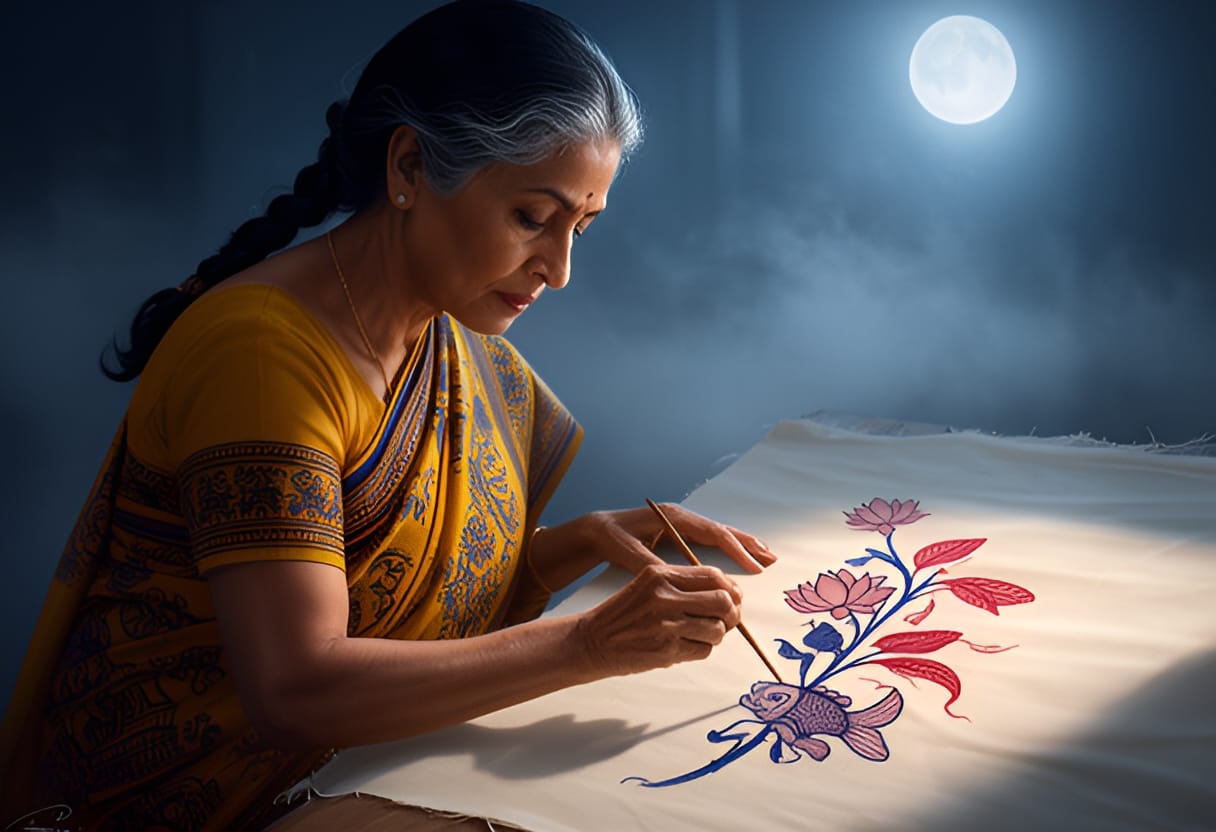
“Even here,” she murmured, “the border tells. The fish mean abundance, but only when they move together. The lotus means purity, but only when it grows from mud. The vine means connection — to earth, to water, to the next world.”
As she worked, Arjun felt the rhythm in his own breath. He copied the sequence: stem, leaf, bud, flower, fish, repeat. He noted the direction — always flowing toward the center, never away. He added a second swatch: indigo stem, madder leaf, pomegranate flower, ochre fish.
When she finished, she held the cloth up to the light. The border shimmered — not loud, but insistent. It did not shout the story; it ushered you into it.
Arjun closed his journal with care. He had filled pages with outlines, dyes, sequences. But now he saw the pattern beneath the patterns: the border as threshold, the motif as metaphor, the repetition as remembrance.
Meenakshi folded the cloth neatly and placed it beside the others. “You carry more than sketches now,” she said. “You carry the grammar. Use it not to copy, but to listen.”
Outside, the tamarind trees cast long shadows across the courtyard. The scent of jaggery had faded, replaced by the dry, clean smell of alum and cotton. Arjun slipped the journal into his bag, its pages thick with more than notes — they held the weight of lines that testified, of borders that bound, of stories that began not with the hero, but with the breaking, and continued, leaf by leaf, dye by dye, into the cloth that remembered.