
Fiction
POEM BOOK
by John Oliveira
3 chapters1.1 hr read
Chapter 1
The Whispering Pages
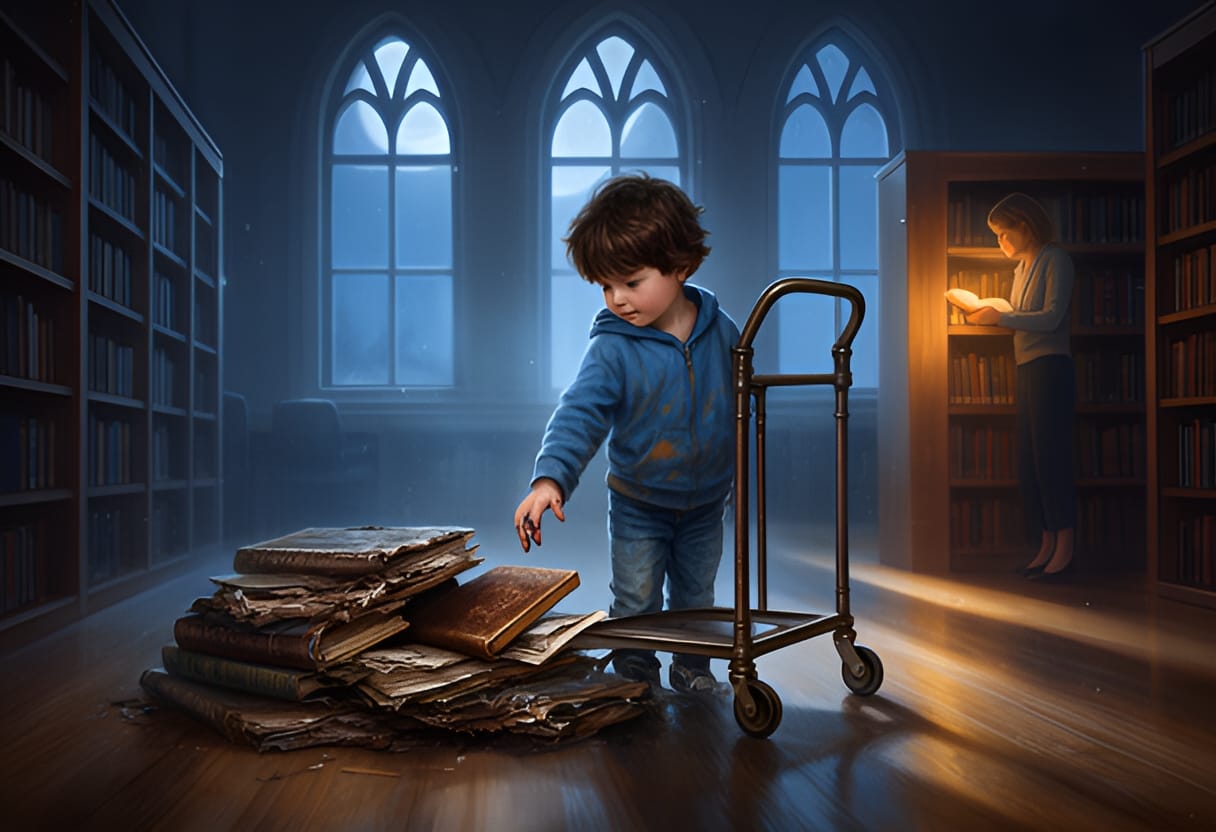
Leo lingered by the return cart, waiting for Mrs. Delaney to finish shelving the picture books. The library lights hummed overhead, casting a soft glow over the spines of forgotten stories. He liked this quiet time after school, when the shelves were still and the only sound was the occasional creak of the floor beneath his sneakers. He tucked his own book—The Adventures of Captain Crumb—into the slot marked “Fiction” and turned to go, but something caught his eye near the bottom of the bin.
A notebook lay half-buried under a stack of water-damaged encyclopedias. It was unlike any he’d seen: deep brown leather, worn at the corners, with no title or name stamped on the cover. The pages felt unusually thick, and when he brushed his fingers across the top sheet, a faint warmth rose from it, like sunlight held in stone.
He glanced around. The library was empty except for Mrs. Delaney, who was humming as she stacked returned books behind the desk. No one would miss this, he thought. It didn’t belong to anyone. He slipped it into his backpack, the leather cool against his palm through the fabric.
The walk home felt longer than usual. The notebook pressed against his spine with each step, a quiet pulse against his back. He imagined opening it to find maps to hidden kingdoms or spells written in disappearing ink. By the time he reached his porch, his heart was tapping a quick rhythm against his ribs.
His room smelled of dust and crayons. He kicked off his shoes, dropped his bag by the bed, and pulled the notebook onto his lap. The cover was smooth, unmarked, waiting. He opened it to the first page. The paper was cream-colored, slightly textured, and as he touched it, a soft shimmer passed over the surface—like heat rising off pavement.
He hesitated. What if it was just a regular notebook? What if he looked silly writing in it? But the warmth lingered, inviting. He uncapped his blue pencil and began to write, not thinking too hard, just letting the words come:
A boat made of notebook paper, Folded neat and crisp and square, Sails with a doodle for a mast, And a crayon sun flares in the air.
As he finished the last line, the ink didn’t just dry—it glowed. A faint silver light traced the letters, then pulsed outward. Leo jerked his hand back. The boat on the page shivered, then lifted, its paper hull rising an inch above the surface. It tilted, as if catching a breeze, and began to glide across the desk.
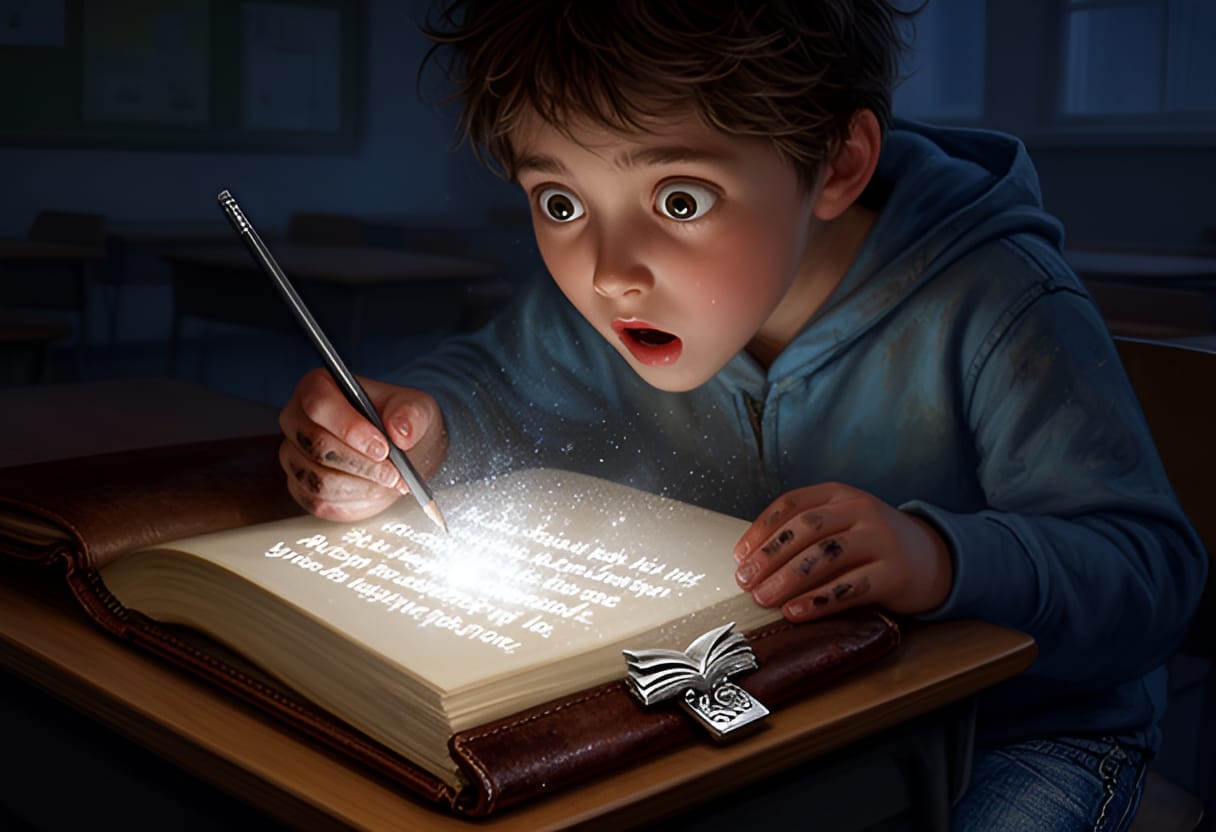
It moved with purpose, paddling forward with invisible oars, the crayon sun glowing brighter on its sail. It passed over his open math workbook, skirted the edge of his half-eaten apple, and sailed toward the edge of the desk. Leo held his breath, eyes wide, not daring to blink.
Then, just before it reached the wooden lip, the boat shuddered. The ink faded, the lines softened, and the paper curled at the edges. In a breath, it dissolved into a fine mist that smelled faintly of rain and old books. The mist curled once above the desk, then drifted upward, vanishing into the quiet air.
Silence rushed back in. The notebook lay flat, its pages cool and ordinary again. Only the faintest trace of shimmer lingered where the boat had been, like a memory of light.
Leo stared at his hands. His pencil was still clenched in his fist. His heart hammered against his ribs, not from fear, but from something brighter—something that felt like wonder, all tangled up with disbelief.
He looked around the room, half-expecting to see Maya peeking in from the hallway or his mom calling up the stairs. But the house was still. The only sound was the tick of the clock on the wall.
He swallowed. Did I imagine that? he thought. But the warmth was gone from the pages, and the ink was dull and dry—just pencil on paper. Yet he could still see the boat in his mind’s eye, crisp and sailing, the crayon sun blazing.
His fingers trembled as he closed the notebook. He didn’t want to lose it. He didn’t want to forget. But he was afraid—afraid that if he kept it out, someone would see, someone would laugh, someone would say it wasn’t real. Afraid that if it was real, he wouldn’t know what to do with it.
He slipped from his bed, notebook clutched to his chest, and peered under the frame. Dust bunnies lurked in the shadows. He pushed the notebook as far back as it would go, then pulled the blanket down to hide the edge. It lay there, warm against the wood, a secret tucked into the dark.
He lay back down, staring at the ceiling. The glow-in-the-dark stars above him blinked softly. Somewhere downstairs, the refrigerator kicked on. His eyes grew heavy, but his mind raced—paper boats, whispering ink, a notebook that breathed.
He didn’t sleep right away. He kept seeing the boat, sailing not just across his desk, but out the window, down the street, toward the river where the willows touched the water. And he wondered, wide awake in the dark, what else the pages might hold.
He turned onto his side, pressing his forehead into the cool pillow. The notebook lay beneath him now, a solid presence through the mattress, its leather warm where his body pressed down. He could still feel it—not heat, exactly, but a quiet thrum, like the hum of a wire holding electricity.
His eyelids fluttered. Just for a moment, he saw it again: the boat, not dissolving, but sailing on. Past his desk, past the open door, down the hall where the floorboards groaned under imagined weight. It turned the corner into the kitchen, where the moon laid a silver path across the linoleum. It floated past the toaster, past the fruit bowl, and out the cracked window into the night air.
In his half-dream, the boat didn’t fade. It caught a real breeze, the kind that rustled the leaves of the mapletree in the yard. It dipped and rose, not over land, but over the roof of Mrs. Gable’s garage, then over the chain-link fence and into the empty lot where the old oak stood. Its sail snapped, the crayon sun blazing, and for a heartbeat, Leo thought he heard it—soft, distant, like a voice calling from inside a shell: Again.
He jerked awake.
The room was dark. The clock glowed 9:17. His cheek was damp where it had pressed into the pillow. He lay still, listening. The house breathed around him—the creak of the stairs, the sigh of the vents, the distant hoot of an owl from the woods behind the school.
Slowly, he slid his hand beneath him, fingertips brushing the notebook’s edge. It was still warm. Not hot, not burning, but undeniably alive with something quiet and deep, like the pulse of a sleeping animal.
He didn’t pull it out. Didn’t open it. Just let his fingers rest there, feeling the rise and fall of his own breath sync, almost, with the quiet throb beneath his palm.
Outside, a branch tapped against the window—once, twice—then silence.
Leo closed his eyes. Not to sleep, but to hold the image: the boat on the moonlit road, sailing not away, but toward something. Toward the river, maybe. Toward the bend where the water slowed and pooled, deep and dark enough to hold a secret.
He didn’t know what would happen if he wrote again. Didn’t know if the boat would return, or if something else would rise from the page—a fish with wings, a bird made of stormclouds, a door that opened onto nowhere.
But for the first time, the thought didn’t scare him all the way through. Beneath the fear, thin but steady, was a thread of something else: curiosity. Not loud. Not bold. Just enough to keep him awake, fingers curled around the magic hidden in the dark, waiting to see what came next.
Leo’s breath came slow and deep as he lay there, the notebook a quiet weight beneath him, its faint throb syncing with his pulse. The house sighed around him—the old floorboards settling, the wind brushing the eaves like a fingertip against glass. Somewhere, a screen door latched shut with a soft click. The owl hooted again, farther off now.
And then, beneath the rhythm of his breathing, he felt it—not a sound, but a shift. The warmth beneath his palm deepened, not burning, but expanding, as if the notebook were inhaling.
He didn’t open his eyes. Didn’t move. Let the sensation pull him under.
Darkness unfolded behind his lids—not empty, but alive. Stars blinked overhead, not in the sky, but below him, as if he floated upside down in a sea of night. The water was not water, but ink—liquid silver, shifting and deep, rippling with faint constellations that pulsed like heartbeats. Above him, or perhaps below—direction had lost meaning—clouds of drifted like jellyfish, their edges glowing with soft internal light. And within them, words swam.
Not written. Alive.
A line of verse curled through the water like a silver eel: “I am made of wind and wish,” it shimmered, then dissolved into mist. Another, bolder: “I laugh until the sky cracks open,” trailed sparks that faded like fireflies. A third, hesitant and small: “I am afraid to be seen,” sank slowly, its letters dimming as it went, until only a faint glow remained, like a coal banked in ash.
Leo reached out, not with his hands, but with his attention. The nearest poem—a looping, playful thing about a sock that danced on one foot—drifted toward him. As it neared, it unfolded, not into sound, but into sensation: the tickle of cotton, the squeak of linoleum, the sudden joy of imbalance caught and recovered. He felt the dance, not as memory, but as present truth, bright and fleeting in his chest.
Then, from the depths, a shape rose—not a poem, but something older. A vessel. The paper boat, but changed. Its sail was no longer crayon, but woven starlight, and its hull gleamed with wet, dark wood that smelled of rain and old libraries. It floated toward him, silent, and as it passed, he felt the brush of its keel against his fingertips—cool, smooth, real.
He wanted to call out. To ask where it was going. To ask if it remembered him.
But before he could, the boat turned and sailed on, toward a horizon where the ink-sea met a sky of burning violet. And from that edge, a voice—not a voice, but the shape of one—rose like a tide:
Write again.
He gasped.
His eyes snapped open.
The ceiling of his bedroom swam into focus—the glow-in-the-dark stars, the crooked crack near the closet, the shadow of the tree branch tapping at the window. His cheek was damp again, not from tears, but from something else. He lifted his hand slowly to his face. His fingertips came away cool, slightly slick. He brought them to his nose.
Salt.
And beneath it—faint, but unmistakable—the crisp, clean smell of ozone, like air after lightning.
His heart jumped. Not with fear. With recognition.
He sat up, the blanket pooling in his lap. The notebook was still beneath him, warm and steady. He pulled it free, cradling it in both hands. The leather felt alive under his palms, subtly expanding and contracting, like a lung.
He glanced at the window. The branch tapped once more—tap-tap—then stopped. The night was still. The clock glowed 2:13.

He swallowed. His throat felt thick.
Did I dream that? he thought. But the salt on his skin, the smell in the air—it wasn’t in his head. It was on his sheets. He pulled the corner of his blanket back and saw it: a small, darkened ring on the cotton, like a splash of seawater that had evaporated, leaving behind a faint crystalline residue.
He stared at it. Then, slowly, he smiled.
Not wide. Not loud. But deep, like a seed cracking open underground.
He swung his legs over the side of the bed, feet finding the cool floor. The notebook rested on his knees. He opened it to a fresh page. The paper was smooth, creamy, waiting.
He picked up his pencil—the same one, still clenched from last night—and pressed it to the page.
He didn’t think. Didn’t plan. Let the words come as they wanted, quiet and sure, like footsteps in snow.
I am a cloud that loves to laugh, I puff and roll and split in half. My giggle shakes the sleepy sky, And drops of light come drifting down— Not rain, not hail, but glitter bright, That winks and fades before the night.
He wrote slowly, carefully, forming each letter with care. As he finished the last line, the pencil lifted. The ink didn’t appear all at once. It bloomed—silver at first, then softening to pearl-gray, then shifting through hues: lavender, rose, the pale gold of dawn. The lines lifted slightly from the page, not floating, but breathing, as if the words had drawn a breath and were ready to speak.
Leo held his breath.
The first word—I—shimmered, then rose. Not as a letter, but as a puff of vapor, like breath on a cold window. It curled upward, joined by the next, and the next, until the whole poem was airborne, a translucent script hovering above the notebook, glowing faintly.
Then, from the center of the lines, something began to gather.
Not a shape at first—just a thickening of the light, a softening of the edges. Then, slowly, a form: round, soft-edged, buoyant. A cloud. But not like any cloud he’d seen. Its underside shimmered with internal light, like moonlight caught in mother-of-pearl. Tiny flecks of gold and silver danced within it, shifting as it pulsed.
It rose higher, drifting above his desk, past the lamp, toward the ceiling. It paused there, hovering just beneath the plaster, and then—
A sound.
Not loud. Not thunderous. A quiet, bubbling chuckle, like water over stones, like a child suppressing laughter behind a hand.
And then it began to rain.
Not water. Light.
Tiny specks of glitter—iridescent, shifting from blue to green to violet—drifted down from the cloud’s underside. They fell in slow motion, catching the glow of the nightlight, spinning like miniature galaxies. Where they landed on his desk, his pencil, his blanket, they left no mark, no dampness—only a fleeting brilliance, like the afterimage of a spark.
Leo laughed then. Soft at first, then louder, unrestrained. It felt like the first time he’d ever really laughed—not polite, not quiet, but full and bright, bubbling up from somewhere deep and warm.
The cloud above him pulsed in response, its light flaring. It laughed back—not in words, but in feeling: a wave of warmth, of joy, of pure, unburdened yes.
It lasted only moments. Then, as suddenly as it had come, the cloud began to fade. Its edges softened, its light dimmed. The glitter rain slowed to a drift, then stopped. The last of the light withdrew, not vanishing, but returning—as if the cloud were dissolving back into the poem, the words sinking gently onto the page, ink fading to ordinary graphite, the paper flat and still.
Silence.
The room felt different. Lighter. As if the air had been washed.
Leo sat very still, his hands resting on his knees, the notebook open in his lap. The page bore only the pencil lines—his words, ordinary again. But he knew. He knew.
He looked up at the ceiling. Nothing there now but the familiar crack, the shadow of the branch, the dull glow of the plastic stars.
But he could still feel it—the echo of laughter, the ghost of glitter on his skin, the memory of a cloud that had lived, if only for a breath, above his head.
He closed the notebook slowly, carefully, and slipped it back under the blanket, near the foot of the bed, where it would be warm but not pressed.
He lay back down, staring at the ceiling again.
The house was quiet. The clock ticked. Somewhere, the refrigerator hummed.
And in the dark, Leo smiled—not because he understood, not because he had answers, but because he had seen. Not imagined. Not dreamed. Seen.
And for the first time, the thought of writing again didn’t bring fear.
It brought hunger.
He slipped the notebook into his backpack the next morning, zipping it closed with a quiet click. The weight of it pressed against his spine through the thin fabric, a steady, living pulse. He adjusted the straps, shoulders hunched, and walked to school with his eyes fixed on the cracks in the sidewalk, counting them as he went—one, two, three—like a prayer.
The morning air was crisp, carrying the scent of damp earth from yesterday’s rain. Leo kept his hands stuffed in his pockets, fingers brushing the worn edges of his pencil case. He hadn’t slept much. The memory of the cloud’s laughter still hummed in his bones, a low vibration that made his chest feel too full, too light all at once. He wanted to write again. He ached to write again. But the fear was still there, coiled tight in his stomach—a cold, quiet thing that whispered, What if someone sees? What if they laugh? What if it stops?
He pushed through the school doors just as the bell rang, the noise of lockers slamming and voices rising washing over him. He moved to his cubby, shoved his backpack inside, and slid into his seat at the back of the room, near the window. Mr. Aris was already at his desk, sipping coffee and humming softly, a stack of picture books beside him. The room smelled of chalk dust and lemon polish.
Leo pulled out his notebook for math—lined, yellowed, dull—and pretended to work. But his eyes kept drifting to the window. Outside, a sparrow hopped along the windowsill, tilting its head as if listening. Leo’s fingers tapped a silent rhythm on his desk. Tap-tap-tap. Like the branch last night. Like the notebook’s heartbeat.
He smiled without meaning to. Just a small thing. A lifting at the corners of his mouth. The memory of the cloud’s glitter rain, the way it had spun like tiny stars on his skin—it came back, warm and bright.
Then a shadow fell across his desk.
He jumped.
Maya stood there, one hand on the back of his chair, her head tilted. She had her usual messy braid, one strap of her overalls undone, and a smudge of peanut butter on her cheek. Her eyes were wide, curious, not unkind.
“You’re smiling,” she said. “Like, really smiling. What’s up?”
Leo’s breath hitched. He looked down at his math paper, at the numbers swimming before him. “Nothing,” he mumbled. “Just… tired.”
Maya didn’t move. She leaned in a little, her elbow resting on the desk, her chin in her palm. “You don’t look tired. You look… like you just ate a whole box of jellybeans and found a dollar on the sidewalk.”
He risked a glance up. Her expression was open, waiting. Not mocking. Not pushing. Just… seeing him.
His throat tightened. The lie formed easy on his tongue—sweet, simple, safe. “I dreamed about candy,” he said. “Last night. A river of chocolate. And gummy fish that sang.”
Maya blinked. Then, slowly, she smiled—not at the story, but at him. “You do have the weirdest dreams,” she said. Her voice softened. “But if it was something… else? Something you don’t want to say yet? That’s okay. I’ve got secrets too. Big ones. Like, really big. The kind that feel too heavy to carry alone.”
She paused, letting the words hang. Then she straightened, brushing a nonexistent speck of dust from her sleeve. “But if you ever want to tell yours? I’m here. I pinky-swear I won’t laugh. Or tell. Or make you share it before you’re ready.”
She held out her pinky finger, crooked and small, waiting.
Leo stared at it. His heart hammered—not with fear, not exactly. With something sharper. Something dangerous and tender, like holding a bird that might fly away if he squeezed too tight, or die if he opened his hand.
He didn’t take it.
Instead, he shoved his math notebook into his desk, shoved his pencil after it, and stood up too fast. His chair scraped back, loud in the quiet hum of the room.
“I gotta go,” he said. His voice came out rough. He cleared his throat. “Bathroom.”
Before she could answer, he turned and walked quickly to the back of the room, past the bookshelf where Mr. Aris kept the poetry anthologies, past the terrarium with the sleepy gecko, and out into the hall.
He didn’t go to the bathroom.
He leaned against the cool tile wall outside the classroom, arms crossed over his chest, and pressed his forehead to the stone. His breath came fast. His backpack felt suddenly too heavy, the notebook inside it thrumming like a second heartbeat.
She noticed, he thought. She actually saw.
And worse—she hadn’t looked away.
He pushed off the wall and walked quickly to his cubby, yanking his backpack free. He unzipped it just enough to slip his hand inside, fingers closing around the warm, familiar leather. He felt it breathe—slow, deep, steady—against his palm.
He zipped the bag back up, swung it over one shoulder, and walked back into the classroom.
Maya was already in her seat, doodling in the margin of her spelling sheet. She didn’t look up when he passed. But as he sat down, he felt her glance—just a flicker—from the corner of her eye.
He kept his eyes on his own paper. On the numbers. On the lines.
But inside, something had shifted.
The fear was still there. Still coiled. Still whispering.
But now, wrapped around it like ivy on a stone wall, was a new thread—thin, fragile, but undeniable.
She saw me smile.
And she didn’t look away.
He didn’t write anything that morning. Didn’t dare open the notebook, not here, not yet.
But when Mr. Aris called the class to the rug for storytime, and Leo sat cross-legged near the back, his backpack resting at his feet, he let his hand rest on the flap—just for a moment—feeling the quiet thump-thump-thump beneath the fabric.
Like an answer.
Like a promise.
At lunch, Leo sat alone under the oak tree, as he usually did. He had traded his peanut butter sandwich for Maya’s apple slices yesterday—a silent thank you she hadn’t acknowledged, just pushed the container toward him with a nod. Today, he ate slowly, watching ants march in a line across the dirt, carrying crumbs twice their size.
He didn’t see Maya approach until her shadow fell over his lap.
She sat down without asking, cross-legged, her lunchbox balanced on her knees. She didn’t speak right away. Just peeled an orange, sections bursting with juice, and handed him one.
He took it. His fingers brushed hers. Warm. Slightly sticky.
“Thanks,” he murmured.
She nodded, sucking juice from her thumb. “My mom says oranges are like sunshine you can eat. Helps when you feel… foggy inside.”
Leo looked at her. Really looked. The freckles across her nose. The way her hair escaped her braid in damp wisps. The quiet kindness in her eyes—no expectation, no demand.
He took a bite of the orange. Sweet. Tart. Real.
A breeze stirred the leaves above them. Somewhere, a kickball bounced against the pavement. A girl laughed—high and bright.
Leo didn’t smile. Not yet.
But he didn’t look away.
And when Maya leaned her head slightly against the trunk of the tree, eyes closed, face turned to the sun, he let himself watch her.
Just for a moment.
Just long enough to remember what it felt like to be seen—not for what he could do, not for what he made, but for simply being there.
And when the bell rang, he stood, brushed the dirt from his pants, and handed her back the empty orange peel.
“Thanks,” he said again.
She grinned. “Anytime.”
He walked to the line, his backpack light on his shoulders, the notebook warm against his back.
And for the first time, he didn’t feel the need to hide it.
That afternoon, during quiet reading time, Leo opened his desk and took out a blank sheet of paper—plain, white, from the printer tray. He didn’t take out the notebook. Not yet. But he took out his pencil.
And he wrote.
Not a poem. Not yet.
Just a sentence.
I am not afraid to be seen.
He wrote it slowly, carefully, pressing just hard enough to leave a mark.
Then he folded the paper small, tucked it into his pocket, and went back to his worksheet.
He didn’t look up.
But he felt it.
The weight of the words.
The warmth of the notebook, close behind him.
And the quiet, steady beat of something beginning.
Leo unfolded his hands in his lap, the orange peel resting between his thumbs. The bell had faded into the distant hum of kickballs and shouting from the far end of the yard, but under the oak, the world felt muffled, wrapped in the slow drift of leaves and the steady thrum of the notebook against his spine. Maya sat beside him, one knee drawn up, her eyes half-lidded as she faced the sun. A strand of hair had come loose from her braid and clung to her cheek, damp with orange juice.
He hadn’t meant to speak. Not really. The words had been forming in his chest all morning—quiet, insistent—like the notebook’s pulse, like the breath he’d felt beneath his palm in the hallway. He’d written the sentence on printer paper. He’d folded it small. He’d carried it close. But this—this felt different. This felt like a step off the edge of something.
“I wrote something,” he said, his voice low, rough from disuse. “Not on the notebook. Not yet. But… I wrote it.”
Maya turned her head. Her eyes, when they met his, were soft. Not probing. Not waiting for a punchline or a performance. Just there. Open.
“What was it?” she asked.
Leo swallowed. He reached into his pocket, fingers brushing the folded square of paper. He pulled it out, unfolded it slowly, as if the creases might tear if he moved too fast. The pencil lines were faint but clear: I am not afraid to be seen.
He held it out to her.
Maya didn’t take it right away. She looked at the words, then at him. A small smile touched her lips—not of pity, not of surprise, but of recognition, as if she’d been given a key to a room she’d always known was there.
“You wrote that?” she whispered.
Leo nodded. His throat tightened. “This morning. During quiet reading.”
She took the paper then, gently, as if it might dissolve. She read it again, her thumb tracing the letters. Then she folded it back, just as he had, and placed it in her own palm. “I’ll keep it safe,” she said. “Until you’re ready to take it back.”
He nodded. A warmth spread through his chest, not hot, not loud—but deep, like roots finding water.
Silence settled again, but it was different now. Lighter. The notebook stirred against his back, not with urgency, but with a quiet awareness, as if it, too, had felt the shift.
He didn’t open it. Not yet. But he wanted to.
And then, without thinking, he began to speak.
“I wrote another one,” he said. “Last night. After… after the boat.”
Maya looked up, attentive.
“It’s about a turtle,” he said. “Not a real one. A… a paper one. Like the boat. But it wants to fly.”
He paused, searching for the words. They came slowly, halting at first, then with a rhythm he hadn’t known he carried.
I am a turtle of folded seam, My shell is creased, my head drawn in. I watch the wind lift leaf and stem, And dream of air beneath my chin. The pond is still, the reeds are tall, I dare not splash, I dare not rise— But in my dreams, I stand so tall, And wings unfold where legs should be. Not feathers, not, but lines of gray, Ink that bends where light has been, A quiet flight, a soft display— To be more than what I’ve always been.
He finished softly. His voice had steadied as he went on, the words finding their shape in the air between them. When he stopped, he looked down at his hands. His palms were open, empty. He hadn’t realized he’d been holding his breath.
Maya was very still. Her eyes were wide, not with fear, but with something deeper—wonder, yes, but also a kind of solemn attention, as if she were witnessing something rare and fragile.
Then, slowly, she pointed.
“Look.”
Leo followed her gaze.
Above the folded poem in her lap—the one she still held—the air shimmered. Not like heat haze. Not like a trick of the light. It was as if the space above the paper had become thin, translucent, and beneath it, something moved.
A small shape lifted.
It was no bigger than her thumb, formed of folded paper and glowing ink—lines of silver tracing the curve of a shell, the tilt of a head. From its back, two delicate wings unfurled, not of feather or membrane, but of written words themselves—faint script that shifted as it moved, catching the sunlight like mica. The turtle hovered, suspended, its tiny legs tucked beneath it, its eyes—two dots of darker ink—fixed on Leo’s face.
It didn’t move toward them. Didn’t dart or dive. It simply hovered, turning slowly in the air, as if considering the world from this new height. A breeze stirred the leaves above, and the creature tilted its wings, riding the current with impossible grace. For a moment, it caught the light and seemed to glow from within, the ink along its edges flaring soft and bright, like the afterimage of a spark.
Then, as if it had said what it needed to say, it turned—gentle, deliberate—and drifted toward the trunk of the oak. It didn’t hit the bark. It didn’t fall. It simply… slipped into the texture of the wood, as if the tree had breathed it in. A faint shimmer lingered for a heartbeat, like the echo of a bell, and then was gone.
Maya didn’t move. Didn’t breathe, it seemed. Her hand, still holding the poem, had lowered to her lap. Her eyes were fixed on the spot where the turtle had vanished.
Leo didn’t dare speak. He felt raw, exposed—not with shame, but with the terrifying, exhilarating sense of having shown something true and having it seen.
After a long time, Maya blinked. She looked down at the poem in her hand, then back at Leo.
“You… you made that?” she whispered.
He nodded. Couldn’t trust his voice yet.
She looked at the paper again, then slowly, deliberately, placed it back in his palm. Her fingers lingered on his for a moment—warm, steady.
“I believe you,” she said. Her voice was quiet, but firm. “I believe you.”
Leo closed his fingers around the paper. The words pressed into his skin. The notebook thumped once against his back—soft, affirmative.
A breeze lifted the edge of Maya’s shirt. Somewhere, a bell rang in the distance—maybe the school, maybe just the wind in the eaves. The sun had shifted, casting longer shadows across the grass. The world felt both the same and utterly changed.
He didn’t smile. Not yet.
But he didn’t look away from her.
And when she leaned her head back against the oak, eyes closed, face turned to the light, he let himself watch her.
Just for a moment.
Just long enough to remember what it felt like to be believed.
Chapter 2
Verses in the Wild
The morning sun angled through the classroom windows, gilding the dust motes that danced above the rows of desks. Leo sat at his usual spot near the back, notebook open on his lap, the leather warm against his thighs. Maya leaned in from the desk beside him, her braid swinging as she turned a page in her reader. The air hummed with the quiet scratch of pencils and the distant murmur of Mr. Aris’s voice reading aloud from a book about the rainforest.
Leo’s fingers hovered over the blank page. The memory of the paper turtle—its wings of shifting script, the way it had dissolved into the oak’s bark—still lingered behind his eyes like a half-remembered dream. He had carried the folded slip of paper with “I am not afraid to be seen” in his pocket all night, its edges soft from being touched again and again. Now, with Maya’s belief still humming in his chest, the fear that had once clamped his throat felt thinner, like ice cracking under a spring thaw.
He dipped his pen.
In the quiet desk of a sleeping room, Where shadows stretch and nightmares loom, There grows a cactus, tall and thin, Its spines like quills, its skin like tin. It does not prick, it does not sting— It sings a song for sleepy things. For scorpions curled in sandy beds, It hums a tune where worry fled. Its voice is low, a velvet hum, Like drums wrapped in a mother’s thumb. And when the moon begins to fade, It sighs, and sinks, and is obeyed. No thorn to harm, no spike to fright— Just song that softens the darkest night.
He wrote slowly, carefully, each letter forming like a small spell. The ink flowed dark and steady, not silver this time, but deep as midnight. When he finished the last line, he sat back, waiting. Nothing happened. The page lay still. A flicker of doubt stirred—had he imagined it all? Had the magic been a trick of light, a wish too fiercely held?
Then, a faint vibration pulsed through the notebook, warm against his palm. He looked down. The ink along the edges of the poem began to shimmer, not with light, but with a subtle heat, as if the words themselves were exhaling.
He glanced at Maya. She was watching him, eyes wide, not with skepticism, but with anticipation. She gave the tiniest nod.
Leo took a breath and whispered the first line.
In the quiet desk of a sleeping room…
As he spoke, the air above the page rippled. A thread of green, like a blade of grass pushed through soil, curled upward. It thickened, segmented, spiny—but soft-looking, the spines more like fine bristles than needles. A small, round pot materialized beneath it, terracotta and unglazed, damp at the base. The cactus grew tall and slender, its body segmented like a stack of pale green coins, each ringed with tiny, hair-like spines that caught the light and glowed faintly, opalescent.
Then it sang.
Not a sound from the throat, but a vibration in the air—a low, resonant hum that seemed to come from the walls themselves, from the floor, from the dust in the sunbeams. It was a lullaby, wordless and soothing, the kind of tune that made eyelids heavy and shoulders drop. The melody wove through the classroom, slipping between the lines of Mr. Aris’s reading, softening the edges of the words.
A scorpion—no larger than a fingernail, its shell polished obsidian, its tail curled delicately over its back—materialized on the windowsill beside the pot. It lowered its pincers, relaxed its stance, and let its limbs go limp as the song washed over it. Its tiny legs twitched once, then stilled. It was asleep.
Leo’s breath caught. He looked at Maya. Her lips were parted, her eyes shining. She didn’t move, didn’t dare to break the spell.
Mr. Aris paused mid-sentence, the book held low in his hands. He turned his head toward the windowsill, his expression unreadable at first—then, slowly, a smile touched the corners of his mouth. Not wide, not loud, but deep and quiet, like the settling of sediment in clear water. He didn’t speak. Didn’t call attention to it. Didn’t ask where it came from. He simply stood there, watching the cactus sway slightly in an unseen breeze, its hum vibrating the glass of the window, and let the moment be.
The song continued, steady and sure, each note a soft pulse that seemed to sync with Leo’s own heartbeat. He felt it in his teeth, in the hollow of his chest—a warmth that wasn’t just pride, but something deeper: recognition. I made this. Not a copy, not a trace, but something alive, born from his words and his silence and the courage it had taken to whisper them aloud.
He didn’t dare grin. Didn’t dare move. But inside, something unfolded—a tight knot in his stomach loosening, replaced by a light, buoyant feeling, like the first lift of a kite catching wind.
The scorpion slept on, one tiny leg twitching in a dream. The cactus sang on, its voice a velvet hum that wrapped the room in quiet. And Leo, sitting very still, let himself believe—just for now—that he was exactly where he was meant to be.
The hum of the cactus deepened, resonating in the fillings of Leo’s teeth, a vibration that felt less like sound and more like a slow pulse spreading through his bones. He glanced at the clock on the wall—ten minutes until quiet time ended. The song showed no sign of fading; if anything, it grew richer, layering soft harmonies beneath the base melody, like voices joining in a hymn only half-heard.
Maya shifted slightly in her seat, her shoulder brushing his. She didn’t look at him, but her pinky finger, resting on the edge of her desk, twitched once—toward him, then away. A silent question: Should I say something? He shook his head almost imperceptibly. No words. Let it be.
Mr. Aris resumed his reading, voice low and steady, but his eyes kept drifting to the windowsill. Each time, he lingered a fraction longer, as if measuring the weight of the moment. When he turned a page, the faintest rustle of paper coincided with a swell in the cactus’s song—a rising phrase, tender and aching, that made the light on the windowsill shimmer, as if the sound were bending it.
A girl two rows ahead, her braid swinging as she turned, paused mid-scribble. She tilted her head, frowning, then smiled—small, puzzled, pleased—and went back to her work. A boy near the window snorted softly, then covered his mouth, eyes wide. He wasn’t laughing at it. He was laughing with it, the way you laugh when something beautiful catches you off guard.
Leo felt the notebook stir against his thigh, a slow expansion and contraction, like breathing. Warmth seeped through the fabric of his pants, up into his skin. He pressed his palm flat against the cover, feeling the life inside it—not frantic, not demanding, but present, steady, like a second heartbeat syncing with his own.
The cactus swayed, not from wind, but from the rhythm of its own song. One of its segments glowed brighter at the tip, a soft cyan pulse that traveled down its body and into the pot, where the soil darkened, then softened, releasing a faint, sweet scent—like rain on stone, or crushed mint after sundown.
The scorpion’s tail uncurled just slightly, then twitched again, deeper in sleep. Its claws relaxed further, exposing the soft underside of its body. It looked utterly safe.
Leo thought of the paper turtle, how it had vanished into the oak—not lost, but returned. This, too, felt like a gift given, not taken. He hadn’t seized the magic; he had asked for it, quietly, and it had come.
The song shifted again, dropping to a near-whisper, a lullaby within a lullaby. Leo closed his eyes for just a breath. When he opened them, Mr. Aris was looking directly at him—not at the cactus, not at the poem, but at him. The teacher’s gaze held no surprise, no demand for explanation. Only recognition. And in that look, Leo saw something he hadn’t expected: not pride in what he’d done, but faith in what he might do next.
He didn’t look away. The hum wrapped around them both, warm and sure.
Leo exhaled slowly, the hum of the cactus still thrumming in his molars, a low vibration that made the air feel thick and sweet, like honey left in the sun. The notebook lay open on his desk, its pages warm beneath his fingertips, the ink of the cactus poem still faintly glowing along the edges, like embers banked for later.
Maya didn’t move. Her pinky finger had stilled on the edge of her desk, but her shoulders were tight, the way they got when she was holding her breath during math drills. Leo knew that look. He’d seen it before—last week, when she’d fumbled her multiplication tables and stared at her paper like it had insulted her.
He waited. The classroom hummed around them: the scratch of pencils, the distant chime of the hallway bell, the soft rustle of pages turning. Mr. Aris had resumed his reading, but his voice was quieter now, almost reverent, as if he were afraid to shatter the spell.
Then, softly, so softly Leo almost missed it over the fading song of the cactus, Maya spoke.
“I’m scared,” she said.
Leo turned his head. Her eyes were fixed on the windowsill, on the sleeping scorpion, on the pot where the soil still held the ghost of mint and rain. Her voice was small, threaded with something he recognized—fear, yes, but also the kind of quiet dread that came from loving something too much to risk losing it.
“The piano recital,” she continued. “Next Friday. Ms. Lorne says I’ve got the piece down. But what if I freeze? What if my hands forget? What if I play it all wrong and everyone hears?”
She finally looked at him. Her eyes were wide, glistening. Not with tears—not yet—but with the kind of vulnerability that made Leo’s chest ache, the same way it had when he’d watched the paper turtle dissolve into the oak.
“I don’t want to mess up,” she whispered. “I don’t want them to think I’m not good enough.”
Leo felt the notebook stir against his thigh again—a slow, deep pulse, like a heart beating in sympathy. Warmth spread up his spine, not hot, but steady, grounding. He didn’t think. He didn’t overthink. He just reached for his pencil, the one with the chewed eraser, and turned to a fresh page.
He didn’t write big words. He didn’t try to be clever. He just listened to the quiet space between Maya’s words—the sigh she hadn’t let out, the breath she was holding—and let it shape the poem.
I write a bridge not of stone or wood, but of the air you let go when you’re afraid. Each plank is a sigh you didn’t know you saved, each rail a breath you thought you’d lost. It sways, but does not break. It leads not to perfection, but to peace. Walk it slowly. The other side is not applause. It is the field where your hands remember how to play.
He didn’t read it aloud. He didn’t need to. As the last word formed, the ink flared—not silver this time, but a soft, shifting gold, like sunlight caught in a spiderweb at dawn. The lines lifted from the page, not as a solid thing, but as a shimmer in the air—like heat rising off pavement, but cool, and trembling with purpose.
It appeared between him and Maya, just above their desks: a narrow arch, translucent and faintly glowing, its surface rippling as if made of exhaled breath caught in moonlight. It didn’t look strong. It looked fragile. Like it might vanish if they blinked.
But it was there.
Leo held his breath. His palms were slick. He didn’t dare move, didn’t dare hope.
Maya stared at the bridge. Her lips parted. Her eyes widened—not with fear now, but with wonder, and something softer, like recognition.
Then, slowly, she stood.
Her chair scraped back, soft against the linoleum. She didn’t look at Leo. She didn’t look at Mr. Aris, who had gone utterly still, his book held limp in his hands, his eyes fixed on the bridge. She didn’t look at the girl two rows ahead, who had stopped scribbling and was now watching, her braid over one shoulder, her mouth slightly open.
She looked only at the bridge.
And then she stepped onto it.
Her foot touched the shimmer, and for a moment, nothing happened. Then the bridge rippled beneath her, like water disturbed by a stone. A soft chime sounded—not loud, but clear, like a single note struck on a tuning fork. It vibrated in Leo’s teeth, in his sternum, in the hollow behind his eyes.
Maya took another step.
Her shoulders, which had been hunched toward her ears, began to lower. Her jaw unclenched. The tight line of her mouth softened.
She took a third step.
The bridge glowed brighter where she walked, not with light, but with a kind of warmth—like the feeling of sunlight on closed eyelids, or the moment before laughter breaks free. With each step, the air around her seemed to exhale. A faint mist curled from her shoulders, not sad, not heavy, but releasing—like steam from a cup of tea left too long.
She reached the middle.
And there, she paused.
Not because she was afraid. But because she felt it.
The bridge wasn’t holding her up. She was holding herself up—just a little differently. The fear was still there, a low thrum in her wrists, a flutter in her stomach. But it wasn’t crushing her anymore. It was… manageable. Like a backpack she could set down for a moment, just to catch her breath.
She took two more steps.
And then she was on the other side.
The bridge didn’t vanish. It lingered for a heartbeat, shimmering like a sigh made visible, then faded—not with a pop or a flash, but like breath dissolving in cold air, leaving only the memory of warmth.
Maya stood still for a moment, her hands loose at her sides, her eyes closed. When she opened them, they were bright—not with tears, but with relief. She looked at Leo, and her smile was small, but it reached her eyes.
“Thank you,” she whispered.
Leo couldn’t speak. His throat was too tight. Instead, he nodded—just once—and pressed his palm flat against the notebook again. It pulsed warmly beneath his hand, slow and sure, like a heartbeat answering a heartbeat.
Mr. Aris lowered his book. His smile was wider now, but still quiet. He didn’t clap. Didn’t cheer. He simply gave a single, slow nod—of acknowledgment, of respect—and turned back to his reading, though Leo could see his eyes keep drifting to the space where the bridge had been.
The girl two rows ahead gave Maya a thumbs-up, her grin wide and unguarded. The boy near the window gave a soft, awed whistle, then clapped his hands together once, quickly, as if afraid to break the spell.
Maya didn’t notice them. She was looking at Leo, her expression soft, grateful.
“I felt it,” she said. “The bridge. It… it didn’t take the fear away. But it made it lighter. Like I could carry it without breaking.”
Leo finally found his voice. It came out rough, unused, but true.
“I didn’t make it to take the fear away,” he said. “I made it so you could walk through it.”
Maya’s eyes glistened again. This time, she didn’t look away.
She reached out—not for his hand, not yet—but her pinky finger brushed his, just for a second, warm and tentative.
Then she sat down.
The classroom settled back into its rhythm—the scratch of pencils, the murmur of turning pages, the distant hum of the school building settling into afternoon. The cactus on the windowsill had faded to a faint afterglow, its song now a memory in the bones. The scorpion still slept, its tail curled gently over its back, one leg twitching in a dream.
Leo closed his notebook. The cover was warm against his palms. He could feel it breathing—slow, deep, in time with his own.
He didn’t know what would come next. He didn’t know if the magic would last, if the notebook would always answer, if he’d ever be brave enough to share more than just poems.
But for now, he knew this: when Maya was afraid, he had found a way to help her carry it.
And that was enough.
Leo tucked the notebook back into his desk, the leather still warm from his palm. The bell hadn’t rung yet, but the air in the classroom felt lighter, as if the bridge had left behind a quiet hum that lingered in the walls. Maya was already gathering her things, her pencil case snapping shut with a soft click.
“Recess?” she asked, not looking up.
Leo nodded. “Yeah. You coming to the swings?”
She smiled, small but sure. “I’ll meet you there. I just need to grab my jacket.”
He watched her slip away toward the coat hooks, her steps lighter than they’d been all week. The memory of the bridge still tingled in his fingertips—the way the air had yielded beneath her feet, not erased the fear, but made it bearable. He pressed his palm flat against the desk, feeling the faint afterglow of the notebook’s pulse through the wood.
Then Mr. Aris cleared his throat, soft but deliberate.
Leo looked up. The teacher was watching him, not with surprise, but with something like quiet anticipation.
“That was… a fine piece of work, Leo,” Mr. Aris said, voice low enough that only Leo could hear it over the rustle of papers and the distant chatter of other classes packing up. “You listened. Not just to the words, but to the silence between them.”
Leo felt his cheeks warm. “I just… wanted her to feel less alone.”
Mr. Aris gave a single, slow blink. “And in doing so, you reminded yourself that you’re not alone either.” He tapped the cover of his own book—The House on Mango Street—then added, “Sometimes the bravest thing a poem can do is say, I see you.”
Leo didn’t know what to say to that. So he just nodded again, and Mr. Aris turned back to his reading, though Leo could feel the weight of his gaze linger a moment longer than necessary.
When the bell finally rang, Leo shoved his notebook into his backpack and hurried to the swings. Maya was already there, kicking gently back and forth, her jacket tied around her waist. She looked up as he approached, her eyes bright.
“You okay?” she asked.
“Yeah,” he said. “You?”
She swung a little higher. “Better. Thanks to you.”
He sat down beside her on the empty swing, the chains creaking under his weight. For a moment, they just swung in silence, the wind tugging at their sleeves, the playground alive with the shouts of other kids, the squeak of sneakers on asphalt, the distant call of a kickball game.
Then Maya grinned. “You know what would be awesome?”
“What?”
“A poem. Right now. Together. Silly one.”
Leo hesitated. “Like… what?”
She kicked off the ground, sending herself into a lazy arc. “Something impossible. Something that could only happen in a notebook.”
He thought of the cactus, humming its low, soothing tune. The bridge of sighs, trembling beneath her feet. “Like what?”
“A storm,” she said. “But not rain. Jellybeans.”
Leo blinked. “Jellybeans?”
“Yeah. Millions of them. Pouring from the sky. Different flavors. Cherry, lime, grape… maybe even bubblegum.”
He laughed, surprised by how easy it felt. “And what happens when they hit the ground?”
“They bounce! Like little rubber balls. Kids slip and slide in them. Someone tries to catch one in their mouth and gets a nose full of sugar.”
Leo’s grin spread. “And the teachers?”
Maya screwed up her face. “They’re furious. Slipping on jellybeans, trying to sweep them up with brooms that just make it worse.”
“And the principal?” Leo prompted.
“He steps in one, goes flying, and lands in a bush. Comes out with a licorice stick stuck to his forehead.”
They both burst out laughing, low and breathless, swinging in tandem now, the rhythm of their laughter matching the creak of the chains.
“Okay,” Leo said, still chuckling. “Let’s write it.”
They pulled out Leo’s notebook from his backpack—the cover still warm, as if it had been waiting. Maya leaned in close, her shoulder brushing his, and together they bent over the page.
Leo uncapped his pen. Maya whispered the first line, her voice soft but sure:
“Let the sky grow dark and sweet,”
Leo wrote it down, the ink flowing smooth and dark.
“Where clouds are made of spun sugar,” Maya added.
He wrote it. The nib scratched softly.
“Let them burst and rain down beans,” Leo said, testing the rhythm.
Maya nodded. “Not water—jellybeans, jumping.”
He wrote it. Then paused.
“They splatter on the slide,” he offered.
“They pile high in the sandbox,” she said.
“A kid tries to ride a bike through them—”
“—and ends up doing a belly flop into a pile of lime.”
They giggled, whispering the lines back and forth, building the poem like a game, each line sillier than the last. Leo wrote fast now, his hand loose, his heart light. The ink didn’t glow yet—but he could feel the notebook thrumming against his thigh, a quiet excitement building beneath the surface.
When they reached the last line, Maya whispered it with a grin:
“And the vice principal slips, arms flailing, yelling, ‘Who approved this snack attack?!’”
Leo wrote it. Then he stopped. The pen hovered.
The notebook grew warm against his leg.
He looked at Maya. She looked back, eyes wide, breath held.
“Ready?” he murmured.
She nodded.
Leo took a breath—and read the poem aloud, his voice clear and steady, ringing across the emptying playground:
“Let the sky grow dark and sweet, Where clouds are made of spun sugar, Let them burst and rain down beans, Not water—jellybeans, jumping. They splatter on the slide, They pile high in the sandbox, A kid tries to ride a bike through them— And ends up doing a belly flop into a pile of lime. And the vice principal slips, arms flailing, Yelling, ‘Who approved this snack attack?!’”
As the final word left his lips, the ink on the page flared—not silver, not gold, but a brilliant, translucent pink, like the inside of a seashell caught in sunlight. The words lifted from the page, swirling above the notebook in a soft, glowing vortex.
And then the sky changed.
It wasn’t dark, not really—but for a heartbeat, the sunlight seemed to thicken, to soften, as if a veil of sugary haze had drifted down from above. A faint, sweet scent drifted on the breeze—cherry and lime and something faintly floral, like grape soda left in the sun.
Then the first jellybean fell.
It plopped onto the asphalt near Leo’s shoe with a soft thwack, bright red and glistening. Another followed—green, then yellow, then purple—bouncing lightly as they hit, rolling a few inches before coming to rest.
Then came more.
And more.
A gentle patter began, like rain made of candy. Jellybeans rained down in a loose, cheerful shower, bouncing off shoulders, landing in hair, plinking against metal swings and the slide. Kids who had been packing up to go inside stopped dead, eyes wide, mouths open.
A scream went up—not of fear, but delight.
“Jellybeans!” shouted a boy from the kickball game, scooping up a handful and popping them into his mouth.
“They’re real!” yelled a girl, spinning in a circle, arms outstretched as the beans bounced off her palms.
Soon the playground was a riot of color and sound. Kids dropped their bags, kicked off their shoes, and dove into the growing piles. Laughter rang out—high, bright, uncontainable. Someone started a jellybean fight, tossing handfuls like snowballs. A group of third graders tried to build a jellybean castle near the sandbox, though it kept collapsing under the weight of its own sweetness.
Leo stood frozen for a moment, notebook clutched to his chest, watching Maya leap into the air to catch a blue one in her mouth. She came down laughing, sugar dusting her lips.
“It’s working!” she shouted over the noise, her eyes shining.
He nodded, unable to speak. The notebook pulsed warmly against his sternum, in time with his own heartbeat, as if it, too, were smiling.
But not everyone was laughing.
From the edge of the playground, near the school doors, Vice Principal Mrs. Krupp stood rigid, her arms crossed, her face a storm of disbelief and disgust. She wore sensible shoes and a cardigan buttoned to the top, and now both were speckled with jellybeans—lime on her heel, cherry on her cuff, a stubborn green one lodged in the lace of her left shoe.
She took a step forward—and slipped.
Her arms flew wide, her cardigan flapping, and for a terrifying second, it looked like she would crash hard onto the asphalt. But she managed to catch herself on the metal railing of the ramp, heels skidding, jellybeans shooting out from under her feet like marbles.
She regained her balance, breathing hard, her face flushed—not just from exertion, but fury.
“What in the name of orderly conduct is this?” she bellowed, her voice cutting through the laughter like a whistle.
The playground fell silent. All eyes turned to her.
Mrs. Krupp brushed jellybeans from her skirt, her lips pressed into a thin line. “This is a health hazard. A mess. Someone is going to slip and break a wrist. Or choke. Or attract ants. Or worse—bees.”
She scanned the crowd, her gaze sharp, suspicious. “Who started this? Who thought it was funny to turn the playground into a candy factory?”
No one answered. The kids looked down, some still holding jellybeans like guilty treasures, others slowly backing away.
Mrs. Krupp’s eyes swept over the scene—then landed on Leo and Maya, standing near the swings, Leo’s notebook still open in his hands, the last lines of their poem still glowing faintly pink on the page.
Her frown deepened.
She began to walk toward them, each step deliberate, her shoes leaving tiny smears of sugar on the pavement.
Leo felt the notebook grow warm again—not with excitement this time, but with something quieter, heavier. A tension. A warning.
He glanced at Maya. Her smile had faded. She was watching Mrs. Krupp approach, her fingers tightening around the strap of her backpack.
The jellybeans still bounced gently on the breeze, a few last stragglers falling like tired confetti. The air still smelled of sugar and sunlight.
But the joy was draining out of the moment, replaced by something sharp and wary.
Mrs. Krupp stopped just in front of them, her shadow falling across the open notebook. She didn’t look at the children still laughing in the distance. She didn’t look at the jellybeans gleaming in the grass.
She looked at Leo.
And she said, voice low and dangerous, “Explain yourself.”
Leo swallowed, his throat dry as chalk dust. The notebook felt suddenly too hot against his palm, the pink glow on the page dimming to a dull throb, like a bruise beginning to show.
Mrs. Krupp’s eyes narrowed. “Well? Are you going to stand there mute, or do you have an explanation for turning my school into a… a confectionery catastrophe?”
Leo opened his mouth, but no sound came. Beside him, Maya shifted her weight, her fingers still clenched on her backpack strap. She didn’t look at him. She was staring past Mrs. Krupp, toward the cluster of kids still laughing and licking jellybeans off their fingers near the slide.
“I—I didn’t mean—” Leo began, his voice thin and reedy. “It was just a poem. We were playing.”
Mrs. Krupp took another step forward, the heel of her sensible shoe crunching a lime-green bean underfoot. “Playing? Playing?” Her voice rose, sharp and incredulous. “You write nonsense in a book and suddenly the sky rains sugar? Do you take me for a fool, Mr. Leo? Or do you think the rules don’t apply to you because you’re… quiet? Because you keep to yourself?”
Heat flooded Leo’s cheeks. He wanted to shrink into the pavement, to disappear into the shadow of the swingset. He glanced at the notebook. The last line of their poem still shimmered faintly pink, but the warmth beneath his palm had gone tight, coiled—like a spring wound too far.
Then, from behind them, a voice cut through the quiet—loud, mocking, familiar.
“Yeah, Leo. What are you, some kind of baby poet?”
It was TJ Rollins, two years older, broad-shouldered and always surrounded by a trio of hangers-on who laughed at whatever he said. He’d been leaning against the brick wall near the doors, arms crossed, watching the jellybean chaos with a smirk. Now he pushed off, sauntering forward like he owned the playground.
Leo’s stomach flipped. TJ had mocked him before—whispered behind his back in the hallway, snickered when Leo stumbled over words during reading circle—but never to his face. Never like this.
TJ stopped just shy of the swings, his sneakers scuffing the asphalt. He jerked his chin at the notebook still clutched in Leo’s hands. “You actually believe that junk? ‘Bridge of sighs’? ‘Jellybean storm’? Please. My little sister writes better stuff—and she’s in kindergarten.”
A ripple of laughter came from his friends. Leo felt the blood rush to his temples. His grip tightened on the notebook’s leather cover. It was warm now—not the steady, comforting pulse from before, but hot, almost angry, throbbing against his fingers like a second heartbeat.
“Give it back,” Leo said, quieter than he meant to. His voice shook.
TJ’s smirk widened. “Give what back? This dumb diary? Nah. I think I’ll hang onto it. See if it makes my poems come to life. Bet I could get it to spit out a fire-breathing dragon or something actually cool.”
Before Leo could react, TJ lunged—not violently, but quick, snatching the notebook from his grasp. Leo stumbled forward, fingers scraping air, his heart hammering against his ribs. The notebook jerked in TJ’s grip, its cover flipping open to the page where their poem still glowed, that ridiculous pink light spilling onto TJ’s palm.
TJ frowned. “What the—? Is this thing glowing?”
He turned the notebook sideways, squinting at the ink. “Huh. Neat trick. Probably just some glow-in-the-dark junk. Still lame.”
Leo’s vision narrowed. The world narrowed to the notebook in TJ’s hands, to the way his thumb rubbed absently over the glowing words, to the laughter of his friends growing louder, more cruel. Baby poet. Dumb diary. Kindergarten stuff.
Anger flared—not the hot, explosive kind, but something deeper, colder. A pressure built behind his eyes, in his chest, in the hollow of his throat. It wasn’t just fear of being laughed at anymore. It was the shame of being seen—not as Leo, the boy who loved the way words felt in his mouth, who saw ships in clouds and songs in cacti—but as the weird one, the quiet one, the one who didn’t belong.
And beneath the shame, something else stirred: a fierce, sudden protectiveness. Not just for himself, but for the notebook. For the cactus that had hummed in the quiet classroom. For the bridge that had made Maya’s fear feel lighter. For the jellybean storm that had turned fear into laughter, even if only for a moment.
This wasn’t just paper and ink. It was theirs.
Leo’s breath came fast. His hands curled into fists at his sides. The notebook pulsed in TJ’s grip—not warm now, but hot, vibrating with a low, resonant hum that made the air around it shimmer like heat haze.
TJ noticed. He frowned again, turning the notebook over. “Hey, why’s it… buzzing?”
Then the sky cracked.
Not with lightning. Not with thunder from storm clouds—there were none, only that same soft, sugary haze still lingering overhead—but a sound like the sky itself had split open: a deep, rolling BOOM that seemed to come from everywhere and nowhere at once, vibrating in Leo’s molars, in the fillings in his teeth, in the soles of his shoes.
The notebook exploded in TJ’s hands—not with fire, but with light and wind.
A blast of golden radiance erupted from the page, fierce and blinding, like a supernova compressed into a fist. It threw TJ backward with a yell, his arms flailing as he flew three feet before landing hard on his backside, the notebook skidding from his grasp and tumbling across the asphalt, pages fluttering like startled birds.
A gale-force wind followed the light—not cold, but thick and charged, smelling of ozone and rain and something green and growing, like crushed stems after a storm. It shoved the nearby kids back, sent hats flying, made the jellybeans on the ground skitter like frightened beetles. Mrs. Krupp gasped, throwing up an arm to shield her face, her cardigan snapping like a flag in a gale.
And then, as suddenly as it had come, it stopped.
The wind died. The light faded. The playground noise—laughter, chatter, the distant squeak of swings—rushed back in, but altered, quieter, as if the world had paused and was now catching its breath.
Silence fell over the swing set. Not peaceful. Heavy.
TJ pushed himself up on his elbows, blinking rapidly, his face flushed—not just from the fall, but from shock. His hair stood up in places, as if he’d touched a live wire. He looked at his smoking palms, then at the notebook lying a few feet away, its cover closed, its surface dull and cool.
Leo stood frozen, his chest heaving, his hands still clenched at his sides. The anger was gone, replaced by a hollow, shaking exhaustion. His ears rang. His fingertips tingled. The notebook lay still, no glow, no pulse, no warmth—just a plain, leather-bound book, as ordinary as any other.
Maya was at his side in an instant, her hand finding his arm. Her grip was tight, her eyes wide. “Leo… did you do that?”
He couldn’t answer. He just stared at the notebook, at the place where TJ’s fingers had gripped it, at the faint, fading scent of ozone in the air.
TJ scrambled to his feet, brushing dirt from his jeans, his bravado gone, replaced by something wary, almost frightened. He snatched up the notebook, flipped it open, and shook it. “Stupid thing. Broken.” He shoved it back into Leo’s hands—roughly, but not unkindly—and turned to his friends. “Come on. Let’s go. This place is weird.”
They retreated, glancing back once or twice, but Leo didn’t see them. He was still staring at the notebook, at the empty page where their poem had been.
Maya squeezed his arm. “It… it protected you,” she whispered. “When he took it… it reacted.”
Leo looked at her. Her eyes were soft, searching. Not afraid. Not judging. Just… seeing him.
He looked down at the notebook again. It felt ordinary now. Lifeless. But in his palm, he could still feel the echo of that thunder—not in his ears, but in his bones. Like the memory of a song hummed low beneath the earth.
He closed his fingers around the cover. Not tight. Not desperate. Just… holding.
And for the first time since the jellybeans had fallen, Leo didn’t look away.
He looked straight ahead—past the swings, past the slide, past the school doors—and breathed.
Not a word. Not a poem.
Just breath.
And in that breath, there was something quiet and firm, like a root gripping stone.
He wasn’t afraid anymore—not of TJ, not of laughter, not of being seen.
But he wasn’t ready to speak, either.
Not yet.
He just stood there, notebook in hand, heart still ringing with the aftershock of thunder, and waited—for the next word, the next line, the next brave thing he might one day say.
Chapter 3
The Last Stanza
Leo sat cross-legged on the floor of his bedroom, the notebook open in his lap. Moonlight pooled through the window, silvering the edge of the leather cover. He had carried it home from school that afternoon, his backpack feeling suddenly too light without its familiar pulse against his spine. Maya had waited by the oak tree after the bell, her eyes wide and searching, but Leo had ducked inside, mumbling something about forgetting his science worksheet. He hadn’t looked back.
Now, with the house quiet and the clock ticking toward ten, he tried to remember the first poem that had ever made the pages glow. The one about the paper boat. He cleared his throat, dipped his pencil—though he knew the notebook didn’t need it—and began to write, slowly, as if coaxing a shy animal from hiding.
The paper boat, so small and white, Set sail upon the morning light. It dipped and spun through puddles deep, While sleepy houses stood asleep.
He finished the last line and waited. The pencil hovered above the page. Nothing. No silver shiver in the ink. No lift of imagined oars. The words lay flat and dull, like chalk on a sidewalk after rain.
Leo frowned. He turned the page and tried another—one he’d written the night after the boat, about a turtle made of stanzas that dreamed of flying.
The turtle curled within its shell, Listened to the wind, then fell Into a sleep of twisting sheets, Where wings of verse began to beat.
Again, nothing. The ink stayed matte, lifeless. He tried a third, then a fourth—poems about singing cacti and bridges of sighs, the ones that had made Maya laugh and the jellybean storm that had painted the playground in sticky rainbows. Each time, the same silence. The notebook remained shut, not just in magic but in spirit, as if it had turned its face away.
He pressed his palm flat against the cover. No warmth. No faint throb beneath the leather, like a heartbeat slowing to stillness. It felt… ordinary. Just a book. Bound in leather, yes, but no different from the ones on his shelf.
A cold knot tightened in his chest. He remembered the thunderclap—the way the sky had cracked open over the playground, the way the kids had screamed and scattered, the way Maya had grabbed his arm and yelled, “It’s protecting you!” He had stood there, trembling, not from fear of the noise, but from the awful, dawning certainty that he had done something wrong. That his anger had scared the magic away. That he had broken it.
He snapped the notebook shut and shoved it under his pillow, as if hiding it could undo what he’d done. Then he lay down, staring at the ceiling, and didn’t move for a long time.
The next morning, Leo avoided Maya’s gaze as they walked to school. He kept his eyes on the cracks in the sidewalk, counting them like prayers. When she fell into step beside him, he shoved his hands deep into his pockets and walked faster. She didn’t say anything, just walked beside him in silence until they reached the classroom door. Then she touched his arm—light, brief—and went inside without him.
Leo lingered in the hall, his backpack strap digging into his shoulder. He wanted to go in. He wanted to see Mr. Aris’s smile, to sit at his usual desk by the window, to feel the quiet hum of pencils on paper. But the notebook felt like a stone in his gut. What if he tried to write again and nothing happened? What if everyone saw him fail?
He turned and walked instead to the back of the school, where the oak tree stood sentinel over the field. He sat against its trunk, rough bark scraping through his shirt, and pulled the notebook from under his arm. He opened it to a clean page and wrote, in small, careful letters:
I am not afraid to be seen.
He had written this before—on printer paper, folded tight in his pocket. He had read it to Maya once, voice barely above a whisper, and she had pressed it into his palm and said, “Keep it safe.” Now he wrote it here, in the book that had once made boats and turtles and clouds come alive.
He waited.
The page stayed blank. The ink didn’t glow. It didn’t shiver. It didn’t even look like it wanted to.
Leo swallowed hard. He blinked fast, feeling the prickle behind his eyes. He had thought the magic was in the book. But maybe it had never been in the book at all. Maybe it had been in him—and he had drowned it with his shout, his fear, his shame.
He closed the notebook and tucked it back under his arm. He didn’t go to class. Instead, he walked home, taking the long way past the closed library and the empty swings, his steps slow and heavy.
That afternoon, Leo sat at his desk, head in his hands. The notebook lay closed beside him, untouched since he’d brought it back from the oak tree. He hadn’t opened it since. He couldn’t bear to see the empty pages.
A soft knock at the door made him jump. He didn’t answer. The door opened anyway, and Mr. Aris stepped in, holding a paper cup that smelled of peppermint and honey.
“Hey there,” the teacher said softly, not looking at the notebook, not pushing. He set the cup down on the desk beside Leo’s elbow. “Thought you might like something warm.”
Leo kept his eyes on the wood grain of the desk. “I’m not hungry,” he mumbled.
Mr. Aris didn’t comment on that. He glanced at the notebook, then back at Leo. “You know,” he said, “I once had a stone that I thought was magic. Found it by the river when I was your age. Smooth as glass, warm even in the shade. I carried it everywhere— in my pocket, under my pillow—convinced it would keep me safe, help me find lost things, make the bullies leave me alone.”
Leo finally looked up. Mr. Aris smiled, small and sad.
“One day, I dropped it in the creek. Watched it sink, thinking I’d lost my luck, my courage, everything it stood for. But the next morning, it was back on my windowsill. Clean. Dry. Waiting. I realized then it hadn’t been the stone giving me courage. It had been me—believing it could. The stone was just… a reminder.”
He reached into his pocket and placed something on the desk: a smooth, river-worn stone, pale gray with veins of quartz, cool to the touch. Beside it, he left a small square of paper, folded once.
Leo unfolded it slowly. In Mr. Aris’s neat, slanting hand, it read:
Some magic needs time.
Leo didn’t look up. He couldn’t trust his voice. But he lifted his hand—slowly, trembling—and let his fingertips brush the stone. It was cool. Real. Solid.
Outside, a sparrow called from the oak tree. The wind stirred the leaves, and for a moment, it sounded almost like pages turning.
Leo’s fingers lingered on the cool stone, feeling the faint pulse of quartz beneath his skin. The tea had gone cold in its cup, but the warmth of Mr. Aris’s words lingered like steam on a windowpane. He didn’t know how long he sat there, the notebook closed beside him, the stone heavy in his palm, before the front door clicked open and Maya’s voice called from the hallway.
“Leo? You in there? I brought cookies.”
He didn’t move. Didn’t answer. He heard her steps pause outside his door, the soft scrape of her sneaker against the wood.
“You don’t have to talk,” she said, her voice quieter now. “I just… I wanted to sit with you. If that’s okay.”
A long breath. Then, softly, “Okay.”
The door opened. Maya stepped in, holding a paper plate with two chocolate-chip cookies, one slightly lopsided. She wore her hair in two braids today, and her shirt was the color of sky just before rain. She didn’t look at the notebook. Didn’t look at the stone. She set the plate on the edge of his desk, near the cup, and pulled the chair from beside the bed to sit facing him.
“I wrote something,” she said, not looking at him. She unfolded a small square of notebook paper from her pocket—lined, the corners worn from being folded and refolded. “It’s not for the book. It’s just… mine.”
Leo watched her hands as she smoothed the paper flat on her knees. Her nails were short, one chipped at the tip. She took a breath, then began to read, her voice low and steady, like she was telling a secret to the walls.
*There was a firefly who lost her light not in a storm, not in a jar, but in the quiet between heartbeats.
She blinked once. Twice. Nothing.
She flew low over the grass, hoping the earth would remember her glow. She circled the porch light, but it only hurt her eyes.
Then she heard them— Maya and Leo, laughing under the oak, their voices like wind through dry leaves.
She drifted closer. Not to take. Just to be near.
And when Leo snorted at Maya’s joke and Maya snorted back, her wings flickered— not with her own light, but with theirs.
She didn’t glow again. But she wasn’t dark. She was held.”
She finished. The silence that followed wasn’t empty. It was full of the ghost of her voice, the echo of laughter in the lines.
Leo’s throat felt tight. He hadn’t known she wrote like this. He hadn’t known she felt like this.
“You… you wrote that for yourself?” he whispered.
Maya nodded, finally meeting his eyes. Her gaze was soft, but there was something fierce in it—like she’d handed him a piece of her armor. “Yeah. I write when I feel small. When I’m scared to raise my hand in math, or when I trip over my words during show-and-tell. Writing… it’s like whispering to the dark and hearing it whisper back. Not because it answers. But because it listens.”
She tapped the paper gently. “This poem? It didn’t make fireflies appear. It didn’t make the room glow. But when I finished it… I felt a little less alone. A little more like I could sit up straight tomorrow and try again.”
Leo looked down at his own hands, resting in his lap. He thought of the notebook, closed and cold beside him. He thought of the turtle that had flown into the oak, the cloud that had rained glitter, the boat that had melted into mist. He had waited for the book to do something—to prove he was worthy, to validate the courage he couldn’t find in himself.
But Maya hadn’t waited for magic. She had written anyway. And in writing, she had found her own kind of light.
“I thought,” he said, his voice rough, “that the notebook gave me the courage. That without it… I was just… me. Afraid. Quiet. Not enough.”
Maya shook her head. “No. The notebook didn’t give you courage. It just… showed you what was already there. Like a mirror. When you wrote about the boat, you weren’t just making magic—you were remembering how it felt to dream. When you wrote the turtle, you weren’t just making wings—you were remembering how it felt to want to fly.”
She leaned forward, her elbows on her knees. “You were brave the day you wrote that first poem. You were brave the day you read it to me, voice shaking. You were brave when you stood up on the playground, even when you were scared. The notebook didn’t make you brave. It just… let you see it.”
Leo looked at the notebook then. Not with longing. Not with fear. But with quiet recognition. It was just a book. Leather-bound. Blank pages. But it had held his words. And his words had held him.
He reached for it slowly, as if it might burn. But it didn’t. It was cool, solid, real.
He opened it to a fresh page. The paper was smooth, waiting.
He didn’t think about glowing ink. He didn’t think about boats or turtles or clouds. He thought of the weight of the stone in his palm earlier. He thought of Maya’s firefly, held not by her own light, but by the laughter of friends. He thought of the walk home past the empty swings, the way the wind had sounded like pages turning.
He picked up his pencil. It felt unfamiliar in his fingers, but not wrong.
And he wrote—not for the book to answer, not for magic to spark, not for anyone to see—but because the words were there, and they needed to be said.
I am not afraid to be seen. Not because I am loud. Not because I am strong. But because I am here. And here is enough. My voice is not a shout. It is a breath. A step. A hand held out in the quiet. And that is how I begin.
He stopped. The pencil hovered. The page was filled with his handwriting—small, careful, true.
He waited.
Nothing happened.
No glow. No shiver. No whisper of animation.
And for the first time, it was enough.
He closed the notebook slowly. Not with sadness. Not with defeat. But with a quiet sense of completion, like closing a door after a long visit.
He looked at Maya. She was watching him, her eyes bright, not with expectation, but with understanding.
“I wrote it for me,” he said.
Maya smiled. “I know.”
She reached out, not for the notebook, not for the stone, but for his hand. Her fingers laced with his, warm and steady.
Outside, the wind stirred the oak tree again. A single leaf, gold-edged, spun down past the window and landed on the desk—between the notebook and the stone—like a comma in a sentence that was still being written.
Leo didn’t let go of her hand. He didn’t need to. He was already seen. And he was ready to write the next line.
Leo’s fingers stayed laced with Maya’s as they walked back inside, the bell’s distant chime marking the end of recess. The classroom smelled of damp wool and chalk, the air thick with the quiet hum of students hanging up jackets and shaking rain from their hair. Mr. Aris stood by the window, watching the storm with a calm that seemed to settle the room. “Looks like we’re in for a while,” he said, not unkindly. “Why don’t we make the most of it? Quiet reading or drawing, if you’d like.”
Leo slipped into his seat, Maya beside him. He kept the notebook closed in his lap, its weight familiar, grounding. He didn’t open it. Didn’t need to. The words were already there, steady in his chest like a second heartbeat.
Outside, the rain intensified, drumming against the roof in a steady, restless rhythm. Puddles spread across the blacktop like spilled ink, swallowing the chalk outlines of hopscotch and four-square. Wind shoved at the windows, making the panes shiver. A few kids near the back began to fidget, voices rising as the lights flickered once—twice—then steadied.
Then came the crack of thunder, sharp and close, and the lights went out.
A gasp rippled through the room. Somewhere, a pencil dropped. A child whimpered. Mr. Aris’s voice cut through the dark, low and steady. “Everyone stay where you are. Breathe. We’re safe. The storm will pass.”
But the windows bulged under the wind’s push, and the sound of rain turned to a roar. Leo’s palms grew slick. He could feel Maya’s grip tighten, her breath shallow against his arm. He closed his eyes, remembering the notebook’s cool surface, the way it had breathed with him—not magic, not anymore, but real. Solid. His.
He thought of the firefly poem. Of Maya’s voice, soft but fierce, saying she wrote to hear herself whisper back. He thought of the gold-edged leaf on his desk, a comma in a sentence still being written.
He didn’t want to be brave. He just didn’t want to let go.
“Mr. Aris?” Leo’s voice came out quieter than he meant, but it cut through the murmurs like a finger tracing a line in fog.
Mr. Aris turned. “Yes, Leo?”
“I… I wrote something. For the storm.” His voice wavered, then found a rhythm. “Can I read it?”
A pause. Then Mr. Aris nodded. “Of course.”
Leo opened the notebook. The pages were plain, the ink dull. He cleared his throat. Not for magic. Not for proof. Just because the words were there, and they needed to be said.
He began.
Feet on wet ground, don’t slip, don’t slide— find the grit, find the side where the gravel holds, where the roots thread through the mud like fingers lacing tight.
His voice was quiet at first, but it didn’t shake. It stayed low, even, like footsteps on a path only he could see. Maya’s hand squeezed his once—tight, then released—as if to say: I’m here. Keep going.
The wind may shout, the sky may break, but my breath is my anchor, my pulse the drum that says: here. here. here.
A murmur rose—not fear now, but attention. Heads turned. Shoulders relaxed. The rhythm of his words seemed to sync with the rain’s own beat, turning chaos into cadence.
Let the puddles shine not with fear, but with light that rises not from above, but from below— from the step that dares to press down anyway.
As he spoke the last line, something shifted.
Not in the room. Not in the sky.
But outside.
Through the fogged window, Leo saw it: the puddles near the school’s back door began to glow. Not brightly. Not like the notebook’s old silver flare. But a soft, steady shimmer—like moonlight on still water, like the inside of a seashell. The light rose in faint rings where each footfall might land, forming a uneven but unmistakable path from the doorway to the awning of the gym, where the class usually waited during drills.
One by one, the kids noticed. A girl pointed. A boy whispered, “Whoa.”
Mr. Aris stepped to the window, his expression not surprise, but quiet recognition. He didn’t speak. He just nodded, once, at Leo.
Leo kept his eyes on the page. His voice didn’t rise. It didn’t need to.
You don’t need wings to move through storm. You just need to know the ground can hold you— if you trust it enough to let your weight fall.
The glow pulsed once, softly, in time with the final word. Then it faded, leaving the puddles dark and rippling under the rain. But the path had been seen. The kids began to move—not in a rush, not in a panic—but in a quiet line, stepping where the light had been, testing the ground, finding their grip.
Maya stood first, offering him her hand again. He took it. Together, they joined the line, their shoes splashing in the shallows, their steps sure.
Outside, the wind still howled. The rain still fell. But the fear had changed shape—no longer a thing to flee, but a weather to walk through.
At the gym’s awning, Mr. Aris held the door open. “Nice poem,” he said, low enough for only Leo to hear. “Felt like a foothold.”
Leo looked at him, then at Maya, then back at the notebook pressed against his side under his arm. It was still just a book. Leather. Paper. Ink.
But it had held his words.
And his words had held him.
He didn’t let go of Maya’s hand as they stepped inside, the gym’s fluorescent lights buzzing overhead, the smell of rubber mats and sweat warm in the air. The class settled in scattered groups, some laughing nervously, others wiping water from their faces.
Leo sat cross-legged near the wall, Maya beside him. He opened the notebook to a fresh page. The pencil felt light in his fingers.
He didn’t write for glow. Didn’t write for proof.
He wrote because the quiet after the poem had left a space—and he wanted to fill it with something true.
The rain keeps falling, but I am not washed away. I am here. I am walking. I am learning how to stand in the wet without needing to dry off first.
He closed the notebook. Not with finality. Not with fear.
But with the quiet understanding that some paths aren’t made of light.
They’re made of showing up.
And stepping forward—anyway.
Leo sat cross-legged on the gym floor, the notebook open in his lap, the last lines of his poem still humming in his chest. Around him, the low murmur of settling voices blended with the distant drip of water from coats and hair. Maya leaned her shoulder against his, warm and steady. Mr. Aris moved quietly between clusters of students, offering a towel here, a word of reassurance there, his presence a calm anchor in the post-storm hush.
The notebook lay open to a blank page. No glow. No pulse. Just the faint texture of pressed fibers under Leo’s fingertips. He turned the page slowly, feeling the slight resistance of the paper, the way it caught just a little on his thumb—like it was hesitating.
Then, without wind or touch, the pages began to flutter.
Not violently. Not like a startled bird. But slow, deliberate, as if drawing a breath. One leaf lifted, then another, fanning open toward the center as if pulled by an unseen hand. The spine creaked softly, a sound like a sigh released after long holding.
Leo stilled. Maya went quiet beside him. Even the background chatter seemed to dip, as if the room itself were listening.
From the gutter where the pages met, a silver thread of ink began to rise—not spilled, not smeared, but summoned. It coiled upward like smoke given form, then settled into the hollow of the open page, pooling into a shape that was neither line nor blot, but the beginning of something waiting to be made.
The ink shimmered, not with the old harsh glare of magic summoned by fear or need, but with a soft, inner light—like the glow of embers banked in ash. It didn’t demand. It invited.
Leo didn’t reach for the pencil right away. He let his hand rest over the page, feeling the faint warmth return—not a blaze, but a steady presence, like sunlight absorbed by stone through the day. The notebook wasn’t commanding him to write. It was offering the space to do so, if he chose.
His throat tightened. Not with fear now, but with the weight of what he wanted to say—not to prove anything, not to summon light, but simply to acknowledge what had passed between them.
He picked up the pencil. It felt familiar in his grip, not as a tool of power, but as a companion.
And he began to write.
Thank you for the boat that carried my quiet across the dark before I knew my name. Thank you for the cactus that sang low when the world felt too loud to name. Thank you for the bridge made of breath that let Maya’s fear find its feet. Thank you for the turtle with wings of script that flew into the oak and vanished not gone, but returned— like a word spoken into wind that still bends the grass.
His voice stayed inside his head, but the words on the page seemed to settle deeper, as if sinking into the paper’s grain. The ink pulsed once—soft, golden—then spread slightly at the edges, not expanding outward, but deepening, like color soaking into cloth.
He continued, his hand moving slower now, each line a step taken with care.
You didn’t give me courage. You showed me where it was buried under layers of ‘maybe not’ and ‘what if they laugh.’ You didn’t speak for me. You held the silence until I trusted my own voice enough to fill it.
The glow intensified—not a flare, but a steady suffusion, as if the page had become a pane of stained glass holding dawn. The leather cover warmed against his thigh, not hot, but alive with a quiet thrum, slow and sure, matching the beat of his pulse beneath his palm.
He wrote the last lines, his pencil pressing just enough to leave a mark that felt like a promise.
So I won’t ask you to glow again. I won’t beg for signs or shivers. I’ll carry what you taught me: that a poem doesn’t need to fly to be true. It only needs to be spoken by someone who’s learned to stand in the wet and still choose to step forward.
He set the pencil down. The page held the poem—clear, modest, unadorned by flourish. The ink had faded to its natural matte black, the silver sheen gone, the warmth receded like tide pulling back from sand. The notebook lay still in his lap, ordinary again—leather worn at the corners, pages slightly curled from use, smelling faintly of dust and oak and rain.
But it wasn’t empty.
It was waiting.
Leo closed the cover slowly, feeling the soft resistance of the leather, the slight give of the spine. He rose to his feet, Maya rising beside him, her eyes searching his—not for explanation, but for confirmation.
He gave her a small nod. She returned it, then slipped her hand into his once more, just briefly, before letting go as they moved toward the gym doors.
Mr. Aris was near the exit, holding the door open for a pair of laughing kids. He caught Leo’s eye as he passed. No words. Just a lift of the chin—acknowledgment, not praise. Leo returned it, his chest light, not with triumph, but with the quiet certainty of having been seen, and seeing back.
Outside, the rain had eased to a mist, the sky a washed-out gray. Puddles dotted the sidewalk, reflecting the blurred shapes of trees and the distant school roof. A breeze stirred—light, playful—lifting loose scraps of paper and sending them dancing across the walk.
As they stepped onto the curb, the notebook, still held loosely in Leo’s left hand, gave a sudden, almost imperceptible tug—not against his grip, but from it, as if the pages had caught a current he couldn’t feel.
He looked down. The cover was slightly ajar, the top corner lifted as if caught by an invisible breeze.
Before he could react, a stronger gust swept down the walk—funneled between the building and the row of maples—and the notebook slipped from his fingers.
It didn’t fall. It rose.
Just a few inches at first, then higher, catching the wind like a leaf with purpose. The cover fluttered open again, pages fanning as if drinking the air. The leather bowed slightly, then straightened, riding the current with eerie grace.
Leo reached out instinctively, but stopped himself. His palm hovered mid-air, then fell to his side.
The notebook banked left, aimed not toward the street, but toward the school’s west side—where the library’s return bin stood beneath the overhang, its metal mouth open and waiting, a dark rectangle beneath the eaves.
It drifted lower, spinning once, slowly, like a seal affixing its mark. Then, with a final soft thump against the plastic lid, it settled inside, half-hidden beneath a stack of returned picture books and a lonely left glove.
Leo watched it disappear from view, the breeze dying as suddenly as it had come. The air felt still again, ordinary. But the space where the notebook had been in his hand now felt not like loss, but like completion—a door closed not with a slam, but with a latch clicking into place.
Maya stood beside him, her gaze following his. “You think it’ll wait?” she asked softly.
Leo didn’t look at her right away. He watched the puddle near the curb, where a ripple spread from a falling drop. Then he turned, meeting her eyes.
“I think,” he said, “it’ll know when to open again.”
She smiled—small, sure—and took his hand once more as they turned toward the sidewalk, the school fading behind them, the gym’s muffled laughter trailing like a song half-remembered.
Behind them, inside the return bin, the notebook lay closed and quiet. No glow. No movement. Just paper and leather and the faint impression of words pressed into the page—words that had been written, read, and let go.
But if you opened it now, and pressed your ear to the spine, you might hear it: not a voice, not a sound, but the quiet, steady rhythm of something waiting—like a heart learning to beat in sync with another’s.
And if a quiet child with ink-stained fingers and a too-big heart ever came along, searching for something to believe in, they might find it there—waiting, not to give them courage, but to remind them they already had it.