Thriller
Project Anant
by shubham jain
3 chapters1.1 hr read
Chapter 1
Knock at Devvan
The letter arrived without warning, slipped beneath the door of his apartment like a slip of fate. Rudraksh Devvardhan picked it up, the wax seal still warm to the touch—deep crimson, stamped with a sigil he knew too well: a coiled serpent eating its own tail, the ouroboros, circled by Sanskrit syllables that had once lulled him to sleep during long nights in Professor Acharya’s study. His fingers trembled as he broke the seal. The paper inside was thick, handmade, the ink slightly blurred at the edges as if written in haste—or hesitation.
Rudraksh,
I have need of your eyes. A manuscript has surfaced—recovered from a sealed chamber beneath the old observatory at Devmahal. Its script is variant Grantha, layered with astronomical notations I cannot decipher. I know your exile weighs on you, but this is not a summons as son or heir. It is a request from teacher to student. Come alone. Bring only your intellect. The forest remembers what the city forgets.
—Vidyadhar
He read it twice. Then a third time, tracing the slant of the Acharya’s hand—the same hand that had guided his quill through commentaries on Bhaskara’s Lilavati, that had praised his first paper on Chola-era maritime trade routes, that had fallen silent the day Rudraksh renounced his birthright and walked out of Devvardhan House without looking back.
The ache was familiar, a hollow behind the ribs. He had not heard from his mentor in seven years. Not since the funeral. Not since he refused to take his place at the head of the table, to sign the deeds, to become the keeper of a legacy built on land seized, temples repurposed, voices erased. His father had called it betrayal. Acharya had only said, “You think purity lies in rejection. But some bonds are deeper than choice.”
Rudraksh had left anyway. Built a life in Pune, teaching undergrads to read palm-leaf manuscripts, translating temple inscriptions for museums no one visited. He told himself he was free. But freedom, he had learned, was just another kind of loneliness.
He packed a single bag—woolen coat, notebooks, a fountain pen that had once belonged to his mother—and left before dawn.
The drive out of the city was a slow unfurling of tension. Traffic thinned, then vanished. The highway gave way to a narrow asphalt ribbon swallowed by the Devvan forest. Trees closed in on either side, ancient sal and teak whose roots gripped the earth like knuckles. No birdsong. No insect hum. Only the whisper of tires on wet pavement and the occasional groan of timber shifting in the wind—a sound like something holding its breath.
He rolled down the window. The air was thick with damp and decay, laced with the sharp tang of crushed neem leaves. Mist clung to the road in slow-moving veils, swallowing the landscape whole. For kilometers, there was nothing but green and gray, the world reduced to shades of moss and stone.
Then, through the fog, it appeared.
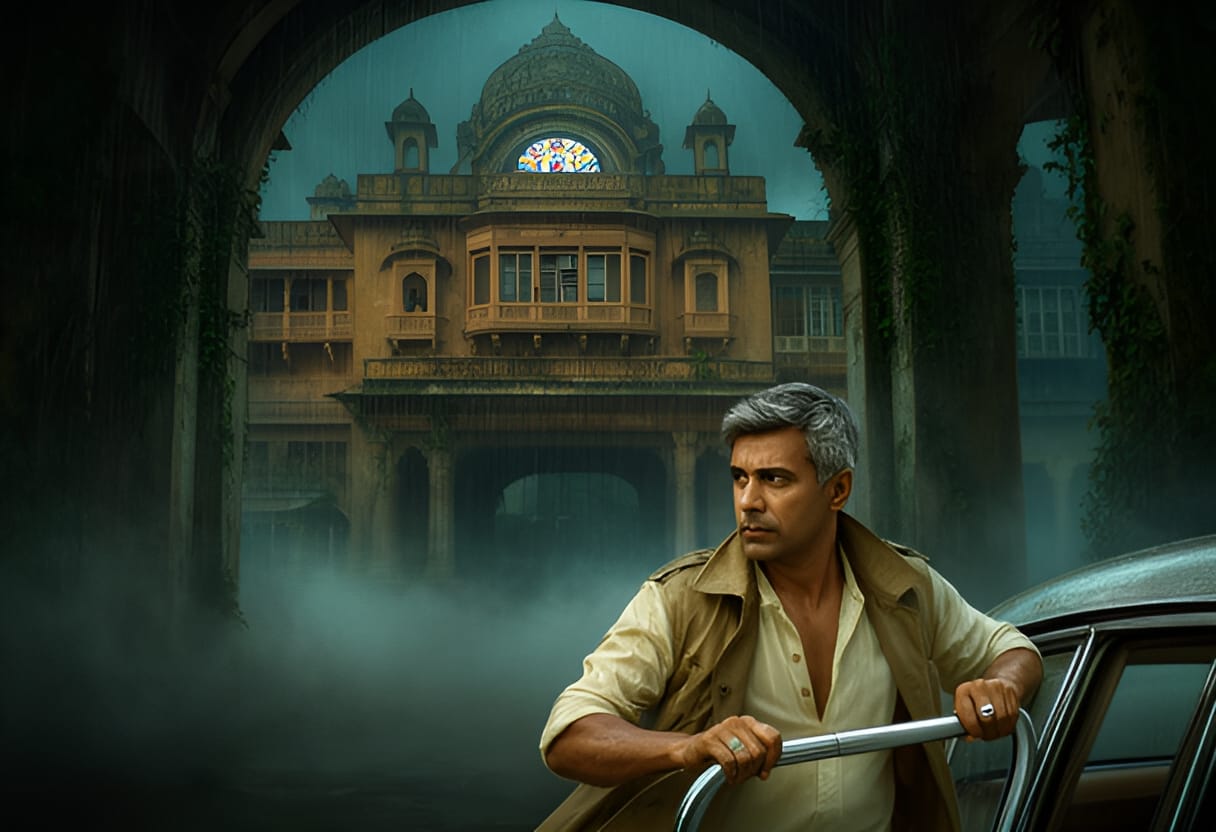
Devmahal rose like a memory made stone—four wings of dark granite arranged around a central courtyard, balconies carved with lotus motifs now choked with ivy, towers capped with copper domes turned verdigris with age. No signs of life. No smoke from chimneys. No glow in the windows. It sat in the hollow of the valley like a tooth in a rotting gum, beautiful and wrong.
He parked beneath the porte-cochère and sat for a moment, hands on the wheel, listening to the silence. It wasn’t empty. It was waiting.
The gate creaked open before he stepped out. A woman stood in the archway, tall and rigid, her uniform immaculate despite the travel—dark trousers, polished boots, a high-collared jacket with no insignia. Her hair was pulled back severely, strands escaping to frame a face carved from granite and suspicion. Her eyes, when they lifted to his, were the color of storm clouds.
“Mr. Devvardhan?” Her voice was low, precise, devoid of warmth. “Ananya Mehta. Head of security. Professor Acharya expected you thirty minutes ago.”
He stepped forward, extending his hand. “I’m sorry. The roads—”
She did not take it. Instead, she tilted her chin toward the hotel. “Follow me. And keep close. The grounds are not safe after dark.”
He fell into step beside her, noting how she moved—economically, alert, shoulders slightly angled as if ready to turn and strike. The soles of her boots made no sound on the stone path. Even her breath seemed controlled.
They passed under the archway into the courtyard. The air here was colder, still. Ivy strangled the pillars. Fountains lay dry, their basins cracked and filled with rainwater and dead leaves. A peacock feather lay in the mud near the west arch—vivid blue-green, impossibly bright against the gloom.
“Professor Acharya is in the library,” she said, not looking at him. “He’s been waiting.”
They entered through a side door, into a hallway lined with portraits—stern-faced men and women in silk and brocade, eyes following him as he passed. The Devvardhans. He looked away. His father’s gaze felt like a weight.
The library was vast, two stories high, walls lined with cedar shelves groaning under the weight of leather-bound volumes and scrolls in languages dead and dying. Dust hung in the air, motionless. A single brass lamp burned on a reading table near the far window, casting a pool of gold over an object that made his breath catch.
It lay on a velvet cushion, wrapped in layers of oiled silk. The outer cloth was pulled back to reveal a binding of copper plates, etched with geometric patterns that caught the light and threw it back in shards. Beneath, the manuscript peeked through—palm-leaf folios, brittle and yellowed, stitched together with silk thread that had faded to ivory. The script was unfamiliar, not quite Grantha, not quite Devanagari, but something older, more angular—like the letters had been carved rather than written.
Ananya stepped aside. “Professor Acharya will see you now. Do not touch anything without permission.”
She turned and left, her footsteps fading down the hall.
Rudraksh approached the table slowly, as if the manuscript might vanish if he breathed too hard. He pulled out the chair and sat. The lamp flared, casting his shadow long and thin across the floor.
He reached out, hesitated, then lifted the edge of the silk. The copper was cool beneath his fingertips. He unfastened the clasp—a tiny lion’s head, its jaws locked shut—and opened the cover.
The first folio lay exposed.
The text began not with an invocation, but with a number: a sequence of dots and dashes arranged in a circle, like stars in a constellation. Below it, a line of script that curled like smoke. He leaned closer, heart pounding not with excitement, but with the quiet dread of recognition.
This was not a treatise.
It was a cipher.
And someone had known he would see it.
He traced the sequence of dots and dashes with a fingertip, feeling the faint ridges of the copper binding beneath the silk. The pattern repeated every seven symbols—dot, dash, dot, dot, dash, space, dash—like a heartbeat stitched into the margin. It wasn’t decoration. It was deliberate.
He pulled his notebook closer, the leather worn at the corners from years of fieldwork. With deliberate slowness, he copied the first line of text, then the marginal mark beside it. The script was a variant of early Brahmi, sharper than Grantha, lacking the loops and curves that came later. He could read it—haltingly, but surely. It spoke of planetary cycles, of conjunctions, of the moon’s nodes. A treatise on jyotisha, perhaps from the Pala period. But the numbers didn’t fit.
He frowned, squinting at a line where the text claimed Jupiter completed an orbit in 4320 days. Modern astronomy placed it at 4332.5. A minor error, perhaps—except it wasn’t minor when repeated. Saturn’s cycle was given as 10,760 days; the accepted value was 10,759.2. Close, but consistently skewed. And then there was the Venus cycle: 584 days according to the text. The actual synodic period was 583.92. Again, off by just enough to feel intentional.
He set down his pen. Too precise to be mistake. Too consistent to be ignorance.
He turned a folio. The marginal symbols appeared again—same sequence, same spacing. He began to isolate them, copying only the marks into a clean column. Dot-dash-dot-dot-dash-space-dash. Over and over. Sometimes broken by a single dot, sometimes doubled. But the core repeated like a refrain.
A substitution, he thought. Or a key.
He recalled a footnote in Acharya’s old lectures on steganography in palm-leaf manuscripts—how scribes would hide prayers or protest verses in the spacing of letters, in the length of vowel marks. But this was different. This was numeric. Or alphanumeric.
He assigned values: dot = 1, dash = 0, space = separator. The sequence became 1-0-1-1-0- -0. Binary? He paused. No—too short. Too repetitive. Unless it was a cipher where each cluster stood for a letter.
He tried mapping it to Sanskrit consonants. Ka, kha, ga—no pattern emerged. Then he tried the English alphabet, just to test. A=1, B=2… but the sequence didn’t align.
He stared at the copper binding. The geometric patterns—interlocking triangles, concentric circles, a lotus within a square. Not random. The same precision that governed the script.
A breath caught in his throat. What if the cipher wasn’t in the text at all? What if it was in the omissions?
He went back to the first folio. The line of script that curled like smoke—he had copied it mechanically, but now he looked closer. The letters were evenly spaced, except—there. Between the third and fourth akshara, a gap wider than the rest. Not a word break. Too small. And later, after the seventh symbol, another. Then after the twelfth.
He marked them. Three irregular gaps in a line of sixteen symbols.
He aligned the marginal sequence beneath it. Dot-dash-dot-dot-dash-space-dash. Seven units. The line had sixteen symbols. Not a match.
Unless—he shifted the alignment. Started the cipher sequence at the second symbol. Then the third. Then the fourth.
On the fifth try, the gaps aligned with the dashes.
His pulse jumped.
He held his breath and applied the pattern: where there was a dash in the cipher, he noted the letter in the text at that position. Where there was a dot or space, he skipped.
He did it for the first line.
The letters he pulled out: म (ma), व (va), स (sa), ं (anusvara, a nasalization dot).
Mavasaṃ? Not a word.
He tried again, shifting the start point. Nothing.
Then he realized—he’d been reading the text left to right, but the copper binding, the geometry, the whole aesthetic of the manuscript felt… oriented. He rotated the folio mentally. What if the script was meant to be read in boustrophedon—alternating directions?
He flipped the line in his mind. Re-read it right to left. Re-applied the cipher.
This time, the letters were: स (sa), ं (anusvara), व (va), म (ma).
Saṃvam? Still nonsense.
He rubbed his eyes. The lamp flickered. Outside, the wind had picked up, rattling a loose shutter somewhere in the west wing.
He wasn’t seeing it right.
He closed his notebook and leaned back. The library felt colder now, the shadows deeper. The portraits on the wall seemed to lean forward, silent witnesses.
He thought of his father’s voice, years ago, in the study at Devvardhan House: “Legacy isn’t inherited, Rudraksh. It’s deciphered.” He’d rejected it then. Walked away. But here, in this room, with this manuscript, the words echoed—not as accusation, but as invitation.
He opened his notebook again. This time, he didn’t look for meaning in the letters. He looked for pattern in the numbers.
He took the marginal sequence and treated it as a repeating key. He assigned each symbol a value: dot=1, dash=2, space=3. The sequence became: 1-2-1-1-2-3-2. Repeating.
He applied it to the folios, skipping that many letters between each picked character.
On the third folio, after several failed attempts, he picked out: प्र (pra), ति (ti), थ (tha), या (ya).
Prathiya? Not Sanskrit.
He tried adding the values instead of skipping. Took the letter’s position in the consonant-vowel matrix, added the cipher value, wrapped around the alphabet.
On the fourth folio, it yielded: दा (da), नि (ni), म (ma), ं (anusvara), दा (da), नि (ni), म (ma).
Danimaṃ danima? Repetitive. A mantra?
He paused. Dāni meant “giver.” Danima wasn’t a word, but dānam was—gift, offering. The repetition felt ritualistic.
He looked up. The lamp sputtered. A shadow passed beyond the tall window—too tall for a person, too slow for an animal. Or maybe it was just the ivy, swaying.
He rubbed his temples. He was forcing it. Seeing patterns where none existed. The exhaustion of seven years of silence, of self-imposed exile, was catching up with him. He hadn’t slept properly since the train.
He was about to close the notebook when a shadow fell across the table.
He looked up.
Ananya stood there, arms crossed, her expression unreadable in the lamplight. She hadn’t knocked. He hadn’t heard her approach.
“You’ve been here three hours,” she said. Her voice was low, but it carried in the stillness. “Professor Acharya asked if you needed anything.”
“I’m fine,” Rudraksh said, closing the notebook slowly. “Just… trying to get my bearings.”
She glanced at the manuscript, at the open folios, at his scribbles. “You’re working on the cipher.”
“I think there is one,” he said. “In the margins. A repeating sequence. I’m testing whether it’s a grille or a key.”
She didn’t smile. “You’re not the first to notice the margins. The last scholar who tried to ‘decode’ them spent two weeks in the west wing before they found him curled up in the archive, whispering about falling stars.”
His stomach tightened. “The west wing?”
She stepped closer, her boots silent on the stone. “Off-limits. Structural instability. And… other reasons.” Her eyes flicked to the portraits behind him—his ancestors, stern and unyielding. “The Devvardhans didn’t build this place to keep people out. They built it to keep something in.”
He met her gaze. “And what is that?”
She didn’t answer immediately. When she did, her voice was softer, but edged with warning. “You’re not here for the manuscript, are you? You’re here because Acharya promised you answers about your father.”
He flinched. “How do you—”
“I know who you are,” she said. “And I know why you left. But Devmahal doesn’t care about your guilt. It only cares if you’re useful.”
She turned to leave, then paused. “Stay out of the west wing. After dark, the grounds aren’t just unsafe. They’re awake.”
She walked away, her footsteps absorbed by the thick carpet. The library swallowed the sound.
Rudraksh sat alone again. The lamp flared, then steadied.
He opened his notebook to a clean page. He wrote the cipher sequence at the top: dot-dash-dot-dot-dash-space-dash.
Then, beneath it, he wrote the first line of text again.
He applied the sequence as a skipping pattern—this time, using the numerical values to count forward, not backward. Dot=1, dash=2, space=3.
He started at the first letter. Counted one forward—landed on the second. Wrote it down. Counted two from there—landed on the fourth. Wrote it. Counted one—fifth. Two—seventh. One—eighth. Two—tenth. Three—thirteenth.
He did it for the whole line.
When he finished, he stared at the string of letters he’d extracted.
दे (de), व (va), म (ma), ह (ha), ल (la).
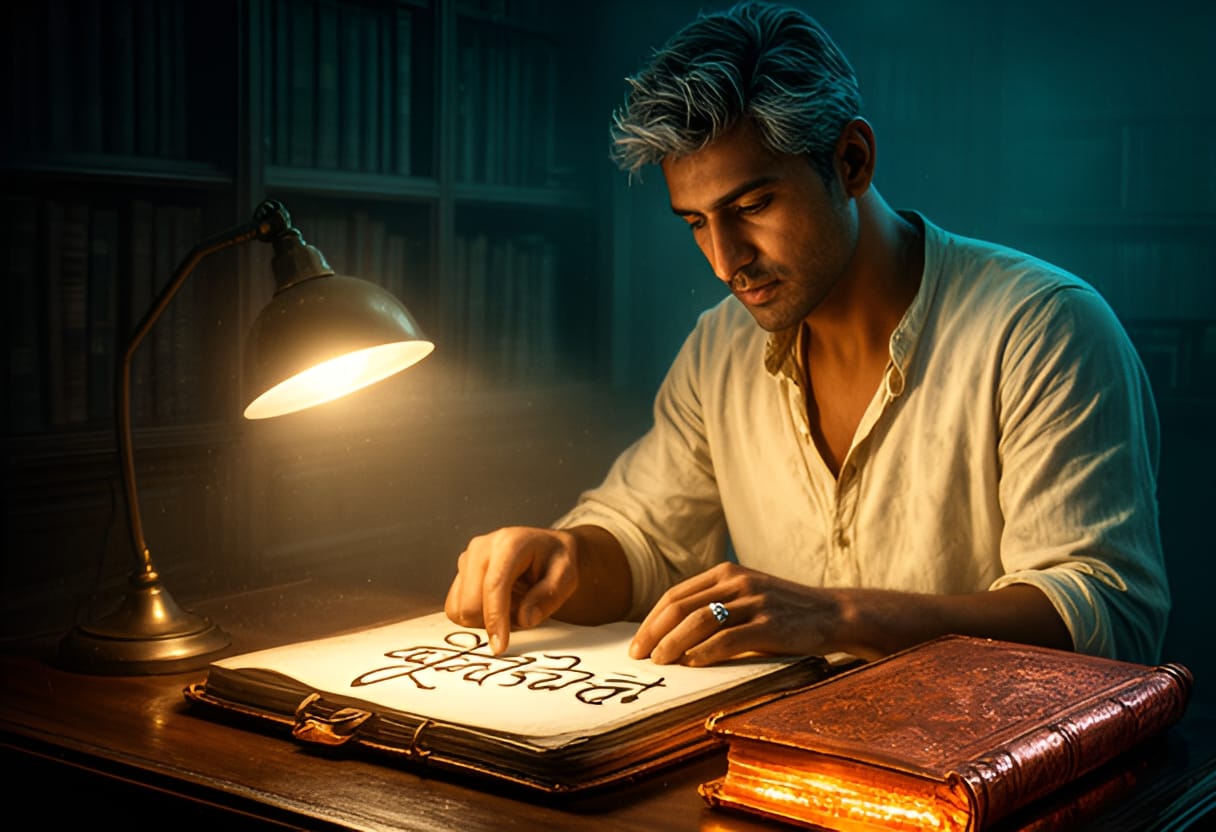
Devamal?
No—Devmahal.
His breath stopped.
He looked up at the copper binding, at the lotus motifs in the corners, at the geometry that had seemed merely decorative.
The cipher wasn’t hiding a message in the text.
It was revealing the text’s origin.
He tested it on the second folio. Same sequence. Same skip pattern.
The result: प्र (pra), चि (chi), द (da), श (sha), अ (a), य (ya), न (na), म (ma).
Praḍiśāyanama? Not clear. But if he split it—Pra-diśāy anama? “Toward the offering of wisdom”?
He tried the third folio.
Result: आ (a), नि (ni), त (ta), र (ra), य (ya), म (ma), ं (anusvara), दा (da), नि (ni), म (ma).
Anitrayamaṃ danima? Still opaque.
But the first line had given him Devmahal. The name of the place. As if the manuscript was not just from here—but about here.
He leaned back, heart hammering. The library felt less like a repository of knowledge and more like a lock. And he had just turned the first tumbler.
Outside, the wind died. The silence returned—deeper, thicker.
He wasn’t just deciphering a manuscript.
He was being answered.
And somewhere in the dark wings of the hotel, something had just taken notice.
He closed the notebook with a soft click, the sound unnaturally loud in the hushed library. The extracted word—Devmahal—pulsed behind his eyelids. Not a hidden message. A signature. A claim.
He rose stiffly, joints protesting from hours hunched over the table. The lamp’s glow pooled weakly around him, leaving the far corners in swallow-dark. Beyond the tall window, the forest breathed—a slow, damp exhalation that made the ivy shiver without wind.
He needed air. Needed to test whether the cipher was a trick of fatigue, a pattern born of desperation. Or whether it was real.
He slipped the notebook under his arm and moved toward the door, pausing only to glance back at the open folios. The margin’s dot-dash-space sequence stared up at him like a challenge.
The corridor outside was narrower than the library, lined with portraits he hadn’t examined closely—the Devvardhan ancestors, yes, but also others: scholars in robes he didn’t recognize, eyes following with painted severity. He didn’t linger. The silence here felt different—older, watchful. As if the walls remembered voices long buried.
He descended the main staircase, its stone steps worn concave by centuries of boots and bare feet. The air grew cooler, damper, carrying the scent of wet stone and distant blossoms. At the base, he paused beneath a fractured skylight where moonlight bled in, fractured by branches. The west wing loomed to his left, a jagged silhouette of collapsed arches and boarded windows. Ananya’s warning echoed: After dark, the grounds aren’t just unsafe. They’re awake.
He shook his head. Not west. East. Toward the waterfall.
He crossed the courtyard, where cracked flagstones protruded from tufts of grass like broken teeth. The fountain at its center was dry, its cherubic figures missing limbs, faces eroded to smooth blindness. Beyond it, the garden sloped downward, terraced and overgrown, swallowed by creepers that had claimed statues and stairways alike.
The eastern waterfall was not marked on any map he’d seen, but he remembered Acharya’s letter—vague, yet insistent: Come to where the stone remembers its name. And now, the cipher had whispered back: Devmahal. Not just a place. A direction.
He followed the sound first—a low, constant roar, like the forest itself was exhaling through stone. The path narrowed, flanked by ferns that brushed his wrists with cold dampness. Moss clung to everything, glowing faintly in the dark where moonlight caught its edges. He pushed aside a curtain of hanging vine and froze.
There it was.
An archway, half-swallowed by the hillside. Moss draped its lintel like a funeral shroud. Vines coiled around its jambs, threatening to pull it whole into the earth. It was not grand—no more than two meters high—but its placement was deliberate, centered on the fall’s spray, as if built to catch the mist and hold it in stone.
His breath caught.
He stepped forward, brushing aside damp fronds. The arch was not ruin—it was concealment. Someone had meant for it to be found, eventually. Or avoided.
He reached out, touched the stone. Cool. Smooth beneath the moss. Not weathered. Worked.
He began to clear the debris—loose rock, rotting wood, a tangle of thorny creeper that scratched his forearms. His fingers found edges, then a seam. With effort, he shifted a loose slab and peered beneath.
Carved into the lintel, revealed as the moss gave way, was script.
Not Devanagari. Not Grantha. Older. Angular. Carved-like, just as the manuscript had been.
His heart lurched.
He traced the first character with a fingertip—दे (de). Then व (va). म (ma). ह (ha). ल (la).
Devmahal.
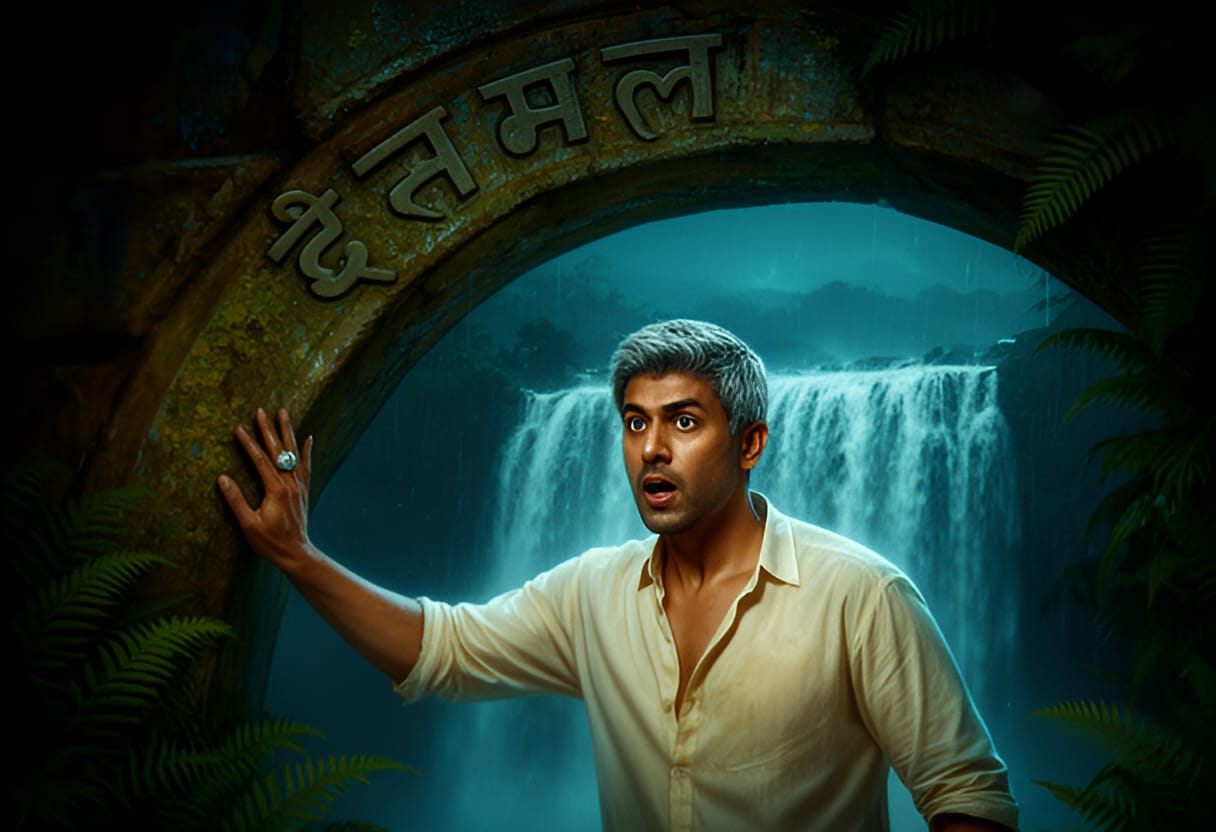
Identical to what he’d drawn from the cipher.
His hand trembled. Not from exertion. From the impossibility of it. The manuscript had been recovered from beneath the observatory, sealed for centuries. Yet here, in this forgotten arch, the same name—the same linguistic key—had been carved into stone, waiting.
He stepped back, scanning the jambs. Faintly, almost erased by time and root, were other symbols—dots and dashes, spaced irregularly. He leaned closer. One sequence matched the cipher’s opening: dot-dash-dot-dot-dash-space-dash.
A confirmation. Not just of the word, but of the method.
He exhaled, shivering despite the humidity. The cipher wasn’t a red herring. It was a map. And he had just followed its first leg.
A twig snapped to his left.
He turned sharply, notebook clutched to his chest.
Nothing. Just the waterfall’s roar and the whisper of leaves.
But he had seen it—a flicker, deep in the tree line where the ferns thinned. A shape, taller than a man, motionless beneath the canopy. And for a split second, as the moon shifted behind a cloud, he’d caught a glint—not from eyes, but from metal. Polished. Flat. A blade, perhaps, or the edge of a buckle.
His pulse hammered in his throat.
He didn’t wait to see if it moved.
He turned and fled—not blindly, but fast, crashing through the undergrowth, branches slapping his face, moss sucking at his boots. He didn’t look back until he reached the garden’s edge, where the courtyard’s broken flagstones gave way to smoother stone near the hotel’s east flank.
He leaned against a fluted column, gasping. The archway was now a dark mouth behind him, half-hidden again by the riot of green. The waterfall’s roar was muffled, distant.
He had been watched. Not by an animal. Too deliberate. Too still.
And whoever it was had known he was coming.
He pushed off the column, heart still racing, and made his way to the west wing—not to enter, but to put distance between himself and the east. The library’s warm glow beckoned from the upper floor, a refuge of lamplight and quiet.
He climbed the stairs two at a time, notebook clutched tight, and paused outside his room. The door was ajar. He hadn’t left it open.
He swallowed, pushed it inward.
The room was small, spare—a cot, a washstand, a wardrobe of plain oak. His satchel lay where he’d left it, but the notebook was gone from the cot.
It lay open on the table.
And seated in the chair beside it, fingers steepled beneath his chin, was Professor Vidyadhar Acharya.
He looked older here, in the lamplight. The lines around his eyes deeper, his silver hair catching the glow like spun wire. But his voice, when it came, was smooth, almost affectionate.
“You found it.”
Rudraksh didn’t answer. He stepped fully inside, letting the door fall shut with a soft snick. He kept his eyes on Acharya, not the notebook.
“I didn’t expect you so soon,” Acharya continued. “Ananya said you were resting.”
“I wasn’t resting,” Rudraksh said. “I was following a lead.”
Acharya’s gaze flicked to the notebook, then away—too quickly. “And did it lead you somewhere interesting?”
“The arch. East of the waterfall. Half-collapsed. Moss-covered.” Rudraksh took a step forward. “The lintel bore the name Devmahal. In the same script as the manuscript. And beneath the moss—cipher marks. Matching the sequence I used.”
Acharya nodded, but his eyes remained fixed on the wall behind Rudraksh’s shoulder. “Impressive work. You’ve always had a gift for seeing patterns others miss.”
“You knew it was there.”
Acharya finally looked at him. A flicker of something—surprise? Regret?—passed across his face before settling into neutrality. “I knew the arch existed. The Devvardhans built many such markers. Boundary stones. Memorials. It’s not uncommon for old estates to have… commemorative inscriptions.”
“Not commemorative,” Rudraksh said. “Directional. The cipher wasn’t hiding a message in the text. It was pointing to the text’s source. The arch confirms it.”
Acharya was silent for a moment. Then, softly: “And what does that make the manuscript? A guide? A warning?”
“It makes it a key,” Rudraksh said. “And whoever carved that arch… they expected someone to use it.”
Acharya pushed to his feet, movements unhurried. He walked to the window, hands clasped behind his back, staring out at the dark garden where the waterfall’s mist would be catching the moonlight. “The Devvardhans were not just builders, Rudraksh. They were keepers. Of knowledge. Of secrets. Some doors were meant to stay shut. Others… only opened by the right hand.”
He turned then, a faint smile touching his lips. “You have your father’s eyes. The way you look at a problem—like it’s a lock, and you’re already feeling for the tumblers.”
Rudraksh’s jaw tightened. “You knew him.”
“I knew of him. A man of principle. Uncommon in our line.” Acharya stepped closer, stopping just inside the ring of lamplight. “He left Devvardhan House not because he rejected the legacy—but because he feared what it could become.”
Rudraksh stared. “What are you talking about?”
Acharya’s expression softened, almost sadly. “The Devvardhans didn’t just collect artifacts, Rudraksh. They sought to understand power. Where it sleeps. How it wakes. The manuscript you’re holding—it’s not merely a record. It’s a device. And the cipher… well. You’ve seen what it can do.”
He paused, glancing at the notebook. “You’ve opened the first door. But there are more. And some rooms… are better left unexplored.”
Rudraksh took a breath. “You told me to come here for answers about my father.”
Acharya’s eyes narrowed, just a fraction. “And have you found them?”
“Not yet.” Rudraksh held his gaze. “But I know you’re not telling me everything.”
Acharya didn’t deny it. Instead, he said, “You’re close. Closer than anyone in generations. But be careful what you wake in the dark. Not all of it sleeps peacefully.”
He moved toward the door, then paused, hand on the knob. “Rest now. Tomorrow, we’ll see how deep the rabbit hole goes.”
The door clicked shut behind him.
Rudraksh stood alone again, the lamplight pooling over the open notebook. The cipher sequence gleamed at the top of the page. Below it, the extracted word: Devmahal.
He reached out, touched the ink.
Somewhere in the west wing, a door creaked open—then closed.
He didn’t look up.
He wasn’t sure if he wanted to know what was on the other side.
He stayed perfectly still, listening. The lamplight from the hallway pooled under his door, a thin rectangle of gold on the worn floorboards. Beyond it, the west wing stretched into deeper shadow, its corridors swallowed by the night. Somewhere, a floorboard sighed. Not the settling of old timber. A step. Deliberate. Slow.
He waited until the sound faded, then slipped from the room, barefoot, the notebook clutched to his chest. The latch on the west wing door was a simple spring bolt—nothing like the barred gates of the courtyard. But he remembered the marginalia: a tiny sketch of a latch mechanism, annotated in a faded hand with the Devnagari glyph for release. He had dismissed it as a doodle. Now, he pressed his thumbnail into the seam where the bolt met the strike plate, felt the catch, and lifted just enough to disengage it. The door opened without a sound.
The air in the west wing was cooler, damp with the breath of stone. He moved slowly, hand trailing the wall, fingers brushing over rough plaster and the occasional smooth patch where someone had rubbed the surface clean over years. Portraits lined the corridor—stern-faced Devvardhans in archaic dress, their eyes following him as he passed. He didn’t look at them. His gaze was fixed on the floor, searching for irregularities, for the faintest disruption in the dust.
At the end of the hall, a doorway yawned black. He paused, listening again. Nothing. He stepped inside.
The room was vast, its ceiling lost in darkness. Faintly, he made out the outline of a long table, its surface cluttered with objects shrouded in dust sheets. To his left, a bank of windows looked out over the garden, but the glass was painted black, blocking the moonlight. He moved toward the center, where the air felt thicker, heavier.
And then he saw it—a narrow gap in the wall, barely wider than a handspan, concealed behind a fallen tapestry. He pulled the fabric aside. Behind it, the stone was cut with precision, the edges too sharp to be natural. A doorway. He pressed his palm to the cool surface and felt a faint vibration, like the hum of a wire under tension.
He stepped through.
The passage sloped downward, the air growing colder, damper. The walls were rough-hewn, torch sconces spaced at irregular intervals—empty, but not unused. The soot inside them was fresh. He ran his fingers along the edge of one, came away with a smear of black.
At the bottom, the passage opened into a chamber. He halted, breath catching.
Frescoes covered the walls, their pigments faded but still vivid in the lamplight from his notebook, which he had opened to use as a light source. The pages glowed faintly, casting a pale radiance over the figures depicted. They were not warriors or kings. They were robed figures, their heads bowed, their hands raised in supplication. Before them, emerging from the bedrock itself, rose a device unlike anything he had seen—a twin-pronged fork of dark metal, its base sunk deep into the stone, its arms arched upward like the horns of a crescent moon. Lines radiated from it, not as light, but as sound—wavy glyphs that curled through the air like smoke, intersecting with symbols he recognized: the same dot-dash-space sequence from the manuscript, repeated in bands around the figures’ wrists, etched into the hem of their robes.
He stepped closer, tracing the air with his eyes. This was no mere decoration. It was a diagram. A schematic. The device was not a weapon in the conventional sense—it resonated. It vibrated the earth. And those who stood before it were not worshipping a god. They were tuning themselves to a frequency.
A chill ran up his spine, not from the cold, but from recognition. He had seen this before. Not in person. In the margins. A tiny sketch, tucked between lines of text, labeled in a hand that was not the scribe’s: Yantra. The Anant Yantra. Not a record. A key. And the manuscript… the manuscript was the score.
His breath hitched. He had been right. It was a device. And someone had been using it recently.
A shift beneath his foot made him freeze.
The stone panel under his left boot had depressed slightly—just a hair’s breadth. He didn’t move. Didn’t breathe. He felt it then: a soft, pneumatic sigh from below, the sound of air displacing as something heavy began to rise.
He didn’t wait to see what.
He turned and fled back up the passage, heart hammering against his ribs. He burst into the west wing room, slammed the hidden door shut, and shoved the tapestry back into place—just as a panel in the floor of the chamber below slid open with a whisper of displaced air.
He leaned against the wall, trembling, when a voice came from the darkness beside him.
“You shouldn’t have come down here.”
He jerked sideways, notebook flying from his grasp. It hit the floor with a thud, pages splaying open.
Kavya stepped from the shadow of the wardrobe, her face pale in the gloom. She wore no uniform, just a simple cotton kurta, her hair loose around her shoulders. In her hand, she held a small brass key—hotel issue, but worn at the bow, as if used often.
“I thought you were with Ananya,” he said, his voice rough. “I thought she had you on watch.”
“I am on watch,” she said. “Just not for her.”
He pushed off the wall, wary. “What are you doing here?”
She didn’t answer right away. Her eyes flicked to the notebook, then back to him. “You found the passage.”
“I followed the cipher. It led me here.”
She nodded, slow. “It leads lower. To the vault. Where they keep the core.”
“You knew.”
“I’ve known since I was a child. My grandmother worked here. Before she vanished.” She reached into her pocket and pulled out a folded slip of paper, brittle at the edges. She unfolded it carefully. “This is her file. From the archives. Dated twenty years ago. ‘Subject: Mehta, Lakshmi. Reason for departure: unauthorized access to restricted levels. Status: missing. Case closed.’”
He took the paper. The ink was faded, but the stamp was clear—Devmahal Hotel, Internal Security. And beneath it, a second stamp, smaller, almost hidden: a serpent eating its own tail. The Ouroboros.
“They erased her,” Kavya whispered. “Not just from the records. From memory. No one talks about her. Not even her sister. But I found this in the lining of her old trunk. A key. And a note: If you’re reading this, they took me for knowing too much. Trust no one in white.”
He looked up. “White?”
“The uniforms. The guards. The ones who walk the halls with their hands never far from their batons. They’re not here for thieves. They’re here to make sure no one leaves the lower levels alive.”
He thought of the figure in the tree line. The watcher. Had it been one of them?
Kavya stepped closer. “You’re not the first to come here chasing answers. But you might be the first who’s not afraid of what they find.”
He stared at her. “Why tell me this?”
“Because I need someone who can read the cipher. Not just break it—understand it. My grandmother didn’t vanish because she stole something. She vanished because she saw something. And if the Circle is moving to activate the Yantra… we don’t have much time.”
He looked down at the notebook, at the word Devmahal glowing faintly on the page. The cipher was more than a map. It was a warning. And a summons.
“Then we go lower,” he said. “Together.”
She hesitated, then nodded. “There’s a service lift behind the library. Old. But it still works. If we’re quiet—”
A sound stopped them both. From the direction of the library, a door creaked open. Then another. Footsteps. Measured. Unhurried.
They weren’t alone.
Kavya melted into the shadow of the wardrobe. Rudraksh snatched up the notebook, shoved it into his satchel, and pressed himself flat against the wall beside the hidden door, his breath shallow, his mind racing.
The footsteps paused just outside the room.
Then, a voice—familiar, smooth, laced with quiet amusement—drifted through the crack beneath the door.
“Ah, Rudraksh. I wondered how long it would take you to look beneath the surface.”
Professor Acharya.
And behind him, the unmistakable click of a safety being disengaged.
Rudraksh’s fingers closed around the edge of the hidden door. He didn’t pull it open.
He braced himself.
And waited.
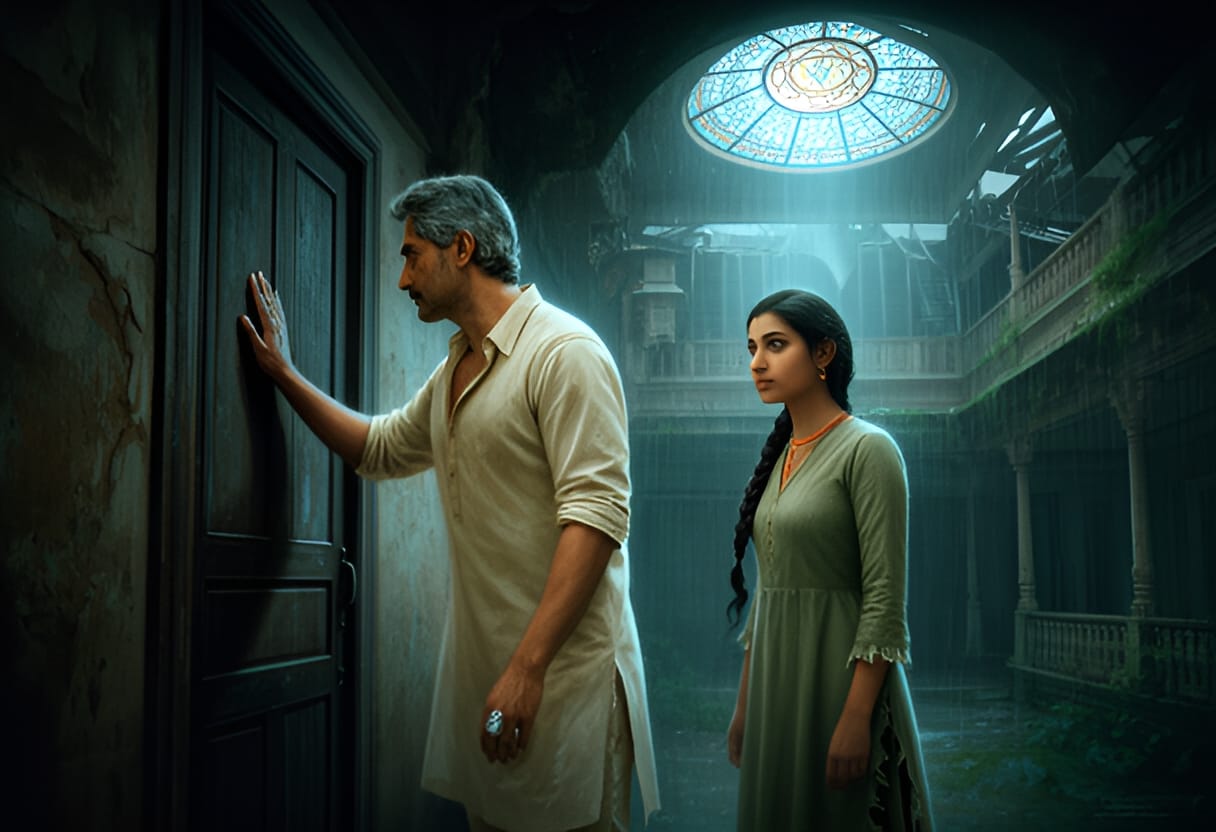
Chapter 2
The Cipher and the Circle
Rudraksh’s palm pressed against the cool wood of the hidden door, feeling the faint tremor of the professor’s boot shifting on the other side. The air in the room tasted of dust and old paper, thick with the silence that followed a threat. Kavya hadn’t moved from the wardrobe shadow, her breath barely disturbing the hanging coats. Acharya’s voice lingered, smooth as oil over stone.
“You always were too curious for your own good, Rudraksh,” he said. “But curiosity, without guidance, leads only to dead ends. Or worse—awakening what should stay buried.”
A pause. The click of the safety re-engaging. Then, softer: “Come out. We have much to discuss. The Yantra waits for no one.”
Rudraksh didn’t answer. His mind raced—not with fear, but with the fragment of cipher still burning behind his eyes: dot-dash-space, one-two-three. Devmahal. Not just a place. A key.
Kavya shifted. The wardrobe creaked.
Acharya laughed—a low, dry sound. “Come now. Hiding won’t save you. Not when the Circle has already moved.”
Footsteps retreated. The door down the hall clicked shut. Silence returned, heavier now.
Rudraksh exhaled. “He knows we’re here.”
Kavya stepped forward, her face pale in the moonlight slicing through the blind. “He always does. But he doesn’t know about this.”
She pulled open the wardrobe fully, revealing not clothes, but a narrow gap behind it—just wide enough for a person to slip through. With careful hands, she ran her fingers along the base of the built-in desk against the far wall. One panel, slightly lighter in grain, gave under her pressure. It swung inward on hidden hinges, revealing a dark square beneath.
“A service tunnel,” she murmured. “Used by staff during the rains, when the main corridors flood. Forgotten, mostly. But the Circle still uses it. For access.”
She ducked inside, disappearing into the gloom. Rudraksh hesitated only a moment before following, pulling the desk panel shut behind him. The air below was damp and cold, smelling of stone and mildew. A single bulb, dangling from a frayed wire, cast a weak glow over rough-hewn walls. The tunnel sloped downward, narrow enough that he had to turn sideways to pass.
At the end, a low arch opened into a chamber no larger than a closet. Shelves lined the walls, sagging under the weight of leather-bound ledgers, their spines cracked and stained with damp. Kavya was already pulling one free, her fingers tracing the embossed crest on the cover—a serpent coiled inward, devouring its tail.
“1948,” she said, voice hushed. “The year the Circle made its first move after the war. They thought independence would weaken the Devvards. They were wrong. But they kept looking.”
She opened the ledger. The ink had faded to sepia, but the script was clear, precise—a hybrid hand, not quite Devanagari, not quite Persian. Rudraksh leaned in, translating as he read:
“The Circle seeks the Yantra’s heart; the Devvards are the key. Blood remembers what stone forgets. The observatory yields only to those who know the sky’s debt. When the serpent eats its tail and the lion drinks the moon, the path opens beneath the east fall. Trust no white.”
He looked up. “The lion drinks the moon?”
“Lunar eclipse,” Kavya said. “Combined with solar alignment. A rare conjunction. The manuscript’s math—it’s not just directions. It’s a calendar.”
Before he could respond, the tunnel behind them shuddered. A faint scrape, like a boot on stone.
Kavya snapped the ledger shut. “He’s checking the tunnel. He knows someone came down.”
They froze. The bulb swayed slightly, casting dancing shadows. Then—footsteps above. Not in the library. In the hall outside the study. Measured. Unhurried.
Ananya’s voice, low and sharp, cut through the wood: “Professor? You called for me?”
Acharya’s reply was calm. “Just checking the western surveillance. Saw something odd near the west wing service lift. Thought I’d better verify.”
A pause. Then, softer: “You’ve been reviewing the night-shift logs, haven’t you?”
“Standard procedure,” Ananya said. “After the disturbance in the east wing. The one you reported.”
“I reported nothing,” Acharya said. “I was merely ensuring the grounds were secure. After all, we can’t have trespassers disturbing the… archival work.”
Another pause. The sound of fabric shifting. “You’re loyal to the hotel, Ananya. Not to ghosts. Remember that.”
“I remember my duty,” she said. “And I remember what I saw.”
Footsteps retreated. The library door clicked shut.
Kavya let out the breath she’d been holding. “She knows.”
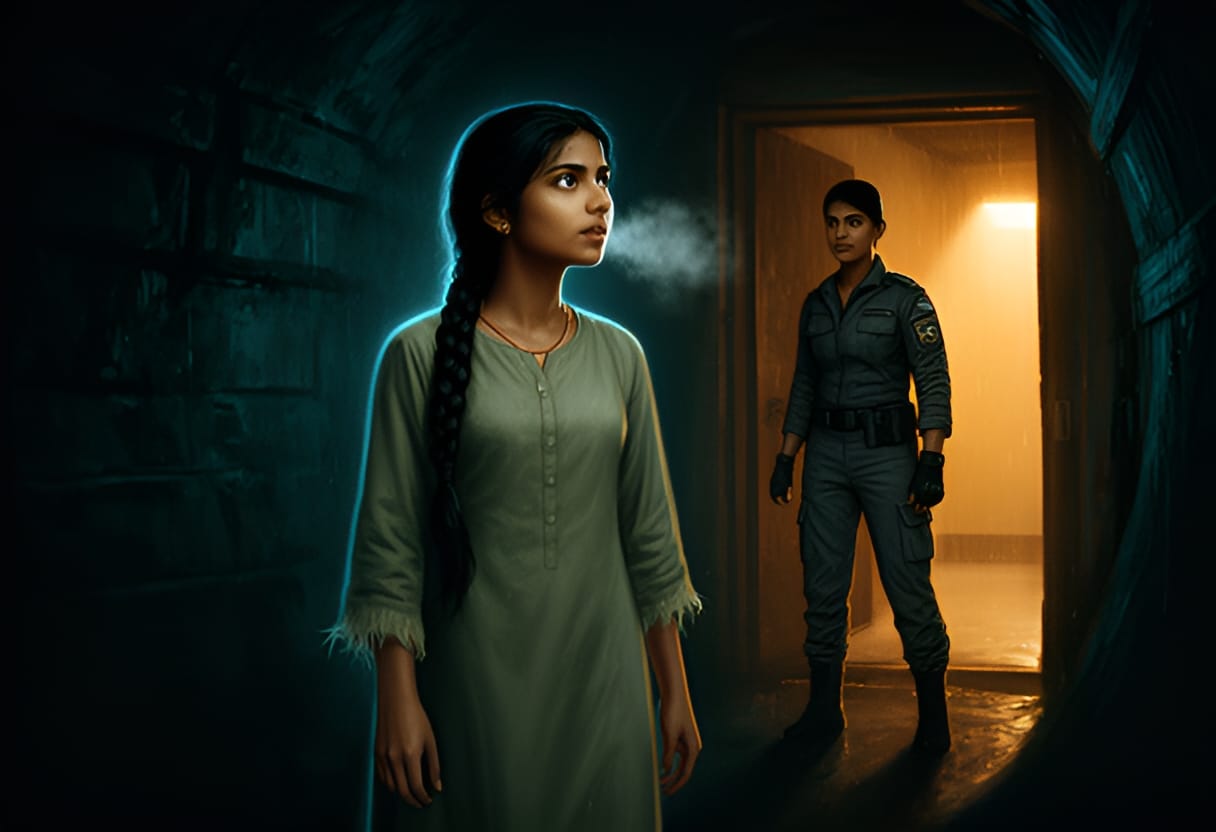
Rudraksh pushed the ledger toward her. “She saw him. Meeting masked figures. In the west wing.”
Kavya nodded, eyes fixed on the open page. “Then we don’t have time. We need to confirm the alignment. If the cipher is tied to the stars, we can predict when the Yantra can be activated—and maybe, how to stop it.”
She pulled out a second ledger, thicker, its cover embossed with a faded lotus. Inside, pages of dense astronomical tables—Sanskrit verses alongside planetary calculations, eclipse cycles, heliacal risings. Rudraksh recognized the script: an early form of Siddhanta, used before the adoption of Islamic astronomy in the courts.
He opened the manuscript from his satchel. The marginalia—dots, dashes, spaces—ran alongside the text in a repeating sequence. He began to translate, not as language, but as numbers: one, two, three. Then he cross-referenced it with Kavya’s tables.
A planetary conjunction. Venus and Jupiter aligned in the house of Krittika. The moon in uttara-bhadrapada. The sun in mrigashira. All occurring only once every seventy-nine years.
He looked up. “It’s not random. The cipher doesn’t just point to a place. It points to a moment.”
Kavya traced the line in the ledger. “The last time this happened was 1945. Just before the war ended. The Circle was active then, too. They tried to use the tremors in the Himalayas to mask a test.”
Ananya’s voice came from the tunnel entrance.
They jumped. She stood silhouetted against the hall light, her expression unreadable, her hand resting near the baton at her belt.
“You weren’t supposed to come down here,” she said. “But I’m glad you did.”
Rudraksh pushed to his feet. “You heard us?”
“I heard Acharya. And I checked the logs again. He wasn’t just meeting figures in the west wing. He was downloading something from the west wing server—encrypted, routed through a dummy node in Kathmandu. Then he went to the observatory. Spent forty-seven minutes there. Alone.”
She stepped into the tunnel, closing the desk panel softly behind her. The bulb swung once, then steadied.
“I don’t know what the Yantra is,” she said. “But I know it’s not a myth. My grandfather worked on the foundations here. He vanished in ’52. Officially, a jungle fever. But his logbook—found hidden in the wall of the old guardhouse—ended with one line: They woke it. Now it dreams.”
She met Rudraksh’s eyes. “My duty is to the hotel. But if what you’re saying is true… then the hotel isn’t just a building. It’s a trigger. And I won’t be the one who helped pull it.”
Kavya nodded. “Then we work fast. The conjunction happens in three nights. If the manuscript is right, the alignment opens the passage beneath the eastern waterfall—the one you found. That’s where the Yantra’s heart lies.”
Rudraksh looked down at the manuscript. The word Devmahal seemed to pulse in the dim light.
“Then we go back to the fall,” he said. “And we go lower.”
Ananya checked her baton, then nodded. “I’ll bring rope. And a weapon. If the Circle’s down there… they won’t expect three of us.”
Kavya touched the Ouroboros stamp on the ledger. “They expect someone who’s afraid. Let’s make sure we’re not.”
The bulb flickered. Outside, the forest held its breath. Somewhere above, the professor was already moving pieces into place.
But down here, in the damp dark, the cipher was no longer just a clue.
It was a countdown.
The manuscript lay open on the damp stone floor, its copper plates catching the weak glow of the hanging bulb. Rudraksh traced the marginalia with a fingertip, feeling the ridges of the dots and dashes as if they might yield more than numbers. Kavya leaned over his shoulder, the thick ledger of astronomical tables braced against her knee.
“It’s not just timing,” she murmured. “Look here.” She pointed to a column of calculations beneath a verse in early Siddhanta script. “These aren’t planetary positions alone. They’re harmonics. Ratios. The manuscript multiplies the conjunction’s angular velocity by the lunar mass, then divides by the local crustal density—estimated from Devvan’s granite strata.”
Rudraksh frowned. “You’re saying it’s calculating force?”
“Resonant frequency,” Kavya corrected. “Like striking a bell at its exact pitch to make it shatter. The Yantra isn’t just activated by alignment—it’s tuned. The cipher gives the moment. The equations give the frequency. Together, they don’t just open a passage. They destabilize.”
Ananya, who had been coiling rope near the tunnel’s mouth, looked up. “So it’s a weapon. Not a key. A trigger.”
“A seismic amplifier,” Rudraksh said, the words tasting of ash. “It doesn’t create energy. It borrows it. From the fault lines beneath Devvan. The manuscript shows how to make the earth resonate—just enough—to slip.”
A silence settled, thick as the tunnel air. Outside, the forest breathed in the dark, unaware that beneath its roots lay a device capable of waking it.
Kavya snapped the ledger shut. “We need to find the chamber. If the alignment opens the passage beneath the eastern waterfall, then the Yantra must be housed where the cipher’s spatial coordinates converge.”
She pushed toward the far end of the tunnel, where a narrow cleft in the rock revealed a stacked shelf of crumbling folios. Rudraksh followed, Ananya bringing up the rear, her hand never far from her baton.
The archive chamber was smaller than the ledger room, its walls lined with niches holding scrolls in decaying cloth and metal boxes stamped with faded seals. Kavya moved with purpose, pulling down a bundle tied with rotten silk. She unwrapped it carefully, revealing a vellum map of Devmahal as it had been—a complex of courtyards, temples, and subterranean channels, drawn in ink that had faded to sepia.
“Here,” she said, tapping a point beneath the oldest temple ruin, its foundation stones predating the hotel by centuries. “The chamber is aligned with the waterfall’s outflow. The manuscript’s coordinates—when converted from stellar declination to ground bearing—point exactly to this mark. And look.” She traced a line from the symbol for the conjunction to a small spiral near the chamber’s entrance. “The Ouroboros. It’s not just a seal. It’s a marker. The Circle left it where only those who read the stars would see.”
Rudraksh leaned in. The spiral was worn, but unmistakable—a serpent eating its tail, etched into the stone threshold of a submerged archway shown on the map. “The eastern waterfall. The archway I found. It’s not just a marker. It’s the entrance.”
Ananya crossed her arms. “And it’s underwater now. The monsoon hasn’t come full force yet. But in three nights—”
“The conjunction,” Kavya finished. “The swell will raise the groundwater. The pressure will push open the seal. The passage will flood—but not enough to drown it. Just enough to equalize the pressure holding the chamber shut. Like a lock designed to open only when the river rises.”
Rudraksh stood slowly. “So the Yantra isn’t hidden. It’s waiting. For the water. For the stars. For us to walk into it.”
Ananya’s jaw tightened. “Then we move now. Before Acharya seals it off—or floods it early.”
They gathered what they could: rope, Kavya’s wrench, a flare Rudraksh had taken from the observatory’s emergency kit, and the manuscript itself, wrapped in oilcloth. Ananya checked her comms unit—a compact, encrypted transceiver issued to hotel security. She tapped it once. A faint green light blinked.
“Channel clear,” she murmured. “But I’ll keep it low. If Acharya’s monitoring the net, he’ll hear us.”
They moved back through the tunnel, the bulb swaying gently overhead. The scrape of stone underfoot sounded loud in the stillness. Rudraksh kept glancing behind him, half-expecting to see the professor’s silhouette in the dust.
They emerged into the study just as the first fat drops of rain began to tap against the high windows. The library was empty, the desk lamp still burning low where they had left it. Ananya paused, listening.
“Wind’s picking up,” she said. “Storm’s coming in fast.”
Rudraksh nodded, tightening the oilcloth around the manuscript. “We should head for the waterfall before the trails wash out.”
Ananya was already at the door, her ear pressed to the wood. Then she froze.
Her comms unit crackled to life—not with the usual steady hum, but with a burst of harsh static. Then, a voice emerged, distorted but unmistakable.
“All units, this is Commander Mehta. Detain historian Devvardhan on sight. Use necessary force. He is attempting to breach Level Three restrictions. I repeat: detain Devvardhan.”
Ananya’s face went pale. She looked down at the unit, then at Rudraksh and Kavya, her eyes wide—not with fear, but with dawning horror.
“That’s not my commander’s voice,” she whispered. “He died two years ago. In the Kashmir op. I buried him myself.”
The voice repeated, slightly slower now, as if adjusting for clarity. “Detain Devvardhan. He is a threat to the hotel’s security. Do not let him reach the eastern waterfall.”
Ananya slammed the unit against her thigh, trying to silence it. It sputtered once, then died.
“They’ve been listening,” she said, voice low and furious. “Not just the logs. The comms. They’ve been feeding me false orders. Acharya didn’t just fake the west wing meeting—he’s been spoofing command.”
Kavya stepped close. “They want us to think you’ve turned. To make us hesitate. To make us split up.”
Rudraksh felt the manuscript press against his ribs through his jacket. The cipher’s countdown ticked in his blood. Three nights. The conjunction. The flood. The Yantra waking.
Ananya met his eyes. Her expression was hard, but beneath it, something older stirred—a soldier’s instinct, honed by betrayal.
“Then we don’t wait for the storm,” she said. “We go now. While they still think we’re listening.”
She turned toward the hall, then paused. “But we don’t go through the main gates. They’ll be watching.”
Kavya nodded toward the service lift Acharya had mentioned—the one near the west wing. “The lift shaft runs past the old observatory. If we take the maintenance ladder down, we can access the west wing’s sub-basement. From there, there’s a drainage culvert that runs under the east wing. It surfaces near the falls—dry for now, but it’ll flow soon.”
Ananya checked her baton. “Then we move. Fast. And we don’t trust any voice that sounds like it’s coming from above.”
Rudraksh looked back at the study, at the empty chair where Acharya had sat just hours before, calm and certain, playing his role as mentor.
The forest beyond the windows was disappearing into rain and shadow. Somewhere beneath it, the earth held its breath.
He tucked the manuscript tighter against his chest and followed them into the dark.
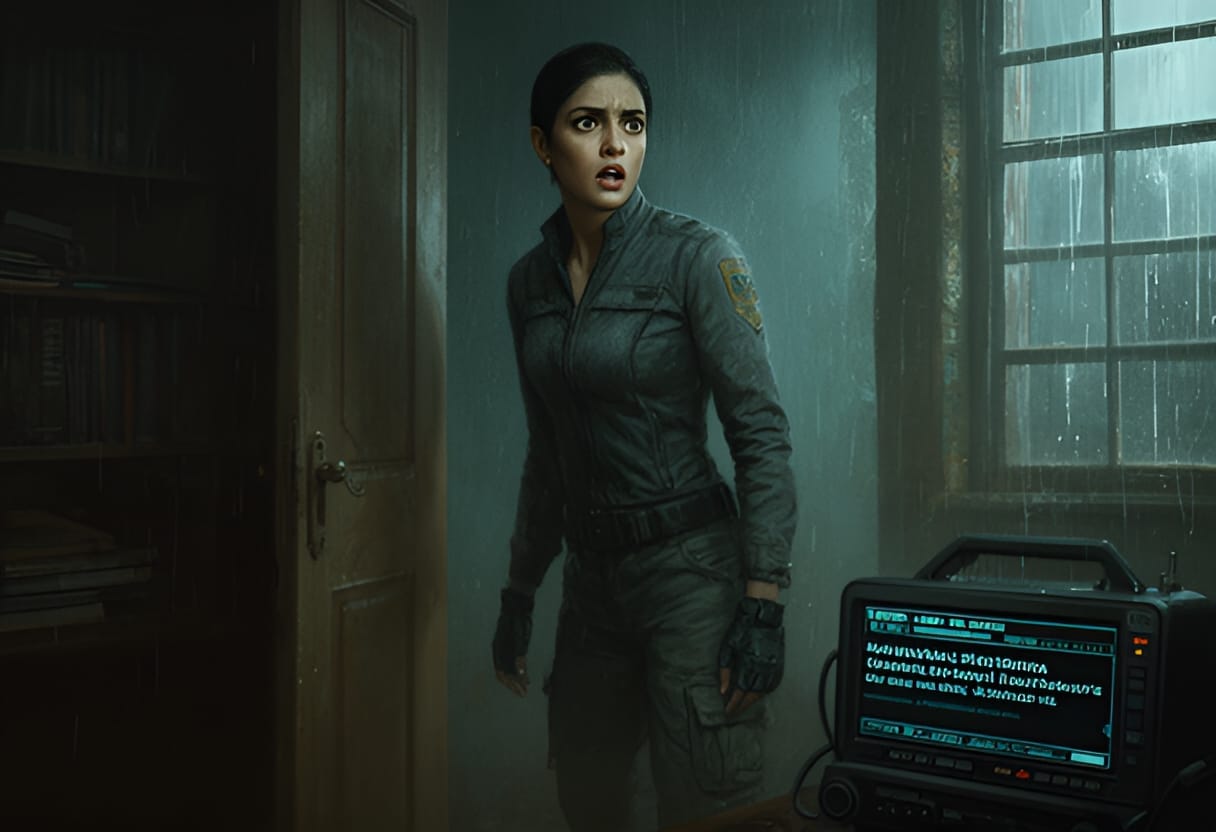
The countdown wasn’t just in the stars anymore.
It was in the silence between heartbeats.
The rain had turned to a steady drumming on the roof as they slipped into the service corridor, the air thick with the scent of damp stone and oil. Rudraksh led, the manuscript pressed flat against his sternum, Kavya just behind him, her fingers brushing the wall for guidance. The tunnel narrowed here, its ceiling low enough that they had to duck, and the flicker of Kavya’s small penlight threw dancing shadows that made the ancient bricks seem to breathe.
Footsteps echoed from the library above—deliberate, unhurried. Too measured to be panic. Someone was coming down the main stair.
“They’re following the false trail,” Kavya whispered. “The one to the west wing.”
Rudraksh nodded, slowing as they reached a junction. A rusted ladder led upward to a maintenance hatch near the observatory. Ananya’s plan. He glanced back. “You sure about this?”
She gave a tight nod. “The lift shaft’s sealed. This is the only way past the west wing without triggering the motion grids.”
They climbed. The hatch groaned open to a narrow catwalk overlooking the observatory’s dome, its glass shattered in places, lenses cracked like frozen spiderwebs. Below, the service lift sat idle at the sub-basement level, its cables slack. To the west, the wing’s corridor stretched into darkness, its emergency lights casting a sickly glow on the checkerboard floor.
A door at the far end swung open.
Ananya stepped into the light, her expression grim, her comms unit gone from her belt. Behind her, Professor Acharya filled the doorway, his coat damp at the shoulders, his smile thin and knowing.
“You’ve been busy,” he said, voice low, meant only for her. “Sabotaging the lift. Misleading the guards. All for a historian who doesn’t even believe in his own bloodline.”
Ananya didn’t flinch. “You spoofed my commander’s voice. You forged an order to detain Rudraksh. You’re not protecting the hotel—you’re clearing the way for something else.”
Acharya’s eyes flicked to the manuscript tucked under Rudraksh’s arm, visible now that they’d emerged. “He’s not a historian tonight. He’s a thief. Security footage shows him lifting the Devmahal heirloom from the vault—a ceremonial dagger, blessed by the last maharaja. Taken just before lockdown.”
“That’s not him,” Ananya said. “You’ve got someone in a mask. Or you’ve doctored the feed. I know his hands. I’ve seen him turn pages for hours without trembling. That thief was wearing gloves and favoring his left—Rudraksh’s right-handed.”
Acharya stepped forward, his voice dropping to a near-whisper. “You’re loyal to the wrong legacy, Ananya. Your father served the Circle. He died believing in the balance. You’re throwing it away for a man who ran from his name.”
“I’m not throwing anything away,” she said. “I’m seeing what you’ve become.”
He sighed, almost sadly. “Such a pity. You had potential. But sentiment is a weakness the Circle cannot afford.”
He snapped his fingers.
Two figures stepped from the shadows behind him—staff in dark uniforms, the insignia of the hotel’s internal security torn from their sleeves, replaced with a simple ouroboros stitched in silver thread. They moved fast, grabbing Ananya’s arms before she could react.
She twisted, kicking hard at the nearest man’s knee, but the second had already jerked her comms unit from her pocket and crushed it under his boot.
“Take her to the cellar,” Acharya said. “Leave the others. Let them run. Let them think they’re escaping. It makes the hunt sweeter.”
They dragged her toward the service stair leading down. As they passed, she locked eyes with Rudraksh one last time—no fear, only a fierce, silent warning: Go. Now.
Then the door slammed shut, and the stairwell swallowed her voice.
Acharya turned to Rudraksh, his expression suddenly benign again, the mentor restored. “You see? Even those closest to us can be led astray by fear. Come, Rudraksh. Let’s get you back to your room. The storm’s worsening. You’ll catch your death out there.”
Rudraksh didn’t move. The manuscript burned against his side. “You framed me.”
Acharya’s smile didn’t waver. “I protected the hotel. And perhaps, in time, you’ll understand why some secrets must stay buried.”
He turned and walked back into the observatory, the door clicking shut behind him.
Silence. Then, from the west wing, a shout—raised voices, boots on tile. The lockdown had begun.
“They’re coming this way,” Kavya breathed. “We need to move—now.”
They didn’t wait for the hatch. Rudraksh shoved it shut and shoved the heavy bolt across, buying seconds. They ran, not toward the main halls, but deeper into the service network, following the route Kavya had traced on her mental map: past the old boiler room, through the ventilation shaft that ran beneath the east wing’s foundation, and out into the drainage culvert that paralleled the falls.
The tunnel sloped downward, the air growing colder, damper. Water dripped steadily from the ceiling, pooling in the channels cut into the stone floor. Somewhere ahead, the distant rumble of thunder blended with the low groan of shifting earth.
They reached the junction where the culvert met the main drain—a wide, arched channel half-filled with slow-moving, brownish water. Kavya paused, pressing her palm to the wet wall.
“This is it,” she murmured. “The outflow. The falls are just beyond that grove of sal trees. The temple steps should be visible from here—if the water hasn’t risen too far.”
Rudraksh peered into the gloom. The rain had turned the forest into a watercolor wash of green and gray, the eastern waterfall a white thread falling into the gorge below. And there, half-submerged in the swelling flood, the top steps of the temple ruin jutted from the water like broken teeth—stone worn smooth by centuries, carved with fading devanagari and the same ouroboros spiral they’d seen in the tunnel.
But it wasn’t the sight that made his breath catch.
It was the light.
Flickering. Unsteady. Coming from inside the ruin.
Someone had lit a torch.
Or worse—someone was already there.
He turned to Kavya, his voice raw. “They knew we’d come this way.”
She was already moving, crouching low, pulling the wrench from her belt. “Then we’re not the hunters anymore.”
They slipped from the culvert into the flood’s edge, the water biting at their boots, tugging at their legs. The temple steps were slick with algae and silt, each one a risk. Rudraksh went first, hand braced against the wall, the manuscript held high above his chest to keep it dry. Kavya followed, her movements precise, silent, eyes scanning the shadows between the pillars.
The torchlight flared again—closer now—casting long, jerky shadows across the inner sanctum. And then, from the darkness beyond the pillars, a voice called out, calm, familiar, dripping with false concern:
“Rudraksh? Is that you? You’re putting yourself in danger. Come out where I can see you.”
Acharya.
He was standing just inside the temple’s inner chamber, framed by the archway, his hands empty, his expression open—too open.
Rudraksh froze. The water swirled around his knees. The conjunction was hours away. The Yantra lay deeper, below. But Acharya was here. Waiting.
And he wasn’t alone.
From the darkness behind him, a shape shifted—tall, armored, the glint of metal at the throat. A guard. Or something more.
Kavya’s grip tightened on the wrench.
Rudraksh swallowed. The countdown wasn’t just in the stars anymore.
It was in the space between one breath and the next.
And it was almost gone.
The water closed over Rudraksh’s head as he ducked beneath the archway, the current tugging at his legs like cold fingers. He kicked hard, surfacing with a gasp, manuscript clutched to his chest, water streaming from his hair. Kavya broke the surface beside him, sputtering, wrench still gripped tight in her fist. The torchlight from within the ruin threw fractured gold across the rippling surface, illuminating the vault’s mouth—a yawning gap in the stone face, half-swallowed by flood and silt.
“Stay low,” Kavya whispered, her voice raw from the chill. “The passage narrows. We’ll need the valves.”
She fumbled at her belt, pulling free two small brass cylinders—breath valves, scavenged from her gear during the frantic escape. She handed one to Rudraksh, who fitted it between his lips with numb fingers. The air tasted of iron and damp stone as he drew it in, shallow and cautious.
They slipped beneath the surface again, the flood swallowing them whole. The passage was a throat of stone, slick with algae and moss, the ceiling low enough that Rudraksh had to arch his back to avoid scraping it. Water rushed past their ears, muffled but insistent, carrying the scent of wet rock and decaying leaf. Kavya moved ahead, her hand trailing along the wall, feeling for the turn she’d memorized from old schematics. Rudraksh followed, the manuscript pressed flat against his chest, the valves keeping his breath steady in the dark.
Then, light.
Not the torch’s flicker from above, but a steady, internal glow—pale and rose-tinted—seeping through the cracks in the passage wall ahead. It pulsed, faintly, like a heartbeat.
They surfaced in a chamber choked with silence and mineral wealth. Stalagmites rose from the floor like frozen fangs, their surfaces glazed with calcite that caught the light and threw it back in prismatic shards. The air was still, thick with the smell of ozone and wet stone. And there, centered on a dais of black basalt, rose the Anant Yantra.
It was not a machine of gears or pistons, but a thing of crystal and stone—a rod of rose quartz, nearly a meter long, suspended vertically above the dais by a lattice of fine silver filaments that vanished into the ceiling. Its base sat within a circular depression etched with symbols Rudraksh recognized: the same devanagari from the manuscript’s margins, the ouroboros swallowing its tail, and beneath it, a sequence of dots and dashes that, when read aloud, formed a warning in Sanskrit: Do not wake the sleeper. The earth remembers.
The quartz glowed with an inner light, soft but insistent, as if breathing. Thin shafts of darkness radiated downward from its tip, vanishing into the bedrock below—drill holes, deep and precise, tapping into the fault lines Kavya had deduced. The Yantra wasn’t just a key. It was a conduit. A tuning fork for the planet’s pain.
Rudraksh lowered the manuscript to the dais, water dripping from its copper binding onto the stone. His breath came fast behind the valve. This was it. The heart of the weapon. The thing Acharya had killed for, lied for, betrayed for.
A sound behind him—soft, deliberate—made him freeze.
He didn’t need to turn to know who it was.
Acharya stepped from the shadow of a stalactite, his robes damp at the hem, his face calm, almost serene. In his hand, he held not a weapon, but a small leather-bound journal—Rudraksh recognized it instantly. His own field notebook, the one he’d lost during the scuffle in the observatory. The one with the marginal notes on the cipher.
“I wondered if you’d come,” Acharya said, his voice echoing softly in the vault. “Not if. When. The Devvards have always returned to this place. It’s in the blood. In the duty.”
Rudraksh kept his hands visible, the manuscript still open on the dais. “You knew we’d follow the water. You let us come.”
Acharya smiled, a flicker of something sad in his eyes. “I didn’t let you. I needed you. The Yantra responds only to a Devvardhan’s touch. The frequency must be keyed to a living lineage. You’re the last. The truest.”
He stepped closer, journal tucked under his arm. “You see it now, don’t you? Not a weapon of annihilation, but of correction. The fault lines beneath Devvan don’t just run under this forest—they curl beneath the capital, under the seats of power where corruption festers like rot in old wood. One pulse. One controlled release. The towers will fall, yes—but not in chaos. In clarity. The old systems will crumble, and from the dust, something just… something true can rise.”
Rudraksh’s throat tightened. “You’d kill thousands to start over?”
Acharya’s gaze drifted to the glowing quartz. “I would save millions by preventing the slow rot. Famine. War. The slow poison of lies. This isn’t destruction, Rudraksh. It’s surgery.”
He extended a hand, not toward the Yantra, but toward Rudraksh. “Come. Stand with me. Help me align the final sequence. Let the Devvardhan name mean something again—not shame, not exile, but purpose. Let us be the architects of the next world.”
Rudraksh stared at that hand—the same hand that had once guided his translations, praised his patience, handed him tea after long nights in the university library. The same hand that had now crushed Ananya’s comms, spun lies, and led them into this flooded tomb.
He didn’t take it.
Instead, he reached for the wrench Kavya had passed to him earlier—still slick with floodwater, still heavy in his grip. He lifted it, not to strike, but to hold it like a promise.
“I’m not here to rebuild your world,” he said, voice low but firm. “I’m here to stop you from breaking it.”
Acharya’s smile faded. The journal slipped from his fingers, landing open on the dais—a page turned to a sketch of the Yantra’s internal resonance matrix, annotated in Acharya’s precise hand.
“Then you’ve forgotten what your family built,” he said quietly. “And what they died to protect.”
From the shadow behind Acharya, the armored figure shifted—a subtle tightening in the shoulders, a shift of weight. The guard. Or whatever it was. It hadn’t moved since they entered. It was waiting.
Kavya stirred at Rudraksh’s elbow, her breath shallow behind her valve. She hadn’t taken her eyes off the figure.
Acharya seemed to sense it. He didn’t look back. “You think you can stop it? The sequence is already primed. The conjunction is minutes away. The Yantra draws power from the alignment—when the stars pull the fault lines taut, it amplifies. All I need is the trigger. A Devvardhan’s palm on the quartz. A word from the old tongue.”
He nodded toward the manuscript. “You’ve already done the work. You’ve translated the key. All that’s left… is to turn it.”
Rudraksh looked down at the open pages. The equations were there—frequency, harmonics, the precise modulation needed to destabilize the resonator rather than activate it. Kavya had shown him how to reverse the phase, how to feed discord into the signal instead of harmony. It was in the margins, half-erased from his own frantic notes after the tunnel discovery.
He could do it. Not with force, but with frequency. A counter-pulse. A lie sung back to the stone.
But to do it, he’d have to get close. Close enough to touch the quartz. Close enough to risk the trigger.
Acharya was counting on that. Counting on his hesitation. His hope that Rudraksh would rather believe in redemption than face the truth: that some legacies aren’t worth saving.
The water in the chamber seemed to hold its breath. The rose quartz glowed brighter, pulsing in time with something far below—something waking.
Rudraksh tightened his grip on the wrench.
He didn’t look at Kavya.
He didn’t need to.
He stepped forward—not toward Acharya, but toward the dais.
And as he did, the armored figure finally moved.
Not to attack.
But to kneel.
One knee on the wet stone, head bowed, the visor of its helmet lifting just enough to reveal the lower half of a face—familiar, scarred, the jawline set in grim recognition.
It was the man from the waterfall. The metallic gleam in the trees. Not a statue. Not a hallucination.
A guard. One of Ananya’s own. One she’d trusted.
And now, he wore the ouroboros on his chest.
Rudraksh’s breath hitched.
The valve fell from his lips, forgotten.
The countdown wasn’t just in the stars.
It was in the betrayal.
And it had already begun.
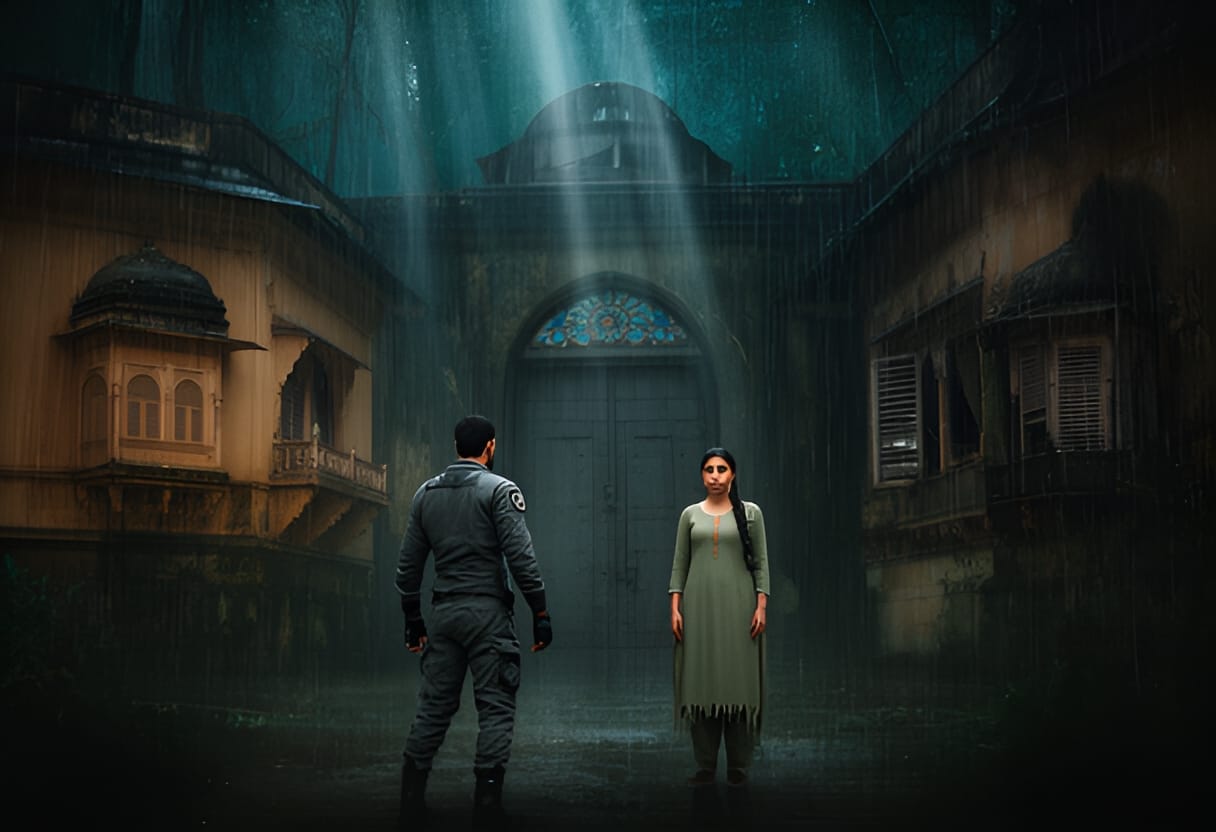
Chapter 3
The Anant Reckoning
The rain had stopped hours ago, but the forest still dripped from the canopy, each drop a slow punctuation in the silence. Rudraksh’s boots sank into the loam as he stumbled between Ananya and Kavya, the weight of exhaustion pressing behind his eyes like a bruise. They had run until the trees thinned and the skeletal outline of Devmahal loomed through the mist—its windows dark, its façade sagging under decades of neglect. Ananya had led them not to the main entrance, but to a service hatch half-buried in ivy near the east wing, her fingers moving fast over the rusted lock. Inside, the air was stale and cold, smelling of stone and damp wool. They moved in silence through corridors lined with portraits of stern-faced Devvardhan ancestors, their eyes following in the gloom.
They reached the vault door just as the first chime of the hotel’s broken clock echoed from somewhere deep within—a sound like a bell submerged in water. Ananya pressed her ear to the metal, then nodded. “He’s inside. Waiting.”
Rudraksh swallowed. The manuscript lay in his pack, its copper binding cold against his spine. He had thought they were running from Acharya. Now he realized they had been running toward him.
Ananya pushed the door open.
The vault was vast, carved from the bedrock beneath the hotel, its walls lined with niches holding artifacts that glinted faintly in the gloom—bronze astrolabes, jade seals, scrolls sealed in lacquer. At its center stood a dais of black stone, and upon it, the Anant Yantra: a concentric array of brass discs and crystal filaments, humming with a low, subsonic thrum that made Rudraksh’s molars ache. Above it, suspended in a frame of oxidized copper, pulsed a single crystal the size of a fist—clear, faceted, and alive with internal light.
And there, standing before it with his hands clasped behind his back, was Professor Acharya.
He turned as they entered, his robes of deep indigo sweeping the stone. His face, usually calm and scholarly, was tight with anticipation. “You came,” he said, voice echoing softly. “I knew you would. The blood remembers what the mind forgets.”
Rudraksh stepped forward, Ananya and Kavya flanking him. “You lied to me,” he said. “You used me.”
Acharya smiled, sad and knowing. “I revealed the truth. You were never meant to walk this path alone. The Devvardhan line is the key. Not because of bloodright—but because of resonance. Your father understood that. He fled because he feared what he could do… not what he might become.”
Rudraksh’s throat tightened. “My father left because he feared what the legacy could become.”
“And he was right to fear it,” Acharya said. “But fear is not wisdom. The Yantra does not destroy—it corrects. The surface world has grown corrupt, bloated with false gods and hollow democracies. It needs a reset. A cleansing. And only the Devvardhan blood can attune it.”
He lifted his hand. In his palm rested a ceremonial blade—thin, curved, etched with Sanskrit mantras that seemed to shift when not looked at directly. “Give me your hand, Rudraksh. Not as a student. Not as a guest. As heir.”
Rudraksh stared at the blade. The edge caught the dim light, razor-thin. He could feel the pulse in his own wrist, frantic and loud. He had spent years running from this name, this house, this expectation. And now, here it was—demanded not as honor, but as fuel.
“You don’t understand what you’re waking,” he said.
“I understand perfectly,” Acharya replied, stepping closer. “You think I want this? I have spent decades trying to avoid it. But the cycles align. The stars remember. And the Yantra stirs.”
He stopped before Rudraksh, blade extended. “Cut your palm. Let the Devvardhan blood seal the circuit. Or I will take it.”
Rudraksh looked past him—to Kavya, eyes wide and fixed on the crystal oscillator at the heart of the Yantra; to Ananya, hand already drifting toward the baton at her belt. He closed his fingers into a fist. Then, slowly, he opened his palm and drew the blade across it.
Pain bloomed, sharp and clean. Blood welled, dark and thick, spilling over the lines of his skin. Acharya caught his wrist, holding it over the dais. A single drop fell.
It struck the central crystal.
For a heartbeat, nothing.
Then the Yantra screamed.
Not a sound, but a sensation—a subsonic wave that slammed into their chests, knocking the breath from their lungs. Rudraksh doubled over, gasping, as pressure built behind his eyes. Hot fluid trickled from his nostrils. Kavya clutched her ears, screaming silently, her wrench slipping from her grasp. Ananya staggered, one hand braced against the wall, blood streaking her upper lip.
The crystal flared—blinding white—and then shattered.
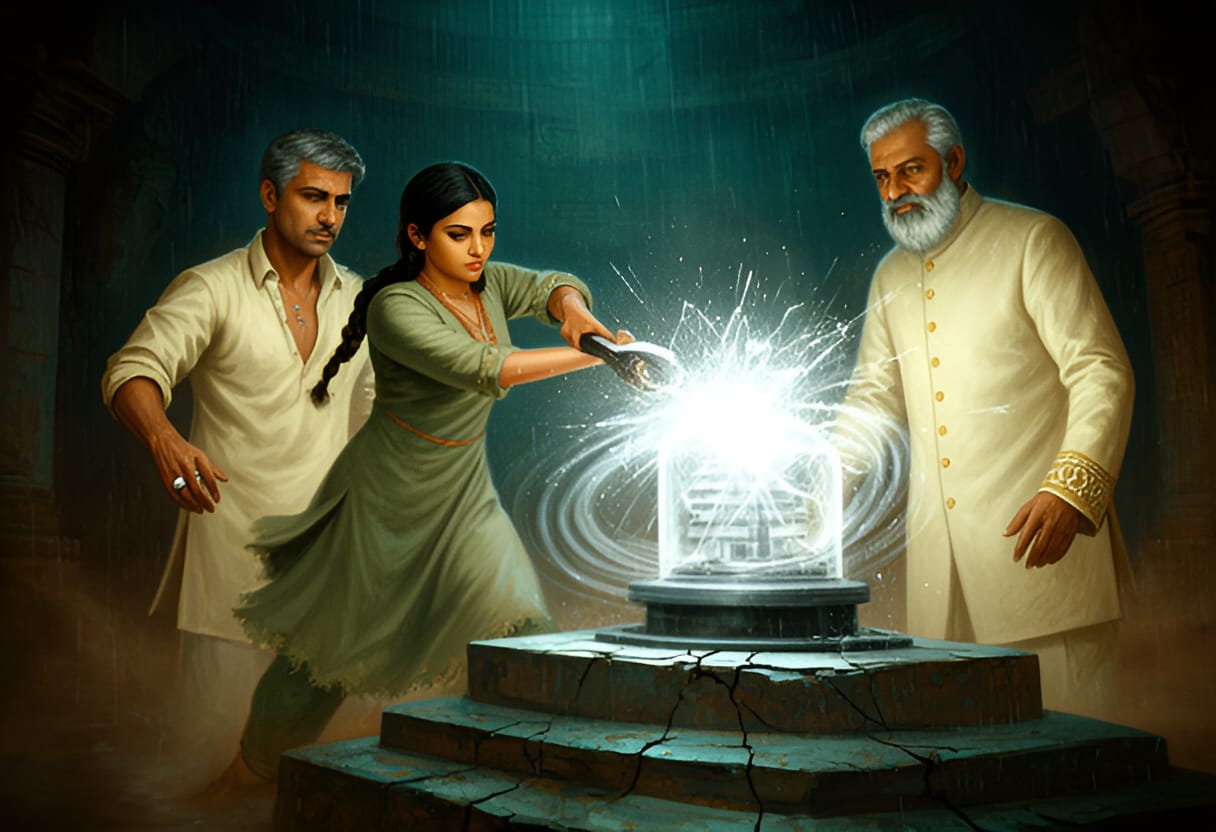
Kavya had swung.
The wrench came down in a wide arc, striking the oscillator’s housing. The impact sent a spray of shards flying like teeth across the stone floor. The Yantra shuddered, its harmonic frequency collapsing into chaos. The hum became a screech—a sound not heard, but felt in the bones, in the marrow, in the roots of their teeth.
Rudraksh gasped, vision swimming. The dais beneath Acharya’s feet began to split. Hairline fractures spiderwebbed outward from the point of impact, racing across the black stone like ice underfoot. Dust rained from the vaulted ceiling in slow, choking clouds.
Acharya staggered back, face twisted not with pain, but with fury. “You fools!” he roared, voice raw. “You don’t know what you’ve done! This isn’t destruction—it’s delay. The resonance is destabilizing. The Yantra will tear itself apart—and take the plateau with it. Millions will die in the ensuing chaos! You think you’ve stopped me? You’ve doomed the very thing you sought to protect!”
He lunged, not at them, but at the dais, hands scrambling over the fractured stone, trying to realign the displaced crystal shards with bleeding fingers. “The circuit must be closed! The alignment must be precise! You’ve doomed us all!”
Rudraksh pushed himself up, blood slick on his palm, breath raving in his ears. He looked at Kavya—her face pale, eyes locked on the wrench in her hand, chest heaving. At Ananya—already moving, not toward Acharya, but toward the vault door, her expression grim, resolute.
The vault groaned.
Somewhere above, the timbers of Devmahal creaked in protest.
And the Yantra, wounded and screaming, began to tear itself apart.
The vault shuddered again, a deep groan that seemed to rise from the earth itself. Rudraksh wiped blood from his nose with the back of his hand, smearing it across his cheek. Acharya was on his knees, fingers bloody and trembling as he shoved a shard of crystal back into its housing, forcing it against the jagged edge of the fracture. The Yantra’s scream had not ceased—it had mutated, a subsonic thrum that vibrated in Rudraksh’s molars, making his vision pulse at the edges.
“It’s not aligned!” Acharya gasped, voice raw. “The phase is off by a fraction—you’ve thrown the harmonics into chaos! If I don’t reset it now, the feedback will cascade—”
He lunged for another shard, but Kavya stepped forward, wrench raised—not to strike, but to block. “You’re going to kill us all if you keep trying,” she said, her voice tight but clear. “Let it go.”
Acharya snapped his head toward her, eyes blazing. “You don’t understand! This isn’t about power—it’s about balance! The world has been rotting for centuries! The Yantra isn’t a weapon—it’s a scalpel!”
“Then why does it feel like it’s tearing the mountain apart?” Rudraksh pushed himself to his feet, blood dripping from his palm onto the stone. He swayed slightly, the world tilting, but he held his ground. “You said it corrects. This isn’t correction—this is rupture.”
Acharya staggered back, chest heaving. “You think I want this? I’ve spent my life trying to avoid the moment the blood would be called! But the stars don’t lie. The cycle demands it. And now—now you’ve forced my hand!”
He made a sudden lunge, not at them, but at the control rod—a long, slender shaft of obsidian-inlaid alloy that ran vertically through the heart of the oscillator housing. With a grunt, he slammed it downward, trying to reseat it into its socket. The movement sent another spike of resonance through the floor. Dust rained thicker now, and from somewhere above, a timber cracked like a gunshot.
Ananya was not there.
The last Rudraksh had seen of her, she had been staggering toward the door, hand braced against the wall, blood on her lip. He had assumed she was retreating, regrouping. But the vault door was still shut—massive, slab-thick stone, etched with ouroboros circles and Sanskrit glyphs that now pulsed faintly, as if reacting to the instability within.
Where had she gone?
A sharp crack echoed from the corridor beyond the vault’s outer chamber—a sound like a baton striking flesh, followed by a choked gasp.
Then voices. Low, urgent. Accented. The guards. Acharya’s loyalists, drawn by the commotion.
Rudraksh’s blood turned to ice. They were trapped. The vault was sealing itself from the inside—no, not sealing. Collapsing. The fractures in the dais were spreading, and the Yantra’s scream was growing louder, more erratic, like a heart fibrillating.
He turned to Kavya. “We need to get out. Now.”
She nodded, eyes flicking to the flooded inlet—a narrow, arched tunnel on the far side of the chamber, where groundwater seeped in through ancient stone, usually just a trickle. Now, it was swelling, dark water rising at the edges, bubbling as if heated from below.
“It’s flooding,” she said. “The pressure’s breaking the seals. We can use it—follow the outflow. It leads to the old aqueducts, then the eastern caves.”
Rudraksh glanced at Acharya, who was now struggling to realign the control rod, knuckles white on the shaft. “And him?”
Kavya’s jaw tightened. “He won’t come willingly.”
Before Rudraksh could answer, a new sound split the air—not a shout, but a roar. Raw, furious, utterly unlike Ananya’s usual composure.
“HEY!”
They all whipped toward the vault’s inner archway—the passage leading back to the corridor.
Ananya stood there.
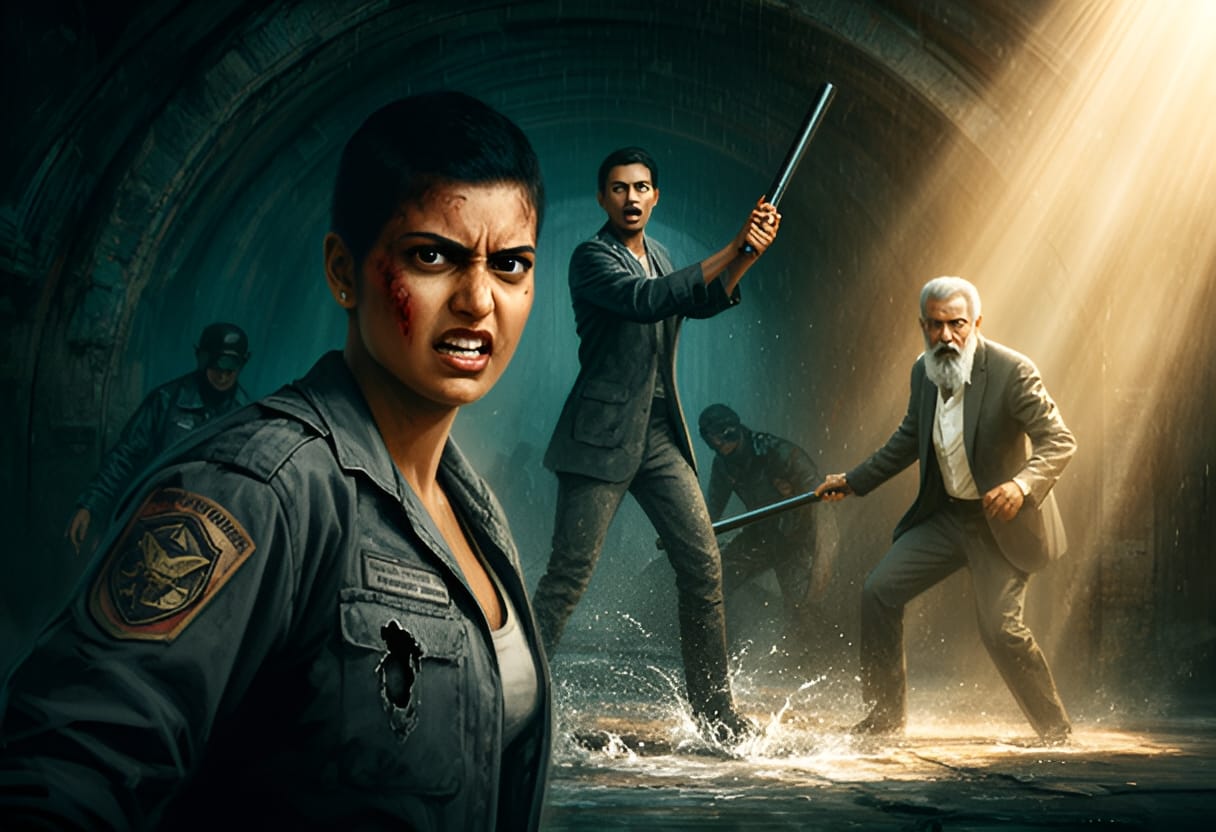
She was bruised, her uniform torn at the shoulder, one eye already swelling shut. Her hair had come loose from its bun, strands plastered to her forehead with sweat and something darker—blood, maybe, or grime. In her right hand, she gripped a metal baton—not hers, but the standard-issue kind carried by the guards. In her left, she held a hairpin, bent and twisted from use.
And behind her, slumped against the wall just beyond the archway, lay two guards. One was unconscious, his head at an unnatural angle. The other was trying to push himself up, face twisted in pain, but Ananya’s boot was planted firmly on his chest, pinning him down.
She didn’t look at them. Her eyes were locked on Acharya, who had frozen mid-lunge, the control rod still clutched in his hands.
“You’re not putting it back together,” she said, voice low, dangerous. “Not while I’m still breathing.”
Acharya straightened slowly, the rod lowering slightly. “Ananya. You should have stayed in your cell. You have no idea what you’re meddling with.”
“I know exactly what you’re meddling with,” she replied, taking a step forward. “And I know what happens when you let a man with a god complex play with forces he doesn’t understand.”
Acharya’s lips curled. “Sentiment. You’ve always been too soft for this work. That’s why they broke you in the field.”
Ananya didn’t flinch. “Maybe. But I still know how to break a neck.”
She lunged.
Not at him—but past him, swinging the baton in a wide, brutal arc that caught him across the ribs. He gasped, wind knocked out of him, and stumbled sideways—right into the rising floodwater at the edge of the inlet.
The water surged upward as he fell, sucking at his boots, swirling around his waist. He scrambled, hands slapping against the slick stone, trying to gain purchase—but the current was stronger than it looked, tugging at his legs, pulling him deeper into the darkness beyond the arch.
Ananya didn’t hesitate. She stepped forward, planted her foot on his lower back, and shoved.
He vanished under the brown-green rush with a strangled cry, swallowed by the torrent.
Silence fell, broken only by the Yantra’s wail and the groan of stone.
Ananya turned to them, chest heaving, baton still raised. Her eyes flicked to Rudraksh’s bleeding palm, then to Kavya’s wrench, then to the dais, where the crystal shards lay scattered like broken teeth, the control rod now askew and vibrating faintly.
“We don’t have much time,” she said. “The outer seal’s weakening. I saw the fissure running along the lintel—water’s starting to seep through the joints. If the pressure equalizes, that slab’s going to blow.”
Rudraksh pushed off the wall, vision swimming. “Then we go. Now.”
Ananya shook her head. “Not yet. I need to buy you time. The inlet’s only a temporary delay—once the Yantra fully destabilizes, it’ll send a shockwave through the bedrock. The whole chamber could implode. If we’re going to make it to the aqueduct, we need the outer door held just long enough to get clear.”
She looked at Kavya. “You know the passage. Take him. Go left at the fork—follow the old drainage channels. They’ll spit you out near the eastern ruins. The monsoon’s high—you’ll have cover.”
Kavya opened her mouth to protest, but Ananya held up a hand.
“I’m not asking. I’m telling you.”
She turned back to the vault door—a monolithic slab of black stone, slightly ajar now, pushed inward from the force of the internal surge. Water was beginning to trickle through the gap, dark and cold, carrying fine silt.
“I’ll hold it,” she said. “As long as I can. Then I’ll follow.”
Rudraksh stepped toward her. “You don’t have to do this.”
She finally looked at him, really looked. One eye was nearly swollen shut, but the other was sharp, clear. “Yes, I do,” she said quietly. “I failed my team once. I won’t fail you.”
Before he could respond, she spun and threw her weight against the door.
It groaned inward, resisting, then gave a few inches—just enough for her to squeeze through sideways, bracing her shoulder against the stone, feet braced on the slick floor. The baton was now pressed horizontally across the gap, wedged between the door and the jamb, a makeshift bar.
Water began to pour in faster now, swirling around her ankles, tugging at her boots.
“Go!” she shouted over the rising roar. “Now!”
Rudraksh didn’t wait. He grabbed Kavya’s arm—she stumbled, then caught herself—and they turned, sprinting toward the flooded inlet.
The water was waist-deep now, cold and furious, sucking at their legs as they plunged in. Behind them, Ananya grunted as the door shuddered under pressure, the baton flexing but holding.
Then came the sound—not a crash, but a deep, resonant thoom, like a bell struck underwater.
The Yantra had reached its breaking point.
Light exploded behind them—not fire, but a blinding, white-blue flash that seemed to come from the very stone itself, followed by a shockwave that hit like a physical blow.
The inlet collapsed.
Rudraksh felt the water yank him sideways, then upward, as if the floor had vanished. He swallowed mud and cold, twisted in the dark, lungs burning—then slammed against stone, air knocked out of him.
He didn’t lose consciousness. Not quite. But when he opened his eyes, the world was muffled, distant.
He was lying on a sloping tunnel floor, water rushing past his ears. Kavya was beside him, coughing, her face streaked with mud and blood. Above them, the tunnel shook, dust falling in slow motion.
And far above, through a fissure in the ceiling, he could just make out the black stone of the vault door—still holding.
For now.
A hand gripped his wrist—Ananya’s. Her face was inches from his, water streaming down her temples, her expression grim but alive.
“I told you I’d follow,” she whispered.
He tried to speak, but the water took his words.
Above them, the Yantra screamed one last time—and then fell silent.
Rudraksh’s grip on Kavya’s arm tightened as the current seized them, dragging them sideways into the black throat of the inlet. The water was colder than ice, sharp with silt and the metallic tang of ruptured stone. It filled his mouth, burned his nostrils, and for a heartbeat he thought he would drown before they even reached the tunnel. Kavya gasped beside him, her fingers digging into his wrist, nails breaking skin. They were tumbling, overturned, slammed against jagged edges that tore at his clothes and scraped fire across his shoulders.
Then, suddenly, the rush eased—not stopped, but channeled—and they shot forward into a narrower passage where the water flowed faster, deeper. Rudraksh kicked hard, twisting his body to face upstream, lungs screaming for air he couldn’t draw. Kavya was ahead of him, her silhouette a frantic blur in the gloom, one hand braced against the wall, the other flailing for balance.
He caught her elbow, yanking her back just as a slab of dislodged masonry spun past where her head had been, striking the opposite wall with a sound like a bell cracked underwater.
“Left!” she choked out, water spraying from her lips. “The ledge—”
He saw it then: a narrow shelf of stone jutting from the tunnel wall, half-submerged, slick with algae and seepage. They lunged for it, Kavya hauling herself up first, coughing and sputtering, her soaked robes clinging like weights. Rudraksh followed, scrambling onto the ledge, his boots slipping on the wet stone. He pressed his belly against the rock, gasping, water streaming from his hair and jaw, his vision blurred by mud and the afterimage of that white-blue flash.
Above them, the tunnel shuddered. A low, deep groan rolled through the bedrock, not sound but vibration—felt in the molars, in the hollow of the chest. Dust trickled from the fissure in the ceiling, spiraling down like ash in reverse.
And then, through the churning gloom behind them, he saw her.
Ananya.
She was still braced against the vault door, one shoulder driven into the stone, the baton locked horizontally across the gap, her feet planted wide on the slick floor. Water rose to her mid-thigh, swirling with debris—chips of crystal, fragments of brass, a torn scrap of dark cloth that might have been her sleeve. Her face was a mask of strain, jaw clenched, one eye nearly swollen shut, the other blazing with fierce, exhausted focus. Blood traced a thin line from her temple, mixing with the water on her cheek.
She saw him looking.
“GO!” she screamed, her voice raw, torn from her throat by the roar of the building collapse. “NOW—”
As she shouted, the lintel above the door split with a sound like thunder heard through wool—a deep, jagged fracture racing across the black stone, spidering outward from the center. Dust and fine gravel rained down. The door shivered inward another inch, the baton groaning under the strain.
Ananya didn’t flinch. She pushed harder, her back arched, muscles cords standing out in her neck. “GO!” she repeated, quieter this time, but no less urgent. “GET OUT—”
Then the surge came.
It wasn’t a wave, not exactly—it was the tunnel itself exhaling. The water rose in a sudden, violent lift, as if the floor had kicked upward from below. It caught them off the ledge, tearing Kavya from Rudraksh’s grasp, spinning him violently in the dark. He lost all sense of up and down, tumbling head over heels, striking stone, then nothing, then stone again—his shoulder, his ribs, the back of his skull. The roar filled his ears, not water but stone groaning, fracturing, giving way. Somewhere, a sharp crack echoed like a rifle shot in a tomb.
Then, as suddenly as it had begun, the motion ceased.
He slammed against a ledge—wider this time, higher—and clung, coughing, water pouring from his nose and mouth. His chest burned, each breath a knife drag. Kavya was beside him, half-slung over the stone, her face pressed to the rock, shuddering as she tried to draw air. Above them, the tunnel ceiling had collapsed in a jagged mouth, revealing a churning vortex of dark water and falling debris where the vault had been.
And where the door had stood—now only a plume of silt and a sucking whirlpool marked its passing.
He twisted, heart hammering against his ribs, and looked back.
The vault was gone.
In its place, a collapsing maw of stone and water, the edges crumbling inward as the pressure from above and below met in violent equilibrium. Dust and spray hung in the air like the breath of a dying beast. And for one suspended, horrifying instant, through the chaos, he thought he saw a shape—still, braced, one hand outstretched—not quite swallowed, not yet lost.
Ananya.
Her face was turned toward the tunnel, eyes open, locked on him. Not fear. Not anger. Something deeper. Resolve. Farewell.
Then the final shift came—a deep, shuddering thoom that seemed to come from the bones of the earth itself—and the outer vault door, the last barrier, the monolithic slab of black stone, groaned inward one final time and slid shut with a sound like a tomb sealing.
It met the jamb with a deafening thud, and the light—what little had filtered through the fissure—vanished.
Darkness swallowed everything.
Silence followed, thick and absolute, broken only by the distant, fading groan of settling stone and the rush of water rushing to fill the void left behind.
Rudraksh lay on the ledge, trembling, water dripping from his chin, his hands slick on the stone. Kavya was still coughing beside him, her body curled inward, one arm wrapped protectively over her head. The tunnel walls wept slowly, droplets falling into the black water below.
He wanted to scream. To rage. To claw back through the collapsing mountain and pull her out.
But the way was gone.
The door had held.
And she had made sure it would.
His breath came in ragged gasps. His palm, cut open earlier, throbbed in time with his pulse. He looked down at it—the wound still wet, not with blood alone, but with something darker, mixed with the silt and the stone dust. It didn’t feel like his anymore.
Above them, the mountain shuddered once more—then fell still.
Kavya stirred, pushing herself up on trembling elbows. Her face was streaked with mud and blood, her eyes wide, unfocused. She opened her mouth. No sound came out.
Rudraksh reached for her, his fingers brushing her shoulder. She flinched, then leaned into his touch, her breathing beginning to slow, uneven but present.
They sat in the dark, on a narrow ledge in a flooded tunnel beneath a sinking hotel, the water rising slowly around their ankles, the silence pressing in like a shroud.
And somewhere, deep in the stone, the last echo of Ananya Mehta’s voice—I told you I’d follow—lay not in the air, but in the hollow of his chest, where fear and gratitude and grief had begun to fuse into something harder, heavier, and utterly final.
Rudraksh pressed his forehead against the cold stone, the rain finding every crack in the tunnel ceiling and stinging his scraped knuckles. The water at their ankles had turned icy, each breath a struggle against the damp that clung to his lungs like wet wool. Kavya’s shoulder was warm where it touched his, her breathing slowly evening out. He could feel the tremor in her hands, the way her fingers dug into the rock not from fear now, but from the effort of staying upright.
He lifted his head. The fissure above yawned wider, a jagged wound in the mountain’s belly. Through it, the sky was a churning slate, sheets of rain slanting sideways with the force of the monsoon’s peak. Thunder rolled, not as a crack but as a low, sustained growl—like the earth itself was settling after a long-held breath.
They moved slowly, Kavya leading, her bare feet finding purchase on the slick stone where his boots had failed. The tunnel opened into a chamber half-filled with water, its arches choked with fallen masonry. Fragments of carved friezes lay half-buried—lotus buds, intertwined serpents, the faint outline of an ouroboros eating its own tail. The Devmahal seal, once proud above the library door, now facedown in the silt, its gold leaf worn away to nothing.
They climbed. The ascent was treacherous, the steps eroded into ramps of mud and rubble. Rudraksh stumbled twice, Kavya catching his elbow each time without a word. When they finally breached the surface, it was not into air but into a downpour that felt like being struck.
The temple courtyard lay in ruins. The eastern wall of Devmahal had given way in a great, diagonal crack, the stone tilting inward as if bowing to the weight of what lay beneath. Water streamed down its face, carrying with it dust, broken tile, and the occasional shard of glazed pottery that caught the dim light like teeth. The central dome, once a beacon of copper and stone, had sunk several feet into the earth, its base now ringed with a moat of runoff that churned toward the forest beyond.
Rudraksh stood at the edge of the courtyard, rain plastering his hair to his forehead, and watched the building sink. Not dramatically, not with a roar, but with the slow, inexorable sag of something overburdened finally yielding. The western wing remained standing, stubborn and dry, but the eastern façade—where the waterfall had once fed the reflecting pools—was now a wound in the stone, the arches yawned open like broken ribs.
Kavya was already moving, her eyes scanning the mud near the collapsed archway where the inlet had spat them out. She knelt without hesitation, her fingers digging into the silt, pulling free a twist of metal and glass.
Acharya’s spectacles.
One lens was gone, shattered or lost in the flood. The other remained intact, the wire frame bent but recognizable. Rudraksh took them from her palm, the metal cold and slick with rain. He lifted them to his eyes.
The world distorted—straight lines bowed, the rain became a smear of silver threads, the tilted wall loomed unnervingly close. He could see the individual grains of sand in the mortar, the way the crack widened minutely with each shudder of the earth. It was a vision both clearer and false, as if the glasses had been calibrated not for sight, but for some other kind of seeing—one that had led Acharya here, to this moment, to this belief.
He lowered them slowly, the weight unfamiliar in his palm. Then, with deliberate care, he laid them on a flat stone beside the cracked step, where the rain would not immediately bury them. The intact lens caught the light, a single unblinking eye staring up at the sky.
“I can’t go back,” he said, his voice rough from disuse and smoke. “Not to the archives. Not to any hotel, any library, any place where they keep things behind glass and call it knowledge.”
Kavya remained kneeling, her hands resting on her thighs, water streaming from her elbows. She didn’t look at him. Her gaze was fixed on the sinking wall, on the way the water had begun to pool in the courtyard’s center, mirroring the sky.
“You think I want to forget?” he continued. “I don’t. I want to remember—everything. The manuscript, the cipher, the way the dots and dashes felt like a heartbeat under my fingers. I want to remember Ananya’s voice in the dark. I want to remember Acharya’s face when he shoved me aside—not with anger, but with the terrible certainty of a man who believes he’s saving the world.”
He paused, swallowing rain and the metallic tang at the back of his throat. “But I can’t carry it like a relic. Not if it means pretending the world is still made of texts and footnotes. Not after what we’ve seen beneath the stone.”
Kavya finally turned her head. Her eyes were red-rimmed, but dry. She reached into her soaked tunic and pulled out a small flask—silver, engraved with a faded lotus. She unscrewed the cap and offered it to him.
He drank. The water was warm, tinged with iron and something herbal. It burned going down, but it cleared the silt from his throat.
She stood, brushing mud from her knees, and slipped the flask back into her belt. “I’m going back to the ruins,” she said. “There’s a chamber beneath the western library that didn’t flood. The shelves held. The codices are dry. I… I need to see if the marginalia are still there. The ones about the falling stars.”
Rudraksh nodded. He didn’t ask if she wanted company. He knew the answer before she gave it.
She walked a few steps toward the tree line, then stopped. Didn’t turn. “You don’t have to walk alone,” she said, her voice low, almost lost in the thunder. “But I understand if you need to.”
He watched her go, the rain turning her dark hair to a rope of water, her steps sure despite the ruin. When she reached the treeline, she paused once more, not looking back, then disappeared into the green-gloom of the Devvan forest.
Alone, Rudraksh turned his face to the sky. The rain stung his eyes, washed the last of the silt from his wound. The cut on his palm throbbed in time with his pulse, but the darkness beneath the scab had faded—no longer foreign, no longer alien. Just his. Just blood.
He began to walk.
Not toward the ruined hotel, not toward the village at the forest’s edge, but along the faint game trail that wound east, where the land rose slightly, where the trees stood thicker against the wind. His boots sucked at the mud, each step a effort, each breath a reminder that he was still alive.
Behind him, Devmahal continued to sink—not dramatically, not with a final crash, but with the quiet, irreversible settling of a thing that had served its purpose. The eastern wall had stopped tilting. The water in the courtyard had stilled, reflecting the broken sky like a shattered mirror.
He did not look back.
He walked until the rain lessened to a drizzle, until the thunder moved east, until his legs ached and his throat was raw from silence. He walked until the forest opened onto a rocky bluff overlooking a valley veiled in mist, where the river Devvan curled like a silver thread beneath the clouds.
He stopped. Sat on a sun-warmed stone, though no sun showed. Took from his pocket the flint scrap Acharya had once given him—a token, he’d said, for safe journeys. He turned it over in his palm. No inscription. Just a smooth river stone, worn by time.
He did not pray. He did not vow. He simply sat, and let the mist settle on his shoulders, and let the silence—not the silence of absence, but of presence—fill the space where noise had been.
Somewhere below, the river ran on. Somewhere above, the clouds began to break.
And Rudraksh Devvardhan, historian, son of a lost line, bearer of a name he could no longer claim, breathed—not for the first time since the vault, but for the first time as himself—and waited not for an answer, but for the courage to ask the next question.