Education
Ringkasan Aqidah
by Aku Malu
2 chapters52 min read
Chapter 1
Foundations of Faith: Understanding Tawhid and Iman
What Is Aqidah?
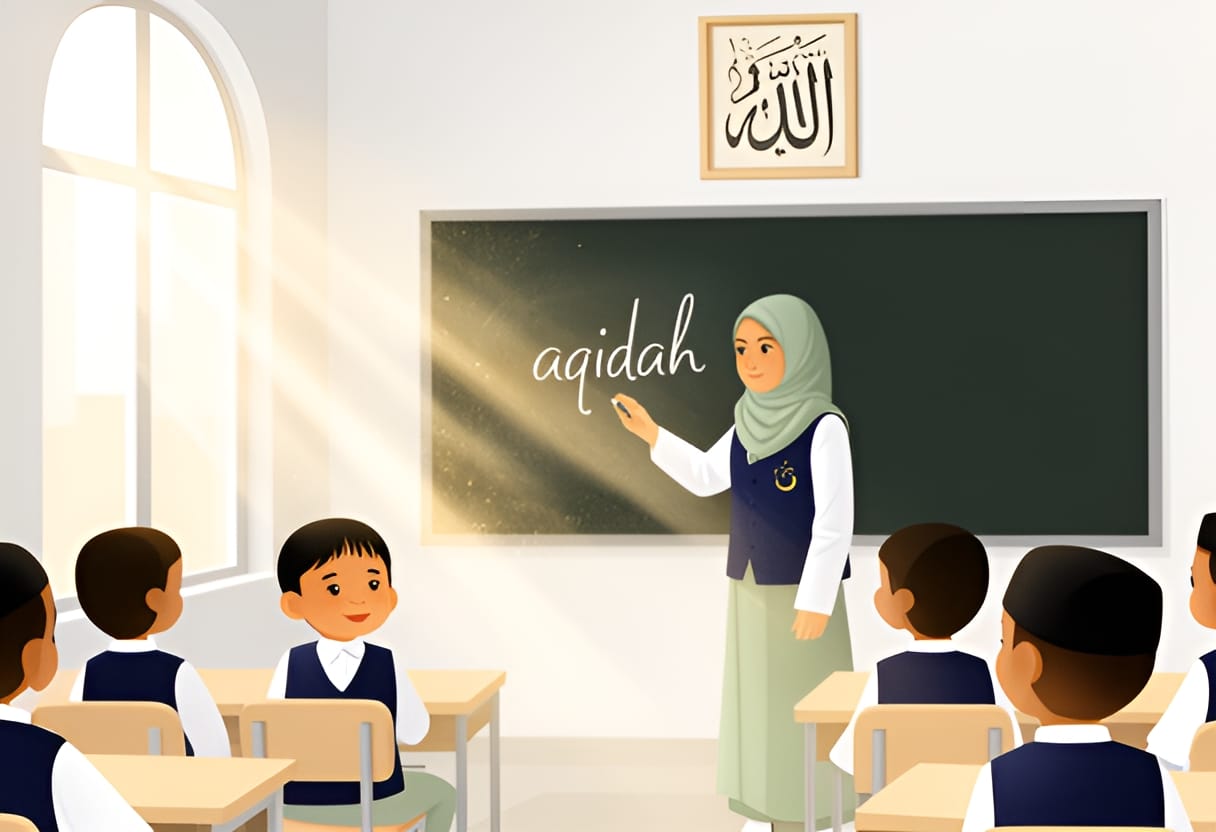
Ustadzah Siti stood at the front of the classroom, her voice calm as she looked at the eager faces of her third-grade students. “Today,” she began, “we will talk about something very special — what we truly believe in our hearts as Muslims.”
A quiet hush fell over the room. Adi leaned forward, his hands clasped tightly on his desk. Budi, who usually stared out the window, turned his attention to the teacher.
Understanding Aqidah
Ustadzah Siti wrote the word aqidah on the board in neat Arabic script, then underneath in Latin letters. “Aqidah,” she said, “is what a Muslim believes with certainty in the heart. It is not just saying words with the tongue. It is a deep conviction that shapes how we think, feel, and act.”
She paused, letting the idea settle. “For example, if someone says, ‘I believe in Allah,’ but then acts as if money or power controls everything, their aqidah is not strong. True aqidah means the heart is sure, and the limbs follow.”
Adi raised his hand. “Ustadzah, is it like when my father says we should trust Allah even when we are scared?”
“Exactly,” Ustadzah Siti smiled. “When fear comes, a person with strong aqidah remembers that Allah is in control. Their belief is not just a thought — it is a refuge.”
She explained that aqidah includes belief in Allah, His angels, His books, His messengers, the Last Day, and divine decree — whether good or bad. “These are not stories we take lightly,” she said. “They are truths revealed in the Quran and taught by the Prophet Muhammad ﷺ.”
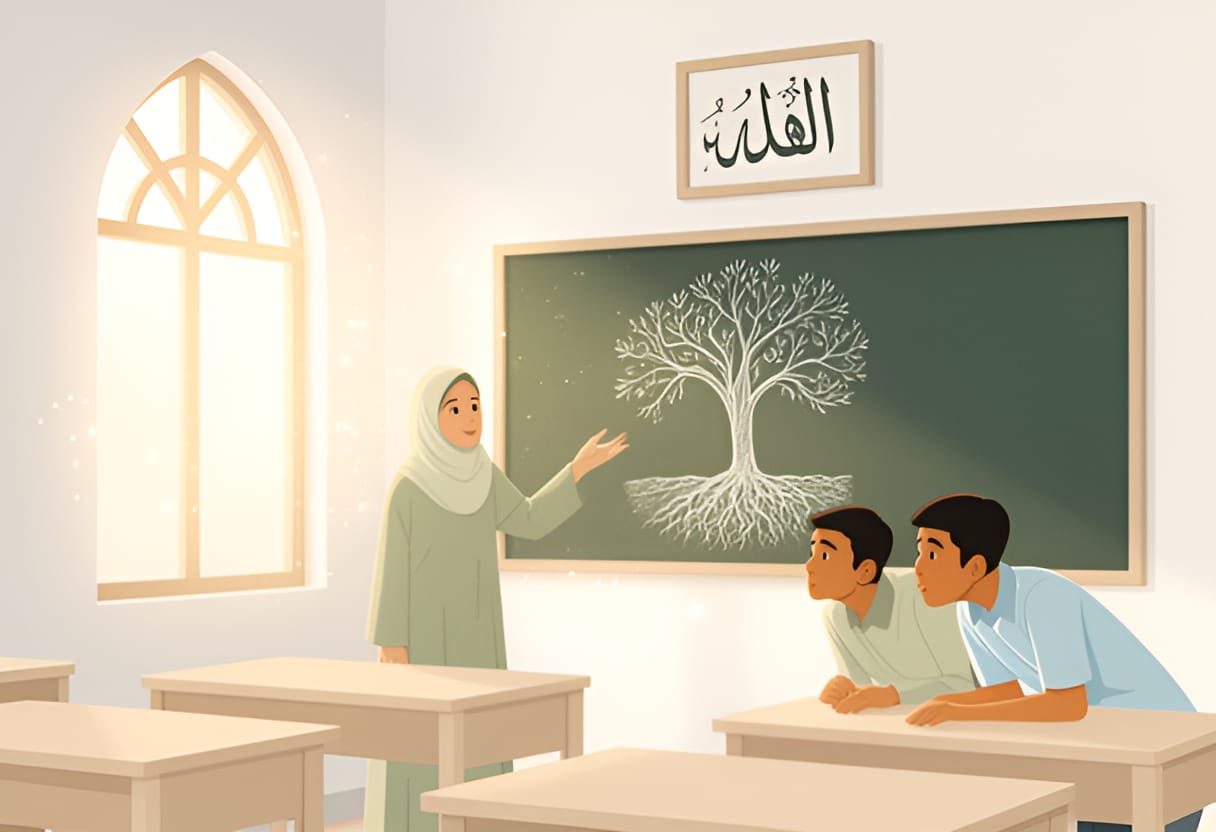
To make it concrete, she shared a simple analogy. “Imagine a tree,” she said. “The roots are hidden underground, but they hold the tree upright. If the roots are weak, the tree falls in the storm. Aqidah is like the roots of a Muslim’s life. You may not see them, but they keep you standing when life gets hard.”
Illustration
A simple diagram showing a tree with labeled roots: belief in Allah, angels, books, prophets, the Last Day, and divine decree. The trunk is labeled 'actions and intentions', and the branches show outcomes like honesty, kindness, and patience.
Budi frowned thoughtfully. “So if I say I believe in Allah but lie to get out of trouble, my roots are weak?”
Ustadzah Siti nodded. “Yes, Budi. Actions that contradict belief show where the heart truly is. Aqidah is not measured by what we say alone, but by what we do when no one is watching.”
Speech vs. Conviction
To illustrate the difference between mere speech and true conviction, Ustadzah Siti told a short story.
“There once was a student who loved to recite the Shahadah beautifully during assembly. Everyone praised his voice. But when the teacher left the room, he would tease his classmates and take their snacks without asking. One day, a new student asked him, ‘Do you really mean what you say?’ The boy paused. He had never thought about it before.”
She looked around the room. “The words were on his tongue, but his heart was not convinced. True aqidah means the belief is so firm that it changes behavior — even when it is hard.”
Adi whispered to Budi, “I think I sometimes say ‘Bismillah’ before eating but forget to be thankful after.” Budi nodded. “Me too. Maybe we need to check our hearts more often.”
Ustadzah Siti added that conviction grows through reflection and remembrance. “When we think about the signs of Allah in nature — the rain, the mountains, the stars — our hearts feel awe. That awe strengthens belief. It is not enough to repeat phrases. We must let them sink in.”
She gave a practical example. “Before eating, instead of just saying ‘Bismillah’ quickly, pause for one breath. Think: ‘This food comes from Allah.’ That small pause turns a habit into an act of remembrance.”
How Aqidah Guides Life
Ustadzah Siti explained that aqidah is not abstract theology — it is a compass for daily life. “When a Muslim believes that Allah sees everything, they are more likely to return a lost item, even if no one saw them pick it up.”
She gave a real-life scenario from the madrasah. “Last week, Adi found a wallet near the gate. It had money inside. He could have kept it. But he brought it to me. Why? Because he believes Allah is Al-Basir — the All-Seeing. His aqidah guided his action.”
Adi blushed. “I just didn’t feel right keeping it.”
“That feeling,” Ustadzah Siti said, “is the fruit of true belief. It is not magic. It is the result of a heart that knows Allah is watching.”
She wrote a simple table on the board to show how core beliefs connect to behavior.
| Belief | How It Guides Action | Example |
|---|---|---|
| Allah is Ar-Razzaq (The Provider) | Trust in sustenance, avoid cheating | Sharing lunch even when hungry |
| Allah is Al-Hakam (The Judge) | Speak truth, avoid gossip | Correcting a mistake honestly |
| Life is a test | Be patient in difficulty | Not crying when scolded unfairly |
| Angels record deeds | Strive to do good | Helping a friend carry books |
Budi pointed at the last row. “So when I help Adi pick up his pencils, the angels write it down?”
“Yes,” Ustadzah Siti said. “And that encourages us to keep doing good, even when no one thanks us.”
Learning Aqidah from Quran and Sunnah
Ustadzah Siti stressed that aqidah is not based on opinions or feelings alone. “We learn what to believe from two sources: the Quran and the Sunnah of the Prophet Muhammad ﷺ.”
She held up a small copy of the Quran. “This book contains Allah’s words. When it tells us about His names, His power, or the unseen world, we accept it as truth.”
She then showed a picture of the Prophet ﷺ teaching children under a tree. “The Sunnah is what the Prophet ﷺ said, did, or approved. He explained the Quran through his life. For example, he taught us how to pray, how to treat neighbors, and what to say when we wake up.”
Adi asked, “How do we know the Hadith are real?”
“Good question,” Ustadzah Siti replied. “Scholars spent centuries checking the chains of narration. They made sure each Hadith came from a trustworthy source. That is why we rely on authentic collections like Sahih al-Bukhari and Sahih Muslim.”

She gave a simple example. “The Prophet ﷺ said, ‘None of you truly believes until he loves for his brother what he loves for himself.’ This is not just a nice idea. It is a part of iman — faith — that comes from his Sunnah. When we share our toys or speak kindly, we are living this teaching.”
She concluded the lesson by inviting students to share what they already knew about God in simple terms.
Adi spoke first. “I know Allah made me. He gave me my family and my school.”
Budi followed. “I know Allah is always listening when I pray. Even if I whisper, He hears.”
Ustadzah Siti nodded. “These are beautiful beginnings. As we learn more, your hearts will grow firmer in belief. And when your belief is strong, your actions will follow — not because you are forced, but because you love Allah and want to please Him.”
She erased the board slowly, the words fading but the lesson remaining. The sun slanted through the windows, casting long shadows across the floor. Outside, a bird called from the mango tree — a small sign, perhaps, of the One who created all things.
The Oneness of Allah: Tawhid Ar-Rububiyyah
Ustadzah Siti began the next lesson by drawing a simple picture on the board: a seed in the soil, a drop of water falling from a cloud, and a sprout pushing upward. She did not label them yet. Instead, she asked the class, “Who makes this happen?”
Adi raised his hand quickly. “Allah makes the seed grow.”
Budi frowned slightly. “But what about the farmer? He plants the seed and waters it.”
“That is true,” Ustadzah Siti said. “The farmer plays a part. But who sends the rain? Who makes the soil fertile? Who gives the seed the power to split open and reach for the sun?”
She waited. The room was quiet except for the distant hum of cicadas outside.
“Allah,” Adi said softly. “He makes the rain fall. He makes the sun shine.”
“Exactly,” Ustadzah Siti said. “This is what we mean by Tawhid Ar-Rububiyyah — recognizing that Allah alone is the Creator, the Sustainer, and the Owner of all that exists. He brings things into being from nothing. He provides for them. He governs their affairs. No one shares in His lordship.”
Meaning of Tawhid Ar-Rububiyyah
Ustadzah Siti turned to a fresh section of the board and wrote in clear letters: Tawhid Ar-Rububiyyah. She explained that Rububiyyah comes from the word Rabb, which means Lord, Cherisher, and Sustainer. To believe in Tawhid Ar-Rububiyyah is to affirm with certainty that:
- Allah is the sole Creator of everything that exists — the heavens, the earth, and all between them.
- Allah is the sole Sustainer who provides for all creation, giving food, water, air, and every means of survival.
- Allah is the sole Owner and Disposer of all affairs — He gives life, causes death, and controls the alternation of night and day.
She emphasized that this belief is not about acknowledging Allah’s role alongside others. It is about recognizing that no created being — whether an angel, a prophet, a star, or a idol — has any independent power to create, sustain, or control. “If we say that rain comes from the clouds alone,” she said, “we forget Who made the clouds and Who commands them to release their water. If we say that food grows from the soil alone, we forget Who made the soil fertile and Who sends the rain to nourish it.”
Adi nodded. “My abah says after every harvest, ‘Everything is from Allah.’ He means that even though we work the land, the growth itself is from Allah.”
Ustadzah Siti smiled. “That is a beautiful expression of Tawhid Ar-Rububiyyah. Your father recognizes that while human effort is necessary, the ultimate source of increase is Allah alone.”
Natural Phenomena as Signs
To make the concept tangible, Ustadzah Siti invited the students to observe the world around them. She asked them to think of one natural process they saw regularly and consider how it pointed to Allah’s lordship.
Budi raised his hand. “I see the river near my village. It flows all year, even in the dry season.”
“Where does that water come from?” Ustadzah Siti asked.
“From the spring in the hills,” Budi replied.
“And who made the spring?” she asked. “Who causes the rain to fall on the hills so that the water collects and flows?”
Budi thought. “Allah.”
Adi added, “I watch the ants in our garden. They carry food much bigger than themselves. Who gave them that strength?”
“Allah,” Ustadzah Siti said. “He is Al-Qawiyy — The All-Strong. He gives strength to the tiniest creature.”
She then shared a Quranic verse that encapsulated this idea. Writing Surah Al-An’am, verse 102 on the board, she read it aloud in Arabic and then explained its meaning in simple terms:
“Such is Allah, your Lord. There is no deity except Him, the Creator of all things, so worship Him. And He is Disposer of all things.”
She broke it down: “Allah tells us He is the Creator of everything. Because of that, He alone deserves worship. And because He is the Creator, He is also the One who manages and disposes of all affairs — nothing happens without His will or permission.”
To illustrate, she described a farmer’s day: “He plows the field, sows the seed, and waits. He cannot make the seed split. He cannot force the rain to fall. He cannot make the sun shine longer. He does his part, but the outcome rests with Allah. When the crop grows well, he says ‘Alhamdulillah’ — not because he thinks he did it alone, but because he knows the increase came from Allah.”
She added that recognizing Allah’s lordship in natural processes protects a person from two errors: attributing divine power to creation (like believing the rain has a mind of its own) and denying Allah’s role altogether (thinking that nature runs on its own without a Sustainer).
Rejection of Partners in Dominion
Ustadzah Siti then turned to a common misunderstanding. “Some people,” she said, “believe that Allah created the world but then left it to run on its own, or that they can go to intermediaries — like saints, stars, or idols — to influence what happens in their lives.”
She shook her head. “This contradicts Tawhid Ar-Rububiyyah. If Allah is the sole Creator and Sustainer, then He alone controls the dominion. No one else can harm or benefit, give or withhold, except by His permission.”
She gave an example from daily life. “Imagine a child who believes that a certain amulet will protect him from harm. If he thinks the amulet itself has power to keep him safe, he is giving partners to Allah in lordship. But if he wears it as a reminder to trust in Allah’s protection, and he knows that any safety comes only from Allah, then his belief remains pure.”
Adi asked, “What if someone says, ‘I believe in Allah, but I also go to the grave of a holy person to ask for help’?”
Ustadzah Siti’s expression grew gentle but firm. “If that person believes the dead person can independently answer prayers, change destiny, or control events, then they are ascribing Rububiyyah to someone other than Allah. That is shirk — associating partners with Allah in His lordship. Islam teaches us to ask only of Allah. We say, ‘You alone we worship, and You alone we ask for help.’”
She clarified that seeking the intercession of the living — like asking a parent to make du’a for you — is permissible, as long as one believes that the answer comes from Allah alone. “The key is where you place your reliance. Is your heart truly dependent on Allah, or are you looking elsewhere for what only He can provide?”
Gratitude and Reliance
To close the lesson, Ustadzah Siti asked the students to list things they believed only Allah could control. They wrote their answers on small slips of paper, which she collected and read aloud anonymously.
The list included:
- Making the sun rise and set
- Giving life to a fetus in the womb
- Causing the rain to fall at the right time
- Healing the sick when medicine fails
- Changing a person’s heart from hatred to love
- Providing food for billions of creatures every day
- Holding the heavens and earth in their orbits
She held up the slips. “Every one of these points to Allah’s Rububiyyah. When we recognize that only He does these things, two fruits grow in our hearts: gratitude and reliance.”
She explained gratitude first. “If we know that every breath we take, every bite of food, every drop of water comes from Allah, we naturally feel thankful. We say ‘Alhamdulillah’ not just in prayer, but throughout the day — when we wake up, when we eat, when we see a beautiful sunset.”
She then spoke of reliance, or tawakkul. “When we believe that Allah is the Sustainer, we stop worrying endlessly about provision. We do our part — we study, we work, we strive — but we trust that the outcome is in His hands. This does not make us passive. It makes us diligent yet peaceful, knowing that He is Ar-Razzaq — The Provider.”
She gave a final example. “Two students have the same test coming up. One studies hard but constantly fears failure, believing his grade depends only on his effort or luck. The other studies hard, then says, ‘I have done my part. The result is with Allah.’ Both put in effort, but the second student’s heart is at ease. He knows that whether he passes or not, Allah has wisdom in it.”
Adi looked thoughtful. “So even if I fail, I can still trust Allah?”
“Yes,” Ustadzah Siti said. “Tawakkul does not mean we never feel disappointment. It means we return our hearts to Allah, knowing that He knows what is best for us, even when we do not understand.”
She erased the board slowly, the words fading but the lesson remaining. Outside, the wind stirred the leaves of the mango tree, and a single seed, carried on the breeze, spiraled downward toward the soil — a quiet reminder of the One who brings life from nothing.
Worshipping Allah Alone: Tawhid Al-Uluhiyyah
Ustadzah Siti began the next day’s lesson by drawing a simple picture on the board: a servant standing before a king, head bowed, hands folded. She asked the class, “If this servant decides to obey another ruler instead, even while still serving his original master in small ways, what would happen?”
Budi raised his hand. “He would be disloyal. The master would be angry.”
“Exactly,” Ustadzah Siti said. “In Islam, we believe that Allah is our sole Master and Lord. Tawhid Al-Uluhiyyah means that we direct all our worship to Him alone. Worship is not just prayer or fasting — it includes every act done with the intention of pleasing Allah. When we turn any part of that worship to someone or something else, we break the sincerity of our servitude.”
Defining Tawhid Al-Uluhiyyah
She wrote the term on the board: Tawhid Al-Uluhiyyah — the oneness of worship. “This means that no one deserves to be worshipped except Allah. Not prophets, not saints, not angels, not idols, not stars, and not even our own desires. Worship belongs to Allah alone because He is the Creator, the Sustainer, and the Owner of all things.”
Adi frowned slightly. “But we love our parents and teachers. Isn’t loving them a kind of worship?”
“Good question,” Ustadzah Siti replied. “Love for creation is natural and encouraged in Islam — we are told to honor our parents, be kind to neighbors, and respect teachers. But worship is a specific kind of love and obedience that includes humility, submission, and the belief that the one we worship can benefit or harm us independently. We love our parents because Allah commanded us to, and we obey them in what is good. But we do not prostrate to them, we do not make du’a to them asking for forgiveness of sins, and we do not believe they can answer our prayers independently of Allah. That would be shirk.”
She paused, letting the idea settle. “Worship, in Islam, is reserved for Allah alone because only He has the power to answer prayers, forgive sins, grant mercy, and change destiny. When we direct worship to others, we are giving them a share in divinity — which belongs to Allah alone.”
Forms of Worship
Ustadzah Siti then listed the major acts of worship on the board, explaining that each must be done sincerely for Allah’s sake.
She began with prayer (salah). “The five daily prayers are the pillar of Islam after the Shahadah. In each rakat, we stand, bow, and prostrate — not to show off, but to declare that Allah is Greater than everything. When we say ‘Allahu Akbar’ in ruku’, we affirm that no creation deserves our bowing except Him.”
Next, fasting (sawm) during Ramadan. “We abstain from food, drink, and marital relations from dawn to sunset — not just to feel hungry, but to obey Allah’s command. The Prophet Muhammad (peace be upon him) said that fasting is a shield, and that Allah says, ‘The fast is for Me, and I will reward it.’ This shows that fasting is a private act between the servant and his Lord.”
Then, zakat — the obligatory charity. “We give a portion of our wealth to the poor and needy, not as a tax or a favor, but as an act of worship. Zakat purifies our wealth and reminds us that everything we own comes from Allah. When we give it, we do so seeking His pleasure, not praise from people.”
Hajj, the pilgrimage to Makkah, came next. “Those who are able make the journey to the House of Allah. They wear simple clothes, stand equal before Allah, and perform rituals that trace back to Prophet Ibrahim. Every step is done to seek Allah’s forgiveness and mercy.”
Finally, du’a — supplication. “This is the essence of worship,” Ustadzah Siti said softly. “The Prophet said, ‘Du’a is worship.’ When we raise our hands and ask Allah for help, we are admitting our dependence on Him. We do not ask the dead, the stars, or the idols — we ask only of Allah, because He is the One who hears and answers.”
She looked around the room. “Notice that all these acts — prayer, fasting, zakat, hajj, du’a — require intention. Without sincerity, they become empty habits.”
The Role of Intention (Niyyah)
To illustrate, Ustadzah Siti told a story. “Two students wake up for Fajr prayer. One does it because his father will check if he prayed. He rushes through it, distracted, thinking about breakfast. The other wakes up because he wants to meet Allah. He makes wudu slowly, stands calmly, and focuses on the words he is saying. Both performed the same outward action — but only the second one earned reward.”
She turned to Budi. “You help your mother carry groceries every day. Is that worship?”
Budi thought. “I guess not. I just do it because she asks.”
“What if you did it because you wanted to please Allah?” Ustadzah Siti asked. “What if you said, ‘I am helping my mother because Allah commanded me to be kind to parents’? Then that same action becomes an act of worship — because your intention changed.”
She explained that niyyah (intention) is what transforms ordinary habits into worship. “Eating can be worship if you eat to gain strength for obeying Allah. Sleeping can be worship if you rest to wake up for prayer. Even breathing can be an act of worship if you do it with the awareness that Allah sustains you.”
She wrote on the board: Action + Intention for Allah’s Sake = Worship Action + Intention for Other Than Allah = Habit or Sin Action + No Intention = Mere Motion
Adi nodded. “So if I study hard to get good grades just to make my parents proud, that’s not worship. But if I study to gain knowledge that helps me serve Allah and others, then it becomes worship?”
“Yes,” Ustadzah Siti smiled. “That is ikhlas — sincerity. It means doing something solely for Allah’s pleasure, without seeking praise, reward, or recognition from people.”
Sincere Worship vs. Shirk: A Comparison
To clarify the boundaries of Tawhid Al-Uluhiyyah, Ustadzah Siti presented a table comparing sincere worship with common misconceptions that lead to shirk.
| Aspect | Sincere Worship (Tawhid Al-Uluhiyyah) | Shirk in Worship (Shirk Al-Uluhiyyah) |
|---|---|---|
| Object of Worship | Allah alone | Others besides Allah (e.g., saints, idols, stars, graves) |
| Intention (Niyyah) | To seek Allah’s pleasure, forgiveness, or reward | To gain favor, protection, or benefit from the object of worship |
| Acts Involved | Prayer, fasting, zakat, hajj, du’a, etc., done for Allah | Same acts directed to others (e.g., praying to saints, making vows at graves) |
| Source of Authority | Quran and Sunnah | Personal desire, tradition, or innovation not based on revelation |
| Result in the Heart | Peace, humility, reliance on Allah | Anxiety, dependence on creation, weakening of tawakkul |
| Example | A person makes du’a, saying, “O Allah, forgive me and guide me.” | A person visits a grave and says, “O saint, heal my sickness,” believing the saint can act independently. |
She pointed to the second row. “The key difference is intention. If you go to a grave to reflect on death and make du’a to Allah alone, that is permissible. But if you believe the dead person can hear your prayer and answer it without Allah’s will, then you have committed shirk — even if you also believe in Allah.”
Budi looked uneasy. “So many people do this without knowing it’s wrong?”
“Many do it out of habit or love for a righteous person,” Ustadzah Siti said gently. “But love does not override the rights of Allah. We can love and respect the pious, but we must not worship them. The Prophet Muhammad (peace be upon him) was the best of creation, yet he said, ‘Do not exaggerate in praising me as the Christians praised the son of Maryam. I am only a servant, so say: Allah’s servant and His Messenger.’”
She emphasized that shirk in worship is the greatest injustice. “Allah has forgiven all sins for those who repent — except dying in a state of shirk. That is why we must examine our hearts constantly. Are we truly worshipping Allah alone? Or have we secretly placed our hope, fear, or trust in something else?”
To drive the point home, she gave a final example. “Imagine a student who studies for a test. He wears a certain bracelet because he believes it brings luck. If he thinks the bracelet itself influences the outcome, he has associated partners with Allah in control — which is shirk in Rububiyyah. But if he wears it only as a reminder to trust in Allah, and he knows that success comes only from Allah’s will, then his belief remains sound.”
She looked at Adi and Budi. “The same applies to worship. If you pray, fast, or give zakat to be seen as pious by others, you have associated partners in worship — because you are seeking praise from creation instead of Allah. But if you do these acts solely to please Allah, even if no one sees you, then your worship is sincere.”
The bell rang, signaling the end of class. As the students packed their bags, Ustadzah Siti wiped the board clean. The last words she had written — “You alone we worship, and You alone we ask for help” — lingered in the air like a quiet promise.
Outside, the mango tree cast long shadows in the late afternoon sun. A breeze lifted a loose leaf and carried it past the window — a small, silent reminder that every movement, every breath, depends on the One who holds all things in His grasp.
The Oneness in Names and Attributes: Tawhid Al-Asma was-Sifat
Ustadzah Siti began the next lesson by writing three words on the board: Al-Khaliq, Ar-Rahman, Al-Alim. She pointed to them and asked, “Who knows what these mean?”
Adi raised his hand. “Al-Khaliq is The Creator, right? Like when Allah made the heavens and the earth?”
“Yes,” Ustadzah Siti said. “And Ar-Rahman is The Most Merciful. Al-Alim is The All-Knowing.”
She turned to the class. “These are not just words. They are Allah’s names — Asma was-Sifat — the names and attributes He has revealed about Himself in the Quran and Sunnah. Believing in them correctly is part of Tawhid. We call it Tawhid Al-Asma was-Sifat — the oneness of Allah in His names and attributes.”
She explained that this means affirming what Allah has affirmed for Himself, denying what He has denied, and avoiding any distortion, denial, or likening to creation. “We do not change the meaning. We do not say He does not have an attribute when He says He does. And we do not say His attributes are like ours.”
Affirming What Allah Has Revealed
Ustadzah Siti wrote a simple definition: Tawhid Al-Asma was-Sifat = Affirming Allah’s names and attributes as they come in the Quran and Sunnah, without tahreef, ta’til, or tamtheel.
She broke it down:
- Tahreef means changing the meaning of a name or attribute — like saying “Al-Yad” (The Hand) really means “His power” when the text does not support that.
- Ta’til means denying an attribute Allah has affirmed — like saying Allah does not see or hear, even though He says He is As-Sami’ (The All-Hearing) and Al-Basir (The All-Seer).
- Tamtheel means likening Allah’s attributes to creation — like saying Allah’s hand is like a human hand, or His anger is like human anger.
She gave an example. “When Allah says He is Al-Qadir — The All-Powerful — we affirm that He has perfect power. We do not say His power is limited like ours. We do not say He does not have power. And we do not say His power works exactly like a machine or a king’s authority. It is His — unique, without comparison.”
Adi frowned slightly. “But how can we affirm something we don’t fully understand?”
Ustadzah Siti smiled. “That is the point. We affirm it as it is — without trying to imagine how it is. We say: ‘Allah is Al-Alim’ — and we leave the ‘how’ to Him. We know He knows everything, but we do not ask how His knowledge works. It is beyond us.”
She wrote on the board: *We affirm the what — not the how. We deny resemblance — not the attribute.*
Examples of Names and Attributes
Ustadzah Siti then listed four names with simple meanings, emphasizing that each reveals something about how Allah relates to creation.
| Name (Transliteration) | Arabic | Simple Meaning | What It Teaches Us |
|---|---|---|---|
| Al-Khaliq | الْخَالِقُ | The Creator | Allah brings everything into existence from nothing. He made the stars, the trees, and even the smallest ant. |
| Ar-Rahman | الرَّحْمَـٰنُ | The Most Merciful | Allah’s mercy encompasses all things. He gives blessings to believers and disbelievers alike — rain, food, air, and life. |
| Al-Alim | الْعَلِيمُ | The All-Knowing | Allah knows what is in the heavens and earth, what is secret and what is even more hidden. Nothing escapes His knowledge. |
| Al-Qadir | الْقَدِيرُ | The All-Powerful | Allah has power over all things. He can create, give life, cause death, and change the night and day. Nothing is too difficult for Him. |
She paused. “Notice something? Each name tells us about Allah’s action — but we do not say He is like a creator who gets tired, or a king who forgets, or a judge who makes mistakes. His creating is perfect. His mercy is complete. His knowledge is flawless. His power is absolute.”
Budi whispered to Adi, “So when we say Ar-Rahman, we’re not saying Allah feels mercy like we feel sad for a friend?”
“Exactly,” Ustadzah Siti said, overhearing. “His mercy is not an emotion that comes and goes. It is an eternal attribute — perfect, boundless, and free from any weakness. When we say Ar-Rahman, we affirm that Allah’s mercy is always there — but we do not say it works like a mother’s hug or a father’s smile. It is His — unique to Him.”
Balancing Transcendence and Closeness
Ustadzah Siti then drew two mountains on the board with a valley between them. On one peak, she wrote Transcendence; on the other, Closeness.
“Some people focus only on how great and far Allah is,” she said. “They say He is so high that He does not care about us. Others focus only on how close He is — and end up saying He is literally inside things or that we can become part of Him. Both are wrong.”
She explained that Tawhid Al-Asma was-Sifat keeps us balanced. “We affirm Allah’s transcendence — He is above His creation, not like it, not in it. He is Al-Aliyy — The Most High. But we also affirm His closeness — He is with us by His knowledge, His hearing, and His sight. He says, ‘We are closer to him than [his] jugular vein’ (Quran 50:16). That closeness is real — but not in a way that means He is mixed with creation.”
She gave an example. “When Adi makes a mistake and feels guilty, he can turn to Allah and say, ‘Ya Rahman, forgive me.’ He knows Allah hears him — not because Allah is inside the room, but because As-Sami’ hears all sounds, everywhere. At the same time, he knows Allah is above the heavens, Al-Aliyy — and yet, nothing hides from Him.”
Adi nodded slowly. “So when I pray, I’m not talking to a faraway god who doesn’t care… or to a force inside me. I’m talking to Allah — who is above all, yet knows everything I feel and think.”
Ustadzah Siti said, “Yes. That balance gives us both hope and fear. Hope, because Ar-Rahman and Al-Ghaffar (The Oft-Forgiving) are always ready to forgive. Fear, because Al-Alim knows what we hide, and Al-Qadir can call us to account. And love, because Al-Wadud (The Loving) loves those who believe and do good — and we love Him in return for His perfection.”
How Correct Belief Shapes the Heart
To close the lesson, Ustadzah Siti asked the class to reflect on how knowing Allah’s names changes the way they feel and act.
“When you know Allah is Ar-Rahman,” she said, “you are not afraid to ask for forgiveness after you mess up. You know His mercy is wider than your mistake.”
“When you know He is Al-Alim,” she continued, “you do not try to hide your sins — because you know He already sees them. But you also know He sees your good deeds, even if no one else does.”
“When you know He is Al-Qadir,” she added, “you do not despair when things are hard. You know He can make a way where there is none.”
She looked at Adi and Budi. “And when you know He is Al-Khaliq, you see every leaf, every breath, every drop of water as a sign — not of nature alone, but of the One who made it.”
Budi spoke softly. “So when I drink water after playing, I can think: Allah is Ar-Razzaq — The Provider. He gave me this.”
“Yes,” Ustadzah Siti said. “And when you feel tired, you can remember: Allah does not get tired. He is Al-Qawiyy — The All-Strong. Your strength comes from Him.”
She ended with a reminder. “Tawhid Al-Asma was-Sifat is not just about learning names. It is about letting those names shape your heart — so you turn to Allah in hope, fear, and love. So you trust Him in hardship. So you thank Him in ease. So you know He is unlike anything you can imagine — and yet, He is closer than you think.”
Try This
This week, try to notice how Allah’s names appear in everyday moments:
- When you eat or drink, pause and say: “Allah is Ar-Razzaq — He provided this.”
- When you make a mistake, say: “Allah is Ar-Rahman — I ask for His forgiveness.”
- When you see something beautiful in nature — a tree, the sky, a bird — say: “Allah is Al-Khaliq — He created this.”
Key Takeaways
- Tawhid Al-Asma was-Sifat means affirming Allah’s names and attributes as revealed in the Quran and Sunnah, without distortion (tahreef), denial (ta’til), or likening to creation (tamtheel).
- We affirm the what of an attribute (e.g., Allah is Al-Alim) but leave the how to Allah, avoiding both anthropomorphism and negation.
- Knowing names like Al-Khaliq, Ar-Rahman, Al-Alim, and Al-Qadir nurtures hope in Allah’s mercy, fear of His justice, and love for His perfection.
- Correct belief in Asma was-Sifat balances Allah’s transcendence (He is above creation) and His closeness (He knows, hears, and sees all things).
- This understanding transforms daily actions into acts of remembrance — turning eating, studying, and even breathing into opportunities to turn to Allah.
Chapter 2
Chapter 2
Belief in the Angels: Allah’s Honored Servants
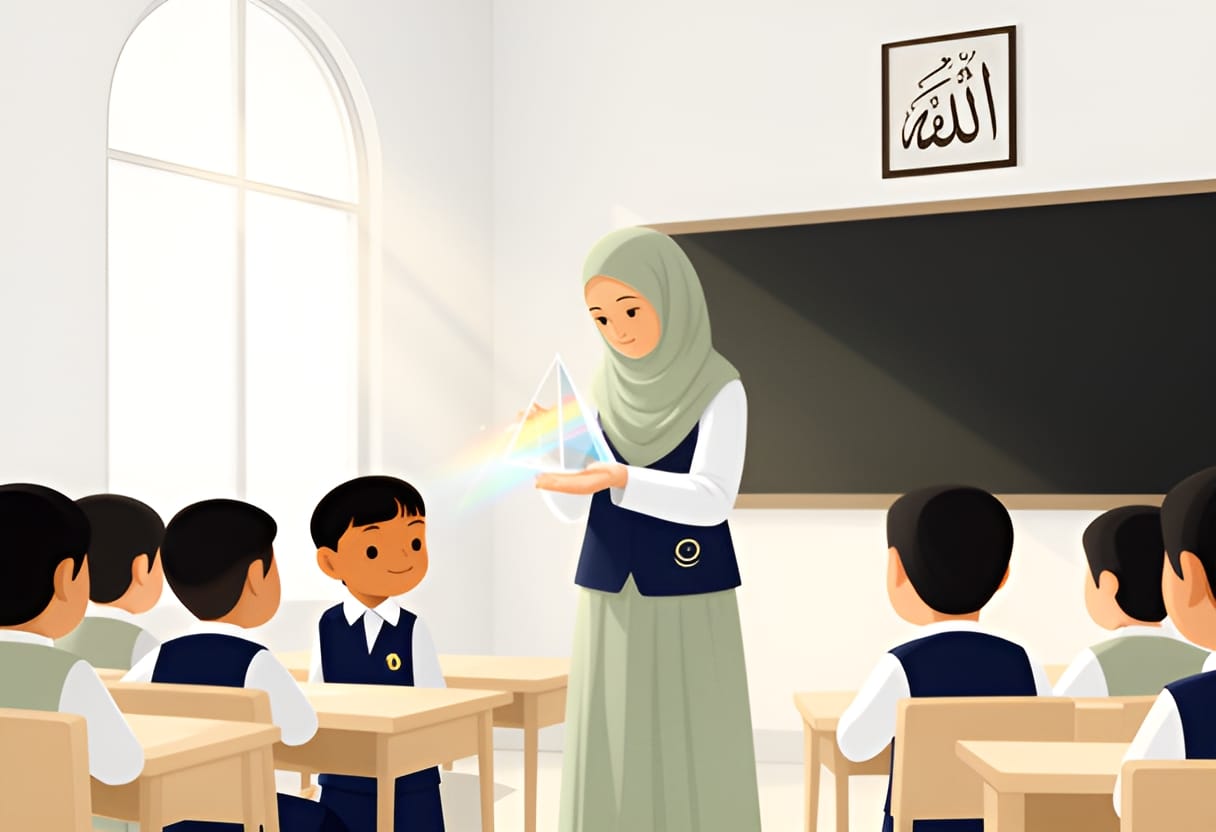
The classroom was quiet as Ustadzah Siti held up a small glass prism, catching the morning light that streamed through the window. A rainbow danced across the chalkboard. “Look closely,” she said. “This light is beautiful, but it is not alive. It does not think or choose. Yet Allah created beings from light who do — angels, who obey Him perfectly in everything they are commanded.”
Belief in the Angels: Created from Light and Obedient
Angels are not like humans or jinn. They were created from light, as the Prophet Muhammad (peace be upon him) said, and they do not eat, drink, or feel fatigue. Most importantly, they never disobey Allah. Whatever He commands them, they do immediately and without hesitation.
Ustadzah Siti turned to the class. “Can anyone tell me what it means to be obedient?”
Adi raised his hand. “It means doing what you’re told, even if you don’t want to.”
“Close,” she said, smiling. “But for angels, it’s not about wanting or not wanting. They do not have the ability to choose disobedience. Their nature is to obey. That is why they are called Allah’s honored servants.”
She wrote on the board: Malaikah — created from light, obedient, sinless.
“Because they are sinless,” she continued, “they are perfectly trustworthy. When Allah sends them with a message, we know it is delivered exactly as He intended. When they record our deeds, we know they do not forget or lie.”
Budi frowned slightly. “But if they can’t choose to disobey, are they like robots?”
“That’s a thoughtful question, Budi,” Ustadzah Siti said. “Robots follow programming. Angels follow divine nature — created by Allah to obey. They love Allah, they fear Him, and they glorify Him night and day without tiring. The Quran says: ‘They do not disobey Allah in what He commands them but do what they are commanded’ (Surah At-Tahrim 66:6).”
She paused. “Their obedience is not weakness — it is perfection. And because they are made of light and devoted to Allah, they are pure and noble in His sight.”
The Roles of the Angels: Revelation, Recording, and More
Ustadzah Siti explained that angels have many important duties, all carried out by Allah’s command.
“First,” she said, “there is revelation. The angel Jibril (Gabriel) is the one who brought the Quran down from Allah to Prophet Muhammad (peace be upon him). He came to the Prophet in the cave of Hira and said, ‘Iqra’ — ‘Read.’ That was the beginning of the Quran.”
She drew a simple diagram on the board: a cave, a figure of the Prophet, and a radiant figure approaching — labeled Jibril.
“Jibril also came to other prophets before him,” she added. “He delivered Allah’s messages to Musa, Isa, and many others. Without Jibril, we would not have the Quran as we know it.”
Next, she spoke of the angels who record our deeds. “Every person has two angels with them — one on the right, one on the left. They write down everything we say and do. The one on the right records good deeds; the one on the left records bad deeds.”
She turned to Adi, who had been quietly twisting his fingers. “You asked earlier if you have a guardian angel, Adi. What made you wonder that?”
Adi looked up. “Well… sometimes I feel like someone is watching when I’m about to do something I know is wrong. Like when I almost took Budi’s pencil without asking yesterday.”
Ustadzah Siti nodded. “That feeling — the hesitation before a wrong action — can be a sign of faith. And yes, those two angels are always with you. We call them the kiraman katibin — the honorable recorders.”
She opened her book to a marked page. “Listen to what Allah says in the Quran: ‘Indeed, over you are keepers, noble and recording; they know whatever you do’ (Surah Al-Infitar 82:10-12).”
She read the verse slowly, then explained: “Noble means they are honorable in Allah’s sight. Recording means they write everything — not just the big things, but the small too. A kind word, a lie, a moment of patience, a burst of anger — all are written.”
Budi looked surprised. “Even if no one else sees?”
“Even if no one else sees,” Ustadzah Siti said firmly. “But Allah sees. And the angels see. And they write.”
She then mentioned other roles: angels who take souls at death (the Angel of Death and his helpers), angels who guard people by Allah’s permission, and angels who attend gatherings where Allah is remembered.
“One angel,” she said, “is assigned to protect you from harm — not that you will never face difficulty, but that Allah sends His protection as He wills. Another group of angels travels the earth seeking gatherings where people remember Allah. When they find such a gathering, they surround it with their wings, all the way up to the sky.”
The Kiraman Katibin: Witnesses to Our Actions
To make the idea of the recorders more tangible, Ustadzah Siti told a short story.

“Imagine two students, Amira and Layla. Amira is known for helping others. She shares her snack, says assalamu alaikum loudly, and tries to pray on time. Layla often interrupts, forgets her homework, and sometimes speaks harshly when upset.”
She paused. “Now, imagine that every action they take is followed by two small lights — one gold, one gray. The gold light appears when they do something good; the gray when they do something harmful. These lights are not visible to us, but they are recorded.”
She looked at Adi and Budi. “Amira’s gold lights are many — helping a friend pick up dropped books, saying thank you to the cafeteria worker, waking up for fajr even when tired. Layla’s gray lights appear when she speaks without thinking or blames others for her mistakes.”
“But,” Ustadzah Siti added gently, “Layla also has gold lights — when she smiles at a new student, when she tries again after failing a quiz. And Amira has gray lights too — when she rolls her eyes at her little brother, or when she rushes through her prayer without focus.”
“The point,” she said, “is not that we are perfect. It is that we are accountable. The kiraman katibin are not waiting to catch us out. They are simply fulfilling their duty — recording what we do, so that on the Day of Judgment, we will see the full picture of our lives.”
She leaned forward. “Belief in the kiraman katibin makes us more mindful. Not because we fear the angels, but because we know Allah sees. And if we know Allah sees, we are more likely to choose what pleases Him — even when no one else is watching.”
Belief in Angels Increases Mindfulness and Trust
Ustadzah Siti connected the belief in angels to daily life.
“When you believe that angels are recording your deeds,” she said, “you think twice before lying. You might pick up trash even if no one asked you to. You might say subhanAllah when you see something beautiful, not just because it’s nice, but because you remember Allah is Al-Khaliq — the Creator.”
She gave an example. “Adi, yesterday when you returned Budi’s pencil without being asked — that was a good deed. The angel on your right wrote it down. You didn’t do it for praise. You did it because it was right. And Allah saw.”
Adi blinked, then gave a small smile.
“And when you feel alone or scared,” Ustadzah Siti continued, “you can remember: angels are with you. The Prophet (peace be upon him) said that Allah assigns angels to protect us, by His command, until our time comes. That doesn’t mean we will never feel fear — but it means we are never truly abandoned.”
She stood and walked to the window. “The same Allah who created the angels from light also created you. He knows your frame. He knows you forget. He knows you make mistakes. But He also gives you the chance to turn back — to say astaghfirullah, to do a good deed to erase a bad one, to sincerely seek His forgiveness.”
She turned back to the class. “Belief in the angels is not about imagining winged figures in the sky. It is about living with awareness — that our actions matter, that we are never unseen, and that Allah’s mercy is always greater than our mistakes.”
Drawing the Unseen: Reflecting on the Angels’ Work
For the final activity, Ustadzah Siti passed out paper and colored pencils.
“I want you to draw what you imagine the angels doing,” she said. “Not what they look like — we don’t know their exact form — but what they are doing based on what we learned today.”
The room filled with the soft sound of pencils on paper. Adi drew two small figures beside a boy returning a lost wallet — one writing in a book with a gold pen, the other watching quietly. Budi drew an angel with wings spread over a sleeping child, and another angel holding a scroll labeled good deeds. One student drew Jibril delivering a scroll of light to Prophet Muhammad on a mountain. Another showed angels circling a group of students sitting in a circle, hands raised in dua.

When they finished, a few volunteers shared their drawings. Ustadzah Siti praised each effort, not for artistic skill, but for the thought behind it.
“You may never see the angels with your eyes,” she said as she collected the papers. “But you can know they are real — because Allah told us about them. And when you believe in them, you live with a little more care, a little more honesty, and a lot more trust in the One who created them — and you.”
She closed her book. “Remember: the angels do not demand perfection. They only record. And the One who sent them is Ar-Rahman and Ar-Rahim — the Most Merciful, the Most Compassionate. He knows what is in your heart. And He loves for you to turn to Him — in every moment, in every action, in every breath.”
The Divine Books: Guidance from Allah
Ustadzah Siti gathered the drawings and placed them neatly on her desk. The morning light streamed through the windows, casting soft patterns on the floor. She smiled at the class before speaking.
“Now that we have learned about the angels who record our deeds,” she began, “let us turn to another part of our faith: the books that Allah sent down to guide His messengers and their people.”
Adi tilted his head. “Ustadzah, did Allah really send books? Like, actual books with pages?”
Ustadzah Siti nodded. “Yes, Adi. Allah revealed divine books to His chosen prophets so that humanity would know how to worship Him alone and live righteously. These books were not written by humans. They came from Allah, through the angel Jibril, to the prophets.”
She walked to the board and wrote in clear letters: The Divine Books.
“Allah mentions in the Quran that He sent down the Torah, the Gospel, the Psalms, and the Quran — each to a prophet for guidance. There were also smaller revelations called the Scrolls, given to prophets like Ibrahim and Musa before the Torah was revealed.”
Budi raised his hand. “If Allah sent all these books, why do we only follow the Quran now? What happened to the others?”
“That is an excellent question, Budi,” Ustadzah Siti said, pleased. “Let us learn about each book, its prophet, and what happened to it over time.”
The Books of Allah and Their Prophets
Ustadzah Siti turned to the class. “First, the Scrolls — As-Sahifah in Arabic. These were revealed to Prophet Ibrahim and Prophet Musa before the Torah. They contained core teachings about monotheism and morality. Unfortunately, the exact text of the Scrolls was not preserved. Only fragments of their meaning remain in the traditions of the prophets.”
She paused. “Next, the Psalms — Az-Zabur. This was revealed to Prophet Dawud, or David. It is a collection of hymns and prayers, praising Allah and reflecting on His greatness. Parts of it are still found in the religious texts of Jews and Christians, but like the Scrolls, the original revelation has been altered over time.”
“Then came the Torah — At-Tawrat. This was revealed to Prophet Musa, or Moses. It contains laws, stories, and guidance for the Children of Israel. It includes the Ten Commandments and teachings about justice, worship, and daily life. The Torah was preserved for a time, but after generations, changes crept in through human translation, interpretation, and loss.”
“The Gospel — Al-Injil — was revealed to Prophet Isa, or Jesus. It confirmed the Torah and brought good news about Allah’s mercy and the coming of the final messenger. The Gospel emphasized love, compassion, and devotion to Allah. However, the original Injil as revealed to Isa is not extant today. What exists now are accounts written by his followers decades later, which contain mixtures of truth, human interpretation, and later theological developments.”
Ustadzah Siti looked at her students. “Finally, the Quran — revealed to Prophet Muhammad, peace be upon him. This is the last and final revelation from Allah. It confirms what came before it, corrects what had been altered, and provides complete guidance for all humanity until the Day of Judgment.”
Adi whispered, “So the Quran is like… the final version?”
“In a way, yes,” Ustadzah Siti replied. “But more than that — it is protected by Allah Himself.”
The Quran: The Final and Preserved Revelation
Ustadzah Siti picked up a copy of the Quran from her desk. “This book you see in front of you is not like the others. Allah has promised to guard it from change. He says in the Quran: Indeed, it is We who sent down the Quran, and indeed, We will be its guardian.”
She let the words settle. “Think about it — for over fourteen hundred years, the Quran has remained exactly the same in its original language, Arabic. Not a single letter has been altered. Millions of Muslims have memorized it word for word, from childhood to old age. This living preservation is a sign from Allah that this book is truly His word.”
Budi frowned. “But what about translations? Aren’t there many versions of the Quran in different languages?”
“Translations are explanations of the meaning,” Ustadzah Siti clarified. “They are not the Quran itself. The Quran is only the Arabic text as revealed. Translations help us understand, but they can never replace the original because no translation can fully capture the depth, rhythm, and precision of the Arabic. That is why Muslims learn to recite the Quran in Arabic, even if they speak another language at home.”
She gave an example. “When Layla memorizes Surah Al-Fatiha, she is not memorizing a translation. She is memorizing the exact words that came from Allah to Jibril to Prophet Muhammad. That same recitation has been passed down unchanged from teacher to student since the time of the Prophet.”
Ustadzah Siti added, “This protection is not just about letters. It is about meaning. Because the Quran is preserved, we can be sure that its guidance — about Tawhid, about prayer, about kindness, about justice — is exactly what Allah intended. We do not have to wonder if a ruling came from Allah or from a person’s opinion.”
Understanding Naskh: When Allah Updates His Guidance
Ustadzah Siti leaned forward. “Now, Budi, your question about why we don’t follow the Torah today brings us to an important concept: naskh, or abrogation.”
She wrote the word on the board. “Naskh means that Allah, in His wisdom, sometimes replaced a ruling from an earlier revelation with a new one in a later revelation. This does not mean the earlier book was false when it was revealed. It means it was suitable for its time and people, but Allah knew that humanity would need updated guidance as circumstances changed.”
She gave a relatable example. “Imagine a teacher gives her students a simple rule: ‘Walk slowly in the hallway.’ This keeps them safe when they are young and still learning. But as they grow older and more responsible, she might change the rule to: ‘You may walk at a normal pace, but still be careful.’ The first rule was not wrong — it was right for that stage. The second rule builds on it and fits the new situation.”
“Similarly,” Ustadzah Siti continued, “the Torah permitted certain practices that were later modified in the Quran. For instance, the Torah allowed multiple forms of marriage and divorce with fewer restrictions. The Quran refined these laws, emphasizing justice, consent, and the dignity of women. It did not abolish the Torah’s core message — to worship Allah alone — but it provided a more complete and balanced legal and ethical framework for a diverse, growing Muslim community.”
Adi nodded slowly. “So the Quran doesn’t contradict the earlier books — it completes them?”
“Exactly,” Ustadzah Siti said. “The Quran confirms the true teachings of the Torah and the Gospel that were preserved in their original form. But where changes had crept in over time, the Quran restores the truth. It is the final criterion — Al-Furqan — that helps us distinguish what is from Allah from what may have been added by humans.”
The Fate of the Scriptures: A Comparison
Ustadzah Siti turned to the board and drew a simple table. She invited the students to watch as she filled it in.
| Divine Book | Prophet | Original Language | Current Status | Preservation Status |
|---|---|---|---|---|
| Scrolls (As-Sahifah) | Ibrahim, Musa | Hebrew/Aramaic | Lost; only traces in tradition | Not preserved |
| Psalms (Az-Zabur) | Dawud | Hebrew | Partial remnants in religious texts | Altered over time |
| Torah (At-Tawrat) | Musa | Hebrew | Exists in versions with variations | Not fully preserved |
| Gospel (Al-Injil) | Isa | Aramaic | Exists in Gospels written decades later | Not preserved in original form |
| Quran | Muhammad | Arabic | Identical worldwide in Arabic text | Fully preserved by Allah |
She pointed to the last row. “See how the Quran stands alone? It is the only divine book that remains in its original language, unchanged, with a continuous chain of memorization and writing from the time of revelation until today.”
Budi looked thoughtful. “So when we read the Quran, we are reading exactly what Allah sent?”
“Yes,” Ustadzah Siti said firmly. “That is a great blessing and a great responsibility. Because we know it is unchanged, we can trust its guidance completely. We know that when it commands us to pray, to be honest, to care for orphans, or to trust in Allah’s plan — these are not human ideas. They are the direct words of our Creator.”
She closed the Quran gently. “This is why we hold the Quran in such high esteem. Not because it is old, but because it is alive — because it is still speaking to us, in the same words, with the same clarity, as it did over fourteen hundred years ago.”
Ustadzah Siti looked around the room. “Remember, the purpose of all these books was the same: to call people to worship Allah alone and to live according to His guidance. The Quran completes that mission. It is the final light that Allah has sent to guide us out of darkness.”
She smiled. “In our next lesson, we will learn about the prophets who brought these books — how they lived, what they taught, and why we love and follow them, especially our beloved Prophet Muhammad, peace be upon him.”
The bell rang softly, signaling the end of the period. As the students packed their bags, Adi turned to Budi.
“Did you know,” he said, “that the Quran is the only book in the world that has been memorized cover to cover by millions of people?”
Budi grinned. “Yeah. And nobody can change it. Not even if they tried.”
Ustadzah Siti watched them leave, her heart warm. She whispered to herself, May they always hold the Quran close — not just in their hands, but in their hearts.
Belief in the Prophets: Messengers of Allah
Ustadzah Siti began the lesson by drawing a simple line on the board, marking points along it to represent time. “Allah sent prophets to guide humanity from the beginning,” she said, placing the first mark at the far left. “The first human, Prophet Adam, was also the first prophet.”
She paused, letting the image settle. “Imagine Adam, standing in Paradise, taught by Allah the names of all things. When he and Hawwa were sent to earth, it was not a punishment but a trust — to worship Allah alone and to populate the earth with righteousness.”
Adi raised his hand. “Ustadzah, did Adam forget what Allah taught him?”
“Not forget,” Ustadzah Siti replied gently, “but tested. Allah allowed him to slip, not to condemn him, but to teach him — and us — about repentance. Adam turned back to Allah, saying, ‘Our Lord, we have wronged ourselves, and if You do not forgive us and have mercy upon us, we will surely be among the losers.’ That moment shows us that even the best of us can err, but the door to Allah’s forgiveness is always open.”
She moved to the next point on the line. “Centuries later, humanity had strayed again. Allah sent Prophet Nuh to call his people back to Tawhid. For 950 years, he called them day and night, but only a few believed.”
Ustadzah Siti’s voice softened. “Picture Nuh, an old man, building a massive ship on dry land while his neighbors laughed. They called him mad. Yet he trusted Allah’s promise. When the flood came, it was not because Allah wished to destroy, but because evil had become so widespread that only a fresh start could preserve the message of Tawhid.”
Budi frowned. “But why did Allah let it go so far before sending the flood?”
“Because Allah is patient,” Ustadzah Siti said. “He sends warners first. Nuh’s long struggle teaches us that calling people to Allah requires perseverance, even when faced with mockery. It also shows that Allah’s help comes — but only after we do our part with sincerity.”
She advanced to the next mark. “Then came Prophet Ibrahim, whom Allah chose as His intimate friend. Ibrahim broke the idols of his people, not out of anger, but to show them the futility of worshipping what cannot hear, see, or help.”
Ustadzah Siti traced a circle in the air. “Allah tested Ibrahim in ways that shake the soul — leaving his wife and infant son in the desert, being commanded to sacrifice his beloved son. Each time, Ibrahim submitted without hesitation. When he was thrown into the fire, Allah said, ‘O fire, be coolness and safety for Ibrahim.’ That miracle was not just to save him — it was a sign to all who witness: those who put Allah first will never be abandoned.”
Adi’s eyes widened. “So Ibrahim’s willingness to sacrifice Ismail was a test of his love for Allah?”
“Exactly,” Ustadzah Siti affirmed. “And Allah replaced Ismail with a ram, showing that He does not desire harm but seeks to see where our hearts truly lie. That moment is remembered every year in Eid al-Adha — not as a celebration of sacrifice for its own sake, but as a reminder that true faith means placing Allah’s will above our own desires.”
She moved to the next point. “Prophet Musa was sent to a people enslaved and oppressed. Allah gave him clear signs — the staff that became a serpent, the hand that shone with light — to confront Pharaoh, who claimed divinity for himself.”
Ustadzah Siti’s tone grew firm. “Musa did not rely on magic or power. He said, ‘My Lord knows best who brings guidance from Him and who will have the best end in the Hereafter.’ When the Red Sea parted, it was not Musa’s power but Allah’s command. When water gushed from a stone in the desert, it was Allah providing for His people in the barren land.”
Budi nodded slowly. “So Musa’s miracles were proofs that his message came from Allah?”
“Yes,” Ustadzah Siti said. “And they were given not to amaze, but to convince the open-hearted. Musa’s life teaches us that standing up for truth against tyrancy is never easy, but Allah supports those who rely on Him. Even when the Israelites complained and worshipped the calf, Musa returned to Allah in intercession, showing that a true leader seeks forgiveness for his people, not just vindication for himself.”
She placed the final mark on the line, slightly offset to show continuity. “Then came Prophet Isa, born without a father, a sign of Allah’s power to create as He wills. He spoke as a baby in the cradle, defended his mother’s honor, and healed the blind and the leper by Allah’s permission.”
Ustadzah Siti’s voice softened with reverence. “Isa never claimed divinity. He said, ‘Indeed, I am the servant of Allah. He has given me the Scripture and made me a prophet.’ His mission was to confirm the Torah and make lawful some of what was forbidden, calling the Children of Israel back to sincere worship of Allah alone.”
Adi whispered, “But if Isa was so special, why didn’t they accept him?”
“Because,” Ustadzah Siti explained, “many expected a political liberator, not a spiritual guide. They focused on outward signs and missed the inner message. Yet Allah raised Isa to Himself, and he will return before the Day of Judgment — not as a new prophet, but as a follower of the Quran, to break the cross and abolish the jizyah, showing that his true message was always submission to the One Allah.”
She paused, letting the weight of the words settle. “And then, after centuries of waiting, Allah sent the final messenger — Prophet Muhammad, peace be upon him. He was not sent to a specific people or time, but to all of humanity, for all time.”
Ustadzah Siti stood and walked to the front of the room. “The Quran says, ‘Muhammad is not the father of any of your men, but the Messenger of Allah and the last of the prophets.’ This means no prophet will come after him. His message is complete, preserved, and sufficient until the Hour.”
She opened the Quran to Surah Al-Ahzab. “Allah also says, ‘And We have not sent you except comprehensively to mankind as a bringer of good tidings and a warner.’ That means his role was not just to convey, but to live the guidance in every aspect — how to pray, how to fast, how to treat neighbors, how to conduct business, how to lead a community.”
Budi looked thoughtful. “So the Sunnah is how Prophet Muhammad lived the Quran?”
“Precisely,” Ustadzah Siti said. “The Quran tells us what to do — establish prayer, give zakah, fast Ramadan. The Sunnah shows us how — the exact movements of prayer, the times to break fast, the kindness in speech, the patience in hardship. Without the Sunnah, we would have the letter but not the spirit.”
She gave an example. “The Quran commands honesty in trade. The Sunnah shows us that Prophet Muhammad would return a lost item, even if it meant delaying his journey. He once said, ‘The truthful and trustworthy merchant will be with the prophets, the truthful, and the martyrs.’ That hadith doesn’t add a new rule — it shows how to embody the Quranic value of honesty in real life.”
Adi smiled. “I like the story of Prophet Yusuf. He stayed patient in the well, in prison, and still forgave his brothers.”
Ustadzah Siti nodded. “Yusuf’s story is a masterpiece of trust in Allah’s plan. He interpreted dreams by Allah’s permission, resisted temptation with the cry, ‘My Lord, prison is more beloved to me than that to which they invite me,’ and when raised to power, he said, ‘No blame on you today. Allah will forgive you; He is the most merciful of the merciful.’ His life teaches that patience and forgiveness are not weakness — they are strength rooted in faith.”
Budi added, “And Prophet Yunus! He left his people in anger, but when the whale swallowed him, he cried from the darkness, ‘There is no deity except You; exalted are You. Indeed, I have been of the wrongdoers.’ Allah answered him and released him.”
“Yunus’s dua in the belly of the whale,” Ustadzah Siti said, “is one of the most powerful invocations in Islam. It shows that no matter how deep the darkness — whether of sin, despair, or circumstance — if we turn to Allah with sincere repentance, He responds. Yunus did not wait until he was saved to praise Allah; he praised Him in the trial, and that is what brought relief.”
She turned to the board and wrote four qualities in clear script. “All prophets, without exception, possessed these traits:”
She pointed to each as she spoke. “First, sidq — truthfulness. They never lied, not even in jest. Second, amanah — trustworthiness. They delivered Allah’s message fully, without concealment or distortion. Third, tabligh — conveyance. They made every effort to ensure the message reached the people. Fourth, fatanah — intelligence. They understood their mission and conveyed it in ways suited to their people’s capacity.”
Ustadzah Siti stepped back. “These qualities are not optional extras. They are the mark of prophethood. When we see someone claiming divine guidance but lacking truthfulness or trustworthiness, we know it is not from Allah. When we see the prophets, we see men who lived these traits so perfectly that their honesty was beyond question — even their enemies admitted it.”
She looked at Adi and Budi. “Your love for the prophets is not just emotional. It is rational. You admire Yusuf’s patience because you see how it brought him honor in this life and the next. You respect Yunus’s repentance because you know that turning to Allah is never in vain.”
Ustadzah Siti lowered her voice. “And your love for Prophet Muhammad, peace be upon him, is the culmination of this. He embodied the Quran in his character. Aisha, his wife, said, ‘His character was the Quran.’ When you follow his Sunnah, you are not following a man’s habits — you are living the divine guidance as it was meant to be lived.”
The bell rang, soft and clear. Students began to gather their things, but Adi lingered.
“Ustadzah Siti,” he asked, “if all prophets called to Tawhid, does that mean loving them is part of loving Allah?”
Ustadzah Siti smiled. “Yes. Loving the prophets is loving what they stood for — the oneness of Allah and the path to Him. To reject a true prophet is to reject the message they brought. To follow them is to walk the path that leads to Allah’s pleasure.”
Budi slipped his notebook into his bag. “So when we send salawat on the Prophet, we’re not just being polite — we’re affirming our belief in his role?”
“Exactly,” Ustadzah Siti said. “Every time you say, ‘Allahumma salli ala Muhammad,’ you are declaring your belief in his prophethood, your gratitude for his sacrifice, and your commitment to follow his way. It is a small act with great weight.”
As the last students left, Ustadzah Siti wiped the board clean. The line of prophets remained in her mind — not as distant figures, but as a living chain of guidance, each link strengthening the next, all leading back to the One who sent them.
The Last Day: When All Will Be Held Accountable
Ustadzah Siti waited until the classroom was quiet, the last rustle of bags fading into the morning stillness. She drew a simple line on the board, marking one end with a sunrise and the other with a night sky dotted with stars.
“Life in this world,” she began, “is like a single day. We wake, we act, we rest — and then comes the night. For the believer, death is not an end but a transition. Allah says in the Quran, ‘Every soul will taste death.’ After death, we remain in a state called barzakh until the Day when Allah resurrects all creation.”
She paused, letting the idea settle. “On that Day, every person will be brought back to life — body and soul — exactly as they were, but perfected. No one will be missing a limb, nor will anyone be flawed. Allah, who created us from nothing, is easily able to recreate us.”
Adi raised his hand. “Will we remember everything we did?”
“Yes,” Ustadzah Siti replied. “Allah has appointed two angels, the kiraman katibin, who record every deed — big or small, public or secret. On the Day of Judgment, these records will be laid open. Nothing will be hidden.”
She drew a set of scales beneath the line. “Then comes the accounting. Allah will weigh our deeds with perfect justice. He says, ‘We shall set up the scales of justice for the Day of Resurrection, so no soul will be treated unjustly in the least.’ If even the weight of a mustard seed of good is found, it will not be overlooked.”
Budi frowned. “What if our bad deeds outweigh the good?”
“Then we face the consequence,” she said gently. “Allah is merciful, but He is also just. Those whose good deeds outweigh their bad will enter Paradise — a state of eternal peace, joy, and closeness to Allah. Those whose evil outweigh their good, and who die without repenting or believing in Allah’s oneness, will face Hell — not because Allah wishes to punish, but because they chose to turn away from His guidance.”
She added a narrow bridge arching over a dark chasm. “After the scales, there is the Sirat — a bridge thinner than a hair and sharper than a sword. Over it, all must pass. The believers will cross swiftly, some like lightning, some like the wind, some like a swift horse, some like a running man, some like a staggering person — each according to their deeds. Those whose deeds were light may slip and fall into the Fire below. But for the believer who sincerely said ‘La ilaha illallah’ and meant it, Allah promises rescue, even if they must first be purified.”
She turned to the class. “Belief in the Last Day shapes how we live now. If we know we will be held accountable, we are more likely to choose honesty over deceit, patience over anger, and kindness over cruelty — not because we fear punishment alone, but because we hope for Allah’s reward and seek His pleasure.”
Divine Decree: Allah’s Knowledge and Will
Ustadzah Siti erased the board and drew a large circle, dividing it into four quadrants. She labeled them: Knowledge, Writing, Will, and Creation.
“Belief in al-qadar means accepting that Allah knows everything that has happened, is happening, and will happen — before it occurs. He has recorded all things in the Lawh al-Mahfuz, the Preserved Tablet. Nothing escapes His knowledge.”
She pointed to the first quadrant. “First, Allah’s knowledge is eternal. He knew you would be born, what choices you would make, and what your end would be — long before the heavens and earth were created.”
Then the second. “Second, Allah wrote everything that will occur. The Prophet Muhammad said, ‘The first thing Allah created was the pen. He said to it, “Write.” It asked, “What should I write?” He said, “Write what will occur until the Hour.”’ So the pen rose and wrote everything that will be.”
The third quadrant. “Third, Allah’s will is absolute. Nothing happens in the heavens or on earth except by His permission. If He wills something, it occurs. If He does not will it, it does not — no matter how hard we strive.”
Finally, the fourth. “Fourth, Allah creates all things — our actions included. He creates the ability to act, the intention, and the act itself. But this does not remove our responsibility.”
Adi looked puzzled. “If Allah creates our actions, how can we be held accountable?”
“Good question,” Ustadzah Siti said. “Allah creates the capacity to act, but He holds us responsible for the choice we make using that capacity. Think of it like this: Allah gives you eyes to see. He creates the ability to see. But whether you look at what is lawful or what is forbidden — that choice is yours. You are accountable for where you direct your gaze.”
She smiled. “This belief does not make us passive. It makes us trustful. We strive with effort, but we place our trust in Allah for the outcome. We plant the seed, water it, pull the weeds — but we know the growth is in Allah’s hands.”
Balancing Effort and Trust: The Farmer’s Parable
Ustadzah Siti stood and walked to the window, where a small potted plant sat on the sill. She brought it back to the desk and held it up.
“Imagine a farmer,” she said. “He wakes before dawn, prepares his plow, and heads to the field. He breaks the soil, sows the seeds with care, and waters them evenly. He does everything within his power to ensure a good harvest.”
She set the plant down. “But then what? Does he sit and stare at the ground, demanding the seeds sprout? No. He does his part, then leaves the rest to Allah. He knows that rain, sunlight, and growth are not in his control — they are in the Hands of the One who sends down rain from the sky and causes the earth to bring forth vegetation.”
She turned to Adi. “Remember when you failed your quiz last month?”
Adi nodded, a little embarrassed. “I studied, but I still got a low score. I felt upset — like I had let everyone down.”
“What did you do after?” Ustadzah Siti asked.
“I told myself, ‘I did my best. I studied, I reviewed my notes, I asked Budi for help.’ Then I made dua, asking Allah to help me do better next time. I didn’t blame myself endlessly. I just tried to learn from it and move forward.”
“That,” Ustadzah Siti said, “is ikhtiyar and tawakkul in action. Ikhtiyar is your effort — your choice to study, to seek help, to prepare. Tawakkul is your trust — knowing that the result is in Allah’s hands, whether it is success or a lesson in patience. You did not become careless, nor did you fall into despair. You balanced both.”
She looked at Budi. “And what about you, Budi? When you were hesitant to speak up in class, what changed?”
Budi shrugged. “I kept thinking, ‘What if I say something wrong?’ But then I remembered that trying is part of worship. Even if I make a mistake, I can learn from it. Allah sees my intention. So I raised my hand anyway.”
Ustadzah Siti nodded. “Exactly. Effort without trust leads to anxiety. Trust without effort leads to laziness. But when we pair sincere effort with deep trust in Allah’s decree, we find peace. We act with excellence, then surrender the outcome to the One who knows what is best for us.”
Illustration
A simple diagram showing a farmer in a field. On the left, the farmer is plowing, sowing, and watering — labeled 'Human Effort (Ikhtiyar)'. On the right, sunlight, rain, and a growing plant emerge from the soil — labeled 'Divine Decree (Qadar)'. Above the scene, a scale balances a hand (effort) and a cloud with divine light (trust), labeled 'Balance: Effort and Trust in Allah'.
Try This
This week, try these three steps to strengthen your belief in the Last Day and divine decree:
- Before beginning any task — homework, chores, or play — pause and say, “Bismillah.” Then do your best. Afterward, say, “Allahumma barik li fima razaqtani” (O Allah, bless me in what You have provided), trusting that the outcome is in Allah’s hands.
- When you feel upset about something that didn’t go as planned, write down one thing you did well and one thing you can improve. Then say, “Hasbunallahu wa ni’mal wakeel” (Allah is sufficient for us, and He is the best disposer of affairs).
- Share one story of a prophet’s patience or trust in Allah with a family member or friend — like Yunus in the whale or Yusuf in prison — and discuss how it applies to your own life.
Key Takeaways
- Belief in the Last Day reminds us that life is a test, and every action — seen or unseen — will be accounted for with perfect justice on the Day of Resurrection.
- Belief in divine decree means accepting that Allah knows all things, has written all things, wills all things, and creates all things — while we remain responsible for our sincere efforts and choices.
- True faith balances human effort (ikhtiyar) with trust in Allah (tawakkul): we strive with excellence, then place the outcome in the Hands of the All-Wise, All-Knowing Creator.
- The stories of the prophets — their truthfulness, trustworthiness, conveyance, and intelligence — show us how to live iman in action, turning belief into character and conduct.
- When we affirm Tawhid, honor the prophets, respect the divine books, believe in the angels, and trust in Allah’s plan, our faith becomes a living force that shapes how we think, feel, and act — for the betterment of ourselves and our communities.