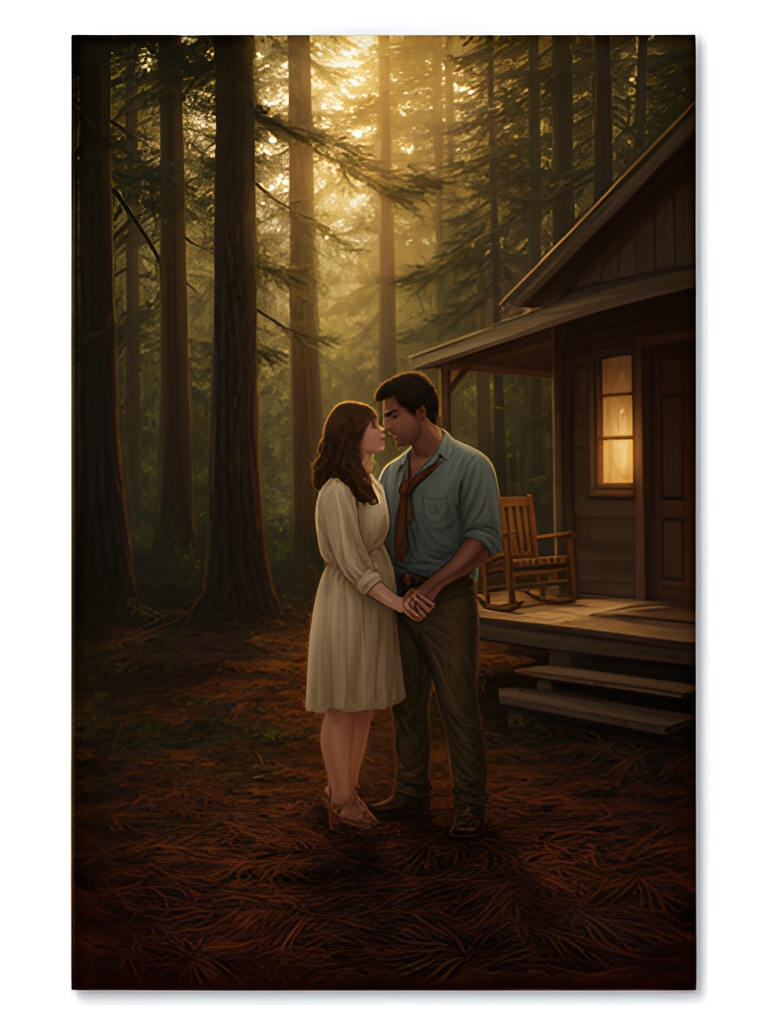
Romance
School camp
by Kaylee Mwebaza
3 chapters17 min read
Chapter 1
Arrival and First Signals
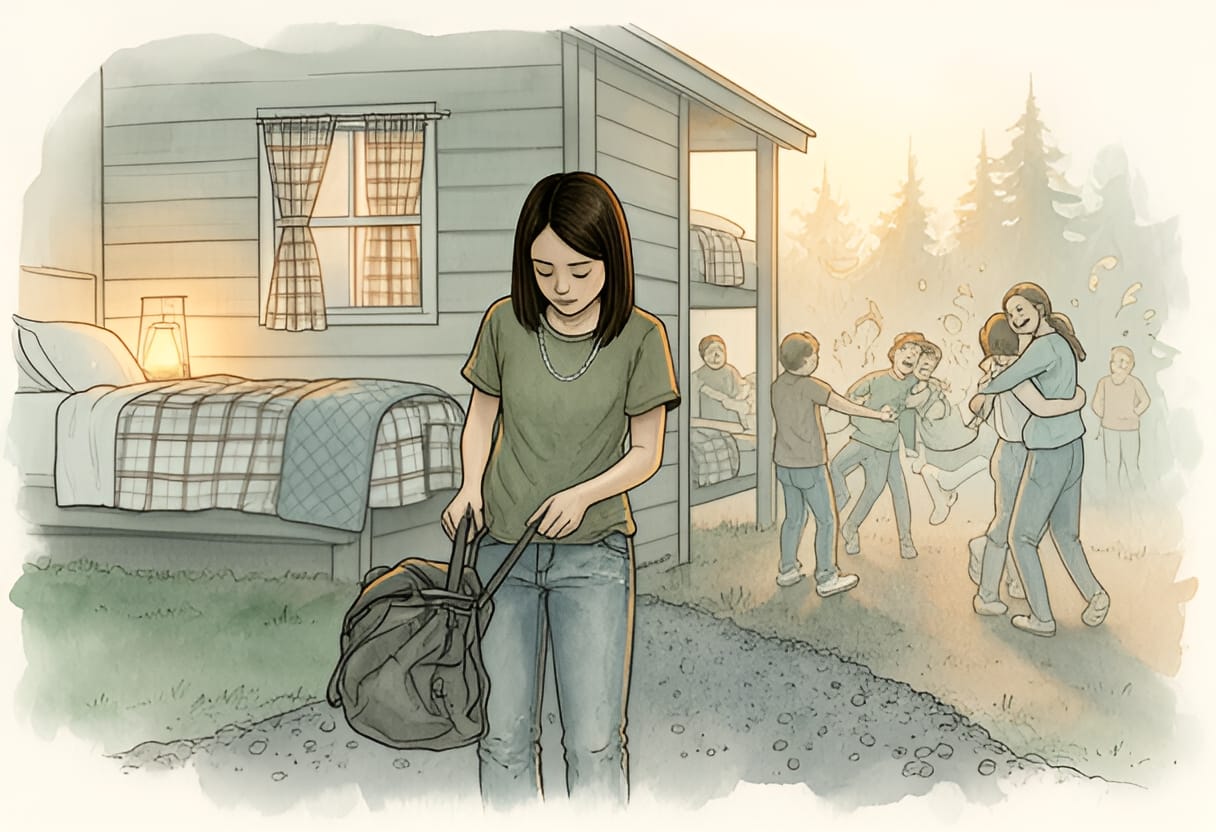
Kaylee stepped off the bus and blinked against the late afternoon sun, the scent of pine and damp earth rising from the forest floor. The air hummed with the chatter of other campers reuniting, laughing, slinging arms over shoulders as they hauled duffel bags toward the cluster of cabins nestled in the hills. She adjusted the strap of her own bag, its worn canvas familiar against her palm, and felt the familiar prickle of being on the outside looking in.
She hadn’t meant to come. Not really. But the letter from the school counselor had arrived with a tone of gentle insistence, and her mother had smiled too brightly when she handed it over. “It’ll be good for you,” she’d said. “A chance to stretch.”
Kaylee hadn’t argued. She just packed quietly, folding t-shirts with precise edges, tucking her journal beneath a sweater where it wouldn’t shift.
Now, standing at the edge of the gravel path, she watched a pair of girls shriek and jump toward each other, their hair flying in the breeze. A knot tightened in her chest. She ducked her head, pretending to adjust the zipper on her bag, and waited for the flow of bodies to thin.
“Need a hand?”
She looked up.
Kashaka stood beside her, one hand already gripping the top handle of her duffel. His expression was open, expectant, but not pushy. There was no flourish to the offer—just a quiet readiness, like he’d noticed her hesitation and decided, without fanfare, to meet it.
“Oh,” she said, surprised. “I’ve got it.”
“I know,” he replied, lifting the bag with ease. “But it’s heavier than it looks. Let me.”
He started walking before she could answer, falling into step beside her as if they’d been doing this all along. The cabin came into view—a low, wooden structure with a wide porch and windows glowing amber in the slanting light. Cabin 7, painted in faded white trim, sat just off the main trail, its door standing open to welcome them in.
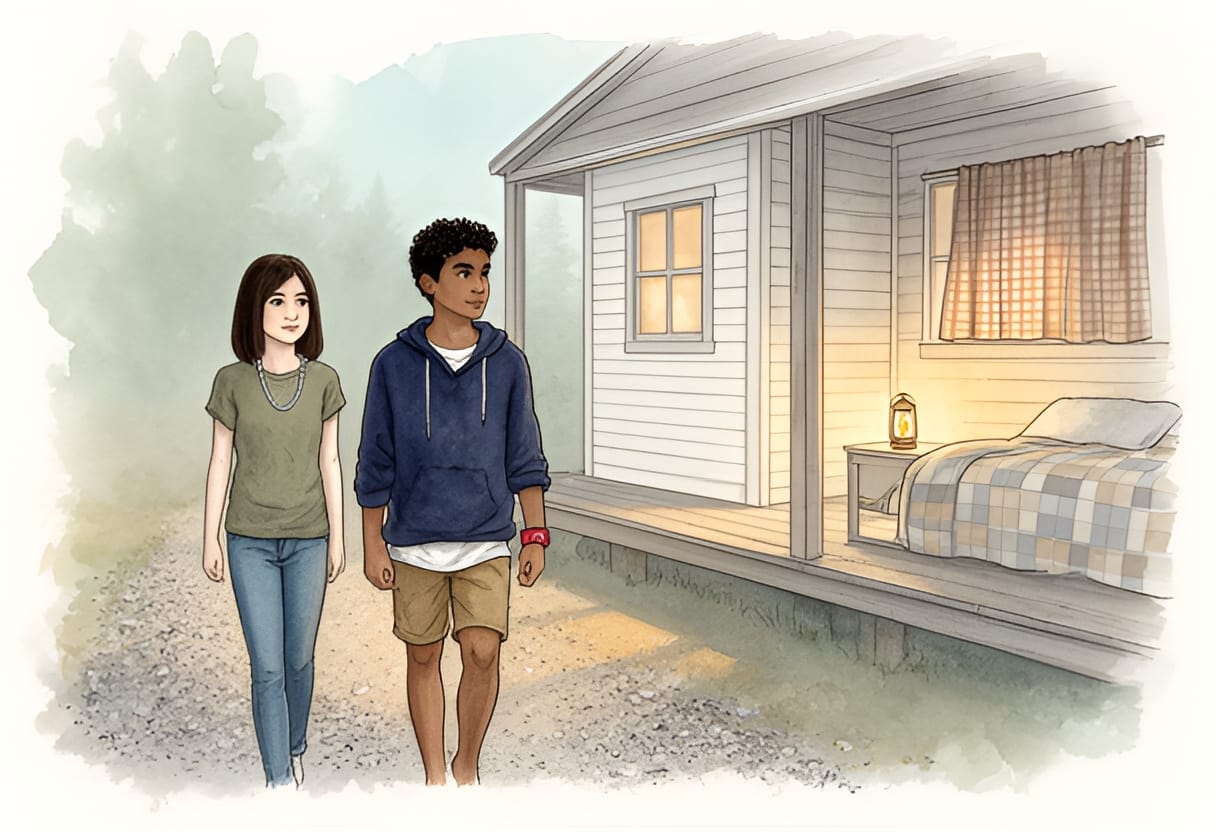
Inside, the air smelled of wood polish and faint mildew. Bunks lined the walls, each with a neatly made bed and a small trunk at the foot. Kaylee set her bag down on the nearest bed and began to unpack, moving slowly, deliberately. She folded her jeans with sharp creases, stacked her socks in pairs, arranged her toiletries in a line along the edge of the sink.
Across the room, Kashaka did the same—but with labels. Small pieces of masking tape, printed in neat block letters: Toothbrush. Shampoo. Snacks. He paused after sticking one on his water bottle, glanced over, and caught her watching.
“Helps me find things,” he said, shrugging. “Especially when I’m tired.”
She nodded. “That makes sense.”
They didn’t speak again as they finished. The silence wasn’t awkward, exactly. It was full of small observations—the way he tied his shoes double-knotted, the way she smoothed the corner of her blanket three times before leaving it be. When they were done, they stood in the center of the room, shoulders slightly turned toward each other, neither moving to leave.
Outside, the bell for dinner rang—a long, low tone that echoed through the trees.
They walked together down the path, the gravel crunching under their boots. The mess hall loomed ahead, its screens open to the cooling air, voices drifting out in fragments of laughter and clinking trays.
In line, they fell into step without speaking. Kaylee felt the warmth of his sleeve brush hers as they shifted forward. Neither pulled away. She noticed the way his hair curled slightly at the nape of his neck, the faint scar above his eyebrow she hadn’t seen before. He, in turn, seemed aware of the small lift of her shoulders when she breathed, the way her fingers tapped once against her thigh—a habit, maybe, when she was thinking.
They reached the serving counter. He let her go ahead, murmuring, “After you.”
She nodded, took her tray, and moved to the next station. When she turned, he was beside her again, filling his plate with quiet efficiency.
They ate side by side at a long table, trays close but not touching. No words passed between them. Yet when she glanced up, she saw he was already looking back—just for a second—before turning to his food.
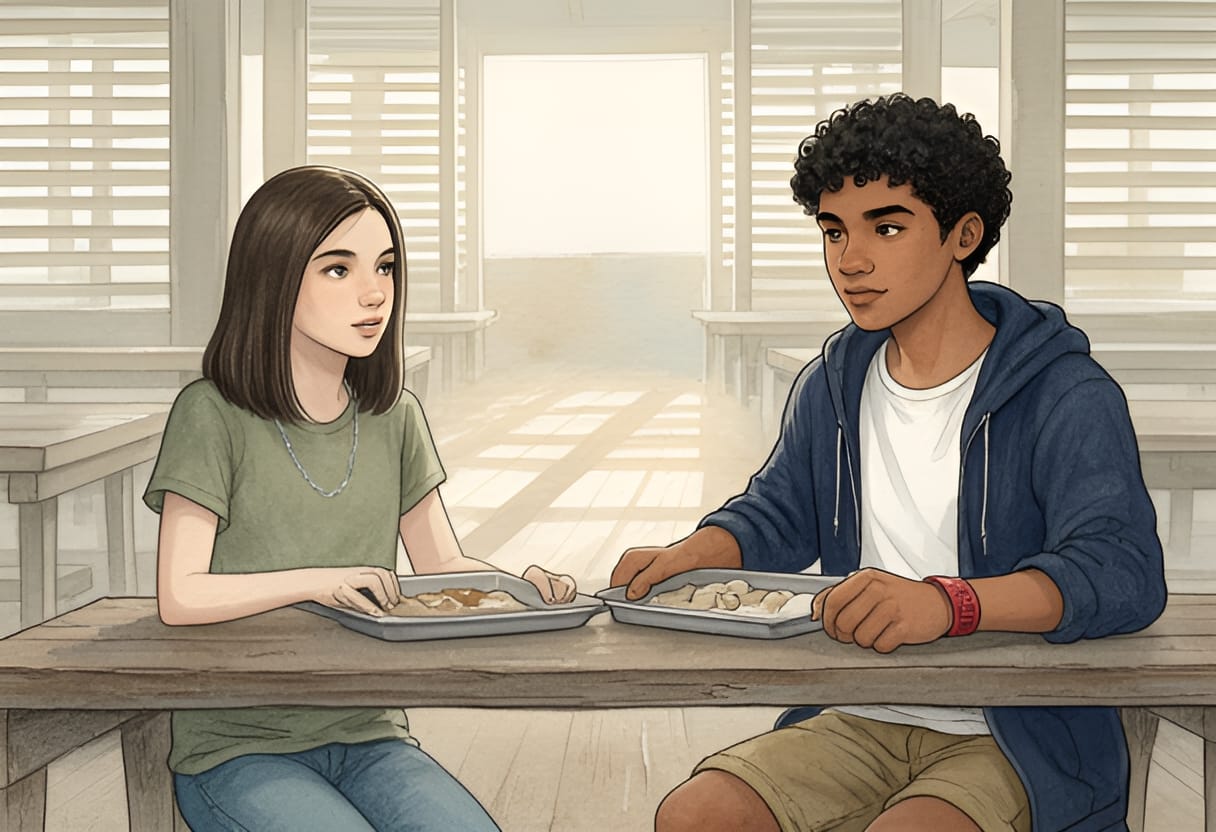
And in that glance, something shifted. Not a spark, not quite. But the quiet sense of being seen, without having to ask for it.
The next morning, the air was cool and still, mist clinging to the treetops like breath held too long. After breakfast, the counselors gathered the campers in a wide clearing near the lake, explaining the trust exercise: pairs would take turns guiding each other through a winding forest path, one blindfolded, the other relying only on voice and touch to navigate roots, low branches, and uneven ground.
Kaylee’s stomach tightened as she watched others fumble forward, some laughing nervously, others moving with stiff caution. When it was her turn, Kashaka stepped close, his presence steady at her elbow.
“Ready?” he asked, voice low.
She nodded, and he tied the bandana over her eyes. Darkness pressed in, soft but absolute. The sounds of the camp faded—voices, birds, the distant lap of water—replaced by the rush of her own breath and the faint crunch of gravel under her boots.
“Left foot,” he said, his hand light on her back, just below her shoulder blade. “Small step. There’s a root ahead—lift your toe.”
She obeyed, feeling the way his guidance settled into her rhythm, not pulling, not pushing, but offering a point of reference in the dark. His voice stayed even, calm, adjusting only when the path narrowed or dipped.
“Watch your head,” he murmured as they passed under a low branch. “Now, step right—there’s a rock, about the size of your fist. Good.”
She focused on the cadence of his words, the warmth of his palm where it occasionally brushed her arm to steady her. The forest smelled of wet pine and decaying leaves, and for the first time since arriving, she wasn’t scanning for threats or judging her missteps. She was simply moving, trusting that he would not let her stumble.
When they reached the end of the path, he gently guided her to a stop.
“You can take it off now,” he said.
She blinked in the dappled sunlight, the world returning in fragments—green shadows, the trunks of trees, his face close enough to see the faint scar catching the light.
“Thanks,” she said, her voice softer than she meant it to be.
He smiled, just a twitch at the corner of his mouth. “You did great. Almost didn’t need me at all.”
Later, after dinner and a quiet evening of sketching in her journal by the fire pit, the camp settled into the hush of lights out. Cabin 7 was dim, only the glow of a few flashlights under blankets and the faint blue of phones being silenced. Kaylee slipped out of her bunk, barefoot on the cool floor, and padded to the small sink in the corner to brush her teeth.
The mirror above it was fogged at the edges from earlier use. She spat, rinsed, and wiped her mouth with the back of her hand. As she turned, Kashaka appeared in the doorway, toothbrush in hand, pausing when he saw her.
They didn’t speak. He stepped forward, squeezed past her to the sink, and began brushing in the mirror’s reflection. Their shoulders nearly touched. In the glass, she saw the reflection of his eyes—focused, then flicking to hers for a brief second before returning to the foam at his lips.
She held his gaze in the mirror a beat longer than necessary. Something passed between them—not a confession, not a promise, but the quiet recognition that they had both been seen, and had seen in return, without needing to say it aloud.
He finished, rinsed, and gave her a small nod. She nodded back. Then, without another word, they turned and climbed back into their bunks, the cabin falling into silence once more, but changed—like the air after rain, lighter, waiting.
Chapter 2
Midweek Shifts and Shared Silences
Kaylee woke to the sound of rain tapping gently on the roof of Cabin 7, a steady rhythm that made staying under the covers feel like a small act of rebellion. She lay still for a moment, listening, then slipped out of bed, pulling on her shoes and a light jacket before stepping into the hallway. The cabin was quiet, the other bunks still occupied, the air cool and smelling faintly of toothpaste and damp wool.
Outside, the sky was a soft gray, the kind of morning that felt suspended between night and day. The camp was quiet too—no voices raised, no footsteps pounding on the gravel paths. She walked toward the lake, drawn by the pull of water and openness, the way the trees thinned and the world seemed to breathe easier.
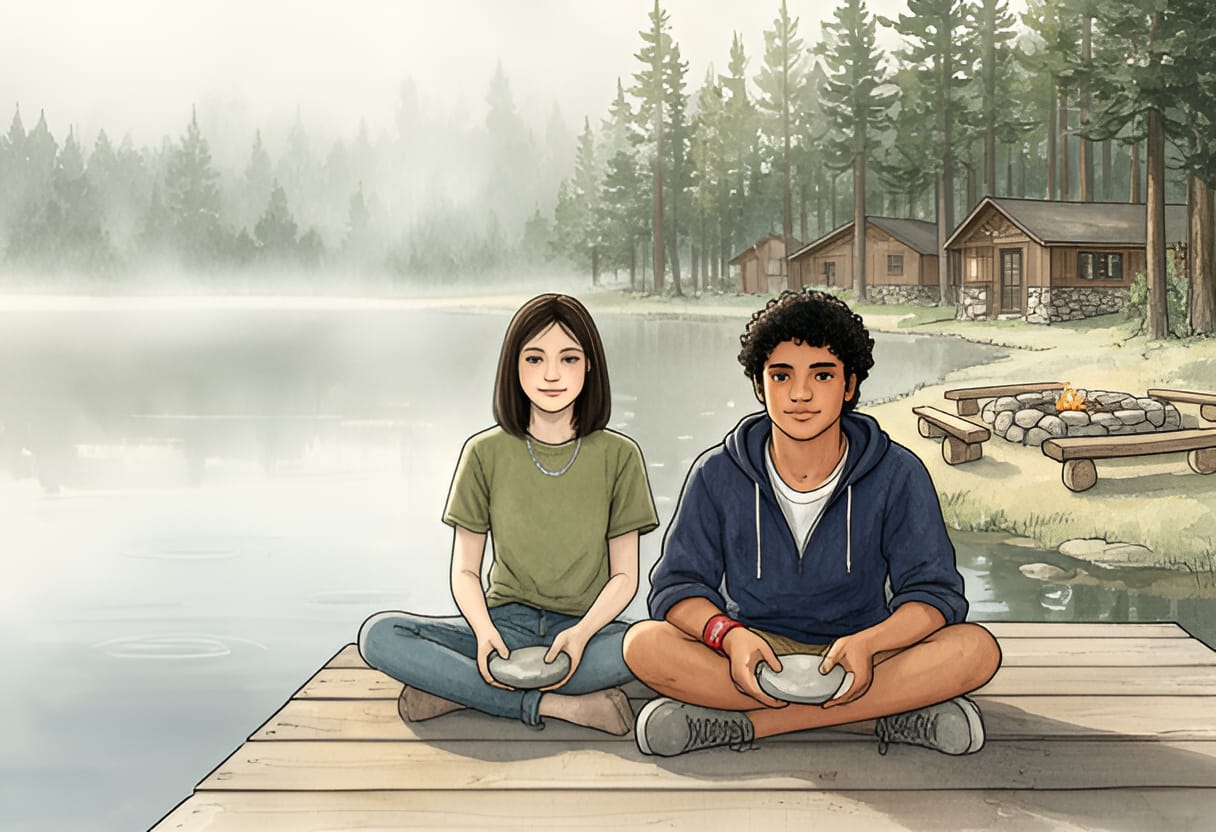
She found Kashaka on the dock, sitting cross-legged near the end, a flat stone balanced in his palm. He wasn’t skipping it yet—just holding it, running his thumb over its smooth edge. The water lapped quietly against the pilings, sending up tiny ripples that caught the light like scattered silver.
She didn’t ask if she could sit. She simply lowered herself beside him, close enough to feel the warmth of his shoulder but not touching. The wood was cool and worn beneath her palms.
“You’re up early,” he said, not looking at her.
“I couldn’t sleep,” she admitted. “Too much quiet in my head.”
He nodded, finally tossing the stone. It skipped three times before sinking. “Me too. My mind likes to rehearse conversations I haven’t had yet.”
She glanced at him. “Like what?”
He shrugged, picking up another stone. “Like telling my dad I don’t want to apply to Prescott. Or that I’m scared I’ll get in and hate it. Or worse—that I’ll get in and love it, and then I’ll never know if I chose it or just chose it to make them proud.”
Kaylee stayed silent, letting the words hang between them. She thought of her younger sister, Mia, who could talk to strangers in the grocery store, who raised her hand in class without hesitation, who always knew what to say when their parents fought. Kaylee had learned early that if she didn’t speak up, someone else would speak for her—and usually, they got it wrong.
“I’m tired of being overlooked,” she said, her voice low. “Not in a loud way. Just… the way people talk over me, or assume I don’t have an opinion because I don’t shout it. Mia gets asked what she wants for breakfast. I get told what I’m having.”
Kashaka was quiet for a moment. Then he said, “I’m tired of having to be strong all the time. Like if I show any crack, the whole thing falls apart.”
She turned to him then. “You don’t have to be strong with me.”
He looked at her, really looked, and for a second, the mask slipped—not into sadness, but into something softer, like relief. “Thanks,” he said. “That means more than you know.”
A beat passed. The lake breathed. A dragonfly skimmed the surface.
He picked up another stone, flatter than the last, and held it out to her. “Your turn.”
She took it, feeling its weight, its coolness. She’d skipped stones before, but never with anyone watching, never with the quiet pressure of being seen. She cocked her wrist, flicked—
The stone jumped once, twice, then a third time before disappearing with a soft plunk.
Kashaka smiled. “You threw better than I did.”
She didn’t laugh, but something warm unfurled in her chest. “Thanks,” she said. “I’ve been practicing.”
He didn’t ask where. Didn’t need to.
They sat in silence after that, skipping stones when the mood struck, not speaking unless they wanted to. The rain had stopped. The sun, pale and hesitant, began to break through the clouds, turning the lake into a sheet of hammered gold.
And for the first time since arriving at camp, Kaylee didn’t feel the need to fill the quiet. She just let it be.
The sky darkened without warning, clouds piling overhead like slate. One moment the sun had been breaking through, golden and hesitant; the next, the air grew heavy and still, as if holding its breath. A low rumble rolled across the lake, distant at first, then closer.
Kaylee glanced at Kashaka. He was already standing, brushing damp denim from his jeans.
“Storm’s coming fast,” he said.
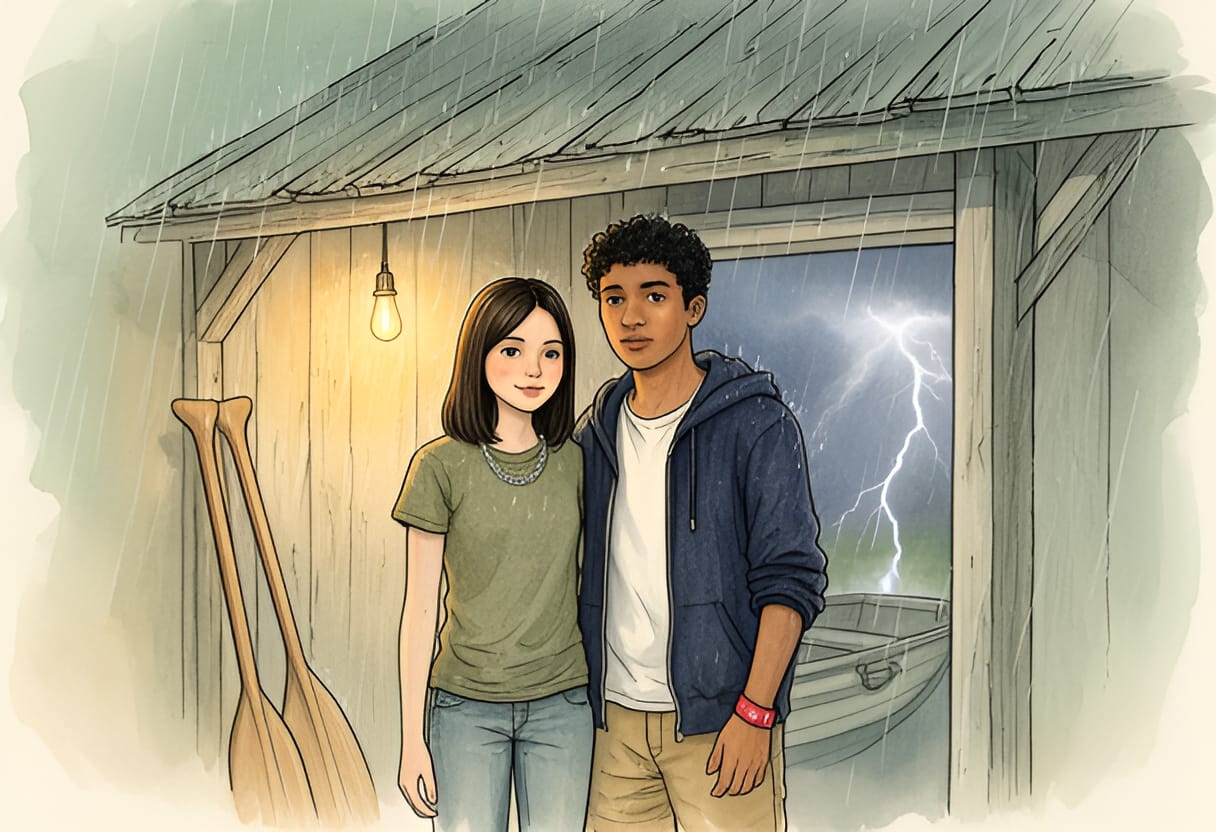
They didn’t run. There was no point. By the time they reached the treeline, the first fat drops were falling, splashing against the dock and turning the lake into a dimpled gray. They ducked under the eaves of the boathouse, shoving the door open just enough to slip inside before the rain came down in earnest.
The boathouse smelled of wet wood, oil, and old life jackets piled in the corner. Paddles leaned against the wall like forgotten oars. A single bulb hung from the ceiling, its cord frayed, but the switch was dead—no power out here. Light came only from the doorway, where sheets of rain blurred the world beyond.
They stood near the entrance, shoulders nearly touching, watching the storm lash the lake. Water hammered the roof in a steady, deafening rhythm. Kaylee shivered, not just from the chill but from the sudden closeness, the way Kashaka’s presence filled the small space.
“You okay?” he asked, voice low over the drumming rain.
She nodded, rubbing her arms. “Just cold. You?”
“Same. Forgot my hoodie.” He offered a half-smile. “Guess we’re both underdressed for monsoon season.”
A laugh escaped her—soft, surprised. It felt good to laugh, easy and unguarded. He smiled back, and for a moment, the storm outside didn’t matter.
Then, quieter: “I hate how people think I don’t care just because I don’t talk much.”
He turned to her fully. “Yeah? What do they think instead?”
“That I’m bored. Or unhappy. Or that I don’t have anything to say. Like my silence means I’m checked out.” She paused, choosing her words. “But it’s not that I don’t feel things. It’s that I feel them too loud inside, and I don’t know how to turn it down.”
He was quiet for a beat. Then: “I get that. But the flip side—people see me joking around, being easygoing, and assume I don’t take anything seriously. Like if I’m not stressed, I must not be trying. But I am. All the time. It’s just… exhausting to keep performing that version of myself.”
She looked at him then, really looked. The way his jaw tightened when he spoke, the faint scar above his brow catching what little light filtered in. “You don’t have to perform with me,” she said.
He exhaled, a slow release. “I know. But it’s hard to stop. Like if I let the act drop, someone’ll notice the cracks.”
“What if they don’t see cracks?” she asked. “What if they just see you?”
He didn’t answer right away. The rain began to tap more gently on the roof, the fury spent. Outside, the world was a watercolor wash of gray and green, the lake no longer churning but settling, ripples fading like exhaled breath.
“I don’t know,” he said finally. “But I want to find out.”
She didn’t speak. Instead, she shifted slightly, until her shoulder pressed against his. Warmth seeped through the thin fabric of her jacket. He didn’t pull away. After a moment, he turned his hand palm-up, just slightly, an open invitation.
She laced her fingers through his. His skin was warm, calloused from paddling or lifting or whatever else he did that left marks. She squeezed, once. He squeezed back.
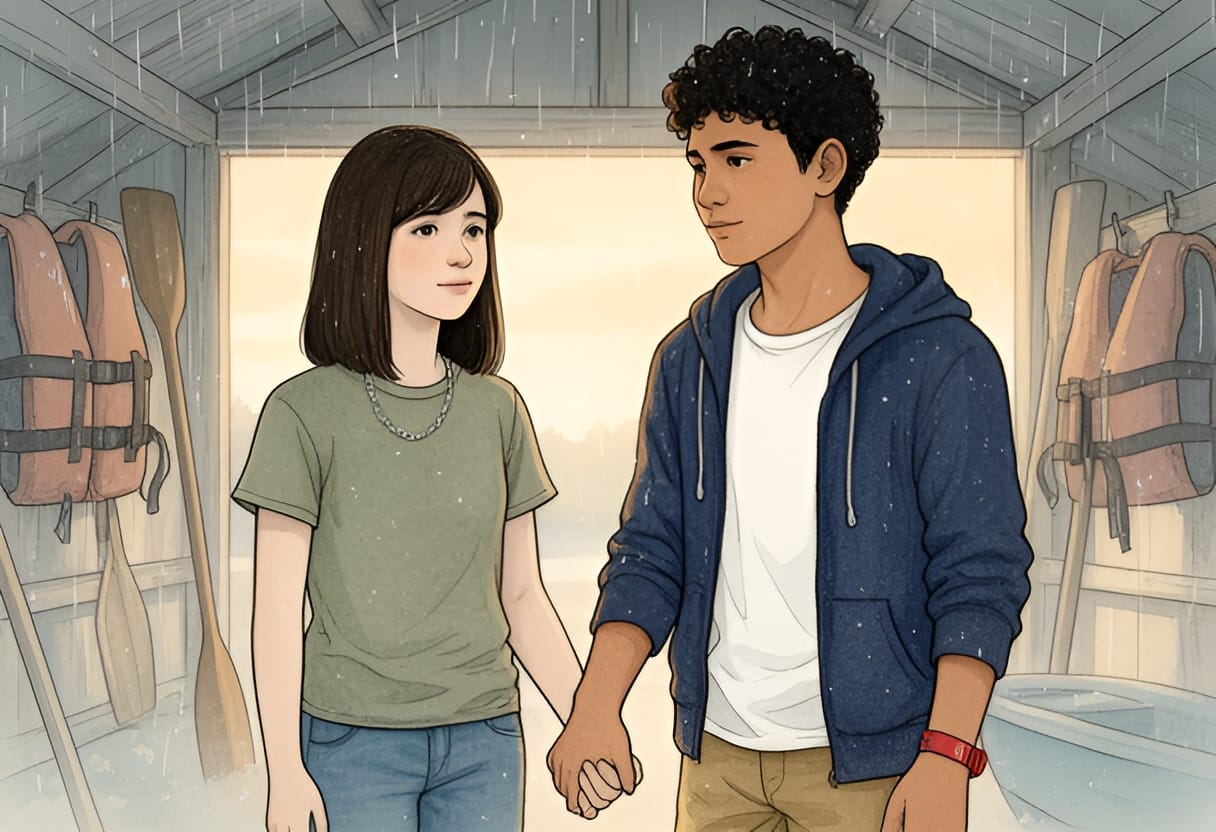
The rain eased to a drizzle. Light crept back into the boathouse, silver and soft. They stood there, hands joined, shoulders touching, listening to the quiet that followed the storm—not empty, but full of what had been said, and what didn’t need to be.
When they finally stepped back into the clearing air, the world felt washed clean. Pines dripped onto the path. The lake gleamed, restless but calm.
They walked side by side toward camp, neither speaking, neither needing to. Her hand stayed in his. His thumb brushed her knuckles, slow and sure.
And for the first time, Kaylee didn’t wonder if he noticed her.
She wondered how to say what she felt.
Chapter 3
Starlight and Quiet Choices
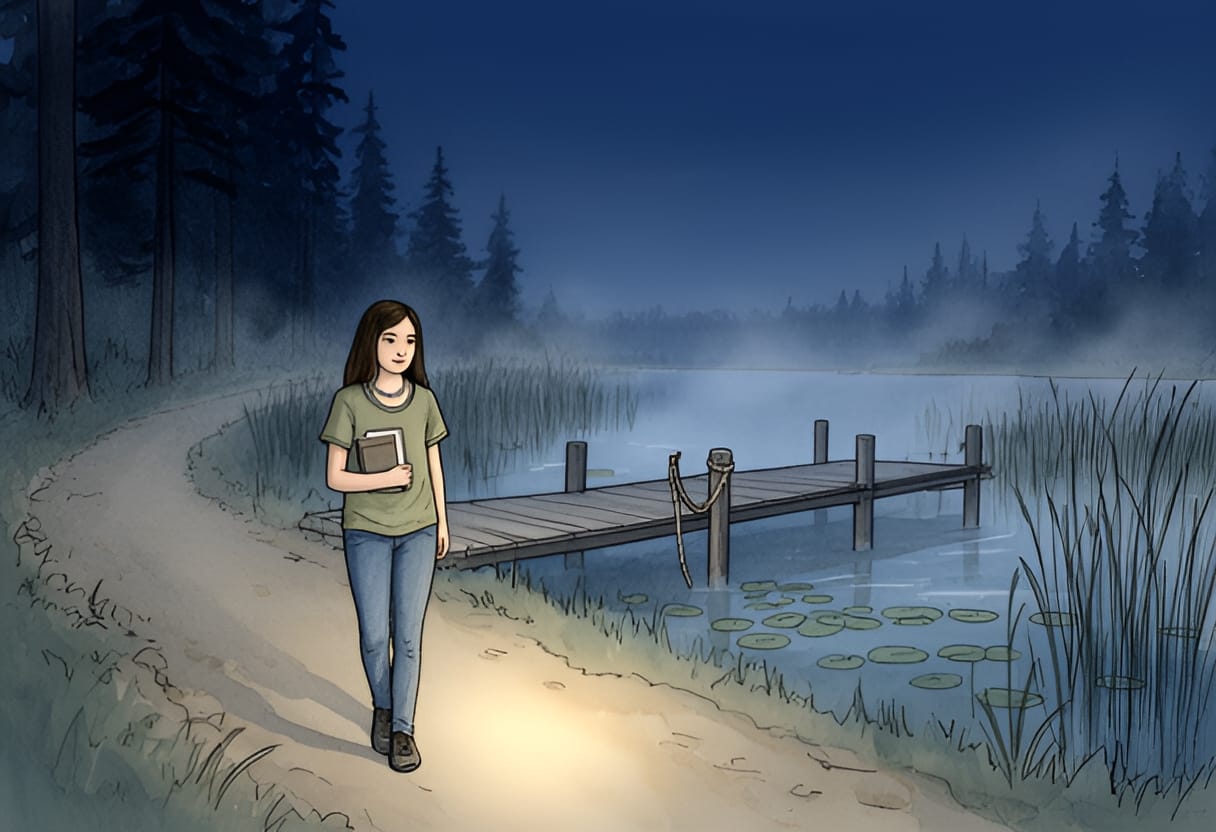
The evening air had begun to cool as Kaylee made her way down the familiar path to the lake, her journal tucked under one arm. She hadn’t meant to come here—had thought she’d sit by the fire pit, sketch the last embers of the day—but her feet had carried her here instead, to the dock where so many quiet afternoons had unfolded. The water was still, catching the last gold of the sun like polished stone. She sat at the edge, legs dangling, and let the silence settle around her—not empty, but full of the day’s echoes: laughter from the field, the distant call of a loon, the way Kashaka’s voice had softened when he said, I don’t have to be perfect here.
She opened her journal to a blank page, not to draw, but to feel the weight of it, the familiar press of the cover in her palms. She hadn’t written in it since the storm. Not because she had nothing to say, but because the words had started to feel unnecessary when she was with him. When she could just be.
A shift in the air beside her made her glance over. Kashaka sat down without a word, close enough that their shoulders nearly touched. He didn’t look at her. He stared out at the water, where the sun had dipped below the treeline and the sky was turning the color of faded denim.
The crickets had begun their evening chorus. Somewhere, a door slammed in the counselors’ lodge. The world was wrapping itself up for the night.
“I’m going to miss this place,” Kashaka said, so softly she almost didn’t hear it. His voice was low, rough at the edges, like he was afraid the words might break if he said them too loud.
Kaylee turned her head. “Me too.”
He finally looked at her. His eyes were dark in the fading light, but she could see them—really see them—clear and open, like the sky just after rain. “Not just the lake,” he said. “Or the hikes. Or even the stupid trust exercises.” He gave a small, tired smile. “I’ll miss… you. How you sit here like you’re listening to the water talk. How you don’t fill the silence just to make it go away.”
A warmth spread through her chest, quiet and certain, like the sun still lingering beneath the horizon. She looked down at her hands, folded in her lap. “You make me feel like I matter,” she said. “Not because I say the right thing, or do well in the activity, or even because I’m fun to be around. But because when I’m with you, I don’t have to prove I’m worth noticing. You just… see me.”
He didn’t answer right away. He just looked at her, and in that look, she felt it—not just heard, but known. The kind of recognition that doesn’t need applause, or proof, or a label stuck neatly on a folder.
Then, slowly, he reached for her hand. Not suddenly, not dramatically—just there, as if it had always belonged there. His fingers laced with hers, warm and sure. The journal slipped from her lap and landed with a soft thud on the dock, forgotten.
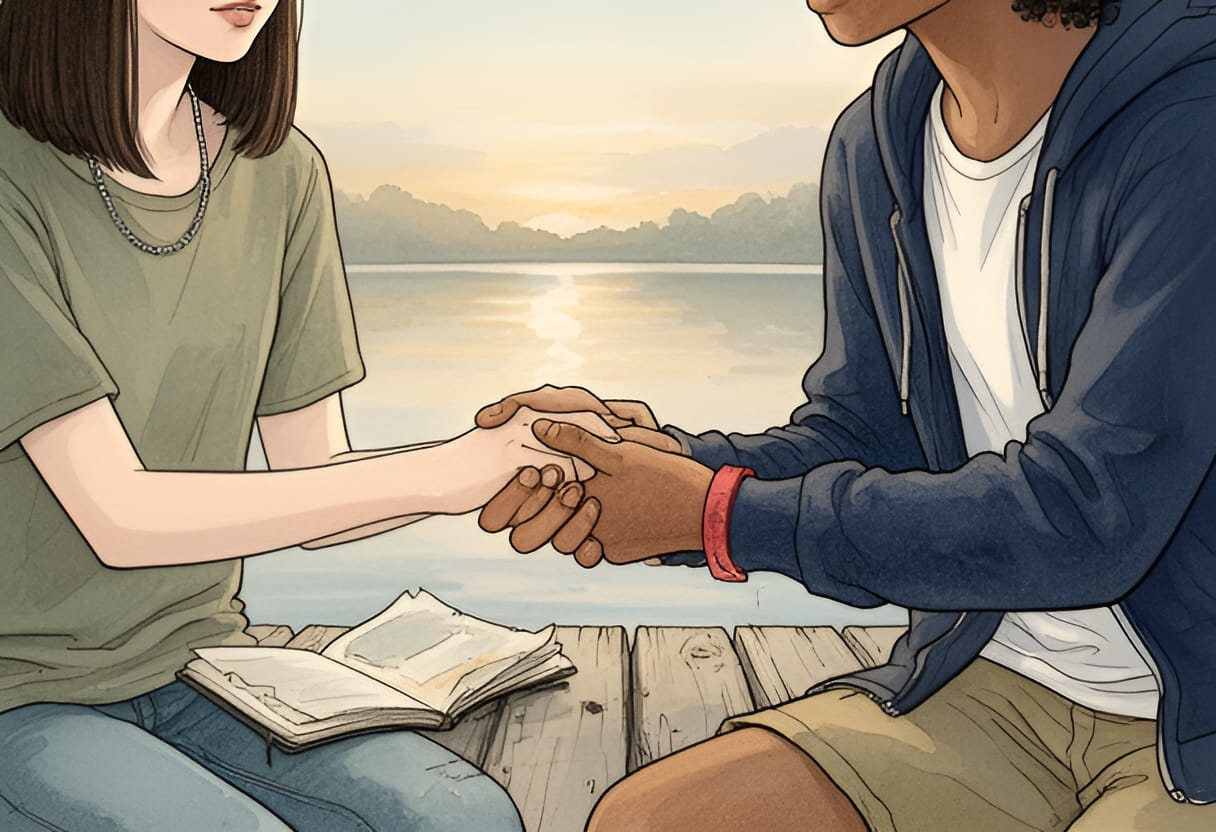
She turned toward him fully. He did the same. The space between them was small, charged not with urgency, but with the quiet understanding of something that had been growing, root by quiet root, since the first time he’d carried her bag without being asked.
His thumb brushed her knuckle once—just once—and then he leaned in.
Their first kiss was soft. Brief. Not a spark, but a settling—like two pieces of wood finally fitting after being rubbed raw by friction. It deepened not with heat, but with the quiet certainty of being known. When they pulled back, foreheads nearly touching, neither spoke. They didn’t need to.
The stars were coming out, one by one, above the lake. The water whispered against the pilings. And for the first time since arriving at camp, Kaylee didn’t feel like she was waiting to be seen.
She just was.
They stayed like that for a while, shoulders touching, hands clasped, listening to the water lap against the dock and the night settle in around them. The air had grown crisp, carrying the scent of pine and damp earth. Above, the sky had deepened to a rich indigo, stars scattered like salt across a dark cloth. Kaylee rested her head lightly on Kashaka’s shoulder, feeling the steady rise and fall of his breath, the warmth of his palm against hers. No words were needed. The silence between them was not empty, but full—of all the things they hadn’t said, and all the things they didn’t need to.
Eventually, Kashaka shifted slightly, pulling back just enough to look at her. His eyes were soft in the starlight, his thumb tracing slow circles on her knuckle. “We should head back,” he murmured, his voice low and rough with sleep and something tenderer.
Kaylee nodded, though a quiet reluctance tugged at her chest. She didn’t want to let go—not of this moment, not of him. But she understood, as he did, that this wasn’t an ending. It was a beginning, quiet and uncertain, but real.
They rose together, brushing off the dock’s rough wood from their jeans. Kashaka tucked her journal under his arm without being asked, his fingers brushing hers as he handed it back. She took it, their eyes meeting for a heartbeat—no words, just acknowledgment. Then he slipped his hand back into hers, fingers lacing naturally, as if they’d always known how to fit.
The path back to camp wound through trees whose silhouettes stood sharp against the starlit sky. The air was cool now, and they walked slowly, shoulders occasionally brushing, steps falling into an easy rhythm. Around them, the camp was winding down—doors clicked shut, laughter drifted from nearby cabins, flashlights flicked on in windows like sleepy fireflies. They passed a group of counselors packing up a canoe, their voices low and tired. No one paid them much notice. To anyone watching, they were just two kids walking home from the lake, hands held.
But it meant everything.
Kaylee felt the familiar weight of self-consciousness lift, not because she was being watched, but because she wasn’t. She could simply be here—Kashaka’s hand in hers, the night air on her skin, the quiet certainty that she was seen, not for what she did or said, but for who she was. And she saw him, too—not the athlete, not the student under pressure, but the boy who noticed how she listened to the water, who remembered the way she folded her clothes, who had carried her bag without being asked and stayed when the silence grew thick.
They reached Cabin 7 just as the last of the evening lights blinked out in the counselors’ lodge. The cabin sat quiet in the darkness, its faded white trim barely visible in the starlight. A single light glowed from within—likely Kashaka’s, or maybe hers—soft and warm behind the curtained window.
They stopped at the bottom of the three wooden steps, turning to face each other. The night air stirred Kaylee’s hair, and Kashaka tucked a strand behind her ear, his touch lingering for a second before falling away. His eyes searched hers, not with urgency, but with a quiet hope—like he was memorizing this moment, not because he feared losing it, but because he wanted to carry it forward.
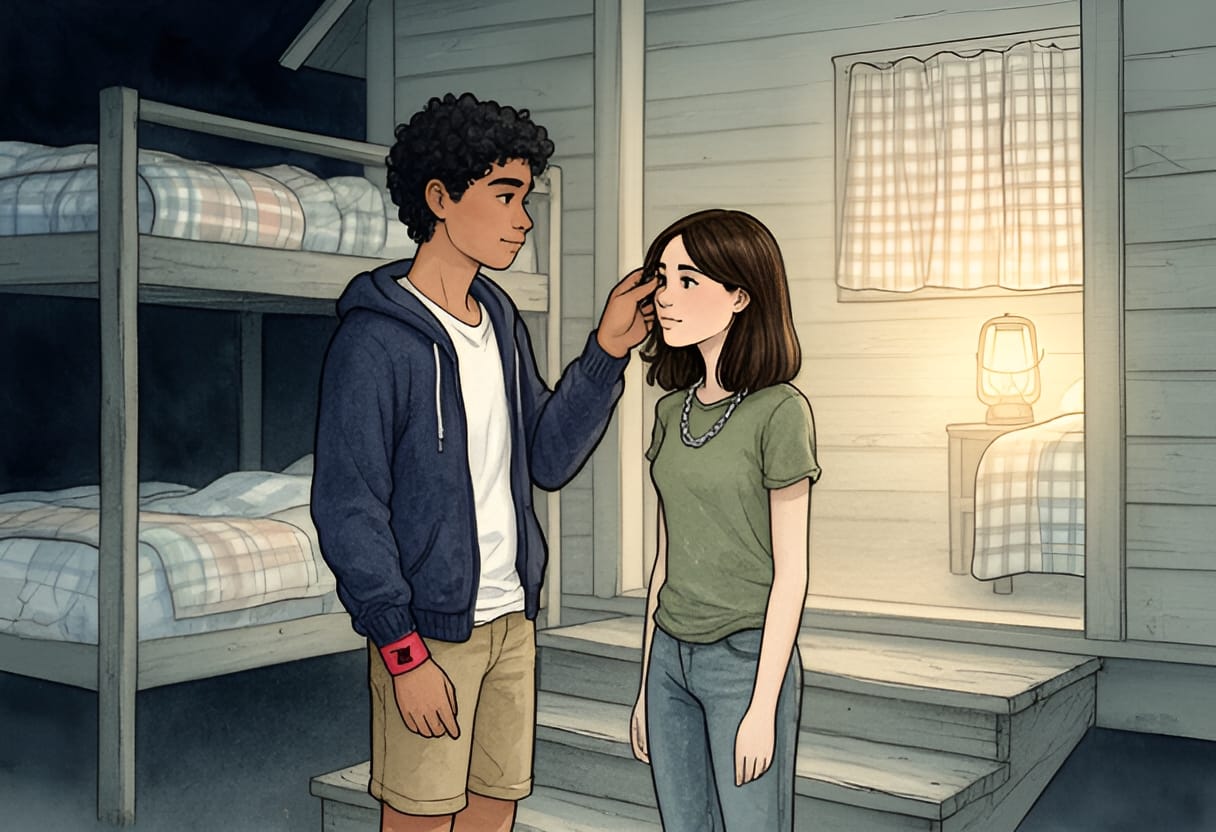
“I’ll see you tomorrow,” he said, voice barely above a whisper.
Kaylee smiled, small and sure. “Yeah. Tomorrow.”
They squeezed each other’s hands once—brief, firm, a promise without fanfare—and then slowly let go. The loss of contact was felt, but not as a loss. More like a pause. A breath held, then released.
Kashaka took a step back, then another, giving her space but not breaking eye contact until he reached the cabin door. He paused there, hand on the knob, and gave her one last nod—soft, grateful, full of unspoken things. Then he turned, opened the door, and stepped inside, closing it gently behind him.
Kaylee stood on the steps for a moment longer, listening to the night—the rustle of leaves, the distant hoot of an owl, the quiet creak of the cabin as it settled. She looked down at her hands, still tingling where his had been, then up at the sky, thick with stars.
She didn’t feel like she was waiting to be seen anymore.
She turned and walked slowly up the path to her own cabin, her steps light, her heart quiet but full. Her journal swung slightly at her side. And for the first time in a long time, she didn’t feel alone.