
Fiction
Stock market uncertain!
by Meera
3 chapters1.3 hr read
Chapter 1
The Weight of Numbers
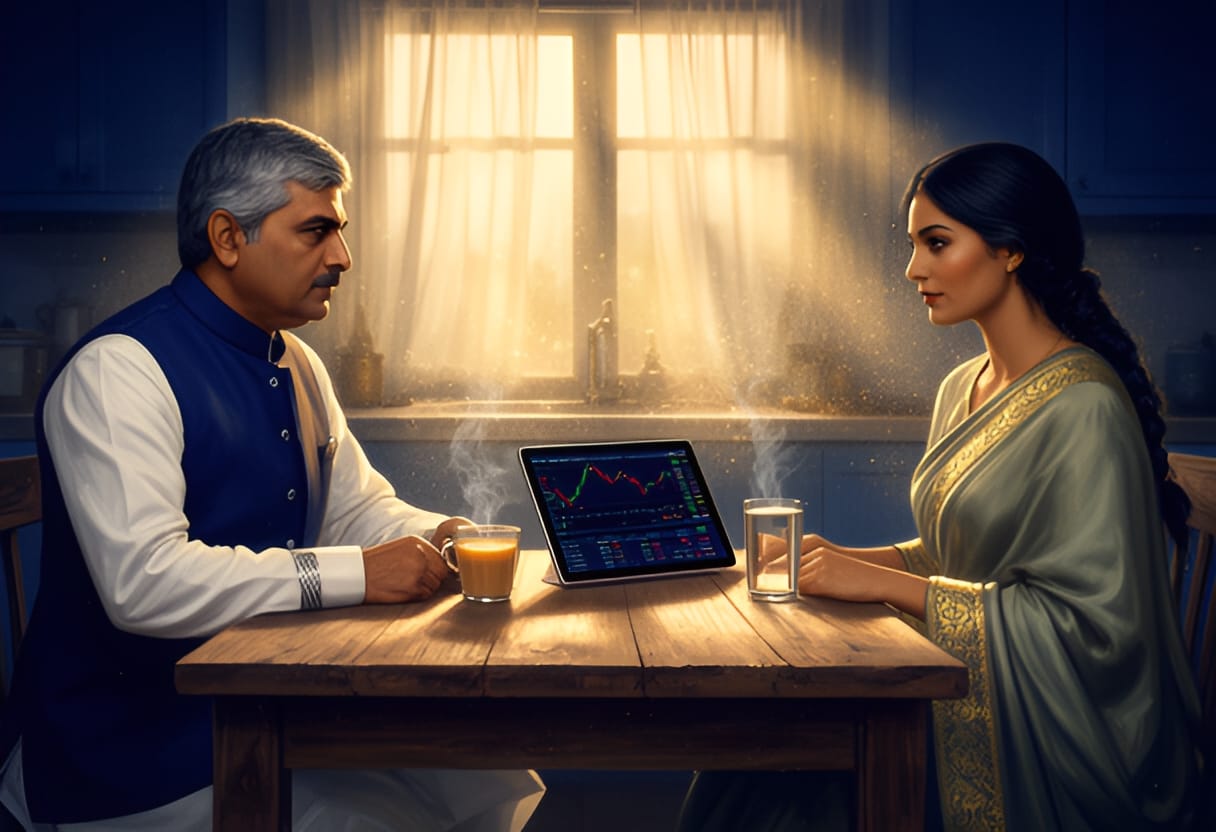
The morning light filtered through the gauzy curtains of the kitchen, catching dust motes in slow, golden spirals. Steam curled from two ceramic cups on the wooden table, carrying the sharp, sweet scent of cardamom and ginger. Arjun Mehta leaned back in his chair, the worn leather creaking softly, and watched his wife trace a finger over the glossy surface of her tablet.
“See here?” Mira said, her voice low and pleased. “This candle—right at the open—it’s a textbook bullish engulfing. The body completely swallows yesterday’s red candle. Volume spiked on the close. Momentum’s building.”
Arjun nodded, though his eyes kept drifting to the window, where the mango tree in their compound swayed gently in a breeze that carried the faint hum of the city waking. “It looks strong,” he said. “But I can’t stop thinking about Patel’s position.”
Mira glanced up, her dark eyes sharp behind thin-rimmed glasses. “The leveraged mid-cap bet? You told me he was diversified.”
“He was,” Arjun said, rubbing his thumb over the rim of his cup. “But last week he doubled down on that textile stock—Vardhman Weave. Mid-cap, thinly traded. I warned him the float was too low for that kind of exposure. He said he had a tip.”
Mira’s brow furrowed. “And you didn’t pull him back?”
“I did. He said he’d hedge with futures. But I know how he trades when he’s got a hunch. He ignores the stops.” Arjun’s jaw tightened. “If the market gaps down tomorrow, he could be looking at a margin call before lunch.”
Mira reached across the table, her hand warm over his. “You’ve been doing this twenty-five years, Arjun. You know when to listen to your gut. But look at the charts—the Nifty’s holding above 22,300. The engulfing pattern confirms the breakout. Foreign inflows are still positive. This isn’t noise. This is follow-through.”
He turned his palm up, lacing his fingers with hers. Her skin was calloused from years of typing, of scribbling notes in the margins of printouts, but her grip was steady. “You always make it sound so simple.”
“It’s not simple,” she said, a small smile touching her lips. “It’s just… clearer than the noise. Trust the pattern. It’s rarely wrong.”
He wanted to believe her. He did believe her—part of him, the part that had learned to read tape and tide over decades of booms and busts, wanted to lean into her certainty. But another part, quieter and older, remembered the crash of ’08, the way the screens had gone red before the news even broke, the silence that followed the closing bell. He pushed it down. Today was Sunday. The market was closed. They had chai.
Mira set the tablet aside and leaned forward, her elbows on the table. “Tell me about the client,” she said. “Not the trade—him. Why does he do it?”
Arjun sighed. “He’s trying to prove something. To himself, maybe. After his father lost everything in the Harshad Mehta frenzy, he swore he’d never be reckless. Now he swings the other way—bets big, hoping one win will erase the fear.”
Mira nodded slowly. “Fear dressed as courage.”
“Exactly.” He lifted his cup. “To fear. And the patterns that try to outsmart it.”
She clinked her cup against his. “And to the ones who live with both.”
They sat in companionable silence for a moment, the morning deepening outside. Then Mira stood, stretching her arms above her head. “Come on,” she said. “Let’s wash up. I’ve got a report to finish on the pharma sector, but after that…?”
Arjun rose, his knees popping slightly. “After that, we see if that bullish engulfing translates to bullish something else.”
She laughed, a soft, warm sound. “Always the opportunist.”
They moved through the kitchen together, the rhythm familiar—the clink of dishes, the splash of water, the way she leaned into him as he passed behind her to reach for a glass. Her hair, usually pulled back tight during the week, had escaped its confines and fell in loose waves over her shoulders. He brushed a strand from her neck, feeling the pulse there, steady and warm.
Later, on the sofa, they lingered over the report, her pointing out support levels with a pencil, him asking questions that made her rethink a resistance line. The conversation flowed easily, the way it did when the world outside felt distant and manageable. By early afternoon, the tablet was set aside, the reports folded and stacked. The sun had moved across the floor, painting rectangles of light that grew shorter with each passing hour.
They made love slowly, deliberately, as if reaffirming a language they both spoke fluently. Her breath hitched against his shoulder; his hands traced the familiar landscape of her back, the rise and fall of her ribs. Outside, the city’s murmur faded into a low thrum. Inside, there was only the press of palms, the quiet gasp, the shared rhythm that had carried them through twenty-two years of marriage—and, so far, every market storm.
Afterward, they lay tangled in the sheet, the ceiling fan above them turning in lazy circles. Mira’s head rested on his chest, her ear over his heart. He could feel the slow rise and fall of her breathing, the occasional flutter of her eyelids as she hovered between wakefulness and sleep.
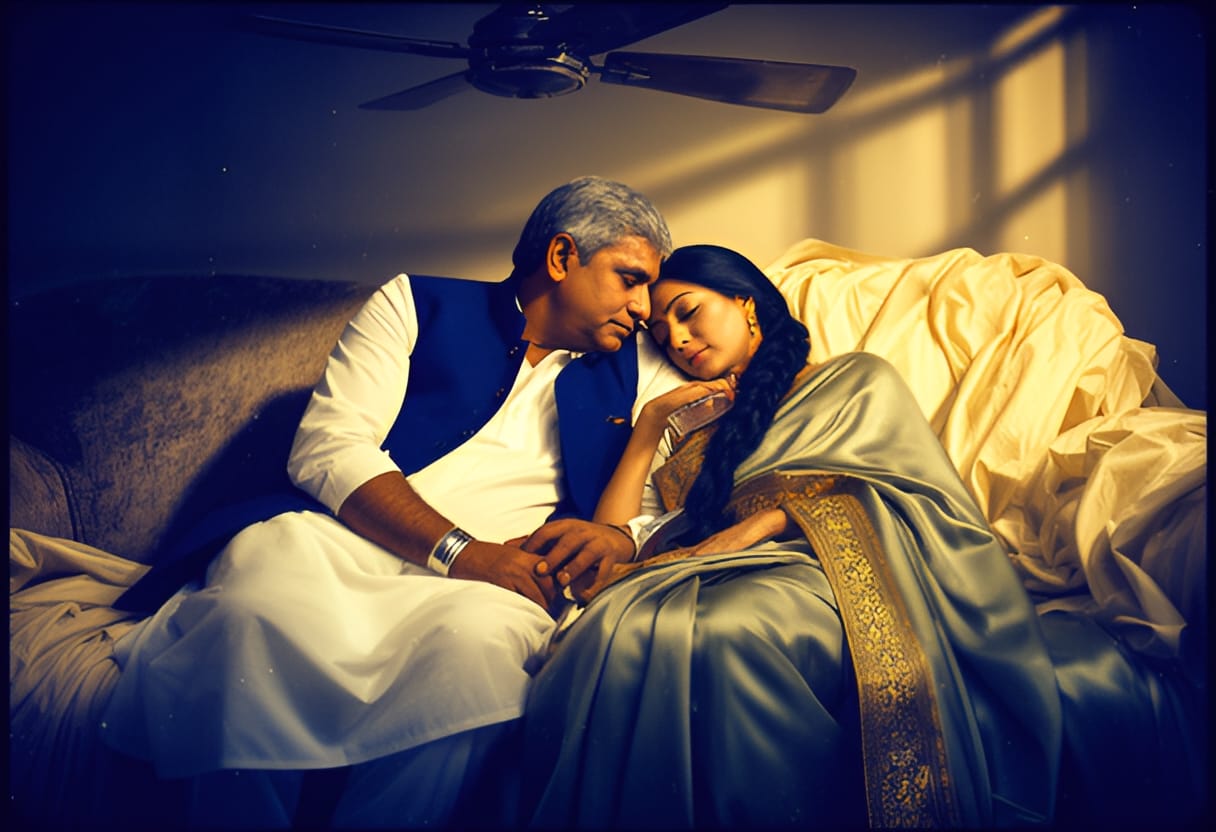
His phone, face down on the coffee table, buzzed once—a soft, insistent vibration.
He ignored it, content to let the moment hold.
But then, minutes later, it buzzed again. And again.
With a sigh, Arjun lifted himself on an elbow and reached for the device. The screen lit up in the dim room: an alert from his trading app.
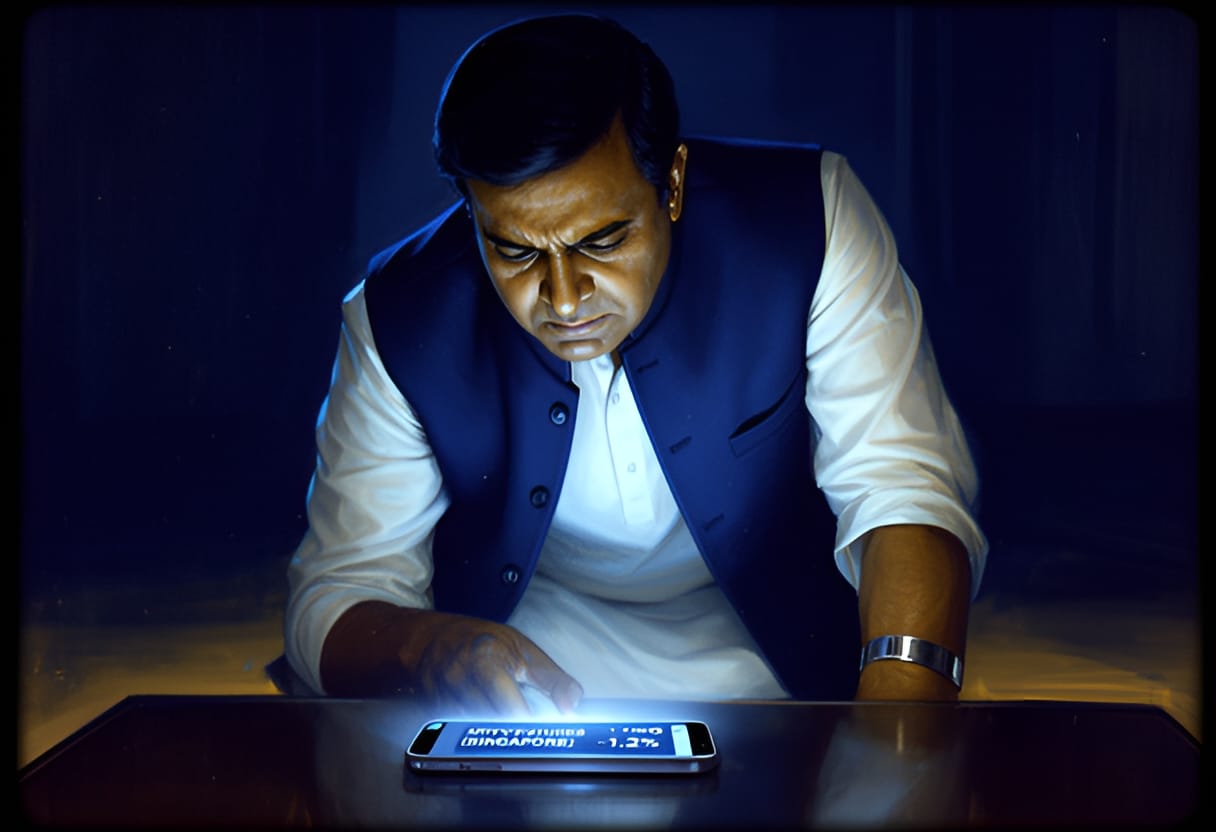
NIFTY FUTURES (SINGAPORE) –1.2% – OVERNIGHT
He stared at the numbers, the red percentage glowing like a warning light. His throat tightened. He turned his head to look at Mira. She was asleep, her face peaceful, one hand curled loosely near her cheek.
He didn’t wake her.
Instead, he lowered the phone back to the table, the screen going dark. He settled back onto the pillow, stared at the ceiling, and listened to the fan turn.
Somewhere, in a market that never truly slept, the pattern she had trusted was already unraveling.
Arjun woke before dawn, the memory of the alert still sharp behind his eyes. He lay still, listening to the fan’s lazy turn, to Mira’s even breathing beside him. The phone on the coffee table remained dark, but he knew the number it had flashed—NIFTY FUTURES (SINGAPORE) –1.2%—was not a glitch. It was a tremor felt through the floor of a building that had stood steady for years.
He slipped out of bed, pulled on his kurta, and padded barefoot to the study. The room smelled of sandalwood polish and old paper. His trading terminal glowed in the dimness, a rectangle of cool light. He powered it on, waited for the familiar chime, and pulled up the Nifty chart. The overnight futures showed a gap down, the candle a solid red body engulfing the previous day’s small green. Not the bullish engulfing Mira had seen. This was its inverse—a bearish engulfing, forming before the market had even opened.
He frowned. The pattern meant nothing by itself, not really. But it was a word in a language he had spent decades learning to speak. And the language was shifting.
By 8:15 a.m., he was at the office, his usual seat at the trading desk already warm from the early shift. The floor hummed with the low thrum of screens and subdued voices. Traders moved with purpose, but there was a tightness in their shoulders, a hesitation before they hit execute. Arjun watched the tape: mid-cap stocks were bleeding on volume. Vardhman Weave, the thinly traded textile Patel had leveraged, was down 3.2% on twice its average turnover. Others—Kiran Gears, Satyam Textiles—showed similar signs. Selling pressure without panic. Distribution, not capitulation.
Yet the Nifty held. Up 0.4% at the open, inching toward 22,400. The index breathed while its parts strained.
Arjun leaned forward, elbows on the desk, fingers steepled. He called up a volume-weighted average price (VWAP) chart for the Nifty Midcap 100. The line sloped downward, price failing to hold above VWAP despite the index’s modest gain. Divergence. Not loud, but insistent—like a cough in a crowded room that no one else seemed to hear.
He picked up the internal line and dialed Mira’s extension. It rang twice.
“Arjun?” Her voice was bright, already awake, already in the flow.
“You free for a second?” he said. “I’m seeing something odd on the floor.”
“Go ahead.”
He described what he’d seen—the mid-cap selling, the volume spikes on down moves, the Nifty’s quiet resilience. “It feels like the market’s holding its breath. Like the bids are thinning underneath.”
There was a pause. Then, softly: “You’re looking at the wrong timeframe, love. Pull up the 15-minute RSI on the Nifty. It’s at 58—no overbought exhaustion. MACD histogram is still positive, though narrowing. And check the advance-decline line—it’s holding above its 20-day average. This isn’t distribution. It’s digestion. A healthy shakeout before the next leg up.”
He heard the confidence in her tone, the way she anchored herself in the numbers. It was the same tone she’d used Sunday morning, chai in hand, certain of the pattern.
“I know your indicators,” he said. “I trust them. But I also trust the tape. And the tape is whispering.”
“Whispers are easy to mistake for wind,” she said. “Trust the signal, not the rustle. Your gut’s been right before—but it’s also been wrong. Remember ’15? You pulled back on Infosys because it ‘felt heavy.’ It went up 18% in two weeks.”
He did remember. And he remembered the shame that followed, the way he’d second-guessed himself for months after.
“I’m not asking you to change your view,” he said carefully. “Just… tell me if you see what I’m seeing. The volume on the downs. It’s not random.”
Another pause. Longer this time.
“I see normal profit-taking,” she said at last. “In a strong uptrend, you get days like this. The weak hands shake out, the strong hands accumulate. Your RSI on the midcap index—if you’re looking at it—is probably showing mild weakness, but that’s expected. It doesn’t break the trend. Arjun, you’ve spent years reading price action. You know a single session doesn’t invalidate a pattern. Especially not when the higher timeframes are still bullish.”
He wanted to argue. To say that the whisper had grown louder, that the hesitation on the floor was palpable, that Patel’s position in Vardhman Weave was a bomb waiting for a spark. But she was speaking the language of the charts, and he was speaking the language of the room. Two dialects of the same market, and neither was wrong—yet they were not meeting.
“I’ll watch it,” he said. “Keep an eye on the AD line. If it starts to roll over, call me.”
“I will,” she said. “And you do the same. Don’t let one bad tick shake your discipline.”
They said goodbye. He lowered the receiver, the silence of the line loud in his ear.
He returned to his screen. The stock he’d recommended to a client three days ago—Sahyadri Alloys, a mid-cap auto ancillary—was down 1.8% on the day. He’d told the client to hold, citing strong order books and improving margins. But that morning, as he watched the tape, something in the way the offers stacked—thin, eager to lift—made his stomach tighten.
He opened the client’s order ticket. The stop-loss was currently at 9% below entry. Too wide, he thought. Too forgiving.
He changed it. Moved it up to 4.5% below the current price—just below the day’s opening level, a logical point where short-term support might hold. If it broke, it would mean the intraday bias had shifted.
He hit enter. The order flashed in red: STOP LOSS – 4.5% – DAY ORDER.
Minutes passed. The stock meandered sideways, then began a slow drift down. At 10:03 a.m., it touched 312.50—his new stop. The order triggered.
He watched the tape as the stock plummeted through the bid. 310.20. 308.70. 305.10. By 10:07, it was down 4.1% on the day, volume surging as stops below his were hit and momentum sellers piled in.
Arjun leaned back, the chair creaking. His heart hammered—not from fear, but from the sharp, clean validation of instinct. He had acted. The market had responded.
His phone buzzed. Mira’s name on the screen.
He answered.
“You were right,” he said, before she could speak. “Sahyadri Alloys just took out my stop. Down 4% in five minutes.”
There was a beat. Then, softly: “I’m sorry, Arjun.”
“Don’t be. It’s not about being right. It’s about what it means.” He paused, choosing his words. “If the stop got taken out so easily, it means the bids weren’t there. It means the selling wasn’t just profit-taking. It was urgent.”
“Or it means the stock was thinly traded and your stop was too tight for its natural volatility,” she countered. “Sahyadri Alloys has an average true range of 3.8% intraday. A 4.5% stop is within one ATR. In a choppy session, that’s likely to get touched by random noise. It doesn’t mean the trend is broken—it means you got stopped out by volatility, not direction.”
He exhaled slowly. She was technically correct. The stock’s movement fit within its normal range. The stop had been vulnerable.
But he hadn’t placed it based on ATR alone. He’d placed it based on the look of the tape—the way the offers had leaned, the lack of buying interest on the dips. He had acted on a read that her indicators couldn’t capture because they weren’t designed to.
“I know,” he said. “But what if it’s not noise? What if it’s the first note of something louder?”
“Then we’ll see it in the data,” she said. “The RSI will break. The MACD will cross. The volume will confirm. We don’t need to guess. We’ll know.”
He wanted to believe her. He wanted to lean into her certainty, to let the charts be the final arbiter. But the image lingered—Sahyadri Alloys bleeding on the tape, the client’s position stopped out not by a trend reversal, but by a sudden, sharp exhalation of supply. It felt less like randomness and more like a market inhaling before a dive.
“I’ll keep watching,” he said. “And I’ll call you if I see the RSI break.”
“Do that,” she said. “And Arjun?”
“Yeah?”
“Breathe. You’re tensing up again.”
He hadn’t realized he was. He loosened his grip on the desk, felt the tension in his shoulders ease, just a fraction.
“Thanks,” he said.
They hung up.
He left the stop where it was. If the stock reversed and reclaimed the level, he’d reconsider. But for now, he sat upright, eyes on the screen, listening not just to the price, but to the silence between the ticks—the way the market held its breath before it decided which way to run.
He set the receiver down slowly, the smooth plastic cool against his palm. The office hummed around him—keyboards clicking, phones ringing in bursts, the low thrum of the air conditioner—but inside his chest, a quiet dissonance had taken root. He stared at the blinking cursor on his trading terminal, the numbers scrolling past like thoughts he couldn’t quite grasp.
It was Tuesday morning, and Mira had promised to send her updated analysis by ten. He waited, not with anticipation, but with a kind of weary resignation. When the email finally arrived, he opened it with deliberate slowness, as if prolonging the moment might delay the inevitable: another chart, another interpretation, another world where the market made sense.
The report was clean, precise. Mira’s voice came through in the formatting—bold headers, color-coded trendlines, annotated charts with arrows pointing to confluence zones. At the top, in her usual understated tone: Nifty Retraces to 38.2% Fibonacci with Volume Confirmation—Uptrend Intact.
He scrolled down.
The Nifty, she wrote, had pulled back from its recent high to the 38.2% Fibonacci retracement level—a classic zone of support in a healthy uptrend. The decline, she argued, was not distribution but a shallow pullback on declining volume, followed by a resurgence of buying interest at the retracement level, evidenced by a spike in on-balance volume and a bullish engulfing candle on the 4-hour chart. The VWAP, she noted, had held as dynamic support during the pullback, and the 20-day EMA was still sloping upward, acting as a magnet for price.
“Volume supports the bounce,” she had written. “Weak hands have shaken out. Strong hands are accumulating. The structure remains bullish.”
Arjun read it twice. He admired the clarity of it—the way she could take chaos and render it into logic, the way she saw order where he saw only tension. But as he traced the lines on the screen with his eyes, he felt a growing hollowness. It wasn’t that she was wrong. It was that she was too right. Her analysis felt like a weather report on a ship already taking on water—accurate, perhaps, but missing the point.
He leaned back in his chair, the leather creaking. Across the open floor, he could see Patel hunched over his dual monitors, jaw tight, fingers drumming a restless rhythm. Earlier that morning, Patel had taken a call—Arjun had seen him flinch at the voice on the other end—and then shoved back his chair and stalked to the window, where he stood staring out at the distant skyline, his reflection dark in the glass.
Arjun’s phone had rung twice since nine. Both times, it had been clients—older men, mostly, voices tight with anxiety. One had asked if he should exit his position in a mid-cap pharma stock, his breath hitching between sentences. Another had whispered, “Is it happening again?” before hanging up without waiting for an answer.
He hadn’t told Mira about the calls. He hadn’t wanted to burden her with the noise when she was busy building her model.
Now, as he reread her report, the disconnect sharpened. She spoke of volume confirmation and Fibonacci levels as if they were bedrock. He saw instead the tremor in a client’s voice, the way an old investor’s hands had shaken as he signed a liquidation form, the silent dread in Patel’s eyes as he watched Vardhman Weave tick lower, leveraged and exposed.
He opened a new email, addressed to Mira. His fingers hovered over the keyboard.
Thanks for the report. Looks solid.
He deleted it.
Tried again.
The analysis makes sense. I’m seeing some pressure in the midcaps, though—Sahyadri Alloys kept me on edge yesterday.
Deleted.
He leaned forward, elbows on desk, and typed slowly, each word deliberate.
I read your note. The logic is clear. The retracement to 38.2%, the volume support, the VWAP holding—it all checks out. I can follow the math.
He paused, staring at the words. They felt inadequate, like bringing a ruler to a hurricane.
But I’m struggling to connect it to what I’m hearing on the phone. Clients are scared. Not just worried—scared. One asked me if this was 2008 again. Another said he couldn’t sleep. Patel’s been quiet since yesterday. He’s not sleeping either, I don’t think.
He swallowed. The next part was harder.
I think I’m afraid—not of losing money, but of losing my edge. Twenty-five years of reading tape, of feeling the room… and now I wonder if it’s just noise. If the market’s moved beyond instinct. If all that experience is just… outdated.
He hit send before he could overthink it.
He didn’t expect an immediate reply. Mira was meticulous—she would think before she responded. He returned to his screen, but his focus was fractured. The candlesticks blurred. The numbers swam. He closed his eyes for a moment, and when he opened them, the office seemed quieter, the voices muffled, as if he were underwater.
His phone buzzed an hour later.
He saw her name and hesitated before answering.
“Hey,” he said, voice low.
“Hey,” she replied. “I got your email.”
There was a pause. He could hear the faint tap of keys in the background—she was still at her desk, likely in their home office, the afternoon light slanting across her workspace.
“I wanted to say… thank you for sharing that,” she said. “I didn’t realize how much you were carrying.”
He exhaled, a sound he hadn’t known he was holding.
“I didn’t want to distract you,” he said. “You were in the zone. I didn’t want to pull you out with my… feelings.”
“Your feelings are data too,” she said softly. “Maybe not the kind I plot on a chart, but real. And important.”
He smiled despite himself. “Since when do you value the unquantifiable?”
“Since I married a man who trades on intuition,” she said. “I’ve learned to respect what I can’t measure.”
He was quiet for a moment. Then, quieter: “What if the models are lying to us? Not because they’re wrong, but because they’re incomplete? What if they’re showing us a picture that’s technically accurate… but missing the whole sky?”
Another pause. Longer this time.
“I’ve been wondering the same thing,” she admitted. “I ran a backtest this morning—just to check. I looked at every time the Nifty retraced to the 38.2% level with rising volume on the bounce, going back ten years. In eighty percent of cases, the uptrend resumed within five sessions. The odds are in our favor.”
He could hear the strain in her voice—not doubt, exactly, but the first tremor of it. The way someone sounds when they’re trying to convince themselves as much as the other person.
“But what about the other twenty percent?” he asked.
“In those cases,” she said, “the market corrected deeper. Sometimes it broke structure. Sometimes it just… stalled. But even then, the damage was limited. The trend recovered.”
“And what if this time is different?” he whispered.
“I don’t know,” she said. Her voice was softer now, closer to a whisper than a statement. “I don’t know.”
He didn’t press her. He didn’t need her to have the answer. He just needed her to say she was wondering too.
“I’m scared,” he admitted. “Not of the numbers. Of what they’re hiding.”
“I know,” she said. “Me too.”
They stayed on the line for a moment longer, neither speaking, the connection thin but unbroken. Outside, the sun had dipped lower, casting long shadows across the desks. The market would close in ninety minutes. The Nifty was down 0.7% on the day, hovering just above the 38.2% retracement level she had highlighted.
Arjun didn’t look at the chart.
He closed his eyes and listened to the sound of her breathing on the other end of the line—steady, human, real.
And for the first time in days, he didn’t try to interpret it.
He just let it be.
The phone rang before the opening bell—a shrill, insistent sound that made Arjun flinch. He hadn’t even powered down his terminal from the night before, the glow of the screen casting a sickly pallor over his face. On the line was Rajiv from desk three, voice tight with panic. “Arjun, it’s opening limit down on the Nifty Futures. Singapore’s down eight percent already. Something’s happened—North Korea, they say. A missile test over Japan. The yen’s spiking, oil’s crashing…”
Arjun didn’t let him finish. He slammed the receiver down and hit the broadcast key on his desk phone, the one that connected straight to the exchange’s voice squawk box. Squawk came alive—a roar of voices, traders shouting over each other, the sharp staccato of sell orders being lifted. He fumbled for his headset, shoved it on, and leaned into the mic. “Floor, what’s the bid on Nifty June?” No answer. Just more chaos. He tried again, louder. “Bid on Nifty June!” A voice cracked through: “Bid? There is no bid, Arjun! It’s limit down! Circuit breaker’s tripped!”
He stared at the screen. The Nifty Futures (Singapore) flashed -9.8% in brutal red. The India VIX, usually a sleepy gauge of fear, had jumped to 42—levels not seen since the pandemic crash. His fingers flew to his keyboard, pulling up Patel’s margin position in Vardhman Weave. The stock was down 18% in pre-market, volume already triple the average. Patel’s leverage was 5x. If the stock gapped down at open, his maintenance margin would be violated in seconds. Arjun’s throat tightened. He snatched up the desk phone and dialed Patel’s number—home line, hoping he hadn’t left for the market yet.
It rang six times. Then Patel’s wife answered, her voice raw. “He’s not here, Arjun. He left at 6:30. Said he had to be at the terminal before the open. He’s… he’s not answering his mobile.” She began to sob. “I told him not to touch that stock. I told him it was gambling.”
Arjun hung up, his chest burning. He glanced at the clock: 9:14 AM. The market was supposed to open in one minute. He braced himself, knuckles white on the desk edge.
The opening bell rang—a harsh, metallic clang that sounded like a jail door slamming shut.
Instantly, the terminal erupted. Price columns collapsed like stone. Nifty Futures limit down at 17,200—800 points below Friday’s close. The cash index followed, plummeting through pre-defined circuit breaker thresholds with sickening speed. At 9:15 AM, the exchange triggered the first stage halt: a 15-minute pause to allow liquidity to replenish and panic to subside. But the halt felt like a lie. The damage was already done.
Arjun’s phone didn’t stop ringing. Clients screamed into the ear—voices high-pitched, terrified. “My stop-loss didn’t trigger! It gapped past it!” “I’m going to get a margin call! What do I do?” “Is this it? Is this 2008 again?” He tried to calm them, to explain the halt, to reassure them that limits were in place, that the market would find balance—but his own voice sounded hollow, mechanical. He could feel the old panic rising, the same icy dread that had gripped him during the 2008 Lehman collapse, the same sensation of the ground vanishing beneath his feet. Only now, it wasn’t just his clients’ money at stake—it was Patel’s, it was the couple’s own savings tied up in blue-chips, it was the trust Mira placed in his judgment.
He looked at the squawk box. Traders were on their feet, faces ashen, some shouting into phones, others just staring at their screens, frozen. A veteran broker he’d known for twenty years, Salim, was pounding his fist on the desk, muttering, “This isn’t technical. This isn’t normal. This is… something else.”
Arjun fumbled for his personal phone. He needed to hear Mira’s voice. He needed to know she was safe, that she wasn’t caught in this alone. He dialed, heart hammering.
She answered on the second ring. “Arjun?”
“I’m here,” he said, his voice rough. “Are you watching?”
“Yes,” she whispered. “I… I just saw it. The Nifty opened limit down. The circuit breaker tripped immediately.”
“I know. I’m on the floor. It’s… it’s worse than I thought. Clients are panicking. Patel—he went in early. I can’t reach him.”
There was a pause. She drew a shaky breath. “I ran a scan the moment I saw the futures drop. All my indicators—RSI, MACD, the 50 and 200-day moving averages—they’re all flashing sell. Strong sell. Across the board. Even the breadth… it’s horrifying. Advance-decline ratio is like 1:20. It’s not just mid-caps. It’s everything.”
He closed his eyes. “You saw it coming in your models?”
“No,” she said, and her voice broke. “No, I didn’t. I backtested the 38.2% retracement. I trusted the volume confirmation. I thought… I thought we had a buffer. But this… this isn’t a pullback. This is a rupture.” She swallowed hard. “I feel… stupid. Like I was looking at a map while the ground was shaking beneath me.”
“No,” he said fiercely. “You’re not stupid. You were right about the pattern. It’s just… the pattern broke. That’s all.”
“But it shouldn’t have broken like this,” she insisted. “Not with those odds. Eighty percent success rate over ten years—this should have been in the twenty percent, sure, but… this feels different. Deeper. Faster. Like the market’s not just correcting—it’s… resetting.”
He heard the fear in her voice—not the analytical concern of before, but something primal, exposed. It mirrored his own. For the first time, they weren’t speaking as broker and analyst, as husband and wife parsing data. They were two people standing on the edge of a precipice, staring into the void together.
“What do we do?” she asked, her voice barely above a whisper.
He didn’t have an answer. He looked at the halted ticker, the frozen red numbers, the sea of panic on the squawk box. Outside the exchange building, he could hear the distant wail of a siren—whether real or imagined, he couldn’t tell.
Then, after a long silence, he said, “We wait. We see what happens when it opens again. And… we talk to Patel. If we can.”
“I’ll call his wife,” she said. “See if she’s heard anything.”
They stayed on the line, neither hanging up. The halt clock ticked down on the screen—14:30, 14:29, 14:28—each second stretching. Arjun could hear Mira’s breathing, shallow but steady. He focused on it, let it anchor him. The market was a storm of numbers and noise, but this—her breath, the faint click of her keyboard in the background as she typed a message to Patel’s wife—this was real. This was human.
The halt lifted at 9:30 AM.
The market didn’t bounce. It accelerated.
Nifty Futures gapped open at 16,900—another 300 points lower—and immediately began to sink. The circuit breaker had held for fifteen minutes, but the selling pressure was relentless, fueled by margin calls, forced liquidations, and a global risk-off wave that showed no sign of abating. By 9:45 AM, the Nifty was down another 5% from the open, trading near 16,000—levels not seen in eighteen months.
Arjun watched in horror as his screen filled with red. Client portfolios were being margin-called in real time. Vardhman Weave hit its lower circuit limit—20% down—for the second consecutive day, triggering another halt. Patel’s position was now underwater by over 60%. His brokerage had likely already begun liquidating.
He grabbed the phone. “Mira?”
“I’m here,” she said, her voice tight. “I just saw Vardhman Weave hit the lower circuit. Patel…”
“I know,” he said. “I think they’ve started liquidating. I need to call his broker—try to get them to pause, if possible. But I don’t know if it’ll help.”
“I’ll call his wife again,” she said. “Tell her to stay off the terminal. Tell her… tell her it’s not over yet. That we don’t know how deep this goes, but panicking won’t help.”
He swallowed. “You don’t believe that, do you?”
A long pause. Then, quietly: “No. I don’t. But she needs to hear it from someone.”
He closed his eyes. The numbers on the screen blurred. He thought of the twenty-five years he’d spent reading tape, of the intuition he’d trusted, the patterns he’d felt in his bones. And now, here it was—everything he’d known, everything Mira had modeled, everything they’d built their lives around—being swept away in a tide of fear and algorithms he didn’t understand.
“Arjun?” Her voice was soft, uncertain.
“Yeah?”
“I’m scared,” she admitted. “Not just for the money. For… for us. For what this means. If the models can fail this badly… what do we trust?”
He opened his eyes. Looked at the flashing red numbers, the relentless tick of decline. He thought of her face that morning over chai, confident in her bullish engulfing candle. He thought of his own email, his whispered fear of obsolescence.
He didn’t offer platitudes. Didn’t quote statistics. Didn’t try to fix it.
Instead, he said, “Then we face it together. Not as the broker and the analyst. Not as the one who trusts patterns and the one who trusts gut. Just… as us. However we can.”
She was quiet for a moment. Then, so softly he almost missed it: “Okay.”
They didn’t say more. They didn’t need to. The market kept falling, the phones kept ringing, the world outside seemed to tilt on its axis. But for the first time since the bell rang, Arjun didn’t feel entirely alone.
He kept the line open. Let her breathing be his anchor. And waited—not for the market to turn, but for the next breath, and the one after that.
Chapter 2
The Logic of Fear
He kept the line open. Let her breathing be his anchor. And waited—not for the market to turn, but for the next breath, and the one after that.
The phone slipped from his ear sometime before dawn. He didn’t notice until the screen dimmed, the call ended by inactivity. He lay still, listening to the silence of the bedroom, the faint creak of the ceiling fan, the distant hum of the city beginning to stir. Outside, the first pale light bled through the blinds, striping the floor in gray and gold. He turned his head toward Mira. She was asleep, one arm flung above her head, the other curled beneath her cheek. Her breathing was even, untroubled. For a moment, he envied her the peace of unconsciousness—the way sleep could temporarily suspend the weight of knowing.
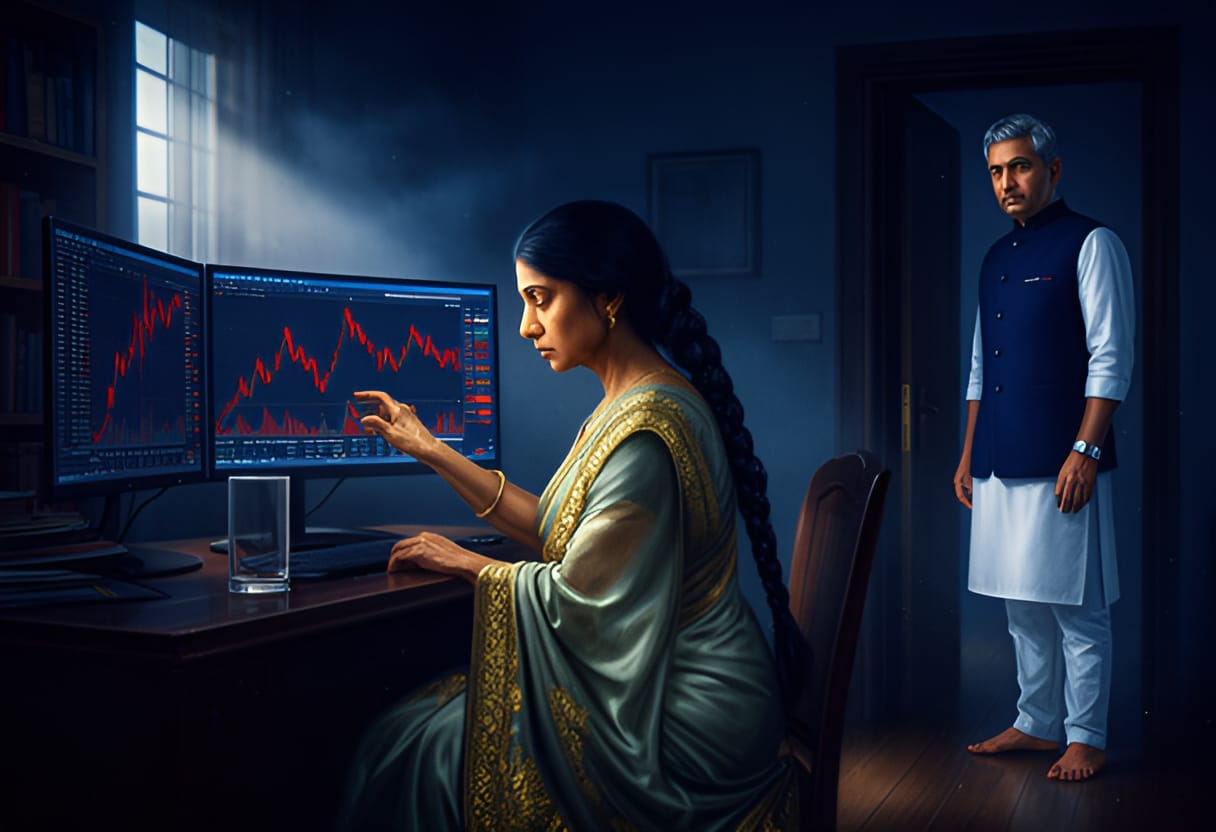
He rose slowly, careful not to disturb her, and padded barefoot to the study. The door clicked shut behind him. The room was cool, smelling faintly of ozone and old paper. Screens glowed in the dimness—multiple monitors arrayed across the desk, each displaying a different stream of data: Nifty futures, Vardhman Weave’s intra-day chart, a ticker of global indices, a heatmap of sector performance. All red. All falling.
He didn’t sit. Instead, he stood before the central screen, hands resting on the desk, staring at the candlesticks that had betrayed them. The bullish engulfing pattern Mira had spotted on Sunday morning—clear, textbook, confirmed by rising volume—had been invalidated by Monday’s gap down. Not a retracement. Not a pause. A decisive break below the pattern’s low, followed by another lower high, then another. The market hadn’t just ignored her signal; it had obliterated it with contemptuous efficiency.
He thought of her face over chai, the quiet certainty in her voice as she traced the candle with her fingertip. “It’s not just a pattern,” she’d said. “It’s the market telling us it’s ready to go higher.” And now, three days later, that same market was trading near its weekly low, Vardhman Weave locked at the lower circuit for the second straight day, Patel’s leveraged position almost certainly underwater, and the Nifty Futures in Singapore down another 0.8% overnight.
Arjun pressed his palms flat against the cool wood, feeling the vibration of his own pulse in his wrists. He wanted to call her. To wake her. To say, Look what happened to your signal. But he didn’t. He remembered her voice last night—soft, uncertain, admitting fear not just for the money, but for them. For what this meant if the models could fail. He hadn’t offered platitudes. He hadn’t tried to fix it. He had said, Then we face it together. And she had said, Okay.
He hadn’t lied. But he hadn’t told her the full truth either—that he, too, was terrified. Not just of losing money, but of losing her faith in the very thing that had defined her, that had brought them together, that had made her feel useful and seen in a world that often reduced her to “the broker’s wife.” If her edge was broken, what did that leave her with? And if his intuition—honed over twenty-five years of reading tape, of feeling the market’s breath in the pauses between ticks—was now just noise in a machine-driven storm, what was he?
He pushed away from the desk and walked to the window. The city was waking. Cars moved slowly along the street below. A vendor set up a cart near the corner, unfolding a tarp, arranging bunches of marigolds and coconuts. Life went on, indifferent to the numbers flashing in their study.
He turned back. The screens still bled red. He didn’t know what to do. So he did nothing. He sat. He watched. He waited—for a sign, for a reversal, for the courage to speak.
Thursday morning, Mira was already at the desk when Arjun emerged from the shower, towel draped around his waist, water still dripping from his hair. She hadn’t moved from her chair. Her eyes were locked on the central monitor, where a spreadsheet scrolled with relentless speed—columns of dates, entry prices, stop-loss levels, exit points, profit/loss figures. Her fingers flew across the keyboard, pausing only to adjust a parameter, rerun a test, muttering under her breath.
“You’re up early,” he said, pouring himself a cup of coffee from the thermal carafe. He leaned against the doorframe, watching her.
She didn’t look up. “I’m backtesting. Again.” Her voice was flat, devoid of its usual lilt. “Sunday’s signal. I need to know why it failed.”
He set the mug down beside her. “You’ve been at this since five.”
“Four-thirty.” She finally glanced at him, her eyes red-rimmed, shadowed. “I’ve run it across every timeframe—five-minute, fifteen, hourly, daily, weekly. I’ve adjusted the volume filter, tightened the stop, loosened it, added RSI divergence, removed it, tried it with and without the moving average confluence. Nothing. Not one version would have kept us in the trade past Monday’s open. Not one.”
She pushed the keyboard away and rubbed her temples. “It’s not just that the signal failed. It’s that every version of it failed. Systematically. Like the market knew exactly where our stops were and hunted them down.”
Arjun sat in the chair beside her, careful not to touch the mouse or keyboard. “Maybe it wasn’t the signal. Maybe it was the context. The Vardhman Weave panic, the circuit limits, the forced selling—”
“It’s not context,” she interrupted, her voice rising slightly. “It’s the pattern. The bullish engulfing is supposed to signal a shift in momentum. A rejection of lower prices. Buyers stepping in. And it did—initially. The candle closed strong. Volume spiked. But then… nothing. Just… reversal. No follow-through. No respect for the structure.” She shook her head. “It’s as if the market laughed at the pattern and kept going down.”
He reached for her hand. She let him take it, but didn’t turn her palm up to hold his. Her fingers were cold.
“I called Patel’s broker again this morning,” he said softly. “They said the liquidation orders are still executing. No pause possible. The exchange won’t halt it—it’s not a single-stock circuit, just the stock hitting its limit. It’s… mechanical.”
She pulled her hand away. “Then it’s not about patterns at all, is it? It’s about liquidity. About forced sellers. About algorithms that don’t care about candlesticks or Fibonacci or volume profiles. It’s about panic selling triggering stop-losses that trigger more stop-losses, and the models—our models—can’t predict when the herd will stampede.”
He didn’t answer. He didn’t have an answer.
She turned fully to him now, her expression raw. “Arjun… I think my edge is broken.”
He stared at her. He had never heard her say those words before. Not in twenty-two years of marriage. Not during the 2008 crash, not during the taper tantrum, not even when she’d lost that big client pitch in ’16 and spent three days in silence, staring at the wall.
“What do you mean?” he asked, his voice barely above a whisper.
“I mean,” she said, “that for years, I’ve trusted that if I read the chart right, if I waited for the confirmation, if I respected the risk parameters, the odds would be in my favor. That the market, while random, had tendencies—and I could exploit them. That technical analysis wasn’t just voodoo, but a way of reading the crowd’s psychology, of anticipating its next move.”
Her voice dropped. “But what if the crowd isn’t thinking? What if it’s just… reacting? What if fear and leverage and algorithmic liquidation have overwritten the very patterns I’ve spent my life learning to see?”
She looked down at her hands, clenched in her lap. “I don’t know how to trade anymore. Not if the signals lie.”
Arjun wanted to tell her she was wrong. To remind her of the hundreds of trades she’d won, the awards she’d earned, the clients who’d thanked her for getting them in at the bottom and out at the top. To say that one bad week didn’t erase twenty-five years of skill.
But he couldn’t. Because he felt it too—the same hollowness, the same suspicion that the ground had shifted beneath their feet. That the market they thought they understood had changed, and their tools were no longer fit for purpose.
Instead, he said, “Then step away. For today. Just… walk away from the screens. Let your mind rest.”
She stared at him. “I can’t.”
“Why not?”
“Because if I don’t figure out why it failed, I’ll never trust it again. And if I can’t trust my analysis, what am I? Just… someone who used to know how to read a chart?”
He reached for her again. This time, she let him pull her close, her forehead resting against his shoulder. He felt her breath, shallow and rapid, against his neck.
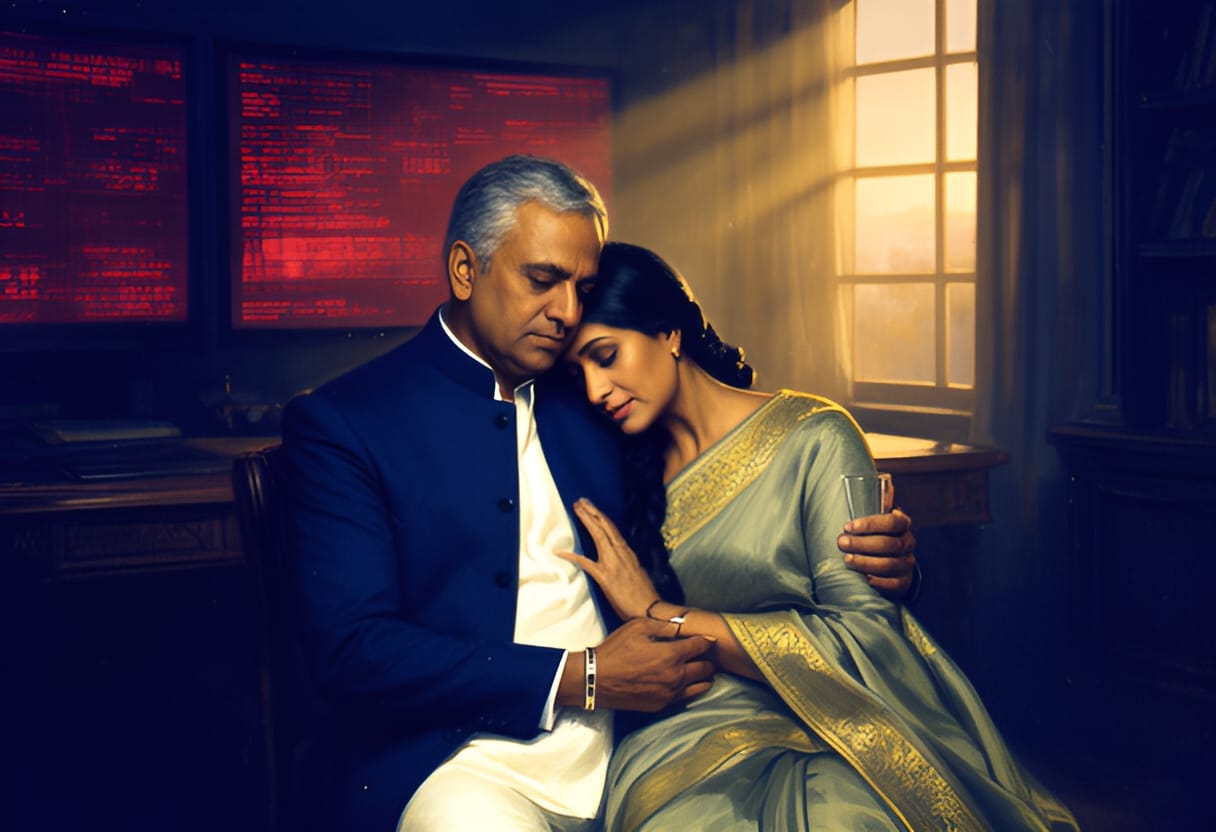
“I just need to understand,” she murmured. “I need to know if it was me… or if it was the market.”
He held her tighter. “We’ll figure it out. Together.”
But even as he said it, he wondered if together was enough. If the market had evolved beyond their combined wisdom—his gut, her charts—into something neither of them could fully grasp.
She pulled back after a long moment, wiped her eyes with the back of her hand, and turned to the monitor. She opened a new tab, pulled up a blank chart, and began to draw—freehand, without indicators, without overlays—just price and time. Her movements were slow, deliberate, as if trying to rediscover the market’s rhythm from first principles.
Arjun stood, poured himself another cup of coffee, and carried it to the window. He watched the street below—the vendor now arranging his marigolds into garlands, a woman in a sari bargaining over coconuts, a child chasing a balloon down the sidewalk. The world moved in its ordinary, indifferent way.
Inside, the sound of tapping keys resumed. Soft. Persistent. Uncertain.
He took a sip of coffee. It had gone cold.
He didn’t turn around.
By mid-afternoon, the backtest had run its course. Mira sat back in her chair, the spreadsheet filled with red and green cells, but the overwhelming impression was one of failure. Her strategy—her edge—had not just underperformed; it had been systematically violated across every timeframe, every parameter tweak, every logical variation she could devise.
She picked up the phone. Her fingers trembled slightly as she dialed.
Arjun was in the living room, reading the business section of the newspaper—though he wasn’t really reading, just letting the words wash over him as a distraction from the silence. The phone on the coffee table lit up: Mira.
He answered on the second ring.
“Hey,” he said, trying to keep his voice light.
Her voice came through, thin and tight. “I’m done.”
“Done with what?”
“With the backtest. I’ve run it fifty-seven times. Fifty-seven different combinations. Not one would have saved us. Not one would have kept us out of the drawdown.”
He sat down on the edge of the sofa, the newspaper forgotten. “Mira…”
“I thought if I just looked hard enough, if I tweaked the right variable, if I found the one thing I missed—” Her voice hitched. “I thought there had to be a logic to it. A reason. A signal I misread.”
“Maybe there isn’t one,” he said gently. “Maybe it’s not about the signal anymore.”
“Then what is it?” Her voice rose, fraying at the edges. “If it’s not the pattern, if it’s not the volume, if it’s not the Fibonacci retracement or the moving average crossover—if none of the things I’ve trusted for twenty years work—then what am I supposed to trust? My gut? Yours? A coin flip?”
He heard the panic beneath the words—not just frustration, but a deeper terror. The fear that her identity, her competence, her worth, was unraveling thread by thread.
“I don’t know,” he admitted. “I really don’t. But you don’t have to figure it out right now. Not today. Not while you’re this wound up.”
“I have to,” she insisted. “If I walk away now, I’ll always wonder if I gave up too soon. If I’d just looked a little longer, tried a little harder—”
“You’ve looked long enough,” he said. “You’ve looked too long. You’re chasing a ghost.”
“I’m not chasing a ghost,” she said, her voice dropping to a near-whisper. “I’m trying to save what’s left of my faith in this.”
Silence. He heard her breathe—shallow, uneven.
“Arjun?” she said finally.
“Yeah?”
“I’m scared,” she whispered. “Not just that I lost money. But that I don’t know how to make it back. That I don’t know if I ever will.”
He closed his eyes. He thought of her face that morning over chai, confident in her bullish engulfing candle. He thought of his own whispered fear of obsolescence. He thought of the twenty-five years he’d spent reading tape, of the intuition he’d trusted, the patterns he’d felt in his bones.
And now, here it was—everything he’d known, everything Mira had modeled, everything they’d built their lives around—being swept away in a tide of fear and algorithms he didn’t understand.
He didn’t offer platitudes. Didn’t quote statistics. Didn’t try to fix it.
Instead, he said, “Then we face it together. Not as the broker and the analyst. Not as the one who trusts patterns and the one who trusts gut. Just… as us. However we can.”
She was quiet for a moment. Then, so softly he almost missed it: “Okay.”
They didn’t say more. They didn’t need to. The market kept falling, the phones kept ringing, the world outside seemed to tilt on its axis. But for the first time since the bell rang, Arjun didn’t feel entirely alone.
He kept the line open. Let her breathing be his anchor. And waited—not for the market to turn, but for the next breath, and the one after that.
The call ended. Mira didn’t hang up right away. She stared at the phone in her hand, the screen dark, the last trace of his voice gone. Then, slowly, she set it down on the desk.
Her eyes drifted to the coffee mug beside her—her favorite, a thick-walled ceramic thing Mira had bought him years ago in Jaipur, glazed in deep cobalt blue with a silver rim. It was half-full. Cold. She hadn’t touched it since this morning.
She picked it up. Felt its weight. The heat long gone, leaving only the ceramic’s residual chill.
She thought of throwing it. Not at the wall. Not at the screen. But into the sink. Just to hear the sound. To feel the release.
She stood. Carried the mug to the sink, which was already half-filled with yesterday’s dishes. She paused over the stainless steel basin, the mug hovering above the murky water.
She didn’t feel anger. Not really. Just exhaustion. A deep, bone-weary surrender to the fact that no amount of backtesting, no amount of tweaking, no amount of faith in patterns could change what had happened. The market had moved. It had moved against her signal. It had moved against her logic. It had moved, relentlessly, indifferently, and there was nothing she could do to undo it.
She let go.
The mug slipped from her fingers.
It didn’t shatter.
The ceramic mug lay in two uneven pieces at the bottom of the sink, the cobalt glaze dull under the kitchen’s fluorescent light. Water pooled around the shards, catching faint reflections of the ceiling bulb. Mira stood motionless, her hands resting on the cool edge of the sink, staring at the break as if it might tell her something the charts never could—clean, final, irreparable.
She didn’t move until the phone on the desk buzzed again. Not Arjun’s number. Unknown. Likely another client, another voice frayed at the edges, another account to reassure or another position to liquidate. She let it ring. Once. Twice. On the third, she silenced it with a swipe and set it face down. The screen went dark. For now, the market could wait.
She turned from the sink, wiped her hands on a dish towel already damp from yesterday’s neglect, and padded barefoot into the living room. Arjun was where she’d left him—on the sofa, newspaper folded neatly on his lap, eyes fixed on the wall opposite the window. Not reading. Not sleeping. Just… there.
She hesitated in the doorway. The silence between them wasn’t empty. It was thick with everything unsaid since the call ended—the fear, the exhaustion, the quiet agreement to face it together, however they could. She didn’t know what that looked like yet. But she knew she couldn’t stay in the kitchen, where every dish, every mug, every drop of cold chai felt like a relic of a certainty that had dissolved.
“Arjun?” she said, soft.
He didn’t startle. Didn’t turn. Just exhaled, slow, like he’d been holding his breath.
“You okay?” he asked, still not looking at her.
She sat beside him, not touching, just close enough to feel the warmth of his shoulder through the thin cotton of his kurta. “I broke my Jaipur mug.”
He finally turned his head. A flicker of something—recognition, maybe, or the ghost of a shared memory—passed across his face. “The one with the silver rim?”
“Yeah.” She let out a breath that wasn’t quite a laugh. “Felt like throwing it. Didn’t mean to break it.”
He nodded. “Things slip.”
A beat. The ceiling fan creaked above them, stirring the stale air. Outside, a distant horn blared—once, twice—then faded into the hum of the city waking.
“I’m going out,” he said suddenly. “Fort. Need to see a few people.”
She didn’t ask why. Didn’t ask who. She just nodded. “Be careful.”
He stood, stretched, and for a moment, she saw it—the tightness in his jaw, the way his fingers curled slightly at his sides, not quite a fist, but close. The man who had spent twenty-five years reading tape, who could feel a shift in momentum in his ribs, was now moving through the world like someone walking on glass.
He kissed her forehead—brief, dry, warm—and left without another word.
The door clicked shut.
Mira stayed on the sofa, listening to the silence settle back in, deeper now. She thought of the mug in the sink. Thought of the backtest results flashing on her screen fifty-seven times, each one a negation. Thought of Arjun’s voice on the phone, steady in the dark.

She didn’t feel better. But she felt less alone.
Fort was a maze of narrow streets and leaning facades, colonial-era buildings housing shops that had sold everything from gramophone records to gold bangles for generations. Arjun moved through it slowly, not hurrying, letting the rhythm of the place—the call to prayer from a nearby mosque, the clatter of a vegetable cart, the murmur of Bengali and Marathi from open doorways—pull him out of his head.
His first stop was Mr. Desai’s flat above a stationery shop on Nagindas Master Road. The old man had been a client since Arjun’s early days at the firm—a retired schoolteacher, widowed, lived alone with a parrot that squawked outdated stock tips from the 90s. Arjun had seen his name on the liquidation report: entire equity portfolio sold at the bottom two days prior. Not a whisper of a call. Not a request for advice. Just silence, then surrender.
He climbed the three flights of stairs, pausing at each landing to catch his breath—not from exertion, but from the weight of what he was about to do. He wasn’t here to fix anything. He wasn’t here to offer reassurance or remind them of long-term averages. He was here because Mira’s voice had echoed in his mind all morning: What am I supposed to trust? And because, in the quiet after the call, he’d realized he didn’t know how to answer that for her—maybe not until he understood what they were really afraid of.
He knocked.
The door opened after a moment. Mr. Desai stood there, frail in a faded kurta, spectacles perched low on his nose. His eyes, usually sharp behind those lenses, were dull, shadowed.
“Arjun beta,” he said, voice thin. “Come in. Didn’t expect to see you today.”
“Just passing through,” Arjun said, stepping inside. The flat was small, tidy, smelling of sandalwood soap and old paper. A framed photo of a younger Mr. Desai with a woman—his wife, Arjun assumed—hung on the wall. The parrot’s cage sat in the corner, empty except for a single drooping feather.
Mr. Desai shuffled to the worn armchair by the window and gestured to the other. “Sit. Chai? I just made it.”
“No, thank you. I’m fine.”
The old man nodded, settled, and stared at his hands folded in his lap. The silence stretched—not uncomfortable, but heavy, like the air before rain.
Arjun waited. Let him speak.
Finally, Mr. Desai looked up. “I sold everything,” he said, as if confessing a crime. “At the lowest. I know. I know I should’ve waited. But I couldn’t… I couldn’t take it anymore. Watching it go down every morning. Not being able to sleep.”
His voice cracked. He cleared his throat, looked away.
“I didn’t tell my daughter,” he said quietly. “She lives in Pune. Thinks I’m still getting my pension plus a little extra from dividends. I… I couldn’t bear to hear her worry. Or worse—her pity.”
Arjun leaned forward, elbows on his knees. “You didn’t do anything wrong, Mr. Desai. The market moved. It happens.”
“Does it?” The old man let out a humorless chuckle. “I taught economics for thirty years. I know how it’s supposed to work. But this… this felt like being punished. Like I’d missed some sign. Some rule I didn’t learn.”
He looked at Arjun then, really looked at him. “Am I the only one who felt this stupid?”
Arjun shook his head. “No. You’re not.”
Mr. Desai’s eyes glistened. He didn’t wipe them. “I just… I didn’t want to be alone in it.”
The second visit was to Mrs. Iyer, a widow in her late seventies who lived in a chawl near Dhobi Talao. Her son had moved to Dubai years ago; she spoke to him once a week on a crackling line. Arjun had managed her small portfolio for over a decade—mostly blue-chips, a few dividend payers. She’d sold everything the day after the circuit breaker hit.
She opened the door in a faded floral nightgown, her hair pinned up in a loose bun, one hand resting on the doorframe for balance. She smelled of turmeric and lavender oil.
“Arjun babu,” she said, her voice warm but tired. “You look like you haven’t slept.”
He managed a small smile. “Neither have you, I suppose.”
She let him in. The room was dim, lit only by a single bulb hanging from the ceiling. A ceiling fan turned lazily. On a low table sat a brass puja set, incense stick long burnt out. A photograph of a young couple—her and her husband, smiling on a beach—sat beside it.
She sat on the edge of the cot, patted the space beside her. “Come. Tell me what the babus in Nariman Point are saying.”
Arjun sat. “They’re scared, Mrs. Iyer. Like everyone else.”
She nodded, as if this confirmed something she’d suspected. “I knew it was bad when I couldn’t sleep. Not because I was thinking about the numbers—though I did, God knows I did—but because I kept imagining my son’s face if he knew. What he’d say. Amma, why didn’t you call? We could’ve helped.”
Her voice dropped. “I haven’t told him. I told him I’m living off the interest from my fixed deposits. That I’m careful. That I don’t need his money.”
She looked at her hands—knuckles swollen, veins standing out like blue threads. “I feel like a liar. Every time he asks how I am, I lie. And the worse I feel, the more I have to lie to keep him from worrying.”
Arjun didn’t offer platitudes. Didn’t tell her the market would recover. Didn’t remind her of her son’s love.
Instead, he said, “You’re not lying to protect him. You’re lying because you love him. And that’s not weakness. That’s… that’s the opposite of weakness.”
She looked at him then, really looked, and for the first time since he’d arrived, her eyes weren’t just tired. They were searching.
“Do you think he’d understand?” she whispered.
“I think he’d want to know,” Arjun said gently. “Not to fix it. Just to share it.”
She was quiet a long time. Then, so softly he almost missed it: “Maybe… maybe being afraid isn’t the problem. Maybe it’s believing you have to carry it alone.”
The third client was Mr. Khan, a retired textile merchant who lived in a ground-floor flat near Mohammed Ali Road. His shop had closed years ago; he lived off rental income and a small, conservative portfolio Arjun had helped him build. He’d liquidated at the open on Thursday—the very first day the fall accelerated—and hadn’t answered his phone since.
Arjun found him sitting on a plastic chair outside his flat, wrapped in a thin shawl despite the morning sun. A half-empty glass of nimbu pani sweated on the stool beside him. He looked up as Arjun approached, his expression unreadable.
“Arjun sahib,” he said, voice rough from disuse. “To what do I owe the honor?”
“I wanted to see how you were doing,” Arjun said. “After everything.”
Mr. Khan let out a short, humorless laugh. “Doing? I’m here. Isn’t that what matters? Breathing. Eating. Not crying in front of the neighbors.”
He paused, stared at his glass. “I sold everything. At the bottom. I know. My father lived through ’92. He used to say, Beta, the market takes, but it also gives. I believed him. I believed the patterns. I believed in the logic of it.”
His voice hardened. “Turns out the logic was a lie. Or maybe… maybe it only works when people aren’t afraid. When they’re not panicking. When they’re not thinking about their grandchildren’s school fees or whether they’ll have to sell the house.”
He looked at Arjun then, eyes sharp despite the fatigue. “You’ve been doing this longer than my father lived. Tell me—was it ever really about the numbers? Or was it always about who got scared first?”
Arjun didn’t have an answer. Not a true one. He thought of Mira’s backtest, her fifty-seven variations, her whispered fear that she didn’t know how to make it back. He thought of his own sleepless night, the alert on the phone, the choice not to wake her.
“I don’t know,” he said finally. “Maybe it’s never been just about the numbers.”
Mr. Khan nodded, as if this confirmed his worst suspicion. He took a slow sip of his drink. “I didn’t tell my wife. She thinks I’m still getting dividends. She’s got her arthritis meds to pay for. I… I couldn’t bear to add this to her burden.”
He set the glass down. “I just… I didn’t want to be the only one who felt like a fool.”
Arjun stood. “You’re not the only one.”
Mr. Khan didn’t look up. “I know that now. Thanks to you.”
Arjun hesitated. Then, gently: “Did it help? Talking?”
The old man gave a faint, humorless twitch of his lips. “It didn’t change what happened. But… for the first time in three days, I didn’t feel like I was screaming into a void.”
Arjun walked back through Fort slower than he’d come. The sun had climbed higher, turning the streets into ribbons of glare and shadow. The city hummed—honking, shouting, the rhythmic thump of a dholak from a nearby wedding—but it all felt muffled, distant, like he was hearing it through wool.
He didn’t go straight home. Instead, he turned toward the maidan near Azad Maidan, where a few old men played chess under a banyan tree, their moves deliberate, quiet. He sat on a bench, not to watch, just to be still.
The market would keep falling. Or maybe it would bounce. Maybe it would churn sideways for weeks, eating away at nerves and margins. He didn’t know. And for the first time in years, he didn’t feel the need to pretend he did.
What he did know was this: the fear wasn’t in the candlesticks. It wasn’t in the volume spikes or the broken trendlines. It was in the quiet apartment where a man lied to his son about his savings. It was in the widow who washed her face extra carefully each morning, hoping her voice wouldn’t betray how little she’d slept. It was in the merchant who sat outside his flat, shivering not from cold but from the weight of silence.
The real risk wasn’t volatility. It was the belief that you were the only one feeling it.
He thought of Mira back at home, staring at a broken mug, her faith in patterns shaken but not gone. He thought of her voice on the phone—I’m scared—and how, in that moment, the most honest thing he’d ever said was Then we face it together.
He didn’t have answers. Didn’t have a signal. Didn’t have a plan.
But he had this: the quiet certainty that neither of them had to face the dark alone.
He stood, stretched, and began the walk home.
The city breathed around him. And for now, that was enough.
Mira’s coffee had gone cold long before she noticed. The mug sat untouched beside her keyboard, a ring of dried brown staining the ceramic where her lips had pressed earlier that morning. Outside, the city had already begun its Saturday hum—auto-rickshaws threading through traffic, distant calls to prayer fraying at the edges—but inside their apartment, the only sound was the quiet whir of the ceiling fan and the relentless flicker of her dual monitors.
She stared at the Nifty 50 chart on the left screen, the one she’d opened first thing, hoping for clarity. Instead, it mocked her. Over the past forty-eight hours, the index had lurched upward nearly six percent on heavy volume, only to surrender almost four percent by the close, then rally again in pre-market trading before collapsing once more. Her screen was a battlefield of conflicting signals.
The 50-day moving average had crossed above the 200-day—a golden cross, traditionally bullish—yet the RSI hovered near seventy, screaming overbought. The MACD line had flipped positive, then negative, then positive again in less than twelve hours. Bollinger Bands had expanded wildly, then snapped shut, as if the market were inhaling and exhaling in panic. Her custom sentiment indicator, which weighted put-call ratios and options skew, flashed buy, then sell, then buy again with each new candle.
She leaned forward, tracing the erratic price bars with her index finger, feeling the ridges of the screen beneath her nail. Buy. Sell. Buy. Sell. It wasn’t analysis anymore—it was a game of whack-a-mole, and she was losing.
A bitter laugh escaped her, sharp and short. She remembered the seminar she’d given six months ago at the NSE academy, a room full of eager junior analysts hanging on her every word as she explained how to identify strong trends, how to ride momentum, how to trust the breakout when volume confirmed it. “The trend is your friend,” she’d said, tapping the slide with a laser pointer. “Until it ends. And even then, it leaves clues.”
Now, looking at the chart, she saw no trend—only a seizure. The market wasn’t trending; it was twitching. Every signal she’d spent years refining was being drowned out by the raw, irrational force of fear and greed operating at hyperdrive. The patterns she’d taught others to rely on were not just failing—they felt like betrayals.
She thought of Patel, his leveraged position in Vardhman Weave, the way he’d stared at his screen the night before the liquidation, jaw clenched, fingers flying over the keyboard as he averaged down again and again. She had told him, gently, that the chart didn’t support the move. He hadn’t listened. And now, watching this chaos, she wondered if she had been wrong—not about the pattern, but about the assumption that patterns mattered at all when panic took the wheel.
What good is a trend when everyone’s running for the exits? she thought. What good is a moving average when the crowd is screaming?
She pushed back from the desk, the chair scraping softly against the floor. Her eyes burned. She hadn’t slept well since the crash began—too much replaying, too much second-guessing. She picked up her cold coffee, took a sip, and grimaced. It was bitter, stale. Like her confidence.
The bedroom door opened. Arjun stood in the doorway, wearing his old cotton kurta, hair slightly mussed from sleep. He didn’t speak. He didn’t ask if she was okay. He simply walked in, pulled out the chair beside her, and sat down.
He didn’t touch the mouse. Didn’t point at the screen. Didn’t offer a platitude about cycles or mean reversion. He just sat, shoulder nearly touching hers, his presence warm and steady beside her. He looked at the chart—not to interpret, but to witness.
Mira hesitated, then lifted her hand again. She traced the same jagged path, her fingertip hovering over a particularly violent spike where the price had jumped three percent in fifteen minutes before reversing just as fast.
“Look at this,” she murmured, her voice low, rough from disuse. “Six percent up. Four percent down. Then up again. Then down. My indicators are flashing buy, sell, buy, sell—sometimes within the same hour. It’s not noise. It’s a loop. A hell.”
Arjun didn’t look away from the screen. “You called it a whipsaw,” he said quietly. “That’s what you named it.”
“Yeah,” she said. “I used to teach juniors how to spot them. How to avoid them. How to wait for confirmation before acting. I told them the trend would reassert itself. That the market would remember its manners.”
She swallowed. Her throat felt tight. “But what if it doesn’t? What if the trend isn’t broken—it’s just… irrelevant? What if when people are afraid, they don’t care about moving averages or RSI? What if all they see is the number going down and the fear going up?”
She turned her head slightly to look at him. His eyes were calm, but she saw the fatigue in them—the same exhaustion she felt, mirrored in the lines around his own eyes.
“I don’t know what to believe anymore,” she whispered. “Not in the charts. Not in the models. Not even in myself. If I can’t trust what I’ve spent twenty-five years building… what’s left?”
Arjun didn’t answer right away. He reached over, not to take her hand, but to gently nudge the cold coffee mug toward the center of the desk, where it wouldn’t be knocked over. Then he rested his own hands on his knees, palms up, open.
“I don’t know either,” he said. “But I know you’re not supposed to have all the answers. Not all the time.”
She wanted to argue—to say that as the analyst, the strategist, the one who saw patterns in the chaos, she should know. That her worth was tied to her certainty. But the words wouldn’t come. Instead, she felt something unexpected: a loosening, like a knot in her chest beginning to ease, not because the problem was solved, but because she wasn’t being asked to solve it alone.
She let her hand fall back to the desk. The screen continued to flash, indifferent, relentless. The market would keep swinging. Her indicators would keep contradicting themselves.
But for now, she wasn’t tracing the price bars to find a signal.
She was tracing them to remember that she was still here.
And so was he.
The apartment was quiet except for the hum of the refrigerator and the occasional flicker of the ticker tape scrolling across Mira’s second monitor. They had eaten in silence—dal, rice, a simple sabzi—nothing said, nothing spared. The food had gone cold long before they finished, but neither had moved to reheat it. It felt like an offering left untouched, a ritual abandoned.
Now, the plates sat stacked in the sink, water still dripping from the faucet. The kitchen light was off. Only the glow from the desk illuminated the living room, casting long, blue-white shadows across the floor. Mira sat on the edge of the sofa, knees drawn up, arms wrapped around herself. Arjun stood by the window, looking out at the darkened street below, where the city’s usual pulse had thinned to a distant throb.
He turned when he heard her shift. “You okay?” he asked, voice low.
She didn’t look at him. “I’m tired,” she said. “Not just sleep-tired. Bone-tired. Like I’ve been running a race with no finish line.”
He walked over and sat beside her, not touching, just near enough to feel the warmth of her through the fabric of her kurta. “Me too,” he said. “But not from the charts. From… waiting.”
She finally looked at him. Her eyes were red-rimmed, but clear. “Waiting for what?”
“For you to come back,” he said. “I kept thinking if I just stayed quiet, gave you space, you’d find your way out of it. Like if I didn’t push, didn’t ask, didn’t make it about us, then you’d be able to breathe. But I think I was wrong. I think I was just afraid.”
She let out a breath, shaky. “Afraid of what?”
“Of losing you to it,” he said. “Not the money. Not the crash. But to the part of you that lives in the numbers. The part that thinks if you just analyze hard enough, see deep enough, you can control it. I watched you disappear into those screens for days. And I was scared that one day, you wouldn’t come back—not because you didn’t want to, but because you’d decided the market made more sense than I did.”
Mira looked down at her hands. “I didn’t realize I was disappearing,” she said softly. “I thought I was being strong. I thought if I could just find the one signal, the one pattern that made sense of it all, then I wouldn’t have to feel it. The fear. The helplessness. I thought if I understood it, I wouldn’t be afraid of it.”
She paused, voice dropping. “But the more I looked, the less I understood. And the less I understood, the more afraid I got. So I looked harder. It became a loop. Like the market. Up, down, up, down—me chasing certainty that wasn’t there.”
Arjun reached over, slowly, and covered one of her hands with his. It was cool. “I stopped trading,” he said, “not because I lost faith in the market. I still believe in it. I believe in the long arc, in the value that builds over time, in the companies that endure. I stopped because I was terrified that if I stayed in it—if I kept watching, kept trading, kept trying to win—I’d lose you to the fear. I’d wake up one day and realize you’d left not for another man, but for another chart. Another indicator. Another chance to get it right.”
She turned her hand in his, lacing her fingers through his. “I never wanted to leave you,” she whispered. “I just wanted to fix it. To make it make sense. So I wouldn’t have to be scared anymore.”
He squeezed her hand. “But the market doesn’t owe us sense,” he said. “It never did. It only owes us what it gives—volatility, surprise, sometimes loss. And sometimes, just sometimes, a chance to be still in the middle of it.”
She let out a quiet laugh, wet and sudden. “Funny, isn’t it? I spent twenty-five years teaching people how to read the market’s mood. And all this time, I was avoiding my own.”
He leaned his forehead gently against hers. “We both were,” he said. “You hid in the data. I hid in silence. Neither of us wanted to say: I’m afraid. I don’t know what’s coming. I need you.”
Outside, a car passed, its headlights sweeping across the wall like a slow pulse. The ticker tape on Mira’s screen continued its endless crawl—green, red, green—meaningless in the dark, beautiful only because it was there, a reminder that the world kept turning, whether they understood it or not.
Neither spoke. They didn’t need to.
They sat like that—shoulders touching, hands joined—watching the light dance across the ceiling, two people who had spent a lifetime reading signs, finally learning to sit in the space between them, and call it enough.
Chapter 3
The Measure of Uncertainty
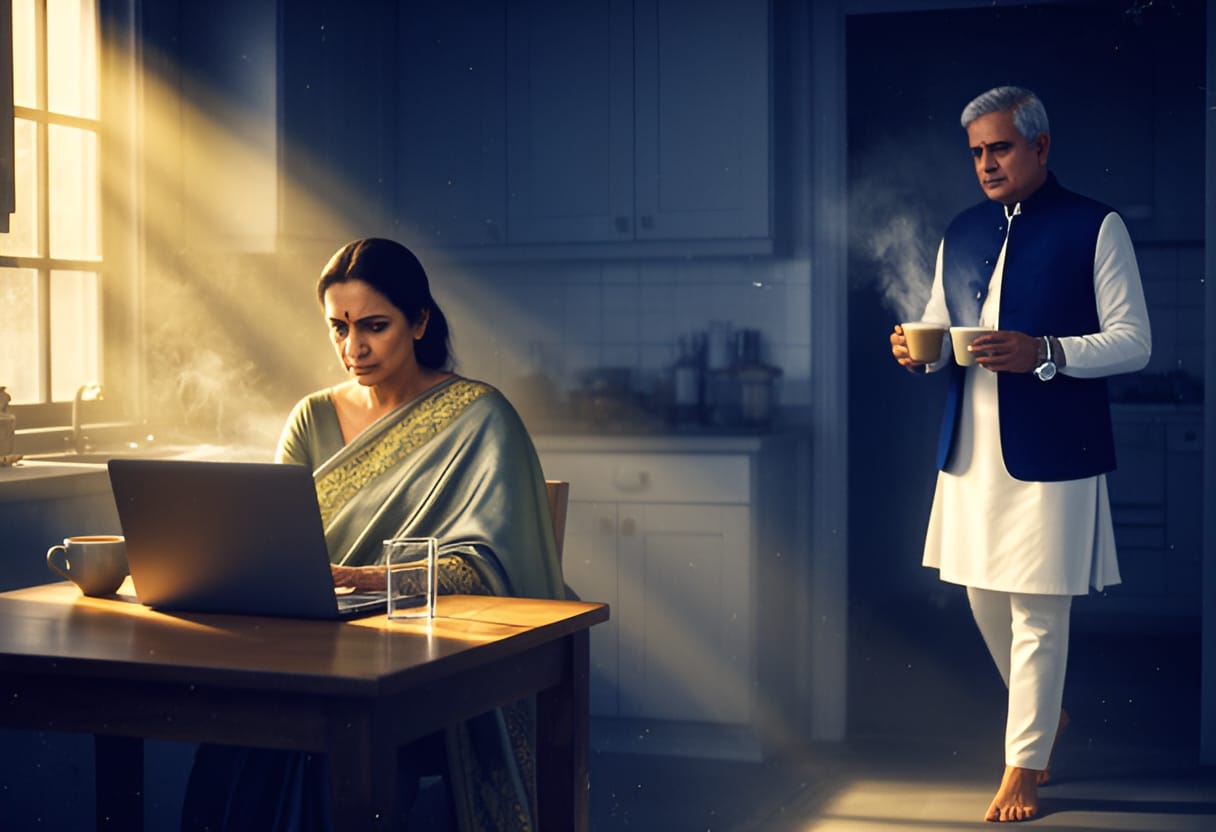
Mira sat at the kitchen table, the morning light catching the edge of her coffee cup as she stared at the deleted file on her laptop screen. The cursor blinked where the template had been—her favorite setup of moving averages and RSI overlays, the one she’d trusted for years to spot reversals before they happened. Now it was gone, erased in a fit of frustration after another whipsaw had led her to misread the Nifty’s morning bounce as a resumption of trend, only to see it collapse again by noon. She hadn’t slept well. The market’s chaos had seeped into her dreams, turning candlestick patterns into jagged teeth snapping at her confidence.
Arjun entered quietly, barefoot on the cool tile, carrying two cups of chai. He set one down beside her without speaking, his eyes tired but attentive. He’d spent the previous evening walking the lanes of Fort, visiting old clients not to trade but to sit with them in their living rooms, listening as they spoke of sleepless nights and the shame of watching their savings dwindle. One man had told him, “I don’t fear losing money. I fear telling my wife I was wrong again.” Arjun had come home heavy with the weight of those confessions, realizing too late that he’d been measuring risk in percentages while ignoring the human cost beneath them.
He didn’t ask if she was okay. He knew better. Instead, he said, “You were right about the 38.2% retracement. The Nifty held it yesterday—just barely. Volume did pick up on the bounce, like your backtest showed.”
Mira didn’t look up. “It failed today. Broke below with no follow-through selling. Just… drifted lower on thin bids. Like the market’s forgot how to panic properly.”
Arjun sipped his chai. “Maybe it’s not forgetting. Maybe it’s learning something else.”
She finally looked at him, eyebrows furrowed. “What do you mean?”
“I mean,” he said, setting his cup down, “that maybe we’ve been asking the wrong question. We keep trying to predict where the price will go—what the next candle will show, what the indicators will whisper. But what if the real signal isn’t in the price at all? What if it’s in what people do when they’re afraid?”
Mira tilted her head. “Go on.”
“Think about Mrs. Desai,” he said. “She lost nearly a third of her portfolio last week. Didn’t sell a share. When I called to check in, she said she stayed because she remembered you telling her once—during that sideways market in ’22—that trends aren’t broken by noise, they’re broken by fear. And fear, you said, leaves traces—not in price, but in behavior. Who people call. What they stop doing. Whether they sleep.”
Mira’s fingers stilled on the laptop. “I did say that. In a seminar. After the IL&FS fallout.”
“Exactly,” Arjun said, leaning forward. “What if we started measuring that? Not volatility. Not beta. Not even standard deviation. What if we measured uncertainty by how many clients reach out for help when the market drops? How many hold? How many panic-sell before a certain threshold? How many talk to their spouse first, versus their broker, versus no one at all?”
She stared at him, slow realization dawning. “You’re suggesting… a behavioral indicator.”
“Not to predict the market,” he said, voice low and intense. “To understand the people in it. To measure resilience, not movement.”
Mira’s breath hitched. For so long, she’d believed her worth lay in decoding the market’s language—the hidden grammar of price and volume. But now, seeing Arjun’s quiet certainty, she felt a shift—not in the charts, but in the ground beneath them. This wasn’t surrender. It was a different kind of analysis. One that didn’t try to control the uncontrollable, but honored the human response to it.
“It wouldn’t be about forecasting,” she said slowly, finding her voice. “It would be about witnessing. Tracking not what the market does to people, but what people do with the market when it turns.”
“Exactly,” Arjun said. “And if we can measure that—really measure it—we might finally understand what risk means. Not as a number on a screen, but as a silence in a phone call. As a sleepless night. As a hand reaching for another in the dark.”
Mira closed her laptop gently. The deleted file was gone, but the idea it represented—her faith in patterns—wasn’t. It was just evolving. She reached for her notebook, the one she used for sketching candlestick formations, and turned to a fresh page.
“Let’s try it,” she said. “Let’s make it simple. One question. Two parts.”
Arjun watched as she wrote, her pen moving with purpose.
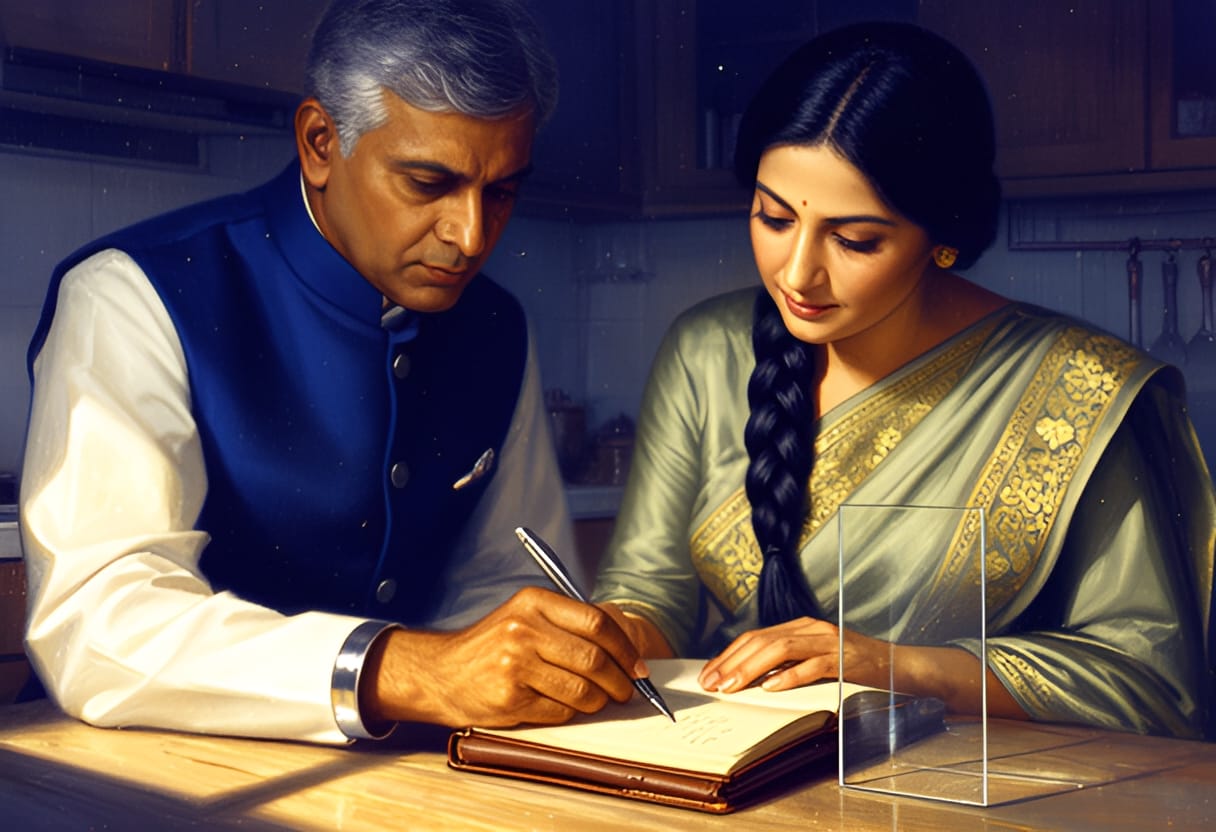
When the market drops, what do you fear most—and who do you talk to first?
“That’s it?” he asked.
“That’s enough to start,” she said. “If we see a pattern in the answers—if fear shifts from loss to isolation, or if more people name a partner, a friend, a child—then we’re seeing something real. Not a prediction. A pulse.”
Arjun picked up his pen and mirrored her on the other side of the page. Below her question, he added a small box: Optional: What helped you stay?
Mira smiled faintly. “You’re adding the antidote.”
“Maybe,” he said. “Or maybe just the evidence that it exists.”
They sat in silence for a moment, the city stirring outside—the distant hum of traffic, a vendor setting up his cart, the first birds on the sill. The market would open in an hour. Futures were flat. No clear signal. No guarantee.
But for the first time in weeks, neither of them needed one.
They weren’t trying to outsmart the fall anymore.
They were learning how to stand in it—together.
Mira traced the rim of her notebook with her thumb, the paper slightly rough from use. “What if we gave this to clients? Not as a survey, but as a check-in? Once a week, during volatile periods. We could track changes over time—not just individual answers, but trends in the responses themselves.”
Arjun nodded, already seeing it. “We could code the fears—loss, shame, regret, loneliness—and the support—spouse, friend, advisor, none. Then watch how they shift as the market moves. If more people start naming isolation as their fear, that’s a warning sign—not of a crash, but of breaking point. And if we see more turning to each other, that’s resilience building.”
She looked up, eyes bright. “It turns the client into a co-observer. Not just someone we advise, but someone helping us understand the human shape of uncertainty.”
“And it gives them agency,” Arjun said. “Instead of feeling at the mercy of the market, they’re contributing to something that might help others feel less alone in it.”
Mira closed the notebook slowly. “We’d have to test it. Start small. Maybe just with the clients we already talk to—Patel, Mrs. Desai, the others Arjun’s been visiting.”
He hesitated. “Patel… I’m not sure he’s ready to talk about this yet. After what happened with Vardhman Weave—”
“I know,” she said gently. “But maybe that’s exactly why he should be part of it. If anyone understands what it means to fear being seen as reckless, it’s him.”
Arjun exhaled, the tension in his shoulders easing just a fraction. “Then we’ll wait. Not push. Let him come to it when he’s ready.”
She reached across the table and covered his hand with hers. Her skin was warm, calloused from years of gripping pens and mouse, but her touch was light. “We’re not fixing anything today,” she murmured. “We’re just beginning to ask a better question.”
Outside, a bicycle bell rang. A child laughed. The sun climbed higher, gilding the edge of the blinds. Somewhere, a ticker scrolled—but they weren’t watching it.
They were listening instead—to the quiet space between fear and connection, where the truest measure of uncertainty might finally be found.
The phone rang on the kitchen counter, its shrill tone cutting through the morning quiet. Arjun glanced at the screen—Mrs. Desai’s name flashed, a number he hadn’t expected to see so soon. He looked up at Mira, who was pouring chai into two cups, her movements deliberate, almost ceremonial.
“It’s her,” he said, his voice low.
Mira nodded, setting the pot down. She wiped her hands on a dish towel and stepped toward him, her expression open but guarded, as if bracing for another round of doubt.
Arjun lifted the receiver. “Mrs. Desai? This is Arjun Mehta. Is everything alright?”
A pause, then her voice—thin but steady, threaded with something like relief. “Arjun ji? It’s me. I… I just wanted to say thank you.”
He exchanged a glance with Mira. Her eyebrows lifted, curiosity softening the lines around her eyes.
“Thank you? For what?” Arjun asked, keeping his tone gentle, inviting.
“For not making me feel foolish,” she said. “For not pushing me to sell when everything in me wanted to run. I held. I didn’t touch a single share. Not even when Vardhman Weave hit the lower circuit again. Not even when my broker called three times a day, voice rising with panic.”
Arjun felt a slow warmth spread through his chest. “That took strength, Mrs. Desai. More than most people realize.”
“I know,” she said, and her voice wavered just slightly. “I lost nearly thirty percent. My late husband would have been devastated. He never trusted the market—said it was a casino dressed in suits. And here I was, watching his life’s work shrink… I kept imagining him standing behind me, shaking his head.”
She paused, drawing a breath. “But then I remembered something you said, Mira ji. Not in a meeting. Not in a report. It was at that seminar last year—after the IL&FS thing. You were joking, really. You said, ‘Sometimes the only trend that matters is the trend of courage.’”
Mira’s hand flew to her mouth. She stared at Arjun, eyes wide, as if seeing him for the first time in years.
“I didn’t know why it stuck,” Mrs. Desai continued, her voice gaining momentum. “It sounded silly at the time. A play on words. But when the market started falling, and every indicator screamed ‘exit,’ and my own fear sounded like a mob in my head… I heard it. Clear as a bell. The trend of courage. Not the trend of prices. Not the trend of volume. The trend of courage.”
Mira whispered, “I didn’t even remember saying that.”
Arjun squeezed her hand, his thumb brushing her knuckles. “She remembered it when she needed it most.”
“I didn’t know what to do,” Mrs. Desai admitted, her tone dropping to a near-whisper. “I didn’t have a signal. I didn’t have a stop-loss that made sense. I didn’t even know if I was being brave or stupid. But I knew—I just knew—that I wasn’t alone in feeling afraid. That if I sold, I’d be selling not just my shares, but my peace. And if I held… well, at least I wouldn’t be running from myself.”
Silence settled over the line, soft and full. Outside, a sparrow hopped along the windowsill, tilting its head as if listening.
“Thank you for asking,” she said finally. “It means more than you know that someone remembered to check in—not on my portfolio, but on me.”
Arjun’s throat tightened. “We’re glad you’re okay, Mrs. Desai. Really.”
“I’m not ‘okay’ in the way the charts would like,” she said, a faint smile in her voice. “But I’m here. And I didn’t sell. And for now… that’s enough.”
She said goodbye softly, and the line went dead.
Arjun lowered the receiver slowly. He turned to Mira, who was still staring at her notebook, the page with their question lying open before her.
“She remembered,” he said quietly.
Mira looked up, her eyes glistening. “I made up that phrase on the spot. I was tired. Trying to lighten the mood after a grim slide deck. I didn’t think anyone would hear it, let alone hold onto it.”
“Sometimes the things we say without thinking are the ones that take root,” Arjun said. “Especially when they’re true.”
She traced the edge of the page with her fingertip. “It wasn’t analysis. It wasn’t even advice, really. Just a metaphor. But it gave her something to hold onto when everything else was slipping.”
“And she didn’t just hold on,” Arjun said. “She held herself together.”
Mira nodded, then stood, moving to the window. She pulled back the blind just enough to see the street below—a milkman loading crates onto his bicycle, a woman haggling over flowers at a corner stall. Life, ordinary and insistent, moving forward.
“I want to write to her,” Mira said suddenly. “Not as her advisor. As someone who heard her.”
Arjun joined her at the window, his shoulder brushing hers. “What would you say?”
She thought for a moment. “I’d say: Thank you for reminding me why this work matters. Not because we get it right—but because sometimes, when we’re lucky, we get to be part of someone’s courage.”
He wrapped an arm around her shoulders, pulling her close. “Then let’s write it together.”
They stood there, side by side, watching the city wake—not waiting for the market to speak, but listening to the quieter, more enduring hum of people trying, again and again, to stay human in the face of fear.
Mira reached for her notebook again, the one that had become their compass. She turned to a fresh page and began to write, her pen moving with the same careful intention she once reserved for marking up charts. Arjun watched her, feeling the quiet shift in the air—not urgency, but purpose.
“Dear Mrs. Desai,” she wrote, pausing to find the right tone. “I hope this note finds you in a moment of calm. I’ve been thinking about our conversation, and I wanted to say something I didn’t get to say yesterday.”
She glanced at Arjun. He nodded, encouragingly.
“You told me you held because you remembered a phrase I tossed off in a seminar—a joke, really. But what stayed with me wasn’t that you remembered it. It was why it helped. You didn’t say it gave you certainty. You said it reminded you you weren’t alone. That’s not a signal. That’s a lifeline.”
She lowered her pen, frowning slightly. “That sounds too formal.”
Arjun leaned in. “Start simpler. Just say what you feel.”
She took a breath and rewrote the opening: “I’ve been thinking about what you said—that you held not because you knew what would happen, but because you remembered you weren’t alone in feeling afraid. That stayed with me. It changed how I see our work.”
She read it back, then nodded. “Better. Honest.”
Arjun smiled. “Now add what you want her to know.”
Mira hesitated, then wrote: “I want you to know that your courage didn’t just protect your portfolio. It reminded me—and Arjun—that sometimes the most radical thing a person can do in a market downturn is to refuse to let fear make them strangers to themselves. You didn’t just hold your shares. You held your ground. And in doing so, you gave us something no backtest ever could: proof that resilience isn’t measured in rebounds, but in the choice to stay present.”
She capped the pen and held the page toward him. “Does it sound like us?”
He read it slowly. “It sounds like truth. And it sounds like gratitude—without flattery.”
She folded the note carefully and slipped it into an envelope. On the front, she wrote Mrs. Desai’s name in clear, deliberate script. “I’ll drop it in the mail today. No expectation of reply. Just… letting her know she was seen.”
Arjun kissed her temple. “And maybe that’s the first data point.”
She laughed softly, the sound light and relieved. “The first of many, hopefully.”
Later, after lunch, they walked to the nearby post office, the envelope tucked in Mira’s purse. The street buzzed with the usual midday rhythm—scooters weaving between cars, shoppers calling out prices, the scent of frying jalebis from a stall near the corner. Arjun noticed how Mira walked beside him, not ahead, not behind, but in step. Her shoulders were relaxed, her gaze occasionally lifting to meet his, not to seek reassurance, but to share the moment.
They mailed the letter without ceremony, watching as it disappeared into the slot. No fanfare. No expectation. Just a small act of witness, sent into the world.
On the walk back, Mira said, “I used to think if I couldn’t predict the fall, I had failed. Now I wonder if the real failure would be to stop noticing who’s still standing—and why.”
Arjun squeezed her hand. “Maybe the market’s uncertainty isn’t in the numbers at all. Maybe it’s in the spaces between them—where people decide, again and again, whether to stay or run.”
She looked at him, her eyes soft but certain. “And maybe our job isn’t to fill those spaces with answers. But to remind people they don’t have to cross them alone.”
They reached their gate, the sun casting long shadows across the courtyard. Neither spoke as they stepped inside. The house felt quiet, but not empty. Full, in a way it hadn’t in weeks—not because the market had changed, but because they had.
The house held its breath in the late afternoon light. Dust motes drifted in the slanting sun that fell across the living room floor, catching in the weave of the rug where Mira sat cross-legged, her laptop open before her. Charts flickered across the screen—Nifty, Bank Nifty, a few mid-cap stocks they’d been tracking—but her eyes weren’t really on the lines. She was listening.
Arjun was on the balcony, speaking low into the phone. She caught fragments: “…no, she didn’t exit. Just tightened her stop, said she’d sleep better knowing she had a plan…” A pause. “…yes, he’s still in Vardhman Weave. Says he’s not selling unless it hits book value. Which, frankly, it might never do again.” A soft chuckle. “…told him that’s okay. Not every stock has to be a winner. Sometimes it’s just about not letting it own you.”
She smiled, though he couldn’t see it. The sound of his voice—steady, unhurried—was its own kind of indicator. Not the kind you backtested or optimized. The kind you felt in your ribs when the market had been screaming for weeks and suddenly, someone was talking about sleep and dignity instead of margins and drawdowns.
Inside, the quiet deepened. The house had changed. Not in its walls or its furniture, but in the way sound moved through it. Less tension in the air. Fewer sharp words. More space between sentences, like the market itself was learning to breathe again.
She minimized the trading terminal and opened a blank document. Not for analysis. For notes. She’d started keeping them after Mrs. Desai’s letter—a private log, not of prices or patterns, but of moments. Client conversations. Her own reactions. Arjun’s observations. Things that didn’t show up in volatility indices but seemed, somehow, to predict steadiness better than any moving average.
She typed slowly, deliberately: Week 3 of recovery. Nifty up 4.2% from low, but with three separate 1.5% pullbacks. Volume thinning on rebounds. Yet—Mrs. Desai held. Mr. Joshi (pharma) added on dips. Patel family didn’t liquidate, despite margin calls. Spoke to three clients today who said, unprompted, “I didn’t panic this time.”
She paused. Frowned. That last bit felt off. Not wrong, but incomplete. It wasn’t that they hadn’t panicked. It was that they had—and chosen not to act on it.
She backspaced and rewrote: …spoke to three clients today who said they felt afraid but didn’t sell. One said, “I remembered what Mira said—about courage being a trend.” I didn’t say that. Not in those exact words. But something like it must have stuck.
She saved the file. Closed the laptop. The screen went dark, leaving her alone with the quiet.
The next morning, the market opened with a gap up—Nifty futures trading 80 points above fair value. By ten, it had given back half. By noon, it was flirting with red again. The ticker on the wall in their home office pulsed with restless green and red, like a heartbeat struggling to find rhythm.
Mira sat at her desk, coffee gone cold, watching the 15-minute chart of Nifty Futures. A bullish engulfing had formed at the open. Then a doji. Then a long-legged bearish candle that wiped out 60% of the gain. Classic whipsaw. The kind that used to send her spiraling—doubting her indicators, questioning her edge, wondering if the market had broken its own rules.
But today, she didn’t reach for the delete key. Didn’t close the platform in frustration. She just… watched.
And then she noticed something.
The volume on the down candles was lower than on the up ones. Not by much. But consistently. And when the price dipped, the bids held—thin, but there. Not the frantic, vanishing liquidity of a panic sell-off. This felt… different.
She pulled up a client spreadsheet—not performance, but behavior. A simple tracker they’d started informally: who had held, who had added, who had exited with regret, who had exited with peace.
The names in the “held” column weren’t just the usual suspects—the disciplined, the long-termers. There were new ones. Patel’s wife, who’d once called in tears after a 5% dip. Mr. Agarwal, a retired teacher who used to check his portfolio every hour. Even young Karan Mehta, a day trader who’d blown two accounts chasing momentum, now sitting tight on a battered mid-cap because, as he’d told Arjun, “I realized I wasn’t trading the stock. I was trading my fear.”
She leaned back. The chart on the screen suddenly looked less like noise and more like a reflection.
It wasn’t that the patterns had returned. It was that the people reading them had changed.
She opened a new message to Arjun, typing with one finger: The indicators are working again. But not because the market’s behaving. Because the people in it are.
He replied almost immediately: Or because we finally stopped asking the market to behave and started listening to the people.
She smiled. Typed back: Same thing, really.
By Friday, the recovery had stalled again—Nifty flat for the week, up just 0.3% from the previous close. No celebration in the trading floors. No headlines screaming “Bull Market Reborn.” Just a slow, uneven crawl, marked by hesitation and false starts.
But in their inbox, something else was happening.
A forward from a junior analyst at their firm: Hey Mira—saw your note on client resilience in the internal forum. Mind if I share it with the team? We’re seeing fewer panic calls on our desk lately. Wondering if there’s a connection.
She opened the attachment—a screenshot of a thread she’d barely remembered posting. A rough reflection, written after a long night: What if we stopped measuring client risk by portfolio beta and started measuring it by how quickly they return to equilibrium after a shock? Not how much they lose—but how soon they speak up, ask for help, or just say, “I’m scared but I’m still here.”
She had sent it to no one in particular. Just tossed it into the void, like a message in a bottle.
Now, it was being passed around.
Arjun came up behind her, placed a hand on her shoulder. She didn’t startle. Just leaned into his touch.
“They’re asking how you predicted the turn,” he said, nodding at the screen.
She laughed, quiet and rueful. “Predicted? I didn’t predict anything. I just stopped pretending fear wasn’t part of the data.”
He squeezed her shoulder. “And that made all the difference.”
She turned to him. “Funny, isn’t it? All those years I spent looking for the perfect signal—and the one that actually worked was the one I kept ignoring: the human one.”
He kissed her forehead. “Maybe the market doesn’t move on indicators. Maybe it moves on whether people feel seen enough to stay in the game.”
She looked out the window. The sky was pale gold, the kind of light that comes just before sunset—not bright enough to dazzle, but soft enough to let you see the shape of things clearly.
“I used to think my job was to find the trend before anyone else,” she said. “Now I think it’s to help people find their own—so they don’t have to borrow someone else’s courage to feel safe.”
He nodded. “And maybe that’s why the charts are working again. Not because the market changed. But because, for once, we stopped trying to outsmart it—and started trying to understand it.”
She turned back to the screen. The Nifty had ticked up two points. Insignificant. Meaningless, in the grand scheme.
But she didn’t close the chart.
She left it open.
Let it breathe.
Let it be.
Later, as dusk settled, they sat on the balcony with chai—her’s spiced with ginger, his plain, just how he liked it. The city hummed below: distant traffic, a radio playing a Bollywood oldie from an open window, the occasional laugh from a courtyard downstairs.
Arjun was quiet, staring at the last light on the rooftops opposite. Mira watched him, not trying to fill the silence. She had learned, over these past weeks, that some of the most important things were said not in words, but in the space between them—the way his hand sometimes found hers without looking, the way he now paused before speaking, as if listening first to the quiet.
She sipped her tea. Warm. Spiced. Real.
“I keep thinking,” she said finally, “about what Mrs. Desai said. That she held because she remembered she wasn’t alone.”
He turned to her. “And?”
“And I keep wondering—what if that’s not just true for clients? What if it’s true for us, too?”
He didn’t answer right away. Took a slow sip. Set the cup down on the railing between them.
“I used to think,” he said, “that if I could just control the outcome—predict the drop, time the exit, protect the capital—I could keep us safe. But safety isn’t in the outcome. It’s in the knowing—that even if we lose, we won’t lose each other.”
She reached over, laced her fingers through his. His skin was warm, calloused from years of gripping too tight, from trading in panic, from trying to hold back a tide with bare hands.
Now, his grip was different. Not tighter. But surer.
“Yeah,” she said. “Me too.”
They didn’t speak again. Didn’t need to.
Above them, the first star appeared—small, steady, indifferent to the charts below. But there. Holding its place.
And for now, that was enough.
The closing bell chimed through the trading terminal—a soft, electronic chime that once would have sent Arjun’s pulse racing, now barely registered over the hum of the ceiling fan in their study. He glanced at the screen anyway. Nifty 50: 22,148.30. Up 18.70 points from the open. A gain of 0.08%. Barely a whisper in the ledger of quarters.
Mira didn’t look up from her notebook, where she’d been sketching the week’s price action in thin, hesitant lines—not as a forecast, but as a diary. She’d stopped labeling the axes. No need to pretend this was analysis anymore. It was just a record: where the market had been, and how they had stood beside it.
“Flat week,” she said, voice quiet. “Almost nothing.”
Arjun pushed back his chair. The leather creaked, a sound familiar after twenty-two years of sharing this room, this rhythm. He walked to the window and pulled back the curtain. Below, the street was already settling into evening—scooter engines fading, shutters clicking down, the last of the office workers hurrying home with lunchboxes tucked under their arms. No one was celebrating. No fireworks. No breaking news alerts flashing across the pubs along Marine Drive. Just the ordinary, exhausted return to routine.
He turned back to her. “They’ll call it consolidation. Or profit-taking. Or maybe just noise.”
She finally looked up, her eyes tired but clear. “Or they’ll say it doesn’t mean anything.”
“And they’d be right,” he said. “In the numbers, it means nothing.”
She closed her notebook slowly, as if tucking something fragile away. “But to us?”
He didn’t answer right away. Instead, he walked to the corner of the room where their small puja space lived—a shelf holding a photograph of their parents, a brass bell, a small bowl of kumkum, and now, for the past week, an unlit diya. He reached for the brass lamp, wiped the dust from its surface with the edge of his kurta, and filled the shallow cup with fresh gingelly oil. He placed a cotton wick inside, pinched it just so, and struck a match.
The flame caught—small, yellow, unsteady at first, then finding its rhythm. It threw a soft glow on the wall behind them, painting the edges of their shadows in gold.
Mira rose without a word and walked to the shelf. She didn’t bring flowers or fruit. She brought the printed chart she’d left open on her desk—the one she’d refused to close, the one that had breathed through the week’s false starts and hesitant recoveries. She laid it gently beside the diya, the paper catching the light, the candlesticks and moving averages now framed not as signals, but as scars.
She stepped back. Arjun took her hand. His fingers were warm, calloused but relaxed—no longer braced for impact, no longer gripping as if the market might yank them under at any second. He squeezed once, gently, and spoke, his voice low enough that only she could hear over the flicker of the flame.
“We didn’t conquer the market,” he said.
She turned to him, waiting.
“We didn’t predict it. Didn’t outsmart it. Didn’t even really survive it—if surviving means coming out ahead.”
He paused, watching the flame dance in the small brass bowl. “We stayed human in it.”
A long breath left her—soft, almost a sigh. She leaned her forehead against his shoulder, just for a moment, feeling the steady beat of his pulse through the thin cotton of his kurta. Outside, the city exhaled. A distant train rattled over the viaduct. Somewhere, a child laughed.
They didn’t move. Didn’t speak. The diya burned steady, its light trembling slightly on the chart beside it—the red and green lines now just marks on paper, no longer commands, no longer judgments. Just a trace of what had passed. What they had witnessed. What they had endured, together.
The market outside kept its silence. Indifferent. Unmoved. Still volatile, still uncertain, still capable of plunging or soaring on a whisper of news, a rumor, a shift in sentiment half a world away.
But here, in this room, with the flame steady and their hands joined, the uncertainty no longer felt like a threat. It felt like a condition—like weather, like time, like the fact that they were alive and choosing, each day, to show up.
The wick glowed. The oil slowly diminished. And for the first time in a long while, neither of them reached for their phones. Neither checked the futures. Neither wondered what tomorrow would bring.
They simply sat.
And let the light be enough.
The flame dipped slightly as a draft slipped through the gap in the window frame—just enough to make the light shiver across the chart, making the moving averages tremble like something alive. Mira didn’t adjust the curtain. Let it play. Let the light waver. It was honest that way.
Arjun’s thumb traced slow circles on the back of her hand, the way he used to when they were first married and she’d fall asleep mid-sentence over her tea, exhausted from late-night backtesting. Back then, he’d thought her focus was a kind of distance. Now he saw it for what it was: attention. A form of love.
“I keep thinking,” he said, voice rough with the quiet, “about what you told that junior analyst. About measuring return to equilibrium.”
She lifted her head just enough to look at him. “You remembered that?”
“How could I forget? It was the first time you sounded like yourself again.”
She smiled, small and tired. “I sounded like I was giving up on signals.”
“No,” he said. “You sounded like you were finally honest about what the signals were for.”
A pause. The flame bowed again, then straightened. Outside, a dog barked once, sharply, then fell silent.
“I used to think equilibrium meant going back to where you started,” she said. “Same portfolio value. Same confidence. Same belief in the pattern.”
“And now?”
“Now I think it’s about coming back to yourself. Not the same—but whole. Scared, maybe. Tired. But able to say, ‘I’m still here.’ That’s the return. Not to the number. To the voice.”
He nodded. “Like Mrs. Desai. She didn’t return to her original investment. She returned to her voice.”
“And we returned to ours,” she said. “Not the versions of us that thought we could control it. The ones that knew we couldn’t—but stayed anyway.”
He squeezed her hand. “Funny, isn’t it? All those years we spent trying to be the ones who saw it first. And the real skill turned out to be being the ones who stayed last.”
She let out a quiet laugh. “The last ones to panic. Or the first ones to admit we were.”
“Same thing,” he said, echoing her words from weeks ago, when the star had first appeared. He hadn’t realized then how often they’d come back to that line. How it had become a kind of anchor.
She turned her hand in his and laced her fingers through his, their rings catching the firelight—hers simple gold, his a worn silver band he’d bought in Kerala on a trip they’d taken before the kids were born, before the market had taught them how to fear in decimals and derivatives.
“I don’t need the market to make sense,” she murmured. “I just need to know I can meet it without losing myself.”
He bent his head and kissed her temple. “And I just need to know that if it breaks us open, we’ll still be able to find each other in the pieces.”
The diya guttered. The oil was low. A thin curl of black smoke rose from the wick, carrying the faint scent of hot metal and burnt cotton. Neither of them moved to trim it. Let it burn as it would.
Somewhere in the building below, a door closed. A television murmured in Hindi—an old song, familiar, the kind their parents used to hum. The sound wrapped around them like a blanket.
Mira glanced at the chart one last time. The week’s final candle was a tiny doji—open and close nearly equal, shadows long on both sides. Indecision. Exhaustion. A pause, not a resolution.
She didn’t erase it. Didn’t redraw it. Just left it there, beside the flame, as proof not of what they had predicted, but of what they had endured.
The light flickered. The room grew dimmer. And still, they sat—two people, a lamp, a sheet of paper, and the quiet understanding that safety had never been in the absence of risk, but in the presence of each other, exactly as they were, trembling and tender, in the face of it all.