Education
Sunnah&teachings
by Mustafa Almustafa
3 chapters1.1 hr read

Chapter 1
Foundations of Faith and the Prophetic Life
The Life of the Prophet: From Orphan to Leader
Imagine standing in a bustling marketplace in seventh-century Mecca, where a man known for his honesty pauses to reflect in a quiet cave on the outskirts of town. That man, Muhammad ibn Abdullah, would soon receive a message that would transform not only his life but the course of human history. His journey—from orphaned child to trusted leader, from solitary seeker to founder of a global community—offers more than historical insight. It reveals how personal trials can shape timeless teachings on compassion, resilience, and justice. By tracing his life, you begin to see how the Sunnah is not a distant record but a living guide rooted in real human experience.
Early Life: Orphanhood and Integrity in Mecca
You are born in 570 CE in Mecca, a city of trade and tribal loyalties, to Abdullah ibn Abd al-Muttalib and Aminah bint Wahb. Your father dies before your birth, and your mother passes when you are six. Raised first by your grandfather Abd al-Muttalib and then by your uncle Abu Talib, you grow up familiar with loss but also with the protection of kin—a balance that later informs your teachings on caring for the vulnerable. As a young man, you earn the nickname Al-Amin ("the Trustworthy") for your honesty in business. A notable example: when the Quraysh tribe disputes who should have the honor of placing the Black Stone back into the Kaaba after a flood, they agree to let the next person entering the gate decide. That person is you. You propose spreading a cloak, placing the stone in the center, and having each clan leader hold a corner and lift it together—a solution that prevents conflict through wisdom and inclusion. This moment illustrates a core principle: leadership is not about status but about resolving disputes with fairness and creativity. Even before prophethood, your actions model how ethical conduct builds trust in community life.
The Call: Revelation in Cave Hira
At age forty, during the month of Ramadan, you retreat to Cave Hira on Mount Nur, seeking solitude amid Mecca’s materialism and idolatry. There, the Angel Gabriel appears and commands: "Recite." Though you cannot read, you repeat the words that flow from you: "Recite in the name of your Lord who created..." (Quran 96:1–5). This first revelation marks the beginning of wahy—divine communication that continues for twenty-three years. Your initial reaction is not triumph but awe and concern: you return home trembling, saying to your wife Khadijah, "Cover me! Cover me!" She reassures you, reminding God would never forsake a man who speaks truth, supports the weak, and honors guests. Her response highlights a key truth: prophethood begins not with isolation but with affirmation from those who know your character. For the next three years, you share the message privately with close relatives and friends, emphasizing monotheism (Tawhid) and accountability before God. This cautious start teaches that guidance often grows best in trusted circles before reaching the public—a lesson relevant when sharing values in skeptical or hostile environments.

The Hijra: Turning Point in Medina
By 620 CE, persecution in Mecca intensifies. You and your followers face boycott, abuse, and isolation. When the Quraysh plot to kill you, God commands migration (Hijra). In 622 CE, you and Abu Bakr leave Mecca secretly, traveling north to Yathrib, later renamed Medina ("the City"). This event is not merely a physical move but a spiritual and communal turning point. The Hijra marks the start of the Islamic lunar calendar, symbolizing that true progress begins when one leaves harm for the sake of principle. In Medina, you are welcomed not just as a refugee but as a mediator. The city’s tribes—Aws and Khazraj—have long been in conflict, and Jewish clans also reside there. Your first act is drafting the Constitution of Medina, a formal agreement that establishes mutual rights and responsibilities among Muslims, Jews, and pagan Arabs. It guarantees freedom of religion, collective defense, and justice for all citizens, regardless of tribe or creed. Consider a practical case: a Muslim and a Jew disagree over a loan. Rather than favoring one side, you refer to the constitution, which stipulates that disputes be settled fairly according to each party’s beliefs. This framework shows how the Sunnah turns abstract ideals like justice into actionable governance—proving that faith and civic order are not opposites but partners.
Leadership and Legacy: From Community Builder to Mercy to Worlds
Over the next decade in Medina, you establish patterns of worship, ethics, and social care that become the Sunnah. You lead prayers, fast in Ramadan, and give generously, especially during hardship. Your household, particularly through the insights of Aisha bint Abi Bakr, becomes a source of hadith on family life, kindness, and spirituality. Abu Huraira, who spends years in your company, later transmits thousands of sayings on manners, humility, and the afterlife—many drawn from observing your daily conduct. The Farewell Pilgrimage in 632 CE, just months before your death, becomes a living sermon. Standing on the Plain of Arafat, you declare: "Your lives and property are sacred to one another until you meet your Lord... Have I conveyed the message?" The crowd replies affirmatively. This moment encapsulates the essence of your mission: to deliver guidance that upholds human dignity, accountability, and mercy. Even in victory, such as the peaceful conquest of Mecca in 630 CE, you grant amnesty to former enemies, showing that strength includes forgiveness. These actions are not isolated virtues but interconnected practices—each reinforcing the other. When you treat a captive with dignity, you model how justice tempers power. When you visit the sick or help a neighbor carry goods, you show that faith expresses itself in small, consistent deeds.
Your life, from orphan to leader, demonstrates that prophethood is not about perfection but about perseverance, humility, and reliance on God. The challenges you faced—loss, opposition, the weight of leadership—were not obstacles to your message but the very context in which it was forged. As you move forward in this book, remember: the Sunnah gains its power not because it comes from a flawless figure, but from a human being who lived through struggle and chose, again and again, to respond with compassion, honesty, and trust in the Divine. That is why studying your life is not history for history’s sake—it is preparation for living with purpose in our own complex world.
Quran and Sunnah: Two Sources of Guidance
You now turn from the life of the Prophet to the guidance he brought. The Quran is the literal word of God, revealed in Arabic over twenty-three years through the Angel Gabriel. It is recited in worship, memorized by millions, and unchanged since its revelation. But the Quran often speaks in broad principles: it commands prayer, yet does not detail how many units to perform; it orders zakat, yet does not list every type of wealth subject to it. This is where the Sunnah comes in—not as a separate source, but as the necessary explanation of the Quran. Together, they form the two foundations of Islamic belief and practice. To live the Quran fully, you must understand how the Sunnah clarifies, specifies, and applies its teachings.
Understanding Wahy: Recited and Unrecited Revelation
Wahy, or divine revelation, comes in two forms. The first is wahy matluw—recited revelation—which is the Quran itself. When you recite Surah Al-Fatihah in prayer, you are speaking the exact words sent down to the Prophet. The second is wahy ghayr matluw—unrecited revelation—which is the Sunnah: the Prophet’s sayings, actions, and silent approvals. Though not recited in worship, these are also from God, as the Quran states: "Nor does he speak from [his own] inclination. It is not but a revelation revealed" (Quran 53:3–4). This means that when the Prophet explained how to perform wudu, or when he condemned dishonesty in business, he was conveying guidance that originated with God, even if the wording was his own.
This distinction matters because it protects the Sunnah from being dismissed as mere opinion. The Prophet did not invent rituals or rulings out of personal preference. Instead, he received divine direction to model and explain the Quran. For example, the command to establish prayer appears dozens of times in the Quran, but the specific times, number of rak’ahs, and movements come from his practice. Without the Sunnah, you would know that you must pray, but not how. The Sunnah, therefore, is not an add-on—it is the key to unlocking the Quran’s practical meaning.
How the Sunnah Explains and Specifies the Quran
The Sunnah performs three essential roles in relation to the Quran: it explains the general, specifies the absolute, and contextualizes the conditional. First, it explains ambiguous or general terms. The Quran says to "establish worship" (Quran 2:43), but does not define what that entails. The Prophet clarified this by demonstrating the full ritual of salah—from the opening takbir to the final tasleem—showing exactly what "establish worship" means in action.
Second, it specifies general commands. The Quran orders believers to give zakat (Quran 2:110), a fixed proportion of wealth to support the poor. But it does not state the rate, the types of wealth subject to it, or the minimum threshold (nisab). The Sunnah fills these gaps: from Aisha and Abu Huraira, we learn that zakat is 2.5% on gold, silver, cash, and trade goods held for a lunar year, provided they meet the nisab equivalent of 85 grams of gold. Without this detail, the command would be unactionable.
Third, it contextualizes situational verses. Some Quranic rulings were revealed for specific historical moments. The Sunnah helps distinguish between timeless principles and context-bound applications. For instance, the Quran permits polygamy under strict conditions of justice (Quran 4:3). The Prophet’s life shows that he practiced monogamy with Khadijah for twenty-five years, and his later marriages were often tied to tribal alliances or caring for widows. Aisha reported that he treated all his wives with equity, illustrating that the permission is not an encouragement but a tightly constrained allowance—contextualizing the verse for all time.
Case Study: Prayer as a Framework for Understanding Ta’seer
To see how the Sunnah functions as ta’seer—Prophetic explanation—consider the command to pray. The Quran says: "Guard your [mid] prayers and [the] middle prayer and stand before Allah, devoutly obedient" (Quran 2:238). This establishes the obligation but leaves critical questions unanswered: How many times a day? What are the movements? What if you are traveling or ill?
The Prophet answered these through his ta’seer. He said, "Pray as you have seen me pray" (Sahih Bukhari), making his actions the visual commentary on the verse. From his practice, learned through companions like Aisha and Abu Huraira, you know that the five daily prayers consist of specific numbers of rak’ahs: two at fajr, four at dhuhr, four at asr, three at maghrib, and four at isha. You also learn the conditions that shorten or combine prayers—such as during travel or fear—and the exemptions for illness or menstruation.
This example shows why ta’seer is foundational to tafsir (Quranic exegesis). Early scholars like Ibn Abbas did not rely solely on opinion; they prioritized the Prophet’s explanations when available. When a verse had multiple possible meanings, they looked to how the Prophet acted or what he said about it. His explanation was not one interpretation among many—it was the definitive clarification from the one who received the revelation. For you, this means that when studying the Quran, the Sunnah is not secondary; it is the primary lens through which the text is understood in practice.
A Framework for Evaluating the Sunnah’s Role in Quranic Interpretation
To apply this understanding, use a three-step framework when encountering a Quranic command:
- Identify the level of generality: Is the verse broad (e.g., "be good to parents") or specific (e.g., "fast the month of Ramadan")?
- Check for Prophetic explanation: Did the Prophet clarify how to fulfill this command through his sayings or actions? For "be good to parents," he specified kindness in speech, financial support, and gentle conduct—even if they are non-Muslim (as narrated by Abdullah ibn Amr).
- Assess whether specification or contextualization is needed: If the Quran sets a principle without detail (like zakat), the Sunnah specifies the rate and conditions. If a verse addresses a historical circumstance (like certain rulings on war), the Sunnah helps determine whether the ruling is timeless or bound to its moment.
Consider the Quranic prohibition of riba (interest). The verse states: "Those who consume interest cannot stand [on the Day of Resurrection] except as one stands who is being beaten by Satan into insanity" (Quran 2:275). The Prophet specified what constitutes riba: any excess in a loan of fungible goods (like gold or currency) where the lender stipulates more in return. He also clarified that delayed exchange of dissimilar goods (like selling wheat for barley with delayed delivery) must be hand-to-hand to avoid riba al-fadl. This turns an abstract moral warning into a practical financial ethic you can apply in modern banking or personal lending.
By using this framework, you move beyond memorizing verses to living their intent. The Sunnah is not a human addition to the Quran—it is the divinely guided explanation that makes the Quran a living, actionable path. Without it, the Quran remains a book of unfulfilled commands. With it, you gain the clarity to worship, transact, and relate to others in a way that aligns with both the letter and the spirit of the Revelation.
Preserving the Sunnah: How Hadith Were Collected
The preservation of the Sunnah did not happen by chance. It resulted from a rigorous, centuries-long effort by Muslim scholars to safeguard the Prophet’s teachings with the same care given to the Quran. After his passing, companions dispersed across the Islamic world, carrying with them memories of his words and deeds. To prevent loss, distortion, or fabrication, scholars developed a science of hadith criticism focused on two core elements: the chain of transmission and the content itself.
The Anatomy of a Hadith: Isnad and Matn
Every hadith consists of two inseparable parts: the isnad (chain of narrators) and the matn (the text of the Prophet’s saying, action, or approval). The isnad is the list of individuals who transmitted the report, each hearing it from the one before them, ultimately reaching a companion who heard or witnessed it directly from the Prophet. The matn contains the actual teaching—for example, “The upper hand is better than the lower hand” (referring to giving charity) or the description of how the Prophet performed ablution.
Think of the isnad as the citation trail in academic research and the matn as the quoted statement. Just as a historian would dismiss a claim with no verifiable sources, early scholars treated any hadith with a broken or questionable isnad as unreliable, no matter how sound the matn seemed. Conversely, a perfect isnad attached to a matn that contradicts the Quran or established Prophetic teachings would also be rejected. Both components must meet strict standards.
For instance, consider the well-known hadith: “None of you truly believes until he loves for his brother what he loves for himself” (Sahih Bukhari). Its isnad traces back through trustworthy narrators like Anas ibn Malik to the Prophet. The matn promotes a universal ethical principle consistent with Quranic teachings on brotherhood and compassion. Only when both parts are validated can the hadith serve as a basis for belief or practice.
Five Conditions for Sahih (Authentic) Hadith
To be classified as sahih—the highest grade of authenticity—a hadith must satisfy five scientific conditions, refined over generations by scholars of hadith methodology (usul al-hadith). These are not arbitrary rules but logical safeguards designed to eliminate error, forgetfulness, or deception.
- Continuity of the isnad: Each narrator must have actually met and heard from the person immediately before them in the chain. There can be no missing links (known as mursal) or ambiguous connections (mudallas). For example, if a narrator says, “A man told me…” without naming him, the chain breaks.
- *Integrity (adalah) of narrators*: Every narrator must be known for upright character, honesty, and adherence to Islamic principles. A person prone to lying, major sin, or bias disqualifies the chain—even if they have a good memory.
- *Accuracy (dabt) of narration*: Narrators must demonstrate strong memory or reliable written preservation. Scholars tested this by comparing multiple reports from the same narrator or checking consistency over time. A narrator known to confuse names or mix up events would weaken the isnad.
- *Absence of concealed defects (illah)*: Even if the isnad appears sound, hidden flaws—such as a narrator secretly meeting another only once despite claiming regular contact—can undermine trust. Expert scholars scrutinize biographical details to uncover such subtle issues.
- *Compatibility (mufawadat) with stronger sources*: The matn must not contradict the Quran, more firmly established hadith, or indisputable facts about the Prophet’s life. For example, a hadith claiming the Prophet ate pork would be rejected outright, regardless of its isnad, because it violates Quranic law (Quran 2:173).
These conditions work together. A hadith might meet the first four but fail the fifth if its content contradicts a clear Quranic verse—such as one suggesting prayer could be abandoned during travel without compensation. Such a report would be deemed da’if (weak), no matter how strong the isnad appeared.
To illustrate, take a hadith about fasting: “Whoever forgets he is fasting and eats or drinks, let him complete his fast, for it is Allah who fed him and gave him drink” (Sahih Bukhari). Its isnad includes Abu Huraira, known for his exceptional memory and verified meetings with companions like Umar ibn al-Khattab. The matn aligns with Quranic mercy (Quran 2:185) and the Prophet’s known emphasis on ease in worship. Biographical checks confirm Abu Huraira’s integrity and precision. No hidden defects are found in the chain. Thus, it meets all five conditions and is classified sahih.
Biographical Evaluation: The Science of Ilm al-Rijal
Central to hadith criticism is ilm al-rijal—the science of men—which evaluates the reliability of each narrator in the isnad. This is not gossip or guesswork but a systematic study of a person’s life: their birthplace, teachers, students, religious practice, truthfulness in daily affairs, and any known biases or weaknesses.
Scholars compiled biographical dictionaries (tarajim) detailing thousands of narrators. Each entry assessed whether the person was thiqah (trustworthy), saduq (truthful but possibly less precise), or layyin (weak due to memory issues or minor religious lapses). For example, Aisha bint Abi Bakr is universally ranked thiqah—her narrations are prized for accuracy, especially regarding the Prophet’s household. In contrast, a narrator known to exaggerate virtues or conceal flaws might be marked munkar al-hadith (rejected in hadith).
This science prevents reliance on unreliable sources. Imagine a narrator who lived in Medina but never met the Prophet yet claims to quote him directly. Biographical data would show a gap in lifetime or location, exposing the claim as mursal (a skipped generation). Or consider someone who converted late in life and had limited exposure to the Prophet’s teachings—their reports would carry less weight than those of someone like Abdullah ibn Umar, who grew up in the Prophet’s presence.
A concrete case: The hadith “Seeking knowledge is obligatory upon every Muslim” is often cited, but its isnad contains narrators like Ibn al-Mubarak, who, while respected, had known issues with memory retention in later years. Combined with subtle inconsistencies in the matn’s phrasing across versions, leading scholars classify this hadith as da’if—not because the idea is un-Islamic (knowledge is highly encouraged), but because the specific attribution to the Prophet lacks sufficient verification. This shows how ilm al-rijal protects against well-meaning but unauthenticated attributions.
Comparing the Six Major Hadith Books
Over time, scholars compiled hadith into thematic and legal collections. The most authoritative six—known as Kutub al-Sittah—became foundational for Islamic law and spirituality. Though all aim to preserve authentic teachings, they differ in scope, methodology, and regional emphasis, reflecting the diversity of early Muslim scholarship.
| Collection | Compiler | Region/Era | Number of Hadiths (approx.) | Unique Features |
|---|---|---|---|---|
| Sahih al-Bukhari | Muhammad al-Bukhari | Persia, 9th c. | 7,275 (with repetitions) | Strictest criteria; only narrators meeting all five sahih conditions included |
| Sahih Muslim | Muslim ibn al-Hajjaj | Persia, 9th c. | 7,565 (with repetitions) | Strong focus on matn verification; thematic organization |
| Sunan al-Nasai | al-Nasai | Persia, 9th c. | 5,760 | Emphasis on legal rulings; known for ascetic tone |
| Sunan Abu Dawud | Abu Dawud | Persia, 9th c. | 4,800 | Includes many hasan (good) hadith for practical guidance |
| Jami al-Tirmidhi | al-Tirmidhi | Persia, 9th c. | 3,956 | Notes hadith grades and includes scholarly opinions |
| Sunan Ibn Majah | Ibn Majah | Persia, 9th c. | 4,341 | Contains unique narrations; some weaker chains included |
Note: All compilers were Persian scholars working in the Abbasid intellectual milieu, yet their collections spread rapidly across the Islamic world due to their methodological rigor.
Bukhari and Muslim are considered the most reliable. Bukhari reportedly spent 16 years testing over 600,000 narrations, selecting only those that met his exacting standards—so strict that he would perform ablution before verifying each isnad. Muslim, while slightly less numerically restrictive, placed greater emphasis on cross-checking matns for consistency and often grouped hadith by legal topic to aid jurists.
The other four sunan collections are more inclusive, preserving narrations that may be hasan (good) or contextually useful even if not reaching the sahih threshold of Bukhari or Muslim. For example, Abu Dawud includes hadith on etiquette and manners that, while not always meeting the highest isnad standards, reflect established Prophetic practice (amal) and are accepted for ethical guidance—not legal rulings.
This diversity allows scholars to cross-reference. A hadith found only in Ibn Majah might be scrutinized more closely, but if its matn aligns with Quranic principles and is supported by similar reports in stronger collections, it gains credibility. Conversely, a hadith unique to Bukhari, given his stringent filters, carries strong presumptive weight.
A Practical Guide to Identifying Reliable Hadith
You do not need to be a scholar to benefit from this preservation effort. When encountering a hadith—whether in a book, lecture, or online—apply a simplified version of the classical framework to assess its reliability.
First, check the source. Is it cited from Sahih Bukhari, Sahih Muslim, or another of the Six Major Books? If yes, it has already passed rigorous scrutiny. If the source is obscure or unnamed, proceed with caution.
Second, examine the matn for consistency. Does the content align with the Quran and well-established Prophetic teachings? A hadith encouraging kindness to neighbors matches Quran 4:36 and the Prophet’s known behavior. One claiming the Prophet prohibited looking at one’s reflection in water—without clear contextualization—would raise eyebrows, as no such prohibition exists in stronger sources.
Third, consider the context and application. Some hadith were situational. For example, the prohibition against selling fruit before it ripens (reported in Sahih Bukhari) was meant to prevent deceit in early Medina’s agricultural economy. Applying it literally today to ban all pre-harvest contracts would ignore its purpose—fairness in transaction—rather than the specific tool used.
Finally, recognize gradations of authority. Not every hadith carries the same weight. A sahih hadith can inform belief (aqidah), law (shariah), or ethics. A hasan hadith may support moral guidance but is rarely used alone for legal rulings. A da’if hadith, while unsuitable for deriving law, might still inspire reflection if its meaning is corroborated by stronger texts or Quranic principles.
This approach mirrors how early scholars worked: they did not reject all weak hadith outright but categorized them by use. A hadith about the virtues of reciting Surah Al-Ikhlas, even if da’if in isnad, might be accepted for encouragement if its message—affirming Tawhid—is repeatedly confirmed in the Quran and sahih reports.
By understanding how the Sunnah was preserved, you move beyond passive reception to informed engagement. The chains of narration, the biographical scrutiny, the textual analysis—these are not relics of academic tradition but living tools that ensure the Prophet’s guidance remains accessible, authentic, and actionable. When you hear, “The Prophet said…”, you can now ask not just what he said, but how we know he said it—and why that matters for living the Quran today.
Living the Sunnah: Worship as a Way of Life
...living the Quran today.
The Prophet’s Model of Salah: Khushu in Action
You can see the Prophet’s approach to salah not as a mechanical routine but as a living conversation with Allah. Before prayer, he performed wudu with mindfulness, often repeating each washing three times, ensuring both physical and spiritual readiness. He would face the qibla, stand straight, and begin with the takbir, raising his hands to his ears or shoulders—a gesture marking the transition from worldly distraction to divine presence. During ruku (bowing), he kept his back straight, head level with his back, and placed his hands firmly on his knees, reciting Subhana Rabbiyal Adheem (Glory be to my Lord, the Most Great) three or more times. In sujud (prostration), he positioned his forehead, nose, palms, knees, and toes on the ground, keeping his elbows away from his sides and reciting Subhana Rabbiyal A’la (Glory be to my Lord, the Most High). After rising from sujud, he would sit briefly, saying Rabbighfir li (Lord, forgive me), before the second prostration. Between the two prostrations, he sought forgiveness and made personal du’a. After the final tashahhud, he concluded with the taslim, turning his head right and left, saying As-salamu alaykum wa rahmatullah (Peace and mercy of Allah be upon you).
This sequence reflects khushu—a state of humility and focus where the heart is present with the body. When you rush through prayer, your limbs may move, but your mind wanders to tasks, worries, or plans. The Prophet’s example teaches that khushu begins with intention (niyyah), is nurtured by slowness and awareness, and is broken by haste or inattention. For instance, if you notice your thoughts drifting during sujud, gently bring your focus back to the meaning of the glorification: you are in the lowest position before your Lord, acknowledging His greatness and your dependence. Over time, this mindfulness extends beyond prayer, shaping how you listen in conversations, approach work, and respond to stress.
Sunnah as the Framework for Worship
The Quran commands salah, sawm, and hajj, but the Sunnah specifies how to perform them. Take timings: the Quran establishes the five daily prayers (Quran 17:78), but the Sunnah defines their precise windows. Dhuhr begins when the sun passes its zenith and ends when the shadow of an object equals its length. Asr starts after Dhuhr ends and lasts until the sun turns pale before sunset. Maghrib begins at sunset and ends when the red twilight disappears. Isha starts after twilight fades and lasts until dawn. Fajr begins at true dawn and ends at sunrise. These timings, derived from the Prophet’s practice and reported by companions like Abdullah ibn Umar, align worship with the natural rhythm of day and night, preventing mechanical observance at fixed clock times that ignore seasonal variation.
Prerequisites (shurut) and recommended acts (sunan) further refine worship. For salah, the prerequisites include purity (through wudu or ghusl), covering the awrah, facing the qibla, and entering the prayer time. If any is missing, the prayer is invalid. Recommended acts—such as raising the hands at the takbir, placing the right hand over the left on the chest, reciting Surah Al-Fatiha in every unit, and saying Ameen loudly after it—are not obligatory but carry reward when performed. For sawm, the Quran prescribes fasting in Ramadan (Quran 2:183), but the Sunnah clarifies that suhoor (pre-dawn meal) is recommended, iftar (breaking the fast) should begin with dates or water, and fasting includes abstaining from lying, gossip, and anger—not just food and drink. Aisha reported that the Prophet would kiss his wives while fasting, showing that intimacy is not inherently broken by fasting unless it leads to intercourse or ejaculation. These details prevent extremism and promote balance: you fulfill the obligation while embracing the spirit of mercy and ease.
Dhikr: Remembrance as a Continuous Practice
Dhikr transforms ordinary moments into opportunities for connection. The Prophet engaged in dhikr not only after prayer but throughout his day—upon waking, before sleeping, entering or leaving the home, and in moments of joy or difficulty. Upon waking, he would say: Alhamdu lillah alladhi ahyaana ba’da ma amatana wa ilayhin-nushur (All praise is due to Allah who gave us life after causing us to die and to Him is the return). Before sleeping, he would recite Subhanallah 33 times, Alhamdu lillah 33 times, and Allahu akbar 34 times, followed by Ayat al-Kursi and the last two verses of Surah Al-Baqarah. When leaving home, he would say: Bismillah, tawakkaltu ‘ala Allah, la hawla wa la quwwata illa billah (In the name of Allah, I place my trust in Allah, there is no power nor strength except with Allah). When entering the market, he would recite a longer dhikr affirming Tawhid and seeking blessings.
These phrases are not magical formulas but anchors for mindfulness. When you feel anger rising, pausing to say Astaghfirullah (I seek forgiveness from Allah) creates a micro-break to reset your response. When receiving a blessing—good news, a safe journey, a meal—saying Alhamdu lillah shifts your focus from entitlement to gratitude. In difficulty, the Prophet often turned to Ya Hayyu Ya Qayyum bi rahmatika astaghith (O Ever-Living, O Sustainer, by Your mercy I seek aid), combining reliance with humility. You can adapt this by selecting two or three adhkar that resonate with your routine: one for mornings, one for transitions (like starting work), and one for evenings. Consistency matters more than quantity; even a few sincere repetitions, done with presence, reshape your inner state over time.
A Daily Worship Checklist: Balancing Ibadah and Duty
The Prophet’s life in Medina shows that worship is not withdrawal from society but the foundation for engaging with it justly and compassionately. His day balanced personal ibadah, family responsibilities, and community leadership. You can mirror this balance with a simple framework built around five daily anchors:
| Anchor | Prophetic Example | Practical Application |
|---|---|---|
| Morning Dhikr & Salah | Woke for tahajjud, performed fajr in congregation, recited morning adhkar | Begin with fajr prayer, followed by 2–3 minutes of morning dhikr (e.g., Ayat al-Kursi, Surah Al-Ikhlas x3) |
| Midday Pause | Observed dhuhr, often took a short rest (qailulah) after | Perform dhuhr on time; if possible, take a 10–20 minute rest afterward to reset |
| Evening Dhikr & Maghrib | Performed maghrib at sunset, recited evening adhkar, spent time with family | Break fast with dates/water if fasting, perform maghrib, then recite evening adhkar (e.g., Surah Al-Ikhlas, Al-Falaq, An-Nas x3) |
| Night Reflection | Performed isha, engaged in tahajjud when possible, reviewed deeds before sleep | Perform isha, then spend 5 minutes reviewing your day: moments of khushu, lapses in patience, gratitude points; end with sleeping dhikr |
| Weekly Framework | Increased worship on Mondays and Thursdays, fasted on white days (13th, 14th, 15th) | Choose one day weekly for extra dhikr or voluntary fasting; monitor consistency monthly |
This checklist is not a rigid schedule but a reflective tool. If you miss fajr due to illness, you compensate by praying as soon as you can and increasing your dhikr that day. If work prevents qailulah, you might take a few conscious breaths after dhuhr to release tension. The goal is alignment: your worship informs your character, and your daily life becomes a field for practicing the virtues cultivated in prayer—patience, humility, and attentiveness. When you notice irritation rising during a meeting, recalling the stillness of sujud can help you respond with calm rather than reaction.
Try This
This week, select one anchor from the daily framework to focus on. For example:
- Choose morning dhikr: after fajr, spend three minutes reciting Ayat al-Kursi once and Surah Al-Ikhlas three times, focusing on the meaning of each phrase.
- Or, commit to performing dhuhr on time for five consecutive days, noting how it affects your focus and energy in the afternoon.
- Alternatively, add a two-minute evening reflection after isha: identify one moment you felt present in worship and one where you were distracted, then plan a small adjustment for tomorrow.
Track your effort in a simple notebook or phone note. At week’s end, reflect not on perfection but on awareness: did you notice more moments when your mind wandered—or returned—to presence?
Key Takeaways
- The Prophet’s salah exemplifies khushu through deliberate slowness, physical awareness, and heartfelt engagement, teaching you to pray with presence rather than haste.
- The Sunnah specifies the timings, prerequisites, and recommended acts of worship, transforming Quranic commands into actionable, context-sensitive practices.
- Prophetic dhikr for waking, sleeping, and daily transitions turns routine moments into opportunities for remembrance, gratitude, and recentering.
- A balanced worship framework integrates salah, dhikr, and reflection into daily life, aligning spiritual discipline with worldly responsibilities without extremes.
- Consistency in small, sincere acts—like mindful suhoor or evening adhkar—builds lasting habits that shape character far more than occasional intensity.

Chapter 2
Ethics, Character, and Social Relations in the Sunnah
The Best of You Are Those with the Best Character
You pause before sending a message that could sting. You wonder whether to speak up when you see unfair treatment at work. In these moments, you are not just deciding what to do—you are shaping your character. The Prophet Muhammad (peace be upon him) taught that the essence of faith lies not only in ritual but in how we conduct ourselves when no one is watching. He said, "I was sent to perfect noble character" (Musnad Ahmad), making moral excellence the very purpose of his mission. This chapter begins with that truth: your character is your most visible act of worship.
The Prophet as the Living Standard of Character
Long before his prophethood, the people of Mecca knew Muhammad ibn Abdullah as as-Sadiq (the Truthful) and al-Amin (the Trustworthy). These were not titles given lightly. As a young man overseeing trade caravans for Khadijah, he returned with full accounts and refused to exaggerate profits, even when it would have benefited him. When the Quraysh disputed over who should have the honor of placing the Black Stone during the rebuilding of the Kaaba, they chose him as arbitrator precisely because they trusted his fairness. He resolved the conflict by having each clan lift the stone together on a cloth—honoring all parties without favoritism.
After receiving revelation, these qualities did not change; they deepened. When the leaders of Mecca accused him of lying, Abu Jahl reportedly said, "We do not accuse you of lying, but we reject what you bring." Even his enemies acknowledged his truthfulness. Aisha reported that he never swore falsely, nor did he break a promise. Once, a man came to him angry, shouting insults. The Prophet listened silently until the man finished, then responded with calm: "Are you done? Now, let me speak." His restraint was not weakness—it was mastery over the self.
This consistency matters because character is revealed in pressure. When tempted by anger, the Prophet chose forgiveness. When a Bedouin roughly grabbed his cloak, leaving a mark on his neck, the man demanded wealth. Instead of punishing him, the Prophet ordered that he be given something from the public treasury. He explained later: "Indeed, gentleness is not placed in anything except that it beautifies it, and it is not removed from anything except that it makes it defective" (Muslim). His response was not passive—it was a deliberate choice to uphold dignity, both his own and the other’s.
How He Modeled Virtue in Daily Life
Truthfulness was not limited to major events. The Prophet corrected a child who lied about eating dates, saying, "Honesty leads to righteousness, and righteousness leads to Paradise. A man continues to tell the truth until he is recorded with Allah as truthful. Beware of lying, for it leads to wickedness, and wickedness leads to the Fire" (Bukhari). He taught that even small falsehoods erode trust over time.
His patience was evident during the years of persecution in Mecca. For thirteen years, he endured mockery, sanctions, and personal loss without retaliation. When he finally entered Mecca victorious, he declared general amnesty, saying, "Go—you are free." This was not forgetfulness of past harm but a conscious choice to break the cycle of revenge.
Humility shaped his interactions. Despite his status, he mended his own shoes, milked his goats, and helped with household chores. Aisha described him as being "in the service of his family" when at home. He sat on the floor with the poor, ate with servants, and never sought preferential treatment. When a companion stood to honor him, he gently discouraged it, saying, "Do not stand as the foreigners do for their leaders" (Tirmidhi). True honor, he showed, comes not from position but from conduct.
Generosity flowed naturally from him. He never refused a request if he had the means. Once, after giving away all his possessions, he borrowed to help someone in need, saying, "The best charity is that given when one is in need and struggling" (Tirmidhi). His courage was not in battle alone but in speaking truth to power—confronting injustice, protecting the vulnerable, and upholding justice even when it was against himself or his loved ones.
A Framework for Self-Assessment: The Seven Prophetic Virtues
To grow in character, you need a mirror. The following tool helps you reflect on seven virtues central to the Prophet’s example. Rate yourself honestly on each, using the scale: 1 (rarely), 2 (sometimes), 3 (often), 4 (consistently). After scoring, choose one virtue to focus on for the next week.
| Virtue | Prophetic Example | Self-Rating (1–4) | One Action to Improve This Week |
|---|---|---|---|
| Honesty | Refused to exaggerate trade profits; corrected a child’s lie about eating dates | Admit a mistake at work or home without deflection | |
| Kindness | Smiled at children; greeted everyone warmly; helped an old woman carry her load | Perform one unexpected act of kindness for a stranger | |
| Patience | Endured years of abuse in Mecca; restrained anger when insulted | Pause and breathe before responding in a heated talk | |
| Humility | Mended his own shoes; sat with the poor; discouraged standing in his honor | Do a task others avoid without seeking recognition | |
| Generosity | Gave away his possessions; borrowed to help others when he had nothing | Share part of your meal or time with someone in need | |
| Courage | Spoke truth to the Quraysh; defended the weak; stood firm in justice | Speak up when you see unfair treatment, respectfully | |
| Justice | Upheld the Constitution of Medina; treated all equally regardless of faith | Make a fair decision today, even if it disadvantages you |
This is not about achieving perfection. It is about awareness. If you score low on patience, for example, notice what triggers your irritation. Is it being interrupted? Feeling unheard? The Prophet’s response was not suppression but redirection—channeling energy into calm speech or silent prayer. Let your assessment guide small, sincere steps.
Applying the Virtues in Modern Contexts
Character is tested not only in face-to-face encounters but also in digital spaces. When commenting online, ask: Would I say this to the person’s face? The Prophet advised, "Whoever believes in Allah and the Last Day, let him speak good or remain silent" (Bukhari). A harsh tweet may feel temporary, but its impact lingers. Instead, pause before posting. Could your words build up rather than tear down?
In multicultural workplaces, honesty means giving credit where it is due, not taking it for yourself. Kindness might be listening to a colleague’s perspective without judgment. Patience appears when you explain a concept again to someone struggling. Humility shows when you admit you do not know something and seek help.
Consider a manager who notices a team member making repeated errors. Instead of reacting with frustration, they recall the Prophet’s gentleness with the Bedouin who grabbed his cloak. They speak privately, listen to the root cause—perhaps unclear instructions or personal stress—and offer support. The error decreases, and trust increases. This is character in action: not perfection, but a consistent effort to align conduct with Prophetic ideals.
Your character is your legacy. It is how you will be remembered—not by your wealth or status, but by how you made others feel. The Prophet said, "The best of you are those with the best character" (Tirmidhi). Let this be your aim: to embody the mercy he was sent to embody, one honest word, one patient breath, one kind act at a time.
Family Life: The Prophet as Husband, Father, and Grandfather
The Prophet Muhammad’s teachings on family life begin with a clear standard: "The best of you are those who are best to their wives" (Tirmidhi). This statement reframes excellence not in status or wealth, but in the quality of one’s closest relationships. His own conduct with his wives, children, and grandchildren provides a living model of how to uphold this ideal. He demonstrated that a strong family is built not through dominance, but through consistent kindness, fairness, and emotional presence.
Balancing Time, Affection, and Fairness Among Wives
The Prophet’s household in Medina included multiple wives, each with distinct personalities, backgrounds, and needs. Despite the complexity, he maintained equity in his treatment, not by giving identical gifts or equal time in a rigid schedule, but by ensuring each wife felt seen, respected, and cared for. He rotated his nights among them in a fair and predictable pattern, as reported by Aisha, so that no one felt neglected or favored without cause. This structure provided stability while honoring the individuality of each relationship.
Affection was a regular feature of his interactions. Aisha reported that he would kiss her while fasting, demonstrating that physical tenderness was not incompatible with spiritual discipline. He also engaged in playful races with her, saying, "This one is for that one," when she won, and laughing when he outpaced her later. These small acts built intimacy and joy, showing that love is nurtured in everyday moments.
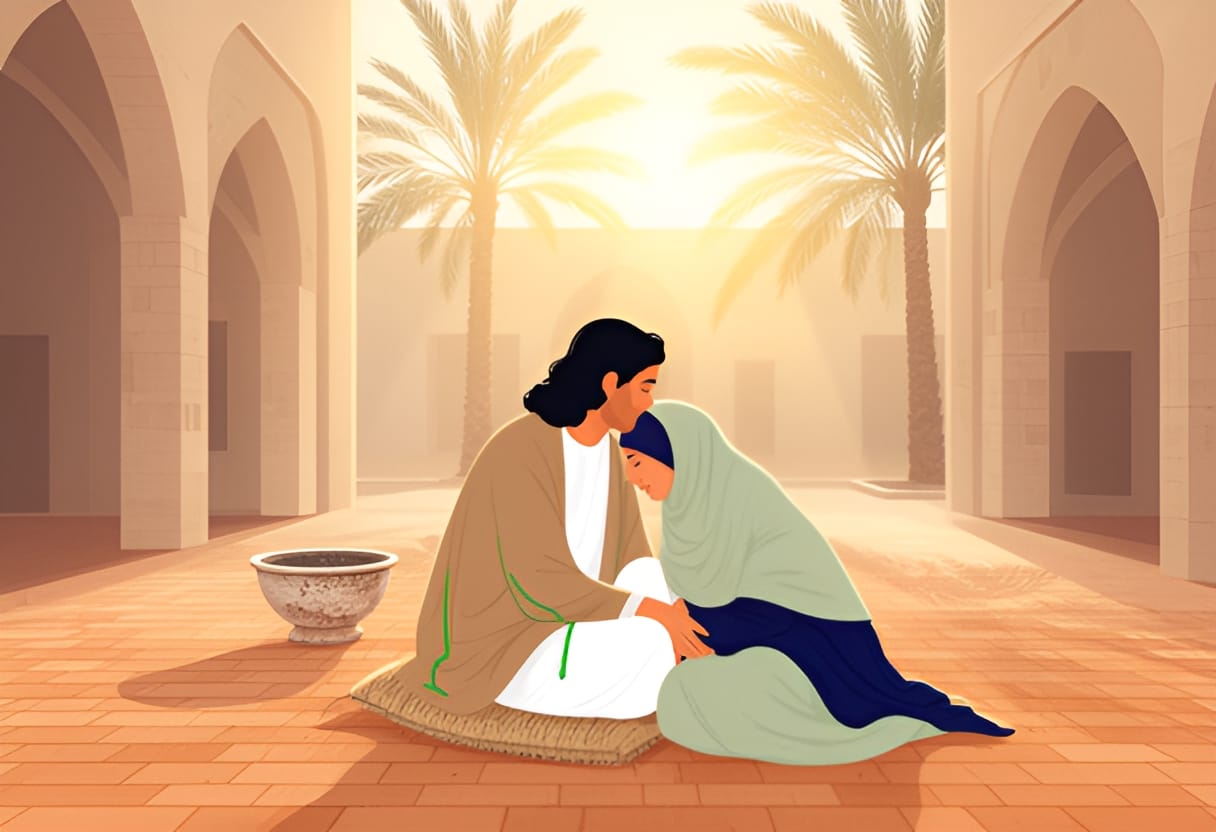
When disagreements arose, he addressed them with calm and patience. On one occasion, when Aisha expressed jealousy over his kindness to another wife, he did not dismiss her feelings. Instead, he acknowledged her emotion, reassured her of his love, and gently reminded her that kindness to others did not diminish his care for her. His approach was not to win an argument, but to preserve harmony and emotional safety in the home.
Nurturing Children Through Play, Teaching, and Affection
The Prophet’s relationship with children was marked by warmth, patience, and active engagement. He greeted them first in gatherings, carried them on his shoulders during prayer, and shortened his prayers when he heard a child cry, so as not to burden the mother. These actions signaled that children were not distractions, but valued members of the community.
He played with his grandsons, Hasan and Husayn, letting them climb on his back while he prostrated in prayer, and once carried them on his shoulders through the market, saying, "What excellent mounts you have!" when people admired them. Such moments were not mere indulgence; they conveyed love, security, and belonging.
He also used play as a teaching tool. When Hasan ibn Ali took a date meant for charity and put it in his mouth, the Prophet gently removed it, smiling, and said, "Do you not know that we do not eat from charity?" This correction was firm yet kind, delivered in a moment of connection rather than punishment. He taught through example and gentle guidance, ensuring that learning occurred in an atmosphere of trust.
Physical affection was frequent and open. He kissed his grandchildren, hugged them, and wept when Ibrahim, his son from Maria al-Qibtiyya, passed away in infancy, saying, "The eyes shed tears, the heart grieves, but we say only what pleases our Lord." This balance of emotion and faith showed that grief is natural, but hope remains rooted in trust in God.
A Household Charter: Mutual Respect, Shared Duties, and Emotional Safety
Inspired by the Prophet’s home, a household charter can help modern families establish shared values and practical rhythms. This is not a rigid contract, but a living agreement that reflects mutual commitment to respect, cooperation, and care. It begins with a family conversation where each member shares what they need to feel safe, heard, and valued.
The charter can include three core areas:
| Area | Prophetic Principle | Modern Application |
|---|---|---|
| Mutual Respect | Treated wives with equity; greeted children first | Listen without interrupting; honor boundaries |
| Shared Duties | Mended his own shoes; helped with household chores | Divide tasks fairly; rotate responsibilities |
| Emotional Safety | Reassured Aisha; responded to children’s cries | Name emotions without blame; pause before reacting |
For example, a couple might agree that when one feels overwhelmed, they will say, "I need ten minutes to breathe," and the other will honor that request without taking it personally. Parents might commit to bedtime routines that include storytelling or gratitude sharing, following the Prophet’s practice of engaging children with warmth before sleep. Adolescents could be given age-appropriate chores not as punishment, but as contributions to the family’s well-being, echoing his belief that everyone has a role to play.
Conflict resolution follows his model: address the issue, not the person; listen to understand; seek reconciliation over victory. If a teenager speaks disrespectfully, a parent might respond, "I hear you’re upset. Let’s talk when we’re both calm," rather than reacting in anger. This mirrors his response to the Bedouin who grabbed his cloak—he did not retaliate, but asked what the man needed and responded with generosity.
Applying Prophetic Principles to Modern Family Dynamics
Modern families face unique pressures—digital distractions, demanding schedules, and blurred boundaries between work and home. The Prophet’s example offers timeless anchors. Begin by protecting time for connection: share meals without screens, greet each other warmly after separation, and check in with simple questions like, "How was your heart today?"
In marriage, prioritize small, consistent acts of kindness: a note of appreciation, taking over a chore without being asked, or asking, "How can I support you today?" These reflect his habit of seeking opportunities to please his wives.
Parenting today means balancing guidance with empathy. When a child fails a test, instead of leading with disappointment, try, "I see you’re disappointed. What do you think made it hard?" This opens space for honesty and growth, much like his correction of Hasan over the charity date.
For multigenerational households, honor elders by seeking their advice and involving them in family decisions, as the Prophet did with his companions and family. Create rituals that bridge ages—such as grandparents teaching traditional crafts or stories—to strengthen bonds across generations.
Ultimately, the Prophet’s home was not defined by perfection, but by intention. He made mistakes, felt fatigue, and faced challenges—yet he consistently returned to kindness, fairness, and love. By emulating his effort, not his outcomes, you can build a family life where every member feels they belong, are valued, and are encouraged to grow in character. This is how mercy begins: in the quiet, daily choice to treat those closest to you with the best of yourself.
Neighbors, Community, and the Rights of Others
Neighbors hold a special place in Islamic ethics, and the Prophet Muhammad (peace be upon him) emphasized their rights through both teaching and action. His guidance transforms everyday proximity into an opportunity for mercy, justice, and community strength. By understanding the categories of neighbors, honoring covenants with all residents, and acting with measured care, you can build relationships that reflect the Prophetic ideal of being 'a mercy to the worlds'.
The Three Categories of Neighbors and Their Rights
Islamic teaching classifies neighbors into three groups based on proximity and relationship, each with specific rights. The first category includes Muslim relatives who live nearby—such as a sibling or parent in the same building or adjacent home. These neighbors hold three rights: the right of kinship, the right of Islam, and the right of neighborhood. The second category consists of Muslim non-relatives who are neighbors—like a fellow believer living next door who is not a blood relative. They hold two rights: the right of Islam and the right of neighborhood. The third category comprises non-Muslim neighbors, whether relatives or strangers, who hold only one right: the right of neighborhood.
This framework ensures that no one is excluded from basic decency, while acknowledging deeper bonds where they exist. For example, if your neighbor is an elderly Jewish woman who lives alone, she holds the right of neighborhood regardless of faith. This means you must not harm her, should check on her during illness or hardship, and avoid actions that disturb her peace—such as loud noise late at night or blocking her access. If she is also a blood relative, say your cousin, then the rights of kinship and neighborhood both apply, increasing your duty to maintain ties and offer support. If she is a Muslim convert from your extended family, all three rights—kinship, faith, and neighborhood—come into play, demanding the highest level of care.
The Prophet’s statement that Jibril kept recommending treating neighbors well 'until I thought he would make them heirs' illustrates how central this duty is. It does not mean neighbors automatically inherit, but that their rights are so emphasized they feel akin to family. In practice, this means seeing a neighbor’s distress as your concern—whether it’s a broken water pipe, a job loss, or loneliness—and responding with help that respects their dignity.
Upholding Covenants: The Charter of Medina and Beyond
When the Prophet migrated to Medina, he did not assume authority over a homogeneous Muslim community. Instead, he encountered a diverse population of Muslim emigrants (Muhajirun), local Muslim helpers (Ansar), Jewish tribes, and other groups. His response was the Charter of Medina (also called the Constitution of Medina), a foundational agreement that granted rights and responsibilities to all parties, regardless of faith.
The Charter recognized Jews as 'one community with the believers' in matters of mutual defense and consultation, while affirming their right to practice their religion. It established that an attack on one group was an attack on all, and that disputes would be referred to God and His Messenger for resolution. Crucially, it prohibited aiding enemies against any signatory, ensuring that loyalty to the community did not require abandoning one’s faith.
This model was not theoretical. When the Jewish tribe of Banu Qaynuqa violated the treaty by harassing a Muslim woman, the Prophet responded not with collective punishment but with a measured process: he confronted the violation, sought correction, and only after repeated breaches did he take action—consistent with Quranic principles of justice and due process. Similarly, his treatment of Abdullah ibn Ubayy, the leader of the hypocrites who outwardly professed Islam but secretly undermined the community, was marked by patience and restraint. Despite knowing his duplicity, the Prophet accepted his outward Islam, honored the social peace, and left judgment to God—demonstrating that upholding a covenant means protecting the integrity of the agreement even when others falter.
For modern application, this teaches that living in a diverse society requires honoring the spirit of mutual agreements—whether civic laws, workplace policies, or informal neighborhood understandings. If you reside in an apartment building with a no-pets policy, respecting it honors the implicit contract with fellow tenants, even if you personally disagree. If a neighbor plays loud music during restricted hours, addressing it through proper channels—such as a calm conversation or building management—reflects the Prophetic preference for resolution over retaliation. The Charter of Medina shows that justice and coexistence are not achieved by ignoring differences, but by affirming shared responsibilities while protecting distinct identities.
A Neighborhood Action Plan: Assess, Help, Respect
Prophetic neighborliness is not passive; it involves proactive awareness and measured response. A practical framework consists of three steps: assess needs, offer help within your capacity, and respect boundaries to avoid overreach.
First, assess needs through observation and gentle inquiry. The Prophet did not wait to be asked—he noticed when someone was struggling. For instance, if you see an elderly neighbor struggling to carry groceries, this is an observable need. A simple, 'Would you like me to help you with those bags?' opens the door without assuming incapacity. If they decline, you honor that—respect is part of the assessment.

Second, offer help that matches your ability and their need. Help is not measured by grandeur but by timeliness and relevance. If a new family moves in and seems overwhelmed, offering to share a meal or explain local recycling rules is meaningful. If a neighbor is ill, dropping off soup or picking up medicine—if you are able—fulfills the right of neighborhood. The key is consistency: small, repeated acts build trust more than occasional grand gestures. The Prophet mended his own shoes and helped with chores—not because he had to, but because it normalized care as part of daily life.
Third, respect boundaries to prevent well-intentioned action from becoming intrusive. Offering help does not mean insisting, monitoring, or reporting. If a neighbor declines your offer to shovel their snow, saying, 'Okay, just let me know if you change your mind,' leaves the door open without pressure. Similarly, if you hear an argument through thin walls, the Prophetic model is not to intervene aggressively but to check in later: 'I heard raised voices yesterday—everything alright?' This approach assumes good faith and avoids escalation.
Consider a real scenario: a Muslim family in Toronto notices their Sikh neighbor, Mr. Singh, always brings his trash bins to the curb but never brings them back in. After a week of seeing them left out, the family’s teenager politely asks if he’d like help returning them. Mr. Singh smiles and says, 'Thank you, but I manage—my son usually helps, but he’s away.' The family then agrees to check in monthly, not weekly, and only offer if the bins remain out for more than two days. Over time, Mr. Singh begins returning the gesture by shoveling snow from their walkway after storms. This cycle of respectful offer, honest response, and reciprocal care mirrors the Prophetic ideal: neighborliness as a quiet, ongoing exchange of dignity.
Sustaining Community Through Consistent Care
The Prophet’s approach to neighbors was never episodic—it was woven into the rhythm of daily life. He greeted children first, accepted invitations even to simple meals, and responded to harm with patience. These small acts created a culture where no one felt invisible or unsafe.
In your own context, sustaining this care means integrating neighborly awareness into routine. Set a monthly reminder to check on at-risk neighbors during extreme weather. Keep a shared list of local resources—such as free clinics or food banks—to share when appropriate. When conflicts arise, pause before reacting; ask, 'What does this person need to feel heard?' as the Prophet did with the Bedouin who grabbed his cloak.
Ultimately, the rights of neighbors are not a checklist but a mindset: seeing proximity as a sacred opportunity to reflect God’s mercy. By assessing needs, offering fitting help, and honoring boundaries, you transform your street, building, or complex into a reflection of the Medina the Prophet built—one where faith is not just believed, but lived in the way we treat those who live closest to us.
Work, Leadership, and Ethical Conduct in the Marketplace
The Prophet Muhammad’s teachings on work and business are not relics of a bygone era but living principles for ethical livelihood in any age. He affirmed that earning a lawful living is an act of worship, stating that “no one eats better food than that which he earns through his own labor” (Sahih al-Bukhari). This elevates honest work from mere survival to spiritual practice. When you choose integrity in your profession—whether as an employee, employer, or entrepreneur—you align your daily effort with a prophetic legacy that sees dignity in diligence and blessing in barakah (divine grace) bestowed upon truthful gain.
Truthfulness and Trust in Trade
Central to the Prophet’s vision of ethical commerce is the inseparable link between truthfulness (sidq) and trustworthiness (amanah). He declared: “The truthful and trustworthy merchant will be with the prophets, the truthful, and the martyrs” (Sunan al-Tirmidhi). This hadith places ethical traders in the highest spiritual company—not because of wealth accumulated, but because of character demonstrated in the marketplace. In a world where profit often justifies deception, this teaching reframes success: your integrity is your eternal inventory.
Consider a freelance designer who discovers a client misunderstood the project scope and is about to overpay. Instead of accepting the windfall, she clarifies the error, revises the invoice, and honors the original agreement. Though she loses short-term gain, she builds a reputation for reliability that attracts long-term clients. This mirrors the Prophet’s own conduct: he would correct mistakes in measurement or weight, even when it disadvantaged him, because amanah demands that you safeguard others’ rights as vigilantly as your own. Trustworthiness here is not passive honesty but active stewardship—returning excess change, disclosing product flaws, or admitting when a deadline cannot be met.
Prohibitions That Protect Fairness
The Prophet identified specific practices that corrupt business and harm community, declaring them haram (forbidden) not as arbitrary rules but as safeguards for mutual dignity. Three core prohibitions shape ethical trade:
- Gharar (excessive uncertainty): Transactions where key terms are unknown or risky, such as selling goods you have not seen or agreeing to a price contingent on unpredictable future events. Example: selling a phone described only as “like new” without allowing inspection, or agreeing to pay for a service only if you “feel satisfied” afterward—both open the door to dispute and exploitation.
- Riba (interest): Any predetermined excess in a loan transaction, whether on money or goods. The Prophet condemned riba severely, equating it with consuming wealth unjustly. Modern parallels include payday loans with compounding fees or credit card debt that traps users in cycles of repayment far beyond the principal. Islamic finance avoids riba through profit-and-loss sharing (mudarabah) or cost-plus sales (murabaha), where risk and reward are shared.
- Tajassus (spying or deceit): Concealing defects, exaggerating benefits, or manipulating information to gain an unfair advantage. This includes hiding water damage in a used car, fabricating online reviews, or using insider knowledge to pressure a seller. The Prophet said: “Whoever cheats is not of us” (Sahih Muslim). Tajassus erodes the very foundation of trade—trust—and invites divine displeasure.
These prohibitions are not merely legalistic; they cultivate a marketplace where neither party feels exploited. When you refuse to exploit a loophole in a contract, disclose a product’s limitation, or walk away from a deal that feels “too good to be true,” you uphift the Prophetic standard of a clean hand and a clear conscience.
Leadership as Service and Consultation
The Prophet’s leadership in Medina was marked by humility, consultation (shura), and accountability. He did not rule by decree but sought counsel from companions, even on matters of war and peace. When preparing for the Battle of Uhud, he listened to younger companions who advocated fighting outside the city, despite senior advice to stay within Medina’s defenses. Though the outcome was difficult, his willingness to consult modeled that leadership is not about infallibility but about inclusivity and learning.
In a modern team setting, this translates to inviting input before making decisions that affect others. A project manager who holds a brief huddle to ask, “What risks do you see I might be missing?” embodies shura. It does not weaken authority—it strengthens it by surfacing blind spots and fostering ownership. Similarly, the Prophet took responsibility for outcomes. After the Battle of Uhud, he did not blame archers who left their posts; he acknowledged the collective shortfall and continued to lead with resolve. When you own a mistake—say, admitting a misjudged timeline caused delays—you build psychological safety, encouraging others to speak up without fear.
He also served his team literally: mending his own sandals, helping with chores, and working alongside companions. A leader who occasionally joins the frontline—not for photo ops but to understand ground realities—earns respect that lasts. If you are a supervisor, spending one day a month doing frontline tasks (e.g., answering customer calls, packing orders) signals that no work is beneath dignity and that you share the burden.
Prophetic Principles and Modern Workplace Values
The following table connects timeless Prophetic guidance to contemporary workplace ethics, showing how ancient wisdom informs modern dilemmas:
| Prophetic Principle | Modern Workplace Application | Concrete Example |
|---|---|---|
| Truthfulness in speech | Honest communication | Admitting a project delay early instead of hiding it until the last minute. |
| Trustworthiness (amanah) | Reliability and accountability | Returning tools or data entrusted to you, even if unsupervised. |
| Prohibition of gharar | Clarity in contracts and expectations | Clearly defining deliverables, timelines, and revision limits in a freelance contract. |
| Prohibition of tajassus | Transparency and honesty in marketing | Disclosing known limitations of a product in a sales pitch, even if it risks the sale. |
| Leadership through shura | Inclusive decision-making | Holding a team vote on two viable approaches before choosing one. |
| Service-oriented leadership | Leading by example | A manager staying late to help meet a deadline, not just monitoring others. |
| Respect for workers’ rights | Fair wages and safe conditions | Paying overtime promptly and ensuring breaks are honored, not discouraged. |
This framework is not about perfection but direction. When you feel pressured to cut corners, ask: “Would the Prophet approve of this action?” If the answer is no, seek an alternative—even if it costs you convenience or short-term gain.
Try This
Apply Prophetic workplace ethics this week with these steps:
- Audit one recent interaction for honesty: Did you withhold information, exaggerate, or stay silent when you should have spoken up? Plan how to correct it moving forward.
- Practice shura in a small decision: Before finalizing a plan (e.g., meeting agenda, task allocation), ask one colleague for their perspective and genuinely consider it.
- Embody service: Perform one unseen task that supports your team—refilling shared supplies, documenting a process, or covering a brief break for a coworker—without seeking recognition.
Key Takeaways
- Honest and trustworthy work is an act of worship, placing ethical earners in the company of prophets and martyrs.
- Gharar, riba, and tajassus are prohibited because they undermine trust, exploit vulnerability, and corrupt the marketplace.
- Prophetic leadership combines consultation (shura), accountability, and service—leading not from above but alongside the team.
- Workplace integrity today mirrors Prophetic principles: transparency, fairness, and respect for workers’ rights are not optional but obligatory.
- Small, consistent acts of integrity—correcting errors, honoring trust, and serving quietly—build a legacy of barakah in your professional life.

Chapter 3
Applying the Sunnah to Contemporary Life
Mindfulness and Mental Well-being in the Prophetic Way
Imagine sitting down after a long day, your mind racing with unfinished tasks, worries about the future, and a lingering sense of unease. You reach for your phone, scroll endlessly, but the calm you seek remains out of reach. What if the solution isn’t in distraction, but in a return to simple, intentional practices rooted in the Prophetic way?
Morning and Evening Adhkar as Emotional Grounding
The Prophet Muhammad (peace be upon him) began and ended each day with specific remembrances of Allah, known as adhkar. These were not mere rituals but deliberate acts of centering the heart and mind. In the morning, after Fajr prayer, he would recite Subhanallah 33 times, Alhamdu lillah 33 times, and Allahu akbar 34 times, followed by Ayat al-Kursi and the last two verses of Surah Al-Baqarah. In the evening, after Maghrib or before sleep, he repeated similar phrases, seeking refuge in Allah from anxiety and sorrow.
These practices function as emotional grounding techniques by shifting attention from mental chatter to a rhythmic, meaningful repetition. Modern psychology recognizes similar benefits in mantra-based meditation, where focused repetition reduces activity in the brain’s default mode network — the system linked to rumination and worry. By engaging in adhkar, you interrupt cycles of anxious thinking and anchor yourself in a sense of divine presence and purpose.
For example, consider someone starting their workday overwhelmed by a heavy inbox and looming deadlines. Instead of immediately checking messages, they spend five minutes after prayer reciting the morning adhkar slowly, focusing on the meaning of each phrase. The repetition of Alhamdu lillah (All praise is due to Allah) redirects attention to gratitude, subtly reframing the day not as a series of demands but as an opportunity. This small shift can lower cortisol levels and improve emotional regulation throughout the day.
To apply this, begin with consistency, not length. Choose one set of adhkar — morning or evening — and practice it daily for two weeks. Use a tasbih (prayer beads) or your fingers to keep count, and aim to understand the meaning of what you’re saying. Over time, this becomes a psychological reset button, available twice a day to restore inner balance.
Tawakkul: Trust That Includes Effort
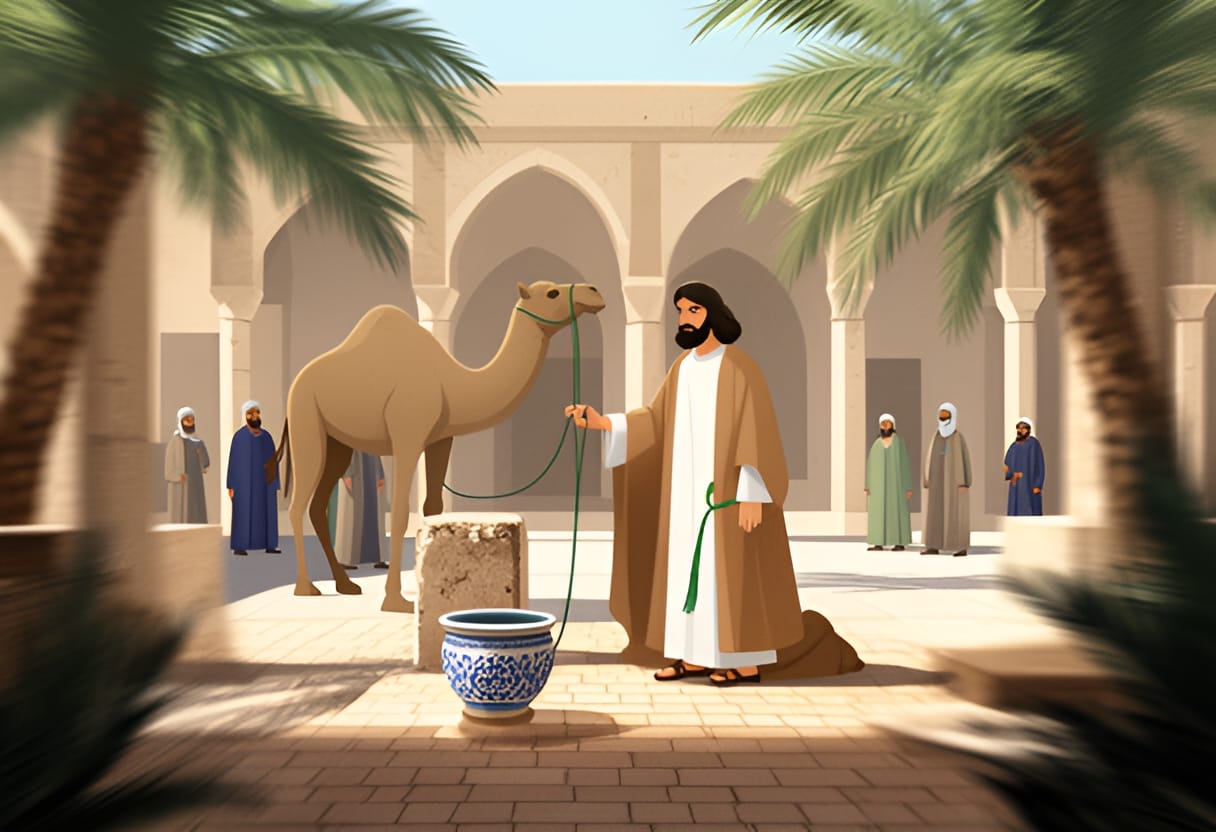
Tawakkul, often translated as reliance on Allah, is frequently misunderstood as passive resignation. In the Prophetic model, it is anything but. The Prophet said, “Tie your camel and then trust in Allah” (Jami` at-Tirmidhi), illustrating that trust coexists with prudent action. Tawakkul means doing your part with sincerity and then releasing the outcome to Allah, freeing yourself from the burden of controlling what is beyond your power.
This distinction is crucial for mental well-being. Anxiety often arises not from effort itself, but from the illusion that we must guarantee results. When we conflate responsibility with control, we set ourselves up for chronic stress. Tawakkul offers a healthier framework: fulfill your duties with excellence, then surrender the rest. This reduces the cognitive load of “what if” scenarios and fosters resilience.
Take the case of a student preparing for an important exam. They study diligently, seek help when needed, and manage their time wisely — these are the acts of tying the camel. Afterward, instead of obsessing over the score, they remind themselves: I have done what I can; the outcome is in Allah’s hands. This mindset doesn’t eliminate effort — it purifies it. The student can then rest, sleep well, and approach the exam with clarity rather than panic.
To practice tawakkul, pair it with a clear action plan. Before beginning a task, ask: What is my responsibility here? Identify concrete steps, then commit to them. Once done, consciously release the result through a phrase like Hasbunallahu wa ni’mal-wakil (Allah is sufficient for me, and He is the best disposer of affairs). Over time, this builds trust not in passivity, but in a balanced engagement with life.
Prophetic Response to Overwhelm: The Companion’s Relief
When a companion came to the Prophet Muhammad (peace be upon him) burdened by worries and debts, the Prophet did not offer vague comfort. He gave him a specific, actionable remedy: “Say: Hasbunallahu wa ni‘mal-wakil. Allah is sufficient for me, and He is the best disposer of affairs” (Sahih al-Bukhari). This was not a dismissal of the companion’s struggles, but a tool to shift his internal relationship with them.
The phrase works on multiple levels. Linguistically, it affirms Allah’s sufficiency (hasbunallah) and excellence as a guardian (ni‘mal-wakil). Psychologically, it redirects focus from the problem’s magnitude to the reliability of a higher support. Cognitive behavioral therapy uses similar techniques — called cognitive restructuring — to challenge catastrophic thinking by introducing balanced, evidence-based alternatives. Here, the evidence lies in lived experience: countless believers have found relief in this affirmation during hardship.
Consider a parent facing financial strain, lying awake at night thinking about bills and their children’s needs. Repeating Hasbunallahu wa ni‘mal-wakil doesn’t make the debt vanish, but it changes the inner dialogue. Instead of I cannot handle this, the mind begins to hold both truths: This is difficult, and I am not alone in carrying it. This subtle shift reduces helplessness and opens space for problem-solving rather than paralysis.
To use this in moments of overwhelm, pause, place a hand on your heart, and say the phrase slowly three times. Feel the vibration in your chest, listen to the sound, and let the meaning settle. You are not denying reality — you are inviting a broader perspective into it. Over time, this becomes an anchor you can return to, whether in traffic, during a difficult conversation, or before sleep.
Daily Mindfulness Routine: Integrating Prophetic Habits
Building on these principles, here is a simple, adaptable daily mindfulness routine rooted in the Prophet’s (peace be upon him) habits. It requires no special equipment and takes less than ten minutes total, divided between morning and evening.
Morning Routine (after Fajr or upon waking):
- Sit quietly for one minute, eyes closed, focusing on the natural flow of your breath. Notice the sensation of air entering and leaving your nostrils.
- Recite the morning adhkar: Subhanallah (33x), Alhamdu lillah (33x), Allahu akbar (34x), followed by Ayat al-Kursi and the last two verses of Surah Al-Baqarah. Move slowly, reflecting on the meaning.
- Conclude with one minute of silent gratitude: name three specific things you are thankful for today — a person, a ability, a moment of peace.
Evening Routine (after Maghrib or before sleep):
- Repeat the breath awareness exercise for one minute, releasing the tension of the day.
- Recite the evening adhkar, which mirror the morning: the same tasbih counts, followed by Ayat al-Kursi and the closing verses of Surah Al-Baqarah.
- End with Hasbunallahu wa ni‘mal-wakil three times, then lie down on your right side, as the Prophet did, and breathe gently until sleep comes.
This routine combines breath awareness (a core mindfulness practice), dhikr (focused remembrance), gratitude (linked to increased well-being), and tawakkul (emotional release). Together, they create a rhythm that supports emotional regulation, reduces stress reactivity, and nurtures a sense of inner steadiness.
For instance, a nurse working long shifts might practice the evening routine after changing out of scrubs. The breath awareness helps transition from the high-alert state of work, the adhkar provides spiritual grounding, and the final affirmation releases the weight of the day’s challenges. Over weeks, they report falling asleep faster and waking with less mental fog.
Begin with just one part — perhaps the morning breath and gratitude — and build gradually. Consistency matters more than perfection. These are not burdens to add, but returns to a natural state: one of awareness, trust, and quiet strength, modeled by the one who was sent as a mercy to the worlds.
Digital Communication: The Weight of Words in the Online Age
In the digital realm, words travel faster and farther than ever before, often stripped of tone, context, and accountability. A single post, comment, or message can reach thousands in seconds, shaping perceptions, influencing emotions, and sometimes causing lasting harm. The Prophet Muhammad (peace be upon him) emphasized the profound power of speech, stating: “A servant may utter a word pleasing to Allah without realizing its significance, and Allah raises him thereby in degrees; and a servant may utter a word displeasing to Allah without realizing its weight, and he thereby falls into the Hellfire farther than the distance between the east and the west” (Sahih al-Bukhari). This hadith underscores that even seemingly minor expressions carry spiritual weight — a truth magnified in online spaces where impulsivity and anonymity lower the barrier to harmful speech.
Consider a scenario where you share a sensational headline without verifying its source, only to later discover it misrepresents a community or spreads fear. Though unintentional, your action contributed to misinformation, which the Prophet condemned as a form of betrayal: “It is enough lying for a man to speak of everything that he hears” (Sahih Muslim). Online, this translates to the danger of amplifying unverified claims — a practice that erodes trust and fuels division. Conversely, choosing to pause, reflect, and speak only what is true and beneficial transforms digital interaction into an act of worship. Each mindful word becomes a step toward Paradise; each careless one, a step away.
Riba al-Fadil: When Speech Becomes Exploitative
The concept of riba al-fadil (usury in speech) refers to gaining advantage through exaggerated, deceptive, or manipulative language — akin to profiting from falsehood. Just as financial riba exploits need through unjust gain, rhetorical riba exploits attention, emotion, or ignorance for clicks, validation, or influence. In today’s attention economy, this manifests in clickbait titles, inflammatory commentary, and curated personas that distort reality to provoke engagement. The Prophet warned against such speech: “Whoever believes in Allah and the Last Day, let him speak good or remain silent” (Sahih al-Bukhari). This hadith sets a high standard: silence is preferable to speech that lacks goodness, truth, or benefit.
For example, imagine posting a heated critique of a public figure using selective quotes and emotive language designed to provoke outrage. While it may garner likes and shares, it often deepens polarization and undermines dignity — a form of spiritual usury where you profit from discord. Applying riba al-fadil here means recognizing that such speech, though common, is not neutral. It extracts value from others’ emotions without offering truth or constructive insight. The alternative? Pause before posting and ask: Does this add value, or does it exploit? Choose language that informs, uplifts, or invites understanding — even when criticizing — mirroring the Prophet’s approach of addressing error with wisdom and restraint.
Modeling Truth and Calm in the Face of Provocation
The Prophet Muhammad (peace be upon him) consistently demonstrated how to respond to misinformation and hostility with integrity and composure. When false rumors spread about him during the Hijra, he did not retaliate with anger or counter-lies. Instead, he affirmed truth through consistent action and character, allowing his integrity to speak louder than the accusations. Similarly, when confronted with insults or ignorance, he often responded with silence, a gentle correction, or a prayer for guidance — never with escalation.
Take the case of online harassment: you receive a hostile message accusing you of beliefs you do not hold. The instinct might be to defend yourself aggressively, match the tone, or expose the sender publicly. Yet the Prophetic model offers a different path. First, verify whether a response is truly necessary — sometimes, silence protects your peace and denies the provocateur the reaction they seek. If engagement is warranted, respond with facts, not fury. For instance, you might say: “I appreciate your concern, but here’s what I actually believe, based on reliable sources.” This mirrors the Prophet’s practice of correcting misinformation with clarity and compassion, as when he gently instructed a Bedouin who urinated in the mosque: “Do not scold him; he was ignorant. Teach him kindly” (Sahih al-Bukhari). Online, this translates to assuming good faith where possible, educating without shaming, and disengaging when hostility persists.
A Digital Citizenship Checklist: THINK Before You Post
To operationalize Prophetic ethics in digital spaces, use the THINK framework as a pre-posting ritual. Inspired by the hadith on guarding one’s tongue, this checklist turns abstract principles into actionable steps:
| Criteria | Question to Ask | Prophetic Parallel | Application Example |
|---|---|---|---|
| True | Is this factually accurate? Have I verified the source? | “It is enough lying for a man to speak of everything that he hears” | Before sharing a news alert, check multiple reputable outlets or fact-checking sites. |
| Helpful | Does this benefit others or solve a problem? | “The best of people are those who bring most benefit to others” | Instead of venting about a delay, share a useful alternative route or tip. |
| Inspiring | Does this uplift, encourage, or remind others of goodness? | “Speak good or remain silent” | Share a personal story of resilience that offers hope, not just frustration. |
| Necessary | Is this adding value, or just noise? Could silence be better? | “Whoever believes in Allah and the Last Day, let him speak good or remain silent” | Skip the sarcastic reply; sometimes, not commenting preserves dignity and peace. |
| Kind | Would I say this to the person’s face? Does it respect their dignity? | “Kindness is a mark of faith” | Respond to a disagreement with “I see it differently — here’s why” instead of name-calling. |
Apply this checklist not only to public posts but also to private messages, group chats, and even internal thoughts before speaking aloud. For example, before forwarding a humorous but potentially offensive meme, run it through THINK: Is it true in spirit? Is it helpful to understanding? Is it inspiring or merely mocking? Is it necessary to share? Is it kind to all who might see it? If any answer is no, reconsider.
By integrating these practices, you transform digital interaction from a source of anxiety into a field of spiritual practice. Every message becomes an opportunity to uphold truth, exercise self-control, and embody the mercy the Prophet embodied — even behind a screen. Over time, this builds not just better online habits, but a deeper awareness of the weight of your words, in this life and the next.
Justice, Equity, and Standing Against Oppression
The Prophet Muhammad (peace be upon him) consistently affirmed that justice is not situational but a divine command that must be upheld regardless of personal ties, social status, or prevailing prejudice. His life offers a living framework for confronting injustice — whether in personal conduct, community decisions, or systemic inequities. This section explores how his actions in Medina established enduring principles of equity, accountability, restitution, and protection for the vulnerable, and how these can guide your response to modern forms of oppression.
Upholding Equality Before the Law
One of the most powerful demonstrations of the Prophet’s commitment to justice occurred when a woman from the prestigious Makhzum tribe was found guilty of theft. Her family, aware of her high social standing, sought to intercede on her behalf, hoping to spare her the prescribed punishment. They approached Usama ibn Zayd, a beloved companion and the son of the Prophet’s freed slave, to plead for leniency. When Usama conveyed their request, the Prophet’s face changed color, and he said: “Do you intercede in one of the punishments prescribed by Allah?” He then stood and addressed the people: “Those before you were destroyed because when a noble person stole, they let him go; but when a weak person stole, they enforced the punishment. By Allah, if Fatima, the daughter of Muhammad, were to steal, I would cut off her hand.” (Sahih al-Bukhari)
This moment was not merely about enforcing a legal penalty; it was a declaration that no individual — regardless of lineage, wealth, or connection — is above the law. The Prophet rejected tribal favoritism (asabiyyah) as a corrupting force that erodes justice and fuels resentment. For you today, this means resisting the temptation to excuse unethical behavior in friends, colleagues, or leaders simply because of familiarity or loyalty. Justice requires consistency: if a rule applies to one, it must apply to all.
Consider a workplace scenario where a senior employee repeatedly takes credit for others’ ideas, yet faces no consequence due to their tenure or influence. Meanwhile, a junior employee is reprimanded for a minor mistake. Applying the Prophetic standard, you would advocate for equitable accountability — not out of resentment, but to uphold fairness. This might involve documenting patterns of behavior, speaking up in private with a supervisor, or supporting systems that ensure impartial evaluation. The goal is not punishment for its own sake, but the restoration of balance and trust in the community.
Protecting the Rights of Non-Muslims
In Medina, the Prophet established a pluralistic society where Muslims, Jews, Christians, and pagans coexisted under the Constitution of Medina (Sahifah). This document granted non-Muslim communities full religious autonomy, the right to self-governance in internal affairs, and equal protection under the law in matters of security and justice. He emphasized that harming a non-Muslim citizen (dhimmi) was a grave sin, saying: “Whoever kills a person under a treaty will not even smell the fragrance of Paradise.” (Sahih al-Bukhari)
His actions reinforced these principles. When a Jewish man was wronged in a business transaction, the Prophet ruled in his favor despite pressure from Muslim companions. He also stood for the funeral procession of a Jew, explaining: “Was he not a soul?” (Sahih al-Bukhari) These gestures affirmed that human dignity transcends religious identity.
Today, this translates to defending the rights of marginalized groups — whether religious minorities, immigrants, or those with differing beliefs — to worship freely, access fair legal representation, and live without fear of discrimination. For example, if you witness a colleague being excluded from meetings due to their accent or attire, you might speak up, invite their input, or report the pattern to HR. Supporting inclusive policies, challenging stereotypes in conversation, and amplifying marginalized voices are practical ways to uphold the Prophetic standard of justice that protects the vulnerable, regardless of background.
Responding to Communal Dissatisfaction with Wisdom
After the Battle of Hunayn, the Prophet distributed war booty among the fighters. Some of the Ansar (the helpers from Medina) felt slighted, believing their earlier sacrifices in Islam were overlooked in favor of newer converts from Mecca. Their disappointment was palpable, and they voiced their concerns openly. Rather than dismissing their feelings or asserting authority, the Prophet gathered them and spoke with empathy: “O Ansar, did I not come to you when you were lost and Allah guided you? Were you not poor and Allah enriched you? Were you not enemies and Allah reconciled your hearts?” He reminded them of Allah’s blessings and asked: “Do you not feel satisfied that others go away with worldly goods while you go away with Muhammad to your homes?” Moved by his words, they wept and replied: “Yes, we are satisfied, O Messenger of Allah.” (Sahih al-Bukhari)
This exchange reveals a profound approach to addressing grievances: listen without defensiveness, validate emotions, reframe perspective through gratitude, and appeal to shared purpose. The Prophet did not deny their sense of injustice; he elevated their vision beyond material gain to the spiritual and communal rewards of their faith.
In modern contexts, this model applies when a community feels overlooked — such as residents of a neglected neighborhood protesting unequal investment, or employees feeling undervalued after a restructuring. Instead of reacting with dismissal or defensiveness, leaders (and individuals) can follow the Prophetic example by acknowledging concerns, highlighting past contributions and blessings, and inviting reflection on shared values. For instance, a manager facing team dissatisfaction might say: “I hear your frustration. Let’s reflect on how far we’ve come together and what we’re building — not just in output, but in trust and care.” This doesn’t ignore legitimate issues but opens space for constructive dialogue rooted in mutual respect.
A Justice Framework: Equity, Accountability, Restitution, and Protection
The Prophet’s approach to justice can be distilled into four interconnected principles that serve as a practical tool for evaluating decisions in personal, communal, and societal contexts:
| Principle | Meaning | Reflective Question | Application Example |
|---|---|---|---|
| Equity | Fairness that considers context and need, not just identical treatment | Am I giving each person what they need to thrive, not just what is equal? | Providing flexible work hours for a parent caring for a sick child, while maintaining team goals. |
| Accountability | Responsibility for one’s actions, regardless of status or intent | Am I willing to face consequences for my choices, and do I expect the same of others? | Reporting a mistake you made in a project, even if it could delay recognition. |
| Restitution | Repairing harm caused, not just apologizing | How can I make this right beyond saying sorry? | Returning stolen property or compensating for lost wages after a dispute. |
| Protection | Safeguarding the vulnerable from exploitation or neglect | Who is most at risk here, and how can I reduce their exposure to harm? | Advocating for safety measures in a workplace where temporary workers face higher risks. |
This framework is not a rigid checklist but a lens for discernment. For example, if you are considering whether to speak up about unfair treatment at work, equity asks whether the burden falls disproportionately on certain groups; accountability prompts you to examine your own role in the system; restitution guides you toward solutions that heal harm; and protection ensures your action prioritizes those most likely to be retaliated against or overlooked.
Imagine a situation where a landlord raises rent sharply, displacing long-term, low-income tenants. Applying the framework: equity reveals the imbalance between profit and human need; accountability challenges the landlord (and perhaps regulators) to justify the increase; restitution might involve relocation assistance or phased increases; and protection centers on preventing homelessness among vulnerable residents. Your response — whether as a tenant, advocate, or policymaker — can be shaped by these questions to align with the Prophetic imperative: “Let there be no harm nor reciprocation of harm.” (Muwatta Malik)
Justice, in the Prophetic way, is not passive fairness but active courage — to uphold truth when it is costly, to protect dignity when it is unpopular, and to restore balance when systems tilt toward oppression. By internalizing these principles, you transform justice from an abstract ideal into a daily practice of integrity, compassion, and moral clarity.
Conducting Muhasabah: The Prophetic Practice of Self-Evaluation
You begin your action plan with muhasabah, the Prophetic habit of regularly reviewing your intentions, actions, and their alignment with divine guidance. The Prophet Muhammad (peace be upon him) said: “Take account of yourselves before you are taken to account, and weigh your deeds before they are weighed for you.” (Al-Tirmidhi) This is not self-condemnation but honest reflection aimed at growth. Like checking your camel’s load before a journey, muhasabah ensures you are carrying what serves your purpose and discarding what hinders it.
To conduct muhasabah, set aside ten minutes at the end of each day—after Maghrib or before sleep—to review your day through three lenses: worship (ibadah), character (akhlaq), and dealings (muamalat). Ask: Did I begin my prayers with presence? Did I speak with kindness, even when tired? Did I fulfill my responsibilities with fairness? Use a simple journal or notes app to record one strength and one area for improvement each day. Over time, patterns emerge. For example, you might notice that impatience arises most during morning rush hour, prompting you to prepare your clothes and meals the night before to reduce stress. Or you may see that you consistently forget to recite evening adhkar, signaling a need to link it to an existing habit like brushing your teeth.
Muhasabah works because it turns vague guilt into specific insight. Instead of thinking, “I’m not a good Muslim,” you identify: “I missed Fajr three times this week because I scrolled social media in bed.” Now you have a clear target: leave your phone outside the bedroom. This practice mirrors the Prophet’s own habit of reflecting after prayer and seeking forgiveness, not out of despair, but as a renewal of commitment.
Selecting Your Three Focus Areas: Ibadah, Akhlaq, and Muamalat
From your muhasabah, choose one area for growth in each of the three domains of Prophetic life: ibadah (worship), akhlaq (character), and muamalat (social dealings). This ensures balanced development—nurturing your relationship with Allah, refining your inner self, and strengthening your community ties.
In ibadah, focus on the quality, not just the quantity, of your worship. Perhaps your audit shows you pray on time but rush through sujood, missing the chance for deep connection. A meaningful goal might be: “In each salah, I will extend my first sujood by five seconds to say ‘Subhana Rabbiyal al-Ala’ with reflection.” In akhlaq, target a recurring trait like impatience or gossip. If muhasabah reveals you interrupt others when excited, your goal could be: “I will pause and listen fully before responding in conversations.” For muamalat, consider your role in family, work, or community. If you often arrive late to meetings, a muamalat goal might be: “I will prepare 15 minutes earlier and arrive five minutes early to all work meetings.”
Choose areas that matter to you and are within your control. Avoid overly broad aims like “be more patient.” Instead, ground them in observable behavior. For instance, a nurse working long shifts might choose: “During handover reports, I will make eye contact and acknowledge each colleague’s input before speaking,” linking akhlaq to professional duty. A parent facing financial strain could select: “I will review our weekly budget every Sunday after Asr and discuss one non-essential expense we can reduce this week,” turning muamalat into family stewardship.
Applying SMART Criteria to Sunnah-Based Goals
Turn your focus areas into actionable goals using the SMART framework—ensuring they are Specific, Measurable, Achievable, Relevant, and Time-bound—while rooting them in Prophetic teachings. This transforms aspiration into practice.
- Specific: Define exactly what you will do. Instead of “improve my prayer,” say: “I will recite Ayat al-Kursi after every Fajr and Maghrib prayer.”
- Measurable: Include a way to track progress. “I will recite Ayat al-Kursi” becomes measurable when you add: “I will mark a check in my journal each time I do it.”
- Achievable: Set a goal that fits your reality. If you struggle to wake for Fajr, aiming to pray two rak’ahs of tahajjud first may be unrealistic. Start with: “I will wake for Fajr and recite the opening takbir with calm.”
- Relevant: Connect it to your values and the Sunnah. Reciting Ayat al-Kursi is relevant because the Prophet (peace be upon him) said it protects one from harm until morning (Sahih al-Bukhari).
- Time-bound: Give it a deadline or review point. “I will do this for the next 30 days, then review.”
For example, if your akhlaq goal is to reduce harsh speech, a SMART version could be: “For the next two weeks, before responding in moments of frustration, I will take one breath and say inwardly, ‘Hasbunallahu wa ni‘mal-wakil.’ I will log each instance in my notes app and aim for at least five successful pauses per week.” This is specific (the pause and phrase), measurable (log entries), achievable (one breath), relevant (ties to tawakkul and Prophetic speech ethics), and time-bound (two weeks).
Use a simple table to plan your three goals:
| Domain | SMART Goal | Tracking Method | Review Date |
|---|---|---|---|
| Ibadah | Recite Subhanallah 33 times, Alhamdulillah 33 times, Allahu akbar 34 times after Maghrib prayer | Daily checkmark in journal | End of month |
| Akhlaq | Pause and breathe before replying when feeling annoyed; aim for 4x/week | Notes app entry after each incident | Every Sunday |
| Muamalat | Prepare work materials the night before to start tasks on time; 5x/week | Calendar reminder + log | Biweekly |
This structure keeps your efforts focused and honest. If you miss a target, your muhasabah will show why—perhaps you underestimated evening fatigue—and you can adjust without self-judgment.
Quarterly Review Template: Assessing, Adapting, and Advancing
Every three months, conduct a deeper review using this template to assess consistency, identify obstacles, and refine your plan. Treat it like a stewardship audit: you are managing the trust (amanah) of your time, energy, and faith.
Consistency Check: For each goal, calculate your success rate. Did you meet your ibadah target 80% of days? Your akhlaq goal 60% of the time? Note trends—did consistency drop during travel or busy weeks?
Challenge Analysis: For each shortfall, ask: What got in the way? Was it lack of preparation, emotional state, or environmental triggers? For example, if you missed morning adhkar because you checked email first, the trigger is digital distraction upon waking.
Adjustment Plan: Based on your analysis, revise your goals or strategies. If evening fatigue prevents dhikr, shift it to right after Maghrib. If workplace stress leads to sharp words, commit to drinking water and pausing before replying in meetings.
Renewed Commitment: Rewrite your SMART goals for the next quarter, incorporating lessons learned. Perhaps your akhlaq goal evolves from pausing when annoyed to initiating one kind message daily to a colleague or family member.
Imagine a teacher who set a goal to greet each student by name at the door. After one quarter, her log shows 70% success—she forgot during chaotic mornings. Her adjustment: she now arrives ten minutes earlier to center herself and writes names on sticky notes as a visual cue. Her renewed goal: “I will greet each student by name and offer a smile, preparing my mindset during my walk to school.”

This cycle—muhasabah, goal-setting, action, review—creates a living relationship with the Sunnah. It is not about perfection but about returning, again and again, to the Prophetic model of growth through honest effort and divine reliance.
Try This
This week, take these three steps to begin your Sunnah Action Plan:
- Tonight after Maghrib, spend five minutes in muhasabah: review your day using the ibadah, akhlaq, and muamalat lenses. Write down one thing you did well and one small improvement for tomorrow.
- Tomorrow morning, choose one specific Prophetic practice to focus on—such as reciting the morning adhkar before checking your phone—and commit to doing it for three days.
- At the end of the week, review your notes: what helped you stay consistent? What made it difficult? Use this insight to set your first SMART goal for the coming week.
Key Takeaways
- Muhasabah (self-evaluation) is a Prophetic habit that turns reflection into growth by identifying specific, actionable changes in worship, character, and dealings.
- Effective Sunnah-based goals are SMART: Specific, Measurable, Achievable, Relevant, and Time-bound, rooted in authentic teachings like the adhkar or tawakkul.
- Regular review—daily through muhasabah and quarterly through structured assessment—ensures your action plan adapts to life’s changes while staying aligned with your values and the Sunnah’s guidance.