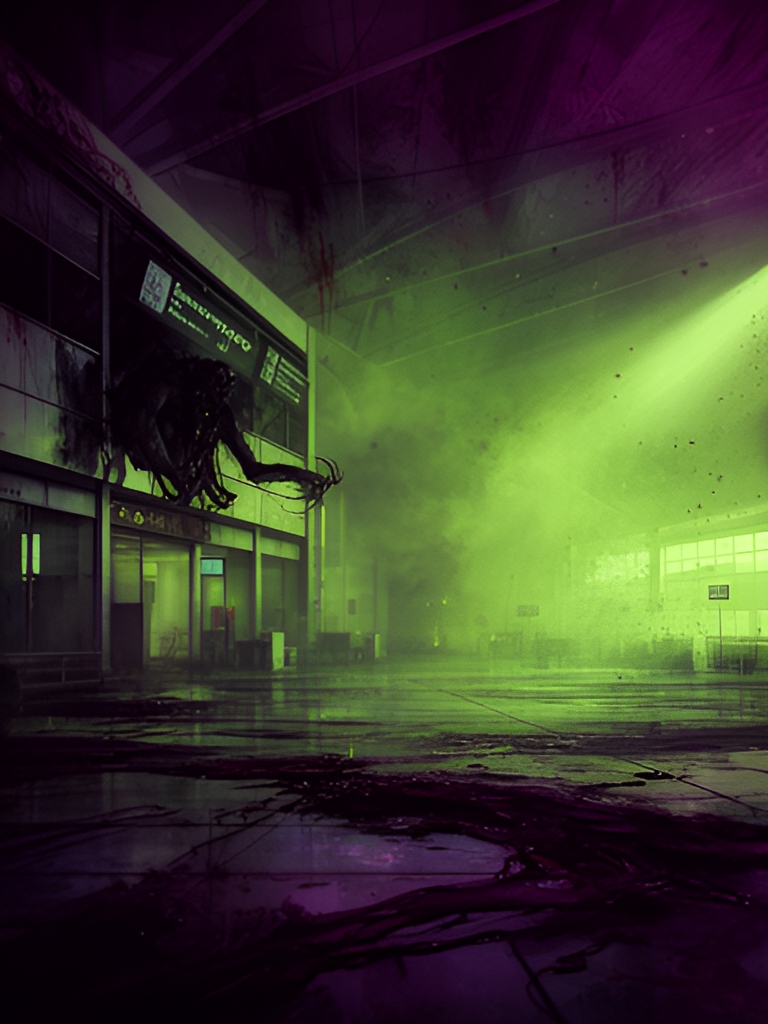
Horror
Survivor
by Adarsh
3 chapters1 hr read
Chapter 1
Alone in the Silence
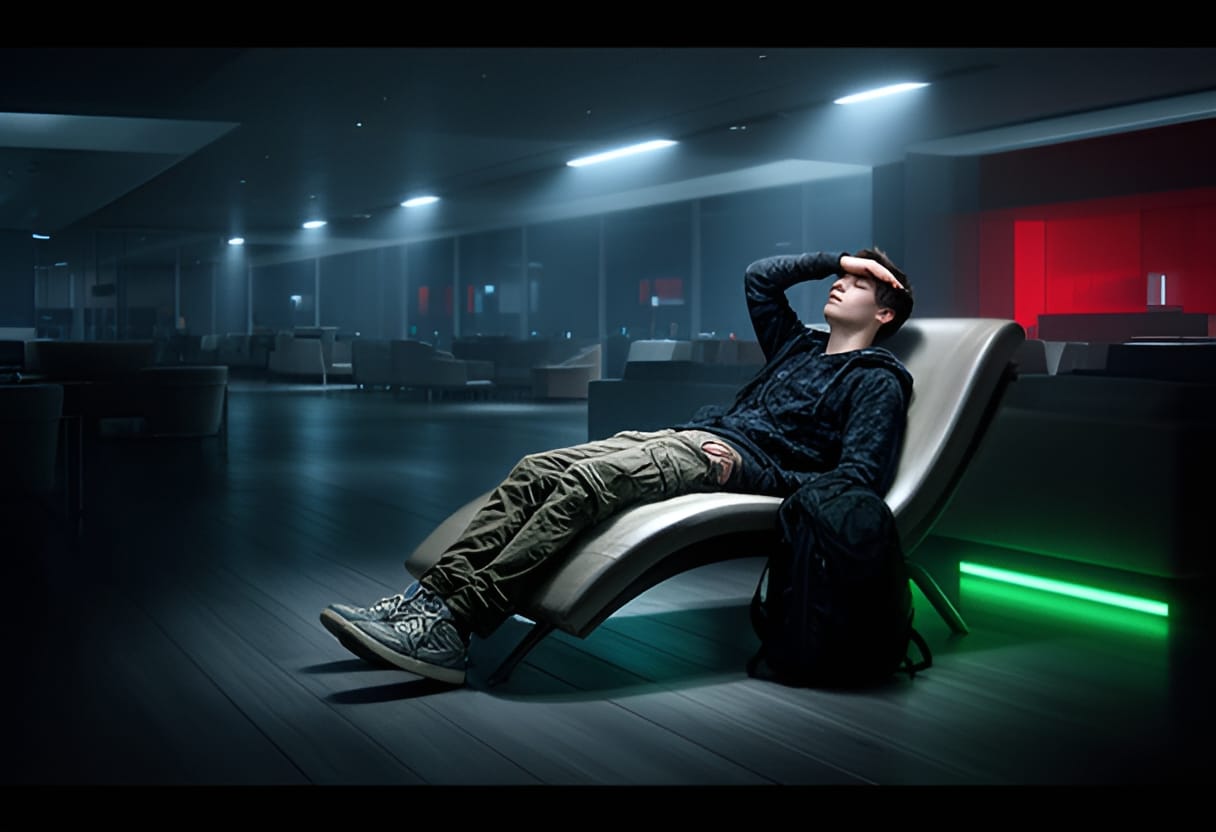
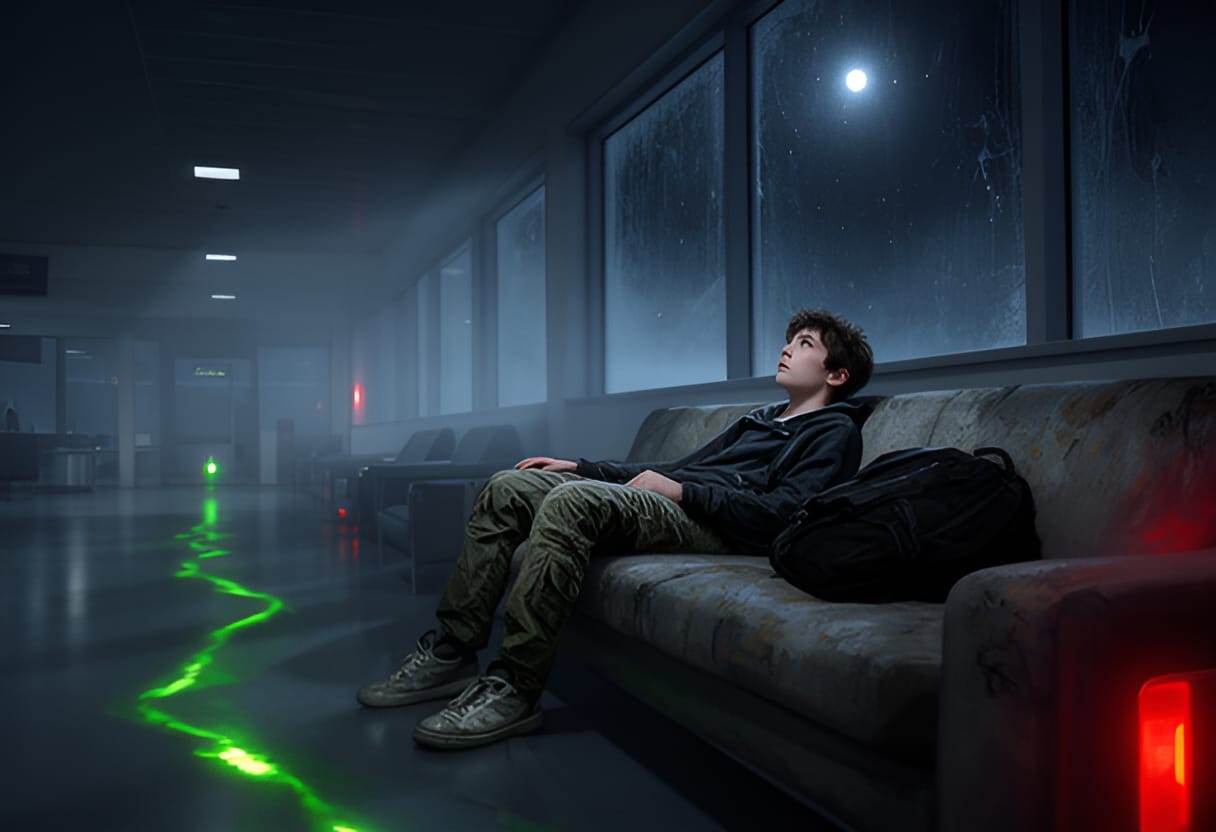
Eli’s eyes opened to darkness and the taste of copper on his tongue. His cheek was pressed against cool leather, and for a moment he thought he was still dreaming—of home, of his mother’s voice calling him down for breakfast, of the hum of the refrigerator in their flat in Malmö. Then the silence pressed in, thick and absolute, and he remembered: no hum, no voices, no announcements over the PA. Just the slow beat of his own heart and the ragged sound of his breath.
He lifted his head. The Plaza Premium lounge was swallowed in blackness, save for the faint glow of emergency strips along the floor, pulsing a sickly green. The HVAC had died hours ago, or days—he couldn’t tell. The air was still, heavy with the ghost of over-brewed coffee and something sour, like milk left too long in the sun. He tried to swallow, but his mouth was dry, his throat rough.
His phone was in the pocket of his jeans. He fumbled for it, fingers slick with sweat, and pressed the power button. Nothing. He tried again, harder, thumb jammed down until the nail whitened. The screen stayed dead. No glow, no vibration, no false hope of a signal. He slipped it back, jaw tight.
He pushed himself up, joints stiff, and swung his legs over the edge of the chaise lounge. His backpack lay where he’d dropped it—next to the armrest, half-hidden under a discarded newspaper. He tugged it free, unzipped the main compartment, and ran his fingers over the familiar shapes inside: a granola bar, half-eaten; a warm bottle of water; a multi-tool his father had given him for his fifteenth birthday; a packet of painkillers. All accounted for. Nothing taken. Nothing added.
He stood, swaying slightly, and moved toward the lounge doors. The glass was smudged with fingerprints, streaked where someone had wiped their hands in a hurry. He pressed his palm flat against it, feeling the chill seep into his skin, and peered out.
The terminal beyond was a cave of shadows. The shops along the concourse were shuttered, their metal grilles pulled down like teeth bared in a snarl. Escalators hung frozen mid-motion, their steps jagled like broken bones. Not a light blinked. Not a screen flickered. No distant rumble of luggage carts, no murmur of voices, no sigh of the sliding doors at the arrivals hall. Just silence—deep, swallowing, the kind that pressed against the eardrums and made you wonder if you’d gone deaf.
He stepped back, heart hammering against his ribs. This wasn’t a delay. This wasn’t a power outage. This was… abandonment.
He turned and walked deeper into the lounge, his shoes whispering on the plush carpet. The buffet table was a wreck: plates overturned, crockery shattered, food smeared across the marble like abstract art. A half-eaten croissant lay curled beside a spilled latte, the milk gone sour and clotted. A fruit bowl had been upended, grapes rolling like dark marbles toward the edge. He knelt, picked one up, and rolled it between his fingers. It was cool, firm. He hesitated, then popped it into his mouth. It burst, sweet and tart, and he swallowed hard, suddenly aware of how hollow his stomach felt.
Further on, near the security lane, he saw him.
The guard was slumped against the stanchion, one arm draped over the belt barrier, the other splayed awkwardly across his lap. His uniform was dark at the shoulder and chest—not from shadow, but from something that had soaked through the fabric and dried in stiff, rust-colored streaks. His head lolled to the side, eyes open and milky, lips parted as if caught mid-breath. A radio lay on the floor nearby, its casing cracked, the speaker grille peeled back like a jaw.
Eli froze. His breath came in short, sharp pulls. He wanted to call out—“Hey, are you okay?”—but the sound died in his throat. He took a step back, then another, until his heel hit the leg of a chair. He didn’t look down. He kept his eyes on the guard, waiting for a twitch, a blink, a sign that this was just a cruel joke, that the man would stir and mutter something about needing coffee.
Nothing.
He spun and fled—not running, but moving fast, low, like he was trying to slip beneath notice. He burst into the lounge’s staff room, slammed the door shut, and shoved the heavy sofa against it with a grunt that echoed in the small space. He piled a coffee machine, a stack of chairs, and the mini-fridge on top, breathing hard, palms slick.
Silence settled again, but now it was different. It wasn’t empty. It was waiting.
He slid down the door until he was sitting, knees drawn up, arms wrapped tight around his shins. The backpack lay at his feet. He unzipped it again, took out the water bottle, and twisted the cap. The liquid inside was warm, flat, but he drank anyway, gulping until his throat burned. He saved a third of it, screwed the cap back on, and returned it to the pack.
Outside, the silence held. No footsteps. No voices. No distant cries. Just the slow, inevitable creep of hours passing in a place that had forgotten how to be alive.
He closed his eyes. When he opened them again, the emergency lights still glowed green along the floor. He was alone. He was alive. And if he wanted to stay that way, he’d have to learn how to listen to the quiet.
He pressed his back against the cold metal of the staff room door, listening. The silence beyond was absolute, but he knew it was deceptive. It wasn’t empty—it was listening back. He took a slow breath through his nose, tasting the stale air: dust, old fabric, the faint metallic tang of dried blood from the guard outside. His pulse hammered in his throat, but he forced it down. He couldn’t stay here forever. The water was warm and flat, the granola bar barely a memory. Hunger was a hollow ache behind his ribs, and his head throbbed where he’d clenched his jaw too tight.
He needed supplies. Painkillers. Water. Something to eat that wasn’t stale fruit or half-melted chocolate from a vending machine he hadn’t dared to check. And he needed to know—really know—what was out there.
He eased the sofa back just enough to slip through, then shoved it back into place with a grunt, the metal legs screeching faintly against the tile. He paused, ear to the door. No answer. No shuffle. No breath but his own.
He turned and moved through the lounge like a shadow, feet light on the carpet, eyes darting. The emergency strips along the floor glowed sickly green, casting everything in an unnatural hue—like the world had been dipped in poison. He passed the buffet table again, the wreckage of crockery and congealed food making his stomach roll. He didn’t stop. Didn’t look at the half-eaten croissant or the congealed latte. He kept moving, toward the lounge doors.
He pressed himself flat against the wall beside the glass, peering out.
The terminal stretched ahead, a canyon of shadow and silence. The shops were all shuttered, their grilles pulled down like teeth. The escalators hung frozen, their broken steps like ribs exposed. And in the vast atrium beyond—the central hub where the departure boards once glowed and crowds surged—he saw them.
Shapes. Pressed against the glass walls of the atrium.
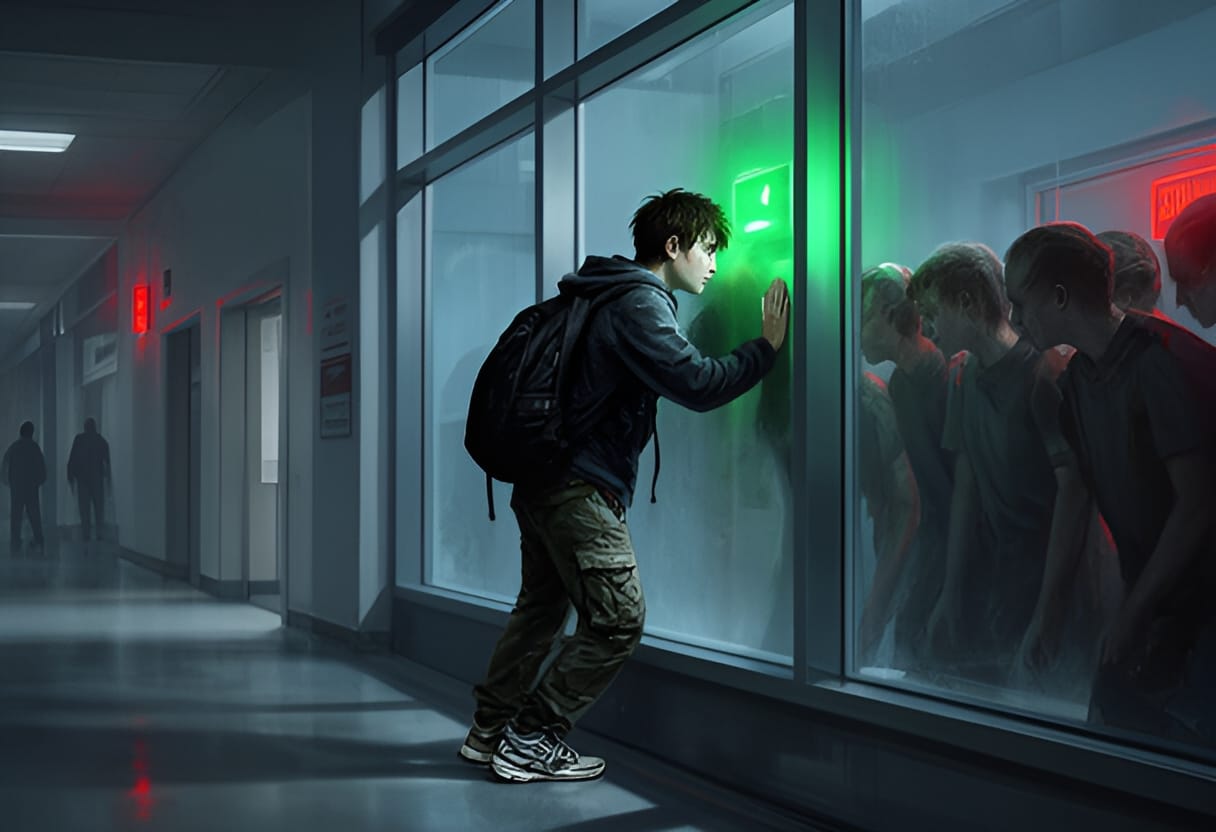
They moved slowly, jerkily, as if pulled by strings. Some leaned forward, foreheads resting on the cool surface, breath fogging the glass in faint, fleeting patches. Others swayed, arms dangling, fingers twitching. Their heads lolled at unnatural angles, jaws slack. No sound came from them—no moan, no whisper—but the way they turned, in unison, toward any flicker of movement inside the lounge, made Eli’s skin crawl.
They weren’t rushing. They weren’t screaming. They were… waiting. Drawn to stillness, to silence, to the absence of noise. Or perhaps to the presence of it. He couldn’t tell. But he knew one thing: if they noticed him, if they sensed him, they would come.
He pulled back, heart pounding. The atrium was too open. Too exposed. He couldn’t cross it—not yet. He would have to go around, through the retail corridors along the edges, where the shops were shuttered and the sightlines shorter.
He slipped into the corridor to the left, hugging the wall, moving low. The carpet gave way to tile, cold and slick under his soles. The emergency lights ran in strips along the baseboards, casting long, wavering shadows that made every trash can, every fallen sign, every puddle of something dark and slick look like something waiting to rise.
He passed a newsstand, its plexiglass barrier smashed inward, magazines scattered like fallen leaves. A duty-free shop beyond—its doors hanging open, one hinge broken. Inside, mannequins stood in grotesque poses, one missing an arm, another facedown on the floor amid shattered perfume bottles and cracked watches. He didn’t stop. Didn’t dare.
He moved faster now, ears straining. Every creak of the building, every sigh of shifting metal, made him flinch. He thought he heard a whisper—just for a second—like fabric brushing tile. He stopped, pressed himself behind a kiosk, and waited. Nothing. Only the hum of his own blood in his ears.
He exhaled and kept going.
At the end of the corridor, a chemist’s shop stood half-lit by the green emergency glow seeping under the roller shutter. The shutter was only halfway down—jammed, or forced open just enough to slip through. He crouched, peered inside.
Shelves lay overturned. Boxes of pills, bandages, cough syrup—scattered across the floor. A display of toothbrushes had been knocked over, bristles splayed like dead insects. The air inside smelled of antiseptic and something sweet and cloying—vanilla lip balm, melted in the heat.
He slipped through the gap, moving slowly, boots silent on the tile. He went straight to the pharmacy counter, ducking beneath it. Behind it, in a locked cabinet, he found what he needed: blister packs of paracetamol, ibuprofen, antihistamines. He ripped them free, stuffing them into his backpack’s side pocket. He grabbed a roll of gauze, a bottle of iodine, a pack of adhesive bandages. He hesitated, then took a small bottle of rehydration salts—just in case.
He straightened, eyes scanning. A vending machine in the corner still stood upright. He kicked it—once, twice—nothing. Then, on the third kick, it shuddered, and a bottle of water dropped into the tray. He snatched it up, cool and sealed. Another kick yielded a second. He took both.
He was turning to leave when a sound made him freeze.
A scrape. From the back storage room.
He went rigid, back against the wall, multi-tool already in his hand, blade flicked open. He listened.
A dragging sound. Like a shoe on tile. Or a bare foot.
He crept toward the doorway, peering around the edge.
Inside, the storage room was chaos—boxes ripped open, medical supplies strewn everywhere. And in the center, kneeling before a shelf, was one of them.
It was dressed in the blue tunic of a cleaning contractor, hair matted to its forehead with sweat or something darker. Its head was tilted, ear pressed to the shelf, as if listening for something inside the wall. Its fingers scrabbled at the cardboard, tearing it slowly, methodically. No sound came from it—not a breath, not a groan—but the way it moved, so focused, so utterly absent of thought, chilled Eli more than any scream could have.
He didn’t wait to see what it was looking for. He backed away, slow, silent, until he was clear of the doorway. Then he turned and fled, not running, but moving fast, low, like a animal fleeing a scent.
He didn’t stop until he was back in the main corridor, leaning against the wall, breathing hard. His hands were shaking. He wiped them on his jeans and forced himself to move.
He detoured around the atrium, staying in the shadows, eyes flicking toward the glass every few steps. The shapes were still there. Still pressed. Still waiting.
He passed the newsstand again—this time, he stopped.
The counter was bare except for a few crushed energy bars and a half-empty rack of bottled water. He grabbed what he could: three water bars, chocolate-flavored, and two more bottles of water. He shoved them into his pack, feeling the weight settle—familiar, comforting.
He paused at the threshold of the lounge, listening. Nothing. Only the hum of the emergency lights, the faint creak of the building settling.
He pushed the sofa aside, slipped inside, and restored the barricade as fast as he could—chairs, coffee machine, fridge, sofa. He leaned against the door, breathing hard, eyes closed.
When he opened them, he saw the backpack at his feet. He unzipped it, took out the supplies, and laid them out on the coffee table: medicine, water, food. He twisted open a bottle and drank, the cool liquid shocking his throat. He ate one of the water bars slowly, chewing until it was paste, savoring the artificial sweetness.
He sat back, wiping his mouth.
And then he smelled it.
Not just the coffee—though traces of it lingered, bitter and burnt in the air. Not just the polish on the floors, sharp and chemical. Not even the distant, ghostly hint of jet fuel from the tarmac beyond the glass.
It was something else. Underlying it all. A sweet, metallic odor, like pennies left in the sun, or blood that had dried and begun to break down. It clung to his clothes, to his hair, to the back of his throat. It was the smell of the guard. Of the things in the atrium. Of the silence itself.
He shuddered, not from cold, but from recognition.
This place wasn’t just empty.
It was changing.
And he was still breathing its air.
He sat very still on the coffee table, the half-eaten water bar forgotten in his palm, and listened. The sweet, metallic tang of dried blood hung in the air like a veil, thickening with each breath. Beyond the lounge’s barricaded door, the terminal breathed in its slow, broken way—occasional groans of settling steel, the distant drip of water from a broken pipe, the whisper of air through compromised seals. And beneath it all, the silence. Not empty, but waiting.
He had not slept. Not truly. The adrenaline of the scavenged supplies, the close call in the chemist’s, the weight of what he had seen—it had wired him tight, muscles coiled, senses raw. Every shadow in the lounge seemed to shift when he wasn’t looking directly at it. He had pushed the coffee table against the inner face of the barricade, not to reinforce it, but to use it as a perch. From there, he could see through the vertical slats of the shuttered lounge entrance—a narrow, skewed view of the corridor beyond, framed by the edge of the sofa and the leg of the overturned chair he’d used to brace the door.
He waited.
Minutes passed. Or maybe it was longer. Time had lost its usual texture; it now came in pulses—marked by the throb in his temples, the rhythm of his breathing, the intermittent flare of the green emergency strips along the floor, casting the lounge in pulses of sickly light and deeper shadow.
Then, movement.
A shape drifted into his field of vision from the left—slow, uneven, like something pulled through water. It was one of the figures from the atrium, but closer now, having slipped past the glass barrier somehow, perhaps through a service hatch or a gap in the debris. It wore the dark uniform of ground staff, though the sleeves were torn at the shoulders, the fabric hanging in rags. Its head lolled forward, chin nearly touching its chest. Arms hung loosely, fingers slightly curled, as if still gripping something that was no longer there.
It stopped.
Not because it had seen anything. Its face was tilted down, eyes unfocused, pupils dilated and unresponsive in the dim light. But then— a sound.
Eli had shifted slightly on the table, the edge of his boot brushing the leg of the coffee table. A faint, high-pitched creak—plastic on metal.
The figure’s head snapped up.
Not toward him. Not exactly. But toward the noise. Its neck jerked with unnatural speed, tendons standing out like wires. It froze for a fraction of a second—then turned, shoulders rotating with a jerking motion, and began to move. Not walking. Not running. But advancing. One foot dragged slightly behind the other, the toes scraping the tile with a soft, rhythmic shhk… shhk…. Its arms lifted, not in aggression, but in a strange, searching posture—palms slightly turned, fingers splayed, as if feeling for vibrations in the air.
It passed through the shaft of green light from the emergency strips, its face revealed for a moment: skin pallid, almost gray, lips pulled back slightly from the teeth, not in a snarl, but in a permanent, slack grimace. Its eyes were open, but they didn’t focus. They scanned—not with sight, but with something else. Like a creature that hears shapes.
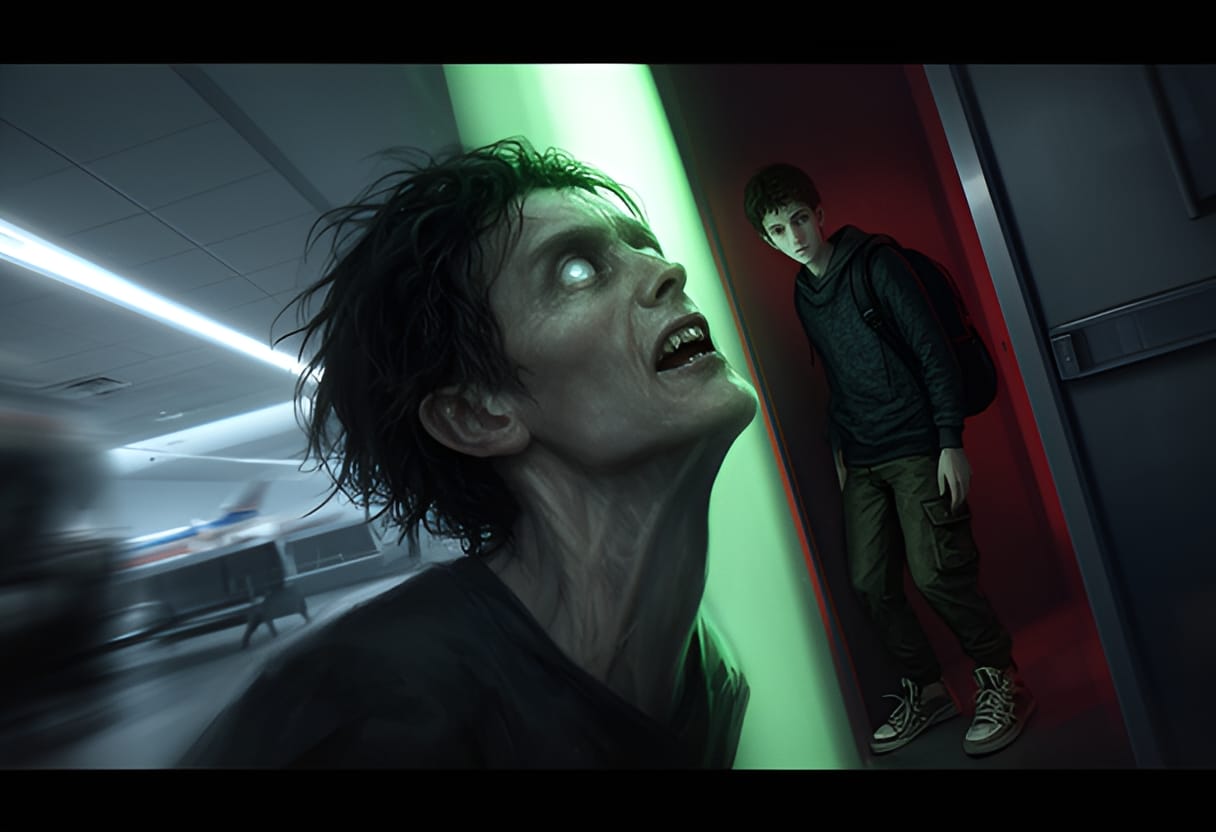
Eli held his breath. His pulse hammered in his throat, loud enough to drown out the building’s sighs. He didn’t dare blink.
The thing passed within three feet of the lounge entrance, moving parallel to the barricade. It didn’t pause. Didn’t sniff the air. Didn’t look at the door. It simply followed the sound—tracing the path of the noise he’d made, step by shuddering step, until it reached the spot where his boot had struck the table leg. There, it stopped. Its head lowered again. It stood motionless, swaying imperceptibly, as if listening for a repetition. When none came, it waited. Ten seconds. Fifteen. Then, slowly, it turned and retraced its path—back the way it had come—until it vanished into the darker reaches of the corridor, drawn now by some other, fainter stimulus Eli couldn’t perceive.
He didn’t move until long after it was gone.
His hands were slick with sweat. His back ached from the tension coiled in his spine. But his mind was sharp—sharper than it had been all day. He had seen it. Not just seen. Understood.
It hadn’t seen him. It hadn’t smelled him. It had reacted to sound—a faint, insignificant noise, and nothing more. And it had pursued it not with aggression, but with a kind of mechanical persistence, as if following a signal only it could detect.
He thought of the guard at the stanchion—eyes open, milky, unresponsive. The figure in the chemist’s storage room, kneeling, ear pressed to the shelf, tearing at cardboard as if listening for something inside the wall. The shapes in the atrium, pressed against the glass, not moving, not feeding—just waiting. All of them responding to something unseen. Something auditory.
He pulled his multi-tool from his pocket and flicked the blade open. The soft snick was loud in the quiet lounge. He winced, then did it again. And again. Each time, he imagined the reaction—how far the sound might carry, how quickly something might turn toward it.
Vision, he realized, was poor. Maybe nonexistent in the way he understood it. But hearing? Hearing was acute. Hyper-acute, perhaps. They didn’t need eyes. They had ears—or something that functioned like them. And they were drawn not to heat, not to scent, but to noise. Movement that made sound. Voices. Footsteps. Even the subtle creak of settling metal, if it was sharp enough.
He thought of the tape.
In his father’s old toolkit—back in Malmö—there had always been a roll of silver duct tape, gray and grimy from use. He didn’t have that here. But he remembered seeing a dispenser behind the reception desk in the lounge, near the complimentary toiletries. He had passed it earlier, half-buried under a fallen magazine rack.
He slipped from the table, moved low to the floor, and crawled toward the barricade. He pushed the coffee machine just enough to peer through the gap between it and the fridge. The corridor was empty. The green lights pulsed on the floor, casting long, wavering shadows from the stanchions and debris.
He waited. Listened.
When he was certain the coast was clear, he slipped out, moved fast but low, knees bent, feet placed deliberately—heel to toe, like a cat. He crossed the corridor in under ten seconds, flattened himself against the wall beside the reception desk, and pulled open the drawer beneath it.
Inside: pens, notepads, a half-eaten apple, and the tape dispenser. He grabbed it, tore off a six-inch strip, and pressed it silently to the base of the wall—just inside the lounge entrance, where the tile met the metal threshold.
He did it again. And again. Placing markers at intervals along the path he knew he’d need to take: to the chemist’s, to the newsstand, to the staff room exit. Each strip was small, unobtrusive—just enough to catch his boot in the low light, a silent reminder: this way. He didn’t mark the entire route. Only the turns. The decision points. Where hesitation could cost him.
When he returned to the lounge, he didn’t go straight to the table. He stood by the barricade, pressed his forehead to the cool metal of the fridge door, and listened.
Nothing.
But he knew they were out there. Not hunting. Not thinking. Just… responding. Like machines left running after their operators had vanished. Drawn to noise. Drawn to life.
He opened his eyes.
And made a promise, quiet and firm, to the silence:
He would not give them anything to follow.
He slipped the tape dispenser back into the drawer and closed it softly, the click swallowed by the hum of the building’s settling frame. The green emergency lights pulsed along the floor like a slow heartbeat, casting the lounge in a pallid, clinical glow. Outside, the corridor stretched empty and silent, but he knew better than to trust it. They were out there—motionless in the dark, waiting for a misstep, a cough, the scrape of a sole on tile.
He returned to the lounge and lowered himself into the armchair by the window, the one that faced the deserted check-in hall. The leather was cracked and cool against his palms. He pulled his knees to his chest and rested his forehead on them, breathing slow and deep. The adrenaline was ebbing, leaving behind a hollow fatigue that settled in his bones. Sleep tugged at the edges of his consciousness, but he fought it. Not yet. First, he needed order.
When he opened his eyes, the light had shifted—just slightly. The green strips seemed dimmer, or perhaps his eyes were adjusting. He pushed himself up and walked to the reception desk, where he’d left the notebook and pen he’d taken from the gift shop two days prior. It was a small, spiral-bound thing, meant for jotting down flight numbers or shopping lists. Now it felt like a lifeline.
He flipped it open to a clean page and wrote, in neat, deliberate print:
Day 1 – Heathrow Terminal B. Plaza Premium Lounge. Status: Alive.
He paused. The words felt inadequate, too flat for what he’d seen, what he’d done. He added:
Observations: Hostiles respond to sound only. No visual tracking. No olfactory pursuit. Movement triggers response. Pursuit is linear, persistent, but easily diverted by false or distant stimuli. They do not breach physical barriers unless compelled by continuous noise. Threat level: High. Containment strategy: Silence + barriers.
He capped the pen and set the notebook down. It wasn’t much, but it was a start. A way to pin the chaos to something tangible.
He rose and began his rounds.
First, the barricade. He pushed the sofa harder against the door, wedging the coffee table behind it to eliminate any give. He wrapped duct tape around the joints where the furniture met the floor and wall, creating a seamless seal. Then he turned to the luggage carts stacked near the staff room entrance—abandoned by ground crew during the evacuation. He dragged two into the lounge, positioned them at right angles to the barricade, and lashed them together with tape, forming a secondary wall. He repeated the process with a third cart, placing it perpendicular to create a zigzag barrier that would force any intruder to slow, to maneuver, to make noise.
He tested it by kicking the leg of one cart. The sound was dull, muffled by the tape and rubber wheels. Good.
Next, the vents. He’d noticed the sweet, metallic smell seeping in from above—the same odor that clung to the guard’s uniform, to the figures in the atrium. He fetched a stepstool from the supply closet and climbed to the ceiling grille in the corner of the lounge. It was a narrow rectangle, barely six inches high, but air moved through it faintly, carrying the scent of damp metal and something older, like iron left in the rain. He tore strips of tape and pressed them over the slats, layering them until no light showed through. He did the same for the second vent near the fridge. The smell didn’t vanish, but it lessened—just enough to make the air breathable.
Then came the alarm.
He’d seen the wind chimes in the gift shop—a small bundle of bronze tubes hung from a wooden cross, meant to tinkle softly in a breeze. He’d taken them the day before, thinking they might make noise if disturbed. Now he repurposed them. He tied fishing line he’d found in a sewing kit to the top of the chimes and anchored the other end to the leg of a chair near the barricade. He positioned the chimes so that any shift in the barrier—any push against the carts or sofa—would tug the line and set them ringing. It wasn’t loud, but in this silence, even a faint chime would snap him awake.
He stepped back and surveyed his work. The lounge was no longer just a refuge. It was a nest. A trap. A statement.
As dusk bled into night—the green lights unchanging, unyielding—he retreated to the armchair with his notebook. He wrote by the dim glow of his phone screen, which he’d jury-rigged to turn on for ten seconds every hour using a rubber band and a folded bit of foil over the power button. A fragile metronome in the dark.
Day 2 – Routine established. 0600: Reconnaissance (visual only, no movement beyond threshold). 1200: Scavenging run—Zone A (retail corridor). 1500: Fortification/maintenance. 2000: Lockdown. All noise-producing activities cease after 1800. Personal log initiated to preserve cognitive continuity. Fear managed through structure. Identity anchored in record.
He wrote until his hand cramped, then stopped. The list wasn’t just practical—it was a ritual. A way to mark time when the world had stopped keeping it.
He ate one of the energy bars slowly, chewing each bite until it dissolved. The chocolate was stale, the nuts soft, but it was fuel. His hands shook slightly as he held the wrapper, not from hunger, but from the quiet after the tension. He wiped his palms on his jeans and folded the foil neatly, placing it in his pocket.
Later, lying on the sofa with his backpack as a pillow, he stared at the ceiling. The green lights crawled along the floor like luminous worms. Somewhere in the terminal, a metal panel groaned. A distant drip echoed from a broken pipe.
He closed his eyes.
Not sleep, not yet. Just rest.
And in the dark, he thought not of Malmö, or his mother’s voice, or the last text he’d sent—On my way home. Flight delayed again.—but of the sound his boot had made on the table leg. The way the thing had turned, not with hunger, but with purpose. Like a machine following a command.
He had survived today not by strength, but by understanding.
And as long as he remembered that, he would survive tomorrow too.
Chapter 2
The Weight of Time
He opened his eyes to darkness and the slow crawl of green light along the floor. The sofa pressed into his back, the backpack lumpy beneath his head. Somewhere, a pipe sighed. The air tasted dry and faintly sweet, like old blood left in the sun.
He lay still, listening. Not for sound, but for the absence of it—the kind of silence that hummed in the ears after too much quiet. His throat was tight. He swallowed, wincing at the scrape.
Then, a blink.
Not in the room. Not in his head.
Through the grimy glass of the lounge’s front wall, high above the atrium, a pinprick of light flashed—once, twice—then vanished.
Eli froze.
His breath hitched. His fingers curled into the fabric of the sofa.
It came again. A rhythm. Slow. Deliberate. On for a fraction of a second, off for three. On. Off. On.
Emergency strobe. From the tower.
His heart hammered against his ribs, not with fear, but with the sudden, violent surge of possibility. Someone was there. Or something still worked—systems clinging to life like barnacles on a hull.
He sat up too fast. The room tilted. He pressed a palm to his forehead, waiting for the wave to pass.
Thirty-one days. He’d counted on the inside of his notebook cover, tally marks clustered like insects. Thirty-one days since the world had stopped breathing. Since the last announcement crackled over dead speakers. Since he’d seen another face that wasn’t frozen in glass or slumped behind a counter.
And now—light.
Not the eternal green of the path markers. Not the dull glow of standby panels. This was active. Intentional.
He scrambled to his feet, knocking the backpack to the floor. Water bottles clinked. He ignored them, already moving toward the wall, pressing his forehead to the cold glass.
The atrium stretched below, a vast, hollow ribcage. Escalators stood mid-collapse, their teeth bared. Dozens of figures pressed against the far glass—waiting, as they always were. Still. Silent. Their faces turned upward, not seeing, not blinking. Just… waiting.
But up above, in the tower’s shattered crown, the light blinked again.
On. Off. On.
Not a malfunction. Not a glitch in the dying grid. This was patterned. Controlled.
Either someone was alive up there—hurt, hiding, signaling—or the tower’s emergency protocols had kicked in, cycling power to the obstruction light as a last-ditch warning to nowhere.
Either way, it meant the system hadn’t fully surrendered.
Eli stepped back. His mind raced, not with hope, but with calculation. Hope was a luxury. This was data.
If it was a person, they might have supplies. Information. A way to call for help beyond the airport’s dead frequencies. But they might also be dangerous—mad, infected, or worse, willing to take what little he had.
If it was automated, it meant the tower still had juice. Maybe not much. Maybe only minutes a day, siphoned from a failing battery or a dying generator. But if there was power there, could he tap into it? Recharge his phone? Access the terminal? Learn what had happened?
The risk was the same either way: to go was to expose himself. To leave the nest.
He thought of the tripwire—wind chimes and fishing line strung across the staff room door. Thought of the taped vents, the sealed grilles, the routine that had kept him sane. Every step outside the lounge was a violation of that order. A roll of the dice.
But to ignore it? To pretend he hadn’t seen it? That would be surrender—not to the infected, but to the silence. To the belief that he was truly, finally alone.
He went to his notebook, already open on the coffee table. The last entry stared back at him: Day 2 – Routine established. He flipped to a fresh page.
Day 31 – 0317 hours. Observed rhythmic blinking from ATC tower. Emergency strobe pattern: 1s on, 3s off. Origin: Tower Zone C, approx. 180m elevation. Not random. Not ambient. Suggests either active human presence or functioning emergency systems. Implication: Power source still operational in tower. Potential for communication, recharging, data access. Risk: Exposure during transit. Infected present in atrium and retail corridors. Must assume hostile intent until proven otherwise. Decision: Recon tomorrow at first light. Preparation: Check multi-tool, test tripwire, inventory supplies. Mental note: Fear is useful. Do not let it paralyze.
He capped the pen. Set it down.
The light blinked again. On. Off. On.
He watched it until his eyes burned. Until the afterimage lingered behind his lids when he closed them.
He did not sleep.
He sat in the armchair, wrapped in the thin blanket from the sofa, and waited.
At 0600, as per routine, he rose. No reconnaissance beyond the threshold today. Instead, he moved silently through the lounge, checking the barricade—sofa, coffee machine, chairs—pushing and pulling each to ensure they hadn’t shifted. He plucked at the fishing line. The wind chimes trembled, soft and high. Good.
He inventoried his backpack: three water bottles (two full, one half), three energy bars (one eaten yesterday), blister packs of paracetamol, ibuprofen, antihistamines, gauze, iodine, bandages, rehydration salts. Multi-tool. Miniature flashlight (borrowed from the chemist’s, battery weak but functional). Notebook. Pen. Foil and rubber band still in his pocket—he’d need to reset the phone’s hourly wake-up later.
He filled the empty bottle from the lounge’s filtered tap—still running, miraculously, though the flow was thin and warm. He drank half, saved the rest.
He checked the sealed vents. The tape held. No peeling. No air movement.
He sat. Waited. Let the minutes crawl.
By 1000, his hands were steady. By 1200, he ate an energy bar slowly, chewing until it dissolved, just as he had before. The chocolate was worse today—chalky, oily—but he forced it down. Fuel. Not pleasure.
At 1500, he did not fortify. Instead, he laid out his tools on the coffee table: multi-tool, flashlight, spare batteries from the chemist’s (two AA, one 9V), lengths of wire scavenged from a broken lamp in the retail corridor, a small magnet from a speaker casing, and his father’s old Swiss Army knife—the one with the dull blade and the bent corkscrew, a relic from home.
He tested the multi-tool’s blades. Sharp. The screwdriver tips, intact. The can opener, stiff but functional. He folded it shut, opened it again. A habit. A way to feel ready.
He charged the flashlight by tapping the batteries against his palm, then twisted the beam on. It flickered, then held—a weak, yellowish cone. He aimed it at the wall. The light shook in his grip.
He lowered it. His pulse was up. Not from exertion. From anticipation.
He thought of Malmö. Of the flat above the bakery. Of his mother’s voice calling him to dinner, the smell of rye bread and dill. Of the text he’d sent, hours before everything stopped: On my way home. Flight delayed again. He hadn’t meant it as a farewell. It had been ordinary. Temporary.
Now it felt like a tombstone.
He pushed the thought away. Not now. Not when there was work to do.
He spent the afternoon reinforcing the tripwire—not because he expected company, but because the act grounded him. He replaced the frayed fishing line with a stronger strand from a ruined backpack he’d found in the chemist’s. He adjusted the wind chimes so they’d catch even the faintest draft. He tested them three times, listening for the clear, metallic shiver.
As dusk bled in, the green lights along the floor flared to life—steady, unchanging. The same as always. A metronome for the dead.
He returned to the armchair. Took his place by the glass.
And waited.
The light came again.
On. Off. On.
He did not look away.
He did not blink.
He let the rhythm etch itself into his vision, into his bones. Let it carve a space in the dark where hope—not the foolish kind, but the grim, stubborn kind that clung to survival—could take root.
He would go tomorrow.
Not because he believed.
But because he could not not try.
He rose before the sky had lightened, the armchair’s thin blanket slipping to the floor as he pushed himself up. The blinking light still pulsed in the distance—on, off, on—its rhythm now a metronome in his skull. He moved like a shadow through the lounge, bare feet silent on the cool tile, backpack light but complete: multi-tool, flashlight, two AA batteries, notebook, pen, foil-wrapped energy bar, half-full water bottle, and the miniature flashlight tucked in his pocket. He’d left the Swiss Army knife behind—too sentimental, too risky to lose.
The barricade held. He gave the fishing line a final pluck. The wind chimes sang once, a fragile note in the dead air. Then he turned toward the service corridor behind the chemist’s, the one he’d used to slip into the storage room days ago. The jammed shutter was still there, bent but passable. He squeezed through, shoulders scraping the metal, and paused in the dimness beyond, listening.
Nothing. No scrape. No breath. Only the faint, constant drip from a leaking pipe somewhere in the walls—water finding its way through the building’s wounds.
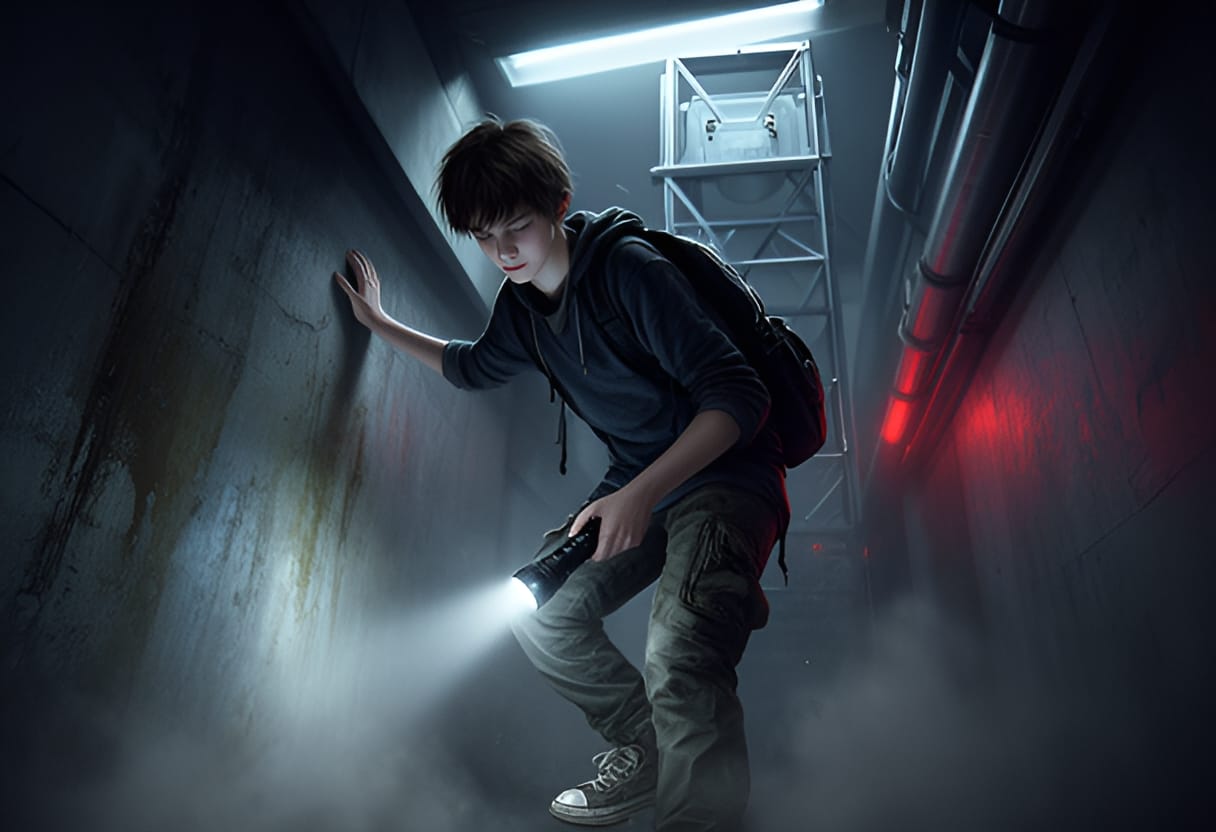
He moved fast now, crouched low, hugging the wall. The maintenance tunnels were narrow, lined with frayed cables and dust-covered conduits. He’d mapped them in his mind over the past week—snatches of sight during supply runs, fragments from old evacuation maps torn from wall panels. This route avoided the atrium entirely. No glass. No waiting figures. Just the slow, sagging belly of the airport, where the infected rarely ventured unless drawn by heat or movement.
A rat skittered across his boot. He froze. Held his breath. The creature vanished into a gap behind a junction box. He exhaled, slow and quiet, and kept going.
The tunnel began to slope upward. The air grew cooler, stale with oil and ozone. He passed a junction marked TOWER ACCESS – STAFF ONLY in peeling yellow paint. A ladder rose into darkness beyond a metal hatch. He pushed it up—it groaned on rusted hinges—and slipped through.
The base of the tower was a concrete shaft, the service ladder bolted to the wall like a spine. He gripped the cold rungs, boots finding the notches, and began to climb.
His breath came shallow. Not from exertion—he’d carried heavier loads—but from the openness. The shaft was narrow, but the walls felt like they were breathing. Every creak of the ladder, every drip of condensation, sounded amplified. He imagined something below, something that had heard the hatch, was now turning its face upward, nostrils flaring for the warmth of his skin.
He didn’t look down.
Halfway up, his palms began to sweat. He wiped them on his trousers, gripped tighter. The ladder vibrated faintly—something far below, maybe a shift in the building’s settle, maybe nothing. He kept climbing.
At the top, the hatch to the control room was ajar, just enough to let out a faint glow. Not the blinking light—this was steadier, bluer. He paused, ear to the metal. No sound but the hum of electricity, low and strained, like a wire holding too much current.
He pushed the hatch open.
The control room was a wreck.
Consoles lay on their sides, screens shattered, spilling glass like teeth across the raised floor. Sparks had jumped from a melted server rack in the corner—blackened plastic sagged like candle wax, wires fused into brittle stalactites. The air smelled of burnt insulation and something sharper, almost sweet—ozone overlaid with a metallic tang, like blood left too long in the air.
But the main terminal—central, elevated, facing the panoramic windows—was still upright. And it was on.
The screen flickered, not with the blinking light from outside, but with scrolling text: corrupted, fragmented, lines of code and data fighting to stay legible. Flight numbers. Altitudes. Departure times. Most were garbage—repeating symbols, null values—but every few seconds, a clean line pushed through.
KL902 – LAGOS (LOS) – ARRIVED 03/14 – 04:22 UTC – GATE B12
Eli stepped forward, boots crunching on glass. His reflection stared back from the dark screen—a gaunt face, eyes wide, jaw tight. He looked like someone who had been waiting a long time to be seen.
He leaned in. The terminal responded to his presence—no touch needed, just proximity. The display shifted, rearranging itself into a manifest.
FLIGHT KL902 – CARGO MANIFEST ORIGIN: MURTALA MUHAMMED INTL, LAGOS DESTINATION: HEATHROW (LHR) ARRIVAL: 03/14 – 04:22 UTC CARGO: 1X SEALED CONTAINER – DIMENSIONS: 2.1m L x 1.2m W x 1.2m H WEIGHT: 850 KG DECLARED CONTENTS: MEDICAL SUPPLIES – CLASS 9 ACTUAL CONTENTS: [REDACTED] HANDLING CODE: CLASS 4 BIOHAZARD – CDC/NIH COMPLIANT NOT FOR CIVILIAN TRANSFER – AUTHORIZED ONLY UNDER PROTOCOL OMEGA-9
Eli’s stomach dropped. Not from fear. From recognition.
Class 4. He’d seen the symbol before—on a poster in his secondary school biology lab, faded but unmistakable: a black trefoil overlaid on a red circle. Agents that cause severe to lethal disease in humans, for which vaccines or treatments are not readily available. Ebola. Marburg. Lassa. Not the kind of thing you shipped in a sealed container labeled medical supplies.
He reached out, fingers hovering over the keyboard. The keys were dusty but intact. He pressed Enter.
The screen flashed.
ACCESS LOG – LAST 72 HOURS 03/14 04:25 – CARGO SCAN COMPLETE – ANOMALY DETECTED – FLAGGED FOR BIOSAFETY LEVEL 4 HOLD 03/14 05:10 – HOLD OVERRIDDEN – AUTHORIZATION: OMEGA-9 – USER: SYSADMIN_TOWER 03/14 05:15 – CARGO RELEASED TO GROUND CREW – GATE B12 03/14 06:00 – POWER FLUCTUATION – TOWER ZONE C 03/14 08:30 – FIRST LOCALIZED SYMPTOM REPORT – CLEANING STAFF, TERMINAL B 03/14 12:00 – INTERNAL ALERT: SUSPECTED OUTBREAK – SUPPRESSED 03/15 02:17 – EMERGENCY STROBE ACTIVATED – TOWER ZONE C – PATTERN: 1s ON, 3s OFF 03/15 03:00 – SYSTEM SHUTDOWN INITIATED – MANUAL OVERRIDE FAILED 03/15 04:00 – LAST HEARTBEAT – TOWER SUBSYSTEM DELTA 03/16 – PRESENT: AUTOMATED BEACON LOOP – POWERED BY UPS BACKUP
Eli stumbled back, hitting the console behind him. It didn’t give. He stared at the screen, at the dates—three days before the outbreak. The light had started blinking the day after the cargo was moved. Not a sign of life. A death rattle. A system running on backup, screaming a pattern into the dark because no one was left to turn it off.
He thought of the figures in the atrium. Not waiting. Holding. Pressed against the glass like they’d been trying to get out—or keep something in.
His breath fogged the air in front of him. Not from cold. From the sudden, crushing weight of understanding.
This wasn’t random. It wasn’t a mutation. It wasn’t bad luck.
It had been allowed.
He turned and slammed his fist—not hard, but enough—into the edge of the console. Pain shot up his knuckles. He didn’t care.
The light outside blinked on. Off. On.
He didn’t watch it this time.
He turned and fled. Down the ladder, through the hatch, into the tunnel, not running, but moving with a speed that bordered on panic. He didn’t stop until he was back in the chemist’s storage room, the shutter pulled shut behind him, the smell of antiseptic and dust thick in his nostrils.
He slid down the wall, sat on his heels, and pressed his forehead to his knees.
The notebook was in his pack. He didn’t take it out.
He just breathed. In. Out. In.
And tried not to think about what kind of men signed off on Protocol Omega-9. Or what kind of world let them.
He stayed there until his legs went numb and the cold seeped through his jeans, until the rhythm of his breathing no longer felt like an act of control but a surrender to fatigue. The chemist’s storage room offered no comfort—only the sharp scent of iodine and the faint, metallic echo still clinging to the air from the tower. He pushed himself up slowly, joints protesting, and wiped his palms on his thighs. The notebook lay where it had fallen, half-buried under a collapsed shelf of bandages. He picked it up, the cover gritty with dust, and opened it to a clean page.
He needed to know more.
Not because he hoped it would change anything. But because not knowing was worse than knowing.
He slipped the notebook into his pack, shouldered the weight of it, and moved back through the storage room toward the shutter. The jammed metal groaned as he pushed it open just enough to slip through, then let it fall shut behind him with a hollow clang that made him flinch. The retail corridor was dim, the emergency lights casting long, uneven shadows across the tile. He kept to the wall, boots silent, eyes scanning—not for movement, but for any sign that the figures in the atrium had shifted. They were still there, he could feel it, a pressure behind his eyes, but he didn’t look. Not yet.
He made his way to the service corridor entrance, the one he’d used to reach the maintenance tunnels. The tripwire was intact, the fishing line taut, the wind chimes still. He stepped over it, paused, listened. Only the slow drip of water from a broken pipe somewhere ahead, and the distant, irregular creak of metal settling in the dark.
The tunnel was cooler here, the air stale but breathable. He followed the familiar route—past the flooded section he’d bypassed with planks, around the bend where the conduit narrowed, up the ladder shaft he’d climbed earlier. His hands shook slightly as he gripped the rungs, not from exertion, but from the lingering adrenaline and the cold certainty that had settled in his chest like a stone.
He emerged into the base of the tower shaft, the hatch above him still ajar, the faint blue glow spilling down like a warning. He didn’t linger. He pulled himself up, pushed the hatch open just enough to slip through, and dropped silently onto the raised floor of the control room.
The consoles were still on their sides. The screens dark now, except for the main terminal, which continued to pulse with that same fragmented data. He avoided the melted rack in the corner, the smell of burnt plastic still thick, and went straight to the working unit.
He didn’t touch the keyboard this time. Instead, he scanned the lower edge of the terminal, where a series of unlabeled ports and slots ran along the base. One of them—a narrow, recessed slot with a spring-loaded cover—caught his eye. He remembered seeing something similar in the maintenance manual he’d salvaged from the tower wing: a backup interface for manual data extraction. He fished out his multi-tool, flipped out the small flathead, and pried the cover open.
Inside was a port labeled DEBUG – USB 2.0. He reached into his pack and pulled out the salvaged PDA circuit board he’d taken from duty-free. It wasn’t much—just a motherboard with a corrupted memory chip and a broken screen—but it still had a USB port, and if he could jury-rig a connection…
He tore a strip from his shirt, wrapped it around the board to insulate the exposed traces, and plugged it into the terminal’s debug port. Nothing happened. He frowned, checked the connection, then remembered: the board needed power. He dug out the lithium-ion cell from the tablet, wrapped it in electrical tape to prevent shorts, and connected it to the board’s power pins using stripped copper wire from the headphones he’d salvaged. A faint whine came from the board—a sign of life.
He held his breath.
The main terminal flickered.
Then, slowly, the display shifted. Not the flight data this time. A new menu appeared, crude and text-based: SYSTEM BACKUP – ACCESS LOG – CARGO TRACKING – MANIFEST ARCHIVE.
He selected CARGO TRACKING with the Enter key—no mouse, just keyboard navigation—and waited.
The screen filled with entries, scrolling too fast to read. He hit Pause. Scrolled back.
KL902 – LAGOS (LOS) – ORIG: 03/13 22:10 UTC – DEST: LHR – STATUS: DELAYED – CUSTOMS HOLD – FLAG: BIOSAFETY CONCERN
He leaned forward.
03/14 01:00 – HOLD EXTENDED – REASON: INCOMPLETE DOCUMENTATION – CARGO CLASS 4 – REQUIRES OMEGA-9 WAIVER
03/14 03:45 – WAIVER GRANTED – AUTH: DIPLOMATIC CHANNEL – REF: OMEGA-9/SECURITY COUNCIL – BYPASS: STANDARD SCREENING
03/14 04:10 – CARGO RELEASED – REROUTED VIA DIPLOMATIC POUCH – GATE B12 ASSIGNMENT CONFIRMED
03/14 04:22 – ARRIVAL – GATE B12 – UNLOADING COMMENCED 04:25
His hands trembled as he absorbed it. The flight hadn’t just been delayed—it had been held. Flagged. Then, somehow, released through diplomatic channels, bypassing every biosafety protocol in place. And it had arrived at Gate B12—the very gate where he’d found the emergency locator transmitter in the life raft locker, where the air still carried that sweet, metallic tang.
He selected MANIFEST ARCHIVE. Waited.
The screen loaded a scanned copy of the original paperwork. He zoomed in.
CONSIGNEE: GLOBAL HEALTH INITIATIVES LTD. – SUITE 1204, 22 BISHOPSGATE, LONDON
He knew that address. It was a mail-forwarding service. A shell. He’d seen it before—on a list of dormant companies tied to a defunct biotech firm called Veridian Dynamics, which had folded two years ago after allegations of illegal gain-of-function research. The company had vanished. Its patents seized. Its leaders quietly relocated.
And yet, here it was—on a manifest for a Class 4 biohazard container, shipped from Lagos, cleared through backchannels, and dumped into the heart of one of the world’s busiest airports.
He hit Print.
The terminal whirred. A tray clicked. A sheet of paper emerged, warm and slightly curled at the edges.
He snatched it up.
The text was faint, the ink low, but legible.
FLIGHT KL902 – CARGO MANIFEST – COPY ORIGIN: MURTALA MUHAMMED INTL, LAGOS DESTINATION: HEATHROW (LHR) ARRIVAL: 03/14 – 04:22 UTC CARGO: 1X SEALED CONTAINER – DIMENSIONS: 2.1m L x 1.2m W x 1.2m H WEIGHT: 850 KG DECLARED CONTENTS: MEDICAL SUPPLIES – CLASS 9 ACTUAL CONTENTS: [REDACTED] HANDLING CODE: CLASS 4 BIOHAZARD – CDC/NIH COMPLIANT NOT FOR CIVILIAN TRANSFER – AUTHORIZED ONLY UNDER PROTOCOL OMEGA-9 CONSIGNEE: GLOBAL HEALTH INITIATIVES LTD. NOTIFY PARTY: VERIDIAN DYNAMICS – EMERGENCY RESPONSE DIVISION WAIVER NUMBER: OMEGA-9/SEC/2020/0414
He read it twice. Then a third time.
His vision blurred. Not from tears. From the sheer, grinding weight of it.
This wasn’t an accident. It wasn’t a mutation jumping species in some remote village. This was a container, knowingly mislabeled, knowingly rushed through, knowingly sent into a populated hub despite every red flag flashing. And it had arrived three days before the first symptoms appeared in the cleaning staff.
He looked up at the main terminal. The data still scrolled, still fought to stay legible. But now he saw it differently—not as a dying system’s last gasp, but as a ledger. A record. A confession.
He folded the printout carefully, twice, then slipped it into the front pocket of his pack, over his heart. He didn’t know if he would ever show it to anyone. He didn’t know if anyone was left to show it to.
But he would carry it.
He disconnected the makeshift rig, tucked the PDA board and battery back into his pack, and replaced the port cover. The terminal flickered once—then went dark, except for the main screen, which continued its lonely loop.
He turned away from the glow.
The hatch above him was still open. The blinking light outside pulsed on. Off. On.
He didn’t look up.
He descended the ladder slowly, each rung a step deeper into the silence he now understood was not empty—but guarded.
When he reached the tunnel, he didn’t stop. He kept moving, past the flooded section, past the bend, until he was back in the service corridor. He pushed through into the retail area, kept his head down, and walked past the wrecked newsstand, past the mannequins in duty-free whose plastic faces seemed to watch him with empty eyes.
He didn’t go to the atrium.
He couldn’t.
Instead, he turned into the chemist’s shop, pulled the shutter down behind him, and slid to the floor in the same spot where he’d sat before. The notebook lay open in his lap. He didn’t write. He just held it, the paper cool against his palms, and listened to the slow, steady drip of water from the leak in the ceiling.
Somewhere above, the light blinked on.
Off.
On.
And in the dark, he finally let himself think the thought he’d been avoiding since he woke up alone in the lounge:
They knew.
And they let it happen.
The chemist’s shop smelled of damp cardboard and iodine, the air thick with the ghost of antiseptic. Eli sat with his back against the shutter, the notebook closed in his lap, the printed manifest burning a hole through the fabric of his pack and into his sternum. The drip from the leak above had slowed to a sporadic plink… plink… plink, like a failing heartbeat. Somewhere in the distance, the blinking light from the tower continued its relentless pulse—on, off, on— a Morse code no one was left to decode.
He didn’t move for a long time. Not because he was waiting, but because movement felt like betrayal. To stand, to walk, to breathe—each action now carried the weight of complicity. He had been surviving. Not just enduring. Surviving. And survival, he realized with a hollow certainty, required a kind of blindness. A willingness to believe the world had ended by accident, by chaos, by nature’s indifferent hand. Now he saw the threads. The waiver. The diplomatic pouch. The shell company that wasn’t a company at all, but a veil. And beneath it, the quiet, deliberate hand of something that had chosen this.
He pressed his forehead to his knees. The concrete seeped cold through his jeans. He thought of the man in the cleaning tunic, tearing open cardboard in the storage room. Had he known? Had he felt it—the slow, silent unraveling inside him—before the aggression took hold? Or had he been one of the first to surrender, his mind already unspooling as the pathogen rewired his fear into hunger?
Eli didn’t know. And that not-knowing was worse than the truth.
He pushed himself up slowly, joints stiff from sitting too long. The chemist’s shop was unchanged: the jammed shutter, the stacked shelves half-collapsed, the mannequin in the corner with its head tilted at an impossible angle, as if listening. He avoided its gaze. He moved to the sink, turned the tap. Water came—thin, warm, faintly metallic. He cupped his hands, drank. It tasted of rust and resignation.
He didn’t go to the atrium. He couldn’t face the glass again, not with those waiting faces pressed against it, not when he now suspected they weren’t waiting for rescue. They were waiting for the next pulse. The next signal. The next wave.
Instead, he went back the way he’d come—through the retail corridor, past the wrecked newsstand, past the duty-free where the mannequins stood in their eternal, plastic vigil. He didn’t look at them. He kept his eyes on the scuffed linoleum, on the cracks where dirt had settled in the absence of feet.
The service corridor was dim, the emergency lights casting long, trembling shadows. He passed the flooded section, the water still and dark, reflecting the blinking red of a dead indicator panel. He didn’t stop. He didn’t listen for echoes. He just walked, one foot in front of the other, until he reached the maintenance tunnel that led back toward the staff lounge.
He pushed through the heavy fire door into the lounge. The armchair still faced the door, the tripwire of fishing line slack but intact. The wind chimes hung silent in the still air. He didn’t sit. He went straight to the metal bin in the corner—the one he’d used for trash, for crushed granola bar wrappers, for used gauze pads.
He pulled the notebook from his pack. Opened it to the first page.
Day 1 – 03/14. Woke in darkness. Phone dead. Guard in atrium. Fled to staff room.
He tore the page out slowly, carefully, along the perforation. It came free with a faint whisper. He dropped it into the bin.
Day 2 – 03/15. Barricaded door. Rationed water. Heard scraping in chemist’s.
Another tear. Another page. He didn’t read them as he tore. He didn’t need to. He knew the words by heart—the rhythm of his days, the mechanical counting of hours, the pretend normalcy he’d constructed to keep the panic at bay.
Day 3 – 03/16. Scavenged medicine. Two bottles water. Figure in storage.
He tore faster now, the pages coming free in small stacks. He didn’t think about what he was losing—the sketches of the tower, the coordinates he’d logged, the list of supplies, the Morse code patterns he’d practiced. He thought only of the weight. The knowing. The way it sat in his chest like a stone, cold and irreversible.
He tore until the notebook was less than half its original thickness. The remaining pages felt insubstantial, flimsy. He closed what was left and shoved it back into his pack. Then he reached into his pocket, pulled out the mini flashlight—its beam weak, but enough—and clicked it on.
He leaned over the bin. Touched the flame to the edge of the top page.
It caught.
Not with a roar, but a soft, eager whoosh. The paper curled black at the edges, then flared orange, eating inward. Flames licked up the stack, devouring the words, the dates, the fragile record of his days. The light threw his face into stark relief—hollow cheeks, eyes too bright, lips parted not in fear, but in something like release.
He watched. Didn’t blink. Didn’t look away.
The fire crackled. Sent up sparks that died before they reached the ceiling. The smell rose—burning paper, acrid and sweet, like overcooked sugar. It reminded him of nothing. Or maybe of birthday candles. He couldn’t be sure anymore.
When the flames died, he didn’t stir. He sat back on his heels and stared into the bin. Glowing embers pulsed deep in the ash, like buried coals. The air shimmered above them, thick with heat.
He reached out, not to touch, but to feel the warmth on his palm. It was the first real heat he’d felt in days that didn’t come from exertion or anxiety. It was just… heat. Neutral. Indifferent.
He pulled his hand back.
Slowly, he rose. Walked to the front of the lounge, where the floor-to-ceiling glass looked out onto the atrium. It was dark now, the emergency strips along the floor casting a faint green glow. The figures were still there—pressed against the glass, motionless, waiting. Their faces were indistinct in the low light, but he knew their shapes. The tilt of a head. The slump of a shoulder. The way one had its hands pressed flat against the glass, as if trying to push through.
He stood very still. Let the silence press in.
Then, very softly, he said, “I know.”
His voice sounded alien in the vastness—thin, raw, unused. It didn’t echo. It was swallowed almost immediately by the stillness, by the glass, by the waiting things beyond.
He didn’t cry. He didn’t shake. He just stood there, staring at his reflection in the dark glass.
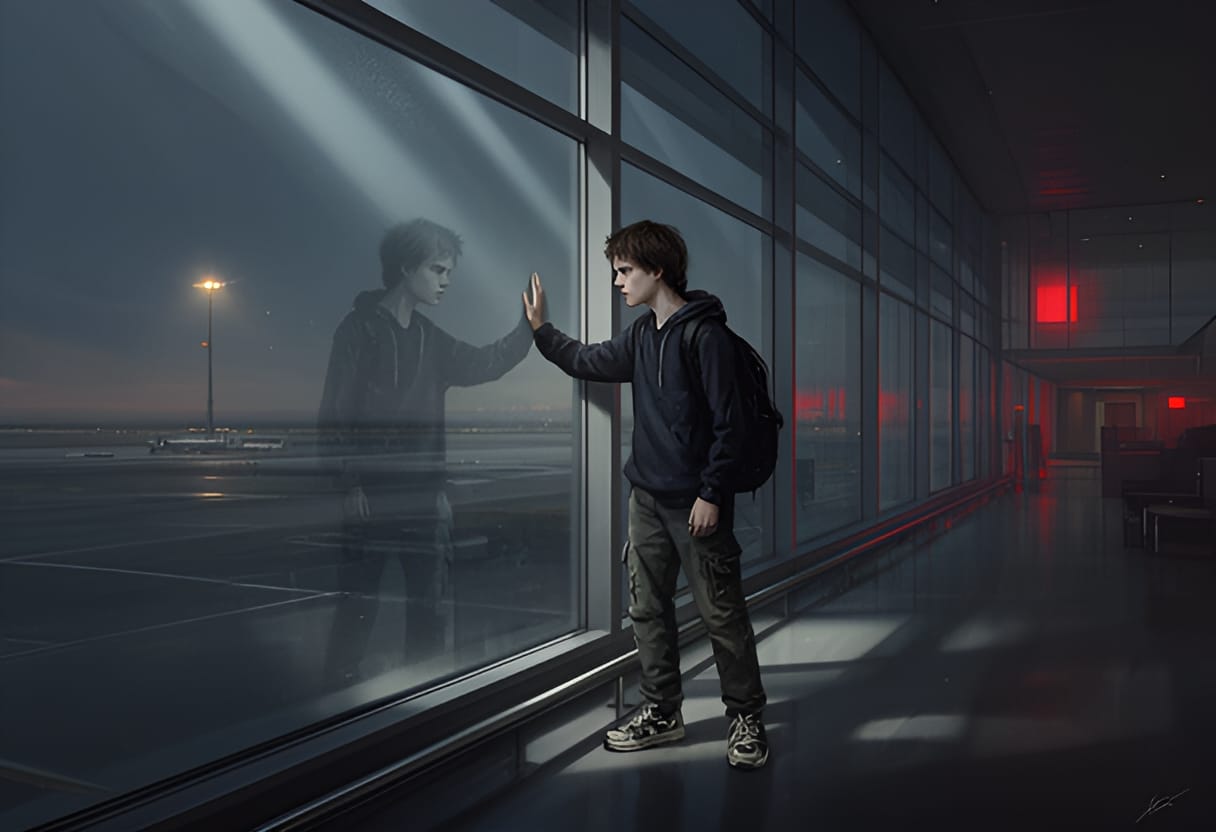
It wasn’t really him. Not the boy who had boarded a flight in Malmö, headphones on, complaining about delays. Not the kid who had argued with his sister over the last packet of crisps, who had lied about finishing his homework, who had believed, deep down, that tomorrow would look like today.
This was someone else. Someone gaunt. Someone whose eyes had lost their focus, not from fatigue, but from having seen too much and understood it all too clearly. His reflection blinked. He didn’t.
He thought of the manifest. The waiver. The diplomatic channel. The way the truth had arrived not with a bang, but with a printer’s whir and a curl of warm paper.
He thought of the possibility that this wasn’t collapse. It was clearance.
And he, Eli Voss, age sixteen, student, son, brother—had been left behind not by accident, but by design. Or worse: by indifference so complete it amounted to the same thing.
He pressed his palm flat against the glass, cool and vibrating faintly with the distant hum of something—maybe the building’s dying systems, maybe his own blood in his ears.
He didn’t whisper I was here. He didn’t need to prove it anymore.
He just stood there, and for the first time since he’d woken alone in the dark, he let himself wonder:
Would it have been kinder to never have known?
The light in the tower blinked on.
Off.
On.
And in the reflection, the boy in the glass didn’t look away.
Chapter 3
Signal in the Static
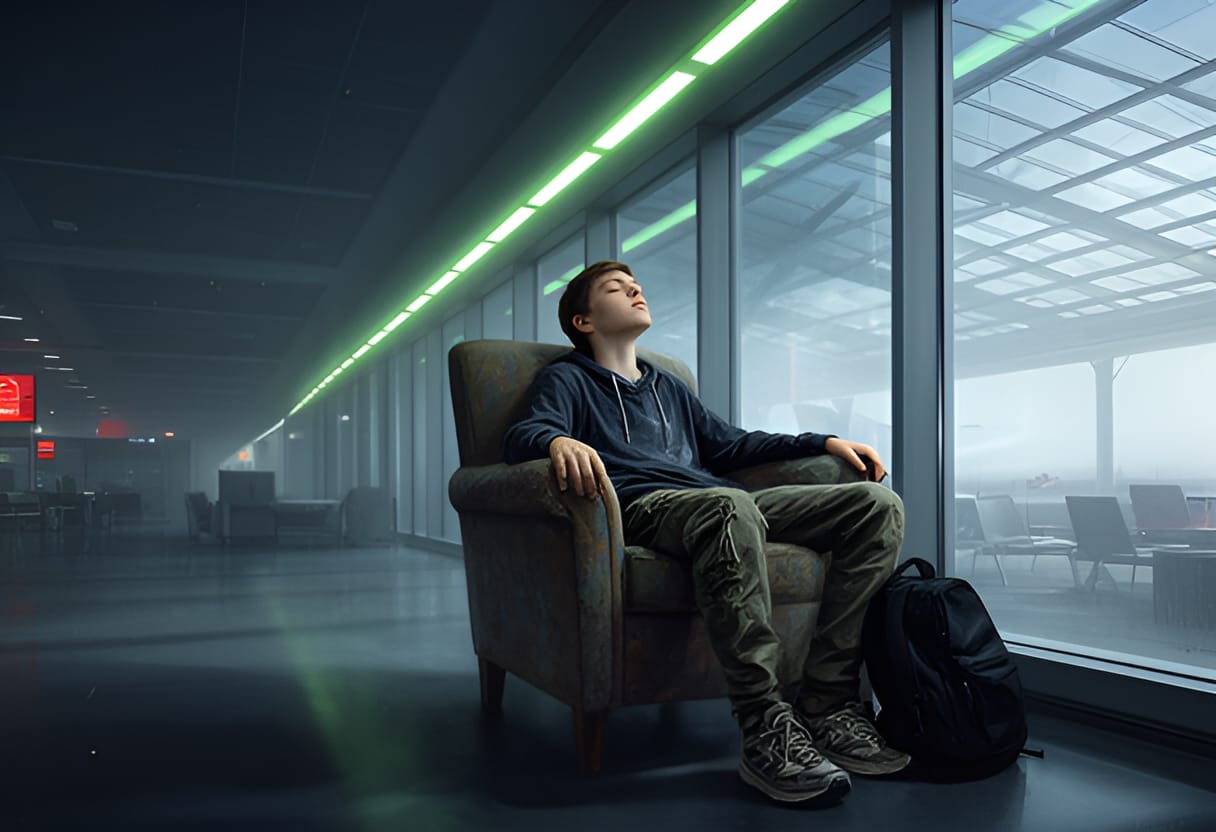
Eli stood in the lounge doorway, one hand braced against the warped metal frame, watching the first grey light of morning bleed through the atrium ceiling. The infected still pressed against the glass, a slow-motion crowd of pallid faces and slack jaws, their breath fogging the panes in irregular patches. He had not slept. Not really. The retreat from the tower had left him hollow, the weight of possibility — that he had been chosen, discarded — settling in his bones like damp clay. He had returned not for safety, but because the lounge was the only place the silence did not accuse him.
He closed the staff room door softly, engaging the makeshift latch — a length of seatbelt threaded through the handle and tied to the radiator pipe. Inside, the air was stale but familiar: the tang of old coffee, the faint ozone smell from the mini-fridge’s dying compressor, the muffled thrum of his own pulse in his ears. He sat on the edge of the sofa, notebook open on his knees. The last entry was three days old: Day 22 – Power flicker in Tower. Cargo manifest delayed. Not random. Abandonment suspected. The pen hovered. He could write Day 23 – Gave up. Or he could write something else.
He turned the page.
The backpack lay at his feet. He unzipped it slowly, inventorying not for need, but for possibility. Three water bottles — one full, two half. Three energy bars, one eaten to the wrapper. Blister packs of paracetamol, ibuprofen, antihistamines. Gauze, iodine, bandages. Rehydration salts. The multi-tool, its blades nicked but serviceable. And, tucked in an inner pocket, the satellite phone — scratched, antenna bent, but intact. He had found it wedged beneath a first-class seat, half-buried in debris and a discarded silk scarf. It had not powered on. Not then. But he had kept it.
He pulled it out now, turning it over in his palms. Dead weight. But not useless.
The duty-free shop was a wreck of shattered glass and overturned displays, perfume bottles crushed into colored shards underfoot, mannequins missing limbs or twisted into obscene poses. Eli moved quickly, eyes scanning, multi-tool in hand. He pried open the casing of a broken PDA behind the counter — its screen cracked, battery swollen — and extracted the circuit board, shaking out the corrosion with a tap against his palm. From a discarded tablet in the children’s section, he salvaged a lithium-ion cell, still holding a charge. A pair of noise-cancelling headphones yielded a neodymium magnet and coiled copper wire. He dropped each prize into a zip-lock bag salvaged from the chemist’s, labeling them in shorthand: PDA Bd, Tab Batt, Hdphn Wire.
He worked by the pale light of the emergency strips, their green glow steady and unnerving in the vast emptiness. Outside, the infected shifted against the glass, drawn not by sound but by the faint heat of his presence, or perhaps nothing at all — just the reflex of motion in their peripheral decay. They did not rush. They did not retreat. They waited, as they had for weeks, their fingers curling and uncurling against the barrier like insects testing glass.
He moved on.
The life raft locker near Gate B12 was salt-crusted and jammed. He used the multi-tool’s saw blade to weaken the hinge, then kicked it open with the heel of his boot. Inside, besides the rotted raft and expired flares, lay the emergency locator transmitter — a compact, orange cylinder with a frayed antenna and a water-activated battery pod. He unscrewed the casing, careful not to snap the fragile circuit inside. The battery was dead, but the board and antenna were intact. He wrapped it in anti-static film from a ruined camera box and stowed it.
The air traffic control tower was a tomb of silence, but the door to the maintenance wing had been left ajar from his last visit. Eli slipped inside, heart not racing, but alert — a quiet readiness, like a muscle tensed before a cramp. The power flicker had been brief, localized. He had seen it from the lounge: a single strobe in the tower’s west face, then darkness again. Now, in the gloom, he moved between racks of servers and shelves of manuals, the beam of his headlamp cutting cones through the dust.
He found the maintenance manual on a rolling cart, open to a page on emergency communications. The paper was brittle at the edges, but the diagrams were clear: schematics for VHF transponders, ELT arrays, signal boosters grounded to airframe. He flipped to the frequency chart. 121.5 MHz. The international distress frequency. Monitored by satellites, by aircraft, by any receiver tuned to listen. Not for conversation. For announcement.
He photographed the page with the satellite phone’s dead lens — a habit, a ritual — then tore it out, folding it small enough to fit in his palm.
From a grounded golf cart near the service ramp, he took the signal booster — a sealed unit with coaxial ports and a label reading ICAO Compliant. Its battery was gone, but the casing and internal amp looked salvageable. He detached it with care, noting the wiring harness: red for power, black for ground, yellow for signal in, green for signal out.
Back in the lounge, he spread the components on the coffee table. The multi-tool lay open, its screwdriver tip magnetized from the headphones’ speaker. He began to disassemble the PDA board, desoldering the crystal oscillator with the tip of a paperclip heated over a candle stub — a flame fed by aviation grease and a cotton wick in a tuna can. The smell was acrid, but he did not flinch. He watched the solder melt, listened for the faint hiss, and lifted the chip free with tweezers made from a bent staple.
Outside, the infected pressed closer. A child’s small hand, missing two fingers, smeared against the glass. It did not wipe away. It stayed.
Eli did not look up.
He sorted the parts by function: power sources, oscillators, amplifiers, antennas, grounding points. He sketched a rough block diagram on a napkin: battery → oscillator → modulator → amplifier → antenna. Not a transceiver. A beacon. One-way. A pulse. A statement.
He thought of the notebook’s first line: Day 1 – Heathrow Terminal B. Plaza Premium Lounge. Status: Alive.
If that was all he could say, he would say it until the battery died, or the sky answered, or the glass finally broke and something came through.
He picked up the soldering iron. The tip glowed dull red.
He touched it to the wire.
He touched it to the wire.
The solder flowed, a bright bead sealing the joint between the oscillator’s output and the modulator’s input. Eli held the connection steady until the metal cooled, then moved to the next: modulator to amplifier, amplifier to antenna feed. Each joint was a small victory, a defiance of entropy. He worked by the green emergency light, its steady glow casting long, unblinking shadows across the coffee table. The candle in the tuna can guttered occasionally, sending up a thin curl of smoke that smelled of hot metal and rancid fat. He didn’t mind. It was the only light he trusted.
On the second day, he scavenged a luggage cart from near Gate B7 — one of the older models with a swivel base and rubber wheels still intact despite the dust. He cleaned it with a rag soaked in iodine solution, then bolted a scrap of aluminum sheeting to its deck, salvaged from the fuselage panel of a decommissioned display jet near the immigration halls. It wasn’t pretty, but it was flat, conductive, and grounded. He mounted the transmitter array on it using strips of velcro torn from a first-class seatbelt and lengths of wire twisted tight around the cart’s frame. The antenna — a quarter-wave whip fashioned from the ELT’s salvaged rod and reinforced with copper from the headphone coils — he affixed to a PVC pipe scavenged from the chemist’s broken plumbing, sunk into a coffee can filled with quick-setting epoxy made from denture adhesive and baking powder. It wobbled slightly, but it stood.
He rigged a handle to the cart’s rear so he could rotate it without touching the electronics. Skyward. Always skyward. He marked degrees on the rim with a nail file: zero due south, where the tower loomed like a broken tooth. Ninety for east, where the sun rose over the empty runways. He would align it each morning, not because he believed in precision, but because the act of aligning felt like prayer.
By the third dawn, the solder joints were cool, the wires taped and labeled in his shorthand, the battery — a jury-rigged pack of the tablet cell and two AA cells from a ruined flashlight, wrapped in electrical tape and nestled in a sock for insulation — connected and holding. He had no oscilloscope, no frequency counter. But he had the receiver.
He took the satellite phone — the one with the bent antenna — and, using a paperclip as a makeshift stylus, probed its service menu until he found the hidden band scanner. It was a long shot; the device was meant for satellite, not VHF. But desperation had made him try everything. To his surprise, it picked up something: a rush of white noise, punctuated by a faint, rhythmic tone.
He keyed the transmitter.
A soft, steady beep emerged from the speaker — not loud, not clear, but unmistakable: beep… beep… beep… at roughly one-second intervals. It was not music. It was not speech. It was a pulse. A digital heartbeat in the language of machines.
He adjusted the oscillator’s trim capacitor with the tip of a screwdriver, listening as the tone shifted in pitch, then stabilized. He tweaked the modulator’s bias resistor — a sliver of graphite from a pencil, laid across a gap in the board — until the beeps grew distinct, clean, against the static. Not perfect. Not lab-grade. But it was transmitting. On 121.5 MHz. The international distress frequency. The frequency monitored by satellites, by passing aircraft, by any soul still listening in the dark.
He logged it in his notebook, the ink smudged from his thumb:
Day 22 – Transmitter assembled. Cart-mounted. Frequency locked. Signal: 121.5 MHz, 1 Hz pulse, 50% duty cycle. Power: 2.1V nominal. Output: weak but detectable. Tested via satellite phone scanner. Tone stable after 17 minutes. No modulation. No ID. Just the pulse. If this is heard, it means: I was here. If not, it means: I was here.
He left the transmitter running on the cart, pointed straight up through the lounge’s glass ceiling, where the infected still pressed, motionless, their faces slack, their eyes reflecting the green light like polished stone. He stepped back. The air was still. The only sound was the faint hum of the amplifier, a vibration felt more than heard in the soles of his feet.
He did not cheer. He did not speak. He simply nodded — once — and turned away.
Outside, a hand pressed harder against the glass. Fingers splayed. Then, slowly, it began to trace a shape. Not random. Not instinctive.
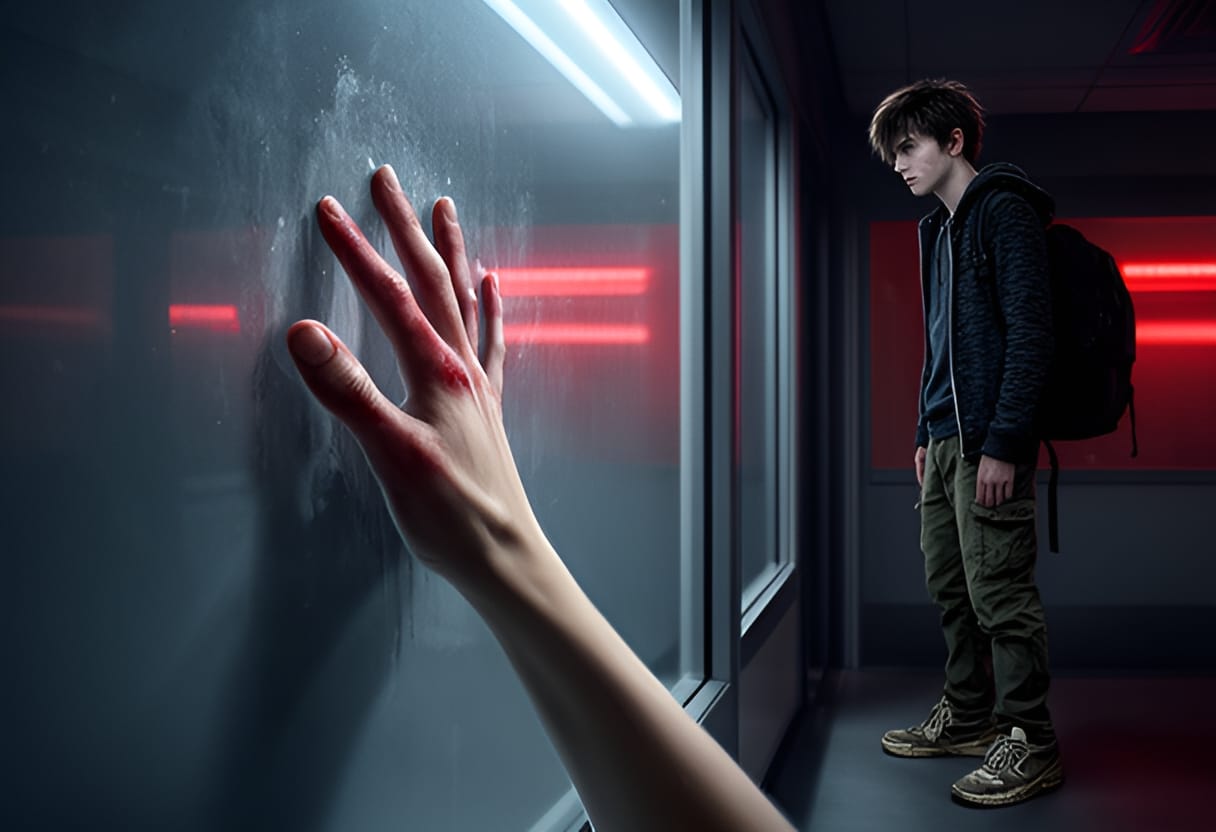
A circle.
Then a line through it.
A signal, returned.
Eli froze. His breath hitched, not from fear, but from the impossible precision of the mark. A circle with a line through it — the international symbol for do not enter, prohibited, danger. Or, in another context, a warning. A message.
He pressed his palm flat against the cool glass, mirroring the position of the hand outside. The infected did not retreat. It did not advance. It simply waited, its palm flat against his, separated only by the barrier. The fingers were long, the nails cracked and blackened at the tips. No two fingers on the right hand. Just as he had seen before.
He had assumed they were drawn by motion, by heat — reflexes of a broken nervous system. But this… this was deliberate. Too deliberate.
He pulled back slowly, heart hammering not against his ribs, but against his skull. The transmitter on the cart continued its pulse: beep… beep… beep… — steady, machine-like, oblivious.
He had come here to bear witness. To say, I was here. But what if he was not the only one sending a signal? What if the thing outside was not trying to get in — but trying to communicate?
He thought of the maintenance manual page, the ICAO booster, the frequency chart. 121.5 MHz was for distress. But frequencies could carry more than pulses. They could carry voice. Code. Even music, if modulated right. He had built a beacon, yes — but what if the infection hadn’t erased reason entirely? What if it had altered it? Rewired it into something that still understood rhythm, pattern, meaning?
He looked at the cart. At the wire running from the oscillator to the antenna. At the graphite resistor, the taped connections, the battery sagging in its sock.
He could modulate it. Not with a microphone — he had none — but by interrupting the power supply. A simple switch. A key. He could send dots and dashes. He could say more than I was here. He could say I am here. He could ask: Are you there?
He reached for the multi-tool. Opened the blade. Began to strip a length of wire from the headphone coil.
Outside, the hand remained. The fingers did not twitch. Did not wave. Did not beckon.
They simply waited.
And in the silence between the beeps, Eli began to tap. — *
By the fourth night, the transmitter had changed.
It no longer sent a steady pulse. It sent a pattern: three short bursts, three long, three short. Repeating. Over and over.
Eli sat on the floor beside the cart, back against the sofa, the satellite phone in his lap. He was not scanning for replies. He was not hoping. He was listening — to the rhythm of his own breath, to the hum of the amplifier, to the faint, fading signal leaking into the dark.
The glass was clear now. No hands. No faces. Just the reflection of the emergency lights, green and cold, stretching across the atrium like veins.
He did not check the doors.
He did not watch.
He let the signal go.
And for the first time in weeks, he slept.
The satellite phone’s screen glowed faintly in Eli’s lap, its band scanner cycling through static. He had left the transmitter running all night, the pulse a metronome in the dark: beep… beep… beep… steady, unchanging. He had watched the glass until the hand withdrew, until the reflection showed only the green emergency lights and the slow drift of dust in the air. He had not slept. He could not. Not with the weight of that mark still pressed against his palm in memory.
Now, at 03:00, he rose from the floor. The lounge was colder than before, the air thin and still. His breath curled in tiny plumes before vanishing. He checked his watch — a cheap digital thing salvaged from a security locker, its face cracked but still ticking — and saw the time: 03:00. Exactly as planned. Terminal activity was at its nadir. Even the infected, if they still followed the rhythms of the world before, would be at their most inert. Their movements, when they came, were sluggish, drawn not to sound but to the faint heat of presence, to motion in the periphery. At this hour, with the terminal sealed in darkness and cold, even that sense would be dulled. He would be safest now.
He moved silently to the cart. The transmitter sat where he had left it, its wires snaking from the battery pack to the oscillator, the modulator, the antenna — a length of copper tubing scavenged from an air conditioning unit, straightened and tipped with a makeshift radiator of aluminum foil. The battery, a cluster of six lithium cells from a first-aid defibrillator, was warm to the touch. The amplifier hummed, a low vibration he felt more than heard in the floorboards.
He picked up the multi-tool. The blade was nicked from use, but still sharp. He flicked it open and began to strip the insulation from a length of wire — the same he had taken from the headphone coil, now repurposed as a manual key. He twisted the bare ends around two screws on a small terminal block he had salvaged from a luggage cart’s control panel. One screw connected to the power line from the battery; the other to the oscillator’s input. By breaking the circuit, he could interrupt the pulse. Short breaks for dots, longer ones for dashes. Morse code. It was crude, but it would work.
He tested the connection. Pressed the wire against the terminal. The pulse stuttered — beep… (pause) …beep… — then resumed. He adjusted the pressure, found the point where a firm press killed the tone cleanly, a release let it return. He tapped out a slow S: three short breaks. Beeeeeep… pause… beeeeeep… pause… beeeeeep… then waited. The tone returned, steady. It worked.
He took a breath. His throat was dry. He unscrewed the cap of his last full water bottle, took a small sip, and rinsed his mouth. The water was warm, flat, but it cleared the copper taste from his teeth.
He looked at the antenna. It pointed straight up, through the glass ceiling, toward the belly of the Airbus A380 parked hardstand away, its fuselage a silver ghost in the dim emergency glow. He had not moved it since testing. The signal had been strong enough to register on the satellite phone’s scanner, but he had wondered — was it going where he wanted? Or was it bouncing?
He keyed the transmitter again. The pulse filled the lounge: beep… beep… beep… He held the scanner to his ear. The tone came back, not clean, but layered — a primary pulse, then a fainter echo, then another, each slightly delayed. It was reflecting. Off the fuselage. Off the tail. Off the hangar doors. The signal was scattering, losing coherence.
He frowned. If the signal was bouncing back, it might be harder to detect at a distance. Worse, if someone was listening, they might mistake the echoes for interference, or dismiss them as noise. He needed it to go straight up, clean and unimpeded.
He stood and walked to the cart. The antenna was fixed in a clamp made from a bent coat hanger and zip ties. He loosened the ties, shifted the copper tube a few degrees east, then tightened them again. He aimed it not at the aircraft, but between the tail and the wing, where the gap opened to the sky. He stepped back, watched for a moment. The tube was steady.
He returned to the floor, sat cross-legged beside the cart, the satellite phone in one hand, the makeshift key in the other. He pressed the wire to the terminal.
Beep… beep… beep…
He listened. The tone was pure. No echo. No delay. Just the pulse, rising.
He keyed the key. Held it down for three counts — a dash. Released. Waited. Pressed three times quickly — dot, dot, dot. Held again for three counts. Dot, dot, dot. Then paused.
The pattern repeated. SOS. Three short, three long, three short. Over and over. The rhythm filled the lounge, a pulse in the wires, a throb in the battery, a whisper in the air. He did not speak. He did not move. He only listened — to the signal, to the silence between, to the faintest shift in the hum of the amplifier.
Outside, the glass remained clear. No hands. No faces. Only the reflection of the green lights, and beyond them, the dark concourse, the empty jetways, the silent rows of seats. The infected were still out there. He could feel them — not in sound, but in the way the air seemed to thicken near the glass, as if the heat of their bodies, faint and slow, was seeping through the barrier. But they did not press. They did not trace. They waited, as he waited.
He thought of the message he had sent before the collapse — On my way home. Flight delayed again. — sent to a number that no longer existed, to a person who might be dust, or worse. He had not sent anything since. Not a word. Not a sigh. This was the first time he had said anything deliberate since the world stopped.
He keyed the key again. Dot. Dot. Dot. Dash. Dash. Dash. Dot. Dot. Dot.
The tone rose, clear and unwavering, into the overcast sky. No echo. No bounce. Just the signal, carrying upward, into the cold, into the dark, into the vast, listening silence.
He did not know if anyone heard it.
He did not know if anyone would.
But for the first time in weeks, he was not just bearing witness.
He was speaking.
And the silence, for now, was not empty. — *
He keyed the key until his thumb ached. Until the battery voltage dipped, just barely, on the satellite phone’s readout. Until the tone began to fray at the edges, the pulses widening, the gaps softening. He did not stop. He could not. Not yet.
The night bled into the pre-dawn. The emergency lights dimmed, not from failure, but from some automatic cycle — a timer, perhaps, or a sensor responding to the faintest hint of light beyond the glass. The green grew softer, less harsh. The reflection in the glass changed. The dust motes were visible now, drifting in slow currents.
His eyes burned. His shoulders ached from sitting still. He had not moved in hours. His back was stiff, his legs numb. But he did not rise. He did not break the rhythm.
Dot. Dot. Dot. Dash. Dash. Dash. Dot. Dot. Dot.
He thought of the notebook. Of the smudged ink. Of the words he had written: If this is heard, it means: I was here. If not, it means: I was here. He had meant it as a resignation. A way to brace himself for silence. But now, as the signal climbed, unbroken, into the sky, he felt the words shift. They were not a shield anymore. They were a claim.
I am here.
He did not say it aloud. He did not need to. The signal said it for him.
The first true light of dawn touched the edge of the glass — a pale, washed-out gold, barely there. It did not wake the terminal. It did not stir the infected. It simply touched the glass, and for a moment, the reflection showed not the empty concourse, but the sky beyond — pale, vast, and waiting.
He did not look away.
He kept keying.
The tone held.
And somewhere, in the space between the beeps, he began to believe — not that he would be answered, but that the act of sending was enough. That to send a signal into the dark was, in itself, a kind of answer.
He rose slowly from the floor, joints protesting after hours of stillness. The key slipped from his fingers, clattering against the metal cart. He didn’t bend to retrieve it. The transmitter pulsed on its own now — a steady, autonomous rhythm born of the last adjustments he’d made: a weighted pendulum scavenged from a broken clock in the duty-free shop, linked to the circuit so that each swing interrupted the current just long enough to dot, then released to dash. It needed no hand. It needed no watch.
He left it running.
The lounge swallowed the sound as he walked away — the beeps softened, muffled by the carpet and the low hum of the amplifier, becoming less a command and more a presence, like the breath of something sleeping nearby. He didn’t look back. Didn’t check the antenna’s alignment. Didn’t verify the battery level. He had done what he could. The signal was aloft. It was no longer his to carry.
He moved through the dim space toward the armchair where he’d sat during the long vigil, the one facing the glass. The emergency lights had dimmed further now, not to darkness, but to a soft, indeterminate glow — neither night nor day, but the quiet threshold between. The infected were still out there. He could sense them not by sight or sound, but by the subtle pressure in the air, a heaviness near the glazing, as if the collective presence of those slow, heat-seeking shapes pressed against the barrier from the other side, drawn not to him, but to the lingering warmth of the building, to the ghost of occupancy.
He didn’t go to the door. Didn’t trip the wire. Didn’t listen for the chime.
He simply sat.
And then, after a while, he didn’t sit at all.
He let himself slide sideways into the chair, boneless, as if gravity had finally won an argument it had been losing for weeks. His head lolled to the side, cheek resting against the faded fabric. His backpack, long emptied of everything but the notebook and a half-empty bottle of water, slumped at his feet. One hand dangled loose, fingers brushing the carpet. The other lay limp on his lap, palm up, as if waiting to be held — or to hold something that was no longer there.
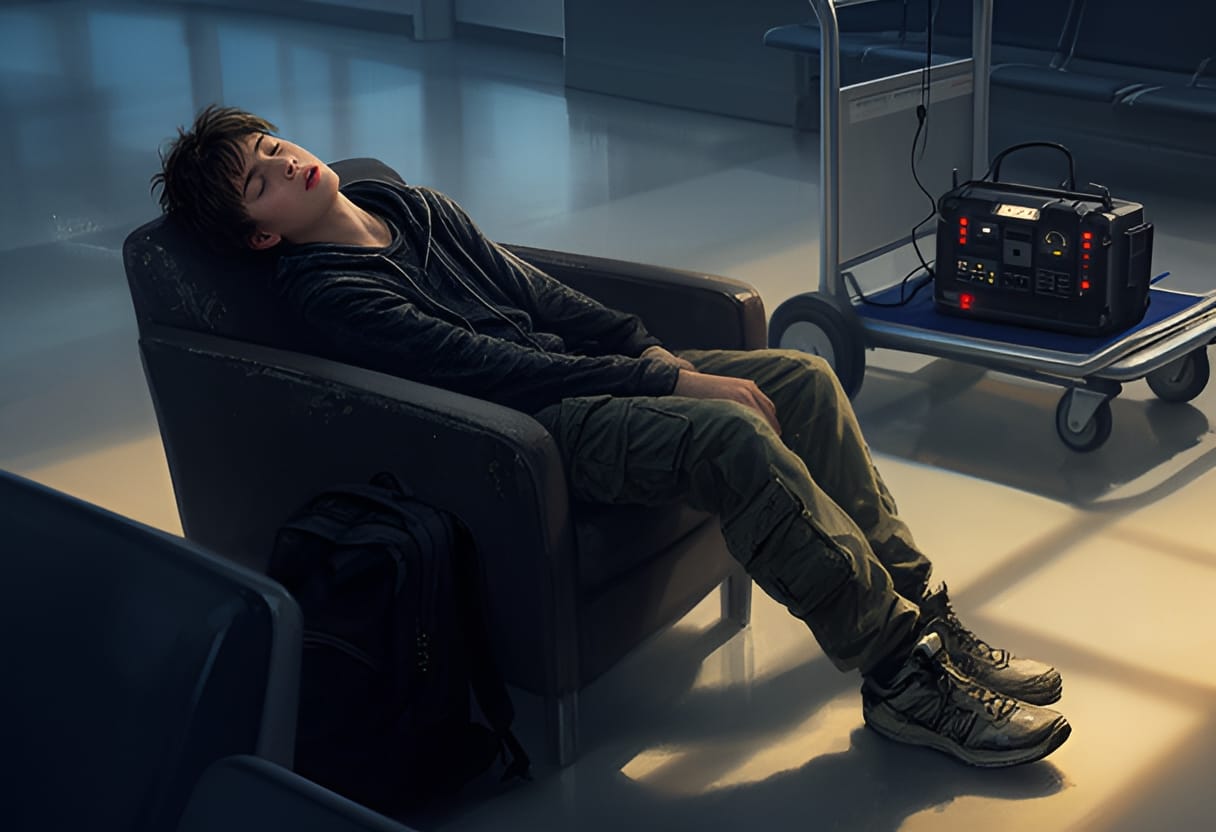
He didn’t think of the signal. Didn’t wonder if it was being heard. Didn’t run through scenarios of rescue, of silence, of eternal repetition. Those thoughts had worn thin, smoothed by repetition into something almost peaceful. Instead, he felt the weight of his eyelids, the dry sting behind them, the deep, bone-level exhaustion that had been his constant companion since he first woke alone in the dark. It wasn’t fear that kept him awake anymore — not really. It was habit. The need to be ready. To watch. To listen for a sign that might never come.
But the sign had already been sent.
And now, for the first time since the world ended, he allowed himself to be unprepared.
His breath slowed. Not forced. Not measured. Just… slower. The kind that comes when the body decides, without consultation, that it has earned rest.
The notebook lay open near the water bottle, the last entry still visible: If this is heard, it means: I was here. If not, it means: I was here. He hadn’t looked at it in hours. Didn’t need to. The words had done their work. They weren’t a shield anymore. They weren’t a claim. They were just true.
Outside, the light continued to grow. Not with urgency, not with promise — but with indifference. The kind of light that rises whether anyone is there to see it or not. It touched the glass, then moved across it, painting the concourse in pale strips that widened as the minutes passed. Dust swirled in the slants, slow and aimless. Somewhere, a pane creaked — not from impact, but from temperature shift, the metal frame contracting in the warming air.
He didn’t wake to it.
He didn’t wake to the distant, wet scrape of something moving along the jetway — one of the infected, perhaps, dragging a foot, or a hand, or nothing at all, just swaying in its slow circuit. He didn’t wake to the faint, irregular click of the tripwire, stirred by a draft that had slipped through a seam in the sealing tape. He didn’t wake to the soft, steady pulse beneath his dreams — the transmitter’s signal, still climbing, still pure, still saying nothing and everything.
He slept.
Not the sleep of exhaustion, not the sleep of collapse, but the sleep of release. The kind that comes not when safety is found, but when the struggle is acknowledged — not as won, but as fulfilled.
And in that sleep, his face was not tense. Not grim. Not even hopeful.
Just still.
And the signal went on.
His breathing deepened, uneven at first, then finding a rhythm that matched the slow rise and fall of his chest — not in sync with the transmitter’s pulse, but harmonizing with it, as if his body had learned to resonate with the signal’s quiet insistence. The dream that came was not of home, nor of Malmö, nor of the last words he’d sent into the void. It was of the lounge itself — but not as it was. Not empty. Not silent.
In the dream, the lights were full. Not harsh, not clinical, but warm — the kind of light that pools in the corners of a room lived in, where shadows are soft and familiar. The air smelled of citrus cleaner and faintly of coffee, of wool coats and luggage left too long in overhead bins. Voices murmured — not loud, not urgent — just the low, indistinct hum of people moving through space, of shoes on tile, of a distant announcement half-heard over a speaker. No panic. No shouting. Just the ordinary thrum of a place that still believed in tomorrow.
He was sitting in this very chair, but he wasn’t alone. A woman sat beside him — not someone he knew, not someone he could place — but her presence was calm, her attention on the glass. She didn’t speak. Didn’t need to. When he turned to her, she offered a small, tired smile, the kind shared between strangers who’ve both survived the night and aren’t ready to talk about it yet. Then she stood, walked toward the retail corridor, and disappeared into the gentle flow of others — not fleeing, not rushing, just going.
He woke not to the dream’s end, but to its echo — the fading impression of warmth on his shoulder where she’d been, the phantom scent of soap and rain on wool.
The transmitter still pulsed beneath his consciousness, a quiet metronome in the dark behind his eyes. He didn’t reach for it. Didn’t check its status. He simply lay there, eyes open, watching the light climb the glass. It was full daylight now — not bright, not cheerful, but clear. The concourse lay exposed in its entirety: the abandoned carts, the overturned chairs, the baggage belts frozen mid-cycle, the silence not oppressive, but spacious. Like a held breath finally released.
Somewhere, far off, a panel shifted — a small metallic sigh, perhaps from thermal expansion, or the settling of the structure itself. No footsteps. No breath on the glass. No tracing of symbols. Just the building, adjusting to a day that would come and go without witness… or with one, if only in the quiet certainty of a signal that refused to stop.
He didn’t move to turn it off. Didn’t move at all.
He let the light wash over him. Let the hum of the amplifier fill the ears. Let the memory of the dream linger — not as proof, not as prophecy, but as a moment of softness in a world that had taken everything else.
And when he finally closed his eyes again, it wasn’t to sleep.
It was to listen. — not for an answer, but for the sound of his own breath, steady and unafraid, rising and falling in time with the pulse that carried, not a plea, but a presence — into the sky, into the silence, into the endless, listening dark.