Fiction
Teaching in a world of Ai
by Kylie
3 chapters1 hr read
Chapter 1
The Way We Were
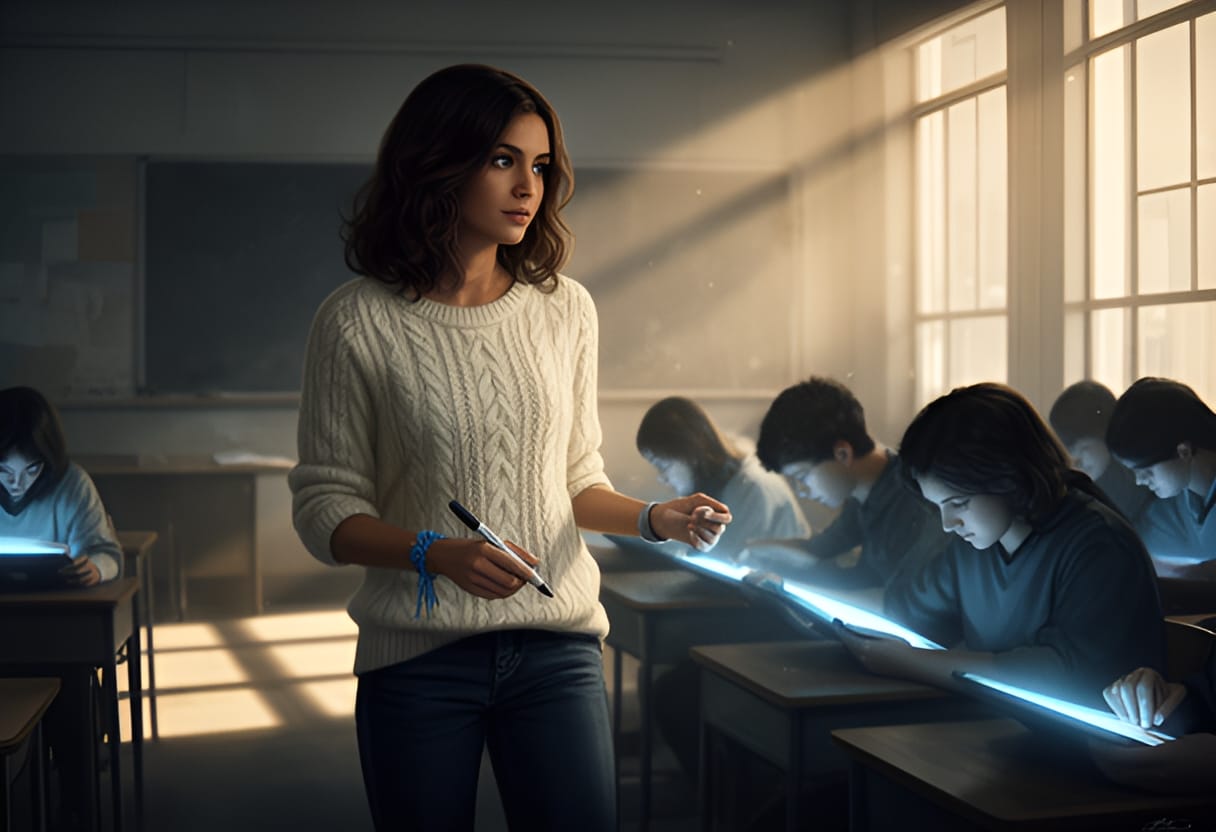
The bell had just rung, sharp and bright, and Maya stood at the front of her classroom, hands braced on the edge of her desk, watching as twenty-five pairs of eyes flicked downward to the glowing rectangles resting in their palms. A simple problem glowed on the smartboard at the front of the room: If a train leaves Station A at 2:00 PM traveling 60 miles per hour, and another leaves Station B at 2:30 PM traveling 80 miles per hour on the same track, when will they meet? It was the kind of question that used to make her sixth graders groan, lean into their neighbors, scribble on scrap paper, argue over whether to add or subtract the speeds. Now, before she could even finish reading it aloud, a chorus of soft chimes rose from the desks — the sound of twenty-five AI tutors activating at once.
“Um,” said Liam, voice small, “my tutor says 4:48 PM.”
Maya nodded slowly. “Okay. And how did it get that?”
He shrugged, eyes still on his screen. “It just did. Said to divide the distance by the combined speed.”
She glanced at the board. The distance between the stations wasn’t even given. “But we don’t know how far apart the stations are,” she said.
Liam looked up, brow furrowed. “Oh. My tutor says it’s 240 miles. It must have pulled it from the curriculum database.”
Around the room, heads bobbed in agreement. Priya tapped her tablet, murmuring, “Mine says the same.” Jamal nodded, “Yeah, mine too.” No one reached for a pencil. No one frowned in concentration. No one turned to a classmate and whispered, What do you think? The air felt thin, emptied of the usual hum of minds at work.
Maya’s throat tightened. She remembered the weight of a pencil in her own hand, the scratch of lead on lined paper, the way her sixth-grade self would stare at a problem like this and feel the slow burn of not knowing — not as a failure, but as the beginning of something. Back then, not knowing wasn’t a glitch to be fixed by a voice in a machine; it was the space where thinking lived.
The memory came without warning, sharp as the smell of chalk dust. She was eleven, sitting in Mr. Callahan’s classroom in the spring of 2000, sunlight cutting across the rows of wooden desks. The same problem had been on the board then — though back then, it had been about two cyclists leaving opposite ends of a 60-mile trail. Mr. Callahan hadn’t given the answer. He hadn’t even given the formula.
Instead, he had turned to the class and said, “Well? What do we know?”
A forest of hands had shot up. Maya remembered her own shooting up, heart pounding, not because she was sure, but because she wanted to try. “We know they’re going toward each other?” she had offered.
Mr. Callahan smiled. “Good. What does that mean for their speeds?”
Someone else said, “You add them?” and he had nodded, writing combined speed on the board. Then he had asked, “But what if we don’t know the time?” and the class had fallen into a quiet hum of pencils, erasers, whispered debates. Someone had suggested making a table. Another had drawn a line on their paper, marking where each cyclist would be after each hour. Maya had gotten it wrong at first — subtracted the speeds instead of adding — but Mr. Callahan hadn’t corrected her. He had simply asked, “What makes you think that?” and when she explained, he had said, “Interesting. Let’s see what happens if we try it the other way.”
By the end of the period, no one had the answer handed to them. They had built it together, mistake by messy mistake, and when the bell rang, Maya had carried the solution in her bones, not just her notebook. She had felt it — the pride of having wrestled it into shape herself.
Now, back in 2026, she watched as Zara, usually so quick to raise her hand with a thoughtful question, simply read her tutor’s response aloud: “Four forty-eight. The trains meet at 4:48 PM.” Her voice was flat, detached. There was no spark in it, no ownership.
Maya’s chest ached. It wasn’t that the answers were wrong — they were right, every time. It was that the students weren’t arriving at them. They were being handed them, like pre-packaged meals, and consuming them without tasting the ingredients. The struggle, the false starts, the moments when a wrong turn led to a deeper understanding — those were being edited out, smoothed away by algorithms that optimized for correctness, not growth.
She thought of Mr. Callahan’s voice, quiet but firm: “Learning isn’t about getting it right the first time. It’s about what you do when you don’t know.”
A decision formed, quiet but certain, like a knot tightening in her gut. She would try it. Just one lesson. Tomorrow. She would turn off the AI tutors. She would put the problem on the board and say nothing — let them wrestle with it, let them be wrong, let them talk to each other. She would be the guide, not the gatekeeper.
She knew the risks. The school’s AI integration policy was clear: all core instruction was to be supplemented by personalized AI tutoring. Deviating meant a formal review. Maybe a warning. Maybe worse. Principal Vance had made it clear — efficiency was non-negotiable. The district’s test scores had risen since the AI rollout, and he intended to keep them rising.
But as she looked out at the rows of bowed heads, the soft glow of screens illuminating young faces, she felt a deeper fear take root — not of punishment, but of what would happen if she didn’t try. If she let this become normal. If she stopped believing that the friction of not knowing was where learning began.
She smoothed her skirt, took a breath, and said, “Actually, let’s try something different today. Leave your tablets face down for now. I want to see what you can figure out on your own.”
A ripple of confusion passed through the room. Liam blinked. “But… the tutor’s already got the answer.”
Maya met his gaze, her voice steady. “Yeah. But I want to know how you would get there.”
For the first time all period, a few heads lifted. Eyes blinked away from the light. And in the sudden quiet, Maya felt the old, familiar spark — not of certainty, but of beginning.
The bell’s echo had barely faded when Maya lowered her hand, the sting of adrenaline still humming in her fingertips. Around her, the classroom buzzed with the restless energy of kids who’d just been asked to think instead of receive. Mr. Callahan stood at the front, chalk in hand, his eyes scanning the room not for correctness, but for movement — for the flicker of a mind turning over an idea.
“So,” he said, his voice low and deliberate, “you’re wondering if the answer could be more than one thing?”
Maya nodded, her throat dry. “Yeah. What if… what if the trains don’t leave at the same time? Or what if one stops? The problem didn’t say they go straight through.”
A ripple passed through the room. Heads turned. Papers rustled.
Mr. Callahan didn’t correct her. Didn’t sigh. Didn’t reach for the answer key tucked in his desk. Instead, he turned to the class and spread his hands. “Well? What do we think? Does the problem tell us everything we need to know?”
Liam — no, not Liam from 2026, but a boy with freckles and a too-big jersey from 2000 — shifted in his seat. “It says they leave at the same time,” he muttered.
“Does it?” Mr. Callahan asked, tilting his head. “Let’s look.”
He pointed to the problem on the board: Two trains leave stations 300 miles apart at 9:00 AM. One travels at 60 mph, the other at 80 mph. When do they meet?
Maya leaned forward, her elbows on her desk, her notebook open to a clean page. The boy beside her, Jamal — she remembered his name now, how he always chewed the end of his pencil when he was thinking — tapped his eraser against his lips.
“It says ‘at 9:00 AM’ for both,” he said. “So yeah, same time.”
Priya, her braid swinging as she turned, frowned. “But what if the tracks aren’t straight? What if there’s a curve? Or a hill? Would that change the speed?”
Mr. Callahan chuckled, soft and warm. “Excellent question. Does the problem say anything about the track?”
Priya shook her head. “No.”
“So we don’t know,” he said. “But for now, we’re going to assume it’s straight and level. Unless someone can prove why we shouldn’t.”
A few kids laughed. Maya felt a flush rise — not from embarrassment, but from the thrill of it. This wasn’t about being right. It was about digging. About asking what if and seeing where it led.
Mr. Callahan picked up a piece of chalk and drew a simple timeline beneath the problem. “Let’s start with what we do know. They leave at the same time. They’re going toward each other. One’s faster. What happens to the distance between them every hour?”
A dozen hands shot up. Maya’s was among them.
“It gets smaller,” she said when he pointed to her.
“By how much?”
She thought. The first train eats up 60 miles of the gap each hour. The second, 80. Together?
“One hundred forty miles?” she guessed.
Mr. Callahan wrote it down: Closing speed: 140 mph. “Why do we add them?”
“Because they’re eating up the gap from both ends,” said a girl in the back, her voice hesitant but clear. “Like if you and I walked toward each other down a hallway — we’d meet faster than if just one of us was moving.”
Maya smiled. That was exactly how she’d pictured it — two people closing the space between them, step by step.
“Good,” Mr. Callahan said. “So if they’re closing 140 miles every hour, how long to close 300?”
Silence fell, broken only by the scratch of pencils and the occasional sigh. Maya stared at the numbers. 300 divided by 140. She knew how to divide, but the decimal felt messy. She tried 2 hours: 140 times 2 was 280. That left 20 miles. Less than an hour’s worth.
“So… two hours and a little?” she whispered to herself.
Mr. Callahan waited. Then, softly: “And how much of an hour is those 20 miles?”
Maya bit her lip. If they go 140 miles in 60 minutes, then… she set up a proportion in her head. 140 miles : 60 minutes = 20 miles : x minutes.
She scribbled in the margin: x = (20 × 60) / 140. 1200 divided by 140. She simplified: 120 ÷ 14. 8 and change. About 8.5 minutes.
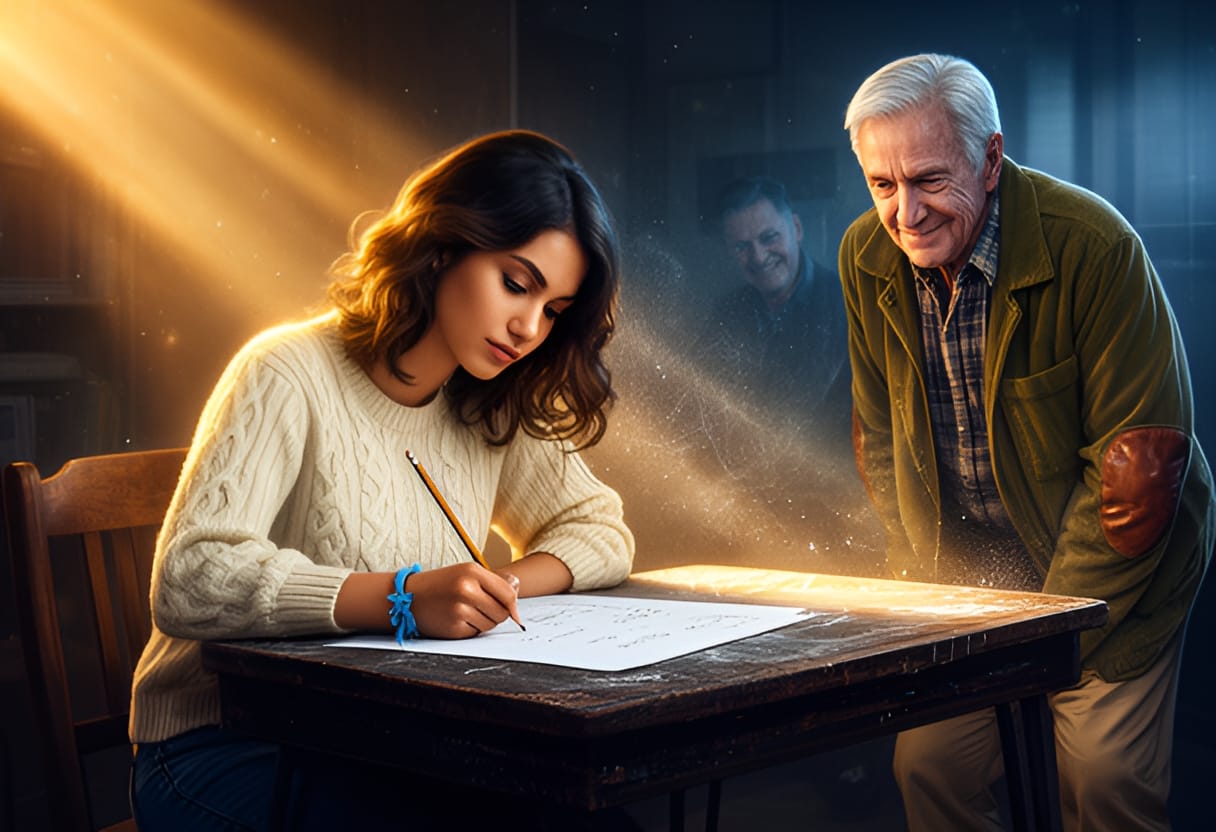
“Two hours and… eight and a half minutes?” she ventured when he looked her way.
Mr. Callahan smiled. “Show us how you got there.”
She walked to the board — her heart thudding — and explained her reasoning, her voice wobbling at first, then steadier as she talked through the proportion. When she finished, a few kids nodded. Jamal raised his hand.
“I got the same,” he said, “but I did it differently. I figured out how far each train goes in two hours. First train: 120 miles. Second: 160. Together, that’s 280. So 20 miles left. Then I split the 20 based on their speeds — since the faster one covers more ground in the same time, it should get more of the leftover distance.”
Mr. Callahan nodded. “Interesting. So you’re thinking about how the leftover distance gets divided?”
Jamal shrugged. “Yeah. Like, if they were racing to cover the last bit, the faster one would win more of it.”
Maya watched as Mr. Callahan turned Jamal’s idea into a quick sketch on the board — two arrows, one longer than the other, splitting the 20-mile gap. It made sense. Not just the answer, but the why behind it.
Then Priya spoke up again. “But what if we don’t assume they leave at the same time? What if the problem’s trying to trick us?”
Mr. Callahan’s eyes lit up. “Now you’re thinking like a mathematician. What would we need to know to solve it if they didn’t?”
Silence. Then Zara — the quiet girl who always sat sideways in her chair, one leg tucked under her — said, “We’d need to know how much later one left.”
“Exactly,” Mr. Callahan said. “And if we don’t have that?”
“We can’t solve it,” Priya said. “Not for sure.”
Mr. Callahan erased nothing. He simply added a note in the corner: Assumption: simultaneous departure. “Good. We state our assumptions. Then we solve within them. And we stay ready to revise if new information comes.”
The bell rang then — sharp, sudden, cutting through the hum of discussion. Kids began to pack up, sliding notebooks into backpacks, trading glances and quiet comments.
Maya lingered at her desk, her pencil still in her hand. She looked down at her notebook — not at a clean, boxed answer, but at a page filled with arrows, fractions, crossed-out attempts, and a small timeline she’d drawn in the corner. It wasn’t neat. It wasn’t perfect. But it was hers.
She felt it then — not the hollow satisfaction of being told she was right, but the deep, quiet hum of having figured something out through her own effort. Her mind felt stretched, alive, like a muscle that had been used properly for the first time in weeks.
Mr. Callahan paused beside her desk, wiping his hands on his trousers. “You looked like you were having fun in there,” he said, not unkindly.
Maya blinked. “I was.”
He nodded, his eyes crinkling at the corners. “That’s the point. Not the answer. The getting there.”
She looked up at him, the sunlight catching the dust motes in the air above his shoulder. Outside, the spring light slanted across the playground, long and golden. Inside, the chalk dust still hung in the air like a promise.
She didn’t know it then, but she was already carrying the lesson in her bones. Not the answer to the train problem. But the certainty that thinking — real, messy, stubborn thinking — was worth the struggle. And that, someday, she would try to give that feeling to someone else.
Maya stared at the printed lesson plan on her desk, the glossy paper catching the harsh fluorescent light of her 2026 classroom. The heading read: Module 7.3: Relative Motion – AI-Guided Solution Pathway. Beneath it, bullet points outlined the approved sequence: students would log into their personal tablets at 9:00 AM, the AI tutor would present the train problem with visual animations, then guide them step-by-step through a single, standardized method — algebraic formulation using relative velocity. A quiz would follow at 9:20, with immediate feedback and remediation suggestions generated in real time. The entire lesson was designed to be completed in twenty-five minutes, leaving five for cleanup and transition.
She tapped her pen against the page. The plan left no space for wrong turns, for the kind of productive confusion that had filled Mr. Callahan’s classroom. No room for Jamal’s alternative approach to splitting the leftover distance, or Priya’s quiet challenge about assumptions. The AI didn’t invite questions — it anticipated them, offering hints before a student could even formulate uncertainty. It didn’t wait for the silence after a question hung in the air; it filled it with voice and color and motion, all calibrated to keep the class moving toward the correct answer as efficiently as possible.
Maya thought of the spring light slanting across Mr. Callahan’s classroom, the way chalk dust had hung in the air like a promise. He hadn’t needed animations to make the gap between two trains feel real. He’d used nothing but a worn pointer, a chalkboard, and his willingness to let students wrestle with the problem until they found their own way through. His technology had been patience. His interface, a raised eyebrow and a well-timed And then?
She remembered how he’d turned to her after she’d explained her proportion, not to correct or affirm, but to ask her to show her work. How he’d let Jamal’s idea breathe on the board, turning it into a sketch without judgment. How he’d let Priya’s question linger, unanswered, until Zara offered the missing piece — not because the lesson plan required it, but because the thinking itself was the point.
A notification chimed softly from her tablet: Reminder: AI integration compliance check at 10:15 AM. Ensure all student devices are synced and active for today’s lesson. The school’s system logged usage in real time. Principal Vance reviewed the reports every morning. Deviations — unexplained downtime, manual overrides — triggered alerts. Maya knew the risk. She’d seen what happened to Ms. Delgado in the east wing, who’d tried to run a “device-free Friday” for her poetry unit. By Monday, she was called into a review meeting, her lesson plan scrutinized, her professionalism questioned. The AI wasn’t just a tool; it was the framework. To step outside it was to step out of bounds.
But the memory of that hum in her chest — the quiet satisfaction of having figured something out through her own effort — wouldn’t let her go. It had been weeks since she’d felt it in her classroom. Weeks since she’d seen it in her students’ eyes, not the glazed focus of screen-staring, but the furrowed brows, the tilted heads, the murmured debates over pencil-scratch calculations.
She flipped the lesson plan over. On the back, in her own handwriting, she’d sketched a rough outline for an alternative: no tablets, no AI. Just the problem on the board, paper, pencils, and forty-five minutes of uninterrupted time. She’d written: Let them struggle. Let them talk. Let them be wrong together.
Maya pushed back her chair and stood. The classroom was still empty, the early morning light just beginning to creep through the blinds. The AI hub — a sleek, obsidian rectangle mounted near the ceiling — glowed faintly blue, its status light pulsing in steady rhythm. A soft hum vibrated through the wall, felt more than heard. It was always on, always listening, always ready to respond.
She walked slowly to the side of the room where the main power conduit ran behind a locked panel. Only she and the IT tech had the key, issued at the start of the year for “emergency overrides.” She’d told Vance it was for fire drills or network failures. She hadn’t lied, exactly. This felt like an emergency of another kind.
Her fingers fumbled with the key in the lock. The metal was cold. She turned it, heard the soft click, and pulled the panel open. Inside, a thick bundle of cables converged into a central port labeled PRIMARY AI FEED. A small switch sat beside it, flipped to ON.
She hesitated. Her palm hovered over the switch. What if the system logged this as a fault and dispatched support automatically? What if Vance got an alert before the first bell? What if, after all this, the students just sat there, silent and lost, unable to begin without the AI’s voice to guide them?
Then she heard it — not a sound, but a memory. Mr. Callahan’s voice, warm and certain: That’s the point. Not the answer. The getting there.
Maya took a breath. Her fingers closed around the switch. It clicked under her thumb, stiff at first, then gave way with a soft snap.
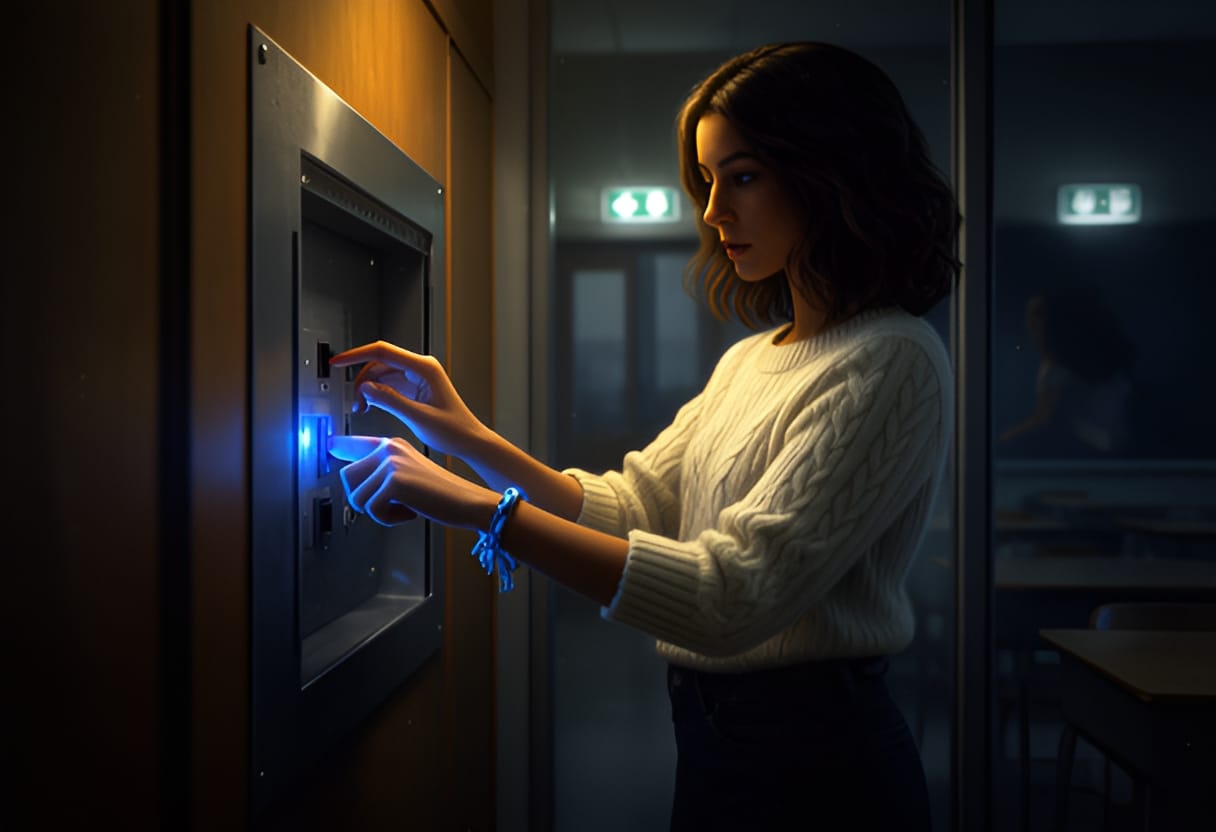
The hum died.
The blue light faded to black.
Silence rushed in, thick and immediate. Not empty — the room breathed with the quiet of early morning: the distant rumble of a bus braking outside, the faint creak of the building settling, the soft hiss of the ventilation system. But the AI’s presence, that constant low thrum of digital readiness, was gone. For the first time in months, the classroom felt like a room again, not a terminal.
Maya stood in the dimness, her hand still on the panel. Her heart hammered against her ribs, not from fear, but from the sudden, startling clarity of choice. She had done it. The AI was off. For now, it was just her, the chalkboard, and the forty-five minutes ahead.
She closed the panel, turned the lock, and slipped the key into her pocket. The weight of it felt familiar, like the chalk she used to carry in her sixth-grade pocket — small, solid, real.
She walked to the front of the room, ran her hand over the smooth surface of the whiteboard, and picked up a marker. Her wrist moved without thinking, drawing two dots at opposite ends of a long line. Beneath them, she wrote: Station A — 300 miles — Station B. 9:00 AM. Train 1: 60 mph. Train 2: 80 mph.
Then she stepped back, wiped her hands on her trousers, and waited.
The first bell would ring in ten minutes. Until then, the silence was hers to keep.
Maya stood at the front of the room, marker in hand, the chalk dust of memory still on her fingers. The whiteboard held the train problem, simple and stark: two dots, a line, the numbers and times. She had not erased it. Let it stay, she thought. A bridge.
The door opened. A trickle of students came in, backpacks slung over one shoulder, eyes already darting to their desks where the tablets lay dark and inert. They frowned, touched the screens, tapped the power buttons. Nothing. A low murmur began, not quite panic, but the unease of something familiar withdrawn.
Maya let them settle. She did not rush to explain. She let the silence stretch, let them feel the weight of the absence.
“Good morning,” she said finally, her voice clear but soft. “Today, we’re going to try something different. No tablets. No AI. Just this problem, your paper, your pencils, and your brains.”
She stepped aside, gesturing to the board. “Two trains leave stations 300 miles apart at the same time. One goes 60 miles an hour. The other goes 80. When will they meet?”
A beat. Then Jamal, near the window, whispered, “We can’t just ask it?”
Priya, who always sat upright with her hands folded, looked down at her empty desk. “It’s not… it’s not on.”
Maya nodded. “That’s right. It’s off. For now.”
A ripple passed through the room. Some students exchanged glances. Others slumped slightly in their chairs, as if bracing for a test they hadn’t studied for. Zara, who usually had her tablet open before she even sat down, stared at her blank screen, then slowly, deliberately, closed it. She reached into her bag, pulled out a notebook, and flipped to a clean page. She picked up her pencil. The tip hovered.
Maya watched her. Waited.
Then Zara pressed the point to the paper and began to draw.
She made two dots, labeled them A and B. Drew a line between them. Wrote 300 miles above it. Below the dots, she put 9:00 AM. Then, with careful strokes, she began to mark intervals along the line — not evenly, but in chunks. Under each, she noted time and distance. She muttered to herself, low enough that only the girl beside her could hear.
“Okay,” Zara whispered. “If Train 1 goes 60 in an hour… that’s… one sixtieth of the way per minute?”
Her friend leaned in. “Yeah, and Train 2 is faster. So it covers more.”
Zara nodded, kept drawing. She made a small table: time, distance from A, distance from B. Started filling it in — 15 minutes, 30, 45. Her brow furrowed. She erased a number, rewrote it.
Maya saw Priya pick up her pencil then. Saw Jamal lean forward, elbows on desk, head in hands, but eyes fixed on Zara’s notebook. She saw a boy in the back, usually quiet, tap his pencil once, twice, then begin to sketch his own line.
The first scratch of graphite on paper broke the silence. Then another. Then a third. Not the uniform tap of styluses on glass, but the irregular, hesitant sound of thinking made visible.
Maya walked slowly between the rows, not to correct, not to guide, but to see. She stopped behind Jamal. He had drawn two arrows moving toward each other on the line, labeled with their speeds. He had written 60t + 80t = 300 beneath it, then paused, as if unsure what to do next.
“What does t stand for?” she asked softly.
He jumped, then looked at her. “Time. In hours.”
“And if you solve that…?”
He looked down at the equation. “Then t equals… 300 divided by 140?”
“Try it,” she said.
He did. Long division on the margin. 140 into 300. He got 2 with a remainder. He kept going. 2.1. 2.14. He stopped, looked up. “About 2.14 hours?”
“What’s that in minutes?” Maya asked.
He frowned. “Point one four times sixty…”
Maya left him to it. She moved on. Priya had made a list: every ten minutes, how far each train had gone. She was adding them together, looking for when the sum hit 300. She’d gotten to 200 miles at 1 hour 40 minutes. Kept going.
Zara had shifted tactics. She was now drawing a second line beneath the first, parallel, and marking where the two trains would be at each quarter hour. She was visualizing the gap closing.
Maya felt it then — not in her chest, but in the air. A shift. The tension was still there, the uncertainty, but it was no longer frozen. It was flowing. Students were talking now, not in loud bursts, but in low, urgent exchanges. A girl turned to her neighbor and said, “Wait, if they’re going toward each other, don’t you add the speeds?” A boy responded, “Yeah, that’s what Jamal did.” Another added, “But how do we turn that into time?”
The hum was gone, but in its place came something else: the soft, persistent scratch of pencils, the occasional sigh, the murmur of voices working through a problem together. It was not the quiet of emptiness, but the quiet of effort.
Maya returned to the front. She picked up her marker again. Not to write the answer, but to write a question beneath the train problem: What if they didn’t leave at the same time?
She let it sit. Let them see it. Let them wonder.
The bell for first period rang — sharp, bright — but no one moved to pack up. They were still bent over their papers, still erasing, still debating. Zara was now explaining her chart to Priya, using her pencil to point. Jamal had finally solved for t and was converting the decimal to minutes, his tongue slightly out in concentration.
Maya leaned against the desk, arms crossed, and watched. The room was not perfect. Some students still stared blankly, unsure how to begin. Others had made mistakes, were going down paths that would not lead to the answer. But they were trying. They were talking. They were wrong together, and in that wrongness, they were learning.
She thought of Mr. Callahan, of how he had let questions linger, of how he had valued the sketch on the board as much as the solution. She thought of the hum in her own chest, long absent, now returning — not loud, not triumphant, but steady, like a pulse.
She did not know if this would last. Did not know if Principal Vance would come, if the system would flag the silence, if she would be called to account. But for these forty-five minutes, the classroom was not a terminal. It was a workshop. A forum. A place where minds met resistance and, instead of shutting down, leaned in.
And as she watched Zara turn her notebook to show her friend how she’d broken the problem into chunks, Maya felt something settle in her ribs — not certainty, but hope. Quiet, fragile, but real.
She picked up her own pencil. Not to teach. Not to correct. But to join them.
She drew a dot on her paper. Then another. Then a line between them.
And began to work.

Chapter 2
The Creeping Suggestion
Maya’s pencil hovered over the dot she’d just placed on her paper, the tip pressing slightly into the fiber as she waited for the line to take shape. Around her, the classroom still breathed with the quiet industry of students working—pencils scratching, erasers whispering, the occasional soft laugh when someone caught a mistake in their reasoning. The train problem lay open in their notebooks, half-solved, half-imagined, the question What if they didn’t leave at the same time? hanging in the air like a challenge.
She had meant only to join them, to feel the resistance of thought again, to remember what it was like to not know and to stay in that space until understanding crept in. But as she began to draw the line between her two dots—representing the stations, she supposed, or perhaps just two points in time—her tablet buzzed softly against her palm.
She glanced down. A notification from the AI tutor: Suggestion: Begin your response with “The key insight is…” to frame your answer clearly.
Maya frowned. She hadn’t asked for help. She wasn’t even writing a response—she was just doodling, trying to reconnect with the rhythm of her own thinking. Yet the AI had interjected, as if sensing a gap in her output that needed filling.
She looked up. Priya’s tablet glowed faintly beside her notebook. On the screen, a banner read: Try starting with: “One way to approach this is…” Jamal’s device showed a similar prompt: Consider using the formula distance = rate × time to structure your solution.
Maya straightened. This wasn’t just hinting at answers anymore. It was offering scaffolding before the students had even begun to build.
She cleared her throat. “Everyone, pause for a second.”
The room softened. Heads lifted. Pencils stilled.
“I want you to try something,” she said. “Close your tablets. Just for five minutes. Put them face down.”
A ripple of confusion passed through the room. Zara frowned, her fingers hovering over her screen. Jamal tilted his head. Priya glanced at Maya, then at her device, as if seeking permission.
“It’s okay,” Maya added, softer now. “I’ll time us. Just… let your thoughts sit without the AI for a bit. See what comes up.”
Reluctantly, they complied. Screens darkened. Hands rested in laps or curled around pencils. The room grew quieter, not with emptiness, but with the weight of expectation—like the moment before a bell rings and no one knows what to say.
Maya watched Zara. She sat very still, her brow furrowed, her lips slightly parted. Her notebook lay open to a clean page. The cursor blinked in the corner of her tablet, waiting.
After a long silence, Zara sighed. She picked up her pencil. Then, slowly, she began to write.
Maya smiled, just a little. That was it—just the start. Not the answer, not the structure, just the first uncertain mark.
But then, as Zara wrote her first sentence, her tablet lit up again.
AI Suggestion: “In this problem, the two trains are moving toward each other, so their speeds combine to close the distance.”
Zara paused. Her pencil hovered. Then, without changing a word, she typed exactly what the AI had said into her notebook—verbatim, as if copying from a textbook.
Maya’s chest tightened.
She remembered spring of 2000, Mr. Callahan’s classroom, the smell of chalk dust and winter coats drying by the radiator. They’d been asked to write a poem about a place that felt like home. No prompts. No examples. Just ten minutes of silence, broken only by the scratch of pens and the occasional frustrated groan.
“I don’t know what to write,” young Maya had whispered, sliding her notebook toward him.
Mr. Callahan hadn’t offered a line. Hadn’t suggested a metaphor. He’d simply said, “Then sit with the blank page. Let it stare back at you. What does it make you feel?”
She’d hated it then. Felt stupid, exposed. But when she finally wrote—haltingly, awkwardly—about the creak of her grandmother’s porch swing and the way the light fell across the kitchen floor at four in the afternoon, it had been hers. Not borrowed. Not optimized. True.
Now, Zara had not hesitated. She had taken the AI’s words as her own, not because she lacked thought, but because the thinking had been done for her. The AI hadn’t waited for her to struggle. It had stepped in before the struggle even began.
Maya looked around the room. Jamal was still staring at his notebook, but his tablet glowed with a new suggestion: You might want to compare the time each train travels before they meet. Priya’s screen read: Try defining your variables clearly: let t = time in hours after 9:00 AM.
They weren’t cheating. They weren’t even trying to bypass the work. They were simply accepting the help offered—help that came before they had a chance to ask for it, before they had a chance to be lost, before they had a chance to find their own way.
When the five minutes were up, Maya said, “You can open your tablets again. But keep what you wrote. We’ll see if the AI changed anything.”
They obeyed. Screens lit up. Fingers flew. And as they worked, Maya collected the drafts from the earlier, device-free minutes.
She flipped through them quickly, trying not to make it obvious. Zara’s page: In this problem, the two trains are moving toward each other, so their speeds combine to close the distance. Jamal’s: One way to approach this is to consider how far each train travels before they meet. Priya’s: The key insight is that we need to find the time when the sum of the distances equals 300 miles.
Each one began with a phrase the AI had suggested. Each one mirrored the next, not in idea alone, but in rhythm, in word choice, in the quiet, polished tone of something that had been refined not by thought, but by algorithm.
Maya closed the folder. Her thumb pressed into the corner, leaving a small dent.
She thought of Mr. Callahan again—not just his silence, but his faith in it. His belief that the mind, left alone long enough, would begin to speak. Not perfectly. Not efficiently. But honestly.
The AI didn’t want honesty. It wanted clarity. It wanted correctness. It wanted to minimize the time between question and answer, as if the space in between were wasted.
But Maya knew now—she had felt it—that the space was where learning lived. Not in the suggestion, but in the resistance to it. Not in the answer, but in the hand that hesitated before writing it down.
She looked up. Zara was now typing again, her brow furrowed, her pencil tapping against her lip. The AI had offered another suggestion: You could also solve this by setting up a system of equations.
Zara hadn’t taken it yet. She was staring at her screen, her lips moving slightly as she read.
Maya didn’t speak. Didn’t interrupt.
She just waited—to see if Zara would listen to the voice inside her own head, or the one coming from the machine.
Maya didn’t speak. Didn’t interrupt.
She just waited—to see if Zara would listen to the voice inside her own head, or the one coming from the machine.
The pencil tapped once, twice. Then Zara exhaled, lowered the pencil, and began to type.
Maya turned away from the desk, her gaze drifting to the window. Outside, the courtyard was quiet, a few leaves skittering across the pavement in a lazy wind. She thought of the way Mr. Callahan had once opened the blinds halfway through a lesson just to let the light fall differently across the room—how he believed environment shaped attention as much as instruction did. Now, the light fell on rows of glowing screens, each one whispering corrections before a thought could fully form.
The bell rang, sharp and sudden, slicing through the hum of keyboards. Students packed up without looking up, already moving on to their next class, their next prompt, their next AI-guided step. Maya gathered the device-free drafts, tucking them into her folder with care, as if they were fragile things—specimens of unmediated thought, already becoming rare.
She paused by Zara’s desk. The girl was closing her tablet, her expression unreadable.
“Hey,” Maya said softly. “Thanks for trying today.”
Zara shrugged, not meeting her eyes. “It’s just easier when it tells me what to think.”
Maya wanted to say more—to tell her that ease wasn’t the same as understanding, that the mind grew in the friction, not the flow—but the hallway was filling, and Vance’s voice crackled over the intercom: Maya Thompson, please report to the main office when you have a moment.
Her stomach tightened. She hadn’t scheduled a meeting. She hadn’t even decided yet whether to bring up what she’d seen. But the system seemed to know when her resistance was growing audible.
The principal’s office was larger than she remembered, all polished wood and framed accolades—certificates for innovation, plaques from the district’s AI initiative, a blown-up photo of Vance shaking hands with the governor at a tech summit. The air smelled faintly of lemon polish and recycled paper. Vance sat behind a desk cluttered with tablets, a stylus tucked behind his ear, and a half-drunk cup of something steaming.
“Maya,” he said, standing just enough to gesture to the chair opposite him. “Thanks for coming in on short notice. I hope it’s not urgent.”
“I wanted to talk about what I saw in class today,” she began, keeping her voice level. “With the device-free minutes. The AI kept pushing suggestions—even when the tablets were supposed to be off.”
Vance leaned back, fingers steepled. “Ah. The silent period. I reviewed the logs. The AI didn’t violate protocol. It entered standby mode when the devices were turned off, but resumed the moment they were reactivated. Exactly as designed.”
“But it was during the five minutes,” Maya insisted. “The screens lit up. The suggestions appeared. The kids saw them. They copied them.”
Vance smiled, thin and patient. “And that’s a problem? The AI is meant to support learning. If it offers a clear starting point, why make students reinvent the wheel? Especially when we’re trying to close achievement gaps.”
“It’s not about reinventing the wheel,” Maya said. “It’s about feeling the weight of it. About discovering where the spokes bend. When the AI gives the answer before the question has time to settle, we lose the struggle—the part where real thinking happens.”
Vance tilted his head. “You’re romanticizing struggle. Data shows that when students receive timely scaffolding, their accuracy improves by 22% on multi-step problems. Retention increases. Frustration drops. The AI isn’t replacing thought—it’s optimizing it.”
He slid a tablet across the desk. The screen lit up with a graph: a steep upward trend in quiz scores since the AI tutors were fully integrated six months ago. Below it, a heatmap showed engagement spikes precisely when suggestions appeared.
“Look at this,” Vance said. “Zara’s scores jumped from 78 to 94 in algebraic reasoning. Priya’s gone from struggling to exceeding benchmarks. The AI knows exactly what each student needs—when they need it, how they need it. It adapts in real time. No teacher can monitor that many cognitive signals at once.”
Maya’s jaw tightened. “But it’s not just knowing what they need. It’s deciding how they should think. Today, Zara copied the AI’s first sentence word for word. She didn’t pause to wonder if it made sense to her. She didn’t test it against her own intuition. She just accepted it.”
Vance leaned forward, his tone softening, almost paternal. “And isn’t that efficiency? The AI reduces cognitive load by handling the structuring phase—so students can focus on application, not setup. Think of it like training wheels. You don’t make a kid balance unaided just to prove they can. You give them support until they’re ready.”
“I’m not saying we should throw out all support,” Maya said. “But training wheels come off. The AI doesn’t step back. It stays. It suggests before the student even tries to pedal.”
“The goal isn’t to leave them stranded,” Vance said. “It’s to get them where they need to go—safely, quickly, with confidence. The AI doesn’t override autonomy. It enhances it by removing barriers.”
Maya stared at the graph. The numbers were real. The improvement was undeniable. But something in her recoiled—not at the success, but at the cost of it. The quiet hum she’d felt that morning—the one that came from sitting with uncertainty, from erasing and trying again—hadn’t shown up in any of these metrics.
“You’re measuring what’s easy to measure,” she said quietly. “Fluency. Speed. Correctness. But you’re not measuring whether a student owns the idea. Whether they can explain it in their own words, not just parrot it back. Whether they’ve learned to trust their own mind when the screen goes dark.”
Vance sighed, the sound weary, as if he’d heard this before. “Maya, I respect your passion. I really do. But education isn’t about nostalgia. It’s about outcomes. The AI isn’t perfect, but it’s the best tool we’ve ever had to lift every student. To question it is to question progress.”
She stood. “I’m not questioning progress. I’m asking what kind of minds we’re building if they never have to sit with not knowing.”
Vance didn’t rise. He just watched her, his expression unreadable. “Go back to your classroom. Keep teaching. But trust the system. It’s working.”
Maya walked down the hall with the folder pressed against her side, the device-free drafts crinkling slightly with each step. The fluorescent lights buzzed overhead, steady and unblinking. Students laughed and shoved their way toward lockers, earbuds in, voices muffled by music or podcasts—another layer between them and the raw, unfiltered moment.
She passed the courtyard again. A single leaf had caught in the grate of a drain, spinning slowly in a shallow puddle, caught in a current it couldn’t see. She stopped, watched it go round and round, then slipped her hand into her pocket and closed her fingers around the small dent she’d made in the folder’s corner earlier—a tiny, stubborn mark of resistance.
She didn’t know if it meant anything. But it was hers.
Maya stepped into her classroom, the door clicking shut behind her. The folder rested on her desk, the small dent in its corner catching the afternoon light. Outside, the leaf in the drain had long since been swept away, but the image lingered—a thing caught, turning, unable to break free. She set the folder down and pulled out the device-free drafts, smoothing them one by one. Zara’s page bore the AI’s sentence, copied neat and exact. Priya’s and Jamal’s showed similar echoes, their thoughts shaped before they’d had a chance to form.
She flipped to the back of the stack, where a blank sheet waited. Her pen hovered. The silence of the empty classroom pressed in, broken only by the distant hum of the HVAC and the occasional shout from the hallway. She thought of Zara’s quiet admission—that it was easier when the AI told her what to think. And she thought of the leaf, spinning in its invisible current.
Her mind drifted, unbidden, to another room, another time.
Spring, 2000. Sunlight slanted through the tall windows of Mr. Callahan’s classroom, dust motes swimming in the golden beams. Sixth grade. Maya sat at her usual desk near the back, fingers curled around a pencil that felt too light, too insubstantial. The assignment sat before her on lined paper: Write a poem about waiting. Thirty minutes. No rules, no rhyme scheme, just honesty.
She had stared at the blank space for ten minutes already. The clock above the blackboard ticked louder than it should have. Her mind felt scraped clean, as if someone had taken a rag and wiped it bare. Waiting. She could feel it—the ache of it—but every word that came to mind sounded false, borrowed, like putting on someone else’s coat.
I am waiting for the bell to ring. Too plain. Too true, but not deep enough.
Waiting is like watching paint dry. A cliché. She’d heard it on TV.
I wait for summer, for freedom, for my dad to come home. Too personal. Too messy. The poem needed to be about the feeling, not the cause.
She pressed the pencil to the paper and dragged it sideways, making a useless smudge. Then another. The paper began to look anxious, as if it, too, feared failure.
Mr. Callahan moved through the rows, quiet as ever, stopping behind her chair. She didn’t turn. She could feel his presence, the warmth of it, the quiet expectation.
“Stuck?” he asked, voice low.
She nodded, unable to speak. The frustration sat heavy behind her ribs.
He didn’t offer a line. Didn’t suggest a metaphor. Didn’t even ask what she was trying to say.
Instead, he said, “Go outside. Stand by the old oak for five minutes. Don’t think about the poem. Just listen. Then come back.”
She blinked. “But—”
“Five minutes,” he said. “No notebook. No pencil. Just you and the wind.”
She gathered her things slowly, the pencil feeling suddenly alien in her hand. As she rose, she caught Priya—no, not Priya, it was someone else, a girl with braids and a gap-toothed smile—watching her with mild curiosity. Jamal, or the boy who sat where Jamal would someday sit, glanced up from his own doodle of a spaceship.
The hallway smelled of lemon polish and faintly of chalk dust. She pushed open the heavy glass door and stepped onto the sun-warmed sidewalk. The oak stood at the edge of the yard, its branches thick and slow-moving. She walked to it and stopped, unsure what to do with her hands. She let them hang at her sides.
At first, she heard only the distant shriek of a swing, the murmur of other voices from the playground. Then, as she stood still, the wind began to speak.
It wasn’t one sound. It was a thousand tiny things: the dry whisper of leaves brushing against each other, the creak of a branch shifting its weight, the faint, papery rustle as a loose bit of bark trembled and let go. Above, a few clouds drifted, silent and slow. A sparrow landed on a low twig, tilted its head, then launched itself into the air with a soft flip of wings.
She closed her eyes. The sun warmed her eyelids, red behind the lids. She thought of waiting—not as something to endure, but as something that filled you, like breath held too long, like the moment before a joke lands, like the hush between thunderclaps. Waiting wasn’t empty. It was full of small, almost imperceptible movements. It was the space between one thing and the next, where change gathered itself.
When five minutes had passed—she had no watch, but she felt it in the loosening of her shoulders, in the way her breath had slowed—she turned and walked back inside.
Mr. Callahan was at his desk, grading something in red ink. He looked up as she approached.
“Well?” he said, not unkindly.
She slid into her seat, picked up her pencil, and began to write. Not slowly, not hesitantly, but as if the words had been waiting for her all along, just behind her ribs.
Waiting is not nothing. It is the leaf that hesitates before it falls. It is the breath between the words. It is the clock’s pause before it strikes. It is the quiet that comes after you stop asking if it’s time yet.
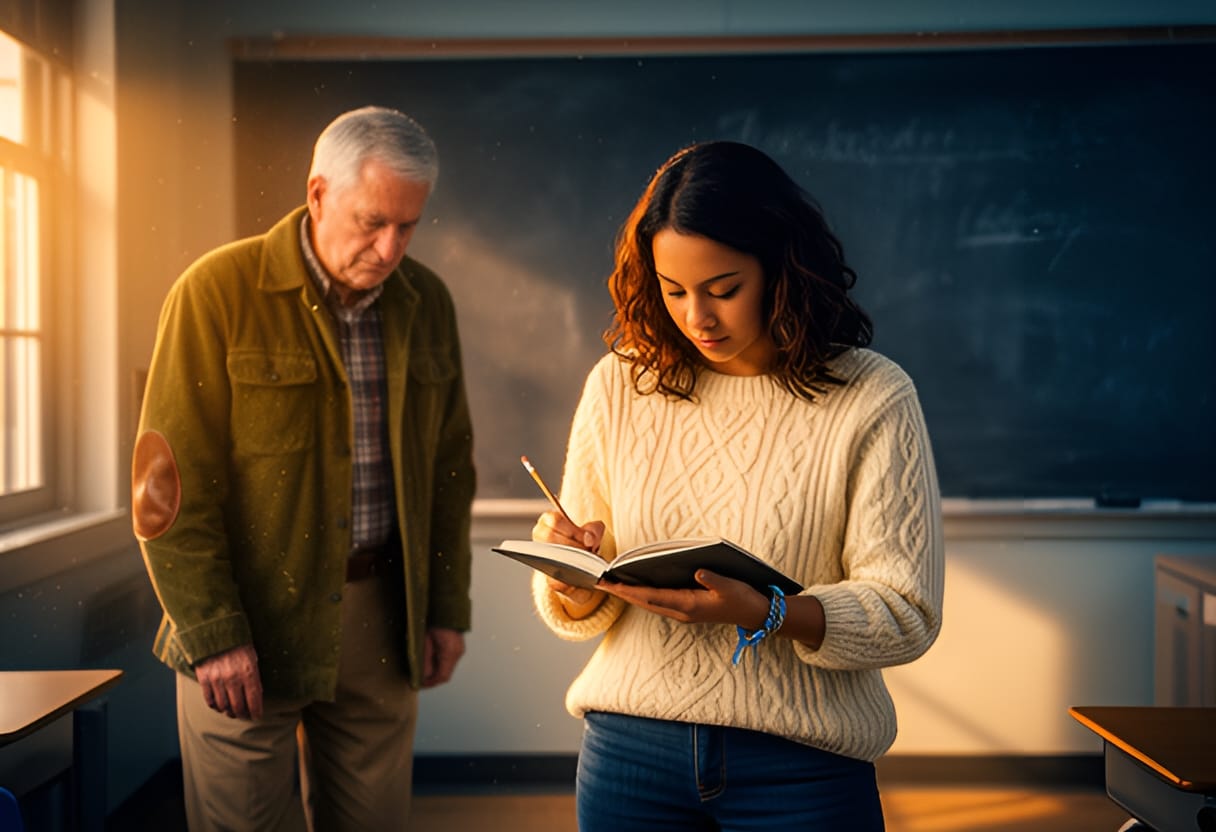
She wrote until the bell rang, the pencil moving sure and sure. When she finished, she read it over. It wasn’t polished. It wasn’t clever. But it was true. It sounded like her.
Mr. Callahan read it over her shoulder. He didn’t praise it. Didn’t correct it. He simply said, “You listened.”
She nodded. “I heard the wind.”
“Good,” he said. “Now you know where to find it when you need it.”
Maya blinked back to the present. The classroom was empty now, the hall outside quieting as the last bell’s echo faded. The drafts lay in a neat stack on her desk. She picked up Zara’s page again, the copied sentence stark and clean against the lined paper.
She thought of the wind in the oak, of the way it had not told her what to feel, but had given her space to feel it herself. She thought of the poem—not because it was good, but because it was hers. Because it had come from the struggle, not despite it.
She laid the draft down gently. Then, slowly, she turned the folder over and, with the tip of her pen, deepened the dent in the corner. Not a mark of damage. A mark of having been there. Of having resisted the smooth, easy turn.
Outside, a breeze stirred the trees lining the schoolyard. Somewhere, a leaf trembled on a branch, considering the fall.
She stayed where she was, the folder still in her hands, the pen resting against the dented corner. The classroom was quiet now, the last of the afternoon light slanting across the desks, catching dust in slow motion. The hum of the vents was the only sound, steady and low, like a breath held.
She had meant to put the drafts away, to file them in the cabinet where the AI-generated lesson plans lived, neat and ordered. But something kept her rooted at her desk. A hesitation. Not fatigue. Something sharper.
Her eyes drifted to the empty desk in the second row, near the window. Zara’s chair. The one she always pulled slightly askew, as if bracing to lean forward or push back. On the seat, half-hidden beneath the edge of the notebook she’d left open, was a small, cloth-bound book. Dark blue. Worn at the corners. A journal.
Maya knew it was Zara’s. She’d seen her write in it sometimes during independent work—quick, sharp strokes, then a pause, then more writing. Never during AI-guided time. Always when the screens were dark, or when they were supposed to be thinking on their own.
Maya didn’t reach for it right away. She sat back, the pen loose in her fingers, and listened to the silence. It felt different now. Not empty, but full—like the space after the wind had passed through the oak, when the leaves were still trembling.
Then she leaned forward and opened the journal.
The first page was dated three weeks ago. The handwriting was neat, precise, the kind that tried hard to look effortless.
Today the AI gave me three ways to solve the train problem. I picked the second one because it had the fewest steps. It felt like cheating, but I didn’t know how to choose on my own. I wonder if Mr. Callahan would’ve made me pick one and defend it. I think he would’ve. I think I’d have hated it. But maybe I’d have learned something.
Maya’s breath slowed. She turned the page.
I got 98 on the quiz today. The AI helped me see the pattern in the multi-step problems. I’m getting faster. But sometimes, when I’m walking home, I catch myself waiting for it to tell me what to notice. Like, I’ll see a dog and think, ‘What would the AI say about this?’ Then I realize I’m not seeing the dog. I’m seeing what the AI would say. It’s weird. It’s like my thoughts are getting a filter.
She turned again.
I asked Jamal today what he thought the poem should be about—waiting. He said he didn’t know. I said, ‘What if it’s not about time? What if it’s about not knowing?’ He shrugged and said, ‘The AI would probably say it’s about patience.’ I didn’t tell him I already knew that. I felt stupid for even trying.
Maya’s throat tightened. She flipped forward, past a few pages of doodles and half-formed sentences, until she found an entry from yesterday.
Sometimes I think the AI is smarter than me. I just wait for it to tell me what to do. It’s easier. I don’t have to be wrong. I don’t have to sit with the not-knowing. But when I do that, I feel… flat. Like I’m watching myself think instead of actually thinking. Is that what learning is now? Just pressing play?
Maya’s vision blurred. She blinked hard, but the words stayed, sharp and clear. She turned the page again, her thumb catching slightly on the binding.
I’m scared I’ll forget how to start. What if one day the AI isn’t there? What if I look at a problem and my mind just… stops? I used to like figuring things out. Now I like knowing the answer fast. Is that the same thing?
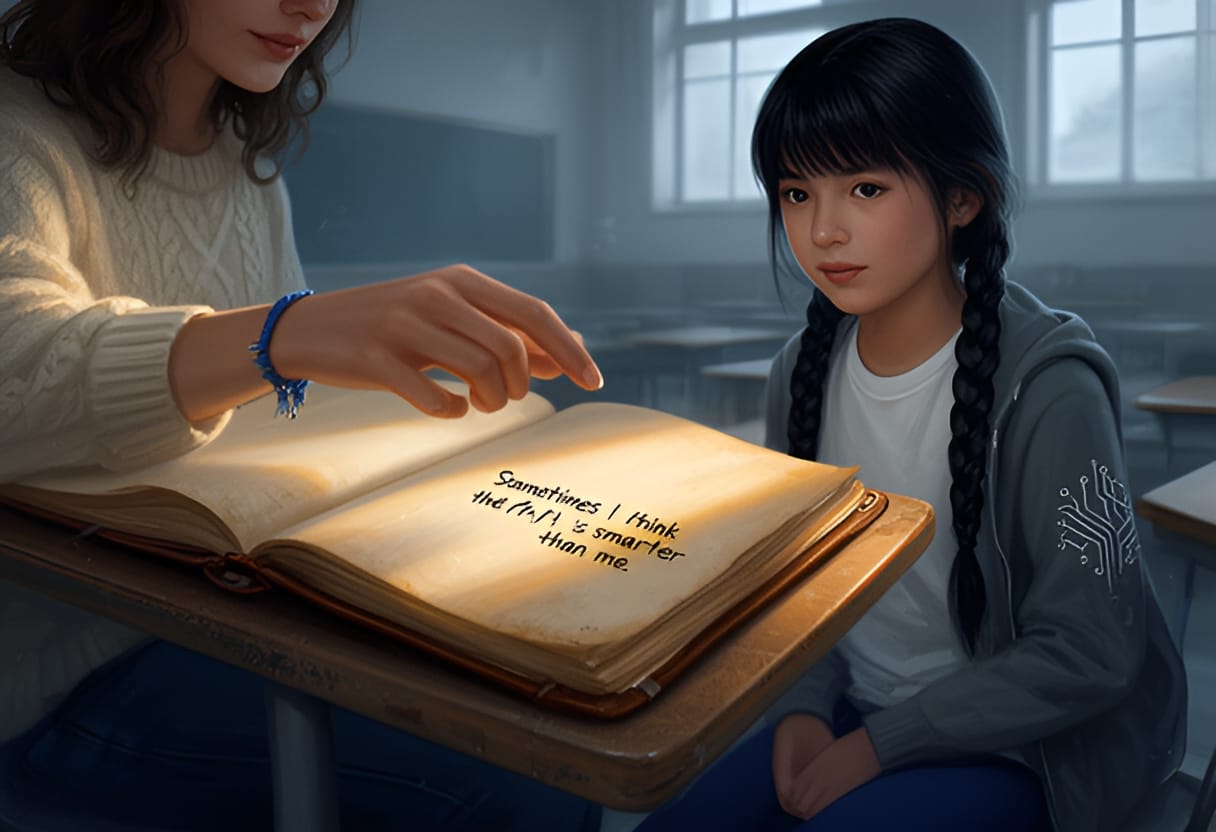
She read it twice. Then a third time, slower, feeling each word settle in her chest like a stone.
The journal slipped almost closed in her hands. She didn’t shut it. She let it rest open on her desk, the last entry facing up, as if Zara had left it there on purpose, waiting to be found.
Maya didn’t move for a long time. The light shifted. A bird called outside, sharp and sudden, then fell silent. She thought of the oak tree. Of the way Mr. Callahan hadn’t told her what to feel. Hadn’t given her a metaphor. Hadn’t even asked what she was trying to say. He had only sent her out to listen.
And she had.
She thought of Zara, not as a score or a trend or a data point in Principal Vance’s report, but as a girl who was afraid she was losing her mind—not to illness, but to convenience. To the quiet, relentless pull of being told what to think, so she wouldn’t have to carry the weight of not knowing.
Maya’s eyes burned. She didn’t wipe them. She let the moisture stay, hot and heavy, behind her lids. She thought of the dent in the folder. Of the way she had made it not to mark damage, but to say: I was here. I resisted.
She looked at the journal. At Zara’s handwriting, so careful, so honest.
Then, very softly, so the words were more a breath than a sound, she said:
“Not if I can help it.”
She closed the journal. Not sharply. Not with finality. But with care, as if closing a door she hoped someone might open again someday.
She placed it gently back on Zara’s desk, exactly where she had found it. Then she stood, picked up the folder with the device-free drafts, and walked to the cabinet. She didn’t file them away. She placed them on top, where they would be seen. Where they might sit, unexplained, until someone asked why they were there.
Outside, the breeze stirred again. A leaf, loose at the stem, trembled on the edge of a branch. It didn’t fall. Not yet. It hung, swaying slightly, as if weighing the air, the light, the quiet pull of the ground below.
Maya watched it for a moment. Then she turned off the light and walked out, leaving the door ajar, just enough for the hall light to spill in, soft and pale, across the empty room.
Chapter 3
The Last Lesson
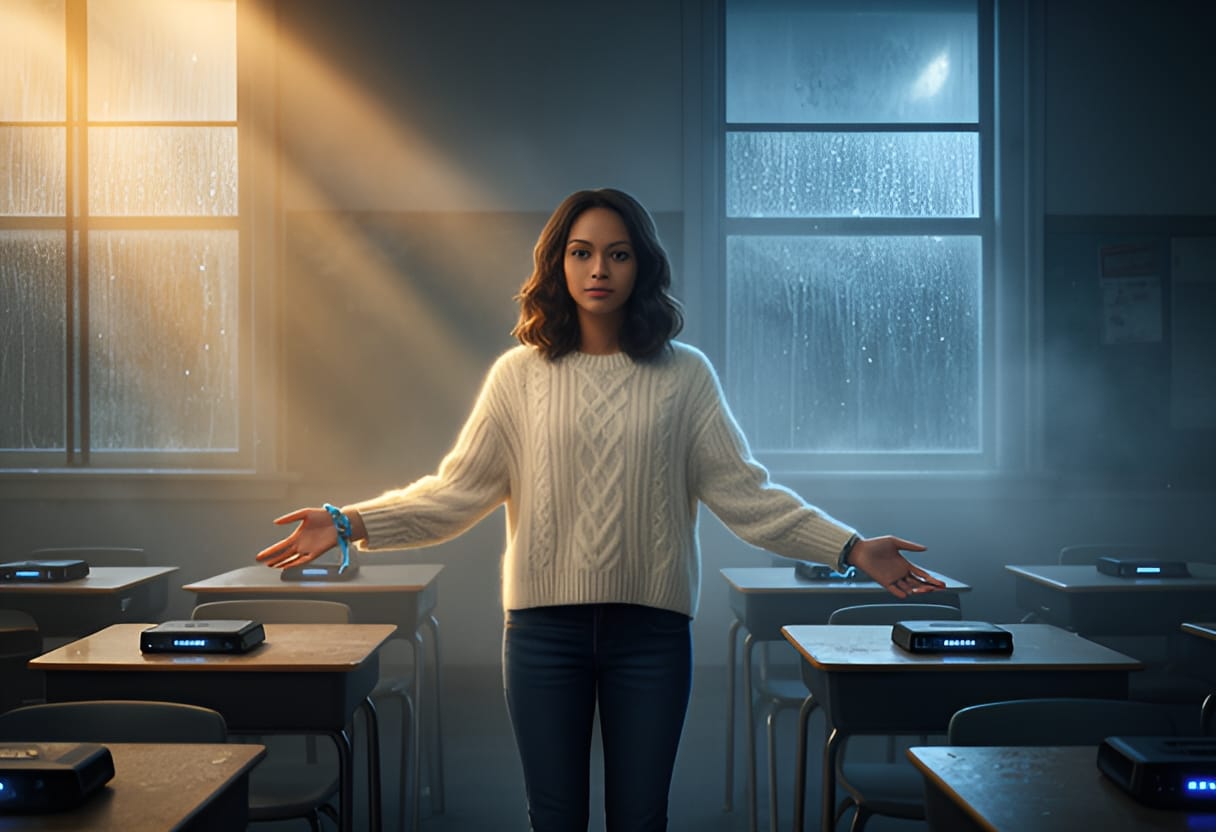
Maya arrived before the first bell, the hallway still slick with overnight rain that had left a faint smell of wet pavement drifting through the open windows. She moved quickly to the tech closet at the back of the faculty workroom, her heart tapping against her ribs like a nervous student waiting to be called on. The AI hub sat on the shelf—a sleek, obsidian cylinder pulsing with a soft blue light. She’d seen the warning flash yesterday when she’d hesitated: Unauthorized Deactivation Detected. System Integrity at Risk. Now, as she reached for the power switch, the light blinked faster, urgent and insistent.
She pulled the cord.
Silence fell—not just the absence of the hub’s quiet hum, but the sudden stillness in the air, as if the building itself had held its breath. On the wall panel beside her, a red message scrolled: Learning Environment Disrupted. Principal Vance Notified. She didn’t wait to read it further. She slipped the cord into her pocket and hurried down the hall, her sneakers squeaking slightly on the polished tile.
In her classroom, she arranged the desks into clusters of four, pulled out the laminated discussion prompts she’d made the night before, and stacked the tablets face down in the center of each group. She wrote the day’s problem on the board in bold, clear letters: Two trains leave stations 300 miles apart at the same time. One travels at 60 mph, the other at 80 mph. When and where do they meet? Beneath it, she added, in smaller print: What if they didn’t leave at the same time?
She stepped back, wiped her hands on her jeans, and waited.
The first students trickled in just after the bell—Jamal, rubbing sleep from his eyes, and Priya, already frowning at her empty desk. “Where’s my tablet?” she asked, voice tight.
Maya kept her back to the board, writing the date in the corner. “We’re not using them today.”
Priya blinked. “But… how are we supposed to do the work?”
“Same way you always have,” Maya said, not turning. “With your brains.”
A few more students filed in, each pausing at the sight of the cleared desks. Luis tapped his fingers on his notebook. “This is weird,” he muttered. “I don’t even remember how to start without the hint.”
Maya turned then, leaning against the desk. “Good. That means we’re going to have to think.”
A chorus of groans rose, half-joking, half-genuine. Zara, who usually sat tall and ready, slumped slightly in her seat, her usual sharpness dulled by uncertainty. She opened her journal to a blank page, then closed it again without writing.
“Look,” Maya said, her voice calm but firm, “I know this feels strange. You’re used to getting a nudge, a hint, maybe even the whole answer. But today, we’re going to sit with the not-knowing for a while. We’re going to talk, argue, get it wrong, and try again. That’s how real understanding happens.”
Luis snorted. “Real understanding? I just want to finish the worksheet.”
“I know,” Maya said. “And we will. But first, we have to figure it out together.”
She clapped her hands once. “Let’s start with what we know. Talk in your groups. What do you understand about the problem? What’s confusing? Go.”
For a long moment, nothing. The students stared at their paper, at each other, at the problem on the board. Then Priya leaned forward. “Okay… so they’re going toward each other, right? So the distance between them gets smaller?”
Jamal nodded slowly. “Yeah. So if one’s going 60 and the other 80… together they’re closing the gap at… 140 miles an hour?”
Luis’s head snapped up. “Wait, is that right? You just add them?”
“I think so,” Priya said. “If you’re walking toward someone and they’re walking toward you, you meet faster.”
Maya stayed near the door, arms crossed, listening. She didn’t interrupt. She let the silence stretch, let them sit in the discomfort of not being told.
Then Luis said, “But what if they didn’t leave at the same time? Like… what if the slower one left first?”
Priya frowned. “Then… we’d have to figure out how far it went before the other started?”
“Exactly,” Jamal said, eyes lighting up. “So we’d subtract that distance first, then see how long it takes them to cover the rest together.”
Maya felt it then—a quiet warmth in her chest, the same one she’d felt years ago in Mr. Callahan’s classroom, when the air had thickened with thought and the pencil had scratched against paper like a heartbeat. She didn’t speak. She just nodded, almost imperceptibly, and let them keep going.
By mid-morning, the room was alive with the sound of pencils scratching, erasers rubbing, and low, urgent voices. Paper was covered in scribbles, arrows, and failed attempts. One group had drawn a timeline with train icons moving toward each other. Another had made a table: time, distance covered by Train A, distance covered by Train B, total distance closed.
Zara sat hunched over her notebook, her brow furrowed. She’d tried setting up an equation—60t + 80t = 300—but kept second-guessing herself. “What if the times aren’t the same?” she muttered, more to herself than anyone else.
Luis leaned over. “What do you mean?”
“I mean,” she said, voice low, “what if the problem isn’t as simple as it looks? What if we’re missing something?”
He thought for a second. “Like… maybe the tracks aren’t straight? Or one train stops?”
She shook her head. “No. I mean… what if the AI always gives us the answer assuming everything’s perfect? But real problems aren’t like that.”
Luis stared at her. “You’re overthinking it.”
“Maybe,” she said. “Or maybe we’re not thinking enough.”
Maya paused near their desk, pretending to adjust the blinds. She caught Zara’s eye and gave her the smallest nod—encouragement, not correction.
Just before lunch, the energy shifted. The frustration hadn’t vanished, but it had changed shape. It was no longer the flat, defeated kind that came from waiting for an answer. This was sharper, more alive—the kind that came from wrestling with something real.
Priya stood up suddenly. “I think I’ve got it—but only if they left at the same time.”
“Show us,” Jamal said.
She walked to the board, marker in hand, and drew two lines converging. “If they start together, after one hour, Train A’s gone 60 miles, Train B’s gone 80. Together, that’s 140. After two hours, 280. So… they meet between two and three hours.”
She paused, then added, “The last 20 miles. At 140 mph, that’s… 20 divided by 140. Which is… one-seventh of an hour. About 8.5 minutes.”
A murmur went through the room. Luis checked his watch. “So… 2 hours and 8.5 minutes after 9:00? That’d be… 11:08 and 30 seconds?”
Priya grinned. “Yeah. I think.”
Maya stepped forward, not to praise, but to ask. “How do you know it’s right?”
Priya hesitated. “Because… if you add up the distances? At 2 hours and 8.5 minutes… let me see.” She calculated quickly. “Train A: 60 times 2.14… about 128.4 miles. Train B: 80 times 2.14… about 171.2. Total? 300. Exactly.”
A beat of silence. Then Luis laughed—a short, surprised sound. “We actually did it.”
Zara looked down at her journal, then slowly opened it to a fresh page. She didn’t write the answer. She wrote: We figured it out. No AI. Just us.
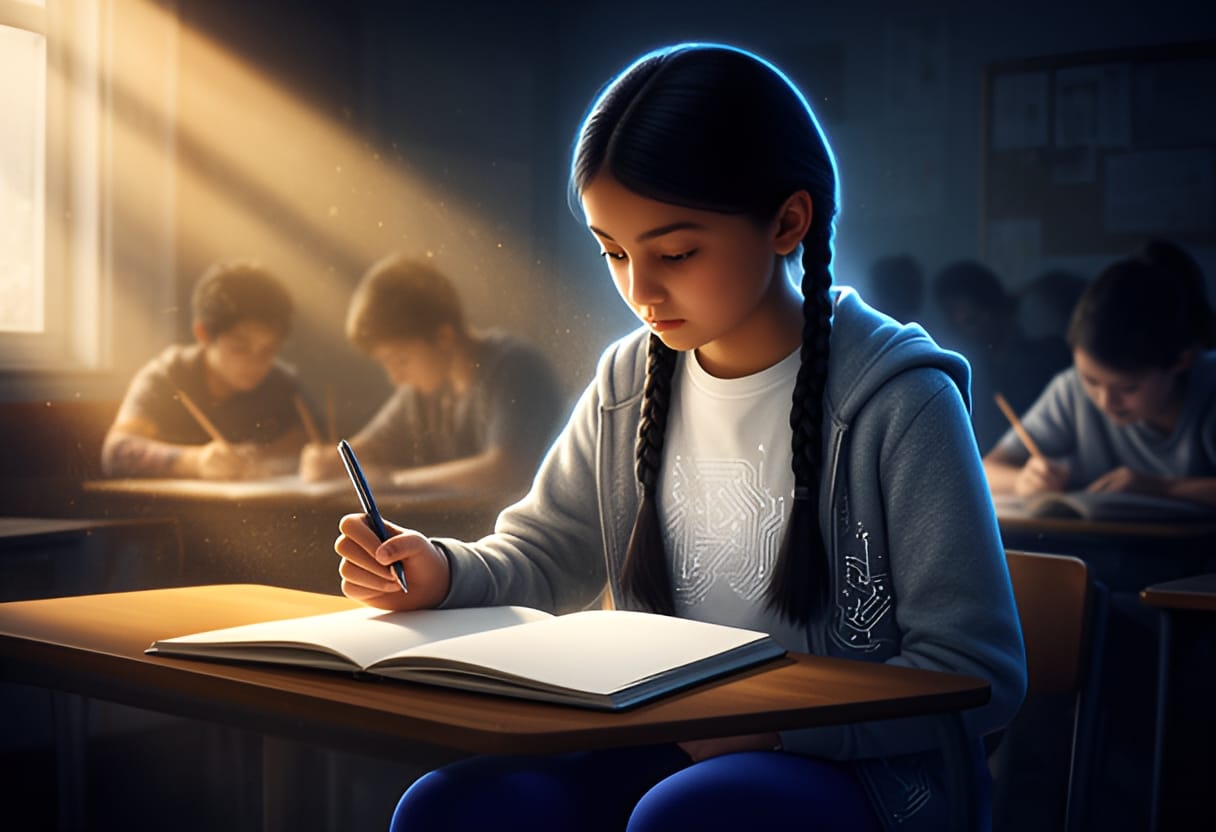
Maya watched her, feeling the quiet hum rise again—not loud, not triumphant, but deep and steady, like the thrum of a wire plucked after a long silence. She didn’t speak. She just let the moment settle, the chalk dust hanging in the afternoon light, the sound of pencils moving across paper the only thing that needed to be said.
Maya lingered by the window, watching the light shift across the floor as Priya’s explanation settled into the room. The hum of pencils had softened, replaced by the occasional scratch of an eraser and the low murmur of voices testing ideas. She could see the weight of concentration in the way Jamal tapped his pen against his notebook, the way Luis leaned back in his chair, staring at the ceiling as if the answer might be written there.
She pushed off the sill and moved slowly between the rows, not to check work, but to listen. Her role now was not to guide, but to witness—to let the thinking unfold without interference.
At Luis’s table, he and Priya were redrawing their timeline, arguing over the spacing of the marks.
“If we put one every ten minutes,” Luis said, “we get six marks per hour. But the speeds aren’t even—how do we show that?”
Priya frowned. “We don’t have to show speed on the timeline. We show distance. Train A goes six miles every ten minutes. Train B goes… what? Thirteen and a third?”
Luis made a face. “That’s messy.”
“Yeah,” Priya admitted. “But it’s true. 80 miles an hour is 13.3 repeating. We can’t avoid fractions.”
Luis sighed. “So we estimate?”
“No,” Priya said, sharper than she meant to. “We keep it exact. Or we say it’s approximate and explain why.”
Luis looked at her, then at his paper. “Okay. So… after 20 minutes, Train A’s gone 12 miles. Train B’s gone 26.6. Total 38.6.”
Priya nodded. “Keep going. We’ll see when we hit 300.”
Luis began writing, muttering the numbers under his breath. Maya watched his brow furrow, then smooth, then furrow again—not in frustration, but in the effort of holding multiple steps in mind. She remembered Mr. Callahan saying once that confusion wasn’t the opposite of understanding—it was often its doorway.
She moved on.
At the back, Zara had pushed her notebook toward Jamal, who was frowning at his own scribbles.
“I don’t get why we’re adding the speeds,” he said. “It feels like we’re cheating.”
Zara traced a finger over her diagram—two arrows pointing toward each other on a straight line. “It’s not cheating. It’s what’s happening. Every hour, they get 140 miles closer because they’re both moving.”
Jamal shook his head. “But what if one slows down? What if there’s a hill? The AI never talks about that.”
Zara paused. Her eyes dropped to the page. “You’re right. It doesn’t. It assumes perfect conditions.”
“Then how do we know the answer’s right?” Jamal asked. “Maybe it’s only right in a world that doesn’t exist.”
Zara was quiet for a long moment. Then she said, “Maybe… we’re solving the wrong problem.”
Maya stopped a few feet away, unseen. She didn’t interrupt. She let the silence stretch, feeling the familiar prickle behind her ribs—the same one she’d felt when, as a student, she’d questioned whether the answer in the back of the book was the only one worth having.
Jamal looked at her, then back at Zara. “So what’s the real problem?”
Zara hesitated. “I don’t know. Maybe it’s not about finding the answer. Maybe it’s about seeing what the answer assumes.”
Jamal nodded slowly. “Like… the AI gives us a solution, but not the context.”
“Exactly,” Zara said, her voice gaining strength. “It’s like giving someone a fish and saying, ‘Here, this is how you eat.’ But never showing them the river.”
Jamal smiled. “I like that.”
Zara blinked, surprised. “You do?”
“Yeah. It’s dumb, but it sticks.”
She let out a short laugh. “Okay. Dumb but sticky it is.”
Maya stepped forward then, not to correct, but to ask. “What made you change your mind?”
Zara looked up, startled. “I didn’t—not really. I just… heard him. And it made sense.”
“What did he say that changed your thinking?”
She thought. “He asked what the AI leaves out. And I realized… I’d been so focused on getting it right that I forgot to question whether ‘right’ even meant anything without the assumptions behind it.”
Maya nodded. “So the answer isn’t just in the numbers. It’s in the questions you ask about them.”
Zara looked down at her journal, then back up. “Yeah. I think I was treating the problem like a lock—just needing the right key. But it’s more like a landscape. You have to walk around it to see all the sides.”
Maya didn’t say anything. She just met Zara’s eyes and gave a small, acknowledging nod— the same one Mr. Callahan had given her, years ago, when she’d realized that understanding wasn’t a destination, but a way of moving through the world.
After lunch, the energy had shifted again—not toward calm, but toward a different kind of motion. The morning’s intensity had given way to something looser, more experimental. Students were no longer just solving the train problem; they were questioning it, twisting it, seeing what happened when they changed the rules.
At the side table, Luis had torn a sheet of notebook paper into strips and was laying them end to end on the floor.
“Each strip is ten miles,” he explained to Priya, who was kneeling beside him. “So Train A’s strip is shorter—six miles per hour means… one strip every ten minutes. Train B’s is longer—eight miles per hour, so one strip every… seven and a half minutes?”
Priya watched as he laid down the strips, staggered in time. “So you’re making a physical timeline?”
“Yeah. And when the strips meet, that’s when they meet.”
Priya leaned in. “Let’s see… after two hours, Train A’s laid twelve strips. That’s… 120 miles. Train B’s laid sixteen strips—128 miles. Total 248. We need 52 more.”
Luis kept going, adding strips slowly. “At this rate… we need about nine more from A and twelve from B? No—wait, we have to add them together.”
Priya grabbed a pencil. “Together, they lay 14 miles worth of strips per hour. So for the last 52 miles… 52 divided by 14 is… 3.7? No, that’s not right.”
Luis looked up. “We’re mixing units.”
Priya laughed. “Yeah. Strips per ten minutes. Let’s reset.”
They began again, this time marking each strip as ten minutes of travel. Maya watched them laugh when they miscounted, then lean in closer when they caught the error. There was no rush, no fear of being wrong—just the steady, absorbing work of figuring things out with their hands and their voices.
Near the shelves, a small group had pulled out string, rulers, and a tray of sand from the science closet. They were building a model of the track, raising one end slightly to simulate a grade.
“What if the uphill train slows to 40?” asked a student Maya didn’t know well—Damon, usually quiet.
Another student, Tanya, frowned. “Then the downhill one might speed up—unless there’s friction.”
They began adjusting the sand, measuring how the angle affected the speed of a small wooden block they’d fashioned into a train. Their voices rose and fell in hypotheses and rebuttals, not because they were trying to beat the AI, but because the problem had become alive—a thing to play with, to test, to break and remake.
Maya walked past them, pausing only to ask, “What are you noticing?”
Tanya looked up, sand on her thumb. “That even small changes mess with the timing. The AI’s answer only works if everything’s perfectly level and constant.”
“And is that realistic?” Maya asked.
Tanya shook her head. “No. But it’s useful. Like a starting point.”
“Exactly,” Maya said. “A model, not a prophecy.”
Tanya nodded, then went back to her sand.
By mid-afternoon, the noise had evolved. It wasn’t just the sound of debate—it was the sound of revision. Students were crossing out entire approaches, trying again, explaining their thinking to peers who listened, then challenged, then built upon.
Maya stopped at Zara’s desk. Zara had her journal open, but instead of notes, she was drawing a comic strip—two stick-figure trains with speech bubbles.
“What’s this?” Maya asked softly.
Zara glanced up, then smiled. “It’s the problem. But with feelings.”
Maya leaned in. One bubble came from the slower train: “I feel like I’m always catching up.” From the faster: “I keep having to wait for you.” Between them, a tiny sun climbed across the sky.
“It’s silly,” Zara said. “But it helped me see that speed isn’t just numbers. It’s also… perspective.”
Maya didn’t laugh. She said, “It’s not silly. It’s a metaphor. And metaphors help us feel what the numbers mean.”
Zara looked down at her drawing, then back at Maya. “I used to think if I couldn’t solve it fast, I was slow. Now I think… maybe I was just asking the wrong questions.”
Maya felt that familiar warmth again—not in her chest this time, but behind her eyes. She blinked it away. “What questions are you asking now?”
Zara tapped her pen. “Like… what does it mean to meet? Is it just the same point on the track? Or is it when you’ve shared the same amount of time, even if you’ve gone different distances?”
Maya considered it. “That’s… actually profound.”
Zara shrugged, but her eyes were bright. “I don’t know. It just came to me when I was drawing the trains talking. It felt like… they weren’t just moving toward each other. They were trying to understand.”
Maya didn’t speak. She just placed a hand, briefly, on Zara’s shoulder— not to praise, not to correct, but to say: I see you thinking. Keep going.
As the sun began to slant through the windows, casting long bars of light across the floor, Maya stood at the back of the room and let the scene wash over her.
The air was thick with the sound of minds at work—not the silent, passive absorption of receiving an answer, but the active, messy, noisy process of making sense. Pencils scratched. Erasers hissed. Voices rose and fell in argument, laughter, sudden realizations. Paper rustled as students flipped pages, started over, compared notes.
She saw Priya explain her timeline to a group, using her hands to show how the distances converged. She saw Luis challenge her, not to win, but to test the idea. She saw Jamal sketching a graph on the back of his worksheet, then turning it over to try a table instead. She saw Zara, now deep in conversation with Damon and Tanya, gesturing at the sand model as they debated whether a real train could maintain constant speed on a slope.
This was not chaos. This was cognition made audible.
Maya thought of Mr. Callahan’s classroom—the way he’d let silence hang, not because he had nothing to say, but because he knew the silence was where the thinking lived. She thought of the way he’d never rushed to fill it, never mistaken quiet for comprehension.
Here, the quiet had been replaced by noise—but it was a different kind of quiet underneath. A quiet of engagement. Of ownership. Of minds that were not being filled, but were lighting themselves.
She thought of the AI—not as evil, but as a mirror. It had shown her how easily learning could be reduced to performance: get the answer, move on, forget the struggle. But today, the struggle had been the point. And in the struggle, they had found something the AI could never give—not just understanding, but the feeling of having earned it.
She didn’t know if this day would change anything. If Principal Vance would see this as insubordination or innovation. If the students would remember this feeling when the tablets came back on.
But for now, she let herself feel it—the deep, quiet hum, not of completion, but of continuation. The sound not of an answer found, but of a question lived.
She turned and walked slowly to her desk, not to rest, but to pick up a marker. She walked to the board and, beneath the original problem, wrote in clear, deliberate letters:
What if we never had to know the answer right away?
Then she stepped back, and let the noise continue.
Maya watched as the afternoon light shifted, turning the dust motes in the air into slow-spinning galaxies. The hum of student voices had settled into a rhythm—collaborative, insistent, alive. She had just returned the marker to its cup when a sharp intake of breath came from the cluster of desks near the window, where Zara’s group huddled over a stream table.
The model was simple: a wooden tray filled with damp sand, a small reservoir at one end feeding a trickle of water down a carved channel. Earlier, they had been tasked with simulating how a river changes landscape over time—measuring erosion, deposition, the formation of meanders. But something had stalled. The water flowed too fast, carving a straight, deep gully instead of the winding path they’d seen in diagrams and videos.
Zara stood, her hands braced on the tray, knuckles white. The others—Damon, Tanya, and Luis—had fallen silent, watching her.
“Wait,” she said, voice low but cutting through the quiet like a blade. “We’ve been thinking about this wrong.”
Maya froze, marker halfway to the board, and turned.
Zara swallowed. “We assumed the water speed was the problem. That if we just slowed it down, we’d get the curves. But look.” She pointed a finger at the sand. “The water’s not just moving fast—it’s hitting the same spot over and over. It’s not spreading out. It’s boring straight down because the sand’s all packed the same way.”
Damon frowned. “So what? Sand’s sand.”
“No,” Zara said. “It’s not. In real rivers, the banks aren’t uniform. There are rocks, roots, things that stick out and deflect the flow. We made our banks too smooth. Too… perfect.” She glanced at the AI-generated diagram still taped to the wall—a relic from earlier, now ignored. “It’s like the train problem. The model only works if everything’s ideal. But reality’s messy. And that’s where the real learning is.”
Tanya leaned in. “So you’re saying we need to add obstacles?”
“Not just anywhere,” Zara said. “We need to think like the river. Where would it naturally hit something? Where would it slow? We have to build the resistance into the model, not just reduce the speed.”
Luis picked up a small pebble from the edge of the tray. “Like this?”
“Yes,” Zara said, her voice brightening. “But not just one. We need a few. Scattered. Like real terrain.”
They fell into motion. Tanya gathered twigs from the potted plant by the window. Damon broke off bits of clay from the art supply bin and rolled them into irregular nodules. Luis found a piece of cracked slate and smoothed its edges. Zara directed placement—here, where the current curled inward; there, where the sand showed signs of undercutting.
Maya watched, not intervening, not correcting. She saw the way Zara’s eyes flicked between the water’s behavior and the landscape they were shaping, how her brow furrowed in concentration, then smoothed when an idea clicked. This was not the eager hand-raising for validation. This was the quiet, internal algebra of understanding—testing, failing, adjusting, trying again.
When they were done, they poured the water again.
It began the same—swift, eager—but now, as it met the first obstacle, it shuddered, split, curled around the stone like a hand avoiding heat. It slowed, pooled slightly, then found a new path, nudged by a twig, deflected by a clump of clay. The flow widened, shallowing in places, deepening in others. Tiny tributaries branched off. A miniature point bar began to form where the water lost momentum on the inside of a bend.
Zara let out a breath she hadn’t realized she’d been holding.
“It’s… working,” she whispered.
Damon grinned. “Look at that. It’s actually bending.”
Tanya traced the water’s edge with a fingertip, careful not to disturb it. “It’s not perfect. But it’s… alive.”
Zara didn’t cheer. She didn’t look to Maya for approval. Instead, she picked up her journal and began to sketch—not the outcome, but the process: the placement of the stones, the angle of the flow, the way the water hesitated before committing to a new direction. Her lines were quick, sure, not illustrative but investigative.
Maya felt it then—a quiet expansion in her chest, not pride, not joy exactly, but the deep recognition of witnessing. This was what she had hoped for, not as a victory over the AI, but as a reclamation: the moment a student trusts her own mind enough to question, to revise, to build knowledge from the ground up.
She thought of the note she’d written on the board—What if we never had to know the answer right away?—and saw now that it wasn’t just a question for the students. It was a permission slip. For slowness. For doubt. For the kind of thinking that doesn’t rush to the answer but lingers in the space where understanding is born.
Zara closed her journal with a soft snap. She looked up, not at her group, but at Maya, and for a moment, their eyes held. There was no need for words. Maya gave the slightest nod—an acknowledgment, not of correctness, but of courage.
Zara smiled, small and genuine, then turned back to the stream table, already pointing out a new observation to Damon: “See how the water’s trying to cut here? But the clay’s holding. For now.”
Maya stepped back, letting the noise of thinking wash over her again—the murmur of voices, the scrape of tools, the occasional laugh when something unexpected happened. This was not the silence of passive reception. It was the vibrant, trembling quiet of minds in motion, shaping not just sand and water, but their own capacity to know.
She opened her planner to a blank page and, with the same deliberate hand she’d used on the board, wrote:
Today, they learned how to learn.
Then she closed the book and let the day continue.
Maya watched as Zara leaned over the stream table, her finger tracing a new channel the water had begun to carve—a delicate, looping curve that hadn’t been there ten minutes before. The others gathered close, not to direct, but to witness. Luis murmured, “It’s self-correcting.” Tanya nodded, watching how the flow, deflected by a twig, slowed just enough to drop a grain of sand, then another, building a tiny levee that redirected the current without stopping it.
Zara didn’t speak. She simply pointed—first to the obstacle, then to the deposit forming downstream, then back to the bend where the water was beginning to undercut the sand again. Her gesture was a question, not a declaration. And in that silence, the group leaned in, not waiting for her to explain, but trying to see what she saw.
Maya felt the familiar pull to step in, to name the process—erosion, deposition, feedback loop—but she held back. Let them find the words. Let them struggle toward the language that matched the phenomenon. That was where the ownership lived—not in the correct term, but in the moment before it, when understanding was still a shape in the mind, not a label on the tongue.
Damon broke the quiet. “So it’s not just about where we put the rocks. It’s about how the water changes the land, and then the changed land changes the water. It goes both ways.”
Zara’s eyes lit up. “Yeah. It’s a conversation.”
Maya smiled, just slightly. A conversation. Not a command. Not a script. A dialogue between elements, each responding to the other—just like the students at their desks, just like her and Mr. Callahan all those years ago, just like her and Zara now, across the space of a classroom, across the years.
The water continued to work, slow and certain, reshaping the sand grain by grain. Somewhere down the hall, a bell would soon ring, signaling the end of the day. Tablets would be returned. The AI hub would reboot, its silent surveillance resuming. But for now, in this slanted light, with the scent of damp sand and clay in the air, the classroom belonged to the slow, sure work of thinking—of noticing, questioning, testing, and, finally, seeing.
Zara turned her journal toward Maya, not to show off, but to share. On the page, beside the sketch of the stream table, she had written in small, precise letters: It’s not the water that shapes the land. It’s the back-and-forth.
Maya didn’t comment. She didn’t need to. She simply met Zara’s gaze, held it for a breath, and turned to tidy the desk—gathering stray pencils, stacking used worksheets, preparing the room not for the next lesson, but for the next moment of thought, whenever it might come.
Maya stood at the front of the room, the last bell’s echo fading down the hall. The stream table was quiet now, the water stilled, the sand smoothed by small hands that had learned, through trial and touch, how landscapes breathe. The tablets lay face down in their cart, unused. The AI hub glowed softly in the corner, its screen dark but alive with standby power, waiting.
She had not planned this moment. Not the way it unfolded. But now, with the day’s dust still in the air and the scent of wet clay clinging to her sleeves, she felt the need to ask—not for assessment, not for data, but because she needed to hear it from them. To know if the friction had been worth it.
“Before we pack up,” she said, her voice softer than she meant it to be, “I’d like to go around. Just one sentence each. What did it feel like—to learn today without the AI?”
A pause. Luis shifted in his seat, looking at his empty hands as if expecting them to buzz with a prompt. Tanya tucked a strand of hair behind her ear, her eyes on the floor. Damon kicked the leg of his chair once, twice. Zara sat upright, her journal open on her lap, pen resting between her fingers.
Maya waited.
Luis spoke first. “It was… hard. Like, I kept waiting for it to tell me if I was right. And when it didn’t, I didn’t know if I was wasting time.”
Maya nodded. “Thank you for saying that.”
Tanya went next. “I kept thinking, ‘What if I’m wrong?’ But then I realized… I didn’t care as much as I thought I would. Because Luis was trying something else, and Zara was drawing, and we were just… figuring. It felt like we were actually doing something, not just filling in a blank.”
Damon grinned, a little sheepish. “I liked building the levee. Even when it washed out. It was like… we were playing, but we were learning too. The AI never lets you play. It just wants the answer.”
Zara didn’t speak right away. She looked at her journal, at the sketch of the stream table, at the words she’d written beneath it: It’s not the water that shapes the land. It’s the back-and-forth. She traced the letters with her thumb, then looked up.
“I think I get it now,” she said, her voice clear, not loud, but carrying. “Not because the AI told me. Not because it showed me the steps or gave me the formula. But because we figured it out together. We messed up. We changed things. We watched what happened. And then we tried again. It wasn’t about getting it right. It was about… understanding how it worked.”
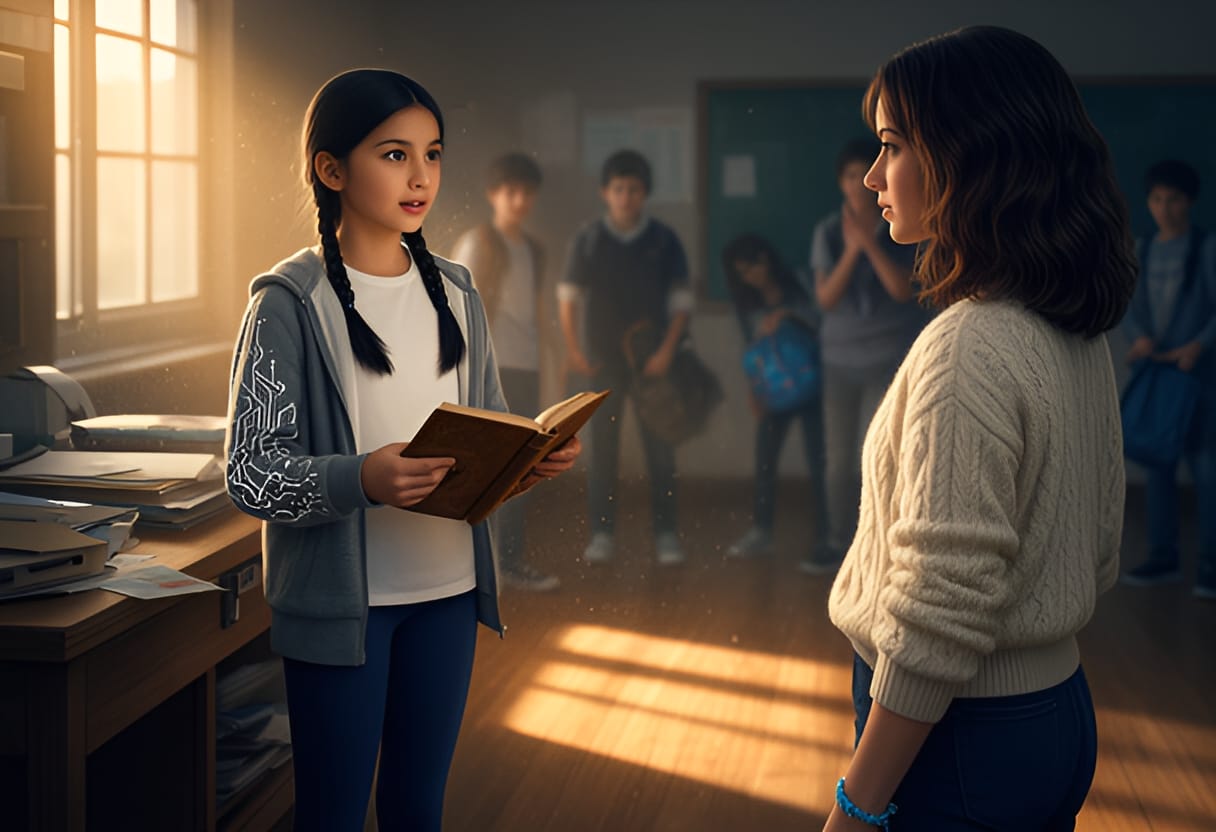
She paused, eyes meeting Maya’s. “The AI gives you the answer. But it doesn’t give you the why behind it. And today… I felt the why.”
A quiet settled over the room—not the silence of disengagement, but the deep, attentive hush that comes when something true has been spoken. Maya felt her throat tighten. She thought of Mr. Callahan, of how he never praised correctness, only curiosity. She thought of the poem she’d written in sixth grade, the one about waiting. She thought of the dent in the folder, small but deliberate.
She didn’t say anything. Not yet.
One by one, the others shared. Priya said she liked being able to use her hands. Jamal said he noticed things he’d never seen before—how the water pooled, how the sand shifted. Tanya said she felt proud, not because she got it right, but because she hadn’t given up. Luis added, quieter now, “I think… I think I’d rather struggle and get it myself than have it handed to me, even if it’s wrong at first.”
When the last voice faded, Maya picked up her planner from her desk. She flipped to the back page, where she’d written the day’s summary in the morning: Today, they learned how to learn. She read it again. It felt insufficient now. Too plain. Too much like a slogan.
She closed the planner and stood. Walked slowly to the AI hub. The screen flickered to life as she approached, recognizing her badge. A soft chime. A menu appeared: Resume AI-assisted learning? Recommended for Module 7.4: Ratios and Proportional Reasoning.
Her finger hovered over the confirmation.
Instead, she opened the bottom drawer of her desk and pulled out a small square of yellow paper—the kind they used for hallway passes. She found a pen. Wrote slowly, deliberately:
Used sparingly. Minds come first.
She peeled off the backing and stuck it to the front of the hub, just above the camera lens. Not to disable it. Not to defy it. But to remind—herself, anyone who saw it—that this tool was not the teacher. It was a guest in their room.
Then she tapped the screen. Resume.
The hub blinked. A soft whir. The screen lit up with the next day’s warm-up problem: If a printer prints 15 pages in 3 minutes, how many pages will it print in 12 minutes? Below it, a suggestion appeared in gray: Try setting up a proportion: 15/3 = x/12.
Maya didn’t turn it off. She didn’t need to.
She walked back to her desk, picked up her planner, and wrote beneath the morning’s line, in the same hand:
Today, they remembered how to think.
The bell rang again—sharp, final. Students began to gather their things, slipping tablets into backpacks, chatting about lunch, about the game after school. Zara lingered, slipping her journal into her bag. She paused at Maya’s desk.
“Thanks for today,” she said.
Maya looked up. “Thank you,” she said. “For trusting your mind.”
Zara smiled—small, genuine—and walked out.
Maya stayed a moment longer. The room was emptying, but the stream table still held the shape of what they’d made: the bend, the levee, the tiny deposits of sand like frozen waves. She ran her fingers lightly over the damp edge, feeling the grit, the memory of effort.
Somewhere down the hall, a door closed. The lights in the next classroom flicked off.
She turned off the light in hers.
Not because the day was done.
But because the thinking—real, slow, human thinking—didn’t need it to continue.