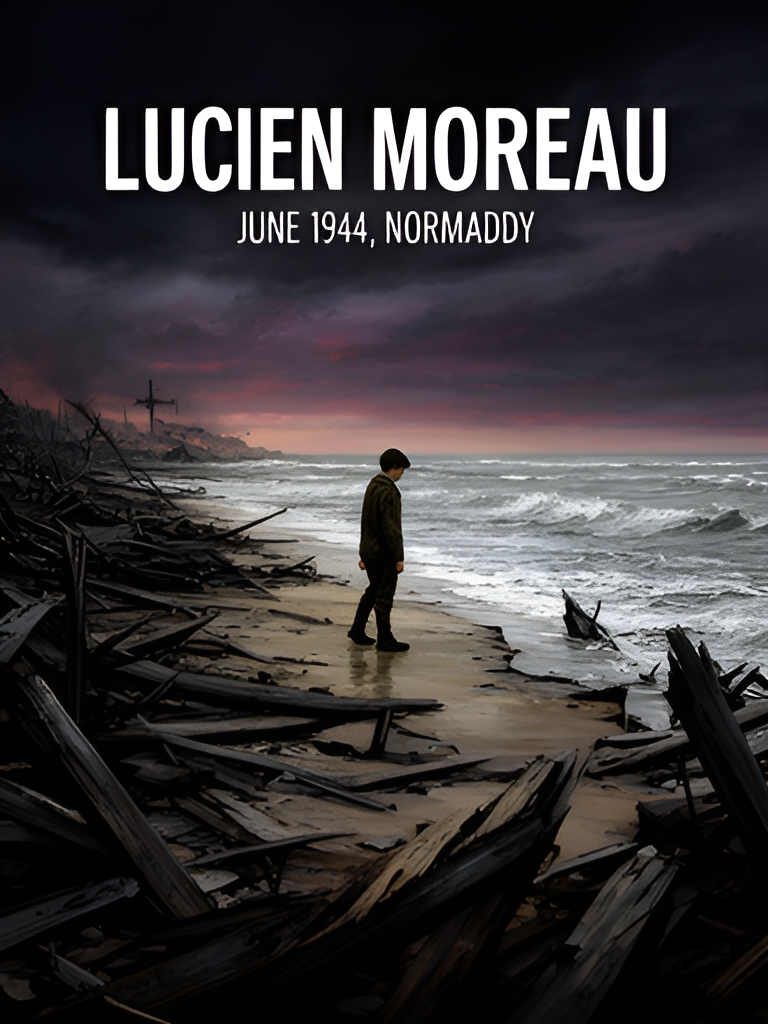
Horror
that war boy
by DukeN
4 chapters1.4 hr read
Chapter 1
The Watcher on the Stone
Lucien pressed his palms flat against the limestone, feeling the sharp bite of ancient salt-crusted rock tear at the soft pads of his hands. The cliff face was cold and unforgiving, each grain grinding into his skin like ground glass. He did not pull away. To release his grip was to invite the vertigo, the sickening lurch that came when the world below remembered it was no longer solid. He had climbed here not for courage, but because his mother had shoved him upward with both hands, her voice raw over the roar: “Go! Now, Lucien — higher!” He had obeyed without thought, as he always had, and now he was stranded on this shelf of stone, the sea a thousand feet below, chewing at the base of the cliffs like a starving dog.
His uniform hung wrong. Too large in the shoulders, the wool stiff with dried seawater and salt crystals that pricked his neck where the collar rubbed raw. It had belonged to his father — a fisherman’s greatcoat, navy blue and heavy as wet sail — issued to him the week before the invasion when the Germans had begun conscripting boys for coastal watch. Lucien had worn it once, for the fitting, and hated how it swallowed him whole. Now it clung to his back, damp and heavy, the sweat of his climb mixing with the salt to create a gritty paste that itched beneath the fabric. He could feel the weave pulling at his armpits, the hem dragging mid-thigh, useless flaps of cloth that served no purpose but to remind him he was wearing a man’s burden on a boy’s frame.
He did not wipe his brow. Did not shift his weight. He stayed locked in place, eyes fixed on the horizon.
The Channel was a chaos of motion. Destroyers cut through the swell like black knives, their wakes feathering white behind them as they churned toward the beaches farther east — Omaha, Gold, Juno — names he had heard crackle over the wireless in the priest’s house, spoken with a mix of dread and pride. Further out, the silhouettes of transports loomed, their sides dotted with antiaircraft fire that bloomed in the sky like black orchids: sudden, violent puffs of smoke that bloomed and died in seconds. He counted them. One. Two. Three. Each burst made his chest tighten, not from fear of the shells — those were aimed at planes, not cliffs — but because each flash felt like a signal. A language. If his father were out there, if he had managed to launch their little Marie-Claire before the barrage began, he might be signaling now. A flash. A pause. Two flashes. Their old code, used when fog rolled in from the west and the lighthouse at Courseulles was blinded.
Lucien leaned forward, squinting against the glare. A flight of Spitfires sliced the sky to the west, their engines a high, clean scream that vibrated in his molars. He watched them bank, turn, disappear into the sun. Then, farther inland — though still miles away — a dull thump rolled through the air, felt more than heard. The ground shuddered. A distant explosion. Artillery. Or a bomb. He could not tell.
He waited.
Another puff of black smoke bloomed near the horizon, this one lower, closer to the water. A ship? A hit? His breath caught. He pressed harder into the stone, fingertips bleeding slightly where the rock had split the skin. Papa? he thought, not in words, but in the raw, wordless way a child calls for a parent when lost in a crowd. Maman? He imagined her standing in the doorway of their cottage, her apron tied tight, calling him in for supper. He could almost smell the woodsmoke, the potatoes simmering in her pot, the faint tang of her lavender soap.
But the wind carried none of that. Only salt. And something sharper beneath it — ozone, burnt metal, the acrid tang of exploded cordite that had begun to drift inland from the beaches, though he did not yet know its name. He only knew it made his throat tight and his eyes water.
He remained still. Watched. Waited.
Then — without warning — the cliff jolted.
Not a shake. Not a tremor. A sudden, upward thrust through the stone, as if the bedrock itself had been kicked from below. It slammed up through his heels, rattled his teeth, and sent a jagged flash of pain behind his eyes. He gasped — a sharp, involuntary suck of air — and his left hand slipped. Fingers scrabbled for purchase, nails scraping limestone, leaving white streaks in the dust. His breath came fast now, shallow and loud in his own ears. The world tilted. For a heartbeat, he was not on the cliff but falling, the sea rushing up to meet him, the weight of the coat dragging him down like a stone tied to his legs.
He recovered. Found the rock. Gripped it harder than before, arms trembling, shoulders screaming. His heart hammered against his ribs, not with the steady rhythm of exertion, but with the erratic, trapped flutter of a bird in a closed fist.
Silence fell — not peaceful, but thick and listening. The distant thrum of engines continued, the guns still spoke their sporadic language, but to Lucien, it all sounded muffled, as if heard through water. His palms were slick. Not just with sweat. He lifted his right hand slightly, turned it palm-up. A thin line of blood welled from a split in his skin, dark against the pale stone.
He did not cry out. He did not weep. He simply stood, pressed flat against the cliff, and waited for the next sign.
And then — a cry.
A gull, wheeling low over the water, split the air with a sharp, two-note scream. It was not loud. But after the silence he had imposed on himself, it shattered his nerves like glass.
Lucien flinched. His breath hitched. The fear that had been a cold stone in his gut since he first realized the cottage was silent, that the boat was gone from the mooring, that no familiar voice answered his internal calls — that fear tightened. It coiled in his chest, sharp and sudden, pulling his shoulders inward, making it hard to draw a full breath.
He did not move. Did not look down. But his grip on the stone did not loosen.
He was still waiting.
And the sea, far below, kept chewing.
Lucien drew a slow breath through his nose, hoping against hope that beneath the salt and the sting of cordite, he might catch the ghost of woodsmoke — the dry, sweet curl of it from his mother’s hearth, the way it used to cling to his woolens after supper, mingling with the faint trace of her lavender soap and the yeasty scent of rising bread. He turned his face into the wind, eyes closed, nostrils flaring. For a moment, he imagined it: a wisp of smoke threading through the air, familiar and comforting, guiding him home like a beacon.
But the wind brought nothing of the sort.
Only the sharp, metallic tang of exploded cordite, thicker now, laced with something acrid and synthetic — burnt plastic, perhaps, or the oily reek of shattered avionics. It burned the back of his throat, made his eyes water anew. He lowered his chin, breath coming short, and pressed his palm flat against the stone to steady himself. The blood from his split skin had dried into a thin, dark crust. It pulled when he moved.
He kept watching.
To the west, a formation of bombers crept inland at low altitude — B-26 Marauders, he’d later learn, though now they were just dark bellies against the sky, engines screaming like wounded things. They flew in loose V’s, wings trembling slightly in the buffeting air, contrails thinning behind them in the damp June sky. The sound was immense — a rolling, tearing roar that vibrated in his sternum, made his teeth ache. He could feel it in the soles of his boots, a pulse up through the rock, as if the earth itself were humming in response.
One plane lagged behind the others, slightly lower, its right wing drooping. A thin trail of black smoke curled from its engine nacelle, thickening as it flew. It didn’t sputter or flame — just smoked, steady and ominous, like a dying breath. The aircraft seemed to struggle, fighting the air, losing height with each slow beat of its propellers. It drifted toward the sea, silent now in its descent, no longer part of the formation, a solitary speck falling from the sky.
Lucien held his breath.
He didn’t see the impact. The horizon swallowed it — a fold of water and haze, the bomber vanishing behind the curve of the world. But a second later, it came.
Not a sound, at first. A sensation.
A deep, low thump — felt more than heard — rolled through the air and into the cliff, up through his boots, into his bones. It was the kind of blast that didn’t crack the eardrums but hollowed the chest, a subsonic punch that left the ribs aching and the breath short. The stone beneath his fingers shivered. A loose pebble near his toe jumped and rolled over the edge, vanishing into the surf below.
He didn’t flinch. Didn’t look away. He simply stood, hands raw on the rock, and waited for the next wave of sound — the echo, the fallout, the distant cry of metal hitting water — but none came. Only the thump lingered, fading like a bell rung underwater.
The bombers passed on, their roar receding eastward toward the beaches, leaving behind a sky that felt suddenly emptier, quieter. The wind shifted, carrying the smoke from the crash out to sea, where it dissolved into the salt air. And still, Lucien waited — not for his parents now, not exactly, but for something to make sense of the silence that had settled inside him, heavier than the coat on his shoulders, colder than the stone beneath his palms.
He did not know then that the quiet would stay with him long after the guns fell silent. That it would become his companion. His burden. His only true inheritance.
He stayed until his legs began to tremble, not from fear now, but from the slow drain of adrenaline, the hollow that follows a body braced too long. The gull had not returned. The sky was empty of planes, save for a single, distant speck — maybe a Spitfire on patrol, maybe nothing at all. He lowered his forehead to the stone, cool and rough against his skin, and breathed through his mouth. The taste of iron lingered on his tongue, from the split in his palm or from something deeper, he couldn’t say.
A wave crashed far below, louder than before, and for a moment he imagined it was a voice — his mother’s, calling from the cottage window, sharp with worry but warm underneath. He lifted his head. Nothing. Only the wind, the sea, the endless scrape of water on shingle.
He pushed off the cliff with care, testing his weight on the balls of his feet. His left ankle protested — twisted slightly during the jolt, or perhaps earlier, when he’d scrambled for grip. He ignored it. Pain was familiar. It meant he was still inside his skin.
The greatcoat dragged at his heels, heavy with damp and the grit of sea spray. He hadn’t realized how much he’d been holding his breath until now, and when he finally exhaled, it came out in a shaky rush, fogging the air briefly before the wind stole it.
He turned inland.
Not with purpose, not yet — just away from the edge. The clifftop sloped gently here, covered in tough grass and clusters of yellow gorse, their flowers bright against the gray-green stalks. A rabbit darted from the undergrowth, ears flared, and vanished into a burrow half-hidden by a fallen stone. Lucien watched the hole for a moment, then looked away. He didn’t envy its safety. Safety felt like a kind of forgetting.
He walked slowly, eyes on the ground, avoiding loose stones and patches of crumbling earth where the cliff had begun to slump. The land here was scarred — not by shells, not yet, but by the weight of men and machines. Boot prints marred the soil, some deep and fresh, others half-erased by wind. A tangled length of barbed wire lay coiled like a sleeping snake, its ends sharp and rusted. He stepped over it, then paused, frowning. It hadn’t been there when he first climbed up. Or had he simply not seen it, eyes fixed on the horizon?
A fragment of olive-drab fabric caught on a gorse thorn nearby. He reached out, touched it. It was thin, torn — part of a uniform, maybe, or a gear pouch. The weave was coarse, unfamiliar. Not French. He dropped it. Let the wind take it if it wanted.
The further he went, the quieter it became. Not silent — never that — but the roar of battle had softened, retreated behind the curve of the coast. Only the occasional thump of distant artillery reached him now, muffled, like a heartbeat through a wall. The air still smelled of cordite, but fainter, mixed now with crushed green stems and the damp earthiness of crushed gorse underfoot.
He came to a shallow depression where the land had given way — a small slump, maybe caused by the underground jolt he’d felt, or just the natural weakness of the chalk. At its base, half-buried in soil and grass, lay a single glove. Left hand. Wool, faded to a dull gray, fingers stiff with dried mud. He knelt, hesitated, then picked it up. It was too large for him, the palm wide, the thumb splayed. Not his father’s — his father’s hands were broad and calloused from nets and oars, but this glove had the neat stitching of issue gear, the kind issued to soldiers. Still, he turned it over in his hands, feeling the roughness of the wool, the damp chill seeping into his own fingers.
He didn’t put it in his pocket. Didn’t wear it. Instead, he laid it gently back where he’d found it, nestled it into the hollow as if tucking something in to rest. He didn’t know why. Only that to take it would feel like theft — not of an object, but of a presence. Someone had worn this. Someone had missed it, or lost it, or been unable to reach for it when the ground shook.
He stood. Dust clung to his knees. The fear was still there, coiled low in his belly, but it had changed — less a sharp stone, more a constant pressure, like water seeping through a crack in the wall. It didn’t paralyze him now. It accompanied him.
He began to walk again, not toward the village, not yet, but along the clifftop, parallel to the sea, where the land was firmer and the view open. The sun had shifted, lower now, casting long shadows that made the gulls wheeling over the water look like scraps of torn paper. He didn’t look for signs. Didn’t call out. He simply moved, one foot after another, the greatcoat swaying slightly at his calves, the split in his hand throbbing in time with his pulse.
And somewhere behind him, the sea kept chewing.
The path down was not a path so much as a suggestion — a narrow ledge worn by goats, if goats had ever dared this far into the wreckage. It clung to the cliff’s face like a scar, crumbling in places, slick with seawater and the oily residue of something darker that had leaked from broken hulls below. Lucien tested each stone with the toe of his boot before committing his weight. His left ankle throbbed in protest, a dull ache that flared sharp when he shifted too fast. He moved sideways, crab-like, one hand braced against the rough limestone, the other gripping the greatcoat to keep it from snagging on jagged edges.
Below, the shore was a chaos of twisted timber, shredded canvas, and the bleached ribs of what had once been boats. A landing craft lay on its side, its ramp hanging open like a broken spine, the interior choked with sand and seaweed. Nearby, a heap of corrugated metal — perhaps from a Nissen hut or a shattered amphibious vehicle — glinted dully where the sun caught its edges. Puddles of iridescent oil lay in the hollows, rainbow-slick and still, releasing a sharp, chemical tang that made Lucien’s eyes water.
He paused on a flat rock just above the high-tide line, breathing hard. The gulls wheeled overhead, their cries thin and piercing. One dove, snatched something from the surf, and banked away. The sea here was quieter than on the cliff — not calm, but subdued, as if exhausted. Waves rolled in with a soft, sucking sigh, pulling back to reveal strips of wet sand that gleamed like hammered pewter.
He picked his way down onto the beach, choosing his steps with care. A length of barbed wire lay half-buried in the sand, its points dull with corrosion but still capable of tearing flesh. He stepped over it. Nearby, a soldier’s helmet sat upside down in a tide pool, the liner long gone, the shell pitted and rusted. He didn’t stop to look inside. Some things were better left unseen.
The debris grew denser as he moved west, toward where the cliffs curved inward and the beach narrowed. Here, the wreckage was heavier — girders bent like old bones, sheets of metal peeled back like sardine tins, the occasional wheel or axle half-swallowed by the sand. The smell of cordite was stronger now, mingling with the brine and the faint, sweet rot of something organic left too long in the sun. Lucien wrinkled his nose, then regretted it — the motion pulled at the split in his palm, sending a thin spike of pain up his wrist.
He kept his eyes on the ground, not hoping, not dreading — just seeing. A boot lace, bleached white by salt and sun. A tin of corned beef, split open, its contents long gone. A sock, woolen and gray, rolled into a tight ball and tucked beneath a plank — forgotten, or lost in the hurry.
Then his foot caught.
Not on stone, not on wood — on something yielding, yet firm. He stumbled, flung out a hand to catch himself, and looked down.
Half-buried in the wet sand, toe pointing stubbornly seaward, lay a single leather boot.
It was caked in salt and grit, the once-black leather faded to a dull charcoal, scuffed and cracked along the toe cap. The laces were gone — either rotted away or pulled free — leaving only frayed ends dangling from the eyelets. The sole was thick, studded with rubber, worn smooth in the ball and heel. It looked heavy. It looked worn. It looked like it had walked far.
Lucien sank to his knees, the sand cold and damp through the knees of his trousers. He didn’t speak. Didn’t cry out. He simply reached out, trembling slightly, and brushed the sand away from the vamp.
The leather gave under his fingers — stiff, but supple where it had flexed with use. He cleared more sand, revealing the tongue, then the throat of the boot. He peered inside.
It was empty.
Not just unlaced — empty. No foot. No sock. No trace of a leg, not even a shred of cloth or a scrap of skin. Just the hollow shape where a foot should have been, the imprint of toes and arch pressed into the insole, now filled with damp sand. He stuck a finger in, probing gently. The leather was cool, slightly damp, but there was nothing inside — no resistance, no warmth, no pulse.
He pulled his hand back as if burned.
His breath came short and shallow. His chest felt tight, not with fear now, but with something heavier — a quiet, crushing certainty. This wasn’t a sign. This wasn’t a clue. This was an absence made solid. Someone had worn this boot. Someone had walked in it, maybe run, maybe stood watch, maybe marched toward the guns. And then — nothing. The sea had taken the rest, or the fire, or the blast, or the sheer, indifferent force of war that didn’t bother with bodies, only with what they carried.
He didn’t know whose boot it was. Didn’t want to know. To name it would be to invite the ghost in.
He let the sand slip from his fingers. The boot settled back into its hollow, half-hidden again, as if the beach were trying to swallow it whole. He didn’t cover it. Didn’t mark it. He simply sat back on his heels, hands resting on his thighs, and stared at the sea.
The gull cried again — sharp, close — and this time he didn’t flinch. He just breathed. In. Out. The split in his palm throbbed. His ankle ached. The greatcoat smelled of salt and smoke and something older, something like wool and lanolin and the faint ghost of his father’s pipe tobacco, clinging to the lining despite everything.
He didn’t move for a long time.
When he finally rose, it was slow, deliberate. He brushed the sand from his knees, wiped his hands on his trousers — useless, really, they were already grimed — and turned his back on the water.
He walked north, away from the wreckage, toward where the cliffs opened again and the land rose. The boot stayed where it was, one more thing the tide would claim, or the sand would hide, or the wind would scour clean. It didn’t matter. It had already said what it needed to say.
And Lucien walked on, not because he believed he would find them, but because to stop was to let the silence win.
Lucien walked with his gaze fixed on the wet ribbon of sand where the sea withdrew and returned, each breath of the tide laying bare another fragment of the night’s violence. A twisted strut of landing gear jutted from the foam like a broken finger. A length of canvas, once olive-drab, now bleached and rotting, flapped weakly against a half-submerged frame. He stepped around a crater the size of a cartwheel, its edges softened by the surf, filled with water that shimmered with oil rainbows.
The air smelled less of cordite here, more of kelp and iron. The sun, low and pale behind thinning cloud, struck the water in long, glancing blades that made the wet sand gleam like hammered pewter. Lucien’s greatcoat dragged at his ankles, heavy with salt and the damp that had seeped through during his long vigil on the cliff. His split palm throbbed in rhythm with his pulse, a dull ache that had settled into his bones. His left ankle protested with every step on the uneven sand, a reminder of the thump he had felt through the stone — not sound, but a shudder in the marrow, as if the earth itself had groaned.
He passed the shattered remains of a landing craft, its steel hull split open like a gutted fish. The ramp lay flung sideways, hinges torn, one end buried in the sand, the other pointing skyward like a broken jaw. Inside the belly, darkness yawned — twisted ribs of frame, snarled cables, a tangle of what might have been seats or racks, all half-filled with sand and seawater. He did not look too closely. Some things were better left unseen.
Then, farther out where the water had just receded, he saw it.
A section of wing, perhaps ten feet long, lying on its side in the wet sand. It caught the light not with glare, but with a quiet, internal gleam — dull aluminum beneath the grime of salt and soot, yet where the morning sun struck it square, it flashed, sudden and bright, like a mirror flung open. For a heartbeat, Lucien thought it was a signal. A heliograph. His father’s hand, flashing a warning or a call — come this way, I am here.
He stopped. The breath left him not in a gasp, but as if the air had been sucked from his lungs. The wing lay half-buried, its leading edge crumpled where it had struck the water or the sand, the skin wrinkled like paper forced into a fist. Rivets showed along the seams, some popped, others holding fast. Traces of camouflage paint clung in patches — olive and gray, now faded and chalky — but beneath, the metal shone, pure and unyielding, indifferent to the ruin around it.
He had seen aircraft before — the slow, lumbering shapes of the bombers his village had watched from the cliffs, the darting silver of Spitfires chasing black crosses through the sky. But never like this. Never so close, never so still. The wing was not flying. It was not falling. It was simply there, a fragment of sky made solid, and in its brightness, it seemed to defy the mud and the wreckage and the slow, sucking pull of the tide.
A crab skittered from beneath the trailing edge, its claws raised in a tiny, futile challenge. The sound was sharp — a click of chitin on sand — and it broke the spell.
Lucien jerked back as if struck. His heart hammered against his ribs, not with fear, but with the sudden, violent return of sensation. The beauty of the wing was a lie. It was not a signal. It was a wound. A piece of something that had flown, that had carried men, that had screamed through the air with engines burning and guns spitting — and now it was junk, salt-crusted and abandoned, home to scavengers with hard shells and no pity.
He turned away.
Not from sorrow. Not from grief, though that lay deep and quiet beneath his breastbone like a stone. He turned because the light on the metal felt like a betrayal. As if the sun, shining on that broken thing, was pretending the war had not happened. As if the gleam said, Look, see how beautiful we are, while the sea swallowed boots and the sand swallowed men and the silence swallowed names.
He walked on, his boots sinking slightly with each step, the greatcoat stiffening as it dried in the wind. The wing remained where it lay, catching the light again and again with each pulse of the surf, flashing its cold, indifferent message to no one and everyone.
Behind him, the tide began to rise.
The water licked at his boots, cold and insistent, tugging at the sand beneath his soles as if trying to pull him back toward the wreckage. He did not resist. He let it take what it wanted. His thoughts were not of home, not of his mother’s voice or his father’s hands, but of the wing — how it had lain there, not broken in spirit, but in purpose. It had not screamed as it fell. It had not begged. It had simply stopped, and the sea had taken its turn.
Ahead, the cliffs opened into a wider shelf, the limestone worn smooth by centuries of wind and wave. Grass clung to the top in stubborn tufts, green against the stone, and somewhere above, a skillet called — sharp, brief, then gone. Lucien paused at the base of the slope, where the sand gave way to shale and the first tentative shoots of sea pink pushed through the cracks. He could climb. The path was steep but clear, worn by goats and the occasional fisherman checking his lines. From the top, he would see the village — or what was left of it. Smoke might still rise from the hearths. Or there might be none.
He looked back once. The wing was half-submerged now, the flashing light stuttering as the waves rolled over it, then returned, weaker each time. The crab was gone. Only the sand remained, smooth where it had been, as if nothing had lain there at all.
He turned his face to the cliff and began to climb.
The stone was rough under his palms, biting into the split on his left hand, sending a fresh spike of pain up his arm. He gasped, not loudly, but enough to make him stop, pressing his forehead to the cool rock. His breath came in short bursts. His ankle throbbed in time with his pulse, a dull, insistent ache that made each shift of weight a calculation. He did not rest long. He moved again, using the edges of his boots to find purchase, his greatcoat catching on a snag of barbed wire half-buried in the soil near the top — a remnant, he thought, from the coastal wire the Germans had strung before the landings. He tore himself free, leaving a thread of wool behind.
At the summit, he lay flat for a moment, chest heaving, the sky above a washed-out blue, the sun higher now, warming his back. Below, the beach stretched west and east, a littered ribbon of wood and metal and cloth, the tide slowly reclaiming what it could. The sea did not hurry. It was patient. It had all the time in the world.
He pushed himself up and stood, swaying slightly. The world tilted — not from injury, but from the sudden height, the openness after hours of looking down. Gulls wheeled overhead, their cries thin and distant. Somewhere inland, a dog barked — once, then silence.
He did not know if the village stood. He did not know if his parents were alive or dead or scattered like the wreckage along the shore. He only knew that to remain on the beach, waiting for a sign that would not come, was to let the sea have the final word. And he was not ready to give it that.
He took a step inland, then another, the shale crunching underfoot. The grass grew thicker here, damp with dew and salt spray, and as he walked, he caught, faintly, the smell of woodsmoke — not the acrid tang of cordite, but something softer, older. It might have been a fire. It might have been memory.
He did not stop to wonder. He walked on.
Chapter 2
The Silence Between Shells
He did not stop to wonder. He walked on.
The grass gave way to sand again, finer and cooler, packed hard by the wind until it dipped into the first hollow behind the dunes. Here the earth softened, saturated with seawater that had seeped inland during the night’s high tide. Lucien’s boots sank with each step, sucking at the soles as if the ground wanted to keep him. He lifted his feet carefully, toes curling inside the damp wool of his socks, and moved forward with a slow, deliberate tread, testing each patch before committing his weight.
The path was narrow, worn not by boots but by the passage of something heavier — wheels, perhaps, or tracked vehicles — now half-erased by water and reed. Tall grasses flanked him, their blades slick with moisture, slapping against his legs as he passed. They left cool streaks on his skin, like fingers brushing him in warning. The air smelled of rot and salt, of crushed stems and mud that had lain too long without sun. Somewhere ahead, a bird cried — sharp, abrupt — then fell silent. He did not look for it. He kept his eyes on the ground.
A glint caught his attention near a clump of bent reeds. He stopped, crouched, and brushed away a film of algae with the heel of his glove. Beneath lay a steel helmet, upside down, its chinstrap snapped and coiled like a dead thing in the mud. The paint was gone, worn to bare metal in patches, and inside, the leather liner had rotted into dark shreds, stained with something darker than dirt. He did not touch it. He only saw it — the shape of a head that had once filled it, the weight of a man who had worn it forward into fire, and now lay still beneath the water or farther on, where the shells had fallen thicker.
He rose and moved on.
The trail wound between two low ridges of dune, where the wind had piled sand into sharp crests that cut the sky like broken teeth. Here the ground was firmer, but treacherous all the same — hidden pools lay under thin crusts of silt, and once, as he stepped, his right boot broke through, plunging to the ankle in cold, sucking mud. He froze, breath held, then pulled slowly, feeling the drag like a hand gripping his heel. When his foot came free, it brought up a glob of viscous black that dripped from the sole and sank back into the mire with a soft plop. He wiped it on the leg of his greatcoat, leaving a smear that smelled of iron and decay.
Further ahead, half-buried where the path bent around a waterlogged hollow, lay a glove. Not wool this time, but leather — stiff with dried mud, fingers curled inward as if holding something that had long since slipped free. The palm was cracked, the stitching along the thumb frayed. It lay open, as though its wearer had taken it off to rest, to wipe sweat from his brow, or to tie a lace, and then simply… walked away. Lucien slowed. He did not reach for it. He did not turn it over. He let his eyes trace the curve of the fingers, the way the leather had molded to a grip, and thought not of who had worn it, but of the moment it had been removed — the quiet decision to pause, however brief, in a world that no longer allowed pauses.
He stepped around it, keeping his boot clear of the mud that clung to its fingertips.
The reeds grew denser here, thickening into a narrow corridor that forced him to walk sideways, shoulders brushing the damp stalks. Water pooled in the ruts left by wheels, reflecting the sky in shattered shards. A dragonfly hovered over one puddle, its wings catching the light like slivers of glass. Lucien watched it for a moment — the way it hovered, then darted, then hovered again — before turning his face forward and pushing on.
The path began to rise, just slightly, and the ground firmed underfoot. He could feel the change in his ankle — less protest, less the sharp jolt that had come with each misstep on the sand. The greatcoat, still heavy with damp, dragged less now, though it clung to his calves where it had soaked through. He adjusted the collar with one hand, the other resting lightly on the split in his palm, which had begun to ache again, a low throb that matched the pulse in his temple.
Then the trail forked.
He stopped.
To the left, the way continued between two reeds that had been trampled flat, leading toward a stand of willows whose leaves shimmered silver in the breeze. To the right, the path faded into a spread of mudflat, crisscrossed with the tracks of boots and what looked like the drag of a sled or a stretcher, though the marks were already softening at the edges, filling with water.
He stared.
He had come this way before — not today, but in memory. He remembered the path from the village to the shore, how it bent past the old millpond, how the willows grew thick where the sheep used to graze, how the right fork led past the peat bog and then, after a long stretch of open marsh, to the dunes and the sea. But now, the landmarks were gone or altered. The willows looked younger, thinner, as if they had been cut and were regrowing. The mudflat showed no sign of the footpath he knew — only the fresh scars of war, the passage of men and machines moving in haste, not toward home, but away from it.
He took a step toward the left, then halted.
What if the willows were not the way? What if the village lay beyond the bog, where the tracks led, and he was turning his back on it because the trees looked familiar? He closed his eyes. He tried to picture his mother’s voice calling him in for supper, the creak of the gate on the hinges, the smell of wet earth after rain — but the images came blurred, as if seen through water. He could not trust them. He could not trust anything.
His ankle throbbed again, a steady pressure now, like water seeping through a crack in stone. He opened his eyes and looked down at his boots — one caked with dried mud, the other still wet from the last misstep. He thought of the glove in the mire, the helmet upside down, the thread of wool left on the barbed wire. Each was a marker. Each said: someone passed here. Each also said: they did not come back.
He did not know which way led to his street.
He did not know if his street still existed.
He stood at the fork, the wind lifting the hem of his greatcoat, the reeds whispering on either side, and for the first time since he had left the cliff, he did not move. He only waited, listening — not for voices, not for whistles, but for the sound of his own feet choosing a direction.
The wind dropped.
Not all at once, but in a slow exhale, as if the air itself had been holding its breath and now, finally, released it. The reeds stilled. The distant thrum of artillery, ever-present like a heartbeat beneath the earth, softened to a low murmur, then fell silent. Even the gulls, usually so loud and insistent over the marsh, seemed to have tucked their wings and gone quiet.
In that hush, Lucien heard it — not with his ears, but in the hollow behind his ribs: the faint, familiar creak of a hinge.
His eyes snapped open.
He turned his head slowly, as if afraid the sound might vanish if he moved too fast. To the left, the willows trembled in a breeze that had not yet reached him. To the right, the mudflat lay flat and dull, reflecting the sky like a sheet of lead. Neither offered the sound.
He listened again.
Nothing.
But the memory of the creak remained — not imagined, not wished, but known. It was the sound of the back gate at his grandmother’s cottage, the one that hung crooked after the winter frost of ’41 and groaned every time it was pushed open, no matter how gently. He had oiled it once, with a rag dipped in kerosene, and his father had laughed and said, “Now it’ll outlive us both.”
He had not thought of that gate in years.
He stepped forward — not toward the willows, not toward the mudflat, but straight ahead, where the ground rose slightly and the reeds thinned, giving way to open earth. The path, such as it was, had vanished here, swallowed by the marsh’s slow reclaiming. But he knew this stretch. He had walked it barefoot as a boy, chasing minnows in the shallow pools that dotted the grass after rain. He remembered the way the earth felt under his toes — soft, then firm, then soft again — and how his mother would call from the doorway, her voice sharp with warning but warm underneath, “Lucien! Don’t sink your good shoes!”
He lifted his foot.
The ground held.
He took another step.
And then he was out of the reeds.
The marsh ended abruptly, as if cut by a blade. Before him, the land opened into a shallow valley, and beyond that, the first outlines of the village.
His breath caught.
Not from hope.
From dread.
He had expected smoke.
Not thick plumes, not the black, oily clouds of burning thatch from the bombardment, but the thin, gray-blue curls of woodsmoke that rose from chimneys at dawn — the kind that meant someone had lit the fire, meant someone was awake, meant someone was alive. He had pictured it as he walked: the sight of it, thin and steady, rising from the roofs like prayers sent upward. He had imagined the smell of it — damp wood, a hint of peat, the ghost of last night’s stew — and how it would have made his throat tight, not with sorrow, but with the fierce, aching relief of return.
But there was none.
No smoke.
No movement.
No birds taking flight from rooftops. No shutters creaking in the wind. No distant call of a neighbor, no dog barking, no child’s laughter caught on the breeze.
Only silence.
And the village.
It lay ahead, not destroyed, but unmade.
Houses stood — or what was left of them. Walls had been blown outward, their timbers splintered like bones snapped in a fall. Roofs had caved in, leaving jagged mouths open to the sky, where rafters hung like broken ribs and laths dangled in tatters. Shutters hung by one hinge or lay in the dirt, their paint blistered and peeling. Doors were gone — blown off, or torn away, leaving only the dark, yawning frames like empty eye sockets.
The street, once narrow and worn smooth by generations of feet, was now a churned mess of mud and rubble. Craters pocked the ground, some still rimmed with wet earth, others softened by rain into shallow ponds that reflected the broken sky. Fences were reduced to splintered posts. The well’s stone collar, which he could just make out in the distance near the center, stood half-collapsed, its coping stones scattered like teeth knocked from a jaw.
He walked forward, slow, as if the earth might swallow him whole if he moved too quickly. His boots sucked slightly in the soft ground, but he did not notice. His eyes were fixed on the roofline — or what remained of it.
And then he saw it.
Near the edge of what had once been a row of cottages, where the garden walls had begun, one gable end still stood. It was crooked, leaning like a man drunk on grief, but intact enough to hold a section of wall. And on that wall, clinging to a nail that had somehow survived the blast, was a scrap of fabric.
Lucien stopped.
His breath came short.
It was blue.
Not the bright blue of a summer sky, nor the dull blue of workaday cloth, but the faded, washed-out blue of his mother’s apron — the one she wore when she baked bread, when she mended his nets, when she stood at the sink washing vegetables and hummed that off-key tune she thought no one heard. He remembered the trim: a narrow band of white cotton, frayed at the edges, stitched along the hem and the pockets. He remembered how she’d tie it behind her back, the knot always slightly lopsided, how she’d scold him when he tried to help and knocked over the flour jar.
He had seen her wearing it the morning he left for the cliff.
She had been standing in the doorway, her arms crossed, her face tight with worry but her voice soft as she said, “Be careful, mon fils. The sea is restless today.”
He had not looked back.
He had been afraid that if he did, he would see the fear in her eyes and turn back — and then what would he do? Stay and wait for the shells? Run and leave her behind?
He had chosen the cliff.
And now, here was the apron.
Not whole. Not even close. Just a fragment — maybe six inches long, maybe less — caught on the nail, fluttering faintly in a breeze that had returned, weak and hesitant. The white trim was still visible, though stained with mud and something darker that might have been blood, or might have been just the dirt of the earth reclaiming what was hers.
He did not move toward it.
He did not reach for it.
He felt the familiar ache in his split palm, the throb in his ankle, the weight of the greatcoat dragging at his shoulders — but none of it mattered. All he could feel was the pull of that scrap, the way it danced just enough to tease the eye, the way it begged to be noticed.
He wanted to take it.
He wanted to press it to his face and breathe in the ghost of her — the lavender soap she used, the faint salt of her skin, the warmth of the bread she’d just pulled from the oven.
He wanted to wrap it around his fist and hold it tight, as if by doing so he could hold her.
But he did not.
Because he knew, with a certainty that settled in his bones like stone, that if he touched it, if he closed his fingers around that fragile scrap, then it would no longer be a remnant.
It would be proof.
And proof, he realized with a quiet horror, was the one thing he could not survive.
He lifted his hand.
Slowly.
As if approaching a wounded animal.
His fingers trembled.
He stopped them just above the fabric — close enough to feel the stir of air it made as it moved, close enough to see the weave of the threads, the way the blue had faded to gray in places, the way the white trim had curled at the edge from damp and time.
He did not touch it.
He let his hand hover.
And in that suspended moment, the world narrowed to the space between his skin and the cloth — a breath, a heartbeat, the faintest shift of air.
He thought of her hands.
How they had looked, rough from work but gentle when they brushed his forehead when he was sick.
How they had tied the apron strings.
How they had held his, the morning he left, not to stop him, but to say goodbye without words.
He thought of how she had stood in the doorway, watching him go.
And how, in the end, she had not called after him.
Not because she did not want him to stay.
But because she knew — as he now knew, too — that if she had, he would not have been able to leave.
And so she had let him go.
And now, here he was.
His fingers remained suspended.
The apron fluttered.
The wind sighed through the broken walls.
And Lucien Moreau, fourteen years old, son of a fisherman and a woman who mended clothes and hummed off-key tunes, did not touch the fabric.
He only let his hand shake — and waited, not for courage, but for the moment to pass.
Then, as if the air itself had exhaled, the tremor in his hand stilled. Not gone, but subdued, like a wire plucked and left to hum faintly. He lowered his arm slowly, the greatcoat settling back against his shoulders with a dry rasp of wool. The apron continued its fragile dance, a blue-white whisper against the splintered timber and stone.
He turned away.
Not with resolve, not yet — but with the dull inevitability of a tide pulling back. His boots sank slightly into the churned earth as he moved, each step a small surrender to the softness of the ground, the way it gave underfoot like damp bread. He kept his eyes low, not to avoid the wreckage, but because looking up meant seeing too much: the sky where roofs should be, the jagged teeth of rafters against the light, the open wounds of cellars gaping like mouths.
He followed the line of the street — or what he remembered as the street — past the gable end, past where the baker’s oven had once jutted into the lane, its brick mouth now collapsed inward. A cast-iron pot lay on its side nearby, lid missing, interior filled with rainwater and leaf litter. He did not stop. He did not look for familiar marks. He knew, now, that recognition would not bring comfort. It would bring the sharp, clean pain of absence — the kind that cuts without bruising, that leaves you staring at your own hands wondering why they still work.
The wind had picked again, tugging at the greatcoat, lifting the hem just enough to brush his calves. It carried no smoke, no scent of bread or woodsmoke, only the wet mineral smell of churned chalk and clay, and beneath it, the faint, iron tang of old blood or rust — he could not tell which, and did not try to name it. He had learned, in the silence between shells, that some things were better left undefined.
He came to the square.
Or where the square had been.
The well stood at its heart — or what remained of it.
He had known its place since he was small enough to stand on tiptoe to see over the bucket’s rim. His mother sent him here every morning before school, the copper pitcher balanced on her hip, her humming low and uneven as she waited for the rope to creak, the bucket to break the surface with its wet glug-glug. He remembered the way the sunlight struck the water at just after eight, turning it to liquid mercury, and how she’d cup her hands and drink, laughing when he pretended to be disgusted.
Now, the stone collar remained — low, rough-hewn, a ring of granite worn smooth by decades of palms and ropes. It was intact, miraculously so, as if the earth had decided to preserve this one thing while swallowing everything else. But the shaft…
He stepped closer.
The well was choked.
Not collapsed inward like a sinkhole, but filled — deliberately, it seemed, or by the sheer violence of falling timber and masonry — with the detritus of the village’s end. Beams, splintered and dark with moisture, lay crosswise over the opening. Roof tiles, some still glazed with the ghost of ochre, were jammed at odd angles. A bicycle frame, its wheels long gone, its handlebars bent into a cruel U, was wedged deep in the rubble, one pedal sticking up like a broken tooth. Rags of cloth, rope, and what might have been straw tangled through the stones, soaked and heavy.
He knelt.
His left ankle protested — a deep, dull throb that had become a constant, like a second pulse — but he ignored it. He reached out, not to move anything, but to test. His fingers brushed the edge of a tile. It was cold. Damp. It did not shift.
He leaned forward, bringing his ear to the stone.
He listened.
Not for voices. Not for the creak of the bucket or the splash of water returning. He had long since stopped hoping for those. He listened for the faintest sign — the slow seep, the drip-drip of water finding its way through stone, the whisper of a spring refusing to be silenced.
There was nothing.
Only the wind, now higher, whistling through the broken timbers above him like a tune played on a broken flute. And beneath it, the occasional settle — a small shift of stone, a sigh of timber adjusting to its new burden. The sound of weight. The sound of surrender.
He waited.
His breath came shallow, not from fear, but from the effort of listening too hard. The silence was not empty. It was full — full of what was not there, full of the weight of what had been pressed down, full of the knowledge that water did not lie. If it were still there, moving, alive, it would make itself known. It would not let a few beams and a bent bicycle stop it. Water found a way.
Unless the way was gone.
Unless the spring had been shaken loose, or buried, or turned to stone itself by the violence that had torn the sky open.
He pressed his forehead to the cold granite.
His breath fogged the stone in a faint, fleeting patch.
He thought of the bucket — the wooden one, bound with iron, the one that always squeaked when raised. He thought of the rope, frayed at the ends, the way his mother’s hands looked when she pulled it up, knuckles white, sleeves rolled to the elbows. He thought of the taste — cool, slightly metallic, the way it clung to the lips after drinking.
He thought of how she would sometimes let him have the first sip, saying, “Eau de puits, mon fils. The earth’s own blood.”
He had not understood then.
He understood now.
The earth’s blood was not in the ground.
It was in the wreckage.
It was in the silence.
He lifted his head.
The well did not echo.
It did not gurgle.
It did not weep.
It simply was — a mouth filled with stones, waiting for a rain that would not fill it.
He rose slowly, the greatcoat dragging as he straightened. His ankle burned, sharp now, a reminder that he was still here, still moving, still capable of feeling the betrayal of his own body. He wiped his palms on his thighs — not to clean them, but to feel the fabric, the weave, the realness of it.
He did not look back at the well.
He did not look at the apron.
He turned toward the center of the village — or what he believed to be the center — where the houses had stood shoulder to shoulder, where the smoke from chimneys had once curled into the sky like prayers.
His steps were slow.
Not hesitant.
Not brave.
Just… continuing.
Because to stop was to let the silence rise.
And he had learned, in the space between his fingers and the cloth, that silence, when it grew deep enough, was not peace.
It was the sound of the world forgetting you were ever there.
He walked past the skeletal remains of the baker’s, its oven yawned open like a broken jaw, blackened timbers jutting from the rubble. A single loaf pan lay on its side, twisted and rusted, half-buried in ash. He did not pause. He knew the smell of burnt dough would not rise here, not anymore.
The cobbled lane, once smooth under his bare feet in summer, was now a churned morass of stone and mud, littered with shingles, a child’s porcelain doll’s arm, and the curled edge of a ledger book, its pages fused into a solid block by fire and rain. He stepped over them without seeing, his eyes fixed ahead, on the gap where his street should begin.
Then he saw it.
The gap was wider than he remembered.
Not just the space between houses — but the absence of the houses themselves. Where the row of cottages had clung to the lane like shells to rock, there was now only a hollow, a basin of shattered brick and splintered timber, the ground sucked downward as if the earth had inhaled and never exhaled. Smoke still curled from a few beams, not from fire, but from dampness steaming in the weak sun. The air smelled of wet plaster, rotting wool, and something sharper — cordite, yes, but also the sour tang of exploded earth.
He moved forward, one foot, then the other, his greatcoat catching on a protruding nail. He did not stop to free it. The fabric tore slightly, a soft rip lost beneath the wind’s moan.
He reached the corner where his street met the lane — and stopped.
His house was gone.
Not damaged. Not ruined.
Gone.
As if it had never been.
The foundation was still there — a low rectangle of stone, half-submerged in mud, its edges softened by erosion. But where the walls had risen, where the roof had sloped red-tile toward the sky, where the shutters had flung open each morning to let in the light and the smell of salt and baking bread — there was only a crater.
It was not wide, but it was deep. The sides had collapsed inward, not outward, as if the blast had come from above and sucked the structure down into itself. The soil at the bottom was dark and loose, turned over and over, mixed with fragments of blue tile — perhaps from the hearth — and shards of green glass, maybe from a bottle his mother kept olive oil in. Tangled in the dirt were strands of barbed wire, twisted and rusted, and a piece of what might have been a gas mask tube, brittle and cracked.
He stepped onto the rim.
His boot sank.
Not into mud, but into something softer — loam, freshly turned, still holding the shape of the force that had thrown it skyward and back down again. He sank to his ankle, then his knee, as if the earth were reluctant to hold him, as if it, too, remembered what had stood here and resisted the weight of what remained.
He pulled free, slowly, and stepped into the hollow.
The crater was no larger than a large room, but it felt vast. The sides were uneven, crumbling in places where rain had begun to wash the loose earth downward. In the center, a depression held rainwater — not clear, but thick with silt and a rainbow sheen of oil. He did not drink from it. He knew better.
He knelt.
His hands hovered above the soil.
He did not dig. He did not search for anything specific. He only wanted to feel it — to press his palms into the ground where her hands had been, where she had knelt to pull weeds, to press seeds into the furrow, to pat the earth around the cabbage heads like she was tucking in a child.
His fingers touched dirt.
It was cold. Wet. It slipped between his fingers like memory.
He closed his eyes.
He remembered the marigolds.
Not the flowers themselves — though he could see them, bright orange against the green, their scent sharp and spicy in the evening air — but the way she had hummed while she planted them. Off-key, always off-key, a tune that rose and fell like a gull’s cry, broken and unafraid. She said they kept the evil spirits away. He had laughed then, told her spirits didn’t live in gardens. She had winked and said, “Maybe not. But they don’t like bright colors. And neither do I.”
He had helped her once. Just once. He had been ten, and she had let him press a seed into the soil with his thumb. She had wiped his cheek with the back of her hand — her sleeve stained with soil, her nails cracked — and said, “You have the touch, mon fils. Gentle. Like your father’s when he mends the net.”
He had not thought of that since the cliff.
Now, his fingers sank deeper.
He found nothing.
No trowel. No pot shard. No whole brick from the path that had once edged the plot. No trace of the trellis where the beans had climbed. No remnant of the wooden stake she had tied the tomatoes to, twine still looped in a loose knot. Only dirt, and stone, and the occasional glint of metal — too small, too twisted to be anything but shrapnel.
He dug a little deeper with his fingers, not hoping, not expecting — only needing to know if anything of her remained. If the earth had kept something, even a button, even a scrap of her apron, even a single seed she had saved from last year’s harvest.
His nails scraped stone.
He pulled his hand back.
It came away streaked with mud and something darker — not blood, not yet dried, but the rust of old metal, or perhaps the stain of something burned. He wiped it on his thigh, leaving a smudge like a bruise.
He sat back on his heels.
The weight in his chest was not grief, not exactly. It was the sudden, terrifying certainty that he would never again see her hands in the soil, never hear her hum that broken tune, never smell the marigolds or the damp earth after she had watered them. The garden was not just destroyed. It was erased. As if it had never been tended. As if she had never knelt here, her back to the sun, her lips moving in a tune only she knew.
A pressure built behind his eyes.
He did not fight it.
He let it come.
One tear fell.
It landed on the back of his hand, dark against the mud, and for a moment, it looked like a seed.
He did not wipe it away at once.
He let it sit.
Let it be.
Let it be proof that he could still feel.
Then, with the heel of his palm, he rubbed it hard — not to erase it, but to stop it. He did not want to cry. Not here. Not now. Not when the silence was already loud enough.
He looked down at his hand.
The mud was smeared across his knuckles, drying already at the edges. He flexed his fingers. The skin pulled tight.
He stood.
His ankle throbbed, a steady pulse now, like a warning. He did not favor it. He let it ache.
He turned from the crater.
Did not look back.
Did not say goodbye.
He walked toward the edge of the village, where the land began to rise again toward the cliffs, where the sea waited, not with open arms, but with the quiet patience of something that had already won.
He did not know if his parents were dead.
He did not know if they were alive.
He only knew that the earth did not keep what was buried.
It only kept the shape of the hole.
And he was still walking.
Because to stop was to let the sea take him too.
Chapter 3
The Weight of What Is Not
Lucien reached the edge of the village and saw not smoke from chimneys, but the skeletal remains of houses, their interiors open to the sky like wounded things. The wind carried no scent of baking bread, only the damp rot of timber and the sharp, metallic tang of disturbed earth. He paused, breath shallow, and let his gaze sweep over the familiar lanes now choked with debris — a wagon wheel half-buried in mud, a shutter hanging by one hinge, the ghost of a chimney standing alone where a kitchen once warmed.
He turned away from the center, where the destruction was total and silent, and followed the faint trace of a path that curled behind the baker’s house, toward the old orchard. It was a route he had walked a hundred times in summer, barefoot and laughing, chasing fallen fruit or stealing a quiet moment beneath the boughs while his mother called him home for supper. The memory came not as a picture, but as a sensation — the dapple of sunlight through leaves, the weight of a warm pear in his palm, the murmur of his father’s voice from the harbor, mending nets.
The hedgerow that marked the orchard’s boundary had been torn apart. Branches lay across the path like broken bones, and where the hedge had once been thick and green, now only splintered stumps remained, oozing sap that glistened black in the weak light. Lucien stepped over them, his left ankle protesting with each uneven placement of his boot. The greatcoat, heavy with damp and sea spray, dragged slightly behind him, catching on a jagged twig. He paused, freed it with a slow pull, and did not look back.
Inside the orchard, the ground sloped gently downward, and the trees should have been heavy with early fruit — apples blushing red, pears hanging like green lanterns. Instead, the scene was one of violent stillness. Trunks were split open, not by age or storm, but by force — some shattered as if struck by timber, others sheared clean through, their hearts exposed to the air. Branches hung in tatters, caught in the wires that once supported them, or draped low over the grass like discarded ribbons. Leaves, where they clung, were curled and brown, scorched at the edges.
The fruit lay where it had fallen, or been flung, in a messy carpet across the grass. Apples and pears alike were bruised, split, some pierced by shards of wood or metal. One apple, near the base of a shattered pear tree, caught his eye — large, still mostly whole, its skin a dull red streaked with yellow. He knelt, the movement slow, as if lowering himself into cold water. His split palm, crusted dark, pressed into the damp earth for balance.
He picked up the apple. It was cool and heavy, but when he turned it, he saw the wound — a splinter of wood, dark and jagged, embedded deep in the flesh near the stem. It had not simply fallen; it had been struck, driven into the fruit as if by a blast or a falling limb. He brought it close to his nose.
No sweetness. No crisp, sun-warmed scent of ripening fruit. Instead, a sour, wet odor rose — like earth turned too long in the rain, like the inside of a rotting hull, like the iron tang he had smelled on the cliff after the bomber fell. It was the smell of something violated, of life interrupted before it could ripen. His throat tightened, not with disgust, but with a quiet, hollow recognition. This was not decay from neglect. This was violence made edible.
He set the apple back down gently, as if placing it on a wound. It rolled slightly in the grass, coming to rest against a clod of earth. He did not crush it. He did not kick it away. He simply sat back on his heels and looked at his hand — the one that had held the fruit. The split in his palm was dry, the blood long gone, but the skin felt tight, as if the cut still pulsed beneath the surface.
He lifted his hand to his trousers and wiped it slowly, deliberately, across the rough wool of his thigh. Again. And again. Not to clean it of dirt, but to erase the sensation — the memory of touch, of contact with something that should have been nourishing and was now only a reminder of what had been taken. The gesture was small, automatic, like washing blood from his palms after a day’s work, though no blood was there. It was a ritual without a prayer, a motion meant to say: I did not take this. I did not break this. But I saw it. And I am still here.
The wind stirred the broken branches above, sending a dry rattle through the orchard — like the sound of bones shifting in a shallow grave. Lucien did not move. He stayed low, his hands resting on his knees, his greatcoat folded around him like a shell. The orchard offered no comfort, no sign of the season’s promise. Only the weight of what should have been, and what now lay ruined in the grass.
He did not know how long he sat. Only that when he finally rose, his left ankle throbbed in time with his pulse, and the silence inside him had grown heavier, not lighter. He brushed the grass from his palms one last time, turned, and walked back toward the village’s edge — not toward the houses, not yet, but along the perimeter, where the land softened toward the marsh and the sea waited beyond. He was not searching anymore. He was bearing witness. And the weight of what was not there was the only thing that felt real.
He moved slowly along the village’s outer rim, where the gardens had once bordered the orchard — neat rectangles of turned earth now cratered and choked with debris. A trellis lay flattened, its beans long gone, the stakes snapped and half-swallowed by mud. Near the old well, the stone curb was cracked, the bucket gone, the rope frayed and dangling into the dark shaft below. He peered in, but saw only darkness and the slow drip of water far down, echoing like a heartbeat in a tomb.
A crow lifted from a shattered gatepost, wings heavy with the damp, and flew low over the rooflines, croaking once before vanishing behind a wall of blackened timber. Lucien watched it go, then turned his gaze to the harbor, where the sea wall curved like a sleeping spine against the tide. He had not yet walked its length. He had not yet touched the stones where his father’s hands had tied knots that held boats fast through winter gales.
His boots sank slightly in the soft ground near the marsh’s edge, where reeds lay broken and salt-crusted, their tops bleached white. The air here was cooler, carrying less of the smoke and more of the brine — clean, sharp, alive. It made him think of mornings before the war, when he and his father would push the skiff out at dawn, the water calm and silver, the gulls crying over the shallows. He could almost feel the pull of the oars, the rhythm of the tide, the way his father would hum — off-key, always — while mending the nets.
He did not go to the wall yet. Instead, he followed the edge of the marsh a little farther, where a single fishing boot lay on its side, half-filled with water and reeds. Not the one he had found earlier. This one was smaller, worn soft at the heel, the lace long rotted away. It faced inland, as if its wearer had simply stepped out of it and walked away, leaving the sea to claim what was left.
He did not touch it. He did not speak. He only stood for a moment, the wind lifting the damp wool of his coat at the shoulders, and then continued on, his steps uneven but deliberate, toward the stone barrier that had once marked the boundary between safety and the deep. The sea wall waited. And beyond it, the open water — indifferent, endless, and still.
He stepped onto the harbor’s edge where the stones had once been worn smooth by the tread of boots and the drag of nets. The wood of the pier was splintered and salt-eaten, some planks missing entirely, others hanging loose on rusted bolts that groaned in the wind. A frayed mooring line whipped in the breeze, snapping like a tendon pulled taut. Lucien moved slowly, his boots sinking slightly into the damp shingle, the ache in his left ankle flaring with each uneven step. He kept his hands loose at his sides, not ready to grasp, not ready to claim.
The water lapped against the pilings, dark and thick with oil. Rainbow sheens clung to the surface, broken only where the tide tugged at debris — a splintered oar, a length of rope, a child’s wooden spoon, bleached and worn smooth by the sea. He did not stop for any of it. His eyes were on the boats.
There should have been half a dozen moored here, the skiffs and yawls that had put out each morning with the tide, their sails furled, their nets coiled and drying on the racks. Now, only one remained.
La Belle Hélène.
The name was barely legible on the stern, the paint blistered and peeling, the letters worn away by wind and wave until only the curve of the B and the faint shadow of the H remained. The boat lay on its side, half-submerged, its keel exposed and fouled with barnacles and strands of green-black weed. The gunwale was stove in on the port side, as if struck by debris or torn loose in the surge. Inside, the cockpit was full of water and debris — a torn life jacket, a broken compass, a single leather glove, stiff and curled like a sleeping thing.
Lucien did not go closer. He stood where the stones gave way to wet sand, the wind lifting the hem of his greatcoat, carrying the sharp tang of diesel and rotting kelp. He thought of his father’s hands on the gunwale, the way he’d tap the hull twice before pushing off — once for luck, once to say he was coming back. He thought of the smell of tar and linseed oil, the sound of the mallet tapping oakum into the seams, the murmur of voices in Breton as they hauled in the nets.
He turned his gaze to the shore.
The net racks were gone. Only the posts remained, snapped off at the base or leaning at sick angles, their crosspieces torn away or tangled in the weeds. Where the nets should have been drying — spread wide to catch the sun and wind, smelling of salt and fish and honest labor — there was only chaos. Lines of netting floated in the shallows, snagged on rocks and reeds, choked with bladderwrack and torn by propellers. One drifted near the half-sunken hull, its mesh stretched and heavy with weed, the floats long gone or waterlogged.
And in it — caught near the center, where the mesh had opened like a mouth — a single herring.
It hung sideways, silvered on one side, dull and gray on the other where the weed had clung. It did not move. It did not gleam with the flash of life, but with the flat, lifeless sheen of something long dead, preserved not by salt but by stagnation. The eye was clouded, the gills pale and frayed. It looked less like a fish and more like a coin left too long in the mud — recognized, but no longer of use.
Lucien felt the old pull — the instinct to reach, to take, to claim something small and real from the wreckage. His father would have seen that fish and said, Waste not. He would have pulled it free, wiped it on his thigh, and slipped it into his pocket for the evening’s stew. Lucien’s hand twitched at his side.
But he did not move.
He thought of the apple in the orchard. The way he had set it down, not in anger, not in disgust, but in recognition. This was not a gift. This was not the sea giving back. This was the sea holding on — to what it had taken, to what it had ruined. The fish was not food. It was a marker. A tag left on the wreckage to say: This was here. This lived. This is gone.
He thought of taking it anyway. Of slipping it into his coat, of carrying it inland like a relic, like proof that something had survived. But he knew — with a quiet certainty that settled in his bones — that it would not nourish him. It would rot in his pocket, or worse, it would remind him each time he touched it that he was trying to stitch meaning from fragments, that he was trying to eat the silence.
He let his hand fall.
The wind shifted, bringing in a gust of cleaner air from the open water — brine and ozone, the smell of the deep moving in. A gull cried overhead, sharp and unanswering. Lucien watched the net drift slightly with the current, the herring swaying inside it like a pendant in a broken clock.
He turned away.
He did not look back at the boat. He did not look at the net. He did not look for another fish, another glove, another scrap of wood with a name carved into it. He walked along the harbor’s edge, past the broken racks, past the sunken ribs of other boats half-buried in the mud, his steps uneven but forward. The greatcoat dragged slightly, damp from the spray, the wool heavy with the weight of what it had brushed against — not just water and weed, but the ghost of use, the echo of hands that were no longer there.
He did not speak. He did not pray. He did not make a sign.
He only walked, the silence inside him not empty, but full — full of the sound of oars in water, full of the smell of tar and twine, full of the way his father would hum off-key while mending the nets, the tune lost now, but the shape of it still there, like a dent in metal, like a scar that remembers the blow.
He reached the end of the harbor where the stone began again — the sea wall, broad and worn, its top smoothed by generations of palms and knees and the occasional boot scuffed in a moment of rest. He did not climb it yet. He stopped at its base, where the stones met the sand, and placed his palm flat against the cold, wet masonry.
It did not vibrate. It did not hum. It did not answer.
But he left his hand there for a moment, feeling the grain of the stone, the salt in its pores, the slow seep of the tide beneath. Then he pushed off, turned his face inland, and walked — not toward the village, not toward the orchard, not toward any place that had a name — but because to stop would be to let the sea pull him under, not with waves, but with the weight of all that had vanished beneath its surface.
He turned his face inland, and walked — not toward the village, not toward the orchard, not toward any place that had a name — but because to stop would be to let the sea pull him under, not with waves, but with the weight of all that had vanished beneath its surface.
The wind had shifted again, pulling the salt and ozone back toward the land, carrying with it the dry, papery rustle of scorched paper and the faint, acrid tang of something burned long ago but not yet forgotten. His boots scuffed over broken cobblestones, some lifted like broken teeth, others sunken into pits where the earth had given way under blast or tread. The greatcoat hung heavy, not just from damp, but from the accumulation of small resistances — each step a negotiation with memory, each uneven stone a reminder that the world no longer obeyed the rhythm of footsteps he once knew.
He passed the skeletal remains of the bakery, its oven a blackened mouth in the wall, its sign long gone, its door hanging by one hinge. A sack of flour had split open in the rubble, the white powder turned to gray paste where rain had touched it, now cracked like dry earth. He did not stop. He did not look for loaves, for crusts, for the warm scent of yeast that used to rise with the morning sun. He knew, without needing to see, that the shelves were bare, the jars empty, the hooks where aprons once hung swinging in nothing but wind.
Then, a turn in the lane — narrower here, flanked by the gutted shells of two cottages, their roofs collapsed inward like fallen wings. The street was littered with shingles, splintered beams, and the occasional crockery shard, glazed blue or white, now dull with dust. And there, half-buried where the wall of the schoolhouse had caved in, lay a shoe.
It was small. Leather, once brown, now faded to the color of weak tea, scuffed at the toe and creased along the vamp where a foot had bent with each step. The laces were gone, either rotted away or pulled free, leaving only the empty eyelets like teeth in a jaw missing its front ones. The sole was worn thin on the inside ball, the heel slightly canted, as if the child who wore it had favored one side, or walked with a limp, or simply grew unevenly in the hurry of childhood.
Lucien stopped.
He did not reach for it at once. He stood over it, hands loose at his sides, the greatcoat brushing the backs of his thighs. The wind lifted a strand of hair from his forehead and let it fall again. He thought of his sister — if he had had one. He did not. He was an only child, the son of a fisherman and a mender of clothes, raised on salt air and the hum of off-key tunes, not on the patter of small feet beside him in the lane. This shoe was too small for him, yes, but also too small for any imagined sibling. It belonged to someone else’s child. A neighbor’s. A classmate’s. Perhaps one of the boys who had dared him to climb the old chestnut tree behind the school, or the girl who had shared her bread at lunch when he forgot his.
He knelt.
The stone was cold through the wool of his trousers. He reached out, not quickly, not eagerly, but with the deliberation of someone handling something that might dissolve if touched too hard. His fingers closed around the heel. The leather was stiff, not with polish, but with dried mud and the slow creep of time. It did not bend. It did not yield. It was a shape waiting for a foot that would never come back to fill it.
He turned it in his palm.
The inside was hollow, yes, but not empty. He could feel the ghost of pressure — the arch, the ball, the slight swell where the toes had curled. He imagined a sock, wool or cotton, maybe frayed at the heel, maybe tucked in neatly, maybe bunched uncomfortably. He imagined the warmth of a living foot, the slight dampness after a walk, the way the leather would have softened over weeks, molded to the unique shape of a child’s gait. He imagined the sound it made on the cobblestones — not a click, not a tap, but a soft, steady shush-shush, like a small animal moving through dry leaves.
He thought of the weight of it. Not the weight of the leather, but the weight of the step it had taken. The weight of the journey to school, or to the well, or to the harbor to watch the boats come in. The weight of a laugh caught mid-step, of a sudden stop to pick up a stone, of a hand reaching for a parent’s or a friend’s. He thought of the last step taken in it — whether it had been hurried, or slow, or dragging with fatigue, or light with the giddy relief of being let out early.
His throat tightened. Not with tears — he had not cried since the cliff, not since the silence had settled into his ribs like water — but with the quiet, crushing recognition that this shoe had known a life. It had known motion. It had known purpose. It had known the ordinary, unremarkable dignity of simply being worn.
He thought of taking it. Of slipping it into his coat, close to his chest, where his heart beat beneath the wool. He thought of carrying it inland, of keeping it as proof — not of his own loss, but of someone else’s. Of saying, I saw this. I remembered this. This mattered. He thought of the way his mother used to mend shoes, how she’d wax the thread, how she’d pull it tight with her teeth, how she’d say, A good sole will carry you far if you look after it.
But he knew, as he had known with the herring, as he had known with the glove, that to take it would not be to preserve. It would be to claim. To turn absence into possession. To make the shoe a talisman of his own grief, rather than a remnant of another’s life.
He lowered his hand.
He did not place it gently. He did not place it with ceremony. He placed it exactly as he had found it — half-buried in the rubble, toe pointing down the lane, sole facing up, open to the sky. He brushed a loose pebble away from the vamp, not to clean it, but to let it lie as it had, undisturbed by his passing.
He sat back on his heels.
The wind moved through the broken street. A shutter, torn from one of the cottages, clattered against a broken rafter somewhere behind him. A crow called from the ridgepole of the schoolhouse — not a gull’s cry, but a harsh, grating craak, indifferent and loud.
He did not look at the shoe again.
He stood, slowly, the ache in his left ankle a familiar pressure, the split in his palm a dull throb he no longer flinched from. He brushed the dust from his knees, not because he cared, but because the motion was familiar, the way his mother used to brush him off after he’d fallen chasing chickens in the yard.
He turned.
He did not look back.
He walked on, the silence inside him not lessened, but altered — not a void, but a chamber, and in that chamber, now, sat a small leather shoe, empty, but not forgotten. He did not carry it. He did not need to. It walked with him anyway, not as a burden, but as a witness — to the fact that even in ruin, things had been worn. Things had been loved. Things had been walked in, and walked out of, and left behind, not because they were worthless, but because life, once lived, leaves its shape in the world, even when the foot that filled it is gone.
He walked on, the silence inside him not lessened, but altered — not a void, but a chamber, and in that chamber, now, sat a small leather shoe, empty, but not forgotten. He did not carry it. He did not need to. It walked with him anyway, not as a burden, but as a witness — to the fact that even in ruin, things had been worn. Things had been loved. Things had been walked in, and walked out of, and left behind, not because they were worthless, but because life, once lived, leaves its shape in the world, even when the foot that filled it is gone.
The path narrowed as he neared the harbor, the ground giving way to packed shingle and then to the broad, weathered face of the sea wall. It rose before him like the spine of some slumbering leviathan, dressed stone fitted tight against the tide’s relentless hunger. He had walked its length as a boy, barefoot in summer, tracing the grooves where his father’s hands had braced while mending nets, feeling the salt-crusted knots bite into his palms. Now, the wall was scarred — chunks missing where shells had struck, rusted rebar jutting like broken bones — but the curve of it held, and the sea still flung itself against it in rhythmic, thunderous blows.
He stepped onto the top, the stones uneven beneath his boots, the wind lifting the hem of his greatcoat. He moved slowly, deliberately, as if each footfall might crack the air too sharply. His fingers drifted outward, brushing the cold masonry. Not searching. Not hoping. Just touching. The stone was wet in places, slick with spray, and where it was dry, it held the chill of deep shadow. He felt the tool marks left by the masons, the faint ridges where a chisel had bitten, and beneath his fingertips, the ghost of pressure — not his own, but another’s. A palm pressed here, fingers splayed, thumb hooked over the edge, bracing against the pull of a net heavy with herring. He knew this spot. He had stood beside it, small and quiet, watching his father work, the rhythm of his hands sure and silent, the twine singing as it passed through knotted loops.
He stopped.
The gap between two stones was wider than the rest — not from damage, but design. A space left for drainage, or perhaps for a hand to rest while splicing. His father had used it. Lucien remembered the way his father would lean into it, shoulder against the wall, eyes on the net in his lap, lips moving as he counted the mesh. He remembered the warmth of that stone on summer evenings, still holding the sun after the light had left the sky.
He turned his hand palm-up and pressed it into the gap.
The stone was icy. It did not yield. It did not warm. He spread his fingers, trying to match the span he had seen, the way his father’s thumb had curled just so, the callus on the heel of his palm resting where the stone met the edge. He closed his eyes. Not to see, but to feel. He imagined the pressure — not just the weight of a hand, but the weight of attention, the quiet focus of a man who knew every knot by feel, who could tie a bowline in the dark, who could sense a weak strand before it broke. He imagined the salt drying on his father’s skin, the way his knuckles would whiten when the tide turned, the small, satisfied exhale when a splice held.
He did not speak. He did not whisper his father’s name. He let the silence fill the space between them, thick and real as the stone itself.
A low groan rose from below — the sea drawing back, gathering itself. Lucien braced, not with fear, but with the readiness of someone who has stood too long on shifting ground. The wave came not as a surprise, but as an inevitability — a thick, green-black wall of water, crowned with foam, hurling itself at the base of the wall with a sound like splitting timber.
It struck.
The impact shuddered up through the stone, into his bones, into his teeth. Water exploded upward in a violent, cold spray, driving horizontally with the wind’s force. It hit his face, his chest, the wool of his coat — sharp, stinging, instantly soaked through. Salt flooded his mouth, bitter and burning. He gasped, not in pain, but in shock — the sudden, total immersion of the senses.
And then — he did not move.
He did not flinch. He did not wipe his face. He did not step back.
He let the water run down his neck, soak into his greatcoat, chill his skin to the bone. He stood there, hand still pressed into the gap, and felt it — not as an attack, not as punishment, but as contact. Pure, unmediated contact. The sea was not speaking. It was not warning. It was simply there, vast and indifferent, doing what it had done for thousands of years before any of them were born, and would do long after.
He thought of his father’s hands, not as they were in memory — strong, sure, alive — but as they must be now: still, salt-crusted, tangled in the weeds below, or scattered, or gone to feed the crabs. He thought of the nets, rotting in the shallows, the boats broken on the rocks, the silence where the harbor had once hummed with voices and the creak of oars.
He thought of the shoe in the lane. The glove on the cliff. The net full of seaweed and oil.
He thought of nothing.
He thought of everything.
The wave retreated, sucking back with a hiss, leaving the wall glistening, the stones dark and weeping. Lucien lowered his hand. It trembled slightly — not from cold, but from the effort of holding still. He turned his face to the wind, eyes open, and let the salt dry on his lips.
He did not know if he was crying.
He did not care.
He stepped down from the wall, the stones slick under his soles, and walked on — not toward the village, not away from it, but along the edge, where land met sea and the wind carried nothing but water and stone.
The silence inside him was no longer a chamber.
It was a tide.
Chapter 4
The Boy Who Keeps Walking
Lucien sat on the sea wall, the cold stone seeping through the thin fabric of his trousers, and for the first time since the landings, he did not think of his mother’s hands pushing him upward, nor of his father’s voice calling over the gulls. He thought only of the weight in his chest — not grief, not exactly, but the quiet, dense pressure of having seen too much and understood too little. He was not waiting for them to appear. He was waiting for the part of himself that had stayed behind on the cliff, in the marsh, among the wreckage, to rise and walk beside him.
He rose slowly, his left ankle protesting with a dull, throbbing ache that had settled into his bones like a second heartbeat. The greatcoat hung heavy on his shoulders, damp with salt and dried spray, the wool stiff where the wind had carved it. A thread of it had snagged on barbed wire during his climb and broken free, left behind like a piece of himself he hadn’t noticed was missing. He did not reach for it. He did not look back.
He turned east.
The village lay silent behind him — not the peaceful silence of dawn, but the hollowed-out quiet of something gutted. Chimneys stood like broken teeth. Roofs were gone, walls peeled back to show the frayed insides of lives: a overturned chair, a child’s doll half-buried in plaster, a spool of thread dangling from a nail where no hand would ever pick it up again. He had walked its edges, touched its wounds, and found nothing that called him home. Home was not a place anymore. It was the absence that followed him.
His boots sank slightly into the damp sand as he stepped onto the shore. The tide had gone out, leaving behind a mirror of wet sand that reflected the sky — pale gray, streaked with the faintest gold where the sun struggled through. The air smelled less of smoke now, less of cordite and burning thatch. It carried the brine of the open sea, sharp and clean, and beneath it, something older — the wet rot of kelp, the iron tang of blood long soaked into the earth, the faint, sweet decay of something buried and forgotten.
He did not wipe the salt from his cheeks. He did not adjust the collar of the greatcoat, which rubbed raw at his neck. He let the wind dry what it would. Let it chafe. Let it remind him he was still alive.
His gait was uneven. Not a limp, not quite — but a hesitation in his left step, as if the leg remembered the shock of impact, the sudden lurch when the earth had jumped beneath him during the barrage. He walked as though each footfall might crack something inside him — not bone, but the thin shell he had built around the silence. He did not hurry. He did not drag. He moved with the rhythm of someone who had learned that purpose was a luxury, and survival was merely the act of not stopping.
Ahead, the dunes rose and fell like the flanks of sleeping beasts — low, shadowed mounds crowned with bent grass that whispered in the wind. No paths marked them. No signs. Just sand and sea and the slow, patient erosion of time. He had no destination. Not the village. Not the cliff. Not the harbor where his father’s boat had once rocked against its moorings. He walked because to stop would be to let the silence inside him rise and fill his ears, to let the sea’s pull claim him as it had claimed so much else.
He passed a half-buried helmet, its liner rotted, the chinstrap snapped. He did not slow. He did not wonder whose head it had protected, or whether that head had still been inside when the blast came. He had seen too many helmets. Too many boots. Too many gloves, like the one he’d found inland — left gray, too large, stitched with the neat precision of issue gear. He had picked it up once, turned it over in his palm, felt the familiar weave, and put it back. It was not his father’s. It was not anyone’s he knew. It was just another thing the sea had given up and then taken back.
He kept walking.
The sun climbed higher, though it gave no warmth. The wind shifted, carrying less of the land’s decay and more of the open ocean’s breath. It lifted the hair at his temples, cooled the sweat on his neck, dried the salt on his lips until they felt cracked and tight. He did not lick them. He did not reach for his water tin — it was empty anyway, and he had not bothered to refill it. Thirst was just another sensation, like the ache in his ankle, like the split in his left palm that had dried into a dark, tight crust. He flexed it once, felt the pull of the scar, and let it lie.
Then, ahead — half swallowed by the dune’s crest, its wood splintered and gray with salt — lay an ammunition crate. One side had blown outward, as if from within. The metal bands that had held it were twisted or missing. The interior was empty. No shells. No cartridges. Just the ghost of where they had been, and the smell of oil and woodsmoke clinging to the grain.
He saw it. He did not break stride.
He did not look inside.
He did not wonder if it had been German or British, American or French. He did not wonder who had carried it, who had loaded it, who had died trying to move it or trying to stop it from being moved. He did not wonder if the hands that had last touched it were still alive, or if they had been blown apart before the crate was even opened.
He knew what war left behind.
It left behind this: empty crates. Broken boots. Silenced whistles. Gloves too large. Shoes too small. Nets tangled with oil. Oars snapped like twigs. It left behind the space where a voice should be, and the weight of knowing you would never hear it again.
He walked past it.
The sand gave way to firmer ground near the water’s edge, where the tide had packed it hard. His boots left shallow prints that the waves would soon erase. He did not watch them go. He did not look back at the village, at the cliff, at the sea. He kept his eyes on the horizon — not hoping, not fearing, just seeing.
The cry of a gull cut through the air — sharp, clear, indifferent.
He did not flinch.
He did not wonder if it was a sign.
He only heard it.
And walked on.
The wind had shifted again, not with the violence of a gust, but with the slow, inevitable turn of tide and current. It no longer carried the bitter tang of cordite, the acrid sting of burnt powder that had clung to his clothes and curled in his throat like smoke. That smell — sharp, metallic, always promising another blast — had thinned, diluted by the salt and the distance from the shattered guns inland. Now, the air was clean in a way that startled him. It smelled of wet stone and sun-warmed kelp, of the deep, mineral breath of the ocean pulling back to gather strength. Beneath it, faint but undeniable, lay the green rot of drowned marsh grass and the quiet, iron-sweet decay of things buried too long to mourn.
He inhaled — not deeply, not yet — but enough to notice the absence. The war-smell was gone. Not forgotten, not overcome, but simply… elsewhere. As if the battlefield had exhaled its last poison and the sea had swept it away.
His steps slowed, not from fatigue, but from the unfamiliarity of breathing air that did not threaten to choke him. The greatcoat still clung damp to his shoulders, its wool heavy with salt, but the wind now lifted the hem and whispered through the weave like it was trying to dry him, not drown him. The split in his left palm ached when he flexed it, but the pain was local, known — not the vague, creeping dread that had lived in his ribs since the first shell fell.
Ahead, where the dunes softened into marsh, a flock of wheldrakes wheeled low over the reeds. Their wings beat the air with a sound like wet canvas snapping, and their cries rose — not sharp, not sudden, but a low, rolling krrrooo-krrrooo that echoed across the water and vanished into the wind. He had heard them before, of course. In the quiet before dawn, when he and his father would push the boat off the shingle, their voices had floated back from the marsh like questions without answers. But then, each call had been weighed, measured — Is that them? Is that danger? Is that the signal? Now, he heard them and did not translate. He only heard the sound: the birds, the wind, the tide moving in its ancient, indifferent rhythm.
Then, closer — a single cry. Not from the marsh, but from above. A gull, silver-winged and bright-eyed, cried out as it rode the updraft near the water’s edge. The sound was pure: a clear, piercing kee-ah that split the air without echo, without consequence. It did not come from a falling plane. It did not precede a barrage. It was not a call for help, nor a warning of ambush. It was simply a bird announcing itself to the sky, to the sea, to the nothing that listened and did not answer.
Lucien stopped.
His boot sank slightly into the packed sand. The greatcoat swayed, heavy at his heels. He did not raise his head. He did not scan the horizon for black specks or flashing metal. He did not think of his father’s whistle, or his mother’s voice calling him home. He did not wonder if the bird was a messenger, or an omen, or the soul of something lost.
He only listened.
And in that listening, he realized something had changed inside him — not healed, not fixed, but shifted. The cry was not a threat. It was not a memory wearing a disguise. It was a sound, belonging to the gull and the wind and the salt, and it asked nothing of him. It did not demand memory. It did not offer hope. It simply was.
A warmth spread behind his sternum, unfamiliar and fragile. It was not joy. It was not relief. It was the first sensation in days that did not carry the weight of loss or the bracing for impact. It was the feeling of air moving freely through him — not forced, not held, not braced against.
He exhaled.
It was long. It was slow. It came from deep in his belly, where the tension had lived like a stone. His shoulders dropped, not from collapse, but from release. The greatcoat shifted. The split in his palm throbbed once, then settled. The ache in his ankle remained, but it no longer felt like a countdown. It felt like a companion — quiet, persistent, but not commanding.
He had not taken a full breath like that since the morning he climbed the cliff. Since the moment his mother’s hands had shoved him upward and the world had split open with noise.
He did not smile. He did not speak. He did not look back.
He only stood there, bareheaded in the wind, and let the sound of the gull fade into the sky.
Then, without hesitation, he turned his face to the horizon and began to walk again.
He walked on, the sand firm beneath his boots, the wind steady now, carrying only the breath of the sea and the distant cry of wheldrakes over the marsh. The dunes rose gently to his left, their grasses bent and bleached by salt, while to his right, the water licked at the edge of the shore in slow, indifferent pulses. No shells fell. No voices called. Only the rhythm of tide and wind, and the steady, aching press of his own steps.
Ahead, where the beach narrowed between a cluster of dunes and the first fingers of marsh, a structure stood — not a house, not anymore, but something pressed into service. Wooden beams jutted at odd angles, the roof patched with corrugated iron and sandbags stacked low along the windward side. A Union Jack, frayed at the corner, hung from a makeshift pole beside the door. This was no longer a fishing cottage. It was a checkpoint.
Lucien slowed, not from caution, but from the quiet recognition of presence. He had seen no one since leaving the sea wall — no French civilians, no German stragglers, no Allied patrols. Only the detritus of war: crates, boots, helmets half-buried in the sand. But here, movement. Two figures sat on packing crates just outside the door, one leaning forward, the other back, a dented tea tin between them.
The younger one — barely older than Lucien, though his uniform fit better, his cheeks clean-shaven under a steel helmet pushed back on his head — was cleaning a rifle with slow, deliberate strokes of an oily rag. The barrel gleamed where the cloth passed. The other, older, face lined and eyes tired, munched from a tin, crumbs falling onto his lap. He watched Lucien approach without alarm, without hostility — only the quiet assessment of someone who had seen too many startled faces to be surprised by another.
Lucien came to a stop three paces away. The wind lifted the hem of his greatcoat again, tugging at the wool as if urging him forward. The soldier with the rifle looked up, his eyes meeting Lucien’s for a moment — not hard, not soft, but open. He wiped his hands on his trousers, then reached into the pocket of his battledress and pulled out something wrapped in wax paper.
“You all right, kid?” he said, voice low, not unkind, but edged with the fatigue of long days and louder nights. He held out the packet. “Got a biscuit. Not much, but it’s something.”
Lucien stared at the offering. The wax paper was creased, the corners folded tight. Inside, he could see the edge of something hard and brown — army biscuit, hardtack, the kind that soaked up tea like a sponge and lasted forever in a pack. He had seen them before, in the hands of soldiers marching through the village before the landings, in the crates abandoned along the road. He had never taken one. He had never been offered one.
His throat tightened. Not from hunger — though his stomach had been hollow for days, filled only with salt and wind — but from the strangeness of it. To be seen. To be spoken to. To be given something not taken, not found, but given.
He did not speak. His voice had not been used since the morning on the cliff, when he had called out — once, softly — for his mother, and the wind had swallowed it before it left his lips. Since then, silence had become his language. It lived in his chest now, heavy and familiar, like the greatcoat on his shoulders.
He nodded. Once. Slowly.
The soldier’s eyes flicked to the nod, then back to Lucien’s face. He didn’t press. Didn’t ask again. He simply held the biscuit out a little farther, as if the distance itself were a question.
Lucien reached out. His left hand — split palm, scarred, still tender — shook slightly as he took the packet. The wax paper was cool, slightly damp from the soldier’s pocket. His fingers closed around it. He did not look down. He did not break the seal.
The older soldier watched him, chewing slowly. “Been a while since you ate proper, huh?” he murmured, more to himself than to Lucien. He tipped his tin toward the younger one. “You want half?”
The younger soldier shook his head, eyes still on Lucien. “Nah. He’s got his own.”
Lucien finally looked at the biscuit in his hand. He turned the packet over, felt the seam along the edge. With a thumb, he peeled back the wax paper just enough to expose a corner. The biscuit was pale brown, rough-surfaced, dusted with flour. It smelled of nothing — no salt, no butter, no yeast. Just grain and time. The kind of smell that belonged to storage, to waiting, to rations meant to endure, not to please.
He brought it to his mouth.
Bit down.
It was harder than he expected. Dense. Dry. It sucked the moisture from his tongue, clung to his teeth, resisted his bite. He chewed slowly, mechanically, the jaw working without thought. The taste was bland — not unpleasant, not pleasant — just there. A neutral substance, filling space. It did not comfort. It did not remind him of his mother’s bread, warm from the oven, crust cracked under his fingers, the scent of yeast and caraway rising like a prayer. This was not food as memory. It was fuel. It was survival stripped of ceremony.
He swallowed. The biscuit sat heavy in his stomach, a lump of duty, not nourishment.
He did not offer thanks. He did not smile. He did not look up.
Instead, he turned his face back to the horizon — east, along the shore — and began to walk again.
The younger soldier watched him go. The older one finished his tin, wiped his mouth on the back of his hand, and said, quiet as tide, “Poor bastard’s been through the mill.”
The younger soldier didn’t answer. He was already turning his attention back to his rifle, the rag moving once more over the barrel, slow and sure, as if polishing away more than oil — as if trying to make something clean that could never be clean again.
Lucien walked.
The sand gave way to firmer ground where the dunes faded into marsh. Reeds rose in clusters, their tops swaying in the wind, silver underneath, green where they bent. The water here was shallower, trapped in pools that mirrored the sky — pale blue, streaked with cloud. A heron lifted from the shallows with a slow, heavy beat of wings, its cry a harsh frahnk that cut the air and vanished.
He did not flinch.
He did not wonder.
He only heard it.
And walked on.
The greatcoat dragged slightly at the heels, heavy with dried salt and the damp of the earth. The split in his palm throbbed when he flexed it, but he did not flex it often. He kept his hands loose at his sides, or clasped in front, as if holding something fragile — not the biscuit, which was gone, but the quiet that had settled in his chest, not as peace, but as a kind of endurance.
He passed a half-submerged rifle, butt end in the mud, barrel pointing skyward like a question. He did not look at it. He did not need to.
Ahead, the land opened — flooded fields, broken trees, the dark shape of a tank half-sunken in the mire, its turret twisted, one track thrown loose. The sea was to his left now, the land to his right, and between them, he walked — not toward anything, not away from anything, but simply forward, because to stop would be to let the silence inside him harden into stone, and he was not yet ready to become that.
He ate nothing more. He spoke no more. He carried only the biscuit’s faint residue on his tongue, the echo of a voice that had said, You all right, kid?, and the weight of a step taken, and another, and another, into the quiet that did not ask why he was still walking — only that he was.
Lucien walked.
The sun had climbed higher, spilling gold across the flooded fields, turning the stagnant water into sheets of hammered copper. Reeds bowed in the wind, their shadows stretching like fingers across the mud. A dragonfly hovered over a pool, wings catching the light before darting away. He did not follow it with his eyes. He did not need to.
His boots sank slightly with each step, the soles stiff with dried salt and clay. The greatcoat hung heavy on his shoulders, not from water now, but from the weight of having worn it so long — a second skin stitched with salt, sweat, and silence. The split in his palm had scabbed over, a thin ridge of pink flesh that pulled when he clenched his fist, which he did only when the wind came sharp off the water, carrying the cry of a distant gull or the low groan of settling timber from some ruined barn inland.
He no longer listened for voices.
Not because he had stopped hoping, but because hoping had changed. It was no longer a question flung into the wind — Are you there? — but a quiet presence, like the chill in his fingers or the ache in his left ankle. It did not demand an answer. It simply walked beside him, unspoken, unburdening him of the need to call out. He carried it as he carried the coat: not because it warmed him, but because to take it off would feel like stripping away something essential, even if it was frayed and heavy.
Ahead, the land opened into a wider expanse of water and grass, where the tide had retreated and left behind a lattice of silver channels. In the distance, a flock of wheldrakes rose from the marsh, their wings beating the air in unison, a soft whuff-whuff that faded into the wind. Lucien watched them for a moment — not as omens, not as signs, but as things moving through the world, indifferent to his passage. He felt no lift in his chest, no tightening of dread. Only the steady rhythm of his feet: left, right, left, right.
He passed a broken fence post, half-submerged, one arm pointing skyward like a finger broken at the joint. A piece of blue cloth was caught on its splintered tip — not his mother’s apron, he knew that at once; too coarse, too bright. It fluttered in the breeze, a small, stubborn thing refusing to be taken. He did not reach for it. He did not look away. He simply walked on, and the cloth stayed where it was, dancing above the water.
The sun climbed further, and with it, the heat began to press against his back, drying the damp at his collar, warming the wool where it lay against his neck. He tilted his face toward it, eyes half-closed, feeling the light on his skin — not as comfort, not as grace, but as a fact, like the salt on his lips or the weight of his boots. It did not heal. It did not forgive. It simply was.
Ahead, the terrain shifted. The flooded fields gave way to firmer ground — raised ridges of earth where reeds grew in thick clumps, their roots binding the mud. Between them, narrow paths of packed sand and shell, worn by boots and wheels and time. Lucien stepped onto one, the surface firm underfoot, and for the first time since leaving the sea wall, he felt a sense of direction not imposed by fear or grief, but chosen.
He did not know where the path led. He did not care.
It led forward.
A crow called from a dead tree to his right, harsh and sudden. He did not flinch. He did not wonder if it was a warning. He only noted it — the sound, the shadow it cast across the ground, the way it lifted and banked on the wind before vanishing into the haze. Another breath. Another step.
The sea was to his left now, not as a wall, not as a threat, but as a constant — a presence that breathed in and out with the tide, indifferent to the wreckage it left behind, indifferent to the boy walking beside it. He had once feared its pull, believed that if he stopped, the sand would give way, the undertow would take him. Now he knew the danger was not in the waves, but in the stillness — in letting the silence inside him harden until he could no longer bend.
He would not stop.
Not because he had found peace.
Not because he had forgotten.
But because to stop would be to let the war win not in the field, but in the marrow — to let it turn him into something fixed, something ended. And he was not ended. He was walking.
Ahead, the path curved slightly, following the contour of the land where the marsh met the dunes. Grass grew here — tough, salt-resistant blades that bent but did not break. Lucien’s shadow stretched long and thin behind him, falling across the sand and grass, a dark line that moved with him, separate yet attached. He did not look back at it. He did not need to see it to know it was there.
He thought, briefly, of the biscuit — not the taste, not the texture, but the moment the soldier’s hand had held it out, the wax paper cool and damp, the quiet you all right, kid? that had not been a question so much as an acknowledgment. He had not answered. He had not needed to. The gesture had been enough — not to heal, not to fill the hollow, but to say: I see you. You are still here.
He touched his tongue to the roof of his mouth. The ghost of grain remained — faint, dry, neutral. Not nourishment. Not comfort. But proof that he had taken something offered, and kept walking.
The wind shifted, carrying the scent of wet earth and crushed reed. Somewhere ahead, a lark rose from the grass, its song spilling into the air — clear, bright, unafraid. Lucien did not interpret it. He did not weigh it against the silence. He only let it pass through him, like wind through reeds, like light on water.
He walked on.
The sun was fully risen now, hanging high and white in the sky, its glare turning the sea to molten tin. His shadow had shortened, pulled tight beneath his feet, no longer a trailing thing but a mark pressed into the earth — temporary, like his footsteps, like his breath.
He did not look for his parents in the dunes, in the marsh, in the broken hulks of boats half-buried in the sand. He did not scan the horizon for smoke, for movement, for a familiar shape. He did not need to.
They were not lost in the landscape.
They were in the step.
In the weight of the coat.
In the scar on his hand.
In the quiet that had become his breath.
He walked because the earth still held him.
Because the tide still came in.
Because the light still fell on the water, and the grass still bent, and the lark still sang.
And because, after all he had seen, after all he had carried, he was still here — not whole, not healed, not hopeful in the way he once had been, but moving.
Forward.
Not toward anything.
Not away from anything.
But simply, quietly, on.