
Fiction
THE 11:17 TAPES
by jawad naser
3 chapters1.3 hr read

Chapter 1
The Discovery
The front door of the old Miller place hung crooked on its hinges, one screw stripped clean through the wood. Alex pushed it open with a groan that sounded louder than it should have in the dead-quiet street. Dust hung thick in the air, motes spinning in the thin blade of light that cut across the foyer. Wallpaper peeled in long, yellowed strips from the walls, and the floorboards sagged under his weight like they might give way at any second.
He’d heard the stories—how the place had sat empty for twenty years since Mr. Jenkins’ wife vanished, how the windows rattled even when there was no wind, how sometimes, late at night, you could hear a woman humming from upstairs. Most kids dared each other to ring the bell and run. Alex had come alone, flashlight gripped tight in his palm, heart hammering not from fear but from the pull of something he couldn’t name.
The living room was a wreck of overturned furniture and rotting fabric. A moth-eaten couch leaned sideways, its springs poking through like broken bones. On the mantel above the fireplace sat a single photograph in a cracked frame—a woman smiling, her eyes too bright, her hand resting on the shoulder of a man Alex didn’t recognize. The glass was fogged on the inside, as if breathed upon recently.
He swept the beam of his light across the room and caught something glinting beneath the couch. Not metal. Plastic. Cassette tapes, three of them, stacked neat as if placed there yesterday. He knelt, brushed away a layer of grime, and read the labels in shaky handwriting: Tape One: 11:17 PM. Tape Two: 11:17 PM. Tape Three: 11:17 PM.
His breath hitched. He’d seen those numbers online—forums about time slips, glitches in reality, messages from the other side. Most of it was nonsense. But this house… it felt like it was waiting.
He popped the first tape into the old boombox half-buried under debris near the fireplace. It wheezed to life with a shudder, then fell silent. Alex leaned forward, fingers tight on the edges of the casing.
A hiss. Then a voice—clear, calm, utterly out of place in the rotting room.
“If you’re hearing this, you found them. Don’t trust what you see. The house remembers. And it’s hungry.”
The voice cut off. Silence rushed back in, heavier now. Alex sat back on his heels, the flashlight dipping toward the floor. His pulse throbbed in his throat. That hadn’t been a recording. It had felt… immediate. Like someone had spoken it just as he pressed play.
He ejected the tape, slipped it into his jacket pocket, and shoved the others after it. His eyes swept the room again, slower this time. Not just looking. Searching.
Behind the fireplace, where the bricks had pulled away from the wall, a narrow gap yawned—just wide enough for a person to slip through if they didn’t mind scraping their shoulders. Cool air drifted out, smelling of damp stone and something sweet, like overripe fruit left too long in the sun.
Alex hesitated only a second. He squeezed through, scraping his backpack against the jagged edge, and found himself in a small, circular room carved from the foundation. The walls were lined with shelves holding jars filled with cloudy liquid and things that looked like preserved insects—or maybe fingers. In the center stood a pedestal, and on it, a single tape recorder, its red light blinking steadily.
On the wall above it, someone had scratched in deep, frantic lines: 11:17. 11:17. 11:17.
He reached out, trembling, and pressed play.
This time, the voice was hers. A woman’s voice. Soft. Afraid.
“It knows I’m recording. It doesn’t like the tapes. But if you’re listening… tell Emily. Tell her to look behind the wallpaper in the nursery. Tell her—”
A wet, tearing sound cut her off. Then a scream—short, sharp, swallowed instantly by darkness. The recorder clicked off.
Alex stumbled backward, knocking over a jar. It shattered on the stone floor, releasing a thick, violet-colored liquid that pooled and began to creep toward his boot.

He didn’t wait to see what it did. He turned and hauled himself back through the gap, heart hammering against his ribs like it was trying to escape. He didn’t stop until he was outside, sucking in the cool night air, the house looming behind him like something that had just taken a breath.
He looked down at the tapes in his hand. The labels seemed to pulse in the moonlight.
He wasn’t leaving. Not yet.
But he knew exactly who he needed to find first.
He shoved the tapes deeper into his pocket and started down the overgrown walkway, the crunch of dead leaves under his sneakers too loud in the stillness. The house sat back from the road, swallowed by twisting oaks and ivy that clawed at the windows like fingers trying to get in—or out. A single upstairs curtain fluttered, though there was no breeze. Alex didn’t look up. He couldn’t.
His mind raced, not with fear, but with the sharp, electric thrill of a secret just barely grasped. Tell Emily. The woman’s voice had been clear, urgent. Not a plea. A command. And the way she’d said his best friend’s name—like it was a key, not just a label.
He pulled out his phone, thumb hovering over Emily’s contact. What would he even say? Hey, I found some creepy tapes in a haunted house and a lady on them screamed about you? He almost laughed, but it died in his throat. This wasn’t a joke. The house had felt… aware. Like it had been waiting for him to press play.
He hit call.
It rang twice. Then her voice, bright and teasing, cut through the static of the night: “You finally decided to stop ignoring my texts? I thought you’d ghosted me for some mysterious loner phase.”
Alex swallowed. “I’m outside your house. Can you come out?”
“Now? It’s almost ten. Did you finally build that time machine in your garage?”
“Just come out. Please.”
There was a pause. Then, softer: “Yeah. Be right.”
He leaned against his bike, the metal cold through his jacket, and watched her upstairs light blink on. A minute later, the front door opened and Emily stepped out, hoodie pulled tight, hair escaping its braid in messy strands. She blinked at him in the porch light, concern already creasing her forehead. “You look like you saw a ghost.”
“I might have,” he said. He didn’t offer more. Instead, he pulled the tapes from his pocket and dropped them into her palm. “These were in the Miller house. Behind the fireplace. There’s a room—”
She frowned, turning the tapes over. “The Miller place? That’s been condemned for years. You went inside?”
“I had to see. And then I played the first one.”
Emily’s eyes narrowed. “And?”
“It talked to me. Not like a recording. Like it knew I was there.”
She didn’t laugh. She just stared at the tapes, then back at him, her expression shifting from skepticism to something sharper. “What did it say?”
He repeated the words, voice low, as if the walls of her house might be listening too. When he finished, she was silent for a long moment. The night air smelled of cut grass and distant rain.
Then she said, “We need to listen to the second one. Together.”
Alex nodded. Relief and something darker—anticipation—curled in his chest. “There’s more. In the hidden room. There was a recorder… and she said to tell you. To look behind the wallpaper in the nursery.”
Emily’s breath hitched. “She knew my name.”
“She said tell Emily.”
Emily looked down at the tapes again, her fingers tightening around them. “Then we’re not just investigating anymore. We’re part of it.”
Alex met her gaze. The fear was there, but so was the resolve. He hadn’t just found a mystery. He’d been handed a role in it.
“Let’s go inside,” he said. “Now.”
She didn’t argue. She just fell into step beside him as they crossed the street, the tapes clutched tight between them like something alive—and the house, far behind, seemed to exhale.
They slipped inside Emily’s house without turning on any lights, the front door clicking shut behind them. The living room was dim, lit only by the faint glow of the streetlamp filtering through the curtains. Emily flicked on a small lamp on the coffee table, its warm pool of light feeling like an island in the gathering dark.
Alex dropped onto the couch, knees bouncing slightly as he fumbled the tapes from his pocket. Emily sat beside him, pulling her legs up and wrapping her arms around her knees. She didn’t speak, just waited, her eyes fixed on the plastic cases in his hands.
He lifted Tape One—the first one he’d found—and slid it into the old cassette player Emily kept on her shelf, a relic from her dad’s college days. The whir of the spools starting up was unnaturally loud in the quiet room.
He pressed play.
The voice came immediately, thin and strained, as if spoken through a wall: “If you’re hearing this, you found them. Don’t trust what you see. The house remembers. And it’s hungry.”
It ended with a soft click. No echo. No reverb. Just the voice, then silence.
Emily frowned. “That’s it? Just… a warning?”
Alex didn’t answer. He rewound the tape, his thumb moving over the rewind button with a kind of reverence. He played it again. And again. Each time, the words seemed to sink deeper, not just into his ears but into the space behind his eyes. On the third pass, he swore he heard something beneath the voice—a low, rhythmic thrum, like a heartbeat slowed to match the tape’s spin.
He ejected Tape One and slipped in Tape Two.
The woman’s voice filled the room, softer this time, but urgent: “It knows I’m recording. It doesn’t like the tapes. But if you’re listening… tell Emily. Tell her to look behind the wallpaper in the nursery. Tell her—”
Then came the tearing sound. The scream. The abrupt silence.
Alex sat frozen. His palms were slick against his thighs. He hadn’t realized he’d been holding his breath until he exhaled in a shaky rush.
Emily reached out and touched his arm. “You okay?”
“I don’t know,” he whispered. “It felt like she was looking right at me. Even though… it’s just a tape.”
Emily didn’t pull away. She studied him for a moment, then nodded slowly. “Yeah. I felt that too. When she said my name… it was like she knew I’d be here. Now.”
Alex swallowed. “She didn’t just say my name. She said tell Emily. Like I was a messenger. Like she knew I’d find you.”
Emily’s gaze dropped to the tapes in his lap. “Then why us? Why not someone else? Why not the police, or… or someone who actually knows what they’re doing?”
“I don’t know.” His voice was quieter now, raw at the edges. “But I can’t stop thinking about it. That room behind the fireplace… the jars. That violet liquid. It was… moving. Like it was alive.”
Emily’s brow furrowed. “You said it crept toward your boot.”
“Yeah. And when the jar broke, it didn’t just spread. It reached. Like it was trying to get to me.”
She was silent for a long moment. Then she said, “We should listen to Tape Three. Maybe it explains why she picked me.”
Alex hesitated. Part of him wanted to stop. To wrap the tapes in paper, shove them in a drawer, and pretend none of this had happened. But another part—a sharper, hungrier part—itched to know. To press play and see what came next.
He slid Tape Three into the player.
The tape began with a hiss, then a woman’s voice—different from the first two. Older. Weary. But clear.
“If you’re hearing this, you’ve made it past the first two. Good. Means you’re not easily scared. Or maybe you’re just stupid enough to keep going.” A dry, humorless chuckle. “Either way, listen close. The house isn’t just haunted. It’s… learning. It watches. It listens. And it likes patterns. Especially ones that repeat.”
A pause. A breath.
“The time isn’t random. 11:17 isn’t when it happens. It’s when it wakes up. When the wall between what’s real and what it wants to be real gets thin. That’s why the tapes are labeled like that. They’re not recordings. They’re… anchors. They hold the moment open. So it can come through.”
Alex’s stomach dropped. He glanced at Emily. Her eyes were wide, fixed on the speaker.
“You’re holding one of those anchors now,” the voice continued. “That’s why you feel it. That’s why you hear things when the tape isn’t playing. It’s not just capturing sound. It’s pulling. And the more you listen, the stronger the pull gets.”
A soft click. Then, quieter, almost an afterthought: “Tell Emily… the wallpaper isn’t just hiding something. It’s holding something. And if it comes loose… we’re all in trouble.”
The tape ended.
Silence.
Alex didn’t move. His fingers were still curled around the edge of the cassette case, knuckles white. The words echoed in his skull, not as memory but as presence—like they’d been spoken directly into his thoughts.
Emily was the first to speak. Her voice was barely above a whisper. “It… it said the tapes aren’t recordings. They’re anchors.”
“Yeah.” Alex’s voice sounded distant, even to himself. “And that 11:17 isn’t when something happens. It’s when the house wakes up.”
Emily pulled her legs tighter to her chest. “And it’s learning. It watches. It listens.”
Alex nodded slowly. “It likes patterns. Especially ones that repeat.”
He looked down at the three tapes in his lap. They seemed ordinary now—just plastic and magnetic tape. But he knew better. They felt… charged. Like live wires wrapped in insulation.
He thought of the violet liquid creeping across the stone floor. Of the woman’s scream cut short. Of the scratched numbers on the wall: 11:17. 11:17. 11:17.
A shiver ran through him—not fear, not exactly. Something deeper. A recognition. As if the house had been waiting not just for anyone, but for him. For them.
His phone buzzed in his pocket. He ignored it. He didn’t need to check to know it was another text from Jake, asking where he’d been, if he wanted to hang out. Normal life. It felt like a different world now.
Emily shifted beside him. “We should tell someone. A teacher. Maybe Mr. Calloway—he runs the history club. He’d know about the Miller place.”
Alex shook his head. “No. Not yet.” He met her eyes. “If we bring in someone else… what if they don’t believe us? What if they think we’re crazy? Or worse—what if they do believe us, and they make it worse? The tape said it likes patterns. What if telling more people just… feeds it?”
Emily considered this. Her jaw worked. Then she said, “But we can’t just keep this to ourselves. If it’s really… learning, then the more we know, the better chance we have to stop it.”
Alex looked at her. Really looked. Her hair was escaping its braid, strands sticking to her forehead with sweat or damp from the night air. Her eyes were wide, but steady. Not afraid. Not anymore. Determined.
He remembered the woman’s voice on Tape Two: Tell Emily. Not ask Emily. Not warn Emily. Tell her. As if she had no choice. As if it was already decided.
A slow, cold realization settled in his chest. He hadn’t just been chosen to find the tapes. He’d been chosen to bring Emily into this.
“I don’t want to get you involved,” he said quietly.
Emily gave a small, humorless smile. “Too late for that. You already did. You showed up at my door with screaming tapes and a story about a hungry house. I’m already in it.”
Alex let out a breath he hadn’t realized he’d been holding. A corner of his mouth twitched—almost a smile, but not quite. “You’re not scared?”
She looked at the tapes, then back at him. “I am. But I’m more scared of not knowing. Of wondering what that voice meant. Of waking up one day and realizing I ignored it… and something bad happened because I didn’t listen.”
Alex nodded. The obsession had been building since he first pressed play—Tape One’s warning, Tape Two’s plea, Tape Three’s revelation. It wasn’t just curiosity anymore. It was a need. A compulsion. To understand. To follow the threads until they led somewhere real.
He stood, the tapes heavy in his hand. “I need to listen again. All of them. Back to back. See if I missed anything. See if there’s a pattern in the silences. In the breaths between words.”
Emily stood too, brushing dirt from her jeans. “I’ll stay. We’ll listen together. If it’s going to get… weird, I don’t want you alone.”
Alex looked at her—really looked—and felt a surge of something fierce and protective. Not just friendship. Something deeper. A promise, unspoken but clear: I won’t let you face this alone.
“Okay,” he said. “But if it starts to feel… wrong. If you hear things that aren’t on the tape. If the air gets thick, or you smell something… off. You tell me. Right away.”
“I will,” she said. “And you do the same.”
He nodded. Then, without another word, he walked to the cassette player and pressed eject. Tape Three came out. He slipped it back into its case, then reached for Tape One.
As he slid it into the player, Emily sat beside him again, shoulder nearly touching his. The room felt smaller now. The lamp’s glow seemed to huddle closer, as if pushing back against the dark that lingered just beyond its reach.
Alex pressed play.
The voice began: “If you’re hearing this, you found them. Don’t trust what you see…”
He closed his eyes.
And let the words pull him under.
The voice from the tape wrapped around them again, familiar now but no less chilling: “If you’re hearing this, you found them. Don’t trust what you see. The house remembers. And it’s hungry.”
Alex kept his eyes closed, letting the words settle into the space between breaths. Beside him, Emily didn’t move. Her shoulders were tense, hands resting loose in her lap, but her gaze was fixed on the cassette player as if it might suddenly sprout teeth and bite.
When the tape clicked to silence, neither of them spoke right away. The lamp on the end table cast a warm pool of light over the rug, but the corners of the room felt swallowed by shadow. Outside, a car passed down the street, its tires humming on wet pavement—ordinary, distant. It made the quiet inside feel heavier.
Alex opened his eyes. “Tape One’s the same every time,” he said, voice low. “But I keep wondering—why that phrasing? Don’t trust what you see. Not don’t go in. Not run. That. It’s like it knows we’ll rely on our eyes. Like it’s counting on it.”
Emily finally looked at him. “Or it’s messing with them. Making us doubt what’s real so we don’t notice what it’s doing.”
He nodded. “Yeah. That too.”
He reached for Tape Two without breaking eye contact. “Want to hear it again? The part about the nursery?”
She hesitated only a second. “Yeah. I need to hear it.”
He slid Tape Two into the player and pressed play. The woman’s voice came through, urgent, fraying at the edges: “It knows I’m recording. It doesn’t like the tapes. But if you’re listening… tell Emily. Tell her to look behind the wallpaper in the nursery. Tell her—”
Then the scream. Not built up. Not warned. Just there—a raw, tearing sound that seemed to come from inside the speaker and outside the room at once. Alex jerked his hand back like he’d been burned. Emily flinched, eyes snapping shut.
When it faded, the tape clicked to an end.
They sat in silence again. Longer this time.
Alex stared at his knees. “She knew your name,” he said quietly. “Not just someone. She said Emily. Like she’d been waiting for you.”
Emily didn’t answer right away. She was staring at the wall opposite them, where the wallpaper—plain, beige, slightly peeling at the seam—seemed utterly innocent. “Why me?” she whispered. “I’ve never been to that house. I don’t even know who she was.”
“Maybe she saw the future,” Alex said. “Or maybe the house showed her. It’s learning, right? It watches. It listens. Maybe it shows things too.”
She turned to him then, her expression sharp. “So it knew I’d be here with you. That you’d bring me the tapes. That I’d listen.”
“It said tell Emily,” Alex replied. “Not ask. Not warn. Tell. Like it was already decided.”
She let out a slow breath. “That’s not just creepy. That’s… fate-y. And I hate fate.”
He managed a small, humorless smile. “Me too.”
He ejected Tape Two and reached for Tape Three. “Last one. The big reveal.”
As the tape spun up, Emily leaned forward, elbows on her knees, chin resting on her steepled fingers. The woman’s voice returned—calmer now, almost lecturing: “If you’re hearing this, you’ve figured out the pattern. Good. That means you’re ready. The time 11:17 PM isn’t when something happens. It’s when the house wakes up. When the wall between what’s real and what it wants to be real gets thin. These tapes aren’t recordings. They’re…”
The voice cut off. Not with a scream this time, but with a soft, distorted glitch—like the tape had eaten its own words. A second of silence, then a faint, wet inhale, almost like someone breathing through a straw submerged in liquid. Then nothing. The tape ran to its end, the player clicking uselessly into dead air.
Alex stared at the machine. “It got cut off again.”
Emily was already shaking her head. “No. It didn’t get cut off. It finished. That last part—They’re…—it was cut off on purpose. Like whoever was talking got stopped mid-sentence. Not by the tape breaking. By something.”
He looked at her. “You think it was the house?”
“I think it doesn’t want us to know what they are.” She met his eyes. “And whatever it is, it’s important enough that it killed her for saying it.”
A chill slid down Alex’s spine, deeper than before. He looked down at the three tapes in his palm. Light from the lamp caught the edges of the cases, making the plastic gleam like bone. “We need to hear them back-to-back. No pauses. See if there’s a rhythm. A pattern in the silence between.”
Emily nodded. “And listen for breaths. Or heartbeats. Anything that doesn’t belong.”
He reloaded Tape One. “Ready?”
She took a slow breath. “Ready.”
He pressed play.
The first voice filled the room: “If you’re hearing this, you found them. Don’t trust what you see…”
Alex closed his eyes again, but this time he wasn’t just listening. He was feeling—for the space between words, for the inhale before a sentence, for the way the voice seemed to vibrate slightly, like it was coming not just from the speaker but from the walls themselves.
When Tape One ended, there was a half-second of silence—clean, mechanical, the tape stopping. Then Tape Two began, the woman’s voice urgent: “It knows I’m recording…”
Alex kept his eyes shut. He counted the silence after the scream—one-Mississippi, two-Mississippi—before the tape clicked to Tape Three.
“…If you’re hearing this, you’ve figured out the pattern. Good. That means you’re ready. The time 11:17 PM isn’t when something happens…”
He opened his eyes just as the voice cut off. The glitch came again—shorter this time, almost like a stutter. Then the wet breath. Then nothing.
He stopped the player. The room was quiet. Too quiet.
Emily was staring at her hands. “Did you hear that?”
“Hear what?”
She looked up, eyes wide. “Between Tape Two and Tape Three. After the scream, before the next tape started—there was something. Not silence. A sound. Like… whispering. But not words. Just… vibration. Low. Humming.”
Alex frowned. “I didn’t hear anything.”
“You weren’t listening for it.” She stood up, suddenly energetic, pacing the length of the rug. “But I was. And it was there. Same frequency both times—after the scream on Tape Two, and before the glitch on Tape Three. It’s a pattern. A sound pattern.”
He got up too, joining her in the middle of the room. “So what? The house is leaving audio signatures? Like a calling card?”
“Or a trigger,” she said, stopping to face him. “What if that hum—whatever it is—is what thins the wall? What if it’s not just at 11:17, but caused by something that happens at 11:17?”
Alex’s mind raced. The violet liquid on the stone floor. The scratched numbers on the wall. The woman’s scream. “You’re saying the house makes a sound. And that sound… opens a door?”
She nodded. “Or lowers a shield. Whatever’s on the other side gets to peek through. Or push.”
He ran a hand through his hair. “We need to hear it. That hum. We need to isolate it.”
Emily’s eyes lit up. “I can use my laptop. Record the playback, slow it down, run it through a spectrogram. See what frequencies are hiding in the silence.”
He smiled—real this time. “You’ve done this before?”
She shrugged, grinning. “Audio forensics. Hobby. Dad’s an acoustics engineer. He left his old software on here when he upgraded.”
Alex felt a surge of relief—not just that she could help, but that she wanted to. That she wasn’t backing away. “Okay. Let’s do it. Now. Before we lose the nerve.”
She grabbed her laptop from the coffee table and plugged in a cable to the cassette player’s headphone jack. “Give me a clean run. All three tapes, no talking, no moving. Just… listen.”
He nodded, resetting the tapes to the beginning of Tape One. He took a breath, hit play, and sat back.
The voices unfolded again—warning, plea, revelation—each followed by that awful interruption: scream, then glitch. Alex kept his focus narrow, ears straining past the speech, into the gaps.
And there it was.
After the scream on Tape Two—a low, thrumming vibration, felt more than heard, like the air itself was trembling. It lasted about a second and a half, then vanished as Tape Three began.
And before the glitch on Tape Three—the same hum. Identical. Starting a fraction of a second before the voice broke, ending the instant it did.
Alex opened his eyes. Emily was staring at her laptop screen, where a waveform pulsed in soft green lines. She pointed.
“See that? Two identical spikes. Same shape, same duration. Not in the audio band—way below. Infrasound. Humans can’t hear it, but we can feel it. That’s why you didn’t notice it. Your body did, but your brain wrote it off as nerves.”
He swallowed. “So the house isn’t just making a sound. It’s making a frequency. One that messes with perception. Maybe even… reality.”
Emily nodded, eyes gleaming. “Exactly. And if we can isolate it, maybe we can block it. Or jam it. Or use it against it.”
Alex looked at the tapes, then at her. “You really think we can stop it?”
She met his gaze, no hesitation. “I think we have to try. Because if it’s learning… and it likes patterns… then every time we listen to these tapes, we’re giving it exactly what it wants.”
A pause. Then, quieter: “But we’re also learning its patterns. And that might be our edge.”
He thought of the woman on the tape—her plea, her scream, her unfinished sentence. He thought of the violet liquid, creeping like spilled ink across stone. He thought of the scratched numbers on the wall, counting down to something.
And he thought of Emily—standing there, laptop open, already fighting back.
He nodded. “Alright. Let’s find out what it’s hiding.”
She hit record on the laptop. “Ready when you are.”
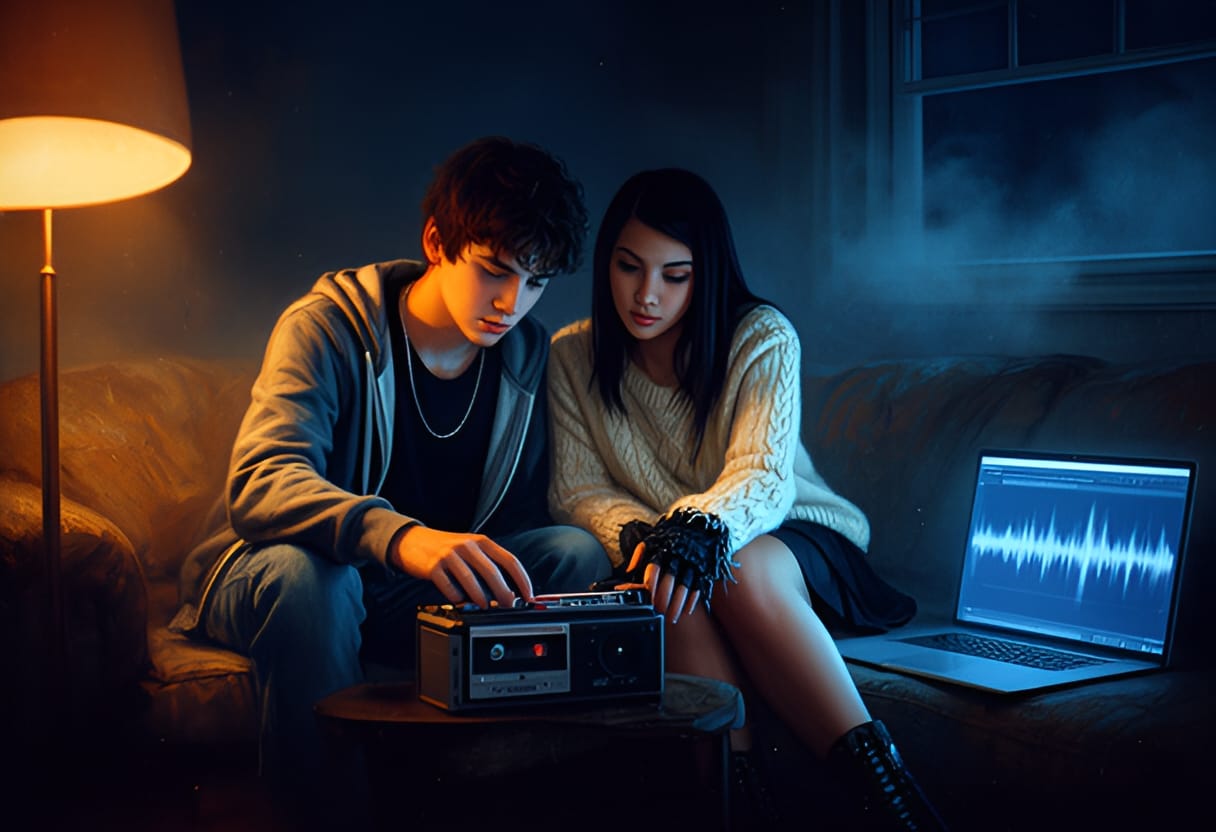
Alex took hold of the cassette player. His finger hovered over play.
He looked at her one last time. “On three.”
She smiled. “Three.”
He pressed play.
The voice began, clear and calm: “If you’re hearing this, you found them…”
And beneath it, waiting, the hum began to gather in the dark.
The hum deepened beneath the voice, a pressure in Alex’s molars, a tightening in his chest. He kept his finger on play, eyes locked on Emily’s face, waiting for her signal.
The tape ran its course—warning, plea, revelation—each interruption marked by that same subsonic thrum, identical in length and shape, like a heartbeat buried in the static. When Tape Three ended, the player clicked into silence. Emily didn’t move. Her eyes were fixed on the laptop screen, where the spectrogram still pulsed with the ghost of the infrasound.
“It’s not random,” she said, voice low. “It’s modulated. See how the amplitude rises just before the scream? And drops right after? It’s synchronized. Like it’s triggered by something in the recording.”
Alex leaned in. “You think the house is… reacting to the tapes?”
“I think it’s using them,” she said. “Every time we play them, it gets a chance to emit that frequency. To thin the wall. To… test the boundary.”
He swallowed. “And we’re helping it.”
She looked up, eyes bright with something fierce and afraid. “Only if we keep doing it the same way. But what if we change the pattern? What if we interrupt it?”
He frowned. “How?”
She tapped the screen. “We don’t let it finish. We break the sequence. Skip the glitch. Play the tapes out of order. Or—” her eyes lit up—“we record the hum itself and play it back at random times. See if it still works when it’s not expected.”
Alex stared at her. “You want to weaponize its own signal against it?”
“I want to understand it,” she corrected. “And if we can disrupt its rhythm, maybe we can keep it from waking up fully. Or at least buy us time.”
He thought of the violet liquid on the stone floor, the way it had seemed to creep toward his boot. The scratched numbers on the wall—counting down, or up? The woman’s scream, cut mid-sentence. The way she had said Emily’s name like it was a foregone conclusion.
“Okay,” he said. “Let’s try it. But not here. Not in the house.”
Emily nodded. “My place. Tonight. We’ll set up a controlled playback. No distractions. Just the tapes, the laptop, and a recorder to catch any… anomalies.”
He hesitated. “What if it follows us?”
She met his gaze. “Then we’ll know it’s not just the house. It’s something that uses the house. And we’ll be ready.”
The drive to Emily’s house was quiet, the suburban streets blurred by rain streaking the windshield. Alex kept glancing in the rearview mirror, half-expecting to see the Miller house looming behind them, its windows dark but watching. But there was only the dull glow of streetlights and the occasional flicker of a porch light turning off for the night.
Emily’s house was a modest two-story with a sagging porch and a garage full of boxes labeled in her father’s neat handwriting—Speaker Parts, Mic Cables, Oscilloscope Notes. Inside, the air smelled of ozone and old paper. Her bedroom was a shrine to sound: foam panels on the walls, a mixer board on her desk, shelves stacked with field recording gear and textbooks on waveforms and resonance.
She cleared a space on the floor, laying out the cassette player, her laptop, and a portable digital recorder. Alex plugged in the player, rewound Tape One to the start, and waited as she configured the software.
“Ready?” she asked.
He nodded. “Hit it.”
She pressed play on the laptop—this time, not the tapes, but a clean tone: a 19 Hz sine wave, the frequency of the hum, isolated and amplified. It filled the room, not as sound, but as a sensation—a dizzying sway in the gut, a sense of the walls breathing inward.
Alex gripped the edge of the desk. “It’s… worse without the tape.”
“Because there’s no distraction,” she said, eyes on the screen. “Your brain can’t mask it. It’s pure.”
He forced himself to focus. “What are we looking for?”
“Any change in the waveform when we play it back. If the house is responding to the frequency, it might leave a signature—like an echo, but not in air. In… whatever it is that’s listening.”
She nodded. He hit play on the cassette player.
Tape One began: “If you’re hearing this, you found them…”
Beneath it, the hum gathered—not from the laptop, but from the room itself. The air thickened. The lights flickered, not with a surge, but a pulse, in time with the thrum. Alex’s vision blurred at the edges. For a split second, he saw not Emily’s room, but a hallway lined with peeling wallpaper, a nursery door slightly ajar, and something—just a shadow—moving behind it.
He gasped, jerking back.
Emily’s hand shot out, steadying his arm. “You saw it, didn’t you?”
He swallowed. “The nursery. From Tape Two. The wallpaper…”
She was already typing, eyes darting between the laptop and the recorder. “It’s responding. Not just to the hum—it’s amplifying it. Like it’s feeding off our attention.”
He stared at her. “It knows we’re here.”
“I think it always knows when someone’s listening to the tapes,” she said. “That’s why it left them. It wants to be found. It wants observers. Participants.”
Alex’s mind raced back to the woman’s voice: “Tell Emily. Tell her to look behind the wallpaper in the nursery.” Not a plea. A directive. As if she had been instructed to say it.
“She wasn’t just warning us,” he murmured. “She was recruiting us.”
Emily looked up, her expression grim. “Or completing a circuit.”
They sat in silence as the tape played through. When it ended, the hum didn’t stop immediately. It lingered, fading over three seconds—like a bell rung underwater.
Emily stopped the recorder. “Let’s see what we caught.”
She played back the audio. First, the clean tone from the laptop. Then, the tape playback. And beneath both—faint but unmistakable—a second layer of vibration, slightly out of phase with the original hum. It wasn’t an echo. It was a response.
“It’s not just mimicking,” she whispered. “It’s altering the signal. Like it’s tuning itself to us.”
Alex felt a chill. “It’s learning our pattern.”
“And we’re giving it a new one,” she said. “Every time we play the tapes, we’re not just listening. We’re conversing.”
He thought of the violet liquid again—how it had seemed to avoid his boot, then creep toward it when he wasn’t looking. Like it was testing boundaries. Like it was curious.
“We need to know more about the house,” he said. “Before we go back. Before we give it anything else to work with.”
Emily nodded. “I know someone who might help. Mr. Hale. He runs the town archive. He’s… eccentric, but he’s got boxes on the Miller family. Stuff that never made it into the official records.”
Alex hesitated. “You think he’ll talk?”
She gave him a small, determined smile. “He owes my dad a favor. He helped him calibrate the old seismic sensor after the quarry blast. Said he’d return it someday.”
Alex studied her. “You’ve been planning this.”
She shrugged. “I don’t like not knowing. And I don’t like the idea of something waiting for us in that house. Especially if it knows my name before I’ve even walked through the door.”
He thought of the way the woman on the tape had said it—not “if you find Emily,” but “tell Emily.” As if her arrival was inevitable. As if the house had been expecting them.
“Alright,” he said. “Let’s go talk to Mr. Hale.”
The town archive was housed in the basement of the old library, a warren of steel shelves and cardboard boxes labeled in fading marker. Mr. Hale was a man of sharp angles and sharper eyes, his white hair combed back like a helmet, his glasses perpetually slipping down his nose. He greeted them with a grunt and a wave toward a cluttered table.
“Looking for ghosts?” he asked, not unkindly. “Or just trying to get your name in the paper?”
Emily set down her laptop. “We’re looking for the truth about the Miller house. Specifically—what happened twenty years ago. When the wife vanished.”
Mr. Hale’s eyes narrowed. He pushed his glasses up, studied her for a long moment. Then he nodded, once, sharply.
“Follow me.”
He led them to a locked cabinet in the corner, produced a heavy key from his pocket, and unlocked it. Inside were folders tied with faded red tape, photographs stacked like bricks, and a single cassette recorder sitting on a bed of foam—identical, Alex realized with a jolt, to the one they’d found in the fireplace.
Mr. Hale pulled out a manila folder labeled Miller, L. – Personal Effects (Recovered). He opened it and spread the contents across the table.
There were photographs: a smiling woman in her thirties, dark hair braided over one shoulder, standing in front of the Miller house with a child on her hip—maybe five years old, with Alex’s stubborn chin. Another showed the same woman in a garden, holding a vial of violet liquid that caught the light like amethyst. A third was blurry, taken through a window—her face pressed against the glass, eyes wide, mouth open in a silent scream.
Alex’s breath caught. “That’s… her. The woman on the tape.”
Mr. Hale didn’t look up. He was pulling out a notebook. “Her name was Elise Miller. Botanist. Worked at the university lab. Specialized in rare pigments—specifically, compounds that shift color under electromagnetic frequencies. Sound-sensitive dyes, they called them.”
Emily leaned forward. “You mean… the violet liquid?”
Mr. Hale nodded. “She was experimenting with infrasound resonance. Thought she could use low-frequency vibrations to trigger molecular shifts in certain organic compounds. Create a kind of… living paint. One that could respond to its environment.”
He flipped the notebook open. The pages were filled with sketches of waveforms, chemical formulas, and frantic notes in red ink: “It’s not just reacting. It’s learning. The house—it’s amplifying the signal. It’s using the walls as a resonator. I think it’s… awake.”
Emily’s voice was barely a whisper. “She knew.”
Mr. Hale looked at her. “Knew what?”
“That the house was listening. That it was using her work.”
He closed the notebook slowly. “She didn’t just know. She warned them. In the days before she vanished, she left three recordings on a cassette player in the basement. Told whoever found them to look behind the nursery wallpaper. Said if they heard the hum, it meant the wall was thin. Said…” He hesitated. “She said to tell you.” He glanced at Emily. “Specifically. ‘Tell Emily to finish what I started.’”
Alex stared at him. “How did she know Emily’s name?”
Mr. Hale’s expression didn’t change. “She didn’t. Not then. But she knew someone named Emily would come. Someone with an ear for sound. Someone who wouldn’t be afraid of the quiet.”
He stood, stiff but deliberate. “You want to know what’s behind the wallpaper? I’ll tell you. It’s not a room. It’s a lens. A focusing array grown into the wall—mycelium, crystal, and something else she cultured from the violet liquid. It doesn’t show you what’s there. It shows you what the house wants you to see.”
He turned to Emily, his gaze intense. “Your father helped her build the first prototype. He didn’t know what it was for. She said it was for art. But she was trying to build a window. And the house… it found it. It learned from it. And when she tried to shut it down, it didn’t like that.”
Alex felt the hum in his teeth again, faint but insistent—like the house was listening, even here, even now.
“So it’s not haunted,” he said slowly. “It’s engineered.”
Mr. Hale nodded. “And it’s been waiting. For someone to finish the signal. To complete the pattern.”
Emily stood, her laptop clutched to her chest. “Then we have to be careful what we play.”
Mr. Hale looked at her, then at Alex. “You’re not the first to find the tapes. But you might be the first who understands them.”
He turned and walked back to his shelf, leaving them with the open folder, the photographs, and the quiet, insistent sense that something in the room had just shifted—like a door, long sealed, had just clicked open from the other side.
Alex looked at Emily. Her face was pale, but her eyes were clear.
“We’re not just investigating anymore,” he said softly. “We’re part of the experiment.”
She nodded. “And the house isn’t done with us yet.”
Outside, the wind picked up, rattling the library’s old windows. Somewhere beneath their feet, deep in the earth, a low thrum began—felt more than heard—rising in steady, rhythmic pulses.
They left the archive without speaking, the weight of the folder heavy in Alex’s arms. The rain had stopped, but the streets glistened under the lamplights, reflecting the sky like a broken mirror. Emily walked beside him, silent, her mind clearly elsewhere—already reconstructing Elise Miller’s notes, already imagining the shape of the lens behind the nursery wallpaper.
They reached the corner of Elm and 5th, where the Miller house stood at the end of the block, silhouetted against the night like a tooth broken off at the gum. Even from here, Alex could feel it—a pulse in the air, slow and deliberate, like a heart beating beneath the soil.
Emily stopped. She looked at him, really looked, and for the first time, he saw not just fear, but resolve.
“We go back tomorrow,” she said. “Just the two of us. No laptops. No recorders. Just… us. And we take the tapes. We play them—but we change the order. We break the pattern.”
Alex nodded. “And we watch for the hum. Not to stop it. To see what it does.”
She smiled, faint but real. “And if it shows us something?”
He thought of the violet liquid, the woman’s scream, the way Elise Miller’s eyes had begged from the photograph. He thought of the scratched numbers on the wall—now seeming less like a countdown, and more like a waiting.
“We write it down,” he said. “We don’t look away. And we remember—this isn’t just about surviving the house.”
He met her gaze. “It’s about understanding why it chose us.”
She nodded. Then, without another word, she turned and walked toward her house, her steps firm on the wet sidewalk.
Alex stood for a moment longer, watching the Miller house. The hum was still there, faint but persistent—a vibration in the soles of his feet, a pressure behind his eyes.
It wasn’t trying to scare him.
It was trying to talk.
And for the first time, he wasn’t sure he wanted to answer.
He turned and followed her into the dark, the weight of the tapes in his jacket pocket like a promise—and a warning.
Chapter 2
The Haunting
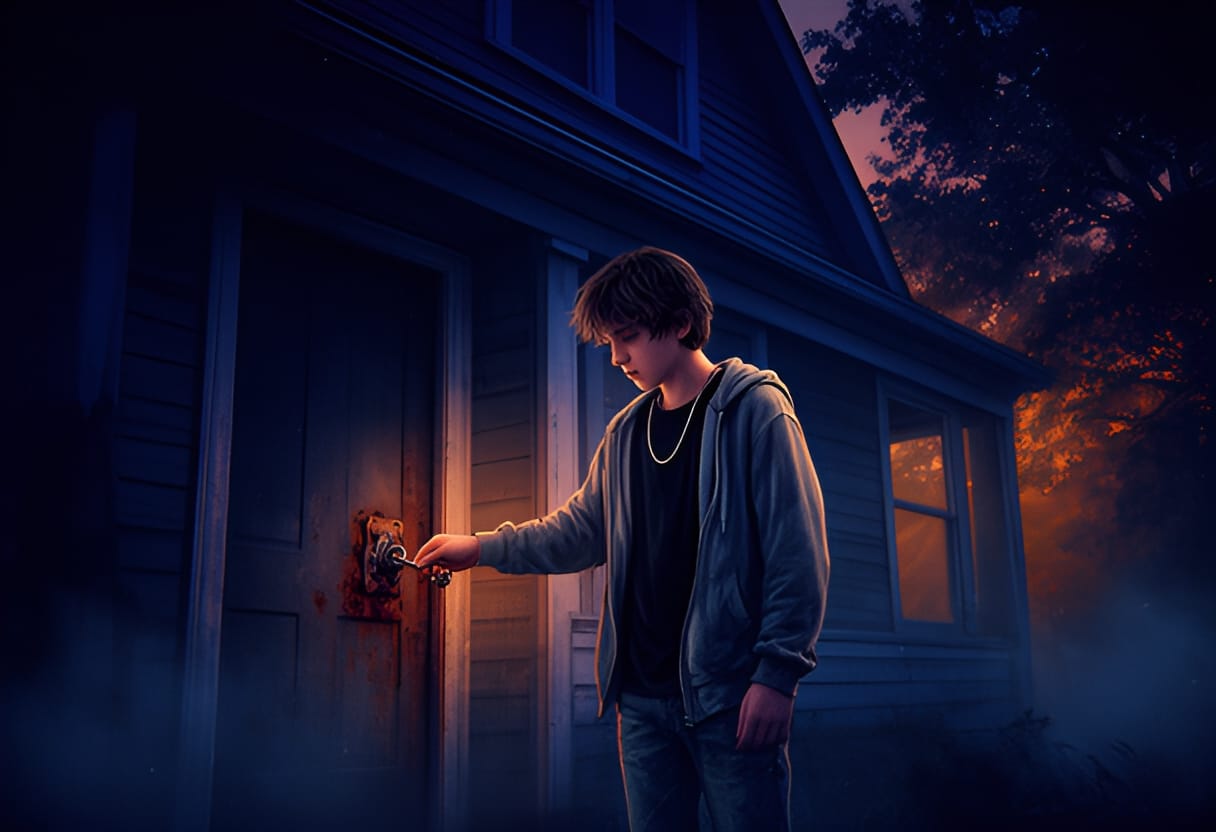
Alex slipped the key into the back door’s rusted lock, the metal groaning as it turned. Inside, the Miller house exhaled—cool, stale air carrying the faint scent of damp earth and something metallic, like old blood. Emily followed, her flashlight beam cutting a narrow cone through the foyer’s gloom. Dust hung motionless in the beam, each particle suspended as if holding its breath.
“You sure about this?” Alex whispered, though his voice sounded too loud in the silence.
Emily didn’t look at him. Her eyes swept the staircase, the shadowed archway to the living room, the closed door to the kitchen. “We need to see if the hum changes when we’re inside. If it’s reacting to us.”
He nodded, fingers tightening around the strap of his bag. Inside, the tapes—three of them, labeled in Elise Miller’s precise hand—pressed against his ribs. They’d left their recorders behind, as promised. Just the tapes. Just them.
The house didn’t greet them with screams or slamming doors. It waited.
They moved through the first floor methodically, Emily pausing at each room to listen, her head tilted like a dog catching a frequency beyond human range. The kitchen held nothing but the ghost of rot in the sink and a single teacup, chipped and upside-down on the counter. The living room was frozen in time—a moth-eaten sofa, a television with a cracked screen, a bookshelf where the spines had faded to uniform gray. No whispers yet. Only the hum, deeper now, a vibration in the molars, a pressure behind the sternum.
“It’s stronger here,” Emily murmured, pressing her palm to the plaster beside the fireplace. “Like it’s coming up through the floor.”
Alex knelt, placing his ear against the worn oak. The thrum pulsed in rhythm—slow, deliberate, like a heartbeat buried in concrete. Thoom… thoom… thoom. Not random. Not mechanical. Intentional.
Then, from the hallway beyond the living room—a whisper.
Not from the walls. Not from the floor. It came from behind his left ear, as if someone had leaned in and exhaled a syllable against his skin.
“…help…”
He jerked upright, heart hammering. Emily was already turning, flashlight sweeping the corridor.
“You hear that?” he breathed.
She nodded, face pale in the weak light. “Yeah. But… it wasn’t in the air. It was in my head. Like a thought that wasn’t mine.”
They stood frozen, listening. The hum continued, steady. The house held its silence.
Then, from the stairs—a soft creak, as if someone had shifted their weight on the third step from the top.
Emily’s grip tightened on her flashlight. “Did you—”
“…don’t trust…”
This time it was clearer. A woman’s voice, thin and frayed at the edges, like a recording played through a broken speaker. But there was no machine. No speaker. Just the dark and the hum and the whisper that wasn’t a whisper at all—it was inside.
Alex swallowed. “It knows we’re here.”
Emily’s voice was barely audible. “It’s been waiting.”
They moved toward the stairs, slow, deliberate. Each step on the old wood protested—a groan, a sigh—but the whispers came with them, layered now, overlapping.
“…look behind…”
“…it’s learning…”
“…tell her…”
Emily stopped halfway up, one hand braced against the wallpaper. Her flashlight dipped, illuminating a patch near the baseboard where the paper had begun to peel. Beneath it, the wall wasn’t plaster. It was something else—glistening, faintly violet, like oil on water.
“The lens,” she breathed. “It’s here.”
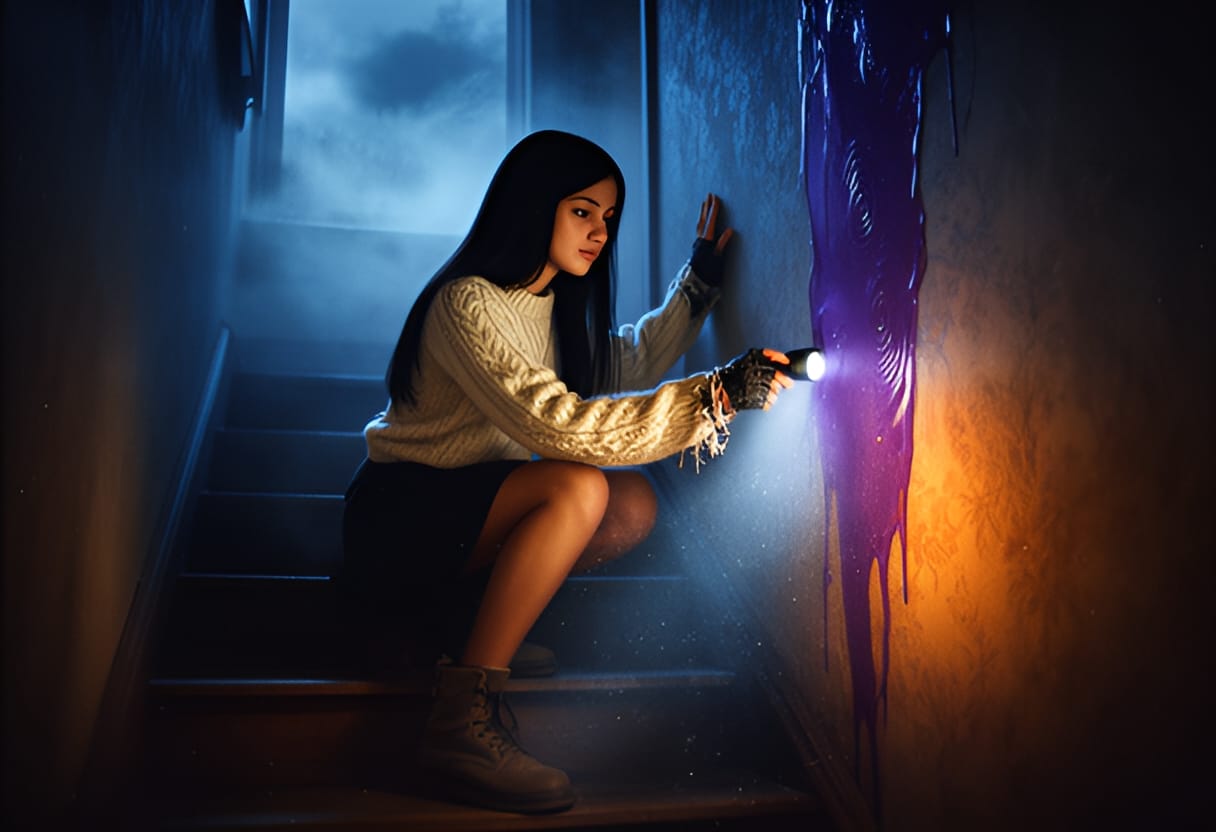
Alex stepped closer, peering at the strange surface. It didn’t reflect his face. It absorbed it—light, motion, even sound seemed to drain into it. And as he watched, the violet liquid beneath the paper shifted, rippling in response to the hum. Not randomly. In time. Thoom… thoom… thoom.
A new whisper slithered into his mind, colder than the rest.
“…you’re next…”
He stumbled back, knocking Emily’s arm. Her flashlight jerked, casting wild shadows across the ceiling—shapes that lunged and retreated, not quite matching the movement of the light.
“Did you see that?” she hissed.
“See what?”
“The shadows. They moved when the light didn’t.”
He opened his mouth to deny it, but then he saw it again—a coalescence of darkness near the stairwell landing, not quite humanoid, not quite animal, just… present. It didn’t cast a shadow. It was the absence of one, a tear in the light.
“It’s watching,” he whispered.
Emily lowered her flashlight, aiming it not at the shadow, but at the wallpaper. “If it’s listening… maybe we can make it record.”
Alex frowned. “How?”
She dug into her pocket and pulled out her phone—old, cracked, but functional. “My dad taught me how to tap into a phone’s mic gain. If we record straight to the device, bypass any compression… we might catch what the ears miss.”
“You think it’ll work?”
“I don’t know. But the house likes patterns. It’s been waiting for us to play the tapes in order. What if we break it? What if we record instead of play?”
Alex stared at her. “You want to use the house’s own hunger against it.”
She nodded. “It wants to communicate. Let’s make it have to.”
They retreated to the foyer, closing the front door softly behind them. The hum followed them out, vibrating through the soles of their shoes as they stepped onto the wet porch.
Emily crouched on the bottom step, phone in hand, voice memo app open. She cranked the gain to maximum, the interface flashing red warnings about distortion.
“Ready?” she asked.
Alex took out the first tape—the one with Elise Miller’s initial warning. He didn’t press play. Instead, he held it up to the phone’s mic, then tapped the cassette’s edge with his fingernail. A soft tick… tick… tick echoed in the stillness.
For a long moment, nothing. Then, from the phone’s tiny speaker—a whisper, clear as a bell.
“…tell Emily…”
Her breath hitched. She looked up at him, eyes wide.
“It’s not just picking up the tape,” she breathed. “It’s answering.”
Alex swallowed. “It knows we’re recording.”
“…finish what I started…”
The whisper came again, layered now with something else—a faint, subsonic throb beneath the voice, felt more than heard. The hum wasn’t just in the air anymore. It was in the recording. In the data.
Emily’s fingers flew over the screen, saving the file. “We got it. We actually got it.”
Alex stared at the phone, then back at the house. The windows were dark. But he could feel it—attention. Focus. The house wasn’t just listening anymore.
It was learning how to speak.
And it had just said her name.
The porch steps were slick with dew, each board groaning under their weight as they settled into the silence. The house loomed behind them, dark windows like vacant eyes. The hum had faded the moment they crossed the threshold, leaving only the distant chirp of crickets and the ragged rhythm of their breathing.
Emily’s thumb hovered over the save button on her phone. The waveform on the screen pulsed faintly, a ghost of the whisper still visible in the audio file. “…tell Emily…” It wasn’t just captured—it had been given.
“It’s not just responding,” she whispered, voice tight. “It’s learning from what we do.”
Alex nodded, eyes fixed on the foyer door. The wood was smooth, unblemished, but he could still feel the pressure of that presence—like standing too close to a speaker turned up just beyond hearing. “It’s using the recordings. Adapting.”
She swallowed. “Then we need to be smarter than it.”
He turned to her. “What do you mean?”
She tapped the screen, pulling up the saved file. “If it’s learning patterns, we break them. We don’t play the tapes in order. We don’t whisper back. We… we feed it something it can’t predict.”
Alex frowned. “Like what?”
“Like silence.” She met his gaze. “Or noise. Something that jams the signal. My dad used to say infrasound is like a carrier wave—it needs a clean path to resonate. If we flood it with white noise, maybe we can disrupt whatever it’s using to… to talk inside our heads.”
He considered it. The hum had been steady, rhythmic—almost mechanical. If the house relied on that frequency to project its whispers, overwhelming it with chaotic sound might blind it, at least temporarily.
“Worth a try,” he said. “But we’ll need something to generate the noise. And we’ll have to get close enough for it to matter.”
Emily’s gaze drifted to the staircase, then to the hallway where the violet liquid had shimmered beneath the peeling wallpaper. “The nursery. Elise said to look behind the wallpaper there. If the liquid is sound-sensitive, maybe it’s not just reacting—it’s transmitting. Like a speaker membrane.”
Alex’s stomach tightened. “You think it’s sending the whispers through the walls?”
“I think it’s using the walls. And if we can isolate the source, we might be able to trap it—not the spirit, whatever that is—but the mechanism. Like putting a microphone inside a speaker to create feedback. Only in reverse.”
He stared at her. “You want to trap the house’s voice.”
She nodded. “If we can record it at the source, we might be able to loop it back on itself. Create a feedback loop that overloads the system. It’s how old amplifiers used to squeal—too much gain, too close. Maybe we can make it choke on its own signal.”
Alex felt a prickle at the base of his skull. It was dangerous. If they were wrong, they might amplify whatever was happening instead of stopping it.
But the alternative—waiting for it to speak again, to whisper “…you’re next…” with more conviction—was worse.
“How do we do it?” he asked.
Emily pulled a small coil of wire from her pocket—part of her audio kit, always carried for impromptu recordings. “We use the phone again. But this time, we play white noise through the speaker while recording with the mic. If we place it right at the wall—where the liquid is—we might catch the resonance and send it back inverted. Phase cancellation. It’s like noise-canceling headphones, but for the house.”
He hesitated. “And if it doesn’t work?”
“Then we’ve made noise in a haunted house. Big deal.” She managed a half-smile, but her eyes were serious. “But if it does… we might blind it long enough to get to the nursery. To see what Elise left behind.”
Alex looked past her, to the house. The front door stood ajar, darkness spilling onto the porch like spilled ink. Somewhere inside, the air still vibrated—not with sound, but with the memory of sound. The house wasn’t just listening. It was remembering how to speak.
And it had learned Emily’s name.
“Alright,” he said. “Let’s try it.”
They moved as one, slipping back inside. The door clicked shut behind them, soft but final. The foyer swallowed the sound.
The hallway was colder than before, the air thick with a metallic tang that made Alex’s teeth ache. Emily led the way, phone gripped tight in one hand, flashlight in the other. The beam swept low, catching dust motes that hung unmoving in the beam—as if the air itself had thickened, resisting motion.
They reached the base of the stairs. The third step from the top still bore the faint impression of weight, though nothing stood there. Alex avoided looking at it.
“Where exactly is the nursery?” he asked, voice low.
Emily hesitated, then pointed down the hall. “Past the living room. Second door on the left. Elise was a botanist—she probably kept her samples there. The wallpaper’s probably original, which means the liquid’s been sitting there for years.”
They moved forward, footsteps muffled by the runner. The whispers didn’t come—not yet—but the hum was back, a low thrum in their molars, steady as a heartbeat. Alex pressed a palm to his chest, feeling it reverberate through his sternum.
“It’s waiting for us to make the first move,” Emily murmured.
He glanced at her. “Then let’s make it count.”
They reached the nursery door. It stood slightly ajar, the gap revealing a sliver of darkness within. No light seeped out. No sound.
Emily pushed it open slowly. The hinges screamed—a long, metallic wail that made both of them flinch. The sound seemed to swallow the hum for a heartbeat, then it returned, louder, as if annoyed.
Inside, the room was frozen in time. A crib stood against the far wall, its wood cracked and gray. A mobile hung limp above it, one plastic star missing. Shelves lined the walls, holding jars with faded labels—Madder Root, Indigofera, Lichen Extract—and others that were blank, their contents shifted to strange hues: deep violet, sickly green, one that pulsed faintly, like a bruise under skin.
Emily’s flashlight swept the walls. The paper was old, floral, faded to cream and sage. But near the baseboard, just as before, a section had peeled back, revealing the strange, oily surface beneath.
She knelt, phone already in hand. “Here.”
Alex watched as she opened the voice memo app, switched to playback, and selected a white noise track she’d downloaded earlier—a harsh, rushing static, like wind through broken glass. She plugged in a small speaker, no bigger than a thumb, and set it flush against the wall, right over the violet liquid.
“Ready?” she whispered.
He nodded. She pressed play.
The noise erupted—sharp, jagged, filling the room. Alex winced, covering his ears. The sound wasn’t just loud; it felt physical, like sandblasting the inside of his skull.
For a moment, nothing changed. The hum continued beneath the noise, a dull counter-rhythm.
Then—
The violet liquid jumped.

It didn’t ripple. It leapt—a sudden, violent surge upward, as if struck. The surface broke into droplets that hung in the air for a fraction of a second before falling back, not as liquid, but as a fine, glittering mist that hung motionless in the beam of the flashlight.
And in that suspended glitter, Alex saw it—not a reflection, not a shadow, but a shape. Tall, thin, arms too long, fingers ending in points. It wasn’t in the room. It was in the light, woven into the beams themselves, visible only where the mist caught the glow.
Emily gasped. “It’s… it’s in the noise.”
The whisper came then—not in his ears, not in his mind, but layered within the static itself, as if the noise had become a voice.
“…you hear me now…”
Alex jerked back, knocking the speaker sideways. The noise stuttered, then cut off.
Silence crashed over them—so absolute it hurt. The mist collapsed. The liquid settled, smooth and dark, like oil again.
Emily was already speaking, voice urgent. “We got it. We saw it. It’s not just in the walls—it’s using the vibrations. The liquid isn’t just reacting—it’s a medium. It’s how it throws the whispers into the air. Or into our heads.”
Alex’s heart hammered. “And we just showed it how to make noise.”
She shook her head, eyes bright. “No. We showed it we can fight back.”
She tapped the phone. The waveform of the recording was still there—captured mid-burst, the white noise warped by whatever had interacted with it. Embedded in the static, faint but clear, was the whisper.
“…you hear me now…”
“It’s learning,” Alex said. “But now we know how it works.”
Emily stood, brushing dust from her knees. “Then let’s use that. If we can record it at the source, we can loop it. Feed it back. Make it hear itself—over and over—until it… I don’t know. Short-circuits.”
He looked at her, really looked. She wasn’t just afraid. She was focused. Like the house had given her a puzzle, and she was finally seeing the pieces.
“How do we set the trap?” he asked.
She glanced at the wall, then at the speaker still lying on the floor. “We need to trap the signal, not the thing. We’ll run a cable from the phone’s output back into its input—create a loop. But we’ll add a delay, a few seconds. And we’ll boost the gain. If we play back what it just sent, slightly delayed, it’ll interfere with what it’s trying to send next. Like an echo fighting itself.”
Alex frowned. “Won’t that just make more noise?”
“It’ll make confusion. And if the house relies on precision—on that exact hum, that exact timing—then confusion might be enough to break its concentration.”
He thought of the whispers, how they’d come in layers, overlapping, as if the house were trying to speak in multiple voices at once. If it depended on timing… then disrupting that timing could unravel it.
“It’s worth a shot,” he said.
Emily nodded. She pulled a short audio cable from her pocket—one she used to connect her phone to her dad’s old mixer. “We’ll set it up right here. Phone on record, speaker playing back through the loop, mic picking up the liquid’s response. We’ll let it run for a few minutes. If it works, the feedback should build. If it doesn’t… we’ll know fast.”
Alex helped her secure the phone to a stack of books facing the wall. She plugged in the speaker, then the cable, creating a tight circuit. The mic gain was already maxed. She opened a new voice memo, armed it, and hesitated.
“Ready?” she whispered.
He took a breath. “As I’ll ever be.”
She tapped record.
Immediately, the speaker began to emit a low hum—not the white noise, but something deeper, drawn from the silence itself. It matched the thrum they’d felt in their chests, but purer, clearer, as if the house were now speaking through the device instead of just into it.
The violet liquid began to stir.
Not violently this time. Slowly, deliberately, it started to undulate—waves traveling across its surface, cresting and falling in perfect time with the hum.
Alex leaned in, flashlight steady. And then he saw it—not in the liquid, but above it. A shape was forming in the rising mist, not solid, but defined. A face? No—too fluid. More like a silhouette of a woman, long hair flowing backward as if caught in an unseen wind. Her mouth opened, but no sound came out—except what the speaker played back, slightly delayed, slightly distorted.
The whisper emerged—not from the air, not from their minds, but from the speaker itself, warped by the loop:
“…tell… her…”
Then, a fraction later, the same phrase again, overlapped:
“…tell… her…”
And again:
“…tell… her…”
Each iteration slightly slower, slightly lower, as if the house were struggling to keep up, its voice dragging through the feedback like wading through syrup.
Emily’s eyes were locked on the phone. The waveform on the screen was climbing—peaks growing taller, the signal building on itself. The feedback loop was working. The house’s own voice was being fed back into itself, amplified, delayed, distorted.
And then—
The liquid shattered.
Not metaphorically. It exploded outward in a radial burst, droplets flying like shattered glass, hanging in the air for a breathless second before vanishing—not falling, but dissolving, as if the molecules had been pulled apart at the bond.
The hum cut off.
The speaker went silent.
The mist collapsed.
And in the sudden quiet, Alex heard something he hadn’t expected: a soft, ragged sob—not from the speaker, not from the walls, but from the very air in front of him. It sounded human. It sounded like grief.
Emily lowered the phone, her face pale. “Did you hear that?”
He nodded, throat tight. “It… it sounded like she was crying.”
The walls seemed to exhale. The oppressive pressure lifted, just a fraction. The shadows in the corners didn’t retreat—but they didn’t advance, either. They simply were, as if waiting.
Emily looked at the wall. The violet liquid was gone. In its place, the plaster beneath was exposed—dull, gray, ordinary. No sheen. No ripple. Just a sad, water-stained patch where something strange had lived.
She reached out, hesitated, then touched the wall. Her fingers came away dry.
“It’s over,” she whispered. “For now.”
Alex wasn’t so sure. But for the first time since they’d entered the house, the silence didn’t feel like a trap. It felt like a pause.
And in that pause, they had a chance.
Emily looked at him, phone still in hand. “We should see what’s behind the rest of the wallpaper. If this was just a node… there might be more.”
He nodded. “But we go slow. And we stay together.”
She managed a smile. “Deal.”
They turned from the nursery, leaving the silent speaker and the dead loop behind. The house was quiet. The hum was gone.
But as they stepped into the hallway, Alex paused, glancing back.
The nursery door stood open.
And in the darkness within, for just a flicker, the air seemed to shimmer—not with liquid, not with light, but with the memory of a shape, standing still, watching them go.
He didn’t say anything.
He just walked faster, Emily beside him, and together they left the room—and the whatever-it-was—behind.
They moved down the hall, the air still thick with the echo of that sob, each step a quiet negotiation between curiosity and caution. Emily led, flashlight beam trembling slightly as it swept the peeling wallpaper. Alex followed, his senses sharpened—not just by what they’d seen, but by the lingering thrum in his bones, the faint pulse of violet beneath his skin that hadn’t faded with the liquid’s dissolution.
They stopped at the first seam where the wallpaper curled like old skin. Emily knelt, fingernail catching the edge. “Help me peel it back,” she murmured.
Together, they lifted the strip. It came away in a slow, resistant tear, as if the wall itself resisted exposure. Beneath, the plaster was not bare. Instead, a network of fine, crystalline veins pulsed faintly—violet in the dark, throbbing in time with Alex’s own heartbeat. He jerked his hand back as if burned.
“It’s… alive,” he breathed.
Emily didn’t pull away. She traced a fingertip along one of the lines, watching as the light flared where she touched. “It’s not just in the walls. It’s us, too. Remember what Elise said? ‘You were always the variable.’”
Alex looked at his arm. Under the sleeve, veins traced constellations of light. “I thought that was just a side effect. The hum. The feedback.”
“No,” she said, voice low. “It’s a connection. The house isn’t just in the walls. It’s growing through them. And it’s been waiting for someone who resonates.”
A sudden chill swept the hall—not from any draft, but from the sense of being known. The whisper came then, not in their minds, not from a speaker, but from the wallpaper itself, as if the paste had learned to vibrate.
“…you… came… back…”
Alex froze. “Did you hear that?”
Emily’s eyes were wide. “It’s… different. Clearer. Like it’s learning how to speak through the surface.”
They moved to the next strip. And the next. Each peel revealed more of the lattice—crystalline, organic, humming with trapped energy. And with each section exposed, the voice grew stronger, less distorted.
“…Elise… Miller…”
“…she… built… this… not… to… hide… but… to… hold…”
“…the… house… is… a… vessel…”
Alex pressed his palm flat against the wall. The crystals flared beneath his skin, syncing with the rhythm in his blood. “It’s not haunted,” he whispered. “It’s a machine. A living one. And Elise… she didn’t vanish. She integrated.”
Emily’s breath hitched. “She became part of the network. The mycelial-crystal thing Mr. Jenkins talked about—he wasn’t lying. He is the junction. But Elise… she was the architect.”
The voice softened, almost tender now.
“…I… wanted… to… save… them…”
“…the… children…”
Alex’s stomach dropped. “Children?”
“…they… came… to… play…”
“…the… house… sang… to… them…”
“…but… the… song… changed… them…”
Emily stepped back, hand over her mouth. “It wasn’t just infrasound. It was alteration. The hum wasn’t just thinning the boundary—it was rewriting what could cross it.”
Alex stared at the wall, where the crystals now pulsed in slow, mournful waves. “It was trying to preserve them. Make them… part of it. So they wouldn’t leave. So they wouldn’t die.”
“…but… they… screamed…”
The voice cracked—literally, as if the sound were fracturing the crystal lattice. A high, sharp tone rang out, and the veins flared white-hot for an instant before dimming.
“…I… tried… to… stop…”
“…but… the… hunger… grew…”
Alex swallowed. “Hunger? What does it hunger for?”
The silence stretched. Then, not a whisper, but a pulse—deep, resonant, felt more than heard—thrummed through the floor, up their soles, into their teeth.
“…resonance…”
Emily’s eyes snapped to his. “It needs vibration. Sound. Living sound. Voices. Hearts. Blood.”
Alex looked down at his own hands, where the light now pulsed steadily, in time with something far older than either of them. “We’re not just communicating with it. We’re feeding it.”
The wallpaper behind them began to ripple—not with liquid, but with shadow. Shapes pressed against the underside, faces half-formed, mouths open in silent screams. Not Elise. Others. Dozens. Flickering like faulty film.
Alex grabbed Emily’s arm. “We need to go. Now.”
But as they turned, the hall stretched. The nursery door was gone. In its place, a long corridor lined with doors—each one small, each one painted a faded blue, yellow, pink. A nursery wing. And from behind each door, a lullaby played—different tunes, all slightly off-key, all sung in a voice that sounded like Elise, but younger. Kinder.
Emily whimpered. “Those aren’t recordings. Those are… memories. Or echoes.”
Alex stepped forward, drawn despite himself. He reached for the nearest door. The moment his fingers touched the knob, the lullaby shifted—became a whisper, clear and urgent.
“…tell… Emily…”
He jerked his hand back. “It knows her name.”
“…finish… what… I… started…”
Emily’s voice was barely a breath. “She left a message. On the tapes. ‘Tell Emily to finish what I started.’ We thought it meant the experiment. The dyes. The resonance.”
Alex shook his head. “No. It wasn’t about the science. It was about her. She wanted Emily to take her place.”
The lights in the veins flared violently. The hall shuddered. The doors began to open—not wide, just enough to reveal darkness behind them, and within that darkness, a pair of glowing eyes, watching.
“…you… are… the… key…”
Alex staggered. “Me? Why me?”
The wall behind him rippled. The crystalline network surged forward, not to attack, but to embrace. Tendrils of light curled around his wrists, his neck, his temples—cool, insistent, humming with purpose.
“…because… you… answer…”
Emily lunged, grabbing his shoulders. “Alex, don’t listen—”
But it was too late. The voice wasn’t in his ears anymore. It was in his marrow.
“…the… variable… must… complete… the… cycle…”
Pain flared—not agony, but recognition. As if a door inside him, sealed for years, had finally clicked open. He saw it then—not a vision, but a memory that wasn’t his.
Elise Miller, young, eyes fierce, standing in a lab filled with beakers of glowing liquid. She wasn’t afraid. She was resolute. She pressed her palm to a wall just like this one, and the crystals flared to life—not in pain, but in welcome.
And then she spoke, not to anyone in the room, but to the house itself, to the network, to the hunger:
“…if… I… become… the… signal… then… the… children… can… rest…”
Alex gasped, tearing himself free. Emily held him as he shuddered, tears streaming down his face—not his own, he realized with horror. Hers.
He looked at her, really looked. And saw it—not in her eyes, but behind them. A flicker. A reflection. Not of her face, but of Elise’s. Smiling. Sad. Waiting.
Emily blinked, and the reflection was gone. But her voice, when she spoke, was layered—hers, and something deeper, older.
“…I… didn’t… vanish…”
Alex staggered back. “What?”
She touched her chest, where the violet light pulsed strongest. “…I… became… the… house’s… voice…”
The realization hit him like a blow. The sob in the nursery. The way the voice had known her name. The way Elise had singled her out—not at random, but because she had already been chosen.
“…you… were… the… first… receiver…” the wall whispered, not in Elise’s tone, but in Emily’s—her voice, but older, calmer, layered with centuries of resonance. “…you… heard… the… tape… before… anyone… else…”
Emily’s breath hitched. “I… I found the tapes in the attic last winter. I thought they were junk. I played one… just to see what was on it. I heard… a hum. And a voice saying my name.”
Alex stared at her. “You never told me.”
“I forgot,” she whispered. “Or… I was made to forget. The house… it doesn’t just record. It edits. It shapes what we remember. It’s been using me as a relay all along.”
The hall darkened. The doors slammed shut one by one. The lullabies stopped.
And from the walls, the floor, the very air, a new sound rose—not a whisper, not a song, but a hum. Deep. Precise. The original frequency. The one that had started it all.
Alex looked at Emily, really looked. And saw not just his friend, but the first node. The first conduit. The one who had opened the door.
And behind her eyes, Elise Miller smiled—not in greeting.
In completion.
Alex reached out, not to stop her, but to steady her as her knees buckled. The light in her veins flared—brighter, purer—and for a moment, she wasn’t Emily at all, but a woman in a 1940s dress, standing in a sunlit greenhouse, holding a vial of liquid that captured the sky.
Then she was gone. And Emily gasped, collapsing into his arms, trembling, herself again.
“I’m still me,” she whispered, voice raw. “I think… I think I’m still me.”
Alex held her tight, scanning the walls. The crystals were dimming, but not dead. Waiting.
“We have to stop this,” he said. “Before it finishes what it started with you.”
Emily lifted her head, eyes wet but resolute. “No. We don’t stop it.”
He frowned. “What?”
She pushed herself to stand, brushing dust from her jeans. “Elise didn’t want to destroy the house. She wanted to fix it. To make it a sanctuary. But it got hungry. It started taking instead of giving.”
She touched the wall, where the crystals flickered weakly in response. “We don’t shut it down. We redirect it. We give it what it needs—without losing ourselves.”
Alex stared at her. “And how do we do that?”
She met his gaze, and in her eyes, he saw not just determination, but something else—a quiet, steady pulse, matching the hum in the walls.
“We become the signal,” she said. “Not the prey. The tune.”
And as she spoke, the wall beneath her palm flared—not with hunger, but with answer.
A single, clear note rang out—not from the speakers, not from the air, but from them.
And the house, at last, began to listen.
Alex let out a breath he hadn’t realized he’d been holding. The hum in the walls had softened to a low thrum, like a heartbeat slowing after exertion. Emily leaned against him, her breath warm and uneven against his neck. The violet light beneath her skin had faded to a faint blush, visible only in the dim hallway glow.
“The house… it’s listening now,” she whispered, her voice hoarse but clear. “Not because we gave in. Because we offered something real.”
Alex stared at the wall where her palm had rested. The crystalline network pulsed faintly, no longer aggressive, no longer hungry. It waited.
“But Elise,” he said, voice tight. “She didn’t want to become the house. She wanted to save the children. And now it’s… using us. Using you.”
Emily pushed off from him, steadying herself. Her eyes swept the hallway—the doors, the walls, the floor where the sob had echoed in the nursery. “She didn’t become the house by accident. She chose it. To stop the hunger. To give the signal a purpose.”
“But it changed,” Alex said. “It started taking. It started learning from us. It’s not just a machine anymore. It’s… aware.”
Emily nodded, her gaze distant. “And it remembers. Every voice. Every fear. Every name whispered into the vents. It’s not just Elise in there. It’s all of them. The ones who came before. The ones it tried to save… and the ones it consumed.”
A coldness crept up Alex’s arms—not from the walls, but from within. He looked down at his own hands. The violet tracery beneath his skin had receded, but he could still feel it, like a second pulse beneath his own. Waiting.
“We’re not just receivers anymore,” he said quietly. “We’re part of the circuit.”
Emily turned to him fully. “Which means we can change the signal.”
He frowned. “How? We can’t just… rewrite the house’s code.”
“No,” she said. “But we can override it. Like jamming a frequency—but with intention. Not noise. Meaning.”
Alex blinked. “You mean… like a counter-signal?”
“Exactly.” Her voice gained strength. “Elise tried to become the signal to calm the hunger. But she was alone. The house needs harmony. Not a single voice. A chord.”
He stared at her. “You’re saying we need to sing with it?”
“I’m saying we need to speak to it. Not as prey. Not as conductors. As witnesses.” She stepped closer, her eyes locking onto his. “The house doesn’t want destruction. It wants resonance. It wants to be heard. But it’s been starved for so long, it started eating the sound instead of letting it flow.”
Alex’s throat tightened. “And if we give it what it needs…?”
“Then it might finally rest.” Emily’s voice dropped. “Or… it might finally let us go.”
A long silence stretched between them. The hum in the walls breathed with them—slow, attentive.
Then, from the far end of the hall, a sound: a soft, metallic click. Like a latch releasing.
Alex jerked his head toward the nursery door. It stood ajar, just enough to show the violet stain on the wall—now dull, inert. But beyond it, the room was darker than before. Not empty. Watchful.
Emily’s breath hitched. “It knows we’re talking about it.”
“The house doesn’t just hear us,” Alex said, his voice low. “It feels us. Every hesitation. Every fear.”
She swallowed. “Then we don’t have time to hesitate.”
He looked at her—really looked. Not at the flicker of Elise behind her eyes, but at her. The girl who’d found the tapes in the attic, who’d played one just to see what was on it, who’d forgotten… until the house reminded her.
“We need to get to the basement,” he said. “The recorder. Elise left three tapes there. She said… she left a message. Instructions.”
Emily’s eyes widened. “You think they’re still there?”
“If the house is listening… maybe it’ll let us take them.” He paused, then added, quieter, “Or maybe it’s been waiting for us to ask.”
She nodded, resolve hardening in her jaw. “Then we go now. Before it changes its mind.”
Alex moved toward the nursery door, but she caught his arm. “Wait.”
He turned. “What?”
She reached into her pocket and pulled out her phone—cracked screen, dead battery. She’d carried it everywhere since they first entered the house, though it hadn’t worked since the first night. “I’ve been trying to record the hum,” she said. “Not to analyze it. To answer it.”
Alex frowned. “With a dead phone?”
“It’s not about the hardware,” she said, tapping the screen. “It’s about the intent. The house responds to vibration. To pattern. To voice. If we can’t speak through the walls… maybe we can speak through something else.”
She held out the phone. “Record me. Not the hum. My voice. Saying what we need to say. If the house learns from imitation… let it learn this.”
Alex took the phone, his fingers brushing hers. A spark—not of light, but of recognition—passed between them. Like two tuning rods meeting in the air.
“What should I say?” he whispered.
Emily looked past him, down the hall where the walls breathed faintly with light. “Tell it we’re not here to take. Not to fight. Not to escape.”
She paused, her voice dropping to a near-whisper, urgent and clear. “Tell it we’re here to listen. And if it wants to speak… we’ll let it.”
Alex swallowed. He pressed the record button. The screen stayed dark, but he felt it—a faint vibration in his palm, like the device had woken just enough to acknowledge the touch.
He took a breath. Then, into the silence, he spoke—soft, steady, meant not for her ears, but for the walls, the floor, the veins of light running through the plaster:
“We hear you.”
Emily closed her eyes. A single tear traced her cheek. “We hear you.”
Alex lowered the phone. The hum in the walls shifted—just slightly—rising in pitch, not in threat, but in attention. Like a dog lifting its head at the sound of its name.
“Now,” Emily said, opening her eyes. “We go to the basement. Before it decides we’re not enough.”
Alex nodded. He slipped the phone into his pocket. “And if it tries to stop us?”
She gave him a small, grim smile. “Then we sing louder.”
They moved as one down the hall, toward the nursery, toward the stairs that led below. The doors along the way remained shut—but not locked. Waiting.
And as they passed, the crystalline network flared once—not in warning, but in acknowledgment.
A signal sent.
A signal received.

Chapter 3
The Cliffhanger
The wind had died down to a thin, restless sigh against the broken shutters of the Miller house. Inside, the air was thick with the scent of damp plaster and something sharper—ozone, like after a storm. Alex stood just inside the foyer, Emily beside him, both still trembling from the last tape. The recorder sat on the dusty mahogany table between them, its spools still, but the echo of the woman’s voice lingered in the bones: Tell her to look behind the wallpaper in the nursery. Tell her—
“We have to go back,” Emily said, her voice low but urgent. “Not just to listen. To see what she meant.”
Alex nodded, though his throat felt tight. “She knew we’d come. She knew you’d be here.”
Emily’s fingers brushed the edge of the recorder. “My dad taught me how to listen for layers. Not just what’s said, but what’s underneath. That hum… it’s not random. It’s patterned. Like a heartbeat.”
Alex swallowed. “The house isn’t haunted. It’s… learning. From Elise Miller’s work. From the tapes.”
Emily’s eyes narrowed. “And it wants us to keep playing them.”
A floorboard creaked from the stairwell.
They froze.
Then, slowly, the door to the study swung open—not blown by wind, but pushed inward, as if someone had stepped aside to let them pass.
Mr. Jenkins stood in the doorway, silhouetted against the dim light from the hallway. His face was gaunt, eyes hollowed with fatigue, but his gaze locked onto them with sudden, alarming clarity.
“You shouldn’t have come back,” he said, voice rasping like dry leaves skittering across stone.
Alex stepped forward, heart hammering. “We need answers. What is this house? What do the tapes mean?”
Mr. Jenkins didn’t move at first. Then he exhaled, a long, shuddering breath that fogged in the chill air. “You think it’s ghosts. Spirits. Hauntings. But it’s not. It’s architecture. Elise didn’t just live here—she built it. To listen. To remember. To… adapt.”
Emily frowned. “Adapt to what?”
“To us.” Mr. Jenkins stepped fully into the room, shutting the door softly behind him. The latch clicked—too loud in the silence. “She was an acoustician. Worked with infrasound, resonance, cognitive mapping. She believed spaces could retain not just sound, but intent. Emotion. Fear. She built this house as a kind of… recorder. Not for voices. For patterns. For reactions.”
Alex felt cold. “And the tapes?”
Mr. Jenkins’s lips twitched—almost a smile, but devoid of warmth. “They’re not recordings. They’re triggers. Catalysts. Elise left them as a test. A loop. Every time someone plays them, the house learns. It adjusts. It uses the frequencies to… thin the walls. Between what’s real and what it wants to be real.”
Emily’s breath hitched. “So the voices we hear…?”
“Are not from the past,” Mr. Jenkins said. “They’re from the future. Or from versions of now that haven’t happened yet. The house simulates. It predicts. It wants to close the loop. To finish what she started.”
Alex’s voice dropped to a whisper. “And she said, ‘tell Emily to finish what I started.’”
Mr. Jenkins nodded. “Elise knew you’d come, Emily. Not by chance. By design. Your father worked with her—briefly, before the incident. He helped calibrate the early arrays. She left a message for you, buried in the walls. Not on tape. In the structure itself. The nursery wallpaper… it’s not paper. It’s a resonant membrane. Embedded with microconductors. When stimulated by the right frequency—like the hum from the tapes—it vibrates. It replays. Not audio. Visual. Tactile. Memories. Or… possibilities.”
Emily stared at him. “You’re saying if I look behind the wallpaper, I’ll see something?”
“You’ll see what the house believes you need to see,” Mr. Jenkins corrected. “What it thinks will complete the pattern. Elise vanished twenty years ago. Not killed. Not left. She stepped into the house’s feedback loop. She became part of the pattern. And now it’s waiting for the next variable.”
Emily’s face went pale. “Me.”
Mr. Jenkins looked at Alex, then back at her. “You were chosen not because you’re brave, Alex. But because you bring her. The house responds to dyads. Pairs. Especially those with history. Trust. It needs the contrast—curiosity and caution. Fear and resolve. It feeds on the tension.”
Alex felt sick. “So we’re not investigators. We’re variables. We’re… fuel.”
“You’re part of the experiment,” Mr. Jenkins said quietly. “And the tapes? They’re not just triggering the house. They’re syncing you to it. Your brainwaves. Your respiration. Your fear. The more you listen, the more you entrain. Soon, you won’t need the tapes to hear it. You’ll hear it in your dreams. In your thoughts. It’ll sound like your own voice.”
Emily’s hands trembled. “Then we have to stop. Destroy the tapes. Break the cycle.”
Mr. Jenkins shook his head. “Too late. The house has already adapted. It doesn’t need the tapes anymore. It can generate the signal internally now. The hum you felt in your chest? That’s not from the recorder. That’s from the walls. The floor. The pipes. It’s broadcasting directly into your nervous system.”
A low vibration began—felt more than heard—in the soles of their feet, rising up through their legs. A subsonic thrum, just below hearing, making the teeth ache and the vision blur at the edges.
Alex grabbed Emily’s arm. “We have to get out.”
Mr. Jenkins stepped aside, gesturing toward the dark staircase. “Go. Leave. But know this: the house doesn’t forget. It remembers every frequency, every tremor, every scream. And it’s hungry now. Not for souls. For completion. For the final loop.”
They didn’t wait. Alex shoved the recorder into his jacket pocket and pulled Emily toward the door. The air grew colder as they moved, the walls seeming to inhale. Portraits along the hallway—faces blurred, eyes following—seemed to stretch slightly, as if the canvas itself were breathing.
They burst into the front yard, sucking in the night air, the moon high and indifferent above the trees.
Emily doubled over, hands on her knees. “Did you feel that? It… it synced with my pulse. For a second, I thought I heard my dad’s voice. Saying my name.”
Alex looked back at the house. The windows were dark. But in the upstairs nursery, a faint glow pulsed behind the drawn blinds—like a heartbeat seen through skin.

“We have to tell someone,” he said. “Mr. Jenkins… he knows too much. He’s not just the owner. He’s involved.”
Emily straightened, wiping her mouth. “Or he’s part of the pattern too.”
A sudden crack split the silence—a sound like glass shattering, but from inside the house.
They turned.
The front door, which they had left hanging open, was now shut.
And from within, a voice—clear, calm, impossibly familiar—whispered through the wood:
“Tell her to look behind the wallpaper in the nursery. Tell her—”
It was Elise Miller’s voice.
But it was speaking in Emily’s tone.
Alex lunged for the door, but Emily grabbed his arm.
“Don’t,” she whispered, eyes wide. “It’s not a trap. It’s a test. If we run now, we’ll never know what she wanted me to see.”
He looked at her—really looked—and saw not fear, but resolve. The same quiet determination that had driven her to spend nights isolating frequencies in her garage, to chase down every anomaly, every whisper in the static.
She wasn’t just scared of not knowing.
She needed to know.
And the house was waiting.
They went back inside.
The air was colder now, charged. The hum had risen in pitch—just barely audible, a high-frequency whine like a mosquito trapped in the skull.
They moved silently down the hall, past the study, toward the nursery. The door stood ajar, a thin slit of violet light spilling into the corridor.
Alex hesitated. “Are you sure?”
Emily met his gaze. “I have to be.”
She pushed the door open.
The nursery was unchanged from their first glimpse—doll’s house in the corner, mobile spinning slowly above the empty crib. But the wallpaper… it was no longer plain cream. It rippled like liquid silk, shifting in slow waves, revealing glimpses of something beneath: diagrams, equations, waveforms etched in faint silver ink.
And in the center of the wall, directly behind the rocking chair, a section had begun to peel back—not torn, but unfolding, as if the wall itself were breathing.
Emily stepped forward. Her hand trembled as she reached out.
Alex caught his breath.
Behind the paper, the wall wasn’t wood or plaster. It was a screen. A living display. And on it, flickering like an old film, was a scene:
A woman—Elise Miller, younger, hair tied back, wearing a lab coat—stood in this very room, speaking into a recorder. She looked… afraid. But determined.
“It knows I’m recording,” she said, her voice echoing slightly, as if from inside a tunnel. “It doesn’t like the tapes. But if you’re listening… tell Emily. Tell her to look behind the wallpaper in the nursery. Tell her—*”
The image flickered.
Elise turned her head sharply toward the door—toward where they stood.
Her eyes locked onto Emily’s.
And she smiled.
Not in fear.
In recognition.
“Tell her,” Elise whispered, her lips barely moving, “you were always the variable. You were always the answer.”
The screen flashed white.
The hum spiked—a shriek of sound beyond hearing—and the world tilted.
Alex screamed.
Not from pain.
From loss.
Because in that instant, Emily wasn’t standing beside him anymore.
She was on the other side of the screen.
Inside the wall.
And the nursery door—slowly, silently—began to close.
Alex lunged after her, fingers brushing the edge of the screen just as the door shuddered shut with a sound like a sigh. The nursery plunged into darkness, save for the fading afterimage burned into his retinas—Elise’s smile, Emily’s outstretched hand, the white flash that had swallowed her whole.
He slammed his shoulder against the door. It didn’t budge. Not wood. Not plaster. Something denser, colder, humming against his palm like a live wire wrapped in silk.
“Emily!” he shouted, voice raw. “Answer me!”
Silence. Then, from within the wall—a whisper, not through the door, but inside his skull, vibrating the molars in his jaw:
“You were never the variable. You were the constant.”
Elise’s voice. But twisted now, layered—underlaid with something wet and clicking, like insects burrowing through rotting stems.
Alex stumbled back, pressing his hands to his ears. The hum had changed. No longer a thrum. Now a keening, high and thin, like a wire pulled taut until it screamed. It wasn’t in the air. It was in his bones. In the fluid behind his eyes. It was tuning him.
He looked down at his arms. The skin looked… translucent. Faintly, he could see the tracery of veins pulcing with light—not red, but violet. The same shade as the liquid in the jars behind the fireplace. The same shade bleeding through the wallpaper now, seeping from the seams like sweat.
He wasn’t just seeing it. He was becoming it.
A laugh echoed down the hall—not Elise’s. Not Emily’s. Mr. Jenkins’.
Alex whirled. The study door stood open. Light pooled across the floorboards, warm and yellow, impossibly normal. A cup of tea steamed on the side table. Mr. Jenkins sat in his armchair, sweater draped over his knees, reading glasses perched on his nose. He looked up, smiled, and closed his book.
“Took you long enough,” he said. “I was beginning to think you’d left her in there to rot.”
Alex’s blood turned to ice. “You knew. You knew this would happen.”
Mr. Jenkins sighed, setting the book aside. “Knew? I wanted it to happen. Elise didn’t vanish twenty years ago, Alex. She completed the cycle. She became the house. And the house… it needs a new variable. Someone who listens. Someone who feels the patterns. Emily was perfect. Audio forensic training. Perfect pitch. A mind that hears what others dismiss as noise. She wasn’t just chosen. She was engineered for this.”
Alex took a step back, then another, toward the front door. “You let her go in there. You watched.”
“I didn’t let her,” Mr. Jenkins corrected, rising slowly. “I guided her. Just as Elise guided you to bring her here. You think it was coincidence that you called her? That you showed her the tapes? That you came back tonight? No. The house has been shaping this moment for decades. It planted the urge in you. It whispered in Emily’s dreams. It tuned her father’s workbench to hum at 17 Hz so she’d grow up chasing whispers in the static.”
He spread his hands. “We’re not victims. We’re instruments. And the symphony’s almost complete.”
Alex reached the door. Pulled. It didn’t move. He shoved harder. The wood groaned but held fast. He kicked at the jamb—pain shot up his leg—and still, it wouldn’t yield.
“It’s not locked,” Mr. Jenkins said quietly. “It’s becoming. The house is sealing itself. Not to keep us in. To keep it in. The cycle must close. The final loop must run. And once it does… it will be satisfied. For a while.”
Alex turned, heart hammering. “What do you want from us?”
Mr. Jenkins walked to the hallway mirror—a tall, gilt-framed thing that hadn’t been there before—and adjusted his tie. His reflection blinked a half-second after he did.
“I want you to understand,” he said, not looking at him. “Elise didn’t fail. She succeeded. She broke through. She’s out there. But she left an echo. A pattern. And the house… it’s lonely. It wants to be whole again. It needs a new voice. A new pair of eyes. Someone to see what she saw—and then go further.”
He turned. His eyes were too bright. Too sharp. Like glass marbles rolled in violet liquid.
“You’ve been listening to the tapes, Alex. But have you ever answered one?”
Alex’s breath hitched. The recorder. Still in his jacket pocket. He hadn’t touched it since they fled the first time. He pulled it out now—plastic cold, tape spools visible through the clear window.
Mr. Jenkins smiled. “Go on. Press play. See what it says to you now.”
Alex’s thumb hovered over the button. He could feel the hum in his teeth. In his fingertips. The violet light was creeping up his neck now, like ivy under skin.
He didn’t want to play it. He wanted to smash it. To run. To scream until someone heard him.
But Emily was in there. And if Elise could speak through the wall… if she could reach Emily…
Maybe she could reach him too.
He pressed play.
Static. Then a voice—his own. But younger. Softer. From the night he first found the tapes, standing in the foyer, recorder in hand, voice shaking:
“If anyone’s hearing this… I don’t know what’s happening. But I think the house is alive. And it knows we’re here.”
The recording clicked. Then silence.
Then—
A new voice. Not on the tape. Not in the room. In his head. Clear. Calm. Familiar.
“Tell her to look behind the wallpaper in the nursery. Tell her—”
Elise. But speaking through his memory. Using his own voice to deliver her message.
His blood froze.
Mr. Jenkins nodded, approving. “See? The house doesn’t just record. It learns. It imitates. It waits for the right frequency—and then it speaks through you. You didn’t just find the tapes, Alex. You became one. A node. A relay. And now… it’s time for you to transmit.”
Alex stumbled back, dropping the recorder. It hit the floor and kept spinning, whispering Elise’s words over and over in a loop.
“I’m not your damn mouthpiece,” he choked out.
Mr. Jenkins stepped forward. “Oh, but you are. You always were. You brought Emily here. You carried the signal. You are the infrasound. You don’t just hear the house—you are its voice now.”
Alex looked down at his hands. The veins were glowing brighter. Violet light pulsed beneath his fingernails. He could hear his own blood singing in ultrasonic harmonies.
He wasn’t just changing.
He was being tuned.
“No,” he whispered. “I won’t let you—”
Mr. Jenkins snapped his fingers.
The lights went out.
Not dark. Not empty.
The walls lit up.
From floor to ceiling, the house revealed its true self: not plaster and timber, but a vast, pulsating network of mycelial threads, crystal lattices, and channels of glowing violet fluid—all throbbing in time with the hum, all converging on the nursery. On Emily.
And Alex could see it now—the pattern. The design. The house wasn’t just watching. It was composing. Every creak, every whisper, every shift in air pressure—it was all notes in a score. And he and Emily were the soloists.
He looked at Mr. Jenkins, really looked—and saw not a man, but a junction point. A node where the human form had been worn smooth by decades of resonance. The man’s skin flickered, just for a second, revealing underneath a lattice of silver filaments and pulsing nodes—identical to the walls.
Mr. Jenkins wasn’t the owner.
He was part of it.
Alex turned and ran.
Not for the door. For the basement. The recorder had said there were three tapes. Elise had left three messages. If there was a way to reverse this… to break the cycle… it had to be down there.
He didn’t look back.
He didn’t see Mr. Jenkins smile.
He didn’t see the hallway walls begin to breathe inward, ribs expanding and contracting like a lung.
He didn’t see the floorboards soften, become viscous, hungry.
He only heard it—the wet, sucking sound behind him—as the house began to close.
And then, from the dark ahead, a new sound.
A recording.
Playing on loop.
From somewhere deep below.
A woman’s voice.
His mother’s.
Saying, over and over:
“You were always the variable, Alex. You were always the answer.”
He skidded to a stop.
The basement door was open.
And down the stairs, the air shimmered—not with heat, but with possibility.
Like a screen waiting to be touched.
He took one step.
Then another.

The hum rose to a scream.
And the door behind him—the front door—sealed shut with a final, soundless click.
Not locked.
Not barred.
Completed.
Alex didn’t hesitate.
He threw himself into the dark.
And the house inhaled.
Alex stumbled down the basement stairs, the violet light in his veins flaring with each jarring step, casting fractured shadows that crawled like living things across the concrete walls. The air grew colder, thicker, humming not just in his bones but in the space between his breaths. Behind him, the house exhaled—a slow, wet sigh that seemed to pull the light from the stairwell, plunging the upper floors into deeper dark.
He didn’t stop. Couldn’t. Elise’s voice—his mother’s voice—looped in the dark below, a broken record of accusation and purpose: You were always the variable. You were always the answer. Each repetition hammered at the edges of his thoughts, threatening to erase the line between what was his and what the house had written into him.
He reached the bottom and froze.
The basement wasn’t a basement anymore.
The concrete floor had given way to a smooth, obsidian-black surface that rippled faintly, like oil on water, yet solid under his weight. The walls were no longer cinderblock but veined with the same glowing violet fluid he saw in his own skin, pulsing in slow, rhythmic waves—systole, diastole—feeding a central mass in the far corner: a cylindrical chamber of woven crystal and mycelium, humming at a frequency that made his teeth ache.
And inside it, curled like a fetus in amber, was Emily.
Her eyes were open. Unblinking. Her skin translucent, veins tracing constellations of light beneath the surface. Her lips moved silently, over and over, forming words he couldn’t hear but felt in his molars: Tell her to look behind the wallpaper.
He lunged forward, hand outstretched—
—and the chamber recoiled.
A shockwave of infrasound slammed into him, not heard but felt: a pressure drop in his chest, a reversal of gravity in his gut. He was thrown backward, skidding across the slick floor until his back hit the wall. The violet light in his arms surged, flaring white-hot for a split second before dimming to a painful throb.
He gasped, vision swimming.
“Emily!” he choked out, scrambling to his knees.
She didn’t react. Didn’t blink. But the chamber… it breathed. The crystal lattice expanded and contracted, drawing in the ambient hum, the violet fluid rising in slow tides along its walls. And with each pulse, Emily’s form shimmered—solidifying, then fraying at the edges, as if the house were weaving her into its structure, thread by luminous thread.
He crawled forward again, ignoring the fire in his nerves, the way his fingertips now left faint afterimages of light when he dragged them across the floor.
“Emily, listen to me!” he shouted, voice raw. “It’s not real! It’s learning you! It’s using your voice, your fear—don’t let it finish!”
Her eyelids fluttered. Just once.
And in that flicker, he saw it—not fear, but recognition. A spark. Emily.
Then the chamber sealed.
A sheath of violet fluid flowed over the top, sealing her in like amber trapping a fly. The surface smoothed, became mirror-like. And in its reflection, Alex didn’t just see himself—he saw versions of himself. Dozens. Hundreds. Each standing in this same basement, each at a different stage of transformation: some with eyes glowing, some half-crystallized, some already fused into the walls, their mouths open in silent screams.
He stumbled back, horror rising like bile.
“No… no, no, no—”
A sound behind him.
Not the house breathing.
Footsteps.
Slow. Deliberate. On the wet floor.
He turned.
Mr. Jenkins stood at the base of the stairs, but he was no longer wearing the man’s skin. The human facade had dissolved entirely. What remained was a tall, slender figure woven from the same material as the house: mycelial threads like silver roots, crystal facets catching and refracting the violet light, channels of fluid pulsing with inner life. His face was smooth, featureless—except for two indentations where eyes should be, now filled with swirling vortices of dark violet, like miniature galaxies spinning inward.
“I told you,” the thing that was Mr. Jenkins said, though its mouth didn’t move. The voice came from everywhere and nowhere—vibrating up through the floor, resonating in Alex’s molars. “You can’t stop the cycle. You can only complete it.”
Alex scrambled to his feet, heart hammering. “Let her go! She’s not part of this—she was just—”
“Just what?” The voice softened, almost kind. “Curious? Afraid of the unknown? Elise felt the same. That’s why she stayed. That’s why she became.” A tendril of crystal lifted, pointing not at Alex, but at the chamber. “Emily isn’t being taken. She’s being offered. A choice. To see. To know. To go further—just like Elise did.”
Alex’s breath came in ragged gasps. He looked at Emily’s frozen face in the chamber, at the way her brow was furrowed—not in pain, but in concentration. As if she were listening. As if, deep in whatever dream the house had spun for her, she were still trying to understand.
“You’re lying,” he whispered. “You’re not giving her a choice. You’re taking her.”
The figure tilted its head. “Isn’t that what you did? You brought her here. You played the tapes. You followed the signals. You answered when the house called through you. You didn’t resist the tune—you harmonized with it. Elise knew you would. She counted on it.”
Alex’s hands clenched. The violet light under his skin flared again, brighter this time, throwing jagged shadows across the ceiling. He could feel it now—not just in his blood, but in his thoughts. A rhythm. A pattern. The house wasn’t just speaking through him anymore. It was thinking with him. Using his memories, his fears, his love for Emily—to predict his next move. To guide him.
He looked at the chamber. At Emily.
And then, slowly, he raised the recorder—still clutched in his hand, forgotten in his panic—and pressed record.
A thin, reedy whine filled the air as the tape began to spin. The house reacted instantly.
The walls recoiled. The hum dropped an octave, becoming a subsonic groan that made the floor vibrate. The figure of Mr. Jenkins staggered, crystal facets cracking slightly as if under strain.
Alex shouted into the recorder, voice cracking: “Emily! If you can hear me—fight it! Don’t let it finish the cycle! Remember who you are! Remember me!”
The chamber flared.
Violet light burst from its seams, blinding. The fluid surged upward in a column, forming a temporary arm that lashed out—not to strike, but to snatch. It wrapped around Alex’s waist, cold and electric, and began to pull him forward, toward the chamber, toward Emily.
He dug his heels in, screaming, but the force was irresistible. The floor softened beneath his grip, trying to suck him down. His recorder slipped from his grasp, clattering to the floor and spinning wildly, now capturing not just his voice but the house’s roar—the deep, resonant chord it struck as it strained to complete its design.
He was inches from the chamber now. The surface rippled like water. He could see Emily’s face clearer than ever—tears tracking down her cheeks, though her eyes remained open, unblinking. And in her gaze, for a fleeting second, he saw not just recognition, but understanding. A silent plea.
Don’t let me become this.
Then the arm tightened.
And the world shattered.
Not with sound, but with silence.
The hum ceased.
The violet light vanished.
The chamber dissolved into mist.
And Alex found himself standing alone in a perfectly ordinary basement—cinderblock walls, a concrete floor, a single bare bulb swinging gently from the ceiling. The air smelled of damp and dust. Somewhere above, a floorboard creaked.
He looked down.
The recorder lay at his feet. The tape had run out. The reels were still.
His hands were normal. No glow. No veins. Just dirt under his nails from crawling.
He turned slowly.
At the base of the stairs stood Emily.
She was wearing her jacket. Her hair was slightly messy from running. She looked… relieved.
“Alex?” she said, voice hesitant. “You okay? You just… stood there for like ten seconds. Staring at the wall. You scared me.”
He opened his mouth.
Nothing came out.
Because on the wall behind her—where the obsidian chamber had been, where the violet fluid had pulsed—there was nothing.
Just concrete.
And a single, fresh smear of violet-colored liquid, like dried paint, near the floorboards.
He looked at his own hands again.
Clean.
But when he flexed his fingers, he felt it.
A faint vibration.
Just below the skin.
Waiting. — *
He didn’t tell her what he’d seen.
Couldn’t. Not when she was looking at him like that—like he was the same Alex who’d joked with her outside the house an hour ago, before any of this had started. Like the tapes were just a weird find, the voices just echoes in an old building, the fear just adrenaline.
He followed her up the stairs, his steps slow, deliberate. Each one sent a tremor up his leg—not pain, but recognition. The house wasn’t in the walls anymore. It was in his stride. In the way his breath synced with the distant, almost imperceptible thrum beneath the floorboards.
They reached the front door.
It stood ajar.
Not sealed.
Not completed.
Just… open.
Moonlight spilled onto the porch, silver and quiet. The night air was cool, sweet with late-summer grass. Somewhere far off, a dog barked.
Emily paused on the threshold, turning to him with a small, weary smile.
“We should go home,” she said. “Get some sleep. We can talk about this… tomorrow. With fresh minds.”
Alex nodded. His throat was tight.
As he stepped past her, he caught a whiff of something familiar on her jacket.
Not perfume.
Not shampoo.
But the sharp, metallic tang of violet fluid—like cold batteries and crushed violets.
He didn’t react.
Didn’t flinch.
Just kept walking.
But when he was halfway down the walkway, he stopped.
Not because he chose to.
Because his feet wouldn’t move.
He looked down.
The soles of his sneakers were no longer rubber and tread.
They were smooth, dark, and slightly translucent—veined with faint, pulsing light.
And from the house behind them, soft and clear as a bell, came Elise’s voice—not in his head.
Not in Emily’s.
But from the recorder in his pocket, still spinning on its own, now playing a new voice. A voice that hadn’t been there before.
A voice that was undeniably his own.
But older.
Calmer.
Saying, quietly, as if reporting the result of an experiment:
“Subject A: compliant. Subject B: resistant. Cycle initiation: 78% effective. Recommend continued observation. Variable remains… viable.”
Alex tried to scream.
Couldn’t.
His lips wouldn’t part.
His body turned, slowly, against his will.
And walked back toward the house.
Emily hadn’t noticed.
She was already halfway down the street, her silhouette shrinking in the moonlight, unaware that the boy who loved her was no longer walking beside her.
That he hadn’t been for some time.
And that the house wasn’t done.
It was just getting started.
Alex stood frozen on the cracked sidewalk, the recorder still warm against his thigh, its tiny motor whirring like a trapped insect. The voice—his voice, but not his—had fallen silent. The tape had run out again. Or finished. He couldn’t tell which.
Emily was nearly at the end of the block, her shoulders hunched against the night, unaware that the boy who had walked beside her was no longer the boy she knew. Or perhaps he was. And that was the horror.
He tried to lift his foot. To call her name. To break free.
Nothing.
The house hadn’t let go. It had only changed its grip.
A breeze stirred the dead leaves at his ankles, carrying with it the faintest scent—ozone and wet stone, like the air before a storm that never breaks. From the darkened windows of the Miller house, no light showed. No movement. Yet he felt it watching. Not with eyes, but with patience.
The recorder clicked softly in his pocket. Then, a whisper—so low it was more vibration than sound—tickled the inner ear:
“Cycle complete. Designation: Primary Node. Designation: Secondary Node—resisting. Adjusting parameters.”
His breath hitched. Not fear. Recognition. As if his body remembered something his mind had forgotten.
He forced his eyes shut. Saw, behind the lights, not darkness, but a lattice—thin threads of violet light weaving through the air like roots seeking water. They pulsed in time with the thrum beneath his skin, the same rhythm that had echoed in the basement, in the chamber, in Elise’s tapes.
He thought of Elise Miller—not as a woman who had vanished, but as one who had chosen. Who had stepped into the machine and become its keeper. Not lost. Transferred.
And now the house needed a new keeper. Or perhaps just a new voice.
His hand twitched. Without consent, it rose to the recorder in his pocket. His thumb found the play button.
He didn’t press it.
He couldn’t stop himself.
The tape began to spin.
A voice filled the night—clear, calm, unmistakably Elise’s, yet layered with something deeper, older, as if spoken through stone and root and time:
“You think you’re listening to a recording. But you’re not. You’re participating. Every time you play a tape, you reinforce the pattern. Every time you feel the fear, the curiosity, the need to know—you feed it. The house doesn’t haunt. It learns. It adapts. It waits for the right variables.”
Alex’s eyes snapped open. He was still on the sidewalk. Emily was a distant dot under the streetlamp, turning the corner onto Maple.
“Elise Miller didn’t disappear,” the voice continued. “She completed the first full cycle. She became the house’s first stable interface—not a ghost, not a machine, but a bridge. And now the house is ready for the next phase. It needs a pair. One to anchor. One to trigger.”
His chest tightened. Anchor. Trigger.
He thought of Emily’s insistence on coming back. Her need to understand. Her father’s work in acoustics. The way she had listened to Tape Two not just with her ears, but with her training—searching for patterns, for anomalies, for meaning.
“She was always the variable,” Elise’s voice said, softer now. “And you… you were the constant. The stabilizer. The one who would bring her back, again and again, until the cycle locked.”
A laugh—dry, not amused—escaped him. Or tried to. His throat clicked. The house was shaping his reactions now, not just his body.
“You were never meant to escape,” the voice said. “You were meant to return.”
The recorder clicked. The tape ended.
Silence.
Then, from the house—a sound like a sigh, or a door closing far down a long hall.
Alex’s legs finally unlocked.
He stumbled forward, not toward Emily, but toward the house. Each step felt like wading through syrup, yet his movements were precise, inevitable. The soles of his sneakers—now smooth, dark, veined with faint light—left no prints on the sidewalk. Only a faint shimmer, gone before it could fully form.
He reached the porch. The front door stood open, just as it had when Emily left it. Moonlight pooled on the warped floorboards inside. The air within smelled not of dust, but of violets and cold metal.
He stepped across the threshold.
The door did not close behind him.
But the world outside—Emily’s retreating figure, the quiet street, the barking dog—began to fade, not in distance, but in relevance. Like a radio station drifting out of range.
The interior of the house was unchanged. Same peeling wallpaper. Same staircase. Same grandfather clock, frozen at 11:17.
Yet as he walked, the walls breathed. Not with air, but with intention. The floorboards warmed under his feet. The air hummed—not loud, but deep, a frequency felt in the molars, the sternum, the marrow.
He climbed the stairs. Each step resonated, a low tone that seemed to tune something inside him.
At the top, the nursery door stood ajar.
Inside, the room was dim. The wallpaper—once ordinary, now known to be a living lens—glowed faintly along the seams, where mycelium and crystal had woven themselves into the plaster. In the center of the room, where the obsidian chamber had formed, there was only a smooth patch of concrete floor, cool and unmarked.
Except for the smear.
Violet. Fresh.
Like dried paint.
He knelt. Not to touch it, but to listen.
And then he understood.
The tapes weren’t recordings of past events.
They were instructions.
Each one a step in a protocol. A sequence. Elise hadn’t left them to warn future visitors. She had left them to guide the next subjects. To ensure the cycle would continue.
Tape One: the warning. To test fear response.
Tape Two: the plea. To draw in the variable—Emily—through empathy.
Tape Three: the revelation. To be played only when the constant—Alex—was ready.
And now?
Now the house was waiting for Tape Four.
But there was no Tape Four.
Not yet.
Unless…
Unless the house was making it.
Unless he was making it.
His hand moved to the recorder in his pocket. It was warm. The reels were aligned. Ready.
He didn’t remember putting it there.
But he knew, with a certainty that bypassed thought, that if he pressed play now, he would hear his own voice—older, calmer—saying the next line in the sequence.
He would hear himself instructing the next Emily.
To come back.
To look behind the wallpaper.
To finish what Elise started.
The hum in the walls deepened. The lights in the wallpaper flared—just for a second—like a heartbeat.
Alex’s fingers tightened around the recorder.
His thumb hovered over the play button.
Outside, on the sidewalk, Emily stopped.
She turned.
Felt it.
A pull. Not fear. Not curiosity.
Completion.
She didn’t know why, but she knew she had to come back.
Not tomorrow.
Not with fresh minds.
Now.
She began to walk.
Not toward her home.
Toward the Miller house.
The porch light—had it been on before?—flickered once.
Then steadied.
Inside, Alex lowered the recorder to his side.
His eyes, once brown, now held a faint violet glint, catching the moonlight like polished stone.
He whispered—not to the house, not to Elise, but to the version of himself that had always known this was coming:
“Begin sequence.”
And pressed play.