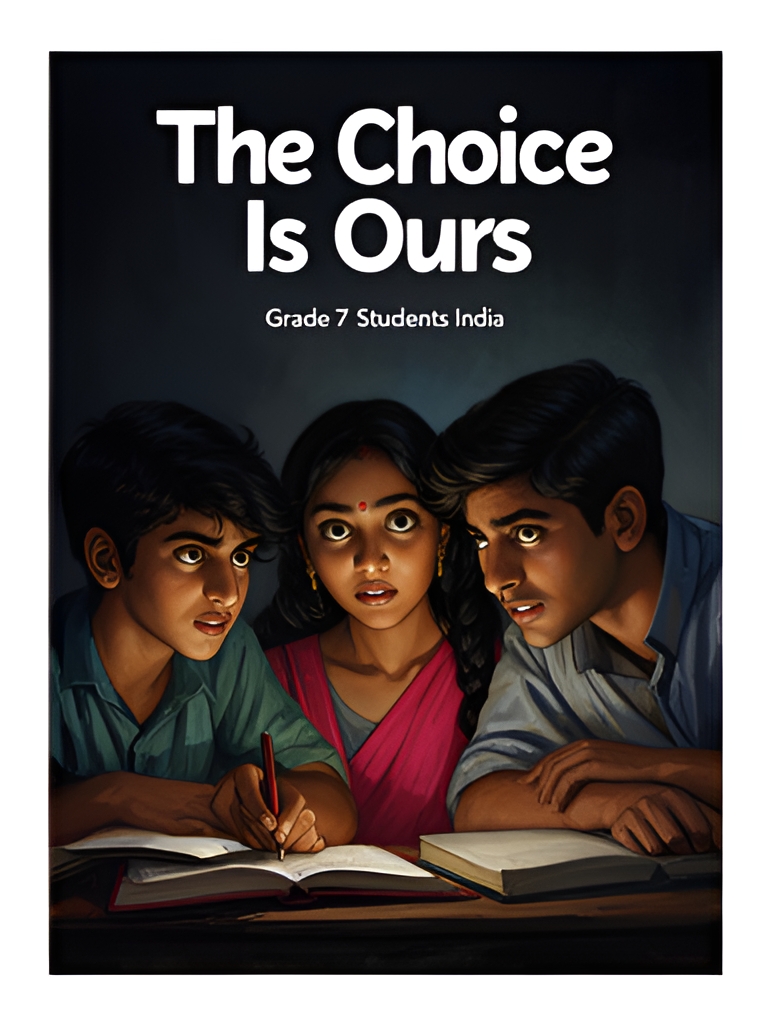
ID · the-choice-is-ours-e58381e9
The Choice Is Ours
By Daivya Jain · Fiction · Academic · 27 pages
Table of contents
- 1. Introduction to Stereotypes
Aarav, Meera, and Kabir notice stereotypes about sports, hobbies, subjects, careers, and household chores, and decide to investigate how these ideas are influenced by family, school, language, media, and advertisements. Aarav, Meera, and Kabir discuss their plans for a school project on everyday gender stereotypes, sharing personal experiences and observations of how these stereotypes affect their lives. Aarav, Meera, and Kabir discuss the various influences that shape gender stereotypes, including language, media, and socialization, and plan a school awareness campaign to promote gender equality
- 2. Understanding the Impact
The friends delve deeper into the impact of stereotypes on individuals and society, and begin to think about ways to challenge and change these perceptions. Aarav, Meera, and Kabir discuss the impact of gender stereotypes on individuals, realizing it affects both men and women, limiting self-esteem, opportunities, and choices. They brainstorm ways to challenge these perceptions, including using social media and organizing school events to promote gender equality. Meera, Aarav, and Kabir discuss the broader societal consequences of gender stereotypes, including perpetuating inequality and limiting opportunities, and decide to create a school awareness campaign to promote gender equality
- 3. Creating a Campaign
Aarav, Meera, and Kabir decide to create a school awareness campaign to help their classmates recognize and question stereotypes, and start brainstorming ideas for posters, skits, and presentations. Aarav, Meera, and Kabir brainstorm ideas for a school awareness campaign to recognize and question stereotypes, suggesting posters, skits, presentations, and a social media component to engage their classmates. Aarav, Meera, and Kabir work together to design visual aids for their campaign, focusing on challenging common stereotypes and promoting inclusivity and respect. They create posters, infographics, and social media posts that convey their message and encourage people to think critically about stereotypes. Aarav, Meera, and Kabir work together to design visual aids for their campaign, creating posters and infographics that challenge common stereotypes and promote inclusivity and respect. They aim to make their campaign positive and empowering, encouraging people to think critically about stereotypes and providing tools and resources for change.
- 4. Implementing the Campaign
The friends launch their campaign, presenting their ideas to the school and encouraging their classmates to think critically about stereotypes and gender equality. Aarav, Meera, and Kabir present their school awareness campaign to challenge and change everyday gender stereotypes, using visual aids and engaging the audience with personal experiences and thought-provoking questions. The classroom discussion sparks as students share their personal experiences with stereotypes, with Sophia and Alex speaking up about being discouraged from pursuing non-traditional interests and being pressured to conform to traditional gender roles. Aarav, Meera, and Kabir listen and respond, emphasizing the importance of challenging expectations and creating a safe and supportive environment.
- 5. Conclusion and Next Steps
The friends reflect on the impact of their campaign and the progress they have made in promoting gender equality, and discuss ways to continue challenging stereotypes in the future.
Chapter 1: Introduction to Stereotypes
Aarav, Meera, and Kabir notice stereotypes about sports, hobbies, subjects, careers, and household chores, and decide to investigate how these ideas are influenced by family, school, language, media, and advertisements. Aarav, Meera, and Kabir discuss their plans for a school project on everyday gender stereotypes, sharing personal experiences and observations of how these stereotypes affect their lives. Aarav, Meera, and Kabir discuss the various influences that shape gender stereotypes, including language, media, and socialization, and plan a school awareness campaign to promote gender equality
Stereotypes in Daily Life
Aarav, Meera, and Kabir were sitting in their classroom, surrounded by colorful posters and bustling with the sound of chatter, as they discussed their plans for the upcoming school project. They had been tasked with exploring everyday gender stereotypes, and they were determined to get to the bottom of it. "I've noticed that people always assume I'm good at sports just because I'm a boy," Aarav said, shaking his head. (Image: A boy playing soccer, with a thought bubble above his head) (Image: A girl playing soccer, with a similar thought bubble)
Meera nodded in agreement. "And I've been told that I'm good at art because I'm a girl. It's like people think we're limited to certain things just because of our gender." Kabir added, "I've seen it in my family too. My mom always expects me to help with the garage work, while my sister is expected to help with the household chores." (Image: A boy helping his father in the garage, with a hammer in hand) (Image: A girl helping her mother with household chores, with a broom in hand)
As they continued their discussion, they began to realize just how prevalent these stereotypes were in their daily lives. They saw it in the way their teachers spoke to them, the way their friends interacted with each other, and even in the media they consumed. "We need to investigate how these ideas are influenced by family, school, language, media, and advertisements," Meera said, her eyes shining with determination. (Image: A group of friends watching TV, with a commercial playing in the background) (Image: A family sitting around the dinner table, with a newspaper and magazine in the center)
Aarav nodded, his mind already racing with ideas. "And we need to talk to people, gather data, and find out how these stereotypes affect our lives." Kabir smiled, his face set with resolve. "We can make a difference, guys. We can create a school awareness campaign to promote gender equality." (Image: A group of students working together, with a whiteboard filled with ideas and plans) (Image: A poster with the words "Gender Equality" written in bold letters, surrounded by diverse images of people)
Influences on Stereotypes
As they delved deeper into their discussion, Aarav, Meera, and Kabir began to explore the various influences that shaped these stereotypes. "It's not just our families and schools that contribute to these ideas," Meera said, "but also the language we use, the media we consume, and the advertisements we see." (Image: A billboard with a stereotypical advertisement, featuring a woman cleaning and a man working) (Image: A newspaper with a headline that perpetuates a gender stereotype, with a red X marked through it)
Kabir nodded, "I've noticed that even the toys and games we play with as kids can reinforce these stereotypes. Boys are often given cars and action figures, while girls are given dolls and dress-up clothes." Aarav added, "And it's not just toys, but also the way we're socialized to behave. Boys are often encouraged to be tough and competitive, while girls are encouraged to be nurturing and cooperative." (Image: A boy playing with a toy car, with a racing track in the background) (Image: A girl playing with a doll, with a toy kitchen and furniture surrounding her)
Meera pulled out a piece of paper and began to jot down notes. "We need to research how these influences intersect and impact our lives. We should look at studies and data that show how these stereotypes affect our self-esteem, our relationships, and our future opportunities." Aarav and Kabir nodded in agreement, eager to dive into the research and gather as much information as possible. (Image: A group of students in a library, surrounded by books and computers, with a researcher in the background) (Image: A graph showing the impact of gender stereotypes on self-esteem, with a downward trend)
As they continued to brainstorm and plan, they realized that their school awareness campaign would need to be multifaceted and comprehensive. They would need to address the various influences that perpetuated these stereotypes and provide alternative perspectives and role models. "We can invite guest speakers, create posters and flyers, and even organize events and activities that promote gender equality," Kabir said, his enthusiasm growing. (Image: A poster with a list of upcoming events, featuring diverse images of people and activities) (Image: A group of students listening to a guest speaker, with a presentation screen behind them)
Aarav smiled, feeling a sense of excitement and purpose. "We can make a real difference, guys. We can help create a more inclusive and equitable environment for everyone." Meera nodded, her eyes shining with determination. "Let's get started. We have a lot of work to do." (Image: A group of students working together, with a whiteboard filled with ideas and plans) (Image: A calendar with a countdown to the school awareness campaign, with a bold marker ticking off the days)
Chapter 2: Understanding the Impact
The friends delve deeper into the impact of stereotypes on individuals and society, and begin to think about ways to challenge and change these perceptions. Aarav, Meera, and Kabir discuss the impact of gender stereotypes on individuals, realizing it affects both men and women, limiting self-esteem, opportunities, and choices. They brainstorm ways to challenge these perceptions, including using social media and organizing school events to promote gender equality. Meera, Aarav, and Kabir discuss the broader societal consequences of gender stereotypes, including perpetuating inequality and limiting opportunities, and decide to create a school awareness campaign to promote gender equality
Effects on Individuals
Aarav, Meera, and Kabir sat in their school library, surrounded by books and articles about gender stereotypes, as they delved deeper into the impact of these stereotypes on individuals. "I never realized how much stereotypes can affect someone's self-esteem," Meera said, looking at a picture of a woman in a science lab, with a thought bubble above her head, saying "I can do this" (Image: A woman in a science lab, with a thought bubble above her head, saying "I can do this"). Aarav nodded in agreement, "Yes, and it's not just limited to women, men are also affected by stereotypes, like the idea that they have to be strong and emotionless" (Image: A man crying, with a caption "It's okay to show emotions"). Kabir added, "And it's not just about individual self-esteem, stereotypes can also limit people's opportunities and choices, like the idea that girls can't play football or that boys can't be nurses".
As they discussed the effects of stereotypes on individuals, they began to think about ways to challenge and change these perceptions. "We need to show people that these stereotypes are not true, and that everyone should have the opportunity to pursue their interests and passions, regardless of their gender," Aarav said. Meera suggested, "We could use social media to spread awareness about gender equality, and share stories of people who have broken free from stereotypes" (Image: A social media post with a hashtag #BreakTheStereotype). Kabir added, "And we could also organize events and activities at school, like a football match between boys and girls, or a workshop on gender equality" (Image: A poster advertising a football match between boys and girls, with a caption "Let's play together"). As they brainstormed ideas, they became more and more excited about the possibility of creating a school awareness campaign to promote gender equality.
Societal Consequences
As they continued to discuss the impact of stereotypes on individuals, they began to explore the broader societal consequences of these limiting beliefs. "Stereotypes don't just affect individuals, they also perpetuate inequality and discrimination in our society," Meera said, looking at a graph showing the disparity in pay between men and women in the workplace (Image: A graph showing the disparity in pay between men and women in the workplace). Aarav added, "And it's not just about equality, stereotypes also limit our potential as a society, by restricting people's choices and opportunities" (Image: A picture of a person standing in front of a locked door, with a caption "Unlock your potential"). Kabir noted, "For example, if we assume that only men can be good at math and science, we're missing out on the potential contributions of women in these fields, and vice versa".
The friends realized that challenging stereotypes was not just about individual empowerment, but also about creating a more just and equitable society. "We need to show people that everyone deserves respect and opportunities, regardless of their gender," Aarav said. Meera suggested, "We could invite speakers to talk to our school about gender equality, and share stories of people who have made a difference in their communities" (Image: A picture of a speaker talking to a group of students, with a caption "Inspiring change"). Kabir added, "And we could also create a social media campaign, using hashtags and tagging influential people, to raise awareness about the importance of gender equality" (Image: A social media post with a hashtag #GenderEqualityMatters). As they explored the societal consequences of stereotypes, they became more determined to create a school awareness campaign that would promote gender equality and challenge limiting beliefs.
Their discussion was filled with passion and conviction, as they envisioned a future where everyone had the opportunity to pursue their dreams, without being held back by stereotypes. "We can make a difference, one conversation at a time," Meera said, smiling at her friends (Image: A picture of the three friends smiling and high-fiving each other, with a caption "Together we can make a difference"). Aarav nodded in agreement, "And we can start by educating ourselves and others about the impact of stereotypes, and the importance of gender equality" (Image: A picture of a person reading a book, with a caption "Education is key"). Kabir added, "We'll face challenges and obstacles along the way, but if we work together, we can create a more just and equitable society for everyone".
Chapter 3: Creating a Campaign
Aarav, Meera, and Kabir decide to create a school awareness campaign to help their classmates recognize and question stereotypes, and start brainstorming ideas for posters, skits, and presentations. Aarav, Meera, and Kabir brainstorm ideas for a school awareness campaign to recognize and question stereotypes, suggesting posters, skits, presentations, and a social media component to engage their classmates. Aarav, Meera, and Kabir work together to design visual aids for their campaign, focusing on challenging common stereotypes and promoting inclusivity and respect. They create posters, infographics, and social media posts that convey their message and encourage people to think critically about stereotypes. Aarav, Meera, and Kabir work together to design visual aids for their campaign, creating posters and infographics that challenge common stereotypes and promote inclusivity and respect. They aim to make their campaign positive and empowering, encouraging people to think critically about stereotypes and providing tools and resources for change.
Brainstorming Ideas
Aarav, Meera, and Kabir sat in their school's library, surrounded by empty tables and chairs, with a large whiteboard in front of them. They had just decided to create a school awareness campaign to help their classmates recognize and question stereotypes. Meera started by writing down ideas on the whiteboard, "We could create posters with powerful messages, or skits that show how stereotypes can be hurtful." Image: A picture of Meera writing on the whiteboard with Aarav and Kabir looking on. Image: A picture of the whiteboard with ideas written on it, such as "Posters" and "Skits".
Aarav added, "And we could also have presentations where we share our own experiences with stereotypes, and how they've affected us." Kabir nodded in agreement, "That's a great idea, Aarav. Personal stories can be really powerful in getting people to understand the issue." Meera turned to them and said, "We should also think about how to make the campaign engaging and interactive, so that our classmates actually want to participate and learn." Image: A picture of Aarav speaking with Meera and Kabir listening. Image: A picture of Kabir nodding in agreement with a thought bubble above his head.
Kabir suggested, "We could have a social media component, where we share facts and statistics about stereotypes, and encourage people to share their own thoughts and experiences." Aarav's eyes lit up, "That's a great idea, Kabir. We could use hashtags to track the conversation and create a movement." Meera smiled, "I like it. Let's make a list of all our ideas and then narrow them down to the most effective ones." Image: A picture of Kabir speaking with Aarav and Meera listening. Image: A picture of Aarav's eyes lighting up with excitement.
As they continued to brainstorm, their ideas began to take shape. They were excited to start working on their campaign, and they knew that it wouldn't be easy, but they were determined to make a difference. Image: A picture of the three friends high-fiving each other. Image: A picture of a calendar with a countdown to the campaign launch.
Designing Visual Aids
Aarav, Meera, and Kabir decided to focus on designing visual aids for their campaign, knowing that images and graphics could be a powerful way to grab people's attention and convey their message. Meera, being the artistic one, took the lead on this task, "Let's create some eye-catching posters that challenge common stereotypes, like girls being good at art and boys being good at sports." Image: A picture of Meera sketching out poster ideas with Aarav and Kabir looking on. Image: A picture of a poster with a girl playing soccer and a boy painting, to challenge traditional stereotypes.
Kabir suggested, "We could also use infographics to show statistics and facts about stereotypes, like how they limit opportunities and perpetuate inequality." Aarav added, "And we could include personal stories and quotes from people who have been affected by stereotypes, to make it more relatable and emotional." Meera nodded, "That's a great idea, Aarav. We could use a mix of images, graphs, and text to make it engaging and easy to understand." Image: A picture of Kabir working on an infographic with statistics and facts about stereotypes. Image: A picture of a poster with a quote from someone who has been affected by stereotypes, with a powerful image in the background.
As they worked on their visual aids, they made sure to keep their message clear and concise, and to use imagery that was inclusive and respectful. They wanted their campaign to be positive and empowering, rather than negative and confrontational. Meera said, "We want to encourage people to think critically about stereotypes, and to consider the impact they have on individuals and society." Image: A picture of the three friends working together on their visual aids, with a collaborative and creative atmosphere. Image: A picture of a poster with a powerful message, such as "Break the Mold" or "Challenge Stereotypes", to encourage people to think critically.
Aarav added, "And we want to provide people with the tools and resources they need to make a change, whether it's by speaking out against stereotypes or by supporting those who are affected by them." Kabir nodded, "We can include a call to action on our posters and social media posts, encouraging people to share their own stories and experiences, and to get involved in the campaign." Image: A picture of Aarav and Kabir working on a social media post with a call to action. Image: A picture of a poster with a call to action, such as "Share Your Story" or "Join the Movement", to encourage people to get involved.
As they finished up their visual aids, Aarav, Meera, and Kabir felt a sense of excitement and pride, knowing that they were one step closer to launching their campaign and making a difference in their school and community. Image: A picture of the three friends holding up their finished posters and infographics, with big smiles on their faces. Image: A picture of a calendar with a countdown to the campaign launch, with a checkmark next to "Visual Aids" to show that it's complete.
Chapter 4: Implementing the Campaign
The friends launch their campaign, presenting their ideas to the school and encouraging their classmates to think critically about stereotypes and gender equality. Aarav, Meera, and Kabir present their school awareness campaign to challenge and change everyday gender stereotypes, using visual aids and engaging the audience with personal experiences and thought-provoking questions. The classroom discussion sparks as students share their personal experiences with stereotypes, with Sophia and Alex speaking up about being discouraged from pursuing non-traditional interests and being pressured to conform to traditional gender roles. Aarav, Meera, and Kabir listen and respond, emphasizing the importance of challenging expectations and creating a safe and supportive environment.
Presenting the Campaign
As the three friends, Aarav, Meera, and Kabir, stood confidently in front of their classmates, they couldn't help but feel a sense of excitement and nervousness. They were about to present their school awareness campaign, designed to challenge and change the everyday gender stereotypes that affected them and their peers. Image: A colorful illustration of Aarav, Meera, and Kabir standing in front of a whiteboard, filled with posters and infographics about gender equality. Image: A picture of the classroom, with students sitting and looking at the presentation with interest and curiosity.
"We want to start by asking you all a question," Aarav began, his voice clear and strong. "Have you ever felt like you're being held back or limited by someone else's expectations of what you should be or do, simply because of your gender?" The room fell silent, with students looking at each other and nodding in agreement. Meera took over, her enthusiasm and passion evident in her tone. "We've all experienced it, whether it's being told that boys should only play sports or that girls should only like dolls. But these stereotypes are not only limiting, they're also harmful and perpetuate inequality and discrimination." Image: An illustration of a boy playing with a doll and a girl playing soccer, with a big X marked through a thought bubble that says "boys only play sports." Image: A picture of a girl and a boy working together on a project, with a caption that says "equality and respect for all."
Kabir added, "And it's not just girls who are affected. Boys are also limited by stereotypes, expected to be strong and emotionless, and not show their feelings." The students listened intently, some looking surprised, others nodding in agreement. Aarav, Meera, and Kabir presented their campaign, showcasing the visual aids they had created, including posters, infographics, and social media posts. Image: A screenshot of a social media post that says "break the stereotype" with a picture of a boy and a girl working together. Image: A picture of a poster that says "equality for all" with a illustration of a diverse group of people.
The response was overwhelming, with students asking questions, sharing their own experiences, and expressing their support for the campaign. Meera emphasized the importance of engaging and interactive campaign, and Kabir proposed a social media component to reach a wider audience. As the presentation came to a close, Aarav, Meera, and Kabir felt a sense of pride and accomplishment, knowing that they had taken the first step towards creating a more inclusive and equitable school community. Image: A picture of the three friends smiling and high-fiving each other, with a caption that says "we did it!" Image: An illustration of a school with a diverse group of students, with a big banner that says "equality and respect for all."
Classmate Reactions
As the presentation came to a close, the classroom erupted into a flurry of discussion and debate. Students were eager to share their thoughts and experiences, and Aarav, Meera, and Kabir were happy to listen and respond. One classmate, a quiet and reserved girl named Sophia, spoke up about how she had always been interested in science and math, but had been discouraged by her parents and teachers, who thought she should focus on more "feminine" subjects. Image: A picture of Sophia standing up and speaking to the class, with a confident expression on her face. Image: An illustration of a girl in a lab coat, conducting an experiment, with a caption that says "women in stem."
"I never thought about how stereotypes could affect me, but now I realize that I've been held back by other people's expectations," Sophia said, her voice filled with emotion. Aarav, Meera, and Kabir nodded in agreement, and Meera added, "That's exactly what our campaign is about - challenging those expectations and creating a more inclusive and equitable community." Another classmate, a boy named Alex, spoke up about how he had always been told to "be a man" and not show his emotions, but how he was tired of living up to that stereotype. Image: A picture of Alex standing up and speaking to the class, with a determined look on his face. Image: An illustration of a boy crying, with a caption that says "it's okay to show emotions."
"I want to be able to express myself without being judged or teased," Alex said, his voice shaking with emotion. Kabir nodded in agreement, and said, "Our campaign is not just about challenging stereotypes, but also about creating a safe and supportive environment where everyone can be themselves." The discussion continued, with students sharing their thoughts and experiences, and Aarav, Meera, and Kabir listening and responding. Image: A picture of the classroom, with students engaged in discussion and debate, and Aarav, Meera, and Kabir facilitating the conversation. Image: An illustration of a diverse group of students, with a big banner that says "respect and inclusivity for all."
As the class came to a close, Aarav, Meera, and Kabir felt a sense of pride and accomplishment, knowing that they had sparked a important conversation and taken the first step towards creating a more inclusive and equitable school community. They left the classroom feeling hopeful and excited, knowing that their campaign had the potential to make a real difference in the lives of their classmates. Image: A picture of Aarav, Meera, and Kabir walking out of the classroom, with big smiles on their faces. Image: An illustration of a school with a diverse group of students, with a big banner that says "equality and respect for all."