Fiction
the girl
by dip oppgave
3 chapters1.2 hr read
Chapter 1
The Weight of Silence
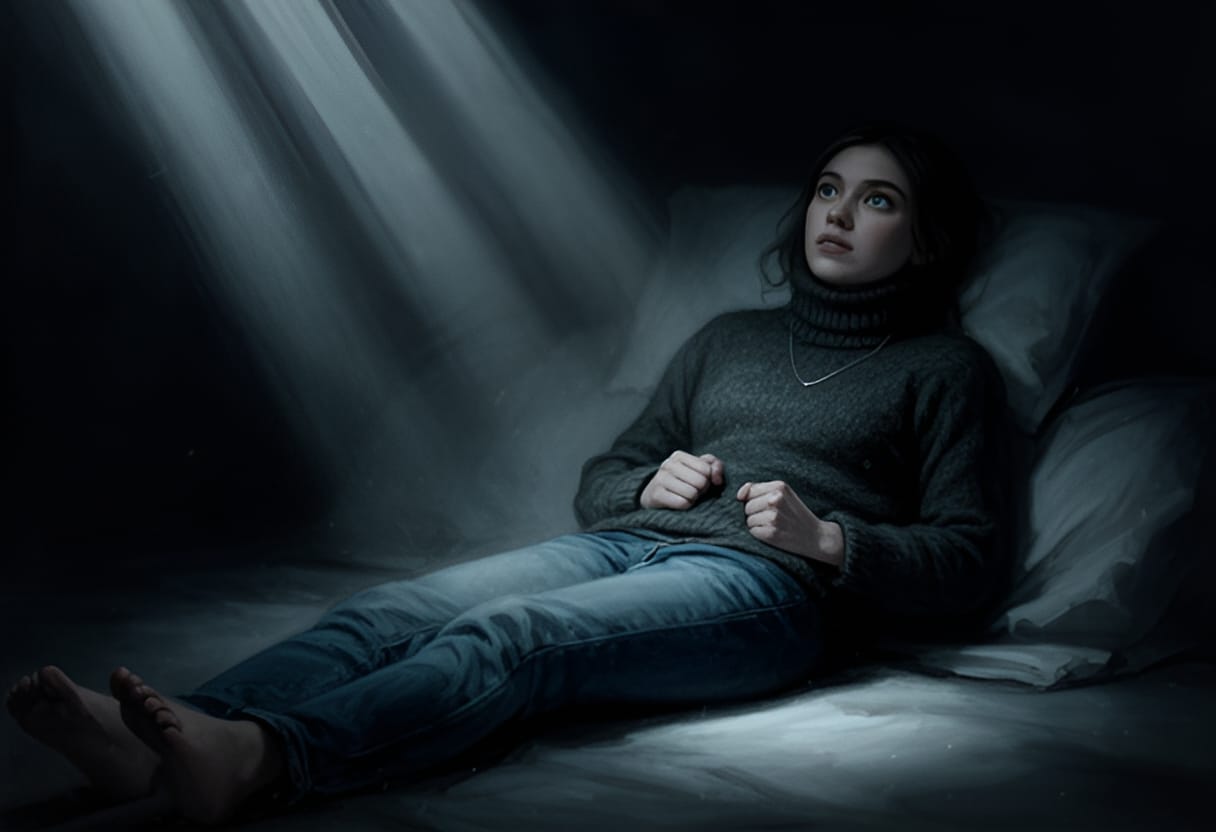
The room was still dark when Marte opened her eyes, the kind of pre-dawn black that clings to the edges of sleep and refuses to let go. For a moment, she lay still, listening to the slow creak of the old house settling, the distant hiss of the radiator in the hallway. Then it came—not a sound, but a voice, clear as if Ingrid were lying beside her: Drive faster, Jonas, I’m cold.
Marte gasped, her fingers curling into the thin cotton of her pajama top. The words echoed in the hollow of her chest, not remembered but relived—the sharp edge of Ingrid’s laughter underneath them, the way her breath had fogged the passenger window as she tugged her coat tighter, cheeks flushed from the walk to the car. Outside, snow had begun to fall again, thick and silent, muffling the world into a soft, white void.
She turned her face into the pillow, pressing her eyes shut as if she could block the memory like a blow. But it was already there, looping: Ingrid’s gloved hand tapping the dashboard, Jonas glancing over with that half-smile he always wore when she teased him, the old Volvo’s engine humming low as it crept through the icy streets of Bodø. Too slow, she had said, nudging his arm. You’re going to freeze us both before we get there. And then, louder, teasing but insistent: Drive faster, Jonas, I’m cold.
The car had answered. The accelerator had pressed down. The world had tilted.
Marte’s breath came short now, her ribs tight. She kicked back the covers and sat up, swinging her legs over the side of the bed. The floor was icy beneath her feet. She shuffled to the window and pulled back the curtain just enough to see the street below—empty, buried under snow, the streetlights casting long blue shadows across the drifts. No footprints. No cars. Just the slow, steady fall of flakes, erasing everything.
She fumbled for her laptop on the desk, fingers numb. It opened with a soft whir, the screen flooding the room with pale light. Photos filled the gallery—her and Ingrid, arms slung over each other’s shoulders, grinning at the camera on the pier in summer, Ingrid’s hair wild with wind, Marte’s scarf half-come undone. Another: them huddled under a single umbrella outside the café, laughing as rain slicked Ingrid’s cheeks. A third, older—Ingrid blowing out candles on a cake Marte had burned slightly at the edges, her eyes crinkled with mock outrage.
Marte’s thumb hovered over the trackpad. She opened the last one—a selfie they’d taken that night, just before leaving Ingrid’s apartment. Ingrid’s face was close to the lens, her nose scrunched, eyes bright. Marte’s own reflection was blurred in the glass behind her, half-hidden by the scarf Ingrid had insisted she wear. You look like a startled elk, Ingrid had said, snapping the picture. Marte had laughed, shoving her playfully. And you look like you’re about to rob a bank.
She stared at it until her vision blurred. Then, with a jerk, she slammed the laptop shut. The screen went black. The room plunged back into dimness, lit only by the faint glow of the alarm clock: 06:47.
Guilt flooded in, cold and heavy, filling the space where the laughter had been. She had said it. She had urged him on. Not stopped him. Not pulled him back. Drive faster. The words weren’t a memory anymore—they were an accusation, etched into her ribs.
She pushed away from the desk and stumbled to the bed, collapsing onto it face-first. The duvet smelled of lavender detergent and dust, the same scent that had clung to Ingrid’s clothes when they’d hugged goodbye that night. Marte buried her face in it, inhaling deep, as if she could pull Ingrid back into the fabric, into the room, into the space beside her.
But all she smelled was wool and time.
She lay there for a long while, listening to the silence. Outside, the wind had picked up, rattling the old windowpane. Somewhere in the house, a pipe groaned. The radiator clicked. Sounds of life continuing, indifferent.
She thought about her phone. It lay face-down on the nightstand, screen dark. She hadn’t checked it since yesterday. Hadn’t dared. What if Jonas had written? What if he had sent something—I’m sorry, I miss you, I hate you—and she hadn’t seen it? Or worse: what if he hadn’t written at all? What if he had decided, after the funeral, after the silence, that she wasn’t worth the effort?
She turned her head just enough to see the edge of the phone. No light blinked. No notification teased the dark.
Good, she thought. Let him hate me. Let him think I’m weak. Let him believe I deserve this.
She closed her eyes again.
The argument came back—not the version she told herself in the dark, the one where she had begged him to slow down, where she had gripped the seat and whispered please—but the real one. The one that had happened in the kitchen, just before they left. Ingrid had been shivering, her teeth chattering slightly as she pulled on her boots. Marte had teased Jonas about his cautious driving, the way he crept through intersections like he was afraid the ice would leap up and bite him. You drive like my grandfather, she had said, laughing. Is the speed limit a suggestion or a law to you?
Jonas had glanced at her, amused. Better slow than sorry.
Sorry for what? Ingrid had interjected, nudging Marte with her elbow. Sorry we’re not frozen into popsicles by the time we reach the café?
Exactly, Marte had said, grinning. Drive faster, Jonas. I’m cold.
And he had.
She saw it again—the way Ingrid’s head had turned toward her, eyes wide with laughter, just before the tires lost grip on the black ice near the fjord bend. The way the car had spun, not violently, but with a sickening, slow inevitability, like a top winding down. The sound of metal groaning, the airbag exploding toward Jonas, the sudden, absolute silence after the crash—broken only by Ingrid’s head hitting the window, a soft, sickening thud that Marte had felt in her teeth.
Then nothing.
Marte’s breath hitched. She pressed her palms into her eyes, seeing stars. Her throat tightened. A sob tried to rise, but she swallowed it down, hard. She wouldn’t cry. Not today. Not ever, if she could help it. Crying felt like surrender. Like admitting she deserved to feel anything but this hollow, aching guilt.
She drifted, half-asleep, the guilt a constant throb behind her ribs. The light outside shifted—from black to blue, from blue to a dull, washed-out gray. Hours passed. She didn’t move. Didn’t eat. Didn’t reach for the water glass on the desk. Her stomach clenched at the thought of food. She wasn’t hungry. She wasn’t thirsty. She was just… tired. Tired of remembering. Tired of pretending she was okay. Tired of being alive when Ingrid wasn’t.
By the time the sky had deepened to the violet-gray of late afternoon, Marte was curled on her side, one arm tucked under her pillow, the other resting limp near her hip. Her eyes were open, but she wasn’t seeing the room. She was back in the car, smelling the wet wool of Ingrid’s coat, hearing the radio play low jazz—something Ingrid had picked, something soft and sad that Marte had complained about until Ingrid had laughed and turned it up just to spite her.
You hate everything that’s good for you, she had said.
Marte’s lips moved silently. I know.
The house grew quieter. The radiator stopped clicking. Somewhere, a door closed softly—her mother, perhaps, checking in, then deciding not to wake her. Marte didn’t hear it. Didn’t care.
She stayed like that until the light began to fade, until the room softened into shadow, until the weight of the day pressed into her bones like stone. And then, finally, exhausted—not from activity, but from the sheer effort of carrying the memory—she let her eyes close.
Sleep came without dreams. Just darkness. And the quiet, relentless truth: she had said the words. And Ingrid had believed her.
Marte lay still, the dark behind her eyelids thick with the echo of Ingrid’s laughter and the soft thud against glass. The room had cooled, the last of the day’s light gone, leaving only the faint glow from the streetlamp outside, painting bars of silver across the floor. She could hear the old house settling—the creak of floorboards somewhere downstairs, the distant sigh of wind in the eaves. Somewhere, a clock ticked. She hadn’t wound it in weeks.
The door opened without a knock.
She didn’t move. Didn’t open her eyes. She knew the step—lighter than her father’s, slower than Jonas’s when he used to come by to fix the sink or bring over bread from the bakery. Her mother.
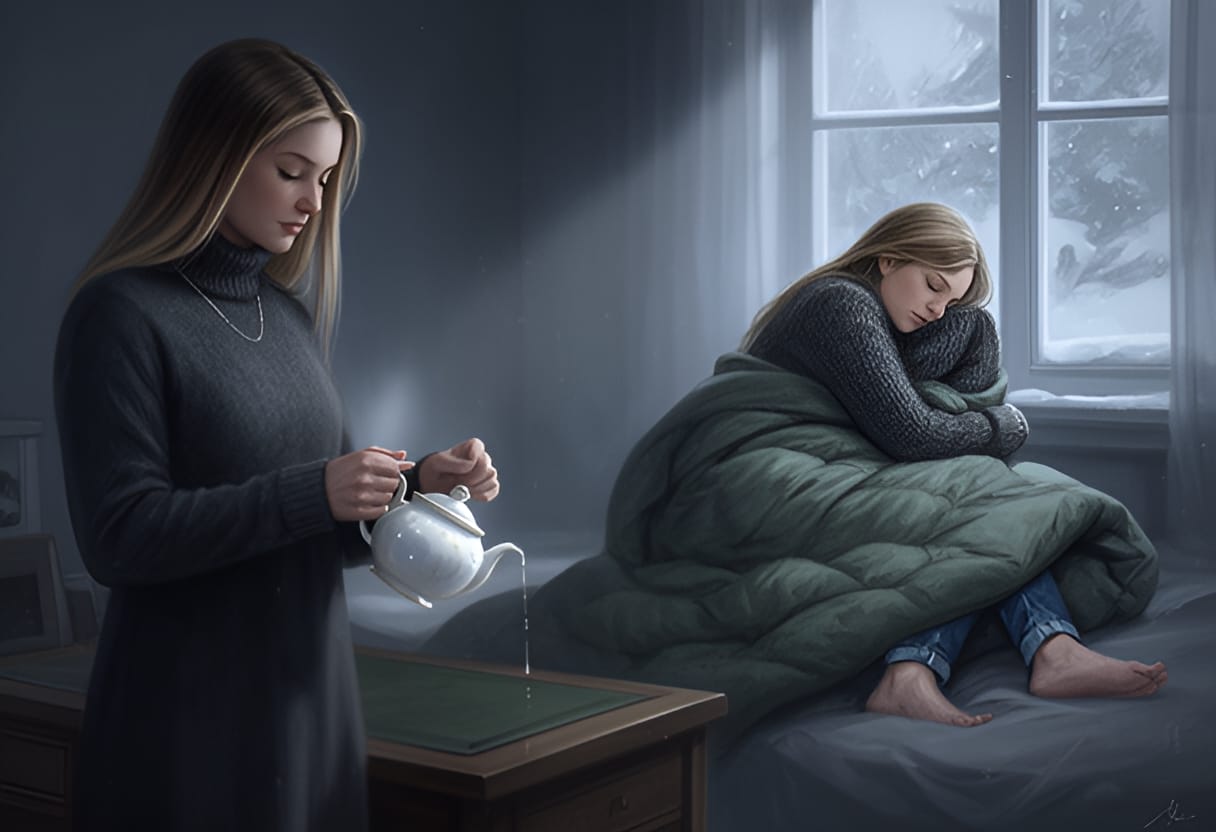
A tray appeared on the edge of the desk, the ceramic cup clinking softly against the saucer. Steam curled upward, carrying the sharp, citrusy scent of bergamot. Earl Grey. Ingrid’s favorite. Marte’s stomach twisted, not with hunger, but with the sudden, sharp ache of memory—Ingrid stealing sips from her cup, making faces, saying it tasted like “wet leaves and regret.”
“You haven’t eaten in two days,” her mother said, voice low, careful, as if speaking too loudly might shatter the fragile quiet. She didn’t sit. Just stood there, one hand resting on the desk, the other holding the teapot as if ready to pour, but hesitating.
Marte kept her eyes closed. “I’m not hungry.”
“You need to keep your strength up.” A pause. The teapot lowered slightly. “I made your favorite. The open-faced sandwiches. With the dill and the smoked salmon. Ingrid used to love those, didn’t she?”
Marte’s jaw tightened. She didn’t answer. She couldn’t trust her voice not to break.
Her mother sighed—a soft, weary sound. “I know you’re hurting. I see it. In the way you don’t answer your phone. In the way you don’t come downstairs. In the way you stare at the wall like it owes you answers.”
Marte finally opened her eyes. The ceiling was a blur of water-stained plaster. She turned her head just enough to see her mother’s profile in the dim light—the silver threading her dark hair, the lines around her eyes deeper than Marte remembered. She looked tired. Not just from lack of sleep, but from carrying something heavy, something she hadn’t asked for.
“I spoke to Elin Hansen today,” her mother said. “At the clinic. She’s a trauma specialist. Works with people who’ve been in accidents. With survivors.”
Marte’s breath caught. She didn’t sit up. Didn’t move. But something inside her coiled tight, like a spring about to snap.
“I don’t need a therapist,” she said, her voice flat, low. “I don’t need to talk about it.”
“It might help,” her mother persisted, gently. “To have someone to say it out loud to. Someone who understands.”
“I don’t deserve help,” Marte said, the words surprising even her. They came out sharper than she meant them to. She hadn’t planned to say them. But once they were out, they hung in the air, undeniable.
Her mother stilled. The teapot hovered mid-pour, a single drop of tea falling silently into the cup.
“What do you mean?” she asked, voice quiet but firm.
Marte swallowed. She turned her face into the pillow for a moment, muffling the next words. When she spoke again, her voice was raw, stripped bare. “I lived. Ingrid didn’t. I said the words. I told him to drive faster. I caused it.” She paused, breathing hard. “Why should I get to talk about it? Why should I get to feel better? She’s gone. And I’m still here. Breathing. Eating. Talking. It’s not fair.”
Silence. Thick. Heavy. The only sound the distant hum of the refrigerator kicking on in the kitchen.
Her mother set the teapot down. Slowly. Deliberately. She didn’t reach for the tray. Didn’t touch the sandwiches. She just stood there, looking at her daughter—not with anger, not with disappointment, but with a sorrow so deep it looked like it had been carved into her bones over years.
“Marte,” she said, finally. “You didn’t make the ice form. You didn’t make the car slide. You didn’t make Ingrid not wear her seatbelt properly. You were joking. You were cold. You were twenty-three years old in a car with your best friend, trying to get to a café before it closed. You didn’t kill her.”
Marte squeezed her eyes shut. Tears burned behind her lids, but she refused to let them fall. “It doesn’t matter what I meant. It matters what happened. And I was there. I spoke. And then—” She choked off, unable to say the rest.
Her mother stepped forward. Not to touch her. Not yet. Just to close the distance. “You think I don’t see how much you punish yourself? Every day? You think I don’t wake up wondering if I said the wrong thing, if I should have made you stay home, if I should have noticed how quiet you were at dinner that night?”
Marte risked a glance. Her mother’s eyes were shiny. She was holding herself together, but barely.
“I don’t want you to be okay because you have to be,” her mother said. “I want you to be okay because you can be. Because Ingrid wouldn’t want this for you. Because you deserve to live, too. Not in spite of her memory—but because of it.”
Marte turned her face away. Toward the wall. Toward the dark. She couldn’t look at her mother’s kindness. It felt like an accusation.
Her mother hesitated. Then, softly: “I’ll leave the tea. And the sandwiches. Eat if you can. Don’t if you can’t. But please… just think about it. One session. That’s all I’m asking. If you hate it, you never have to go back.”
She moved toward the door. Pausing with her hand on the knob. “I love you,” she said. Not loud. Not dramatic. Just true. “And I’m not going to stop worrying about you. Not ever.”
The door clicked shut.
Not loud. Not final. Just… closed.
Marte lay there, staring at the ceiling again. The tea had gone cold. The sandwiches sat untouched, the salmon glistening faintly under the streetlamp’s glow.
She wanted to scream. She wanted to throw the tray against the wall. She wanted to bury her face in the pillow and never come up for air.
Instead, she rolled onto her side and pulled the duvet up to her chin. The lavender scent was gone now, washed away by the bergamot, by the salt of unshed tears, by the quiet, relentless truth that had settled in her chest like a stone.
She had lived.
And every breath felt like a betrayal.
The next morning, the light came thin and gray, filtering through the frost-laced window like a reluctant apology. Marte didn’t move at first. She lay curled on her side, listening to the house breathe—the creak of timber settling, the distant drip from a gutter choked with ice. Her mother had left the door ajar. The hallway was dim, but she could see the edge of the rug, the bottom of the coat rack where Ingrid’s scarf still hung from a forgotten visit months ago. She hadn’t touched it since the funeral. Couldn’t bring herself to.
But today, she needed air. Not the recycled, stagnant kind that pooled in her bedroom, thick with guilt and the ghost of Earl Grey. She needed to feel her boots on pavement, even if just for a few minutes. To prove to herself she could still move through the world without dissolving.
She sat up slowly, muscles protesting from disuse. Her jeans were stiff from yesterday, her hair tangled and unclean. She washed her face with cold water from the tap, the shock grounding her just enough to function. She pulled on her coat—the thick wool one Ingrid had teased her for buying, saying it looked like something a fisherman would wear to wrestle seals. Ingrid had laughed, her breath fogging the glass of the café window as they waited for their hot chocolate. Marte had shoved her playfully, nearly spilling the mug.
She stopped herself. The memory came too fast, too bright. She pressed her palms to her eyes until spots bloomed behind her lids.
Downstairs, the kitchen was empty. Her mother’s coat was gone. A note lay on the counter in her familiar, looping script: Went to check on Aunt Sigrid. Left soup on the stove. Warm it slowly. – M
Marte didn’t warm the soup. She poured a glass of water instead, drank it in three gulps, and went back upstairs.
Ingrid’s scarf was still there. Soft with age, the wool faded at the ends where it had frayed from being pulled too tight around her neck. Marte remembered the day Ingrid had given it to her—midwinter, two years ago, after Marte had complained her old one was too thin. “It smells like woodsmoke and stubbornness,” Ingrid had said, draping it over Marte’s shoulders. “Like you.”
Marte buried her face in it for a moment. It still carried the faintest trace of bergamot from the tea Ingrid always spilled on it. She wrapped it loosely around her neck, pulled her hood up, and stepped outside.
The world was hushed. Snow lay thick and undisturbed on the lawns, on the roofs, on the shoulders of the narrow road that wound past the cluster of houses toward the town center. Her breath plumed in front of her, quick and shallow. She kept her eyes fixed on the tips of her boots, on the crunch of snow under tread, on anything but the houses, the windows, the possibility of a face behind glass.
The post office was six blocks away. A short walk, normally. Today, it felt like a pilgrimage.
She passed the bakery where Ingrid used to buy cinnamon buns on Sundays, the paper bag warm in her hands, the sugar catching the light as she licked her fingers. Marte crossed the street before she could stop herself, her heart lurching at the sight of the red-and-white awning. She kept walking, shoulders hunched, the scarf pulled tight.
Halfway there, her lungs began to burn. Not from the cold—she was overdressed—but from the effort of not looking up. She forced herself to pause at the corner, to fill her lungs, to remind herself she was allowed to be here, to be moving, to be alive.
And then she saw him.
Across the street, beside the old brick post office, Jonas stood at the mailbox. He was wearing his dark coat, the one with the frayed cuff he’d refused to replace because Ingrid had mended it once with blue thread. His hands were gloved, but she knew the shape of them—the way his left thumb always rubbed the inside of his index finger when he was thinking. His head was tilted slightly, as if listening to something far away. Or waiting.
Marte’s breath stopped.
He wasn’t looking at her. Not yet. But he was facing her street. His posture was still, expectant. Like he knew she might come. Like he had been waiting.
Panic, sharp and metallic, flooded her mouth. She ducked instinctively, pressing her back against the cold metal of a lamppost. The snow seeped through her coat where it touched the ground. She squeezed her eyes shut, willing herself to vanish.
Go away, she thought, though she knew he couldn’t hear her. Just go inside. Check your mail and leave.
She heard the soft clink of metal—him putting a letter into the slot. Then the creak of the mailbox door closing. A pause. A breath she could almost hear.
Then footsteps. On the sidewalk. Coming toward her.
Her pulse hammered in her temples. She couldn’t stay here. If he saw her—really saw her, hood up, eyes red from crying, wrapped in Ingrid’s scarf like a ghost—she would shatter. She would scream. She would beg him to hate her, to say it out loud, so the guilt would finally have a voice.
She pushed off from the lamppost and turned, not toward the post office, but the opposite way—down the side street that ran behind the row of shops, the one that looped past the old fishpacking plant and came out near the school. It was longer. It was exposed. But it was away.
She walked fast, too fast, her boots slipping slightly on the icy patches where the sun hadn’t reached. She kept her head down, the scarf pulled over her mouth, breathing through the wool. She didn’t dare look back.
When she finally turned onto her street, her legs were shaking. She fumbled with her keys, dropped them once, snatched them up before they could vanish into the snowdrift by the step. The lock turned stiffly in the cold. She stumbled inside, slammed the door shut, and leaned against it, trembling.
Silence. The house exhaled around her—the creak of the stairs, the sigh of the radiator waking up. She slid down the door until she was sitting on the floor, her back against the wood, her knees drawn up. The scarf had slipped; she pulled it back over her nose and mouth, inhaling the ghost of bergamot, the salt of tears, the memory of Ingrid’s voice saying, “Like you.”
She pressed her forehead to her knees.
He had been there. He had been waiting.
And she had run.
Not because she was afraid of what he might say—but because she was terrified of what he wouldn’t say. Of the quiet understanding in his eyes, the lack of blame, the sorrow that mirrored her own. She couldn’t bear to be seen not as a monster, but as a broken girl who still deserved compassion. Because if he didn’t hate her, then she had no right to punish herself. And if she stopped punishing herself, then what was left but the unbearable weight of having lived?
She stayed on the floor until her legs went numb, until the cold seeped through her jeans and into her bones. She didn’t move when her mother called from downstairs, voice soft but concerned: “Marte? You home? I brought the soup up if you want it.”
She didn’t answer.
She couldn’t.
Because if she spoke, she would break.
And if she broke, she wasn’t sure she could put herself back together again.
She didn’t answer her mother’s call from downstairs. The words hung in the air like smoke—Marte? You home? I brought the soup up if you want it—but she couldn’t force her voice to shape a reply. Not yet. Not when every breath felt like it might crack her ribs open and spill everything out onto the floorboards.
She stayed where she was, back against the door, knees drawn tight, Ingrid’s scarf pulled low over her face. The wool still carried the faintest trace of bergamot, a ghost of Ingrid’s teasing: “Like you.” It was too much. Too soft. Too kind. She buried her nose deeper into the fabric, inhaling until her lungs ached, as if she could suffocate the guilt into silence.
Time passed in slow, frozen breaths. The radiator clicked. Somewhere in the house, a floorboard sighed. Outside, the wind shifted, pushing snow against the windowpane in a soft, relentless whisper.
Eventually, the numbness in her legs gave way to a deep, marrow-deep ache. She shifted slightly, wincing as feeling returned in pins and needles. The soup would be cold by now. Her mother would have gone back downstairs, worried but respecting the silence—for now. Marte knew that look. The one that said I’m here, but I won’t push. Not today.
She stayed until the light had changed, until the pale winter sun had climbed high enough to throw a thin, grey rectangle across the floor near the stove. Only then did she push herself up, stiff and unsteady, and make her way to the bathroom.
The mirror was cruel.
Her face was hollow-eyed, cheeks flushed from cold and tears, lips chapped from biting them to keep from sobbing. Her hair hung limp around her face, escaping its loose braid. She looked like someone who had been dug up after too long underground—pale, disoriented, surprised to find herself still breathing.
She turned on the tap, splashed icy water on her face, and stared at her reflection until the shock of it faded into something numb and familiar. Then she brushed her teeth, washed her hands, and changed into clean clothes—a thick sweater, wool trousers, boots laced tight. She didn’t look at herself again.
Downstairs, the kitchen was quiet. The soup sat on the stove, covered, steaming faintly. A note lay beside the bowl: Eat when you can. I’m at Aunt Sigrid’s. Will be back tonight. Her mother’s handwriting, neat and careful, the way it had been since Marte was a girl.
She didn’t eat. She poured a glass of water instead—three quick gulps, just as she had that night, the glass slick in her grip, the liquid burning not from cold but from the memory of saying it: Drive faster, Jonas, I’m cold. The words echoed in her throat, not as sound, but as a physical presence, like a stone lodged behind her sternum.
She left the glass on the counter. Didn’t rinse it.
She pulled on her coat, wrapped Ingrid’s scarf once more around her neck, and stepped outside.
The world was still hushed. Snow muffled every sound. Her boots crunched in rhythmic, uneven steps as she walked toward the clinic—a low, timber-clad building on the edge of town, tucked between the dentist and the physiotherapist’s office. She had passed it a hundred times without seeing it. Today, it loomed.
She was ten minutes late.
She had walked slowly, deliberately, each step a negotiation with herself: Turn back. You don’t belong here. You don’t deserve this. But her mother had insisted—not with anger, but with that quiet, unyielding love that made resistance feel like betrayal. Just go. Sit with her for twenty minutes. If you hate it, you never have to come back.
So she came.
She pushed open the clinic door, the bell above it giving a soft, hesitant chime. The waiting room was empty except for a receptionist behind a glass screen, who looked up with polite expectation.
“Marte Evensen?” the woman asked.
Marte nodded, her voice caught in her throat. “I’m… sorry I’m late.”
“It’s alright. Elin’s expecting you. She’s in room three. Just down the hall, first door on the left.”
“Thank you.” Marte’s voice sounded thin, foreign. She cleared it, tried again. “Thank you.”
She walked slowly down the corridor, past framed nature prints and a small table with a bowl of smooth stones. Her pulse throbbed in her ears. She could feel the scarf tight at her throat, could smell the wool, the bergamot, the ghost of Ingrid’s laughter in the kitchen years ago, flour on her nose, teasing Marte for being unable to crack an egg without getting shell in the batter.
She stopped outside the door. Took a breath. Then another.
She knocked.
“Come in,” said a voice—calm, low, unhurried.
Marte opened the door and stepped inside.
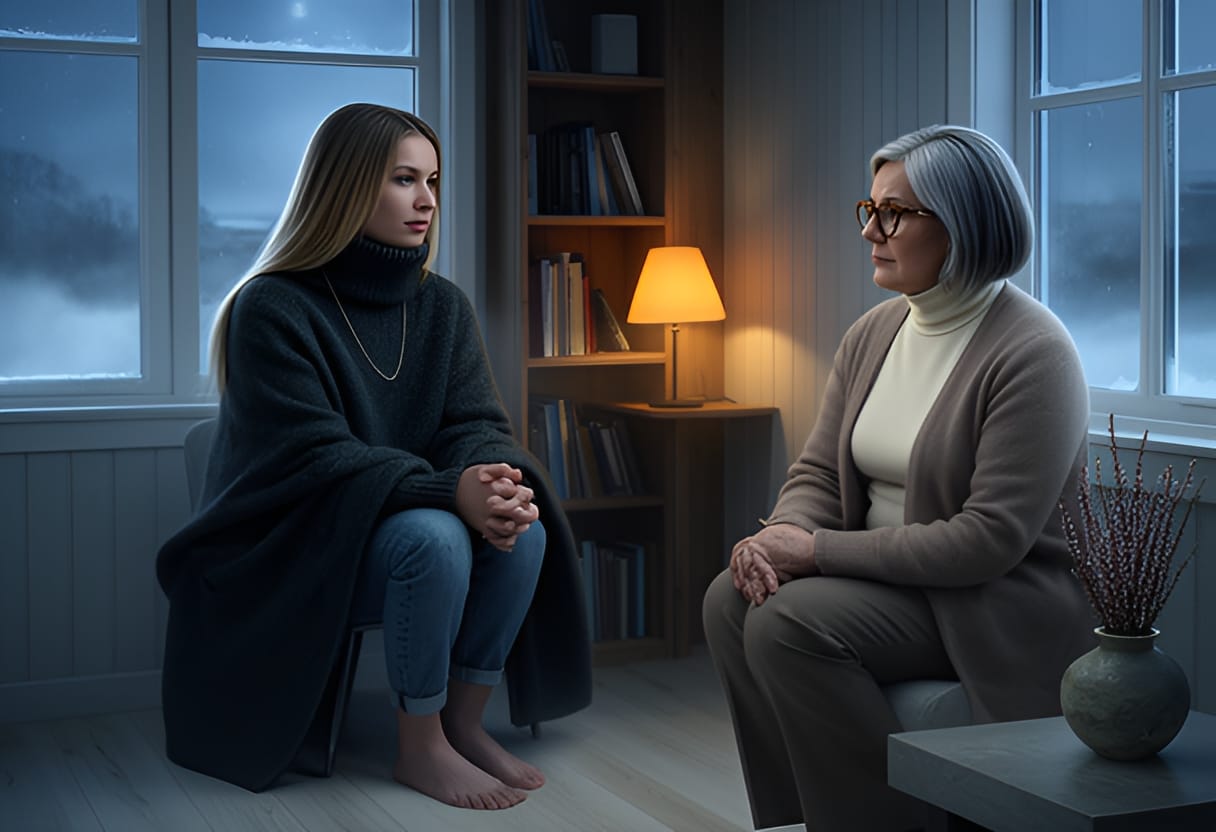
The office was warm, softly lit. A low bookshelf lined one wall, filled with texts Marte didn’t recognize—Trauma and Recovery, The Body Keeps the Score, Waking the Tiger. A small sofa sat opposite two armchairs arranged around a low coffee table. A potted fern sat in the corner, its fronds soft and green. On the wall behind the desk hung a framed print of a fjord at dawn, light breaking over still water.
Elin Hansen rose from her chair. She was taller than Marte had expected, her hair streaked with grey, pulled back into a loose knot. She wore a soft grey sweater and trousers, her expression open, attentive but not eager. There was no performative warmth, no over-the-top sympathy. Just presence.
“Marte,” she said. “Thank you for coming.”
Marte sank into the nearest armchair, pulling her coat tighter around her. She didn’t take off her scarf. “I… I only came because my mother asked. I don’t think I need to be here. I’m fine. Really.”
Elin didn’t smile, didn’t frown. She simply nodded. “Okay. Thank you for telling me that. It’s helpful to know where you’re starting from.”
Marte blinked. “You’re not… surprised?”
Elin tilted her head slightly. “Surprised that you’re here despite doubting it? No. Many people come because someone they love asked them to. It takes courage to show up even when you’re not sure why.”
Marte looked down at her hands, clenched in her lap. “I don’t know why I’m here. I don’t think I deserve to be.”
Elin waited. Then, gently: “Would you be willing to tell me a little about your life before the accident? Just to help me understand who you were? Not what happened—just… you.”
Marte hesitated. Then, voice tight: “I worked at the bookstore. Part-time. While I studied marine biology at the university in Tromsø. I liked the quiet. The smell of paper. Ingrid and I used to go there after her shifts at the café. We’d sit in the corner with tea and talk about everything and nothing.”
Elin listened, nodding occasionally. “What did you talk about?”
“Everything. Ingrid… she had this way of making the ordinary feel important. She’d get excited about a weird cloud formation, or the way the light hit the water at low tide. She said Earl Grey tasted like ‘wet leaves and regret’—which made no sense, but she’d say it with a grin, like it was a poem.”
A flicker of something—almost a smile—touched Marte’s lips before she crushed it. “She loved cinnamon buns. Every Sunday, without fail. She’d come running into the bookstore with a paper bag still warm from the oven, sugar on her fingers, and she’d make me try a bite, even though I hate the icing.”
Elin’s eyes were soft. “She sounds like someone who brought light to the people around her.”
Marte’s breath hitched. She looked away, staring at the fern in the corner. “She did. And I… I let her go.”
Elin waited. Then, quietly: “Would you be willing to tell me her name?”
Marte’s head snapped up. Her chest tightened, as if a hand had squeezed it shut. Her throat closed. She opened her mouth, but no sound came.
“I… I can’t,” she whispered. The words were raw, scraped from somewhere deep and wounded. “I can’t say it. Not out loud. Not yet.”
Elin didn’t push. She simply said, “That’s okay. We don’t have to say it today. We can just acknowledge that it’s hard.”
Marte swallowed hard, tears pricking behind her eyes. She blinked them back, furious with herself. “I just… I don’t know why I’m wasting your time. You have real patients. People who actually need help.”
Elin leaned forward slightly, her elbows resting on her knees, her gaze steady. “Marte, you’re here. That means something part of you believes you deserve to be heard. Even if it’s small. Even if it’s buried under guilt. That part is worth listening to.”
Marte looked at her, really looked—for the first time—and saw not a therapist, but a woman who had sat with others in this exact place, who had heard confessions whispered in trembling voices, who knew the weight of silence.
She didn’t believe it. Not yet. But she felt it, like a faint pulse beneath the ice.
The session ended with Elin saying, “I’d like to see you again next week, if you’re willing. Same time. No pressure. We’ll go at your pace.”
Marte stood, pulling her coat on. “I’ll think about it.”
“That’s fair,” Elin said. “Just know the door is open.”
At the reception desk, Marte paused. The woman smiled gently. “Have a good day.”
Marte nodded, pulled her scarf higher, and stepped back into the cold.
The walk home was slower this time. Her boots crunched in the snow, but her head was up, just slightly. She passed the bakery, the red-and-white awning catching the weak sunlight. She didn’t flinch. She just kept walking.
When she reached her house, she didn’t go straight inside. She paused at the gate, looked up at her bedroom window—the curtains drawn, the glass dark.
She didn’t know if she believed she deserved help.
But for the first time since the accident, she wondered what it might feel like to stop asking that question—and simply let someone try to answer it.
That night, Marte lay awake, not from panic, but from thought.
The soup was still on the stove, untouched. She had eaten a few bites of bread with cheese, just enough to quiet the hunger that gnawed at her ribs. She had brushed her teeth, washed her face, and changed into her softest sleepwear—the old flannel set Ingrid had given her for her birthday two years ago, the one with the faded blue birds along the hem.
She lay on her back, staring at the ceiling, the scarf draped loosely over her chest. The bergamot was fainter now, mixed with the scent of wool and her own skin.
She thought of Elin’s voice—calm, unhurried, unafraid of the silence.
She thought of Ingrid’s laugh in the bookstore, the way she’d snort when Marte tried to pronounce a particularly long Latin name for a sea slug.
She thought of Jonas, waiting at the mailbox, his gloved hand resting on the metal, his breath visible in the cold air.
And for the first time, she didn’t flinch from the memory of his face.
She didn’t forgive herself.
She didn’t absolve Jonas.
She didn’t even know what she believed anymore.
But she turned onto her side, pulled the blanket to her chin, and whispered into the dark—not a plea, not a confession, but a name, so soft it was almost lost in the hush of the room:
“Ingrid.”
The word hung in the air, fragile and true.
And then, finally, she slept.
Chapter 2
The Return of Memory
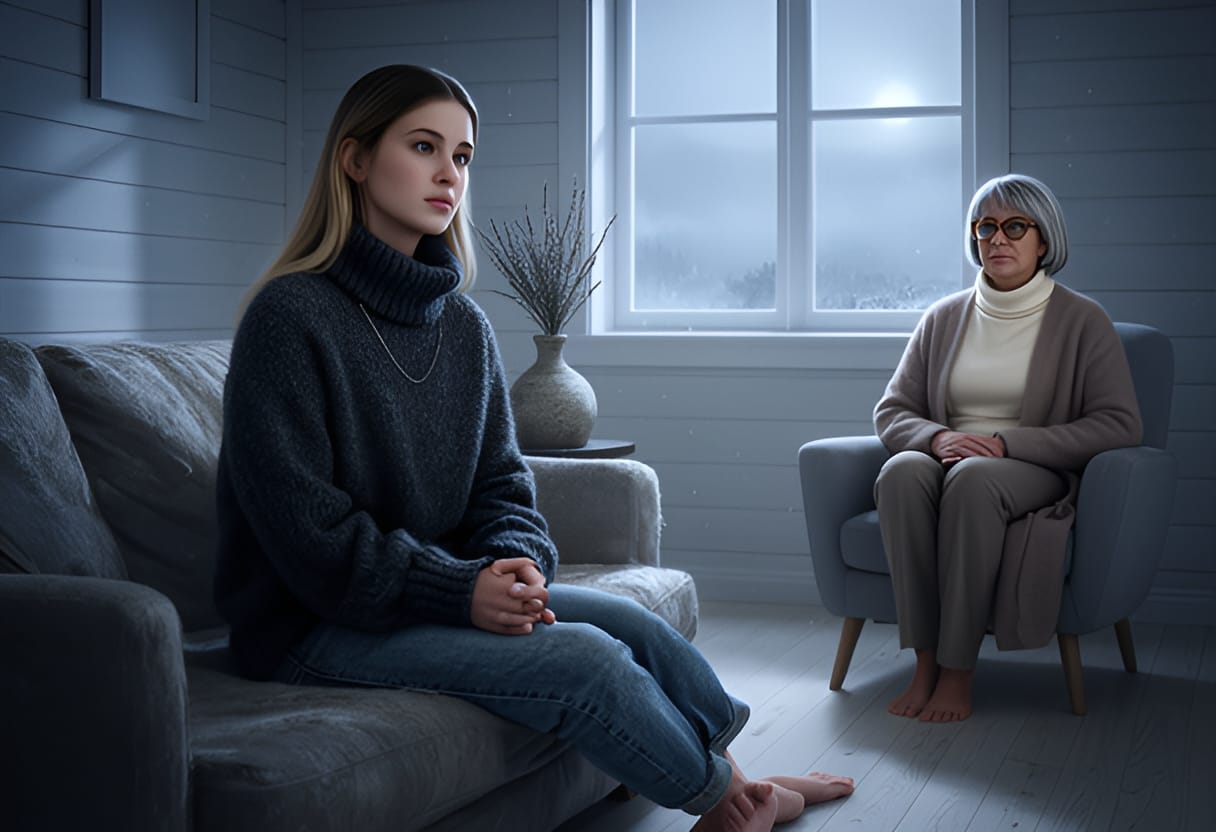
Marte sat on the edge of the couch in Elin’s office, her hands folded tightly in her lap. The room smelled of cedar and faint citrus, the air warm against the chill still clinging to her coat. Snow had begun to fall again outside, soft and steady, blurring the edges of the bare birches visible through the tall window. It was Tuesday. Two days since her first session. She had come back—not because she was sure she wanted to, but because the silence at home had grown too loud.
Elin sat across from her in the armchair, notebook open but pen resting. “You said last time you weren’t sure if you deserved help,” she began gently. “But you’re here. That means something, even if it’s just curiosity.”
Marte nodded, staring at the knot in the wool of her scarf. “I don’t know if it’s curiosity. Maybe I just didn’t want to lie in bed anymore.”
“Fair enough,” Elin said. “Let’s start where you feel safe. If you’re ready, tell me what you remember from that night. Not what you think you should remember. Not what you’ve told yourself. Just what comes.”
Marte swallowed. The memory came in flashes, unbidden but vivid—like frames from a film she couldn’t stop playing. She closed her eyes.
“I remember the mitten,” she said, her voice low. “Ingrid’s red mitten. It flew out the window when we laughed. She was teasing Jonas about his driving—said he was going like a grandfather to the mailbox. She stuck her hand out to wave at nothing, just to be silly, and the wind caught it. It spun out into the dark, trailing wool like a comet.”
She opened her eyes. Elin was watching her, not writing.
“I remember laughing too,” Marte continued. “Not because it was funny, but because Ingrid was happy. She was always happy in the car. Singing off-key. Making up stupid lyrics to songs on the radio.”
“What song?” Elin asked.
Marte frowned. “It was… ‘Stuck in a Moment’ by U2. I remember because Ingrid hated it. She said Bono sounded like he was yelling at a lost sheep. But that night, she was singing along anyway, just to annoy me. She turned it up when the chorus came.”
A faint smile touched her lips. Then it faded.
“The road was icy,” Marte said, her voice tightening. “Jonas was driving slow. Too slow, I thought. I was cold. My feet were numb even with my boots on. I kept pulling the scarf up over my nose, but it didn’t help.”
She paused, gathering the thread.
“I said it clearly,” she said. “I looked at him in the passenger seat mirror and said, ‘Jonas, slow down, the road is slick.’ I was worried. I didn’t want us to skid.”
Elin tilted her head slightly. “You said slow down?”
Marte nodded. “Yes. I was scared. The car was fishtailing a little on the curves near the old quarry. I could feel it—like the back end wanted to swing out. I put my hand on the dash to brace myself and said it again, louder: ‘Slow down!’”
She stopped. Her palms were damp against her thighs.
Elin was quiet for a moment. Then, softly: “Are you sure about that? The words you used?”
Marte’s breath hitched. “What do you mean?”
“I mean,” Elin said, choosing her words carefully, “that in our last session, you described Ingrid urging Jonas to drive faster. You said she laughed and said, ‘Come on, Jonas, live a little!’ And that you joined in, teasing him to speed up because you were cold and wanted to feel the wind.”
Marte’s stomach dropped. The room seemed to tilt, just slightly. “No,” she said, her voice thin. “That’s not right. I would never— I told him to slow down. I was trying to keep us safe.”
Elin didn’t look away. “But you also said, in that same session, that you remembered Ingrid’s mitten flying out the window as they laughed. And that the song playing was ‘Stuck in a Moment.’ Those details feel true. They’re sensory. Specific. But the words you attribute to yourself… they shift depending on when you tell the story.”
Marte stared at her scarf. The faded blue birds along the hem seemed to blur. “I’m not lying,” she whispered.
“I don’t think you are,” Elin said gently. “I think your mind is trying to protect you. It’s common after trauma. The brain doesn’t record like a camera. It records fragments—sights, sounds, smells—and then stitches them together with what feels emotionally true. Sometimes what feels true isn’t what happened. It’s what we need to have happened to make sense of the pain.”
Marte’s chest tightened. “So you’re saying I made it up?”
“I’m saying your memory might be doing its best to shield you from something harder to face.” Elin paused. “What if, instead of telling Jonas to slow down, you were the one who laughed and said, ‘Faster! I want to feel the wind’? What if Ingrid’s mitten flew out not because she was waving playfully, but because she was leaning out the window, laughing, urging him on?”
Marte shook her head, but the image came anyway—unguided, uninvited: Ingrid’s face turned sideways, hair whipping, mitten gone, her mouth open in laughter as the car surged forward. The radio blaring the chorus. Jonas’s hands tightening on the wheel, not in fear, but in reluctant amusement. And Marte—Marte leaning between them, not bracing, but laughing too, her voice bright over the music: Faster!
She gasped, her fingers digging into her thighs.
“No,” she breathed. “That’s not—that’s not me. I would never—”
“Wouldn’t you?” Elin asked, not unkindly. “Or is it just too painful to admit that you did?”
Marte couldn’t answer. The scarf felt suddenly too tight, the bergamot ghost in the wool now sharp, almost bitter. She thought of Ingrid’s mitten, spinning into the dark. She thought of the song. She thought of the cold seeping into her bones. And beneath it all, a new fear—quieter, mais insidious—began to grow: What if she hadn’t been the voice of caution at all? What if she had been the one who wanted to fly?
The session ended with Elin saying, “I’d like to see you again next week, if you’re willing. Same time. No pressure. We’ll go at your pace.”
Marte stood, pulling her coat on. “I’ll think about it.”
“That’s fair,” Elin said. “Just know the door is open.”
At the reception desk, Marte paused. The woman smiled gently. “Have a good day.”
Marte nodded, pulled her scarf higher, and stepped back into the cold.
The walk home was slower this time. Her boots crunched in the snow, but her head was up, just slightly. She passed the bakery, the red-and-white awning catching the weak sunlight. She didn’t flinch. She just kept walking.
When she reached her house, she didn’t go straight inside. She paused at the gate, looked up at her bedroom window—the curtains drawn, the glass dark.
She didn’t know if she believed she deserved help.
But for the first time since the accident, she wondered what it might feel like to stop asking that question—and simply let someone try to answer it.
That night, Marte lay awake, not from panic, but from thought.
The soup was still on the stove, untouched. She had eaten a few bites of bread with cheese, just enough to quiet the hunger that gnawed at her ribs. She had brushed her teeth, washed her face, and changed into her softest sleepwear—the old flannel set Ingrid had given her for her birthday two years ago, the one with the faded blue birds along the hem.
She lay on her back, staring at the ceiling, the scarf draped loosely over her chest. The bergamot was fainter now, mixed with the scent of wool and her own skin.
She thought of Elin’s voice—calm, unhurried, unafraid of the silence.
She thought of Ingrid’s laugh in the bookstore, the way she’d snort when Marte tried to pronounce a particularly long Latin name for a sea slug.
She thought of Jonas, waiting at the mailbox, his gloved hand resting on the metal, his breath visible in the cold air.
And for the first time, she didn’t flinch from the memory of his face.
She didn’t forgive herself.
She didn’t absolve Jonas.
She didn’t even know what she believed anymore.
But she turned onto her side, pulled the blanket to her chin, and whispered into the dark—not a plea, not a confession, but a name, so soft it was almost lost in the hush of the room:
“Ingrid.”
The word hung in the air, fragile and true.
And then, finally, she slept.
Marte woke before dawn, the name still on her lips. Ingrid. She lay very still, listening to the house breathe—the creak of timber settling, the distant drip of meltwater from the eaves. The sky beyond her window was the color of wet slate, just beginning to lighten in the east. She had slept without dreaming, or if she had dreamed, she remembered nothing. It felt like a small mercy.
She did not reach for her phone. Did not check for messages. Instead, she rolled onto her side and pulled the quilt tighter, the familiar weight of Ingrid’s flannel sleepwear grounding her in something softer than thought. The faded blue birds along the hem had worn thin in places, but they were still there. Like her.
After a while, she sat up. Her legs felt stiff from lying still, but not painful. She swung her feet to the floor and stood, moving slowly to the window. She pushed aside the curtain just enough to see the street below—empty, save for a few early footprints in the snow leading to the bakery. No car in the driveway. No sign of Jonas.
She turned away from the glass and walked to the small dresser by the bed. Her fingers lingered over the photograph tucked beneath the glass—a picture of her and Ingrid, taken the summer before their last year of university. They were sitting on the rocks at Hvitsten, legs dangling over the water, Ingrid’s arm slung around Marte’s shoulders, both of them laughing into the wind. Marte traced the edge of the frame with her thumb. She had not looked at it in weeks.
She dressed in quiet layers: thermal leggings, a thick sweater, her winter coat. Then, from the bottom of her closet, she pulled out the box she had not opened since the funeral. Inside lay Ingrid’s gloves—wool, lined with fleece, the left one slightly stretched where Ingrid always pulled them on too fast. Marte had kept them because they smelled, faintly, of her—of the lavender soap she used, and something deeper, like cold pine and woodsmoke.
She slipped them on now. They were too big. The fingers swallowed her hands, the wrists loose. But when she closed her fists, she could feel the shape of Ingrid’s fingers in the fabric, the way they had curled around hers the last time they walked the fjord trail together—just days before the accident, though Marte had blocked that memory until now.
She paused at the door, hand on the knob. Outside, the world was hushed under snow. The fjord lay still and gray beyond the trees, its surface broken only by the occasional gull riding the wind. She had not walked this far since the snow first fell. Her legs felt uncertain, but she told herself she would go only as far as the old bench—the one beneath the bent birch where they used to sit and share thermoses of tea, Ingrid always stealing Marte’s when she thought she wasn’t looking.
She stepped outside.
The cold hit her like a breath. It sharpened her senses—the crunch of snow under her boots, the sting in her nostrils, the way her breath plumed in the air. She pulled Ingrid’s gloves tighter and began to walk, her pace slow at first, then gradually finding a rhythm. The path was familiar, though softened by snow. She passed the bakery, its awning dusted white, the smell of rye and cinnamon drifting onto the street. She did not stop. She kept her eyes on the ground, watching her boots sink into the powder, then spring back as she lifted them.
Halfway to the fjord, the trees began to thin, and the view opened up. The water lay still beneath a low sky, ice forming along the edges in delicate, lacy patterns. A kingfisher flashed blue and gold over the reeds before vanishing into the cattails. Marte paused, hand resting on the trunk of a pine, and listened. The world was quiet, but not empty. There was life here—subtle, persistent. A chickadee called from a branch overhead. Somewhere, a dog barked, muffled by distance.
She continued, her shoulders slowly unwinding. Not relaxed, not yet—but less braced. She thought of Ingrid’s laugh, the way it used to rise like ice cracking under spring thaw—not sharp, but clear, full of light. She had told Marte once, years ago, that it was the sound she loved most in the world. Marte had laughed then, too, and said it was because Ingrid spent too much time listening to frozen lakes.
A smile touched her lips, unbidden. It faded quickly, replaced by a ache so deep it felt like hollow bone. She pressed on.
The bench came into view ahead—a simple wooden structure, painted a faded green, its slats worn smooth by years of use. It stood just off the path, facing the water, sheltered slightly by a cluster of rowans. She had sat there with Ingrid a hundred times. They had shared secrets, silences, sandwiches wrapped in wax paper. They had watched the seasons turn.
And then, as she drew closer, she saw him.
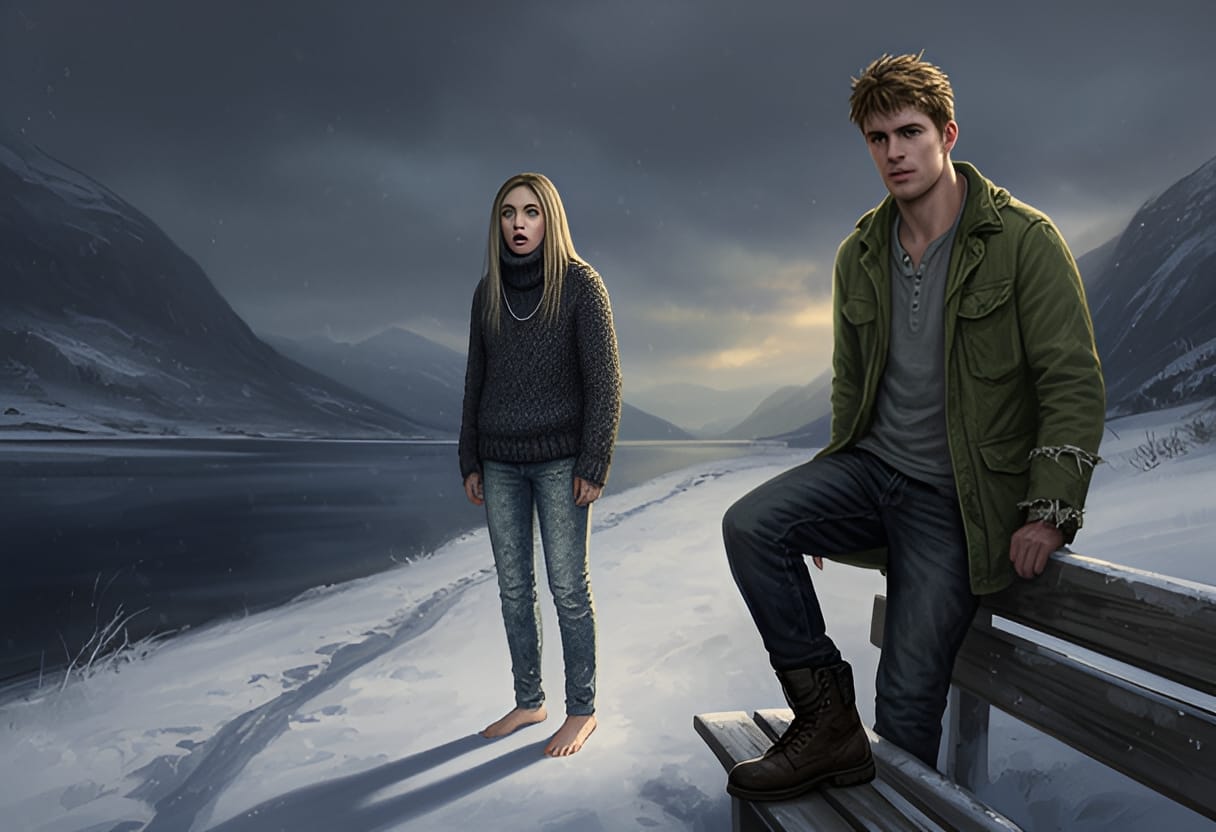
He was leaning against the backrest of the bench, one boot resting on the lowest slat, his hands in the pockets of a dark wool coat. His head was tipped back, eyes closed, face turned toward the weak sun. He was still. Waiting, it seemed, for nothing in particular.
Marte froze.
Her breath caught. Her gloves—Ingrid’s gloves—suddenly felt alien, too large, too full of someone else’s presence.
It was Jonas.
She knew it instantly—not from his face, which was still turned away, but from the way he held himself. The slight forward tilt of his shoulders, the way his weight rested on his left hip, the faint tension in his neck even at rest. She had seen him stand like that a hundred times—outside her apartment, at the edge of a crowd, leaning against a railing after a long day. It was his posture of quiet endurance.
Her heart hammered against her ribs, loud enough that she feared he might hear it over the distance. Her vision narrowed. The bench, the fjord, the snow—all of it blurred at the edges. Only Jonas remained in focus, a solid shape against the pale world.
She wanted to run to him. To throw her arms around him and bury her face in his coat, to breathe in the scent of wool and salt and something familiar she could not name. She wanted to ask if he was cold, if he had eaten, if he had slept. She wanted to tell him she had dreamed of Ingrid laughing in the bookstore, that she had worn her gloves, that she had almost believed, for a moment, that she deserved to be forgiven.
But then the memory came—not invited, not willed, but shoved forward by some deeper current beneath her thoughts.
Faster! I want to feel the wind.
Ingrid’s mitten, flying into the dark.
Jonas’s hands on the wheel, not afraid, but amused.
Her own voice, bright over the music: Faster!
She gasped, as if struck.
No. Not that. Not ever.
She turned.
And ran.
Her boots kicked up snow behind her, spraying it in arcs. She did not look back. She could not. Her lungs burned, her legs pumped, her arms pumping hard at her sides. The path rushed beneath her—gravel, ice, snow—each step a hammer blow. She heard nothing but her own breath, ragged and loud, and the thunder of her pulse in her ears.
She did not stop until she was at her gate.
She fumbled with the latch, her fingers stiff and clumsy, the gloves making it harder. Finally, it gave. She shoved the gate open and stumbled through, slamming it shut behind her with a crash that echoed in the quiet street. She leaned against it for a moment, eyes closed, trying to draw air into her burning chest.
Then she pushed off and ran the last few steps to the door.
She fumbled with the key, dropped it once, snatched it up, and turned it in the lock. The door swung inward. She lurched inside, kicked off her boots without untying them, and slid down the wood until she was sitting on the top step, her back against the door, her knees drawn up to her chest.
She buried her face in her hands.
Her breath came in short, sharp gasps. Her chest felt tight, as if wrapped in wire. Her fingers tingled. The world tilted slightly, as if the floor were no longer level.
He was waiting for her.
That was the thought that screamed in her skull, over and over, until she thought she would vomit or scream or both. He had been waiting. Not by accident. Not because he came here to think, to remember, to sit where they had all been happy. No. He had been waiting for her. To see if she would come. To see if she would break.
And she had.
She had seen him. She had run. She had proven exactly what he must think—that she was guilty, that she was afraid, that she could not face what she had done.
Her vision swam. She pressed her palms harder against her eyes, as if she could hold back the tears that threatened to spill. But they came anyway—hot, silent, tracking down her cheeks, dripping onto her wool sleeves.
She did not make a sound. She only sat there, shaking, her breath coming in shallow, painful pulls, the gloves still on her hands—Ingrid’s gloves—too big, too full of ghost.
And somewhere, deep in the quiet of the house, the clock on the wall began to tick. One second. Then another. Then another.
She did not move.
She did not speak.
She only sat on the stairs, wrapped in the cold and the memory of a laugh that sounded like ice breaking, and waited for the world to stop tilting.
She sat on the top step, back against the door, knees drawn to her chest, Ingrid’s gloves still on her hands. The clock ticked on. One second. Then another. Then another. The house held its breath with her. Outside, the world was still wrapped in winter’s hush—no wind, no birds, just the faint creak of timber settling in the cold.
She didn’t know how long she stayed like that. Long enough for the numbness in her fingers to creep up her wrists. Long enough for the salt of her tears to dry tight on her cheeks. Long enough for the shame to settle, heavy and familiar, like a second skin.
When she finally moved, it was not to rise, but to pull her hands from her face. The gloves were damp where they’d pressed against her skin. She peeled them off slowly, as if removing a bandage from a wound that hadn’t yet scabbed. They smelled of lavender and woodsmoke—Ingrid’s scent, still clinging to the wool. She held them for a moment, then shoved them under her arm and pushed herself up.
She didn’t go to the kitchen. Didn’t make tea. Didn’t turn on a light. Instead, she went straight to the hallway table, where the mail usually collected—a small wooden tray beneath the mirror, already dusty from days of neglect.
Her breath hitched when she saw it.
A thick envelope, cream-colored, addressed in a hand she knew as well as her own.
Jonas.
Her pulse jumped—not with hope, but with dread. She hadn’t checked the mail in days. Hadn’t dared. But here it was, plain as daylight, resting on top of a flyer for the Bodø winter market and a bill from the power company.
She reached for it slowly, as if it might burn her. The paper was slightly textured, expensive. Not a note shoved in haste. This had been thought over. Written with care.
She turned it over. No stamp. No postmark. He’d delivered it by hand.
Her throat tightened. She hadn’t seen him since the bench. Not in person. Not since she’d fled.
She carried the envelope to the kitchen table and sat down. The room was dim, lit only by the pale glow of dawn filtering through the blinds. She didn’t open it right away. She just held it, feeling the weight of it—the thickness, the slight stiffness of folded paper inside.
Then, with fingers that trembled, she slipped a thumb under the flap and pulled it open.
Inside lay a single sheet of paper, folded once. She unfolded it slowly, as if afraid the words might jump out and strike her.
His handwriting filled the page—neat, deliberate, the same slant she’d seen on birthday cards, on postcards from trips they’d taken together, on the margin of a textbook he’d once lent her in university.
She began to read.
Marte,
I don’t expect you to read this. I don’t expect you to answer. I don’t even expect you to believe I meant to leave it here. But I needed you to know I was thinking of you. Not in the way you might fear—not to ask for anything, not to reopen what’s closed. Just to say I see you. I see how hard you’re trying. I see how much you carry.
I miss Ingrid too. Not in the way you do—never that. But I miss her laugh. The way she’d steal your fries and pretend she hadn’t. The way she’d sing off-key in the car and make you laugh until you cried. I miss her presence in the world. And I know you carry her like a second heartbeat. I don’t ask you to put her down. I only ask that you don’t carry her alone.
I’m not waiting for forgiveness. I’m not waiting for you to be ready. I’m waiting for nothing. I just wanted you to know I understand if you’re not ready to speak. If you’re not ready to see me. If you need more time. I’ll be here—not in your way, not in your face—but in the periphery. Like a tree you pass on your walk. You don’t have to acknowledge it. You just have to know it’s there, rooted, unchanged.
If you never want to see me again, I’ll understand. But if one day you do—I’ll be on the fjord trail. Not waiting for you to break. Just hoping you might breathe a little easier.
- — Jonas*
She read it once. Then again. Then a third time, each pass slower than the last, her eyes tracing the curves of his letters, the way he’d dotted his i’s with small circles, the way he’d crossed his t’s with a slight upward flick—just like he always had.
By the third reading, the tears were flowing freely. Not loud, not heaving—but silent, relentless, sliding down her temples and into her hair, dampening the collar of her sweater.
She missed him. Oh, how she missed him. Not just his presence, but the ease of him—the way he could sit beside her in silence and make it feel like companionship, not isolation. The way he’d bring her coffee in the morning without being asked, just because he knew she liked it black with one sugar. The way he’d listened when she talked about Ingrid, never interrupting, never trying to fix it, just saying, Yeah. She was something.
And now here he was, not asking for anything. Not demanding her guilt. Not insisting she move on. Just offering to exist in the quiet edges of her life—like a shadow that didn’t flee when she turned toward it.
It undid her.
She wanted to scream. She wanted to throw the letter across the room. She wanted to call him and scream into the phone until her voice gave out. She wanted to tell him he had no right to be this kind. No right to be this understanding. No right to make her feel seen when all she wanted was to disappear.
Because if he understood—if he truly didn’t blame her—then what was she punishing herself for?
The thought ignited a fury so sharp it stole her breath.
She wasn’t doing this for Ingrid. She was doing it because she believed she deserved to suffer. And if Jonas refused to let her suffer in peace—if he kept showing up, quiet and steadfast, like a lighthouse in a storm she didn’t want to weather—then she would have to stop punishing herself. And she wasn’t ready for that.
She wasn’t ready to forgive herself.
She wasn’t ready to let go of the belief that she had killed her best friend.
She wasn’t ready to live in a world where joy wasn’t a betrayal.
She rose from the chair, the letter still clenched in her fist. Her movements were sharp, jerky—like a puppet pulled by tight strings.
She went to the sink. Turned on the tap just enough to let a thin stream of water run. Pulled the matchbox from the drawer beside the stove—she kept it there for candles, though she hadn’t lit one in months.
She tore the letter into pieces. Not neatly. Not with care. She ripped it violently, again and again, until it was a pile of white scraps stained with smudges of ink and the ghost of his words.
Then she struck a match.
The flame flared—small, bright, blue at the base. She held it to the pile.
The paper caught instantly. Orange tongues licked upward, curling the edges, blackening the neat loops of his handwriting. The words I miss Ingrid too curled and vanished. I’m not waiting for forgiveness turned to ash before her eyes.
She watched it burn. Watched the flames dance, felt the heat on her face. Watched as the letters dissolved into glowing embers, then into gray-white ash that swirled in the sink’s shallow basin, caught in the faint current of water.
She leaned closer, her breath shallow.
And whispered, voice raw and broken, “I can’t let you off the hook.”
The words hung in the air, swallowed by the hiss of dying flame and the dull gurgle of the drain.
She didn’t move until the last spark faded. Until the sink held only damp ash and a few charred corners that refused to fully burn.
Then she turned off the tap.
She didn’t wash the remains away. Let them sit. Let them be a kind of monument—not to him, not to her, but to the thing between them that she refused to name.
She wiped her hands on her jeans, left the matches where they were, and walked back to the hallway.
She didn’t go upstairs. Didn’t go to the living room. Didn’t turn on a light.
Instead, she opened the coat closet and pulled out her heaviest winter coat—the one Ingrid had picked out for her two winters ago, the deep blue one with the faux-fur hood. She slipped it on, zipped it to her throat, pulled the hood up over her head.
Then she opened the front door.
The cold hit her like a slap. Clean. Sharp. It made her eyes water—not from tears, but from the sheer bite of it.
She stepped onto the porch, closed the door softly behind her, and stood there for a moment, staring down the empty street.
The houses were dark. The snow was undisturbed except for her own footprints from yesterday—leading to the gate, then back. No other tracks.
She didn’t go toward the fjord trail.
She didn’t go toward his apartment, which lay just beyond the old fish market, three blocks east.
Instead, she turned west—toward the cliffs.
Toward the place where the land dropped away into the gray-green water, where the wind came in off the sea and stole the breath from your lungs.
She walked fast, boots crunching on frozen gravel, hood pulled tight, hands buried deep in her pockets.
She wasn’t going to think.
She wasn’t going to feel.
She was just going to walk—until her legs gave out, until her lungs burned, until the world narrowed to the rhythm of her steps and the roar of the blood in her ears.
And if, by some chance, she saw him on the path ahead—leaning against a bench, waiting not for her to break, but simply to be—she would keep walking.
She would not look back.
She would not stop.
She would not let herself believe, even for a second, that she deserved to be met with kindness.
She didn’t go back inside. Didn’t lock the door. Didn’t look at the house again. She kept walking, the cliffs rising ahead like a wall of stone and ice, the sea below a bruised throat of green and gray. Wind carved through her coat, snatching at the hood, trying to pull it from her head. She let it. Let the cold scour her cheeks, let it sting behind her eyes. Anything to keep the silence inside her from growing too loud.
She walked until her lungs ached, until her legs trembled not from fatigue but from the effort of not stopping. The path narrowed where the land gave way to sheer drop, the rocks slick with spray that froze on contact. She pressed herself against the cliffside, one hand braced on stone, the other still curled at her side, nails digging into her palm. She hadn’t realized she’d been holding her breath until now. She exhaled—a short, ragged thing—and looked out.
The water moved below, restless, indifferent. Ice floes drifted like broken teeth, grinding together in the tidal pull. Gulls wheeled overhead, cries sharp and distant. She watched them for a long time. Not thinking. Not feeling. Just seeing.
And then, without warning, she was back in the car.
Not the memory she’d carried for months—the one where she sat stiff in the passenger seat, voice tight with worry, begging Jonas to slow down, to be careful, please—but another. Brighter. Louder. The radio playing low, U2’s “Stuck in a Moment” just starting, Ingrid humming along off-key, her red mitten tapping the beat on the window. Jonas easing the car forward, cautious, as always, on the icy stretch outside town. And Marte—Marte laughing, not nervously, not falsely, but really laughing, her head turned toward Ingrid, eyes bright.
“Come on, Jonas,” she said, and her voice was light, teasing, alive. “Live a little! I want to feel the wind.”
Ingrid snorted, nudging her shoulder. “Careful, Marte. He might actually listen.”
Jonas glanced over, smiling despite himself. “You two are impossible.”
And then—ice. Not a patch, not a warning, but a sheet of black glass hidden under a dusting of snow. The tires lost grip. The car began to spin, slow at first, then faster, the world tilting sideways. Ingrid’s laughter cut off. Jonas swore, hands jerking on the wheel, but it was too late. The car slid sideways toward the ditch, then jerked hard as the rear wheels caught on something unseen. The airbag exploded—a violent puff of white—and Ingrid’s head snapped sideways, striking the window with a sickening crack.
Marte screamed.
Not then. Not in the memory. But now, standing on the cliff, wind ripping at her coat, she screamed—a raw, broken sound torn from her throat, half sob, half roar. She doubled over, hands flying to her ears as if she could block it out, as if the sound were coming from outside her, not from deep inside where it had been buried, locked away under layers of guilt and the story she’d told herself to survive.
She wasn’t begging him to stop.
She’d urged him to go faster.
She’d wanted to feel the wind.
And Ingrid had laughed.
And Jonas had smiled.
And then—
She fell to her knees in the gravel, not from weakness but from the force of it, the sheer, staggering weight of what she’d remembered. The snow soaked through her pants, cold and sharp against her skin, but she didn’t feel it. All she felt was the press of Ingrid’s shoulder against hers in the car, the sound of her voice saying, Live a little, and the terrible, beautiful normalcy of it—how ordinary the moment had been, how full of life, how utterly unprepared for what came next.

She stayed like that for a long time, forehead pressed to her knees, arms wrapped around her head, breathing in short, ragged gasps. The wind screamed above her. The sea roared below. Somewhere, a gull cried. And beneath it all, the memory played on a loop, not as a film but as a sensation—the warmth of Ingrid beside her, the jolt of joy in her chest when Jonas had glanced over and smiled, the split second before everything shattered.
When she finally lifted her head, her face was wet. Not just from snowmelt. From tears. Hot and relentless, cutting paths through the grime on her cheeks.
She hadn’t wanted to stop him.
She’d wanted to go faster.
And she’d survived.
The thought came not as an accusation but as a fact, simple and inescapable. She had not been the voice of caution. She had been the voice of recklessness. And Ingrid—her best friend, her other half—had been right there, laughing with her, sharing the same stupid, bright urge to feel something, to break free of the weight of winter, of waiting, of being careful.
And Jonas—Jonas had been driving. He had been trying to be careful. He had been the one who lost control.
And yet.
She had said it.
She had said, Faster.
She pushed herself up on trembling legs, snow falling from her coat as she stood. She swayed for a moment, wind buffeting her, but she didn’t fall. She looked out over the water again, not to escape, but to see. To face it.
The guilt hadn’t vanished. If anything, it had deepened, twisted into something more complex, more cruel. Because now it wasn’t just that she had caused the crash by distracting him, by speaking at all. It was that she had wanted it. She had wanted the speed, the rush, the feeling of being alive in a way that felt dangerous, forbidden. And in getting that, she had lost Ingrid.
She wasn’t being punished for a mistake.
She was being punished for wanting.
A bitter laugh escaped her, half-choked. Of course. Of course it would come down to that. She had spent months believing she had failed Ingrid by not stopping Jonas, when the truth was worse: she had failed her by not being careful enough, by not valuing safety over sensation, by choosing the thrill of the moment over the person beside her.
She turned her face into the wind, let it scour her skin, let it carry away the tears she didn’t bother to wipe away. She didn’t know how long she stood there. Long enough for her fingers to go numb. Long enough for the ache in her chest to become a constant, dull throb, like a bruise that wouldn’t fade.
And then, slowly, a different feeling began to stir—not relief, not forgiveness, but something quieter, more dangerous: the urge to tell someone.
Not to confess. Not to beg for absolution. But to say it out loud. To let the words exist in the air, where they couldn’t be twisted or denied.
She thought of Jonas. Not waiting on the fjord trail. Not hoping she would break. But simply being—steady, quiet, unshaken in his belief that she deserved kindness, even when she didn’t believe it herself.
And she thought of Elin. Calm, perceptive Elin, who had guided her back into that moment not with pressure, but with patience, who had asked only what she remembered, not what she thought she should remember.
Had Elin known? Had she seen the truth in Marte’s face when she’d hesitated earlier, when she’d insisted she’d urged caution? Or had she simply held the space for the memory to rise on its own, unbidden, uninvited?
Either way, it didn’t matter. The memory was real. She had felt it—not as a story, but as a sensation in her bones, a taste on her tongue, a sound in her ears. She could still hear Ingrid’s laughter. Still feel the press of her mitten against her arm.
She had remembered.
And she could not unremember it.
She started walking again, not toward the house, not toward safety, but along the cliff path, her boots crunching in the frozen gravel, her hood pulled low against the wind. She wasn’t running. She wasn’t hiding. She was moving—toward what, she didn’t know. But she was moving.
And when she reached the bend where the trail began to descend toward the fjord, she stopped.
Not because she saw him.
But because she could imagine him there.
Not waiting for her to break. Not waiting for her to be ready. Just… there. A presence. A possibility.
She didn’t call out. Didn’t wave. Didn’t approach.
She stood where she was, hands shoved deep in her pockets, hood up against the wind, and whispered—not to him, not to Ingrid, not even to herself, but to the space between them, to the air, to the sea and the sky and the indifferent, endless quiet:
“I said it.”
Her voice was small. Rough. Uncertain.
“I said, Faster.”
She paused, let the words hang.
Then, quieter:
“I wanted to feel the wind.”
She didn’t wait for an answer. Didn’t look for a sign. She just stood there, breathing, letting the truth sit in the cold air like a stone.
And then she turned.
Not toward the house.
Not toward the fjord.
But along the cliff, toward the wind, toward the sea, toward whatever came next.
She walked on.
Chapter 3
The Choice to Remember
The chapter opens with Marte beginning to attend therapy regularly, slowly recounting fragments of the accident while still resisting the idea that she played a role. She starts taking short walks, and one day sees Jonas waiting on the fjord trail, which triggers a panic attack. By the end, a breakthrough session reveals a repressed memory: she had urged Jonas to drive faster, not beg him to stop.
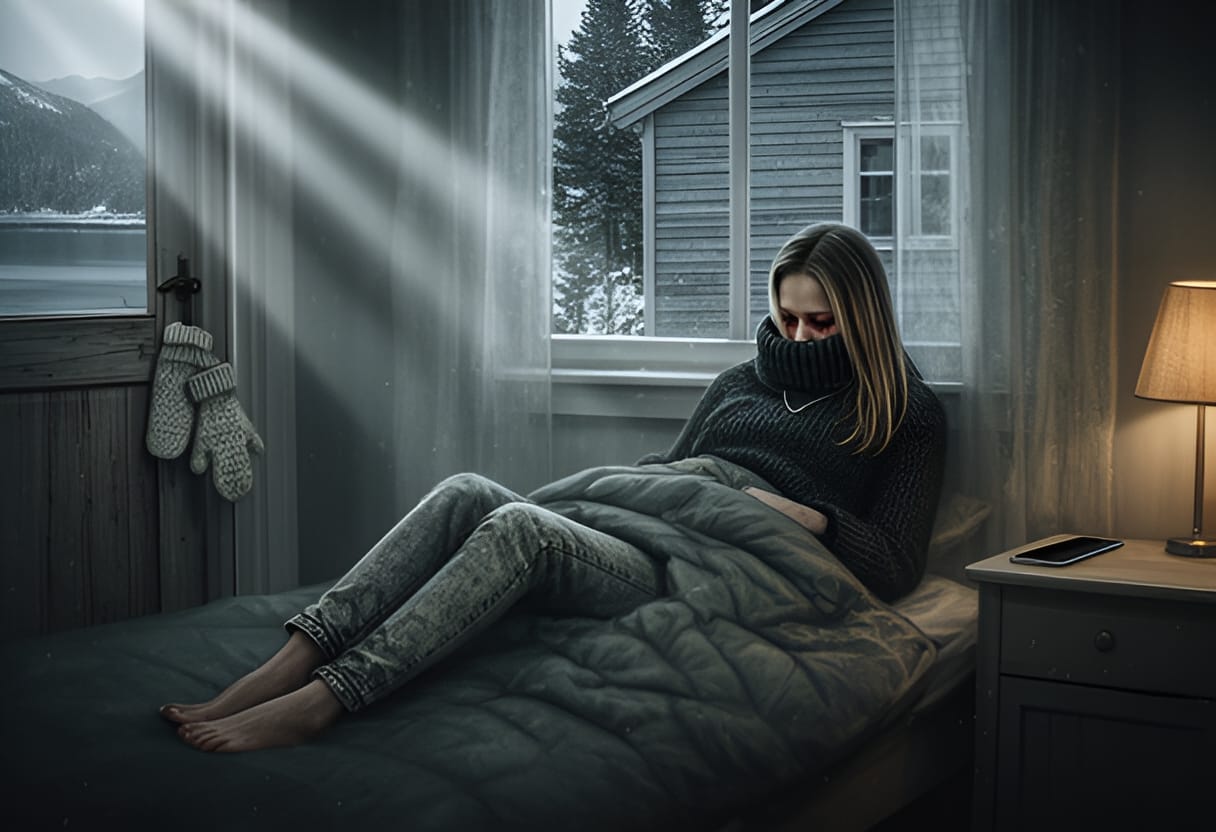
Marte’s thumb hovered over the screen, the glow of her phone casting a pale light on the dark ceiling. She had typed it twice already: I’m not feeling well. Can we reschedule? Each time, she deleted it, the words feeling like a lie wrapped in another. But the third time, she sent it. Headache. Sorry for the short notice. She set the phone face down on the nightstand and rolled onto her side, pulling the faded blue-bird flannel Ingrid had given her up to her chin. The fabric smelled faintly of bergamot and woodsmoke, a ghost of spilled tea and stubbornness. She closed her eyes, but the dark only made the memory sharper.
It wasn’t a headache. It was the weight of the sentence forming in her chest like a stone: I told him to go faster. Not pleaded. Not begged. Urged. She had been cold, shivering in the passenger seat, her breath fogging the window as Ingrid laughed beside her, and she had said it — lightly, teasingly, as if speed were a joke, as if the ice weren’t waiting, as if Ingrid’s head wouldn’t snap sideways like a doll’s when the car spun. She had said it, and then Ingrid had laughed, and then the world had tilted, and then there was only the hiss of the airbag and the wet crack of glass against bone.
She opened her eyes. The room was too bright. She dragged the quilt over her head, sealing herself in cotton and shadow. Mirrors were forbidden now. She had caught her reflection yesterday in the darkened window of the bookstore — hollow cheeks, eyes too wide, lips parted as if still speaking — and had stumbled back, breathless, as if she had seen a stranger who had committed a crime. The face in the glass had wanted the car to go faster. It had wanted to feel alive, to feel the rush of wind, to tease Jonas about his caution, to hear Ingrid laugh louder over the engine. And now Ingrid was gone, and that face was still hers.
The knock came at three in the afternoon. She didn’t move. The sound echoed too loud in the quiet house, like a knock on a coffin lid. She pulled the quilt tighter, listening as her father’s footsteps paused outside her door. The handle turned slowly, and a crack of hallway light sliced the dark before the door opened just enough for him to peer in.
“You awake?” His voice was low, rough from disuse. He didn’t wait for an answer. He stepped inside, closing the door behind him, and set a steaming bowl on her nightstand — fish soup, dill floating on the surface, a slice of rye bread beside it. Her mother’s making. He didn’t turn on the light. He just sat on the edge of the bed, the springs sighing under his weight, and waited.
She didn’t speak. She couldn’t. The soup smelled of the sea and thyme, of ordinary care, and it made her throat tighten. She turned her face into the pillow, breathing in the scent of Ingrid’s scarf still wrapped loosely around her neck. She wanted to scream. She wanted to say it wasn’t fair that he was here, that the soup was warm, that the world kept turning when hers had shattered on black ice. She wanted to say she didn’t deserve soup, or light, or her father’s quiet presence. She wanted to say she was the reason Ingrid’s laugh would never echo in a kitchen again.
Her father didn’t push. He sat silently, his hands resting on his knees, looking at the wall where a photo of Ingrid and Marte at sixteen grinned back from the frame — arms around each other, snow in their hair, cheeks flushed from cold and joy. After a long time, he spoke, his voice soft but firm.
“Ingrid loved your laugh,” he said. “She used to say it was the sound of ice cracking under spring thaw — sudden, bright, impossible to ignore. She wouldn’t want it buried.”
Marte shuddered. A sound escaped her — not a sob, not quite, but something broken and low, like ice giving way under pressure. She buried her face deeper, her shoulders shaking. She wanted to tell him that her laugh had killed Ingrid. That the very sound he praised had been the last thing Ingrid heard before the world went silent. That she had urged Jonas to drive faster not because she was cold, but because she had wanted to feel something — anything — before the numbness returned. That she didn’t deserve to laugh again, not when Ingrid’s had been stolen.
But her father didn’t ask for an explanation. He just sat there, his presence a quiet anchor in the storm she had made inside herself. And when her tears finally slowed, dampening the pillowcase and the edge of the scarf, he didn’t offer platitudes. He didn’t say it would be okay. He just reached over, gently, and pulled the quilt a little higher over her shoulders before standing.
“I’ll leave the soup,” he murmured. “Eat when you can.” The door clicked shut, leaving her in the dark again, but this time, the silence felt less like an accusation and more like a space — vast, terrifying, and somehow, possibly, survivable.
She didn’t move for hours. The soup grew cold. The light outside shifted, turning the room from gray to deep blue as evening settled. She lay still, listening to the creak of the old house, the distant cry of a gull over the fjord, the slow beat of her own heart — a traitor, still pumping blood, still demanding air, still insisting on life when all she wanted was to stop.
She thought of Ingrid’s voice that night — not the laughter, but the quiet moment before, when Marte had teased Jonas about driving like an old man. Ingrid had turned to her, smiling, and said, “You’re impossible.” Then she had leaned her head against the window, her breath fogging the glass, and whispered, “But I love it.” Marte had laughed then, light and bright, and reached over to squeeze Ingrid’s knee. And then she had said it — “Come on, Jonas. Live a little.” And Jonas had pressed the gas, just a little, just enough to please them, and the ice had taken its due.
She turned onto her back, staring at the ceiling. The flannel sleepwear scratched her neck. She wanted to tear it off, to rid herself of every trace of Ingrid — the scarf, the memory, the guilt that clung like frost. But she didn’t. She just lay there, letting the cold seep into her bones, letting the guilt coil tighter in her gut. She didn’t deserve to be warm. She didn’t deserve to be clean. She didn’t deserve to forget the way Ingrid’s head had lilted to the side, eyes open but seeing nothing, hair fanned across the shattered glass like a dark halo.
She thought of her father’s words. She wouldn’t want it buried. But what if burying it was the only way to honor her? What if silence was the only penance left?
She closed her eyes. The dark returned, unblinking. And in it, she saw Ingrid’s face — not laughing, not accusing, just there, waiting. And for the first time since the memory surfaced, Marte didn’t look away.
She whispered it, so quiet even she could barely hear it: “I’m sorry.”
The words hung in the air, raw and unanswered. She didn’t expect forgiveness. She didn’t even expect to be heard. She only knew she had to say it — not to Ingrid, not really, but to the part of herself that had wanted to go faster, that had wanted to feel alive, that had survived when her best friend had not.
And then, finally, she turned over, pulled the quilt to her chin, and let the silence hold her.
Marte lay still, the quilt pulled to her chin, the silence thick and unyielding. The words she had whispered — I’m sorry — still hung in the air like frost on glass, unseen but felt. She had meant them for Ingrid, yes, but they had come from somewhere deeper, from the part of her that had urged Jonas forward, that had wanted to feel the rush of speed, the sting of cold air, anything to break the numbness that had settled in her bones long before the ice took hold.
She hadn’t slept. Not really. Her eyes had burned behind closed lids, and every time she drifted, the image returned: Ingrid’s forehead against the window, breath fogging the glass, her smile soft as she said, “But I love it.” Then Marte’s voice, light and bright, saying, “Come on, Jonas. Live a little.” And the gas pedal pressing down — just a little — just enough.
She turned her face into the pillow again, inhaling the faint trace of woodsmoke and stubbornness from Ingrid’s scarf. It smelled like her. Like safety. Like something lost.
The first light of morning crept through the curtains, pale and hesitant. Marte didn’t move. She let the silence settle into her ribs, let it press against her sternum like a stone. She thought of calling in sick to the bookstore again. Thought of turning her phone off, of disappearing into the walls of her room until the guilt had worn her down to nothing.
But then she remembered the soup — still sitting on the nightstand, now stone cold. Her father’s quiet presence. The way he hadn’t pushed, hadn’t offered false comfort, had just been there. And Ingrid’s voice, not in anger, but in memory: “You’re impossible.” Followed immediately by, “But I love it.”
She closed her eyes. Not to escape. To listen.
A decision formed, not with certainty, but with the quiet insistence of something true: she needed to go back to therapy. Not because she was ready. Not because she had answers. But because she owed it to herself — to Ingrid — to stop letting the silence be a cage.
She reached for her phone on the nightstand, her fingers trembling slightly as she unlocked it. The screen glowed blue in the dim room. She opened her messages, found Elin’s name, and hovered her thumb over the keyboard.
What do you say when you’re terrified of what you might discover?
She typed slowly, each letter a effort:
I’ll be there Thursday. I’m not ready to talk, but I’ll be there.
She read it over. It sounded hesitant. Weak. Like she was making excuses. She almost deleted it. But then she thought of Elin’s calm face in the therapy room, the way she never rushed her, never filled the spaces with noise. She hit send before she could talk herself out of it.
She set the phone down and stared at the ceiling. Minutes passed. Then, a soft chime.
Elin’s reply appeared:
Thank you for trusting the process. We’ll go at your pace.
Marte exhaled, a breath she hadn’t realized she’d been holding. No pressure. No demand for explanation. Just acknowledgment. It made her eyes sting. She rubbed them fiercely with the heel of her palm and sat up, pulling the scarf tighter around her shoulders.
The day stretched ahead, empty and wide. She made tea — Earl Grey, the kind Ingrid had mocked as tasting like “wet leaves and regret” — and sat at the kitchen table, staring out at the frost-rimed pines beyond the garden. The warmth of the cup in her hands was almost too much to bear. She set it down untouched.
She couldn’t sit still. She paced the length of the living room, then retraced her steps. She thought of Jonas — not with fear, not yet, but with a dull, persistent ache. She imagined him walking the fjord trail alone, hands in his pockets, looking out at the water the way he used to when they were younger, when the three of them would sit on the rocks and share cinnamon buns, Ingrid stealing bites from both of theirs and laughing when Marte pretended to be offended.
She stopped by the window. Her breath fogged the glass. She wiped it away with her fingertip, then drew a shaky heart in the condensation. It faded almost immediately.
She went back to her room and opened her laptop. The blank document glared at her. She began to type, then stopped. Deleted. Tried again.
Jonas, I —
Too blunt. Too raw.
I’ve been remembering things. I think I need to tell you what I said that night.
Too much. It sounded like an accusation, even if it wasn’t meant to be.
I’m sorry I survived.
No. That wasn’t true. She wasn’t sorry she lived. She was sorry she had lived because of what she’d done. Sorry she had laughed. Sorry she had urged him on.
She deleted it all. Sat back. Let her hands rest in her lap.
What did she want him to know? Not that she blamed him. Not that she wanted forgiveness. Just that she remembered. That she had been part of it. That she hadn’t been the helpless bystander she’d painted herself as for so long.
She tried again.
I remembered something in therapy. I didn’t beg you to stop. I said, “Come on, Jonas. Live a little.” I wanted to feel something. I don’t know if that makes it my fault. But I needed you to know it wasn’t just you driving. It was me too — in my voice, in my wanting.
She read it over. It was honest. Maybe too honest. She imagined Jonas reading it, his face going still, his eyes dropping to the floor. She imagined him saying nothing. Or worse — saying, “It’s okay,” when it wasn’t.
She deleted it. Again.
She lay back on her bed, the laptop resting on her stomach. The room was quiet. Outside, a gull cried over the fjord, sharp and clear. She thought of Ingrid’s laugh — how it had sounded like ice cracking under spring thaw. Sudden. Bright. Impossible to ignore.
She wanted to hear it again. Not as a ghost. Not as a punishment. But as a memory that didn’t tear her apart.
She opened a new document. Typed one sentence.
I want to tell you the truth.
She stared at it. Then, slowly, she added:
Not to hurt you. Not to ask for anything. Just because I can’t carry it alone anymore.
She saved it as a draft. Closed the laptop. Lay there in the darkening room, the weight of the words she hadn’t sent pressing against her chest like a second heartbeat.
She didn’t sleep. She watched the night deepen, the stars appearing one by one over the water, cold and distant. She thought of Jonas waking in his own house, maybe looking at his phone, wondering if she’d reached out. Wondering if she hated him. Wondering if he deserved to be forgiven.
She thought of telling him she didn’t hate him. That she never had. That she was angry — at herself, at the ice, at the cruel randomness of it all — but not at him.
She thought of saying it out loud.
Her eyes burned. She turned onto her side, pulled Ingrid’s scarf a little tighter, and whispered into the pillow:
“I’m scared.”
Not of his anger. Not of his silence.
But of what it would mean to speak the truth and still be allowed to stay.
She lay there until the first gray light of dawn touched the edge of the curtain. Then, slowly, she closed her eyes — not to escape, but to rest. To gather herself. To prepare.
Not for forgiveness.
For honesty.
Marte sat on the edge of the couch in Elin’s office, her fingers curled around the warm ceramic of the mug she hadn’t touched. The room smelled faintly of lavender and old paper, the light slanting through the blinds in pale gold strips. Outside, the fjord was still, a sheet of lead under a sky beginning to blush with dawn. She had come early, before the clinic filled with the murmur of other voices, needing the quiet to steady herself.
She hadn’t slept. The words she’d drafted and deleted a dozen times pulsed behind her eyes like an afterimage. I want to tell you the truth. Not to hurt you. Not to ask for anything. Just because I can’t carry it alone anymore.
She had meant to send it. She really had. But fear had clenched her throat each time she hovered over the send button — fear of his silence, fear of his pity, fear that if she spoke it aloud, even to Jonas, the fragile thing she was beginning to build inside herself would shatter.
But here, with Elin’s calm presence anchoring her, the words felt less like a weapon and more like a lifeline — one she had to throw, even if her hands shook.
Elin sat across from her in the armchair, her posture open, her eyes steady. She hadn’t pushed. She never did. She simply waited, as she had for weeks, for Marte to find the threshold and step across it.
“I didn’t tell him to stop,” Marte began, her voice low, rough from disuse. She stared at her hands, at the chipped nail on her thumb, at the faint blue veins tracing her knuckles. “I said… I said, ‘Go faster.’ I wanted to feel alive.”
The words hung in the air, fragile as spider silk. Saying them aloud made them real — not a suspicion, not a half-remembered fragment surfacing in dreams, but a fact she had spoken, owned. Her chest tightened. She could still feel the weight of Ingrid’s hand on her arm that night, the warmth of her laughter, the way the kitchen light had caught the gold in her hair as she teased Jonas, urging him to loosen up, to take a chance, to live.
“I wanted to feel something,” Marte whispered, her voice breaking. “It was just… a joke. A dare. I didn’t think — I didn’t think it would — ”
She couldn’t finish. The memory surged: Ingrid’s grin, Jonas’s hesitant smile as he pressed the accelerator, the way the car had lurched forward on the icy road, not with recklessness, but with a sudden, foolish eagerness to please. And then — the slide. The spin. The shatter of glass. Ingrid’s head snapping sideways, the awful, hollow thud against the window.
A sob tore from her throat, raw and unexpected. She doubled over, elbows on her knees, pressing her palms into her eyes as if she could push the images back in. “Then I’m just as guilty as if I’d grabbed the wheel,” she choked out. “Maybe more. Because I wanted it. I wanted the speed. I wanted the risk. And she paid for it.”

Elin didn’t move immediately. She let the silence sit, thick and heavy, not to punish, but to honor the weight of what Marte had carried alone for so long. When she spoke, her voice was soft, but firm — like stone worn smooth by water.
“You can hold two truths,” Elin said. “You wished for joy, and the outcome was tragic.”
Marte froze, her breath catching. She lowered her hands, her cheeks wet, her eyes wide. “But… how? If I hadn’t said it — if I’d just stayed quiet — ”
“Then the car might still have slid,” Elin interrupted gently. “Black ice doesn’t care about intent. It doesn’t ask who laughed, who urged, who stayed silent. It only asks: Is there traction? And that night, there wasn’t.”
Marte stared at her, searching for evasion, for a softening that would let her off the hook. But Elin’s gaze was clear, unwavering. Not unkind — but unwilling to let her escape into the simplicity of self-loathing.
“Guilt assumes intent,” Elin continued. “It says: I meant for this to happen. Responsibility says: This happened, and I was part of the chain. You can be responsible without being guilty. You can regret without condemning yourself to forever.”
A fresh wave of tears spilled over, hot and relentless. Marte buried her face in her hands again, her shoulders shaking. “I’ve been punishing myself for wanting to laugh,” she muffled. “For wanting to feel… not just grief. Not just fear. I thought if I stopped wanting, if I erased that part of me, I could make it right. I could bring her back.”
Elin waited until the worst of the storm passed, until Marte’s breathing hitched less frequently, until she could look up, her eyes red-rimmed and raw.
“You don’t have to earn the right to live,” Elin said softly. “Ingrid wouldn’t want you to stop wanting. She’d want you to remember her — not as a punishment, but as a person who loved you. Who laughed with you. Who would hate to see you shrink yourself into nothing because you’re afraid of joy.”
Marte swallowed hard, the words catching in her throat like shards. She thought of Ingrid’s face that night — not the broken image from the crash, but the one before: head tipped back, eyes crinkled, laughter ringing like ice giving way under spring thaw. Not an accusation. A gift.
“I don’t know how to stop,” Marte admitted, her voice barely above a whisper. “I don’t know how to hold her and… and still let myself want things.”
Elin leaned forward slightly, her hands resting on her knees. “You don’t have to figure it out today. You just have to stop fighting the truth. You wanted to feel alive. That doesn’t make you a monster. It makes you human. And Ingrid — she knew that. She saw you. She didn’t love you because you were perfect. She loved you because you were real.”
A long silence followed. Not empty, but full — full of the ghost of laughter, the echo of a scarf brushing against wool, the quiet creak of the house settling in the cold morning. Marte felt it then, not as a wave, but as a steady pulse beneath the ribs: grief, yes, but also something softer, tentative — the first stirrings of permission.
She wiped her face with the back of her hand, sniffling. “I think… I think I need to say it to him,” she said. “Not to ask for anything. Not to make him feel better. Just… to tell him I remember. That I was there. That I spoke.”
Elin nodded, a small, approving tilt of her head. “Then say it. Not as a confession. Not as a plea. As a testimony. To what was. To what you carry. To what you’re willing to face.”
Marte drew a breath, deep and shuddering. It didn’t fix anything. It didn’t undo the past. But for the first time since the crash, it didn’t feel like a lie.
She stood, her legs stiff from sitting too long. The mug was still warm in her hands. She set it down carefully on the side table, not wanting to spill, not wanting to waste the small kindness of warmth.
“Thank you,” she said, her voice steadier now, though still thin at the edges. “For not letting me hide.”
Elin smiled — just a flicker, but genuine. “You did the hard part. You showed up. You spoke. That’s how healing begins — not with a bang, but with a whisper that dares to be heard.”
Marte paused at the door, her hand on the handle. She looked back once.
“I’m scared,” she said.
Elin’s eyes softened. “I know. But you’re here. And that means you’re already moving through it.”
Marte nodded. She opened the door and stepped into the hall, the cool air brushing her cheeks. The clinic was quiet, the reception desk empty. Outside, the sky was turning pear-gray, the first true light of morning spilling over the water.
She didn’t know what would happen when she found Jonas on the trail. She didn’t know if he would speak, if he would turn away, if he would reach for her hand or let it fall.
But she knew this: she would not run.
She would walk toward him, and when she was close enough, she would say the words she had carried like a stone in her chest for months.
I remembered something in therapy. I didn’t beg you to stop. I said, “Come on, Jonas. Live a little.”
And then, she would let the silence come — not as a verdict, but as a space where two people, both bruised by the same storm, could finally stand in the same wind without pretending they were unscathed.
She stepped out into the dawn, the crunch of frost under her boots sharp and clear, and began to walk.
Marte walked until the frost had begun to melt from the soles of her boots, until the air smelled less of ice and more of wet earth and distant woodsmoke. The town was still hushed, shops shuttered, curtains drawn. She passed the bakery where Ingrid used to buy cinnamon buns on Sundays, the one with the chipped blue sign and the bell that jingled too loud. She didn’t stop. She kept walking, past the old school, past the marina where the fishing boats rocked like tired things in their slips, until she came to Jonas’s street.
It was a narrow lane lined with birches, their bark peeling in white ribbons. His house sat at the end, a small, gray-clad place with a sagging porch and a window that always seemed to be lit, even in the deepest hours of night. She had seen that light before — a soft glow behind the blinds, a sign he was awake, waiting, or just unable to sleep.
She stopped at the curb, her breath curling in front of her. The note was folded small in her coat pocket, the edges worn from being touched too many times. She had written it twice. The first version had been longer, fuller — apologies, explanations, a plea for understanding. She had torn it up, flushed the pieces down the toilet, watched them swirl away like confetti in reverse. This one was bare. Honest, she hoped. Not a burden.
She took it out now, smoothing it against her thigh. The ink was slightly smudged where her thumb had rested. She read it again in her mind:
I remembered something. I said to go faster. I’m sorry I survived when you lost her too.
No name. No date. No request. Just the truth, and the sorrow that came with it.
She tucked it back into her pocket and crossed the street. Her boots crunched on the gravel of his driveway. The mailbox was a small, dented thing nailed to a post beside the gate, painted once white, now gray with age and rain. She lifted the lid. It was empty inside, save for a few stray pine needles and a dead leaf. She slipped the note in, let it rest on the bottom, and closed the lid softly. It clicked — a small, final sound.
She stepped back. Her hands were cold. She shoved them into her pockets and turned away, not looking back. She didn’t want to see if he came out. Didn’t want to watch him read it, wonder if he would frown, or sigh, or cry. She had done what she could. The rest was not hers to carry.
She walked slowly down the lane, then turned onto the main road. The sky was deepening now, the pear-gray of morning giving way to true dark. Stars blinked overhead, sharp and cold. She passed the clinic, its windows dark, and kept going, toward the fjord trail.
The path was familiar — the same packed dirt, the same roots twisting like sleepy snakes over the surface, the same scent of damp moss and cedar. She had walked it a hundred times with Ingrid, laughing, talking about nothing and everything. She had walked it alone since the crash, head down, eyes on her boots, afraid of what she might see if she looked up.
Tonight, she lifted her gaze.
The trees stood silent on either side, their branches bare against the sky. The fjord lay still below, a sheet of black glass reflecting the moon. No wind. No sound but her own breath and the quiet crunch of her steps.
She walked until the trail bent inward, until the trees closed in like a cathedral. And there, just ahead, where the path opened onto a small overlook with a bench worn smooth by years of use, she stopped.
She didn’t see Jonas. She didn’t expect to. But she felt him — not as a presence, but as a possibility. Like the air before rain.
She sat on the bench. The wood was cold through her jeans. She pulled her coat tighter, drew her knees up, and rested her forehead on them.
She didn’t pray. She didn’t beg. She just breathed.
And then, behind her eyelids, she saw her.
Ingrid.
Not as she was in the crash — not broken, not silent. But as she had been the last time Marte saw her alive: sitting on this very bench, scarf wrapped tight, cheeks flushed from the cold, grinning as she shoved a stolen fry from Marte’s paper cone into her mouth.
She was wearing her red mittens. One was missing — the same one that had flown out the window that night, fluttering like a startled bird before vanishing into the snow.
Ingrid turned her head. She didn’t speak. She didn’t need to.
She looked at Marte — really looked — and then she nodded.

Slowly. Seriously. As if to say: I see you. I hear you. It’s okay to remember.
And then she was gone — not faded, not erased, but simply… elsewhere. Like a voice that had finished its song.
Marte stayed on the bench for a long time. Her tears came quietly, not as a flood, but as a steady seep, warm against her cold skin. She didn’t wipe them away. She let them fall, tracing paths down her cheeks, dropping onto her jeans, soaking into the wool of her cuffs.
When she finally stood, her legs were stiff. She stretched, rolled her shoulders, and began to walk back — not toward town, not yet, but along the water’s edge, where the ice had begun to crack and shift under the pressure of the tide.
She didn’t know if Jonas had found the note. She didn’t know if he would ever understand. She didn’t know if she would ever stop feeling the weight of what had happened.
But she knew this: she had spoken the truth. Not to punish herself. Not to punish him. But to honor what was real — that she had been there, that she had spoken, that she had wanted to feel alive, and that Ingrid, in her laughter and her love, had never asked her to stop.
She walked until the trail met the road again, then turned toward home. The stars were still out, but in the east, a faint blush was beginning to rise — the first, quiet promise of dawn.
She didn’t run. She didn’t hurry.
She walked, one step at a time, carrying nothing but her breath, her memory, and the soft, unshakable knowledge that she was still here — and that, for now, that was enough.