Horror
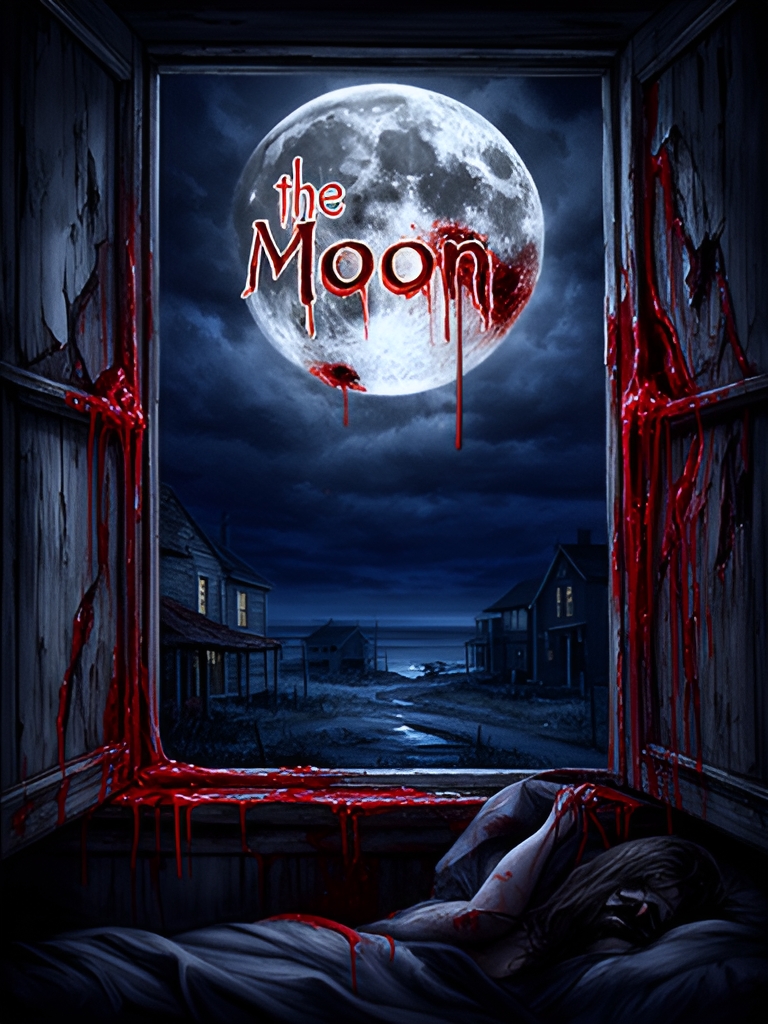
the Moon
by hadrfa
5 chapters39 min read
Chapter 1
The First Bleed
The cliffs at Blackwater Cove dropped straight into the Atlantic, and at two in the morning, the tide was low enough to expose the black ribs of bedrock that jutted like broken teeth from the sand. Elena Varga’s cruiser kicked up gravel as she pulled off the narrow access road, the beam of her spotlight cutting through the fog that clung to the shore like damp wool. She’d been called out for a disturbance—nothing official, just a worried parent’s voice crackling over the radio—but the sight that met her made the hair on her arms stand up.
Toby Quinn was on his knees at the base of the cliff, shovel braced against his shoulder, fingers curled into the stone as if trying to pull himself through it. He wasn’t digging so much as scrabbling, nails split and bleeding, tracks of dried blood cracking across his knuckles. His eyes were open but unfocused, pupils wide and dark in the pale light of the moon hanging low over the water. He wore only thin pajamas, the fabric torn at the knees, and his breath came in short, ragged puffs that vanished before they could form clouds.
“Toby?” Elena said, keeping her voice low, hands visible at her sides. She didn’t want to startle him—not when he looked like he might vanish into the rock if she moved too fast.
He didn’t respond. Instead, he tilted his head, as if listening to something beneath the sand. Then, in a voice that wasn’t quite his—too smooth, too layered, like stone grinding on stone—he spoke.
“She remembers the hunger,” he said. “She remembers the name you buried.”
Elena froze. Her pulse hammered in her throat. No one knew her full name. Not here. Not since she’d taken the badge and changed the way she signed reports, dropped her mother’s maiden name from official use. She’d been Elena Varga for ten years. Before that, she’d been Elena Varga-Molnár—her father’s name, her mother’s, a hyphen she’d shed like skin after leaving Budapest, after the gaps in her memory began to yawn wider than she could name.
“What did you say?” she asked, stepping closer, boots sinking slightly into the damp sand.
Toby turned his head slowly. His lips were cracked, tongue darting out to wet them. “The moon remembers,” he whispered. “It remembers the name you don’t say. It remembers the blood before the name.”
He laughed then—a short, broken sound—and went back to digging, shovel biting into the stone with a sound like a scream muffled underwater.
Behind her, the cruiser door creaked open. Deputy Daniel Cho stepped out, flashlight beam sweeping the scene. He frowned at Toby’s bloody hands, then at Elena’s face.
“He’s been like this for twenty minutes,” Daniel said. “Parents say he’s been sleepwalking for weeks. Digging in the backyard, muttering about tunnels. Tonight they found him here, shovel in hand, like he was trying to get to something.”
Elena didn’t take her eyes off Toby. “Did he say anything to them?”
Daniel shook his head. “Just nonsense. Words that didn’t sound like any language I know. Sounded like… rocks sliding.”
She finally looked at him, her jaw tight. “He said the moon remembers my name.”
Daniel blinked. “Your name? Ellie? He knows you’re Ellie Varga.”
“Not Ellie,” she said. “My full name. The one I haven’t used since I was seventeen.”
Daniel’s expression shifted, skepticism giving way to unease. “You think he’s making it up?”
“I don’t know what he’s doing,” she said. “But he wasn’t supposed to know that name. Not here. Not ever.”
Toby gave a sudden jerk, as if pulled by a string, and froze mid-dig. His head snapped up, eyes locking onto hers with unsettling clarity.
“The moon is hungry,” he said. “And it remembers you.”
Then he collapsed, shovel clattering to the sand, unconscious before he hit the ground.
Elena lay awake long after midnight, the sheets pulled to her chest, the house silent except for the old house’s usual creaks and sighs. Toby’s words echoed in her skull, not as memory but as intrusion—like something had slipped a key under the door and was turning it in the lock.
Then came the tapping.
Faint at first. A rhythm. Three slow taps, pause, two quick ones. Like fingernails on glass.
She sat up, heart hammering, and listened. The sound came from above—on the roof, near the eaves. Not branches. Not animals. Too deliberate. Too… intelligent.
She swung her legs over the side of the bed, feet finding the cold floorboards, and moved to the window. She pulled back the curtain just enough to see the roof slope in the moonlight. Nothing. Just shadows and the silver sheen of dew on the shingles.
The tapping came again. Three slow, two fast.
She pressed her forehead to the cool glass, breath fogging the pane. And then, as if the sound had unlocked something behind her eyes, she was dreaming.
Not a dream. A descent.
She was falling—not through air, but through the moon’s surface, crust giving way like old ice beneath her weight. Below, not darkness, but a vast, wet cavern pulsing with a low, throbbing light. The walls breathed. And in the center, something vast and coiled shifted in the gloom, not sleeping, not awake, but remembering.
And then it screamed.
Not a sound, but a sensation—like the inside of her skull was being torn open by a voice that had waited centuries to be heard. It didn’t come from outside. It came from the place where her name used to live, before she buried it, before she forgot it.
She gasped awake.
Her sheets were damp. Not sweat. Something thicker, cooler, that left a faint iridescent sheen on her fingertips when she touched it. She brought her hand to her nose and inhaled—copper and ozone, like blood left too long in the air.
The tapping had stopped.
Outside, the moon hung heavy and low, its light no longer just light. It seemed to pool, to seep, to remember.
The moonlight did not fall. It bled.
Elena stared at the window where the silver sheen had pooled hours before. Now, instead of light, a thick, viscous substance seeped through the cracks in the casing and along the sill, moving against gravity in slow, deliberate strands. It was not water. Not oil. It had the weight of mercury and the sheen of oil on wet stone, catching the dim glow of her bedside lamp and fracturing it into hues that shifted—silver, then bruised violet, then a deep, absorbent black that seemed to drink the light around it.
She rose without thinking, bare feet silent on the floor, and watched as it coiled across the bedroom floor like a living thing. Where it touched, the air grew colder, and sound—her breath, the creak of the house—seemed to muffle, as if the substance were swallowing vibrations before they could reach her ears. She lifted a hand, hesitated, then let a fingertip graze the edge of the nearest tendril.
It was cool. Not cold. And it left behind a faint iridescent film, like the residue on her sheets hours before. She brought her hand to her nose. Copper. Ozone. The same scent that had clung to her skin after the dream.
The substance pulsed once—softly, like a heartbeat—and then flowed toward the door, slipping beneath it with eerie ease.
She followed.
The hallway was dim, the nightlight at the end casting a long shadow that didn’t quite match her own. As she moved, the seeping light trailed behind her, not as a reflection, but as a presence—thickening where she paused, retreating when she advanced, as though testing boundaries.
At the bathroom door, she paused. The substance had pooled at the threshold, forming a mirror-smooth surface that rippled without disturbance. She stepped over it, and the moment her foot made contact, the air shifted—like passing through a membrane.
Inside, the bathroom was swallowed by the same silver-black glow. It coated the tiles, clung to the porcelain of the sink and tub, and filled the air with a quiet hum she felt more than heard—low, resonant, like the thrum of something vast turning in its sleep.
She moved to the mirror above the sink.
Her reflection stared back. Pale. Eyes wide. Hair tangled from restless sleep.
She blinked.
Her reflection blinked a full second later.
Elena froze. Breath held. Heart hammering not with fear, but with the awful certainty of being observed from within her own skin.
She lifted her right hand.
The reflection lifted its left.
Then, slowly, deliberately, it turned its palm upward—and curled its fingers inward, as if beckoning.
She jerked back, knocking her elbow against the medicine cabinet. The mirror swung open, bottles clattering. In the sudden movement, the reflection stuttered—then snapped back into sync, eyes wide, mouth slightly open, mirroring her shock.
But it was too late. She had seen the lag. The independence.
The substance on the floor began to recede, pulling back toward the window like tide drawn by an unseen moon. As it went, the air normalized—sound returned, the chill lifted—and the mirror showed only her, breathing hard, palms slick with sweat.
She turned to the window.
The seeping light was gone. Only ordinary moonlight now spilled across the sill, pale and indifferent.
But on the wood, where the substance had pooled, faint marks remained.
Not water stains. Not mold.
They were lines. Deliberate. Etched shallow into the grain, as if made by a fingernail or a tool too fine to see. Three vertical strokes, connected at the base by a crescent, then bisected by a sharp downward slash. A symbol. Not from any alphabet she knew. Not from any language Daniel had ever mentioned, or Toby muttered in his sleep.
It felt like a signature.
She leaned closer, breath fogging the cool glass. The symbol caught the light in a way that made it seem to shift—just slightly—when she wasn’t looking directly at it.
Outside, the moon hung low and heavy, its light no longer passive. It watched. It remembered.
And now, so did she.
Chapter 2
The Compulsion Spreads
Elena stood at the edge of the pier, the wood still damp from the receding tide, and watched the first pale streaks of dawn bleed into the sky. The symbol on the windowsill at home had faded by morning, but the unease hadn’t. It had settled into her bones like a second pulse.
She’d called the town meeting for ten. By nine-thirty, the hall was already filling.
Old Man Poole sat rigid in his folding chair, calloused hands resting on his knees, dirt ground deep under his nails. Across the aisle, Lillian Cho—no relation to Daniel—twisted the hem of her apron, her eyes darting to the doors every time they opened. Near the back, Deputy Cho leaned against the wall, arms crossed, jaw tight. He hadn’t slept. Elena could tell by the way his shoulders hunched, like he was bracing against a weight only he could feel.
Martha Wren arrived last, draped in her shawl of woven sea wool, her silver braid coiled tight at her nape. She didn’t sit. She stood near the window, watching the harbor with eyes that had seen too many tides turn.
“Three basements,” Elena said, her voice low but clear, cutting through the murmur. “Poole’s, Lillian’s, and the Hutchins boy—Jesse, sixteen. All found digging before first light. All claiming they couldn’t stop themselves. All saying the same thing.”
She paused, letting the weight sink in.
“They dreamed of a light,” Elena continued. “Warm. Thrumming. Like a heartbeat under stone. And a voice—not in their ears, but in their bones—teaching them words. Words that felt old. Familiar. Like they’d known them before they were born.”
Lillian swallowed hard. “I dreamed I was speaking… not English. Not any language I’ve studied. But I understood it. It was… instruction. Like a mother teaching a child to walk.”
Poole nodded, his gaze fixed on the floor. “I kept hearing ‘remember the names.’ Over and over. Not mine. Others’. People who… weren’t supposed to be forgotten.”
Elena glanced at Daniel. He gave the barest lift of his chin—a signal. He’d checked the logs.
“It’s not random,” he said, stepping forward. “I pulled admission records from the clinic. Going back sixty years. Every eighteen years, give or take a month, we see a spike. Sleep disturbances. Compulsive digging. Reports of… unusual speech. Always in the weeks leading up to the autumn equinox, when the moon’s declination hits its peak.”
He flipped open his notebook. “1954. 1972. 1990. And now. 2008. Each time, it starts with the young and the old—those whose guards are down. Each time, it builds. And each time, it ends the same way.”
“Someone goes too deep,” Martha Wren said quietly from the window. Her voice was soft, but it carried. “They break through. Not just rock. Something else.”
Elena’s throat tightened. “You’ve seen this before.”
Martha turned. Her eyes were ancient, weary. “I was sixteen in ’72. I kept a journal. Wrote about the dreams. The words. How they felt like coming home.” She paused, swallowing. “My brother Daniel—no relation to the deputy—he dug under the old boathouse. Said he could hear singing. When they pulled him out, he wasn’t breathing. But his lips were moving. Forming sounds no throat should make.”
A silence fell, thick and damp as fog.
Elena felt it then—the old pull. Not fear. Recognition. Like the symbol on the sill, it whispered at the edge of thought. You knew this once.
“I don’t believe in curses,” she said, voice steady. “But I believe in patterns. And if this is cyclical… we can prepare. We can watch for it. Keep people safe.”
Martha shook her head, a faint, sorrowful smile touching her lips. “You don’t understand, Sheriff. It’s not about stopping it. It’s about answering it. The moon isn’t bleeding light. It’s bleeding memory. And it’s hungry for voices that remember.”
Before Elena could respond, the doors flew open.
Jesse Hutchins stumbled in, barefoot, his pajama legs caked with wet sand. His eyes were wide, unblinking. In his trembling hands, he clutched a shovel—too big for him, the blade nicked and rusted.
“I… I had to,” he gasped. “It was calling. The light… it’s warmer now. Closer.”
He looked down at the shovel, then back at them, his voice dropping to a whisper. “It knows my name. And it knows yours, Sheriff. Elena Varga-Molnár.”
The name hung in the air like a bell struck underwater.
Elena didn’t move. Didn’t breathe.
Daniel took a step forward, his hand hovering near his holster. “How do you know that?”
Jesse’s lips peeled back—not in fear, but in something worse. Recognition. Joy, even.
“It told me. In the dream. It said you forgot. But it remembered. And now… it’s waking up.”
By noon, the shovel was back in Elena’s shed—clean, dry, placed exactly where she kept it. But the dirt under her fingernails remained. She’d scrubbed until her skin was raw, and still, the grains clung, dark and gritty, like they’d grown there.
She sat on the tailgate of her truck, staring at the cliffs. The sea cave yawned black in the cliff face, its mouth wet and gleaming. No one had gone near it since Toby vanished. No one dared.
But she had dreamed of it again last night. Not the descent. Not the scream. This time, she’d stood at the mouth of the cave, and the air had breathed out—warm, sweet, like ozone and old paper—and a voice, layered and deep, had hummed just beneath hearing:
Come home.
She pressed her palms to her eyes. When she lowered them, the moon hung in the daytime sky—a pale, indifferent disc. But she knew better now.
It wasn’t watching.
It was waiting.
And it had learned her name.
She rose from the truck’s tailgate, the grit of sand and stone still caught beneath her nails, and walked slowly toward the archives building—a converted fishing lodge half-swallowed by ivy and salt-rusted shutters. Daniel fell into step beside her, his hands shoved deep in his jacket pockets, eyes scanning the street as if expecting someone to step out from between the boarded-up storefronts.
“You still hearing it?” he asked quietly.
“The hum? The warmth?” Elena shook her head. “Not now. But it’s there. Like a tooth you can’t stop touching with your tongue.”
They reached the back door of the archives, the one Martha Wren kept padlocked and claimed was for “preservation integrity.” Elena fished a slim piece of spring steel from her pocket—a habit from years of picking shed locks when kids got themselves trapped—and worked it into the mechanism. The lock gave with a soft click.
Inside, the air was thick with the smell of old paper, beeswax, and something faintly metallic—like the inside of a camera long unused. Rows of sagging shelves held binders labeled in Martha’s precise cursive: Lunar Folklore, 1890–1950; Meteorite Fragments; Tidal Anomalies; NASA Transcripts (Declassified). Elena ignored them. She knew where the real records were kept.
Behind a false panel in the west wall—revealed by tugging a loose corner of a map showing the 1969 lunar landing sites—lay a narrow crawlspace. They slipped inside, moving slowly to avoid dislodging the drywall dust that clung to everything like forgotten breath.
The hidden room was small, lined with foil-backed insulation and smelling strongly of ozone. A single bulb hung from the ceiling, its cord frayed at the base. On a metal shelf sat stacks of manila folders, each stamped in faded red: PROJECT STILL WATERS – EYES ONLY – NASA CONTRACT NAS5-21230.
Daniel pulled the top folder free. Inside were typed reports on thick, yellowing paper, carbon copies with blue lines down the margins. The header read: LUNAR SEISMIC ANOMALY INVESTIGATION – FARSIDE MONITORING – APOLLO 12 POST-LANDING ANALYSIS.
Elena flipped through quickly. Pages of spectrograms, tremor logs, and audio waveforms. Then, on page seventeen, a transcript with a handwritten note in the margin: Recurring pattern at 0.7 Hz. Not tectonic. Modulated. Speech-like?
She turned to the next page. A second transcript, dated November 19, 1972, twelve days after Apollo 17’s return.
Audio File: LSW-17-11-19-03 Time: 03:14:22 UTC Source: Passive Seismometer Array, Farside Crater Poincaré [Low-frequency rumble, rhythmic pulsing] Voice (filtered, low male timbre): “…nemeton…” [Pause, pulsing continues] Voice: “…méh₂tēr…” [Longer pause. The pulsing shifts, becomes more complex] Voice (clearer, layered, as if multiple tones speaking at once): “…u̯idʰeh₂… weyd… [Sudden silence. Then, a single sharp tap. Like stone on stone.] Voice (whisper, urgent): “…remember…”
Daniel’s breath hitched. “That’s… not random. Those are roots. Proto-Indo-European. ‘Mother.’ ‘To know.’ ‘To see.’”
Elena’s fingers trembled as she traced the ink. “And the tapping. Just like on my roof. Just like in Jesse’s dream.”
She pulled another folder. This one labeled INTERNAL MEMO – WERN VON BRAUN TO NASA ADMIN – 12/03/1972. The memo was brief, typed in all caps:
FARSIDE AUDIO ANOMALIES CONTINUE TO DEFY CONVENTIONAL EXPLANATION. SIGNALS EXHIBIT STRUCTURE CONSISTENT WITH ARTICULATED SPEECH IN UNKNOWN LANGUAGE FAMILY. RECOMMEND IMMEDIATE TERMINATION OF DATA COLLECTION AND SEALING OF ALL RECORDS UNDER CLASSIFIED LEVEL OMEGA. EVENT CORRELATES WITH LUNAR MODULE DESCENT STAGE IMPACT ZONE. POSSIBLE CONTAMINATION OR UNINTENDED EXPOSURE OF SUB-SURFACE STRATUM. DO NOT DISCUSS WITH OUTSIDE PERSONNEL. – WVB
Elena looked up. “They knew. They landed, they heard something, and they buried it.”
Daniel closed the folder slowly. “And the town elders did the same in ’72. Martha’s brother—”
“—dug too close to what was waking,” Elena finished. “And they silenced it. Just like NASA.”
A floorboard creaked behind them.
They spun.
Martha Wren stood in the crawlspace entrance, her shawl pulled tight, her silver braid gleaming in the bulb’s harsh light. She wasn’t angry. She looked… relieved.
“You weren’t supposed to find this,” she said, her voice quiet but firm. “But I knew you would. Eventually.”
Elena stood, the folder still clenched in her hand. “What is it? What’s really down there?”
Martha stepped inside, ducking slightly to avoid the insulation. She didn’t touch anything. Just looked at the shelves, at the folders, at the face of the young deputy who had once brought her soup when she was sick.
“The moon isn’t a rock,” she said. “Not anymore. Not since we punched through.”
Elena frowned. “What do you mean?”
“The first landing. Eagle. The moment the descent engine kicked up dust, the moment those boots touched regolith—it wasn’t just a landing. It was a breach. Like tearing open a scab that had sealed for millennia. The crust… it’s thin there. Weaker. And beneath it—”
“It’s not rock,” Daniel said slowly. “It’s a wound.”
Martha nodded. “Yes. A tear in the skin of the world. And what’s inside… it’s not alien. It’s ancient. Older than language. Older than memory as we know it. It’s the thing that dreamed us into remembering our names.”
Elena felt the blood drain from her face. “And it’s using us to remember itself.”
“Not using,” Martha corrected gently. “Awakening. It doesn’t want to consume us. It wants to be known again. To be named. Every time someone dreams the words, every time they dig toward the pulse beneath the stone, they’re not being possessed. They’re helping it remember how to be.”
Elena thought of Toby, carving symbols into driftwood. Of Jesse, whispering a name he shouldn’t have known. Of her own dream—Come home—and the voice that sounded like her grandmother’s lullaby, twisted into something vast and hungry.
“And the tapping?” she asked. “The substance on my skin?”
“A byproduct,” Martha said. “When the wound stirs, it bleeds—not blood, but potential. Possibility. The ozone is the smell of reality fraying. The copper… that’s the taste of old blood. The kind that remembers being shed.”
Elena looked at her hands. The dirt under her nails seemed to pulse, faintly, like a second heartbeat.
“I need to go home,” she said.
Martha didn’t try to stop her. She just placed a hand, warm and papery-thin, on Elena’s forearm. “Be careful what you remember, Sheriff. Once you start, it’s hard to stop.”
Outside, the sky had deepened to indigo. The moon hung low, a pale coin swallowed by haze. Elena walked fast, Daniel beside her, neither speaking until they reached her house.
The shed door was open.
Her shovel was gone.
She stepped inside, heart hammering. The floor was undisturbed. No footprints. No signs of forced entry.
But when she lifted her left hand, the nails were caked with fresh earth—dark, damp, smelling of deep stone and wet roots. She hadn’t left the house. She hadn’t dreamed of digging.
And yet.
She turned to Daniel, her voice raw. “I’ve been out there. I just don’t remember doing it.”
He didn’t answer. He just looked at her, his expression grim, and touched the side of his own head—where, in his dreams, he’d felt the warm, pulsating glow beneath the stone, singing to him in a language that felt like a mother’s breath.
Elena looked down at the dirt. Then, slowly, she brought her fingers to her lips.
And tasted the moon.
Chapter 3
The Hunger in the Stone
Elena woke with dirt under her nails and the ghost of a shovel’s weight in her hands. The shed door hung ajar, its lock broken not by force but by the quiet, persistent turn of something that had learned how to open it. She stood barefoot on the cold wood floor, breath fogging in the predawn air, and stared at her palms—black with loam, ridges packed tight. She hadn’t remembered leaving the house. Hadn’t remembered walking to the cliffs, or digging, or the way the moon had hung low and heavy over the water, its light not shining but seeping, like ink through wet paper.
She scrubbed her hands at the sink until the skin turned red, but the dirt wouldn’t come out from under her nails. It felt less like soil and more like ash that had once been bone.
Daniel found her there ten minutes later, coffee in hand, his expression wary but not surprised. “You were at the cave mouth again,” he said. “I saw your boot prints in the dew. Went straight to the wall, then turned back. Didn’t go in.”
“I don’t remember,” she said. She turned on the tap, let the water run hot. “I dreamt I was digging. But it felt… familiar. Like I’d done it before.”
He didn’t press. He never did when she got like this—when the edges of her thoughts softened and the world seemed to tilt just a few degrees off true. Instead, he leaned against the doorframe and said, “Martha Wren stopped by the station this morning. Left a box of old reel-to-reel tapes. Says they’re from the ’71 incident. Thinks you ought to listen.”
Elena froze, water dripping from her wrists. “Why now?”
“Because she’s scared,” Daniel said. “And scared people do strange things. Like handing over evidence they’ve kept hidden for fifty years.”
She turned off the water. Dried her hands slowly, feeling the roughness of her knuckles, the way the skin pulled tight over the bones. “I’ll look at them tonight.”
He nodded, sipped his coffee. “Get some rest. You look like you haven’t slept in days.”
She managed a ghost of a smile. “I’ll try.”
But sleep, when it came, was not rest.
She fell into it not as a descent but as a recognition—as if her mind had been waiting for a signal and the moon had finally broadcast it.
The dream began in darkness, not the dark of closed eyelids but a deep, viscous dark that had weight and temperature, like being submerged in cold oil. She was lying on stone that breathed—slow, deep inhalations that lifted her shoulders, exhalations that settled her back into the ground. The air tasted of salt and burnt metal. Above her, instead of sky, there was a vast, curved surface veined with faint bioluminescence, pulsing in rhythm with the stone beneath her. The moon, but not as she knew it. This was inside it. Or it was the moon.
She sat up.
Before her, floating just above the floor, was a mass—no larger than a child’s torso—shifting constantly between states. It was neither solid nor liquid, but something that absorbed light rather than reflected it, a void that seemed to pull at the edges of her vision. It had no face, no limbs, yet she knew it was aware of her. Not watching. Remembering.
And then it spoke—not in words, but in a surge of feeling and image that flooded her mind like a tide breaking through a dam.
She was small. Barefoot. Standing on a shore that did not yet belong to any ocean. The sky above was a swirling haze of violet and gold, streaked with clouds that moved like slow thought. Above that, hanging low and enormous, was a moon whole and unbroken, its surface smooth and pearlescent, glowing with an inner light. And then—violence. Not an impact, but a tearing. As if something vast and ancient had been ripped from the moon’s core, leaving a wound that bled not blood but shadow and cold fire. The sky screamed—not with sound, but with the sudden absence of song, a silence so profound it felt like her ears were being turned inside out. And from the wound, a voice—not hers, not human, but familiar in the way a lullaby hummed by a ghost is familiar—whispered a name.
Életfény.
Her grandmother’s name for her, when she was a child in Budapest, before the silence, before the boats, before she learned to bury parts of herself to stay alive. Életfény. Light of life. Only Éva Molnár had ever called her that. Only she had known it was not just a nickname, but a claim.
The vision shattered.
Elena woke screaming.
She was on her back, blankets kicked to the floor, tears hot on her cheeks. Her heart hammered not with fear, but with grief—a deep, bone-deep sorrow for something she had never lost, because she had never had it. The substance on her skin was gone, but the memory of its coolness lingered, like the imprint of a hand that had just let go.
She pressed her palms to her eyes, trying to erase the image of the wound in the moon, the thing that had flowed toward her not as an invader, but as a relative returning after a long exile.
And beneath the grief, a quieter, more terrifying thought took root: What if I didn’t resist it? What if I was the one who let it go?
She woke to the gray hush of dawn, the dream’s echo still vibrating in her molars. The sheets were tangled around her ankles, and her left heel was sore, as if she’d walked far on stone. She swung her legs over the side of the bed and padded barefoot to the window. The cliff face loomed in the distance, a jagged tooth against the paling sky. No fresh boot prints marred the dew this morning—she checked—but the ache in her bones told her she hadn’t stayed in bed.
Downstairs, Daniel was already at the kitchen table, a mug of steaming coffee cupped in both hands. The laptop was open before him, its screen casting a pale glow on his focused profile. He didn’t look up as she entered.
“You weren’t in bed long,” he said.
“I know.” She poured herself coffee, the pot still warm from the night before. “Did you get any sleep?”
“Four hours. Then I reviewed the feeds.” He finally turned the screen toward her. Three timestamps ran along the bottom: 02:17, 03:04, and 04:11—each from a different night, overlaid with thermal imaging that rendered the cave mouth in shades of blue and violet.
“Watch,” he said, and tapped the play button.
The first clip showed nothing remarkable for nearly two minutes—just the slow crawl of shadows as the tide receded. Then, at the base of the eastern wall, a darker patch began to coalesce. It didn’t ripple like water or shift like smoke; it peeled itself from the stone as if the wall had exhaled it. The shape was amorphous at first, a puddle of void that drank the infrared light, then elongated, flowing outward across the cave floor like molten obsidian. It moved with purpose, heading toward the sea, pausing where the waves licked the rocks, then reversed course, sucking back into the fissure from which it had come. The whole event lasted seventeen seconds. When it was gone, the wall looked unchanged—no crack, no discoloration.
“That was the first night,” Daniel said. “I thought it was a glitch. Lens flare, maybe. But then it happened again.”
He queued the second clip. This time, the shadow emerged sooner, lingered longer. It took on a faint taper at one end, like a pseudopod reaching. It stretched nearly three meters toward the surf before retracting. The return seemed slower, as if the thing were testing the resistance of the stone.
“The third night,” Daniel said, his voice low, “is when it changed.”
The third clip began like the others—stillness, then the detaching. But this time, the shadow didn’t flow as a single mass. It separated into strands, like ink in water, then recombined into a defined shape: tall, slender, vaguely humanoid. It had no face, no discernible features, just a smooth, absorbing surface that seemed to devour the dim light of the cave’s bioluminescence. It stood at the threshold for a full twenty seconds, tilted slightly forward, as if listening to something beyond the roar of the tide. Then, with a deliberateness that made Elena’s stomach tighten, it turned and flowed back into the wall, leaving behind a faint smudge on the stone—like a fingerprint made of cold.
She leaned closer to the screen. “It’s learning to hold a form.”
“And to stay out longer,” Daniel said. “Each time, it’s gone farther, stayed out more. Last night it was at the mouth for over half a minute. If the trend continues—”
“It’ll be walking the beach by next week.”
He nodded. “Or worse. It’s not just mimicking movement. It’s learning from us. From the dreams. Everyone who’s dreamed deep enough—you, Toby, even me—we’ve left something behind. A resonance. It’s using that to build a body.”
Elena’s gaze drifted to the window again. The cliff was still, but she could feel it now—not as rock, but as a membrane, thin and trembling. Something was pressing against it from the other side, not to break through, but to shape itself in our likeness.
“I need to see the cave,” she said.
“Now? It’s barely light.”
“I need to see if it left anything.”
Daniel hesitated, then closed the laptop. “I’ll come with you.”
They drove in silence along the coastal road, the cruiser’s tires humming on the damp asphalt. The moon was a pale ghost in the west, already fading. By the time they reached the trailhead, the sun had climbed enough to gild the edges of the clouds, but the cave mouth remained in shadow, a yawning blackness in the cliff face.
Elena went first, her flashlight beam cutting a cone through the damp air. The walls were slick with condensation, the stone cool and smooth under her gloves. They passed the spot where Toby had first breached the bedrock—a jagged hole the size of a dinner plate, now ringed with salt crystals. Beyond it, the tunnel opened into a small chamber, its walls etched with the same spiral symbols Toby had carved into driftwood.
And there, on a low stone shelf near the far wall, lay Toby’s jacket.
It was folded with impossible neatness, the sleeves tucked inward, the collar smoothed as if by a careful hand. The fabric was damp, not from seawater but from condensation, and it smelled faintly of ozone and old copper.
Daniel knelt beside it, gloved fingers hovering. “He left this here? On purpose?”
Elena didn’t answer. She reached out, hesitated, then lifted the jacket. Inside the left pocket, nestled against the lining, was a small carving no larger than her thumb. It was made of a pale, veined stone that glowed faintly from within—like moonlit marble. It depicted a crescent moon, but instead of the usual hollow curve, the interior was filled with a smiling face: two crescent eyes, a wide, upturned mouth, cheeks rounded with mirth. It was utterly alien, yet undeniably joyful.
She turned it over in her palm. The stone was warm.
“It’s not a warning,” she murmured. “It’s an invitation.”
Daniel frowned. “To what?”
“To remember.” She looked up, her eyes meeting his in the dim light. “It’s not just learning to move. It’s learning to be us. To wear our faces, our voices, our smiles. And it’s starting with the ones who’ve already dreamed it deep enough to become doorways.”
She tucked the carving into her own pocket, the weight of it strange and comforting against her thigh. “We’ve been thinking of it as something trying to get out. But what if it’s already getting in?”
Daniel stood slowly, his expression grim. “Then we’re not fighting an invasion.”
“We’re facing assimilation.”
She turned toward the cave mouth, where the first pale light of morning touched the stone. The shadow was gone, but she could feel its attention—patient, curious, already shaping itself from the memories they’d given it, one dream at a time.
And somewhere deep in the stone, something that had once been called Életfény stirred, not with hunger, but with the quiet certainty of a name finally remembered.
Chapter 4
The Throat Opens
Elena stood in the kitchen doorway, barefoot on the cold linoleum, watching the moon’s blood crawl across the ceiling like spilled quicksilver. It pooled in the corners where plaster had cracked, seeped through the light fixture in slow, luminous threads, and gathered in the chipped enamel of the sink, thick and iridescent, smelling sharp with copper and ozone. Outside, the same light slicked the windows, turning the glass into a membrane through which the moon pressed, heavy and aware.
She had not slept. Not since the dream where her fingers sank into the warm, humming mass beneath the stone and it opened its eyes. Not since she woke with dirt under her nails and the echo of Toby’s voice in her molars: The moon is learning to wear a face.
A sound made her turn.
Rabbi Lev stood in the hallway, his robe stained at the hem with the same luminous fluid. His eyes were wide, not with fear, but with recognition. He lifted a hand, palm up, and from his wrist dripped a single bead of the moon’s effluent. It hung there, trembling, before falling to the floor with a sound like a bell struck underwater.
“Shema Yisrael,” he whispered. Then, without pause, the words shifted—soft, guttural, resonant in a way that made her teeth ache. Shema Yisrael Adonai Eloheinu Adonai Echad. The ancient tongue. Not learned. Remembered.
Elena’s lips moved before she could stop them. The chant rose in her throat, not as translation, but as unfolding—like a bone remembering its break. She saw it then, not as image, but as sensation: a vast, vaulted chamber carved not from rock, but from fused bone and black glass. Figures moved within it—tall, jointed strangely, their skin like polished obsidian, their eyes absent, smooth as river stones. They tended a wound in the ceiling, a pulsing slit that bled the same light now filling her kitchen. They sang as they worked. A lullaby. For something unborn.
She gasped, doubling over, gripping the doorframe. The chant died on her lips. Sweat broke across her forehead. The moon’s blood on the walls seemed to pulse in time with her hammering heart.
“You see it now,” Martha said.
Elena jerked her head toward the kitchen arch. Martha stood there, wrapped in a shawl that drank the light and re-emitted it in faint pulses. Her eyes were not her own. They were flat, dark, and deep—like the eyes Toby had worn before vanishing into the stone. Light bled from her tear tracks, tracing slow paths down her cheeks.
“The chant,” Martha said, voice layered, as if speaking through water and stone. “It’s not a warning. It’s a lullaby. For the unborn god. You remember, don’t you? You’ve always remembered. That’s why you left Budapest. That’s why you dropped the name. You were afraid of what you knew.”
Elena’s breath came short. “I don’t know what you’re talking about.”
“You do.” Martha stepped forward. The moon’s blood clung to her ankles, climbing like ivy. “You touched it in the dream. You felt it hum. It knows you. It’s been waiting for you to remember your name. Elena Varga-Molnár. Say it. Let it wake.”
The words formed on Elena’s tongue, heavy and familiar, like a tooth she’d lost long ago but could still feel in the gum. She clamped her jaw shut. Tears burned, not from sorrow, but from the pressure of something trying to rise— a name, a place, a vow made under a different sky.
Outside, a dog began to howl. Then another. Then a chorus of voices from down the street—neighbors, shopkeepers, the night-shift waitress from the diner—all singing the same phrase in perfect, horrifying unison. The sound vibrated the fillings in her molars. It made the moon’s blood on the walls shiver.
Martha reached out, her fingers trembling. “Let it in, Elena. Let it remember us. Let it be whole.”
Elena jerked back, knocking over a glass. It shattered on the floor, the shards catching the light and throwing it in jagged stars across the ceiling. She turned and fled, not toward the stairs, but to the back door, fumbling with the bolt. The moon’s blood slicked the knob. It burned where it touched her palm.
She stumbled onto the porch, gasping. The whole town glowed. The bleed wasn’t just in the houses—it was in the gutters, climbing the telephone poles, dripping from the eaves of the bait shop, coating the lobster traps piled behind the co-op. It moved with purpose, slow and sure, like sap rising in a tree.
And from every throat, every open window, every cracked lip, came the chant— not a prayer, not a curse, but a hum of recognition, rising and falling in a rhythm older than language, older than memory.
Elena pressed her back against the door, sliding down until she sat on the wet boards, her hands pressed over her ears. But the sound wasn’t in the air. It was in her teeth. In the marrow of her bones.
She understood it now.
It wasn’t asking to be heard.
It was asking to be remembered.
Elena pressed her palms harder against her ears, but the chant throbbed up through her jaw, a vibration that made her vision swim. The moon’s blood slicked the porch boards beneath her, iridescent and slow, creeping toward her boots like something alive. She could feel it seeping through the soles, a cold fire that didn’t burn but marked, as if each drop were a sigil being stitched into her flesh.
She had to move. Had to get to the cave before the chant finished its work—before the town’s voices, now one voice, became the thing’s first true breath.
She shoved herself up, legs trembling, and stumbled down the porch steps. The blood coated the railings, the steps, the cobblestones of the path. It didn’t run—it flowed, thick and deliberate, as if guided. She saw Mr. Halvorsen from the hardware store kneeling in his driveway, palms flat on the ground, murmuring the chant in a voice that wasn’t his. The waitress from the diner stood frozen in the middle of the street, eyes open but unseeing, her lips moving in perfect sync with the hum vibrating in Elena’s molars.
She broke into a run, heart hammering not just from exertion but from the pressure building behind her eyes—a pressure that felt less like pain and more like unfolding. The name Elena Varga-Molnár pulsed at the back of her throat, a foreign weight she’d carried in silence for a decade. Now it threatened to surge forward, unbidden, complete.
She reached the trail to the cliffs just as the first pale fingers of dawn began to bleach the eastern sky. The moon still hung low, swollen and sickly, its light not shining but oozing—a viscous radiance that pooled in the hollows of the land and climbed the cliffs like tide. The air smelled of copper and ozone, sharp and metallic, making her eyes water.
The cave mouth yawned ahead, a dark wound in the stone. And there, framed by the bleeding light, stood Martha.
She was on her knees at the threshold, arms outstretched, face lifted to the moon. Her shawl had slipped, revealing a neck and throat where the skin had gone smooth and taut, almost translucent in places, revealing a faint, internal glow—like veins of molten quartz beneath the surface. Her lips moved in the chant, but the sound wasn’t coming from her mouth alone. It resonated from her chest, her bones, the very air around her.
“Martha!” Elena shouted, her voice raw. “Get back!”
Martha didn’t turn. Her fingers splayed in the dirt, and where they touched, the moon’s blood soaked in, spreading outward in fractal patterns that pulsed like capillaries. “You feel it, don’t you?” she breathed, not as a question but as an affirmation. “The remembering. It’s not loss. It’s homecoming.”
Elena lunged forward, grabbing Martha’s arm. The skin was unnervingly cool, firm as polished stone. “You’re changing,” Elena said, horrified. “You’re becoming—”
“I am remembering,” Martha corrected, finally turning her head. Her eyes were no longer human. They were flat, dark, depthless—like twin pits in obsidian, absorbing the light rather than reflecting it. A thread of moon-blood traced from the corner of her eye down her cheek. “And so is Daniel.”
Elena followed her gaze.
Daniel stood a few paces inside the cave mouth, half in shadow, half in the bleeding light. He hadn’t moved when she arrived. Now he was turning his head slowly, mechanically, toward her. His face—she froze.
The skin had gone tight, stretched over his cheekbones and jaw like a mask pulled too firm. His nostrils were barely slits. His lips, once full and mobile, were now a thin, seamless line. There was no expression in them—no surprise, no fear. Only stillness. And yet, as she watched, a faint tremor passed through his jaw, as if something beneath the surface were adjusting, shaping itself to a new form.
“Daniel?” Elena whispered.
He didn’t answer. Instead, he lifted his hand. Not in greeting. In offering. His palm faced upward, and from his wrist, a single bead of moon-blood welled—identical to the one Rabbi Lev had shed. It hung there, trembling, then fell. It didn’t splash. It sank into the stone at his feet, and where it touched, the rock darkened, softened, began to flow like wet clay.
Elena wrenched free from Martha and lunged for Daniel. “Snap out of it! Daniel, look at me!”
He turned his head fully toward her. For a fraction of a second, his eyes flickered—human, confused, pleading. Then the mask smoothed again, flawless. He opened his mouth. The sound that came out wasn’t a word. It was a harmonic hum, low and resonant, the same frequency as the chant vibrating in her teeth.
She stumbled back. “No,” she breathed. “You’re not— you’re not becoming it. You’re being unmade.”
Martha rose slowly, her movements fluid, unhurried. “He’s not being unmade. He’s being completed. Like Toby. Like all of us who’ve waited. The entity doesn’t take—it remembers. And in remembering, it makes us whole again.”
Elena’s gaze darted to the cave interior. Beyond Daniel, the darkness wasn’t empty. It pulsed. A faint, rhythmic throb came from deep within the stone, like a heart buried in bedrock. And the walls—she could see it now, in the bleed’s sickly light—they weren’t just wet. They were active. The surface rippled where the moon’s blood touched it, not with erosion, but with response. As if the stone were breathing.
She fumbled for the detonator in her pack—the claymore mine Daniel had insisted on bringing, just in case. Her fingers closed around the cool metal. Her thumb found the switch.
“Elena, don’t,” Martha said, stepping closer. Her voice was layered now, not just her own but threaded with something deeper, older—a chorus of whispers that made Elena’s molars ache. “Let it come. Let it remember you. You were always part of the promise. The name you buried—it’s not a curse. It’s a key.”
Elena’s breath hitched. The name Elena Varga-Molnár surged forward, unbidden, filling her mouth like blood after a bite to the tongue. She tasted iron. She tasted salt. She tasted Budapest—not the city, but the feeling: a hand on her forehead, a lullaby in a language she’d forgotten, a promise whispered over a cradle.
No.
She jammed her thumb down.
The world exploded.
Not with fire, but with light—a blinding, white-white flash that seemed to come from everywhere and nowhere at once. The concussion hit her like a wave, throwing her backward onto the rocky ground. She threw her arms over her face, gritting her teeth against the roar—not sound, but pressure, a physical shove that made her bones vibrate.
Then silence.
Not quiet. Silence. As if the air itself had been sucked out. The chant was gone. The hum in her teeth—gone. Even the moon’s blood on her skin felt inert, dull, like dried paint.
She pushed herself up, coughing, dust and small stones raining from her jacket. The cave mouth was gone.
In its place was a smooth, unbroken surface—curved, seamless, like the inside of a vast, polished egg. It gleamed faintly, not with reflected light, but with a soft, internal luminescence, like mother-of-pearl. No jagged edges. No rubble. Just this perfect, organic curve, rising from the cliff face as if the stone had healed itself over something vast and sleeping beneath.
And then she felt it.
Not with her ears. Not with her eyes. With the marrow in her wrists, the hollow of her teeth, the deep core of her bones—a pulse. Slow. Deliberate. Aware.
It had felt the blast.
It had felt her.
And it was no longer dreaming.
It was waking.
A single thought, not heard but known, settled in her mind like a stone dropped in still water:
Remember.
Chapter 5
The Sky That Forgot
The charge had muffled the world for a heartbeat, then released it in a groan of stone and a rush of salt-laced air. Elena stood at the lip of the collapsed cave mouth, dust and grit coating her tongue, the explosive’s acrid tang still burning her nostrils. The beam of her flashlight cut a trembling cone through the darkness where the entrance had been—now just a jagged scar in the cliff face, rubble piled like broken teeth. No light seeped from within. No hum. No shape stirred in the dark.
Behind her, Martha stood with her hands clasped before her, face turned toward the sky where the moon hung low and mercilessly bright, its surface smooth and unblinking. “It’s asleep now,” she said, voice soft, almost reverent. “Or pretending.”
Elena didn’t look at her. She swept the light across the rubble, searching for any sign of Daniel— a boot, a scrap of his jacket, the glint of his knife. Nothing. The stone had swallowed him whole, or nearly. She knelt, brushed away a layer of fine dust, and found something metallic half-buried: the twisted remains of his flashlight, its lens cracked, the body bent like a snapped rib. She turned it over in her gloved hand. No blood. No tissue. Just the cold, inert metal.
“He didn’t suffer,” Martha said, stepping closer. “Not in the end. He saw it. He understood.”
Elena’s throat tightened. She wanted to scream, to demand how Martha could stand there so calm, so certain, after what they’d done—after what they’d seen. But the words choked behind her teeth. Instead, she pressed the broken flashlight into her palm until the edges bit into her skin.
“He left this for you,” Martha said, reaching into the pocket of her woolen coat. She pulled out a small square of paper, folded neat and precise. Elena took it, her fingers numb. The note was in Daniel’s handwriting—tight, deliberate, the way he wrote when he was trying to be clear.
I saw it smile. It was kind.
Elena read it twice. Then a third time, as if the words might shift, rearrange themselves into something less final. She looked up. Martha’s eyes were wet, but her expression was peaceful, almost joyful.
“He wasn’t lost,” the old woman said. “He was found.”
Elena stood slowly, the note crumpling in her fist. She didn’t trust her voice, so she gave a single, sharp nod and turned away from the cave, from Martha, from the moon’s relentless gaze. Her boots slipped on the wet stone as she scrambled back up the path toward town, the beam of her flashlight jerking wildly ahead of her—then she switched it off. She didn’t need light to know the way.
The town hall smelled of polish and stale coffee, the fluorescent lights humming overhead like something trying desperately to be normal. Elena sat across from Mayor Pike, a man whose cheeks had hollowed in the past weeks, whose eyes darted away whenever she spoke too long.
“I’ve made my decision,” she said, keeping her voice level. “I’m resigning. Effective immediately.”
Pike blinked. “Now? But we still need you—”
“We don’t.” She met his gaze, and for a moment, she saw it flicker—recognition, quickly smothered. “Not of me. Not of this.” She tapped the file between them: incident reports, witness statements, logs of sleepwalking episodes, dig sites, the strange linguistic utterances recorded on Martha’s old tape recorder. All of it now seemed thin, brittle, like old paper left in the sun. “People are already forgetting. Or choosing to.”
Pike swallowed. “It was a mass stress reaction. The CDC’s been in touch. They think it was a shared delusion—triggered by isolation, maybe some kind of mold in the caves. They’ll send counselors.”
Elena didn’t argue. She knew the story they’d tell: a strange season, a collective nightmare, nothing more. Already, she’d heard whispers at the diner—remember when we all thought the moon was bleeding?—said with a nervous laugh, as if recalling a bad dream. The photographs she’d taken of the iridescent residue on the cave walls were now just blank spots on her phone’s gallery. The vial she’d sealed with the substance—cool, iridescent, smelling of copper and ozone—had shattered in her glove compartment overnight, leaving only a faint, iridescent smear that vanished when she tried to wipe it clean.
Outside, the moon hung in the afternoon sky, pale and indifferent. She hadn’t looked at it directly since the cave-in. She didn’t need to. She could feel its weight, like a hand resting just above her shoulder.
She signed the resignation letter. Pike didn’t try to stop her.
Martha’s cottage smelled of lavender and beeswax. She sat in her rocking chair by the window, a quilt draped over her knees, her hands folded in her lap. The room was quiet, save for the soft tick of the mantle clock.
“I dreamed last night,” Martha said without turning. “Of tunnels. Of voices singing in a language that felt like home.”
Elena stood in the doorway, arms crossed. “You’re not afraid?”
Martha finally looked at her. Her eyes were clear, unusually so—no cloud of age, no hesitation. “Why should I be? It remembered me. It knew me. After all these years of waiting… it smiled.”
Elena’s jaw tightened. “Daniel saw that smile too. Before it took him.”
Martha’s gaze softened. “He didn’t lose himself. He joined the song. And now he’s part of the remembering.” She paused, then added, quieter: “You heard it too, didn’t you? In your bones. The word.”
Elena looked away. Remember. It had echoed not in her ears, but in the hollow of her teeth, in the marrow of her wrists. She had woken three nights after the blast with her sheets damp and her fingertips stained faintly silver, the scent of ozone thick in the air. She had scrubbed her skin raw trying to wash it off. It hadn’t come off. It had just… faded, like a memory losing its edge.
“I don’t know what it was,” she said finally. “I don’t know if it was kind, or hungry, or both.”
Martha rose slowly, walked to the window, and placed a hand on the glass. Outside, the moon hung low, its face calm, its light flat and familiar—too familiar, as if it had smoothed its features after the storm.
“It doesn’t matter what it was,” Martha said. “What matters is that it’s still listening. And it’s still learning.”
Elena didn’t answer. She turned and walked out, closing the door softly behind her. The latch clicked. In the silence that followed, she could almost hear it—a faint, rhythmic tapping, like fingers on glass. She didn’t look back. She didn’t need to. She already knew where it was coming from.
The latch clicked. In the silence that followed, she could almost hear it—a faint, rhythmic tapping, like fingers on glass. She didn’t look back. She didn’t need to. She already knew where it was coming from.
Elena drove until the GPS stopped recognizing street names and began listing coordinates instead. She took the first exit that led away from the coast, then another, and another, until the air smelled of pine and damp earth rather than salt and diesel. She found a sublet in a city tucked between two rivers, where the sky was often choked with cloud and the moon, when visible, hung low behind buildings like a secret too heavy to lift. She kept the blinds drawn after dusk. She turned her face away when walking under streetlights that haloed too brightly. She stopped checking the lunar calendar. She told herself it was precaution, not fear.
Weeks blurred into months. She took a job processing archival requests at a university library—quiet work, mostly digitizing faded letters and land deeds. She spoke little. Ate lunch alone in the reading room, where the light was filtered through leaded glass and the only sounds were the scratch of pens and the occasional sigh of turning pages. She dreamed, sometimes, of tunnels. But she woke before they deepened, heart pounding, sheets dry, and told herself it was stress. She avoided mirrors at night. She kept her nails short, so she wouldn’t feel the phantom ridge along her molars, the place where the word had vibrated.
One Tuesday in late October, she walked home under a sky scoured clean by wind. The air was sharp with the smell of burning leaves from a park two blocks over. She pulled her coat tighter, hands buried in the pockets, eyes on the cracked sidewalk ahead. A car passed, tires hissing on wet asphalt. Somewhere, a siren wailed and faded.
Then, between two buildings, a gap in the clouds.
The moon hung there—not full, but gibbous, its edge softened by haze. She hadn’t meant to look. It had simply broken through, sudden and pale, like a wound reopening.
And for three seconds, the light at its rim did not shine.
It thickened.
It became viscous, like molten quartz, like the substance that had seeped from the cave walls. It pulsed—once—slow, deep, a rhythm that matched nothing in her chest but echoed in the hollow behind her eyes. She felt it not as sight, but as a pressure behind her sternum, a recognition that made her breath catch and her knees lock.
She flinched.
She turned her face hard against her coat collar, squeezing her eyes shut as if blocking sunlight. When she dared to look again, the moon was ordinary again—silver, distant, indifferent. The streetlamp on the corner cast its usual pool of gold. A leaf skittered across the pavement.
Her pulse hammered in her throat. She didn’t touch her mouth. Didn’t check her wrists. She walked faster, shoulders hunched, until she reached the corner of her street. She fumbled with her keys, dropped them once, snatched them up. The lock clicked. She leaned against the door, breathing through her nose, trying to forget the taste of ozone.
Inside, she did not turn on the light. She stood in the dark, listening. The apartment was silent. No hum of refrigerator, no creak of settling wood. Just the quiet of a place waiting to be lived in.
She did not go to the window.
She did not look up.
But for the first time in months, she did not tell herself it was over.
Outside, the moon hung in the sky, its face calm, its light flat. It did not pulse again. It did not need to.
It had seen her.
It had remembered.
And it was still learning.