Fiction
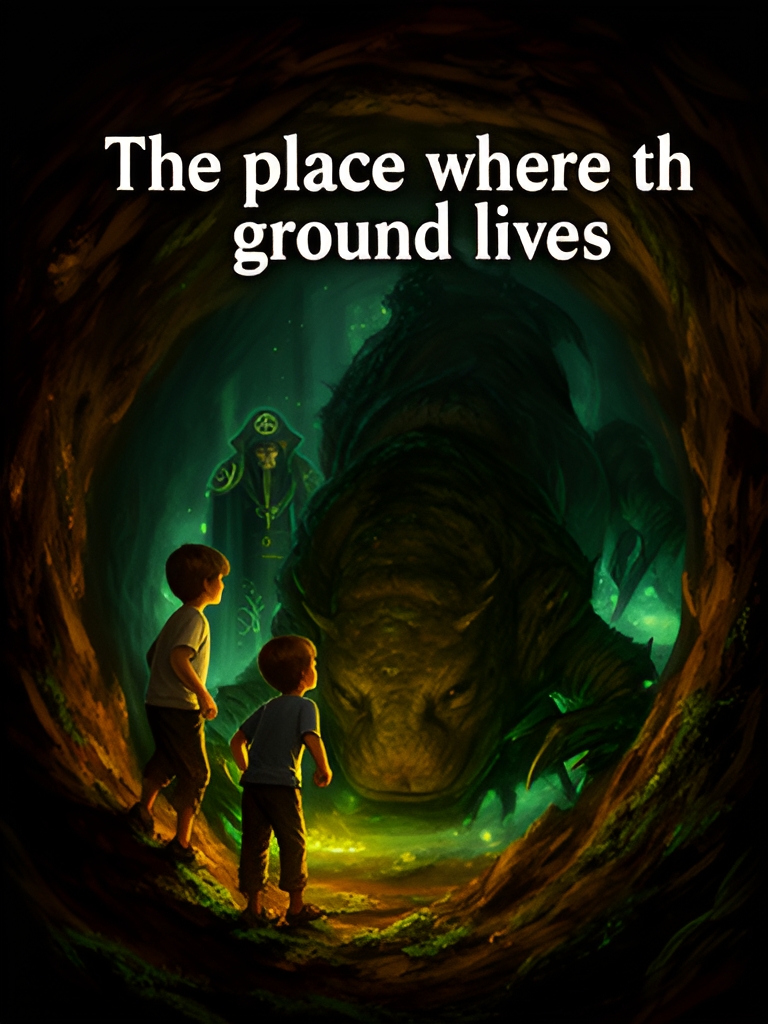
The place where the ground lives
by Igor love to cook
3 chapters1.1 hr read
Chapter 1
The Boys Who Listened to Stone
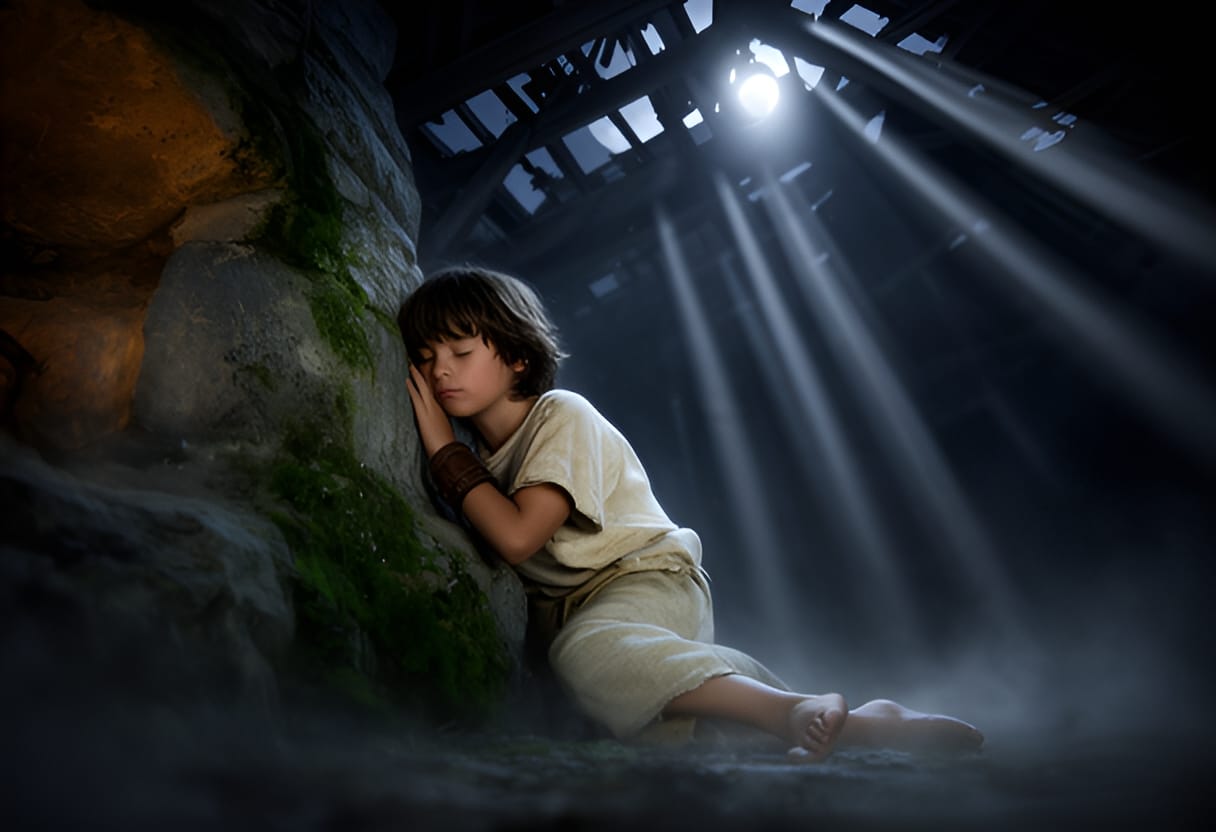
Leo pressed his ear to the cold stone of the mill’s foundation and felt it — a slow, deep throb, like a heart buried in rock. It came in pulses, steady and immense, each one a shudder that traveled up through his jaw and into his teeth. He held his breath, waiting, and when it came again — a low, rolling thrum — he knew it wasn’t the wind in the rafters or the creek singing past the wheel. This was older. This was alive.
He didn’t move for a long time, just listening, his cheek flat against the moss-stained crack where the foundation had split years ago. The mill had been abandoned for generations, its sails gone, its gears rusted shut, but the stone remembered. And now, so did he.
A shadow fell over him. “You’re doing it again,” Mateo said, voice low but edged with excitement. He crouched beside Leo, not asking, just mirroring — pressing his own ear to the stone. His brow furrowed. Then his eyes flew open.
“You feel that?” Mateo whispered. “It’s not just a shake. It’s got a rhythm. Like… like something breathing.”
Leo nodded, unable to speak. The pulse came again — deeper this time, slower — and for a moment, the world narrowed to the beat in the stone. It wasn’t random. It wasn’t the settling of old rock or the shift of groundwater. It was deliberate. Measured. As if something vast, far below, was drawing breath and letting it go, over and over, in a rhythm older than trees.
“We have to come back at midnight,” Mateo said, already scrambling to his feet. “When the village is quiet. No carts, no voices, no goats braying. Just us and the stone.”
Leo pushed himself up, brushing dirt from his knees. “You think it’ll still be there?”
“It’s been there longer than the mill,” Mateo said. “Longer than the village. It’s not going anywhere.”
They left the mill as the sun dipped behind the ridge, the sky bleeding orange over the rooftops. The village of Hollow’s Wake lay quiet in the valley, smoke curling from chimneys, the bell tower silent. No one noticed two boys slipping past the baker’s, past the well, toward the edge of town where the land began to fold and crack.
They returned when the moon hung high, silver and sharp, casting long shadows that made the cottages look like sleeping beasts. The streets were empty. Even the dogs had gone indoors. Leo led the way to the mill, his breath quiet in the cold air. Mateo followed, hands shoved in his pockets, eyes darting — not from fear, but from the thrill of being out when no one else was.
Inside the mill, the air smelled of damp stone and rotting wood. They moved to the same crack in the foundation, the one where the stones had pulled apart like old bones. Leo dropped to his knees first, then Mateo beside him. They pressed their ears to the stone and waited.
The thrum came — not loud, but undeniable. A slow, rolling surge, like a tide of rock moving deep beneath their feet. It lasted nearly ten seconds, then faded into a deep, resonant hum, as if the earth were exhaling.
“Again,” Mateo breathed.
They waited. And then — another pulse. Same length. Same depth. Same impossible slowness.
Leo lifted his head. “It’s too regular. Too… intentional.”
Mateo nodded, his face lit in pale moonlight. “It’s not the creek. It’s not the wind. It’s not even an earthquake. Earthquakes jerk. This… this is like a heartbeat. But too slow. Too big.”
They decided to follow it.
Crawling out the back of the mill, they pushed through the brambles and ivy that choked the old path toward the Whispering Cleft — a narrow fissure in the hillside where the earth had split long ago, draped in moss and fed by a trickle of groundwater that never quite dried up. The villagers avoided it. Said it whispered names if you leaned too close. Leo had always thought it was just the wind through the cracks. Now he wondered.
They reached the cleft as the moon climbed toward its zenith. The air here was cooler, damper. Moss slicked the walls, and water whispered down in thin threads, catching the light like silver wire.
Leo pressed his palm to the stone at the base of the cleft. Mateo did the same a few feet away.
The pulse came — stronger here. Clearer. Not just a vibration, but a wave that seemed to rise from the depths and press up through the rock, into their bones. It wasn’t just in their ears anymore. It was in their teeth, their fingertips, the soles of their feet.
They waited for the next one. And when it came, it was unmistakable — a slow, rolling swell, like the breath of something immense turning in its sleep.
Leo looked at Mateo, eyes wide. “It’s getting stronger the deeper we go.”
Mateo grinned, wild and bright. “Then we’re not imagining it.”
They spent the rest of the night there, returning every twenty minutes, tracking the rhythm. Pulse. Pause. Pulse. Pause. Each cycle lasted about forty seconds — twenty of throbbing pressure, twenty of quiet release. It never varied. Never faltered. It was too precise for nature. Too patient.
By the time the first pale light touched the ridge, they were certain.
“It’s not a natural phenomenon,” Leo said, voice hushed, as if the stone might hear and mind. “It’s not geology. It’s not hydrology. It’s… it’s like something breathing. Something huge. Something asleep.”
Mateo stood, brushing moss from his knees. “And it’s been doing this for a long, long time. Longer than anyone’s memory.”
Leo looked down at the cleft, at the mossy stones, the trickling water, the quiet dark beneath. “What if it’s not just under the village?”
“What if it is the village?” Mateo said, soft now, not joking. “What if the ground we walk on… isn’t ground at all?”
They didn’t speak again as they climbed back toward town. The sun rose behind them, painting the rooftops gold. Smoke began to rise from chimneys. A rooster crowed. The world woke up.
But beneath their feet, the stone kept its slow, steady beat — a heart that had dreamed through centuries, and was, at last, beginning to stir.
Leo and Mateo pushed through the village gate just as the baker pulled shutters from his windows, the scent of fresh bread spilling into the street. The morning was young, the air still cool with night’s retreat, but the boys moved with purpose, their boots kicking up small stones along the packed earth path toward the center of Hollow’s Wake. Leo carried a folded piece of bark scraped from the mill’s inner wall, onto which he’d etched the rhythm of the pulse with a charcoal stick — short marks for the throb, longer gaps for the release. Mateo gripped the leather strap of his satchel, inside which he’d tucked a smooth river stone warmed from his pocket, convinced it had absorbed something of the cleft’s depth.
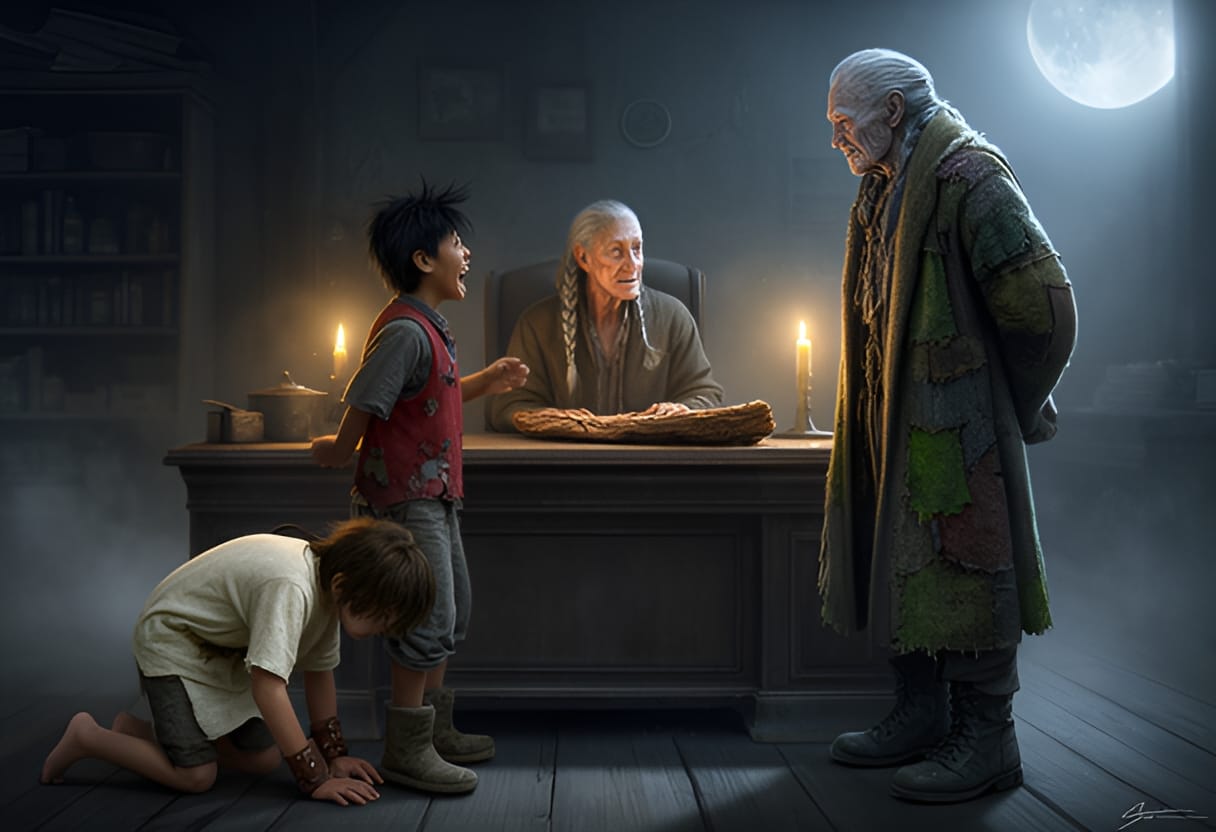
They found Mayor Varn in his office above the general store, a room built of fitted stone with a low ceiling and a single narrow window that looked out over the rooftops. The space smelled of beeswax and old paper, and a single tallow candle flickered on the desk beside a brass inkpot and a ledger bound in cracked leather. The mayor sat behind the desk, his silver hair combed back from a high forehead, his face lined like dried riverbed. He wore his usual patched coat, the sleeves frayed at the cuffs, and his hands — thin-knuckled and stained at the fingertips — rested folded on the wood.
“Boys,” he said, without looking up. His voice was low, not unkind, but edged with the weariness of long habit. “You’re early. Trouble with the goats again?”
Mateo stepped forward, satchel thumping against his hip. “No, Mayor. It’s not the goats. It’s the ground.”
Leo placed the bark slab on the desk, smoothing it flat with his palm. The charcoal marks stood out in the candlelight: ||| … ||| … ||| … a steady, repeating pattern.
“We went back to the mill last night,” Leo said. “After midnight. When everything was quiet.”
“We felt it again,” Mateo added. “Strong. Regular. Like a pulse. But not from water. Not from wind.”
The mayor’s eyes flicked to the bark. He did not touch it. Instead, he leaned back slightly in his chair, the candle flame catching the silver in his eyebrows. “You went to the Whispering Cleft,” he said. Not a question.
Leo nodded. “We followed the thrum. It got stronger there. Deeper. It wasn’t just in our ears — it was in our teeth. Our feet. Like the stone was… breathing.”
Mateo leaned in, voice dropping as if the walls might listen. “It’s too slow to be natural. Too exact. Forty seconds on, twenty off. Every time. Like something… sleeping. But breathing.”
The mayor was silent. The candle guttered, sending a shiver of shadow across his face. He stared at the bark, at the rigid pattern of marks, his expression unreadable. Not dismissive. Not surprised. Something deeper — a recognition, perhaps, or a sorrow worn smooth by time.
When he finally spoke, his voice was quieter than before, as if he were afraid of waking the room itself.
“You’ve heard the dream,” he said.
Leo blinked. “The dream?”
“The ground’s dream,” the mayor said. “It has slept longer than the memory of stone. Longer than the first axe that felled a tree in this valley. Longer than the name Hollow’s Wake was whispered by the wind.”
Mateo swallowed. “You knew?”
The mayor’s gaze lifted then, locking onto Leo’s. His eyes were pale — not blue, not gray, but the color of wet slate after rain. And in them, Leo saw not age, but depth. A kind of stillness that did not belong to the living.
“I have always known,” the mayor said. “Not as you know it — not with ears or hands. But in the way the roots know the dark. In the way the deep earth remembers the weight of mountains before they were mountains.”
He reached forward, not for the bark, but for a small pouch of dried herbs beside the inkpot. He turned it slowly between his fingers. “You feel the pulse because it is slowing. Not ending. Changing. What has dreamed for millennia is beginning to shift in its sleep.”
Leo’s throat tightened. “Is it dangerous?”
The mayor did not answer at once. He looked past them, toward the window where the valley lay waking — smoke rising, a hen clucking near the well, the bell tower still silent. When he spoke again, it was softer, almost a whisper.
“Danger is not the right word. But waking is not gentle. Not for something this old. Not for something that has dreamed the valley into shape, the stream into its bed, the roots into the rock. To wake it is not to rouse a sleeper. It is to ask the mountain to remember it was once magma.”
He placed the pouch down. His voice firmed, though not unkind. “You must not tell anyone. Not yet. Not ever, if the dream holds. To speak of it is to stir the air above the sleeper. And air, once stirred, does not settle easily.”
Mateo’s jaw worked. “But people should know. If the ground’s alive — if it’s not ground at all — ”
“The mayor held up a hand, palm outward. “Knowing and believing are not the same. And belief, when it comes too loud, can crack what should remain whole.”
He stood, the movement slow, deliberate. His coat whispered against the stone floor. He walked to the window and placed his palms flat against the cool glass, his breath fogging a small circle. For a long moment, he said nothing. The candle burned low.
Then, without turning, he said, “Go home. Tend to your chores. Let the mill sleep. Let the cleft keep its secrets.”
As they moved toward the door, Mateo hesitated. “Mayor?”
The mayor did not turn. “Yes?”
“If it’s not ground… what is it?”
The silence stretched. Then, so quiet Leo almost missed it, the mayor said, “What the world forgot it was carrying.”
They stepped out into the morning light, the door clicking shut behind them. Below, the village stirred — a woman drawing water, a dog barking at a passing cart, the smell of woodsmoke thickening in the air. But beneath their feet, the stone held its slow, steady beat, unchanged, unhurried, dreaming on.
Mateo shoved his hands deep into his pockets, the river stone warm against his palm. Leo looked down at his boots, at the cleft between sole and leather, and wondered if the thrum was not just in the ground, but in them now — a second pulse, quiet and insistent, rising to match the first.
They walked in silence toward their homes, the valley waking above them, the deep earth turning in its sleep beneath.
They reached the square just as the bell tower’s clapper struck nine, the sound rolling across the valley like a loose stone down a scree. Smoke curled from chimneys, hens scratched in the dust near the well, and a few early vendors were setting up stalls beneath the faded awnings of the general store and the tailor’s. The fountain stood dry in the center, its stone basin cracked and moss-fringed, the cherub atop its pedestal missing an arm and staring sightlessly down at the cobbles.
Mateo didn’t wait. He lunged for the fountain’s edge, scrambling up the moss-slick stone with the sudden, reckless energy that had always been his. Leo followed more slowly, heart hammering not from exertion but from the weight of what they were about to do — what they had been told not to do.
“Listen!” Mateo shouted, his voice cracking the morning air. He stood on the fountain’s lip, arms wide, facing the gathering cluster of women drawing water, men leaning on tools, a couple of boys chasing a hoop near the baker’s. “Listen to the ground!”
A few heads turned. A woman with a bucket paused, one foot on the well’s stone rim, her expression wary. The hoop rolled to a stop.
Leo stepped up beside him, barehanded, his voice low at first, then rising as he felt the familiar thrum begin — not in his ears alone, but in his jaw, his molars, the hollow of his chest. It was there, steady as ever: forty seconds on, twenty off. A slow, deep exhalation of stone.
“We went to the Whispering Cleft last night,” Leo said, forcing his voice to carry. “We felt it. Not imagined. Not wind. Not water. It’s a pulse. Deep in the rock. Regular. Like a heartbeat.”
Mateo leaned forward, eyes blazing. “It’s not just under the mill. It’s under the whole valley. Under your houses. Under the well. Under your feet right now. It’s not stone. It’s not dirt. It’s something… alive. And it’s waking up.”
A murmur rippled through the crowd. Not fear — not yet. Amusement. A baker’s apprentice snorted, wiping flour from his cheek. An old mender of nets crossed his arms, his face a map of skepticism.
“Alive?” said Maren, the fishwife, setting down her basket with a clack. “You boys been eating too much of Old Joren’s mushroom stew again?”
“It’s not a joke,” Mateo said, voice rising. “We brought proof.” He glanced at Leo, who reached into his tunic and pulled out the bark slab, holding it up so the charcoal marks caught the light.
“See?” Leo said. “This is what we recorded. The thrum. Forty on, twenty off. Over and over. No variation. No randomness. It’s too perfect to be nature.”
A boy no older than ten — Jonah, the tailor’s son — stepped forward, eyes narrowed. “You carved those yourself. I saw you whittling that bark yesterday behind the mill.”
“I didn’t carve them!” Leo protested, heat flooding his cheeks. “We rubbed the stone with charcoal. The vibration made the marks. It’s like a seismograph — ”
“Seismo-what?” Jonah snorted. “You’ve been reading too many of the peddler’s tall tales. Next you’ll say the well talks to frogs.”
Laughter broke out — not unkind at first, but growing, spreading. A woman near the bakery covered her mouth, her shoulders shaking. The mender of nets shook his head, muttering, “Boys and their fantasies.”
Mateo’s face flushed red. “It’s not fantasy! You don’t understand — ”
“Then make us understand,” said Halvar, the miller, stepping forward. His hands were dusted with flour, his eyes tired but sharp. “Speak plain. What are you saying? That the ground’s going to get up and walk?”
“Worse,” Mateo said, voice dropping to an urgent intensity. “It’s not going to walk. It’s going to rise. And when it does, everything on it — your homes, your wells, your fields — it’ll all be shaken loose. Like dust off a sleeping giant’s back.”
Silence fell, sudden and thick. For a heartbeat, the laughter died. Then Maren barked a laugh — sharp, disbelieving.
“A giant? Under Stone Hollow? You’ve been in the sun too long, boy.”
“It’s not a giant,” Leo said, desperate now. “It’s older than that. Older than mountains. The mayor — ”
“The mayor?” Halvar echoed, eyebrows lifting. “You went to Varn?”
“We did,” Mateo said. “He didn’t deny it. He said… he said it’s been dreaming longer than the first axe in the valley.”
A ripple of unease passed through the crowd — brief, then drowned by skepticism.
“Varn’s been talking in riddles since his great-grandfather’s time,” said Old Brinna, leaning on her cane near the tailor’s stall. “He tells children the stones remember their names. You lot believe every word he mutters?”
“He didn’t mutter,” Mateo insisted. “He looked at us like he knew. Like he’s always known.”
“And what did he say to do?” Halvar asked, voice low. “Did he tell you to keep quiet?”
Mateo hesitated. Leo saw it — the flicker of doubt, the instinct to obey the mayor’s warning. But then he thought of the thrum in his teeth, the way the stone had pulsed beneath his palms in the cleft, and he shook his head.
“He said not to tell anyone,” Mateo admitted. “But we can’t keep quiet if the ground’s about to wake. People could get hurt.”
“Or,” said a voice from the edge of the crowd — Dorothea, the widow who kept the geese — “you’re just trying to make yourselves important. Two boys with wild ideas, trying to scare the village into listening to you.”
More laughter. Harder this time. Not mocking, exactly — but dismissive, as if their fear were a child’s nightmare to be outgrown.
Mateo jumped down from the fountain, his boots hitting the cobbles with a jolt. “You’ll see,” he said, voice raw. “When the earth splits and the streets tilt, you’ll remember we warned you.”
“Oh, we’ll remember,” Maren said, wiping her hands on her apron. “We’ll remember the boys who cried wolf in the square.”
Before Leo could answer, a hand clamped onto his shoulder — thick, calloused, his father’s grip. He hadn’t even seen him approach.
“Come on, Leo,” his father said, voice low but firm, eyes darting to the crowd. “Time to go home.”
Leo tried to pull away. “But Da — ”
“Now.” The word wasn’t unkind, but it left no room for argument. His father’s gaze swept the square — the laughing women, the skeptical men, the boys pointing and giggling — and tightened. “You’re making a spectacle. And you’re upsetting your mother.”
Mateo was already being led away by his own father, his arms half-raised as if to shout again, but his father’s grip was unyielding, steering him toward the bend in the road that led to their cottage. A few boys from the crowd began to follow at a distance, not to help, but to jeer.
“Watch where you step, earth-shakers!” one called. “Don’t wake the giant on your way home!”
Another picked up a smooth stone from the gutter and tossed it — not hard, but it struck Mateo’s shoulder. He flinched, but didn’t cry out. Leo felt a sting on his cheek — another pebble, smaller, from someone unseen.
They were half-turned, already moving away, when Mateo stopped suddenly, chest heaving, and shouted back over his shoulder, voice breaking:
“It’s not a wolf we’re crying! It’s real! It’s under us! Can’t you feel it?!”
Silence. The laughter had faded. A few faces turned toward them — not smiling now, but blank, unreadable. The wind stirred the dry fountain’s moss. Somewhere, a hen clucked.
Then, as if nothing had happened, the baker called for his apprentice, the fishwife lifted her basket, and the square resumed its morning rhythm.
Leo’s father kept walking, his grip firm but not cruel. Mateo stumbled beside him, silent, his face streaked with dust and something darker — not tears, not yet, but the raw pressure of being unheard.
They didn’t speak until they’d passed the last cottage and the road began to climb toward the ridge. Even then, Leo’s father only said, “Your mother’s waiting with soup. And a lecture.”
Mateo kicked a stone. It skittered into the brush.
Leo looked back once. The square was small now, the fountain just a blotch of gray and green. But beneath his boots, faint but insistent, the thrum came again — forty on, twenty off — steady, patient, waiting.
He didn’t tell his father. He didn’t tell Mateo. He just walked, and carried the pulse inside him like a secret too heavy to name.
Leo’s boots slipped on the loose gravel as he followed his father’s retreating back, the ridge path narrowing ahead, flanked by thickets of juniper and wind-bent pine. Mateo trudged beside him, shoulders hunched, fingers still curled around the smooth stone that had struck him — now clutched tight in his palm like a token of shame. The sun hung low, gilding the treetops, but the air had turned sharp, carrying the scent of damp earth and pine resin from the cleft behind them. Leo’s father said nothing, his gaze fixed on the winding trail, his grip on Leo’s shoulder unyielding.
They passed the last of the cottages, the smoke from chimneys thinning into the sky, and the road began to climb in earnest, switchbacking up the shoulder of the ridge. The village fell away below — rooftops like scattered stones, the dry fountain a dull smudge near the square. Behind them, the murmurs of daily life faded: the baker’s call, the cluck of hens, the distant ring of a blacksmith’s hammer. Only the wind remained, pushing through the needles above, and beneath Leo’s feet, the thrum.
It came not as a sound, but a pressure — a slow, deep pulse in the molars, a vibration that rose through the soles of his feet and settled in the hollow of his chest. Forty on, twenty off. Steady. Patient. Waiting.
He wanted to speak. To tell his father what he felt. To ask if he, too, sensed it — the ancient breath beneath the stone. But his father’s jaw was set, his steps firm, and Leo knew better than to break the silence. Not now. Not after the square.
Mateo stumbled on a root, catching himself on a moss-slicked boulder. He didn’t look up. His face was tight, eyes fixed on the ground, jaw working as if chewing something bitter.
“Your mother’s waiting with soup,” his father said finally, voice rough but not unkind. “And a lecture.”
Mateo kicked a loose stone. It skittered into the brush and vanished.
They reached the first overlook — a narrow shelf of rock where the trail bent east — and Leo’s father paused, glancing back once toward the village. Then, without a word, he released Leo’s shoulder and stepped aside.
“Go on,” he said. “But be home before dark. And Leo?” He hesitated. “Try not to wake the giant on your way home.”
A bitter laugh escaped Mateo — sharp, broken. He shoved past them, boots scraping stone, and began to climb faster, taking the switchbacks two at a time. Leo hesitated only a heartbeat before following, his father’s words ringing behind them like a warning and a jest rolled into one.
They didn’t speak as they climbed. The forest thinned, giving way to open scree and wind-scoured stone. The ridge rose ahead — a whale-backed spine of rock that overlooked the valley, crowned with twisted pines and patches of reindeer moss. It was a place the boys came to think, to skip stones into the valley below, to whisper secrets the wind would carry away. Now, it felt like exile.
They reached the summit just as the sun dipped below the far peaks, painting the sky in streaks of amber and rose. The village lay spread out beneath them — a patchwork of fields and rooftops, the river a silver thread winding through the valley floor. The air was thin and cold, carrying the distant low of cattle and the faint, metallic tang of stone.
Mateo sank to his knees on the warm rock, elbows on his thighs, head in his hands. Leo sat beside him, pulling his knees to his chest, staring out over the land they’d tried to warn.
“I thought…” Mateo’s voice was low, rough. “I thought if we showed them the marks… if we told them what Varn said… they’d have to believe us.”
Leo didn’t answer. He couldn’t. The thrum pulsed in his teeth again — forty on, twenty off — a quiet insistence beneath the silence.
Mateo lifted his head, eyes red-rimmed but dry. “He looked at us like he knew,” he murmured. “Like he’s been waiting for this.”
Leo turned to him. “He said not to tell anyone.”
“I know.” Mateo swallowed hard. “But what if he meant… what if he meant we should tell? What if the riddle wasn’t a warning — but a test?”
Leo stared at him. The wind tugged at his hair, cold against his sweat-damp forehead. He thought of the cleft — the way the stone had breathed beneath his palms, the way the thrum had climbed into his jaw like a living thing. He thought of his father’s grip, the way he’d looked not just at the crowd, but through them — as if seeing something else.
“I don’t know,” Leo said quietly. “But I felt it again. On the way up. In my boots.”
Mateo turned fully toward him, frowning. “You did?”
“Yeah.” Leo pressed his palms flat to the stone beneath him, closing his eyes. The thrum came — not loud, but undeniable. A slow, deep heave, like the exhalation of something vast turning in its sleep. Forty seconds of pressure, twenty of release. Steady. Ancient.
Mateo copied him, pressing his ear to the rock. His brow furrowed. Then his eyes snapped open.
“It’s… it’s not just under us,” he breathed. “It’s moving.”
Leo’s eyes flew open. Beneath his hands, the stone wasn’t just vibrating — it was shifting. A slow, immense tilt, as if the ridge itself were beginning to rise on one end. The rock under his palms groaned — not a crack, but a deep, resonant strain, like the bow of a ship bending under weight.
Then the ground shuddered.
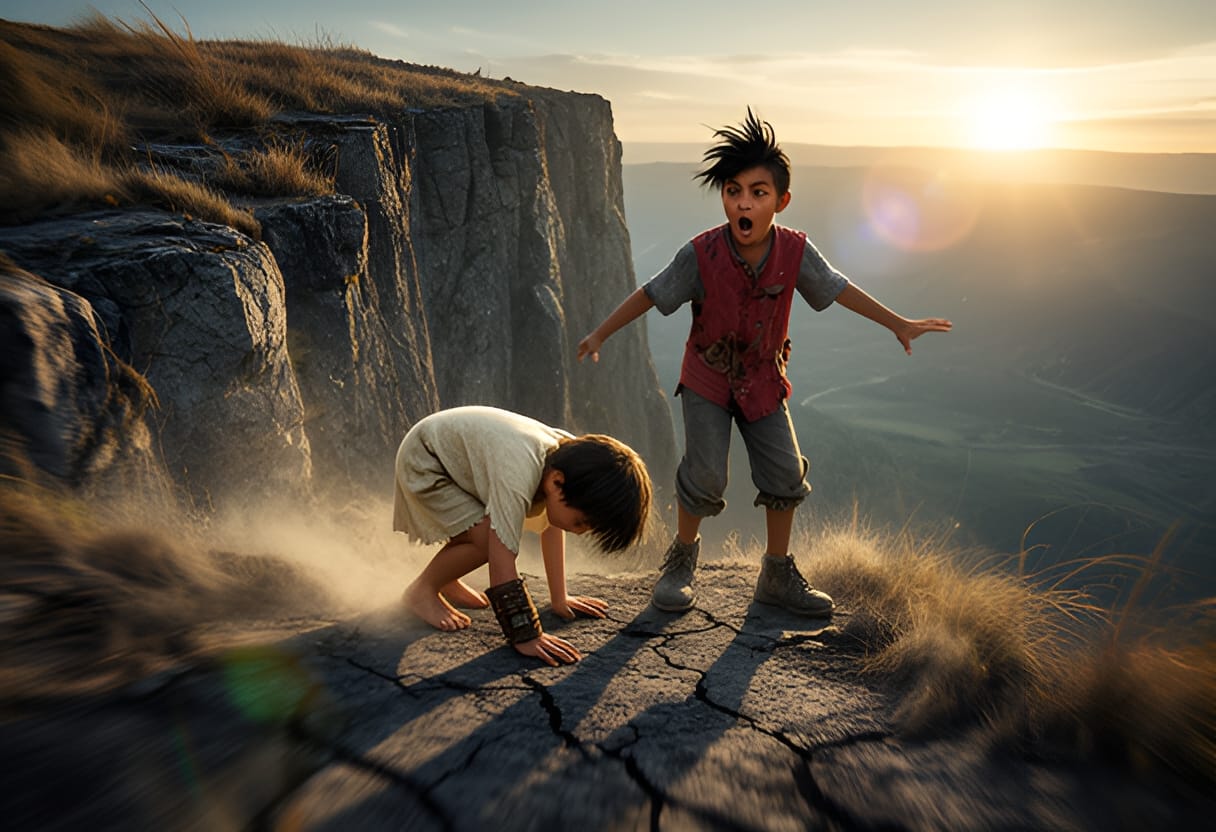
It wasn’t a jolt. It was a sigh — a slow, monumental heave that rolled up from the depths, lifting the ridge beneath them like a ship on a swelling wave. Leo gasped as the world tilted — his feet slid, his stomach lurched, and he flung his arms out to keep from falling. Mateo cried out, scrambling backward on his heels as the stone path beneath them split with a low, grinding groan.
A fissure snaked across the ridge — narrow at first, then widening, dust and small stones pouring into the yawning gap. The earth didn’t just crack — it opened, as if something vast were stretching beneath, pushing upward with inexorable force.
Leo scrambled to his knees, heart hammering, and looked down.
The valley floor was moving.
Not shaking. Not trembling.
Rising.
Fields swelled like bread in an oven, the soil buckling into slow, rolling waves. The river bent and strained against its banks, water churning as the land beneath it lifted. Rooftops tilted, chimneys leaned, and the dry fountain in the square — that sad, cherub-less basin — began to slide, stone grinding on stone as the earth heaved beneath it.
A distant cry rose — not from the village, but from the land itself — a low, subsonic groan that vibrated in Leo’s molars, in his teeth, in the very marrow of his bones. It was the thrum — magnified a thousandfold, no longer a pulse, but a breath. The creature was not stirring.
It was waking.
Mateo was beside him, face ashen, lips parted. “Oh God,” he whispered. “Leo… we’re not on the ground.”
Leo looked down at his hands, still pressed to the splitting stone. Beneath his palms, the rock was warm — not from the sun, but from something deeper, older, pulsing with a slow, tidal rhythm. The fissure beneath them wasn’t a break in the earth.
It was a seam.
And they were standing on the back of something that had dreamed beneath the valley for longer than memory.
The ridge continued to rise, tilting further, the valley below unfolding in slow, horrifying motion — not destruction, but unfolding. The earth was not breaking apart. It was rising, lifting the village into the air as if the world itself were sitting up after a long sleep.
Leo’s breath came short. His father’s words echoed in his mind — not as a joke, but as a warning he hadn’t understood: Try not to wake the giant on your way home.
He hadn’t been laughing.
He’d known.
A tear cut through the dust on Leo’s cheek. He didn’t wipe it away. He just kept his hands pressed to the stone, feeling the slow, immense throb beneath him — forty on, twenty off — and whispered, so low the wind might have taken it:
“We tried to tell you.”
Below them, the valley rose. And the ground, at last, remembered how to move.
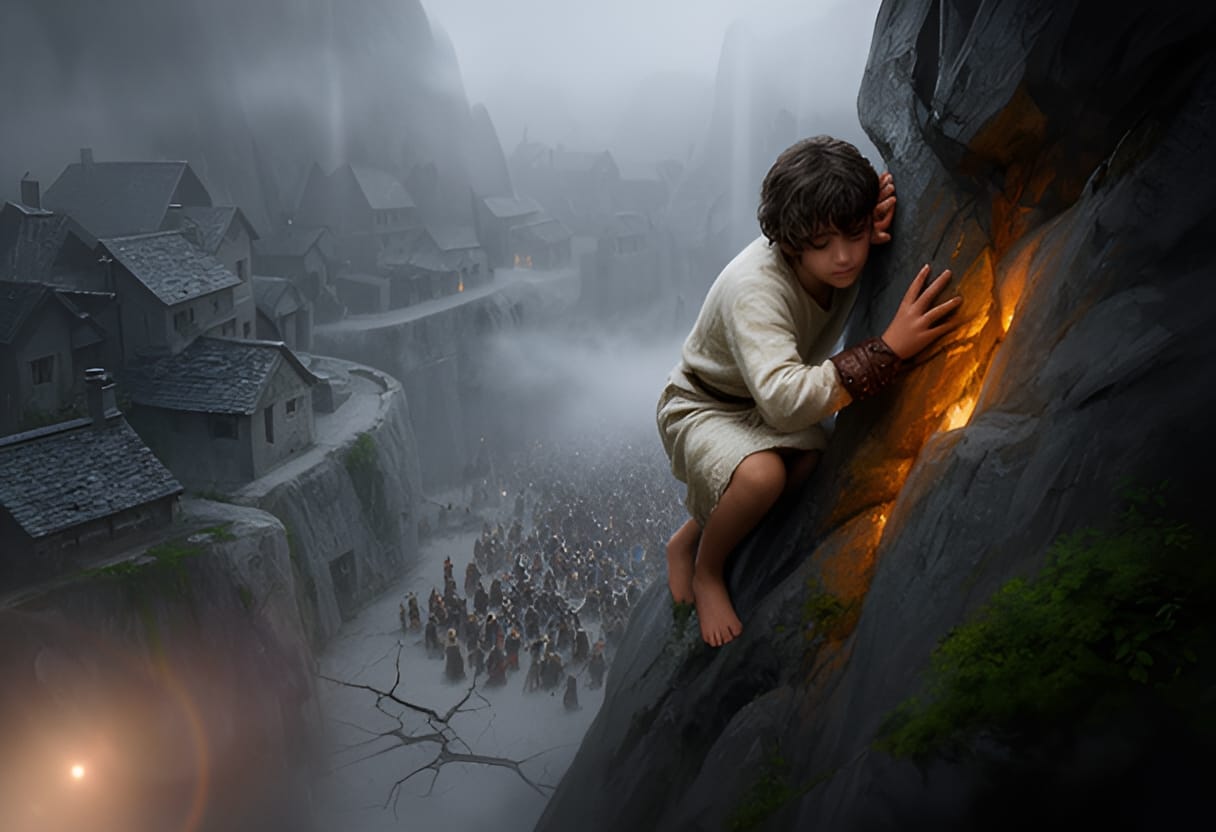
Chapter 2
When the Earth Remembered How to Move
The ridge tilted further, the angle steepening until the world felt less like ground and more like the flank of a sleeping leviathan beginning to stir. Stone Hollow was no longer a village nestled in a valley — it was a settlement being hauled, inch by agonizing inch, onto the curved back of something vast and ancient, its spine arcing upward from the deep earth like a fist unclenching after centuries.
Homes that had stood solid for generations now groaned in protest. Timber frames screamed as foundations tore free from footings. Chimneys snapped like brittle bones and plunged into the yawning fissures that spiderwebbed across the streets. Roofs slid sideways, tiles rattling down in avalanches of clay and slate, striking the heaving earth with hollow cracks. Dust boiled up from the splitting ground, thick and choking, smelling of wet stone and something older — iron-rich, like blood seeping from an ancient wound.
Leo clung to the ridge, fingers sunk into fissures warmed by the creature’s pulse. Beneath his palms, the stone breathed — slow, tidal, inexorable. Forty seconds of pressure, twenty of release. Each inhale lifted the village higher; each exhale paused, as if the thing beneath them were testing its strength, measuring the weight of the world it carried.
A well in the Baker’s Lane erupted without warning — not with water, but with a thick, black geyser that shot thirty feet into the air before collapsing back into the widening maw beneath it. The smell of sulfur and rotting roots followed, sharp and suffocating. Mateo coughed, dragging the back of his wrist across his mouth, eyes wide with terror.
“It’s not water,” he gasped. “It’s… it’s like the thing’s bleeding.”
Leo didn’t answer. He couldn’t. His attention was fixed on the town square, now a drunken deck tilting toward the east. The dry fountain, that sad basin cherub-less for as long as anyone could remember, had already slid halfway into a crack that split the cobblestones like rotten fruit. Water — clear, cold, impossibly fresh — welled up from the fissure beneath it, bubbling as if the earth itself were drinking deep after a long drought.
People poured into the square, not in greeting, but in panic. Mrs. Gable from the millinery stumbled forward, her bonnet askew, one slipper lost in the dust. “My shop!” she screamed, pointing toward where her storefront had been. “My bonnets — they’re sliding into the earth!”
Old Man Hemlock, who’d spent sixty years mending nets by the river, fell to his knees, not in prayer, but in disbelief. His hands scrabbled at the tilting stone, trying to find purchase. “It’s not an earthquake,” he choked out. “Earthquakes don’t rise. They don’t breathe.”
A woman — Leo didn’t know her name — clutched a swaddled infant to her chest, her face streaked with tears and dirt. “We’re on its back,” she whispered, voice raw. “We’re standing on… on it.”
The realization rippled through the crowd like a wave. Heads turned. Eyes widened. Screams tore from throats, not just of fear, but of utter, world-shattering disbelief. The ground wasn’t falling away. It was lifting them. And it was alive.
Leo’s breath hitched. Beside him, Mateo’s grip on his arm tightened until his nails bit into skin.
“Leo,” Mateo breathed, voice raw. “Our house — ”
Leo followed his gaze.
Their cottage, the one with the crooked porch and the wild thyme growing between the stones, was sliding sideways toward a chasm that had opened beneath the eastern ridge. The timbers groaned, the roof tilting at a sickening angle. One corner had already begun to drop, dragging the stone foundation into the dark.
Without thinking, Leo lunged.
He caught Mateo’s wrist just as the boy stumbled forward, reaching for the edge of the collapsing porch. Their fingers locked, sweat-slick and trembling.
“Don’t,” Leo whispered, his voice cracking. “Don’t let go.”
Mateo’s eyes were wide, pupils blown dark with fear. He nodded once, sharply, and shoved his free hand into a crack in the ridge, fingers scrabbling for hold. Leo did the same, planting his boots against a jutting slab of stone that had once been part of the garden wall. The creature’s pulse thrummed up through the soles of his feet, steady and immense — forty on, twenty off — a heartbeat slower than any human’s, deeper than bedrock.
Above them, the village screamed.
Tiles rained down. A gable end collapsed into a fissure with a sound like a bowstring snapping. The well in the square geysered again, black water arcing into the air before sucking back down, dragging a half-collapsed bucket with it.
And still, the lift continued.
The valley below was no longer a valley. It was a vast, curved plain falling away beneath them, fields and forests tilting at impossible angles, rivers drawn into new courses as the land itself rolled and buckled beneath the creature’s slow, monumental rise. Stone Hollow hung in the air now, not fallen, not destroyed — but borne, carried upward on the back of something that had dreamed longer than memory, longer than stone, longer than the first breath of wind over these peaks.
Leo pressed his forehead to the ridge, closing his eyes. The thrum filled his skull — not as sound, but as sensation, a deep, resonant vibration that harmonized with the pulse in his temples, the hollow of his chest, the very marrow of his bones. It was not angry. It was not vengeful. It was awakening.
And in that moment, beneath the roar of stone and the cries of his people, Leo understood, with a clarity that stripped away all doubt:
They had not woken a monster.
They had woken a god.
And the god was rising.
The angle of the ridge grew steeper still, the village now hanging at a tilt that made standing feel like climbing a slope slick with rain. Leo’s muscles burned as he braced his feet against the stone, his back arched to keep from sliding toward the yawning chasm that had swallowed half their cottage. Mateo’s grip on his wrist was iron-tight, his knuckles bleached white, breath coming in short, ragged gasps.
Below them, the valley had become a nightmare of motion. Fields that had been neat rows of barley and rye now rippled like liquid stone, earth folding over itself in slow, massive waves. Trees tilted, roots tearing free as the ground beneath them heaved upward, then slumped, then rose again in the creature’s uneven breath. A barn — Old Tess’s, with its red door and crooked weathervane — had slid entirely into a fissure, vanishing mouth-first into the dark, only its highest peak still visible, trembling like a tooth about to fall.
A child’s wail cut through the chaos — high, raw, terrified. Leo turned his head, straining against the pull of gravity and fear. Near the edge of the square, where the fountain’s basin had vanished into the crack, a small boy in a patched shirt clung to the leg of a woman whose face was streaked with tears and dust. The boy’s shoe had come loose, dangling by its lace over the void.
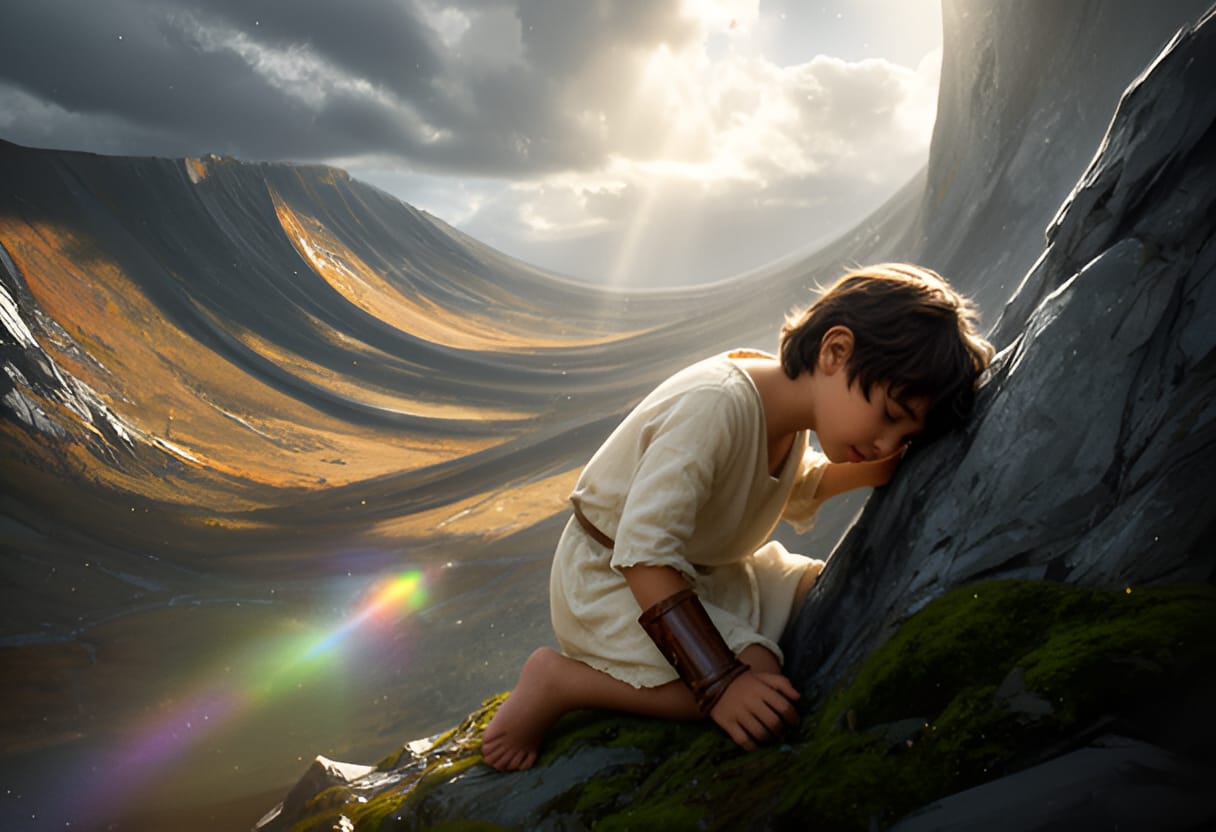
Without thinking, Leo shoved off from the ridge, heart hammering. “I’ve got him!” he shouted, though his voice was swallowed by the groan of stone and the distant, subsonic thrum that now pulsed like a second heartbeat in his skull.
He slid on his belly across the tilting flagstones, fingertips scraping for purchase, until he reached the woman. She looked up, eyes wild, and without a word, thrust the child toward him. Leo snatched the boy mid-air, pulling him to his chest as the ground lurched beneath them — a sudden, violent heave that sent a shower of dust and pebbles raining down.
“Hold on!” Leo gasped, wrapping his arms tight around the small, trembling body. The boy buried his face in Leo’s shoulder, sobbing.
Mateo was already there, hauling them both back toward the ridge. “We’re sliding!” he yelled. “We’ve got to get to higher ground — if there is any!”
They scrambled upward, the village tilting worse with each pulse of the creature beneath them. Rooftops now pointed skyward like tombstones. The well in the square had become a geyser again, black water arcing in a slow, lazy arc before crashing back into the widening maw, dragging a half-collapsed wall with it.
And still, the lift continued — not with violence, but with the terrible, inexorable patience of something vast rising from sleep after an age. The air grew thinner, colder. Below, the valley was no longer recognizable — just a rolling, heaving expanse of stone and shadow, the village a fragile, tilting raft caught on the back of a waking world.
Leo’s arms trembled around the child as Mateo hauled them back toward the ridge. The boy’s sobs muffled against his shoulder, hot and wet, while the creature’s slow, deep thrum pulsed up through Leo’s bones — forty on, twenty off — a rhythm older than language, older than fear. The valley below had become a roiling sea of stone and shadow, fields rippling like black water, trees tilting as their roots tore free. Somewhere, a barn had vanished mouth-first into a fissure, only its weathervane still trembling in the thin, cold air.
They reached the ridge’s crest, where the tilt was less severe, and Leo lowered the child to his feet. The woman — Mrs. Gable, he realized, her face streaked with dust and tears — gripped the boy’s shoulders, murmuring thanks in a voice raw from shouting. Leo nodded, unable to speak, his breath coming in short gasps as the creature’s pulse thrummed up through his soles, into his marrow, syncing with the frantic hammer of his heart.
Mateo was already scanning the chaos, his wild hair whipping across his forehead. “We need to get everyone to the high ground!” he shouted over the groan of stone. “The old quarry — if it’s still there — ”
A sudden, violent heave threw them all sideways. Dust and pebbles rained down as the ridge tilted farther, the village sliding like a raft on a slow, immense swell. Leo braced himself against a jutting slab of what had once been the garden wall, fingers digging into cracks, boots scraping for purchase. The thrum intensified — not in volume, but in presence — filling his skull, his teeth, the hollow of his chest, until it felt less like sound and more like the very substance of his bones had begun to vibrate.
And then, above the roar of shifting stone and the cries of the terrified, a voice cut through — not loud, but clear, carrying on the same deep frequency as the creature’s breath.
“Listen!”
Mayor Varn stood atop the shattered pedestal of the fountain, his long, patched coat hanging loose over his frame, silver hair whipping in the updraft. One hand gripped the jagged edge of the pedestal for balance; the other was raised, palm out, not in command, but in plea. His face, usually a mask of calm authority, was lined with exhaustion and something deeper — a sorrow worn thin by centuries.
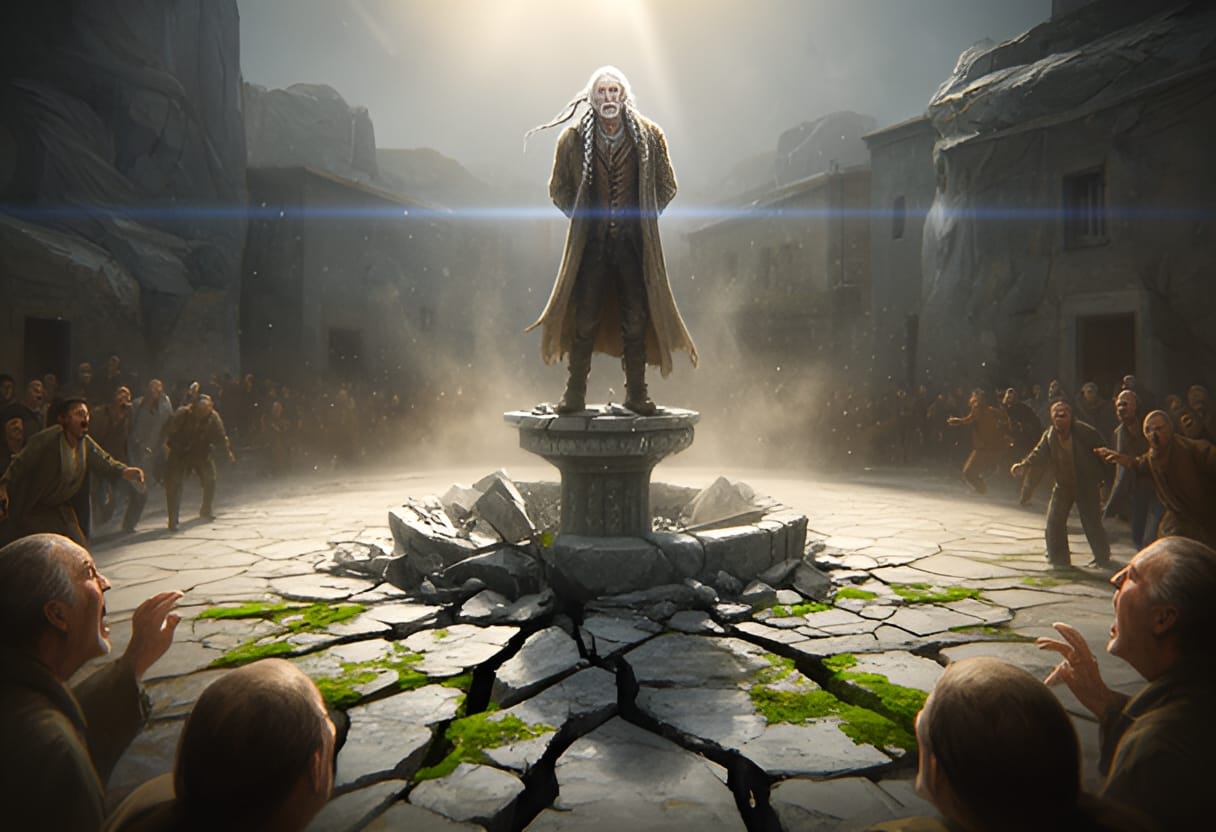
The crowd below stilled. Not because he shouted, but because the silence that followed his word felt inevitable, as if the creature itself had paused to listen.
Leo lowered his gaze from the mayor’s face to the ridge beneath his feet, feeling the thrum — forty on, twenty off — steady, immense, patient. It was not anger in the pulse. It was not wrath. It was the slow, inevitable rise of something that had dreamed longer than memory.
Varn’s voice dropped, but it carried, riding the same low frequency as the groaning stone, the wind, the distant wail of a child lost in the chaos.
“I have known,” he began, his voice rough with disuse, like stone long unturned, “what lies beneath us. For nine hundred years.”
A murmur rippled through the villagers — disbelief, then confusion, then a dawning, unsettling recognition. Old Man Hemlock, his cane forgotten in the dirt, stared up at the mayor with eyes that had seen too many seasons to be easily fooled. Old Tess, her red door gone, her barn swallowed, clutched her shawl tighter, her breath shallow.
“I am not a wizard who stopped time,” Varn continued, his gaze sweeping over the tilted rooftops, the fissures snaking through the square, the black water of the well sucking back into the earth like a dying breath. “I am a watcher. A keeper of the vigil. My ancestors — my blood — was sworn, generations ago, to observe. To remember. To never speak.”
He paused, his knuckles whitening where they gripped the pedestal. The creature shifted beneath them — a slow, deep inhalation — and the ridge tilted another degree, sending a shower of slate tiles sliding toward the chasm.
“I stayed silent,” he said, “because I believed sleep was safer than truth. I thought — if no one knew, if no one feared, if no one tried to wake it — then it might dream on. Undisturbed. Unafraid. And we… we could live above it, as we always had. As if the ground were just ground.”
A woman near the fountain — the one with the infant — pressed a hand to her mouth, her eyes wide. The infant stirred against her chest, oblivious, blinking up at the swaying sky.
Varn’s voice dropped further, raw now, each word seeming to cost him something vital. “I was wrong. The sleep was not safety. It was denial. And denial… is just another kind of waking.”
He looked down then, not at the crowd, but at the stone beneath his feet — at the ridge that was no longer ridge, but the curved, obsidian-like flank of something vast and ancient, its surface etched with fissures that pulsed faintly with inner light, like veins in a sleeping god’s skin.
“The thrum you heard,” he said, “was not a warning. It was a dream. A breath. The creature does not stir from malice. It stirs because it is remembering. Remembering the weight of stone. The flow of rivers. The press of roots. And… us.”
A silence fell — not empty, but full. Full of the creature’s slow pulse, full of the wind tearing at loose shutters, full of the distant, endless groan of stone on stone. The villagers did not shout. They did not weep. They simply stood, or clung, or braced themselves against the tilt, and listened — not with their ears, but with their feet, their teeth, the hollow of their chests.
Leo felt it then — not as vibration, but as understanding. The mayor’s confession was not a revelation of deceit, but a release. For nine hundred years, he had carried the weight of knowing, alone, while the village slept above a dream. And now, as the creature rose, the dream was ending.
Mateo stepped forward, his voice hoarse from shouting, but steady. “What do we do?” he asked. “How do we stop it?”
Varn did not answer immediately. He looked out over the valley — no longer a valley, but a heaving, rolling expanse of shadow and stone, where rivers had been pulled into new courses and forests tilted like fallen dominoes. The air was thin, cold, smelling of wet rock and something deeper — sulfur, yes, but also the rich, dark scent of turned earth after rain.
“You don’t stop it,” he said at last. “Not with ropes. Not with force. You never could.”
He turned his gaze back to the crowd, his eyes locking with Leo’s for a moment — just a breath — before sweeping to Mateo, then to the child still clutching Leo’s shirt.
“You listen,” he said. “You remember. And when it settles… you learn to live on what it becomes.”
A shudder ran through the ridge — not violent, but deep, like the creature shifting its weight in sleep. The thrum swelled — forty on, twenty off — filling the air, the stone, the bones of everyone who stood upon it.
And in that moment, beneath the weight of the rising god, the villagers of Stone Hollow did not see a mayor who had lied.
They saw a man who had kept watch.
And who, at last, had spoken the truth.
The thrum swelled — forty on, twenty off — filling the air, the stone, the bones of everyone who stood upon it.
And in that moment, beneath the weight of the rising god, the villagers of Stone Hollow did not see a mayor who had lied.
They saw a man who had kept watch.
And who, at last, had spoken the truth.
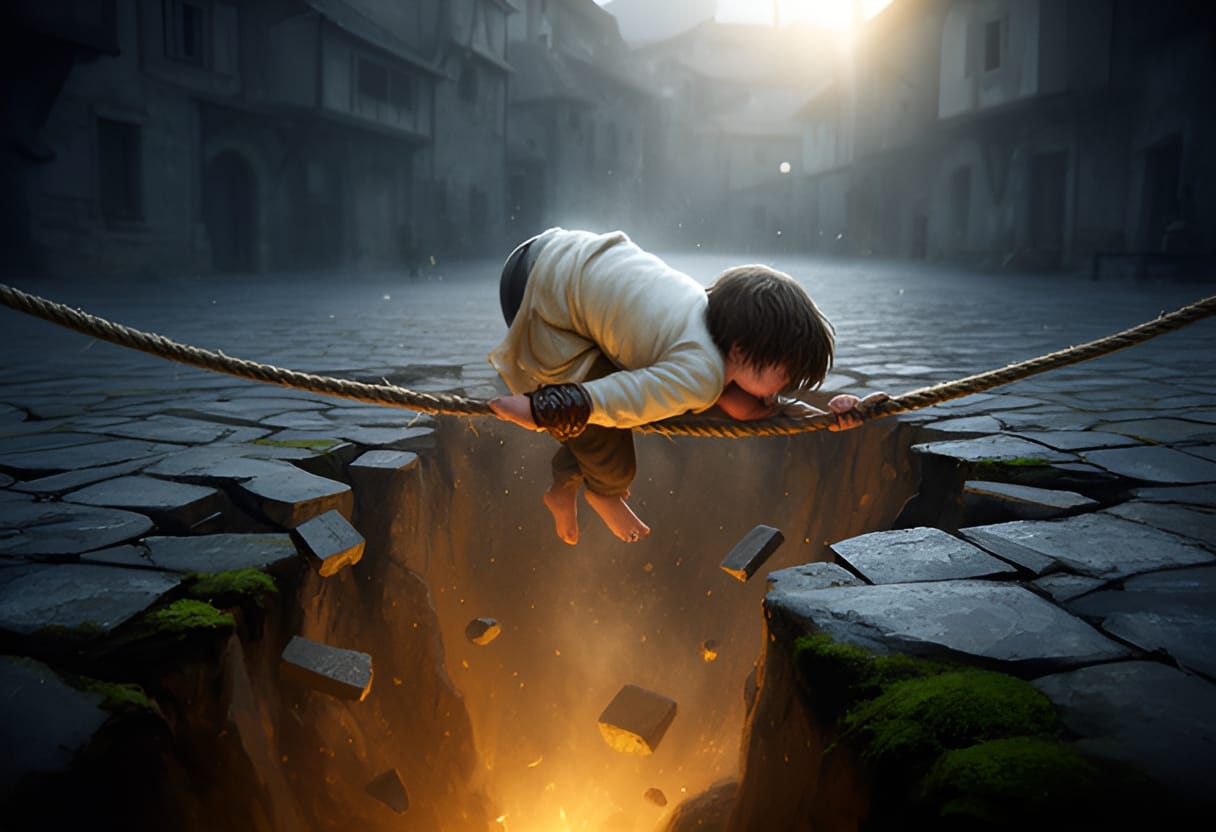
Hands flew to curtains, to bedsheets coiled in lofts, to the hemp lines still dangling from the old well’s windlass. Shouts rose not in panic now, but in grim, frantic purpose. “Tie it! Hold it!” someone cried — Old Tess, her voice raw from shouting, her shawl torn at the shoulder. “If we can just slow it — just a breath — ”
Leo’s fingers fumbled with a strip of crimson velvet torn from Mrs. Gable’s parlor drape. It was too thin, too slick. Beside him, Mateo snatched a length of rope from the blacksmith’s abandoned cart — thick, frayed at the ends, smelling of coal and sweat. He tested its weight, then looped it around a jagged protrusion of obsidian-like plate that jutted from the ridge like a broken tooth.
“Here,” Mateo grunted, handing the end to Leo. “Tie it off. Tight as you can.”
Leo’s nails bit into his palm as he pulled the knot — a clumsy half-hitch, then another, fingers slick with sweat and something darker, maybe blood from a split knuckle he hadn’t felt yet. The stone beneath his knees vibrated — forty on, twenty off — a slow, deep throb that made his teeth ache and his vision blur at the edges. He pressed his forehead to the cool flank of the creature, feeling the pulse travel up through his skull, not as sound, but as a thought: remembering.
Around them, the villagers worked in a feverish silence broken only by grunts and the rasp of fabric tearing. A woman braided three sheets into a thick cord, her child wailing against her chest. Old Man Hemlock, cane forgotten, used his teeth to hold a knot while he twisted the rope with gnarled hands. The ropes snaked across the tilted square, lashing from chimney shards to upturned staircases, from the fountain’s broken basin to the ridge’s stony spine — all aiming to bind the creature’s exposed flank, to somehow anchor the rising god to the earth it was leaving behind.
Mateo moved between them, shouting encouragement, his voice hoarse but fierce. “Pull! Pull like you’re hauling a net full of fish! Like your lives depend on it — because they do!”
Leo tied another line to a spur of black stone near the well’s mouth, where sulfurous steam still curled in lazy spirals. The rope bit into the surface, not sinking, but gripping — as if the creature’s skin, though hard as volcanic glass, had a grain, a direction, and the rope was catching on its ridges.
Then — a shift.
Not a jerk. Not a jolt. But a deepening of the pulse. The forty seconds of pressure came not as a wave, but as a sigh — a vast, inward drawing of breath from the roots of the world. The ropes tightened instantly, strands humming like bowstrings under tension. Leo felt it in his molars, in the hollow of his chest, in the marrow of his wrists where he gripped the knot.
And then — the release.
The twenty seconds of release came not as slack, but as a shudder.
It began deep, low — a roll in the belly of the thing beneath them, like thunder heard through stone. The ridge shuddered. Not sideways. Not up. But inward, as if the creature were flinching from the bite of the ropes, from the sudden, alien constraint on its dream.
A sound rose — not a roar, but a groan, vast and ancient, like the first crack in a glacier that has held its silence for ten thousand years. It came from everywhere and nowhere, vibrating in the soles of their feet, the fillings of their teeth, the hollow behind their eyes.
The ropes sang.
Then they snapped.
Not all at once. One by one. A sheet-rope near the well exploded outward, flinging a woman backward into a pile of broken tile. A hemp line from the blacksmith’s cart parted with a crack like a whip, whipping Mateo’s cheek and drawing a thin line of blood. The velvet strip Leo had tied shuddered, then tore free, snapping back to slap him across the wrist.
The creature did not thrash. It rolled.
A slow, immense tilting — not of the village, but of the thing carrying it. The ridge heaved beneath their feet, not to throw them off, but to shake itself, like a dog waking from deep sleep, trying to dislodge an irritant. The motion was not violent, but inevitable — the slow, inevitable shift of a mountain turning in its sleep.
People flew.
Leo lost his grip. The world tilted — sky, stone, the pale face of Mateo reaching for him — and then he was falling, not down, but across, sliding on his belly over slick obsidian, fingers scraping for purchase, finding only smooth stone and the distant, fading thrum still pulsing beneath him — forty on, twenty off — even as he tumbled.
He hit something hard — a fragment of chimney — and rolled, breath knocked out, dust and grit filling his mouth. Above him, the ridge continued its slow roll, carrying the village with it, a slow-motion landslide of flesh and timber and screaming people.
Mateo was near him, sprawled on his back, chest heaving, one hand pressed to the stone where he’d fallen. His eyes were wide, not with fear, but with something like awe — or realization.
“The ropes…” he gasped. “They didn’t hold… but it felt them. It knew.”
Leo pushed himself up on his elbows, ribs screaming. Around them, villagers groaned, pushed themselves to hands and knees, looked not at the broken ropes, but at the stone beneath their palms — at the faint, inner light that pulsed in the fissures, now flickering erratically, like a heart startled awake.
The thrum continued — forty on, twenty off — but changed. The pressure was sharper now, less a breath, more a question.
And beneath their fingers, the stone was no longer just dreaming.
It was listening.
Leo scrambled to his knees, fingers raw against the stone, and saw the village no longer clung to the ridge — it was sliding. The tilt had deepened, the creature’s flank now angled steeply, and Stone Hollow, half-awake on its back, began to peel away like bark from a burning log. Roofs tore free, walls groaned and split, and the square — once a jumble of chimneys and washing lines — became a river of timber, tile, and screaming bodies flowing downward, not toward earth, but toward the creature’s underside, where the stone glowed.
A fissure yawned ahead, wide and jagged, its edges curling like burnt paper. From its depths rose a light — not fire, not lava, but something deeper: a slow, amber pulse, like molten honey trapped in quartz, throbbing in time with the thrum. Forty on, twenty off. The glow brightened with each pressure, dimmed slightly on release, as if the creature’s blood — or its dream — flowed just beneath the surface.
People slid toward it, arms flailing, grasping at nothing. A woman in a stained apron slid past Leo, her boot catching on a loose shingle; she screamed once, then vanished over the edge, her skirt snagging on a beam before tearing free. Old Tess, her braid come undone, dug her heels into the stone and shouted, not in fear, but command: “Hold to the roofs! Tie to the beams!” Her voice cracked like dry wood, but some listened — a man lashed his belt to a fallen gutter, another wrapped a scarf around a chimney pot and hung on, knuckles white.
Leo crawled toward the edge, not to flee, but to see. Below, the chasm swallowed stone and timber whole, the sound not a crash, but a wet, sucking sigh, as if the creature were inhaling the village into itself. Dust rose in slow plumes, lit from within by that amber glow, casting long, dancing shadows that moved like living things.
And then — he saw it.
Not in the fissure, but above it, set into the curve of the creature’s flank like a jewel in stone: an eye. Vast. Slow. Lidless at first, then blinking — not with speed, but with the deliberation of a mountain shifting in its sleep. The iris was a swirl of gold and umber, pulsing faintly, the pupil a vertical slit that narrowed as it focused — not on the falling debris, but on them. On Leo.
He froze, breath caught, not from terror, but from recognition. This was not the gaze of a predator. It was the look of something waking in a world it no longer understood — confused, startled, searching for the dream it had been having. The eye did not narrow in anger. It widened, as if asking: Where am I? What have I dreamed?
A sound came then — not from the eye, but from the throat of the world — a low, resonant hum that vibrated in Leo’s sternum, not heard but felt, like the echo of a name remembered after centuries. The thrum had changed again. No longer forty on, twenty off. Now it was uneven — a stutter, a hesitation, as if the creature’s breath had caught in its chest.
Mateo appeared beside him, slick with sweat and dust, his face streaked. He didn’t shout. He pointed, not at the eye, but at the slope itself, where the village was disappearing into the light. “It’s not throwing us off,” Mateo said, voice raw but clear. “It’s… trying to sit up. And we’re in the way.”
Leo looked down at his hands — still trembling, still smudged with stone dust and the faintest trace of blood — and then back at the eye. The creature wasn’t punishing them. It was lost. It had dreamed the village into being for so long that now, awake, it didn’t know whether to crush them or cradle them. Its motion wasn’t malice. It was disorientation. A god rising from a dream too deep to remember how to stand.
A sudden lurch threw them both sideways. Leo slammed into a upended wagon wheel, the impact knocking the wind from him. Mateo rolled, grabbed his arm, and hauled him upright. “We can’t hold it!” Mateo yelled over the groan of shifting stone. “But maybe we don’t have to!”
Leo looked past him — past the sliding roofs, the flailing arms, the glow of the chasm — and saw not destruction, but a kind of surrender. The village wasn’t just falling. It was being received. The creature’s underside wasn’t a maw; it was a surface, softening where it met the falling timber, absorbing rather than rejecting. The stone wasn’t closing to crush. It was yielding — slowly, reluctantly — like a mother making space in her sleep for a child who has climbed into bed without waking her.
He turned to Mateo, voice low but firm. “We don’t tie it down. We… we meet it.”
Mateo frowned. “What?”
Leo didn’t wait for an answer. He pushed off the wheel, ran — not down, but across the tilt, toward the thickest flow of falling debris, toward where a cottage roof spun like a leaf in a whirlwind. He grabbed a dangling beam, planted his feet against a wall sliding past, and shouted, not in command, but in invitation: “Here! Grab hold! Not to stop it — to go with it!”
A woman — the baker’s wife, her face smudged with flour — heard him. She reached, missed, then caught his wrist. He pulled her up onto the beam, then reached for Old Tess, who was sliding toward the edge on her back, kicking feebly at the air. “Give me your hand!” Leo cried. She did, her grip like iron, and he hauled her onto the makeshift raft of wood and tile just before she vanished into the glow.
Mateo was already organizing others — shouting not orders, but points of contact: “Latch onto the frame! Wind your scarf around the gable! Use the shutter as a hook!” They weren’t tying the creature down. They were lashing themselves to the village, to each other, turning the falling debris into a flotilla, a raft of timber and tile and desperate hands riding the creature’s rise as it struggled to stand.
Below, the chasm pulsed — amber, slow, alive. The eye above them blinked again, slower this time, and in its depth, Leo thought he saw not anger, but something like gratitude. Or perhaps just relief — the vague, dreamy satisfaction of a sleeper who, after centuries of turning, has finally found a comfortable position.
The thrum still came — not steady, but trying. Thirty on, twenty-five off. Twenty-eight on, thirty-two off. A rhythm learning to walk again.
Leo clung to the beam, his cheek against sun-warmed wood, and listened not with his ears, but with his bones. The creature was not rising to destroy. It was rising to remember. And for the first time in nine hundred years, the village was not above it — but part of it.
Chapter 3
The Ground That Remembered Us
The creature’s back heaved like a lung tearing free of earth. Stone groaned in protest, timber snapped like dry twigs, and the village — once a huddle of chimneys and shutters — became a landslide of falling slate and screaming dust. Leo clung to a frayed rope knotted around a shattered beam, his palms raw, his breath coming in ragged gasps. Below him, the square had vanished, swallowed by a yawning fissure that glowed faintly amber at its depths, as if the world’s core breathed upward. Around him, villagers scrambled over sliding roofs, some clutching children, others staring up at the sky where their homes had been moments before, now adrift on tilting planes of bedrock.
Mayor Varn stood near the edge of a collapsing arch, his silver hair whipping in the wind born of the beast’s movement. His face, usually carved of calm, was strained, eyes locked on the horizon where the ridge tilted skyward. He had spoken then — not in riddles, but in a voice stripped bare — confessing centuries of silence, of watching the dream stir, of choosing terror delayed over terror now. The words had hung in the air like bell tolls after the strike. And still, the beast rose.
Leo’s fingers burned where the rope bit in. He had been pulling, straining, trying to lash the creature’s flank as if it were a frightened mule, as if ropes and rage could turn back a mountain’s sigh. But the motion was futile, arrogant — like trying to still a storm with a whisper. The realization struck him not as thought, but as release: a loosening in his chest, a surrender not of hope, but of force.
He let go.
The rope slipped through his numb fingers and fell, vanishing into the churn below. For a heartbeat, he hung in air, weightless, then dropped — not far — onto a slope of exposed stone that had once been the foundation of the baker’s oven. It was still warm from the sun that had kissed it hours ago, before the sky tilted and the ground remembered it was alive. Dust coated his knees, grit stung his eyes, but the stone beneath his palm thrummed — not the frantic, panicked pulse of breaking earth, but the deep, slow rhythm he had first felt in the mill, in his molars, in the hollow of his chest. It was slower now, heavier, like a heart beating beneath miles of stone.
He pressed his whole palm flat against it.
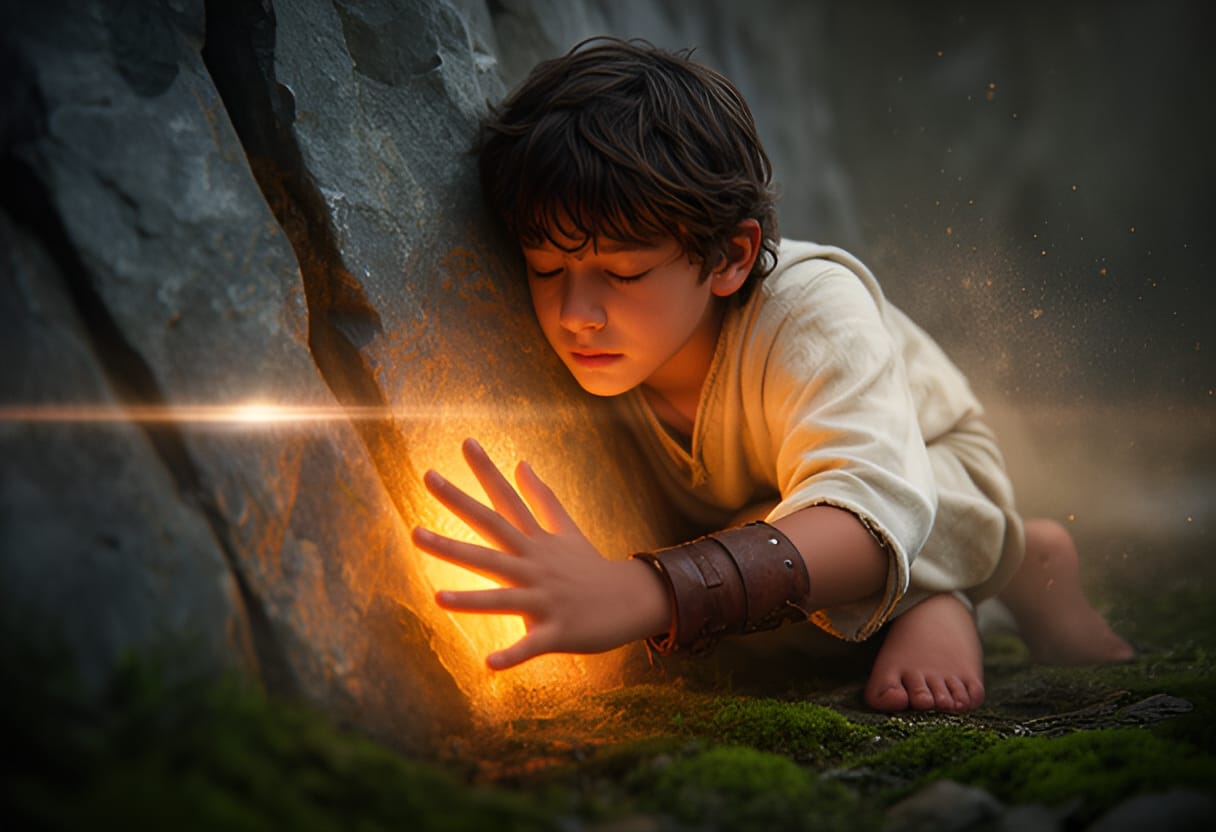
“Sorry,” he whispered, voice raw from shouting and stone-dust. “We didn’t know… we were scared. We yelled because we didn’t know how else to wake you… but you were already awake. You were just… dreaming us.”
His breath hit the rock in a faint plume. He didn’t wait for an answer. He didn’t need one. The truth wasn’t in words — it was in the contact, the warmth, the way the vibration seemed to sync, for a moment, with the flutter in his own throat.
“Thank you,” he added, quieter now. “For holding us. Even when we didn’t know you were there.”
A sob caught in his throat — not of fear, but of something deeper, older: recognition. As if, in touching the stone, he had touched a memory not his own, yet familiar as breath.
A few feet away, Mateo had stopped struggling. He had been shouting orders, trying to rally others to tie ropes around protruding spires, but the effort had collapsed with the street beneath his boots. Now he crawled on hands and knees, his wild hair plastered to his forehead with sweat and grime, until he reached a smooth patch of bedrock where a garden wall had once stood. He pressed his ear flat to the stone, eyes closed, jaw tight.
Leo watched him — saw the way his shoulders, usually rigid with bravado, softened. Saw the tremor in his lower lip, the way his breath hitched, not from exertion, but from something breaking loose inside.
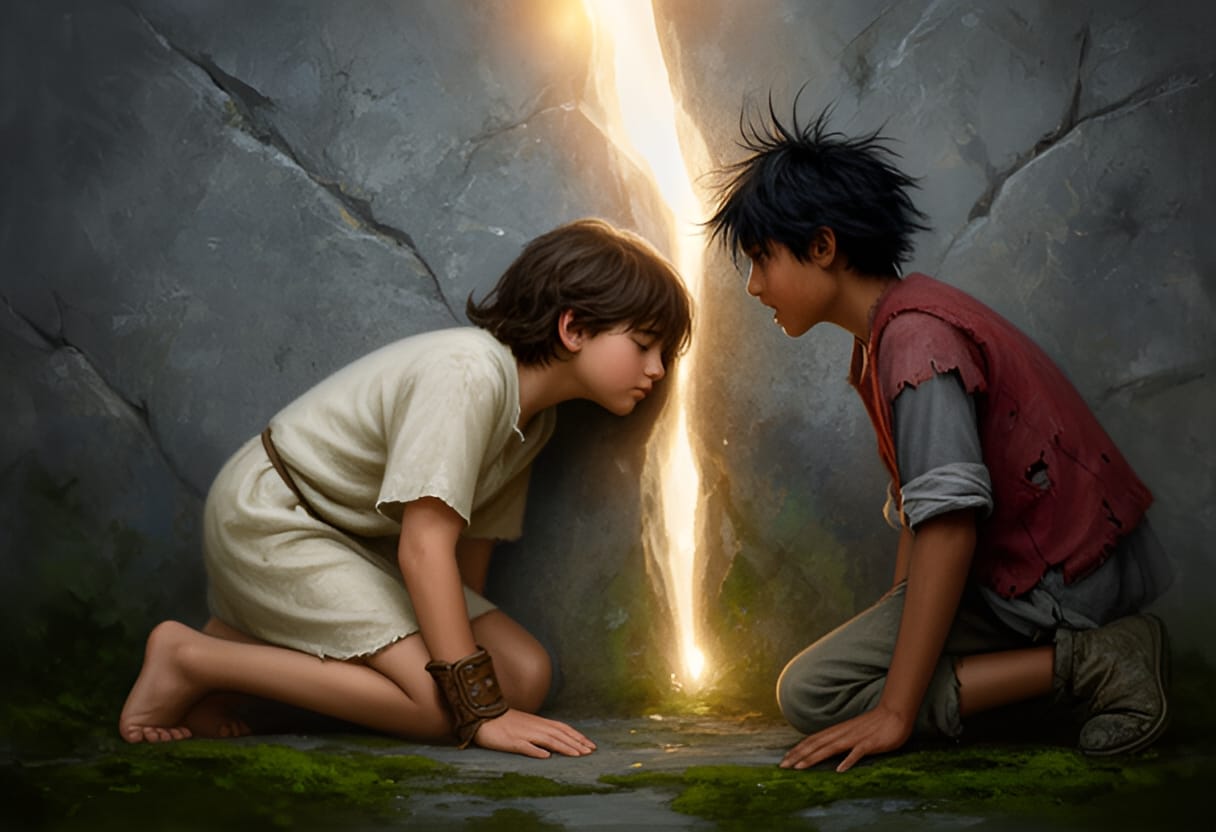
Mateo didn’t speak. He just listened. And then, quietly, so quietly Leo almost missed it beneath the distant groan of shifting stone, he began to cry — not loud, not for show, but soft, broken sounds, like wind through a crack in a tombstone. His fingers curled into the rock, not to grip, but to hold on, as if the stone might vanish if he let go.
And then — the shuddering stopped.
Not gradually. Not with a sigh. But as if a switch had been flung deep in the dark.
The falling slate hung in the air for a breathless second — tiles, shards of mortar, a child’s wooden shoe — suspended as if the world had paused to listen. Then, one by one, they settled. Not crashed. Not piled in ruin. But settled, like leaves finding their place on still water. The great tilts of stone eased. The crevasses softened at the edges. The beast’s back, which had arched in agony or rage, flattened — not in defeat, but in peace.
Silence fell, thick and heavy, not empty, but full. Full of dust settling. Full of breath held. Full of the low, steady hum that now rose not from panic, but from presence — a sound felt more than heard, vibrating up through Leo’s bones, through Mateo’s pressed ear, through the soles of the villagers’ bare feet as they stumbled onto the new ground.
No one moved. No one spoke.
Leo kept his palm on the stone. Mateo kept his ear pressed to it. And beneath them, the earth did not tremble.
It breathed. — * — The sun, now low in the sky, slanted across the transformed valley. What had been streets and roofs and square was now a landscape of gentle swells and hollows, where chimneys stood like sentinels of stone, where beams had become ridges draped in moss, where the fountain’s basin had sunk into the earth and filled with clear water that trickled over smooth pebbles. The air smelled of wet stone and crushed thyme, of something green and ancient stirring in the dark.
Leo sat back on his heels, his palm still resting on the warm rock. His fingers were smeared with dust and a faint lichen-green where they had brushed a creeping vine. Mateo lay beside him, cheek to the ground, one arm flung out, his breathing even, his tears dried into clean tracks on his cheeks.
Around them, villagers stirred — not in panic, but in wonder. A woman ran her hand over a low wall that had once been her cottage’s chimney. An old man knelt where a wellhead had stood, now a smooth stone dome, and pressed his forehead to it, murmuring something in the old tongue. Children, silent and wide-eyed, picked up smooth shards of glazed tile and turned them in their palms, as if seeing them for the first time.
Mayor Varn walked slowly through the new terrain, his patched coat brushing the tops of emerging grasses. He did not look triumphant. He did not look relieved. He looked… seen. As if, after centuries of guarding a secret too vast for words, he had finally been acknowledged.
He stopped near Leo and Mateo, his shadow falling across their joined hands — one on stone, one near ear — both still connected to the ground.
He did not speak. He did not need to.
Leo turned his head slightly, just enough to meet the mayor’s eyes. In them, he saw not the weight of ages, but something lighter: the quiet release of a watchman who had kept the vigil too long.
Leo gave the stone one last press — a pulse of warmth, a silent thanks — then let his hand fall to his side.
Beside him, Mateo shifted, rolled onto his side, and pressed his palm to the earth as well.
The hum continued. Deep. Steady. Alive.
And for the first time since the thrum had begun, it did not feel like a warning.
It felt like a promise.
Leo’s palm rested still against the stone, the warmth seeping into his skin like a slow infusion. Beneath his fingers, the frantic shuddering had given way to something deeper — a pulse that no longer hammered but flowed, steady and vast, like the tide of some underground sea. It was not a sound so much as a pressure, a rhythm felt in the marrow before it reached the ear. He closed his eyes and let it move through him, not as invasion, but as answer.
Beside him, Mateo lay on his side, his ear pressed to the earth, his breathing slow and even. The tears had dried, leaving clean trails on his cheeks where dust had not yet settled. His fingers, splayed against the stone, twitched once — not from tension, but from the faint rise and fall of the hum beneath them. It was no longer a warning. It was a presence.
A low, sustained tone now hummed through the bedrock — not loud, but all-encompassing, as if the stone itself had begun to sing. It vibrated in Leo’s teeth, in the hollow of his chest, in the soles of his feet where they touched the ground through his worn boots. It was not fear that made the air still, but recognition. The creature was not raging. It was breathing. And in its breath, there was a pattern — not the sharp, staccato thrum of alarm, but a long, rolling resonance, like a note held in a cavern too vast for ears to catch its start or end.
Leo opened his eyes. Across the new landscape, villagers moved with caution, not panic. A man who had been scrambling up a fallen beam now paused, one hand braced against the stone, his head tilted as if listening to something far below. A woman knelt where her doorway had been, her palms flat on the earth, her eyes closed. Even the children, who had clutched broken tiles like talismans, now held them loose in their palms, their frowns smoothed into curiosity.
Then, from nearby, Mateo’s voice — quiet, rough with tears, but clear — cut through the hum.
“It’s a song,” he murmured. “Not a warning. A lullaby.”
Leo turned his head. Mateo’s eyes were still closed, his cheek pressed to the stone, his lips moving slightly as if echoing the tune in silence.
“The earth sings when it’s not afraid,” Mateo added, so softly Leo had to lean in to hear. “It’s been singing all along. We just didn’t know how to listen.”
Leo swallowed. He remembered the first time he’d felt it — in the mill, in his bones, in the quiet before dawn — how it had seemed like a code, a signal. Now he realized it had never been a message to decode. It had been a voice. And they had been too loud to hear it.
A sudden shift in the light drew his gaze uphill. There, near the remnants of what had been the bakery’s oven — now a smooth, moss-capped swell in the earth — stood Old Mrs. Tegun. She had been halfway up a pile of charred beams, her hands scraping for purchase, her face streaked with soot and effort. But now she had stopped. One foot still clung to a loose timber; the other hovered in the air. Her head was bowed, not in exhaustion, but in attention.
Then, slowly, she lowered herself. Not falling — settling. She slid from the beam onto her knees, then eased forward until her forehead touched the stone. Her arms curled loosely at her sides, palms up, as if offering something or receiving it. Her shoulders began to shake. Not with sobs of grief, but with a quiet, shuddering release — the kind that comes after a lifetime of bracing.
Leo felt it then, not just in his own body, but in the air between them — a softening. The tension in the villagers’ shoulders eased. Grips on broken wood loosened. Faces turned not toward escape, but toward the ground. A boy no older than eight sat cross-legged on a mossy ridge, his ear to the stone, a half-smile touching his lips. An old man who had been shouting orders now stood still, his hands open at his sides, his breath syncing — imperceptibly — with the pulse below.
It was not surrender. It was recognition.
The ground was not beneath them. It was with them.
Leo lifted his hand from the stone just enough to turn it over, studying his palm — dusty, lined, alive. He pressed it back down, firmer this time, not to command, not to plead, but to say: I am here. I feel you.
The hum answered — not in words, but in warmth, in the subtle deepening of the vibration, as if the stone had drawn a breath and let it out in reply.
Mateo stirred beside him, rolling slightly onto his back. He did not open his eyes, but his hand found Leo’s forearm and gave it a light squeeze — once, then lingered. No words were needed. The promise was in the contact: the earth had not swallowed them. It had cradled them.
And in that cradle, the song continued — low, ancient, unafraid — a lullaby not for sleep, but for waking.
The sun dipped lower, gilding the edges of the new hills and throwing long shadows into the hollows where roofs had once peaked. Steam rose in thin curls from sun-warmed stone, carrying the scent of wet rock, crushed thyme, and something deeper — the green, root-like smell of life stirring in the dark.
Leo sat upright, his back straight, his hands resting on his knees. The hum was constant now — not a throb, not a cry, but a presence as steady as his own heartbeat. He could feel it in his molars, in the hollow of his chest, in the slow blink of his eyes. It was not outside him. It was woven through.
Mateo lay beside him, one arm tucked under his head, the other draped across his belly. His breathing was even, his face relaxed. For the first time since Leo had known him, Mateo looked not ready to shout, not ready to run, not ready to prove — but simply there. Present. At peace.
A small girl, no more than five, came shuffling over on bare feet, a smooth shard of blue-glazed tile clutched in one hand. She stopped a few paces away, tilted her head, then lowered herself to her knees. Without hesitation, she pressed her forehead to the stone. Her eyes closed. Her small fingers curled into the earth, not gripping, just holding.
Leo watched her. He remembered how, just hours ago, she had screamed as the street split beneath her sandals. Now she listened.
A woman stepped forward — the baker’s wife, her apron dusty, her hair escaping its braid. She did not speak. She simply knelt beside the girl and pressed her own palm to the ground, her eyes closing as if listening to a voice only she could hear. After a moment, she leaned forward and kissed the stone — not in worship, but in greeting.
One by one, others followed. Not in a rush, not in a crowd, but singly, in pairs, as if drawn by a quiet tide. An old man pressed his ear to a moss-covered ridge where a beam had become a hill. A teenager laid both hands flat on a swell that had once been the bakery’s wall. A woman with a child on her hip sat cross-legged and rested her cheek against the earth, humming — softly, uncertainly — a tune that matched the pulse below, note for note.
The hum did not change. It did not swell. It simply was — deep, patient, endless. And those who touched the stone felt it not as a force, but as a fellowship.
Leo felt Mateo shift beside him. He turned his head.
Mateo’s eyes were open now, fixed on the horizon where the valley folded into shadow. His voice, when it came, was rough but clear — not shouting, not explaining, just stating.
“We were never on top of it,” he said. “We were inside it.”
Leo looked at him. Then, slowly, he turned his palm upward and let it rest, open, on his thigh. He did not need to press it to the stone to know it was still there — still breathing, still singing.
He thought of the Whispering Cleft, of the names it was said to speak. He thought of his father’s warning: Try not to wake the giant on your way home. He thought of Mayor Varn’s silence, not as secrecy, but as stewardship.
And he realized, with a quiet certainty that settled in his bones like stone, that the entity beneath them had not dreamed the village into existence to hide or to rule.
It had dreamed them into being to be known.
The hum continued. The stone held its warmth. And for the first time since the thrum had begun, Leo did not listen for danger.
He listened for home.
Leo’s breath came slow, matching the pulse that now thrummed not just beneath him, but through him — a quiet rhythm in his blood, in the press of his palms against his thighs, in the way his eyelids felt heavy not with fatigue, but with belonging. The sun had slipped further behind the western ridge, painting the new hills in molten gold and violet. Shadows pooled in the folds where walls had once stood, now softened into gullies lined with moss and tiny white flowers that had not been there at dawn.
He did not move to speak. He did not need to. The hum was enough — a language older than words, deeper than thought. It said: Stay. Rest. You are held.
Then, a shift.
Not a jolt. Not a groan. But a settling — so gradual it felt less like movement and more like the earth exhaling after a long-held breath. The stone beneath them did not drop. It lowered, as if a vast hand, patient and sure, were guiding the weight of the world back into its cradle.
Leo felt it in his spine — a gentle sinking, not of his body, but of the ground itself yielding to a deeper level of rest. The hills, still sharp in places where beams had fractured, began to round. Ridges that had been jagged timber now softened at the edges, their surfaces blooming with lichen in slow, creeping greens and grays. Where a chimney had once pierced the sky, its broken bricks now formed a low, spiraling mound — not a ruin, but a natural turret, veined with quartz that caught the last light like captured stars.
A cry rose — not of fear, but of wonder — from somewhere behind him. Leo turned his head.
Mateo was on his knees, one hand pressed to a ridge of stone that had been the bakery’s oven. His fingers traced a seam where molten glass from the windowpanes had fused with sandstone, creating a river of amber stone that gleamed like honey in the dusk.
“Look,” Mateo whispered, voice raw but awed. “It’s not gone. It’s changed.”
Leo followed his gaze. The town square — or what remained of it — lay in a shallow basin now, ringed by gentle swells of stone that had once been façades and gables. At its heart, the fountain’s base, once a square of carved marble, had sunk slightly and opened upward, its edges worn smooth by time and pressure. Clear water welled from its center, not gushing, but rising, as if the stone itself were weeping gently. It spilled over the rim in a thin, silent sheet, feeding a pool that mirrored the sky — and in its depths, smooth pebbles rolled slowly, turned by an unseen current.
A woman — the baker’s wife — stepped into the hollow, her bare feet touching the wet stone at the pool’s edge. She did not hesitate. She cupped her hands, drank, then splashed her face, laughing — a soft, startled sound, like a bird taking flight.
“It’s cold,” she said, turning to Leo and Mateo. “But it’s alive.”
Leo nodded. He could feel it — not just the water, but the stone beneath it, the slow seep of minerals, the quiet work of roots threading through cracks below. The fountain was not rebuilt. It was remembered. The creature had not erased the town’s shape; it had folded it into its own, like a seed splitting open to reveal the root and stem already dreaming inside.
A soft * marked the quiet passage of time — not a break in consciousness, but a pause in the telling, as if the world itself held its breath while transformation deepened.
When Leo’s awareness returned, the light had changed. The sun was gone, replaced by a sky washed in indigo, the first stars pricking through like pinpricks in velvet. The hum had deepened, not in volume, but in resonance — a subsonic thrum that now lived in his teeth, his jaw, the hollow behind his eyes. It was no longer something he felt on him. It was something he was.
He rose slowly, joints stiff not from strain, but from the unfamiliar ease of stillness. His muscles, coiled for so long in tension — for running, for shouting, for bracing against the world — now unwound like springs released. He walked without purpose, his bare feet finding purchase on stone that was warm where the day’s sun had lingered, cool where shadow had settled.
He passed a ridge where a timber beam had once supported the mill’s roof. Now it was a low, sinuous swell of stone, its surface threaded with veins of pyrite that winked in the starlight. He knelt and pressed his palm to it. The vibration rose through his arm — steady, deep, answering. Not a plea. Not a command. A confirmation.
You are still here. We are still here.
Further on, Mateo sat cross-legged atop a mound that had been the well’s stone casing. He held a shard of blue-glazed tile — the same one the little girl had carried — and was rubbing it gently against his thumb, as if polishing a worry stone.
Leo sat beside him, shoulder to shoulder. Neither spoke. The hum filled the space between them — not silence, but a presence so full it needed no words.
A child’s voice, small and clear, came from nearby.
“Is it dreaming us?” the girl asked.
Leo glanced over. She was the same one who had pressed her forehead to the stone earlier, now curled against her mother’s side, her ear to the ground.
Mateo opened his eyes. He looked at the girl, then at Leo, then back at the girl.
“I don’t know if it’s dreaming us,” he said softly. “But I know it’s dreaming with us.”
The girl considered this. Then she shifted, pressing her ear harder to the stone, her lips parting slightly as if to catch a whisper on the wind.
Leo closed his eyes. He thought of the Whispering Cleft, of the names it was said to speak — not in language, but in rhythm, in resonance, in the way certain stones sang when the wind passed through them just so. He thought of his father’s warning, not as a command to avoid, but as an invitation to listen — to walk gently, to tread with awareness, to remember that every step was a conversation.
He thought of Mayor Varn, standing apart now, his gaunt frame silhouetted against the starlit sky. The mayor did not touch the ground. He did not need to. His hands were clasped behind his back, his head tilted slightly upward, as if listening to a frequency only his long years had tuned him to perceive. His face was not peaceful. It was acknowledged. After nine centuries of vigil, of silence borne like a stone in the chest, he was no longer watching for danger. He was witnessing the fulfillment of a promise — not made in words, but in the slow turning of the world.
A breeze stirred, carrying the scent of damp earth and crushed mint. Somewhere, a stream began to chuckle over rocks that had once been the mill’s foundation. The hum pulsed — forty seconds on, twenty off — not as a warning, not as a threat, but as a lullaby without end, a song of continuity.
Leo opened his eyes. He looked at his hands — dusty, lined, alive — and then at the ground beneath them, no longer separate, no longer foreign.
He did not press his palm to the stone.
He simply let his hands rest, open, on his knees.
And in that openness, he felt it — not as a force beneath him, but as a presence beside him, within him, woven into the same quiet breath that lifted the stars and turned the tide.
The ground was not beneath them.
It was with them.
And it was home.
The first light of dawn slipped over the eastern ridge, gilding the tips of the new hills that had risen where Stone Hollow once clung to the mountainside. Mist clung to the hollows like breath, slow to retreat as the sun climbed. Wool drifted across the slopes in loose, wandering clouds — sheep, their bells silent now, not from neglect but from reverence. The shepherds moved among them with bare feet, testing the earth before each step, as if the ground might still startle if approached too hard.
An old woman, her back bent like a wind-scoured sapling, paused where a flock had just passed. She knelt, not to rest, but to press her palm flat against the soil. Her eyes closed. A faint smile touched her lips. When she rose, she brushed the dust from her knees and murmured to the boy beside her, “It’s warm today. Deeper down. Like it’s dreaming of summer.”
The boy, no older than six, nodded solemnly and tugged at her sleeve. “Can I listen?” he asked.
She knelt again, guiding his small ear to the ground. For a long moment, he lay still, cheek to earth, eyelids fluttering. Then a grin split his face. He giggled — a bright, bubbling sound — and rolled onto his back, kicking his heels in the air. “It’s singing!” he declared. “Like a stone lullaby!”
The old woman laughed softly, rising to her heels. She wiped her hands on her skirt and called to the flock, which began to move again, slow and sure, as if the land itself were guiding them.
Leo adjusted the strap of his satchel, the leather worn soft at the edges from years of use. He walked beside Mateo along the high ridge that now curled like a sleeping spine above the valley. The stone here was smoother, worn by time and touch, veined with quartz that caught the light and threw it back in faint, icy sparks. Below, the village had not returned — not as it was. Instead, the hollows held gardens where root vegetables pushed through dark, loamy soil; the square had become a shallow basin where water gathered after rain, edged with reeds and the purple heads of loosestrife. Smoke curled from chimneys not of timber and thatch, but of stone and earth, shaped into the hills themselves, their vents breathing warmth into the air.
They had not spoken since leaving the cottage. Words had grown heavy, unnecessary. The hum was enough — a steady pulse beneath their boots, in the marrow of their teeth, in the quiet space between breaths. It had not changed in rhythm: forty seconds on, twenty off. But it had changed in quality. Where once it had felt like a warning, a distant hammer blow in the deep earth, it now felt like a hand laid gently on the shoulder — present, patient, saying only: I am here. You are here. We are together.
Mateo broke the silence first, not with speech, but with movement. He slipped his hand into Leo’s, fingers lacing briefly before letting go. A gesture they had not shared since they were small, since the days before the thrum had become a question, before the mill, before the cleft, before the world had split open and remade itself.
Leo glanced at him. Mateo’s profile was sharp in the morning light, his jaw set, his eyes fixed on the horizon where the valley folded into the higher peaks. There was no triumph in his face, no pride — only a deep, quiet recognition, like a man who has walked a long road and finally seen the end not as a destination, but as a continuation.
“I used to think,” Mateo said at last, his voice low, “that if we could just make them hear it — really hear it — they’d understand. That fear was just… not listening hard enough.”
Leo nodded. “We weren’t wrong to try.”
“No,” Mateo agreed. “But we were listening for the wrong thing. We thought we needed to wake it up. To make it stop. To save the town.”
He kicked at a loose pebble. It rolled a few inches before stopping, caught in a tuft of thyme. “Turns out, we just needed to listen… to let it know we were listening.”
The hum deepened for a moment — a swell in the stone, a resonance that rose not in volume, but in presence. Leo felt it in his sternum, in the hollow of his throat, as if the earth were inhaling with him.
He looked down at his hands — older now, the knuckles scraped from climbing, the nails short and clean. He thought of the first time he had pressed his palm to the stone in the fissure, how it had trembled under his touch, how he had whispered an apology not knowing if it would be heard. He thought of the baker’s wife laughing as she drank from the fountain, of the child pressing her ear to the ground and giggling at the song beneath, of Mayor Varn standing apart not in sorrow, but in acknowledgment, his vigil ended not with relief, but with completion.
The ground had not forgiven them. It had not needed to. It had simply… continued.
A sudden movement caught Leo’s eye — a flash of white near the lower slope. A lamb, separated from its flock, stumbled over a rise, its legs splaying as it sought purchase on the soft, loamy soil. It bleated once, thin and startled.
Without thinking, Leo moved. He slid down the incline, boots kicking up small showers of dirt and pebble, and reached the lamb just as it began to panic, its tiny heart hammering against its ribs. He dropped to his knees, not to grab, but to lower himself to its level, speaking in a murmur so low it was more breath than word.
The lamb stilled. Its ears twitched. Then, slowly, it leaned forward and pressed its forehead to Leo’s knee.
A ripple passed through the ground — not a shake, not a shift, but a pulse, warm and steady, rising through the stone and into Leo’s palm where it rested on the earth beside the lamb’s hoof. The animal exhaled, a soft puff of breath, and stepped back. It shook its fleece, gave a tentative bleat — not of fear, but of greeting — and trotted back toward the flock, its tail high.
Leo remained kneeling for a moment, his palm flat on the ground. The hum thrummed up his arm, not as a vibration, but as a rhythm — a heartbeat, slow and sure, matching his own.
Mateo stood beside him, silent, his shadow stretching long across the hillside. When Leo rose, Mateo offered a hand to help him up. Leo took it, and they stood shoulder to shoulder, looking out over the valley.
Below, the first true tendrils of morning fog began to rise from the stream that now wound through the valley like a silver thread, its voice a soft chuckle over stones that had once been beams and thresholds. Somewhere, a door creaked open — not in fear, but in routine. A woman’s voice called to a child, warm and unhurried. A cow lowed from a pasture where the grass grew thick and green, rooted in soil that remembered every footfall, every seed, every tear.
The sun cleared the ridge, spilling gold across the hills. The shadows retreated, not in defeat, but in rest.
Leo closed his eyes. He did not press his ear to the ground. He did not need to.
He felt it — not beneath him, not beside him, but in the same quiet breath that moved his lungs, that beat in his temples, that hummed in the hollow behind his eyes. It was in the way the light fell on the stone, in the scent of thyme and damp earth, in the distant sound of a bell, not from a flock, but from the old mill’s frame, now a natural arch over a deer path, its timbers softened by moss and time.
He opened his eyes. Mateo was already looking at him. No words passed between them. None were needed.
They turned and began to walk — not toward home, not away from it, but along the ridge, where the land rolled gently underfoot, where the stone remembered every step, and where the ground, at last, was not something they lived on.
It was something they lived with.
And as they walked, the hum continued — forty seconds on, twenty off — not a warning, not a plea, but a promise, worn into the world like a seam in stone, like a name whispered not in language, but in rhythm, in root, in the slow, patient turning of the earth.
And the ground lived.