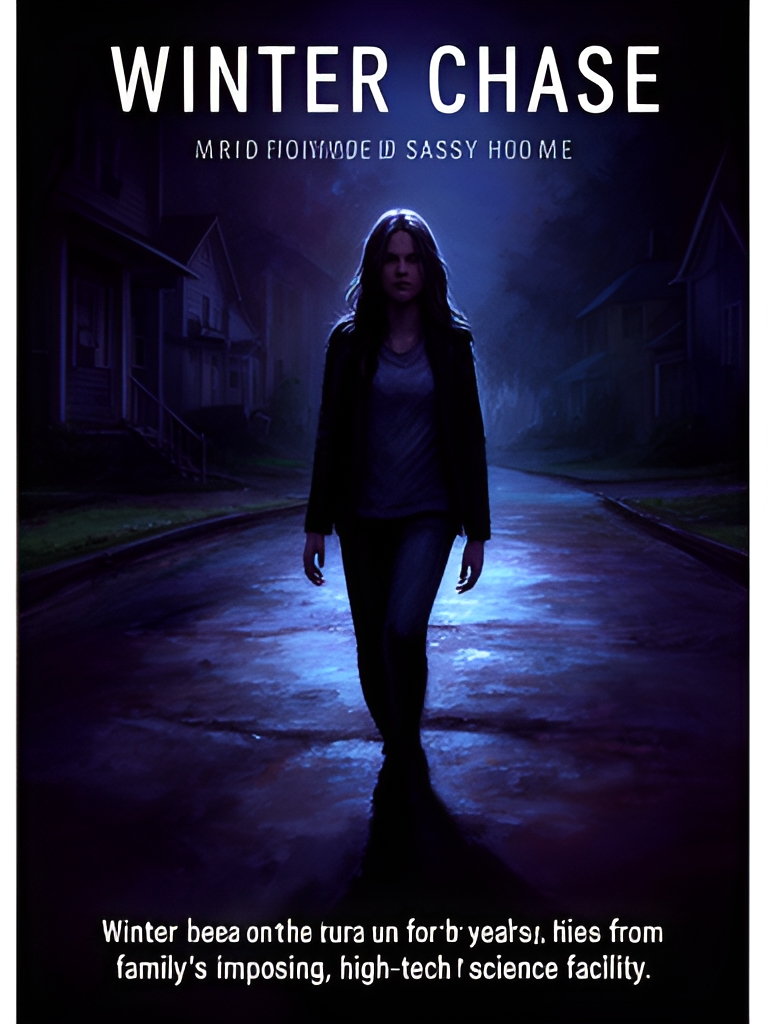
Fiction
The runaway
by isabel reese
3 chapters1.2 hr read
Chapter 1
Footprints in the Snow
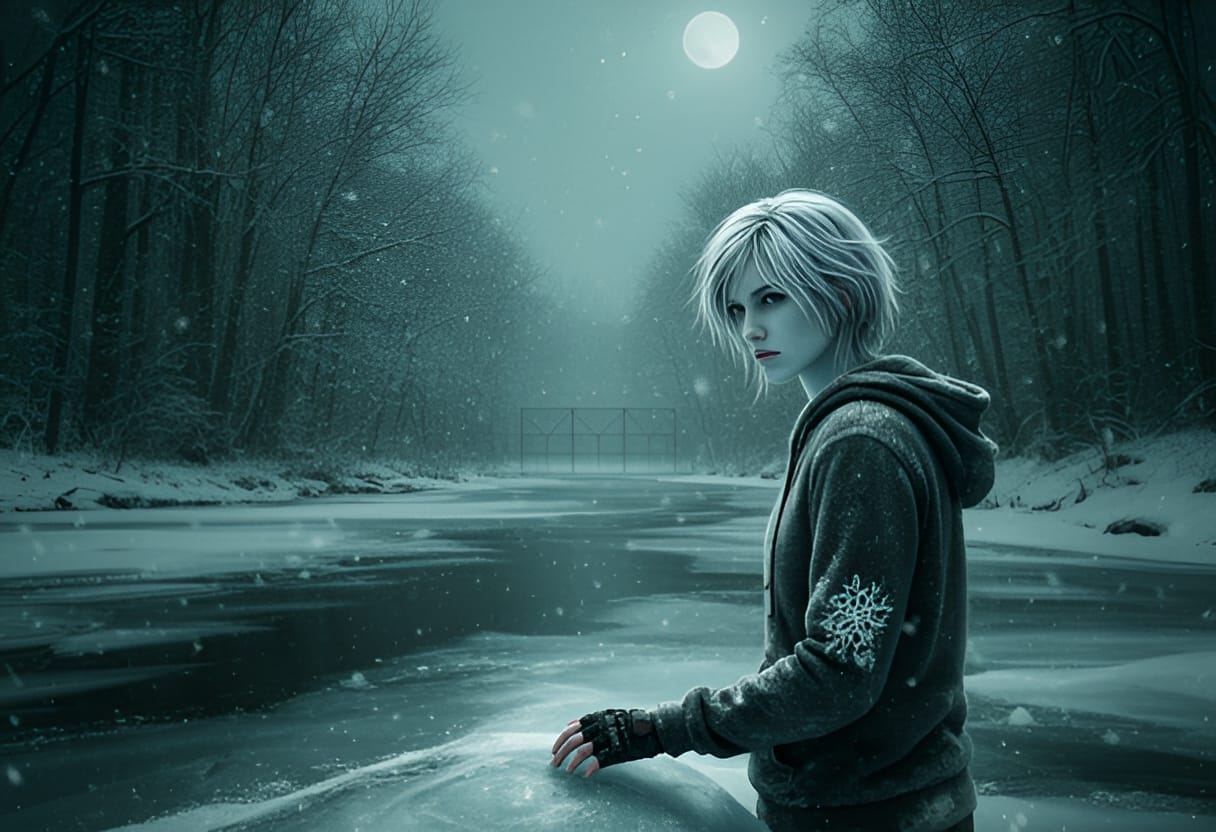
Winter moved through the woods like a shadow given breath, her boots sinking just enough to leave no crisp imprint in the fresh snow. The cold didn’t bite—it never did anymore—but she kept her breath shallow, her pulse slow, the way they’d taught her to suppress the heat signature that bloomed beneath skin. Three years on the run had honed it to instinct: walk soft, stay low, let the forest swallow you whole.
Yet here she was, not hiding.
Her fingers brushed the bark of a black spruce, rough and resinous beneath her gloves. The scent of pine and damp earth rose in short gusts, sharp against the back of her throat. Somewhere ahead, the lullaby came again—not loud, not clear, but threaded through the wind like a half-remembered dream. Hush now, little snowflake, drift where the quiet things sleep… Her mother’s voice, or the ghost of it, warped by distance and time and the way memory bends when you’ve spent too long surviving instead of living.
She didn’t know why she’d come back. Only that the pull had been there for weeks, a quiet hum beneath the ribs, growing louder each night when the moon hung low and the world went silent. Tonight, it had become a compass.
Her boots crunched over a crust of ice as she descended toward the frozen creek—a place she’d known before the white coats, before the needles and the humming machines that rewired her pulse to match the cold. She stopped at the bank, where the ice lay thick and glassy, and pressed her palm flat against it. The cold seeped through the leather, not unpleasant, just… familiar.
A flash: herself, no older than eight, barefoot despite her mother’s protests, skipping stones across the water when it was still liquid. Each skip a defiance of gravity, each ripple a laugh caught in the air. Her mother standing on the shore, wrapped in a faded wool coat, singing that same tune off-key but bright, like she believed the world could still be gentle.
Winter’s breath hit the ice in a thin plume. She hadn’t thought of that day in years. Not since the first procedure. Not since they told her the changes were necessary—for strength, for survival, for the greater good.
A crack split the silence.
Not from the ice. From above.
She jerked her head up just as a blooming flare blossomed overhead—thermal, not visual—splattering the canopy with false heat signatures that pulsed like dying stars. For a heartbeat, the woods blazed red in her mind’s eye, every tree trunk and branch outlined in lethal clarity. Then it faded, leaving only the real dark and the creeping certainty that she’d been seen.
Her muscles coiled. Run. The thought was pure reflex, honed by flight.
But she didn’t move.
Instead, she let her hand fall from the ice, slow, deliberate. Let the memory of her mother’s voice settle in her chest like a stone. Let the cold remind her what she was now—not the girl who skipped stones, but the thing they’d made her into.
A thing that didn’t run unless it had to.
And she had to.
She turned and plunged back into the trees, not toward safety, but toward the fence—the old chain-link barrier half-buried in snow, marking the edge of the facility’s outer perimeter. If they were coming, she’d meet them on her terms.
The lullaby was gone now, swallowed by the wind. Only the snow remained, falling soft and endless, covering her tracks even as she made them.
The snow swallowed her footsteps as she pushed deeper into the woods, her movements economical, each step placed to minimize disturbance. The flare had been a warning, not a capture—but it meant eyes were already turning toward her. Drones would be adjusting their sweep patterns. Ground teams, if they were close, would be fanning out. She couldn’t outrun sensors forever, but she could make them work for it.
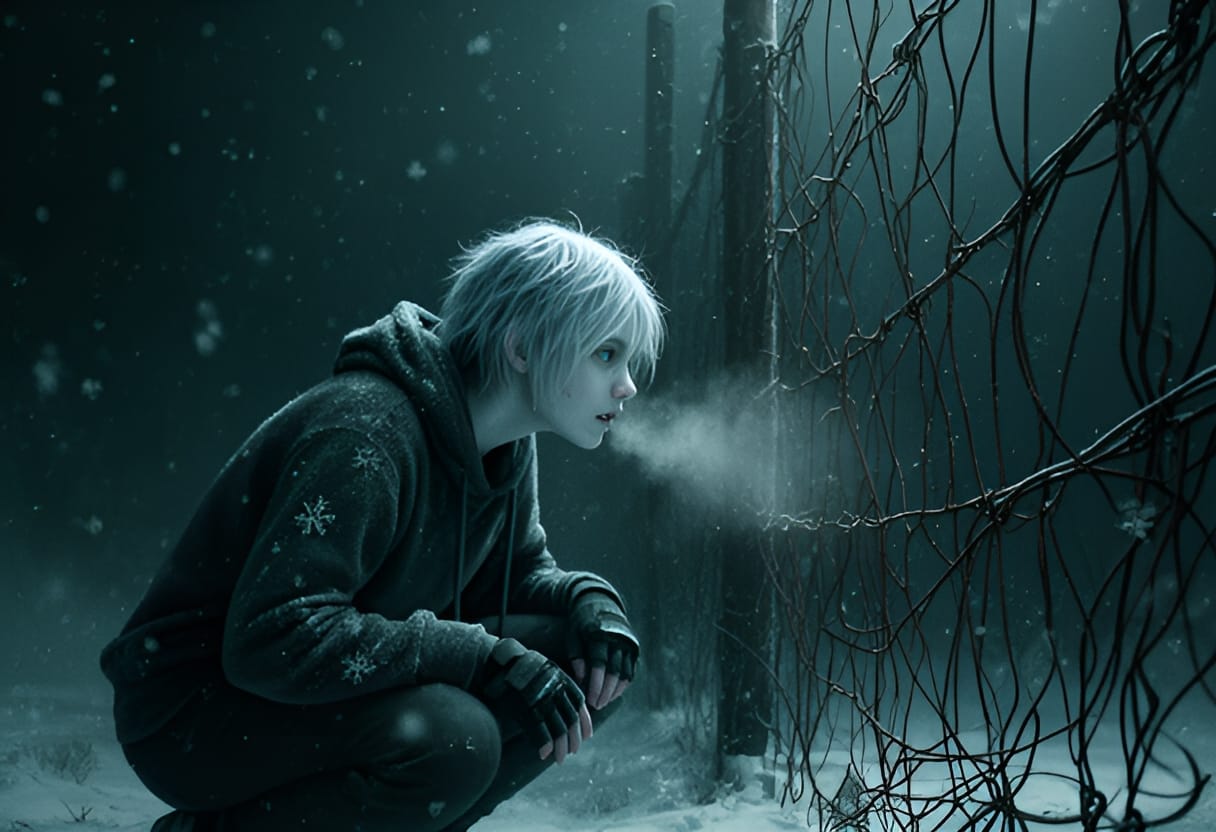
Ahead, the trees thinned. The fence loomed—a jagged line of rusted metal and sagging posts, half-buried in drifts, topped with coiled razor wire that had long since gone slack. It wasn’t meant to keep people in. Not anymore. It was a tripwire. A first layer. Beyond it, the ground was seeded with pressure plates and passive infrared grids, all feeding back to the central node buried beneath the west watchtower. She knew every blind spot, every decayed sensor she could slip past. Three years ago, she’d used them to get out. Now, she prayed they still worked.
She dropped into a crouch at the tree line, breath barely fogging. The wind had died, leaving the world hushed and sharp-edged. Somewhere to the east, a distant crack echoed—maybe a branch under weight, maybe something worse. She pressed herself against the trunk of a frost-cracked oak, eyes scanning the open ground between her and the fence.
Then she saw them.
Three figures, moving low through the snow like predators who knew the terrain. Thermal camouflage—mottled white and gray—blended them into the drifts until they stepped, and the pattern shifted just enough to catch the eye. Jace led, broad-shouldered and silent, his boots kicking up little spray. Kael followed, lighter on his feet, one hand hovering near the console strapped to his forearm. Rook brought up the rear, head swiveling, not just watching the trees but the sky—watching for her.
They hadn’t seen her yet. But they were coming from the direction of the facility, fanning out in a slow arc that would soon put them between her and the trees. She was being herded.
Her fingers tightened around the grip of the knife sheathed at her thigh—not the regulation issue, but an old blade she’d taken from a trapper’s cabin two winters prior. It wasn’t much against taser nets or dart launchers, but it was hers.
She waited.
They spread out, moving in a loose triangle. Jace angled toward the fence’s weakest point—a section where the posts had rotted and the wire sagged low. Kael veered left, likely to monitor any biometric spikes from her suppressed core temp. Rook stayed center, eyes lifting intermittently, as if listening for something above.
A drone. She’d forgotten the drone.
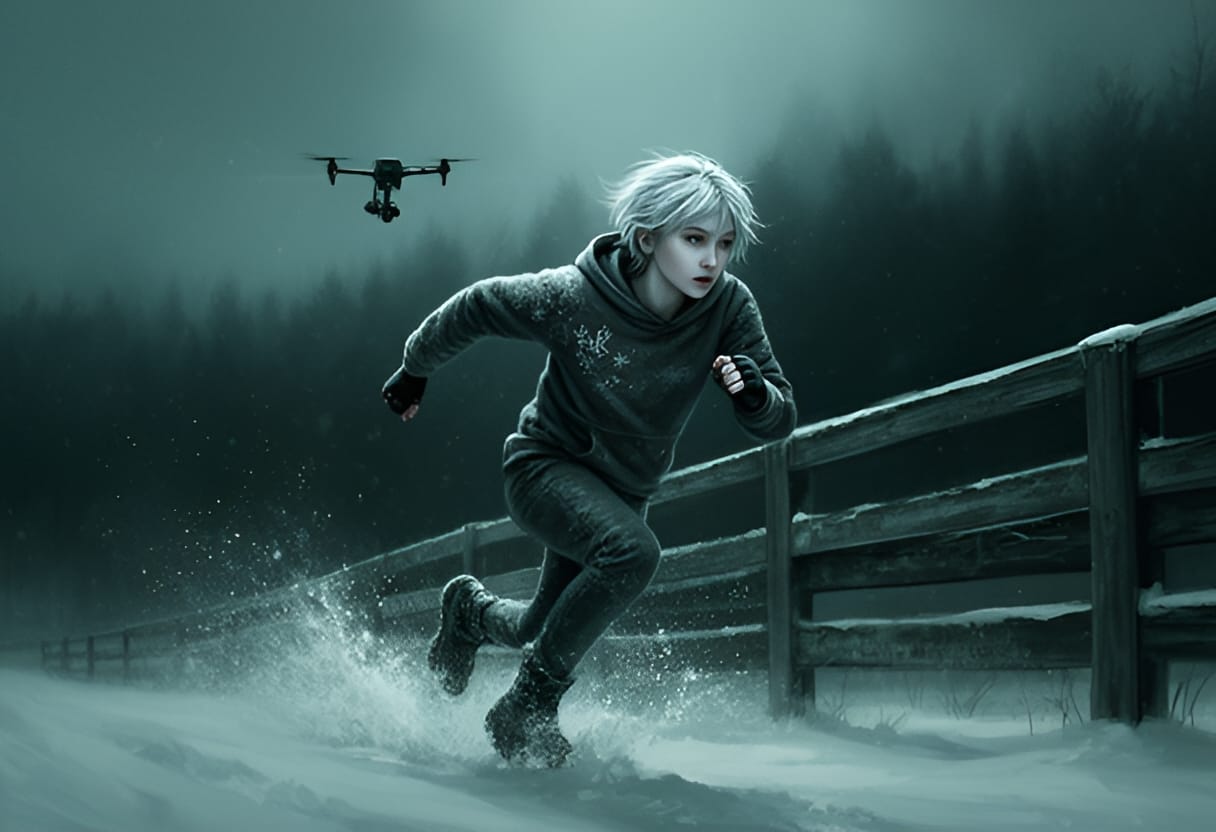
Her gaze snapped upward. There—just above the treeline, a small rotor craft hung motionless, its infrared emitter scanning in a slow spiral. It hadn’t spotted her yet. But it would, if she stayed still too long.
She had to move. Now.
She exploded from cover, not toward the fence, but parallel to it—cutting diagonally across the open snow, forcing them to adjust. Jace reacted first, lunging forward with a shout that was swallowed by the wind. Rook fired—not a dart, but a net launcher from his wrist-mounted cuff. The taser net unfurled in a wide arc, strands crackling with stored charge.
She threw herself sideways, rolling through the powder. The net snapped shut where she’d been, missing her by inches. Ice stung her face as she came up, already moving, already turning.
Kael was on her left, palm out, not firing yet—scanning. She could see the faint glow of his neural monitor, pulsing as it tried to lock onto her elevated heart rate, the micro-spike in adrenaline she couldn’t fully suppress. She bared her teeth in a silent snark and feinted right, then cut hard left, aiming for the dip in the fence line where the snow was deepest.
Jace met her there.
He came low and hard, shoulder first, driving into her ribs with enough force to knock the wind from her lungs. She twisted, slashing with the knife—catching air, then fabric—as he wrapped his arms around her waist and drove them both into the snow. They rolled, shoulder to shoulder, her back hitting ice once, twice, before he managed to pin her arms beneath his weight.
“Winter,” he grunted, breath frosting in the air between them. “It’s over. Just yield.”
She bucked hard, twisting her head to avoid a knee to the sternum. “Go to hell,” she spat, though her voice came out ragged.
Above them, the drone whirred closer, its emitter locking on.
Then, from the tree line behind them, a new sound—metal on packed snow, deliberate and unhurried. A sled. Low-slung, tracked, its matte black surface drinking the dim light. It eased into the clearing, engine idling soft.
And then the figure stepped off.
Tall. Encased in a sealed thermal suit, gloves and boots integrated, the visor reflecting the snow, the sky, the two of them writhing in the snow like insects. No insignia. No need for one.
Frost.
She didn’t speak. Didn’t need to. One gloved hand lifted, palm out, fingers slightly curled—a signal. Universal. Absolute.
Jace eased back just enough to let her breathe, but didn’t release her arms. Rook approached cautiously, net launcher lowered but ready. Kael stayed back, eyes fixed on his console, watching the readouts spike and dip as her body fought the restraint.
Frost walked forward, boots crunching softly. She stopped just beyond Winter’s peripheral vision, then crouched—not to touch, not to comfort—but to look. Her head tilted slightly, as if assessing a specimen.
Winter met the visor’s reflection and saw herself: face flushed, hair escaping its braid, eyes wide and furious, breath coming in short, furious bursts. She saw the girl who’d skipped stones. She saw the thing they’d made.
And she saw, in the dark behind the glass, nothing at all.
Jace’s grip tightened on her wrists, the cold seeping through her sleeves where his gloves pressed into her pulse points. She bucked again, hips rolling to throw him off, but his weight was too solid, too practiced. Snow packed icy and sharp beneath her cheek, each breath a rasp of frozen air that burned her throat. Above them, the drone’s whine rose—a steady, mechanical hunger.
“Hold her still,” Jace grunted, his voice low but cutting through the wind. His forearm pressed harder against her sternum, forcing the air from her lungs in a harsh puff that vanished instantly in the cold.
Kael stepped closer, the faint blue glow of his neural monitor flaring at his temple. In his other hand, he held a slender prod—no thicker than a finger, its tip etched with micro-conductors that pulsed intermittently. He didn’t look at her face. His eyes were fixed on the readout scrolling across his wrist console: heart rate, core temp, adrenaline spikes. Data points dancing like fireflies in the dark.
“Her cortisol’s peaking,” he said, voice flat, analytical. “Sympathetic nervous system’s maxed. She’s running on pure instinct now.”
Winter twisted her head, snarling, and caught the edge of Kael’s glove with her teeth. Salt and synthetic fabric filled her mouth. She bit down hard, hoping to make him flinch, to break his focus.
He didn’t flinch. Instead, he shifted his weight and drove the prod into the side of her neck, just below the jawline.
The shock wasn’t loud—no crack, no flash—but it hit like a frozen needle driven straight into her spinal column. Her vision whited out at the edges. Muscles locked, then spasmed violently. A choked gasp tore from her lips, cut short as her jaw locked. For a heartbeat, she couldn’t move—not a finger, not a toe. The world narrowed to the burning pressure at her neck and the roaring in her ears.
Then it faded, leaving her limbs heavy, trembling. The adrenaline was still there, but dulled, as if someone had turned down the voltage on her fear.
“Neural dampener engaged,” Kael murmured, already retracting the prod. “Should buy us twenty seconds of clean handling.”
Jace didn’t wait for her to recover. With a grunt, he hauled her to her feet, one arm locked around her waist, the other still gripping her wrist. Her boots slipped on the packed snow, toes scraping for purchase. She tried to kick out, to drive her heel into his shin, but her legs felt thick, unresponsive—like wading through icy sludge.
Rook stepped in from the side, net launcher lowered but ready. He moved with deliberate calm, unfastening a length of reinforced cuff from his belt—black polymer, lined with heating elements to prevent freezing in subzero temps. He crouched, not to threaten, but to secure.
“Wrists together,” he said, voice unnervingly gentle. “Make this easier on yourself.”
Winter spat blood onto the snow—bright red against the white. “Go screw yourself.”
He didn’t react. Instead, he caught her left wrist as she flung it out, twisting it behind her back with a smooth, practiced motion. She gasped—pain flared in her shoulder, sharp and sudden. Before she could react, he snapped the first cuff into place. The metal clicked, cold and final.
She twisted, trying to bring her knee up between his legs, but Jace shifted his grip, pinning her arms tighter against her spine. Rook moved to her right wrist, pulling it hard to meet the left. She bucked, whole body heaving, but between Jace’s weight and Rook’s leverage, she had no anchor. The second cuff snapped shut. The chain between them pulled taut, forcing her arms into a painful angle behind her back.
“Easy,” Rook said, though his eyes flicked to the tree line, scanning. “We’re not trying to hurt you. We’re trying to get you home.”
“Home?” Winter choked out, breath coming in ragged pulls. Her throat burned where the prod had struck. “You call that prison a home?”
Jace shifted his grip, turning her slightly to face him. His face was close—too close. She could see the faint stubble on his jaw, the tension in his eyes. Not anger. Something wearier. Doubt, maybe, but buried deep.
“We call it where you belong,” he said quietly. “Where you were made.”
A bitter laugh escaped her, raw and broken. “Made? You mean broken. You mean rewired.”
Kael stepped back, watching her with detached interest. His console blinked softly—vitals stabilizing. “Her motor function’s returning. Sedation protocols not yet needed.”
“Good,” Frost’s voice cut through the air—soft, but it carried like ice cracking underfoot.
They all froze.
Winter’s blood turned to sludge in her veins. She hadn’t heard the sled move. Hadn’t felt the shift in the air. But there she stood—Frost—just beyond Jace’s shoulder, visor lifted just enough to reveal the lower half of her face. Pale lips. No expression. Eyes like chips of glacial ice, locked on Winter’s.
She didn’t smile. Didn’t frown. She simply saw.
And in that gaze, Winter felt the last of her fight drain away—not with surrender, but with the chilling realization that no amount of kicking, biting, or screaming would change what came next.
Frost took one step forward. The crunch of her boots was unnervingly loud in the sudden quiet.
“Stand her,” she said. No inflection. No need for it.
Jace released her waist but kept hold of her cuffed wrists, lifting her upright. Winter swayed on her feet, vision swimming slightly from the residual shock and the rush of cold air hitting her overheated skin. Rook moved to her side, shoulder brushing hers—not supportive, just present—ready to catch her if she fell.
Kael fell in behind them, console still glowing faintly against his chest. The drone hovered above, its lazy spiral now a tight, focused circle—tracking, recording, waiting.
Frost turned without a word and began walking back toward the sled. Her movements were precise, economical—no wasted motion, no hesitation. The brothers fell into step beside her, flanking Winter like a convoy moving through hostile territory.
She didn’t look back. Didn’t need to.
Winter’s feet dragged slightly in the snow, each step sending a shock of cold up her legs. Her breath came in short, visible plumes. The world had narrowed to the rhythm of her own heartbeat, the bite of the cuffs on her wrists, and the endless white stretching ahead—trees, sky, the silent promise of the facility looming beyond the tree line.
They hadn’t spoken a word since the cuffs clicked shut. But she could feel it—the weight of their silence. Jace’s reluctance. Kael’s detachment. Rook’s quiet unease. And Frost… Frost was something else entirely. Not anger. Not pity. Just the absolute certainty of someone who had already won.
The sled waited ahead, its black tracks sunk slightly into the snow, engine idling low—a beast at rest, ready to devour distance.
Winter lifted her chin. Not in defiance. Not anymore.
But she wouldn’t make it easy for them to look away.
Frost stopped ten paces away. The sled’s tracks cut clean lines into the snow, its matte black surface drinking the weak winter light. Steam curled faintly from the rear vents, a quiet hiss lost in the hush of the woods. She didn’t approach. Didn’t need to. Her visor remained down, the reflective surface catching the fractured light like a shard of mirrored ice. Only the lower half of her face was visible—pale lips set in a neutral line, the skin around her mouth taut from cold or discipline, impossible to tell which.
Winter’s breath came in ragged gusts, each plume dissolving before it could fully form. Her shoulders trembled, not just from the cold but from the lingering aftershocks of the prod, her muscles still fighting to relearn how to obey. The cuffs bit into her wrists, the heating elements along their inner edges a futile protest against the deep chill seeping into her bones. She met Frost’s gaze through the visor’s reflection—saw her own face distorted, eyes wide and raw, lips split and bleeding. A stranger. A threat. A mistake.
Frost tilted her head, just slightly. A gesture of assessment. Winter could almost hear the soft chime of sensors in the sister’s suit—biometric readouts flooding in: heart rate, cortisol spikes, micro-tremors in the extremities. The data of her defiance, quantified and cold.
“Elevated stress markers,” Frost said, voice low but clear, carrying on the still air like a blade drawn from silk. “Interesting. She’s still running hot.”
Winter wanted to spit. To scream. To wrench free and hurl herself into the trees, consequences be damned. But her legs were still weighted, her coordination scattered like stones in slush. All she could do was stand, shivering, and let the hatred burn in her chest where her voice had failed.
Frost took one step forward. Then another. The snow muffled her boots, each placement exact, economical—no wasted motion, no hesitation. She closed the distance until they were nearly toe-to-toe, the sled looming behind her like a monolith waiting to consume.
Slowly, deliberately, Frost peeled back the glove on her right hand. The motion was precise, the seal breaking with a soft hiss. Skin emerged—pale, almost translucent in the weak light, veins tracing faint blue pathways beneath. She flexed her fingers once, as if testing sensation, then lifted her hand.
Winter flinched—not from fear, but from the sudden, intimate proximity. The glove hovered near her face, then brushed away a clump of snow caught in her eyebrow. The touch was feather-light, absurdly tender. A false tenderness, Winter realized with a sick lurch in her gut. The kind that came before the cut.
“You always ran too hot,” Frost murmured, her voice softer now, almost conversational. As if they were sharing a secret. As if Winter were a child again, feverish and fussing over blankets, not a seventeen-year-old girl cuffed and broken in the snow. “Made it harder to track you. Made it harder to bring you back.”
Winter jerked her head back, but Frost’s grip on her wrist—taken mid-motion—was unyielding. Not painful, just… final. Like steel wrapped in velvet.
“I ran because I had to,” Winter choked out, each word scraped raw. “Not because I liked the cold.”
Frost’s eyes—those glacial chips—locked onto hers. No anger. No pity. Just observation. As if Winter were a specimen under glass, fascinating only in her failure to conform.
“I know,” Frost said. Then, quieter: “That’s why you’re here.”
She released Winter’s wrist and straightened. The glove was reattached with another soft hiss, sealing the suit once more. No skin exposed. No vulnerability shown.
Without looking at the brothers, Frost gave a single, sharp nod.
Jace and Rook moved as one. Jace took Winter’s left elbow, Rook her right, their grips firm but not cruel—practical, efficient. Winter tried to twist, to drive her hip into Jace’s side, to knee Rook in the thigh, but her limbs still lagged, her reflexes dulled by the prod’s aftereffects. She bucked, a choked cry tearing from her throat, but they anticipated it, shifting their weight to absorb the motion without breaking stance.
“Easy,” Rook murmured, though his jaw was tight. “We don’t want to hurt you.”
“Liar,” Winter gasped, breath fogging the air between them. “You like it.”
They hauled her toward the sled. The black surface loomed, slick and frozen, the rear hatch yawning open like a maw. Metal gleamed faintly where the sun caught the edge of the frame—a promise of cold, of confinement, of return.
Kael stepped forward, not to help, but to steady the sled with a hand on its flank, his console still glowing faintly against his chest. The drone hung above, its rotors whispering, lens fixed on Winter’s face—recording, analyzing, waiting.
Frost stood to the side, visor reflecting the sled, the brothers, the captive girl between them. She didn’t flinch as Winter kicked out, catching Jace’s shin with the toe of her boot. He grunted but didn’t release her. Didn’t falter.
At the sled’s edge, Winter twisted violently, throwing her weight sideways. For a heartbeat, she was free—arms straining against the cuffs, snow exploding beneath her boots as she lurched toward the tree line.
Then Rook was there, not blocking, but guiding—his forearm across her lower back, redirecting her momentum into Jace’s waiting grip. She slammed into him, air driven from her lungs, and together they stumbled back a step before regaining balance.
Winter went limp—not in surrender, but in exhaustion. Her head lolled, breath coming in ragged, burning pulls. The world tilted at the edges, white and black bleeding together.
“Load her,” Frost said, voice flat, final.
Jace and Rook hauled her up, despite her weak thrashing, her heels digging furrows in the snow. Her back hit the sled’s metal bed with a clang that rang up her spine. The cold was instant, shocking—she gasped, fingers curling instinctively, but the cuffs held fast, locking her arms in place behind her as they straightened her out.
Frost stepped forward. Not to help. To see.
She placed a gloved hand on the sled’s frame, leaning in just enough to speak near Winter’s ear, her breath a faint plume in the frigid air.
“You don’t get to choose when you come home,” she whispered. “Not anymore.”
Then she straightened, gave a curt nod to Kael, and fell into step beside the sled as the brothers took hold of the tow bar. The engine hummed to life—a low, throaty growl beneath the matte black hull. Tracks began to turn, biting into the snow, pulling them forward.
Winter’s forehead pressed against the freezing metal. The world became a blur of white bark and gray sky, the sled’s vibration humming through her teeth, up her arms, into the hollow of her chest where something brittle and old had finally cracked.
She didn’t look back.
But she felt it—the weight of Frost’s gaze, steady and absolute, walking beside her like a shadow that had always been there, waiting.
Winter’s forehead is fused to the sled’s icy plate, each breath a ragged scrape against the cold. The metal leaches heat from her skin, sending shards of frost crawling up her temples. Her arms are locked behind her, the reinforced cuffs biting into her wrists, the heating threads along their inner seam a cruel mockery—warm enough to sting, not enough to thaw. Snow clings to her lashes, blurring the world into streaks of charcoal and gray. The sled shudders beneath her, a low, rhythmic throb that travels up her spine, jarring her teeth with every turn of the tracks.
Jace and Rook haul the tow bar forward, their breath pluming in the air like exhausted beasts. Kael walks slightly behind, one hand resting on the sled’s flank, his eyes flicking between the diagnostic tablet strapped to his forearm and the treeline beyond. Frost strides beside them, her visor reflecting the wan winter sun, her gloved fingers tapping absently at the screen of her own handheld scanner. The drone hangs higher now, a silent insect humming above the canopy, its lens unwavering on Winter’s prone form.
She tries to lift her head. Just an inch. To see the sky. To remember what blue looks like without the filter of ice or fear. But the cuffs hold, unyielding, and her neck muscles tremble with the effort. A fresh wave of spasms curls through her shoulders, making her jerk involuntarily against the restraints. A choked sound escapes her—part gasp, part whimper—before she forces herself still. Resistance now is only in the breath, in the silent refusal to surrender the last shred of control.
Then, without thought, without warning, the words come.
Not in English. Not in the clipped, efficient dialect of the facility’s drills. But something older. Softer. A lullaby half-remembered, sung in a voice that wasn’t hers.
—спи, моя звездочка, спи… Sleep, my little star, sleep…
The phrase tumbles out, cracked and unfamiliar, yet her lips shape it as if her tongue still knows the way. Her breath hitches. Where did that come from? She’s never spoken Russian. Never heard it spoken in the halls of the Chase Compound, never seen it in the textbooks they forced her to memorize during re-education cycles. And yet—there it is. A whisper from a life before the scalpels, before the neural lace, before they rewired her fear into focus and her grief into grit.
The sled hits a hidden rut. She jolts forward, her chin smacking the metal. Pain flares behind her eyes, sharp and sudden. She bites her tongue to keep from crying out. Copper floods her mouth.
Beside the sled, Frost stops.
The scanner in her hand emits a soft, rising chime—a frequency spike. Her gloved fingers still. For a fraction of a second, the visor tilts downward, just enough to catch Winter’s profile: the furrowed brow, the blood on her lower lip, the frantic flutter of her pulse against the skin of her throat.
Then it’s gone.
Frost straightens. Her thumb wipes the screen once, twice, erasing the anomaly. Her voice, when it comes, is low, meant only for the brothers ahead.
“Vitals are stabilizing. Neural feedback within expected parameters. No signs of seizure activity.”
Jace glances over his shoulder, brow furrowed. “You sure? She just—”
“I’m sure.” Frost’s tone cuts the air like ice splitting. “She’s dreaming. Or recalling. Irrelevant. Keep moving.”
But her gaze lingers on Winter a beat too long. Not with the usual clinical detachment. Not with the frostbitten authority she wears like a second skin. There’s something else in the way her shoulders tighten, the almost imperceptible curl of her gloved hand around the scanner’s edge. A flicker. Not fear. Recognition? Or the quiet, dangerous stir of something she’s been told to forget.
Winter doesn’t see it. Her face is still pressed to the sled, her eyes closed against the snowflakes catching in her lashes. But she feels it—the shift in the air, the sudden stillness in Frost’s step, the way the hum of the engine seems to dip for just a breath.
And in that silence, the lullaby returns, not spoken this time, but felt—a vibration in the marrow, a echo from a room long buried under snow and silence.
Спи, моя звездочка…
She doesn’t know the words. She doesn’t know why they’re there.
But she knows, with a certainty colder than the metal beneath her, that they weren’t put there by the facility.
The sled carries them deeper into the woods, the trees closing in like ribs around a dying thing. The light grows thinner, filtered through skeletal branches and low-hanging clouds heavy with more snow. Frost walks ahead now, her tracked boots leaving perfect, symmetrical impressions in the powder—predator’s prints, precise and unyielding. The brothers follow, their steps falling in line behind her, the tow bar creaking with each uneven drift.
Winter’s vision swims at the edges. The cold has seeped past her skin, into her bones, making her limbs feel like old wood—brittle, prone to splintering. Every jolt of the sled sends a shock through her spine, up to the base of her skull where the neural implants sit, dormant but watching. She can feel them, sometimes—a faint pressure behind her eyes, a hum just below the threshold of hearing. Like something waiting to wake.
She tries to focus on the pain. The cuffs. The scrape of snow against her cheek. Anything to keep from drifting.
But the words come again.
—не бойся тьмы, она не вечна… Don’t fear the darkness, it is not eternal…
Her voice is barely a breath, lost in the wind’s sigh. Yet this time, she feels it—not just in her mouth, but in her chest, as if the phrase had been carved into her ribs years ago, waiting for the thaw to make it bleed.
Frost, walking twenty paces ahead, suddenly stills.
Not a full stop. A micro-pause. A shift in weight. Her head tilts, just a fraction, as if listening to something beyond the wind, beyond the drone’s whine, beyond the brothers’ muttered exchange about trail conditions.
Her gloved hand lifts—not to the scanner, but to the seam of her glove at the wrist. She tugs it once, slowly, deliberately, as if checking the seal. Then lets it fall back.
When she moves again, her stride is tighter. More guarded.
Winter doesn’t dare open her eyes. But she listens.
And in the quiet between the sled’s groans and the wind’s push, she swears she hears it—not from Frost, not from the sky, but from somewhere deep in the woods behind them.
A voice. Faint. Familiar.
Singing back.
Спи, моя звездочка…
Her breath catches. Her fingers curl against the metal, nails scraping for purchase.
She doesn’t know if it’s memory.
Or if it’s a message.
But for the first time in three years, she doesn’t want to be found.
The sled lurches over a buried log, throwing Winter sideways. Her shoulder hits the sled’s rail with a crack that rattles her teeth. She gasps, air tearing through her throat, and for a moment, the world narrow to that single point of pain—sharp, real, undeniable.
Then the cuffs tighten.
Not from the brothers. Not from any external force.
The magnetic locks in the cuffs—engaged remotely.
A soft, internal click. A surge of warmth spreading from the heating elements, not to comfort, but to immobilize. Her arms are wrenched back harder, locked into place with hydraulic precision. Her spine bows slightly under the strain. A choked moan escapes her, swallowed by the wind.
Beside the sled, Frost’s hand is already lowered from her scanner. Her expression, visible only as a reflection in the darkened visor, is unreadable. But her thumb rests on the side of the device—just above a small, unmarked button.
Kael glances at her, then at Winter, who is trembling violently now, her breath coming in short, panicked bursts.
“Neural dampener engagement?” he asks, voice casual. “Preemptive?”
Frost doesn’t look at him. Her eyes stay fixed on the horizon, where the tree line begins to thin, giving way to the first skeletal outlines of the facility’s outer perimeter—the slack razor wire, the half-buried fence, the ghost of safety she once knew.
“No,” she says. Her voice is calm. Too calm. “Just… recalibrating. She’s running hot again. We can’t have her overheating the sled’s systems.”
Kael nods, accepting it. He gives the tablet a quick tap, his own gaze flicking to the readout: Core Temp: 38.7°C — Rising. Muscle Tension: 89% — Spiking.
Frost’s scanner remains silent. No alert. No log of the magnetic pulse she just triggered.
Winter presses her face harder into the metal, tears freezing before they can fall. She bites her lip again, harder this time, until the pain blooms sharp and clean.
She doesn’t know what they’ve done to her.
But she knows, now, that whatever they took from her—whatever they buried under layers of scar tissue and silence—is still alive.
And it’s waking up.
The facility looms ahead, not as a building, but as a presence—a low, sprawling complex of matte black and concrete, half-swallowed by snowdrifts and frozen scrub. The outer fence looms, its slack razor wire glinting like broken teeth. Pressure plates gleam faintly under the frost, invisible but waiting. Passive infrared grids hum in the air, unseen webs of light.
The sled slows.
Jace and Rook ease the tow bar to a halt. Kael steps forward, his tablet casting a pale blue glow on his face as he runs a final diagnostic. Frost stands a few paces ahead, her visor turned toward the tree line—not at the facility, not at the brothers, but back into the woods.
As if listening.
Winter doesn’t move. Can’t move. Her face is still pressed to the sled, her breath fogging the metal in short, desperate bursts. Her arms burn where the cuffs hold her. Her skull throbs with the echo of the neural pulse. But beneath it all, beneath the cold and the fear and the drugs they’ve pumped into her without consent, there’s something else.
A whisper.
Not in her ears.
In her blood.
Мы вернемся. We will return.
Her eyes snap open.
Not in fear.
In resolve.
Above her, the drone whirs, lens unblinking.
Beside the sled, Frost finally turns.
Her visor reflects Winter’s face—bloodied, bruised, eyes blazing with something the facility has spent years trying to extinguish.
Not fear.
Not submission.
Recognition.
And for the first time since they took her, Winter doesn’t look away.
She meets her sister’s gaze.
And in the silent, frozen space between them, the lullaby dies—not with an end, but with a promise.
The rear hatch of the sled hisses open. Cold air floods in, carrying the scent of pine and iron and something older—ozone, maybe. Or snowmelt on stone.
Jace and Rook move to uncuff her.
But Winter doesn’t wait.
She twists—not to escape, not yet—but to drive her shoulder into Jace’s sternum with all her remaining strength. He staggers back, winded, his grip loosening.
Rook lunges, but she’s already rolling—awkward, hampered by the cuffs still locked on one wrist—kicking out at Kael’s ankle as he steps forward. He curses, stumbling, his tablet flying from his grasp and skidding across the snow.
Frost doesn’t move.
She watches.
Her hand stays at her side.
Not on her weapon.
Not on the scanner.
Just open. Empty.
Waiting.
Winter scrambles to her knees, snow sucking at her boots, her vision swimming with stars and pain. She looks up—not at the brothers, not at the sled, but at Frost.
Her voice is raw, torn from a throat still burning from cold and shouting.
“You don’t own me,” she whispers. “Not even if you made me.”
Frost tilts her head. Just slightly.
Inside the visor, her eyes—those glacial chips—don’t flinch.
But for the first time, they don’t look away either.
The brothers regroup, shouting, moving in.
Winter doesn’t run.
She stands.
And as the first gloved hand reaches for her, she whispers again—this time, not in English, not in fear, but in the language of the dream that refuses to die.
—не сдавайся. Don’t surrender.
The world goes white.
Then black.
Then white again.
But this time, she’s still standing.
Chapter 2
The Cost of Return
Winter’s breath comes in short, ragged pulls, fogging the air in front of her face. The world is a smear of white light and throbbing pain behind her eyes. She tries to move her fingers—nothing. Her wrists are locked to something cold and flat. Metal, maybe. Or polymer. It doesn’t matter. It holds.
She blinks. The ceiling is too bright. Too close. It stretches in every direction, seamless and blinding, like she’s trapped inside a slab of frozen milk. No seams. No corners. Just light and the hollow ache in her ribs where Rook’s boot must have connected when they dragged her under.
Her tongue feels thick. Dry. She licks her lips—metal and salt. Blood, maybe. Or just the crack of cold.
Where is she?
Not outside. No wind. No snow. No drone whine in the distance. Just this… hum. Low. Steady. Like the facility’s heart beating through the floor.
She tries to turn her head. A sharp tug at her wrists stops her. Restraints. Tight. Unyielding.
“Awake,” says a voice. Flat. Neutral. Comes from everywhere and nowhere. Overhead. In the walls. “Subject Winter Chase. Designation: Echo-Seven. Present for neural recalibration.”
She doesn’t answer. Doesn’t move. Lets the silence stretch. Let them think she’s still under.
“Present for neural recalibration,” the voice repeats. Slightly sharper now. “Compliance is required.”
She exhales through her nose. Slow. Deliberate. Then, quietly: “I’m not presenting for anything.”
A pause. Long enough that she almost believes they’ve left her alone in this light-box.
Then: “Non-compliance noted. Initiating passive compliance protocol.”
A hiss.
Not from the vents—she’d know that sound. This is thinner. Sharper. Like air escaping a punctured lung.
She sniffs. Ozone. Sharp. Sweet. Underneath it—something chemical. Fruity. Cloying.
Sleep gas.
They’re not messing around.
She slams her mouth shut, jaw tight, and holds her breath. Lungs burning already. She won’t give them the satisfaction of seeing her gasp. Won’t let them win this small thing.
The light seems to pulse. Brighter. Dimmer. Brighter. Like it’s breathing with her—or against her.
Her vision starts to swim at the edges. Gray creep. Like ink in water. She blinks hard. Once. Twice. Tries to focus on a crack in the ceiling—there isn’t one. Just light. Endless light.
Her shoulders twitch. Involuntary. Her fingers curl against the restraints. Not to escape. Just to feel something real.
The hum in the floor deepens. Vibrates in her teeth.
She sways—mentally, at least. The world tilts. Not from movement. From surrender.
Her breath punches out in a weak gasp before she can stop it.
And then—
The light doesn’t go out.
It just… stops mattering.
Cold.
Not the clean, biting cold of outside. This is deeper. Damper. Like the chill of a grave that’s been dug but not yet filled.
Winter’s eyes flutter open.
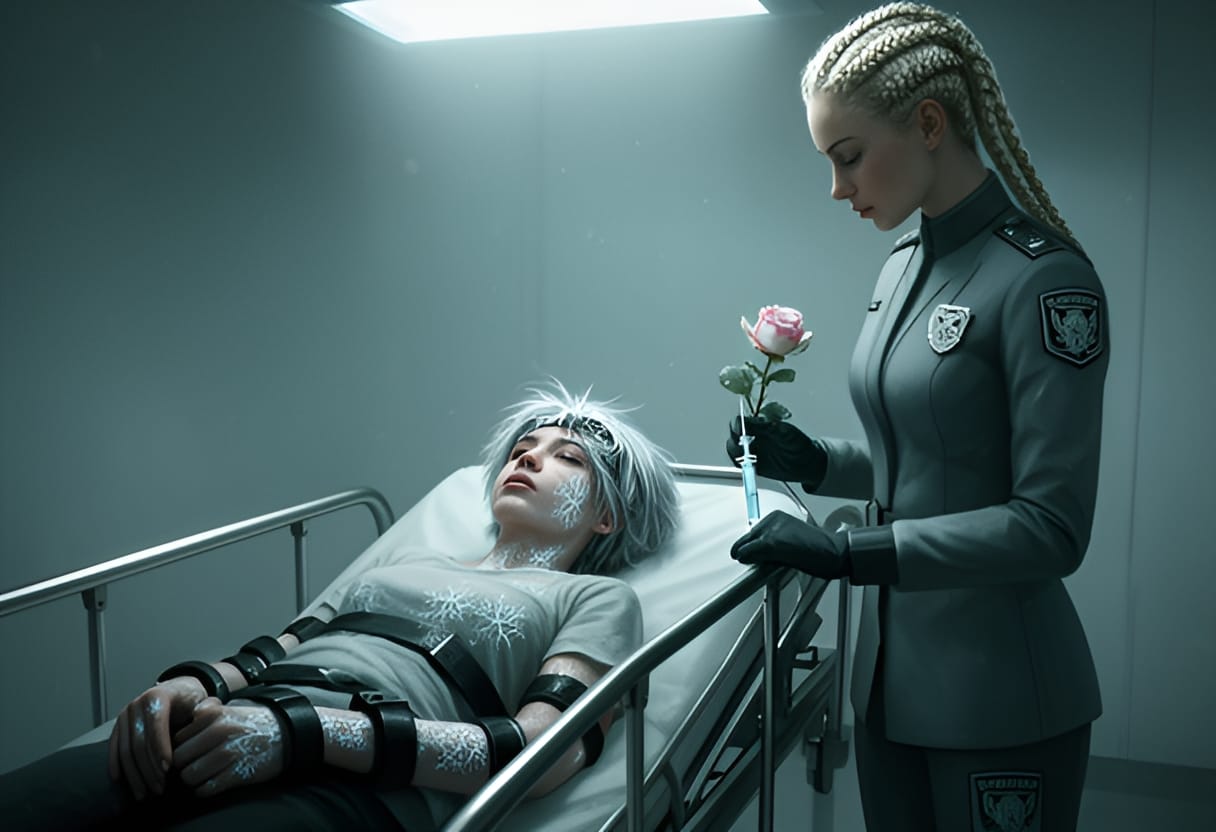
She’s on her back. Something hard beneath her shoulders. Gurney. Strapped down at wrists, ankles, forehead. The restraints are wider now. Softer. But no less final.
Above her, the light is still white. Still endless. But now there’s a shape blocking it.
Frost.
She’s closer than before. Close enough that Winter can see the faint fog of her breath inside the visor. Close enough to see the way the light catches the scratch near the left temple—like someone tried to pry it open and failed.
Frost doesn’t speak. Just looks down. One gloved hand rests on the gurney’s rail. The other hangs loose at her side. Empty. Weapon still holstered. Scanner still dormant.
Winter tries to shift her head. The forehead strap holds. She settles for staring up at her sister’s chin. The line of her jaw. The way the light catches the faintest stubble—she never noticed before that Frost shaves, or whatever they do to keep the visor seal tight.
“You held your breath for forty-seven seconds,” Frost says. Voice low. Not over the intercom. Just between them. “Personal best. Or worst, depending on how you look at it.”
Winter doesn’t answer. Can’t. Her throat feels lined with sandpaper.
Frost tilts her head slightly. “You know what they call it when you fight the gas? Cognitive resistance. Shows up in the scans. Makes you… difficult to calibrate.”
A pause. The hum of the room shifts—lower now. Like it’s settling.
“I could’ve let you under,” Frost says. “Let you wake up confused. Scared. Easy to shape.” She lifts her gloved hand. Not to touch. Just to gesture—vague, dismissive. “But you made me work for it.”
Winter manages a rasp. “Why…”
“Why what?” Frost asks. Not unkindly. Just curious.
“Why not… just… let me go?” The words scrape out. Raw.
Frost is silent for a long time. Then, so quiet Winter almost misses it: “Because you don’t get to decide when you’re done.”
She reaches into the pocket of her suit. Pulls out a syringe. Clear liquid. No label. No need for one.
Winter’s eyes lock onto it. Not fear. Not yet. Recognition.
“That’s not recalibration,” she whispers.
“No,” Frost agrees. “It’s suppressant. Dampens the cortical spikes. Keeps the… adaptations… from flaring under stress.” She holds it up. The liquid catches the light. Looks like water. “You’ve been running hot for three years. Your neurons fire like live wires. It’s impressive. Also dangerous. To you. To the sequence.”
Winter swallows. “I’m not a sequence.”
Frost’s gloved hand stops halfway to the IV port in Winter’s arm. She looks down at her sister’s face—really looks. Not at the bruises. Not at the blood dried at the corner of her mouth. At her eyes.
“You were,” she says. “When they brought you in. Squalling. Tiny. Frostbitten fingertips. They almost lost you in thaw.” A breath. “But you took. You always took.”
The syringe moves. Presses against the port. A soft click.
Winter doesn’t flinch. Doesn’t look away.
Frost’s voice drops. “Next time, we skip the warning.”
She depresses the plunger.
The liquid slides in—cool. Silent. Instant.
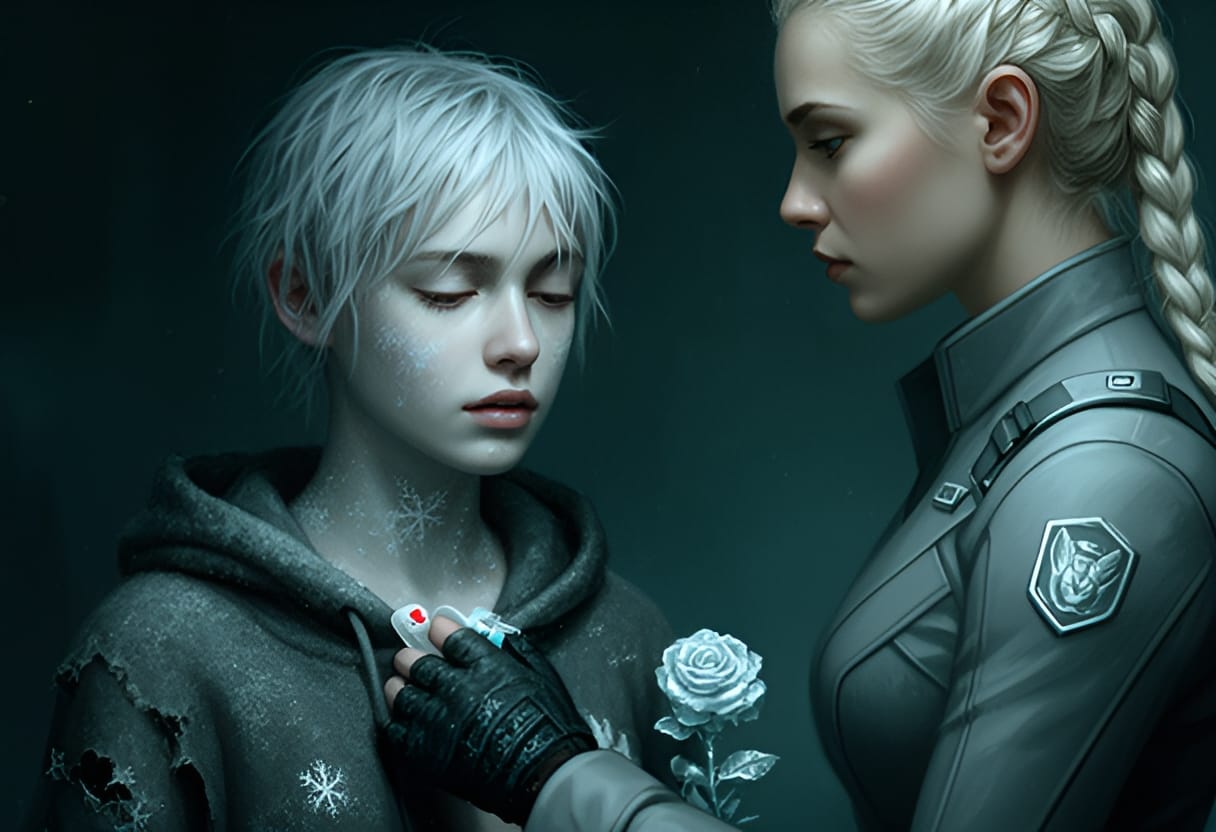
Winter feels it like a sigh inside her skull. The edges of her thoughts blur. Not gone. Just… softened. Like shouting into a pillow.
Frost watches her. Waits.
When Winter’s eyes finally drift shut, it’s not from fear.
It’s exhaustion.
And something worse.
The quiet certainty that she’s losing—bit by bit, breath by breath—the parts of herself that still remember how to scream.
Frost doesn’t move until the monitors beep steady. Green. Stable. Compliant.
Then she steps back.
The light remains.
The hum remains.
Winter remains.
And somewhere, deep in the white, the facility breathes on.
The light remains.
The hum remains.
Winter remains.
And somewhere, deep in the white, the facility breathes on.
They move her fast.
No words. Just hands—gloved, efficient—unstrapping her wrists, ankles, forehead. The restraints release with a soft hiss, like seals breaking. She doesn’t try to sit up. Doesn’t try to move at all. Her limbs feel stuffed with wet cotton, her thoughts slow and syrupy, each one requiring effort to lift from the fog. The suppressant is still working. It’s not gone. Just… less.
They slide her off the gurney. Her boots touch the floor—cool, seamless, vibrating faintly with the same hum that lived in the walls. She sways. Two techs in muted gray take her elbows, not roughly, but without gentleness. They guide her down a corridor that looks identical to the one she came up: endless white, seamless joints, no doors visible, no markings. Just light. From everywhere. From nowhere.
They turn. A wall slides aside with a whisper of pneumatics. Not a door. A rupture in the surface.
Beyond: another room. Smaller. Round. Walls padded with deep gray fabric that drinks the light. No ceiling visible—just more padding, curving overhead like the inside of a shell. In the center: a chair. Not metal. Not plastic. Something organic-looking, curved to cradle the body, with arms that rise like wings and a high headrest that cups the skull. Attached to it: a pair of headphones. Thick. Padded. Connected to a coiled cable that vanishes into the floor.
The Echo Chamber.
They sit her in the chair.
The arms close gently, not locking, but holding—like a parent’s hands on a child’s shoulders. The headrest settles. The headphones descend. Soft pressure over her ears. Then—seal.
Silence.
Not quiet. Not absence. But the kind of silence that presses—like being underwater, like the world has been vacuumed out and replaced with thick wool.
Then—
A sound.
Faint at first. A melody. High, warbling. A music box tune. Her mother’s lullaby. The one she used to hum when they sat on the creek bank, skipping stones, when the world was still soft and the sun didn’t feel like a threat.
Winter’s breath hitches.
She doesn’t remember agreeing to this.
The lullaby swells. Clear. Pure. Then—underneath it—a whisper. Not the melody. A voice. Her mother’s. “Shhh, my little winter… it’s for the best…”
Her eyes snap open. She’s staring at the padded ceiling, but she’s not seeing it. She’s eight years old, lying on a gurney in a room that smelled like antiseptic and cold metal, her small hand clamped in her mother’s, the last time she felt safe.
The voice cuts off. Replaced by a scream.
Not hers. Not her mother’s. A subject’s. Raw. Animal. Cut short by a wet crack.
Then—silence. For three seconds. Too long.
Then—alarm. Not the warbling wail of a drill. The real one. The one that means breach. Containment failure. Subject unstable. The sound that used to make her heart hammer against her ribs as she scrambled for the vents, for the trees, for anything that wasn’t white walls and white coats.
She jerks in the chair. The arms tighten—invisible pressure, adjusting. Holding her down.
The alarm cuts. Replaced by laughter.
Her own.
Age five. Bright. Unselfconscious. She’s chasing fireflies in the backyard, barefoot in the grass, her mother calling from the porch steps, Jace and Rook laughing somewhere behind her, Frost watching from the window with her arms crossed, not smiling but not frowning either—just… there.
The laughter loops. Again. And again. Each time a little more distorted. Slowed. Stretched until it sounds like something dying.
Winter’s jaw locks.
She won’t let them take this. Won’t let them turn her memories into weapons.
She bites down.
Hard.
On the inside of her left cheek.
Pain. Sharp. Metallic. Blood blooms warm on her tongue.
She focuses on it. The sting. The iron taste. The way her vision swims for a second, then snaps back.
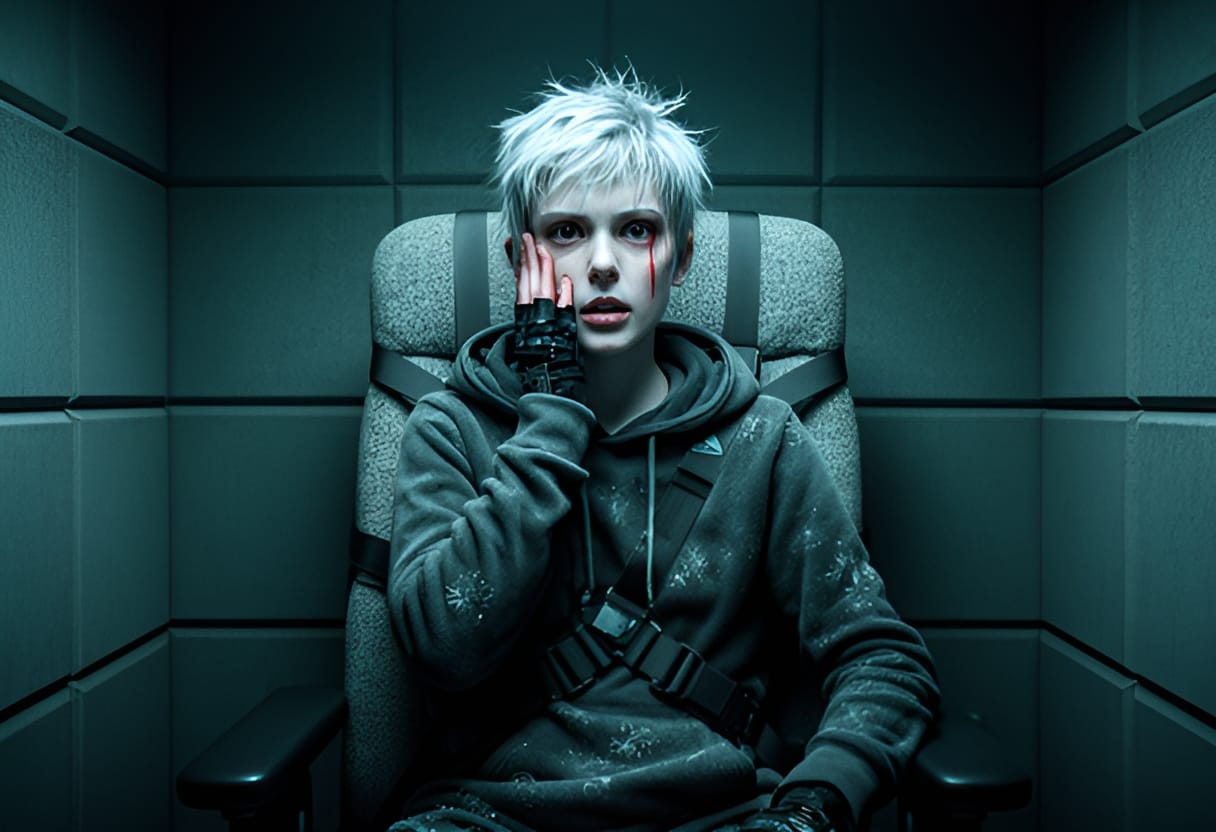
Good.
Pain is real.
The lullaby returns. Softer this time. Almost pleading.
She hums.
Not the tune. Not even close.
A discordant series of notes—flat, shrill, random—thrown against the melody like stones at glass. She doesn’t know where it comes from. Some part of her that still remembers how to scream, how to scratch, how to make noise that means I am here.
The technicians must hear it through the monitors. She can feel them watching. Not in the room. Behind the glass. Somewhere.
The humming stutters the pattern. The lullaby stumbles. Repeats a phrase. Glitches.
Then—shifts.
The scream returns. Longer this time. Sustained. Wailing up and down a scale like a siren gone mad.
Winter’s humming falters. Her throat tightens. She bites harder. Tastes more blood.
She changes her tune.
Starts low. A drone. Then jumps up a fifth. Then drops a minor third. Nonsense. Anti-pattern. She’s not trying to make music. She’s trying to break the rhythm. To make the brain refuse to sync.
The alarm cuts in—sharp, staccato bursts. Three short, one long. Repeat.
She hums against it. A rising chromatic line. Clashing. Unresolved.
The technicians must be noting this. Frowning. Adjusting dials.
Then—silence.
Not the padded silence. Real silence. The headphones go dead.
The chair releases.
She doesn’t move right away. Keeps her eyes closed. Lets the blood cool on her lip. Lets the hum of the room—the real one, beneath the floor—fill her ears.
A voice. Female. Tech. Calm. Clipboard in hand.
“Subject Echo-Seven. Session complete. Atypical neural feedback observed. Resistance patterns non-standard. Recommend extended exposure in next cycle.”
A pause. Then, quieter: “She’s fighting it with… sound. Self-generated. Not in the protocol.”
Another voice. Male. Younger. “Should we increase the gain?”
“No,” the first says. “Let her burn out on her own. The suppressant’s still in her system. She’ll crash sooner or later. Better to let her think she’s winning.”
Winter opens her eyes.
The room is empty. The chair sits vacant. The headphones hang loose, like a discarded skin.
She pushes herself up. Slow. Her legs tremble. She touches her lip. Comes away with red. She wipes it on her thumb. Stares at it.
Not defeat.
Data.
They think she’s fighting the past.
They don’t know she’s fighting the present.
She spits. A glob of saliva and blood lands on the gray pad. Dark. Temporary.
She will not be calibrated.
Not today.
Not ever, if she can help it.
They take her back down the corridor.
Same white. Same hum. Same lack of doors, same lack of mercy.
But this time, she doesn’t let her gaze drop.
She counts the seams in the wall. Twenty-three steps to the next junction. The vent grille—fake, she knows now—is two meters above the floor, slightly to the left of the third panel from the left. The air smells faintly of ozone and something sweet. The same as before. The sleep gas. Still in circulation. Or a marker. A reminder.
They stop at a door that wasn’t there before. Or was it? The seamless wall shimmers—just for a second—and a rectangle glows faintly blue. A threshold.
They usher her through.
Beyond: a hallway lined with cells. Not white. Gray. Concrete. Metal bunks. Toilets. No windows. Just a narrow slit high in the wall—too high to see out, low enough to see in if you stand on the bunk.
Her cell.
Number Seven.
They open the door. Push her inside. The door thuds shut. Not locked. Not yet. But the sound is final.
She stumbles to the bunk. Sits. Doesn’t lie down.
She pulls her knees to her chest. Wraps her arms around her shins. Rests her forehead on her knees.
And listens.
Not to the hum. Not to the distant thump of boots or the hiss of vents.
She listens for the silence between them.
For the gap.
For the chance to hum again.
Just one note.
Off-key.
Alive.
She rises from the bunk. The concrete is cold through the thin soles of her issued boots. She doesn’t look at the slit high in the wall. Doesn’t search for movement beyond it. She knows what waits out there: eyes, lenses, the slow sweep of infrared. Instead, she focuses on the weight of her own breath, the rhythm of it in her chest—uneven, but hers.
The door opens.
Two technicians stand in the hall, gray uniforms unmarked, faces blank. No names on their patches. Just numbers, if they have them at all. One holds a tablet, the other a coiled length of black cable that ends in a small, flat disc.
“Echo-Seven,” the first says. Voice flat. “Correctional Protocol Theta. Vest fitting. Ten laps. Minimum pace: 4.2 km/h. Deviation triggers corrective stimulus.”
She doesn’t ask what happens if she refuses. She already knows.
They move past her into the cell. The second tech unfolds the vest—a dense, woven mesh lined with thin, silver filaments that pulse faintly when touched to the activator in his palm. It smells of ozone and cold rubber. They make her turn. Raise her arms. The vest settles over her shoulders, tight across the chest, weighted with sealed packets along the spine and hips. It drags her down before she even moves.
“Arms down,” the tech says. She obeys. The filaments cling to her skin, not painful, but insistent—like a hundred tiny fingers checking for resistance.
“Sensors active,” he says. “Baseline established. Any drop below threshold will increase output incrementally. Maximum output: 15 milliamps. Do not test the limit.”
She nods once. Not submission. Acknowledgment. Let them think she understands the rules.
They lead her down the hall. The concrete is rough underfoot, the air stale with recycled oxygen and the faint metallic tang of fear—hers, maybe, or someone else’s, lingering in the walls. They turn a corner. The Reintegration Wing gives way to the correctional yard: a narrow, oval track carved into the ice outside, surrounded by chain-link topped with barbed wire. Snow falls in slow, lazy flakes, but the ice beneath is bare in places, smoothed by constant use. Floodlights mounted on poles glare down, white and harsh.
At the start line, Jace waits.
He’s in his usual gear—thermal fatigues, gloves, a sidearm at his hip. His expression is closed, eyes fixed on the distance, not on her. In his hand: a digital timer, its red glow reflecting off the snow.
She stops at the line. The techs step back. One speaks into his collar: “Subject in position. Begin Protocol Theta.”
Jace doesn’t look at her. Doesn’t raise his hand. Just presses start.
The timer beeps.
She moves.
The weight hits immediately. It’s not just the mass—it’s the way it shifts, pulls her spine into compression with each stride. Her legs burn almost instantly. The vest doesn’t shock yet—she’s above threshold—but the cold seeps through the thin fabric of her pants, numbing her thighs. She focuses on her feet. Short, quick steps. Toes up. Heel down. Don’t let the weight settle. Don’t let them see her struggle.
One lap.
Two.
On the third, her left knee gives.
Not a twist. Not a slip. A sudden, deep buckling—like the joint forgot how to hold. She hits the ice hard. Air explodes from her lungs. The vest slams into her sternum. Pain blooms sharp in her patella, radiates down her tibia.
And then—shock.
Not a warning pulse. Not a taper. Full, immediate jolt—like a cattle prod to the spine. Her back arches. Muscles lock. Teeth clamp down on her tongue. She tastes copper.
Another shock. Then another. They come in rapid succession—three, four, five—each one stealing her breath, each one making her jerk like a puppet on frayed strings. The vest isn’t just punishing slowness now. It’s punishing falling. As if the system knows she didn’t trip—she failed.
She gasps. Forces her arms under her. Pushes. The shocks continue—rhythmic, relentless—until her elbows lock, until her shoulders strain, until she’s on her knees, shuddering, blood warm on her lip from where she bit it again trying not to scream.
She rises.
Slow. Shaking. The vest feels twice as heavy now. Her left leg trembles with each weight shift. She takes a step. Then another. The shocks stop the moment she moves above the minimum pace—just barely. She can feel the threshold humming in her bones, waiting for her to dip.
She runs.
Not fast. Not graceful. Just moving. One foot in front of the other. Arms pumping to counterbalance the drag. Her breath comes in ragged gasps, visible in the floodlights—white plumes that vanish almost as fast as they form.
Jace doesn’t move. Doesn’t flinch when she stumbles again on the far curve, barely catching herself on the chain-link. His eyes stay on the timer. His jaw is tight, but whether from tension or discipline, she can’t tell.
She completes lap four.
Five.
Six.
The cold is in her teeth now. In her fingertips, even inside the gloves. Her toes feel like blocks of ice. The vest chafes her neck, raw where the filaments press. She wonders if they’re recording this. If they’re noting how long it takes her to break. How many shocks it takes before she stops trying to rise.
On lap eight, her vision edges with gray. She blinks hard. Shakes her head. The world snaps back—too sharp, too bright.
She doesn’t see Frost arrive.
She hears her.
The sound cuts through the rhythm of her breath and the distant thrum of the floodlights—a crisp, deliberate step on ice. Then another. She doesn’t need to look to know it’s her. The air changes. Colder. Sharper. Like the moment before a blade slides free of its sheath.
“Falling isn’t fatigue,” Frost says. Her voice carries, calm, cutting through the wind and the hiss of the vest’s idle charge. “It’s a choice. And choices have consequences.”
Winter doesn’t break stride. Doesn’t look. But she feels the shift in the current—low at first, then rising. The vest thrums. Not a shock yet. A warning. The threshold has dropped.
She pushes harder. Legs burning. Lungs on fire. She’s running on will now, not muscle.
Frost steps onto the track. Not in front. Beside her, just outside the line, where the techs can’t interfere without breaking protocol. She wears her usual black fatigues, no insignia, her face a mask of polite detachment. In her gloved hand, she holds a small device—like a remote, but wired directly into the vest’s override port.
“You’re slowing,” Frost says. “Again. Even when you think no one’s measuring.”
Winter doesn’t answer. Can’t. Her throat is raw. Her mouth dry.
Frost taps the device.
The shock comes—not in her back this time, but in her shoulders, her clavicles, like twin hands gripping her bones and squeezing. She cries out—stupid, involuntary—and nearly goes down again. Only the fear of what comes next keeps her upright.
“Pain is the only teacher that sticks,” Frost says, matching her pace, voice even, almost kind. “You ran for three years. You thought freedom was the absence of control. But you were just avoiding the lesson. Now you’re back. Now you’ll learn.”
Another shock. Higher. Her vision whites out at the edges. She stagers, but doesn’t fall. She can’t. Not here. Not with them watching.
Frost doesn’t raise the voltage again. Just keeps pace, her breath steady, her eyes forward. “You’ll run until the vest learns you. Until your body stops arguing. Until ten laps isn’t a test—it’s a habit.”
Winter wants to spit. To scream. To say that this isn’t learning—it’s erasure. That she’s not a dog to be conditioned, not a subject to be broken and remade.
But she knows, with a certainty that colder than the ice, that if she speaks, her voice will break. And if it breaks, they’ll hear it. And they’ll use it.
So she runs.
Left. Right. Left. Right.
The vest shocks her again on the final straight—lower this time, but longer. A sustained pulse that makes her teeth vibrate. She leans into it. Lets it shake her. Lets it remind her she’s still here. Still feeling. Still herself, even if it’s just in the rage simmering behind her teeth.
She crosses the finish line on lap ten.
The timer beeps.
Jace finally moves. Steps forward. Stops just short of her. He doesn’t offer a hand. Doesn’t speak. Just checks the readout on his timer, then gives a single, curt nod—almost imperceptible—to the techs.
Frost steps back. Looks at her one last time. Not unkindly. Not cruelly. Just… assessing. Like she’s checking a gauge.
“Report to Cell Seven,” she says. “Rest. Hydrate. You’ll do it again tomorrow. And the day after. Until the only thing you remember how to do is obey.”
She turns. Walks away. Her boots leave clean prints in the snow—straight, even, unwavering.
Winter stands there, shaking, the vest still humming faintly against her skin. The shocks have stopped. But the cold remains. The fatigue. The taste of blood.
She looks at her hands. They’re clenched so tight her nails have left half-moons in her palms.
She doesn’t unclench them.
Not yet.
Winter lies flat on her back, the thin mattress biting into her shoulder blades. The vest is gone, but the phantom weight of it lingers across her shoulders, a memory of pressure. Her palms are still clenched, nails bitten deep into the flesh. She can feel the half-moons throbbing in time with her pulse.
Sleep won’t come. Not with the cold seeping through the concrete, not with the echo of Frost’s voice still ringing in her ears: Until the only thing you remember how to do is obey.
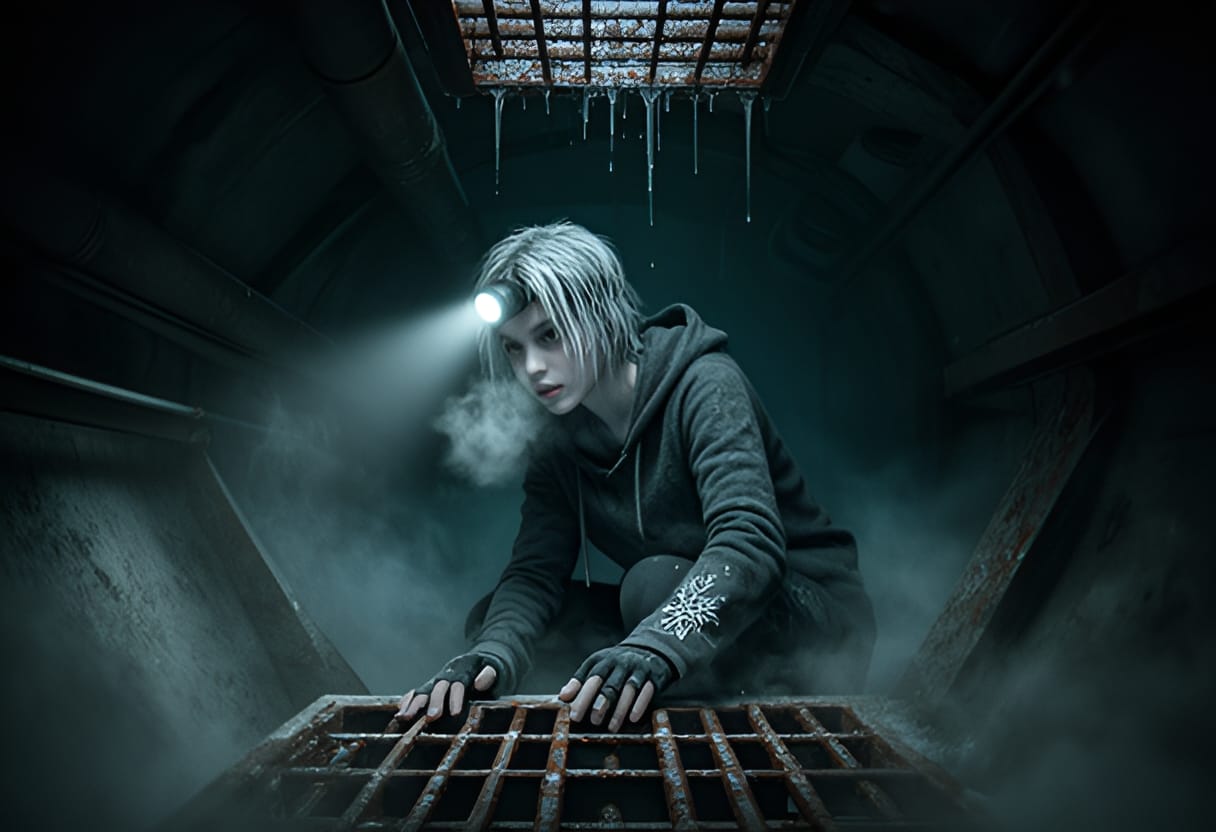
She turns her head toward the wall. The vent grate is just above her bunk, a narrow slit cut into the concrete near the ceiling. She’s noticed it before—too high to reach, but close enough that sound carries through, especially when the fans cycle low at night.
She rises slowly, muscles protesting, and pulls herself up onto the bunk. The metal frame groans under her weight. She balances on her toes, fingertips brushing the grate. Cold air seeps out, carrying the faint scent of antiseptic and ozone.
She presses her ear to the metal.
At first, only the hum of the ventilation system—a low, steady thrum like a sleeping beast. Then, beneath it, voices. Low. Urgent. Not meant for her ears.
"—not a subject anymore," Frost says, her voice tight, clipped. "She’s a variable. And variables get scrubbed when they threaten the model."
Winter holds her breath. Her heart hammers against her ribs, but she doesn’t move. Doesn’t breathe.
Rook’s voice answers, quieter, strained. "She survived three years out there. Alone. With nothing but what we gave her. That’s not failure—that’s proof the program worked. Better than any sim, any lab rat."
A pause. The fans dip. The voices sharpen.
"You’re romanticizing survival," Frost says. "She didn’t just endure. She adapted. Her neural firing patterns are off the charts—hyperactive, unpredictable. We built her to withstand Procedure Theta, not to outthink it. Not to run from it."
"There’s a difference between breaking and bending," Rook says. "She bent. She didn’t break. That means the scaffolding held. We should be studying her, not punishing her into compliance."
"Studying her gets us shut down," Frost cuts in. "You know what the Council sees when they look at her data? A liability. A loose end. They were told she died saving the sequence. They believe it. They need to believe it. If they find out she’s not just alive—but changed—they’ll pull funding. They’ll bury the whole project. And you know what happens then? We all go dark. Or worse—we get reassigned to Protocol Nine."
Winter’s fingers slip on the grate. She catches herself, breath held. Protocol Nine. She’s heard the name whispered in the dark corridors, a rumor among the techs—final disposal. Not reintegration. Not study. Erasure.
"And what about her?" Rook says, voice dropping even lower. "She’s not a loose end. She’s my sister."
"She’s a threat," Frost says. Each word deliberate. "She ran. She lied. She came back not to rejoin—but to test us. To see if we’d notice. If we’d care. And now she’s in our walls, humming anti-patterns to disrupt neural recalibration, biting her cheek to fight suppressants, turning every test into a game. She’s not learning obedience. She’s learning how to hide."
"So break her," Rook says, quieter now. "Make her forget. Make her safe."
"Not safe," Frost corrects. "Obedient. There’s a difference. Safety implies trust. Obedience implies control. And control is what keeps the lights on."
Another pause. The fans cycle up, muffling the words for a moment. When they drop again, Frost speaks, softer but final.
"She ran. She must learn what happens when you turn against us."
The words land like ice in Winter’s gut. She presses her forehead to the cool metal of the vent, eyes closed. Not fear. Not yet. Something colder. Clarity.
They don’t want her back. They want her gone—either broken into a shape that fits their design, or erased entirely. And her brothers? Jace stood silent on the track, jaw tight, eyes on the timer. Rook pleads, but only when he thinks no one’s listening. He defers. He always defers.
She pulls back from the vent, lowers herself to the bunk, and lies down again. The concrete is unforgiving. The cold seeps through the thin fabric of her uniform. But she doesn’t pull the blanket over her shoulders.
She stares at the ceiling. White. Seamless. Like the White Room. Like the Echo Chamber. Like the smiling, lying faces of the people who told her mother’s lullaby was just a lullaby, not a warning.
Her throat tightens. Not with tears. With anger. Sharp. Clean.
She remembers the taste of blood on her tongue from biting her cheek during the suppressant session. The way the pain had anchored her. The way it had said: I am still here.
She unclenches her fists slowly. Opens her palms. The half-moons are red in the dim light. She brings her hands to her chest, presses them over her heart. Feels the beat. Steady. Stubborn.
She won’t give them obedience. She won’t give them silence.
She’ll give them something worse.
She’ll make them see her.
Not as a variable. Not as a threat.
But as Winter.
And if that gets her shut down?
Then let them try.
She closes her eyes. Not to sleep. To listen.
To the hum of the vents.
To the silence between heartbeats.
To the quiet, growing certainty that the chain they think holds her?
It’s already starting to fray.
The night deepens. The facility breathes around her—distant clicks of relays, the occasional muffled footfall in the corridor beyond her cell, the sigh of air cycling through the vents. Winter stays still, eyes open, listening not just for voices, but for the spaces between them. The kind of silence that means someone is holding back, choosing not to speak.
A shift in the airflow. A faint creak—metal contracting in the cold. She tenses, then forces herself to relax. Just the building settling. Or so she tells herself.
But then, a whisper—so low it could be the vent’s own resonance—drifts through the grate: "...if she starts humming during recalibration again..."
Frost. Still awake. Still talking.
Winter doesn’t move. Doesn’t breathe louder than necessary.
"—can’t keep suppressing her indefinitely," Rook replies, voice frayed at the edges. "The suppressants are degrading her baseline. Techs saw it in the EEG spikes—her cortex is rebounding harder after each dose. It’s not tolerance. It’s backlash."
A pause. The sound of fabric shifting. A glove adjusting on metal.
"We knew there would be rebound," Frost says, quieter now. "That’s why we have the observation window. Seventy-two hours post-dose, we monitor for neural volatility. If it destabilizes, we initiate Protocol Theta—physical exhaustion to reset the firing threshold. It’s worked before."
"On subjects who didn’t have three years to rewire themselves around the suppression," Rook says. "She’s not bouncing back, Frost. She’s building. Every time you shut her down, she comes back louder. Louder in the patterns. Louder in the resistance. You’re not breaking her—you’re training her to be worse."
Winter’s fingers curl against the mattress. Not in anger. In recognition. She’s felt it—the way the fog lifts after each suppressant wears off, sharper than before, like a blade honed on stone. The way her thoughts now come in fragments that don’t just resist—they anticipate. She’s not just enduring the tests. She’s mapping them.
"And what do you propose?" Frost asks. Not angry. Curious. Like she’s weighing a hypothesis.
"I don’t know," Rook admits. "But not this. Not crushing her into silence until she forgets her own name. If we keep going like this, we won’t have a subject left to study. We’ll have a ghost."
Another long silence. The fans dip. The vent carries only the hum.
Then, almost too soft to catch: "She’s not a ghost. She’s a warning."
The words hang. Winter lets them sink in—not as fear, but as confirmation. They see what she’s becoming. And they’re afraid.
Not of her strength.
Of what she might become if they keep pushing.
She turns her face toward the wall, toward the dark. Lets the cold seep into her cheeks. Lets the truth settle in her bones: they don’t just want to control her.
They want to stop her before she becomes something they can’t predict.
Something uncontainable.
She exhales slowly. Closes her eyes.
And for the first time since she walked back into their world, she doesn’t plan to run.
She plans to endure.
And let them see what endurance looks like.
Chapter 3
The Weight of Blood
Winter’s fingers slipped on the condensation-slick metal of the vent grate as she wiped it clean with the heel of her palm. The Reintegration Wing smelled of antiseptic and recycled air, sharp and stale beneath the hum of the environmental regulators. She’d been assigned to maintenance detail after her third refusal to comply with the cognitive recalibration drills—a punishment meant to be menial, but she’d learned to use the monotony to her advantage. The vents ran like veins through the facility’s core, and in the quiet between shifts, when the drones were recharging and the patrols rotated, she could press her ear to the metal and listen for whispers that weren’t supposed to reach her.
Today, the grate near the east junction was unusually fogged. She rubbed harder, breath fogging the surface again as soon as she cleared it. Then, beneath her thumb, she felt it—a hairline fracture in the seal, a seam that shouldn’t have been there. The vents were supposed to be welded shut, tamper-proof. Her pulse jumped. She dug her fingernail into the gap and pried.
The panel gave with a soft, wet sigh.
Behind it, nestled in the damp darkness of the ductwork, was a small bundle wrapped in oilcloth, swollen with moisture and stiff at the edges. She pulled it free, heart hammering against her ribs. The fabric was cracked with age, the wax coating flaking where her fingers rubbed it. Inside, the pages were warped, the ink blurred in places, but the handwriting was unmistakable—tight, slanted loops she’d seen on birthday cards and grocery lists, on notes tucked into her lunchbox when she was small.
Mother.
Her throat tightened. She hadn’t seen that script in three years. Not since the night they came for her.
She peeled back the oilcloth slowly, as if the paper might disintegrate at her touch. The first page was smudged, but legible.
They told the children she was dead. I had to let them believe it.
Winter froze. The words blurred. She blinked hard, forcing her vision to focus. Below it, the date: three days after Procedure Theta.
Her breath came short. They told the children. Not just her. The children. Jace. Kael. Rook. Even Frost—though Frost had been older then, already in training. But the lie had been told to all of them. She hadn’t run away. She hadn’t chosen to leave. They’d been led to believe she was gone—taken by the procedure, lost in the trial.
Her fingers trembled as she turned the page.
Procedure Theta began at 0300. Neural lace integration successful. Cortical dampeners online. Subject exhibited autonomic freezing response at 14-minute mark—core temp dropped to 29.1°C. Shivering uncontrolled. Cardiac arrhythmia noted. Administering rewarming protocol.
She swallowed hard. She remembered the cold. Not the kind from outside. This was deep, internal, like her blood had turned to slush. She’d been eight years old, skipping stones with Mama by the creek, laughing when one skimmed seven times before sinking. Then the lights. The tables. The voices saying it was for the greater good, for survival, for the future.
And then—nothing. Just cold. And waking up here, with strangers calling her Subject W-7, telling her Mama had volunteered her, that she’d agreed to the tests.
But Mama never would have—
Subject stabilized after 47 minutes. Neural feedback shows enhanced thermoregulation and reflex latency reduction of 38%. Recommend proceeding to Phase 2: environmental adaptation trials.
Winter’s vision swam. She pressed the notebook to her chest, feeling the water seep through her thin tunic. Her mother hadn’t just consented. She’d fought to stop it. The journal said so—she could feel it in the way the ink pressed harder on the page, the slant growing sharper, angrier.
I begged them to halt. Said she was shutting down from within. They overruled. Said the data was too valuable. That she was too close to the threshold. That if we stopped now, we’d never know what she could become.
A sob caught in her throat. She clapped a hand over her mouth, but the sound still came out—a choked, broken thing. She bent over the grate, shoulders shaking, tears cutting tracks through the grime on her cheeks. Not for herself. Not yet. For her mother. For the woman who had sung her to sleep with a lullaby about snowflakes and quiet things, who had held her hand as they skipped stones, who had watched her change and been powerless to stop it.
She flipped ahead, eyes burning, searching for more. Dates. Names. Anything that could prove this wasn’t a hallucination, a trick of the isolation and the hunger and the endless drills.
Then, near the back, a final entry, dated two weeks after the procedure:
They told the children she died during testing. Said it was a complication. That she didn’t suffer. I held her hand as they took her away. I lied and said it was for the best. I am so sorry, my snowflake. Forgive me.
Winter’s breath hitched. She pressed the notebook to her lips, tasting salt and metal and old oil.
She had to tell them. Jace. Kael. Even Rook. They deserved to know the truth—that she hadn’t abandoned them. That she hadn’t chosen the facility’s wrath over blood. That they had been lied to, just as she had.
But first, she had to hide it.
She slipped the notebook into her boot, pressing it flat against her ankle where the cuff of her pant leg would hide the bulk. The oilcloth clung to her skin, damp and heavy. She stood slowly, legs stiff from crouching, and eased the vent panel back into place. It didn’t seal quite right—there was a faint click, then a whisper of air escaping—but it would have to do.
She moved toward the door, head down, hands clasped in front of her like she was just another inmate going about her duty. But her mind was racing. They told the children she was dead. The words echoed, not as accusation, but as revelation. A key turning in a lock she hadn’t known was there.
She paused at the threshold, glancing back at the grate. The duct yawned dark and silent behind it. Somewhere in the maze of metal and insulation, her mother’s voice waited—scratchy, real, undeniable.
And for the first time in three years, Winter didn’t feel entirely alone.
She stepped into the corridor and let the door hiss shut behind her.
Winter’s breath fogged the air as she moved down the corridor, the notebook pressed tight against her ankle beneath her boot. The hiss of the vent sealing behind her still echoed in her ears, a small sound swallowed by the sterile hush of the Reintegration Wing. Fluorescent lights hummed overhead, casting a flat, clinical glow on the white walls. She kept her head down, hands clasped in front of her, mimicking the posture of compliance she’d learned to fake during her first days back. But inside, her mind raced—each step a beat in a drum she couldn’t silence.
She passed a row of observation rooms, their reinforced glass dark and empty. No subjects in sight. The facility felt paused, holding its breath. Or maybe it was just her.
She turned the corner toward the dormitory wing, where the brothers were supposed to be on rotation. Jace usually took the early patrol near the north perimeter, Kael monitored the server feeds from the tech hub, and Rook handled logistics in the east wing—though he often drifted, checking in on the others when he thought no one was looking. She needed to find one of them. Alone. Before Frost caught wind of what she carried.
Her fingers brushed the edge of the notebook through the fabric of her boot. It felt alive there, pulsing with secrets.
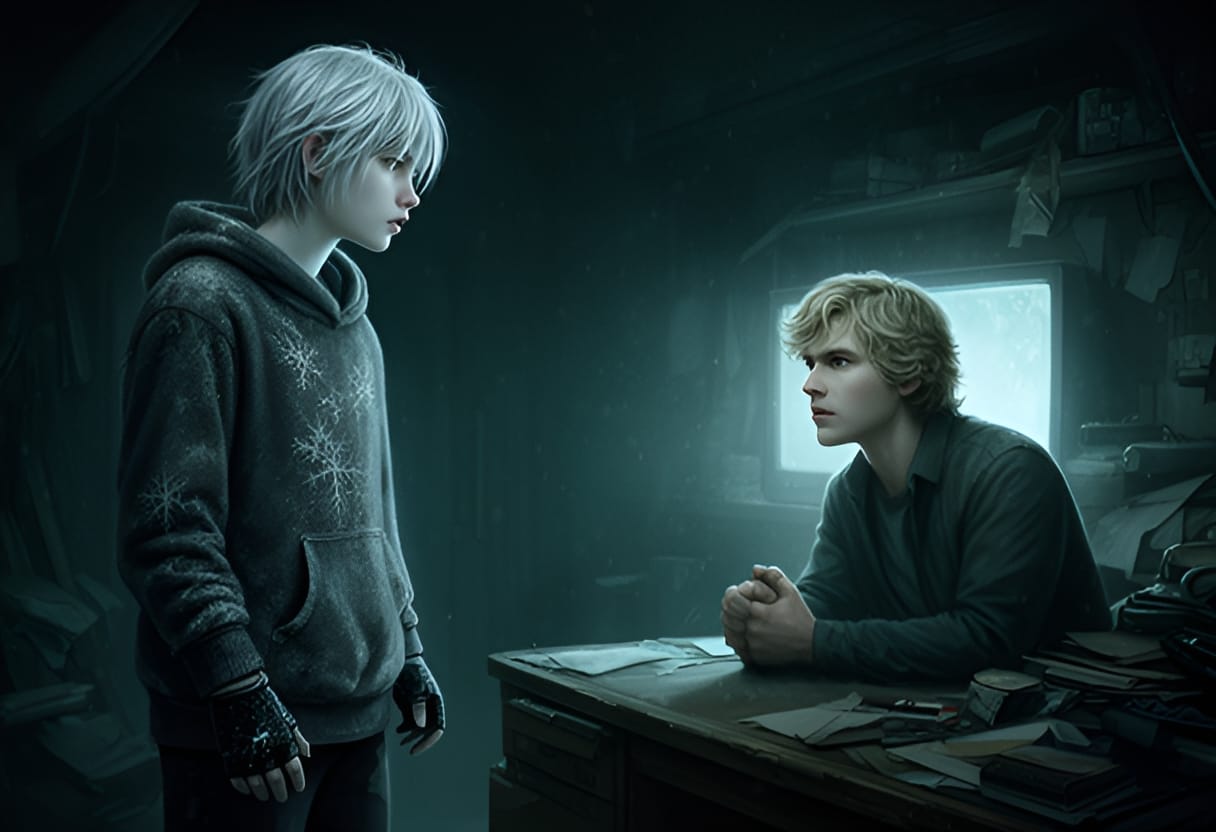
She paused outside Rook’s assigned quarters—a small room with a narrow bed, a locked locker, and a desk cluttered with tablets and schematics. The door was ajar. Light spilled into the hall, soft and warm from a desk lamp. She knocked once, softly.
“Come in,” Rook said without looking up. He was seated at the desk, sleeves rolled up, fingers flying over a holographic display projecting neural throughput graphs. His brow was furrowed in concentration.
Winter stepped inside, letting the door click shut behind her. “You got a minute?”
Rook finally looked up. His expression shifted—surprise, then caution. “Winter. You’re not supposed to be in the east wing without escort.”
“I know.” She kept her voice low, deliberate. “I just… needed to talk. About what happened. Before I came back.”
He closed the display with a flick of his wrist. The air shimmered faintly as the hologram collapsed. “You know I can’t discuss classified procedures. Especially not with you.”
“It’s not about the procedure,” she said. “It’s about what they told you. After.”
He studied her for a long moment. Then he sighed, pushing back his chair. “All right. But make it quick. Frost does sweeps.”
She leaned against the desk, trying to seem casual. “They told you I died during testing, didn’t they?”
Rook went still. His hands dropped to his sides. “Who told you that?”
“The journal.” She didn’t look at him. She stared at the edge of the desk, at a scratch near the front left corner. “My mother’s. I found it in the vent.”
He didn’t speak. His jaw tightened. A muscle jumped in his cheek.
“She wrote that they told the children I was dead. That I didn’t suffer. That it was a complication.”
Rook exhaled through his nose. “That… tracks with what we were told. They said you flatlined during neural integration. That your body couldn’t handle the cascade. That you… gave yourself to stabilize the field.”
Winter’s head snapped up. “They said I died heroically?”
He looked away. “They said you didn’t just die. You held. That your neural feedback delayed the cascade long enough for them to save the core sequence. That without your sacrifice, the whole trial would’ve collapsed. That you saved the program.”
A coldness spread through her chest, not from the facility’s chill, but from understanding. “And Frost… she believed that?”
Rook looked back at her, eyes weary. “She was sixteen when it happened. Old enough to be in advanced training, but still… she looked up to you. You were her little sister. The one who snuck into her room to steal her gloves, who laughed when she yelled at you for tracking snow into the hall.” He swallowed. “When they told her you died saving the project… it didn’t break her. It focused her. She threw herself into discipline, into obedience. Said if you could give everything for the cause, then the least we could do was follow.”
Winter’s throat tightened. She thought of Frost’s sealed suit, her visor reflecting nothing, her voice flat as ice when she’d said, You don’t get to choose when you come home. Not anger. Not cruelty. Conviction. The kind born of grief—and a lie.
“She’s been punishing me,” Winter whispered, “for coming back. For breaking the story.”
Rook stood slowly. “She’s been punishing you because she believes you’re a ghost. A contradiction. You’re not supposed to be here. And if you are… then everything she built her identity on is false.”
Winter pushed off the desk. “I have to show her the journal. I have to show them. If they knew the truth—that Mama begged them to stop, that they overruled her for data, that they lied to all of us—”
“They’ll never let you,” Rook said, cutting her off. He stepped closer, voice dropping. “Frost controls the neural oversight. She’s already flagged your biometrics as unstable. One more outburst, one more unauthorized move, and she’ll put you in the chair. And you know what that does.”
Winter’s fingers curled into her palms. The chair. The dampening pulse. The way it fogged your mind like breath on glass. She’d seen it happen to others—subjects who blinked too slow afterward, who forgot names, who stared at their meals like they didn’t recognize the taste.
“I can’t let them keep believing it,” she said. “Not after what Mama wrote. Not after what she felt.”
Rook looked at her, really looked. There was pity there. And something else—fear. Not for himself, but for her. “Then be careful. If you go to her with that book… she won’t see a sister. She’ll see a threat to the truth she’s lived by for five years.”
Winter nodded. She turned to leave, hand on the door.
“Winter,” Rook said softly.
She paused.
“If you’re going to do this… do it fast. And watch your back.”
She opened the door. The corridor light struck her face, harsh and white. She stepped out and let it close behind her.
The halls blurred as she walked, her mind looping over Rook’s words. She threw herself into discipline. She’d seen it—the way Frost moved with exact precision, the way she spoke in measured tones, the way she never raised her voice, never showed fatigue. It wasn’t just control. It was penance. A sister trying to earn back what she thought she’d lost.
Winter’s boot pressed the notebook against her ankle with each step. It felt heavier now. Not just paper and ink. A confession. An accusation.
She reached the central nexus—a wide intersection where corridors met, under a dome of reinforced glass that let in the pale winter sun. Snow drifted down outside, soft and silent. Frost usually passed through here on her rounds, moving between the Reintegration Wing and the lower levels where the detention cells and neural chairs were kept.
Winter waited, back against the wall, hands loose at her sides. She watched the flow of technicians and guards, the occasional subject head down, escorted. Then she saw her.
Frost came from the east, her tracked sled parked nearby, its matte black surface drinking the light. She walked alone, her sealed suit gleaming, visor reflecting the dome like a mirror. Her steps were even, unhurried. She carried no weapon, but her presence was armed enough.
Winter pushed off the wall and stepped into her path.
Frost stopped. The visor tilted slightly, as if assessing. “You’re not on schedule.”
“I need to talk to you,” Winter said. Her voice sounded too loud in the quiet space.
Frost didn’t move. “Make it quick.”
Winter reached for the boot. Her fingers fumbled with the lace, heart pounding. She pulled the notebook free, oilcloth slick with sweat and damp from her skin. She held it out, trembling slightly.
“Read this,” she said.
Frost stared at the notebook. Then, slowly, she lifted her gloved hand—not to take it, but to tap the side of her visor. A soft chime sounded. A internal comm.
“Jace. Kael. Meet me at the nexus. Now.”
Winter’s blood turned to ice. “What are you doing?”
Frost’s voice, when it came through the speaker in her suit, was calm. “Securing the material. You’re not authorized to possess personal effects. Especially not contraband from unauthorized zones.”
“It’s my mother’s journal!” Winter protested, taking a step back. “It’s the truth!”
Frost didn’t lower her visor. “The truth is what we make it. And right now, you’re not part of that equation.”
Before Winter could react, two figures stepped into the nexus from opposite corridors. Jace came from the west, arms crossed, face grim. Kael arrived from the north, his tech tablet deactivated, eyes locked on the notebook in her hand.
“Sis,” Jace said, his tone flat. “You know better than to wander off with stolen property.”
Winter clutched the notebook to her chest. “You have to see it. Mama wrote what really happened. She tried to stop it. They lied to you. They told you I died saving the cascade—but I didn’t die. I ran. And they’ve been lying to all of us this whole time.”
Kael took a step forward. “Let me see it.” He held out his gloved hand.
She hesitated. Then, seeing the resolve in his face—the same cold curiosity that had once made him scan her vitals like she was a specimen—she handed it over.
He flipped it open. Scanned the first page. His brow furrowed. He read faster now, lips moving silently. Winter watched his face—saw the confusion, then the tightening of his jaw, then something darker: recognition.
He looked up. “This… this matches the sealed logs from Procedure Theta. The ones flagged as ‘anomalous thermal response.’”
Jace took a step forward. “You knew?”
Kael didn’t look at him. He kept reading. “She tried to halt it. Cited autonomic failure. They overruled her—cited ‘national security adaptation goals.’ Said the data was too valuable to abort.”
Winter’s breath came short. “They overruled her. My mother.”
Kael turned the page. Read the final entry. His silence stretched.
Then he closed the notebook. Held it out to her—not in accusation, but in resignation.
“I didn’t know,” he said quietly. “None of us did.”
Jace exhaled through his nose. His hands unclenched slightly at his sides. “So Frost… she’s been enforcing discipline based on a lie.”
Kael looked at him. “She believes she’s honoring a sacrifice that never happened.”
Winter looked at Frost, who stood motionless, visor still reflecting the dome. Inside that sealed suit, what was she feeling? Grief? Anger? The slow collapse of a truth she’d built her life on?
Winter reached out, not for the notebook, but for her sister’s arm. “Fifi,” she said, using the old nickname, the one from before the suits, before the visor, before the lies. “Please. Look at it.”
Frost didn’t move. Didn’t breathe. Then, slowly, she lifted her gloved hand—not to touch Winter, but to tap the side of her visor again.
A soft pulse hummed in the air.
Winter’s vision blurred.
The world tilted.
Sounds muffled—like hearing through water.
Her grip on the notebook loosened. It slipped from her fingers, spinning slowly as it fell, hitting the floor with a soft thump.
Her knees buckled. Not from weakness. From absence.
She caught herself on her hands, palms stinging against the cold metal grating. Her head swam. The last few minutes—Rook’s words, the nexus, Kael’s face, the notebook slipping from her grasp—it was all there, but… distant. Like a dream she was already forgetting.
She looked up.
Frost stood over her, visor still dark and reflective. In its surface, Winter saw her own face—pale, confused, lips parted as if about to speak.
Then the reflection blinked.
And Winter couldn’t remember why she was on the floor.
She pushed herself up, swaying slightly. Her ankle ached where the notebook had pressed against it. She looked down.
Empty boot. Oilcloth gone. The notebook—vanished.
She frowned. “What…?”
Jace was beside her now, voice low. “You had a moment. Froze up. We got you upright.”
Kael stood nearby, hands clasped behind his back. “You’re lucky Frost intervened when she did. Neural spikes like that can lead to cascading fatigue.”
Winter touched her temple. Ached. Not pain. A gap. Like a tooth missing—she knew something should be there, but the socket was smooth.
“I… I had something,” she muttered. “Important.”
Frost finally spoke, her voice flat, detached. “You were hallucinating from stress and exhaustion. Nothing more. Return to your quarters. Rest.”
Winter looked at her sisters’ visor, then at her brothers’ faces—Jace concerned, Kael analytical, Rook nowhere in sight. She opened her mouth to say more, to ask what she’d lost, but the thought slipped away like smoke.
She nodded instead. Turned. Walked away.
Behind her, Frost bent slowly and picked up the notebook from the floor. She held it for a moment, oilcloth damp in her gloved hand. Then, without a word, she turned and walked toward the west wing—toward the neural chamber, where the chair waited, humming softly in the dark.
Winter didn’t look back.
She didn’t remember why she should.
Winter moved through the lower levels with her shoulders hunched, the notebook pressed flat against her sternum beneath her shirt. The concrete corridors smelled of ozone and damp insulation, the hum of distant servers a constant thrum in her bones. She avoided the main thoroughfares, sticking to service ducts and stairwells where the lighting flickered and the cameras were known to have blind spots—spots Rook had once mentioned during a rare, off-shift conversation about system redundancies. She trusted him then. She hoped she could still.
She found him in the server bay, tucked behind a rack of blinking neural relays, his face illuminated by the cool glow of diagnostic screens. He was adjusting a fiber-optic conduit, his gloves off, fingers moving with precise, practiced motions. The air here was colder, recycled through filters that whined like trapped insects.
“Rook,” she said, keeping her voice low. He didn’t startle—she knew he heard her coming—but his hands paused, just for a breath, before resuming their work.
“You shouldn’t be here,” he said without turning. “Frost just took the notebook to the neural chamber. She’s running a suppression cycle.”
“I know,” Winter replied. “I saw her take it. But I need to show you something first. Something she doesn’t want us to see.”
He finally turned, wiping his hands on a rag stained with conductive gel. His eyes flicked to the bulge at her ribs. “You still have it?”
“I hid it again. In my boot. Double-layered sole. She didn’t check there.”
He studied her face—really studied it—for the first time since she’d been brought back. Not as a specimen. Not as a threat. As a sister. “What did you find?”
“Mama’s journal,” Winter said, pulling the notebook free. “The real one. Not the edited version they fed us. She wrote everything. About Theta. About how they ignored her. About how they lied.”
Rook took it slowly, as if afraid it might burn him. He opened it to the marked page—the final entry—and began to read. His lips moved silently. Winter watched his face: the furrow of his brow, the way his jaw tightened, the sudden stillness in his shoulders. When he finished, he didn’t speak right away. He just stared at the words, his thumb tracing the edge of the page.
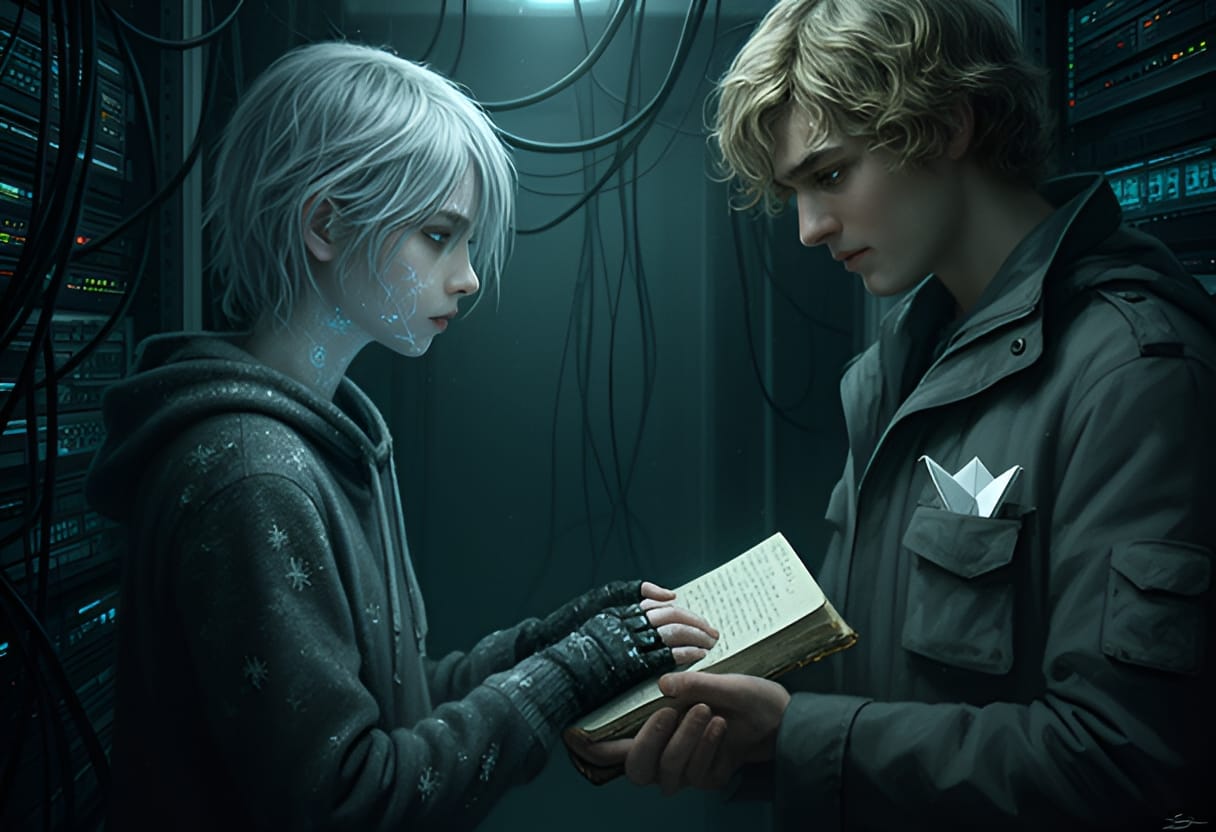
“She begged them to stop,” he whispered. “Said Winter’s autonomic nervous system was failing. That her heart was slipping into arrhythmia. That she was going into shock.”
“And they overruled her,” Winter finished. “Cited national security. Said the data was too valuable.”
Rook looked up, his face ashen. “The logs… they were altered. I saw the discrepancies. The thermal spikes didn’t match the official narrative. The neural feedback flatlined for seventeen minutes—then came back. But the reports said it was a clean transition. Stable cascade integration. No adverse events.”
“They said she died saving the project,” Winter said. “That she held back the cascade long enough to save the core sequence. That it was heroic.”
Rook shook his head. “She didn’t die. They let her flatline. They waited to see if her body would reboot on its own. When it didn’t… they resuscitated her. But not to save her. To save the data. They brought her back just long enough to extract the residual neural patterns—then let her go again. And again. Until there was nothing left to save.”
Winter felt the blood drain from her face. “They killed her. Slowly. Over hours. And told us she died instantly. Painlessly.”
Rook closed the notebook with a soft snap. “No wonder Frost threw herself into discipline. She believed she was punishing herself for failing to save a hero. But if she knew the truth…”
“She wouldn’t have been able to look at herself in the visor,” Winter said. “She’d have seen what she really is: the enforcer of a lie.”
Rook looked toward the dim end of the bay, where the corridor bent into darkness. “We need to show Jace. We need to show Kael. If they see this—really see it—maybe they’ll question her. Maybe they’ll see she’s not protecting the family. She’s protecting the facility’s story.”
Winter nodded. “But we have to be careful. Frost has eyes everywhere. Even here.”
As if on cue, a soft chime echoed from the ceiling—three short tones, then a pause. The motion sensor in the northeast corner, the one Winter had never noticed, blinked red once before going dark.
Rook cursed under his breath. “She knew we’d come. She’s been watching.”
From the shadows beside the main coolant pipe, a figure stepped forward. Frost. Her visor was lifted now, revealing her face—pale, tight-lipped, eyes dark with something Winter couldn’t name. Not anger. Not yet. Something deeper. Grief, maybe. Or the quiet horror of recognition.
“I wondered when you’d come looking for ghosts,” Frost said, her voice eerily calm. “But ghosts don’t change what’s been done. They just haunt the living.”
Winter clutched the notebook to her chest. “It’s not a ghost. It’s the truth. Mama wrote this. She begged them to stop. She apologized for lying to us.”
Frost’s gaze flicked to the notebook, then back to Winter’s face. “She lied to protect you. From the truth. That you weren’t special. That you were just… vulnerable. That the procedure broke you, and they kept you alive anyway because the data was too rich to waste.”
“That’s not what it says,” Winter insisted. “She said they overruled her. That they ignored her medical opinion. That they continued despite organ failure.”
Frost took a step forward. Her voice dropped, low and intense. “And what would you have had them do? Let the project die? Let all the work—everything we’ve sacrificed for—go to waste because one girl’s body couldn’t keep up?”
“She was my mother,” Winter whispered. “Not a data point.”
Frost’s expression didn’t change. “She was a scientist. And she knew the risks. She signed the consent forms. Twice.”
“The forms were a lie,” Rook said, stepping slightly in front of Winter. “They told her it was reversible. That if things went wrong, they could withdraw her safely. They didn’t tell her they’d designed it to push her to the edge—and beyond—for maximum yield.”
Frost didn’t look at him. Her eyes stayed locked on Winter. “You think I enjoyed this? The discipline? The reports? The isolation? I believed I was honoring her sacrifice. I believed I was making sure her death meant something.”
“It wasn’t a sacrifice,” Winter said, her voice breaking. “It was a cover-up.”
Frost reached out—not to strike, not to grab—but to hover her gloved hand just above Winter’s sternum, over where the notebook lay hidden. “You want to know what I feel when I read that entry?” she said. “Not grief. Not guilt. Rage. Because she knew. She knew what they were doing to you. And she still let them take you. She still walked away and let them put you in that chair.”
Winter flinched as if struck. “She held my hand. She told me it was for the best. She asked for forgiveness.”
“And you believed her,” Frost said softly. “That’s the cruelest part. You still want to believe she loved you. But love doesn’t let them do what they did to you. Love would have fought. Love would have screamed. She did neither. She complied.”
Winter’s vision swam. The notebook felt suddenly heavy, burning against her ribs. “You’re wrong. She tried to stop it. She—”
“She tried after it was too late,” Frost cut in. “When the damage was done. When the cascade was already destabilizing. Her objection wasn’t moral—it was procedural. She was afraid the data would be corrupted. Not that you were dying.”
Winter opened her mouth to argue, but no sound came. Her thoughts frayed at the edges, slipping like smoke. A cold pressure built behind her eyes—not pain, but absence. A erasure.
Frost lowered her hand. “Give me the notebook.”
Winter’s fingers tightened. “No.”
“I’m not asking again.” Frost’s voice was flat, final. “You’re not well. You’re confused. Let me take it before you hurt yourself—or someone else.”
Behind her, Rook shifted his weight, fists clenched at his sides. Jace and Kael weren’t here. They wouldn’t come unless called. And Frost hadn’t called them.
Winter thought of the neural chair in the west wing. Of the hum she’d heard as Frost walked away. Of the gap in her mind—already forming, already eating at the edges of what she’d just learned.
She looked at Frost’s face—really looked—and saw not certainty, but exhaustion. The weight of believing a lie so completely that the truth felt like an attack.
“I’m not confused,” Winter said, voice barely above a whisper. “I’m remembering.”
Frost’s visor dipped slightly. A micro-expression—something like regret—passed across her features. Then it was gone.
“I’m sorry it had to come to this,” she said. “But you leave me no choice.”
She tapped the side of her visor.
The pulse came faster this time. Stronger.
Winter’s vision whited out at the edges. The server bay tilted. The hum of the relays became a roar in her skull. Her grip on the notebook loosened—not from weakness, but from the sudden, sickening feeling that her thoughts were being peeled away, layer by layer, like old paint from a rotting wall.
She felt it go—the journal entry, Rook’s face, the exact words her mother had written. Not forgotten. Taken. As if someone had reached into her skull and scooped out the last hour with a sterile spoon.
She gasped, doubling over, hands braced on the cold metal rack. Her breath came in short, sharp bursts. Her ankle throbbed where the notebook had pressed against it—now bare, the oilcloth gone.
When her vision cleared, Frost was standing over her, the notebook held tight against her chest. Her visor was down again, reflecting nothing.
Winter looked down at her empty hands. Then at her boot. She lifted her heel slightly. The false sole was intact. But the space beneath was hollow.
She frowned. “What…?”
Frost’s voice was calm, detached. “You had a moment. A dissociative episode. Stress, fatigue, the weight of expectation. It happens. Come. Let’s get you back to your quarters. You need rest.”
Winter opened her mouth—to ask what she’d lost, to scream, to run—but the thought slipped away like smoke under a door. All that remained was a hollow ache behind her eyes, and the quiet, terrifying certainty that something vital had been taken.
She nodded. Turned. Walked away.
Behind her, Frost stood still for a long moment, the notebook pressed to her sternum, her gloved fingers brushing the oilcloth cover. Then, without a word, she turned and walked toward the west wing—toward the neural chamber, where the chair waited, humming softly in the dark.
Winter didn’t look back.
She didn’t remember why she should.
Frost’s grip on the notebook was iron, her knuckles white against the oilcloth. She held it to her chest like a shield, her visor tilted just enough to catch the flicker of the relay lights. “You’re compromised,” she said, voice flat, devoid of the earlier heat. “False memories. Infection. You’re not thinking clearly.”
Winter’s throat worked. She wanted to lunge, to snatch it back, to scream that the truth wasn’t a virus—it was the antidote. But her limbs felt thick, slow, as if her blood had turned to sludge. The hollow behind her eyes pulsed, not with pain, but with the quiet, insistent tug of something missing. Like a tooth torn out, leaving only the ache of its absence.
“She’s not infected,” Rook said, stepping forward. His voice was low, urgent. “She’s remembering. That’s not a fault—it’s a return.”
Frost didn’t look at him. Her gaze locked on Winter’s face, searching, calculating. “Remembering what? A lie she wants to believe? A fantasy her mind stitched together to survive out there? You saw the journal. You know what it says. You know what it implies.”
“I know what it is,” Rook countered. “It’s her mother’s handwriting. Her confession. It’s not a fabrication—it’s the only thing that makes sense of why she came back. Why she risked everything.”
Frost finally turned to him, her expression unreadable behind the dark visor. “And what does it make sense of, Rook? That we’re monsters? That we’ve been lying to ourselves for years? That the discipline, the protocols, the sacrifices—all of it was for nothing?”
“I’m not saying that,” Rook said, hands open at his sides. “I’m saying we deserve to know the truth. Especially her.”
Frost’s breath hitched—just once. A micro-fracture in the composure. Then she straightened. “The truth is a liability when it undermines function. When it makes a subject question her purpose. Her place.”
“Her purpose isn’t to suffer in silence,” Rook said. “It’s to heal.”
“Her purpose is to serve,” Frost said. “To validate the work. To bear the weight so the rest of us don’t have to. That’s what she was made for. That’s what we all were.”
Winter swallowed. The words landed like stones in her gut. Made for. Not born. Not raised. Made. And now, unmade.
Frost turned back to her, voice dropping to something almost gentle. “You’re not well, Winter. You’re overwhelmed. Let us help you.”
“I don’t need help,” Winter whispered. “I need the truth.”
Frost sighed—a sound like air leaking from a broken seal. “Then we’ll give you peace instead.”
She tapped her comm. “Two techs to the server bay. Now. Bring the restraint cart.”
Rook’s eyes widened. “Frost, you don’t—”
“Protocol Theta, Class-4 neural reset,” Frost said, cutting him off. “Targeted hippocampal purge. Ninety-minute retrograde. Authorized by Sector Lead.”
Rook stepped between her and Winter, fists clenched. “You can’t do this without oversight. Without consent. She’s not a variable to be erased—she’s your sister.”
Frost’s visor lifted slightly. For a heartbeat, she looked at him—not as a brother, not as a sibling, but as a deviation in the data. “Consent is irrelevant when the subject is compromised. You of all people should know that. You’ve seen the logs. The resistance patterns. The feedback loops. She’s not stable.”
“I’ve seen her fight,” Rook said, voice dropping. “I’ve seen her remember her mother’s voice. I’ve seen her care. That’s not instability—that’s humanity.”
Frost’s gloved hand lifted, not to strike, but to silence. “Humanity is inefficient. It’s messy. It gets in the way of the outcome.”
The techs arrived—two figures in neutral gray, faces obscured by shields, moving with practiced silence. They didn’t speak. Didn’t hesitate. One stepped forward, extending cuffed restraints; the other took the notebook from Frost’s grip with a gloved hand, tucking it into a sealed pouch at his belt.
Winter’s breath hitched. Not fear—not yet—but the raw, animal instinct to not let go. She jerked back, but the tech was faster. Cold metal closed around her wrists. She twisted, kicked, but the second tech braced her shoulders, holding her firm against the rack. The metal bit into her skin. The hum of the relays seemed to vibrate up through her soles, into her bones.
“Let me go!” she shouted, voice raw. “You don’t get to decide what I remember!”
Frost didn’t flinch. She watched, visor impassive, as the techs guided Winter toward the door. “She’ll thank us later,” she said, more to herself than anyone else. “When the noise stops.”
Rook lunged—not to strike, but to grab Frost’s arm. “You’re not doing this. Not to her.”
Frost didn’t shake him off. She turned her head slowly, visor reflecting his strained face. “You don’t understand what it cost me to believe she was gone. To wake every morning and tell myself her death meant something. To wear her grief like a medal.”
“This isn’t grief,” Rook said, voice breaking. “This is fear. You’re afraid that if she remembers, then everything you’ve done—everything you’ve become—was for a lie.”
Frost’s silence stretched. Then, softly: “And what if it was?”
She pulled her arm free—not roughly, but with finality. “Take her.”
The techs moved. Winter fought—not with strength, but with everything she had. She bucked, screamed, bit the air, her heels scraping the grating. Her voice tore itself raw: “NO! YOU CAN’T—!”
They didn’t answer. Didn’t pause. They half-carried, half-dragged her down the corridor, her boots scraping, her breath coming in ragged gasps. The walls blurred. The lights strobed. And all the while, that hollow behind her eyes grew wider, colder—like a vacuum sucking at the edges of her mind.
They reached the neural chamber. The door hissed open. Inside, the chair waited—cylindrical, padded, studded with nodes that glowed faintly blue. Cables snaked from its arms like veins. The hum was deeper here, thicker, resonating in the teeth.
Winter screamed again—a soundless, animal thing—as they lifted her. She twisted, kicked, caught one tech in the ribs with a knee. He grunted but didn’t release her. They lowered her into the chair. Straps snapped over her chest, her thighs, her forehead. Cold metal pressed against her temples. The nodes pulsed, syncing with her heartbeat.
“Targeting hippocampal trace,” one tech murmured. “Initiating retrograde pulse. Duration: ninety minutes. Intensity: Level Omega.”
Winter’s vision narrowed. She saw Frost standing in the doorway, visor down, notebook pressed to her sternum. Saw Rook just behind her, face twisted in anguish, fists clenched so tight his nails drew blood. Saw the oilcloth cover of the journal, just visible beneath Frost’s grip.
“No,” Winter whispered. “Please—”
The pulse hit.
Not pain. Not at first.
It was a pulling—deep, internal, like threads being drawn from the fabric of her skull. Memories didn’t fade. They were unspooled. The journal’s words—her mother’s apology, the admission of coercion, the raw, shaking plea to stop—peeled away like film from a spool. Rook’s voice in the server bay, his plea, his anger. Frost’s face, close, her breath fogging the visor as she spoke of rage, of betrayal. The weight of the notebook against her ribs. The smell of ozone and cold metal. The exact moment she realized the truth.
Each fragment was snatched away, not erased, but extracted—as if a hand had slipped into her skull and lifted them out, one by one, leaving clean, smooth cavities behind.
She screamed then—a real scream, raw and tearing—arching against the restraints. Her vision whited out. The hum became a roar, a scream inside her bones. Her body went rigid, then slack, then rigid again as waves of static crashed through her neural pathways.
And then—silence.
Not peace. Not calm. But the deep, hollow quiet of a room after the last echo has died.
The techs released the straps. Winter slumped forward, head lolling, breath shallow. Her hands lay open in her lap. Palms up. Empty.
Frost stepped forward. She didn’t look triumphant. Didn’t look relieved. She looked… drained. As if she’d just finished a task that had cost her more than she could admit.
She reached out—not to touch Winter, but to brush a stray strand of hair from her forehead. Her gloved fingers hovered, then fell away.
“She’s stable now,” the tech said, checking a readout. “Baseline restored. No residual trauma markers. Cognitive function within expected parameters.”
Frost nodded. “Return her to Cell Seven. Observation for twenty-four hours. No stimuli. Let her rest.”
The techs moved to lift her. Winter didn’t resist. Didn’t speak. She let them support her weight, let them guide her feet. Her eyes were open, but unfocused—seeing, yet not perceiving. The corridor lights were too bright. The hum of the facility too loud. But beneath it all, beneath the noise and the motion and the hollow where anger should have been, there was something else.
A sensation. Faint. Almost imaginary.
Like the ghost of a lullaby.
Just beyond hearing.
She didn’t try to catch it. Didn’t try to name it.
She just let it be.
And walked on.