Education
The Secret of the Leaf and the Umbrella
by Adom Print out
3 chapters9 min read
Chapter 1
Introduction to Wonder
The Unusual Lesson
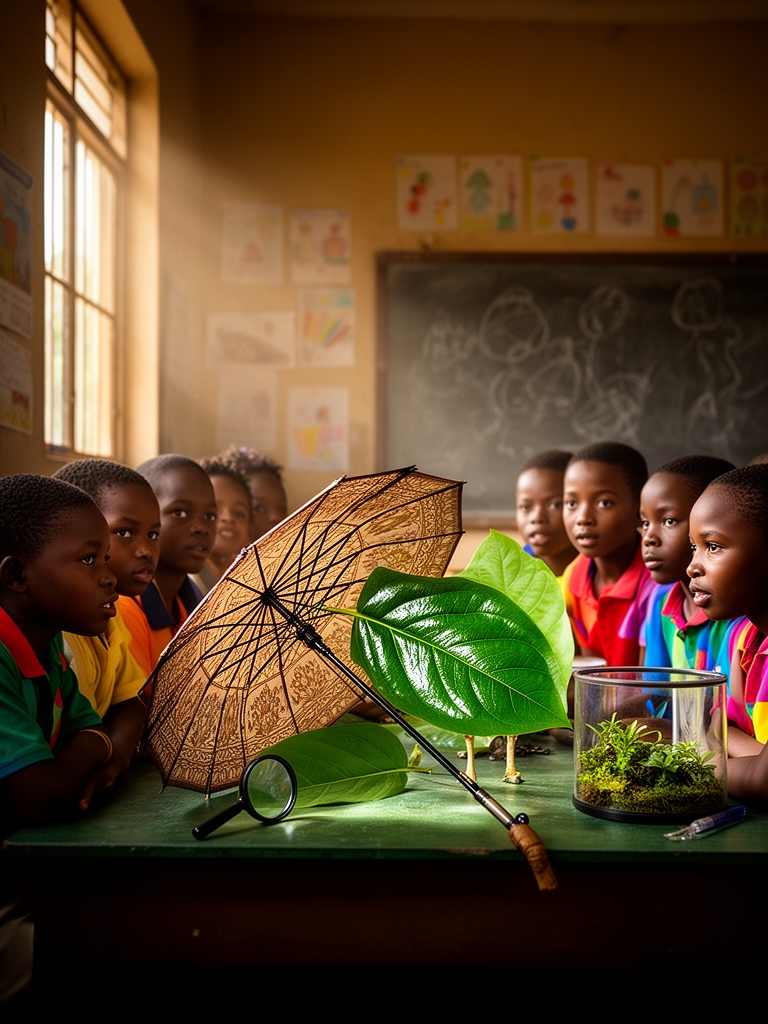
The Basic 7 classroom was abuzz with excitement as Mr. Mensah walked in, a mysterious smile spreading across his face. He carried a large, worn leather bag slung over his shoulder, its contents clinking and rustling as he moved. The students exchanged curious glances, sensing that this was going to be no ordinary lesson. As Mr. Mensah began to empty the bag's contents onto his desk, a collective gasp filled the room. Among the assortment of items were a vibrant green leaf, an umbrella with a brightly colored canopy, a small, sleek rock, and a feather. "Today, class," Mr. Mensah announced, his eyes twinkling with enthusiasm, "we're going to explore the connections that bind our world together." He paused, surveying the room to ensure he had everyone's attention. "I want you to look at these objects, to really see them, and think about how they might be related to one another." The students leaned forward, their faces aglow with curiosity, as they began to examine the items more closely. "Wow, look at that leaf!" exclaimed Emily, her finger reaching out to gently touch the leaf's delicate edge. "It's so green!" "And what's with the umbrella?" asked Jake, his brow furrowed in puzzlement. "Is it going to rain in here or something?" The class erupted into a chorus of laughter, and Mr. Mensah chuckled, his smile growing wider. "Not quite, Jake," he said, "but that umbrella is going to play a very important role in our lesson today." As the students continued to marvel at the objects, Mr. Mensah walked over to the window and pulled back the curtain, revealing a sky filled with gray, rain-laden clouds. "You see, class," he began, "sometimes the most unexpected things can be connected in surprising ways."
Initial Reactions
As the students gazed out the window at the ominous sky, their minds began to whirl with possibilities. Emily's eyes widened with excitement as she turned back to the objects on the desk. "Do you think the umbrella has something to do with the rain outside?" she asked, her voice filled with wonder. Jake nodded thoughtfully, his eyes fixed on the umbrella. "Maybe we're going to learn about how umbrellas are used in different weather conditions," he suggested. Mr. Mensah smiled, his eyes glinting with amusement. "You're both on the right track," he said, "but there's more to it than just using an umbrella in the rain." He paused, surveying the room to ensure everyone was engaged. "I want you to think about how all these objects might be connected, not just the umbrella and the rain, but the leaf, the rock, and the feather as well." The students leaned forward, their faces intent with concentration, as they began to brainstorm and share their ideas. "Maybe the leaf is connected to the rain because plants need water to grow," suggested one student. "And maybe the rock is connected to the earth, which is connected to the plants," added another. The room was filled with a buzz of excitement and curiosity as the students continued to explore the possibilities. Mr. Mensah walked around the room, listening to their discussions and offering gentle guidance, his smile growing wider as he saw the connections beginning to form in their minds. As the lesson progressed, the students' initial reactions gave way to a deeper understanding, and they began to see the world in a new and fascinating way. The objects on the desk, once seemingly unrelated, were now becoming a gateway to a broader understanding of the interconnectedness of nature and everyday life. And as they delved deeper into the lesson, they couldn't help but wonder what other secrets the leaf, the umbrella, and the other objects held, and how they would ultimately fit into the larger puzzle of the world around them.
Chapter 2
Exploring Connections
Nature's Inspirations
As the students continued to explore the connections between the objects, Mr. Mensah asked, "How does the structure of a leaf relate to the design of an umbrella?" The class fell silent, with each student deep in thought. Suddenly, Emily's hand shot up, and she exclaimed, "I think I know! The leaf has a waxy coating that helps it shed water, and the umbrella has a waterproof material that does the same thing!" The class nodded in agreement, and Mr. Mensah smiled, "That's a great connection, Emily. The natural world is full of examples like this, where the design of one thing inspires the design of another." He walked over to the window and looked out at the rain-soaked garden, "The rain outside is a perfect example of this. The leaf is adapted to survive in rainy conditions, and the umbrella is designed to keep us dry in the same conditions." The students gazed out the window, watching as the raindrops slid off the leaves of the plants, and Mr. Mensah continued, "Nature has been inspiring human innovation for centuries. The shape of the rock, the lightness of the feather, all of these things can be found in the designs of everyday objects." As the students listened, they began to see the world in a new light, as a complex web of connections and inspirations. "Let's take a closer look at the leaf," Mr. Mensah said, holding up the leaf for the class to see. "What do you notice about its shape and structure?" The students leaned in, eager to explore the secrets of the leaf and its connection to the umbrella.
Interconnectedness
As the students examined the leaf, they noticed the intricate network of veins that ran through it, and the way the edges curled up to prevent water from entering. "This is just like the umbrella," one of the students exclaimed, "it's designed to keep water out, just like the leaf." Mr. Mensah nodded, "Exactly, and that's not just a coincidence. The designers of the umbrella were inspired by the natural world, and the way that leaves and other plants are able to shed water. They used this knowledge to create a material that would do the same thing, keeping us dry in the rain." Emily spoke up again, "I never thought about it before, but it makes sense. The leaf is like a tiny umbrella, protecting the plant from the rain." The class laughed at the comparison, but Mr. Mensah was serious, "That's exactly right, Emily. The leaf and the umbrella are connected in a way that might not be immediately obvious, but they are both part of a larger web of relationships that bind the natural and human-made worlds together." As the lesson drew to a close, the students began to see the world in a new light, as a complex and interconnected system where everything was related and nothing existed in isolation. They realized that the objects on the table, the leaf, umbrella, rock, and feather, were not just random items, but were instead part of a larger puzzle, each one fitting together with the others to reveal a deeper truth about the world. "I never knew that learning could be so much fun," one of the students said, as the class packed up their things and headed out into the rainy day, eager to explore the world and discover more of its secrets. Mr. Mensah smiled, watching them go, knowing that he had sparked a curiosity in them that would stay with them for the rest of their lives. The rain outside seemed to be washing away not just the dirt and grime of the city, but also the students' old way of thinking, revealing a new world of wonder and interconnectedness that they were eager to explore.
Chapter 3
Reflection and Growth
New Perspectives
As the lesson drew to a close, the students of Basic 7 sat in contemplative silence, their minds still reeling from the connections they had uncovered. Mr. Mensah, sensing the moment was ripe for reflection, asked his students to share their thoughts on what they had learned. Emily, who had made the pivotal connection between the leaf's waxy coating and the umbrella's waterproof material, spoke up first. "I never realized how much nature inspires the things we use every day," she said, her eyes wide with wonder. "It's like the world is full of hidden secrets, just waiting to be discovered."
The other students nodded in agreement, and soon a lively discussion ensued, with each student sharing their own insights and observations. Some talked about the rock and feather, and how their unique properties had led to innovations in engineering and design. Others discussed the umbrella, and how its simple yet effective design had been influenced by the natural world. As the conversation flowed, Mr. Mensah listened attentively, offering the occasional question or comment to guide the discussion.
At one point, he asked, "How do you think this new understanding of interconnectedness will change the way you see the world?" The students thought for a moment before responding. One boy, who had been quiet until then, said, "I think it will make me more curious. I'll want to know more about the things I use and see every day, and how they're connected to nature." A girl added, "And I think it will make me more appreciative of the world around me. I'll see the beauty in things I never noticed before."
Mr. Mensah smiled, pleased with the depth of their reflections. "That's exactly right," he said. "When we understand the connections that bind the world together, we begin to see the world in a new light. We appreciate its beauty, its complexity, and its wonder." As the students packed up their things and prepared to leave, Mr. Mensah handed out a small assignment. "For next class, I want you to find an object in your daily life that has been inspired by nature. It could be a piece of clothing, a tool, or even a building. See if you can discover the connection between the object and the natural world." The students left the classroom, their minds buzzing with excitement and curiosity, eager to embark on their next discovery.
A Lasting Impact
As the days went by, the students of Basic 7 found themselves seeing the world in a new light. They would point out to each other the ways in which nature had inspired the design of everyday objects, from the shape of a bird's wing influencing the curve of an airplane's wing, to the texture of a leaf inspiring the pattern on a shirt. The assignment Mr. Mensah had given them had sparked a sense of curiosity and wonder that went beyond the classroom, and they began to notice the interconnectedness of the world all around them. Emily, who had been so fascinated by the connection between the leaf and the umbrella, found herself observing the way the rainwater flowed off the roof of her house, and how the gutters were designed to mimic the way a leaf's veins channel water. She realized that the same principles that governed the natural world were at work in the man-made world, and that this understanding could be used to create innovative solutions to real-world problems.
The other students had similar experiences, and soon they were all sharing their discoveries with each other. One boy had found a pair of shoes that had been designed with a tread pattern inspired by the suckers on a gecko's feet, allowing for better grip on smooth surfaces. A girl had discovered a type of fabric that had been developed using the principles of spider silk, making it incredibly strong and lightweight. As they shared their findings, they began to see that the connections between the natural and man-made worlds were endless, and that the secrets of the leaf and the umbrella were just the beginning. Mr. Mensah watched with pride as his students developed a deeper understanding of the world and its many wonders. He knew that the lessons they had learned would stay with them for the rest of their lives, and that they would carry this sense of curiosity and wonder with them as they grew and explored the world. The experience had a lasting impact on the students, and they would always remember the lesson of the leaf and the umbrella as a turning point in their journey of discovery.
As the students continued to explore and learn, they began to realize that the interconnectedness of the world was not just limited to the natural and man-made objects they encountered. They started to see that the same principles that governed the physical world also applied to the way people lived and interacted with each other. They began to understand that the world was a complex web of relationships, and that every action, every decision, and every discovery had a ripple effect that could be felt far beyond their immediate surroundings. This realization sparked a sense of responsibility and stewardship in the students, and they began to think about how they could use their newfound understanding to make a positive impact on the world. They started to brainstorm ways to apply the principles of nature to solve real-world problems, from developing sustainable energy sources to creating innovative solutions for environmental challenges. Mr. Mensah's lesson had unlocked a door to a new way of thinking, and the students of Basic 7 were eager to see where it would lead them.