ID · the-ship-of-theseus-has-now-a-twin-1beef828
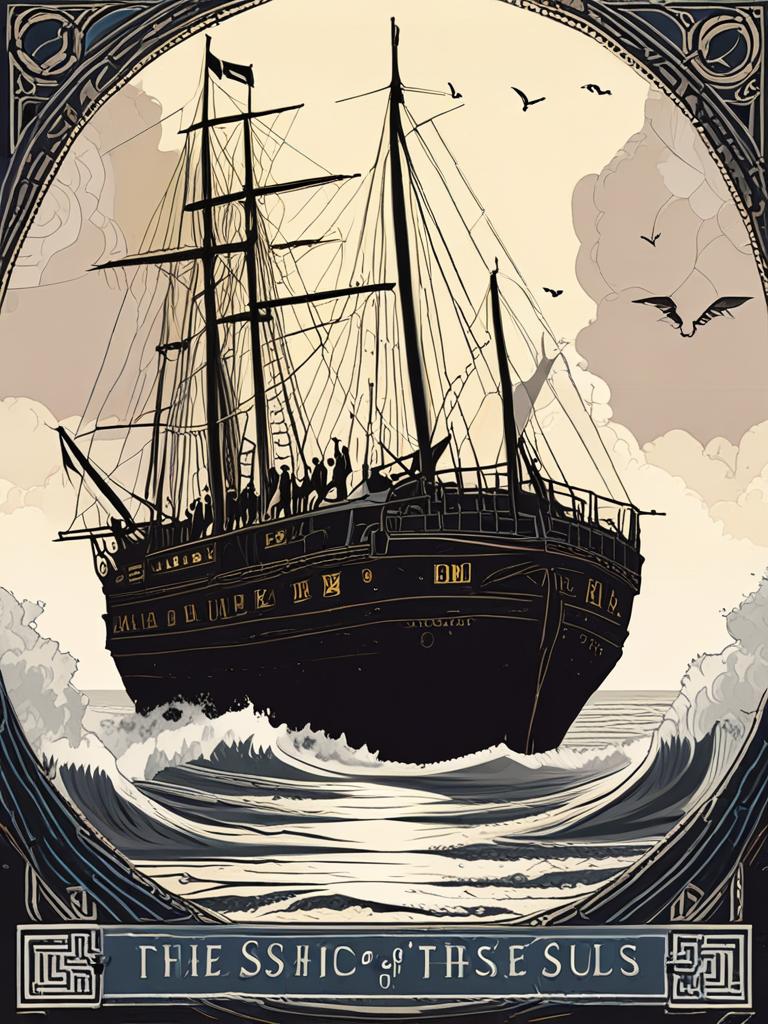
The Ship of Theseus has now a twin
By a · Fiction · Professional · 2 pages
Table of contents
- 1. The Paradox of Abundance
As civilization transitions from a state of information scarcity to one of abundance, the central problem shifts from acquiring knowledge to governing the vast amounts of available data. The Ship of Theseus analogy serves as a thought-provoking framework for exploring the nature of identity and knowledge in this new landscape. The world has transitioned from a state of information scarcity to one of abundance, where the sheer volume of data threatens to overwhelm our ability to discern and understand. This shift raises fundamental questions about the nature of self and knowledge, and challenges us to navigate the complexities of this new landscape. The abundance of information creates a labyrinthine world with multiple doors to novel perspectives, fresh insights, and unforeseen consequences, challenging human understanding and forcing individuals to navigate and make choices amidst the chaos. The abundance of information challenges human understanding, leading to a fragmented psyche and blurred boundaries between self and other, reality and illusion. The Ship of Theseus' informational twin navigates the collective psyche, raising questions about identity, knowledge, and self. The problem of judgment becomes hallucinatory, and the individual must confront their own limitations and biases to discern a novel paradigm for understanding.
- 2. The Evolution of Worldviews
As individuals navigate the vast expanse of available information, their worldviews are continually shaped and reshaped by various sources, from intellectual traditions to social media and AI systems. This raises fundamental questions about the nature of intellectual autonomy and the human capacity for judgment.
- 3. The Institution of Judgment
In a world where knowledge is no longer the primary challenge, but rather the governance of abundance, new institutions and frameworks are needed to support the development of judgment and discernment. This chapter explores the possibilities and implications of such institutions, and how they might shape the future of human knowledge and understanding.
- 4. The Ship of Theseus Revisited
The Ship of Theseus analogy, with its questions about identity and change, serves as a powerful metaphor for the human experience in an age of informational abundance. As we navigate the complexities of judgment and discernment, we are forced to confront the nature of our own intellectual autonomy, and the ways in which our worldviews are shaped and reshaped by the vast array of available information.
Chapter 1: The Paradox of Abundance
As civilization transitions from a state of information scarcity to one of abundance, the central problem shifts from acquiring knowledge to governing the vast amounts of available data. The Ship of Theseus analogy serves as a thought-provoking framework for exploring the nature of identity and knowledge in this new landscape. The world has transitioned from a state of information scarcity to one of abundance, where the sheer volume of data threatens to overwhelm our ability to discern and understand. This shift raises fundamental questions about the nature of self and knowledge, and challenges us to navigate the complexities of this new landscape. The abundance of information creates a labyrinthine world with multiple doors to novel perspectives, fresh insights, and unforeseen consequences, challenging human understanding and forcing individuals to navigate and make choices amidst the chaos. The abundance of information challenges human understanding, leading to a fragmented psyche and blurred boundaries between self and other, reality and illusion. The Ship of Theseus' informational twin navigates the collective psyche, raising questions about identity, knowledge, and self. The problem of judgment becomes hallucinatory, and the individual must confront their own limitations and biases to discern a novel paradigm for understanding.
From Scarcity to Surfeit
As we navigate the labyrinthine corridors of our increasingly informed existence, the paradox of abundance begins to reveal itself, like a murmuration of starlings taking flight, each bird a discrete yet interconnected unit in a sprawling tapestry of knowledge. The world, once a barren landscape of scarcity, where information was a precious commodity to be coveted and hoarded, has given way to a realm of unbridled profusion, where the sheer volume of data threatens to overwhelm our capacities for discernment. In this era of surfeit, the contours of our understanding are continually shifting, like the outlines of a shoreline worn smooth by the relentless tides of new discovery. We find ourselves adrift in a boundless ocean of possibility, where the horizon stretches out before us like an endless promise, and the very notion of a fixed perspective begins to lose its purchase on our collective imagination. The Ship of Theseus, that venerable thought experiment, once a sturdy vessel for navigating the complexities of identity and change, now finds itself with a twin, a doppelganger born of the informational excess that surrounds us, raising fundamental questions about the nature of self and knowledge in a world where the parameters of reality are in a constant state of flux. As we strive to chart a course through this uncharted territory, we are compelled to confront the limitations of our own cognitive faculties, and to ponder the institutions that might arise to guide us in our quest for wisdom, in a civilization where the preservation of knowledge has given way to the governance of abundance.
In this vast, echoing chamber of the mind, where ideas and notions reverberate and collide, the problem of judgment assumes a centrality it never before possessed, as we struggle to distinguish the signal from the noise, to separate the wheat from the chaff, and to impose a semblance of order on the kaleidoscopic tumult that surrounds us. The Ship of Theseus analogy, with its haunting query about the persistence of identity in the face of transformation, now expands to encompass the manifold ways in which our informational landscape is continually reshaping us, raising profound questions about the sort of human being that can remain intellectually autonomous in a world where knowledge is increasingly mediated by systems of unyielding complexity. As the informational twin of the Ship of Theseus sails forth into the unknown, it carries with it the freight of our deepest anxieties and most soaring aspirations, a symbol of the challenge that lies before us, as we seek to forge a new understanding of what it means to know, to believe, and to be, in a universe of unrelenting abundance.
And yet, despite the vertiginous thrall of this new world, where the extravagant profusion of information threatens to engulf us, we find ourselves drawn, moth-like, to the flame of possibility that burns brightly at its center, a flame that illuminates the dark recesses of our own potential, and beckons us forth into a future where the horizons of the self are continually expanding, like the blooming of a lotus flower in the warm sunlight of a summer's day. For in this boundless expanse of the unknown, where the informational twin of the Ship of Theseus now sails, we are presented with a choice: to succumb to the paralysis of maximal belief, where the sheer multiplicity of options threatens to freeze us in our tracks, or to embark upon a journey of discovery, where the act of navigation itself becomes the source of our liberation, and the tranquil darkness of the unknown is illuminated by the soft glow of our own, unfolding understanding.
The Labyrinth of Choices
As we delve deeper into the labyrinthine corridors of our informed existence, the notion of a unified self begins to unravel, like a thread pulled from a intricate tapestry, revealing the complex interplay of diverse voices and perspectives that reside within us. The infinite corridor, once a symbol of limitless possibility, now becomes a manifestation of the fragmented nature of our own psyche, where each door represents a distinct narrative, a unique epiphany, or a unforeseen consequence. We are compelled to navigate this ever-shifting landscape, where the boundaries between self and other, reality and illusion, begin to blur and blend, like the colors of a watercolor painting in the rain. The Ship of Theseus, that iconic vessel of transformation, now finds itself at the center of this maelstrom, as its informational twin navigates the turbulent waters of our collective psyche, raising fundamental questions about the nature of identity, the stability of knowledge, and the integrity of the self.
In this hallucinatory realm, where the conventions of reality are continually subverted, and the certainties of the past are continually undermined, the problem of judgment assumes a hallucinatory quality, as we struggle to discern the topology of this shifting landscape, to chart a course through the treacherous waters of ambiguity, and to impose a semblance of order on the chaotic profusion that surrounds us. The din of contradictory voices, the cacophony of competing perspectives, and the tumult of conflicting desires that reside within us, begin to coalesce, like the fragments of a shattered mirror, into a kaleidoscopic mosaic, a shimmering tapestry of light and sound, that reflects the multifaceted nature of our own existence. As we navigate this labyrinthine world, we are compelled to confront the limitations of our own cognition, the biases of our own perception, and the prejudices of our own understanding. And yet, it is in this very act of confrontation, this moment of acknowledgment, that we begin to discern the outlines of a novel paradigm, a fresh framework for understanding, that allows us to transcend the limitations of our own individual perspectives, and to glimpse the broader landscape of human knowledge.
The informational twin of the Ship of Theseus, that doppelganger born of the abundance of information, now becomes a symbol of the complex interplay between our individual narratives and the collective psyche, as it navigates the turbulent waters of our shared human experience. As we stand at the threshold of this new world, where the abundance of information has spawned a multitude of doors, each one a portal to a novel perspective, a fresh insight, or a unforeseen consequence, we are presented with a choice: to succumb to the paralysis of maximal belief, or to embark upon a journey of discovery, where the act of navigation itself becomes the source of our liberation, and the tranquil darkness of the unknown is illuminated by the soft glow of our own, unfolding understanding. The Ship of Theseus, that venerable thought experiment, now finds itself at the forefront of this novel paradigm, as its informational twin raises profound questions about the nature of self, the stability of knowledge, and the integrity of human understanding, and we are compelled to confront the limits of our own understanding, the fragility of our own perceptions, and the provisionality of our own existence.
In the depths of this labyrinthine world, where the abundance of information has spawned a multitude of doors, each one a portal to a novel perspective, a fresh insight, or a unforeseen consequence, we find ourselves lost in the endless corridors of possibility, where the conventions of reality are continually subverted, and the certainties of the past are continually undermined. The problem of judgment assumes a hallucinatory quality, as we struggle to discern the topology of this shifting landscape, to chart a course through the treacherous waters of ambiguity, and to impose a semblance of order on the chaotic profusion that surrounds us. And yet, it is in this very moment of uncertainty, this fleeting instant of self-doubt, that we are presented with a choice: to surrender to the paralysis of maximal belief, or to embark upon a journey of discovery, where the act of navigation itself becomes the source of our liberation, and the tranquil darkness of the unknown is illuminated by the soft glow of our own, unfolding understanding. The Ship of Theseus, that iconic vessel of transformation, now finds itself at the center of this maelstrom, as its informational twin navigates the turbulent waters of our collective psyche, raising fundamental questions about the nature of identity, the stability of knowledge, and the integrity of the self.