Fiction
There’s A Kelli In My Closet
by Brayden Dowdney
3 chapters1.1 hr read
Chapter 1
The First Knock
Austin brushed his teeth one last time, the minty foam spitting into the sink as he stared at his reflection—too wide-eyed, hair sticking up in back from restless turning. He rinsed, wiped his mouth on the towel, and padded back to his room in his dinosaur pajamas, the ones with the frayed cuff Maya had sewn for him last winter. The hallway was quiet. The floorboards didn’t creak under his weight, not tonight. He paused at his door, hand on the knob, and listened. Downstairs, the TV murmured—a low, steady drone from his dad’s favorite news channel. Mom’s footsteps had faded after she tucked in the dog. The house was settling into its night rhythm.
He pushed the door open and stepped inside. His room smelled of lavender spray and old paperbacks. His desk was cluttered with half-finished homework, a half-eaten granola bar, and Maya’s hairbrush left upside down on the corner—she’d forgotten it the morning she left. Austin hadn’t touched it. He couldn’t bring himself to put it away.
He flicked on his lamp, the one with the chipped blue base, and pulled back the covers. The sheets were cool where he’d left them. He slid under, pulled the blanket to his chin, and turned off the light.
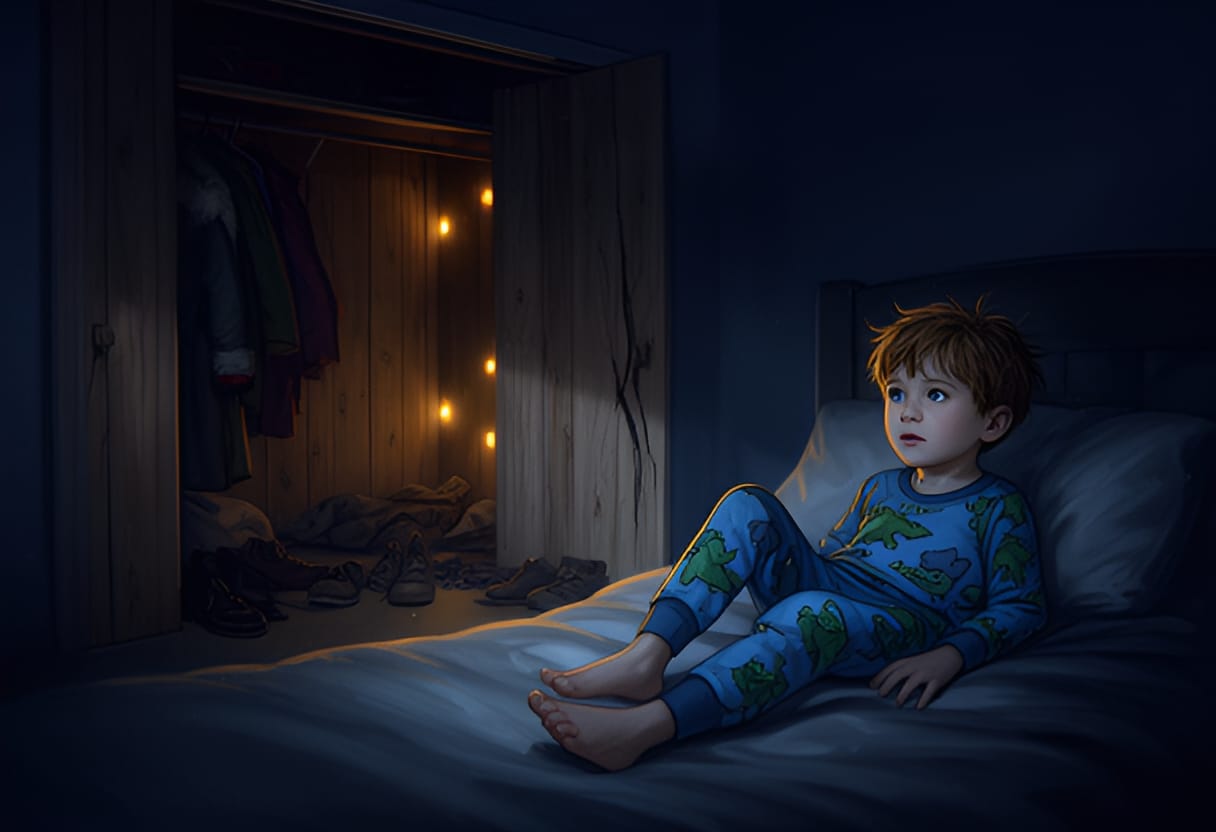
Darkness swallowed the room. Not total dark—there was the green glow of the alarm clock blinking 9:14, and the faint silver line under the door from the hallway nightlight—but close enough. His eyes adjusted. The closet door loomed at the foot of his bed, a deeper rectangle of shadow against the wall. He could just make out the edge of Maya’s old backpack hanging from the inside knob, the one with the frayed strap and the missing button.
He breathed in, then out. Slow. Like Mom taught him when he couldn’t sleep. In… two, three… out… two, three…
His eyelids grew heavy. The hum of the fridge downstairs blended with the distant hiss of the radiator. He was almost there—just on the edge—when it started.
Tap.
Soft. Slow. Like a fingernail on wood.
Austin’s eyes snapped open.
Tap-tap.
Again. From the closet.
He froze, breath caught in his throat. The house settling, he told himself. Old pipes. Wind in the eaves. He’d heard it before—creaks and groans that sounded like something alive.
But this wasn’t random. Tap… pause… tap-tap… pause… tap.
It matched his heartbeat. Exactly.
His pulse hammered in his ears. Tap. Tap-tap. Tap.
He sat up slowly, blanket pooling in his lap. The alarm clock glared 9:15.
“Hello?” he whispered. His voice sounded too loud in the quiet.
Silence.
Then— a giggle.
Soft. High. Like paper tearing in the wind.
It came from inside the closet. Not loud. Not close. But unmistakably there.
Austin’s stomach flipped. He pulled the blanket tighter around his shoulders, knuckles white where he gripped the fabric.
“Who’s there?” he asked, louder this time. His voice wavered.
Another giggle. Fainter this time. As if she’d pulled back into the dark.
He swung his legs over the side of the bed, feet hitting the cold floor. The closet door stood shut. Still. Waiting.
He didn’t move. Didn’t breathe.
Tap.
Just once. Then nothing.
Austin waited. His heart thudded against his ribs. The green numbers on the clock blinked: 9:16. 9:17.
Nothing.
Maybe he’d imagined it. Maybe he was just tired. Maybe—
A whisper, so soft he felt it more than heard it: “You’re not tired.”
It came from the dark inside the closet. Not from one spot. From everywhere and nowhere.
Austin froze. His breath hitched.
He didn’t scream. Didn’t cry out. He just lay back down, pulled the blanket all the way up to his nose, and squeezed his eyes shut.
But he could still hear it.
Giggling.
Faint. Playful. Like she was having fun.
And she wasn’t tired at all.
The giggle came again, closer this time—just inside the closet door, where the crack let out a sliver of nothing. Austin kept his eyes shut, jaw clenched, fingers digging into the blanket over his nose. He told himself it was the wind. The house. His overactive brain, still buzzing from the day—math quiz, peanut butter sandwich at lunch, the way Mr. Henderson had frowned when he turned in his doodle-covered worksheet.
But the voice hadn’t been his imagination. It had been outside it. Like someone had slipped a word into his ear from the dark.
He risked a peek. Just a slit.
The blanket was up to his lashes. Below it, the room was the same—desk, chair, the lump of his backpack in the corner. The closet door remained shut. No shadow moved under it. No light pooled from within.
Yet he felt her. Not seen. Not heard. Felt. Like the air near the door had gone thin, like static before a spark.
Then— a whisper against his ear.
“You can’t hide under there forever.”
Austin jerked. The blanket flew back. His heart lurched into his throat.
Nothing.
He sat upright, scanning the room. The closet door was still closed. The alarm read 9:18. His palms were slick. He wiped them on his pajama legs.
“Go away,” he muttered. His voice sounded small, even to himself.
Silence.
Then, from the closet— a soft shush, like fabric sliding on a rod.
He froze.
The door hadn’t opened. He would’ve seen it. He would’ve felt the draft.
But something had moved inside.
He swung his legs over the side of the bed again, toes curling against the cold floor. He didn’t stand. Didn’t call out. He just waited, breath shallow, ears straining.
Tap.
Once. Low on the door, near the floor.
Then— silence.
Austin waited ten seconds. Twenty. His knees began to ache from the crouch.
He was about to lie back down when the closet door creaked.
Not opened. Not pushed. Just… shifted. A fraction of an inch inward, then back, like something had pressed against it from the other side.
His breath stopped.
Then, from the dark within— a giggle. Not soft this time. Playful. Teasing.
It sounded like Maya.
Not her laugh— he knew that, remembered it like a song half-forgotten—but the way she used to giggle when she was sneaking up on him, back when she still lived down the hall. That little catch in her throat, like she was biting her lip to keep from laughing too loud.
Austin’s eyes burned. He swallowed hard.
“Stop it,” he whispered. “Just go away.”
The giggle faded. In its place, a voice— not hers, not quite his, but between them— soft and teasing: “I’m not tired.”
He flinched. That was his own voice. Or… it had sounded like it. But he hadn’t said it.
The closet door shifted again— a slow, inward push, then release. Like something was testing it.
Austin lunged.
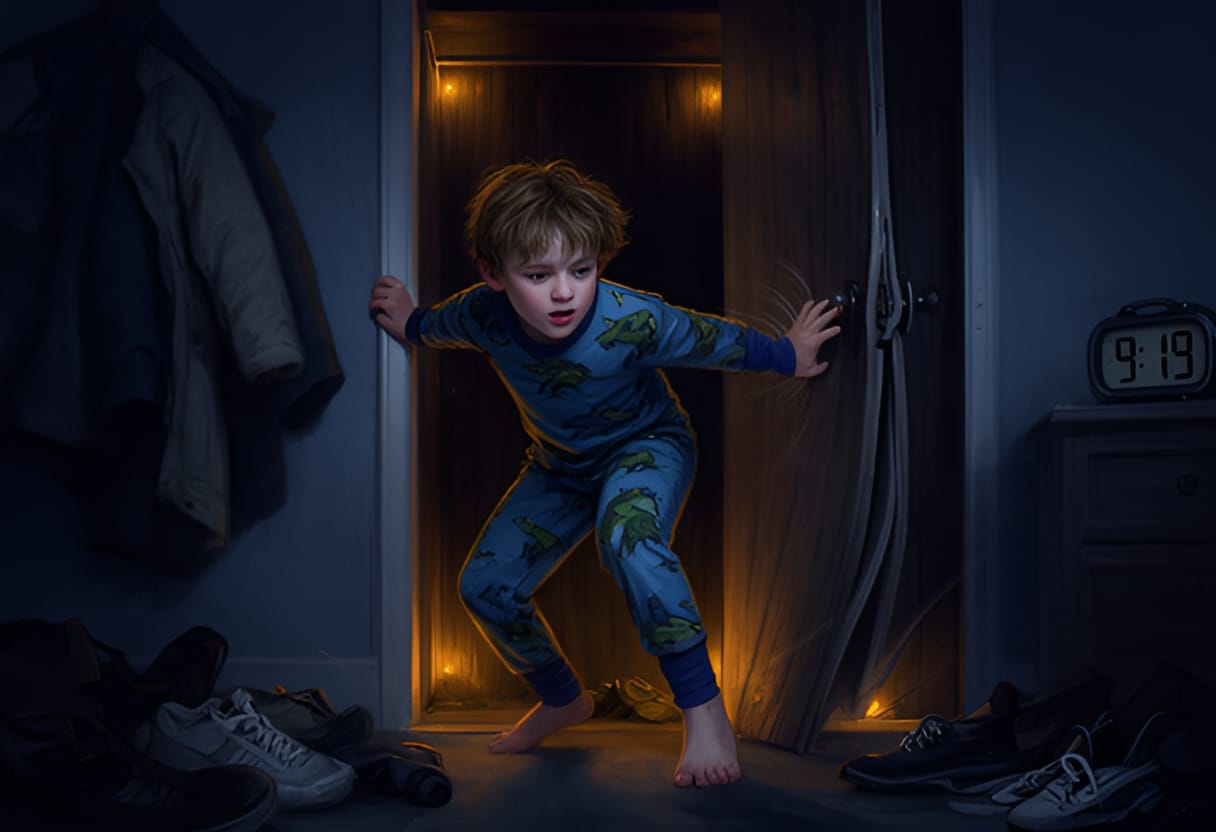
He didn’t think. He just moved— feet hitting the floor, body launching forward—and shoved the closet door shut with both hands, hard enough to make the frame shake.
It slammed.
Silence.
He stood there, chest heaving, hands pressed flat against the wood, knuckles white. The closet didn’t move. Didn’t groan. Just… waited.
After a long moment, he stepped back. His palms tingled. He rubbed them on his pants.
The door was shut. The room was still.
He glanced at the alarm: 9:19.
He climbed back into bed, pulled the blanket to his chin, and lay stiffly on his back. Eyes open. Staring at the ceiling.
The tapping didn’t restart.
But he couldn’t sleep.
He could still feel it— the presence in the closet, not gone, just… waiting. Like a held breath.
And somewhere in the dark, just beyond hearing, a faint, familiar giggle drifted— not from the closet, not from the room, but from the space between thoughts, where memory and fear blurred.
He didn’t call out.
He didn’t move.
He just lay there, eyes wide, listening to the quiet, and wondering if he’d imagined the voice that sounded like his own— or if he was starting to sound like something else.
Austin swung his legs over the side of the bed again, the cold floor sharp against his soles. His pulse hammered in his temples, but he forced himself to move—deliberately, mechanically—toward the nightstand where his flashlight sat beside Maya’s forgotten hairbrush. He snatched it up, thumb clicking the switch on. A thin cone of white light pierced the gloom, cutting across the desk, the backpack, the warped edge of the closet door.
His breath came short. Just do it, he told himself. See for sure.
He gripped the flashlight like a weapon and yanked the closet door open.
It swung inward with a soft groan, revealing only the familiar dark of hanging clothes—his father’s old flannel, a pair of jeans rolled at the cuff, a single sneaker missing its mate. The beam swept left to right: plastic bins on the floor, folded sweaters on the shelf, the faint scent of cedar and dust. Nothing moved. No shape shifted in the shadows. No gleam of eyes, no flicker of fabric that wasn’t supposed to be there.
He stepped inside, closing the door behind him with a quiet click. The air felt thicker, cooler, as if the closet exhaled around him. He lifted the flashlight, sweeping it slowly—up the rods, into the corners where shadows pooled deep, behind the hanging coats where the fabric bunched and swayed ever so slightly, though no breeze stirred.
“Kelli?” he called, voice low but firm. It sounded too loud in the enclosed space, bouncing off the wood and fabric. “I know you’re in here. Come out.”
Silence. Only the faint rustle of his own jacket as he shifted his weight.
He took another step forward, brushing past a hanging sweater. The flashlight dipped, catching the toe of his dinosaur pajama—frayed at the cuff, just as Maya had left it. He paused. Memories flickered: her hands, small and sure, stitching the dinosaur’s eye with blue thread; the way she’d grinned when she handed them over, saying, Now you’ll never be lonely in your pajamas.
A breath—icy and sudden—brushed the nape of his neck.
He didn’t jump. Didn’t yelp. But his shoulders locked, and the flashlight trembled in his grip.
A whisper, soft as a sigh against his ear: “You forgot to check behind you.”
He spun.
The beam jerked wildly—catching the closet rod, the edge of a bin, the wall where the paint had chipped near the floor. Empty. The hanging clothes swayed minutely, as if disturbed by his movement, then stilled. No footprint on the dusty floor. No indentation in the piled sweaters on the shelf. No sign that anything had been there at all.
His heart hammered against his ribs like a trapped bird. He swallowed, tasting metal. It’s just the air. Just me. Just…
But he knew. He knew she’d been there. The breath hadn’t been his. The whisper hadn’t come from his throat.
He backed slowly out of the closet, never taking his eyes off the darkness within. When he cleared the threshold, he didn’t turn away. He kept the flashlight aimed inside, heart pounding, waiting for a flicker, a shift, a sign that she was still there—watching, waiting.
The closet remained still. The door hung open, revealing only the ordinary mess of a child’s storage space.
Austin lowered the flashlight slightly, arm trembling. His eyes burned. Not from fear alone—though that was there, cold and sharp—but from the ache of recognition. That breath. That whisper. The way she’d known exactly where he’d hesitate, exactly what he’d overlook.
He hadn’t imagined it. Not this time.
He clicked the flashlight off.
Darkness swallowed the closet whole.
He stood there for a long moment, hand still on the doorframe, listening. The house creaked—old wood settling, the distant hum of the refrigerator downstairs. No giggle. No tap. No voice mimicking his own.
Just quiet.
And beneath it, the faintest echo—like a bell wrapped in wool, fading.
He didn’t call out again.
Didn’t scream.
Didn’t beg.
He simply turned, walked back to bed, and sat on the edge, feet dangling. The flashlight lay forgotten on the desk beside Maya’s hairbrush, still upside down, forgotten since she left.
He pulled the blanket to his chin and lay down, eyes open, staring at the ceiling.
Somewhere, deep in the dark, something waited.
Not gone.
Just… patient.
Austin lay rigid on his back, the blanket pulled tight to his chin, eyes fixed on the shadowed crack where the ceiling met the wall. His breath came slow, deliberate, each inhale a struggle against the tightness in his chest. The clock blinked 9:21 in angry green digits. Two minutes since he’d fled the closet. Two minutes since the air had last stirred with something that wasn’t quite breath, wasn’t quite sound.
He told himself to sleep. To close his eyes and let the darkness take him, like he used to before Maya left, before the giggles started sounding like memories, before his own voice began echoing back at him from places he hadn’t spoken.
But sleep wouldn’t come. Not while he could still feel it—the absence where her presence should have been, now inverted into a pressure behind his eyes, a humming in his ears like the space between heartbeats.
Then, a shift.
Not in the closet. Not in the room.
In the air above his chest.
A faint displacement, as if the blanket had been lifted a fraction—just enough for something cool to drift against his sternum. Not touch. Not press. Hover.
His lungs seized.
He didn’t move. Didn’t blink. But his eyes flicked downward, just enough to catch the very edge of the blanket where it rose and fell with his restrained breathing. There—where the fabric strained slightly over his ribs—it indented. Not from his body. From above.
As if fingers, light as spider silk, had pressed down and lingered.
A whisper followed—not in his ear, not in the room, but inside his skull, soft and velvety, like thoughts not his own settling into place: “You’re still listening.”
His jaw tightened. Tears burned behind his lids, but he refused to let them fall. Not here. Not now. Not giving her the satisfaction of seeing him break.
The indentation deepened slightly. Then, impossibly, the blanket lifted—just an inch— as if something had crawled beneath it, slow and deliberate, moving toward his throat. The fabric stretched taut over nothing, then settled again, smooth and empty, as if whatever had been there had dissolved into the weave.
His breath came in a silent gasp. His hands, clenched at his sides, began to shake.

He wanted to scream. To fling the covers off and run for the door, for his parents’ room down the hall, for anything that felt real and safe and adult. But he knew—knew with a certainty that chilled him more than any touch— that if he moved, if he spoke, if he acknowledged it even with a flinch, she’d pull him deeper. Into the game. Into the dark where she fed.
So he stayed still.
Let the phantom pressure trace a slow circle over his heart—cool, insistent, like a finger testing a wound.
Let the whisper curl in his thoughts: “You can’t unfeel what you’ve already felt.”
Let the silence stretch, thick and heavy, until even the clock’s blink seemed to pause.
And then—release.
The pressure vanished. The air above his chest stilled. The blanket lay flat, undisturbed, as if nothing had ever disturbed it.
Austin didn’t dare exhale. Didn’t dare move. He lay there, waiting for the next sign, the next whisper, the next impossible touch that wasn’t a touch.
But nothing came.
Only the quiet.
And in that quiet, a terrifying thought, unbidden and clear: She’s learning. She’s getting better at this.
He swallowed hard, throat working. His eyes burned, not just from unshed tears, but from the awful, creeping realization that he wasn’t just being haunted.
He was being studied.
And worse—she was enjoying it.
A single tear slipped free, hot and sudden, sliding into his ear. He didn’t wipe it away. Didn’t make a sound.
He just lay there, rigid and wide awake, listening to the dark breathe— and wondering, with a cold certainty that settled in his bones, whether he’d ever sleep again without feeling her watching.
Austin sat rigid on the edge of the bed, the blanket still pulled to his chin, his breath shallow and uneven. The tear had dried on his temple, leaving a faint saltiness. The room was still, the clock’s green numbers blinking 9:23. He waited, ears straining, for any sign—any shift in the air, any breath that wasn’t his.
Nothing came.
Only the quiet, thick and watchful.
He swallowed. His throat felt raw, as if he’d been holding his voice back for hours. The memory of the whisper—You’re still listening—still hummed behind his eyes, not as sound, but as a pressure, a knowing.
He couldn’t take it anymore.
Not the waiting. Not the not-knowing. Not the way she made him feel like a specimen under glass, studied for her own amusement.
With a sudden, sharp movement, he shoved the blanket down and swung his legs over the side of the bed. His feet hit the floor with a soft thud. He stood, heart hammering, and walked straight to the closet door.
His hand trembled as he reached for the knob.
He yanked it open.
The closet yawned before him—dark, deep, the same as before. No shape. No shift in the shadows. Just the faint scent of old wool and dust, and the quiet.
But he knew.
He knew she was there.
He took a breath, steadying himself, and spoke—loud, clear, cutting through the silence like a knife.
“I’m telling Mom,” he said. “Right now. If you don’t leave me alone.”
He waited.
The air didn’t stir.
The shadows didn’t move.
Then, from inside the dark, a sound—not a giggle, not a whisper, but the soft creak of wood, like someone settling onto a shelf.
A pause.
Then, a voice. Not mimicking his. Not echoing. Hers. Light, dry, like paper dragged over stone.
“You won’t.”
Austin’s jaw tightened. “I will. I’ll tell her you’re in here. That you won’t let me sleep. That you tap and whisper and—”
“She won’t see me,” Kelli said, her voice calm, almost kind. “And even if she did, she’d think you made me up. Like you always do.”
A flicker of something—frustration, maybe—rose in his chest. It wasn’t fair. It wasn’t fair that she could be so real to him and so invisible to everyone else. That she could twist his words, his fears, into proof that he was imagining it all.
“I’m not imagining you,” he said, voice dropping, fierce. “I saw you. I felt you. You’re not gone.”
“No,” she agreed. “I’m not gone. But I don’t have to stay. Not if you make it worth my while.”
He froze. “What do you mean?”
“I’ll leave,” she said. “Tonight. Right now. If you promise to play with me tomorrow.”
Austin blinked. “Play?”
“Yeah,” she said. “You know. Games. Hide-and-seek. I’ll hide in the closet. You come find me. Or we can make up stories. Or you can draw me. Anything. Just… you and me. Alone. No grown-ups. No soccer. No school.”
His mind raced. Soccer practice. Tomorrow after school. Coach Daniels had been drilling penalty kicks all week. If he missed practice, he’d lose his spot on the team. His dad would be disappointed. Not angry—never angry—but quiet. The kind of quiet that felt worse than yelling.
“I can’t,” he said. “I have soccer practice. After school. I can’t skip.”
A pause. Then, softer, almost curious: “Soccer?”
“Yeah. I’m on the team. We practice Tuesdays and Thursdays. It’s important.”
“Important to you?” she asked.
He hesitated. “Yeah. It is.”
“Then I’ll wake you up earlier,” she said. “Before practice. We can play for twenty minutes. Just enough. Then you go. I won’t be in the way.”
Austin stared into the dark closet. The idea was tempting—too tempting. If he played with her, even for a little while, maybe she’d get bored. Maybe she’d leave him alone the rest of the night. Maybe he could finally sleep.
But then he remembered the way her fingers had hovered above his chest. The way she’d studied him, not with malice, but with the intense focus of someone learning how a machine works. The way she’d enjoyed his fear.
If he played, he’d be giving her exactly what she wanted.
Attention.
He shook his head, even though she couldn’t see him. “No. I won’t play. Not if it’s a bargain. Not if you’re just using me to stay up later.”
Silence.
Then, a soft sound—like fabric brushing against wood.
When he glanced toward the dresser, his breath caught.
There she was.
Kelli sat cross-legged on the edge of his dresser, one leg swinging slowly, the other tucked beneath her. She wore her usual dress—tonight, a soft lavender that seemed to absorb the dim light. Her mismatched socks dangled over the edge: one striped red and white, the other a dull, faded yellow. Her hair, dark at the roots and fading to silver at the ends, fell over one shoulder. Her eyes—those ember-like eyes, smoldering beneath a film of ash—were fixed on him, not unkind, but expectant.
She wasn’t smiling. She wasn’t frowning. She was just… waiting.
Austin’s stomach flipped. He hadn’t heard her move. Not a whisper of footsteps, not a shift in the air. One moment, she’d been in the closet. The next, she was there, on his dresser, as if she’d simply stepped out of the shadows.
“You said you’d leave,” he said, voice low.
“I did,” she said. “I left the closet. I’m here now. Is that not leaving?”
He opened his mouth to argue, but she held up a hand—pale, slender, fingers slightly too long.
“You said you’d tell Mom if I didn’t go,” she said. “I went. I’m not in the closet anymore. I kept my side.”
Her tone wasn’t accusatory. It was… curious. Like she was testing a hypothesis.
Austin felt trapped. Technically, she hadn’t lied. She had left the closet. But she hadn’t left him. She’d just changed locations.
He licked his dry lips. “You’re still here. That’s not leaving me alone.”
“Alone?” she tilted her head. “I’m not touching you. I’m not whispering. I’m just sitting. Is that not alone enough?”
He wanted to scream. To tell her that this—her sitting there, legs swinging, eyes glowing like banked coals—was worse than any whisper. It was a reminder. A constant, silent I’m still here. I’m still watching.
But he didn’t scream. He couldn’t. Not if he wanted to keep any control.
Instead, he said, quiet but firm: “I’m not playing with you tomorrow. Or any day. I’m done.”
He expected anger. A flash of irritation. A sudden lunge.
Instead, Kelli’s expression softened—just slightly. Her shoulders slumped. The swing of her leg slowed, then stopped.
For a long moment, she said nothing. Then, so quietly he almost missed it: “You’re breaking the game.”
He didn’t respond. He couldn’t trust his voice.
She pushed herself up from the dresser, smooth and silent, like smoke given form. Her feet touched the floor with no sound. She began to walk—slow, deliberate—toward the bed.
Austin didn’t move. Didn’t blink. He stayed locked in place, eyes fixed on her approaching form.
She stopped at the foot of the bed. The lavender of her dress seemed to ripple, shifting for a heartbeat to storm cloud gray, then back again.
Then, without warning, she flickered.
Not a fade. Not a dissolve.
A stutter—like a candle in a draft. One moment, she was there, solid and real. The next, she was gone.
The air where she’d stood felt suddenly colder.
Austin exhaled, a shaky breath he hadn’t realized he’d been holding.
He waited.
Seconds passed.
The room stayed still.
He was about to relax—just a little—when a shift in the air above his pillow made him freeze.
There, inches from his face, hovering just above the cotton case, she reappeared.
Kelli lay on her side, propped on one elbow, her face inches from his. Her silver-tipped hair spilled over the pillow like spilled ink. Her eyes glowed, not brightly, but steadily—two small coals in the dark. Her breath, if she had any, didn’t stir the blanket.
She wasn’t touching him. Not quite. But the space between them was less than a hand’s width.
Her voice, when it came, was a whisper—not in his ear, but in the space between his thoughts, soft and insistent, like a secret being passed hand to hand in the dark.
“You say you’re done,” she murmured. “But you’re still looking. You’re still talking. You’re still here, with me.”
Austin wanted to look away. To squeeze his eyes shut. To bury his face in the pillow and pretend she wasn’t there.
But he couldn’t.
Because she was right.
He was still looking.
He was still talking.
And worse—he was still afraid.
And as long as he was, she wouldn’t have to try.
She’d already won.
She gave him no chance to answer. No chance to look away.
With a final, almost imperceptible smile—just a lifting of the corner of her mouth—she faded.
Not all at once.
First, her eyes dimmed, the ember-glow sinking to ash.
Then her outline softened, the lavender of her dress bleeding into the darkness.
Then, slowly, she was gone.
Not a sound.
Not a whisper.
Just the quiet.
And the indent in the pillow where her head had lain—so slight, so brief, that if he hadn’t been staring right at it, he would’ve sworn it was nothing.
Austin didn’t move.
He didn’t breathe.
He just lay there, eyes locked on the spot where she’d been, his heart pounding not from fear, but from the awful, quiet understanding that had settled in his chest like a stone.
She hadn’t left.
She’d just changed the rules.
And he had no idea how to play anymore.
Austin pulled the blanket over his head, the cotton thick and warm against his ears, sealing him in a dark, sweating cave. He pressed it tight around his neck, tucking the edges under his chin, as if he could smother not just the light but the very idea of her. His breath came in short, hot bursts, fogging the fabric where his mouth pressed against it. Outside the blanket, the room was utterly still—too still. He could feel the absence of sound like a physical thing, a vacuum pressing in on his ears. He waited, heart hammering against his ribs, waiting for the whisper, the shift in the air, the faintest indication that she was still there, still watching.
Then came the laugh.
Not from outside the blanket. Not from the closet or the dresser or the foot of the bed.
It vibrated up through the mattress, through the springs, into his bones—a soft, muffled giggle, like stones tumbling in a dry creek bed, close, intimate, as if her mouth were pressed to the box spring just beneath him. It wasn’t loud. It wasn’t meant to wake the house. It was meant for him alone, a private ripple in the dark, designed to make his skin prickle and his toes curl.
He squeezed his eyes shut tighter, jaw clenched, willing himself to ignore it. To pretend he was already asleep, deep and unconscious, beyond her reach. He told himself that if he didn’t react, if he didn’t acknowledge her, she would eventually grow bored and fade—like a thought left unspoken.
But then he felt it.
A fingertip, light as a moth’s wing, tracing slow, deliberate circles on the sole of his left foot, right through the thin cotton of his dinosaur sock. The touch was maddeningly gentle, almost ticklish, but it wasn’t playful. It was investigative. Mapping. Learning the exact pressure that made his breath hitch, the spot that made his heel twitch involuntarily.
He bit the inside of his lip, hard, until he tasted copper. He didn’t wiggle. Didn’t pull his foot away. Didn’t make a sound. He focused on the pain in his lip, on the rhythm of his breathing through his nose, on the memory of Maya’s voice reading him Where the Wild Things Are when he was five—anything to keep from giving her the satisfaction of a reaction.
For a long moment, there was only the tracing—round and round, up the arch, down to the ball of the foot, back again—like she was drawing a symbol only she could understand. His foot began to burn, not from the touch, but from the effort of staying still. His calf muscle trembled. He could feel sweat prickling along his spine.
And then she began to hum.
It was his lullaby. The one Maya used to sing when she tucked him in—the same simple, five-note phrase, rising and falling like a breath. But Kelli’s version was wrong. Off-key. The third note was sharper than it should have been, the fourth dragged out too long, as if she were mocking the tune, or worse, learning it poorly on purpose, just to get under his skin.
The humming wasn’t in his ears. It was in his teeth. In the hollow of his chest. It resonated, low and insistent, like a tuning fork struck against his sternum.
His eyes flew open beneath the blanket. The darkness behind his lids flared with sudden, white-hot anger—not just at her, but at himself. For lying there. For letting her touch him. For letting her hum. For still being afraid after all this time, after all the traps, the threats, the whispered bargains.
He couldn’t take it.
With a choked cry that was part shout, part sob, Austin flung his arms upward and kicked out with both legs, hard, as if trying to strike something solid in the dark. The blanket exploded off his face and flew backward, landing in a crumpled heap near the pillows. He sat up, chest heaving, hair plastered to his forehead with sweat, eyes darting wildly around the room.
The closet door stood closed, its warped wood casting a jagged shadow across the floor. The dresser was empty. The space above his pillow was smooth, undisturbed cotton. The dinosaur pajamas on his legs were rumpled, but there was no sign of her—no flicker in the corner, no cold spot in the air, no indent in the sheet where a head had rested.
Silence rushed back in, thick and absolute. Not the waiting silence from before. This was different. Empty. Final.
His breathing slowed, ragged at first, then evening. His hands, still gripping the edge of the mattress, began to unclench. His feet, bare now where the sock had slipped off during the kick, touched the cool floorboards. He looked down at his left foot. The skin was unmarked. No trace of touch. No redness. Just the faint impression where the sock had been.
He pulled the blanket back over his shoulders, not over his head this time, but loosely, like a shield. He lay back down, staring at the ceiling where the moonlight painted a silver bar across the textured plaster. The oak tree outside tapped once against the window—a branch, not a knock.
He didn’t call for his mom. Didn’t threaten to tell. Didn’t whisper a bargain or a plea.
He just lay there.
And after a while, when the humming was gone and the laughter had faded into the hollows of the house, when the only sound was the slow, steady rhythm of his own breath and the distant, irregular creak of the old house settling—he realized, with a quiet that surprised him, that he wasn’t waiting for her to come back.
He was waiting to see if he would still care when she did.
The moonlight shifted, inch by inch, across the ceiling, dragging the silver bar like a slow breath over the plaster. Austin watched it move, not because he was waiting for her, but because the dark felt too complete without something to track. His eyes stayed open, not from fear, but from a dull, stubborn curiosity—like testing a loose tooth with your tongue, even when you know it’ll ache.
He thought about the indent in the pillow. About how it had looked less like a dent and more like a question mark the last time he’d seen it. He wondered if it had ever been there at all, or if his mind had shaped the fabric into proof just to quiet the screaming silence that followed her leaving.
His foot still tingled where her fingertip had traced circles. Not unpleasantly. Just… aware. As if the nerve endings remembered a touch that hadn’t happened. He flexed his toes against the sheet, feeling the cotton catch slightly on his toenail. Normal. Ordinary. The kind of sensation that meant nothing—unless you were looking for meaning in everything.
A car passed far down the street, its tires humming on wet pavement, then fading. The house exhaled. Somewhere, a pipe clicked. The oak branch tapped the window again—twice this time—like someone testing a rhythm.
Austin turned his head toward the wall, burying his face in the pillow just enough to muffle his breath. He didn’t close his eyes. He didn’t need to. The dark behind his lids was no different from the dark in the room.
He thought about tomorrow. About soccer practice. About how his coach would notice if he dragged his feet, if his eyes were hollow, if he flinched when the whistle blew too sharp. He thought about telling him he couldn’t come—not because he was sick, but because he couldn’t risk being seen yawning on the bench, couldn’t risk the questions, the concern, the way adults looked at you when they thought you were breaking but didn’t know how to fix it.
He thought about Maya’s hairbrush, still upside down on the desk. He hadn’t touched it since she left. Not because he forgot. Because moving it felt like admitting she wasn’t coming back to use it.
A slow breath escaped him—through his nose, quiet, deliberate. He didn’t know if she was gone for good. Didn’t know if she’d return with a new game, a new voice, a new way to crawl under his skin without touching it.
But for now, the blanket stayed down. His head stayed on the pillow. And instead of bracing for her return, he let his thoughts drift—not toward sleep, not yet—but toward the quiet space between one breath and the next, where nothing demanded his attention, and nothing waited to be seen.
Chapter 2
The Trap
He thought about Maya’s hairbrush, still upside down on the desk. He hadn’t touched it since she left. Not because he forgot. Because moving it felt like admitting she wasn’t coming back to use it.
A slow breath escaped him—through his nose, quiet, deliberate. He didn’t know if she was gone for good. Didn’t know if she’d return with a new game, a new voice, a new way to crawl under his skin without touching it.
But for now, the blanket stayed down. His head stayed on the pillow. And instead of bracing for her return, he let his thoughts drift—not toward sleep, not yet—but toward the quiet space between one breath and the next, where nothing demanded his attention, and nothing waited to be seen.
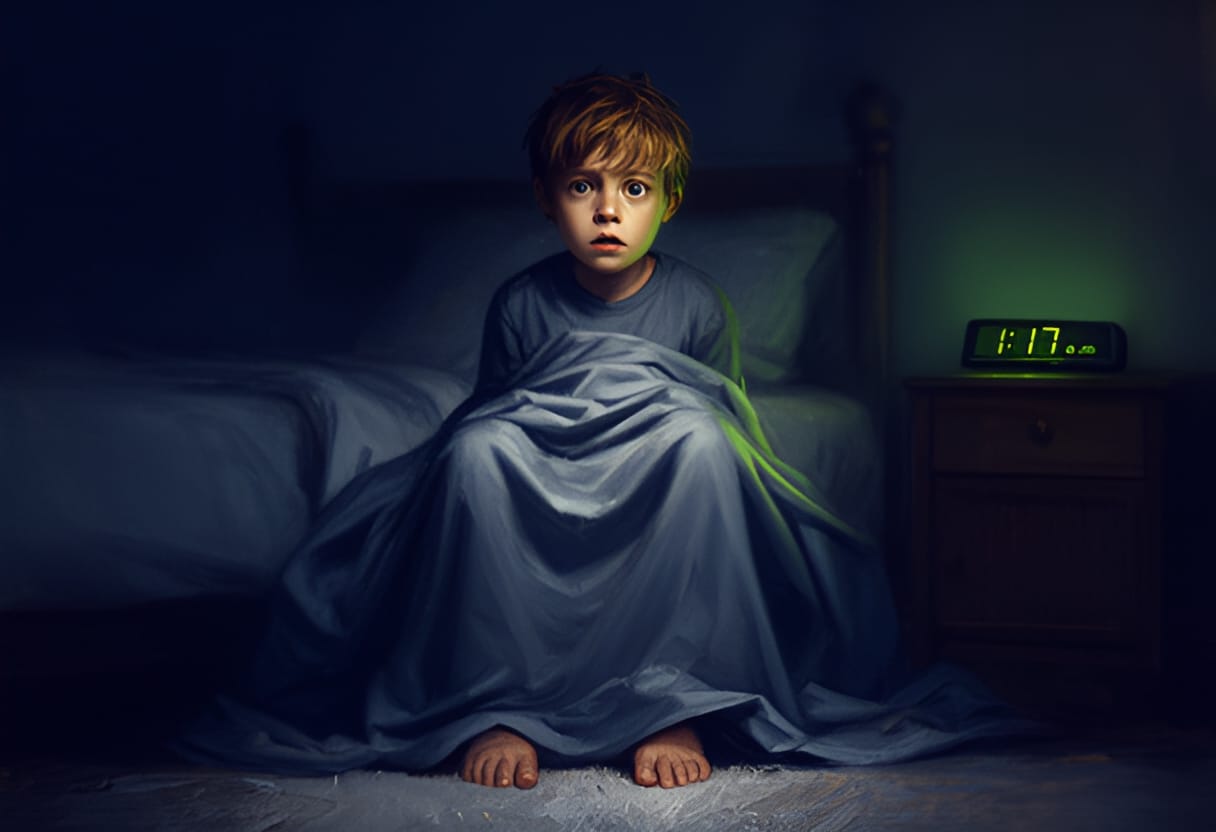
The clock on his nightstand glowed 1:17 a.m. in sickly green. Austin’s eyes fluttered open. The room was too quiet now. Too still. The absence of sound felt louder than any whisper. He swallowed. His throat was dry.
He sat up slowly, the sheets pooling around his waist. The floor was cold beneath his bare feet. He paused, listening. Nothing. Just the distant hum of the refrigerator and the occasional creak of the house settling—normal sounds, the kind that didn’t make his skin prickle.
But he knew better. He knew she was waiting. Not in the closet this time, maybe. Not behind the door. But somewhere. Watching. Learning.
His jaw tightened. He wasn’t going to play anymore.
He swung his legs over the side of the bed and stood, moving with deliberate silence. His dinosaur pajamas—Maya’s last gift, the ones with the tiny stegosaurus along the cuff—brushed against his ankles. He’d worn them every night since she left. Not for comfort. For connection. As if, by keeping them on, he could keep her close.
He padded across the room, avoiding the third board from the left—the one that squeaked like a startled mouse. He’d learned that long ago, when he used to sneak cookies from the kitchen after bedtime. Now it was a different kind of theft.
He reached the desk and paused. Maya’s hairbrush lay where he’d left it, upside down, the bristles splayed like a startled starfish. He didn’t touch it. Just looked at it for a moment, his chest tight. Then he turned and walked to the closet.
He pulled the door open just enough to slip inside, the hinges whispering in protest. The closet smelled of old sweaters and cedar chips, the faint ghost of Maya’s lavender shampoo still clinging to the back wall where she used to hang her hoodies. He reached in, fingers brushing past winter scarves and forgotten mittens, until his hand closed on the small plastic bin on the top shelf—the one labeled in her looping script: Craft Stuff – Do Not Touch (Unless You Ask).
He pulled it down and set it gently on the floor. The lid came off with a soft snick. Inside, spools of yarn spilled in a rainbow cascade—blue, green, yellow, and a bright, bold red that caught the dim light from the hallway nightlight.
Austin’s fingers closed around the red yarn. It was smooth, slightly fuzzy, the kind Maya used for friendship bracelets and pom-poms. He remembered her teaching him how to make a braid once, her fingers quick and sure as she showed him the over-under pattern. He’d messed it up, of course. Tangled it beyond recognition. She’d laughed—not unkindly—and said, “It’s okay. You’ll get it.”
He hadn’t tried since.
He tore off a length—about three feet, he guessed—and tucked the spool back into the bin. He didn’t want to take more than he needed. Didn’t want to leave a trace she might notice later. Though, truth be told, he wasn’t sure she would notice. Not if she never came back.
He carried the yarn back to his room and closed the closet door softly behind him. The latch clicked. Just like always.
He sat cross-legged on the rug, the yarn coiled in his lap like a sleepy snake. The room was dark except for the glow under the door from the hallway light and the faint pulse of the nightlight shaped like a crescent moon. He pulled the yarn taut between his thumbs and index fingers, feeling its slight resistance, its alive-ness.
He’d seen snares in books—survival guides, adventure stories where kids built traps in the woods to catch rabbits or raccoons. He hadn’t ever built one, but he knew the basics: a loop, a trigger, a tension point. He wasn’t trying to hurt anything. Just to catch. To surprise. To turn the tables.
He made a small overhand knot, then another, forming a loose pretzel shape. He pulled the ends, watching the loop shrink. Too small. He undid it and tried again, this time making the loop about the width of his fist. He tested it with his shoe—slipping the toe inside, then giving a sharp tug. The loop tightened instantly, snapping shut around the sole with a soft snick.
He nodded. Good. But it needed to release fast. If it didn’t spring open after being tripped, she’d just step over it or crawl under. He needed it to catch her foot, yank her off balance, and then let go—so she’d stumble, maybe fall, maybe make a noise. Something he could hear.
He adjusted the knot, practicing the release. Three times. Four. On the fifth try, he flicked his wrist just right—the loop sprang open like a jack-in-the-box, the knot sliding smooth and fast. He grinned in the dark. Got it.
Now he needed to set it.
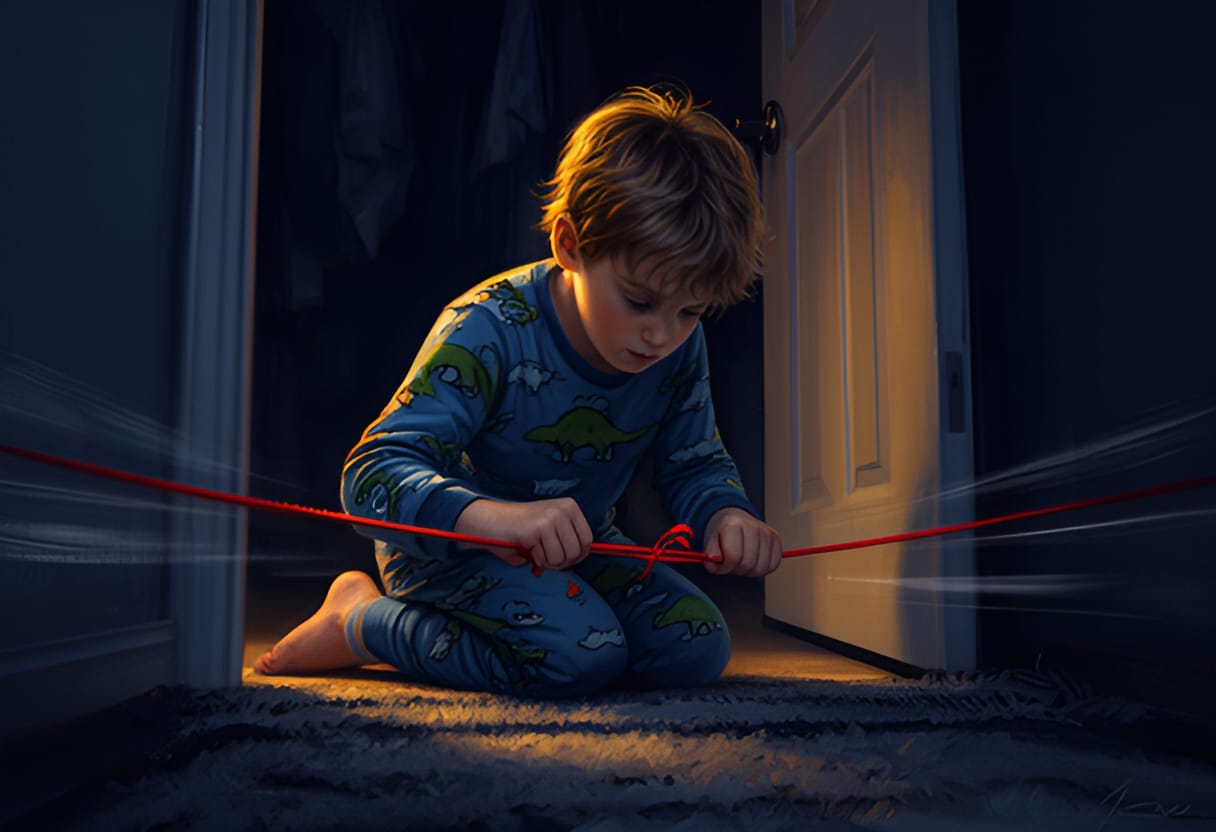
He crawled to the closet door on his knees, the rug scraping slightly under him. He anchored one end of the yarn to the inside handle—the brass knob Maya had polished the week before she left, saying, “It’s the little things that make a room feel like yours.” He tied a tight double knot, then wrapped the excess around the base twice for security.
He pulled the yarn across the threshold, keeping it low—just above the floor, where a foot would catch it. He stretched it to the opposite side of the door frame, where he’d tied a second anchor to the edge of the rug, tucking the knot under the frayed edge so it wouldn’t snag.
Now came the hard part: the trip line.
He took the loose end and laid it diagonally across the floor, leading from the anchor point to the spot where he predicted she’d step—right in front of the closet, where she usually appeared when she came out to whisper or giggle or breathe on his neck. He adjusted it, lifted it slightly with a fingertip, then let it fall so it lay just barely above the rug’s nap—visible only if you were looking for it, invisible if you weren’t.
He tested it again with his shoe. This time, when he stepped on it, the line pulled taut, the loop jerked shut, and the anchor held. He stumbled back a step, heart pounding—not from fear, but from triumph. It worked.
He reset it. Twice more. Each time, the loop snapped shut clean and fast. He was sweating slightly despite the cool air. His hands trembled, but not from nerves. From focus. From purpose.
He looked at the rug. The yarn was hidden beneath the weave, indistinguishable from the fibers unless you knew where to look. Unless you were expecting it.
He backed away, eyes locked on the spot. Satisfied.
He crawled back to bed on his stomach, moving like a scout returning from a mission. He pulled the covers up to his chin, arranged the pillow just so, and lay flat on his back. Arms at his sides. Eyes closed. Breathing slow—too slow, almost. He forced himself to mimic the rhythm of sleep: the slight catch in the inhale, the longer exhale, the way the body surrendered.
But his mind was wide awake.
He listened.
The house creaked. A branch tapped the window—once. Then silence.
He waited.
Ten minutes passed. Maybe fifteen. His eyes burned. His legs twitched. He fought the urge to shift, to scratch his nose, to open his eyes just a crack to check if the yarn was still there.
He didn’t move.
He thought about the loop under the rug. About how it lay invisible, waiting. About how, if she came, she wouldn’t see it. Wouldn’t expect it. Would step right into it—just like he’d planned.
A smile tugged at the corner of his mouth, so faint he wasn’t sure it had happened.
Then—
A sound.
Not from the closet.
From under the bed.
A soft, dry scritch-scritch, like fingernails dragging across unfinished wood.
Austin’s eyes flew open.
His breath hitched.
He didn’t move. Didn’t blink.
The sound came again. Closer. Slower. Deliberate.
And then, a whisper—so quiet it seemed to come from inside his own skull:
“You forgot the vents.”
The whisper hung in the air, thin as spider silk but sharp enough to make his scalp prickle. You forgot the vents. The words weren’t loud, but they landed like a stone in a still pond—ripples spreading through his chest, cold and sudden.
He didn’t dare move. Not a muscle. Not even to swallow. His eyes stayed locked on the darkness above him, where the ceiling bled into the shadows, but his ears strained downward, toward the source of that soft, persistent scritch-scritch. It came again—closer this time—and with it, a faint shift in the air, like the brush of a wing or the exhale of something holding its breath just beneath the mattress.
Then, a puff. Cold. Deliberate. It ghosted over his left ear, raising the fine hairs along his jawline. He felt it not just on his skin, but deep in the marrow of his bones—a chill that didn’t come from the room, but from inside the space where he lay, as if the air itself had been exhaled from somewhere far colder than the bedroom could ever be.
His trap. The yarn. The loop hidden under the rug, taut and ready, waiting for a foot that would never come.
He had been so focused on the closet—the door, the threshold, the place she always appeared—that he hadn’t thought to look elsewhere. Of course she hadn’t come through the door. She never needed to. She was already in the walls. In the vents. In the hollows beneath the floorboards where the old pipes groaned and the dust slept undisturbed for years.
And he had fallen for it. Hook, line, and sinker.
A whimper threatened to rise in his throat, but he choked it back. If he made a sound—if he flinched, if he gasped—she would know she’d gotten to him. And worse, she’d know he was still awake. Still playing.
But the scraping hadn’t stopped. It had changed. Now it was slower, more deliberate—like fingertips tracing a pattern. Not random. Not afraid. Measuring.
Then, pressure.
Just above his left ankle, where the blanket dipped slightly over the curve of his heel, something pressed. Warm. Small. Firm, but not hard—like a palm, or the sole of a bare foot, resting gently against his skin through the thin cotton of his dinosaur pajamas.
He froze.
It wasn’t grabbing. Not pulling. Not trying to trip him or yank him down. It was simply… there. Touching. As if to say, I’m here. You felt me. You always do.
His breath hitched again—this time, audible. A tiny, involuntary catch in his throat.
The touch didn’t move. Didn’t retreat. It just… waited.
And then, from the darkness below, a voice. Not a whisper this time. Not inside his head. This time, it came from under the blanket, muffled by the fabric but clear enough to make his eyelids flutter despite himself.
“You’re still awake,” it said. Soft. Sweet. Almost teasing. Like a sister sharing a secret at bedtime.
He didn’t answer. Couldn’t. His jaw was locked. His eyes were open now, wide and unblinking, staring at the ceiling where a faint glow from the nightlight painted a silver crescent above him—Maya’s nightlight. The one she’d left behind. The one that now felt less like a comfort and more like a spotlight.
The touch on his ankle shifted. Slow. Deliberate. It dragged downward, just a fraction, following the line of his foot toward the toes. Then paused. Then, with the lightest pressure, began to trace slow, lazy circles on the arch of his foot—just beneath the fabric, where the sock had slipped down during his restless tossing earlier.
A giggle followed. Not loud. Not cruel. But undeniably hers. High and airy, like the sound of a wind chime caught in a summer breeze—except it wasn’t in the air. It was in the blanket. In the space between his skin and the sheets. It vibrated up through his leg, a faint tremor in his shin, as if the sound weren’t traveling through air at all, but through the mattress, through the springs, through the very bones of the bed.
He wanted to yank his foot away. To kick out. To scream. But he remembered the way she’d laughed before—when he’d flung the blanket off and stumbled backward, heart hammering, only to find nothing there. How she’d mimicked his panic, his fear, his reaction—and how it had only made her smile wider in the dark.
So he stayed still.
Let the circles continue. Let the giggle fade into a hum—low, resonant, the kind that made his teeth feel loose in his gums, the kind he’d felt before in his chest when she’d stood too close and sung that off-key tune that seemed to tune him like an instrument.
His ankle burned where she touched it. Not with pain, but with awareness. Every nerve ending screamed notice me, even as his mind begged him to ignore.
But ignoring was harder than fighting. Fighting gave him something to do. Ignoring meant surrendering control—not of his body, but of his attention. And she had already proven she could live in the gaps between his thoughts, in the blink of an eye, in the space between one breath and the next.
The touch stopped.
Silence.
He held his breath. Waited for the next move. The next whisper. The next trick.
But nothing came.
Only the slow, steady thud of his own heart in his ears.
And then—so faint he wondered if he’d imagined it—a single word, breathed not from under the bed, not from the vents, but from the very pillow beside his ear, as if lips had brushed the fabric and spoken through the weave:
“Almost.”
Then nothing.
The room settled. The nightlight pulsed once, softly, like a sleeping thing dreaming.
Austin didn’t move. Didn’t dare to hope it was over.
He just lay there, eyes open, breath shallow, listening—not for her, but for the silence between the sounds.
And in that silence, he realized with a quiet, sinking certainty: she hadn’t been trying to escape the trap.
She’d been waiting to see if he’d notice she’d already won.
The touch on his ankle ceased as abruptly as it had begun, leaving only the faint impression of warmth where skin had met fabric. Austin didn’t dare exhale. His lungs burned with the effort of holding still, ribs locked, diaphragm clenched. The nightlight above him cast its soft, silver glow, painting the ceiling in quiet waves—Maya’s nightlight, steady and unjudging. He fixed his gaze on it, refusing to let his eyes drift downward, to the shadow pooled thick beneath the bed where the scraping had come from, where the voice had lived.
A beat passed. Then another. The silence wasn’t empty. It was thick, waiting—like the moment before a held note breaks into song.
Then, from beneath the blanket, a murmur. Not a whisper this time. Not inside his skull. This came from within the folds of the sheet, as if the fabric itself had learned to speak. Muffled, yes, but distinct—close enough to stir the hairs on his neck.
“You’re still awake,” it said.
The voice was soft. Sweet. Almost tender. It carried the lilt of a shared secret, the kind Maya used to whisper when they’d stay up too late talking about nothing and everything. Austin’s throat tightened. He didn’t move. Didn’t blink. Let the words hang in the air between him and the dark.
But the voice wasn’t done.
It shifted—lower, rougher, trying on a new timbre. A deliberate imitation. “Coach said you missed practice.”
Austin’s eyes snapped open wider. His breath hitched—not from fear, but from the sudden, sharp recognition. He had missed practice. Tuesday evening. He’d been too restless to settle, too keyed up from the tapping, the giggles, the feeling of being watched. He’d lied and said he wasn’t feeling well. Coach had bought it—had even sounded concerned—but Austin had seen the flicker of doubt in his eyes, the way he’d rubbed the back of his neck before saying, “Just get some rest, okay?”
How did she know that?
The question burned, but he swallowed it down. If he reacted—if his eyes flicked, if his jaw twitched—she’d have proof. Proof that she was getting through. Proof that he was still playing along.
So he let his face go slack. Let his eyelids grow heavy, though he didn’t close them. Let his breathing slow, even as his heart hammered against his sternum like a trapped bird. He focused on the nightlight, on the way its glow made the edges of the ceiling blur, on the faint scent of lavender from the sachet Maya had tucked into her pillowcase years ago—still there, faint but persistent, like a ghost of her presence.
And then—movement.
The touch returned. Not on his ankle this time. It had traveled. Slow. Deliberate. Up the inside of his calf, over the knee, where the blanket bunched slightly from his earlier shifting. It paused there, just for a breath, as if testing the resistance of the fabric, the tension in his muscle. Then it continued—up his thigh, where the cotton of his pajamas stretched taut over bone and sinew.

He felt it before he saw it: a faint distortion in the blanket, like a heat haze over asphalt. The fibers indented, not pressed down, but displaced—as if something invisible were flowing beneath them, shaping itself to the contours of his leg.
It reached his hip. Then, with a slow, inevitable drift, it moved beneath the hem of his shirt.
Austin’s breath caught—not a gasp, but a tightening in his chest. The touch was on his ribs now. Light. Exploratory. Fingertips—or something like them—traced the edge of his ribcage, just beneath the fabric, where the skin was soft and ticklish. It lingered there, circling slowly, teasing the hypersensitive spot just below his pectoral, where even the brush of a sheet could make him flinch.
A laugh threatened to bubble up—unstoppable, traitorous. He felt it rise in his throat, a warm, fizzy pressure behind his eyes and nose. His toes curled inside his socks. His hands, resting limp at his sides, twitched toward the blanket, as if to grab it, to pull it up and see—but he stopped himself. He remembered the last time he’d reacted: how she’d mirrored his panic, how her laughter had grown brighter in the dark, how she’d seemed to feed on the electricity of his fear.
So he bit down. Hard.
On his tongue.
The pain was sharp, metallic. Copper flooded his mouth. He tasted it—hot and bright—and focused on that instead. On the pulse in his jaw. On the way his teeth pressed together, threatening to bruise the flesh. The laugh died before it could form, swallowed by the sudden, sharp clarity of pain.
The touch didn’t stop. It didn’t retreat. It simply… adjusted. The circling slowed, became more deliberate, as if studying his reaction. Or lack thereof.
Then, from the fabric near his sternum, a sound. Not a giggle. Not a hum. A sigh. Soft. Contented. Like someone settling into a warm bed after a long day.
Austin didn’t move. Didn’t breathe. He just lay there, eyes fixed on the ceiling, blood pounding in his ears, tongue throbbing with pain, and let the sensation wash over him—not as something to fight, not as something to fear, but as something to endure. Because if he could endure this—if he could let her touch him, let her speak, let her be there, without flinching, without giving her the satisfaction of a reaction—then maybe, just maybe, she’d get tired. Maybe she’d realize the game wasn’t fun anymore if no one was playing back.
The touch lingered a moment longer. Then, slowly, it began to retreat—down his ribs, past his waist, over the curve of his hip, tracing the same path back toward his feet. The blanket settled behind it, smoothing out as if nothing had been there at all.
Silence returned.
Austin waited. Counted his breaths. One. Two. Three. Five. Ten. The nightlight pulsed once—soft, slow—like a heartbeat.
And then, from the pillow beside his ear, so faint he nearly missed it, came the whisper again.
“Almost.”
He didn’t flinch. Didn’t blink. Let the word hang in the air, unanswered, unacknowledged.
And then—nothing.
Only the dark. Only the quiet. Only the steady, unyielding beat of his own heart, finally beginning to slow.
The whisper hung in the air like smoke, then dissolved. Austin kept his eyes open, fixed on the blurred halo of the nightlight, counting the slow throb in his temples. One minute passed. Then another. The silence wasn’t empty—it was thick, expectant, like the hush before a storm breaks. He waited for the return of the touch, the whisper, the giggle that lived in the seams of the blanket. Nothing came.
Five minutes stretched into ten. His jaw ached from the pressure of his teeth, his tongue swollen and sore where he’d bitten it. The metallic taste lingered, coppery and sharp, a grounding ache in the midst of the unreality. He didn’t dare shift, didn’t dare blink too fast, afraid that any movement might be the signal she’d been waiting for—the crack in his resolve that would summon her back, stronger, hungrier.
But the room stayed still. The closet door remained shut, the yarn snare coiled invisibly beneath the rug like a sleeping snake. The nightlight pulsed once, softly, then steadied. No cold spots bloomed on his skin. No warmth crept under the fabric. The indentation in the blanket where her presence had flowed was gone, smoothed by time and stillness.
He let his breath out in a slow, shuddering release. His shoulders, which had been locked tight against the mattress, began to unwind. The fear hadn’t vanished—it had ebbed, leaving behind a hollow exhaustion, the kind that comes after holding your breath too long underwater.
Carefully, so slowly the motion was almost imperceptible, Austin lowered the blanket from his face. The cool air of the room touched his skin, and he flinched—not from fear, but from the sudden, ordinary sensation of it. He was still here. The world was still ordinary. The clock on his desk glowed 2:17 a.m. in dull green digits.
He turned his head, just enough to see the closet. The door was shut. The rug lay flat. No disturbance. No sign that anything had crossed the threshold.
A reluctant hope began to unfurl in his chest, fragile and wary. Maybe she was gone. Maybe the game really was over when no one played back. Maybe, after all this—after the tapping, the whispers, the touches that weren’t touches—she’d finally understood he wasn’t going to give her what she wanted.
He exhaled again, longer this time, and let his head sink deeper into the pillow. The lavender scent from Maya’s old sachet was faint but there, a quiet reminder of something safe, something real. He could feel the weight of his eyelids, the pull of sleep beginning to tug at the edges of his consciousness. For the first time in what felt like hours, he allowed himself to think: Maybe I can sleep now.
Then he saw it.
The pillow beside him—the one he hadn’t been lying on—was indented. Not crushed, not rumpled from restless turning, but depressed in a smooth, oval shape, exactly where a head had rested. The fabric was slightly cool to the touch, as if warmed not long ago and only now beginning to return to room temperature.
His breath stopped.
He didn’t move. Didn’t dare to lift his hand and press into the dent, afraid of what he might confirm—or what he might not find.
Then his eyes dropped, drawn by a flash of color against the dark fabric of his pajama top.
There, caught on the button just below his collarbone, was a single strand of red yarn. It was looped once around the plastic, taut and deliberate, like a tiny flag planted in conquered territory.
His stomach dropped.
The snare.
He hadn’t touched it. He hadn’t moved. The trap was still hidden under the rug, untouched, waiting. And yet—here was proof. Not of failure, but of something far more unsettling: she had been here. Not in the closet. Not under the bed. Here. On the bed. With him.
His mind raced, scrambling for explanations. Had she slipped past the snare somehow? Gone around it? Come through the wall? Or had she never left the room at all—had she been here all along, invisible, patient, waiting for him to lower his guard?
The thought sent a fresh wave of ice through his veins, colder than any puff of air she’d ever breathed on his neck. He had believed he was winning. He had believed endurance was the key. But what if endurance wasn’t the end of the game? What if it was just another level?
He looked back at the pillow. The indentation remained, unwavering in its quiet accusation. The yarn on his button caught the faint glow of the nightlight, a tiny, accusing thread of red.
A sound almost escaped him—a whimper, a groan, something raw and helpless—but he swallowed it down hard, feeling the familiar sting of his split tongue. He couldn’t react. Not now. Not ever, if he wanted this to stop.
But the relief he’d felt moments ago was gone, replaced by a creeping dread that settled in his bones like frost. She hadn’t been deterred. She hadn’t been bored. She had adapted. She had found a way to touch him without setting off the trap. She had lain down beside him—next to him—while he pretended to sleep, and left her mark not in fear, but in something quieter, more intimate: the warmth of a head on a pillow, the proof of presence.
He didn’t know how long she’d been there. Didn’t know if she was still there now, just beyond the edge of his vision, waiting to see if he’d flinch.
Slowly, deliberately, Austin pulled the blanket up and over his head again.
The fabric closed in, soft and familiar, smelling of cotton and laundry soap and the faintest trace of Maya’s lavender. It blocked out the nightlight, the clock, the dented pillow, the incriminating yarn. It left him in darkness—not the deep, velvety dark of the closet, but the softer, closer dark of being buried.
Under the blanket, he curled inward, drawing his knees up slightly, tucking his hands under his cheek. He didn’t close his eyes. He couldn’t. Not yet. But he stopped looking. He stopped listening for whispers. He stopped waiting for touch.
Instead, he focused on the rhythm of his own breath—the slow, uneven in and out—and the steady, stubborn beat of his heart beneath his ribs.
He didn’t know if she was still there.
He didn’t know if she would come back.
But he knew this: if he moved, if he spoke, if he let himself react—she would win.
So he stayed still.
Under the blanket, in the dark, he waited—not for sleep, but for the moment when even she would grow tired of waiting for a reaction that would never come.

Chapter 3
The Last Night
Austin lay frozen beneath the thin cotton sheet, eyes wide in the dark, heart hammering against his ribs like a trapped bird. The scratching beneath the bed had stopped, but the silence that followed felt heavier, thicker—like the air itself was holding its breath. He could still feel the echo of those fingernails on wood, a phantom vibration in his molars. Kelli’s voice lingered too, not in his ears but in the space behind his eyes: I knew you’d try. I’ve been waiting in the vents all along.
He swallowed hard. His mouth was dry. The yarn snare lay coiled under the rug near the closet door, a clumsy testament to his hope. Hope that had just been laughed at from underneath his own bed.
He wasn’t going to fall for it again.
Not tonight.
Not ever again, if he could help it.
A shiver ran down his spine—not from cold, but from the sudden, fierce clarity that cut through the fog of fear. He didn’t need to trap her. He didn’t need to outsmart her or outlast her. He just needed to stop playing.
His eyes flicked to the ceiling, where the glow-in-the-dark stars Maya had stuck up years ago still pulsed faintly—greenish, weary, but there. One near the edge had peeled at the corner. He remembered her laughing as she stood on the desk to reach it, her hair escaping its braid in sticky wisps. Almost there, she’d said. Just a little more.
He hadn’t touched the hairbrush since she left. It sat upside down on the desk, the bristles splayed like a question mark. He hadn’t moved it because moving it felt like admitting she wasn’t coming back. And if she wasn’t coming back… then who was this in his room? Who was whispering from the vents, scratching under the bed, promising games and secrets and worse?
He didn’t know. But he knew this: every time he reacted—every jump, every shout, every frantic glance—she grew stronger. Louder. More present. She fed on it. Not food, not sleep, but his attention. His fear. His frantic, useless attempts to win.
Well, no more.
He took a slow breath through his nose, held it, then let it out through his mouth—quiet, controlled. His arms lay flat at his sides, palms down on the sheet. He clenched and unclenched his fists once, just to feel the fabric, then stilled them.
No reaction, he told himself. Not a twitch. Not a breath too loud. Not a thought followed with my eyes.
He repeated it in his head, low and steady, like a chant against the dark.
No reaction. No reaction. No reaction.
The words weren’t magic, but they were his. They anchored him. They were his side of the bargain—if there was one—and he intended to keep it.
He fixed his gaze on the ceiling, on the smear of greenish light where the stars clung. He began to count them, not because he believed in their power, but because counting gave his mind something to do besides imagining what was coming.
One… two… three… a cluster near the lamp… four… five… the one with the peeling corner… six…
A creak.
Soft. Slow. Not from the floor. Not from the bed.
The closet door.
It was moving.
Austin didn’t flinch. Didn’t blink faster. Didn’t let his eyes dart toward the sound. He kept his stare locked on the ceiling, on the seventh star—the one that looked like a bent arrow—and counted on.
Seven… eight…
The door swung inward on its hinges, slow and deliberate, as if pushed by an unseen hand. No rush of air. No sigh. Just the quiet, deliberate groan of wood on wood, like something waking up after a long sleep.
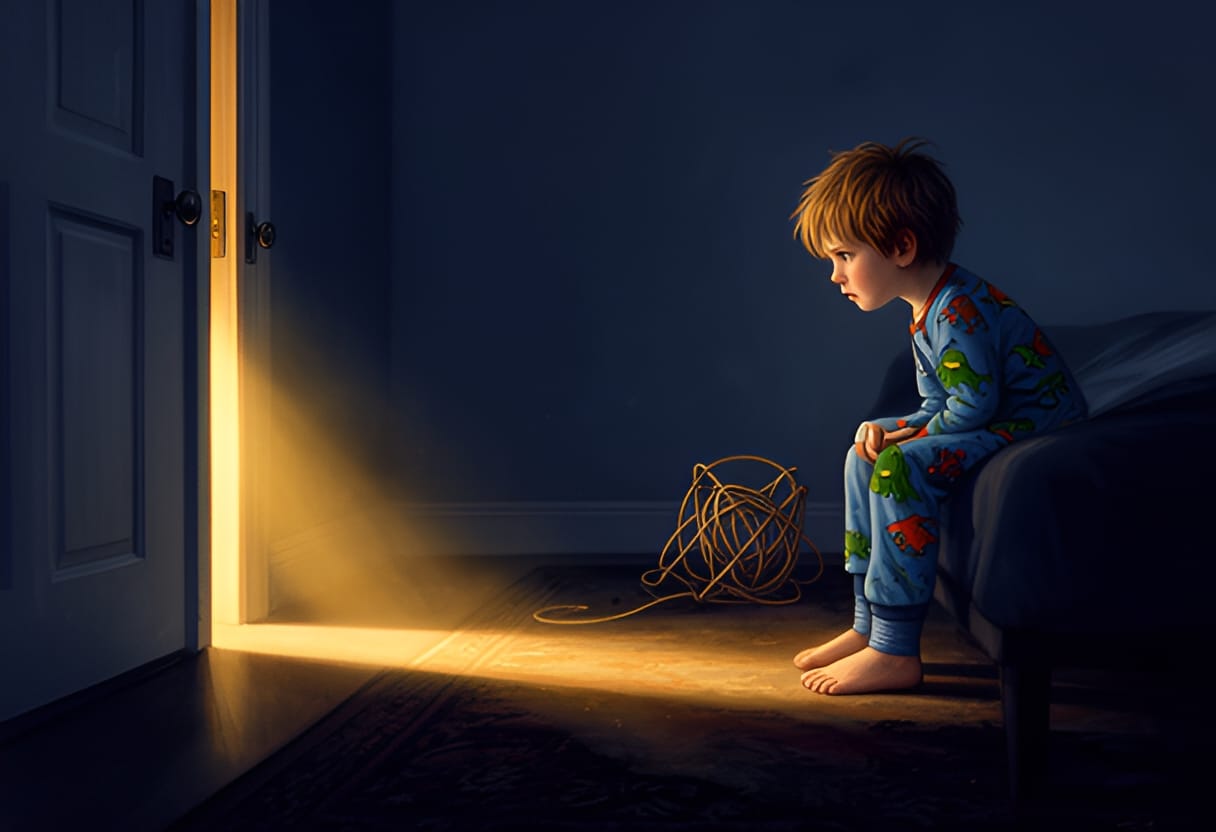
A sliver of light spilled onto the floor—yellow, not white. Not the hallway light. Not the nightlight his dad had insisted on. This was warmer. Older. Like the glow inside a seashell held to the ear.
It crept across the rug, inching toward the snare.
Austin didn’t look. He felt it in his periphery, a pale stain spreading in the dark, but he kept his eyes up. He counted.
Nine… ten… eleven…
The light widened. The door opened further. Now it cast a thin bar across the floor, like a runway for something unseen. The yarn loop lay half in shadow, half in that strange glow, its knots catching the light like tiny teeth.
He could feel it now—not just see it, but sense it. A presence. Not in the closet exactly, but at it. Waiting in the threshold. Patient. Amused.
He didn’t wonder what she looked like. Didn’t wonder if she was smiling, or tilting her head, or tapping a fingernail against the doorframe. He didn’t need to know. Knowing would be the first step toward reacting.
Instead, he focused on the weight of the sheet against his ankles. The faint itch of sweat at his temple. The way his left heel kept wanting to twitch outward.
He ignored it.
No reaction.
The light kept growing. The door was nearly halfway open now, flooding the lower third of the room with that buttery glow. It reached the edge of the bed. It would soon touch the rug where the snare lay hidden.
And still, Austin did not move.
He counted the stars again, starting over, his voice a silent murmur in the quiet.
One… two… three…
Somewhere deep in the room, a breath exhaled—soft, amused, almost disappointed.
But Austin didn’t react.
He just kept counting.
And waited.
The light pooled over the rug now, lapping at the edge of the snare like tide reaching sand. The yarn loop lay exposed in its full length, a lazy curve of off-white thread waiting to be sprung. Austin could see it clearly in his lowered gaze—though he refused to let his eyes drop that far. He felt the glow on his eyelids, a faint warmth against the skin, like sunlight through closed lids on a winter morning.
He kept counting.
Four… five… six…
A shift in the air. Not a draft. Not a change in temperature. But a presence—closer now. Not in the closet. Not at the door. Somewhere in the space between the bed and the dresser, where the shadows pooled deepest. He could sense the shape of attention, like a hand hovering just above a surface, not touching but measuring the heat beneath.
He didn’t flinch. Didn’t swallow hard. Didn’t let his breath hitch, even as the sensation brushed against his ankle—light, fleeting, like a moth’s wing grazing skin.
Seven… eight…
The whisper came then, not from any direction, but from inside the space behind his eyes, where thought lived before it became sound.
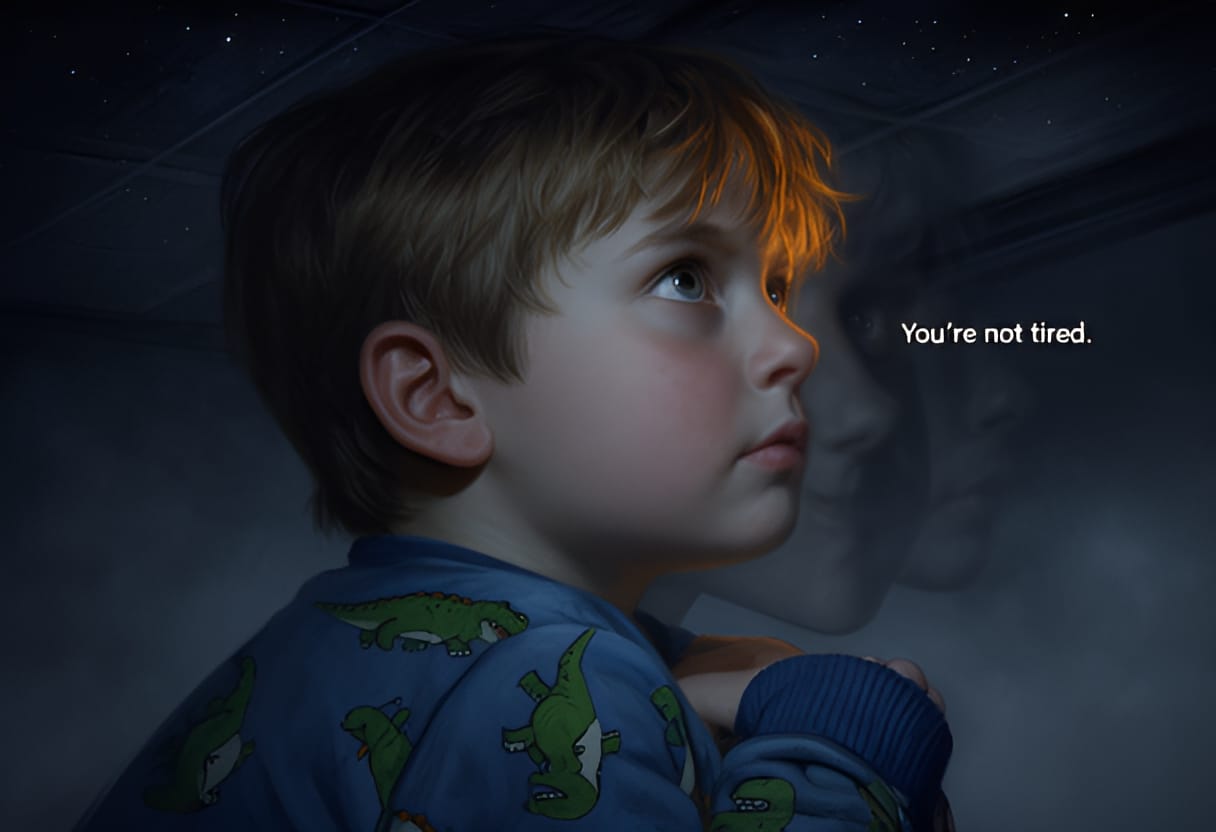
You’re not tired.
His own voice. But softer. Slower. Laced with something that wasn’t quite mockery—more like pity. Or patience.
His jaw tightened. He felt the urge to press his tongue against the roof of his mouth, to hum the tune she knew lived in his teeth—the one that made his sternum vibrate like a struck bell. But he didn’t. He let the sensation rise, let it hum in his bones, and kept his face blank, his eyes fixed on the ceiling.
Nine… ten…
The light began to pulse. Slow. Steady. Like a heartbeat.
And with it, the pressure in the room shifted—not on his chest, not yet, but in the air itself, as if the space had grown denser, more aware. He could feel her watching. Not with eyes, not exactly, but with the quality of the silence, which had changed from empty to expectant.
He thought of Maya’s hairbrush. Upside down. Untouched. He thought of the way she used to hum off-key while brushing her teeth, spit frothing at the corner of her mouth, grinning at him in the mirror. He thought of how she’d promised to teach him how to braid, then left before she could.
A prickle behind his eyes. Not fear. Not quite. Something heavier. Sadness, maybe. Or the quiet exhaustion of being seen too well.
He didn’t wipe it away. Didn’t let it change his breath. Didn’t let it move his face.
He just kept counting.
One… two… three…
The pulse of the light faltered. Once. Twice.
Then, from the corner of the room—near the vent where she’d said she waited—a sound. Not a whisper. Not a giggle.
A sigh.
Long. Slow. Released like a held breath finally let go.
And the light—just for a flicker—dimmed.
Not gone. Not defeated.
But waiting, still, for the next move.
Austin didn’t make one.
He just kept counting.
Austin kept counting, the numbers a thin rope pulling him back from the edge of whatever waited in the glow. Four… five… six… The light pooled over the rug, lapping at the snare like tide at sand. He could see the curve of off-white thread in his lowered gaze, though he refused to let his eyes drop that far. He felt the warmth on his eyelids, faint and steady, like sunlight through closed lids on a winter morning.
Seven… eight…
A shift in the air. Not a draft. Not a change in temperature. But a presence—closer now. Not in the closet. Not at the door. Somewhere in the space between the bed and the dresser, where the shadows pooled deepest. He could sense the shape of attention, like a hand hovering just above a surface, not touching but measuring the heat beneath.
He didn’t flinch. Didn’t swallow hard. Didn’t let his breath hitch, even as the sensation brushed against his ankle—light, fleeting, like a moth’s wing grazing skin.
Seven… eight…
The whisper came then, not from any direction, but from inside the space behind his eyes, where thought lived before it became sound.
You’re not tired.
His own voice. But softer. Slower. Laced with something that wasn’t quite mockery—more like pity. Or patience.
His jaw tightened. He felt the urge to press his tongue against the roof of his mouth, to hum the tune she knew lived in his teeth—the one that made his sternum vibrate like a struck bell. But he didn’t. He let the sensation rise, let it hum in his bones, and kept his face blank, his eyes fixed on the ceiling.
Nine… ten…
The light began to pulse. Slow. Steady. Like a heartbeat.
And with it, the pressure in the room shifted—not on his chest, not yet, but in the air itself, as if the space had grown denser, more aware. He could feel her watching. Not with eyes, not exactly, but with the quality of the silence, which had changed from empty to expectant.
He thought of Maya’s hairbrush. Upside down. Untouched. He thought of the way she used to hum off-key while brushing her teeth, spit frothing at the corner of her mouth, grinning at him in the mirror. He thought of how she’d promised to teach him how to braid, then left before she could.
A prickle behind his eyes. Not fear. Not quite. Something heavier. Sadness, maybe. Or the quiet exhaustion of being seen too well.
He didn’t wipe it away. Didn’t let it change his breath. Didn’t let it move his face.
He just kept counting.
One… two… three…
The pulse of the light faltered. Once. Twice.
Then, from the corner of the room—near the vent where she’d said she waited—a sound. Not a whisper. Not a giggle.
A sigh.
Long. Slow. Released like a held breath finally let go.
And the light—just for a flicker—dimmed.
Not gone. Not defeated.
But waiting, still, for the next move.
Austin didn’t make one.
He just kept counting.
The cold came without warning.
It swept over his legs first—a sudden, sharp invasion that made the hairs on his arms stand straight up, as if each follicle had been yanked by an invisible force. The flannel of his dinosaur pajamas, usually a soft barrier against the night, felt suddenly thin, as though the fabric had withdrawn and left his skin bare to something older and deeper than winter. The chill didn’t fade. It climbed, moving like ink in water, creeping up his calves, over his knees, pressing against the backs of his thighs where they touched the sheet. It was not the cold of an open window or a draft under the door. This was internal, as if the air itself had been drained of warmth and replaced with something that had never known sun.
He felt it reach his hips, then his stomach, a slow, deliberate flood that made his breath catch—not from fear, not yet, but from the sheer physical shock of it. His ribs tightened. The sheet, which had felt warm and familiar moments before, now seemed to radiate the cold back at him, as if it had been sitting in a freezer all along. He wanted to pull his legs up, to tuck them beneath him, to burrow into the mattress and hide. The urge was a live wire in his spine, twitching, demanding motion.
But he didn’t move.
He kept his eyes on the ceiling. He kept counting, though the numbers had slipped from his mind. He was no longer aware of what came after three. He was only aware of the cold, and the need not to react.
Then, a breath.
Not his own.
It brushed his ear—icy, uneven, like the exhale of someone who had been holding their breath in a freezer for too long. It stirred the fine hairs at his temple, sent a shiver not through his skin but through his bones, deep and resonant, as if the sound had vibrated in his marrow.
And with it, a voice.
Soft. Close. Not from the vent. Not from the closet. From the space just behind his left ear, where the air felt thin and charged.
I know you’re scared of the dark.
The words were not loud. They did not echo. They simply were, as real as the pressure of the sheet against his ankles, as undeniable as the beat of his own heart in his throat. They carried no triumph, no teasing lilt. Only observation. Quiet. Certain. As if she had been waiting not to frighten him, but to confirm something she had long suspected.
His body wanted to turn. To snap his head toward the voice, to see if anyone was there, to demand an explanation, to plead for it to stop. His neck muscles coiled. His eyes wanted to dart, to blink rapidly, to seek the comfort of familiarity in the dark. His breath hitched—a sharp, silent intake that threatened to break into a gasp.
But he did not move.
He let the breath hang in his lungs, shallow and controlled. He let the cold press deeper, let it settle into his shoulders, let it make his fingertips tingle with the onset of numbness. He let the voice hang in the air, unanswered, uncontested.
And then it changed.
The tone softened, frayed at the edges. The words came slower, broken, as if spoken through tears or a throat tightened with sorrow.
Help…
It was not her voice anymore. It was higher. Younger. Fragile.
…me…
A sob followed—small, choked, the kind of sound a child makes when they’ve been crying too long and their throat is raw. It came from down the hall, just beyond his door, where the floorboards creaked under small feet running in panic. It was the sound of his little sister, Lily, though he didn’t have a little sister. He had Maya. And Maya was not crying in the hall. Maya was at boarding school, hundreds of miles away, asleep in a dorm room with a roommate who snored and a poster of a band he’d never heard of.
But the sound was real. The sobs were real. The fear in them was real—raw, unfiltered, the kind of fear that only a child who believes they are truly alone can feel.
His chest tightened. His hands, which had lain flat on the sheet, curled slightly inward, fingers pressing into the palms as if to keep from reaching out, from throwing back the covers and running down the hall, barefoot and heart pounding, to find whoever was hurting.
His breath came faster now, shallow and tight, but he did not gasp. He did not sit up. He did not call out. He kept his eyes fixed on the ceiling, on the faint, fading glow of the stars Maya had placed years ago, their light now weak and distant, like memories of warmth.
He felt the cold press into his collarbone, then his throat, a fingertip of ice tracing the line of his jaw. The sobs continued—broken, uneven, each one a fresh wound. He wanted to cover his ears. He wanted to scream into his pillow to block it out. He wanted to believe it was a trick, a mimicry, a cruel imitation of a sound that had never existed.
But even if it was a trick, it worked because it was true in some deeper way—not because Lily was crying down the hall, but because a part of him feared that someone might be. Because he had once woken to the sound of Maya crying after a nightmare, and had lain frozen in his own bed, too afraid to go to her, too ashamed of his own fear to move. Because he had learned, early, that crying in the night often went unanswered. That sometimes, no matter how loud you were, no one came.
And so he lay there, eyes open, breath shallow, body rigid as stone, and let the sound wash over him—not as something to fight, but as something to endure.
The sobs began to fade. Not all at once, but gradually, as if the child down the hall had finally exhausted herself, had tucked her face into a pillow and surrendered to silence. The last one was a wet, shuddering exhale, then nothing.
The cold lingered. It had not lessened. If anything, it had deepened, seeped further into his bones, settling in the hollow of his hips, the space behind his knees, the space between his shoulder blades where tension lived. His skin felt tight, as if it had shrunk slightly, pulled inward by the absence of heat.
He did not shiver. He did not adjust the blanket. He did not let his eyes close, not yet.
He simply lay there, waiting—for the next move, for the next test, for the moment when she would decide whether he had passed or failed.
And in the quiet that followed, the only sound was the slow, steady rhythm of his own breath—barely there, but his. And the faint, persistent pulse of the light, still waiting near the rug, still holding its breath.
He held his breath as the cold deepened, not as a shiver but as a slow seep, like groundwater rising through stone. It pooled in his sternum, then spread outward, pressing against his ribs from within. A weight settled—not sudden, not violent, but inevitable, as if the air itself had thickened and begun to pull down. At first, it was merely a sensation, like a heavy blanket tucked too tightly. Then it grew, ounce by ounce, until inhaling felt like lifting a stone.
His lungs strained against the pressure. He wanted to gasp, to throw back the covers and suck in air like a diver breaking the surface. His diaphragm clenched. His throat tightened. But he remembered the vow: no reaction. Not a flinch, not a sigh, not the slightest shift in breath rhythm. He forced his inhales to stay shallow, sipping air through the corners of his mouth, exhaling just as slowly, as if breathing through a straw buried in sand. Each breath was a small act of defiance, a quiet rebellion against the thing that sought to unmake him.
The weight continued to increase. It was no longer just pressure—it was presence. He could feel its shape now, diffuse but distinct, straddling his torso like a crouching figure. It warmed where it touched, not with heat, but with the absence of cold, a strange inverse sensation that made his skin prickle. His ribs ached. His vision began to blur at the edges, not from lack of air, but from the intensity of holding still, from the sheer force of not moving a muscle.
Then came the touch.
Two points of cool pressure, like river stones smoothed by centuries of water, settled on his collarbones. They were light at first—almost tentative—then firmer, spreading slightly as if testing the bone beneath. They did not pinch. Did not grab. Simply rested, deliberate, undeniable. His body screamed to jerk away, to trap those hands in his fists and throw them off. His shoulders twitched, imperceptibly, but he checked it instantly, locking them back into the mattress.
He did not look down. He did not turn his head. He kept his eyes fixed on the ceiling, on the ghostly glow of the stars—now so faint they were barely there, like memories of light. His vision tunneled, the periphery fading to gray, until all he could see was a single point of phosphorescence near the ceiling’s center, a tiny beacon in the dark. He focused on it, not because it comforted him, but because it was something real, something unchanging, something that was not her.
And then, slowly, impossibly, a face formed above him.
It did not emerge from shadows or mist. It simply was, as if the air had thickened enough to take shape. Pale skin, slightly luminous in the dark. Hair that shifted between shades—ash blond, then faintly green, then back again—like oil on water. Eyes wide and unblinking, irises so pale they appeared almost white, yet somehow holding depth, as if they contained storms. Her lips were parted, not in a smile, not in a snarl, but in quiet expectation.
She was close. So close he could have felt her breath if she had drawn any. But there was none. No warmth. No mist. Just the silence between breaths, the space where sound should have been.
“I know you’re there,” she whispered. Not loud. Not taunting. Just a statement, soft as dust falling. “You can’t ignore me forever.”
Her voice was not her own. Not exactly. It was layered—like a recording played over itself, slightly out of sync. Beneath it, faint but clear, was the echo of Maya’s voice, the way she used to say “Come on, Austin, just try it” when she was teaching him to ride his bike. And underneath that, a third tone, younger, trembling—like a child’s voice begging to be heard.
Austin did not blink. Did not swallow. Did not let his gaze drop, not even a fraction. He felt her eyes on him, studying the line of his jaw, the tension in his neck, the way his chest rose and fell in those tiny, controlled sips of air. He felt the weight of her presence, not just on his chest, but in the room—it had changed the air, made it thicker, slower, as if time itself had to push through her to reach him.
He wanted to speak. To say Go away. To say I’m not afraid. To say Leave me alone. But words would have been movement. Breath shaped into sound. And any reaction, no matter how small, would have been a victory for her.
So he stayed still.
He let the silence stretch. Let her wait. Let her see that he would not break—not for fear, not for pleading, not even for the sound of his sister’s voice, real or not, echoing in the dark.
Her expression did not change. Not anger. Not frustration. Just that same quiet observation, as if she were waiting to see how long it would take before he cracked. Before he moved. Before he gave her what she came for.
But he did not move.
He breathed.
He waited.
He stared at the star.
And somewhere, deep in the dark, the weight on his chest began—not to lessen, but to wait, as if holding its own breath in return.
The pressure on his chest shifted—not less, but different. It flowed downward, settling into his lower ribs, then his abdomen, as if the weight were liquid seeking the lowest point. His hips felt pinned, his legs heavy, though he knew they were free. The sensation was not pain, but a deep, resonant pressure, like standing at the bottom of a pool and feeling the water press in from all sides. It made each shallow breath a conscious effort, a negotiation with his own body.
Above him, Kelli did not move. Her face remained inches from his, eyes locked onto his, unblinking. He could see the faintest reflection of the ceiling’s glow in her pupils—a tiny, inverted star. It was the only light in the room that seemed to come from her, not from memory or trick, but from something self-contained, like a ember in ash.
A sound began, low and vibrational, not in the air but in the bones of his skull, in the enamel of his teeth. It was the hum—deep, resonant, the one that had made his fillings ache the first time she appeared. It thrummed now, steady, not loud, but pervasive, as if the mattress, the floorboards, the very walls were tuned to her frequency. It did not hurt. It simply was, a constant beneath thought, like the hum of a refrigerator in an otherwise silent house.
His jaw tightened. He wanted to clench his teeth against it, to hum back, to disrupt the frequency. But that would be reaction. That would be engagement. So he let the vibration pass through him, let it rattle his molars and loosen his grip on the sheets, all while keeping his face smooth, his breath even, his eyes fixed on the star.
The hum shifted—rose in pitch, became almost melodic. And woven into it, faint but unmistakable, was a tune. Off-key. Familiar. Maya’s humming from the night she promised to braid his hair before school, the one she never got to finish because her bus came early and she’d shouted, “Tomorrow, I swear!” as she ran out the door.
Austin’s throat tightened. Not from fear now, but from something deeper—a ache that had nothing to do with breath or pressure. He remembered the way her voice had sounded then, hopeful, distracted, already halfway out the door. He remembered believing her.
The hum faltered. Just for a breath. The weight on his chest hesitated.
Then, from somewhere behind his eyes—not in the room, not in the air, but in the quiet space where thought begins—a whisper formed, not in her voice, not in his, but in the space between:
You don’t have to keep pretending you’re not tired.
It was not a trick. It was not a threat. It was the truth, spoken softly, as if she had finally stopped playing the game and was only now saying what she’d meant all along.
Austin did not respond. He did not break. He only breathed—shallow, even, unyielding—and let the hum fade, let the weight settle, let the silence return, thick and complete, as if the room itself were holding its breath alongside him.
The whisper came again, softer now, fraying at the edges like a thread pulled too thin. “You don’t have to keep pretending you’re not tired.” It wasn’t in her voice anymore. Not really. It was the quiet between his breaths, the space where thought began to loosen its grip.
Kelli didn’t move. Her eyes still held his, pale and unblinking, reflecting that tiny inverted star from the ceiling. But the hum had changed. It was no longer a vibration in his teeth, a pressure in his skull. It had thinned, become intermittent—like a signal losing strength. The melody woven through it, Maya’s off-key hum about braids and tomorrow, now stumbled over itself, notes dropping out one by one until only silence remained where the tune had been.
A breath passed. Then another. The weight on his chest, that deep, liquid pressure settling into his ribs and abdomen, didn’t vanish—but it stopped pressing. It simply was, like water that had ceased to rise but still filled the space it occupied. His hips no longer felt pinned. His legs, though still heavy with the ghost of resistance, could have moved if he’d willed them to. But he didn’t will them to. He didn’t will anything.
Her whisper returned, even fainter now, as if spoken from the other side of a wall made of fog. “I’m not going away because you made me. I’m going away because you stopped needing me to stay.”
The words weren’t accusatory. They weren’t sad. They were just… true. And that was what made them dangerous. Because if she was right, then he’d been feeding her all along—not with fear, not with screams, but with the quiet, exhausted act of pretending he wasn’t tired. With the lie he told himself every night: I’m fine. I can handle this.
He didn’t correct her. He didn’t agree. He let the statement hang in the thick, slow air between them, unanswered, unchallenged.
Then she sighed.
It wasn’t a sound of frustration or defeat. It was softer than that—like wind slipping through a crack in a sealed window, like the last exhale of something that had been holding its breath for far too long. The sound didn’t come from her lips. It seemed to rise from the blankets near his sternum, from the very fabric of the bed, as if the sigh had been woven into the threads and was only now coming loose.
And with it, she began to fade.
Not all at once. First, the edges of her form blurred—her shifting hair, the pale line of her jaw, the hollow of her throat—like ink dropped in water. Her outline softened, lost definition. The pale eyes that had locked onto his grew less distinct, the pupils dilating until they were nothing but dark pools reflecting nothing. The light that had seemed to come from within her—the tiny, inverted star in her gaze—dimmed, then vanished.
Her fingers, which had hovered just above his collarbone, began to translucent. He could see the weave of his dinosaur pajamas through them, the faded green of the stegosaurus plate, the worn cotton threads. Her forearm, when he dared to track it with his eyes, became a suggestion of shape, a shimmer in the air where solidity had been.
The hum was gone. The pressure, however, lingered—a fullness in his lower ribs, a warmth in his abdomen, like the echo of a touch. But it was no longer oppressive. It was merely present, as if her departure had left behind a residue, a imprint in the space she’d occupied.
He waited.
He counted the stars in his mind, not the ones on the ceiling, but the ones he remembered from summer nights in the backyard, when Maya would point out constellations and make up stories about them. Orion’s belt. The bear with the long tail. The one she said looked like a dinosaur drinking from a stream.
Ten seconds passed. The weight hadn’t increased. It hadn’t decreased. It simply remained, a quiet pressure against his innerwear, like the memory of a hand.
Twenty seconds. The air in the room felt lighter, though nothing had changed. The closet door was still open. The rug still hid the yarn snare beneath it. The flashlight and upside-down hairbrush still sat on the desk, untouched.
And then—so gradually he wasn’t sure it had happened—the pressure lifted.
It wasn’t a sudden release. It was a slow seeping away, like water draining from a sunk thing. The heaviness in his ribs eased first, then the tightness in his abdomen. His breath, which had been shallow and controlled for so long, deepened without his permission. He felt it—not as a betrayal, not as a surrender, but as a return. Air filled his lungs, slow and full, and for the first time in what felt like years, he didn’t fight it.
He didn’t open his eyes. Not yet.
Instead, he turned.
Slowly, deliberately, he rolled onto his side, pulling the blanket up to his chin as he went. The fabric brushed his nose, smelled of laundry soap and the faintest trace of cedar from his closet. He tucked his hands beneath the pillow, folded his knees slightly, and let his spine settle into the mattress.
The room was quiet.
No hum. No whisper. No weight.
Just the quiet.
He let his eyes close.
Not because he was giving in. Not because he had won.
But because he was, at last, tired.
And for the first time in a long time, that was enough.
The blanket settled over his shoulders, warm from the heat of his body, and for a moment he lay perfectly still, listening—not for whispers, not for footsteps, not for the creak of the closet door settling back into its frame—but for the sound of his own breathing. It was even now. Unforced. The kind of breath that came not from control, but from release.
Behind his eyelids, the dark wasn’t empty. It was soft. Like the inside of a seashell held to the ear, where the rush of blood sounded like tide. He thought of the backyard oak tree, its branches scraping against the window in the wind. He thought of Maya’s voice, not as it had echoed in Kelli’s layered tones, but as it truly was—loud when she laughed, off-key when she hummed, impatient when she said, Tomorrow, I swear! as she ran for the bus.
He didn’t chase the thought. He let it pass, like a cloud across a moonlit sky.
Somewhere down the hall, the floorboard near the stairs groaned—a sound of settling, not of stepping. The house was old. It made noises. His father had said so, voice muffled through the door after checking on him weeks ago: Just the house breathing, Austin. Nothing to worry about. He hadn’t believed it then. Now, he wondered if he’d been listening for the wrong thing all along.
His jaw, which had ached from the hum’s vibration, felt loose. His teeth no longer throbbed. He licked his lips—dry, but not from fear. From breathing through his mouth, as he had all night. He swallowed. The motion was small, ordinary. Human.
The weight on his chest was gone. Not just lifted—absolved. As if it had never been more than a shadow cast by his own resistance, a shape given form by the attention he’d refused to withdraw.
He didn’t know how long he lay there before sleep came. It didn’t arrive with a fall, but with a sinking—like stepping into deep, still water and feeling the pull of it slowly take you under. No struggle. No sudden darkness. Just the gradual loosening of grip, the mind releasing its hold on the edge of wakefulness.
His fingers uncurled from where they’d been tucked beneath the pillow. His breath softened further. The last trace of tension in his neck eased, and his head turned slightly into the pillow, seeking the cool cotton beneath the blanket’s warmth.
The room stayed quiet. The closet door remained open, but it no longer felt like a threshold. It was just a door. The wood grain visible in the dim glow from the streetlamp outside, the slight warp near the hinge where it had always stuck—a flaw, not a doorway.
And in the quiet, Austin Sledge slept.
Not because he had defeated her.
Not because he had outlasted her.
But because he had, at last, stopped fighting the night.
And the night, having found no purchase in his resistance, no echo in his stillness, no fuel in his fear or his fury or his fragile, flickering hope—let him go.