
Fiction
vision mah 2eme bac
by amine moussaoui
3 chapters1.1 hr read
Chapter 1
The Weight of Numbers
Amina pressed her forehead against the cool glass of the classroom window, willing the numbers on the page to rearrange themselves into something familiar. The quiz lay face down on her desk, but she could feel its weight — the harsh red ink circling a single line in her work, the one where she had subtracted seven from twelve and gotten four. It was stupid. A slip. The kind of mistake she made when her mind raced ahead, terrified of running out of time, of falling behind, of letting everyone down.
Around her, pens scratched softly. Other students bent over their papers, brows furrowed in concentration. She had studied. She had reread the chapter on quadratic equations three times, done every practice problem in the workbook, even stayed after class twice to ask Madame Benali for clarification. And yet, when the teacher had announced, without warning, “Clear your desks. We’re having a quiz on factoring and completing the square,” her throat had tightened. The formulas had scattered like birds from a startled tree.
She had started strong. The first problem — factoring x² + 5x + 6 — came easily. (x+2)(x+3). She smiled faintly, relieved. The second, completing the square for x² – 6x + 5, required a few more steps, but she got there: (x–3)² – 4. Confidence flickered. Then came the third: solve 2x² – 8x – 10 = 0 by factoring.
She factored out the 2 first: 2(x² – 4x – 5). Then she looked for two numbers that multiplied to –5 and added to –4. –5 and +1. So: 2(x – 5)(x + 1). Set each factor to zero: x = 5 or x = –1. She wrote it down quickly, satisfied.
Then came the fourth problem — the one that undid her.
3x² + 12x + 9 = 0.
She factored out the 3: 3(x² + 4x + 3). Then she needed two numbers that multiplied to 3 and added to 4. 1 and 3. So: 3(x + 1)(x + 3). Solutions: x = –1 or x = –3.
She wrote it down. Double-checked. Felt good.
But then, as she turned the page to the back where the bonus question waited — a word problem about a ball thrown upward, height modeled by h = –5t² + 20t + 1 — she paused. The numbers swam. Had she factored correctly? Had she missed a sign?
She flipped back to her work on the fourth problem. Stared at it. The original equation was 3x² + 12x + 9 = 0. She had factored out 3 correctly. Inside the parentheses: x² + 4x + 3. Two numbers that multiply to 3 and add to 4… yes, 1 and 3. So (x+1)(x+3). Right.
But then — she saw it. In her haste, when she had written the solutions, she had written x = 1 and x = 3 instead of x = –1 and x = –3. A sign error. A stupid, avoidable sign error.
She had known the rule. She had taught it to her younger cousin last summer. And yet, under the pressure of the clock ticking, the silence of the room, the weight of expectation pressing down like a second bac already looming, she had flipped the signs.
Her chest tightened. She wanted to erase it, to fix it, but the quiz was already collected. Madame Benali was walking down the aisle, gathering papers, her expression unreadable.
When the teacher reached her desk, Amina slid the quiz forward, her fingers trembling slightly. She didn’t look up. She couldn’t.
“You usually do better than this, Amina,” Madame Benali said softly, not unkindly, but the words landed like a stone. “Everything alright at home?”
Amina shook her head, finally meeting the teacher’s eyes. “Just tired, madame. Didn’t sleep well.”
Madame Benali nodded, though her gaze lingered a second too long. “Come see me after class if you want to go over it. We can’t afford gaps before the bac mocks.”
“I will,” Amina whispered.
As the teacher moved on, Amina buried her face in her hands. The heat behind her eyes threatened to spill over. She had let herself believe — just for a moment — that she was getting it. That the hours of struggle were paying off. That she might, just might, make her parents proud.
Now she knew better. She was fooling herself. She wasn’t smart enough. Not for this. Not for the bac. Not for the future they had sacrificed for.
When the bell rang, she was the last to pack her bag. Her movements were mechanical, numb. She shoved her notebook and textbook into her bag without looking at them, as if they might accuse her too. Her cheeks were wet, but she blinked fast, refusing to let anyone see.
She pushed through the classroom door and into the hallway, the noise of locking lockers and shouting friends washing over her without registering. She didn’t go to her next class. She didn’t stop at the water fountain. She just walked — fast, head down — until she reached the side entrance, where the cool air of the Algiers autumn hit her face.
She kept walking, past the fruit vendor shouting prices, past the old man mending shoes under his awning, until she turned the corner onto her street. Her breath came in short gasps, not from exertion, but from the tight knot in her chest. Home. She needed to be home. To disappear.
She fumbled with her keys, dropped them once, snatched them up, and shoved the key into the lock. The door clicked open. She slipped inside, closed it softly behind her, and leaned against it for a moment, listening.
Silence. Then, from the kitchen, the murmur of her mother’s voice — low, soothing — probably on the phone with her sister. The clink of a spoon against a cup. Tea being prepared.
Amina pushed off the door and moved quickly down the hall, her slippers silent on the tile. She passed the living room where the television murmured a news bulletin in Arabic, her father’s silhouette just visible in the dim light, his newspaper folded on his lap. She didn’t dare look at him. She couldn’t face the question she knew would come: How did the quiz go?
She reached her room at the end of the hall, closed the door, and leaned her forehead against the wood. She drew a shaky breath. Then another.
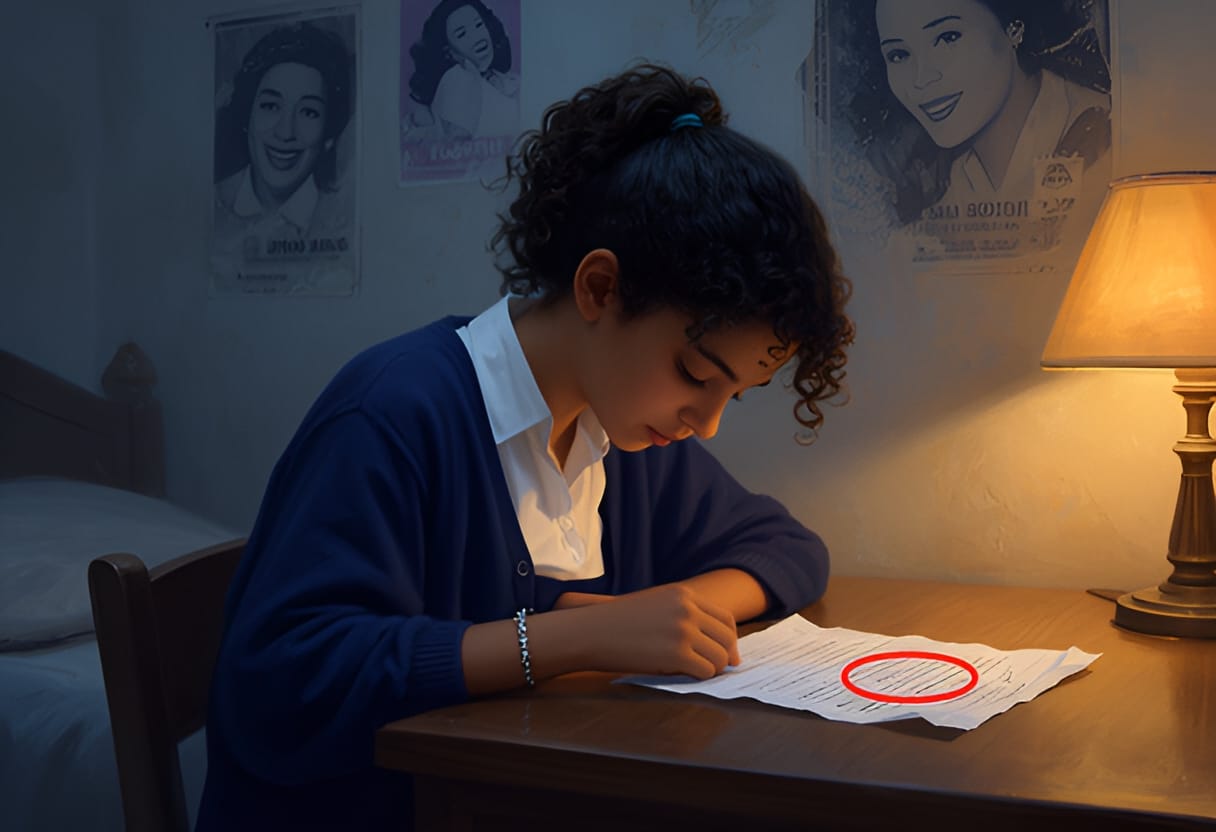
She turned on the lamp. The small room came into focus: posters of Algerian singers on the walls, her schoolbooks stacked neatly on the desk, her prayer rug folded in the corner. She dropped her bag by the chair and went straight to the desk. Her quiz lay on top of her notebook, where she had shoved it when she got home.
She picked it up. The red circle glared at her from the fourth problem. Around it, Madame Benali had written: Check your signs.
She stared at it. Not at the whole page. Not at the three correct answers. Just that one circle. That one mistake.
Her breath hitched. She felt it then — the familiar, crushing certainty that settled over her like dust. She wasn’t just bad at math. She was a fraud. She had been pretending all along, copying notes, asking questions, acting like she understood, when really she was just one slip away from exposure.
She thought of her father’s quiet pride when she brought home good grades. Of her mother’s early mornings, making sure she ate before school. Of the sacrifices — the extra tutoring fees, the skipped family outings, the way her parents whispered about her future like it was a promise they had to keep.
And she had ruined it. All of it, over a minus sign.
Tears spilled over, hot and silent. She wiped them angrily with the heel of her hand, but more came. She sank into her chair, the quiz clutched in her hand like evidence.
She was not smart enough. She never would be.
She sat there until the light began to fade, until the call to evening prayer drifted faintly from the mosque down the street. She didn’t move. Didn’t turn on the main light. Just sat in the growing dark, the red mark on the paper burning behind her eyelids.
And then, softly, a knock at the door.
“Amina?” her mother’s voice, gentle, hesitant. “Habibti, I made tea. With mint. Would you like some?”
Amina swallowed hard. Her throat felt tight, raw. She didn’t trust herself to speak without breaking.
“No, umm…” she managed, her voice thick. “I’m not hungry. Thank you, ummi.”
There was a pause. She could imagine her mother on the other side, hand resting on the door, head tilted, listening.
“Okay, habibti,” her mother said finally. “If you change your mind, it’s on the table. I’ll be in the kitchen.”
The footsteps retreated. The door stayed closed.
Amina let out a breath she hadn’t realized she’d been holding. She looked down at the quiz again. The red circle seemed to pulse in the dim light.
One mistake. One stupid, preventable mistake.
And it had undone her.
She closed her fingers around the paper, crumpling it slightly at the corner. Then, slowly, she smoothed it out again. She couldn’t look away. Couldn’t stop seeing it: the place where she had gone wrong.
She whispered it to the empty room, to the shadows, to the ghost of the girl who had believed, just that morning, that she might be okay.
“I’m not smart enough.”
The words hung in the air. And for the first time in a long while, she believed them.
Amina didn’t move. The whisper still trembled in the air between her and the darkening room. She hadn’t expected an answer. She hadn’t even meant to say it aloud.
Then came the knock again — softer this time, but insistent.
“Amina?” It was not her mother’s voice. Lower. Familiar, but changed — deeper, rougher at the edges, like stone worn by wind.
Her breath caught. She knew that voice. She hadn’t heard it in two years, not since the day he left with only a duffel bag and a silence that had swallowed the house.
She didn’t answer. Couldn’t. Her fingers tightened on the crumpled quiz, knuckles whitening.
The door opened just enough for a sliver of hallway light to cut across the floor. Then it swung wider.
Karim stood in the doorway, silhouetted against the glow from the living room. He had grown taller, his shoulders broader beneath a faded jacket that hung loosely on his frame. His face was sharper now, cheeks hollowed, but his eyes — dark and steady — locked onto hers immediately. Not with judgment. Not with surprise. With recognition, as if he had been waiting for this exact moment.
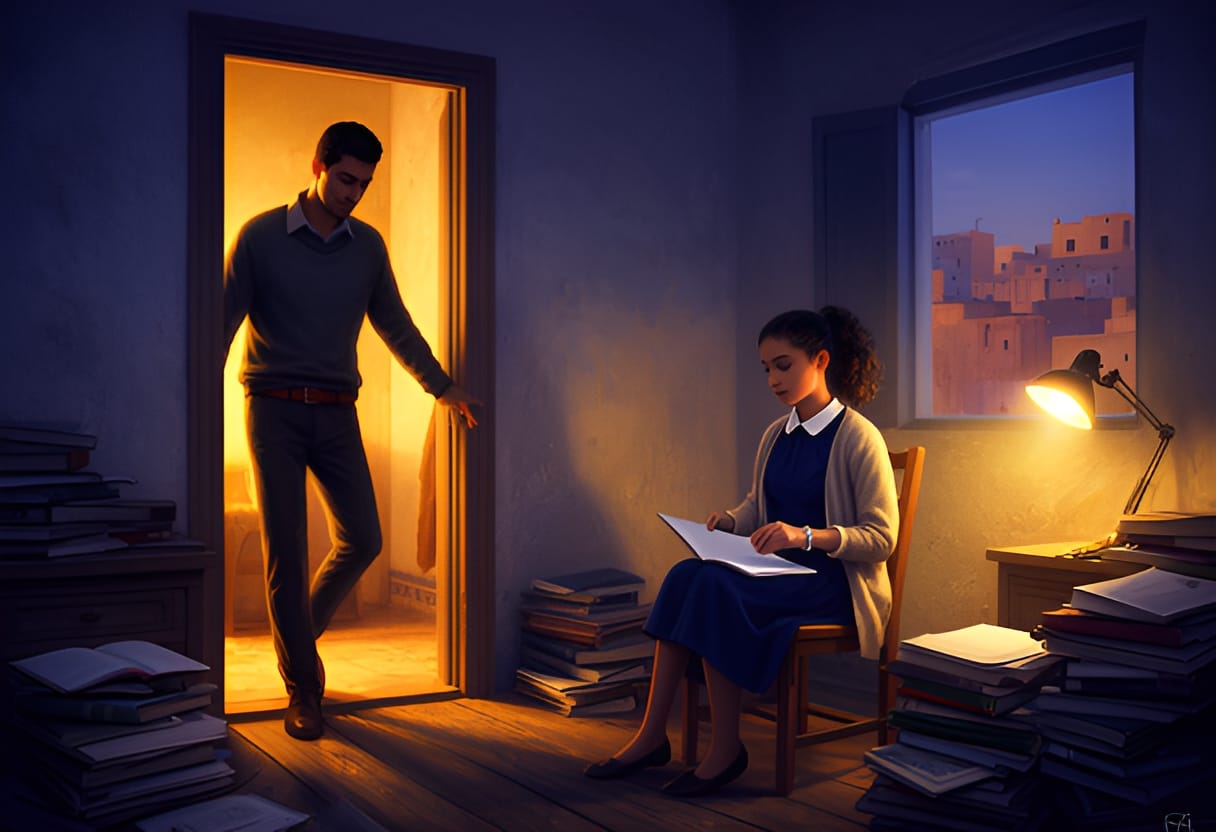
“You left the door unlocked,” he said, voice quiet, stepping inside without waiting for permission. He closed the door softly behind him, the click loud in the stillness. “Mother was worried you’d catch cold.”
Amina pushed back in her chair, the quiz still clutched in her lap. She wanted to speak — to ask why he was here, why now, after all this time — but her throat closed. Instead, she glanced down at the paper, then quickly tucked it beneath her notebook, as if hiding it could erase what had just happened.
Karim didn’t miss the motion. His gaze flicked to the desk, then back to her face. He didn’t comment. Didn’t accuse. He simply pulled the chair from her desk and sat, turning it so he faced her, elbows on his knees, hands dangling.
“You’ve been studying hard,” he said. “I can see it. The books are stacked just right. Notes in the margins. Even the way you sit — like you’re bracing for impact.”
A bitter laugh escaped her before she could stop it. “I’m not studying. I’m failing.”
He shook his head, a small, almost imperceptible motion. “You didn’t fail. You made a mistake. There’s a difference.”
She looked at him then, really looked. The suspicion was there — why was he here? What did he want? — but beneath it, something else stirred. A flicker of the old trust, the kind that had existed before the silence, before the accusations, before he stopped being her brother and became a ghost in the house.
“You don’t understand,” she whispered. “It’s not just this quiz. It’s everything. I can’t keep up. I don’t get it. I pretend, but I’m just… waiting for the moment everyone realizes I’m not supposed to be here.”
Karim leaned forward, his forearms resting on his thighs. “Tell me about the quiz.”
She hesitated. Then, voice flat, she described it: the surprise, the first three problems she’d solved correctly, the fourth — the quadratic — where she’d dropped the sign, turned a negative into a positive, and walked away with answers that were the mirror image of the truth.
When she finished, he didn’t sigh. Didn’t say I told you so or you should’ve checked your work. Instead, he asked for her textbook.
She handed it over, wary. He opened it to the algebra section, ran a finger down the page where the rules for factoring quadratics were laid out in bold print.
“You know this,” he said, tapping the line about finding two numbers that multiply to ac and add to b. “You’ve seen it a hundred times. But you’re treating it like a spell — say the words right, and the answer appears. Magic doesn’t work that way. Math doesn’t either.”
He closed the book. “Tell me what you see when you look at 3x² + 12x + 9 = 0.”
She frowned. “I see a mess. Numbers everywhere.”
“What if I told you it’s not a mess? What if I told you it’s a story?”
She blinked. “A story?”
He stood and walked to the window, pulling aside the curtain just enough to let in the last of the twilight. The street below was quiet now, the fruit vendor gone, the shoe mender packed up. Only the occasional call to prayer drifted on the air, soft and rhythmic.
“Look at it like this,” he said, turning back. “This equation? It’s a parabola. A curve. It opens up because the three in front is positive. It crosses the x-axis where it equals zero — that’s what we’re solving for. And it’s symmetrical. Always. Like a mirror.”
He walked to the center of the room, pacing slowly. “Now, imagine you’re standing at the vertex — the bottom of the curve. From there, you take steps left and right. Same number of steps each way, because it’s balanced. The distance you go? That’s half the distance between the roots.”
Amina watched him, frowning. It made no sense. And yet…
“You’re saying the answers aren’t just numbers you pull out of a hat?” she asked.
“No,” he said, stopping in front of her. “They’re points on a line. And if you can see the shape, you don’t need to memorize the formula. You just need to feel the balance.”
She thought of the quiz. Of how she’d gotten the first three right — not by rote, but because she’d seen them. The first: (x+2)(x+3). She’d recognized the pattern instantly. The second: a perfect square shifted down. The third: factored by grouping. She hadn’t memorized those. She’d understood them.
And then the fourth — and she’d panicked. She’d stopped seeing. She’d started guessing.
Karim saw it in her face. “You already know how to do this,” he said quietly. “You just forgot to trust yourself.”
She looked down at her hands. “What if I’m wrong again?”
“Then you’ll be wrong,” he said. “And you’ll try again. That’s how it works. Not perfection. Persistence.”
A long silence followed. Outside, the call to evening prayer rose again, clearer this time, weaving through the alleys of the Casbah like a thread.
Amina swallowed. She thought of her mother’s tea, still warm on the table. Of her father’s newspaper, folded just so. Of the way the house had held its breath since he left.
She looked up. “Just… one evening,” she said. “To see if… if it helps.”
Karim nodded. A small smile touched the corner of his mouth — the first real one she had seen from him in years. “One evening,” he agreed. He reached into his jacket pocket and pulled out a worn notebook, its cover stained and corners bent. He placed it gently on her desk, beside her textbook.
Then he stood. “But first,” he said, “tea. You said you weren’t hungry. But you never turn down mint tea when it’s made with care.”
He walked to the door, paused, and looked back. “And Amina?”
She looked up, waiting.
“You’re not a fraud,” he said. “You’re just tired.”
Then he left, closing the door softly behind him.
Alone again, Amina stared at the notebook. She didn’t open it. Didn’t dare to hope.
But for the first time since the quiz, the red circle on the page didn’t feel like a verdict.
It felt like a question.
And maybe, just maybe, she was ready to answer it.
Amina traced the edge of the notebook with her thumb, feeling the roughness of the worn cover, the slight give where the spine had cracked open before. The room was quiet except for the distant hum of the refrigerator in the kitchen and the occasional creak of the old building settling. Outside, the last light had faded from the Casbah streets, leaving only the amber glow from a few windows and the steady pulse of the call to prayer echoing between the walls.
She had not opened it. Not yet.
But the words Karim had said lingered — You’re not a fraud. You’re just tired. — and they had settled somewhere deeper than thought, in the place where breath catches before a sob or a laugh.
She lifted the notebook slowly, as if it might vanish if she moved too fast. The pages were yellowed at the edges, filled with handwriting that leaned forward like someone in a hurry to get to the point. Diagrams dotted the margins — parabolas sketched with careful arrows, axes labeled in a hand that was precise but not cold. She flipped to a blank page near the back and hesitated. Then, with a pencil she kept behind her ear, she wrote the equation at the top: 3x² + 12x + 9 = 0.
Below it, she drew a set of axes — not because she remembered how, but because Karim had made her see them.
She remembered his voice: It’s symmetrical. Always. Like a mirror.
She looked at the equation again. Three times x squared — that meant the parabola opened up, wide at the arms, narrow at the waist. Twelve x — that was the tilt, the shift. Nine — the starting point.
She closed her eyes.
Imagine you’re standing at the vertex — the bottom of the curve.
She pictured herself low in a valley, the ground rising evenly on either side. The vertex — that was the point where the slope changed, where you stopped going down and started going up. To find it, you didn’t need to guess. You could feel it.
Negative b over 2a, she thought, the formula surfacing not as a chant but as a tool. Negative twelve over two times three. Negative twelve over six. Negative two.
So the vertex was at x = –2.
She opened her eyes and marked it on her sketch — a dot on the axis, two units left of zero.
Now, the roots — where the curve touched the x-axis. Equal distance left and right from the vertex. Because it was symmetrical.
She needed to find how far out to go.
She thought of the equation again. Not as a spell to break, but as a shape to read.
3x² + 12x + 9 = 0
She could factor out a three: 3(x² + 4x + 3) = 0. So really, she just needed to solve x² + 4x + 3 = 0. The three didn’t change where it crossed zero — only how steep the arms were.
Now, x² + 4x + 3. What two numbers multiplied to 3 and added to 4?
One and three.
So (x + 1)(x + 3) = 0.
Thus, x = –1 or x = –3.
She checked against her sketch. Vertex at –2. Roots at –1 and –3. One step left, one step right? No — from –2 to –1 was one step right. From –2 to –3 was one step left. Yes. Equal distance. Symmetrical.
She had done it. Not by memorizing a formula she didn’t trust, but by seeing the shape.

A quiet laugh escaped her — soft, surprised, like a bird taking flight from a branch she hadn’t known was occupied.
She looked at the page. The numbers weren’t accusing her anymore. They were telling her where to look.
Karim had been right. She hadn’t forgotten how to do math. She had forgotten how to see it.
She turned to a fresh page and wrote another problem — one she had struggled with on last week’s homework: 2x² – 8x + 6 = 0.
She didn’t reach for the formula. She breathed.
Opens up? Two is positive — yes, like a smile.
Vertex? Negative b over 2a. Negative negative eight is eight. Over two times two — four. Eight over four is two. So x = 2.
Symmetrical. Roots equal distance from two.
Now, simplify: divide by two. x² – 4x + 3 = 0.
What multiplies to 3 and adds to –4? –1 and –3.
(x – 1)(x – 3) = 0. So x = 1 or x = 3.
She checked: vertex at 2. Roots at 1 and 3. One step left, one step right. Perfect.
She did another: x² – 6x + 8 = 0.
Vertex: negative negative six over two — 6 over 2 = 3.
Divide? Already simple. What multiplies to 8 and adds to –6? –2 and –4.
(x – 2)(x – 4) = 0. Roots at 2 and 4. Vertex at 3. One step each way. Yes.
One more: 4x² + 16x + 15 = 0.
Vertex: negative sixteen over two times four — –16 over 8 = –2.
Factor? She looked for two numbers that multiply to 4×15=60 and add to 16. Six and ten.
So 4x² + 6x + 10x + 15 = 0. Group: 2x(2x + 3) + 5(2x + 3) = 0. (2x + 3)(2x + 5) = 0.
Thus, 2x = –3 or 2x = –5 → x = –3/2 or x = –5/2.
Vertex at –2. Roots at –1.5 and –2.5. Distance: 0.5 each way. Symmetrical.
She leaned back, the pencil loose in her fingers. Four problems. Four correct. No guessing. No panic. Just seeing.
A warmth spread in her chest — not the frantic heat of anxiety, but something slower, steadier, like the first sip of mint tea after a long day.
She thought of Karim at the window, the way he had moved — not like a teacher delivering a lesson, but like someone showing her a hidden door in a room she thought she knew.
She looked at the notebook again. It wasn’t magic. It wasn’t even particularly clever. It was just… true.
And for the first time since the quiz, she believed she could learn it.
She closed the notebook gently and placed it back on the desk, not hiding it, not hoarding it — just leaving it there, like a promise.
Outside, the call to evening prayer faded into the quiet of the night. The city breathed. The house breathed.
And Amina, for the first time in weeks, felt like she might, too.
She heard the soft creak of the floorboard outside her door — not loud, but enough to make her freeze, pencil still in hand. The house had settled into its nightly rhythm: the murmur of the news from the living room, the distant hum of traffic on Rue Didouche Mourad, the occasional sigh of the old radiator. But that sound — a shift in weight, a pause — meant someone was near.
Karim was already moving, silent as ever, sliding the notebook from her desk and tucking it beneath the edge of the mattress with a practiced flick of his wrist. He didn’t look at her when he straightened, just gave the room a quick, assessing glance — the open textbook, the scattered scratch paper, the faint smudge of graphite on her thumb.
“We should stop,” he said, voice low, roughened at the edges like stone rubbed smooth by water. “Your mother might come to check if you’re asleep. She does that now — sits outside your door, listening.”
Amina swallowed. She hadn’t thought of that. The guilt, sharp and sudden, coiled in her stomach. “I’m sorry,” she whispered. “I didn’t mean to — ”
“Don’t apologize,” he interrupted, softer now. He paused at the door, hand on the knob. “You weren’t the one who disappeared for two years. You weren’t the one who stopped answering letters.”
He didn’t wait for a reply. The door clicked shut behind him, leaving her alone with the echo of his words and the quiet pulse of the room.
She stayed still for a long moment, listening. Down the hall, her father’s voice rose — low, amused — responding to something on the television. Her mother’s laughter followed, light but tired. Normal. Safe. For now.
Then, slowly, she turned back to her desk.
The textbook lay open where she’d left it, page turned to the section on quadratic functions — the one she’d stared at blankly just hours ago, convinced the symbols were a language designed to exclude her. Now, she picked it up, not to memorize, but to follow.
Her eyes traced the graph in the margin: a parabola, labeled with vertex and axis of symmetry. She didn’t see a diagram anymore. She felt it.
Vertex at x = –b/2a, she thought, not as a rule to recite, but as a truth she could verify. It’s the point where the direction changes. Where you stop falling and start rising. Like the bottom of a valley.
She closed her eyes and saw it again — herself, standing low in the curve, palms flat against the rising ground on either side, equal slope, equal distance. The symmetry wasn’t in the numbers. It was in the shape. And the shape was in the world — in the arc of a thrown stone, the curve of a suspension cable, the way light bent across the courtyard at noon.
She opened her eyes and looked at the equation beneath the graph: y = 2x² – 12x + 18.
She didn’t reach for the formula sheet. She breathed.
Opens up? Two is positive — yes, like a smile.
Vertex? Negative b over 2a. Negative negative twelve is twelve. Over two times two — four. Twelve over four is three. So x = 3.
Symmetrical. Roots equal distance from three.
Now, simplify: divide by two. x² – 6x + 9 = 0.
What multiplies to 9 and adds to –6? –3 and –3.
(x – 3)(x – 3) = 0. So x = 3.
Double root. The vertex touches the axis. Just one point.
She smiled. Of course. The parabola didn’t cross — it kissed. Tangent. She could feel it.
She flipped to another page, then another, working through problems she’d once skipped or guessed at. Each time, she didn’t ask, What step comes next? She asked, What does this want to show me?
The numbers weren’t enemies. They weren’t tricks. They were invitations — to see, to trace, to follow the logic of balance and return.
A warmth spread through her, deeper than before. Not the flash of relief from getting an answer right, but something quieter, more lasting — the quiet certainty of understanding. Not just how, but why. Not memorization, but recognition.
She thought of Karim at the window earlier, not instructing, but revealing. Of his voice — not lecturing, but reminding. Of the way he’d said, You’re not a fraud, just tired. Not empty encouragement. A correction. A reset.
And then, the thing he’d said before leaving — about their father.
He’s just repaying a debt to their father, who once taught him to love numbers.
She hadn’t understood it then. Now, she wondered: Was that why Karim had come back? Not just to help her — but to return something? To finish what their father had started?
She thought of her father — retired schoolteacher, hands always stained with chalk, voice soft when he explained fractions to her as a child. She remembered how he’d draw circles in the air when talking about pie charts, how he’d tap his pencil rhythmically when solving a problem, like keeping time.
Had Karim inherited that? The way of seeing? And had he lost it — or hidden it — when he left?
She didn’t know. But she felt, suddenly, less alone in the quiet.
She closed the textbook gently — not to hide it, but to mark her place. Then, with deliberate care, she laid it open on her lap, spine cracked, page facing up. The graph of the parabola stared back at her, vertex clear, arms rising.
She didn’t need to solve anything else.
She just needed to see.
Outside, the night deepened. The call to prayer had long faded. The city slept. The house breathed.
And Amina, her head tilted back against the chair, her breathing slow and even, let herself drift — not into escape, but into rest. The kind that comes not from forgetting, but from finally being able to hold something true in your hands.
The textbook remained open.
The numbers waited.
And for the first time in a long while, she wasn’t afraid to look.
Chapter 2
The Equation of Trust
The textbook remained open.
The numbers waited.
And for the first time in a long while, she wasn’t afraid to look.
The bell rang sharp and sudden, slicing through the hum of pencils and turning pages. Amina blinked, the graph of the parabola swimming slightly in her vision before she blinked it back into focus. Around her, chairs scraped, bags rustled, and voices rose in the familiar morning chorus of Lycée Ibn Sina — plans for lunch, complaints about homework, laughter too loud for the hour. She gathered her things slowly, the worn notebook Karim had given her resting atop her stack of books, its cover softened at the corners from use, though she had not yet opened it.
Madame Benali moved through the rows with her usual quiet precision, collecting papers, her heels clicking against the tile like a metronome keeping time for a silent march. She paused beside Amina’s desk, her shadow falling across the open textbook. Amina tensed, then forced herself to relax. It was just the teacher. Just a check.
“You’ve been working hard,” Madame Benali said, her voice low enough that only Amina could hear it over the din. She tapped a finger lightly on the page where Amina had solved the quadratic — not the one with the sign error from days ago, but a newer one, clean and swift, each step flowing into the next like water finding its channel. “This… this is different.”
Amina’s throat tightened. “Thank you, madame,” she murmured, keeping her eyes on her notebook.
Madame Benali didn’t move. “You used to write out every substitution. Every factorization. Even when it was tedious. Now… you skip steps. You jump from the equation to the roots as if you already know where you’re going.” Her gaze sharpened. “Who’s been helping you?”
The question landed like a stone in still water. Amina felt the blood drain from her face. No one had noticed before. Not her classmates, not even her mother, who only ever asked if she’d finished her homework. But Madame Benali — sharp-eyed, exacting, who had once made Amina rewrite an entire assignment because she’d used pen instead of pencil — had seen the change. And she didn’t like it.
“I… I’ve just been practicing more,” Amina said, her voice tighter than she meant it to be. She lifted her chin slightly, trying to sound sure. “After the quiz. I went back over everything. The vertex form. The symmetry. It… it started to make sense.”
Madame Benali studied her for a long moment. The classroom had emptied around them, leaving only the two of them and the lingering echo of voices in the hall. The morning sun slanted through the high windows, cutting across the teacher’s sharp cheekbone, the line of her jaw. She didn’t smile. Didn’t frown. Just looked, as if trying to solve Amina like an equation with too many unknowns.
“Practice doesn’t usually look like this,” she said finally. “It doesn’t usually make the difficult look effortless. It makes the effort visible.”
Amina swallowed. She thought of the notebook on her desk at home, untouched. Of Karim’s quiet voice the night before, saying, You’re not a fraud, just tired. She thought of the way he’d looked at her — not with judgment, but with something like recognition. As if he’d seen this before. In himself.
“I’m not cheating,” she said, the words coming out sharper than intended. “I’m just… understanding it better.”
Madame Benali’s eyes flickered — not with anger, but with something closer to pity, or perhaps calculation. She reached out, not to close the textbook, but to point at the vertex of the parabola drawn on the page. “This point,” she said, “where the curve changes direction. It’s not just a formula. It’s a moment of decision. For the function. And sometimes, for the person solving it.”
She straightened, her voice returning to its usual classroom timbre, but softer now, as if speaking not just to Amina, but to the space between them. “Stay after class. I have a problem I’d like you to try. At the board.”
Amina nodded, unable to speak. Her hands felt clumsy as she packed her bag, the weight of the notebook suddenly strange against her palm. She walked to her seat and sat, waiting, the eyes of a few lingering classmates brushing over her like static. She kept her gaze down, tracing the grain of the desk with her fingertips, waiting for the room to empty, for the moment to pass.
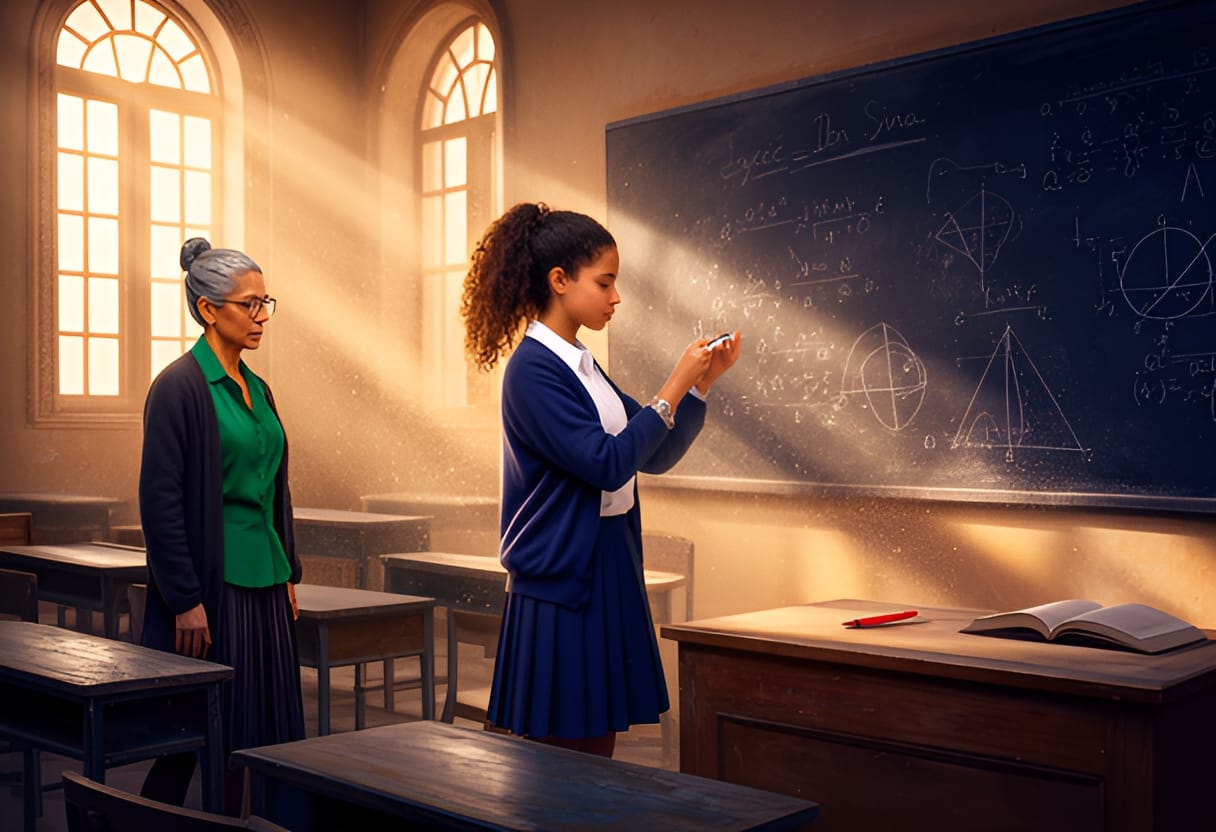
The last student slipped out, the door clicking shut behind them. The classroom was suddenly vast and quiet, the sunlight now angled lower, casting long bars of light across the floor. Madame Benali stood at the front, her back to the window, a piece of chalk held loosely between her fingers. On the board behind her, a problem waited — not from the textbook, not from any past paper she’d seen. It was complex, layered: a cubic function disguised as a word problem about the trajectory of a ball thrown from a moving train, requiring not just factoring, but interpretation, substitution, a shift in perspective.
“Go on,” Madame Benali said, not unkindly. “Show me how you think now.”
Amina’s legs felt like they were made of water. She walked to the front, each step echoing slightly in the silence. She picked up a piece of chalk — white, dusty — and turned to the board. The problem stared back. For a heartbeat, she saw only the old panic: the fear of mistakes, the voice whispering fraud, the memory of that red mark on her quiz. Then she breathed. In. Out. She thought of Karim at the window, not instructing, but reminding. Of his voice — not lecturing, but revealing.
She began to write.
Not fast. Not slow. But sure.
She translated the words into variables, not because she’d memorized a method, but because it felt like the right way to begin. She factored the cubic not by rote, but by recognizing a pattern — a symmetry, like the parabola, but stretched into three dimensions. She substituted, simplified, paused — not to guess what came next, but to listen to what the equation was showing her. When she reached the quadratic at the end, she didn’t immediately reach for the formula. She completed the square, just as Karim had taught her, seeing the vertex emerge like a landmark in familiar terrain.
The roots came out clean: two real, one repeated. She circled them, stepped back, and wiped her chalky hand on her skirt.
Madame Benali was silent for a long time. She walked slowly to the board, her eyes tracing each line, each step, each pause. She didn’t correct anything. Didn’t nod. Didn’t frown. She simply read, as if following a path through unfamiliar terrain.
When she finally spoke, her voice was quiet, thoughtful. “You didn’t just solve it,” she said. “You read it. Like it was a sentence in a language you’ve learned to feel, not just decode.”
Amina didn’t dare look up. She could feel the heat in her cheeks, the prickle behind her eyes. “I… I just tried to understand it,” she whispered.
Madame Benali turned to her then, her expression unreadable. “Understanding is rare,” she said. “And it’s often mistaken for something else.” She paused, glancing toward the door, as if listening for footsteps in the hall. “Keep going. But remember — the truth has a way of showing its work, even when you try to skip it.”
She walked past Amina without another word, gathered her things, and left the classroom, the door clicking shut behind her with a finality that felt like a verdict.
Amina remained at the board, the chalk dust on her fingers, the echo of the problem still humming in her bones. She had solved it. Correctly. But the victory tasted thin, layered with something colder — the awareness of being seen, not just as a student, but as a question. A variable in someone else’s equation.
She lowered the chalk. The numbers waited.
And for the first time in a long while, she wasn’t sure she wanted to look.
Amina stayed at the board long after the room had emptied, the chalk dust clinging to her fingers like a second skin. The silence pressed in, not empty, but full — of the problem’s echo, of Madame Benali’s words, of the way the sunlight had fallen across the floor in those long, quiet bars. She didn’t move to leave. Not yet. The board still held the ghost of her solution, the roots circled, the vertex marked — not as a mistake corrected, but as a truth revealed.
She finally lowered the chalk and turned, her movements slow, as if waking from a deep thought. The classroom felt different now — not just a room of desks and blackboards, but a space where something had shifted. She gathered her things mechanically, her mind still tracing the steps of the problem, not the steps to get it right, but the way it had unfolded: the substitution, the pause, the completing the square — not as a ritual, but as a conversation.
Outside, the hallway buzzed with the low murmur of students changing classes, lockers slamming, voices rising and falling. Amina walked slowly, her bag over one shoulder, her eyes down but not avoiding the world. She noticed how the light fell in stripes across the terrazzo floor, how it moved as she walked — not because she was moving, but because the sun was. A rate of change, she thought, almost without meaning to. The angle shifting. The length of the shadow growing.
She paused at the stairwell, hesitating. Karim usually waited for her near the old archway by the courtyard, where the jasmine climbed the stone and the air smelled of earth and spice after the morning’s heat. But today, he wasn’t there. She told herself it was fine — he had errands, maybe, or had stopped to speak with Mother. Still, a small tightness curled in her chest. She had begun to rely on those quiet moments — not just for the math, but for the way he made it feel like something alive, not a set of rules to be feared.
She continued home, the route familiar: past the baker where the scent of warm bread drifted onto the sidewalk, past the vendor stacking olives in pyramids of purple and green, past the mosque where the call to prayer had just faded, leaving behind a hush that settled over the rooftops. The Casbah unfolded around her — narrow, winding, alive with the quiet rhythm of daily life. Cats slunk through doorways. Water dripped from a rusted gutter into a ceramic basin below. An old man swept his stoop with a broom made of palm fronds, each stroke deliberate, each flick of the wrist sending dust into the slanting light.
She didn’t realize she had stopped until she felt the shadow of a hand on her shoulder.
“You’re walking like you’re carrying the whole problem in your steps,” Karim said, his voice low, amused. He fell into step beside her, his hands in his pockets, his eyes on the street ahead. “Too tense. You’re not solving for x anymore. You’re living it.”
Amina glanced at him. He looked rested, though there was a shadow under his eyes she hadn’t noticed before — not fatigue, but something deeper, like a wound that had scabbed but never fully healed. She had noticed it the night he returned, the way he touched the doorframe as if testing its strength before entering. But now, in the street, with the noise of the city around them, he seemed… present. Not distant. Not gone.
“I was thinking about the problem,” she said. “The ball thrown from the train. How we had to shift the frame — not just solve the equation, but see where it came from.”
Karim nodded. “Exactly. That’s what I mean. You didn’t just apply a method. You changed your point of view. And that… that’s where the real math begins.”
They turned a corner onto a quieter lane, where the houses clung to the hillside like old secrets. A boy on a bicycle coasted past, his feet off the pedals, slowing as he approached a stop sign. The bike didn’t halt — it eased, the wheels turning slower and slower until they stopped, not with a jerk, but with a sigh.
“Watch,” Karim said, pointing. “That’s a derivative. Not the speed — the change in speed. The braking. The way his motion isn’t constant, but shifting. That’s what a derivative measures: how something changes, right now, in this moment.”
Amina frowned slightly, thinking. “So it’s not just how fast he’s going… it’s how fast his speed is changing?”
“Yes.” Karim smiled, just a little. “When he’s coasting, the change is small — almost zero. When he hits the brakes, the change spikes — negative, because he’s losing speed. But it’s not just about the numbers. It’s about noticing. About seeing that nothing stays the same. Not a bus, not a shadow, not even a cup of tea.”
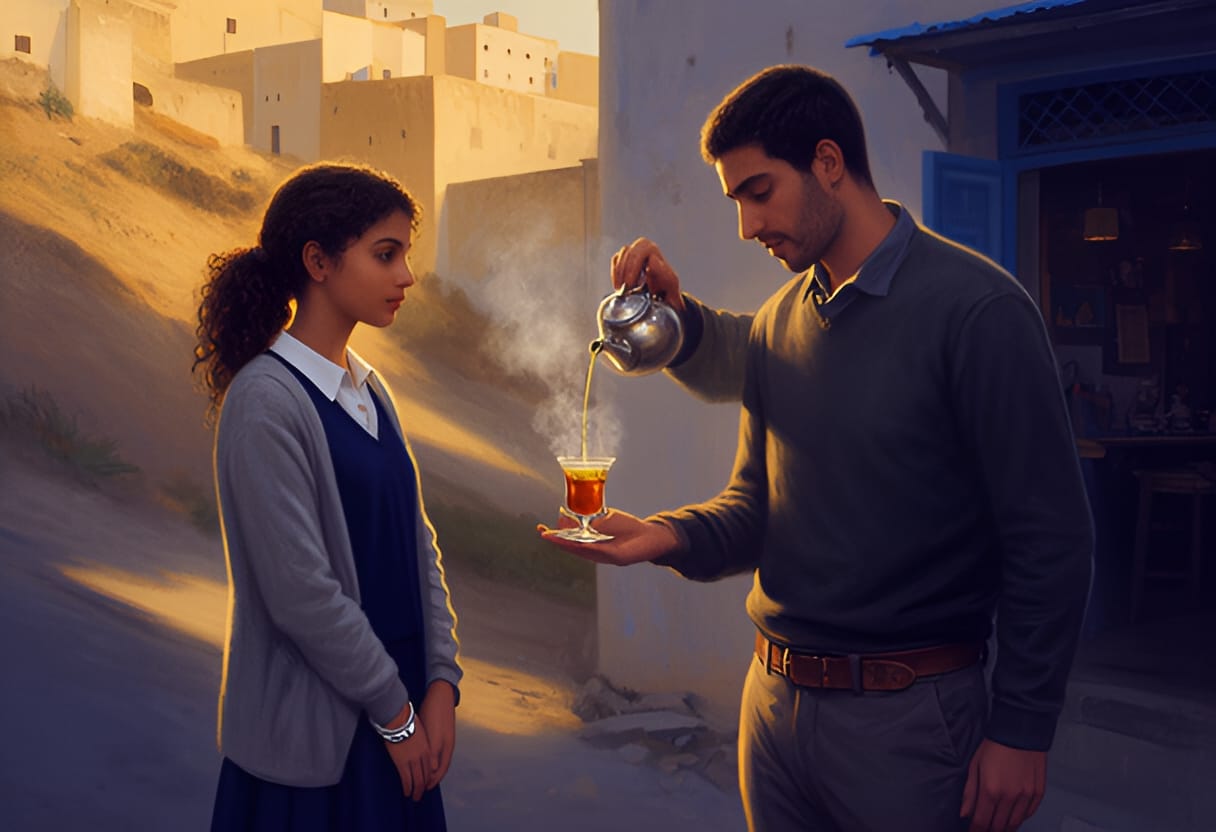
He nodded toward a café where a waiter poured mint tea from a height into a small glass. The liquid arced through the air, then settled, the surface rippling before going still. Steam curled upward, thinning as it rose.
“See that?” Karim said. “The heat leaving the tea. It’s hottest when it’s first poured. Then it cools — fast at first, then slower and slower. The rate of cooling changes over time. That’s a derivative too. Not the temperature — how fast the temperature is dropping. And it’s not constant. It depends on how hot it still is. The hotter it is, the faster it loses heat. That’s why the curve bends.”
Amina watched the tea. She could almost feel the warmth rising from the glass, even from here. She thought of the quadratic they’d worked on — the parabola, the vertex, the point where it turned. “So the derivative… it’s like the slope of the curve at one point? But not just a line — it’s how the slope itself is changing?”
“Yes,” Karim said. “Or — better — it’s the instant you’re in. Not the average over a minute. Not what happened before or after. What’s happening now. Like when you’re walking — your speed isn’t the same every second. You speed up to cross the street, slow down to avoid a puddle. The derivative catches that. It’s the math of paying attention.”
They walked in silence for a moment, the call to a vendor selling roasted chickpeas drifting from a side street. Amina turned the idea over in her mind — not as a formula, but as a way of seeing. She thought of the ball on the train again. Not just its path, but how its speed changed relative to the ground, how the thrower’s motion added to it, how gravity pulled. It wasn’t just about solving for where it landed. It was about feeling the motion.
That evening, after dinner — couscous with caramelized onions and lamb, Mother humming an old tune as she cleared the table — Amina found Karim in the small room off the kitchen where he’d set up a cot. He was sitting on the edge of it, a notebook open on his knees, a pencil tucked behind his ear. The worn notebook he’d given her lay beside him, its pages filled with his own scribbles — diagrams, arrows, notes in the margins.
“You were thinking about the tea,” he said, not looking up. “I saw you staring at your glass earlier.”
Amina hesitated in the doorway. “I was. I kept imagining the steam… how it thinned as it went up. Like it was disappearing bit by bit.”
Karim finally looked up, his eyes kind. “That’s the derivative of heat loss. You didn’t need an equation to see it. You just had to watch.”
He patted the space beside him. “Come. Let’s try something.”
She sat, and he turned to a fresh page. He didn’t write a problem from the book. Instead, he drew a simple graph — axes labeled, a curve rising then falling, like a hill.
“This,” he said, “is the height of water in a fountain over time. It shoots up, slows, stops for a breath, then falls. Where is the derivative zero?”
Amina leaned in. “At the top,” she said. “When it stops going up and hasn’t started falling yet. The change in height is zero there.”
“Good.” He nodded. “And what about when it’s rising fastest?”
She thought. “At the bottom — just as it leaves the nozzle. That’s when the speed upward is greatest.”
“Exactly.” He smiled. “And when it’s falling fastest?”
“Just before it hits the basin,” she said. “When it’s been accelerating downward the longest.”
Karim didn’t say correct. He just watched her, his expression quiet, proud. “You’re not memorizing rules,” he said. “You’re seeing the story. And that’s what makes it yours.”
He turned the page. “Now — try this one.” He sketched a new scenario: a ball rolling down a ramp, then across a flat surface, slowing due to friction. “Where is the acceleration greatest? Where is it zero? Where is it negative?”
Amina picked up the pencil. She didn’t overthink it. She saw the ball — quick at the top of the ramp, gaining speed, then hitting the flat and gradually losing it. She marked the points: steepest slope on the ramp — greatest acceleration. Flat part, slowing — negative acceleration. The instant it hit the flat — where the curve bent — that’s where the acceleration changed most suddenly.
She looked up. “It’s not about the position,” she said. “It’s about how the motion is shifting. At every second.”
Karim nodded. “And that’s what the derivative gives you. Not the where — the how of the where changing.”
She sat back, the pencil loose in her fingers. The room was quiet except for the faint hum of the refrigerator and the distant murmur of Father reading in the next room. Outside, the call to evening prayer had not yet come, but the light was changing — softer, goldening the walls.
She thought of Madame Benali’s warning — the truth has a way of showing its work — and realized it wasn’t a threat. It was an invitation. To show her work not as a performance, but as a process. To let the steps be seen, not because they had to be perfect, but because they were honest.
“I think,” she said slowly, “I’m starting to like not knowing the answer right away. Because then I get to watch how it comes together.”
Karim closed the notebook gently. “Then you’re not just learning math,” he said. “You’re learning how to be in the world.”
She didn’t answer. She didn’t need to. The idea settled in her, not as a conclusion, but as a beginning — quiet, steady, true. Like the curve of a shadow on the wall, shifting with the light. Like the cooling of tea. Like the moment a ball, thrown from a moving train, reaches its peak — not because it stops trying, but because, for one suspended instant, it has found its balance.
She lay back on the cot, the notebook pressed flat against her palms, the pencil still warm from her grip. The room held its breath — the refrigerator’s hum, the slow creak of the house settling, the fading echo of Karim’s voice: You’re learning how to be in the world. She turned the words over, not as comfort, but as a question. What did it mean to be in the world when the world kept asking for proofs you couldn’t give?
A floorboard groaned in the hallway — deliberate, heavy. Not Mother’s soft tread. Father’s.
She froze.
The door to Karim’s room stood ajar, a sliver of light cutting across the worn rug. Voices came through — low at first, then rising, not quite shouting, but strained, like a rope pulled taut.
“You left,” Father said. His voice was dry, stripped of the warmth it held when he recited poetry or helped Amina with her multiplication tables. “After all we did for you. After your mother stayed up nights worrying when you had that fever. After I took extra tutoring jobs to pay your fees. You just… walked out.”
Karim didn’t answer right away. Amina pictured him on the edge of the cot, shoulders hunched, eyes fixed on the floor — the way he looked when he thought no one was watching, when he believed he deserved the silence.
“I needed to go,” he said finally. His voice was quiet, but not weak. Steady, like he was stating a fact, not making an excuse.
“Needed to go?” Father’s breath hitched — a sound like paper tearing. “Needed to go where? To sit in cafés and play dominoes? To let your mother cry herself to sleep wondering if you were sick or in trouble? To make your sister believe she’s not good enough because her own brother couldn’t stick it out?”
“I wasn’t crying over dominoes,” Karim said. There was no anger in his tone. Only weariness, deep and old. “I was trying to breathe.”
“Breathe?” Father scoffed. The word hung in the air, sharp and dismissive. “You had a future. Top of your class. Teachers wrote letters. The university wanted you. And you threw it away because you felt… what? Sad? Tired? Since when do we quit because life is heavy?”
“I didn’t quit because I was sad,” Karim said. His voice dropped, as if speaking to himself. “I quit because they said I cheated.”
Silence.
Amina’s chest tightened. She had never heard him say those words out loud. Not to Mother. Not to her. Not even in the nights she’d heard him pacing, murmuring to the wall.
Father laughed — short, harsh. “Cheated? That’s the excuse they all use. ‘The system failed me.’ ‘The test was unfair.’ You think we don’t know how it works? You saw a problem you couldn’t solve, you looked at someone else’s paper, and you panicked. That’s not injustice. That’s weakness.”
“I didn’t look at anyone’s paper,” Karim said. His hands were clasped tight between his knees, knuckles white. “I solved it myself. They checked my work. They found nothing.”
“Then why was it annulled?” Father pressed. “Why the stamp? Why the note from the ministry? You think they do that for nothing? You think they waste time accusing honest boys?”
“I don’t know why,” Karim said. He lifted his head then, and Amina saw his face in the dim light — not defiant, not broken, but empty. The kind of emptiness that comes after too many explanations. “I only know what happened. I know I didn’t cheat. And I know I couldn’t stay where they treated me like a liar.”
Father stepped closer. Amina could see the shadow of his fall across the threshold — broad, heavy, falling like a judgment. “You think walking away makes it better? You think hiding here, pretending to help your sister with her homework, erases what happened? You’re not helping her. You’re warning her. Look at you — broken, bitter, teaching her to doubt the very thing that could save her.”
“I’m not teaching her to doubt,” Karim said. “I’m teaching her to see.”
“To see what?” Father’s voice rose, just a notch. “That effort doesn’t matter? That integrity is a joke? That when things get hard, you just… leave?”
“I’m not leaving again,” Karim said. He stood slowly, the cot creaking under his weight. He didn’t move toward the door. He stayed where he was, facing the wall, his back to Father. “I’m here. For Mother. For you. For Amina.”
“Are you?” Father said. He sounded tired now — not angry, but drained, as if the fight had gone out of him. “Or are you just waiting for the moment you can walk out without feeling guilty?”
Karim didn’t answer.
Father sighed — a long, slow release of air. “Your mother believes you left because you were depressed. She prays for you every night. She still sets your plate at the table, just in case. But I know better. I know you didn’t leave because you were sick. You left because you were ashamed. And now you’re dragging her into it — making her lie to herself, making her believe you’ll snap out of it.”
He paused. His voice dropped, quieter, but no less cutting. “You’re not the son I raised. You’re not the boy who stayed up to help Amina with her fractions. You’re a stranger who wears his face.”
The door clicked shut.
Not Father’s retreat — Karim’s. He had turned and walked to the small window, pressed his forehead against the cool glass. Amina heard the softest sound — not a sob, but something worse: the quiet surrender of a man who had stopped expecting to be understood.
She stayed frozen in the doorway, the notebook pressed to her stomach like a shield. Her mind raced — He didn’t cheat. He didn’t cheat. He didn’t cheat. The words burned, but she couldn’t let them out. Not here. Not now.
If she spoke, she would be defending him — and in doing so, she would be accusing the school, the ministry, the system Father still respected, however flawed. She would be calling him a liar to his face. And worse — she would be admitting that she knew. That she had seen the letter, the stamp, the note tucked in The Little Prince. That she had been keeping secrets.
What would Father do then? Look at her with the same disappointment? Wonder if she was tainted too? If the blood that made her quick with numbers also made her prone to deceit?
She couldn’t risk it.
Not when the bac was coming. Not when Madame Benali was already watching. Not when every correct answer felt like a tightrope over a canyon of suspicion.
Better to let him believe Karim was weak. Better to let him believe the shame was earned. Better to stay silent and keep her head down, her pencil moving, her scores rising — let her success be the answer, not her words.
Father’s footsteps retreated down the hall, slow and heavy. The door to their room clicked shut.
Amina didn’t move.
She stayed in the doorway, the night pressing in through the window — the distant hum of traffic, the occasional bark of a dog, the whisper of wind in the jasmine vines creeping along the wall. The house felt too large, too full of ghosts.
She walked to Karim’s room slowly, barefoot on the cool tile. He hadn’t moved. Still at the window, his reflection ghostly in the dark glass — shoulders bowed, head low.
She didn’t speak. Didn’t reach out. Just stood beside him, close enough to feel the warmth of his arm, close enough to see the tremor in his hand where it rested on the sill.
Outside, a cat yowled. A shutter slapped against the side of the house. Somewhere, a radio played an old Umm Kulthum song, the voice curling through the night like smoke.
Karim didn’t turn. But after a long while, he lifted his hand — not to touch her, but to cover hers where it hung loose at her side. His fingers were cold, his grip light, fleeting. Then he let go.
She stayed until the first true chill of night crept in, until the stars came out sharp and clear above the rooftops. Until the silence between them wasn’t empty, but full — full of everything they couldn’t say.
Then she went back to her room.
She lay on her mat, the notebook open on her chest. Not studying. Not thinking of derivatives or integrals or the motion of balls or tea. Just listening — to the house, to her own breath, to the quiet, insistent voice that whispered: You know the truth. Why won’t you say it?
And the quieter one that answered: Because if I do, I might lose everything.
She closed her eyes.
The room stayed dark.
The night stayed long.
And somewhere, in the dark, a brother and a sister lay awake — not because they couldn’t sleep, but because speaking felt like surrender, and silence felt like betrayal.
Amina woke before dawn, the notebook still clutched in her fist from the night before. The first gray light seeped through the blinds, painting stripes across the floor. She had not slept. The words He didn’t cheat had looped in her mind like a broken record, each repetition sharpening the ache behind her ribs. She needed to see it again — the proof — to remind herself she wasn’t imagining it, that her brother’s silence wasn’t guilt but something heavier.
She slipped from her mat, barefoot on the chill tile, and padded to Karim’s room. The door was ajar, just as she’d left it. Inside, the space was orderly — too orderly. His bed was made, his clothes folded neatly at the foot, his books stacked in precise piles. Everything in its place, as if he were preparing to leave again. Or as if he were trying to erase the trace of having been there at all.
She moved to his desk. The worn notebook she’d given him lay open, but it wasn’t the one she knew. This was older, its cover frayed at the corners, the spine cracked from use. She frowned. She’d left her own notebook on her mat. Had she taken his by mistake?
She reached for it, and as she lifted it, a slip of paper fluttered to the floor. She bent, heart already quickening, and picked it up.
It was a photocopy — faded at the edges — of a bac result sheet. Her brother’s name, Karim Benali, was printed in bold at the top. Below it, his scores: 18 in physics, 17 in chemistry, 16 in philosophy… and then, in red ink that seemed to pulse, a stamp: ANNULÉ POUR FRAUDE. Annulled for fraud.
Her breath stopped.
She turned the paper over. On the back, in a tight, official hand, was a note from the Ministry of Education, dated three years prior: Following investigation, candidate Karim Benali found in possession of unauthorized materials during the mathematics examination. Results annulled. Candidate barred from retaking the bac for two years.
Her fingers trembled. She knew this paper. She’d seen it before — not here, but tucked inside the pages of The Little Prince, the book their mother had given Karim when he left for university. She remembered now: the night she’d gone to return his forgotten scarf, she’d seen the book on his shelf, its spine cracked, and pulled it out to straighten it. A folded slip had drifted out. She’d shoved it back without looking, too startled by the sight of his handwriting in the margins — equations, doodles, a sketch of a parabola labeled for Amina — to think clearly.
She had forgotten it. Until now.
She rushed to the bookshelf. Pulled down the copy of The Little Prince. Opened it to the middle, where the pages had been softened by time and touch. There, nestled between the chapters where the fox speaks of taming, was the same slip — but now she saw it clearly. The same stamp. The same note. And beneath it, in Karim’s hand, a single line: I didn’t bring it. I swear on Mother’s eyes.
Her vision blurred. She pressed the paper to her chest, just as she had the notebook. The words burned: fraud. Unauthorized materials. Smuggled formula sheet. The accusation was specific, vicious. And the ministry had believed it.
She heard a creak in the hallway. Karim stood in the doorway, barefoot, wearing only his trousers and a faded undershirt. His hair was mussed, his eyes red-rimmed. He had been waiting.
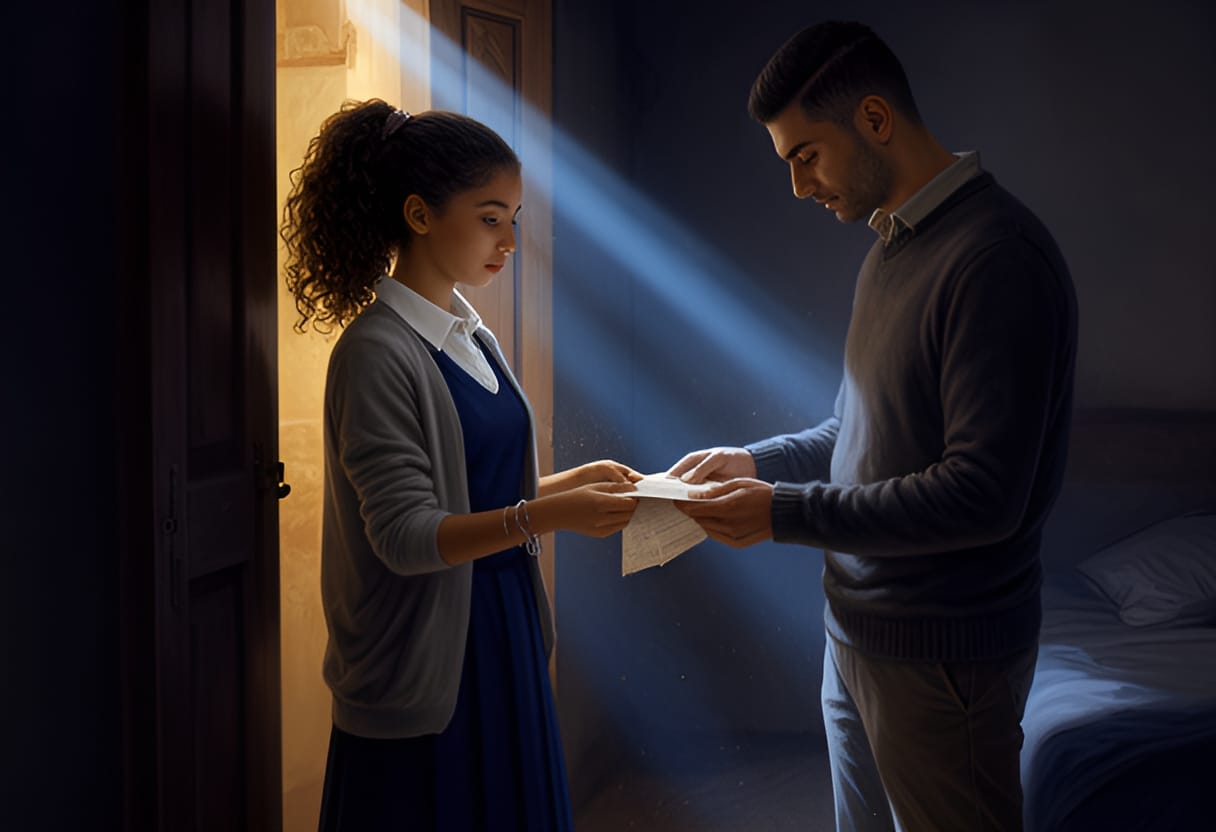
“You found it,” he said. Not a question. A statement, quiet and raw.
Amina didn’t speak. She held out the paper. He took it slowly, as if it might burn him. His thumb traced the red stamp. A muscle jumped in his jaw.
“I didn’t cheat,” he said, his voice low. “I swear it. I didn’t bring anything into that exam hall. Not a note, not a formula, not even a spare pen I hadn’t been given. I sat there, and I worked the problems the way I always did — the way you’re learning to work them now. And when I turned in my paper, the supervisor pulled me aside. Said the invigilator had seen me looking at my sleeve. Said there was a fold in the fabric, like something had been tucked there.”
He swallowed. “I looked down. My sleeve was plain. Nothing. But they didn’t care. They said the report was filed. That the ministry had to follow protocol. That I could appeal — but it would take months, and during that time, I’d be under investigation. They’d watch me. They’d search my things. They’d treat me like a criminal until proven otherwise.”
He finally met her eyes. “I couldn’t do that to Mother. I couldn’t let her believe her son was a liar. I couldn’t let Father see me dragged through hearings, my name in the papers, my honor picked apart over a fold in a sleeve that might’ve been nothing. So I left. Before they could call me in. Before they could make me prove a negative.”
Amina’s throat tightened. “You left to protect us.”
“I left because I was ashamed,” he corrected, but his voice cracked. “Ashamed that they thought I could do it. Ashamed that I couldn’t make them believe I didn’t. And yes — I left to keep you from having to answer for it. To keep Mother from lying awake wondering if she’d raised a cheat. To keep Father from looking at me and seeing only the stain, not the boy who stayed up to help you with your fractions.”
He let out a humorless breath. “Funny, isn’t it? I thought if I walked away, the shame would stay with me. But it followed you. It’s in the way Madame Benali watches you now. It’s in the way Father flinches when you solve something too fast. It’s in the silence between us — not because we don’t trust each other, but because we trust each other too much to speak the truth and risk breaking what’s left.”
Amina looked down at the paper in his hand. The red stamp glared back at her — not just a mark of annulment, but a wound. She thought of the nights she’d lain awake, terrified her own success would be seen as borrowed, as tainted. She thought of how she’d smoothed over her mistakes, how she’d stayed silent when Father accused Karim of weakness, how she’d pressed the notebook to her heart not to study, but to feel close to something true.
She had thought silence was safety. But now she saw: his silence had been a kind of love. A brutal, quiet sacrifice. He had taken the blame — not of cheating, but of leaving — so she wouldn’t have to carry the weight of being related to a fraud.
Her eyes burned. She reached out, not for the paper, but for his hand. His fingers were cold, but he let her hold them.
“I didn’t know,” she whispered. “I didn’t know you carried this.”
He looked at their joined hands. “You weren’t supposed to.”
She squeezed his fingers. “But I do now. And I’m not letting you carry it alone.”
He didn’t answer. But he didn’t pull away.
Outside, the first call to prayer began to rise — soft, clear, drifting over the rooftops. The city was waking. Somewhere, a door opened. A bicycle bell rang.
Amina held the bac result in her other hand, the paper thin and fragile. She thought of the equation Karim had once shown her — how a derivative wasn’t just about slope, but about change in motion, about what happens at the exact moment things shift. She thought of how he’d said, I’m teaching her to see.
She saw now.
Not just the accusation. Not just the stamp. But the choice he’d made — not out of weakness, but out of a kind of courage she was only beginning to understand.
She folded the paper carefully, slipped it back into The Little Prince, and returned the book to the shelf. Then she took Karim’s hand and led him back to the window, where the light was growing stronger.
They stood side by side, watching the street below. No words were needed. The truth was between them now — not as a weapon, not as a burden, but as something shared. And for the first time in a long time, Amina felt the tightness in her chest ease, not because the danger had passed, but because she was no longer facing it alone.
She would still take the bac. She would still solve the problems, step by step, her pencil moving sure across the page. But now, when she wrote her name at the top of the page, she would know — not just that she had earned her place, but that she carried someone else’s quiet strength with her.
And if the day came when she had to speak, she would not do it to clear her brother’s name alone.
She would do it to honor the truth — the one he had protected with his silence, and the one she was now ready to protect with her voice.
Chapter 3
The Solution Beneath the Surface
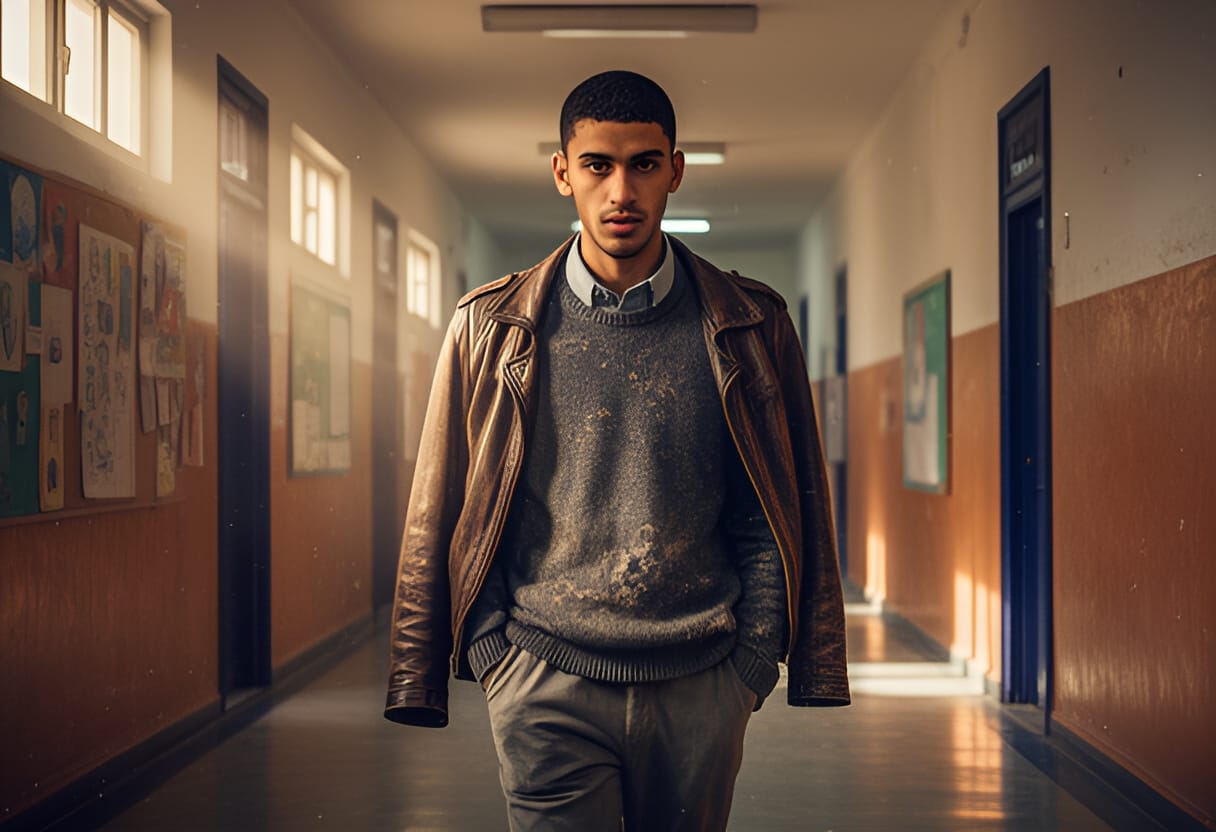
The hallway smelled of damp wool and disinfectant, the linoleum cool under Karim’s shoes as he walked toward the administration wing. Madame Benali had intercepted him just outside the mathematics classroom, her expression tight, her voice low but carrying the weight of authority. “Karim,” she said, not waiting for a reply, “come with me. Now.”
He followed without protest, his hands shoved into the pockets of his jacket, the one he’d worn since returning home—frayed at the cuffs, smelling faintly of cedar and old paper. He knew why she had stopped him. He had seen her watching Amina in class these past weeks, the way her eyes lingered a second too long when Amina solved a problem on the board, the faint furrow between her brows as if trying to reconcile two conflicting equations.
The office was small, the air thick with the scent of polish and old files. Madame Benali gestured to the chair opposite her desk. Karim sat, back straight, eyes forward. She did not sit. Instead, she placed a folder on the desk between them, opened it, and slid a photocopy across the surface.
It was Amina’s latest quiz. The one she had aced—full marks, clean steps, no sign errors this time. Karim felt a flicker of pride, quickly suppressed.
“Explain this,” Madame Benali said, tapping the paper with a fingernail. “Two months ago, she couldn’t solve a basic quadratic without second-guessing herself. Now she’s factoring cubics in her head and drawing graphs from memory. How does that happen overnight?”
Karim kept his voice even. “She’s been working hard. Staying after class. Doing extra problems.”
“Hard work doesn’t erase two years of struggle in a single term,” she replied, leaning forward. “Unless someone’s been giving her a leg up. And I’ve noticed you’ve been around a lot lately. Dropping off supplies. Picking her up after tutoring sessions that don’t exist on the schedule.”
He swallowed. “I visit my mother. I see Amina when I’m here.”
“You’ve been in her room,” Madame Benali said, her tone sharpening. “The housemaid saw you leaving with a notebook last Tuesday. And the week before, you were there until dusk. Don’t think I don’t notice when a former top student who vanished after his own bac scandal suddenly reappears to coach his sister through the very exam that broke him.”
The words landed like a blow. Karim felt the blood drain from his face. He had known she suspected something—had seen the way she watched him at the school gate, the way she paused when he passed her in the corridor—but to hear it spoken aloud, to see the accusation laid bare in black and white, stole his breath.
“I’m not here to hurt her,” he said, voice low. “I’m here to help her believe she can do it herself.”
Madame Benali’s eyes narrowed. “And how exactly are you doing that? By giving her answers? By doing her work for her?”
“No,” Karim said, shaking his head. “I show her how to think through problems. I remind her of what she already knows. I don’t give her solutions—I help her find them.”
She studied him for a long moment, the silence stretching until the hum of the fluorescent light above them seemed too loud. Then she closed the folder with a soft snap.
“Intentions don’t matter,” she said. “The rules are clear. Any unauthorized assistance—whether it’s giving answers or just ‘guidance’ that crosses into instruction—is considered academic misconduct. If the examination committee finds out you’ve been tutoring her, they could invalidate her bac results. Not just in math. All of them.”
Karim felt the room tilt. “You wouldn’t do that to her.”
“I’m not doing anything,” Madame Benali said, standing. “I’m following protocol. You’re the one who put her at risk by involving yourself. You know what’s at stake—not just for her, but for your father. He still believes you left because you were overwhelmed. He doesn’t know about the accusation. He doesn’t know you were accused of cheating on your own bac.”
Her words struck deeper than any threat. Karim looked down at his hands, calloused from working construction jobs in the south, the same hands that had once solved complex integrals with ease. He had thought he was protecting Amina by staying quiet, by taking the blame if it came to that. But now he saw it wasn’t just about shielding her from punishment—it was about protecting the fragile thing she had finally begun to build: her belief in herself.
“I admit it,” he said, meeting her gaze. “I’ve been helping her. But not to give her an unfair edge. To give her back her confidence. She’s not a fraud. She’s just been afraid.”
Madame Benali did not soften. “Intentions don’t excuse violations. Whether you meant to help or to hinder, the line has been crossed. I’ll be speaking with the examination committee tomorrow. They’ll decide what happens next. But know this—if Amina’s results are questioned, it won’t be because she failed. It will be because the system saw fit to protect its integrity.”
She moved to the door, paused, and looked back. “You’ve always been clever, Karim. But cleverness doesn’t get you out of every problem. Sometimes, you have to face the sum.”
Then she was gone, the door clicking shut behind her.
Karim sat alone in the office, the weight of the accusation pressing down like a stone in his chest. Outside, the call to prayer began to drift across the city—soft, insistent, rising from the minarets like a plea. He closed his eyes and breathed through it, the sound wrapping around him like a familiar blanket.
He had come home to repay a debt—not just to his father, but to the quiet girl who had once believed in him before the world made him stop believing in himself. And now, faced with the choice between silence and sacrifice, he realized the debt was not one he could pay by staying hidden.
It was one he could only settle by standing in the light—and letting her see him do it.
Karim remained seated, the echo of the closing door still vibrating in the thin wood of the chair beneath him. The call to prayer wove through the open window, its rising and falling notes threading into the silence like a question without an answer. He opened his eyes. The fluorescent light above hummed steadily, indifferent.
“I won’t let you punish her for this,” he said, his voice quieter now, but firm. “If anyone has to answer for what happened, it should be me.”
Madame Benali turned halfway, her hand resting on the doorframe. Her expression was unreadable in the dimming afternoon light that slanted across the linoleum floor.
“I’m not a student anymore,” Karim continued. “My bac was voided years ago. Whatever penalty you’re thinking of—suspension, a mark on my record—it doesn’t apply to me the way it would to her. She’s still got a future ahead of her. One that shouldn’t be ruined because I couldn’t stay away.”
He leaned forward, resting his elbows on his knees, hands clasped tightly. “You saw her quiz. You saw the steps. She didn’t just copy answers. She understood. And that didn’t come from me handing her solutions. It came the moment she stopped thinking she was broken. I reminded her of what she already knew. I gave her back her voice in the subject. After that? She did the rest.”
Madame Benali didn’t move. Her gaze drifted past him, to the window where the minaret of the Ketchaoua Mosque stood sharp against the sky, its shadow creeping across the courtyard.
“You think I don’t see that?” she said at last. “I’ve watched her for two years. I saw the way she flinched at equations, the way she erased her work three times before writing a single line. I know what it cost her to get to this point. And I also know that progress like this doesn’t bloom in isolation—not when it jumps from failure to fluency in a single term.”
Karim exhaled slowly. “Then ask her. Call her in here. Let her explain how she solved those problems. Let her walk you through her thinking. You’ll see it wasn’t me. It was her—finally unafraid to try.”
A long silence followed. Outside, a child laughed down the street, bright and sudden, then faded. The call to prayer ended, leaving behind the low thrum of the city settling into evening.
Madame Benali pushed off the doorframe and walked slowly to the desk. She picked up the quiz again, turning it over in her hands as if weighing its truth. When she spoke, her voice was softer, but no less resolute.
“I will speak with the examination board,” she said. “Not tomorrow. Not yet. But soon. And I will tell them what I’ve seen—the improvement, the timing, your presence. I will also tell them what you’ve said: that you helped her find her confidence, not her answers.”
She looked up, her eyes meeting his. “But I cannot promise what they will decide. The rules are there for a reason. Even if the intent is pure, the act of outside guidance—especially from someone with your history—blurs the line. They may see it as compromise. They may see it as risk.”
Karim nodded once. “Then let them see me take the responsibility. If they need to name someone, let it be me. Let her stay out of it.”
Madame Benali studied him for a moment longer. Then, without another word, she turned and opened the door. The hallway beyond was empty, the fluorescent lights buzzing in the quiet.
Karim rose slowly. He didn’t look back as he stepped into the corridor. The door clicked shut behind him.
He walked down the hall, his footsteps muffled on the waxed tile. At the intersection, he paused, hand braced against the cool wall. His breath came shallow, his chest tight—not with fear, but with the familiar, heavy weight of choice made. He had shielded her before, in silence, by leaving. Now he did it again, not by disappearing, but by stepping forward.
As he turned toward the stairwell, a flicker of movement caught his eye—a shadow drawn back from the bend above, where the stairs rose to the second floor. Amina. She had been there. He hadn’t heard her come, but he felt her—felt the stillness of her holding back, the way her breath had hitched when he spoke of taking the blame.
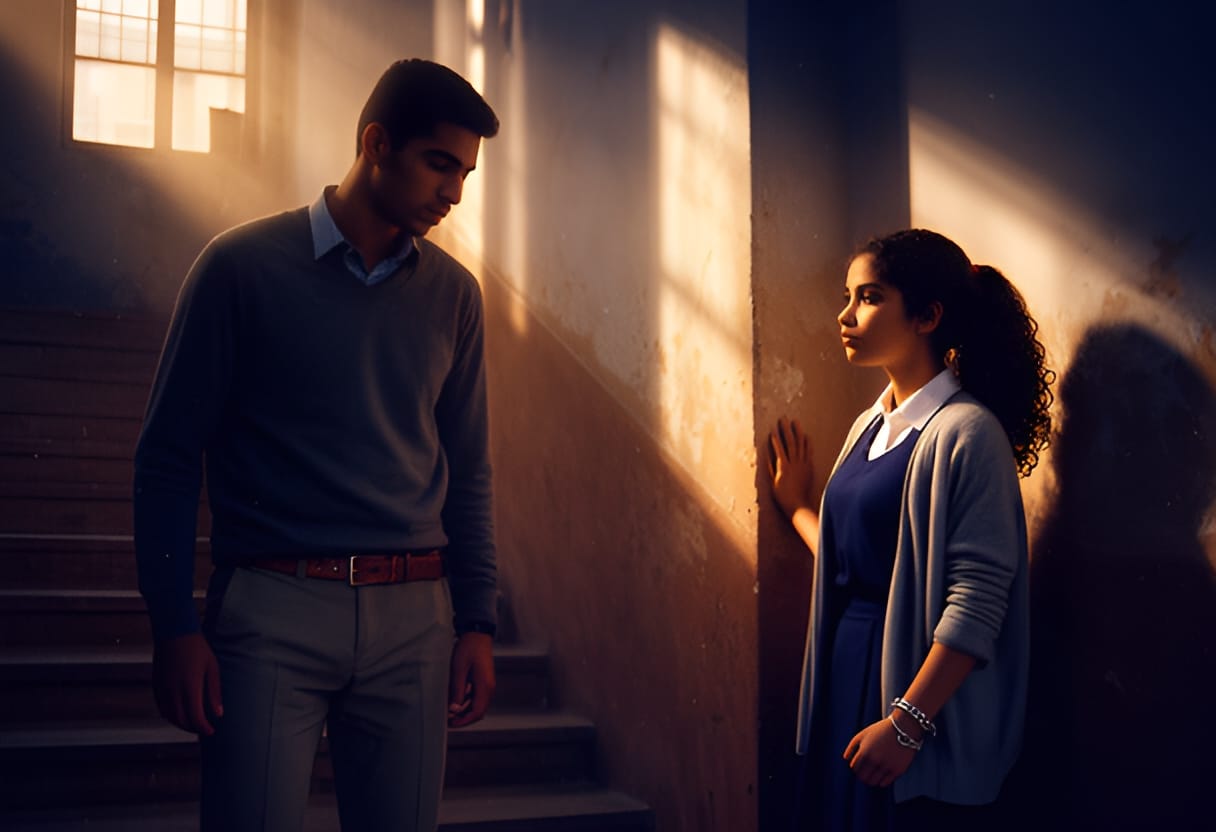
He didn’t call out. Didn’t gesture. He simply met her gaze for a heartbeat—her eyes wide, glistening, caught between fear and something deeper, something like recognition. Then he gave the smallest nod, almost imperceptible, and continued down.
Amina stayed where she was, one hand pressed to the wall, the other clenched at her side. The quiz lay heavy in her mind—not the paper itself, but what it represented: the moment she stopped apologizing for needing help, the moment she allowed herself to believe she belonged in the world of numbers.
She had thought his help was the turning point. But now she saw it differently. It hadn’t been his explanations, his diagrams, his quiet voice walking her through the vertex of a parabola. It had been the space he made for her to trust her own mind. The way he looked at her—not as someone who needed fixing, but as someone who had merely forgotten how to see.
And now he was giving that up. Not for pride. Not for redemption. But because he still saw her—really saw her—and would rather bear the cost himself than let her lose what she had fought so hard to reclaim.
She pushed off the wall and started down the stairs, her steps slow, deliberate. Not to follow him. Not to stop him. But to bear witness.
At the bottom, she paused again. He was already at the end of the hall, heading toward the exit. The autumn light slanted through the high windows, gilding the edges of his shoulders, turning the dust in the air to gold.
She didn’t call his name. Didn’t run after him.
Instead, she reached into her pocket, closed her fingers around the smooth edge of the worn notebook he had left her—the one with the frayed cover and the pages soft from use—and pressed it gently against her chest, right over her heart.
Then she turned and walked back toward the classroom, her head high, her steps sure, carrying not just the weight of what had been said, but the quiet, unshakable knowledge that some truths are not proven by speaking—but by enduring.
Amina lay awake long after the house had fallen silent. The notebook pressed against her chest had grown warm from her heartbeat, its edges soft against her ribs. She could still see Karim’s silhouette in the hallway light, the way he had carried himself—not with defeat, but with a quiet resolve that made her chest ache. She had watched him go, and in that moment, she had understood something she could not name: his silence was not surrender. It was an offering.
The ceiling above her blurred in the dark. She thought of her father’s hands, always clean and precise, correcting her younger brother’s homework at the kitchen table years ago, his voice calm when explaining fractions, firm when correcting a slanted line. She remembered how he had paused the day Karim left, how he had stared at the closed door long after the footsteps had faded, not with anger, but with a sorrow so deep it seemed to hollow him out. She had not understood it then. Now she did. It was not just the shame of a son who had failed. It was the shame of a father who had taught his children to believe in the integrity of their work—and seen one of them break that belief, whether justly or not.
Her mother’s face came next, softer, lined with worry that never fully smoothed. She had brought Amina tea that first night after the quiz, her silence heavy with unspoken questions. She had not pressed. She had only sat on the edge of the bed, her presence a kind of prayer. Amina had felt it then—the weight of her mother’s hope, not for perfection, but for her daughter to believe she was worthy of trying. And now, Karim had given her that belief, and was ready to lose everything for it.
She turned onto her side, the notebook digging slightly into her sternum. She thought of his eyes when he had spoken of the past—not the accusation, but the aftermath. The way his voice had dropped, not with bitterness, but with exhaustion, as if recounting a dream he had once cherished and then watched dissolve. He had not spoken of the cheating claim directly, but she had seen it in the way he flinched when Madame Benali mentioned the board, in the way his fingers had tapped the desk—a rhythm she now recognized as the echo of an old habit, a nervous tic from years of staring at papers under fluorescent lights, waiting for judgment.
She had thought his help was the turning point. But she now knew it had been the space he made. The way he had handed her the pencil and said, “Try again,” not as a correction, but as an invitation. The way he had laughed when she finally saw the pattern in the sequence, not at her, but with her, as if discovering it together. He had not given her the answers. He had given her back her courage to look for them.
And now she was being asked to let him take the fall for it.
She sat up, the notebook slipping to her lap. The room was cool, the air still. Outside, a dog barked once in the distance, then fell silent. She reached for her pen and the stack of loose paper she kept for practice problems. Her fingers trembled slightly as she uncapped the pen. Not from fear, but from the weight of what she was about to do.
She began to write.
Examination Committee,
I am writing not to defend my brother, Karim, but to clarify my own role in my progress. I have struggled with mathematics for years. Not because I lack ability, but because I lacked belief. I would freeze at the sight of an equation, convinced I would get it wrong, and in that fear, I made mistakes. I erased my work not because I was careless, but because I could not bear to see the proof of my own doubt.
Karim did not give me the answers. He gave me something harder to name: the permission to try without shame. He sat with me in the evenings and asked me to explain my thinking, even when it was flawed. He waited. He did not rush to correct me. He made me feel that my voice in this subject mattered, even when I stumbled. When I finally solved a problem—not because he showed me how, but because I kept at it until I saw the way forward—it was not his knowledge I was using. It was my own persistence, finally unburdened.
I understand the rules. I understand why outside help is scrutinized. But I also know that confidence is not taught in a single lesson. It is rebuilt, moment by moment, in the quiet spaces between frustration and understanding. Karim did not break the rules to give me an advantage. He stayed up late to help me find the voice I had silenced in myself. If anyone is to be held accountable for what has changed in me, let it be me—for choosing to listen, for choosing to try again, for refusing to let fear have the last word.
I do not ask for mercy for him. I ask only that my work be seen as mine. And if his intentions are to be judged, let them be judged as they were: not as deceit, but as the love of a brother who remembered what it felt like to be told he was not enough—and who would rather bear the world’s doubt than see his sister carry it alone.
She set the pen down. The ink had blurred slightly where her hand had shaken. She read it over, the words feeling both too bold and not bold enough. It was not an excuse. It was a testament. And it was true.
She folded the paper carefully, twice lengthwise, then once across, until it was a small, tight rectangle. She slipped it into her bac preparation folder, nestled between her formula sheet and the worn notebook Karim had given her. The pen lay beside it, capped. Her calculator, its screen dark, rested on top.
She did not seal the envelope. She did not address it. She left it as it was—private, unfinished, a promise she had not yet decided to keep.
Outside, the first call to prayer began to rise, thin and clear over the rooftops. She listened to it, her hands folded in her lap. The sound was not a command. It was an invitation—to pause, to remember, to begin again.
She did not move. She did not sleep. She only waited, the letter resting where her books lay open, the night deepening around her, and the weight of what she had written settling not as a burden, but as a ground beneath her feet.
She rose from the bed as the last echo of the call faded, the letter still warm in her palm. Dawn had not yet broken, but the sky held a pale insistence, the kind that comes before light fully commits. She dressed quickly, her movements deliberate, the notebook tucked under her arm like a shield. The house was silent—Father already at the mosque, Mother in the kitchen, the murmur of her low prayer a steady thread beneath the silence. Amina paused at the door, hand on the wood, and pressed the letter once more to her chest before slipping it into the inner pocket of her coat, where it lay flat against her heart.
She walked to school with her head up, steps sure, as she had promised herself. The streets of Algiers were already stirring—vendors unfolding awnings, the scent of fresh bread and strong coffee drifting from open doorways, children in crisp uniforms laughing as they raced toward the lycée. No one glanced at her twice. She was just another student, another face in the flow. And yet, inside, something had shifted. Not the absence of doubt—it still lingered, quiet at the edges—but the certainty that she could move through it. That she had already.
The examination hall smelled of polish and paper, of quiet concentration and restrained breath. Rows of desks stretched under the harsh fluorescent lights, each occupied by a student bent over their paper, pens scratching in unison. Amina took her usual seat near the window, where the morning sun now spilled gold across the floor, warming the edge of her desk. She placed her tools before her—ruler, compass, calculator—and her fingers brushed the pocket where the letter rested. Not as a talisman, but as a reminder: she had spoken her truth. Now she would let her work stand on its own.
The examiner’s voice, calm and authoritative, filled the room: “You may begin.”
She turned the page.
The first problem was a function analysis—finding the interval where the derivative was negative, given a cubic modeling the height of water in a draining tank. She saw it instantly: the rate of change, the slope of the curve, the moment when the flow began to slow. She wrote quickly, her steps clear: differentiate, set the derivative less than zero, solve the inequality. No hesitation. No erasing. When she finished, she leaned back slightly, not to rest, but to check. The logic held. The answer felt earned.
The second was a kinematics question—a ball launched up a ramp, its velocity decreasing due to gravity and friction. She visualized it: the parabolic arc flattened by resistance, the derivative zero at the peak, negative on the way down. She sketched a quick graph in the margin, labeled the turning point, wrote the equation of motion, and solved for time. Her pen moved with confidence, not because she remembered every formula, but because she understood what they meant. The derivative was not just a symbol—it was a story of change, and she could read it.
She worked through the next two with the same steady focus—an optimization problem involving minimizing material for a cylindrical can, and a probability question disguised as a game of draws from an urn. Each time, she paused only to breathe, to re-read, to trust the process. She did not rush. She did not second-guess. When she encountered a tricky algebraic manipulation in the optimization, she frowned, tapped her pen once against her lip, then tried a different grouping. It worked. She smiled faintly—just a flicker—before moving on.
Time blurred. The scratch of pens, the occasional cough, the distant hum of traffic beyond the walls. She was not thinking of Karim’s voice, not exactly. But she felt his presence—not as a whisper in her ear, but as the quiet certainty that she was allowed to be here, to try, to be wrong and still continue. He had not given her the method. He had given her the belief that she could find it.
When the examiner called time, she closed her booklet slowly, smoothed the cover, and waited as the papers were collected. Her hands did not shake. She felt no surge of triumph, no wave of relief. Only a deep, quiet satisfaction—like the stillness after a long climb, when you reach the ridge and see not the summit, but the path behind you, and know you walked it yourself.
She stayed seated until the hall emptied, then gathered her things. As she rose, the head examiner—Monsieur Tariq, a man known for his sharp eyes and stricter standards—approached from the front, his expression unreadable.
“Amina Belkacem?” he said.
She turned. “Yes, sir.”
He studied her for a moment, then lowered his voice. “I understand you have something you wish to share.”
She reached into her coat, pulled out the letter, and held it out. It was slightly creased from being carried, the edges soft from handling. “I wrote this last night,” she said. “I… I wanted you to have it. Not as a defense. Just… as clarification.”
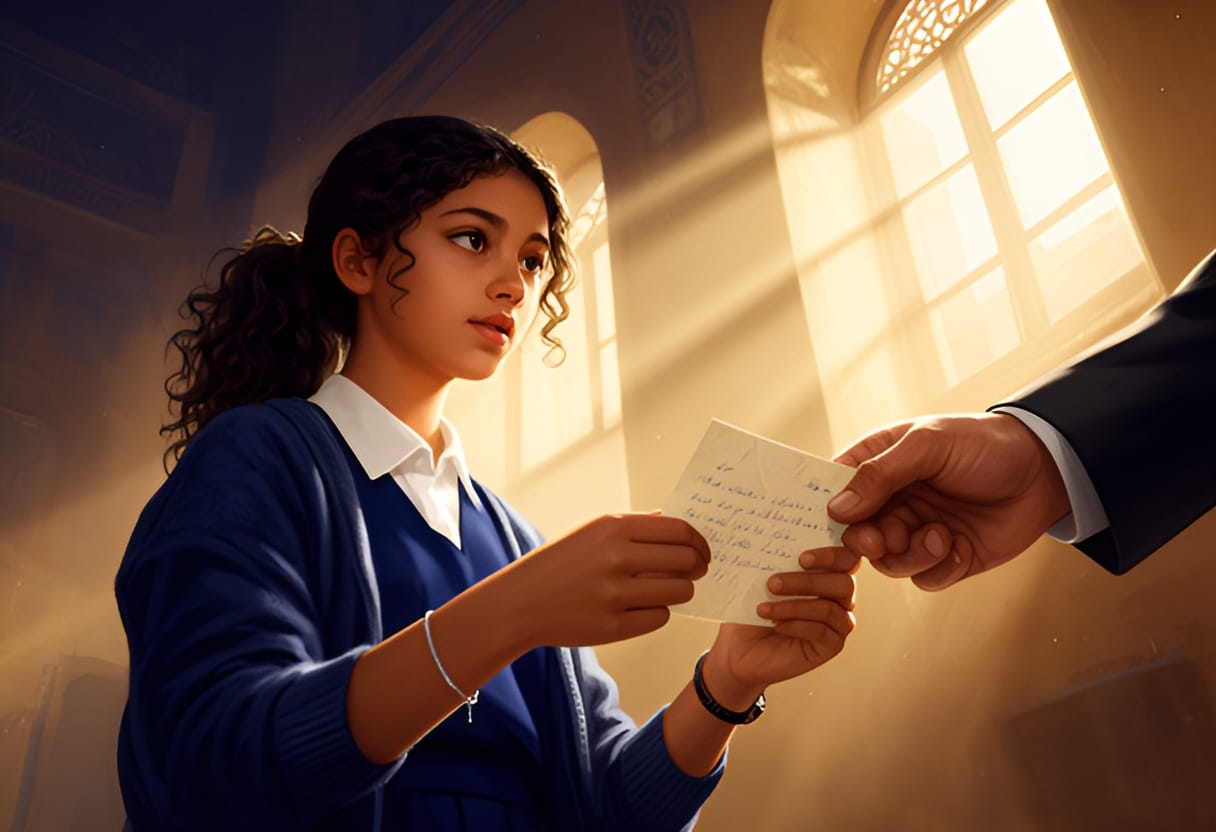
He took it slowly, his fingers brushing hers. His gaze flicked to the paper, then back to her face. “You’re submitting this voluntarily?”
“Yes, sir.”
He unfolded it carefully, eyes scanning the first lines. She watched his jaw tighten slightly, his brow furrow—not in anger, but in concentration. He read in silence, the only sound the soft rustle of the page as he turned it. When he finished, he folded it back neatly, just as she had, and handed it to her.
“I will read it,” he said. “And I will remember that courage, too, is part of the answer.”
She took the letter, her throat tight. “Thank you, sir.”
He nodded once, sharply, then turned and walked toward his desk, where he began sorting the completed booklets. Amina did not follow. She turned and walked out into the hallway, the morning sun warm on her face, the letter pressed once more to her ribs.
She did not look back. She did not need to.
Outside, the courtyard was alive with students—some laughing, some crying, most just moving, relieved to be done. Amina walked slowly, her steps unhurried. She passed the fountain, its water catching the light in scattered diamonds. She thought of the derivative—not as a test question, but as a measure of flow, of change over time. She had been still for so long. Now, she felt herself moving.
She reached the school gates and paused. Ahead, the street stretched toward home, toward the quiet house where her mother would be waiting with tea, where her father would ask, not about the score, but about how she felt. She did not know what the examiners would decide. She did not know if her letter would change anything. But she knew this: she had spoken. She had stood in the room where judgment was passed and said, without shouting, without pleading, “This is mine. And I am not afraid to say it.”
She took a breath. Then she walked forward—not running, not fleeing, but going—her head high, her steps sure, the letter warm against her heart, and the morning, finally, fully hers.