Fiction
Wings and Disaster
by Aluko Samuel
3 chapters1 hr read
Chapter 1
The Early Years
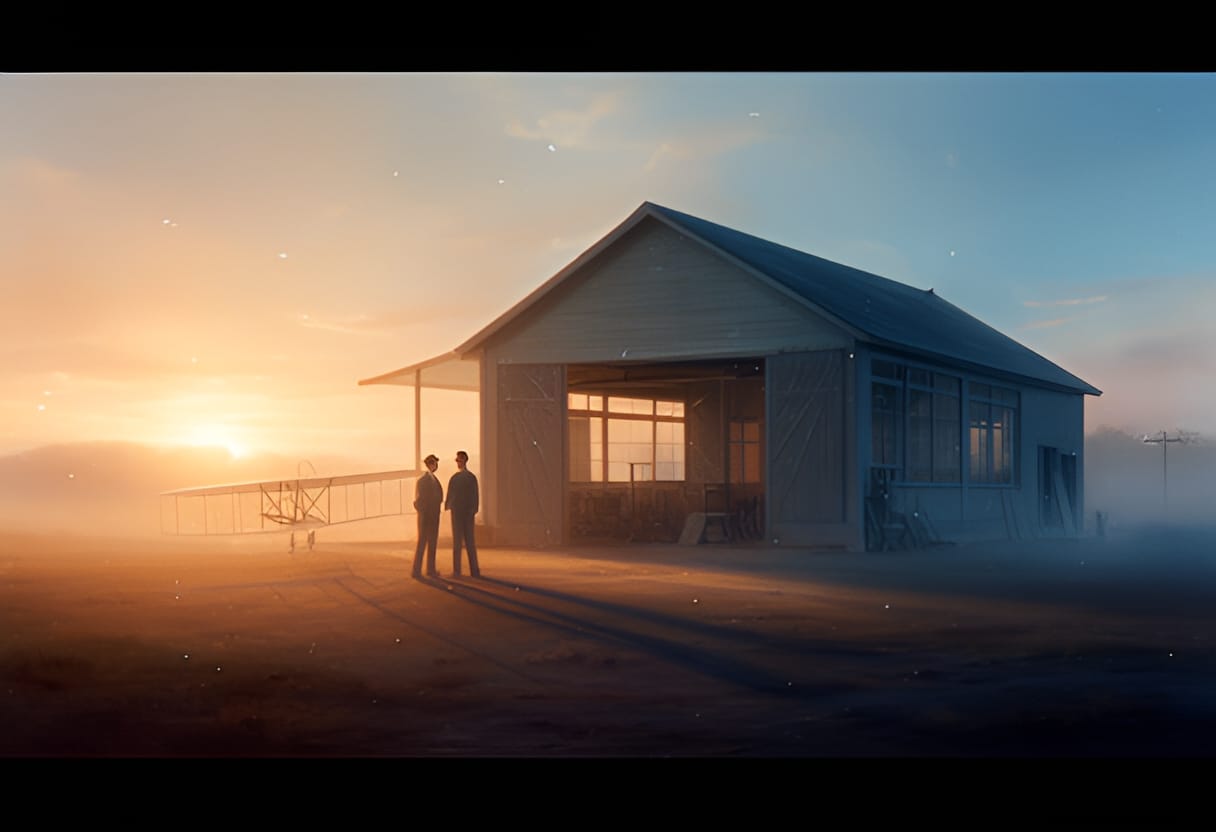
The sun rose over the small town of Kitty Hawk, North Carolina, casting a golden glow over the sandy dunes and the small workshop of Orville and Wilbur Wright. The brothers stood outside, their faces set with determination, as they gazed out at the open field where they would soon attempt to fly their latest creation. The year was 1903, and the world was on the cusp of a revolution in transportation. The Wright brothers were about to change the course of history.
"We're ready, Wilbur," Orville said, his voice filled with excitement, as he patted the wooden frame of their airplane. "The wind is in our favor, and the machine is ready to fly."
Wilbur nodded, his eyes scanning the horizon. "Let's get started, then. We've got a long day ahead of us."
The brothers had spent years experimenting with different wing designs and engine types, testing and retesting, until they were convinced they had created a machine that could fly. They had built and rebuilt, tweaked and adjusted, until their creation was a complex system of wires, pulleys, and wooden beams. The engine, a small gasoline-powered motor, roared to life as Orville turned the propeller, and the machine began to move, slowly at first, then gaining speed as it hurtled down the rail they had built to guide it.
As the machine picked up speed, Wilbur ran alongside, his eyes fixed on the wings, watching for any sign of lift. The wind rushed past, whipping his hair back and forth, and the sun beat down on his face, but he didn't flinch. He was focused on the task at hand, his mind racing with calculations and predictions.
The days turned into weeks, and the weeks turned into months, as the Wright brothers continued to experiment and refine their design. They encountered countless setbacks and failures, but they never gave up. They were driven by a fierce determination to succeed, to prove to themselves and the world that their idea was not crazy, that it was possible to build a machine that could fly.
One day, as they were working in their workshop, a young boy wandered in, curious about the strange contraption they were building. "What's that thing?" he asked, his eyes wide with wonder.
Wilbur smiled, happy to explain. "It's a flying machine," he said. "We're going to use it to soar through the air, like birds."
The boy's eyes grew even wider. "You mean, like a kite?"
Orville chuckled. "No, not like a kite. This machine will carry us through the air, with us on board."
The boy looked skeptical, but the Wright brothers just laughed. They knew that their idea was revolutionary, that it would change the world. And they were determined to make it happen.
The day of the first flight finally arrived, December 17, 1903. The Wright brothers stood on the windy beach, their machine ready to go. They had chosen a spot with a gentle slope, where the wind would help lift the machine into the air. Wilbur won a coin toss, and he climbed aboard, settling into the pilot's seat. Orville stood beside him, his hand on the rail, ready to release the machine.
"Here we go," Wilbur said, his voice steady.
Orville nodded, and released the machine. It began to move, slowly at first, then gaining speed as it hurtled down the rail. The wind rushed past, whipping Wilbur's hair back and forth, and the sun beat down on his face, but he didn't flinch. He was focused on the task at hand, his mind racing with calculations and predictions.
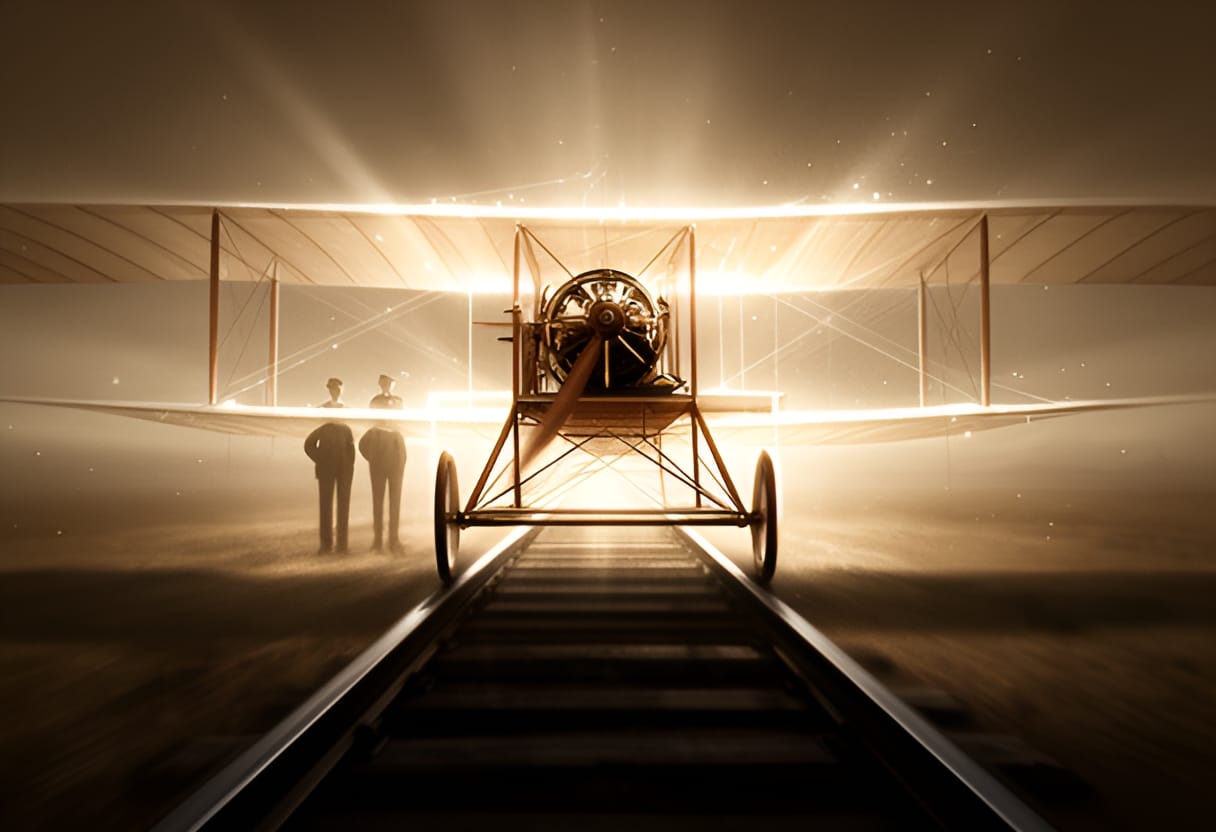
And then, in an instant, the machine lifted off the ground, soaring into the air. Wilbur felt a rush of exhilaration, a sense of wonder and awe, as he gazed out at the landscape below. He was flying, really flying, for the first time in his life.
The machine stayed aloft for 12 seconds, covering a distance of 120 feet. It was a short flight, but it was enough. The Wright brothers had done it. They had built a machine that could fly.
As Wilbur climbed out of the pilot's seat, a huge grin spread across his face. "We did it, Orville," he exclaimed. "We really did it."
Orville beamed with pride, clapping his brother on the back. "We sure did, Wilbur. We sure did."
The two brothers stood there, basking in the glory of their achievement, as the wind whipped through their hair, and the sun shone down on their faces. They knew that their lives would never be the same, that they had changed the course of history. And they were eager to see what the future held.
The excitement of the moment was palpable, and the Wright brothers couldn't help but let out a whoop of joy. They had done it, they had really done it. As they stood there, grinning from ear to ear, they knew that their lives would never be the same. They had achieved something truly remarkable, something that would change the world forever.
As they celebrated, a small crowd began to gather around them. The news of their achievement had spread quickly, and people were eager to see the machine that had made it all possible. The Wright brothers were happy to oblige, and they spent the next few hours showing off their creation and explaining how it worked.
One of the onlookers was a young man named Jack Harris, who had been fascinated by the Wright brothers' experiments for months. He had watched them from afar, marveling at their determination and ingenuity. Now, as he saw the machine up close, he couldn't help but feel a sense of awe. This was the future, he thought. This was the beginning of a new era.
As Jack watched, the Wright brothers made several more flights, each one longer and more successful than the last. They were refining their technique, making adjustments and tweaks to the machine as they went. It was clear that they were just getting started, that this was only the beginning of their journey.
As the day drew to a close, the Wright brothers packed up their machine and headed back to their workshop. They were exhausted but exhilarated, knowing that they had achieved something truly remarkable. As they walked, they talked about their plans for the future, about the possibilities that lay ahead.
"We'll need to make some adjustments to the machine," Wilbur said, his mind already racing with ideas. "We'll need to make it more stable, more reliable."
"And we'll need to find a way to control it better," Orville added. "We can't just let it fly wherever it wants."
Jack, who had been walking alongside them, nodded in agreement. "You'll get there," he said. "You've already come so far. I have no doubt that you'll succeed."
The Wright brothers smiled, grateful for the encouragement. They knew that they still had a long way to go, but they were ready for the challenge. They were pioneers, blazing a trail into the unknown. And they were excited to see where it would lead.
As they approached their workshop, the Wright brothers noticed a figure waiting for them outside. It was a reporter from the local newspaper, who had heard about their achievement and wanted to write a story. The Wright brothers were happy to oblige, and they spent the next hour talking to the reporter, explaining their machine and their plans for the future. It was the beginning of a new era, and they were eager to share it with the world.
As the Wright brothers finished their interview with the reporter, a young man named William Boeing watched from across the street, his eyes fixed on the scene unfolding before him. He had heard about the Wright brothers' achievement and was eager to learn more about their machine. William was a successful businessman, having made his fortune in the timber industry, but he had always been fascinated by the potential of aviation. He saw the Wright brothers' invention as a game-changer, and he wanted to be a part of it.
William walked across the street, introducing himself to the Wright brothers and congratulating them on their achievement. They were happy to meet him, and they spent the next hour talking about their machine and its potential. William was impressed by their ingenuity and determination, and he saw an opportunity to get involved in the industry. He asked them about their plans for the future, and they told him about their desire to build a plane that could carry multiple passengers. William's eyes lit up at the idea, and he knew that he wanted to be a part of it.
Years went by, and William Boeing's interest in aviation only grew stronger. He began to experiment with building his own planes, using the knowledge he had gained from the Wright brothers to create his own designs. He faced many challenges and setbacks, but he persevered, driven by his passion for flight. Finally, in 1916, William founded the Boeing company, with the goal of building planes that could carry multiple passengers. He started small, with a handful of employees and a tiny workshop, but he had big dreams.
William spent every waking moment thinking about his planes, designing and redesigning, testing and retesting. He was obsessed with creating the perfect machine, one that would be safe, efficient, and comfortable for passengers. His employees were dedicated and hardworking, but they were also skeptical at times. They had never seen anything like the planes William was designing, and they weren't sure if they would ever work. But William was undeterred, and he pushed them to keep trying, to keep innovating.
One day, William gathered his employees around him, his eyes shining with excitement. "We're going to build a plane that can carry multiple passengers," he told them. "A plane that will change the world." His employees looked at each other, unsure of what to make of William's claim. But they trusted him, and they were willing to follow him on this wild journey. Together, they set to work, designing and building the plane that would become Boeing's first major success.
The months that followed were a whirlwind of activity, as William and his team worked tirelessly to bring their vision to life. They encountered countless obstacles and setbacks, but they never gave up. William was a demanding boss, but he was also a fair one, and his employees were loyal to him. They worked long hours, often for little pay, but they were driven by a sense of purpose, a sense that they were creating something truly special.
Finally, the day arrived when the plane was ready to fly. William stood on the runway, his heart pounding with excitement, as his pilot climbed into the cockpit. The plane roared to life, its engines thundering as it began to move down the runway. William watched, his eyes fixed on the plane, as it lifted off the ground and soared into the air. It was a beautiful sight, the plane glinting in the sunlight as it flew overhead. William felt a sense of pride and accomplishment, knowing that he had created something truly remarkable.
The plane flew for several minutes, carrying its passengers safely and efficiently. William watched, a huge grin spreading across his face, as the plane landed smoothly back on the runway. It was a moment of pure triumph, the culmination of years of hard work and dedication. William's employees cheered and applauded, congratulating each other on their success. William just stood there, basking in the glory of the moment, knowing that he had changed the world.
As the news of Boeing's success spread, the company began to attract attention from all over the world. People were amazed by the plane's capabilities, and they wanted to know more about the company that had built it. William was happy to oblige, giving interviews and tours of his factory. He was a natural showman, and he loved being in the spotlight. But he never forgot the true purpose of his company, which was to build planes that would change the world. He continued to innovate and experiment, always pushing the boundaries of what was possible.
One day, a young man named Jack Harris visited the Boeing factory, eager to learn more about the company and its planes. William showed him around, proud to display his creations. Jack was impressed by what he saw, and he asked William about his plans for the future. William smiled, his eyes glinting with excitement. "We're just getting started," he said. "We're going to build planes that will take people all over the world, planes that will change the course of history." Jack listened, fascinated by William's vision, and he knew that he wanted to be a part of it.
As Jack toured the factory, he was struck by the sheer scale of the operation. Row upon row of workstations stretched out before him, each one staffed by skilled craftsmen and women who were busy building the next generation of planes. The air was thick with the smell of wood and metal, and the sound of hammering and drilling filled the air. William walked alongside him, pointing out different features of the planes and explaining the design process.
They stopped in front of a large wooden plane, its wings and fuselage taking shape under the skilled hands of the craftsmen. William ran his hand over the wood, feeling the smooth surface. "This is our latest design," he said. "We're calling it the Model 1. It's going to be a game-changer." Jack looked at the plane in awe, trying to take in all the details. He could see the attention to detail that had gone into its design, the careful consideration of every aspect of its construction.
As they walked further through the factory, Jack saw more and more planes in various stages of construction. He saw the care and attention that went into every detail, from the stitching on the seats to the polishing of the metal components. He was impressed by the level of craftsmanship on display, and he could see why Boeing was quickly becoming a leader in the aviation industry. William's passion for flight was infectious, and Jack found himself getting caught up in the excitement of it all.
They eventually made their way to William's office, a small room filled with papers and plans. William sat down behind his desk, a large wooden affair that was covered in papers and pens. He leaned back in his chair, a look of satisfaction on his face. "So, what do you think?" he asked Jack. "Are you impressed by what you've seen?" Jack nodded, still trying to take it all in. "I am," he said. "I had no idea that Boeing was so advanced." William smiled, pleased with himself. "We're just getting started," he said. "We've got big plans for the future." And with that, he leaned forward, his eyes glinting with excitement, and began to explain his vision for the future of aviation.
As William Boeing's vision for the future of aviation continued to unfold, a new player was emerging on the scene. Across the Atlantic, a group of European companies had come together to form a consortium, with the goal of building a plane that could compete with Boeing's offerings. The consortium, which would eventually become known as Airbus, was the brainchild of a handful of visionary individuals who saw the potential for a European-based aviation company to challenge the dominance of the American giants.
One of these individuals was a French engineer named Roger Béteille, who had a passion for aviation and a keen eye for design. Béteille had spent years working on various projects, from small propeller planes to large commercial airliners, and he had a deep understanding of what it took to build a successful aircraft. He was convinced that a European consortium could produce a plane that would be superior to anything Boeing had to offer, and he was determined to make it happen.
Béteille spent countless hours meeting with other engineers, designers, and executives from across Europe, trying to drum up support for his idea. He traveled from city to city, giving presentations and pitching his vision to anyone who would listen. It wasn't easy - there were many who doubted that a European consortium could ever hope to compete with the mighty Boeing - but Béteille persevered, driven by his conviction that he was onto something big.
Finally, after months of hard work, the consortium was officially established. It was a momentous occasion, with representatives from companies across Europe gathering to sign the founding documents. Béteille was overjoyed, knowing that this marked the beginning of a new era in European aviation. The consortium was named Airbus, and it quickly set to work on designing and building its first plane.
The early days of Airbus were not without their challenges. The company faced numerous technical and financial hurdles, and there were many who doubted its ability to succeed. But Béteille and his team were undeterred, driven by their passion for aviation and their determination to build a plane that would be the best in the world. They worked tirelessly, pouring over designs and testing new materials, and slowly but surely, their vision began to take shape.
The first Airbus plane, known as the A300, was a massive undertaking. It was designed to carry hundreds of passengers, and it would require a level of technical sophistication that was unprecedented in European aviation. But Béteille and his team were confident that they could do it, and they threw themselves into the project with abandon. The A300 was a beautiful plane, with sleek lines and a powerful engine. It was the perfect combination of form and function, and Béteille knew that it would be a game-changer.
As the A300 began to take shape, the aviation world started to take notice. Boeing, in particular, was watching with interest, knowing that Airbus was a potential threat to its dominance. But Béteille and his team were not intimidated. They were convinced that their plane was superior, and they were eager to prove it.
The day of the A300's maiden flight finally arrived, and it was a momentous occasion. Béteille and his team had worked tirelessly to get to this point, and they were eager to see their creation take to the skies. The plane lifted off the runway, its engines roaring as it soared into the air. It was a beautiful sight, the A300 glinting in the sunlight as it flew overhead. Béteille watched, a huge grin spreading across his face, as the plane performed flawlessly, its systems working in perfect harmony.
The A300 was a massive success, and it marked a major turning point for Airbus. The company had proven that it could build a plane that was capable of competing with the best of Boeing, and it had established itself as a major player in the aviation industry. Béteille and his team were overjoyed, knowing that their hard work had paid off. They had created something truly special, and they were eager to see what the future held.
As the news of the A300's success spread, Airbus began to attract attention from all over the world. Airlines and governments alike were impressed by the plane's capabilities, and they were eager to learn more about the company that had built it. Béteille and his team were happy to oblige, giving interviews and tours of their facilities. They were proud of what they had achieved, and they were eager to share it with the world.
The years that followed were a whirlwind of activity for Airbus. The company continued to innovate and expand, building new planes and establishing itself as a major force in the aviation industry. Béteille and his team were at the forefront of it all, driving the company forward with their passion and vision. They had created something truly special, and they were determined to make it last. As the company grew and prospered, it became clear that Airbus was here to stay, and that it would be a major player in the aviation industry for years to come.
As Airbus continued to grow and expand, it began to attract the attention of airlines and governments from around the world. The company's planes were in high demand, and its order book was filling up rapidly. Béteille and his team were working tirelessly to keep up with the demand, but they were determined to maintain the high standards of quality and innovation that had made Airbus so successful.
One of the key factors in Airbus's success was its ability to innovate and adapt to changing market conditions. The company was constantly looking for new ways to improve its planes, whether it was through the use of new materials, the development of more efficient engines, or the implementation of advanced avionics systems. This commitment to innovation had allowed Airbus to stay ahead of the curve, and to build planes that were truly world-class.
As the company continued to grow, it began to establish partnerships with other companies and organizations from around the world. These partnerships allowed Airbus to tap into new markets and to access new technologies, and they helped to further establish the company as a major player in the aviation industry. Béteille and his team were careful to choose their partners wisely, and they worked hard to build strong relationships with each of them.
Despite the many successes that Airbus had achieved, the company still faced many challenges. The aviation industry was highly competitive, and there were many other companies vying for market share. Additionally, the development of new planes was a complex and costly process, and it required a huge amount of investment and resources. Béteille and his team were well aware of these challenges, and they were working hard to overcome them.
As the years passed, Airbus continued to push the boundaries of what was possible in aviation. The company's planes were becoming increasingly sophisticated, with advanced systems and technologies that made them more efficient, more comfortable, and more reliable. Béteille and his team were proud of what they had achieved, and they were excited to see what the future held. They knew that there would be many more challenges to come, but they were confident that they had the skills, the expertise, and the determination to overcome them.
The future of Airbus was bright, and the company was poised to continue its upward trajectory. With its commitment to innovation, its focus on quality, and its determination to succeed, Airbus was ready to take on whatever challenges lay ahead. And as Béteille looked out at the company's facilities, he couldn't help but feel a sense of pride and excitement for what was to come. The sound of planes taking off and landing, the smell of fuel and metal, and the sight of rows of planes lined up on the runway all combined to create a sense of energy and possibility that was hard to ignore.
As Béteille looked out at the company's facilities, he couldn't help but feel a sense of pride and excitement for what was to come. The sound of planes taking off and landing, the smell of fuel and metal, and the sight of rows of planes lined up on the runway all combined to create a sense of energy and possibility that was hard to ignore. But amidst all the celebration and anticipation, there was a growing sense of unease. Boeing, the American aviation giant, had been watching Airbus's rise with growing concern. They had long been the dominant player in the industry, and they were not about to let some upstart European consortium steal their thunder.
The rivalry between Boeing and Airbus began to heat up, with both companies competing fiercely for market share and customers. Boeing's CEO, Philip Condit, was a seasoned veteran of the industry, and he was determined to do whatever it took to stay ahead of the competition. He launched a series of aggressive marketing campaigns, touting the superiority of Boeing's planes and questioning the safety and reliability of Airbus's aircraft. Béteille and his team were caught off guard by the ferocity of Boeing's attack, but they were not about to back down. They fired back with their own marketing campaigns, highlighting the innovative features and fuel efficiency of their planes.
As the competition between the two companies intensified, it began to have a major impact on the industry as a whole. Airlines and governments were forced to take sides, with some opting for the tried and true Boeing, while others were swayed by the sleek and modern Airbus. The rivalry also drove innovation, as both companies pushed the boundaries of what was possible in aviation. New technologies and materials were developed, and the planes themselves became more efficient, more comfortable, and more reliable. But the competition also had a darker side, as the two companies engaged in a series of bitter disputes and lawsuits. The tension between them was palpable, and it seemed to be building towards a dramatic confrontation.
That confrontation came when both companies bid on a major contract to supply planes to a large Asian airline. The contract was worth billions of dollars, and it was seen as a crucial test of the two companies' abilities. The airline's executives were torn between the two options, and they demanded that both companies make their best pitch. The meeting was held in a luxurious hotel in Singapore, with Béteille and Condit facing off against each other in a tense and dramatic showdown. The room was filled with the airline's executives, all of whom were eager to see which company would come out on top. Béteille stood confidently at the podium, outlining the features and benefits of Airbus's planes. Condit, on the other hand, was more aggressive, questioning the safety and reliability of Airbus's aircraft and touting the superiority of Boeing's planes. The debate was fierce and intense, with neither side giving an inch. In the end, it was Béteille who made the decisive move, revealing a shocking new feature that Airbus had been working on in secret. The room fell silent, with all eyes on Béteille as he waited for the airline's response. And then, just as it seemed like the decision was about to be made, a figure stood up from the back of the room. It was Jack Harris, the young investigator who had been watching the rivalry between Boeing and Airbus with growing interest. He had a question, one that would change the course of the competition forever. "Gentlemen," he said, his voice firm and confident. "I think it's time we talked about the real issue here. The issue of safety." The room fell silent, with all eyes on Jack as he waited for his chance to speak.
The room was electric with tension as Jack's words hung in the air. Béteille and Condit exchanged a wary glance, both of them sensing that the conversation was about to take a dramatic turn. The airline's executives leaned forward in their seats, their faces filled with a mix of curiosity and concern. Jack took a deep breath, his eyes scanning the room as he began to speak. "We've all heard the stories about the recent crashes, the ones that have been blamed on pilot error or mechanical failure. But what if I told you that there's more to it than that? What if I told you that there are systemic problems within both Boeing and Airbus, problems that are putting the safety of passengers at risk?"
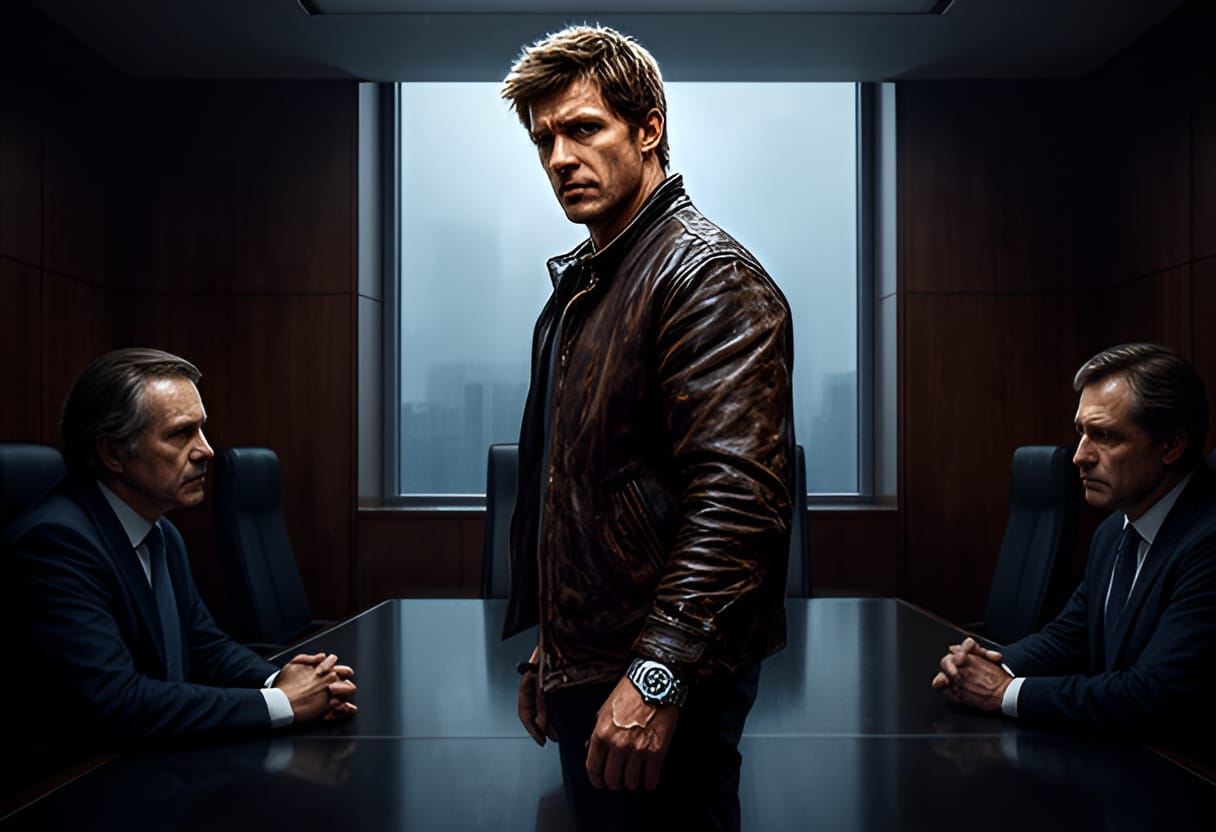
The room erupted into a chorus of gasps and whispers, with Béteille and Condit immediately jumping to their feet to protest. "That's not true," Condit said, his face red with anger. "Boeing has a perfect safety record, and we've done everything in our power to ensure that our planes are safe." Béteille nodded in agreement, his eyes flashing with defensiveness. "Airbus has also prioritized safety above all else," he said. "We've invested millions in research and development, and our planes are some of the safest in the world." Jack smiled wryly, his eyes glinting with amusement. "I'm not talking about the planes themselves," he said. "I'm talking about the culture within both companies, a culture that prioritizes profits over safety."
The room fell silent once again, with all eyes on Jack as he continued to speak. "I've been investigating the recent crashes, and what I've found is disturbing. Both Boeing and Airbus have been pushing the boundaries of safety, taking risks that they shouldn't be taking. They're under pressure to deliver planes quickly and cheaply, and that pressure is coming from the top. The result is a culture of fear and intimidation, where employees are afraid to speak out about safety concerns for fear of being fired or demoted." Béteille and Condit looked at each other, their faces pale with shock. They knew that Jack was telling the truth, and they knew that they had to respond.
The meeting continued for hours, with Jack presenting his evidence and Béteille and Condit defending their companies. The airline's executives listened intently, their faces filled with concern and uncertainty. As the meeting drew to a close, it was clear that the decision was far from made. The airline's CEO, a tall and imposing figure with a stern expression, stood up to address the room. "We will take all of this into consideration," he said. "But we need to make a decision, and we need to make it quickly. We'll be in touch with both Boeing and Airbus within the next few days to let them know our decision." The room erupted into a flurry of activity, with Béteille and Condit shaking hands with the airline's executives and Jack packing up his notes and preparing to leave.
As Jack walked out of the hotel, he was met with a surprise. Emily Chen, the brilliant engineer from Boeing, was waiting for him in the lobby. She looked nervous and agitated, her eyes darting back and forth as she spoke. "Jack, I need to talk to you," she said. "I've been watching you from afar, and I think you're onto something. I have information that could help you, information that could blow the lid off the whole industry." Jack's eyes narrowed, his mind racing with possibilities. "What kind of information?" he asked, his voice low and urgent. Emily glanced around the lobby, her eyes checking for eavesdroppers. "Let's just say that I have documents that prove what you've been saying," she said. "Documents that show the systemic problems within Boeing, problems that are putting the safety of passengers at risk." Jack's eyes locked onto hers, his heart racing with excitement. He knew that he had just stumbled into something big, something that could change the course of the industry forever.
Chapter 2
The Crashes
Jack's eyes locked onto Emily's, his mind racing with the implications of what she had just said. "Let's get out of here," he said, his voice low and urgent. "Somewhere private." Emily nodded, and together they walked out of the hotel lobby, into the cool evening air. They found a small café a few blocks away, where they sat down at a quiet table in the back.
"I have documents that show a pattern of negligence and cost-cutting at Boeing," Emily said, her voice barely above a whisper. "They're prioritizing profits over safety, and it's going to get people killed." Jack's eyes narrowed, his grip on his cup tightening. "I've been saying that for months," he said. "But no one wants to listen." Emily's eyes flashed with anger. "I know," she said. "I've been trying to sound the alarm from the inside, but it's like hitting my head against a brick wall."
Just then, Jack's phone rang, shrill in the quiet café. He answered it, his expression changing from curiosity to shock. "What?" he said, his voice sharp. "When?" He listened for a moment, his face growing paler. "I'll be right there," he said, and hung up. Emily's eyes were wide with concern. "What is it?" she asked. Jack's face was grim. "There's been a crash," he said. "A Boeing plane, just outside of Chicago. Everyone on board is dead."
The scene at the crash site was one of utter devastation. The wreckage of the plane was scattered across a field, the twisted metal and debris a grim reminder of the tragedy that had occurred. Jack and Emily arrived a few hours after the crash, and were immediately struck by the scale of the disaster. The air was thick with the smell of smoke and fuel, and the sound of sirens filled the air. Jack's eyes scanned the scene, taking in the destruction. He had seen some terrible things in his time as an investigator, but this was something else. The sheer scale of the tragedy was overwhelming.
As they walked through the wreckage, Jack and Emily were met by the lead investigator, a gruff but kind-eyed man named Mark. "Jack, thanks for coming," he said, his voice somber. "We're going to need all the help we can get on this one." Jack nodded, his eyes locked on the wreckage. "What do we know so far?" he asked. Mark hesitated, his expression grim. "Not much," he said. "The plane was a 737, one of Boeing's most popular models. It was on a routine flight from New York to Chicago, and everything seemed normal until...well, until it didn't." Jack's eyes narrowed. "What do you mean?" he asked. Mark shook his head. "The pilot's last transmission was a Mayday call, but we don't know what happened after that. We're still trying to piece together the evidence."
As they walked through the wreckage, Jack and Emily began to notice something strange. The plane's engines were intact, but the wings were badly damaged. It looked like the plane had experienced some kind of catastrophic failure, but Jack couldn't quite put his finger on what it was. He made a mental note to look into the plane's maintenance records, to see if there had been any issues with the wings or engines. Emily, meanwhile, was examining the wreckage with a keen eye, her expression growing more and more concerned. "Jack, look at this," she said, her voice low. "The wing's design is all wrong. It's like they took a shortcut, tried to save a few bucks." Jack's eyes locked onto hers, his mind racing with the implications. "You think that might have contributed to the crash?" he asked. Emily nodded, her face grim. "I do," she said. "And if that's the case, this tragedy could have been prevented."
Jack's eyes scanned the wreckage again, his mind racing with the possibility that a design flaw could have contributed to the crash. He knew that Boeing was a company that prioritized profits over safety, and the thought that they might have cut corners on the wing's design made his blood boil. He turned to Mark, his expression grim. "We need to get the maintenance records for this plane," he said. "And we need to take a closer look at the wing's design." Mark nodded, his face somber. "I'll get the records pulled," he said. "But I have to warn you, Jack, Boeing is already pushing back on this investigation. They're saying that the crash was a one-in-a-million accident, and that there's no way it could have been prevented."
Emily's eyes flashed with anger. "That's not true," she said. "I've seen the documents, Jack. I know what Boeing is capable of. They're going to try to cover this up, to sweep it under the rug." Jack's expression was grim. "We're not going to let them," he said. "We're going to get to the bottom of this, no matter what it takes." Mark nodded, his face set in a determined expression. "I'm with you, Jack," he said. "Let's get to work."
As they began to sift through the wreckage, Jack and Emily noticed something else strange. The plane's black boxes were intact, but they were badly damaged. It looked like the crash had been so severe that it had destroyed a significant portion of the plane's electronic systems. Jack's eyes locked onto Emily's, his mind racing with the implications. "This is going to make it tough to get any data from the black boxes," he said. Emily nodded, her face concerned. "But we have to try," she said. "We need to know what happened in those final moments before the crash."
Mark nodded, his expression grim. "I'll get the black boxes sent to the lab," he said. "But I have to warn you, it's going to take some time to recover any data. And even then, there's no guarantee that we'll be able to get anything useful." Jack's eyes scanned the wreckage again, his mind racing with the possibilities. He knew that the investigation was going to be a long and difficult one, but he was determined to get to the bottom of it. He was going to find out what had caused this crash, and he was going to make sure that those responsible were held accountable.
As the sun began to set on the crash site, Jack and Emily took a break to review what they had found so far. They sat down in a quiet corner of the field, away from the wreckage and the chaos of the investigation. Jack pulled out a notebook and began to scribble down some notes, his mind racing with the implications of what they had discovered. Emily sat beside him, her eyes fixed on the wreckage. "This is just the beginning," she said, her voice barely above a whisper. "I know that Boeing is going to try to cover this up, to blame it on pilot error or something. But we can't let them. We have to keep pushing, keep digging until we get to the truth."
Jack's eyes locked onto hers, his expression grim. "I'm with you," he said. "We're going to get to the bottom of this, no matter what it takes." As they sat there, the sun dipping below the horizon, Jack couldn't shake the feeling that they were just scratching the surface of something much bigger. Something that could have far-reaching consequences for the entire aviation industry. He knew that the investigation was going to be a long and difficult one, but he was determined to see it through. He was going to find out what had caused this crash, and he was going to make sure that those responsible were held accountable.
As the sun dipped below the horizon, Jack and Emily finally took a break from the investigation, exhausted from the long day of sifting through the wreckage. They decided to grab a bite to eat at a nearby diner, hoping to clear their minds and recharge for the long days ahead. As they sat down at a booth, Jack couldn't help but feel a sense of unease, knowing that the investigation was far from over. Emily, sensing his tension, reached out and put a hand on his arm. "We'll get to the bottom of this, Jack," she said. "I promise."
Just as they were about to order, the TV in the corner of the diner caught their attention. Breaking news flashed on the screen, and the anchor's voice was grave. "We've just received word of another plane crash, this time an Airbus A320. The plane was en route from Paris to Rome when it went down, killing all 150 people on board." Jack and Emily exchanged a stunned glance, their minds racing with the implications. This was the second major crash in as many weeks, and the coincidence was too great to ignore.
The investigation into the Airbus crash began immediately, with Jack and Emily joining the team on the ground in Rome. As they arrived at the crash site, they were met with a scene of utter devastation. The plane was a twisted wreckage of metal and debris, and the smell of smoke and fuel hung heavy in the air. Jack and Emily began to survey the damage, taking note of the plane's engines, wings, and control systems. It was clear that the crash had been catastrophic, and the cause was far from obvious.
As they worked, Jack couldn't shake the feeling that there was a connection between the two crashes. Both planes had been state-of-the-art, with advanced safety features and experienced crews. And yet, both had gone down in a matter of weeks, killing hundreds of people. He turned to Emily, his expression grim. "I think we're looking at a bigger picture here," he said. "Something that goes beyond just pilot error or mechanical failure." Emily nodded, her eyes scanning the wreckage. "I agree," she said. "But what could it be?"
As the investigation continued, Jack and Emily began to focus on the plane's engine, a complex system of turbines and fuel injectors. They spent hours poring over the maintenance records, talking to the mechanics who had worked on the plane, and analyzing the data from the black boxes. And then, finally, they found it - a major flaw in the engine's design, one that could have caused a catastrophic failure. The flaw was a faulty fuel injector, one that had been installed on numerous Airbus planes. Jack's eyes locked onto Emily's, his mind racing with the implications. "This could be it," he said. "This could be the cause of the crash."
Emily's face was grim. "But why didn't anyone catch it?" she asked. "Why did it take a crash to discover this flaw?" Jack shook his head. "That's the million-dollar question," he said. "But I think we're getting close to the answer. I think we're looking at a systemic problem, one that goes all the way to the top of the aviation industry." As they stood there, surrounded by the wreckage of the Airbus plane, Jack couldn't help but feel a sense of outrage. How could this have happened? How could a flaw so major have gone undetected for so long?
As the sun began to set on the crash site, Jack and Emily decided to call it a day, exhausted from the long hours of investigation. But as they walked away from the wreckage, Jack couldn't shake the feeling that they were just scratching the surface of something much bigger. Something that could have far-reaching consequences for the entire aviation industry. He turned to Emily, his expression grim. "We're not done yet," he said. "We're not even close to being done." Emily nodded, her eyes fixed on the horizon. "I know," she said. "But we'll get there. We'll find out what's going on, and we'll make sure that those responsible are held accountable." As they walked off into the darkness, the wreckage of the Airbus plane looming behind them, Jack couldn't help but feel a sense of determination. They would get to the bottom of this, no matter what it took.
As they walked back to their hotel, Jack's mind was racing with the implications of the faulty fuel injector. He couldn't understand how such a critical flaw could have gone undetected for so long. He thought about all the planes that were still in the air, all the people who were trusting their lives to these machines. The thought sent a shiver down his spine.
When they arrived at the hotel, Jack and Emily decided to review the data they had collected so far. They sat down at a table in the lobby, surrounded by stacks of papers and laptops. Jack began to sift through the maintenance records, looking for any sign of negligence or oversight. Emily, meanwhile, started to analyze the data from the black boxes, trying to reconstruct the final moments of the flight.
As they worked, Jack's phone rang. It was Mark, the lead investigator from the Chicago crash. "Jack, I've got some news," Mark said. "We've finished analyzing the data from the black boxes, and it looks like the pilot was experiencing some kind of engine failure just before the crash." Jack's eyes locked onto Emily's, his mind racing with the implications. "That's consistent with what we've found here," he said. "A faulty fuel injector could have caused a catastrophic failure."
Mark's voice was grim. "I know. And it gets worse. We've discovered that the same fuel injector was used on several other Boeing planes. We're talking about a potential disaster on a massive scale." Jack felt a surge of adrenaline. This was getting bigger by the minute. He thought about all the planes that were still in the air, all the people who were at risk.
Emily's eyes were fixed on him, her expression concerned. "What do we do now?" she asked. Jack took a deep breath, his mind racing with the possibilities. "We need to get this information to the FAA, ASAP," he said. "We need to ground all the planes that are affected, and we need to do it now." Emily nodded, her face set in a determined expression. "I'll start making calls," she said. "But we need to be careful. If Boeing finds out what we're doing, they'll try to shut us down."
Jack's eyes locked onto hers, his mind racing with the implications. He knew that they were taking a risk, but he also knew that they had no choice. They had to act, and they had to act fast. The lives of thousands of people depended on it. As they sat there, surrounded by the quiet of the hotel lobby, Jack felt a sense of determination wash over him. They would get to the bottom of this, no matter what it took. They would make sure that those responsible were held accountable, and they would make sure that the aviation industry was safe for everyone.
As they sat in the hotel lobby, Jack and Emily quickly got to work, making calls and sending emails to alert the FAA and other relevant authorities about the potential disaster. The atmosphere was tense, with a sense of urgency hanging in the air. Jack's mind was racing with the implications of their discovery, and he couldn't shake the feeling that they were running out of time.
"I need to get in touch with Ryan Thompson," Jack said, pulling out his phone. "He's a pilot with experience flying both Boeing and Airbus planes. If anyone can give us insight into what might have caused these crashes, it's him." Emily nodded, her eyes fixed on her laptop screen as she typed away. "I'll keep analyzing the data from the black boxes," she said. "See if I can find any other clues that might point to a systemic problem."
As Jack waited for Ryan to answer his call, he couldn't help but think about the sheer scale of the potential disaster. Thousands of planes were still in the air, carrying millions of passengers. If they didn't act fast, the consequences could be catastrophic. The phone rang several times before Ryan finally picked up. "Hey, Jack. What's going on?" he asked, his voice groggy from sleep.
"Ryan, we've got a situation here," Jack said, getting straight to the point. "We've discovered a faulty fuel injector that might have caused the crashes. And it's not just limited to one plane - it's been used on several Boeing and Airbus models." There was a pause on the other end of the line, and for a moment, Jack wondered if the connection had been lost. But then Ryan spoke up, his voice laced with concern. "That's not possible," he said. "I've flown those planes, Jack. I know their systems inside and out. If there was a problem with the fuel injector, we would have known about it by now."
Jack's eyes locked onto Emily's, his mind racing with the implications. "That's what we thought, Ryan," he said. "But the evidence is mounting. We need to get to the bottom of this, and fast." Ryan's voice was firm. "I'm with you, Jack. What do you need me to do?" Jack thought for a moment before responding. "I need you to review the maintenance records for the planes that were involved in the crashes. See if you can find any discrepancies or red flags that might indicate a problem with the fuel injector."
The next few hours were a blur of activity, with Jack, Emily, and Ryan working tirelessly to uncover the truth behind the crashes. They pored over maintenance records, interviewed mechanics and pilots, and analyzed data from the black boxes. And then, just as they were starting to think they were getting close to the truth, Emily stumbled upon something that made her blood run cold.
"Guys, I've got something here," she said, her voice barely above a whisper. Jack and Ryan turned to her, their faces expectant. "What is it?" Jack asked, his heart racing with anticipation. Emily's eyes were fixed on her laptop screen, her face pale. "I've been going through the emails and documents that I... acquired from Boeing," she said. "And I think I've found something that might explain why they didn't catch the problem with the fuel injector."
Ryan's eyes narrowed. "What is it?" he asked, his voice firm. Emily took a deep breath before responding. "It looks like Boeing was aware of the problem with the fuel injector, but they chose to ignore it. They were more concerned with meeting their production deadlines and making a profit than with ensuring the safety of their planes." Jack's eyes locked onto Emily's, his mind reeling with the implications. "That's not just negligence," he said. "That's a criminal act."
As the reality of the situation sank in, Jack couldn't help but feel a sense of outrage. How could a company like Boeing, a company that was responsible for the safety of millions of people, prioritize profits over human life? It was a question that he couldn't answer, but he knew that he had to do something about it. He turned to Emily and Ryan, his eyes blazing with determination. "We need to take this to the authorities," he said. "We need to make sure that Boeing is held accountable for their actions."
Ryan nodded, his face set in a firm expression. "I'm with you, Jack. We can't let them get away with this." Emily's eyes were fixed on her laptop screen, her face grim. "I'll keep digging," she said. "See if I can find any more evidence that might help our case." As they sat there, surrounded by the quiet of the hotel lobby, Jack knew that they were in for a long and difficult fight. But he also knew that they had no choice. They had to act, and they had to act fast. The lives of millions of people depended on it.
The hours that followed were a whirlwind of activity, with Jack, Emily, and Ryan working tirelessly to build their case against Boeing. They poured over documents, interviewed witnesses, and analyzed data, all in an effort to uncover the truth behind the crashes. And then, just as they were starting to think they were getting close to the truth, Jack received a call from an unknown number. "Jack Harris," a voice said, the tone firm and authoritative. "I understand you're investigating the recent plane crashes. I might have some information that can help you."
Jack's eyes locked onto Emily's, his mind racing with the implications. "Who is this?" he asked, his voice firm. The voice on the other end of the line hesitated for a moment before responding. "My name is not important," it said. "What's important is that I have information that can help you bring down Boeing. Are you interested?" Jack's heart was racing with anticipation as he turned to Emily and Ryan. "Yes," he said. "We're interested."
The voice on the other end of the line seemed to pause, as if considering how much to reveal. "I used to work for Boeing," it said finally. "I was an engineer, responsible for designing and testing new components. But I left the company when I realized that they were prioritizing profits over safety." Jack's eyes locked onto Emily's, his mind racing with the implications. This could be the break they needed, the proof they required to take down Boeing.
"What do you know about the faulty fuel injector?" Jack asked, his voice firm. The voice on the other end of the line hesitated again, and for a moment, Jack wondered if the connection had been lost. But then the voice spoke up, its tone laced with a mix of fear and determination. "I know that it was a deliberate design choice," it said. "Boeing knew that the fuel injector was flawed, but they chose to use it anyway. They were more concerned with meeting their production deadlines and making a profit than with ensuring the safety of their planes."
Jack's grip on the phone tightened, his anger and outrage growing with each passing moment. He glanced at Emily and Ryan, seeing the same emotions reflected in their faces. They were getting close to the truth, and they knew it. The voice on the other end of the line continued to talk, revealing more details about Boeing's questionable practices and the extent of their knowledge about the faulty fuel injector. Jack listened intently, his mind racing with the implications of what he was hearing. He knew that they had to get this information to the authorities, and fast. The lives of millions of people depended on it.
The voice on the other end of the line fell silent, and for a moment, Jack wondered if the connection had been lost. But then he heard a faint breath, and the voice spoke up again. "I'm sorry," it said. "I'm sorry that I didn't come forward sooner. I was afraid of what might happen to me, to my family." Jack's grip on the phone tightened, his anger and outrage growing with each passing moment. He glanced at Emily and Ryan, seeing the same emotions reflected in their faces.
"It's not your fault," Jack said, trying to keep his voice calm. "You're doing the right thing now. Can you meet with us in person? We need to get your statement on record." The voice on the other end of the line hesitated, and Jack could almost hear the fear and uncertainty. "I don't know," it said. "I'm not sure I can do that." Jack took a deep breath, trying to reassure the voice on the other end of the line. "We'll protect you," he said. "We'll make sure you're safe. But we need your help to bring down Boeing."
The voice on the other end of the line seemed to consider Jack's words, and for a moment, there was silence. Then, finally, it spoke up. "Okay," it said. "I'll meet with you. But you have to promise to protect me." Jack nodded, even though he knew the voice on the other end of the line couldn't see him. "I promise," he said. "We'll do everything in our power to keep you safe." The voice on the other end of the line gave Jack an address, and they agreed to meet the next day.
The next day, Jack, Emily, and Ryan arrived at the address, a small café on the outskirts of town. They were nervous, unsure of what to expect. But as they walked in, they saw a figure sitting in the corner, dressed in a hoodie and sunglasses. The figure looked up, and Jack saw a glimmer of fear in its eyes. "Are you the one who called me?" Jack asked, trying to keep his voice low. The figure nodded, and Jack, Emily, and Ryan sat down across from it.
The figure pushed back its hood, revealing a young woman with a look of determination on her face. "My name is Sarah," she said. "I used to work for Boeing as an engineer. I was responsible for designing and testing new components, including the faulty fuel injector." Jack's eyes locked onto Sarah's, his mind racing with the implications. This was the break they needed, the proof they required to take down Boeing. Sarah told them her story, of how she had discovered the problem with the fuel injector, but had been silenced by her superiors. She told them of how she had tried to come forward, but had been afraid of the consequences.
As Sarah spoke, Jack, Emily, and Ryan listened intently, their faces set in determined expressions. They knew that they had to get Sarah's story out, to make sure that the world knew what had really happened. They spent hours with Sarah, getting her statement on record, and gathering as much evidence as they could. And as they left the café, Jack knew that they were one step closer to bringing down Boeing.
The aftermath of the crashes was felt throughout the industry, with passengers and crew members telling their stories of horror and loss. The media was filled with reports of the crashes, and the public was outraged. The government was forced to act, launching an investigation into the crashes and the practices of the aviation industry. Jack, Emily, and Ryan were at the forefront of the investigation, working tirelessly to uncover the truth.
As the investigation continued, changes were made to the industry. New safety protocols were put in place, and airlines were forced to re-examine their practices. The public was demanding action, and the government was responding. But despite the progress that was being made, Jack knew that there was still much work to be done. The aviation industry was a complex and powerful beast, and it would take time and effort to bring about real change.
The confrontation between Boeing and Airbus came to a head when they both bid on a major contract with a large airline. The contract was worth billions of dollars, and both companies were determined to win it. The airline's executives were torn, unsure of which company to choose. Boeing was offering a cheaper price, but Airbus was promising a safer and more efficient plane. Jack, Emily, and Ryan were at the meeting, watching as the two companies presented their bids.
The room was tense, the air thick with anticipation. The executives from Boeing and Airbus were seated across from each other, their faces set in determined expressions. Jack, Emily, and Ryan were standing at the back of the room, watching as the drama unfolded. The airline's CEO stood up, a look of determination on his face. "We will not be swayed by cheap prices or fancy promises," he said. "We will choose the company that can provide us with the safest and most efficient planes." The room fell silent, the executives from Boeing and Airbus waiting with bated breath as the CEO made his decision. And then, finally, he spoke. "We will go with Airbus," he said. "Their planes are safer, and their company has a proven track record of prioritizing safety over profits." The room erupted into chaos, the executives from Boeing shouting in outrage. Jack, Emily, and Ryan smiled, knowing that they had played a part in bringing about this moment. It was a small victory, but it was a start. And as they left the meeting room, Jack knew that they would continue to fight for safety and justice in the aviation industry.
The executives from Boeing were furious, their faces red with anger. One of them stood up, slamming his fist on the table. "This is a mistake," he shouted. "Our planes are just as safe as Airbus's. You're just being swayed by the media and the public's perception." The CEO of the airline stood firm, his expression unyielding. "We've done our research," he said. "We've looked at the data, and we've made our decision. Airbus is the better choice for us." The room continued to erupt in chaos, with the Boeing executives arguing and shouting. Jack, Emily, and Ryan slipped out of the room, watching from a distance as the drama unfolded.
As they walked away, Emily turned to Jack and Ryan. "That was a big win for us," she said, a smile on her face. "But we know that Boeing won't give up easily. They'll try to fight back, to discredit us and Airbus." Ryan nodded in agreement. "We need to be prepared for that," he said. "We need to have all our evidence in order, and be ready to defend ourselves." Jack nodded, his mind already racing with the next steps. They had won a small battle, but the war was far from over. And as they walked away from the meeting room, Jack couldn't help but feel a sense of unease. What would Boeing do next? And how would they respond? The outcome was far from certain, and Jack knew that they had to be ready for anything.
Chapter 3
The Reckoning
The hearing into the crashes began on a somber note, with Jack Harris and Emily Chen seated at a long, wooden table, surrounded by representatives from Boeing and Airbus. The room was filled with an air of tension, as the families of the victims and the media looked on, eager to hear the truth behind the devastating disasters. Jack, with his years of experience as a pilot and investigator, took a deep breath and began to present their findings.
"Ladies and gentlemen, esteemed members of the committee, we have uncovered a shocking pattern of negligence and corporate greed that has led to the crashes of several Boeing planes," Jack said, his voice firm and confident. Emily Chen nodded in agreement, her eyes scanning the room as she handed out copies of their report. "Our investigation has revealed that Boeing prioritized profits over safety, ignoring warnings from engineers and pilots about the dangers of their new jet engine design." The room erupted into a flurry of whispers and murmurs, as the representatives from Boeing shifted uncomfortably in their seats.
The chairman of the committee, a stern-looking woman with a reputation for being tough on corporate misconduct, raised her hand, calling the room to order. "Let's hear from Boeing and Airbus," she said, her voice firm. "How do you respond to these allegations?" The CEO of Boeing, a tall, imposing figure with a smug expression, stood up, clearing his throat. "We take these allegations very seriously, but we must correct the record. Our planes are safe, and we have followed all safety protocols and regulations." Emily Chen's eyes narrowed, her face set in a determined expression. "That's not true," she said, her voice firm. "I have documents that prove otherwise. Documents that show Boeing knew about the dangers of their design and chose to ignore them."
The room fell silent, as the weight of Emily's words sank in. The CEO of Airbus, a suave, charismatic man with a quick smile, stood up, his eyes locked on the CEO of Boeing. "We have always prioritized safety at Airbus," he said, his voice smooth. "And we have the records to prove it. Boeing's actions are a clear example of the dangers of corporate greed and the importance of accountability." The CEO of Boeing's face turned red with anger, as he spluttered, "How dare you! You're just trying to gain an advantage over us." The chairman of the committee banged her gavel, calling the room to order once again. "This is not a debate, gentlemen. This is a hearing into the causes of a tragedy. Let's keep the discussion civil and focused on the facts."
As the hearing continued, the tension in the room grew, with both companies presenting their cases and defending their actions. Jack Harris and Emily Chen presented more evidence, including testimony from whistleblowers and internal documents that revealed a culture of corruption and negligence at Boeing. The representatives from Boeing grew more and more agitated, as the evidence mounted against them. The CEO of Airbus, on the other hand, seemed to be enjoying the spectacle, his smile growing wider as the day wore on.
As the hearing drew to a close, the chairman of the committee announced that the final witness would be Ryan Thompson, a seasoned pilot with years of experience flying for both Boeing and Airbus. Ryan took the stand, his face grave, as he began to testify. "I've flown for both companies, and I can tell you that there's a difference between them. Boeing's planes are more prone to malfunction, and their safety protocols are lax. I've seen it firsthand, and I've reported it to my superiors, but nothing ever seems to change." The room fell silent, as the weight of Ryan's words sank in. The CEO of Boeing's face turned purple with rage, as he shouted, "That's a lie! You're just a disgruntled employee trying to get revenge."
The hearing ended with a dramatic confrontation between the two companies, as they vied for a major contract with a prominent airline. The CEO of Airbus stood up, his eyes locked on the CEO of Boeing. "We're not just talking about safety here, we're talking about lives. And we're talking about the future of this industry. Boeing's actions are a threat to us all, and it's time they were held accountable." The CEO of Boeing sneered, his face twisted with contempt. "You'll never get that contract. We have the best planes, and we have the best team. You're just a bunch of amateurs trying to steal our thunder." The room erupted into chaos, as the two companies and their representatives began to argue and shout at each other. Jack Harris and Emily Chen watched, their faces grim, as the scene unfolded before them. They knew that this was just the beginning, that the real battle was only just starting.
The chairman of the committee banged her gavel once again, trying to restore order to the room. "That's enough!" she shouted, her voice rising above the din. "We will not tolerate this kind of behavior in this hearing. You will all be given a chance to present your final statements, and then we will adjourn." The room slowly quieted down, as the representatives from Boeing and Airbus took their seats, still glaring at each other.
The CEO of Boeing stood up, his face still red with anger. "We demand a chance to respond to these baseless allegations," he said, his voice dripping with venom. "We will not be swayed by the opinions of a few disgruntled employees and investigators. We have the facts on our side, and we will prove it." The CEO of Airbus smiled, his eyes glinting with amusement. "We're not afraid of the facts," he said. "We're afraid of the truth. And the truth is that Boeing's planes are not safe. They are a threat to the flying public, and they must be held accountable."
Jack Harris and Emily Chen exchanged a look, their faces grim. They knew that the battle was far from over. They had presented their evidence, but they knew that Boeing would stop at nothing to discredit them. They were determined to see justice done, but they knew it wouldn't be easy. The chairman of the committee looked at them, her eyes serious. "Mr. Harris, Ms. Chen, do you have any final statements to make?" Jack nodded, standing up. "Yes, we do. We urge the committee to take our evidence seriously, and to take action against Boeing. The lives of the flying public are at stake, and it's time someone took responsibility."
Emily Chen stood up, her voice firm. "We also urge the committee to consider the long-term implications of Boeing's actions. This is not just about one company, or one plane. This is about the entire industry, and the safety of everyone who flies. We must take a stand against corporate greed and negligence, and we must do it now." The room fell silent, as the weight of their words sank in. The representatives from Boeing and Airbus looked at each other, their faces set in determination. The battle was far from over, and it was clear that only one side could emerge victorious.
The chairman of the committee looked at her watch, her face serious. "I think that's all the time we have for today," she said. "We will adjourn this hearing, and reconvene tomorrow to consider the evidence. I urge all parties to remain calm, and to refrain from making any public statements until the hearing is concluded." The room began to empty, as the representatives from Boeing and Airbus filed out, still arguing and shouting at each other. Jack Harris and Emily Chen watched them go, their faces grim. They knew that the real battle was only just beginning, and they were determined to see it through to the end.
The next morning, Jack Harris and Emily Chen returned to the hearing room, their nerves on edge as they waited for the verdict. The chairman of the committee took her place at the front of the room, a solemn expression on her face. "After careful consideration of the evidence presented, we have reached a decision," she began, her voice firm and authoritative. "It is our finding that Boeing's negligence and prioritization of profits over safety were the primary causes of the recent crashes."
The room erupted into a mixture of gasps and murmurs, as the representatives from Boeing and Airbus reacted to the news. Jack and Emily exchanged a look, their faces set in determination. They had known that the evidence was on their side, but it was still a relief to hear the committee's verdict. The CEO of Boeing's face turned red with rage, as he shouted, "This is a travesty! We will appeal this decision and prove that it is flawed." The CEO of Airbus, on the other hand, smiled, his eyes gleaming with satisfaction. "We are pleased that the committee has recognized the truth about Boeing's actions," he said. "We hope that this verdict will bring about real change in the industry."
The chairman of the committee banged her gavel, calling the room to order. "The verdict is final," she said. "Boeing will be held accountable for their actions, and they will be required to make significant changes to their safety protocols and procedures." As she spoke, the room began to empty, as the representatives from Boeing and Airbus filed out, still arguing and shouting at each other. Jack and Emily watched them go, their faces grim. They knew that the real battle was far from over, but they were determined to see it through to the end.
As the day went on, the news of the verdict spread like wildfire, shocking the aviation industry to its core. The media was filled with stories of Boeing's negligence and the committee's verdict, and the public began to demand action. The government announced that it would be launching a full-scale investigation into Boeing's actions, and the company's stock prices began to plummet. Jack and Emily were hailed as heroes, their bravery and determination in the face of overwhelming opposition inspiring countless people. They were interviewed by the media, and their story was told and retold, a reminder of the power of courage and conviction.
The CEO of Boeing, on the other hand, was forced to resign, his reputation in tatters. The company was fined heavily, and they were required to make significant changes to their safety protocols and procedures. The industry as a whole was forever changed, as companies began to prioritize safety over profits. The days of corporate greed and negligence were numbered, and a new era of accountability and transparency had begun. Jack and Emily's work had sparked a revolution, and they had changed the course of history.
As they walked out of the hearing room, Jack turned to Emily and smiled. "We did it," he said, his voice filled with emotion. "We actually did it." Emily smiled back, her eyes shining with tears. "We sure did," she said. "And it's only the beginning." They walked out into the bright sunlight, ready to face whatever challenges lay ahead, knowing that they had made a real difference in the world. The sound of cameras clicking and reporters shouting filled the air, as they were mobbed by the media. Jack and Emily stood tall, their faces set in determination, as they faced the future and all its possibilities.
The media frenzy surrounding them was intense, with reporters and cameras swarming around them, all clamoring for a statement. Jack and Emily were bombarded with questions, from "How does it feel to have won the case?" to "What's next for you?" They answered as many questions as they could, trying to convey the significance of the verdict and the impact it would have on the industry. As they spoke, they were aware of the weight of their words, knowing that they were not just speaking for themselves, but for the families of the victims and for the future of aviation.
As the press conference drew to a close, Jack and Emily were approached by a group of family members of the victims, who had been watching the proceedings from the sidelines. They were met with tears, hugs, and words of gratitude, as the families thanked them for their tireless efforts to bring about justice. Jack and Emily were deeply moved by the encounter, knowing that their work had brought some measure of closure to those who had lost loved ones. They listened as the families shared their stories, their struggles, and their hopes for the future, and they knew that they had made a real difference in the lives of these people.
The days that followed were a whirlwind of activity, as Jack and Emily worked to ensure that the verdict was enforced and that Boeing was held accountable for its actions. They met with government officials, industry leaders, and other stakeholders, pushing for real change and reform. They also began to work on a new set of safety protocols and procedures, ones that would prioritize the safety of passengers and crew above all else. The work was grueling, but Jack and Emily were driven by their determination to create a safer, more accountable industry.
As they delved deeper into the process, they encountered resistance from some quarters, particularly from those who had a vested interest in maintaining the status quo. They faced opposition from some of Boeing's allies, who argued that the verdict was unfair and that the company was being unfairly targeted. Jack and Emily expected this pushback, but they were undeterred, knowing that they had the evidence and the truth on their side. They continued to push forward, using their knowledge and expertise to counter the opposition and to build a stronger, safer industry.
The investigation into Boeing's actions was ongoing, with new revelations emerging every day. The company's internal documents and emails were being scrutinized, revealing a culture of negligence and greed that went all the way to the top. The CEO's resignation was just the beginning, as more and more executives were forced to step down or face prosecution. The company's reputation was in tatters, and it would take years to rebuild trust with the public. Jack and Emily watched as the company struggled to come to terms with the consequences of its actions, and they knew that it would be a long and difficult road to recovery.
As the weeks turned into months, Jack and Emily began to see the fruits of their labor. The industry was beginning to change, with companies prioritizing safety above profits. New regulations were being put in place, and manufacturers were being held to a higher standard. The culture of negligence and greed that had permeated the industry for so long was finally being rooted out, and a new era of accountability and transparency was dawning. Jack and Emily knew that there was still much work to be done, but they were heartened by the progress that had been made, and they were determined to see it through to the end.
The phone rang, breaking the silence. Jack answered, listening intently as the caller spoke. His face was grave, and Emily could sense that something was wrong. "What is it?" she asked, as he hung up the phone. Jack's eyes were serious, his voice low. "It's the chairman of the committee," he said. "She wants to see us, urgently. Something's come up, something that could change everything." Emily's heart sank, as she wondered what new challenge lay ahead. She looked at Jack, and saw the determination in his eyes. Together, they would face whatever came next, knowing that their work was far from over.
Jack's words hung in the air, and Emily's eyes locked onto his, searching for any hint of what was to come. The chairman's urgency was palpable, even through the phone call, and Emily's mind was racing with possibilities. She stood up, her movements swift and decisive, as she followed Jack out of the room. The corridors were quiet, the only sound the soft hum of the air conditioning and the muted murmur of voices from other offices. They walked in silence, their footsteps echoing off the walls, until they reached the chairman's office.
The chairman, a woman with a kind face and a stern expression, greeted them warmly, but her eyes betrayed a sense of gravity. "Thank you for coming, Jack, Emily," she said, her voice low and measured. "I'm afraid we have a new development. One that could change the course of our investigation." She paused, collecting her thoughts before continuing. "We've received new evidence, documents that suggest Boeing's negligence went far beyond what we initially thought. It appears that they were aware of the design flaws in their jet engines, and yet they chose to ignore them, prioritizing profits over safety." The chairman's words were like a punch to the gut, leaving Emily breathless and Jack's face set in a grim determination.
The days that followed were a blur of activity, as Jack and Emily worked tirelessly to verify the new evidence and build a stronger case against Boeing. They met with experts, pored over documents, and conducted interviews, all in an effort to uncover the truth. The passengers and crew who had been affected by the crashes began to heal, their physical wounds slowly mending, but the emotional scars would take longer to fade. Emily visited some of the families, listening to their stories, and offering what comfort she could. She saw the pain in their eyes, the grief, and the anger, but she also saw a sense of hope, a sense that justice was being served. Jack, too, was working with the families, helping them to navigate the complex web of bureaucracy and red tape, ensuring that they received the support and compensation they deserved.
As the industry began to move forward, changes were made to the safety protocols and procedures. New regulations were put in place, and manufacturers were held to a higher standard. The culture of negligence and greed that had permeated the industry for so long was finally being rooted out, and a new era of accountability and transparency was dawning. Jack and Emily watched as the industry slowly began to heal, as companies prioritized safety above profits, and as the public began to trust again. They knew that there was still much work to be done, but they were heartened by the progress that had been made, and they were determined to see it through to the end. The phone on Jack's desk rang, breaking the silence, and he answered, his voice firm and resolute. "Yes, we'll be right there," he said, before hanging up. He turned to Emily, his eyes locked onto hers. "The chairman wants to see us again. It seems that Boeing is ready to make a statement, to accept responsibility for their actions." Emily's heart skipped a beat, as she wondered what this new development would bring. Would it be a genuine apology, or just a PR stunt? She looked at Jack, and saw the determination in his eyes. Together, they would face whatever came next, knowing that their work was far from over.
As they walked into the chairman's office, Emily could sense a shift in the atmosphere. The room was filled with a sense of anticipation, and the chairman's expression was grave. Boeing's CEO, flanked by his lawyers, stood before them, his eyes cast downward. The chairman began to speak, her voice firm and measured. "Gentlemen, we have reached a critical juncture in this investigation. Boeing's actions, or rather, their inactions, have been deemed negligent and reckless. The evidence is clear: they prioritized profits over safety, and the consequences were devastating." The CEO's eyes flickered upward, a hint of defiance in his gaze, but the chairman continued, unyielding. "We expect a full apology, and a commitment to make significant changes to your safety protocols and procedures."
The CEO cleared his throat, his voice laced with a mix of contrition and defensiveness. "We acknowledge that mistakes were made, and we take full responsibility for our actions. We are committed to making things right, to ensuring that such tragedies never happen again." Emily watched him, her eyes narrowed, searching for any sign of insincerity. Jack, too, was scrutinizing the CEO, his expression unreadable. The chairman leaned forward, her eyes locked onto the CEO's. "We will be monitoring your progress closely, and we expect regular updates on the changes you are making. We will not tolerate any further negligence or recklessness." The CEO nodded, his eyes cast downward once more, and Emily sensed a glimmer of hope. Perhaps, just perhaps, this was the beginning of a new era for the industry, one where safety and accountability would be paramount.
The meeting drew to a close, and as they left the chairman's office, Emily felt a sense of unease. The CEO's apology had seemed heartfelt, but she knew that words were cheap, and that actions spoke louder than words. She turned to Jack, her voice barely above a whisper. "Do you think they'll follow through on their promises?" Jack's expression was grim, his eyes clouded with doubt. "I don't know, Emily. I want to believe that they will, but I've seen too many companies make promises they don't intend to keep." Emily nodded, her mind racing with the implications. If Boeing failed to deliver on their promises, the consequences would be catastrophic. The industry would never recover, and the public's trust would be irreparably broken.
As they walked back to their office, Emily's phone rang, shrill in the silence. She answered, her voice crisp, and listened intently as the caller spoke. Her eyes widened, and she turned to Jack, her expression urgent. "It's one of the families of the victims," she said, her voice low. "They want to meet with us, to discuss the settlement and the changes that Boeing is promising to make." Jack's eyes locked onto hers, and Emily sensed a sense of purpose, a sense that their work was far from over. They would continue to fight, to push for justice and accountability, until the industry was safe, and the public could trust again. The meeting with the family would be just the beginning, a chance for them to hear the stories, to see the pain and the grief, and to know that their work was making a difference.
The days turned into weeks, and the weeks turned into months, as Jack and Emily worked tirelessly to ensure that Boeing followed through on their promises. They met with the families, with the chairman, and with the CEO, pushing for progress, and demanding accountability. The industry was slowly beginning to change, but Emily knew that it would take time, effort, and perseverance to create a culture of safety and transparency. She and Jack were just two people, but they were determined to make a difference, to leave a lasting legacy that would save lives, and prevent tragedies like the ones they had witnessed. As they sat in their office, pouring over documents, and making plans for their next move, Emily felt a sense of hope, a sense that the future was bright, and that the industry would emerge from this darkness, stronger, safer, and more accountable than ever before.
As they sat in their office, pouring over documents, and making plans for their next move, Emily felt a sense of hope, a sense that the future was bright, and that the industry would emerge from this darkness, stronger, safer, and more accountable than ever before. Jack looked up from the papers in front of him, his eyes locking onto hers, and Emily sensed a sense of pride and accomplishment in his gaze. "We've come a long way, Emily," he said, his voice low and reflective. "We've made a difference, and we've changed the industry for the better." Emily nodded, her mind racing with the memories of the past few months, the struggles, the triumphs, and the setbacks. She thought about the families of the victims, the chairman, the CEO, and all the others who had been affected by the crashes. She thought about the lessons they had learned, the sacrifices they had made, and the progress they had achieved.
"We've learned that safety and accountability are not just buzzwords, but essential components of this industry," Jack continued, his voice filled with conviction. "We've learned that profits and greed should never come before human lives, and that transparency and honesty are the only way to build trust and credibility." Emily nodded, her eyes never leaving his, as she felt a sense of validation and vindication. They had fought for the truth, and they had fought for justice, and in the end, they had emerged victorious. The industry would never be the same again, and the legacy of the crashes would be a reminder of the importance of safety and accountability for generations to come.
Years went by, and the industry continued to evolve and change. Boeing, under new leadership, had implemented significant changes to their safety protocols and procedures, and the results were evident. The number of crashes and accidents had decreased dramatically, and the public's trust in the industry had been restored. Jack and Emily had become legends in their own right, their names synonymous with bravery, integrity, and a commitment to safety. They had continued to work together, pushing for further reforms and improvements, and their partnership had become a model for others to follow. One day, as they sat in their office, now a symbol of their legacy, Emily turned to Jack and said, "You know, I never thought I'd say this, but I'm proud of what we've accomplished. We've made a difference, and we've left a lasting legacy." Jack smiled, his eyes twinkling with pride, and said, "We sure have, Emily. We sure have."
As they looked out the window, watching the planes take off and land, Emily felt a sense of hope and renewal. The industry was looking to the future, and the possibilities were endless. New technologies were being developed, new safety protocols were being implemented, and a new generation of pilots, engineers, and investigators were emerging, eager to make their mark. Jack and Emily had played a small part in shaping this future, and as they walked out of their office, arm in arm, Emily knew that their legacy would live on, a reminder of the power of courage, integrity, and a commitment to safety. The sun was setting, casting a golden glow over the landscape, and Emily felt a sense of peace, knowing that the industry was in good hands, and that the future was bright.
As they walked out of their office, Emily couldn't help but feel a sense of nostalgia wash over her. She thought about all the late nights, the early mornings, and the countless hours they had spent pouring over documents, attending meetings, and pushing for change. It had been a long and difficult journey, but it had been worth it. The industry was safer, and the public was more aware of the importance of safety and accountability. Jack, sensing her mood, put his arm around her shoulders and pulled her close. "You okay?" he asked, his voice low and gentle. Emily nodded, smiling up at him. "Just thinking about how far we've come," she said, her voice barely above a whisper.
They walked in silence for a while, taking in the sights and sounds of the bustling airport. Emily watched as planes took off and landed, their engines roaring as they soared through the skies. She thought about the thousands of people who worked behind the scenes to make sure those planes were safe, the mechanics, the engineers, the air traffic controllers. She thought about the families of the victims, and the impact that the crashes had had on their lives. She thought about the CEO of Boeing, and the changes he had implemented to ensure that such tragedies never happened again. As they walked, they came across a group of young engineers, eager and enthusiastic, discussing the latest advancements in safety technology. Emily's eyes lit up as she listened to their conversation, and she felt a sense of excitement and hope for the future.
One of the engineers, a young woman with a bright smile, noticed Emily and Jack standing there, and her eyes widened in recognition. "Oh my god, you're Emily Chen and Jack Harris," she exclaimed, her voice full of awe. "We've studied your work, and we're huge fans." Emily blushed, feeling a sense of embarrassment, but Jack just chuckled and shook his head. "We're just doing our job," he said, his voice humble. The young engineer nodded, her eyes shining with admiration. "You've inspired us to pursue careers in safety and engineering," she said. "We want to make a difference, just like you have." Emily felt a sense of pride and purpose, knowing that their work was inspiring a new generation of professionals.
As they continued to talk to the young engineers, Emily realized that their legacy was not just about the changes they had made, but about the people they had inspired. They had shown that one person, or a small group of people, could make a difference, and that the power of courage, integrity, and determination could overcome even the most daunting challenges. The young engineers asked them questions, seeking their advice and guidance, and Emily and Jack were happy to share their experiences and insights. As they talked, Emily felt a sense of connection to these young people, and she knew that the future of the industry was in good hands.
Months went by, and Emily and Jack continued to work together, pushing for further reforms and improvements. They attended conferences, gave speeches, and wrote articles, sharing their knowledge and expertise with the world. They became mentors to the young engineers they had met, guiding them and advising them as they navigated their careers. Emily and Jack's partnership had become a model for others to follow, a testament to the power of collaboration and teamwork. As they looked out at the industry, they knew that there was still much work to be done, but they were confident that the next generation of professionals would carry on their legacy. The industry was evolving, and new challenges were emerging, but Emily and Jack were ready to face them head-on, armed with their experience, their knowledge, and their commitment to safety and accountability.
One day, as they were preparing to attend a conference, Emily received an email from the chairman of the committee that had investigated the crashes. The chairman wanted to meet with them, to discuss the progress that had been made, and to seek their advice on how to continue to improve the industry. Emily and Jack exchanged a look, and without saying a word, they knew that this meeting would be important. They arrived at the chairman's office, and were greeted with a warm smile. The chairman thanked them for coming, and began to discuss the latest developments in the industry. Emily and Jack listened intently, their minds racing with ideas and suggestions. As the meeting drew to a close, the chairman turned to them, his eyes serious. "I have one more thing to discuss with you," he said, his voice low. "Something that I think will be of great interest to you both." Emily and Jack leaned forward, their hearts pounding with anticipation, as the chairman began to speak.