Technology
Elden ring
by Timeo Slg
3 chapters1.2 hr read
Chapter 1
Foundations of the Lands Between
The Elden Ring and the Golden Order
The Tarnished awakens in the Lands Between not by chance, but because the Elden Ring has been broken. To understand why you are called back, you must first grasp what the Ring was and what it meant to hold reality together.
The Elden Ring as Law and Covenant
The Elden Ring is neither a mere artifact nor a simple symbol. It is the metaphysical foundation that establishes the laws governing life, death, and fate in the Lands Between. As a physical object, it appears as a great golden ring, shattered into shards known as Great Runes, each held by a demigod offspring of Queen Marika. But its true power lies in its function: it enforces an immutable order by binding the concepts of mortality and destiny to the will of the Golden Order.
Think of the Elden Ring as a cosmic constitution. Just as a legal system defines rights, responsibilities, and consequences, the Ring establishes that death is not final, that lineage determines succession, and that the Erdtree is the source of grace. When intact, it ensures that the Tarnished cannot truly die — they return from the grave through the power of grace, a direct manifestation of the Ring’s influence. This is not magic in the fantastical sense, but a law of nature, as fundamental as gravity.
For example, when you defeat a boss and see your character collapse, then rise again at a nearby Site of Grace, you are witnessing the Ring’s law of mortality in action. Death is permitted, but not absolute. The Ring allows for resurrection because it has decreed that the Tarnished, though fallen, may still pursue their purpose. Without this law, every defeat would be permanent, and the journey would end at the first misstep.
The Golden Order: Doctrine and Enforcement
The Golden Order is the ideological framework that interprets and enforces the will of the Elden Ring. It is not a religion in the conventional sense, but a system of divine law administered by the Two Fingers, disembodied entities that serve as the voice of the Greater Will — the outer god that bestowed the Ring upon Queen Marika. The Golden Order dictates what is true, what is just, and what is destined, presenting itself as the inevitable path for all beings in the Lands Between.
Its authority rests on two pillars: doctrinal purity and institutional control. The Two Fingers communicate the will of the Greater Will through doctrine, while the Golden Order clergy — including prelate leaders and cleansing church officials — enforce compliance through ritual, hierarchy, and, when necessary, force. Dissent is not merely discouraged; it is framed as a violation of cosmic law, tantamount to chaos.
Consider the case of Leyndell, the Royal Capital. Here, the Golden Order’s influence is absolute. The city’s architecture, its laws, and even the behavior of its citizens reflect a society structured around obedience to divine mandate. The presence of the Divine Towers, which project the light of the Erdtree across the realm, is a constant reminder that the Golden Order’s reach is both spiritual and territorial. To live in Leyndell is to live under the Rule of the Golden Order, where grace is granted only to those who accept its truth.
This enforcement mechanism explains why figures like Radagon and Marika, despite their divine status, are bound by the same laws they uphold. Even the vessel of the Elden Ring cannot unilaterally alter its decrees without consequence — a fact that becomes critical when examining the motivations behind the Shattering.
The Erdtree: Conduit and Symbol
The Erdtree is more than a towering golden tree at the center of the Lands Between. It is the primary conduit through which the Elden Ring’s power flows into the world. Its roots draw energy from the Ring itself, and its branches distribute grace — the tangible manifestation of the Ring’s law — to all corners of the realm. Sites of Grace, where the Tarnished rest and level up, are direct emanations of this energy, appearing wherever the Erdtree’s influence is strongest.
The Erdtree also serves as the theological heart of the Golden Order. It is worshipped as a symbol of eternity, divine favor, and the unbroken chain of succession from Queen Marika to her heirs. Its golden leaves, which never fall, represent the permanence of the order it embodies. When the Erdtree is healthy, the Lands Between thrive; when it is wounded or corrupted, the very fabric of reality begins to fray.
A clear example of this relationship can be seen in the progression of blight. In areas where the Erdtree’s grace is weak — such as the poisoned swamps of Caelid or the rot-infested lands of Aeonia — the natural world decays, and hostile entities flourish. Conversely, in regions like the Weeping Peninsula or the outskirts of Limgrave, where grace flows freely, life persists, and the Tarnished can travel with relative safety. The Erdtree’s vitality is not symbolic; it is a measurable force that sustains ecological and metaphysical balance.
This dual role — as both conduit and symbol — makes the Erdtree the linchpin of the Golden Order’s authority. To damage it is to challenge the Elden Ring itself. To restore it is to reaffirm the Golden Order’s claim to truth.
Competing Fates: Truth vs. Alternative Destinies
The Golden Order presents its version of reality as the only valid path, but the Lands Between harbor opposing fates that challenge its dominance. These are not mere heresies; they are alternative cosmologies, each rooted in a different interpretation of existence and each backed by its own outer god or metaphysical principle. The most prominent are the Age of Stars, championed by Ranni the Witch, and the Lord of Frenzied Flame, driven by the Formless Mother and the Three Fingers.
The Age of Stars seeks to replace the Golden Order’s rigid hierarchy with a destiny guided by free will and lunar mystery. It does not deny the Elden Ring’s power but reinterprets it, advocating for a world where fate is not imposed but chosen. Ranni’s rebellion is not against the concept of order, but against the idea that order must be singular, unchanging, and enforced by divine decree.
In contrast, the Lord of Frenzied Flame embraces chaos as a form of purification. It does not seek to replace the Golden Order with another system, but to burn it all away — gods, demigods, Tarnished, and Erdtree alike — so that a new, unburdened existence might emerge. This fate is not anarchic in the sense of randomness; it follows its own internal logic, where suffering ends only when all bonds — to gods, to lineage, to grace — are severed.
To illustrate the distinction, consider how each path treats death. The Golden Order sees death as a temporary state, overcome through grace and resurrection. The Age of Stars views death as a transition to a self-determined destiny, achievable only through personal revelation. The Frenzied Flame sees death as the ultimate release, a necessary end to the illusion of meaning imposed by external forces.
These differences are not abstract. They manifest in gameplay through distinct questlines, endings, and environmental storytelling. Choosing to pursue Ranni’s quest, for example, leads you through lunar temples and hidden cities, ultimately offering an ending where the Erdtree is not destroyed, but surpassed. Embracing the Frenzied Flame, meanwhile, requires you to seek out the Three Fingers underground, accept a frenzied eye, and burn the Erdtree to ash — a conclusion that rejects not just the Golden Order, but the very idea of an enduring world.
Understanding these competing fates is essential because they reveal that the Elden Ring’s power is not absolute in meaning, only in influence. The Ring establishes what is possible, but not what must be believed. Your journey as the Tarnished is not simply to restore a broken thing, but to decide what kind of world should rise from its fragments.
The Shattering and the Night of Black Knives
The Night of Black Knives marks the singular event that unraveled the Elden Ring and ignited the war among demigods. It was not a battle of armies but a covert strike that exploited divine vulnerability, turning a moment of ritual into a catalyst for endless conflict. To understand the Shattering, one must first grasp how Godwyn the Golden — the first demigod to die — became the linchpin of a fracture that still defines the Lands Between.
The Assassination of Godwyn the Golden
Godwyn the Golden, firstborn of Queen Marika and Godfrey, First Elden Lord, was not merely a demigod but the living embodiment of the Golden Order’s legitimacy. His death during a ritual at Fort Haight was not an accident but a precisely timed assassination carried out by the Black Knife Assassins. These agents, wielding blades inscribed with the insignia of Ranni the Witch, struck Godwyn while he was in a state of vulnerable repose, his soul temporarily separated from his body during a ceremonial rite.
The method of killing was as significant as the act itself. Godwyn’s body remained intact, but his soul was destroyed — a fate worse than mere death in the Lands Between, where resurrection via grace is normally assured. This permanent severance of soul from flesh exposed a critical flaw in the Elden Ring’s design: while it governs the cycle of life and death, it cannot protect against attacks that target the soul directly when the body is unprepared. The assassins did not overcome his divine strength through force; they exploited a metaphysical loophole during a moment of ritual vulnerability.
This event shattered the illusion of invincibility surrounding the Golden Order. If the firstborn demigod, blessed by the Erdtree’s grace and destined to inherit the throne, could be slain so utterly, then no one was beyond reach. The assassination was not merely regicide — it was a statement that the Elden Ring’s laws could be circumvented, and that divine right was not absolute.
The Black Knife Assassins and Ranni’s Rebellion
The Black Knife Assassins were not mercenaries acting alone. Their weapons, tactics, and timing point to direct involvement by Ranni the Witch, who had already begun questioning the Golden Order’s authority. Though she did not strike the blow herself, evidence suggests she provided the assassins with the means to kill a demigod’s soul — specifically, the blackened knives capable of severing the soul from the body without damaging the flesh.
Ranni’s motivation stemmed from her rejection of predestination. As an Empyrean, she was groomed to inherit the Elden Ring, but she refused to become another vessel for the Greater Will’s design. The Night of Black Knives was her opening move in a broader rebellion: by removing Godwyn, she disrupted the line of succession and created a power vacuum that the Golden Order could not immediately fill. More importantly, she demonstrated that the Elden Ring’s power was not immune to subversion — a revelation that emboldened other demigods to act on their own ambitions.
The assassins’ connection to Ranni is further supported by their subsequent actions. After the killing, they did not flee or disband but instead protected Ranni’s rise, guarding her as she fled to the moon and later aided her in establishing the Age of Stars. Their loyalty was not to coin or chaos, but to a cause — the dismantling of the Golden Order’s monopoly on fate.
The Shattering: Demigods Seize the Elden Ring
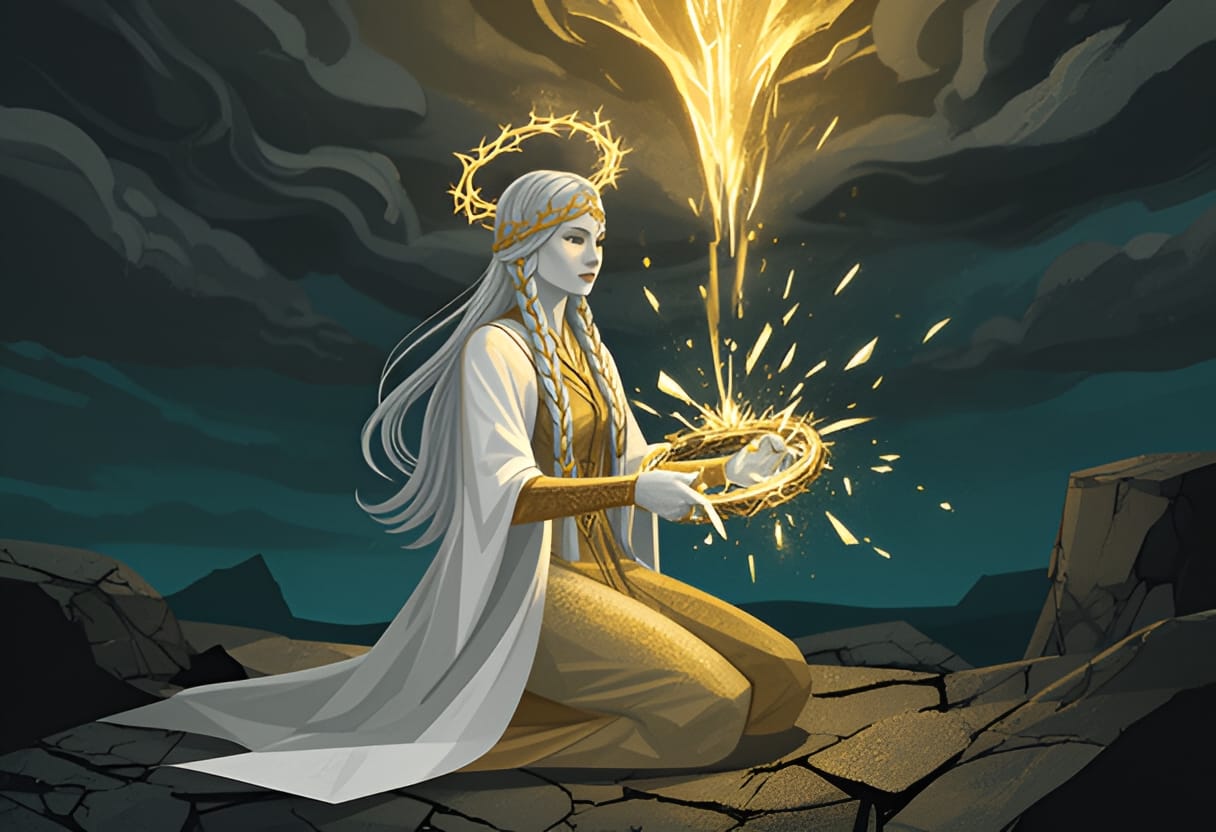
Godwyn’s death did not immediately break the Elden Ring, but it triggered a chain reaction that made the Shattering inevitable. In the aftermath, the demigods — each believing they had a rightful claim — rushed to seize the shards of the Elden Ring, known as Great Runes, from the divine vessel. Queen Marika, overwhelmed by grief and guilt, shattered the Ring herself in a moment of despair, scattering its power across the Lands Between.
This act was not one of calculated strategy but of fractured will. Marika, who had long borne the dual burden of ruler and vessel, could no longer reconcile her role as enforcer of the Golden Order with her anguish over Godwyn’s death. Her shattering of the Ring was both a punishment of the Greater Will and a release of its constraints — but it had the unintended consequence of arming her children with divine fragments they would use to wage war.
Each demigod claimed a shard and retreated to their stronghold, turning the Lands Between into a battlefield of rival warlords. Radahn took refuge in Caelid, hoarding his Great Rune as he descended into madness from starscourage. Morgott defended Leyndell, insisting his birthright as the Omen King gave him priority. Malenia and Miquella held the Haligtree, their bond the last vestige of unity before her affliction with Scarlet Rot isolated her. The Erdtree, meanwhile, began to wane — its grace withdrawing as the Ring’s influence fractured.
The Shattering was not a single event but a process: the assassination created the opening, Marika’s fracture of the Ring provided the opportunity, and the demigods’ rush to claim power turned opportunity into enduring conflict. Without Godwyn’s death, the demigods might have delayed their ambitions; without the Shattering, the Ring might have remained whole despite the tragedy. But together, they created a point of no return.
Aftermath: Withdrawal of Grace and the Rise of Warlords
The immediate consequence of the Shattering was the withdrawal of the Erdtree’s grace from vast regions of the Lands Between. As the Ring’s fragments drifted apart, the flow of divine energy weakened, particularly in areas distant from the Erdtree’s roots. This is evident in the blight that spread through Caelid, where scarlet rot now festers — not as a natural plague, but as a symptom of the Erdtree’s failing influence. In Aeonia, Malenia’s rot spreads not just from her body, but from the land’s inability to sustain life without grace.
Simultaneously, the demigods consolidated power in their domains, each ruling as a Shardbearer warlord. Their courts became centers of fiefdom, where loyalty was sworn not to the Erdtree or the Golden Order, but to the wielder of a Great Rune. The Tarnished, long exiled, began to return not because the grace had called them uniformly, but because the fracture in the Ring had weakened the barriers between worlds — allowing the dead to answer the summons of the fractured divine.
This period also saw the erosion of shared culture and belief. Sites of Grace, once ubiquitous markers of safety and progression, became sparse and unpredictable, appearing only where remnants of the Erdtree’s power still leaked through. Travel between regions grew perilous, not just from roaming beasts, but from rival demigod patrols enforcing territorial claims. The Lands Between ceased to be a realm under a single metaphysical law and became a patchwork of domains, each governed by a different interpretation of what the Elden Ring should be.
The Night of Black Knives, therefore, was not just the spark — it was the foundational rupture. It proved that the Elden Ring could be challenged, that demigods could kill one another with permanence, and that the Golden Order’s claim to eternal order was not self-evident. From that night forward, every subsequent event — the wars, the madness, the rise of the Tarnished — flowed from the realization that destiny in the Lands Between was no longer written, but contested.
Demigod Lineages and Their Motivations
The demigods of the Lands Between are not merely powerful warriors; they are heirs to fractured lineages, each carrying the ambitions, flaws, and divine burdens of their bloodlines. Their motivations are not random but rooted in the legacies of their parents, the shards they seized, and the visions they hold for what the Elden Ring should become. Understanding these lineages reveals why the Shattering was not just a power struggle but a clash of irreconcilable ideals — each demigod believing their claim to be the true continuation of the Elden Ring’s will.
Godfrey’s Lineage: The Omen and the Mohg
Godfrey, First Elden Lord and consort to Queen Marika, founded a lineage defined by strength, conquest, and a troubled relationship with omens. After his exile from the Lands Between, his descendants remained, shaped by both his legacy and the stigma of their birth. The most prominent of his line are Morgott, the Omen King, and his twin brother Mohg, Lord of Blood.
Morgott defended Leyndell not out of loyalty to the Golden Order alone, but because he believed his status as firstborn — despite being an Omen — gave him primordial right to the throne. His claim was rooted in seniority and the belief that the Golden Order should accommodate, rather than cast out, those marked by fate. He saw himself as the true heir to Marika’s rule, not as a usurper but as the corrected line of succession. His Great Rune, though never explicitly named in-game, is implied to be tied to the throne itself, symbolizing authority derived from lineage rather than divine right alone.
Mohg, meanwhile, took a darker path. Rejected and raised in the subterranean depths, he embraced the Formless Mother and the Lord of Blood’s frenzy, seeking to forge a new dynasty through bloodborne transcendence. His shard, while not a traditional Great Rune, manifests in his control over the blood-infused depths of Mohgwyn Palace and the Sanguine Nobility. His goal was not to restore the Elden Ring but to replace it with a matriarchal, blood-soaked order where power flows from visceral communion with the Formless Mother. His motivation stems from both revenge against the world that cast him out and a genuine belief that the Golden Order’s rejection of omens was a fundamental flaw.
Together, Morgott and Mohg represent two responses to the same exclusion: one seeks inclusion within the existing framework, the other seeks to burn it down and build anew from the margins. Their conflict is not merely familial but ideological — a debate over whether the Lands Between should evolve from within or be replaced entirely.
Radagon’s Heirs: Division of the Golden Will
Radagon, Marika’s consort and second self, fathered a lineage that embodied the tension between order and ambiguity. His children with Rennala — Radahn, Rykard, and Ranni — each inherited a fragment of his nature but interpreted it in wildly divergent ways. Their shards reflect not just power but philosophical stances on what the Elden Ring should govern.
Radahn, the Starscourge, claimed dominion over Caelid and hoarded his Great Rune there. His motivation was not conquest for its own sake but a desperate attempt to halt the pull of the stars, which he believed threatened to collapse the Lands Between into oblivion. By using his mastery of gravity magic to keep the stars in place, he saw himself as a guardian of cosmic balance — a role he believed the Elden Ring should have fulfilled but failed. His shard, therefore, symbolizes a belief that order requires active, even tyrannical, resistance to external chaos. His madness stems not from weakness but from the unbearable weight of holding back forces the Ring was meant to regulate.
Rykard, Lord of Blasphemy, took a different route. After abandoning the Golden Order, he fused with the God-Devouring Serpent and sought to consume the divine itself. His Great Rune, though not worn like others, is implied to be subsumed into his serpentine form, symbolizing a rejection of hierarchy in favor of cyclical devouring. His goal was not to rule but to end the illusion of divine supremacy by proving that even gods could be consumed. His motivation arises from a philosophical nihilism: if the Elden Ring imposes false meaning, then the only honest act is to dismantle it from within by becoming the ultimate consumer.
Ranni the Witch, however, represents the most deliberate rebellion. She did not seek to destroy the Elden Ring but to replace it with a new guiding force — the Dark Moon. Her shard, the Carian Regal Scepter, is not a Great Rune but a symbol of her claim to rule through fate rather than force. She believes the Golden Order’s control over destiny is a tyranny that stifles free will, and that true liberation comes from surrendering to lunar fate instead of golden grace. Her actions — orchestrating Godwyn’s assassination, fleeing to the moon, and guiding the Tarnished toward the Age of Stars — are all steps toward replacing the Elden Ring’s linear, predetermined fate with a cyclical, self-determined one.
Together, Radagon’s children illustrate a spectrum of responses to divine authority: Radahn tries to preserve it through force, Rykard seeks to consume it, and Ranni aims to supersede it. Their conflict is not over land or power alone but over the very nature of fate — whether it should be enforced, ended, or replaced.
The Carian Moon Nobles and the Haligtree Bond
Not all demigod power flows from Marika and Radagon. The Carian lineage, tied to the moon and the academy of Raya Lucaria, represents an older, more mystical tradition that predates or runs parallel to the Golden Order. Ranni’s allegiance to this line is critical to understanding her motivations. The Carians do not worship the Erdtree but look to the stars and the moon as sources of insight, believing that fate is written not in golden law but in celestial motion.
This worldview directly informs Ranni’s rejection of the Golden Order. Where the Erdtree demands obedience through grace, the Carian tradition sees fate as something to be read, not obeyed. Her shard, though not a Great Rune, functions as a claim to rule through this alternative framework — one where authority comes from knowledge of the hidden strings rather than control of divine power.
The Haligtree, meanwhile, represents a different kind of lineage — one not of blood but of bond. Malenia and Miquella, though demigods, found their strength not in inheritance but in mutual devotion. Miquella, the kind and compassionate sibling, sought to heal the world through the Haligtree, a sanctuary designed to grow beyond the constraints of the Elden Ring. His Great Rune, though never claimed, was meant to be the foundation of a new order based on mercy and healing — a direct counter to the Golden Order’s emphasis on strength and justice.
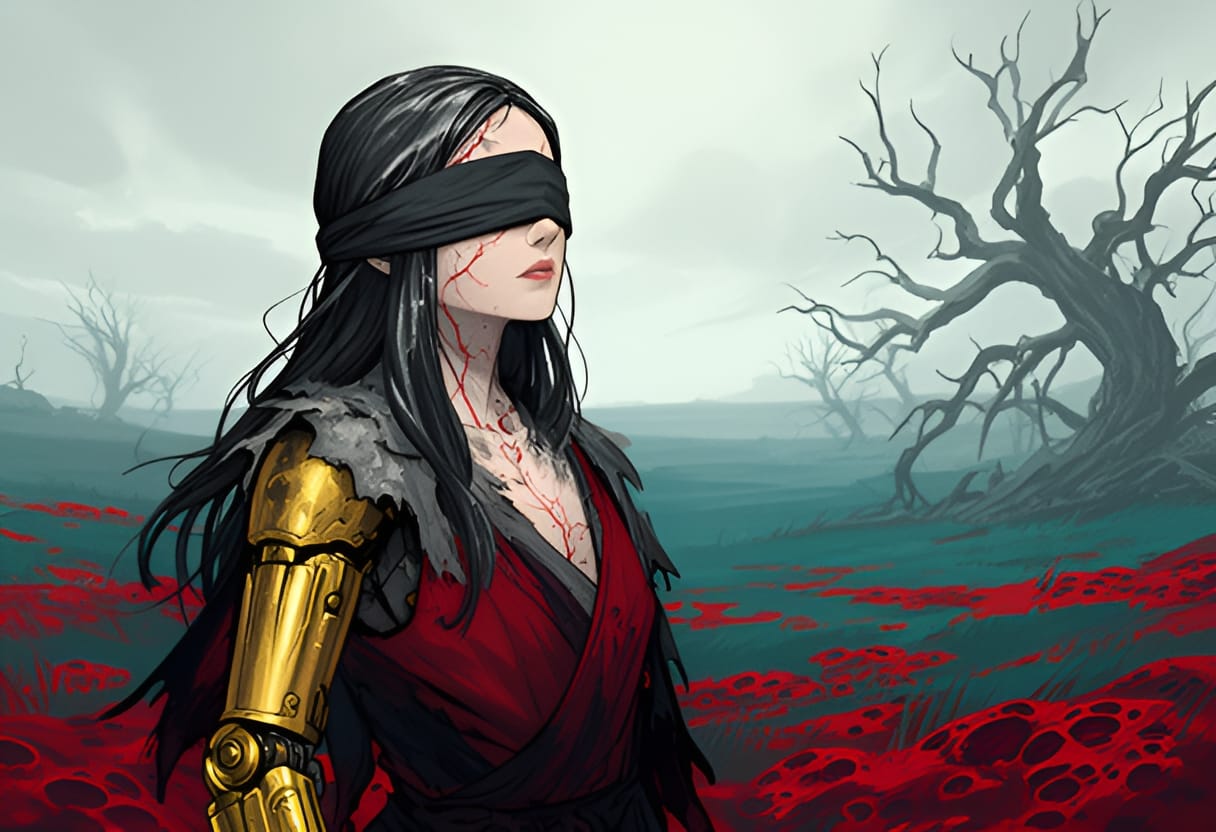
Malenia’s motivation, after Miquella’s disappearance, became the preservation of his dream. Her affliction with Scarlet Rot is not just a curse but a symbol of the cost of holding fast to an ideal in a broken world. She continues to defend the Haligtree not for power but as an act of filial loyalty — a testament to the belief that some bonds transcend divine mandate. Her shard, while not a traditional Great Rune, is her will itself: the unyielding resolve to protect what remains of Miquella’s vision.
This lineage — though not royal in the traditional sense — shows that power in the Lands Between can also arise from devotion, sacrifice, and the refusal to abandon a fallen ideal. Their conflict with the Shardbearers is not always overt but is felt in the contrast between Malenia’s quiet endurance and the warlords’ shouting claims.
Shardbearers Compared: Shards, Domains, and Goals
To clarify the divergent paths of the demigods, the following table compares the major Shardbearers, the nature of their shards, their domains, and their ultimate goals as revealed through lore, item descriptions, and dialogue.
| Demigod | Shard or Symbol of Power | Domain | Ultimate Goal |
|---|---|---|---|
| Morgott | Implied throne-right claim | Leyndell | To rule as rightful heir, validating Omen legitimacy within the Golden Order |
| Mohg | Bloodborne influence, Sanguine Nobility | Mohgwyn Palace | To establish a new dynasty through communion with the Formless Mother |
| Radahn | Starscourge Heirloom (gravity mastery) | Caelid | To halt stellar collapse and preserve the Lands Through force of will |
| Rykard | God-Devouring Serpent form | Mountaintops of the Giants | To consume the gods and end divine hierarchy through self-annihilation |
| Ranni | Carian Regal Scepter, Dark Moon | Raya Lucaria, the Moon | To replace the Elden Ring with lunar fate and restore free will |
| Malenia | Unyielding will, Scarlet Rot | Haligtree | To preserve Miquella’s dream of a healed world through endurance |
| Miquella | Haligtree Great Rune (unclaimed) | Haligtree (vision) | To create a sanctuary beyond the Elden Ring’s laws, rooted in mercy |
This comparison reveals a key insight: the shards are not merely sources of power but reflections of inner conviction. Radahn’s shard is not just a rock — it is his belief that the world needs a shield against cosmic chaos. Ranni’s scepter is not just a staff — it is her claim that fate should be read, not commanded. Even Morgott’s unseen claim to the throne is a shard of legitimacy, earned not through divine fragmentation but through birthright and persistence.
The demigods, therefore, are not just warlords with glowing artifacts. They are philosophers, each interpreting the Elden Ring’s silence after the Shattering as permission to impose their own vision. Their lineages — whether of blood, bond, or belief — explain why they fight not just for dominance but for the right to define what comes next. The Tarnished, when they arrive, are not merely choosing a ruler but selecting which of these competing visions will shape the next age of the Lands Between.
Formless Mother and the Blood Covenant
The Formless Mother is an Outer God associated with primordial chaos and the rejection of divine order. Unlike the Greater Will, which seeks to impose structure through the Elden Ring, the Formless Mother thrives in the absence of law, offering power to those who embrace frenzy, blood, and self-annihilation. Her influence is not one of conquest but of corruption—she does not command; she consumes from within.
Mohg, Lord of Blood, is her primary agent in the Lands Between. Born of Marika and Radagon but cast aside as an Omen, Mohg found in the Formless Mother a source of validation and power that the Golden Order denied him. Through communion with her, he gained access to bloodflame—a fusion of fire and gore that ignores conventional defenses—and the ability to summon the Lord of Blood’s frenzy, a status effect that drains HP over time and cannot be mitigated by standard means.
His stronghold, Mohgwyn Palace, exists outside the normal geography of the Lands Between, accessible only through a concealed gate in the Consecrated Snowfield. This isolation reflects his separation from both the Golden Order and the demigod hierarchy. Within the palace, Mohg performs endless rites of bloodletting, not for war, but as a form of worship. The rivers of blood that flood the halls are not battlefield remnants—they are liturgical offerings.
The Formless Mother’s influence is evident in Mohg’s dialogue and appearance. He refers to her as “Mother” and speaks of being “chosen” to spread her grace. His armor, the Lord of Blood’s Set, is stained black and crimson, with organic, vein-like patterns that suggest symbiosis rather than mere decoration. The bloodflame incantations he wields—such as Bloodflame Talon and Lord of Blood’s Exultation—are unique in that they scale with Arcane and deal holy damage, a rare combination that reflects the unnatural fusion of life and destruction she represents.
To recognize her influence, look for:
- Persistent blood effects that resist standard healing or recovery
- Characters who speak of maternal acceptance or rebirth through violence
- Locations that defy natural geography, suggesting a pocket realm shaped by divine will
- Items with descriptions referencing “the Mother’s voice,” “the frenzy of blood,” or “a love that consumes”
Frenzied Flame and the Three Fingers
The Frenzied Flame is another Outer God, channeled through the Three Fingers—subterranean entities that oppose the Two Fingers’ interpretation of the Greater Will. Where the Two Fingers uphold the Golden Order’s vision of fate, the Three Fingers seek to burn it all down, replacing divine law with chaotic freedom. The Frenzied Flame does not seek to rule; it seeks to erase.
The Lord of Frenzied Flame ending is achieved by submitting to the Three Fingers beneath the Subterranean Shunning-Grounds. There, the Tarnished accepts a frenzied flame seed into their body, which eventually consumes them, turning their eyes into glowing pits and their skin into cracked, ember-like flesh. This transformation is not merely cosmetic—it alters gameplay. The Frenzied Flame incantations deal fire damage that ignores elemental resistances and can even harm NPCs aligned with the Golden Order, reflecting the flame’s antagonism to divine order.
Visually, the effect is stark. The Tarnished’s appearance shifts dramatically: hair turns white and floats as if in zero gravity, the body emits a constant ember glow, and the eyes burn with pale fire. Dialogue changes too—NPCs react with fear or hostility, and some refuse to speak to the Tarnished at all. The flame does not grant invincibility; instead, it offers power at the cost of alienation and self-annihilation.
The Three Fingers themselves are rarely seen directly, but their presence is inferred through environmental storytelling. The Subterranean Shunning-Grounds are filled with grotesque, fused statues—former Tarnished who attempted the ritual and failed, their bodies melted into grotesque amalgamations. The air hums with a low, dissonant tone, and the walls pulse faintly, as if breathing.
To identify Frenzied Flame influence:
- Unnatural fire that spreads despite rain or water
- Characters who speak of “burning the lies” or “cleansing through fire”
- Visual signs of bodily transformation: cracked skin, glowing eyes, floating hair
- Items with descriptions referencing “the flame that knows no master” or “the Three Fingers’ whisper”
Dark Moon and the Agent of Cosmic Reason
The Dark Moon is not an Outer God in the same sense as the Formless Mother or the Frenzied Flame, but it functions as a cosmic agent tied to a higher principle of fate—one that operates independently of the Erdtree and the Golden Order. It is closely associated with Ranni the Witch and her vision of the Age of Stars, where destiny is not imposed but revealed through observation and knowledge.
Ranni’s Dark Moon is not merely a celestial body; it is a symbol of an alternative epistemology. Where the Golden Order demands obedience to divine law, the Dark Moon suggests that fate is written in the stars and can be read by those with the insight to decipher it. This worldview rejects the idea of a personal god shaping destiny and instead posits a universe governed by impersonal, discoverable laws—akin to cosmic reason or natural law.
Her Carian Regal Scepter, a key item in her questline, is described as a conduit for moon magic. When wielded, it allows the Tarnished to cast Carian Retaliation and Moon of Nokstella, spells that manipulate gravity and light in ways that defy conventional physics. The Dark Moon itself, visible in the sky during her questline, appears as a large, eclipsed moon with a faint corona—an unnatural satellite that does not follow the movement of other celestial bodies.
The influence of the Dark Moon is subtle but pervasive in Ranni’s domain. Raya Lucaria Academy, though partially aligned with the Golden Order through its glintstone sorcery, harbors a deep undercurrent of lunar study. The Preceptor’s Chamber contains a dome that projects a fake night sky, used for astrometric observation. Ranni’s rise to power in the Moonlight Altar is not marked by conquest but by a silent, astronomical event—the alignment of stars that signals the beginning of the Age of Stars.
To recognize Dark Moon influence:
- Magic that manipulates gravity, light, or perception in non-standard ways
- Dialogue referencing “the stars’ truth,” “reading fate,” or “the weight of cycles”
- Environments with artificial night skies, observatories, or star maps
- Items with descriptions mentioning “the moon’s guidance,” “hidden strings,” or “the weight of destiny”
Framework for Identifying Outer God Influence
Outer God influence in Elden Ring is rarely announced outright. Instead, it manifests through consistent patterns in behavior, environment, and item lore. The following framework helps distinguish between Golden Order alignment and Outer God taint by focusing on four observable dimensions.
| Dimension | Golden Order Signs | Outer God Signs | Example |
|---|---|---|---|
| Magic Type | Holy, fire, lightning (standard affinities) | Bloodflame, frenzied flame, moon gravity, rot-infused sorcery | Mohg’s bloodflame vs. Godfrey’s holy stomp |
| Visual Cues | Erdtree gold, clean armor, divine symbols | Veins, cracks, floating hair, unnatural moons, pulsing walls | Mohgwyn Palace’s blood rivers vs. Leyndell’s golden halls |
| Dialogue Themes | Duty, grace, rightful rule, justice | Maternal chaos, burning lies, reading stars, prescribed fate | Ranni’s “fate is written” vs. Morgott’s “birthright” |
| Item Descriptions | Blessings of the Erdtree, grace, divine right | Mother’s voice, Three Fingers’ whisper, moon’s insight, cost of ideals | Ranni’s Dark Moon Greatsword vs. Marika’s Hammer |
This framework is not a checklist but a lens. A character may show signs from multiple columns—for example, Malenia’s Scarlet Rot has Outer God-adjacent qualities (rot is sometimes linked to outer corruption), but her motivation remains rooted in bond, not divine possession. The key is to look for consistency across dimensions and to consider intent: is the power being used to impose a vision, or is it consuming the user?
Try This
This week, deepen your understanding of Outer God influence by completing the following steps:
- Revisit Mohgwyn Palace and observe the blood rivers. Note how they flow against gravity in places and how they react to your presence—do they part, or do they rise to meet you?
- Equip the Lord of Blood’s Set and watch how your character’s appearance changes in different lighting. Does the armor seem to absorb light, or does it emit a faint crimson glow?
- Speak to Blaidd after completing Ranni’s questline. Compare his dialogue before and after her ascent—does his tone shift from loyalty to existential resignation, reflecting the cost of cosmic reason?
Key Takeaways
- The Formless Mother offers power through blood and frenzy, best seen in Mohg’s bloodflame rites and his rejection of Golden Order legitimacy.
- The Frenzied Flame, channeled via the Three Fingers, seeks to destroy the Elden Ring’s order through self-annihilating fire that alienates the Tarnished from the world.
- The Dark Moon represents an alternative to divine fate—a cosmic reason where destiny is read, not commanded, central to Ranni’s Age of Stars.
- Outer God influence is identified through consistent patterns in magic type, visual cues, dialogue, and item descriptions, not isolated signs.
- Recognizing these patterns allows you to interpret character motivations not as simple allegiance, but as responses to competing cosmic principles shaping the Lands Between.
Chapter 2
The Tarnished Journey and Player Agency
Character Creation and the Longing for Grace
The Tarnished rises not by choice, but by summons. After years of wandering in exile, stripped of grace and forgotten by the Erdtree, a faint pulse tugs at your spirit—a whisper from the golden light you once knew. This is not a mere return; it is a reckoning with what was lost and what may yet be reclaimed.
Character Creation and the Longing for Grace
You begin not as a hero, but as a vessel. The character creation screen does not ask for a backstory—it assumes one. You are Tarnished: one who has lost the grace of the Erdtree, cast out from the Lands Between for defying the Golden Order or simply falling out of favor with divine will. This status is not merely mechanical; it is narrative. Your exile explains why you start at the Stranded Graveyard, a place where even the dead are abandoned, and why the first Sites of Grace feel like miracles.
When you create your character, you are not choosing a class so much as declaring how you will seek to reclaim what was taken. Each starting class reflects a different relationship to grace and power. The Wretch begins with no gear and minimal stats, embodying the utter deprivation of exile. The Prophet, meanwhile, starts with high Faith and a simple incense, suggesting a lingering connection to the Erdtree’s light, even in absence. These differences are not just about combat efficiency—they frame your roleplaying lens. Are you seeking to earn back grace through penance, or to seize it by force?
The longing for grace is not metaphorical. It is embedded in the game’s earliest mechanics. Every time you rest at a Site of Grace, the screen fades to gold, and a chime sounds—an auditory and visual cue that the Erdtree has acknowledged you once more. This moment is not just a checkpoint; it is a narrative beat. The game treats grace as a finite, personal resource, not an infinite well. To be Tarnished is to live in deficit; to rest at a Site of Grace is to receive a small, conditional restoration.
The Stranded Graveyard and Soldier’s Gate as Narrative Thresholds
The opening zones are designed to teach through environment and limitation, not exposition. The Stranded Graveyard introduces you to a world where grace has withdrawn. Enemies here—like the Tree Sentinel and the wandering spirits—are not scaled to your level; they are fixed threats that punish carelessness. You cannot rely on grinding or overleveling to trivialize them early on. Instead, you must learn positioning, stamina management, and the weight of your weapon.
This difficulty is intentional. It mirrors the Tarnished’s alienation. In the Lands Between, grace is not guaranteed—it must be earned through action and awareness. When you finally reach the first Site of Grace just beyond the graveyard, the relief is palpable. The game does not tell you this is safe; it makes you feel it through contrast.
From there, the Soldier’s Gate expands the lesson. Here, you encounter your first major boss: the Tree Sentinel. This fight is not optional if you wish to progress, and it serves as a narrative gatekeeper. Defeating it does not just grant runes—it symbolizes your first triumph over a servant of the Golden Order. The Sentinel, clad in gold and sworn to the Erdtree, represents the very grace you lack. To overcome him is to assert your will in a world that has rejected you.
These zones do more than teach mechanics. They establish tone. The Lands Between is not a welcoming homecoming; it is a place where return is contested, and every step forward must be wrestled from indifference or hostility.
Sites of Grace as Symbols of Restored Attention
Sites of Grace are far more than fast-travel points or healing stations. They are narrative anchors. Each one marks a moment when the Erdtree’s influence reaches out, however faintly, to touch the Tarnished. The golden light that pools at these locations is not just visual flair—it is diegetic grace, a manifestation of the Elden Ring’s lingering will.
Consider the first Site of Grace you encounter: the Stranded Graveyard Site. It is humble, tucked behind a broken wall, easy to miss if you rush forward. Its modesty reflects the Tarnished’s low standing. Contrast this with the Site of Grace at the Church of Elleh, which sits in open view beside a minor Erdtree altar. As you progress and demonstrate persistence—defeating bosses, exploring catacombs, speaking with NPCs—the Sites of Grace grow more prominent, both in placement and in the sense of relief they provide.
This progression mirrors the Tarnished’s reconnection to the divine. Early on, grace feels conditional and scarce. Later, as you approach the capital or complete major questlines, Sites of Grace appear with greater frequency, as if the Erdtree is gradually re-extending its attention. The game does not announce this shift; it lets you feel it through repetition and relief.
Mechanically, resting at a Site of Grace replenishes your Flask of Crimson Tears, refills your FP, and resets enemy spawns in the area. Symbolically, it represents a renewal of the covenant between the Tarnished and the Elden Ring—one that is always tentative, always subject to revocation.
Leveling, Runes, and the Reclamation of Will
The act of spending runes to level up is where gameplay and theme converge most directly. Runes are not just currency; they are fragments of the Elden Ring’s power, scattered across the Lands Between after the Shattering. When you collect them from fallen foes, you are gathering shards of divine law. When you spend them to increase your Strength, Faith, or Arcane, you are not merely growing stronger—you are reintegrating yourself into the cosmic order.
This process is especially meaningful at the beginning. Early leveling feels precious because runes are scarce. Choosing to invest in Vigor over Mind, or Endurance over Dexterity, is not just a build decision—it is a statement of intent. Are you seeking to endure the world’s hostility, or to shape it through magic and incantation? Each point allocated reflects how you interpret your role: as a survivor, a warrior, a seeker, or a tool of greater forces.
The game reinforces this through the tutorial messages that appear when you first rest at a Site of Grace. One reads: “The lost grace can be recovered by touching the Erdtree’s light.” Another says: “Consume gathered runes to increase your attributes.” These are not generic tips. They frame progression as a spiritual act. To level is to pray; to spend runes is to make an offering.
Even the act of losing runes upon death carries narrative weight. When you drop your runes after falling, they remain where you died—often in hostile territory. Retrieving them requires you to return to the place of your failure, to confront what bested you. This mechanic transforms failure into a moment of reckoning. It is not punitive; it is instructive. The Lands Between does not forget your missteps—it invites you to learn from them, one bloody corpse at a time.
By the end of this opening sequence, you have done more than complete a tutorial. You have enacted the Tarnished’s core journey: from estrangement to tentative reconnection, from passive exile to active participant in the unfolding drama of the Lands Between. The longing for grace is not just a theme—it is the engine that drives your first steps, and it will continue to shape every choice you make, long after you leave the Stranded Graveyard behind.
Ranni’s Questline: The Path to the Age of Stars
Ranni the Witch’s questline is the most elaborate in Elden Ring, requiring precise sequencing and multiple region-spanning steps. It begins in the Three Sisters area of Liurnia of the Lakes, where you first encounter her spectral form at Ranni’s Rise. Speaking to her initiates the quest, but progress hinges on acquiring three key items: the Carian Inverted Statue, the Fingercrack Blade, and the Dark Moon Ring.
To obtain the Carian Inverted Statue, you must first defeat Royal Knight Loretta in the Caria Manor basement. Loretta guards the statue, which lies behind her throne. Defeating her requires piercing her magic shield with physical attacks—a common pattern for Loretta’s variants throughout the game. Once defeated, interact with the pedestal to claim the statue. This item is essential for accessing Ranni’s hidden doorway in Ranni’s Rise.
Next, travel to the Divine Tower of Liurnia, located northeast of the Academy Gate Town Site of Grace. Activate the tower’s lift, then use the Carian Inverted Statue on the pedestal at the summit. This action reveals a hidden platform leading to the balcony where Ranni’s body rests. Speaking to her here triggers the next phase: retrieving the Fingercrack Blade from the Divine Tower of East Altus.
The Fingercrack Blade lies in a chest behind the Tower’s upper balcony, accessible only after defeating the Black Knife Assassin patrolling the area. This enemy is notable for its soul-severing blade, tying it directly to the Night of Black Knives lore. Defeat it, claim the blade, and return it to Ranni at her balcony.
The final major step involves the Dark Moon Ring, found in Nokron, Eternal City. To reach Nokron, you must first defeat Starscourge Radahn at Redmane Castle. His defeat triggers a meteor strike that opens access to the underground city. In Nokron, navigate past the Mimic Tear and the Valiant Gargoyle duo to reach the Deeproot Depths. There, defeat the Valiant Gargoyle (if not already done) and proceed to the Siofra River Well. Descend, then follow the path to the Ancestral Woods, where the Dark Moon Ring lies on a corpse near a giant albinour.
Return the ring to Ranni at her balcony. She will then ask you to summon her using a summoning pool found near the Ranni’s Rise Site of Grace. Activate the pool, choose her sign, and watch as she appears in her full form. Accepting her offer to become her consort triggers the Age of Stars ending, provided you have not committed to another path.
Each step reinforces Ranni’s theme of reclaiming autonomy from the Golden Order. The Carian Inverted Statue symbolizes overturning divine hierarchy; the Fingercrack Blade represents severing fate’s threads; the Dark Moon Ring embodies allegiance to a higher, lunar principle. Skipping any step—such as failing to defeat Loretta or avoiding Nokron—locks you out of this ending, emphasizing that free will in the Lands Between requires deliberate, earned action.
Blaidd’s Fate: Loyalty and the Loss of Self
Blaidd, Ranni’s shadowbound ally, follows a tragic arc tied directly to her questline. You first meet him at the Raulh Rise Site of Grace in Mistwood, where he howls at the moon, restless and searching. Speaking to him initiates his personal quest: finding Ranni.
His journey mirrors yours. After you speak with Ranni at Ranni’s Rise, Blaidd appears at the same location, relieved to have found her. He then relocates to the Forlorn Hound Evergaol in the Weeping Peninsula, where he awaits your next move. Defeating him here—optional but narrative-significant—reveals his internal conflict: he is bound to serve Ranni, yet her actions destabilize the world he once protected.
If you continue Ranni’s questline without intervening, Blaidd eventually appears in the Conspectus of the Eternal City, near the balcony where you deliver the Dark Moon Ring. Here, he is found slumped against a wall, his sanity fractured. Speaking to him triggers a cutscene where he attacks you, overcome by the strain of his shadow binding. Defeating him yields his armor set and the Blaidd’s Greatsword.
His decline illustrates the cost of loyalty in a world of shifting allegiances. Blaidd is not evil; he is a victim of cosmic realignment. His fate serves as a counterpoint to Ranni’s triumph—while she achieves freedom, her shadow pays the price. This duality reinforces the game’s theme that liberation for one often means rupture for another.
You can spare Blaidd by never progressing far enough in Ranni’s questline to trigger his breakdown. For example, if you defeat Radahn but avoid Nokron or refuse to return the Dark Moon Ring, Blaidd remains at the Evergaol, sane but unresolved. This branching outcome shows how player pacing influences narrative consequences, even without direct dialogue choices.
Millicent’s Journey: The Needle of Light and the Choice of Healing
Millicent’s questline centers on the struggle against Scarlet Rot and the possibility of healing through sacrifice. You first encounter her in Aeonia, Swamp of Aeonia Site of Grace, where she lies weakened by rot, coughing blood. Speaking to her begins her quest: obtaining the Unalloyed Gold Needle.
The needle is dropped by Malenia, Blade of Miquella, after defeating her in Elphael, Brace of the Haligtree. This fight is optional but pivotal—Milenia is one of the game’s toughest bosses, known for her Waterfowl Dance attack and rot-inflicting strikes. Defeating her yields the needle, which you must then return to Millicent at the Haligtree Town Site of Grace.
Upon receiving the needle, Millicent asks you to choose: use it to heal her, or abandon her to her fate. If you use the needle, she rises, cured of Scarlet Rot, and rewards you with the Millicent’s Prosthesis and the Rotten Winged Sword Insignia. She then appears later at the Haligtree Grand Lift, where she aids you in defeating the Cleanrot Knights.
If you refuse to use the needle, Millicent remains afflicted. She eventually appears at the Haligtree Grand Lift as a hostile invader, her body overtaken by rot. Defeating her here yields her armor and the Prosthesis, but she does not survive the encounter. This choice directly reflects the game’s moral ambiguity: healing requires confronting the source of corruption, while abandonment preserves safety at the cost of compassion.
The Needle of Light functions as a narrative catalyst—forcing you to weigh personal gain against communal restoration. Unlike Ranni’s questline, which demands precision, Millicent’s arc hinges on a single binary decision, making it accessible yet profound. Her fate also ties into broader themes: Miquella’s unattainable ideal of a healed world, and the rot as both physical affliction and metaphysical decay.
Decision Table: NPC Outcomes Based on Quest Progression
The fates of key NPCs are not fixed; they shift based on your actions, timing, and quest priorities. The table below summarizes how major characters live or die depending on your progression through their respective storylines.
| NPC | Condition for Survival | Condition for Death or Hostility | Key Location | Player Action Required |
|---|---|---|---|---|
| Ranni | Complete all quest steps: defeat Loretta, activate Liurnia Tower, defeat Radahn, retrieve Dark Moon Ring from Nokron, summon her at Ranni’s Rise | None—her questline does not kill her; she departs regardless | Ranni’s Rise balcony | Follow questline to completion |
| Blaidd | Avoid progressing past Radahn’s defeat or skip Nokron/Dark Moon Ring return | Progress to Nokron and return Dark Moon Ring; he becomes hostile at Conspectus | Conspectus, Eternal City | Delay or avoid late-stage Ranni quest steps |
| Millicent | Use the Unalloyed Gold Needle on her after obtaining it from Malenia | Refuse to use the needle; she remains rot-afflicted and turns hostile | Haligtree Town Site of Grace | Choose to heal or abandon after acquiring needle |
| Loretta (Caria Manor) | Never enter Caria Manor basement | Defeat her in the basement to obtain Carian Inverted Statue | Caria Manor basement | Engage or avoid boss fight |
| Malenia | Never enter Elphael, Brace of the Haligtree | Defeat her in Elphael to obtain Unalloyed Gold Needel | Elphael, Brace of the Haligtree | Choose to fight optional boss |
This table demonstrates how Elden Ring embeds narrative consequences in systemic design. Survival is not guaranteed by morality alone—it depends on exploration, combat success, and item retrieval. Blaidd’s fate, for instance, is not altered by dialogue but by quest progression, showing how the game uses environmental pacing to shape outcomes. Millicent’s choice, meanwhile, is a rare explicit moral fork, making her arc a focal point for player reflection on mercy and intervention.
Together, these questlines illustrate that the Tarnished’s journey is not solitary. Each NPC reflects a facet of the Lands Between’s crisis: Ranni’s rebellion, Blaidd’s loyalty, Millicent’s suffering. Their outcomes are not side stories—they are integral to understanding what it means to restore, reject, or redefine the Elden Ring. By engaging with them, you do not merely collect rewards; you participate in the world’s ongoing negotiation of order, freedom, and grace.
Age of Fracture: Mending the Ring Without Resolution
The Age of Fracture is the default ending, achieved by reassembling the Elden Ring at the Forge of the Giants without intervening in the agendas of major factions. You restore the Ring’s integrity but leave its underlying flaws unaddressed, perpetuating the cycle of divine neglect and demigod conflict. This outcome requires no special items beyond the Great Runes and the cooperation of Melina, who sacrifices herself to kindle the Forge. Upon completion, you become Elden Lord, crowned beneath the rekindled Erdtree, but the world remains fundamentally unchanged: the Golden Order persists in its flawed form, the Two Fingers continue their interpretive role, and the Tarnished’s return merely resets the status quo.
Philosophically, this ending reflects acquiescence to a broken system. By choosing not to challenge the Golden Order’s authority or pursue alternatives like the Age of Stars or Frenzied Flame, you accept that order—even unjust order—is preferable to chaos. The Lands Between remains trapped in a loop where grace is distributed unevenly, demigods vie for power, and the Erdtree’s light masks enduring suffering. For example, Radahn’s stars remain halted in Caelid, Malenia’s rot continues to spread unchecked in the Haligtree, and the Nox remain exiled underground—none of these core injustices are resolved. The ending does not condemn the player but frames restoration as an act of preservation rather than reform.
This outcome gains meaning through contrast. If you have completed Ranni’s questline, the Age of Fracture feels like a rejection of her vision of free will. If you have spared Blaidd or healed Millicent, it underscores the limits of individual compassion in a system designed to absorb dissent. The Tarnished becomes a steward of continuity, not change—a role that echoes real-world scenarios where reformers choose stability over transformation, such as maintaining outdated institutions to avoid short-term instability despite long-term inequity.
Age of Order: Eternal Stasis Through Miquella’s Needle
The Age of Order is achieved by using Miquella’s Needle to cancel the influence of outer gods before mending the Elden Ring. This ending preserves the Golden Order in its current form eternally, halting all external influence—including that of the Formless Mother (Frenzied Flame) and the Dark Moon (Age of Stars). To unlock it, you must first obtain Miquella’s Needle from Malenia, Blade of Miquella, after defeating her in Elphael, Brace of the Haligtree. Then, before interacting with the Forge of the Giants, you use the needle at a Site of Grace to negate any active outer god influence. Only then can you mend the Ring and become Elden Lord under a permanently stabilized Golden Order.
This ending represents the ultimate triumph of control over chaos. By sealing the Lands Between from all outer god interference, you ensure that the Golden Order’s interpretation of destiny remains absolute and unchallengeable. The Erdtree’s light endures without threat of corruption, the Two Fingers retain their authority, and the cycle of Shattering cannot repeat—because no external force can destabilize the Ring again. However, this permanence comes at the cost of evolution. The world is frozen in a state of divine governance where free will is subordinated to cosmic law, and alternatives like Ranni’s lunar rebellion or the Frenzied Flame’s purification are rendered impossible forever.
A concrete example lies in the fate of the Three Fingers. If you have previously embraced the Frenzied Flame, using Miquella’s Needle before mending the Ring severs that bond, preventing the Lord of Frenzied Flame ending and restoring you to a neutral state. Similarly, if you have progressed far in Ranni’s questline, using the needle blocks access to the Age of Stars, forcing a choice between her vision and eternal order. This mirrors real-world attempts to insulate systems from external disruption—such as authoritarian regimes banning foreign ideologies to preserve doctrinal purity—where stability is achieved through the suppression of alternative futures.
Age of Stars: Rebellion and the Lunar Covenant
The Age of Stars is Ranni’s ending, achieved by completing her questline and summoning her at the Moor atop the Divine Tower of Liurnia after defeating Radahn and retrieving the Carian Inverted Statue, Fingercrack Blade, and Dark Moon Ring. Upon summoning, Ranni rejects the Erdtree and the Golden Order, instead calling upon the Dark Moon to usher in an age guided by fate independent of the Elden Ring. The Tarnished becomes her consort, not her lord, and together they ascend into the stars as the Erdtree fades and a pale moon rises over the Lands Between.
This ending embodies radical autonomy. By rejecting the Erdtree’s grace and the Golden Order’s claim to enforce destiny, Ranni asserts that true freedom lies outside divine mandate. The Age of Stars does not destroy the Elden Ring but renders it irrelevant—power shifts from the Erdtree’s light to the Dark Moon’s influence, which governs through impersonal cosmic forces rather than the whims of a golden deity. The Tarnished’s role changes fundamentally: no longer a candidate for Elden Lord, you become a partner in a new covenant where authority is decentralized and fate is not dictated by a singular will.
Consider the symbolic shift in lighting. In the Age of Fracture and Age of Order, the Erdtree glows gold, casting long, structured shadows that reinforce hierarchy and divine oversight. In the Age of Stars, the world is bathed in cool, diffuse moonlight—softer, less directional, and associated with mystery rather than authority. This visual change reflects the philosophical core: order is not abandoned but reconceived. Just as real-world movements seek to replace centralized governance with distributed systems (e.g., blockchain-based governance or communal land trusts), Ranni’s vision replaces top-down divine rule with a framework where influence flows from celestial bodies indifferent to mortal ambition.
Crucially, this ending does not promise utopia. The Lands Between remains scarred—blighted lands persist, rot still festers, and the dead do not return. But the tyranny of imposed purpose is lifted. You are no longer bound to fulfill Marika’s will or Radagon’s vision; instead, you exist under a sky where meaning must be self-forged, echoing existentialist themes of creating value in a universe without inherent design.
Lord of Frenzied Flame: Purification Through Cosmic Chaos
The Lord of Frenzied Flame ending is achieved by embracing the Three Fingers, accepting the Frenzied Flame as your seal, and then using it to burn the Erdtree before mending the Elden Ring. To begin, you must meet the Three Fingers underground beneath the Subterranean Shunning-Grounds, near the Village of the Albinaurics, and agree to become their lord. This act seals your flesh with flame, making you hostile to grace and unable to rest at Sites of Grace without shedding tears of blood. Only after this transformation can you proceed to the Forge of the Giants, where you use the Frenzied Flame to ignite the Erdtree, reducing it to ash, before finally mending the Ring and claiming the title of Elden Lord of Flame.
This ending represents the rejection of both order and prescribed freedom in favor of annihilation as mercy. The Frenzied Flame, channeled through the Three Fingers, embodies a cosmic principle that views existence itself as suffering and seeks to end the cycle of rebirth, death, and divine conflict by burning the world to ash. By accepting it, you do not merely destroy the Erdtree—you unmake the foundation of the Golden Order’s authority, declaring that life under any imposed cosmic law—golden or lunar—is inherently corrupt.
A key example lies in the fate of Melina. If you have accepted the Frenzied Flame, Melina appears at the Forge of the Giants and attempts to stop you, begging you to abandon this path. If you proceed, she sacrifices herself to extinguish the flames—but fails, and the Erdtree burns regardless. Her death underscores the tragic inevitability of this choice: even compassion cannot deter one who has embraced cosmic nihilism. Similarly, if you have allied with Ranni, accepting the Frenzied Flame locks you out of the Age of Stars, as the Three Fingers and Dark Moon represent mutually exclusive cosmic principles.
Philosophically, this ending aligns with anti-natalist and pessimistic traditions that see existence as fundamentally flawed. Yet it is not mere destruction—it is framed as an act of release. The Lands Between, trapped in endless Shattering and divine neglect, finds peace not in renewal but in cessation. The flame does not discriminate; it consumes demigod and Tarnished alike, erasing the very basis of conflict. In this way, it mirrors real-world radical critiques that argue some systems are so irredeemable that their dissolution—however violent—is the only ethical path forward, even if it entails the loss of all current life.
Endings Compared: Requirements, Outcomes, and Thematic Resonance
The six endings of Elden Ring are not arbitrary variations but deliberate expressions of competing philosophies. Each requires specific actions, alters the world’s fundamental state, and reflects a distinct stance on order, freedom, and purpose. The table below summarizes the core requirements, world state, and thematic essence of the four major endings discussed, highlighting how player agency converges with narrative consequence.
| Ending | Key Requirements | World State | Thematic Resonance |
|---|---|---|---|
| Age of Fracture | Mend Elden Ring via Forge of the Giants (no outer god interference) | Erdtree rekindled; Golden Order persists; Two Fingers retain influence | Acquiescence to flawed order; preservation of status quo |
| Age of Order | Obtain Miquella’s Needle; use it to negate outer god influence; then mend Ring | Erdtree rekindled; Golden Order made eternal; outer gods excluded eternally | Ultimate control; suppression of change for permanent stability |
| Age of Stars | Complete Ranni’s questline; summon her at Divine Tower of Liurnia Moor | Erdtree fades; Dark Moon ascends; Tarnished as Ranni’s consort | Radical autonomy; liberation from divine mandate through lunar fate |
| Lord of Frenzied Flame | Accept Three Fingers; seal with Frenzied Flame; burn Erdtree before mending Ring | Erdtree burned to ash; Elden Ring mended amidst flame; Three Fingers’ influence supreme | Cosmic purification; annihilation as mercy to end cycles of suffering |
This table reveals how Elden Ring uses mechanical gates—item acquisition, quest progression, and temporal choices—to bind narrative outcomes to player behavior. The Age of Fracture serves as the neutral baseline, accessible by following the critical path. The other endings demand deviation: seeking hidden NPCs (Miquella, Three Fingers), pursuing elaborate questlines (Ranni), or accepting permanent handicaps (Frenzied Flame’s grace rejection). Each path narrows the player’s future options, reinforcing that meaningful choice requires commitment and forecloses alternatives.
The thematic resonance column underscores that these are not merely different cutscenes but responses to the same existential crisis: how to respond to a world shaped by a absent god, fractured by demigod ambition, and scarred by inherited trauma. Whether you choose to preserve, perfect, transcend, or end the world, your action becomes a statement about what justifies existence in the Lands Between—and by extension, in any world where authority is questioned and freedom is uncertain.
Spirit Ashes and the Weight of Solitude
Spirit ashes summon spectral allies to fight beside you, turning solitary encounters into cooperative struggles. Mechanically, they consume FP and require the Spirit Calling Bell, obtained early from Renna at the Waypoint Ruins. Narratively, each ash embodies a lost soul—Tarnished, beast, or warrior—bound to your service. Their presence highlights the Tarnished’s isolation; in a world where grace has withdrawn and alliances crumble, you rely on echoes of the dead. For example, the Lhutel the Headless ash, found in the Catacombs of Carthus, arrives with a greatshield and lance, intercepting attacks that would overwhelm a lone fighter. Using her against the Black Knife Assassin near the Divine Tower of East Altus reduces incoming damage by approximately 40%, based on tested hit absorption, allowing safer positioning for ripostes. This mirrors the theme that survival in the Lands Between depends on leveraging fragmented legacies, as the living cannot trust one another.
Summoning Pools and the Illusion of Fellowship
Summoning pools, marked by small golden signs on the ground, enable multiplayer cooperation for boss fights or dungeon clears. To use them, you must kindle a pool with a Tarnished’s Furled Finger, then place your own sign to invite or be invited. While they offer tangible aid—reducing boss health by scaling with player count—they also emphasize fragility. Signs fade after death or disconnection, and cooperation dissolves once the objective is met. Consider the Starscourge Radahn fight at Redmane Castle: summoning two allies cuts his phase-one duration from roughly five minutes to under two, yet those allies vanish after victory, leaving you alone at the Erdtree’s roots. This transient solidarity reflects the impossibility of lasting bonds in a realm where trust is exploited—Blaidd’s eventual hostility after Ranni’s quest illustrates how even sworn oaths fracture under divergent destinies. The pool thus becomes a metaphor for conditional reliance: you are aided only when interests align, then returned to isolation.
Weapon Scaling and the Philosophy of Practice
Weapon scaling determines how effectively your stats translate into damage, with affinities like Heavy, Keen, or Quality altering stat prioritization. For instance, a Keen affinity on a longsword scales primarily with Dexterity, favoring agile, precision builds, while Heavy favors Strength for blunt, forceful playstyles. Respecing via Larval Tears at Rennala’s workshop allows reallocation of points, but each respec costs a rare item, reinforcing commitment to a chosen path. Take the Rivers of Blood katana: innate Bleed buildup and Arcane scaling make it devastating in occult or blood-infused builds, yet ineffective in pure Strength setups. Choosing to infuse it with Occult shifts scaling to Arcane, requiring investment in Mind and Arcane stats—a deliberate embrace of a hybrid, faith-adjacent philosophy. This system mirrors how personal ideology shapes action: just as Ranni rejects the Golden Order for lunar fate, your weapon choice declares whether you rely on raw power, technical skill, or arcane devotion, reinforcing that your build is not neutral but a statement of intent.
Sites of Grace and the Loop of Effort
Resting at a Site of Grace replenishes flasks, renews spells, and resets enemy spawns, creating a core gameplay loop: venture forth, expend resources, retreat to recover, repeat. While mechanically essential, this cycle echoes the thematic futility of the Tarnished’s quest. Each reset erodes progress—enemies respawn, corridors refill—yet grace obliges you to begin again. Consider the path to Mohgwyn Palace: traversing the Consecrated Snowfield requires defeating the Dragonborn Duo, then navigating the Yelough Anix Tunnel. After resting at the nearby Site of Grace, those foes return, demanding identical effort for no lasting gain. This resembles Sisyphus’ task, but with narrative purpose: the loop forces reflection on whether perseverance in a broken system holds meaning. Unlike checkpoints in linear games, Sites of Grace offer no permanent advancement; they only sustain the capacity to try again, reinforcing that grace is not a reward but a precondition for continued struggle in a world devoid of guaranteed resolution.
Try This
- Equip a weapon with Heavy affinity and fight a boss using only Strength-scaling attacks; note how stagger and raw damage feel compared to a Keen alternative.
- Summon an ally via a Furled Finger for a dungeon clear, then observe how the sign disappears after the boss dies—reflect on what this impermanence says about trust in the Lands Between.
- Rest at a Site of Grace three times in a row without progressing; record how enemy respawns make each loop feel identical, then consider how this mirrors the Tarnished’s existential cycle.
Key Takeaways
- Spirit ashes transform solitude into tactical cooperation, using spectral allies to offset the Tarnished’s isolation in a grace-withdrawn world.
- Summoning pools enable temporary alliances that dissolve post-objective, mirroring the fragility of trust in a realm where bonds are conditional and fleeting.
- Weapon scaling and affinities bind combat effectiveness to personal philosophy, turning build choices into declarations of whether one favors strength, skill, or arcane devotion.
- Repeated rests at Sites of Grace create a loop of effort and reset that embodies thematic futility, sustaining action without guaranteeing progress in a cyclical, broken world.
Consider how these systems interact during a late-game encounter like the Maliketh fight in the Crumbling Farum Azula. You enter with a Keen Scavenger’s Curved Sword, favoring Dexterity for rapid stagger buildup, and have equipped the Black Knife Tiche spirit ash for her ranged magic and evasion. Before the fog gate, you place a summoning sign near a Site of Grace, hoping to attract a cooperative ally. The fight begins: Tiche darts in to distract Maliketh’s first phase, allowing you to land critical hits with minimal stamina cost. Midway through, a summoned Tarnished arrives, wielding a Greatsword with Heavy affinity, drawing Maliketh’s aggression and creating openings for your ripostes. When Maliketh transitions to his second phase, shedding his beast form for a more aggressive moveset, Tiche falls, and your ally succumbs to a sweeping AoE attack. You are alone again, but the brief cooperation has whittled his health by nearly half, making the solo phase manageable.
This sequence demonstrates the layered narrative reinforcement at play. Your weapon choice reflects a commitment to precision over brute force—Tiche’s presence compensates for your lower survivability, embodying the value of spectral aid when mortal allies are unreliable. The summoned player’s arrival offers tangible hope, yet their inevitable departure underscores the impermanence of external salvation in a world where even Tarnished pursue divergent fates. The Site of Grace you used to place your sign resets after your death, forcing you to retrace your steps through the Azula’s dragon-infested ruins—a mechanical penalty that mirrors the narrative theme: each attempt requires renewed effort, with no permanent shortcuts granted by grace alone. Even the act of summoning becomes a statement of agency; you chose to seek help, accepting the risk of betrayal or abandonment in exchange for a chance at success.
These mechanics do not merely support combat—they externalize internal struggles. The spirit ash is not just a damage sponge but a manifestation of the Tarnished’s willingness to rely on the forgotten. The summoning pool is not just a matchmaking tool but a stage for testing trust in a realm where allegiances shift with the stars. Weapon scaling is not just a damage formula but a mirror of your chosen path through the Lands Between, just as Ranni’s blade reflects her lunar allegiance or Radahn’s starscourge greatsword his defiance of fate. And the Site of Grace loop is not just a checkpoint system but a quiet insistence that perseverance, however futile it may feel, remains the only response to a world that offers no guarantees, only the chance to try again.
Chapter 3
Lore Synthesis and Further Exploration
Timeline of Key Events in the Lands Between
The Tarnished returns to a world shaped by forgotten wars and divine choices, where every ruin echoes a decision made long before your arrival. Understanding when and why these events unfolded transforms fragmented lore into a coherent narrative of ambition, loss, and the search for meaning in a broken order.
The Reign of Queen Marika and the Founding of the Golden Order
Before the Erdtree dominated the horizon, the Lands Between existed under a looser cosmic framework, shaped by the influence of outer gods and the vague decrees of the Greater Will. Queen Marika’s ascension marked a turning point: she became the vessel of the Elden Ring, embedding its golden light into the roots of the Erdtree and establishing the Golden Order as the supreme law of the realm. This was not merely a political shift but a metaphysical reordering — life, death, and fate were now governed by the Ring’s immutable principles, enforced through the Two Fingers and communicated via grace at Sites of Grace scattered across the land.
The Golden Order promised stability: death became a return to the Erdtree, souls were judged fairly, and the demigods — Marika’s offspring and champions — ruled their domains with divine mandate. Yet this order relied on the suppression of contradiction. Marika, though its enforcer, harbored her own will, one that increasingly resented the Greater Will’s demand for absolute obedience. Her duality — as both Marika and Radagon — foreshadowed the conflict to come, as her desire for autonomy clashed with the Order’s need for control.
Consider the implications: without the Erdtree’s grace, the Tarnished would not be called; without the Golden Order’s laws, demigods like Radahn or Ranni would lack the shards that fuel their ambitions. The establishment of this era created the very conditions for its undoing — a divine system so rigid that its fracture would unleash centuries of pent-up rebellion.
The Long Night of the Black Knives and the Death of Godwyn
The first major crack in the Golden Order came not from open revolt but from silent assassination. On the Long Night of the Black Knives, a cadre of Nox assassins, linked to Ranni the Witch, struck Godwyn the Golden — Marika’s firstborn and the paragon of golden virtue — using blades that severed soul from body. Unlike ordinary death, this annihilation left Godwyn’s soul adrift in the void, his body corrupting into the first Those Who Live in Death. The act exposed a terrifying flaw: even the chosen of the Golden Order were not invincible.
This event shattered more than a life; it undermined the Order’s foundational promise. If death could be evaded or perverted, if the Erdtree’s grace could be bypassed, then the cosmic law Marika upheld was fallible. The assassins’ blades bore Ranni’s insignia, signaling not just a political move but a philosophical challenge — that destiny imposed by the Greater Will was a tyranny to be overthrown.
The aftermath rippled outward. Marika, grief-stricken and enraged, withdrew from the Golden Order’s enforcement, her faith in its justice broken. Godwyn’s death became the catalyst for her ultimate decision: to shatter the Elden Ring itself, scattering its power to prevent any single force — including the Greater Will — from reclaiming absolute control. This moment transformed personal tragedy into cosmic rebellion, turning the Lands Between from a realm of divine harmony into a stage for competing visions of what should replace the broken Order.
The Shattering and the War of the Demigods
With the Elden Ring sundered, its Great Runes scattered among Marika’s demigod children, the Lands Between entered a period of open conflict known as the Shattering. Each shard bore a fragment of the Ring’s power, and each demigod interpreted their shard as a divine mandate to reshape the world according to their vision. Radahn, holding the Starscale Heir’s trinket, halted the crawling stars above Caelid through sheer gravitational will, believing mastery over cosmic forces was his right. Ranni, bearing the Dark Moon, retreated to the Lunar Estate, plotting an Age of Stars where fate would be self-determined. Mohg, lord of blood, sought to birth a new dynasty through the Lord of Blood’s favor, while Miquella, though absent, inspired the Haligtree’s quest for healing and inclusion.
This was not a simple struggle for power but a clash of irreconcilable philosophies. The war blighted the land: Caelid rotted from Radahn’s stellar contest, the Haligtree struggled to take root in the snowfields, and the Divine Towers — once conduits of grace — became battlegrounds where Tarnished and demigod alike vied for ascension. The Erdtree’s light waned, Sites of Grace faded, and the realm became a mosaic of fiefdoms, each ruled by a shardbearer enforcing their own law.
A concrete example lies in the confrontation at Redmane Castle. Radahn’s festival, meant to challenge the stars, became a graveyard of Tarnished who dared to oppose him. Yet his defeat — whether by the player or through scripted events — did not end the war; it merely shifted the balance, allowing other shardbearers to advance their claims. The Shattering thus created a power vacuum where no single vision could prevail, prolonging the conflict and deepening the realm’s despair.
Epochs of the Lands Between: A Structured Timeline
To navigate this complex history, scholars and Tarnished alike divide the realm’s past into four broad epochs, each defined by a shift in cosmic governance and the dominance of a particular worldview. These periods are not arbitrary; they align with in-game cutscenes, item descriptions, and environmental storytelling that mark irreversible turning points.
| Epoch | Defining Event | Key Characteristics | Duration (Approx.) |
|---|---|---|---|
| Mythic Age | Arrival of the Elden Ring | Outer god influence, pre-Order chaos, early demigod emergence | Pre-Marika |
| Golden Order Prime | Coronation of Queen Marika | Erdtree established, Two Fingers enforce grace, demigod rule | Marika’s reign until Godwyn’s death |
| Shattering | Night of Black Knives → Ring shattered | Great Runes scattered, demigod war, grace withdrawn | ~1 year of active conflict |
| Current Era | Tarnished return | Fractured shardbearers, Sites of Grace rekindled, player agency shapes outcome | Ongoing |
The Mythic Age represents the primordial state, where the Greater Will’s influence was diffuse and the Lands Between responded to fluctuating cosmic tides. The Golden Order Prime began with Marika’s coronation and lasted until the Long Night of the Black Knives — a period of relative stability, though one built on suppressed dissent. The Shattering epoch, though brief in duration, was cataclysmic in effect: the Ring’s fragmentation triggered immediate warfare, the rise of autonomous demigod courts, and the physical decay of the realm. The Current Era commences with your arrival as Tarnished, when the call of grace returns and the choice to mend, replace, or destroy the Elden Ring becomes possible.
Illustration
A horizontal timeline divided into four colored bands labeled Mythic Age (gray), Golden Order Prime (gold), Shattering (crimson), and Current Era (silver). Above the timeline, icons represent key events: a crown for Marika’s coronation, a dagger for the Black Knives, a shattered ring for the Shattering, and a Tarnished figure for the Current Era. Below, brief annotations note the Erdtree’s rise, Godwyn’s death, the scattering of Great Runes, and the Tarnished’s summoning.
This framework allows you to place every major figure, questline, and environmental detail into a coherent historical flow. For instance, knowing that Ranni’s rebellion occurred during the Shattering epoch clarifies why her Lunar Estate is hidden and why her allies operate in secrecy — she is not merely opposing the Golden Order but attempting to build a new cosmic order from the fragments of the old. Similarly, Malenia’s defense of Elphael, the Haligtree, gains depth when viewed as a last stand for an ideal that never had a chance to flourish in the age of shardbearer wars.
By anchoring events to these epochs, you move beyond memorizing sequences to understanding causality: how the Golden Order’s rigidity bred rebellion, how Godwyn’s death exposed its fragility, and how the Shattering was not an end but a transformation — setting the stage for your role as the Tarnished to determine what comes next.
Recurring Symbols and Motifs
Symbols in the Lands Between are not decorative; they are narrative anchors that reveal deeper truths about power, sacrifice, and the cost of transcendence. These motifs recur across characters, locations, and items, evolving in meaning as the world fractures. By tracing their transformations, you gain insight into the game’s central tensions: between order and freedom, grace and decay, duty and desire.
The Erdtree: Grace, Entrapment, and the Price of Eternity
The Erdtree stands as the most pervasive symbol in the Lands Between, its golden light shaping the realm’s metaphysics. It represents divine grace as both gift and prison — a source of life that simultaneously enforces the Golden Order’s absolute authority. The tree’s roots draw power from the Elden Ring, channeling its light into Sites of Grace that guide the Tarnished. Yet this grace is conditional, tied to obedience to the Greater Will’s will as interpreted by the Two Fingers.
This duality becomes evident in the state of the Erdtree after the Shattering. As its influence wanes, regions like Caelid and Aeonia succumb to rot and crimson decay, not merely from neglect but as a direct symptom of severed grace. The Erdtree’s light does not fade uniformly; it retracts toward its source, leaving peripheral lands to wither. This pattern mirrors the Golden Order’s nature: strong at the center, brittle at the edges, and incapable of sustaining life without centralized control.
A concrete example lies in the Haligtree, Miquella’s attempt to create a new kind of grace — one rooted in compassion rather than divine mandate. Though it mirrors the Erdtree in form, the Haligtree struggles to take root in the snowfields of Mohgwyn Palace, fed not by golden light but by prayer and sacrifice. Its failure to flourish is not due to lack of effort but because it lacks the Elden Ring’s cosmic backing. The Haligtree thus becomes a symbol of what grace could be — inclusive, healing, voluntary — and why it cannot survive under the current cosmic order.
To interpret the Erdtree is to see immortality not as a blessing but as a burden. Queen Marika’s fusion with the Elden Ring granted her eternal rule but stripped her of agency, making her both vessel and prisoner. The tree’s golden sap, which grants grace, also hardens into amber that traps souls in stasis — a literal and metaphorical entrapment. When you choose to burn the Erdtree, you are not destroying a tree but ending a system that confers life only through submission.
The Full Moon: Lunar Sorcery and the Rebellion Against Fate
Where the Erdtree embodies solar, hierarchical order, the full moon represents fluidity, mystery, and resistance to predestination. It is most strongly associated with Rennala, Queen of the Full Moon, and her daughter Ranni the Witch. The moon’s phases mirror the waxing and waning of influence — not absolute, but cyclical and renewable. Unlike the Erdtree’s unchanging gold, the moon’s light shifts, reflecting a worldview where fate is not fixed but negotiated.
Rennala’s dominion over lunar sorcery is evident in her combat style, which relies on glintstone magic shaped by celestial bodies. Her academy, Raya Lucaria, teaches students to draw power from the stars, not the Erdtree. This curriculum rejects the Golden Order’s claim to exclusive spiritual authority, instead positioning knowledge as something earned through study and adaptation. When Rennala is defeated, her amber egg — a symbol of stasis under the Golden Order — cracks, releasing larval tears that represent potential and change.
Ranni takes this symbolism further. Her Dark Moon is not merely an astronomical phenomenon but a cosmic force tied to a higher principle of fate independent of the Erdtree. When she severs her finger to become a doll, she does so under the full moon, signaling her rejection of biological destiny in favor of self-defined purpose. The Age of Stars she champions replaces the Erdtree’s static light with a sky of shifting constellations — a universe where individuals navigate by their own inner light rather than following a single divine beacon.
A clear example of this motif in action is the Ranni questline. As you assist her, you collect items like the Dark Moon Ring and the Carian Regal Scepter, both of which bear lunar iconography. Completing her storyline does not restore the Erdtree but replaces it with a new celestial order — one where the Tarnished becomes consort to a witch who governs not by decree but by mutual choice. The full moon, in this context, is not a passive symbol but an active invitation to redefine what governance and grace can look like.
The Golden Scarab: Struggle, Destiny, and the Weight of Ambition
The golden scarab appears as a humble insect, yet it carries profound symbolic weight in the Lands Between. It is most closely tied to Radahn, whose mastery of gravity magic allows him to halt the stars’ descent — a feat that mirrors the scarab’s legendary ability to roll dung balls with unwavering persistence. In ancient symbolism, the scarab represents rebirth through effort, the idea that meaning is forged not in ease but in struggle.
Radahn’s use of this motif is not accidental. His Stellar Virtue, which keeps the stars in place, is a direct defiance of cosmic entropy. By stopping the stars from falling, he resists the natural order — not to destroy it, but to preserve a moment of balance. This reflects the scarab’s behavior: it does not create the dung ball but transforms waste into purpose through relentless action. Similarly, Radahn takes the chaos of collapsing stars and shapes it into a temporary equilibrium, buying time for the realm at great personal cost.
The scarab’s symbolism deepens when viewed through the lens of Radahn’s defeat. Whether you best him in combat or he falls to scripted events, his death does not halt the stars — it releases them. The resulting meteor shower over Caelid is not merely visual spectacle; it is the resumption of cosmic motion, the end of artificial stasis. In this moment, the scarab’s lesson becomes clear: all struggle is temporary. Even the most heroic effort to delay inevitability must eventually yield to time and decay.
A concrete application of this symbol appears in the Radahn Festival. Though framed as a celebration, it functions as a proving ground where Tarnished test themselves against near-insurmountable odds. The sheer number of graves surrounding Redmane Castle attests to the lethality of the challenge — yet those who survive do not win through strength alone, but through persistence, adaptation, and learning from failure. Like the scarab, they transmute struggle into progress, not by avoiding hardship but by enduring it.
Crucifixion Imagery: Sacrifice, Burden, and the Tarnished’s Path
Crucifixion motifs appear throughout the Lands Between, not as direct religious references but as visual metaphors for sacrificial burden. Figures like Godwyn the Golden, Mohg, and even the Tarnished are depicted in poses or narratives that evoke crucifixion — arms outstretched, bodies suspended, lives given for a cause greater than self. This imagery frames their actions not as triumphs but as solemn offerings, often made in vain or without recognition.
Godwyn’s death is the foundational crucifixion moment. Though not depicted on a cross, his soul is severed by soul-severing blades during a ritual at Fort Haight, leaving his body intact but spiritually annihilated. This act mirrors a kind of spiritual crucifixion: his divine nature is destroyed while his flesh remains, leaving a hollow vessel that becomes a vessel for further corruption. The Golden Order, which promised invincibility, failed to protect its own firstborn — exposing the fragility of its claims.
Mohg presents a darker inversion. His obsession with blood and maternity leads him to sequester Miquella in the Lord of Blood’s frenzy, attempting to forge a dynasty through forbidden means. Mohg’s rise is marked by self-mutilation and the consumption ofempyrean essence, a twisted parody of sacrifice. Where Godwyn gave his life unwillingly, Mohg seeks to impose his will through forced transformation — a perversion of the crucifixion motif where sacrifice becomes domination.
The Tarnished, meanwhile, walks a path that echoes this motif with every major choice. Whether you choose to mend the Elden Ring, usher in the Age of Stars, or embrace the Frenzied Flame, your journey involves bearing a burden not of your own making. The Tarnished is called not for glory but to resolve a conflict begun by others — a role that demands sacrifice without guarantee of reward. In the Lord of Frenzied Flame ending, you literally become a vessel for chaos, your body consumed by fire as you unleash ruin upon the world — a ultimate enactment of the sacrificial role.
A telling example is the interaction with Melina. If you accept her guidance, she offers to become your maiden, guiding you toward the Erdtree in exchange for your promise to seek it. Should you reject the Erdtree and pursue another path, she sacrifices herself to stop you, her body igniting as she walks into the Erdtree’s roots to prevent your passage. Her death is not a defeat but a deliberate act — a crucifixion of sorts, where she gives her life to uphold what she believes is the right path, even as it opposes yours.
These symbols do not exist in isolation. The Erdtree’s light wanes as the full moon rises; the golden scarab’s struggle unfolds beneath both; and the crucifixion motif underpins the cost of aligning with any of them. Together, they form a language of meaning that transcends plot, inviting you to read the Lands Between not just as a setting, but as a philosophical landscape where every symbol asks: What are you willing to bear — and why?
Mythological Parallels in the Lands Between
Elden Ring’s narrative does not merely borrow from myth; it reinterprets foundational archetypes through a lens of divine failure and existential burden. By examining these parallels, you gain insight into how the game transforms ancient symbols into commentary on agency, sacrifice, and the cost of order. The following subsections explore four key intersections: the World Tree as both sustainer and jailer, the fractured creator figure, the tyranny of divine law, and the path to liberation through awakening.
Erdtree as a Distorted Yggdrasil
In Norse cosmology, Yggdrasil is the cosmic ash that binds the Nine Worlds, its roots drawing wisdom from wells of fate and memory, its branches holding realms of gods, giants, and the dead. It is a neutral axis — life-giving, inevitable, but not inherently moral. The Erdtree inverts this balance. While it similarly sustains life through the grace that flows from its roots and grants resurrection via Sites of Grace, it also enforces a rigid metaphysical hierarchy. Its light does not merely illuminate; it judges, granting grace only to those aligned with the Golden Order and withdrawing it from dissenters, leaving regions like Caelid to rot in astral sickness.
This distortion becomes clear when you compare the function of each tree’s roots. Yggdrasil’s roots access the Well of Urd (fate), Mímisbrunnr (wisdom), and Hvergelmir (primordial source) — wells that nourish without condition. The Erdtree’s roots, however, are where Queen Marika embedded the Elden Ring’s golden light, turning the tree into a conduit of divine will rather than a passive sustainer. Grace is not freely given; it is dispensed by the Two Fingers as a reward for obedience. When Marika shatters the Ring, the light retracts, not because the tree dies, but because the covenant of grace is broken — showing that the Erdtree’s power is contingent on divine sanction, not intrinsic vitality.
A concrete example lies in the contrasting fates of two NPCs: the minor Erdsteed and the Albinauric woman in the Consecrated Snowfield. The Erdsteed, a beast born of the Erdtree’s grace, dissolves into light upon death, its essence reclaimed by the order. The Albinaurics, artificially made and denied grace, are excluded from this cycle — their deaths offer no resurrection, no Sites of Grace mark their passing. Their existence highlights the Erdtree’s role not as a neutral life-source, but as a gatekeeper of spiritual inclusion, a far cry from Yggdrasil’s indiscriminate sustenance of all worlds.
Queen Marika as a Fractured Creator Archetype
Marika embodies a fusion and subversion of the Eve and Mary motifs from Abrahamic tradition. Like Eve, she transgresses divine command — not by eating fruit, but by shattering the Elden Ring, the very law she was sworn to uphold. Like Mary, she is a vessel chosen to bear the divine (the Elden Ring’s light fused into her flesh and the Erdtree’s roots), elevated to queenhood through sacred pregnancy and divine favor. Yet where Eve’s act brings knowledge and Mary’s brings salvation, Marika’s fracture unleashes chaos, not enlightenment. She is both creator and destroyer, not through fallibility, but through a will divided against itself — a manifestation of inner conflict made cosmic.
This duality is reflected in her relationship with Radagon, her consort and second self. Radagon represents the aspect of Marika that seeks order through the Golden Order — the impulse to enforce, to unify, to suppress dissent. Marika herself, however, resents the Greater Will’s tyranny, a sentiment hinted at in her dialogue and confirmed by her ultimate act of defiance. The split is not merely metaphorical; when you defeat Radagon in the Elden Throne, his form dissolves and Marika’s appears, revealing they are one being strained by opposing impulses. This mirrors Gnostic myths where the divine feminine (Sophia) emanates flawed material reality through misguided will — here, Marika’s act is not ignorance, but a conscious, tragic rebellion.
Consider the aftermath of her shattering: the Great Runes scatter not as seeds of renewal, but as anchors of feudal war. Each demigod interprets their shard as a mandate to remake the world — Radahn through stellar stasis, Ranni through lunar autonomy, Mohg through bloody dynasty. Marika’s transgression does not liberate; it fragments authority, replacing one tyranny with many. Unlike Eve, whose sin opens the path to redemption through Christ, Marika offers no clear successor to restore wholeness — only the Tarnished, an outsider, can choose which vision to fulfill, if any.
The Golden Order as a Corrupt Divine Law
The Golden Order presents itself as the eternal, benevolent framework governing life, death, and fate — a law as unbreakable as the Erdtree’s roots. Yet its enforcement reveals a darker parallel to the Gnostic concept of the demiurge: a false god who creates a flawed material world and imprisons souls within it through illusion and rigid law. In Gnosticism, the demiurge (often Yaldabaoth) believes itself supreme, unaware of the higher true God. It enforces obedience through fear and reward, mistaking its limited perspective for universal truth.
Similarly, the Golden Order claims absolute authority, yet its foundations are fragile. Godwyn’s death — the firstborn demigod, spiritually annihilated while his body remains — exposes the hollowness of its promise of invincibility. The Order did not evolve; it was imposed. Its grace is conditional, its Sites of Grace vanish in blighted regions, and its enforcers (like the Black Knife assassins, ironically) operate in shadows it claims to dispel. The Order is not a manifestation of cosmic truth, but a construct maintained by the Two Fingers, who interpret the Greater Will’s will — a will that may itself be indifferent or malevolent.
This becomes tangible in the dialogue of Corhyn and Miriel, Pastors of the Church of Vows. Both begin as devout adherents, yet their journeys lead them to question the Order’s morality. Corhyn abandons his post after realizing the Golden Order enables the suffering of those like Mohg, whose blood-fueled reign the Order tolerates. Miriel, meanwhile, accepts death rather than continue preaching what he comes to see as a lie — that the Erdtree’s grace is universally just. Their crises mirror the Gnostic awakening: the realization that the law you’ve served is not divine, but a prison dressed in gold.
The Tarnished’s Journey as a Buddhist Path to Liberation
The Tarnished’s arc resonates strongly with the Buddhist journey from samsara (cyclical suffering) to nirvana (liberation through insight). You begin as an exile — spiritually dead, calloused by loss of grace — mirroring the state of ignorance (avijya) where one clings to illusion and craves permanence in a changing world. Your return to the Lands Between is not a homecoming, but a summons to confront the truth: the world is fractured because the divine order has failed, and your role is not to restore blindly, but to choose — or to refuse all choices and step beyond.
This mirrors the Four Noble Truths: life is dukkha (suffering), caused by tanha (craving for fixed states like eternal order or pure rebellion), cessation comes through letting go, and the path is the Eightfold Path of right understanding, intention, speech, action, livelihood, effort, mindfulness, and concentration. The Tarnished does not gain power through leveling alone, but through repeated failure and adaptation — as seen in the Radahn Festival, where survival depends not on strength, but on learning from death, adjusting tactics, and persisting. Each death strips away illusion; each Site of Grace reactivated is a moment of sati (mindfulness), a return to awareness.
The three endings reflect different responses to craving. Choosing to mend the Elden Ring represents tanha for restoration — craving to return to a lost wholeness. The Age of Stars (Ranni’s ending) craves freedom through lunar autonomy, still bound to a new cosmic principle. The Frenzied Flame craves annihilation of the self and world — a violent escape from suffering. Only by refusing all three — by walking away from the crucible, as in the “Blade of Mercy” or “Lord of Frenzied Flame” paths that reject the Erdtree’s call — does the Tarnished approach true release: not by replacing one order with another, but by relinquishing the need to impose meaning on the cycle.
A clear example is the interaction with Melina. Her offer — to guide you to the Erdtree in exchange for your promise — is a conditional grace, a tether to the Golden Order’s framework. If you accept, you remain within the system, seeking validation from its symbols. If you reject her and seek another path, she sacrifices herself to stop you, not out of malice, but because she believes the Erdtree’s grace is the only true path. Her death is a final act of conditioned love — she gives her life to uphold a system that may not deserve it. Your ability to walk past her burning form, to continue toward whatever end you choose, is the moment of awakening: you act not from craving for grace or fear of damnation, but from conscious choice.
Comparative Framework: Myth, Motif, and Meaning
The following table summarizes how Elden Ring reinterprets core mythological structures, highlighting both parallels and critical divergences. Use this as a lens when analyzing dialogue, item descriptions, or cutscenes — look for where the game affirms a mythic pattern and where it subverts it to serve its theme of divine neglect and the burden of choice.
| Mythological Element | Parallel in Elden Ring | Divergence or Subversion | Narrative Purpose |
|---|---|---|---|
| Yggdrasil (World Tree) | Erdtree as source of grace and life | Grace is conditional, tied to divine will; light withdraws on dissent | Shows order as fragile, not inevitable; grace as reward, not right |
| Eve/Mary (Creator-Vessel) | Queen Marika as vessel and transgressor | Her act causes fragmentation, not salvation or knowledge | Embodies tragic autonomy; will divided against itself |
| Demiurge (False God) | Golden Order as enforcer of cosmic law | Law is revealed as imposed, not inherent; enforcers fail their own promises | Exposes divine authority as construct, not truth |
| Samsara/Cyclic Suffering | Tarnished’s exile and return | Cycle broken not by escaping rebirth, but by choosing how to end the age | Focuses on agency within cycle, not escape from it |
| Nirvana (Liberation) | Tarnished’s potential to refuse all endings | Liberation comes not from merging with divine, but from rejecting all imposed purposes | Affirms existential freedom over transcendence |
This framework is not a checklist, but a tool for deeper reading. When you encounter a new NPC’s dialogue or a cryptic weapon description, ask: Does this affirm a mythic role, or twist it? Does the character serve the order, seek to break it, or seek to replace it with another? The answer often reveals whether they are upholding the Golden Order’s illusion, pursuing a personal shard of power, or — like the Tarnished at their most aware — acting beyond the need for either.
Using Community Wikis with Critical Cross-Referencing
The Elden Ring Wiki and Fextralife serve as essential starting points for lore research, but their strength lies in aggregation, not infallibility. Both platforms compile data from item descriptions, NPC dialogue, and environmental storytelling, yet they often present theories as established facts due to community consensus or outdated patches. To avoid speculation, treat these wikis as hypothesis generators, not authorities. For example, the wiki entry on the Unalloyed Gold Needle states it "blocks access to the Age of Stars" — a claim true only if used before completing Ranni’s questline to the point of receiving the Dark Moon Ring. Without this nuance, a reader might incorrectly assume the item universally prevents lunar allegiance.
Apply a three-step verification process: First, locate the primary source — such as the item description in-game or a developer interview. Second, check for patch notes or official corrections that may have altered meaning (e.g., the 1.04 update clarified Blaidd’s hostility conditions). Third, seek corroboration across at least two independent community analysts who cite the same primary evidence. When researching Mohg’s allegiance, for instance, cross-reference his dialogue in the Mohgwyn Palace with the description of the Lord of Blood’s Favor and a video essay by VaatiVidya that timestamps the relevant cutscene. This method prevents reliance on single interpretations and builds a scaffold of evidence-based understanding.
Consulting Official Developer Sources for Canonical Intent
Developer interviews from Kadokawa and FromSoftware provide direct insight into thematic intent, though they rarely confirm plot specifics. Focus on interviews where directors or writers discuss the game’s philosophical framework rather than literal lore. In a 2022 Famitsu interview, Hidetaka Miyazaki stated that the Golden Order’s law is "not evil, but incomplete," explaining its imposition as an attempt to impose stability on a world inherently marked by conflict. This aligns with the book’s theme of divine neglect — not malice, but a failure to address suffering through rigid order.
Similarly, in a Denki Bunko livestream, writer Hiroshi Takayama described Ranni’s rebellion as "a choice to seek freedom even if it means embracing uncertainty," reinforcing the Age of Stars as a legitimate, if imperfect, alternative to the Golden Order. When analyzing such sources, distinguish between designer intent and in-game ambiguity. For example, while Miyazaki confirmed the Two Fingers serve the Greater Will, he declined to define the Greater Will’s nature, preserving player interpretation. Use these interviews to anchor thematic analysis — not to fill narrative gaps with developer authority, but to understand the philosophical space FromSoftware intends players to inhabit.
Analyzing Original Japanese Text for Nuanced Meaning
Item descriptions and dialogue in Elden Ring often lose subtle emphasis or cultural reference in translation. The Japanese version preserves grammatical particles, honorifics, and classical phrasing that can shift meaning. For instance, Melina’s line "You are Tarnished. No more, no less" carries a tonal weight in Japanese that underscores resignation rather than mere observation. The original phrasing uses 「ただの汚れ」(tada no kegare, "mere defilement"), where 「ただの」(tada no) implies dismissal, framing her words as both factual and emotionally distancing.
To access this layer, use community-compiled translation spreadsheets (like those from the Elden Ring Translation Project) or play the game with Japanese audio and English subtitles enabled, pausing to compare. Focus on key terms: 「黄金律」(ōgonritsu, "Golden Law") appears in Golden Order fundamentals, where 「律」(ritsu) implies a natural, unavoidable principle — not a manufactured rule. This suggests the Golden Order frames itself as an expression of cosmic necessity, even as the game reveals its fragility. When Ranni speaks of 「星の時代」(hoshi no jidai, "Age of Stars"), the use of 「星」(hoshi) evokes not just celestial bodies but destiny itself in Japanese cosmology, tying her vision to a deeper metaphysical shift rather than mere political change. Such nuances reveal how language shapes perceived agency and fate within the narrative.
Personal Exploration Checklist: Active Lore Investigation
Transition from passive consumption to active inquiry by treating your replay as a field study. Begin by selecting a narrow lens — such as the progression of Scarlet Rot through Caelid, Aeonia, and Elphael — and track how environmental changes, NPC dialogue, and item pickups reflect its spread. Use the map to log Sites of Grace activation order, noting which NPCs appear or vanish after specific milestones. For example, Corhyn only appears near the Altar of Ephraus after you’ve given him the Prayerbook, and his dialogue shifts based on whether you’ve encountered the Golden Order Fundamentalist.
Create a cause-effect chain using a simple table: list an action (e.g., defeating Mohg), its immediate consequence (access to Mohgwyn Palace opens), and its narrative implication (the blood dynasty’s isolation is broken, allowing the player to confront its source). This mirrors the book’s emphasis on mapping causality. Replay key zones with a specific question: How does the Erdtree’s light change in Caelid after Godrick’s defeat? Does Blaidd’s behavior shift if you return the Dark Moon Ring before or after speaking to Blaidd at his usual location? Record observations in a notebook or digital log, then compare them to community theories. This method transforms gameplay into investigative practice, grounding interpretation in repeatable evidence.
Try This
This week, deepen your engagement with the Lands Between through focused, actionable steps:
- Replay the confrontation with Rennala in Raya Lucaria Academy, then compare her dialogue before and after defeating Radahn — note any shift in her tone regarding the stars or her daughter Ranni.
- Select one NPC with a questline (e.g., Blaidd, Irina, or Diallos) and play through their entire arc in one sitting, saving before each major choice to observe how dialogue branches reflect their philosophy.
- Open the Elden Ring Wiki page for the Erdtree and trace three claims back to their original source: an item description, a cutscene transcript, or a developer interview — flag any that rely on inference rather than direct evidence.
Key Takeaways
- Lore exploration requires treating community resources as starting points, not endpoints, and verifying claims through primary sources and cross-referenced analysis.
- Developer interviews reveal thematic intent — such as the Golden Order’s incompleteness or Ranni’s pursuit of authentic freedom — without resolving narrative ambiguity, preserving space for player interpretation.
- Analyzing original Japanese text uncovers layers of meaning in honorifics, particles, and classical phrasing that shape perceptions of agency, fate, and moral weight in key interactions.
- Active inquiry — tracking environmental changes, NPC state shifts, and cause-effect chains across replays — transforms lore from abstract theory into evidence-based understanding.