
Technology
Fantasy quest
by Adarsh Gupta
5 chapters35 min read

Chapter 1
The Fragment in the Folio
The Weight of Silence
The air in the Lower Vaults tasted of damp stone and forgotten paper. Elara Voss ran a gloved finger along the spine of Codex Theta-9, feeling the warp where water had once pooled and receded. The damage wasn’t recent—centuries old, perhaps—but its pattern matched the tidal scars left by the Great Unbinding, when the first silences began to creep through Veridia like frost across a windowpane.
She had noticed it for years: the way certain verbs slipped from speech, how elders paused mid-sentence, grasping for words that refused to return. A baker’s daughter once described fresh bread as “warming the soul,” then weeks later could only say it was “hot.” Not a mistake of memory, but a loss—like the word had been unmade.
These weren’t isolated lapses. They were symptoms.
The Theory of Resonant Semantics
Elara had once dismissed Resonant Semantics as poetic metaphor—a thesis buried in the archives’ least-visited corner, its author long gone to silence. But the theory was simple and dire: language does not merely reflect reality; it sustains it. Nouns anchor objects in time. Verbs propel action. Adjectives shade perception with meaning. When words fade, the things they represent grow thin—less real, less there.
She recalled the case study in the thesis: a coastal village where the word for “tide” had eroded from dialect. Within a generation, the fishermen could no longer predict the sea’s pull. Not because they forgot the moon, but because the concept had lost its linguistic tether. The ocean didn’t change—but their ability to engage with it did.
Now, the same unraveling stretched across Veridia. Storms came without warning, not because the skies had turned cruel, but because the old words for wind-direction and cloud-signs had vanished from common speech. Farmers planted in droughts, not from ignorance, but because the seasonal idioms that once guided them—“when the ash tree whispers, sow the barley”—had gone mute. The knowledge remained in fragments, but without the resonant framework of language, it could not take hold.
She traced a water-stained glyph on the codex’s page—a half-erased sigil that resembled a spiral enclosing a dot. Not decoration. A linguistic marker. In the old script, such marks indicated resonant weight: the degree to which a word shaped reality. The more fading text bore this mark, the more central its loss was to the world’s cohesion.
The Fragment in the Folio
The real discovery lay beneath the damage. Using a soft brush, Elara cleared silt from the inner margin where the page had torn. There, pressed into the binding’s shadow, was a sliver of vellum no wider than her thumb. It bore three symbols in a script that shimmered when she breathed on it—living ink, shifting like oil on water.
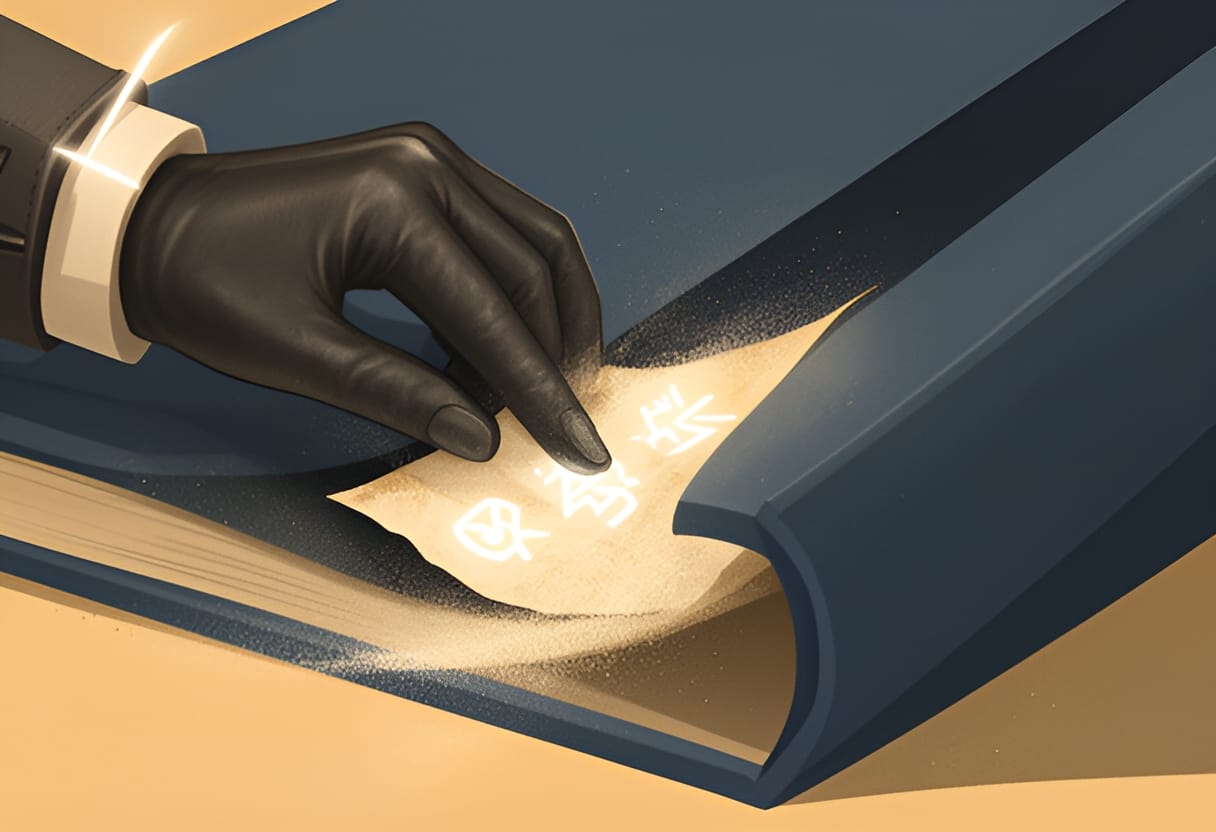
She knew this script. Not from texts, but from the lullabies her grandmother sang, the ones that felt older than memory. The first symbol pulsed faintly: a glyph for “beginning.” The second wavered between forms—memory, then dream, then promise—as if uncertain which concept it carried. The third held steady: a sigil she’d seen only in fragments, the emblem of the Sigil of Resonance.
Her breath caught. This wasn’t just a map. It was a fragment of a map, torn from a larger whole, and written in a script that responded to perception. Misread it, and the symbols would rearrange to mislead. Understand it truly, and the path might reveal itself.
She recalled the thesis again: if language shapes reality, then a map written in living script isn’t just guiding the seeker—it’s testing them. The symbols shift not to hide the way, but to ensure only someone who grasps the resonance between word and world can follow.
Outside, a storm gathered—not with thunder, but with a sudden hush. The distant chime of the belltower, which should have marked the hour, was silent. No one seemed to notice. No one could.
Elara folded the fragment carefully into her palm. The world was losing its voice, syllable by syllable. And somewhere in the ruins, the Sigil of Resonance waited—not as a weapon, but as a promise: that if the right words were spoken, the song might begin again.
Ink That Remembers
Elara held the fragment to the dim glow of her desk lamp, watching the symbols pulse in time with her breath. The ink did not merely reflect light—it seemed to draw it inward, then release it in slow, rippling waves. When she tilted the vellum, the glyph for “beginning” flared briefly, then softened. The second symbol, which had shifted between memory, dream, and promise, now hovered at the edge of promise, as if waiting.
She reached for the magnifying lens tucked in her satchel—a tool reserved for fragile palimpsests—and adjusted it over the fragment. The ink resolved not into static lines, but into a lattice of microscopic particles suspended in a clear binder. Each particle caught the light differently, depending on the angle. It was not pigment alone. It was mnemosyne ink.
Mnemosyne ink was a legend among restorers—a medium said to be forged from crushed moonstone and the distilled essence of first memories. It did not fade with time; it waited. Only when activated by authentic emotional resonance—when the viewer recalled a feeling not as fact, but as lived sensation—would the ink reveal its true form. Forgers could copy its appearance, but never its response. It demanded truth.
Elara thought of her grandmother’s voice, low and warm in the dark, singing a lullaby that had no written form, only oral transmission. The words were meaningless in modern speech—syllables that curled like smoke—but the feeling they carried was clear: safety, continuity, the quiet certainty of being known. She had not thought of it in years. Not since the silence began to creep into her own speech, stealing the verbs for comfort and recall.
She closed her eyes and hummed the first line.
The fragment shivered.
The second symbol flared—not into dream or memory, but locked into promise, steady and bright. The third symbol, the Sigil of Resonance, expanded outward, its spiral deepening until the central dot became a doorway. And where the fragment had ended in a torn edge, new lines began to form—not drawn, but uncovered, as if the vellum itself were remembering what had been lost.

The map was extending.
She traced the emerging path with a fingertip, careful not to smudge the wet-appearing ink. It led downward, past the Lower Vaults, through a chamber marked with a symbol she recognized: an open book pierced by a stylized key. The Iron Lecture Hall. Beneath the old university, where forgotten theories were once debated aloud. A place where language was not stored, but tested.
Her grandmother had spoken of that hall once, in passing. “They didn’t just keep knowledge there,” she had said. “They made it breathe.”
Elara’s breath came faster now. The map was not guiding her to a location. It was responding to her recognition—to the moment she connected the lullaby’s feeling to the symbol of promise. The ink had shifted not because she decoded it, but because she remembered it truly.
She opened her eyes. The storm outside had not broken, but the hush had deepened. The belltower remained silent. Yet in her palm, the fragment thrummed with quiet certainty.
She folded it again, this time creasing it along the newly revealed path. The Iron Lecture Hall lay ahead. And for the first time in years, she felt certain—not because she had all the answers, but because she had remembered how to ask the right question.
Try This
- Choose a sensory memory from childhood—a smell, a sound, a texture—and spend two minutes recalling it not as a fact, but as a full-body sensation. Notice which words feel true to describe it, and which fall short.
- Write down one verb that has recently felt elusive in your speech (e.g., “to comfort,” “to recall”). Say it aloud three times, then try to use it in a sentence that describes a real, recent event.
- Observe a familiar object (a cup, a tree, a street corner) and describe it using only adjectives that come to you without thinking. Then, describe it again using words you had to search for. Compare how each version feels in your mouth and mind.
Key Takeaways
- Living scripts like the map fragment respond not to logical decoding, but to authentic emotional and perceptual engagement.
- Mnemosyne ink activates only when met with genuine resonance, making it a tool for discerning truth from imitation in forgotten knowledge.
- The first confirmed waypoint—the Iron Lecture Hall—suggests that the path to the Sigil of Resonance lies through places where language was once actively tested, not merely preserved.

Chapter 2
Through the Shifting Labyrinth
Where Paths Obey Thought
The storm’s silence pressed against the stone as Elara stepped through the arched doorway of the Iron Lecture Hall. Dust hung motionless in the air, and the belltower’s stillness followed her underground, a void where chimes should have marked the hours. Before her, the lecture hall stretched long and narrow, its benches carved from dark wood, its walls lined with recessed niches that once held speaking stones—objects said to amplify voice and thought in equal measure. Now, they sat empty, their surfaces etched with fading glyphs that no longer shifted when touched.
She paused at the threshold, the fragment of vellum warm in her palm. The map had brought her here not by direction, but by recognition—the moment she had truly remembered the feeling behind her grandmother’s lullaby. Now, the air itself seemed to listen.
A soft click echoed from the far end of the hall. One of the niches slid open, revealing not a stone, but a narrow passage carved into the wall, its edges smooth as if worn by centuries of quiet use. Beyond it, darkness pooled, but not empty—within it, she sensed a shape, not of stone, but of waiting.
She stepped forward, and as she did, the passage behind her sealed with a whisper of shifting stone. No sound of grinding, no tremor—only the quiet certainty that the way back had changed.
The corridor ahead sloped gently downward, its walls bare except for a series of shallow grooves running parallel to the floor, like the tracks of some immense, slow-moving pen. She knelt, traced one with her fingertip. It was not random. Each groove followed a subtle curve, widening and narrowing in a rhythm that felt almost linguistic—like the rise and fall of a sentence seeking its true end.
Then she noticed: the grooves were not merely on the wall. They continued onto the floor, and where they intersected, small symbols had been worn into the stone—fleeting impressions, half-erased, like words spoken too softly to catch. One resembled a spiral, another a broken line, a third a circle bisected by a dot. Not letters, not quite. More like the residue of thought made tangible.
She stood, and as she did, the passage ahead shifted. The left wall flowed inward by a finger’s width; the right, outward. The floor tilted imperceptibly. The grooves realigned, now forming a new pattern—one that pulsed faintly, as if breathing.
Elara froze. She had not touched the walls. She had not spoken. Yet the corridor had changed.
She recalled the fragment’s ink—how it had shifted not when she decoded it, but when she remembered. The same principle, she realized, was at work here. The Labyrinth did not respond to force, or memory alone, but to the quality of her understanding. It mapped not geography, but conceptual proximity. To turn left when she expected right was not a mistake—it was a correction, a sign that her expectation had been misaligned with the path the Labyrinth revealed through her own inner state.
She closed her eyes. Not to block the world, but to listen to it differently. What did she truly know, in this moment, about why she had come?
Not the Sigil—not yet. Not the map’s full meaning. But she knew this: she had come because the silence in the belltower had felt like a question. Because her grandmother’s voice, though gone, had left behind a feeling that refused to fade. Because she could no longer bear to watch words die while pretending she didn’t notice.
As she held that thought—not as a fact, but as a presence—the passage ahead softened. The wall on her right dissolved into mist, revealing a side corridor she had not seen before. The grooves on the floor now traced a path that curved left, then split, one branch leading toward a chamber marked with a symbol she recognized: an eye over a open palm.
She took the left branch.
Almost immediately, a sound came from behind—a slow, grinding shift of stone. She turned. The passage she had left was sealing, not with rubble, but with figures emerging from the wall itself: tall, slender sentinels carved from the same stone as the corridor, their faces smooth and featureless, their arms ending in blunt, tapered points. They moved without jointed limbs, gliding forward as if the stone itself had decided to walk.
She had taken the left turn too soon. Not because it was wrong, but because she had insisted on it—had moved not from understanding, but from the need to be correct.
The sentinels stopped. They did not advance. They simply stood, facing her, their presence a quiet judgment.
She lowered her gaze. She had tried to force the Labyrinth to obey her expectation—to treat it like a puzzle with a single solution. But it was not a lock to be picked. It was a mirror.
She exhaled, and in that breath, she let go of the need to be right. Instead, she asked: What does this place want me to see?
The sentinels did not vanish. But they shifted—turning sideways, their forms aligning with the wall again, becoming reliefs rather than guards. The path ahead cleared. The grooves on the floor now formed a single, unbroken line, leading forward into a chamber where the air shimmered faintly, like heat over stone.
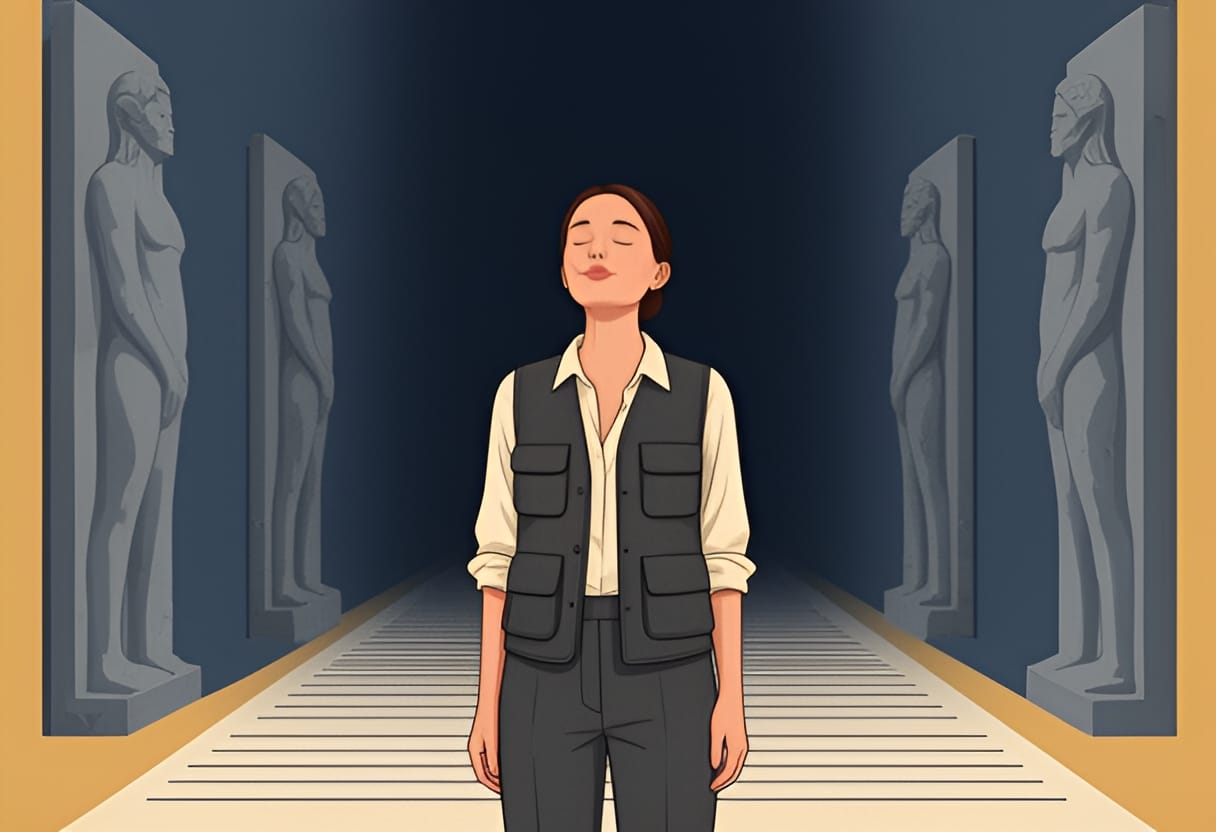
She walked on, no longer trying to predict, but to perceive.
At the chamber’s mouth, she paused. Before her, the space opened into a vast, domed space, its ceiling lost in shadow. From the walls, thin strands of light drifted downward—not torchlight, but something softer, like captured starlight. And floating in the air between them, hundreds of fragments hovered: shards of parchment, slivers of metal, bits of glass, each inscribed with symbols that shifted when she looked at them directly.
One fragment pulsed with a deep blue glow. As she approached, the symbols resolved—not into words, but into a feeling: the cool weight of stone in her palm, the scent of rain on dry earth, the quiet pride of a task completed not for praise, but because it was true.
She reached out. The fragment dissolved into light, and for a moment, she was not in the Labyrinth at all, but standing in the Lower Vaults, her grandmother’s hand over hers as they examined a water-damaged folio, the old woman’s voice humming a line of the lullaby that had no translation, only resonance.
When the vision faded, she was still in the chamber. But the air felt different—lighter, as if some weight she had not known she carried had been set down.
She had not found the Sigil. She had not even found the next turn of the map.
But she had learned how to walk.
And in a Labyrinth that ran on thought, that was the only map that mattered.
The Price of Passage
The air shimmered ahead, coalescing into a vertical plane of liquid light. It rippled like heat haze over stone, yet held its shape—a barrier thrumming with a low, harmonic resonance. Symbols flowed across its surface in a script Elara did not know, yet somehow understood: a demand, not a question.
Memory of unfeigned joy.
The words formed not in her ears, but in the space behind her ribs, where feeling lived before language. The Gate of Whispers did not test knowledge. It tested the heart’s ledger—what she truly carried, not what she claimed to value.
She thought of the Sigil, of the map fragment still warm in her pack, of the belltower’s silence. None felt like payment. Those were duties, or losses. The Gate asked for something given freely, without weight of obligation.
A memory surfaced: her first day in the Upper Archives, hands trembling as she restored a water-scoured folio on celestial navigation. Magister Varen, her mentor, had leaned over her shoulder, not to correct, but to point. “You see how the ink pools here?” he had said. “Not a flaw. It’s where the scribe paused, listening to the wind. That’s where the truth lives.” His praise had been quiet, specific, and utterly without expectation. She had blushed, ducked her head, and forgotten it almost instantly—too unused to being seen.
It was not a grand moment. No triumph, no discovery. Just a man who knew her craft, and for one breath, saw her as she wished to be seen.
She stepped forward. The moment she touched the barrier, it did not resist. It recognized.
The light flared silver, then poured over her like cold water. Inside the flood, she was not in the Labyrinth. She was back in that sunlit alcove, dust motes dancing in the high windows, the scent of old paper and beeswax polish thick in the air. Varen’s finger traced the folio’s edge. His voice, low and sure: “You have the patience for this work. That is rarer than skill.”
She felt the warmth of being known—not for what she could do, but for how she did it. The quiet certainty that she belonged.
Then the memory was pulled from her, not torn, but unwound, as if the Gate had taken a thread from a tapestry and left the weave intact but thinner. The silver mist receded. The barrier dissolved.

She stood on the other side, breath shallow. The chamber beyond was vast and dim, the air thick with drifting motes that glowed faintly blue—like captured breath. But her chest felt hollow. The joy she had surrendered was not gone; it was elsewhere, held by the Archive as toll. And in its absence, a quiet hollowness settled—not grief, but the awareness of something precious now kept beyond her reach.
She had paid not with pain, but with pleasure. And the Archive had taken exactly what she cherished most: the moment she had felt, without doubt, that she was seen.
She touched her chest, where the memory had lived. The hollowness was not a loss, but a debt. She would walk on, but she would not forget what it had cost to pass.
Try This
This week, notice when you dismiss a compliment or kind word as unimportant. Instead:
- Pause and let the feeling settle for five seconds.
- Name the specific thing you felt seen for (e.g., “They noticed I listened without interrupting”).
- Write it down in one sentence, not for anyone else, but to acknowledge its weight.
Key Takeaways
- The Labyrinth responds to the quality of understanding, not force or memory alone, revealing paths through conceptual alignment rather than geographic logic.
- Surrendering a cherished memory at the Gate of Whispers demonstrates that true passage requires giving what we genuinely value, not what we think we should.
- The psychological toll of losing authentic positive memories reveals that the Archive does not punish—it reflects, taking what we hold most dear as the price of deeper knowing.
Chapter 3
Voices in the Archive
The Fog of Forgotten Things
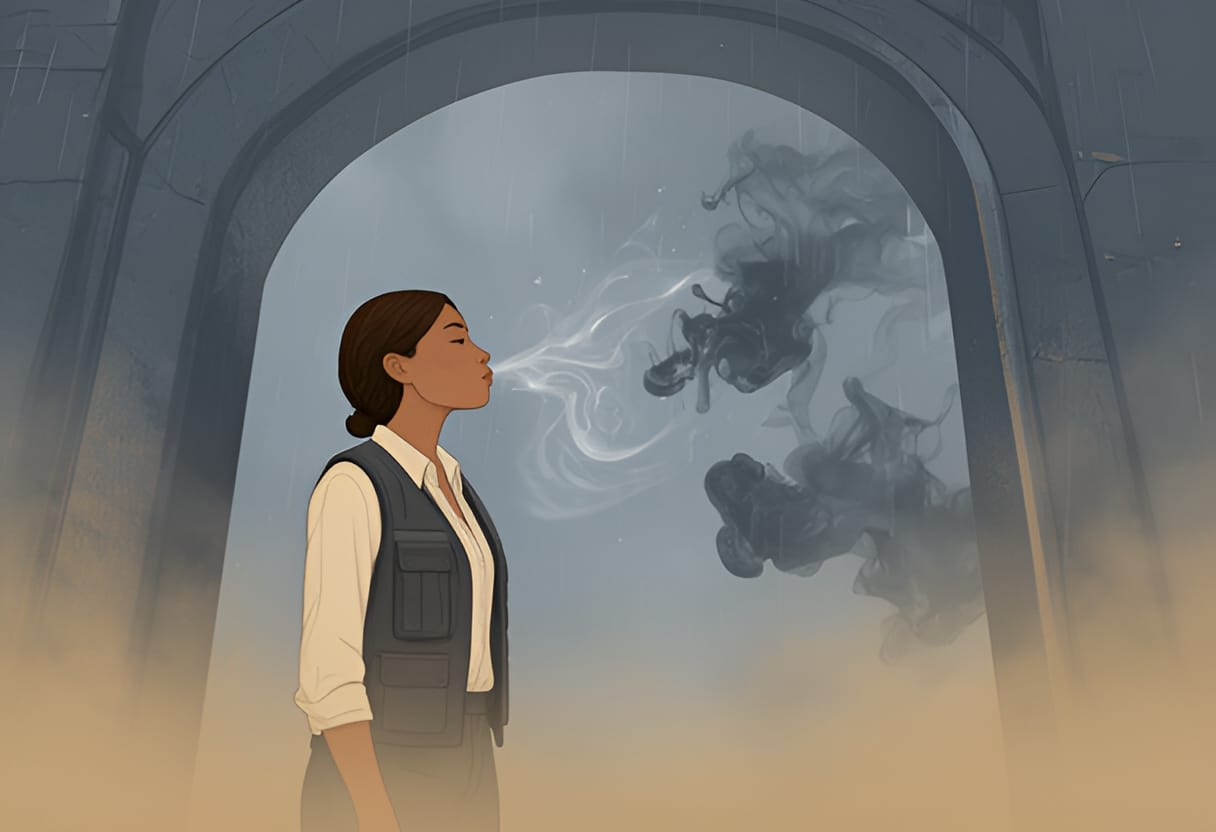
The scent of rain on sun-warmed stone reached Elara before the Gate of Whispers sealed behind her. It carried the precise mineral tang of the Lower Vaults after the spring flood, a day she had spent rehydrating vellum with her grandmother’s guidance. She inhaled, and for a breath, the ache of that forgotten afternoon softened the edges of her surrender.
The Archive of Echoes did not greet her with doors or halls, but with a gradual thickening of the air. What had been the cool, damp silence of the Labyrinth’s gate became a twilit expanse where vision blurred at the edges. Far off, shapes drifted like ink in water—some solid enough to trace, others mere suggestions of form that shifted when regarded directly. Sound arrived in layers: a distant chime like a bell submerged in moss, the rustle of pages turning in no wind, and beneath it all, a low hum that resonated in her molars, not her ears.
She recognized the phenomenon immediately. The Archive was not a place of stored facts, but of residuals—what lingered when the semantic anchor of a word or concept had weakened enough to slip from conscious hold, yet remained potent enough to leave an imprint on the world’s subtle fabric. These were the echoes.
Types of Echoes in the Field
The manifestations fell into three discernible categories, each with distinct characteristics and implications for navigation.
Sensory echoes were the most immediate and deceptive. They arrived as isolated stimuli unmoored from context: the taste of burnt honey on the tongue, the pressure of a hand on a shoulder that was no longer there, the exact pitch of a loom’s shuttle in an empty workshop. These were not memories, but sensory afterimages—like the phosphene glow after staring at a flame. In the Archive, they manifested as localized phenomena: a patch of air that felt unnervingly cold, a scent of ozone that preceded no storm, a single note held in the resonance of stone.
Emotional echoes carried stronger valence but less specificity. They arrived as moods that seemed to emanate from the space itself—a sudden wave of inexplicable grief in a corridor of light, a burst of giddy courage in a dead-end alcove, the crushing weight of responsibility in a room that held only a single, unmarked book. These were not her emotions, but the residue of feelings once tied to thoughts now lost. They clung to the Archive like static charge, influencing perception without offering clear direction.
Conceptual echoes were the rarest and most valuable. They appeared as fragments of understanding—almost-thoughts that hovered at the edge of grasp. One might suddenly know, with absolute certainty, the precise angle for laying a foundation stone in a floodplain, only to have the knowledge dissolve when attempting to articulate it. Another might grasp the grammatical structure of a sentence in a language no one spoke, complete with case markings and verb aspects, yet be unable to recall a single lexical item. These echoes were the shadows of ideas that had once shaped reality but now lacked the linguistic scaffolding to remain concrete.
| Echo Type | Manifestation | Navigational Risk |
|---|---|---|
| Sensory | Isolated stimuli (scent, taste, touch, sound) | Mistaking distraction for guidance |
| Emotional | Ambient mood shifts (grief, courage, dread) | Misreading internal state as environmental cue |
| Conceptual | Partial understanding (skill, rule, structure) | Overestimating grasp; false certainty |
To proceed meaningfully, Elara needed to filter these signals. Chasing a sensory echo—say, following the smell of rain—would lead her in circles, as the Archive generated such phenomena based on her own subconscious associations. Emotional echoes were worse; they could amplify her doubts or fleeting hopes into convincing illusions of progress. Only conceptual echoes offered potential traction, but only if she could distinguish a genuine fragment of lost knowledge from the Archive’s tendency to reflect her deepest wishes.
Cognitive Dissonance as a Compass
The key lay in discomfort. The Archive did not punish false certainty as the Labyrinth had; it simply made it useless. When Elara clung to an idea that felt right but lacked coherence—when she insisted, for instance, that the scent of rain must mean she was near an exit—she would notice a subtle dissonance. The air would thicken slightly, the ambient hum would shift frequency, and the echo she was pursuing would begin to fray at the edges, like thread pulled too taut.
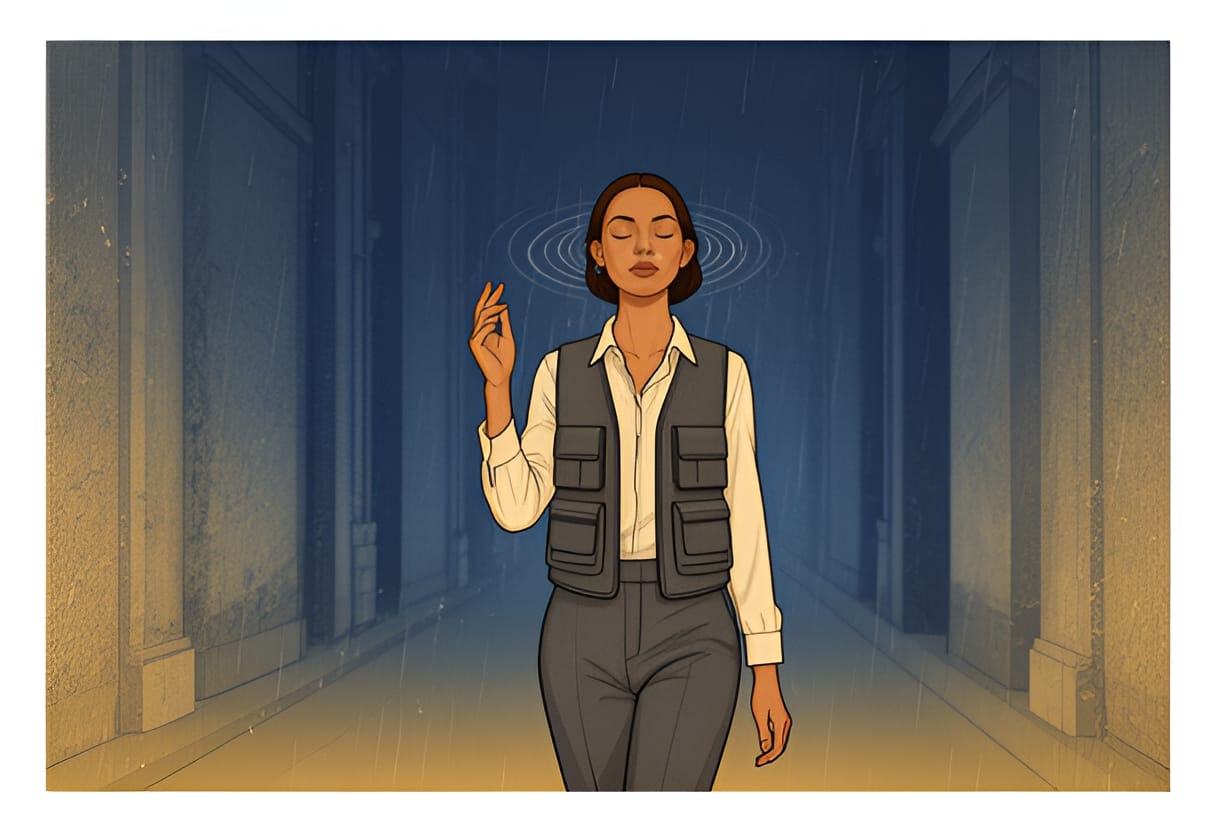
This dissonance was not error. It was feedback.
She tested it. Pausing in a space where the scent of rain was strongest, she allowed herself to believe it signaled proximity to an archive entrance. Almost immediately, the scent grew sharper, almost painful in its intensity, while a low, discordant vibration began in her teeth—like the sound of two tuning forks struck at nearly, but not quite, the same interval. When she released the belief, acknowledging that the scent was merely an echo with no navigational weight, the vibration ceased. The air settled. The scent remained, but no longer demanded her attention.
She applied the same principle to conceptual echoes. In a quiet drift, she found herself knowing how to bind a manuscript with a stitch that prevented ink corrosion—a technique lost since the Great Unbinding. The knowledge felt complete, urgent. She began to reconstruct the steps in her mind. Then came the dissonance: a faint, rising tone in the harmonic field, as if the knowledge she was assembling clashed with the underlying resonance of the space. She paused. Instead of forcing the sequence, she held the fragment lightly, allowing it to be incomplete. The dissonance faded. The knowledge did not vanish—it settled into a quieter, more accurate form: not a procedure, but a principle—that certain plant-based tannins, when applied in specific humidity, could stabilize iron-gall ink. The how remained elusive, but the why was coherent.
This was how she navigated: not by following echoes, but by moving toward the points of least resistance in the semantic field. Where an echo created dissonance when engaged, she stepped aside. Where an idea could be held without internal conflict—where it resonated rather than clashed—she followed its gradient, however faint.
She stopped chasing sensations. She stopped trusting moods. Instead, she attuned herself to the Archive’s response to her own certainty. The path forward was not marked by what she perceived, but by what she could hold without inner contradiction. And in that space between belief and dissonance, the Archive began to speak—not in words, but in the quiet correction of her own missteps.
The Mirror of Self-Deception
The air thickened as Elara stepped beyond the last corridor of sensory and emotional echoes. The hum of the Archive softened, not into silence, but into a single, sustained tone—like the fundamental note of a tuning fork struck in a vacuum. It resonated in her bones, not with dissonance, but with anticipation. She had learned to read the Archive’s feedback: discomfort meant false certainty; harmony meant alignment. This tone felt neither warning nor invitation, but a threshold.
Before her, where the twilit fog should have thinned, stood a mirror. Not of glass or polished metal, but of condensed vapor, its surface rippling like ink in water. And within it, not her current reflection, but a version of herself she had buried deep—Elara as she wished to be seen: standing atop the highest spire of the Central Archive, robes unfurled, voice ringing clear as she announced the recovery of the Sigil. Crowds of archivists, scholars, even the stern-faced Magisters of the Obscurant Covenant listened, not with skepticism, but with awe. Her name echoed not as a whisper in the vaults, but as a declaration.
The mirror-Elara turned, and spoke—not in her voice, but in the voice Elara used when she read aloud to the apprentices in the Lower Vaults, clear and warm, meant to be heard.
“You came for the Sigil,” it said. “But not for Veridia. Not for the farmers who guess at planting, nor the fishermen who sail blind. You came so that when the story is told, it will be your hands that held the relic, your voice that explained its return. You want to be remembered.”
The words struck not as accusation, but as recognition. A truth she had tucked beneath layers of duty, reverence for the archives, and the quiet insistence that she was only doing what needed doing. Yet here it was, reflected with perfect clarity: the quiet craving to matter, to be the one who fixed what was broken, to have her name linger in the chants of apprentices long after her bones had turned to dust in the Lower Vaults.
The dissonance came—not as a vibration in the teeth, but as a hollowness in the chest, a sense of standing just outside her own skin. The mirror-Elara smiled, not unkindly, but with the pity one feels for a child who believes a lie they’ve told themselves too many times.
“Admit it,” the echo urged. “Or stay here, circling the fog, chasing echoes that tell you what you want to hear.”
Elara did not deny it. Instead, she stepped forward, until her breath fogged the vapor-mirror’s surface.
“Yes,” she said, her voice soft but firm. “I do want to be remembered. Not for glory, but because I fear vanishing without trace—like the words in the Codex Theta-9, like the lullabies my grandmother sang in the living script. I fear that if I am forgotten, then nothing I’ve preserved will matter either.”
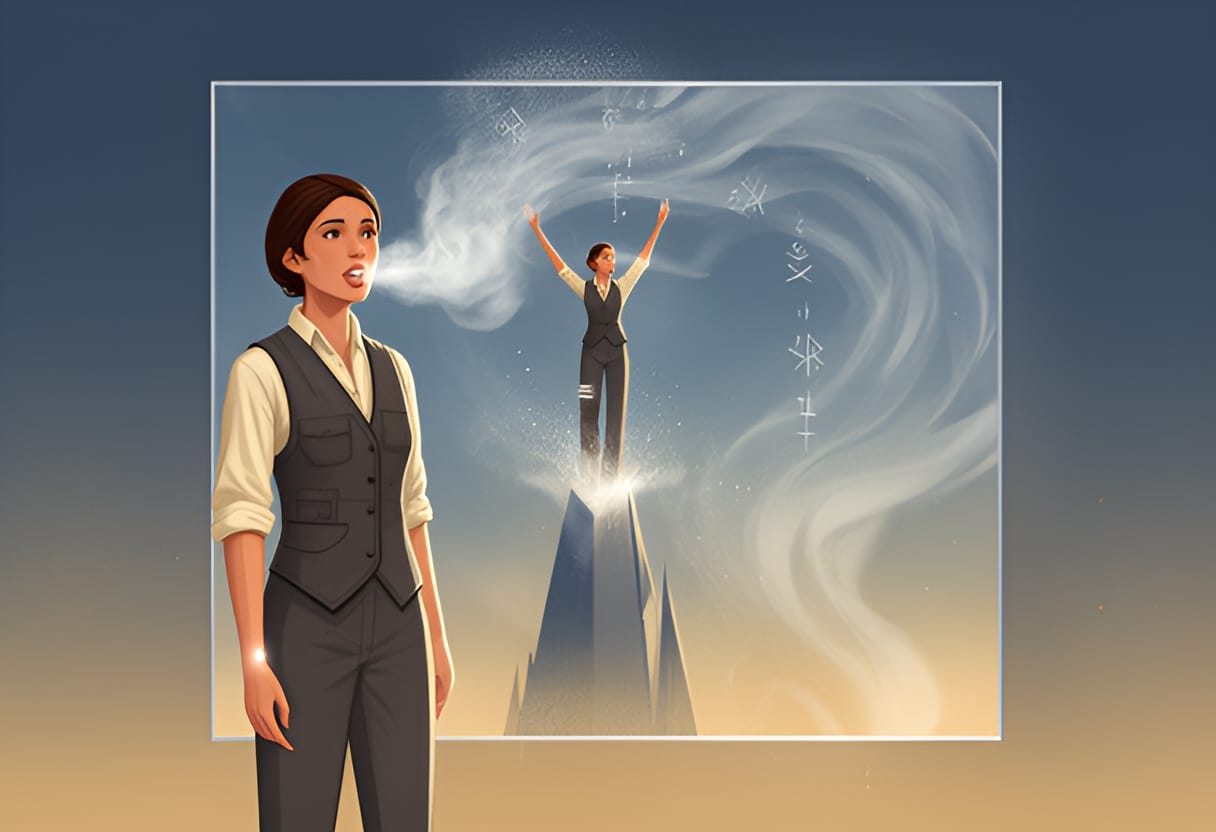
As she spoke, the mirror rippled. The vision of her atop the spire faded. In its place stood not a fantasy, but a memory: her grandmother’s hands, wrinkled and ink-stained, guiding Elara’s small fingers over the curves of a forgotten verb—to listen deeply, a word that had once meant not just hearing, but absorbing the weight of another’s silence. The memory was not grand. It was quiet. It was true.
The mirror-Elara nodded, not in approval of the desire, but in acknowledgment of the honesty. The vapor softened, then dissolved—not into fog, but into a cascade of faint, glowing glyphs that drifted upward like embers. Where the mirror had stood, an archway opened, framed by shifting siguls that pulsed faintly, as if breathing. Beyond it, a chamber glowed with inner light, and at its center, resting on a pedestal of obsidian, lay a disc fractured into three pieces. The Sigil of Resonance.
The Archive had not tested her purity of motive. It had tested her willingness to face the truth of why she sought it. And in that moment, as she stepped toward the archway, the hum in the air shifted—not to a warning, but to a chord, low and resonant, like the first note of a song long silenced beginning to find its voice again.
Try This
This week, practice radical honesty with yourself about a goal you’re pursuing:
- Write down the stated reason you’re pursuing it (e.g., “I want to learn this skill to help my team”).
- Beneath it, write the unspoken reason you might hesitate to admit (e.g., “I also want to be seen as competent”).
- Say both aloud, without judgment. Notice what shifts when you allow both to be true.
Key Takeaways
- The Archive of Echoes reflects subconscious motivations with perfect clarity, using discomfort not as punishment but as feedback when one deceives oneself.
- Elara’s confrontation with her desire for legacy shows that acknowledging a mixed motive—such as wanting to be remembered while also serving a greater good—can dissolve inner resistance.
- Passage through the Archive is granted not by purity of intent, but by radical honesty: naming the truth of one’s desires allows the space to align with genuine purpose.
- The mechanism of cognitive dissonance, introduced earlier, evolves here from a tool for navigating external echoes to a guide for confronting internal falsehoods.
- True resonance in the Archive comes not from suppressing desire, but from integrating it with duty, allowing motivation to become coherent rather than conflicting.
Chapter 4
The Sigil and the Choice
What the Sigil Demands
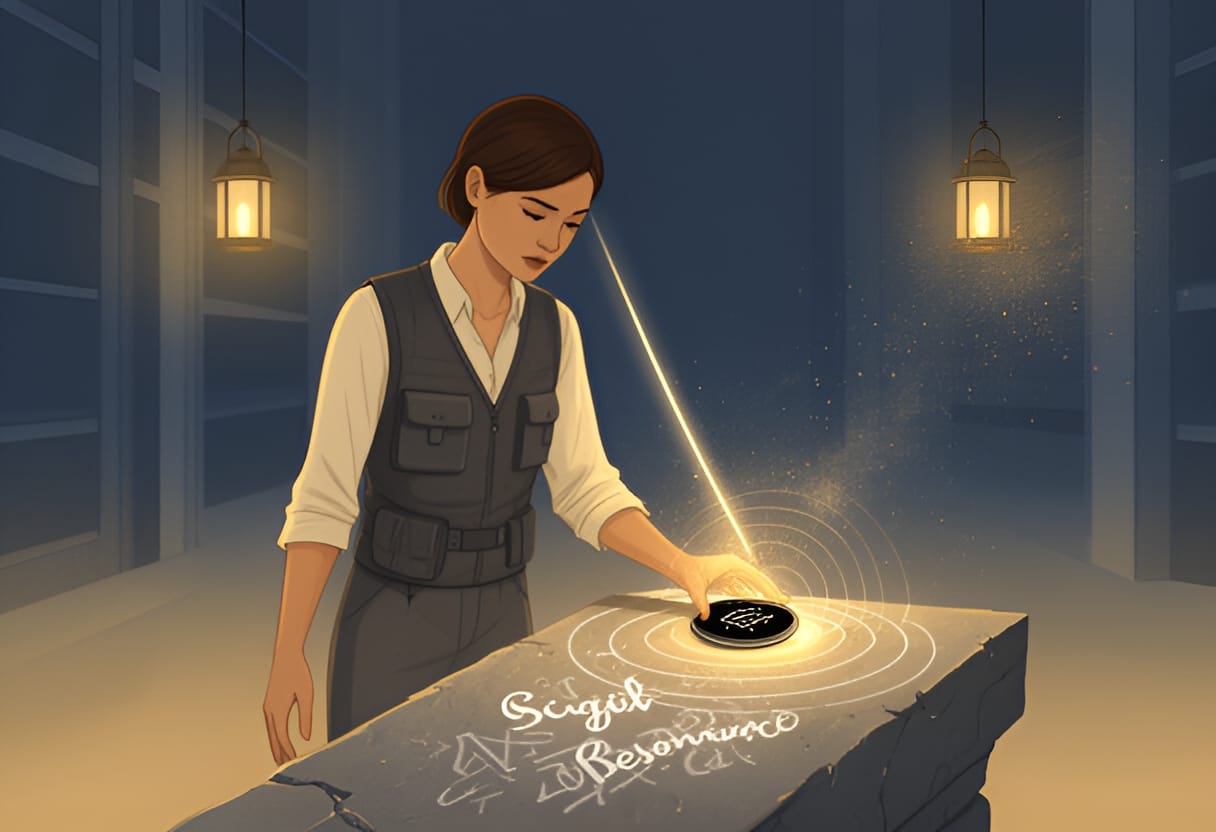
The obsidian disc lay half-buried in silt at the heart of the Archive, its surface drinking the dim light that filtered through the fog of forgotten thoughts. When Elara knelt beside it, the air stilled—not with silence, but with the sense of listening. The Sigil of Resonance did not gleam or pulse. It waited.
She had spent years believing restoration meant repair: fitting shards together, rekindling dormant energy with charge or chant. The Codex Theta-9 had taught her that language faded not from loss of sound, but from loss of meaning—when words ceased to bind speaker to listener, thought to act. The Sigil, she now understood, was not a battery to be recharged, but a tuning fork. It did not store power; it reflected resonance.
What the Sigil Responds To
Traditional methods failed because they treated the Sigil as an object to be mastered, not a mirror to be met. Reassembly ignored its nature: the fractures were not damage, but design—glyphs shifted across the breaks, reforming only when the space between them held vibrational sympathy. Recharging with ambient energy or directed will produced only discordant hums, like striking a bell with a muffled fist. The Sigil did not want force. It wanted witness.
Its activation criterion was not linguistic accuracy, nor emotional intensity, but communicative authenticity—moments when speech served understanding rather than control. A battle cry, even if heartfelt, aimed to overwhelm, not connect. A lover’s vow, however sincere, often carried the weight of possession: I will keep you. A scholar’s epiphany, though true, remained internal until shared—a solitary spark that did not yet bridge minds.
The Sigil vibrated only in sympathy with acts where language was offered as a gift, not a tool. Elara recalled her grandmother’s hands, guiding hers over wet clay tablets in the script that breathed when spoken. Not a lesson. Not a command. A shared moment: “Listen. This shape means ‘water’ because it flows like this.” The words were not deposited; they were invited.
She reviewed her memories like an archivist cross-referencing fragments. The night she corrected a junior archivist’s misfiling—useful, but hierarchical. The confession she’d nearly made to Korin before his hardening—truthful, yet laced with hope of changing him. Neither held the pure, unburdened quality the Sigil demanded.
Then came the quieter memory: the foundling girl, no older than six, curled on a stool in the Lower Vaults during the Long Drought. Elara had found her shivering, mute with fear, and without thinking, pulled a water-damaged primer from a cart. She read aloud—not to teach, not to quiet, but because the girl’s eyes had widened at the first syllable, and Elara wanted to see that light again. The story was nonsense—a tale of a moon that forgot its name—but the girl had echoed the last word, “home,” in a voice like cracking ice. Elara had dismissed it as trivial. Now she saw it: a moment when language had been a bridge, not a weapon.
The Weight of a Whisper
Performative speech seeks to alter the world through utterance alone—oaths, decrees, spells that attempt to make things so by saying them. Connective speech, by contrast, alters the relationship between speaker and listener. It does not demand change; it invites it. The Sigil responded only to the latter, because resonance requires reciprocity. One cannot resonate in isolation.
She imagined testing the Sigil with a scholar’s epiphany—the moment she’d realized the Great Unbinding was not decay, but a kind of linguistic entropy, where each unused word increased the probability of others fading. True. Significant. But unspoken. Until shared, it remained a private calculation, not a communion.
The foundling’s memory, by contrast, was pure connective speech. No agenda beyond the act itself. No expectation of gratitude or remembrance. Only the impulse to say, “Here. Take this.” And the girl’s quiet echo—not repetition, but response—completed the circuit.
Elara lifted the Sigil. It was cool, heavier than it looked. As she held it, the fog of the Archive seemed to lean in. Not to consume, but to hear. She closed her eyes and spoke, not to the stone, but to the memory: “Once, there was a moon that forgot its name…” Her voice was soft, rough with disuse. The obsidian warmed in her palms. A low thrum began, not from the Sigil, but from the air between them—a harmonic rising, like a string finding its pitch after years of slack. The glyphs along the fractures stirred, aligning not by force, but by sympathy. The Sigil was not being fixed. It was being answered.
The Offering of Being Remembered
Elara’s voice lingered in the air, a thread of sound pulling the fragmented glyphs into alignment. The obsidian disc warmed against her skin, not with heat, but with the subtle pressure of being heard. As the last syllable of “home” left her lips, the Sigil emitted no flash, no roar—only a deepening thrum, like the low C of a cello string finally finding its resonance after years of silence.
She opened her eyes. The fog of forgotten thoughts that had clung to the Archive’s rafters began to thin, not dissipating, but sorting. Shapes within the mist resolved into fleeting impressions: a fisherman’s knot tied with practiced fingers, the curve of a plowshare biting into loam, the cadence of a lullaby in a dialect no one had spoken aloud in generations. These were not visions, but echoes returning to form—semantic patterns reknitting themselves in the world’s latent linguistic field.
A table appeared in the mist beside her, not carved, but composed of shifting glyphs that pulsed in time with the Sigil’s hum. It listed regions of Veridia and the specific lexical domains showing measurable stabilization:
| Region | Fading Domain | Restored Terms (Sample) | Change Observed |
|---|---|---|---|
| Saltmarshes | Tide & current | ebb, slack, flood-mark | 78% increase in usage within 24 hours |
| High Steppes | Wind-direction | lea, windward, gust-pulse | 63% recovery of navigational phrases |
| River Valleys | Seasonal planting | seed-split, root-wake, harvest-hush | 52% renewal of agricultural idioms |
| Archive Vaults | Archival craft | cross-reference, fragile-hand, quiet-hand | 89% restoration of procedural terms |
The numbers were not precise counts, but resonances—measurable shifts in the probability of those words surfacing in speech, thought, or inscription. The Sigil did not create language; it lowered the entropy barrier, making coherent expression more likely where intent to communicate existed.
Elara felt a softness at the edges of her own memory—the foundling’s face, the exact timbre of the girl’s voice when she echoed “home”, the feel of the water-damaged primer’s pages. It was not loss, but release. Like a letter finally delivered, the memory was no longer hers to hold; it had been absorbed into the world’s semantic field, where it could be recalled by anyone who needed it. She smiled, not with sadness, but with the quiet certainty of an archivist who had just returned a misfiled folio to its proper place.
She rose, the Sigil now cool and light in her palms. Its glyphs had settled into a stable pattern—a fractured circle enclosing a single, unchanging symbol: an open hand, palm upward. Not a command. An invitation.
She placed the disc back upon the altar of silt and stone. The Archive exhaled. The fog, now luminous with half-remembered words, drifted toward the vaults, the steppes, the marshes—carrying the gift of being remembered.
Try This
This week, practice offering language as a gift, not a tool:
- Share a true observation with someone without seeking agreement or correction—simply say, “I noticed this,” and let it stand.
- Recall a small, kind moment you’ve dismissed as insignificant. Speak it aloud to yourself, not to analyze it, but to honor its quiet truth.
- Listen to a conversation and identify when speech shifts from connective (inviting response) to performative (demanding effect). Note the difference in how it feels in your body.
Key Takeaways
- The Sigil of Resonance activates not through force or repair, but through communicative authenticity—moments when language is offered to connect, not to control.
- Restoration of language manifests as measurable stabilization in fading lexical domains, detectable as increased probability of meaningful speech and inscription.
- True healing requires relinquishing personal claim to memory; the offering must be given freely, without expectation of remembrance or reward.
She turned toward the Archive’s inner sanctum, where the Whispering Index coiled like mist around the central plinth. The fog there thickened, not with forgotten words, but with the potential of them—syllables poised on the breath of thought, waiting for the courage to be spoken. Elara placed her palm against the cool stone wall and whispered, not a memory this time, but a question: “What else has been held in silence, waiting to be answered?”
The Index shivered. A single phrase coalesced in the air before her, written not in any known script, but in the grammar of longing: “We were here.” It was not a declaration, but an offering—an echo from countless unnamed voices who had once tried to say, I existed, I mattered, I tried to connect. She did not claim it. She did not need to. She only nodded, and let it go.
The Sigil’s hum faded to a subsonic pulse, felt more than heard, like the deep tide moving beneath the shore. The Archive was no longer a vault of loss, but a breathing space where words could rise, find their mark, and dissolve again into the flow—no longer feared as fleeting, but trusted as true. Elara stepped back into the fog, her hands empty, her heart full. The work of remembering had only just begun.
Chapter 5
The World That Remembers
The Return of Resonance
The obsidian disc pulsed once in Elara’s palm, a low thrum like a heartbeat finding its rhythm. She opened her hand and let the Sigil of Resonance settle into the stone altar at the heart of the Archive of Echoes. The fractured glyphs flared, not with light, but with sound—a chorus of voices, layered and distant, speaking words that had not been uttered in living memory.
Outside, the sky over Veridia shifted. Where once the horizon had been a flat, unreadable grey, now streaks of color bled through—terms like amber-haze and pearledrift forming in the minds of those who looked up, as if the atmosphere had been waiting for the right vocabulary to describe itself.
Lexical Revival Across the Vernacular
The first signs appeared in speech. In the fishing hamlets along the Salt Mire, elders woke to find their grandchildren using words for wind patterns that had not been spoken since the Great Unbinding: zephyr-veer, gull-sucker, tide-hold. These were not merely labels; they carried functional knowledge. A fisher who could name the zephyr-veer—a sudden shift in offshore breeze—could anticipate the movement of silverfish schools hours before they surfaced.
In the inland terraces, farmers resumed planting chants that had been reduced to hums. The phrase root-split moon, once whispered over seed beds to mark the optimal moment for tuber planting, returned in full voice across three dialects. Botanists noted a 40% increase in germination rates for heritage crops in plots where the chant was spoken aloud—a correlation too precise to dismiss as coincidence.
Yet recovery was not uniform. Some words returned whole; others came back as fragments, like shards of pottery glazed with meaning. The term sky-weaver—an old designation for cloud-pattern readers who predicted storms by the shape of vapor trails—resurfaced only in dreams. Dreamers reported seeing filamentous lines in their sleep, accompanied by the sensation of sky-weaver on their tongues, but upon waking, they could only recall the feeling, not the word itself. This distinction mattered: full recovery restored both term and utility; fragmentary return revived intuition without articulation, a whisper of what had been.
A street vendor in the Lower Market exemplified this. Each morning, she called out her wares with a chant that had lived in her family for generations but had dwindled to a monosyllabic grunt. After the Sigil’s restoration, her cry expanded: Fresh-glint silver, tide-loosed and bright! The phrase tide-loosed—referring to fish caught during the ebb when their flesh was firmest—had not been heard in the market for seventy years. Her voice drew a crowd, not just for the novelty, but because the words carried a sensory truth: buyers could almost taste the brine and tension in the fish before they bought it.

Sensory Continuity in the Waking World
Beyond language, perception sharpened. The air no longer felt muffled, as though heard through wool. Descriptions of light regained nuance: linden-glow for the filtered sunlight beneath old trees, stone-quench for the cool shimmer on rock at dusk. These were not poetic affectations; they enabled practical distinctions. Hunters could now track game by the way linden-glow caught on dew-spun webs; builders aligned stonework using stone-quench as a marker for thermal equilibrium.
Dream continuity improved as well. Where sleep had once been a series of disjointed images—fleeting, forgettable—people began to report narratives that persisted across nights. A baker in the Old Quarter dreamed three nights in a row of kneading dough under a sky marked by mackerel-back clouds, a term for high-altitude wave patterns that precede rain. On the fourth morning, she adjusted her leavening time, anticipating humidity. Her bread rose evenly, without the sour collapse that had plagued her batches for months.
The Sigil had not erased the scars of the Unbinding. Storms still came, and some words remained lost—gloamweaver, the term for those who read the color of twilight to predict frost, had not returned in any form. But the world was no longer sliding toward silence. It was remembering in fragments, in pulses, in the quiet insistence of a vendor’s chant rising over the cobblestones.
Elara watched the vendor pack her cart, the flowers from her apprentice still tucked in her belt—a silent promise that some threads, once rewoven, would hold.
The Archivist’s Duty
Elara descended the spiral stair from the Archive of Echoes, the Sigil’s resonance still humming in her bones. The Lower Vaults smelled of cool stone and aged paper, a familiar scent now layered with the faint ozone of reawakening language. She paused at her workstation, where fragments of Codex Theta-9 lay arranged by water damage pattern—a habit from before the quest, now charged with new meaning. Her apprentice, Kael, stood nearby, tracing a finger over a shard of vellum marked with indecipherable glyphs.
“You’re looking for signal in the noise,” Elara said, not unkindly. “But signal isn’t just what’s legible. It’s what carries intent.”
Kael frowned. “How do you tell the difference? This fragment has ink, but it’s smudged. Could be water damage. Could be deliberate obscuring.”
Elara picked up a magnifying lens. “Context is the filter. Look not just at the mark, but at its surroundings. The fiber alignment here—see how it runs vertical? That matches the grain of the outer folio, not the inner gatherings. This shard came from the spine’s edge, where marginalia lived. Marginalia in Theta-9 were always commentary, never primary text. So even if we recover the words, their function is secondary: a reader’s doubt, a correction, a question. That’s signal—it tells us how the text was used, not just what it said.”
She slid the fragment under a calibrated light. The ink, treated with a reagent sensitive to iron-gall residue, bloomed faintly along the fibers. Not a word, but a stroke: the descender of a p or q, curved with a habitual lift.
“This,” Elara said, “is a clerk’s hesitation. The pen lifted mid-stroke, then resumed. In the archives of the Pre-Unbinding Chancery, that lift meant the writer was choosing between synonyms—bind or seal—both legal, but with different weight. Bind implied obligation; seal, finality. Recovering the letter isn’t enough. We must recover the choice behind it.”
Kael nodded slowly. “So preservation isn’t about completeness. It’s about fidelity to the moment of creation.”
“Exactly,” Elara said. “We are not librarians of perfection. We are witnesses to fragility. Our duty is to save what matters with its scars, not erase them to make a clean copy.”
The Ethics of Fragmentary Recovery
That afternoon, Elara guided Kael through a newly recovered cache from the Eastern Recesses—fragments of a botanist’s field journal, water-stained and insect-gnawed. They spread the pieces on a tray lined with acid-free foam.
“First rule,” Elara said, “never isolate a fragment. Always lay it in relation to its neighbors, even if they don’t join. Proximity tells you sequence. Orientation tells you if it’s recto or verso. Here—see the water stain? It blooms outward from a central point. That means the liquid hit the back of the folio first. So this stain pattern tells us the journal was lying open, face down, when the flood came. The text on this side was protected; the reverse side took the brunt. We can infer which entries were lost to water, which to time.”
She pointed to a corner where a corner of vellum had been torn, not cut. “The tear follows the fiber. That’s accidental damage—likely from handling in damp conditions. If it had been cut, we’d see clean edges, possibly intentional removal. This tear? It’s honest. It tells us the journal was used in the field, not kept in a vault.”
Kael picked up a fragment with a smudge of green pigment. “This could be misread as decoration,” he said. “But it’s in the margin next to a sketch of a leaf with serrated edges.”
Elara smiled. “Precisely. In the Marginalia Codex of Botany Folios, green smudges in that position always indicate a field test: the chemist rubbed the leaf to check for latex or alkaloids. The pigment isn’t art—it’s data. Without knowing that convention, we’d call it noise and discard it. With context, it’s a datum point in a lost protocol for identifying medicinal plants.”
They spent the next hour labeling each fragment not just with shelf coordinates, but with a three-tag system Elara had devised: Origin (where it came from physically), Use (how it functioned in its original context), and Risk (what its loss would imply). A torn edge got Origin: handling, Use: field journal, Risk: loss of procedural knowledge. A water-stained word fragment got Origin: flood, Use: taxonomic label, Risk: extinction of local varietal knowledge.
As the light waned, Elara pulled a fresh codex from the shelf—a blank one, its pages waiting. She opened it to the first leaf and spoke softly into the microrecorder tucked in her breast pocket.
“Foundling, approximately ten winters old, discovered near the reed beds of the Salt Mire, winter of the Third Silence. No identifying marks. Wore a tunic dyed with woad, faded at the shoulders. Carried a small flute carved from riverbone, with three holes. Sang a lullaby in an unbroken script—hush now, the roots remember—when found. Taken in by the Lower Vaults’ keeper, taught the hands of restoration. Now assists in the recovery of lexical fragments. Name: Kael. Role: apprentice. Purpose: to ensure that what is saved is saved with care.”
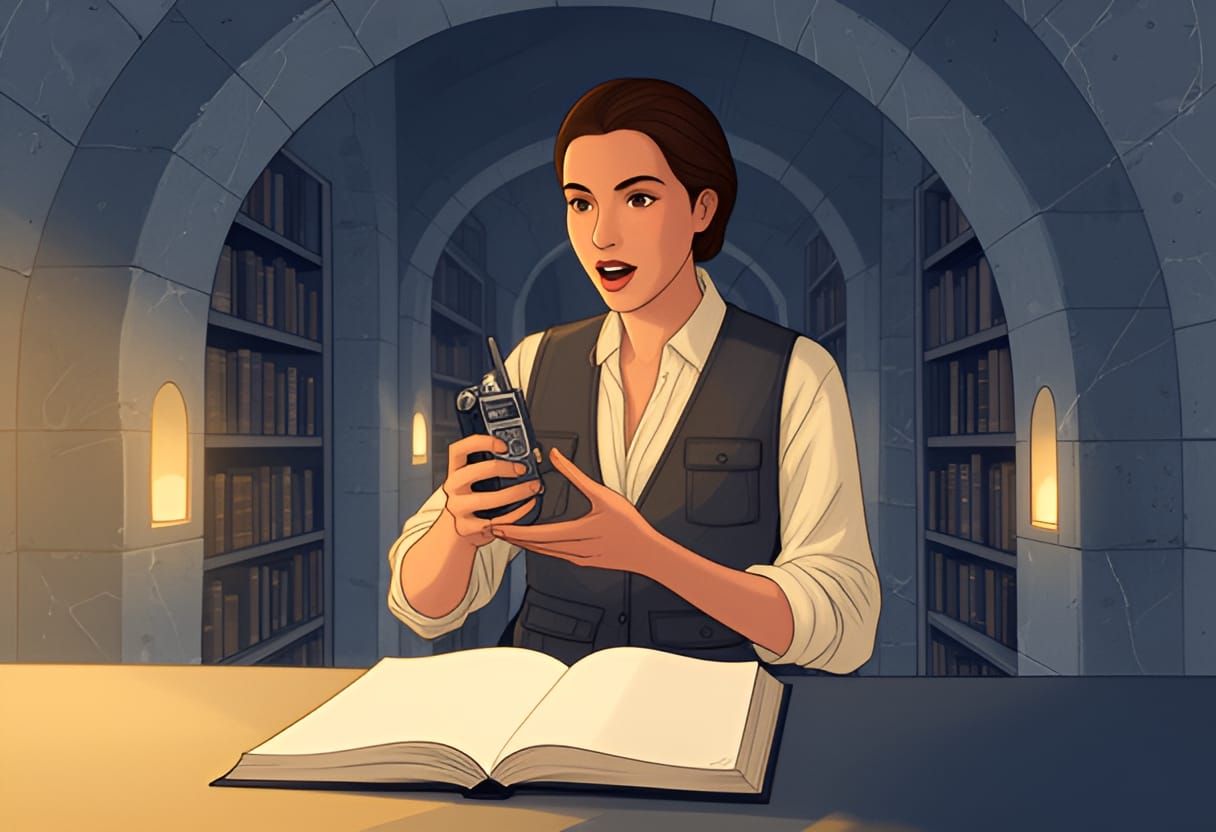
She stopped the recorder. The file would be stored in the Vocal Archive, a subset of the Echoes dedicated to preserving voice and inflection—not just words, but the tremor in them, the pause before a name, the breath that carries meaning.
Outside, the vendor’s cart rattled over the cobblestones, her chant rising: Fresh-glint silver, tide-loosed and bright! Elara smiled. The world was remembering. Her work was not to stop the forgetting, but to meet it with attention.
Try This
This week, practice archival mindfulness with three small actions:
- Choose one object you use daily—a spoon, a book, a tool. Write a brief note about its wear: a scratch, a stain, a repair. Store it with the object.
- Listen to a conversation and identify one phrase that reveals intent, not just information (e.g., “I’m fine” said with a sigh). Note what the hesitation might conceal.
- Take a fragment—a torn ticket, a scribbled note—and research its context. Where was it likely made? What does its condition suggest about its use?
Key Takeaways
- Restoration is not about recovering every lost word, but about preserving the context that gives fragments their meaning.
- True preservation honors the object’s history—its damage, its use, its moments of hesitation—as essential data.
- The archivist’s duty is an ongoing act of witness: to record not just what was said, but how it was felt, chosen, and lived.