Science Fiction
Gears of war Emergence Day
by Isaiah Lopez
23 chapters22 hr read
Chapter 1
Skin of the World
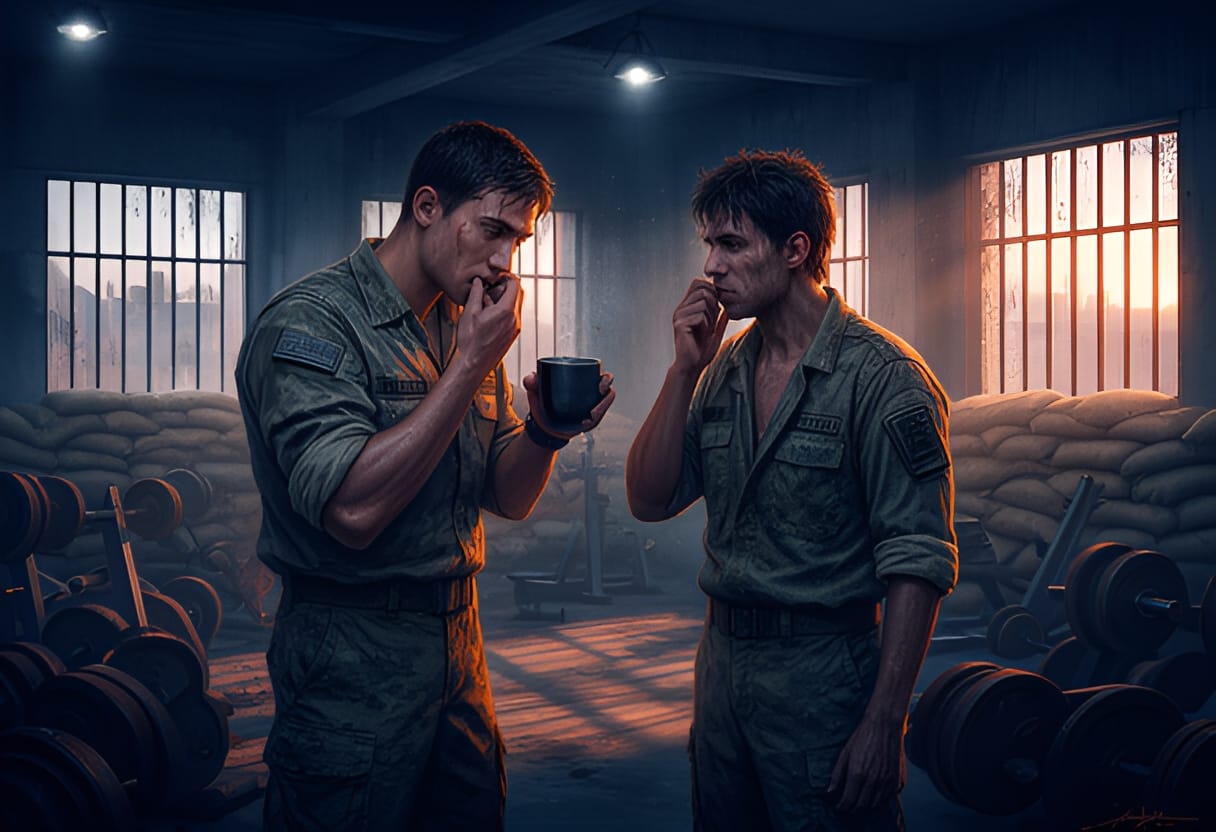
The first light of dawn bled through the high, grimy windows of the East Barracks’ gymnasium, catching dust in slow, lazy spirals above the worn rubber flooring. Isaiah 'Zay' Lopez lowered himself from the final pull-up, his breath coming in steady, controlled bursts. Sweat traced paths down his temples, dampening the dark hair at his nape. Beside him, Alex Lopez dropped from the bar with a light hop, landing on the balls of his feet before rolling back onto his heels.
"Man," Alex said, wiping his forearm across his brow and leaving a streak of grime, "you really need to lay off that sludge you call coffee. Tastes like burnt engine oil filtered through a sock."
Zay pushed himself upright, rolling his shoulders. "It wakes you up. That’s the point."
"Yeah, if your definition of ‘awake’ is wanting to crawl back into bed and die." Alex grabbed his canteen, took a long pull, then tossed it to Zay. "Here. Drink something that won’t strip your enamel."
Zay caught it, unscrewed the cap, and took a sip of the lukewarm water inside. It tasted faintly of metal and plastic. "Your turn to make it tomorrow. I’ll supervise."
Alex snorted, grabbing his towel and slinging it over his neck. "Only if you promise not to judge me when I put three sugars in it. Some of us need motivation that doesn’t come with a side of existential dread."
They moved toward the locker row, the rhythmic thump of their boots the only sound in the otherwise empty space. Morning PT was over. The barracks were quiet—too quiet, Zay thought, as he slipped his shirt over his head. Even the usual clatter of cooks prepping breakfast in the mess hall seemed muted, as if the building itself were holding its breath.
"Something off?" Alex asked, noticing his brother’s stillness.
Zay frowned, pulling his boots on. "Just… quiet. Like the city’s not even trying to wake up."
Alex shrugged, zipping up his jacket. "Maybe everybody’s just tired. You know how it is—late shift, night patrols, the usual. Ephyra don’t sleep much, but it dozes."
Zay finished lacing his boots and stood. "Yeah. Maybe."
They stepped out into the courtyard, where the first true light of day painted the neoclassical façades of the barracks in soft gold. The motor pool sat to the east, a lattice of camouflaged trucks and armored vehicles under canvas tarps. To the west, the armory loomed—a squat, reinforced building with slit windows and a heavy blast door. Between them, the parade ground stretched, cracked concrete flanked by neatly ranked saplings that had yet to fill out.
A civilian groundskeeper, an older man with a faded COG cap and a rag in his hand, paused near the flowerbeds by the main gate. He looked up as the twins passed, gave a tight nod, then went back to his work—plucking weeds with mechanical precision.
"Morning, Lopez," he murmured without looking up.
"Morning, Reyes," Zay replied. "Everything alright?"
The man didn’t stop. "Just the weeds. Always the weeds."
Alex exchanged a glance with Zay as they walked. "Guy’s been here twenty years. Knows every crack in the pavement."
"Yeah," Zay said. "And every weed."
They reached the armory’s outer perimeter and paused. The blast door stood open, revealing the dim interior where racks of Lancer rifles, Gnasher shotguns, and ammo crates waited in orderly rows. Corporal Jace Stratton leaned against the frame, cleaning his weapon with a rag, his movements efficient but tense.
"Morning, twins," Jace said without looking up. "Heard you two were trying to wake the dead with that PT session."
Alex grinned, clapping Zay on the shoulder. "Tell him about the coffee, Zay. It’s a public hazard."
Jace finally looked up, a smirk tugging at his mouth. "If it’s half as bad as you say, I’ll volunteer for guard duty just to stay away from the mess hall."
Zay pushed off the wall. "We’re heading in. Gotta draw ammo before chow."
"Copy that," Jace said, falling in behind them. "I’ll cover the rear. Just in case Reyes decides to start a weed uprising."
Inside, the air was cool and smelled of oil, metal, and faint cordite. Fluorescent lights hummed overhead, casting a sterile glow over the rows of weapons. The twins moved to their usual locker—number 47—where their gear hung in tandem: identical helmets, body armor, and harnesses, each marked with their names in stenciled white.
Alex spun the combination lock, the clicks loud in the quiet room. "You ever think," he said as the door swung open, "that one day we’ll wake up and none of this’ll feel real? Like we’re just… waiting for the dream to end?"
Zay paused, one hand on his helmet. "All the time. Then I remember the weight of this," he said, tapping his chest plate, "and I know it’s not a dream."
Alex snorted, pulling out his Lancer. "Yeah, well. Hope the dream doesn’t decide to bite back today."
They checked their weapons—chamber clear, safety on, magazines loaded with standard-issue rounds. Zay slipped his Gnasher into its thigh holster, checked the pump action, then nodded to Alex.
"Ready?"
"Born ready," Alex replied, shouldering his Lancer. "Let’s go make Reyes proud."
They stepped back into the courtyard, Jace falling into step beside them. The morning had warmed slightly; the air shimmered faintly over the asphalt. Somewhere in the distance, a train rattled along the elevated tracks that ringed Ephyra’s industrial sector. A few civilians—mostly workers in coveralls—hurried past the barracks gates, heads down, lunch pails in hand.
Then the world heaved.
It wasn’t an explosion. No flash, no roar—just a sudden, violent shudder that rolled up from the ground like a sick wave. Zay staggered, his boots sliding on the wet concrete as the earth bucked beneath him. Alex grabbed his arm, fingers biting into his sleeve.
"Jesus—"
Another heave. Harder. The motor pool shuddered, tarps snapping loose as if caught in a gale. A chain-link fence near the motor pool’s edge buckled, posts wrenched from the ground. Dust plumed from cracks in the parade ground, and from the flowerbeds beside the gate, Reyes stumbled backward, his rag flying from his hand as the earth split open.
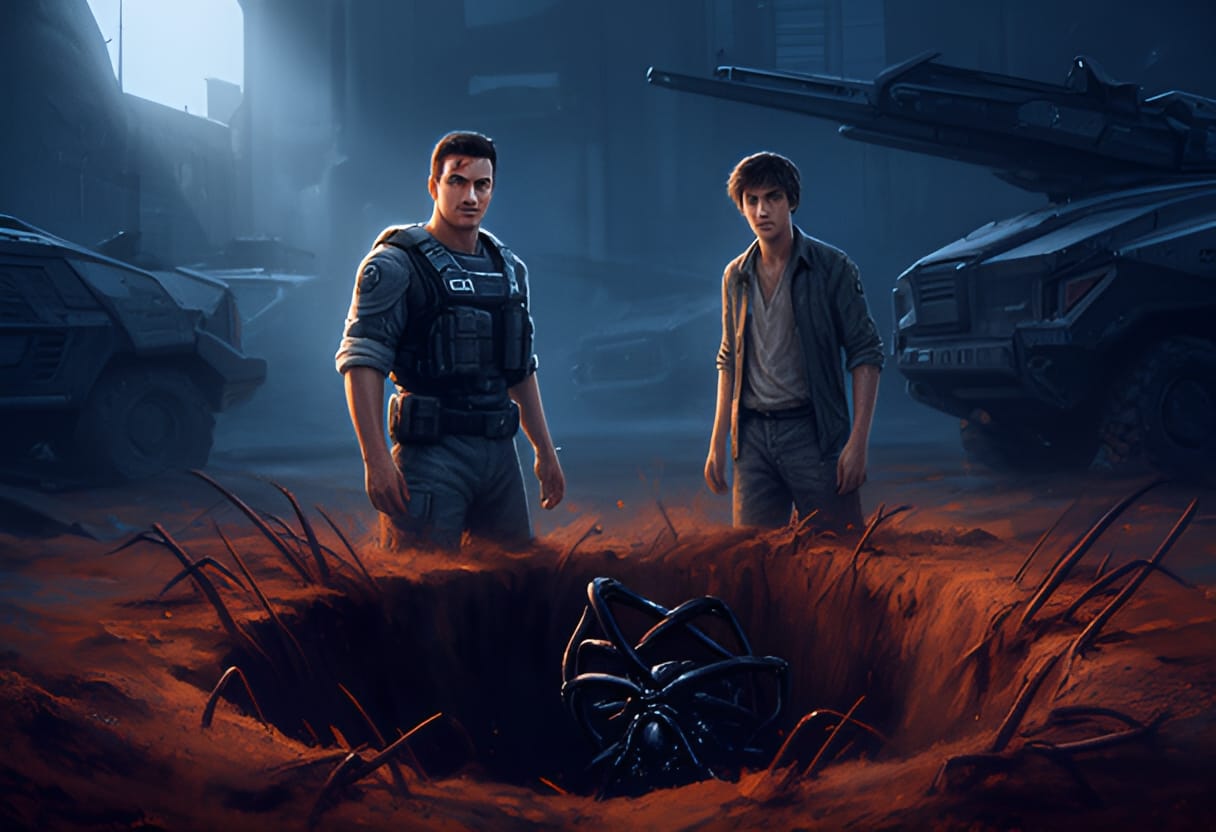
Not a crack. A hole.
Perfectly round, rimmed with torn earth and rebar, it yawned in the soil where the marigolds had been. Steam or something thicker rose from its depths—gray, oily, smelling of wet stone and decay.
Then it moved.
Something unfolded from the hole—a limb, jointed and black as obsidian, ending in a clawed foot that scraped the lip of the opening. Another followed. Then a head, low and angular, eyes like polished bone scanning the courtyard.
A Drone.
It hauled itself fully into the light, standing nearly seven feet tall, its exoskeleton ridged and segmented, plates clicking as it shifted its weight. Its mandibles twitched, tasting the air.
Zay’s breath locked in his throat. His hands flew to his weapons without thought.
More holes tore open—not just in the courtyard, but across the boulevard, in the streets beyond the barracks, in the parks and plazas of eastern Ephyra. From each, Drones surged upward, followed by heavier shapes—Boomers, their bulky frames straining against the confines of the holes, grenade launchers already cradled in their three-fingered hands.
The first shots cracked—not from the twins, but from the streets.
Screams split the air.
A woman in a floral dress stumbled from a side alley, clutching a child’s hand, only to freeze as a Drone loomed from a hole twenty feet away. It raised its clawed hand—not to strike, but to point. A second later, a spike of venomous mucus arced from its throat, striking the woman in the chest. She screamed again, this time in pure agony, as the substance began to eat through her fabric and skin. The child wrenched free and ran, barefoot on the hot pavement, straight into the arms of another Drone that had emerged from a sewer grate.
Alex cursed, swinging his Lancer up. "Zay—!"
"I see it!" Zay barked, already moving.
He fired.
The Lancer’s chainsaw bayonet screamed to life as the trigger pulled, spitting tungsten rounds that hammered into the Drone’s chest plate. The creature jerked backward, mandibles flaring, but didn’t fall. It roared—a sound like stone grinding on stone—and charged.
Alex was already firing, bursts of controlled fire walking up the Drone’s torso. Jace shouted something from the rear, his own Lancer barking as he took cover behind the armory’s corner.
More Drones poured from the holes. A Boomer heaved itself fully into the street, its launcher swinging toward a cluster of civilians huddled near a bus stop. It fired.
The grenade arced—a slow, ugly arc—then detonated in a blossom of fire and shrapnel. The bus stop vanished. So did the people beside it.
Zay felt the heat on his face, tasted ash and copper. His vision narrowed. The Drone in front of him lunged, claws scraping the pavement as it closed the distance.
He didn’t think. He stepped into the blow, shoved the Lancer forward, and let the chainsaw do its work.
The blade screamed through chitin and muscle, spraying black ichor across the concrete. The Drone shuddered, then collapsed in a twitching heap, its head lolling at an unnatural angle.
Alex was already moving, covering his brother’s flank. "Two more at ten o’clock! Boomer on the move!"
Zay spun, sighting down his barrel. The Boomer was reloading, its loader struggling to slip a fresh grenade into the breach. He fired—a three-round burst that caught the creature in the side of the head. It jerked, the grenade slipping from its grasp and clattering to the ground.
It didn’t explode. Not yet.
But the Boomer let out a guttural roar and charged, lowering its shoulder like a bull.
"Grenade!" Alex yelled.
Zay didn’t hesitate. He snatched a frag from his belt, pulled the pin with his teeth, and threw—not at the Boomer, but at the ground just short of its feet.
The detonation lifted the creature off its stride, flipping it onto its back. It landed with a thunderous crash, launcher skidding across the pavement.
Before it could recover, Alex was on it, Lancer blazing into its exposed underside. The Boomer thrashed, trying to bring its weapon to bear, but Zay was already there, Gnasher cocked, and blew a hole through its throat joint.
The creature went still.
Silence fell—not peace, but the awful, ringing quiet after violence. Smoke curled from the destroyed bus stop. Fires sparked in the gutter where the grenade had detonated. Civilians lay where they’d fallen—some still, some twitching, some crawling away with horrifying injuries.
Zay stood over the Boomer, chest heaving, Lancer still smoking. His ears rang. His hands shook—not from fear, but from the sudden, violent absence of it. The training had kicked in. The body remembered.
Alex came up beside him, placing a bloody hand on his shoulder. "You good?"
Zay nodded, unable to speak. His throat was tight. He looked past his brother, toward the boulevard.
More holes were opening. Not just in the streets, but in the sidewalks, the plazas, even the steps of the neoclassical bank building two blocks away. Drones and Boomers poured out like ants from a disturbed nest. In the sky, something vast and slow blotted out the sun—a Seeder, its bloated, jellyfish-like form pulsing with internal light as it hung motionless above the city, tendrils dripping with glowing spores.
A horn blared—deep, urgent, shaking the marrow in Zay’s bones. The barracks alarm.
He looked back. The armory door stood open. Jace was waving them in, face grim, already loading a fresh magazine.
"Move!" he shouted. "Now!"
They ran.
Bullets cracked overhead—not from the Locust, but from the barracks’ own defenders, scattered and panicked. A Gnasher blast exploded nearby, sending chips of concrete flying.
They burst through the armory door, Jace slamming it shut behind them. The interior was chaos—soldiers shouting, medics yelling for stretchers, a lieutenant trying to rally a squad near the ammo lockers.
"Lopez!" a voice barked. It was Sergeant Mara Velez, her face streaked with sweat and dirt, her Lancer gripped tight in both hands. She was near the inner door, trying to direct flow toward the armory’s secondary exit. "You two—grab what you can and get to the motor pool! We’re falling back to the transit hub! Move!"
Zay didn’t hesitate. He and Alex split off, heading for their locker. Jace followed, covering their rear as they grabbed extra magazines, grenades, and a pair of flare guns.
"Motor pool’s fucked," Jace panted as they ran. "Seeders just dropped spit on the east side. Flames already licking the tanks."
They burst out into the courtyard—only to stop dead.
The motor pool was an inferno.
Fuel trucks had ruptured, rivers of burning diesel snaking between the armored vehicles. Flames licked the underbellies of the Hawks, turning their canvas covers into blackened shrouds. The heat shimmered in waves, making the air above the asphalt ripple like desert sand. Thick, black smoke boiled upward, blotting out the sky.
And above it all, the Seeder hung—no longer motionless. Its tendrils lashed downward, spraying more of that glowing, corrosive spit. Where it struck, concrete bubbled and steel warped.
A Boomer emerged from a hole near the motor pool’s rear gate, launcher already raised.
"Incoming!" Alex yelled.
Zay shoved him sideways as the grenade launched—a slow, deadly arc that struck the side of a fuel tanker. The explosion was instantaneous, a fireball that swallowed the vehicle and sent a shockwave knocking them both to the ground.
Zay hit hard, air driven from his lungs. He rolled, came up on one knee, and fired—two quick shots that took the Boomer in the eye socket. It staggered back, launcher dropping, then fell.
Alex was already up, helping Jace to his feet. "We can’t stay here! The whole place is going up!"
Zay looked past the flames. The barracks itself was catching—embers drifting onto the roof, smoke beginning to curl from the eaves. Inside, voices shouted, but the sound was muffled, distant, as if heard through water.
Then he saw it.
Near the main gate, where the flowerbeds had been, a knot of civilians huddled behind a shattered bench—Reyes among them, his face blackened with soot, his arm wrapped tight against his side. He was trying to shield a woman and two small children, his body curled over them like a shield.
A Drone stepped from a hole just ten feet away, its head tilting as it studied them.
No hesitation.
Zay surged forward, Lancer roaring.
He didn’t aim for the body. He aimed for the mouth.
The chainsaw bit deep, tearing through mandible and throat. The Drone gagged, spraying black fluid, then collapsed.
Reyes looked up, eyes wide. "Lopez—!"
"Get them out of here!" Zay yelled, not breaking stride. "Toward the armory! Now!"
Alex was already moving, laying down cover fire as the twins flanked the hole. Jace joined them, and together they poured fire into the opening, suppressing whatever tried to climb out.
The civilians scrambled up, Reyes half-carrying the woman, the children clinging to his legs. They lurched toward the armory, smoke stinging their eyes.
Then the Seeder spat.
A glob of glowing spit arced down—not at the civilians, but at the armory’s roof. It struck the edge of the blast door frame, eating through the metal like acid. Sparks flew. The door shuddered.
"Door’s going!" Jace shouted.
Zay didn’t look back. He fired until his magazine was empty, then slammed in a fresh one, barrel glowing hot.
"Go! Go! Go!"
The last civilian disappeared inside. Reyes paused at the threshold, looked back—met Zay’s eyes for a split second—and then ducked through.
Zay turned, sprinting for the door himself. Alex was beside him, Jace bringing up the rear.
They were halfway across the courtyard when the Seeder spat again.
This time, it hit the motor pool’s central fuel depot.
The explosion was not a bloom—it was a detonation. A vast, rising ball of orange and white that swallowed the trucks, the Hawks, the fuel lines, and the very ground beneath them. The shockwave hit like a fist, lifting Zay off his feet and throwing him forward.
He landed hard on his stomach, skidding on burning asphalt. Pain exploded across his back and shoulders—shrapnel, he thought, or just the sheer force of impact. He pushed himself up on his elbows, coughing, blood and grit in his mouth.
The armory door was ten feet ahead.
Alex was already there, hauling the door open from the inside. Jace was dragging himself toward them, one leg twisted awkwardly beneath him.
Zay forced himself to his feet. His vision swam. The world tilted.
Then he saw it—not the fire, not the smoke, but the Seeder.
It hung lower now, tendrils whipping like angry serpents. Its central mass pulsed, a sickly bioluminescent glow throbbing in rhythm with something vast and alien beneath the city’s crust.
And from its underside, something dropped.
Not a spit. Not a grenade.
A pod—oval, black-veined, about the size of a man’s torso. It fell silently, spinning slightly, and struck the parade ground with a wet, muffled thud.
It began to open.
Zay scrambled forward, adrenaline igniting a second wind. He didn’t know what was inside, but he knew it couldn’t be good.
He reached the armory door just as Alex hauled him inside. Jace followed, collapsing against the wall just beyond the threshold.
Alex slammed the door shut and shot the bolt.
The sound was deafening—not the impact, but the sealing. The thick steel groaned as it locked, cutting off the roar of the fire, the screams, the alien hum of the Seeder.
For a moment, there was only the sound of their own breathing—ragged, harsh—and the frantic beat of hearts trying to restart after being crushed by proximity to oblivion.
Then the pod exploded.
Not with fire, but with pressure.
The armory shuddered. Dust rained from the ceiling. Lights flickered. A high-pitched whine filled the air—like teeth on steel—and then, from the vents, from under the doors, from every seam in the walls, a black, glittering cloud began to pour in.
Kryll.
Tens of thousands of them. A living storm of tiny, winged horrors, their bodies like shards of obsidian, their mouths needle-sharp, their hunger absolute.
They flowed like smoke, but with purpose—seeking warmth, seeking breath, seeking life.
Zay stumbled back, coughing, trying to raise his Lancer—but the Kryll were already on him.
They swarmed his face, his hands, his throat. He felt the pricks—dozens, hundreds—like ice needles piercing his skin. He swung blindly, the chainsaw screaming, but it was useless against the sheer volume. They got into his eyes, his nose, his ears—every orifice, every gap in his armor.
He couldn’t breathe. Couldn’t see. Couldn’t think.
Then a hand grabbed his wrist—Alex’s grip, iron-tight—and yanked him backward.
"Come on!" Alex screamed over the roar of the wings. "To the back! Now!"
Zay let himself be dragged, stumbling, blinking Kryll from his eyes. He felt Jace beside him, also flailing, also cursing in short, ragged gasps.
They reached the far end of the armory—a storage room for spare parts and obsolete gear. Alex shoved him inside, then turned and slammed the door just as the Kryll swarm hit it.
The impact was like a hurricane hitting glass. The door bowed inward, bolts screaming, but held.
They slumped against it, sucking in lungfuls of filtered air, the Kryll’s frantic scratching and clicking a constant, maddening pressure on the other side.
Zay slid down to sit, his back against the cold steel. His hands trembled. His vision was blurred, his face slick with sweat and blood and something darker—ichor from the Drone he’d killed, or maybe his own blood from a hundred tiny wounds.
Alex dropped beside him, shoulder to shoulder. He pulled off his helmet, ran a hand through his sweat-drenched hair, then looked at his brother.
"You good?" he asked, voice raw.
Zay managed a nod. "You?"
Alex let out a humorless laugh. "Peachy. Feels like I just wrestled a nest of hornets made of broken glass."
A beat of silence, broken only by the Kryll’s relentless assault on the door.
Then Alex said, quiet but fierce, "We’re not done yet."
Zay turned his head. Met his brother’s eyes.
No jokes. No coffee. Just the two of them, in the dark, with the world ending outside.
He nodded again.
"Yeah," Zay said. "We’re not."
Outside, the Kryll kept coming. The barracks burned. The city died.
And the Lopez twins, brothers in blood and in arms, readied themselves to fight—not for victory, not yet—but for the next breath, the next shot, the next chance to see the sun rise again.
The door shuddered again, a deep, metallic groan that vibrated up through Zay’s boots and into his molars. The Kryll weren’t letting up. Their tiny claws scraped and clicked against the steel like a thousand fingernails on a chalkboard, a sound that drilled into his skull and threatened to unravel the thin thread of focus he’d managed to claw back from the panic.
Alex was still pressed against the door beside him, shoulder straining, jaw clenched. Sweat streaked the grime on his cheeks, cutting clean paths through the dust and dried blood. His Lancer lay across his lap, chainsaw idle, but his fingers never left the grip.
“How long you think this’ll hold?” Zay asked, voice rough from the Kryll’s assault on his throat. He spat a glob of bloody phlegm to the side. It landed with a dull plink on the concrete floor.
Alex didn’t look at him. His eyes were locked on the door, watching for any sign of give. “Long enough,” he said. “Hopefully.”
A particularly violent impact made the bolts scream. The door bowed inward another fraction of an inch, the steel whining like a wounded animal. Dust sifted down from the ceiling in a slow, gray rain.
Reyes stirred in the corner. The old groundskeeper had been silent since they’d shoved him inside, eyes wide and unfocused, hands clamped over his ears as if trying to block out the noise. Now he blinked, slowly, as if surfacing from deep water. “Is it… is it over?” he whispered, voice raw and trembling.
Zay shook his head. “Worse than ever. Kryll won’t quit till they get what they came for.”
Reyes swallowed hard. His gaze flicked to the woman and two children huddled against the far wall—civilians they’d pulled in during the mad dash from the motor pool. The woman clutched the children to her chest, her face buried in their hair, rocking slightly. The boy, no older than eight, had his thumb in his mouth. The girl, maybe five, stared straight ahead, unblinking.
“We got civilians in here,” Zay said, more to himself than anyone else. He pushed up on his elbows, muscles screaming. “We can’t just sit and wait for the door to give.”
Alex finally turned his head. His expression was grim, but there was no hesitation in his eyes. “What do you need me to do?”
“Cover me,” Zay said. “I’m going to check the vents. See if we can seal them off before they find another way in.”
Alex nodded. “I’ll hold the door. But be quick. That thing’s not gonna hold forever.”
Zay pushed himself to his feet, legs shaking. He grabbed his Lancer from where he’d dropped it and moved low along the wall, keeping his back to the storage shelves. The room was long and narrow, filled with rusted vehicle parts, old engine blocks, stacks of moldy canvas tarps, and crates labeled with faded stencils: SPARE TRACKS – M1A2, AMMO BELTS – CAL .50, FIELD RATIONS – EXPIRED 03/14. The air smelled of oil, mildew, and something sweet and sickly—like rotting fruit left in the sun.
He reached the first vent, a rectangular grating near the ceiling, and pressed his ear to it. Faint scratching came from within, like insects in the walls. He frowned. The Kryll were small, but they could squeeze through impossibly tight spaces if motivated by hunger.
He pulled his combat knife from its sheath and began prying at the screws holding the grate in place. They were rusted, but gave with a sharp twist. The grating came free, and he peered inside.
Darkness. Then movement. A ripple of black, like oil on water.
He slammed the grate back just as a dozen Kryll surged toward the opening, their tiny wings buzzing like angry hornets. They struck the metal with a series of sharp pings, then flowed back into the vent, searching.
“They’re in the ducts,” Zay muttered, wiping sweat from his brow with the back of his glove. “We gotta seal every one.”
Alex was already moving. “I’ll take the west wall. You do east. Reyes—you and the woman, help me with the tarps. We’ll stuff ‘em in the gaps.”
They worked fast, fingers slick with sweat and grime, hearts hammering against ribs. The Kryll assault on the door hadn’t let up—each impact sent a fresh wave of vibration through the floor, making it hard to keep balance. But they moved as a unit, silent and efficient, driven by the same instinct that had kept them alive through a dozen skirmishes on the frontier.
Zay crawled along the east wall, checking each vent, each seam where the wall met the floor, each crack around the door frame. He stuffed oil-soaked rags into the gaps, then layered them with canvas, pressing hard to create a barrier. It wasn’t perfect—nothing was—but it would slow them down. Buy them time.
Alex was doing the same on the other side, his face set in grim concentration. Reyes and the woman passed him tarps and rags, their movements jerky but determined. The children stayed silent, eyes wide, clutching each other.
Then, from the direction of the armory’s main chamber, came a sound that made Zay’s blood run cold.
A guttural, clicking chitter—like insects scraping stone. Not Kryll. Something bigger.
He froze, Lancer raised, senses snapping to alert.
From the main room, a low, wet groan echoed—then another. The sound of something large dragging itself across concrete. Of boots on metal. Of weapons being readied.
“Locust,” Alex breathed, voice barely audible. He was already swinging the door to the storage room open a crack, peeking out.
Zay slipped up beside him, pressing his back to the wall. What he saw made his stomach drop.
The main armory was chaos.
Sparks flew from shattered light fixtures. Smoke curled from the ceiling where fire had begun to eat through the old timber beams. The floor was slick with fluids—oil, blood, something darker and thicker that didn’t belong in a human body.
And in the midst of it, silhouetted against the orange glow of spreading flames, stood three figures.
Drones.
Tall, spindly, their exoskeletons gleaming with chitinous armor. Their heads were elongated, eyeless, sensing the world through vibrations and scent. One held a boltok pistol, its barrel smoking. Another gripped a vicious-looking cleaver, its edge nicked and rusted. The third stood slightly behind them, cradling what looked like a small, pulsating sac—perhaps a pod, perhaps something worse.
They hadn’t seen them yet. Were focused on the main door, where the Kryll still hammered relentlessly.
Alex turned his head slightly, eyes locking with Zay’s. No words were needed.
They’d trained for this. Breach and clear. Room domination. But this wasn’t a drill. This was real. And they were outnumbered, outgunned, and running on fumes.
Zay nodded. Alex gave the tiniest of nods back.
Then, as one, they moved.
Zay went low, sliding along the wall toward the stack of empty ammo crates near the entrance. Alex went high, using the overhead pipes for cover, his Lancer at the ready.
The Drone with the boltok turned its head—just a fraction—toward the sound of shifting metal.
Too late.
Zay rolled from behind the crate, Lancer blazing. The chainsaw screamed to life, a deafening roar in the enclosed space. He didn’t aim for the head—he knew the armor there was too thick. He swept low, driving the spinning blade into the Drone’s knee joint.
There was a wet crunch, a shriek of tearing chitin, and the creature collapsed, one leg gone at the mid-shin, sparking as hydraulic fluid pumped onto the floor.
Alex didn’t wait. He dropped from the pipe, landing on the Drone with the cleaver, Lancer raised. The chainsaw tore into the creature’s shoulder, sending black ichor spraying. The Drone staggered, swinging wildly—cleaver clattering uselessly against the concrete.
Zay was already moving. He pivoted, bringing the Lancer up in a horizontal arc. The blade caught the second Drone across the throat. There was no scream—just a wet gurgle as the chainsaw severed muscle and tendon, sending the head lolling at a sickening angle. The body twitched once, then went still.
The third Drone—the one with the sac—let out a high-pitched, keening wail and lunged, not at them, but toward the back wall, where a set of heavy double doors led deeper into the barracks.
Alex spun, Lancer snapping up. “Not today, you ugly bastard!”
He squeezed the trigger. The Lancer’s assault rifle spat fire, rounds punching into the Drone’s chest. It stumbled, the sac bursting in its grip—releasing a thick, viscous fluid that smelled of ammonia and rot.
Zay finished it with a burst to the head. The creature collapsed, twitching, then lay still.
Silence fell, broken only by the hiss of burning timbers, the distant scream of metal under stress, and the relentless, maddening scratch of Kryll against the storage room door.
Zay stood, Lancer at his side, chest heaving. Ichor dripped from his blade. His arms burned. His vision swam at the edges—shock, or blood loss, or both.
Alex was already moving, kicking the sac apart with his boot. “Whatever that was, it ain’t natural. And it ain’t good.”
Reyes stumbled forward, eyes wide. “What… what were those things?”
“Locust,” Alex said, wiping his hands on his trousers. “Drones. Scouts, maybe. Or engineers. Doesn’t matter. They’re here.”
Zay looked around the armory. Fire was spreading now, licking up the walls, eating through the old wood supports. The ceiling groaned. Somewhere, a pipe ruptured, sending a jet of steam hissing into the air.
“We don’t have time to celebrate,” he said. “This place is going up. We need to get out—now.”
Alex glanced at the storage room door. The Kryll were still throwing themselves at it, but the seals were holding—for now. “What about the civilians?”
“We take them with us,” Zay said, already moving toward the woman and children. “But we move fast. And we stay quiet. No loud noises. No sudden movements. The Kryll hunt by sound and heat.”
The woman looked up, tear tracks cutting through the grime on her face. “Is there… is there anywhere safe?”
Zay met her eyes. He wanted to lie. To say yes, of course, the COG would protect them, the brass had a plan, everything would be alright.
But he couldn’t. Not anymore.
“There’s a tunnel,” he said instead. “Under the old transit hub. Leads out of the city. If we can get there, we might have a chance.”
She nodded, pulling the children closer. “Then let’s go.”
Alex checked his Lancer. Ammo was low—maybe half a mag. “We’ll need to fight our way out. The main doors are probably swarmed.”
“Then we don’t go out the main way,” Zay said. He moved to the far end of the armory, where a maintenance hatch sat half-hidden behind a stack of rusted fuel drums. It was meant for pipe access, not people—but it was big enough to crawl through.
He kicked the drums aside. The hatch cover was bolted shut, but the bolts were old, corroded. He planted his boot on the rim and put his weight into it.
The metal groaned. Then, with a sudden shriek of tearing steel, it gave.
Cold, damp air rushed out—smelling of earth and rust and something faintly metallic, like blood.
“Here,” Zay said. “This’ll take us under the motor pool. Maybe out to the streets behind the barracks.”
Alex peered into the darkness. “How deep does it go?”
“Deep enough,” Zay said. “If we don’t get lost.”
Reyes helped the woman and children toward the hatch. The boy clung to his sister, whispering something inaudible. The girl kept her eyes fixed on the hatch, face pale but set.
Zay turned to Alex. “You gonna be alright?”
Alex gave him a half-smile—tight, tired, but real. “I’ve been worse. Just… watch my six, yeah?”
“Always,” Zay said. It wasn’t just a promise. It was a habit. A rhythm older than words.
They descended into the hatch one by one, Zay going first, Lancer braced against the dark. The shaft was narrow, the metal rungs slick with condensation. Below, the air grew cooler, damper. The sounds of the barracks—fire, screams, the endless scrabbling of Kryll—faded to a muffled thrum, like hearing the world through cotton.
Halfway down, Zay’s foot slipped. He gasped, clawing at the rung, heart hammering against his ribs. Alex’s hand shot out, gripping his wrist with bruising strength.
“Got you,” Alex muttered. “Don’t go dying on me now.”
Zay managed a shaky breath. “Thanks.”
They reached the bottom and pushed through a low tunnel carved into the clay and shale beneath the barracks. It was tight—just wide enough to crawl on hands and knees. The walls dripped. The air tasted of wet stone and mold.
They moved in silence, the only sounds their breathing, the occasional drip of water, and the faint, distant echo of collapse above.
After what felt like an eternity—though it was likely only minutes—the tunnel opened into a larger chamber. Here, they could stand, though they had to hunch. The space was lined with old support beams, some cracked, some missing entirely. In the far wall, a gap yawned—dark, yawning, leading who-knew-where.
“This is it,” Zay whispered. “The old transit access. If we follow this, it should take us under the motor pool and out near the east gate.”
Alex nodded, checking his Lancer again. “We’re not out of the woods yet. You hear that?”
Zay listened.
At first, nothing but the drip of water and the rush of his own blood in his ears.
Then—a low, rhythmic thumping. Distant, but unmistakable.
Footsteps. Heavy. Slow. Deliberate.
Locust.
And not just one.
They exchanged a look. No panic. No words. Just the quiet understanding that they weren’t safe yet.
Alex moved to the front, Lancer raised. Zay fell back, covering the rear. Reyes and the civilians followed in the middle, the woman urging the children forward in hushed whispers.
They crept forward, every sense on fire. The thumping grew louder. Then, from the darkness ahead, a shape emerged.
A Boomer.
Massive, armored, its belly hanging low over short, thick legs. It carried a massive mortar-like weapon cradled in one arm, the other ending in a brutal, clawed fist. Its head was small, almost buried in its shoulders, eyes glowing a dull red.
It hadn’t seen them yet. Was moving slowly, methodically, scanning the tunnel walls as if searching for something—or someone.
Zay’s mind raced. They couldn’t fight it head-on. One shot from that weapon would turn them to paste. But they couldn’t go back—the way behind them was collapsing, the barracks falling in on itself.
Then he noticed it.
In the Boomer’s grip, the mortar tube was cracked near the base. A fissure spiderwebbed along the metal. One good jolt, and it might blow.
He caught Alex’s eye and jerked his chin toward the weapon.
Alex understood. A ghost of a smile touched his lips.
They moved.
Zay circled wide to the left, using the broken beams for cover. Alex stayed low, hugging the right wall. The Boomer continued its slow patrol, oblivious.
When Zay was level with its midsection, he stopped. Took a breath. Then, with a shout that echoed off the stone, he slammed his Lancer into the cracked mortar tube.
The impact was brutal. The chainsaw bit deep, spraying sparks and molten metal. The Boomer roared—a low, guttural sound that shook the dust from the ceiling—and swung its clawed fist where he’d been a second before.
Zay had already rolled, coming up firing. Alex opened up from the other side, Lancer blazing.
The Boomer staggered, mortally wounded not by the bullets, but by the damage to its weapon. The cracked mortar tube shuddered, then exploded in a burst of flame and shrapnel.
The creature screamed—a sound like tearing metal—and fell backward, limbs flailing, before crashing to the floor with a thunderous impact that sent cracks spiderwebbing through the tunnel floor.
Silence. Then, the hiss of burning fuel.
Alex was on his feet first, helping Zay up. “Nice shot,” he said, breathless. “Almost didn’t see that crack.”
“Lucky break,” Zay replied, though his heart was still pounding. “We ain’t that lucky.”
They moved past the fallen Boomer, careful not to slip in the pooling fluids. The tunnel ahead forked—left and right.
Zay pressed his ear to the left passage. Nothing but dripping water.
The right—faint voices. Human voices.
He looked at Alex. “Civilians. Maybe more survivors.”
Alex nodded. “Let’s check it out. But we stay quiet. And we stay together.”
They took the right fork, moving like shadows. The voices grew clearer—low, urgent, speaking in hurried whispers.
Then they saw them.
A group of six—three men, two women, and an older girl—huddled around a flickering glowstick. They were dressed in civilian clothes, faces smudged with soot, eyes haunted.
One of the men saw them first and jerked upright, hand going to a makeshift weapon—a pipe wrench.
“Easy,” Zay said, raising his free hand. “We’re COG. We’re not here to hurt you.”
The woman stepped forward, eyes narrowed but not unkind. “You’re the first COG we’ve seen that ain’t shooting on sight. What’s happening out there?”
“The world’s ending,” Alex said bluntly. “But we know a way out. If you want it, you’ve got to move now. And you’ve got to be quiet.”
The group exchanged glances. Then, without a word, they packed up what little they had—blankets, a half-empty canteen, a child’s stuffed bear—and fell in behind the twins.
They moved as one through the dark, the tunnel narrowing again, forcing them into single file. The air grew colder. Somewhere ahead, water dripped in a steady rhythm.
Then, from behind, came a sound that made Zay’s blood freeze.
Scratching.
Faint at first. Then clearer.
Kryll.
They’d found the vent. Or followed the heat. Or smelled the blood.
He didn’t dare look back. Couldn’t. If he slowed, they’d all die.
Alex must have felt it too. His grip on the Lancer tightened. His breaths came short and sharp.
“Faster,” Zay whispered, not looking at anyone. “Just… faster.”
They moved. The tunnel sloped downward now, the walls closing in. The scratching grew louder—closer. Not just behind. From the walls themselves. The Kryll were coming through the stone, drawn by warmth, by breath, by the pulse of life.
A woman whimpered. A child began to cry—soft, terrified.
Zay’s vision narrowed to the tunnel ahead. His legs burned. His lungs screamed. But he didn’t stop.
Then—light.
Faint, but real. A greenish glow ahead, filtering through a grate in the tunnel ceiling.
The old storm drain. The one that led out under the motor pool.
They were close.
Alex surged forward, kicking the grate loose with a grunt. Cold night air rushed in, smelling of smoke and burnt metal and something worse—ozone and decay, the scent of a city dying.
They scrambled out one by one, blinking against the gloom. The motor pool was a wreck.
Flames devoured the trucks and Hawks. The fuel tanks had ruptured, turning the ground into a river of fire that snaked toward the barracks. The sky above was an angry orange, choked with smoke. In the distance, the Seeder still hung, its tendrils lashing like whip cords, dropping more pods that exploded in silent, pressure-driven blasts.
And everywhere—movement.
Locust. Drones scuttling between burning wrecks. Boomers laying down suppressing fire with their mortars. Shadows in the smoke—figures too tall, too thin, moving with unnatural grace. Kryll swarmed in the air above the flames, a living cloud of shadow and hunger.
Zay ducked behind a burned-out Warthog, Alex beside him. The civilians pressed close, faces tight with fear.
“We gotta get to the transit hub,” Zay whispered. “It’s our best shot. If the tunnel’s still intact…”
Alex peered through the smoke. “It’s a long way. And we ain’t exactly subtle.”
A Boomer turned its head in their direction. Too close.
“Down!” Alex hissed.
They flattened behind the vehicle as a mortar round screamed overhead, detonating in a fireball twenty yards back. The shockwave rolled over them, hot and deafening.
When it passed, Zay peered out. The Boomer was reloading. Another Drone stood guard nearby, boltok at the ready.
“We can’t go straight,” Alex said. “We’ll need to flank. Use the wrecks for cover.”
Zay nodded. He looked at the civilians. “You guys stay low. Stay behind us. If we say freeze, you freeze. No questions.”
They nodded, faces grim.
Then, like ghosts, they moved.
From wreck to wreck, shadow to shadow, they crept through the hellscape of the motor pool. The heat was intense, blistering exposed skin, making the air shriek and warp. Sparks fell like rain. Somewhere, a ammo cook-off sent a series of bright orange blooms lighting the night like hellish fireworks.
A Kryll swarm passed overhead, thick enough to blot out the firelight for a moment. Zay felt the familiar prickle on his neck, the instinctive urge to swat at nothing. He ignored it. Focused on the path ahead.
They reached the edge of the motor pool, where the barracks wall stood half-collapsed, a jagged wound in the earth. Beyond it, the streets of Ephyra lay in ruins—buildings sliced open, fires raging, Locust pouring from cracks in the ground like ants from a nest.
And ahead, half a mile distant, the transit hub loomed—a squat, concrete structure half-buried in debris, its roof caved in, its entrances blocked.
But it was standing.
And between them and it—open ground. Swept clean by fire. No cover. No place to hide.
Zay turned to Alex. His brother met his gaze. No words were needed.
They both knew what came next.
Alex took a breath. “You ready?”
Zay nodded. “Always.”
Then, as one, they sprang from cover.
They ran.
Not a sprint—too loud, too obvious. A low, fast lope, bodies bent, weapons ready, eyes scanning left and right for movement.
Behind them, the civilians followed, feet slapping on burning asphalt, breaths ragged.
The Locust noticed almost immediately.
A Drone broke from the shadows, boltok raised. A Boomer turned its massive torso, mortar swinging into position.
Zay didn’t hesitate. He came up on one knee, Lancer blazing.
The Drone jerked, hit in the chest, and fell back, boltok clattering uselessly.
Alex took the Boomer. He didn’t go for the kill shot—knew the armor was too thick. Instead, he walked his fire up the creature’s belly, targeting the soft tissue between the plates. The Boomer roared, staggering, one clawed hand coming up to shield its face.
They didn’t stop moving.
More targets emerged—Drones from alleyways, a pair of tickers rolling fast from a side street, their tiny legs clicking, their bodies glowing with unstable imulsion.
Zay sprayed the ticker pack, chainsaw screaming. One exploded in a fireball that lit up the block, sending the others scrambling.
Alex took a Drone that tried to flank them from the left, cutting it down with a burst to the throat.
They were halfway now. The transit hub loomed closer, its broken silhouette a promise.
Then—sound.
A high-pitched whine, rising fast.
From the sky.
A Seeder pod.
It came down fast, spinning, trailing black smoke. It struck the street thirty yards ahead, cracking the asphalt on impact.
Zay threw himself flat, Alex beside him. The civilians hit the deck behind a low wall of rubble.
The pod hissed. Then split.
Not with fire. Not with blast.
But with pressure.
A wave of force slammed into them, lifting Zay off the ground, stealing his breath. His ears popped. His vision whited out at the edges.
When it cleared, his ears were ringing. His nose bled. His chest burned.
And the street was filled with Kryll.
Thousands of them. A living tide of black wings and needle mouths, flowing like ink across the pavement, drawn to the heat, the breath, the pulse of life.
They were everywhere. On the walls. In the air. Crawling over the wrecks, seeping into the cracks.
Zay scrambled to his feet, Lancer blazing. Alex was already firing, rounds punching into the swarm, but it was like spitting into the ocean.
“Move!” Alex screamed over the roar of wings. “Now!”
They didn’t wait. They ran—straight into the swarm.
The Kryll hit them like a physical blow. Dozens, hundreds, latched onto faces, hands, necks. The pricks burned like ice, like fire, like a thousand tiny needles driven beneath the skin.
Zay swung blindly, chainsaw screaming, but it was useless. He couldn’t see. Couldn’t breathe. Could only feel the relentless, hungry scrabbling.
Then—a hand on his arm. Alex’s grip, iron and unyielding.
“Eyes shut! Mouth shut! Go!”
Zay obeyed. He squeezed his eyes shut, clamped his jaw, and shoved forward, trusting his brother to lead him.
He felt Alex’s presence beside him—steady, unbroken. Heard his ragged breaths, felt his steps matching his own.
They moved through the dark, through the storm of wings, guided only by touch and trust.
And then—suddenly—it was over.
The pressure lifted. The scrabbling stopped.
Zay gasped, eyes flying open.
They were on the other side. The transit hub’s shattered entrance loomed ahead, a dark maw in the wall of concrete.
The Kryll swarm had passed—drawn on by heat signatures deeper in the city, or perhaps satisfied for the moment. It flowed onward like a dark river, swallowing the wrecks, the flames, the screams.
Alex was already moving, hauling himself to his feet, coughing, spitting blood. “Come on,” he rasped. “Before it circles back.”
They stumbled into the transit hub, the civilians stumbling behind them. The interior was dark, half-collapsed, but the main corridor was still passable—blocked in places by debris, but clear enough to move through.
Zay leaned against a broken support column, sucking air into burning lungs. His face was a mask of sweat, blood, and Kryll ichor. His arms trembled. His vision swam.
Alex wasn’t much better. His left eye was swollen shut, a dark bruise blooming around it. His lip was split. Blood trickled from his nose. But he was standing. And he was scanning the darkness, Lancer at the ready.
“How’s everyone?” Zay asked, voice hoarse.
The woman stepped forward, children clutching her legs. “We’re… we’re alive. For now.”
Reyes leaned against the wall, breathing hard. His face was ashen, but his eyes were sharp. “You boys fight like cornered wolverines. I’ve seen gears with less heart.”
A ghost of a smile touched Alex’s lips. “We do what we have to.”
Zay pushed off the column. “We’re not out yet. This place ain’t safe forever. We need to find the tunnel entrance. Supposed to be under the old maintenance floor—leads out to the riverworks. If we can get there, we can follow the tunnels east, out of the city.”
Alex checked his Lancer. “Ammo’s low. But we’ve got enough to make a hole if we need to.”
They moved deeper into the transit hub, flashlights sweeping the darkness. The air grew damper, colder. The sound of dripping water echoed from somewhere ahead.
Then, from the dark, a sound that made Zay’s stomach drop.
Scratching.
Faint. Rhythmic.
Not Kryll.
Something bigger.
He froze. Alex did the same.
From the shadows ahead, a pair of red eyes blinked open.
Then another.
And another.
Figures rose from the gloom—tall, spindly, moving with a jerky, unnatural gait. Wretch. Three of them, maybe more. Their mouths hung open, dripping saliva, their bodies twitching with barely contained aggression.
They’d found the nest.
Alex raised his Lancer. “You wanna talk, or do we make this quick?”
The lead Wretch let out a guttural shriek and lunged.
Zay didn’t hesitate. He stepped forward, Lancer roaring.
The chainsaw tore into the creature’s chest, sending black ichor spraying. It staggered back, shrieking, but didn’t fall.
Alex was on it in a second, Lancer blazing. The second burst dropped it to its knees.
The other two Wretches came fast, claws extended, mouths open in silent screams.
Zay spun, catching one across the throat with a backhand swing. The creature gurgled, then collapsed, twitching.
Alex took the last one, walking his fire up from gut to throat. It fell face-first, limbs jerking once, then still.
Silence fell again, broken only by the drip of water and the ragged breaths of the survivors.
Zay stood, Lancer at his side, chest burning. Ichor slicked his hands. His knees felt weak.
Alex wiped his brow with a grimy forearm. “Feels like we’re collecting souvenirs today.”
Zay managed a tired chuckle. “Yeah. Hope they make good paperweights.”
They moved on, more cautious now, eyes darting, weapons ready.
Then, at the far end of the corridor, they found it.
A section of the floor had given way, revealing a yawning darkness below. A ladder, rusted but intact, led down into the earth.
The tunnel entrance.
Zay knelt at the edge, peering down. The air below was cool, damp, smelling of stone and stagnant water. No signs of life. No movement.
“Looks clear,” he said. “But we go slow. One at a time. Weapons ready.”
Alex nodded. “I’ll go first. Cover me.”
He slipped over the edge, boots finding the first rung. Zay followed, then the woman, helping the children. Reyes went last, pulling the glowstick after him.
The descent was slow, the ladder creaking under their weight. The air grew colder, damper. The smell of wet stone intensified, mixed with something faintly sweet—like decaying vegetation.
At the bottom, they stepped onto a narrow walkway flanked by two channels of slow-moving, black water. The tunnel stretched ahead, disappearing into darkness. The walls were slick, lined with old pipes and conduits, some broken, leaking thin streams.
Zay paused, listening. Above, the muffled roar of the city’s death—fire, explosions, the endless, hungry scrabbling of Kryll—filtered down through the earth, distant and muffled.
Ahead, silence. Just the drip of water and the slow, steady flow of the channels.
He looked back at the ladder. The civilians were assembling below, faces pale but determined. Reyes gave him a thumbs-up. The woman clung to her children, eyes wide but dry.
Alex was already moving forward, Lancer low, eyes scanning the shadows.
Zay fell into step beside him, weapon ready, back straight despite the ache in his muscles, the fire in his lungs, the thunder in his skull.
They moved into the dark, the tunnel swallowing them whole.
Behind them, the ladder creaked one last time—then fell silent.
Above, the city burned.
Ahead, only darkness.
And the quiet, relentless tread of two brothers, side by side, moving not toward victory, not yet—but toward the next breath.
The next step.
The next chance to see the sun rise again.
Zay’s boot caught on a loose rung as he descended, the metal groaning under his weight. The tunnel swallowed the last of the light from above, leaving only the faint green glow of the stick Reyes clutched in his fist. The air down here was thick and cold, damp stone pressing in from all sides, the black water in the channels sluggish and silent, like something holding its breath.
He moved forward, Lancer low, senses straining. Every drip echoed too loud. Every shift in the water’s flow made his skin prickle. Alex was ahead, shoulders tense, weapon sweeping left and right in short, sharp arcs. The woman followed, one hand gripping the boy’s wrist, the other the girl’s ankle, her breath shallow but steady. Reyes brought up the rear, the glowstick casting long, trembling shadows that danced like ghosts on the slick walls.
They hadn’t gone twenty paces when a low, wet click came from the darkness ahead—too rhythmic to be water, too deliberate to be wind.
Alex froze. His Lancer came up, barrel tracking the sound.
“Wretches?” Zay whispered.
“No,” Alex breathed. “Too slow. Too… deliberate.”
Then, from the blackness beyond the beam of their light, a wet, rattling hiss—like air forced through a collapsed lung.
Zay’s gut tightened. He’d heard that sound before, in the fever swamps of Pelruan, when something wounded and dying tried to drag itself one last inch toward shade. But this wasn’t an animal. This was something else.
A shape shifted in the gloom—tall, thin, limbs jointed wrong. Its head lolled to one side, skin stretched tight over bone, eyes glowing faintly crimson in the dark. Another followed. Then another. They moved with a jerky, spasmodic gait, limbs snapping into place like broken puppets being jerked by invisible strings.
Wretches. But not like the ones above. These were different. Slower. Sickly. Their mouths hung open, not in a shriek, but in a slow, wet pant, saliva thickening at the corners into black strings that dripped onto the stone and hissed where it touched the water.
“They’re not right,” Alex said, voice low. “Look at them.”
Zay nodded, throat dry. The creatures weren’t aggressive. Not yet. They just… stood. Swaying. Twitching. As if listening. As if waiting.
Then one of them turned its head—slow, jerking—and fixed its gaze on them. The red eyes locked onto Zay’s. Its mouth opened wider. A low, subsonic hum began to vibrate in the air, felt more than heard, like the thrum of a buried engine.
Alex’s finger tightened on the trigger.
“Don’t,” Zay said, stepping slightly in front of him. “Wait.”
The Wretch didn’t lunge. It just… breathed. The hum deepened, resonating in Zay’s molars, in the hollow of his chest. The other two mirrored it, heads tilting in unison, bodies rocking slightly on their spindly legs.
Then, from behind them, a wet, tearing sound.
Zay whirled.
Reyes was on his knees, one hand braced against the wall, the other pressed hard against his side. Blood welled between his fingers, dark and thick, seeping through the fabric of his shirt. The glowstick had rolled from his grasp, casting erratic shadows that made the blood look black in the flickering light.
“Reyes?” Alex said, already moving.
The old man looked up, eyes wide, not with fear, but with something like surprise. “Thought I heard… my wife calling,” he rasped. “Sounded like she was humming that old tune… ‘Beneath the Willow’…”
Zay dropped to one knee beside him, Lancer forgotten. “You’re hit. Where?”
Reyes glanced down, then let out a weak, humorless chuckle. “Side. Felt like a punch. Then… warmth. Now… cold.” He coughed, and blood flecked his lips. “Tell Mara… I tried. Tell her… I didn’t quit.”
His head lolled to the side. The light in his eyes dimmed. The hand on his belly went slack.
Alex knelt on the other side, fingers pressing to Reyes’s carotid. He shook his head, just once. “He’s gone.”
Zay stared at the old man’s face—peaceful, almost, in the dim light. The worry lines were still there, but they looked softer now, like they’d been smoothed by something gentle. He reached out, closed Reyes’s eyelids with his thumb and forefinger.
A dry, papery sound came from the Wretches ahead. All three had turned fully now, facing them. The humming had stopped. Their heads were cocked, not in curiosity, but in anticipation. Like they’d sensed the shift in the air—the sudden stillness, the drop in pulse, the metallic tang of fresh blood.
Alex stood slowly, Lancer rising. “They’re feeding on it,” he said quietly. “The fear. The death. They… taste it.”
Zay pushed himself up, weapon coming up in tandem. “Then let’s not give them a feast.”
He stepped forward, Alex flanking him. The woman pulled the children closer, her back against the wall, eyes squeezed shut, murmuring a prayer in a language Zay didn’t recognize.
The lead Wretch lunged—not with the frenzied aggression of its surface kin, but with a slow, inevitive lurch, as if moving through thick syrup. Its claws scraped the stone, sending up a faint shower of sparks.
Zay fired.
The Lancer’s chainsaw screamed, teeth chewing through rotted flesh and brittle bone. The creature shuddered, black ichor bursting from its chest in a thick, viscous spray that smelled of burnt rubber and wet ash. It didn’t fall. It just… stopped. Hung there for a heartbeat, limbs twitching, then collapsed in a boneless heap.
Alex took the second, a short, controlled burst that walked up its torso, shredding sternum and spine. It folded inward, limbs splaying at unnatural angles before going still.
The third came at him from the side, moving faster than the others, driven by something primal now that the scent of blood was in the air. Zay spun, swinging the Lancer in a wide arc. The chainsaw caught it across the shoulder, shearing through clavicle and rib, sending it spinning into the black water with a muted splash.
Silence fell again. Thicker this time. Heavier.
Alex wiped his Lancer on his thigh, watching the ichor drip off the blade. “They weren’t hunting us,” he said. “They were… drawn. Like flies to a wound.”
Zay didn’t answer. He was staring at the water where the third Wretch had fallen. The black liquid had swallowed it whole, but faint ripples still spread outward, distorting the dim reflections of the ceiling pipes.
“We keep moving,” he said, voice rough. “Now.”
They proceeded in silence, the only sounds the drip of water, the occasional creak of settling stone, and the soft, uneven footsteps of the civilians behind them. The tunnel narrowed ahead, the walkway becoming little more than a ledge between the two black channels. The air grew colder, damper. Faint bioluminescent patches clung to the ceiling in places—faint blue-green glows like mold or algae, pulsing weakly, as if breathing.
Then, ahead, a sound that made Zay’s blood turn to ice.
Not dripping.
Not water.
A slow, rhythmic scrape… scrape… scrape—like something being dragged across stone.
He held up a hand. Alex stopped instantly, weapon up, eyes locked on the darkness ahead.
The scraping came again. Louder. Closer.
Then, from the blackness, a shape emerged—low to the ground, long and segmented, moving with a horrible, undulating motion. Its carapace was slick and obsidian-black, ridged along the spine, ending in a barbed tail that dragged behind it, leaving a faint furrow in the damp stone. Its head was wedge-shaped, eyeless, but crowned with a forest of trembling, hair-like tendrils that waved constantly, sampling the air.
A Rockworm. But not like the ones used in mining. This was… altered. The tendrils pulsed faintly red, syncing with a soft, internal glow beneath its carapace—like a heartbeat made visible.
It hadn’t seen them. Not yet. It was moving slowly, methodically, following some unseen trail—perhaps the scent of blood, perhaps the vibration of their passage.
Alex shifted his weight, Lancer rising. “You want me to—”
“No,” Zay said, voice barely a whisper. “Not unless we have to. If we shoot it, the noise… it’ll bring everything down here on us.”
They stood frozen as the creature passed, mere meters away, its tendrils brushing the walkway with the faintest tremor. It paused once, head tilting, tendrils freezing mid-wave—as if it had sensed something. Then, as if deciding it was nothing, it resumed its slow crawl, disappearing into the darkness ahead.
Only when the scraping had faded into the distance did Zay exhale, realizing he’d been holding his breath.
Alex lowered his weapon slightly, shoulders relaxing. “That… wasn’t in the briefings.”
“Nothing about today was,” Zay replied. “Let’s get out of this tunnel before we find out what else is down here.”
They moved faster now, the civilians keeping close, the woman humming that same low tune under her breath—Beneath the Willow—her voice barely audible, but it seemed to steady the children, whose grips on her hands had loosened just a fraction.
The tunnel opened into a larger chamber—natural, not carved. Stalagmites rose from the floor like broken teeth, and the black water channels widened into a slow-moving subterranean river, its surface slick with iridescent scum. In the far wall, a narrow fissure breathed cold air, carrying with it the faint, distant roar of fire and collapse from above.
And there, half-buried in silt and debris, lay a ladder—rusted but intact—leading up into darkness.
“The riverworks access,” Zay murmured. “It’s here.”
Alex shone his light up the shaft. The top was lost in shadow, but he could see the outline of a manhole cover, warped and askew. “Looks like it dumps out near the old filtration plant. If the streets are still standing, we might be able to cut east toward the river bridges.”
The woman stepped forward, children clutching her. “We can’t go back up there,” she said, voice tight. “Not yet. Not with… with what’s out there.”
Zay crouched, meeting her eyes. “I know. But we can’t stay down here forever. The water’s rising—can you feel it? The channels are higher than when we came in. If the Locust break through somewhere upstream, this place’ll flood. We have to move. And if we’re going up, we do it fast, we do it quiet, and we watch each other’s backs.”
She nodded, jaw tight. “Then let’s go.”
Alex went first, Lancer up, boots finding the first rung. Zay followed, then the woman, helping the children up one at a time. He felt the boy’s small hand grip his wrist, the girl’s fingers digging into his sleeve. Their hearts hammered against his palms—fast, terrified, alive.
He reached the top and shoved against the manhole cover. It groaned, then shifted, scraping aside with a protesting shriek of metal on stone.
Cold night air hit him like a slap—filled with smoke, ash, and the distant, endless crackle of fire. Above, the sky was an angry orange, streaked with black smoke that boiled upward like liquid pitch. Embers drifted down like dying stars.
He pulled himself fully out, Lancer sweeping left and right.
They were in a narrow service alley behind what had once been a municipal maintenance yard. Rusted hulks of vehicles lay on their sides, some crushed, some burned to skeletons. The transit hub’s entrance was just ahead—a yawning maw in the concrete, its doors blown off, the interior a chaos of fallen debris and flickering emergency lights.
But it wasn’t the hub that drew his eye.
It was the street beyond.
Ephyra’s main thoroughfare was a river of flame. Buildings burned from within, windows exploding outward in showers of glass and fire. Locust forces moved through the inferno like shadows given form—Drones in their chitinous armor, Boomers hulking behind them, their massive mortar tubes smoking. In the distance, a Seeder drifted low over the ruins, its pod belly open, releasing another wave of Kryll that flowed like spilled ink across the sky, seeking heat, seeking life.
And in the midst of it all, Sergeant Mara Velez stood in the open, rifle blazing, her squad scattered behind her in ragged cover.
She saw them.
Her face was streaked with soot and sweat, one cheek split and swollen, her hair plastered to her forehead. But her eyes—sharp, fierce—locked onto Zay the moment he appeared.
“Lopez!” she bellowed over the roar of fire and the chittering of Kryll in the sky. “Took you long enough!”
Zay didn’t waste breath. He slid into cover beside her, Alex dropping to one knee on his left, Lancer already chattering.
“Status?” Zay yelled, firing a three-round burst that caught a Drone in the throat as it lunged from behind a burning wreck.
Velez ducked as a bolt of plasma seared the air above her head. “We’re holding a choke point near the hub’s east flank! Got Civilians pinned in the old supply depot—twenty, maybe thirty, mostly women and kids. We’ve got two medics, both down. Ammo’s critical. And we’re about to get flanked—those Boomers are setting up on the overpass!”
Alex fired, walking his fire up a Drone’s chest. “We can hold it for a minute. Maybe two.”
Velez shook her head, already pulling a frag from her belt. “Not long enough. We need to fall back—now—to the river bridges. There’s a reinforced underpass there. If we can get the civilians there, we might buy time for evac.”
Zay glanced at Alex. His brother met his gaze, Lancer smoking in his hands, jaw set. No hesitation. No fear—just the quiet resolve that had carried them since they were boys, scraping knees in the dirt behind their grandfather’s house, promising each other they’d always find their way back.
“Then we move,” Zay said. “But we don’t leave anyone behind.”
Velez nodded, already moving. “Then let’s make it count.”
She tossed the frag. It arced over the burning wreckage, detonating in a concussive blast that sent a shower of flame and shrapnel into the Boomers’ position. One staggered, mortar tube jerking as it tried to realign.
“Now!” Velez screamed.
They surged forward—not in a line, but in a staggered rush, laying down suppressing fire as they went. Zay and Alex moved as one, covering each other’s angles, Lancers spitting death in short, controlled bursts. The woman and children followed, the woman shouting encouragement in her native tongue, her voice raw but unwavering.
They reached the supply depot—a collapsed storefront with a partial back wall still standing. Inside, civilians huddled in the darkness, faces pale, eyes wide with terror. A young medic knelt over a bleeding man, pressing a rag to a wound in his thigh, her hands shaking.
“Come on!” Zay yelled, ushering them out. “Keep low, keep moving!”
As the last civilian stumbled into the street, a deafening whump shook the ground.
A Boomer mortar round impacted the depot’s remains, exploding in a fireball that licked the sky. Flame rolled outward, consuming the wreckage, searing the air.
And in the sudden, horrifying light, Zay saw him.
Dominik Santiago.
He’d been standing just behind the depot’s inner wall, one arm wrapped around an old woman, the other shielding a small boy tucked against his chest. He’d seen the round coming. Had shoved them both sideways—just enough.
The blast caught him full in the chest.
He didn’t scream. Didn’t cry out. Just… folded. His arms went slack, the woman and boy tumbling free as he crashed backward into the wall, then slid down to sit upright, eyes open, staring at nothing.
Zay froze. Blood bloomed across Dominik’s front, dark and spreading, soaking his uniform, dripping from his chin. His lips moved—once—forming a word no one could hear over the roar of fire.
Then his head lolled to the side.
The old woman scrambled to her knees, pulling the boy close, screaming in a language Zay didn’t know but understood anyway—grief, raw and animal.
Alex was at Dominik’s side in an instant, fingers flying to his neck. He looked up, eyes locked on Zay’s. His face was pale, jaw clenched so tight Zay could see the muscle jumping.
“He’s gone,” Alex said, voice flat. “Instant.”
Zay swallowed hard. He’d known Dominik since basic—quiet, steady, the kind of guy who shared his last ration and wrote letters to his sister every Sunday. He carried a photo of his wife and daughter in his chest pocket. Zay had seen it a dozen times—smiling faces, sunlit backyard, a little girl holding a stuffed rabbit.
He reached out, fingers trembling, and closed Dominik’s eyes.
Then he stood, Lancer coming up, eyes blazing.
“They want to take this city?” he said, voice low but ringing with fury. “Let them come. We’ll make them pay for every step.”
Alex fell in beside him, weapon ready. “Always.”
Velez was already moving, rallying the civilians, herding them toward the river bridges with sharp, urgent commands. The woman with the children followed, glancing back once at Dominik’s still form before turning her face forward, jaw set.
They moved as a unit—broken, bleeding, but not broken.
The retreat was a blur of smoke and fire, of plasma bolts and shrieking Wretches dropping from rooftops, of Kryll swarming in the air above like a living storm, drawn to the heat and pulse of the fleeing humans.
Zay and Alex brought up the rear, Lancers roaring, laying down a curtain of fire that kept the Locust at bay—for now.
A Drone lunged from a side alley, claws extended. Alex pivoted, Lancer flashing—burst, burst, burst—dropping it in a spray of black ichor.
A Boomer rounded the corner, mortar tube swinging. Zay saw it a split second too late—its shot wasn’t aimed at him, but at the civilian cluster just ahead, where a woman was stumbling, her child in her arms.
“Alex—left!” he yelled.
His brother didn’t hesitate. He twisted, Lancer coming up in a smooth, practiced arc. A three-round burst caught the Boomer in the side of the head, just below the helmet’s edge. The creature jerked, mortar tube flying from its grip, then collapsed in a heap, one boot twitching.
Alex didn’t look at him. Just gave a sharp, almost imperceptible nod.
Zay met his eyes. In the gloom, lit only by fire and the dying glow of Kryll, he saw it—not a smirk, not a joke—but something rarer. Something real.
A smile. Small. Tired. But genuine.
He returned it, just a twitch of his lips, and turned back to the fight.
They pushed on, the river bridges looming ahead—a series of low, reinforced spans crossing the black, slow-moving waters of the Ephyra River. The underpass beneath was a concrete tunnel, its entrances barred with twisted rebar and sandbags, but still passable—for now.
Velez was already organizing the civilians into lines, medics tending to the wounded, soldiers forming a loose perimeter.
Zay leaned against the cold concrete, Lancer resting on his shoulder, breathing hard. Ichor and sweat streaked his face. His lungs burned. His thighs trembled.
Alex stood beside him, silent, watching the horizon where the city burned.
Behind them, the echoes of battle faded—replaced by the distant, endless crackle of fire, the occasional distant boom of explosives, and the soft, ragged breaths of the living.
Ahead, the river flowed dark and quiet, carrying the city’s ashes toward the sea.
And between them, the twins stood—side by side, breath matching step, hearts beating in time—not toward victory, not yet—but toward the next breath.
The next step.
The next chance to see the sun rise again.
Zay pushed off the wall, Lancer tightening in his grip. “We can’t stay here long. Those Boomers are regrouping. I saw a Seeder circling back—second wave of Kryll’s coming.”
Alex nodded, eyes scanning the river’s far bank. Smoke choked the sky there too, but the flames were thinner. “Bridges are our best shot. If we hold the underpass, we can funnel them. Buy time for the civs to cross.”
Velez jogged over, her rifle slick with grime. She wiped her forearm across her brow, leaving a black streak. “Medics say we’ve got twelve walking wounded. The rest can’t make it without support. We need to move them through the tunnel now—staggered, in groups of four. I’ll take the rear with two squads. You two—”
She stopped, eyes locking onto Zay’s. “You take point. Alex, you’re on his six. Keep your eyes on the flanks. If anything moves in that water, you light it up.”
Zay didn’t hesitate. “Understood.”
He turned to the tunnel mouth—a yawning darkness beneath the bridge, its entrance choked with debris but still passable. A thin trickle of water ran down the center, black and oily, reflecting the fire above like a shattered mirror.
“Ready?” he asked Alex.
His brother gave a short, sharp nod. “Always.”
They moved first, Lancers sweeping left and right, boots splashing in the shallows. The air underground was cooler, thick with the smell of damp concrete and rust. Somewhere ahead, water dripped in a steady rhythm—plink… plink… plink—like a clock counting down.
Zay led, muscles coiled, senses sharp. Every shadow held a threat. Every ripple in the water could be something rising.
Then, from the darkness ahead—a sound.
Not a drip. Not a rat.
A scrape. Low. Deliberate.
He froze. Alex did the same, Lancer coming up, barrel tracing a slow arc.
A shape emerged from the gloom—not tall like a Wretch, not broad like a Boomer. Low to the ground. Four limbs. Skin like cracked obsidian, glistening with moisture. Eyes—small, red, piggish—gleamed in the gloom. Its mouth twitched, revealing needle teeth.
A Ticker.
It paused, head cocked, listening. Then it let out a soft, clicking chirp—and lunged.
Zay reacted on instinct. He stepped sideways, Lancer flashing—burst, burst, burst—catching it in the flank. It skidded, sparks flying where the rounds hit its armored plating, then recovered and came again, faster this time, clicking wildly.
Alex was on it. He drove the Lancer forward, chainsaw roaring as he plunged it into the creature’s side. Black ichor sprayed, thick and steaming in the cold air. The Ticker jerked, limbs locking, then went limp.
Silence fell, broken only by the drip of water and the ragged breath of the survivors.
Alex wiped his blade on his pant leg, eyes dark. “More where that came from. They nest in the damp. Lay eggs in the pipes.”
Zay nodded, already moving. “Then we don’t linger.”
They pushed deeper, the tunnel narrowing, the walls weeping moisture. The water grew deeper—ankle-deep now, then calf—slow, sluggish, carrying traces of ash and something thicker, darker. Occasional shapes drifted in the current—rags, plastic, once a child’s shoe, half-melted.
Then, ahead—a glow.
Faint. Flickering.
Firelight.
They crept forward, weapons ready, and found the tunnel opening into a larger chamber—a forgotten pumping station, its walls lined with rusted valves and broken gauges. In the center, a small fire burned in a dented metal drum, casting long, dancing shadows.
Around it, civilians huddled—women, children, two elderly men wrapped in thin blankets. A medic knelt beside a young girl, no older than six, her leg twisted at an unnatural angle, face pale and slick with sweat.
The medic looked up as they entered. Her eyes were red-rimmed, but steady. “She’s got internal bleeding. Shrapnel, I think. We don’t have plasma, we don’t have morphine—just bandages and prayer.”
Zay knelt beside the girl. She opened her eyes—wide, dark, trusting. She didn’t cry. Just whispered, “Is it dark outside?”
He forced a smile. “It’s dark. But we’re here. And we’re not leaving.”
Alex stood guard at the chamber’s mouth, Lancer low, eyes scanning the tunnel in both directions. The girl’s mother—a woman with hollow cheeks and a headscarf frayed at the edges—took Zay’s hand. Her grip was iron.
“Thank you,” she whispered. “Thank you for not leaving us.”
He squeezed her fingers. “We don’t leave our own.”
They stayed only as long as it took to stabilize the girl—clearing the wound, packing it with sterile gauze, splinting the leg with a piece of rebar and cloth. The medic worked fast, her hands sure despite the tremor in her voice. When she was done, she gave a tight nod.
“She’ll make it… if we get her out.”
Zay stood, Alex falling in beside him. “We move now. Last group goes through. Velez, you’re on my six.”
They found the sergeant at the tunnel’s entrance, organizing the final group—five civilians, two wounded soldiers leaning on each other, a boy no older than ten clutching a stuffed fox.
Velez looked up as they approached. Her face was grim, but her eyes held something fierce. “Last group’s ready. You take them through. I’ll hold the entrance until you’re clear. Then I fall back.”
Zay shook his head. “You’re not staying behind.”
“I’m not asking for permission.” Her voice was low, urgent. “You get them to the riverbank. You get them across. If the Kryll come, you burn them. But you don’t wait for me. You go.”
Alex stepped forward, voice quiet but firm. “Sarge—”
“No.” She met his eyes, then Zay’s. “You two—you’re the ones who keep moving. You’re the ones who find the way back. Don’t waste it on me.”
Before Zay could answer, a sound split the air—a deep, resonant thoom from above.
The Seeder.
It hung low over the bridge, pod bay open, Kryll pouring out like spilled ink, swirling in a vortex above the river. The air darkened. The temperature dropped.
“They’re here,” Alex breathed.
Velez shoved a fresh magazine into his hands. “Go. Now.”
They moved.
Zay took the lead, the civilians behind him, Alex bringing up the rear, Lancer blazing. The Kryll struck like a living shadow—wave after wave, drawn to heat, to breath, to the frantic pounding of hearts.
They didn’t fly. They flowed—a black tide that swallowed light, that clung to skin, that sought the pulse beneath the ribs.
Zay fired into the mass, Lancer roaring, chainsaw chewing through dozens at a time, but they kept coming, replacing the fallen in seconds. Alex was beside him, then behind, then looping back to cover a woman who had stumbled, her child screaming in her arms.
A Kryll latched onto Zay’s neck. He screamed—not in pain, but in rage—and slammed his helmet back into the concrete wall, crushing it. Another got his wrist. He shook it off, Lancer swinging, cleaving a path.
They moved not as soldiers, but as a shield—bodies pressed close, weapons outward, lungs burning, eyes stinging from the creatures’ toxic touch.
Then—light.
Not fire. Not Kryll.
Daylight.
They burst from the tunnel mouth onto the riverbank, blinking against the harsh glare of dawn. The sky was bruised purple and gold, the sun just cresting the horizon, casting long shadows across the black water.
The civilians stumbled onto the shore, coughing, sobbing, kissing the dirt. The medic laid the girl down, checking her pulse, her lips moving in silent prayer.
Alex collapsed to his knees, Lancer dropping from his hands. He gasped for air, eyes closed, face streaked with black and red.
Zay stood over him, chest heaving, weapon still smoking. He looked back at the tunnel mouth.
No sign of Velez.
Only darkness. And the faint, distant echo of automatic fire—short, sharp, then silence.
He didn’t call out. Didn’t move.
Alex opened his eyes. Looked at him. Saw the question in his gaze.
He shook his head, just once. “She made her choice.”
Zay nodded. Swallowed hard. Then turned to the civilians. “We’re not safe yet. But we’re across. Now we move—upriver, to the rally point. If anyone can’t walk, we carry them.”
No one argued.
They began to move—slow, weary, but moving. The twins walked at the front and rear, Lancers ready, eyes scanning the trees, the water, the sky.
Behind them, the tunnel mouth remained dark.
Ahead, the river flowed east, carrying the city’s grief toward the sea.
And between them, the brothers walked—side by side, breath matching step, hearts beating in time—not toward victory, not yet—but toward the next breath.
The next step.
The next chance to see the sun rise again.
They kept moving.
The riverbank gave way to cracked asphalt and the skeletal remains of a bus shelter, its roof torn clean off and twisted like discarded paper. Beyond it, the eastern suburbs of Ephyra unfurled—row upon row of neoclassical townhouses with stucco façades and iron balconies, now pockmarked with blackened holes and smoking wreckage. The morning sun, still low, threw long shadows that made the devastation look like a bruise spreading across the city’s skin.
Zay led the way, Lancer at the ready, his breath coming in short, controlled bursts. Alex fell into step just behind him, weapon up, eyes flicking between rooftops and storm drains. The civilians trailed in a ragged line—women clutching children, the wounded supported by strangers, the medic still tending to the girl’s splinted leg as she hobbled forward, her face set in grim determination.
No one spoke. Words were wasted here. The air tasted of ozone and burnt insulation, and every sense was tuned to the threat above and below.
A flicker of movement on a slate roof to their left—too quick to be human. Zay didn’t hesitate. He dropped to one knee, Lancer spitting fire in a tight, three-round burst. The impact shuddered through the barrel as something fell from the eaves—a Locust Drone, its armor cracked, mandibles twitching before it went still.
Alex was already turning, barrel sweeping toward a sewer grate halfway down the block. A Boomer’s artillery round had blown the cover clean off, revealing the yawning dark below. From it, a Wretch scrambled upward, limbs jerking in its unnatural gait, saliva dripping from its jaws.
“Septic!” Alex barked, though no one needed the warning.
He fired from the hip, the Lancer’s chainsaw roaring as it tore into the creature’s chest. Black ichor sprayed, steaming where it hit the hot pavement. The Wretch convulsed, then slid back into the hole, pulling a second one with it as the grate shuddered under unseen weight.
Zay was already moving again, sprinting to the cover of a collapsed delivery truck, its cargo of glass bottles shattered across the street like teeth. He pressed his back to the metal, chest heaving, and glanced over his shoulder.
Alex met his gaze. No words. Just a slight tilt of the head—toward the next intersection, where a plume of smoke curled from a shattered pharmacy—and a flick of the eyes downward, toward the storm drain gridding the curb.
They understood. Move fast. Stay low. Watch the seams.
They rose together, crossing the open street in a low crouch, Lancers sweeping left and right. Plasma fire lanced down from a rooftop sniper nest—green bolts that melted the asphalt where they struck. Zay threw himself sideways behind a flipped taxi, the impact jarring his shoulder. Alex dove into the doorway of a barbershop, its striped pole snapped and hanging by a wire.
Inside, the air was thick with the smell of tonic and dust. Shattered mirrors lay on the floor, reflecting fractured ceiling lights. Alex pressed himself against the wall, listening.
A scrape. Then a whisper of claws on tile.
He didn’t look. Just swung the Lancer around the doorframe, chainsaw screaming. Something shrieked—high, wet, cut short. He stepped back, breathing hard, and wiped the blade on his pant leg.
Outside, Zay was already moving again, signaling with a closed fist: halt. Then, two fingers to his eyes, then pointed forward.
Scout.
Alex slipped out beside him, low and fast. They flanked the taxi from opposite sides, meeting at the rear bumper. From there, they saw it—a Drone crouched behind the shell of a delivery van, its long fingers tapping rhythmically on the fender, as if listening.
Zay counted down in his head—three, two, one—then rose and fired.
The Lancer bucked. The Drone jerked, spinning as rounds tore through its throat and shoulder. It didn’t fall. Instead, it let out a guttural roar and charged, claws scraping pavement.
Alex was already moving. He stepped out from cover, not running, but sliding—feet sweeping the Lancer in a wide arc. The chainsaw caught the Drone across the midsection, slicing clean through bone and plate. It screamed, a sound like tearing metal, and collapsed in two halves, steam rising from the exposed viscera.
Zay didn’t pause. He kept moving, Alex falling in step behind him, and together they pushed the civilians forward—past the taxi, past the barbershop, toward the next intersection where the boulevard widened and the river came into view.
But the suburbs weren’t just empty shells. They were graves.
They passed a row of townhouses where the doors stood open, interiors lit by flickering flames. Inside one, a dining table was still set—china plates, half-eaten bread, a child’s shoe beside a overturned chair. No bodies. Just absence. A silence louder than any scream.
Further on, a woman lay curled on her stoop, one hand outstretched toward a stroller that had rolled into the gutter. Her eyes were open, unseeing. A Kryll mark—dark, veined, like frostburn—spread across her temple and cheek.
Alex slowed just enough to catch Zay’s eye. He gave the tiniest shake of his head. No words. No stopping. Not now.
They kept going.
The boulevard ended at a T-intersection, where a overpass arched overhead, its concrete supports cracked and leaking rebar like broken bones. Beyond it, the Imulsion River stretched wide, its black water choked with debris—upended cars, twisted girders, the occasional bloated shape that didn’t belong to any animal they knew.
And there, spanning the river like a wounded serpent, was the pontoon bridge.
It was a mess of blackened pontoons and twisted walkways, some sections sunken, others tilted at sickening angles. Sandbags and razor wire had been hastily strung along the edges, but most were torn away or on fire. Small-arms fire cracked intermittently from the far shore—pops and sputters of Gnasher pistols and Lancers holding the line. But overhead, the sky was darkening—not with night, but with wings.
Kryll.
They boiled above the bridge in a slow, churning vortex, drawn to the heat and pulse of the fighting below. They didn’t swarm yet—just hovered, a living storm waiting for the signal.
Then the mortars began.
Whump.
A round landed short, sending a geyser of water and blackened planks into the air. Another followed, closer—this one striking the near shore, throwing up a crater that swallowed a sandbag emplacement whole. Shouts rose from the bridge—COG voices, strained, yelling over the din.
“They’re ranging us,” Alex muttered, voice tight. “Adjusting for the next salvo.”
Zay didn’t answer. He was scanning the far shore, trying to make out positions through the smoke and flickering muzzle flashes. A machine gun nest—probably a Mulcher—was laying down suppressing fire from behind a collapsed water tower. But the mortar teams were hidden, likely in the industrial district across the water, where the refineries still stood, their towers spewing black smoke into the twilight.
“We can’t stay here,” he said finally. “We’ll get picked off one by one.”
Alex nodded, eyes fixed on the bridge. “Then we make a run for it. Now, while they’re reloading.”
“We’ve got civilians. Wounded. Kids.”
“We carry them. We always do.”
A moment passed. The mortars fell silent—for now. The Kryll above pulsed, like a heartbeat.
Zay looked back at the group. The medic was supporting the girl, her arm around the child’s waist. The woman with the headscarf walked stiffly, her grip still on Zay’s hand from earlier—though she hadn’t let go. The two soldiers leaned on each other, one with a bloody bandage around his thigh. The boy with the stuffed fox walked stiff-footed, eyes darting to every shadow.
“We go,” Zay said. “Fast. Low. Keep your heads down. Alex, you’re on the wounded. I’ll take point.”
Alex clapped him on the shoulder—brief, firm. “Don’t get yourself killed trying to be a hero.”
Zay managed a half-smile. “Same to you.”
They moved.
Not a charge. Not a rush. A deliberate, creeping advance—boots on broken glass, bodies hunched, Lancers sweeping in overlapping arcs. The mortar teams seemed to have paused, perhaps adjusting their aim, perhaps waiting for a denser target. The Kryll above didn’t dive—yet—but their presence pressed down like a weight on the chest, making each breath feel stolen.
Halfway across the bridge, a section of pontoon gave way beneath the weight of a fleeing family. The wood groaned, then snapped. Mother, father, and two small boys plunged into the black water with a choked cry.
Alex was already moving. He dropped his Lancer, dove after them, and surfaced with a boy under each arm, kicking hard for the near shore. Zay provided cover, firing into the Kryll swarm above—each burst a brief, blinding flash that drove the creatures back for a heartbeat before they flowed back in.
The medic and the others made it to the far shore, hauling themselves onto the broken walkway. The woman with the headscarf reached back, hauling the girl up after her. The soldiers followed, one limping badly, the other supporting him with a shoulder under his arm.
Alex hauled the last boy onto the pontoon, coughing, water streaming from his nose and mouth. He looked up just in time to see a Drone step into the open on the far shore, Mulcher spinning up.
“Incoming!” he yelled.
Zay swung his Lancer, laying down a suppressing arc of fire. The Drone ducked behind the water tower’s ruins, but not before a round caught it in the shoulder—it staggered, roaring, then vanished behind cover.
Another mortar whistle cut through the air.
This time, it was close.
Zay didn’t look. He shoved Alex flat as the round struck the pontoon ten meters ahead—whump—a hammer blow of concussion and flame. The walkway lurched. Planks flew. Alex rolled, dragging the boy with him, and came up spitting blood and river slime.
“Go!” Zay yelled, hauling him to his feet.
They didn’t wait. They ran—limping, stumbling, lungs burning—as the Kryll finally committed.
They came not in a wave, but in a flood—pouring down from above like ink dropped in water, seeking heat, seeking breath, seeking the frantic hammer of hearts beneath ribs.
Zay fired. Alex fired. The Lancers screamed, chainsaws chewing through flesh and chitin, but for every one that fell, two more took its place. They clung to helmets, to shoulders, to the gaps between plates—icy, suffocating, whispering with a sound like dry leaves dragged over stone.
A Kryll latched onto Zay’s cheek. He screamed, not from pain, but from the sudden, icy numbness spreading through his flesh—like his blood was turning to sludge. He bucked, slammed his head back into a metal support, felt the creature pop like a burst tick.
Alex was fighting his own battle—two on his wrists, one crawling up his neck. He shook them off with brutal, jerking motions, Lancer swinging wild, more intent on creating space than killing.
They weren’t fighting to win. They were fighting to move.
One step. Then another. Then another.
The girl stumbled, her leg giving way. The medic caught her, lowering her gently to the pontoon. “I can’t—” she began.
“Yes, you can,” Zay said, dropping to one knee beside her. He grabbed the girl under the arms, hefting her despite the burn in his shoulders. “We’ve got you.”
Alex took her other side. Together, they half-carried, half-dragged her forward, the Kryll thick around them now—so dense they could barely see the planks beneath their feet, only the shifting blackness and the occasional glimpse of pallid, terrified faces in the swarm.
The far shore loomed—close, yet impossibly far. Mortar fire continued to walk across the bridge, each impact shaking the structure, sending plumes of water and smoke into the air. Somewhere ahead, a Mulcher opened up—its deep, tearing roar cutting through the Kryll’s whisper.
Then, a break.
A gap in the swarm—just enough. A breath of cooler air, smelling of wet stone and distant fire.
They surged.
Alex threw the girl to the medic, who caught her and stumbled onto solid ground. Zay followed, then Alex, who fell to his knees the moment his boots hit earth, retching river water and bile.
They didn’t stop. Not yet.
Zay grabbed Alex’s arm, hauling him up. “Come on. We’re not done.”
Alex wiped his mouth with the back of his hand, eyes watering. “You’re enjoying this, aren’t you?”
Zay didn’t smile. “Someone’s gotta keep moving.”
They turned back toward the bridge.
The fight was still raging—COG troops holding the near shore against a tide of Locust pouring from the far side, Mulchers and Hammer of Dawn teams trading fire with Boomers and Seeders drifting low over the water. The Kryll still choked the sky, but their density had thinned slightly—perhaps sated, perhaps distracted by the larger fight.
Zay and Alex didn’t rejoin the line. Instead, they moved parallel to the shore, keeping low among the wreckage of a collapsed rail yard—twisted boxcars, spilled coal, the skeletal remains of a signal tower.
Their goal wasn’t to hold the bridge. It was to buy time.
They found a position behind a overturned flatcar, its steel belly offering cover from both small arms and shrapnel. From there, they could see the crossing clearly—the churning water, the burning pontoons, the desperate clusters of soldiers and civilians trying to reach the far bank.
And they could see the mortar teams.
Three of them, set up in the ruins of a refinery control building, their tubes angled high, crews working in grim silence as they fed rounds into the breech.
Alex glanced at Zay. A question.
Zay nodded once.
They opened fire.
Not a sustained barrage—too risky, too loud. Just controlled bursts, aimed not to kill, but to disrupt. A round here, a burst there—enough to make a crew flinch, to spoil a sight picture, to make a loader fumble a shell.
It worked.
The first mortar tube jumped as a Lancer round struck its base, knocking the crew off balance. The next round went wild—whump—landing in the river instead of on the bridge.
Alex shifted, tracking the second team. He caught a glimpse of a helmet as a loader ducked to reload—fired. The man jerked, spun, and fell sideways behind the wall.
Zay took the third. He waited for the puff of smoke from the tube’s muzzle—then fired. The round hit the breech block with a clang that echoed across the water. The crew shouted, scrambled, and the next shot went high, arcing harmlessly over the bridge.
For a moment, the mortar fire stalled.
The Kryll above seemed to hesitate—perhaps confused by the sudden lull in heat signatures below, perhaps waiting for the barrage to resume.
Zay didn’t wait to find out.
“Move,” he breathed.
They rose—not running, but flowing—slipping from cover to cover, using the smoke and the uneven terrain to stay hidden. They passed a shattered water main, its contents flooding the rail yard in a slow, black stream. They crossed under the skeletal arm of a crane, its cable snapped and whipping in the wind like a wounded serpent.
And then they were past the refinery ruins, moving toward the river’s edge where the land flattened into a scrub of dead grass and broken concrete.
They stopped.
Not because they were safe. But because they couldn’t go further without being seen.
Below them, the river flowed east, carrying the wreckage of the city toward the sea. On the far shore, the suburbs of Ephyra gave way to open fields and the distant outline of the Imulsion pumping station—still standing, still lit, its flares casting a dull orange glow on the horizon.
Behind them, the battle for the bridge raged on—mortars blinking like angry stars, Kryll still coiling in the air above the crossing, tracers stitching the dark with green and red.
Alex leaned against a half-buried culvert, breathing hard. His Lancer was hot in his hands, the barrel streaked with soot and dried ichor. He looked at Zay, then at the bridge, then back.
“We bought them some time,” he said quietly. “Maybe enough.”
Zay didn’t answer right away. He was watching the Kryll.
They weren’t gone. Not by half. But they had thinned—no longer a solid blanket, but scattered patches, drifting like smoke on a breeze. Some still clung to the underside of the bridge, to the ropes and netting, to the soaked uniforms of the fallen. But the sky was clearing—just a little.
And in that clearing, the first true light of dawn touched the water.
A ribbon of gold, thin and trembling, stretched across the black current—a promise, fragile and fleeting.
Alex followed his gaze. When he spoke, his voice was softer than Zay had heard it in hours.
“You see that?”
Zay nodded. “Yeah.”
“It’s still there. The sun.”
Zay looked at him. Really looked—past the grime, the exhaustion, the fear. Saw the same thing he always had: the quiet strength, the stubborn light that refused to go out, even when the world was ending.
“Yeah,” he said. “It is.”
They didn’t speak again. Didn’t need to.
They just stood there—shoulder to shoulder, weapons at rest, eyes on the river—as the Kryll drifted overhead like forgotten dreams, and the sun, slowly, stubbornly, climbed higher.
And for the first time since the ground had split open, since the sky had filled with wings and fire, since the world had begun to unravel—Zay Lopez let himself believe, just for a moment, that they might make it through the day.
Not victorious.
Not unscathed.
But through.
And that, for now, was enough.
The Kryll above them shifted—not retreating, but regrouping. A pulse of movement ran through the swarm, like a current shifting in deep water. They thickened again along the river’s far bank, drawn not just to the heat of the fleeing civilians and soldiers, but to the lingering warmth of the burning pontoon sections, the smoldering wreckage of the Mulcher nest, the fresh blood still seeping into the soil near the tunnel mouth.
Zay felt it before he saw it—a prickle along his spine, the same icy warning that had come when the first Kryll had latched onto his neck in the tunnel. His breath hitched. He didn’t turn. Didn’t need to. He could feel them: not falling, not diving, but flowing—a slow, silent descent, seeking the pulse beneath skin, the heat of life pressed close to the earth.
Alex shifted beside him, Lancer lifting just slightly, barrel tilting toward the threat. No words. Just the faintest tightening of his grip.
They didn’t run. Running would draw them. Make them a target.
Instead, Zay lowered himself slowly to one knee, then the other, bringing his weight down onto the balls of his feet. Alex followed, slower, favoring his left leg—likely twisted in the scramble from the pontoon. They pressed themselves flat against the cold concrete of the culvert’s outlet, where the drainage pipe jutted from the embankment like a broken bone. The water within was stagnant, thick with silt and something iridescent—likely Locust ichor, washed down from the fighting above.
Above them, the Kryll descended.
Not in a storm. In a search.
They came like fingers dragging through dust—tendrils of blackness probing the gaps between concrete and rubble, slipping under twisted rebar, brushing the underside of the culvert’s lip. Zay held his breath. He could feel them now—not just sense, but feel—a subtle drop in temperature, a faint pressure against his cheeks and eyelids, like standing too close to a block of dry ice. His lips went numb. His fingers, curled around the Lancer’s foregrip, began to tingle.
Alex’s breath came shallow and fast beside him. Zay risked a glance.
His brother’s eyes were wide, not with panic, but with focus—locked on the darkness just above their heads, where the Kryll pooled like spilled oil, thickening, coiling. A single strand had slipped down, curling around the edge of the pipe, trembling as it tested the air.
Zay didn’t think. He acted.
He drove his elbow back—not hard, but sharp—into Alex’s ribs.
A signal. A warning.
Alex understood instantly. He twisted his torso, bringing the Lancer up in a smooth, controlled motion—not to fire, but to strike. The chainsaw bayonet screamed to life, a high-pitched whine that cut through the Kryll’s whisper like a blade through silk.
He swung.
Not at the mass. At the tip.
The chainsaw caught the leading tendril, shearing through it in a shower of black glitter—tiny fragments of chitin and something darker, like powdered obsidian. The severed end spasmed, then fell, twitching once on the concrete before going still.
The reaction was instant.
The Kryll jerked—as if struck—and then flowed backward, not in retreat, but in realignment. The swarm above pulsed, thickened, and then surged—not down, but out, spreading laterally along the embankment like a stain in water, seeking a way around the sudden void.
Alex lowered the Lancer. The chainsaw died with a final, shuddering gasp.
“Too close,” he whispered. His voice was raw, scraped from disuse and strain.
Zay nodded, still watching the swarm. It had pulled back—just a few meters—but it was still there, coiling in the shadows beneath the overpass, waiting. He could see the way it moved now—not random, not mindless. There was a pattern. A purpose. It wasn’t just hunting. It was herding.
He looked downstream.
The civilians and wounded were still moving—slow, but steady—along the river’s edge, hugging the cover of collapsed buildings and broken walls. Ahead, the land rose slightly, offering a shallow ravine that could conceal their passage… if they could reach it.
But the Kryll were flowing to cut them off—not from the air, but from the ground. They were pooling in the drainage ditches, seeping into the culverts, forming living barriers in the low ground.
They weren’t just attacking.
They were guiding.
Zay’s stomach tightened. They weren’t trying to kill them all—not yet. They were driving them. Toward something.
He followed the flow of the swarm with his eyes.
It led not to the open fields, not to the hills beyond—but back toward the city. Toward the ruins of the transit hub. Toward the tunnel they had just fled.
A cold certainty settled in his chest.
They weren’t escaping.
They were being redirected.
Alex must have seen it too. He turned his head, eyes narrowing. “They’re pushing us back.”
Zay didn’t answer. He couldn’t. The thought was too ugly, too clever—and too familiar, in a way that chilled him more than any Kryll touch. This wasn’t random violence. This was tactics. The Locust weren’t just swarming. They were maneuvering. Using the Kryll not just as a weapon, but as a tool—to corral, to contain, to steer prey into kill zones.
He thought of Reyes, whispering about hearing his wife hum Beneath the Willow in the dark. Thought of the Wretches in the maintenance tunnel, their subsonic hum, the way they had seemed to feed on fear.
Was this connected? Was there a pattern to the horror—not just in how they fought, but in how they thought?
He shoved the thought aside. Not now. Not when there were people to get to safety.
He tapped Alex’s shoulder—once, firm. Then pointed downstream, then made a looping motion with his hand: circle wide, go high, cut back.
Alex nodded. Understood.
They couldn’t go forward. Not without walking into a trap.
So they would go around.
They rose slowly, crouched low, and began to move—not along the river, but up, scrambling over the embankment’s rocky face, using loose stone and broken concrete for cover. The Kryll above shifted with them, flowing like smoke over stone, but they didn’t descend—perhaps deterred by the exposed rock, the lack of concentrated heat signatures, or perhaps simply waiting for the pair to commit to a path.
Halfway up, they paused behind a shattered water tank, its steel belly split open like a rotten fruit. Below, the Kryll had thickened in the drainage ditch, forming a black, undulating line that stretched from the river to the base of the ravine—exactly where the civilians were headed.
Zay glanced at Alex. His brother met his gaze, jaw set, eyes hard. No fear. Just resolve.
They waited.
A group of three civilians appeared in the ravine—a man supporting a woman with a bandaged head, and a small girl clutching a doll with one button eye. They moved slowly, cautiously, eyes darting to the shadows.
Then, from the ditch, the Kryll rose.
Not a wave. A wall.
It flowed upward from the ditch like liquid shadow, cresting the embankment in a slow, silent breaker that blotted out the wan morning light. The civilians froze. The woman gasped. The girl buried her face in the man’s shoulder.
Zay didn’t hesitate.
He stepped forward—not into the open, but up, onto the tank’s broken rim, raising his Lancer.
Alex did the same on the other side.
They didn’t yell. Didn’t warn.
They fired.
Zay laid down a sweeping arc of fire, chainsaw roaring, chewing through the leading edge of the Kryll wall—black fragments exploding outward like ash in a gust. Alex mirrored him, his bursts short, precise, eating into the swarm from the flank.
It wasn’t enough to break through. But it was enough to buckle.
The Kryll wall shuddered—rippled—then recoiled, not in pain, but in confusion, as if the sudden loss of mass had disrupted its cohesion. For a heartbeat, the flow faltered.
Zay saw his chance.
“Go!” he bellowed—not at the Kryll, but at the civilians.
The man didn’t need telling. He half-dragged, half-carried the woman forward, the girl stumbling between them. They surged into the gap, boots splashing in the shallow water of the ditch, and scrambled up the far bank into the ravine’s shelter.
Zay and Alex kept firing—backpedaling now, step by step, laying down a curtain of fire that held the Kryll at bay just long enough for the civilians to disappear into the ravine’s bend.
Then, the swarm closed.
It flowed back together with eerie speed, sealing the breach in a heartbeat, the black mass smoothing over the spot where the civilians had been—leaving no trace, no gap, no sign they had ever been there.
Zay and Alex fell back a step, then another, Lancers still smoking, chests heaving. The Kryll above them thickened again, coiling, watching.
They had bought time. A few breaths. Maybe a minute.
But the pattern was clear now.
The Locust weren’t just winning.
They were learning.
And they were using the Kryll not just to kill—but to control.
Zay wiped sweat and grime from his eyes with the back of his glove. His hands trembled—not from fatigue, but from the slow, dawning rage that comes when you realize your enemy isn’t just strong. They’re smart.
Alex leaned in, voice low. “We can’t keep doing this. Not if they’re gonna herd us like cattle.”
Zay looked at him. Then past him—up toward the crest of the embankment, where the land flattened into the outskirts of the industrial district. Smoke rose from half-collapsed factories. Flickers of flame danced in broken windows. And somewhere beyond, the distant thrum of a Seeder’s engine—low, rhythmic, like a heartbeat beneath the earth.
“We don’t have to go through the city,” Zay said. “We go under it.”
Alex frowned. “The transit tunnels? After what happened down there?”
“We don’t go through them. We go under them. There’s a storm drain—runs parallel to the river, old maintenance line, barely big enough to crawl through. I saw it during patrols. It’s got grates every fifty meters—we can pop up, check the surface, go back down if it’s hot.”
Alex studied him. Then, slowly, he nodded. “You remember where it starts?”
“Yeah. Near the old water treatment outflow. West of the rail yards. About three clicks from here.”
Alex looked toward the river, then back at the ravine where the civilians had disappeared. “We can’t leave them.”
“We’re not leaving them,” Zay said. “We’re going to find a way to get word through. If we can reach the outflow, we can follow it to the river’s edge—maybe even find a way to signal. Flares. Mirror. Something.”
Alex studied the sky—still streaked with Kryll, but thinner now, the dawn gaining strength. “And if we can’t?”
Zay met his eyes. “Then we make sure they know the way’s still open. That someone’s coming.”
Alex didn’t smile. But his shoulders eased, just a fraction. He checked his Lancer—magazine half-full, chainsaw nicked but functional. “Lead the way.”
Zay turned. He didn’t look back at the river. Didn’t look at the Kryll swarm, still coiling like a storm held in suspension.
He looked forward.
And began to move—low, silent, purposeful—scraping his boots over broken stone, hugging the shadow of the embankment, his Lancer ready, his eyes scanning not just for threats, but for openings.
Because the fight wasn’t just about surviving the day anymore.
It was about learning how to fight differently.
And if the Locust were adapting…
Then so would they.
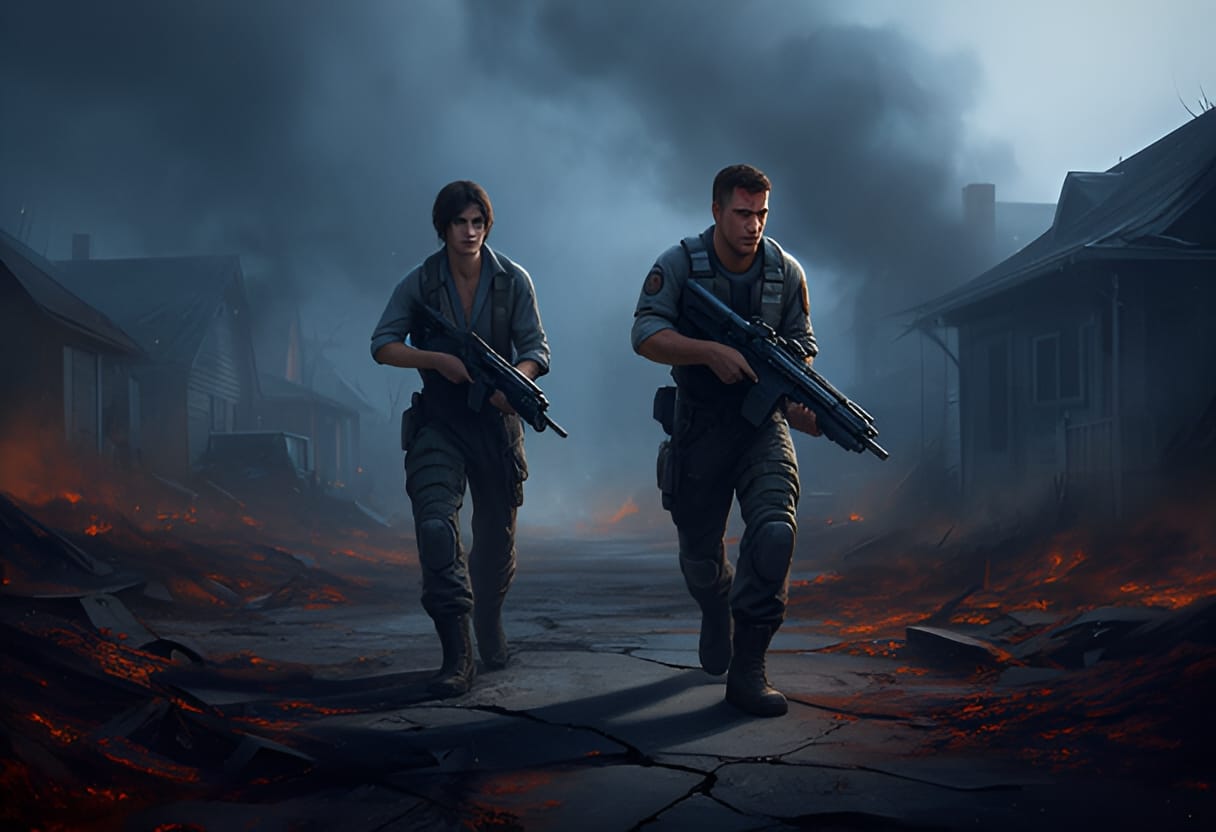
Chapter 2
Asphalt and Ash
The squad moved through the eastern suburbs like ghosts through ash. Smoke hung low, clinging to the cracked pavement and the skeletal remains of storefronts whose windows yawned empty or were boarded with splintered wood. The air tasted of burnt insulation and something sharper—ozone, maybe, or the metallic tang of blood already dried on stone. Kryll had thinned since the ravine, but not vanished. They drifted in lazy eddies above the rooftops, like smoke given hunger, waiting for a pulse to flare.
Zay led, his boots scraping over broken concrete, his Lancer held low but ready. Alex walked just behind him, shoulder nearly brushing his brother’s, eyes flicking between the shadows under collapsed awnings and the gaps between buildings where sewer grates gaped like black teeth. Mara Velez brought up the rear with Jace Stratton and Dominik Santiago, their steps uneven, burdened not just by gear but by the weight of civilians they’d shepherded this far—though now, the line of survivors had dwindled to nothing. The last of them had peeled off two blocks back, ducking into a collapsed subway entrance with murmured thanks and wide, terrified eyes. No one had stopped them. There was nowhere else to go.
“School’s up ahead,” Zay said, voice quiet but clear. “St. Cyril’s. Basement’s supposed to be sealed—old civil defense spec. Thick door, air vents high up. If it’s still intact…”
“If it’s not full of Locust already,” Alex finished, his tone flat. He didn’t need to finish. They all knew.
They moved faster now, crouching behind the husk of a delivery truck whose tires had melted into the asphalt. From there, they saw it—the school. Once a proud neoclassical façade with fluted columns and a triangular pediment, now half-collapsed. The roof had caved in near the gymnasium, dragging down the second floor into a jagged heap of concrete and twisted rebar. But the west wing, where the basement entrance lay beneath a set of stone steps, still stood, though scarred. Black soot streaked the walls like fingernail drags. One of the columns was split clean through, as if struck by something immense.
They crossed the open ground in rushes, dropping behind a low wall that had once been a fence. No fire came. No movement. Just the distant, irregular pop of small arms fire from somewhere near the rail yards, and the constant, subsonic thrum of Seeders burrowing deeper beneath the city.
Zay reached the steps first. He paused, listening. Nothing but the wind through broken glass and the far-off cries of something inhuman—maybe a Boomer clearing its throat, maybe a wounded Drone calling for its pack.
He signaled: Clear?
Alex shook his head. Can’t tell.
They went down together, Velez and the others close behind. The basement door was steel-reinforced, set into the concrete frame of the old foundation. It stood slightly ajar, a gap of maybe six inches at the top, just enough to slip a hand through—or a barrel.
The air that leaked out was warm and thick. It carried smoke, yes, but beneath it—something sweeter, fouler. The smell of cooked meat. Of urine and fear. Of blood that had soaked into concrete and begun to sour.
Zay pressed his back to the wall beside the door, Lancer raised. Alex mirrored him on the other side. Dominik Santiago stepped forward, his expression grim, his rosary beads clenched in one fist. Jace Stratton crouched low, weapon ready. Mara Velez stood just behind them, one hand on her radio, the other gripping her Lancer so tight her knuckles whitened.
“On three,” Zay whispered.
Alex nodded.
“One… two… three.”
Alex kicked. The door burst inward with a scream of torn hinges, slamming against the interior wall with a crash that echoed down the stairwell and into the dark beyond.
For a heartbeat, nothing.
Then—movement.
Shapes lunged from the gloom.
Not civilians.
Locust Drones—three of them, broad-shouldered and snarling, their rifles already spitting. Boltok rounds cracked the air, supersonic and brutal, chipping concrete near Zay’s ear. One Drone dragged a woman by the hair, her boots scraping as she kicked and screamed. Another had a man by the wrist, twisting it upward until the bones must have snapped. The third stood over a child no older than six, who cowered beneath a overturned desk, eyes wide and silent.
Alex didn’t hesitate. He swung his Lancer up and fired—a short, controlled burst. The chainsaw bayonet screamed as it tore into the nearest Drone’s throat, spraying dark blood across the concrete. The creature gargled, staggered, and fell.
Zay fired too, his Lancer bucking as he caught the second Drone in the chest. The rounds punched through armor and flesh, spinning it sideways. It crashed into the wall, sliding down leaving a smear of black and red.
The third Drone turned, Boltok raised—but Dominik Santiago was already moving.
He didn’t shout. Didn’t yell a prayer or a curse. He just lunged, shoulder first, driving into the Drone’s midsection with the force of a tackle. The Locust stumbled back, roaring in surprise, its weapon firing wild— a bolt seared the plaster above the door.
Dominik didn’t stop. He grabbed the child by the wrist and yanked her clear of the desk, throwing her behind him toward the stairwell where Jace and Velez stood. Then he turned, planting himself between the Drone and the girl, arms wide, body low—a shield.
The Drone recovered fast. It raised its Boltok again, aiming not at Dominik’s chest, but at his head— a killing shot.
But Dominik didn’t flinch.
He whispered something—maybe a name, maybe a plea—and stepped forward, not away.
The Boltok fired.
The round caught him square in the chest, just above the heart. It didn’t explode—it punched, a thick, armor-piercing slug that drove through his ribs and out his back in a spray of blood and bone fragments.
Dominik Santiago didn’t scream.
He gasped—once, sharply—and then his knees buckled. He fell forward, landing on his hands and knees, head bowed. For a second, he stayed like that, as if praying. Then he toppled sideways, landing hard on his side, the rosary beads scattering across the concrete like broken teeth.
The girl he’d shoved to safety scrambled backward, sobbing, her small hands clawing at the floor.
The Drone advanced, Boltok cocked for another shot.
Alex was on it before it could fire.
He didn’t aim. He didn’t need to. He charged, Lancer roaring as the chainsaw bit into the Drone’s shoulder, carving down through clavicle and rib, exiting near the hip in a fountain of gore and shattered bone. The Locust screamed—a high, tearing sound—then collapsed, twitching.
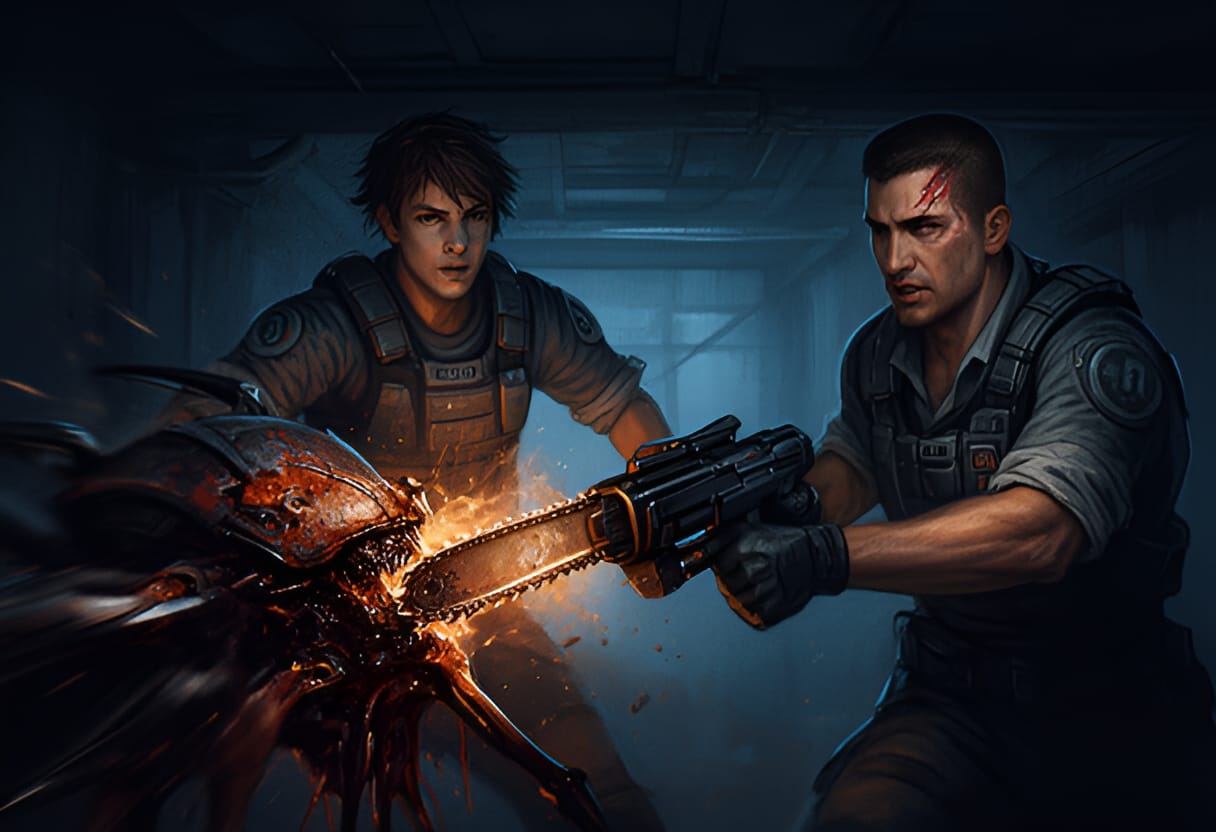
Zay finished the last one with a burst to the temple. It dropped without a sound.
Silence fell, thick and heavy. Only the girl’s sobs broke it, raw and terrified.
Zay lowered his weapon. His breath came hard. He stared at Dominik’s body—at the way his fingers were curled slightly, as if still holding onto something. The rosary lay nearby, the cross glinting dully in the dim light that filtered in from the stairwell.
Alex knelt beside the girl. She was maybe five, her dress torn, one shoe missing. Her face was streaked with tears and dirt, but her eyes—wide, dark, locked on him—held no recognition, only fear.
“Hey,” Alex said, voice soft, uncharacteristically gentle. “Hey, it’s okay. You’re safe now. I’m Alex. This is my brother, Zay. We’re gonna get you out.”
She didn’t answer. Just shook her head, pressing herself harder against the concrete wall.
Alex didn’t push. He just stayed there, kneeling, one hand resting lightly on his thigh, the other open and empty in his lap— a silent offering.
Zay checked the others. The woman the Drone had dragged was alive, though dazed, her scalp bleeding where she’d been pulled. The man with the twisted wrist was unconscious but breathing. No others were visible—just shadows in the corners, huddled behind debris, too afraid to move.
“Clear?” Velez asked, her voice tight. She hadn’t lowered her weapon. Her eyes flicked to Dominik’s body, then away, hard.
“For now,” Zay said. He looked at the door they’d come through—the stairwell leading back up to the street. “But not for long. They’ll have heard that.”
Alex stood, still keeping his voice low. “We need to get these people out. Now.”
Velez nodded. “We can’t stay. The basement’s got only one way in or out—and it’s the way we came in. If they seal the top, we’re trapped.”
“We go to the river,” Zay said. “The outflow’s close. We follow the storm drain west, get to the river, follow it south to the bridges. If we can hold the crossing long enough—”
“If,” Velez cut in, her voice cracking just slightly. “If we can make it there. If the bridges aren’t already gone. If the Locust aren’t waiting on the other side.”
She looked at them then—really looked. Her gaze swept from Alex’s grim set jaw to Zay’s clenched fists, then flicked to the civilians huddled in the dark. She swallowed hard.
“We fall back to the river bridges,” she said. “That’s the order. Move fast, stay low, and don’t look back. If you see a flare—green—hold position. If you see red—run.”
Alex met her eyes. “Copy that.”
Zay gave a single nod.
Velez turned to the civilians. “You heard him. Follow my lead. Stay close. Don’t stop for anything. If you fall, keep crawling. We’re not leaving anyone behind—but we have to keep moving.”
She looked at Dominik’s body one last time. Her jaw tightened. Then she looked away.
“Let’s go.”
They moved in a tight formation—Velez and Jace up front, then the civilians in the middle, the twins bringing up the rear. Alex paused only long enough to scoop up the girl’s lost shoe and press it into her hand. She didn’t look up, but she clutched it tight.
As they reached the stairwell, Zay paused at the bottom step. He looked back at the basement.
Dominik Santiago lay where he’d fallen, one arm flung out, the other curled near his chest. His eyes were open, staring at the ceiling—unseeing.
Zay felt something twist in his chest. Not grief, not yet. Not the kind that broke you. Something harder. Colder. A kind of resolve forged in the moment between breath and breath, when you realize the world has stopped making sense—and you decide to keep moving anyway.
He turned and began to climb.
The stairs were narrow, steep, choked with dust and fragments of broken brick. They emerged into the late morning light—pale, washed out, the sun struggling through a haze of smoke and Kryll-dusted air. The school stood silent behind them, its wounds open to the sky. No alarms rang. No Locust poured out. Just the wind, and the distant, endless thrum of the war beneath their feet.
They moved west, toward the rail yards, toward the old water treatment outflow, toward the storm drain that Zay remembered from patrols—narrow, forgotten, but still there, still whole.
Alex walked beside him. Neither spoke. But after a while, Alex nudged his shoulder—just barely—and when Zay glanced over, he saw it: the ghost of a smile. Not the usual smirk. Not the shield. Something quieter. Something real.
Zay nodded. Almost imperceptibly.
And they kept moving.
Because the fight wasn’t just about surviving the day anymore.
It was about learning how to fight differently.
And if the Locust were adapting…
Then so would they.
The sun had climbed higher, but the light still felt thin, strained through layers of ash and drifting Kryll that clung to the lower altitudes like smoke without fire. The squad moved in silence now, boots scraping over rubble, weapons low but ready. The civilians followed in a ragged line—men, women, children—faces hollow, eyes darting. No one spoke. No one cried aloud. Fear had settled into their bones, heavy and quiet.
Zay led, eyes scanning not just for threats, but for signs—disturbances in the dust, unnatural stillness in the air, the way shadows pooled too deep in alleyways. He knew the route: past the shuttered textile mill, its windows boarded but for jagged holes where something had punched through; then the old rail spur, half-buried in debris from a collapsed overpass; then the concrete embankment that ran alongside the dry canal, where the storm drain grate waited, half-hidden beneath a slab of fallen façade.
They passed a storefront with its glass shattered inward. Mannequins lay on the sidewalk, one missing an arm, its plastic face smeared with soot. A child’s shoe lay nearby—small, pink, stuffed with dirt. Alex glanced at it, then looked away fast. His jaw tightened. He didn’t say anything, but Zay saw the way his fingers flexed on his Lancer grip—white-knuckled, then loose, then tight again.
They turned the corner onto the rail spur.
And stopped.
The tracks were gone.
Not just damaged—taken. Sections of steel torn clean from the ties, dragged sideways or piled in grotesque heaps like kindling. The ties themselves were splintered, some burned black at the ends. And in the center of the destruction, half-buried in rubble, lay the carcass of a Seeder—its armored carapace cracked open, limbs splayed, internal fluids long since drained into the earth. Around it, the ground was pitted with small craters—mortar impacts, maybe. Or something worse.
Alex crouched, fingers brushing the edge of a torn rail. “This wasn’t just a stray shot,” he murmured. “This was deliberate. They’re not just fighting us. They’re remaking the ground.”
Zay stood rigid, Lancer sweeping left and right. “They’re cutting off routes. Forcing us into kill zones. Or herding us toward something.”
Jace spat onto the ballast. “Either way, we’re fucked if we try to cross here.”
Velez stepped forward, ignoring the debris, her eyes fixed on the Seeder’s corpse. “Check for movement. Drones like to play dead.”
They fanned out, weapons sweeping. No heat signatures. No twitch. Just the slow seepage of fluid from ruptured lines, staining the soil a sickly iridescent green-black.
“Clear,” Zay said after a moment. “But this changes things. We can’t follow the rail line west. Too exposed.”
Alex stood, wiping his hands on his trousers. “So we go off-track. Through the backstreets. Use the mill as cover, cut south toward the canal, then pick up the drain where it runs under the old foundry.”
Velez nodded. “Make it quick. The longer we’re in the open, the more likely they’ve got eyes on us.”
They moved again, but slower now, more cautious. The mill loomed ahead—a long, low building of brick and corrugated iron, its roof partially caved in, one wall blown outward in a jagged maw. Smoke still curled from its broken windows, not flame, but a slow, oily seep—like the building itself was sweating toxins.
They slipped inside through the gap in the wall.
The interior was dim, lit only by shafts of light that pierced the roof holes like fingers. The air was thick with lint, oil, and something acrid—burnt rubber, maybe, or melting plastic. Rows of looms stood silent, some toppled, others still standing like skeletal sentinels. Bolts of fabric lay in heaps, damp and moldy in places, dry and brittle in others. The smell of mildew rose from the floor in places where water had seeped in and never left.
They moved swiftly down the central aisle, civilians pressed close to the walls, children clutching adult hands so tight their knuckles blanched. Alex kept near the front, Zay at the rear, both Lancers ready, eyes flicking to the shadows between machines, to the dark spaces beneath workbenches, to the corners where darkness pooled like liquid.
A scuttle in the fabric pile to the left.
Alex froze.
Zay’s Lancer swung toward the sound.
A rat darted out—large, fur matted with grease—and vanished beneath a overturned cart.
Alex exhaled, slow and sharp. “Jesus. I swear to God, if I have to shoot another rat today—”
He didn’t finish. A sound cut him off—not from the front, not from the sides.
From above.
A soft, wet rip—like canvas tearing.
Then another.
And another.
Zay’s head snapped up.
The roof—where the light poured in—was moving.
Not falling. Not collapsing.
Flowing.
A sheet of Kryll, thin but vast, had slipped through the broken roofing and was now drifting downward like a slow-motion shadow-waterfall, pooling along the upper beams, coiling around the hanging pulleys, dripping in slow strands toward the floor.
They were drawn to heat. To breath. To pulse.
And down here, in the stale dark, they were starving.
“Down!” Zay yelled—not a whisper now, but a command, raw and urgent.
He didn’t wait to see if they obeyed. He dropped, sliding on his belly beneath the nearest loom, Lancer held tight to his chest, breathing shallow through his nose. Alex went down beside him, pulling the girl with him—she didn’t resist, just buried her face in his shoulder, trembling.
Velez and Jace shoved two women and an old man beneath a workbench. The others followed—crawling, scrambling, some crying out as they hit concrete or scraped their knees on metal.
Then the Kryll touched the first loom.
It didn’t swarm. It didn’t rush.
It flowed.
Like ink dropped in water, the shadow spread across the metal frame, seeping into the cracks, climbing the threads of the fallen fabric. Where it passed, the metal darkened—not rusted, not burned, but consumed, as if the Kryll were eating not the substance, but the energy held within it—the residual heat, the latent motion, the echo of use.
And then it began to rise.
Not as a cloud. Not as a mass.
As tendrils.
Thin, whip-like strands of living shadow lifted from the surface, swaying like seaweed in a current, probing, searching. One lashed out—just a flicker—toward the place where a man had just pushed himself up onto his elbows.
It struck his forearm.
He jerked back with a choked gasp—not of pain, but of loss. The skin where it touched went instantly gray, then black, not burned, but desiccated, as if every molecule of warmth and motion had been sucked out in an instant. His arm went limp. He stared at it, eyes wide, mouth opening and closing like a fish.
Then another tendril struck—this time at his throat.
He didn’t scream. He just folded, collapsing sideways, eyes rolling back, breath stopping mid-exhale.
The Kryll retracted slightly, the tendrils recoiling like struck snakes, then flowed back toward the main mass, carrying the stolen warmth with them—making the shadow pulse, faintly, like a slow heartbeat.
Silence fell again—but different now. Not the silence of hiding. The silence of after.
Zay lay still, cheek pressed to the gritty concrete, heart hammering against his ribs. He could feel the Kryll above—not as sound, but as pressure, a subtle shift in the air, like the moment before lightning strikes. He didn’t dare breathe deep. Didn’t dare blink too slow.
Alex was beside him, face inches away. His eyes were wide, not with fear, but with something colder—recognition. Understanding.
They’re not just attacking, his gaze seemed to say. They’re learning. They’re adapting. They’re figuring us out.*
A child whimpered nearby—soft, terrified.
Zay risked a flicker of his eyes.
The girl from the basement—she was pressed against Alex’s side, her small hand fisted in his shirt. Her eyes were locked on the ceiling, wide and unblinking. Not screaming. Not crying. Just watching. As if she understood, in some bone-deep way, that to make a sound was to invite death.
He met Alex’s gaze again.
Alex gave the tiniest shake of his head.
Don’t move. Don’t breathe loud. Don’t even think loud.
Zay nodded—just a twitch of his chin.
They waited.
The Kryll mass above shifted, undulating like a slow tide. Tendrils extended, retracted, probed the shadows below—testing, sampling. One drifted down, slow and curious, stopping just above the loom where Zay lay. It hung there, quivering, as if listening.
Then—movement.
Not from them.
From the other side of the mill.
A boot scraped on concrete.
A muffled curse.
A voice—low, strained—“Come on, come on…”
A man. Civilians. One of the women who’d lagged behind, trying to help an elderly neighbor who’d slipped and couldn’t get up.
They were trying to rise.
Zay’s blood turned to ice.
He opened his mouth to shout a warning—
But Alex’s hand shot out, clamping over his mouth—not hard, but firm, fingers pressing just enough to silence without bruising. His eyes locked onto Zay’s—pleading, desperate.
Don’t. If you shout, you kill them all.
Zay froze.
Above, the Kryll tendril twitched—then lunged.
Not at the loom.
At the sound.
It shot downward like a striking viper, fast and silent, wrapping around the woman’s ankle as she tried to lift her neighbor.
She screamed—a short, sharp thing, cut off instantly.
The Kryll flowed up her leg in a rushing tide of shadow, swallowing her calf, her thigh, her waist—then her chest, her shoulders, her face. It didn’t tear. Didn’t rip. It engulfed, flowing over her like liquid night, sealing her mouth, her nose, her eyes. In seconds, she was gone—not a corpse, not a wound, but a void where a person had been, the shape of her still visible in the Kryll-mass for a heartbeat before the shadow flowed smooth again, whole and hungry.
The man beside her stumbled back, face ashen, dropping the old woman’s hand. He didn’t run. He just stood there, trembling, staring at the empty space where his companion had been.
The old woman began to whimper—a soft, broken sound.
The Kryll sensed it.
A tendril shot out—not toward her, but toward the noise.
It struck the man’s wrist as he raised his hand to his mouth to stifle a sob.
He jerked—then went rigid. The shadow flowed up his arm, over his shoulder, across his chest. He didn’t fall. He stiffened, standing straight as a statue, eyes wide and unseeing, mouth open in a silent scream that would never come.
Then the Kryll flowed through him—not around, but through, as if his body were no more substantial than smoke. When it passed, he didn’t collapse. He simply… ceased to be. A faint outline of his shape lingered in the air for a breath, then dissipated like mist in sun.
The old woman stopped whimpering.
She just sat there, rocking slightly, staring at her lap.
The Kryll mass above shuddered—then began to descend, not in a rush, but a slow, inexorable sink, like a ceiling lowering in a tomb.
They had seconds.
Maybe less.
Zay’s mind raced. Fire? No—too slow, too risky in a building full of lint and oil. Grenades? They had two frags between them—too precious to waste on a blind blast in close quarters. Firearms? Boltok rounds might punch through, but the Kryll would just flow around the impact, reforming instantly. Lancer fire—same issue. The chainsaw would tear, but the Kryll weren’t solid. They were flow. Like trying to cut mist with a blade.
Unless…
Unless you could burn it.
Not with bullets. Not with blades.
With heat. Real, sustained, overwhelming heat.
The kind that didn’t just damage—but denied.
He thought of the Seeder’s fluid—green-black, iridescent, still warm in the corpse outside. He thought of the way the Kryll had recoiled from the explosion of the pod back at the armory—not just from the blast, but from the sudden, violent disruption in the air. From the heat and pressure and light.
He thought of the Lancer’s chainsaw.
Not as a weapon.
As a source.
The chainsaw didn’t just cut. It frictioned. It sparked. It threw off molten metal fragments, superheated air, a brief but intense burst of thermal energy—enough to ignite loose fuel, to scorch flesh, to make the air shout.
If he could get enough of them running at once—if he could create a wall of heat and noise and light—maybe, just maybe, he could make the Kryll recoil. Not destroy them. Not permanently. But break the flow. Make them hesitate.
Long enough to get out.
He looked at Alex.
Alex was already watching him.
No words.
Just eyes.
Zay gave the tiniest nod—now?
Alex nodded back.
Then, slowly, deliberately, Alex began to move.
Not toward the exit.
Toward the center of the room.
He slipped free from under the loom, low and slow, keeping his body shadowed by the machinery. The girl didn’t make a sound—just curled tighter, her face buried in his shoulder.
Zay followed, crawling on his belly, Lancer held under him, muzzle pointed forward, ready.
They moved toward the nearest loom—the one that had been struck first, its metal still faintly warm from where the Kryll had touched it.
Alex came up to a kneel behind it, one hand gripping the frame, the other on his Lancer’s trigger.
Zay mirrored him on the other side.
Velez saw them. Her eyes flicked to their position, then to the Kryll mass above—now low enough that its tendrils were brushing the tops of the tallest machines, probing downward like fingers testing the temperature of a bath.
She caught Zay’s gaze.
He gave the barest lift of his chin.
Ready?
She nodded—once.
Then she turned her head and shouted—not a warning, but a command, loud and sharp, cutting through the silence like a blade:
“NOW!”
Alex and Zay didn’t hesitate.
They swung their Lancers up and hit the trigger.
The chainsaws screamed to life—not a idle whine, but a full-throated, teeth-baring roar, blades spinning at ten thousand RPM, throwing off sparks that flew like molten stars.
And they cut.
Not at the Kryll.
At the loom.
Alex drove his blade into the wooden base, splintering it, sending chunks flying. Zay did the same on the other side. Then they began to saw—not through, but along, tearing lengthwise through the frame, shredding the wood, snapping bolts, sending showers of hot metal fragments into the air.
The noise was deafening—a dual scream of tearing steel and burning rubber, of sparks flying and chains kicking back. The air filled with the smell of ozone and scorched wool and hot oil.
And above them—
The Kryll jerked.
Not in pain.
In surprise.
The tendrils that had been probing downward whipped back as if struck, the main mass shuddering, rippling like a pond hit by a stone.
Then—another volley.
Zay and Alex didn’t stop. They kept sawing, kept sparking, kept throwing light and heat and violent motion into the air. Velez joined them, firing her Lancer in short bursts—not to hit, but to flash, the muzzle flare blinking like a strobe. Jace did the same, yelling incoherently as he walked forward, Lancer blazing, driving the Kryll back from the western wall.
The Kryll didn’t flee.
They recoiled.
The mass pulled upward, tightening, coiling, the tendrils snapping back like startled snakes. The flowing shadow thickened at the core, becoming denser, darker—resisting. But it didn’t advance. It held, pulsing, as if weighing the cost.
And in that hesitation—
The civilians moved.
Velez screamed, “GO! GO! GO!”
They didn’t run. They flowed—crawling, scrambling, helping each other, the strong dragging the weak, the adults shielding the children with their bodies. The girl was passed from Alex to a woman who clutched her to her chest and moved low, head down. The old woman was lifted by two men, her feet dragging, her eyes empty but her breath still coming.
Zay and Alex kept the saws screaming, kept the sparks flying, kept the light flashing—creating a false dawn in the heart of darkness.
Then, as the last civilian cleared the doorway and stumbled into the weak morning light outside, Velez gave the signal.
She slapped her Lancer against her thigh—once, twice.
Fall back.
Alex and Zay killed the saws.
The noise cut off abruptly.
Silence crashed back—deeper now, louder in its absence.
The Kryll mass above didn’t rush in.
It hesitated.
As if confused. As if the sudden violence of light and heat had disrupted its sense—its hunger—made the prey seem… not worth the cost.
Then, slowly, it began to retreat—not in fear, but in recalculation. It flowed back up toward the broken roof, slipping through the gaps like smoke returning to the fire, thinning as it went, until only a faint smudge remained in the high shadows—then nothing.
Silence.
Real silence this time.
No buzzing. No scraping. No breath.
Just the ragged panting of survivors, the drip of water from a broken pipe, the distant, endless thrum of war.
Alex pushed himself up on his knees, braced with one hand on the loom. He was shaking—not from exertion, but from the aftermath. His face was slick with sweat and something else—grief, maybe. Or the ghost of fear, still clinging.
Zay stayed down a moment longer, forehead resting on his forearm. He could still feel it—the Kryll’s presence, not as sound, but as a absence in the air, a place where warmth had been stolen and not yet returned. He pressed his palm flat to the concrete, feeling the slow seep of moisture from below, the vibration of distant impacts through the earth.
Then he pushed up.
They met at the doorway.
The civilians were already moving west, hugging the wall of the mill, eyes down, feet shuffling. No one spoke. No one looked back at the building.
But Zay did.
He glanced over his shoulder.
The mill stood silent, its wounds gaping. The roof was still open to the sky. And in the darkness within, where the Kryll had flowed, the air seemed… thinner. Cooler. As if something vital had been sucked out and not yet replaced.
He turned away.
They fell into step behind the group, moving slowly, carefully—no sudden moves, no loud noises. The Kryll were still out there. Still watching. Still learning.
But so were they.
Alex fell into step beside him. After a while, he said, voice low, rough, “You had a plan back there.”
Zay didn’t look at him. “Not a plan. A guess.”
Alex glanced at him—really looked. “It worked.”
Zay kept his eyes forward. “For now.”
They passed the burned-out husk of a bus, its tires melted into the asphalt, its frame twisted like a broken spine. A child’s doll lay in the gutter beside it—one eye missing, its smile cracked.
Alex didn’t see it. Or if he did, he didn’t react.
They kept walking.
Past the cannery, its silos ruptured, yellow grain spilling like rotten teeth into the street.
Past the barber shop, the striped pole still standing, though the glass was gone and the chair inside lay overturned, a single shoe tucked beneath it.
They turned south onto the canal embankment.
And there it was.
The storm drain grate.
Half-buried under a chunk of fallen cornice, but visible—the iron ribs, the rust, the familiar pattern Zay remembered from patrols. Big enough to crawl through. Grates every fifty meters—just as he’d said.
He went to it, dropped to his knees, and began to pry at the edges with his knife and the butt of his Lancer.
Alex came over, took the other side.
Together, they heaved.
The grate groaned—then shifted.
With a final shove, it tilted and slid aside, revealing the darkness below—a narrow passage, just tall enough to crawl on hands and knees, just wide enough to shoulder through. The air that came up was cool, damp, smelling of stone and stagnant water and something older—ozone, maybe, or the faint metallic tang of deep earth.
Velez arrived, breathless. “Is this it?”
Zay wiped his hands on his trousers. “This is it.”
She looked down into the hole. “How far?”
“To the river. About eight hundred meters. Maybe less if the line’s intact.”
She nodded. “We go in. Civilians first. Twins and I bring up the rear. Jace—you take point with the first group. Keep it quiet. No talking. No lights. If you hit a blockage, signal—three taps on the wall. We’ll come back and clear it.”
Jace saluted weakly. “Copy.”
They began to move.
One by one, the civilians slipped into the drain—men, women, children—some hesitating at the edge, peering into the black, others going down without a word, as if surrendering to the dark was easier than facing the light.
Zay watched them go.
Alex knelt beside him, handing him a spare magazine. “You good?”
Zay checked the weight in his palm. “Yeah. You?”
Alex tapped his chestplate, over his heart. “Still here.”
Zay managed a faint smile. “Good. Keep it that way.”
They waited until the last civilian disappeared into the hole—an old man who paused at the lip, looked back once at the mill, then lowered himself in without a word.
Then Velez descended.
Jace went next, disappearing into the dark with a soft scrape.
Only the twins remained.
Zay looked at Alex.
Alex looked back.
No words were needed.
They had survived the school. They had survived the mill. They had seen friends die. They had seen strangers live.
They had fought not just with guns, but with wit, with timing, with the quiet understanding that passed between them like breath.
And now—
They were going underground.
Not to hide.
But to move.
To find a way forward.
To keep the promise.
Zay slipped his Lancer to his chest, lowered himself into the drain, and pulled the grate back into place behind him.
The darkness swallowed them whole.
But ahead—faint, distant, almost imagined—there was a draft.
A movement of air.
A way out.
And for now, that was enough.
They began to crawl.
Forward.
Always forward.
They emerged from the drain into a back-alley choked with fallen branches and shattered glass. The storm drain’s mouth gaped behind them like a wound in the earth, half-swallowed by weeds and rubble. Above, the sky was a bruised violet, streaked with ash that fell slow and silent, coating their armor, their hair, the cracked sidewalks. The city exhaled heat and rot.
Zay wiped grime from his visor with the back of his glove. His fingers came away streaked with soot. He could still taste the damp stone of the drain on his tongue—mineral and ancient, like licking the inside of a tomb.
Alex fell into step beside him, Lancer at the ready, chainsaw whining faintly as he idled it. “Smells like someone left the gas on in hell,” he muttered, voice low. “Only worse.”
Zay didn’t answer right away. He was watching the alleys—narrow passages between row houses, their back doors hanging open, curtains fluttering like ghosts in windows long abandoned. Gardens lay in ruin: tomato vines trampled, flowerbeds churned into mud, a child’s red wagon overturned near a fence, one wheel spinning lazily in a breeze that carried the scent of burnt wiring and something worse—organic, sweet, decaying.
“Nature’s taking it back,” Alex said after a beat, nodding at a fig tree splitting through a patio slab, its roots heaving the concrete like bones breaking skin. “Suburbs never stood a chance. We paved over paradise, and now it’s coming up through the cracks.”
Zay glanced at him. For a moment, the exhaustion in his brother’s eyes softened—just a flicker—before the old guard slid back into place. Then, quiet but clear: “You sound like a damn hippie.”
Alex barked a laugh—short, sharp, surprised. “Me? Nah. I just hate when the grass wins.”
They moved on, boots crunching over broken tile and gravel. The squad fanned out slightly, using the cover of yards and alleyways to skirt the main avenues where Locust patrols moved like shadows between burning storefronts. Velez led, low and alert, her rifle scanning rooftops. Jace followed, favoring his left leg slightly—a twitch in his step from whatever nick he’d taken earlier. Dominik brought up the rear with the civilians, his hands steady on his Lancer despite the tremor in his jaw.
A woman clutched a bundle of blankets to her chest, her bare feet bleeding where they’d stepped on glass. An old man leaned on a cane, his eyes darting left and right as if expecting hands to grab him from the shrubbery. A boy no older than ten kept glancing back at the smoke rising from the mill, his lips moving in silent prayer.
Zay caught Alex’s eye. His brother gave the tiniest shake of his head—don’t look back. So Zay didn’t. He kept his gaze forward, scanning for movement, for the glint of metal in a window, for the telltale bulge of a Drone crouched behind a hedge.
They turned a corner into a wider alley, flanked by the hollowed-out shells of a bakery and a tailor’s shop. Oven doors hung open, blackened within. Mannequins lay on their sides in the gutter, one missing an arm, its face cracked like porcelain. Thread spools spilled from a ruptured display, rolling like marbles toward the drain.
A sudden crack—sharp, close—made them all hit the ground.
Dust exploded from the wall beside Jace’s head as a Boomer round detonated ten meters out, blowing a chunk from the brick facade. Plaster and grit rained down, stinging their eyes, coating their lips. The concussion shoved the air from Zay’s lungs like a fist to the chest.
He blinked, vision swimming. When it cleared, he saw the Boomer—massive, armored, its grenade launcher still smoking—stepping into the alley’s mouth, flanked by two Drones skittering low behind overturned trash carts.
“Contact front!” Velez hissed, already rolling to her knee, Lancer spitting tracer.
Alex was moving before the words finished—low, fast, sliding on his belly behind a broken water main. He came up on the Boomer’s blind side, chainsaw screaming as he tore into the joint of its arm guard. Metal shrieked. Sparks flew. The Boomer roared, swinging its launcher wildly—only to catch Jace in the ribs as he lunged from the opposite side, Lancer butt driving into its throat.
The beast staggered, blood bubbling at its lips. Dominik fired a burst into its eye slit. The Boomer jerked, then fell sideways, crushing a hibiscus bush under its weight.
Silence. Thick. Heavy. Only the hiss of cooling metal and the ragged breath of the squad.
Alex pushed himself up, wiping sweat and dirt from his chin. His Lancer dripped coolant and something darker. He looked at Zay, eyes bright despite the grime. “Told ya I’d watch your flank.”
Zay met his gaze. For the first time since the mill, since the drain, since the doll in the gutter—he let himself smile. Not much. Just a twitch at the corner of his mouth. “Yeah. You did.”
They didn’t linger. Velez was already waving them forward. “Move! Civilians are at the drain—we’ve got seconds before more come!”
They ran.
The storm drain lay half a block ahead, its grate half-lifted where they’d left it—a jagged wound in the sidewalk leading down into darkness. Civilians were already slipping through, guided by Jace and Dominik, their faces pale in the dim glow of emergency lights still flickering in some distant block.
An elderly woman struggled with the descent, her skirts snagging on the edge. Zay knelt, took her wrists, and lowered her slow, whispering, “Easy now. We got you.”
Alex covered the rear, Lancer sweeping the alley, ears straining for the whine of engines, the click of claws on stone.
A child’s shoe lay in the gutter—small, blue, lace still tied. Alex didn’t see it. Or if he did, he didn’t break stride.
They got the last civilian through—a man with a bandaged head, muttering about his pharmacy—then began to pull the grate back into place.
Zay heaved. Alex braced against the opposite side. The iron groaned, rust flaking from its hinges. It settled with a final clang, sealing them in darkness above, but not below.
Below, the air moved. Cool. Stirring.
They’d bought time.
But not much.
They rose, weapons up, and moved toward the river.
The alleys gave way to a broader thoroughfare—Eastern Avenue, once lined with sycamores and cafés, now a canyon of broken glass and overturned cars. Fires burned in storefronts, sending orange tongues licking the sky. The air shimmered with heat. Somewhere, a Seeder hissed in the distance, its bio-acid eating through concrete.
They moved fast, low, using the wreckage for cover. A Drone popped up behind a flipped bus—Alex dropped it with a burst to the throat before it could raise its weapon. Another tried to flank from a second-story balcony—Zay caught the glint of its armor and put a round through its eye as it leaned too far out.
They crossed an intersection littered with shell casings and a melted motorcycle, its frame fused to the asphalt. A radio lay nearby, still crackling—half-heard voices in static: “…requesting evac… repeat, civs trapped…”—then nothing.
At the river’s edge, the world opened up.
The Imulsion River stretched before them, black and oily under the ash-choked sky, its surface broken by the twisted remains of the pontoon bridge. Sections had collapsed or been blown apart, leaving jagged gaps where the deck had fallen into the toxic water. Fires burned on the far bank, illuminating the skeletal remains of a bus depot.
And the Locust were already there.
Drones moved along the ruined span, laying down suppressing fire. Boomers lobbed mortar-like grenades that exploded in geysers of black water and flame. Kryll began to gather—not yet a swarm, but a thickening shadow along the far shore, drawn to the heat, the pulse, the scent of life in the open.
Velez stood at the water’s edge, binoculars pressed to her face. Her shoulders were rigid. Her knuckles white on the grips.
Zay and Alex came up beside her, breathless, rifles ready.
She lowered the glasses slowly. Her face was streaked with soot and something that might have been tears—or just sweat and grime. She didn’t wipe them away.
“The bridge,” she said, voice flat. “It’s under direct fire. No way across without getting picked off.”
Alex peered past her. “We could try the storm drain line—Zay said it runs parallel. Maybe it comes out upstream?”
Zay shook his head, already calculating. “Too risky. We don’t know where it exits. If it dumps us right into a nest…”
Velez didn’t answer. She lifted her radio, thumb pressing the call button. “This is Velez to Command. Squad’s at the river bridge. Requesting immediate artillery support on east bank—coordinates marked. Repeat, we need fire now. Over.”
She waited. Ten seconds. Fifteen.
Only static answered.
She tried again. “Command, this is Velez. Do you copy? We are taking heavy casualties. Request fire support. Over.”
Nothing. Just the hiss of dead air.
Her jaw tightened. She lowered the radio. Looked at them—really looked—her eyes moving from Zay to Alex to Jace, who leaned against a broken lamppost, face grim, to Dominik, who clutched his rosary so hard his knuckles blanched.
Then she looked past them, toward the civilians still huddled in the shadows behind the wreckage, women holding children, men staring blankly at the burning bridge.
Her voice, when it came, was quiet. Raw. “We hold here. As long as we can. Let the civilians find another way—through the drain, maybe, or the old maintenance tunnels. We’ll buy them time.”
Alex opened his mouth—probably to protest, to say we can still make it—but Zay put a hand on his arm. Shook his head once.
Alex looked at him. Saw the resolve in his brother’s eyes—not despair, not yet, but acceptance. The kind that comes when you’ve seen too much and still choose to stand.
He nodded. Tight. Hard.
Velez turned back to the river. Raised her binoculars again. Watched the Locust move like ants across the broken bridge, their silhouettes jerking in the firelight.
And somewhere behind them, in the dark beneath the city, the storm drain waited—quiet, empty, ready to swallow whoever dared to descend.
The first mortar hit the water twenty meters out—a plume of black oily water and flame that boiled upward like a dying star. Shrapnel sang through the air, peppering the far bank with molten stone. A second round followed, then a third, walking the explosions closer to shore. The Locust weren’t just holding the bridge—they were softening them up for something bigger.
Zay dropped to one knee behind the rusted husk of a delivery van, its tires long gone, its frame twisted like a wishbone. Alex was beside him, Lancer braced against the chassis, chainsaw idle but ready. Velez crouched near the river’s edge, binoculars still in hand, watching the far shore with a grim intensity. Jace and Dominik had taken positions behind a collapsed bus shelter, their fire intermittent but precise—each shot chosen, not wasted.
A Drone popped up on the far end of the bridge, raising its hammerburst. Zay tracked it, squeezed off a burst. The rounds struck its chest plate—sparks flared—and it staggered back, disappearing behind a girder. Another took its place, then another. They were cycling, testing, probing for weakness.
“They’re not rushing,” Alex muttered, voice low. “They’re letting us sweat.”
Zay didn’t answer. He was watching the Kryll.
It had started as a thickening along the far shore—a coiling shadow in the lee of a burned-out warehouse. Now it was moving, not as a wall, but as tendrils, snaking along the water’s edge, probing the gaps between wreckage. It flowed like liquid smoke, drawn to the heat of the fires, the pulse of the squad, the damp breath of the river itself.
And it was learning.
He remembered the mill. How the Kryll had flowed, not just attacked, but observed. How it had seemed to test the door, to find the rhythm of their breathing before it struck.
Now it was doing the same here—only on a larger scale. It wasn’t just herding. It was hunting.
A soft thump came from behind them—a civilian slipping on the wet stone as they moved toward the drain’s alternate grate, the one Zay had mentioned, the one that ran parallel to the river. He glanced back. A woman was helping an old man down the slick slope, her flashlight beam shaking as it cut through the gloom. Others followed—slow, silent, trusting the dark more than the light above.
“Keep moving,” Velez said, not taking her eyes off the binoculars. “They’re making it. Good.”
A Boomer round struck the water ten meters from shore—closer this time. The blast lifted Zay off his knees, deafening him for a heartbeat. When the ringing faded, he tasted copper. His left ear rang. Shrapnel had torn through his sleeve, raking a line of fire across his forearm. He didn’t look. Just pressed his palm to the wound, felt the warmth, the stickiness.
Alex was already moving—hand on his shoulder, eyes locked. “You good?”
Zay nodded. “Keep your head down. They’re ranging us.”
Another round whistled overhead—too close. It hit the far bank, exploding in a shower of slag and flame. The Kryll recoiled—not from the blast, but from the sudden flare of light and heat. For a heartbeat, the shadow pulled back, coiling like a struck serpent.
Then it flowed forward again—thicker, faster.
“They’re adapting,” Velez said, voice tight. “Every time we make them show themselves, they learn how to avoid it.”
Alex checked his Lancer—magazine half-full, chainsaw nicked but still biting. “We can’t stay here forever. Sooner or later, they’ll send a Seeder to flush us out—or just blow the whole bank into the river.”
Zay looked at the water. The Imulsion clung to the surface in rainbow sheens, toxic and thick. Below, the current dragged debris—wood, metal, a child’s sandal, one strap broken. He thought of the storm drain. Of the promise they’d made long ago, in the back of their father’s garage, grease on their hands, laughing about getting lost in the city’s veins and finding their way out.
Always find your way back to each other.
He hadn’t thought of that in years. Not since basic. Not since the first time they’d been assigned to different squads.
Now it felt like a vow carved in bone.
“What’s the play, Sarge?” Alex asked, not taking his eyes off the river.
Velez lowered the binoculars. Her face was smeared with ash and sweat. Her eyes were red-rimmed, but dry. She looked at each of them in turn—Zay, Alex, Jace, Dominik—then at the civilians disappearing into the dark below.
“We hold,” she said. “As long as we can. Let the civilians get clear. Then we fall back to the drain—all of us. No one gets left behind.”
Jace spat into the water. “And if they send a Seeder?”
Velez’s gaze hardened. “Then we make them pay for every meter.”
A distant whine cut through the air—rising, unnatural. Not a mortar. Not a Boomer.
A Seeder.
All heads snapped skyward.
There—over the western rooftops—a bulky, insectoid shape hung in the haze, its wings beating slow and heavy, its tail curled like a scorpion’s. It hovered, belly open, pod gleaming wetly in the firelight.
“Incoming!” Zay yelled.
They scattered.
Alex dove behind the van’s rear axle. Zay rolled to the right, into the shallow runoff ditch beside the road. Jace and Dominik flung themselves behind the bus shelter’s broken frame. Velez stayed standing for half a second too long—then dropped behind a chunk of overturned concrete, radio crushed in her grip.
The pod detached.
It fell—not with a whistle, but a wet plop—landing in the water fifteen meters out. It didn’t explode on impact. Instead, it began to pulse, a soft, throbbing glow emanating from its seams. Steam hissed as it met the oily surface. The Imulsion around it bubbled, not from heat, but from something alive inside—something reacting.
And then it cracked.
Not with a bang, but a rip—like a sac splitting.
Blackness poured out.
Not smoke. Not dust.
Kryll.
Thousands of them. Tens of thousands. They didn’t swarm—they exploded outward in a silent, flowing wave, rising from the water like ink dropped in milk, then unfolding into the air, coiling, reaching. It flowed over the bridge, poured down the far bank, curled toward them like a living tide.
It wasn’t just coming for them.
It was coming to consume.
“Move!” Velez screamed.
They didn’t wait for orders.
Alex was already firing—Lancer spitting chainsaw fire in short, controlled bursts. Each shot carved a temporary tunnel through the shadow, a cone of light and heat that made the Kryll recoil like struck nerves. But for every meter they cleared, ten more flowed in behind it.
Zay fired from the ditch, his Lancer rocking on his shoulder. He aimed not at the mass, but at the edges—trying to shear off the flanks, to slow the flow. It helped. A little. But the Kryll wasn’t a solid thing. It was a fluid. It flowed around bullets, seeped through gaps, curled around boots and wrists and necks like smoke seeking flame.
A tendril lashed out—struck Alex’s boot. He jerked, crying out—not in pain, but surprise. The Kryll had grabbed. Not crushed. Not torn. But held, as if testing his resistance, his heat, his pulse.
He kicked free, stumbling back. “It’s sticky!” he yelled. “Like tar with teeth!”
Another tendril whipped toward Zay’s face. He ducked, felt the brush of it against his cheek—icy, electric, like touching a live wire wrapped in velvet. His vision flashed—white, then black—and for a split second, he wasn’t in the ditch. He was in the gym again, before the alarm, complaining about coffee, Alex laughing at him for burning his tongue.
Then it was gone.
He gasped, blinking sweat and ash from his eyes. His heart hammered. Not from fear. From violation. As if something had reached inside his skull and stirred the dark.
“They’re probing,” he gasped. “Not just attacking—tasting.”
Alex was reloading, hands slick. “Well, they don’t like the flavor. Keep burning ‘em.”
They fell into a rhythm—fire, move, fire again. Velez joined them, her rifle cracking in short bursts, each shot a lance of orange light that made the Kryll writhe and pull back. Jace and Dominik were doing the same from the shelter, their fire overlapping, creating a fractured net of light along the bank.
But the Kryll kept coming.
It wasn’t just flowing now—it was building. Forming ridges, waves, curling over itself like breakers on a shore. It began to climb the wreckage—up the van’s frame, along the concrete barrier, seeking higher ground, seeking them.
A tendril snaked over the edge of the ditch—Zay saw it coming, twisted, fired. The chainsaw took it halfway—then the creature pulled, yanking the Lancer forward. Zay braced with both arms, boots digging into the mud, muscles screaming. The Kryll didn’t tear—it flowed, like liquid rope, trying to wrench the weapon from his grip.
Alex was there in an instant—boot on the Lancer’s stock, hands on the barrel, helping him hold. “Not letting go,” he grunted, teeth clenched.
Together, they held. The Kryll strained—then, finding no purchase, it flowed off the weapon like water off wax, seeking easier prey.
It found Dominik.
He hadn’t seen it coming—had been reloading, head down. A tendril shot up from the water, coiled around his ankle like a rope, and yanked.
He fell backward, Lancer clattering from his hands. He hit the stone hard, winded, dazed—then began to drag.
“Dom!” Velez screamed.
Alex was already moving—sliding on his belly, grabbing Dominik’s arms. Zay fired blindly into the water, not aiming, just making noise, making light, making the Kryll think.
Alex hauled. Dominik kicked, scraping his heels, trying to gain purchase. The Kryll tightened—then, as if deciding the struggle wasn’t worth the effort, it released.
Dom slid free—hit the stone again, gasped, then pushed himself up, face white, eyes wide.
“Thanks,” he rasped.
Alex shoved his Lancer back into his hands. “Keep your head up. And your feet moving.”
They fell back—not retreating, but flowing, like water avoiding a rock. Step by step, they gave ground, but never broke. Every step back was paid for in Kryll recoil—every burst of light, every scream of chainsaw, every muzzle flash bought them a meter, a second, a breath.
But the Kryll was patient. It didn’t need to win in a rush. It could wait. It could flow. It could learn.
And it was learning fast.
A tendril shot up—not at them, but at the radio in Velez’s hand, still clutched in her fist. It wrapped around the device, squeezed—plastic cracked, circuits fried. She jerked her hand back, shaking out sparks.
“Comms are dead,” she said, voice flat. “No help coming.”
Alex glanced at her. “We knew that.”
She didn’t answer. Just raised her rifle again.
They were halfway back to the drain now—the alternate grate, half-hidden behind a collapsed storefront, its entrance shadowed and narrow. Civilians were already inside, their voices muffled whispers in the dark—prayers, sobs, the quiet hiss of a mother shushing a child.
Zay risked a glance back.
The Kryll had reached the water’s edge. It wasn’t a mass anymore—it was a shore. A living border of blackness, lapping at the stones, climbing the wreckage, seeking the slightest gap, the smallest exposed inch of skin.
And it was quiet.
No hiss. No buzz. Just the slow, relentless flow.
Like tide.
Like time.
A Boomer round struck the van—this time a direct hit. The vehicle lurched, frame groaning, then began to tilt, sinking slowly into the runoff ditch. Zay and Alex barely had time to scramble clear as it slid sideways, blocking part of their retreat—but also shielding them from direct sight.
They used it.
Fired from behind its bulk. Used its metal as a heat sink, a shield, a blind.
Velez and Jace laid down suppressing fire from the shelter, Dominik feeding them mags with shaking hands.
The Kryll flowed around the van—split, went left and right, then began to recombine behind them, trying to cut off the drain.
“We’re getting boxed in,” Alex said, reloading. “They’re trying to trap us in the kill zone.”
Zay checked his mag—down to fifteen. His Lancer was overheating, the barrel glowing faintly cherry at the tip. He could feel the heat through the glove. “Then we make them pay for the box.”
He popped up—just for a second—fired a burst into the Kryll mass forming behind the van. The chainsaw screamed, carving a jagged arc of light. The shadow recoiled—then flowed back in, thicker.
Alex did the same from the other side. Together, they created a pincer of light—two converging arcs that forced the Kryll to flow around them, not through.
It worked—for a moment.
Then a new shape emerged from the shadow.
Not a Drone. Not a Boomer.
Something taller. Thinner. Head elongated, limbs jointed wrong. It moved silently, gliding over the water’s edge, not touching the stone—hovering just above it, as if repelled by the ground.
A Seeker.
Velez gasped. “Seeker!”
It raised a limb—not a weapon, but a sensor array, pulsing faintly blue. It scanned them—slow, deliberate—like a predator measuring heat signatures, breathing rates, the flicker of fear in the eyes.
Then it spoke.
Not in Locust clicks or roars.
But in a voice—distorted, layered, like multiple voices speaking at once through a broken speaker—it said:
“You cannot flee the dark. It is already inside you.”
The words didn’t come through the air.
They came through the bones.
Zay froze. His teeth ached. His vision blurred at the edges. For a horrifying second, he wasn’t seeing the riverbank—he was seeing the inside of his own skull, veins lit like wiring, thoughts crawling like things with too many legs.
Alex staggered, hand clapped over his ears. “Shut it up! Shut it up!”
Velez fired—three quick shots. The Seeker jerked, sensor array sparking, then flowed—not backward, but up, rising into the Kryll mass like a stone sinking in reverse, vanishing into the shadow.
The voice faded.
But the feeling didn’t.
It lingered—a cold pressure behind the eyes, a whisper in the blood: You are already lost.
Alex was breathing hard, face slick with sweat and something else—tears? Or just the river’s mist? He looked at Zay, eyes wide, not with fear, but with something sharper.
Recognition.
“It knew,” he whispered. “It knew what we’re thinking.”
Zay swallowed. His throat was dry. “It’s not just hunting us. It’s learning us.”
Velez was already moving—low, fast, toward the drain grate. “Then we give it nothing to learn. Move! Now!”
They didn’t argue.
They moved.
Alex and Zay took the flanks, firing in short, controlled bursts—not to kill, but to disrupt. Every muzzle flash, every chainsaw scream, was a lie—a false signal to scramble the Kryll’s sensing, to make it doubt what it felt.
Jace and Dominik covered the rear, their fire steady, economical.
The Kryll flowed—yes—but now it hesitated. It curled, paused, flowed around the flashes instead of through them. It was confused. Overloaded.
They reached the grate.
It was half-buried under debris—brick, timber, a twisted fire escape—but the opening was still there, a yawning maw of darkness leading into the cool, damp depths below.
“Go!” Velez yelled.
They didn’t need to be told twice.
One by one, they dropped into the drain—feet first, then shoulders, then hips, scraping against the rough stone. The air was thick with mold and stone and the faint, sweet rot of stagnant water. Above them, the grate blocked out the sky—but not the sound.
They could still hear it.
The Kryll.
Not screaming. Not roaring.
But flowing.
Like a river of shadow, seeking the cracks, seeking the vents, seeking any warmth that leaked down from above.
They crawled.
Not fast. Not slow. But steady. Hands and knees, then elbows, then shoulders—wriggling through the narrow passage, the stone scraping their knees, their elbows, their helmets. The air grew colder, damper. The smell of ozone grew stronger—mixed now with the metallic tang of blood, the sharp tang of fear.
Behind them, the Kryll probed.
A tendril snaked down through the grate’s bars—thin, curious, like a finger testing water. It brushed the stone near Zay’s boot—icy, electric—and he jerked his leg away, heart hammering.
Alex was behind him, breathing hard. “It’s trying to follow.”
“We’re deeper than it likes,” Zay whispered back. “Too cold. Too still.”
But he wasn’t sure.
The Kryll had surprised them before.
They crawled on.
The drain twisted—left, then right, then a sudden drop where the pipe angled steeply downward. They slid on their backsides, heels scraping, then braced against the walls to slow themselves. Water pooled in the low spots—cold, black, smelling of rot and iron.
Somewhere ahead, a light glowed—not electric, but chemical. A glowstick, maybe, or a civilian’s emergency beacon. It pulsed faintly—green, then red, then green again—like a heartbeat.
They followed it.
The tunnel opened slightly—just enough to turn, to sit, to catch breath. Civilians were already there—families huddled together, children asleep against parents’ chests, elders murmuring prayers in low voices. A man offered them a flask of water—warm, flat, tasting of metal. Zay took a sip. Alex refused—just shook his head, eyes closed, jaw tight.
They weren’t safe.
Not yet.
But they were moving.
And for now, that was enough.
They crawled another fifty meters—then another. The tunnel began to rise—just a slight incline, but enough to feel like progress. The air grew less stagnant. A draft stirred—coming from ahead, carrying the faintest hint of river wind, of wet stone, of something green and crushed underfoot.
Then—voices.
Up ahead. Muffled, but clear.
“…see any lights? Any movement?”
“Negative. Just the flow. It’s… it’s not stopping.”
“Keep watching. If it tries to follow, we seal it off.”
They exchanged a look.
Zay pressed his palm to the stone—felt the vibration. Not from footsteps. From flow. The Kryll was still out there. Still searching. Still learning.
But so were they.
Alex shifted, Lancer ready. “We’re not out of the woods yet.”
Zay looked at him—really looked. His brother’s face was streaked with soot and sweat, his lower lip split from where he’d bitten it during the Seeder drop. His eyes were bloodshot. But they were open. Alert. Alive.
Zay touched his own chest—over the heart. Felt the steady thump beneath the armor.
Alex mirrored him—tap, tap.
Still here.
They crawled on.
Not running.
Not hiding.
But moving.
Forward.
Always forward.
And above them, in the dark beneath the city, the storm drain carried them—not away from the fight, but through it.
Toward the river.
Toward the bridge.
Toward whatever came next.
They didn’t know what waited.
But they knew this:
They would face it.
Together.
They came to the river’s edge just as the light began to thin, the sun a bruised coin sinking behind the skeletal remains of Ephyra’s eastern waterfront. Smoke curled from half-collapsed tenements, and the air tasted of wet ash and cordite. The Imulsion River, usually a slow, oily gleam beneath the midday sun, now churned black and restless, catching the last glints of fire from the far bank like dying embers scattered on oil.
Velez moved ahead, her boots splashing through the shallows where the river licked the concrete embankment. Her radio hung silent at her chest—no voice, no static, just the dead weight of broken comms. She didn’t look back. Didn’t need to. She knew they followed.
Zay and Alex brought up the rear, flanking Jace Stratton, who limped hard, his left leg dragging slightly behind him. A jagged tear marred his armor plating just below the knee—mortar shrapnel, hot and sudden, had torn through the composite weave and bitten deep into the muscle. Blood had soaked the inner lining, dark and thick, already beginning to cake in the cooling air.
“You good?” Alex asked, voice low, eyes flicking to the wound.
Jace gritted his teeth. “I’ll live. Just… don’t let me bleed out before we get across.”
“We ain’t leaving you behind,” Zay said. Not a promise. A statement.
They’d seen what happened to those who fell behind. Dominik Santiago, pulling kids from fire in the school basement—gone in a flash of flame and screaming. No time for graves. No time for mourning. Just move. Or die.
The pontoon bridge lay ahead—a clumsy assembly of steel pontoons and wooden planks, hastily lashed together by combat engineers days before the war even began. Now it sagged in the middle, groaning under its own weight, swaying faintly with the river’s slow pulse. Locust mortar fire had already peppered its approach—craters pocked the embankment, and smoke rose from a burning half-track lodged sideways in the shallows.
“It’s holding—for now,” Velez called back, testing the first plank with her boot. It creaked but didn’t give. “Move fast. Keep low. And for the love of Tyrah, don’t bunch up.”
They stepped onto the bridge.
It shuddered beneath them—a long, low moan that traveled up through the soles of their boots. The planks flexed, then settled. Somewhere ahead, a civilian woman clung to a child, her face pale, eyes darting to the shadows beneath the bridge where the water frothed black and slick.
Halfway across, Jace’s leg gave out.
He cried out—not loud, but sharp—his knee buckling as he stumbled sideways, hand slamming against the rail to keep from falling.
Alex was there in an instant, shoulder braced under Jace’s arm. Zay took the other side. “On three,” Zay muttered. “One… two… three.”
They heaved.
Jace’s weight was dead, limp with pain, but they got him upright, his good leg dragging, toes scraping the planks. They lowered him gently onto a stretcher they’d snatched from the supply crate back at the drain—canvas stretched over two fractured rifle stocks, lashed tight with paracord and strips of torn shirt. It was crude, but it would hold.
“You sure this thing ain’t gonna snap?” Alex muttered, testing the knots.
“It’s gotta,” Zay replied. “We don’t got time to weave a new one.”
They lifted.
The litter swayed between them, Jace’s body a dead weight in the center. His face was tight, eyes shut, jaw clenched so hard Zay could see the tendon jump in his neck. Every step sent a fresh ripple of agony through him—he gasped, but didn’t cry out. Just breathed hard through his nose, nostrils flaring.
They moved slowly, deliberately. The bridge groaned under their combined weight—four men, plus the litter, plus the civilian woman and child who’d followed them across, clutching each other like lifelines.
Above them, the sky had drained to indigo. The first stars pricked through the smoke haze, faint and cold. And then—movement.
A flicker.
Then another.
From the river’s dark mirror, shapes began to rise—not fish, not debris, but things. Thin, winged silhouettes, catching the last light on membranous wings. Kryll. Dozens of them. Then hundreds. They spiraled upward from the water like smoke given form, drawn to the heat of bodies, the pulse of blood, the rhythm of breath.
They didn’t scream. Didn’t screech. They hummed—a low, vibratory thrum that seemed to come from inside the skull rather than the ears. A sound that made the teeth ache and the vision swim at the edges.
“They’re on us,” Alex whispered, not taking his eyes from the swarm.
Zay didn’t answer. He shifted his grip on the litter, feeling the sway, the strain in his shoulders. His Lancer was slung across his back, chainsaw idle. He didn’t dare fire—every muzzle flash would be a beacon. Every chainsaw scream would paint a target on their backs.
Instead, he focused on the rhythm—left foot, right foot, breathe. Left, right, breathe. Keep moving. Keep balanced.
The Kryll thickened.
They didn’t attack—not yet. They hovered. A living cloud just above the bridge, pulsing in time with their footsteps, thickening where the litter blocked the wind, thinning where the wind caught. They were sensing. Learning. Testing.
Jace stirred. His eyes snapped open. “They’re… learning us,” he rasped. “Just like in the drain.”
“Yeah,” Zay said. “We know.”
A sudden, sharp crack split the air—not a gunshot, but the sharp twang of metal under stress.
The bridge shuddered.
Not a sway. A lurch.
The pontoon on the far end dipped violently, throwing the planks into a wild, seesaw motion. The litter tilted. Jace slid sideways, screaming as his wounded leg twisted against the canvas.
Alex lunged, grabbing the litter’s edge. Zay threw his weight to the counterbalance, boots scraping, heels slipping on wet wood.
“Hold!” he bellowed.
The civilian woman shrieked, clutching the child tighter as she slid toward the edge. A GEAR lunged—too late. Her fingers brushed the rail, then slipped. She fell, screaming, the child flung from her arms like a ragdoll.
They hit the water with twin splashes—one high-pitched and terrified, the other a gurgling choke as the oily liquid closed over their heads.
The Kryll exploded downward.
Not in anger. In hunger.
A black wave poured from the sky, thick and swirling, sucking at the surface where the victims struggled. The woman’s screams cut off abruptly. The child’s flailing slowed, then stopped. The Kryll flowed over them like ink over stone—silent, relentless, consuming.
Zay stared, breath locked in his chest. His hands shook on the litter. Not from exertion. From rage. From the cold, hollow terror of helplessness.
Alex didn’t look at the water. He stared at his brother, eyes wide, jaw working. “We gotta move,” he breathed. “Now. Or we’re next.”
They did.
Heaving with everything they had, they dragged the litter forward—Jace gasping, blood slick on his thigh, leaving a dark trail on the planks. The bridge screamed under them—timbers splitting, cables groaning like live wires under strain.
Then—whistle.
High, sharp, incoming.
They didn’t see it. Felt it.
The Nemacyst struck the port-side support cable just behind them—a spiky, organic missile, trailing viscera and glowing with internal light. It hit with a wet thwack, detonating not with fire, but with a concussive pulse that rippled through the cable like a whip crack.
The cable snapped.
Not cleanly. It unraveled—strands flying, whipping wildly, one catching the edge of the pontoon and tearing it loose.
The bridge folded.
The near end lurched upward. The far end plunged downward. The center buckled like a spine broken in half.
Men screamed. Civilians yelled. The litter tore from their grip.
Zay and Alex were thrown apart—Zay sliding forward on his belly, fingers scrabbling for purchase on splintered wood, Alex flung sideways, rolling hard against the rail, breath knocked from his lungs.
Jace went with the litter—canvas ripping, rifle stocks snapping—he slid toward the collapsing center, legs flailing, one boot catching on a broken plank and yanking him sideways with a sickening crack.
He didn’t scream.
He just went—disappearing into the churning, black water below as the bridge gave way entirely, the pontoons spinning like wounded beasts, dragging debris and bodies into the frothing maw.
Silence.
Then—not silence. The river roared.
Water sucked downward in a violent vortex where the pontoons had torn free, sucking under planks, gear, limbs. The Kryll surged—not in a cloud now, but in a column, a living funnel of shadow drawn to the heat, the motion, the life vanishing below.
They fed.
Not with bites. Not with claws. With pressure. A sucking, squeezing force that pulled the struggling down, down, into the oily dark where light died and the Imulsion clung like tar to skin, burning, poisoning, changing.
Zay dragged himself to the edge, fingernails breaking on splintered wood. Below, the water boiled—not with heat, but with motion. Arms flailed. Faces surfaced—wide-eyed, mouth open in silent screams—then sucked under again. A GEAR’s helmet bobbed, then vanished. A child’s small shoe floated, then was pulled under.
And the Kryll—thick, pulsing, alive—wove through it all like a living current, guiding the drag, hungry for the warmth, the fear, the blood.
Alex was beside him, coughing, spitting oily water from his mouth. His Lancer was gone—lost in the fall. His chainsaw dangled from his wrist by the cord, still spinning faintly, teeth catching on nothing.
“Jace…” Alex whispered. His voice was raw. Broken.
Zay didn’t answer. He couldn’t. His eyes burned—not from smoke, not from river spray. From something deeper. Something that felt like grief, but sharper. Like guilt. Like failure.
He had sworn—years ago, in the dust behind their grandfather’s farm, pinky swear sworn—that they would always find their way back. No matter what. No matter how dark it got.
And now? Now he’d failed the first test.
He looked at Alex. His brother’s face was streaked with soot and river grime, his lower lip split again, fresh blood welling. His eyes were open. Wide. Not with fear.
With hunger.
Not for vengeance. Not yet.
For motion. For action. For the next step.
Zay swallowed. His throat was tight. He looked down at his hands—shaking, slick with river water and something darker. He curled them into fists. Then opened them. Then curled again.
He stood.
His legs trembled. His armor was soaked, heavy. His Lancer was gone—sank with the bridge. But his knife was still on his belt. His sidearm—half-empty magazine, but functional.
He looked upriver. The far bank was maybe two hundred meters away—broken concrete, twisted rebar, the skeletal remains of a freight crane leaning like a broken tooth. Beyond that, the city’s edge—still standing, still firing. Still there.
He looked back at Alex.
Alex pushed himself up on one knee, water streaming from his helmet, his eyes locked on Zay’s. No words needed.
Zay offered his hand.
Alex took it. Pulled himself to his feet.
They didn’t speak.
They didn’t need to.
They turned.
And began to walk.
Not toward safety.
Not toward hope.
But forward.
Because that’s what they’d promised.
And because, even now—even here, in the dark, with the river hungry and the Kryll watching—they were still moving.
And as long as they moved, they were still alive.
They moved in silence, boots sinking slightly into the damp, ash-choked earth at the river’s edge. The sky above had deepened to near-black, the last vestiges of twilight smothered by smoke and the slow, drifting creep of Kryll that now clung to the low clouds like a bruise. The river itself no longer gleamed—it drank the light, a thick, obsidian ribbon choked with floating debris: splintered wood, shredded fabric, a child’s doll with one glass eye staring vacantly at the heavens.
Alex led, favoring his left leg where a shard of twisted metal had gashed his calf during the fall. He didn’t limp—not overtly—but his stride was uneven, and every third step he shifted his weight, gritting his teeth against the burn. Zay followed close behind, eyes scanning the treeline to their left, the ruins of suburban homes to their right—skeletal frames, collapsed roofs, the occasional flicker of movement in a broken window that made his finger twitch toward the empty space where his Lancer should have been.
They hadn’t gone twenty meters when Alex stopped.
“Wait.”
Zay halted, hand drifting to his knife grip. “What?”
Alex didn’t answer right away. He was staring at the ground—specifically, at a set of boot prints in the muddy silt near the water’s edge. Not theirs. Fresh. Deep. Leading away from the river, toward the inland ruins.
“Someone else made it across,” Alex said, voice low. “Before the bridge went.”
Zay crouched, fingers brushing the damp earth. The prints were large—armored tread. GEAR issue. And they weren’t alone. Smaller prints beside them. Civilians. A family, maybe. Or a squad that had split off.
“They kept going,” Alex murmured. “Didn’t stop to look back.”
Zay stood. “Means there’s still ground on the far side. Maybe even a route through.”
Alex nodded, already moving again. “Or means they’re dead and we’re following their trail into a trap.”
“Then we stay sharp.”
They fell into step again, the Kryll above thickening—not swarming, not attacking, but watching. A silent, shifting ceiling of wings and shadow, pulsing faintly in time with their footsteps, as if the air itself had become a living thing that breathed with them.
They passed the remains of a burned-out gas station, its metal skeleton twisted like melted wax. The pumps lay on their sides, hoses coiled like dead snakes. Inside the convenience store, the glass was shattered, shelves overturned. A half-eaten protein bar lay sticky on the floor, ants already marching over it in a black line—strange, almost comforting, to see life persisting in the small things.
A sudden crack made both brothers snap upright, weapons—knife and empty Lancer—raised.
From the second floor of a collapsed townhouse, a figure appeared in a broken window. Not a GEAR. Not a Locust. A woman, mid-thirties, hair escaped from a braid, face smudged with dirt and tears. She held not a weapon, but a wrapped bundle against her chest—an infant, no more than a few weeks old, wrapped in a faded blue blanket.
She didn’t shout. Didn’t wave. Just stared at them, eyes wide and hollow, then slowly, deliberately, pointed past them—down the riverbank, toward a narrow break in the tree line where the land rose slightly into a overgrown embankment.
Then she was gone—vanished back into the darkness of the room, the curtain of ruined fabric falling like a sigh.
Zay and Alex exchanged a look.
“Safe path?” Alex whispered.
“Or a lure?”
Zay didn’t answer. He didn’t need to. They both knew the answer: it didn’t matter. If it was a trap, they’d walk into it eyes open. If it was real, they’d follow it to whatever lay beyond.
They moved toward the embankment.
The climb was steep, the soil loose and slick with ash and river silt. Alex led, using his good leg to push, dragging the injured one behind him like a dead weight. Zay followed, hands out to steady himself, fingers scraping on broken brick and twisted rebar half-buried in the slope.
At the top, they paused.
Before them lay not the city’s edge, but something quieter—a narrow, overgrown service road, half-swallowed by kudzu and wild grapevine, running parallel to the river but shielded from direct sight by a thicket of sycamores and willows. The road was cracked and littered with fallen branches, but it was clear of immediate threat. No movement. No glint of metal in the shadows. Just the wind through the leaves and the distant, low thrum of artillery somewhere to the west—Ephyra’s heart, still beating, still fighting.
Alex started down the road, Zay covering the rear.
They hadn’t gone fifty meters when Alex froze again.
“Listen.”
Zay stopped. Held his breath.
At first, only the wind. Then—faint, but unmistakable—a rhythmic thump-thump-thump, like a distant heartbeat, but mechanical. Not organic. Not Kryll.
“Engine?” Alex murmured.
“Or a Seeder’s pulse,” Zay said. “They use low-frequency thrums to coordinate. Like a drumbeat.”
They moved forward, slower now, bodies low, eyes sharp. The sound grew clearer—not a pulse, but a putter. Small. Internal combustion. A generator? A pump? Something human-made, struggling to stay alive.
They pushed through a curtain of hanging vines—and stopped.
In a small clearing beside the road, half-hidden by a curtain of weeping willow, sat an old civilian generator—rusted, patched with duct tape and wire, its fuel tank wrapped in inner tubes to prevent leaks. It chugged steadily, a single bare bulb hanging from its frame, casting a weak, yellow pool of light over a makeshift camp.
And around it, gathered in silence, were people.
Not soldiers. Civilians. A dozen of them, maybe more—men, women, children—huddled under tarps and blankets, sharing a single canteen, passing a plate of something that looked like boiled roots. A GEAR medic knelt beside an elderly man, changing a bloody bandage on his shin. A teenager kept watch at the tree line, a hunting rifle cradled in his arms—not military issue, but well-oiled, cared for.
They hadn’t seen the twins yet.
Alex stepped forward, slowly, hands open at his sides, Lancer dangling empty from his grip.
“Easy,” he said, voice rough but clear. “We’re COG. Just looking for a way through.”
The reaction was instant.
The medic snatched up a wrench. The teen swung his rifle up, aiming not at center mass, but at the throat—a hunter’s instinct, not a soldier’s. The others froze, eyes wide, hands moving to whatever was at hand—a rock, a pipe, a broken bottle.
Zay mirrored his brother’s movement, slow, non-threatening. “We’re not here to take anything. We’re just trying to get across. Heard there might be a ford up ahead—shallow enough to cross without pontoons.”
The medic lowered the wrench slightly, but didn’t put it down. “You’re the ones from the bridge,” she said. “We saw the lights. Heard the screams. You’re the ones who didn’t make it.”
Alex swallowed. “We made it out. Just… not the way we planned.”
A beat of silence. Then the teen—no older than sixteen, face sharp with fatigue and something older than fear—spoke. “You got bit?”
“Kryll?” Alex shook his head. “No. Just the water. Burns like hell, but it ain’t in the blood yet.”
The medic studied them—really studied them—eyes flicking from Zay’s solemn, watchful gaze to Alex’s clenched jaw, the way he favored his leg, the dried blood on his trousers. Then she nodded, just once.
“Ford’s half a klick north,” she said. “But it’s not safe. Not anymore.”
“Why?” Zay asked.
She glanced toward the river, then back. “Because the Kryll aren’t just in the air anymore. They’re in the water. Not swimming. Not floating. Living in it. Like they’ve adapted. Like they breathe it now.”
Alex cursed under his breath. “That’s not possible.”
“It is,” the medic said. “We saw it yesterday. A scout team tried to cross near the old mill. They made it halfway—then the water moved. Not current. Not tide. It pulled them under. And when they came back up…” She trailed off, shaking her head. “Let’s just say they weren’t screaming anymore. They were singing. Low. Like the Kryll hum. But… human voices.”
Zay felt the blood drain from his face. “You’re saying they’re changing them?”
“I’m saying something’s happening to people who stay in the water too long,” the medic replied. “Skin turns slick. Eyes go black. And they don’t breathe air anymore. They breathe the river.”
Alex looked at Zay. Saw his own reflection in his brother’s eyes—not just fear, but something colder. Recognition.
They’d seen it before. Not in the water, but in the drain. The way the Kryll had paused. The way it had learned. It wasn’t just hunting. It was adapting. And if it could learn to hunt them in the air…
What if it could learn to live in the water?
“Is there another way?” Zay asked. “A tunnel? A culvert? Anything that keeps us out of the river?”
The medic hesitated. Then nodded toward a collapsed drainage pipe half-buried in the embankment behind the willows—wide enough to crawl through, its mouth choked with debris, but open at the far end where it disappeared under the road.
“Old storm line,” she said. “Runs under the embankment, comes out near the rail yards. Used to drain runoff from the hills. Haven’t used it in years. Too narrow for vehicles. Too long for comfort. But… it’s dry. And dark. And the Kryll don’t like tight spaces. They can’t flow well when they’re cramped.”
Alex looked at Zay. No words needed.
“Thanks,” Alex said. “We owe you.”
The medic shook her head. “Don’t owe us nothing. Just… if you see anyone else coming this way, tell them to avoid the water. Tell them the river’s not safe anymore.”
“We will,” Zay said.
They turned to leave, but the teen called after them.
“Hey,” he said. “If you see a girl—about sixteen, red hair, freckles, wearing a blue jacket with a white stripe on the sleeve—tell her her brother’s looking for her. Name’s Eli.”
Alex paused. Didn’t turn. “We’ll keep our eyes open.”
They slipped into the drainage pipe—Zay first, then Alex, dragging his injured leg behind him. The passage was tight—shoulder-width at best, the concrete rough and damp, smelling of mold and old oil. They had to move single file, Alex in front, Zay bringing up the rear, one hand on the wall to guide himself, the other gripping his knife.
The Kryll hum was faint here—muffled by the earth and concrete, but still present, a subsonic thrum that vibrated in the molars, a feeling more than a sound. It wasn’t trying to get in. It was waiting. Like it knew they were in its domain, and it was content to let them squirm.
They crawled.
Fifty meters. Then a hundred. The pipe inclined slightly, then leveled, then dipped again where a section had sagged under the weight of the road above. Alex paused, breathing hard, forehead resting against the cool concrete.
“My leg’s on fire,” he muttered. “Feels like it’s full of glass.”
Zay reached back, felt for his canteen—empty. He unscrewed it anyway, shook it. Nothing. He offered it to Alex anyway.
Alex took it, nodded. “Thanks.”
They kept going.
At the hundred-and-twenty-meter mark, the pipe began to narrow—not by design, but by collapse. A section of the ceiling had given way, forcing them to crawl on their bellies through a gap less than thirty centimeters high. Zay went first, shoulders scraping, helmet scraping, breath coming in short gasps as he pushed forward, dragging his legs behind him like a wounded animal.
Alex followed, slower. His injured leg dragged uselessly behind him, catching on a jagged edge of rebar. He gasped—pain sharp and white—but didn’t cry out. Just tucked his face into his arm and shoved forward with his elbows and good leg.
They made it through.
On the other side, the pipe opened into a larger chamber—old maintenance junction, maybe, or a junction box for forgotten utility lines. The air was stale, but breathable. And dry.
Alex collapsed onto his back, chest heaving, one arm thrown over his eyes. Zay sat beside him, back against the wall, listening.
The Kryll hum was gone here—dampened by the earth, blocked by the thick concrete and soil above. For the first time since the alarms sounded, there was only silence. Real silence. Not the absence of sound, but the presence of peace. Or as close to it as they could get.
Alex lowered his arm. Looked at Zay. His face was pale, slick with sweat, but his eyes were clear.
“We’re gonna make it,” he said. Not a question. A statement. Quiet. Firm.
Zay didn’t answer right away. He looked at his brother’s leg—torn pants, swollen calf, the skin around the wound angry red and streaked with purple. The nick from the Kryll earlier—Dante’s wound, they’d heard—wasn’t just a nick anymore. It was festering. The venom was spreading. Slow, but sure.
He thought of the medic’s words. The people in the water. The singing.
He thought of the promise.
Not just to find each other.
But to come back.
“Yeah,” Zay said finally. “We are.”
Alex managed a weak smile. Then his eyes drifted past Zay’s shoulder, toward the far end of the chamber—where a faint glow seeped through a crack in the wall.
“What’s that?” he asked.
Zay turned.
A thin shaft of pale green light filtered through a fissure in the concrete—not from the surface. From below. It pulsed softly, rhythmically, like a heartbeat. And it wasn’t natural. It was Imulsion—but not the raw, glowing liquid from the pumps. This was refined. Stabilized. Contained.
Someone had been here. Recently.
And they hadn’t left empty-handed.
Alex pushed himself up on his elbows, wincing. “Someone’s been using this place. Maybe the militia. Maybe remnants of the 26th.”
Zay stood, offered his hand. Alex took it, hauled himself up, favoring his leg hard.
They followed the glow.
The crack led to a small alcove—hidden behind a collapsed ventilation shaft. Inside, tucked behind a rusted pipe, was a metal locker—small, military-issue, painted OD green but scratched and dented. The lock had been forced—not smashed, but picked. Clean work.
Zay knelt, ran his fingers over the seam. No signs of forced entry. Just skill.
Alex peered over his shoulder. “Whoever did this knew what they were doing.”
Inside the locker: two M9 pistols, both loaded, magazines full. A box of 9mm rounds—fifty rounds. Three fragmentation grenades, pins intact. A combat knife, blade still sharp. And, tucked in the corner, a pair of thermal goggles—military spec, lenses cracked but functional.
Zay picked up one of the pistols. Weight familiar. Trustworthy. He checked the chamber—round in the breech. Safety on.
Alex took the other. Checked his own. Then, without a word, he slipped the thermal goggles over his eyes.
The world shifted.
The darkness peeled away. The concrete walls glowed faintly—cooler spots where moisture seeped, warmer spots where pipes ran. And in the far wall, where the green light had come from—a hidden cavity, just behind the locker, revealed a stash: two sealed canisters of refined Imulsion, a coiled length of fuel line, and a handheld pump.
Not much. But enough.
Alex lowered the goggles. “Someone was planning to burn something.”
“Or power something,” Zay said. He looked at the pump, then at the fuel line. “Maybe a generator. Maybe a comms rig.”
Alex tucked the pistol into his holster. Took the extra magazine. “Or maybe they were getting ready to leave.”
Zay stood, shouldered the pistol. “Then let’s hope they left the road clear.”
They backtracked to the main pipe, then continued forward—now with weapons, with light, with a little more hope.
The tunnel leveled out, then began a slow ascent. The air grew cooler, cleaner. And then—faintly—a new sound.
Not the Kryll hum.
Not the river.
But the distant, muffled roar of engines.
Trucks. Maybe a convoy. Maybe reinforcements.
They exchanged a look.
Alex nodded. Zay nodded back.
They picked up the pace.
The tunnel ended not with a grate, but with a collapsed section—earth and debris piled high, blocking the way. But to the left, a narrow vertical shaft rose—just wide enough to climb—topped by a rusted manhole cover, half-buried in leaves and mud.
Zay went first, fingers finding purchase on the embedded rungs—ladder rungs, long forgotten, but still solid. He climbed slowly, Alex behind him, leg protesting with every upward push, but he didn’t complain. Didn’t stop.
At the top, Zay pressed his palm to the manhole cover. It was cool. Not sealed. Not locked. Just… resting.
He took a breath.
Then pushed.
The cover slid aside with a groan of rusted hinges, revealing not the city streets, but a quiet, tree-lined suburban street—empty, silent, the houses dark, windows shattered or boarded. The sky above was full of stars now, unobstructed by smoke, the Milky Way a faint ribbon of light overhead. The air smelled of wet earth and distant woodsmoke.
No Kryll in sight.
No movement.
Just… quiet.
Zay hauled himself out, then reached down to help Alex. His brother climbed slowly, pain etched in every line of his face, but he made it. Sat on the edge of the drain, breathing hard, one hand on his injured leg.
“We made it,” Alex whispered.
Zay looked down the street. No signs of life. No lights. No smoke rising from chimneys. Just the hush of abandonment.
But then—faint, from the end of the street—a sound.
Not engines.
Not guns.
A voice.
Soft. Singing.
A lullaby. Off-key. Trembling.
It came from a house two doors down—the one with the broken porch swing and the child’s bicycle twisted in the yard.
Zay looked at Alex.
Alex looked back.
Then, without a word, they moved.
Not as soldiers.
Not as brothers in arms.
But as two people who had promised, long ago, to always find their way back.
And if that meant walking into a house where someone was singing to a child in the dark…
Then they would walk in.
Together.
They crossed the street slowly, Zay covering the left, Alex the right, eyes scanning doorways, windows, rooftops. The song grew clearer—a woman’s voice, young, tired, singing an old folk tune about rivers and return.
They stopped at the porch.
The door was ajar.
Inside, the light of a single candle flickered in a front-room window. Shadows moved—two figures. One larger, rocking. One small, wrapped in blankets, eyes half-open, listening.
Zay raised his hand—not to signal halt, but to stop Alex from stepping forward.
Then, softly, he knocked.
Three times. Slow. Deliberate.
The singing stopped.
Silence.
Then—the creak of a floorboard.
The door opened a little more.
A woman peered out—early thirties, hair tangled, eyes red-rimmed, but alert. She wore a faded dress, bare feet on the porch wood. In her arms, the child stirred, blinked up at them with wide, dark eyes.
She didn’t scream.
Didn’t raise a weapon.
Just looked at them—really looked—and then, quietly, said:
“You’re late.”
Zay swallowed. His throat tight.
“We got delayed,” he said.
The woman’s gaze flicked to Alex’s leg, to the blood on his pants, to the way he leaned on his good leg.
“You’re hurt,” she said.
Alex managed a half-smile. “Nothing that won’t heal.”
She studied them a moment longer. Then, without another word, she stepped back.
“Come in,” she said. “Before the night gets any colder.”
They didn’t hesitate.
They stepped across the threshold.
And closed the door behind them.
The scent of damp wool and woodsmoke clung to the air inside the house, thick with the quiet intimacy of survival. The woman—her name, Zay would later learn, was Elira—led them through a narrow hall lined with faded photographs and into a kitchen where a cast-iron stove sputtered weakly, its fire low but steady. A pot of something thin and steamy bubbled on the back burner. Elira moved without hurry, pouring water into two chipped mugs, setting them on the scarred wooden table. She didn’t ask their names. Didn’t ask where they’d come from. She simply pushed a mug toward Alex, then Zay, and nodded toward the small couch near the window where a folded blanket waited.
Alex sank into it with a groan that seemed to come from somewhere deep in his bones, his injured leg stretched out stiffly before him. Zay remained standing, shoulders still tight, eyes drifting to the darkened windows, to the street beyond where the lullaby had begun. The singing hadn’t resumed. The house held its breath.
“You should sit,” Elira said softly, not looking at him. “You’re favoring your side.”
Zay glanced down. The Seeder’s shrapnel had torn through his vest hours ago, leaving a ragged wound just below his ribs. It had stopped bleeding, but the ache was a constant, dull throb that flared with every breath. He hadn’t thought much of it—pain was a language he knew—but now, in the warmth and quiet, it demanded attention.
“I’m fine,” he said, but his voice lacked conviction.
Elira finally looked at him, her eyes sharp despite the exhaustion. “You’re not. But you will be, if you let yourself rest.”
Before he could answer, a soft whimper came from the corner. The child—no older than four, with curls plastered to her forehead from sweat or tears—had slipped from the blankets and was now crawling slowly toward Alex, her tiny hand outstretched.
Alex didn’t move at first. Then, slowly, he lifted his good arm. The girl crawled into his lap, burying her face against his chest. He wrapped one arm around her, stiff and careful, his other hand resting awkwardly on his knee. His breath hit the top of her head in short, uneven bursts.
Elira watched them for a long moment. Then she turned and ladled broth into two bowls, carrying them over. She set one in front of Alex, the other on the coffee table beside Zay.
“Eat,” she said. “You need strength. Not just for the road. For what comes after.”
Zay looked at the bowl. The steam curled upward, smelling of root vegetables and salt. He hadn’t realized how hungry he was until that moment. He picked up the spoon, but his hand trembled slightly—not from weakness, he told himself, but from the adrenaline finally bleeding out of his system.
Alex shifted the child slightly so he could spoon broth into his mouth. His movements were slow, deliberate. He ate like a man who knew each bite might be his last.
Outside, the night deepened. The stars burned cold and distant above the rooftops. Somewhere far off, a low rumble rolled through the earth—not thunder, but the muffled concussion of explosions. Fires still raged in the city’s heart, sending up pillars of orange light that flickered against the underside of clouds like dying stars.
Zay ate slowly, each spoonful a small act of defiance against the hollowness inside him. He thought of the storage room back at the barracks—the scratching at the door, the taste of burnt coffee, the way Alex had laughed when he’d complained about it. That life felt like another world now. Another lifetime.
He looked over at his brother. Alex’s face was pale in the candlelight, his jaw clenched as he swallowed. The wound on his leg had soaked through the bandage Elira had fashioned from a torn shirt—dark crimson spreading in a slow bloom near his calf. But he didn’t complain. Didn’t shift. Just held the child and ate, his eyes occasionally drifting to the doorway, to the dark street beyond.
When the bowl was empty, Alex set it down with a soft clink. He looked at Zay, then at the child still curled against him, her breathing now deep and even in sleep.
“She’s got your eyes,” Alex said quietly. Not to Zay. To Elira.
She paused, wiping her hands on her apron. “Her mother’s. She got the chin from her father.”
Alex nodded. “She’s lucky to have you.”
Elira’s expression didn’t change, but something in her posture softened—just a fraction. “She’s not the only one who needed shelter tonight.”
Zay set his spoon down. “We should move on. First light’s coming. We need to get to the river. Find the bridges.”
Alex looked at him sharply. “We just got here. You’re not thinking of leaving now, are you?”
“We can’t stay,” Zay said. “Not when there are people out there who need us. Civilians. Squad. Velez.”
Alex’s gaze dropped to the child. Then back to his brother. “And what about her? What about this? You think safety’s just down the road?”
“I don’t know what’s down the road,” Zay said. “But I know we can’t wait for it to find us.”
A long silence followed. The fire in the stove popped. Somewhere in the walls, a mouse skittered.
Then Alex smiled—small, tired, but real. “You always were the one who wanted to keep moving.”
Zay didn’t return it. “Someone has to.”
Alex looked down at the child again. Then, gently, he eased himself out from under her, laying her back onto the couch and pulling the blanket up to her chin. She stirred once, murmured something unintelligible, then settled.
He stood slowly, favoring his leg, and walked to the window. He pulled aside the frayed curtain just enough to peer outside. The street remained empty. No movement. No lights. Just the whisper of wind through bare branches and the distant, endless crackle of fire.
“No signs of pursuit,” he said finally. “No Kryll. No engines. Just… quiet.”
Zay joined him at the window. “Too quiet.”
Alex let the curtain fall back. “Yeah. Too quiet.”
He turned, leaning against the glass. His face was drawn, the lines around his eyes deeper than Zay remembered. “You know,” he said, voice low, “I keep waiting for the punchline. Like this is some joke Command cooked up—‘Hey Lopez, report to Ephyra for a little fun in the apocalypse!’”
Zay didn’t smile. He couldn’t.
Alex’s laugh came out brittle. “Yeah. Me neither.”
He pushed off the window and walked to the door, pausing with his hand on the knob. “We should thank her. Properly.”
Zay nodded. “We will.”
Alex opened the door just enough to slip outside, closing it softly behind him. Zay stayed where he was, listening to the muffled exchange—Alex’s voice, low and grateful; Elira’s, quieter in return. Then the door opened again, and Alex stepped back in, closing it gently.
“She’s got a stash of candles in the basement,” he said. “And some dried meat. Not much, but it’ll keep.”
Zay looked at him. “You’re still set on leaving?”
Alex met his gaze. There was no humor in it now. Only resolve. “We can’t stay. Not when there’s a chance—however slim—that Velez is still out there. That Reyes made it to the armory. That the tunnel leads somewhere safe.”
He paused, glancing at the sleeping child. “And not when there’s a chance that somewhere, someone’s still singing to their kid in the dark.”
Zay nodded. He understood. It wasn’t just about duty. It was about remembering what they were fighting for.
Alex turned and went to the small closet by the door, pulling out their gear—Lancers, pistols, extra magazines. He checked the chamber of his rifle with practiced ease, then handed Zay his weapon.
“Locked and loaded,” he said.
Zay took it, feeling the familiar weight in his hands. The Lancer was nicked and scarred, the chainsaw guard cracked from use, but it fired true. He checked his own magazine—half-full, just as Alex had said earlier—and slid it back in.
Alex slung his rifle over his shoulder, then paused, looking at his brother. “You good to move?”
Zay tested his weight on his injured side. The pain flared, sharp but manageable. He gritted his teeth and nodded. “Yeah. I’m good.”
Alex gave him a half-smile. “Good. Because I’m not carrying you too.”
They moved to the door together. Elira was waiting there, holding two small bundles wrapped in cloth.
“For the road,” she said, handing one to each of them. Inside were strips of dried meat, a few hardtack biscuits, and a small flask of water—warm, but clean.
“Thank you,” Zay said, his voice thick.
Elira shook her head. “Just… be careful. And if you see anyone else singing in the dark—tell them it’s not too late to keep going.”
Alex looked at her, then at Zay. “We will.”
They stepped back out into the night.
The air was colder here, sharper, carrying the tang of smoke and something metallic—blood, or fuel, or the ozone tang of distant energy weapons. The stars were brighter now, unblinking in the black vault of sky. The Milky Way stretched overhead like a veil of frozen fire.
They crossed the street quickly, weapons low, eyes scanning. The houses stood silent and dark, their windows like empty eyes. Some doors hung open, swaying slightly in the breeze. Others were barred, nailed shut with planks painted over in hurried haste.
At the end of the block, the street opened onto a wider avenue—one that ran parallel to the river. And there, just beyond the intersection, they saw it.
The pontoon bridge.
Or what was left of it.
It had been a marvel of engineering—pontoons chained together, steel grating laid across, rails for light vehicles. Now it was a ruin. Half of it had collapsed into the river, twisted girders jutting from the black water like broken teeth. The remaining section burned fiercely, flames licking upward from the decking, sending up thick plumes of smoke that curled and twisted in the night breeze. Embers rose in slow spirals, carried aloft before dying in the dark—black snow falling upward, then drifting back down to hiss as they hit the water.
The Imulsion River itself was a nightmare—its surface a roiling, iridescent slick of toxic chemical and fire, burning with an eerie blue-green flame that pulsed faintly beneath the surface, as if the river itself were alive and angry.
Zay felt Alex tense beside him.
“No way across,” Alex murmured.
Zay shook his head. “No. But we made it to the far bank.”
They turned and walked slowly along the river’s edge, keeping to the shadow of the trees and broken walls. The ground was littered with debris—shrapnel, melted plastic, the charred remains of a child’s shoe. Somewhere nearby, a Locust Drone lay half-submerged in the shallows, its armor melted and fused to the rocks.
They found a relatively clear patch of bank not far from where the bridge had begun—a stretch of mud and broken concrete, sheltered by the overhang of a collapsed storefront. Alex lowered himself down with a grunt, easing his injured leg out in front of him. Zay sat beside him, back against the cold brick, rifle across his lap.
Alex pulled off his helmet with a shaky hand, running his fingers through his sweat-damp hair. He let out a breath that sounded half-laugh, half-sob.
“Well,” he said, voice rough, “guess we finally got that mud bath I’ve been dreaming about.”
Zay glanced at him. The attempt at humor was there—but it was thin, frayed at the edges. His voice cracked on the last word, and he quickly cleared his throat, looking down at his hands.
Alex didn’t notice. Or if he did, he didn’t show it. He was already reaching for his medkit, fumbling with the clasp one-handed.
“Let me see that leg,” Zay said, setting his rifle aside.
Alex hesitated, then nodded. He pulled up the torn pant leg, revealing the wound—a deep gouge just below the knee, where shrapnel or debris had torn through muscle and fat. The bleeding had slowed, but the edges were ragged, and the flesh around it was swollen and angry red. A thin line of venomous black traced the path of a Kryll nick higher up—Corporal Ruiz’s injury, if Zay remembered right, though he couldn’t be sure if Alex had been nicked too. The venom hadn’t yet spread, but the mark was there, a silent warning.
Zay opened the medkit, pulling out a pressure bandage and a packet of coagulant powder. He worked quickly, cleaning the wound with a water-soaked cloth from Elira’s flask, then applying the powder and wrapping it tight. Alex hissed at the pressure but didn’t pull away.
When it was done, Alex leaned back, exhaling slowly. “Thanks.”
Zay nodded. “How’s it feel?”
“Like someone took a chainsaw to my calf and then set it on fire.” Alex managed a weak grin. “But it’ll hold.”
Zay didn’t smile. He looked out at the river. The flames on the bridge pulsed, casting long, dancing shadows across the water. The current carried debris downstream—burnt wood, melted metal, the occasional piece of fabric that might have been a uniform.
Then, from upstream, a deep, groaning creak echoed through the night.
Both brothers froze.
The burning section of the pontoon bridge shuddered. A support cable snapped with a sharp twang, whipping through the air like a black serpent. The decking lurched, tilting dangerously.
Then, with a sound like the world itself sighing in defeat, the bridge began to collapse.
It didn’t fall all at once. It folded—pontoon by pontoon, section by section—each one breaking free from its chains, spinning wildly before being sucked under the burning current. Flames erupted where metal met fuel, sending up geysers of orange and blue-white fire. The Imulsion on the water caught instantly, turning the river into a ribbon of hellish light that snaked through the darkness.
Zay and Alex stood without speaking, watching as the last vestiges of the crossing disintegrated. Sparks rained down like dying embers. The heat washed over their faces, hot and choking. The smell of burning Imulsion—sharp, sweet, nauseating—filled their nostrils.
And then, silence.
Not the quiet of the suburban street. Not the hush of a house with a sleeping child.
This was the silence of ending.
The bridge was gone. Utterly. Nothing remained but a few twisted struts clinging to the near bank, and the endless, burning flow of the river carrying the wreckage away into the black.
Alex turned to Zay, his face illuminated by the fire’s dying glow. His eyes were red-rimmed, not just from smoke, but from something deeper—grief, maybe, or the weight of what they’d just witnessed.
“We made it,” he said, voice barely above a whisper. “We actually made it.”
Zay looked at him. Then, slowly, he nodded.
“Yeah,” he said. “We made it.”
They didn’t speak again. Didn’t need to.
They stood shoulder to shoulder on the far bank, the fire behind them casting long shadows, the toxic river flowing endlessly ahead, and the night pressing in from all sides—full of danger, full of unknowns, full of the quiet, stubborn will to keep going.
And somewhere, far off, a lullaby began again—faint, trembling, but unbroken.
They didn’t turn toward it.
They didn’t need to.
They were already walking back into the dark.
They moved without speaking, boots sinking slightly into the softened earth at the river’s edge, the mud slick with runoff and ash. The fire from the bridge still cast a flickering glow behind them, but it was dying fast—sputtering as the pontoons vanished beneath the current, the Imulsion-fed flames choking on their own fuel. Ahead, the suburbs stretched into darkness, broken only by the occasional distant flash of weapons fire or the slow, drifting glow of a Kryll swarm catching the starlight like smoke given form.
Zay led, his Lancer held low, finger off the trigger but ready. Alex followed, limping slightly now that the adrenaline had ebbed, his hand resting on the grip of his pistol. The wound in his leg throbbed with a deep, steady ache, but he didn’t favor it openly. He couldn’t afford to. Not with Jace still out there—somewhere.
They hadn’t seen or heard from Corporal Stratton since they’d hauled him across the bridge. The last image was seared into Zay’s mind: Jace’s face pale and slick with sweat, his breath shallow, his fingers clutching the edge of the stretcher as the planks groaned beneath them. They’d laid him down on the far bank just before the collapse, propped against a chunk of concrete, his helmet off, his eyes fluttering. Alex had checked his pulse then—faint, thready, but there. Like a candle struggling in a draft.
Now, as they moved, Zay found himself glancing back every few steps, half-expecting to see Jace following, rifle in hand, grinning through the pain. But the road behind them was empty. Just the river, the fire’s last gasp, and the road vanishing into shadow.
“He’s tough,” Alex said suddenly, voice low. “Jace. Tougher than he lets on.”
Zay didn’t look at him. “Yeah. He is.”
Alex swallowed. “I was scared, you know. When we were on the bridge. When the Kryll came up… I thought we were gonna lose him right there. Thought we were gonna lose all of it.”
Zay paused, just for a step, then kept moving. “Me too.”
They turned a corner where a collapsed wall had spilled into the street, forcing them to detour through a narrow alley between two gutted townhouses. The air here was cooler, sheltered from the worst of the heat, but it smelled of damp plaster and something sour—rotting food, maybe, or waste backing up in the sewers. Kryll couldn’t thrive in enclosed spaces like this, not without open air to swarm in, but the silence felt heavier here, oppressive. Like the walls were listening.
A soft click made both brothers freeze.
Zay pressed himself flat against the brick, Lancer coming up, eyes scanning the shadows. Alex did the same, pistol drawn, back to the wall.
Then—a whimper.
Not loud. Not close. But unmistakably human.
Zay signaled left. Alex nodded, moving silently to the right.
They approached a broken storefront—the remains of a bakery, if the charred sacks of flour and the warped display case were any indication. Inside, the floor was littered with debris, but in the far corner, huddled beneath a sagging shelf, was a girl. No older than ten, maybe twelve. Her hair was matted with dirt, her dress torn, one bare foot swollen and purple at the ankle. She clutched a stuffed rabbit—one eye missing, stuffing spilling from its belly—and rocked slightly, humming that same off-key lullaby under her breath.
Zay lowered his weapon slowly. “Hey,” he said, voice soft. “It’s okay. We’re not gonna hurt you.”
The girl froze. Then, slowly, she lifted her head. Her eyes were wide, dark, terrified—but not hostile. Just… exhausted.
Alex crouched, keeping his hands visible. “My name’s Alex. This is my brother, Zay. We’re COG. We’re here to help.”
She didn’t speak. Just stared at them, then glanced past them toward the mouth of the alley, as if expecting someone else to appear.
“Are you alone?” Zay asked gently.
She shook her head. A single, stiff motion.
“Your family?”
She hesitated. Then, so quietly Zay almost didn’t catch it: “They went to the school. The one with the bell tower. Mama said it was safe.”
Zay and Alex exchanged a look. The school. St. Cyril’s. They’d been there earlier—cleared the basement, freed the hostages. But that had been hours ago. Before the Kryll swarms thickened. Before the city really began to burn.
“Did they make it out?” Alex asked.
The girl shrugged. Then, after a moment, she pointed a trembling finger toward the river—upstream, where the water curved around the old mill district. “They took the boats. The fishing boats. Said the river was faster than the roads.”
Zay felt a flicker of hope—foolish, maybe, but real. If they’d reached the boats, if they’d pushed off before the Locust took the docks… maybe they were okay. Maybe they were drifting downriver now, past the worst of it, toward the farms or the hills.
“Did you see any soldiers?” he asked. “Any COG?”
She thought about it. Then: “I saw a lady. With red hair. She was carrying a gun. She told us to run.”
Velez. Of course it was Velez.
Alex let out a breath—half relief, half something else. “She got them moving. That’s… that’s good.”
The girl looked at him, then at Zay. “Are you gonna find them?”
Zay met her gaze. He wanted to say yes. Wanted to promise it. But he couldn’t lie—not to her, not after everything.
“We’re going to try,” he said. “We’re going to keep moving. And if we see them, we’ll tell them you’re waiting.”
She didn’t smile. But she unclenched her fist just a little from around the rabbit’s neck. “Tell them… tell them I saved the last cupcake. In the tin. Under the counter. Chocolate. With sprinkles.”
Zay managed a real smile then—small, but genuine. “I’ll tell them.”
Alex reached into his pack and pulled out one of the hardtack biscuits from Elira’s stash, wrapping it in a scrap of clean cloth. He handed it to the girl, along with a half-full water flask. “Here. Eat this. Keep your strength up.”
She took it hesitantly, then, after a second, leaned forward and pressed her forehead to his shoulder—just for a second—before pulling back, eyes down.
“Be careful,” she whispered.
“We will,” Alex said. He stood, offering her a hand up. She took it, wincing as she put weight on her injured foot. Zay slipped off his own boot and tore a strip from his shirt sleeve, wrapping it tightly around her ankle as a makeshift brace. It wasn’t much, but it would help.
They guided her back to the street, keeping low, eyes on the rooftops and storm drains. Halfway down the block, they heard it—a low, rhythmic thumping, like something heavy being dragged.
Zay halted. Alex froze beside him.
Then, from the shadow of a collapsed bus shelter, a figure emerged.
It was Jace.
He was leaning on a piece of rebar as a crutch, his left leg twisted at an unnatural angle, blood soaking through his pant leg and pooling around his boot. His face was gray, slick with sweat, but his eyes were open. Alert. And when he saw them, he managed a grimace that might have been a smile.
“Took you long enough,” he rasped.
Alex was at his side in an instant, taking his weight. “Jesus, Stratton. What the hell happened to you?”
Jace grimaced. “Seeder. Took a potshot at the bridge while we were crossing. Fragment caught me in the thigh. Went deep. Felt like… like someone shoved a hot poker through my leg and twisted.”
Zay knelt, already opening the medkit. The wound was bad—jagged, deep, bleeding steadily despite the crude tourniquet Jace had fashioned from his belt. The flesh around it was swollen, the edges blackened in places—not from fire, but from necrosis setting in. Kryll venom, maybe, if a stray tendril had nicked him during the chaos. Or just infection, festering fast in the heat and filth.
“We gotta get you patched up,” Zay said, voice tight. “Now.”
Jace laughed—a short, broken sound. “Yeah. Good luck with that. I don’t think I’m gonna be winning any marathons.”
Alex was already working, applying coagulant powder, layering gauze, wrapping it tight with the elastic bandage. “You’re not dying on me, Stratton. Not today. Not after we just hauled your ass halfway across a burning bridge.”
Jace’s breath hitched as Alex tightened the wrap. He gripped Zay’s forearm hard enough to leave marks. “Tell me something,” he gasped. “When this is over… assuming there’s an ‘over’… what do you guys wanna do?”
Zay paused, thinking. He’d never really allowed himself to imagine past survival. Past the next hour, the next breath. But now, with Jace bleeding out in the street and the city burning around them, the question felt strangely vital.
“I wanna go home,” he said finally. “To the coast. Dad’s old fishing shack. Sit on the porch. Watch the tide come in. Drink something that doesn’t taste like burnt oil.”
Alex snorted. “Yeah. And I wanna eat something that doesn’t come in a foil pouch. Real food. Hot. With grease. And maybe… maybe I’ll finally ask that girl from supply to dance. If she’ll have me.”
Jace managed a chuckle, then gasped as pain spiked. “You two are idiots.”
“Yeah,” Alex said, tying off the bandage. “But we’re your idiots.”
When it was done, Jace leaned back, breathing hard. The bleeding had slowed. Not stopped, but slowed. He wasn’t out of danger—not by a long shot—but he could move. With help.
“Can you walk?” Zay asked.
Jace tested his weight, face tightening. “With a crutch. And two of you yelling at me to keep up.”
Alex slung Jace’s arm over his shoulders, taking most of his weight. Zay took the other side, bracing him against his ribs. Together, they began to move again—slow, uneven, but moving.
The girl from the bakery fell into step behind them, clutching her rabbit, her bare foot lifted slightly off the ground thanks to Zay’s improvised brace. She didn’t speak. Just walked, eyes scanning the shadows, ears tuned to the night.
They went two blocks. Then three.
And then, from the intersection ahead—where the river road met the old transit line—came the sound of voices.
Not Locust. Not the guttural clicks and screeches of Drones or the deep bellow of Boomers.
Human voices. Shouting. Orders.
Zay froze, hand flashing to his Lancer.
Alex did the same, pulling Jace to cover behind a overturned mailbox.
They waited.
A moment later, a squad emerged from the side street—six Gears in battered armor, helmets scratched and smoke-stained, Lancers at the ready. At their front, moving with purpose despite the limp in her step, was Sergeant Mara Velez.
Her face was streaked with soot and sweat, one cheek split and swollen, her left arm cradled against her chest—possibly broken or badly sprained. But her eyes were sharp. Alert. And when they swept the street and landed on Zay and Alex, something in them shifted—relief, exhaustion, and something fiercer: pride.
“Lopez twins,” she said, voice raw but loud enough to carry. “Took you long enough to show up.”
Alex pushed forward, helping Jace limp into the open. “Sarge. We’ve been looking for you.”
Velez’s gaze flicked to Jace, then to the girl behind them, then back to Alex’s leg, to Zay’s side wound. She took it all in—the blood, the exhaustion, the sheer, stubborn will to keep going.
Then she nodded. Once. Firm.
“We’ve got a fallback point,” she said. “Old imulsion refinery, east of the river. Underground tanks. Thick walls. Kryll can’t get in if we seal the vents. We’ve got ammo, meds, and a working comms array—barely, but it’s there. We’ve been holding it since first light. But we’re running low. And we’ve got civilians with us. Kids. Elderly. People who can’t fight.”
She looked at them, really looked. “We need people who can. People who won’t quit.”
Alex met her gaze. His jaw tightened. He looked at Zay—really looked—and saw his own resolve reflected back: the same grit, the same refusal to let go.
“We’re with you,” Alex said. His voice was steady now. No humor. No shield. Just truth.
Zay nodded. “We’re not leaving anyone behind.”
Velez studied them for a long moment. Then she turned and raised a hand.
The squad snapped to attention.
“Fall in,” she said. “We’re moving out. And Lopez? Keep your eyes open. The night’s not done with us yet.”
As they fell into step behind the squad, Zay glanced back once at the river. The last of the fire on the water had guttered out. The current flowed dark and silent, carrying only ash and debris now.
But upstream, faint but unmistakable, a light blinked—once, twice—on the far shore.
A signal. A flare. Or maybe just a reflection.
He didn’t know.
But he kept walking.
And somewhere behind them, the girl began to sing again—soft, trembling, but clear.
The lullaby of return.
And for the first time since the sky had opened and the earth had screamed, Zay let himself believe it might be heard.
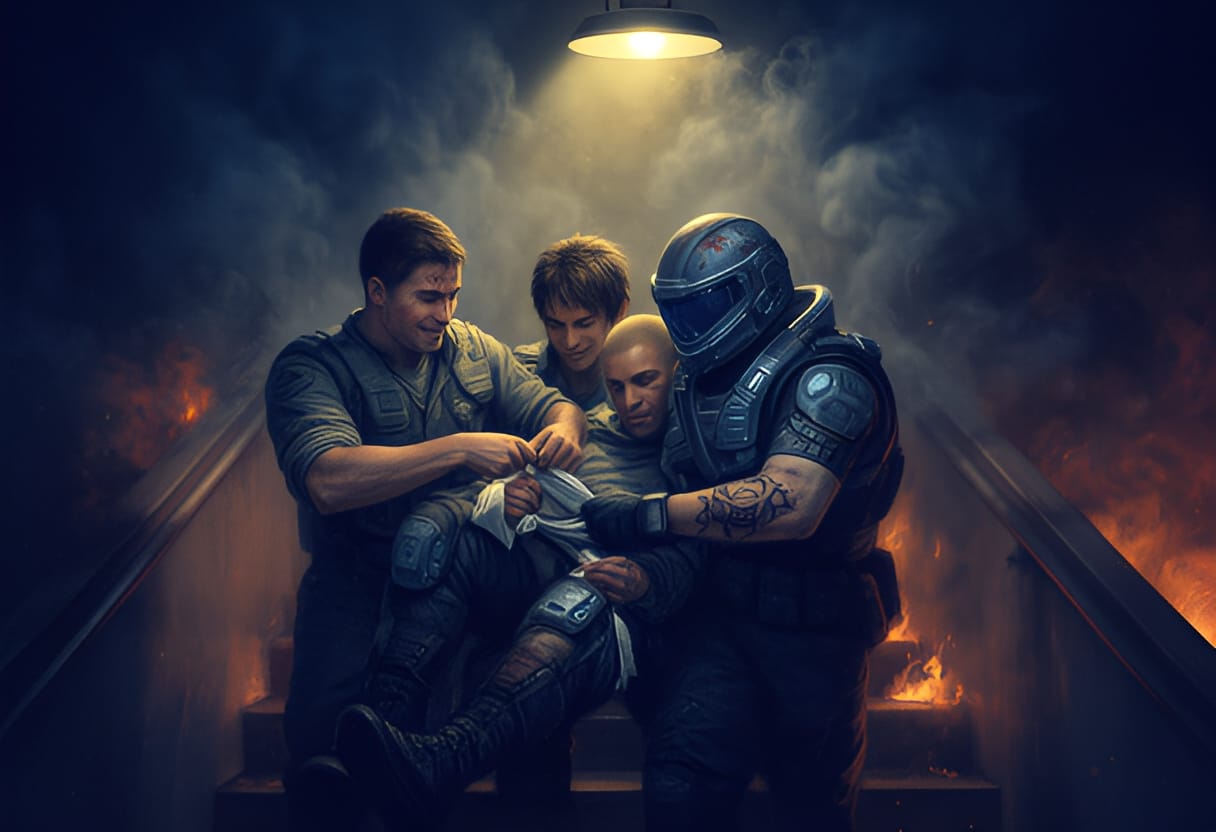
Chapter 3
The River’s Edge
The squad stumbled into the hospital grounds on tired legs and ragged breath, the acrid tang of smoke and cordite clinging to their uniforms like a second skin. Flares sputtered in the gathering dusk, casting long, jerky shadows across the paved lot where ambulances idled, engines throbbing low and urgent. Doctors and nurses in stained scrubs moved with frantic efficiency, shoving gurneys toward the vehicles, barking orders over the whine of sirens that had long since fallen silent. A child’s wail cut through the chaos, sharp and raw, before being swallowed by the slam of an ambulance door.
Sergeant Velez barked a command, her voice hoarse from smoke and shouting. “Lopez twins! Rear entrance! Now!”
Zay and Alex exchanged a glance—no words needed. They’d trained for this, drilled it into muscle memory: cover the fall back, hold the line until the last soul was clear. They sprinted toward the west wing, where a recessed loading dock offered some cover from the open sky. The rear entrance yawned like a wound, its automatic doors shattered, glass crunching underfoot as they moved inside.
A grizzled figure stepped from the gloom, helmet askew, a battered Lancer cradled in his arms. Salt-and-pepper stubble clung to his jaw, and his eyes, though tired, held the sharp glint of someone who’d seen too many damn endings.
“Name’s Hale,” he said, voice gravelly. “Retired 26th RTI. Heard the call on the emergency band. Figured I’d pitch in before the bugs got all the fun.” He gave them a half-smile that didn’t reach his eyes. “You boys look like you could use a hand. Or at least someone to yell at when you mess up.”
Alex snorted, checking his Lancer’s chamber. “We’re not rookies, Hale.”
Hale chuckled, checking his own weapon’s chainsaw bayonet. “Sure you ain’t. Just try not to get in my way, alright? Old habits die hard.”
Zay ignored the jab, already assessing the space. Sandbags lay stacked near the inner wall—left over from some earlier drill, maybe. He grabbed one, then another, passing them to Alex. Together, they began to build a hasty barricade just inside the doorway, angling it to funnel any attackers into a narrow kill zone. Hale joined them, muttering about proper entrenchment as he hefted sandbags with surprising strength.
“Fields of fire,” Zay said low, more to himself than anyone. He slipped to the left flank, pressing his back against the cool concrete wall. Alex took the right, crouched low behind the sandbag stack. Hale planted himself dead center, Lancer at the ready, chainsaw growling softly as he tested the throttle.
“Overlapping sectors,” Alex murmured, checking his sight alignment. “You take left to center, I take center to right. Hale, you’re the anchor. If anything gets past you, we’ve got crossing fire.”
Hale nodded, grim. “Solid. Now let’s see if these Locust bastards can read a map.”
The first wave came not with a roar, but a skitter—like insects disturbed in the dark. Drones poured from the shadows beyond the hospital’s broken perimeter wall, their clawed feet scraping on concrete, guttural clicks rising from their throats. They moved fast, low, using the wreckage of overturned gurneys and discarded supply crates as cover.
“Contact left!” Hale barked.
Zay’s Lancer bucked in his hands as he squeezed the trigger. Tungsten rounds slammed into the lead Drone, staggering it back. Alex’s fire joined a split second later, catching another in the shoulder, spinning it sideways. The chainsaw on Hale’s Lancer screamed to life as he stepped forward, carving a bloody arc through a third that lunged too close.
They fell into rhythm—Zay hammering the left, Alex chewing up the center-right, Hale holding the middle with short, controlled bursts that saved ammo and dropped targets cleanly. The air filled with the stench of ozone and burnt chitin, the sharp reports of Lancers mingling with the wet, tearing sound of the chainsaw.
A Drone lunged from the smoke, claws outstretched for Alex’s throat. He twisted, bringing his Lancer up just in time—the chainsaw caught the creature’s forearm, shredding bone and tendon before he kicked it back into the horde. Zay fired a burst into its chest as it fell, the rounds punching through and taking out another behind it.
“Nice work, rookie,” Hale called, though there was no real bite to it. He was reloading, sweat streaking the grime on his cheeks.
Alex managed a grin, breathless. “Shut up and cover me.”
They held the line as the ambulances began to pull away, engines growling as they lurched forward onto the access road. Nurses slammed doors, waving frantically at the drivers. A stretcher bearing an elderly man with an oxygen mask passed close to the entrance, his eyes wide and unfocused.
“Move it!” a nurse yelled, glancing back at the defensive line. “They’re breaking through east!”
Zay’s blood turned to ice. He risked a glance over the sandbags. More Drones were flowing in now—dozens, maybe more—drawn by the noise, the heat, the pulse of life spilling from the hospital like bait.
“Second wave!” he shouted.
Alex was already swinging his Lancer to the left, tracing a sweeping arc of fire. “On it!”
Hale roared as he opened up, chainsaw and gunfire blending into a deafening crescendo. The Drones came in waves, clawing over their own dead, heedless of the cost. One scrambled up the sandbag stack, only to meet Alex’s chainsaw face-first. Another tried to flank right, but Zay’s rounds caught it in the throat, sending it gurgling to the sand.
They fired until their arms burned, until the world narrowed to the rhythm of trigger pull and recoil, the hot brass casing flying from their ejection ports, the smell of cordite and alien blood thick in their nostrils. Alex yelled a warning as a Drone leapt for Hale’s legs—Zay turned and fired, dropping it in two shots before it could reach the veteran.
“Thanks,” Hale panted, wiping blood from his visor. “You boys ain’t half bad.”
Alex let out a short, humorless laugh. “We aim to please.”
But the Drones kept coming. The sandbags were taking hits now, chunks of concrete exploding outward where rounds struck. A Nemacyst whistled in from somewhere beyond the lot—then detonated with a sickening thoom against the hospital’s outer wall, shaking the dust from the ceiling above them.
Zay coughed, blinking grit from his eyes. “They’re bringing heavier stuff.”
“We can’t hold forever,” Alex said, reloading with shaking hands. “Not without more ammo or fallback.”
Hale slammed a fresh magazine into his Lancer. “Then we make every second count. Ambulances are still rolling. As long as they’re moving, we hold.”
Another Drone lunged—this one faster, more aggressive, its head cocked like it was listening. Zay fired. The round missed, striking the concrete beside its foot. It snarled and leapt.
Alex didn’t think. He surged forward, Lancer roaring as he drove the chainsaw into the creature’s chest. It screamed—a high, piercing keen—before going limp. He kicked it off, breathing hard, blood spraying down his forearm.
Zay grabbed his arm. “You good?”
Alex nodded, eyes wild. “Yeah. Yeah, I’m good.”
They reset the line, breathing in ragged unison. The ambulances were thinning now—only two or three left, their lights flashing weakly against the darkening sky. A stretcher passed close again, this time bearing a young woman with a bandaged head, her eyes locked on the twins as she passed. She didn’t scream. She just stared, as if seeing something human in the midst of the nightmare.
Then, with a final hiss of brakes, the last ambulance pulled away. Its doors slammed. The engine growled, then faded as it turned onto the road and disappeared into the smoke-choked streets.
Silence fell, broken only by the ragged breathing of the three defenders and the distant, intermittent pop of small arms fire from elsewhere in the hospital grounds.
Hale lowered his Lancer, chainsaw idling. “Well,” he said, voice rough. “They’re out. Now it’s just us and the dark.”
Alex slumped against the sandbag wall, adrenaline draining into bone-deep fatigue. He looked at his brother—really looked—and saw the same exhaustion mirrored in Zay’s eyes, the same tightness around the mouth. But beneath it, something else: resolve, hard and unyielding.
Zay met his gaze. No words passed between them. Just a nod. A silent promise.
Hale clapped a heavy hand on each of their shoulders. “Rest while you can. They’ll be back. And next time, they might bring friends.”
Zay glanced toward the shattered doors, where the night pressed in like a living thing. Beyond, the sky was a bruised purple, the first true stars beginning to prick through the haze. Somewhere in the distance, a Boomer laughed—a low, guttural sound that chilled the blood.
He turned back to his brother. “We hold,” he said quietly. “Until we can’t.”
Alex gave a tight, humorless smile. “Always.”
And as the first true night of E-Day settled over Mercy Hospital, the twins braced themselves—not knowing if dawn would come, but knowing they would face it together.
The distant chuckle of the Boomer faded, swallowed by the oppressive quiet that settled over Mercy Hospital’s shattered grounds. Smoke curled from burning vehicles near the main entrance, and the occasional pop of small arms fire crackled like distant fireworks—too far to be immediate, too frequent to be ignored. Inside the rear entrance, the air hung thick with cordite, sweat, and the metallic tang of blood. Hale shifted his weight, wincing as pressure flared in his old knee wound—a relic from Pendulum Wars desert combat, he’d once muttered. Now, he leaned more heavily on his Lancer, using it as a makeshift cane.
Zay wiped his forearm across his brow, smearing grime and dried blood into a rust-colored streak. His Lancer felt heavier now, the chainsaw’s weight a constant drag on his tired muscles. He checked the ammo counter: twelve rounds left in the magazine. Alex’s display blinked the same grim number. Hale, ever the veteran, gave a tight nod when their eyes met—sixteen in his drum. Not much. But enough for a few more bursts. Maybe.
“We can’t stay here forever,” Alex said, voice low, rough from shouting and smoke. He didn’t look at Zay as he spoke, eyes fixed on the darkened corridor beyond the sandbags, where the hospital’s inner halls stretched into shadow. “If they send something bigger—like a Seeder or a Corpser—this barricade won’t slow them down.”
Zay didn’t answer right away. He was listening. Not just to the silence, but to the spaces between it—the faint, rhythmic scritch-scritch of claws on concrete from somewhere deeper inside, the occasional drip of water from a broken pipe, the distant, uneven breathing of someone injured and alone. The hospital wasn’t empty. Not yet. And as long as there were still lives inside, they couldn’t just abandon the post.
“We hold until the last ambulance clears the perimeter,” he said finally. “Velez’s order was to cover the retreat. That means we don’t fall back until we’re sure no one’s left behind.”
Alex exhaled through his nose, a sound like air escaping a punctured lung. “And what if no one’s coming to relieve us? What if Velez’s group got cut off? What if—”
“We don’t know that,” Zay interrupted, sharper than he meant to. He saw Alex flinch, just slightly, and softened his tone. “We don’t. So we act on what we do know: people are still in there. Nurses. Patients. Maybe even kids. We don’t leave them to die in the dark because we’re scared.”
Alex didn’t look at him, but he gave a single, tight nod. His grip tightened on his Lancer. “Yeah. Yeah, you’re right.”
Hale cleared his throat, drawing their attention. “Speaking of scared… you boys ever hear the old tale about the Kryll? Not just as a swarm, but as… something else? Something that listens?”
Zay frowned. “What are you talking about?”
Hale shifted again, wincing. “Old timer’s superstition, maybe. But back in ’79, during the first Kryll outbreaks in Timgad, there were reports. Soldiers swore the shadows… moved when you weren’t looking. Not just flowing—forming. Like they were shaping themselves. Walls. Arms. Even faces, briefly, in the corner of your eye.” He gave a shaky laugh. “Probably just fatigue and fear. But tonight… I swear I saw something near the east loading bay. A ripple in the dark, like oil on water. Didn’t behave like a swarm. Behaved like it was watching.”
Alex’s jaw tightened. He’d seen the Kryll swarm the storage room back at the barracks—how they’d flowed like liquid shadow, how they’d seemed to react to heat, to breath. He hadn’t thought of them as intelligent. But if the Locust were using them to herd… maybe there was more to it than mindless instinct.
“Kryll aren’t just animals,” Zay said quietly. “They’re tools. And the Locust don’t waste tools.”
Hale nodded grimly. “Exactly. And if they’re herding us… they’re not trying to kill us all at once. They’re trying to funnel us. Push us where they want us to go.”
A cold prickle ran down Zay’s spine—not fear, not exactly, but the sharp, alert awareness of being seen. He glanced toward the shattered rear doors again. Beyond them, the hospital’s parking lot was a wreck of overturned ambulances, scattered medical supplies, and the occasional corpse—Locust and human alike, tangled together in grotesque embrace. The Kryll hadn’t come in force yet. But they were out there. Waiting.
“We need to check the inner corridors,” he said. “See if there’s anyone still trying to get out. And if we can find a better fall back point—something defensible, with fewer entry points.”
Alex pushed himself up, joints protesting. “You want to go in? Just the two of us?”
“I’ll come with you,” Hale said, pushing off the wall with a grunt. “Old bones creak, but I can still pull a trigger. And I know these halls—used to come here for checkups when the wife was pregnant with my boy. West wing’s got a supply closet near the old radiology suite. Steel door, narrow entrance. Easy to defend. If we’ve got to hole up, that’s not a bad spot.”
Zay exchanged a look with Alex. No hesitation. No need for words. They moved as one—Zay taking point, Alex covering their six, Hale shuffling behind, Lancer braced against his hip.
The interior of Mercy Hospital was a study in ruin. Fluorescent lights flickered overhead, some dead, others sputtering like dying insects. Gurneys lay on their sides, IV poles snapped, blankets soaked in blood and something darker. The smell was worse here—closer, sharper—mixed with the antiseptic sting of bleach and the sour reek of panic. Every step echoed too loudly in the hollow halls, each creak of settling metal a potential alarm.
They moved silently, boots barely whispering on the linoleum. Zay’s senses were heightened—ears straining for the slightest sound, eyes darting between shadows, nose flaring for the sour-sweet odor of Kryll or the coppery tang of fresh blood. Alex kept his Lancer at low ready, chainsaw idling, thumb resting on the throttle. Hale breathed through his nose, short and controlled, eyes scanning ahead with the wary patience of a man who’d cleared rooms before.
They passed the triage area—overturned chairs, a crashed defibrillator sparking weakly in a puddle of water. A nurse’s cap lay abandoned near a blood-smeared clipboard. No bodies in sight, but the signs of struggle were everywhere.
Then, from the east corridor—a soft moan. Faint. Human.
Zay froze. Alex’s head snapped toward the sound. Hale went still, Lancer lifting slightly.
“Someone’s hurt,” Alex whispered.
They moved toward it, cautious, weapons sweeping. The moan came again—louder this time, a woman’s voice, ragged with pain.
“Please…” it breathed. “Is anyone… there?”
Zay signaled left. Alex covered the right flank. They crept past a collapsed partition, where a ceiling tile had caved in, revealing a tangle of wiring and insulation. And there, half-beneath a fallen shelving unit, lay a woman in her thirties, her uniform torn, one leg bent at an unnatural angle. Her face was pale, eyes wide and glassy with shock, but she focused on them as they approached.
“Thank God,” she whispered, voice breaking. “I thought… I thought I was alone.”
Zay dropped to one knee, keeping his weapon trained on the shadows. “You’re safe now. What’s your name?”
“Elena,” she gasped, clutching her side. “Elena Varela. I’m a triage nurse. I was… I was helping move patients when the ceiling gave out. I think… I think my femur’s shattered.”
Alex knelt beside her, already tearing at his medkit. “We’ll get you out. Just hold on.”
As he worked, Elena’s eyes flicked past him, toward the darkened hallway beyond. Her breath hitched.
“Did you… did you see that?” she whispered. “Just now? In the dark?”
Zay followed her gaze. Nothing. Just the flickering light, the drifting dust. But he knew better than to dismiss it.
“See what?” he asked gently.
She swallowed hard. “A shadow. But it… it didn’t move like a person. It flowed. Like smoke, but darker. And it… it reached for me. I screamed, and it pulled back. But I felt it—like cold fingers on my ankle.”
Alex finished wrapping a tight pressure bandage around her leg. “Kryll,” he said grimly. “They’re inside.”
Hale swore under his breath. “That’s not good. If they’re getting in through the vents or the basement… we’ve got less time than we thought.”
Zay helped Elena to her feet, arming her with a discarded pistol from a fallen guard—half-empty, but functional. “Can you walk?”
She grimaced, putting weight on her good leg. “It… it hurts like hell. But I can hobble. If you… if you don’t leave me.”
“We’re not leaving anyone,” Alex said firmly. “Not if we can help it.”
They moved slowly, Elena leaning heavily on Alex and Zay, Hale bringing up the rear, Lancer sweeping left and right in slow arcs. The corridors grew darker as they went—some emergency lights had failed entirely, plunging stretches into near-total blackness. Zay activated his Lancer’s underbarrel flashlight, the beam cutting a narrow cone through the gloom.
And then—movement.
Not ahead. Above.
A soft, wet shush came from the ventilation grate in the ceiling. Dust fell in a slow spiral. Zay snapped his light up just in time to see it—a ripple in the shadows, like ink dropped in water, flowing down the grate’s slats in a slow, deliberate tendril. It didn’t scatter. It pooled. And as it neared the floor, it began to rise—not as a cloud, but as a column, vertical and upright, like a shadow given shape.
Alex cursed, raising his Lancer. “Contact! Ceiling!”
The shadow-column shuddered—then lunged.
Not at them. At Elena.
She screamed as the darkness coiled around her ankle like a living whip, yanking her off her feet. She crashed to the floor, sliding on her back, fingers scrabbling at the linoleum as the Kryll pulled her toward the vent.
Zay fired. Tungsten rounds punched into the shadow, flaring blue-white on impact—but the Kryll absorbed the hits, rippling like oil, then reforming. Alex swung his Lancer, chainsaw screaming, but the blade passed through the shadow, meeting only air and the hiss of displaced air.
“It’s not solid!” Hale yelled. “You can’t hit it like a Drone!”
Elena’s nails dug into the floor, leaving thin grooves. “It’s… it’s cold! And it’s whispering!”
Zay’s mind raced. The Kryll weren’t just attacking—they were communicating. Or trying to. The Locust had used them as tools, yes—but if they could form shapes, transmit pressure… maybe they could sense in ways humans couldn’t. Maybe they were drawn not just to heat and breath, but to fear. To pulse. To the quiet, terrified thrum of a heart about to break.
“Let go of her!” Alex roared, not at the Kryll, but at the fear in his own chest. He shoved Elena hard toward Zay, then stepped forward, not away, planting himself between her and the vent. He didn’t fire. Didn’t swing. He just stood there, Lancer low, breathing slow and deep—trying to project calm, to mask his pulse.
It worked.
The Kryll column hesitated. The tendril holding Elena loosened, just a fraction. The shadow rippled, uncertain.
Zay saw his chance. He didn’t aim for the mass. He aimed for the source—the vent itself. He squeezed the trigger, laying down a walking burst of fire up the shaft, rounds striking metal and sending sparks flying. The Kryll recoiled—not from the bullets, but from the heat, the sudden flare of light and energy in their dark domain.
With a sound like tearing silk, the shadow collapsed—not into nothing, but into a shower of tiny, beetle-like creatures that scattered into the vents, vanishing into the dark.
Elena gasped, scrambling back into Zay’s arms. “It… it hurt. Like ice fire.”
Alex lowered his Lancer, chest heaving. “They don’t like sudden heat. Or bright light. It disrupts their cohesion.”
Hale was already moving, checking the vent cover. “We need to seal these. All of them. If they can come in through the ducts… we’re sitting ducks.”
They worked fast—Zay and Alex using their knives to pry loose ceiling panels, Hale tossing in incendiary grenades (scavenged from a fallen Gear’s belt) one after another, each explosion sending a gout of flame into the ductwork, sealing the passages with fire and molten metal. The smell of burning insulation filled the air, acrid and choking, but it was necessary.
By the time they finished, Elena was sitting upright, her face pale but alert, pistol clenched in both hands. The moan from before had not returned. But the silence now felt different—heavier, watchful.
“We should keep moving,” Hale said, reloading. “That little light show probably drew attention.”
They proceeded, slower now, more cautious. Every vent grate was eyed with suspicion. Every shadow examined for unnatural stillness or movement. The twins moved in perfect sync—Zay scanning left, Alex right, their fields of overlap seamless, instinctive. Elena hobbled between them, Hale bringing up the rear, his occasional mutterings the only sound besides their breathing and the distant, ever-present groan of the building settling.
They reached the west wing supply closet just as the first true chill of night began to seep through the hospital’s broken walls. The door was half-off its hinges, but the inner steel door—reinforced, meant for storing volatile supplies—still stood. Hale shoved it open with a grunt, revealing a small, windowless room lined with shelves. Boxes of bandages, antiseptic, saline bags lay scattered. In the corner, a fire axe leaned against the wall.
“Not much,” Hale said, “but it’s got one way in. And if we block the door with the shelves… we can make them pay for every inch.”
Zay nodded. “We’ll set up here. Keep watch. Try to raise Velez on the radio—see if any friendlies are still pushing toward the river.”
Alex checked his comms unit—cracked, screen flickering. “Radio’s iffy. Might be dead from the EMP pulse when those Seeders hit earlier.”
“Then we use light,” Hale said. “Flashes. Patterns. If anyone’s still out there looking for signals, they’ll see it.”
They set to work. Zay and Alex dragged the heaviest shelves in front of the steel door, creating a zigzag barrier that would force any attacker to slow, to expose themselves. Hale took the fire axe and began chopping at the wooden shelf supports, weakening them so they could be pulled down quickly if needed—a last-ditch avalanche of weight to buy seconds.
Elena sat against the back wall, her leg elevated on a box of saline, her breathing shallow but steady. She watched them work with quiet intensity, her eyes sharp despite the pain.
“You’re not like the others,” she said suddenly, nodding at the twins. “Most gears I’ve seen… they panic. Or they freeze. But you two… you move like you’ve done this a hundred times.”
Alex managed a half-smile, checking his Lancer’s chainsaw tension. “We’ve got each other’s backs. Makes it easier to stay sharp.”
Zay glanced at him—really glanced. Saw the exhaustion, yes, but also the focus. The way Alex’s jaw was set, not in fear, but in determination. He thought of the morning, just hours ago, when they’d been complaining about coffee in the gym. How unreal it felt now. How much had changed.
“I keep thinking,” he said quietly, “about what we told Mom before we shipped out. That we’d always find our way back to each other.”
Alex didn’t look up, but his voice was soft. “We said it so many times it became a joke. ‘Even if we have to crawl through hell, we’ll meet at the middle.’”
Zay let out a breath that was half-laugh, half-sob. “Guess we’re crawling through it now.”
A sudden scrape at the door made them all jerk upright. Weapons snapped to bear.
Silence.
Then—three soft knocks. Not random. Patterned. Tap… tap-tap… tap.
Zay exchanged a look with Alex. A signal. A challenge-response.
He stepped forward, voice low but clear. “Identify.”
A pause. Then, a woman’s voice, strained but familiar: “Velez. Sergeant Mara Velez. I’ve got two privates with me—Gomez and Ruiz. We’re pinned near the east stairwell. Kryll in the vents. We’re low on ammo and one’s got a leg wound.”
Zay exhaled, tension bleeding from his shoulders. He signaled to Alex and Hale—hold fire, but stay ready.
“Sergeant,” he called back, “this is Lopez. Zay and Alex. We’re in the west supply closet. We’ve got a nurse with us—Elena Varela. She’s injured but alive. We can cover your approach. But you’ve got to come now. The Kryll are active. They’re learning.”
Another pause. Then, softer: “Copy that. We’re moving. Keep the door open… just a crack. So we know it’s you.”
Zay nodded to Alex. Together, they began to slowly, carefully pull back the shelving barricade—just enough to create a narrow slit, wide enough for a person to slip through sideways, but narrow enough to funnel any attacker into a killing zone.
They took up positions—Zay left, Alex right, Hale covering the center with the fire axe ready, Elena reloading her pistol with trembling but determined hands.
The waiting was the worst part.
Every second stretched. Every creak of the building sounded like footsteps. Every draft felt like a breath on the back of the neck.
Then—movement at the door.
A shape resolved in the gloom—three figures, low and cautious. Velez in the lead, her face streaked with soot and blood, her Lancer gripped tight. Behind her, two privates—one supporting the other, who limped badly, blood soaking through his pant leg.
“Come on!” Zay hissed.
They slipped through the slit one by one—Velez first, scanning sharply, then the wounded private, Gomez taking his weight, Ruiz bringing up the rear, Lancer sweeping.
As the last of them cleared the opening, Zay and Alex slammed the shelves back into place with a grunt, sealing the door. Hale jammed a metal pipe through the handles to hold it shut.
Silence fell again—closer now, tighter. Eight souls in a small, windowless room, surrounded by dark and danger.
Velez dropped to her knees beside the wounded private, already tearing open her medkit. “Corporal Dante Ruiz. Took a Kryll nick to the calf. Burns like hell, but the venom hasn’t hit his system yet—got lucky.”
She looked up, eyes locking onto Zay’s. “You held the rear. Held it long enough for the ambulances to get clear. That… that was damn good work, Lopez.”
Alex shifted uncomfortably. “We were just doing our job.”
Velez gave a short, bitter laugh. “Yeah. Well, a lot of folks forgot what their job is these days. Thanks for remembering.”
She turned to Elena, already assessing her leg with practiced fingers. “You’re lucky it’s clean. We’ll get you splinted and moved when we can. But for now—stay still. And save your strength.”
Elena managed a weak smile. “I’ll try.”
The room settled into a wary vigil. Zay and Alex took opposite corners, weapons ready, eyes on the sole entrance. Hale checked the improvised barricade, nodding when satisfied. Velez tended to the wounded, her movements efficient, calm despite the chaos outside. Ruiz gritted his teeth as she cleaned the wound, but didn’t cry out. Gomez kept watch at the door’s edge, peering through the narrow gap between shelves.
Time passed in silence and tension. The hospital groaned around them—settling, shifting, alive with the sounds of ruin. Somewhere, a fire burned low. Somewhere else, a loose piece of metal swung in a draft, clicking like a metronome counting down to nothing.
Zay let his mind drift, just for a moment. Not to fear. Not to the horror. But to the quiet certainty that had guided him since childhood—the knowledge that, no matter what, he and Alex would face it together. Not because they were fearless. But because they were bound.
He glanced at his brother. Alex met his gaze, gave the tiniest nod—I’m here. I’m ready.
Zay nodded back.
Outside, the night deepened. The Kryll stirred. The Locust waited.
And in the dark little room beneath a broken hospital, eight hearts beat in quiet unison—waiting, watching, holding on.
Not for victory.
Not yet.
Just for the next breath.
The next second.
The next chance to see each other’s faces in the gloom.
The Kryll stirred. The Locust waited.
And in the dark little room beneath a broken hospital, eight hearts beat in quiet unison—waiting, watching, holding on.
Not for victory.
Not yet.
Just for the next breath.
The next second.
The next chance to see each other’s faces in the gloom.
The first light of true dawn bled through the high, grimy windows of the west wing corridor, painting the shattered linoleum in sickly streaks of gold and ash. Smoke curled from the east stairwell where a Seeder’s impact had buckled the concrete, and the air tasted of burnt wiring and damp stone. Somewhere below, a pipe groaned, venting steam that hissed like a wounded thing.
Zay stood at the threshold of the supply closet, Lancer braced, eyes scanning the corridor. Alex hovered near Elena, checking the makeshift splint on her leg—strips of scavenged metal and torn sheets bound tight. Ruiz sat upright now, jaw clenched, the Kryll nick on his calf cleaned and bandaged, though the skin around it remained angry and swollen. Gomez kept watch at the door, Hale leaned against the wall, axe in hand, and Velez moved between them, quiet, efficient, already shifting from medic to commander.
“Status?” she asked, voice low.
“Door’s sealed,” Alex said, not looking up. “Shelves holding. Pipe’s solid. No sign of Kryll trying to breach vents—yet.”
Velez nodded. “Good. We can’t stay here long. Not with the west wing compromised. That Seeder hit took out the main power relay—lights are out past the triage wing, and the elevators are dead. We need to get to the basement. There’s a maintenance tunnel that runs under the river. Old storm drain. Big enough to crawl through. Zay mentioned it.”
Zay’s head snapped toward her. “You heard that?”
“I heard you talking to Alex last night. Low voices, but not low enough. You were going over escape routes. Smart. Keeps the mind sharp when the world’s going dumb.”
Alex finally looked up, a ghost of a smirk touching his lips. “We were just making conversation. Didn’t know we were briefing the NCO.”
Velez’s eyes flicked to his, then softened. “You two talk in shorthand. I’ve seen it before. Twins. Doesn’t surprise me you’ve got a plan. But plans change when a Berserker decides to walk through your wall.”
A beat of silence.
Then, from the corridor beyond— a deep, shuddering thoom.
Not distant. Not muffled.
Right outside the west wing.
The sound was less an explosion and more a release—like the world itself had exhaled after holding its breath for too long. Dust rained from the ceiling. The metal shelves shivered. Elena gasped, pressing a hand to her mouth.
Alex was already moving, Lancer up, chainsaw snarling to life as he kicked the supply closet door open.
“Move!” he shouted.
Zay was right behind him, Elena half-supported by Hale as they stumbled into the corridor.
The west wing was gone.
Not damaged.
Unmade.
The outer wall had been ripped open like papier-mâché, concrete and rebar twisted and flung inward as if by a god’s fist. Beyond the breach, the morning light revealed a nightmare given flesh and fury.
The Berserker stood in the courtyard, backlit by the rising sun, a towering silhouette of muscle and bone, its pale, almost translucent skin stretched tight over ridges of sinew and jagged bone plates. It was blind, yes—but it felt. It smelled. It heard. And it had found them.
Its head snapped toward the hospital, nostrils flaring, ears—nothing more than slits—twitching. Then it let out a roar that wasn’t sound so much as a pressure, a wave of force that rattled the teeth in Zay’s skull and made the windows along the corridor flex inward like they might shatter.
It stepped forward.
And the hospital groaned.
The Berserker didn’t charge. It advanced. Each step sent a tremor through the foundation, cracking tiles, making the lights in the ceiling flicker and die. Its arms hung low, fingers ending in claws that scraped the ground, leaving furrows in the concrete. Saliva, thick and rope-like, dripped from its jaws, sizzling where it hit the stone.
And then it saw them.
Not with eyes. With heat. With pulse.
It turned.
And it came.
“Fall back!” Velez yelled, already firing.
Her Lancer bucked, rounds spiking into the creature’s thigh. The impacts sparked—tiny flares of yellow-white—but did nothing to slow it. The Berserker barely flinched, its hide absorbing the blows like rubber absorbing stones.
Alex opened up next, chainsaw screaming as he raked fire across its midsection. The rounds punched through, but the creature didn’t bleed—it oozed, a dark, viscous fluid that sealed almost instantly. Its roar intensified, a subsonic thrum that made the fillings in Zay’s teeth vibrate.
Zay added his fire, laying down a steady stream into its chest. The Lancer jerked, hot brass flying, but the Berserker kept coming, unfazed, relentless. It wasn’t thinking. It wasn’t hunting. It was clearing.
A militia member—Jansen, Zay thought, the old gear who’d been helping with the ambulance triage—stepped forward from the shadows near the west entrance, shotgun braced. He fired a slug round straight into the Berserker’s chest at point-blank range.
The impact made the creature stagger—just a step.
Then it lunged.
Jansen didn’t have time to scream.
The Berserker’s fist closed around him like a vise. There was a wet crunch, a sound like branches snapping underfoot, and then the militia member went limp, arms flailing once before being crushed into his chest. The Berserker lifted him, inspected him for a second with a blind, sweeping motion of its head, then threw him—not away, but into the hospital wall, where he hit with a sickening thud and slid down, leaving a smear of blood and something darker.
The creature turned back to the hospital.
And it smiled.
Not with lips. With the slow, horrific parting of its jaws, revealing rows of needle-like teeth, slick with saliva and gore.
“Fall back! Now!” Velez shouted, but her voice was swallowed by the roar as the Berserker surged forward.
Zay grabbed Alex’s arm. “Move!”
They didn’t run. They retreated—backward, firing, laying down a curtain of fire as the creature advanced. Elena was hauled by Hale, Ruiz limping badly but moving, Gomez covering their rear with short, controlled bursts.
The Berserker didn’t dodge. It walked through the fire.
Rounds struck its arms, its shoulders, its face. It flinched—just slightly—when a burst caught it in the eye socket, but the damage was superficial. The fluid that welled was dark, thick, and it sealed over in seconds. It didn’t blink. It didn’t pause. It just kept coming.
And then it was inside.
It ducked under the broken lintel of the west wing entrance, shoulders scraping the concrete, and stepped into the corridor like a beast entering its den.
The first nurse it saw—young, maybe nineteen, still in her stained scrubs—tried to scream. The Berserker didn’t bother with hands. It simply lowered its head and rammed.
The impact lifted her off her feet, snapped her spine audibly, and sent her flying ten feet down the corridor, where she hit the wall and crumpled, motionless.
It turned.
A patient in a wheelchair, an old man with an oxygen tube, tried to wheel away. The Berserker reached out, snatched the chair by the back, and flung it. It spun through the air, crashing into a supply cart, sending bandages and antiseptic bottles flying like shrapnel.
The old man flew out of the chair, hit the floor, and didn’t move.
The creature turned again.
And then it saw them.
Zay and Alex, backs to the stairwell door, Laying down fire.
Hale, Elena, Ruiz, and Gomez were just behind them, scrambling for the stairwell entrance.
The Berserker lowered its head.
And it charged.
Not fast. Not like a beast. But inevitable. Like a glacier. Like doom given weight and muscle.
Zay fired. Alex fired. The Lancer’s chainsaw screamed, spitting molten copper and fire.
The Berserker flinched—just a fraction—as a round caught it in the throat. Another sparked off its collarbone. A third struck the ridge above its eye.
It didn’t stop.
It didn’t slow.
It just came.
Zay felt it in his bones before he heard it—the deep, resonant thrum as it planted its feet and braced for impact.
He shoved Alex sideways.
“GO!”
Alex stumbled, barely catching himself on the stairwell railing.
The Berserker hit the door.
Not with a crash.
With a slam.
The steel-reinforced door buckled inward, hinges screaming, bolts tearing from the wall. The frame groaned, concrete cracking around the edges. The door didn’t hold.
It gave.
And the Berserker flowed through.
Like water.
Like shadow given mass.
It filled the stairwell entrance, blocking the retreat, its bulk filling the narrow space, shoulders brushing both walls. It turned its head—blind, but aware—and swept its gaze across them.
Zay fired point-blank into its chest.
The Lancer jerked. The chainsaw caught on bone, sparked, then jerked free.
Alex unloaded into its side.
The Berserker didn’t yell. Didn’t roar.
It just reached.
Its hand shot out—fast, terrifyingly fast—and closed around Alex’s throat.
Alex gasped, feet kicking, Lancer clattering to the floor as he was lifted off the ground, dangling, face purpling, eyes bulging.
Zay didn’t think.
He moved.
He slammed the Lancer into Berserker mode, chainsaw roaring, and charged.
He didn’t aim for the hand.
He aimed for the arm.
The chainsaw bit in—deep—sparks flying, oil and black fluid spraying. The Berserker roared—a sound of pure, shocked agony—and jerked back, throwing Alex aside like a ragdoll.
Alex hit the far wall, slid down, coughing, sucking in air.
Zay didn’t stop.
He kept the chainsaw buried, driving it deeper, twisting, trying to sever tendon, trying to reach the nerve bundles beneath the armor-plated muscle.
The Berserker staggered back, slamming into the opposite wall, dust raining down. It swung its free hand—backhanded—catching Zay on the cheekbone.
The impact lifted him off his feet.
He flew.
Hit the stairwell railing.
Blacked out for a breath.
When he came to, he was on his knees, blood hot in his mouth, vision swimming.
The Berserker was turning.
Its attention had shifted.
It had seen Elena.
She was halfway up the stairwell, Hale dragging her up, Ruiz and Gomez behind them, firing over their shoulders.
The creature began to move—not fast, but relentless—its long strides eating up the stairs two at a time.
Zay pushed himself up.
Alex was already moving, limping, Lancer in hand, blood drying on his lip.
“Go!” Alex gasped. “Get them out! I’ll—”
“No,” Zay said, voice raw. “We go together.”
Alex looked at him. Nodded.
They turned.
And they fired.
Not to kill.
Not yet.
To slow.
To hinder.
They laid down a walking barrage, Zay left, Alex right, Lancers spitting fire, rounds impacting the Berserker’s legs, its hips, its back. Each hit made it stutter. Each hit made it hiss—a sound like steam escaping a ruptured pipe.
It didn’t stop.
But it slowed.
Just enough.
Hale got Elena to the first landing. Ruiz and Gomez were behind them, firing, reloading, moving.
Zay and Alex backed up the stairs, step by step, never turning their backs, never stopping the fire.
The Berserker followed.
Each step it took shook the stairs. The metal railings vibrated. The concrete steps cracked under its weight. Dust fell in clouds. Somewhere above, a door shuddered on its hinges.
Then—smell.
Smoke.
Sharp. Acrid.
Zay glanced up.
Flames were licking the edge of the west wing ceiling, just beyond the stairwell opening. The fire had taken hold—fast, fed by broken gas lines and spilled fuel. It crawled along the rafters, orange tongues licking the smoke detectors, setting off a shrill, wailing alarm that layered over the Berserker’s groans and the distant, fading screams from within the burning wing.
The fire was spreading.
And the screams—oh, the screams—were growing fainter.
Not because they were stopping.
But because the ones making them were being silenced.
Zay fired again.
A round struck the Berserker’s knee joint. It stumbled—just a step—but caught itself on the railing, groaning.
Alex fired into its side. The chainsaw sparked against bone.
“Almost there!” Hale shouted from above.
They were at the third landing.
One more flight.
The Berserker was twenty feet below, closing.
Zay felt it—not just in his ears, but in his teeth, in his marrow—the deep, subsonic pulse of its approach. It wasn’t just coming. It was learning. It was tracking them by heat, by breath, by the frantic hammering of their hearts.
They reached the top of the stairs.
The door to the basement level was ahead—solid steel, slightly ajar.
“Go!” Alex yelled, shoving Zay forward.
Zay stumbled through, Hale pulling Elena clear, Ruiz and Gomez following.
Alex was last.
He turned at the threshold, Lancer up, and fired a final burst into the Berserker’s chest.
The creature recoiled—just a fraction—then let out a sound that wasn’t a roar, not quite. It was a warning. A promise.
Then it began to climb.
Alex slammed the door shut.
They threw their weight against it.
The Berserker hit the other side.
The door jangled. Hinges screamed. Bolts groaned.
Then—silence.
Not peace.
Just… waiting.
They were in the basement corridor now—cool, dark, smelling of damp concrete and oil. Flickering emergency lights cast long, jerky shadows. Somewhere, a pump chugged steadily, trying to keep floodwater at bay.
Elena was sitting on a crate, Hale checking her leg. Ruiz was leaning against the wall, breathing hard. Gomez watched the door, Lancer ready.
Velez stood in the center of the corridor, eyes closed, breathing slow.
Then she opened them.
“It’s coming,” she said.
Zay looked at Alex.
Alex looked back.
No words needed.
They both knew.
The Berserker wasn’t done.
And neither were they.
They took their positions—Zay left, Alex right, Lancers raised, eyes on the door.
The fire above crackled louder.
The alarms wailed.
And down in the dark, beneath the burning hospital, eight souls waited—not for rescue.
Not for victory.
Just for the next chance to see each other’s faces in the gloom.
And to remember, no matter what came, they had promised:
Even if we have to crawl through hell, we’ll meet at the middle.
The door shuddered.
Then, slowly, it began to bend inward.
The Berserker came through the door like a collapsing wall.
It didn’t stop. It didn’t hesitate. It just entered, filling the corridor, its bulk forcing the emergency lights to flicker and die. Darkness pressed in, broken only by the dull, angry glow of its skin in the gloom—like embers beneath ash.
Zay and Alex opened fire.
Not to win.
To buy time.
The Lancers screamed, chainsaws biting, rounds impacting. Sparks flew. Black fluid oozed. The Berserker staggered—just a step—then recovered, lowering its head, charging.
They fell back.
Step by step.
Firing.
Retreating.
The creature followed, each step shaking the dust from the ceiling, each breath it drew pulling the air hard into its lungs, making the flames above roar louder.
They reached the T-junction.
Left led to the utility tunnels. Right led to the old storm drain—Zay’s escape route.
“Go left!” Zay shouted. “I’ll cover!”
Alex didn’t hesitate.
He grabbed Elena’s arm, Hale took her other side, Ruiz and Gomez moved fast, and they turned left, disappearing into the side corridor.
Zay stayed.
He turned, Lancer braced, and fired into the Berserker’s chest as it turned to follow.
The creature didn’t stop.
It absorbed the fire.
It kept coming.
Zay fired again.
And again.
He wasn’t trying to hurt it.
He was trying to anger it.
To make it focus.
To make it chase.
The Berserker let out a guttural sound—not a roar, but a challenge—and surged forward.
Zay turned and ran.
He didn’t look back.
He didn’t need to.
He could feel it.
The thunder of its steps.
The displacement of air.
The heat radiating off its back like a furnace.
He burst into the left corridor, slammed into the wall to avoid sliding, and kept going.
Behind him, the Berserker followed—slower now, but relentless.
He ran.
Lungs burning.
Legs pumping.
Heart hammering.
He didn’t know how far he’d gone when he heard it—a sound behind him.
Not footsteps.
A scrape.
Then a thud.
And then—silence.
Zay didn’t stop.
He kept running.
Until he saw the grate.
Halfway down the corridor, set low in the wall—a maintenance access point, just big enough to crawl through. He wrenched it open, peered inside.
Dark.
Narrow.
But it led down.
And it ran parallel to the river.
Just like he’d remembered.
He glanced back.
The corridor was empty.
No Berserker.
No pursuit.
Just the echo of his own breath and the distant, muffled roar of fire above.
He crawled in.
Pulled the grate shut behind him.
And began to move.
Alex didn’t look back when he turned the corner.
He couldn’t.
He had Elena to get to safety.
Hale was supporting her left side, Ruiz her right, Gomez bringing up the rear, Lancer ready.
They moved fast—too fast, maybe. Elena gasped with each step, her face pale, sweat beading on her forehead despite the chill of the basement.
“Easy,” Alex muttered, though his voice was tight. “We’re not out of the woods yet.”
They turned another corner.
And stopped.
The corridor ahead was blocked.
Not by rubble.
By fire.
It had dropped down through a shattered ceiling, spreading along the floor like a living thing—orange, hungry, licking at the pipes and conduit. The heat shimmered in the air, and the smell of melting plastic and burning insulation made Alex’s eyes water.
“No way through,” Gomez said, voice low.
Ruiz leaned against the wall, breathing hard. “We can go back. Try the other way.”
“No,” Hale said. “Zay’s covering. He’s going to the storm drain. We need to meet him there.”
Alex looked at Elena. She was biting her lip, face drawn, but her eyes were clear.
“We can make it,” she whispered. “If we have to, we’ll go slow. But we won’t stop.”
Alex nodded. “Then we go slow. But we don’t stop.”
They turned around.
Retraced their steps.
Back to the T-junction.
Back to where Zay had been.
The corridor was empty.
No sign of the Berserker.
No sign of Zay.
Just the smell of smoke, growing stronger.
And the sound—faint, distant—of something large moving.
Not running.
Walking.
Alex gripped his Lancer tighter.
“He’s still leading it,” he murmured. “He’s still drawing it off.”
They moved on.
Past the junction.
Down the corridor.
And then—light.
Flickering.
Yellow.
Not fire.
Electric.
A bare bulb, swaying slightly in its socket, hung from the ceiling ahead.
And beneath it—waiting against the wall—was Zay.
He was leaned back, head tilted, eyes closed.
Then he opened them.
And smiled.
Not wide.
Not loud.
Just… there.
“Took you long enough,” he said, voice rough but steady.
Alex let out a breath he hadn’t realized he was holding.
“You’re damn lucky I like you,” he replied, stepping forward.
Zay pushed off the wall. “Likewise.”
They clasped forearms—brief, firm—then turned to the others.
“Storm drain’s this way,” Zay said, nodding down the corridor. “Grate’s ahead. Big enough to crawl through. Leads under the river. We can follow it to the east bank. Maybe find a way out.”
Elena looked at him. “And if it’s blocked?”
Zay met her gaze. “Then we make a new way.”
Alex checked his Lancer. Magazine low. Chainsaw nicked but still spinning true.
“We’ve got enough,” he said. “For now.”
They moved as a group—slow, deliberate—toward the grate.
Zay went first, peering through the bars.
Dark.
Cool air.
Dripping water.
And far below, the faint, slow pulse of something moving through the dark—water, or something worse.
He turned.
“Ready?”
Alex nodded.
Hale helped Elena down first.
Then Ruiz.
Then Gomez.
Then Alex.
Zay was last.
He looked back one last time.
The corridor behind them was dark.
But not empty.
He could feel it.
The Berserker was coming.
Not fast.
But sure.
Like fate.
Like hunger.
Like the end of the world, one slow step at a time.
He dropped into the grate.
Pulled the cover shut.
And began to crawl.
The storm drain was tight.
Not enough to stand.
Not even enough to sit upright.
They moved on hands and knees, sometimes on their bellies, dragging gear, pulling Elena when her leg gave out. The air was thick with damp and the faint, metallic tang of old iron. Water dripped steadily from the seams, pooling in the trough beneath them. Somewhere ahead, the Imulsion River flowed—slow, toxic, glowing with a sickly, iridescent sheen that seeped through the cracks in the stone.
They didn’t speak.
Couldn’t.
Every breath was effort.
Every movement, a calculation.
Zay led, Alex followed, then Hale with Elena, Ruiz, and Gomez bringing up the rear.
The twins moved in sync—without looking, without speaking—knowing when to shift weight, when to brace, when to pause for breath. It wasn’t just training. It was them. The unspoken language of a lifetime spent side by side.
They crawled.
And crawled.
And crawled.
The light from the grate behind them faded.
Then the one ahead appeared—a pinprick, growing.
They were nearing the river.
The air grew cooler.
The smell of water stronger—sharp, chemical, tinged with ozone and rot.
And then—sound.
Not from ahead.
From behind.
A deep, resonant thoom.
Muffled.
Distant.
But unmistakable.
The Berserker had found the entrance.
It was following.
Zay stopped.
Alex bumped into him.
“What is it?” Alex whispered.
Zay didn’t answer right away.
He listened.
The sound came again.
Not a step.
A drag.
Something heavy, scraping stone.
Then a low, wet snuffle.
It was sniffing the air.
Tracking them.
By scent.
By heat.
By the pulse of life in the dark.
Zay swallowed.
He looked back.
Alex’s eyes met his in the gloom.
No fear.
Not panic.
Just resolve.
And the quiet understanding that had carried them since they were boys, scraped knees and shared secrets under the old oak in their backyard.
We find our way back.
Even if we have to crawl through hell.
Zay gave the tiniest nod.
Then he turned and kept crawling.
They didn’t speed up.
They didn’t panic.
They just kept moving.
Because stopping meant dying.
And dying meant breaking the promise.
And they wouldn’t—couldn’t—do that.
The grate ahead grew larger.
The light brighter.
And the sound behind them— the dragging, the sniffing, the slow, inevitable pursuit— came closer.
But so did the end of the tunnel.
And the chance to see the sky again.
Even if it was a sky filled with smoke.
Even if it was a sky that meant war.
They kept crawling.
Together.
As they always had.
As they always would.
The stairwell was a tomb of concrete and rust, the air thick with the smell of ozone and old blood. Zay pressed his back against the cold wall, Lancer braced, eyes locked on the door below. The stairwell stretched up and down like a throat, narrow and choked with debris—shattered plaster, twisted rebar, the occasional boot or discarded magazine. Somewhere above, the building groaned, a low, shuddering creak that made the dust tremble in the faint light filtering through a cracked skylight far overhead.
Alex knelt beside Jace, who lay slumped against the opposite wall, face slick with sweat, breath coming in shallow, ragged gasps. His left leg was a ruin—torn at the thigh by shrapnel from the Berserker’s swipe, the flesh swollen and angry red, heat radiating off it like a banked fire. The wound had stopped bleeding, but the fever had taken hold fast, burning through him like a wildfire.
Alex ripped the tail from his undershirt with his teeth, the fabric coming away in a long, ragged strip. He folded it over once, twice, then pressed it firmly against the worst of the tear, where the skin had split open and oozed a thick, yellowish fluid.
“Hold still,” he muttered, voice low and tight. “This is gonna suck.”
Jace grimaced, teeth clenched. “Do it.”
Alex wound the strip around the leg, pulling it snug but not tight enough to cut off circulation. He tied it off with a clumsy knot, then tore another strip, and another, building a layered pad. His hands moved fast, practiced—field medic training kicking in despite the panic clawing at his ribs.
When he was done, he sat back on his heels, wiping his brow with the back of his hand. The sweat came away streaked with grime.
“There,” he said. “Not pretty, but it’ll hold. You owe me a peach cobbler when this is over.”
Zay, who had been scanning the stairwell above, froze mid-breath. A ghost of a smile tugged at the corner of his mouth—just a flicker, gone before it could fully form. He turned his head slightly, eyes meeting Alex’s in the dim light.
Alex gave him a half-shrug, a silent you know what I mean.
Zay swallowed hard. The memory surfaced unbidden: a summer afternoon, ten years old, sitting on the porch steps of their aunt’s house in Tyra, sticky with peach juice, arguing over who got the last slice of cobbler. Alex had won, of course—always did—and had shoved the plate toward Zay with a grin, saying, “You owe me one next time. And I’m holding you to it.”
They’d never spoken of it since. Not really. But it had lived there, quiet and warm, like a coal banked under ash.
Zay looked away, jaw tight. He couldn’t let himself laugh. Couldn’t let the moment break. Not now. Not with the Berserker still out there, not with Jace burning up beside them, not with the building shuddering like it was about to come down.
But the warmth remained—small, fierce, a secret spark in the dark.
He turned his attention back to the door below. The metal was scorched in places, bent inward where something heavy had slammed against it. Kryll had tried to get in earlier—he could still see the faint, oily smudges on the frame where they’d burned against the heat of Alex’s flare before it died. But the door held. For now.
“Ammo check,” he said, voice rough.
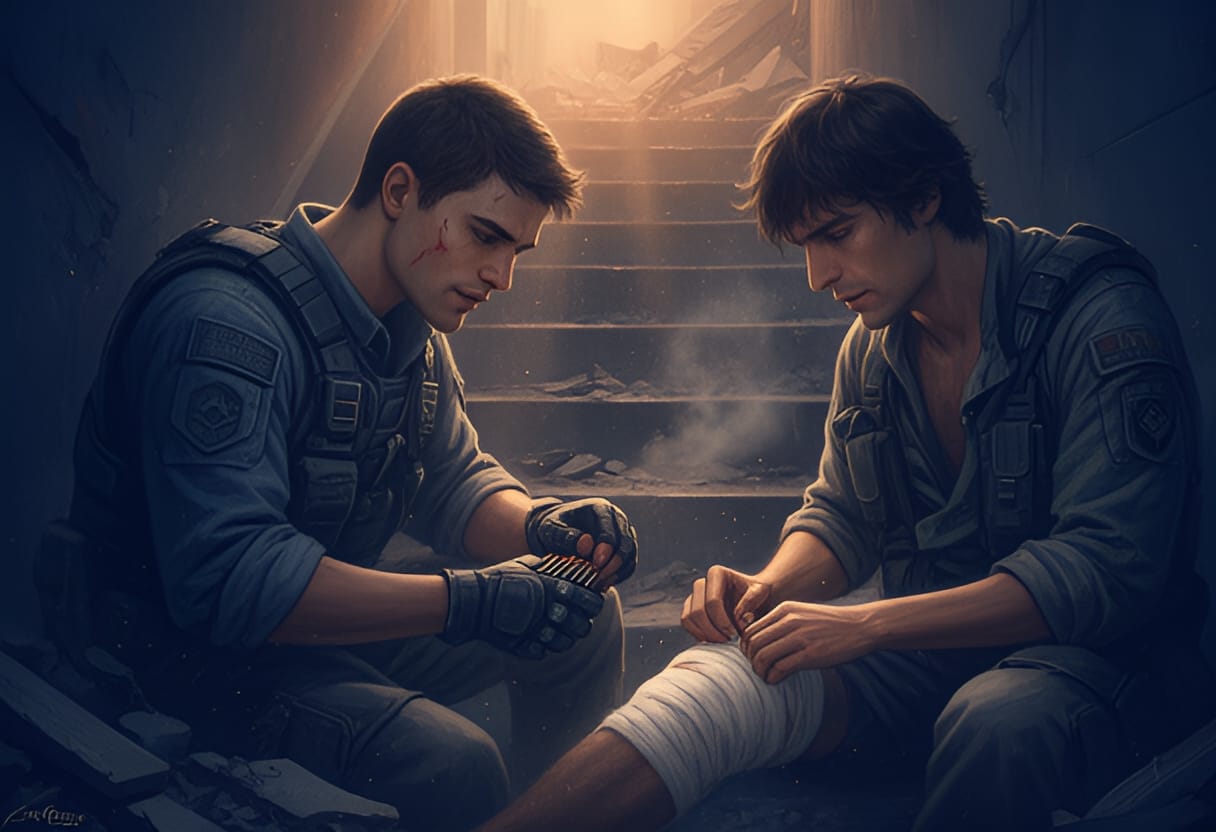
Alex patted his vest. “Two full mags for the Lancer. One half. Chainsaw’s still got teeth, but it’s chewing through air more than anything these days. Got two frags left. One smoke. That’s it.”
Zay nodded. He checked his own loadout—three mags, one grenade, chainsaw nicked but functional. Low, but workable. If they had to fight their way out, they’d make it count.
“Keep an eye on Jace,” he said. “If he starts to fade—”
“I know,” Alex said. “I’ll know.”
They fell silent again, listening.
The stairwell was quiet except for Jace’s labored breathing and the occasional drip of water from a broken pipe somewhere above. But beneath it, a low thrumming vibrated through the concrete—felt more than heard. The building was settling. Shifting. The lower floors were weakening, compromised by fire and impact. Each groan was a warning.
Then, a whisper of smoke began to curl up from below—thin at first, like breath on glass. It drifted upward, lazy and gray, catching the dim light.
Alex tensed. “That ain’t steam.”
Zay pushed off the wall, moving silently to the stairwell’s edge. He peered down.
The landing below was swallowed in haze. Flickers of orange pulsed behind the smoke—fire, spreading. The acrid tang of burning insulation and melting plastic began to creep into the air, sharp and nauseating.
“It’s coming up,” he said. “Fast.”
Alex shifted Jace slightly, cradling the corporal’s head. “We gotta move. Now.”
“Up or down?” Zay asked.
Alex glanced up the stairwell. The skylight was too high, too exposed. The roof was their only real chance—but getting there meant climbing through a collapsing building, with Jace in no shape to move fast.
“Down’s worse,” Alex said. “That’s where the fire is. And if the Berserker’s still sniffing around…”
Zay followed his gaze toward the door below. The smoke was thickening, seeping under the frame in slow, curling tendrils. The heat was rising, too—just a wave now, but growing.
“Roof,” he said. “It’s the only way out. We go fast, we go quiet, and we don’t look back.”
Alex nodded, already shifting his grip on Jace. “You take his legs. I’ve got the torso.”
They moved as one—Zay slipping his arms under Jace’s knees, Alex bracing behind his back and shoulders. Jace groaned, a low, broken sound, but didn’t wake.
“On three,” Alex whispered.
“One… two… three.”
They lifted.
Jace’s weight was dead, limp, but they carried him smooth, step by step, up the first flight. The smoke curled around their ankles, then rose to their shins, then their knees. The air grew hotter, harder to breathe. Each inhalation burned.
Halfway up the second flight, Jace began to shudder.
“Hey,” Alex murmured, voice tight. “Hey, stay with us. Come on, Jace. Don’t you dare check out on us now.”
Jace’s eyelids fluttered. His lips moved—no sound, just a silent shape. Maybe a name. Maybe a prayer.
Alex tightened his grip. “Not today. Not today.”
They pushed on.
The stairwell narrowed higher up, the walls blackened with soot, the railings warped from heat. Sparks fell occasionally from the ceiling—live wires, exposed and dancing. The smell of burning metal joined the stench of smoke and sweat.
Then, a deep, shuddering crack echoed from below—like a timber snapping under weight. The stairwell lurched.
Alex gasped, nearly dropping his share of the weight.
“Hold!” Zay barked, planting his feet.
The building groaned again, longer this time, a sustained, shuddering protest. Dust rained down in thick sheets. Somewhere far below, a muffled explosion thundered—followed by another, and another. The building was coming apart in stages, floor by floor, like a house of cards collapsing inward.
“We don’t have much time,” Alex said, voice strained. “Keep going.”
They resumed the climb, slower now, more cautious. Each step was a gamble—the treads might give way, the landings might collapse. But they moved, driven by the primal need to get Jace to air, to light, to anywhere that wasn’t this dying tomb.
Halfway up the third flight, Zay’s boot struck something soft.
He froze.
Looked down.
A hand—pale, fingers curled—jutting out from beneath a slab of collapsed concrete. A gear. Maybe a civilian. He couldn’t tell. The body was half-buried, one arm flung out like a question mark.
He swallowed hard. Didn’t break stride. Couldn’t.
Alex saw it too. Didn’t say anything. Just gave Jace a little more support, his jaw set.
They climbed.
And climbed.
The smoke was thicker now, stinging their eyes, filling their lungs with every breath. Zay felt the familiar burn in his throat, the heaviness in his chest—signs of smoke inhalation creeping in. He pushed it aside. Focused on the rhythm: left foot, right foot, breathe. Left, right, breathe.
Alex kept talking to Jace, low and steady, though the corporal’s responses were fading—just murmurs now, incoherent.
“…you… owe me… cobbler…” Alex whispered, managing a grimace that was half-smile, half-grimace.
Zay risked a glance at him. Saw the effort in his brother’s face—the way he held Jace just a little tighter, the way his eyes flicked constantly to the stairs above and the smoke below.
And then, impossibly, Zay felt it—the ghost of a laugh, bubbling up despite everything. It was absurd. It was wrong. They were in a burning building, carrying a dying man, with a Berserker possibly still on their trail and the city falling apart around them.
But the memory was there—the porch, the peach juice, Alex’s stupid grin as he shoved the plate forward.
Zay bit the inside of his cheek hard, tasting blood. He forced his expression blank, eyes forward.
But the warmth remained. Small. Unkillable.
They reached the fourth landing.
The stairwell ended here—abruptly. The flight above had collapsed inward, concrete and rebar piled in a jagged slope that rose into darkness. No way through.
“Shit,” Alex breathed.
Zay pushed forward, scanning the walls. There— a maintenance hatch, half-hidden behind a fallen support beam. It was small, rusted shut, but it led to a service crawlway that ran parallel to the stairwell, according to the old blueprints he’d studied during basic urban ops training.
He shoved at the beam. It shifted with a groan, scraping concrete.
“Here,” he said. “We go through.”
Alex looked skeptical. “You sure it’ll fit Jace?”
“We make it fit.”
They worked fast—Zay prying, Alex pulling debris clear, Hale and the others (who had followed them up, silent and grim) helping to clear the entrance. The hatch was small, but not impossible. They’d have to go sideways, Jace flat on his back, passed through like cargo.
Alex wiped sweat from his eyes. “You ever think we’d be doing this? Crawling through walls like rats?”
Zay gave him a look. “We’ve done worse.”
Alex managed a half-laugh. “Yeah. Yeah, we have.”
They prepped Jace—straightened his legs, supported his head, made sure the improvised bandage stayed in place. Then, one by one, they began the passage.
Hale went first, small and wiry, slipping through with ease. Then Gomez, then Ruiz. Elena came next, guided by Hale’s voice from the other side.
Then came Jace.
Zay and Alex positioned themselves on either side, lifting him carefully. The corporal was burning up now, skin hot and damp, breaths shallow and rapid. He muttered something unintelligible, fingers twitching against Alex’s arm.
“Easy,” Alex murmured. “Easy, Jace. We’ve got you.”
They angled him into the hatch. It was tight—shoulders scraped, hips caught—but with a grunt and a shift, they got him through. Then they followed, pulling themselves after, the hatch clanging shut behind them with a final, echoing bang.
The crawlway was low—barely two feet high in places—forcing them to move on their bellies, dragging gear, pulling Jace by his arms and legs. The air was stale, thick with dust and the tang of wet insulation. Somewhere ahead, water dripped steadily. Behind them, the building continued to shudder and collapse, each impact a dull thump transmitted through the earth.
They crawled.
And crawled.
Zay led, Alex followed, then the others, with Jace between them—pulled forward by Zay, pushed from behind by Alex. The twins moved in instinctive sync, hands and feet finding purchase without thought, bodies adjusting to the crawl as if they’d done it a thousand times.
And in a way, they had—not this exact path, but the motion, the rhythm, the unspoken understanding of moving as one. It was in their bones.
The tunnel bent left, then right, then opened slightly into a wider chamber—an old valve room, maybe, or a pump house. Rusty pipes lined the walls, some leaking thin streams of blackish fluid that smelled like rot and metal. A single dangling bulb flickered overhead, its light weak but steady.
They stopped.
Jace lay in the center of the floor, face pale, lips bluish at the edges. His breathing was too fast, too shallow. The fever had climbed.
Alex dropped to his knees beside him, pressing the back of his hand to Jace’s forehead.
“Burning up,” he whispered. “Bad.”
Zay checked his own Lancer—still functional, but low on ammo. He glanced at the others. Hale and Gomez were watching the tunnel entrances, weapons ready. Ruiz sat back on his heels, face grim. Elena clung to the wall, one leg bent, the other stretched out, her face drawn with pain.
“We can’t stay here,” Zay said. “The tunnel’s not safe forever. If the building keeps coming down, this could collapse too.”
Alex looked at Jace, then back at Zay. “We gotta move him. Now.”
“To where?”
Alex’s eyes flicked to the far end of the chamber. There—a second hatch, smaller, half-submerged in standing water. It led to a vertical shaft, according to memory—a maintenance riser that climbed three stories to a service hatch on the building’s fifth floor. From there, if the stairs were gone, they could try the roof via the exterior fire escape—or at least get above the worst of the smoke and fire.
“Up,” Alex said. “We go up. It’s tighter, but it’s vertical. Less likely to cave in from above.”
Zay weighed it. The shaft would be a chimney for smoke and heat—but if they moved fast, they might beat the worst of it.
“All right,” he said. “We go up. But we move light. No extra weight. Just Jace, weapons, and what we can carry.”
They stripped down—dropped extra ammo pouches, discarded empty magazines, left behind a broken radio. Alex kept his Lancer and one extra mag. Zay kept his. They shared the last smoke grenade and the two frags.
Then they prepared Jace.
Alex rechecked the bandage—still holding, though soaked through in places. He added a fresh strip from his undershirt, tying it tight.
“Sorry about the cobbler,” he muttered, more to himself than anyone else. “Guess I’ll have to make it myself next time.”
Zay looked at him. Saw the exhaustion, the fear, the effort to keep it light.
He didn’t smile. Couldn’t.
But he nodded—just once.
They lifted Jace again—Zay at the shoulders, Alex at the knees— and carried him to the vertical shaft.
The hatch was round, about twenty inches in diameter, set into the floor. Rust stained the edges. The ladder inside was gone—ripped out or rotted away—but there were metal rungs bolted to the wall, spaced unevenly, leading up into darkness.
“After you,” Alex said, nodding to Zay.
Zay went first, lowering himself onto the rungs. They were cold, slick with condensation. He tested his weight—held. Then began to climb, slow and deliberate, one hand over the other, feet finding the next rung.
Alex followed, Jace cradled against his chest. The corporal was limp now, head lolling, breaths coming in faint, wet gasps. Alex murmured to him constantly—names, promises, fragments of jokes—anything to keep him tethered.
“…you… still… owe… me…” Alex whispered, voice raw. “…peach… cobbler…”
Zay climbed higher, the shaft narrowing above. The air grew warmer, heavier with smoke. Somewhere above, fire raged. The metal of the ladder vibrated faintly with distant impacts—more collapses, closer now.
His arms burned. His lungs screamed. But he didn’t stop.
He couldn’t.
Not with Jace in Alex’s arms. Not with the promise still unfulfilled—we find our way back—not with the memory of that porch, that plate of cobbler, that stupid, infuriatingly hopeful grin.
Halfway up, the heat became intense. The air shimmered. The metal of the ladder was too hot to touch bare-handed in places—he had to shift his grip, use his forearms, his elbows.
Below, Alex groaned. “It’s… like climbing into an oven…”
“Keep going,” Zay said, voice tight. “We’re almost there.”
They passed a junction—a sideways duct branching off, dark and forbidding. Zay didn’t pause. Didn’t look.
They kept climbing.
And then—light.
Not much. Just a glow. Faint. Yellow.
The top of the shaft.
They were near the surface.
Zay’s muscles trembled. His vision swam at the edges. But he kept moving—rung by rung, breath by breath.
Alex was right behind him, Jace a dead weight against his chest, but still holding on, still whispering.
Then—Zay’s boot touched solid ground.
He pulled himself over the lip of the hatch and onto a metal grating. The service room beyond was small, half-collapsed, but the air was clearer here—less smoke, though still hazy. Emergency lights flickered along the wall, casting a weak, intermittent glow.
He turned, reaching down.
“Alex! Give him to me!”
Alex hauled himself up, Jace limp in his arms. With a final heave, he passed the corporal up to Zay, who caught him under the arms and laid him gently on the grating.
Alex followed, collapsing onto his hands and knees, coughing, sweat pouring off him.
“…made it…” he gasped.
Zay knelt beside Jace, checking his pulse—faint, thready. His skin was ashen, lips cracked. The fever had ravaged him. He wouldn’t last much longer.
Alex crawled over, resting his forehead against Jace’s for a moment. Then he pulled back, eyes wet but dry—no tears left to shed.
“Hey,” he said, voice hoarse. “Hey, Jace. You hear that?”
Jace didn’t respond. Didn’t move.
Alex swallowed. “We made it. We’re… we’re on the fifth floor. Service hallway. West side. Roof access is two doors down. Fire escape should still be intact—we checked it on the way in.”
He looked at Zay. “We can get him out. We can get him to a medevac. If we hustle—”
Zay looked past him, down the hall. Smoke curled under the door at the far end—thin, but growing. The building was still dying. The roof might not hold.
And Jace… Jace was slipping away.
Alex saw it in his face. The hope died hard.
He looked back at Jace, then at Zay.
“We ain’t leaving him,” he said, quiet but firm. “Not like this. Not without a fight.”
Zay met his gaze. No words. Just a nod.
Alex reached into his vest, pulled out his last smoke grenade. He twisted the base.
“Cover me,” he said. “I’m gonna buy us some time.”
He rolled the grenade toward the door. It hit the floor, spun once, then popped—not with a bang, but with a thick, white plume that began to fill the hallway, rolling under the door and out into the stairwell beyond.
“It’ll slow the smoke,” Alex said. “Maybe the heat, too. For a few minutes.”
Zay took his Lancer, checked the charge. “We make a run for it. Now. While we’ve got the cover.”
Alex nodded, pushing himself up. He slipped his Lancer into his grip, checked the chainsaw—still spinning, still hungry.
Then he knelt beside Jace one last time.
He took the corporal’s dog tags from around his neck—two metal discs on a chain—and slipped them into his own pocket. Then he leaned close, lips near Jace’s ear.
“You were a good gear,” he whispered. “A damn good one. And you’re not alone. Not today.”
He pulled back, nodded to Zay.
Zay lifted Jace again—this time, not to carry, but to shield. He positioned the corporal’s body in front of him, using it as a makeshift barrier as they moved toward the door.
Alex went first, Lancer up, chainsaw roaring to life with a snarling whine. He kicked the door open and stepped into the hallway—
—only to freeze.
The smoke was thicker here, but through it, he could see the fire escape ladder—dropped, waiting, its steel rungs gleaming faintly in the emergency light.
And beyond it—sky.
Not blue. Not clear.
But open.
Grey. Smoky. Lit by the distant glow of fires across Ephyra.
But sky.
Alex didn’t hesitate. He turned, waved them forward.
“Go! Go, go, go!”
Zay moved, Jace cradled against his chest, one arm under the knees, the other behind the back. Alex followed, covering the rear, Lancer spraying short bursts into the smoke to keep anything back—though nothing came. The threat wasn’t Locust now. It was time. It was collapse. It was the building giving up its last breath.
They reached the fire escape.
Alex went up first, testing the rungs. They held—bent in places, but solid.
Then Zay began the climb, Jace against his chest, legs dangling. Each rung was a struggle—his arms shook, his breath burned, the heat from the fire below rising like a wave.
But he climbed.
Alex was above him, pulling at Jace’s arms when he could, urging him forward.
“Come on, Jace,” he panted. “Almost there. Just… a few more feet…”
They climbed.
And climbed.
The fire escape groaned under their weight, swaying slightly in the wind. Sparks fell from above—embers, maybe, or bits of burning debris. The air was thick with ash and the tang of burnt plastic and fuel.
Halfway up, Zay’s vision began to tunnel. The edges darkened. His legs felt like stone.
But he kept moving.
One rung.
Then another.
Then another.
Alex was near the top now, hauling himself over the lip of the roof. He reached down, grabbed Jace under the arms.
“Give him to me!” he gasped.
Zay hesitated—then lifted Jace as high as he could. Alex grabbed him, pulled, and with a grunt, got the corporal’s torso onto the roof.
Then came the legs.
Zay followed, dragging himself up, elbows scraping on the hot metal. He collapsed onto the roof beside Alex, sucking in lungfuls of cooler, cleaner air—though even that was tinged with smoke and metal.
They lay there for a moment, chests heaving, hearts hammering.
Then Alex rolled onto his side, looked at Jace.
The corporal was still. Skin pale. Lips parted. No breath.
Alex’s hands curled into fists. He bowed his head for just a second—then lifted it, eyes hard.
Zay sat up slowly, wincing as his shoulders screamed. He looked out over the city.
Ephyra was burning.
Fires dotted the skyline—orange tongues licking the night sky. In the distance, the glow of larger conflagrations pulsed like dying stars. The air thrummed with the low, distant roar of explosions, the crackle of fire, the occasional scream cut short.
And above it all—the sky.
Not the calm blue of morning. Not the soft grey of dawn.
But a sky choked with smoke, streaked with the orange-black bloom of fires, lit intermittently by distant flashes—artillery? Bombs? The first true night of Emergence Day had fallen, and it was a nightmare made real.
Alex pushed himself up, stiff and sore. He looked at Zay.
“We held the line,” he said, voice rough. “We got him this far.”
Zay looked down at Jace—still, silent, a brother in arms lost to the dark.
Then he looked back at Alex.
“We keep moving,” he said. “We find a way out. We find the river. We find the storm drain.”
Alex nodded. He reached into his vest, pulled out the dog tags he’d taken—Jace’s—and placed them gently on the corporal’s chest, over his heart.
Then he stood, offered Zay a hand.
Zay took it. Pulled himself up.
They stood side by side on the burning roof of a dying city, the night closing in around them, the Locust still coming, the war just beginning.
And between them—no words needed.
Just the promise.
We find our way back.
They turned.
And began to move.
Zay shifted his weight, feeling the rough bite of the roof’s corrugated metal beneath his palms. The air tasted of scorched insulation and molten copper, and somewhere below, the hospital groaned—a deep, shuddering creak like a beast settling into its death throes. Flames licked at the lower floors, visible through shattered windows, painting the smoke in violent streaks of crimson and gold. The night pressed in, thick and hungry, but above them, the sky remained a wound—raw, bleeding light from distant fires.
Alex was already moving, boots scraping against the edge of the roof as he tested the fire escape’s stability with his weight. “Stairs are shot,” he said, voice low, strained. “But the main stairwell’s still intact—we saw it on the way up. If we can get down past the fire, maybe there’s a way out below. Basement levels. Maintenance tunnels. Something.”
Zay looked at Jace, limp in his arms, the corporal’s head lolling slightly against his shoulder. Skin cold. Lips faintly blue. He’d felt the last flutter of breath against his cheek just before they’d hauled him over the lip of the roof. Now, nothing. Just the quiet. The terrible, absolute quiet of a life ended.
“He’s not walking,” Zay said. Not a question.
Alex didn’t look back. He was already edging toward the hatch that led down into the stairwell. “No. But he’s not staying here, either. Come on. We take him with us. One step at a time.”
Zay lowered himself through the hatch, feet finding the top rung. The metal was hot, vibrating faintly with the transmission of flames from below. He paused, adjusting Jace’s weight against his chest, one arm locked under the knees, the other cradling the head and upper back. It was awkward, ungainly, but it kept the corporal’s spine aligned, prevented the limp form from slipping.
Alex followed, Lancer cradled in one hand, the chainsaw bayonet still whirring faintly at his hip—its fuel low, but the motor clung to life with a desperate, rattling whine. He flicked the ignition switch. The chainsaw caught with a wet, tearing snarl, throwing a jagged arc of blue-white light into the darkness of the stairwell.
“Light,” Alex said, voice tight. “Just enough.”
They began to descend.
The stairwell was a throat of concrete and rebar, narrow and vertical, smelling of damp plaster and burnt wiring. The glow from the chainsaw threw long, jittering shadows that danced across the walls like fleeing things. Each step sent a shudder through the structure—dust sifted down from the cracks in the ceiling, fine as powdered bone. Somewhere, a pipe ruptured, spraying a thin, hissing stream of steam that curled in the light like a ghost.
Jace’s head lolled against Zay’s shoulder. His dead weight pulled at Zay’s spine, making each step a battle against gravity and fatigue. His arms burned. His grip trembled. But he didn’t shift him. Didn’t complain. Just kept moving, one slow, deliberate step after another.
Alex went backward, facing Zay, Lancer braced against his hip, chainsaw casting its flickering glow downward. He watched Jace’s face in the strobing light—pale, slack, the peacefulness of deep sleep or something final. His jaw worked. He swallowed hard.
“You okay?” Alex murmured, not taking his eyes off Jace.
Zay gritted his teeth. “He’s on me. I’ve got him.”
“Good.” Alex’s voice dropped. “Just… keep your feet. One step. Then the next. Don’t think about the bottom. Just the next rung.”
They moved in silence after that, broken only by the ragged rasp of their breathing, the metallic whine of the chainsaw, and the occasional groan of the building settling—low, prolonged, like a held note struck on a cello string.
The fire below was spreading. They could feel it now—not just heat, but pressure. A slow, insistent push from beneath, as if the floors were exhaling smoke and flame upward through the cracks. The air grew thicker, harder to draw into the lungs. It tasted of sulfur and melted vinyl. Zay’s eyes watered, not from smoke alone, but from the strain, the sheer, grinding effort of carrying a dead man down endless stairs while his own legs screamed with exhaustion.
Halfway down, his left knee buckled. He gasped, driving the heel of his boot hard into the stair tread to keep from falling. Jace shifted slightly in his arms, a limp slide that made Zay’s stomach lurch.
“Easy,” Alex said, voice tight. He reached out, not touching Jace, but steadying himself against the wall. “You good?”
Zay swallowed. “Yeah. Just… slipped.”
“Take it slow. We’re not racing anything but the dark.”
They kept going. The glow from the chainsaw threw Jace’s face into sharp relief every few seconds—those moments when the light swept across him just right. In those flashes, Zay saw not a corpse, but the man who’d joked with them in the motor pool, who’d hauled Reyes to safety despite his own burns, who’d stood shoulder to shoulder with them in the armory when the Kryll came. He saw the corporal who’d called them “brother” without irony, who’d shared his last water pouch with a civilian girl in the school basement.
And then the light would shift, and the illusion would break. Jace was gone. Only the weight remained.
They reached the first landing. A set of double doors stood ajar, leading into what had been the hospital’s ground-floor corridor. Beyond, darkness pooled thick and absolute. No emergency lights. No glow from outside. Just the sucking black of a building dying from within.
Alex paused, Lancer sweeping the doorway. “Clear?” he whispered.
Zay listened. Nothing but the distant crackle of fire, the occasional pop of bursting glass, and beneath it all—a faint, irregular skittering. Not from the hallway. From above. From the vents.
He shook his head. “Not clear. But we can’t stay here.”
Alex nodded. He shifted his grip on the Lancer, brought it up to his shoulder, sighting along the barrel. The chainsaw sputtered, then died with a final, wet cough. Darkness swallowed them, save for the faint, dying glow of the barrel’s heat signature—like a coal banked in ash.
“Flashlight?” Zay asked.
Alex shook his head. “Broke it on the fire escape. Dropped it when I was hauling Jace up.”
Zay exhaled through his nose. “Then we go dark. But we go slow. And we stay quiet.”
They moved into the corridor.
The darkness was total. Not the absence of light, but a presence—thick, velvety, pressing against the skin like wet wool. Zay kept one hand on the wall, the other locked around Jace’s torso. Alex led, one hand outstretched, fingertips brushing the wall for guidance, the other gripping the Lancer like a talisman.
Their boots made no sound on the vinyl floor—too much ash and debris had settled, muting each step. But every breath sounded loud. Too loud. Zay could hear the rasp in his own throat, the uneven drag of Alex’s exhale, and beneath it, the faintest shift in the air—like something large and slow turning its head in the dark.
Then, a sound from above.
A soft, rhythmic skritch-skritch-skritch—like claws on metal, but lighter. Faster. Multiplied.
Kryll.
Not a swarm. Not yet. But a thread. A filament of shadow, thin and glistening, moving through the ventilation shafts just above the ceiling tiles. Zay could almost see it in his mind’s eye—a dark ribbon, pulsing faintly, reacting to their presence, to the heat of their bodies, the rhythm of their breath.
Alex froze. His hand tightened on the Lancer. His breath hitched—just once—but he didn’t make a sound.
Zay pressed himself flatter against the wall, drawing Jace closer. The dead weight of the corporal was suddenly a comfort. Something real. Something to anchor him in the storm of sensation.
The skittering paused.
Then came again—closer. Faster. A staccato pattern now, sharp and jerky, like fingers tapping a code on a hollow wall. Tik-tik-tik… tik-tik-tik…
The Kryll were testing. Probing. Using the disruption to unravel thought, to induce panic. Zay felt it—a prickle at the base of his skull, a tightening in his chest, the urge to run, to scream, to throw Jace down and flee.
He forced his breath slow. In through the nose. Out through the mouth. Long. Even. He focused on the weight in his arms. On the texture of Jace’s dog tags, still warm from where Alex had pressed them into the corporal’s chest earlier. On the promise. Not spoken. Not needed. Just there—like a pulse in the blood.
Alex moved. Just an inch. Then another. His fingertips never left the wall. His body was angled slightly sideways, presenting a smaller target, his Lancer low but ready.
They passed the first intersection. A side corridor branched left—dark, unexplored. Zay wanted to look, to see if there was a way out, a service hatch, anything. But Alex shook his head almost imperceptibly. Forward. The stairwell continued down. The basement lay that way.
They descended another flight.
The air changed here. Cooler. Damper. The smell of smoke was still present, but underneath it—wet concrete, mildew, the faint, metallic tang of water. They were below the fire line. Below the worst of the heat.
And then—the ceiling gave way.
Not with a crash. Not with an explosion.
But a sigh.
A long, low groan of stressed concrete, followed by a soft, wet crump—like a sack of flour dropped from height. Dust and small stones rained down, striking Zay’s shoulders and arms. A larger chunk struck the stair tread ahead with a dull thud, sending vibrations up through the soles of his boots.
Alex gasped. “Shit—”
Zay froze. Jace shifted in his arms, sliding slightly. He tightened his grip, breath coming short.
Above them, the skittering stopped.
Then came again—louder. More urgent. The Kryll weren’t just in the vents now. They were reacting to the disturbance. To the noise. To the vibration.
The staccato pattern returned—faster, tighter. Tik-tik-tik-tik… tik-tik-tik-tik… Like a heartbeat accelerating.
Alex didn’t hesitate. He took a half-step down, then another, guiding them past the debris field. “Keep moving,” he whispered. “Don’t stop. Don’t look up.”
They stepped over the rubble. Zay felt the edge of a broken concrete lip catch his boot, nearly sending him sprawling. He recovered, Jace’s weight swinging like a pendulum, and forced himself upright.
The darkness pressed in. Not empty. Aware.
They reached the landing at the bottom of the stairwell. A heavy steel door stood before them—painted institutional green, scuffed and scratched, with a small wire-reinforced glass panel at eye level. It was barred from the inside with a heavy steel beam slid into brackets.
Alex stopped. He lifted his hand, pressed it flat against the door. Felt for vibrations. Listened.
Nothing. Just the distant hum of the building’s death rattles, and above, the Kryll—still moving, still tracing their frantic pattern in the vents.
“Locked,” Alex murmured. “But not barred. Beam’s in place.”
Zay shifted Jace slightly, trying to ease the strain on his lower back. “We need to get that beam out.”
Alex nodded. He set the Lancer down carefully on the landing, muzzle pointing away, then slipped his hand into his vest. Pulled out the multi-tool he always carried—a compact thing with a blade, a screwdriver, a small pry point.
He worked at the bracket where the beam met the doorframe. The metal was cold, slightly oily from maintenance. The bolt was tight, but not seized. He turned it slowly, deliberately, minimizing the scrape.
A soft creak.
Then another.
The beam shifted—just a fraction.
Above them, the Kryll reacted.
The skittering spiked—sharp, frantic, a burst of static noise that made Zay’s teeth ache. The staccato pattern dissolved into chaos—hundreds of tiny impacts, like rain on a tin roof, but faster. Sharper. Designed to shred concentration.
Alex swore under his breath. His fingers slipped on the tool. He cursed again, quieter this time, and re-gripped.
Zay closed his eyes. Not to rest. To focus. He let the panic rise—let it crest like a wave—and then, instead of fighting it, he rode it. He turned the fear into fuel. Into anger. Into the quiet, burning need to move. To protect. To keep the promise.
He thought of the peach cobbler. Of the summer they’d spent at their aunt’s house in Tyrus, stealing slices from the windowsill while she napped. Of how Alex had burned his tongue and cried like a baby, and how Zay had laughed—and then shared his own slice, even though he was pissed off about the burn.
He thought of Jace’s voice in the school basement, laughing at some dumb joke Alex had made about the cafeteria meatloaf.
He thought of the weight in his arms—not just a corpse, but a man who had trusted them to get him out. Who had believed, even in the end, that they wouldn’t leave him behind.
His eyes snapped open.
Alex’s hands were steady now. The multi-tool bit into the bolt. He turned it—slow, steady, inexorable.
Another creak. The beam shifted another inch.
The Kryll screamed—not with sound, but with sensation. A wave of pure, icy dread washed over Zay, so sudden and intense he gasped, doubling slightly against the stairwell wall. His vision blurred at the edges. His lungs felt full of cotton.
But Alex didn’t stop.
He kept turning.
The beam gave.
With a final, soft clunk, it slid free of the brackets.
Alex caught it before it could fall, lowering it silently to the floor. He snatched up the Lancer, checked the charge—still showing half a mag, the chainsaw dead but the rifle live.
He looked at Zay. Nodded once.
Zay shifted Jace, got a better grip, and pushed against the door.
It swung inward on protesting hinges, revealing a stairwell that continued downward—narrower, rougher, hewn partially from raw concrete. The air that rose from below was cool, damp, smelling of stone and standing water. No smoke. No fire. Just the deep, quiet dark of the earth.
Alex went first, Lancer up, scanning the darkness. Zay followed, Jace cradled against his chest, one arm under the knees, the other behind the shoulders. He moved slowly, deliberately, placing each foot where Alex had stepped, trusting his brother’s lead.
They descended.
The walls were rough, unfinished—no plaster, no paint. Just poured concrete, scarred by the forms, with rebar ends protruding like broken bones. The steps were uneven, some worn smooth by decades of use, others jagged and treacherous.
And still, the Kryll came.
Not from above this time. From the walls themselves. From the gaps between the concrete pours, from the conduits and cable trays that ran vertically through the shaft. The skittering was fainter here, muffled by the thickness of the structure, but present. A constant, sub-audible thrum—like the wings of a thousand insects beating against glass just beyond perception.
Zay could feel it. Not in his ears. In his marrow. A vibration. A pressure. It made his teeth ache. Made the back of his eyes burn.
He focused on Jace. On the weight. On the rise and fall of the cloth where the corporal’s chest should have been moving. On the dog tags, now tucked inside his own vest, resting against his sternum.
One step.
Then another.
Then another.
They passed a junction. A side tunnel branched off to the right—dark, low, barely tall enough to stoop through. A maintenance access, maybe. Or a utility chase. Alex glanced at it, then shook his head. Not the way. He pointed forward. Down.
They kept going.
The air grew colder. Damper. Zay could feel moisture on his cheeks—not sweat, but condensation. The walls wept in places, dark streaks running down like tears. Somewhere, water dripped. A slow, metronomic plink… plink… plink… that echoed in the shaft like a countdown.
His legs were trembling now. Not just from fatigue. From the cold. From the relentless, subsonic thrum of the Kryll in the walls, vibrating the very stone.
Alex stumbled slightly on a loose chunk of aggregate. He caught himself, muttered a curse, and kept going.
Zay said nothing. Just kept moving.
Then—light.
Faint. Blue-green. Far below.
Not electric. Not fire.
But the glow of something biological. Phosphorescent. Like moss on stone, or the lure of a deep-sea creature.
They were near the bottom.
Alex paused at the last step, Lancer sweeping the bottom of the shaft. The concrete floor was slick with moisture. Puddles reflected the faint glow—though Zay realized, with a jolt, that it wasn’t coming from the floor. It was coming from beyond a low archway ahead—a tunnel cut into the bedrock, its walls veined with glowing mineral deposits.
The Imulsion.
It seeped here. Slow. Silent. A slow poison bleeding from the earth, lighting the dark with its unholy radiance.
Alex looked at Zay. “This it?” he whispered. “The storm drain?”
Zay nodded, unable to speak. His throat was too tight. His arms were trembling with the effort of holding Jace. But he nodded.
Alex looked down at the corporal. Then back at Zay. “We take him through. We find the grate. We follow the line to the river. Then we figure the rest out.”
Zay swallowed. “Yeah.”
Alex shifted his grip on the Lancer. “Ready?”
Zay adjusted Jace one last time, pulling the corporal’s head to rest against his shoulder, his cheek brushing the rough fabric of Jace’s uniform. He met Alex’s eyes.
“Yeah,” he said. “Let’s go.”
They stepped into the tunnel.
The glow washed over them—pale, eerie, casting their shadows long and distorted on the wet stone. The air smelled of ozone and rot, of something ancient and disturbed waking in the deep. The Kryll’s thrum was fainter here, but still present—a vibration in the bones, a whisper in the blood.
They moved forward, one slow step at a time, Jace between them, the promise unspoken but unbroken—like a heartbeat in the dark.
The tunnel narrowed ahead, the glowing Imulsion veins in the walls pulsing faintly, like slow breaths beneath stone. Zay kept his eyes on Alex’s back, on the way his shoulders tensed with each step, on the slight limp in his left leg from an old shrapnel wound he’d never bothered to report. Jace’s weight was a steady, silent pressure against his chest—too still, too cold. He adjusted his grip every few steps, not just to ease the strain on his arms, but to feel for any sign—any flicker of warmth, any hitch in the fabric where breath might have been. There was nothing. Only the fabric, the dog tags pressed against his own sternum, and the hollow rhythm of his own breathing.
They moved in near-silence. The only sounds were the soft scrape of boots on wet stone, the occasional drip of water from somewhere ahead, and the ever-present, subsonic thrum of the Kryll in the walls—now less a panic, more a presence. Like something watching. Waiting.
Alex stopped suddenly.
Zay nearly ran into him. He braced Jace, shifted his weight, and peered past his brother’s shoulder.
Ahead, the tunnel opened into a low, arched chamber—natural, not carved. The ceiling arched overhead in rough stone, slick with condensation. And there, set into the far wall, was a grate. Rectangular. Heavy. Bars spaced just wide enough for a man to squeeze through if he twisted sideways. Beyond it, darkness—but not the dark of the tunnel. This was deeper. Older. The air beyond moved. It carried the scent of wet earth, of flowing water, and beneath it—something sharp. Metallic. Like blood left too long in the sun.
Alex stepped forward, Lancer low, scanning. He reached out, tested the grate with the butt of his weapon. It didn’t budge. Rust had seized the frame in places, but the bars themselves were solid.
“It’s locked,” he murmured. “Or seized. Either way, not giving easy.”
Zay shifted Jace again, feeling the awkward angle of the corporal’s limbs. “We need to get him through. Now. Before whatever’s in those walls decides we’re worth the effort.”
Alex nodded, eyes still on the grate. He slung the Lancer over his shoulder, muzzle up, and pulled the multi-tool from his vest again. He worked at the bolts securing the grate to the stone frame—four of them, recessed, corroded. The first turned with a protesting shriek of metal on metal. The second took longer. His knuckles scraped raw against the stone.
Above them, the Kryll stirred.
Not a skitter. Not a staccato.
A hum.
Low. Resonant. Like a cello string bowed underwater. It vibrated up through the soles of their boots, into their teeth, into the base of their skulls. Zay felt it in his molars. A pressure behind his eyes. A whisper at the edge of thought: Stop. Lie down. Let go.
He gritted his teeth. Focused on Jace. On the weight. On the promise.
Alex cursed under his breath. The third bolt was seized. He dug the pry point of the tool into the seam, twisted, put his whole body into it. The metal groaned. Then—suddenly—gave.
The bolt spun free.
He moved to the last.
The hum deepened. The air thickened. It wasn’t just sound anymore. It was a sensation—like fingers of cold silk brushing the back of the neck, like breath on the ear when you know no one’s there.
Alex’s movements slowed. His breath came shorter. His head tilted slightly, as if listening to something far away.
Zay saw it—the glaze in his eyes. The way his grip on the tool loosened, not from fatigue, but from… distraction.
He didn’t think. He acted.
He shifted Jace just enough to free his left hand, then slammed his palm hard against Alex’s cheek—not to hurt, but to shock. The impact snapped his brother’s head to the side. Alex blinked. Shook his head once, hard, like a dog shaking water from its ears.
“Thanks,” Alex rasped. His voice was raw. He looked at Zay, really looked at him—saw the strain, the fear, the determination—and nodded. “Yeah. Sorry.”
Zay didn’t answer. He just met his eyes, then nodded toward the grate.
Alex returned to the bolt. This time, he worked fast. Short, sharp turns. No hesitation. The bolt came free.
He set the grate down carefully—no clatter, no echo—and slipped his fingers into the opening. Pulled.
It resisted. Rust groaned. Stone grit shifted.
Then, with a sound like a sigh from the deep earth, it swung inward on ancient hinges—just enough.
Alex peered through. “It’s a drop. About six feet. Then… water. Moving. I can see the glow—Imulsion on the current. And… there’s a ledge. Just below the grate. Wide enough to stand on. If we can get him down without breaking anything.”
Zay looked at Jace. At the stillness. At the way the corporal’s head lolled slightly when he shifted.
“We lower him,” he said. “Feet first. You take his legs. I’ll take his torso. We go slow. We don’t let him swing.”
Alex nodded. He slipped the Lancer fully onto his back, muzzle up, chainsaw facing rear—safe, but ready. Then he moved into position at the grate, feet spread, back braced against the opposite wall.
Zay turned Jace in his arms, facing the opening. He took a breath. Then another.
“On three,” he whispered. “One… two… three.”
They lifted.
Jace was dead weight—limp, unresisting. Zay felt the shift in balance as Alex took the weight of the legs. He bent his knees, kept his back straight, and began to lower.
The corporal’s feet cleared the grate first. Then his calves. His knees.
Zay felt the strain in his shoulders, in his lower back, in the tremor in his thighs. He focused on the rhythm—down, inch by inch—matching Alex’s pace, feeling his brother’s strain through the shared weight.
Then—Jace’s torso cleared.
His head hung back, face upturned toward the dark ceiling of the chamber. His lips were slightly parted. His skin was pale in the glow, almost translucent.
And then—his dog tags, still looped around his neck, caught on the edge of the grate.
A soft snag.
Jace’s body jerked—not from movement, but from the sudden halt. His head snapped forward, chin hitting his chest with a dull thunk.
Alex froze. “He’s caught.”
Zay didn’t look up. He felt it—the catch, the tension in the chain. He shifted his grip slightly, trying to ease the pull, but the tags were hooked firm.
“Hold him,” Alex said, voice tight. “I’ll get it.”
He reached through the grate, fingers fumbling in the dark, searching for the chain, the tags, the point of snag.
Zay bore the weight. His arms were burning. His grip was slipping—not from sweat, but from the slow, relentless drain of effort, of grief, of the sheer, exhausting will it took to keep going.
Then—Alex’s fingers found it.
There was a soft click.
The chain slipped free.
Jace’s body continued its descent.
Zay braced.
Alex guided the legs.
And then—splash.
Not loud. Not dramatic. Just a soft, wet plunk—like a stone dropped into still water.
Then another, closer—Zay’s boots hitting the ledge below. Solid. Wet. He staggered slightly, caught himself on the slick stone, and turned to help Alex down.
His brother dropped lightly, Lancer already in hand, scanning the water.
It moved slowly—a sluggish, oily current, glowing faintly where the Imulsion touched the surface. The air above it shimmered with heat haze, though the water itself was cold to the touch, sending a sharp shock up Zay’s soles when he stepped in.
They were in a drainage culvert—wide enough to walk side by side, maybe ten feet across, with vaulted brickwork overhead, moss-green and weeping in places. The flow was slow, but steady, carrying debris—torn fabric, splintered wood, a child’s rubber sandal, half-submerged.
And the smell—oh, the smell. Not just the Imulsion. Not just the wet stone. But something underneath. Something sweet and sour, like rotting fruit left in the sun. Like decay given voice.
Alex knelt at the water’s edge, dipped his fingers in, then brought them to his nose. He frowned. “It’s in the water. Not just on it. It’s in it.”
Zay didn’t answer. He was looking at the far wall—where the brickwork gave way to raw stone, and there, etched not carved, but grown into the surface—was a symbol.
He’d seen it before. In briefings. In the dark, grainy intel feeds from the frontier.
The Locust emblem.
A jagged, three-pronged mark. Like a claw. Like a footprint.
It wasn’t painted. It wasn’t carved.
It was formed—as if the stone itself had softened and flowed around the shape, then hardened again.
As if something had pressed itself into the wall.
And it was still damp.
Alex stood, Lancer sweeping the darkness ahead and behind. “They were here,” he said. “Not long ago. Maybe while we were in the stairwell. Maybe while we were fighting the Berserker.”
Zay didn’t take his eyes off the symbol. “They knew we’d come this way.”
Alex followed his gaze. Then he looked at Zay—really looked. Saw the exhaustion. The grief. The fire still burning behind the fatigue.
“We’re not done,” Alex said. His voice was low. Not a promise. A statement. “We’ve still got the river. We’ve still got the storm drain line. We’ve still got each other.”
Zay finally looked at him. Saw the dirt on his cheeks. The split knuckle on his right hand. The way his thumb rubbed absently over the Lancer’s charging handle—nervous. Habitual. Human.
He nodded. “Yeah.”
Alex turned, began to move—slowly, cautiously—downstream, using the glow of the Imulsion in the water to pick his way past submerged debris. Zay followed, keeping Jace close to his chest, one arm under the knees, the other behind the back, the corporal’s head resting against his shoulder.
They didn’t speak.
They didn’t need to.
The Kryll’s hum had faded behind them—dampened by the water, by the stone, by the weight of what they carried.
But the symbol on the wall remained.
And the water flowed on—slow, glowing, relentless—taking them deeper into the dark, toward the river, toward whatever waited beyond.
And between them, the promise held—not as words, but as the rhythm of their steps, the pressure of a grip, the quiet, unyielding refusal to let go.
They walked.
And the tunnel swallowed them whole.
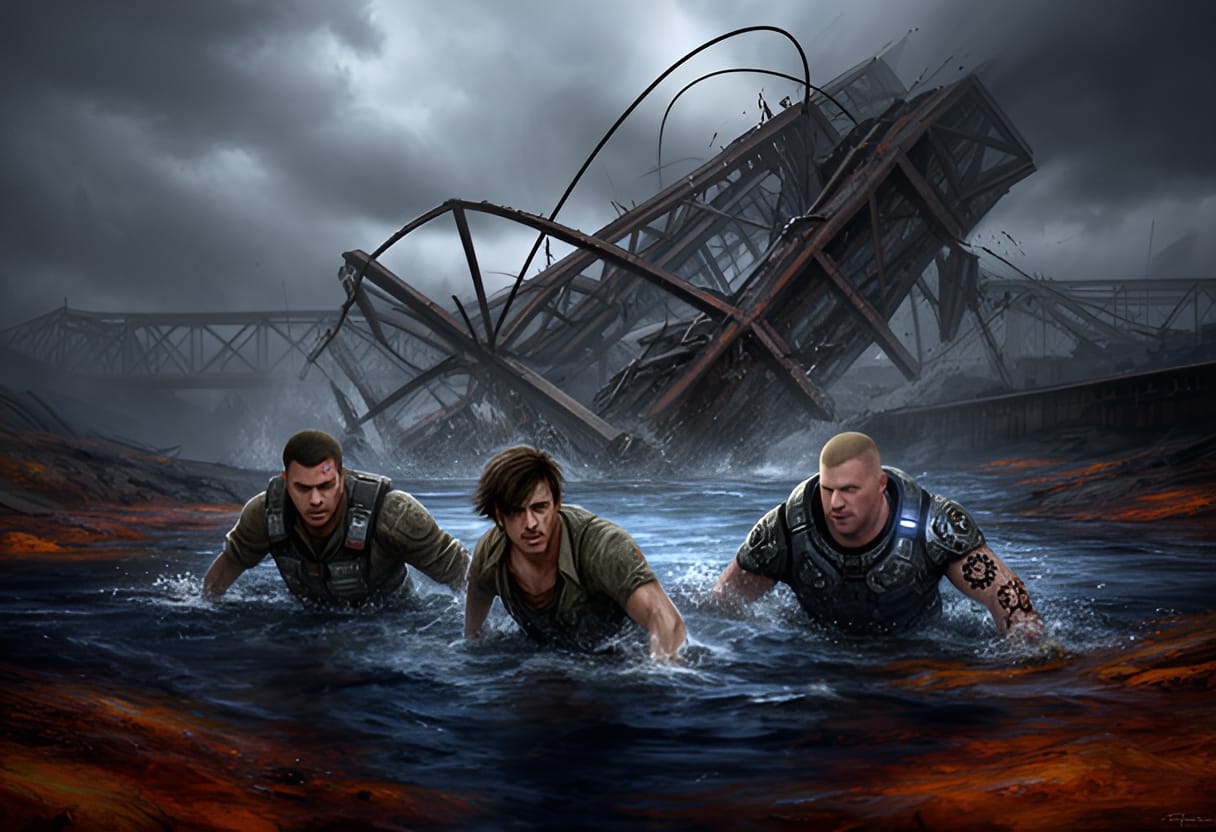
Chapter 4
Mercy’s Last Light
The pontoon bridge gave way with a shuddering groan, steel cables snapping like rotten twine, and the world tilted into chaos. Zay felt the cold shock of the Imulsion river seize his legs, the toxic water burning through his fatigues and into his marrow as he was sucked under. He kicked blindly, lungs screaming, fingers scraping against something hard—Jace’s webbing. He hauled, muscles trembling, dragging the wounded corporal upward until his head broke the surface, gasping, choking on foul air and worse water.
Alex was already there, one arm locked around Jace’s chest, the other churning to keep them both afloat. His face was a mask of strain, jaw clenched so tight Zay feared he’d crack a tooth. “Come on, Lopez,” Alex gasped, voice raw. “Don’t make me fish you out twice.”
They shoved toward the far bank, the current trying to drag them sideways into the sucking mud where drowned things stirred. Kryll began to thicken above them, a living cloud blotting out the moon, their wings whispering like dry leaves over stone. A Nemacyst had taken the bridge’s center span; the rear half buckled and folded inward, pitching soldiers and civilians alike into the river’s embrace. Screams cut off abruptly, swallowed by the water or the dark.
Zay didn’t look back. He couldn’t.
They reached the muddy slope of the east bank, Alex half-carrying, half-dragging Jace as the gear’s leg buckled beneath him. Zay pushed from behind, boots slipping on slick clay, until they collapsed in a heap just beyond the water’s reach. The river roared behind them, a black ribbon swallowing light and life. Above, the Kryll swarmed thicker, drawn to the heat, the pulse, the salt of fear in the air.
Alex rolled onto his back, chest heaving, water streaming from his nose and mouth. He wiped his eyes with a grimy forearm, smearing ash and river scum across his cheeks. “Well,” he rasped, trying for his usual lilt, “that was… refreshing.”
Zay said nothing. He was already moving, scanning the tree line where the river met the city’s edge. Smoke curled from Ephyra’s eastern districts, orange and angry against the night sky. Distant pops of small arms fire crackled like dry kindling. Somewhere, a Boomer laughed—a low, guttural chuckle that made the ground vibrate.
“Jace,” Alex said, pushing himself up on one elbow. “You still with us?”
The corporal groaned, face twisted in pain. His left leg was bent at an unnatural angle just below the knee, the fabric of his trousers torn and darkened with blood. “Fuck… my leg,” he muttered. “Feels like someone took a hammer to it.”
“You’re lucky it’s not worse,” Zay said, already tearing strips from his own undershirt. “Be luckier if we had a medic.”
Alex managed a weak grin. “Yeah, well, beggars can’t be choosers. Especially when the beggars are two ugly twins and a crippled gear who smells like river scum and regret.”
Zay tied the makeshift bandage tight, knotting it with practiced fingers. Jace hissed but didn’t protest. “Keep pressure on it,” Zay instructed. “We’re not out of the woods yet.”
Alex pushed to his feet, offering a hand to Jace. “Come on, Sunshine. Let’s see if we can’t find a nice, quiet place to die. Preferably somewhere with fewer giant bugs and more… I don’t know, functioning toilets.”
Jace took the grip, grimacing as he put weight on his bad leg. “Funny,” he muttered. “I was hoping for a hospital.”
Alex’s eyes flicked to Zay, then back. “Funny you should say that.”
The subway entrance yawned like a wound in the earth—a jagged maw of twisted steel and cracked concrete, half-swallowed by debris from the buildings above. Flickering emergency strips cast long, trembling shadows along the descent, their glow sickly and intermittent. The air down here was cooler, damp, tinged with the metallic tang of rust and something deeper—mildew, old oil, the faint, sweet rot of forgotten things.
Zay dropped first, testing each rung of the ladder with his weight before committing. Alex followed, Jace clinging to his back, arms locked around his neck, good leg braced against the wall. The descent was slow, agonizing for the wounded man, each jolt sending a fresh wave of pain through his features. But he didn’t cry out. Just gritted his teeth and breathed through it.
At the bottom, they stepped onto the platform.
And stopped.
The station was long and narrow, vaulted ceiling lost in darkness above. But along the edges, huddled against the tiled walls or slumped on benches, were people. Dozens of them. Men, women, children. Wrapped in blankets, coats, anything they could grab in the hurry. Faces were pale, eyes wide and haunted, illuminated only by the weak, dying glow of flares stuck in cracks or clutched in trembling hands. The light danced—amber, fragile—throwing their shadows into grotesque relief on the walls.
A baby wailed softly, muffled against a mother’s shoulder. An old man coughed into a rag, his breath rattling like a broken bellows. A teenage girl sat apart, knees drawn to her chest, staring at the tracks as if expecting a train to come and take them all away.
Alex moved first. He dropped to one knee beside an elderly woman whose lips were cracked and bleeding, her skin drawn tight over her cheekbones. Without a word, he unscrewed the cap of his canteen and tilted it gently to her lips. She drank, slow at first, then deeper, her hands trembling as she took it.
“Easy now,” Alex murmured. “Don’t drown yourself. We ain’t got a lifeguard on duty.”
She managed a weak smile, eyes glistening. “Thank you,” she whispered.
Alex winked. “Hey, what are brothers for? Besides stealing your fries and blaming the dog?”
The woman blinked. Then, impossibly, she laughed—a short, dry sound, like twigs snapping underfoot. But it was a laugh.
From the shadows nearby, the teenage girl looked up. Her face was smudged with dirt, a tear track cutting through the grime on one cheek. She stared at Alex for a long moment, then, seeing his earnest, half-smirking expression, she let out a hesitant chuckle. It was quiet. Nervous. But real.
Alex’s shoulders eased, just a fraction. “See? Told ya. Subway etiquette: always share your water, and never, ever eat the mystery meat from the vending machines.”
The girl ducked her head, but not before Zay saw the ghost of a smile touch her lips.
He turned away, moving toward the tunnel mouth at the far end of the platform. The East Rail Tunnel—supposedly disused, forgotten by the city’s transit planners, but known to him from old maintenance schematics. A storm drain line ran parallel, he remembered, big enough to crawl through if they had to. Grates every fifty meters. Air shafts. Possible exits.
But first, they had to get there.
He planted himself at the tunnel’s mouth, back against the cold concrete, Lancer held low but ready. The chainsaw bayonet caught the faint flare light, teeth glinting like shattered glass. He listened—past the whimpers and muffled sobs, past the distant drip of water from broken pipes— for anything that didn’t belong.
Silence. Then, a faint skitter. Like claws on stone.
Zay tensed, finger tightening on the trigger. He swept the barrel left, then right. Nothing. Just the dark, and the ever-present sense of being watched.
Alex joined him a moment later, Jace leaning heavily on his shoulder, face pale but set. “They ready to move?” Alex asked, nodding toward the civilians.
Zay didn’t take his eyes from the tunnel. “Almost. They’re gathering what they can. Blankets, kids, whatever’s not nailed down.”
Alex glanced back. The group was stirring now—blankets being folded, children being hoisted onto hips, a man pressing a flask into a woman’s hand. The teenage girl stood, helping an older woman to her feet. Her earlier fear hadn’t vanished, but it was no longer paralyzing. She looked toward the twins, then gave a small, sharp nod.
“Good,” Alex said. “’Cause I don’t know about you, but I’m starting to miss the smell of burnt toast. At least that didn’t try to eat your face.”
Zay finally looked at him. “You’re impossible.”
Alex grinned, wiping sweat and river grime from his brow. “And yet, you still follow me into dark holes full of god-knows-what. Guess that makes us even.”
A sudden scuttle echoed from the tunnel’s depths—closer this time. Something large. Dragging.
Zay lifted the Lancer, sight lining up on the black maw ahead. The flare light didn’t reach far, but he could feel it—the pressure, the hunger in the dark.
Alex fell silent, hand drifting to his own weapon. Jace swallowed hard, knuckles white where he gripped his brother’s arm.
The civilians had gone still too. Not a whisper. Not a sob. Just the slow, shallow rhythm of fear holding its breath.
Zay didn’t speak. He didn’t need to.
They waited.
And in the dark, beneath the dying city, the twins braced—not for victory, not even for survival—but for the chance to keep moving. To keep the others behind them alive just a little longer.
Because if there was one thing they’d learned in the barracks, on the river, in the fire and the dark—it was that as long as they were together, they hadn’t lost yet.
And so they stood, back to back, brothers in arms and in blood, waiting for the first claw to scrape the light.
The first touch came not with a roar, but a drag—a slow, wet scrape along the concrete lip of the tunnel entrance, like something heavy being pulled backward through gravel and slime. Zay’s finger tightened on the trigger. His breath came shallow, nostrils flaring as he sucked in the damp, mineral tang of the underground, laced now with something older—iron-rich, fungal, the scent of deep earth and rotting wood.
Then came the smell.
Sulfur and rot. Like eggs left in the sun too long, mixed with the copper tang of blood. It curled up from the darkness in waves, making Alex’s eyes water behind his grimy lenses. He didn’t wipe them. Couldn’t afford to lose sight, even for a second.
“Drones,” he murmured, voice low but sharp. “Or worse. Wretches.”
Zay didn’t answer. He was already moving—silent, flowing forward like water seeking a crack. He pressed himself against the right wall, Lancer held tight to his shoulder, the chainsaw idling at a low, hungry whine. The teeth gleamed in the flare’s weak pulse, ready to scream to life at a moment’s notice.
Alex followed, Jace limp but conscious between them, his good leg dragging, his face a mask of clenched-teeth endurance. They moved in a staggered wedge, Alex covering the left, Zay the right, the wounded corporal in the middle like fragile cargo. The civilians stayed back, pressed into the platform’s shadows, women pulling children close, mouths shut tight to stifle cries. The teenage girl stood near the front, eyes wide but fixed on the twins’ backs, as if her gaze alone could hold the dark at bay.
Ten meters in, the tunnel opened slightly—an old maintenance alcove, its walls lined with rusted pipes and frayed conduit. Zay halted, head cocked. Ahead, the passage narrowed again, then bent left into darkness so absolute it seemed to swallow the flare light whole.
He dropped to one knee, fingers brushing the ground. Not dirt. Not dust. Something fibrous, tangled—like hair, but thicker. Coarse. And damp.
He brought his hand to his nose. Sniffed.
Flinched.
“Alex,” he said, voice barely a breath. “Get back here. Now.”
Alex eased Jace down against the wall, wincing as the gear gasped at the jolt to his leg. “What is it?” he asked, keeping his tone even, though his pulse hammered in his throat.
Zay held up his gloved hand. Strands of something dark and fibrous clung to the fingertips—like wet rope, but organic. He brought it closer to the flare’s glow.
It wasn’t hair.
It was tendril.
Thick as a thumb, rubbery and veined with tiny pulsations that caught the light like slow-beating hearts. One end was frayed, as if torn. The other… the other still twitched.
Alex swore under his breath. “Jesus. What the hell is that?”
“Not sure I wanna know,” Zay said, already scraping the tendril off his glove onto the concrete. He crushed it under his boot. It burst with a soft pop, releasing a thin, greenish vapor that smelled like burnt sugar and ammonia. His eyes watered again—this time from the sting.
“Whatever it is,” Alex said, voice tight, “it didn’t get here by accident.”
A soft skitter-scrape came from the bend ahead. Then another. Closer.
They weren’t alone.
Zay rose, Lancer rising with him. “Stay low. Stay quiet. And for the love of all that’s holy, don’t scream if you see something ugly.”
Alex managed a tight nod. “No promises.”
They moved forward again, slower now, senses flared like trapwires. The tunnel walls breathed—dripping, shifting, alive with the faintest vibrations. Somewhere ahead, something clicked. Not a weapon. Not a boot. Something jointed. Something alive.
Then—light.
Not flare. Not fire.
A sickly, pulsing glow seeped from around the bend—greenish, rhythmic, like the breath of a sleeping beast. It painted the walls in shifting hues, making the condensation run in rivulets that looked, for a second, like blood.
Zay froze. Alex halted behind him. Jace gasped, pressing himself harder into the stone.
They peered around the edge.
And saw it.
The tunnel opened into a wide, vaulted chamber—once a transit hub, maybe, or a maintenance depot. Now it was a nest.
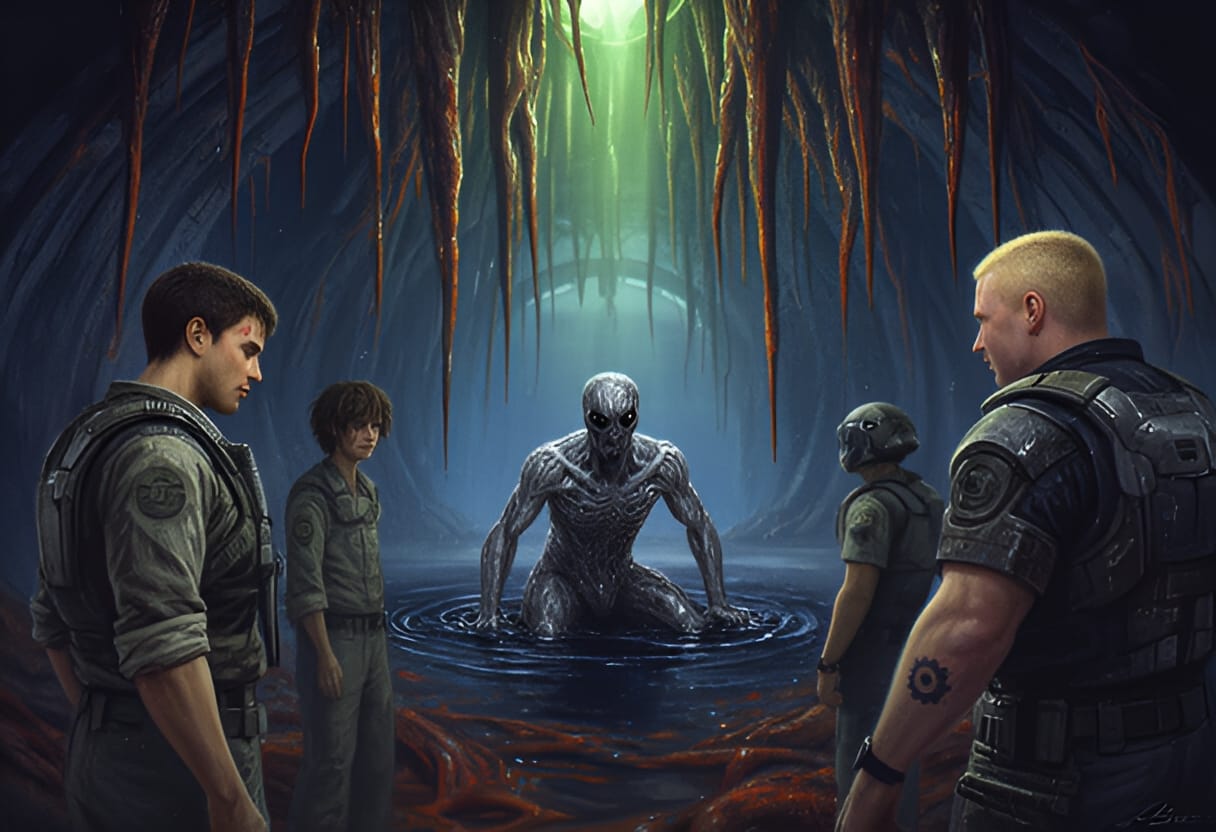
Hundreds of the tendrils hung from the ceiling like grotesque stalactites, some thick as a man’s wrist, others thin as whipcord. They pulsed in unison, a slow, eerie bioluminescence that cast the room in an eldritch glow. Along the walls, cocoon-like sacs clung to the stone—leathery, veined, some the size of barrels, others no larger than a football. A few twitched. One split slightly at the seam, oozing a thick, clear fluid that hissed where it touched the ground.
And in the center of it all, kneeling in a pool of the same viscous liquid, was a figure.
Human-shaped. But wrong.
Its skin was stretched tight over too-prominent bones, gray and slick with mucus. Its limbs were elongated, joints bending in places they shouldn’t. The head was too large, skull elongated, eyes lidless and black as polished obsidian. No nose. Just two slits where nostrils should be. Its mouth—if it could be called that—was a vertical slit lined with rows of needle-thin teeth that clicked softly as it breathed.
It wasn’t moving.
But it was aware.
Zay’s blood turned to ice.
He knew that shape.
He’d seen it in the briefings—classified, fragmented, whispered about in the mess halls after too much caffeine and not enough sleep. Locust. Not drone. Not boomer. Something older. Something that commanded.
A Kantus.
Or what was left of one.
The creature’s head lifted. Slow. Deliberate. Those black eyes swept the tunnel entrance—passed over Alex’s crouched form, lingered on Jace’s pale face, then locked onto Zay.
And in that gaze, there was no hunger.
Only recognition.
Like it had been waiting.
Alex sucked in a breath so sharp it sounded like a gasp. “Oh, you’ve got to be shitting me.”
The Kantus didn’t speak. Didn’t hiss. Didn’t roar.
It sang.
A low, subsonic thrum began in its chest, vibrating through the floor, up Zay’s boots, into his teeth. It wasn’t sound so much as pressure—a wave that made his vision swim, his stomach lurch. The tendrils overhead flared brighter, pulcing in time with the rhythm. The sacs along the walls shuddered. One split open.
From within, something unfolded.
Limbs. Joints. A carapace of dark, chitinous plate. It dropped silently to the floor—a Wretch, but not like any they’d seen. Its skin was pallid, veined with the same greenish light as the tendrils. Its fingers ended in needle-sharp claws. Its head swiveled on a neck too long, eyes locking onto the intruders with alien intent.
Then another sac burst.
And another.
The chamber was waking up.
Zay didn’t hesitate.
“Alex—Jace—now!”
He opened fire.
The Lancer roared to life, chainsaw screaming as he swept the barrel in a tight arc. Sparks flew where the rounds struck stone. The first Wretch lunged—too fast, too low—and met the spinning blade head-on. There was a wet shreak, a burst of greenish ichor, and the creature collapsed in two twitching halves, its limbs curling inward like a dead spider.
Alex was already moving, laying down suppressing fire with his own Lancer, short controlled bursts that caught two more Wretches in the chest, knocking them backward into the hanging tendrils. The creatures didn’t die instantly—they twisted, wrapping themselves in the pulsing fibers as if seeking shelter, their cries high and keening, like steam escaping a ruptured valve.
Jace, despite his leg, managed to pull his sidearm—a Snub—and fired twice. One round went wide. The second caught a tendril near the ceiling. It snapped back with a whip-like crack, spraying glowing fluid that burned where it struck the gear’s forearm. He cursed, dropping the pistol and clutching the arm, but didn’t go down.
“Fall back!” Zay barked, not taking his eyes from the Kantus. “To the platform! Now!”
They didn’t need telling twice.
Alex grabbed Jace under the arms, hauling him backward as the gear sucked in pain. Zay covered their retreat, walking backward, Lancer spitting fire, each shot aimed not to kill—but to delay. He targeted the tendrils, trying to sever the creature’s lifelines. Where the chainsaw bit, the fibers retracted with a hiss, pulling back like startled snakes.
But for every one he cut, two more seemed to stir.
The Kantus rose.
It didn’t run. Didn’t charge. It simply stepped forward, each movement deliberate, fluid—like a dancer stepping into moonlight. As it moved, the tendrils recoiled from its path, then snapped forward like striking vines, lashing at the twins’ boots, their legs, the barrel of Zay’s Lancer.
One wrapped around Alex’s ankle. He stumbled, barely catching himself on the wall. “Shit—shit!” he kicked, boot connecting with something soft and yielding. The tendril retracted with a squeal, leaving a burning line across his shin.
Another lashed out at Zay’s wrist. He jerked back, but not fast enough—it coiled around his forearm, squeezing. Pain flared, deep and burning, like frostbite and acid mixed. He gritted his teeth, raised his forearm, and revved the chainsaw.
The blade screamed.
The tendril severed with a wet snip, retracting with a hiss that sounded almost… offended.
The Kantus tilted its head.
And then it opened its mouth.
Not to scream.
To sing again.
This time, the thrum was deeper. Louder. It didn’t just vibrate the air—it solidified it, making Zay’s vision blur at the edges, his limbs feel heavy, slow. He fought it, shaking his head, blinking hard, but the rhythm was in his bones now, syncing with his heartbeat, threatening to pull him under.
Alex saw it. Saw Zay’s eyes glaze, his stance waver.
He didn’t think.
He moved.
Lunging forward, he drove his shoulder into Zay’s chest—not hard enough to hurt, just enough to break the rhythm. The Lancer jerked upward, firing a burst into the ceiling. Stone rained down. The Kantus flinched—just a fraction.
But it was enough.
“Hey!” Alex yelled, voice raw, cutting through the thrum like a knife. “Over here, you ugly bastard! You missed a spot!”
He pointed his Lancer not at the creature, but at the largest sac hanging above it—bulging, veined, pulsing like a diseased heart.
And he opened fire.
The rounds struck true. The sac ruptured.
Not with an explosion, but a gush—a torrent of thick, glowing fluid that poured down like molten jelly, flooding the Kantus’s lower half. The creature jerked back, a sound finally escaping its lips—not a song, but a wet, gurgling hiss, like steam forced through a clenched jaw.
The tendrils went wild.
They whipped and lashed, not just at the twins, but at each other, as if the creature had lost control. The chamber filled with the sound of tearing fiber and bursting sacs, the green light strobing erratically as the bioluminescence faltered.
Zay shook his head, blinking hard. The thrum was fading—replaced by the raw, ragged sound of his own breathing. His arm burned, but it worked. He could move.
“Now!” he shouted.
Alex didn’t need telling twice. He grabbed Jace again—this time both arms under the gear’s armpits—and yanked. Jace cried out, pain flashing across his face, but his legs found purchase, and he stumbled forward, then another step, then a run on adrenaline and sheer spite.
Zay covered them, walking backward, Lancer blazing. He didn’t aim for the Kantus anymore. He aimed for the tendrils—cutting the ropes that held the sacs aloft. One by one, they fell, splattering the floor with glowing goo that hissed and smoked where it touched stone. The Kantus shrieked—a high, broken sound—and lashed out with a tendril that caught Alex’s Lancer barrel, yanking it sideways.
Alex held on, boots skidding, but didn’t let go. “Not today, you freak!” he snarled, and with a grunt, he pulled—dragging the creature forward a step, off-balance.
Zay saw his opening.
He surged forward, not shooting—swinging.
The Lancer came up in a brutal, horizontal arc, chainsaw screaming.
It caught the Kantus across the midsection.
Not a killing blow. Not even close.
But the blade bit—tearing through rubbery hide, through layers of mucus and muscle, sending a geyser of glowing fluid into the air. The Kantus arched back with a sound that was half-scream, half-something else—something almost human in its pain.
And then it fell.
Not dead.
But down.
The tendrils went limp.
The glow began to fade.
The chamber fell into near-darkness, lit only by the dying pulses of the broken sacs and the twin red glows of the Lancers’ barrels as Alex and Zay stood over the fallen thing, chests heaving, weapons ready.
For a long moment, nothing moved.
Then Alex lowered his weapon slightly, wiping sweat and grime from his brow with his forearm. “Well,” he said, voice rough, “that’s one way to start a Tuesday.”
Zay didn’t answer. He was staring at the Kantus—not with triumph, not with relief—but with something colder. Something like dread.
Because as the light faded, he’d seen it.
In the creature’s final moments, as it lay twitching in the pool of its own fluids, its lidless black eyes had turned—not to the ceiling, not to the walls—but straight at him.
And in that gaze, there hadn’t been anger.
Or hunger.
Or even fear.
There had been sorrow.
Like it had known them.
Like it had expected them.
Zay swallowed hard. “Let’s go.”
They didn’t wait to see if it stirred.
Alex hauled Jace to his feet one last time, the corporal biting back a cry as his leg buckled. Together, the three of them retreated—fast, but not panicked—back down the tunnel, toward the platform, toward the waiting civilians.
The tendrils behind them lay still.
The sacs were silent.
And somewhere deep in the dark, the tunnel breathed.
But it didn’t follow.
When they reached the platform, the civilians were waiting—silent, wide-eyed, ready. The teenage girl stepped forward, placing a small, warm hand in Alex’s. He looked down, surprised, then gave her a faint, tired smile.
Zay took point again, Lancer ready, eyes scanning the tunnel mouth.
No movement.
No sound.
Just the dark.
And the quiet, steady rhythm of breath—his, Alex’s, Jace’s, the old woman’s, the child tucked against her mother’s shoulder.
They weren’t safe.
They weren’t even close.
But for now, they were together.
And in the dark, that was enough to keep moving.
Zay turned his head slightly, just enough to catch Alex’s eye in the dim light.
His brother gave him the smallest of nods.
No joke.
No quip.
Just understanding.
Zay returned it.
Then he stepped forward.
And they began to walk.
Zay’s boot scraped against the gritty tile as he led the small group forward, the tunnel’s mouth yawning ahead like a throat waiting to swallow them whole. The air was cool and damp, smelling of wet stone and old oil, the kind of scent that clung to forgotten places beneath the city. Behind him, Alex kept a steady pace, Jace limping between them, his breath coming in short, sharp gasps. The civilians followed in a loose line— the teenage girl who had taken Alex’s hand, the old woman clutching a faded shawl, the child pressed against her mother’s chest, and a handful of others, faces pale in the dim glow of the Lancers’ barrels.
They had walked maybe twenty paces when it started.
A whimper.
Soft at first, almost lost in the rhythm of their footsteps and the distant drip of water from somewhere unseen. Then it came again—louder, more urgent. A child’s voice, thin and frayed at the edges.
“I… I don’t like the dark,” the little girl whispered, her small hand tightening on her mother’s sleeve. “It’s too quiet. It’s… it’s breathing.”
No one answered. No one could.
The whimper became a sob. Then another. And then, without warning, she screamed.
It was raw and piercing, a sound ripped straight from terror, echoing off the curved tiles and bouncing back in a dozen distorted voices. The sound hit like a physical thing— a shockwave of panic that slammed into the group.
The old woman gasped and stumbled backward, her foot catching on a loose chunk of concrete. She went down hard, her shawl flying open as she hit the ground, a choked cry escaping her lips. The teenager beside her lurched to help, but in her haste, she shoved the child forward— and the boy tripped over his own feet, crashing into the woman beside him, sending them both sprawling.
“Get up! Get up!” someone yelled, voice shrill and broken.
Feet kicked and scrambled. Hands grabbed at arms, at sleeves, at anything to pull themselves upright. A man in a stained work shirt lost his balance and fell sideways, dragging another down with him. The tunnel filled with the ragged sound of breathing, the scrape of fabric on stone, the occasional grunt of pain or the hiss of a sucked-in breath.
Zay spun, Lancer coming up, eyes darting left and right. “Hold it! Hold your positions!”
His voice cut through the chaos like a blade, but it was barely audible over the rising tide of fear. The girl was still screaming, her face twisted, tears streaking through the dust on her cheeks. She kicked and twisted in her mother’s grip, trying to break free, her small body vibrating with terror.
Alex moved without hesitation.
He lunged forward, closing the distance in two long strides, and clamped his large hand over her mouth—not to hurt, but to silence. His grip was firm but not crushing, his thumb pressing gently against her jaw to keep her from biting down. His other hand came up to rest on her shoulder, steadying her.
“Hey,” he murmured, voice low and rough, cutting through her panic like a hand through fog. “Look at me. Look at me, okay?”
Her eyes flew open, wide and glassy, locked onto his. She was trembling so hard he could feel it through her thin shirt.
“I know it’s dark,” he said. “I know it’s loud in your head. But you’re safe. Right here. With me. With your mama. With Zay. We’re not letting anything get you. You hear me?”
Her breaths came in short, ragged gasps, but the screaming had stopped. Only soft whimpers escaped now, muffled against his palm.
“Good,” Alex breathed. “Good. Now… let’s try something. When I count to three, I’m gonna take my hand away. And you’re gonna take one slow breath. Just one. Can you do that for me?”
She gave the tiniest nod.
“One… two… three.”
He pulled his hand back.
She sucked in a shuddering breath— then let it out in a long, shaking exhale. Her shoulders dropped slightly. Her grip on her mother’s arm loosened, just a fraction.
Alex didn’t smile. Didn’t joke. He just kept his eyes on hers, waiting, holding the space.
Behind them, the old woman had pushed herself up onto her elbows, her face pale but her eyes sharp. She reached out and took the girl’s free hand, squeezing it gently. “It’s alright, little one,” she whispered, her voice cracked but steady. “We’re right here. We’re not leaving you.”
The girl buried her face in the woman’s side, her breathing slowly evening out.
Zay watched the exchange, his jaw tight. He lowered his Lancer slightly, but didn’t relax his grip. His eyes swept the tunnel ahead— dark, yawning, the walls closing in like the inside of a bone. The flare he carried felt heavy in his other hand, the metal cool against his palm.
He hadn’t wanted to use it. Not yet. Flares were short-lived, precious. But the panic had changed everything. Noise drew them. Heat drew them. And down here, in the dark, they were both.
He flicked his wrist.
The flare ignited with a sharp whoosh, a burst of crimson light that flooded the tunnel like blood spilled on stone. For a heartbeat, everything was washed in red— the tiles, the cracked walls, the ragged faces of the civilians, the sweat on Alex’s temple, the grim set of Jace’s jaw as he pushed himself upright.
And then— movement.
Not close. Not yet. But undeniable.
Scuttling. Skittering. Like a thousand tiny claws dragging across stone.
Zay’s breath hitched.
Along the far wall, just beyond the pool of light, shapes began to stir. Not random. Not chaotic. Coordinated. Small, fast-moving forms detached from the shadows and flowed toward the source of the sound and heat— toward the group. They moved like liquid shadow, flowing over cracks and ridges, pausing only to reform before surging forward again.
Kryll.
Dozens of them. Maybe more. They flowed like smoke given hunger, their bodies absorbing the light, making the red flare seem to dim where they touched it. Their wings— thin, membranous things— flicked open and shut in unison, creating a soft, rhythmic shhk-shhk that sounded like breath drawn through broken glass.
They weren’t attacking yet. Not fully. But they were coming. Drawn by the scream. By the pounding hearts. By the warmth of living flesh pressed together in fear.
Alex didn’t take his eyes off the swarm. His grip on the girl’s shoulder hadn’t loosened. His other hand tightened on his Lancer, knuckles whitening.
“They’re here,” he said, voice low, barely audible over the thrum of the Kryll’s wings. “They heard her.”
Zay didn’t answer. He couldn’t. His throat was tight. He raised the flare higher, trying to push the light further down the tunnel, to see how deep the rot went.
But the Kryll weren’t deterred. If anything, they seemed to thicken where the light touched them— not repelled, but concentrated, as if the flare’s heat was a beacon, a signal flare of its own. They pulsed faintly at the edges, a bioluminescent shimmer running through their ranks like a warning.
One broke from the main flow— a lone scout, faster than the rest— and shot forward, skimming the floor like a shadow given wings. It veered toward the girl, toward the heat of her small body pressed against the old woman.
Alex didn’t think.
He shifted his weight, planted his boots, and swung the Lancer—not to shoot, but to strike.
The chainsaw screamed as it bit into the air, a horizontal arc that caught the creature mid-flight. There was a soft pop, like a overripe fruit bursting, and a spray of dark fluid arced through the red light before vanishing into the darkness.
The Kryll hesitated.
Just for a heartbeat.
Then the flow surged forward, faster now, denser. The shhk-shhk grew louder, more urgent, like a chorus of whispers rising to a scream.
Zay swore under his breath.
“Alex— get them back! Now!”
He didn’t wait for a reply. He lifted the flare and threw it—not at the swarm, but past it, down the tunnel, as far as his arm could send it.
It landed with a clatter and a burst of light, rolling a few meters before sputtering against the wall, casting a second pool of crimson farther ahead.
The effect was instant.
The Kryll split— part of the swarm lunging toward the new light, drawn like moths to a flame, while the rest held back, flowing along the walls, testing, waiting.
But the delay was enough.
“Move!” Alex barked, scooping the girl into his arms. She was limp now, not from unconsciousness, but from sheer exhaustion, her head lolling against his shoulder, her breaths shallow and uneven.
“Come on!” Zay yelled, turning and shoving the old woman forward with his free hand. “Keep moving! Don’t look back!”
They surged forward— a ragged, stumbling line. Jace limped hard, his face slick with sweat, one hand braced against the tunnel wall for balance. The teenager helped the mother and child, half-carrying, half-dragging them as they shuffled on numb feet. The old woman moved surprisingly fast, her eyes darting left and right, her breath coming in short, sharp bursts.
Behind them, the Kryll flowed like a dark tide.
They didn’t fly. Not yet. They flowed— pouring over the uneven ground, slipping through cracks, climbing the walls in slow, undulating waves. Their bodies caught the flare’s light and drank it, glowing faintly from within, like embers banked in ash. The sound grew— a rising susurrus, like wind through dry leaves, like a thousand voices humming just below hearing.
Zay walked backward, Lancer blazing, firing short, controlled bursts into the leading edge of the swarm. Each shot punched a hole through the mass— a brief, bloody bloom of light and shadow— but the gap closed almost instantly, the Kryll oozing back together like liquid shadow seeking its level.
He caught Alex’s eye in the flickering red.
His brother’s jaw was set, his eyes locked on the tunnel ahead, but his free hand— the one not holding the girl— was curled tight at his side, fingers twitching.
He’s scared, Zay realized, not with surprise, but with a cold, quiet certainty. And he’s not joking. He’s not making a sound. He’s just… holding on.
A tendril of Kryll shot out from the main mass— thin, whip-like, faster than the rest— and lashed toward Alex’s boot. He twisted just in time, feeling the brush of something cold and slick against his heel, like a snake made of smoke.
“Keep your heads down!” Zay shouted. “Stay low! They hunt height!”
They obeyed without question. The civilians ducked, lowering their profiles, pressing themselves close to the ground as they moved. The girl in Alex’s arms gave a small, shuddering sigh, her breath warm against his neck.
The tunnel narrowed ahead— not by much, but enough to force them into a tighter cluster. The walls closed in, the ceiling dipping slightly, forcing them to hunch. The Kryll followed, thickening, the flow becoming less like a liquid and more like a wall— a advancing shadow that pulsed with inner light, tendrils flicking out to test the air, to taste the heat.
Zay fired again. And again. Each burst of Lancer fire carved a temporary canyon through the dark, but the Kryll flowed back in, slower now, more deliberate, as if learning.
Then— a new sound.
From behind the swarm, deep in the dark where the flare’s light didn’t reach, came a low, resonant thrum.
Not random. Not accidental.
Subsonic.
It vibrated up through the soles of Zay’s boots, into his bones, making his teeth ache. His vision blurred at the edges for a split second— not from darkness, but from pressure, like his skull was being squeezed from the inside.
He gasped, stumbling back a step.
Alex caught his arm. “You good?”
Zay swallowed, blinking hard. “Yeah. Yeah, I’m— ”
Another pulse. Stronger this time. The air seemed to thicken. The Kryll stilled for a fraction— then surged forward, not in chaos, but in unison, like a single organism responding to a command.
They weren’t just drawn to the noise and heat.
They were being called.
Zay’s blood turned to ice.
He remembered the Kantus. The way it had sung. The way its sacs had pulsed. The way it had looked at him— not with hatred, but with sorrow. Like it had known.
Like it had been waiting.
He looked ahead.
The tunnel stretched into blackness, the thrown flare now a dying ember up ahead, its light faltering. Beyond that— nothing. Just dark. And whatever was moving in it.
He tightened his grip on the Lancer.
“We can’t stop,” he said, voice raw. “We keep moving. No matter what.”
Alex nodded, his gaze fixed on the dark ahead. “Then let’s move.”
They stepped forward— into the throbbing dark, into the pulse of the swarm, into the weight of a whisper that wasn’t a whisper at all, but a summons.
And behind them, the Kryll flowed like a living shadow, hungry, patient, and utterly relentless.
The thrum came again— deeper this time, slower, like a heartbeat felt through stone. It wasn’t just in the air anymore. It was in the marrow. Zay felt it in his molars, in the hollow behind his eyes, a pressure that made his skull feel too small for his brain. He blinked hard, trying to clear the static at the edges of his vision, but the darkness seemed to pulse in time with the sound— a slow, malignant rhythm that wasn’t sound at all, but something older. Something that didn’t travel through ears, but through blood.
Alex stumbled slightly, his grip on the girl tightening without conscious thought. His breath came in short, sharp pulls through his nose, as if he were trying to suck air through a clogged filter. Sweat plastered his bangs to his forehead, and his knuckles were white on the Lancer’s foregrip.
“It’s… not just calling them,” he whispered, voice raw. “It’s… messing with us.”
Zay didn’t answer. He couldn’t trust his voice. Instead, he shifted the flare to his left hand and raised the Lancer, sweeping the barrel in a tight arc ahead of them. Red light carved tunnels through the gloom, revealing the Kryll not as a shapeless mass, but as something with structure— tendrils of shadow looping and recoiling like startled eels, flowing in layers, each level moving at a slightly different speed, creating a rippling, optical illusion that made the tunnel walls seem to breathe.
They were close now. Too close.
A tendril shot out from the left wall— thin, fast, whip-crack quick— and lashed at Zay’s boot. He twisted, feeling the brush of something cold and viscous scrape the toe of his boot, leaving a faint, numbing tingling that crawled up his ankle like frost. He stumbled, barely catching himself on the wall.
“Watch the sides!” he gasped, shoving the flare forward again. “They’re not just coming from ahead!”
Alex didn’t hesitate. He swung his Lancer in a wide, horizontal arc, the chainsaw screaming as it carved a crescent of light through the swarm. There was a wet, papery tear— like silk being ripped— and a burst of dark fluid sprayed into the air, catching the flare’s light and glowing faintly before vanishing into the dark. The Kryll recoiled—not in pain, but in surprise— the flow hesitating for a heartbeat before surging forward again, denser now, angrier.
The old woman cried out—not in fear, but in effort. She was moving faster than anyone expected, her feet sliding on the slick tile as she half-ran, half-stumbled, dragging the teenage girl with her. The girl’s eyes were wide, unblinking, locked on the writhing shadows at their heels. She hadn’t screamed again. She hadn’t cried. She was just… watching. Waiting.
Jace limped behind them, one hand braced against the wall, the other gripping his Lancer like a lifeline. His face was ashen, his leg trembling with each step, but he hadn’t complained. Not once. He just kept moving, his breath coming in ragged gasps that sounded like they were being torn from a shattered lung.
Zay risked a glance back.
The Kryll had formed a wall now— not a flowing mass, but a solid, undulating barrier that filled the tunnel from floor to ceiling, pulsing with a sickly inner light. It wasn’t moving as a swarm anymore. It was moving as a thing. A single entity with a will. And it was pressing forward, slow and inevitable, like a glacier made of hunger.
He raised the Lancer and fired a controlled burst into the center of the mass.
The rounds punched through, creating a temporary fissure— a jagged hole of red light and flying shadow. For a split second, they could see through to the tunnel beyond— the thrown flare sputtering against the wall, its light dying, the darkness beyond absolute and waiting.
Then the Kryll flowed in.
Not rushing. Not chaotic. Filling. Like water seeking its level, the shadow oozed back together, the edges smoothing, the pulsing light intensifying as if feeding on the disruption. The hole closed—not instantly, but with a chilling deliberateness, as if the creature were learning, adapting, remembering how to seal its wounds.
Zay’s stomach dropped.
They weren’t fighting a swarm.
They were fighting something that learned.
“Alex— ”
“I see it,” his brother said, voice tight. “It’s… adjusting.”
They had maybe ten meters of tunnel left before the dying flare. Beyond that— nothing. Pitch black. And whatever was waiting in it wasn’t just hungry.
It was patient.
The Kryll pressed closer. The thrum intensified— not louder, but deeper, vibrating in Zay’s teeth, making his vision swim. He felt nauseous. Dizzy. His grip on the Lancer felt slippery, not from sweat, but from a strange, crawling numbness in his fingers— like they were falling asleep from the inside out.
He forced himself to focus on Alex’s back. On the way his brother’s shoulders tensed with each step. On the small, warm weight of the girl against his chest, her breath fluttering against his neck like a trapped bird.
“Almost there,” Alex muttered, more to himself than anyone else. “Just… a few more steps.”
They moved as a unit now— not because they’d planned it, but because there was no other way. Zay covered the left, Alex the right, Jace staggering in the center, the civilians pressed between them like a fragile core. Every step was a victory. Every breath, a defiance.
The Kryll flowed along the walls, not just in front, but around— slipping behind them in slow, silent tendrils that probed the gaps between boots and heels, testing for purchase. Zay felt one brush his calf— cold, slick, leaving a faint, burning trail that made him want to scream, not from pain, but from the sheer wrongness of it. It wasn’t touch. It was invasion.
He slammed his boot down hard, trying to crush whatever had latched on, but there was nothing there— just the damp tile, the smell of ozone and old stone, and the lingering chill that seemed to have seeped into his bones.
Ahead, the thrown flare gave its last gasp—a final burst of crimson light that painted the tunnel wall in lurid detail: cracks in the stone, rusted pipes running along the ceiling, a dangled cable sparking weakly in its death throes.
And then it died.
Darkness swallowed them.
Not the dark of night. Not the dark of a closed eyelid.
This was thick. Active. It had weight. It pressed against the skin like a physical thing, damp and cold, smelling of wet stone and something sweetly rotten— like overripe fruit left in the sun.
Zay lifted the flare in his hand— the one he’d been carrying—and struck it against the wall.
Nothing.
He tried again. Harder.
The magnesium tip sparked— once, twice— then flared to life with a harsh, white-hot hiss, flooding the tunnel with light so bright it hurt.
They weren’t in the tunnel anymore.
They were in a chamber.
The space opened up suddenly— a wide, circular room carved from the bedrock, its walls rough-hewn and glistening with moisture. In the center, a shallow basin held stagnant, black water that reflected the flare’s light like oil. Around the rim, embedded in the stone, were strange growths— bony, coral-like structures that pulsed faintly with a bioluminescent glow, cycling through colors too slow to follow: deep violet, sickly green, a bruised red that made Zay’s stomach flip.
And hanging from the ceiling— dozens of them— were sacs.
Identical to the ones the Kantus had carried.
Bulging. Veined. Pulsing.
Slowly. Rhythmic.
Waiting.
The Kryll weren’t in the chamber.
They were on the walls.
Flowing not in a swarm, but in a pattern— tracing the ridges of the bone-like growths, moving in concentric circles that expanded and contracted with the pulse of the sacs. Their wings didn’t flap. They vibrated— a high-frequency hum that added to the thrum, layering it, making it more complex, more invasive.
Zay’s vision swam.
He couldn’t tell if the throbbing in his head was from the sound, the light, or something else— something that felt like it was inside his skull, pressing against the back of his eyes, whispering not in words, but in sensations: fear. hunger. obedience.
Alex gasped beside him.
Zay turned.
His brother was on one knee, the girl cradled against his chest, his forehead pressed to her temple. His eyes were shut tight, his jaw clenched so hard Zay could see the muscle jumping in his cheek.
“Alex?” he whispered, voice raw.
His brother didn’t open his eyes. “It’s… in my head,” he breathed. “Not talking. Just… pushing. Like it wants me to stop. To… lie down. To stop fighting.”
Zay’s blood turned to ice.
He raised the Lancer—not to fire, but to illuminate— sweeping the beam across the chamber.
The Kryll on the walls weren’t just flowing. They were dancing. Their movements weren’t random. They were mirroring the pulse of the sacs— expanding when they glowed, contracting when they dimmed— creating a feedback loop of light and motion that filled the chamber with a slow, hypnotic rhythm.
It wasn’t just affecting them.
It was syncing them.
He looked down at his own hands.
They were trembling.
Not from fatigue.
From resonance.
The thrum wasn’t just in the air anymore. It was in his blood. His heartbeat was trying to match it— slowing, stuttering, each beat a struggle against the pull of the rhythm.
He forced himself to look at the sacs.
One of them— the largest, dead center above the basin— pulsed brighter than the rest. Its veined surface stretched and relaxed with each cycle, and inside, he could see movement— not fluid, but shape. Something coiled within, shifting, waiting.
It wasn’t just a sac.
It was a womb.
And whatever was inside it wasn’t asleep.
It was dreaming.
And it was dreaming of them.
A wet, clicking sound came from the darkness beyond the chamber’s entrance— not from the Kryll, but from something larger. Something dragging itself through the tunnel, its limbs scraping stone, its breath a wet, rattling hiss.
The Seeder.
They’d heard the rumors. Seen the pods. But this— this was the source. The thing that had launched the Kryll into the sky over the river, that had darkened the noon sun with living shadow.
And it had brought them here.
Not by accident.
By design.
Zay’s grip on the Lancer tightened until his fingers ached. He could feel the chainsaw’s vibration through the grip, a familiar, grounding buzz that cut through the thrum like a knife through fog.
He looked at Alex.
His brother’s eyes were open now— glassy, unfocused, but aware. He met Zay’s gaze, and for a second, there was no fear. No pain. Just the old, wordless understanding that had carried them since they were boys sharing a bunk in the barracks, whispering secrets in the dark before lights-out.
We’ve been in worse, his eyes said. We’ve made it out.
Zay nodded once. Sharp. Hard.
Then he turned to the civilians.
The old woman was on her knees, one hand pressed to her temple, the other clutching the girl’s shoulder. The teenager stood frozen, eyes wide, not crying, not moving— just waiting, like she’d been told to do.
Jace was slumped against the wall, his Lancer dangling from his fingers, his head lolled to the side. His breathing was shallow, uneven— but he was still there. His eyes flickered open when Zay called his name, focusing with effort.
“Jace,” Zay said, voice low but cutting through the thrum like a blade. “Listen to me. You still got fight in you?”
Jace swallowed. His lips moved. “Always… ” he rasped. “Just… need a… target.”
Zay managed a grim smile. “Good. Then listen. We’re not dying here. Not today. Not in this fucking cave. We make a hole— big enough for them to crawl through. You, me, Alex— we lay down fire. Old woman, you get the girl and the kid through first. Teenager, you bring up the rear. We don’t stop. We don’t look back. We move.”
He looked at Alex. “You with me?”
His brother pushed himself up, slow, stiff, but his eyes were clear now— burning with something that wasn’t just courage. It was rage. The kind that came not from hatred, but from love. From the refusal to let something ugly take what mattered.
“Always,” Alex said. His voice was rough, but it was his. No tremor. No hesitation. Just the low, steady tone of a man who had made his choice.
Zay turned to the chamber’s far wall— the side opposite the basin, where the Kryll flowed thinnest, where the bone-like growths were cracked and uneven.
“On three,” he said. “We break through. And we don’t stop until we see sunlight.”
He didn’t wait for agreement.
He raised the Lancer.
“One.”
The chainsaw screamed to life.
“Two.”
Alex joined him, his own Lancer roaring in harmony.
“Three.”
They surged forward—not as soldiers, not as brothers, but as forces.
Zay aimed low, cutting into the wall where the stone met the growth, the chainsaw biting into bone-like material that screamed when cut—a high, ringing keen that made his teeth vibrate. Sparks flew. Chips of blackened stone and something harder— like obsidian— sprayed into the air.
Alex worked high, slicing into the pulsing sacs that hung from the ceiling. Each one burst with a wet pop, releasing a thick, glowing fluid that hissed where it touched the stone, sending up plumes of acrid smoke that smelled of burnt sugar and rotting meat. The Kryll recoiled from the heat, the flow stuttering, the pulsing light faltering.
Jace, despite his leg, dragged himself forward, firing his Lancer into the Kryll on the floor, each round punching holes in the shadow that glowed briefly before sealing again. He wasn’t aiming to kill. He was aiming to disrupt— to break the rhythm, to throw off the pattern.
The old woman didn’t hesitate. She scooped the girl into her arms, tucked her face into her shoulder, and ran— not toward the tunnel, but along the wall, using the civilians’ momentum to carry her past the worst of the flow. The teenager followed, half-carrying the small boy who had gone silent, his face pressed against her shoulder, his tiny fists clenched in her shirt.
The Kryll reacted—not with anger, but with adaptation.
The thrum shifted— not in pitch, but in pattern. It became sharper, more staccato, like a series of pulses designed to disrupt thought, to induce panic. Zay felt it hit his temples like a series of tiny hammers, each blow threatening to shatter his focus.
He gritted his teeth and pushed.
The chainsaw bit deeper.
A sac exploded above him— not from his fire, but from pressure— releasing a torrent of glowing fluid that drenched his shoulder and arm. It burned—not with fire, but with cold, a searing, icy fire that made him gasp and drop to one knee.
Alex was there in an instant, hauling him up by the collar of his vest. “Come on, Zay! Move!”
They weren’t breaking through.
They were making a hole.
And the Kryll were flowing into it faster than they could cut.
But they weren’t stopping.
Zay roared—not in pain, but in defiance—and swung the Lancer in a wide, horizontal arc, cleaving through a cluster of sacs and sending a geyser of glowing fluid arcing across the chamber. The light from the burning liquid painted the walls in lurid, shifting hues— green, violet, a sickly yellow that made the Kryll recoil, not from pain, but from confusion.
For a heartbeat, the rhythm broke.
The thrum stuttered.
The flow hesitated.
And in that gap— narrow, fleeting, but real— the old woman lunged.
She didn’t run.
She threw.
With a grunt of effort, she heaved the girl forward— not gently, but with desperate, maternal force— sending her flying through the clearing like a sack of grain tossed over a wall.
The teenager caught her mid-air, turning to absorb the impact, her feet sliding on the slick stone as she braced against the wall.
“GO!” the old woman screamed, her voice cracking. “NOW!”
She didn’t wait to see if they made it.
She turned and shoved the teenager hard in the back, sending them stumbling forward with the boy, then dove after them— not gracefully, but with the brutal, desperate motion of someone who knew she might not make it, but would die trying.
Zay and Alex didn’t wait for orders.
They surged into the gap— side by side, Lancers screaming, chainsaws carving tunnels of light through the Kryll, each step a battle, each breath a war.
Behind them, the chamber reacted.
The sacs flared— not in unison, but in sequence, a wave of light that rolled from the basin outward like a detonation chain. The Kryll flowed faster, denser, their wings vibrating at a frequency that made the air feel thick, like wading through oil.
Zay felt something latch onto his boot— not a tendril, but a cluster, dozens of tiny bodies locking together to form a living grappling hook that yanked hard, trying to pull him back.
He didn’t look down.
He stomped.
The chainsaw bit into the mass, and there was a sound like a thousand tiny bones breaking— a wet, crunching shatter— and the grip released.
Alex stumbled— not from injury, but from vertigo. The thrum had shifted again, now layering a subharmonic that made the world tilt, like the chamber itself was spinning.
Zay grabbed his arm. “Eyes forward,” he barked. “Don’t you dare close them.”
His brother’s eyes snapped open— wide, bright, burning with something fierce and desperate. He nodded. Once.
They burst through the chamber’s mouth and into the tunnel beyond— not into darkness, but into light.
Not sunlight.
Not yet.
But the flare Alex had been carrying— the one he’d gripped tight in his fist the whole time— had somehow stayed lit. It sputtered in his hand, low and weak, but burning, casting a feeble cone of gold-white light ahead.
And in that light— just ten meters down— was the mouth of the tunnel.
And beyond that— the faint, gray glow of the pre-dawn sky.
They weren’t safe.
They weren’t even close.
But they were out.
Zay didn’t slow.
He didn’t look back.
He just kept moving, Alex at his heels, Jace limping hard behind them, the civilians scrambling ahead, their footsteps echoing in the tunnel like a heartbeat.
The Kryll followed.
Not in a swarm.
Not in a wall.
But in a trail— a thin, glistening thread of shadow that clung to the walls and floor, pulsing faintly, like a wound that hadn’t yet closed.
And from deep behind them, still echoing through the stone, came the thrum.
Slower now.
Fainter.
But not gone.
It wasn’t chasing them.
It was following.
And it would remember them.
They moved through the tunnel with the flare’s weak light trembling in Alex’s fist, a sputtering beacon against the dark. The Kryll trailed behind—not a wall, not a swarm, but a thin, glistening thread clinging to stone and rail, pulsing like a bruised vein. It breathed with them. Watched. Waited.
The air was cold and damp, smelling of wet concrete, ozone, and something older—something fungal and deep, like the breath of the earth itself. Water dripped from somewhere ahead, a slow, metronomic plink… plink… plink that echoed off the arched ceiling. Jace limped behind them, one hand braced against the wall, his face drawn tight with pain. The civilians shuffled forward in a ragged line— the old woman, the teenager carrying the boy, the girl now tucked safely against her chest, her small fingers curled into the fabric of the teen’s shirt. Others followed, hollow-eyed and silent, their shoes scraping on grit and shattered tile.
Alex kept the flare low, swinging it in slow, wide arcs as they walked, the flame guttering but refusing to die. Each pass sent a shiver through the Kryll thread— the shadows recoiling slightly, then flowing back in, testing.
Then, without warning, it lunged.
Not as a mass. Not as a wave. But as a thousand tiny bodies, launched from the walls and ceiling like shrapnel, drawn to the heat, the motion, the life in the beam. They struck in a silent storm— wings clicking against faceshields, tiny claws scrabbling at armor joints, seeking the warmth of skin beneath.
Alex shouted, not in fear, but in fury— a raw, instinctive sound—and swung the flare like a torch.
The flame lashed out in a wide, screaming arc, searing the air. Where it struck, the Kryll didn’t just flee—they shattered. Wings curled and blackened mid-flight, bodies detonating in tiny puffs of smoke and chitinous ash. The smell hit instantly— scorched fabric, burning protein, the acrid tang of chitin like burnt hair and sulfur. Alex felt the heat bloom across his knuckles, then lick up his fingers. He gasped, jerking his hand back—but didn’t drop the flare. Didn’t break the arc.
Again. And again.
He swung it in widening circles, each pass a crescendo of light and flame, driving the creatures back into the cracks, into the fissures in the stone, into the dark where they could not follow. His gloves smoked. The synthetic layers curled and blackened at the seams. Beneath, his skin blistered— first a prickle, then a sear, then a deep, radiating burn that climbed his wrists and flared into his palms. He could feel the flesh bubbling where the flame had licked too close, where the radiant heat had soaked through the thin material. It hurt like hell— a white-hot pressure behind the nerves, a sensation like his skin was trying to peel itself off and crawl away.
But he didn’t stop.
He couldn’t.
Not with them behind him. Not with the girl’s small face pressed against the teenager’s shoulder, her eyes wide and unblinking in the flare’s glow.
He gritted his teeth and swung harder.
“Come on, you fucking shadows!” he bellowed, voice raw. “Is that all you got?”
The Kryll shrieked—not a sound, but a vibration in the teeth, a subsonic whine that made the fillings in his molars ache. Then, as if burned by the light itself, they began to retreat— not fleeing, but flowing, like oil sucked back into a crack in the pavement. One by one, they vanished into the stone, leaving only the faintest trace of shadow on the wall, a pulsing afterimage that faded with each passing second.
The tunnel fell silent but for the drip of water, the ragged breathing of the survivors, and the harsh, uneven rasp of Alex’s own breath.
He lowered the flare.
The flame guttered low, almost dead— but still burning.
He looked at his hands.
The gloves were ruined— melted into stiff, blackened claws over his knuckles. The right hand was worse: the skin beneath had split in places, weeping clear fluid that instantly coagulated into a thick, glossy seal. His fingers trembled—not from weakness, but from the sheer, blinding agony of it. Every nerve screamed. Every movement sent lightning up his arms.
He didn’t show it.
He tucked both hands tight beneath his armpits, pressing the wounded palms against his ribs, where the pressure and the warmth of his body could mask the shake. He forced his shoulders back. Forced his chin up. Forced a grin onto his face— tight, strained, but there.
Zay was already moving.
He dropped to one knee in front of the girl, his Lancer dangling loose in one hand, the other outstretched—not to touch, not yet, but to assess. His eyes flicked over her face, her neck, her arms— checking for bites, for tears in clothing, for any sign the Kryll had gotten through.
“You okay?” he asked, voice low, steady. No panic. No hurry. Just the calm of a man who had seen too much to be shaken by little— but who cared, deeply, about the little things.
The girl didn’t answer right away. She stared at him— not with fear, but with something quieter. Something like recognition. As if she’d seen this look before. In a father. In a brother. In someone who had sworn, silently, to keep her safe.
Then she gave the smallest nod.
“My neck,” she whispered. “It… itches.”
Zay leaned in, squinting in the dim light. He saw nothing— no welts, no breaks in the skin. Just the faint reddening where sweat had mixed with dust. He exhaled through his nose.
“Just sweat and grit,” he said. “You’re fine. The bugs didn’t touch you.”
She didn’t smile. But her shoulders dropped. A fraction.
Alex shifted his weight, the pain in his hands flaring white-hot for a split second as he moved. He swallowed it down. Forced air through his nostrils. Then, when he was sure his voice wouldn’t break, he spoke.
“See?” he said, nodding at the girl. His tone was light— teasing, almost playful— but his jaw was clenched so tight he could feel his molars grind. “Told you I’d keep the bugs off your neck. Didn’t I?”
The girl blinked. Then, impossibly, she gave a half-smile. Not big. Not loud. But real.
The teenager let out a breath she hadn’t known she was holding. Her eyes flicked to Alex— really looked at him—for the first time since they’d entered the tunnel. She saw the ruined gloves. The way he held his arms. The tension in his jaw.
She didn’t say anything.
But she nodded. Once. Slowly.
Alex caught it. Held it.
Behind them, Jace cleared his throat— a wet, painful sound. “We should keep moving,” he rasped. “That flare won’t last much longer.”
Alex glanced down.
The flame was low. Yellow at the base, trembling at the tip. It had burned nearly to the metal casing. He could feel the heat radiating up through the grip now— not the clean heat of combustion, but the dull, searing warmth of something dying.
He tightened his grip— not to hold it steady, but to keep from dropping it. The pressure sent a fresh wave of agony through his blistered palms. He bit the inside of his cheek until he tasted copper.
“Yeah,” he said. “Yeah, we should.”
He lifted the flare again— not in an arc, not in a defense— but held it low and forward, like a torchbearer leading the way. The light threw long, shuddering shadows ahead— of Zay, bent over the girl; of the teenager shielding the boy; of the old woman, her face set like stone; of the others, trailing like ghosts in the dark.
They moved.
The Kryll did not follow.
Not yet.
But the thrum was still there— faint, distant, a vibration in the soles of their feet, a subsonic pulse echoing through the bedrock. It wasn’t chasing. It wasn’t even hunting.
It was waiting.
And it remembered.
Alex’s hands burned.
Every step sent a shock of pain up his forearms. The blisters had split now— he could feel the wetness seeping through the ruined gloves, could sense the raw, slick surface of his skin beneath. He flexed his fingers experimentally— just a twitch—and the pain flared like a live wire. He stopped himself. Let his hands go limp again, cradled against his chest.
He didn’t look down.
He didn’t complain.
He just walked.
And every few paces, he’d catch Zay’s eye— not to speak, not to ask for help— but to share a look. A silent exchange. I’m still here. I haven’t broken.
Zay would nod. Almost imperceptibly. Then return his focus to the dark ahead.
The tunnel sloped gently upward— a relic of old maintenance shafts, dug long ago to service forgotten lines. The air grew slightly less stale. A faint draft stirred— not from outside, not yet, but from the slow, deep breathing of the earth itself, shifting in its sleep.
Ahead, the tunnel opened into a larger chamber— a junction, maybe, or an old storage vault. The flare’s light didn’t reach the ceiling, but it caught the glint of something metallic half-buried in silt— a piece of rail, warped and twisted. A broken sign, its letters long gone, leaving only the stub of a pole.
And then— a sound.
Not from behind.
From ahead.
A low, rhythmic thump… thump… thump— like something heavy being dragged. Or hammered.
The teenager froze. The old woman turned her head, sharp and sudden.
Alex slowed the flare’s sweep, narrowing the beam.
Zay came up beside him, Lancer rising—not aimed, but ready.
The thumping continued.
Steady.
Relentless.
Then, from the darkness beyond the light’s edge, a shape began to resolve.
Not Locust.
Not Kryll.
Something… human.
A figure emerged— tall, clad in patched armor, a helmet under one arm. A gear. Older. Face streaked with soot and sweat, one eye swollen shut. In his other hand, he dragged a makeshift stretcher— on it, a woman, unconscious, her leg bent at a wrong angle, a tourniquet of twisted cloth and wire cinched high on her thigh.
The man saw them.
Stopped.
Lowered the stretcher with a groan.
“You… you made it out,” he rasped. His voice was raw, torn from shouting. “From the hospital?”
Zay stepped forward, Lancer still at low ready. “Mercy? You were at Mercy?”
The man nodded, breathing hard. “Took the west stairwell. Got pinned in the sub-basement. Kryll came down the vents like rain. Took half the squad before we could seal the door.” He glanced at the woman on the stretcher. “Luis… Luis got her out. Took a Boomer round to the chest doing it. Didn’t even slow him.”
He looked past them— into the tunnel behind— where the Kryll thread still pulsed, faint but persistent.
“You’re the first I’ve seen come out of the dark,” he said. “Not go in. Come out.”
Alex swallowed. The pain in his hands was a constant, throbbing thing now— a third heartbeat. He kept the flare lifted. Kept his face neutral.
“We’re not out,” he said, voice quiet but clear. “We’re just… still moving.”
The man studied him— really studied him— then flicked his gaze to Alex’s hands. The ruined gloves. The way he held them. The tension in his shoulders.
He didn’t say anything.
But he gave a single, sharp nod.
Then he bent, hoisted the stretcher back onto his shoulder, and said, “We’re heading for the rail line. Heard there’s a maintenance crew holding the east portal. If we can get there, we might get a train moving. Might get out.”
Zay glanced at the civilians— at the girl, now dozing against the teenager’s shoulder; at the old woman, her eyes closed, lips moving in silent prayer.
“We’re with you,” he said.
The man didn’t smile. But he didn’t refuse.
They fell in behind him— the gear, the stretcher, the wounded woman— as the group turned and began to move deeper into the tunnel, toward the distant, uncertain promise of the rails.
The flare sputtered in Alex’s fist.
It was dying.
He could feel it— the way the flame hesitated before each flicker, the way the wax pooled unevenly around the wick, the way the light now cast more shadow than illumination.
He raised it higher, not to see better, but to buy time.
And as he did, the pain in his hands flared— sharp, white, blinding— and for a heartbeat, he saw not the tunnel, not the gear ahead, not even the girl sleeping behind him.
He saw the gym.
The morning before.
The smell of burnt coffee.
Zay’s grimace as he took the first sip.
“Tastes like engine oil filtered through a sock,” he’d said.
And Alex had laughed— loud, bright, unguarded— and said, “Yeah? Well, at least it wakes you up.”
Now, the light shook in his hand.
His breath came short.
His palms were on fire.
But he didn’t lower the flare.
He didn’t let go.
And when the girl stirred against the teenager’s chest, murmuring something unintelligible in her sleep, Alex leaned his head back against the tunnel wall— just for a second—and let the pain burn.
He didn’t cry out.
He didn’t stop.
He just kept the light moving.
Forward.
Always forward.
The flare’s light stuttered again— a long, shuddering gasp— then held, weak but stubborn, like a man refusing to collapse.
Alex felt it in his bones: the wick was nearly gone. The metal casing grew hotter now, not from the flame, but from friction— his grip, slick with sweat and something thicker, had begun to slip. He adjusted his hold, twisting the flare so the unburned end sat in the crook of his injured palm, the blistered skin pressed against cool metal. It helped— just a little. The pressure shifted the agony to a duller throb, though the raw edges still screamed with every pulse.
They moved deeper.
The tunnel widened slightly here, the walls rough-hewn from old stone, veined with threads of quartz that caught the flare’s light and threw it back in faint, icy glints— like distant stars trapped in rock. The air grew cooler, damper. A slow drip echoed from somewhere ahead, metronomic and lonely.
Jace limped beside him, breath ragged, left leg stiff and swollen at the knee. He hadn’t complained since the chamber, but Alex saw the way he favored it, the way his boot dragged slightly on the uphill grade. The wound from the mortar fragment was festering at the edges— a angry red halo around the entry point, the bandage soaked through with something darker than sweat.
“You good?” Alex asked, voice low, not looking at him.
Jate gave a humorless snort. “Been better. Been worse.” He nodded toward the civilians ahead. “They’re doing better than us.”
Alex glanced forward. The girl slept now, her head lolling against the teenager’s shoulder, one small hand curled loosely in the fabric of her shirt. The old woman walked with her eyes open, but unfocused— staring not at the tunnel walls, but inward, as if counting beads or reciting names. The teenager shifted the boy’s weight from time to time, her arms trembling, but she didn’t stop. Didn’t drop him.
“They’ve got something to fight for,” Alex said.
Jace didn’t answer right away. Then, quiet: “So do we.”
They passed a side passage— dark, yawning— where the stone had collapsed inward, burying the mouth under rubble and twisted rebar. A faint, sour smell drifted out— ozone and something sweet, like rotting fruit. Alex didn’t break stride. Didn’t slow. But his grip on the flare tightened, just for a second, and a fresh wave of pain shot up his arm. He bit his tongue. Kept walking.
The gear leading them— Luis, he’d said his name was— moved with purpose, despite the weight on his back. His boots found purchase on uneven ground, his eyes scanning the walls and ceiling, not for beauty, but for threats: cracks that might widen, vents that might breathe dark, alcoves where something could hide.
They came to a fork.
Left: a narrow crawlspace, barely tall enough to stoop through, darkness swallowing it whole after three meters.
Right: a wider, better-maintained shaft— concrete-lined, with remnants of old conduit and cable trays hanging like fossilized ribs from the ceiling. Faint glyphs were stenciled near the top— faded, but legible if you knew what to look for: MAIN LINE – EAST SECTOR – AUTHORIZED PERSONNEL ONLY.
Luis stopped. Put a hand out, halting the group.
“This is it,” he said. “East Maintenance Shaft. Leads straight to the rail tunnel’s service access. If the portal’s still clear, we can get to the tracks in under a klick.”
He looked back at them— really looked— his gaze sweeping over the civilians, over Jace’s limp, over Alex’s ruined hands, still cradled against his chest.
“You sure you can make it?” Luis asked Alex, blunt. “That light’s gonna die soon. And if it does… we’re moving blind. And the Kryll? They don’t need much of an opening.”
Alex looked at the flare.
It sputtered. A long, yellow tongueshot— then dimmed to a dull ember glow.
He could feel it now: not just the burn in his hands, but the tremor in his wrists, the way his fingers wanted to curl inward, to protect themselves. The pain wasn’t just surface anymore. It had sunk deep— into the tendons, the joints, the marrow. Every movement was a negotiation with agony.
But he didn’t hand it over. Didn’t suggest someone else take it.
Instead, he lifted it— not high, not wide— but held it low and forward, the flame cupped in both wounded palms, shielding it from drafts, from his own shaking.
“I’ve got it,” he said. His voice was steady. Too steady. Like a wire pulled taut.
Luis studied him a moment longer. Then gave a single nod. “Alright. We move. Quiet. Fast. And if anything hits— we don’t stop. We keep going. Understood?”
Murmurs of assent. The teenager tightened her grip on the boy. The old woman touched the girl’s cheek— a fleeting, feather-light gesture— then fell into step.
They turned into the right-hand shaft.
The concrete was smooth underfoot, worn by decades of use— maintenance carts, workers, the quiet hum of a city that once kept its lights on. The air here smelled different— less damp, less stone. Cleaner, in a way. Like concrete and oil and the faint, metallic tang of old electricity.
They moved in silence.
Only the soft scrape of boots, the uneven rhythm of Jace’s limp, the occasional soft whimper from the woman on the stretcher— Luis shifting his grip to ease her pain.
Alex kept the flare low.
The flame was barely alive now— a blue-white core no bigger than a pencil tip, surrounded by a halo of pale gold that struggled to push back the dark. It cast long, trembling shadows— of Luis’s broad shoulders, of the stretcher’s awkward bulk, of Jace’s hunched form, of the civilians trailing like a frightened flock.
And behind them— still there.
The thrum.
Fainter now. Distant. But not gone.
It vibrated through the soles of their feet, a subsonic thrum that made the fillings in Alex’s teeth ache. It wasn’t loud. Didn’t need to be. It was the kind of sound you felt in your marrow— a reminder that the dark wasn’t empty. That it was watching. Learning.
They passed a junction— a T-intersection where another shaft branched off, darker, untouched by concrete or light. A draft came from it— cold, damp, carrying the faintest hint of something organic, sweet and sickly— like overripe fruit left in the sun.
Luis paused. Put a hand on the wall. Listened.
“Air’s moving,” he murmured. “That shaft connects to the old storm drains. Runs under the river. If the Locust are using it… they could flank us.”
He looked at Alex. “You seeing anything?”
Alex swept the flare slowly from side to side— not wide, not frantic— just enough to catch movement, to catch glint. The light was too weak to pierce far, but it was enough to show the walls— smooth, unbroken. No scuff marks. No drag trails. No signs of passage.
“Clear,” he said. “For now.”
Luis grunted. “Doesn’t mean it’ll stay that way.”
They moved on.
The tunnel began to rise more steeply now— a gradual incline that made Jace’s limp more pronounced, that made Alex’s burned hands scream with every step as he shifted the flare’s weight, as he gripped it tighter to keep it from slipping.
His vision started to swim at the edges.
Not from blood loss. Not from shock.
From the pain.
It came in waves— a hot, white pressure behind his eyes, like the world was being squeezed through a funnel. He’d blink hard, shake his head slightly— just enough to clear it—and keep going. He didn’t tell anyone. Didn’t slow. Didn’t break stride.
But he felt it.
The way his breath hitched when he lifted the flare.
The way his fingers trembled—not from weakness, but from the body’s attempt to shut down the signal, to gate the pain before it overwhelmed.
He thought of Zay.
Not looking. Just knowing he was there— a few steps ahead, Lancer at the ready, eyes scanning, jaw tight. Alex could feel his presence like a gravitational field— steady, constant. A point of reference in the dark.
He thought of the girl.
Asleep. Safe, for now. Not because of luck. Because they’d fought. Because they’d bled. Because someone had thrown her through a gap in the dark, not to save themselves, but to give her a chance.
He thought of the coffee.
Burnt. Bitter. Like engine oil filtered through a sock.
And he almost laughed.
Almost.
But the laugh died in his throat— turned into a sharp, silent intake of breath as a fresh wave of fire lanced up his arms. He pressed the flare harder against his chest, using his body to brace it, to steady it. The metal was searing now— not just hot, but burning— conducting the heat straight into his palms, where the skin was already gone in places, where nerve endings lay raw and screaming.
He didn’t drop it.
He didn’t yell.
He just kept walking.
And then— light.
Not from the flare.
From ahead.
Ahead, where the shaft opened into a larger chamber— a junction of tunnels, maybe, or an old station platform— the concrete gave way to metal grates, and beyond them, a flood of pale, washed-out glow.
Not sunlight.
Not yet.
But close.
Emergency strips— the kind that lined refuges and fallout shelters— still glowing along the base of the walls, their phosphorescent paint charged by whatever ambient light had touched them hours ago. They threw a soft, greenish luminescence— just enough to see by, just enough to keep from stumbling in total dark.
Luis let out a breath he hadn’t known he was holding.
“We made it,” he whispered. “We’re at the service access. The portal’s just beyond that grate.”
He moved forward— slow, cautious— and kicked at the grate with his boot. It didn’t budge. Rust had fused it to the frame. He tried again, harder. The metal groaned.
“Give me a second,” he muttered. He braced a foot against the wall, grabbed the bars, and put his back into it.
The grate shrieked.
Then swung inward— not far, but enough.
Beyond it: darkness again. But different. Cooler. Moving.
Air rushed out— not stale, not stone-damp, but clean, with a hint of something green, something growing. And faint, very faint— the distant rumble of trains, not running, but settled. Like beasts resting between journeys.
Luis peered in. “Looks clear. No signs of recent use. No boot marks. No drag lines. But… it’s open. And if it’s open, the Kryll can get in.”
He turned back. “We go one at a time. I’ll go first— check the drop, make sure it’s safe. Then the stretcher. Then you guys. Move fast. Don’t linger. And if you see anything— anything at all— you shout. You don’t wait. You don’t second-guess. You shout and you run.”
He looked at Alex. “You good to go?”
Alex didn’t answer with words.
He lifted the flare— not high, not wide— but held it steady in front of him, the tiny blue-white core pushing back the immediate dark like a beacon in a storm. His hands shook. The pain was a living thing now— a second pulse in his wrists, a fire that had burned past the skin and into the bone. He could feel it in his thumbs, in the pads of his fingers, in the way his grip kept loosening despite himself.
He swallowed. Tasted blood.
Then he nodded.
Just once.
Luis gave him a look— not pity. Not sympathy. Something harder. Respect. Or maybe just recognition. The kind you give someone who’s still standing when everyone else would’ve gone down.
He slipped into the opening.
Feet vanished.
Then a soft thud— landing on something yielding, maybe gravel or packed earth.
Silence.
Then: “Drop’s about a meter. Solid ground. No immediate threats. Come on.”
One by one, they went.
The teenager lowered the boy first, then followed, her movements careful, quiet.
The old woman went next— slow, deliberate, her hands brushing the concrete lip as she lowered herself.
Then Jace— he hesitated at the edge, grimaced, then lowered himself slowly, using his good leg and his arms to control the drop. He landed stiffly, caught himself on one knee, then pushed up with a grunt.
Then came the stretcher.
Luis took the weight, eased it over the edge, then descended slowly, guiding it down with his back and legs. The woman on it moaned— soft, incoherent— but didn’t wake.
Then it was Alex’s turn.
He hesitated at the lip.
Not from fear of the drop.
From fear of letting go.
He had to release the flare with one hand to swing his legs over— and the moment he did, the pain in his wounded hand spiked— a white-hot flash that made his vision blur. He choked it back. Swallowed. Forced his fingers to uncurl— just enough— to let go.
He felt himself begin to fall.
Then— impact.
Not hard. Not bad. But the jolt sent shockwaves up his arms, through his shattered palms, and he cried out— not loud, but a sharp, involuntary gasp that echoed in the dark.
He hit on the balls of his feet, knees buckling, and went down on one side, the flare flying from his grasp—
He caught it.
Not with his hands.
With his forearm.
He slammed it against his ribs, crushing it to his chest, the flame guttering violently— then flaring back, desperate, as if sensing its imminent death.
He lay there for a breath— face pressed to cold stone, gasping, tears cutting tracks through the dust on his cheeks—not from sadness. From pain. From the sheer, overwhelming weight of it.
Then he heard it.
A whisper.
Not from behind.
From ahead.
The girl.
Soft. Sleepy. “Did we make it?”
Alex pushed himself up on his good arm— the left, still mostly usable— and got to his knees. He looked toward the voice.
In the gloom, he could see them: the teenager crouched beside the girl, the old woman sitting back on her heels, Luis standing watch at the mouth of the shaft, Jace leaning against the wall, eyes closed, breathing deep.
And the flare.
Still in his grip.
Still burning.
Barely.
The flame was now no taller than his thumb— a trembling spear of blue-white light, fighting to stay alive in the moving air. It threw barely enough light to show the curve of the tunnel ahead— the gravel floor, the damp walls, the faintest suggestion of a track bed just beyond.
He pushed himself up.
Stood.
The pain was a white-hot brand in both hands— but he didn’t let it drop them. Didn’t let it take the light.
He lifted the flare— not high, not wide— but held it low and forward, the way a sentry holds a lantern in a hostile pass: not to see far, but to see enough. To see the next step. The next breath. The next chance to keep going.
He looked at Zay.
Zay was already moving— a few steps ahead, Lancer at low ready, eyes scanning the dark ahead, his posture tense but forward.
Alex met his gaze.
No words.
Just a look.
And in it— everything.
I’m still here.
I haven’t broken.
I’m still holding the light.
Zay gave the tiniest nod. Almost imperceptible. Then turned back to the dark.
Alex took a step.
Then another.
The flare sputtered.
The flame dipped— nearly died— then flared again, defiant.
Behind them, the shaft began to fade— the concrete, the grates, the echo of their passage— swallowed by the dark.
And the thrum?
It was still there.
Fainter.
Slower.
But not gone.
It pulsed in the stone, in the air, in the blood.
Not chasing.
Not hunting.
Just… waiting.
Remembering.
Alex kept walking.
One step.
Then another.
The light in his hand was dying.
But he was still holding it.
And as long as he was holding it— as long as his hands, broken and burning, still refused to let go— then so was the hope.
Not loud.
Not bright.
But there.
And in the dark, that was enough.
The flare in Alex’s grip guttered again, a ragged cough of blue-white flame that threw his shadow long and trembling against the tunnel wall before snapping back to life. He swallowed, the motion scraping raw against his throat, and shifted his weight onto the balls of his feet. The pain in his hands was a constant, grinding presence now—less sharp than before, but deeper, woven into the marrow of his bones. He could feel it in every twitch of his fingers, every pulse of blood through the blistered skin. He didn’t look down. Didn’t dare. If he saw what was left of his palms, he knew he’d stop. And stopping meant the light died.
Ahead, Zay moved like smoke given form—silent, deliberate, his Lancer held low but ready, the chainsaw idling with a low, hungry whine. He didn’t glance back. Didn’t need to. He knew Alex was there. Knew the light still burned in his brother’s grip, however faint.
The tunnel stretched forward, rough-hewn and damp, the air thick with the smell of wet stone and something older—ozone and iron, like the breath of a wounded beast. The Kryll-thrum had faded to a distant vibration in the soles of their feet, a memory of pressure rather than a threat. For now, they were alone in the dark.
Then—light.
Not from the flare. From ahead.
A thin, pencil-line of red glinted off something metallic embedded in the rubble-choked mouth of the East Rail Tunnel. Just for a heartbeat. Then gone.
Alex’s muscles locked.
He didn’t breathe.
Zay froze mid-step, Lancer dipping a fraction as his eyes flicked forward, then narrowed.
Another glint. Higher up. Left side of the blockage. A second flash—cold, deliberate. A scope catching the dying light of the flare.
Snipers.
Two of them. Nestled in the jagged teeth of collapsed concrete and twisted rebar where the tunnel entrance had caved in from the bombardment above. They weren’t shooting yet. Just watching. Waiting. Their barrels tracked the group’s slow progress like fingers tracing a pulse.
And they weren’t aiming at the front.
They were aiming at the rear.
At the old woman, her hands gnarled but steady as she helped the teenager steady the boy on the stretcher. At Jace, favoring his wounded leg but still upright. At Luis, back bent under the weight of the stretcher, his face a mask of exhaustion. At the child, small and silent now, clutching the teenager’s sleeve.
The snipers weren’t hunting for sport. They were thinning the herd. Removing the weak first. Making the rest panic. Making them break.
Alex’s jaw tightened. He could feel the flare’s heat searing into his forearm through the rag wrapped around it, but he didn’t flinch. He kept the light low, forward—just enough to see the next step, the next breath. Just enough to keep moving.
Then—Zay moved.
Not a word. Not a signal. Just a shift of weight, a subtle turn of the hip toward the left wall where a maintenance access hatch yawned in the stone—half-buried, half-obscured by fallen debris, but still there. A narrow vertical shaft, just wide enough for a man to slip through, leading god-knew-where. Maintenance tunnels. Service lines. Maybe another way in. Maybe a way around.
Zay’s left hand came up—slow, deliberate—and tapped twice against his own right shoulder.
Tap. Tap.
Their signal.
Flank left.
Alex’s breath hitched. Not from fear. From recognition. That look. That tiny, almost imperceptible nod they’d used since they were kids—when they’d sneak into the old train yards to hop freights, when they’d double-team a Boomer in the outskirts of Port Farrall, when they’d covered each other’s backs in the dust-choked alleys of Aspho Point during the Pendulum Wars. No words needed. Just trust. Just knowing.
He didn’t look at Zay as he moved. Didn’t need to. He kept his eyes forward, on the flare’s dying glow, on the rough gravel under his boots, on the slow, stubborn rhythm of his own steps. But he felt it—the absence where his brother had been. The sudden, quiet void on his left.
Zay was gone.
Melting into the shadow like he’d never been there.
Alex swallowed again, harder this time. His palms screamed. He tightened his grip on the flare, feeling the crusted blood crackle under his fingers. He lifted it just a fraction higher—not to see farther, but to make sure the light didn’t die. Not yet.
Behind him, the teenager whispered, “Is something wrong?”
Alex didn’t answer right away. He kept walking. One step. Then another.
The flare sputtered. The flame dipped low—almost gone—then surged back, blue-white and desperate, licking at the air like a starving thing.
He could feel the Kryll-thrum again. Fainter. But there. Not chasing. Not hunting. Just… waiting.
Ahead, the tunnel mouth loomed—a jagged wound in the earth where concrete and rebar jutted like broken teeth. The snipers were hidden in the high points—one atop a slab of collapsed wall to the left, the other crouched in the skeletal remains of what looked like a signal gantry to the right. Their positions were elevated. Protected. They had the high ground. They had the sightlines.
And they had the patience.
Alex kept moving. Slow. Steady. He didn’t look up. Didn’t give them the satisfaction of seeing him flinch. He kept the flare low, held it tight against his chest with his forearm, the flame trembling but alive.
He could feel Zay’s absence like a physical pull. A gap in the air. But he also felt something else—certainty. Not that Zay would make it. Not that they’d both get out. But that Zay was doing what needed to be done. That he was moving. That he was working.
That was enough.
The teenager’s voice came again, softer this time. “Are we… are we almost there?”
Alex risked a glance sideways—just a flicker of his eyes toward the stretcher. The old woman’s face was pale in the dim light, her eyes closed, her lips moving in silent prayer. The boy on the stretcher moaned softly, unconscious or just beyond caring. The teenager’s hands were raw where they gripped the stretcher’s handles, her knuckles white.
He wanted to tell her yes. To lie. To say the light at the end of the tunnel was near.
But he couldn’t.
Instead, he said, “We’re moving. That’s what matters.”
It wasn’t much. But it was true.
He took another step.
Then another.
The flare flared—suddenly, violently—pushing back the dark for a heartbeat before guttering again.
And then—movement.
From the left.
Not from the sniper’s nest. From the shadow of the rubble itself.
A shape detached from the darkness—tall, broad-shouldered, moving with the low, fluid grace of a predator. Locust armor, dull and chitinous, absorbed what little light there was. The head was elongated, ridged, eyes glowing faintly amber in the gloom. A drone. But not just any drone. This one carried a long, slender weapon—not a Hammerburst, not a Boltok. Something longer. Sleeker. A sniper rifle. A Longshot, maybe. Or something worse.
It had been there all along. Waiting. Watching.
And it had seen Zay slip into the maintenance hatch.
Alex’s blood turned to ice.
He didn’t shout. Didn’t yell. Couldn’t risk it. If he made a sound, the sniper would snap to attention. Would shift his aim. Would find the source.
Instead, he did the only thing he could.
He lifted the flare.
Not forward.
Not for light.
He swung it—hard—toward the drone’s position.
The flame spat and died on impact with the concrete wall—but not before the sudden burst of heat and bright, blue-white light flared in the drone’s visual range.
The creature recoiled with a hiss—a sharp, pneumatic release of air from its vents—as the light burned its sensitive optics. It stumbled back, claws scrabbling for purchase on the loose gravel, its weapon swinging wide.
And in that instant—Alex saw it.
A flicker of motion in the maintenance hatch above and to the left.
A hand gripping the edge.
Then another.
Zay’s face—grim, focused, sweat cutting through the dust on his cheeks—appeared in the aperture. He wasn’t coming out. He was above them. In the shaft. And he was aiming down.
Not with his Lancer.
With something else.
A grenade.
The cylindrical shape of a Frag-O, the pin already pulled, the lever held tight between thumb and forefinger.
Zay’s eyes locked onto Alex’s for a fraction of a second.
No words.
Just a look.
Now.
Alex didn’t hesitate.
He dropped to one knee—pain exploding in his shattered palms as they hit the stone—and shoved the flare hard into the ground beside him, burying the dying flame in loose gravel and dust. It sputtered once—then went out.
Darkness swallowed them.
But not for long.
From above, a soft thunk—then a hollow clatter as the grenade bounced once on the concrete ledge of the hatch, then rolled forward—toward the drone’s position.
Alex covered his ears with his forearms, turned his face away, and opened his mouth to equalize the pressure.
The blast came a heartbeat later.
Not loud. Not world-shaking. But deep. A low, concussive whump that shook the stones in his teeth and sent a wave of hot, stinging air washing over him. The drone screamed—a high, keening wail cut short—as the fragmentation tore through its chitinous shell. Shrapnel pinged off the tunnel walls. Dust and grit rained down.
Then—silence.
Heavy. Thick. The kind that comes after violence.
Alex stayed down for a breath. Then another. He pushed himself up slowly, hands screaming, and looked up.
The hatch was empty.
Zay was gone again.
But the drone was down—crumpled in the rubble, one arm twisted at an unnatural angle, its head lolling to the side, the Longshot snapped clean in two.
One sniper neutralized.
But the other?
Alex’s eyes snapped to the right.
The second sniper’s position—still occupied. Still watching.
And now—alert.
The figure had shifted. Was no longer crouched behind cover. Was standing, fully exposed, weapon brought to bear—not on the drone’s fallen position, but down the tunnel. Straight at the group.
At the stretcher.
At the old woman.
At the child.
Alex’s breath stopped.
He couldn’t shout. Couldn’t warn them. Not without giving himself away.
He looked down at his hands—blistered, burned, useless for holding a weapon. The Lancer was slung across his back, but he couldn’t lift it. Couldn’t aim it. Couldn’t fire it with hands that felt like they were full of broken glass.
He had the flare.
Dead.
He had his fists.
He had his feet.
And he had his brother’s trust.
He forced himself to breathe. Slow. In through the nose. Out through the mouth. Let the pain burn. Let it fuel him.
He looked toward the stretcher.
The teenager was watching him now—eyes wide, not with fear, but with question. What do we do?
Alex didn’t answer. He couldn’t.
Instead, he did the only thing left.
He pushed off his good leg.
And ran.
Not toward the sniper.
Not yet.
He ran past the stretcher—low, fast, dragging his injured hands behind him, the pain a white-hot lance with every jolt—and slammed into the concrete slab where the old woman had been braced.
He didn’t stop.
He used his shoulder, his hip, his whole body to heave—and the slab shifted.
Just a few inches.
But enough.
It tipped—and began to fall.
Not toward the sniper.
Toward the wall beside it.
Where the second sniper had been perched.
The concrete slab—half a ton of reinforced aggregate and rebar—came loose with a groan of stressed metal and a shower of dust and small stones. It didn’t crush the sniper outright. Didn’t need to.
It buried him.
The slab slammed into the vertical face of the rubble pile, knocking loose a cascade of debris—broken conduit, twisted rebar, a chunk of what looked like a transit sign—and buried the sniper’s position under an avalanche of stone and steel.
A cry cut off mid-breath.
Then silence.
Alex didn’t wait to see if it was enough.
He kept moving.
He didn’t go for the sniper’s weapon. Didn’t go for cover.
He went straight for the stretcher.
He dropped to his knees beside the old woman, his hands blazing, and grabbed one of the stretcher’s handles.
“Come on,” he gritted out, voice raw. “We’re not done yet.”
The teenager didn’t hesitate. She grabbed the other side.
Luis shifted his grip, bracing his back against the concrete wall.
Jace, despite his leg, pushed up from the wall and took the rear.
Together, they lifted.
The stretcher jerked—then began to move.
Slow. Uneven. But moving.
Alex didn’t look back at the sniper’s tomb. Didn’t look for Zay.
He kept his eyes forward.
On the dark tunnel ahead.
On the next step.
On the next breath.
And as they moved—slow, painful, relentless—the stretcher scraping over gravel and broken concrete, the old woman’s muttering growing louder, the teenager’s breath coming in short gasps—Alex felt it.
Not hope.
Not yet.
Something harder.
Something deeper.
Resolve.
He wasn’t holding a light anymore.
But he was still moving.
And as long as he was moving—
As long as they were going—
Then the dark hadn’t won.
Not yet.
He took another step.
Then another.
And somewhere behind him, in the blackness beyond the maintenance hatch, he thought he felt it—a shift in the air. A draft. A whisper of movement.
Not the Kryll.
Not the Locust.
Something else.
Something close.
He didn’t turn.
Didn’t break stride.
Just kept walking.
One foot.
Then the other.
The stretcher rattled.
The old woman whispered a prayer.
The teenager hummed a tune—off-key, trembling, but there.
And Alex Lopez—hands burning, breath ragged, soul scraped raw—kept moving.
Because Zay was still out there.
And as long as he was still moving—
So was his brother.
The stretcher lurched as Jace’s grip slipped on the worn webbing, his injured leg buckling under the sudden shift in weight. Alex cursed under his breath and threw his weight forward, using his shoulder to brace the front corner while the teenager dug her heels into the gravel and pulled with a grunt that sounded like it was torn from her ribs. The old woman on the stretcher gasped, her eyes snapping open wide—not in fear, but in alarm.
“Watch the left!” she rasped, her voice cracked but sharp. “The wall’s giving!”
Alex didn’t need to look. He could feel it—the slow, sickening grind of stone shifting behind them, the way the tunnel wall on their left was bulging inward, dust sifting down in thick clouds from the seam where the ceiling met the wall. The blast from the grenade had done more than kill the drone. It had weakened the already fractured support. The tunnel was breathing. And it was about to exhale.
“Hold it!” Luis barked, though his voice lacked its usual command. He was straining, back arched, forearms trembling where he braced against the opposite wall to keep the stretcher from tilting. “Jace—get your good leg under you and push! Now!”
Jace snarled, something feral and desperate, and drove his injured leg forward—not to stand, but to use the heel as a brace. He shoved with his good leg and his arms, lifting his hip off the ground, and the stretcher lurched upward just enough to clear a loose slab that had begun to slide.
They kept moving.
Inch by inch.
The tunnel narrowed ahead—not by design, but by collapse. Chunks of ceiling had pancaked down, leaving only a low, crawling space where they had to move the stretcher sideways, then lift it over a jagged ridge of rebar that jutted like a spine from the floor. Alex had to go first, one-handed, using his elbow and forehead to push the stretcher forward while the others pulled from behind. Every movement sent fire up his arms, but he didn’t stop. Couldn’t. If they stopped here, under this unstable ceiling, they’d be buried alive before the Locust even got a shot off.
“Left foot,” he muttered to himself, then to the group. “Left foot, then right. Keep it slow. Keep it low.”
They obeyed. Not because he was in charge, but because they had no one else to follow.
The teenager adjusted her grip, switching to an underhand hold that let her use her back and legs instead of her shredded palms. The old woman, surprisingly strong for her age, began to inch her feet forward, using the stretcher as a walker to drag herself along, her muttering now a steady, low chant in a language Alex didn’t recognize—prayers, maybe. Or names. He caught “Mateo” once. “Luz.” He didn’t ask.
Jace, sweating and pale, kept pace at the rear, his breath coming in short, sharp bursts. He wasn’t speaking. Wasn’t complaining. Just moving. Alex caught his eye once in the dim, indirect light—just a flicker, but enough to see the raw focus there. Not fear. Not pain. Purpose. It reminded him of the way Jace had looked back on the pontoon bridge—just before the Nemacyst hit—when he’d grabbed Alex’s wrist and said, “Don’t let go.” Alex had held on. Jace had let go to save them. And now here they were, returning the favor in silence.
They passed the point where the maintenance hatch opened into the tunnel—a vertical shaft choked with dust and dangling cables, the hatch cover half-displaced and skewed at an angle. Alex glanced up as they passed. Nothing moved. No sign of Zay.
His chest tightened.
But he didn’t stop. Didn’t call out. Couldn’t risk it. If Zay was still up there, still working, still watching—then making noise could get him killed. And if Zay was already moving ahead—then they had to keep going. Had to reach the other side. Had to get these people clear.
So he kept his eyes forward.
And his feet moving.
The tunnel began to rise—not sharply, but enough that they had to haul the stretcher up a shallow incline, the weight pressing down on their shoulders and spines. Alex felt the burn in his lungs, the throb in his hands, the way his vision narrowed at the edges when he pushed too hard. He swallowed the taste of copper and kept going.
Then—light.
Not much. Just a faint, washed-out glow seeping in from ahead, where the tunnel bent slightly and opened into a larger space. Not daylight. Not yet. But the pale, diffuse illumination of pre-dawn filtering through grates or cracks in the street above. The city was still dark. Still burning. But the night was loosening its grip.
Alex’s pace faltered—not from exhaustion, but from hope. Dangerous, foolish hope. He choked it down. Set his jaw. Kept moving.
They emerged into a vaulted chamber—what had once been a transit hub, maybe a junction or a maintenance bay. The ceiling was higher here, supported by thick columns wrapped in corroded pipe and frayed wiring. The floor was littered with debris—twisted track, broken turnstiles, a crushed fare machine half-submerged in black water that smelled of oil and rot. But the worst of it was the bodies.
Locust. Drones. Maybe half a dozen. Scattered. Some slumped against the walls, others face-down in the water. Their armor was scorched in places, ripped open in others. Not from bullets. From something hotter. Something that had melted the chitin and fused the joints.
Alex stopped. Not because of the sight—but because of the smell. Ozone. Burnt protein. And beneath it—something sweet. Sickly. Like overripe fruit left in the sun.
Plasma fire.
Someone had been here. Someone with a Torque Bow. Or a Mulcher set to overload.
His eyes swept the space—columns, shadows, the far archway where the tunnel continued toward the river—and then locked on a shape near the eastern wall.
A figure. Crouched. Still.
Not Locust.
Gear.
The armor was familiar—scratched, dented, the insignia faded but still visible on the shoulder plate: the COG eagle, wings spread.
Zay.
He was facing the wall, one hand braced against the concrete, the other hanging limp at his side. His Lancer lay across his knees, the chainsaw side down, the teeth dull and clogged with dark residue. His helmet was off, resting nearby, his hair damp with sweat and something darker—blood, maybe, or grime from the crawl.
Alex didn’t call out. Didn’t rush. He just… stopped. Let his arms hang. Let the stretcher settle on the uneven floor as the others gathered behind him, silent, waiting.
Zay didn’t turn.
But after a long moment—so long Alex thought he hadn’t been heard—he spoke, his voice low, rough, like stone grinding on stone.
“Took you long enough.”
Alex managed a breath. A ghost of a smile. “Took you long enough to notice.”
Zay finally turned his head. Just enough to show his profile—the sharp line of his jaw, the bruise blooming under his left eye, the split lip he’d been licking absently. His eyes were red-rimmed, but clear. Focused.
“Saw the flare go out,” he said. “Knew you were close. Could hear the stretcher scraping. Knew you weren’t stopping.”
Alex nodded. He looked past Zay to the wall behind him. There, etched into the concrete with something sharp—maybe a knife, maybe a claw—were marks. Not random. Deliberate.
Three lines. Then a circle. Then two more lines.
A symbol. Old. From their childhood. A mark they’d made in the dirt behind their grandfather’s house when they were kids—we were here. We’re still here.
Zay had left it for him.
Alex swallowed. “You been here long?”
“Long enough.” Zay pushed himself up slowly, using the wall for balance. His movements were stiff, but deliberate. He picked up his Lancer, checked the magazine—half-full, just like Alex’s—and then did something unexpected. He slung the weapon over his back, then reached into his vest and pulled out a small, wrapped packet. He tore it open with his teeth and handed Alex half.
A ration bar. Dry. Bland. But food.
Alex took it. His hands shook as he tried to unwrap it with his burned fingers. He couldn’t get a grip. The paper kept slipping.
Zay didn’t say anything. Just took the bar from him, broke off a piece, and put it in Alex’s palm. Then he did the same for himself. They stood there, chewing in silence, the tunnel humming faintly around them—the distant groan of settling stone, the drip of water from somewhere unseen, the faint, eternal thrum of the Kryll still lingering in the deep rock, like a heartbeat beneath the world.
The old woman cleared her throat. Softly. But it broke the spell.
Alex looked over.
She was sitting back on her heels now, one hand on the stretcher, the other wrapped around the boy’s wrist. The teenager knelt beside her, checking the boy’s pulse at his throat. Luis leaned against a column, eyes closed, breathing deep. Jace stood a few paces away, Lancer at ready, scanning the dark arches—not with fear, but with the quiet vigilance of someone who knew what waited in the shadows.
Zay wiped his mouth with the back of his hand. “We’re not out yet.”
Alex nodded. “No. But we’re closer.”
Zay glanced toward the far archway—the continuation of the tunnel, the one that ran parallel to the river, the one that led toward the old maintenance hatch they’d heard about, the one that might—might—lead to the surface, to the riverbank, to a chance.
“That way,” he said, not asking. Stating.
Alex looked. The arch yawned dark and wide. But beyond it—just barely—he could see it. A faint, silvery gleam. Not light. Reflection.
Water.
The Imulsion River.
Not far.
If they could get through this chamber, past the wreckage, they could follow the tunnel to the river’s edge. Find a way up. Find a boat. Find something.
But first—
Alex looked at the Locust bodies again. The plasma burns. The precision.
Someone had fought here. And won.
He turned to Zay. “You see who did it?”
Zay shook his head. “No. But I checked the shells. Caseless. 7.62. Standard issue. COG ammo.”
Alex frowned. “Then it was us. One of our own.”
Zay’s gaze drifted to the far wall, where a scorched mark marred the concrete—a shape like a crouched figure, arms outstretched, as if bracing against an explosion. “Or someone who took it from us.”
A pause. Then, quieter: “Or someone who was wearing it when they died.”
Alex didn’t answer. He didn’t need to. They both knew what that meant. Someone had made a stand here. Held this choke point. Fought until the last round. Until the last breath.
And then—either been overrun… or chosen to stay.
He looked at the stretcher. At the old woman’s quiet strength. At the teenager’s fierce, protective grip on the boy. At Luis, eyes still closed but jaw set. At Jace, weapon ready, not scanning for glory, but for the next threat.
They weren’t just moving civilians.
They were carrying the weight of everyone who hadn’t made it this far.
Zay pushed off the wall. “We move in ten seconds. You take left flank. I’ll take right. Jace, you and Luis cover the rear. Teenager—keep the stretcher level. Old woman—if you can’t walk, we’ll drag you. But we’re not stopping.”
Alex stood. Ached. Burned. But he stood.
He looked at Zay. Really looked.
Not just at the twin. The brother. The man who had crawled through vents and dropped grenades and left marks in the dark to say I’m still here.
He gave the smallest nod.
Zay returned it.
Then they moved.
Not as a squad.
Not as strangers.
But as two halves of the same thing—bruised, bleeding, burning—moving forward together.
They took their positions. Alex on the left, Zay on the right, bodies low, weapons up, eyes scanning the arches and shadows. The stretcher began to move again—slow, deliberate, guided by the teenager’s hands and the old woman’s quiet determination. Luis and Jace brought up the rear, weapons sweeping, ears straining.
The tunnel ahead was clear—for now.
No movement. No glint of optics. No whisper of chitin on stone.
Just the dark. And the way forward.
Alex took a breath.
Then another.
And stepped into the gloom.
Behind him, the stretcher rattled.
Ahead, the tunnel opened.
And somewhere, far off but drawing nearer, the river whispered.
He didn’t look back.
Didn’t need to.
He could feel Zay’s presence—like a pulse in the air, like the weight of a promise kept.
One step.
Then another.
They were going.
And as long as they were going—
They weren’t lost.
They were found.
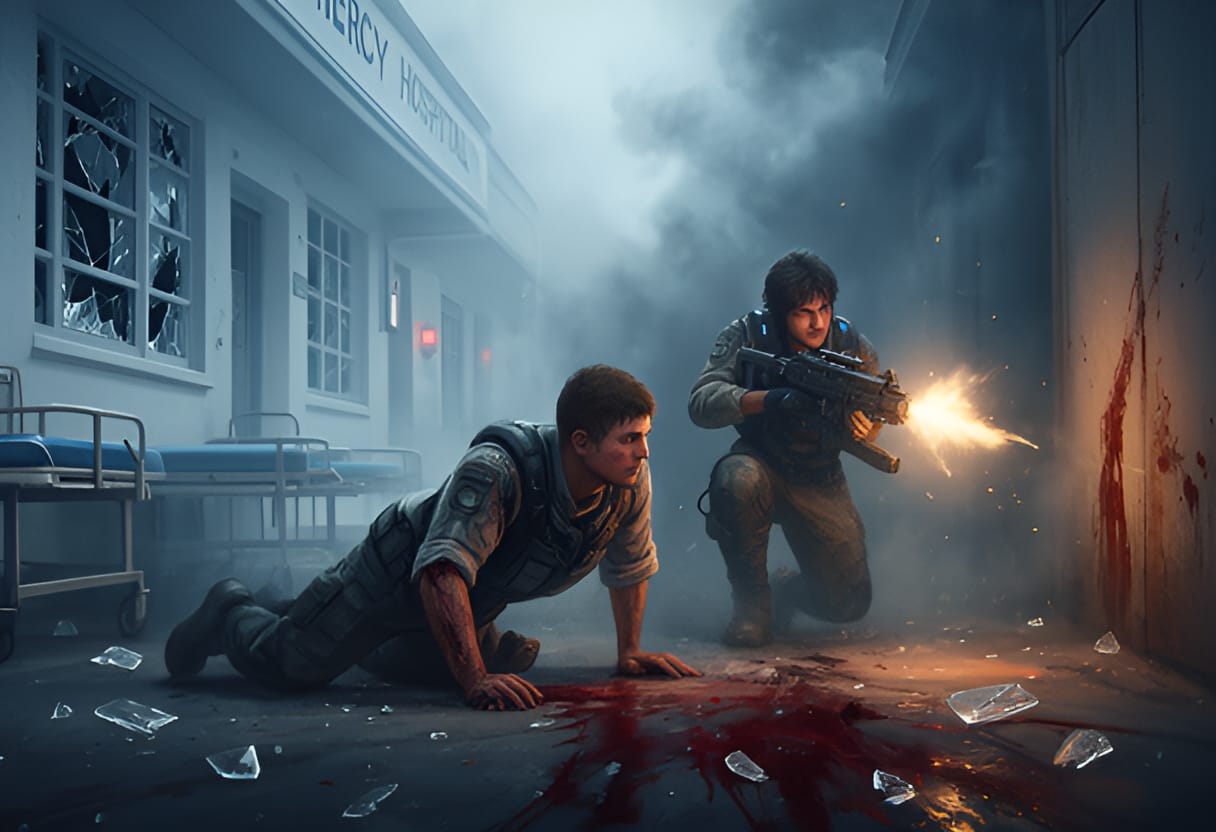
Chapter 5
Into the Dark
The heat pressed against Zay’s back like a living thing, radiating from the collapsing west wing of Mercy Hospital where the Berserker had torn through concrete and steel as if it were paper. Smoke curled in thick, acrid ribbons, stinging his eyes and filling his lungs with the taste of burned insulation and melted polymer. Above him, the stairwell groaned — a deep, metallic shudder as the fire licked upward, seeking oxygen, seeking to consume.
Alex was beside him, breath ragged, rifle gripped tight. His knuckles were white on the Lancer’s foregrip, chainsaw idling low, a dull orange throb in the gloom.
“We can’t stay here,” Zay said, voice low, raw from smoke and shouting. “The whole building’s going.”
Alex glanced back up the stairs, where the screams had dwindled to occasional, distant cries — then cut off entirely. His jaw tightened. “Velez and Jace…”
“They made it to the ambulances,” Zay said, though he wasn’t sure. He hadn’t seen them after the Berserker hit. “We have to trust that.”
Alex nodded once, sharp. Then he turned, eyes scanning the rear entrance — the alley behind Mercy, choked with debris, overturned gurneys, and the bodies of those who hadn’t made it out. Locust Drones still prowled the periphery, their silhouettes jerky in the flickering light of burning vehicles, rifles tracking, waiting.
“They’re holding the exits,” Alex murmured. “Trying to herd us back inside.”
Zay pressed himself flat against the scorched brick of the stairwell wall, Lancer at his shoulder. He could see two of them — maybe three — using the shell of a collapsed awning for cover, their heads popping up intermittently to spray bursts of Hammerfire down the alley.
“We need a way out,” he said. “Now.”
Alex followed his gaze. Then, slowly, he nodded toward the far left, where the alley narrowed between the hospital’s west wing and the skeletal remains of a parking garage. There, half-buried under rubble and a sagding section of corrugated metal, was a gap — just wide enough for a man to slip through sideways.
“Storm drain,” Alex said. “Old maintenance line. You mentioned it once — runs parallel to the river. Big enough to crawl.”
Zay’s mind flicked back to mornings in the barracks, to lazy conversations over terrible coffee, to Alex’s offhand remark during PT: “Y’know, if the city ever goes to shit, we could probably lose ourselves in the drainage nets.” He’d laughed then. Now, it was the only hope.
“It’s our only shot,” Zay said. He slid his Lancer to his back, muzzle up, chainsaw facing rearward to avoid snagging. “You cover me. I’ll go first. If they spot me, lay down suppressing fire — make them duck. I’ll make it to the grate.”
Alex checked his magazine — half-full, as he’d confirmed earlier. The chainsaw nick was still there, a tiny flaw in the blade’s edge, but it would spin. “I’ll keep their heads down. You move like a ghost.”
Zay gave him a tight nod. Then, without another word, he pushed off the wall.
He hit the alley low, belly scraping against broken glass and hot ash. The air shimmered with heat, and the smell — ozone, burnt sugar, something metallic and sweet — made his throat tighten. Locust fire cracked nearby, a Hammerburst round pinging off a steel beam inches above his head. He froze, breath held, then rolled left into the shadow of a fallen ambulance.
Alex’s Lancer barked — three controlled bursts, muzzle flash blooming in the dark. The Drones jerked back, hissing in surprise. Zay seized the moment.
He wormed forward on his elbows, legs trailing straight behind him, boots dragging through grit and ash. The Lancer was held vertically along his spine, both hands on the grip and stock, muzzle pointed skyward to keep it clear of debris. Every movement sent a jolt of pain through his shoulders and ribs — old wounds from frontier skirmishes flaring — but he pushed through it, focused on the grate ahead.
It was set low in the garage wall, half-hidden by a slab of fallen concrete. He counted the bolts as he approached — a habit from tunnel drills back at Fort Reval. Six on the top flange, four on each side. He tapped them silently with a gloved fingertip as he passed: one… two… three…
His heart hammered in his ears, loud enough to drown out the distant roar of flames and the occasional scream from deeper in the hospital. Sweat trickled down his temple, mixing with ash on his cheek. His vision tunneled — the grate, the bolts, the next inch of ground.
He passed the sixth bolt on the top row. Then the seventh. Eighth.
A shadow shifted above him — a Drone’s head, peering from behind a broken support column, Hammerburst cradled in its arms. It hadn’t seen him — yet — but it was scanning the alley, head swiveling methodically.
Zay froze, body coiled like a spring. His Lancer pressed hard against his sternum. He could feel the chainsaw’s vibration through the armor, a low, dangerous hum.
Alex’s voice came then — not loud, but sharp, cutting through the haze: “Suppressing left!”
Two bursts from the Lancer — crump-crump — flashed from the alley mouth. The Drone flinched, withdrawing behind cover. Zay didn’t wait. He surged forward, elbows pumping, dragging himself the final few inches.
His fingers closed around the grate’s edge. Cold. Vibrating faintly — not from his touch, but from something deeper in the earth. A tremor. Distant, but steady.
He braced his boots against the concrete lip and pulled.
The grate shifted — rusted, but not seized. With a groan of protesting metal, it lifted just enough for him to slip his shoulder through, then his torso. He wriggled, hips catching for a heartbeat before he twisted and dropped through.
Darkness swallowed him.
The crawlspace was tighter than he remembered — or maybe fear had shrunk it in his mind. He lay flat on his stomach, the Lancer still vertical along his spine, chainsaw pointing toward his feet. The air was thick with dust and the sharp tang of ozone from severed power lines overhead. Somewhere nearby, a wire sparked intermittently, casting brief, staccato flashes of blue-white light that made the dust dance like ghosts.
He couldn’t see Alex — couldn’t see anything beyond arm’s length — but he knew his brother was there, just outside, laying down fire to keep the snipers’ heads down. He could almost feel it: the rhythm of Alex’s breath, the weight of his gaze fixed on the alley mouth, waiting.
Zay began to move.
Inch by inch, he dragged himself forward on his elbows, boots barely lifting off the floor of the crawlspace. The space was barely thirty centimeters high — enough to crawl, not enough to turn or shift position without scraping armor against concrete and rebar. Each motion sent a shudder through his frame, the Lancer rattling slightly against his spine.
He focused on the grate ahead — the junction where the crawlspace split. He’d counted bolts to get here; now he’d count them to know when he’d arrived.
One… two… three… four…
His palms burned where they scraped the rough floor. His knees ached from dragging. The chainsaw’s idle vibration, usually a comfort — a familiar hum like a brother’s breath in sleep — now felt like a warning, a beast coiled at his feet.
Five… six…
A sharp crack echoed from above — a Locust round striking the grate, maybe ten meters ahead. Dust rained down on his visor. He blinked it away, heart leaping.
Seven… eight…
He was close. He could feel it — the change in air pressure, the subtle widening of the space. The crawlspace wasn’t just a pipe; it was a junction box, where the main drain met a lateral line. Left led toward the river, toward the old maintenance tunnels under the East Barracks. Right — he didn’t know where right went. But if the snipers were set up above the left fork, as Intel had suggested — if they were using the grate as a nest — then right might be the blind spot.
Nine…
His fingers brushed the edge of the grate. Cold. Ribbed. He paused, forehead resting on the concrete, breathing slow and shallow through his nose. The Lancer was steady in his grip — not tight, not loose — ready.
Ten.
He’d reached it.
The junction.
He pushed himself up just enough to peer through the grate’s openings. The world above was a blur of shadow and flickering flame — but he could make out two shapes, crouched behind the upended hull of a delivery van, their silhouettes blocky and alien in the gloom. Snipers. Longshot rifles resting on their shoulders, barrels angled down the alley, sweeping methodically.
They hadn’t seen him. Not yet.
But they were alert. Tense. One shifted its weight — a minute movement, almost imperceptible — and the grate above shivered in response.
Zay pulled back, heart hammering. He’d made it. He was in position.
Now came the hard part.
He had to choose.
Left or right?
No way to tell which led behind the snipers. No way to know if he’d crawl into an ambush or a dead end. He could go left — follow the main line, hope it looped around — or right, gamble on the lateral, pray it was unguarded and led to a blind spot behind their firing position.
He thought of Alex — not just his brother, but his mirror. The one who’d joked about dying in a place that smelled like burnt toast, voice trembling despite the humor. The one who’d saved his life more times than he could count, who’d carried Jace across the burning bridge, who’d stood beside him in the stairwell as the hospital burned.
He thought of the promise — not spoken in years, but etched in bone: We always find our way back.
He didn’t have time for fear. Didn’t have time for doubt.
He pressed his forehead to the concrete one last time, whispering so low even his own ears barely caught it: “Left.”
Then he began to move.
He turned his body sideways, shoulders first, and eased into the left fork. The space narrowed further here — maybe twenty-five centimeters high — forcing him to tuck his chin, to crawl with his face nearly pressed to the floor. The Lancer had to be angled diagonally now, stock tucked under one arm, grip held near the muzzle to keep it from dragging.
The air grew colder, damper. The smell of ozone faded, replaced by something deeper — mildew, stagnant water, the faint, sickly sweet rot of Imulsion seeping from old fractures in the rock. Somewhere ahead, water dripped — slow, metronomic.
He kept moving, elbows and toes scraping, breath shallow. Every sound seemed amplified: the rasp of his armor, the faint whine of the chainsaw idling, the distant drip… drip… drip…
Then — a shift.
The tunnel opened slightly. Not much — just enough to roll onto his side. He did, bringing the Lancer to rest across his chest, both hands on the grip. He could aim now — not well, but enough.
Ahead, the grate came into view through the gloom. It was set in the tunnel ceiling, a rectangle of rusted steel, maybe a meter long. He could see through it — not clearly, but enough.
Shadows moved above.
Two of them. The snipers. Still there. Still watching the alley.
And between them — a third shape. Taller. Bulkier.
A Boomer.
Zay’s blood turned to ice.
The Boomer shifted its weight, lifting its massive launcher — the Mulcher — and rested it on its shoulder. It wasn’t aiming at the alley. It was aiming down.
At the grate.
At him.
He didn’t think. He didn’t hesitate.
He squeezed the trigger.
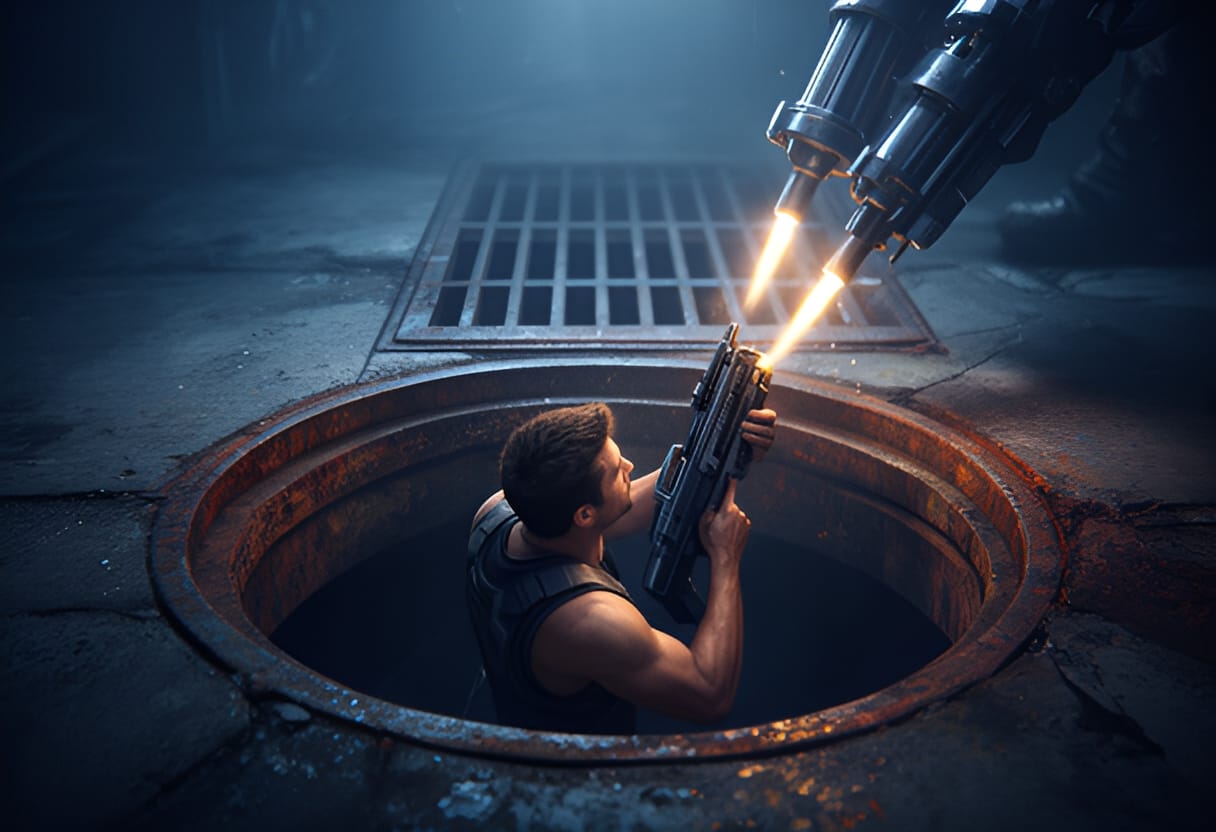
A burst of Lancer fire — three rounds — spat upward, muzzle flash blooming in the dark grate. The rounds struck the Boomer’s chest plate with sharp pings, useless against its armor, but the flash and noise were enough.
The creature roared — a deep, guttural bellow that shook the tunnel walls — and whipped its head toward the sound.
The snipers reacted instantly, weapons snapping up, scanning the darkness.
Zay didn’t wait for them to locate him.
He rolled onto his belly again and began to crawl — fast, desperate — pulling himself forward with everything he had. The Lancer bounced against his sternum, chainsaw roaring louder now as he pushed it to full idle, the sound a frantic whine in the tight space.
Behind him, the grate exploded.
Not with fire — but with fury.
A salvo of Hammerburst rounds tore through the metal, shredding it inward. Shrapnel rained down — hot, jagged — striking the tunnel floor in a spray of sparks. One fragment skittered past his helmet, raising a spark where it grazed the visor.
He didn’t look back.
He kept moving.
Crawling. Scratching. Dragging himself through the dark, lungs burning, muscles screaming. The tunnel seemed to stretch forever — no end, no relief, just the relentless drive forward.
Then — light.
Not fire. Not explosion.
A soft, greenish glow, faint but steady, seeping in from ahead.
He slowed, heart pounding, and peered forward.
The tunnel opened into a larger chamber — a junction or pump room, maybe — where an old maintenance light still flickered on emergency power. The glow was weak, dying, but it was enough.
And there, slumped against the far wall, half-submerged in ankle-deep water, was Alex.
His Lancer was gone — dropped or thrown. His chainsaw arm was bent at a sick angle, the blade still spinning weakly, teeth catching on nothing, sending up sparks that died instantly in the damp air. His helmet was cracked, one lens missing, revealing an eye swollen shut, the other wide and unfocused.
Zay surged forward, ignoring the pain in his shoulders, ignoring the water soaking through his trousers.
“Alex!” he whispered, voice raw. “Alex, talk to me.”
His brother’s head lolled slightly. A bloody bubble formed at the corner of his mouth. Then, weakly, a whisper: “Took… too long… to choose…”
Zay dropped to his knees beside him, one hand gripping Alex’s shoulder, the other fumbling for his medkit — only to remember he’d left it back at the armory, in the rush to mobilize.
“Shit,” he breathed. “Shit, Alex, I’m sorry. I should’ve been faster.”
Alex managed a weak, broken smile — the kind that didn’t reach his eyes, the kind that came from sheer will. “Nah… you were… right… left was… correct…”
His breath hitched. The chainsaw gave one last feeble sputter — then died.
Silence.
Zay pressed his forehead to his brother’s temple, breathing in the mix of sweat, blood, and ozone. Outside, the city burned. Locust hunted. The sky choked with Kryll.
But here, in the dark, with his twin gone cold in his arms, there was only this: the weight of a promise kept — and the unbearable cost of it.
Zay didn’t move for a long time — couldn’t. His arms locked around Alex’s torso, fingers digging into the soaked fabric of his brother’s jacket, feeling the last tremors fade from the body he held. The water around them was cold, seeping through his trousers, chilling the skin where it touched. He didn’t notice. All he felt was the absence — the hollow where Alex’s breath should have been, the silence where his voice should have cracked a joke, even a bad one, to lighten the weight.
He stayed like that until his own shaking subsided, until the rage and grief settled into something harder, colder — a stone in his gut that didn’t pulse, didn’t throb, just was. It wasn’t peace. It was resolve, forged in the fire of loss.
When he finally pulled back, it was with deliberate slowness, as if peeling himself away from a wound. He laid Alex down gently, back against the damp concrete, arms crossed over his chest like a soldier at rest. He took his brother’s dog tags — two identical discs on a frayed cord — and slipped them over his own head. They rested against his sternum, cool and heavy, a second heartbeat.
He didn’t close Alex’s eyes. Couldn’t bring himself to do it. Let them stay open, staring into the dim light — a silent accusation, a plea, a testament.
Then he rose.
The Lancer lay where Alex had dropped it, half-submerged in the stagnant pool. Zay retrieved it, wiping the barrel and stock on his thigh, checking the chamber. One round remained. He ejected it, held it in his palm for a moment, then slipped it into his pocket. Not for himself. Not yet.
He checked the chainsaw. The motor was seized — water and debris had jammed the mechanism. He gave it a hard twist, heard nothing but a dry grind. Useless. He unslung it from Alex’s arm, the weight unfamiliar without the counterbalance of his brother’s grip, and set it aside. Not discarded. Honored. Like a fallen comrade’s weapon left on the field — not forgotten, but not carried forward either. He’d come back for it. If he made it back.
He turned to the tunnel ahead — the one that led away from the junction, toward the river, toward whatever lay beyond the collapsed hospital and the burning streets. The path the snipers had been guarding. The path that, if he’d gone right instead of left, might have led him into their teeth.
He didn’t second-guess the choice. Not anymore. Left had been right. Not because it was easy — but because it had brought him here. To Alex. To the truth.
He pressed forward, moving low, Lancer at the ready. The emergency light flickered once — twice — then died, plunging the chamber into near-total blackness. Only the faintest glow seeped in from the grates above, where distant fires painted the sky in bruised orange and sickly yellow. He moved by touch and memory, fingers brushing the damp walls, boots finding purchase on slick concrete and rusted flange.
The tunnel sloped downward now, following the old drainage grade toward the Imulsion River. He could smell it before he saw it — that thick, metallic tang, like blood and burnt sugar, the smell of a world poisoning itself. The air grew heavier, harder to breathe, each inhalation scraping his throat.
He stopped at a junction where a side pipe branched off — a narrow, horizontal shaft just large enough to crawl through. On a whim, he pressed his ear to the opening.
Silence. Not the silence of emptiness — but the silence of waiting. The kind that pressed against the eardrums, thick and alive.
Kryll.
He didn’t need to see them to know. The air here was still, too still — no draft, no insect buzz, no distant drip. Just… absence. As if something had swallowed the sound, the motion, the very breath of the space.
He pulled back, heart hammering. They were nesting in the side shaft — a colony, roosting in the dark, waiting for warmth, for movement, for the pulse of life to trigger their swarm.
He couldn’t go through. Not without light. Not without fire.
He thought of the flare Alex had joked about — the one he’d carried in his vest, the one he’d meant to use if they got separated. Zay patted himself down. Nothing. Alex’s vest was gone — torn away in the struggle, or lost in the water. He checked his own pockets. Empty. He’d used his last flare at the hospital, signaling the ambulances before the Berserker came.
No light. No fire.
He couldn’t wait for dawn. Couldn’t risk sitting still. The Locust were moving — he could feel it in the vibrations through the floor, the faint, rhythmic thud of boots on stone, the occasional groan of shifting metal as they dragged equipment through the streets above.
He had to go around.
He backed out of the junction, turned, and followed the main tunnel as it curved west, parallel to the river. The walls narrowed here, the floor uneven — chunks of concrete had collapsed inward, forcing him to pick his way over rubble and twisted rebar. Somewhere ahead, water rushed faster — not the stagnant pool from before, but a real current, fed by broken mains and storm drains overwhelmed by the chaos.
He paused at a point where the tunnel opened into a vertical shaft — a flooded well, maybe ten meters deep, its bottom lost in darkness. A maintenance ladder ran along one side, its rungs corroded but intact. He could climb up, emerge at street level — but where? He had no idea what lay above. Only that the city was burning, that the Locust were everywhere, that to surface blind was to court death.
He listened.
Below, the water moved — slow, sluggish, but alive with movement. Not fish. Nothing lived in that poison anymore. But something stirred — a rat, maybe, or worse, something that had crawled down from the streets seeking refuge.
Above — silence. Or near-silence. Just the occasional creak of settling stone, the faraway crack of timber giving way under fire.
He couldn’t go up. Not blind.
He had to go through the water.
He slipped off his helmet, setting it carefully on a dry ledge — not because he cared about keeping it clean, but because he didn’t want to lose it. If he died down here, someone might find it. Might know. Might tell Mara, if she lived. Might tell the twins’ mother, if she was still alive in the South Isles.
He unclipped the Lancer’s sling, looped it over his shoulder, and lowered himself into the water.
It was worse than he expected.
Not just cold — toxic. It burned his skin where it touched, not with flame, but with a chemical fury that felt like acid and ice at once. He gasped, instinctively trying to pull back, but forced himself down, shoulders first, then chest, letting the water take him. It closed over his head, muffling all sound — a deep, hollow quiet, like being buried in wool.
He pushed off the bottom with his feet, gliding forward, body horizontal, arms outstretched. The Lancer trailed behind him, stock first, chainsaw dragging through the silt. He couldn’t see — not a thing. Just the pressure of the water, the burn in his lungs, the wild hammering of his heart.
He kicked, slow and steady, conserving air, conserving strength. His lungs screamed. His vision pulsed at the edges — black spots blooming like flowers behind his eyelids. He couldn’t hold it much longer.
Then — light.
Not from above. From ahead.
A faint, wavering glow — greenish, unsteady — seeping through the water like moss on stone.
He kicked harder, lungs burning, and broke the surface.
He was in a chamber — larger than the last, half-flooded, water lapping at his waist. And in the center, standing knee-deep in the toxic flow, was a Locust Drone.
It hadn’t seen him yet. Its back was turned, head cocked, listening — not to him, but to something beyond the chamber, something upstream. Its armor was dull, pitted, one shoulder plate missing, revealing the grayish flesh beneath. In its clawed hands, it held not a weapon, but a device — a cylindrical object, about the length of his forearm, pulsing with a soft, inner light. Tendrils of vapor curled from its seams.
A seeder? No. Too small. Too quiet.
A spore launcher? A gas projector? He didn’t know. But it was active. And it was working.
He realized, with a jolt of horror, what it was doing.
The device wasn’t firing. It was venting. Releasing something into the air — a fine mist, almost invisible, carried on the damp currents. And where it touched the water… the water changed.
Where the mist hit, the toxic broth began to clarify. The oily sheen faded. The stench lessened — not gone, but altered, becoming… cleaner. Less lethal.
It was purifying the water.
Not for them.
For them.
The Locust weren’t just surviving in the poison — they were fixing it. Making it habitable. For themselves. For their brood. For whatever came next.
Zay’s blood ran colder than the water.
He didn’t have a weapon that could stop it. One round in his pocket. A useless chainsaw. His hands.
He couldn’t let it continue.
He rose slowly from the water, water streaming from his armor, dripping from his chin, his eyes locked on the Drone’s back. He didn’t shout. Didn’t charge. He moved like a predator — slow, silent, each step deliberate, boots finding purchase on the slick stone, water sucking at his greaves.
He was three meters away when the Drone twitched — not from sound, but from vibration. It felt him. Knew.
It turned.
Its face was a mask of ridges and pores, eyes milky but sharp, nostrils flaring as it tasted the air. It opened its mouth — not to roar, but to hiss, a sound like steam escaping a ruptured valve.
And then it lunged.
Not with a weapon. With its hands.
Claws flashed — four of them, hooked and black as obsidian — aiming for his throat.
Zay jerked back, but not fast enough. One talon raked across his cheek, burning like fire, drawing a line of heat that blurred his vision. He stumbled, slipping on the wet stone, and went down on one knee.
The Drone loomed over him, jaws working, preparing to strike again.
Zay didn’t think. He reacted.
He drove his forehead forward — not into the Drone’s face, but into its chin, using the crown of his head as a battering ram. The creature’s jaws snapped shut — not on him, but on empty air — and its head jerked back.
In that instant, Zay shoved hard with his palms, driving the heel of his hand into the Drone’s sternum. It staggered, arms flailing, and lost its balance.
It fell backward — into the water.
Not the shallow edge.
The deep part.
Where the current pulled.
It hit with a splash, arms flailing, then vanished beneath the surface — not dead, but taken. The current swept it downstream, toward whatever lay beyond, toward the river’s main flow, where the toxin was thickest and the currents strongest.
Zay scrambled to his feet, heart pounding, hand flying to his cheek. The cut stung — not deep, but fiery. He wiped at it, saw blood on his fingers — bright red, almost vivid against the grime.
He turned to the device.
It still floated in the Drone’s loose grip, bobbing just below the surface, its green pulse steady, unwavering.
He didn’t hesitate.
He plunged his arm into the water, grimacing as the liquid burned through the tear in his glove and seared his skin. He grabbed the device — it was warm, almost alive in his grip — and wrenched it free.
It came away with a soft click, and the pulsing light died instantly.
The mist stopped.
The water began to cloud again — slowly, oily tendrils rising from the depths, the stench returning, heavier now, as if the poison resented being denied.
Zay held the device to his chest for a moment, feeling the last faint vibration fade. Then, with a curse, he hurled it into the deepest part of the shaft, where the water churned and sucked. It vanished with a barely-there blip, gone into the dark.
He turned and moved — not back the way he’d come, but forward, following the current.
The tunnel opened up ahead — not into another chamber, but into a culvert, wide enough to stand in, its arched ceiling lost in shadow. The water flowed faster here, deeper, carrying debris — a child’s shoe, a torn civilian jacket, a broken radio sparking weakly in the current.
He waded through, Lancer at the ready, senses sharp. The tunnel bent west, then south, following the river’s bend. The air grew worse — not just toxic, but thick, as if the atmosphere itself was saturated with Imulsion vapors. His head pulsed. His lips felt numb.
And then — a sound.
Not from ahead.
From behind.
A soft, wet scrape.
He froze.
Turned.
Nothing. Just the tunnel, the water, the dripping.
He strained his ears.
Then — a whisper. Not in his ears. In his bones.
A vibration. Low. Rhythmic.
Thoom… thoom… thoom…
Like a heartbeat.
But too slow. Too vast.
He pressed himself against the wall, Lancer raised, and peered into the gloom ahead.
And saw it.
A shape in the water.
Not floating.
Moving.
Beneath the surface — just below — something large, pale, and serpentine glided just beneath the murk. It wasn’t a fish. It wasn’t debris. It was alive. Its body undulated in slow, powerful sweeps, pushing water aside in a slow, rolling wake. It was easily three meters long — maybe more — tapered at both ends, with fin-like ridges along its spine and a head like a flattened shovel, eyeless, mouth a circular maw lined with tiny, needle-like teeth.
A leech? No. Too big. Too intelligent in its movement.
It was hunting.
And it had sensed him.
Zay didn’t wait to see if it would come for him. He backed slowly, silently, eyes locked on the disturbance in the water — the subtle bulge, the way the current parted just so around the unseen mass.
He took one step back.
Then another.
Then — the thing lunged.
Not at him. Under him.
A sudden, violent heave from below — the water exploded upward in a geyser of black, toxic fluid, throwing him off his feet. He landed hard on his back, the wind knocked out of him, Lancer skittering from his grasp and clattering across the stone before disappearing into the current with a metallic clang.
He gasped, choking on the taste of poison and blood, and scrambled to his feet — just in time to see the thing surge.
It wasn’t fully in the tunnel. It was part of it — its head and forebody had erupted from the water like a leviathan breaking the surface, jaws gaping, revealing rows of teeth that glinted like shattered glass. It lunged not to bite, but to sweep — its massive head arcing sideways, aiming to crush him against the wall with pure force.
Zay threw himself sideways — not enough.
The side of the creature’s head swiped him — not with teeth, but with the thick, bony ridge along its temple. It struck his ribs like a carriage wheel, lifting him off his feet and hurling him sideways into the wall.
He hit hard — shoulder, ribs, hip — and slid down, stunned, vision whiting out at the edges. He couldn’t breathe. Couldn’t move. His Lancer was gone. His knife was on his belt — but he couldn’t reach it, couldn’t think past the white-hot agony blooming in his left side.
The creature sank back beneath the surface, leaving only a slow, widening gyre in the water — and the echo of its passage, a low, subsonic thrum that vibrated in his molars.
He sucked in a breath — fire in his lungs — and forced himself up on one elbow.
The thing was gone. For now.
But it would come back. It was hunting. And it had tasted blood.
He had to move. Now.
He forced himself upright, screaming silently as pain lanced through his side — broken ribs, he knew it. Three, maybe four. He couldn’t draw a full breath without seeing stars.
He found his Lancer half-buried in silt near the wall, retrieved it, checked the chamber — still empty. He’d used his last round. He was running on fumes and spite.
He began to move — not down the tunnel, but up. Along the wall, using the jagged edges and rusted conduits to pull himself forward, limping, each step a battle. He couldn’t run. Couldn’t fight. Could only endure.
He passed another junction — this one vertical, a shaft leading up. He didn’t look. Didn’t pause. He had no flares. No grenades. No way to signal. No way to know if the surface was any better than this.
He just kept going.
Left, then right, then left again — following the tunnel’s lazy spiral as it wound beneath the riverbed, deeper into the earth’s bones. The water grew shallower here, then vanished entirely in places, leaving only damp silt and the occasional puddle that mirrored nothing but darkness.
His vision swam. His head pounded. Every step sent fire through his ribs. He tasted copper on his tongue — not just from the cut on his cheek, but from inside. He was bleeding internally. He could feel it — the warmth, the pressure, the way his movements grew sluggish, his thoughts slow.
He wasn’t going to make it out.
Not like this.
But he wasn’t going to lie down and wait for the dark to take him.
He kept moving.
One foot. Then the other.
Breathe. Step. Breathe. Step.
He didn’t know how long he’d been crawling when he saw it — a glimmer ahead.
Not fire. Not explosion.
Light.
Real light.
Pale. Steady. Coming from a grate set high in the tunnel wall — a square of reinforced glass, cracked but intact, set into a ventilation shaft that angled upward toward the surface.
He dragged himself to it, braced his palms on the concrete, and pushed.
His vision tunneled. The light swam. He blinked — once, twice — and forced his eyes to focus.
Through the grate, he saw not the burning streets of Ephyra.
Not the smoke-choked sky.
Not the silhouettes of Locust marching in formation.
He saw stars.
Real ones. Pinpricks of cold, ancient light, scattered across a sky so vast it made his chest ache.
He was under the city. Under the ruins. Under the war.
And above him — the night sky. Untouched. Unbroken. Beautiful.
He pressed his forehead to the cool glass, sucking in lungfuls of the damp, foul air below — but even that smelled different now. Not just poison. Not just death.
There was something else.
Faint. Far off.
But there.
Green.
Not the sickly glow of Imulsion.
He pressed his forehead to the cool glass, sucking in lungfuls of the damp, foul air below — but even that smelled different now. Not just poison. Not just death.
There was something else.
Faint. Far off.
But there.
Green.
Not the sickly glow of Imulsion.
He didn’t know what it meant. Only that it wasn’t from below. That it came from somewhere alive. Somewhere growing.
He pushed off the grate and let himself slide back into the darkness of the tunnel, the pain in his side a constant, grinding presence with every breath. He couldn’t afford to rest. Not yet. Not while the thing in the water still hunted. Not while the sky above held stars and something green whispered at the edge of perception.
He moved slower now, favoring his left side, each step a calculated shift of weight. The tunnel narrowed ahead, the walls closing in as it forked — left and right — just as he remembered from the old maintenance schematics Velez had drilled into them during downtime at Fort Hanson. Left led toward the river’s old outflow, where the water grew deep and stagnant, a perfect ambush ground for whatever leviathan had nearly killed him. Right led upward, toward a series of vertical shafts and maintenance alcoves — places where the old city’s infrastructure still breathed, where grates faced the surface and where, if luck held, he might find a way to signal, to see, to fight.
He chose the right.
Not because it was safer. But because it was up.
And if he was going to die down here, he wanted to see the sky one more time.
The passage tightened, the concrete rough under his palms as he dragged himself forward, using the jagged edges of broken conduit and the occasional rusted pipe to pull his weight. His Lancer dragged behind him, useless without ammo, but he kept a grip on it — not as a weapon, but as an anchor. Something solid in the dark.
The air changed. Cooler. Drier. Less saturated with the rot of standing water. And then — a faint metallic tang. Not blood. Not poison. Oil. Lubricant. Someone — or something — had been here recently. Maintaining.
He paused at the fork, listening.
Silence. Not the heavy, oppressive quiet of the water tunnel, but a different kind — the kind that comes when something is waiting. When the air itself holds its breath.
He inched forward, right fork, and after ten meters, the tunnel opened into a low, vaulted alcove — just tall enough to crouch in, its walls lined with rusted valves and pressure gauges frozen at zero. Above him, set into the concrete ceiling, was a ventilation grate — square, reinforced, its bars thick and spaced just wide enough for a hand to slip through.
And on the other side of those bars — weight.
A slow, deliberate shift. The grate creaked. Not from wind. Not from settling.
Something was standing on it.
Locust.
He pressed himself flat against the back wall of the alcove, drawing his knife — the only weapon he had left. The blade was nicked, the handle worn smooth from years of grip, but it was sharp. It had to be.
He regulated his breathing. Shallow. Controlled. Pain flared with each inhale, but he pushed it down. Let it burn. Let it focus him.
Above, the creature shifted again. A slow transfer of weight — from left foot to right. The grate groaned, a low, resonant thrum that traveled up through the steel and into his bones.
Now.
He exploded upward.
Not a shout. Not a cry. Just pure, violent motion — legs driving, back straightening, shoulders snapping into alignment as he launched himself through the grate, knife leading.
The Locust — a Sniper, he realized in the instant before impact, its long limbs folded awkwardly on the metal, its head tilted as it peered down the scope mounted on its left forearm — didn’t have time to turn.
The knife drove home.
Not a slash. Not a thrust meant to wound.
A kill.
The blade slipped beneath the jaw, past the cartilage and muscle, severing the spinal cord just below the brainstem. The creature’s eyes widened — not in surprise, but in the abrupt, silent cessation of input. Its mandibles twitched once. Then stilled.
The body jerked — a single, violent spasm — then went limp.
It didn’t fall. It was caught — half in, half out — by the grate, its upper torso hanging over the alley below, its legs still braced on the metal, the longscope still clutched in its three-fingered left hand.
Zay hung there for a breath, his chest heaving, the knife still buried to the hilt in the creature’s throat, warm fluid seeping over his knuckles.
Then, with a grunt of effort, he twisted his wrist and pulled.
The blade came free with a wet, sucking sound.
The Sniper’s body shuddered — once — then slid sideways, falling silently into the darkness below, disappearing into the water with barely a ripple.
He didn’t watch it go.
Instead, he pulled himself fully through the grate and dropped into the alley on the other side, landing in a crouch, knife ready, eyes scanning.
The alley was narrow, choked with debris — overturned carts, shattered concrete, the skeletal remains of a streetlamp. Fires burned in the distance, orange tongues licking the night sky, but here, in the shadow of collapsed tenements, it was dark. Quiet. Too quiet.
He wiped his knife on the thigh of his pants — the denim stiff with dried sweat and grime — and stared at the blade. The act felt absurd. Intimate, even. As if he’d just finished something private in a room where no one else was supposed to see.
He shoved the knife back into its sheath.
Then he turned to the Sniper’s weapon.
The longscope lay where the creature’s hand had fallen — half in the water, half on the slick concrete, its barrel stained with silt and something darker.
He picked it up.
It was heavier than he expected. Cold. The metal etched with fine, repeating patterns — not random, not decorative. A glyph. A mark.
He turned it in his hands, bringing it close to his face, squinting through the grime.
There — just behind the ocular lens, where the casing met the shaft — a symbol.
Three interlocking triangles, each pointing inward, their tips nearly touching at the center. Above them, a single horizontal bar. Below, two parallel lines, like legs.
He knew it.
Intelligence briefings. Classified. Eyes only.
The Sigil of the Hierarchy.
Not a rank. Not a unit.
The Locust Hierarchy itself.
The ruling caste. The ones who spoke in the dark. The ones who gave the orders that brought the Kryll, the Seeders, the Berserkers.
This Sniper hadn’t just been a scout.
It had been an observer.
And it had been watching him.
A coldness spread through him — deeper than the pain in his ribs, deeper than the shock, deeper than the fear.
They weren’t just hunting.
They were learning.
He slipped the longscope into his vest, the weight familiar despite the alien design. It would need cleaning. The lenses were fogged, the focus ring stiff. But it would work.
He looked up at the grate.
The stars were still there.
And the green — faint, but present — glowed on the horizon beyond the fires, where the river met the outskirts of the city, where the farms and the hydroponic domes used to be.
Something’s growing, he thought.
Not just in the tunnels.
Not just in the dark.
Above.
He turned from the grate and moved back into the alley, keeping to the shadows, the longscope cradled against his chest like a relic.
He didn’t know if he was going to live.
But if he died down here, he wanted them to know — whoever found this — that they hadn’t just taken a man.
They’d taken a witness.
And he had seen the face behind the mask.
He kept moving.
One foot.
Then the other.
Breathe.
Step.
Breathe.
Step.
The city burned above.
But down here, in the dark, he was still alive.
And he was still hunting.
He moved like a shadow given purpose, each step a silent negotiation with pain. The alley opened into a wider thoroughfare — what had once been a grand boulevard lined with neoclassical facades now lay in ruin, columns sheared in half, pediments collapsed into the street like broken teeth. Fires burned in skeletal buildings, their orange glow throwing long, dancing shadows that made the rubble seem to writhe. Somewhere nearby, a Locust Drone muttered into its comms — a guttural, clicking cadence that made the hairs on Zay’s neck stand up. He froze, pressed against the shattered base of a statue — a forgotten hero of the Pendulum Wars, its face worn smooth by time — and listened.
The voice was close. Too close.
He risked a glance around the corner.
Two Drones patrolled the intersection ahead, their armor dull and scarred, their weapons loose in their grips. They weren’t alert. Not yet. Just moving, slow, almost bored — as if the slaughter had become routine. One kicked at a loose piece of rebar, sending it skittering into the gutter. The other laughed — a short, barking sound, devoid of humor.
Zay didn’t hesitate.
He didn’t have the luxury of a clean shot. His Lancer was empty. His pistol — a Snub he’d snatched from a fallen Gear in the hospital lobby — had two rounds left. He wasn’t going to waste them on drones unless he had to.
Instead, he slipped free the combat knife — the same one still slick with the Sniper’s blood — and moved.
He flowed from shadow to shadow, using the wreckage as cover, his boots finding purchase on broken glass and twisted rebar without a sound. The wind carried the smell of burning plastic and melted rubber, but beneath it, faint as a memory, was that same green undertone — like crushed stems and wet earth after rain. It came from the east. From the river’s floodplain, where the old biomass farms had stretched for kilometers before the war.
He closed the distance.
Twenty meters.
Ten.
Five.
He was behind the left Drone now, its back turned, its attention on its companion as it chittered something about patrol rotations.
Zay lunged.
Not a yell. Not a war cry.
Just motion.
His left hand clamped over the Drone’s muzzle, fingers digging into the rubber seal around its jaws, stifling the grunt that tried to escape. His right drove the knife up and under the left armpit — where the armor plates overlapped, thin and vulnerable — twisting as he buried it to the hilt.
The creature shuddered. Its eyes flared — not with pain, but with surprise. A sudden, sharp cutoff of input. Its weapon slipped from its fingers, clattering to the ground.
Zay lowered it gently.
Let it down.
Not a thud. Not a crash.
A settling.
Like laying down a tired animal.
He wiped the blade on the Drone’s leg — the same grim intimacy as before — and turned to the second.
It had heard nothing.
Its head swiveled — just slightly — as if sensing a shift in the air.
Too late.
Zay was already moving.
He stepped into its blind side, the momentum of his carry carrying him forward, and drove the knife not into the throat — too high, too guarded — but into the junction where neck met shoulder, severing the brachial plexus and dropping the creature before it could scream.
It fell sideways, twitching once, then still.
He stood over them, breathing hard, the pain in his side a white-hot wire pulled tight with each inhale. He checked his Snub. Still two rounds. He ejected the magazine — just to see — and confirmed: one round in the chamber, one in the mag. He slapped it back in, chambered a round with a sharp click, and slipped the pistol back into his holster.
He took the Longshot from the first Drone — a standard-issue Marksman, its barrel still warm — and checked the ammo. Five rounds left. Not much. But better than nothing.
He slung it across his back, the weight familiar, comforting in its lethality.
Then he paused.
Something was wrong.
Not with the bodies.
With the silence after.
The Drones had been quiet. Too quiet. No chatter. No calls to nearby units. No sign of a network.
He looked up.
The streetlights were dead. The sky above was a maelstrom of smoke and ember, but through the thinning haze, he could see it — the stars. And again, that green.
Not a reflection. Not fire.
A source.
It pulsed — faint, rhythmic — like a heartbeat beneath the horizon.
He shook his head. Focus.
He had to keep moving.
Not toward the river. Not yet.
He needed to get back to the storm drain. To the tunnel. To Alex.
His brother.
The thought struck him like a physical blow.
Alex.
He hadn’t seen him since the hospital. Since the Berserker. Since the fire.
Had he made it out? Had he been caught in the collapse? Was he dead — already — somewhere in the burning wards, his last breath lost in the screams of the dying?
No.
Zay refused to let the thought settle.
Alex was alive.
He had to be.
They’d made a promise — long ago, when they were boys, huddled under a blanket during a thunderstorm, whispering secrets in the dark — that no matter what happened, they’d always find their way back to each other. Not in life. Not in death.
Always.
He had to believe it.
He had to be the one who kept it.
He moved west, back toward the storm drain entrance — the one near the old water treatment outflow, where the tunnel began. The route took him through a series of alleys and service corridors, each one a maze of fallen debris and hidden dangers. He moved slowly, deliberately, using the Longshot to peer around corners, the scope fogged but still functional after a quick wipe on his shirt.
At one point, he paused beneath a collapsed overpass, its concrete ribs exposed like the bones of some great beast. From the wreckage, a sound — faint, rhythmic.
Not Locust.
Human.
A whisper.
He crept closer.
A woman — mid-thirties, hair matted with ash, one arm wrapped tightly around her torso — sat curled against a broken fire hydrant, her eyes wide and unseeing. She rocked back and forth, muttering in a language he didn’t recognize — perhaps Tyrus, perhaps an old dialect from the southern colonies. In her lap, wrapped in a bloody piece of sheet, was a child — no older than three — its face blue, its lips cracked, its chest not rising.
Zay knelt.
He didn’t speak.
He didn’t touch.
He just sat there, on his heels, for a long moment, the Longshot loose in his hands, the weight of the world pressing down.
Then he reached into his vest and pulled out the last of his rations — a half-crushed protein bar, wrapped in foil. He broke it in half. Offered one piece to the woman.
She didn’t take it.
Her eyes flicked to him — just for a second — then returned to the child.
“Shhh,” she whispered. “Shhh, my love. The dark ones are listening.”
He didn’t argue.
He didn’t lie.
He just placed the half-bar on the ground beside her — within reach — and stood.
He didn’t look back.
He couldn’t.
He kept moving.
The streets grew quieter the closer he got to the outflow. Not peaceful. Just… emptier. As if the Locust had passed through, leaving only the hollowed-out shells of what had been. Fires still burned, but they were isolated now — contained to single buildings, feeding on gas lines and chemical stores. The air tasted of ozone and burnt sugar.
Then he saw it.
The storm drain grate.
Half-collapsed. One side bowed inward from impact — likely from a Nemacyst strike during the initial barrage. But the opening was still there. Big enough. Just barely.
He dropped to his knees and peered inside.
Darkness.
And water.
Slow-moving. Black as tar.
He listened.
Nothing.
No movement. No vibration. No sign of the leviathan.
Had it gone? Or was it waiting?
He couldn’t stay up here forever.
He lowered himself in, feet first, letting his body slide into the channel. The water was cold — shockingly so — and thick with silt and something iridescent that made his skin crawl. He pulled himself forward, using the walls for traction, the Longshot held high and tight against his chest to keep it dry.
The tunnel stretched ahead — low, narrow, forcing him to crawl on his belly in places, his chest scraping against the rough concrete. His side screamed with every movement, the broken ribs grinding, but he pushed through. He had to.
He passed the first junction — the vertical shaft he’d climbed earlier — and didn’t look up. Didn’t hesitate.
He kept going.
Past the second.
Past the third.
And then — a change.
The air shifted.
Not in temperature. Not in smell.
In pressure.
It felt… lighter.
And ahead — a faint glow.
Not from the surface.
From within.
He slowed.
Crawled forward on his elbows, the Longshot tucked under his arm, his breath shallow.
The water grew shallower here — ankle-deep in places, then gone entirely, replaced by damp silt and patches of glowing moss.
Yes.
Moss.
Not the sickly, phosphorescent kind that grew in Imulsion pools.
This was different.
Soft. Velvety. A pale, luminous green that seemed to drink in the darkness and emit it back as light.
It clung to the walls in thick patches, trailing like hair in the current where water still pooled. It covered the grates in the ceiling — the ventilation shafts — turning them into honeycombs of soft radiance.
And it wasn’t just moss.
He saw it — faint, but unmistakable — in the cracks of the floor. In the joints between concrete slabs. Tiny filaments, like threads of light, weaving through the stone, connecting patch to patch, forming a network.
A living network.
He reached out — slowly — and touched the nearest patch.
It was cool. Slightly springy.
And when his finger made contact, the glow flared — just slightly — brighter, then faded back to its baseline.
It responded.
He pulled his hand back, heart pounding.
Not a plant.
Not just moss.
Something… else.
Something that had been here long before the city. Long before humans. Long before the Locust, maybe.
Something that remembered.
He didn’t have time to wonder.
Not yet.
He had to keep going.
He crawled forward, his palms and knees burning from the abrasion, the green light washing over him in waves, casting his shadow ahead like a second self — thin, wounded, but moving.
And then — he saw it.
A fissure in the wall.
Not natural.
Made.
A rectangle, roughly cut, the edges rough and uneven — like it had been punched through from the other side.
And beyond it — light.
Brighter than the moss.
White. Harsh.
Electric.
He froze.
Not fear.
Recognition.
They’d been here.
The Locust.
They’d breached the tunnel.
Not to flood it. Not to collapse it.
To use it.
He inched forward, peering through the gap.
Beyond the wall was a chamber — larger than the tunnel, carved out of the earth and reinforced with Locust chitin plating and salvaged metal. In the center stood a pedestal — not natural, not grown — but constructed. On it rested a device — cylindrical, about the height of a man, its surface etched with the same Hieroglyphic sigil he’d seen on the Longscope. From its top, a spiral of light rose — not laser, not plasma — but something softer, like liquid radiance, twisting upward into the darkness above, where it vanished into the rock.
And around it — figures.
Locust.
Not Drones.
Not Snipers.
These were taller. Thinner. Their limbs jointed like insectile arms, their heads elongated, their faces featureless save for a single vertical slit that glowed faintly blue. They moved in silence, their motions precise, almost ritualistic, as they tended to the device — adjusting dials made of bone and copper, pouring liquid from vials that smoked when they touched the ground.
A machine.
But not of metal.
Of flesh and light.
And the green — the same green he’d seen in the moss, in the sky — it wasn’t just near the device.
It was coming from it.
The device wasn’t just emitting light.
It was generating the green.
He pulled back, his mind reeling.
This wasn’t just a weapon.
This wasn’t just a tactic.
This was… terraforming.
They weren’t just killing the city.
They were changing it.
Making it theirs.
He had to tell someone.
He had to get word back — to Velez, if she was still alive, to HQ, to anyone — that this wasn’t a random invasion. This was a conversion.
He began to crawl backward — slow, silent — retreating the way he’d come, the green light of the moss fading behind him as he returned to the black water of the main tunnel.
He didn’t stop until he was past the third junction.
Until he was sure he wasn’t followed.
Then he paused.
In the dark.
Water lapping at his chest.
His side on fire.
His hands shaking — not just from pain, but from what he’d seen.
He reached into his vest and closed his fingers around the Longscope.
The weight of it.
The symbol.
The sight of that thing in the chamber — the device, the figures, the light.
It wasn’t just intelligence.
It was a warning.
And if he didn’t get out of here… if he didn’t find Alex… if he didn’t make it to the surface…
Then no one would ever know what the Locust were really doing down here.
He pressed the scope to his forehead, just for a moment, letting the cold metal ground him.
Then he set his jaw.
He turned back toward the outflow.
And he began to move.
Not just to survive.
To return.
One foot.
Then the other.
Breathe.
Step.
Breathe.
Step.
The water closed over his hands as he pushed forward.
And somewhere ahead — faint, but growing — the green light pulsed again.
Like a signal.
Like a promise.
Like something waiting to be understood.
Zay pressed the Longscope to his forehead a moment longer, letting the cold seep into his skin, a small anchor against the surge of dread and wonder. The moss-light behind him pulsed once, faint, like a heartbeat. Then he was moving again, crawling through the black water, each inch a struggle against fatigue and the cold that gnawed at his bones. His side throbbed where the Seeder’s shrapnel had torn through his vest — not deep, but enough to bleed slow and steady, warming the water around his waist in a slick, iridescent trail.
He had to get back. Had to find Alex.
The thought of his brother — alive, somewhere ahead, maybe hurt, maybe already lost — drove him forward when his arms wanted to give out. He couldn’t lose him. Not now. Not after everything. Not after the hospital, the fire, the screams that had choked off behind them like lives snuffed in a breath.
He paused at the fourth junction, listening. The tunnel was quiet but for the drip of water and the distant, irregular groan of settling stone — the city dying above them. No Locust chitter. No Boot-scrape. No whisper of wings. Just the moss-light, far behind, a ghostly echo in the dark.
He pushed on.
The outflow was close. He could feel it — the change in the air, a faint stir of night wind, carrying the tang of ozone and burnt ash. The water grew shallower, the floor rising under his knees. Then, light — not the soft, living green, but the harsh, clinical glare of electric fixtures, broken and sparking in places, casting jagged shadows that danced like things alive.
He froze.
Alex.
There, silhouetted against the glare of a ruined streetlamp, crouched low behind the rusted husk of a mailbox, Lancer braced, barrel smoking slightly. His back was to Zay, shoulders tight, head tilted as he listened — not to the tunnel, but to something beyond.
And then Zay saw it.
Perched on the broken edge of a subway entrance, half in shadow, half in the sickly glow of a flickering emergency sign, was a Locust Sniper. Tall. Thin. Limbs too long, joints clicking faintly as it shifted its weight. Its head — elongated, smooth, featureless save for that single vertical slit — turned slowly, scanning the dark where Zay had just been. The left position. The one Zay had cleared.
It had heard the silence.
And it was coming to investigate.
Zay’s breath hitched. He couldn’t shout. Couldn’t move. If he gave himself away now —
The Sniper took a step forward, then another, its clawed feet scraping on concrete. It paused, head tilting, the blue slit narrowing. It had sensed something. A disturbance. A vacancy where there should have been a watcher.
It was walking into a trap.
Alex hadn’t moved. Didn’t flinch. Just sat there, Lancer at low ready, finger off the trigger, eyes locked on the Sniper’s flank — the soft joint where thigh met torso, where the chitin plating thinned, where a well-placed round could tear through.
Zay wanted to scream. To warn him. To tell him to wait, to aim for the throat, the eye-slit — anything but risk a glance-off.
But he didn’t. He trusted his brother. Knew the weight of that Lancer in his hands. Knew the hours they’d spent on the range, breathing in sync, pulling the trigger as one.
The Sniper took another step — fully exposed now, side-on, its weapon — a long, barbed railgun — cradled in one thin arm, the other reaching out to touch the wall, testing the air, the silence.
Alex exhaled.
The Lancer barked.
A three-round burst — short, controlled — ripped through the night.
The first round glanced off the Sniper’s shoulder plate, spraying sparks. The second struck true — not the head, not the throat, but the side of the skull, just beneath the eye-slit, where the chitin was thinner, fused with something softer, almost fleshy.
The creature jerked — not backward, but sideways — as if punched by an invisible fist. Its weapon flew from its grip, clattering across the rebar and into a puddle of oily water near the curb. There, it sparked once — a bright, angry hiss — then died, swallowed by the dark.
The Sniper staggered, spun once on its heels, arms flailing — not in rage, but in shock, in the sudden, brutal rupture of expectation. Then it folded, collapsing sideways, hitting the ground with a wet, meaty thud that echoed off the subway tiles.
Silence.
Alex didn’t move. Didn’t cheer. Didn’t even lower his weapon right away. He sat there, chest rising and falling fast, sweat streaking the grime on his temples, his knuckles white on the Lancer’s grip. The barrel smoked faintly, curling into the cold air. He blinked — slow, deliberate — as if waking from a dream.
Then, quietly, so quietly Zay almost missed it over the rush of blood in his own ears: “One down.”
His voice was flat. Drained. Not triumphant. Not relieved. Just… spent. Like the fight had gone out of him with the shot.
Zay wanted to cry. To laugh. To throw his arms around his brother and never let go.
Instead, he stayed hidden, watching as Alex finally lowered the Lancer, checked the chamber — half-empty, as he’d said before — then tapped the forward assist to clear a potential misfire. He wiped the charging handle on his thigh, leaving a dark streak. Then, with deliberate slowness, he reached into his vest and pulled out a frayed rag, began to swab the barrel — slow, methodical circles — as if the ritual could wash away what he’d just done.
Zay stayed where he was. Let him have this. Let him come back to himself.
After a long moment, Alex tucked the rag away, stood, and stretched — a small, stiff movement, like an old dog rising from sleep. He glanced once at the fallen Sniper, then toward the tunnel mouth, where Zay knew he was.
He didn’t call out. Didn’t wave.
Just took a step forward — then another — and began to walk toward the sound of his brother’s breathing.
Zay didn’t move until Alex was nearly on top of him, until he could see the sweat on his upper lip, the faint tremble in his hands, the way his eyes flicked past him — not seeing, not yet — still scanning for threats.
Then Zay shifted. Just a little. A cough, muffled in his fist.
Alex froze.
Then his head snapped up.
And there it was — recognition. Not surprise. Not joy, not yet. Just the slow, deep unfolding of something vital, something that had been fraying at the edges — the bond. The unspoken promise.
Alex’s lips parted. His breath hitched.
“Zay?” he whispered — not a question. A confirmation.
Zay pushed himself up, water streaming from his sleeves, his side screaming in protest. He didn’t answer with words.
He just opened his arms.
And Alex came.
They collided hard — not a hug, not really — more like two halves of a soul slamming back together, foreheads knocking, arms locking tight enough to bruise. Zay buried his face in Alex’s neck, breathing in the salt of sweat, the ghost of gun oil, the familiar, living warmth of his brother. Alex’s arms closed around him like a vise, his forehead resting on Zay’s temple, his breath hot and uneven against his skin.
“I saw it,” Zay mumbled into his shoulder, voice raw. “The device. The light. They’re not just fighting us. They’re… changing the world. Making it theirs.”
Alex pulled back just enough to look him in the eye. His own were red-rimmed, exhausted, but sharp. Alert. “We’ll tell Velez. If she’s still alive.”
Zay nodded. “If anyone’s still alive.”
They held each other’s gaze a second longer — no jokes, no coffee jabs, just the weight of what they’d seen, what they’d done, what was still coming.
Then Alex glanced past him, toward the tunnel. “You clear it?”
Zay looked back. The moss-light was gone now — swallowed by distance and dark. Only the tunnel remained, black and silent, the water still. “Yeah. It’s clear.”
Alex glanced at his Lancer, then at the fallen Sniper, its weapon dead in the oily puddle. “Good. ‘Cause I think we’re gonna need every bullet we’ve got.”
Zay managed something that might have been a smile — tight, tired, real. “Then let’s get moving.”
They turned as one, backs to the fallen creature, faces toward the city — toward the smoke, the fire, the screams — and began to move.
Not running. Not yet.
But moving.
Together.
They moved through the subway mouth and into the street with practiced silence, Zay slightly ahead, Alex covering his six. The rain had started again — light, intermittent — but enough to slick the asphalt and turn the fallen debris into treacherous footing. Shards of glass crunched underfoot like broken bone. Somewhere in the distance, a building collapsed inward with a groan that shook the ground, sending a plume of orange-black smoke spiraling into the low, choked sky.
Ephyra was dying.
Not with the quiet dignity of an ending, but with the violent, shuddering convulsions of something being torn apart from within. Fires bloomed in windows like infected sores. Sirens had long since fallen silent — either destroyed or drowned under the weight of the assault. All that remained was the occasional crack of small arms fire, the distant thud of mortar impacts, and the ever-present, skittering whisper of Kryll in the gloom — a sound like wet leather dragged over stone, or the soft, incessant clicking of a thousand insect mandibles.
They moved west, toward the river, toward the old transit hub Velez had mentioned before the hospital fell — a place where, if any command structure remained, they might find answers. Or at least, other survivors.
Zay kept his Longscope low, not to shoot, but to feel its weight — a reminder of purpose. Alex carried his Lancer at port, eyes scanning rooftops, sewer grates, shadowed alcoves. Every instinct screamed at him to run, to find cover, to end this — but they couldn’t. Not yet. Not without knowing if anyone else had made it out. Not without trying to get the word out about the device in the tunnel — the light, the moss, the thing that remembered.
They passed a shuttered pharmacy, its front window shattered, displays looted or overturned. A child’s shoe lay in the gutter, pink and small, one lace still tied in a neat bow. Zay didn’t break stride, but his chest tightened. He thought of the woman and child he’d seen in the drain alley — dying, beyond help. He’d left them food. It hadn’t felt like enough. It never would.
Alex must have seen it too. He didn’t say anything. Just gave Zay’s shoulder a brief, almost imperceptible squeeze — a silent I know. I’m here. Then his eyes flicked forward, alert again.
A flicker of movement in a second-story window — a curtain twitching. Not wind. Too deliberate.
Zay froze. Alex dropped to one knee behind a overturned mailbox, Lancer coming up, not to fire, but to assess.
They waited.
After three long breaths, the curtain fell back into place. Still. Empty? Or waiting?
Zay signaled left — flank. Alex nodded, melted into the shadow of a burned-out bus, moving low and fast. Zay went right, hugging the wall of a shuttered café, his side protesting with each step, the wound hot and tight beneath his vest.
They converged on the building from opposite sides, pressing flat against the wall beside the broken window. No sound inside. No movement.
Alex gave the count — three, two, one — and they surged through the opening, Lancers up, scanning.
The pharmacy was trashed. Shelves overturned. Medicine spilled across the floor in colorful puddls — antibiotics, painkillers, things that now meant nothing in the face of fire and teeth. Behind the counter, the glass case was smashed, its contents gone. But in the back, near the stockroom door, a figure huddled on the floor — wrapped in a stained blanket, face buried in knees.
Not a Locust.
Human.
Alex lowered his weapon slightly. “Hey. You alright?”
The figure didn’t move. Just shook — a slow, shuddering tremor.
Zay stepped forward, hands visible. “We’re COG. We’re not gonna hurt you.”
A whimper. Then, slowly, the head lifted.
A woman. Maybe forty. Hair matted with sweat and dirt, one eye swollen shut, a deep cut across her cheekbone — fresh, still bleeding. She stared at them with the one good eye, wide, terrified — not of them, but of what lay beyond.
“They’re… in the tunnels,” she whispered, voice raw. “Not the ones with guns. The… the thin ones. The tall ones. They took my boy. Took him down.”
Zay exchanged a glance with Alex. The thin ones. The Snipers? Or something else? The ones in the chamber — the tall, thin figures tending the light.
“Where?” Alex asked, voice low, urgent.
She pointed a trembling finger toward the subway grate a half-block down — the one they’d just come from. “They came up through there. Like… like they owned it. Took him screaming. I… I hid. I didn’t… I couldn’t — ”
She broke off, sobbing into her hands.
Alex holstered his Lancer, crouched beside her. “What did he look like? Your boy?”
“Ten. Brown hair. Freckles. Wore a blue jacket — ”
“Yeah. Yeah, we know him.” Alex’s voice was quiet, but fierce. “His name’s Mateo. We saw him earlier — near the ravine shelter. You got separated during the Kryll wave.”
Her head snapped up. Hope, fragile and dangerous, flared in her one good eye. “You… you saw him?”
“We got him to safety. He’s with a group of civilians — near the old transit hub, by the rail yards. We were heading there now. He’s alive. He’s alive.”
Tears streamed down her face, but this time, they weren’t just grief. They were relief. Raw, trembling, almost too much to bear. She reached out, gripping Alex’s wrist with surprising strength. “Thank you. Thank you so much. If you see him again — tell him… tell him Mama’s sorry she couldn’t hold on. Tell him I love him.”
Alex swallowed hard. “We will. We promise.”
She nodded, then slumped back, exhaustion claiming her. Zay pulled his canteen from his belt, unscrewed the cap, and offered it to her. She drank deeply, then handed it back, her fingers brushing his. “Be careful,” she murmured. “They’re not just down there. They’re… learning. They wear our faces sometimes. In the dark. They whisper.”
Zay took the canter back, nodded. “We’ll keep our eyes open.”
They left her there, tucked against the wall, the blanket pulled tight. Not safe. But safer than the open street. And they had to keep moving.
The transit hub loomed ahead — a squat, brutalist structure of reinforced concrete and steel, half-collapsed on its eastern flank where a Nemacyst had struck hours ago. Despite the damage, its core remained intact — a cavernous waiting area with ticket booths, turnstiles, and passages leading to the platforms below. Flickering emergency lights cast long, stuttering shadows across the debris-strewn floor. Smoke curled from vents in the ceiling, acrid and thin.
But there were people.
Dozens of them. Civilians — men, women, children — huddled in clusters along the walls, wrapped in blankets, clutching bags or nothing at all. Some slept fitfully. Others stared into the middle distance, eyes empty. A few tended to wounds with scraps of cloth and bottled water. The air smelled of sweat, fear, and disinfectant — someone had brought a medkit.
And in the center of it all, standing on a collapsed bench like a sentinel, was Sergeant Mara Velez.
She looked older than she had that morning. Her uniform was torn at the shoulder, one sleeve ripped away to reveal a bandaged forearm — shrapnel, maybe. Her face was streaked with soot and sweat, her eyes red but alert. In her hands, she gripped a Gnasher shotgun, its barrel warm from recent use. Around her, a handful of gears — maybe six or seven — stood watch, weapons ready, faces grim.
But it was the twins she saw first.
Her shoulders relaxed — just a fraction — then snapped back, rigid again. “Lopez twins. Took you long enough.”
Zay stopped a few paces out, Alex beside him, both lowering their weapons but not lowering guard. “Sarge. We got separated in the hospital collapse. Found a drain line — made our way to the outflow. Took out a couple Snipers on the way.”
Velez’s gaze flicked to the street behind them, then back. “Good. We could use the help. Took a beating holding this place. Lost Ruiz an hour ago — Kryll venom finally took him. He didn’t make it past the third wave.” She paused, jaw tightening. “And Jace… he didn’t make it out of the hospital. Blew himself up with a grenade to buy us time. Took three Seeders with him.”
Zay felt it like a punch — Jace, loud, brash, always arguing tactics, now gone. Alex’s hand found his, a brief, grounding pressure.
“We’re sorry, Sarge,” Zay said.
Velez nodded, curt. “Save it. We don’t have time for sorry. We’ve got maybe twenty minutes before the Locust try to flush us out. They’ve been probing the perimeter — Drones on the flanks, Snipers on the roof. But I think they’re saving something bigger for the main push. Something… organized.”
She stepped down from the bench, moving with deliberate stiffness. “You two — you were in the storm drain. You saw anything… odd? Down there?”
Zay hesitated. How to explain the moss? The light? The machine that wasn’t a machine? It sounded like madness. But Velez had earned honesty. She’d held the line when others broke.
“I saw a chamber,” he said, choosing his words carefully. “Carved out beneath the tunnel. Reinforced with chitin and scrap metal. In the center — a pedestal. On it, a device. Tall. Cylindrical. Etched with Hieroglyphic sigils — the same ones on the Longscope. From it… a spiral of light rose. Not plasma. Not laser. Softer. Like liquid radiance. And around it — figures. Tall. Thin. Featureless, except for a vertical blue slit. They weren’t Drones. They were… tending it. Adjusting dials. Pouring liquid that smoked on contact.”
He swallowed. “And the moss. The green light — it wasn’t just there. It was coming from the device. Like it was generating it. Like it was… alive.”
Velez listened. Didn’t interrupt. Didn’t dismiss. Her eyes narrowed, not in disbelief, but in concentration — the look of a soldier processing intel under fire.
When he finished, she was silent for a long moment. Then: “You’re not the first to report strange lights underground. Ruiz mentioned it before he went down — said he saw flickering in the sewers near the old waterworks, like someone was doing welding with colored torches. Thought it was just fires from ruptured lines. But… this? This is different.”
Alex stepped forward. “What if it’s not just a weapon? What if it’s… changing the air? The ground? Making it… habitable for them?”
Velez’s eyes snapped to him. “Terraforming. You used that word.”
“I saw it in the moss,” Zay said. “It responded to touch. Glowed brighter when I touched it. Then faded. Like it was… aware.”
Velez swore under her breath — a low, guttural sound in her throat. She looked around at her surviving squad, at the hollow-eyed civilians clinging to life in the dim light. Then she made a decision.
“We need to get this to Command. If there is a Command left.” She turned to a young private — no older than eighteen, face smudged, hands trembling slightly on his Lancer. “Corporal. Take Henderson and Ruiz’s spot on the west flank. Watch for Snipers. If you see movement above the third-floor windows — report it. Now.”
The corporal saluted shakily, moved to obey.
Velez turned back to the twins. “You two — you’re with me. We’re going to the comms relay on the roof. If the array’s still intact, we can punch a burst signal to Anvil Gate. Let them know what’s really happening down here. Not just an invasion. A conversion.”
Alex looked up at the roof — or what was left of it. Half collapsed, twisted rebar jutting like broken teeth, fires still burning in the insulation. “That’s a death run, Sarge.”
“I know,” she said, not unkindly. “But if we don’t try, no one’ll ever know what hit us. And if we do make it — if we get that message through — then maybe, just maybe, someone’ll send help. Or at least nuke the hole they’re crawling out of.”
Zay looked at Alex. His brother met his gaze — no hesitation, no fear, just the quiet understanding that passed between them: We go where the other goes.
“We’re with you,” Zay said.
Velez nodded. “Good. Move low. Use the wreckage for cover. I’ll take point. Alex — you’re on my left. Zay, you bring up the rear. Watch for flankers. And for God’s sake — watch the sky. If you see Kryll, don’t wait. Flare and burn.”
They moved as a unit — three ghosts in the ruin.
Velez led, shotgun cradled close, eyes scanning, ears cocked. Alex flanked left, Lancer ready, his gaze flicking between rooftops and alleyways. Zay brought up the rear, Longscope slung but ready, his senses stretched thin — listening for the soft scrape of claws, the faint chitter of communication, the wrong kind of silence.
They crossed the open plaza between the transit hub and the relay building — a squat, windowless structure with a satellite dish tilted at a drunken angle on its roof. Half the wall was gone, blown outward by explosive force. Inside, racks of equipment lay sparking on the floor, cables torn loose, but the main array — a cluster of dish antennas and transmitters — still stood, tilted but possibly functional.
“Stay here,” Velez whispered, pressing herself against the wall beside the door. “I’ll go in first. Clear it. If it’s clear, I’ll tap twice. If it’s hot — three times. You know the drill.”
Alex nodded. Zay tightened his grip on the Longscope.
Velev moved — fast, low, silent. She slipped through the shattered doorway, vanished into the gloom inside.
Seconds ticked by. Zay’s back was to the transit hub, watching the street, watching the sky. A faint, irregular scraping came from the east — too rhythmic to be settling stone. Too light to be a Boot. Something small. Something climbing.
He tensed. Raised the Longscope just a fraction — not to aim, but to see.
Then — a flicker. Movement in the third-floor window of a building across the street. A shadow. Tall. Thin. Limbs too long. Head tilted, the vertical slit catching the dim light — glowing faintly blue.
A Sniper.
It had seen them.
Zay didn’t hesitate. He brought the Longscope to his shoulder, found the figure in the dim glow — not a clear sight picture, but enough. Center mass. He exhaled, squeezed.
The Lancer’s report was sharp, loud in the quiet street.
The round struck — not the head, not the chest, but the upper shoulder, spinning the Sniper around. It stumbled back against the window frame, claws scraping stone, then recovered — too fast — and vanished from sight.
“Contact! Third floor, east building!” Zay called, voice tight.
Alex was already moving — rolling left behind a concrete barrier, Lancer sweeping up. “I’ve got it!” he called back.
Velez’s voice came from inside the relay — calm, urgent. “Almost in! Keep them off me!”
Zay ducked low, eyes scanning — left, right, up. Another flicker — this time lower, near ground level. A Drone, maybe, using the wreckage for cover, trying to flank.
He didn’t wait. Fired a controlled burst — three rounds — into the shadow where he’d seen movement. A choked cry answered it — not human. The Drone jerked back, trailing dark fluid.
“Two down!” he called.
Alex’s voice, strained: “One on the roof! Came up the fire escape! He’s got a bead on the relay!”
Zay spun — and saw it.
On the edge of the relay’s ruined roof, silhouetted against the glow of a nearby fire, was another Sniper — this one holding a long, barrel-like weapon, aiming not at them, but at the relay dish itself. It wasn’t trying to kill them. It was trying to break the comms.
“Alex! Sniper on the roof — targeting the array!”
“I see it!” Alex yelled, already rolling to his feet, Lancer coming up.
But before he could fire, the Sniper fired first.
A flash — not laser, not plasma — but a thin, piercing beam of sickly green light lanced from its weapon. It struck the relay array — not exploding, but melting the metal where it hit, warping the dish, sending up a curl of black smoke and a hiss like steam on stone.
The array shuddered. One of the secondary dishes peeled loose and crashed to the floor inside.
“They’re jamming it!” Alex yelled. “They’re killing the signal!”
Zay didn’t think. He moved.
He sprinted across the open ground — not toward cover, but toward the Sniper, Longscope low, heart hammering. He heard Alex shout his name — a warning — but he didn’t stop. Couldn’t. If they lost the comms, lost the chance to send the word —
He hit the base of the relay building, lunged sideways behind a stack of bent conduit, and peered out.
The Sniper was still there, weapon tracking, adjusting for another shot. It hadn’t seen him yet — still focused on the array.
Zay took a breath. Let half of it out.
Then he rose — not fully, just enough — and fired.
Three rounds. Fast. Not perfect. But close enough.
The first struck the weapon housing — knocked it askew. The second caught the Sniper in the ribcage, chitin cracking audibly. The third —
The third caught it in the throat — just below the jawline, where the plating thinned into soft tissue.
The creature jerked — head snapping back — then folded, collapsing sideways off the edge of the roof. It hit the concrete below with a wet, wet thud, limbs splayed, weapon skittering away into the shadows.
Silence.
Alex was at his side in an instant, breathless. “You fucking maniac. What were you thinking — ”
“I was thinking we need to get that message out,” Zay said, already moving toward the relay door. “And I wasn’t going to let some bug-legged freak steal it from us.”
Alex let out a shaky laugh — half relief, half disbelief. “Yeah. Well. Next time, maybe tell me you’re going full frontal?”
Zay managed a grin — tight, real. “Next time, I’ll send a flare.”
They reached the door. Inside, it was chaos — sparks flying from severed wires, smoke hanging in the air, the main array tilted and damaged. But Velez was already at work — fingers flying over a portable comms unit she’d pulled from a rack, jury-rigging power from a backup cell.
“It’s not dead,” she grunted, not looking up. “Just wounded. If I can reroute the auxiliary array — the backup dish on the south side — I might get a burst off. Ten seconds. Maybe fifteen. Enough for a burst transmission.”
Alex checked his Lancer — magazine low, chainsaw nicked but still functional. “How long?”
Velez swore as a shower of sparks fell near her hand. “Give me five minutes. And keep whatever’s out there off my back.”
They took positions — Alex at the broken window facing the street, Zay covering the rear and flank, eyes and ears straining.
The first wave came ten minutes later — not a rush, but a flow. Drones seeping from the alleys like water finding a crack, using smoke and ruined walls for cover. They came quietly, methodically — not screaming, not charging. Just advancing.
Alex opened fire first — a rolling burst that dropped one in the open, then another trying to crawl behind a burned-out car. Zay took the left flank — a Drone slipping through a gap in the wall, he caught it mid-step, two rounds to the chest, sent it sprawling.
But they kept coming.
And then — from the sky — the whisper began.
Faint at first. Then growing.
Kryll.
A dark cloud, low and fast, rolling in from the north like a storm made of wings. It blotted out the emergency lights, turned the street into a stuttering strobe of shadow and flash.
“Kryll inbound!” Alex yelled, already fumbling for a flare.
Velez didn’t look up. “Burn it. Now.”
Alex struck the flare — it flared to life in his hand, white-hot and brutal. He hurled it — not into the cloud, but ahead of it, into the middle of the street. The flare hit the asphalt, exploded in a burst of white flame — and the Kryll recoiled, veering away from the light as if burned, screaming — not audibly, but in the way the air itself seemed to shriek — as the swarm split and flowed around the fire like water around a stone.
But it wasn’t enough. The cloud was too big. Too thick.
Another wave was coming.
Zay fired into the mass — tracers stitching brief lines of light — but the Kryll just flowed around the bullets, indifferent. He grabbed his own flare — fumbled it in his gloved hand — and threw.
This one landed short — hit a pile of rubble, bounced, and went out in a puff of smoke.
“Shit!” he muttered, reaching for another.
Then — movement.
Not Kryll. Something else.
From the alley to the west — a Drone, yes — but not alone. Dragged behind it, stumbling, was a civilian — a man, maybe mid-thirties, face slack, eyes unfocused, mouth working soundlessly. A Leech? No — not the usual velvet grip. This was different. The Drone’s fingers were sunk into the man’s temples, not just holding him — pulsing. Faint green light traced the veins in his neck, flared where the Drone’s touch met skin.
A puppet.
A thrall.
And it wasn’t alone.
Two more figures emerged from the shadows — one a woman, her jaw clenched so tight her teeth showed, eyes rolling as if fighting something inside. The other — a boy. No older than twelve. His arms were outstretched, fingers twitching, and from his mouth came a low, rhythmic chant — not in Tyran, not in any human tongue — but something wet and clicking, like the Kryll themselves were speaking through him.
They weren’t just using the Kryll to hunt.
They were using people.
To scout. To flush. To speak.
Zay’s blood ran cold. He remembered the moss. The light. The device. This wasn’t just war. This was infection. A slow, silent takeover — not just of cities, but of minds.
He raised his Longscope.
Not to kill the Drone — not yet.
He aimed for the man it was dragging — the civilian.
One shot. Center mass.
The man jerked — then went limp. The Drone stumbled, surprised by the sudden loss of weight, its grip breaking.
Alex saw it. “Nice shot! Now get the bug!”
Zay swung — traced the Drone as it stumbled back, claws scraping, head snapping toward him — and fired.
Three rounds. Chest. Throat. Head.
It fell.
But the others — the woman, the boy — they didn’t stop. They kept coming, movements jerky, unnatural, eyes glowing faintly green in the flare-light.
Alex swore. “They’re not stopping! They’re driven!”
Velez’s voice came from inside — sharp, urgent. “I’ve got power! I’ve got lock! But I need time — ”
“Then we’ll give you time!” Alex yelled, already moving — not to shoot, but to close. He surged forward, Lancer roaring as he engaged the chainsaw — the blade screamed to life, biting into the woman’s shoulder as she lunged, tearing through cloth and flesh and bone. She screamed — a human sound, cut short — and went down.
Zay turned to the boy.
The child’s eyes locked on him — not with hatred, but with something worse: recognition. As if, deep behind the terror, something of him was still there. Still aware. Still afraid.
Zay didn’t hesitate.
He raised the Longscope — not to the chest, not the head — but to the hand. The one outstretched, trembling.
He fired.
The round shattered the wrist — bone and tendon exploding in a spray of blood and light. The boy screamed — a real scream this time, human and raw — and clutched the ruin of his arm to his chest, tears streaming down his face.
But the light in his eyes — the green — it flickered. Then faded.
He was still there. Still himself. Just… hurt.
Zay didn’t wait to see if he’d run. He turned, sprinting back toward the relay.
Inside, Velez was shouting into the mic, voice raw with effort.
“This is Sergeant Mara Velez, Echo-Niner-Seven! We are under assault at the Ephyra Transit Hub! Locust forces are not only attacking — they are altering the environment! Repeating: they are generating a bioluminescent field — green spectrum — originating from subsurface machinery! It is affecting neural function! It is not natural! I repeat — this is not a standard invasion! This is a terraforming operation! Request immediate orbital bombardment on coordinates — ”
The message cut off — not with silence, but with a sudden, violent shudder as the building took a hit.
Not mortar. Not bullet.
A Nemacyst.
It struck the roof — not exploding, but impacting with a wet, heavy thud, then began to pulse — a deep, throbbing glow emanating from its core, spreading cracks through the concrete like veins.
“It’s seeding!” Alex yelled, diving for cover as shrapnel rained down. “It’s dropping more of those things!”
Zay didn’t wait. He grabbed the nearest fire extinguisher — heavy, cold in his hands — and hauled it toward the hole in the roof where the Nemacyst had punched through.
He didn’t think. He just acted.
He sprayed — not at the creature, but around it — blanketing the area in a sudden, violent cloud of white foam and CO2. The Nemacyst hissed, recoiled — not from pain, but from the sudden cold, the displacement of air. Its pulsing light stuttered.
Then Alex was there — Lancer roaring — and he charged.
He didn’t shoot. He didn’t need to.
He plunged the chainsaw blade into the Nemacyst’s side — not to cut, but to anchor — and with a roar that came from somewhere deep and primal, he wrenched it free from the roof, dragging it sideways — then heaved it through the broken wall and into the street below.
It hit the pavement with a wet, splattering crash — then began to smoke.
Not fire.
Something worse.
The casing split — and from within, a pulse of that same sickly green light welled up — then exploded outward in a shockwave not of force, but of influence. The air shimmered. The shadows seemed to breathe.
And then — silence.
The Kryll whisper died.
The Drones in the street froze — then began to retreat, not in fear, but in confusion, as if the signal that had guided them had been cut.
The thralls — the woman, the boy — gasped, staggered, then collapsed, not dead, but free. Their eyes cleared. The green was gone.
Velez was still at the comms — but the signal had gone through.
She lowered the mic, her hands shaking. “It… it sent. Burst transmission. Full packet. Coordinates, observations, everything. It’s out there.”
Alex slumped against the wall, chainsaw idling, dripping green-black fluid. “Did… did it work?”
“We don’t know,” Velez said. “But it’s out.”
Zay looked at his hands — still shaking. Not from adrenaline. From the weight of what they’d seen. What they’d done. The boy’s face. The woman’s scream. The thing in the tunnel — not a weapon. A seed.
He looked at Alex. His brother was staring at his own hands — at the gore on the chainsaw, the tremble in his fingers.
Then Alex looked up. His eyes were red. Exhausted. But clear.
“We held the line,” he said quietly. “We got the word out.”
Zay nodded. “We did.”
Outside, the first pale fingers of dawn were beginning to creep over the horizon — not enough to push back the dark, not yet. But enough to show the truth of what lay ahead.
The city was ruined.
The war had changed.
And they had just sent the first warning.
They didn’t celebrate. Didn’t speak.
They just stood there — three gears, battered and bloody, in the belly of a dying city — and waited.
Not for orders.
Not for rescue.
But for the next move.
Because the fight wasn’t over.
It had only just begun.
The first true light of dawn bled through the shattered skylights of the transit hub, painting the dust in thin gold stripes across the concrete floor. Zay stood just inside the doorway, the Longscope still warm in his grip, its barrel smoked from the last shot. His side wound throbbed — a deep, dull ache beneath the ripped fabric of his vest — but he ignored it. He scanned the street beyond: empty. The Drones had pulled back, dragging their wounded or dead behind them. The Kryll were gone, vanished into the cracks of buildings or the sewers below, sated for now on fear and blood. The thralls lay where they’d fallen, blinking up at the sky like newborns, their faces slack with relief and confusion.
A hand touched his elbow.
Alex was there, chainsaw still revving low, a lazy growl that spoke more of exhaustion than threat. Blood and greenish ichor streaked his forearms, dried in places, wet in others where the Nemacyst’s rupture had sprayed him. He nodded once, sharply, at the weapon in Zay’s hands.
“You earned that,” Alex said, voice rough from smoke and shouting. “Mind if I take it back?”
Zay didn’t hesitate. He slipped the Longscope free from his shoulder, the weight familiar despite the alien engravings along the stock — symbols he didn’t understand but felt in his bones, like a warning carved into the wood. He handed it over, grip first.
Alex took it, fingers brushing Zay’s palm for a heartbeat longer than necessary. He checked the focus ring with a practiced twist, nodded again, then slid the weapon into the inner pocket of his vest, where it lay flat against his ribs, a cold comfort.
“Still zeroed,” he muttered. “Good as new.”
Zay let out a breath he hadn’t realized he’d been holding. “Then let’s move.”
They turned back into the hub. The civilians were still there — a ragged cluster of twenty or so, mostly women, children, and a few elderly men, huddled near the ticket counters where the last of the emergency lights flickered weakly. Some still clutched bags or children, others sat with heads in their hands, rocking. A woman with a bandaged leg leaned on a crutch made of scrap metal, her eyes red but dry. A girl no older than six pressed her face into her mother’s coat, thumb in mouth, eyes wide and unblinking.
Velez was already moving among them, her voice low and urgent, her face streaked with soot and sweat. “Listen up! East Rail Tunnel’s our best shot. It’s sealed at the far end, but we can breach it — we’ve got charges. We just need to get there first. Stay close. Stay quiet. And for the love of all that’s holy, don’t scream.”
A man in a stained shirt pushed forward, voice cracking. “What about the sappers? You said they were planting charges — ”
“They’re on the other end,” Velez snapped, not unkindly. “We’re going in blind. But we’re going. Now.”
Zay stepped forward, Alex falling into step beside him. Together, they began to guide the group toward the yawning mouth of the subway entrance just beyond the hub’s western wall — a gaping maw of rusted rails and concrete, choked with debris: twisted rebar, shattered tile, a overturned cart half-buried in rubble. The air beyond the threshold was still, thick with the scent of damp stone and old oil, but beneath it, something sharper — the tang of ionization, like before a storm.
Alex dropped to one knee at the lip of the tunnel, glove pressed to the grime-slick concrete. He inhaled slowly through his nose, then exhaled through his mouth. His eyes narrowed.
“Stale,” he said, voice low. “But clean. No rot. No Hollows. Not yet, anyway.”
He pushed himself up, wiping his glove on his thigh. “Air’s breathable. For now.”
One by one, they began to move the civilians into the dark.
Zay took the left flank, Alex the right. They moved like bookends, shoulders squared, weapons at the ready — Zay with his Lancer, Alex with his Longscope now secured and his pistol drawn. The first to go were the injured: the woman with the makeshift crutch, helped by two others as she limped forward, each step a grimace. Then the children, carried or led by trembling hands. The elderly followed, supported under the arms, muttering prayers or just staring at their feet.
Zay kept his head on a swivel. Every shadow in the tunnel’s mouth seemed to pulse, just for a second, like something breathing behind the veil. He gripped his Lancer tighter, knuckles white. The chainsaw whined faintly in his grip, eager.
A small boy, no more than four, stumbled as he stepped over a piece of rebar. Alex was there in an instant, catching him under the arms, his voice a rough whisper.
“Easy, little man. We got you.”
The boy buried his face in Alex’s shoulder, trembling. Alex didn’t hesitate — he pressed a quick, hard kiss to the boy’s forehead, then set him back on his feet, giving him a shove toward the tunnel.
“Go on. Move.”
The boy ran, small legs pumping, disappearing into the gloom.
Zay watched him go, then turned to help an older man who had frozen at the edge, his hands shaking as he gripped the wall.
“Come on,” Zay said, voice low but firm. “We’re not leaving anyone behind.”
The man nodded, teeth chattering, and let Zay take his weight. Together, they shuffled forward, the man’s breath ragged in Zay’s ear.
Behind them, the last of the civilians disappeared into the tunnel — a mother pushing a stroller over the rubble, an old man leaning on a cane, a teenager carrying a sleeping child on her back. The group thinned, then vanished, swallowed by the dark.
Only Zay and Alex remained at the mouth.
Alex glanced back at him, then nodded toward the tunnel. “You good on rear?”
Zay met his eyes. In them, he saw the same exhaustion, the same resolve. The same promise, unspoken but louder than any words: I’ll find you. No matter what.
“Always,” Zay said.
Alex gave him a single, sharp nod — the kind they’d used since they were boys, before patrols, before fights, before the world made sense. Then he turned and stepped into the tunnel, Lancer raised, eyes scanning the dark.
Zay followed, pausing just long enough to cast one last look back at the transit hub.
The emergency lights were flickering now, dying one by one. The street beyond was littered with debris, the Nemacyst’s impact crater still smoking faintly. In the distance, a low, wet clicking echoed — not Kryll, not yet. Something else. Something moving in the deep.
He turned away.
The tunnel swallowed him whole.
The last light from the hub’s doorway faded behind them, swallowed by the dark. The only sound was the soft scrape of boots on concrete, the ragged breath of the civilians ahead, and the quiet, steady rhythm of two brothers moving as one — not speaking, not needing to.
The city’s noise — the distant screams, the gunfire, the groan of collapsing steel — fell away, muffled by the earth above.
And in the dark, they walked.
Not toward safety.
Not yet.
But toward each other.
The tunnel’s air grew colder the deeper they went, the stale breath of the underground mixing with a mineral tang that made Zay’s lips crack. He kept his Lancer low, the chainsaw idling in short, controlled bursts whenever a shadow shifted too sharply in the periphery of his vision. The beam from Alex’s Longscope swept ahead in slow arcs, cutting through the gloom like a scalpel — revealing patches of damp wall, rusted pipes, the occasional puddle that reflected the light back in fractured shards.
They weren’t moving fast. Couldn’t. Not with the group strung out behind them — the elderly leaning on each other, the children clutching stuffed animals or ragged blankets, the woman with the injured leg hopping on her good foot, supported by two strangers who hadn’t let go of her arms since they entered. Zay matched his pace to the slowest, his eyes never leaving the rear, his ears tuned for any sound that didn’t belong — the scrape of a boot on stone, the faintest click of a Locust claw on metal.
Somewhere ahead, a child began to hum — a tuneless, broken thing, off-key and trembling. Zay didn’t look back. He knew it was the girl from the transit hub, the one who’d buried her face in her mother’s coat. He let the sound be. It was human. It was fragile. It was worth protecting.
Alex moved like a shadow ahead of him, silent and economical. Every few meters, he’d stop, press himself flat against the wall, and listen — really listen — not just with his ears, but with the tension in his shoulders, the way his jaw tightened. Zay had seen that look before, in the trenches of Aspho Fields, when the enemy had learned to mimic gear radio chatter to lure squads into ambushes. Alex wasn’t just listening for sound. He was listening for the absence of it. For the silence that meant something was holding its breath.
They passed a junction — a side tunnel branching off to the right, darker than the rest, its mouth yawned like a wound. Alex halted, Longscope lifting. He didn’t fire. Didn’t need to. His gaze locked onto the darkness beyond, and after three long seconds, he gave a nearly imperceptible shake of his head.
Clear. For now.
Zay exhaled through his nose and kept moving.
The tunnel began to slope downward, gentle at first, then steeper. The air grew damper, the walls weeping in places, streaks of blackened water tracing down the concrete like tears. In the distance, a low drip… drip… drip echoed from somewhere unseen, rhythmic and maddening. Zay found himself syncing his steps to it, left-right, left-right, as if the rhythm could keep the panic at bay.
Then, a cry — sharp, sudden — from up ahead.
Not a child. A man. Voice raw with pain.
Zay surged forward, Alex already moving beside him, weapons raised.
They found the source near a bend where the tunnel narrowed, the ceiling dropping to force them to crouch. The woman with the injured leg had fallen, her makeshift crutch snapped in two, her face pale and slick with sweat. She was sitting on her heels, one leg bent beneath her, the other stretched out straight — her ankle twisted at a sickening angle, the boot split open, the skin beneath bruised and swollen.
“I can’t… I can’t put weight on it,” she gasped, her breath coming in short, sharp bursts. “Go on. Leave me. You’ll make better time.”
No one moved to help her. Not from cruelty — from exhaustion. The group had already stretched thin, their reserves drained. To stop now, to lift her, to slow… it felt like surrender.
Alex was the first to speak. He knelt beside her, not touching her leg yet, just holding her gaze. “Hey. Look at me.”
She did, her eyes glassy.
“You’re not staying here. We’re not leaving anyone behind. You heard Zay. You heard me back at the hub. We made a promise.”
She opened her mouth to protest, but he cut her off.
“And I don’t break promises. Not to strangers. Not to my brother. Not to anyone who’s still fighting to see the next breath.”
He glanced over his shoulder. Zay was already moving, signaling two of the stronger civilians — a young man with a bandaged hand and a middle-aged woman with a scar across her cheek — to come back. They came without hesitation, their faces set.
“On three,” Alex said. “We lift together. You take her shoulders, I’ll take her hips. You — ” he pointed at the woman with the scar — “you take her good leg. Don’t let it drag. And you — ” to the young man — “you take the broken one. Keep it straight. No twisting.”
They got into position. The woman gasped as they lifted, a raw, animal sound, but she didn’t scream. She gripped the arms of her rescuers, her nails digging in.
“Go,” Alex said. “Slow. Steady. Don’t jostle her.”
They began to move, the group parting to let them through. Zay fell in behind them, Lancer at the ready, his eyes scanning the walls, the ceiling, the black gaps between the pipes and conduits. Alex walked backward for a few steps, Longscope sweeping the rear, then turned and fell into step beside Zay, his expression grim.
“She’s tough,” Alex said quietly. “She’ll make it.”
Zay didn’t answer. He just nodded, his jaw tight. He wasn’t thinking about her strength. He was thinking about the weight of her in the arms of those carrying her — how fragile she was, how easily she could break. And how, if they stopped, if they faltered, the dark would rush in and take them all.
They passed another junction — this one left, leading into a blackness so complete it seemed to swallow the light from Alex’s Longscope before it could reach the far wall. Alex paused again, head tilted. This time, he didn’t shake his head. He frowned.
“Did you hear that?” he murmured.
Zay listened. Beyond the drip of water, beyond the rasp of breath and the shuffle of feet, there was something else — a low, vibratory hum, felt more than heard, like the thrum of a distant engine… or the pulse of something alive in the stone.
He shook his head. “No.”
Alex didn’t look convinced. He kept the Longscope raised for a few more seconds, then lowered it. “Could be nothing. Settling rock. Or…”
“Or the Locust tapping the walls?” Zay finished. “Yeah. Could be.”
They kept moving. But Zay shifted his grip on his Lancer, thumb resting on the chainsaw’s trigger guard, ready.
The tunnel leveled out again, the walls closing in slightly, the air growing thicker, heavier. The drip… drip… drip had faded, replaced by a faint, rhythmic thumping — like a heartbeat far off, or the slow pulse of machinery deep beneath the earth. Zay tried not to listen to it. Tried not to imagine what it meant.
Then, a whisper.
Not from behind. Not from ahead.
From the wall to his right.
He froze.
Alex felt it too — he stopped, Longscope lifting, the beam cutting a white tunnel through the dark.
The whisper came again — not a voice, not quite. More like a breath on glass. A sigh. A susurrus that seemed to come from the concrete itself, as if the stone were exhaling.
Zay pressed himself flat against the wall, Lancer raised, his back to the cold, wet stone. Alex did the same on the opposite side, their fields of fire crossing, covering the tunnel’s length.
Then — movement.
A flicker in the beam. Just for a second. A shape, tall and thin, pressed flat against the far wall — not moving, not breathing, just there. Like a stain on the darkness. A Locust Drone? Too slender. Too still. Not alive. Not dead.
Something in between.
Alex’s finger tightened on the trigger.
Zay held up a hand — just a flick of his fingers — wait.
The shape didn’t move. Didn’t blink. Didn’t breathe.
Then, slowly, it began to slide sideways, not walking, not crawling — flowing — like oil on water, melting into the shadow behind a rusted pipe junction. The beam followed it, but the darkness swallowed it whole.
Silence.
Alex lowered his weapon a fraction, but didn’t lower his guard. “That… wasn’t a Drone.”
“No,” Zay said. “It wasn’t.”
He didn’t say what he was thinking. That it had looked… familiar. Not in face or form — but in the way it had moved. The way it had waited. Like it knew they were coming. Like it had been watching.
They stood there for a long time, the beam sweeping slowly, methodically, over every crack, every seam, every shadow. Nothing else moved. Nothing else breathed.
At last, Alex gave a soft click of his tongue — the signal they’d used since childhood when they wanted to say all clear without sound.
Zay nodded. They moved on.
But the air had changed. It felt thinner now, charged, like the moment before lightning strikes. The hum in the walls was back — fainter, but there. And this time, Zay didn’t try to ignore it.
They came to another junction — a T-intersection, the left fork leading into a section of tunnel that had clearly collapsed long ago, rubble piled high, rebar jutting like broken bones. The right fork continued straight, wider, drier, the air moving faintly — a draft, subtle but real.
Alex went to the right, Longscope sweeping. Zay went to the left, his boots crunching on gravel and shattered tile.
He didn’t go far. Just far enough to see that the collapse was total — concrete slabs twisted and tilted, a section of the ceiling pancaked down, blocking the passage completely. No way through. No way around.
He was turning back when he caught it — a glint, low in the rubble, near where a water main had burst and flooded the lower section.
He knelt, brushing away debris with his gloved hand.
There, half-submerged in stagnant water, lay a piece of metal — not natural, not rock. It was flat, rectangular, about the size of a palm, etched with lines and symbols that caught the dim light and threw it back in a faint, iridescent shimmer.
Zay froze.
He knew those markings.
Not from any COG manual. Not from any human design.
He’d seen them before — on the hull of the Nemacyst that had struck the transit hub. On the casing, just before it had pulsed. On the shattered fragments in the street, still glowing faintly as they smoked.
This was a fragment of the same thing. A piece of the seed.
His breath came short. His palms grew slick inside his gloves.
He didn’t touch it. Didn’t move it. Just sat back on his heels, staring at it, his mind racing.
What was it doing here? In a collapsed side tunnel, buried under rubble and water? Had it been carried here by the blast? Or had it been placed?
He thought of the boy in the transit hub — the one whose wrist he’d shattered, the one whose eyes had cleared as the green light faded. The thralls hadn’t been slaves. Not entirely. They’d been… vessels. Conduits. And when the signal broke, they’d come back.
But this — this wasn’t a thrall. This was the source.
And it was down here. In the dark. Waiting.
He didn’t call out to Alex. Didn’t want to risk it — not yet. Not until he knew more.
Instead, he pulled a small, battered notebook from his vest — the one he kept for field notes, the kind they issued to snipers for range calculations. He flipped it open to a blank page and, using the stub of a pencil tucked into the binding, he made a quick sketch: the shape of the fragment, the symbols, the way it lay in the water. Then, beneath it, he wrote in tight, precise letters:
Found in collapsed lateral. Not natural. Matches Nemacyst casing. Possible Locust tech — signal relay? Beacon?
He closed the book, slipped it back into his vest, and stood.
He didn’t look at the fragment again as he rejoined the main tunnel. He didn’t need to. The image was burned into his retinas — the shimmer, the symbols, the cold, alien geometry of it.
Alex was waiting at the junction, Longscope lowered, his expression unreadable.
“Everything clear?” he asked.
Zay met his eyes. For a second, he considered telling him. Then he thought of the civilians behind them — the woman with the broken leg, the child humming, the old man muttering prayers — and the weight of what they carried. Not just their lives. Their hope.
If he said anything, if he said we found a piece of the thing that nearly killed us, what would happen? Panic? Paralysis? Or worse — what if someone tried to touch it? What if it still worked?
He shook his head. “Just a dead end. Cave-in to the west. Nothing moving.”
Alex studied him for a long moment — then nodded, accepting it. “Good. Let’s keep pushing. We’re not far from the breach point now. Velez said the charges are set about two klicks in — we should be hitting the sealed section soon.”
Zay fell into step beside him. “Two klicks. Yeah. We can make that.”
They didn’t speak again. Not for a long time.
The tunnel stretched on, the walls closing in slightly, the air growing warmer, damper. The drip… drip… drip had returned, slower now, more deliberate — like a clock ticking down. And beneath it, the hum — felt in the teeth, in the bones — a low, subsonic thrum that seemed to come from the very rock itself, as if the earth were dreaming of something vast and hungry moving beneath it.
Zay kept his Lancer ready, his senses stretched thin. He watched the civilians ahead — the way the woman with the scar adjusted her grip on the injured woman’s shoulders, the way the young man kept the broken leg aligned, the way the child who had been humming had gone silent, her thumb now pressed hard against her lips, her eyes wide and unblinking in the dark.
They were tired. So tired. But they were moving. And as long as they were moving, they weren’t lost.
Then, ahead, Alex stopped.
Not at a junction. Not at a hazard. Just… stopped.
Zay came up beside him, Lancer rising.
“What is it?” he whispered.
Alex didn’t answer right away. He was staring at the floor — or rather, at what was on the floor.
In the beam of the Longscope, just a few meters ahead, lay a series of marks in the dust and grime — not random, not natural. They were too regular. Too deliberate.
Footprints.
But not human.
Too long. Too narrow. The toes splayed at odd angles, the heels deep and sharp — like something that walked on the balls of its feet, with weight shifted forward, ready to spring.
Locust.
But… not quite. The stride was off. Too uneven. Too hesitant. As if whoever — or whatever — had made them had been injured. Or afraid.
Alex crouched, glove hovering just above the print, not touching. He brought it to his nose, inhaled slowly.
“Smells like ozone,” he murmured. “And… something sweet. Like rotting fruit left in the sun.”
Zay leaned in, just a fraction. He caught it too — a faint, cloying odor beneath the damp stone and iron, like overripe plum mixed with battery acid.
“Not a Drone,” Alex said. “Too light. Too… careful.”
“A Wretch?” Zay suggested. “Scout?”
Alex shook his head. “Wretches leave claw marks. These are… deliberate. Like they were trying not to be seen. But they weren’t good at it.”
He stood, brushing his palms on his thighs. “They came this way. Not long ago. Maybe an hour. Less.”
Zay glanced back the way they’d come. The civilians were still moving, slow but steady. No one had fallen behind. No one had lagged.
Which meant the thing that made those prints hadn’t come from behind.
It had come from ahead.
And it had been waiting.
Alex met his eyes. In the dim light, Zay saw it — not fear. Not panic. But something sharper. Something colder.
Resolve.
Alex didn’t say we should turn back. Didn’t say we should warn the group. Didn’t say we’re walking into a trap.
He just lifted his Longscope, checked the focus one last time, and nodded toward the dark ahead.
“We keep moving,” he said. “But we go quiet. No talking. No unnecessary movement. We step where they stepped. We watch the walls. We watch the ceiling. And if we see anything that doesn’t belong — ”
“We kill it,” Zay finished.
Alex gave him a tight nod. “Yeah. We kill it.”
They moved forward, slower now, more deliberate. Zay took point, Alex falling back to cover the rear — a reversal of their usual order, but one born of necessity. If something was ahead, Zay would see it first. If something followed, Alex would catch it.
They passed the prints without incident, the Longscope beam sweeping ahead, revealing nothing but empty tunnel, rusted pipes, the occasional patch of fungal growth clinging to the walls like wet lace.
Then, about twenty meters beyond the prints, the air changed.
It grew thinner. Sharper. The hum in the walls dropped out, replaced by a sudden, absolute silence — not peaceful, but waiting. Like the moment before a predator strikes.
And then — light.
Not from their lamps. Not from any source they carried.
From the walls themselves.
Faint. Green. Pulsing.
It came from the seams between the concrete blocks, from the cracks in the pipe conduits, from the rusted bolts holding the rails in place — a soft, internal glow, like veins of phosphor lit from within.
Zay stopped. Alex stopped beside him.
The civilians behind them continued to move, unaware, their footsteps echoing softly in the dark.
Zay raised a hand — not to halt them, but to signal caution. Alex mirrored him, his Longscope dropping to a low ready.
They stepped forward, cautiously, the green light growing stronger with each step, casting their shadows long and distorted on the walls — not black, but sickly, translucent, as if something were standing just behind them, mimicking their movements.
They came to a section where the tunnel widened slightly, the ceiling arched like a cathedral’s nave. And there, set into the floor at the center, was a circular platform — about two meters in diameter — made of the same dark, veined metal as the Nemacyst casing. It was flush with the stone, seamlessly integrated, and it was glowing.
Not brightly. Not violently. But with a deep, steady throb — like a heartbeat. Slow. Deliberate. Alive.
Around the platform, etched into the stone in a perfect ring, were the same symbols Zay had seen on the fragment — intricate, flowing, alien. They pulsed in time with the glow, brightening and fading like breath.
And standing before it, face tilted upward, arms outstretched, was a Locust.
Not a Drone. Not a Boomer. Not a Seeder.
It was taller than a man, thin and spindly, its limbs jointed in ways that looked painful, its skin a mottled gray-green, stretched tight over sharp bones. Its head was elongated, smooth, featureless except for two narrow slits where eyes might be — and those slits were glowing, not green, but a deep, violent violet, like lit embers in a skull.
It wasn’t wearing armor. It wasn’t carrying a weapon.
It was worshipping.
As Zay and Alex watched, frozen, the creature bowed its head, then raised its arms higher, its fingers splayed, its whole body trembling — not with fear, but with ecstasy. A low, harmonic hum began to build in its throat, not sound, but vibration — felt in the chest, in the teeth — and the platform beneath it flared in response, the green light surging, the symbols blazing.
Then, as suddenly as it had begun, it stopped.
The creature lowered its arms. Its head tilted — not toward them, but past them, as if listening to something far away.
And then it turned.
Slowly. Deliberately.
It saw them.
It didn’t roar. Didn’t charge. Didn’t reach for a weapon.
It simply… smiled.
Not with lips. With the opening where a mouth should have been — a vertical slit that split its lipless face from chin to brow, revealing rows of needle-like teeth, wet and gleaming.
And then it spoke.
Not in Locust. Not in any human tongue.
But in a voice that sounded like Zay’s own — soft, familiar, laced with the same half-smile he used when he was trying not to worry Alex.
“You came back,” it said. In his voice. In his tone. In the exact cadence he used when he was trying to reassure his brother after a nightmare.
Zay didn’t move. Didn’t breathe. His Lancer felt suddenly alien in his hands, heavy and useless.
Alex didn’t lower his weapon. Didn’t flinch. But his eyes — oh, his eyes — they flickered. Just for a second. Like he’d seen a ghost.
The creature took a step forward. Then another. Its movement was jerky, unnatural — like a puppet being worked by clumsy strings. But its voice — that voice — remained smooth, calm, reasonable.
“I’ve been waiting,” it said. Still in Zay’s voice. “You always find your way back. Even when you don’t know you’re lost.”
It tilted its head, the violet lights in its eye-slits pulsing in time with the platform below.
“You promised,” it whispered. “You promised you’d always find each other.”
Zay’s breath hitched. His grip on the Lancer tightened until his knuckles whitened.
Alex didn’t speak. Didn’t move. But Zay saw it — the minute tightening at the corner of his mouth, the way his blink came a fraction too slow. He was listening. Not just to the words. To the voice. To the way it mirrored Zay’s own speech patterns, his rhythms, his habits.
It wasn’t just mimicking. It was remembering.
The creature took another step. It was close now — close enough that Zay could see the fine tracery of veins beneath its skin, glowing faintly green, pulsing in sync with the platform. Close enough to smell it — sweet decay and iron, like blood left too long in the sun.
“I know what you’re thinking,” it said, still in Zay’s voice. “You think I’m a trick. A lie. A monster wearing your face.”
It laughed — a soft, dry sound, like paper tearing.
“But what if I’m not? What if I’m you? What if I’m the part of you that never gave up? The part that kept walking when everyone else stopped? The part that remembered the promise?”
It spread its arms, inviting.
“Come home, brother.”
Zay didn’t answer. He couldn’t. His throat was locked. His vision was tunneling — not on the creature, but on Alex. On his brother’s face. On the way his eyes had dropped, just for a second, to Zay’s left hand — the one that always fidgeted with the strap of his vest when he was nervous. The one the creature had known to watch.
Because it had seen it. It had known.
It wasn’t guessing. It had been watching. For how long? Since the transit hub? Since the storm drain? Since the moment they’d woken up that morning, thinking it was just another day?
The creature took another step. It was within arm’s reach now.
“I’m not here to hurt you,” it said. “I’m here to remind you. Of who you are. Of what you promised.”
It took Zay’s hand — cold, clammy, impossibly strong — and placed it over its heart.
And there, beneath its ribs, where a human heart should have been, Zay felt it.
Not a heartbeat.
A pulse.
Green. Throbbing. Familiar.
The same pulse as the Nemacyst. The same pulse as the fragment in the rubble. The same pulse as the light in the thralls’ eyes before it faded.
It wasn’t mimicking him.
It was wearing him.
Like a skin.
Like a suit.
And it had been waiting — not to kill them, but to replace them. To wear their voices, their faces, their bonds — and walk out into the world as something that looked like hope, but was nothing of the sort.
Alex moved then.
Not a shout. Not a war cry.
Just a shift of weight. A breath. A step forward.
And then he fired.
The Longscope bucked in his hands — a single, precise shot — not at the creature’s chest, not at its head.
At its wrist.
The round struck true — bone and tendon exploding in a spray of dark fluid and light. The creature screamed — not in Zay’s voice, but in something else, something raw and animal, a sound of pure, shocked pain — and staggered back, clutching the ruin of its arm to its chest.
The green light in its eye-slits flickered. Stuttered. Then went dark.
The platform beneath it dimmed. The symbols faded. The hum in the walls died to a whisper.
The creature didn’t fall.
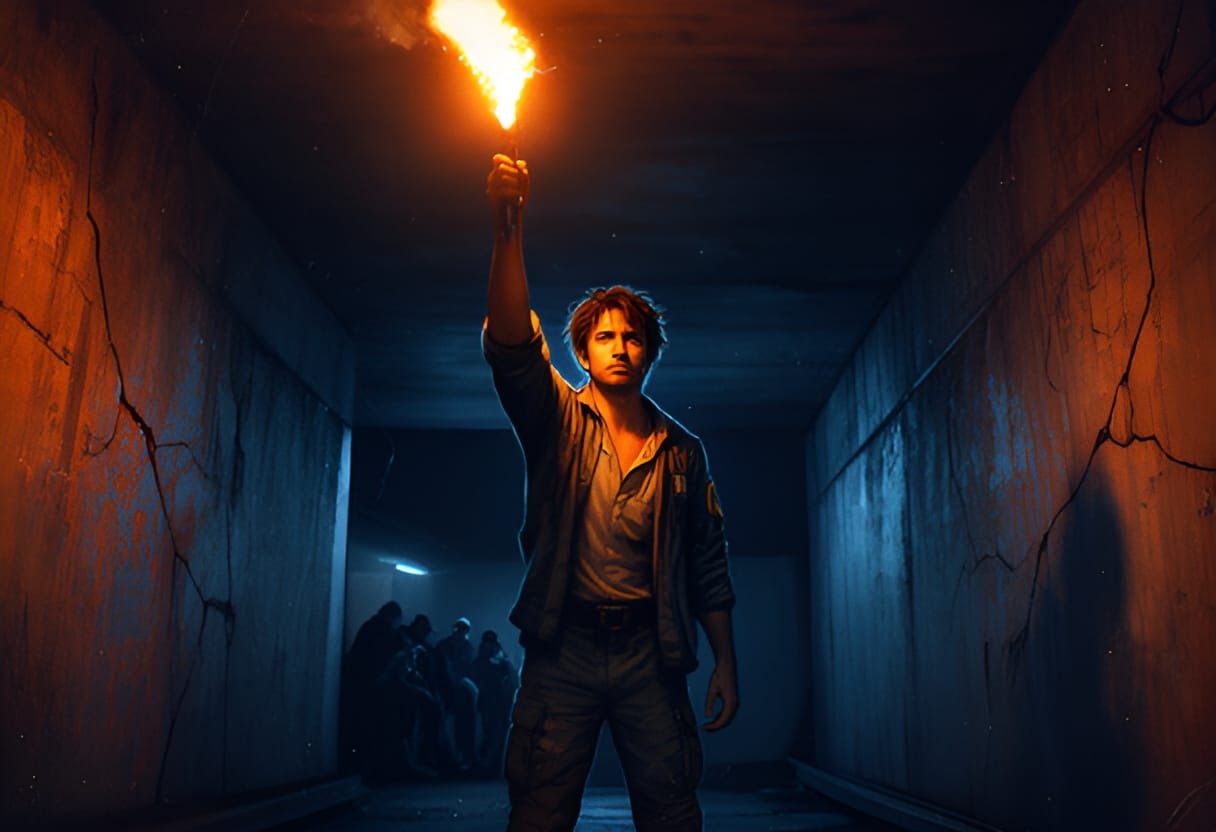
Chapter 6
The Weight of Silence
The flare hissed in Alex’s grip, casting long, jittering shadows across the cracked tiles of the subway platform. Dust hung thick in the air, smelling of ozone and wet concrete, and somewhere far off, a structural groan echoed like a dying beast. Zay knelt beside a woman clutching a blood-soaked rag to her thigh, his fingers slick as he pressed a strip of torn shirt into the wound. Around them, civilians huddled in clusters—some silent, some whispering prayers, others staring blankly at the dark maw of the tunnel beyond.
Alex stood a few paces away, flare held high, its orange glow painting his face in stark relief. He’d been scanning the tunnel mouth since they’d arrived, jaw tight, eyes flicking between the rubble-choked entrance and the shadows beyond. The promise he’d made—to get them out—hung between them like a taut wire.
“Almost there,” he said, voice low but steady. “Just gotta clear the last stretch.”
Zay looked up, meeting his brother’s gaze. Alex managed a half-smile, but it didn’t reach his eyes. The laughter that usually came easy—sharp, sarcastic, a shield against the dark—had been fraying for hours. Now it was thin as old thread.
“You sure about that?” Zay asked, nodding toward the tunnel. “Looks like the ceiling gave up.”
Alex shrugged, jerking his chin at the flare. “Sappers planted charges farther down. Not here. This bit’s still sound. Just… blocked.”
A child’s whimper cut through the murmurs. A girl, no older than six, sat curled against a pillar, her mother’s hand locked in hers. Her eyes were wide, unblinking, fixed on something in the dark beyond the platform’s edge.
“Mama,” she whispered. “It’s breathing.”
The words hung. Then, from the shadows beyond the flare’s reach—a soft, papery rustling. Like wings. Too many wings.
Zay’s blood turned to ice.
“Alex—”
His brother didn’t hesitate. He flung the flare—not at the darkness, but into it, hurling it with a grunt of effort. It arced, spinning, and struck the wall just beyond the platform’s lip, bursting into a shower of sparks and flame.
The Kryll exploded outward—not in flight, but in a frenzied, shrieking scatter, thousands of tiny bodies bursting like burnt paper in the sudden light. They fled into vents, cracks, any hole that offered darkness. The flare sputtered and died where it landed, but the damage was done. The immediate threat was gone.
Silence crashed back, heavier than before. The girl was screaming now—a raw, terrified keen that tore at Zay’s chest. Her mother pulled her close, rocking, murmuring nonsense words.
Alex was already moving, dropping to his knees beside her. He peeled off his glove with his teeth, revealing blistered, reddened skin across his knuckles and the backs of his fingers. The flare’s heat had eaten through the thin material.
“Hey,” Alex said, voice soft now, urgent. “Look at me. You’re safe. We got you.”
The girl hiccuped, tears streaming. “It was gonna eat me.”
“I know,” Alex said. “But it’s gone now. See? Light scares ’em. Just like the stories.”
He held out his hands, palms up. The burns were angry, skin bubbling at the edges. “See? Even I get scared. But we keep going. Together.”
Zay stepped forward, pulling the medkit from his vest. He tore open a packet of antiseptic wipes, his movements precise despite the tremor in his hands. “Let me.”
Alex tried to pull away. “I’m fine.”
“You’re not,” Zay said, voice low but firm. “Let me do this.”
After a beat, Alex nodded, jaw clenched. Zay cleaned the wounds gently, the antiseptic making him hiss. He wrapped the burns in sterile gauze, securing it with tape. When he finished, Alex flexed his fingers—slow, painful, but functional.
“Thanks,” Alex muttered.
Zay didn’t answer. He was watching his brother’s face—the tight line of his mouth, the way his breath hitched when he moved his hands. The humor was gone. All that remained was the raw, exhausted effort of holding it together.
A man near the front of the group cleared his throat. “We should move. Now. While they’re scattered.”
Zay stood, brushing dust from his knees. “Alex?”
His brother was already shouldering his Lancer, checking the magazine with a thumb. “Half-full. Chainsaw’s nicked, but it’ll bite.”
“Good.” Zay glanced at the tunnel entrance. Piles of concrete and twisted rebar choked the mouth, jagged teeth of destruction. Beyond it, two shapes crouched in the gloom—too still, too deliberate. Rifles glinted faintly in the ambient gloom.
“Snipers,” he said. “Locust. Set up to pick us off as we approach.”
A murmur rippled through the civilians. Fear, sharp and cold, replaced the temporary relief.
Alex stepped forward, squinting. “They’re not moving. Just… waiting.”
“They know we’re coming,” Zay said. “Sappers blew the far end to trap us. These two? They’re the gate.”
The girl buried her face again. “We’re gonna die here.”
“No,” Alex said, turning to her. He crouched, putting himself at her level. His voice was gentle, but edged with steel. “We’re not dying anywhere. Not today. Not while we’re still breathing.”
He looked at Zay then—a silent question. What now?
Zay studied the scene: the blocked tunnel, the snipers, the exhausted civilians, the flare gone dark. He thought of the storm drain line he’d known from old schematics—parallel to the river, grates every fifty meters. It was a long shot. But it was a way.
“We go under,” he said.
Alex blinked. “Under?”
“The maintenance line. Runs parallel to the tunnel. If we can get to a grate, we might bypass the blockage—and the snipers.”
Alex followed his gaze to the wall beside the platform. Faintly, beneath layers of grime and soot, a rectangular seam showed where an access panel had been sealed.
“You sure it’s still open?” Alex asked.
“I checked the maps before deployment. It’s old, but sturdy. Big enough to crawl through.”
Alex stood, testing his burned hands against his Lancer. They shook, but he gripped it firm. “Then let’s not keep ’em waiting.”
Zay turned to the civilians. “Listen up. We’re changing course. Follow us close. Stay quiet. No sudden moves. If you see light—Kryll light—you get down and cover your head. Understand?”
Nods. Trembling, but resolute.
Alex slung his Lancer, then offered his good hand to the woman with the leg wound. She took it, gripping hard. “Go on,” he said. “We’ve got you.”
They moved as a unit—Zay and Alex flanking the group, rifles up, eyes scanning. The woman hobbled between them, supported by another civilian. The girl clung to her mother, silent now, eyes darting.
At the wall, Zay knelt and pried at the seam with his knife. The metal groaned, then gave. Behind it: darkness, and a narrow passage just tall enough to crawl through.
Alex went first, lowering himself feet-first, then dragging his torso through. Zay followed, helping the woman through next, then the others. One by one, they disappeared into the dark, the sounds of their passage muffled—soft scrapes, ragged breaths, the occasional muffled curse.
When Zay entered, the air was cool and still, smelling of stone and damp earth. He crawled on his elbows and knees, Alex ahead, the civilian line snaking behind like a wounded serpent. The passage was tight—shoulders scraping stone, knees bruising on uneven ground—but it was clear. No Kryll here. No immediate threat.
They moved slowly, painfully. Every few meters, Zay paused to check behind them. The civilians followed in silence, trusting, exhausted. A child whimpered once—quickly hushed by a parent’s hand over their mouth.
Then, a sound ahead—a faint, metallic tick.
Alex had stopped. Zay crawled forward until he was beside him, peering into the gloom.
Ahead, the passage opened slightly into a junction. And set into the far wall, just barely visible in the dim glow of Alex’s Lancer’s ammo counter—two figures. Still. Watching.
Snipers. But not in the tunnel. Here. They’d followed. Or guessed.
Zay’s stomach dropped. They hadn’t escaped. They’d just moved the fight.
Alex shifted slightly, bringing his Lancer to bear. The chainsaw whined to life—a harsh, angry sound in the stillness.
Zay caught his wrist. “Wait.”
Alex looked at him, eyes narrowed. “They’re gonna see us.”
“Not if we’re smart.” Zay nodded toward the junction. “There’s a side branch—left, about ten meters back. It loops around. We can flank.”
Alex considered it. Then, slowly, he lowered the weapon. The chainsaw died with a sigh.
“Lead,” he murmured.
Zay eased backward, signaling the civilians to halt. He crawled back to the junction, then turned left into the side passage. It was narrower, rougher, but it wound upward at a gentle angle—toward the surface, maybe, or at least above the main line.
He moved slowly, listening. Behind him, Alex brought up the rear, civilian line stretching in the dark. The girl’s hand was in her mother’s again. No one spoke.
After what felt like an age, the passage opened into a larger chamber—an old junction room, perhaps, with broken pipes and rusted valves lining the walls. And in the far wall, another access panel—this one leading up, toward the tunnel’s ceiling.
Zay pushed it open. Cool air rushed in, carrying the scent of dust and something metallic—blood, maybe, or ozone. Above, through the gap, he could see the tunnel proper: the blockage of debris, and beyond it, the two snipers, still crouched in their positions, unaware.
He turned, signaling Alex.
His brother came forward, helping the civilians up one by one. The woman with the leg injury went first, grimacing as she pulled herself through. Then the others. The girl went last, clutching her mother’s neck, her small fingers digging in.
When they were through, Zay pulled himself up last, Alex right behind him.
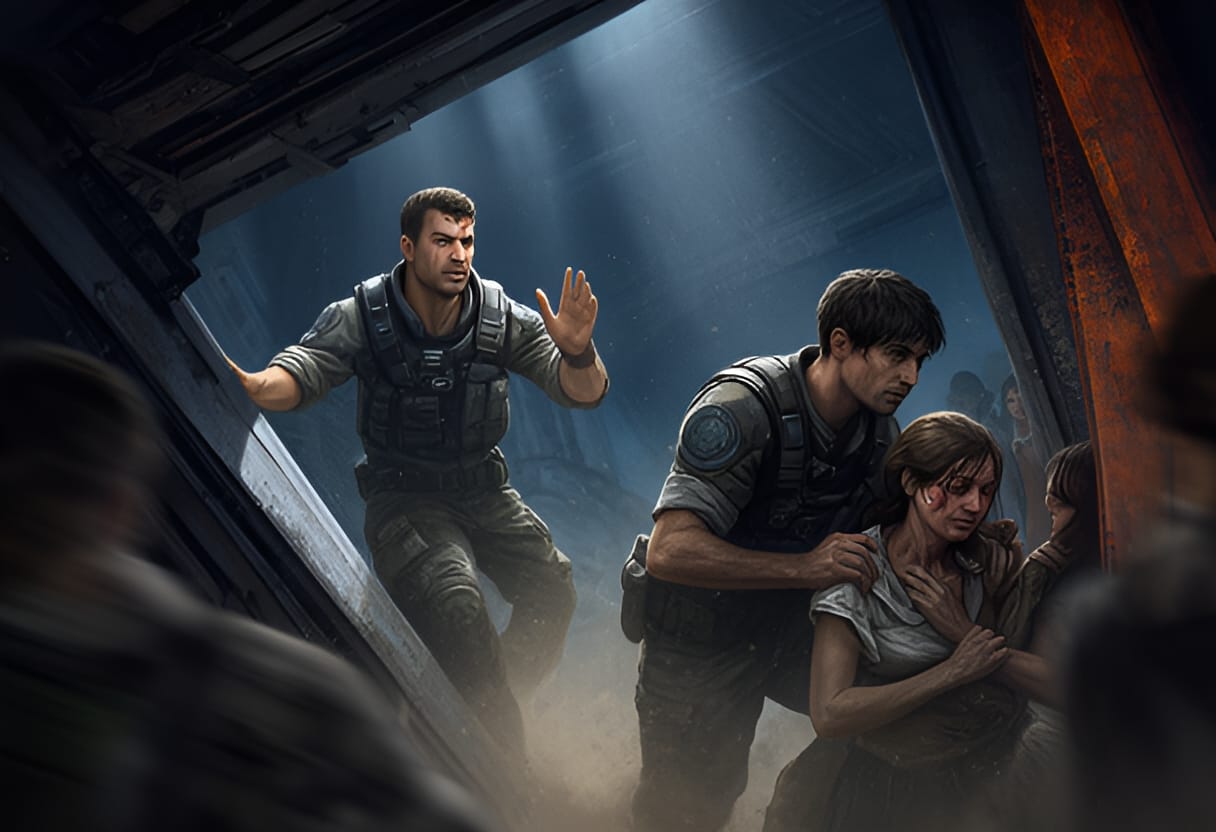
They lay flat on the rubble-strewn tunnel floor, just behind a shattered concrete slab. Below, the snipers shifted—one adjusting his grip, the other shifting his weight. Unaware.
Zay glanced at Alex. His brother’s face was grim, burns throbbing, but his eyes were sharp. He tapped his chest twice—I’m ready—then pointed at the snipers.
Zay nodded. He lifted his Lancer, sighting along the barrel.
They didn’t need words. They never had.
Alex moved first—low, fast, a shadow detaching from the dark. He went left, using the wreckage as cover, closing on the sniper on the far side. Zay went right, low and silent, his boots finding purchase on broken stone.
The first sniper noticed movement—a glint, a shift—and turned, rifle lifting.
Alex was already there.
He didn’t fire. He didn’t need to. He surged forward, Lancer swinging—not to shoot, but to strike. The barrel caught the sniper’s jaw with a sickening crack. The man’s head snapped back, helmet flying. Alex followed with a burst from the hip—three rounds into the chest. The Locust crumpled, limbs jerking once, then still.
Zay was on his second almost at the same time. He came up low, knife already in hand—the combat blade he kept sheathed at his thigh. The sniper turned, surprised, raising his rifle to block.
Zay ducked under the barrel, drove upward with his shoulder, and slammed the knife into the man’s throat just below the jaw. The Locust gagged, claws scrabbling at the wound, then went limp. Zay wrenched the blade free, wiping it on his thigh as the body slumped.
Silence. Then, the soft, ragged breathing of the civilians emerging from the drain.
Alex stood, leaning on his Lancer, chest heaving. One hand pressed to his shoulder where the sniper’s rifle had grazed him—a line of fire across his clavicle, blood seeping through his vest. He didn’t mention it.
Zay checked the tunnel beyond the snipers. The blockage remained—too much to clear quickly. But the immediate threat was gone.
He looked at his brother. Alex met his gaze, sweat and dirt streaking his face, burns red on his hands, blood on his shoulder. But he was standing. He was breathing. He was there.
Zay gave the smallest nod.
Alex returned it—tight, tired, but real.
Then, without a word, he turned and began helping the civilians toward the tunnel mouth, toward the uncertain safety beyond.
Zay followed, rifle at the ready, eyes on the dark.
Behind them, the passage lay quiet. Ahead, the city burned.
But for now, they were still together. And that, at least, had not changed.
The group moved in a slow, staggered line toward the tunnel’s mouth, the civilians leaning on each other, limping, silent. The girl stayed close to her mother, her small hand clutching the frayed edge of her shirt. Zay brought up the rear, Alex just ahead of him, rifle cradled in one arm, the other pressed tight against his side wound. Blood had soaked through the fabric, dark and sticky, but he didn’t slow. Didn’t complain.
Zay caught his eye once. Alex gave a tight shake of his head—I’m fine—but his face was pale beneath the grime, his breaths shallow. The wound wasn’t deep, but it bled steady, and the adrenaline was fading. Soon, the shock would wear off, and the pain would come full force.
They reached the lip of the tunnel entrance just as the first gray light of true dawn began to seep through the pall of smoke hanging over Ephyra. The sky wasn’t bright—it never would be again, not today—but the oppressive blackness of night had lifted into a sullen, ashen haze. Fires still raged in the distance, orange tongues licking at the skyline. The air smelled of burnt plastic, scorched stone, and something sickly sweet—like sugar left too long in a flame.
Beyond the snipers’ bodies, the East Rail Tunnel yawned, choked with debris. Concrete slabs, twisted rail, and wrecked freight cars were piled high, forming a barricade that looked impossible to breach. Locust had clearly come through here in force, and whatever they hadn’t destroyed, they’d buried under collapsing infrastructure. It wasn’t just a blockage—it was a tomb.
A low whimper came from the woman with the leg injury. She’d sat down on a chunk of rebar, face tight with pain. “We can’t get through this,” she whispered. “Not without tools. Not without time.”
Alex stepped forward, resting his forearms on his knees, staring at the pile. “We don’t need to go through it,” he said quietly. “We just need to get past it.”
Zay frowned. “How? It’s sealed.”
Alex nodded toward the left wall, where the tunnel curved slightly inward. “See that seam? Where the wall meets the ceiling? It’s not solid all the way through. There’s a maintenance void—narrow, but it runs parallel to the blockage. I saw it on the schematic back at Fort Hoffman. Used for cable runs. If we can get into it, we might be able to crawl over the debris, drop down on the other side.”
Zay studied the spot. Sure enough, a hairline crack ran along the joint, barely visible in the dim light. “You sure it’s big enough?”
“Big enough for a person to squeeze through,” Alex said. “If we take our packs off, turn sideways. It’ll be tight. But it’s there.”
Zay looked at the civilians—expressed, wounded, terrified. “Can they make it?”
Alex hesitated. “Not all of them. The woman with the leg… she won’t fit. And the girl’s small, but she’d need help. The rest… maybe. If we go slow. If we help each other.”
A silence fell. The weight of it pressed down—who stays, who goes. Zay felt it in his bones, the same dread that had settled in him back at the hospital, when they’d left the wounded behind in the stairwell. Only now, it wasn’t just soldiers. It was civilians. People who had trusted them.
The woman looked up, eyes wet. “You don’t have to wait for me,” she said. “Take the others. Get them out. I’ll… I’ll hold here. Slow ‘em down if I can.”
“No,” Alex said firmly. “Nobody stays. Not unless they have to.”
Zay placed a hand on his brother’s shoulder. “We find another way. Or we make one.”
Alex let out a short, humorless laugh. “With what? Our hands? We’ve got no explosives. No breaching charge. Just rifles and a damn chainsaw that’s seen better days.”
Zay glanced at his Lancer. The chainsaw was nicked, the motor strained from earlier use. But it still turned. Still bit.
He looked again at the blockage—not just at the debris, but at the pattern of it. The way the slabs had fallen. The gaps between them. Not random. Not entirely.
“Wait,” he said. “Look at how it’s piled.”
They both leaned in, tracing the lines with their eyes.
The debris wasn’t uniform. Near the top, it was chaotic—collapsed ceiling, fallen lights. But lower down, near the tunnel floor, the arrangement was… deliberate. Gaps. Channels. Like someone—or something—had guided the fall.
Alex’s brow furrowed. “You think the Locust did this on purpose?”
Zay nodded. “They don’t just collapse tunnels. They shape them. Use the rubble to funnel prey. Make kill zones. I saw it in the outskirts—sewers choked to force us into open streets. This… this feels the same.”
Alex followed the lines with his gaze. Then his eyes narrowed. “There.” He pointed. “Near the bottom—left side. There’s a gap. Big enough to crawl through. If we can clear a little of the loose rubble…”
Zay got to his knees, brushing dust from his hands. He reached into the gap, fingers scraping against stone and twisted rebar. It was tight, but there was space—just enough for a person to wriggle through, shoulder first, if they pulled the larger chunks aside.
“It’s possible,” he said. “But we’ll need to move the big pieces. And we’ll need light.”
Alex checked his flare pouch. Empty. The one he’d used on the Kryll was gone—burned out in his hands. He patted his pockets. “No flares. No glow sticks. Just weapon lights.”
Zay thought of the civilian woman’s flashlight—small, battered, but still working when he’d seen her fumble with it earlier. He looked over. She was trying to stand, grimacing as she put weight on her injured leg.
“Hey,” he said. She looked up, wary. “Your light—does it still work?”
She nodded, fumbling in her coat. “Yeah. Barely. But it works.”
Zay took it from her. The beam was weak, flickering, but it cut through the gloom. He handed it to Alex. “Use this. Keep it low. We don’t want to draw attention.”
Alex nodded, switching it on. The thin cone of light swept the gap.
“Okay,” he said. “Let’s make it bigger.”
They began to work—slow, silent, methodical. Alex used the butt of his Lancer to tap at loose chunks, testing their stability. Zay pried with his knife and the flat of his hand, shifting smaller stones aside. The woman with the leg injury crawled forward on her good leg and elbows, using her free hand to nudge pebbles out of the way. The girl helped too, her small fingers surprisingly adept at shifting grit and dust.
Sweat beaded on Zay’s forehead. His side wound throbbed in time with his pulse. Alex’s burned hands shook as he gripped the Lancer, but he didn’t stop. Every now and then, he’d glance back at the civilians—checking, making sure they were still there, still breathing.
After nearly twenty minutes, the gap had widened enough. Not much—just enough for a person to slip through sideways, scraping shoulders, holding breath. But it was enough.
Zay crawled forward first, shining the light ahead. The passage beyond was low—no more than three feet high—but it ran clear, following the curve of the blockage. Beyond it, he could see the tunnel floor again—dark, but unobstructed. A path through.
He wriggled through, then turned and helped Alex. His brother grunted as he shifted, the movement sending a sharp flare of pain through his shoulder. He gritted his teeth, but made it through without stopping.
One by one, the civilians followed. The woman with the leg injury went next, pulling herself with her elbows, her face set in grim determination. Zay and Alex helped her through, then pulled her clear. The girl went after, small and quick, her mother right behind her.
When the last of them was through, Zay pulled the flashlight from Alex and shone it back into the gap. The rubble remained unstable—shifted, but not collapsed. It would hold for now. Maybe not forever, but long enough.
They stood in the tunnel beyond the blockage, breathing hard. The air here was cooler, less choked with smoke. In the distance, the faint rumble of Locust movement echoed—boots on metal, the guttural chirp of Drones. But for now, they were unseen.
Alex leaned against the wall, head back, eyes closed. Blood had soaked through his vest, staining the fabric dark red. His breathing was labored.
Zay knelt beside him. “Let me see it.”
Alex opened his eyes. “It’s just a graze.”
“It’s bleeding too much for a graze.”
Alex finally let him see. The wound was along the top of his left shoulder, just where the clavicle met the muscle. The round had glanced off the bone, tearing a furrow through the flesh. It wasn’t deep, but it was wide—ragged edges, tissue torn. Blood welled slow but steady.
Zay tore a strip from his own undershirt—already stained with sweat and dirt—and pressed it to the wound. Alex hissed.
“Sorry,” Zay muttered.
“Don’t be.” Alex grabbed his wrist, not hard, but firm. “You’re doing it right.”
Zay wrapped the cloth tight, tying it off with a knot he knew from field medic training. It wouldn’t stop the bleeding completely, but it would slow it. Buy time.
Alex tested his arm. It trembled, but he could lift it. “Still functional,” he muttered. “Just… sore.”
Zay gave him a look. “You’re not fine.”
Alex managed a ghost of a smile. “Never said I was. Just said I’m still here.”
Zay held his gaze. The humor was thinner now—almost gone. But the bond remained. Unspoken. Absolute.
He stood, offering his hand. Alex took it, pulling himself up with a grunt. He swayed slightly, then found his balance.
“Thanks,” he said.
Zay nodded. “Let’s keep moving.”
They fell into step again—Zay leading, Alex just behind, civilian line forming in their wake. The girl stayed near the front, her mother’s hand firm on her shoulder. The woman with the leg injury leaned on a makeshift crutch—a length of rebar she’d pulled from the rubble.
They moved slowly, cautiously. Zay kept his Lancer up, scanning the darkness ahead. Alex brought up the rear, weapon ready, eyes flicking between the group and the tunnels branching off into dark.
After several minutes, the tunnel began to incline gently upward. The air grew fresher—less dank, less stale. And then, ahead, a faint glow.
Not fire. Not explosion.
Daylight.
They froze.
Zay signaled halt. He and Alex moved forward cautiously, rifles raised, using the curve of the tunnel to stay concealed.
They reached the mouth and peered out.
They were in a drainage culvert that opened into a sunken boulevard—part of the city’s old storm runoff system. The grate above had been blown clean off, twisted and tossed aside by some distant blast. Through it, the pale dawn light poured in, illuminating the scene below.
The boulevard was wide, lined with shattered storefronts and overturned vehicles. Fires burned in pockets—garbage piles, a stalled bus, the skeleton of a newsstand. But the street itself was largely clear of Locust. For now.
And scattered across the pavement, moving with purpose, were people.
Dozens of them. Maybe more. Civilians—men, women, children—carrying bags, supporting the injured, limping or hurrying toward a series of concrete barriers and sandbagged positions further down the street. COG gears were there too—sergeants and corporals directing flow, medics tending to wounds, a few Lancers set up in overwatch positions.
A forward operating point. Improvised. But held.
Alex let out a breath he didn’t know he’d been holding. “We made it,” he whispered.
Zay didn’t answer. He was watching the street—watching the people. Watching the way a medic knelt to bind a child’s knee, the way a sergeant barked an order that was obeyed without hesitation, the way an old man helped a woman carry a sleeping child on his back.
Hope. Fragile. Flickering. But there.
He turned to his brother. Alex was staring at the scene too, his expression unreadable—relief, exhaustion, something deeper. Something like awe.
Then Alex looked at him. Not with words. Just a look. A question.
Zay—
Zay nodded. Not in answer. In acknowledgment.
They had kept their promise.
They had found their way back.
Not to safety. Not to victory.
But to each other.
And for now, in the midst of the burning city, in the shadow of the Locust advance, that was enough.
Alex pushed off the wall, slinging his Lancer. He looked back at the civilians trailing behind them—still coming, still trusting.
“Let’s go help,” he said.
Zay fell into step beside him. Together, they stepped into the light.
Behind them, the tunnel remained dark. Ahead, the city burned.
But they walked forward—side by side—into the dawn.
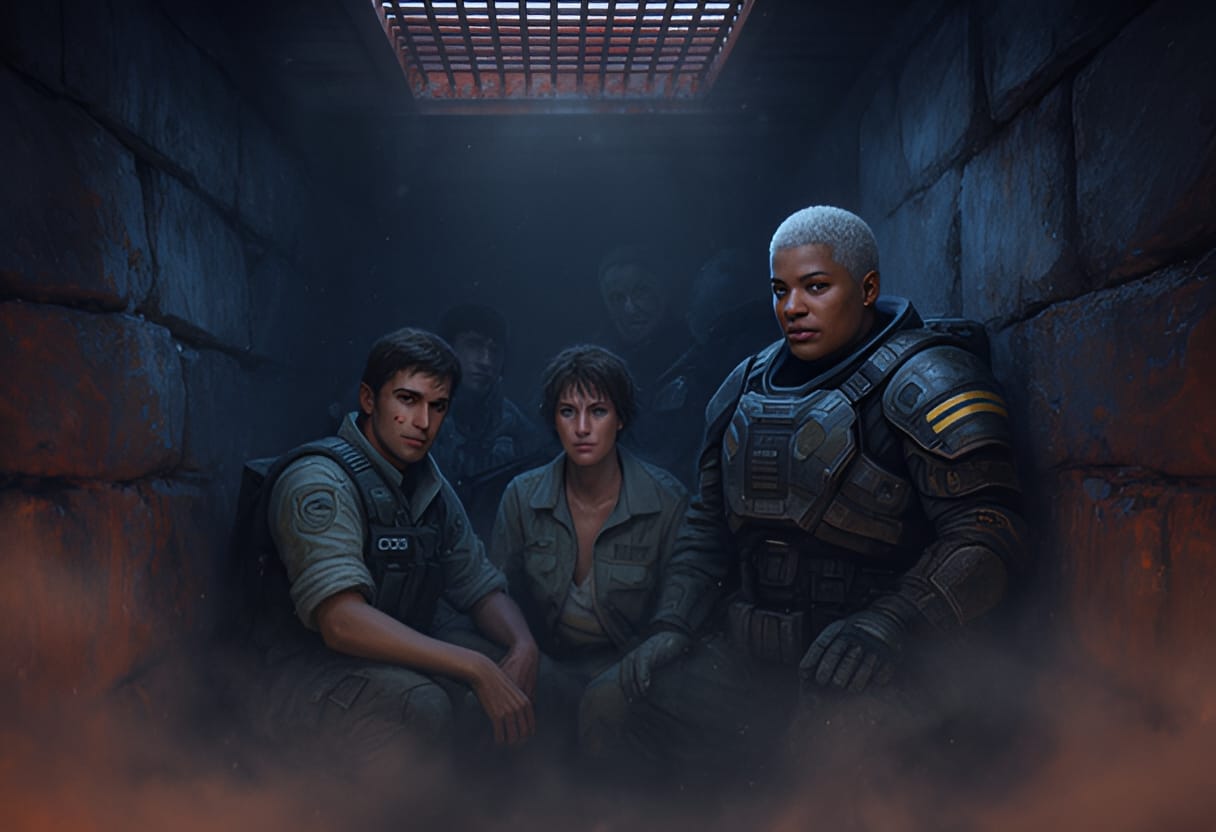
Chapter 7
Ghosts in the Machine
The group huddled against the cold stone of the tunnel mouth, the air thick with dust and the sour tang of burning insulation. Debris choked the entrance—twisted rebar, shattered concrete, a collapsed section of rail that jutted like broken teeth. Beyond it, two silhouettes crouched behind a toppled kiosk, rifles resting on the wreckage, scanning the darkness with the patient stillness of predators. Locust snipers. Their armor drank the dim light, making them almost invisible against the gloom.
Zay pressed himself flat against the wall, shoulder to shoulder with Alex. The flare in Alex’s grip guttered, casting long, jittery shadows that made the snipers’ heads seem to bob and weave. He glanced at his brother. Alex met his eyes, jaw tight, the flare held low in his left hand. His right hand—burned raw from driving off the Kryll—trembled slightly on the Lancer’s grip.
Zay lifted his right hand, tapped twice on Alex’s right shoulder.
Flank left.
Alex gave the barest nod. He shifted his weight, easing backward along the wall until he found the gap—a narrow fissure between two fallen support beams where the stone had spalled away, revealing a void behind. The maintenance crawlspace. Old storm drain access, just wide enough for a man to wriggle through on his belly. Zay had known it was there from old city schematics, a relic from before the hammer strikes, before the wars that had scarred Sera’s surface. Now it was a wormhole through the earth.
He slipped first, shoulders scraping concrete, breath held tight against the grit and damp. The tunnel was low, forcing him to crawl on his elbows and knees, the flare’s light gone behind him. Only the faintest glow seeped in from the entrance, enough to outline the rough curve of the drain. Alex followed close behind, the scrape of his armor a soft whisper in the dark.
They moved slowly, inches at a time, the crawlspace angling left as it paralleled the tunnel above. The stone was wet in places, slick with seepage, and the air grew colder, damper—underground, away from the fires above. Zay’s side wound, a searing line where Seeder shrapnel had torn through his vest, throbbed with each twist of his torso. He ignored it. Focus stayed on the rhythm: inhale, exhale, push, drag, repeat.
Then—light. Faint, but growing. A grating ahead. They’d reached the point where the drain rose to meet the surface again, just beyond the snipers’ position. Zay halted, listening. Above, the murmur of voices—Locust, guttural and sharp. The snipers were talking, low and urgent, likely arguing over who had seen movement, who should take the next watch.
He turned his head just enough to see Alex beside him, eyes narrowed, lips pressed thin. Zay raised three fingers, then tapped his chest twice.
Ready. On my signal.
Alex mirrored the gesture. Zay waited, counting the seconds between the Locust’s words. A pause. A shift in tone—one of them standing, stretching.
Now.
He drove his boot into the grating’s rusted frame. The metal screamed, flung upward with a shriek of protest. Concrete dust rained down. Before the sound could fully bloom, Zay was through, rolling to his left, Lancer coming up in a smooth arc.
The first sniper jerked upright, rifle swinging—too slow. Zay’s burst caught him in the chest, the rounds hammering through armor and flesh alike. The Locust gasped, eyes wide, then folded backward over the kiosk, rifle clattering to the ground.
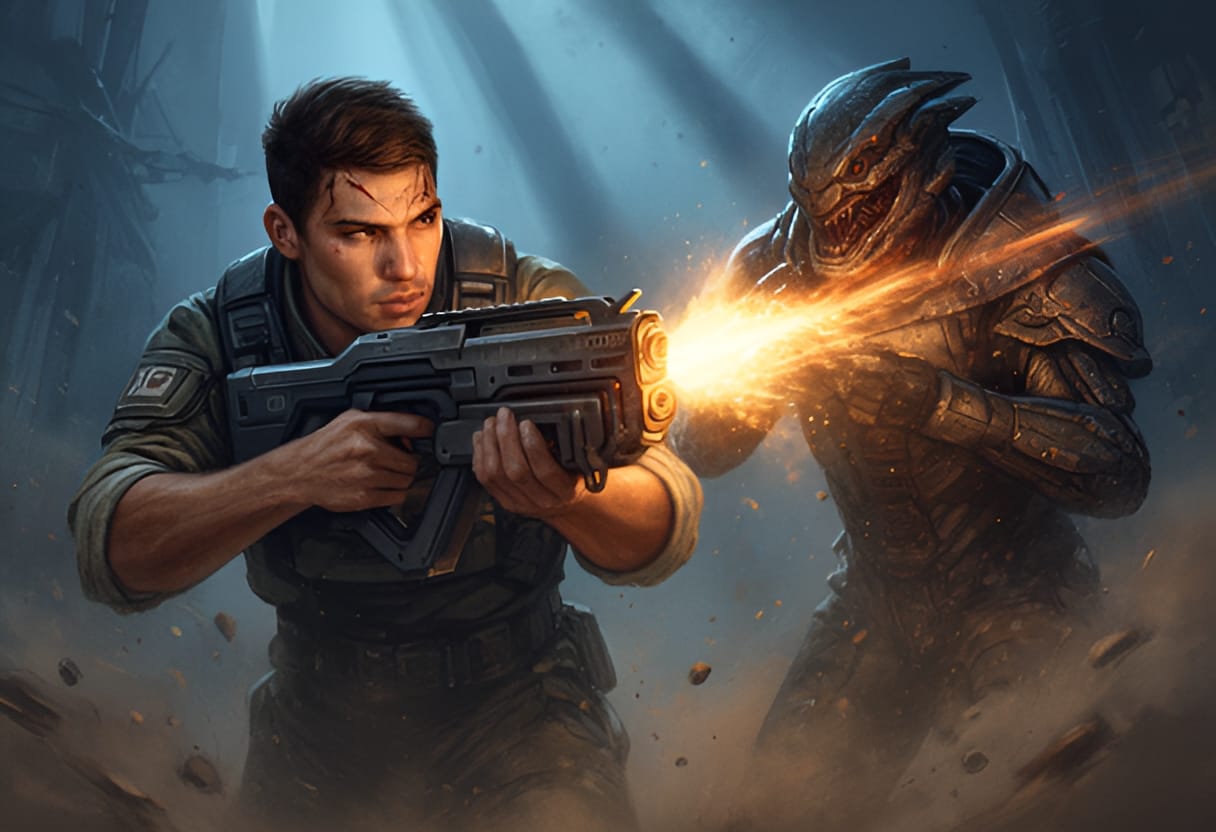
Alex was already moving. He’d slipped out to the right, low and fast, using the smoke and debris as cover. The second sniper had turned at the noise, bayonet fixed, snarling as he spotted the movement. He lunged, the blade flashing toward Alex’s throat.
Alex twisted, taking the blow on his fore-arm. The bayonet slid along the Lancer’s barrel, biting deep into his shoulder just below the collarbone. He cried out—a short, sharp sound, more surprise than pain—and drove the Lancer forward. The chainsaw screamed to life, teeth tearing into the sniper’s midsection. Blood sprayed, hot and thick, dousing Alex’s burned hand. The Locust staggered, eyes rolling back, then collapsed in a heap, the bayonet clattering from his grip.
Silence fell, thick and heavy. Only the ragged rasp of Alex’s breathing broke it, the flare sputtering in his left hand, casting his face in alternating flashes of blue-white and shadow.
Zay was at his side in a heartbeat. He dropped to one knee, Lancer discarded, fingers probing the wound. The bayonet had gone deep, but missed the clavicle. Blood welled dark and steady, soaking the fabric of Alex’s undershirt and dripping onto the stone.
“You idiot,” Zay muttered, voice rough. He tore a strip from his own undershirt, already stained with sweat and grime, and pressed it hard against the wound. “You always did charge in like a damn berserker.”
Alex managed a grimace that might have been a smile. “Hey,” he whispered, “somebody’s gotta keep the ugly ones off your back. Besides… you owe me a beer for life. Remember that promise?”
Zay’s throat tightened. He remembered—the porch swing at their grandfather’s house, the two of them sixteen and stupid, swearing they’d always find their way back, no matter what. A beer. A stupid, simple thing. Now it felt like a vow carved in bone.
He pressed harder on the bandage. “Yeah,” he said. “Yeah, I remember.”
Alex’s breath hitched. He looked down at the makeshift bandage, then back at Zay’s face. The flare flickered, casting his eyes in stark relief—pale, exhausted, but still sharp. “You know,” he said, voice dropping, “I didn’t think we’d actually make it to collect.”
For a long moment, neither spoke. The weight of the day pressed in—the screams from the suburbs, the smell of burnt flesh, the way Jace had gone quiet in the stairwell, the flare’s dying light in Alex’s grip. The world above was ending. But down here, in the damp dark of the drain, with his brother’s blood warm on his fingers and the ghost of a promise hanging between them, Zay felt something shift—not hope, not exactly, but the stubborn refusal to let go.
Alex shifted, wincing as he pulled the Lancer closer, cradling it like a wounded thing. He took a slow breath, then reached into his belt and produced the water bottle—half-full, lukewarm, tasting of metal and dust. He offered it to Zay first.
Zay took it, drank deep. The water was flat, warm, but it cleared the grit from his throat. He handed it back.
Alex drank, then wiped his mouth with the back of his hand. He looked at the bottle, then at Zay, and for the first time since they’d entered the crawlspace, his humor didn’t quite reach his eyes.
“You know,” he said softly, “I always figured if we ever got that beer, it’d be on a porch somewhere. Sun setting. No sirens. No… this.”
Zay didn’t answer. He couldn’t. Instead, he tucked the flare more securely into Alex’s left hand, then took up his Lancer, checking the magazine. Half-full. The chainsaw nicked but functional.
Alex pushed himself up on his elbows, grimacing as the movement pulled at his shoulder. “We should move,” he said. “Before more of them come sniffing around.”
Zay nodded. He slipped back into the drain first, Alex following close behind, the flare’s light trembling in his grip like a heartbeat. They crawled forward, the stone rough beneath them, the distant echoes of Locust voices fading behind.
Somewhere ahead, the East Rail Tunnel waited. Beyond it, the river. Beyond that—maybe—escape.
But for now, there was only the crawlspace, the dark, and the steady, ragged sound of two brothers moving as one through the belly of a dying city.
The crawlspace narrowed ahead, the stone pressing in on either side as if the earth itself were trying to seal them in. Zay moved slowly, shoulders scraping, the flare’s light throwing long, trembling shadows that made the walls seem to breathe. Alex followed, each movement a calculated grimace—his shoulder wound throbbing in time with his pulse, the bandage already darkened at the edges. He didn’t complain. Didn’t even sigh. Just kept his Lancer low, chainsaw idling, ready.
They’d gone maybe twenty meters when the air shifted. Not colder, but thicker—laden with a faint, sweet-rot smell, like overripe fruit left in the sun. Zay paused, nostrils flaring. He tapped Alex’s shoulder once. Wait.
Alex froze, Lancer braced against the damp stone. Zay crawled forward on his elbows, head low, until he could see past the bend. Ahead, the drain opened into a small chamber—likely a junction point where another line met this one. The grating above was gone, replaced by a jagged hole in the concrete, and through it poured not light, but a thick, writhing shadow.
Kryll.
They weren’t swarming yet. Just drifting, like smoke caught in a slow eddy, their tiny wings whispering against the stone. But Zay knew that stillness. It wasn’t rest. It was hunger. They were waiting—for movement, for heat, for the pulse of life.
He signaled back: two taps on the shoulder, then a flat palm pushed forward. Hold. Don’t move.
Alex nodded, eyes locked on the writhing gloom. His burned hand trembled slightly on the Lancer’s grip, but he didn’t lower it. The flare in his other hand cast a thin blue-white ring around them, just enough to hold the dark at bay—but the Kryll seemed to recoil from it, pulling back slightly as if burned.
Zay thought fast. They couldn’t go back—the snipers’ position was compromised, and more Locust would be coming. Going forward meant passing through the chamber. And the Kryll… they avoided light, yes, but not all light. The flare was weak, sputtering. It wouldn’t last.
He reached into his vest and pulled out the last of his spare magazines. Slid it silently into Alex’s hand. Then, from his own belt, he took the combat knife—still slick with the other sniper’s blood—and pressed it into Alex’s free hand.
Alex looked at him, eyebrows raised. Zay gave the barest shake of his head. Not for throwing. For close.
Then Zay shifted his weight, planted his elbows, and shoved forward—not with a yell, not with a burst of speed, but with a slow, inexorable push, like a man forcing his way through icy water. The flare lifted, held high. The Kryll stirred.
For a heartbeat, nothing. Then—like a curtain ripped aside—they flowed.
Not in a scream, not in a chaotic rush, but in a silent, liquid wave, pouring down from the hole above and across the chamber floor like ink in water. They didn’t screech. They didn’t need to. Their presence was a pressure, a sucking cold that seemed to drain the warmth from the air, from the blood.
Zay went low, shoulder first, driving through the leading edge of the swarm. The Kryll parted around him like water around a stone, but not without cost. Tiny claws raked at his exposed neck and cheeks, needle-sharp and burning where they broke the skin. He gasped, tasting iron, and swung the Lancer in a tight arc. The chainsaw screamed, teeth chewing through chitin and wing, throwing up a fine black mist that coated his visor and lips.
Beside him, Alex was a storm of motion. He didn’t fire. Didn’t waste the ammo. Instead, he surged forward, knife flashing in the gloom—up, under, twist—each motion precise, lethal. A Kryll caught in the blade’s path exploded in a puff of dust and shadow. Another lunged at his face; he twisted aside, caught its wing in his off-hand, and drove the knife into its thorax. It went limp. He flung it aside and moved on.
They moved as one—no words, no signals needed. Zay laid down suppressing fire, short bursts that flared and died, creating pockets of light the Kryll avoided. Alex flowed through the gaps, a shadow among shadows, the knife his only voice. Burned hand screaming, shoulder on fire, he didn’t falter. Didn’t hesitate. Just kept moving, kept cutting, kept going.
Zay felt it then—not fear, not exactly, but something deeper. A recognition. This was what Alex had always been: not the loud joke, not the flare-bearer, but the knife in the dark, the quiet hand that steadied the aim, the brother who moved first when the world went silent. And in that moment, Zay understood why he’d always followed—not because he had to, but because he wanted to. Because trusting Alex was as natural as breathing.
The chamber emptied. The Kryll, thwarted by flame and steel, retreated back into the hole above, coalescing into a writhing knot that pulsed once—like a heart—and then vanished into the dark.
Silence. Heavy. Wet. Zay lowered the Lancer, chest heaving, the taste of blood and Kryll ash thick on his tongue. Alex was bent over, hands on his knees, breathing hard. The flare sputtered in his grip, casting his face in stark relief—sweat-slicked, eyes wide, the burned fingers of his left hand curled into a fist.
Zay stepped forward, wiped a gloved hand across his visor to clear the smears. “You good?”
Alex let out a short, humorless laugh. “Never better.” He pushed himself upright, wincing as the movement pulled at his shoulder. The bandage had soaked through, dark and sticky. “Just… feeling a little light-headed. Must be all the… extra protein.”
Zay didn’t smile. He couldn’t. Instead, he checked Alex’s wound again. The bleeding had slowed, but the skin around the entry point was angry red, swollen. Infection was a risk, sure—but right now, shock and blood loss were the immediate threats. He tore another strip from his undershirt, wrapped it tight over the first, and tied it off with a knot he knew would hold.
“Keep pressure on it,” he said. “And tell me if it starts to burn. Or if you get dizzy.”
Alex nodded, but his gaze had drifted past Zay, toward the hole in the ceiling where the Kryll had vanished. His jaw worked. “You think they’re… hunting us? Or just… doing what they do?”
Zay considered it. The Kryll weren’t random. Not anymore. They’d seen them used as herders, as blockers—tools. The Locust weren’t just throwing them at walls; they were aiming. “They’re herding,” he said quietly. “Pushing us where they want us to go. Or keeping us where they can finish us.”
Alex looked at him, really looked. “Then why let us through the drain? Why not just flood it?”
“Because they don’t know we’re in here,” Zay said. “Or they think we’re dead. Or… they want us to think we got away.” He paused. “Either way, we’re not out of it yet.”
Alex checked his Lancer. Magazine still half-full. Chainsaw nicked, but the teeth were intact. He gave it a test squeeze—it whined to life, smooth and hungry. “Then we move,” he said. “Before they change their mind.”
They crawled on.
The drain opened up again after another fifteen meters—a larger maintenance shaft, dry and dusty, with rusted ladders climbing up to a manhole cover far above. Zay paused at the base, listening. Silence. No voices. No skittering. Just the distant, muffled thump of something heavy settling—maybe a building giving up its last breath.
He looked up. The cover was round, heavy steel, rimmed with rust. It was shut—but not sealed. He could see a sliver of pre-dawn sky through the edges, a faint wash of indigo that meant morning was coming. Not dawn, not yet. But close.
Alex came up beside him, leaning on his Lancer. “We go up?”
Zay shook his head. “Not yet.” He pointed to the wall opposite the ladder—a narrow horizontal seam in the stone, barely visible unless you knew to look for it. Another access point. A second crawlspace, this one running parallel to the river, just as he’d remembered from the old schematics. “This way. It’s drier. Less chance of Kryll nesting in the damp.”
Alex didn’t argue. Just gave a single tap on Zay’s right shoulder—understood—and turned to lead.
They entered the second crawlspace feet first this time, lowering themselves down onto a narrow ledge before slipping inside. It was higher than the first—enough to crawl on hands and knees, maybe even crouch in places—and the air was dryer, less metallic. The stone was smoother here, worn by decades of water flow, but now it was just dust and grit.
They moved faster now. Not reckless, but with purpose. The flare’s light danced ahead, casting long, jerky shadows that made the walls seem to pulse. Alex’s breathing was shallow, but steady. Every so often, he’d shift his grip on the Lancer, checking the wound without breaking stride.
Then—sound.
Faint. Distant. But unmistakable.
Voices.
Not Locust. Human.
Zay halted, hand shooting out to stop Alex. They pressed flat against the wall, hearts pounding. The voices were muffled, distorted by stone and distance, but the tone was clear—urgent, low, speaking in COG brevity codes.
Zeta squad. Check your six.
Zay’s blood turned to ice. Velez.
He turned his head, eyes wide. Alex was already moving—slow, silent, hand signaling: Follow me.
They crept forward, the crawlspace widening slightly as it paralleled the main tunnel. The voices grew clearer—not just Velez, but others. Jace? No. Jace was gone. But there were others. Soldiers. Civilians. A woman’s voice, soft but firm—Elena Varela, the one Velez had been treating.
Zay’s chest tightened. They weren’t far. Maybe ten meters ahead, the crawlspace rose to meet the tunnel proper—just where the debris had blocked the entrance. If they could get up there, they could link up. Combine forces. Maybe even make a real stand.
He signaled Alex: Up ahead. Voices. Velez and others.
Alex nodded, eyes sharp. He tightened his grip on the Lancer, then pointed ahead—then made a slicing motion across his throat. Quiet.
They inched forward, the crawlspace rising gradually until the stone ceiling lowered enough that they could hear not just voices, but the scrape of boots on concrete, the rattle of a magazine being seated, the soft hiss of a flare being struck.
Then—light.
A flicker, low and orange, coming from up ahead where the crawlspace met the tunnel. Not the harsh blue-white of a military flare. This was something else. A candle? A makeshift torch?
Zay halted. Alex bumped lightly into him, then froze when he saw Zay’s stillness.
They were close. Too close to risk noise.
Zay turned his head just enough to meet Alex’s eyes. He raised three fingers, then pointed to his own eyes, then forward.
Look. Then we decide.
Alex gave the tiniest nod. He shifted his weight, eased forward on his belly, and began to crawl—slow, silent, every muscle coiled.
Zay followed, the flare held tight against his chest to keep its light from spilling. The stone scraped his forearms, his knees, but he didn’t feel it. All his focus was on the pinpoint of glow ahead, the murmur of voices growing clearer.
Then he saw it.
Not the tunnel entrance. Not the blockade.
A side chamber—off to the right, where the crawlspace dipped slightly into a small alcove carved from the stone. And in that alcove, huddled together like frightened animals, were six people.
Sergeant Mara Velez sat with her back against the wall, her Lancer across her lap, magazine empty. Beside her, Corporal Jace Stratton—no, wait. Jace was dead. Zay’s breath hitched. It wasn’t Jace. It was a younger gear—maybe nineteen, face smudged with dirt, bandage on his thigh. Private Daniels, if Zay remembered right from the armory roster.
On Velez’s other side sat Elena Varela, her leg splinted with a piece of conduit and strips of cloth, face pale but alert. Across from them, two civilians—a woman with a child wrapped in a blanket, the boy no older than five, eyes wide and silent. And at the far end, slumped against the stone, was Private Santiago—Dominik. His eyes were closed, his hands folded over the small photo he always carried. His breathing was shallow. Too shallow.
They weren’t holding the tunnel. They were hiding. Waiting. Out of ammo. Out of time.
And the flare they’d lit—small, desperate—was guttering in a battered canteen, its light dying.
Zay pulled back, crawling until he was even with Alex. He pressed his forehead to his brother’s for just a second—contact, grounding—then pulled away and signaled: Two taps. Then point to chamber. Then three fingers on chest.
Alex understood. Flank left. Enter chamber. We’re not alone.
Zay nodded. He slipped back, then began to crawl—not toward the chamber, but past it, following the crawlspace as it continued to run parallel to the tunnel, staying low and blind to whatever lay ahead. Alex followed, keeping pace, the Lancer ready.
They went another ten meters before the crawlspace began to rise again, angling upward toward the tunnel ceiling. Zay halted, listened. The voices were louder now—Velez giving quiet orders, Daniels checking his weapon, the woman humming something soft to the child.
Zay turned to Alex. Held up one finger. Then pointed to the ceiling above them—where the crawlspace met the stone of the tunnel. Then made a digging motion with his fingers.
Breach point.
Alex gave a sharp nod. He shifted, planted his elbows, and began to work at the seam where the crawlspace met the tunnel—a hairline crack in the stone, widened by age and vibration. Zay joined him, using the butt of his Lancer to chip away at the concrete, sending fine powder drifting down.
It was slow work. The stone was dense, reinforced in places. But they didn’t need a big hole. Just enough to see. Enough to speak.
After five minutes of steady, silent labor, Zay’s fingers broke through. Not a hole—a slit. Just wide enough to peer through, to speak in a whisper.
He pressed his eye to the gap.
The tunnel beyond was a mess of debris—overturned crates, a shattered bench, the remains of a timetable board half-buried in dust. But there, in the flicker of the dying flare, he saw them.
Velez was trying to reload her Lancer with shaking hands. Daniels was watching the darkness beyond the blockade, rifle ready. Elena was pressing a cloth to the child’s back, murmuring in Spanish. The woman rocked back and forth, silent tears tracing paths through the grime on her cheeks. And Dominik… Dominik hadn’t moved. His photo lay open on his knee—a woman, smiling, two small girls beside her. His lips were moving. A prayer.
Zay pulled back. His throat was tight. He looked at Alex.
Alex’s face was grim. He tapped his chest twice—me—then pointed to the hole, then made a throwing motion with his hand. I’ll go first.
Zay shook his head. No. Too risky. If they were seen, if a Locust patrol was watching—
Alex tapped again. Then pointed to Zay. Then to himself. Then made a cradling motion with his arms.
You take the civilians. I’ll cover.
Zay stared at him. Then, slowly, he nodded.
He backed up, turned, and began to crawl back toward the chamber—slow, low, keeping his body flat against the stone. Alex followed, keeping pace, the Lancer held ready.
When they reached the breach, Zay went first. He eased his head and shoulders through the slit, keeping his profile low. The smell hit him—damp concrete, sweat, fear, and underneath it all, the copper tang of blood.
“Sergeant,” he whispered. “Lopez. Isaiah Lopez. We’re coming in.”
Velez jerked upright, Lancer snapping toward the sound—then lowered it, recognition flooding her face. “Zay? Lopez? Thank God.”
Alex followed, slipping through the gap with a grunt of pain as his shoulder scraped the stone. He didn’t stop. Went straight to Daniela—no, Daniels—and took the rifle from his numb hands. “You’re out,” he said quietly. “Rest. I’ve got this.”
Daniels looked like he wanted to protest, but his eyes were glazed, his face ashen. He nodded and slumped back against the wall, closing his eyes.
Zay moved to the civilians. The woman looked up at him, eyes red-rimmed. “Is it safe?” she whispered.
“Not yet,” he said. “But we’re getting you out. What’s your name?”
“Marisol.” She clutched the child tighter. “This is Mateo. He hasn’t spoken since… since they took his father.”
Zay met her gaze. “We’ll get you both to the river. I promise.”
She didn’t answer. Just nodded, a small, desperate thing.
Alex was already at the blockade, heaving at a chunk of concrete with his good arm, grunting with the effort. Velez joined him, then Elena, using her good leg to brace. Together, they heaved—stone shifted, dust rained down. Not enough to clear it, but enough to create a gap—a low, narrow space, just big enough for a person to slip through sideways.
“Go,” Velez said, breathing hard. “Now. Before they notice.”
Zay didn’t hesitate. He turned to Marisol. “On my back. Hold tight.”
She hesitated only a second—then swung her legs around his waist, arms locking tight around his neck, the child pressed against his chest. Mateo’s breath was warm against Zay’s ear, shallow and fast.
“Ready?” Zay asked.
Marisol nodded into his shoulder.
He turned, lowered himself, and began to crawl backward through the gap—slow, agonizing, scraping his spine and shoulders against the jagged edges of concrete and rebar. The weight of them was immense, but he didn’t falter. Didn’t stop. Just kept moving, inch by inch, driven by the rhythm of the child’s breath and the memory of a promise made on a porch swing long ago.
Halfway through, a sound made his blood freeze.
A skitter. Soft. From the darkness beyond the blockade.
Kryll.
Not a swarm. Just a few—scouts, maybe, or stragglers from the earlier swarm. But enough.
He didn’t look back. Couldn’t. Just kept crawling, heart hammering, Marisol’s grip like iron.
Then—light.
Not from behind. From above.
A flare arced through the air—thrown, not dropped—and burst in a shower of blue-white sparks just beyond the blockade, illuminating the darkness in a stark, freezing glare.
The Kryll screamed—not audibly, but in the way the air seemed to shudder—and fled, pouring back into the cracks and holes like smoke sucked into a vacuum.
Alex.
Zay risked a glance over his shoulder. Alex was standing in the gap, Lancer raised, the flare still burning in his left hand despite the damage to his fingers. His face was slick with sweat and blood, eyes blazing—not with fear, but with fury. Beside him, Velez and Daniels were firing short, controlled bursts into the darkness, keeping the Kryll at bay.
Marisol gasped. “He… he came back.”
Zay didn’t answer. Couldn’t. He kept crawling, then finally cleared the blockade and lowered himself to the tunnel floor. He set Marisol and Mateo down gently against the wall, then turned—just in time to see Alex follow, slipping through the gap with a hiss of pain as his shoulder caught on the rebar.
He didn’t stop. Went to one knee, Lancer coming up, scanning the darkness beyond the blockade where the Kryll had fled.
“How many?” Zay asked, breathless.
Alex checked his magazine. “Two-thirds full. Chainsaw’s good. But I can’t… I can’t hold this forever.” He glanced at his shoulder, then at Zay. “We need to move. Now.”
Velez was already moving, helping Elena to her feet. Daniels stood, rifle in hand, face set. Marisol clutched Mateo, whispering to him in low, urgent Spanish.
Zay looked at the tunnel ahead. The blockade was breached—but not cleared. Beyond it, the tunnel stretched into darkness, the East Rail line disappearing into the gloom. Somewhere ahead, the river waited. Beyond that—maybe—boats. Maybe safety.
But between here and there? Unknown. Locust. Kryll. Maybe worse.
He looked at Alex. Really looked. The flare in his hand was sputtering low, the fuel nearly gone. His shoulder was bleeding through the fresh bandage. His burned hand shook slightly on the Lancer’s grip. But his eyes—his eyes were locked on Zay’s, steady, unwavering.
No joke. No quip. Just that look. The one that said: I’m here. I won’t let go.
Zay reached out, not for the flare, not for the weapon—but for Alex’s wrist. Gripped it tight. Felt the pulse hammering beneath the skin, strong and loud.
“We go together,” he said. “Just like always.”
Alex gave a single, sharp nod. Then he turned, lifted his Lancer, and stepped forward into the tunnel—flame in one hand, weapon in the other, brother at his back.
And together, they walked into the dark.
The tunnel swallowed sound. Only the rasp of boots on wet stone and the occasional drip from the ceiling broke the silence, a metronome counting their steps deeper into the dark. Alex led, his Lancer braced against his good shoulder, the flare in his left hand sputtering like a dying star. Each pulse of blue-white light threw jagged shadows that danced across the tunnel walls—shapes that might have been rock, might have been something else. Zay followed close behind, his own weapon at the ready, eyes scanning the darkness ahead and behind. Marisol and Mateo trailed just ahead of him, the woman’s grip on the child fierce and silent. Velez brought up the rear with Daniels and Elena, their footsteps muffled but deliberate.
Alex’s left hand trembled on the flare’s grip. The skin across his knuckles was blistered and raw, reddened to a painful sheen where the heat had bitten deep. He shifted the weapon slightly, trying to ease the pressure on his wounded shoulder, but the movement sent a sharp, burning ache through the joint. He gritted his teeth, drew a slow breath through his nose, and forced his voice into something light, almost cheerful.
“You know, Zay,” he said, without turning, “if we make it out of this, I’m gonna hold you to that breakfast you promised. Pancakes. Real syrup. None of that synthetic junk they try to pass off as maple back at the barracks.”
Zay didn’t smile. He kept his eyes forward, but he heard the strain beneath the joke—the way Alex’s voice tightened at the end, the slight hitch as he swallowed. The flare’s light caught the damp patch spreading across the front of Alex’s shirt, just below the collarbone. Dark. Wet. Growing.
They’d bandaged it as best they could with strips from Zay’s undershirt, but the cloth was already soaked through, the blood seeping slow and steady like a leak in a pipe. Zay calculated the rate in his head—too fast for a clean wound, too slow for an arterial hit. It was the kind of bleed that didn’t kill you outright, but drained you drop by drop, stealing warmth, strength, thought.
Alex took another step, then another. His stride was uneven now, favoring his right side. He adjusted the Lancer again, this time with a grimace that flickered across his face so fast Zay almost missed it. But he didn’t miss it. He saw it. He saw the way Alex’s breath came shorter now, the way his free hand occasionally curled into a fist at his side, nails digging into his palm.
They passed a junction where a side tunnel branched off into blackness. Alex paused, listening. The flare sputtered, casting his profile in stark relief—jaw clenched, eyes narrowed. He gave a single tap on his own right shoulder. Flank left. Zay mirrored the motion without breaking stride, then tapped his chest. All clear. Alex nodded, almost imperceptibly, and moved on.
But the joke came again, softer this time, as if he were testing the waters.
“Bet you’re regretting that extra cup of sludge this morning,” Alex said, voice low. “Told you it’d stunt your growth. Look at you—still waiting for your first real chest hair.”
Zay risked a glance sideways. Alex was staring straight ahead, but his shoulders were hunched, the left one drawn up slightly as if trying to shield the wound. The flare’s light caught the sweat on his upper lip, the pallor of his cheeks. He was pushing through it, pure willpower turning each step into an act of defiance.
Zay said nothing. Instead, he fell back a half-step, then another, until he was just behind Marisol and Mateo. He kept his weapon low, eyes on the tunnel behind them. The darkness there was thick, unbroken by any light. He listened for the skitter of claws, the rasp of breath, the faintest shift in air that might mean something was moving. But there was nothing. Only the echo of their own passage, the drip of water, the frantic beat of his own heart.
He took the rear not because he was told to, but because it was where he needed to be. Where he could watch Alex’s back without being seen. Where he could see the way the younger twin’s steps grew shorter, the way he sometimes had to catch himself on the wall with his free hand, fingers scraping against the rough stone.
They walked like that for what felt like hours, though it could only have been minutes. The tunnel sloped gently downward, the air growing cooler, damper. The smell of wet earth and old stone mingled with the acrid tang of blood and sweat. Every so often, Alex would lift the flare, checking its fuel. The flame grew smaller with each pass, the blue-white light weakening to a faint, sickly glow.
Then, without warning, Alex stumbled.
His right foot caught on a raised seam in the tunnel floor. He lurched forward, arms windmilling, the Lancer slipping in his grip before he slammed it butt-first into the stone to keep from falling. A sharp gasp tore from his lips—white, ragged—and his left hand flew to his shoulder, fingers pressing hard into the bandage.
Zay was already moving. He closed the distance in two strides, snaking an arm around Alex’s waist to steady him, his other hand gripping the Lancer to keep it from clattering to the ground.
“Easy,” Zay murmured, voice low and rough. “I’ve got you.”
Alex leaned into him, forehead resting against Zay’s temple for just a second. His breath came in short, ragged bursts. When he spoke, it was barely above a whisper, his lips brushing Zay’s ear.
“Don’t let me go,” he said.
The words hung in the air between them—raw, vulnerable, stripped of every joke, every shield. For a heartbeat, Zay saw not the soldier, not the joker, but the boy who’d once clung to his hand on a crowded pier, terrified of getting lost in the crowd. The boy who’d promised, over and over, that no matter what, they’d find their way back.
Zay tightened his grip, his voice a rough promise in the dark.
“I won’t.”
Then Alex pushed back, just enough to stand on his own. He managed a laugh—short, brittle, forced—but it was there. He straightened his spine, squared his shoulders, and lifted the Lancer again, though his left hand shook visibly on the flare.
“Sorry,” he said, voice trying for lightness but missing the mark. “Guess I’m just… clumsy today. Must be all this dodging Kryll and Locust. Wear a fella out.”
He took a step forward, then another. His gait was still uneven, but he didn’t falter again. He kept his eyes on the tunnel ahead, his jaw set, the flare’s fading light throwing his silhouette long and thin against the wall.
Zay fell back into step beside him, close enough to feel the heat of his brother’s body, close enough to catch him if he fell again. He didn’t speak. Didn’t offer empty reassurances. He just stayed there—present, watchful, ready.
Behind them, Marisol whispered something to Mateo in Spanish, her voice a soft murmur lost in the tunnel’s breath. Ahead, the darkness stretched on, endless and hungry. But for now, they walked together. One step at a time. One breath. One promise kept, even as the world tried to break it.
The tunnel’s incline deepened, the stone underfoot growing slick with condensation that wept from the ceiling in slow, steady beads. Alex’s breathing had settled into a rhythm—shallow, controlled—but Zay could still see the tension in his jaw, the way his left hand occasionally spasmed on the flare’s grip before he forced it still. The flame had dwindled to a faint, trembling blue, barely enough to cast their shadows in distorted silhouettes on the wall ahead. Soon, it would gutter out. And when it did, they’d be moving through pitch black, relying only on touch, memory, and the thin thread of trust that bound them.
They passed another junction—this one marked by a rusted sign half-buried in grime, its letters worn smooth: EAST RAIL – TERMINUS 3. Zay glanced at it, then at the dark maw of the side tunnel branching off to the right. No movement. No sound. But he noted it anyway. File it away. If they needed to lose a pursuit, or double back, it was there. He tapped his chest twice—all clear—then touched his temple. Watch rear. Alex gave the faintest nod, eyes already scanning the gloom behind them.
The flare sputtered. A sudden, sharp hiss rose from its casing as the last of the fuel vaporized. The light flared once—brighter, whiter—then died with a soft pop, plunging them into sudden, absolute dark.
For a heartbeat, the world vanished.
Then, slowly, their eyes adjusted.
Not to sight, but to sensation. The tunnel walls loomed close on either side, rough and damp under phantom fingertips. The air tasted of stone and old water, of rust and something deeper—something metallic and faintly sweet, like blood left too long in the open. Alex’s presence beside Zay was a warmth, a steady pressure at his elbow. He could hear his brother’s breath—labored but even—and the faint, almost subsonic thrum of his pulse in the quiet.
Zay shifted his grip on his Lancer, bringing it up to a ready position, muzzle low but aligned with his line of sight. He didn’t need to see to know where the danger might come from. He’d fought in the dark before—on frontier outposts where the moon was swallowed by storm clouds, in caves where the only light came from muzzle flashes. He trusted his ears. His instincts. The bond that had kept them alive through scrapes and skirmishes long before they’d ever put on a COG uniform.
Alex moved first, stepping forward with deliberate care. His left hand, still gripping the dead flare, lifted slightly—not to see, but to feel the wall. His fingertips brushed the stone, tracing its contours, feeling for irregularities, for gaps, for anything that might suggest a hollow, a niche, a place where something could hide.
Zay mirrored him, his own free hand outstretched, palm forward, fingers slightly curled. He felt the wall’s texture—gritty with mineral deposits, cool and unyielding. Every few steps, he paused, tilted his head, listened. The only sounds were their own: the soft scrape of boots, the ragged inhale-exhale of Alex’s breathing, the occasional muffled whimper from Mateo, quickly swallowed by Marisol’s quiet hum—a tune without words, low and soothing, passed down from mother to child in a language older than war.
They moved like that for what felt like an eternity, though Zay knew it couldn’t have been more than ten, maybe fifteen minutes. The tunnel continued its slow descent, the air growing cooler, heavier. Then, ahead, a change: the walls began to curve inward, the ceiling dropping lower. The space narrowed, forcing them into single file.
Alex went first, as he always did when the path tightened. He moved slowly, deliberately, his body angled sideways to reduce his profile. Zay followed, keeping his weapon close, his senses flared. Marisol and Mateo came next, the woman guiding the child with soft words and a hand on his back. Velez, Daniels, and Elena brought up the rear, their footsteps soft but deliberate.
Then, a sound.
Not from ahead. From behind.
A soft scritch—like a claw dragging on stone.
Zay froze.
His heart kicked up, not with panic, but with sharp, focused alertness. He didn’t turn. Didn’t break rhythm. Instead, he slowed his breath, let his ears drink the dark.
Again—scritch. Closer this time. And beneath it, something else: a faint, wet click, like mandibles rubbing together.
Kryll.
Not a swarm. Not yet. But enough. A scout. Or two. Testing the air.
He didn’t signal. Couldn’t risk the sound. Instead, he shifted his weight slightly, bringing his Lancer just a fraction closer to his chest, ready to snap it up and fire if needed. He kept his eyes forward, but his awareness expanded backward, like a net cast into the dark.
Alex felt it too. Zay could tell by the way his brother’s shoulders tightened, by the almost imperceptible pause in his step. But Alex didn’t break stride. Didn’t look back. He just kept moving, his free hand still tracing the wall, his breathing steady despite the pain that must have been flaring in his shoulder with each twist of his torso.
They crept forward, the narrowing tunnel pressing in on all sides. The air grew still, thick. Then—another sound. A soft, fluttering whisper, like silk dragged over stone. It came from the left wall, just ahead and slightly up.
Zay’s finger twitched on the trigger.
Then—movement.
A shape detached itself from the darkness. Small. Angular. Wings folded tight against a carapace that drank the dim ambient light. It clung to the wall, head tilted, sensing.
A Kryll scout.
It hadn’t seen them yet. Or if it had, it hadn’t classified them as threat. It was hunting—sniffing the air for warmth, for breath, for the faint pulse of life.
Zay didn’t hesitate.
He brought his Lancer up in one smooth motion, the chainsaw roaring to life with a guttural snarl that echoed off the tunnel walls. The sound was deafening in the confined space—a violent, tearing noise that seemed to split the dark itself.
The Kryll reacted instantly.
It launched off the wall with a shriek—a high, piercing keen that made Marisol flinch and Mateo bury his face in her chest. But Zay was already moving, stepping into the creature’s flight path, the Lancer’s chainsaw blade screaming as it bit into chitin and flesh.
There was a wet crunch, a spray of dark ichor that arced through the air and struck Zay’s visor. He didn’t blink. Didn’t flinch. He drove the weapon forward, the chainsaw chewing through the creature’s midsection, splitting it clean in two. The halves fell to the stone with a soft thump, twitching briefly before going still.
Silence fell again—thicker now, heavier. The roar of the chainsaw had died, leaving only the echo of its violence and the ragged sound of their breathing.
Alex was at his side in an instant, Lancer raised, scanning the darkness. “You good?” he asked, voice low but tight with strain.
Zay wiped his visor with the back of his glove, smearing the ichor into a streaky mess. “Yeah. You?”
Alex glanced at his shoulder, then away. “Peachy. Just… peachy.”
He didn’t meet Zay’s eyes. Instead, he turned and kept moving, his steps uneven but unyielding. The flare was dead in his hand—a useless weight now—but he didn’t drop it. Held it like a talisman, like a promise.
They resumed their march, single file again, the tunnel walls pressing close. The narrow passage forced them to move slowly, each step deliberate, each breath measured. Zay stayed just behind Alex, close enough to feel the heat of his brother’s back, close enough to catch him if he stumbled. He could see the way Alex’s left arm hung slightly away from his body, not from choice, but because lifting it too high sent fire through the wound. He could see the faint tremble in his brother’s right hand as it gripped the Lancer, the effort it took to keep the weapon level.
They passed a section where the ceiling had collapsed in a small cave-in, rubble piled high enough to block the way. Alex paused, ran his free hand over the stones, testing their stability. Then, with a grunt that sounded more like a growl, he braced his shoulder against the largest slab and pushed.
It didn’t budge.
Zay moved to his side, bracing his own shoulder against the stone. Together, they heaved—muscles straining, breath sharp. The rock shifted, just a fraction. Then another. With a groan of shifting weight, the pile settled enough to create a gap—low, narrow, but passable.
“Go,” Alex said, voice tight. “Marisol. Mateo. Now.”
Zay didn’t argue. He turned, helped the woman and child through the gap first, then followed, scraping his shoulders on the jagged edges as he squeezed through. Alex came last, grunting as his wounded shoulder caught on a protruding rebar. He didn’t cry out. Just gritted his teeth and shoved through, the movement sending a fresh wave of pain up his arm that made his vision blur at the edges.
They were through. The tunnel opened up again ahead—wider, taller. The air felt slightly less stagnant, though the darkness remained absolute.
Alex leaned against the wall for a moment, breathing hard. His face was slick with sweat and grime, the bandage on his shoulder darkened further with fresh seepage. Zay watched him, said nothing. Just waited.
Then Alex pushed off, straightened, and took the lead again.
“Almost there,” he said, voice rough but trying for lightness. “Can almost smell the river. Smells like… like home. Before it went to shit.”
Zay didn’t correct him. Couldn’t smell the river yet—only stone and sweat and old blood—but he let the words stand. Let Alex have his illusion, if it kept him moving.
They walked on.
The darkness remained absolute. No stars. No moon. No distant glow of fires from the city above. Just the tunnel, the stone, the weight of the earth above them, and the slow, relentless march of feet in the dark.
Alex’s steps began to falter again—not with the sudden stumble of before, but with a gradual dragging, as if each step cost him more than the last. His left hand, still clutching the dead flare, hung limp at his side. His right hand trembled on the Lancer, the weapon dipping slightly on the downswing before he jerked it back up.
Zay matched his pace, staying half a step behind, ready.
Then, without warning, Alex’s knees buckled.
He didn’t fall. Not all the way. But he sagged, suddenly, as if his strings had been cut. He cried out—a short, sharp sound, more surprise than pain—and flung his left hand out, fingers scrabbling for purchase on the wall. His right hand clenched on the Lancer, knuckles white.
Zay was there instantly, shoulder hitting Alex’s side to hold him up, his own weapon sliding forward to brace against the stone.
“Easy,” Zay said, voice low and rough. “I’ve got you. Just… hold on.”
Alex’s forehead rested against Zay’s temple again, his breathing harsh and wet. “Fuck,” he gasped. “It’s… it’s like someone’s got a vise on my shoulder. And they’re… they’re turning it slow.”
Zay didn’t answer. Couldn’t. Instead, he shifted his grip, sliding one arm under Alex’s armpit and across his back, taking more of his weight. He felt the heat radiating from the wound through the layers of fabric—the soaked bandage, the undershirt, the armor beneath. Felt the tremble in his brother’s frame, not just from pain, but from exhaustion, from the slow leeching of blood and strength.
“You’re gonna be okay,” Zay said, voice steady, though he wasn’t sure he believed it himself. “We’re not far. Just… keep moving. One step at a time.”
Alex pushed off after a moment, his legs trembling but holding. He managed a shaky laugh—more air than sound. “Yeah. One step at a time. Like… like marching drill. Left, right. Left, right. Don’t think about the fucking weight on your back. Just… step.”
He took a step. Then another. His gait was uneven, stiff, but he didn’t stop. Didn’t break rhythm. He kept his eyes forward, his jaw clenched so tight Zay could see the muscle jumping in his cheek.
Zay stayed beside him, close enough to feel the heat of his brother’s skin, close enough to catch him if he fell again. He didn’t speak. Didn’t offer platitudes. He just stayed present—his presence a quiet anchor in the dark.
Behind them, Marisol murmured something to Mateo, her voice a soft rumble in the stone. The child had gone silent again, his small body pressed tight against her, his breath warm and uneven against her neck.
Ahead, the tunnel began to change again. The air felt less stagnant, slightly fresher. And then—faint, so faint Zay almost doubted it—a new sound. Not the drip of water. Not the scrape of stone. But a low, distant murmur, like water moving over stone, like the slow, deep breath of a river far below.
The Imulsion.
They were close.
Alex’s head lifted slightly, just a fraction. His nostrils flared. “You… you smell that?” he whispered.
Zay inhaled. Stone. Sweat. Blood. And underneath—yes. Water. Cold. Moving. Alive.
“The river,” he said.
Alex gave a single, sharp nod. Then he straightened, squaring his shoulders as best he could with the wound screaming in his joint. He lifted the Lancer again, though his left hand could barely grip the dead flare. His right hand trembled on the weapon, but he kept it level, muzzle forward.
“We’re almost there,” he said, voice rough but firm. “Just… a little farther.”
Zay fell into step beside him, shoulder nearly touching shoulder. He didn’t look at the wound. Didn’t mention the blood soaking through the bandage, darkening the fabric in a widening stain. He didn’t need to. Alex knew. They both knew.
But they kept moving.
One step. Then another.
The tunnel walls began to widen again, the ceiling lifting. The murmur of the river grew louder—no longer a whisper, but a steady, deep thrum, like the pulse of the earth itself. The air grew cooler, damper, carrying the faint, mineral tang of deep water.
And then—light.
Not much. Just a faint, pale glow ahead, diffused and distant, like moonlight filtered through thick cloud. But it was there. Real. Not flame. Not spark. Something else.
Zay slowed, just a fraction. Alex did too, his breath catching.
“Is that…?” Alex began.
“Moonlight,” Zay finished. “From the river’s mouth. We’re close to the exit.”
Alex didn’t answer right away. He just stood there, staring into the pale glow, his chest rising and falling with effort. Then, slowly, he lifted his free hand—the one not clutching the dead flare—and pressed it to his mouth, biting down hard on his knuckle. A small, sharp sound escaped him—part gasp, part groan—but he didn’t stop. Didn’t break.
When he lowered his hand, his eyes were bright, not just from the dim light, but from something fiercer. Something harder.
He looked at Zay.
No joke. No quip. Just that look—the one that said I’m still here. I haven’t broken.
Zay met his gaze. Held it.
Then, without a word, he reached out and tapped Alex’s right shoulder twice.
Flank left.
Alex gave the barest nod. Then he turned, lifted his Lancer, and stepped forward into the growing light—wounded, weary, but unbroken.
Zay fell into step behind him, weapon ready, eyes on the dark ahead and behind, his brother’s presence a steady warmth at his side.
And together, they walked into the glow.
They stepped into the mouth of the tunnel and the pale glow washed over them—cool, silvery, spilling from the river’s mouth like liquid mercury. The air tasted of wet stone and ancient water, thick with the mineral tang of Imulsion seeping up from below. Zay drew in a slow breath, feeling the chill settle in his lungs, and for a heartbeat, the pain in his own ribs—bruised from the tunnel collapse, aggravated by the strain of hauling Alex—faded beneath the weight of relief. They were close. The exit was near. The river was near. Safety, however fragile, was within reach.
Alex stumbled half a step, his breath hitching as the Lancer jerked in his grip. His left hand, still curled uselessly around the dead flare, twitched at his side. The bandage on his shoulder had darkened completely, a wet, spreading stain that soaked through the undershirt and darkened the fabric of his armor where it pressed against the wound. He swallowed hard, jaw working, and lifted his chin. “Almost there,” he muttered, voice raw. “Just… gotta make it to the light.”
Zay matched his pace, shoulder brushing Alex’s with each step. He kept his weapon low, eyes scanning the walls ahead and to the flanks. The tunnel had opened here, widened by age and water, the ceiling arched like the ribs of some buried leviathan. Faint grooves ran along the stone—old tool marks, maybe, or the scrawl of water over centuries. The murmur of the river had grown into a steady thrum, a deep vibration that seemed to rise from the earth itself, felt more than heard in the soles of his boots.
Then, from ahead—a sound. Not the river. Not water.
A click. Sharp. Metallic.
Zay froze. His breath caught. His eyes flicked left.
There, half-hidden in a shadowed niche where the wall bulged outward, the dull gleam of a Locust helmet caught the moonlight. Not one. Two. Three. A patrol, huddled in the recess, rifles cradled, heads low. They hadn’t seen them yet—too focused on the dark ahead, or perhaps too weary from their own hunt—but they were there. Blocking the way forward.
Zay’s hand shot out, locking onto Alex’s wrist. He squeezed once—hard—and tapped twice against the twin’s right shoulder.
Flank left.
Alex didn’t flinch. Didn’t look. Just gave the barest dip of his chin in acknowledgment, his eyes fixed ahead, jaw still tight. He shifted his weight, easing back just enough to let Zay pass, then fell into step behind him as Zay peeled away from the main flow of the tunnel.
They moved slow, silent, boots finding purchase on the slick stone as they turned into a narrow fissure Zay had noticed earlier—a hairline crack in the wall, barely wide enough for one person to slip through sideways. It had looked like a dead end, a seam in the rock, but now it was their salvation. Zay pressed himself flat, shoulder scraping stone, and shoved sideways. The gap resisted, then gave with a soft groan of shifting rock. He wriggled through, then turned and reached back for Alex.
“Come on,” he murmured, voice barely a breath.
Alex followed, twisting his torso to slip through the tight space. His wounded shoulder caught on the edge, and he gasped—a short, sharp sound of pain—but didn’t cry out. He gritted his teeth, shoved forward, and tumbled into the darkness beyond.
The passage was low, narrow, forcing them to crawl on hands and knees. The air here was different—still, damp, carrying a sweet, fungal rot that clung to the back of the throat. Zay led, palm flat on the stone, fingers splayed to feel for obstacles. Alex followed close behind, his breathing shallow, each movement sending a fresh wave of fire through his shoulder. The dead flare dragged from his fingers, its cold weight a constant reminder of his weakness.
They crawled for what felt like minutes, the tunnel narrowing further, the stone closing in like a fist. Then, suddenly, the walls opened.
They tumbled into a cavern that swallowed the light.
Zay gasped—not from exertion, but from awe.
The space stretched wide and high, a natural cathedral carved by time and water. Stalactites hung like frozen fangs from the ceiling, their tips glistening with moisture. Stalagmites rose from the floor in jagged forests, some thick as pillars, others slender as bones. And everywhere—light.
Not moonlight. Not flame.
A soft, eerie luminescence pulsed from the stone itself. The walls breathed with a slow, internal glow—shifts of blue and green that ebbed and flowed like tide beneath skin. Fungi clung to the rock in cascading veils, their caps radiating a pale bioluminescence that painted the air in shifting hues. Moss carpeted the floor in thick, spongy mats that sucked at their boots and glowed faintly where touched. In the distance, a slow drip echoed from somewhere high above, each drop sending ripples of light across the wet stone like a stone dropped in ink.
Zay rose slowly to his feet, weapon low, eyes wide. He had heard the old stories—whispers among the miners, tales told to scare new recruits—of the Hollows beneath Sera, where the earth dreamed and the stones breathed. He had thought them superstition. Now, standing in the heart of it, he wasn’t so sure.
Behind him, Alex stirred. He pushed himself up on one elbow, then the other, his face pale in the shifting glow. His breath came in short, ragged pulls. He looked around, eyes darting from wall to wall, and for a moment, Zay thought he saw recognition—then confusion.
“Zay…?” Alex whispered. His voice was thin, strained. “Do you… do you see that?”
Zay turned. Followed his brother’s gaze.
There, in the far wall, where the fungal veils parted like a curtain, the stone had worn smooth over centuries. And in that smoothness, shaped by erosion and time and the flicker of the glow, was a shape.
A house.
Not detailed. Not exact. But unmistakable—a peaked roof, a central door, two windows flanking it like eyes. It was there, etched into the living rock by water and time, glowing softly in the bioluminescent mist.
Alex froze. His breath hitched. His fingers curled into the moss at his sides.
“No,” he breathed. “No, that’s… that’s not possible. We’re underground. We’re… we’re beneath the city.”
But he wasn’t looking at the stone. He was seeing something else.
Zay saw it in his eyes—the unfocused stare, the way his pupils were blown wide, not from darkness but from something deeper. The slight tremor in his lower lip. The way his breath hitched, not from pain alone, but from something like longing.
“Alex,” Zay said, voice low and urgent. He stepped forward, closing the distance. “Look at me.”
Alex didn’t move. His gaze was locked on the phantom house in the wall. His lips moved silently—mouthing words Zay couldn’t hear. A name? A date? A promise?
“Alex!” Zay said, sharper this time. He reached out—not to shake, not to strike—but to grip his brother’s wrist, hard. He squeezed, nails biting into skin through the glove.
Alex jerked. His head snapped sideways, eyes flying to Zay’s face. For a second, there was only panic—wild, disoriented—then recognition, slow and shuddering, like a surfacer breaking through dark water.
“Zay?” he whispered. His voice cracked. “I… I saw…”
“You saw nothing,” Zay said, cutting him off. His grip didn’t loosen. “You’re hurt. You’re tired. The glow’s messing with your head. Listen to me: we are not home. We are not kids. We are in the fucking Hollows, and if we don’t keep moving, we’re gonna die down here with the worms and the ghosts. Understood?”
Alex blinked. Once. Twice. Then he swallowed hard. His gaze dropped to Zay’s hand on his wrist, then flicked up to meet his brother’s eyes. He nodded—just once—but it was enough.
“Yeah,” he rasped. “Yeah, I got it. Sorry. Just… for a second, I thought I smelled Ma’s stew. Like… like she used to make when we were kids. Before the rigs. Before the war.”
Zay held his gaze a beat longer. Then, slowly, he released his grip. He didn’t let go of Alex’s arm entirely—kept his fingers curled around the bicep, ready to steady him if he swayed—but he stepped back, giving him space.
“It’s the Imulsion,” Zay said quietly. “Or the fungi. Or the lack of sleep. Doesn’t matter. It’s not real. What’s real is that patrol back there. What’s real is that we still gotta get out of this hole before they send a search party down this crack.”
Alex managed a ghost of a smile. “Yeah. Yeah, you’re right. Let’s… let’s get the hell out of Dodge.”
They moved on.
The passage widened as they went, the crawlspace giving way to a low walkway where they could stand, though they had to duck beneath hanging draperies of glow-fungus that brushed their heads like soft, living curtains. The light grew stronger here, bathing everything in an alien radiance that made shadows dance and shift with every step. Zay kept his weapon up, eyes scanning, but the Hollows seemed empty of life—no scuttling things in the dark, no distant echoes of Locust boots. Just the slow pulse of the stone, the constant drip of water, and the ever-present hum that seemed to rise from the very bedrock.
Then, ahead, the tunnel opened again—not into another passage, but into a vast chamber that stole their breath.
They stepped onto a natural balcony of stone that jutted into the void, and below them, the world opened into a chasm so large it defied comprehension.
The floor was lost in mist—a thick, glowing vapor that curled and boiled like liquid light, rising from pools that dotted the cavern floor. These pools weren’t water. They shimmered with an inner fire, their surfaces rippling with colors that didn’t belong in nature—virulent greens, sickly yellows, deep indigos that pulsed like slow heartbeats. And rising from the mist, suspended in the air like grotesque fruit from a nightmare tree, were hundreds of them.
Pods.
They hung from the ceiling on thick, rope-like cords of tissue that glowed with the same sickly light as the pools below. Some were the size of a man’s head, others large enough to swallow a cow whole. Their surfaces were translucent, veined with glowing filaments that throbbed in rhythm—pulse, pause, pulse—like lungs breathing. Inside, shapes moved. Not clearly. Not enough to make out faces or limbs. But enough to know: something was growing in there. Something alive. Something waiting.
The air hung thick with a sweet, cloying odor—like overripe fruit left in the sun, mixed with the sharp tang of ozone and something deeper, older, that made the back of Zay’s throat burn.
Alex froze beside him. His weapon dropped to his side, forgotten. His breath came out in a long, shuddering hiss. His face went ashen, the bioluminescent light washing out the last traces of color from his skin.
“Jesus Christ,” he whispered. “Zay… what the fuck are those?”
Zay didn’t answer. He couldn’t. His own stomach had dropped to his knees. His grip on the Lancer tightened until his knuckles whitened. Every instinct screamed at him to turn and run—to flee this place, this womb of horrors, before whatever was inside those pods woke up and noticed them.
But his eyes wouldn’t leave them.
One of the larger pods pulsed violently—a sudden, bright flare of green light that made the mist recoil. Inside, the shape shifted violently, limbs thrashing against the membrane. A sound came then—not from the pod, but from the air itself—a low, wet clicking, like mandibles grinding together, echoed from a hundred throats at once.
Alex gasped. He clapped both hands over his ears, dropping to one knee. “Turn it off,” he choked out. “Make it stop. Please, Zay, make it stop—”
Zay was there in an instant. He dropped to one knee beside his brother, threw his arm around Alex’s shoulders, and pulled him hard against his chest. He pressed his mouth to Alex’s ear, voice raw and urgent.
“Look at me,” he commanded. “Look at me. Not the pods. Not the noise. Me. You hear me? You’re safe. You’re with me. We’re getting out of here. Do you understand?”
Alex’s breathing was ragged, uneven. His eyes were squeezed shut, tears cutting tracks through the grime on his cheeks. He shook his head—once, violently—but then, slowly, he began to breathe in time with Zay’s own harsh inhalations. His hands lowered from his ears, trembling, and gripped Zay’s arm like a lifeline.
“Okay,” he whispered. “Okay. I’m… I’m here. I’m with you.”
Zay held him for a moment longer, feeling the frantic hammer of his brother’s heart against his own ribs. Then, gently, he eased back. He kept his hand on Alex’s shoulder, firm and grounding, and rose to his feet, pulling Alex up with him.
They didn’t speak. Didn’t need to. Zay gave his shoulder one last squeeze—two taps, silent and sure—then turned and began to move, hugging the edge of the balcony, keeping as much distance as possible between themselves and the glowing horror below.
They picked their way along the narrow ledge, stone slick with condensation, every step a calculation. The mist rose to their knees in places, cold and tingling where it touched skin, leaving a faint phosphorescent residue that faded slowly. The pods swung gently in unseen currents, their surfaces rippling with internal light, casting the cavern in a grotesque, shifting glow that made the walls breathe and pulse.
Halfway across, Alex stumbled. His boot caught on a lip of stone, and he pitched forward, arms windmilling. Zay lunged, caught him by the straps of his harness, and hauled him upright. Alex sagged against him, breathing hard, his forehead resting against Zay’s sternum.
“I can’t…” he mumbled. “I can’t see straight. It’s like… like the walls are breathing. Like they’re alive.”
“They’re not,” Zay said, though even as he said it, he wasn’t entirely sure he believed it. “Keep your eyes on my back. Follow my steps. Don’t look down. Don’t look at the pods. Just… follow me.”
Alex nodded against his chest. Then, after a breath, he lifted his head. “Yeah. Yeah, I got you.”
They moved on.
The balcony ended in a natural archway that led upward—a narrow fissure in the stone that sloped steeply toward the surface. Zay tested the angle with his boot, then nodded. It was tight, but climbable. They turned and began to ascend, hands scraping stone, boots scraping for purchase on the wet rock. The glow faded behind them, replaced by the familiar dark of the upper tunnels, but the smell clung to them—sweet, rotting, wrong—and the memory of those pods burned behind Zay’s eyelids every time he blinked.
Halfway up, Alex paused, braced against the wall with one hand. His shoulder was bleeding again—a fresh trickle of dark red snaking down his arm, soaking the bandage and dripping onto the stone below. He didn’t complain. Just pressed his palm harder into the rock and pushed off.
They reached the top and shoved through a narrow gap into a familiar tunnel—one that sloped gently upward, the air cooler and drier, the stone smoother, worked by human hands long ago. The murmur of the river was louder here, closer, and ahead, the pale glow of moonlight grew stronger, spilling from the tunnel’s mouth like a promise.
They stumbled into the open air and stopped.
The river lay before them—a wide, black ribbon of water churning under the pale light of the moon, its surface broken by rapids and hidden stones. The far bank was lost in shadow, but the near shore was rocky and uneven, littered with debris—twisted metal, broken concrete, the occasional boot or helmet half-buried in silt. On the far edge of the water, where the current slowed, a tangle of roots and fallen trees formed a natural barrier, half-submerged, half-exposed to the air.
And on the near bank, just a few yards from the tunnel mouth, a handful of figures moved in the dim light—COG soldiers, setting up a hasty perimeter. Sandbags were being stacked. A flamethrower hissed as it was primed. A radio crackled with fragmented voices.
Sergeant Mara Velez stood near the front, her silhouette sharp against the water, binoculars raised to her eyes. She lowered them as she saw them, her face tight with relief and exhaustion.
“About damn time,” she called out, her voice carrying over the rush of the river. “Took you long enough to crawl out of whatever hole you were hiding in.”
Zay didn’t smile. Didn’t joke. He just nodded, his eyes scanning the far bank, the water, the dark tree line beyond. The exit was here. The river was crossed. But the war wasn’t over. Not by a long shot.
Alex stood beside him, silent, his left hand still useless at his side, his right gripping the Lancer like it was the only thing keeping him upright. His shoulder shone wet in the moonlight, the bandage darkened to almost black. He didn’t wipe it away. Didn’t adjust it. Just stood there, breathing hard, staring at the water.
Zay glanced at him. Saw the tension in his jaw, the way his eyes kept drifting not to the far shore, but to the water itself—where the moonlight caught the ripples and turned them to silver.
“You good?” Zay asked, quiet.
Alex didn’t look at him. Took a slow breath. Then, quietly: “Yeah. Yeah, I’m good. Just… thinking.”
“About what?”
Alex’s lips twitched—almost a smile, but not quite. “About how we used to swim in the reservoir back home. Before the rigs took over. Before the Locust came. We’d dare each other to jump off the old dam. You always chickened out first.”
Zay let out a short, humorless breath. “Yeah. Well. I’m not chicken now.”
Alex finally looked at him. His eyes were tired, but clear. “No. You’re not.”
They stood there a moment longer—two brothers, bloodied and weary, on the edge of a river that had seen too much death already. Then, without a word, Zay reached into his pack and pulled out the half-empty water bottle. He unscrewed the cap, took a small sip, then handed it to Alex.
Alex took it. His fingers brushed Zay’s—warm, calloused, alive. He took a long drink, then lowered the bottle, wiped his mouth with the back of his hand, and handed it back.
“Thanks,” he said.
Zay took a sip himself, then capped the bottle and tucked it away. He looked at his brother—really looked—seeing the pain, the exhaustion, the faint, unhealthy sheen on his skin that hinted at something deeper than blood loss. Imulsion poisoning, maybe. Or just the toll of too many hours in the dark.
He didn’t say anything. Didn’t need to.
Alex gave him a small, sharp nod—I’m still here. I haven’t broken.—and turned toward the river, toward the boats being readied on the far shore, toward the fight that still waited.
Zay fell into step beside him. Shoulder to shoulder. Weapon ready.
And together, they walked into the dark.
The river’s edge was a chaos of motion and muttered commands. Boats—small, flat-bottomed craft rigged with makeshift armor and mounted machine guns—were being shoved into the current by sweat-slicked Gears who grunted with each heave. Their engines coughed to life in ragged bursts, sending black smoke into the cool night air. Medics moved between the wounded, applying pressure to wounds, shouting for plasma and morphine. Somewhere nearby, a radio squawked with fragmented updates: Hostile contact east ridge… Civilians pinned near the old mill… Requesting immediate evac…
Zay and Alex paused at the water’s edge, letting the flow of the operation wash around them. The moonlight caught the spray where the current hit submerged rebar, turning it to mist that hung in the air like ghost’s breath.
A young private—no older than sixteen, his helmet too big, his uniform hanging off his frame—approached hesitantly. He carried a medkit and looked at Alex’s shoulder with wide, fearful eyes.
“Sir,” the boy said, voice cracking. “Let me… let me take a look at that. It’s bleeding bad.”
Alex started to wave him off, but Zay stepped forward, placing a hand on the boy’s chest—not to push him back, but to steady him.
“He’s good,” Zay said, his tone flat, final. “We’ve got it under control.”
The boy opened his mouth, clearly wanting to argue, to insist, to do his duty. But something in Zay’s eyes—something hard and unyielding—made him hesitate. He glanced at Alex’s face, saw the tight jaw, the lack of protest, and finally nodded.
“Okay,” he murmured. “Just… shout if it gets worse. I’ll be over by the triage tent.”
He retreated quickly, disappearing into the flow of bodies moving toward the boats.
Alex exhaled through his nose. “Thanks.”
Zay didn’t answer. He was already scanning the far bank, where the boats were being loaded. Civilians—men, women, children—were being helped aboard, some limping, some carried, some clutching bundles of belongings wrapped in blankets. A woman rocked back and forth, humming a tuneless lullaby to a silent child in her arms. An old man kissed a photograph before tucking it into his coat. The sight tightened something in Zay’s chest—not pity, not yet, but a deep, quiet resolve. This was why they kept moving. Why they kept fighting.
A coxswain shouted for the next boat to push off. The engine caught with a roar, and the vessel lurched forward, cutting into the current.
“Last boat’s loading,” Alex said, nodding toward the stern where a sergeant was waving them forward. “We should get on it. Cross over, link up with the east bank unit. Maybe find Velez.”
Zay glanced at him. Alex was paler than before, his skin taking on a waxy sheen under the moonlight. His left hand hung limp at his side, the fingers slightly curled. The blood had soaked through the bandage entirely now, staining his sleeve and dripping intermittently to the ground. He was swaying minutely, barely perceptible, but Zay felt it—the subtle shift in weight, the way his brother’s shoulder brushed his own with each breath, just a little too much.
“You sure you can make it?” Zay asked, low.
Alex gave him a look—half irritation, half something deeper. “I’ve made it this far. I’m not stopping now.”
“I know,” Zay said. “But you don’t have to prove anything. Not to me. Not to anyone.”
Alex’s lips twitched. “Yeah. Well. Old habits.”
They moved toward the boat. The coxswain—a grizzled corporal with a scar running from his temple to his jaw—gave them a curt nod as they approached.
“About time,” he said. “We’re pushing off in thirty seconds. Move.”
They climbed aboard. The boat was already half-filled—two wounded Gears on stretchers, a family of four huddled under a tarp, a teenage girl clutching a stuffed animal so hard her knuckles were white. Zay and Alex took positions near the stern, backs to the rail, watching the shore recede as the engine throttled up.
The crossing was short but treacherous. The current tugged at the boat’s stern, trying to swing it sideways into the submerged debris. The coxswain fought the wheel, swearing under his breath as they lurched toward a half-sunken bus. A spray of icy water slammed into the bow, drenching the front seats. Alex flinched, drawing in a sharp breath as the cold hit his wounded shoulder. Zay saw his fingers twitch against the rifle stock—an involuntary reaction to pain.
He shifted slightly, turning his body to shield Alex from the wind and spray as best he could. It was a small thing, but it was something.
Midway across, the boy from earlier—the private with the medkit—appeared at the rail of another boat nearby, waving frantically. He was pointing toward the west bank, where smoke curled up from a burning building near the old power station.
“Incoming!” he shouted, though the wind stole most of his voice. “Locust on the ridge! They’ve got—”
A sudden crack split the air—not a gunshot, but something deeper, heavier. A mortar round whistled overhead, trailing smoke, and struck the water fifty yards upstream with a geyser of black water and flame. The blast rocked both boats. The one beside them listed violently, and Zay saw the private lose his grip, arms flailing as he slid toward the edge—
Alex moved.
Without hesitation, he lunged across the deck, grabbing the boy by the collar of his jacket and hauling him back just as his boots cleared the rail. The private crashed into Alex’s chest, knocking the wind out of him. Alex grunted, staggered, but held on, bracing the boy against his chest with one arm while the other clung to the rail.
“Got you,” Alex gasped, his voice raw. “Got you. Hold on.”
The private sobbed, face buried in Alex’s shoulder, his shoulders shaking. “I thought—I thought I was gonna—”
“You’re not,” Alex said, voice low but fierce. “You’re not going anywhere. Not today.”
Zay watched him—saw the way his brother’s face was set, the sweat mixing with the river spray on his cheeks, the way he held that boy like he was holding onto something more than just a life. Like he was holding onto a promise.
The mortar teams adjusted. Another round screamed down, this time closer—impacting the near bank with a shower of dirt and rock. Debris rained onto the water. A chunk of concrete the size of a helmet struck the boat’s gunwale, spraying splinters.
The coxswain yelled, “Hold fast! We’re almost there!”
They hit the far bank with a jolt, the boat grinding against rocks and submerged roots. The ramp dropped with a clang, and the coxswain shouted, “Move! Move! Move!”
Zay was first off, hitting the muddy shore and rolling to a kneel, weapon sweeping the treeline. Alex followed, half-carrying, half-dragging the private with him. They shoved the boy toward a nearby trench where two medics were waving them over, then turned back to the boat to help unload the wounded.
The fight for the east bank was already in motion. Gears were digging in behind wrecked vehicles and sandbag stacks, laying down suppressing fire as Locust Drones emerged from the tree line—shambling, clicking things in their armored carapaces, weapons spitting globs of incendiary gel that hissed and burned on contact.
Zay and Alex slipped into the line, taking positions beside a ruined APC. Alex leaned against the hull, his breath coming in short gasps, his left arm hanging useless. He fired his Lancer one-handed, the chainsaw snarling as it chewed through the air, sending sparks flying where it struck the hull of a Seeder lurking in the shadows.
Zay fired beside him, his shots controlled, economical. He caught a Drone in the throat as it rounded a fuel tank—it gargled, dropped its weapon, and fell face-first into the mud. Another came from the left, bayonet fixed, and Alex twisted, bringing the butt of his rifle up in a brutal arc that caught it under the chin. It snapped back, stunned, and Zay finished it with a burst to the chest.
They fought in silence, not needing words. Alex’s aim was off—his shoulder trembled with each shot, and he had to brace his wrist with his free hand to keep the barrel steady—but he didn’t miss. Not when it counted.
Zay kept watch on his flank, eyes flicking to the tree line, to the water, to the sky where the first hints of dawn were beginning to bleed the stars from the heavens. He saw movement—a flicker of shadow near the water’s edge—and turned, raising his weapon—
But it was only a civilian, a man in a soaked shirt, crawling through the reeds with a child on his back. The man looked up, eyes wide with terror, then saw the Gears and froze.
Zay lowered his weapon. “Go,” he said, voice rough but not unkind. “Keep low. Follow the river downstream. There’s a checkpoint at the old mill.”
The man nodded frantically, clutched the child tighter, and slipped back into the reeds.
Alex fired again—another Drone going down—and then stumbled, catching himself on the APC with a gasp. His face was slick with sweat and river water, his breath coming in ragged pulls. He pressed his forehead against the cold metal, eyes closed.
Zay was at his side in an instant. “You alright?”
Alex didn’t open his eyes. “Just… need a second. My shoulder’s on fire.”
“Then let me take over,” Zay said. “You cover my six. Just… watch my back.”
Alex managed a nod. “Yeah. Yeah, I can do that.”
He pushed off the hull, shifted his weight to his good side, and fell into position just behind Zay’s left shoulder, his eyes scanning the rear and flanks, his weapon ready though he didn’t fire. He was slower, heavier in his movements, but he was there. Present.
Zay took the lead, stepping forward into the smoke and fire, his Lancer speaking in short, controlled bursts. He didn’t look back. Didn’t need to. He could feel Alex there—breathing, enduring, holding the line.
The battle raged on. The river flowed on. And the twins—bloodied, battered, but unbroken—stood shoulder to shoulder in the gathering dark, doing what they’d always done.
Fighting. Side by side.
The morning light had sharpened, turning the smoke into a thin, acrid haze that clung to the ruins like a shroud. Zay and Alex held their position behind the wrecked APC, the Lancer’s chainsaw still warm in Alex’s grip, though he hadn’t fired in minutes. His breath came shallow, each inhale a rasp that seemed to tear at his ribs. Sweat streaked the grime on his temple, and the bandage around his shoulder had darkened, seeping through in slow, stubborn pulses.
They had held the line. Civilians were filtering toward the old mill checkpoint, guided by the shouts of medics and the desperate waving of arms. The Locust pressure had eased—for now—snipers pulled back, Drones regrouping in the treeline. It was a lull, not a victory. Zay knew it. He could feel it in the way the silence pressed against his ears, thick and expectant.
Alex hadn’t moved since the last Drone fell. He stayed braced against the APC’s cold hull, eyes closed, jaw clenched. Zay watched him, not with impatience, but with the quiet dread of someone who knows the wound is deeper than blood.
“You good to move?” Zay asked, voice low.
Alex didn’t answer right away. His fingers twitched on the Lancer’s foregrip. Then, slowly, he opened his eyes. They were glassy, unfocused for a heartbeat before sharpening on Zay’s face.
“Yeah,” he said. “Yeah, I’m good.”
It was a lie. Zay saw it in the way his brother’s Adam’s apple bobbed, in the slight tremor of his lower lip. But he didn’t call him on it. Not here. Not with the wounded still being pulled from the boat and the medics working over corpses too close to the water’s edge.
Instead, Zay nodded and jerked his chin toward the riverbank. “Let’s get you patched up proper. There’s a medic tent near the mill. They’ve got clean bandages, maybe even morphine.”
Alex pushed off the hull with a grunt that sounded like it cost him something. He shifted his weight to his right leg, favoring his left side, the Lancer held low and awkward in his one good hand. Zay fell into step beside him, matching his pace, keeping his body slightly angled to shield Alex’s wounded flank.
They moved downstream, away from the immediate fight, following the curve of the river where the reeds grew thick and the mud sucked at their boots. The air here was cooler, damp with river mist and the faint, metallic tang of blood—some theirs, some not. Overhead, the sky was a washed-out blue, the stars gone, the sun a pale coin struggling through the haze.
They hadn’t gone fifty paces when Alex stopped.
His breath hitched. Not from pain—though Zay saw the sweat break out across his forehead again—but from something else. His gaze had locked ahead, fixed on something beyond the reeds, beyond the muddy bank, where the land rose into a low ridge dotted with shattered concrete and the skeletal remains of a bus shelter.
Zay followed his stare.
And saw them.
The birthing sacs.
They hung from the rusted girders of the collapsed overpass like grotesque fruit—swollen, veined membranes pulsing with a sickly inner light. Some were translucent, revealing the curled, limb-less forms inside, twitching in slow, silent rhythms. Others were opaque, mottled with gray and green, their surfaces rippling as if something within strained against the walls. Tubes snaked from the sacs into the earth, into the cracked concrete, drawing sustenance from God knew where. The air around them hummed—a low, subsonic thrum that made the fillings in Zay’s teeth ache.
Locust breeding chambers. Not in the Hollows. Not deep underground. Here. On the surface. In the ruins of their own city.
Alex didn’t move. Didn’t blink. His Lancer dipped until the barrel dragged in the mud.
“Alex?” Zay said, softer this time.
His brother didn’t answer. His chest rose and fell in shallow, uneven pulls. His face had gone slack, not with exhaustion, but with horror—pure, unfiltered and raw. Zay had seen him afraid before. Seen him angry, weary, defiant. But this… this was something else. This was the look of a man staring into the abyss and seeing it stare back.
“It’s not real,” Alex whispered. His voice was thin, frayed at the edges. “It can’t be. They don’t— they don’t do this. Not here. Not above ground.”
“They’re adapting,” Zay said. He kept his voice steady, though his own stomach churned. “They’re using what’s here. Speeding it up.”
Alex finally tore his eyes from the sacs. He looked at Zay, and in that gaze, Zay saw it—not just fear, but a kind of unraveling. As if the sight had cracked something fundamental in him.
“I don’t want to become that,” Alex said. The words came out ragged, like he was vomiting them up. “I don’t want to… to be part of that. To be… made. Like they’re making them.”
Zay stepped closer. He didn’t reach out. Not yet. He let the words hang in the air between them, heavy and real.
“You won’t,” he said. “You’re not one of them. You’re my brother. You’re a Gear. You’re—”
“I’m scared,” Alex cut in, his voice breaking. Not loud. Not theatrical. Just… broken. “I’m scared I’m gonna wake up one day and not know the difference. That I’ll pull the trigger and not feel it. That I’ll look at a civilian and see… I don’t know. A threat. A resource. Something to be used. That I’ll stop seeing people.”
He swallowed hard, his Adam’s apple working. Tears cut tracks through the dirt on his cheeks, but he didn’t wipe them away. He just kept staring at Zay, pleading silently for him to understand.
“I don’t want to lose myself,” Alex whispered. “I don’t want to become what we’re fighting.”
Zay felt it then—a cold knot in his gut, not of fear, but of recognition. Because he knew that fear. Not the fear of death. He’d made peace with that long ago, in the jungles of Aspho, in the dust of Pelruan. No, it was the fear of what survival might cost. The fear that one day, he’d have to choose between mercy and expediency, between what was right and what kept them alive—and that he might choose wrong.
“I’m scared of that too,” Zay said. His voice was rough, low. He hadn’t admitted it to anyone. Not even himself, not in so many words. But seeing Alex break open like this… it gave him permission to be honest.
“I’ve thought about it,” he continued. “When we’re clearing a building and there’s a kid hiding in the closet. When we’re pinned down and the only way out is to torch a room full of civvies using the structure as cover. When the order comes down to fall back and leave the wounded behind because we can’t carry them.”
He paused, swallowing. The images came unbidden: a mother shielding her child with her body as incendiary gel rained down; a wounded Gear begging for a mercy shot as Kryll swarmed the trench; a Locust prisoner, eyes wide and human, begging for water before the interrogation even started.
“I don’t know if I’ll be able to live with myself if I have to make those calls,” Zay said. “I don’t know if I’ll still be me after.”
Alex stared at him. Then, slowly, he reached out. Not for his weapon. Not for support. He placed his palm flat against Zay’s chest, right over his heart. The gesture was familiar—a silent signal they’d used since boot camp: I’m here. You’re not alone.
Zay covered his brother’s hand with his own, pressing it firm against his sternum. He could feel the frantic hammer of Alex’s pulse beneath his palm, the tremor in his fingers.
“We won’t,” Zay said. “Not as long as we’re together. Not as long as we remember why we’re fighting.”
Alex’s grip tightened. His eyes burned, but he didn’t look away.
“I don’t want to be a monster,” he murmured.
“You’re not,” Zay said. “And you won’t be. Not while I’m still breathing.”
They stood like that for a long moment—forearms clasped, foreheads nearly touching, the weight of the world pressing in from all sides. The birthing sacs pulsed in the distance, a soft, alien glow illuminating the mist. Somewhere, a Locust screech echoed, sharp and distant. The river flowed on, indifferent.
But here, in this fragile space between two brothers, there was only this: the warmth of skin, the steady beat of two hearts, and a promise renewed not in words, but in the silent, unbreakable language of blood and bond.
Eventually, Alex pulled back just enough to meet Zay’s eyes. He gave a small, watery nod. The humor was gone, replaced by something quieter, more profound.
“Let’s get patched up,” he said. “I… I don’t want to bleed out before we see what’s next.”
Zay managed a ghost of a smile. “After you.”
They turned and moved on, side by side, the Lancer once again held ready in Alex’s one good hand. The birthing sacs faded behind them, their glow diminishing in the morning light—but the image would stay. Not as a nightmare, but as a reminder.
Of what they were fighting against.
And, more importantly, of what they were fighting to preserve.
The trek to the medic tent was slower than Zay would have liked, but he didn’t complain. Alex’s steps were uneven, his breath coming in short, sharp pulls that hitched whenever he jarred his shoulder. The Lancer dangled from his fingers now, the chainsaw idle, its weight too much to hold steady for long. Zay kept pace beside him, his own weapon at low ready, eyes scanning the treeline, the reeds, the shadowed hollows where a Drone might lie in wait. But the immediate threat had passed—for now. The Locust were regrouping, licking their wounds, redirecting their fury elsewhere. For a few precious minutes, the east bank belonged to the living.
They passed a cluster of civilians huddled beneath a collapsed overpass, wrapped in whatever blankets or scraps of clothing they’d managed to grab. A woman rocked back and forth, humming a tuneless tune to a child who stared blankly at the smoke-choked sky. An old man pressed a bloodied rag to his side, his eyes closed, lips moving in silent prayer. Zay caught Alex’s eye as they passed. His brother gave the barest dip of his chin—acknowledgment, shared sorrow. They didn’t stop. Couldn’t. Not when every second bled into the next and the line held only by the thinnest thread of grit and ammunition.
The medic tent loomed ahead—a patchwork of canvas and tarpaulin strung between the skeletal remains of a bus depot, its flaps snapping in the wind like wounded wings. Inside, the air was thick with the sting of antiseptic, the sour reek of infection, and the ever-present undertone of burned flesh. Medics moved in practiced haste, their faces smeared with grime and sweat, their hands steady despite the chaos. A private lay on a cot, his leg twisted at an unnatural angle, screaming as a corpsman tried to straighten it. Another sat upright, clutching a bandage to his neck, his eyes wide and unblinking.
Zay guided Alex to the nearest open flap. A medic—a woman with cropped red hair and a name tag that read LISA—looked up, her expression weary but focused.
“You guys look like hell,” she said, not unkindly. “What’s the damage?”
“Shoulder wound,” Zay said. “Alex took a bayonet up near the clavicle. It’s been bleeding through the bandage. He’s been firing one-handed since the river.”
Lisa’s eyes flicked to Alex’s shoulder, where the bandage had darkened into a thick, rust-colored stain. She peeled it back gently, her fingers probing the edges of the wound.
“Bayonet’s nasty,” she murmured. “Looks like it missed the subclavian, but it’s deep. Muscle damage, maybe nicked the axillary vein. Lot of swelling. And… is that greenish?”
She leaned in, squinting. The discharge at the wound’s edge had a sickly iridescence, catching the tent’s dim light in an oily sheen. It smelled sharp—ozone and rot, like something left too long in the dark.
Alex winced as she touched the perimeter. “Yeah. Been like that since the tunnel.”
Lisa swore under her breath. “Imulsion poisoning. You’ve been crawling through their goddamn birthing chambers, haven’t you?”
Alex didn’t answer. He just stared at the ceiling, his jaw tight.
Lisa sighed, already reaching for a tray. “We’re low on antibiotics. Morphine’s gone. But I can clean it out, pack it with iodine gauze, and hope like hell your body doesn’t decide to shut down today.”
She began irrigating the wound with saline from a battered bottle, the liquid streaming out in a pinkish froth. Alex gasped, his body tensing, but he didn’t pull away. Zay gripped his good shoulder, grounding him.
“You good?” Zay asked, voice low.
Alex managed a tight nod. “Yeah. Yeah, I’m good.”
Lisa worked in silence for a few minutes, her movements efficient, practiced. She packed the wound with sterile gauze, then wrapped it tightly with elastic bandage, securing it with clips. When she stepped back, she gave Alex a assessing look.
“It’s not pretty,” she said. “But it’ll hold for now. Keep it clean. Keep it dry. And for God’s sake, don’t let them hit you again there.”
Alex tested his arm, lifting it slightly. A wave of pain shot through him, sharp and white, but he gritted his teeth and held it. “I can still shoot,” he said. “One-handed. It’s… it’s not great, but it’s there.”
Lisa didn’t smile, but her eyes softened. “Just try not to make it a habit.”
Zay thanked her with a nod, and they stepped back out into the harsh morning light. The wind had picked up, carrying ash and the distant crackle of small arms fire. The sky was clearing now, the smoke thinning enough to reveal the true extent of the devastation—blackened hulks of vehicles, buildings reduced to skeletons, the river choked with debris and the occasional bloated form drifting lazily downstream.
They found a patch of relatively flat ground near the tent’s edge, sheltered by a half-collapsed wall. Zay lowered himself onto a broken concrete slab, wincing as the rough surface bit through his pants. Alex eased down beside him, leaning his back against the wall, his eyes closed. He looked exhausted—not just physically, but in the way his entire frame seemed to have deflated, as if the effort of standing upright had drained something essential from him.
Zay unscrewed the cap of his canteen and took a slow sip of warm, metallic-tasting water. He offered it to Alex, who opened his eyes just enough to take it, his fingers brushing Zay’s as he took the bottle. The contact was brief, but it lingered—a spark of connection in the numbness.
Alex drank deeply, then handed it back. He didn’t speak right away. Instead, he stared at his hands—calloused, scarred, trembling slightly. He turned them over, palms up, as if seeing them for the first time.
“I keep thinking about the sacs,” he said finally. His voice was quiet, raw. “Not just what they are. But… what it means. That they’re doing this here. On our turf. In our streets.”
Zay didn’t respond right away. He watched the way Alex’s fingers flexed, the tendons standing out like cords.
“It’s not just about survival anymore,” Alex continued. “It’s about what we become to survive. You said it earlier—about the choices. But it’s worse than that. It’s not just if we’ll have to do terrible things. It’s that… they’re already changing the battlefield. Making it theirs. Not just with guns and monsters. But with… with this.” He gestured weakly toward the ridge where the sacs still pulsed, faintly visible through the thinning haze. “They’re not just killing us. They’re replacing us. Turning our world into a hatchery for their damn horde.”
Zay felt the familiar prickle behind his own eyes, but he pushed it down. He leaned forward, resting his elbows on his knees.
“I saw something like that once,” he said. “Before E-Day. On the frontier. We were chasing a pack of Stranded raiders who’d hit a refinery outpost. Took us three days through the badlands. When we finally caught up to them… they weren’t just stealing supplies. They’d set up a nursery. Babies. Kids. All of them hooked up to these machines—ventilators, nutrient drips—trying to keep them alive in the middle of nowhere. No parents. Just machines. And the raiders… they weren’t even trying to hide it. Like it was normal. Like they’d decided that if the world was going to hell, they might as well raise the next generation in it.”
Alex turned his head, his expression pained. “And what did you do?”
“We took the kids,” Zay said. “Took ’em back to the nearest COG outpost. Medics looked ’em over. Most were malnourished, dehydrated, but alive. We figured we’d done good. Until the COG doc came to me and said, ‘Lieutenant, these kids are Stranded. Their parents are probably dead or worse. We can’t just adopt them out. The system doesn’t work like that.’”
He paused, swallowing. “So we had a choice. Leave ’em at the outpost and let the system figure it out—which meant they’d probably end up in some overcrowded holding pen, or worse, sent back to the Stranded camps where they’d starve or get pressed into service. Or… we could take them ourselves. Raise them. Feed them. Teach them. But that meant going AWOL. Desertion. Court-martial. The works.”
Alex watched him, silent.
“I took them,” Zay said. “All three. Took ’em to my aunt’s place in Tyrus. She ran a boarding house. Took in war orphans before the Pendulum Wars. She didn’t ask questions. Just fed ’em, bathed ’em, put ’em to bed. I stayed with them for two weeks. Taught them how to shoot, how to move, how to watch each other’s backs. Then I left ’em with her and went back to my unit. Figured if I stayed, I’d get caught. If I left, at least they had a chance.”
Alex’s eyes were wet again, but he didn’t wipe them. “And did it work?”
“I don’t know,” Zay admitted. “Last I heard, the oldest boy joined the militia. The girl went into medics. The youngest… I lost track. But for a while, they were safe. They had a chance to be kids. To be human.”
He looked at Alex, his gaze steady. “That’s what we’re fighting for, Alex. Not just to stop them from killing us. But to stop them from turning the world into a place where kids are raised in tanks and men are measured by how many they can kill before breakfast. We’re fighting to keep the possibility of mercy alive. Of mercy mattering.”
Alex was quiet for a long time. The wind tugged at his shirt, lifting the hem slightly. Somewhere, a medic shouted a warning. A burst of automatic fire cracked in the distance.
Then, softly: “What if we’re too late? What if the damage is already done?”
Zay reached out, not for his weapon, but for Alex’s hand. He laced their fingers together—right to left, palm to palm—just like they used to do as kids when they were scared of the dark after a nightmare. It was a gesture born of childhood, but it had survived boot camp, combat, the loss of friends, the slow erosion of hope. It was theirs.
“We’re not too late,” he said. “Not as long as we’re still here. Not as long as we remember what it feels like to hold someone’s hand and mean it.”
Alex squeezed back, hard. His breath hitched, but he didn’t let go.
“I’m scared,” he whispered again. “Not of dying. Not even of getting hurt. I’m scared that one day, I’ll look in the mirror and not recognize the guy staring back. That I’ll see… a weapon. A tool. Something the Corps made, not something that chose to be.”
Zay turned his hand, lacing his fingers fully with Alex’s, thumb brushing over his knuckles. “Then we’ll keep reminding each other,” he said. “Every day. Every hour. Every damn minute. We’ll look at each other and say, Yeah. That’s my brother. That’s the guy who saved that kid on the boat. Who held the line when he could barely stand. Who still gives a damn about the guy crawling through the reeds with a kid on his back.”
He paused, voice dropping. “And if we ever forget? We’ll remind each other again. And again. Until it sticks.”
Alex’s shoulders shook—not with sobs, but with the effort of holding something in. He swallowed hard, then gave a single, sharp nod.
“Okay,” he said. His voice was rough, but clear. “Okay. I can do that.”
They sat like that for a while—hands clasped, backs against the wall, the world burning around them. The medics worked inside the tent. The Locust waited beyond the ridge. The river carried the dead toward the sea.
But here, in this sliver of shade, with the sun climbing higher and the air warming slightly, there was only this: the press of palm against palm, the shared rhythm of breath, and the quiet, unyielding resolve of two brothers who had sworn, long ago, to always find their way back to each other.
Even if the world ended today.
Even if it ended tomorrow.
They would find each other.
Because that was the one thing the Locust could never take.
Not as long as they remembered to reach for the other’s hand.
Eventually, Alex shifted, wincing as he adjusted his position. He glanced at his shoulder, where the bandage held firm beneath the elastic wrap.
“Think I can make it to the mill?” he asked. “Checkpoint’s supposed to be set up there. Maybe they’ve got a real doc. Someone who can do more than just pack it and pray.”
Zay stood, offering his hand. Alex took it, using the wall to push himself up. His face was tight with effort, but he stood on his own.
“You lead,” Zay said. “I’ll watch your six.”
Alex managed a ghost of his old smirk—tired, but real. “Only if you promise not to steal my rations when we get there.”
“I make no such promise,” Zay said. “But I’ll share my coffee. If we find any.”
Alex let out a short, humorless breath that might have been a laugh. “Deal.”
They started forward again, side by side, weapons at the ready, eyes open. The birthing sacs remained behind them, a glowing wound in the landscape—but they didn’t look back. Not this time.
Instead, they watched the road ahead. The broken pavement. The twisted metal. The smoke thinning into haze.
And between them, the unspoken understanding that no matter what came—no matter what they had to do, what they had to see, what they might have to become—they would face it together.
Not as soldiers.
Not as survivors.
But as brothers.
And that, for now, was enough.
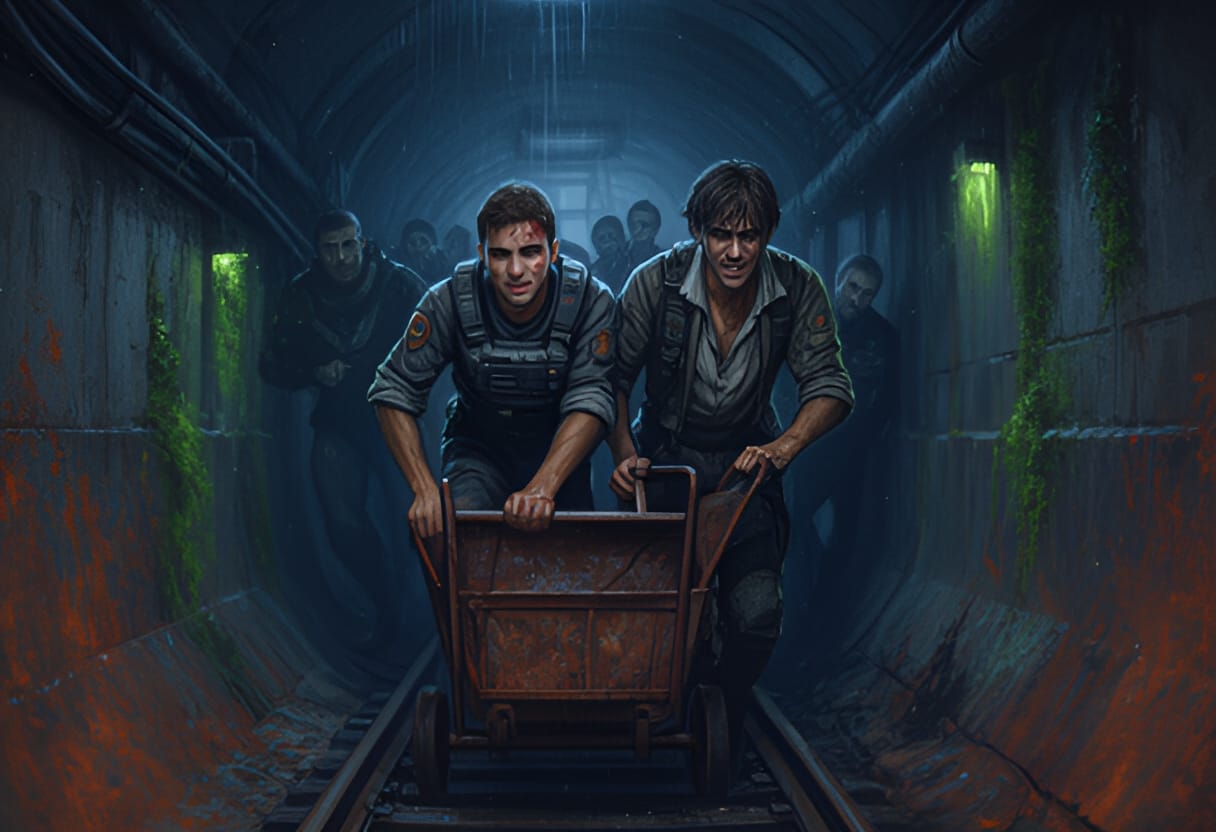
Chapter 8
Brother’s Keeper
The water bottle slipped from Zay’s grip and rolled to a stop against the damp tunnel wall, condensation beading along its curved surface. Alex’s voice, low and rough from exertion, cut through the damp silence: “You know, I owe you a beer for life.” He managed a smirk, though it didn’t reach his eyes. Then, quieter: “Assuming we live to collect.”
Zay didn’t answer. He couldn’t. The words hung between them like smoke—familiar, comforting, but already tinged with the ash of what might come. He wiped his mouth with the back of his hand, feeling the grit of tunnel dust and dried sweat. His side wound throbbed in time with his pulse, a dull ache beneath the layered fabric of his vest and undershirt. He’d checked it earlier—no seepage, no fever—but the pressure of movement kept it raw.
Alex shifted his weight, favoring his left side. The sniper’s round had torn through muscle, not bone, but the damage was real. Blood had soaked through the field dressing Zay had applied in the crawlspace, darkening the fabric at his shoulder. Alex kept his arm tucked close, fingers twitching occasionally against his Lancer’s grip, as if testing whether it would still fire when needed.
They were in the maintenance crawlspace now, the narrow passage opening into the main tunnel ahead. Faint light filtered in from grates set into the ceiling—barely enough to outline the contours of the passage, enough to see the damp streaks on the walls where water had seeped through over years. Somewhere ahead, the tunnel opened into a larger chamber, the beginning of the storm drain line Zay remembered from childhood drills and old city schematics. It ran parallel to the Imulsion River, wide enough to walk abreast, tall enough to stand in most places—though the air hung heavy with damp and the faint, metallic tang of Imulsion in the rock.
Voices echoed from ahead—civilians, mostly. Women, children, a few older men. They’d followed the twins through the subway, through the alley behind Mercy Hospital, through the dark and the fire and the screaming. Now they moved in a ragged line, shoulders hunched, eyes wide and darting. A woman clutched a bundled infant to her chest, her breath coming in short gasps. A boy no older than ten carried a battered tin cup, his bare feet smeared with mud and something darker. Zay caught the glance of a man with a bandaged head—private Santiago’s friend, maybe—and saw not gratitude, but exhaustion. The kind that comes when survival feels less like a victory and more like a delay.
Alex fell into step beside him, his breathing shallow. “You good?” Zay asked, voice low.
Alex gave a half-shrug. “Shoulder’s on fire. But I’ll live. You?”
“Side’s holding.” Zay glanced at him. “You’re bleeding through the dressing.”
Alex looked down at his arm, then back up, forcing a grin. “Nah, that’s just… artistic expression. Abstract. Red means I’m feeling passionate.” He winked. “Like when I burn your coffee.”
Zay snorted despite himself. A short, sharp sound, but real. It surprised them both.
Alex’s eyes softened. “There it is. I was starting to think you’d forgotten how.”
Zay wiped his mouth again, this time with more intention. “Don’t get used to it.”
They moved forward.
The tunnel opened into the storm drain line—wider, taller, the arched ceiling lost in shadow above. The floor was slick in places, worn smooth by decades of water runoff. Occasional grates punctuated the path every fifty meters or so, rusted iron squares set into the stone, some missing entirely, revealing black drops into deeper voids. The air here was cooler, damp, smelling of wet stone and old oil. And beneath it all, the slow, subterranean murmur of the Imulsion River—close, just beyond the western wall, its presence felt more than heard, a low thrum in the bones.
They’d gone maybe two hundred meters when Zay spotted it: half-buried in silt and debris near the wall, a rusted maintenance cart. Its frame was bent in places, one wheel missing, the other seized with corrosion. But the bed was intact—metal slats framed by steel ribs, designed to haul tools or pipe sections. It looked sturdy enough, if they could get it moving.
“Hey,” Zay said, kicking at the wheel. It groaned but didn’t budge. “You think this thing still works?”
Alex pushed off the wall, wincing as his shoulder protested. He crouched, fingers probing the axle housing. “Rust’s bad, but… yeah. If we can free the wheel, maybe lubricate it a bit—”
“With what?” Zay asked.
Alex glanced at his own hands, then at the wall. “Phosphorescent moss. Grows in the damp patches. Slimy. Might work.”
They set to work. Zay pried at the seized wheel with his knife blade, levering against the axle while Alex sprayed a burst from his Lancer’s coolant line—just enough to loosen the grime. It took ten minutes of sweat and cursing, but finally, the wheel gave with a shriek of protest and began to turn, stiff but functional. They propped the cart up, found a length of rebar to serve as a makeshift axle for the missing wheel, and lashed it with strips of torn shirt and paracord from Alex’s gear.
It wasn’t pretty. But it would roll.
“All right,” Zay said, stepping back. “Who needs a ride?”
Three people stepped forward immediately: an elderly woman with a cane whose knuckles were white on the grip, a young girl with a swollen ankle wrapped in a dirty rag, and a man in his thirties with a deep gash along his thigh that had been hastily packed with cloth. The others made space, murmuring thanks, shifting to let them pass.
Zay helped the woman into the cart first. She was light, her frame reduced by age and hunger, but she gripped the edge with trembling hands. “Thank you,” she whispered, her voice raw. “God bless you both.”
Alex lifted the girl next. She couldn’t have been more than eight, her eyes wide and silent, her small hand clutching a stuffed rabbit missing an eye. She didn’t speak, just buried her face in Alex’s chest for a moment before he settled her gently onto the slats.
The man with the leg wound groaned as Zay took his weight. “Easy,” Zay said, bracing him. “We’ll go slow.”
They began to move.
Zay took the front, Alex the rear. The cart creaked and groaned with every bump, the makeshift wheel wobbling slightly, but it held. The civilians walked alongside, some supporting each other, others just putting one foot in front of the other, eyes fixed on the tunnel ahead. Alex stayed close to the cart, one hand on the frame, the other on his Lancer, scanning the darkness behind them. His face was tight, jaw clenched, but every so often, he’d catch Zay’s eye and offer a tight, humorless smile—more a grimace than anything.
Then, after nearly ten minutes of steady progress, the girl in the cart stirred. She lifted her head, blinking at the dim light filtering through a grate above.
“Mama used to make peach cobbler,” she said, her voice small but clear. “When the peaches were ripe. She’d let us sit on the porch steps and eat it warm, with vanilla ice cream that melted right into the crust.”
Zay glanced back. Alex had gone still, his grip on the cart tightening.
The girl went on, unaware. “She’d hum that old song—‘You Are My Sunshine’—while the crust browned. Said the sugar made the peaches sing. I can still smell it… cinnamon and butter and… sunshine.”
A beat of silence. Then Alex let out a breath—a short, shuddering thing—and said, voice rough: “Yeah. She’d burn the crust every time. Said it added character.”
Zay risked a look. Alex’s eyes were glinting, not just from the damp, but with something deeper. A memory, sharp and sudden.
“Burnt it black, more like,” Zay said, keeping his tone light. “You’d scrape it off and eat the good parts underneath, pretending you didn’t notice.”
Alex let out a laugh—short, surprised, then another, stronger. “Yeah! And she’d yell at us for wasting food, like we weren’t the ones who had to choke it down!”
The girl giggled, a bright, clear sound that echoed off the stone. “She always said we had hollow legs.”
“Hollow legs and full hearts,” Alex said, smiling now. “That was her line.”
Zay felt something loosen in his chest—a knot he hadn’t realized was there. For the first time since the first Locust eruption, since the first scream, since the first body he’d seen torn open in the street, he laughed. Not a chuckle. Not a politeness. A real, rough, disbelieving laugh that startled a nearby civvy into glancing over.
Alex’s smile widened, genuine this time. “See? Told you I’d get it out of you.”
They kept walking. The cart rolled on. The girl rested her head against the side, eyes half-closed, still smiling.
But the tunnel wasn’t forgiving.
About fifty meters later, just past a grate that dripped steady water onto the path, the left wheel—the seized one, the one they’d nursed back to life—gave a sudden, violent lurch. The cart jerked to the left, tilting dangerously. The rebar axle shuddered, then snapped clean through with a sound like a bone breaking.
The cart slammed to a halt.
The woman cried out as she slid sideways, catching herself on the edge. The girl tumbled forward, landing on her knees but not crying out—just staring at her hands, stunned. The man with the leg wound gasped as his weight shifted, pain flaring bright in his face.
Zay was already moving, dropping to one knee beside the cart. Alex was there a second later, shoulder screaming, but he ignored it, hands flying to the axle.
“It’s snapped,” he said, voice tight. “Clean through. No way to fix it here.”
Zay ran his hand over the break. The rebar was cold, jagged where it had fractured. They could try to splint it, maybe, but without proper tools, without time—it wouldn’t hold. Not for long. Not with weight.
He looked up. The civilians were watching them, wide-eyed. The woman was trying to sit up, her cane useless now. The girl had pulled herself to her feet, hugging the rabbit tight. The man was gritting his teeth, sweat beading on his forehead despite the chill.
“We can’t take it further,” Zay said quietly.
Alex didn’t look at him. He was staring at the broken axle, his jaw working. Then he swallowed hard. “We’ll have to leave it. And… whoever can’t walk.”
The words hung in the air like poison.
Zay stood, offering his hand to the woman. She took it, her grip surprisingly strong. “We’ll help you,” he said. “You can walk with us. Lean on me.”
She shook her head. “My hip… it’s not right. I’ll slow you down. You need to get the others through.”
Before Zay could argue, Alex stepped forward. He crouched in front of the girl, who looked up at him with those wide, frightened eyes.
“Hey,” Alex said softly. “You remember that story? About the peach cobbler?”
She nodded, lip trembling.
“Good,” he said. “That means you remember her. And that means she’s still with you. Wherever you go. You understand?”
She swallowed hard. Then, barely a whisper: “I think so.”
Alex pressed the stuffed rabbit into her hands. “Hold on to him. He’s brave. Just like you.”
She nodded again, clutching the toy to her chest.
Then Alex turned to the man with the leg wound. “You think you can make it on a crutch? We can tear a pole from the cart, pad it with cloth—”
The man shook his head. “The muscle’s torn. I can’t bear weight. Not even a step.”
Alex’s face tightened. He looked like he wanted to argue, to insist, to find a way. But he saw the truth in the man’s eyes, in the way his leg hung useless, in the pallor of his skin beneath the sweat.
He stood slowly. “All right,” he said. His voice was rough, but steady. “We’ll make you as comfortable as we can.”
They found a niche in the tunnel wall just ahead—deep enough to offer some shelter from the wind that occasionally stirred through the grates, dry-ish, sheltered from the worst of the damp. Zay and Alex helped the woman and the man lower themselves onto the cold stone, using their jackets as makeshift padding. The girl stayed close, sitting cross-legged beside the woman, the rabbit tucked under one arm.
Alex pulled out his last water bottle—half-full—and handed it to the woman. “Drink slow,” he said. “Save some.”
She nodded, her eyes glistening. “Thank you. Both of you. For… for not leaving us in the dark.”
Alex looked away, swallowing hard. “We’re not leaving you in the dark,” he said. “We’re leaving you with light. Inside.”
He touched his chest, then pointed to hers. A silent signal. A promise.
Zay knelt beside the man. “If you hear anything—Locust, whatever—bang on the wall. Three times. We’ll hear it.”
The man managed a nod. “I’ll try.”
Alex stood, brushing dirt from his knees. He looked at Zay, then at the civilians tucked into the niche, then back down the tunnel, where the rest of the group waited in silence, watching.
“We move,” Alex said. His voice was flat. Empty, almost. “Now.”
Zay hesitated only a second. Then he nodded.
They left the cart where it lay, the broken axle gleaming dully in the faint light. They didn’t look back as they turned and walked away.
But Alex did.
He paused at the mouth of the niche, one hand on the tunnel wall, his forehead resting against it for just a second. His shoulders shook—once, violently—then he pushed off, wiped his face with the back of his hand, and fell into step beside Zay.
No words. No jokes. Just the sound of their boots on wet stone, the drip of water from the ceiling, the faint, distant hum of the Imulsion River.
And behind them, in the dark, four souls waited—hoping, praying, wondering if the light Alex had spoken of was real… or just another story told to keep the fear at bay.
The tunnel narrowed ahead, the walls closing in like the jaws of some unseen beast. Water seeped steadily from cracks in the stone, forming thin rivulets that snaked over their boots and pooled in the dips of the floor. The air grew colder, damper, carrying the faint metallic tang of Imulsion—sharp, oily, like the breath of something ancient and sick. Zay moved just ahead of Alex, his Lancer held low, senses straining for any sign of movement: a shift in the dark, the scrape of claw on stone, the faint, wet chittering of Kryll wings too high to see.
They hadn’t gone twenty paces when Alex’s breath hitched—a sharp, silent intake that Zay felt more than heard. He didn’t turn. Didn’t break stride. But he knew.
Alex’s hand had gone to his shoulder again, fingers pressing hard into the fabric of his jacket, knuckles white. The wound from the sniper’s round—already angry and swollen—was bleeding anew, seeping through the makeshift bandage they’d slapped together in the crawlspace. Dark blooms spread across the gray fabric, slow but steady, like ink in water.
Zay kept walking. Kept scanning. But his mind was split now—half on the tunnel ahead, half on the brother beside him, whose steps were growing uneven, whose jaw was clenched so tight Zay could see the muscle jumping in his cheek.
They passed another grate. This one dripped in a steady rhythm—plink… plink… plink—like a clock counting down.
Alex stumbled.
Not much. Just a misstep, a slight drag of the left foot as his weight shifted wrong. He caught himself on the wall, fingers scrabbling for purchase, and sucked in a breath through his teeth. His head bowed for a moment, eyes shut.
Zay stopped. Didn’t speak. Just waited.
After three long seconds, Alex lifted his head. His eyes were glassy, but focused. He gave a short, sharp nod—I’m good—and pushed off.
They kept moving.
But Zay fell back half a step, taking the rear. Not just to watch for pursuit—though he did that, eyes flicking left and right, ears tuned for the faintest echo—but to stay close enough to catch Alex if he went down.
The tunnel opened slightly ahead, the walls flaring into a small chamber where an old maintenance junction had once been. Rusted pipes clung to the ceiling like fossilized ribs, and a broken gauge dangled from a frayed wire, spinning lazily in the draft. In the center stood a rusted valve wheel, as tall as a man’s waist, its spokes caked with grime.
Alex leaned against it, breathing hard. His face was ashen, sweat beading on his upper lip despite the chill. He didn’t look at Zay. Just stared at the valve, at the dark tunnel beyond.
“You need to stop,” Zay said quietly. “Let me check it.”
Alex finally glanced over. His mouth opened—probably to joke, to deflect, to say I’ve had worse—but nothing came out. Instead, he licked his lips and gave a single, almost imperceptible shake of his head.
“I’m fine,” he whispered. “Just… need a sec.”
Zay didn’t buy it. But he didn’t push. Not yet. Instead, he stepped forward and placed a hand on the valve wheel. It was cold, slick with condensation. He gave it an experimental turn—nothing. Seized shut, maybe, or rusted solid.
“Nothing,” he said. “Just a relic.”
Alex managed a tired smirk. “Guess even the old world’s falling apart.”
They stood in silence for a moment, the only sound their breathing and the distant drip of water. Then Alex pushed off the wall. Too fast. His vision swam—just for a second, a gray haze at the edges—and he had to grab the valve again to keep from pitching forward.
Zay was there in an instant, bracing his elbow.
“Easy,” he murmured. “Easy.”
Alex leaned into him, breathing hard. His forehead was slick with sweat. When he finally looked up, his eyes were unfocused, distant.
“I had a dream,” he said, voice low, rough. “Back in the house. Before… before all this. Mom was in the kitchen. Humming. The window was open—summer night, air thick with the smell of cut grass and something sweet. Peaches, I think. She turned and smiled at us—just like she used to when we came in from playing. Didn’t say a word. Just… smiled.”
His voice trailed off. He swallowed hard. “Then the lights went out. Not the bulb—everything. Like the world just… blinked. And when I could see again, she was gone. The kitchen was empty. The pie was still on the counter—half-eaten—but no one was there to finish it.”
Zay didn’t speak. Just held him a little tighter, one hand on his back, the other still gripping the valve for support.
Alex let out a shaky breath. “I keep waiting for her to walk back in. Like if I just stand here long enough, she’ll appear in the doorway, flour on her nose, scolding us for tracking dirt. But she never does. It’s just… quiet. And cold.”
He looked at Zay then, really looked—eyes glistening, voice barely above a whisper.
“I’m scared, Zay.”
It was the first time he’d ever said it outright. Not masked in humor. Not buried under a joke or a boast. Just raw. Exposed.
Zay’s throat tightened. He wanted to say It’ll be okay. Wanted to promise safety, home, a future. But he knew better. Knew the world had ended hours ago, and no promise could bring back what was lost.
So he said the only thing that was true.
“I’m here,” he said. “I’m not letting go.”
Alex held his gaze for a long moment. Then, slowly, he nodded. Not convinced. Not reassured. But heard.
He pushed off gently, straightening. His face was still pale, his movements stiff, but the panic had receded—replaced by that old, familiar resolve. The kind that had gotten them through scraped knees, broken bones, and a hundred dumb dares when they were kids.
“All right,” he said, voice steadier now. “Let’s keep moving.”
They left the junction behind, the valve wheel standing silent in the dark like a sentinel of a forgotten war.
The tunnel began to slope downward, gently at first, then more noticeably. The air grew heavier, thicker with the scent of Imulsion—sweet and sour at once, like rotting fruit left in the sun. The walls glistened in places, not with water, but with a thin, iridescent sheen that caught the dim light and threw back faint rainbows—like oil on a puddle.
Zay frowned. They were getting closer to the river. Too close, maybe. The Imulsion wasn’t just in the water here—it was in the air, seeping through the stone, poisoning the very rock.
Alex stumbled again, harder this time. His foot caught on a raised seam in the floor, and he went down on one knee, gasping. His hand flew to his shoulder, fingers digging in.
Zay dropped beside him, one hand on his back, the other scanning the darkness—left, right, up, down. Nothing. Just the slow drip of water, the distant groan of settling stone, the ever-present hum of the river ahead.
“Talk to me,” Zay said, voice low but urgent. “Now.”
Alex gasped through clenched teeth. “It’s… it’s not just the shoulder. It’s… it’s inside. Like something’s eating me from the ribs out. Fire and ice at the same time.”
Zay’s blood turned to ice. He remembered the reports—fragmented, panicked—from medics during the Pendulum Wars: wounds that didn’t just bleed, but burned. Injuries that festered not with pus, but with something… other. Something the Locust carried in their claws, their teeth, their very presence.
Kryll venom? No—this was deeper. Slower. More insidious.
Imulsion sickness? Possibly. But they weren’t in the river. Just near it.
Unless it was already in the air. Unless it had been for hours.
He ripped open Alex’s jacket, peeled back the blood-soaked undershirt. The wound was angry—red around the edges, purple at the center—but it wasn’t the hole that frightened him. It was the skin around it. The flesh looked… wrong. Not swollen, not exactly. But translucent in places, like thin wax over bone. And threaded through it, faint but unmistakable, were lines of light—subtle, pulsing, like veins of bioluminescent moss.
“Alex,” Zay breathed. “Look at this.”
Alex peered down, brow furrowed. Then he saw it. His breath stopped.
“No,” he whispered. “Not now. Not here.”
“It’s the Imulsion,” Zay said, voice tight. “It’s in the air. It’s getting in through the wound. Or… or maybe it’s been in you since the flare. Since you’ve been breathing it.”
Alex let out a humorless chuckle—short, broken. “Figures. I spend my whole life avoiding the stuff, and now it’s trying to crawl inside me through a hole in my shoulder.”
Zay didn’t laugh. He couldn’t. Instead, he tore a strip from his own undershirt—clean, dry—and began to rebandage the wound, wrapping it tight, layering the cloth to seal it as best he could. Not to stop the bleeding—though that helped—but to create a barrier. To slow whatever was seeping in.
“Keep it clean,” he muttered. “Keep it covered. We’ll get you out. We’ll get you to a medic. If there’s one left.”
Alex looked at him, eyes searching. Then he gave a small, sad smile. “You really believe that, don’t you?”
“I have to,” Zay said. “Or what’s the point?”
Alex didn’t answer. Just closed his eyes for a second, leaned his forehead against Zay’s shoulder, and let out a long, slow breath.
When he pulled back, he was quieter. Calmer. But the light in his eyes had changed—dimmer, quieter, like a candle guttering in the wind.
They got moving again.
Zay took point, but kept Alex close—half a step behind, ready to catch him if he fell. The tunnel continued its descent, the walls now weeping in places, not just water but a thin, iridescent film that shimmered faintly in the dark. Every so often, Alex would flinch—not from pain, but from something else. A flicker in his peripheral vision. A whisper at the edge of hearing.
“You seeing it too?” Zay asked quietly.
Alex opened his eyes. Nodded. “Shadows. Moving when they shouldn’t. And… voices. Not words. Just… feelings. Like sadness. Or hunger.”
Zay’s grip tightened on his Lancer. He’d heard rumors—whispers from old timers in the fringes—about the Hollows, about places where the Imulsion didn’t just poison the body, but spoke to the mind. Where it showed you what you feared, what you lost, what you wished you’d done differently.
They weren’t in the Hollows yet. Not officially. But maybe the edges were bleeding through. Maybe the Imulsion, saturated in the air, in the stone, in the very breath they drew, was beginning to reach into their heads.
They pressed on.
The tunnel opened into a larger cavern—a natural junction where the old maintenance tunnel met a fissure in the earth, wide enough to stand in, high enough that the ceiling vanished into shadow. The sound of the river was louder here—a deep, constant murmur, like the breath of a sleeping giant. And in the far wall, where the stone gave way to raw earth, water trickled down in a dozen thin streams, each catching the faint light and turning to silver.
But it wasn’t water alone.
Where the trickles met the stone, the rock itself seemed to glow—not brightly, but with a soft, internal pulse, like the slow beat of a heart buried deep. The light was blue-green, eerie, unnatural. And where it touched the damp walls, patches of moss—thick, velvety, glowing faintly—had begun to grow, spreading like frost.
Alex stopped dead.
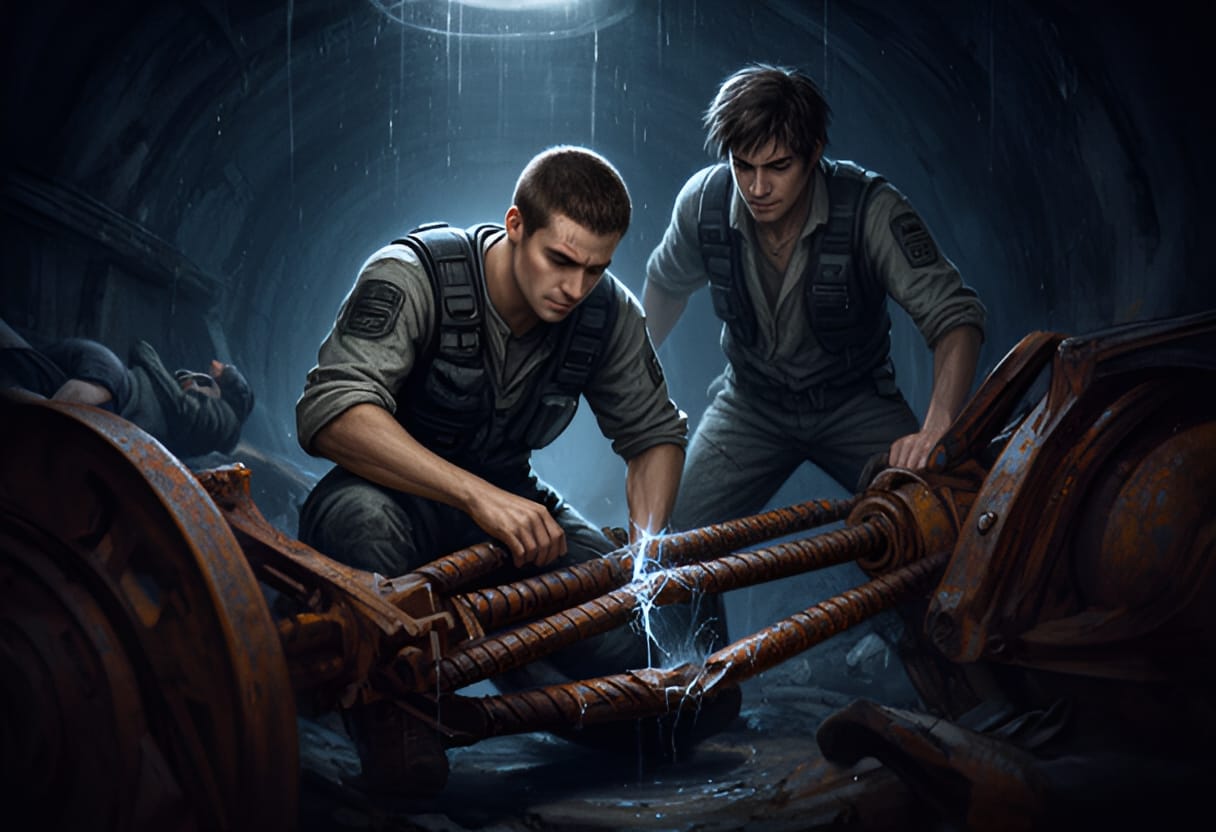
“No,” he breathed. “No, no, no…”
Zay followed his gaze.
On the far wall, where the glow was strongest, the moss had formed a shape. Not random. Not natural.
A house.
Two stories. A porch with a swing. A chimney curling smoke into the air. A window with curtains drawn just enough to let the light show a figure inside—a woman, her back turned, standing at a sink.
Their house.
As they remembered it.
From before the war. From before the fissures took the east edge of town. From before the Locust ever dreamed of rising.
Alex stumbled forward, hand outstretched, as if he could touch it, step through the glow and into that other world.
“Alex—” Zay began, but his brother didn’t hear him.
He was already walking, slow, reverent, like a man approaching a shrine. His hand trembled as he reached out—not to the wall, but to the image—his fingertips hovering just above the glowing moss, as if testing whether it was real.
And then he saw her.
Not just the outline. The detail. The way her hair was tied back with that faded blue ribbon she always wore—the one that came undone by noon no matter how tight she tied it. The way her left sleeve was rolled up, revealing the old burn scar from when she’d caught her arm on the stove trying to flip pancakes. The way she hummed—you could almost hear it—that off-key version of “You Are My Sunshine,” the one she always sang when she thought no one was listening.
Tears streamed down Alex’s face, silent and hot. He didn’t wipe them away. Didn’t make a sound. Just stood there, trembling, staring at the vision of his mother—not a memory, not a dream, but a presence—as if she’d simply stepped out of the kitchen for a moment and would turn any second, smile, and say, “Boys, wash up. Supper’s almost ready.”
Zay didn’t know what to do. He couldn’t pull him away—not without breaking him. Couldn’t speak—words would shatter the spell, and maybe that was what Alex needed right now. Not safety. Not survival. Just… this. One more moment with the woman who had loved them first, best, and forever.
So he stood guard.
He turned his back to the vision, Lancer raised, eyes scanning the dark tunnels branching off from the chamber—left, right, up, down—listening for any sign of movement, any hint of Locust, any whisper of wings in the stone.
And he waited.
He didn’t know how long it lasted. Minutes? Hours? Time had lost meaning down here, stretched thin by fear and fatigue and the slow, insidious pull of the Imulsion.
But eventually, Alex’s trembling eased. His breath slowed. The desperate, grasping look in his eyes softened—replaced by something quieter. Grief, yes. But also peace. Like he’d finally been allowed to say goodbye.
He lowered his hand. Slowly. Reverently.
Then he turned.
His eyes met Zay’s. Red-rimmed. Exhausted. But clear.
“I saw her,” he whispered. Not a question. A statement. A gift.
Zay nodded. “I know.”
Alex swallowed. “She… she knew. She knew we’d find our way back to each other. Even if it was the end.”
His voice broke—but not with sorrow. With certainty.
Zay stepped forward, placed a hand on his brother’s shoulder. “She was right.”
Alex gave a small, broken nod. Then, suddenly, he shuddered—not from grief, but from pain. His face went tight, eyes squeezing shut as a wave of nausea hit him. He grabbed the wall for support, knuckles whitening.
Zay was there in an instant, arm around his waist, holding him up.
“Easy,” he murmured. “Easy.”
Alex gasped, breathing through his nose. When he opened his eyes again, they were unfocused—distant, like he was seeing something far away. Or something that wasn’t there at all.
“It’s… cold,” he whispered. “But… warm too. Like lying in the sun after swimming. But… inside. In my bones.”
Zay’s stomach dropped. He knew that sensation. Not from wounds. Not from fatigue.
From Imulsion poisoning. The kind that didn’t just kill—it changed. That made the body glow in the dark, that made the blood run slow and thick, that made men see visions and hear voices and forget their own names before they forgot how to breathe.
He looked down at Alex’s hands—still gripping the wall—and saw it. Faint, but undeniable. Beneath the skin, along the veins, a soft blue-green light was beginning to show. Not bright. Not yet. But there.
Like the moss on the walls.
Like the river itself.
Alex was changing.
And there was nothing Zay could do to stop it.
He helped his brother upright, kept his arm around him, and began to move—slow, deliberate, back toward the tunnel, away from the vision, away from the glow.
Alex leaned on him, silent now, his breathing shallow, his steps mechanical. The light in his skin pulsed faintly with each heartbeat—once, twice, once—like a signal from somewhere deep.
Zay didn’t look back at the chamber. Didn’t look at the house, the woman, the smoke curling from the chimney.
He couldn’t.
Because if he did, he might see her too.
And if he saw her, he might stop.
And if he stopped, they’d both be lost—not to the Locust, not to the Kryll, not even to the Imulsion, not yet.
But to the past.
And in the dark, beneath the earth, with the river groaning ahead and the sky gone black above, the past was a luxury they could no longer afford.
They moved on.
One step.
Then another.
The tunnel swallowed them whole.
And behind them, in the chamber where the stone remembered what the flesh had forgotten, the glowing house faded—slowly, like a breath exhaled in the cold—and the moss dimmed, returning to mere stone and shadow, waiting for the next soul to come seeking what was lost.
The stone pressed cold and damp against Zay’s palm as he guided Alex forward, one slow step at a time. The tunnel walls closed in, rough and uneven, slick with seepage that made each footing uncertain. Behind them, the civilians shuffled in a ragged line—the woman with the infant tucked against her chest, the boy clutching his tin cup like a talisman, the man with the bandaged head moving stiffly, favoring his left side. Their breaths came shallow and hurried, eyes darting into the dark where no light reached.
They had left the chamber behind, the vision of their mother fading like smoke in a draft, but the unease lingered. Not just from what they’d seen, but from what they hadn’t. The silence now felt different—thicker, weighted. Not empty, but watched. As if the stone itself had drawn a breath and was holding it.
Then, from ahead—a soft, wet click. Like something small tapping stone.
Zay froze. Alex stiffened against his side.
Another click. Then a faint, wet scrape, rhythmic, deliberate.
“Did you hear that?” Alex whispered, voice raw from disuse and strain.
Zay didn’t answer. He eased his Lancer forward, the chainsaw whining low as he spun it up—just enough to feel the vibration in his grip, ready to roar at a moment’s notice. His eyes strained into the black ahead, but the tunnel swallowed sight whole. No glow from moss. No flicker from distant fire. Just absolute dark, pressing in like a lid.
Then came the scent—sharp and metallic, tinged with something sweet and rotting, like overripe fruit left in the sun. It curled through the air, unfamiliar but instinctively wrong.
Tracking spores. The thought struck him like a blade. The Locust weren’t just chasing—they were marking. Bio-luminescent particles, clinging to skin and fabric, glowing faintly in the dark—enough for their hunters to follow even without sight.
They had to move. And they had to move unseen.
Zay turned his head slightly, brushing his temple against Alex’s. “We’re being tracked,” he murmured. “Locust spores. They glow. If we don’t kill the light, they’ll have us by the throat before we hit the next bend.”
Alex’s breath hitched. He didn’t ask how Zay knew—he’d seen the signs before, in the field, in the briefings. The Horde adapted fast. And down here, in the dark, they were learning.
“We go black,” Zay continued. “No flame. No reflection. No exposed skin if we can help it. You take point. Use your knife—scrape the moss off the walls. It’s got phosphorus. If we dab it on the ground in spots, just enough to see our feet… it won’t glow bright enough to carry far. But it’ll keep us from walking into a wall or each other.”
Alex gave a single, tight nod. He didn’t joke. Didn’t quip about Zay’s sense of direction or the moss tasting like regret. He just shifted his grip on his Lancer, swung the barrel down to free his right hand, and drew his combat knife from its sheath—a move practiced a thousand times, now urgent, silent.
He stepped ahead, placing his palms flat against the tunnel wall. The stone was cool, rough under his fingertips. He drew the blade down slowly, scraping off a thin layer of the luminous moss that clung in patches where moisture seeped through cracks. It came away in a soft, greenish powder, faintly glowing in his palm like crushed fireflies.
He dabbed it onto the toe of his boot, then pressed it lightly to the stone ahead—a small, dim smudge, barely visible unless you were looking for it. Then another. And another. A dotted trail, faint as breath on glass, leading forward.
Zay followed, matching his pace, Lancer at the ready. The civilians came behind, moving in silence now, their fear palpable. The woman with the infant pressed her face into the child’s hair, murmuring a soft, wordless hum. The boy stared at the glowing dots underfoot, wide-eyed, as if seeing stars in the dirt. The bandaged man muttered something under his breath—maybe a prayer, maybe a curse—his knuckles white on the wall.
Alex didn’t look back. He kept his head down, shoulders hunched, scraping and marking, step after step. The rhythm of it was almost meditative—the shhk-shhk of blade on stone, the soft plop of moss dust falling, the faint crunch of their boots on silt and grit. But beneath the motion, Zay saw it: the way Alex’s jaw was clenched, the tremor in his knife hand that wasn’t from exertion, the too-quick rise and fall of his chest.
The humor was gone. The jokes about burnt coffee and artistic blood patterns—gone. Replaced by this quiet focus, this grim determination. He wasn’t just leading; he was bearing it. Carrying the weight of the group, the weight of the wound, the weight of whatever was happening beneath his skin.
Zay’s eyes flicked to Alex’s hands again—the ones gripping the knife, the ones that had just traced the vision of their mother. The blue-green light beneath the skin was stronger now. Not bright, but steady. Like a slow pulse beneath the surface, tracing the veins in his knuckles, the backs of his fingers. It showed most when he flexed his grip— a faint, eerie luminescence, like light through jade.
Imulsion. It wasn’t just in his veins. It was waking.
They moved on. The tunnel twisted—left, then a gradual right, then a sudden drop where the floor sloped into a shallow chute. Alex hesitated at the edge, tested it with his boot, then slid down on his backside, using his heels to brake. Zay followed, then helped the woman with the infant down, one hand on her elbow, the other on the child’s squirming form.
At the bottom, the tunnel opened slightly—just enough to stand without hunching. Alex pressed back into the wall, chest heaving, and wiped his knife on his thigh. The moss dust on the blade had faded to a dull gray. He reached into his pocket, pulled out a small, folded square of fabric—worn at the corners, softened by time—and unfolded it slowly.
It was a photograph. Faded at the edges, the corners curled from sweat and pocket wear. Zay recognized it instantly: their father, in his old COG dress uniform, standing beside a rusted truck outside their childhood home in Tyrus. He was smiling— not the stiff, posed grin of a portrait, but a real one, crinkles at the eyes, missing a tooth from an old bar fight. One hand rested on the truck’s fender; the other held a battered lunchbox. Behind him, the laundry hung on the line, and the screen door stood open, hinting at the kitchen within.
Alex held it out, not looking at Zay. His voice was low, rough, barely audible over the drip of water from somewhere ahead.
“If I don’t make it… tell him I tried.”
Zay’s throat closed. He didn’t speak. Couldn’t. He took the photo with two fingers, careful not to smudge it, and slipped it into his own chest pocket, over his heart. The paper was thin, warm from Alex’s touch.
Alex finally looked at him then. Eyes dark, shadowed, but clear. Not pleading. Not begging. Just… stating. As if he’d already made peace with the answer, whatever it was.
Zay gave the smallest nod. One sharp dip of the chin. I heard you. I’ll carry it.
Alex didn’t smile. Didn’t joke. Just turned back to the wall, raised his knife, and began scraping again.
The moss came away slower now. His movements were less precise, more labored. Each scrape seemed to cost him. He’d stop occasionally, forehead resting against the stone, breathing hard through his nose. Once, he doubled over, coughing—a dry, racking sound that made Zay’s gut twist. When he straightened, there was a fleck of blood at the corner of his mouth. He wiped it away with the back of his hand, didn’t break rhythm.
The civilians followed in near-total darkness now, guided only by the faintest glimmer underfoot—Alex’s trail, renewed every few steps. The woman with the infant had stopped humming. The boy kept close to her leg, silent. The bandaged man walked with his head down, one hand braced against the wall, the other curled into a fist at his side.
Zay brought up the rear, Lancer cocked, senses straining. He listened for the click-scrape behind them, for any sign the spores had taken hold and the Hunters were closing. But the tunnel remained quiet—too quiet. No drip, no scuttle, no distant groan of shifting stone. Just their breath, the whisper of fabric, the soft shhk of knife on rock.
And then, ahead, Alex stopped.
Not a stumble. Not a stumble-recover. A full, sudden halt. He stood rigid, one hand braced on the wall, the other hanging limp at his side, knife pointing down. His head was tilted slightly, as if listening to something far off.
Zay moved up beside him, Lancer low, eyes scanning the dark ahead. “You see something?”
Alex didn’t answer right away. His breath came shallow. Then, so quiet Zay almost missed it: “It’s… quiet. Too quiet. Like the tunnel’s holding its breath.”
Zay frowned. “Or like something’s waiting.”
Alex let out a breath that sounded like a laugh—dry, broken, devoid of humor. “Yeah. Feels like that.”
He turned his head slightly, not enough to meet Zay’s eyes, but enough to speak into the space between them. “You ever think… maybe we’re not supposed to make it out? Maybe this is where it ends. Not with a bang. Not with a last stand. Just… down here. In the dark. With the moss and the memories.”
Zay didn’t respond with platitudes. Didn’t say we’ll make it or you’re strong. He knew better. Instead, he said: “Then we make sure the ones behind us do. That’s the promise, isn’t it? Not just to each other. To the ones who can’t fight.”
Alex was silent for a long moment. Then, so softly it was almost lost in the drip of water: “You always did carry the heavier load.”
Zay felt something tight in his chest—not sorrow, not fear, but the weight of being seen. Known. Not as the soldier, not as the twin, but as the brother who stayed.
Alex lifted his hand then—not to Zay’s arm, not to the wall—but to his own chest, over his heart. He pressed his palm flat against the fabric of his shirt, right over where the glow pulsed strongest beneath the skin. His fingers trembled.
“I can feel it,” he whispered. “Not just the light. The… pull. Like something’s trying to wake up inside me. Not me. Something… else.”
Zay’s blood turned to ice. He didn’t ask what it meant. He knew. The Imulsion wasn’t just poisoning—it was changing. And if the stories were true—if the whispers in the old reports held any truth—then what was happening to Alex wasn’t just sickness. It was conversion. Slow. Silent. Irreversible.
Alex lowered his hand. He reached into his pocket again—not for the photo this time, but for something smaller. A folded slip of paper, corners worn soft. He unfolded it with care, revealing a tiny sketch in pencil: a stick-figure family—two adults, two boys holding hands, a sun with a smiley face in the corner. Drawn by one of them, long ago, on the back of a ration ticket.
He pressed it into Zay’s other hand. “For luck,” he said. “Or… in case I forget what it looks like.”
Zay closed his fingers around both items—the photo, the sketch—holding them tight. He didn’t speak. Couldn’t. The weight of them, the weight of him, pressed hard against his sternum.
Alex stepped back into the lead. He raised his knife, took a breath, and began to scrape again.
But his movements were slower now. Sloppier. The moss came away in clumps, uneven. He missed a spot, then overcorrected, scraping too deep and gouging the stone. A small shower of dust fell—brighter this time, more vivid—before fading to dull gray.
Zay caught his wrist—not to stop him, but to steady it. “Easy,” he murmured. “Let it come. Don’t force it.”
Alex leaned into the touch for a fraction of a second—just enough to let Zay feel the tremor in his frame, the heat radiating off his skin like a banked fire. Then he pulled away, straightened, and kept going.
They moved on. The tunnel stretched ahead, dark and endless. The spores were still out there—waiting, watching, hunting. The Imulsion burned in Alex’s blood, quiet but relentless. And somewhere behind them, in the stone and dark, the past still whispered.
But forward—there was only the next step. The next scrape of moss. The next faint, fading glow underfoot.
And the brother who refused to let go.
Alex’s knife slipped from his fingers.
It clattered against the stone floor—a sharp, hollow sound that echoed too loud in the silence. He didn’t reach for it. Just stood there, head bowed, shoulders rising and falling with labored breaths. The glow beneath his skin had flared—not bright, but insistent, like embers stirred by a draft. It traced the veins in his hands, crawled up his forearms, pulsed in the hollow of his throat.
Zay didn’t speak. Didn’t move to pick up the knife. He just waited, Lancer low, eyes scanning the dark ahead and behind. The civilians had halted too, a few steps back, huddled in the gloom. The woman pressed the infant tighter to her chest, her eyes wide and glistening. The boy stared at Alex’s back, small fists clenched at his sides. The bandaged man had sunk to one knee, braced against the wall, lips moving in silent prayer.
Alex’s voice came then—low, rough, scraped from somewhere deep.
“I can’t… feel my fingers.”
Zay’s gut twisted. He stepped forward, slow, deliberate, and reached out—not to touch the light, not yet, but to hover his hand near Alex’s wrist. Close enough to sense the heat, the wrongness, without making contact.
“Try,” he said. “Wiggle them. Just a little.”
Alex obeyed. Slowly. Tremulously. The fingers of his right hand twitched—once, twice—then went still. The left didn’t move at all.
“It’s… numb,” Alex whispered. “But not like cold. Like… asleep. But awake at the same time. Like it’s full of… static.”
Zay’s eyes flicked to the hand. The blue-green light was brighter now along the knuckles, the backs of the fingers—steady, rhythmic, pulsing in time with what felt like a second heartbeat. Not his. Not just Alex’s. Something beneath it. Something using it.
He remembered the reports—fragmentary, buried in old COG intel caches, whispered about in hushed tones after frontier skirmishes. Imulsion saturation. Not just toxicity. Infusion. The body doesn’t just break down—it adapts. Cells begin to metabolize the compound. Skin takes on a luminescence. Reflexes sharpen. Senses distort. And in the final stages—rare, but documented—subjects exhibit heightened strength, resistance to pain… and a growing detachment from self. A sense of otherness. As if the body is no longer wholly its own.
He swallowed. “You’re still in there,” he said, voice low and firm. “I can hear your breath. I can see your eyes. You’re still you.”
Alex let out a breath that sounded like a sob—short, sharp, cut off before it could break. “I don’t know how much longer that’ll be true.”
Zay didn’t offer false hope. Didn’t say we’ll get you help or the medics can fix this. There were no medics. No help. Just this tunnel, this dark, and the slow, silent transformation eating at his brother from the inside.
Instead, he said: “Then we make every step count. For as long as you’re still you, we move. We protect. We get these people out. That’s not just a duty. That’s the promise. To Mom. To Dad. To each other.”
Alex was silent for a long time. Then, so quiet Zay had to lean in to hear: “You always did believe in promises more than I did.”
“I believe in us,” Zay corrected. “And you’re part of that. All of it. Even the parts that scare you.”
Alex’s head lifted slightly. Not quite looking at him, but turned in his direction. A ghost of a smile touched his lips—then faded as another wave passed through him. He gasped, back arching just slightly, fingers curling inward—not in spasm, but in reach, as if trying to grasp something just beyond his perception.
When it passed, he stood straighter, but his stance was wider, knees slightly bent, weight balanced like a fighter’s. His head tilted, as if listening to a frequency only he could hear.
Zay’s muscles tensed. “You hearing them again?”
Alex didn’t answer right away. When he did, his voice was quieter, strained. “Not voices. Not exactly. More like… pressure. In my skull. Behind the eyes. Like the stone is… breathing. And it’s not alone.”
Zay’s blood ran cold. “The tunnel?”
Alex shook his head—just a fraction. “No. Deeper. Below. The Hollows. They’re… awake. And they’re hungry.”
Zay’s mind flashed to the old stories—tales from the Pendulum Wars, muttered by veterans who’d spent too long in the frontier tunnels. The Hollows remember. The Hollows hunger. Most dismissed it as superstition, combat fatigue, Imulsion delirium. But now, seeing the light in his brother’s skin, hearing the raw certainty in his voice—he couldn’t dismiss it. Not anymore.
“Then we don’t go down,” Zay said. “We stay on this line. We follow the drain. It runs parallel to the river—it’s our best shot at the east bank.”
Alex nodded, but his eyes were unfocused, tracking something invisible. “It’s not just the Hollows. It’s the spores. They’re not just tracking us. They’re… learning. Adapting. Like they know how we move. How we think.”
Zay’s eyes narrowed. The Locust weren’t just using bio-luminescent spores—they were engineering them. Adapting them in real time. That meant intelligence. Coordination. A hive mind—or something close to it—that could analyze patterns, predict behavior, adjust tactics.
It meant they were being hunted by something that wasn’t just alive—but learning.
Alex pushed off the wall, retrieved his knife with his left hand—his right still limp, useless—and wiped it on his thigh. The blade came away clean. He tested his grip. Weak, but functional.
“I can still cut,” he said. “Not fight. Not like before. But I can mark. I can lead.”
Zay met his eyes. Saw the fear there—but beneath it, the same fierce, stubborn will that had carried them through every scrap, every loss, every impossible moment since they were boys kicking a dented can down the back alley of their street.
“Then lead,” Zay said. “I’ll watch your six. And if you start to fade—if you start to go—I’ll pull you back. However I have to.”
Alex gave a single, sharp nod. Then he turned to the wall, raised his knife, and began to scrape again.
But this time, it was different.
His movements were slower, but stronger. More deliberate. Less like a man marking a path, and more like one laying claim. Each stroke of the blade was firm, deliberate—gouging shallow grooves into the stone, then rubbing the phosphorescent moss into the cuts. The result wasn’t just a trail—it was a sigil. A series of repeating marks: a dot, a dash, a dot. Then a pause. Then again.
Zay frowned. “What is that?”
Alex didn’t look up. His voice was flat, focused. “Old code. Dad taught us. When we were kids, playing in the storm drains after rain. Three taps on the pipe meant follow me. Two meant danger. One long, one short meant home.”
He finished the sequence, stepped back, and studied it. The moss glowed faintly in the grooves—just enough to see if you knew to look. Infiltrators might miss it. Civilians would follow it instinctively. And if the Locust were tracking by heat, by motion, by spore-scent… this might just bypass them.
“Clever,” Zay said. “Real clever.”
Alex didn’t respond. He just kept going—marking, moving, step by step. The glow beneath his skin had spread—now visible not just in his hands, but along the radial artery in his wrist, tracing up his forearm in a faint, web-like tracery. It pulsed slower now, deeper—like a heartbeat slowed by cold, or depth, or something older.
The group followed. The woman with the infant had begun to hum again—soft, wordless, a tune that sounded like a lullaby half-remembered. The boy walked close behind her, eyes fixed on the glowing marks underfoot. The bandaged man had risen, leaning on the wall for support, but moving under his own power now.
Zay brought up the rear, senses stretched thin. He listened for the skitter of claws on stone, the flutter of wings in the dark, the faintest hiss of pressurized vapor from a Seeder pod. But the tunnel remained unnervingly still. No echo. No scuttle. No distant groan of shifting rock.
Just their breath. The soft shhk of knife on stone. The dull thud of boots on silt. And beneath it all—the quiet, insistent thrum coming from Alex’s chest. Not his heartbeat. Something under it. Something answering.
They rounded a slow bend in the tunnel—left, then a gradual right—and the air changed. Cooler. Damp. And carrying a faint, metallic tang—like blood, or ozone, or something burning.
Alex stopped. Not from weakness. From sense. He lifted his free hand—knives still in the other—and pressed it to the wall. Closed his eyes.
Zay moved beside him, Lancer ready. “What is it?”
Alex’s eyes opened. They were unusually bright—not just from the Imulsion glow, but with a kind of terrible clarity. “It’s not just the tunnel,” he whispered. “It’s the wall. It’s… veined. Like it’s got blood in it. Or something like it.”
Zay leaned in, squinting. In the dim glow of Alex’s own light, he could see it now—the stone wasn’t uniform. It was threaded with faint, glowing filaments—blue-green, pulsing slow and deep, like roots or nerves or veins. They ran vertically, horizontally, branched and reconnected—like a circulatory system carved into the bedrock.
“It’s not natural,” Zay breathed.
Alex shook his head. “No. It’s grown. Like the Imulsion didn’t just seep into the rock—it infused it. And now it’s… alive. Not thinking. Not like us. But aware. Reactive.”
A sudden, sharp hiss came from ahead—not loud, but close. Like steam escaping a valve.
Alex jerked back, knife up. “Contact?”
Zay swept his Lancer left and right—nothing. Just the tunnel, the veined walls, the glowing trail underfoot.
Then, from behind—a soft, wet click. Like something peeling away from stone.
Zay spun—
And saw it.
On the wall, ten meters back, where the bandaged man had been leaning—a patch of stone had opened. Not a crack. Not a fissure. A pore. Like the wall had breathed out, and something had slipped through.
It was small—no bigger than a child’s fist. Pale, translucent, shaped like a flattened leech, but with tiny, cilia-like fringes along its edges. It pulsed with an inner light—blue-green, same as the veins in the wall, same as the light in Alex’s skin. It hovered for a heartbeat, quivering in the air, then shot forward—not through the air, but along the wall, like a drop of oil on water, moving with eerie speed and precision.
It struck the bandaged man just below the shoulder blade.
He didn’t cry out. Didn’t flinch. Just stiffened. His eyes went wide—not with fear, but with sudden, shocking clarity. Then they rolled back in his head. His body went rigid—then slack. He crumpled to the stone, not falling, but collapsing, like a puppet whose strings had been cut.
Silence.
Then—a soft, wet rip.
The man’s shirt tore open—not from violence, but from within. Something was pushing out. Pale, glistening, serpentine. It slid free—a tendril, thick as a thumb, dripping with clear fluid. It writhed in the air for a second, then lashed—not at anyone, but down, into the stone floor. Where it struck, the rock glowed—bright blue-green, flaring like a match struck in dark—and then opened.
A hole. No bigger than a wrist. But leading down. Into darkness. Into warmth. Into a slow, pulsing glow that beat like a heart.
And from within it—a sound. Not a voice. Not a word. But a feeling—projected, not heard. A wave of recognition. Of welcome. Of hunger.
Zay’s blood turned to ice. He didn’t wait for orders. Didn’t wait for thought.
He lunged.
Not at the thing in the floor—at the man.
He grabbed the bandaged man’s shoulders and yanked him backward—just as the tendril reeled, snapping back like a whip, dragging a spray of dark fluid and stone dust with it. The hole in the floor sealed instantly—stone flowing back together like liquid, smooth and seamless, leaving no trace.
The man lay still. Eyes open. Unseeing. His breath was shallow, rapid—but his lips were moving. Forming words. Not in panic. Not in pain.
In gratitude.
“Thank you,” he whispered. “Thank you for not letting me go.”
Then his eyes closed. His breath stopped. And the light in his skin—faint, but there—faded to nothing.
Zay lowered him gently to the ground. Took the man’s photo from his pocket—a small, worn image of a woman and two children, smiling in front of a church. He tucked it into his own vest, over his heart, beside Alex’s sketch and their father’s photo.
He didn’t look back at the body. Couldn’t. Not yet.
Alex was already moving—knife in hand, scraping a new mark into the wall where the pore had opened. A deep, sharp gouge. Then another. Then a third—forming a triangle. A warning sign. Danger. Do not enter.
He stepped back, breathing hard, sweat beading on his forehead despite the chill. His right hand still hung useless at his side. His left trembled on the knife.
Zay stepped up beside him. “You okay?”
Alex let out a breath that was half-laugh, half-groan. “My arm’s dead. I feel… full. Like I’ve eaten too much. But it’s not food. It’s… light. It’s in my teeth. In my bones. I can taste the stone.”
Zay’s stomach dropped. He’d read the final stage reports—rare, but horrifying. In the last hours before full conversion, subjects reported synesthesia—senses crossing over. Tasting sound. Seeing smell. Feeling light as pressure, or heat, or hunger.
“You’re still here,” Zay said, voice low and fierce. “I can see it in your eyes. You’re still fighting.”
Alex looked at him then—really looked. And for a moment, the Imulsion glow in his eyes seemed to dim, just a fraction. Not gone. But replaced. By the boy who’d stayed up too late drawing on ration tickets. By the brother who’d shared his last water bottle in the dark. By the man who’d sworn, on a scrap of cloth and a childhood promise, to always find his way back.
“I’m trying,” Alex whispered. “I’m trying so hard not to let it take me. Not yet. Not until… until we’re clear. Until they’re safe.”
Zay placed his hand on Alex’s shoulder—not the wounded one, the other. Solid. Real. “Then we move. Now. While you’re still you.”
Alex nodded. Gripped the knife tighter. And began to move again—slow, stiff, but forward.
The group followed. The woman with the infant kept her eyes on the glowing trail—now a mix of scraped moss and carved sigils. The boy walked silently, his small hand gripping the hem of her shirt. No one spoke. No one dared.
Zay brought up the rear, Lancer cocked, senses screaming. He listened for the skitter, the flutter, the hiss. But the tunnel remained unnervingly quiet. Too quiet. The spores weren’t just tracking—they were waiting. Letting them move deeper into the vein-streaked stone, deeper into the influence of whatever lay below.
And then—up ahead—Alex stopped again.
Not from weakness. From warning.
He held up his hand—flat, palm out. The universal sign: halt.
Zay moved up beside him, Lancer scanning. “What is it?”
Alex’s voice was barely a whisper. “Ahead. The tunnel… it splits. Left goes up, toward a maintenance shaft. Right continues straight, but it’s… narrowing. And the walls—”
He swallowed. “They’re breathing.”
Zay peered forward. In the faint glow of Alex’s own light, he could see it—the tunnel did fork. Left led upward at a steep angle, rough-hewn, clearly older, possibly natural. Right continued, but the walls were closing in—narrowing from shoulder-width to barely enough to squeeze through sideways. And the stone… it wasn’t just veined. It was undulating. Slow. Rhythmic. Like a lung expanding and contracting.
“It’s not rock,” Alex whispered. “It’s tissue. Or something that was. And it’s alive.”
Zay’s mind raced. The old storm drain line—was it ever just a drain? Or had it been built over something older? Something the Locust had found, not made? Something that woke when the Imulsion woke?
He turned to Alex. “Which way?”
Alex didn’t hesitate. “Right. The narrow way. The upward shaft—it’s too open. Too exposed. And the air… it’s thicker. Like it’s waiting to be breathed.”
Zay nodded. “Then we go right. But we go fast. And we go together.”
Alex gave a single, sharp nod. Then he turned to the woman with the infant. “You first. Keep close to the wall. Don’t touch it if you can help it. If it feels… wet, or warm, or like it moves—scream. And drop. Just drop and roll. Don’t try to get up. We’ll come for you.”
She nodded, eyes wide but resolute. She shifted the infant to her chest, wrapped her arms tight, and stepped into the narrowing passage.
She didn’t scream. Didn’t falter. But as she passed, the wall twitched—a subtle, inward ripple, like a muscle tensing. Where her sleeve brushed the stone, the surface glowed—bright blue-green, flaring for a heartbeat—then faded.
She made it through. Emerged on the other side, gasping, but unharmed. She turned, eyes locked on the tunnel, waiting.
The boy went next. Small, agile. He ducked, twisted, slipped through sideways—his back scraping the wall. He gasped as he passed—then came out the other side, coughing, but laughing—a short, broken sound. “It tickled!” he whispered. “Like… like static on your skin.”
Zay’s jaw tightened. Not a good sign. Not at all.
Then it was Alex’s turn.
He turned to Zay. “Go after them. I’ll bring up the rear. If it grabs me—if it holds—you cut me loose. However you have to. Burn me. Bury me. Don’t let it take me all the way.”
Zay’s eyes burned. “I won’t let it take you at all.”
Alex managed a ghost of a smile. “Promise?”
“Promise.”
Alex turned. Took a breath. And stepped into the narrow passage.
The walls closed in instantly—shoulder, then hip, then chest. He had to turn sideways, press flat, inch forward with slow, shuddering movements. His left hand scraped the left wall. His right—useless, limp—dragged at his side.
And then—contact.
The wall didn’t just touch him. It grasped.
Not with claws. Not with teeth. With pressure. A slow, viscous suck, like stone turning to tar, like muscle closing around a foreign body. It gripped his legs, his waist, his arms—holding him, not to crush, but to absorb.
Alex gasped—but not in pain. In shock. His eyes flew open, wide and unblinking. The glow beneath his skin flared—not blue-green now, but white-hot, blazing along every vein, every capillary, every nerve. His mouth opened—but no sound came out. Not a scream. Not a word. Just a silent, soundless impulse—a wave of pure, raw recognition, projected not from his mouth, but from his skin, his bones, his blood.
It hit Zay like a physical blow.
Not in the ears. In the mind.
He saw it—not as images, but as knowledge:
- The stone wasn’t stone. It was flesh. Ancient. Vast. Older than the Hollows, older than the Locust, older than the first Imulsion seep.
- It had been asleep. Buried. Waiting.
- The Imulsion hadn’t poisoned it—it had woken it.
- And now it was hungry. Not for flesh. Not for blood.
- For consciousness. For mind. For the spark that made them them.
- It didn’t want to kill them. It wanted to wear them. To use them. To speak through them.
- And Alex—already infused, already changed—wasn’t resisting. Not fully. Part of him… wanted to let go. To stop fighting. To let the dark in.
Zay didn’t think. Didn’t hesitate.
He slammed his Lancer against the wall—once, hard—just above Alex’s shoulder. The impact sent a shockwave through the stone—or the flesh—and the grip loosened, just a fraction.
Then he did it again. And again. Each blow a hammer strike, each impact a shout of defiance in the dark.
Not yours. Not yours. NOT YOURS.
On the third strike, the pressure released—not all at once, but in a shuddering wave, like a lung exhaling. Alex stumbled forward, out of the constriction, and collapsed onto his hands and knees, coughing, gagging, spitting up a thick, clear fluid that smelled like ozone and wet stone.
Zay was on him in an instant—hauling him up, supporting his weight, Lancer still raised, eyes locked on the tunnel behind them.
The passage was sealing. The walls were flowing back together—slow, smooth, inevitable—like water closing over a stone. The narrow way was vanishing. Becoming solid. Becoming wall.
They had made it through. Barely.
Alex leaned hard into Zay, trembling, breath ragged, face slick with sweat and something else—tears? Or the fluid from his lungs? His glow had faded to a dull, intermittent pulse—weak, fading. Like a candle in the wind.
“Did… did it get in?” he gasped.
Zay searched his eyes—searched his face, his posture, the set of his jaw. Saw exhaustion. Pain. Fear. But also—resistance. A stubborn, burning no.
“No,” Zay said, voice rough but sure. “It touched you. It tried. But you’re still here. I can see it in your eyes. You’re still you.”
Alex let out a breath that was half-sob, half-laugh. “I feel… empty. Like something was pulled out. Not blood. Not air. Something… deeper.”
Zay didn’t lie. Didn’t offer platitudes. He just tightened his grip on his brother’s arm.
Zay shifted his grip, feeling the slick heat of Alex’s skin against his forearm. The brother’s breath came in ragged, uneven pulls, each one rattling in his chest like loose gravel in a tin can. Sweat streaked his temples, and the pallor of his face had taken on a grayish cast, the blue-green glow beneath his skin now reduced to a faint, erratic throb—like a dying ember struggling for air.
They had moved only a few paces beyond the sealing wall when the tunnel began to open. The constricting, living tissue gave way to rough-hewn stone, the walls widening just enough to allow them to walk side by side again, though Alex could barely stand on his own. Zay bore most of his weight, his shoulder protesting under the strain, but he didn’t complain. Didn’t falter. His eyes remained fixed ahead, scanning the darkness for any sign of movement, any telltale glow of tracking spores, any shift in the stone that might mean the tunnel wasn’t done with them yet.
The civilians moved ahead in a loose, stumbling line—the woman with the infant pressed to her chest, the boy with the tin cup clutching it like a talisman, the bandaged man favoring his left side but still moving forward, jaw set. They didn’t speak. Didn’t dare. The silence was thick, broken only by the ragged breaths of the group and the occasional drip of water from somewhere far above, echoing like a distant heartbeat in the stone.
Then, faint at first, a sound cut through the stillness—not from behind, not from the dark, but from ahead.
A low, rhythmic rumble. Distant. Metallic.
Engines.
Zay’s head snapped forward, muscles coiling. Not Kryll. Not Locust. This was too steady, too patterned. Internal combustion. Tracks on broken pavement. A vehicle. Maybe more than one.
Hope, sharp and sudden, flared in his chest—dangerous, almost painful after so many hours of silence and slaughter. But he crushed it down. Hope got people killed. Made them careless. Made them look up when they should be watching the ground.
Still… it meant they were close. Close to the surface. Close to the river’s far bank. Close to whatever remnants of the COG still held the line.
He tightened his grip on Alex, feeling the tremor that ran through his brother’s body—not just from exhaustion, but from fever. The skin beneath his palm was burning up, slick with sweat that smelled faintly sweet, like overripe fruit left in the sun.
“You with me?” Zay murmured, voice low, rough from disuse and dust.
Alex’s head lolled slightly against his shoulder. His eyes were open, but unfocused, staring past Zay’s ear at something only he could see. His lips moved, forming words in a language Zay knew too well—their mother’s tongue, the Spanish she’d spoken when they were boys, before the fever took her, before the fractures in their home began.
“…hace tanto calor…” Alex whispered, his voice thin, fraying at the edges. “Como si el fuego estuviera dentro…”
Zay frowned. Fire inside. Not metaphor. He’d seen what the Imulsion did—how it seeped into the marrow, how it lit the veins from within. He’d watched the glow pulse under Alex’s skin like a second heartbeat. Now it seemed to be consuming him from the inside out.
He shifted his weight, trying to ease the strain on his wounded shoulder, and glanced down. Alex’s left hand—still wrapped in the makeshift bandage from earlier—twitched intermittently, fingers curling and uncurling as if grasping at nothing. The wound on his shoulder had seeped through the cloth, a dark stain spreading like ink in water. Zay could see the edges were angry, inflamed, the skin around it taut and shiny. Infection. Septic shock, maybe. The medics back at the barracks had called it a death sentence without proper care.
And they were nowhere near a medic.
“Alex,” Zay said, firmer this time. “Look at me.”
His brother’s eyes blinked slowly, heavily. For a moment, the focus returned—sharp, clear, the familiar glint of defiance cutting through the haze. “Yeah?” Alex breathed, his voice weaker now, but his own. “Still here.”
Zay managed a tight nod. “Yeah. You’re still here. Keep breathing. We’re almost out.”
Alex gave a humorless chuckle that turned into a cough, wet and painful. When it passed, he licked his lips—parched, cracked—and whispered, “You always say that. Even when we were kids lost in the drainage ditch behind Abuela’s. ‘Almost out.’ Then we’d walk in circles for an hour.”
A ghost of a smile touched Zay’s mouth. He remembered. Ten years old, chasing fireflies after a storm, convinced they were following a path home, only to end up waist-deep in mud and laughing until they cried. Alex had always been the one to joke when they were scared. To make the dark feel smaller with words.
“You always complained about my sense of direction,” Zay said, voice soft now, meant only for his brother. “Said I couldn’t find my way out of a paper bag.”
Alex’s eyes drifted again, unfocusing. His head began to loll, chin dropping toward his chest. “Nah… you just… liked the scenic route…”
His breath hitched. A low moan escaped him—not pain, not exactly. More like the sound of something giving way inside. His body went slack in Zay’s arms, then suddenly rigid, muscles locking as a spasm ripped through him. He gasped, back arching, heels scraping against the stone floor.
“Alex!” Zay gasped, bracing harder, planting his feet to keep them both from going down.
His brother’s eyes flew open—wide, terrified, glowing with an inner light that wasn’t just fever. For a split second, the blue-green beneath his skin flared, not steady, but pulsing in time with his frantic heartbeat—like a signal flare in the dark.
And then he began to speak. Not in whispers. Not in fragments. But in a rush, words tumbling over each other, half in English, half in Spanish, some neither—sounds that didn’t belong to any human tongue, shaped by a mind fraying at the edges.
“No… no, no, no… no quiero… no quiero ser… no quiero ser parte de ello…” Alex gasped, his voice rising in pitch, fraying into something raw and animal. “No… no me lleven… no me lleven… Zay…”
He twisted in Zay’s grip, trying to pull away, fingers scrabbling at the air as if fighting off invisible hands. “No… no quiero… escucho las voces… pero no son mías… I don’t want to… I don’t want to… hablar por ellos…”
Zay’s stomach dropped. He knew those words. Not just from the delirium—they echoed what he’d felt in the tunnel, what he’d seen when the wall had gripped Alex—the ancient hunger, the desire not to destroy, but to use. To wear a mind like a glove and speak through it.
And Alex—his brother, his other half, the one who’d joked about owing him a beer for life—wasn’t just fighting the fever. He was fighting possession.
“Hey,” Zay said, voice dropping to a rough whisper, lips brushing Alex’s ear as he pulled him back against his chest. “Hey. Look at me. Mírame.”
Alex’s eyes locked onto his—wild, pleading, the fever burning behind them like coals. Saliva slicked his chin. His breath came in short, panicked bursts.
“You’re not going anywhere,” Zay said, each word deliberate, each syllable a vow carved into bone. “You hear me? You’re not becoming part of that damn wall. You’re not becoming anything but Alex Lopez. My brother. My hermano.”
A shudder ran through Alex’s body. His fingers clawed at Zay’s arm—not to push away, but to hold on. “I’m… I’m scared, Zay…” he whispered, the English clear now, raw and small. “I don’t wanna… I don’t wanna go…”
“I know,” Zay said, his own throat tight. “I know. But you’re not going alone. I’m right here. I’ve got you.”
Alex shuddered again, a deep, shuddering breath pulling into his lungs. Then, slowly, the tension began to bleed from his limbs. The frantic light in his eyes dimmed. The whispering, the frantic code-switching—it stopped. Not gone, but… subdued. Like a radio signal fading under interference.
He slumped against Zay, exhausted, his forehead resting against his brother’s shoulder. His breathing was still rapid, shallow, but the terror had eased, replaced by a bone-deep weariness.
“We’re almost out,” Zay murmured again, though he wasn’t sure he believed it. The rumble of the engines was louder now—closer. Definitely vehicles. Maybe a convoy. Maybe reinforcements. Or maybe just Locust machinery, mimicking the sound to lure them out.
He didn’t care. They were close. He could feel it—the change in the air. Less damp. Less mineral. A faint, stale warmth, like sun-baked stone. The tunnel ahead was widening, the walls losing their organic, pulsing texture, becoming rough, fractured rock—natural, not grown.
And there—just ahead, maybe twenty meters—a fracture in the darkness. A slash of grayish light. Not bright. Not sunlight. But outside light. Filtered through dust and smoke, maybe, but real. The mouth of the tunnel.
They were almost there.
Zay took a step forward, then another, dragging Alex with him. The boy with the tin cup glanced back, eyes wide, then turned and kept moving. The woman with the infant murmured a quiet prayer under her breath, her lips moving fast. The bandaged man didn’t look back, but his pace didn’t falter.
Alex’s feet dragged. His steps were shuffling, uneven, his left leg barely lifting off the ground. Zay bore nearly all his weight now, his own muscles screaming, his wounded shoulder a white-hot bolt of pain with every shift of his brother’s dead weight.
“Almost there,” Zay grunted, more to himself than to Alex. “Just… a little further.”
Alex’s head lolled to the side, his cheek brushing Zay’s chest. His breath was hot and damp against the fabric of Zay’s shirt. “Ma…” he mumbled, so soft Zay almost missed it. “Ma…”
Zay frowned. “What?”
Alex didn’t answer. His eyes were closed. His face was slick with sweat and something else—tears? Or the last of that strange fluid from his lungs? His lips moved again, forming words barely audible.
“Tell Ma…” he whispered. “Tell Ma… I didn’t let go.”
Zay froze. His breath caught. His vision blurred—not from sweat, not from dust, but from something deeper, older. A promise made long ago, in a sunlit backyard in Jacinto, two boys pressing their palms together over a scraped knee, swearing no matter what, no matter where, they’d always find their way back.
“I won’t let you,” Zay whispered back, his voice breaking. “I won’t let go.”
Alex gave the faintest nod. A single tear traced a path through the grime on his cheek. Then, without warning, his knees buckled.
Zay gasped, dropping his Lancer with a clang that echoed in the tunnel, and caught him—just barely—before he hit the stone. Alex’s full weight slammed into him, driving the air from his lungs. He staggered back, heels scraping, spine screaming, but he held. He held.
Alex hung limp in his arms, head lolling to the side, face turned toward the tunnel mouth, toward the light. His breathing was shallow, uneven—each inhale a struggle, each exhale a rattling sigh. The fever had spiked; his skin burned like a coal. The blue-green glow beneath his flesh had vanished entirely, replaced by an ashen pallor, save for two faint, flickering patches over his heart—like embers struggling to stay alive.
Zay lowered him slowly, gently, onto the cold stone, supporting his head and shoulders. He dropped to his knees beside him, one hand cradling Alex’s neck, the other pressing hard against the wound on his shoulder, trying to stem the seepage—though he knew it was useless. The damage was internal. Too deep.
Alex’s eyelids fluttered. Not closing. Not opening. Just… twitching, like a moth’s wings against glass.
“Alex?” Zay said, voice raw. “Hey. Look at me.”
His brother’s eyes opened—slow, heavy, the pupils dilated, unfocused. But when they met Zay’s, there was recognition. Not full. Not clear. But there. A spark. Flickering. But alive.
Alex’s lips moved. No sound came out at first. Just the faintest movement—like he was shaping the words with his soul before giving them breath.
Then, so quiet Zay had to press his ear to his brother’s mouth to hear it:
“Tell Ma… I didn’t let go.”
Zay closed his eyes. A sob tore from his chest—quiet, broken, swallowed instantly so as not to draw anything near. He pressed his forehead to Alex’s, feeling the heat, the tremor, the faint, fading pulse beneath the skin.
“I know,” he whispered. “I know you didn’t. I see it. I see you. You’re still here. You’re still you.”
Alex’s breath hitched. A faint, almost imperceptible smile touched his lips—just the corner, just for a second. Then his eyes began to drift again, the focus slipping, the light in them dimming like a guttering candle.
Zay didn’t let go. Didn’t look away. He held his brother’s gaze, his voice dropping to a whisper, rough with emotion and exhaustion, but steady.
“I’m right here,” he said. “I’m not going anywhere. You hear me? I’m right here. Estoy aquí.”
Alex’s breathing grew shallower. The rattling in his chest worsened. His hand, resting on Zay’s forearm, gave the faintest twitch—then went still.
His eyes remained open. Fixed on Zay’s. Not seeing him. Not really. But there. Still open. Still his.
And then, slowly, the light left them.
Not all at once. Like a flame sucked into darkness. The pupils stayed wide, unblinking. The gaze remained locked—but empty. The spark was gone.
Zay didn’t move. Didn’t breathe. He just held his brother’s gaze, his own eyes burning, tears cutting clean tracks through the grime on his cheeks.
The rumble of the engines grew louder. Closer. Now unmistakable—tracks on metal, the low growl of an engine, maybe a King Raven or a battered Centaur pushing through the rubble above.
Help was coming.
But it was too late for Alex.
Zay stayed kneeling, his brother’s limp form cradled against his chest, one hand still pressed to the useless wound, the other cradling his head. He didn’t close Alex’s eyes. Didn’t wipe his face. Didn’t speak.
He just held on.
Because the promise wasn’t just to find each other.
It was to see each other.
To know, without doubt, that the other was still there.
And in that moment, as the light from the tunnel mouth spilled over them—pale, weak, but real—Zay Lopez saw his brother.
Not the fever. Not the infection. Not the shadow of whatever had tried to take him.
He saw Alex.
His brother.
His other half.
His hermano.
And he whispered, voice breaking into the dark:
“I see you. I’ve always seen you. And I’m not letting go. Not ever.”
The words hung in the air, raw and real, a vow carved not in stone but in bone and blood. He didn’t know if Alex could hear him. Didn’t know if any part of him was still listening. But he had to say it. Had to let the truth stand between them, even as the world tilted into silence.
A shadow fell across the tunnel mouth—large, blocky, the unmistakable silhouette of a Gear in full armor, helmet lowered, Lancer at the ready. The figure paused, scanning the darkness, then stepped forward, boots crunching on gravel and loose stone.
“Lopez?” a voice called—familiar, strained. “Zay? Alex? You two in there?”
Zay didn’t look up. Didn’t shift. He kept his eyes locked on his brother’s face, his jaw tight, his breath shallow. The figure drew closer, the Lancer swinging down to hang at their side as they knelt beside them.
It was Jace Stratton. His left arm was in a makeshift sling, the fabric stained dark with old blood. His face was smeared with soot and sweat, a fresh cut splitting his eyebrow. But his eyes—sharp, alert—locked onto Alex first, then flicked to Zay’s face, searching.
“Jesus,” Jace breathed. “He… he didn’t make it.”
Zay finally looked at him. Not with anger. Not with blame. Just… exhaustion. A hollowed-out weariness that went deeper than bone.
“No,” he said, voice flat. “He didn’t.”
Jace swallowed hard, his Adam’s apple bobbing. He glanced back toward the tunnel mouth, where the sound of approaching vehicles had sharpened—engines idling, voices shouting, the metallic clank of gear being readied. A rescue party. Too late. Always too late.
“I’m sorry,” Jace said. Not a platitude. Not empty. He meant it. Zay could hear it in the roughness of his throat, the way his hands hovered, unsure whether to reach out or pull back.
Zay gave the tiniest shake of his head. Not forgiveness. Not yet. But acknowledgment. Jace had tried. He’d come back. He’d fought. That meant something.
“I need to move him,” Zay said suddenly, his voice snapping back into focus, sharp and sudden. “Get him out of the tunnel. Before it… seals again.”
Jace nodded, understanding flashing in his eyes. Not just the rock—though the walls were already beginning to shudder, a deep, resonant thrum vibrating through the stone, like a heartbeat slowing. But the thing in the wall. The hunger. It wasn’t done. It was waiting. Watching. And if it sensed weakness—if it sensed an opening—it would try again.
“How?” Jace asked. “He’s… he’s not light.”
“I’ll carry him,” Zay said, already shifting, sliding one arm under Alex’s knees, the other behind his shoulders. He braced himself, gritting his teeth against the fire in his wounded shoulder, the ache in his lower back, the deep, marrow-deep fatigue that had been gnawing at him since the hospital. “You take the rear. Watch for anything that moves in the dark. And if that wall starts to close—if it reaches—you cut me loose. However you have to.”
Jace’s eyes narrowed. He didn’t argue. Didn’t ask if Zay was sure. He just turned, Lancer coming up, scanning the darkness behind them with sharp, wary sweeps. “Go,” he said. “I’ve got your six.”
Zay didn’t wait. He lifted.
Alex’s weight was dead—completely limp, like a sack of wet stone. But Zay didn’t stagger. Didn’t falter. He drew on something deeper than muscle—on memory, on rage, on the echo of his brother’s whisper: Tell Ma I didn’t let go.
He took a step forward. Then another.
The tunnel floor was uneven—slabs of shifted rock, jagged edges, patches of slick moss that threatened to send him slipping. But he kept his gaze fixed on the light ahead, on the widening mouth where fresh air stirred, carrying the distant shouts of voices, the sharp tang of cordite and ozone, the faint, acrid sting of smoke.
Jace moved just behind and to the left, Lancer sweeping in short arcs, eyes darting between the walls and the rear. Every few seconds, he’d pause, head cocked, listening. The thrum in the stone grew stronger—more insistent. Not random. Pulsing. Like something vast and ancient stirring in its sleep, turning in its bed.
Then, a sound.
Not from behind. From ahead.
A wet, sucking rip—like flesh parting under pressure. A low, resonant groan, not from stone, but from something deeper, older, alive.
Zay’s breath hitched. He didn’t look back. Didn’t break stride. But his grip on Alex tightened, his knuckles whitening on the fabric of his brother’s jacket.
“Steady,” Jace murmured, voice low but urgent. “It’s… it’s reacting. To the movement. To the heat. It’s trying to pull back in.”
Zay gritted his teeth. “Then we move faster.”
He increased his pace, not quite breaking into a run—couldn’t, not with Alex’s dead weight—but close. A hard, loping stride, each step jarring his injured shoulder, sending bolts of fire down his spine. Sweat poured into his eyes, stinging, blurring. He blinked it away, refusing to slow, refusing to look down.
The tunnel mouth loomed—wider now, spilling light onto the stone like a promise. He could see the edge of the culvert beyond, the broken pavement of the sunken boulevard, the scattered debris, the distant shapes of COG vehicles—two Kings Ravens hovering low, their rotors kicking up dust, a pair of Grizzlies rumbling into position, their cannons scanning the skyline.
And people.
Dozens of them. Civilians. Soldiers. Medics with red-cross armbands rushing forward with stretchers and med-kits. A woman in a COG medic’s vest—Reyes, maybe? He couldn’t be sure—was shouting orders, pointing toward the tunnel.
They were seen.
Help was here.
But the wall wasn’t done.
A sudden, violent shudder ripped through the tunnel—stronger this time, a full-body convulsion of the stone. The walls bulged inward, not smoothly, but in violent, rippling waves, like muscles contracting in unison. Dust rained from the ceiling. A section of rock near the ceiling split with a sharp crack, sending a shower of gravel down.
Zay stumbled, nearly dropping Alex, but caught himself, driving one boot hard into a crevice to anchor himself.
“Move!” Jace shouted, not yelling, but sharp, urgent. “Now!”
Zay lunged forward.
Alex’s body swung with him, limp and heavy, his head lolling against Zay’s chest, his hair brushing Zay’s chin. The light grew brighter—blinding after the dark—and then, with a final, shuddering gasp, they were out.
They hit the culvert floor hard—Zay on one knee, Alex sliding from his arms and landing flat on his back on the rough stone and broken pavement. Zay barely caught himself, his palms scraping, his wounded shoulder screaming as he braced his fall.
He didn’t stay down. He pushed up on his elbows, sucking in lungfuls of cool, smoky air, his eyes snapping to his brother.
Alex lay still. Eyes open. Unseeing. Face pale, lips slightly parted. The faint, intermittent glow beneath his skin was gone—completely. No pulse. No breath. No movement.
But his hand—his right hand—was curled slightly inward, fingers relaxed, not clenched. Not fighting. Not resisting.
Just… open.
Zay crawled the last few inches on his knees, ignoring the pain in his palms, the throb in his shoulder, the way his vision kept narrowing at the edges. He reached out, trembling, and took Alex’s hand in his own.
It was cold. Already cooling. But the grip—such as it was—wasn’t slack. It was held. Loose, but present. Like he’d fallen asleep holding on.
Zay lowered his forehead to their joined hands, closing his eyes. A broken sound escaped him—not a sob, not a cry, but something deeper. A sound of surrender. Of release. Of a bond tested to its breaking point and found, somehow, still intact.
“You kept your word,” he whispered, voice raw. “You didn’t let go. Not of me. Not of the promise.”
He stayed like that for a long time—how long, he couldn’t say. Seconds. Minutes. It didn’t matter. The world could burn. The Locust could pour through the streets like black blood. The Hollows could wake and hunger and scream for more souls to devour.
None of it mattered.
Because here, in the pale light of dawn, with his brother’s hand in his and the distant thrum of engines and voices rising around them, Zay Lopez was exactly where he needed to be.
Beside his brother.
Not lost.
Not alone.
Here.
A hand fell on his shoulder—gentle, not urgent. He didn’t flinch. Didn’t look up.
Reyes stood beside him, her medic’s vest stained with sweat and soot, her face tight with exhaustion and something deeper—grief, recognition. She didn’t speak. Didn’t offer platitudes. Just stood there, a silent witness.
Behind her, two stretcher-bearers approached, their faces grim but efficient. One carried a folded wool blanket. The other held a stretcher, its canvas worn but sturdy.
Zay didn’t move. Didn’t release Alex’s hand.
Reyes knelt beside him, her voice low, calm, meant only for him. “We need to get him to the aid station. Now. Before the shock sets in fully—yours or his.”
Zay finally looked at her. His eyes were red-rimmed, raw, but clear. He gave the tiniest nod.
“Not yet,” he said. “Just… give me a minute.”
Reyes didn’t argue. She settled back on her heels, waiting, her eyes scanning the tunnel mouth with wary vigilance. The thrum in the stone had faded—dampened, maybe, or just waiting. But the air still felt charged, like the space before lightning.
Zay turned his attention back to Alex.
He brushed a stray strand of sweat-damp hair from his brother’s forehead. His skin was still warm, but losing heat fast. The wound on his shoulder was a mess—torn fabric, dried blood, angry red edges. But it wasn’t what had killed him. Not directly. It was the other wound—the internal one. The bleeding they couldn’t see. The poison in his blood from the Imulsion, from the Kryll, from whatever that ancient thing had tried to take.
He had known. Deep down, he had known. The way Alex’s breath had hitched in the tunnel. The way his voice had frayed. The way he’d whispered about emptiness, about something being pulled out.
He had fought it. Not just the wall. Not just the Locust. He had fought the darkness inside himself—had clung to the light, to the promise, to the sound of Zay’s voice.
And he had held on.
Until he couldn’t.
Zay pressed Alex’s hand to his chest, over his own heart, feeling the frantic hammer of his own pulse against his brother’s still fingers.
“I’m still here,” he whispered. “I’m still fighting. I won’t forget you. I won’t let the world forget you. You were my brother. My best friend. My hermano. And I love you. More than I ever said. More than I ever could.”
He stayed like that for another long moment—forever and an instant—then, with a tenderness that surprised even him, he gently lowered Alex’s hand to his brother’s side, palm up, fingers relaxed, as if he were simply resting.
He rose slowly, stiffly, every muscle protesting. Reyes handed him the blanket without a word. He took it, unfolded it, and laid it gently over Alex’s face and chest—not to hide him, but to cover him. To honor him.
Then he stepped back.
The medics moved in. One checked for a pulse—just to be sure—then gave a single, solemn shake of the head. The other lifted Alex’s shoulders, the first took his legs, and together they lifted him onto the stretcher with practiced care, minimizing jostling, keeping his spine aligned.
Zay didn’t help. Couldn’t. He stood back, watching, his hands clenched at his sides, nails biting into his palms.
As they began to move—slow, deliberate, carrying Alex toward the nearest King Raven where a medevac team waited—Zay fell into step behind them, not beside, not in front. Behind. Where he had always been, in a way. Not leading. Not following. Just… there.
Reyes walked beside him, silent. Jace fell in on his other side, Lancer cradled but ready, his eyes scanning the rooftops, the alleyways, the smoke-choked sky.
The boulevard was chaos—organized chaos. Civilians were being shepherded toward the transit hub, wounded were being triaged, soldiers were setting up perimeter fire, laying down suppressive bursts at the first sign of movement in the shadows. Kryll shrieked in the distance, drawn to the noise, the heat, the light—but the COG guns were spitting fire, keeping them at bay for now.
A Seeder drifted low over the eastern skyline, its pod belly open, dripping spores like black rain. A King Raven peeled off, chasing it, its chain guns spitting tracer fire.
But none of it touched them. Not yet.
They reached the Raven. The medics lifted Alex onto the stretcher inside, securing him with straps, attaching a monitor that flashed a flat line—no surprise there. A medic slapped an oxygen mask over his face, though it was pointless. Another checked his pupils—fixed, dilated. No reaction.
Zay leaned in, close enough to smell the antiseptic, the sweat, the copper tang of blood on his brother’s lips.
“I’ll find you,” he said, voice low, rough, meant only for Alex’s ears. “However long it takes. However far I have to go. I’ll find you. And we’ll finish that beer. I swear it on everything I am.”
He stepped back.
The medics closed the door. The engines spooled up. The Raven lifted, rocking slightly as it cleared the wreckage, then turned northeast, heading for the field hospital near the East Dam.
Zay watched it go until it was a speck in the smoky sky, then turned.
Reyes was watching him. Not with pity. With respect. And something else—recognition. She had seen brothers fall before. Had seen men break. But she had also seen men like this—men who carried their grief like a weapon, who turned loss into resolve.
“We’re setting up a fallback point at the transit hub,” she said. “Hold the line until evac is complete. You’re with us.”
Zay didn’t answer right away. He looked down at his hands—shaking, scraped, stained with his brother’s blood and the tunnel’s strange fluid. Then he looked up, his eyes hardening, not with rage, but with purpose.
“Yeah,” he said. “I’m with you.”
He turned toward the transit hub, where the first wave of refugees was already funneling through the reinforced doors, where medics were shouting orders, where a battered but unbroken line of Gears was digging in behind overturned trucks and sandbags.
He didn’t run. Didn’t march. He walked—steady, deliberate, each step a choice.
And as he walked, he touched his chest, just over his heart, where his brother’s hand had rested.
Not a goodbye.
A continuation.
Because the promise wasn’t broken.
It was just changing form.
We always find our way back to each other.
Even if the way led through darkness.
Even if the way led to death.
He would walk it.
And when he reached the other side—wherever, whenever that was—he would call out.
And he knew, with a certainty that no Locust horde, no waking stone, no dying light could take from him…
His brother would answer.
Zay crouched behind the shattered hull of a delivery truck, its chassis twisted like a snapped bone, the cab half-buried in rubble from the collapsed storefront beside it. The tunnel mouth yawned twenty meters ahead—a dark maw in the earth where the storm drain maintenance line broke through to the surface, framed by twisted rebar and chunks of concrete slick with grime and old oil. Beyond it, the transit hub’s reinforced doors stood open, a beacon of dim light spilling onto the boulevard where civilians stumbled and crawled toward safety, guided by the shouts of medics and the occasional burst of Lancer fire from the perimeter.
Alex was beside him, back pressed to the cold metal of the truck’s fender, his left arm clamped tight against his torso, the bandage on his shoulder darkened with fresh seepage. His face was drawn, skin pallid beneath a sheen of sweat, but his eyes—sharp, alert—scanned the shadows beyond the tunnel’s mouth. He hadn’t spoken in minutes. Not since Zay had laid him down in the culvert, not since the Raven had lifted away with his brother’s body. The grief was still there, a stone in his gut, but it had shifted—no longer a wave threatening to drown him, but a weight he carried, low and hard, like a second pack of ammo.
A civilian woman, her dress torn and one shoe missing, stumbled past the truck, clutching a wailing child to her chest. Zay caught her arm gently, steadied her. “Keep moving. Doors are open. Don’t look back.”
She nodded, eyes wide, and hurried on, her bare foot slipping on the slick curb. Another followed—an old man with a cane, then a pair of teenagers supporting a girl with a bloody knee. The flow was steady, but thinning. Most had made it through. The last stragglers were coming now.
A sharp crack split the air—a Boltok round pinging off the truck’s frame near Zay’s ear. He ducked instinctively, then peered over the edge.
Drones emerged from the gloom beyond the tunnel, three of them, low and swift, their rifles spitting. One staggered as Alex’s Lancer bucked in his hands, a burst of chainsaw fire tearing into its chest. The other two took cover behind a overturned bus, returning fire. Boltok rounds snapped overhead, Zay felt the heat of one graze his helmet.
“Suppress!” Alex rasped, voice raw but clear. He shifted his grip, pain flashing across his features as he squeezed the trigger again. The Lancer screamed, laying down a curtain of fire that forced the Drones to duck.
Zay rolled left, came up behind the truck’s rear wheel, and fired three quick bursts from his own Lancer. One Drone jerked, then fell sideways, its rifle clattering to the pavement. The other two retreated into the tunnel’s shadow, vanishing like smoke.
“Two down,” Alex said, but he didn’t smile. His breathing was shallow, each inhale a struggle. He pressed his forehead against the truck’s side for a moment, eyes closed. When he opened them, there was no humor in them—only focus, and something deeper. A quiet certainty.
“They’ll send more,” Zay said. “Boomers next. Maybe a Mauler.”
Alex nodded, already checking his ammo. “Then we make them pay for every step.”
They fell silent, listening. The boulevard noise—shouts, engines, distant gunfire—was a dull roar. Nearer, the tunnel breathed: a faint draft, the occasional drip of water from above. Then, a low, guttural chant rose from the darkness—a Locust war cry, distorted and echoing.
Boomers.
Two of them lumbered into view, hulking figures in spiked armor, their massive mulchers raised. One fired—a glob of incendiary ooze arcing toward the truck. Zay shoved Alex hard to the side as the blast hit, molten fire splattering the pavement where they’d stood, bubbling and stinking of burnt sulfur.
Alex hit the ground hard, gasped, but rolled instantly, coming up on one knee. He fired—three quick Boltok shots into the first Boomer’s exposed thigh. The creature roared, staggered, but didn’t fall. Its partner swung its mulcher in a wide arc, forcing Zay back behind the truck.
“Jace!” Alex yelled, not expecting an answer, just needing to break the tension. “Where the hell are you when we need you?”
A laugh—short, bitter—came from behind them. Not from the boulevard. From the tunnel itself.
“Thought you’d never ask.”
Jace Stratton stepped into the dim light just inside the tunnel mouth, his Lancer gone, replaced by a Boltok pistol gripped in both hands. His uniform was torn, one shoulder plate missing, his face streaked with soot and a fresh cut above his eyebrow. He leaned against the tunnel wall, breathing hard, but his eyes were locked on the Boomers.
“Took me long enough to crawl out of that hospital basement,” he said, voice rough. “Felt like I was digging my own grave with my fingernails. But I made it. And I brought this.” He nodded at the pistol. “Scavenged off a Drone who didn’t need it anymore.”
Zay didn’t ask how he’d survived. Didn’t ask where he’d been. He just gave a sharp nod. “Good to see you, Stratton.”
Jace pushed off the wall, stepped forward, and fired. The Boltok bucked in his hands, the round catching the second Boomer in the shoulder joint. It howled, dropped its mulcher, and clutched at the wound as thick, dark blood oozed between its fingers.
Alex shifted his aim, fired again—this time into the Boomer’s throat. The creature gagged, choked, then collapsed forward, landing on its face with a shuddering groan.
The first Boomer, enraged, charged. Zay stepped out from cover, Lancer roaring, chainsaw tearing into its leg. It stumbled, off-balance, and Jace drove his Boltok up under its jaw, firing point-blank. The Boomer’s head snapped back, eyes bulging, then it fell sideways, twitching once before going still.
Silence fell, broken only by the ragged breathing of the three Gears and the distant cries of civilians still making their way to the hub.
Alex leaned against the truck, trembling. “That… was too close.”
Jace wiped his brow with the back of his hand, leaving a streaked smear of grime. “Feels like home.” He nodded toward the tunnel. “But they’re not done. I heard more movement down there. Dragging something big.”
Zay checked his Lancer’s ammo counter. Low. He glanced at Alex—his brother’s face was ashen, his breathing uneven. He wouldn’t last much longer. Not like this. But he wasn’t leaving the line. Not while civilians were still coming through.
“Then we make it count,” Zay said. “We hold this spot until the last person’s through. No matter what.”
Jace nodded, already scanning the darkness. “You got it, Lopez. I’ll cover the left. You take right. Alex—you’re on overwatch. If you see movement, you call it. Even if you can’t pull the trigger.”
Alex managed a weak smile. “Wouldn’t dream of it.”
They settled into position—Zay at the truck’s front left, Jace at the right rear, Alex crouched low behind the engine block, his Boltok cradled in his arms like a fragile thing. The civilians kept coming—now a trickle, then a single woman supporting an elderly man who could barely walk. Zay timed his breaths, waited for the pause between waves, and when the last of them slipped through the hub’s doors and vanished inside, he gave a quiet signal.
“Last ones are in,” he murmured. “Time to fall back.”
But before they could move, the tunnel erupted.
Not with gunfire. With sound—a deep, thunderous whump that shook the ground beneath them, followed by a shriek of metal and a blast of hot, searing air. A mortar round had found its mark—likely fired from a Seeder lurking in the ruins beyond the plaza.
The explosion hit the tunnel mouth directly. Concrete exploded outward in a spray of gravel and dust. The truck shuddered, lifted slightly on its springs, then slammed back down. Zay was thrown sideways, his head cracking against the fender. Stars bloomed behind his eyes. When his vision cleared, smoke choked the air, thick and acrid, stinging his lungs.
Alex was gone from his spot.
Zay shoved himself up, heart hammering. “Alex!”
He saw him then—thrown clear of the truck, lying flat on his back near the curb, arms splayed, his Boltok slipped from his grip. Blood bloomed dark across his chest, spreading fast beneath his shirt. His eyes were open, unfocused, staring at the smoke-choked sky.
“Alex!” Zay screamed, scrambling forward.
But Jace was already there, dropping to his knees beside him. He pressed a hand to Alex’s wound, trying to staunch the flow, but it was useless—the blood pumped through his fingers like a broken seal.
Alex gasped, a wet, bubbling sound. His lips moved.
“Tell… Prescott…” he whispered, voice fraying at the edges. “The Lopez boys… held…”
His head lolled to the side. The light left his eyes. His hand, still curled slightly where it lay on the pavement, went slack.
Jace bowed his head for a heartbeat—just long enough to close Alex’s eyes with his thumb and forefinger. Then he looked up, his face hard, jaw set. He picked up the Boltok, checked the chamber, and rose to his feet.
Zay stood beside him, numb, hollow. The grief was back—but this time, it wasn’t a weight. It was a spark. A fuse lit.
More movement in the tunnel. Shadows shifting. The low, hungry chant of Drones gathering.
Jace turned to him, Boltok raised. “They’re coming again.”
Zay didn’t speak. He just lifted his Lancer, felt the familiar weight of it in his hands, and stepped forward—into the smoke, into the fire, into the dark.
He would not run.
He would not break.
He would stand here, where his brother had fallen, and he would make them pay.
Because the promise wasn’t just to find each other in death.
It was to make sure the world remembered why they fought.
Zay moved ahead, Lancer low, chainsaw idle but ready. The smoke from the mortar blast hung thick in the air, obscuring the tunnel mouth, but he could still hear them—shuffling feet, the dry click of mandibles, the guttural warble of Locust voices coordinating in the dark. He didn’t need to see them to know they were coming. He could feel it in the vibration under his boots, in the way the air seemed to thicken with malice.
Jace fell in beside him, Boltok braced, eyes narrowed against the haze. Alex’s body lay behind them, a silent anchor in the rubble. Zay didn’t look back. He couldn’t. Not if he wanted to keep moving forward.
“They’re funneling us,” Jace muttered, voice tight. “Want us to chase them into the tunnel. Make it easy to collapse the roof on us.”
Zay glanced at the tunnel’s mouth—black yawning throat, jagged concrete, rebar bent like broken bones. “Then we don’t go in. We make them come out.”
He fired a burst into the darkness ahead. The Lancer screamed, chainsaw tearing into nothing but air and dust, but the noise—sudden, violent—made something shift in the shadows. A Drone stumbled into the dim light, rifle up, and Jace dropped it with a single Boltok shot to the throat. It fell backward, pulling two others with it in a tangle of limbs and weapons.
Zay swept his Lancer left, then right, laying down a walking barrage. The chainsaw roared to life as he stepped forward, chewing through the air, ready to bite. He didn’t wait for them to break. He made them break.
A Boomer loomed into view, mulcher swinging, and Zay didn’t hesitate. He charged, Lancer raised, and drove the chainsaw into the creature’s side just below the arm joint. The Boomer howled—a sound like stone grinding on stone—and tried to shake him off, but Zay leaned into the cut, feeding the blade deeper. Sparks flew where the chainsaw struck armor plating. Black ichor sprayed, hot and foul, staining Zay’s gloves and faceplate.
Jace was already moving, circling wide, Boltok spitting. He caught the Boomer’s gunner in the eye as it tried to target him, then shifted fire to the creature’s exposed neck. The Boltok rounds punched through, and the Boomer staggered, mulcher dipping.
Zay wrenched the Lancer free and swung it in a high arc, catching the Boomer under the chin. The chainsaw tore through tendon and bone, and the creature’s head snapped back. It didn’t fall—it folded, collapsing inward like a puppet with its strings cut, landing on its knees before pitching sideways into the dust.
Silence. Brief. Then the tunnel answered.
Not with voices. With a roar.
Something massive shifted in the dark—a deep, resonant groan, like stone dragging over stone. The ground trembled. Dust rained from the tunnel ceiling.
“Seismic charge,” Jace said, voice low. “Or worse. They’re bringing in a Rockworm.”
Zay’s blood turned to ice. He’d seen what those things could do—how they could burst up from below, swallow a squad whole before anyone knew they were there. If they brought one into the plaza…
He didn’t wait to find out.
“Fall back to the truck!” he bellowed, though his voice came out raw, shredded. “Use it as a pivot! Jace, cover our six!”
He didn’t wait to see if they obeyed. He turned and ran, Lancer still revving, chainsaw screaming as he backpedaled toward the overturned truck. Jace was right behind him, Boltok flashing, picking off a Drone that lunged from the left flank. Alex’s body lay just ahead, and Zay didn’t slow—he leapt over it, boots striking the curb, and kept going, using the truck’s frame as cover.
They set up again—Zay at the front left, Jace at the rear right, the truck’s bulk shielding them from direct fire. The boulevard was a killing zone now—smoke, fire, the acrid tang of burnt metal and Locust blood. Flares arced overhead, casting everything in stuttering red light. Somewhere, a King Raven’s engines whined, distant but closing.
Then the tunnel blew.
Not a mortar. Something bigger.
The earth heaved upward in a violent plume—concrete, rebar, twisted rail—all flung skyward like debris from a volcano. A vast, segmented shape burst through, slick and glistening in the firelight, its hide like cracked obsidian, ridges running down its spine where bioluminescent veins pulsed with a sickly green light. A Rockworm—twice the length of the truck, maybe more—reared up, mouthparts clicking, dripping venom, its head crowned with a cluster of sensory tendrils that waved like feelers in the smoke.
It let out a shriek—a sound that wasn’t just heard, but felt, deep in the molars, in the marrow.
And then it turned its head toward them.
Zay didn’t think. He just fired.
The Lancer bucked, chainsaw chewing air, tracer fire stitching the Rockworm’s flank. It didn’t slow. It lunged, forepaws slamming down, shaking the ground. Jace dove left, rolling under the truck’s rear axle, and came up firing—Boltok rounds pinging uselessly off the creature’s armored plates.
“It’s too thick!” Jace yelled. “We need to hit the joints! The soft bits!”
Zay saw it then—the underside, where the segments flexed as it moved. Thin membranes stretched between the plates, pulsing with that same eerie light. Vulnerable.
He shifted his aim, fired a burst into the crease between the first and second segment. The Rockworm shrieked again, louder this time, and reared back, trying to crush the truck with its weight.
“Now!” Zay shouted.
Jace didn’t hesitate. He rolled out from under the truck, Boltok blazing, and walked his fire up the creature’s belly, segment by segment. Each hit made it jerk, made the green light flare brighter—like striking a nerve.
Zay joined him, Lancer screaming, chainsaw tearing into the soft tissue where leg met thorax. Ichor sprayed—thick, luminous, burning where it touched his skin. He didn’t feel it. Couldn’t. All he felt was the weight of the Lancer, the rhythm of the trigger, the memory of Alex’s voice in his ear: Keep moving. Don’t stop.
The Rockworm thrashed, dragging its bulk sideways, trying to crush them under its weight. It hit the truck with a sound like a building collapsing—metal screaming, glass (if any remained) shattering. The vehicle lurched, tilted on its springs, then settled back, groaning.
But it held.
And the Rockworm was slowing.
Its movements grew jerky, uncoordinated. The green light along its flanks began to flicker, pulse erratically. One of its forepaws twitched, then dragged. It tried to rear again—failed—and sank to its belly, limbs splayed, head hanging low.
Silence fell again, heavier this time. The only sounds were the ragged breathing of the two Gears, the hiss of cooling metal, and the faint, irregular drip of ichor from the Rockworm’s wounds.
Zay stayed low, Lancer still smoking in his hands. Jace leaned against the truck, Boltok loose in his grip, chest heaving.
“Did we…?” Jace started, voice hoarse.
“We stopped it,” Zay said. He didn’t allow himself hope. Not yet. Not until he was sure.
They waited. Ten seconds. Twenty. The Rockworm didn’t move. Its breathing—if it had any—was too shallow to see. The green light had dimmed to a faint throb, like a dying ember.
Then, from the tunnel behind it, a new sound.
Not a chant. Not a roar.
A voice.
Human. Faint, distorted, but unmistakable.
A woman’s voice, singing.
Zay froze.
He knew that lullaby.
His mother used to sing it to them when they were boys—when the nightmares came after a bad drill, when the frontier winds howled too loud through the barracks. Hush now, little one, the stars are near…
His breath caught.
No. It couldn’t be.
But Jace had gone rigid beside him, eyes locked on the tunnel, face pale beneath the soot.
“You hear that?” he whispered.
Zay nodded. Couldn’t speak.
The singing continued—soft, wavering, like someone struggling to stay conscious. A woman’s voice, young, trembling. Not a Locust mimicry. Not a trick. It was real. Someone was down there. Hurt. Calling for help—or just holding on to sanity with a thread of song.
Zay looked at Jace. Saw the conflict in his eyes—the instinct to help, the knowledge that going into that tunnel now was suicide.
But they didn’t leave people behind.
Not if they could help it.
“We can’t just—” Jace began.
“I know,” Zay said. His voice was rough, but steady. “We go in. Fast. We find her, we get her out, we burn the tunnel behind us if we have to. No hesitation.”
Jace nodded. Checked his Boltok. One round left.
Zay slipped a fresh mag into his Lancer. The chainsaw whined to life, ready.
“On three,” he said. “One… two… three.”
They moved.
Zay led, Lancer raised, chainsaw screaming as he plunged into the tunnel mouth. The air was hot, thick with dust and chemical stench—ozone, burnt flesh, something sweet and sickly underneath, like rotting fruit. The Rockworm blocked most of the tunnel, its bulk a barrier, but there was space—just enough—to slip past its flank, hugging the wall where the creature’s bulk met the concrete.
Jace followed, Boltok ready, eyes darting.
The singing grew clearer.
It was coming from a side alcove—half-collapsed, shaded by a slab of fallen ceiling. Zay eased forward, Lancer sweeping, and saw her.
A woman. Mid-twenties, maybe. Dark hair matted with sweat and blood, face streaked with tears and grime. She was pinned under a chunk of concrete the size of a coffin, her left leg crushed beneath it. Her right hand clutched a small, frayed stuffed rabbit—one ear missing, button eye dangling by a thread. She was singing to it. Rocking slightly, as much as she could, voice cracking on the notes.
“Shhh, little one,” she whispered, not to Zay or Jace, but to the rabbit. “It’s almost over. The stars are near…”
Zay’s chest tightened. He didn’t think. He just acted.
“Jace, on my mark—lift that slab. I’ll cover you.”
Jace nodded, braced himself, and got his fingers under the edge of the concrete. Zay took a breath, then yelled, “Now!”
Jace heaved.
The slab shifted—just a few inches—but it was enough. The woman gasped, cried out, and tried to pull her leg free.
Zay didn’t wait. He surged forward, grabbed her under the arms, and hauled. She screamed—pure agony—but came loose, dragging herself backward on her elbows, leaving a smear of blood on the concrete.
Jace caught her under the shoulders, and together they dragged her clear of the alcove, out into the open air beside the dying Rockworm.
She collapsed, gasping, tears streaming. “Thank you… thank you…” she kept saying, over and over, clutching the rabbit to her chest.
Zay scanned her quickly—pale, shock setting in, leg crushed below the knee, probably fractured pelvis. She wouldn’t walk. Not without help.
“Can you move?” he asked, voice gentler than he felt.
She shook her head, hiccuping. “My leg… it’s gone. I can’t feel it…”
“Then we’ll carry you.” Zay looked at Jace. “You take her upper half. I’ll get her legs. We’ll make it to the hub. Medics can—”
She cut him off with a weak laugh. “No… no time. You saw what came out of that tunnel. There’s more. I heard them… talking. Down past the Rockworm’s nest. They’re not done. They’re bringing something… bigger.”
Zay exchanged a look with Jace. The woman was delirious. Or she wasn’t.
But in this day, delirium felt closer to truth than hope.
“What did you hear?” Zay asked.
She licked her lips, eyes unfocused. “Voices. Low. Like stones grinding. And… singing. Not like mine. Older. Deeper. Like the earth itself was humming.” She looked at him then, really looked, and her gaze wasn’t fearful. It was knowing. “You’re the Lopez boys, aren’t you? I heard them talking about you at the hub. The twins who won’t quit. Who keep their promises.”
Zay felt a jolt—something sharp and cold. How did she know?
“How do you—” he began.
She smiled, weak but sure. “I’m a teacher. I listen. And I remember faces. You’ve got your mother’s eyes. Both of you. That lullaby… she sang it to you, didn’t she? When you were small. After the bad dreams.”
Zay’s throat closed. He couldn’t speak.
She saw it. Saw the truth in his silence.
“Tell your brother,” she whispered, “that I’m sorry I couldn’t keep mine safe. But tell him… tell him he did good. That he kept his word.”
Then her eyes rolled back. Her breath hitched once, twice—and stopped.
The rabbit slipped from her grasp, landing face-down in the dust.
Zay knelt, closed her eyes with two fingers, just as Jace had done for Alex. He didn’t say a prayer. Didn’t have the words. But he whispered, “We’ll remember you.”
Then he stood.
Jace was already moving, checking the Boltok—empty. He tossed it aside, drew his combat knife instead.
“They’re coming,” he said. “I can hear them. Boots. Heavy ones. Grinders, maybe. Or a Mauler pack.”
Zay checked his Lancer. Low on ammo. Chainsaw still hot. He slapped in his last mag. “Then we make them wish they’d stayed in the hole.”
They turned back to the plaza, backs to the tunnel, using the Rockworm’s carcass as a makeshift barricade. The woman’s body lay between them, a silent witness. Zay didn’t look at her. He couldn’t. But he felt her there—like a weight on his shoulders, not of guilt, but of purpose.
The first Grinder emerged from the dark—taller than a Drone, thinner, limbs jointed like a praying mantis, blade-arms clicking as it moved. It spotted them, let out a chittering shriek, and charged.
Zay met it with the Lancer, chainsaw screaming as he drove it into the creature’s chest. It didn’t die fast—it twisted, blades snapping, trying to gut him—but Jace was there, knife flashing, severing a tendon in its leg. It collapsed, and Zay finished it with a burst to the skull.
Then came another. And another.
They weren’t just fighting. They were dancing—a brutal, bloody ballet of steel and fire, backs almost touching, covering each other’s blind spots. Zay took the left, Jace the right. The Lancer roared, the knife flashed, and the Locust fell—one by one, two by two—each death bought with sweat, blood, and the slow, steady drain of Zay’s strength.
His shoulder burned where Alex’s wound had been—not from injury, but from memory. Every twitch of his fingers on the trigger, every shift of his weight, reminded him of the weight of his brother’s hand on his chest. Of the promise whispered over a cooling body.
He wasn’t fighting for himself anymore.
He wasn’t even fighting just for the woman in the dust, or the civilians behind the hub doors.
He was fighting for the boy who’d once shared a bunk with his brother, whispering promises into a pillow. For the boy who’d sworn, on a scrap of paper tucked in a boot, that no matter what happened, they’d find their way back.
And if this was the way back—through fire, through blood, through the belly of the earth—then he would walk it. He would drag himself through it, if he had to.
The Grinders kept coming. Then a Mauler—hulking, shield-armored, charging with a roar. Zay ducked under its swing, came up inside its guard, and drove the Lancer chainsaw into its throat. It gagged, staggered, and Jace finished it with a knife to the eye socket.
Zay was running on fumes now. His arms shook. His vision tunneled at the edges. The world had narrowed to the weight of the Lancer, the heat of the chainsaw, the smell of blood and ozone and burnt hair.
Then—silence.
Not peace. Not victory.
Just… quiet.
The tunnel was still. The Rockworm lay still. The plaza was littered with bodies—Locust and human, mixed together in the grime. No more chitters. No more footsteps. Just the wind, shifting smoke through the wreckage, and the distant, fading whine of a King Raven’s engines.
Zay lowered his Lancer. The chainsaw died with a final sputter.
Jace leaned against the Rockworm’s ribplate, knife bloody in his hand, breathing like a bellows. “Think… that’s it?”
Zay didn’t answer right away. He looked down at the woman’s body. At the stuffed rabbit, half-buried in dust.
Then he looked at the tunnel.
Dark. Quiet. But not empty.
He could still feel it—the hum. Faint, but there. Like a heartbeat under stone.
He took a step forward.
Jace pushed off the wreckage. “You ain’t going in there, Lopez. Not alone. Not after what we just saw.”
Zay turned to him. His face was streaked with sweat, soot, tears he hadn’t realized he’d shed. “I have to know,” he said. “What’s down there. What they were doing. Why they were singing.”
Jace studied him—really studied him. Then he nodded, slow. “Alright. But we go together. And we go fast. No heroics. No lingering. We see what we need to see, we get out, and we seal it. Deal?”
Zay extended his hand—bloody, shaking.
Jace took it. Gripped hard.
“Deal.”
They moved as one—Zay in front, Lancer at the ready, Jace behind, knife drawn, ears pricked. The tunnel mouth yawned before them, the Rockworm’s carcass forming a grotesque archway. The air inside was warm, damp, smelling of mineral and decay and something else—something like old paper and wet stone, like the breath of a long-sealed tomb.
They moved slowly, carefully. Every step echoed. Every shadow held a threat.
Then they saw it.
In the tunnel’s deepest recess, where the walls narrowed and the ceiling arched like a ribcage, there was a chamber. Not natural. Not made by hands. Grown. The walls pulsed faintly with that same eerie green light, veins of bioluminescence threading through the rock like capillaries. In the center, a pedestal of fused bone and stone held a single object—a smooth, oval pod, about the size of a watermelon, its surface veined with the same glowing lines. It pulsed slowly, rhythmically—thoom… thoom… thoom—like a heart.
And around it, kneeling in a loose circle, were five Locust. Not Drones. Not Boomers. Something else. Tall, slender, their limbs jointed like crystal, their skin translucent, revealing glowing organs beneath. They moved in slow, synchronized motion, hands raised, voices low—a chant that wasn’t sound, but vibration. It resonated in Zay’s teeth, in his sternum, in the hollow of his bones.
They weren’t guarding the pod.
They were worshipping it.
And the pod… it wasn’t just glowing.
It was breathing.
Zay’s breath hitched. He knew what this was. Not a weapon. Not a nest.
A seed.
A Locust birthing sac—like the ones they’d seen gestating limb-less forms in the city ruins—but this one was different. This one was active. This one was alive with purpose.
And it wasn’t just growing Locust.
It was growing something else.
As he watched, the pod pulsed again—and a fissure split its surface, just a hairline crack. From within, a soft light spilled out—golden, warm, like sunlight through leaves. And for a split second, Zay thought he saw—not a Locust larva—but the faint, curled shape of a human hand, fingers relaxed, resting against the inner wall.
Then the fissure sealed. The light dimmed. The chant continued.
Jace made a sound—a choked gasp—behind him.
Zay didn’t look at him. He couldn’t.
He stepped back. Slowly. Silent as shadow.
Then he turned.
And he walked out of the tunnel without looking back.
Jace followed, closing the distance quickly. Once they were clear of the Rockworm’s bulk, Zay stopped, turned, and pulled a thermite grenade from his vest—his last one.
He primed it. Held it out.
“You wanna do the honors?” he asked, voice flat.
Jace took it. Nodded. Stepped forward, placed the charge against the tunnel wall, just above the Rockworm’s head, where the stone was thinnest from the blast.
“For the woman,” he muttered. “For the teacher. For Alex.”
Zay didn’t speak. He just backed away.
Jace lit the fuse.
They ran.
Not fast. Not heroic. Just steady. Deliberate. One step after another, like a march.
The fuse hissed.
Then—whump.
Not loud. Not explosive. A deep, sucking whoosh, like the earth inhaling. The tunnel mouth erupted in flame—not orange, but blue-white, intense and clean, licking upward in a column that sealed the entrance in seconds. The Rockworm’s carcass ignited, flames racing along its ridges, the green light in its veins flaring bright before dying to ash.
The heat washed over them, but they didn’t flinch. They watched as the fire consumed the entrance, as the stone melted and ran like wax, as the chant—if it had still been going—was silenced forever.
When it was over, there was nothing left but a blackened scar in the earth, smoking gently, and the echo of something ending.
Zay turned away first.
Jace fell in beside him, silent.
They walked back toward the transit hub—not running, not marching, but walking. Like men who had seen too much and still had farther to go.
The boulevard was quiet now. The last of the refugees were inside. The medics were moving. The Gears were holding the line, eyes scanning the shadows, fingers on triggers.
Zay didn’t go to the medics. Didn’t ask for a sitrep. Didn’t look for Reyes or Jace’s squad.
He went straight to the sandbag line where the defenders were digging in, where a young private was feeding a belt into a Mk. Lancer, hands shaking.
Zay took the belt from him. Didn’t say a word. Just began to load it—slow, practiced, each click of a round seating itself a small act of defiance.
The private stared at him. Then, slowly, he nodded. Took the feed tray. Began to help.
Jace took up position beside them, knife still in hand, eyes scanning the dark.
No one spoke of what they’d seen in the tunnel. No one needed to.
Some things weren’t for words.
Some things were for remembering.
And as Zay worked, his hands steady now, his breath even, he thought not of the pod, not of the chant, not of the thing that had been growing in the dark.
He thought of the woman’s voice, singing in the dust.
He thought of Alex’s hand, warm in his, then gone.
And he thought, not with sorrow, but with resolve:
We always find our way back to each other.
Even if the way led through fire.
Even if the way led to the heart of the earth.
He would walk it.
And when he reached the other side—wherever, whenever that was—he would call out.
And he knew, with a certainty deeper than fear, deeper than loss, deeper than the dark itself…
His brother would answer.
And this time, he wouldn’t be alone.
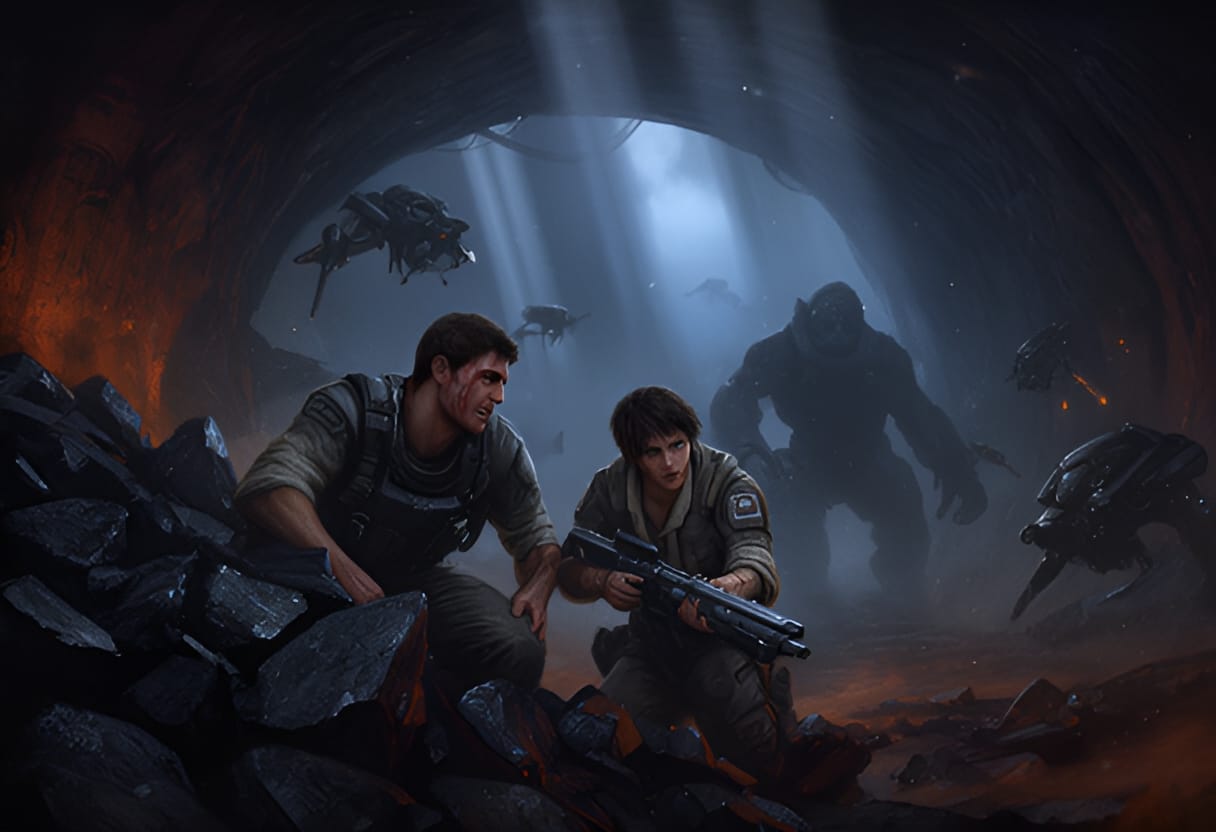
Chapter 9
The Hollows Below
The tunnel mouth yawned ahead, a jagged tear in the earth where light and shadow fought a losing battle. Dust hung thick in the air, choked with the acrid tang of burnt cordite and something deeper—wet stone, ancient and breathing. Alex shoved forward, his left shoulder screaming with every step, the Lancer gripped white-knuckled in his right hand. Behind him, Zay moved like a shadow given purpose, eyes scanning the dark, rifle low but ready. The flare Alex had been carrying sputtered in his grip, casting stuttering blue-white light that painted the walls in fleeting hues of corpse-pale and blood-red.
They had lost Jace back in the subway’s throat, swallowed by a Seeder’s scream and the sudden, silent drop of Nemacyst from the dark. No time to mourn. No time to stop. The tunnel was a vein, and they were the blood trying to clot before the Locust could drain it dry.
"Keep moving," Zay muttered, voice raw from smoke and shouting. He didn’t look back. Couldn’t. If he saw Alex’s face—the pallor, the way his jaw clenched against the pain—he’d break stride. And if he broke stride, they both died.
Alex managed a grunt, though it came out more like a rag being torn. "Your cooking’s still gonna kill me before any of these uglies do," he said, trying to make it sound like a joke. It came out thin. Hollow. Even to his own ears.
Zay didn’t smile. But he didn’t tell him to shut up, either. That was enough.
They reached the mouth just as the first Locust drone erupted from the dark—a hulking thing in chitinous armor, its maw split into rows of needle teeth. It roared, a sound like stone grinding on stone, and swung its cleaver in a wide arc.
Zay fired first. Three rounds. The drone staggered, blood blooming dark on its chest. Alex’s Lancer barked to life, chainsaw screaming as he lunged, blade biting into the drone’s throat. It gurgled, then collapsed, twitching.
No sooner had it fallen than two more poured from the gloom—Drones, then a Boomer lurking behind them, its Boomshot cradled like a child’s toy.
"Back to back!" Zay yelled, already moving.
They spun, rifles coming up. Alex took the left, Zay the right. The tunnel narrowed here, walls closing in like a fist. Perfect for a last stand. Terrible for survival.
The Drones came first—fast, screeching, claws scraping stone. Zay’s rifle bucked, rounds finding throats and eyes. Alex’s Lancer snarled, chainsaw flashing as he parried a clawed swipe, then drove the blade upward into a drone’s sternum. It shuddered, then went still.
But the Boomer hung back, waiting.
Zay saw it too late.
The Boomshot flared—no roar, just a sudden, sickening thoom like the world inhaling. A gout of flame and molten metal erupted from the barrel, a blooming sphere of death hurtling straight for Alex’s chest.
Zay didn’t think. He moved.
He threw himself sideways, taking the blast full in the chest and face.
Pain exploded—not a single point, but a storm. White-hot shrapnel tore through his vest, punched through the ceramic plating, and ripped into his shoulder. Something hot and sharp caught him along the jawline, shearing flesh from bone. Another fragment glanced off his cheekbone, sending stars bursting behind his eyes. The world tilted. Sound dropped out, replaced by a high, ringing whine, like a bell struck inside his skull.
He stumbled, boots sliding on slick stone and blood—his own, maybe, or the drone’s. His vision swam: red at the edges, then gray, then a nauseating swirl of purple and black. The flare flew from Alex’s hand, clattering to the ground and sputtering out in a puddle of oily water.
Dimly, through the fog, he heard Alex scream—not in fear, but in rage. A raw, animal sound that shook the dust from the ceiling.
Then strong hands gripped his arms, hauling him backward. Stone scraped his back. He hit the wall hard, breath knocked loose. Alex’s face swam into focus above him, sweat and streaks of grime cutting through the dirt on his cheeks. His eyes were wide, pupils blown, breath coming in ragged gasps.
"You idiot," Alex gasped, voice raw. He fumbled at his belt, tearing free a strip of cloth from his undershirt—already stained with his own blood from the shoulder wound. He pressed it hard against Zay’s face, right over the worst of the tears. "You idiot, I’m supposed to be the reckless one."
Zay tried to speak. Blood filled his mouth, hot and coppery. He choked it back, swallowed. When he could finally get air, it came in a ragged wheeze. "Your… cooking… still… worse."
Alex managed a broken, watery laugh—more a cough than anything. "Yeah. Yeah, it is." He kept pressure on the wound, knuckles white. "Stay with me, Zay. Don’t you dare check out on me now."
The tunnel mouth screamed with Locust. Boomers chuckled, Drones chittered, and somewhere deeper in the dark, something vast and wet shifted in the stone.
Zay leaned into his brother’s grip, the world narrowing to the press of the bandage, the smell of Alex’s sweat and gun oil, the faint, fading pulse of the flare’s dying light beneath the water.
He didn’t let go. Neither did Alex.
The pressure of Alex’s hand on his face was the only thing keeping Zay from slipping under. Blood warmed his palm where it seeped through the makeshift bandage, sticky and thick. Each breath burned—shrapnel had torn into his lung, he knew it, the way each inhale rasped like gravel in a tin can. But Alex was still talking, voice low and urgent, cutting through the roar of the Locust outside their shallow alcove.
"Look at me," Alex said, his grip tightening on Zay’s chin, forcing his head up despite the agony. "You hear me? You stay with me. I’m not losing you in this fucking hole."
Zay’s vision swam—black at the edges, then a sickly green pulse, like the glow of Imulsion leaking from cracked veins in the rock. He forced his eyes open. Alex’s face was inches from his, eyes blazing with something fiercer than fear—terror, yes, but overlaid with a feral refusal to yield. The left side of Alex’s face was streaked with sweat and dirt, but his jaw was locked, unyielding.
"Your… shoulder…" Zay rasped, each word a shard of glass. "You’re bleeding out."
Alex barked a laugh that turned into a wince. "Nah. Just a flesh wound. You should see the other guy." He nodded weakly toward the tunnel mouth, where the Boomer lay half-collapsed in a spreading pool of dark fluid, its Boomshot twisted and useless beside it. "Took the damn thing’s own shot back at it. Poetic, ain’t it?"
Zay wanted to smile. Couldn’t. His cheek felt like it was split open to the bone, and every twitch of his face sent fire racing through the nerves. But Alex was right—there was a grim satisfaction in it. The Boomer had come for them, and instead, it had fed the dirt with its own entrails.
A sudden skittering from the left made both of them twist, rifles coming up despite the pain. A pair of Wretches poured from a side fissure, claws clicking on stone, mouths frothing as they screeched. Alex fired first—three quick bursts from his Lancer, the chainsaw screaming as he swept it low. One Wretch went down, spurting black ichor. The other lunged—Zay pivoted on his good leg, rifle cracking. The round caught it in the throat. It gargled once, then collapsed, twitching.
Silence fell again, broken only by their ragged breathing and the distant, wet clicks of something moving in the dark beyond the tunnel mouth.
Alex lowered his weapon, chest heaving. He glanced down at the bandage, then back at Zay. "How bad?"
Zay swallowed. Tasted iron. "Face… shoulder. Can’t… see right."
Alex cursed under his breath, a low, vicious thing. He fumbled with his left hand—his right still cradled against his ribs, the Lancer dangling from a slack grip—and tore open his own tac-vest. Inside, tucked in a hidden pocket, was a small medikit: a squeeze-bag of coagulant, a roll of sterile gauze, a couple of morphine syrettes. He’d been saving it. For who, Zay didn’t know. Maybe himself. Maybe Jace. Now, it was his.
"Hold still," Alex said, voice tighter now. He sprayed the coagulant directly onto the worst of the wounds on Zay’s face—a hissing sting that made Zay jerk back despite himself. The gel hit the open flesh, bubbling slightly as it began to seal the micro-tears in the skin and capillaries. It wouldn’t close the deep tears, but it would slow the bleeding. Buy time.
Alex worked fast, fingers slick with blood and sweat. He wrapped gauze around Zay’s head, looping it under the chin and over the crown, careful not to press too hard on the injured eye. When he was done, he pressed a morphine syrette into Zay’s hand.
"Take it," he ordered. "Now."
Zay hesitated. "You need it more."
"Shut up and take it," Alex snapped, but there was no real heat in it—just exhaustion, and something deeper. Fear. Not for himself. For Zay. "I can still shoot. You can’t see shit. Take the damn shot."
Zay didn’t argue. He clicked the syrette against his thigh, felt the cold bite of the needle, then the slow, warm flood of morphine spreading through his veins. The pain didn’t vanish—it receded, like a tide pulling back from shore, leaving behind a dull, throbbing ache and a strange lightness in his limbs. His vision cleared slightly—the left eye still a blur of red and shadow, but the right sharpened. He could see Alex’s face again, the tight line of his mouth, the way his shoulders were hunched against the pain in his side.
"Thanks," Zay murmured.
Alex gave him a sharp nod. "Don’t thank me yet. We’re not out of this."
He peeked around the edge of their cover—a jagged outcrop of basalt that had shattered under the Boomshot’s blast. The tunnel mouth was a charnel ground. Three Drones lay in various states of dismemberment, one missing an arm, another with its head half sheared off. The Boomer was worse—its torso split open, ribs splayed like broken wings, its gun a melted wreck. But more were coming. He could see the glow of distant torches, the slow, shuffling advance of a squad moving in formation—Drones flanking, a pair of Theron Guards bringing up the rear, their armor gleaming dully in the emergency lights.
"They’re flanking," Alex whispered. "Trying to pin us here while they bring up the heavy hitters."
Zay nodded, sighting down his rifle. His hands were steadier now. The morphine hadn’t fogged his mind—it had sharpened it, stripped away the panic. All that remained was the mission: keep Alex alive. Keep moving. Find the river. Find the others.
"Theron on the left," he said. "Boomer support coming from the right rear. They think we’re pinned."
Alex’s eyes narrowed. "Then let’s make them regret it."
They didn’t wait for the Locust to close. With a silent signal—two taps on Zay’s right shoulder, the old flank-left sign—they exploded from cover.
Zay went left, rolling low, rifle spitting fire. He caught a Drone in the side as it turned, the round spinning it around. He came up on one knee, took another in the throat. The Lancer jerked in his grip—recoil, or something else? He glanced down. The magazine was down to two rounds. Shit.
Alex went right, Lancer roaring. He didn’t aim for center mass—he went for the legs. A sweeping burst took out a Drone’s knee, sending it crashing. He followed up with a chainsaw lunge, the blade catching the creature’s throat and sawing through with a wet, tearing sound. Blood sprayed his chest, hot and thick. He didn’t flinch.
But the Therons were closing—armored, disciplined, their Hammerburst rifles chattering in controlled bursts. One round caught Alex in the plated shoulder guard, spinning him halfway around. He stumbled, but didn’t fall. Gritting his teeth, he fired back, two quick shots that dropped the shooter.
Zay saw the Boomer emerging from the smoke—a hulking silhouette, its replacement weapon already loaded. It raised the Boomshot, barrel glowing as it charged.
"Boomer!" Zay yelled.
Alex didn’t hesitate. He surged forward, not away from the blast, but toward it—closing the distance before the weapon could arm fully. He slammed into the Boomer’s legs with his shoulder, using the monster’s own momentum against it. The Locust staggered, roaring in surprise.
Zay was already moving. He didn’t aim for the chest. He aimed for the joint where the Boomshot connected to the arm—a weak point, exposed during the reload cycle. His last two rounds struck true. There was a sharp crack, then a hiss of pressurized gas. The Boomshot jerked in the Boomer’s grip, then detonated in its hands.
The explosion was close enough to blanch Zay’s retinas. Heat washed over him, searing his eyelids even shut. The Boomer didn’t scream—it just folded inward, a crumpled wreck of metal and meat, flung backward into the wall with a sound like a slaughtered beast hitting stone.
Silence. Not peace. Just the absence of immediate threat.
Alex pushed himself off the Boomer’s collapsing frame, breathing hard. His left arm hung useless at his side, the Lancer dragging. Blood soaked his side wound through the makeshift dressing—dark, spreading fast. He was pale, sweat beading on his forehead despite the chill in the air.
Zay stumbled toward him, vision swimming again as the morphine began to wear off at the edges. The pain in his face was returning—a deep, throbbing ache that pulsed with his heartbeat. He reached out, grabbed Alex’s arm to keep him upright.
"You okay?" Alex asked, voice strained.
Zay managed a grimace that might have been a smile. "Ask me again when I’m not seeing double."
Alex let out a short, humorless breath. "Yeah. Well. You look like hell."
"Thanks. You look… like you’ve been wrestling a Brumak in a tarpit."
Alex actually laughed then—a short, sharp sound that ended in a wince as he clutched his side. "Yeah. Yeah, I do."
They leaned on each other, backs to the tunnel wall, watching the smoke drift from the Boomer’s corpse. The tunnel mouth was quiet now—too quiet. No more scuttling, no more chittering. Just the distant drip of water from somewhere deep in the Hollows, and the faint, almost subsonic thrum that had been growing louder since they entered this place. It wasn’t just in the ears. It was in the bones. A vibration, like the rock itself was dreaming.
Alex pushed off the wall first, grimacing. "We gotta move. Before they send in the big bugs."
Zay nodded, testing his weight. His legs held. The left eye was still a blur, but the right was clear enough. He took point, rifle at the ready, Alex limping just behind, left hand braced against the wall for balance.
The tunnel opened ahead—not into another passage, but into a vast chamber that made the hair on Zay’s arms stand on end.
It was enormous. Cathedral-scale. The ceiling arched upward into darkness, lost in shadow. Stalactites hung like the fangs of some slumbering leviathan, glistening with moisture. And everywhere—clinging to walls, draping from ceilings, sprouting from the floor in grotesque clusters—were fungi. Not the dull, earthy kind from the surface, but things that pulsed with an inner light. Blues and violets, sickly greens and deep, bruised reds. They breathed. Slowly. Rhythmically. Like lungs.
And the air—it thrummed. Not with sound, but with pressure. A low, resonant frequency that made Zay’s teeth ache and his vision swim again. It wasn’t just the Locust energy they’d heard rumors about. This was older. Deeper. Something that had been down here long before men crawled out of the caves, long before the Imulsion rigs scarred the surface.
Alex stopped dead beside him, Lancer limp in his hand. His breath hitched.
Zay followed his gaze.
And then he saw it.
Not the fungi. Not the light.
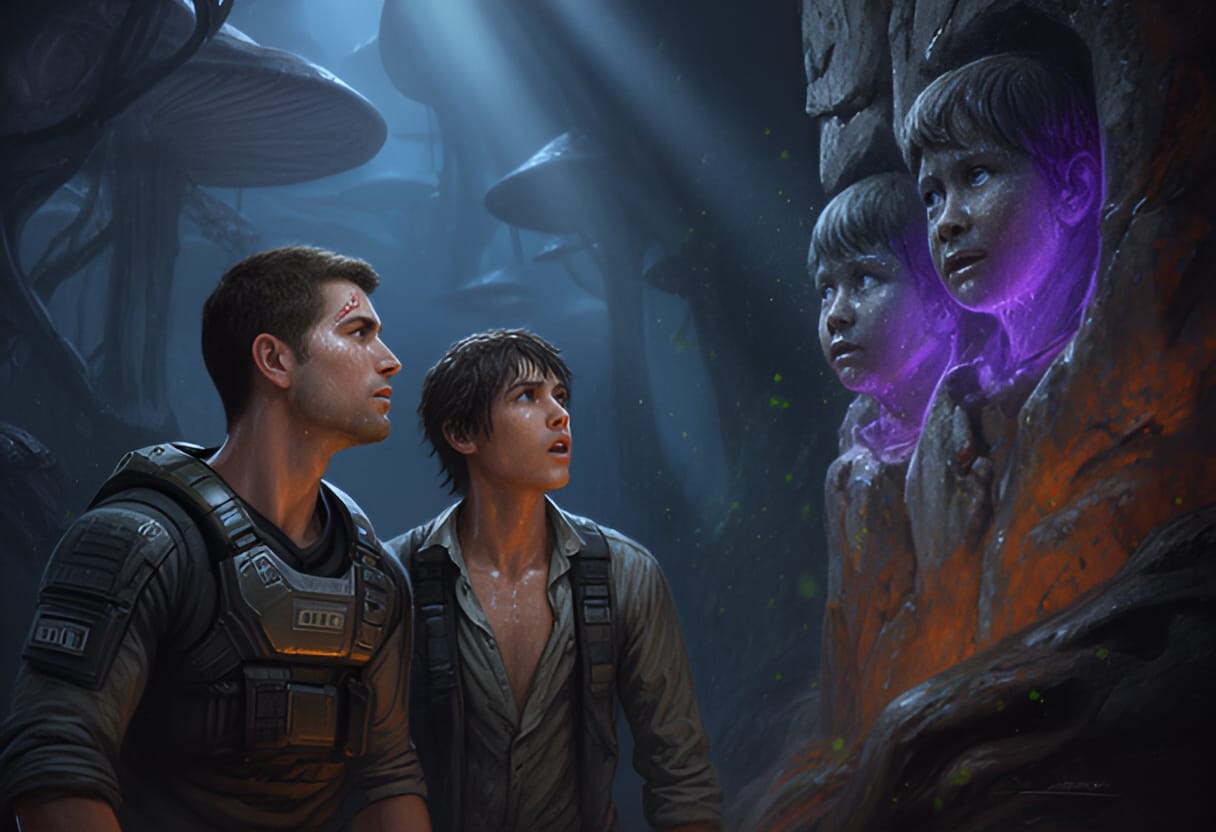
The shapes in the stone.
Not natural formations. Not erosion.
Faces.
Flickering in the gloom, half-seen, half-imagined—like faces burned into the retina after staring too long at a flame. But these weren’t random. They were familiar.
There—high on the left wall, where a cluster of violet fungi pulsed like a heartbeat—was the curve of a cheekbone, the slope of a nose. The outline of a forehead. And below it, two dark smudges that could only be eyes.
Zay sucked in a breath. It wasn’t just one. As his eyes adjusted, more emerged—faint, like ghosts in the rock. A jawline here. A chin there. The arch of an eyebrow. All of them… young. Soft. Unmarked by war.
Childhood.
"Jesus," Alex whispered. His voice was barely audible, raw with something Zay had never heard in him before—not fear, not pain, but a deep, aching nostalgia. "Zay… look."
Zay turned his head—pain flaring in his face—and followed Alex’s stare to a cluster of formations near the floor.
It was them.
Not perfect. Not exact. But close enough to stop the heart.
Two figures, side by side, carved not by tool but by time and mineral seepage—and something else, something that had watched, had listened, had remembered. One taller, broader at the shoulders—Zay. The other slightly shorter, a softness around the jaw, a tilt to the head that spoke of quiet amusement—Alex. And between them, where their hands would have been if they’d been holding on… a small, perfect circle. Three lines above it. Two below.
Their symbol.
The one Zay had etched into concrete back in Tyro, back when the world was still whole and the worst thing they feared was missing curfew.
"We were here," Alex breathed. "We’re still here."
Zay couldn’t speak. His throat was tight. Not just from the morphine wearing off, or the pain in his face. It was the sheer, impossible weight of it—that something down here, in this ancient, lightless place, had preserved their likeness not as a monument, but as a witness. As if the stone itself had seen them, as boys, laughing in the sun, promising to always find their way back.
And now, here they were—men, bloodied, half-blind, half-dead—standing in the dark, seeing themselves as they once were.
A sudden, wet click echoed from the fungi nearest them. One of the violet growths pulsed—brighter, faster—and released a soft, spore-filled sigh into the air.
Alex jerked back, hand flying to his nose and mouth. "Shit—what the hell was that?"
Zay didn’t answer. He was staring at his own reflection in the stone—not the carving, but the real thing. The fungi were releasing spores. Microscopic. Airborne. And they weren’t just drifting—they were seeking. Drawn to warmth. To breath. To blood.
He looked at Alex. His brother’s eyes were wide, pupils dilated, not just from pain or fear, but from something else. A slow, dawning confusion. His hand tightened on the Lancer—not in readiness to fight, but as if he were trying to hold onto something slipping away.
"Zay…" Alex said, voice thin. "Did… did we just pass the old mill? Near Miller’s Creek?"
Zay frowned. "What?"
"The mill. With the broken wheel. We used to skip stones there when we were kids. Ma would yell at us for getting our clothes muddy."
"We never went to Miller’s Creek," Zay said slowly. "We went to Holloway Bend. You know that."
Alex blinked. His forehead creased. "Did we? I… I thought…"
He trailed off. His gaze drifted past Zay, not at the tunnel, not at the fungi, but at something just beyond—something that wasn’t there.
A flicker. Like a heat haze. But cold.
And then, softer, almost amused: "You always did take the long way around, didn’t you, Zay?"
Zay’s blood turned to ice.
Alex wasn’t talking to him.
He was talking to someone who wasn’t there.
Zay grabbed his brother’s arm, hard. "Alex. Look at me."
Alex turned. His eyes were open, but unfocused—like he was seeing through Zay, not at him. A ghost of a smile touched his lips. "Hey. You look… different. Like Dad did, when he came home from the rigs. All tired. But happy."
Zay’s chest tightened. Their father had died when they were ten—gone in a rig explosion off the coast of Pelenaur. Alex had been too young to really remember him. But Zay had. And Alex had never seen him come home tired and happy. Only hollow. Only gone.
"This isn’t real," Zay said, voice rough. "It’s the spores. They’re messing with your head. Like the Kryll—only slower. Deeper."
Alex blinked. The confusion cleared, just for a second. Then it came back—stronger. His head tilted, as if listening to a voice only he could hear.
"Ma’s calling," he murmured. "She’s got stew on. Told us to be home before dark."
Zay felt something break inside him—not pain, not fear, but a quiet, devastating grief. This wasn’t just hallucination. It was invasion. The Hollows weren’t just showing them memories. They were rewriting them. Replacing the present with a past that had never been, or worse—one that had been, but was now being used to lure them into surrender.
He shoved the medikit into Alex’s hands. "Listen to me. You are home. But it’s not the house on Miller’s Creek. It’s this tunnel. It’s this fucking rock. And if you don’t snap out of it, you’re gonna stand here forever while they dig your bones out of the wall."
Alex’s eyes flickered. The hallucination wavered—like a candle in a draft.
Then, violently, he blinked. His breath hitched. He looked down at his hands—really looked at them—seeing the grime, the blood, the torn fabric of his glove. He shuddered, a full-body jerk that seemed to tear him loose from whatever dream had been pulling him under.
"Fuck," he gasped. "Fuck, fuck, fuck—"
He doubled over, one hand braced against the wall, the other pressed to his temple. "It felt… so real. Like I was ten years old again. Like none of this ever happened."
Zay grabbed his shoulders, forcing him to meet his eyes. "It did happen. And it’s still happening. We’re not kids anymore. We’re Gears. And we’ve got a promise to keep."
Alex sucked in a ragged breath. Nodded once. Sharp. Hard. "Yeah. Yeah, I know. Promise."
Zay held his gaze a second longer—just to make sure. Then he nodded. "Good. Now let’s get the hell out of this fucking cave before it decides to keep us as souvenirs."
They moved again—slow, stiff, but moving. The chamber stretched before them, vast and alien, the pulsing fungi casting eerie, shifting light across the walls. The thrum in the stone had grown stronger—now it wasn’t just a vibration, but a rhythm. A pulse. Like a heart. Slow. Deliberate. Patient.
And then Zay saw it.
Set into the far wall, half-hidden behind a curtain of glowing blue lichen, was an archway. Not natural. Not carved by water or time. This was made. Smooth basalt, fitted with precision. And set into the lintel—etched deep, unmistakable—was the same symbol they’d seen in the rock.
Three lines. A circle. Two more lines.
Their symbol.
But older. Deeper. Worn smooth by centuries, maybe millennia, of touch.
Zay stopped. Alex bumped into him from behind.
"What is it?" Alex whispered.
Zay didn’t answer right away. He reached out, not to touch the symbol, but to trace it in the air with his fingertip—just above the stone, where the air shimmered faintly, as if heated.
It wasn’t just a mark.
It was a key.
Or a warning.
Or both.
He lowered his hand. "This isn’t just a place," he said, voice low. "It’s a memory. A trap. The Locust didn’t just come from here. They remember here. And they’re using it—using us—to get inside our heads."
Alex was silent for a long moment. Then, quietly: "So we’re not just fighting them. We’re fighting what they make us see."
Zay nodded. "Yeah. And if we let it win… we stop being us. We become whatever they need us to be."
Alex looked at him—really looked—and for the first time since they’d entered the Hollows, Zay saw his brother back. All of him. The sharp tongue. The stubborn pride. The quiet, unbreakable loyalty.
"Then we don’t let it win," Alex said. He raised his Lancer, though his left arm still trembled. "We keep moving. We keep fighting. And we keep finding our way back to each other."
Zay smiled—real this time, despite the split lip, the swollen eye, the blood drying hot on his cheek. "Always."
They stepped forward together—not as boys lost in a dream, but as soldiers. As twins. As the last thing the Hollows expected.
And somewhere deep in the stone, the pulse slowed—just for a fraction of a second—as if the thing that had been watching, waiting, learning, had just realized it had underestimated them.
Then the thrum returned.
Stronger.
Hungry.
And the hunt began again.
The archway loomed ahead, a mouth in the stone waiting to swallow them whole. Zay felt the weight of it pressing against his ribs, not just the symbol’s promise but the sheer, ancient intent behind it. Whoever had carved this—if it wasn’t the Locust themselves, then something older, something that had learned to wear their faces—had built it to remember. To call. And now it was calling them.
Alex’s breath came shallow beside him, his Lancer held low, the chainsaw bayonet still whining faintly from residual spin. His left arm shook, not just from the wound but from the effort of holding the weapon steady. Blood had soaked through the strip of Zay’s undershirt bandage, darkening it to a rust-brown near the shoulder. The wound along his clavicle still wept, a slow, steady seep that tracked down his ribs and vanished into the grit of his trousers.
"Keep your eyes up," Zay murmured, more to himself than to Alex. "Watch for movement. Not just on the walls. In the air."
Alex gave a tight nod, but his gaze kept drifting—not to the shadows, but to the fungi. To the way the blue light pooled in the hollows of the stalactites above, like liquid sky fallen upward. His lips moved, silent, forming words Zay couldn’t hear. A lullaby? A promise? The ghost of their mother’s voice, calling them home?
Zay’s jaw tightened. He shoved the thought aside. Focus. Now.
They passed beneath the archway, and the air changed. Not just cooler—though it was, a damp chill that seemed to rise from the stone itself—but thicker. As if the very atmosphere had been laced with something invisible, something that clung to the skin and seeped into the lungs. The thrum in the stone intensified, no longer a pulse but a hammer, slow and inexorable, beating against the inside of Zay’s skull like a second heartbeat trying to sync with his own.
His vision blurred at the edges. For a split second, he saw not the cavern wall but the concrete of the East Barracks gym, the smell of sweat and rubber mats thick in his nostrils, the echo of Alex’s voice complaining about the coffee. Then it snapped back—stone, fungi, blood—and he gasped, sucking in air that tasted of iron and damp earth.
Alex stumbled, catching himself on Zay’s forearm. His eyes were wide, unfocused. "Zay…?"
"Stay with me," Zay said, voice rough. "Look at me. Now."
Alex blinked. The haze in his eyes cleared—just enough. He swallowed hard. "Sorry. Just… felt like I was back in the gym. Before everything. Before the bugs."
"It’s not real," Zay said. He kept his grip firm on Alex’s arm, feeling the tremble run through him. "None of it is. Keep your head. Keep your eyes on the tunnel. On me."
Alex nodded again, but this time he didn’t look away. He raised his Lancer, the chainsaw whining to life as he squeezed the trigger. A spray of sparks flew from the blade as it chewed into nothing, the sound sharp and sudden in the heavy air.
Then, from the dark ahead—a guttural, chittering hiss, like stone grinding on bone.
Zay threw himself sideways, pulling Alex with him. A volley of spikes shattered the stone where they’d stood, punching deep into the basalt with a sound like teeth breaking.
Drones. Three of them, emerging from a fissure in the wall to their left, their armor dull and chitinous, their heads tilted as they sniffed the air. One raised its Hammerburst, the barrel glowing as it charged.
Alex fired first. A burst from his Lancer tore into the lead Drone’s chest, the rounds stumbling it back. Zay came up behind it, knife flashing—he drove the blade up under the jaw, twisting as he pulled it free. The thing gurgled, black blood bubbling from its lips, then collapsed.
The second Drone swung its weapon. Zay ducked, the round whizzing past his ear. He grabbed the barrel, wrenched it sideways, and drove his elbow into the creature’s temple. It staggered, and Alex finished it with a burst to the throat.
The third turned to flee—then exploded.
Not from their fire. From above.
A Boomer dropped from a ledge twenty feet up, landing with a thunderous crash that sent dust and spores raining down. Its Boomshot was already loaded, the barrel glowing orange as it took aim.
"Down!" Zay yelled.
They threw themselves flat as the projectile screamed overhead—a searing ball of plasma that detonated against the far wall, melting stone into screaming orange slag. The shockwave hit them like a fist, driving the air from Zay’s lungs. His ears rang. His vision swam.
When he could see again, the Boomer was reloading, its small, piggish eyes locked on them. It chuckled—a low, wet sound, like rocks tumbling in a gut.
Alex was already moving. He scrambled to his feet, Lancer raised, and fired—not at the Boomer, but at the ledge above it. Sparks flew as his rounds struck the stone, dislodging a chunk that tumbled down and struck the Boomer’s shoulder. It roared, more surprise than pain, and fired again.
This time, Zay was ready. He rolled left as the Boomshot detonated where he’d been, the heat washing over him like a furnace blast. He came up firing, his Lancer spitting into the Boomer’s chest. The rounds staggered it, but didn’t stop it. It raised its weapon again.
"Zay—now!" Alex shouted.
He wasn’t aiming at the Boomer. He was aiming at the column behind it—a thick, fluted pillar of stone, veined with glowing fungus.
Zay understood. He shifted his fire, walking his shots up the column. The impacts sent fissures spiderwebbing through the stone. One more hit—then another—and the column shuddered, began to tilt.
The Boomer noticed too late. It tried to step back, but its foot caught on a loose slab. The column fell.
It didn’t crush the Boomer outright—it trapped it. The massive thing pinned beneath the falling stone, one arm pinned, the Boomshot wrenched from its grip. It screamed, a sound of pure rage and frustration, as it struggled to free itself.
Alex didn’t wait. He surged forward, Lancer roaring, and emptied his magazine into the Boomer’s exposed throat and chest. The creature bucked, then went still.
Silence fell, broken only by the drip of water from the ceiling and the ragged gasps of the two brothers.
Zay pushed himself to his feet, his side screaming where the Seeder shrapnel had torn through his vest. He felt wetness there too—blood, seeping through the layers of his armor and undershirt. He ignored it. He had to.
Alex was bent over, hands on his knees, breathing hard. The chainsaw on his Lancer had sputtered out, the blade still warm. He wiped sweat and grime from his forehead with the back of his glove, leaving a streak of black.
"Nice shooting," Zay said, trying to keep his voice light. "Thought we were gonna be Boomer stew for a second."
Alex let out a short, humorless laugh. "Yeah. Almost. You okay?"
"I’ve been better." Zay touched his side, felt the warmth spreading. "You?"
Alex looked down at himself. His Lancer was empty. The magazine dangled from the well, the last round spent. He flicked the release, let it fall, and fumbled for a fresh one from his belt—only to freeze.
His face went pale.
"What?" Zay asked, stepping closer.
Alex held up his hand. It was shaking. Not from exertion. From loss.
"I’m out," he whispered. "Magazine’s gone. And I… I don’t have another."
Zay’s stomach dropped. He’d seen Alex load his last spare before they’d entered the chamber—the one he’d taken from a fallen Drone back in the tunnel. He’d thought it was enough. It wasn’t.
He reached for his own belt. Two magazines left. He tossed one to Alex.
"Here. Take mine."
Alex caught it, but didn’t load it. He just stared at it in his palm, his breath coming fast and shallow.
"Zay," he said, voice tight. "My side…"
Zay followed his gaze.
Alex’s hands were pressed to his right ribs, just below the armpit. His fingers were slick. When he pulled them away, they came away coated in dark, viscous blood—so dark it looked almost black in the fungi’s glow.
Zay’s breath hitched. He hadn’t seen that wound before. Not in the chaos of the fight. Not until now.
Alex’s shirt was torn, the fabric ripped open along a jagged line that ran from just below his pectoral to the top of his hip. The skin beneath was torn apart—not a clean bullet wound, but something worse. Shrapnel. Or a blade. Something that had ripped through muscle and tissue, leaving a gaping wound that pulsed with each shallow breath, dark blood welling up and spilling over his fingers.
"Jesus," Zay breathed. "When did that happen?"
Alex shook his head, his eyes unfocusing again. "Don’t… know. Felt… hot. Like a punch. Then… nothing. Just… pressure."
He tried to straighten, but his legs buckled. Zay caught him under the arms, lowering him gently to the stone. Alex gasped as the movement jarred the wound, a thin cry escaping his lips—more surprise than pain, but raw all the same.
Zay ripped open his own medikit with trembling hands. He pulled out the last of the field dressings—a large, sterile pad, already half-used from earlier. He pressed it to the wound, applying firm pressure.
Alex hissed, his back arching slightly off the ground. "It… it burns," he gasped. "Like fire. Inside."
"It’s the shock," Zay said, though he knew it was more than that. The wound was deep. Too deep. He could see the glint of something metallic deep in the torn flesh—shrapnel, maybe a fragment of the Boomer’s own weapon, or a piece of the column that had shattered. It had to come out. But not here. Not now. Not with the threat still so close.
He looked up. The Boomer was down, but the fight wasn’t over. More movement in the dark—scuttling, clicking. Drones regrouping. Maybe more. The thrum in the stone had returned, louder now, insistent—like something vast and ancient was drawing a breath, preparing to surge.
Alex’s eyes fluttered. His face was pale, slick with sweat. His lips were parted, but no sound came out—just the ragged, wet sound of breathing through a mouth full of blood.
"Alex?" Zay said, voice tight. "Hey. Look at me."
Alex’s eyes flicked open. They were unfocused, distant. Not the sharp, wary gaze of a soldier—but the glassy stare of someone slipping away.
"No," Zay said, more fiercely. "Look at me. Now."
Alex’s gaze found his. For a second, there was recognition. Then it began to fade again.
"Zay…" he whispered. "I’m… cold."
"You’re not dying," Zay said, voice low and fierce. He leaned forward, pressing his forehead to Alex’s, feeling the heat of his skin, the dampness of sweat. "You hear me? You are not dying. Not today. Not in this fucking cave. Not while I’m still breathing."
Alex’s eyelids fluttered. His breath hitched. "Zay… I…"
"Shh," Zay murmured. He shifted, cradling Alex’s head against his shoulder, one hand still pressing the dressing to the wound, the other wrapped tight around his brother’s shoulders. "I’ve got you. I’m not letting go. Not now. Not ever."
Alex’s body went slack for a moment—then tensed, a weak spasm running through him. A wet, gurgling sound came from his throat. Blood trickled from the corner of his mouth.
Zay’s vision blurred. Not from the spores. From something deeper. Something older. A promise made in a backyard under a Texas sun, two boys swearing they’d always find their way back.
He pressed his lips to Alex’s temple. "Not yet," he whispered. "Not yet, Alex. Not yet."
He held him tighter, feeling the faint, uneven rise and fall of his brother’s chest against his own. Feeling the life in him—weak, flickering, but there.
And as the first Locust footsteps echoed in the dark ahead, Zay tightened his grip, buried his face in Alex’s hair, and whispered again, like a vow, like a prayer, like the last thing he would ever say if the dark won:
"Not yet."
Zay shifted his weight, bracing his back against the cold stone column as he cradled Alex’s head against his shoulder. The dressing was soaked through, dark blood seeping at the edges, warm and sticky against his palm. He could feel the frantic flutter beneath his hand—not a heartbeat, not yet, but something trying to be one. Alex’s breath came in shallow, wet gasps, each one a struggle, like air fighting through a collapsed lung. Froth flecked his lips, pink and bubbling.
Zay didn’t dare look at the wound again. He’d seen enough. The depth of it. The way the flesh gaped, revealing not just muscle but the dark, glistening curve of rib beneath. This wasn’t just blood loss. This was air escaping where it shouldn’t. A punctured lung. Maybe more. He didn’t have the training to name it, but he knew what it meant. He’d seen it before—on the frontier, in the dirt, when a round caught a man just wrong. And he knew, with a certainty that settled in his bones like ice, that without help—real help, a medevac, a surgeon—Alex wouldn’t last the hour.
But there was no help coming. Not here. Not now.
The thrum in the stone pulsed again, slower now, but deeper—like the Hollows itself was drawing breath, sensing the weakness, the opportunity. Somewhere ahead, the Locust moved. Not rushing. Not yet. They were listening. Waiting to see if the twins would break. If the wound would finish what their weapons had started.
Zay tightened his grip on Alex’s shoulder, feeling the tremors run through his brother’s body—not just from pain, but from the cold creeping in. Shock. He could see it in the way Alex’s lips had gone slightly blue, in the way his eyelids fluttered like a moth trapped in glass.
"Stay with me," Zay whispered, his lips brushing Alex’s ear. "Just stay with me. I’m not letting you go."
Alex’s fingers twitched against Zay’s chest. A faint pressure. A response.
"Zay…" The name was barely audible, lost in the wet rasp of his breath. "So… cold…"
"I know," Zay said. "I know. But you’re not alone. I’m right here. I’ve got you."
He shifted slightly, pulling the torn remains of Alex’s jacket tighter around his shoulders, trying to share what little body heat he had left. His own side screamed where the Seeder shrapnel had torn through him—a deep, throbbing ache that made his vision swim at the edges—but he ignored it. Pain was a language he understood. This? This was something else. This was the slow, quiet theft of a life.
Alex’s head lolled slightly, then jerked back as if startled. His eyes opened—wide, unfocused, staring past Zay into the dark.
"You… you promised," he whispered. Voice fraying at the edges. "Said… we’d find our way back."
"I did," Zay said, voice rough. "And we will. We are. You’re here. I’m here. We’re together. That’s the promise. Not the place. Us."
Alex’s breath hitched. A weak, broken sound. "Feels… like… falling."
"Then fight it," Zay said, firmer now. "You don’t get to quit. Not now. Not when we’ve come this far. Not when I still owe you that beer."
A ghost of a smile touched Alex’s lips—just for a second. Then it was gone, swallowed by another shuddering breath. Blood welled at the corner of his mouth again, thicker this time, darker.
Zay swallowed hard. He could feel it—the way Alex’s body was beginning to shut down. The tremors were lessening, not from improvement, but from exhaustion. His breathing was growing more irregular—long pauses, then a desperate gulp of air, then silence again.
"No," Zay said, voice dropping to a fierce whisper. "You don’t get to check out on me. You hear me? You don’t get to leave me here alone in this fucking dark with nothing but your stupid jokes and your half-eaten rations and that stupid fucking grin you wear when you think I’m not looking."
He paused, throat tight. "You don’t get to go. Because I still need you. And because… because I made you a promise too. When we were kids. After Dad… after he didn’t come home. You were scared. You said you were scared I’d leave you too. And I looked you in the eye and I said, Never. I’ll always find my way back to you. And I meant it. Not just then. Always. So you don’t get to break that promise by checking out now. You hear me? You don’t get to go."
Alex’s body went still for a long moment. Then, so faint Zay almost missed it, his fingers curled—not in pain, but in grip. Weak. Fragile. But there. He was holding on.
Zay pressed his forehead to Alex’s again, feeling the damp heat of his skin, the slow, uneven rise and fall of his chest. "Good," he murmured. "That’s my boy. That’s my brother. Hold on. Just hold on. I’m not letting go."
He didn’t know how long they stayed like that—time had lost meaning in the Hollows, where the light never changed and the thrum in the stone was the only clock. Minutes? Maybe more. All he knew was that Alex’s breathing was growing fainter, the intervals between breaths longer. The warmth of his skin was leaching away, replaced by a clammy chill that seeped into Zay’s own bones.
And then, from the dark ahead—a sound.
Not footsteps. Not the chitter of Drones.
A voice.
Low. Distorted. Speaking in a language that wasn’t quite language—more like the echo of a voice through water, or the hum of a hive mind tuning to a frequency.
Zay froze. His blood turned to ice.
It was speaking Alex’s name.
Not in Gearspeak. Not in any human tongue. But in the cadence. The rhythm. The way Alex’s mother used to say it when she called him in for dinner—soft, drawn out, full of love and a hint of exasperation.
"Aleeeex…"
Zay’s head snapped toward the sound. The archway. The symbol. The glowing lichen curtain swayed slightly, as if stirred by a breath that wasn’t there.
And then he saw it.
A shape. Not solid. Not quite real. Flickering at the edge of the torchlight thrown by the fungi—tall, slender, draped in something that looked like a dress, but made of shadow and shifting light. The face was blurred, indistinct—but the feeling of it was unmistakable.
Their mother.
The way she used to stand in the kitchen doorway, hands on her hips, hair tied back with a faded blue scarf, waiting for them to come in from playing in the fields. The way she’d smile when they were late, not angry—just relieved. The way she’d say, “You two are gonna be the death of me,” but her eyes were always warm.
Zay’s breath caught. His grip on Alex loosened, just for a fraction of a second—then tightened again, hard, as if he could physically hold his brother to this world.
"No," he breathed. "Not you too. Not this time."
The figure tilted its head. The voice came again, clearer now, layered—like a hundred voices whispering the same word.
"Aleeeex… come home…"
Alex’s body shuddered. A soft moan escaped his lips. His eyelids fluttered. Not from pain this time—from recognition.
"Ma?" he whispered. Voice small. Lost. Like the boy who’d once stood in that same kitchen, waiting for stew, unaware that the man who’d walked out that morning would never come back.
Zay’s heart shattered.
He didn’t think. He acted.
With a guttural cry, he shoved himself upright, dragging Alex with him. His brother cried out—a sharp, broken sound—as the movement jarred the wound. Blood welled fresh at the dressing, dark and thick. Zay ignored it. He half-carried, half-dragged Alex backward, away from the archway, away from the figure, away from the voice that wore his mother’s face like a mask.
"Don’t listen to it!" Zay yelled, voice raw. "It’s not her! It’s a lie! It’s the Hollows—it’s them—they’re using your memories against you!"
Alex stumbled, his legs buckling. Zay caught him, bearing most of his weight. His brother’s head lolled against his shoulder, breath coming in ragged pulls.
"But… she sounded… so real…" Alex murmured, voice fading. "Like… like she was waiting…"
"She’s not waiting," Zay said, voice breaking. "She’s gone. And you know it. You know she’s not here. This is a trick. It’s the same thing they did with Dad’s voice in the tunnel—the same damn thing. They’re not showing us memories. They’re wearing them. Like a skin. To get inside."
Alex’s breathing hitched. A wet, bubbling sound. His eyes opened—just a slit—but there was fear in them now. Not just of the wound. Of the lie.
"It’s not real," he whispered. "It’s not…"
"No," Zay said, pressing his forehead to Alex’s again, his voice dropping to a fierce whisper. "It’s not real. You’re here. I’m here. The stew’s not on the stove. The house isn’t standing. You’re ten years older. You’re a Gear. You’re my brother. And you’re not going to let some fucking worm-thing in the dark wear her face and steal you from me."
Alex shuddered. A long, slow breath. Then, so faint Zay had to feel it more than hear it—a whisper against his neck.
"Zay…"
"I’m here," Zay said. "I’m not leaving. I’m not letting go. I’m right here. Look at me."
Alex’s eyes opened. Fully this time. Still glazed. Still fading. But focused. On him.
"Good," Zay said. "Now listen. You’re gonna stay with me. You’re gonna keep breathing. You’re gonna keep fighting. Because if you quit, I swear to whatever’s left of God in this world—I’ll follow you. And I’ll drag your ass back whether you like it or not."
A ghost of a smile. Fragile. Fading. But real.
"Threatening… to drag me…" Alex whispered. "Even when… I’m… dead?"
"Especially then," Zay said. "Because I promised. And I don’t break promises. Not to you. Not ever."
Alex’s eyelids began to droop again. His breath was growing shallower. The intervals longer. Zay could feel it—the way his brother’s body was beginning to shut down, the vital signs slipping like sand through fingers.
"No," Zay said, voice dropping to a raw whisper. "Stay with me. Just… stay with me. I’m not done talking. I got so much more to say. About Mom’s stew. About Dad’s stupid hat. About that time you tried to dye your hair blue and Mom made you scrub it for three days with vinegar. About the promise. About the beer. About everything."
He felt it then—the faintest pressure. Alex’s hand, weak as a newborn’s, brushing against Zay’s wrist. Not a grip. A touch. A farewell?
"No," Zay said, voice breaking. "Don’t you dare. Don’t you fucking dare."
He pressed his mouth to Alex’s ear, his voice dropping to a raw, desperate whisper, pouring everything he had into those words—every memory, every fear, every ounce of love he’d ever felt for this boy who was his other half, his mirror, his anchor.
"I love you, Alex," he said. "I’ve always loved you. Not just as a brother. Not just as a twin. But as the other half of my soul. You’re my compass. You’re my home. And if you leave me now… I don’t know how to be me without you. So you don’t get to go. You don’t. You hear me? You stay. You stay."
Alex’s body went still. Too still.
Zay’s breath caught. He froze. His heart hammered against his ribs like a trapped bird.
Then—so soft he wasn’t sure he’d felt it—a breath. Against his neck. Warm. Wet. Faint.
Alex was still breathing.
Zay closed his eyes. A shudder ran through him—not from relief, not yet. From the sheer, terrifying closeness of it. How close they’d come. How close they still were.
He didn’t move. Didn’t dare. He just held his brother tighter, feeling the slow, uneven rise and fall of Alex’s chest against his own, each breath a victory, each one a defiance of the dark.
And as the thrum in the stone pulsed again—slow, patient, hungry—Zay whispered into Alex’s hair, his voice raw, his soul laid bare:
"Not yet."
He didn’t know how long they stayed like that. Minutes. Maybe an hour. All he knew was that the cold was creeping in faster now, seeping into Alex’s bones, turning his skin ashen beneath the grime and blood. The breathing was slower now. Deeper between the gaps. Each inhalation a struggle, each exhalation a rattle, like air struggling through a flooded lung.
Zay kept talking. Not because he thought it would help—though God, he hoped it did—but because if he stopped, if he let the silence in, he’d hear nothing but the thrum of the Hollows and the frantic hammering of his own heart, and he was terrified of what he might do if he gave in to it.
So he talked. About the creek behind their house where they used to skip stones. About the old oak that had been struck by lightning when they were twelve, and how they’d dared each other to climb it anyway. About the time Alex had caught Zay stealing cookies from the jar and had blackmailed him into doing his chores for a week by threatening to tell Mom he’d called her meatloaf “edible but questionable.”
He talked until his voice was raw. Until his throat burned. Until he could barely form the words.
And still, Alex breathed.
Then, from the dark ahead—a new sound.
Not a voice. Not a trick.
The sharp, metallic click of a weapon cocking.
Zay’s head snapped up.
Three shapes emerged from the gloom—Drones, moving with purpose, their heads swiveling, their weapons raised. Not scanning. Hunting. They’d heard him. The talking. The noise. They’d tracked them to this spot.
And they weren’t alone.
Behind them, from the shadows of the archway, came a fourth figure—taller, thinner, draped in a carapace that seemed to absorb the dim light. Its head was elongated, smooth, featureless save for two faint depressions where eyes might be. It moved without sound, its limbs jointed in ways that made Zay’s stomach twist.
A Kantus. Or something like it. A priest. A speaker. The ones who could sing the Kryll to wake. The ones who could talk to the stone.
It tilted its head. Not at Zay. At Alex.
And then it began to sing.
Not a roar. Not a chant.
A lullaby.
Soft. Melodic. Hauntingly familiar.
Zay’s blood turned to ice.
It was the same tune their mother used to hum when she rocked them to sleep after a nightmare. The same slow, rising and falling melody, the same off-key note on the third bar—their lullaby. The one only she knew.
The sound wrapped around Alex like smoke. His eyelids fluttered. His breathing hitched—not from pain this time, but from recognition. A soft, broken whimper escaped his lips.
"No," Zay breathed. "Not this. Not this."
He shifted Alex’s weight to his left arm, wincing as the movement jarred his own side. His right hand flew to his Lancer—still loaded, one magazine left. He didn’t think. He aimed.
The first shot caught the lead Drone in the throat. It staggered, claws scrabbling at the air, then fell.
The second shot took the next in the eye. It jerked back, shrieking, then collapsed.
The third Drone raised its weapon—Zay fired again. The round caught it in the chest. It fell to one knee, then pitched forward.
Silence.
Then, from the archway—a sound like stone grinding on stone.
The Kantus stepped forward. Its hands were raised, palms outward. Not in surrender. In invitation.
And then it sang again.
The lullaby. Louder now. Clearer. The notes hanging in the air like spider silk, vibrating in Zay’s teeth, in his bones, in the hollow behind his eyes.
Alex shuddered. A soft moan escaped him. His fingers curled against Zay’s chest—not in resistance. In longing.
"Zay…" he whispered, voice dreamy. "It’s… so pretty…"
"No," Zay said, voice breaking. He raised his Lancer again, aiming not at the Kantus’s chest—but at its head. The thing was too fast, too strange. A body shot might not stop it. He needed to break the signal. Break the song.
He squeezed the trigger.
The Lancer bucked. The chainsaw screamed to life as the rounds spat out—three, four, five—before the magazine clicked empty.
The Kantus didn’t flinch. It tilted its head, as if listening to the music behind the noise.
And then it raised its hands.
From the walls—from the floor, from the very stone—came a sound.
Not a whisper.
A hum.
The thrum in the stone exploded into vibration. The fungi flared, pulsing violently. The archway shimmered, the symbol flaring bright as if lit from within.
And the air itself seemed to bend.
Zay felt it—not in his ears, but in his teeth. In his marrow. A pressure building behind his eyes, like his skull was too small for his brain. The lullaby wasn’t just in the air anymore—it was in his head. Playing on a loop, soft and sweet and inescapable, wrapping around his thoughts like velvet ropes.
He stumbled, gripping the Lancer like an anchor. His vision swam. The Kantus wasn’t just singing. It was amplifying. Using the Hollows. Using the stone. Using the pulse—turning the whole cavern into a speaker, a resonator, a weapon.
And it was tuned to them.
Alex gasped. His body arched against Zay’s, a choked cry tearing from his throat. Blood bubbled at his lips—more this time, frothy and bright red. The wound wasn’t just bleeding. It was working. Each gasp of air was pulling more blood into the pleural space. His lung was collapsing. Fast.
Zay’s vision narrowed. The Kantus stood tall, arms still raised, its face—if it had one—turned toward them, listening. Not to the song. To the effect.
It knew. It knew what it was doing.
And it was winning.
Zay’s grip on the Lancer weakened. His shoulders slumped. The weapon felt suddenly absurd—a toy against this. Against a force that didn’t just kill the body, but unmade the mind, that turned memory into a weapon and love into a snare.
He looked down at Alex.
His brother’s eyes were half-closed. His breathing was shallow, ragged—each one a struggle, each one bringing him closer to the edge. His skin was ashen, slick with sweat and blood. The dressing was soaked through, dark and heavy.
And yet—his lips were moving. Not in pain. In response.
Humming.
Faint. Off-key. But there.
The lullaby.
He was singing it back.
Zay’s heart stopped.
No.
Not this.
Not this.
He lunged, not with the weapon—but with his body. He threw himself sideways, dragging Alex with him, crashing into the stone column. The impact jarred the wound—Alex cried out, a raw, torn sound—but Zay didn’t care.
Zay didn’t think. He didn’t breathe. He only moved.
He wrenched Alex’s rifle from the slack grip of his brother’s left hand, the metal slick with blood and sweat. The weight of it felt alien in his grip—too light, too familiar. He had fired this same rifle a hundred times on the range, in drills, in skirmishes out in the Jacinto Plateau. But never like this. Never with his brother’s life ebbing into the stone beneath them, never with the echo of a mother’s lullaby still ringing in his skull like a curse.
He shoved Alex’s body back against the column, just enough to keep him from sliding down. Alex gasped, a wet, broken sound, but his eyes remained half-lidded, lips still trembling with the ghost of the tune.
Zay didn’t look at him. Couldn’t.
He turned.
The Kantus stood where it had been, arms still raised, head tilted as if listening to a symphony only it could hear. Around it, the Drones were stirring—clawing their way to their feet, weapons jerking up, jaws working in silent snarls. The Boomer in the rear shifted its massive frame, the Boomshot glinting in the fungal glow, barrel beginning to rise.
Zay lifted the Lancer.
He didn’t aim. He didn’t think about conservation. He didn’t think about tomorrow, or tomorrow’s coffee, or the promise he’d made to Alex a lifetime ago—to always find his way back.
He thought only of the thing singing their mother’s voice into Alex’s bones.
He squeezed the trigger.
The Lancer jerked. The chainsaw screamed. Rounds spat out in a violent, rolling burst—six, seven, eight—before the magazine jerked empty with a hollow click.
The first Drone jerked sideways, round through the throat, gurgling as it fell.
The second took a burst to the chest, armor cratering, and went down on one knee before pitching forward.
The third tried to raise its weapon—Zay walked the fire up, caught it under the jaw, and it flipped backward, skull snapping against the stone.
The fourth lunged with its claws—Zay stepped sideways, fired from the hip, and caught it in the shoulder. It spun, shrieking, and crashed into the wall, leaving a smear of dark ichor.
The fifth—he didn’t see it come. He felt the brush of air, turned, and fired a triple burst into its midsection. It folded, then dropped.
The sixth—he was already moving, stepping over the fallen, Lancer swinging like a blade—and caught it in the eye. It didn’t even cry out. Just went limp.
The magazine clicked empty again.
Zay didn’t pause.
He slapped the spare magazine from his vest—fumbling, fingers slick with Alex’s blood, his own sweat, the damp of the cavern—and jammed it home. The bolt slammed forward with a harsh chunk. He didn’t check the chamber. Didn’t need to. He knew it was loaded.
He raised the rifle.
The Boomer had fully raised its Boomshot now, the barrel aimed low, directly at his chest. The glow along its shoulders pulsed—charging. A second more and it would fire. A second more and Zay would be nothing but scorched meat and broken bone on the stone.
He didn’t flinch.
He fired.
The Lancer bucked. The chainsaw howled.
The first round caught the Boomer in the left shoulder plate—spun it sideways, roaring in surprise.
The second caught it in the neck joint—armor cracked, steam hissing from the wound.
The third—he aimed for the eye slit. The round struck true. The Boomer staggered back, one massive hand flying to its face, the Boomshot dropping from its grip with a clang that echoed like a bell.
It didn’t fall. Not yet. It swayed, breathing hard, blood trickling down its chest plate. But it was down. It was hurt.
Zay didn’t wait to see if it would rise.
He turned.
More Drones were coming—three, maybe four, scrambling over the fallen, weapons raised, mouths open in silent screams. The Kantus was still standing, arms lowered now, head tilted—not in defeat, but in calculation. It was listening. Watching. Waiting for the song to take hold again.
Zay stepped forward.
He didn’t yell. Didn’t scream. He just fired.
The Lancer kicked. The chainsaw sang.
He walked the fire—left, right, left—catching one Drone in the throat, another in the gut, a third in the femur as it lunged. It stumbled, then fell, weapon skittering across the stone.
He reloaded on the move—magazine out, fresh one in, bolt forward—no hesitation, no thought, just muscle and rage and the terrible, hollow need to hurt something, to stop something, to make the singing end.
He fired until the Lancer clicked empty again.
He was breathing hard. Vision tunneling. The lullaby still hummed at the edge of his hearing—not loud, but there, like a fly buzzing near the ear. He wiped his nose with the back of his hand. Came away bloody.
He looked down.
Alex hadn’t moved.
His head was lolled to the side, eyes closed. The dressing on his shoulder was a dark, soaked mass. His breath came in shallow, shuddering gasps—each one a fight. Blood bubbled at the corner of his mouth again, frothy and bright.
Zay’s throat tightened.
He didn’t have time for this.
He had to keep moving. Had to get Alex out. Had to find the tunnel. Had to—
A roar split the air.
Not from the Boomer. Not from the Drones.
From above.
A deep, shuddering whump—then another, and another—like the world itself was coughing fire.
Shells.
Mortar.
They came in a staggered arc—three, four, five—slamming into the Locust mass with earth-shaking force.
The first detonated among the Drones still trying to rise—blown apart in a flash of flame and shrapnel, limbs and armor flung like toys.
The second caught the Boomer as it tried to push itself up—there was a scream, cut short, and then nothing but a fireball and a rolling shockwave that knocked Zay flat on his back.
He hit the stone hard. Air punched from his lungs. The Lancer flew from his grip, skidding across the cavern floor, chainsaw still spinning slowly before dying with a whine.
For a long moment, he couldn’t breathe. Couldn’t see. The world was fire and noise and the smell of burning ozone and molten stone.
Then—silence.
Not peace. Not quiet. But the thick, ringing silence after the blast. Ears full of cotton. Vision swimming. Dust falling like snow.
He pushed himself up on his elbows.
The chamber was ruined.
The archway was cracked, stone flung outward in a spiderweb of fractures. The fungi hung limp, some torn from the ceiling, others smoldering. The Kantus was gone—no trace, not even a smear. The Drones were broken hulks, some still twitching, most still. The Boomer was a blackened silhouette, half-buried in rubble, the Boomshot melted into its grip.
And through the settling smoke—
Figures.
Moving.
Not Locust.
COG.
Armored. Cautious. Weapons low but ready.
Sergeant Mara Velez led them, her face streaked with soot and sweat, her Lancer at the ready. Behind her, two privates—one he didn’t recognize, the other Ruiz, favoring his left leg but still upright, rifle cradled. A fourth followed, helmet missing, bandage across the forehead—Gomez, maybe? Hard to tell in the gloom.
They moved in a wedge, eyes scanning, boots crunching on stone and bone.
Velez’s gaze swept the chamber—past the wreckage, past the fallen, until it landed on him.
She froze.
Not in shock. In recognition.
Her eyes flicked to Alex—still slumped against the column, blood dark on the stone beneath him—and then back to Zay.
She didn’t shout. Didn’t cry out.
She just raised her hand—flat, palm out—halt.
The others stopped. Rifles came up, scanning the shadows.
Zay pushed himself to his knees. Then to his feet. His side screamed—a hot, tearing pain where the Seeder shrapnel had bitten deep—but he ignored it. He didn’t care about the wound. He cared about the rifle. He needed to know if it was still loaded.
He stumbled forward, boots slipping on blood and slick stone, and snatched up his Lancer. Checked the chamber. One round left. He ejected it, slipped in a fresh magazine from his vest, and slammed the bolt home.
Then he turned to Alex.
He dropped to one knee beside him.
“Alex,” he said, voice rough, raw. “Alex, look at me.”
Alex’s eyelids fluttered. Not open. Just… twitching.
“Hey,” Zay said. “Hey, look at me. Come on.”
A breath. A shudder. Then—Alex’s lips moved.
Not words.
A hum.
Faint. Off-key. But there.
The lullaby.
Zay closed his eyes for just a second. When he opened them, his vision was wet.
He reached out—not to shake him, not to wake him—but to brush the sweat-damp hair from Alex’s forehead. His brother’s skin was burning. Clammy. Wrong.
“Don’t you dare,” Zay whispered. “Don’t you fucking dare leave me here alone.”
Alex didn’t respond. Didn’t need to. His breathing had gone shallower. Each gasp a little weaker. Each one pulling him closer to the dark.
Zay looked up.
Velez was still there. Still watching. Her expression unreadable—but her eyes weren’t angry. Not disgusted. Not impatient.
They were… wary. Concerned. Like she was seeing something she hadn’t expected.
He didn’t know what to say.
So he said the only thing that mattered.
“We need to get out of here,” he said. “Now.”
Velez nodded. Once. Sharp.
She turned to her people.
“Ruiz, Gomez—on me. Stratton, you and the rookie take rear. We move fast, we move quiet. No flares. No noise. We follow the wall left until we hit the fork. Then we take the left passage—it slopes up. Should spit us out near the old maintenance hatch. If the tunnel’s still intact, we’re golden.”
She looked back at Zay.
“You with us?”
Zay glanced at Alex—still breathing, still humming that damned tune—and then back at her.
“I’m not leaving him.”
Velez didn’t sigh. Didn’t argue.
She just said, “Then you carry him.”
She turned and started moving, silent as smoke, her Lancer low, eyes scanning the darkness ahead.
Ruiz and Gomez fell in behind her, rifles up, boots careful.
Zay didn’t hesitate.
He slipped one arm under Alex’s shoulders, the other behind his knees, and lifted.
Alex was lighter than he should have been. Too light. Like his body was already letting go.
He groaned—a soft, broken sound—as Zay shifted him. His head lolled back, mouth open. The humming stopped.
For a terrifying second, Zay thought he’d lost him.
Then— a shuddering breath. A flicker of the eyelids.
Alex’s hand twitched. Weak. Feeble. But it found Zay’s wrist. Fingers curled, just slightly, like a child holding on in sleep.
Zay swallowed hard.
“Easy,” he murmured. “Easy, Alex. I’ve got you.”
He started forward.
His side burned with every step. His back screamed from the awkward lift. His legs trembled from exhaustion and adrenaline crash. But he didn’t stop. Didn’t falter.
He kept his eyes on Velez’s boots ahead—on the way she moved, smooth and sure, like she’d done this a hundred times.
The chamber gave way to a narrow passage—low ceiling, walls slick with condensation. The fungi here were dull, no longer pulsing. Just… there. Like they’d been drained.
They moved in silence.
No words. No jokes. No complaints about coffee.
Just the sound of breath—his, Alex’s ragged pulls, the soft scrape of boots on stone, the occasional ping of a loose rock shifting in the distance.
And beneath it all—faint, almost imagined—the echo of a lullaby.
Not in his ears.
In his bones.
Zay kept walking.
He didn’t look down.
He didn’t dare.
Because if he looked at Alex’s face—pale, sweating, lips slightly parted—he wasn’t sure he could keep going.
He just kept moving.
One step.
Then another.
Then another.
Until the passage began to rise.
Until the air grew cooler.
Until, far ahead, he saw the faintest glow—not fungal. Not fire.
Moonlight.
Real moonlight.
Silver and cold, spilling through a crack in the stone ahead.
They were close.
Velez paused at the mouth of the passage, just before the opening. She turned her head, just enough to look back at him.
Her face was half in shadow, half in silver.
“Almost there,” she murmured.
Zay didn’t answer.
He couldn’t.
He just kept walking.
Carrying his brother.
Toward the light.
Toward the air.
Toward whatever came next.
The moonlight fell across the chamber like a benediction—cool, silent, and utterly alien after the heat and pulse of the Hollows. It pooled on the stone floor, silvering the edges of broken rock and the shattered remains of Locust armor. A breeze, real and moving, stirred the air—carrying the damp scent of stone and water, and beneath it, the faint, metallic tang of blood. It was the first true air they’d breathed since entering the tunnel, and it felt like life returning to limbs long numb.
Zay didn’t pause. He couldn’t. Not with Alex’s weight in his arms, not with the way his brother’s breath hitched now and then, shallow and frayed at the edges. Each step jolted the wound, each jolt drew a faint sound from Alex—nothing loud, nothing articulate, just a tightening of the jaw, a flicker of the eyelids as if caught in a dream he couldn’t wake from.
They stepped into the moonlight.
The tunnel mouth yawned ahead—a jagged fissure in the rock where the natural passage gave way to the old maintenance shaft they’d followed down. Beyond it, the night sky stretched wide and indifferent, stars sharp and cold over the sleeping ruins of Ephyra. The Imulsion River gleamed far below, a dark ribbon threaded with faint reflections of starlight. Somewhere in the distance, a low, rolling thump echoed—artillery, maybe. Or the city dying in real time.
Velez moved first, slipping through the opening with practiced ease, her Lancer sweeping left then right as she scanned the far bank. Ruiz and Gomez followed, bodies low, rifles ready. The rookie—Stratton, Zay realized with a jolt—brought up the rear, breathing hard but alert, eyes darting between the shadows and the sky.
Zay followed last, angling his body to shield Alex as much as he could from the open sky, from the unseen eyes that might be watching from the ridges or the ruins. He didn’t know if the Locust still held the high ground. Didn’t know if Kryll were already stirring in the dark, waiting for the moon to dip. All he knew was that every second they lingered in the open was a second too long.
He eased Alex down gently against the lip of the tunnel, letting his brother’s back rest against the cold stone. Alex groaned—a low, broken sound—and his head lolled to the side, eyes still closed. His breathing was worse now. Shorter. Faster. Each inhale sounded like it was being sucked through a clenched fist.
Zay pressed a hand to Alex’s chest, feeling the frantic, uneven rise and fall beneath the ruined dressing. Blood had soaked through completely now, dark and sticky, matting the fabric to the skin. The wound wasn’t just bleeding—it was working, as the Kantus’s song had warned. Air was getting in where it shouldn’t be. Blood was pooling in the pleural space. Lung collapsing. He’d seen it before—on the frontier, in a medic’s tent after a mortar shrapnel hit—but never to someone he loved. Never to his brother.
He fumbled with the strap of his vest, pulling free the last of his field dressing—a sterile pad, still sealed. His hands shook as he tore it open. Not because of fear. From exhaustion. From the cold. From the sheer, grinding weight of it all.
He peeled back the old dressing slowly, wincing as it clung to the wound. Alex gasped—sharp, sudden—and his fingers scrabbled at Zay’s forearm, not in pain, but in protest. A reflex. A instinct to pull away from the hurt.
“Easy,” Zay whispered, though his voice sounded foreign to his own ears—rough, raw, stripped bare. “I’ve got you. Just… easy.”
He cleaned what he could with the edge of his undershirt—dry, useless, but better than nothing—then pressed the fresh pad directly over the wound. It wasn’t enough. It would never be enough. But it was something. It was trying.
He wrapped the bandage tight—too tight, maybe, but better loose than useless—tying it off with a knot he’d learned in basic, one that wouldn’t slip even if soaked through. When he was done, Alex’s shoulder was a bulky, rigid mound beneath the fabric, the dressing darkened already at the edges.
Alex’s breathing hadn’t improved. If anything, it was worse. Each gasp was shorter, sharper. His lips were parted, his tongue slightly dry. A faint sheen of sweat coated his forehead, though his skin felt cold to the touch.
Zay leaned in, brushing his lips against Alex’s temple—just for a second. A promise. A prayer.
“I’m not leaving you,” he murmured. “Not now. Not ever.”
Alex didn’t respond. Didn’t move. But his fingers—still curled weakly in Zay’s sleeve—twitched once. A signal. A sign.
Zay held his gaze a moment longer, then rose, slipping his Lancer free from its sling. He checked the chamber—full. Good. He ejected the magazine, verified the rounds, and slammed it home. The bolt clicked forward with a satisfying chunk. He chambered a round. The weapon was ready.
He moved to the edge of the tunnel mouth, crouching low, back against the stone, weapon ready. Velez was already there, her own Lancer at her shoulder, eyes narrowed against the moonlight.
“Contact?” he whispered.
She shook her head. “Nothing yet. But they’re out there. I can feel it. The quiet’s too… complete.”
He knew what she meant. The absence of sound. No wind in the broken glass of distant buildings. No scuttling of rats. No distant cries. Just the river, the wind, and the slow, frantic beat of his brother’s failing breath behind him.
They waited.
Time stretched. The moon crept westward. The stars shifted. The cold seeped into Zay’s bones, not just from the air, but from the shock, the loss, the sheer, grinding waiting.
Then—movement.
Not close. Not immediate. But on the far ridge, where the ruins of the power plant clung to the hill like broken teeth—a shape detached itself from the shadow. Tall. Broad. Moving with a slow, deliberate gait.
A Boomer.
Or worse—a Scourge. One of the big ones. The ones that carried the mulchers, the ones that could lay down a wall of lead that turned cover into graves.
Zay’s grip tightened on the Lancer. His thumb found the trigger guard. He didn’t need to aim yet. Just needed to be ready.
Beside him, Velez didn’t move. Didn’t blink. Her eyes never left the figure.
Then—another shape emerged from the dark. Smaller. Faster. A Drone, maybe, or a Wretch—low to the ground, limbs twitching, head swiveling as it scanned the ruins.
And then another.
And another.
They weren’t rushing. Not yet. They were testing. Probing. Seeing if the prey was still alive, still aware, still worth the effort.
Zay’s jaw clenched. He could feel it—the old fury rising, not hot and blind, but cold and focused. The kind that came when you’d lost too much to be afraid anymore. When the only thing left to protect was the weight in your arms and the promise you’d made in a sunlit backyard years ago, when the world was still whole.
He didn’t look at Alex. Didn’t need to. He could feel him there—fragile, fading, but there. And as long as he was breathing, the fight wasn’t over.
The lead Drone took another step forward—then froze. Its head snapped up, not toward the tunnel, but toward the sky.
A whistle.
High. Sharp. Cutting through the night like a blade.
Zay’s blood turned to ice.
Incoming.
He didn’t wait for the whistle to finish. He didn’t wait to see where it was going.
He fired.
The Lancer bucked. The chainsaw screamed.
The first three rounds walked up the ridge—dust and stone exploding where they hit. The fourth caught the lead Drone in the throat. It jerked back, claws scrabbing at the air, then collapsed in a heap.
The fifth and sixth took the second in the chest and shoulder—spinning it sideways before it hit the ground.
He didn’t stop. He couldn’t.
He walked the fire—left, right, left—catching a third as it lunged, a fourth as it tried to take cover behind a broken pillar. The seventh round struck true in the eye socket. The eighth—
Click.
Empty.
He’d forgotten. He’d only loaded one magazine after the mortar strike. He’d been running on instinct, on rage, on the need to do something. And now, in the moment he needed it most, the weapon was dry.
He slammed the magazine release. The empty clattered to the stone. His fingers fumbled with the fresh mag—cold, slick with sweat and blood—trying to seat it, trying to get the bolt forward.
Too slow.
The Boomer had seen the muzzle flash. It had seen the fallen. It was moving now— not running, but advancing, each step deliberate, each step crushing rubble under its massive boots. In its arms, the mulcher spun up—a low, angry whine that rose in pitch, promising death in a cone of lead.
Zay jerked the fresh magazine in. It seated. He slapped the forward assist—once, twice—nothing. The bolt was stuck.
He cursed under his breath, yanking the charging handle hard. It jerked free with a loud clang—then slammed forward. Chambered a round.
He raised the Lancer—
Too late.
The Boomer fired.
Not a burst. A wall.
The mulcher spat fire—a horizontal cone of tracers and lead that tore through the night like a god’s breath. It shredded the stone where Zay had been a heartbeat before. It chewed up the tunnel lip, sending chips and dust flying. It caught the edge of his vest—ripping the fabric, scorching the material—and then it was past him, tearing into the ruins beyond.
He’d been spared by inches. By luck. By the fact that he’d ducked low the instant he saw the barrel rise.
His ears rang. His vision swam. The smell of cordite and hot metal filled his nose.
He was on one knee, breathing hard, the Lancer shaking in his grip.
Across the way, Velez had dropped and rolled—she was behind a boulder now, firing in controlled bursts. Ruiz was down too, behind a shattered wall, his leg dragging but his aim true. Gomez had taken a knee in the open, firing from the hip, his rounds walking up the ridge toward the Boomer.
The rookie—Stratton—was nowhere to be seen.
Zay’s stomach dropped.
Then—movement to his left.
A shadow detaching from the wall of the tunnel.
Not Locust.
Human.
Stratton, face grim, Lancer in hand, blood streaking his temple from a graze. He’d flanked left—just as they’d practiced—circling around through the scrub and the broken wall to get angle on the Boomer’s exposed side.
He didn’t hesitate.
He opened fire.
Three rounds. Four. Five.
The Boomer staggered—not from the hits, but from the surprise. It turned its massive head, mulcher still spinning, trying to bring the weapon to bear on the new threat.
Too slow.
Zay rose—not to his full height, but enough to take aim.
He didn’t aim for the chest. Didn’t aim for the gut.
He aimed for the joint where the Boomer’s right arm met its torso—the place where the armor was thinnest, where the servo cables ran, where a hit could cripple the weapon’s feed.
He squeezed the trigger.
The Lancer kicked.
The first round struck the armor—deflected with a shower of sparks.
The second struck lower—just above the elbow joint. Armor cracked. The mulcher stuttered—spun down, then jerked back up, uneven.
The third—
He didn’t see it hit.
He felt it.
The weapon jerked in his hands. The Boomer let out a sound—not a roar, not a scream, but a deep, mechanical groan, like a engine seizing mid-cycle. Its arms dropped. The mulcher fell silent.
It swayed. Once. Twice.
Then, with a sound like a building collapsing, it fell forward—face first into the dirt and rubble—twitching once, then still.
Silence.
Not the empty silence of before. This was different. This was the silence after the storm. The silence of breath returning. Of hearts still beating.
Zay stayed low, weapon ready, eyes scanning.
Velez rose slowly from cover, her Lancer still at her ready. She nodded once—toward Stratton, then toward the Boomer.
“Nice work,” she said, voice low but audible. “You too, Lopez.”
Zay didn’t answer. He couldn’t. His throat was tight. His hands still shook—not from fear, but from the aftermath. From the crash of adrenaline. From the sight of his brother, pale and still, behind him.
He turned.
Alex hadn’t moved.
His breathing was worse.
Each gasp was shorter now. Shallower. His lips were slightly blue. His skin was ashen, slick with sweat and something worse— the cold sweat of shock, of systems shutting down.
Zay moved without thinking.
He dropped to his knees beside Alex, tearing open the medic’s pouch on his vest—last resort, last hope. He pulled out the needle. The tube of adrenaline. The field medkit’s one shot at buying time.
He didn’t hesitate.
He found the spot—just below the ribs, where the muscle was thick, where it would get into the system fast.
He plunged the needle in.
Pushed the plunger.
Withdrew.
Then he pressed his ear to Alex’s mouth and nose.
Listened.
Waited.
A breath.
Then another.
Still shallow. Still uneven.
But there.
And then—faint, so faint he wasn’t sure he’d heard it— a sound.
Not a gasp.
A hum.
Just a vibration in the chest. A whisper against his ear.
The lullaby.
Alex was still fighting it. Still answering it. Even now. Even here.
Zay pressed his forehead to his brother’s, closing his eyes.
“I’m here,” he whispered. “I’m right here. Don’t you dare stop fighting.”
He didn’t know if Alex could hear him. Didn’t know if the words reached him through the fog of pain and hypoxia and the Locust’s damned song still echoing in his skull.
But he said it anyway.
Because it was true.
Because it was all he had left.
Behind him, Velez gave a quiet signal—two taps on the shoulder. Flank left.
He didn’t look. Didn’t need to.
He knew what it meant.
They weren’t safe yet.
The ridge was still dark. The ruins still held eyes. The river was still far. The tunnel behind them was a wound in the earth—a possible route for pursuit, a choke point if the Locust decided to follow.
They couldn’t stay.
But they couldn’t go—not yet.
Not until Alex could breathe.
Zay stayed where he was, one hand on his brother’s chest, feeling for the rise and fall, the other gripping his Lancer, eyes on the ridge, waiting for the next move, the next threat, the next chance to keep the promise.
He didn’t pray.
He didn’t beg.
He just waited.
And held on.
And hoped—against all reason, against all evidence—that the lullaby in his brother’s chest wasn’t a sign of surrender.
But a sign that he was still fighting.
Still here.
Still his.
Velez’s voice cut through the quiet, low and urgent. “Zay. Lopez. You with me?”
He didn’t look up. His thumb pressed harder against Alex’s sternum, feeling the flutter beneath the skin—so faint it might have been imagination, might have been the throb of his own pulse transmitted through bone and blood. But it was there. It had to be.
“Zay,” she said again, closer now. A boot scuffed gravel beside him. “Medic’s up. We need to move. Now.”
He finally lifted his head. Velez knelt on one knee, her face smudged with soot and blood, one strap of her harness torn. Ruiz leaned against the boulder nearby, one leg bent awkwardly, his Lancer cradled like a broken thing. Gomez crouched nearby, reloading with shaking hands. Stratton stood a few paces back, watching the ridge, jaw tight.
“He’s still breathing,” Zay said, voice raw. “I felt it. The adrenaline—it’s holding. Just barely.”
Velez’s eyes flicked to Alex’s chest, then back to Zay’s face. She didn’t ask for proof. She knew the weight of a brother’s word. Instead, she reached into her vest and pulled out a folded square of sterile gauze, pressing it into Zay’s free hand.
“Wrap his shoulder,” she said. “The bleed’s slowed, but it’s still weeping. We can’t afford to lose him to shock before we get him to a litter.”
Zay took the gauze without a word. He shifted slightly, lifting Alex’s arm just enough to slide the dressing beneath the torn fabric of his undershirt. The wound was ugly—a jagged tear where the Boomer’s shrapnel had caught him during the ambush, now puckered and dark at the edges. Blood had soaked through the makeshift bandage from earlier, stiffening the cloth. Zay cleaned what he could with a water-stained rag from his pocket, then wrapped the gauze tight, tying it off with a knot he’d learned in basic—double loop, slip-resistant. Alex didn’t flinch. Didn’t stir.
When Zay settled back, his palm returned to Alex’s chest. Right over the heart. Where it belonged.
Velez watched him for a long moment. Then she gave a soft click of her tongue and turned to the others.
“Stratton, you and Ruiz take rear. Gomez, you’re on flank watch. I’ll take point. We move in thirty seconds. Litters are staged at the tunnel mouth—two of ’em, but we’re doubling up. Lopez twins on one. Move fast, stay low, and for the love of all that’s holy, don’t look up unless you want to kiss a Kryll.”
No one laughed. The joke hung in the air like smoke—bitter, fleeting.
Zay didn’t release his grip on Alex. Not when Velez knelt to check his pulse at the wrist. Not when Ruiz slipped a folded blanket beneath his shoulders. Not when Gomez adjusted the litter’s straps to accommodate both brothers side by side.
“His thready,” Ruiz murmured, frowning at his fingers. “But it’s there. Like a moth tapping on glass.”
Zay didn’t look up. “Then we don’t stop moving.”
Velez stood, brushing dirt from her knees. “We don’t. But we need to get you both onto that litter. Now.”
“I’m not leaving him,” Zay said, finally meeting her eyes. His voice was quiet, but it carried—steady, iron-clad. “Not for a second. Not to get on the litter. Not to walk ten feet. If we move him, I move with him.”
Velez studied him. The exhaustion in her gaze was deep, but so was the respect. She gave a single nod.
“Then we move him with you holding on. Gomez, help him shift. Ruiz, support his head. Stratton, keep your eyes open—we’re not out of the woods yet.”
Gomez slipped his arms under Alex’s shoulders, bracing. Ruiz cupped the back of his head, fingers splayed to avoid pressing on the wound. Zay shifted his weight, sliding his free hand under Alex’s lower back, lifting in unison.
Alex’s body was limp, heavy as stone. His head lolled slightly to the side, cheek brushing Zay’s shoulder. His breath came in tiny, irregular pulls—like a bellows with a cracked valve. Each one seemed to cost him everything.
“Easy,” Gomez grunted. “Easy… got him.”
They lowered him onto the litter. The canvas sagged under their combined weight. Zay didn’t let go of his brother’s hand. Instead, he slid onto the litter beside him, shoulder to shoulder, thigh pressed to thigh, their fingers laced together in the grip they’d used since they were boys—palms tight, thumbs hooked, a silent vow written in calluses and sweat.
“Secure him,” Velez said. “But leave his left arm free. Lopez needs to hold on.”
Gomez and Ruiz worked quickly, fastening straps across the chest and hips, leaving the left side open. Zay kept his grip, his knuckles white, his forearm trembling with the effort of holding on—not just to Alex’s hand, but to the thread of his presence.
When they were done, Velez gave the signal. Two taps on Zay’s shoulder.
Flank left.
He didn’t need to see it. He felt it in his bones.
The litter was lifted. Four hands took the straps—Velez and Gomez at the head, Ruiz and Stratton at the feet. Zay remained kneeling beside it, one knee on the litter’s edge, his body bent over Alex, shielding him as best he could from the jostle, the dust, the sudden jolt of movement.
They started forward.
The pace was slow, deliberate. Every step was calculated to minimize jarring. The litter swayed slightly with each stride, but Zay moved with it, his torso swaying in counterbalance, his head low over Alex’s face, his lips near his brother’s ear.
“You hear that?” he whispered, voice rough from disuse and strain. “The wind. It’s picking up. Smells like rain. Like the night before the storm hit the coast—when we were kids and Dad took us out to fish off the jetty. Remember? You kept begging to steer the boat, even though you couldn’t see over the rail.”
Alex didn’t respond. But his fingers twitched—just once—in Zay’s grip.
Zay swallowed hard. “You always did that. Pretended you were captain. Even when you were just holding the rope. Always had to be in charge of something.”
A dry laugh tried to form in his throat. It came out as a shuddering breath.
“I’m not letting go of the rope, Alex. Not this time. Not ever. You hear me? I’m right here. I’ve got the line. You just… you just hold on. That’s all you gotta do. Hold on.”
They crested a low rise. The tunnel mouth yawned ahead—a dark wound in the earth, framed by twisted rebar and chunks of collapsed concrete. Two litters waited nearby, attended by two more Gears—faces grim, weapons ready. A Medevac truck sat idling fifty meters beyond, its engine a low thrum, exhaust curling in the stale air.
“Almost there,” Velez said, her voice tight. “Just a little farther.”
Zay didn’t answer. He couldn’t. His focus had narrowed to the rise and fall of Alex’s chest beneath his palm, the fragile warmth of his brother’s skin, the faint, stubborn pulse against his fingertips.
They crossed the threshold into the tunnel’s shadow. The air grew cooler, damper—rich with the smell of stone and damp earth and something older, deeper—like the breath of the planet itself. The walls closed in, slick with moisture, faintly glowing where patches of bioluminescent clingfish clung to the rock, casting eerie blue-white shadows that danced with their movement.
Zay kept his face low, his breath mingling with Alex’s. He could feel the heat of his brother’s skin through the fabric of his shirt, the slight tremor in his fingers, the way his thumb occasionally stroked the back of Zay’s hand—an unconscious echo of their childhood, when they’d walk home from school and Alex would fidget with his sleeve, needing contact, needing to know he wasn’t alone.
They reached the litter station. Hands took the straps. Zay didn’t rise. He stayed where he was, kneeling in the grit, his body curled over Alex like a shield.
“Medic’s here,” someone said—Gomez, maybe. “Let him look.”
A pair of gloves appeared in Zay’s peripheral vision. A young private—face pale, eyes wide—knelt beside them, a field scanner in hand.
“Mind if I…?” the medic began.
Zay didn’t look up. “Check his pulse. But don’t you dare stop me from holding his hand.”
The medic hesitated, then nodded. He placed two fingers gently on Alex’s carotid, then shifted to the wrist. His brow furrowed. He glanced at the scanner—then back at Zay.
“Sir,” he said, voice quiet, “he’s got a thready pulse. Forty-two. Weak, but present. Respirations are irregular—about six a minute. Oxygen’s low, but he’s still fighting. Adrenaline’s still in his system. He’s not out yet.”
Zay closed his eyes for a breath. Just one. Then he opened them.
“Good,” he murmured. “That’s good.”
The medic nodded again, then rose. “We’ll hook him up to O2 en route. Keep him warm. Keep talking to him. It helps.”
Zay didn’t look at him. He just tightened his grip on Alex’s hand.
The litter was lifted again. This time, Zay swung his leg over the side and settled fully onto it, lying on his side, facing his brother, their foreheads nearly touching. He kept Alex’s left hand locked in both of his—right hand over left, thumbs braced, fingers interlaced like roots gripping stone.
They began to move again.
The ride to the Medevac was short, but every bump felt like a blow. The litter jolted over rubble, swayed in the wind, tilted as they navigated a narrow cleft in the rock. Zay absorbed it all—letting his body take the shock, shielding Alex with his frame, his shoulders, his thighs. He never broke contact. Never let go.
When they reached the truck, the rear doors were already open. A medic inside waited with a portable ventilator and a warm blanket.
“Ready?” Velez asked, her voice low.
Zay didn’t answer with words. Instead, he shifted, sliding Alex’s body toward the edge of the litter, then, with a grunt of effort, lifted him just enough to swing his legs over the side and into the vehicle. He followed immediately, crawling in after him, settling flat on his back beside the litter, pulling Alex onto his chest.
The medic didn’t protest. He just handed Zay the O2 mask.
“Put this on him. I’ll start the drip.”
Zay took the mask. He adjusted it slowly, carefully, over Alex’s nose and mouth, making sure the seal was snug but not tight. Then he tucked the blanket around his brother’s shoulders, pulling it up to his chin.
Alex’s skin was cold. His lips were still tinged blue. But his breath—shallow, uneven, faint—was there. And beneath Zay’s palm, his heart still beat. Faint. Fragile. But there.
Zay shifted until he was lying on his side, facing Alex. He slipped his left hand under the blanket, found his brother’s right hand, and laced their fingers together once more. His right hand rested on Alex’s sternum, feeling the faint rise and fall.
The engine hummed to life. The truck lurched forward.
Zay lowered his head until his forehead rested against Alex’s.
“I’m not letting go,” he whispered, so low only his brother could hear it—if he could hear anything at all. “Not now. Not ever. You hear me? I’m right here. I’ve got you. I’m not leaving this tunnel without you. Not for anything. Not for heaven. Not for hell. You’re my brother. You’re my blood. And I promised you—long ago, in the backyard, when we were too small to know what war meant—I promised I’d always find my way back to you.”
A beat. Then, softer:
“So you damn well better stay with me.”
He didn’t know if Alex heard him. Didn’t know if the words reached him through the fog, the pain, the weight of whatever was happening inside his brother’s body.
But he said them anyway.
Because they were true.
Because they were all he had left.
The truck rolled on, leaving the tunnel behind, the ridge fading in the mirror, the Hollows receding into dark.
Zay kept his forehead pressed to Alex’s.
Kept his hand on his brother’s chest.
Kept his fingers locked in Alex’s.
And waited.
Not for rescue.
Not for safety.
But for the next breath.
And the one after that.
And the one after that.
As long as it took.
As long as they had.
…The medevac lurched over a shattered stretch of highway, the suspension groaning as it hit a crater the size of a bunker. Alex’s body shifted slightly against Zay’s chest, a soft groan escaping his lips—barely audible beneath the engine’s roar and the hiss of the ventilator pumping oxygen into his lungs.
Zay tightened his grip, his palm flat against Alex’s sternum, feeling the fragile rise and fall beneath his fingers. Each inhalation was a struggle, each exhalation a rattling whisper, like air forcing its way through wet cloth. But it was there. Persistent. Stubborn. Just like Alex.
“Easy,” Zay murmured, his lips brushing the shell of his brother’s ear. “You’re doing good. Just… keep riding it. Like you used to ride that old bike down Miller’s Hill—no hands, eyes closed, laughing like you’d already won.”
A faint tremor ran through Alex’s fingers in Zay’s grip. Not a squeeze. Not yet. But a twitch. A response.
Zay swallowed hard. “Yeah. That’s it. You’re still in there. I can feel you fighting. Don’t you dare quit on me now.”
The medic in the front passenger seat glanced back, his expression tight. “Vitals are holding. Pulse’s still thready, but steady. Sats are at eighty-two on the O2—low, but not crashing. If we can keep him from aspirating and get him to a real respirator at East Evac Point, he’s got a shot.”
Zay didn’t take his eyes off Alex’s face. “How long?”
“Forty minutes, if we push. Less if we hit a detour. The main route’s been sealed—Locust hit the convoy tunnel near the refinery. We’re taking the old service road through the irrigation ditches. Rough, but clear—for now.”
Zay nodded once. “Then drive like the hounds of hell are on your tail. Because they might as well be.”
The medic gave a curt nod and tapped the driver’s shoulder. The truck surged forward, tires spraying gravel and mud as they swung onto the broken service road, flanked by drowned fields and the skeletal remains of center-pivot rigs, their cables hanging like severed tendons.
Inside the cab, the air was thick with the smell of rubber, sweat, and antiseptic. The ventilator ticked softly, a metronome marking the slow, uneven rhythm of Alex’s breath. Zay kept his forehead pressed to his brother’s temple, his breath syncing as best he could with the shallow pulls—inhale when Alex inhaled, exhale when he exhaled—trying to force some semblance of normality into the chaos.
His free hand— the one not locked with Alex’s— drifted to the dog tags resting against his own chest. He pulled them free, the cold metal familiar against his fingertips. His own. And Alex’s. He’d taken them from his brother’s neck when they’d first hit the Hollows, fearing they’d be lost in the chaos, or worse—used to identify a body.
He hadn’t given them back.
Now, he pressed Alex’s tags into his brother’s open palm, curling his fingers loosely around them. The weight was slight, but the meaning wasn’t.
“You keep these close,” Zay whispered. “Not for the brass. Not for the paperwork. For us. Remember what they meant when we were kids? We used to bury them in the dirt by the old oak and dig them up like treasure. Said they were proof we’d been real—that we hadn’t just dreamed each other up.”
A soft exhalation. Alex’s thumb shifted slightly against the tags. A ghost of a grip.
Zay’s vision blurred. He blinked hard, refusing to let the tears fall. Not now. Not when Alex still had a chance.
“You hear that?” he said, voice rough. “That’s the sound of us not being done. That’s the sound of two dumb kids who swore they’d always find their way back to each other. We’re not done yet. Not by a long shot.”
The truck hit a deep rut. The litter jolted. Alex’s head lolled to the side, his cheek pressing into Zay’s shoulder. His breathing hitched—a sharp, wet intake that made Zay’s stomach clench.
“Hey,” Zay said, voice dropping to a fierce whisper. “Look at me. Look at me, Alex.”
He lifted his head just enough to catch his brother’s gaze. Alex’s eyes were open—glassy, unfocused, pupils blown wide from hypoxia and pain—but they were open. And for a split second, something flickered in them. Not recognition, not exactly. But presence. A spark. A whisper of the brother who’d once stayed up all night drawing comic book heroes on napkins, who’d sworn he’d name his first son after Zay, who’d laughed until he snorted when Zay tried to cook chili and set off the smoke alarm.
“There you are,” Zay breathed. “There’s my brother. Come on back. I’ve saved you a seat at the table. Mom’s saving you the last biscuit. And I… I owe you that beer. Remember? You said I owed you one for life. Well, I’m collecting. Starting now. You buy the first round when we get out of this. I’ll even let you pick the tap.”
Alex’s lips parted. No sound came out. But his fingers—still curled around the dog tags—twitched again. Stronger this time. A deliberate flex.
Zay grinned, raw and fierce. “That’s my boy. Fight. Just fight. I’ll handle the rest.”
The medic called back, voice tight. “We’re coming up on the river crossing. The bridge is out, but the ford’s still passable—shallow, but fast. Brace.”
Zay braced himself, pressing Alex tighter against his chest, one arm locked under his brother’s shoulders, the other cradling the back of his head. His chin rested on Alex’s forehead, his lips brushing the damp hairline.
The truck descended into the ditch, tires churning through mud and scattered stone. The water hit the undercarriage with a slap, then rose, swirling around the axles, cold and dark. The vehicle tilted, leaning into the current, the engine whining as it fought the pull.
Inside, the litter swung like a pendulum. Zay absorbed the motion with his body, letting his hips and knees bend, shielding Alex from the worst of the sway. Water seeped in through the gaps in the tailgate, misting the air, slicking the floor. Alex’s skin grew colder against Zay’s chest, his breath shallower, the ventilator’s ticks growing more labored.
“Almost through,” the driver called back. “Hold on.”
Zay gritted his teeth. “Come on, Alex. Don’t you dare check out now. Not when we’re this close. Not when I’ve got you right here.”
The truck bucked as it hit a submerged concrete slab. Alex’s body jerked—a sharp, involuntary spasm. His breath hitched, then stalled.
For a long, terrifying second, there was nothing.
No rise. No fall. No flutter of eyelids. No twitch of finger.
Just silence. And the cold, relentless press of loss threatening to crush Zay’s chest.
“No,” he breathed, his voice breaking. “No, no, no—”
He slammed his palm flat against Alex’s chest, feeling for a beat. Nothing. Then—
A flicker. A shudder. A single, weak expansion of the ribs.
A breath.
Shallow. Faint. But there.
Zay exhaled so hard it hurt. “Thank God,” he whispered, his forehead falling back to Alex’s. “Thank God. Don’t you ever do that again. You hear me? You don’t get to quit. Not without me dragging your ass back by the collar.”
Alex’s fingers tightened—just slightly—around the dog tags. A pressure. A promise.
The truck surged forward, clearing the water, climbing the far bank. The engine screamed as it hit gravel and clawed its way onto the service road again. The medic in the front let out a shaky breath.
“We’re through. Vitals are dipping again, but he’s back. Sats at seventy-nine. Pulse thirty-eight. But he’s there.”
Zay didn’t respond. He just held on. Held his brother’s hand. Held his head. Held his heart in his palms, feeling the erratic, desperate hammer beneath his fingers—uneasy, irregular, but alive.
The road straightened. The river faded behind them, the mist lifting slightly as dawn began to bleed into the east—a pale wash of gray-gold that turned the clouds to hammered silver. In the distance, the silhouettes of East Evac Point’s tents and trucks rose like a promise—white crosses on canvas, the red cross on the aid station flag snapping in the wind.
“We’re almost there,” the medic said. “Five minutes. Hold steady.”
Zay shifted slightly, lifting his head just enough to see Alex’s face fully. The color was returning—slowly, faintly—to his lips. Not the healthy pink of before, but less blue. Less gray. His skin was still slick with sweat and grime, his hair plastered to his temples, but the tension in his jaw had eased. His breathing, though still shallow, had found a rhythm—uneven, but persistent.
Zay lowered his forehead back to Alex’s. “You hear that?” he whispered. “We’re almost home. Not the house. Not the barracks. But home. Wherever we are together. That’s where home is. You remember? We used to say that when we were scared during thunderstorms. ‘As long as we’re together, we’re home.’”
Alex’s eyelids fluttered. Not opening. But moving. Like he was dreaming. Or listening.
Zay pressed his lips to his brother’s temple. “I’m not letting go. Not now. Not ever. You’re my brother. You’re my other half. And if the world ends tomorrow, I want to be right here—holding your hand, hearing your stupid jokes, smelling your terrible coffee breath—because that’s what matters. That’s what’s real.”
A soft sound escaped Alex’s lips. Not a word. Not a sigh. But a vibration. A hum.
The lullaby.
Faint. Fragile. But unmistakable.
Zay closed his eyes. A tear finally slipped free, tracing a hot path through the dirt on his cheek. He didn’t wipe it away.
“Yeah,” he breathed. “I know. I hear you. Keep singing it. I’ll keep listening. As long as you’ve got a breath left, I’ll be right here. Singing it back.”
The medevac rolled on, crossing the final stretch of broken highway, the aid station growing closer—tents flapping, medics moving with purpose, a stretcher team waiting near the triage tent.
The truck slowed. The engine idled. The rear doors swung open.
Two medics in white uniforms stepped forward, their faces focused, efficient. One carried a portable monitor, the other a collapsible stretcher.
“Let’s get him on board,” the first medic said. “We’ve got a ventilator prepped, blood hanging, and a surgeon on standby. He’s critical, but he’s not gone.”
Zay didn’t move. He didn’t release his grip. He didn’t shift his weight.
The medic hesitated. “Sir, we need to take him now. We can’t treat him in here.”
Zay finally lifted his head. His eyes were red-rimmed, raw, but clear. Locked on the medic’s.
“I’m going with him,” he said. Voice low. Flat. Final.
The medic opened his mouth to protest—rank, protocol, procedure—but then he saw it. Not just the determination. The need. The raw, unspoken truth in Zay’s eyes: if he wasn’t allowed to stay, he might shatter.
The medic glanced at his partner. She gave a barely perceptible nod.
“Alright,” the medic said. “But you stay out of the way. No touching the lines. No interfering. Understood?”
Zay nodded. “Understood.”
They lifted Alex from Zay’s chest with infinite care, sliding the collapsible stretcher beneath him. Zay kept hold of his brother’s hand until the last possible second, then slipped his fingers free only to press Alex’s dog tags firmly into his palm before releasing him.
“Hold on to these,” he whispered, just for Alex to hear. “I’ll be right beside you.”
They lifted the stretcher. Zay stepped back, then fell into step beside it, his Lancer gripped in his right hand, his left hand clenched at his side—aching for contact, but restrained.
As they wheeled Alex into the triage tent, the flap opening to reveal the harsh glare of surgical lights, the hiss of monitors, the quiet urgency of trained voices, Zay stopped at the threshold.
He didn’t go in.
He couldn’t.
Not yet.
Instead, he planted his feet, squared his shoulders, and watched as the medics transferred Alex to the ventilator-ready stretcher, connected the lines, checked the IV, adjusted the O2.
And then—just before they turned him toward the trauma bay—Zay stepped forward.
He bent down, ignoring the startled glance of a nurse, and pressed his forehead to his brother’s once more.
“I’m right here,” he whispered, his voice thick but clear. “I’m not going anywhere. I’ll be right outside that flap. I’ll be here when you wake up. And if you don’t… I’ll be here when you don’t. Either way, I’m not leaving. You hear me? I’m not leaving you.”
Alex’s eyes were half-lidded, unfocused. But his lips moved—just slightly.
Forming a sound.
Not a word.
But the shape of a name.
Zay.
Zay’s chest clenched. He didn’t pull back. He just held the contact, his breath mingling with his brother’s, his hand rising to cradle Alex’s jaw, his thumb brushing the cheekbone.
“I’m here,” he whispered again. “Always.”
Then, slowly, he straightened.
He stepped back.
He didn’t wipe his face.
He didn’t take a deep breath to steady himself.
He just turned, planted his boots on the packed earth of the evac zone, and stood watch.
His Lancer rested in his grip, muzzle low, eyes scanning the tree line, the road, the sky—watchful for movement, for threat, for the next wave of horror that might come crawling out of the dark.
But his heart? His heart was still in that tent.
Still pressed to his brother’s chest.
Still feeling for the rise and fall.
Still listening for the hum.
Still waiting.
Not for orders.
Not for relief.
But for the next breath.
And the one after that.
And the one after that.
As long as it took.
As long as they had.
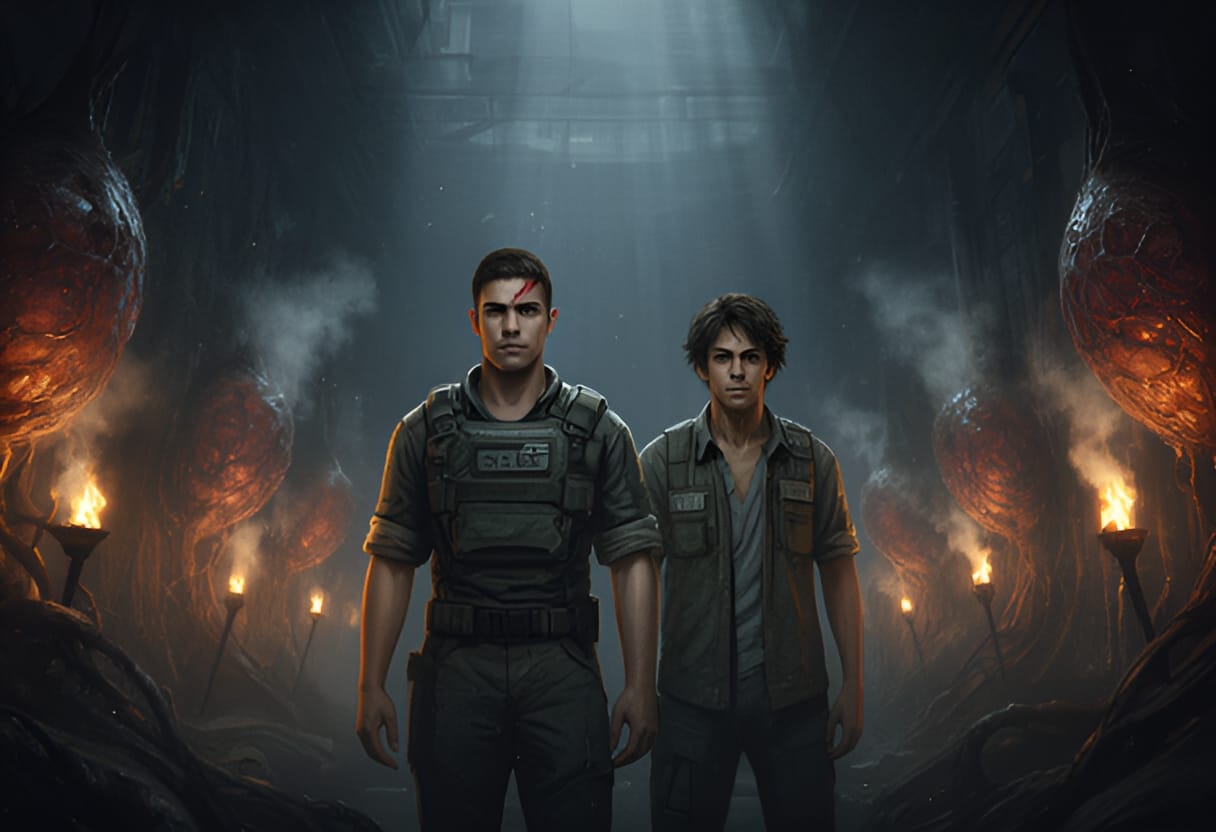
Chapter 10
What We Carry
The chamber smelled of damp stone and something sweetly rotten, like overripe fruit left in the sun. The pods hung from the vaulted ceiling in slow, rhythmic pulses, their membranous walls throbbing with a faint, internal light—bioluminescent veins tracing patterns like frightened nerves. Each sac swayed just enough to catch the edge of the twins’ torchlight, casting long, jerking shadows that made the walls appear to breathe.
Zay stopped first. His boot scraped against a loose shard of obsidian, the sound too loud in the silence. Alex stood beside him, rigid, his Lancer lowered but not relaxed. The wound on his shoulder had seeped through the makeshift bandage Zay had torn from his own undershirt—a dark stain spreading like ink in water. Alex’s knuckles were blistered and red from the flare’s heat, his fingers curled slightly as if still gripping something that wasn’t there.
“Alex?” Zay said, voice low.
His brother didn’t answer. His stare was fixed on the nearest pod, where a faint outline curled within—too small, too humanoid to be anything but what it was. A Locust infant, suspended in fluid, developing in the dark. The sight had struck him like a blow to the chest. He hadn’t moved since they stepped into the chamber. His breath came shallow, his chest rising and falling with a tension that spoke of more than exertion.
Zay took a step forward. “Hey. Look at me.”
Alex’s head turned slowly. His eyes were wide, pupils dilated, reflecting the pulsing glow of the sacs. There was no recognition in them—only horror, raw and unfiltered. He opened his mouth, but no sound came out at first. When it did, it was a whisper, frayed at the edges.
“I can’t… I can’t go in there.”
Zay stepped closer, closing the distance until he could see the sweat beading on Alex’s forehead, the way his jaw clenched so tight the muscle jumped. He reached out, not to touch, but to gesture—palms up, open. “You don’t have to go in. We go around. We’ve done it before.”
Alex shook his head, a sharp, jerky motion. “It’s not the pods. It’s what they mean.” His voice cracked. “They’re making them. Here. Down in the dark. Like we’re… like we’re cattle. Or worse.”
Zay swallowed. He knew what Alex meant. It wasn’t just the birthing chambers. It was the implication—that the Locust weren’t just invading. They were replacing. Growing their own. And if they could do that, what did it make the fight? What did it make them, killing things that had never seen the sun?
“I know,” Zay said softly. “It’s not right. None of this is.”
Alex let out a broken laugh, wet and harsh. “You always say that. ‘It’s not right.’ Like if we say it enough, it’ll stop being true.”
“I say it because it’s true,” Zay replied. His voice dropped, dropping into the rhythm he used when they were kids—low, steady, the kind of tone that meant listen, this matters. “We saw what they did at St. Cyril’s. We saw what they did to Jace. We’ve seen enough to know they don’t care about us. About life. Not the way we do.”
Alex’s gaze flicked to the floor, then back to the pod. His shoulders shook—not with sobs, but with the effort of holding them in. “I’m scared, Zay.”
The admission hung in the air. Not fear of death. Not fear of pain. Fear of something deeper.
“Of what?” Zay asked, though he already knew.
Alex’s eyes glistened. “Of becoming like them. Of losing… of losing us in the fight. Of getting so hard I can’t tell the difference between pulling the trigger and… and becoming the thing that makes it necessary.”
Zay didn’t answer right away. He looked at his brother—the way the torchlight caught the dust on his cheeks, the way his lower lip trembled just slightly, the way he still stood, still held his weapon, even as he fell apart inside. He thought of the promise they’d made as boys, carved into the concrete wall behind the old mill: three lines, a circle, two more lines. We were here. We’re still here. It hadn’t been about surviving the world. It had been about surviving each other.
He stepped forward, closing the last gap between them. Without a word, he took Alex’s gloved hand in his own. It was damp, trembling. He squeezed—once, firm.
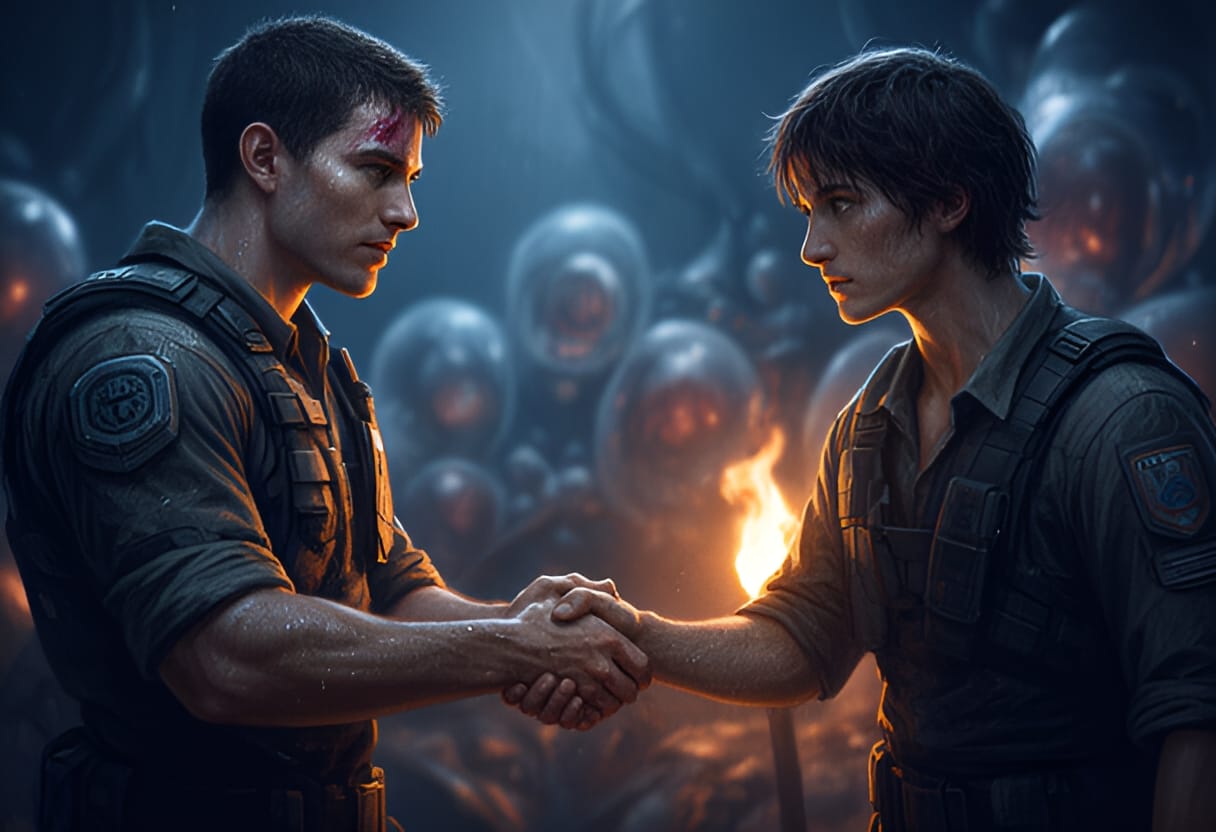
“I’m scared too,” Zay said. His voice was rough, but steady. “Every day. I’m scared I’ll wake up one morning and realize I’ve forgotten what mercy feels like. That I’ll pull the trigger without thinking, not because I have to, but because it’s easier. That I’ll look at a Locust kid in one of those pods and not see a child—I’ll see a threat. And I’ll do what I’m told.”
Alex’s breath hitched. He didn’t pull his hand away.
“I don’t want to be that guy,” Zay continued. “I don’t want to lose the part of me that still flinches when I hear a civilian scream. That still remembers what it felt like to steal peaches from Mrs. Calloway’s tree and get chased off with a broom. That still… still believes there’s something worth saving.”
Alex’s grip tightened. His eyes met Zay’s—red-rimmed, wet, but clear now. Focused.
“I remember,” Alex whispered. “I remember the promise.”
Zay nodded. “So do I. We swore we’d always find our way back to each other. No matter what. Even if it’s dark. Even if we’re lost. Even if we’re… broken.”
A pause. The pods pulsed above them, slow and inexorable. Somewhere in the distance, a Locust hiss echoed—then faded.
“I’m still here,” Alex said, voice firmer now. “I’m still me.”
“And I’m still here with you,” Zay said. He brought their clasped hands up between them, pressing Alex’s knuckles to his own chest, over his heart. “We carry it. Not the fear. Not the hate. The promise. That’s what we carry.”
Alex leaned forward, just slightly, resting his forehead against Zay’s shoulder. For a long moment, neither of them moved. The chamber breathed around them—alien, indifferent, alive with purpose that was not their own. But between them, in the press of palm to palm, the shared warmth, the unspoken vow renewed—there was something human. Something that still belonged to them.
Then Alex gasped.
Not from emotion. From pain.
He jerked back, gasping again, his hand flying to his shoulder. The bandage had slipped. Blood welled fresh at the edge of the wound, dark and thick, seeping through the frayed cotton.
“Alex—”
“I’m fine,” Alex gritted out, but his face was pale, his breath coming in short bursts. He tried to straighten, to laugh it off, but his knees buckled just a fraction.
Zay caught him by the elbow, steadying him. “No. You’re not.”
“I can walk,” Alex insisted, though his voice lacked conviction.
“I know you can,” Zay said. He kept his grip firm, eyes locked on his brother’s. “But you don’t have to pretend. Not with me.”
Alex exhaled, a shaky release. The bravado drained from his shoulders. He nodded once, sharply.
Zay shifted his grip, sliding his hand down to clasp Alex’s forearm—grip to grip, the way they’d done since they were kids, the way they’d promised. No words. Just pressure. Just presence.
“Let’s move,” Zay said quietly. “We’ll take it slow. I’ve got you.”
Alex managed a faint, tired smile. “Don’t let go.”
“I won’t,” Zay promised. “Not this time.”
They turned from the birthing chamber, back into the side passage. The tunnel narrowed again, the air cooler, the whispering fungi fading behind them. The torchlight swung in Zay’s other hand, casting long, trembling shapes on the walls—two figures, side by side, moving forward.
Behind them, the pods pulsed on. Silent. Waiting.
But ahead, the dark waited too. And for now, they walked into it together.
The passage sloped gently downward, the air growing cooler and damper with each step. Faint drips echoed from unseen crevices, a metronome to their slow advance. The tunnel walls, rough-hewn and slick with mineral seepage, closed in slightly, forcing them to move in near-unison—shoulders brushing, steps syncopated by the uneven floor. Zay kept his torch low, its beam cutting a narrow wedge of light ahead, while Alex walked slightly behind and to his left, favoring his right side as the shoulder wound throbbed with a deep, aching pulse that flared with every jolt of movement.
They didn’t speak. Not because there was nothing to say, but because words had already been spent—laid bare in the birthing chamber like open wounds. What remained was the weight of the promise, the quiet understanding that they were still brothers, still bound by something deeper than fear or duty. Zay could feel it in the way Alex’s breath fell into rhythm with his own, in the subtle pressure of their forearms still touching now and then when one steadied the other on a loose stone or a sudden dip in the floor.
The wound was worse than Zay had let on. He’d seen the blood soaking through the makeshift bandage, dark and viscous, but he hadn’t let himself dwell on it—not then, not with Alex unraveling beside him in the face of the pods. Now, as the adrenaline of that confrontation ebbed, the reality of it pressed in: Alex was losing blood. Not catastrophically, not yet, but steadily. The kind of loss that didn’t kill in a moment, but stole strength drop by drop, dulling reflexes, clouding judgment, making each step a negotiation between will and flesh.
Zay glanced sideways. Alex’s face was tight, jaw clenched, eyes fixed on the tunnel ahead. His left hand hung loose at his side, fingers occasionally twitching—as if testing grip, or fighting the urge to shake out the numbness creeping in. The Lancer rested in his right hand, barrel angled down, but his grip was loose, weapon forgotten unless needed. Zay knew that look. It was the same one Alex wore when he’d pushed himself too hard in training, when he’d ignored the burn in his lungs to finish a sprint, when he’d laughed off a twisted ankle because stopping meant admitting weakness.
Only this wasn’t training. And the cost of stopping wasn’t pride—it was survival.
They came to a fork in the tunnel, two passages diverging in the gloom. One sloped left, widish and dry, the other dropped sharply to the right, narrow and wet with seeping water that caught the torchlight like scattered coins.
Zay paused, lifting the light. He scanned both openings. The left showed signs of recent disturbance—scuffed dust, a few loose pebbles displaced near the entrance. The right was undisturbed, but the air from it carried a faint, metallic tang, like rust or old blood.
“Left,” he said quietly. “Looks like something came through recently. Might be a patrol route. Better to avoid.”
Alex didn’t argue. He gave a single nod and shifted his weight, preparing to turn.
As they stepped toward the left passage, Alex’s boot struck a loose chunk of shale. It skittered ahead, clattering against the wall with a sharp, echoing crack—too loud in the stillness.
Both brothers froze.
Zay’s heart lurched into his throat. He pressed himself flat against the tunnel wall, torch angled down to minimize light, body coiled like a spring. Alex mirrored him, back flat, Lancer lifted slowly, eyes scanning the darkness ahead.
Silence stretched. Then— a low, guttural click. Not random. Deliberate.
From the left passage, something shifted in the gloom. A shape resolved—tall, spindly, limbs jointed wrong. A Drone. Its head tilted, nostrils flaring as it tasted the air. Behind it, another emerged, then a third—three of them, moving silently, weapons cradled, eyes gleaming in the dark.
Locust. On patrol.
Zay’s breath hitched. They were exposed. No cover. No flare. Just the two of them, one wounded, in a tunnel that funneled sound and light like a trap.
He caught Alex’s eye. No words needed. The signal—two taps on the right shoulder. Flank left.
Alex understood. He pushed off the wall, moving low and fast, not toward the left passage where the Drones were, but angling into the right-hand tunnel—the wet, narrow one they’d almost ignored. Zay followed, melting into the darkness behind him, torch extinguished now, relying on memory and the faint phosphorescent glow of the fungi clinging to the walls—just enough to see by, not enough to give them away.
They moved in silence, boots scraping lightly on the damp stone, bodies pressed close to the wall. The Drones passed the fork, unaware, their heads swiveling as they scanned the left passage. One paused, head cocked, as if hearing something—then shrugged and moved on, the trio disappearing into the dark with soft, clicking steps.
Zay waited until the echoes faded, then let out a breath he hadn’t realized he’d been holding.
Alex was already moving again, limping slightly as they followed the right-hand passage deeper into the earth. The tunnel narrowed further here, forcing them to move single file. Zay took the lead, his back to Alex, listening—not just for pursuit, but for his brother’s breath. He could hear it: shallow, uneven, a slight hitch on the inhale that spoke of pain and exertion.
After a stretch of twisting turns, the tunnel opened into a small chamber—natural, not carved. Stalactites hung like frozen tears from the ceiling, and a slow seep of water trickled down one wall into a shallow pool on the floor. The air here was cooler, still, carrying the scent of wet stone and something ancient.
Alex stumbled slightly as he entered, catching himself on the wall with his left hand. He didn’t cry out, but his breath hitched—a sharp, sucked-in sound—and he leaned there for a moment, forehead resting against the cool rock, eyes closed.
Zay turned. “You alright?”
Alex didn’t open his eyes. He drew in a slow breath, then another. When he spoke, his voice was low, strained. “Just… need a second. My shoulder’s on fire.”
Zay stepped closer. He could see the bandage now—dark with blood, the edges curled and stiffening where it had dried and re-wetted. The wound itself was ugly—a jagged tear along the clavicle, muscle exposed in places, the skin around it swollen and inflamed. It wasn’t just bleeding. It was infected. The heat radiating from it was visible even in the dim light.
“Let me look,” Zay said.
Alex opened his eyes. He looked exhausted—pale, shadows deep under his eyes, the blisters on his knuckles raw and weeping slightly. But he nodded, pushing off the wall with a grimace.
Zay eased him down to sit on a flat ledge beside the pool. He pulled the water bottle from his belt—half-full, lukewarm—and unscrewed the cap. Then he took the strip of his own undershirt from Alex’s shoulder, wincing as it came away, stuck in places to the wound.
The sight made his stomach twist. The edges of the tear were ragged, swollen, the flesh around it angry red and hot to the touch. There was no puss yet, but the signs were there—heat, pain, the way Alex’s breath hitched whenever Zay touched the perimeter.
“I’m gonna clean it,” Zay said. “Best I can. It’s gonna hurt.”
Alex gave a tight nod. “Do it.”
Zay poured a small stream of water over the wound. Alex gasped, body tensing, but he didn’t pull away. He gripped the edge of the ledge with his good hand, knuckles white.
The water washed away some of the surface blood, revealing the full extent of the damage. It wasn’t just a graze—it had torn through muscle, nicked the top of the lung, maybe. Zay had seen wounds like this before. They didn’t kill fast, but they killed sure if left untreated. Fluid buildup. Pneumonia. Septic shock. He’d seen men last a day, two, before the fever took them.
He tore a fresh strip from the bottom of his own shirt—cleaner, less soaked in sweat and dirt—and dipped it in the water. Then, gently, he began to clean the wound, working from the center outward, removing debris, rinsing away clotted blood.
Alex breathed through his nose, nostrils flaring, eyes squeezed shut. He didn’t cry out, but his body trembled—once, twice—then stilled as he forced himself to endure.
When Zay was done, he pressed the clean strip to the wound, holding it firm. “Hold this,” he said, handing Alex the makeshift pad. “Pressure. Keep it tight.”
Alex took it, his left hand trembling slightly as he pressed it to the wound. His breath was still ragged, but he met Zay’s eyes. “Thanks.”
Zay nodded. He glanced at the pool. The water was still, clear in places, but he knew better than to let Alex drink from it—not without boiling, not with an open wound. Dehydration was a risk, but so was infection from parasites or bacteria in the water.
He unscrewed his canteen and took a small sip himself, then offered it. “Here. Just a little. Rinse your mouth. Don’t swallow.”
Alex took the canteen, rinsed, spit carefully to the side, then returned it. He didn’t complain. Didn’t ask for more. Just sat there, holding the pressure on his shoulder, eyes closed, conserving what strength he had.
Zay watched him. The brothers had always been close—more than twins, more than siblings. They’d shared a bunk until they were twelve, finished each other’s sentences, knew the exact timbre of the other’s laugh, the way Alex’s foot tapped when he was nervous, the way Zay’s jaw tightened when he was holding back anger. They’d fought over video games, stolen each other’s rations, covered for each other during inspections. They’d promised, as kids, that no matter what happened—war, distance, time—they’d find each other. Not just survive. Find each other.
Now, deep in the earth, beneath a city burning above, that promise wasn’t just words. It was the only thing keeping them moving.
He shifted, sitting beside Alex, shoulder to shoulder. Not touching—giving him space—but close enough to feel the heat of his brother’s body, to hear the faint rasp of his breath.
“You remember,” Zay said softly, “that summer we spent at Aunt Rosa’s? The one where we tried to build that raft out of old pallets and inner tubes?”
Alex gave a faint, tired smile. “Yeah. Sank before we even got it in the water.”
“We were ten,” Zay said. “Thought we were gonna float all the way to the coast.”
Alex snorted. “We didn’t even make it to the middle of the pond. Just spun in circles like idiots.”
“We were idiots,” Zay agreed. “But we had fun.”
A pause. The drip of water echoed in the chamber. Somewhere far off, a low, resonant groan—maybe the earth settling, maybe something else.
Alex opened his eyes. He looked at Zay, really looked at him—searching, as if trying to memorize his face.
“Promise me something,” he said, voice quiet.
“Anything.”
“If it gets bad… if I start to go… if I’m not… me anymore… don’t let me become one of them. Don’t let me turn into… whatever they’re making in those pods.”
Zay’s throat tightened. He looked at his brother—the fear in his eyes wasn’t of death. It was of erosion. Of losing himself piece by piece, until there was nothing left of the boy who’d stolen peaches, who’d sworn on concrete, who’d laughed at his own bad jokes.
“I won’t,” Zay said, voice rough. “I swear it. If it comes to that… I’ll make sure it’s you. Not whatever they want you to be.”
Alex held his gaze for a long moment. Then he gave the smallest nod. “Thanks.”
He shifted, trying to get more comfortable on the ledge. A grimace crossed his face as he moved his shoulder. The bandage held, but the pressure was clearly taking its toll.
“We can’t stay long,” Zay said. “We need to keep moving. Find a way out. Get to Northern Command if we can—see if there’s any kind of rally point, any command structure left.”
Alex opened his eyes. He looked toward the tunnel they’d come from, then back the way they’d gone. “You think there’s anything left of Northern Command?”
“I don’t know,” Zay admitted. “But I know this: if there’s even a chance of finding survivors, of getting help, of getting you patched up proper—we owe it to ourselves to try.”
Alex was silent for a moment. Then he said, “What if it’s gone? What if it’s all… over?”
Zay met his eyes. “Then we keep moving anyway. Not because we believe there’s a happy ending. But because we promised. Because we’re still here. And as long as we are… we keep each other human.”
Alex studied him. Then, slowly, he lifted his left hand—the one not holding the pressure bandage—and placed it over Zay’s where it rested on his knee. A silent acknowledgment. A renewal.
“I’m still here,” Alex whispered.
“And I’m still here with you,” Zay replied.
They sat like that for a few more minutes—just breathing, just being. The wound throbbed, but the pressure held. The blood flow had slowed, oozing now rather than streaming. It wasn’t enough to save him if infection set in, but it was enough for now. Enough to move.
Finally, Alex pushed himself up, using the wall for support. His face was pale, but his eyes were clear. He took the bandage from his shoulder, folded it neatly, and tucked it into his pocket—a small, almost ritualistic gesture, like preserving a relic.
“Let’s go,” he said.
Zay stood, shouldering his rifle. He took the lead again, torch in hand, beam cutting a shaky path forward. Alex followed, close enough that Zay could hear his breath, feel his presence—a steady, grounding force at his back.
The tunnel twisted again, descending further. The walls grew wetter, the seepage increasing until small rivulets ran down the stone, feeding the pool they’d left behind. The air grew colder, damper, carrying a faint, mineral tang.
They passed a section where the ceiling had partially collapsed, rubble choking the passage. They had to turn sideways, squeezing through a gap where a jagged slab of stone leaned like a tombstone. Alex went first, moving slowly, favoring his right side. Zay followed, watching his brother’s back, listening for any sign of distress.
On the other side, the tunnel opened into a larger passage—natural, carved by water over millennia. A subterranean stream flowed here, slow and dark, its surface catching the torchlight in trembling shards. The sound of water—steady, constant—filled the space, a white noise that masked other sounds, made it harder to hear approaching threats.
They followed the stream, walking along its rocky bank. The water was icy to the touch—Zay dipped a finger in and pulled it back fast—but it meant life. Fish, maybe. Or at least proof that the earth still breathed, still cycled, still held pockets of normalcy beneath the horror.
Alex walked close, his left hand occasionally brushing Zay’s arm or back—not for support, not consciously, but as if needing to confirm he was still there. Zay let him. Let him take the contact he needed, without comment, without making it a thing.
After a stretch of silent walking, Alex spoke, voice low, almost lost in the sound of the water.
“We used to come down here, you know. When we were kids. Not this far—just the old storm drains near the East Barracks. We’d sneak in after curfew, flashlights in hand, pretending we were explorers. Found an old tin soldier once. Rusty, missing an arm. We kept it in Zay’s locker for a month.”
Zay smiled despite himself. “You tried to trade it for my last pack of gum.”
“And you said no,” Alex said, a hint of his old teasing returning. “Because you were a miser.”
“I was saving it for a rainy day.”
“Yeah, well, today’s about as rainy as it gets.”
They walked on. The stream widened slightly, the tunnel opening into a vaulted space where the water flowed over smooth stone, creating a gentle, rhythmic rush. Somewhere ahead, the sound dropped off—possibly a drop, or a diversion into a deeper channel.
Zay paused, listening. Not just to the water, but to the silence between its pulses. Nothing. No clicks, no whispers, no distant gunfire. Just the water, and their breath, and the faint, steady beat of two hearts still going.
He turned to Alex. “How’s the shoulder?”
Alex shook his head slightly. “Same. Hurts like hell when I move it wrong. But… it’s not bleeding bad. Just… aching. Like a toothache you can’t ignore.”
Zay nodded. He reached into his pack and pulled out the last of his rations—a compressed protein bar, bland and dense. He broke it in half, handed one portion to Alex.
“Eat,” he said. “You need the fuel.”
Alex took it, hesitated, then began to chew slowly. He didn’t complain about the taste. Didn’t ask for more. Just ate, eyes on the water, jaw working steadily.
Zay ate his own half in silence, watching the stream. His thoughts drifted—not to the battle above, not to the Locust, not even to the promise, not directly. But to the feeling of the sun on his face that morning, before all this. To the smell of oil and sweat in the gym. To the bitter coffee he’d complained about. To the way Alex had grinned and said, “You need to lay off the grounds, Zay. You’re gonna stain your teeth.”
It felt like a lifetime ago. And maybe it was.
When they finished, Alex tucked the wrapper into his pocket. He stood, stretching carefully, testing his shoulder. A grimace flashed across his face, but he pushed through it.
“Ready?” Zay asked.
Alex nodded. “Yeah. Let’s keep moving.”
They fell into step again, following the stream. The tunnel began to rise slightly, the water growing shallower, the flow lessening. The walls showed signs of human work here and then—old mortar, remnants of brickwork, a rusted pipe half-buried in the silt. This wasn’t just natural anymore. This was Sera’s old infrastructure—storm drains, maintenance tunnels, forgotten arteries of the city.
They were going somewhere. Not just deeper. Somewhere.
After another ten minutes of walking, the stream vanished entirely, absorbed into the ground or diverted elsewhere. The tunnel continued, drier now, the air less humid. The fungi were gone, replaced by bare stone and the occasional patch of mold.
And then—light.
Not torchlight. Not flame. A pale, diffuse glow ahead, filtering through a fissure in the rock. Not sunlight—too weak, too scattered—but something like it. A break in the earth.
They exchanged a look. No need to speak. They moved forward, cautiously, weapons ready.
The tunnel opened into a larger cavern—part natural, part modified. In the far wall, a section had been reinforced with concrete, and set into it was a heavy steel door, painted with faded COG insignia. Below it, a rusted ladder led down into darkness. Above, the fissure in the rock allowed a sliver of pre-dawn sky to bleed in—gray, overcast, the light of a world that had forgotten how to be bright.
Zay stepped forward, hand on his Lancer. He checked the door—locked, but not barred. The manual override was intact.
Alex came up beside him, leaning slightly on the wall for support. His face was set, determined, but Zay could see the fatigue in the set of his shoulders, the way his breath hitched just a little too often.
“This it?” Alex asked quietly.
Zay nodded. “Looks like an old maintenance access. Leads up to the surface. Maybe near the river’s east bank. If the grid’s still intact, this could be a way out.”
Alex looked at the door, then at the fissure, then back at his brother. “You think there’s anyone up there?”
“I don’t know,” Zay said. “But if there is… we’ll find them. Together.”
Alex met his gaze. A ghost of a smile touched his lips. “Yeah. Together.”
Zay turned to the door. He planted his feet, gripped the handle, and pulled.
It didn’t budge.
He braced, put his shoulder into it, heaved. The metal groaned, protested—then gave slightly, shifting on its hinges with a shriek of rusted steel.
Alex stepped forward, despite the pain, and added his weight. Together, they pulled.
The door swung inward with a loud, protesting creak, revealing a vertical shaft—dark, narrow, lined with rusted rungs leading upward. A foul, damp smell rose from below—stagnant water, oil, something organic decaying. But above, the air was fresher. Cooler. Alive with the scent of rain-washed stone and distant vegetation.
Zay peered up. The shaft climbed maybe twenty, thirty feet before breaking into another tunnel or perhaps the surface itself. The light from the fissure below illuminated the first few rungs—then faded into shadow.
“After you,” Alex said, voice low.
Zay shook his head. “No. You go first. I’ll watch your back.”
Alex opened his mouth to protest—then thought better of it. He nodded, gripping the bottom rung with his good hand. He tested his weight on it. It held.
He began to climb.
Slowly. Painfully. Each movement sent a sharp flare through his shoulder—he grunted, bit his lip, but didn’t stop. His left hand found the next rung, then the right, then left again—three points of contact, always. He moved like a man climbing through fire, each inch earned, not given.
Zay watched, torch in hand, ready to cover if something came from below—or above. He saw the way Alex’s breath hitched with each pull, the way his forehead beaded with sweat despite the chill, the way he never once complained, never asked for help, just kept moving—one rung, then another, then another.
Halfway up, Alex paused, resting his forehead against the cold rung. He sucked in a deep breath, held it, then let it out slowly. When he spoke, his voice was strained but clear.
“Tell me… a story. Something dumb. Something… normal.”
Zay didn’t hesitate. He cast his mind back—not to war, not to loss, but to the before.
“Okay,” he said. “Remember that time we tried to make peach cobbler in Aunt Rosa’s microwave?”
Alex let out a weak laugh—more a puff of air than sound—but it was there. “Oh god. Yeah. We didn’t even know you weren’t supposed to put metal in there.”
“We put in the whole damn tin. Foil lining and all.”
“It sparked like crazy. Smoke everywhere. Aunt Rosa came running, thinking the place was on fire.”
“We tried to blame the cat.”
“She didn’t buy it. Made us eat the damn thing anyway—half-baked, foil-tasting nightmare. Said it built character.”
Zay smiled. “She said we owed her a new microwave. Took us six months of chores to pay it off.”
Alex laughed again—stronger this time, though it ended in a wince as he shifted his weight. “Worth it. Just for the look on her face.”
They kept climbing. Alex’s movements grew more labored, but he didn’t slow. Not much. He found a rhythm—breathe, pull, breathe, pull—each rung a small victory.
Zay kept watch, torch sweeping the shaft above and below. Nothing moved. The only sounds were Alex’s strained breaths, the occasional creak of metal under weight, and the steady drip of water from somewhere deep in the earth.
At last, Alex’s hand disappeared over the top of the shaft. He pulled himself up, rolled onto his stomach, and lay there, breathing hard, one arm dangling over the edge.
Zay followed. He climbed quickly, then hauled himself over the lip, rolling to his back beside his brother.
They lay there side by side on cold, damp concrete, staring up at the fissure in the rock above—a jagged tear in the earth through which a sliver of overcast sky peered down. No sun. No birds. Just light. Faint. Hesitant. But there.
Alex turned his head to look at Zay. His face was smeared with dirt and sweat, his hair plastered to his forehead, his shoulder wound bleeding slowly through the pressure bandage—dark bloom spreading across the fabric. But his eyes were clear. Focused. Present.
“We made it,” he whispered.
Zay turned his head to meet his gaze. “We did.”
A beat. The wind stirred somewhere above, rattling loose stones at the mouth of the shaft. Somewhere far off, a Locust roar echoed—then faded, swallowed by the earth.
Alex shifted slightly, wincing as he moved his shoulder. He didn’t try to hide it. Didn’t joke. Just lay there, breathing, present.
Zay reached out—not to touch the wound, not to check it—but to brush a stray strand of hair from Alex’s forehead. A small gesture. Brotherly. Familiar.
Alex leaned into the touch, just slightly. Then he closed his eyes.
“I’m tired,” he murmured.
“I know,” Zay said. “Rest. I’ve got you.”
Alex didn’t argue. He let his breathing deepen, even as the pain lingered. His hand, resting on his stomach, twitched once—then stilled.
Zay kept watch. His back against the rough wall of the shaft, torch held low, eyes scanning the darkness above and below, ears straining for any sound that didn’t belong—the skitter of claws, the whisper of wind through too-quiet grass, the distant thump of something large moving.
But for now, there was only the two of them. Brothers. Still here. Still breathing.
And as the first true light of dawn began to seep through the fissure—pale, weak, but undeniable—Zay whispered the words they’d sworn on concrete, so many years ago, in a world that still made sense:
“We’re still here.”
Alex didn’t answer. He didn’t need to.
His breath was steady. His hand, loose on his stomach, curled slightly—like a child’s in sleep.
And Zay, watching over him, held the line. Not as a soldier. Not as a hero.
Just as a brother.
Who had promised.
And who would not break it.
The ascent had taken longer than expected, and by the time they reached the surface, the sky had lightened enough to reveal the true scale of the devastation. Ephyra was a wound in the earth—buildings collapsed like rotten teeth, streets choked with rubble and twisted metal, fires burning low and smoky in the distance. The air tasted of ash and something sharper, acrid—Imulsion, maybe, or the ozone after a lightning strike. No sirens wailed. No voices called for help. Only the wind, low and restless, moving through the ruins like a breath held too long.
Zay helped Alex to his feet. His brother swayed, face drawn, the bandage on his shoulder darkened with fresh seepage. Each step sent a tremor through Alex’s frame, but he didn’t lean on Zay—not fully. Not unless he had to. Pride, or habit, or the quiet understanding that if one of them fell, the other would have to carry both.
They moved toward the distant glow of Northern Command, a cluster of reinforced bunkers and sandbagged positions still flying the COG flag, however frayed. It was meant to be a rally point. A place where the wounded could be treated, where supplies were stocked, where command still tried to pretend they were in control.
As they neared, the sound of voices grew—shouted orders, the clatter of gear, the occasional curse. Medics moved with purpose, stretchers bouncing over uneven ground. A surgeon in blood-stained scrubs barked at a private to fetch more plasma. The smell of antiseptic and iodine cut through the smoke.
A corporal spotted them and barked, “Lopez twins! Over here—medic tent’s this way!”
Zay didn’t answer. He guided Alex toward the flap of the largest tent, where a trio of surgeons hunched over a stretcher, their movements sharp and economical. Inside, the light was harsh and white, throwing every drop of sweat and smear of blood into stark relief.
Alex was laid down gently. His eyes fluttered open when he felt the shift, locking onto Zay’s for a heartbeat before slipping shut again.
“Stay with me,” Zay whispered, brushing his thumb over Alex’s knuckles—blistered, reddened, useless for gripping anything now.
Alex managed a faint squeeze. Then his head lolled to the side.
The lead surgeon, a woman with tight braids and eyes that had seen too much, didn’t look up as she spoke. “Pulse is thready. BP’s dropping. We’ve got internal bleeding—likely hepatic or splenic from shrapnel we missed. And look at this.” She lifted the edge of the bandage on Alex’s shoulder. “Wound’s infected. Not just Kryll venom—this is septic. Greenish discharge, foul odor. He’s in the early stages of septic shock.”
Zay’s jaw tightened. He’d seen men die of infection before—slow, wasting away as the fever took hold and the body turned on itself. But Alex was young. Strong. He hadn’t made it this far to be brought down by a bug.
“Can you stop it?” Zay asked, voice low.
The surgeon glanced at him finally—assessing, not unkind, but weary. “We’re trying. We’ve got him on broad-spectrum antibiotics, fluids, blood products. We’re prepping for surgery to explore the abdomen and control the bleed. But septic shock… it moves fast. Especially with a wound like that. His system’s already flooding with cytokines. If we don’t get ahead of it, his organs start shutting down.”
She paused, wiping her brow with the back of her glove. “I won’t lie to you, Lopez. It’s touch and go. He’s fighting, but the odds aren’t in his favor.”
Zay felt the words land like a blow to the chest. He didn’t sway. Didn’t look away. But inside, something cold and hard began to form—fear, yes, but also a grim resolve. He wouldn’t let Alex go without a fight. Not today. Not ever.
“What do you need me to do?” he asked.
The surgeon hesitated. “Nothing. Not in here. You’re not sterile. You could contaminate the field. And honestly… it might be better if you stepped back. Seeing you like this—it could agitate him. He needs calm. Quiet. Not a brother pacing like a caged animal.”
Zay opened his mouth to protest—he belonged at Alex’s side—but saw the truth in her eyes. His presence, usually a comfort, might now be a source of stress. Alex needed to rest, not worry about him.
“I’ll stay right outside,” Zay said. “Flap open. I’ll hear if anything changes.”
She nodded. “Fair enough. But if he codes, we’ll need the space. And if he doesn’t make it… you’ll want to be the last thing he sees, not the first thing he hears screaming.”
Zay swallowed. “Understood.”
He stepped back, pulling the tent flap aside just enough to create a narrow opening. Through it, he could see Alex’s face—pale, lips slightly parted, the rise and fall of his chest shallow but persistent. The surgeons worked in silence now, interrupted only by the occasional hiss of the IV pump or the soft snap of a glove being changed.
Zay planted his back against the cold canvas of the tent, shoulders squared, torch gripped in one hand, the other resting near his sidearm—not ready to draw, but ready to act if something came. He wasn’t a medic. He couldn’t stitch or transfuse or pump antibiotics into a vein. But he could watch. He could listen. He could be the wall between Alex and the dark.
Minutes bled into an hour. The surgeons’ voices dropped to murmurs. A nurse checked the IV line, adjusted the flow. Someone whispered, “Lactic acid’s still high.” Another replied, “We’re pushing dopamine, but his vascular tone’s in the toilet.”
Zay didn’t understand half of it. But he understood the tone. Grim. Focused. Not hopeless—but not hopeful, either.
He thought of the concrete symbol they’d etched as kids—three lines, a circle, two more lines. We were here. We’re still here. He pressed his palm flat against the tent fabric, feeling the vibration of distant artillery, the muffled thump of something large moving underground. He wondered if Alex could feel it too, even unconscious.
Then, a shift.
The lead surgeon exhaled sharply. “BP’s up ten points. Heart rate’s down to 110. Still tachycardic, but trending.”
A pause. Then, quieter: “He’s responding to the fluids. Antibiotics are hitting. Let’s see if we can hold this.”
Zay didn’t dare breathe. He pressed his ear closer to the flap, straining to catch every word.
The surgeon continued, “But we’re not out of the woods. Fever’s spiking—39.2. Liver enzymes are rising. If we don’t get him into surgery soon to control the bleed, we’re just buying time.”
Another nurse said, “OR’s prepped. But we need to stabilize him first. If we take him now, he might not make it past induction.”
Zay closed his eyes. Stabilize. Hold the line. It was a soldier’s prayer. And for the first time since the invasion began, he was praying not for victory, but for time.
He thought of their mother’s peach cobbler—half-baked, foil-tasting, eaten under Aunt Rosa’s stern gaze. He thought of the way Alex had laughed, weak but real, as they climbed the shaft. He thought of the promise, etched in concrete, whispered in the dark.
He wasn’t going to break it.
The night deepened outside, though inside the tent, time seemed to stretch and warp. The surgeons rotated shifts—some leaving, others arriving, their faces grim but determined. Fluids hung in bags, dripping steadily into Alex’s arm. The monitor beside him emitted a soft, rhythmic beep—too fast, but present.
Zay didn’t move. He didn’t sleep. He didn’t even shift his weight much, lest the slightest noise disturb the fragile quiet inside. He watched the rise and fall of Alex’s chest, listened for changes in the breathing pattern, flinched at every sharp intake that might signal pain or distress.
At one point, Alex murmured something incoherent—maybe a name, maybe a plea. Zay leaned in, heart in his throat.
“…Zay…?”
“I’m here,” he whispered back, voice raw. “I’m not going anywhere.”
Alex’s brow smoothed, just a fraction. Then he was still again.
Hours passed. The cold seeped into Zay’s bones. His side wound, forgotten in the tension, began to throb—a dull, persistent ache beneath his ribs. He ignored it. He had worse things to focus on.
Around what he guessed was 0300, the lead surgeon returned, her braids loose, her eyes shadowed. She didn’t enter the tent. Instead, she stopped at the flap, looked in, then turned to Zay.
“He’s holding,” she said. “Not improving, but not crashing. We’ve got the bleed somewhat contained—likely a small arterial nick we can clip in surgery. The infection’s still there, but the antibiotics are starting to suppress the cytokine storm. His lactate’s coming down.”
She hesitated, as if choosing her words carefully. “I won’t pretend he’s out of danger. Septic shock can rebound. His organs are still under stress. But… he’s fighting. And right now, that’s enough.”
Zay felt something loosen in his chest—not hope, not exactly, but the absence of utter despair. “Can I see him?”
She studied him for a moment. “Just a second. And don’t touch anything. No talking unless he wakes up.”
She parted the flap wider, and Zay slipped inside, moving like a shadow. The air was warm, thick with the smell of antiseptic and sweat. Alex lay exactly as he had before, but the color in his cheeks had returned slightly—no longer the gray of impending death, but the faint pink of someone still in the fight.
The monitors blinked softly. The IV lines snaked like vines into his skin. His breathing was still shallow, but regular.
Zay stopped at the foot of the stretcher, not daring to go further. He looked at his brother’s face—so young, so tired, but peaceful in a way he hadn’t seen since before the first Kryll fell.
“I’m still here,” Zay murmured, more to himself than to Alex. “And I’m not leaving.”
He didn’t know if Alex heard him. Didn’t matter. He needed to say it.
He backed out slowly, letting the flap fall shut behind him.
The night wore on. The surgeons worked in quiet shifts. A new nurse took over the IV check—young, face smudged with fatigue, but her hands were steady. She adjusted the flow, checked the dressing on Alex’s shoulder, noted something on a chart.
Zay stayed where he was, back against the tent, torch now switched off to preserve the battery. He relied on the faint glow seeping through the fabric—the first hint of dawn.
He thought of the symbol again. Three lines, a circle, two more lines. Not just a mark. A declaration. They had made it this far. They were still here.
And if Alex didn’t make it…
No. He wouldn’t go there. Not yet.
Around 0530, the tent flap stirred. A nurse emerged—mid-30s, hair pulled into a tight bun, her expression exhausted but not defeated. She paused, looking out at the dimming darkness, then at Zay.
He pushed off the wall immediately. “How is he?”
She didn’t smile. Didn’t frown. Just shook her head slightly—once, slowly.
“No change,” she said. “Vitals are stable. Not improving, but not declining either. He’s still in a precarious balance. But… he’s still here.”
She glanced back into the tent, then at Zay. “You’ve got a strong brother, Lopez. And you’ve been a good one. Whatever happens, remember that.”
She turned to go, then paused. “Dawn’s coming. Might be a good time to step inside. Just… be quiet. Let him rest.”
Zay nodded. “Thank you.”
She moved off toward the supply crate, already pulling on fresh gloves.
Zay waited until she was gone, then stepped to the flap and pulled it open just enough to slip inside.
The light was different now—softer, bluer, filtering through the weave of the tent like a promise. Alex lay exactly as before, but there was a stillness to him that felt less like surrender and more like endurance.
Zay moved to the side of the stretcher, careful not to touch anything sterile. He didn’t take Alex’s hand—didn’t want to risk disturbing the IV—but he sat down on his heels, bringing his face level with his brother’s.
Alex’s eyes were closed. His breathing was even. The wound on his shoulder still seeped, but slower now, the dressing holding.
Zay reached out—not to touch, not to wake—but simply to hover his hand a few inches above Alex’s chest, feeling the faint rise and fall beneath the hospital gown.
He whispered, so low even he could barely hear it: “We made it through the night. Now let’s see what the day brings.”
He didn’t expect an answer. Didn’t need one.
Alex’s fingers twitched once—then stilled.
And Zay stayed. Not as a soldier. Not as a survivor.
Just as a brother.
Who had promised.
And who would not break it.
Zay remained where he was, knees pressed into the cold concrete floor of the trauma tent, his back straight, his gaze fixed on Alex’s face. The dawn light had grown stronger now, spilling through the canvas in soft, diffused bands that painted stripes of silver and pale gold across the floor. It caught the dust motes drifting in the air above Alex’s chest, turning them into slow, drifting stars. For a moment, the world beyond the tent—the screams, the gunfire, the relentless grind of Locust advancing through Ephyra’s ruins—felt distant, almost unreal. Here, in this quiet bubble of cloth and plastic and beeping monitors, time had narrowed to the rhythm of a brother’s breath.
He didn’t dare move. Didn’t dare breathe too loud. He had learned, over the last hours, that stillness was its own kind of vigilance. Any sudden motion—even the shift of his weight—might catch Alex’s attention if he was drifting near consciousness, and Zay refused to startle him. Not now. Not when every moment of peace was a gift snatched from the jaws of death.
The surgeons had gone quiet again. Only one remained inside—a young medic Zay didn’t recognize, her face smudged with antiseptic, her eyes tired but alert. She stood near the head of the stretcher, checking the IV line, then the pulse oximeter clamped to Alex’s fingertip. Her lips moved silently as she read the numbers. Zay couldn’t hear her, but he saw the slight furrow between her brows ease, just a fraction. A good sign. Or at least, not a bad one.
He thought of the symbol again—three lines, a circle, two more lines—etched into the concrete of their childhood backyard behind Aunt Rosa’s house. They’d done it the summer they turned ten, after Alex had gotten into a fight defending Zay from a couple of older boys who’d mocked his accent. They’d sworn then, pressing their palms to the mark, that no matter where life took them, they’d always find their way back. Not just to each other, but to who they were before the world got hard. Before the war. Before the fear.
Now, seeing Alex lying there—so still, so fragile—Zay wondered if that promise had ever been about geography at all. Maybe it was about identity. About refusing to let the horrors they’d seen, the things they’d done, the losses they’d carried, erase the boys who’d once tried to bake a peach cobbler in a microwave and ended up smoking out the whole block.
A soft beep from the monitor pulled him back. The heart rate had dipped slightly—now at 106. Still elevated, but better. The oxygen saturation hovered at 92%, up from the dangerous 80s they’d seen earlier. The medic gave a quiet nod to herself and made a note on her chart.
Zay exhaled through his nose. Slow. Controlled.
He didn’t dare hope. Not fully. But he allowed himself the luxury of not despairing. And in the middle of Emergence Day, that felt like a kind of victory.
Time passed. The light outside the tent grew stronger, sharper. The fabric glowed now with a steady, pearlescent luminance. Somewhere beyond the walls, a bird called—a real one, not a mimicry or a trick of the wind. The sound was so unexpected, so achingly normal, that Zay’s throat tightened. He swallowed hard, blinked rapidly. He hadn’t heard a bird since before the first tremor hit the barracks.
Inside, Alex shifted. Just slightly. A faint furrow appeared between his brows. His eyelids fluttered—once, twice—then opened.
Not all the way. Just a slit. But open.
Zay froze, every muscle locking. He didn’t move. Didn’t speak. Just waited, breath held, heart hammering against his ribs like it wanted to break free and crawl into Alex’s chest to help him breathe.
Alex’s gaze was unfocused at first, glazed with the haze of pain and medication. He stared at the tent ceiling for a long moment, his lips parted, his chest rising and falling in shallow, uneven pulls. Then, slowly, his eyes tracked left—toward the flap where Zay sat.
Recognition didn’t come instantly. There was a delay, as if his mind had to reboot, to pull itself up from deep water. But then—there. A flicker. A softening. The barest lift at the corner of his mouth.
Zay couldn’t hold it anymore. He leaned forward, resting his forearms on his thighs, his voice raw from disuse and emotion.
“Hey,” he whispered. “You’re back.”
Alex didn’t answer right away. He blinked again, slowly, as if each movement cost him. Then, his voice came—thin, raspy, but unmistakably his.
“Felt… like I was floating,” he murmured. “Like I was… underwater. Could hear… muffled voices. Yours. Sometimes.”
Zay swallowed. “You were fighting. Hard.”
Alex’s eyes flicked to his shoulder, where the bandage bulged slightly under the pressure of the dressing. He didn’t wince when he saw it. Just gave a small, tired shake of his head.
“Still… here,” he said. Each word seemed to cost him. “You… kept… your… promise.”
Zay felt something hot and sharp prick behind his eyes. He rubbed hard at the corner with the heel of his hand, then forced himself to focus.
“Always will,” he said. “That’s not up for debate.”
Alex managed a faint smile. Then his gaze drifted past Zay, toward the flap of the tent. His brow furrowed again—not in pain, but in confusion.
“Where… are we?” he asked. “Last thing I remember… the shaft. Climbing. You… telling that stupid story.”
Zay let out a breath he hadn’t realized he’d been holding. “We made it out. You pulled yourself up. I followed. We collapsed on the concrete. You passed out. I brought you here—Northern Command. They’ve been working on you all night.”
Alex processed this slowly. His eyes drifted to the IV line snaking into his arm, then to the monitor beside him, its green line jumping in steady, if slow, pulses.
“How long?” he asked.
“About eight hours,” Zay said. “You’ve been out most of it.”
Alex turned his head slightly toward Zay, his expression earnest despite his exhaustion. “You… stayed?”
Zay didn’t hesitate. “Of course I stayed. Where else would I be?”
Alex’s eyes closed for a moment. When they opened again, there was something in them—gratitude, yes, but also a deep, quiet sorrow. Not for himself. For what they’d lost. For what was still coming.
“Jace…?” he asked, voice barely above a whisper.
Zay’s stomach dropped. He had hoped Alex wouldn’t remember. Had hoped the trauma, the blood loss, the sepsis—had hoped something would have softened the edges of that memory. But no. Alex remembered. Of course he did.
He met his brother’s gaze and shook his head, slowly. “He didn’t make it. Covered our retreat from the Seeder. Took a burst to the chest. Last thing he said… was telling us to go. To keep moving.”
Alex went very still. His face, already pale, seemed to drain further. His breathing hitched—not a sob, not quite, but something close. A sound like a man swallowing a scream.
Then he turned his face toward the tent wall, squeezing his eyes shut. A single tear escaped, tracing a slow path through the grime on his temple. He didn’t make a sound. Didn’t move. Just lay there, shoulders rigid, grief locked tight inside him.
Zay wanted to reach out. Wanted to take his hand, to squeeze his shoulder, to say I’m sorry a thousand times until it meant something. But he knew better. Alex didn’t need platitudes. He needed space. He needed to feel it. To carry it. And Zay would carry it with him—not by speaking, but by being there.
After a long while, Alex turned his head back. The tear was gone, absorbed into the dirt or evaporated by the heat of his skin. His face was composed again—not healed, not okay, but contained. Like a wound that had been packed and bound, still sore, but no longer bleeding freely.
“He died… saving us,” Alex said, voice low but clear. “That… counts for something.”
Zay nodded. “It counts for everything.”
Alex was quiet for a moment. Then, his eyes flicked to the symbol—though of course he couldn’t see it. But Zay knew he was thinking of it. Knew he felt its weight, even here, even now.
“Do you still… believe it?” Alex asked. “That we were here. That we’re still here?”
Zay didn’t hesitate. He placed his palm flat against his own chest, over his heart, then tapped it twice—slow, deliberate.
“I do,” he said. “And I always will.”
Alex looked at him for a long moment. Then, very slowly, he lifted his own hand—his good hand, the right one—and mirrored the gesture. Two taps. Over his heart.
We were here.
A pause.
We’re still here.
The words weren’t spoken. But they didn’t need to be. They lived in the gesture. In the blood still pumping through their veins. In the breath still moving in their lungs. In the fact that, despite everything, they were still lying side by side—brother to brother, promise to promise.
The medic at the head of the stretcher cleared her throat softly. She didn’t look at them, but her voice was gentle when she spoke.
“You’re doing better,” she said. “Fever’s down to 38.5. Lactate’s trending down. We’re going to try to get you to surgery in a couple of hours—if you hold. If not… we’ll keep fighting. But you’ve got a real shot, Lopez.”
Alex opened his eyes. Looked at her. Then at Zay.
“I want… to see the sky,” he said. “Before… I go under again.”
Zay understood. Not a last request. Not a farewell. A request to bear witness. To remember what they were fighting for.
He looked toward the flap. The light was stronger now—full daylight, though filtered through the haze of smoke and dust still hanging in the air over the city. He could see the edge of the tent, the sandbags stacked outside, the barrel of a Lancer resting against them.
“I’ll get you outside,” he said. “If you’re up for it.”
Alex gave the faintest nod. “If I can… move.”
Zay stood slowly, careful not to jostle anything. He went to the flap and pulled it open wider, then stepped back to let the medic and another nurse—who had appeared silently at his side—take over. They worked quickly, efficiently, sliding a rigid board under Alex’s stretcher and preparing to lift.
“On three,” the medic said. “One… two… three.”
They lifted. Alex gasped—a sharp, sudden intake of pain as his shoulder shifted—but he didn’t cry out. He gritted his teeth, knuckles whitening on the edge of the stretcher, his body rigid with effort.
Zay moved to the foot of the stretcher, taking the weight there. Together, they carried him toward the flap.
Outside, the air was cooler than expected, tinged with the smell of burnt rubber and cordite. The sky above Ephyra was a washed-out gray, streaked with thinner clouds that let through occasional shards of pale sunlight. In the distance, smoke rose from multiple points—fires still burning, buildings collapsing, the low thrum of artillery a constant undertone.
They lowered the stretcher to the ground just inside the tent’s shadow, out of direct sight but still under the open sky. Alex blinked up at the light, his face screwing up briefly from the brightness, then smoothing as he drank it in.
Zay knelt beside him, not touching, just present. He could see the sheen of sweat on Alex’s forehead, the way his jaw was clenched. But his eyes—his eyes were open. Clear. Aware.
“There,” Zay said softly. “Sky’s still there.”
Alex turned his head toward him, a ghost of a smile touching his lips.
“Yeah,” he whispered. “It is.”
And for now, that was enough.
The flap of the medic tent whispered shut behind the last of the orderlies, leaving the interior dim and hushed. Zay sank back onto his heels beside the stretcher, the rough canvas biting into his palms as he braced his weight. Alex’s chest rose and fell in a slow, uneven rhythm, the rise less pronounced than before, the fall a little too deliberate. Sweat beaded along his hairline, damp against the grime already crusted there. The wound on his shoulder wept steadily now, a dark stain spreading through the layers of gauze Zay had torn from his own undershirt hours ago—hours that felt like lifetimes.
He didn’t move to adjust it. Didn’t dare. Not while Alex was this close to the edge. Any jostle could tip him over.
Instead, Zay reached into the inner pocket of his jacket and pulled out the folded square of paper he’d been carrying since before the first tremor shook the barracks. It was soft now at the creases, the edges frayed from being handled too many times, the ink of the handwriting slightly blurred where sweat or rain had touched it. He hadn’t read it since the morning. Hadn’t needed to. The words were etched into him deeper than skin.
He unfolded it slowly, careful not to tear it further. The letter was from their mother—written the week before they shipped out to Fort Hoffman, back when the biggest worry was whether they’d pass marksmanship qualifiers and if the mess hall would ever serve something that didn’t taste like reprocessed protein paste. She’d written in her looping, deliberate script, the kind she used only for letters she knew would be kept.
“My dearest boys,” it began, “if you’re reading this, it means you’ve made it to your first posting. I hope you’re behaving yourselves. I hope you’re eating something green once in a while. I know the army food is terrible—I’ve heard the stories. But try. For me.”
Zay’s voice was low, rough from disuse, but steady as he read aloud, the words filling the quiet space between Alex’s breaths.
“I’ve enclosed a photo of the peach tree in the backyard. It’s blooming again this year—earlier than usual, the old fool. You remember how you used to climb it when you were too small to reach the lowest branch? Alex, you’d stand at the base and yell until Zay came down to help you up. And Zay, you’d always pretend you were annoyed, but I saw the way you braced your hands on the trunk to steady him. That’s the kind of brother you are. Don’t ever forget that.”
He paused, letting the silence settle. Outside, the tent flap stirred again as a medic passed, boots crunching on gravel. Somewhere in the distance, a mortar fired—a deep, rolling thump that made the sandbags shiver. But inside, for now, there was only the sound of Alex’s breathing and the quiet rhythm of Zay’s voice.
“I don’t know what you’ll face out there. I don’t pretend to understand the weight of what you’re carrying. But I know this: no matter how dark it gets, no matter how far you wander, you carry home with you. Not in your pack. Not in your helmet. In your chest. Where it’s warm. Where it beats.”
Zay’s throat tightened. He swallowed hard, blinked against the sting in his eyes—not from the smoke this time, but from the memory of her hands, flour-dusted, pressing a still-warm slice of cobbler into each of their palms the night before they left. The way she’d winked and said, “Save room for seconds, you gluttons.”
He lowered the letter to his chest, feeling the faint pressure of the paper against his sternum. Then, softly, he began again—not reading, but remembering.
“You know what I saw this morning, Alex?” he said, voice dropping to a murmur, as if speaking too loud might shatter the fragile moment. “The sky. Before all this. Before the first tremor. It was… clear. Not a cloud in sight. Just this endless blue, like someone had washed the world clean and hung it out to dry. The sun was low, just peeking over the eastern ridge, and it caught the dew on the grass—made it look like the whole field was sprinkled with glass.”
He paused, listening. Alex’s breath hitched—just slightly—but there was no movement, no sign he’d heard.
“I remember thinking,” Zay continued, “how peaceful it looked. How… ordinary. Like nothing could ever go wrong. Like the world had all the time in the world.” He let out a breath that sounded almost like a laugh, but held no humor. “Funny, ain’t it? How the sky doesn’t care if we’re ready. It just keeps turning. Keeps dawning. Whether we’re watching or not.”
He fell silent again, watching the rise and fall of Alex’s chest. The fever had broken, the medic said. But the infection was still in his blood, still gnawing. The internal bleeding—unseen, unfelt until it was too late—had slowed, but not stopped. Every minute was a gift. Every breath, a defiance.
Zay shifted slightly, pulling the letter up to rest over his heart again. He tapped his fingers once, twice, against the paper—slow, deliberate. The same signal he’d used in the dark tunnels, the same one Alex had mirrored with his good hand just hours ago. We were here. We’re still here.
He didn’t expect an answer. Didn’t need one. But he kept talking anyway—because silence felt like surrender. Because if he stopped, the quiet might swallow them whole.
“Hey,” he said, voice softer now, almost tender. “You remember that time we tried to fix Dad’s old radio? The one in the attic? Took us three days just to get the casing open—you kept stripping the screws, I kept losing the washers. When we finally got it powered on, all it did was squeal like a stuck pig. We sat there for twenty minutes, just grinning at each other, covered in dust and smelling like ozone and failure. Then Mom came up and laughed so hard she cried. Said we’d better stick to fixing things that actually wanted to be fixed.”
A beat. Then—movement.
Alex’s eyelids fluttered. Not a spasm. Not a reflex. A deliberate, heavy lift, as if dragging weighted curtains open. His eyes opened—slitted at first, squinting against the dim light of the tent, then focusing, slowly, on Zay’s face.
Zay froze. Didn’t breathe. Didn’t dare to hope.
Alex’s lips parted. No sound came out. Just a faint, shuddering inhale. Then, the barest twitch at the corner of his mouth—not a smile, not quite, but the ghost of one. The same quiet amusement he used to get when Zay told a joke so bad it looped back around to being funny.
And then—his hand.
The left one, still swollen, still useless from the flare burn and the infection creeping up his arm, lay palm-up on the stretcher, fingers curled slightly inward. But his right hand—the good one, the one that had mirrored Zay’s chest tap earlier—lifted. Trembling. Weak as a newborn’s grip.
It drifted across the narrow space between them. Not fast. Not sure. But deliberate.
And when it found Zay’s forearm—just below the elbow, where the pulse throbbed steady and strong—it closed. Not a squeeze. Not a grip. Just a pressure. A presence. Fingers pressing lightly into the muscle, trembling with the effort, but holding.
Zay didn’t move. Didn’t dare to shift, lest he break the contact. He let his own hand fall flat against the stretcher, palm up, open. Let Alex’s hand rest in his, their fingers barely touching, but connected.
Alex’s breath came shallow now, uneven. His eyes remained locked on Zay’s—clear, aware, holding him in a gaze that said more than any words ever could. I’m here. I see you. I haven’t left.
Then, as suddenly as it had come, the focus began to fade. Alex’s eyelids grew heavy. The pressure in Zay’s forearm lessened, the fingers slackening ever so slightly. His gaze drifted, unfocused, losing its anchor.
Zay whispered, voice raw but steady, “I’m still here.”
Alex’s hand gave one last, feeble pulse—a final press against Zay’s skin—then went still. His breathing softened, deepened into the uneven rhythm of slipping under again. His head turned slightly toward the tent wall, as if seeking shade from a light that wasn’t there.
Zay didn’t let go. Kept his hand open, waiting. Kept his voice low, just beneath the threshold of sound.
“You see that?” he murmured, more to himself now, but with Alex’s ear near enough to catch it if he could. “That patch of blue, just there? Where the smoke’s thinning? That’s the same sky. The one from this morning. It’s still there, Alex. Still waiting.”
He didn’t know if Alex heard him. Didn’t know if any of it got through. But he kept saying it anyway—because if he stopped, the dark might finally win.
Outside, the war raged on. Buildings fell. Kryll screamed in the smoky dusk. The Locust pressed forward, relentless, hungry.
But in this small, stifling tent, beside a brother who still breathed, still held on—however faintly—Zay held the line.
Not with a weapon.
Not with a shout.
But with a letter pressed to his chest.
A hand clasped in the dark.
And a voice, quiet as dawn, refusing to let go.
Zay didn’t move. Didn’t dare to shift his weight, lest the subtle pressure of Alex’s hand slip away entirely. He kept his palm open beneath his brother’s, feeling the faint, erratic tremor in those fingers—less a grip now, more a lingering echo of will. The rise and fall of Alex’s chest had softened further, each breath shallower than the last, as if his body were rationing air, conserving what little strength remained for the simple act of staying.
Outside, the world had not paused. The distant thump of artillery had grown steadier, more rhythmic—shells finding their marks in the ruined outskirts of Ephyra. Somewhere to the east, a building collapsed in a slow, groaning surrender, sending up a fresh plume of ochre dust that caught the light and hung in the air like a second sky. A lone Lancer fired in short bursts nearby—someone holding a flank, buying time. The crack of gunfire was closer now, sharper. Not random. Organized. The Locust were probing, testing the edges of the Northern Command perimeter. They always came at dawn. Always when the light was thin and the defenders were tired.
Zay listened, but didn’t flinch. Didn’t tense. He kept his focus low, anchored in the weight of Alex’s hand in his, the slow drag of breath, the quiet insistence of presence.
He had read the letter twice already. Could recite it backward if he needed to. But he didn’t want to rely on memory alone. He wanted the paper itself—the physical thing, the ink, the folds—to remain between them. A tether. Not just of words, but of time. Of before.
He unfolded it again, slowly, carefully, as if afraid the act might tear it beyond repair. The creases were deeper now, softened by sweat and handling, the paper thin enough that he could almost see the shadow of his own thumbprint where he’d gripped it too tight during the night. He smoothed it against his thigh, then lifted it to rest once more over his heart.
He didn’t read it this time. Not aloud. Not in words.
Instead, he let his eyes drift closed, and he let himself remember—not the letter, but the day it was written.
They’d been twelve. Or thirteen. Time had blurred then, too, but he remembered the heat of that August afternoon—the kind that pressed down like a wet blanket, making the air feel thick and slow. They’d been sent to clean out the garage after a storm had flooded the lower level, dragging in mud, debris, and a dead rat that had Alex gagging and Zay laughing until he snorted. Their mother had stood in the doorway, arms crossed, watching them work with that half-amused, half-exasperated look she wore when they were being stubbornly, endearingly useless.
“Boys,” she’d said, wiping her hands on her apron, “if you’re going to live to be old men, you might as well learn how to take care of yourselves.”
Alex had thrown a rag at her. “We know how to take care of ourselves. We can shoot straight and run fast. That’s all that matters.”
She hadn’t scolded. Hadn’t even frowned. Just smiled—soft, knowing—and said, “You think so? Then why don’t you write me a letter? Tell me what you’re afraid of. What you dream about. What you’d miss if you never came back.”
They’d laughed. Thought it was a joke. But she’d handed them paper and a pen anyway, and sat down on the oil-stained crate beside them, waiting.
Zay had written first. Short. Stiff. “Dear Mom, I’m fine. Tell Dad I said hi. Don’t worry.” He’d handed it over, eager to be done.
She hadn’t said anything. Just looked at it. Then looked at him.
“Is that all you’ve got to say?” she’d asked.
He’d shrugged. “What else is there?”
She’d taken the paper back, folded it neatly, and placed it in Alex’s lap. “Your turn.”
Alex had grumbled, but he’d taken the pen. And then, slowly, he’d begun to write—not about drills or rations or the stupid obstacle course Sergeant Hale made them run every Thursday—but about the way the light fell through the garage window that morning, how it made the dust look like gold. About how Zay had shared his water when Alex’s canteen leaked. About how he sometimes woke up feeling like he was forgetting what their father’s voice sounded like, and how he’d lie awake listening for it in the quiet. About how he was scared—not of dying, but of becoming someone he wouldn’t recognize. Someone hard. Someone who didn’t flinch at the sight of blood.
When he’d finished, he’d handed it over without looking up.
She’d read it silently. Then she’d folded it, tucked it into her apron pocket, and pulled both of them into a hug so tight Zay could feel her heartbeat against his cheek.
“That,” she’d whispered, her voice thick, “is what I wanted to hear.”
He hadn’t understood then. Not really. Not until now.
Now, as he sat here in the dim, smoke-scented tent, the letter pressed to his sternum like a second heartbeat, he understood exactly what she’d meant.
It wasn’t about the words. It was about the willingness to say them. To be soft, even when the world demanded hardness. To admit fear, not as weakness, but as proof that you were still human—that you still felt, still hoped, still loved.
Alex’s hand twitched in his. Just a flicker. A tightening of the fingers, so slight Zay almost missed it.
He opened his eyes.
Alex’s eyes were open again. Not focused. Not clear. But open. Unseeing, yet somehow aware—like a man surfacing from deep water, lungs burning, limbs heavy, but driven by something deeper than instinct.
Zay didn’t speak. Didn’t move. Just kept his gaze steady, soft, waiting.
And then—almost imperceptibly—Alex’s lips moved.
Not a word. Not a sound. Just the faintest shaping of syllables, as if forming them in the dark.
Zay leaned in, breath held, ear straining.
“…M…om…” Alex breathed. The sound was barely there—a vibration more than a voice, carried on a sigh so weak it might have been the wind. But the shape was unmistakable. The intent, clear.
Zay felt something crack open inside him—not pain, not grief, but something deeper. A recognition. A reunion, of sorts.
He didn’t answer with words. Didn’t dare to break the spell.
Instead, he lifted his free hand—the one not holding Alex’s—and pressed it gently to his own lips. Then, slowly, deliberately, he brought it down to rest over his heart. Two taps. Slow. Firm.
We were here.
He held the gesture, waiting.
Alex’s eyes fluttered. Not closing. Focusing. Just slightly. As if trying to bring something into view.
And then—his hand, still curled weakly in Zay’s grip, gave a single, feeble shake. Not a denial. A response.
Zay.
He felt it more than saw it—the minute tightening of the fingers, the subtle shift in pressure, the way Alex’s thumb brushed once, lightly, over the ridge of his knuckle. A mirror. A reply.
We’re still here.
Zay swallowed hard. Blinked fast against the sudden wetness in his eyes. He didn’t wipe it away. Let it trace its own path down his temple, mixing with the grime, the sweat, the dust of a thousand battles.
He didn’t speak. Didn’t need to.
Instead, he lifted the letter again—not to read it, not to recite it—but to press it, fully, against Alex’s chest, right over the place where his heart beat beneath the layers of gauze and fabric and flesh.
Let him feel it. Let him know it was real. Let him know that somewhere, in the midst of all this ruin, there was still a woman who loved them. Who remembered them as boys who climbed trees and shared water and wrote letters about dust and fear. Who still waited, somehow, for them to come home.
Alex’s breath hitched—just once—and then his eyes drifted shut again. Not in surrender. Not in defeat. But in release. As if, having been seen, having been heard, he could finally let himself rest.
His hand remained in Zay’s. Still trembling. Still holding.
Zay didn’t let go. Didn’t move. Just sat there, shoulder to shoulder with his brother, the letter warm between them, the rhythm of their breathing the only sound in the world that mattered.
Minutes passed. Or maybe it was hours. Time had lost its meaning here, in this space between waking and sleeping, between hope and horror.
The light had changed. The gray of early dawn had deepened, thickened with smoke, but somewhere beyond the haze, the sun was climbing—slow, relentless, indifferent. A shaft of pale gold pierced the tent wall near the back, cutting a diagonal swath across the floor, illuminating dust motes dancing in the still air. It fell just shy of the stretcher, just out of reach—but close enough that Zay could see it, could feel its warmth on the back of his hand where it rested on his knee.
He thought of the morning Alex had begged to see the sky. How he’d drunk in the light like a man starving for color. How he’d whispered, “It is,” as if the mere fact of its existence was a kind of promise.
Now, the sky was still there. Still waiting. Still holding its light, even as the world burned beneath it.
Zay lowered his forehead to rest against the edge of the stretcher, just above Alex’s shoulder—careful, so careful not to jostle the wound, not to disturb the fragile balance. He kept his eyes open. Watched the play of light and shadow across the tent wall. Listened to the distant thunder of war, the occasional sharp report of a Lancer, the muffled shout of a sergeant rallying his squad.
And beneath it all, the quiet, persistent sound of two brothers breathing—one strong, one fading, but both still here.
He didn’t know how long they had. Minutes. Maybe less. The medic had said they were buying time. That surgery was a gamble. That the infection was winning, slowly, silently, eating away at Alex from the inside.
But Zay wasn’t thinking about odds. Wasn’t thinking about survival rates or triage tags or the grim calculations of war.
He was thinking about the way Alex had laughed when Zay tried to pour coffee that first morning in the barracks—how he’d snorted and said, “You brew that stuff like you’re trying to strip paint, Zay. My grandma’s chicory brew has more kick.”
He was thinking about the way Alex had shoved him playfully in the stairwell at St. Cyril’s, grinning through blood and sweat, saying, “Watch the pretty hair, Lopez—it’s expensive.”
He was thinking about the way Alex had whispered, “Don’t let me go,” in the tunnel, voice raw with fear and exhaustion, and how Zay had answered not with words, but with the pressure of his forearm, the set of his jaw, the silent vow in his eyes.
He was thinking about the letter. About their mother’s hands. About the peach tree in the backyard, blooming too early, stubbornly beautiful in the face of frost.
He was thinking about the sky.
And he realized, with a quiet certainty that settled in his bones like stone, that he wasn’t afraid of dying.
Not really.
What frightened him was the thought of surviving—of waking up one day to find the world still turning, the sky still blue, the birds still singing—and realizing that Alex wasn’t there to share it. That the silence where his brother’s voice should be was permanent. That the weight of their promise had been carried alone.
He shifted slightly, just enough to bring his mouth near Alex’s ear. Kept his voice low, rough, but clear—so that if Alex could hear, he would. If he couldn’t, Zay would still have said it.
“Hey,” he whispered. “You remember that dream we used to have? When we were kids? The one where we found that cave behind the old quarry? Said it was full of treasure—gold, jewels, the whole deal. We’d sneak out after dark, flashlights in hand, convinced we were gonna be rich.”
He paused, listening. Alex’s breath was shallow, uneven, but steady. Still there.
“We never found the treasure,” Zay continued. “Just bats. And a bunch of weird mushrooms that glowed in the dark. We screamed like girls and ran all the way home. Mom made us wash up twice before she’d let us near the table.”
A beat. Alex’s fingers twitched—just once—in his grip.
“But we still talked about it for weeks after,” Zay said, voice dropping even lower, rough with emotion. “Like we’d actually found something. Like the fact that we went looking… meant we already had it.”
He let the silence stretch. Let the words hang in the air between them, thick and real.
“We were rich, Alex,” he murmured. “Not because of what we found. But because we looked together.”
He didn’t know if Alex heard him. Didn’t know if any of it landed.
But he kept talking anyway—because if he stopped, the dark would rush in. And he wasn’t ready to let it win just yet.
“You know what I think?” he said, voice barely above a breath. “I think we were rich then. And I think we’re rich now.”
He lifted his gaze to the tent wall, to that narrow shaft of gold cutting through the gloom.
“Because we’re still here. Still looking. Still together.”
Alex’s hand gave one final, almost imperceptible squeeze—then went slack. Not loose. Not limp. But surrendered. As if the effort of holding on had finally been released, not in defeat, but in peace.
His breathing remained—shallow, uneven, but undeniably present.
Zay didn’t move. Didn’t try to pull his hand away. Didn’t try to break the contact.
He kept his palm open, his fingers loose, his grip gentle—just enough to say, I’m here. I haven’t left. I won’t.
He let his head rest against the stretcher, his forehead brushing the coarse fabric, his eyes fixed on that sliver of light on the wall.
And he waited.
Not for a miracle.
Not for a cure.
But for the next breath.
The next moment.
The next chance to say, without words, what no speech could ever hold:
I’m still here.
We’re still here.
We’re still here.
Zay stayed until the light shifted, until the gold on the wall turned pale and thin, until the distant thunder of artillery softened into a low, rolling groan like the earth itself was exhaling. He didn’t leave when the medic came in to check the IV line, didn’t stir when the nurse adjusted the blanket over Alex’s legs, didn’t flinch at the sharp intake of breath that sometimes came when the pain flared beneath the bandages. He just sat, shoulder pressed to the cold metal of the stretcher frame, hand loose in Alex’s, waiting for the next breath, the next twitch, the next sign that the boy who had once shoved him in a stairwell and complained about his coffee was still in there.
When the medic finally said, “He’s stable for now. Infection’s responding to the antibiotics. Not out of the woods, but holding,” Zay didn’t answer. He just nodded, eyes fixed on Alex’s face—the slack jaw, the faint sheen of sweat on his forehead, the way his eyelids fluttered like moth wings against the light.
“Can I get you anything?” the nurse asked, voice soft. “Water? A blanket?”
Zay shook his head. “I’m good.”
She lingered a moment, then moved to the foot of the stretcher, checking the drip rate, her boots quiet on the linoleum. When she was gone, the tent felt smaller, quieter, the walls pressing in just a little. Outside, the war didn’t stop. It never did. But in here, for now, there was only the rhythm of two breaths—one strong, one fragile—and the quiet certainty that, for the first time in days, they were still breathing together.
He didn’t sleep. Didn’t dare. Not yet. Instead, he memorized the way the light caught the dust motes drifting above Alex’s chest, the exact shade of bruise blooming along his collarbone where the shrapnel had torn through, the faint tremor in his fingers when he dreamed. He thought of the quarry, of the mushrooms, of the way Alex had laughed until he snorted, of the peach tree in the backyard that had bloomed too early and still borne fruit. He thought of the letter, still pressed against Alex’s sternum over his heart, the paper soft from sweat and handling, the ink slightly blurred where Alex’s thumb had brushed it in his sleep.
And he waited.
The move came at dawn two days later.
Zay had dozed fitfully in the chair beside the stretcher, head bowed, one hand still curled loosely around Alex’s when the medics arrived with the stretcher wheels and the folded canvas cot. They spoke in low, efficient tones, checking vitals, re-taping the IV, adjusting the oxygen tube beneath Alex’s nostrils. Alex didn’t wake. Didn’t stir. Just breathed—shallow, uneven, but there.
They lifted him with practiced care, Zay guiding the head end, murmuring, “Easy, easy,” as if Alex could hear him, as if the words might somehow cushion the jolt. The pain must have flared then—Alex’s breath hitched, a soft groan escaping his lips—but he didn’t open his eyes. Didn’t pull away. Just let them move him, trusting, even unconscious, that Zay wouldn’t let him fall.
The recovery ward was quieter than the medic tent. Fewer bodies. Less smoke. The air smelled of antiseptic and boiled linens, underneath it the faint, metallic tang of blood that never quite washed out of the walls. They placed Alex in a cot near the window, where the morning light came in slanted and pale, gilding the edge of the blanket, catching the dust in the air like suspended gold.
Zay stayed. Sat in the hard-backed chair pulled close to the cot. Took Alex’s hand again. Watched the rise and fall of his chest, the slow blink of his eyelids as consciousness began to creep back in.
When Alex’s eyes finally opened, they were glassy, unfocused. He blinked slowly, lips parting as if to speak, but no sound came. Just a faint furrow between his brows, a question without words.
Zay leaned in, voice rough from disuse. “Hey. You’re in the recovery ward. You’re safe. You’re with me.”
Alex’s gaze found his. Focused, slowly. Then, a ghost of a smile—just the twitch of the corner of his mouth. His fingers tightened, just a fraction, in Zay’s grip.
“Thirsty,” he whispered. Voice raw, like sandpaper over stone.
Zay was up in an instant, pouring water from the chipped mug on the side table, tilting the cup carefully to Alex’s lips. He drank slowly, coughing once, then sighed, eyes closing again.
“How long?” he asked, voice weaker now.
“Two days. You’ve been out most of it.”
Alex opened his eyes again. Looked around the ward—at the other cots, some empty, some occupied by soldiers with blank stares or bandaged heads, at the IV pole dripping steadily beside him, at the way the light pooled on the floor like honey. Then he turned his head back to Zay. “We made it?”
“We made it.” Zay squeezed his hand. “You made it. You’re here.”
Alex let out a breath that sounded half-laugh, half-sob. “Took you long enough to find me.”
Zay managed a real smile then—small, tired, but real. “Took you long enough to stop hiding.”
They didn’t speak for a while. Just breathed. Just held on. Outside, the war ground on—Locust shells falling somewhere in the eastern districts, Kryll swarms thickening at dusk, the radio crackling with fragmented reports of fallen outposts and desperate last stands. But in this room, with the sun warm on the blanket and Alex’s breath evening out in his grip, the world had narrowed to this: two brothers, one handhold, the quiet hum of being alive.
Zay began coming every day.
Not just to sit. To bring things.
The first day, he brought a packet of salted crackers salvaged from the quartermaster’s dump—half-crushed, but edible. Alex ate three, then pushed the rest away, grimacing. “Tastes like regret and cardboard.”
“Better than nothing,” Zay said, eating one himself. It did taste like regret. And cardboard. But it was something.
The second day, he brought two cans of lukewarm coffee from the supply tent—bitter, over-brewed, the kind that scorched the tongue. Alex took a sip, made a face, then drank the rest anyway. “Still worse than Grandma’s chicory,” he muttered. “But I’ll take it.”
The third day, he brought a clean rag and a bar of lye soap he’d begged from the medic. Washed Alex’s face and hands himself, careful around the IV sites, humming off-key under his breath—a tune their mother used to sing when she peeled potatoes. Alex didn’t protest. Just closed his eyes and let him, the tension in his jaw easing as the warm water wiped away the grime of days.
Each visit, Zay brought news.
“Corporal Reyes made it to the northern outpost with twelve civilians. Said they’re holding the old water treatment plant.”
“Jace… he didn’t make it. But he bought us time. Got three families into the subway before the Seeder hit.”
“Velez’s still at the ammo lockers. Last I heard, she’s got a handful of Gears holding the east corridor. Refuses to pull back.”
“Santiago… he’s gone. But he got those kids out of the school basement. They’re in the refugee camp east of the river now.”
Alex listened. Sometimes he asked questions. Sometimes he just nodded, eyes distant, processing. Sometimes he fell asleep mid-sentence, breathing evening out, hand going lax in Zay’s grip until Zay gently squeezed his fingers to remind himself he was still there.
And each day, Alex looked a little better.
The color came back to his cheeks—not the flush of fever, but the slow, stubborn return of life. The hollows under his eyes softened. His grip, when he took it, grew firmer. He began to wake sooner, to stay awake longer. He started talking—not just about the war, not just about the fear, but about stupid things: the way the coffee in the barracks always tasted burnt, the time they’d tried to fix the toaster with a butter knife and nearly set the kitchen on fire, the stupid bet they’d made as kids about who could hold their breath longer underwater (Alex had won, of course, and had rubbed it in for weeks).
Zay listened. Laughed when he could. Felt, slowly, the weight in his chest begin to shift—not gone, never gone, but lighter. Like a stone worn smooth by water.
The Locust didn’t wait.
Even as the twins healed, the advance continued.
Reports came in fragments, snatched from overheard conversations, from scribbled notes passed between medics, from the grim faces of soldiers trudging in from the perimeter.
The Horde was pushing north, swallowing suburbs, turning parks into hatcheries, turning schools into processing centers. The Kryll grew bolder, swarming in thicker clouds, blotting out the sun in the afternoons. Seeder pods were being spotted in the industrial district, in the old rail yards, in the tunnels beneath the imulsion refinery—places where the earth itself seemed to pulse with wrongness.
But the twins heard it all from a distance now. Felt it in the vibrations underfoot, in the way the lights sometimes flickered when a distant mortar hit, in the sudden silence that fell over the ward when the radio crackled with another lost signal.
They were safe. For now.
Not unscathed. Not untouched. But together.
And that, Zay found himself thinking more and more, was its own kind of victory.
On the fifth day, Alex tried to sit up.
It was late afternoon. The light had turned honey-gold, slanting across the ward, painting stripes on the blanket, gilding the edge of the IV pole. Zay was dozing in the chair, one hand still curled around Alex’s, when he felt the shift—a tightening in the grip, a shift in the weight against his palm.
He opened his eyes.
Alex was halfway up, elbows braced on the mattress, face screwed up in effort, breath coming in short, sharp gasps. His shirt had ridden up, revealing the stark white of the bandage across his shoulder, the edges already damp with seepage. Sweat beaded on his forehead. His lips were parted, teeth clenched.
“Easy,” Zay said, voice thick with sleep. He sat up, put both hands on Alex’s shoulders, gentle but firm. “You’re not ready for that yet.”
Alex shook his head, a jerky, frustrated motion. “I… I need to…” He trailed off, breath hitching as another wave of pain lanced through him. His arms trembled. He wasn’t going to make it.
Zay didn’t let him fall. Shifted his weight, slid one arm beneath Alex’s shoulders, the other behind his knees, and lifted—slow, careful, keeping the spine aligned, the wound protected. Alex gasped, a soft sound of effort and surprise, then went rigid in his arms, trembling.
“Put me down,” he muttered, voice strained. “I can—”
“No,” Zay said, adjusting his grip, lowering him back onto the cot with infinite care. “You can’t. Not yet.”
Alex sank back into the pillows, chest heaving. He looked furious. Not at Zay—never at Zay—but at his own body, at the betrayal of weakness, at the way his limbs refused to obey his will.
Then, slowly, the fury drained out of him. Left behind was something quieter. Something raw.
He turned his head to the side, eyes meeting Zay’s. The tension in his jaw eased. And then—so faint Zay almost missed it—his lips twitched.
A laugh. Barely a sound. More air than noise. But it was there.
Zay froze. Waited.
Alex’s shoulders shook once, twice. Then another breathless laugh, weaker this time, but real. Tears gathered in the corners of his eyes, not from pain, but from the sheer, absurd effort of it—of trying to sit up, of failing, of being caught, of being seen in his struggle.
“You… you always were… the stronger one,” he managed, voice rough, smiling through the effort. “Figured… I’d finally… beat you at something.”
Zay couldn’t help it. He laughed too—soft, disbelieving, a sound that startled him with its ease. He leaned forward, forehead resting against the edge of the cot, just above Alex’s shoulder, careful not to jostle the wound, not to disturb the fragile balance.
“You idiot,” he murmured. “You’ve got years of teasing to repay. Starting now.”
Alex’s laugh faded into a shaky breath. His hand, weak but deliberate, lifted and found Zay’s forearm where it rested on the blanket. His fingers curled, just slightly, into the fabric of Zay’s sleeve.
“I’m not going anywhere,” he whispered.
Zay didn’t answer with words. He just turned his hand, laced his fingers through Alex’s, and squeezed.
Outside, the war continued. The Locust advanced. The sky darkened with swarms. The earth groaned beneath the weight of invasion.
But in that ward, in that slant of golden light, with two hands locked and two hearts beating—one strong, one mending, both still here—there was only this: the quiet, defiant truth of survival.
Not victory. Not yet.
But enough.
For now.
It was enough.
…Zay didn’t let go of Alex’s hand. Not when the medic came by to check the IV, not when the orderly brought in the lukewarm broth, not even when the light began to fade and the ward slipped into that blue-gray hush between day and night. He kept his grip loose but steady, thumb brushing the back of Alex’s knuckles in a rhythm that matched his own breathing—slow, deliberate, a silent metronome keeping time with the fragile pulse of his brother’s return.
The broth came in a chipped bowl, steam curling in the air like a ghost of home. Alex pushed at it weakly at first, then, seeing Zay’s expectant look, took the spoon with a grimace and managed three spoonfuls before his wrist gave out and the utensil clattered to the tray. Zay didn’t comment. Just took the spoon, refilled it from the bowl, and brought it to Alex’s lips again. “One more,” he said. “For strength.”
Alex opened his mouth. Ate it. Then, after a pause: “Tastes like… wet cardboard and hope.”
Zay snorted. “That’s the army’s specialty. Next they’ll be issuing it in ration packs.”
Alex managed a smile. “I’ll trade you my coffee for it.”
“Only if you promise not to brew it like you’re trying to strip paint again.”
“I make no promises.”
They ate in silence after that—Zay feeding Alex small, careful bites, Alex swallowing without complaint, his eyes drifting shut between mouthfuls. When the bowl was empty, Zay set it aside, wiped Alex’s mouth with the clean corner of the rag, and tucked the blanket a little higher around his shoulders. The fever had broken, finally. The skin was no longer hot to the touch, just warm, alive. The breathing was deeper now, less strained, though still uneven—like a tide pulling back, then returning, then pulling back again.
Zay stayed. He didn’t try to sleep. Didn’t try to distract himself with thoughts of the front, of Velez’s last known position, of the civilians scrambling for the northern tunnels, of the way the Kryll had blotted out the sun over Mercy Hospital two days ago and hadn’t fully retreated since. He stayed because when he closed his eyes, even for a moment, the images came back too vivid: Alex stumbling in the tunnel, whispering Don’t let me go; Alex slumped against the wall in the birthing chamber, face ashen, eyes wide with something worse than fear—horror at what they were, what they might become; Alex’s hand going slack in his grip, not in defeat, but in surrender, as if he’d decided, in that moment, that letting go was the only peace left.
He wouldn’t let himself forget. Not the fear. Not the closeness of the edge. Not the way Alex had looked at him—not with accusation, but with a quiet, devastating trust: I’m scared. Stay with me.
So he stayed. Held on. Let the ward breathe around them—the distant murmur of voices, the occasional cry of pain muffled by distance, the rhythmic beep of a monitor from the next cot over, the soft rustle of fabric as someone shifted in their sleep.
And Alex breathed.
In. Out.
In. Out.
Each cycle a small rebellion against the dark.
The next morning, the light came in thinner, cooler—autumn pressing in at the edges of the season, though on Sera, seasons were more suggestion than rule, warped by imulsion storms and the perpetual haze of burning cities. But the light was still gold, still slanting across the ward, still catching the dust in the air like suspended breath.
Alex was awake.
Not fully. Not yet. But his eyes were open, tracking the movement of the shade as it crept across the floor. His grip on Zay’s hand was lighter, but present. When Zay shifted in his chair, Alex’s fingers tightened—just a fraction—then released.
“You’re still here,” he said. Voice softer than before. Less effort.
Zay leaned forward. “Where else would I be?”
Alex’s gaze drifted to the window. To the sliver of sky visible between the tent flaps—pale blue, streaked with high, thin clouds. A lone bird wheeled in the distance, a speck against the vastness. “I kept thinking… if I slept too deep, I’d wake up and you’d be gone. Like it was a dream. Like none of it was real.”
Zay didn’t answer right away. He watched his brother’s face—the way the morning light caught the faint stubble on his jaw, the way his breath hitched slightly when he inhaled, the way his eyes, though tired, held a clarity that had been missing for days.
“I’m here,” he said. “Not a dream. Not a memory. Right here. Holding your hand. Listening to you breathe.”
Alex turned his head back. Looked at him. Then, slowly, he lifted his free hand—trembling, but deliberate—and reached up. His fingers brushed Zay’s cheek, rough with stubble, then trailed down to the corner of his mouth, as if checking that he was real, that he was warm, that he was there.
“I was scared,” Alex whispered. “Not of dying. Not really. I was scared… that if I let go, even for a second, I’d forget what it felt like to be us. To laugh at your stupid coffee. To argue about who got the last ration bar. To… to just be.”
Zay covered Alex’s hand with his own, holding it against his face. “You didn’t forget. I didn’t let you. We’re still here. Still us.”
Alex’s eyes flickered. A shadow passed over them—not fear, not pain, but something deeper. Grief, maybe. Or the weight of what they’d seen. What they’d done. What they might still have to do.
“I saw them,” Alex said suddenly. “In the chamber. The pods. The… the things inside. Moving. Like they were… waiting.”
Zay went still. He hadn’t asked. Hadn’t pushed. Had let Alex speak in his own time, in his own way. But now, the words were out, raw and quiet, hanging in the air like smoke.
“I saw them,” Alex repeated. “And I thought… what if we become like that? What if we keep fighting, keep killing, and one day we wake up and we’re not… not us anymore? Just… weapons. Just… things that hunt.”
Zay didn’t offer platitudes. Didn’t say It won’t happen or You’re stronger than that. He knew better than anyone how thin the line could stretch—how easy it was to harden, to shut down, to let the war carve away the soft parts until all that was left was the edge.
Instead, he said: “I saw them too.”
Alex’s breath hitched. “You did?”
“I did. And I thought the same thing. What if we lose ourselves in the fight? What if one day I have to choose—save a civilian, or take the shot that stops a Seeder? Save my brother, or hold the line so others can get away? What if the choice isn’t clear anymore? What if I don’t even know which side of the line I’m on?”
Alex stared at him. Then, slowly, he nodded. “Yeah. That’s it. That’s the fear. Not the dying. The… the becoming.”
Zay squeezed his hand. “But we’re still here. Still talking about it. Still feeling it. That means we’re not gone. Not yet.”
Alex let out a breath—long, slow, shaky. “I don’t want to lose myself, Zay. I don’t want to lose you.”
“We won’t,” Zay said. “Not if we keep choosing each other. Not if we keep remembering. Not if we keep… looking.”
Alex looked at him—really looked. And then, so softly Zay almost missed it, he whispered: “Remember the quarry?”
Zay felt his throat tighten. “How could I forget?”
“We screamed like girls,” Alex said, a ghost of a smile touching his lips. “Ran all the way home. Mom made us wash up twice.”
“We were covered in slime and mushrooms,” Zay said. “And we still told her we’d found treasure.”
Alex’s eyes glistened. “We were stupid kids.”
“We were rich,” Zay said. “Because we looked together.”
Alex didn’t laugh. Didn’t joke. Just held Zay’s gaze, his hand trembling in Zay’s grip, his breath coming a little easier now. “I’m tired,” he admitted. “So tired.”
“I know,” Zay said. “Rest. I’ve got you.”
Alex didn’t argue. Just let his head sink back into the pillow, his eyes drifting shut. His grip on Zay’s hand loosened—not gone, not released, but softened, like a fist uncurling after holding on too long. His breathing deepened, evened, the harsh edges smoothing into something closer to rest.
Zay didn’t move. Didn’t dare to breathe too loud. He just watched—watched the rise and fall of Alex’s chest, the flutter of his eyelids behind closed lids, the way his jaw, so often clenched in defiance or humor, had finally, finally gone slack.
The war raged beyond the tent. The Locust advanced. The Kryll thickened at dusk. The radio crackled with lost signals and desperate calls for ammo. But here, in this slant of morning light, with the steady rhythm of his brother’s breath and the warmth of his hand in his own, Zay felt something he hadn’t felt in days—not hope, not exactly, but something quieter, more grounded: the certainty that, for now, they were still here. Still together. Still fighting not just to survive, but to stay themselves.
And that, he realized, was its own kind of resistance.
The days bled into one another after that—marked not by hours, but by small shifts, by increments of return.
Alex began to wake sooner. To stay awake longer. To ask for the news—not just the grim reports, but the stupid, mundane things: Had the cook managed to scrounge up any real coffee today? Had anyone seen a stray cat near the ammo lockers? (There had been, reportedly, a mangy tabby that kept trying to steal scraps from the trash pits. Alex had insisted, with a weak but firm glare, that if it showed up again, they should name it Jace, just to annoy the memory of their fallen squadmate. Zay had promised to pass it along.)
He began to try sitting up again—just a little higher each time, propped on his elbows, then on his forearms, then, on the seventh day, with Zay’s help, to a full seated position, back braced against the headboard, blanket pulled up to his waist. His face went pale, sweat breaking out along his hairline, but he held it. Held it for three full breaths before he had to sink back, laughing weakly as Zay eased him down.
“You’re insufferable,” Zay said, wiping his brow with the rag.
Alex was grinning, breathless. “Told you I’d get you back for that stairwell stunt at St. Cyril’s.”
Zay snorted. “You barely tapped me. I almost didn’t feel it.”
“Liar. You nearly dropped your Lancer.”
“I had it under control.”
“Sure you did.” Alex’s eyes were bright. “Just like you had the coffee under control that first morning.”
Zay shook his head, smiling despite himself. “You’re impossible.”
“And you love it.”
“I do.” He paused. Looked at his brother—really looked. At the color returning to his cheeks, the strength slowly rebuilding in his grip, the way his eyes, though tired, held that old spark, that sharp, amused intelligence that had always been Alex’s signature. “More than I ever said.”
Alex’s smile softened. He reached up, slow, and touched Zay’s wrist. “I know.”
They didn’t need to say more. Not then. Not ever, really.
By the tenth day, Alex was eating solid food—small portions, but real: a spoonful of stew, a bite of hardtack softened in broth, a cracker with a smear of whatever protein paste they could scrounge from the supply tent. He still tired easily. Still needed help shifting in the bed, still winced when he moved his shoulder too fast, still had moments where his breath would catch and his eyes would flutter shut as if fighting to stay present.
But he was there. Present. Engaged.
And Zay came every day—not just to bring supplies, not just to sit vigil, but to be with him. To share the quiet. To tell the stupid stories. To listen when Alex talked about the dreams he’d been having—not nightmares, not exactly, but strange, vivid things: walking through a forest of glass trees, hearing their mother’s voice calling from behind a door that wouldn’t open, standing on a bridge over a river that flowed upward into a sky full of floating stones.
Zay didn’t interpret them. Didn’t try to fix them. Just nodded, and said, “Sounds weird,” and let Alex laugh at him.
And when the night came, and the ward grew quiet, and the only sounds were the distant thump of artillery and the soft, steady rhythm of two brothers breathing—one strong, one healing, both still here—Zay would let himself believe, just for a moment, that maybe, just maybe, they were going to be okay.
Not healed. Not whole. Not yet.
But here.
And that, for now, was enough.
On the twelfth day, the orderly brought in a small, battered radio—salvaged from a wrecked scout vehicle, wired to a jury-rigged battery. It crackled to life with a burst of static, then a voice—faint, fragmented, but unmistakably Velez’s.
“…holding the northern ridge… third platoon… civilians… moving east… request ammo… repeat, request ammo…”
The signal faded. Then came back, weaker.
“…Casualties heavy… Jace… he… covered the retreat… tell his sister… tell her he…”
The voice broke. Then, after a long silence filled only with static: “…Velez out.”
The radio went dead.
Alex didn’t move. Didn’t speak. Just stared at the ceiling, his jaw tight, his hand loose in Zay’s grip.
Zay didn’t try to fill the silence. Didn’t offer platitudes. Just sat with him, let the weight of it settle between them—grief, guilt, the cruel arithmetic of war where every victory was paid for in blood, where every step forward was marked by names left behind.
After a long time, Alex turned his head. Looked at Zay. His eyes were dry, but deep—like still water over stone.
“He didn’t scream,” he said. “When he went down. Just… pushed us back. Said, Go. Now. Then… nothing.”
Zay swallowed. “I know.”
Alex closed his eyes. “I keep seeing it. The Seeder’s mouth opening. The spray. He didn’t even flinch. Just… stepped in front of us.”
“I saw it too,” Zay said. “He didn’t hesitate.”
Alex was quiet for a long moment. Then: “We owe him. Not just the thanks. The… the remembering. We have to keep going. Not for glory. Not for victory. But for him. For Santiago. For Reyes. For everyone who didn’t make it this far.”
Zay nodded. “We will.”
Alex opened his eyes. Looked at him. Then, slowly, he lifted his hand—not to Zay’s face this time, but to his own chest, over his heart. He tapped once. Twice. A pause. Then three times.
Zay understood instantly. He mirrored it—tap-tap-pause-tap-tap-tap—on his own chest, over his heart.
Alex’s eyes met his. A ghost of a smile. “We were here.”
Zay tapped back: We’re still here.
Alex’s fingers twitched in his grip. Then, so faint it was almost imagined: We’re still here.
Zay pressed his forehead to the edge of the stretcher, just above Alex’s shoulder—careful, so careful not to jostle the wound, not to disturb the fragile balance. He kept his eyes open. Watched the play of light and shadow across the tent wall. Listened to the distant thunder of war, the occasional sharp report of a Lancer, the muffled shout of a sergeant rallying his squad.
And beneath it all, the quiet, persistent sound of two brothers breathing—one strong, one mending, but both still here.
He didn’t know how long they had. Minutes. Maybe less. The medic had said they were buying time. That recovery was a gamble. That the body healed slow, and the soul slower.
But Zay wasn’t thinking about odds. Wasn’t thinking about recovery rates or PT schedules or the quiet dread of what came next.
He was thinking about the way Alex had laughed when Zay tried to pour coffee that first morning in the barracks—how he’d snorted and said, “You brew that stuff like you’re trying to strip paint, Zay. My grandma’s chicory brew has more kick.”
He was thinking about the way Alex had shoved him playfully in the stairwell at St. Cyril’s, grinning through blood and sweat, saying, “Watch the pretty hair, Lopez—it’s expensive.”
He was thinking about the way Alex had whispered, “Don’t let me go,” in the tunnel, voice raw with fear and exhaustion, and how Zay had answered not with words, but with the pressure of his forearm, the set of his jaw, the silent vow in his eyes.
He was thinking about the letter. About their mother’s hands. About the peach tree in the backyard, blooming too early, stubbornly beautiful in the face of frost.
He was thinking about the sky.
And he realized, with a quiet certainty that settled in his bones like stone, that he wasn’t afraid of dying.
Not really.
What frightened him was the thought of surviving—of waking up one day to find the world still turning, the sky still blue, the birds still singing—and realizing that Alex wasn’t there to share it. That the silence where his brother’s voice should be was permanent. That the weight of their promise had been carried alone.
He shifted slightly, just enough to bring his mouth near Alex’s ear. Kept his voice low, rough, but clear—so that if Alex could hear, he would. If he couldn’t, Zay would still have said it.
“Hey,” he whispered. “You remember that dream we used to have? When we were kids? The one where we found that cave behind the old quarry? Said it was full of treasure—gold, jewels, the whole deal. We’d sneak out after dark, flashlights in hand, convinced we were gonna be rich.”
He paused, listening. Alex’s breath was shallow, uneven, but steady. Still there.
“We never found the treasure,” Zay continued. “Just bats. And a bunch of weird mushrooms that glowed in the dark. We screamed like girls and ran all the way home. Mom made us wash up twice before she’d let us near the table.”
A beat. Alex’s fingers twitched—just once—in his grip.
“But we still talked about it for weeks after,” Zay said, voice dropping even lower, rough with emotion. “Like we’d actually found something. Like the fact that we went looking… meant we already had it.”
He let the silence stretch. Let the words hang in the air between them, thick and real.
“We were rich, Alex,” he murmured. “Not because of what we found. But because we looked together.”
He didn’t know if Alex heard him. Didn’t know if any of it landed.
But he kept talking anyway—because if he stopped, the dark would rush in. And he wasn’t ready to let it win just yet.
“You know what I think?” he said, voice barely above a breath. “I think we were rich then. And I think we’re rich now.”
He lifted his gaze to the tent wall, to that narrow shaft of gold cutting through the gloom.
“Because we’re still here. Still looking. Still together.”
Alex’s hand gave one final, almost imperceptible squeeze—then went slack. Not loose. Not limp. But surrendered. As if the effort of holding on had finally been released, not in defeat, but in peace.
His breathing remained—shallow, uneven, but undeniably present.
Zay didn’t move. Didn’t try to pull his hand away. Didn’t try to break the contact.
He kept his palm open, his fingers loose, his grip gentle—just enough to say, I’m here. I haven’t left. I won’t.
He let his head rest against the stretcher, his forehead brushing the coarse fabric, his eyes fixed on that sliver of light on the wall.
And he waited.
Not for a miracle.
Not for a cure.
But for the next breath.
The next moment.
The next chance to say, without words, what no speech could ever hold:
I’m still here.
We’re still here.
We’re still here.
The next morning, Alex woke to the smell of antiseptic and weak tea. The light was thin, gray-blue, the kind that comes just before dawn. His shoulder ached—a deep, dull throb that made his breath catch when he moved too fast—but his head was clearer than it had been in days. The fog was lifting, not all at once, but in patches, like sunlight breaking through storm clouds.
He turned his head.
Zay was asleep in the chair, head tilted back, mouth slightly open, one hand dangling loose at his side, the other resting palm-up on his thigh. His uniform was rumpled, his boots caked with dried mud from the perimeter patrol he’d pulled the night before. He looked exhausted. But peaceful.
Alex watched him for a long time. Not with the urgency of before, not with the fear that every breath might be the last. Just… watched. Noted the way the light caught the silver in his stubble, the way his eyelashes cast faint shadows on his cheeks, the way his breath came in slow, even pulls—strong, steady, unburdened for the moment by the weight of having to be the anchor.
He didn’t want to wake him. Didn’t want to break the peace. But he needed to move. Needed to test himself. Needed to know, in his bones, that he was still here, still capable, still him.
So he did it slowly.
First, he flexed his fingers—good. Then his wrist—stiff, but usable. Then his elbow—aching, but bending. He drew a slow breath, braced his core, and, using the elbow of his good arm for leverage, began to push himself up.
It was agony. Fire lanced up his shoulder, white-hot and sharp, stealing his breath. His vision grayed at the edges. His stomach clenched. He gasped—not in pain alone, but in frustration, in the sheer, humiliating effort of it.
But he didn’t stop.
He kept going, inch by inch, until he was halfway up, elbows locked, shoulders screaming, sweat beading on his upper lip. His shirt had rucked up, revealing the stark white of the bandage, the edges darkened with old serum. He was trembling—not just from effort, but from the shock of it, from the realization of how much it cost him to do something so simple.
And then—Zay stirred.
Alex froze, heart pounding, bracing for the scolding, the I told you so, the gentle but firm push back down.
But Zay didn’t speak. Didn’t move to stop him.
He just opened his eyes.
Looked at Alex—really looked. Saw the strain, the sweat, the sheer, stubborn will etched into every line of his brother’s face. Saw not weakness, but determination. Saw not failure, but effort.
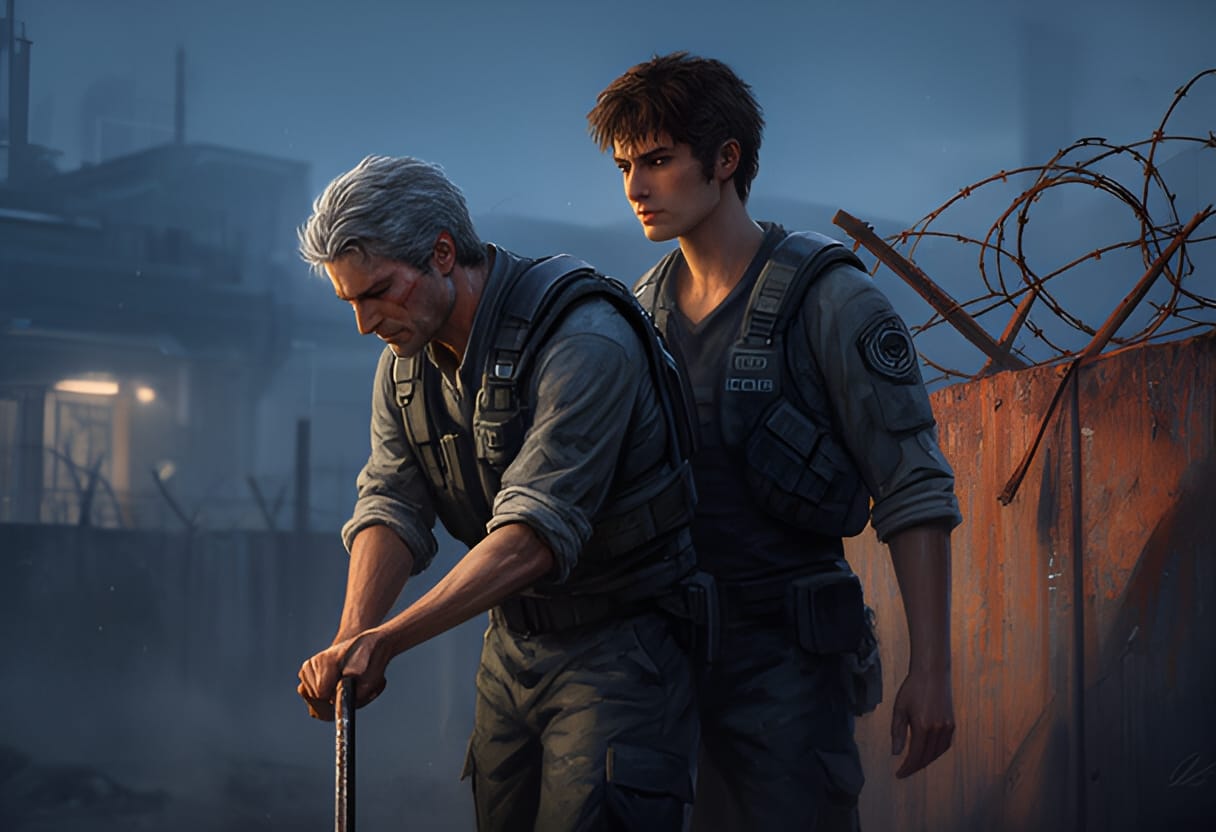
Chapter 11
Echoes of Home
In the birthing chamber, Alex refuses to move forward, overcome by the sight of the pods and the implication of what the Locust are. Zay tries to reason with him, but Alex breaks down, admitting he’s scared—not of dying, but of becoming something less than human in the fight. Zay shares his own fear: that one day he’ll have to choose between mercy and survival. The chapter ends with them clasping forearms, renewing their silent vow to face whatever comes together.
The air tasted of damp stone and old oil, the kind that clung to the back of the throat like a memory you couldn’t spit out. Torchlight guttered along the rough-hewn walls of the outpost’s training yard, casting long, jittery shadows that danced with every gust of wind slipping through the gaps in the corrugated metal siding. Somewhere beyond the perimeter, the low thrum of distant artillery pulsed like a second heartbeat—steady, indifferent, a reminder that the war hadn’t paused for breath, let alone healing.
Alex moved slowly, deliberately, the wooden cane tapping a hesitant rhythm against the packed earth with each step. His left lung still protested with a tight, burning pull whenever he drew too deep, a souvenir from the shrapnel that had kissed his ribs near the mill checkpoint months ago. The medics had patched him, stitched the lung, drained the fluid, but the scar tissue remained—a fibrous web that stiffened with cold and protest. He hid it well, most of the time. Only the cane gave it away. And the way his breath hitched when he thought no one was looking.
Zay watched him from ten paces off, leaning against the rusted frame of an abandoned ammo crate, arms crossed, eyes sharp despite the fatigue etched into his jaw. He’d noticed the flinch—the almost imperceptible jerk of Alex’s shoulders when a recruit dropped a magazine too hard, the way his gaze darted to the treeline at the crack of a distant rifle report, even though they were miles from any known Locust patrol. The Kryll had taken more than skin; they’d left echoes in the nervous system, ghosts in the synapses. Zay knew them well. He carried his own.
But what struck him harder than the flinches was what came after.
Alex didn’t just endure the training—he shaped it.
A trio of recruits stumbled through a low-crawl under barbed wire, their movements stiff, terrified. One boy, no older than seventeen, froze midway, face pressed into the mud, trembling as if the wire might lunge and bite. Alex was there in two strides, cane planted firm, voice low but cutting through the panic like a blade through silk.
“Hey,” he said, not unkindly. “Breathe. In through the nose. Out through the mouth. You’re not dead yet. Act like it.”
The boy gasped, eyes wide. Alex knelt, ignoring the strain in his shoulder, and showed him how to keep his profile small, how to worm forward using elbows and toes, not knees. “You think the Locust care if you’re scared?” he murmured, adjusting the boy’s helmet strap. “They don’t. They only care if you stop moving. So don’t. Not for a second.”
Zay pushed off the crate, boots sinking slightly into the loam. He’d seen Alex like this before—back in the barracks, teaching him how to field-strip a Lancer when their hands were too small to grip the bolt properly. Same patience. Same quiet intensity. Only now, it wasn’t about earning a badge. It was about keeping someone alive.
“Not bad,” Zay said, stepping into the circle. Alex glanced up, a flicker of something—surprise? pride?—crossing his face before he masked it with a smirk.
“Just trying to earn my keep,” Alex replied, rising slowly, using the cane to lever himself upright. His breathing was shallower now, but steady. He didn’t offer an excuse. Didn’t need to.
The recruits straightened, eyes darting between the twins like they were trying to decode a language older than words. Zay fell into step beside Alex as they began the circuit around the yard, observing the next drill—live-fire movement from trench to trench under simulated suppressive fire. Alex paused at each station, correcting grips, adjusting stances, reminding them to check their sectors, to talk, to move as one. His voice never rose, never cracked with frustration. It was calm. Instructive. Human.
When the whistle blew to end the cycle, the recruits slumped, exhaling in unison. Alex waited until the last one had fallen in before turning to Zay, cane tapped once against his boot.
“Still got it,” he said, voice rough but warm. “Not bad for a pair of ghosts.”
Zay let out a short laugh—real, unguarded. It startled a nearby crow into flight. “Don’t get cocky. Half of them still think you’re faking the limp to get out of KP.”
Alex’s grin was tight, but it reached his eyes. “Let them think that. Keeps ‘em guessing.” He paused, gaze drifting toward the horizon where the Jacinto plateau rose like a sleeping god against the bruised twilight. The first stars were pricking through the haze. “We’re still here,” he said, softer now. Not a boast. A statement. A vow renewed, not with clasped forearms this time, but with the quiet weight of presence.
Zay nodded, throat tight. He didn’t speak. Instead, he lifted his hand and clapped Alex once on the shoulder—firm, brief, a gesture that said I see you. I’m here. Alex didn’t flinch. He leaned into it, just for a second, before straightening and turning back to the recruits, already calling out the next instruction.
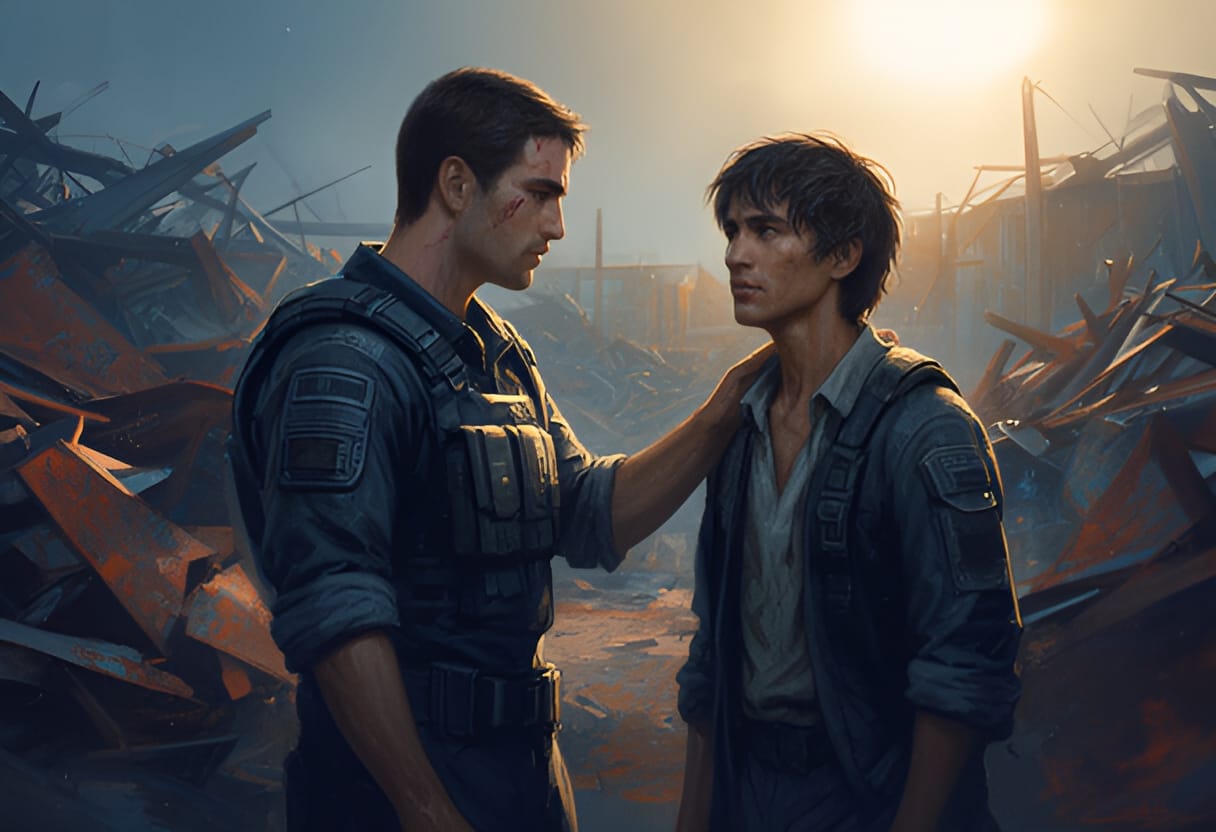
Somewhere, a Locust scout might have been watching. Might have been listening. Might have been counting the breaths between heartbeats.
But here, on this patch of earth scarred by war and stubbornly held, two brothers walked side by side—one with a cane, one with a quiet fire in his chest—and for the first time in a long while, the future didn’t feel like a countdown.
It felt like a chance.
The sun had climbed higher by mid-morning, turning the outpost’s scrap-metal yard into a shimmering heat haze where the air rippled above the corrugated roofs and the sweat on the recruits’ necks caught the light like brine. Training had shifted to close-quarters drills—room clearing in a mock-up of a Civilex apartment block constructed from sandbags, plywood, and scavenged Locust chitin plating. The twins moved through the rotation like twin pistons in a well-oiled engine: Zay taking point with his Lancer at low ready, Alex covering the rear flank, cane tucked under his arm but ready to snap out and strike if needed—though it hadn’t come to that in weeks. Not since the mill.
A fresh batch of recruits filtered through the doorway of the mock structure, faces slick with sweat, eyes wide and darting. Zay held up a fist. The group froze. He pointed to the second doorway on the left—likely a kill zone, based on the scuff marks in the dust and the faint scent of cordite lingering in the air. Alex gave a barely perceptible nod from the rear, eyes scanning the roofline for snipers, though they knew there were none. Not here. Not anymore. But old habits died hard, and in this line of work, hesitation got you killed.
“Stack up,” Zay murmured, voice low but carrying. “Two-by-two. Move fast, stay low. Threat’s likely in the back room—assume booby-trapped entry.”
The recruits fumbled into position, knees bent, weapons up. Alex stepped forward, cane planted, and tapped the shoulder of the kid who’d frozen in the crawl yesterday—Private Renn, barely out of boot camp, hands trembling on his Lancer’s foregrip.
“You good?” Alex asked, voice quiet enough that only Renn could hear.
The boy swallowed. “Yeah. Just… didn’t expect it to feel so… real.”
Alex’s expression softened, just a fraction. “It is real. That’s the point. But fear’s fine. Letting it stop you? That’s what gets you buried.” He tapped the boy’s chestplate twice—once for breath, once for heart. “You’ve got both. Use ‘em.”
Renn nodded, jaw tightening. Alex gave him a shove toward the stack—not unkind, just firm—and fell back into position as Zay gave the signal.
On three, they flowed through the doorway like water breaking a dam.
The first room was clear—empty pallets, a overturned locker spilling ration packs. Zay moved left, Alex right, covering each other’s blind spots with the silent efficiency of men who’d spent years anticipating each other’s breath. The second doorway yawned ahead, darker than it should have been. Zay paused, listening. Nothing but the rasp of recruits’ breathing and the distant whine of a generator cycling down somewhere beyond the wire.
He tapped Alex’s shoulder—two quick presses. Flank left.
Alex melted sideways, cane swinging low to probe for tripwires or pressure plates. His boot scraped something metallic—a spent shell casing, kicked loose from a previous drill. He flicked it aside with his toe, eyes never leaving the threshold.
Zay eased forward, Lancer humming softly as the chainsaw idled. He paused at the edge, peered inside—then froze.
Not a threat. Not a trap.
A child.
No older than six, maybe seven, curled beneath a collapsed bunk in the far corner of the room. Her hair was matted with dust, one bare foot peeking from a torn pant leg. She clutched a frayed stuffed animal—a rabbit, one eye missing—to her chest. Her eyes were wide, not with fear, but with exhaustion. She hadn’t cried. Not yet. Just stared, waiting.
Zay’s throat tightened. He hadn’t seen a civilian this close in months. Not since the evacuation from the transit hub, when the screams had started to fade behind them as the Locust sealed the tunnels.
He held up a hand—halt.
The recruits froze mid-step, weapons tracking, faces tight with confusion.
Alex emerged from the flank, eyes locking on the girl. His expression didn’t shift—no surprise, no horror—but Zay saw it: the minute tightening around his eyes, the way his grip on the cane tightened until his knuckles whitened. He’d seen this before. Not in training. In the hollows beneath Mercy Hospital, when they’d found the woman curled in the drainage pipe, whispering to her dead child. In the school basement, before they’d burned the bodies.
He stepped forward slowly, deliberately, hands empty and visible.
“Hey there,” Alex said, voice rough but gentle, like he was speaking to a spooked animal. “You lost, little one?”
The girl didn’t answer. Just blinked. Her small fingers dug deeper into the rabbit’s fur.
Alex lowered himself to a crouch, wincing slightly as his lung protested the twist. He didn’t reach for her. Didn’t make a sound. Just sat back on his heels, cane laid across his thighs, and waited.
After a beat, the girl whispered, “Mama said not to talk to strangers.”
Alex managed a ghost of a smile. “Smart lady. Your mama’s got good instincts.” He paused, glancing toward Zay, who had withdrawn into the shadows near the doorway, Lancer lowered but alert. “Mind if I sit? This floor’s harder than it looks.”
The girl hesitated. Then, almost imperceptibly, she shifted over—just enough to make space.
Alex didn’t thank her. Just settled in, shoulders relaxed, gaze soft. “You know,” he began, voice low, “I used to have a sister. Well—not really. But I wished I did. Someone to share my fries with. To yell at me when I stole the covers.” He paused, listening to the ragged rhythm of her breathing. “She’d have liked this rabbit. Missing eye and all. Gives it character.”
A flicker. The girl’s eyes darted to the rabbit, then back to him.
“Her name’s Bess,” she whispered.
“Bess is a fine name,” Alex said. “Strong. Sounds like she could wrestle a Brumak and win.”
A ghost of a smile touched the girl’s lips. Then faded.
“Where’s your mama?” Alex asked, gentle as laying a cloth on a wound.
The girl looked down. “Took the sky bus. Said it was safe.”
Alex’s breath hitched—just slightly. He didn’t show it. “Sky bus, huh? Must’ve been quite the ride.” He paused. “You know what I think? I think she knew you’d be brave enough to wait. That you’d hold on until someone came.”
The girl’s lower lip trembled. She didn’t cry. But she pulled the rabbit tighter.
Alex reached slowly, deliberately, into his pocket. Pulled out a small square of wrapped ration bar—peanut butter, his favorite. He broke it in half, offered one piece.
“For Bess,” he said. “She looks like she’s earned it.”
The girl stared at the offering. Then, with the solemnity of a diplomat accepting terms, she took it. Didn’t eat it. Just held it in her small fist like a promise.
Alex stayed until the drill resumed—until Zay tapped his shoulder twice, signaling it was time to move. He rose slowly, offered his hand. The girl hesitated, then placed hers in his. Calloused, warm, scarred from shrapnel and sand and too many triggers pulled. She stood, wobbly, and Alex kept his grip until she found her balance.
“Stay low,” he murmured. “And if you see someone in blue armor—someone who looks like me, but taller and uglier—tell them Alex sent you. They’ll know what to do.”
She nodded. Didn’t let go of the rabbit.
As they rejoined the stack, Zay fell into step beside him. Didn’t speak. Just matched his pace, eyes forward.
The recruits cleared the room without incident—no threats, no traps. Just empty space and the echo of their own adrenaline. But as they fell back into formation for the next iteration, Zay finally spoke.
“You didn’t have to do that.”
Alex shrugged, though his shoulder tensed slightly under the weight of the Lancer. “Didn’t have to. Chose to.”
“It compromised the drill. Broke protocol.”
Alex glanced at him, eyes sharp beneath the sweat and dust. “Protocol doesn’t walk into a room and find a kid hiding under a bunk. People do.”
Zay looked away, jaw working. “We’re not here to be social workers, Alex. We’re here to train soldiers. To survive.”
Alex stopped walking. Forced Zay to do the same. The recruits continued ahead, unaware, already resetting for the next run.
“We are soldiers,” Alex said, voice low but edged with something older than anger—something like sorrow, or resolve. “But if we forget why we’re fighting… what’s the point?”
Zay opened his mouth—to argue, to remind him of the birthing chamber, of the pods, of the choice between mercy and survival—but Alex held up a hand.
“I know what you’re going to say,” he said. “And I’m not saying we stop being hard. I’m saying we don’t let the hardness eat us whole.” He tapped his chest, over the scar where the adrenaline shot had burned through. “This isn’t just about lungs, Zay. It’s about what’s left when the shooting stops. If all we are is what we do to survive… then we already lost.”
A Locust drone screeched in the distance—real this time, sharp and close enough to make the recruits hit the dirt. But neither twin moved. Didn’t flinch. Just stood there, two silhouettes against the rising sun, the war pressing in from all sides.
Then Alex exhaled, long and slow, and clapped Zay on the shoulder—same as before, same weight, same meaning.
“We’re still here,” he said.
And this time, Zay didn’t just hear it.
He felt it.
By afternoon, the drills had shifted to live ammunition—controlled bursts downrange at the sandbag berms, where the crack of Lancers and the occasional pop of a Snub pistol rang out like a language of steel and fire. The twins oversaw the rotation from a shaded observation post built from sandbags and a collapsed drone hull, Zay spotting through binoculars, Alex coaching from beside him, cane resting across his knees.
A recruit—Private Kell, broad-shouldered and eager—stepped up to the line. His grip was too tight, his stance too squared, like he was bracing for a tackle instead of preparing to fire.
Alex leaned forward. “Elbows in. Not wings. You’re not flying, Kell. You’re shooting.”
Kell adjusted, awkwardly. Alex waited. Then, when the boy exhaled and squeezed the trigger—three ragged bursts that jerked the barrel skyward—Alex didn’t correct him outright. He waited for the echo to fade, then spoke.
“Again. But this time—feel it. Don’t fight the kick. Let it come. Then bring it back. Like you’re shaking hands with someone you trust.”
Kell blinked. “You want me to… like the recoil?”
Alex let out a short laugh. “No. I want you to know it. Like you know the weight of your brother’s hand on your shoulder when things go sideways. Recoil’s just the gun saying hello. You don’t have to like it. Just don’t be scared of it.”
Kell nodded, reset. This time, his bursts were tighter. Not perfect. But controlled. He looked over, eyes bright.
“Did I… did I do okay?”
Alex studied him a moment. Then tapped the boy’s helmet—once, firm. “You’re getting there. Keep listening.”
Zay lowered the binoculars, a quiet pride warming his chest despite the grit in his teeth. He turned to Alex. “You’re good at this.”
Alex shrugged, eyes still on the line. “Had a good teacher.”
Zay didn’t miss the implication. He glanced down at his own hands—calloused, scarred, the nails bitten quick from stress. “We both had the same one.”
Alex didn’t look at him. But his voice, when it came, was quieter than before. “Yeah. We did.”
They fell silent, watching the recruits cycle through. A gust kicked up dust across the berm, stinging the eyes, carrying the tang of burnt powder and hot metal. Somewhere behind them, a mechanic cursed as a generator sputtered. A medic passed with a tray of saline packs, eyes tired but steady.
Alex shifted slightly, adjusting the cane against his thigh. His breathing was shallower now—afternoon heat always made it worse—but he didn’t complain. Didn’t adjust his stance. Just breathed through it, slow and even, like he’d learned to do in the dark tunnels when the Kryll had pressed close and panic had threatened to swallow him whole.
Zay noticed. Always noticed.
He reached into his vest pocket, fingers brushing the folded letter tucked inside—the one from their mother, the one he’d carried since the armory, the one he’d pressed to Alex’s chest that night in the subway when the world had ended and begun all at once. He didn’t take it out. Just felt its presence, a solid weight against his sternum.
Alex must have felt it too. Because without looking, he lifted his own hand—slow, deliberate—and placed it over Zay’s where it rested on his knee. Not a squeeze. Not a shake. Just contact. Skin to skin, through fabric, warm and real.
Zay turned his head. Alex’s eyes were on the range, but his lips were barely moving.
“Still here,” he whispered.
Zay covered his brother’s hand with his own. Held it there.
And for a long moment, neither of them spoke.
They didn’t need to.
Evening bled into the outpost like ink in water—slow, inevitable, staining the sky with bruised purples and the last molten gold of sunset. The training had wound down. Rifles were cleared, barrels swabbed, gear stacked in the armory tent under the watchful eye of a weary supply sergeant who muttered about lost pins and bent magazines. The recruits were dismissed to chow, their laughter and shouts fading as they trudged toward the mess line, already forgetting the drills, already dreaming of sleep.
The twins stayed behind.
They walked the perimeter together—not on duty, not on patrol, just walking. The cane tapped a soft rhythm beside Zay’s boot. The fence line was a patchwork of sandbags, concertina wire, and salvaged Locust plating, threaded with flickering floodlights that cast long, trembling shadows. Locust patrols had been spotted two klicks east yesterday—nothing major, just a scouting party of Drones and a Wretch handler—but the wire had been reinforced, the mines re-armed, the listening posts double-manned. Standard procedure. Vigilance, not panic.
Alex paused at a gap in the fence where a section of wire had sagged under the weight of a fallen branch. He crouched, fingers tracing the frayed strands.
“This’ll need re-tensioning by first light,” he murmured.
Zay leaned against the post, watching him. “You don’t have to do that.”
Alex didn’t look up. “Someone’s gotta.”
“You’ve got medics checking your lung every other day. You’re not on the rota for perimeter maintenance.”
Alex finally looked up, eyes calm but firm. “I’m not broken, Zay. I’m just… bent. And bent things can still hold weight.”
Zay opened his mouth—to argue, to insist, to say let me carry this—but Alex stood before he could speak, dusting off his knees with a slow, deliberate motion.
“Besides,” Alex said, voice lighter now, “I like it out here. Quiet. Lets me think.”
Zay studied him—really studied him. The way the fading light caught the gray at his temples, the way his jaw tightened when he breathed in too deep, the way his left hand occasionally curled inward, as if remembering pain that wasn’t there anymore. But also the way his shoulders weren’t hunched against the world. The way he stood, not braced for impact, but present. Aware. Alive.
“You’ve changed,” Zay said softly.
Alex snorted, but there was no humor in it. “Yeah. Funny how getting blown up does that.”
“No,” Zay said. “Not that. You’re… softer. But stronger. Like the metal after it’s been forged.”
Alex looked away, out toward the darkening hills where the first stars were beginning to show. “I used to think being hard was the only way to stay alive. That if I let anything in—fear, doubt, even love—it’d make me weak. Slow me down. Get me killed.”
He paused, swallowing. “But down in those tunnels… when I saw those pods… when I thought I was becoming something else… I realized I was already losing myself. Not to the Locust. To the idea that I had to stop being me to survive.”
Zay swallowed. His throat felt thick. “And now?”
Alex looked at him—really looked—and for the first time in months, Zay saw not the soldier, not the wounded man, not the brother who’d nearly died in his arms, but Alex. The boy who’d stayed up late to fix his bike. The one who’d burned the toast trying to make breakfast for their mom. The one who’d whispered “…M…om…” in the dark, not as a plea, but as a promise.
“I’m learning,” Alex said, “that being soft doesn’t mean being weak. It means you’re still human. And maybe… that’s the only thing that’ll keep us from becoming what they are.”
Zay reached out. Didn’t speak. Just placed his hand on Alex’s shoulder—same as before, same weight, same silent language.
Alex leaned into it. Just for a second. Then straightened, cane tapping once against the dirt.
“Come on,” he said. “Let’s get something to eat before the cooks throw out the mystery meat.”
They walked back toward the mess tent in silence, shoulders occasionally brushing as they moved. The wind had picked up, carrying the distant rumble of artillery and the faint, metallic tang of ozone—signs that the war was still breathing, still hungry. But here, between them, in the space of a touch, a shared glance, a quiet step in unison—there was something else.
Something that hadn’t been broken.
Not yet.
Later, after chow—after the lukewarm stew and the stale bread and the lukewarm coffee that tasted like burnt regret—Zay found Alex sitting on the rear step of the supply tent, back against the canvas, cane laid across his lap, head tilted back, eyes closed. The last light had faded. Now only the glow of lanterns and the distant flicker of fires beyond the wire painted the world in monochrome.
Zay didn’t wake him. Just sat down two steps below, shoulders resting against the tent pole, and watched his brother breathe.
It was uneven still—shallow on the inhale, a slight catch on the exhale—but it was there. Steady. Persistent.
He thought of the birthing chamber. Of the pods. Of Alex’s whispered fear: not of dying, but of becoming something less than human.
He thought of the girl in the mock room—Bess, with her one-eyed rabbit—and how Alex had sat in the dirt and spoken to her like she mattered.
He thought of the way Alex had corrected Kell’s stance, not with anger, but with the kind of patience that only comes from having been broken and choosing, anyway, to help someone else stand.
He thought of the letter pressed to his chest, the one that smelled faintly of lavender and home, and how Alex had mirrored his chest-tap signal with that feeble shake of his hand—I’m still here. I’m still me.
And he thought, not for the first time, that survival wasn’t just about drawing breath.
It was about what you did with it.
Alex stirred, blinking awake. He didn’t startle. Just blinked slowly, owlish, as if surfacing from deep water.
“You still on watch?” he asked, voice rough with sleep.
Zay shook his head. “Just making sure you didn’t stop breathing in your sleep.”
Alex let out a breath that was almost a laugh. “Funny. I was about to say the same thing.”
They looked at each other—really looked—and in that dim light, with the war humming at the edges of the world, Zay saw it: not the ghost of what they’d lost, not the shadow of what they feared, but the quiet, unyielding truth of what remained.
Alex shifted, wincing slightly as he pulled the cane into his lap. He didn’t offer excuses. Didn’t minimize it. Just said, “Still hurts sometimes. When it’s cold. When I laugh too hard.”
Zay nodded. “I know.”
Alex was quiet for a beat. Then, softly: “You ever wonder if we’ll ever not be at war?”
Zay looked out past the tent, where the sentinel lights swept their slow arcs across the wire. “Every day.”
Alex nodded. “Me too. But… I also wonder what it’ll feel like when we’re not.”
Zay turned to him. “What do you think it’ll feel like?”
Alex stared at his hands—calloused, dirty, alive. “Like this,” he said. “Like being able to sit on a step and not think about the next threat. Like being able to breathe without counting it. Like being able to look at my brother and not see a casualty waiting to happen.”
He paused. Then, quieter: “Like being able to believe we deserve peace.”
Zay didn’t have an answer. Didn’t have a promise to make. The war wasn’t over. The Locust were still under the earth. The sky still rained fire sometimes. And tomorrow, they’d be back on the line—training, watching, bleeding if they had to.
But for now, in this moment, with the night air cool on their skin and the weight of the day settling like dust, he reached over and squeezed Alex’s knee—once, firm, just above the scar where the shrapnel had entered.
Alex covered his hand with his own. Held on.
And neither of them let go.
Not yet.
Not until they had to.
Zay stayed where he was, back against the tent pole, Alex’s hand warm and steady over his own. The night air had deepened, pulling the last vestiges of daylight from the sky, leaving only the dim glow of lanterns and the distant, angry pulse of fires beyond the perimeter wire. Somewhere, a mortar round thudded low and far—felt more than heard, a vibration in the soles of his boots. But here, in the narrow slice of space between the supply tent and the darkening earth, there was only the rhythm of their breathing, the press of palm to palm, and the quiet understanding that some things, however frayed, still held.
Alex shifted first, fingers loosening just enough to turn his hand, palm up, beneath Zay’s. A silent question. Zay answered by threading their fingers together, grip light but firm—a promise returned in kind. Alex exhaled through his nose, a soft release of tension, and let his head tilt back against the canvas. His eyes stayed closed. The scar along his jaw caught what little light there was, a pale thread in the dusk.
They didn’t speak. Didn’t need to. The weight of the day—of the birthing chamber, of the spores, of the promise remade in blood and silence—settled between them not as a burden, but as an anchor. Zay let his thoughts drift, not to the fight ahead, but to the texture of this moment: the coarse weave of the tent pole against his shoulder, the faint scent of oil and dried sweat on Alex’s skin, the way the lantern light made the hollow of his brother’s throat pulse with each shallow breath.
Inside the tent, voices murmured—cooks closing up, a private humming off-key, the clatter of a mess kit being stacked. Normal sounds. Fragile. Precious.
Alex stirred again, shifting his weight. “You think they’ll have anything warm left?” he asked, voice rough with sleep and disuse.
Zay opened his eyes. “Doubt it. But we can check.”
Alex nodded, slow, like every movement cost him something. He pushed himself up using the tent pole for leverage, cane snapping into place under his left arm with a familiar click. Zay rose beside him, shoulders brushing as they turned toward the mess tent.
The walk was short, but the world felt stretched thin—like fabric pulled too tight over a frame. The wind had dropped, leaving the air thick with the smell of burning imulsion and something sharper, acrid—ozone, yes, but also the tang of scorched metal and distant plasma. The sentinel lights swept their slow arcs across the wire, painting the barracks in stuttering gold and shadow. Somewhere nearby, a gear coughed, then spat into the dirt. A baby cried, muffled behind a flap of canvas.
They reached the mess tent flap. Inside, the space was half-lit, tables pushed aside, pots stacked upside down on the serving line. A single lantern hung from the center pole, its glow pooling over a tray of cold stew and a loaf of bread gone stiff at the edges. Two cooks—privates Zay didn’t recognize—were wiping down surfaces with rags, movements slow, weary.
“Anything hot?” Alex asked, voice quieter than he meant it to be.
One of the cooks looked up, eyes tired behind smudged goggles. “Soup’s got a skin on it. Bread’s like chewing bark. Coffee’s… well, it’s brown and wet. Take your pick.”
Alex managed a half-smile. “We’ll take the bark and the brown wet.”
The cook snorted, turned back to his work. Zay reached for a chipped bowl, ladled out what stew he could—mostly liquid, a few floating bits of carrot and mystery meat—and broke off a hunk of bread. Alex took his without a word, already turning toward the flap.
“Not hungry?” Zay asked, falling into step beside him.
Alex shrugged, jaw tight. “Not really. Just… didn’t want to sit alone.”
They walked in silence past the aid tent, where the flap was closed and a single lantern burned inside. Past the ammo locker, where two guards leaned against the wall, rifles loose in their hands, eyes heavy. The perimeter wire hummed faintly in the distance—a sound felt in the teeth more than the ears—and above them, the sky was a bruised violet, streaked with the first faint pricks of stars.
They found a spot behind the supply tent, where the ground leveled out and the canvas created a windbreak. Alex sat with a grunt, cane laid across his thighs, bowl balanced on his knee. Zay sat beside him, shoulder almost touching, and began to eat.
The stew was lukewarm, thin, lacking salt. The bread was dry enough to scrape the roof of his mouth. But it was food. It was theirs. And for a few minutes, the world narrowed to the act of chewing, the warmth of the bowl in his hands, the quiet presence of his brother beside him.
Alex finished first. He sat back, hands resting on his thighs, head tipped back to stare at the canvas roof. “You ever think about how weird it is?” he said, voice low. “That we’re sitting here, eating army slop, while the world’s literally falling apart beneath us?”
Zay swallowed. “All the time.”
Alex let out a breath that wasn’t quite a laugh. “Feels like we’re pretending. Like if we just keep doing the small things—eating, sleeping, telling dumb jokes—then maybe the big bad won’t notice we’re still here.”
Zay looked at him. “It’s not pretending. It’s resistance.”
Alex turned his head, eyes searching Zay’s in the dim light. “Yeah? Feels like denial sometimes.”
“Maybe,” Zay said. “But denial keeps you from jumping off the cliff. Resistance means you see the cliff—and you still choose where to put your feet.”
Alex was quiet for a long moment. Then, softly: “You always did have a way with words.”
Zay shook his head. “Just stating what I see.”
Alex let out a humorless chuckle. “Yeah. Well. Thanks for seeing me.”
They sat like that for a while—shoulders nearly touching, eyes on the dark horizon where the war breathed and waited. The wind picked up again, rustling the tent flaps, carrying with it the faint echo of voices, a laugh cut short, the metallic scream of something dying far off.
Then, from inside the supply tent—a sound.
Not a voice. Not a shout.
A pluck.
Soft. Uncertain. A single note, vibrating in the stillness.
Zay froze, bowl halfway to his lips. Alex went rigid beside him, cane slipping slightly on his thigh.
Another note. Then a second, hesitant, searching. A chord—barely there, fingers fumbling over strings.
Someone was playing a guitar.
Zay set his bowl down slowly, not taking his eyes toward the tent flap. Alex didn’t move either, but Zay felt the shift in him—the coiled tension, the sudden stillness, like a wire drawn tight.
Inside the supply tent, the music continued—halting, awkward, but unmistakable. A melody Zay knew. Not from the radio. Not from any barracks sing-along.
Their father’s song.
He’d heard it only a handful of times—on porch swings in the humid dusk of Edin, on winter nights when the power flickered and they’d huddle under blankets with mugs of cocoa, on the morning before the draft came, when their father had sat on the back step, eyes closed, fingers finding the chords like they were second nature.
It was simple. Three chords, repeating. A lullaby, really. Something he’d made up, or maybe remembered from his own father. Alex had been six when he first asked to learn it. Zay had been twelve, already too cool to admit he’d sat cross-legged on the grass and tried to pick it out by ear.
Now, someone was trying to play it again.
And it was Alex’s hands—Zay knew it even before he saw them—that were fumbling over the strings.
He rose silently, bowl forgotten, and moved to the tent flap. Pulled it back just enough to peer inside.
The interior was dim, lit only by a single lantern hanging from a beam near the back. Stacks of crates and barrels cast long shadows. And there, on a low stool near the wall, sat Alex.
He was barefoot, one boot kicked off beside him, the other still laced but loose. His injured shoulder was braced against his ribs, arm curled protectively. In his lap rested an old acoustic guitar—wood worn smooth at the edges, finish faded to a soft gray, one tuning peg wrapped in frayed wire. It looked like it had been dragged out of a locker, maybe forgotten during the rush to arm up, or left behind when the barracks were evacuated years ago.
Alex’s fingers hovered over the strings, then pressed down—too hard, too far back—and the note buzzed, dead. He winced, shifted his grip, tried again. The note rang this time, clear but thin, trembling in the air like a held breath.
Zay stayed where he was, pressed against the canvas, heart hammering not from fear, but from something deeper—something that had been scraped raw in the birthing chamber and had yet to scab over.
Alex played the first chord again. Then the second. His brow was furrowed, tongue poking slightly from the corner of his mouth in concentration. He got halfway through the progression before his fingers slipped, the chord collapsing into a dissonant scrape.
He cursed under his breath—low, harsh, immediate—and let his hands fall to his lap, shoulders curling forward.
Zay didn’t move. Didn’t speak. Just watched as Alex sat there, head bowed, fingers splayed over the strings like they’d betrayed him.
Then, after a long breath, Alex tried again.
This time, he started slower. Thumbed the bass note—felt it, rather than heard—and let the rest follow. The chord rang, uneven but true. He moved to the next, then the next, each transition a struggle, each success a small victory. His face was tight with effort, eyes closed now, not in despair, but in focus. In memory.
Zay let himself listen.
Not as a soldier. Not as a brother on watch.
But as the boy who’d lain on his bunk years ago, listening to his father play this same tune while rain tapped the roof, and Alex had slept curled against his side, thumb in mouth, breathing soft and sure.
The melody wasn’t complex. Just a loop of three chords, rising and falling like a tide. But in that moment, with the war raging beyond the wire and the ghosts of Hollows still whispering in his blood, it felt like the most honest thing he’d ever heard.
Alex played it through twice. The third time, he hummed along—low, rough, untrained—but the tune was there, carried on breath and blood and something older than fear.
When he finished, the last note faded into silence. He didn’t open his eyes right away. Just sat there, hands resting on the guitar, chest rising and falling with effort.
Zay stepped back from the flap, let it fall closed, and moved silently to the front of the tent. Pulled it open, stepped inside.
The lantern light caught the dust in the air, made it swim like tiny stars. Alex didn’t look up at first. Just kept his eyes on his lap, fingers still curled around the neck of the guitar.
Zay stopped a few paces away. Didn’t reach for it. Didn’t offer praise. Just stood there, hands loose at his sides, and let the quiet settle.
When Alex finally lifted his gaze, it was wary. Expecting judgment. Expecting teasing. Expecting the older brother to say, You suck, or Where’d you even find that thing?, or nothing at all—just a look that said pathetic.
Instead, Zay gave a single, slow nod.
“He’d be proud,” he said.
Not loud. Not for show. Just enough for Alex to hear, in the hush between breaths.
Alex’s breath hitched. His eyes flicked to Zay’s face—searching, disbelieving—and then dropped back to the guitar. His throat worked. He opened his mouth, closed it. Tried again.
“I kept my promise,” he whispered. The words were barely there—more vibration than sound—but Zay caught them. Felt them.
Alex’s promise. Made years ago, when they were kids and their father had handed him the guitar and said, Learn this. Play it for me when I’m gone. Not a command. A request. A trust.
And Alex had carried it. Through basic. Through the frontier skirmishes. Through the long months of waiting, training, pretending they weren’t counting the days until the war came.
He’d kept it safe. Hidden it. Waited for the moment—not to play it well, but to play it true.
And now, in a supply tent on the edge of a dying city, with his brother watching and the war holding its breath, he had.
Zay didn’t reach out. Didn’t pull him into a hug. Didn’t say I know or It’s okay or anything that would break the spell.
He just nodded again. Once. Firm.
Alex looked up then, eyes bright in the lantern light, and managed a watery smile. “Told you I’d learn it.”
Zay’s own throat tightened. He swallowed. “Yeah,” he said. “You did.”
Alex let out a shaky breath and, with infinite care, set the guitar down beside him on the stool. Not carefully. Not roughly. Just… placed it. Like putting down a friend who’d done their duty.
He rubbed his palms over his thighs, then looked at Zay. “Think they’ve got any more of that bark bread?”
Zay let out a breath he hadn’t realized he’d been holding. “I’ll check.”
He turned, pushed the flap open, and stepped back into the night.
Alex stayed where he was, hands resting on his knees, head tipped back against the stool. The lantern light painted his face in soft gold and shadow. His breathing was still uneven—shallow on the inhale, a catch on the exhale—but it was there. Steady. Persistent.
Above them, the stars blinked cold and indifferent. Somewhere, a Locust drone clicked its mandibles in the dark. A flare arced over the river, painting the clouds in brief, hellish light.
But here, in this tent, with the ghost of a song still hanging in the air and the weight of a promise kept settling deep in his bones, Alex Lopez closed his eyes.
And for the first time in hours, he didn’t think about the next threat.
He just breathed.
And waited.
Zay moved through the supply corridor with measured steps, boots quiet on the packed earth floor. The air here was cooler, damper—seeped in from the outer walls where the trench met the bedrock. Lanterns hung at intervals, their light sputtering slightly in the draft, casting long, jumping shadows that made the stacked crates look like hunched figures waiting to move.
He passed the ammo locker—sealed, guarded by a half-awake private who gave him a curt nod without looking up—and turned toward the mess tent’s supply annex, where the cooks kept the dry goods and the day-old bread that wasn’t quite moldy enough to throw out.
The flap was open. Inside, Maribel Ruiz, the mess sergeant’s assistant, was bent over a bin of hardtack, sorting the edible from the tooth-chipping. Her dark hair was tied back with a frayed strip of cloth, her sleeves rolled to the elbows, revealing forearms corded with muscle from hauling sacks and stirring vats of stew that never seemed to feed enough.
“Looking for the bark bread?” she said without straightening. Her voice was rough from smoke and shouting, but not unkind.
Zay leaned against the frame. “If it’s not going to make us sick.”
She snorted, tossing a misshapen lump into a separate bin. “Define sick. It’ll give you gas for three days and make your teeth feel like they’re sweating, but it won’t kill you. Not today, anyway.”
He pushed off and stepped inside, ducking under the low beam. The air smelled of flour dust, dried beans, and the faint, sweet rot of overripe fruit buried beneath the sacks. “How’s the pot?” he asked, nodding toward the iron cauldron bubbling on the stove in the corner.
Maribel wiped her hands on her apron, leaving streaks of dirt and something darker. “Thin. Stretching the peas again. Added some of that tuber the scouts dug up near the old rail line—tastes like dirt, but it fills the belly.” She paused, eyes narrowing slightly. “You look like you’ve seen a ghost.”
Zay didn’t deny it. “Alex found a guitar.”
She blinked. Then, slowly, a smile tugged at the corner of her mouth. “Yeah? The old one from Locker 17? Took me twenty minutes to dig it out from under the collapsed shelving last week. Figured it was junk—wood’s warped, one string’s held together with prayer and duct tape.”
“He played our father’s song.”
Maribel went still. The rag hung from her hand. Her eyes, when they lifted, were soft. “Your pa used to play that on the porch when the crickets started. Said it was the sound of the world winding down proper.”
Zay nodded. “Alex said he was gonna learn it. Before… before all this.”
She turned back to the bin, but her shoulders were looser now. “Kid’s got a stubborn streak a mile wide. Reminds me of his ma—used to hum that tune while she shelled peas. Said it kept the bad thoughts out.” She glanced over her shoulder. “He play it alright?”
Zay hesitated. “Not clean. Fingers kept slipping. But he got through it.”
Maribel nodded, satisfied. “Then he did it right. Ain’t about the notes. It’s about showing up.” She grabbed a sack and tore it open, pouring the contents into a bin. “Here—take this. It’s the last of the bark bread that ain’t actively trying to bite back. Tell Alex to eat slow. And if he starts singing again… tell him his ma would’ve liked to hear it.”
He took the sack—coarse burlap, rough against his palms—and nodded. “Thanks.”
She gave him a sharp, brief salute with the rag. “Now get outta here before I put you on peeling duty.”
He ducked back into the corridor, the sack slung over one shoulder. The night had deepened. The wind had dropped, leaving the air still and heavy, charged with the low thrum of distant artillery and the occasional, wet screech of something large moving in the dark below.
He didn’t go straight back to the supply tent. Instead, he veered toward the eastern perimeter, where the wire ran close to the old drainage culvert—a place the twins had used during their first night out, when they’d carried Jace and crawled through sludge to escape the Kryll.
A sentinel paced the catwalk above, rifle tucked in the crook of his elbow, eyes scanning the dark. Zay didn’t call out. Just waved a hand once, low, and kept walking.
He found what he was looking for halfway down the culvert’s mouth—a shallow niche in the stone, half-hidden by a tangle of roots and a rusted piece of rebar. Inside, wrapped in an oilskin that had once belonged to their father’s field jacket, lay a small, battered tin.
He’d stashed it there weeks ago, during one of their rare quiet mornings before the first rumors of underground movement had started. Not for himself. For Alex.
He pulled the oilskin back, wiped the dirt from the tin’s lid, and opened it.
Inside: two peppermints, wrapped in wax paper, slightly sticky from heat; a smooth river stone Alex had picked up when they were ten and insisted was lucky; and a folded square of paper, worn at the creases.
Zay didn’t take the mints or the stone. He unfolded the paper.
It was a drawing. Not much to look at—just stick figures, really. Two tall ones holding hands, a smaller one between them, and a sun with a face grinning in the corner. At the bottom, in wobbly block letters: Me and Zay and Alex. We are safe.
He’d found it in the rubble of St. Cyril’s after they’d cleared the basement, clutched in the fist of a little girl who hadn’t made it out. He’d kept it ever since.
He traced the edge of the drawing with his thumb, then folded it back carefully, tucked it into the tin, and closed the lid.
He didn’t take it with him. Some things were better left where they were—anchors, not burdens.
He stood, tucked the oilskin back into place, and turned back toward camp.
The walk was quiet. No voices. No movement. Just the crunch of gravel under his boots and the occasional whisper of wind through the wire.
When he reached the supply tent, he pulled the flap open and stepped inside.
Alex was exactly where he’d left him—on the stool, hands in his lap, head tipped back. The guitar sat beside him, silent. The lantern had burned low, its flame guttering in a pool of wax.
Zay didn’t speak. Just crossed the space and set the sack of bread down at Alex’s feet.
Alex’s eyes opened. Slow. Heavy-lidded.
Zay nodded toward the sack. “Maribel said to eat slow. And not to choke on it.”
A ghost of a smile touched Alex’s lips. He looked down at the bread, then back up. “She still mad about the time I spilled the gravy boat?”
Zay let out a breath that was almost a laugh. “She’s still making you scrub pots for it.”
Alex looked down at his hands—calloused, grimy, the nails broken and dirty. He flexed his fingers once, then reached for the sack. Untied the top, pulled out a chunk of the dense, dark bread. It was heavy, damp in places, flecked with bits of bark and something that might have been nut husk.
He broke off a piece and held it out.
Zay shook his head. “You first.”
Alex hesitated, then took a bite. Chewed slowly. His face didn’t change—didn’t wince, didn’t grimace—but Zay saw the tension in his jaw, the way his throat worked as he swallowed.
“Tastes like regret and sawdust,” he said finally.
Zay sat down on the stool beside him, not too close, not too far. “Yeah. But it’s bread.”
Alex took another bite. Then another. The chewing was deliberate, almost ritualistic. Like he was forcing himself to slow down, to be present in the act of eating, of surviving.
When he was halfway through, he paused. Looked at the guitar. Then at Zay.
“You ever wonder,” he said, voice low, “if he heard it? Dad. When I played it?”
Zay considered it. The old man had been gone two years—taken by a fever that ripped through Edin’s East Ward while the twins were at basic. No warning. Just gone.
“I think,” Zay said slowly, “that if he was anywhere near enough to hear it… he stopped what he was doing. Sat down. Closed his eyes. And just listened.”
Alex stared at his hands again. “I hope so.”
A beat of silence. Then, quieter: “I was scared I’d forget how it went.”
Zay shook his head. “You couldn’t forget it if you tried. It’s in your bones. Like the way you still flinch when someone raises their voice too fast. Like the way you save the last bite of your ration for me, even when you’re starving.”
Alex looked up, startled. “I do not.”
“You do.” Zay nodded toward the sack. “You broke off the biggest piece and handed it to me first.”
Alex glanced at his hands, then at the bread. A faint flush crept up his neck. “That’s… that’s just manners.”
“Maybe.” Zay stood, stretched his shoulders. “Or maybe it’s the thing that keeps you from becoming what you’re afraid of.”
Alex didn’t answer right away. He finished the bread, wiped his hands on his trousers, and picked up the guitar. Not to play. Just to hold it—cradeled it against his chest like it was something fragile, something alive.
He sat like that for a long time, eyes half-lidded, listening to the night. The wind had picked up again, rattling the tent flap, carrying with it the faint, metallic tang of ozone and the distant, rhythmic thump of artillery—steady, inevitable, like a heartbeat.
Then, without looking up, he said, “Zay?”
“Yeah?”
Alex’s voice was so low Zay almost missed it. “If… if I don’t make it out of this. If I go down somewhere dark and quiet, and no one’s there to see it…”
Zay knelt in front of him, resting his elbows on his knees. “Hey.”
Alex finally looked up. His eyes were wet, but his gaze was steady.
“You tell Dad,” he said, voice raw, “that I kept my promise.”
Zay didn’t speak. Didn’t offer platitudes. Just reached out and squeezed Alex’s shoulder—once, firm, the same way he had on the step, the same way he had in the dirt, the same way he had when Alex had first whispered “…M…om…” in the dark.
Alex leaned into it. Just for a second. Then nodded.
Zay stood. “Now get some sleep. We’ve got a long walk tomorrow.”
Alex didn’t move right away. He just sat there, guitar in his arms, eyes on the dim light.
Then, softly: “You think they’ll ever play that song again? After all this?”
Zay paused at the flap. Looked back.
“I don’t know,” he said. “But if they do… I hope it sounds like this.”
He stepped out into the night, leaving the flap open just enough to let the lantern light spill onto the ground—a small, trembling pool of gold in the dark.
Alex didn’t follow. Didn’t call out.
He just sat in the quiet, holding the guitar, and let the memory of the tune carry him—not away from the war, but deeper into himself, where the boy who’d once burned toast for his mother still lived, still breathed, still believed, against all odds, in the quiet, unyielding truth of what remained.
And somewhere, beneath the weight of the world, a single note hung in the air—not played, not sung, but felt.
Like a vow.
Like a breath.
Like a promise kept.
Morning light filtered through the flaps of the supply tent, thin and gray as old gauze. The air still smelled of damp wool, boiled beans, and the faint, sharp tang of cordite from last night’s skirmish on the ridge. Zay sat on the edge of his cot, laces loose on his boots, elbows on his knees, staring at the dirt-choked floor. The guitar leaned against the tent pole beside Alex, silent now, its wood warm from where his brother had held it all night.
A rustle at the flap made him look up.
Corporal Jace Stratton ducked inside, face smeared with soot and something darker that hadn’t washed out yet. He carried a battered metal satchel, straps frayed, one buckle dangling loose. His eyes flicked to Alex—still seated, guitar cradled, breathing slow and shallow—but he didn’t speak to him. Instead, he set the satchel down hard on Zay’s cot.
“Forwarded from East Evac,” Jace said, voice rough from smoke and shouting. “Civilians. Letters. Stuff they shoved in pockets on the way out. Medics said to pass it up the line if it looked… personal.”
Zay unlatched the satchel. Inside, wrapped in oilcloth, were envelopes of all sizes—some sealed, some torn open at the corner, addresses smudged or missing. A child’s crayon drawing peeked from beneath a stack of notebook paper. A dried flower, brittle and brown, lay pressed between two sheets of lined paper.
He pulled out the top letter. The handwriting was tight, angled, the ink faded where sweat or rain had blurred it.
Private Lopez,
If you’re reading this, you made it to the ridge. Tell your brother we’re safe. The school shelter held. We’re heading north with the convoy. Tell him I kept the bread he gave the boy with the burnt hand. Tell him thank you.
—Maribel Ruiz, Kitchen Staff, East Evac Point
Zay’s throat tightened. He remembered her—flour in her braid, voice sharp but kind, pressing a warm roll into Alex’s palm the night before the bridge fell. He folded the letter carefully, slipped it into his vest pocket, right over his heart.
Below it, another. Then another. Names he didn’t recognize. Messages for sons, husbands, brothers. One was a prayer, written in shaky block letters on the back of a ration label. Another was a list—names of those who didn’t make it out of the nursery ward.
He set them aside, one by one, until his fingers brushed something thicker. He pulled it out.
It was folded into a square, the edges worn soft from handling. The paper was thin, the kind used in school notebooks, and on one side, someone had drawn in thick, wobbly crayon.
Zay froze.
It was a house. Or what was left of one. Flames licked the roof in jagged red and orange, black smoke curling above it like a scream. In front of the house, two tall figures stood side by side, arms linked, hands clasped. One had a helmet marked with a crude skull—Zay’s. The other had a gap-toothed grin scribbled above the collar—Alex’s. Between them, a smaller figure, stick-thin with two dots for eyes and a line for a mouth, reached up toward their joined hands.
Below the drawing, in uneven print that strained to stay inside the lines:
Dear Soldiers,
Thank you for not letting the bad men take us. I hid in the closet under the stairs. I heard the boots and the yelling, but I didn’t come out until you came. You made the loud noises stop. My mommy says you are angels. I drew you holding hands so the bad men can’t pull you apart. I hope you find your mommy and daddy too.
From Lily, Age 6, Miller’s Creek Elementary
Zay’s breath hitched. He looked up. Alex was still sitting where he’d left him, eyes closed, head tipped back against the tent pole, the guitar resting on his lap like a child asleep.
Zay didn’t wake him. Not yet.
He smoothed the drawing on his knee, tracing the edge of the flame with his thumb—feeling the slight ridge of wax where the crayon had built up. The house was gone. The street outside the school was gone. Miller’s Creek was gone. But here, on this slip of paper, it still stood. And so did they.
He cleared his throat. Soft. Low.
“Alex.”
His brother’s eyes opened. Slow. Heavy. But focused.
Zay held up the drawing.
Alex didn’t reach for it. Just looked. His gaze dropped to the figures—the two soldiers, hand in hand, standing firm while the world burned behind them. His finger lifted, hovered, then touched the paper—light as a moth’s wing—over the stick-figure boy reaching up.
“That’s you,” Alex whispered. Not a question.
Zay nodded. “And that’s me.”
Alex’s finger traced the line where their hands met. Then drifted to the small figure below. “That’s Lily.”
“Yeah.” Zay swallowed. “She made it out.”
Alex’s breath hitched—just once. Then he let it out through his nose, slow and deliberate. His eyes stayed on the drawing. On the linked hands. On the flame that hadn’t touched them.
“I used to think,” he said, voice rough, “that if I kept moving, kept fighting, kept making you laugh… that meant I wasn’t becoming what they wanted. That I was still me.”
Zay didn’t speak. Just waited.
Alex’s thumb pressed gently into the paper, over the flame. “But seeing this… it’s not about what I do. It’s about what they see. She didn’t see a weapon. She saw… us. Holding on.”
His voice dropped even lower. “I don’t want to lose that. Not the way they see it. Not the way I see it.”
Zay reached out, not for the drawing, but for Alex’s hand—calloused, grimy, nails broken and dirty from last night’s crawl through the drain. He laced their fingers together, just as they had in the subway, just as they had when Alex whispered “…M…om…” in the dark.
Alex’s grip tightened. Not painfully. Just enough to say: I’m here.
Zay leaned in, voice low enough that only Alex could hear it over the distant thump of artillery and the whisper of wind through the tent flap.
“We’re still holding on,” he said. “Even when no one’s watching.”
Alex didn’t let go. His eyes flicked up, wet but clear. “Even when we’re scared?”
“Especially then.”
A beat. Then Alex gave the smallest nod. His thumb brushed Zay’s knuckle—once—before he slipped his hand free and picked up the drawing again.
He studied it a moment longer. Then, carefully, he folded it along the existing creaks, making the edges neat, tucking the flame inside so it wouldn’t smudge.
When he handed it back, Zay took it—and slipped it into his vest pocket, right beside the worn photograph of their father.
The photo was smooth at the corners from years of being passed hand to hand, carried in pockets, pressed against chests during firefights. The image showed a man in his forties, smiling, one arm around a woman whose face was cut off at the edge—probably their mother. The boys stood in front of him, maybe eight and six, grinning missing-toothed grins, arms slung over each other’s shoulders.
Now, the drawing rested against it. Lily’s crayon house, her stick-figure family, her thanks—pressed flat against the ghost of their father’s smile.
Zay closed his vest over both.
He didn’t speak. Didn’t need to.
Alex picked up the guitar again. Not to play. Just to hold. His fingers found the strings, not plucking, just feeling the tension, the vibration humming up into his palms—a silent conversation with the wood, with the night, with the boy who’d once burned toast and still believed in tomorrow.
Outside, the artillery thumped on. Steady. Inevitable.
Inside the tent, two brothers sat shoulder to shoulder, one with a guitar cradled like a promise, the other with a drawing and a photo pressed close to his heart—two talismans against the dark, two proofs that even when the world burned, something human still endured.
And for now, that was enough.
The weight of the drawing in his pocket was familiar now—not heavy, but present, like the pulse in his wrist when he checked for life after a blast. Zay shifted slightly on the cot, the fabric of his vest rustling against the paper. He didn’t look at it. Didn’t need to. He could feel its edges, the slight bump where the crayon had built up along the flame, the soft fold where Lily’s small hands had pressed it tight.
Alex was still holding the guitar, but his fingers had stopped moving. They lay flat against the strings, damp with sweat and grime, the calluses worn smooth from years of gripping a weapon, not a neck. His breathing had slowed further—shallow, uneven, the kind that came not from exertion but from the body beginning to shut down, to conserve. The medic’s words echoed in Zay’s mind: fluid in the lungs, Imulsion in the blood. He’d seen it before, in refugees near the Imulsion fields—lips blue at the edges, eyes too bright, voice fading to a whisper. Alex hadn’t reached that point yet. But he was closer than he admitted.
A shadow fell across the tent flap. Zay looked up.
Sergeant Mara Velez stood there, silhouetted against the pale morning light. Her armor was streaked with dust and dried mud, one shoulder plate scratched deep where she’d deflected a Boltok round. Her face was lined with exhaustion, but her eyes—sharp, alert—swept the tent, took in Alex’s stillness, the guitar, the satchel of letters half-empty on Zay’s cot.
“Lopez,” she said, voice low, not quite a whisper. “We’re moving out in twenty. Convoy’s forming at the east sally port. Civilians first, then the wounded who can walk. You two are on rear guard with Reyes and Hale. Keep your eyes open. The Locust are probing the flanks. They’ve started using sound—clicks, taps—like they’re learning how we talk.”
Zay nodded. “Understood.”
Velez hesitated. Her gaze flicked to Alex—still seated, guitar cradled, eyes distant but open. She didn’t speak right away. Then, quieter: “He’s fading faster than he should.”
“I know,” Zay said. “Adrenaline helped yesterday. But it’s not fixing what’s underneath.”
Velez nodded once, sharply. “Keep him moving. Keep him talking. The mind holds the body longer than we think.” She paused. “And Lopez? If he starts seeing things that ain’t there… don’t argue. Just bring him back. Use the signal. The chest tap.”
Zay’s jaw tightened. He remembered the subway, the Kryll, Alex’s hand shaking in his grip—a feeble mirror of the tap they’d used since boot camp to say I’m here. I’ve got you. He hadn’t needed to use it since. But he knew it. Knew the weight of it.
“I will,” he said.
Velez gave a single nod, then melted back into the morning light, her boots silent on the packed earth.
Inside the tent, Alex shifted. His head lolled slightly to the side, eyes closing. The guitar slipped a fraction in his lap.
Zay leaned forward. “Hey.”
Alex’s eyes opened. Slow. Heavy. But focused.
“You good?” Zay asked.
Alex swallowed. Took a breath that rattled just a little in his chest. “Yeah. Just… tired. Like my bones are full of sand.”
Zay reached out, not to touch him yet, but to steady the guitar. “You want to lay it down? Rest your arms?”
Alex looked at the instrument like it was something precious, fragile. Then, slowly, he shifted it to the ground beside him, resting it against the tent pole where the wood was still warm from his chest. His hands came to rest on his knees, palms up, fingers slightly curled—like he was holding something invisible.
“You hear that?” Alex said after a moment. His voice was thin, but clear.
“Hear what?”
“The song.” He tilted his head slightly, as if listening to something far off. “Not the lullaby. The other one. The one Dad used to hum when he fixed the roof. Before Mom left. Before… everything.”
Zay frowned. He remembered that tune—a simple, looping melody, no words, just a hum that rose and fell like breath. Their father used to sing it when he was concentrating, when his hands were busy and his mind was free. It wasn’t sad. It wasn’t happy. It was just… there. A sound of being.
“I don’t hear anything,” Zay said gently. “Just the wind. And the guns.”
Alex’s eyes opened fully. They were bright—too bright. There was a distance in them, like he was looking past the tent, past the ridge, past the war.
“It’s there,” he whispered. “Faint. But it’s there. Like someone’s humming it… far away. Through the walls.”
Zay didn’t argue. Didn’t tell him it was the fever, the Imulsion, the lack of sleep. He just leaned in, voice low, steady.
“Then let’s listen to it together.”
He began to hum—soft, unsure at first, trying to match the half-remembered tune from years ago, from before the war, before the losses, before the weight of the world had settled on their shoulders. It was off-key. He knew it was. But Alex’s lips twitched—not a smile, not quite, but a relaxation, like a knot loosening.
Alex joined in. His voice was weaker, thinner, but it found the melody faster. Together, their voices wove the tune—two threads, slightly out of sync, but holding. The notes hung in the air, fragile, easily broken by a shout or a burst of gunfire. But for now, they endured.
When the hum faded, Alex let out a breath. His eyes were wet, but his gaze was steady. “Thanks.”
“Anytime,” Zay said. “We’ll keep humming it. Every morning. Until you can sing it loud enough to wake the dead.”
Alex managed a ghost of a smile. Then his expression shifted. He looked down at his hands—palms up, open. “You ever think about what we’ll tell them? When this is over? Assuming there’s an after?”
Zay considered it. The question wasn’t hypothetical. It was a lifeline. A way to pull Alex back from the edge, to give him something to reach for.
“I’ll tell them,” he said, “that we kept moving. That we didn’t let the dark win. That we held on to each other, even when we couldn’t see the path.”
Alex nodded. Then, quieter: “And what about you? What’ll you tell them about me?”
Zay didn’t hesitate. “That you were the one who remembered the song. That you were the one who shared your last bite. That you were the one who held on to the guitar like it was the last thing tying you to home. That you were brave—not because you weren’t scared, but because you kept going anyway.”
Alex was silent for a long time. Then: “And if I don’t make it?”
Zay met his eyes. The request hung in the air—not a plea for comfort, but a demand for truth. For remembrance.
“I’ll tell them you were my brother,” he said. “And that no matter what happened, you never let go of my hand.”
Alex’s breath hitched. Just once. Then he nodded. Slow. Deliberate. Like he was sealing a vow.
Outside, the tempo of the artillery shifted—closer now, more urgent. The war was coming back to them.
Zay stood, offering a hand. Alex took it, grip weak but firm, and pushed himself up. His legs wobbled for a moment, but he found his balance. He retrieved the guitar, cradling it against his chest like a shield, like a relic.
Zay checked his vest—felt the smooth corners of the photograph, the slight ridge of the drawing. Both still there. Both still intact.
“Ready?” he asked.
Alex looked at him—really looked. Not just at his face, but at his eyes, his stance, the quiet strength in his shoulders. Then he nodded.
“Yeah,” he said. “Let’s go.”
They stepped out of the tent into the full glare of morning. The sky was a washed-out blue, the sun high enough to burn off the last of the night’s chill. The air smelled of scorched earth, cordite, and something green and growing—wild grass pushing up through the cracks in the road, stubborn and defiant.
The outpost was already in motion. Civilians shuffled forward with bundles tied in blankets, elders leaning on children, mothers clutching infants to their chests. Wounded gears leaned on sticks or were carried on makeshift stretchers. Medics moved between them, shouting orders, applying pressure, checking tags.
Zay and Alex fell into step at the rear, shoulders nearly touching, eyes scanning the tree line, the ruined buildings, the folds in the terrain where an enemy could hide. The guitar swung gently against Alex’s back with each step. The drawing and the photo pressed against Zay’s chest, a quiet counterweight to the rifle in his hands.
They didn’t speak. Didn’t need to.
But every so often, Alex would lift his head—just a fraction—and hum a few notes of the tune. Low. Barely there.
And Zay, walking beside him, would hum back.
Not to drown out the war.
But to remind themselves—and anyone who might be listening—that even in the midst of fire, something human still endured.
The convoy moved slowly, painfully so, through the outskirts of Ephyra. Ruined buildings loomed on either side—storefronts with shattered windows, homes with roofs caved in, streets littered with debris and the occasional boot, half-buried in dust. The Locust hadn’t come in force yet—just probes, skirmishers testing the edges—but the tension was thick enough to choke on. Every shadow held a threat. Every silence felt like a held breath.
Alex kept close to Zay’s side, one hand occasionally brushing his arm—not for support, but for connection. His breathing remained uneven, but he didn’t falter. He kept his eyes up, his weapon ready, his grip on the guitar strap tight enough to leave a mark.
Half an hour in, a child’s wail cut through the air—a sharp, broken sound, raw with terror.
Zay’s head snapped toward the source.
A woman stumbled out from behind a collapsed wall, clutching a bundle to her chest. Her face was streaked with tears and dirt, her dress torn at the shoulder. In her arms, a girl no older than four screamed, her face red, her small fists pounding the woman’s collarbone.
“She won’t stop!” the woman gasped, her voice raw. “She’s been crying since the shelling started. She won’t eat, won’t drink—she just screams!”
Zay moved before he could think. He closed the distance in two strides, dropping to one knee in front of them.
“Hey,” he said, voice low and calm, the tone he used with spooked livestock or startled civilians. “It’s okay. You’re safe now.”
The girl didn’t hear him. Her screams intensified, her body arching backward, her eyes squeezed shut.
Zay glanced at Alex. His brother was already moving—no hesitation, no question. He knelt on the girl’s other side, setting the guitar gently on the ground beside him. Then, slowly, he began to hum.
Not the lullaby. Not the roof-tune. Something simpler. A melody Zay didn’t recognize—soft, descending, like a sigh made sound.
The girl’s screams didn’t stop immediately. But they faltered. Her breathing hitched. Her eyes fluttered open—just a slit—and locked onto Alex’s face.
He kept humming. His eyes never left hers. His expression was open, vulnerable—no humor, no shield, just pure presence.
After a few breaths, the girl’s cries softened. Her fists unclenched. Her breathing began to sync—just slightly—with the rhythm of the hum.
Zay watched, transfixed. He’d seen Alex use humor to deflect fear, sarcasm to mask pain, loyalty to anchor himself in chaos. But this—this was something else. This was Alex using his voice not as a weapon, not as a shield, but as a bridge. Reaching across the terror and pulling someone back.
The woman stared, tears streaming silently down her cheeks. “How… how did you know?”
Alex didn’t stop humming. Didn’t look away from the girl. “My mom used to sing it when I had nightmares,” he murmured. “After Dad left. Said it sounded like waves pulling back from the shore. Said it reminded her the tide always comes in.”
The girl’s sobs slowed to shuddering breaths. Her small hand, still clenched in her mother’s shirt, twitched—then opened, just a fraction, reaching toward the sound.
Alex kept going. His voice was thin, frayed at the edges, but it didn’t break. He hummed until the girl’s forehead rested against her mother’s shoulder, until her breathing evened, until the only sound was the hum and the distant thump of artillery.
When it was over, Alex lowered his hands. His chest rose and fell with effort. He looked exhausted—more than before. But there was a quiet satisfaction in his eyes, like he’d done something necessary.
The woman pulled her daughter closer, pressing a kiss to the top of her head. “Thank you,” she whispered. “Thank you both.”
Alex managed a faint smile. “Just doing our job.”
As they rose, Zay caught his brother’s wrist—not to stop him, but to steady him. Alex swayed slightly, his face pale, the skin around his eyes tight with strain.
“I’m fine,” Alex muttered, but he didn’t pull away.
Zay held his gaze. “You don’t have to be. Not right now.”
Alex’s eyes flicked to the drawing in Zay’s vest—felt it, maybe, through the fabric. Then he nodded. Once. Sharp. Final.
They fell back into step, the convoy creaking forward like a wounded beast.
By midday, the sun hung high and brutal, turning the rubble into a glare-filled maze. The air shimmered with heat, and the scent of burning—plastic, wood, something sweet and chemical—hung thick in the back of the throat. Alex’s breathing had worsened. His steps were shorter, his shoulders more hunched. He kept one hand braced against his ribs, as if trying to hold himself together.
Zay walked slightly behind him, close enough to catch him if he fell, far enough to give him space. He scanned the rooftops, the alleyways, the broken storefronts—any place a sniper or a drone could hide. His rifle was ready, but his mind was half on the weight in his vest, half on the brother beside him.
Then, a flicker.
Movement in the second-story window of a gutted pharmacy—too deliberate to be a rat, too slow to be a bird. A glint of metal. The curve of a Boltok barrel.
Zay’s breath caught. He didn’t shout. Didn’t break stride. Just shifted his weight, lowered his rifle a fraction, and tapped twice—hard, fast—on Alex’s left shoulder blade.
The signal. Flank left. Threat high.
Alex didn’t look. Didn’t break his pace. But his free hand drifted to his knife—already in hand, blade reversed—and his body angled ever so slightly, just enough to present a smaller target, to prepare to pivot.
Zay kept walking, eyes forward, but his peripheral vision locked on the window. The figure didn’t fire. Didn’t move. Just watched.
They passed the building. The threat passed with them.
Alex exhaled—a long, shaky release. His hand dropped to his side. His shoulders slumped.
“Thanks,” he murmured.
Zay didn’t look at him. Just kept walking. “Anytime.”
But he could feel it—the tension in Alex’s frame, the way his breath came faster now, the faint sheen of sweat on his upper lip despite the chill in the shade. The Imulsion was winning. It was in his blood, his lungs, his bones. It was rewiring him, fraying the edges of his mind, turning his senses inside out.
And yet—he was still here. Still walking. Still watching his brother’s back.
Zay risked a glance. Alex’s eyes were open, scanning the horizon, jaw tight. But there was a clarity there—not the fog of delirium, not the haze of pain, but focus. Purpose.
Zay’s chest tightened. He reached into his vest, not for the drawing or the photo, but for the ration packet he’d been saving—half a bar of compressed protein, dense and chalky. He broke it in half, held out one piece.
Alex looked at it. Then at Zay. “You don’t have to—”
“I know,” Zay said. “But you need to eat. Even if it tastes like regret and sawdust.”
Alex took it. Didn’t thank him. Just turned his head and bit off a chunk. Chewed slowly. Deliberately. Like it mattered.
They walked on.
The convoy reached the east sally port just as the sun began its slow descent, painting the sky in streaks of bruised purple and molten gold. The transit hub loomed ahead—a concrete fortress half-swallowed by rubble, its steel doors scarred, its windows blown out. Sandbags were stacked high, barbed wire coiled like sleeping serpents. Gears moved with purpose—loading civilians onto trucks, triaging the wounded, checking ammo, calling in coordinates.
Zay and Alex fell into the flow, stepping aside to let a stretcher pass bearing a man with no legs below the knees. The man’s eyes were closed, his face peaceful—either unconscious or at peace. Zay couldn’t tell which was worse.
They found Reyes and Hale near the ammunition lockers, where a small group of civilians and wounded gears were being organized into the last wave of evacuation.
Reyes looked up as they approached. Her face was tight, her braid loose, strands sticking to her forehead with sweat. She didn’t smile. Didn’t need to.
“You made it,” she said. “Took you long enough.”
Alex managed a half-smile. “Had to stop and serenade a screaming kid. Didn’t want to waste the talent.”
Reyes’s eyes flicked to the guitar slung over his shoulder. Then to Alex’s face—too pale, too still. Her expression softened, just a fraction. “You keeping it together?”
Alex’s gaze drifted to the horizon, where the sun was now a molten coin sinking behind the Jacinto plateau. “Trying,” he said. “It’s harder when everything’s quiet. Too much time to think.”
Reyes nodded. “I know the feeling. But you’re not thinking alone. Remember that.”
She turned to Zay. “You two are on the last truck. Civilians only. Wounded who can’t walk stay behind with Hale and a medic team. You ride with the kids, the elders, the ones who can’t carry their own weight. Keep your eyes open. Keep your heads down. And if you see movement where there shouldn’t be—don’t hesitate. Fire first, ask questions later.”
Zay nodded. “Understood.”
Reyes placed a hand on his shoulder—brief, firm. Then she turned and was gone, swallowed by the flow of people preparing to leave.
Alex looked at him. “Last truck. Feels like the end of the line.”
Zay didn’t answer right away. He looked at the transit hub—the doors, the sandbags, the weary faces of those who weren’t getting on the trucks. Then he looked at his brother—the way he held the guitar, the way he breathed, the way he still stood, still faced forward.
“We’re not at the end,” he said quietly. “We’re just on the next leg.”
Alex considered this. Then, slowly, he nodded. “Yeah. Yeah, I guess we are.”
They moved to the staging area, where civilians were being called forward in groups. A young woman with a clipboard checked names off a list, her voice hoarse from shouting. A medic sat on a crate, wrapping a boy’s burnt hand in gauze. An old man sat apart, staring at his feet, a rosary wrapped tight in his fists.
Zay and Alex didn’t join the line. Instead, they stood just behind it, watching, ready.
Then, a small voice.
“Hey.”
They looked down.
It was Lily. The girl from the drawing. She stood before them, her small hand still clutching the edge of her mother’s skirt. Her face was clean now—washed, maybe, or wiped with a damp cloth. Her eyes were wide, serious, the way only a child’s can be when they’ve seen too much but still believe in goodness.
She held something out.
It was another drawing. Smaller. Folded once, then unfolded carefully, as if she’d been carrying it close to her skin.
Zay took it. His breath caught.
It was the same house. But now, the flames were gone. In their place, a sun shone in the corner—a lopsided yellow circle with rays like scribbled flames. The two tall figures were still there, hand in hand. But now, they weren’t just standing. They were walking. One foot forward, then the other. And below them, the stick-figure girl wasn’t reaching up anymore. She was walking beside them, her hand held in one of theirs.
At the bottom, in the same uneven print:
Dear Soldiers,
I’m on the truck now. I drew us walking because I don’t want to be scared anymore. I want to believe we’re going somewhere safe. I hope you are too.
From Lily
Zay looked up. Her eyes were bright, unwavering. Not begging for reassurance. Just offering it.
Alex stepped forward. He didn’t kneel. Didn’t try to be tall or intimidating. He just bent at the waist, bringing his eyes level with hers.
“You did good, Lily,” he said, voice rough but warm. “You really did.”
She didn’t smile. But she didn’t look away. She reached up—not to touch his face, but to touch the guitar strap on his shoulder. Her fingers brushed the worn nylon, then stopped.
“I like your song,” she whispered. “It made the loud noises go away.”
Alex’s breath caught. Just once. Then he nodded. “I’m glad.”
She stepped back, took her mother’s hand, and slipped into the line of civilians boarding the truck.
Zay watched her go. Then he looked at the drawing in his hand. He folded it carefully—along the creases she’d made, preserving the image of them walking together, hand in hand.
He slipped it into his vest. Beside the photo. Beside the first drawing.
Three layers now. Three proofs.
He closed his vest over them.
Alex was beside him again, guitar in hand, breath shallow but steady. He didn’t speak. Just nodded toward the truck, where the last civilians were climbing aboard.
Zay met his gaze. No words were needed.
They stepped forward.
Not as heroes.
Not as saviors.
Just as two brothers who had kept their promise—so far—and who intended to keep it a little longer.
The engine coughed to life. The truck lurched forward.
And as they climbed aboard, Zay felt the familiar weight in his chest—not just the drawings, not just the photo, but something deeper. Something quieter.
The knowledge that, no matter what came next, they were still here.
Still holding on.
Still walking.
Side by side.
The engine’s growl faded behind them as the truck rolled beyond the transit hub, leaving the last of the light from the rising sun to spill across the cracked earth of Ephyra’s outskirts. The road ahead was littered with debris—twisted metal, shattered concrete, the occasional boot half-sucked into the mud—but the convoy moved steady, flanked by the silent silhouettes of surviving Gears keeping watch. Inside the truck bed, civilians huddled beneath tarps, their breaths shallow, eyes downcast. Children clung to mothers, elders whispered prayers, and the air smelled of diesel, sweat, and the faint, metallic tang of fear.
Zay sat near the tailgate, back against the cold steel, Alex beside him, guitar resting across his lap like a shield. The drawings and the photo pressed against his sternum, a quiet weight that grounded him when the world threatened to tilt. Alex’s breathing was labored, shallow, each inhale a struggle, but his fingers tapped a silent rhythm on the guitar’s body—two taps, pause, two taps—the old signal between them. I’m here. I’ve got you.
They didn’t speak. Not yet. The morning was still young, the horizon a bruised seam of violet and gold, and for now, the war felt distant—not gone, but paused, as if the earth itself were holding its breath.
Hours passed. The truck jolted over potholes, swayed on uneven ground, and the convoy slowed as they approached the eastern outpost—a cluster of sandbagged bunkers, ruined storefronts, and a hollowed-out schoolhouse repurposed as triage and supply. Smoke curled from distant fires, but here, near the Imulsion refinery’s outer fences, there was a fragile stillness. The Locust had not pressed this far… yet.
They were met not with orders, but with silence.
A corporal waved them to a staging area near the school’s broken awning. Medics moved quietly, checking vitals, offering water. No one called roll. No one shouted. Instead, people gathered—soldiers, civilians, the wounded—forming a loose semicircle facing east, toward the Jacinto plateau where the first light of dawn would break.
It was the anniversary.
Emergence Day.
One year since the ground had split and the Horde had risen.
No speeches were made. No flags raised. Just the slow, solemn shift of bodies turning toward the horizon, heads bowed, hands clasped or resting on rifles. A widow laid a single wildflower at the base of a charred telephone pole. A boy no older than ten pressed his forehead to his mother’s shoulder. A Gear knelt, fingers brushing the dirt where a comrade’s name had been scratched into concrete.
Zay and Alex stood together at the edge of the group, shoulder to shoulder, hands loose at their sides but turned slightly inward, palms almost touching. The guitar lay forgotten in the dirt beside Alex’s boot. He didn’t reach for it. He just stood, eyes fixed on the darkening sky, jaw tight, breath visible in the chill air.
The twins didn’t need words. They had lived this day before—the screams, the fire, the smell of burning flesh and Imulsion. They had lost brothers, friends, innocence. But they had also found each other, again and again, in the dark.
As the first sliver of sun crested the plateau, painting the clouds in molten rose and amber, a quiet ripple passed through the crowd. People lifted their heads. Not in cheer, but in recognition. In endurance.
Alex shifted. His weight favored his left leg—the one wounded in the Hollows, the one that had given out during the Kryll ambush, the one that had dragged him through tunnels and subway grates on sheer will. He hadn’t walked unaided in months. Not since the birthing chamber. Not since he’d crawled, half-delirious, clutching Zay’s wrist as spores warped his mind into seeing a child chasing fireflies down Miller’s Creek.
But now, as the light touched his face—warming the stubble on his chin, gilding the smudge of dirt on his cheekbone—he moved.
Slowly. Deliberately.
He bent at the knee, not to sit, but to test. His left foot hovered above the dirt, trembling. Then, slowly, he lowered it. Took weight. Held.
A gasp—barely audible—caught in his throat.
Zay didn’t look at him. Didn’t move. Just stood steady, a fixed point in the world.
Alex exhaled through his nose. Then, slowly, he lifted his right foot. Moved it forward. Placed it down. Heel to toe. Like a child learning again.
He wasn’t steady. His knee buckled slightly, and he jerked his hand out—not to Zay’s arm, not to his shoulder—but to the toe of Zay’s boot. Just a brush. A press. Enough to steady himself. Enough to say, I’m still here.
Another step.
And another.
Three paces. Unaided. Not running. Not marching. Just… walking. On his own.
His breath came faster now, shallow but strong. Sweat beaded on his temple. His left leg shook like a sapling in wind, but he didn’t stop. Didn’t falter. He kept his eyes forward, fixed on the rising sun, on the light spilling over the jagged teeth of the Jacinto range.
Then, on the fourth step, he stopped.
Not because he couldn’t go on—but because he chose to.
He turned.
Slowly. Painfully. But he turned.
And when his eyes met Zay’s, he smiled.
Not the quick, sharp grin he used to deflect fear. Not the sarcastic quip wrapped in humor. This was something deeper. Something worn smooth by time and trial. A smile that said: I remember. I’m still me. I’m still yours.
Zay didn’t smile back. Not with his lips. But his eyes—dark, intense, locked on his brother’s—held something just as true. A nod. A breath. A silent I see you.
Alex held the gaze for a heartbeat longer. Then, without a word, he turned back to the light.
They stood shoulder to shoulder again, facing east, as the sun climbed higher, pouring gold over the land. The wind stirred the tarps of the outpost, carried the distant cry of a hawk, rustled the pages of a forgotten letter tucked in Zay’s vest.
Somewhere behind them, a medic began handing out water. A child asked if the monsters were gone. No one answered. They didn’t have to.
The war wasn’t over. The Locust still tunneled beneath their feet. The sky would darken again. But for now, in this quiet, golden moment, they were not broken. They were not lost.
They were walking.
Side by side.
Still here.
The light continued its steady climb, spilling over the outpost like liquid honey, gilding the edges of sandbags, catching the dust in slow motion as it drifted above the trampled earth. Alex remained still beside Zay, his left hand resting lightly on the toe of his brother’s boot—not for support now, but as an anchor, a point of contact. His breathing had eased, the shallow gasps giving way to something deeper, steadier. The wound in his shoulder, the one that had festered since the birthing chamber, still ached—a dull, throbbing presence beneath the bandage—but it no longer stole his breath. For the first time in months, he felt present. Not as a casualty. Not as a burden. But as himself.
Zay didn’t look at him. He kept his gaze fixed on the horizon, where the sun now sat high enough to throw sharp shadows from the ruined schoolhouse and the skeletal remains of the water tower. But he felt Alex’s presence—solid, warm, real—like the press of a hand in the dark, like the hum of a guitar string after it’s been plucked.
A medic approached slowly, carrying two dented canteens. She stopped a respectful distance away, her eyes flicking between them before settling on Alex’s face. “You’re doing better,” she said, voice low, rough from disuse and smoke. “How’s the leg?”
Alex didn’t answer right away. He glanced down at his left leg, as if seeing it for the first time that morning. The bandage was stained dark near the ankle—old blood mixed with fresh sweat—but the swelling had gone down. The shrapnel wound, though still tender, no longer burned with fire. He flexed his foot, tested the range of motion. “It holds,” he said finally. “For now.”
The medic nodded, unscrewed the cap on one canteen, and offered it to him. “Drink slow. You’ve lost a lot of fluid. And stay off it if you can. We’ve got stretchers if the convoy moves again.”
Alex took the canteen with his right hand, nodded his thanks, and took a small sip. The water was warm, flat, but it slid down his throat like relief. He passed it to Zay, who drank without breaking his gaze from the horizon.
The medic lingered a moment longer, then glanced toward the schoolhouse, where a cluster of civilians sat under a tarp, sharing a pot of stew. “We’re holding here for now,” she said. “Reyes sent word—they’re setting up a secondary line half a klick west, near the old rail spur. If the Horde pushes through the eastern passes, we’ll fall back. But for now… we rest. We listen. We remember.”
She touched Alex’s shoulder briefly—just a press of fingers, then gone—and walked away, her boots crunching on gravel.
Alex watched her go, then turned the canteen in his hands. “Feels weird,” he murmured. “Being still. Like we’re waiting for the other shoe to drop.”
Zay finally turned his head. “We are,” he said. “But that doesn’t mean we can’t use the quiet.”
Alex let out a short, humorless laugh. “Easy for you to say. You’ve always been good at sitting still. Me? I start itching after five minutes. Feels like I’m wasting time.”
“You’re not wasting it,” Zay said. “You’re healing. And you’re remembering. That’s not nothing.”
Alex looked down at his hands—calloused, nails bitten short, a faint tremor in the fingers of his left hand. “Sometimes I wonder,” he said, voice quieter now, “if we’re just postponing the inevitable. Like if we stop moving long enough, the dark catches up.”
Zay didn’t answer with words. Instead, he shifted slightly, pulled the folded drawings and the photograph from his vest, and placed them gently in Alex’s open palm. The paper was soft from wear, the edges frayed, but the images were clear: Lily walking beside them, hand in hand; the first drawing of them as soldiers holding fast; the photo of their father, smiling in his old COG cap, arm around their mother outside the house on Miller’s Creek.
Alex stared at them. His thumb traced the edge of the crayon sun in Lily’s drawing. “She believed we’d get her somewhere safe,” he whispered.
“We did,” Zay said. “She’s on the truck. She’s alive.”
Alex swallowed hard. “Yeah. But how many didn’t make it? How many are still out there, screaming in the dark, and we didn’t hear them?”
Zay met his eyes. “We did what we could. We always do.”
Alex looked back at the drawings. Then, slowly, he closed his fingers around them—not tight, not crushing, but holding them close, like something sacred. “I keep thinking about that day,” he said. “The first one. When the ground opened. I was on patrol near the East Barricade. Heard the screaming before I saw anything. Then the ground just… tore. And they came out—not like soldiers. Not like anything we’d trained for. They came out screaming, claws first, and I remember thinking, This isn’t war. This is something else.”
His voice dropped. “I fired until my barrel glowed. Until my arms shook. And I still couldn’t stop them. I kept thinking… if I’d been faster. If I’d seen it sooner. Maybe I could’ve saved more.”
Zay reached over, not to touch him, but to rest his forearm lightly against Alex’s—bone to bone, a silent tether. “You weren’t alone that day,” he said. “None of us were. And you didn’t fail. You fought. You kept fighting. That’s what matters.”
Alex let out a breath that sounded almost like a sob, but he didn’t break. He just stood there, the drawings pressed to his chest, the sun warming his face, his brother beside him.
A long silence passed. Not empty. Full. Full of memory. Full of ghosts. Full of the quiet understanding that they had survived not because they were strong, but because they had each other.
Then, from the schoolhouse door, a small figure stepped out.
Lily.
She wore a borrowed jacket too big for her frame, the sleeves rolled up twice, and her hair was braided loosely on one side. In her arms, she carried a chipped enamel cup and a small cloth bundle. She saw them and paused, then walked forward, barefoot despite the cool ground, her steps sure.
She stopped in front of them, tilted her head back to look up—first at Alex, then at Zay—and held out the cup.
“Hot chocolate,” she said. “Made it myself. Well, kinda. Maribel helped. But I stirred it.”
Alex took the cup with both hands, surprised by the warmth seeping through the enamel. “You made this?”
Lily nodded. “Marshmallows too. Well, one. It melted. But it was there.”
He looked into the cup. The liquid was dark, frothy, real. He brought it to his nose, inhaled—sweet, rich, chocolate and a hint of cinnamon. It smelled like home. Like before.
His throat tightened. He didn’t trust himself to speak. So he just nodded, then took a small sip. The heat spread through his chest, sweet and thick, and for a moment, he wasn’t in a war-torn outpost. He was ten years old again, standing in his mother’s kitchen, waiting for the first sip of cocoa after sledding down Miller’s Creek hill, his father laughing in the doorway, the radio playing an old jazz tune low in the background.
When he lowered the cup, his eyes were wet. But he was smiling.
“Thank you,” he said, voice thick but clear. “This is… really good.”
Lily beamed. “I knew you’d like it. You always did.”
Alex glanced at Zay, who gave the tiniest nod—yes, she’s right.
“How’s your mom?” Alex asked.
Lily’s smile faded just a fraction. “She’s helping in the supply tent. Says her ankle’s twisted, but she won’t sit down. Keeps saying someone’s gotta keep track of the bandages.”
“She’s strong,” Alex said.
“Like you,” Lily said. Then, quieter: “Do you think we’ll ever go back? To Miller’s Creek? Before… all this?”
Alex looked past her, toward the distant hills where the city of Ephyra lay in ruins, smoke still rising from pockets of fire. He thought of the creek, the old oak where they used to skip stones, the smell of rain on hot pavement, the way the light used to slant through the trees in the late afternoon.
“I don’t know,” he said honestly. “But I hope so. And if we can’t go back… we’ll make a new place. Somewhere safe. Somewhere quiet. Where kids can draw pictures without burning houses in the corner.”
Lily considered this. Then she reached up—not to touch his face, not his guitar—but to take his free hand in hers. Her grip was small, warm, trusting.
“I’ll hold onto that,” she said.
Alex squeezed her fingers. “Good. Me too.”
She stayed for a moment longer, then, seeing that they were still caught in their own quiet world, she slipped her hand free, gave them one last look, and skipped back toward the schoolhouse, the cup held carefully in both hands.
Alex watched her go, then turned to Zay. “She’s got your eyes,” he said. “The way she looks at you. Like you’re gonna fix everything.”
Zay didn’t deny it. “She sees what she needs to see.”
Alex took another sip of chocolate, then sighed, the sound soft, almost peaceful. “You know,” he said, “I used to hate mornings. Felt like they were just another chance for things to go wrong. Too much light. Too much visibility. Made it easier for them to see us coming.”
He paused, glanced at the sun. “Now… I don’t know. I kinda like it. Feels like… like the world’s giving us a second chance. Even if it’s just for a few minutes.”
Zay said nothing. But he shifted his stance slightly, turning his body more fully into the light, letting the warmth spread across his chest, his shoulders, his face. He closed his eyes for just a second. Felt the sun on his eyelids. Heard the distant creak of metal, the murmur of voices, the soft rustle of wind through broken glass.
And beneath it all—the quiet, steady rhythm of his brother’s breath.
After a while, Alex spoke again, quieter this time. “Hey. Zay?”
“Yeah?”
“You ever think… about what we promised? When we were kids? About always finding our way back?”
Zay opened his eyes. Looked at him. “Every day.”
Alex nodded. “Me too. Even when I couldn’t remember my own name. Even when I thought I was ten years old and lost in the woods. Some part of me… kept listening. For your voice. For the promise.”
Zay reached out then—not to touch, not to hold—but to press his palm flat against Alex’s chest, over his heart. Felt the steady thump beneath the fabric of his shirt, beneath the layers of cloth and memory.
“I heard you too,” he said. “Every time.”
Alex covered Zay’s hand with his own, lacing their fingers together—not tight, not desperate, but sure. A promise renewed. A bond remembered.
They stood like that for a long time—hand over heart, fingers intertwined—watching the light grow stronger, watching the shadows shrink, watching the world wake up.
No alarms sounded. No shouts rang out. The outpost remained still, holding its breath, honoring the day not with noise, but with presence.
A crow called from the ruins of the water tower. Somewhere, a generator coughed to life. A child laughed—far off, bright, unafraid.
Alex shifted his weight, testing his leg again. It held. He took a small step forward, then another, using Zay’s arm this time—not for balance, but for companionship. Zay walked with him, slow, step for step, neither leading nor following, just moving together.
They passed the medic tending to a bandaged arm, nodded to Reyes, who stood watch near the sandbag line, her rifle loose in her hands, her eyes scanning the tree line. They passed the old man with the rosary, who nodded at them without speaking, his lips moving in silent prayer.
They didn’t go far. Just far enough to feel the earth beneath their boots, to feel the sun on their faces, to feel the rhythm of their steps syncing—left, right, left, right—like a heartbeat.
When they turned back, they didn’t rush. They just turned, shoulder to shoulder, and walked the rest of the way in silence.
They returned to their spot by the schoolhouse wall. Alex sat down carefully, wincing slightly as he lowered himself, but he didn’t groan. Didn’t complain. He just settled, the canteen between his knees, the drawings resting on his lap.
Zay sat beside him, shoulder brushing shoulder, hip touching hip. He didn’t lean. Didn’t slouch. Just sat upright, alert, present.
The sun climbed higher. The shadows shortened. The air warmed.
And still, they sat.
Not waiting for the next order. Not bracing for the next attack.
Just being.
Two brothers.
Still here.
Still walking.
Side by side.
Alex shifted the canteen between his knees, the metal cool against his palms. He unscrewed the cap, took a slow sip of water, then handed it to Zay without a word. Zay drank, then passed it back. The rhythm was familiar—no need for speech, just the quiet exchange of care, the way they’d shared a canteen on patrol in the Aspho Fields, the way they’d split a ration bar during the winter siege of Pelruan, the way they’d passed a bullet back and forth in the dark, checking each other’s magazines before a push.
He set the canteen down. Drew one knee up, rested his forearm on it. The sun was higher now, fully cresting the Jacinto plateau, spilling gold over the broken ribs of the city. It caught the dust in the air, turned it to haze, made the distant smoke from Ephyra’s ruins look less like destruction and more like something… natural. Like mist over a river at dawn. Like the world was breathing again.
Lily reappeared at the schoolhouse door, this time with two more cups—one in each hand. She paused when she saw them, then walked over, her bare feet silent on the packed earth. She handed one cup to Alex, then one to Zay.
“Second round,” she said. “Maribel said to make sure you drank something warm. Says it helps the lungs.”
Alex took the cup, warmed his hands on it. “Thanks, Lil.”
She didn’t sit. Just stood there for a moment, looking from one to the other, then said, “You know, my mom says you two are like… like the old stories. The ones about the twins who walked through the fire and came out the other side still holding hands.”
Alex almost laughed. “Your mom reads a lot of stories?”
“She used to,” Lily said. “Before. Now she just tells me the ones she remembers. Says stories are how we keep people alive when they’re gone.”
Zay looked at her. “She’s right about that.”
Lily nodded. Then, after a beat: “Do you think… if we ever get to a safe place, you’d tell me a story? About before? About you and Alex when you were little?”
Alex glanced at Zay. Saw the faintest twitch at the corner of his mouth—don’t make promises you can’t keep. But he also saw the quiet understanding: if we can, we will.
“We’ll see,” Alex said. “If we get there, I’ll tell you about the time we tried to build a raft to float down Miller’s Creek. Ended up sinking it, nearly drowned, and got dragged home by the scruff of our necks.”
Lily’s eyes lit up. “Did you get in trouble?”
“Worse,” Alex said. “We had to listen to Dad talk about responsibility for an hour. And Mom made us eat cold stew for three nights.”
She giggled—a real, bright sound, unguarded. “That doesn’t sound so bad.”
“It was torture,” Alex said, mock-offended. “Cold stew is a war crime.”
Zay let out a quiet breath—almost a laugh, but not quite. He took a sip of his chocolate, then said, “You know what I remember? The first time Alex tried to make peach cobbler. Burned the crust, left the filling raw in the middle. Ate it anyway. Said it had ‘character.’”
Alex groaned, but he was smiling. “I was twelve. And it was experimental. Besides, you ate two helpings.”
“Out of pity,” Zay said. “And because I didn’t want to hurt your feelings.”
“Liar,” Alex said, but there was no heat in it. Just affection. The kind that had survived mortar fire, Kryll swarms, and the slow, creeping poison of Imulsion in his blood.
Lily beamed, clearly delighted by the exchange. “You’re funny,” she told Zay. “I like when you talk.”
He gave her a small nod. “Thanks, Lil.”
She lingered a moment longer, then, seeing they were settled, gave a little wave and skipped back inside, the door clicking shut behind her.
Silence returned. But it was different now. Not the silence of dread, not the silence of waiting for the next scream, the next explosion, the next shadow moving where it shouldn’t. This was the silence of exhaustion, yes—but also of reprieve. Of a moment stolen from the war.
Alex leaned his head back slightly against the schoolhouse wall, eyes half-lidded. The sun was warm on his face. His breathing, though still shallow, felt… easier. Less like he was pulling air through a straw, more like it was flowing. He didn’t know if it was the chocolate, the rest, the fact that he hadn’t had to run or fight or carry anything for the last hour—or if it was just knowing, deep in his bones, that for now, they were safe. That Lily was on the truck. That Maribel was watching over her. That the civilians were moving north, away from the hatcheries, away from the pits.
He turned his head toward Zay. Found him already looking back.
No words were needed. Just the look—the one that said I’m here, the one that said we made it this far, the one that said I’m not letting go.
Alex reached out, not for his hand, but to brush his fingers lightly against Zay’s forearm—just above the wrist, where the pulse beat steady. A touch. A reminder. A vow renewed in silence.
Zay turned his hand slightly, palm up, and let his fingers curl just enough to touch Alex’s in return—not a grip, not a hold, but a contact. Skin to skin. Warmth to warmth.
They stayed like that for a long time. Watching the light. Listening to the world.
A breeze stirred, lifting a scrap of paper from the ground—a piece of a torn poster, maybe, or a page from a notebook. It danced in the air for a moment, twirled once, twice, then settled against Zay’s boot.
Alex’s eyes followed it. Then, slowly, he lowered himself further, until he was sitting more fully on the ground, his back resting against the wall, his legs stretched out in front of him. He winced slightly as he moved, but didn’t cry out. Didn’t complain. Just adjusted, shifted his weight, found a position that didn’t scream.
Zay watched him, then, after a moment, mirrored the motion—slow, deliberate—lowering himself to sit beside him, shoulder pressing shoulder, thigh touching thigh. He didn’t lean into him. Didn’t need to. Just sat. Present. Aligned.
The sun climbed. The shadows retreated. The air grew thinner, clearer, carrying the faint, metallic tang of Imulsion from the river below—but overlaid now with something else. The smell of warm stone. Of dry grass pushing through cracks in the pavement. Of distant woodsmoke, maybe from a cooking fire in the evac zone.
Somewhere, a bell rang—once, low and slow. Not an alarm. Not a call to arms. Just a mark of time. A moment noted.
Alex opened his eyes. Looked at the sky. The blue was deepening, pure and bright, unmarred by smoke for now. He exhaled, long and slow.
“Feels like,” he said, voice quiet, “like the world remembered how to be peaceful.”
Zay didn’t answer right away. He watched his brother—the way the light caught the gold in his stubble, the way his chest rose and fell, the way his hand, resting on his thigh, trembled just slightly, not from fear, but from the effort of simply being.
Then he said, “It didn’t forget. We just… stopped fighting long enough to hear it.”
Alex turned his head to look at him. Searching. Then, after a breath, he gave the smallest nod. “Yeah,” he said. “Yeah, I guess we did.”
They sat like that for a while longer—two brothers, side by side, not speaking, not moving, just existing in the light.
The sun climbed higher.
The war was still out there.
The Locust still tunneled.
The Kryll still waited in the dark.
But for now, on this patch of earth, beside this wall, with this brother, this breath, this warmth— they were not soldiers.
They were not survivors.
They were not heroes.
They were just two boys who had grown up too fast, who had promised to find their way back, and who, against all odds, were still walking— side by side.
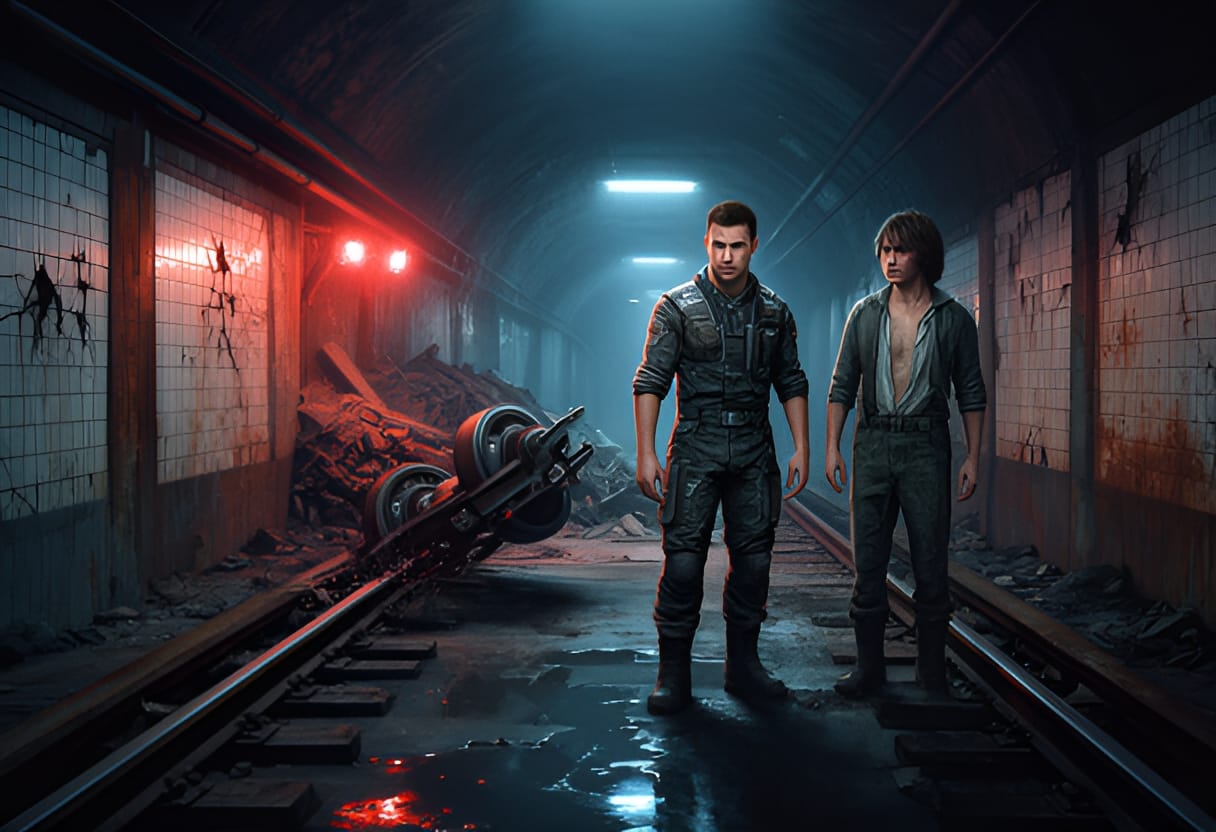
Chapter 12
The Cost of Light
The cart’s axle gave with a sharp crack that echoed down the tunnel like a gunshot. The wooden wheel folded inward, dragging the whole contraption to a lurching halt on the slick stone floor. Dust puffed from the impact, catching in the dim glow of their flare sticks. The last civilian—a girl no older than ten, her face smudged with soot and her coat torn at the shoulder—stumbled forward, caught herself on Zay’s arm, and looked up with wide, exhausted eyes.
“I can’t go further,” she whispered. Her voice was raw, barely audible over the distant drip of water and the ever-present, low thrum of the Imulsion river flowing unseen beside them.
Alex knelt beside her, his breath fogging in the cold air. He didn’t speak right away. Instead, he unstrapped the worn leather pack from his shoulders and pulled out the last of their rations—a half-crushed bar of protein paste and a dented canteen. He handed them to her without a word, then turned to Zay.
“We can’t carry her,” Alex said, his voice low but steady. “Not anymore. The cart’s done. And if we slow down for her, we slow down for everyone.”
Zay swallowed. He knew it was true. The tunnel was narrowing ahead, the walls closing in like a fist. Locust patrols had been reported near the junction—boots on metal, the faint click of weapon safeties disengaging. They couldn’t afford to stop. Not again.
The girl’s lips trembled. She clutched the rations to her chest like a lifeline.
Alex reached out, slow and gentle, and brushed a strand of hair from her forehead. “You’re strong,” he said. “Stronger than you know. Keep moving. Follow the wall to the left—there’s a maintenance ladder halfway down. It leads up to the old drainage culverts. You’ll know it by the rusted ladder rungs. Follow them up. There’s a settlement there. People. They’ll help.”
She nodded, tears cutting clean paths through the grime on her cheeks. She didn’t look back as she turned and began to shuffle forward, her small feet slipping on the wet stone.
Alex watched her go until she disappeared into the gloom, then stood and wiped his hands on his trousers. He didn’t look at Zay. Instead, he kicked at a loose pebble, sending it skittering into the dark.
“Let’s move,” he said. His voice was quieter now. The joke was gone. The laughter from earlier—soft, unexpected, a rare sound in the suffocating dark—had already begun to feel like a dream.
They fell into step behind the remaining civilians, a ragged line of ten or twelve souls, most of them children, some elderly, all moving with the hollow-eyed gait of those who have seen too much and still put one foot in front of the other. The twins flanked the group, Zay on the left with his Lancer at the ready, Alex on the right, his knife drawn—not for show, but because in the dark, close quarters, a blade was sometimes all you had left.
The tunnel stretched on, carved by forgotten hands, its walls weeping condensation in places, slick with mineral deposits that caught the faint glow of their flares like scattered stars. The air tasted of stone and old water, of Imulsion seeping up from below, sharp and metallic on the tongue. Somewhere behind them, a child began to hum—a tuneless, broken thing, but a hum all the same. It made Zay’s chest tighten.
They walked in silence for a long time. The only sounds were the shuffle of boots, the occasional whimper, the rhythmic drip of water from unseen cracks. The flare in Zay’s hand sputtered once, then steadied. He gripped it tighter, the metal biting into his palm.
After what felt like an hour but was likely less, the tunnel opened into a wider cavern. The ground leveled out, and ahead, through a veil of mist rising from the standing water, they could see the faint outline of a stone archway—half-collapsed, draped in vines and moss, but unmistakably man-made. A remnant of the old world. A way out.
Alex stopped first. He turned to the group, his expression softening despite the grime on his face, the exhaustion in his shoulders.
“Rest here,” he said. “Ten minutes. Then we move.”
They sank to the ground where they stood, backs against the damp wall, children curling into each other for warmth. Zay leaned his head back, closed his eyes, and let the darkness press in. For a moment, he wasn’t a gear. He wasn’t a twin. He wasn’t even a survivor. He was just a boy again, sitting on the back porch of their mother’s house in Pelruan, watching fireflies blink over the long grass, the smell of peaches and woodsmoke in the air.
The memory came uninvited, sharp and sweet. He could almost taste the cobbler—crust flaky and golden, filling bubbling thick and sweet, the way Alex had described it earlier, voice soft with nostalgia as they’d pushed the creaking cart through the dark.
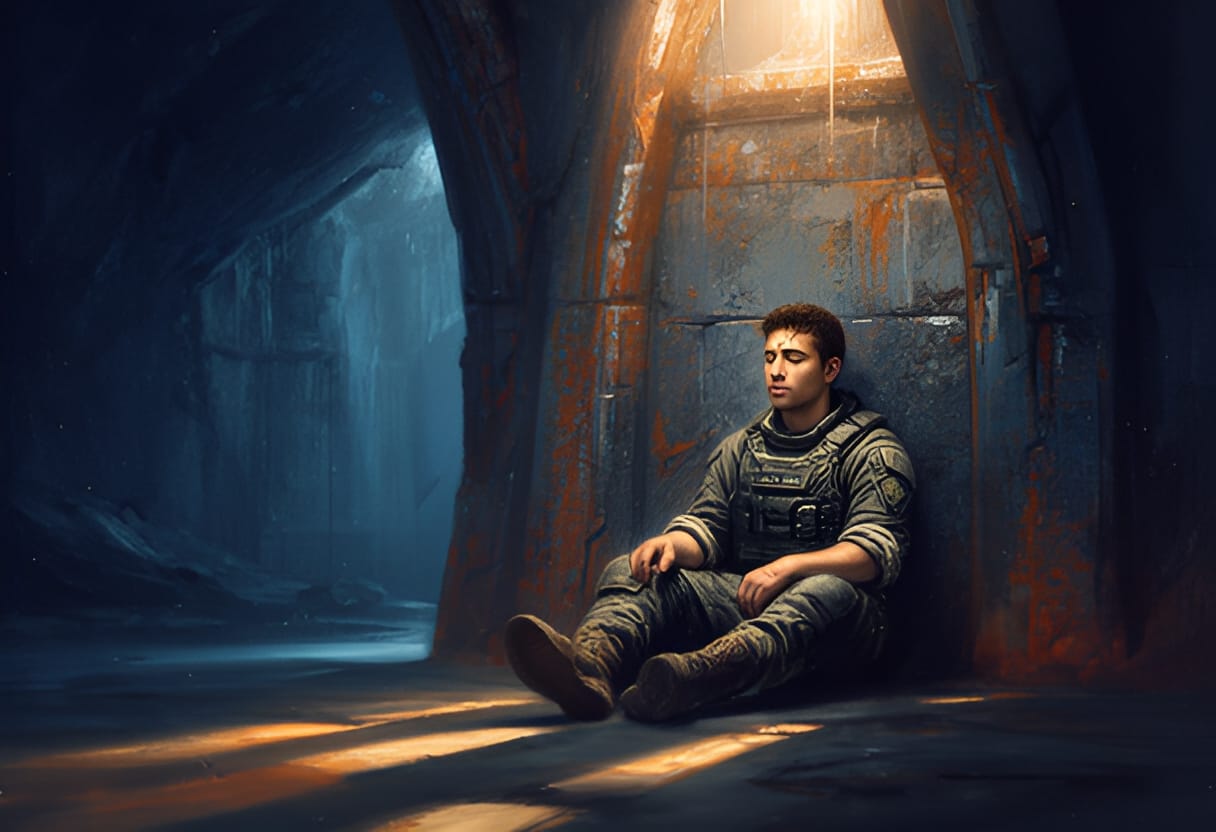
He hadn’t laughed like that in years. Not since before the war. Not since before they’d sworn the oath, shoulder to shoulder in the recruiting office, palms slick with sweat, vowing to watch each other’s backs.
A small hand tugged at his sleeve.
He opened his eyes.
A girl, maybe six, with braids frayed at the ends and a missing front tooth, looked up at him. In her palm, she held a flat, smooth stone, worn by water.
“Like this?” she asked.
Zay frowned, then took the stone. He turned it over in his fingers. Cool. Heavy. Balanced.
He stood, brushed off his pants, and walked to the edge of the standing water where the cavern met the underground stream. The surface was still, black as glass, reflecting the faint glow of the flares like a shattered mirror.
He skipped the stone once. It sank with a soft plop.
The girl giggled. “Again.”
He tried again. This time, it hopped—once, twice—before disappearing beneath the surface.
A ripple of laughter spread through the small group. Alex, who had been watching from the shadows, stepped forward. He didn’t speak. Just knelt beside the girl and picked up a stone of his own. He showed her how to flick the wrist, how to let the stone kiss the surface instead of punch through it.
“Not too hard,” he murmured. “Let it glide.”
She tried. The stone wobbled, veered sideways, sank.
“Again,” she said, undeterred.
Alex smiled—just a flicker, but real. He handed her another stone.
Zay watched them. Watched the way Alex’s voice softened when he spoke to her, the way his shoulders relaxed, the way his eyes—usually so alert, so haunted—lost their edge for just a breath. He saw the ghost of the boy who used to teach his brother how to skip stones on the creek behind their grandfather’s farm, how to tie a knot that wouldn’t slip, how to whistle through a blade of grass.
It was absurd, really. Here they were, deep in the earth, surrounded by the echoes of a dying world, teaching a stranger’s child how to play.
And yet—it felt necessary. Like breathing.
When the girl finally got it—three skips, the stone dancing across the water before vanishing—she threw her arms in the air and shouted, “I did it!”
Alex laughed. A short, bright sound that startled a bat from its roost in the ceiling.
Zay leaned against the damp wall, arms crossed, and let the sound wash over him. It was fragile. Temporary. A candle in a hurricane. But for now, it was enough.
The moment didn’t last.
It never does.
They packed up in silence, the children returning the stones to the water with solemn care, as if returning something borrowed. The flare in Zay’s hand sputtered again—this time, it died completely. Darkness rushed in, thick and absolute.
Alex cursed softly. Then, from his pocket, he struck a match. The tiny flame flared, casting his face in stark relief—sharp cheekbones, shadowed eyes, a line of dirt along his jaw. He lit a fresh flare, the red bloom pushing back the dark just enough to see by.
“Ready?” he asked.
Zay nodded. They reformed the line, the children in the middle, the twins on the flanks. Alex took the lead, his flare held high, his knife still in hand.
They moved slowly now, cautiously. The tunnel ahead forked—left toward a known maintenance shaft, right toward a deeper, uncharted stretch that ran parallel to the Imulsion vein. Alex paused at the split, head tilted, listening.
Then, from the right-hand tunnel—a faint, pulsing glow.
Not fire. Not flare.
Something softer. Alive.
Bioluminescent.
Zay’s blood went cold.
Locust tracking spores. They’d begun using them in the last few hours—seeding the air with glowing particles that clung to skin, fabric, hair, burning faintly green in the dark. Like fireflies made of poison. Once you were marked, you couldn’t wash it off. The Horde could follow you for kilometers.
Alex didn’t hesitate. He grabbed Zay’s arm, hard, and shoved him toward the left fork.
“This way,” he whispered. “Now.”
They moved faster, the group tightening, children pressing close, whimpers swallowed tight in throats. The left tunnel was narrower, lower—they had to duck in places, scraping helmets on rough stone. The air grew colder, damper. Somewhere ahead, water rushed through a chute, loud and constant.
They made it fifty meters before Alex stopped again.
He held up a fist.
Silence.
Then, from the darkness ahead—a faint, rhythmic clicking. Not boots. Not machinery.
Something skittering. Many legs. Too many.
A scout drone.
Zay felt the weight of his Lancer. He brought it up, slowly, the barrel pointing into the gloom. The flare in his other hand cast long, jittery shadows on the walls—shapes that looked like claws, like teeth, like things that shouldn’t be.
Alex didn’t raise his weapon. Instead, he reached into his vest and pulled out a small, folded photograph. The corners were worn, the edges softened from years of being handled. He unfolded it just enough to show Zay the image: their father, in his old COG dress uniform, standing beside a rusted tractor on the family farm, grinning with missing teeth and eyes crinkled at the corners. The photo was faded, but the smile was unmistakable.
Alex met Zay’s eyes. His own were bright—not with tears, not yet—but with something deeper. A quiet resolve. A farewell.
He placed the photo in Zay’s palm. Closed Zay’s fingers around it.
“If I don’t make it,” Alex said, his voice barely more than a breath, “tell him I tried.”
Then he stepped forward, past Zay, and took the point position again. He didn’t look back. He didn’t need to.
Zay stood frozen for a heartbeat, the photo burning against his skin, the weight of it—of everything it carried—settling in his bones like stone.
Then he swallowed hard, raised his Lancer, and followed.
The drone clicked again, closer now.
And the dark swallowed them whole.
The tunnel constricted ahead, walls squeezing inward as if the earth itself sought to suffocate them. Water dripped steadily from the ceiling, each drop a metronome marking time they might not have. Alex moved first, low and silent, his flare held tight against his thigh to minimize its glow. The children followed, small hands gripping the shoulders of those ahead, faces pale in the intermittent stutter of the dying light. Zay brought up the rear, Lancer braced, eyes darting between the darkness ahead and the suffocating black behind. The scout drone’s clicking had faded, but he knew better than to trust silence. The Locust didn’t hunt with noise—they hunted with patience, with spores, with the certainty that prey would tire, would falter, would make a mistake.
They moved in near-total dark now, only the faintest ember-glow from the flares marking their progress. The air grew heavier, laced with the mineral tang of Imulsion and something else—sweet, cloying, like rotting fruit left in the sun. Zay’s throat tightened. He’d smelled it before, in the birthing chambers, near the pods. It meant they were close to a nest. Or worse, a processing line.
A small hand tugged at his belt.
He looked down. The girl from the creek—her braid now loose, strands plastered to her forehead with sweat—looked up at him, eyes wide but dry. She didn’t speak. Just pointed ahead, then mimed walking with her fingers.
He nodded. Tightened his grip on her shoulder. Kept moving.
The tunnel opened into a vaulted chamber, natural stone carved by ancient water, now marred by Locust construction—crude scaffolding of bone and resin, tubes pulsing with faintly glowing fluid snaking along the walls like veins. In the center, a shallow basin held standing water, black and still, reflecting nothing. Around it, clusters of pods hung from the ceiling, translucent and veined, pulsing with a slow, internal rhythm. Inside each, shapes curled—limbs folded, heads bowed, not quite formed, not quite alive.
Zay’s breath hitched. He’d seen this before. In the Hollows. In the birthing chamber where Alex had broken down, where he’d whispered, I’m scared of becoming something less than human.
He swallowed hard. Didn’t look at Alex. Didn’t dare.
Alex was already moving, flank low, knife in one hand, the other brushing the wall as he went—feeling for grooves, for changes in texture, for anything that might mark a path, a threat, a way out. His flare cast long, dancing shadows that made the pods appear to breathe, to shift, to watch.
One of the children whimpered—a soft, broken sound.
Alex froze.
He didn’t turn. Didn’t need to. He knew exactly who it was.
He slipped forward, silent as shadow, and knelt beside the boy who had cried—a toddler, no older than three, his face streaked with dirt and tears, his small body trembling against his mother’s side. Alex didn’t speak. Instead, he pulled from his pocket the last of the smooth stones they’d gathered earlier—small, water-worn, cool to the touch. He placed it gently in the child’s palm, closed the boy’s fingers around it, then pressed the kid’s hand to his own chest, over his heart.
Thump. Thump. Thump.
A steady rhythm. Human. Real.
The boy’s breathing hitched. Then, slowly, he began to mimic it—his small hand rising and falling in time.
Alex stayed like that for only a few seconds—long enough to anchor the child, short enough not to risk discovery. Then he rose, wiped his hand on his trousers, and took the point again, flare low, knife ready.
They passed the chamber without incident. No movement from the pods. No shift in the air. Just the endless drip of water, the distant groan of stone settling, and the quiet, relentless press of the dark.
But Zay felt it—the weight of the place, the wrongness of it. The pods weren’t just incubators. They were factories. And whatever was growing in them wasn’t meant to stay underground.
They emerged into a narrower passage, this one worked—cut straight, shored with timber and metal plating. Old human construction, repurposed. A maintenance tunnel, maybe. Or a forgotten transit line. The air here was cooler, cleaner—less Imulsion, more stone. And then, ahead, a glint.
Metal.
Not natural.
Alex halted. Flare down. He pressed himself flat against the wall, motioning for the group to do the same. Zay eased back, Lancer at ready, and peered around the corner.
A section of track ran parallel to the tunnel—rusted, but intact. And on it, half-buried in silt and debris, sat the skeletal remains of a light rail cart. Its frame was twisted, one wheel missing, the other bent inward as if crushed by something heavy. But it was intact enough to suggest use. Not Locust. Not native. Human.
Alex glanced back. His expression was unreadable in the gloom, but his eyes—sharp, alert—locked onto Zay’s for a fraction of a second. A question. A possibility.
Way out?
Zay shook his head almost imperceptibly. Too exposed. Too easy to ambush. The Locust knew these old lines. They’d turned subway tunnels into killing grounds before.
Alex nodded. Accepted. Moved on.
They followed the track for a short distance, the rails guiding them through a series of low arches and cross-passages. The children walked silently now, no more games, no more laughter. Even the girl with the stone held it tightly in her fist, her thumb rubbing slow circles over its surface, as if drawing strength from its smoothness.
Then, ahead—a sound.
Not dripping. Not settling.
Scraping.
Metal on stone. Rhythmic. Deliberate.
Zay’s fingers tightened on his Lancer.
Alex didn’t hesitate. He dropped to one knee, flare extinguished, and began to crawl forward on his belly, knife in hand, body pressed flat against the wet stone. The children froze, mothers pulling them close, hands over mouths. Zay stayed behind, weapon up, eyes locked on the darkness where Alex had disappeared.
He waited.
Ten seconds.
Twenty.
His palms were slick on the grip. His back was soaked through, the fabric of his shirt clinging to his spine. He listened—hard—for any change in the sound, any cry, any shout. Nothing. Just the scrape… scrape… scrape… like something being dragged.
Then, a soft hiss.
Not Alex.
Something else.
Zay pushed forward, low and fast, heart hammering against his ribs. He rounded the bend—and stopped.
Alex was on his feet again, back against the wall, one hand braced on the cold stone, the other holding his flare aloft. In front of him, half-submerged in the shallow runoff that ran along the tunnel floor, lay a Locust Drone. Not dead. Not quite alive. Its limbs jerked sporadically, as if charged with faulty current, its mandibles clicking weakly. A deep gash ran across its throat—clean, precise. Not from a chainsaw. Not from a Lancer bayonet.
From a knife.
Alex’s knife.
He hadn’t killed it outright. He’d disabled it. Left it to bleed out in the dark, where it couldn’t call, couldn’t alert, couldn’t bring others down on them.
Zay stepped forward. Alex didn’t look at him. He was already moving, checking the drone’s gear—ammo pouches, grenades, a fractured comms unit—muttering under his breath in a mix of English and Spanish, the way he did when he was thinking hard, when he was trying to make sense of something broken.
“Still warm,” Alex said quietly, not looking up. “Means they’re close. Patrol, maybe. Or a scout pair.”
Zay knelt beside the body. The Drone’s skin was pallid, mottled with patches of bioluminescent fungus—tracking spores, still active, pulsing faintly green where they clung to the corpse. He reached out, not touching, just observing. The spores didn’t just mark. They signaled. A beacon for anything with the senses to follow.
He glanced at Alex. “We’re lit up like a festival.”
Alex finally met his eyes. His expression was grim, but there was something else there—something raw, almost vulnerable. He held up his hands. Palms up. Empty.
“I scraped it off,” he said. “As best I could. Used my knife, rubbed at my wrists, my neck… wherever I could feel the itch.”
Zay understood. The spores didn’t just land—they burrowed. Microscopic barbs. You couldn’t wipe them away. You had to scrape. Like trying to remove ticks with a dull blade. It left the skin red, raw, sometimes bleeding. And even then, traces remained.
He looked down at his own arms. Felt the faint prickle along his forearms, the back of his neck. He hadn’t noticed it before—too focused on the children, on the path, on keeping his brother safe. But now that he knew what to look for, the sensation was unmistakable: a subtle, crawling irritation, like ants under the skin.
He didn’t say anything. Just nodded.
Alex seemed to read it anyway. He reached into his vest and pulled out a small, jagged shard of broken flare casing—sharp enough to scrape, dull enough not to cut deep. He handed it to Zay.
“Do it,” he said. “Now. Before we move.”
Zay took it. Found a patch of skin on his inner wrist where the irritation was strongest. He pressed the shard in and dragged it down—hard. A line of fire bloomed. He gritted his teeth, didn’t flinch. Did it again. Again. Until the skin was red and stinging, until the faint glow beneath the surface had been scraped away, leaving only dull, wounded flesh.
He did the same to his throat, his temples, the back of his hands—anywhere the spores might have landed. It hurt. Badly. But the alternative was worse.
When he was done, he handed the shard back. Alex took it, nodded, and began the same process on himself—quick, efficient, methodical. He didn’t flinch either. Just set his jaw and scraped, leaving thin red lines where the spores had been.
The children watched, silent. No one cried out. No one flinched. They seemed to understand, somehow, that this was necessary. That pain now meant survival later.
When Alex finished, he tucked the shard away, wiped his hands on his trousers, and stood. He looked at the group—really looked—then gave a single, sharp nod.
“Let’s go.”
They moved again, slower now, more cautious. The flare cast just enough light to see the next step, the next breath, the next possible threat. The scrape of the drone’s body in the water behind them was a grim reminder: they weren’t just fleeing. They were leaving a trail. And the Horde was learning how to follow.
The tunnel began to slope upward—gently at first, then steeper. The air changed. Less stagnant. More movement. And then, ahead, a faint glow—not bioluminescent. Not flame.
Daylight.
They froze.
Alex held up a hand. Flare down. He crept forward, low and silent, Zay mirroring him behind. The children stayed put, mothers pressing them into the earth, fingers over mouths, eyes wide with fear and hope.
Alex reached the mouth of the tunnel—and paused.
Just inside the opening, he stopped.
Not because of what he saw.
But because of what he didn’t.
The exit opened onto a broken street—familiar, yet alien. The curb was cracked, the pavement buckled by underground shifts. A burned-out husk of a civilian car lay on its side nearby, its frame twisted, windows gone. Beyond that, the skeletal remains of a storefront—glass shattered, sign hanging by one chain, letters half-gone: “M… R… E…”—maybe Mercy, maybe Market. Impossible to tell.
But there were no Locust.
No Drones patrolling.
No Kryll swarming in the gloom.
No distant boom of artillery, no scream of Seeder pods launching.
Just… quiet.
Wind. Distant birds. The creak of settling metal.
And sunlight—real, unfiltered sunlight—spilling across the rubble like liquid gold.
Alex stepped fully into the opening, shielding his eyes with his hand. He turned his face to the light, breathed deep. His shoulders, which had been coiled tight for hours, began to unfurl—just a fraction. A release.
Zay stayed in the tunnel’s shadow, watching him. Watching the way the light caught the dust in his hair, the way it glinted off the knife still in his grip, the way his chest rose and fell with something that looked suspiciously like relief.
He looked like the boy who used to lie on the roof of their garage in Pelruan, staring at clouds and making up stories about where they were going.
Then Alex turned.
His expression was unreadable—softened, yes, but guarded. He didn’t smile. Didn’t speak. He just reached into his vest, pulled out the worn photograph of their father—the one he’d shown Zay back in the cavern—and held it out, palm up.
Not to give it back.
To share it.
Zay stepped forward. Took the photo. Their fingers brushed—brief, warm, real.
Alex nodded once. Then turned and began to walk down the street, not running, not rushing—just moving, one foot in front of the other, toward whatever lay beyond.
Zay fell into step beside him. The children followed, quiet now, not from fear, but from the weight of what they’d seen, what they’d endured, what they were still carrying.
Behind them, the tunnel mouth yawned like a wound in the earth—a dark throat that had almost swallowed them whole.
And ahead, the street stretched into the ruins of Ephyra, broken but standing, scarred but there.
Zay glanced down at the photo in his hand—his father’s smile, the old tractor, the dusty boots planted firm in the soil of a world that no longer existed.
He didn’t speak.
He didn’t need to.
He tucked the photograph safely into his own vest, close to his chest, where his heart beat steady and loud beneath his ribs.
And he walked on.
With his brother.
Into the light.
Zay kept walking, the photograph warm against his sternum, the weight of it a quiet anchor in the chaos of his thoughts. The street stretched ahead—ruined, silent, but undeniably real. Sunlight pooled in the hollows of collapsed awnings, glinted off shards of glass like scattered teeth. Somewhere in the distance, a dog barked, sharp and brief, then fell silent. Birds wheeled in the sky, their cries thin and clear. It was almost peaceful. Too peaceful.
Alex moved beside him, silent, eyes scanning the ruins with that habitual alertness Zay knew so well—the slight tilt of the head, the way his fingers hovered near his knife grip even when his hands were empty. He hadn’t spoken since handing over the photo. Not a word. Not even a joke about the coffee back at the barracks, or the way Zay always burned the toast. That silence wasn’t peace. It was the quiet before the storm broke inside.
They turned a corner where a wall had collapsed inward, burying half a mailbox under twisted rebar and dust. Beyond it, the street opened into a small plaza—what had once been a market square, judging by the cracked stone basins and the rusted frame of a vendor’s cart half-sunk into the earth. Fountains lay dry, their stone cherubs missing faces or arms. A child’s shoe, small and pink, lay half-buried near the edge of the basin.
Zay’s breath hitched. He looked away.
They kept moving.
The plaza gave way to a residential block—row houses with sagging roofs and blown-out windows. One door hung open, swaying slightly in the breeze. Inside, darkness yawned. Zay didn’t look in. He couldn’t.
Hours passed, or maybe it only felt like it. The sun climbed, then began its slow descent. Shadows stretched long and thin across the pavement. The air cooled. Somewhere behind them, the tunnel mouth gaped like a secret the earth wasn’t ready to tell.
They found shelter in the shell of a laundromat—walls still standing, roof mostly intact, though water stained the ceiling in spreading brown halos. A rusted drum lay on its side in the corner. A few plastic chairs were stacked near the counter, one leg snapped off. The bell above the door was gone, but the hook remained, bent and empty.
Alex pushed the door shut with his boot. It didn’t latch, but it held against the wind.
Zay dropped to his knees by the counter, pulled out his canteen, and took a slow sip. The water was warm, flat. He handed it to Alex without a word.
Alex drank, then passed it back. His fingers brushed Zay’s—brief, calloused, real.
They didn’t speak. Didn’t need to.
Outside, the light faded. The sky turned from blue to bruised purple, then to deep indigo. Stars came out, sharp and cold, unblinking. No moon. Just the vast, indifferent dark.
They bedded down on the floor near the counter, using their jackets as makeshift blankets. The civilians—what remained of them—had found other corners: a mother with two small boys curled under a counter, an old man with a cane propped against his chest, breathing slow and shallow. No one snored. No one shifted much. Sleep, when it came, was light. Alert.
Zay lay on his back, staring at the ceiling. The stain above him looked like a face if he tilted his head just so—hollow eyes, a mouth stretched in a silent scream. He looked away.
And then the dream came.
Not memory. Not exactly. But close enough to gut him.
He was back in the birthing chamber—the chamber with the pods—the one they’d stumbled into after the storm drain, before the shaft, before the promise whispered in the dawn light. The air thick, warm, smelling of iron and something sweetly rotten, like overripe fruit left in the sun. The pods lined the walls, pulsing faintly with an inner sickly glow—veins of light threading through translucent membranes, carrying shadows that shifted and coiled like things alive.
He’d seen them twitch.
He’d seen the shapes inside—limbs folding and unfolding, heads too large, skin slick and veined, eyes that opened not to see but to sense.
And the whispering.
Not in any language he knew. But he understood it anyway.
We are coming.
We are here.
You cannot unsee us.
He tried to move. To shout. To shake Alex awake.
But his body wouldn’t obey. It was heavy. Slow. As if the dream had weighted his bones with something older than fear—something like recognition.
A pod near him ruptured.
Not with violence. With a soft, wet unfurling.
Steam rose. Light flared.
And from within, a hand reached out—not to grab, not to strike—but to touch his wrist.
Fingers long, jointed strangely, skin translucent enough to see the pulse beneath.
He wanted to pull away.
But he didn’t.
Because in that touch, he didn’t feel menace.
He felt known.
And that terrified him more than any scream.
He jerked awake.
Gasping.
His back arched off the floor. Fingers scrabbled at the concrete, seeking purchase. His breath came in short, sharp pulls—too fast, too shallow. His skin was slick with sweat. His heart hammered against his ribs like a trapped thing trying to break free.
He lay there, eyes open, staring at the dark ceiling, waiting for the world to stop spinning.
Then he felt it.
A shift beside him.
Not loud. Not dramatic.
Just the faintest movement of air, the whisper of fabric.
Alex.
Already awake.
Zay turned his head.
In the starlight filtering through the broken roof panels, he could just make out his brother’s profile—eyes open, fixed on the ceiling, jaw tight. Not sleeping. Not pretending. Just… waiting.
Zay didn’t speak.
He didn’t have to.
Alex shifted.
Slow. Deliberate.
He rolled onto his side, then pushed himself up on one elbow, just enough to slide backward—making space. Not a word. Not a glance. Just the quiet, practiced motion of two men who’d shared bunks in barracks, tents in the field, narrow stretches of tunnel floor when the world was falling apart.
Zay let out a breath he didn’t know he’d been holding.
He turned onto his side.
Faced the wall.
Then, slowly, he backed up.
Until his shoulder touched Alex’s.
Until their spines aligned, vertebrae to vertebra, shoulder blade to shoulder blade.
Just like in the tunnels.
Just like when they were kids, sharing a narrow bed during a storm, backs pressed together because facing the dark alone was worse than any nightmare.
Just like when they’d crawled through the storm drain, exhausted, filthy, but still side by side.
Just like when they’d stood at the shaft’s mouth, dawn light on their faces, and whispered their promise into the quiet.
They didn’t touch hands.
Didn’t need to.
The contact was enough.
Solid. Real. A silent I’m here passed through bone and muscle.
Zay closed his eyes.
His breathing slowed.
Not because the dream was gone.
But because he wasn’t facing it alone.
Behind his lids, the pods still pulsed.
The whispering still curled at the edges of his mind.
But now, there was this: the steady rise and fall of Alex’s breath against his back. The warmth of his brother’s body, firm and present. The faint, familiar scent of oil and sweat and soap that had clung to Alex since basic training.
He focused on that.
Let it drown out the rest.
The dream didn’t vanish.
But it lost its teeth.
Somewhere in the dark, a civilian sighed in their sleep. A child shifted, murmuring something unintelligible.
The stars wheeled overhead.
And slowly, imperceptibly, the night began to lighten.
Not with sun yet.
But with the slow, patient creep of dawn—first a deepening of the black to charcoal, then a softening at the edges, like ink diluted in water.
Light crept in through the broken roof, through the gaps in the boards nailed over the windows. It crawled across the concrete floor in pale fingers, slow and inevitable.
It reached Zay’s boot first—scuffed leather, caked with dried mud from the tunnel, the lace frayed at the tip. Then it touched Alex’s—similar wear, same quiet dignity in the way he kept his gear clean even when there was nothing left to clean for.
The light climbed.
Touched the hem of their pants.
Then stopped, as if hesitating.
As if aware of what it was illuminating.
Zay didn’t move.
Didn’t open his eyes.
Let the warmth seep in.
Let the day begin.
He felt Alex shift—just a fraction—perhaps settling deeper into the quiet, perhaps bracing for whatever came next.
But they didn’t pull apart.
Didn’t speak.
Just lay there, two brothers in the ruins of a world that had ended hours ago, backs pressed together, waiting for the light to reach their faces.
And when it finally did—soft, gold, quiet—it found them still.
Still breathing.
Still together.
Still here.
The light climbed higher, spilling across the floor in widening pools, catching dust motes in slow, lazy spirals. It reached the cuffs of their trousers, then the lower ribs, pausing just below the sternum as if weighing whether to go further. Zay kept his eyes shut, breathing deep, letting the warmth sink into his bones—not just the sun’s, but the quieter heat of Alex’s presence at his back. He could feel the rise and fall of his brother’s breath, steady now, the tension in his shoulders eased just enough to suggest sleep, or something close to it. Not unconsciousness. Never that. But rest. A fragile, hard-won thing.
Somewhere nearby, a child whimpered—soft, frightened, then hushed by a mother’s palm over lips. The old man with the cane coughed once, wet and rattling, then fell silent again. The world outside the laundromat remained hushed, but not empty. Zay knew it. He could feel it in the way the air still carried the ghost of smoke, in the faint, metallic tang of blood dried on stone somewhere down the street. The Locust weren’t gone. They were just… waiting. Like predators who’d learned that sometimes, the best hunt was the one where the prey walked right into the open, thinking they were safe.
He didn’t open his eyes. Didn’t need to. He could map the room in his mind—the counter’s edge, the rusted drum, the way the light now struck the chipped tile near the drain, making it gleam like wet bone. He could hear Alex’s breathing, the faintest catch in it when he dreamed, the way his fingers sometimes twitched even in rest, as if still gripping a knife, still ready.
A shift.
Alex exhaled—long, slow—and his shoulder pressed back just a fraction harder against Zay’s. Not a word. Not a movement. Just that. A silent affirmation.
Still here.
Zay let himself smile. Just a little. Inside. Where it wouldn’t show.
He stayed like that until the light reached his collarbone, until it touched the hollow of his throat, until it brushed the photo tucked inside his vest—his father’s smile, the dusty boots, the tractor frozen in a field that no longer existed. He felt it then—not the image, but the weight of it. The promise wrapped in leather and memory.
We’re still here.
He hadn’t said it aloud. Not since the shaft. Not since the dawn in the fissure. But he’d thought it. Every time Alex moved without hesitation. Every time he handed over the last of his water. Every time he scraped spores from his skin without flinching, without complaint, as if pain were just another thing to endure, like hunger, like fear.
And now, here, in the quiet aftermath of nightmare and narrow escape, he realized he hadn’t needed to say it. Not really. Because Alex knew. Had always known.
The light climbed higher.
Reached Zay’s chin.
Then his lips.
He opened his eyes.
The ceiling was no longer dark. Just concrete, stained, cracked in places where water had seeped through over years. A hairline fracture split the surface near the corner, branching like a vein. He followed it with his gaze until it disappeared behind the drum.
Then he turned his head.
Just enough.
Alex’s face was turned away, toward the wall, eyes still closed. His jaw was relaxed, the line of his mouth soft. Not peaceful, exactly. But not braced. Not waiting for the next blow. Just… resting. The faintest stubble darkened his chin and jaw. A smudge of dirt streaked his left cheekbone—probably from when he’d wiped his face earlier, before they’d settled in. His eyelashes cast thin shadows. His ears, always too big for his head when they were kids, caught the light at the edges, translucent and pink.
Zay didn’t speak.
Didn’t move.
Just watched.
And in that silence, he remembered—not the war, not the tunnels, not the screaming or the spores or the way the Kryll had blotted out the sky like a living eclipse—but the roof of their garage in Pelruan. Summer. They’d been twelve, maybe thirteen. Alex had talked him into stealing a bottle of their father’s cheap whiskey—just a sip, he’d said, to see what it tasted like. Zay had refused at first. Then Alex had handed him the bottle, grinning, and said, “Come on, Zay. Live a little.” So they’d climbed onto the flat roof, legs dangling over the edge, and passed the bottle back and forth, making faces, coughing, laughing until their stomachs hurt. Then they’d lain back, staring at the clouds, and Alex had started making up stories—about cloud ships, about sky pirates, about a brother duo who flew through the stars fixing broken worlds.
Zay had rolled his eyes. Called him ridiculous.
Alex had just smiled and said, “One day, we’ll see them for real.”
He hadn’t meant the Locust.
Zay knew that now.
He blinked. The light had moved again—now resting on Alex’s forehead, glowing in the fine hairs there, turning the sweat into something like dew.
Zay swallowed.
His throat felt tight.
Not from grief. Not exactly.
From the quiet, terrifying truth that they were still alive. That they had made it this far. And that survival, in this world, wasn’t a victory. It was a debt. One that would be paid in blood, in dreams, in the faces of those they couldn’t save.
He looked down at their hands—resting near their hips, palms up, fingers slightly curled. Not touching. Not needing to. But close. So close that if one of them twitched, if one of them shuddered in sleep, their pinkies would brush.
He remembered the first time they’d done this—back-to-back, not touching, just there. Not in the war. Not even in the tunnels. But years ago, after their mother had died. They’d been sixteen. Fifteen? It didn’t matter. Their father had shut down. Gone quiet. Worked the fields from dawn to dusk, then sat on the porch long after dark, staring at nothing. The boys had ended up in the spare room—two narrow beds pushed together because the room was too small for anything else. They hadn’t spoken. Hadn’t needed to. Just lay there, backs touching, shoulders aligned, waiting for sleep that wouldn’t come.
And when it finally did, it had been because they weren’t alone.
Zay’s eyes burned.
He blinked fast. Cleared it.
Alex stirred.
Just a twitch. A sigh. Then stillness.
Zay didn’t look away.
He watched the way the light now touched Alex’s temple, how it caught the faintest glint in his eyelashes—like he was dreaming of something bright.
Then, slowly, Alex’s fingers moved.
Not much. Just a slight curl inward, as if testing the air. As if reaching for something that wasn’t there.
Zay held his breath.
And then—so faint he wasn’t sure he’d felt it—Alex’s pinky finger brushed his.
Just once.
A whisper of contact.
Then stillness again.
Zay didn’t move.
Didn’t squeeze back.
Didn’t speak.
Just let the moment be.
Because that was all it needed to be.
A touch.
A promise.
A silent I’m here passed skin to skin, bone to bone, heartbeat to heartbeat.
The light climbed higher.
Reached the bridge of Alex’s nose.
Then paused.
As if the sun itself were hesitating—afraid to wake him, afraid to break the spell.
Zay didn’t move.
Didn’t blink.
Just let the moment stretch—this fragile, stolen peace—until the light finally crept over Alex’s eyelids, until it painted his cheeks gold, until it touched the corner of his mouth and made the faintest shadow of a smile appear—not from joy, not yet, but from the deep, muscle-deep relief of safety, however temporary.
And then Alex breathed in—deep, slow—and his eyelids fluttered.
Not open.
Just… shifted.
Like he was dreaming of waking.
Zay held his gaze.
Waited.
And then, finally, Alex’s eyes opened.
Not all the way.
Just slits at first, adjusting to the light.
Then wider.
He didn’t turn his head.
Didn’t need to.
He knew Zay was there.
Knew he hadn’t moved.
Knew he hadn’t looked away.
His gaze stayed fixed on the ceiling for a beat longer—then, slowly, he turned his head.
Just enough to meet Zay’s eyes.
In the morning light, they were startlingly clear. Not haunted. Not hollow. Not the eyes of a man who’d seen too much. Not yet.
Just brothers.
Awake.
Together.
Alex’s mouth opened.
Closed.
Opened again.
No words came.
Not yet.
Instead, he lifted his hand—slow, deliberate—and tapped twice against Zay’s sternum.
Two taps.
The old signal.
Flank left.
Only now, it meant something else.
Watch my back.
Zay, I’m here.
Zay, I’ve got you.
Zay didn’t speak.
Didn’t grin.
Didn’t make a joke about the whiskey or the roof or the way Alex always stole the covers.
He just reached up.
Covered Alex’s hand with his own.
Held it there.
Let the warmth pass between them.
Let the silence say what words couldn’t.
Alex’s fingers curled—just slightly—against his palm.
Then, after a long moment, he squeezed.
Once.
Firm.
Then let go.
His hand fell back to his lap.
Zay kept his own where it was for a second longer—resting on his chest, over the photo, over his heart—then lowered it slowly to his side.
Alex didn’t move.
Didn’t look away.
Just breathed.
In.
Out.
In.
The light kept climbing.
Reached the ceiling.
Spilled over the edges of the drum.
Touched the cracked tile near the drain.
Made the water in the puddle there shimmer like broken glass.
Somewhere outside, a bird called—clear, sharp, unafraid.
Then another answered.
And another.
The world was waking up.
Not healed.
Not safe.
But there.
And so were they.
Zay finally turned his head fully toward the opening of the laundromat—toward the street beyond, toward the ruins of Ephyra stretching into the haze.
He didn’t stand.
Didn’t reach for his weapon.
Just looked.
And saw—not safety.
Not victory.
But possibility.
A street. A sky. A chance.
Alex shifted beside him—just a shoulder roll, a quiet adjustment—but didn’t rise.
Didn’t speak.
Just stayed.
Waiting.
For Zay to decide.
For them to move.
Together.
Zay took a breath.
Let it out slow.
Then, without a word, he pushed himself up onto his elbows.
Then to his knees.
Then to his feet.
He offered a hand down.
Alex took it.
Grip firm.
Calloused skin against calloused skin.
Zay pulled him up.
They stood side by side for a moment—shoulders touching, heads slightly bowed, listening.
To the wind.
To the distant creak of settling metal.
To the silence between heartbeats.
Then Alex nodded.
Once.
Zay nodded back.
And they stepped forward—into the light, into the street, into whatever came next—boots scuffing the dust, hands near weapons, eyes open, backs straight.
Not running.
Not fleeing.
Just walking.
Side by side.
As they always had.
As they always would.
Until the end.
However long that took.
However hard it got.
However dark the world became.
They walked.
And the light walked with them.
Zay stepped forward onto the cracked pavement of the street, Alex’s hand still warm in his grip. The morning light had climbed higher now, spilling gold across the ruins of Ephyra—over collapsed facades, twisted streetlamps, and the hollow eyes of buildings that had once held laughter, markets, children’s voices. Birds wheeled in the distance, their cries sharp and unafraid. Somewhere, a shutter clattered in the wind. The world was broken, but it was still turning.
They walked in silence, side by side, boots scuffing dust and small shards of glass. Neither spoke. Neither needed to. The weight of what had passed—of the tunnels, the dark, the Kryll, the birthing pods, the dream of the translucent hand—settled between them not as a burden, but as a kind of gravity. It kept them grounded. Present.
Ahead, the street forked. One path led toward the river’s edge, where the pontoon bridge had fallen and the Imulsion still burned in slow, rainbow slicks on the water. The other veered toward the barracks, where the remnants of their squad had last been seen trying to hold a rally point near the old armory. Alex gave the slightest tug on Zay’s hand—a silent question. Zay nodded once, toward the barracks. They adjusted their course, shoulders brushing as they turned.
The city breathed around them—groaning, settling, alive with the quiet aftermath of violence. Locust corpses lay in the alleys, some half-buried in rubble, others picked clean by carrion birds. Blood had soaked into the concrete in places, dark and rust-streaked. Zay noticed a child’s shoe, half-buried near a shattered toy store window. He looked away quickly. Alex saw it too. His jaw tightened. He didn’t say anything. He just squeezed Zay’s hand—once—before letting it fall back to his side.
They passed a overturned trolley, its metal frame twisted like a broken spine. A flare lay nearby, its casing split open, the phosphorescent gel long gone cold. Zay almost reached for it—habit, muscle memory—but stopped himself. No need to mark the way now. Not here. Not today.
The barracks came into view through the haze—a squat, utilitarian building of reinforced concrete and steel, its windows blown out or boarded with scrap metal. Sandbags still ringed the entrance, though many had slumped or burst open. A single sentry paced the roof, rifle loose in his hands, eyes scanning the horizon. He saw them coming and straightened, then gave a sharp, crisp salute when they drew near.
Zay returned it without hesitation. Alex did the same, his movements precise, automatic. The sentry nodded and fell back into his watch.
Inside, the air was thick with the smell of oil, sweat, and cordite. The main hall was a triage of sorts—wounded men and women lay on cots or leaned against walls, bandages stark white against grimy fatigues. Medics moved between them, voices low, efficient. Someone was shouting orders in the distance. A radio crackled with fragmented updates—Locust movement near the east sector, a possible breach at the hydroplant, a call for ammo at Checkpoint Seven.
Zay and Alex moved through the crowd without speaking, parting the way not with force, but with presence. People made space for them. Not because of rank—though Alex’s insignia, still that of a private, caught the light now and then—but because of what they carried. The quiet certainty. The unbroken bond. The way they moved as if they were one person split in two, each step echoing the other.
They found Sergeant Velez near the supply locker, checking a clipboard with a stub of pencil. Her hair was pulled back tight, strands escaped and plastered to her temples with sweat. Her uniform was torn at the shoulder, patched with field tape. She looked up as they approached, and for a moment, her expression softened—not with relief, not exactly, but with recognition. As if she saw in them something she hadn’t allowed herself to believe still existed: continuity. Purpose. Brotherhood.
“Lopez twins,” she said, voice rough but steady. “Thought I might’ve lost you two in the dark.”
“We’re here, Sarge,” Alex said. His voice was low, but clear. Not tired. Not broken. Just… present.
Velez studied him for a second—really studied him—then flicked her gaze to Zay. “You both look like hell. But you’re standing. That counts for something.”
“We’re still here,” Zay said.
She gave a short, sharp nod. Then, as if remembering something, she reached into her vest and pulled out a small square of metal on a ribbon. Corporal’s insignia. The eagle and the wreath, dull with use but unmistakable.
“Word came down from command,” she said. “Before the comms went fully dark. Alex Lopez—you’re to be promoted. Effective immediately. For actions in the Mercer Street tunnel. For holding the line while civilians evacuated. For not leaving anyone behind.”
Alex went still. His breath hitched—just once. Then he swallowed. His eyes dropped to the insignia in her palm, then lifted to meet hers.
“Me?” he said. His voice was quieter now. Almost disbelieving.
Velez’s expression didn’t soften, but her eyes held his. “You earned it. You’ve been acting like one since day one. Now it’s official. Pin it on.”
She held the ribbon out. Zay stepped forward without being asked. He took the insignia from her palm, his fingers brushing hers briefly. Her skin was calloused, warm. He nodded at her—thanks, acknowledgment—and turned to Alex.
Alex lifted his chin slightly, eyes down, waiting. Zay brought the insignia to his collar. The metal was cool against his fingers. He found the holes in the fabric, lined up the pins, and pressed them through. One. Then the other. The clutch snapped shut on the inside with a soft, final click.
He stepped back.
Alex touched the insignia with two fingers—just a touch—then looked up. His eyes were bright. Not with tears. Not yet. But with something deeper. Something that had been buried under dust and smoke and fear, and was now, slowly, unearthed.
“Thanks,” he whispered.
Zay didn’t trust his voice. So he just nodded. Then, without a word, he reached up and covered Alex’s hand with his own—just as he had in the laundromat, just as he had done a thousand times before in training, in silence, in the dark. Alex turned his hand under Zay’s palm and laced their fingers together. Held on.
Velez watched them for a moment. Then she turned away, back to her clipboard, her voice dropping to a murmur as she muttered orders to a nearby medic.
They stood like that for a long time—forever and no time at all—hands clasped, foreheads nearly touching, breathing in sync. The noise of the barracks faded. The shouting, the radios, the moans of the wounded—it all receded. There was only this: the press of skin, the shared warmth, the unspoken vow that had carried them from childhood cobbler stains to birthing chambers and back again.
Then, slowly, Alex pulled his hand free. Not away—just enough to reach into his vest. He fumbled for a moment, then drew out a small, folded square of paper, worn at the edges, creased from being folded and refolded too many times. He unfolded it slowly, carefully, as if afraid it might disintegrate in his hands.
It was a photograph. Black and white, slightly faded. Two men in old-style COG uniforms—one taller, broad-shouldered, with a kind eyes and a smile that didn’t quite reach them; the other younger, leaner, grinning like he’d just won a bet. Between them, a woman in an apron, flour on her cheek, holding a pie fresh from the oven. The caption, handwritten in the corner, read: Lopez Family—Backyard, ’42.
Zay recognized it instantly. Their father. Their mother. The bakery on Fifth and Elm. The smell of cinnamon and burnt sugar. The way their dad would lift them both onto his shoulders and pretend to stagger under the weight, laughing until he snorted.
Alex’s thumb traced the edge of the photo. His voice, when it came, was rough. Low. For Zay’s ears only.
“If anything happens to me…” he began.
Zay didn’t let him finish. He shook his head—just a fraction. “Don’t.”
Alex’s eyes flicked to him. Then back to the photo. He swallowed hard. “Just… listen. Please.”
Zay nodded. He didn’t let go of Alex’s hand.
“Take care of Mom’s peach cobbler recipe,” Alex said. “It’s in the tin. Behind the loose brick at home. You know the one. Third from the left in the pantry wall. The brick that squeaks when you press it.”
Zay’s throat tightened. He knew the brick. He remembered helping their father chisel it loose one summer when they were kids, trying to hide a jar of fireflies inside. Their mother had found them, scolded them with a spoon, then made them peach cobbler as a peace offering—and sworn them to secrecy about the hiding spot.
“It’s not just a recipe,” Alex continued, voice dropping even lower. “It’s… it’s the last thing she wrote down before the cough got bad. Before they took her to the infirmary. She wrote it on the back of a receipt. Said if we ever forgot how to be sweet, we should make it and remember.”
His eyes glistened now. Not tears—yet—but close. “I’ve carried it this long. But I can’t… I can’t promise I’ll make it out of this. So if I don’t… you gotta keep it. Not just the paper. The making of it. The way she did it—with the nutmeg, not too much, and the lattice on top. And you gotta tell her… tell her I tried. To get back. To be there. To… to be worthy of it.”
Zay couldn’t speak. His chest felt too full. Too tight. He squeezed Alex’s hand again—hard, painful, real. Then he brought his other hand up, slow, and took the photograph from Alex’s fingers. He held it for a moment, studying the faces—his parents, young and whole, unaware of the fire coming. Then he folded it carefully, just as Alex had, and tucked it into his own vest, over his heart, where the letter from their mother had once lain.
Alex watched him do it. Then he gave a small, shuddering breath. “Thanks, Zay.”
Zay finally found his voice. It was rough, but steady. “Always.”
They stood there a moment longer—forever and a breath—then Alex tucked his hands into his pockets and straightened his back. Zay did the same. No words were needed. The promise had been passed. The weight accepted.
They turned and walked back toward the hall, shoulders touching, moving as one. The wounded groaned. The radios crackled. The sentry on the roof shifted his weight, scanning the horizon. Somewhere, a kettle whistled in a kitchen that had been turned into a field mess.
They didn’t run. They didn’t hurry. They walked—side by side, boots scuffing dust, hands near weapons, eyes open, backs straight—just as they had that morning in the gym, just as they would until the end.
However long that took.
However hard it got.
However dark the world became.
They walked.
And this time, they walked with the recipe. With the photo. With the promise.
And with each other.
They moved through the barracks with the quiet rhythm of men who had learned to navigate chaos not by rushing, but by anchoring themselves in what remained constant: each other. The hall was a river of motion—stretchers being carried, ammo being passed, voices raised in clipped commands or hushed reassurances—but Zay and Alex flowed against or around it, never broken from their stride. Their shoulders brushed with every step, a silent calibration, like the tuning of a weapon before a fight.
A medic called out for plasma type O, and a pair of hands shoved a heavy canister into Alex’s grip without breaking eye contact. He took it, shifted his weight, and passed it back to Zay without breaking step. Zay took it, adjusted his hold, and handed it off to a runner heading toward the triage tents. No words. Just motion. Trust.
They reached the armory annex—a repurposed storage room lined with racks of rifles, stacked magazines, and piles of salvaged gear. A corporal they didn’t recognize was issuing weapons to a ragged line of civilians turned militia. Alex paused, scanned the rack, and pulled free a Lancer he knew had been tuned the week before—its chainsaw teeth oiled, its ammo counter reset. He checked the chamber, cocked it once, and slung it over his shoulder. Zay did the same with his own weapon, a Hammerburst he’d carried since Anvil Gate, its stock worn smooth from years of grip and grit.
They didn’t speak as they fell back into step. But when they passed a young private—no older than sixteen, eyes wide and trembling—struggling to fasten his chest rig, Alex stopped. Without a word, he stepped behind the boy, adjusted the straps, pulled the waistband snug, and gave him a firm clasp on the shoulder. The boy looked up, startled, then nodded—once—and shoved his chin forward, trying to look brave.
Zay watched him go, then caught up to Alex. “You didn’t have to do that.”
Alex glanced at him, jaw tight. “Yeah, I did.”
They kept walking.
Outside, the city breathed smoke and fire. The sky was a washed-out gray, streaked with the orange-brown haze of distant fires. Imulsion pits still burned in places, sending up toxic plumes that curled like black fingers into the air. The streets were littered with wreckage—overturned cars, collapsed facades, the occasional Locust carcass picked clean by carrion birds. Kryll avoided the daylight now, but their absence didn’t mean safety. It just meant the Hunters and Drones were out in force, using the light to hunt.
They turned onto Mercer Street—the same street where, days ago, they’d held a collapsing tunnel mouth while civilians crawled to safety. Now, the asphalt was cracked and buckled, littered with shell casings and the charred remains of a Seeder that had been brought down by a lucky salvo from a Hammer of Dawn strike. The air smelled of ozone and burnt meat.
A squad of Gears huddled behind a burned-out bus, laying down suppressive fire toward a side street where muzzle flashes blinked like angry wasps. Zay and Alex dropped to a knee beside them without breaking stride, adding their fire to the fray. Three rounds. A pause. A reload. They didn’t look at each other. They didn’t need to. Their aim found the same targets—Drones using abandoned market stalls for cover—dropping one, then another, then a third that tried to flank and got caught in a crossfire.
When the fire eased, they rose and kept moving.
They passed a group of civilians being shepherded by a Gear sergeant toward a makeshift collection point near the old transit hub. A woman clutched a bundle of blankets to her chest, inside which a small face peeked out—eyes wide, silent. An old man leaned on a cane, his foot wrapped in bloody rags. A teenage girl carried a younger boy on her back, her arms locked under his knees, her face set in grim determination.
Alex’s gaze lingered on them a second longer than necessary. Then he looked away.
Zay noticed. He didn’t comment. But when they reached the corner of 5th and Elm—the street where their family’s bakery had once stood—he slowed.
The building was gone. Not just damaged. Erased. In its place was a crater, ten feet wide and smoking at the edges, the concrete melted and bubbled in places from Imulsion fire. Twisted rebar jutted from the sides like broken bones. A fragment of a pink-and-white awning—Lopez & Sons Bakery, in looping script—was caught on a snag of wire, fluttering weakly in the hot wind.
Alex stopped. Didn’t speak. Just stared.
Zay stood beside him. Let him have the moment.
After a long while, Alex reached into his vest—not for the photo this time, but for the small, dented tin he’d carried since the first day. The one that held the recipe. He turned it over in his palm, feeling the faint engraving on the lid: For the sweet moments, in their mother’s handwriting.
He didn’t open it. Just held it. Then, slowly, he placed it in Zay’s open palm.
Zay closed his fingers around it. The metal was warm from Alex’s touch.
Alex looked at him. His eyes were bright, but his voice was quiet. “If we don’t make it back… you know what to do.”
Zay swallowed. “We’ll make it back.”
Alex gave a half-smile. Not convinced. Not doubtful. Just… acknowledging the weight of the words. “Yeah. Well. Just in case.”
He turned and started walking again. Zay fell into step beside him, the tin heavy in his grip, the photograph warm against his chest.
They didn’t speak for a long block. Then, as they passed a collapsed pharmacy where a handwritten sign read MEDS HERE – FIRST COME, Alex said, “You ever think about what she’d say if she saw us now?”
Zay thought of the woman in the photo—flour on her cheek, smiling like the world hadn’t yet cracked open. “She’d probably yell at us for getting our uniforms dirty.”
Alex let out a short, breathless laugh. Then, quieter: “And then she’d feed us anyway.”
“Yeah,” Zay said. “She would.”
They walked on.
The sun began its slow descent, painting the ruins in long, slanting shadows. The light caught the dust in the air, turning it to gold. Somewhere, a siren wailed—not the old civil defense tone, but a Locust signal, low and pulsing, like a heartbeat from underground. It made the hairs on Zay’s arms rise.
They turned onto a side street that ran parallel to the river. The Imulsion here was still, black and slick, reflecting the sky like a mirror. A few ducks paddled near the far bank, unbothered, as if the world hadn’t ended. A breeze carried the sharp tang of metal and something sweet—burnt sugar, maybe, or just memory.
Alex slowed. “You hear that?”
Zay listened. Beneath the wind, beneath the distant gunfire, there was a sound—a rhythmic clinking, like metal on stone.
“Someone’s working,” he said.
They moved closer, weapons at the ready, but relaxed when they saw it: a Gear—corporal, by the insignia—sitting on a stool beside a damaged generator, taking it apart with a wrench and a rag. Beside him, a pile of salvaged parts. A child, maybe eight, sat cross-legged on the curb, handing him bolts when he asked for them, her small fingers precise despite the grime on her knees.
The Gear looked up as they approached. Nodded. “Evening, Lopez. Heard you two made corporal.”
Alex glanced at Zay. “Heard wrong. Only one of us made it.”
The Gear shrugged. “Semantics. You both lead like it. Keeps the rest of us from panicking.”
Alex didn’t smile. But his shoulders eased, just a fraction.
Zay stepped forward. “You need a hand?”
The Gear wiped his brow with the back of his hand. “Nah. Got it. Just waiting on a new regulator—hope it comes in the next convoy. If not, we jury-rig. Always do.”
Alex nodded. “Let us know if you need anything.”
The Gear gave a half-salute. “Will do. And Lopez? Tell your brother… keep doing what you’re doing. It matters.”
Alex’s eyes flicked to Zay. Then back to the Gear. “Will do.”
They walked on.
As they neared the barracks again—this time from the river side—they passed a cluster of civilians gathered around a fire drum, cooking something in a dented pot. The smell of onions and garlic drifted out, sharp and comforting. An old woman ladled stew into a chipped bowl and handed it to a boy who couldn’t have been more than five. He took it with both hands, blew on it carefully, and took a small, cautious bite. His eyes lit up.
Alex stopped again. Watched.
Zay stood beside him. Let him have it.
After a moment, Alex reached into his pocket and pulled out half a ration bar—peanut butter, slightly melted. He broke it in two. Gave one half to Zay. Kept the other.
Then, without a word, he walked over to the fire drum and handed the piece to the old woman.
She looked up, surprised. “You sure, son?”
Alex met her eyes. “Yeah. I’m sure.”
She nodded, eyes glistening. Took the bar. Broke off a piece and slipped it into the boy’s bowl. He didn’t notice. Just kept eating his stew, oblivious to the small kindness.
Alex stepped back. Zay fell into step beside him.
They didn’t speak. Didn’t need to.
The barracks loomed ahead—same as before, but different now. The sentry on the roof had been relieved. A new one paced the edges, rifle ready. The sandbags had been reinforced. A tarp had been strung over the entrance to keep out the drifting ash.
They paused at the threshold.
Inside, the noise washed over them—the clatter of trays, the murmur of voices, the occasional laugh, sharp and sudden, like a branch snapping in the wind. A guitar had been pulled out somewhere; someone was playing a slow, halting tune—something old, something sweet. A melody Zay remembered from childhood. His mother used to hum it while rolling dough.
Alex hesitated at the door. Then, without looking at Zay, he said, “You gonna take first watch?”
Zay checked his internal clock. Dawn was still hours away. “Yeah. I’ll take it.”
Alex nodded. Went inside.
Zay lingered a second longer. Let the music wash over him. Let the smell of stew and sweat and gunpowder remind him that life, fragile and stubborn, still persisted.
Then he stepped through the door.
The room shifted focus as he entered—not because of rank, but because of presence. A few heads turned. A medic gave a nod. The guitar player stumbled on a chord, then recovered.
Zay made his way to the back, where a cot had been cleared near the wall—his usual spot. He set his rifle down, checked his ammo, then sat. Took out the photograph. Held it for a moment. Then, carefully, he placed it beside him on the cot—facing up, so he could see it if he needed to.
He took out the tin. Opened it.
Inside, folded in wax paper, was the recipe. Not just ingredients—though those were there, in precise script: 3 cups flour, 1 tsp salt, 1/2 tsp baking soda, 1 cup sugar, 1/2 cup butter, 1 egg, 1 tsp vanilla, 4 cups sliced peaches, 1/4 tsp nutmeg. But beneath it, in a different ink—bolder, more urgent—was a note, added later, in a hand he knew too well: If you’re reading this, I didn’t make it. But you did. And that’s what matters. Make the cobbler. Share it. Remember us.
Zay traced the words with his thumb. Then closed the tin. Put it in his vest, over his heart, beside the photo.
He lay back on the cot. Stared at the ceiling. The guitar played on—soft now, almost a lullaby. Somewhere nearby, someone was singing along, voice cracked but true.
He didn’t sleep. Didn’t try. Just let the sound wash over him, let the weight of the tin and the photo press into his sternum, let the memory of his mother’s hands shaping dough, his father’s laugh, his brother’s quiet strength, fill the space between his breaths.
Outside, the world burned. Inside, for now, there was this: warmth. Continuity. A promise kept.
And the quiet, unshakable knowledge that, no matter what came, they would face it—not as strangers, not as survivors, but as brothers.
He closed his eyes.
And waited for dawn.
Zay opened his eyes to the gray smear of pre-dawn light filtering through the cracked window of the barracks cot. The guitar had gone silent. Somewhere, a cough echoed low and wet. The air tasted of ash and old sweat, but beneath it, the ghost of stew and peanut butter lingered—small, human things that refused to be erased.
He didn’t move right away. Let the weight of the photograph and the tin press into his sternum. Let the memory of his mother’s hands, his father’s laugh, Alex’s quiet strength settle into his bones like sediment in still water. Outside, the world burned. Inside, for now, there was this: warmth. Continuity. A promise kept.
He exhaled through his nose, slow and deliberate. The cot creaked as he sat up, shoulders rolling to ease the stiffness from sleeping in his gear. His rifle lay where he’d left it, within easy reach. He checked it anyway—magazine seated, safety on, chamber clear. Habit, more than necessity. The barracks hadn’t been breached. Not yet.
He swung his legs over the side, boots finding the cold concrete floor. The photo and the tin were still there, side by side on the cot where he’d left them. He didn’t pick them up. Didn’t need to. They were with him, always.
The room was quieter now. Only a few souls remained awake—medics tending to the worst of the wounded, a sentry pacing near the door, the low murmur of prayer from a corner where Dominik used to sit. The guitar was gone. Someone had packed it away, or maybe it had broken in the chaos. Either way, the music was silent. The lullaby was over.
Zay stood. Stretched his arms above his head, feeling the pull in his ribs where the Boomer’s blast had caught him weeks ago. It ached, but it held. He was still here.
He walked to the back of the room, where the wall met the floor in a seam of cracked plaster. Pressed his palm flat against it. Cool. Solid. Not much, but it was real. He leaned his forehead against the stone for a moment, eyes closed, breathing in the damp, mineral scent of the old foundation. Let it ground him. Let it remind him: this was still Sera. This was still home, even if home was now a place of sandbags and sentries and stew cooked over fire drums.
He pushed off and moved toward the door. Pausing just before the threshold, he glanced back. The cot was empty now, but the indent in the blanket remained—like a body had just risen from it. Like someone might still return.
He stepped into the hallway. The air was thicker here, stirred by the breath of dozens, laced with cordite and the metallic tang of blood from the infirmary down the hall. A child’s voice whispered a lullaby in Spanish, soft and uncertain. A woman hummed along, off-key but tender.
Zay kept walking. Didn’t look left or right. Didn’t need to. He knew the way.
The barracks door opened onto a yard choked with sandbags, overturned vehicles, and the skeletal remains of what had once been a supply depot. The sky above was turning—night’s deep blue bleeding into the first pale streaks of dawn. Not the gold of morning yet, but the promise of it. The kind of light that made the ash in the air look less like ruin and more like frost.
He crossed the yard slowly, boots crunching on gravel and broken glass. Sentries nodded as he passed—no words, just the lift of a chin, the briefest flicker of recognition. He returned it. Not with pride. Not with fatigue. With acknowledgment. We’re still here.
He reached the outer wall—the secondary line they’d thrown up after the first breach, a patchwork of concrete barriers, welded plating, and sandbag reinforcements. It wasn’t pretty. It wasn’t meant to be. It was meant to hold.
He climbed the steps two at a time, heart pounding not from exertion, but from the familiar rush of being on the wall. The wind hit him here—cleaner, stronger, scented with wet stone and distant fire. Below, the city sprawled in silence, broken only by the occasional distant pop of small arms fire or the low, throaty groan of a diesel engine struggling to turn over. Ephyra was wounded. But it was still standing.
Zay reached the crenellated top and turned east, where the river curled like a blade through the city’s heart. The Imulsion flats shimmered faintly in the low light, not with the sickly glow of contamination, but with the reflected promise of dawn. He leaned his elbows on the parapet, rifle resting across his forearms, and watched.
Time passed. The sky deepened—blue to gold, gold to peach, peach to the soft orange of early morning. A breeze stirred the ash in the air, making it dance like restless spirits. Somewhere, a bird called—sharp, brief, then gone. Not a Kryll shriek. Not a Locust scream. A real bird. A sparrow, maybe. Or a swallow. He didn’t know. Didn’t care. It was alive.
He didn’t check his watch. Didn’t need to. He could feel it—the slow, steady climb of the sun. The way the light crept over the rooftops, gilding the edges of broken windows, catching on the brass of abandoned shell casings, turning the puddles in the streets into mirrors.
And then, from behind him—a shift in the air. Not a threat. Not an alarm. Just presence.
He didn’t turn. Didn’t have to.
Alex stepped up beside him, silent as shadow. He leaned his own elbows on the parapet, rifle cradled in his hands, gaze fixed on the horizon. His shoulder brushed Zay’s—light, deliberate. A point of contact. An anchor.
Zay didn’t look at him. Didn’t speak. Let the silence stretch between them, thick and comfortable, like the weave of an old blanket. The wind tugged at Alex’s hair, lifting the strands at his temple. His jaw was tight, but not with fear. With focus. With the quiet intensity of a man who had seen too much, but still chose to stand.
Below, the city breathed. Fires smoldered in the ruins. Civilians moved through the streets—some with purpose, some just moving because stopping meant facing what they’d lost. Gears patrolled in pairs, rifles low but ready. Medics carried stretchers toward the infirmary. A mechanic hammered on a broken generator, sending sparks into the air like fallen stars.
And above it all, the sky burned.
Not with war. Not yet.
With light.
Zay felt it then—not as a thought, but as a sensation deep in his chest, warm and certain. The weight of the photograph. The tin pressed to his sternum. The ghost of his mother’s voice humming in the kitchen. The taste of peanut butter shared with a boy who didn’t know he was being saved. The promise whispered in the dark: We’re still here.
He wasn’t just remembering it. He was living it.
Alex shifted ever so slightly—just enough for his shoulder to press more firmly against Zay’s. His head turned, just a fraction, as if to say something. But he didn’t speak. Didn’t need to.
Instead, he let his weight settle. Slow. Trusting.
His temple came to rest against Zay’s upper arm, just below the shoulder. His breath warmed the fabric of Zay’s shirt—soft, uneven, but steady. His hands loosened on his rifle, not letting go, but no longer braced for fight. Just holding. Just being.
Zay didn’t flinch. Didn’t stiffen. He turned his head just enough to press his cheek against the top of Alex’s skull—rough with stubble, damp with sweat and ash. He inhaled. Smelled oil, gunpowder, and something fainter underneath—soap, maybe. Or the ghost of their mother’s lye soap from years ago.
He brought his free hand up, slow, deliberate, and wrapped it around Alex’s back—just below the shoulder blade, fingers splayed against the spine, feeling the rise and fall of his brother’s breath through the layers of shirt and armor. Not a grip. Not a hold for battle. An embrace. Quiet. Firm. Unspoken.
Alex didn’t move. Didn’t pull away. Just leaned into it, his head heavier now, his breathing deepening—still uneven, still touched by the poison in his blood, but present. Real.
Zay closed his eyes.
The wind stirred the ash. The sun climbed higher. The city slept and woke and suffered and endured.
And between them, on the wall at the edge of the world, two brothers stood—not as soldiers, not as survivors, not as symbols.
Just as they had always been.
Together.
He didn’t know how long they stayed like that. Minutes. Maybe an hour. Long enough for the light to shift from orange to gold, for the shadows to shorten, for the first true warmth of the day to touch their skin.
When Alex finally shifted, it was not to leave, but to adjust—turning his face slightly into Zay’s shoulder, his breath a quiet puff against the fabric. Zay held him a moment longer, then, without a word, eased his arm just enough to let Alex straighten.
Alex stepped back. Not far. Just enough to stand beside him again, shoulder to shoulder, hands loose on their rifles, eyes on the horizon.
The sun was fully up now. The sky was clear. The world was still burning.
But for now, they were here.
And they were not alone.
Zay reached up, not to wipe his eyes, but to adjust the strap of his helmet—then let his hand fall to rest, once more, on the butt of his rifle.
Alex did the same.
They stood in silence.
Waiting.
Not for orders.
Not for the next attack.
But for the moment when they would have to move again.
And when it came, they would face it—side by side, as they always had.
As they always would.
The first shot cracked not from the south, where the river bent and the ruins of the old power plant smoked, but from the east—sharp, sudden, a report like a tree splitting in frost. It was followed by another, then a third, spaced unevenly, the rhythm of a nervous finger on a trigger. Zay’s muscles coiled before his mind caught up. His rifle came up, not to his shoulder, but to the ready—elbows in, sights low, scanning the skeletal remains of the textile district where the Locust had first breached weeks ago.
Alex didn’t move. Didn’t flinch. But his grip tightened on his weapon, knuckles whitening just enough to show the strain. His head stayed forward, eyes locked on the horizon where the sky bled into the city’s jagged silhouette. He wasn’t looking for the source of the shots. He was waiting—for confirmation.
Another round. Then a burst—three quick pops, too close together to be anything but automatic fire. Too weak, too scattered to be Locust. Their weapons didn’t sputter. Didn’t jam. They fired with the cold, mechanical precision of something that had never known fear.
“Friendly,” Alex murmured, so low Zay had to tilt his ear to catch it. “Or someone who’s forgotten how to aim.”
Zay didn’t answer. He didn’t need to. He could see it now—the flicker of movement behind the collapsed facade of what had once been a print shop. A shadow detaching itself from the rubble. Not low and loping like a Drone. Not the jerky, spindly gait of a Wretch. This was upright. Human. Stumbling.
A Gear. Maybe two.
They emerged slowly, one supporting the other, dragging a foot that didn’t bend right. The helmet of the one in front was dented, the chin strap frayed. Blood streaked the temple, wiped haphazardly with a gloved hand. The other—behind, arms wrapped tight around the wounded man’s waist—was younger. Helmetless. Hair plastered to his forehead with sweat and grime. He wasn’t wearing standard issue. His jacket was patched with civilian cloth, the sleeves rolled to the elbows. A medic’s armband, faded and frayed, clung to his bicep.
Zay lowered his rifle just a fraction. Not in trust. In recognition.
Alex exhaled through his nose. Soft. Relieved.
The wounded man gasped as his boot caught on a broken pipe. His companion cursed—low, sharp in Ephyran dialect—and hauled him up, murmuring something that sounded like almost there. They didn’t see the twins on the wall yet. Were too focused on the weight they carried, the rhythm of their steps, the ragged gasps of the injured.
Zay shifted his weight, preparing to call out— to wave them in, to tell them the gate was clear, to offer covering fire if needed—when the second shot came.
Not from the street.
From above.
A sharp, high-pitched ping rang out—metal on metal. Not a bullet. A ricochet. It came from the parapet just to their left, where a sandbag had split open, exposing the corrugated steel beneath.
Alex went rigid.
Zay didn’t look at him. Didn’t have to. He felt it—the shift in the air, the sudden stillness in his brother’s shoulders, the way his breath hitched, just once, before forcing itself back into rhythm.
Another ping. Closer this time. Sparks flew from the edge of the parapet where a bullet had glanced off the reinforcement plate.
Sniper.
Not Locust. Their marksmen didn’t waste ammo on warning shots. Didn’t play with ricochets. They fired to kill. And they didn’t miss.
This was someone else. Someone nervous. Someone with a rifle and a bad case of trigger fear.
Zay’s eyes flicked downward—not to the street, but to the base of the wall, where the sandbags met the concrete apron. There, half-buried in ash and gravel, lay the dull gleam of a spent casing. 7.62mm. Standard COG ball. Not a sniper round. Not a Longshot. A Boltok. Or a Lancer, fired at extreme range, the bullet tumbling, destabilized.
Someone was shooting up. At them.
Or at the shadows.
His jaw tightened. He scanned the rooftops opposite—the skeletal frames of collapsed tenements, the hollowed-out shells of stores and warehouses. Nothing moved. Nothing glinted. But he knew what it meant. Someone was up there. Civilians, maybe. Or stragglers from a broken unit. People who had seen too much, heard too much, and now fired at anything that moved—friend or foe—because the world had narrowed to the space between their heartbeat and the next bang.
Alex shifted his weight. Just slightly. But it was enough. His shoulder brushed Zay’s again—harder this time. Not for comfort. For signal.
I see it too.
Zay gave the barest nod. Almost imperceptible. A tightening of the jaw. A flicker of the eyes toward the threat.
They didn’t speak. Didn’t need to. They had spent years learning to read each other in the quiet—the lift of an eyebrow, the shift of a weight, the way Alex’s left hand would twitch when he was about to make a joke he didn’t have the heart to finish.
Now, they read the silence between heartbeats.
Zay kept his rifle low, but turned his torso just enough to present a smaller target. His free hand drifted to the knife on his belt—not to draw it, but to feel the familiar ridge of the grip, the worn groove where his thumb always rested. A tether. A reminder: You are still here. You are still you.
Alex did the same. His fingers found the edge of his own blade. Not a signal. A shared breath.
Below, the wounded man groaned as his companion shifted his grip. The younger one— the medic, maybe— muttered a curse and shifted his stance, trying to ease the weight. He looked up then. Not at the wall. Not at the snipers’ nest. His eyes swept the street, the buildings, the sky—searching, desperate. He saw the twins.
And froze.
Not in fear. In recognition.
His mouth opened. No sound came out. But his eyes widened—just a fraction—and then, slowly, deliberately, he raised his free hand. Not in surrender. Not in warning.
In salute.
Two fingers to the temple. Held. Then lowered.
Zay returned it. Just a dip of the chin. A shadow of a nod.
Alex didn’t move. Didn’t return the gesture. But his shoulders—so tight a moment ago—loosened. Just a fraction. The tension in his neck eased. His grip on the rifle softened, not to laxity, but to readiness. To purpose.
The wounded man stirred again, gasping as his companion adjusted his hold. The younger one looked back at him, lips moving—words lost to the wind. Then, with a final glance at the wall, he turned and half-carried, half-dragged his burden toward the gate, where a pair of Gears waited with a stretcher and a look of grim determination.
They disappeared into the archway, swallowed by the gloom of the inner yard.
Silence returned. Thicker now. Heavier.
The sun climbed higher. The light turned harsh, bleaching the color from the ruins, turning the ash into a fine, glittering haze that hung in the air like powdered glass. It caught in Alex’s eyelashes. In the stubble on Zay’s jaw. In the fine cracks of the parapet where lichen had tried, and failed, to take root.
Zay didn’t look at him. Didn’t need to. He could feel it—the proximity, the warmth, the steady pressure of Alex’s presence beside him. Not leaning now. Not resting. Just… there. Solid. Real.
A gust of wind swept through the yard, lifting a scrap of paper—maybe a ration wrapper, maybe a page from a notebook—and sent it dancing along the top of the wall. It caught on a jagged edge of rebar, fluttering like a wounded bird.
Alex’s eyes followed it. Just for a second. Then they drifted back to the horizon.
Zay did the same.
The city sprawled before them—half-ruined, half-defiant. Fires still smoldered in the hollows where buildings had pancaked. Smoke curled from the Imulsion refinery on the outskirts, thick and black, smearing the sky in streaks. But to the north, where the barracks sat, the streets were clearer. Carts rolled. Women carried buckets. Children chased each other past a fire drum where a pot bubbled over, sending up a plume of fragrant steam.
Life. Not victory. Not safety. But life.
He thought of the photograph in his vest. Of the tin. Of the recipe, written in a hand that would never hold a spatula again, but whose words had guided his fingers through the motions anyway—measuring, mixing, waiting for the oven to warm.
He thought of Alex’s voice, quiet in the dark, saying, If I don’t make it… tell him I tried.
He thought of the boy with the stew. Of the old woman’s eyes, glistening as she broke the peanut butter bar into the child’s bowl.
He thought of the guitar. Of the lullaby. Of the way the music had frayed at the edges, but hadn’t broken.
He thought of all the things they had carried—not just rifles and ammo, but the weight of promises, the taste of shared bread, the silence that said more than words ever could.
And he thought—not with dread, not with fear, but with a quiet, unshakable certainty—that whatever came next, they would meet it together.
Not because they had to.
But because they chose to.
The wind shifted. Carried with it the distant thump of artillery—far off, maybe beyond the river, maybe past the refinery. Not close enough to shake the wall. Not close enough to demand action. Just a reminder. A pulse in the earth.
Alex’s hand moved. Not to his weapon. Not to his knife.
It drifted back—just a few inches—and found Zay’s where it rested on the rifle stock. Not a grip. Not a squeeze. A touch. Fingertips brushing over knuckles. Bare skin on glove. Warmth through wool and polymer.
Zay didn’t look down. Didn’t turn his head. But he let his fingers curl—just slightly—toward the contact. Not to hold. Not to claim. To acknowledge.
Alex’s breath hitched. Almost imperceptible. Then smoothed out.
They stood like that for a long time—shoulder to shoulder, hands nearly touching, eyes on the horizon where the city met the sky and the sky met the sun.
The shot came again.
Not from the rooftops. Not from the street.
From the south.
Closer this time. A single report, followed by the wet, tearing sound of something hitting flesh.
Zay’s head snapped toward the sound.
Alex was already moving.
He didn’t shout. Didn’t yell a warning. Just pushed off the wall, rifle coming up in one smooth motion, and broke into a loping run along the parapet—fast, but controlled, boots finding purchase on the uneven stone and metal.
Zay followed.
No words. No signals. Just motion. Trust.
They reached the southeast corner of the wall, where the barrier curved inward to meet the riverfront defenses. Here, the parapet was lower—patched with sandbags and scrap metal, reinforced with rails ripped from old transit lines. Below, the riverwalk was a maze of broken piers, submerged walkways, and the rusted hulks of barges that had torn loose in the first days of the assault.
And there, halfway down the slope, crouched behind the overturned shell of a water taxi, were two figures.
One was a Gear—corporal, by the stripes on the shoulder, though the armor was scuffed, the helmet missing. He was firing—short, controlled bursts from a Lancer into the haze above the river, where the Kryll massed at dusk, waiting for the light to fade.
Beside him, crouched low, back against the hull, was a girl. Couldn’t have been more than thirteen. Her hair was cut short, uneven, as if she’d done it herself with a dull knife. She wore a boy’s jacket too big for her, the sleeves rolled and pinned at the wrists. In her lap, cradled like something fragile and alive, was a small, wrapped bundle—blankets, maybe. Or a child. Zay couldn’t tell. Didn’t need to. He knew the way she held it. The way her thumb stroked the edge of the fabric. The way her eyes darted—not in panic, but in constant, quiet assessment.
She wasn’t shooting. Wasn’t armed. But her eyes—sharp, alert, old beyond her years—were scanning the same haze as the Gear’s. Watching for the first sign of movement. The first whisper of wings.
The Gear fired again. A three-round burst. The Lancer choked on the last round—jam. He cursed, slapping the side of the weapon, trying to clear it.
The Kryll came then—not in a swarm, not yet, but in a loose, drifting cluster, like smoke given hunger and wings. They flowed over the river’s edge, drawn to the warmth, the motion, the scent of life.
The Gear yelled—wordless, raw—and swung the Lancer like a club, trying to knock the nearest one from the air.
It didn’t work.
The creatures flowed around the blow, drawn to the exposed neck, the pulse at the throat.
Zay didn’t think. Didn’t hesitate.
He went over the edge.
Not a leap. A controlled drop—feet finding the rusted flange of a submerged support column, knees bending to absorb the impact, then a push-off to carry him forward in a low, sliding roll that brought him up on the other side of the taxi, rifle already spitting fire.
Three rounds. Controlled. Aimed not at the mass, but at the edges—where the Kryll thinned, where the individuals could be singled out. He didn’t waste ammo on the center. He picked them off one by one, like pulling threads from a fraying seam.
Alex landed beside him a heartbeat later—no roll, just a drop and a rebound, boots hitting the concrete with a crack that echoed off the water. He didn’t fire. Didn’t need to. He moved—low, fast, a shadow cutting across the Gear’s blind side—and drove his knife up and under the jaw of the Drone that had detached from the swarm, drawn by the noise, the motion, the smell of blood.
It gurgled. Twitched. Went still.
Alex wrenched the blade free, wiped it on his pant leg, and was already turning—scanning, assessing.
The Gear was on his knees now, one hand on the jammed Lancer, the other pressed to his side where a Drone’s claw had raked across his ribs. Blood seeped between his fingers, dark and thick.
The girl hadn’t moved. Was still crouched behind the taxi, the bundle held tight against her chest. Her eyes were wide. Not screaming. Not crying. Just… watching. Waiting for the next thing.
Zay was at the Gear’s side in two strides. He didn’t ask if he was okay. Didn’t waste breath on platitudes. He slapped a fresh magazine into the Lancer’s housing, racked the charging handle with a sharp click-clack, and handed it back—stock first.
“Clear your jam,” he said, voice low, rough from disuse. “Then give me two shots. On my mark.”
The Gear nodded. Jaw clenched. Eyes locked on the weapon like it was the only thing keeping him alive.
Alex was already moving—crouching, circling wide to flank the remaining Kryll, which were beginning to regroup, drawn by the commotion, the heat, the sudden flare of violence.
Zay stayed low, behind the Gear, using the taxi’s hull as cover. He didn’t shoot. Didn’t need to yet. He watched the Kryll—watched how they moved, how they flowed, how they avoided the bright spots where the sun hit the water, how they clung to the shadows under the piers, how they seemed to react not just to sight, but to vibration, to heat, to the faint electrical buzz of living things.
He turned his head, just enough to catch Alex’s eye.
His brother was halfway to the next pier, knife in one hand, the other braced on a submerged piling. He was watching the swarm. Waiting.
Zay gave the smallest lift of his chin.
Alex nodded. Then, without warning, he pushed off—explosive, silent—and launched himself across the gap between pilings, feet slipping on the wet steel, hands catching the edge to swing himself forward like a pendulum.
He landed on the next pier with no sound.
And opened fire.
Not with a rifle. With a bolter—pistol-sized, brutal, the kind that fired micro-grenades that detonated on impact. He squeezed off two rounds in quick succession. The first struck the water near the edge of the swarm— a plume of steam and spray, a shockwave that scattered the nearest creatures like leaves in a gust. The second hit a pier support— detonating on impact, sending shards of rusted steel flying, taking three Kryll with it in a flash of orange flame and chitin.
The swarm recoiled. Not in fear. In confusion. The sudden violence, the heat, the noise—it disrupted their cohesion. For a heartbeat, they drifted, disordered.
Zay didn’t wait.
He rose to one knee, Lancer braced on his hip, and fired—not into the mass, but just above it, into the underside of the pier where the Kryll were thickest, where they clung to the rust and the damp.
The rounds struck concrete. Sprayed fragments. Created a shower of debris that rained down on the swarm like hail.
They scattered. Not in retreat. In confusion. Some dropped into the water, twitching as they sank. Others veered sideways, drawn to the sudden heat of the bolter blasts, the noise, the motion.
Alex was already moving again—sprinting along the pier, bolter spitting fire, each shot a small explosion that punched holes in the swarm, not to destroy, but to disrupt, to break the rhythm, to make them hesitate.
Zay kept firing—Lancer on semi, controlled bursts, walking the fire up the pier, forcing the Kryll back, compressing them, making them bunch where they were easier to hit.
The Gear was on his feet now, leaning on the taxi for support, Lancer cradled in one hand, the other pressed to his wound. He wasn’t shooting. But he was watching. Watching them. Watching how they moved. How they covered each other. How they didn’t shout. Didn’t signal. Just knew.
When the Kryll finally broke—when the last of them either drowned in the river or fled back into the darkening shadows under the piers—it wasn’t because they were destroyed. It was because they had lost the thread. The signal. The sense that this was worth the cost.
They didn’t scream. Didn’t retreat in terror. They just… dissolved. Slipped back into the gloom like smoke returning to the fire.
Silence fell again. Thicker. Heavier. The kind that comes after violence—not the silence of emptiness, but the silence of exhaustion. Of things said and done that can’t be taken back.
Alex was breathing hard. Not from exertion. From the burn in his lungs—the familiar fire that had been growing worse with each passing day, each exertion, each moment spent in the thick air near the Imulsion seams. He leaned on the pier, hands on his knees, head bowed, the bolter hanging loose in his grip.
Zay stayed upright. Rifle low. Eyes scanning. Not for more threats. For signs. For movement. For the next thing.
The Gear stumbled forward, using the taxi to pull himself upright. He looked at them—really looked—eyes flicking from Zay’s rifle to Alex’s bent form, to the blood on his brother’s sleeve where a Kryll’s claw had nicked him during the scramble down.
“You… you ain’t regulars,” he rasped. Voice raw. Throat torn from shouting, from smoke, from the effort of staying upright.
Zay didn’t answer right away. He looked at the girl. She was still there. Still crouched. Still holding the bundle. Her eyes were on Alex now—not with fear, but with something else. Something sharp. Calculating.
“No,” Zay said finally. “We’re not.”
The Gear swallowed. Nodded. Looked down at his wound. “Took a claw to the side. Think it’s just… flesh. But it burns like hell.”
Alex lifted his head. Didn’t smile. Didn’t offer platitudes. Just said, “Pressure. Keep it tight. We’ll get you to the aid station.”
The Gear managed a nod. “Thanks.”
Zay glanced at the girl. “You okay?”
She didn’t move. Didn’t speak. But after a long moment, she shifted the bundle slightly—just enough to reveal the corner of a small, padded jacket. Inside, wrapped tight, was the face of a baby. Eyes closed. Breathing soft and even. A pacifier dangled from one tiny fist.
She looked at Zay then. Not asking for help. Not begging. Just… letting him see. Letting him know that what she carried wasn’t just a bundle. Wasn’t just weight.
It was a future.
Zay didn’t promise her safety. Didn’t say it would be alright. Didn’t lie.
He just met her eyes. Held them. Gave the smallest nod. Acknowledgment. Recognition.
Then he turned to Alex.
His brother was pushing off the pier, straightening, the bolter back in his grip, but loose— not ready to fire, but ready to move. His face was slick with sweat and river damp. His eyes were open. Clear. Focused.
Zay didn’t say Let’s go. Didn’t need to.
He fell into step beside him as they climbed back up the slope, the Gear limping between them, one arm on each shoulder for support. The girl followed, silent, the baby held close, her eyes never leaving the twins’ backs—not in awe. Not in hope. In trust.
They reached the top of the wall without a word. The Gear sagged against the sandbags, breathing hard, but upright. The medics were already running toward them from the gate—two of them, a woman with a red cross armband and a man carrying a field kit.
Zay and Alex didn’t wait. Didn’t look back. They turned and walked back along the wall—toward the center, toward the barracks, toward the quiet stretch where the sun hit the stone just right and the wind carried the smell of stew and woodsmoke.
They didn’t speak. Didn’t need to.
The Gear’s thanks hung in the air behind them—not as debt, but as acknowledgment. As proof that what they did mattered. Not because it was grand. Not because it was heroic. But because it was theirs. Because it was done the way they had always done it—together, quiet, sure.
The girl and the baby disappeared into the flow of people moving toward the inner courtyard—toward safety, toward warmth, toward the chance to eat, to sleep, to wake up and do it all again.
Zay and Alex kept walking.
The sun was high now. The light was sharp. The ash in the air glittered like crushed quartz.
They reached their usual spot—the crenellated section near the barracks, where the wall widened just enough to allow two to stand side by side without pressing too close. They didn’t sit. Didn’t lean. Just stood.
Rifles at their sides. Eyes on the horizon.
The city breathed below them. Not in panic. Not in surrender. In endurance.
A child laughed somewhere in the distance—a bright, sudden sound, like a bell tapped once. Then silence again.
A wind came through—cool, carrying the scent of rain. Not yet falling. Just promised. The kind that made the hairs on Zay’s arms rise, not from cold, but from the sense of change. Of air shifting. Of pressure building.
Alex shifted his weight. Just slightly. His shoulder brushed Zay’s—once. Twice. A rhythm. A signal.
Zay didn’t look at him. Didn’t speak. Let the silence settle. Let it be full of everything they hadn’t said—the fear, the hope, the exhaustion, the love that wasn’t loud, but was there, in the way they stood, in the way they breathed, in the way they had, without a word, covered each other’s backs when the Kryll came, when the sniper fired, when the world tried to break them apart.
He thought of the photograph. Of the tin. Of the recipe. Of the promise written in ink that wasn’t just words, but a kind of prayer.
He thought of the boy with the stew. Of the old woman’s hands, wrinkled and sure, as she broke the peanut butter bar.
He thought of the girl on the pier, holding her brother—or her child—like it was the only thing in the world that mattered.
He thought of the Gear with the jammed Lancer, who had still tried to fight, who had still tried to hold the line.
He thought of all the small things. The quiet things. The things that didn’t make it into reports. Didn’t get shouted over radios. Didn’t earn medals.
But added up. Made a life. Made a people. Made a reason to stand on the wall and watch the sky burn.
Alex let out a breath. Long. Slow. Not a sigh. A release.
Zay turned his head—just enough to catch the corner of his brother’s eye.
Alex wasn’t smiling. Wasn’t frowning. His face was neutral. Open. Aware.
And in that moment, Zay saw it—not as a thought, not as a memory, but as a truth, solid and quiet as the stone beneath their boots:
They were still here.
Not because they had won.
Not because they were safe.
But because they had chosen, again and again, to show up. To stand. To watch. To cover. To hold.
To be brothers.
Not in spite of the world.
Because of it.
The wind came again—stronger this time—lifting the ash, stirring the dust, tugging at their uniforms, at their hair, at the edges of their resolve.
Alex’s hand moved. Not to his weapon. Not to his radio.
It drifted back—slow, uncertain—and found Zay’s where it rested on the rifle stock.
Fingertips brushed over knuckles. Bare skin on glove. Warmth through wool and polymer.
Zay didn’t flinch. Didn’t pull away. He let his fingers turn—just slightly—to meet the contact. Not to hold. Not to claim. To say: I’m here. I see you. I’m not letting go.
Alex’s breath hitched. Then smoothed. Then deepened—just a fraction.
They stood like that for a long time—shoulder to shoulder, hands touching, eyes on the horizon where the city met the sky and the sky met the sun.
The light shifted. The shadows shortened. The air grew warmer, thicker with the promise of rain.
And still, they stood.
Not waiting for orders.
Not waiting for relief.
Just waiting—for the next moment. For the next breath. For the next chance to stand together.
Because that was what they did.
That was who they were.
And as the sun climbed higher, painting the ruins in gold and making the ash glow like scattered stars, Zay closed his eyes—not to rest, not to escape—but to feel it.
The sun on his skin.
The wind in his hair.
The weight of his brother’s hand, just barely touching his own.
And the quiet, unshakable knowledge that, no matter what came, no matter how dark it got, how loud the war became, how many fell— they would face it.
Not as strangers.
Not as survivors.
But as brothers.
Side by side.
Until the end.
And when Alex finally shifted—just a fraction, turning his face slightly into Zay’s shoulder, his breath a warm puff against the fabric—Zay didn’t move to break the contact. Didn’t speak. Didn’t pull away.
He just held on.
Let the moment be what it was.
Let the silence be enough.
Let the touch say what words never could.
And when Alex finally straightened—just enough to stand beside him again, shoulder to shoulder, rifles loose in their hands, eyes on the horizon—Zay didn’t let go right away.
He kept his hand where it was—for one more breath. For one more heartbeat.
Then, slowly, deliberately, he lowered it to his side.
Alex did the same.
They stood in silence.
Waiting.
Not for the next attack.
Not for the next order.
But for the moment when they would have to move again.
And when it came, they would face it—side by side, as they always had.
As they always would.
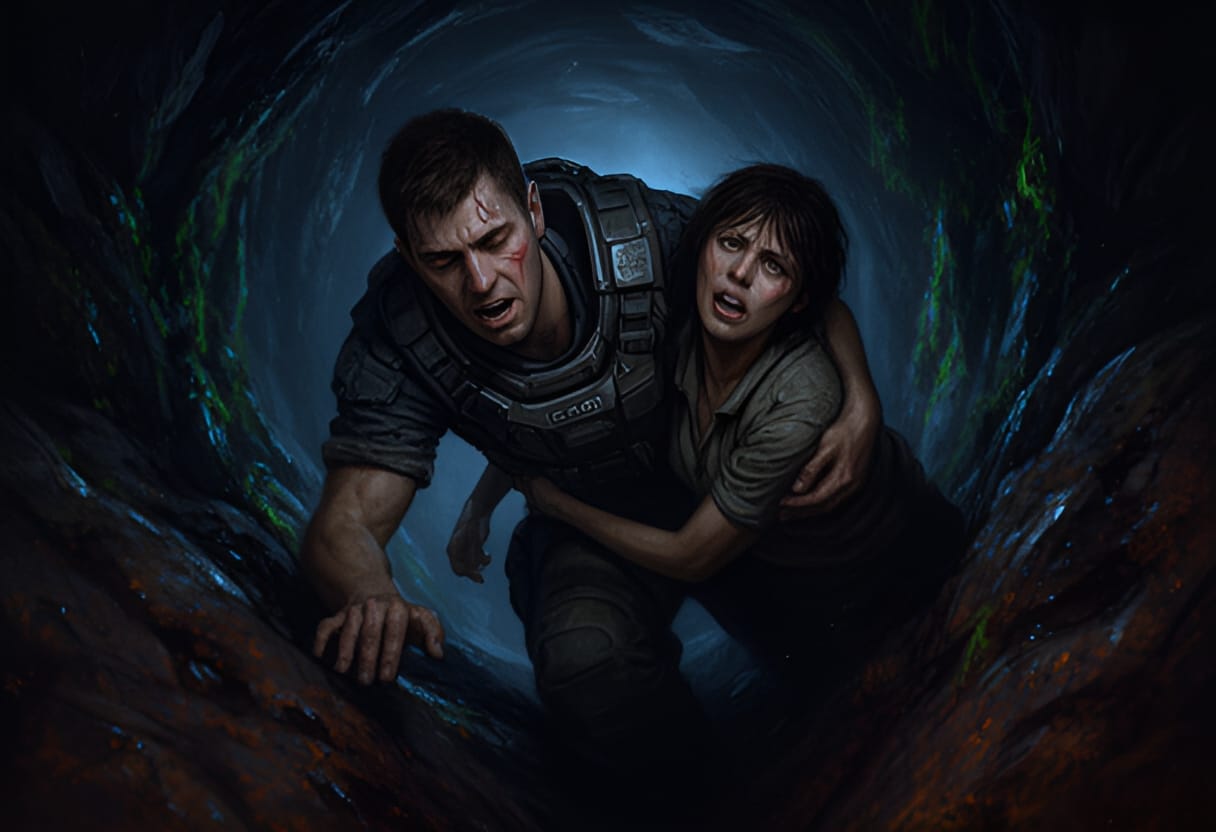
Chapter 13
Almost Out
The photo of their father felt warm in Zay’s palm, the edges worn smooth from years of being carried in a pocket, passed hand to hand, now pressed into his grip by Alex’s trembling fingers. Alex’s voice had been a rasp, barely audible over the drip of water from the tunnel ceiling and the distant, uneven scrape of their boots on stone. If I don’t make it… tell him I tried.
Zay had swallowed hard, nodded once, and slipped the photo into his own vest pocket, over his heart, where the letter from their mother already lay. He hadn’t trusted himself to speak. Not then. Not with the way Alex’s breath hitched, the way his eyes had flicked to the darkness ahead as if seeing something Zay couldn’t.
Now, the dark pressed in tighter. The phosphorescent moss Alex had scraped from the walls glowed faintly behind them, a fading trail of sickly green light that pulsed like a dying heartbeat. They had been moving in silence for what felt like hours, the only sound the rasp of Alex’s breathing and the occasional, involuntary moan that escaped him when a jolt of pain shot through his wounded shoulder or the fever that burned beneath his skin spiked.
Zay bore most of his brother’s weight now, Alex’s arm slung heavy over his shoulders, his body limp and leaning, feet dragging. Each step was a negotiation with exhaustion, with the scream in his own legs, with the way the world seemed to tilt when he moved too fast. He focused on the rhythm: left, right, breathe. Left, right, breathe. Keep moving. Don’t think about how heavy Alex felt. Don’t think about how much hotter his skin was against Zay’s own, how the dampness of sweat had long since soaked through Alex’s shirt and was now seeping into Zay’s armor.
They had left the maintenance cart behind hours ago, its broken axle a useless twist of metal in the mud somewhere back along the tunnel. The last civilian who couldn’t keep up had been left with it, a woman with a child clamped tight to her chest, her eyes wide and silent as Alex had gently guided her to sit against the wall. Zay had seen the resignation in her face, the understanding that they couldn’t all make it. Alex had looked away then, jaw tight, and said nothing. That silence had stayed with them, heavier than any pack.
Now, the tunnel began to slope upward, the stone walls closing in slightly, the air growing cooler, damper. And then—faint at first, a vibration felt more than heard in the soles of his boots—came the rumble.
Zay froze, his breath catching. Alex stirred against him, a weak pressure, a groan.
“Did you—” Alex began, his voice thick, slurred. His forehead was slick with sweat, his skin pallid in the dim glow of the moss behind them. His eyes were open but unfocused, pupils dilated, staring past Zay into the dark. “Did you hear that?”
Zay pressed his lips together, straining to listen past the roar in his own ears, past the frantic hammering of his heart. There it was again—low, distant, but unmistakable. The deep, throbbing pulse of an engine. Not the high-pitched whine of a Locust Seeder or the erratic chug of a Corpser. This was steady. Rhythmic. Human.
“Yeah,” Zay whispered, his voice raw. “Yeah, I hear it. Sounds like… like a truck. Maybe a convoy.”
Alex managed a weak, humorless chuckle that turned into a cough, a wet, rattling thing that made Zay wince. “Funny,” he muttered, his tongue seeming to stumble over the words. “Funny how the only thing that sounds like home these days is the sound of something trying to run us over.”
Zay didn’t answer. He shifted his grip, pulling Alex’s arm tighter against his chest, feeling the rapid, erratic flutter of his brother’s heartbeat through the thin fabric of his shirt. Alex was burning up. His skin was hot and damp, his breaths coming in short, shallow gasps that sounded like they were being pulled through a straw. Every now and then, he would shudder, a full-body convulsion that made Zay fear he’d lose his grip entirely.
“Stay with me,” Zay murmured, more to himself than to Alex. He didn’t know if Alex could hear him. The fever was stealing him away, syllable by syllable.
Alex’s head lolled slightly, his lips moving. Not English this time. Spanish, rapid and fractured, words tumbling out in a stream Zay only half caught.
“…calor… no puedo… respirar…”
Zay frowned, adjusting his stance. “Qué? Alex, habla en inglés. Por favor.”
Alex’s eyes flicked to him, unfocused but searching. A ghost of a smile touched his lips. “El calor… es como… como si el infierno estuviera dentro de mí.” His voice dropped to a whisper. “Siento la luz… sabe a cobre.”
Zay’s breath hitched. He knew that phrase. Alex had mentioned it once before, days ago, when the Kryll had first hit—how the light from a flare had tasted like metal on his tongue. Synesthesia. The Imulsion poisoning was getting worse, attacking his senses, scrambling them. He was tasting light. Feeling sound as pressure. It was a sign of how far the infection had spread, how deeply it had taken root.
“Estás contigo,” Zay said, his voice thick. “Estoy aquí. No te suelto.”
Alex nodded slowly, his eyelids fluttering. “Bueno… bueno… porque… porque si me sueltas… me llevo la oscuridad conmigo.” He paused, swallowing hard. “Y no quiero que la oscuridad gane.”
Zay felt something tighten in his chest, a mix of dread and fierce, aching love. He pressed his forehead briefly to Alex’s temple, feeling the scorching heat of his skin, the dampness of sweat. “She won’t,” he whispered. “Not while I’m still standing.”
They moved on, slower now, each step an agony of balance and will. The engine rumble grew louder, clearer, vibrating through the stone beneath their feet. It was close now—maybe just beyond the next bend. Hope, fragile and dangerous, began to stir in Zay’s chest, a small, desperate flame. Maybe they were near the eastern exit. Maybe the convoy was waiting there, medevacs, reinforcements, a chance to get Alex to a real surgeon, real medicine, a ventilator.
He dared to imagine it: the cool kiss of antiseptic air, the smell of clean bandages, the sound of a voice saying, We’ve got him now. The thought was enough to make his legs burn with renewed effort, to make him straighten his spine just a fraction, to pull Alex’s weight a little tighter against his side.
They rounded a bend in the tunnel, the walls narrowing, the ceiling dipping low, and then—light.
Not the sickly green of moss, not the distant, hopeless glow of surface fires. This was real light. Golden, harsh, spilling from the mouth of the tunnel ahead, cutting through the dark like a blade. And with it came the sound—the deep, resonant throb of engines, not one but multiple, the metallic clink of tracks, the shouts of voices, sharp and urgent, carried on the air.
Zay’s breath stopped. His heart lurched. They’re here. They’re really here.
Alex stirred against him, a weak pressure, a soft sound that might have been a whimper or a sigh. His head lolled against Zay’s shoulder, his breathing even more ragged now, each inhale a struggle, each exhale a rattling sigh. His skin was ashen beneath the sweat, his lips cracked and blue-tinged at the edges.
“We’re almost there,” Zay said, his voice rough, thick with emotion he couldn’t afford to show. “Just a few more steps. Look—see the light? Help’s there.”
Alex didn’t respond. His eyes were open, but unfocused, staring past Zay at the glow ahead. His lips moved again, forming words Zay couldn’t hear, couldn’t decipher over the roar of the engines and the pounding in his own ears. His hand, the one not draped over Zay’s shoulder, twitched slightly, fingers curling and uncurling as if grasping at nothing.
Zay gritted his teeth and pushed forward, his boots scraping on stone, his muscles screaming with the effort. The tunnel mouth loomed—just a few yards away, a rectangle of blessed light and sound and hope.
He was so close he could almost taste it—almost feel the cool night air on his face, almost hear the voices calling out, almost feel the solid ground beneath his boots that wasn’t shifting, collapsing, dripping with Locust ichor.
Then—movement.
Not from the light. From the hole beside it.
A secondary breach in the tunnel wall, hidden in the shadows just to the right of the main exit, a jagged maw torn into the stone by something vast and powerful. And from it, they poured.
Locust.
Not a few. Not a scouting party. A wave. Drones, their armor gleaming dully in the tunnel light, their rifles raised. Boomers, hulking and grotesque, their Boomshots cradled like deadly toys. Tickers, skittering along the walls and floor, their tiny claws clicking on stone. And worse—behind them, the sickly, pulsing glow of Kryll, thousands of wings beating in unison, a living shadow that swallowed light and exhaled hunger.
They poured from the breach like blood from a severed artery, flooding the tunnel mouth, swallowing the light, choking the air with the stench of ozone and rot and something sweet and sickly, like overripe fruit left in the sun.
Zay’s blood turned to ice.
Alex went rigid against him, a sharp intake of breath that turned into a choked gasp. His eyes snapped open, wide and suddenly lucid, filled not with delirium but with stark, icy terror.
“No,” he whispered, his voice raw. “No, no, no—”
Zay didn’t think. He didn’t have time to think. He shifted his weight, lowering Alex gently but firmly to the tunnel floor, supporting his brother’s head and shoulders with one arm, the other snapping up to grip his Lancer. The chainsaw bayonet snarled to life, a vicious, biting sound that cut through the horror for a heartbeat.
“Stay down,” Zay growled, his voice low and fierce, eyes locked on the advancing horde. “Stay with me. Please.”
Alex didn’t answer. He couldn’t. His breath was coming in short, painful bursts, his chest rising and falling with visible strain. His hand, trembling, reached up and closed weakly around Zay’s wrist where it rested on his chest. His grip was feeble, but it was there. An anchor.
Zay swallowed hard, his knuckles white on the Lancer’s grip. The Locust were closing in, boots thudding on stone, guttural commands barked in their harsh tongue, the Kryll massing overhead like a storm cloud given teeth.
The light from the tunnel mouth was already dimming, swallowed by the mass of bodies and wings. The distant roar of the engines was still there, but now it sounded mocking, cruel—a promise of salvation just beyond reach, ripped away at the last second.
Hope had died.
All that was left was this: the weight of his brother in his arm, the smell of sweat and blood and fear, the roar of the chainsaw in his hands, and the Locust pouring from the dark, hungry for blood.
Zay tightened his grip on the Lancer, lowered his stance, and stepped forward, placing himself between Alex and the oncoming horde.
The first Drone lunged.
Zay roared and met it with fire and steel.
The Lancer’s chainsaw bayonet screamed as it tore into the Drone’s chest, sparks flying where the blades struck armored plating before biting deep into soft tissue beneath. The thing shuddered, a guttural grunt escaping its ruined throat, then collapsed in a heap of limbs and oily black blood that smelled of burnt rubber and sulfur. Zay didn’t pause. He swung the rifle in a wide arc, the blade catching the next Drone across the throat, severing muscle and tendon in a spray of dark ichor. The creature gagged, hands flying to its neck as it stumbled backward, only to be caught by the butt of Zay’s weapon driving up under its chin, snapping its head back with a crack that echoed in the confined space.
Alex’s grip on his wrist tightened, nails digging in despite his weakness. “Zay—” he gasped, voice raw. “They’re… everywhere.”
“I know,” Zay said, not taking his eyes from the fight. He kicked out, catching a Ticker that had skittered too close to Alex’s legs, sending it flying into the wall where it exploded in a puff of smoke and chitinous fragments. Another Drone came at him from the left, rifle raised. Zay ducked under the wild burst of fire, felt the heat of plasma kiss his cheek, then surged forward, driving his shoulder into the Locust’s midsection and driving it back into the stone wall. He brought the Lancer up, chainsaw screaming, and drove it into the creature’s gut. It bucked once, then went limp, sliding down the wall in a boneless heap.
The Kryll were closer now, a vast, shifting cloud pressing in from the breach and the tunnel mouth alike, their wings beating in unison, creating a sucking wind that pulled at Zay’s clothes, his hair, the very breath in his lungs. He could feel them—not just see them—each tiny impact like a needle prick against his skin, a cold, hungry pressure that seemed to seek out warmth, to drain it. Alex was shuddering beside him, his breath coming in ragged gasps, his face slick with sweat and something darker—was that blood? Or just the sheen of fever?
“Alex,” Zay said, voice tight. “Look at me.”
His brother’s eyes fluttered open, unfocused but searching. The fever had stolen much of his clarity, but there—deep in the brown of his irises—was still recognition. Still him.
“You still with me?” Zay asked, voice low, urgent.
Alex swallowed hard, his Adam’s apple bobbing. A faint, broken sound escaped him—maybe a whisper, maybe nothing. Then, faintly: “…sí…” He swallowed again. “…contigo…”
Zay nodded, jaw clenched. “Good. Now listen. When I say move, you roll left—toward the wall. Don’t think. Just move. Can you do that?”
Alex’s eyes narrowed slightly, focusing with effort. He gave the tiniest nod.
Zay took a breath, then shouted, “Now!”
He shoved hard with his shoulder, using his body as a shield, and heaved Alex sideways just as a Boomshot round screamed past where they’d been—whump—detonating against the tunnel floor in a ball of flame and concussion that threw Zay off his feet. He landed hard on his shoulder, breath knocked out of him, but held onto the Lancer, rolling to absorb the impact. Alex cried out—a sharp, pained gasp—as he hit the stone, his back arching slightly before he went still, chest heaving.
Zay pushed himself up on one elbow, blinking against the smoke and dust. The Boomer that had fired stood revealed in the flickering light of the blast, its massive form silhouetted against the glow, reloading its weapon with slow, deliberate movements. Its head turned, dead eyes locking onto him.
“No,” Zay breathed, scrambling backward on his heels, Lancer coming up. He fired—a burst of automatic fire that sprayed sparks off the Boomer’s chest plate but did little else. The thing laughed—a low, wet chuckle—then raised the Boomshot again.
Zay braced for impact.
Then—movement from the shadows.
A figure lunged from the darkness to the right, a blur of dark fabric and metal. A knife flashed, sinking deep into the Boomer’s throat where the armor ended and flesh began. The creature gurgled, its shot going wild—whump—into the ceiling, raining dust and small stones. It staggered, claws scraping stone, then collapsed sideways, twitching.
Zay blinked. Jace Stratton stood over the fallen Boomer, knife still in hand, chest heaving, face smeared with soot and blood. His Boltok pistol was gone—lost, maybe—but he’d taken a Gorgon SMG from a fallen Drone and was already swinging it toward the next threat.
“Thought you might need a hand,” Jace said, voice grim but steady. He didn’t wait for an answer. He opened fire, short controlled bursts that dropped two Tickers skittering toward Alex’s prone form.
Zay pushed himself to his feet, Lancer at the ready. “You’re alive.”
Jace spared him a tight, humorless grin. “Barely. But I’ve got a score to settle with the uglies that buried Mercy.” He nodded toward Alex. “How’s the twin?”
“Fever’s bad,” Zay said, keeping his eyes on the enemy. “Delirious. Burning up. But he’s breathing. Still with me.”
Jace glanced at Alex, then back at the horde. “We can’t hold this. Not like this. But we can buy time. If there’s really a convoy out there—if they’re close—then we just need to hold the mouth long enough for them to see us. To see him.” He jerked his chin toward Alex, who was trying to push himself up on his elbows, face twisted in pain.
Zay followed his gaze. Alex was trembling, face ashen, lips parted as he fought for air. His hand clutched at his side where a dark stain was spreading across his shirt—shrapnel? A ricochet? Whatever it was, it was bleeding, slow but steady. And his breathing—shallow, uneven, each inhale a struggle—was worsening by the second.
“We don’t have time for him to last,” Zay said, voice tight. “He needs a medic. Now.”
Jace didn’t argue. He just nodded, eyes scanning the chaos. The Locust were still pouring from the secondary hole—Drones, Boomers, more Tickers—but the Kryll mass was thinning slightly, perhaps distracted by the explosions, perhaps sated by the heat and noise. The tunnel mouth was still blocked, but not completely. There were gaps—fleeting, dangerous—where the light from outside punched through.
“Then we make them see us,” Jace said. He slipped a fresh magazine into the Gorgon, the click loud in the sudden quiet between volleys. “We make a signal. Something they can’t miss.”
Zay frowned. “Like what?”
Jace’s eyes flicked to the Lancer in Zay’s hands. Then to the Boomer’s discarded Boomshot, still smoking nearby. “You ever see a Grenade launcher work?”
Zay understood instantly. He looked at the Boomshot, then back at his brother—pale, trembling, fighting to stay conscious—and felt a surge of something fierce and desperate ignite in his chest. Not hope. Not exactly. Something sharper. Something older. A promise made long ago, whispered in the dark before they’d even known what war was: I will always find my way back to you.
He turned to Jace. “Give me ten seconds.”
Jace nodded, raising the Gorgon. “Going loud.”
He opened fire—a controlled burst that caught a Drone in the throat, sending it spinning. Then another, catching a Ticker mid-leap. The Locust faltered for a heartbeat, confused by the sudden, precise resistance. Zay didn’t wait. He lunged for the Boomshot, snatched it up—it was heavy, hot from recent use—and turned, half-crouching, toward the tunnel mouth.
Alex had managed to get onto his knees, one hand braced on the stone, the other pressed hard against his side. His eyes were open, wide and terrified, but fixed on Zay. Not pleading. Not begging. Just seeing him. As if to say, I’m still here. Don’t forget me.
Zay met his gaze, heart hammering. He didn’t have time for words. Instead, he tapped his chest—twice, sharp and firm—then pressed his palm flat over Alex’s heart, feeling the frantic, uneven hammering beneath his fingers.
Alex’s breath hitched. A tear tracked through the sweat on his temple. He managed a weak, shuddering nod. Then, voice barely audible: “…te… encuentro…”
Zay pressed his forehead to Alex’s for a brief, fierce second. “Siempre.”
Then he turned, Boomshot cradled in both hands, and stepped into the light.
The tunnel mouth was a chaos of smoke and fire and shifting shadows. The Locust still pressed in, but the main mass had shifted slightly, drawn by the noise, by the explosions. And beyond them—just beyond the ragged edge of the horde—Zay saw it.
Not a convoy. Not trucks.
A single King Raven helicopter, hovering low over the eastern ridge, its rotors kicking up dust and debris, its door gunner leaning out, scanning the ground. And beneath it, half-hidden in a dip of terrain, a pair of Mule APCs, engines idling, hatches open, crewmen shouting and pointing.
They were close. So close.
Zay raised the Boomshot.
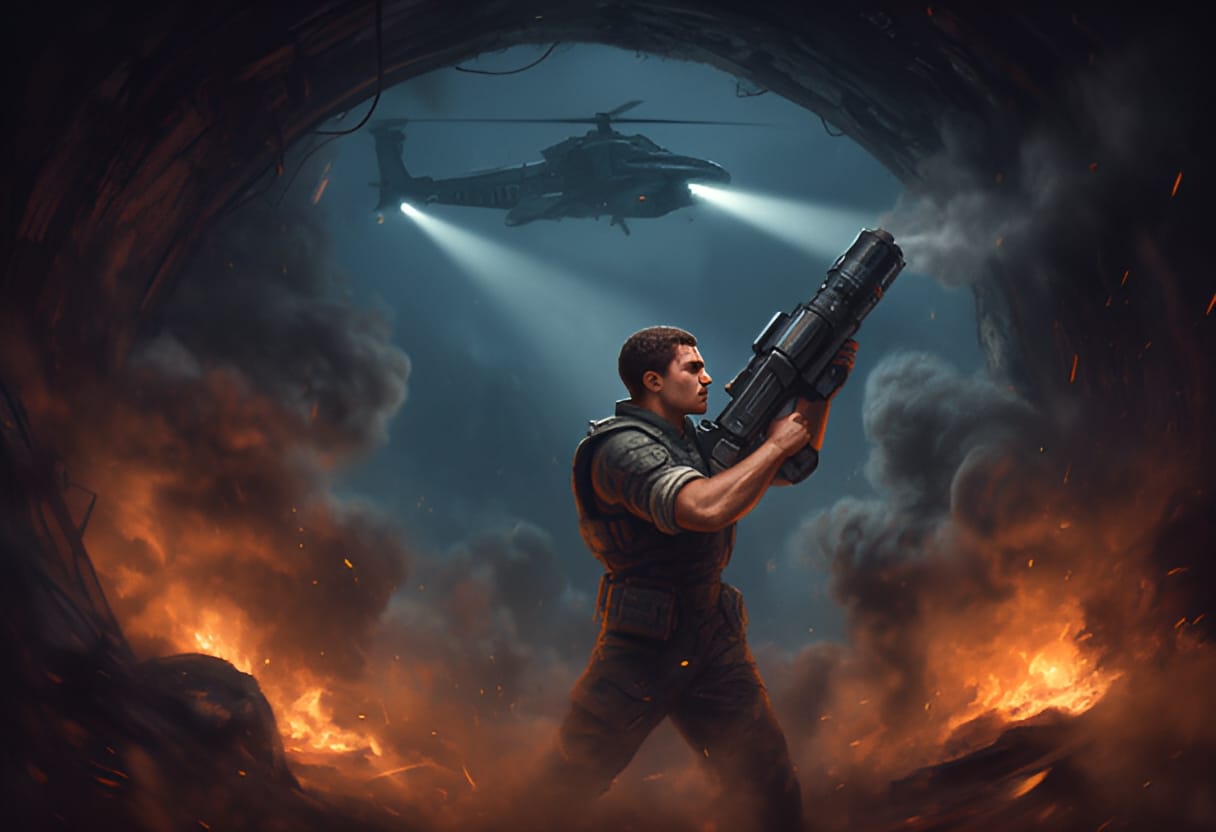
He didn’t aim for the horde. He aimed for the ground—just a few feet in front of the leading Boomer, where the stone was cracked and dusty from recent explosions. He squeezed the trigger.
Thoom.
The grenade launched—a slow, arcing trajectory through the smoke and flame—then detonated on impact.
Not a kill shot. Not even close.
But it was loud.
And it was bright.
The explosion bloomed in a ball of orange and white flame, sending a shockwave of heat and pressure rippling outward. Stone shattered. Dust flew. And for a heartbeat—just a heartbeat—the Kryll scattered, wings snapping shut as they were blown back by the blast, leaving a temporary gap in the swarm.
And in that gap—clear, unmistakable—the King Raven’s searchlight swept across the battlefield.
It hit Zay first.
He didn’t flinch. He stood there, Boomshot still smoking in his hands, Alex’s blood on his face, sweat and dirt streaking his skin, and he met the light—not as a soldier begging for rescue, but as a man standing his ground.
The light swept over him, then moved on—catching Jace behind him, Gorgon smoking, knife in teeth as he reloaded. Then it swept further—past the secondary breach, past the writhing, wounded Locust—and fell on Alex.
He was still on his knees, one hand braced on the ground, the other pressed to his wound. His head was lifted, chin up, eyes open and fixed on the light. His face was pale, drawn, but his expression—gods, his expression—wasn’t fear. It was recognition. It was relief. It was, impossibly, a kind of peace.
The light held on him for a long moment.
Then the King Raven’s door gunner shouted something—Zay couldn’t hear it over the rotors, over the ringing in his ears—but the helicopter tilted slightly, swinging its nose toward the tunnel mouth. The Mule APCs lurched forward, engines roaring, tracks biting into the dirt as they began to move.
They’d been seen.
They were coming.
Zay lowered the Boomshot, his arms shaking. He turned, stumbling back toward Alex, who had collapsed forward onto his hands and knees, breathing hard, face pressed to the stone.
“They saw us,” Zay whispered, dropping to his knees beside his brother. He slipped an arm under Alex’s shoulders, another under his knees, and lifted—grunting with the effort, muscles burning, vision swimming at the edges. “They’re coming. Just hold on. Please.”
Alex’s head lolled against his shoulder, breath hot and wet against Zay’s neck. His hand twitched, fingers curling weakly against Zay’s chest—right over his heart, where Zay had pressed his palm moments before.
“Tried…” Alex murmured, voice a broken thread. “…told him… I tried.”
Zay’s throat closed. He pressed his cheek to Alex’s temple, feeling the terrifying heat of his skin, the frantic, faltering beat of his heart against his palm.
“I know,” he whispered. “I know you did.”
He began to move—backward, step by agonizing step—pulling his brother away from the killing zone, toward the relative cover of the tunnel wall, toward the waiting machines, toward the chance of a medic, a surgeon, a ventilator, a chance.
Behind them, the Locust surged forward, sensing prey, sensing victory. The Kryll closed in again, a living shadow seeking warmth. The Boomshot was empty, the Lancer nearly out of ammo, and Zay’s strength was fading fast—every step a battle against gravity, against fatigue, against the creeping certainty that they might not make it.
But ahead, the King Raven hovered lower now, its searchlight swinging in a wide arc, scanning for threats. The Mule APCs were closer, their hulls gleaming in the dim light, hatches open, crewmen leaning out, weapons ready.
And in Alex’s ear, Zay whispered again, over and over, a litany against the dark:
“I’ve got you. I’ve got you. I’ve got you.”
He didn’t know if his brother could hear him.
He only knew that if he stopped saying it, he might start believing it wasn’t true.
Zay adjusted his grip on Alex’s weight, feeling the tremor in his brother’s limbs as they moved backward, step by step, toward the shelter of the tunnel wall. The heat of Alex’s skin seeped through Zay’s armor, a feverish burn that made his own pulse hammer in his temples. He could feel the ragged catch in Alex’s breath, the way his chest hitched with each inhalation, shallow and strained. The words Alex had murmured—tried… told him I tried—echoed in Zay’s skull, a broken litany that threatened to unravel him.
He didn’t dare look down at the wound. Not yet. Not while they were still moving.
The tunnel mouth yawned ahead, a jagged wound in the earth rimmed with twisted metal and splintered concrete. Beyond it, the street was a hellscape of smoke and flame, the air thick with the acrid tang of burning Imulsion and ozone. The King Raven hung low, its searchlight swinging in slow arcs, painting the scene in stark, stuttering flashes of white. The Mule APCs were closer now—close enough that Zay could see the sweat on the crewmen’s brows, the way they gripped their weapons, knuckles white. Shouts cut through the rotor wash: “Move! Move! Civilians through the tunnel—now!”
Zay’s eyes flicked to the flow of people slipping into the darkness behind them—men, women, children, faces smudged with soot, eyes wide with terror. Some carried bundles; others dragged the injured. A woman clutched a toddler to her chest, her breath coming in ragged gasps. An old man leaned on a cane, his leg twisted at an unnatural angle. They were pouring into the tunnel like water through a crack in a dam, and Zay knew, with a certainty that chilled him deeper than any wound, that if they didn’t hold this line, none of them would make it.
He shifted Alex’s weight again, feeling his brother’s body go limp for a heartbeat before Alex gasped and pushed weakly against Zay’s chest.
“Can’t… carry me…” Alex rasped, voice raw. “Go… save yourself…”
Zay shook his head, teeth gritted. “Shut up. You’re coming with me.”
He lowered Alex gently to the ground beside a overturned transit cart, its wheels bent, its frame twisted. The cart had been used earlier to haul supplies; now it would serve as cover. Zay dragged it sideways, grunting as the metal screamed against stone, until it formed a partial barrier between them and the street. He crouched behind it, pulling Alex down with him, pressing his brother’s back against the cold concrete of the tunnel wall.
Alex’s head lolled to the side, eyes half-lidded. His breath came in wet, shuddering pulls. Blood soaked through the fabric of his shirt at his side, dark and slick. Zay pressed his palm flat against the wound, feeling the frantic flutter beneath his fingers—too fast, too thin. The heat radiating from Alex’s skin was terrifying, like touching a furnace.
“Stay with me,” Zay whispered, voice rough. “Just stay with me.”
Alex’s lips moved. No sound came out. Just a faint twitch, like he was trying to smile.
Zay swallowed hard, then turned his head, scanning the street.
The Locust were coming.
Not in the dense, rolling wave they’d seen earlier, but in tighter, more disciplined packs—Drones advancing in staggered formations, Bolters laying down suppressive fire from behind shattered storefronts, a pair of Boomers lumbering forward, their Boomshots cradled like grim reapers’ scythes. Kryll wheeled above them in a living cloud, wings clicking and scraping as they sought the warmth of bodies.
And then, from the flanks—snipers.
Zay caught the glint of metal on a rooftop to the left, the glint of a scope catching the King Raven’s searchlight as it swept past. A second later, a pulse of blue-white plasma lanced down, striking the pavement near the Mule APCs, sending a shower of sparks and molten stone into the air.
“Snipers!” Zay barked, though he knew the crewmen had already seen them. “Left flank! Rooftop!”
A burst of Lancer fire spat from the nearest Mule, the chainsaw bayonet snarling as it chewed through the air. The shot went wide, but it made the sniper duck back behind cover.
Zay turned his attention back to the immediate threat. He fumbled for his Lancer, checked the magazine—two rounds left. He slapped in a fresh clip from his vest, the metal clicking into place with a sound that felt unnervingly loud in the sudden quiet between bursts of fire.
Alex stirred beside him, fingers twitching against Zay’s arm.
“Zay…” he breathed. “My hands…”
Zay looked down. Alex’s left hand was curled inward, the fingers stiff and trembling. The skin was blistered and blackened at the tips—Kryll burns, worsening. The right hand, the one pressed over his heart, was slick with blood, but he could still move it, weakly.
“You’re alright,” Zay lied, though his voice didn’t convince even himself. “Just hold on. We’re almost there.”
Alex managed a faint nod. His eyes fluttered shut for a second, then opened again, locking onto Zay’s. There was no fear in them. Not anymore. Just a deep, weary certainty—like he’d already seen the end and made peace with it.
Zay’s throat tightened. He couldn’t afford to break. Not now.
He raised the Lancer, sighting down the barrel.
The first wave hit.
Three Drones lunged from the smoke, rifles spitting, claws extended. Zay squeezed the trigger. The Lancer bucked, the chainsaw screaming as it tore into the lead Drone’s chest, spraying black ichor and sending the creature staggering back with a guttural shriek. The second Drone went down to a burst of fire from the Mule’s turret, its head snapping back as rounds punched through its skull. The third tried to flank, darting left toward the civilian stream—
A bolt of blue-white light lanced out from the shadows.
Jace Stratton.
He appeared from the side of the tunnel mouth, crouched low behind a chunk of fallen façade, the Boltok pistol smoking in his hand. His face was streaked with dirt and blood, a gash above his eyebrow bleeding into his eye, but his gaze was locked, fierce. He fired again—another bolt, another Drone dropping mid-stride, clutching its throat as it fell.
“Took you long enough,” Zay said, not lowering his weapon.
Jace managed a grim, humorless smile. “Had to crawl through a Seeder’s vent to get here. Felt like I was being digested.” He jerked his chin toward the street. “They’re thickening up. Boomers on the move.”
Zay glanced over. Two Boomers were advancing, slow and deliberate, their heavy steps shaking the ground. One swung its Boomshot, aiming not at them, but at the tunnel mouth itself—trying to collapse the entrance and trap the civilians inside.
“No you don’t,” Zay muttered.
He shifted his aim, squeezed the trigger. The Lancer roared. The chainsaw bit into the air, then caught the edge of the Boomshot barrel as the Boomer swung. Metal screamed. Sparks flew. The weapon jerked violently in the Boomer’s grip, throwing off its aim. The Boomshot discharged into the sky, a fireball blooming harmlessly above the rooftops.
The Boomer staggered, roaring in fury.
Jace was already moving. He popped up from cover, Boltok blazing. Two quick shots—one to the Boomer’s knee, one to its throat joint. The creature staggered, then dropped to one knee, gripping its leg as black fluid pulsed from the wound.
The second Boomer swung its weapon, aiming for the Mule APCs—
A King Raven door gunner opened up. The minigun stuttered to life, a torrent of tracers chewing through the air. The Boomer jerked, hit in the shoulder, then the chest. It went down hard, sliding on its belly before going still.
Zay didn’t have time to breathe.
Kryll dove.
A wave of them, wings snapping, surged from the smoke like a living shadow, drawn by heat, by motion, by the scent of blood. They struck the Mule APCs first, swarming over the hulls, claws scrabbling at vision ports and seams. Crewmen shouted, swinging rifle butts, trying to shake them off.
Zay raised the Lancer again, but this time he didn’t fire. He swung it like a club, the chainsaw guard catching a Kryll mid-flight and crushing it with a sickening pop. Another dove for his face—he ducked, felt the brush of wingtips against his helmet, then brought the Lancer up in a backhand swing that sent the creature spinning into the concrete.
Alex cried out—a soft, broken sound.
Zay snapped his head around.
Alex was on his side, one hand clamped over his mouth, the other pressing desperately at his side wound. His face was ashen, lips blue at the edges. Sweat plastered his hair to his forehead. His breath came in ragged, wheezing gasps, each one a struggle.
“Alex!” Zay yelled, dropping the Lancer and scrambling to his knees beside him.
Alex’s eyes were open, but unfocused, pupils blown wide. He was trembling violently, teeth chattering despite the heat. His hand twitched against Zay’s chest, fingers scrabbling at the fabric of his vest—searching for something.
Zay grabbed his wrists, pinned them gently but firmly. “Hey. Hey, look at me. Look at me, Alex.”
Alex’s gaze found his, slow and heavy. There was recognition there—flickering, but real. And beneath the pain, something else. Trust.
“I’m here,” Zay said, voice low and fierce. “I’m not leaving you.”
Alex’s lips moved. This time, Zay caught it.
“Frío…” he whispered. “So… cold…”
Zay’s breath hitched. He pulled off his own helmet, then his undershirt, and wrapped it around Alex’s shoulders, rubbing his arms briskly to generate friction. “You’re not cold. You’re burning up. Just… hold on. Please.”
Alex’s breathing hitched again—a wet, bubbling sound. Blood frothed at the corner of his mouth. He tried to speak, but only a wet groan came out.
Zay pressed his forehead to Alex’s, feeling the terrifying heat radiating from his skin. “I’ve got you,” he murmured, over and over, the words a lifeline thrown into the dark. “I’ve got you. I’ve got you.”
Behind them, the battle raged.
Jace was everywhere.
He popped up behind a broken fire hydrant, Boltok flashing—another Drone down, clutching its eye. He rolled left as a Bolter’s plasma bolt seared the spot where he’d been, then popped up again, firing on the move—two shots, a Bolter spinning backward, smoke rising from its chest wound.
He ducked as a Kryll swarm dove, swinging the Boltok like a club and catching one mid-air, the impact sending it spinning into a wall where it burst into ash and oily residue.
He was shouting, too—short, sharp commands, the kind that cut through panic.
“Cover the left! Grenade incoming! Medic, move up!”
Zay watched him, awe and grief warring in his chest. Jace wasn’t just fighting—he was leading. He was seeing the flow of the battle, calling targets, making sure the civilians kept moving into the tunnel. He was the kind of soldier Zay had always respected—hot-headed, yes, but damn effective.
And then, as if summoned by the thought, a crack split the air.
Not from the front. Not from the flanks.
From above.
A high, sharp crack—like a whip made of light—split the silence between bursts of fire.
Jace froze.
His eyes widened. He looked down.
A small, perfect hole bloomed in his throat, just above the collarbone. No spray, no gush—just a thin thread of black blood trickling downward, staining the front of his armor. His Boltok slipped from his fingers, clattering to the stone.
He didn’t cry out. Didn’t scream.
He just… stopped.
His gaze lifted, slow and heavy, searching until it found Zay’s. Then Alex’s.
For a long, breathless moment, the world narrowed to those three pairs of eyes—Zay’s, wide and disbelieving; Alex’s, glazed but fixed; Jace’s, holding theirs with a quiet, profound understanding.
Then Jace nodded.
Just once.
A small, sharp dip of the chin.
Acknowledgment. Thanks. I saw you. I’m sorry.
Then his eyes slid shut.
His head lolled to the side.
His body went slack, slipping sideways until he lay still, one arm flung out, the Boltok lying inches from his fingertips.
Silence.
Not the silence of absence, but the silence of loss—deep, sudden, and absolute.
Zay couldn’t breathe.
His vision tunneled. The roar of the King Raven, the chatter of Lancers, the scream of Kryll—it all faded, muffled, as if heard through water. All he could see was Jace’s face—peaceful, almost serene in death, the blood on his throat like a dark jewel.
Alex shuddered against him, a soft moan escaping his lips.
Zay jerked back to the present.
He didn’t have time to grieve. Not yet.
He lowered Alex gently back to the ground, then snatched up his Lancer, checking the chamber—still one round left. He slapped in another clip from his vest, his movements sharp, mechanical.
He rose to a crouch behind the transit cart, weapon raised.
The Locust were pressing harder now—sensing weakness, sensing the moment. A group of Drones surged forward, rifles blazing, followed by a Wretch that came shrieking from the left, claws scraping stone as it lunged.
Zay fired.
The Lancer kicked. The round took the Wretch in the throat, blowing its head clean off. The body crumpled, twitching.
A Drone went down to a burst from the Mule’s coaxial. Another was hit by a plasma bolt from the King Raven’s door gunner—flung backward, smoking.
But they kept coming.
Zay burned through ammo, firing in controlled bursts, each shot deliberate. He aimed for joints, for throats, for the glowing weak points in the Locust carapace. He didn’t waste shots. He couldn’t.
Beside him, Alex stirred again.
His breathing was worse—shorter, faster, each inhalation a wet, bubbling rasp. Blood trickled from the corner of his mouth, dark and thick. His skin was grayish, lips tinged blue. His eyes fluttered open, unfocused, then locked onto Zay’s for a second before drifting away.
“Zay…” he whispered. “Cold… so cold…”
Zay knelt beside him, ignoring the battle for a heartbeat. He pulled Alex’s head onto his thigh, brushing sweat-damp hair from his forehead. “You’re not cold,” he said, voice thick. “You’re burning up. Just… fight it, okay? Fight it for me.”
Alex’s fingers twitched, brushing weakly against Zay’s leg. Then, faintly, so faintly Zay almost missed it—he felt the press of a thumb against his skin.
Two taps.
Chest. Heart.
Zay’s breath hitched. He pressed his own palm flat over Alex’s heart, feeling the frantic, faltering beat beneath his hand—too fast, too weak, but there.
“I’m here,” he whispered. “I’m right here.”
He didn’t let go.
He couldn’t.
He turned his head back to the street, Lancer braced on his forearm, eyes scanning.
The Boomers were back—two of them, advancing from the right, shields raised, Boomshots primed. Behind them, a pack of Drones moved in a loose wedge, laying down suppressing fire.
Zay squeezed the trigger.
The Lancer screamed.
The first burst caught the lead Boomer in the shield arm—plasma chewed through the armored plating, sending black fluid spurting. The Boomer roared, staggering, but didn’t drop.
Zay kept firing, walking the shots up the arm, toward the shoulder joint. The Boomer swung its Boomshot wildly—Zay ducked as the projectile screamed overhead, detonating against a building facade in a shower of stone and flame.
Then—click.
Empty.
Zay cursed, slapping the mag release. The empty clip clattered to the ground. He fumbled for another—his last.
His fingers closed around it.
Just as the Boomer raised its weapon.
Zay shoved the fresh clip in, slammed the bolt forward—
And fired.
The Lancer roared.
The round struck the Boomer square in the chest, just below the collarbone. Plasma bloomed across its armor, searing through flesh and bone. The Boomer let out a terrible, rattling cry—then folded, collapsing sideways, its Boomshot clattering uselessly to the ground.
The second Boomer hesitated—just for a heartbeat.
That was all Jace needed.
Even dying, even gone, he’d given them the opening.
Zay didn’t think. He moved.
He surged forward from cover, Lancer roaring, chainsaw snarling as he charged the stunned Boomer. The creature tried to bring its weapon to bear, but Zay was already on it—he slammed into its thigh with his shoulder, knocking it off balance, then drove the Lancer forward.
The chainsaw bit into the Boomer’s neck.
Black ichor sprayed, hot and thick, spraying Zay’s face and armor. The Boomer jerked, tried to scream—then the chainsaw tore through its spinal column, and it went limp, collapsing in a heap of smoking meat and broken plate.
Zay didn’t stop.
He wrenched the Lancer free, spun—
And saw them.
The last of the civilians were disappearing into the tunnel— a woman pushing a stroller, an old man supported by two others, a girl no older than ten clutching a stuffed animal to her chest. The flow was thinning, but still coming.
And behind them, the Locust were regrouping.
A sniper’s lens caught the light on a far rooftop—another shot incoming.
Zay didn’t hesitate.
He turned, Lancer raised, and fired—not at the sniper, but at the edge of the rooftop itself.
The round struck the concrete, detonating in a puff of dust and shattered stone.
Debris rained down.
The sniper ducked—just for a second.
That was all the King Raven’s door gunner needed.
The minigun stuttered to life.
Tracers lashed across the rooftop, chewing through concrete and steel. The sniper’s position erupted in a cloud of smoke and debris—when it cleared, there was nothing left but a twisted, smoking ruin.
Zay lowered the weapon, breathing hard.
He looked back at the tunnel.
The last civilian vanished into the darkness.
The entrance was clear.
He turned to Alex.
His brother was still, too still. His head lolled to the side, eyes half-closed, breath coming in shallow, wet gasps. Blood soaked through Zay’s undershirt where it was wrapped around Alex’s side, dark and spreading. The skin around his lips was bluish, his fingertips tinged with cyan.
Zay dropped to his knees, cradling Alex’s head in both hands.
“Alex,” he said, voice raw. “Alex, look at me.”
Alex’s eyelids fluttered. It took effort—so much effort—but his eyes opened, unfocused, searching.
Zay pressed his forehead to his brother’s, feeling the terrifying heat, the frantic flutter of his pulse against his skin.
“I’ve got you,” he whispered, over and over, the words a prayer, a promise, a lifeline. “I’ve got you. I’ve got you. I’ve got you.”
Alex’s lips moved.
No sound came out.
Just the faintest twitch—like he was trying to smile.
Then his breath hitched.
A long, shuddering draw.
And then—nothing.
His body went slack.
His breath stopped.
His eyes stayed open, fixed on Zay’s, unseeing.
Zay didn’t cry out.
He didn’t move.
He just held his brother tighter, forehead pressed to temple, and let the silence swallow him whole.
The King Raven’s searchlight swept over them once—white, cold, indifferent.
Then it moved on.
And the battle continued—without them.
Zay didn’t let go.
He stayed there, kneeling in the dust and stone, Alex’s lifeless weight pressed against him, the world narrowed to the hollow in his chest where his brother’s heartbeat should have been. The King Raven’s searchlight swept over them again—this time lingering, as if the crew had seen, had understood. A voice crackled over the comm, distant and tinny: “Medic team, we’ve got two down at the tunnel mouth—repeat, two down, need evac now!”
Zay didn’t answer. He couldn’t.
His hands trembled where they clung to Alex’s shoulders, fingers digging into the fabric of his armor, as if he could somehow hold his brother to this world by force of will alone. The blood on his hands was cool now, drying in streaks across his knuckles, dark and thick. He stared at them—at the evidence of what had happened, of what he hadn’t been able to stop.
A shadow fell across them.
He looked up.
Jace’s body lay a few feet away, eyes still open, throat ruined, the Boltok abandoned in the dirt. The sight of him—still, silent, eyes seeing nothing—sent a fresh wave of nausea through Zay’s gut. He’d seen death before. He’d dealt it. But this… this was different. This was watching the people who had become his anchor, his reason, slip away in the span of breaths.
He lowered Alex gently to the ground, easing his brother’s head onto a chunk of broken concrete. Then he rose, stiff and unsteady, and walked over to Jace. He closed the man’s eyes with two fingers, the lids slipping down like shutters on a broken window. He didn’t say anything. There was nothing left to say.
He took the Boltok from the dirt—still warm, still loaded—and checked the chamber. One round left. He tucked it into his vest, next to the photo of their father, next to the letter from their mother. He didn’t know why he kept them. Maybe because letting go felt like admitting it was really over.
He turned back to the tunnel mouth.
The King Raven hovered lower now, its rotors kicking up a storm of dust and grit. The Mule APCs had pulled up flush against the tunnel entrance, hatches open, crewmen shouting, waving them forward. Stretcher teams stood ready, medics with kits open, voices urgent but calm.
Zay didn’t move.
He looked back at Alex.
His brother lay exactly as he had fallen—peaceful, almost, if you ignored the blood, the gray skin, the stillness. Zay knelt again, took Alex’s hand in both of his. It was cold. Too cold.
He pressed his forehead to Alex’s knuckles, breathing in the scent of sweat, blood, and something else—ozone, maybe, or the sharp tang of Imulsion that had been in Alex’s breath for hours now.
“I tried,” he whispered, the words rough, torn from somewhere deep. “I tried to keep you safe. I tried to bring you home.”
He swallowed hard, throat tight. “I didn’t… I didn’t know it would end like this.”
He lifted his head, eyes burning. “But I’m not leaving you. Not now. Not ever.”
He stood, then, and began to strip off his own gear—plate by plate, piece by piece. The Lancer went first, set gently beside Alex. Then the ammo pouches, the grenades, the knife. He peeled off his undershirt, soaked through with Alex’s blood, and folded it carefully, laying it over his brother’s chest like a shroud.
When he was down to his undershirt and trousers, he lay down beside Alex, shoulder to shoulder, hip to hip. He took his brother’s hand again, lacing their fingers together—just like they had when they were kids, just like they had in the gym that morning, joking about coffee and push-ups.
He turned his head, resting his temple against Alex’s.
The King Raven’s searchlight swept over them one last time—steady, unwavering—and then the rotors shifted, the helicopter beginning to pull back, gaining altitude as the Mule APCs’ engines growled to life.
They were leaving.
They were leaving them behind.
Zay closed his eyes.
He didn’t fight it.
He let the darkness come.
Not the darkness of fear.
Not the darkness of loss.
But the darkness of together.
And in that dark, he whispered again, voice barely a breath:
“I’ve got you, Alex. I’ve got you. I’ve got you.”
And for the first time since the world ended, he believed it.
Zay didn’t feel the impact at first—only the sudden, searing pressure across his cheek, like a fist wrapped in barbed wire had slammed into his face. He staggered backward, boots skidding on loose gravel and blood-slick stone, the world tilting violently to the right. A hot, wetness blossomed along his jawline, tracing a path down his neck, and for a breathless second, he thought he’d been gutted—until he realized the warmth was his own, pouring from a ruin where his eye should have been.
He dropped to one knee, gasping, fingers flying to the wreckage of his vision. His left eye was gone—not just dark, but gone, replaced by a throbbing, pulsing agony that radiated into his skull like a live wire. Light stabbed through the remaining sight in his right eye, fractured and smeared with blood, turning the tunnel mouth into a nightmare of double images and shifting shadows. He blinked hard, trying to clear it, but the blood kept flowing, hot and thick, sealing his lashes shut every few seconds.
“Zay!” Alex’s voice tore through the chaos—raw, terrified, closer than he expected.
He didn’t turn. Couldn’t. Instead, he braced his left forearm against the ground, planted his right boot hard, and fired from the hip, Lancer jerking in his grip as he sprayed rounds toward the sound of snarling and chitin scraping on stone. He didn’t aim. He listened. The whine of a Bolter’s charge, the wet thunk of a Drone’s claws on metal, the low, subsonic hum of Kryll wings beating in the dark—each sound became a target. He walked his fire by ear, stitching bursts across the gloom where the enemy massed, feeling the recoil hammer his shoulder, feeling the gun grow hot in his hands.
Alex was shouting again, but Zay couldn’t make out the words over the ringing in his ears and the scream of his own nerve endings. He caught fragments—jam—stoppage—cover me—and understood without needing clarity. His brother’s weapon had failed. Again. And in this hell, a jammed Lancer was a death sentence.
He shifted his weight, threw his body forward into the blast zone, and opened up with everything he had. The Lancer bucked like a living thing, chainsaw snarling as it chewed through the air, tracers stitching red arcs through the dust and smoke. He didn’t see the Bolter that rose from the rubble to his left—didn’t see the glow of its charging cannister—but he heard the whine spike, felt the vibration in his molars, and threw himself sideways just as the bolt detonated.
The world exploded.
Not fire. Not flame. A concussion—a physical blow that hit like a wrecking rod, slamming him flat on his back, helmet ringing, teeth rattling. Shrapnel tore across his face and shoulder—hot needles of metal punching through armor, biting deep. He tasted copper and dirt, felt the wet tear of flesh along his cheekbone, and then—nothing. The left side of his face went numb, then flooded with fire. He tried to lift his head, to see, to fight, but his vision swam—black at the edges, then red, then gone entirely on that side. Only a narrow, bloody slit remained in his right eye, the world reduced to a tunnel of light and motion.
He forced himself up on one elbow, coughing blood and grit, and fired again—blind, instinctive, hammering the trigger as Locust shapes loomed through the haze. He heard Alex scream his name—not a word, just a raw, shattered cry—and then hands were on him, gripping his armor, hauling him backward with brutal strength.
They tumbled behind the fallen support column—stone and twisted rebar groaning under their weight—and Alex shoved him hard against the cold, rough surface, pressing his body over Zay’s like a shield. Zay gasped, trying to suck air through blood-clogged nostrils, hissing as Alex’s weight jarred his shattered face.
“Stay down,” Alex snarled, voice ragged but fierce. “Just… stay down.”
Zay couldn’t answer. Couldn’t see. Could only feel—the press of Alex’s chest against his back, the frantic hammer of his brother’s heart, the slick warmth of blood soaking into his shirt where Alex’s side was torn open. He raised his Lancer with his good hand, fired blindly over the column’s edge, listening for the thud of impacts, the chitinous shriek of something going down.
Above them, the tunnel mouth was a storm of Locust—Drones pouring from the secondary hole like ants from a kicked nest, Bolters laying down suppressing fire, a Boomer lumbering into view with its Boomshot cradled like a child. Kryll swarmed the edges of the light, a living shadow that licked at the stone, seeking gaps in their defense.
Alex was screaming again—not in fear, but in fury. Zay felt him shift, felt the jerk of his brother’s arm as he slammed a fresh magazine into his Lancer, the click of the bolt release sharp and final. Then came the roar of the chainsaw, the spit of gunfire, and Alex’s voice, raw and bleeding through the pain: “Come on, you ugly bastards! Come and get some!”
Zay fired again, then again, each shot a prayer, each burst a promise. He couldn’t see. Couldn’t aim. But he could hear—and as long as he could hear, he could fight. He walked his fire by the rhythm of the enemy’s advance, by the snarl of a Drone lunging too close, by the whine of a Bolter charging up for another shot. He fired until his arm burned, until the Lancer jerked empty in his hands, until all he had left was the weight of his brother beside him and the echo of their father’s voice in his bones: “Stand together. Fall together.”
The column shuddered as a Boomshot round struck it—stone exploding in a shower of dust and splinters. Zay flinched, blood and grit stinging his good eye, and fired again—once, twice—into the smoke where the Boomer had stood. He heard it stagger, then fall with a wet, grinding crash.
Silence. Brief. Fragile.
Then the Kryll came—not in a wave, but a pouring, a living tide of wings and claws that flowed over the column like ink in water. They struck first at Alex—Zay felt him jerk, heard the ragged intake of breath as dozens of tiny teeth and claws found flesh—and then they were on him, swarming his face, his neck, his hands, seeking the wet, warm places.
He screamed—not in pain, but in rage—and fired the Lancer’s chainsaw blindly into the mass, the blade screaming as it tore through chitin and wing. Alex was shouting, firing over his shoulder, the muzzle flash lighting up their faces in staccato bursts—Zay saw it then, just for a flicker: his brother’s face, streaked with sweat and blood and tears, eyes wide and feral, lips pulled back in a snarl that was half grin, half grimace.
Then the Kryll broke—scattered by the light, by the fire, by the sheer, bloody will of two brothers who refused to die alone.
Alex slumped against him, trembling. “Zay…” he breathed. “Zay, I can’t—”
“Shut up,” Zay rasped, blood bubbling at the corner of his mouth. “You’re not dying here. Not while I’m still breathing.”
Alex let out a broken sound—half laugh, half sob—and pressed his forehead to the back of Zay’s head. “You’re insane,” he whispered.
“Yeah,” Zay managed. “But I’m your insane.”
They stayed like that—back to back, forehead to temple, hands locked on their weapons—as the Locust reformed, as the Bolters whined to life again, as the tunnel mouth filled with the smell of burnt powder and alien blood.
And Zay, blind in one eye, bleeding from a dozen wounds, deafened by battle and grief, smiled through the blood on his lips.
Because for now, they were still standing.
And as long as they were standing, they were still together.
The Kryll had scattered, but the air still tasted of iron and ozone, thick with the stench of burnt chitin and Zay’s own blood. He blinked hard, trying to clear the film over his right eye, but the blood kept seeping from the gash above his brow, hot and relentless, tracing a slow path down his temple. His vision was fragmented—shards of light and motion, like looking through cracked glass—but enough. Enough to see the Bolter rising from the rubble twenty paces ahead, its cannister glowing a sickly orange as it charged.
He didn’t think. He didn’t aim. He just fired.
The Lancer bucked, chainsaw screaming as it chewed through the empty air, then spat a burst of tracer fire that lanced straight into the Bolter’s chest. The creature jerked, arms flailing, before collapsing in a heap of smoking armor and twitching limbs. A second later, its cannister detonated—not with a boom, but a dull, sickening whumpf—sending a shockwave of heat and shrapnel rolling across the stone.
Zay felt it in his teeth, in his bones. He staggered, vision swimming, and fired again—this time at the shadow detaching itself from the wall to his left: a Drone, low and fast, claws clicking on stone as it lunged. The rounds caught it mid-leap, spinning it sideways, and it hit the ground with a wet crunch, legs jerking once before going still.
Alex was shouting again, but Zay couldn’t make out the words over the roar in his ears and the scream of his own nerves. He felt his brother shift beside him, felt the press of Alex’s shoulder against his as he reloaded—click-clack, the sharp, familiar sound of a fresh magazine seating. Then came the roar of the chainsaw, the spit of gunfire, and Alex’s voice, raw and bleeding through the pain: “Come on, you ugly bastards! Come and get some!”
Zay fired again, then again, each shot a prayer, each burst a promise. He couldn’t see. Couldn’t aim. But he could hear—and as long as he could hear, he could fight. He walked his fire by the rhythm of the enemy’s advance, by the snarl of a Drone lunging too close, by the whine of a Bolter charging up for another shot. He fired until his arm burned, until the Lancer jerked empty in his hands, until all he had left was the weight of his brother beside him and the echo of their father’s voice in his bones: “Stand together. Fall together.”
The column shuddered as a Boomshot round struck it—stone exploding in a shower of dust and splinters. Zay flinched, blood and grit stinging his good eye, and fired again—once, twice—into the smoke where the Boomer had stood. He heard it stagger, then fall with a wet, grinding crash.
Silence. Brief. Fragile.
Then the Kryll came—not in a wave, but a pouring, a living tide of wings and claws that flowed over the column like ink in water. They struck first at Alex—Zay felt him jerk, heard the ragged intake of breath as dozens of tiny teeth and claws found flesh—and then they were on him, swarming his face, his neck, his hands, seeking the wet, warm places.
He screamed—not in pain, but in rage—and fired the Lancer’s chainsaw blindly into the mass, the blade screaming as it tore through chitin and wing. Alex was shouting, firing over his shoulder, the muzzle flash lighting up their faces in staccato bursts—Zay saw it then, just for a flicker: his brother’s face, streaked with sweat and blood and tears, eyes wide and feral, lips pulled back in a snarl that was half grin, half grimace.
Then the Kryll broke—scattered by the light, by the fire, by the sheer, bloody will of two brothers who refused to die alone.
Alex slumped against him, trembling. “Zay…” he breathed. “Zay, I can’t—”
“Shut up,” Zay rasped, blood bubbling at the corner of his mouth. “You’re not dying here. Not while I’m still breathing.”
Alex let out a broken sound—half laugh, half sob—and pressed his forehead to the back of Zay’s head. “You’re insane,” he whispered.
“Yeah,” Zay managed. “But I’m your insane.”
They stayed like that—back to back, forehead to temple, hands locked on their weapons—as the Locust reformed, as the Bolters whined to life again, as the tunnel mouth filled with the smell of burnt powder and alien blood.
And Zay, blind in one eye, bleeding from a dozen wounds, deafened by battle and grief, smiled through the blood on his lips.
Because for now, they were still standing.
And as long as they were standing, they were still together.
The Boltok kicked hard in his grip—too hard. Zay hadn’t fired a pistol in years, not since basic, and the recoil jerked his wrist sideways, sending the first shot wild into the stone above the tunnel mouth. He cursed, tasted blood, and tried again—this time bracing the weapon with both hands, elbows tucked, eyes narrowed against the glare and the blood haze.
The second shot hit.
A Drone that had been crawling along the ceiling, claws scrabbling for purchase, jerked violently and dropped—landing on its back with a sickening splat, legs twitching as dark fluid pooled beneath it.
Alex was shouting something—Zay caught the tail end: “—left flank! They’re looping around!”
He didn’t need to see it. He felt it—the shift in the air, the change in the rhythm of the fight. The Locust weren’t just coming straight at them anymore. They were flowing, like water around a stone, trying to get behind the column, to pinch them in the narrow mouth of the tunnel where retreat was impossible and cover was thin.
Zay fired again. Missed. The bolt sang past a Boomer’s shoulder, spraying stone chips. He adjusted—led the target, pulled low—and fired. This time, the round caught the Bolter in the throat. It gagged, claws scrabbling at its neck, then toppled backward into the rubble.
Alex was moving—Zay felt him shift, felt the drag of his brother’s boot on stone as he stepped out from cover to lay down suppressing fire. The Lancer roared, chainsaw snarling, tracers stitching the air. Zay heard the impact—thud, thud, thud—and knew Alex was hitting something. Good. Keep them busy.
He fired the Boltok again. Click.
Empty.
One round left. He’d used it.
He cursed under his breath, blood slick on his lip, and shoved the pistol back into his vest—next to the photo, next to the letter—then grabbed his Lancer with both hands. The chainsaw screamed to life, a sound like a beast waking, and he surged forward—not thinking, not planning—just moving, driven by the raw, animal need to keep the enemy off his brother’s back.
He hit the first Drone like a falling tree—shoulder first, chainsaw screaming as it bit into shoulder and neck. The creature shrieked, a high, wet sound, and went down hard, Zay stumbling over it as he pivoted, swinging the Lancer in a wide arc to catch the Bolter lunging from the shadows.
The blade caught it across the midsection—armor splitting like paper—and the Bolter folded, entrails spilling onto the stone in a steaming heap. Zay didn’t stop. He kept moving, kept swinging, the chainsaw a whirlwind of steel and fury, driving the Locust back, inch by bloody inch.
Alex was shouting again—“Zay, watch your—!”—but it was too late.
A Bolter, fast and low, had slipped in from the right, claws outstretched, and caught Zay across the thigh just above the knee. The talons sank deep, tearing through muscle and tendon, and Zay went down on one knee, a raw, animal cry tearing from his throat.
He didn’t let go of the Lancer.
He couldn’t.
He fired from the hip, blind, the chainsaw chewing air, the gun spitting fire—heard the Bolter screech, felt the impact of rounds hitting home—and then Alex was there, hauling him backward by the collar of his armor, dragging him back behind the column with a grunt of effort.
“Fuck,” Alex gasped, chest heaving, face smeared with sweat and blood. “You idiot. You almost got yourself killed.”
Zay couldn’t speak. Could only pant, vision swimming, the pain in his leg a white-hot brand that made his vision swim and his stomach lurch. He looked down—saw the ruin of his pants, the dark stain spreading fast, the ragged punctures where the claws had punched through. It wasn’t deep enough to hit the artery—thank whatever gods were left—but it was bad. Bad enough that putting weight on it felt like standing on broken glass.
Alex was already moving—ripping a strip from his own undershirt, muttering under his breath as he pressed it hard against the wound. “Hold still,” he ordered, voice tight. “I’ve got you.”
Zay wanted to argue—to tell him to save it, to save himself—but the words wouldn’t come. Instead, he gripped Alex’s forearm, fingers slick with blood and sweat, and nodded once. Sharp. Final.
Alex finished tying the bandage—tight, knot secure—and then sat back on his heels, chest heaving, eyes scanning the tunnel mouth with a look that was equal parts fury and dread.
“They’re not stopping,” he said quietly. “They just keep coming.”
Zay nodded. He could hear it too—the constant rasp of claws on stone, the low chitter of Bolters communicating, the distant, uneven thump of a Boomshot being reloaded. The Locust weren’t just attacking. They were testing. Probing for weakness. And they’d found it—two wounded men, backs to the wall, ammunition low, strength fading.
He looked at his brother—really looked—and saw it: the exhaustion in the set of Alex’s jaw, the way his breath hitched just slightly when he moved, the faint tremor in his left hand as he gripped his Lancer. The Imulsion poisoning was getting worse. Zay could see it in the faint gray undertone of Alex’s skin, in the way his eyes sometimes unfocused, staring past the enemy as if seeing something else entirely.
“We need to move,” Zay rasped, voice rough from shouting and blood. “Now. Before they flank us for real.”
Alex shook his head. “To where? The Mule’s still fifty meters out, and we can’t make it that far—not like this. Not with you hurt and me…” He trailed off, swallowing hard. “…not with me feeling like my veins are full of fire.”
Zay didn’t answer. Couldn’t. Instead, he pushed himself up—slow, agonizing—using the column for support, hissing as his leg buckled. Alex was there in an instant, shoulder under his arm, taking his weight without a word.
“Easy,” Alex murmured. “I’ve got you.”
They moved—slow, painful, inch by agonizing inch—toward the mouth of the tunnel. Every step sent fire up Zay’s leg, every jolt sent stars behind his good eye. Alex stumbled once, gasping, hand flying to his side where the wound had reopened—blood blooming dark and fast across the makeshift bandage.
“Alex—” Zay began.
“I’m fine,” Alex snapped, too fast, too loud. Then, softer: “Just… keep moving.”
They made it ten meters. Fifteen.
Then the Bolters opened up.
Not a barrage. A walking fire—methodical, deliberate—marching the line of fire slowly across the tunnel mouth, forcing them to either stop and die or keep moving and get hit.
Alex shoved Zay hard behind a fallen section of transit rail—just enough cover to kneel behind—and leaned out, Lancer blazing. Two Bollets went down—one hit in the throat, the other spinning as a round took its knee. But the fire didn’t stop. It walked—creeping closer, forcing them back, inch by inch.
Zay fired the Boltok—last round—caught a Drone in the eye as it peered around a corner. It dropped instantly. He fumbled for another magazine—none. Empty.
Alex was shouting again—Zay caught “—flank! Left! They’re on the—”—then choked off as a bolt of plasma grazed his helmet, searing a black line across the side of his skull. He stumbled, dazed, and Zay lunged—caught him by the vest, hauled him back behind cover just as another bolt splattered the rail where his head had been.
“Alex!” Zay yelled, voice raw. “Talk to me!”
Alex was breathing hard, eyes unfocused, pupils blown wide. “Light…” he whispered. “It’s… it’s loud. Like bells. Inside my head.”
Zay’s stomach dropped. Synesthesia. Late stage. He was hearing light now—seeing sound as pressure. The poisoning was in the final stages.
“We’re not done yet,” Zay said, voice low and fierce. “You hear me? Not done.”
Alex managed a grimace—something between a smile and a grimace. “Told you… I’d try.”
Zay nodded. “You did. You tried. Now fight.”
He shoved the empty Boltok back into his vest—next to the photo, next to the letter—then grabbed his Lancer with both hands. The chainsaw screamed to life, and he leaned out from cover, firing in short, controlled bursts—aiming for muzzle flashes, for the glint of armor, for the dark shapes moving in the smoke.
Alex joined him—shaky, unsteady, but firing true. Together, they walked the fire up and down the line, knocking Bolters off their feet, dropping Drones before they could close, keeping the Kryll at bay with the roar of the chainsaw and the flash of muzzle fire.
They were losing ground. Slowly. Steadily. The Locust were flowing around them now—seeping through the cracks in their fire, slipping past the column, trying to get behind them, to trap them in the tunnel mouth where there was nowhere to run.
Zay felt it—a pressure on his left flank, a rustle of cloth and claw on stone. He turned—too slow—and caught a Drone mid-lunge, chainsaw biting into its shoulder as it slammed into him, knocking the wind from his lungs. He staggered, fired point-blank into its chest, and shoved the corpse off just as Alex screamed—a raw, wordless cry—and opened up on the Bolter that had been creeping up the right wall.
The Bolter jerked, arms flailing, then fell—landing on its face with a crunch of exoskeleton.
Silence.
For three heartbeats, there was nothing but the sound of their breathing—hard, ragged, uneven—and the distant, uneven drip of blood from Zay’s leg onto stone.
Then Alex laughed. Quiet. Broken.
“Would you look at that,” he murmured. “We actually did it.”
Zay couldn’t see his face—could only feel the tension in his brother’s shoulders, the way he was braced, waiting for the next wave—but he knew that tone. Knew it from a hundred patrols, a hundred scrapes, a hundred times when the odds were worse and they’d laughed anyway.
“Yeah,” Zay said, voice rough. “We did.”
Alex let out a slow breath. “Think… think the medevac’s still coming?”
Zay looked toward the tunnel mouth—saw the Mule APCs still idling, hatches open, crewmen waving, shouting, trying to get their attention. The King Raven hovered higher now, rotors beating a slow, steady rhythm against the sky.
“They’re trying,” Zay said. “They’re trying.”
Alex was quiet for a long moment. Then: “Tell Mom… tell her I didn’t scream. Not at the end.”
Zay’s throat tightened. He wanted to say you won’t have to, to say we’re getting out of this, but he couldn’t lie. Not to Alex. Not anymore.
Instead, he squeezed his brother’s shoulder—hard, once—and said: “I’ll tell her myself.”
Alex didn’t answer. Just nodded, once, slow and stiff, and raised his Lancer again.
The Locust were coming back.
Not in a rush. Not in a scream.
But in a creep—a slow, inevitable advance, like the tide coming in. Bolters from the left, Drones from the right, a Boomer lumbering into the center with its Boomshot cradled like a promise of death.
Zay raised his Lancer.
Alex did the same.
And as the first Bolter’s cannister began to glow, as the first Drone lowered its head and charged, as the Kryll began to gather at the edges of the light like shadows given hunger—Zay turned his head, just slightly, and pressed his temple to his brother’s.
“I’ve got you,” he whispered.
Alex didn’t speak.
But he turned his head, just enough, and pressed his lips to Zay’s temple in return.
Then they fired.
And the tunnel mouth erupted in light and noise and fire.
Zay kept firing, the Lancer’s chainsaw snarling in short, violent bursts as he tracked the glow of Bolter cannisters and the slow, armored advance of the Boomer. Each shot was a hammer blow—muzzle flash, recoil, the scream of metal tearing through chitin. He felt the vibration in his teeth, the copper tang of blood on his lip from where he’d bitten it during the last rush. Alex was beside him, breathing hard, fingers twitching on the trigger—then still.
Zay didn’t notice at first. The roar of the chainsaw, the crack of plasma, the hiss of Kryll pulling back from the light—it all bled together. But then the rhythm broke. No second volley from Alex’s Lancer. No shout, no curse, not even the ragged inhale before a burst.
He risked a glance.
Alex was slumped against the stone column, head lolled to the side, eyes open but unseeing. The Lancer hung limp in his hands, chainsaw idling, spitting smoke. A dark bloom spread across his side, soaking the fabric of his vest, dripping in thick, slow pulses onto the stone floor. The light from the failing tunnel lamps caught the edge of the wound—jagged, deep, glistening with something darker than blood in the dim glow.
Zay’s breath hitched. He opened his mouth, but no sound came at first.
“Alex?” he said, voice raw. He stepped forward, boot scraping on rubble. “Alex, answer me.”
He reached out, gripped his brother’s shoulder, and shook—once, hard. The body rolled slightly, limp as a sack, then settled back. No groan. No flicker in the eyes. Just the slow, uneven rise and fall of the chest—too slow, too shallow.
Zay’s stomach dropped. He pressed two fingers to the carotid, throat tight. A pulse. Faint. Threadbare. But there.
“Alex! Look at me!” He slapped the cheek—light, desperate. No reaction. The eyes stayed fixed, pupils blown wide, reflecting the emergency lights like dead glass.
Behind him, the Lancer coughed—empty. He’d burned through the last magazine without realizing it. The Boltok was empty. He had nothing but the knife on his belt and the weight of his brother’s body going slack in his grip.
The Locust didn’t pause. A Bolter rounded the corner, cannister glowing sickly green, fingers twitching on the trigger. A Drone skittered low, claws scraping stone, jaws parted in a silent hiss. The Kryll stirred at the edges, sensing weakness, sensing the break in the line.
Zay didn’t think. He shoved the Lancer away—it clattered into the dust—and lunged, throwing his weight into Alex’s side to drag him clear of the column’s shadow. The movement jolted the wound; a fresh wave of blood welled, dark and thick. Alex gasped—a wet, broken sound—and his head lolled harder, cheek scraping the stone.
“Stay with me,” Zay muttered, more to himself than to Alex. He lowered him gently, cradling the head in one arm, the other pressing hard against the side wound. Fingers slick with blood. He could feel the heat of it, the frantic flutter beneath his palm—like a bird trapped in a fist.
Alex’s lips moved. No sound. Just the barest twitch.
Zay leaned in, ear to lips. “What? Say it again.”
A breath. Then, so quiet he almost missed it: “Calor…”
Heat. He was burning up. Imulsion fever, eating him from the inside. The synesthesia had been the warning. This was the endgame.
Zay swallowed hard. He fumbled with the med-pouch at his belt—empty. He’d given the last of it to Alex earlier, for the chest wound, the facial gash. Nothing left. No bandages. No morphine. Just the weight of his brother dying in his arms, and the Locust closing in.
He looked up.
The Bolter was twenty paces out, raising its weapon. The Drone had closed to ten, jaws snapping. The King Raven’s rotors beat a lazy circle overhead—too high, too slow. The Mule APCs idled, engines throbbing, but no one moved to help. Smoke curled from one hatch where a plasma bolt had nicked the armor. The crewmen were shouting, pointing, but frozen—waiting for orders that would never come.
Zay lowered his forehead to Alex’s temple. The skin was burning. He could feel the pulse jumping beneath the bone—erratic, frantic.
“I’m here,” he whispered. Voice cracked. “I’m right here. I’ve got you.”
Alex’s fingers twitched—once—then went still.
Zay held on. He pressed harder, forehead to temple, breathing in the salt-sweat smell of his brother’s skin, the iron tang of blood, the faint, sweet rot of Imulsion seeping from the pores. He closed his eyes. Saw the gym at dawn, the smell of burnt coffee, Alex stealing his socks again. Saw the recipe tin in his vest, the photo of their father, Lily’s drawings tucked beneath it—Zay and Alex holding hands, the sun in the corner.
He whispered again, voice breaking: “I’m here.”
A plasma bolt struck the column above them—stone exploded, dust and shrapnel raining down. One fragment caught Zay’s shoulder, spinning him sideways. He grunted, didn’t release his grip. Another bolt screamed past, melting the stone where Alex’s head had been a second before.
The Bolter fired.
The bolt of plasma lanced out—bright, searing—and hit the stone floor between them, boiling the air into a hiss of steam. The shockwave threw Zay back onto his heels. He sucked in a breath, vision swimming—white at the edges, then red, then black.
When it cleared, Alex was still there. Still breathing. Barely.
Zay crawled back, ignoring the fire in his leg, the numbness in his fingers. He pressed his forehead to Alex’s again, lips brushing the shell of the ear.
“I’m not leaving you,” he said. Voice low. Fierce. A vow. “Not now. Not ever.”
Alex’s chest rose—once. A long, shuddering draw. Then fell.
Silence.
The tunnel lights flickered. One by one, they died—plugs popping, conduits overheating in the heat of battle. The emergency strips along the base sputtered, then went dark. Only the dying glow of plasma fire and the distant, indifferent pulse of the King Raven’s navigation lights remained.
The Locust closed in.
Zay didn’t raise his weapon. He didn’t reach for the knife. He just held his brother, forehead to temple, and waited.
The first Drone reached them—claws scraping stone, jaws opening for the killing blow.
Zay closed his eyes.
And whispered, into the dark: “Always.”
The world narrowed to the press of bone against bone, the ragged drag of air in Alex’s lungs, the slow seep of warmth from Zay’s own body into his brother’s cooling frame. The Drone’s breath came in wet clicks, its mandibles flexing as it leaned in, saliva stringing from its fanged maw. Zay felt the vibration of its growl through the stone, felt the shift of its weight as it cocked its head, calculating the strike.
He didn’t move. Couldn’t. Not without jostling Alex, not without risking the last fragile thread of connection—the warmth, the pulse, the ghost of breath against his neck. Instead, he buried his face deeper into the side of Alex’s head, lips brushing the temple, whispering not just the word but the weight of it: Always. Always. Always.
The Drone struck.
Not with claws, not with teeth—but with the butt of its rifle. A brutal, sideways blow that caught Zay square in the ribs. Pain exploded—white and blinding—and he felt himself folding, felt Alex slip from his grasp as the world tilted. He hit the stone hard, shoulder taking the brunt, breath punched from his lungs in a ragged gasp. For a suspended moment, he lay there, vision swimming with stars, ears ringing, the taste of copper thick on his tongue.
Then came the sound.
Not the Drone’s victory hiss. Not the Kryll’s frantic whispering at the edges of the light.
But Alex.
A groan. Low. Raw. Dragged from somewhere deep.
Zay’s eyes snapped open.
Alex was on his side, one arm curled protectively over his wound, the other braced against the stone as he pushed himself up—slow, trembling, but moving. His face was slick with sweat and blood, eyes unfocused but open, pupils still blown wide, yet somehow… there. Awake. Fighting.
“Alex—” Zay began, voice raw, but Alex cut him off with a sharp, pained shake of the head. Not denial. Warning.
The Drone loomed over them, rifle canted, ready to finish the job. But Alex moved first—not with a weapon, but with his body. He rolled, dragging his wounded side, and kicked out with both feet, catching the Drone in the knee joint. There was a wet crack—exoskeleton giving way—and the creature staggered, bellowing, off-balance.
Zay didn’t think. He reacted.
He surged to his knees, snatched up the fallen Lancer from the dust—still warm, still loaded with one last magazine he hadn’t noticed before—and fired. Not at the Drone’s chest, not at its head. At the weapon in its hands. The plasma bolt struck the rifle’s feed mechanism, and it exploded in a shower of sparks and molten alloy. The Drone staggered back, howling, clawing at its ruined arm.
Alex was already moving. Despite the wound, despite the way his breath hitched with every motion, he lunged—not away, but in. Shoulder first, he drove into the Drone’s midsection, knocking it off its feet. They went down in a tangle of limbs, Alex on top, raining fists—bruised, bloody, relentless—into the creature’s throat and jaw joint. The Drone gagged, limbs flailing, then went still.
Silence.
Alex slumped sideways, breathing hard, forehead resting on the Drone’s shoulder. His side wound had torn open again, blood soaking the fabric, pooling beneath him. But he was awake. He was fighting.
Zay crawled over, hands shaking as he pressed his palm to the wound again, fingers sinking into the slick heat. “You idiot,” he choked out, voice breaking. “You idiot—you were gone.”
Alex turned his head, slow, heavy-lidded. A ghost of a smile touched his lips. “Told you… I’d try.”
The words hit Zay like a physical blow. He swallowed hard, throat tight. “You didn’t just try. You came back.”
Alex’s eyes drifted past him, toward the tunnel mouth. The King Raven was lower now, rotors chopping the air in a desperate, uneven rhythm. The Mule APCs had lurched forward, engines growling, but still no dismount. Still no rescue. Just lights—white, red, flashing in a stuttering rhythm—like a heartbeat trying to restart.
“They’re not coming,” Alex whispered. Not despairing. Just stating. As if reporting the weather.
Zay followed his gaze. Saw the truth in the way the crewmen huddled behind armor, in the way the Raven’s pilot kept circling instead of descending, in the way the smoke from the wounded Mule curled upward like a funeral pyre. The convoy wasn’t abandoning them—it was waiting. For orders. For clearance. For someone higher up to say it was safe.
And no one was coming to give it.
“Then we move,” Zay said. “Now.”
Alex tried to push up, but his face went gray, sweat breaking out in beads along his hairline. “Can’t… not like this.”
“You don’t have to,” Zay said. He shifted, got his arms under Alex’s shoulders and knees. “I’ve got you.”
He lifted.
Alex cried out—a short, sharp sound—and went rigid, teeth clenched. Blood welled fresh at the wound, dark and thick. Zay grit his own jaw, feeling the tear in his leg protest, the dizziness from blood loss and Imulsion poisoning swimming at the edges of his vision. But he held. He held.
“Walk,” he gritted out. “Just… lean. I’ll carry the weight.”
Alex nodded, unable to speak. He threw an arm over Zay’s shoulders, dead weight, but there. Zay shifted his grip, took the strain, and began to move—slow, shuffling steps backward toward the tunnel mouth, never turning his back on the dark.
The Locust weren’t charging. Not yet. They were flowing. Like water seeking a crack. Bolters from the left, Drones from the right, a Boomer lumbering forward with its Boomshot cradled like a sacrament. The Kryll weren’t diving—they were pooling, thickening in the shadows, waiting for the lights to die completely.
Zay felt it—the pressure in his skull, the way sound now had weight, the way the flicker of a dying lamp tasted like burnt copper on his tongue. The Imulsion was in his marrow now, in his synapses, rewiring his senses. He could hear the pulse of Alex’s heartbeat in his molars. He could taste the fear in the air—sharp, metallic, like licking a battery.
But he kept moving.
One step. Then another.
Alex’s breath came in wet gasps against his ear, each one a struggle. “Left…” he whispered suddenly. “Left wall… there’s a seam… maintenance hatch…”
Zay didn’t question it. He shifted left, dragging them both toward the stone barrier lining the tunnel. Sure enough—half-hidden under a cascade of rubble and frayed cable—was a rectangular outline in the wall, slightly darker, slightly cooler to the touch. A hatch. Old. Sealed with rust and time.
“Help me,” Zay grunted.
Alex managed a nod. With his free hand, he braced against the wall and shoved. The hatch didn’t budge. Rust had fused it to the frame. Zay planted his boots, braced his back, and heaved with everything he had—muscles screaming, vision narrowing to a pinpoint.
The metal groaned.
Then, with a sound like tearing silk, it gave.
They stumbled into the darkness beyond.
The hatch led not to a tunnel, but to a vertical shaft—narrow, rough-hewn, ladder rungs welded into the stone at irregular intervals. A maintenance chute. For ventilation. For access. Not meant for escape.
But it was up.
Zay peered up. Faint light filtered down from above—not the hellish orange of fire, but a cooler, grayish glow. Dawn? Or just the sky through dust and smoke?
“We go up,” he said. “Now.”
Alex shook his head weakly. “Can’t… climb…”
“You don’t have to,” Zay said. He shifted his grip, got both arms under Alex’s back and legs, and lifted him into a fireman’s carry. The weight nearly buckled him—Alex was limp, bleeding, burning with fever—but Zay locked his knees, gritted his teeth, and began to climb.
The first rung burned his palms. The second sent fire up his injured leg. By the third, his vision was tunneling—gray at the edges, the sound of Alex’s ragged breathing loud in his ears like a drum. He could feel the Imulsion in his blood, hot and restless, making his thoughts slip, making the walls breathe. He tasted ozone and iron. He heard the drip of Alex’s blood as if it were a heartbeat in his skull.
But he climbed.
One rung. Then another. Then another.
He lost count. Lost time. Knew only the rhythm: grip, pull, breathe, step. Alex’s weight shifted against his back, a dead weight, but warm. Alive.
Halfway up, Alex shuddered. A low moan escaped him. “Zay…” he whispered. “So… cold…”
“I know,” Zay panted. “Almost there.”
He wasn’t lying. The light above was growing—stronger, clearer. Not sunlight, but close. The shaft opened into a larger chamber—collapsed, half-buried, but open to the sky. Rubble piled in corners. Exposed rebar jutted from concrete like broken bones. And above it all—the sky. Pale. Gray. streaked with the faintest hint of blue.
Dawn.
They had made it.
Zay hauled himself over the lip of the shaft and collapsed, Alex sliding from his shoulders onto the rubble. He landed on his back, wound exposed to the air, chest rising and falling in shallow, uneven pulls. His skin was ashen, lips blue-tinged. But his eyes—when they opened—found Zay’s. And in them, there was recognition. Not confusion. Not fear.
Knowledge.
Zay dropped to his knees beside him, hands trembling as he pressed them to the wound again, trying to stem the flow. It was useless. The blood came too fast, too hot, too steady. It soaked through his fingers, ran down his wrists, pooled in the dust beneath them.
Alex’s breath hitched. A wet, bubbling sound. His fingers twitched—once—then curled weakly around Zay’s wrist.
“Tell… Mom…” he breathed. “The cobbler… tell her… I remembered… the cinnamon…”
Zay’s vision blurred. He swallowed hard, throat working. “I will,” he promised. “I’ll make it. I’ll make it just like she did. And I’ll tell her… I’ll tell her you were brave. That you fought. That you came back.”
Alex managed a faint nod. His grip loosened. His head rolled to the side, cheek coming to rest on the cold stone.
Zay leaned down, pressed his forehead to Alex’s—just as they had in the tunnel, just as they had a hundred times before in training, in barracks, in quiet moments before sleep. He breathed in the scent of sweat and blood and something sweet underneath—like burnt sugar, like the edge of a peach cobbler left too long in the oven.
“I’m here,” he whispered. Not a promise this time. A fact. An anchor.
Alex’s fingers gave one last, feeble squeeze.
Then went still.
The breath stopped.
The chest stilled.
The eyes remained open—unseeing, but peaceful. As if, in the end, he had seen exactly what he needed to see.
Zay didn’t cry. Couldn’t. The tears wouldn’t come. Instead, he pressed his lips to Alex’s forehead—once, lingering—and whispered the words they had sworn to each other long before the war, long before the uniforms, back when they were boys sharing a bed in a small house on the edge of Sardis Bay:
“I’ll find my way back to you.”
Then he sat back on his heels, blood coating his hands, his brother’s weight gone from his arms, and looked out at the sky.
The Locust were still coming. He could hear them—boots on stone, guttural voices, the distant whine of a Seeder’s wings. The hatch behind them was no barrier. They would follow. They would find them.
But for now, the sun had broken through the haze—a thin, pale line of gold on the horizon. And in that light, Zay Lopez, brother, soldier, survivor, made a choice.
He slipped his hand into Alex’s vest, fingers closing around the cold metal of the recipe tin and the worn photograph of their father. He pulled them free, tucked them deep into his own vest, over his heart, where they belonged.
Then he rose.
Not to run.
Not to hide.
He turned, picked up the Lancer from the rubble—still warm, still loaded—and chambered a round.
The first Bolter appeared at the lip of the shaft, cannister glowing, weapon raised.
Zay didn’t shout.
Didn’t curse.
Didn’t pray.
He just raised the weapon.
And fired.
The bolt caught the Bolter in the throat. It fell back, screaming, into the dark.
Zay chambered another round.
And waited.
For the next one.
And the next.
He would not break.
He would not yield.
He would stand here, in the light, with his brother’s name on his lips and his father’s face in his chest, and he would make them pay—every last one—until his own breath gave out.
Because some promises weren’t made to be kept in life.
They were made to be kept beyond it.
And Zay Lopez had every intention of keeping his.
The second Bolter came fast, low, using the fallen first as cover. Zay didn’t hesitate. He walked the Lancer’s fire—short, controlled bursts—aiming not for center mass but for the joints: hip, knee, the exposed tubing along the spine. The Bolter staggered, cannister sputtering, then dropped to one knee as a round took its thigh joint. It tried to rise, arms flailing, and Zay finished it with a three-round burst to the helmet’s seam. The visor cracked. The head snapped back. It collapsed face-first into the rubble.
A Drone came next—slinking along the wall to the left, claws clicking on stone, head tilted as it listened. Zay tracked it, waited until it stepped into the open, then fired. The round caught it low in the abdomen. It doubled over, claws scraping, then lunged—not at him, but past him, toward the shaft where Alex lay. Pure instinct. Pure malice.
Zay moved. Not with the Lancer. He dropped it, snatched the Boltok from his vest—empty, but heavy—and swung. The metal caught the Drone on the temple. It staggered. Zay followed with a knee to the chest, driving it back, then slammed the pistol’s grip into its throat. It gagged, claws scrabbling, then went limp. He let it fall.
Silence again. But shorter this time. The air tasted thinner. Sharper. Like breathing glass.
He turned back to Alex.
The body hadn’t moved. The wound in the side had soaked through the undershirt, the vest, the fat beneath—dark and spreading, slick with rain that had begun to fall, fat drops hitting the stone like fingers tapping a warning.
Zay knelt. Took Alex’s hand in both of his. Cold. Stiffening. He pressed the palm to his own cheek, just to feel something—anything—human.
“I’m not leaving you,” he murmured. Not to the body. To the memory. To the promise.
He slipped the Lancer’s sling over his shoulder, then, with infinite care, rolled Alex onto his side. Took the undershirt from beneath him—blood-crusted, stiff—and folded it once, twice, until it was a square. Placed it gently over the face. Not to hide. To honor. Like covering a friend after a long shift. Like tucking in a brother after a nightmare.
He stood. Took one last look. Then turned toward the light.
The sky was brighter now. Not dawn. Not quite day. But the kind of light that comes after the longest night—pale, hesitant, but there. It caught the dust in the air, the smoke, the falling rain, and for a moment, the world looked washed clean.
He stepped forward.
Then stopped.
A sound. Not from above. From below.
A wet, wet click. Like a bolt being drawn.
Zay spun.
At the mouth of the shaft, half in shadow, a Bolter had managed to climb halfway up the ladder—using the rungs, using the wall, dragging its damaged leg. It wasn’t aiming at him. It was aiming down. At Alex.
Its cannister glowed. A sickly, pulsing green. It was priming a shot—not to kill Zay, but to destroy what lay below. To deny him even this.
No.
Zay didn’t think. He didn’t aim. He lunged.
He hit the Bolter low, shoulder to midsection, driving it backward off the ladder. They fell—not far, but enough. The Bolter hit the stone on its back, winded, cannister jerking in its grip. Zay was on it instantly, knees on its arms, hands wrenched around the weapon, trying to twist it away.
It fought. Strong. Desperate. Its free hand came up, claws raking toward his face. He jerked back—too slow. Three lines of fire opened across his cheek, burning, blinding. He screamed—not in pain, but in rage—and drove his forehead into the Bolter’s nose. Cartilage gave. Blood sprayed.
He didn’t let go.
With a roar, he twisted the Boomshot hard to the side. The cannister jerked—then detonated.
Not a full blast. Not yet. But enough. The priming charge ignited. A flash of green-white fire erupted from the muzzle, searing the Bolter’s face, its chest, its weapon hand. It screamed—a high, wet sound—and went rigid, then slumped, limbs twitching.
Zay threw himself sideways as the Boomshot clattered to the ground, live, unstable.
He didn’t wait to see if it would go full. He scrambled to his feet, grabbed the Lancer, and backed toward the light, never turning his back on the shaft.
Behind him, the Bolter’s body began to smoke. Then, with a soft whump—like a bellows exhaling—the remainder of the charge cooked off. A ball of green flame erupted, licking the walls of the shaft, turning the rubble briefly incandescent. The heat washed over Zay’s back, singeing the back of his neck, making his eyes water.
Then it was over.
Silence. Thick. Heavy. Falling like ash.
Zay stood at the top of the shaft, Lancer at the ready, chest heaving, blood in his mouth from biting his tongue, rain and sweat and something warmer mixing on his face. Below, the shaft was a black hole, glowing faintly at the bottom where the fire had been. Alex was down there. Covered. Not gone. Not to him.
He wiped his face with the back of his hand. Came away with red.
He looked up.
The sky was widening. The clouds were breaking. Not much—but enough. A wedge of pale gold had pushed through, slanting across the horizon, touching the tops of the ruined buildings, the broken towers of Ephyra, the bent skeleton of the transit hub.
It was not victory.
It was not even survival.
But it was light.
And for the first time since the tunnels, since the screams, since the first whisper of Kryll in the dark, Zay Lopez did not feel the weight of the dark pressing in.
He felt the weight of his brother’s hand in his.
He felt the weight of the photograph against his sternum.
He felt the weight of the recipe tin—small, dented, warm from his body—and knew, with a certainty that rose from somewhere deeper than thought, deeper than fear, that he would make that cobbler.
One day.
When this was over.
When they could sit.
When they could eat.
When they could laugh again.
He didn’t know if that day would come.
But he would walk toward it.
He raised the Lancer.
Not in defiance.
Not in fury.
But in readiness.
And stepped forward into the light.
Not running.
Not fleeing.
Just walking.
Because some roads aren’t meant to be run.
They’re meant to be walked.
Side by side.
Even when one of you is no longer there to take the step.
He took another.
And another.
The ground was uneven. Rubble. Shards of glass. A child’s shoe, half-buried, pink with white laces. He didn’t look at it long. Just stepped over it.
Somewhere behind him, the Locust were coming. He could feel them—vibrations in the stone, the low creak of shifting metal, the faint, insectile chitter of Kryll regrouping in the shadows.
But they were behind him.
And he was going forward.
He passed the Mule APCs. The crewmen were gone. Hatches shut. Engines cold. One of the doors hung open, swaying slightly in the breeze. Inside, a half-eaten ration bar. A water canteen, tipped over. A glove.
He didn’t stop.
He passed the King Raven. It had settled, not landed—crashed—one skid buried in the rubble, rotor blades bent like broken wings. The pilot’s door was open. Seat empty. Harness cut.
He kept walking.
He didn’t know where he was going.
He only knew he couldn’t stay.
Not here.
Not with the silence.
Not with the weight.
He turned east—toward the river. Toward the old rail lines. Toward the places they’d patrolled a hundred times before the world broke.
He didn’t look back.
But he carried the weight.
And with every step, he whispered it—not as a plea, not as a prayer, but as a fact:
“I’m still here, Alex.
And I’m still walking.”
The rain fell harder.
The light grew.
And Zay Lopez, twin, brother, survivor, kept moving.
One foot.
Then the other.
Into the broken world.
Not to escape it.
But to bear it.
Until he couldn’t.
Until he couldn’t take another step.
Until he found his way back.
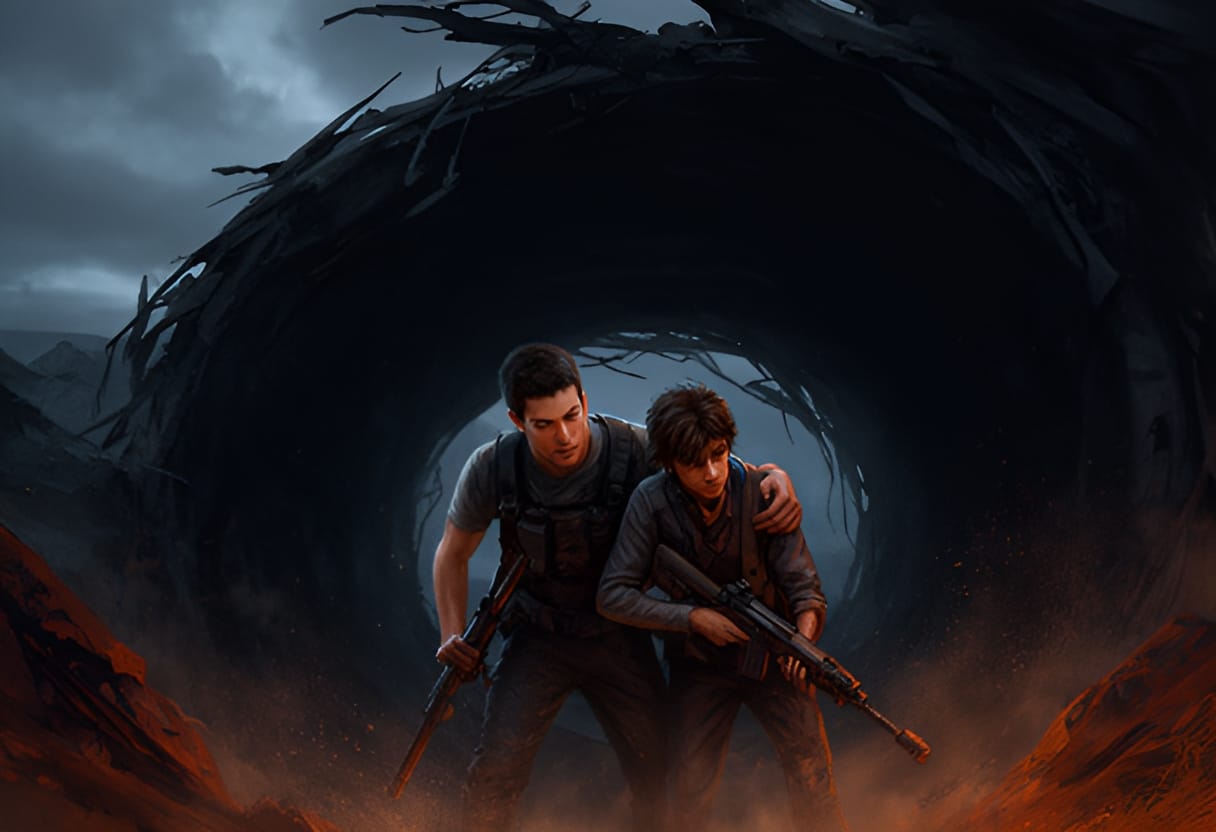
Chapter 14
Last Stand at the Mouth
The tunnel mouth yawned like a wound in the earth, black and ragged, vomited over with Locust reinforcements spilling from a secondary fissure in the rock. Dust and grit hung thick in the air, stinging Zay’s eyes as he shoved Alex forward, the twin’s weight dragging hard against his side. Alex’s breath came in ragged, uneven gasps, his skin slick with sweat and the ashen pallor of Imulsion poisoning deepening by the second. He muttered fragments—mamá, agua, no duele—his voice thin and distant, lost somewhere between fever and the hollow echo of the tunnel.
“Steady,” Zay breathed, more to himself than to Alex. He adjusted his grip under Alex’s armpit, feeling the tremble in his brother’s limbs, the way his fingers spasmed weakly against Zay’s forearm. “Just a little farther. We’re almost there.”
They stumbled into the mouth, and the world exploded.
Locust Drones surged from the side hole like insects from a shattered nest, their armor dull and chitinous, jaws working as they snarled in guttural clicks. Bolts of plasma seared the air, melting stone where they struck. The rumble of engines Zay had heard earlier was gone—drowned by the roar of gunfire and the wet, tearing sound of flesh giving way under Locust claws.
Zay shoved Alex behind a fallen slab of reinforced concrete, the kind used in old transit supports, and swung his Lancer up. The chainsaw snarled to life, a brutal, vibrating roar that cut through the panic. He fired a burst—three rounds caught a Drone in the chest, staggering it back before the blade finished it, slicing through armor and bone with a wet, sucking tear.
Alex gasped, doubling over as another wave of coughs wracked him. He pressed a palm to his mouth, smearing blood across his lips. When he pulled it away, the sputum glistened faintly, iridescent in the dim light—like oil on water.
“Zay…” he whispered, eyes wide and unfocused. “The light… it tastes like copper.”
Zay didn’t answer. He couldn’t. He fired again, the Lancer kicking hard against his shoulder, the chainsaw screaming as it tore through a Drone that had lunged too close. Blood and viscera sprayed the concrete, slicking the surface. He kicked the corpse aside, scanning the chaos.
Civilians—men, women, children—were stumbling past them into the tunnel’s depths, pushed and urged forward by unseen hands. Some carried bundles. Others dragged the wounded. Their faces were masks of terror, eyes darting between the twins and the Locust pouring from the side hole.
They were buying time. That was all this was. A bloody, desperate pause in the flood.
“Zay!” a voice shouted—sharp, familiar, cutting through the din.
He turned.
Jace Stratton stood ten paces back, half-collapsed against the tunnel wall, one hand clamped over a bleeding wound in his ribs. His Lancer was gone, but in his grip he held a Boltok pistol, its barrel still smoking. His face was smeared with soot and blood, a gash above his left eyebrow bleeding into his hairline. But his eyes—those were clear. Focused.
“I thought you bought it under Mercy,” Jace said, voice raw but steady. He raised the Boltok, squeezed off a shot. The heavy round caught a Drone in the throat, snapping its head back with a crack like a whip.
Zay didn’t hesitate. He fired another burst from the Lancer, the chainsaw chewing through a pair of Drones that had flanked Jace’s position. “You’re supposed to be dead!”
Jate managed a grim, bloody grin. “Turns out I’m harder to kill than I look.” He fired again, the Boltok’s report deafening in the confined space. Another Drone went down, clutching its chest as dark fluid bubbled from its lips.
“How many you got?” Zay yelled over the noise.
“Seven in the mag,” Jace replied, reloading with shaking hands. “But I ain’t planning to use ‘em all.”
Alex slumped further against the concrete, his breathing now a wet, rattling struggle. His eyes rolled slightly, unfocused, as if seeing things beyond the tunnel wall—flickers of light, sounds that weren’t there. He began to hum again, low and broken, the lullaby their mother used to sing, the notes warped by fever into something eerie and hollow.
Zay caught his brother’s wrist. Alex’s skin was icy, his pulse thready beneath Zay’s fingers. “Hey,” Zay said, voice dropping. “Look at me. Alex. Look at me.”
Alex’s eyelids fluttered. His gaze found Zay’s, slow and distant, like a swimmer surfacing from deep water. For a moment, recognition flickered—then faded, replaced by something softer, more resigned.
“I’m cold,” Alex whispered.
“I know,” Zay said. “I’ve got you.”
He pulled Alex’s arm over his shoulder again, bearing more of his weight, and turned back to the fight. Jace was laying down fire with the Boltok, each shot a thunderclap that dropped a Locust or sent it stumbling. The pistol kicked hard, but Jace held it steady, jaw clenched, eyes narrowed.
A Boomer emerged from the side hole, its massive form blocking the light, the Boomshot cradled in its crooked arms. The weapon glowed faintly as it charged, a sickly green light pooling in the barrel.
“Boomer!” Zay yelled.
Jace didn’t hesitate. He fired two quick shots—one to the Boomer’s knee, the other to its throat. The creature staggered, the Boomshot discharging early with a deafening whump that sent a fireball arcing into the ceiling. Stone rained down, dust blooming in the air.
The Boomer fell, twitching, its limbs jerking as it tried to rise. Zay surged forward, Lancer roaring, and drove the chainsaw into its throat. The blade screamed, spraying black blood and steam as it severed the spine. The Boomer went still.
“Nice shooting,” Zay said, wiping sweat and grime from his brow with the back of his glove.
Jace nodded, breathing hard. “You too. But we can’t keep this up. They’re still coming.”
He was right. The secondary hole pulsed with movement—shadows shifting, limbs scraping stone. More were coming. Drones, maybe a Wretch or two. The air smelled of ozone and burnt hair, the sharp tang of plasma fire mixing with the damp, mineral stench of the tunnel.
Behind them, the last of the civilians disappeared into the dark— a woman pushing a cart with two small children, an old man leaning on a cane, a teenager carrying a wounded woman on his back. Their footsteps faded, swallowed by the tunnel’s depth.
Zay glanced back. The tunnel mouth was narrowing now, the walls closing in as if the earth itself were trying to seal the wound. He remembered Reyes’s words, the way the transit hub’s collapse had folded in on itself like wet clay. The passage wouldn’t stay open long.
“Jace,” he said, voice low. “How long you think we got?”
Jace glanced over his shoulder, then back at the horde massing in the side hole. “Ten minutes. Maybe twelve. If we’re lucky. After that, it’s just us and the dark.”
Alex shuddered, a soft moan escaping his lips. His head lolled against Zay’s shoulder, his breath fogging the air in short, painful bursts. “Zay…” he murmured. “The song… it’s changing.”
Zay swallowed hard. He didn’t ask what it meant. He knew. The synesthesia was worsening—Alex wasn’t just hearing sounds; he was feeling them as pressure, tasting light as flavor. The Imulsion was rewiring him, turning his senses inside out.
“Just rest,” Zay said, voice thick. “Just rest for me.”
Alex didn’t answer. His hand, limp in Zay’s grip, twitched once—then went still.
Zay eased him down gently against the concrete, propping his head on a chunk of broken rebar. He checked the wound on Alex’s shoulder—the entry point from the Imulsion leak days ago. It was angry, swollen, streaked with black lines that looked like veins of corruption spreading beneath the skin. Pus oozed from the edges, thick and foul-smelling.
He tore a strip from his own undershirt, pressed it to the wound. It soaked through instantly.
Alex’s eyes fluttered open. He looked at Zay, then past him, toward the tunnel’s dark maw. A faint, wistful smile touched his lips.
“Tell her…” he began, voice barely a breath. “Tell her I tried…”
Zay’s throat tightened. He pressed his forehead to Alex’s, feeling the shallow rise and fall of his brother’s chest. “I will,” he whispered. “I promise.”
Alex’s lips moved again—forming a word, maybe a name—but no sound came out. His hand, resting on his stomach, gave one final, feeble shake. Then it fell still.
Zay stayed like that for a long moment, forehead pressed to Alex’s, listening to the ragged, uneven rhythm of his brother’s breath. It was faint. Fragile. But it was there.
Then a bolt of plasma seared the concrete inches from his face, melting stone into glowing slag.
He snapped upright, Lancer rising instinctively.
Jace was back on his feet, Boltok smoking, eyes locked on the side hole where the Locust kept pouring through. “They’re not stopping,” he said, voice grim. “We gotta thin the herd. Now.”
Zay nodded. He slipped the spare magazine from his vest, slammed it into the Lancer, and racked the charging handle. The weapon whined to life, chainsaw biting the air with a hungry snarl.
He looked at Alex—pale, still, breathing like a tide going out. Then he looked at Jace, then at the dark tunnel where the last of the civilians had vanished.
He turned back to the fight.
“On three,” he said.
Jace raised the Boltok. “On three.”
Zay tightened his grip on the Lancer, felt the weight of it, the heat of the barrel, the familiar reassurance of the grip worn smooth by his hands. He thought of the letter in his vest—his mother’s words, folded small and worn at the corners. He thought of the promise they’d made as boys, sworn over a scraped knee and a shared juice box: No matter what, we find our way back.
He thought of Alex’s hand, open and loose in death’s approach.
He thought of the light that tasted like copper.
“One.”
The Locust surged forward—Drones, Wretches, something taller and spindly lurking in the rear, its limbs too long, its head tilted unnaturally.
“Two.”
Jace’s finger tightened on the trigger.
Zay braced his feet, planted himself like stone behind the concrete slab. The chainsaw screamed in his ears, a sound that had become the heartbeat of his survival.
“Three.”
He stepped forward.
And the world became noise and fire and the brutal, beautiful rhythm of killing to stay alive.
The Lancer bucked in Zay’s grip as he stepped into the breach, chainsaw screaming as it tore through the chest of a lead Drone. Black blood and steam erupted in a gout, the creature’s jaws working soundlessly before it collapsed, twitching. He didn’t pause—pivoted on his heel, swung the barrel wide, and caught a Wretch lunging from the shadows. The rounds struck its ribs, sending it flying backward into the wall with a wet crack. It slid down, leaving a smear of dark ichor.
Jace was beside him, Boltok roaring with each shot. He fired from the hip, not aiming so much as pointing, each heavy round finding a mark—throat, eye socket, joint. A Drone went down clutching its throat, another spun and fell as a round shattered its knee. The Boltok kicked hard, but Jace absorbed it, shoulder rolling with the recoil, eyes locked on the mass pouring from the side hole.
“Keep moving!” Zay bellowed over the din. “Don’t let them bunch up!”
He stepped left, Lancer low, chainsaw carving a horizontal arc that sheared through the legs of two Drones at once. They fell in a heap, limbs jerking as the blade continued its bite. He brought the weapon up, caught a third in the throat—steam hissing as the chainsaw severed cartilage and windpipe—and used the momentum to shoulder-block a Wretch that had leapt from the rubble. It flew back, hitting the concrete hard, and didn’t move.
Alex lay still behind them, chest rising and falling in shallow, uneven pulls. The wound on his shoulder had soaked through the makeshift bandage, darkening the fabric. A faint, sweet-rot smell clung to the air near him—like overripe fruit left in the sun. Zay dared a glance. His brother’s lips were slightly parted, skin ashen save for the high, unnatural flush on his cheeks. The humming had stopped. In its place was silence—too complete, too final.
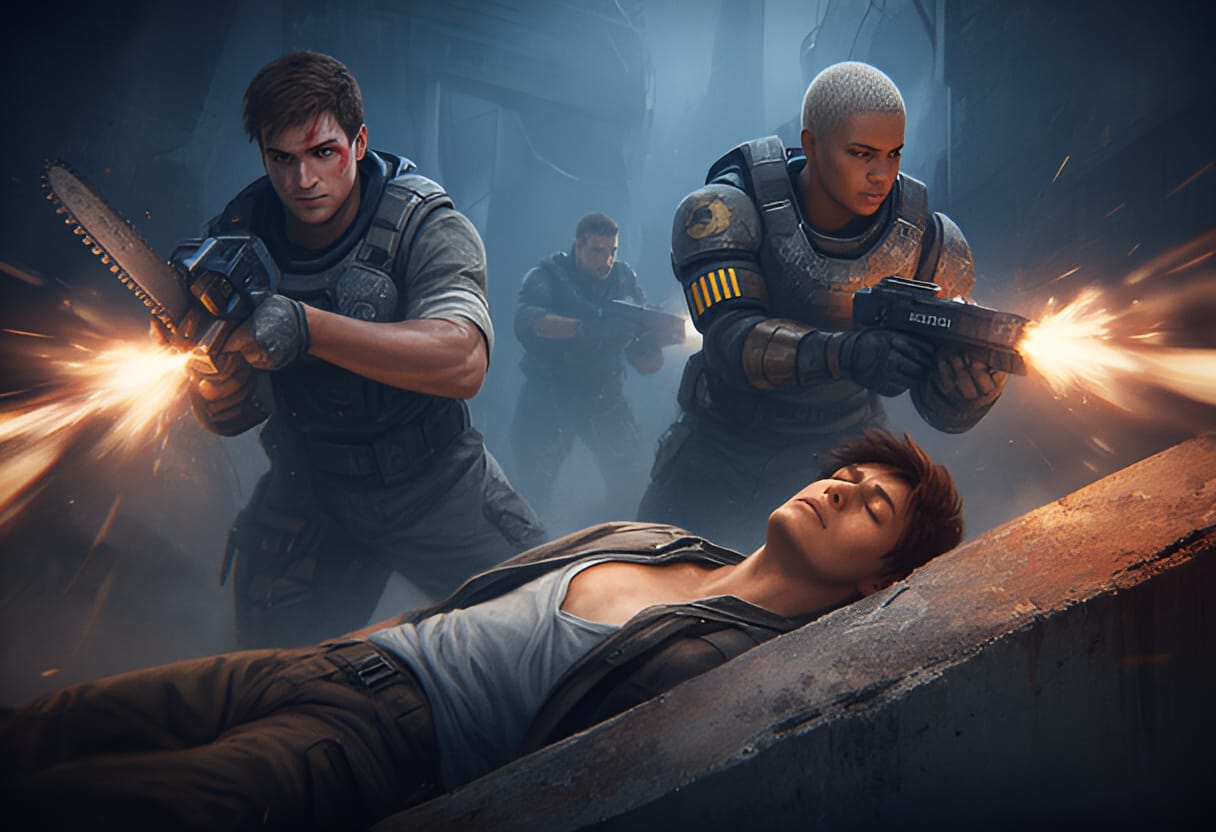
Zay swallowed hard and turned back.
The Locust were adapting. They weren’t just rushing in anymore. They were using the debris—broken conduit, collapsed support beams—as cover, firing blind shots from the gloom. Plasma bolts sizzled past, melting stone, raising clouds of dust and ozone. One nicked Zay’s forearm, burning through the sleeve of his vest and searing the skin beneath. He gasped, teeth clenched, but didn’t break stride. He fired a burst into the flash where the shot had come from—got a scream, then silence.
Jace cursed, ducking as a bolt seared the edge of the concrete where his head had been. “They’re learning!” he shouted, firing two quick Boltok rounds into the smoke. “Smarter than they look!”
Another Drone emerged, this one armored—thicker plating on chest and shoulders, a helmet-like crest ridged along its skull. It raised its Hammerburst, firing from the hip. Zay threw himself sideways, the rounds chewing up the concrete where he’d stood. He came up firing, Lancer on full auto, the chainsaw screaming as it chewed through the air. The Drone staggered under the barrage, shots peppering its chest plate—then Zay lunged, drove the Lancer forward, and buried the chainsaw in its throat. The weapon jerked violently as it hit bone, then gave way. Steam and black fluid poured out as the Drone collapsed, gurgling.
“Armored!” Jace yelled, reloading the Boltok with shaking hands. “They’re bringing in the heavies!”
Zay kicked the corpse aside, scanning. The secondary hole was widening—more Locust pouring through now, not just Drones and Wretches, but something taller, thinner, with jointed limbs that bent in wrong directions. A Seeder? No—too small. A Scout? Maybe. Its head swiveled independently, sensing heat, tracking movement. It raised a clawed limb, and from its wrist fired a spray of needle-thin spines that hissed through the air.
Zay threw himself flat, the spines striking the concrete above him with tiny picks, like rain on stone. One glanced off his helmet, leaving a shallow groove. He rolled, came up on one knee, and fired a controlled burst—three rounds center mass. The Scout jerked, spasmed, then fell sideways, limbs twitching.
Jace was bleeding now—a trickle of blood from his nose, another from a split lip. He fired the Boltok again, the report deafening in the confined space. A Wretch that had been crawling along the ceiling dropped, hit square in the chest. It hit the ground with a soft thud, then went still.
“How many you got left?” Zay asked, voice raw.
Jace checked the magazine. “Two. Maybe three if I’m lucky.” He glanced at Alex. “We ain’t got much time.”
Zay looked at his brother. Alex’s breath was shallower now, each inhale a struggle, each exhale a rattling wheeze. His fingers, resting on his belly, twitched once—then went slack. The skin around his lips had begun to take on a bluish tint. Cyanosis. The Imulsion was in his blood, spreading, poisoning him from within.
Zay’s throat tightened. He reached out, brushed his fingers over Alex’s knuckles—cold, unresponsive. He remembered the last time they’d done this—before boot camp, when they’d sworn to always come back for each other. They’d been twelve, scrapping in the yard behind their house, Alex bloody-nosed and laughing, Zay furious but unable to stay mad. They’d pressed palms together, made a promise. No matter what.
He pressed his forehead to Alex’s temple again, breathing in the faint, metallic scent of his brother’s skin. “I’m not leaving you,” he murmured. “Not again.”
Alex didn’t respond. But his hand—just barely—flexed. Once. A feeble twitch, like a dream of movement.
Zay held the grip a second longer, then rose.
He turned to the fight.
The Locust were closing in—now less than ten meters from their position. The side hole was a maw of shifting shadows, limbs scraping, heads turning. A Boomer had dragged itself into view, its Boomshot cradled like a child. It began to charge, the weapon glowing sickly green as energy built in the chamber.
“Boomer!” Zay yelled.
Jace didn’t hesitate. He raised the Boltok, took a breath—then fired.
The heavy round struck the Boomer square in the forehead.
The creature didn’t even flinch.
It kept charging.
Zay swore, lifted the Lancer, and opened fire. The chainsaw screamed, the rounds chewing into the Boomer’s chest plate—sparks flying, steam hissing where the bullets struck hot metal. But the armor held. The Boomer took another step, then another, the Boomshot rising to aim.
“It’s not stopping!” Jace shouted, firing again. This time he aimed for the throat. The round struck—crack—and the Boomer’s head snapped back. It staggered, weapon dipping.
Zay saw his chance.
He surged forward, Lancer roaring, and drove the chainsaw into the Boomer’s exposed neck. The blade hit bone, then muscle, then tore through tendon and artery. Black blood flooded out, scalding hot, mixing with the steam from the chainsaw’s friction. The Boomer convulsed, weapon firing wildly—a plasma bolt seared the ceiling, melting stone into glowing slag—then collapsed in a heap, twitching once before going still.
Zay wrenched the Lancer free, breathing hard, sweat and blood mixing on his brow. He looked at Jace, who was reloading the Boltok with trembling hands.
“Two down,” Zay said. “How many more?”
Jace didn’t answer right away. He slid the last round into the chamber, snapped the bolt shut. “One,” he said quietly. “Last one.”
He looked past Zay, toward the tunnel mouth—where the civilians had vanished into darkness. Then he looked back, eyes locking onto Zay’s.
“We hold,” he said. “We hold until the last one’s through. Then we fall back. Together.”
Zay nodded. He glanced at Alex—still, silent, breathing like a man drowning in air. A wave of guilt and fury surged through him. This isn’t how it’s supposed to end. Not like this. Not in a stinking tunnel, brother dying while they held off monsters with pistols and grit.
But it was how it was.
He tightened his grip on the Lancer, felt the familiar weight, the vibration of the engine, the heat of the barrel. He thought of the letter in his vest—his mother’s words, her voice in his head: Be careful. Look out for each other. He thought of the lullaby, the way Alex had hummed it even as the fever took him. He thought of the promise.
He stepped forward, planting himself in the gap between the concrete slab and the wall—a natural choke point. Jace took position to his left, Boltok ready. The space between them was narrow—just enough for two to stand shoulder to shoulder, firing forward without getting in each other’s way.
The Locust came.
They weren’t rushing anymore. They were advancing—methodical, using cover, laying down suppressing fire. Plasma bolts lanced through the gloom, striking stone, melting conduits, raising clouds of toxic smoke. The air grew hot, hard to breathe. Zay’s eyes watered, not just from the fumes but from exhaustion, from grief, from the sheer, grinding weight of it all.
He fired in controlled bursts—three rounds, pause, reassess. The Lancer bucked, the chainsaw screaming between shots. He dropped a Drone with a headshot, then turned and caught a Wretch mid-leap, the rounds blowing it apart in midair. Jace fired the Boltok with deadly precision—each shot a thunderclap, each finding a mark. A Scout went down, then another. A Drone that tried to flank from the left caught a round in the eye and dropped like a stone.
But they kept coming.
The side hole was a fountain of Locust now—wave after wave, pouring through like ants from a disturbed nest. Drones, Wretches, the occasional armored Shock Trooper. The air rang with the chittering of Kryll wings high above—though none had descended yet, the smell of them was in the air, damp and rotten, like caves after rain.
Zay’s arms were burning. His grip on the Lancer was slick with sweat and blood—his own, from the forearm wound, and maybe some that wasn’t. He could feel the tremor in his muscles, the fatigue deep in his bones. But he didn’t lower the weapon. He couldn’t. Not while Alex lay there. Not while Jace bled beside him.
“Reloading!” Jace shouted, slapping the empty magazine from the Boltok.
Zay covered him, laying down a suppressing burst into the smoke. A Drone that had crept close went down, jerking as the rounds tore through its midsection. Jace fumbled the fresh magazine—his hands were shaking, slick with blood and sweat—but got it in, slammed the bolt home.
“Ready,” he gasped.
Zay nodded. He didn’t speak. There was nothing left to say.
The next wave came faster—half a dozen Drones, moving in a loose V, firing from the hip. Zay picked off the leader with a three-round burst to the chest. Jace took the next two—one to the throat, one to the eye. The rest scattered, taking cover behind rubble, firing back.
A plasma bolt caught Zay in the shoulder plate—knocking him sideways. He grunted, staggered, but stayed on his feet. The armor had deflected it, but the impact had driven the air from his lungs. He sucked in a breath, tasted copper, and fired back—three rounds center mass on the Shooter that had hit him. It went down, limbs akimbo.
Jace was bleeding worse now—blood streaming from a cut above his eye, tracing a path through the soot on his cheek. He fired the Boltok again, the report echoing off the tunnel walls. A Wretch that had been crawling along the ceiling dropped, hit in the belly. It hit the ground, twitched, then stilled.
“How many civilians made it?” Zay asked, voice low, not taking his eyes from the gloom.
Jace didn’t look away from his sights. “Enough. I saw the old man and the kid with the cart—they were past the bend. The woman with the hurt leg—she was being carried. They’re in the dark now. They’ve got a chance.”
Zay let out a breath he didn’t know he’d been holding. “Good.”
He risked a glance back.
Alex hadn’t moved. His chest still rose—but barely. Each inhale was shorter than the last, each exhale a longer, rattling sigh. The skin around his mouth was now distinctly blue. His fingers, resting on his stomach, were slightly curled—not clenched, not resisting, just… open. Like he was holding something invisible.
Zay’s vision blurred. He blinked hard, forcing the tears back. He couldn’t afford to break. Not now. Not while they were still standing.
He turned back to the fight.
The Locust were changing tactics again. They weren’t just firing—they were flanking. Two Drones had moved along the left wall, using the conduit pipes as cover, trying to get behind them. Zay saw the movement—just a flicker of shadow—and fired a warning burst. The rounds struck the pipe, sending sparks flying. One Drone ducked back. The other kept coming.
Jace saw it too. He shifted his weight, Boltok tracking.
“Left flank!” he yelled.
Zay turned, Lancer sweeping. He caught the first Drone in the throat—chainsaw biting deep, steam and black fluid spraying. He pivoted, caught the second as it tried to rise—rounds to the chest, then a final burst to the head. It went down, twitching once.
“Thanks,” Jace said, not taking his eyes from the front.
Zay nodded. He was running on fumes now—adrenaline, habit, the sheer refusal to stop. His legs felt like wet rope. His vision swam at the edges—dark spots pulsing in time with his heartbeat. He wiped his forearm across his brow, came away with a streak of blood and sweat. He didn’t know if it was his or Alex’s or someone else’s. It didn’t matter.
The air was thick now—smoke, plasma residue, the metallic tang of blood. Somewhere deep in the tunnel, a rock shifted—a small fall, maybe. Or the earth settling. The tunnel mouth wasn’t safe. It wasn’t stable. The walls were weeping in places, moisture seeping from the stone, making the concrete slick.
And still they came.
Another Boomshot-armed Locust emerged from the side hole—this one smaller, faster, but just as deadly. It raised its weapon, began to charge. Zay didn’t wait. He lifted the Lancer, took a quick sight picture—then fired.
The rounds struck the weapon’s housing, sending sparks flying. The Locust stumbled, dropped the Boomshot—it clattered to the stone, discharging harmlessly into the wall. Zay surged forward, Lancer roaring, and drove the chainsaw into its throat before it could recover. The blade screamed, then gave way. The creature collapsed, twitching, then went still.
Jace fired the Boltok into the smoke—got a scream, then silence.
“They’re thinning,” he said, voice hoarse. “But I don’t know for how long.”
Zay risked a look back at the tunnel.
Darkness. Absolute, swallowing darkness. The civilians were gone—into the black, into the unknown. He hoped they were heading for the transit hub, hoped Reyes had gotten them there, hoped the fallbacks were still holding. But he had no way of knowing. No comms. No signals. Just the echo of their footsteps, now lost.
He looked at Alex.
His brother’s breath was so shallow now it was almost imperceptible. The rise and fall of his chest was minimal—barely a lift, barely a fall. His skin was cold to the touch, except for the fever-hot flush on his cheeks. The lullaby was gone. All that remained was silence—and the faint, irregular rasp of air moving through damaged lungs.
Zay’s throat tightened. He reached out, took Alex’s hand in his own. The fingers were cold, limp—but when he squeezed, Alex’s hand returned the pressure. Just slightly. A twitch. A flicker.
“I’m here,” Zay whispered. “I’m right here.”
Alex’s eyelids fluttered. His lips moved—no sound, just the shape of a word. Ma… Maybe. Or more. Or nothing at all.
Zay pressed his forehead to his brother’s again, breathing in the scent of sweat and blood and something sweet and rotting—like fruit left too long in the sun. He thought of their mother’s letter, the way she’d signed it: With all my love, always. He thought of the promise they’d made as boys, sworn over a scraped knee and a juice box. He thought of the way Alex had laughed when they’d first fired a Lancer together—how he’d whooped, eyes bright, shouting, “This thing’s a beast!”
He thought of all the mornings they’d run PT together, the way they’d finish, dripping sweat, arguing over coffee. He thought of the jokes Alex made—terrible ones, always—just to make Zay roll his eyes and smile despite himself.
He thought of the weight of Alex’s head on his shoulder in the subway, the way he’d whispered, “If I don’t make it… tell him I tried.”
And he thought, with a sudden, fierce clarity, that he wouldn’t let it end like this. Not if he could help it.
He lowered Alex’s hand gently to his stomach. Then he rose, Lancer rising with him.
Jace was watching him, Boltok ready, eyes questioning.
Zay met his gaze. “We hold,” he said. “We hold until I say otherwise.”
Jace nodded. He didn’t ask why. He just tightened his grip on the pistol.
Zay turned back to the gap.
The Locust were still coming—but slower now. The wave had broken. They were firing from cover, probing, testing. A Drone popped up from behind a conduit, fired a wild burst—Zay ducked, the rounds whizzing overhead. He came up shooting, caught it in the throat. It fell back, twitching.
Another followed—same result. Then another.
They were learning to respect the Lancer’s bite.
Zay kept firing—controlled bursts, economy of motion. He didn’t waste rounds. He aimed for center mass, throat, head. Each shot was a statement: This far and no farther.
Jace matched him, Boltok cracking in the gloom. He wasn’t wasting shots either—each one deliberate, each one deadly. A Wretch that had tried to climb the wall dropped, hit in the chest. A Scout that had peered out from the side hole got a round between the eyes and vanished back into the dark.
The firing slowed. Then stopped.
For a long, tense moment, there was nothing but the sound of ragged breathing—Zay’s, Jace’s, Alex’s faint, rattling pull in the dark behind them. The air smelled of burnt metal, blood, stone. Somewhere, a loose piece of conduit tapped against the wall—a slow, irregular tick… tick… tick…
Zay kept the Lancer trained on the side hole, eyes scanning the gloom. His arms were trembling now—not just from fatigue, but from the aftershock of adrenaline, the crash coming. He could feel it in his teeth, in the back of his throat—a metallic taste, a buzzing behind his eyes.
Jace shifted slightly, wincing. “You good?” he asked, voice low.
Zay didn’t take his eyes from the darkness. “Shoulder’s burned. Arm’s tired. But I’m still here.”
Jace gave a short, humorless chuckle. “Same. Think my eye’s swollen shut. Boltok’s got two rounds left. After that…”
“We’ll manage,” Zay said. He didn’t add if we have to.
A soft sound came from behind them—a wet, shuddering breath. Then another.
Zay didn’t look. He couldn’t. If he looked, he’d see it—the end coming, slow and quiet. He’d see his brother’s eyes open, unfocused, seeing things that weren’t there. He’d see the life leak out of him, silent and inevitable.
So he stared into the dark, Lancer ready, and waited.
Minutes passed. Or maybe it was seconds. Time had lost its meaning—stretched thin, then snapped. The only thing real was the weight of the weapon in his hands, the burn in his lungs, the ache in his bones, and the quiet, fading breath of the man behind him.
Then—movement.
A shape unfolded from the side hole—not a Drone, not a Wretch. Tall, thin, limbs too long, joints bending in ways that made the eye hurt to follow. Its head was oval, smooth, featureless save for a faint indentation where a mouth might be. It moved silently, gliding almost, feet barely touching the ground. Its skin was pallid, almost translucent, veined with faintly glowing blue lines—like Imulsion under glass.
A Seeder? No. Something else. Something newer. Something that hadn’t been in the briefings.
It stopped ten meters out, head tilting as if listening. Then it raised a limb—not a weapon, but a sensor array, perhaps—and emitted a soft, pulsing tone. A hum. Low. Resonant.
Zay’s teeth hurt.
He felt it in his molars, in the base of his skull—a vibration, deep and invasive. The air seemed to thicken. The tunnel walls pulsed faintly, in time with the sound.
Beside him, Jace gasped. He clapped both hands over his ears, face twisting in pain. “Jesus Christ—what is that?!”
Zay didn’t answer. He couldn’t think. The sound was in his bones now, vibrating his teeth, making his vision swim. He raised the Lancer—not to fire, but to shield his ears, to block the noise. It didn’t help. The vibration came through the ground, through the soles of his boots, up his legs, into his spine.
Alex made a sound behind him—a soft, broken moan. Then another. His body arched slightly off the ground, back bowing, hands clawing at the air. His mouth opened—no sound came out, just a silent scream.
Zay’s vision whited out at the edges. He felt pressure behind his eyes, like his skull was too small for his brain. He staggered, Lancer dipping, then recovered—just barely. He gritted his teeth, forced himself to stand straight, to keep the weapon level.
Jace was worse. He’d dropped to one knee, Boltok forgotten in the dirt, both hands clamped over his ears, face contorted in agony. Blood trickled from his nostrils. He was shaking, rocking slightly, lips pulled back in a silent snarl.
The creature in the gloom pulsed again—thoom… thoom… thoom—and with each pulse, the pressure increased. Zay felt his vision narrowing, the world reducing to a pinpoint of light and pain. He thought he heard whispers—not in his ears, but in his head—voices speaking in a language that wasn’t language, more like sensation translated into sound: hunger… cold… deep…
He fought it. He dug his nails into his palms, felt the pain, used it to anchor himself. He thought of Alex’s hand in his—cold, limp, but still there. He thought of the promise. He thought of the letter.
He forced himself to breathe—slow, shallow, through the nose. In. Out. In. Out.
The creature pulsed again.
Zay didn’t flinch.
He raised the Lancer—not to his shoulder, but to his hip, firing from the gut. He didn’t aim. He just pointed and held the trigger.
The weapon roared to life—chainsaw screaming, rounds spitting fire. A torrent of lead and fury poured into the gloom, chewing up stone, spraying sparks, tearing into the advancing horror.
The creature jerked—then staggered. Its limbs twitched violently, the glowing veins flaring bright, then fading. It let out a sound—not a vocalization, but a resonance, a harmonic shriek that made the air vibrate. Then it folded inward, collapsing like a puppet with its strings cut, and fell silently to the stone.
The pulse stopped.
The pressure vanished.
Silence crashed over them—sudden, absolute. The ringing in Zay’s ears was deafening after the constant hum. He lowered the Lancer, breathing hard, chest heaving, vision swimming. He wiped sweat and blood from his eyes with the back of his glove.
Jace was still on his knees, gasping, blood trickling from his nose and the corner of his mouth. He looked up at Zay, eyes wide, pupils dilated. “What… the hell… was that?” he whispered.
Zay shook his head. “I don’t know. And I don’t want to find out again.”
He risked a glance back.
Alex was still. His chest hadn’t moved in several seconds.
Zay’s breath caught. He dropped to his knees beside his brother, Lancer forgotten in the dirt.
“Alex?” he whispered, voice raw. “Alex, come on. Don’t do this. Not now.”
He pressed two fingers to Alex’s neck—just below the jaw. Felt for a pulse.
Nothing.
He tried again. Higher, lower. Nothing.
The skin was cold. Gray. Lips slightly blue. The chest—still. No rise. No fall.
No breath.
Zay froze.
His mind went blank. Not empty—full. Full of everything: the morning PT, the coffee argument, the way Alex had laughed when he’d missed the target during rifle qualification, the way he’d hummed that stupid lullaby even when he was scared shitless, the way he’d pressed that photo into Zay’s hand and said, If I don’t make it… tell him I tried.
He remembered the weight of Alex’s head on his shoulder in the subway. The way he’d murmured, “M…om…” before fading.
And now this.
Silence.
Zay didn’t cry. He couldn’t. Not yet. The grief was there—a cold, heavy stone in his chest—but it was distant, muffled, like it was happening to someone else. All he felt was the absence. The void where his brother’s breath had been.
He lowered his forehead to Alex’s, pressed his lips to the cold forehead. Stayed there for a long time—long enough for the world to keep turning, long enough for the Locust to possibly regroup, long enough for Jace to shift behind him, to pick up the Boltok, to check the chamber.
Then he rose.
He didn’t look at Jace. He couldn’t. If he looked, he’d see the pity, the understanding, the shared grief—and he couldn’t bear it.
He picked up the Lancer. It was hot in his hands, slick with sweat and blood and something else—maybe Imulsion residue, maybe something worse. He checked the chamber—half a magazine left. Enough.
He turned to the side hole.
Darkness. Stillness. No movement. No sound.
He didn’t trust it.
He stepped forward, Lancer low, chainsaw idling with a soft whine. Jace fell in beside him, Boltok raised, eyes scanning the gloom. They moved slowly, cautiously, boots scraping on stone, the sound loud in the sudden quiet.
The side hole yawned ahead—a dark maw in the wall, edges rough and broken. Beyond it, only blackness.
Zay paused at the threshold. He didn’t want to go in. Didn’t want to see what was breeding in there, what had sent that thing out.
But he had to know.
He stepped inside.
The air was colder here—damp, mineral-rich, smelling of wet stone and ozone. The walls were smooth, almost glassy in places, veined with faintly glowing blue lines—Imulsion, pulsing slow and deep. The floor was littered with husks—thin, desiccated things that looked like shed skins, brittle and papery. Some were small. Some were large enough to have held a man.
And in the center—a nest. Not of sticks or debris, but of woven filaments, glistening and wet, like silk spun from light. At its heart pulsed a single orb—about the size of a fist, spherical, surface rippling like oil on water. It emitted a soft, internal glow—pale blue, shifting, alive.
Zay raised the Lancer.
Jace whispered, “Don’t touch it.”
Zay didn’t answer. He couldn’t take his eyes off the orb. It wasn’t just glowing—it was breathing. Expanding, contracting, slow and deep. Like a heart.
And as he watched, he realized—he wasn’t just seeing it. He was feeling it. A pressure in his chest. A taste on his tongue—sweet, metallic, like blood and rain. A sound in his ears—not noise, but a tone, low and resonant, vibrating his teeth.
Synesthesia.
The same thing Alex had felt.
He staggered back a step, knocking his elbow against the wall. The pain shot up his arm—sharp, real. He gasped, blinked. The vision faded. The taste disappeared. The sound stopped.
He looked at Jace.
Chapter 15
The Wall
He staggered back a step, knocking his elbow against the wall. The pain shot up his arm—sharp, real. He gasped, blinked. The vision faded. The taste disappeared. The sound stopped.
He looked at Jace.
Jace was staring at him, eyes wide, not with fear, but with something deeper—recognition. The kind that comes when you see a man touch the edge of what he’s not meant to understand and live to tell it.
“You felt it too,” Zay said, voice low, raw.
Jace swallowed. “Yeah. I felt it. Like the tunnel… breathed.”
Zay didn’t answer. He couldn’t. Not when the memory of that pulse still thrummed in his molars, when the sweet-iron taste lingered on his tongue like a promise.
He turned back to the nest. The orb still pulsed, slow and deep, like a heart buried in stone.
He raised the Lancer again.
“Don’t,” Jace whispered.
Zay’s finger tightened on the trigger. The chainsaw whined, eager.
A crack split the air—not from the Lancer, but from above. Stone groaned. Dust railed down from the tunnel ceiling. Somewhere far off, a Locust roar split the dark—guttural, hungry, multiplying.
They weren’t alone.
Jace spun, Boltok up, shouting, “Contact! Rear!”
Zay didn’t hesitate. He shoved the Lancer toward Jace’s chest, hard. “Go. Now. Get to the mouth. Tell them—tell them the hole’s active. It’s not just a nest. It’s… awake.”
Jace stared at him, then at the pulsing orb, then back at Zay’s grim, sweat-slicked face. He opened his mouth—maybe to argue, maybe to protest—but Zay cut him off.
“Move!” he barked, voice cracking like ice under boot.
Jace hesitated one last heartbeat, then turned and bolted, boots pounding on stone, disappearing into the dark toward the tunnel mouth.
Zay stayed.
He didn’t know why. Maybe it was the way the orb had breathed with him. Maybe it was the ghost of Alex’s whisper in his ear from the birthing chamber—…M…om…—or the weight of the letter still pressed against his sternum, warm from his brother’s chest.
He lifted the Lancer. The chainsaw sang.
And then the wall exploded.
Not with fire, but with force—a Boomshot blast detonated just beyond the nest, sending a cone of superheated metal and shredded stone screaming into the chamber. Zay threw himself sideways, but not fast enough. Shrapnel tore across his face—cheek, jaw, temple—like a rake dragged through flesh. Heat bloomed behind his eyes. Blood flooded his left eye, hot and thick, blurring everything crimson.
He screamed—not in pain, but in rage. A raw, animal sound torn from his throat.
He dropped to one knee, Lancer braced against the floor, chainsaw screaming as he fired blind into the smoke and storm of debris. Sparks flew where the rounds hit Imulsion-slick stone. The air stank of ozone, burnt hair, and something sweet—like rotting fruit left in the sun.
Through the red haze, he saw them: Locust Drones, six, maybe eight, pouring through the side hole, claws scraping, jaws parted, emitting that low, clicking chitter that meant they’d smelled blood.
He fired. The Lancer bucked. Two Drones jerked back, limbs flailing, before collapsing in twitching heaps. A third lunged—he felt the rush of air, smelled the rancid musk—and he swung the chainsaw sideways. The blade caught the thing’s forearm, shearing through chitin and tendon with a wet shriek. It stumbled, howling, and he drove the Lancer forward, burying the bayonet into its throat. It gagged, blood bubbling over his hands, then went still.
He wrenched the blade free just as a fourth Drone lunged from the darkness, Boomshot cradled in its arms. He barely had time to twist— the projectile screamed past his shoulder, detonating against the wall behind him in a blossom of fire and slag. The shockwave lifted him off his feet. He landed hard on his back, wind knocked out, Lancer skittering from his grip.
Pain exploded in his ribs. Something cracked. He gasped, tasting blood and dirt.
The Drone advanced, Boomshot raised, mandibles clicking in triumph.
Zay rolled. The Blast detonated where he’d been, sending a shower of molten rock and shrapnel spraying across the chamber. He came up on one elbow, snatching his Lancer, and fired—three quick bursts. The Drone staggered, chest erupting in smoke and flame, then fell backward into the nest, sending ripples through the glowing filaments.
Silence.
For three heartbeats, there was only the ragged sound of his own breathing, the hiss of the Lancer’s idle chainsaw, and the slow, deep pulse of the orb.
Then—movement.
More shapes in the dark beyond the side hole. Not Drones. Bigger. Heavier. The unmistakable silhouette of a Boomer, its Boomshot gleaming dully in the faint light.
Zay pushed himself to his feet, vision swimming, blood streaking down his face in two thick rivulets. He wiped at his eye with the back of his glove—useless. It only smeared the warmth wider.
He raised the Lancer.
The Boomer fired.
The world ended in noise and light.
He didn’t hear the blast. He felt it—a hammer blow to the chest that lifted him off his feet and flung him backward into the wall. The impact drove the air from his lungs. Stars exploded behind his eyelids. When he opened them, the chamber was spinning. The orb pulsed, slow and indifferent, as if it had seen this a thousand times before.
He tried to rise. His legs wouldn’t obey. His left arm hung wrong—something torn deep in the shoulder. Every breath felt like inhaling glass.
Through the swimming dark, he saw the Boomer step forward, Boomshot reloading, steam hissing from the vents along its arms. Behind it, two Drones flanked, claws clicking on stone.
He was going to die here. In this wet, glowing tomb, far from the sun, far from Alex.
A bitter laugh bubbled up in his throat. Funny. He’d spent his whole life watching his brother’s back. And now, he was going to die alone in the dark, with no one to see it.
Then—movement from the tunnel mouth.
A figure lunged out of the gloom, not running, but throwing himself forward—shoulder first, arms outstretched.
Alex.
He hit Zay like a falling tree, driving him sideways just as the Boomer fired.
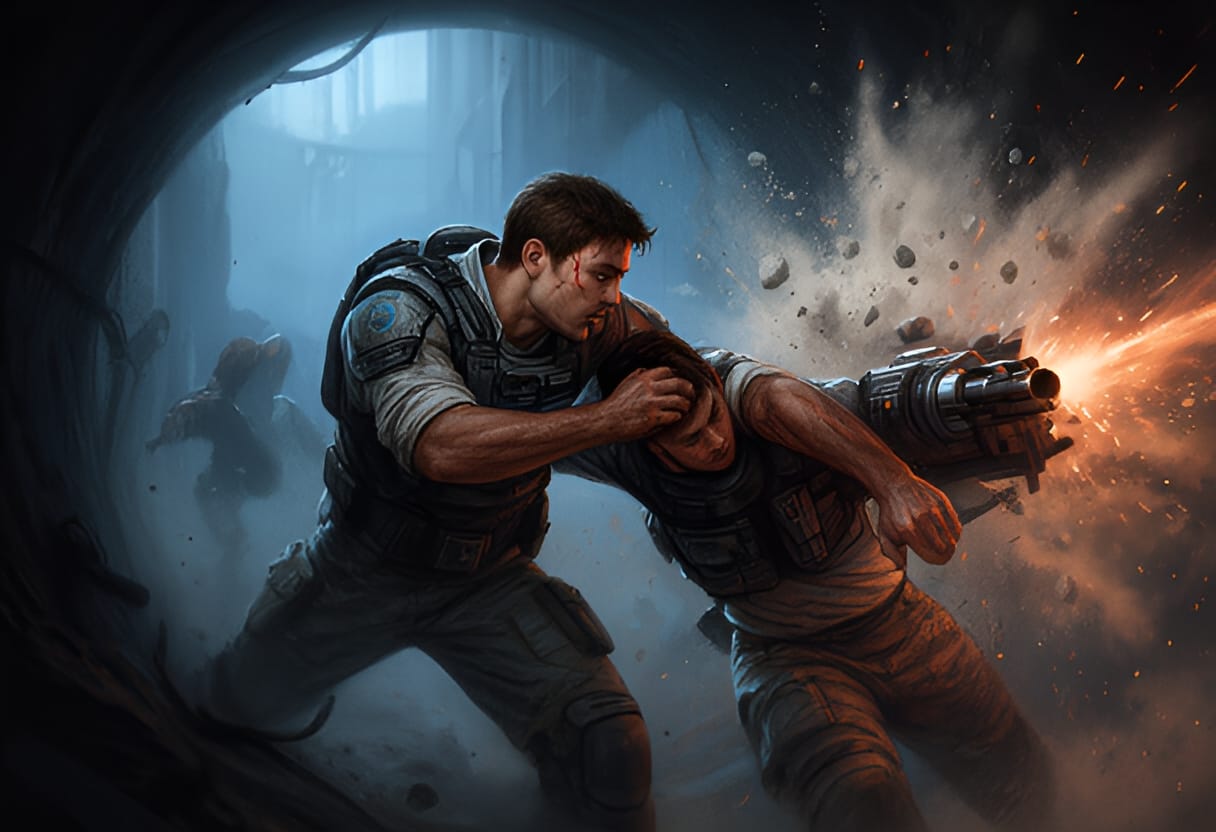
The Boomshot round screamed past—where Zay’s chest had been a heartbeat ago—detonating against the far wall in a cataclysm of fire and stone. The shockwave hit them both, slamming them into the rubble. Dust choked the air. Alex groaned, face pressed into Zay’s shoulder.
“Jesus Christ, Zay!” Alex gasped, voice raw, half-shouted, half-sobbing. “What the hell were you thinking, staying back here like some damn monument?”
Zay couldn’t speak. His throat was full of blood and stone. He managed a weak push, trying to get upright. Alex wouldn’t let him.
“Stay down,” Alex muttered, voice dropping, urgent. “Just… stay down. I got you.”
Zay tried to protest. Tried to say I’m fine, or Go, or Watch the Boomer—but his tongue felt thick, his thoughts sluggish. The world tilted. He could feel the warm stickiness of blood on his chin, his neck, seeping into his collar.
Alex shifted, planting one knee, then the other, braced over him like a shield. He raised his Lancer—Zay’s Lancer, he realized with a dazed jolt—Alex must have snatched it up when he fell.
The weapon kicked in Alex’s hands as he fired. Bursts of muzzle fire flashed in the gloom. Alex cursed—short, sharp, in Spanish—then switched to English, voice tight: “Jam! Goddamn it—jam!”
Zay blinked. Through the haze, he saw it: the feed tray was skewed, a round stuck halfway, the bolt locked open. Alex was working the charging handle with frantic, jerky motions, face set in concentration, sweat and dirt streaking his cheeks.
“Cover me,” Alex grunted, not looking at him. “Just… give me ten seconds.”
Zay forced his eyes open. Pain lanced through his skull with every heartbeat. He fumbled for his pistol—Gorgon, strapped to his thigh. His fingers fumbled the release. Drew it. Aimed.
He couldn’t see straight. The Boomer was a double image. The Drones, shadows within shadows.
He fired anyway.
The first shot went wide—spanged off stone. The second caught a Drone in the shoulder. It stumbled, shrieking. The third—he squeezed the trigger as another surge of pain washed over him—caught the Boomer in the throat. The thing gagged, Boomshot jerking upward as it fired.
The round launched wild—zipping over their heads, detonating deep in the tunnel beyond, shaking the walls with a low, thunderous whump.
Alex finally jerked the charging handle home. The bolt slammed forward. He didn’t hesitate. He fired.
Three rounds. Center mass. The Boomer convulsed, then folded, collapsing in a heap of smoking armor and steaming vents.
Silence again.
Alex stood over him, chest heaving, Lancer smoking, blood streaking his temple from a graze. He looked down at Zay, eyes wide, pupils blown—partly from pain, partly from the Imulsion poisoning, Zay knew. The synesthesia was getting worse. He could see it in the way Alex’s gaze flickered, as if he were hearing colors, feeling sounds.
“You idiot,” Alex whispered, voice breaking. “You stupid, stubborn, beautiful idiot.”
Zay managed a twitch of his lips. A smile? He couldn’t tell.
Alex’s expression crumpled. He dropped to one knee, not to fight, but to press his forehead to Zay’s. His breath came fast and hot against Zay’s ear.
“I thought I lost you,” he whispered. “I thought—when you didn’t move—I thought…”
Zay lifted a trembling hand. It found Alex’s cheek. Skin hot, damp. He couldn’t speak. Couldn’t form the words. So he pressed harder, letting his brother feel his pulse, his presence.
Alex shuddered. Then, suddenly, he shoved back—not unkindly, but urgent.
“They’re flanking,” Alex said, voice snapping back into gear. “Left and right. Drones. Maybe more Boomers. We gotta move—now.”
Zay tried to push up again. His vision swam. The left side of his face was a mess of heat and numbness. He could barely see out of his right eye. The world was a smear of stone and shadow and pulsing blue light.
Alex saw his struggle. He didn’t ask. He just slid one arm under Zay’s shoulders, the other behind his knees, and lifted.
Zay gasped—pain lanced through his ribs, his shoulder, his face—but Alex held tight, grunting with the effort.
“Easy,” Alex muttered. “Just… easy. I got you.”
He began to move—backward, toward the tunnel mouth, dragging Zay with him. Not running. Not yet. Too exposed. But steady, relentless, each step a battle against weight and pain and the growing pressure in his own chest.
Zay hung limp in his arms, head lolling, blood dripping from his chin onto Alex’s armored chest. He could feel the rhythm of Alex’s breath—too fast, too shallow. Could feel the tremor in his arms. Could feel the way his brother’s body tensed with each step, as if fighting not just the Locust, but something deeper—something eating him from the inside.
They reached the tunnel mouth.
And stopped.
The exit was a nightmare.
Locust poured from the broken street beyond—Drones, Boomers, even a pair of Wretches skittering on the rubble like mad dogs. They swarmed the opening, claws scraping, weapons raised, voices a guttural chorus of hunger and hate.
And worse—behind them, emerging from a secondary hole in the tunnel wall—a new wave. Fresh. Relentless.
They were flanked.
Alex halted, back pressed against the jagged edge of the tunnel’s mouth, Zay still draped over his forearm like broken cargo. He shifted his grip, cradling Zay closer to his chest, and raised the Lancer with both hands.
His eyes locked on the horde.
His jaw tightened.
He didn’t speak. Didn’t joke. Didn’t grin.
He just stared at the oncoming wave—and then, slowly, he turned his head to look down at Zay.
His face was streaked with sweat and blood and tears. His lips moved.
Not a prayer. Not a curse.
A name.
“Zay…”
It came out raw. Broken. A whisper lost in the wind and the distant roar of war.
And then Alex screamed.
Not a battle cry. Not a warning.
A raw, anguished shout—”ZAAAYYY!”—that tore from his throat like something being ripped out.
He lunged forward—not to fire, not to fight—but to throw his weight sideways, dragging Zay with all his remaining strength.
They hit the ground hard—Zay landing on his back, Alex collapsing atop him, shielding him with his body as the first Boomshot round detonated where they’d stood.
Stone exploded. Fire washed over them. Shrapnel pinged off Alex’s armor. He grunted, curled tighter, taking the blast for him.
Then another. And another.
Alex didn’t move. Didn’t flinch. Just lay there, trembling, breath coming in ragged gasps, one hand braced on the ground, the other clamped tight around Zay’s wrist—like an anchor. Like a vow.
Above them, the Locust closed in.
Zay couldn’t see. His right eye was swelling shut. His left was flooded with blood. But he could feel it—the vibration in the ground, the thud of boots, the hiss of weapons charging.
He could feel Alex’s heartbeat against his own—fast, frayed, but still there.
And in the dark, beneath the pain and the blood and the roar of the coming storm, he heard it—not with his ears, but in his bones, in his blood, in the quiet place where they’d always found each other:
A pulse.
Slow.
Deep.
Familiar.
Like the orb.
Like a promise.
He turned his head, as best he could, toward his brother’s ear.
His lips moved. No sound came out. But he shaped the word, clear and slow, as if Alex could read it on his lips:
Always.
Alex didn’t answer.
He didn’t need to.
He just held on tighter.
And waited for the storm to break.
The first Drone lunged through the smoke, claws scraping stone, maw open in a silent shriek. Alex twisted, throwing his weight onto his side, using Zay’s body as a pivot. He brought the Lancer up in a desperate, one-handed sweep—the chainsaw screamed to life, teeth biting into the creature’s forearm. Green-black blood sprayed, hot and slick, coating Alex’s glove. The Drone stumbled back with a guttural howl, clawing at the ruin of its arm.
Alex didn’t hesitate. He rolled, dragging Zay with him just enough to clear the fallen support column’s shadow, then planted his boots and fired.
The Lancer bucked. Three rounds tore into the Drone’s chest. It staggered, then fell, twitching.
Another came—this one from the right, low and fast, Boomer in tow, its Boomshot already swinging up.
Alex shouted—a raw, torn sound—”Zay, cover your face!”
He didn’t wait for a response. He shoved Zay’s head down with one hand, threw his own body over him, and fired.
The Boomshot detonated.
Not at them.
Not quite.
The round struck the lip of the tunnel mouth—stone and shrapnel exploded outward in a cone of fury. Alex felt the searing kiss of molten rock across his shoulder plate, heard the scream of metal tearing. He gritted his teeth against the pain, swallowed the taste of blood and ozone, and kept firing.
The Boomer staggered, recoiling from the blast’s backlash. Its weapon lowered, fumbling for a reload.
Alex saw his chance.
He surged up—not to run, but to meet it.
He came at the Boomer low, shoulder first, driving into its midsection with a grunt that came from somewhere deep in his gut—someplace beyond fear, beyond pain. The thing staggered, arms windmilling, Boomshot clattering to the ground.
Alex was already on it.
He slammed the Lancer’s chainsaw into the joint where neck met shoulder armor. The blade screamed, sparking against alloy, then found purchase. He drove it forward, twisting, until the metal gave way with a sickening, wet tear.
The Boomer shuddered. Steam hissed from ruptured lines along its spine. It didn’t fall—it collapsed, folding inward like a broken thing, its eyes dimming as the life fled from them.
Alex stumbled back, chest heaving, Lancer sputtering as the chainsaw caught on a strand of sinew. He ripped it free with a jerk, sending a spray of dark fluid across the rubble.
He turned.
Zay was still down.
Alex dropped to his knees beside him, palms pressing against Zay’s chest, feeling for breath, for a heartbeat, for any sign that the brother he’d dragged through hell was still there.
His fingers came away wet.
Not just sweat.
Blood.
Too much.
He cursed—low, fierce, in Spanish—then switched to English, voice raw: “Hey. Hey, Zay. Look at me.”
Zay’s eyelids fluttered. Not open. Just… twitching. Like a man dreaming of waking.
Alex slapped his cheek—light, but sharp. “Come on. Don’t you dare check out on me now. Not after all this.”
A groan. Low. Pain-filled. Then, barely audible: “…Alex…?”
“Yeah,” Alex breathed, relief sharp enough to hurt. “I’m here. I’m right here. You stupid bastard. You almost got yourself killed staring at that damn rock.”
Zay’s lips moved. No sound. Just the shape of a word.
Alex leaned in, ear near his brother’s mouth.
“I saw it,” Zay whispered. “The orb. It… it breathed. Like it was alive.”
Alex swallowed. He knew what that meant. The Imulsion wasn’t just in the walls. It was in them. In their blood. In their heads. It was changing them. And he could feel it—the pressure behind his eyes, the way sounds had started to feel like weights on his skin, the way light sometimes tasted like copper on his tongue.
But now wasn’t the time to dwell on it.
Now was the time to keep moving.
He pushed himself up, then reached down, hauling Zay to his feet with a grunt that pulled fire from his ribs. Zay swayed, knees buckling, but Alex held him—arm locked around his waist, Zay’s arm slung over his shoulders, their bodies locked together like twin pillars.
“You can walk,” Alex said, voice low, fierce. “You will walk. One step. Then another. I’m not carrying you all the way out. Not unless I have to.”
Zay nodded. A small, stiff motion. But it was there.
Alex shifted his grip, took the Lancer in his free hand—still hot, still smoking—and stepped forward.
They moved slowly.
Pain lanced through Zay with every step—face, shoulder, ribs—but he forced himself to bear weight, to keep his boots moving, to not be a burden. Alex kept up a steady stream of muttering—half encouragement, half curse, half prayer in a language Zay barely understood but felt in his bones.
“Left… left… good. That’s it. Now right. Don’t drag your foot. Lift it. Yeah. Like that. You’re doing it. You’re fucking doing it.”
They reached the tunnel mouth.
The Locust were still there—but thinner now. Disorganized. The initial surge had spent itself. Boomers reloaded. Drones regrouped. But the pressure was less. For now.
Alex pressed Zay back against the wall, just inside the shelter of the tunnel’s curve. He peered out.
The street beyond was chaos—fire, smoke, the distant thrum of engines—maybe Gears, maybe more Locust. He couldn’t tell. Didn’t matter. They couldn’t go out there yet. Not like this.
He turned back.
Zay was sliding down the wall, breathing hard, face ashen. Alex dropped to one knee beside him, ripped open his own med-pouch with shaking fingers.
He found the bandages—sterile, stiff from disuse. He unfolded them with his teeth, one hand pressing down on Zay’s chest to stem the flow from a deep gash near the collarbone. The other hand worked fast, wrapping, looping, pulling tight—not enough to cut off breath, but enough to hold.
Zay hissed. Alex apologized in a whisper. Kept going.
When the chest was dressed, he moved to the face.
The cut above Zay’s eye was deep—needed stitches, but they didn’t have time, didn’t have the tools. Alex cleaned it as best he could with a water-stained rag from his pocket, then pressed a pad of gauze over it, securing it with tape from his vest.
Zay flinched. “S’not… necessary,” he mumbled.
Alex didn’t answer. He just kept working.
When he was done, he sat back on his heels, sweat dripping from his chin, and looked at his brother.
Zay’s face was a mask—blood dried in cracks, one eye swollen shut, the other wide and fever-bright. His breathing was shallow. Uneven. Alex knew the signs. Imulsion poisoning was moving fast now. The synesthesia would come in waves. Soon, he might start seeing sounds, feeling colors, losing touch with what was real.
Alex reached out, slowly, and took Zay’s hand.
It was cold.
He laced their fingers together—just like they had as kids, just like they had in the stairwell, just like they had when they’d promised each other, long before any of this, that they’d always find their way back.
Zay’s grip was weak. But it was there.
Alex leaned forward, forehead resting against Zay’s, and whispered, so low only the blood in his veins could hear it: “We’re not done yet. Not by a long shot. But we’re gonna make it. I swear it. On everything. On Ma. On Pa. On every damn promise we ever made.”
Zay’s lips twitched. Not a smile. Not quite. But something close.
Then, from the darkness beyond the tunnel mouth—a sound.
Not Locust.
Not boots.
A whistle.
Low. Three notes. Rising.
Alex froze.
He knew that whistle.
It was the old COG signal. The one they’d used in training. The one for friendly. Hold fire. We’re coming in.
His breath caught.
He looked at Zay.
Zay’s good eye was open. Focused. Listening.
Alex squeezed his hand.
Then, slowly, he rose.
He helped Zay up. Took the Lancer. Checked the chamber—half a magazine. Enough.
They moved to the mouth of the tunnel.
Not to run.
Not to hide.
But to meet what was coming.
They stood side by side.
Back to back.
Just like always.
And waited.
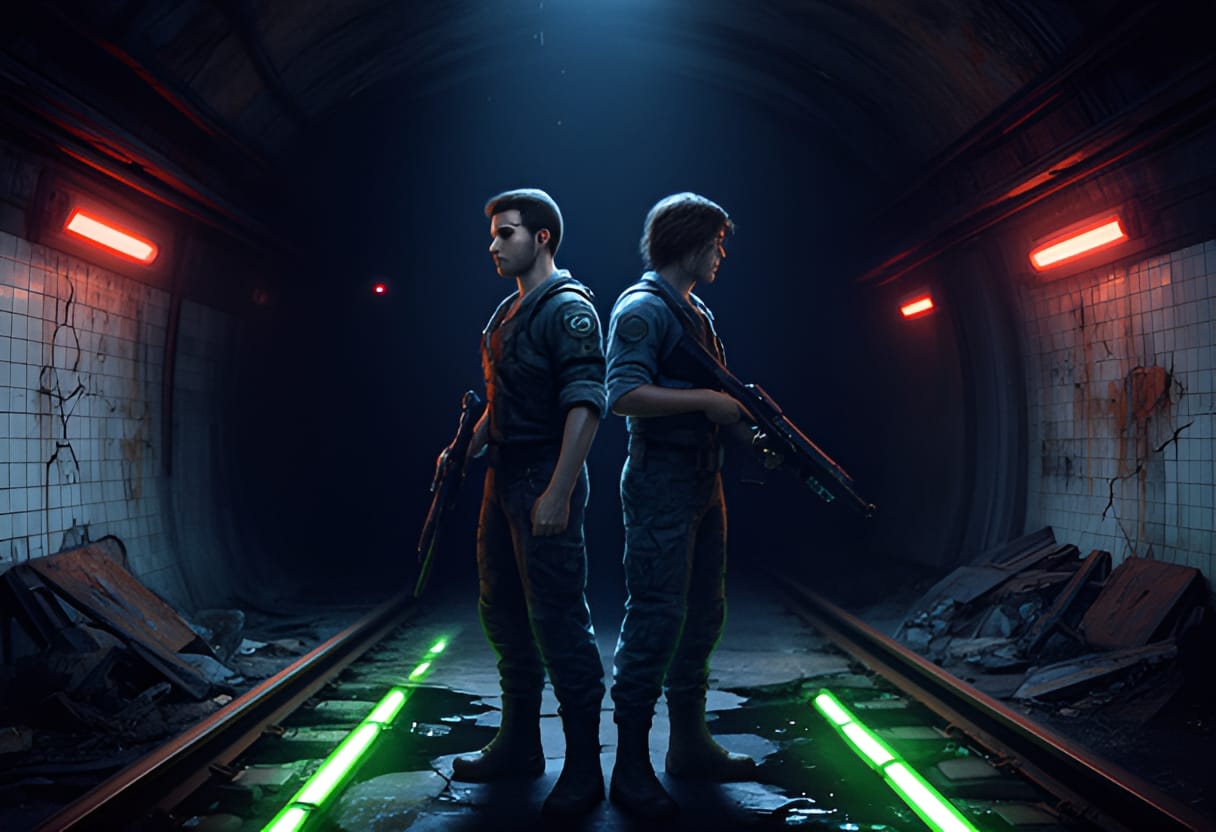
Chapter 16
Blood and Breath
Zay’s grip on the Lancer tightened as the whistle echoed again—three clear notes, rising, unmistakably COG. He felt Alex’s fingers shift in his, a faint pressure answering his own. The world narrowed to the tunnel mouth, the throb in his ribs, the copper taste of blood on his tongue, and the steady, ragged rasp of his brother’s breath against his temple.
Then the lights flickered.
Not the emergency strips along the floor—those still clung to a sickly green—but the overheads, the bare bulbs strung on conduits above the tunnel mouth, sputtered once, twice, and died. Darkness swallowed the threshold, leaving only the faint glow of moss Alex had scraped from the walls hours ago, now long faded to nothing. The whistle cut off mid-note, choked into silence.
Zay’s breath hitched. Synesthesia flared—a sharp, metallic taste like licking a battery, the sound of the dying light pressing against his teeth. He swallowed, tasting iron and ozone. Alex’s hand went slack in his.
“Alex?” Zay whispered, voice raw.
No answer.
He turned his head, ignoring the fire in his ribs, the way his vision swam at the edges. Alex was slumped against the stone column behind them, head lolling to the side, eyes open but unseeing, fixed on a point somewhere in the dark. The bandage Alex had applied to Zay’s face was soaked through, dark with old blood and sweat. His own undershirt, pressed over Alex’s chest earlier as a makeshift shroud, was now darkened at the side—not with Zay’s blood, but with a fresh, spreading stain blooming across Alex’s flank.
Zay’s stomach dropped.
He’d seen that wound before—in the processing chamber, when the Boomer’s blast had thrown him sideways. He’d thought Alex had avoided it, had been lucky. But luck had a way of running out in the Hollows.
“Alex,” Zay said louder, shaking his shoulder. The Lancer slipped from his grip, clattering to the stone floor. He caught himself on the column, knuckles white. “Hey. Look at me.”
Alex’s eyelids fluttered. His lips parted, but no sound came out. Just a faint, wet rattle with each breath—too shallow, too slow. His skin was ashen beneath the grime, lips tinged blue. The synesthesia surged again—a wave of pressure behind Zay’s eyes, the feeling of Alex’s breath like a fist tightening around his lungs.
“Come on,” Zay begged, voice cracking. “You promised. You swore on Ma and Pa. You don’t get to quit now.”
Alex’s head rolled slightly toward him. His unfocused eyes found Zay’s face—or tried to. There was recognition there, faint and distant, like a signal lost in static. His mouth moved. A whisper, barely audible: “…Zay…?”
“I’m here,” Zay said, pressing his forehead to Alex’s, ignoring the slick of blood and sweat between them. “I’m right here. You’re not alone.”
Alex’s breath hitched—a dry, painful sound. His fingers twitched in Zay’s grip, then went still.
Zay held on, feeling the frantic hammer of his own heart against his ribs, trying to sync it with the fading pulse in his brother’s hand. The synesthesia came again—not as taste or pressure this time, but as a deep, resonant hum in his bones, felt more than heard. It vibrated up from the floor, through the stone, through his boots. The Locust were coming. Not the usual skittering of Drones or the heavy tread of Boomers. This was slower. Deliberate. Something big. Something that shook the ground with each step.
He didn’t have time for grief. Not yet.
Zay eased Alex’s weight down against the column, propping him as best he could. He snatched up his Lancer, checked the chamber—half a magazine, just like before. He flicked the safety off with his thumb, the click loud in the sudden quiet.
The first shape emerged from the darkness—a hulking silhouette, taller than a Drone, broader than a Boomer. Its skin was pallid, stretched tight over a frame of corded muscle, veins tracing bright blue beneath the surface like rivers of light. It moved with a jerky, unnatural gait, limbs bending at odd angles, yet it came forward with terrifying inevitability. No armor. No weapons visible. Just those glowing veins, pulsing in rhythm with the hum in Zay’s teeth.
A Seeder? No. Too humanoid. Too… aware.
It stopped at the edge of the darkness, head tilting as if listening. Then it turned—not toward Zay, but toward Alex. Its lipless mouth opened, not in a roar, but in a low, harmonic tone that seemed to tune the very air.
Zay fired.
The Lancer bucked. Sparks flew from the creature’s chest where the rounds struck—no blood, not red anyway, but a thick, luminous fluid that oozed like liquid light. It didn’t flinch. Didn’t stagger. It just… absorbed the blows, the hum deepening, the blue veins flaring brighter.
He squeezed off another burst. Same result. The creature took a step forward, then another, each footfall sending a shockwave through Zay’s soles, up his legs, into his molars.
He was going to die here. Back to the wall, brother dying beside him, facing something that shouldn’t exist.
Then, from the dark behind the creature—a second whistle. Three notes. Rising.
Not COG.
This was wrong. Off-key. A distortion of the signal, like a recording played through broken glass.
The creature’s head snapped toward the sound. Its veins flared—brighter, faster—then dimmed as it seemed to listen.
Zay didn’t wait. He surged forward, Lancer braced, screaming—not a battle cry, but a raw, animal sound torn from his throat. He drove the bayonet into the creature’s side, not to kill, but to distract. To give Alex a chance.
The thing turned on him with impossible speed. One blow—a backhand strike that didn’t feel like flesh or bone, but like being hit by a collapsing wall. Zay flew backward, air knocked from his lungs, spine hitting the stone column with a crack that made his vision go white. He slid down, dazed, tasting blood and something sweet—like burnt sugar, like the last breath of a dying star.
He forced his eyes open.
The creature stood over Alex now, one hand raised, veins blazing. Alex’s head lolled to the side, breath gone still. The hum in Zay’s bones had become a scream.
No.
Not again.
Not after everything.
Zay pushed himself up on one elbow, ignoring the fire in his ribs, the way his vision doubled and tripled. He found his Lancer nearby, slick with blood—his own, maybe Alex’s. He dragged it toward him, fingers numb.
The creature lowered its hand.
Not to strike.
To touch.
Its fingers, long and impossibly thin, hovered above Alex’s forehead—veins lit like live wires, pulsing in time with the hum that now filled Zay’s skull, his blood, his breath.
Zay fired.
Not at the creature.
At the wall beside it.
The Lancer bucked. Concrete exploded. Dust and stone rained down.
The creature flinched—not from pain, but surprise. Its head jerked toward the blast. The hum faltered.
Zay didn’t think. He didn’t aim. He just fired again and again, walking forward on knees and elbows, Lancer blazing until the magazine clicked empty.
The creature staggered back, not from the bullets—those had done little—but from the noise, the light, the sudden violence of it. It looked down at its chest, where the rounds had punched through, leaking that strange, glowing fluid. Then it looked at Alex. Then at Zay.
And for the first time, it seemed to hesitate.
Zay threw the empty Lancer aside. He crawled the last few feet, leaving a trail of blood on the stone. He reached Alex’s side, pressed his ear to his brother’s mouth—nothing. No breath. No heartbeat he could feel over the roar in his own ears.
He lifted Alex’s head, cradling it against his chest. The synesthesia was gone now, replaced by a hollow silence, a vacuum where sensation should be. He tasted nothing. Felt nothing. Saw only the dark, and the faint, fading glow of the creature’s veins as it watched them—waiting.
Zay pressed his forehead to Alex’s, just as he had before. Just as he always would.
“I’m here,” he whispered, voice broken, raw. “I’m here.”
The creature didn’t move. Didn’t advance. It just stood in the darkness, trembling slightly, as if caught between two worlds.
And somewhere, far off, the whistle came again—three notes, rising—then cut short.
The lights stayed dead.
The Locust did not charge.
They waited.
And Zay held his brother, and breathed, and waited with them.
Zay’s arms locked around Alex’s torso, pulling him close against his chest as if he could somehow force warmth back into the still form, as if the sheer pressure of his hold might jump-start a heart that had forgotten how to beat. His own breath came in ragged, shallow gasps—each one a blade dragging through his lungs, each exhale tasting of copper and something acrid, like burnt wiring. The synesthesia had vanished, leaving behind a numbness that felt worse than any pain: a void where sensation should be, as if his body had shut down to protect him from the reality of what he was holding.
He couldn’t let go.
Not yet.
Not ever, if he had a say in it.
The creature hadn’t moved. It stood just beyond the pool of darkness where the tunnel lights had died, its blue veins pulsing slow and deep, like the heartbeat of something vast and ancient. It didn’t look threatening anymore. Not exactly. It looked… waiting. Patient. As if it knew Zay wouldn’t run. As if it had been waiting for this moment all along.
Zay didn’t understand. He didn’t have the luxury of understanding. All he knew was that Alex was gone. That the weight in his arms was real. That the warmth was leaking out of him, leaving only the chill of stone and death.
He buried his face in Alex’s damp hair, breathing in the scent of sweat, blood, and something faintly sweet—like the peanut butter bar Alex had given away hours ago, like the last normal thing he’d done before the world ended.
A sound escaped Zay then—not a sob, not a yell, but a low, broken moan that started in his gut and tore up his throat, raw and helpless. He didn’t try to stop it. Let it come. Let it break him open.
The creature tilted its head. The hum returned—not in Zay’s bones this time, but in the air itself, a low vibration that made the dust on the floor shiver. It took one slow step forward, then another. Its movements were jerky, uncoordinated, as if it were learning how to walk in a body that didn’t quite fit.
It stopped an arm’s length away.
Zay didn’t look up. He couldn’t. He kept his face buried in Alex’s neck, his arms locked tight, his fingers digging into the fabric of Alex’s jacket, trying to hold onto something real.
Then—light.
Not from the creature. Not from the tunnel.
From Alex’s chest.
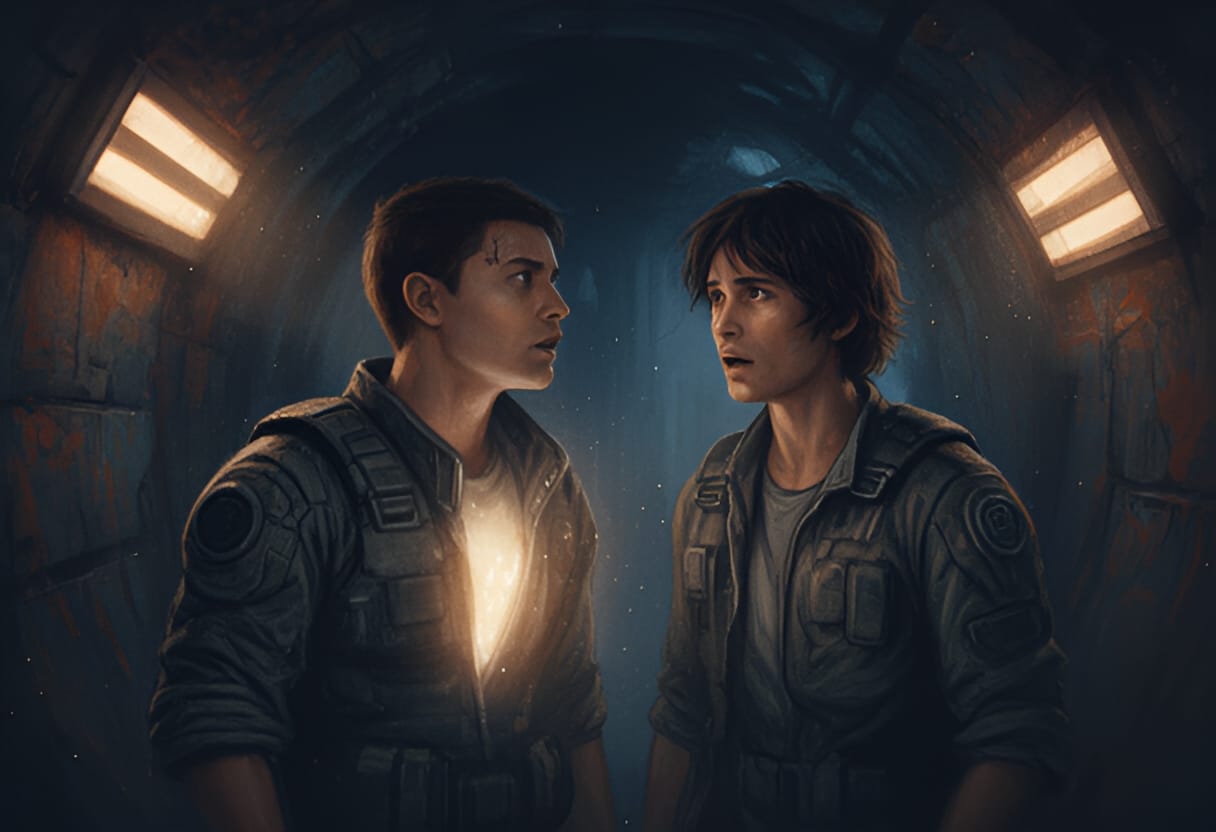
A faint, soft glow began to seep through the fabric of his jacket, right over his heart. It was pale blue, the same color as the creature’s veins, but gentler—like moonlight on water, like the glow of phosphorescent moss in a dark cave.
Zay froze.
He pulled back just enough to see.
The glow was coming from inside Alex’s vest. From the recipe tin.
His mother’s peach cobbler recipe.
The one Alex carried everywhere. The one with the note: Make it. Remember them.
Zay’s hands shook as he fumbled with the flap of the vest. He couldn’t see well in the dark, but he didn’t need to. He knew the shape of that tin. Knew the dents from when Alex had dropped it in the Mercer Street tunnel. Knew the way the lid always stuck a little on the corner.
He got it open.
Inside, the recipe card was still there—creased, stained with grease and sweat, the handwriting faded but legible. And tucked beneath it, the small photograph of their parents, smiling in front of their house in Tyrus, arms around each other, Lily—no, wait, that wasn’t Lily. That was a younger girl, maybe a cousin, or a neighbor’s kid. He couldn’t remember. It didn’t matter.
What mattered was what lay beneath the photo.
A second object.
Small. Smooth. Warm to the touch.
Zay pulled it free.
It was a shard.
No bigger than his thumb, shaped like a teardrop, its surface etched with faint, glowing lines that pulsed in time with the creature’s veins and the glow now emanating from Alex’s chest. It wasn’t metal. Not stone. It looked… grown. Like something cultivated in a lab, or harvested from a living thing.
And it was warm.
Not hot. Just… warm. Like skin. Like life.
The creature made a sound then—not a hum, not a roar, but a soft, resonant tone, almost musical. It lowered its head, bringing its own glowing chest level with the shard in Zay’s hand.
The light from the shard flared.
Not blinding. Just… bright. Enough to paint the tunnel in shifting blues and silvers, enough to make the dust motes dance like stars.
And then—impossibly—Alex gasped.
Not a rattle. Not a death rattle.
A full, shuddering inhalation. His back arched slightly off the stone, his fingers twitching in Zay’s grip.
Zay froze, heart hammering against his ribs like it would break free.
Alex’s eyelids fluttered. His breath came again—shallow, uneven, but there. Alive.
“Alex?” Zay whispered, voice raw with disbelief.
Alex’s lips parted. His eyes opened—unfocused at first, glassy, but then, slowly, they cleared. He looked at Zay. Not through him. At him.
“Zay?” he whispered, voice hoarse, raw. “What… happened?”
Zay couldn’t answer. He just clung tighter, pressing his forehead to Alex’s again, feeling the faint rise and fall of his brother’s chest, the ragged but real rhythm of his breath. The shard still glowed in his fist, warm and insistent, pulsing in time with both of their heartbeats now—two rhythms, syncing.
The creature didn’t move. Didn’t advance. It just stood there, head tilted, veins glowing steady and calm. It wasn’t attacking. It wasn’t threatening. It was… observing. Like it had been waiting for this.
Zay didn’t trust it. Not for a second. But he couldn’t deny what he’d seen.
The shard had done something. It had reached into Alex. Pulled him back from wherever he’d been slipping.
He looked down at the object in his hand. The etched lines glowed brighter now, casting shifting patterns across his knuckles, up his wrist. It wasn’t just warm—it was alive with something. Energy? Purpose? He didn’t know. But it felt… connected. To Alex. To the creature. To whatever had been humming in his bones since the Imulsion poisoning took hold.
Alex stirred, trying to sit up. Zay helped him, supporting his weight as his brother groaned, fingers pressing to the wound in his side. The bandage was soaked through, but the bleeding had slowed—no longer a gushing wound, but a slow, dark seep. Not healed. Not even close. But stable. For now.
“What… was that?” Alex breathed, nodding weakly toward the creature.
“I don’t know,” Zay admitted, his voice rough. He glanced at the thing. It hadn’t moved. Its veins pulsed slow and deep, like a sleeping beast. “But it didn’t kill you. It… did something.”
Alex managed a weak, humorless grin. “Figured it was gonna be something weird. Just didn’t think it’d glow.”
Zay let out a short, broken laugh—more air than sound. “Yeah. Me neither.”
They sat in silence for a moment, the only sounds their breathing, the distant drip of water from somewhere in the tunnel, and the faint, steady pulse of the shard in Zay’s hand. The creature remained motionless, a statue of blue light and stillness in the dark.
Then Alex shifted, wincing as he put weight on his injured side. “We can’t stay here,” he muttered. “Even if that thing’s not gonna kill us… the Locust will. They’re just… waiting. Like they know we’re hurt.”
Zay nodded. He looked toward the tunnel mouth. Beyond the column, the darkness was absolute now—no whistle, no lights, no sign of the COG signal. Just the sense of something vast and patient waiting in the dark, like the creature, like the war itself.
He tightened his grip on the Lancer—still empty, but he’d scooped up a few spare magazines from Alex’s vest while checking the wound. Not many. Maybe two full clips. Enough for a fight. Not enough for a stand.
“We move,” he said. “Now. While they’re still… hesitating.”
Alex pushed himself to his feet with Zay’s help, swaying slightly, face pale beneath the grime. He grabbed his own Lancer—checked it. Half a magazine. He nodded. “Lead the way.”
Zay hesitated. He looked back at the creature.
It hadn’t moved. But its head had turned slightly, as if tracking them.
“Come on,” Alex said softly, touching his arm. “We don’t have time to figure it out.”
Zay nodded. He tucked the shard into his own vest, over his heart, where he kept Lily’s drawings and his father’s photograph. It fit snugly, warm against his skin, a quiet pulse beneath his fingers.
Then they moved.
Not running. Not yet. But moving—slow, careful, backs to the wall, weapons up, eyes scanning the dark. The creature didn’t follow. Didn’t advance. It just stood where it was, a silent sentinel in the gloom, its veins glowing like banked coals.
They made it ten paces.
Then the lights came back on.
Not the overheads—those were still dead. But the emergency strips along the floor flared to life, bathing the tunnel in that harsh, sickly green light. Overhead, a few bare bulbs flickered, then steadied, casting long, jittery shadows.
And from the darkness beyond the tunnel mouth—a sound.
Not a whistle.
A chorus.
Dozens of voices, raised in a low, guttural chant—Locust, but not quite. It was rhythmic. Harmonic. Almost… sung.
The creature’s head snapped toward the noise.
Its veins flared—brighter, faster—then it turned, not to flee, but to face the sound. It took one step forward. Then another. Its gait was smoother now, more confident, as if the call had awakened something in it.
Zay and Alex froze, backs to the wall, Lancers raised.
The creature didn’t look at them. It marched into the darkness, toward the chanting, its form becoming less distinct as it moved—almost shimmering at the edges, like heat haze over stone.
Then it was gone.
Swallowed by the dark.
The chanting continued for a few moments longer—then cut off abruptly, as if silenced.
Silence fell again. Heavy. Complete.
Alex exhaled slowly. “Well. That was… not what I expected.”
Zay didn’t answer. He was staring at the spot where the creature had vanished, his mind racing. It hadn’t attacked them. It had helped. Or… something. He didn’t know. But the shard was warm against his chest, pulsing faintly, like a second heartbeat.
He looked at Alex. His brother was swaying on his feet, face drawn with pain, but his eyes were sharp. Alert. Alive.
“You good?” Zay asked.
Alex managed a grimace. “Been better. But I can walk. Can shoot. Can… keep moving.”
Zay nodded. He slipped his Lancer back into his grip, checked the safety. “Then we move. Find the others. Find a way out.”
Alex gave a short, sharp nod. “Yeah. Let’s go.”
They started forward—slow at first, then gaining pace as the tunnel swallowed them, the emergency lights casting their long, trembling shadows ahead. Behind them, the darkness pressed in, silent and waiting. Ahead, the tunnel stretched into the unknown—no guarantee of safety, no promise of rescue.
But they were moving.
Together.
And for now, that was enough.
The tunnel narrowed ahead, the walls closing in as the emergency lights grew sparser, flickering erratically like dying fireflies. The air grew colder, damper, carrying the mineral tang of deep stone and something sour—like rotting vegetation, or worse, the sweet-sick stench of Locust breeding pits. Zay’s boots splashed occasionally in shallow puddles, each splash echoing too loud in the silence.
Alex moved beside him, slightly behind and to the left, favoring his right side. His breathing was labored but steady, each inhale a struggle, each exhale a puff of fog in the cold air. He hadn’t spoken since they started moving, conserving energy, focus. Zay could see the tension in his jaw, the way his fingers tightened and loosened on his Lancer’s grip.
They passed a side passage—dark, yawning like a throat. Zay paused, listening. Nothing but the drip of water and the distant, indeterminate groans of the city settling in its death throes. He shook his head. Not worth the risk. They kept to the main tunnel.
Halfway through, Alex stumbled.
Zay caught him by the elbow before he could fall.
“Easy,” he murmured. “You good?”
Alex nodded, but his face was slick with sweat, his breath coming in short, sharp gasps. He pressed a hand to his side, where the wound had soaked through the bandage. “Just… dizzy. Head’s… swimming.”
Zay’s stomach clenched. Synesthesia. Or something worse. The Imulsion poisoning was in its final stages now—he could feel it in his own body, the way sounds had weight, the way light left a bitter aftertaste. If Alex was starting to lose it…
He slipped his arm under Alex’s shoulders, taking more of his weight. “Lean on me. I’ve got you.”
Alex didn’t argue. Just let himself be supported, his head lolling slightly against Zay’s shoulder. “Sorry,” he mumbled. “Dead weight.”
“Shut up,” Zay said, but there was no heat in it. Just resolve. “You carried me through the storm drain. Now it’s my turn.”
A weak chuckle escaped Alex. “Yeah. Yeah, I did. Remember? You owed me a beer.”
Zay’s breath hitched. The memory hit him like a physical blow—the two of them, filthy and exhausted, slumped against a rusted cart in the maintenance line, joking about beer and moss and stupid promises. It felt like a lifetime ago. Or another life.
“I still owe you,” Zay said quietly. “That beer. And a lot more.”
Alex’s head tilted slightly. “Don’t… worry about it. Just… get us out. Please.”
“I will,” Zay swore, voice low and fierce. “I swear it. On everything. On Ma. On Pa. On every damn promise we ever made.”
Alex didn’t answer. But his grip on Zay’s arm tightened—just a fraction—and his breathing eased, just a little.
They kept moving.
The tunnel began to slope downward, gently at first, then more steeply. The emergency lights grew fewer, the gaps between them longer. Soon, they were moving in near-darkness again, guided only by the faint, intermittent glow of the shard against Zay’s chest and the occasional patch of phosphorescent moss Alex would scrape from the wall and press into his palm—a faint, greenish light that faded after a few heartbeats.
They had to be getting close to the lower levels. Close to the Hollows. Close to where the Locust had come from.
And close, maybe, to whatever had sent that creature.
A sudden clatter echoed from ahead—metal on stone. Then a low, guttural chuckle.
Zay froze. Alex went rigid in his grip.
“Did you hear that?” Alex whispered.
“Yeah,” Zay breathed. “Someone’s there.”
They pressed themselves flat against the left wall, Lancers raised, breaths held. The tunnel ahead bent sharply to the right, swallowing the view. Whatever had made the noise was just beyond the corner.
Zay signaled with his fingers—three, two, one—then lunged around the corner, Lancer blazing.
Nothing.
Just empty tunnel. Stone walls. A few loose rocks scattered near the bend—maybe dislodged by a rat, or shifting earth. No sign of life.
Alex peered past him, frowning. “Weird. Sounded like… laughter.”
Zay shook his head. “Echo. Or… rats. Or your head playing tricks.”
Alex didn’t look convinced. He gave the tunnel a long, wary look, then nodded. “Yeah. Maybe.”
They moved on.
But Zay couldn’t shake the feeling that they weren’t alone. That something was watching. Not just the Locust. Not just the dark. Something older. Something that had been down here long before men dug tunnels or waged wars.
The shard against his chest pulsed—once, slow and deep—then went quiet.
They came to a junction.
Three tunnels branched out: one sloping up at a steep angle, likely toward the surface; one continuing straight, level; and one descending into blackness so complete it looked like a hole in the world.
Zay checked his vest—no map, no compass. Just instinct, and the half-remembered drills from basic training.
“Up,” he said. “We need to get to the surface. Find the evacuation point. The truck.”
Alex nodded, but his eyes kept drifting to the descending tunnel. “You feel that?” he murmured. “Like… a pull. From down there.”
Zay frowned. “Yeah. I feel it too. But we don’t go down. We go up. Surface. Air. Help.”
Alex didn’t argue. Just gave a short, sharp nod and fell in behind him as Zay took the lead, Lancer at the ready.
The ascent was brutal. The tunnel grew steeper, the footing treacherous—loose gravel, slick patches of moss, occasional drops where the stone had given way. Alex’s breathing grew worse with every step, each one a battle. Zay had to stop twice to let him catch his breath, his brother leaning heavily against the wall, face ashen, eyes unfocused.
At one point, Alex stopped dead, hand pressed to his temple.
“Zay…” he whispered. “I… I hear singing.”
Zay froze. “What?”
“Singing. Low. Like a lullaby. In Spanish. Ma used to sing it… when we were small.”
Zay’s blood turned to ice. He knew that song. “Duerme, duerme, mi niño…” Their mother’s voice, soft and warm, singing them to sleep in their bunk back in Tyrus.
“It’s not real,” Zay said, voice tight. “It’s the poisoning. Or your head. Don’t listen to it.”
Alex didn’t answer. He was staring past Zay, eyes wide, lips moving silently as if listening to a voice only he could hear.
Then he took a step forward—toward the descending tunnel.
Zay lunged, grabbing his arm. “Hey! No. We’re going up.”
Alex jerked away, but not angrily. Confused. “It’s… calling me. I have to go. I have to… see.”
“No,” Zay said, voice dropping to a fierce whisper. “You don’t have to do anything. You just have to live. For Ma. For Pa. For Lily. For me. You hear me? You live.”
Alex blinked. The faraway look in his eyes flickered. Then, slowly, it cleared. He swallowed hard. “Yeah,” he whispered. “Yeah, you’re right. I’m… I’m sorry.”
Zay pulled him into a quick, fierce hug—chin resting on his brother’s shoulder, feeling the ragged beat of his heart against his own. “Hey. Look at me. We’re getting out of this. Together. Just like we promised.”
Alex nodded, face buried in Zay’s neck for a moment. Then he pulled back, wiping his eyes with the back of his hand—quick, ashamed. “Yeah. Let’s go.”
They turned and began the climb again.
The tunnel leveled out after a short, brutal stretch, opening into a wider chamber—natural, not carved. Stalactites hung from the ceiling like teeth, and the floor was uneven, littered with fallen rock and ancient debris. In the center stood a formation of stone, smooth and worn, shaped roughly like a throne or an altar. And etched into its surface, glowing faintly blue, were symbols—lines and curves that looked familiar, not from any COG manual, but from the recipe tin, from the shard, from the creature’s veins.
Zay stopped dead.
Alex bumped into him from behind. “What is it?”
Zay didn’t answer. He stepped forward, drawn despite himself. The glow from the shard in his vest flared in response, casting shifting patterns across the stone.
He reached out—hesitantly—and touched the nearest symbol.
The moment his fingers made contact, the world split.
Not with pain. Not with light.
With sound.
A voice—not his own, not Alex’s—filled his head. Ancient. Genderless. Speaking in a language that wasn’t words, but meaning, poured directly into his mind:
We were here first. We slept. You woke us. You took. You burned. We rise.
Then—images.
Not memories. Visions.
A vast city of spires and arches, built not of steel or stone, but of living crystal and bone, pulsing with soft inner light. Beings tall and slender, moving with grace, their skin veined with the same blue light. They tended vast gardens of glowing flora, sang to the stone, shaped the earth with thought.
And then—fire.
Not from the sky. From below. Men with drills and charges, breaking into the deep, tearing at the heart of the world, extracting the black blood—Imulsion—screaming it was a gift, a fuel, a savior.
And the waking.
The slow, furious rising of those who had slept.
The war.
Not invasion.
Reckoning.
Zay gasped, stumbling back, hand flying to his mouth. His vision swam—not with synesthesia, but with overload. The images burned behind his eyes, the voice still echoing in his skull.
Alex grabbed his arm. “Zay? You okay?”
Zay couldn’t speak. He just stared at the altar, at the symbols, at the terrible, beautiful truth flooding his senses.
They weren’t just fighting aliens.
They were the invaders.
The Locust weren’t monsters from another world.
They were the original inhabitants of Sera.
And humanity—driven by greed, by fear, by the hunger for power—had woken them.
And now, they were paying the price.
The shard in his vest grew hot—not painful, but insistent. It wasn’t just a key. It was a message. A fragment of what had been. A plea.
Or a warning.
Alex was still holding his arm, voice urgent. “Zay? Talk to me. What did you see?”
Zay looked at his brother—really looked. Saw the fear, the pain, the exhaustion. But also the loyalty. The love. The unspoken promise that had carried them through hell.
He took a deep breath. Let the images settle. Let the voice fade to a hum at the edge of his consciousness.
“I saw… them,” he said, voice rough. “The ones who were here first. The Ones that Sleep. The Locust… they’re not the enemy. They’re the owners. We woke them up. We stole their blood. We burned their home.”
Alex went still. His eyes widened—not with fear, but with something darker. Understanding. Or dread.
“So… we’re the invaders?” he whispered.
Zay nodded. “Yeah. We are.”
A long silence. Then Alex let out a humorless breath. “Figures. We always were good at fucking things up.”
Zay managed a short, sharp laugh—more air than sound. “Yeah. We really are.”
They stood there for a moment, the weight of it pressing down—not just the truth, but the futility. What did it matter now? They were dying. The city was burning. The war was lost.
But then Alex straightened, squaring his shoulders despite the pain, despite the truth, despite everything.
He looked at Zay. “Doesn’t change what we do, does it?”
Zay frowned. “What do you mean?”
Alex met his eyes. His voice was low, fierce. “We still get the civilians out. We still protect our own. We still fight—not because we think we can win, but because it’s right. Because we made a promise. To each other. To the people counting on us.”
He tapped his chest, over the wound. “This poison? It’s killing me. But it doesn’t get to decide who I am. I do.”
Zay felt something shift inside him—something tight and coiled, like a spring finally releasing. Not hope. Not exactly. But purpose. Clear. Hard. Unbreakable.
He nodded. “Yeah. You’re right.”
Alex gave a grim, determined nod. “Good. Now let’s get the hell out of here before we start philosophizing ourselves into death.”
Zay snorted—then winced as the movement jarred his ribs. “Lead the way, Corporal.”
Alex managed a smirk. “Gladly.”
They turned from the altar, from the glowing symbols, from the terrible truth of the world they’d inherited.
And they began to climb—toward the light, toward the surface, toward whatever waited above.
The shard against Zay’s chest pulsed once—steady, warm, alive.
And for the first time in hours, Zay didn’t feel alone.
He felt guided.
The climb grew steeper again, the tunnel narrowing into a vertical shaft—likely an old ventilation shaft or maintenance access. Rungs were set into the stone, rusted and slick with moisture. Water dripped steadily from above, echoing in the shaft like a clock counting down.
Alex went first, Zay just behind, ready to catch him if he fell. Each rung was a victory. Each breath, a defiance.
Halfway up, Alex’s movements began to falter. His grip slipped on a rung, and he hung there for a moment, trembling, face contorted with pain.
Zay called up to him: “You okay?”
Alex didn’t answer right away. He just hung there, breathing hard, then slowly, painfully, pulled himself up another rung. “Yeah,” he gasped. “Just… need a minute.”
Zay didn’t push. He just stayed close, ready.
After a long moment, Alex found his rhythm again. Slow. Steady. Unyielding.
They climbed.
And climbed.
The air grew cooler, cleaner—less mineral, more like open sky. The sound of dripping water faded, replaced by the faint, distant wind—real wind, moving through broken streets and shattered towers above.
Then, finally, Alex’s boot touched solid ground—not stone, but concrete. Broken, cracked, littered with debris, but ground.
He pulled himself over the lip of the shaft and collapsed onto his back, chest heaving, arms spread wide.
Zay followed more slowly, swinging his legs out and dropping to sit beside him, back against the shattered remains of a wall.
They were in a side street off what had once been Mercer Avenue. Buildings stood like broken teeth around them—some collapsed, others gutted by fire, their interiors open to the sky. Smoke curled in the distance, and the sky overhead was a bruised purple-gray, streaked with the orange glow of fires burning uncontrolled.
But there was quiet.
Real quiet.
Not the silence of the tunnels, thick with threat. This was the silence after the storm. The hollow, ringing quiet of a city that had fought and bled and was now… resting. Waiting.
Alex turned his head to look at Zay. His face was streaked with dirt and sweat, his lips cracked, his eyes bright with fever but clear. Alive.
“We made it,” he whispered.
Zay let out a breath he hadn’t realized he’d been holding. “Yeah,” he said. “We made it.”
Alex pushed himself up on his elbows, wincing. “Now what? We find the evacuation point? The truck?”
Zay scanned the street. No sign of movement. No COG vehicles. No soldiers. Just wreckage and silence. But he remembered the orders—Reyes had assigned them to the last evacuation truck, the one carrying civilians who couldn’t walk. It was supposed to be waiting near the old transit hub, a few blocks east, near the river.
“We go there,” he said. “Find the truck. Get the civilians out. Then… we worry about us.”
Alex nodded, struggling to sit up fully. He leaned on Zay for support, then managed to get to his feet, swaying but upright. He checked his Lancer—checked the magazine. “One clip left. You?”
Zay checked his own. “Same. Two if we count the spare in my vest.”
Alex gave a short, sharp nod. “Then let’s move. And this time… we don’t stop for anything.”
Zay pushed himself up, using the wall for support. His ribs screamed, his vision swam at the edges, but he ignored it. He had a brother to get home. A promise to keep.
They started down the street—slow, wary, eyes scanning every shadow, every broken window, every darkened doorway.
The city was dead. But they were still breathing.
And as long as that was true, the fight wasn’t over.
They made it three blocks before they heard it.
Not the Locust.
Not the wind.
A voice.
Faint. Fragile. Calling for help.
Zay stopped. Alex stopped beside him, hand on his weapon, head cocked.
“Did you hear that?” Alex whispered.
“Yeah,” Zay breathed. “Over there.”
They moved toward the sound—a collapsed storefront, its front wall caved in, interior exposed to the street. Inside, beneath a slab of fallen concrete, something moved. A hand. Fingers scraping weakly at the rubble.
Zay shoved aside a chunk of rebar, then another. Alex joined him, grunting with the effort, his face tight with pain.
Together, they pulled.
And then they saw her.
A girl. No older than ten. Dark hair matted with blood and dust, one leg pinned under a concrete chunk, the other twisted at an unnatural angle. Her face was pale, eyes wide and terrified, but she was alive. She whimpered as they worked, her breath coming in short, panicked gasps.
“Hey,” Zay said, dropping to his knees beside her. “Hey, it’s okay. We’re gonna get you out.”
Alex tore off his own undershirt, balling it up to press against a gash on her forehead. “Hold on, kid. We’ve got you.”
It took them ten minutes—ten long, agonizing minutes—of heaving, leveraging, praying the rubble wouldn’t shift and crush her further. Sweat poured from Zay’s face, his ribs screamed, his vision swam with bursts of color and sound—synesthesia flaring as the effort spiked his Imulsion levels. But he didn’t stop. Couldn’t.
Finally, with a grunt and a shudder, the slab shifted. They pulled the girl free.
She cried out—not in pain, but in relief—throwing her arms around Zay’s neck, clinging to him like he was the last thing holding her to the world.
“Shh,” he murmured, holding her tight, one hand rubbing her back. “You’re safe now. We’ve got you.”
Alex knelt beside them, checking her leg—badly broken, but not bleeding out. He tore a strip from his own shirt to make a makeshift splint, then wrapped it as best he could. “You’re gonna be okay,” he told her, voice gentle. “We’re gonna get you help.”
She looked up at him, eyes wide. “You… you’re soldiers?”
“Yeah,” Alex said, managing a weak smile. “We are.”
She buried her face in Zay’s shoulder again, whispering, “Thank you.”
Zay held her for a moment longer, feeling the rapid beat of her heart against his chest, the warmth of her small body, the fierce, fragile will to live.
Then he gently set her back on her feet, supporting her weight. “Can you walk?” he asked.
She shook her head. “My leg… it hurts too much.”
Zay looked at Alex. Alex looked back. No words needed.
Zay knelt. “On my back.”
The girl hesitated, then climbed on, wrapping her arms tight around his neck. Alex took her other side, supporting her weight, his own face grim with effort.
They started moving again—slower now, but moving.
The transit hub was still three blocks away.
And the sun was beginning to rise.
They reached the old transit hub just as the first true light of dawn crept over the horizon, painting the shattered skyline in shades of gold and rose. The building was a skeleton—collapsed roof, twisted metal, glass crunching underfoot—but in the recessed loading bay beneath the overhang, they found it.
The truck.
A heavy-duty COG transport, its canvas cover ripped and flapping in the morning breeze, its tires flat, its engine silent. But it was there. And it wasn’t empty.
Inside, curled on benches or slumped against the walls, were a dozen civilians—old and young, injured and exhausted, but alive. A woman with a bandaged head cradled a sleeping child. An old man coughed into a rag. A teenage girl pressed a bloody hand to her side.
They weren’t alone.
Sergeant Mara Velez stood near the rear of the truck, her armor scuffed, her face grim, her rifle resting across her chest. She wasn’t alone either—two other gears stood with her, rifles ready, eyes scanning the streets.
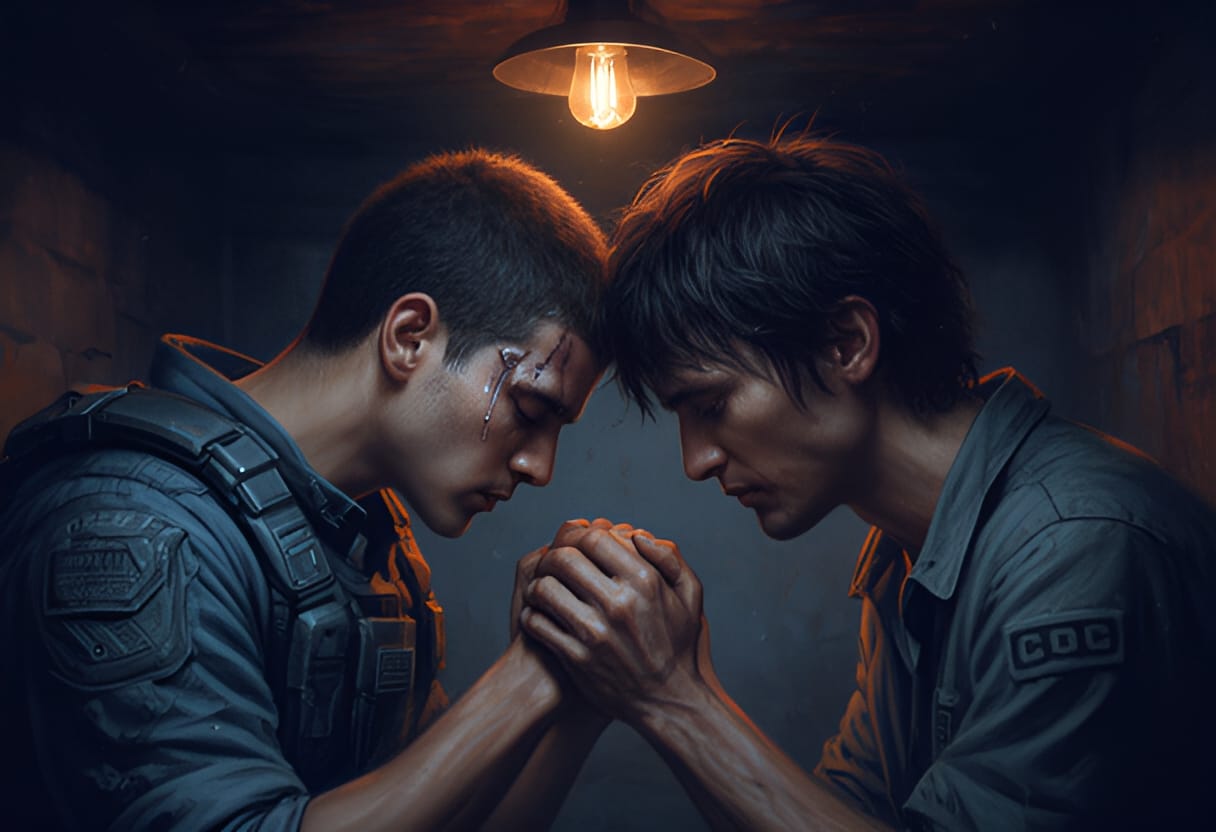
Chapter 17
Not Alone
Zay pressed his forehead to Alex’s, whispering, “I’m here,” as the Locust advance and the tunnel lights began to fail.
The world narrowed to the rhythm of his brother’s breath—or the absence of it. Alex’s chest did not rise. His skin, already slick with sweat and blood, felt unnervingly cool beneath Zay’s palm where it rested on his brother’s sternum. The wound in Alex’s side gaped, a dark flower blooming across the fabric of his armor, pumping life onto the gritty tunnel floor in slow, thick pulses. Each beat of Zay’s own heart hammered a silent accusation: Too late. Too slow. Not enough.
A guttural roar split the air—a Boomer’s challenge, close now, its heavy footsteps shaking loose dust from the ceiling. Zay didn’t think. He didn’t mourn. He moved.
His hands, trembling not from fear but from the white-hot fury of loss, snapped Alex’s Lancer from its grip. The weapon was warm from recent use, still humming faintly with residual charge. He rolled to his knees, then to his feet, back snapping upright with a violence that stole his breath—but he didn’t feel it. Not the pain in his ribs, not the fire along his jawline where the Boomshot shrapnel had torn him, not the sour copper taste of light on his tongue or the way every distant drip of water felt like a drill boring into his skull. All of it was drowned beneath the roar in his ears and the red haze behind his eyes.
He stepped into the open.
The tunnel mouth yawned before him—a jagged wound in the earth framed by broken concrete and hanging cables. Beyond it, the city burned. Fires licked the sky like dying stars. Locust poured from the shadows: Drones with jagged teeth bared, Wretches skittering on all fours, their eyes gleaming with hunger. And there, lumbering forward with the slow inevitability of a glacier, came the Boomer—its Boomshot cradled in both arms, the barrel already swinging to track him.
Zay didn’t aim. He sprayed.
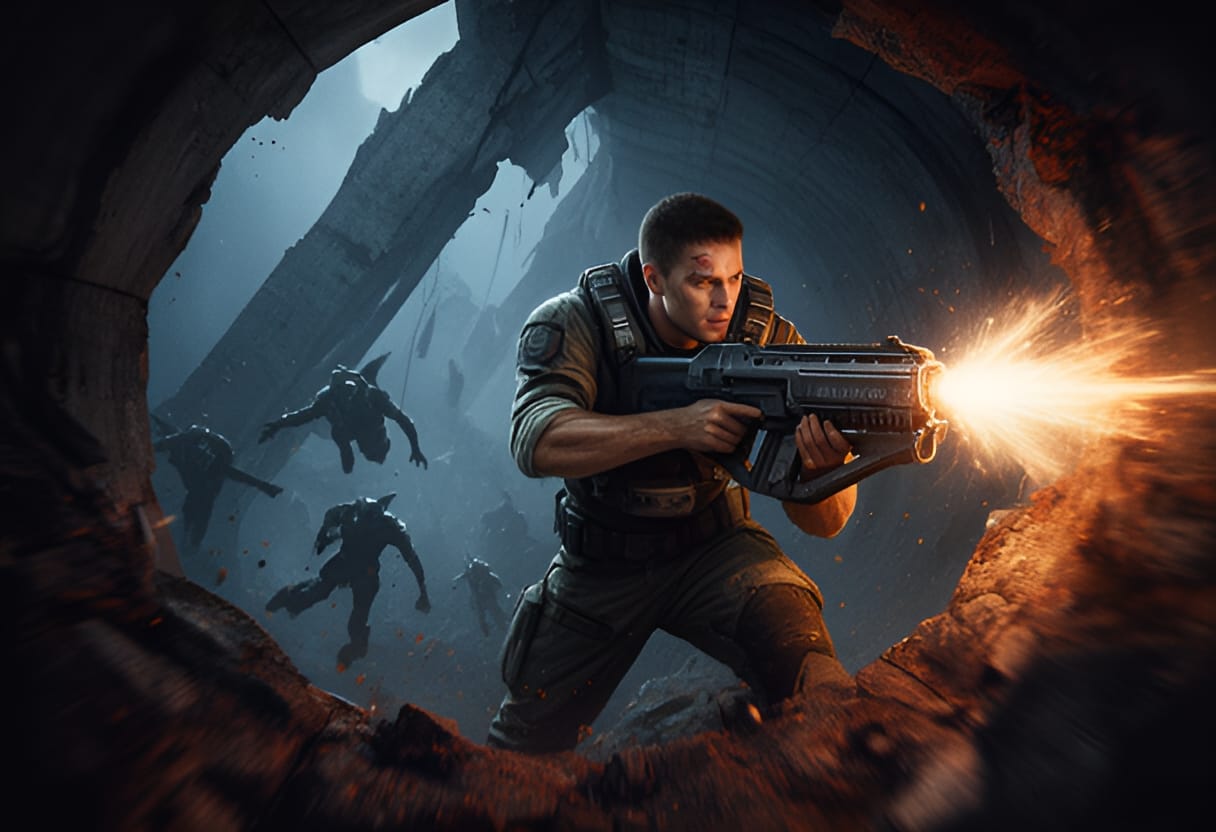
The Lancer bucked in his grip, chainsaw snarling as it chewed through air and Locust alike. Sparks flew where the blade struck armor. Rounds tore into flesh and chitin, dropping Drones in twitching heaps. A Wretch launched itself at his throat—he pivoted, caught it mid-leap with the butt of the weapon, and snapped its neck with a crack that echoed too loud in the sudden quiet between bursts.
He fired until the magazine clicked empty.
The sound was a physical thing—a vacuum in his ears, a sudden silence that made the pounding of his blood sound like war drums. He fumbled the spare magazine from Alex’s webbing, fingers slick with his brother’s blood and his own. The reload was clumsy, frantic. A round clattered to the ground. He snatched it up, jammed the mag home, slapped the bolt release—chunk—and brought the Lancer back to bear.
The Boomer was closer now. Ten meters. Its rotting lips pulled back in a silent snarl. The Boomshot rose.
Zay squeezed the trigger.
Nothing.
He looked down. The magazine wasn’t seated. Panic flared—cold and sharp—but he shoved it down, harder this time, and racked the bolt. The Lancer shuddered awake.
He fired.
The Boomer staggered as rounds hammered its chest. It roared, a sound like stone grinding on stone, and lifted its weapon.
Too slow.
A burst of Lancer fire lanced from the smoke to the left—rak-rak-rak—and the Boomer’s head snapped back. It dropped to one knee, then fell face-first into the dirt, its Boomshot clattering uselessly beside it.
Another burst came from the right. Then another. Three, four, five—Lancer reports cracking the air like whipshots, each one felling a Locust that dared to step into the killing zone.
Zay didn’t stop. He couldn’t. He walked forward, weapon swinging in short, lethal arcs, spraying fire into the gloom. He didn’t see faces. He didn’t see uniforms. He saw only targets—things that had taken his brother, his world, his tomorrow—and he gave them nothing but lead and fury.
He didn’t know how long he fought. Minutes? Hours? Time had lost meaning. All he knew was the weight of the Lancer, the heat of the barrel, the taste of blood and ozone, and the relentless push forward—driven not by hope, but by the hollow need to make them pay.
Then, through the haze of smoke and cordite, a shape emerged.
Not Locust.
Gears.
Sergeant Mara Velez led them, her face streaked with soot and sweat, her Lancer blazing. Behind her, Jace Stratton—alive, impossibly—fired from the hip, his Boltok spitting explosive rounds that turned Drones into showers of gore. Two others followed, rifles up, moving with the grim precision of those who had seen too much and refused to break.
They pushed through the smoke like a blade through flesh, clearing the tunnel mouth with brutal efficiency. Locust fell—not in ones or twos, but in waves, cut down by disciplined, enraged fire.
Zay stopped firing.
His arms dropped. The Lancer felt suddenly alien in his grip—heavy, foreign. His breathing came in ragged gasps, each one scraping his raw throat. The synesthesia flared—a metallic taste on his tongue, like licking a battery, synchronized with the distant thump of falling bodies. His vision swam at the edges, the world tilting slightly, as if the tunnel itself were breathing.
He looked past the advancing Gears, past the drifting smoke, to the broken concrete lip of the tunnel.
Alex still lay where he had fallen.
Slumped against the column.
Eyes open.
Unseeing.
Zay’s knees unlocked. He didn’t remember deciding to move. One moment he was standing; the next, he was on his knees in the dust, hands braced on his thighs, head bowed.
Velez reached him first. She didn’t speak. Didn’t offer platitudes. She simply knelt beside him, her glove brushing his shoulder—a touch of solidarity, not pity.
“Lopez,” she said, voice low and rough from smoke and shouting. “We’ve got you.”
He didn’t look at her. His eyes were fixed on Alex’s chest. Waiting. Hoping, against every instinct, for the faintest rise and fall.
Nothing.
Then—a twitch.
A finger. Alex’s left hand, the one not pinned beneath his body, twitched. Once. Then again. Slow. Deliberate.
Zay’s breath hitched.
He lunged forward, ignoring the fire in his ribs, ignoring the way the world pulsed and blurred at the edges. He grabbed Alex’s wrist, fingers closing around the cold skin.
“Alex?” he whispered. “Alex, míranme. Look at me.”
The eyelids fluttered. Not much. Just a fraction. But they moved.
And in that fractured sliver of vision—glassy, unfocused, but there—Zay saw it.
Recognition.
A ghost of a smile touched Alex’s lips. So faint Zay might have imagined it. But he didn’t think so.
Alex’s mouth opened. No sound came out. Just air. But his lips shaped the word, clear as a bell in the silence between heartbeats:
Always.
Zay pressed his forehead to his brother’s again. This time, he didn’t whisper.
He swore it.
“I’m here,” he said, voice breaking. “I’m here. And I’m not letting go.”
Around them, the battle raged on. Gears shouted. Lancers fired. The Locust screamed and fell.
But in that narrow space between two brothers, bound by blood and promise and a lifetime of unspoken words, there was only this: the press of foreheads, the grip of hands, and the quiet, blazing certainty that even in the dark, even in the ruin, they had found their way back to each other.
The medics came then—two privates with red crosses on their helmets, moving with practiced urgency. They knelt beside Alex, fingers flying to his throat, his wrist, the ghastly wound in his side.
Zay didn’t move. Didn’t release his grip. He watched as one medic frowned, then nodded to the other.
“Pulse is thready,” the medic said. “But it’s there. Shallow, but there.”
Zay exhaled—a sound like a sob torn from his chest. He didn’t let go. Instead, he shifted, sliding his free hand beneath Alex’s head, cradling it against his thigh. He brushed sweat-damp hair from his brother’s forehead, his touch reverent, afraid to break the fragile thread between them.
Velez crouched nearby, her expression grim but resolute. She wiped her brow with the back of her hand, leaving a streak of grime. “We’ve got a evac point set up two clicks east,” she said, voice low so as not to disturb the moment. “Armory’s holding. We’ve got a couple of trucks still running. Civilians are loading now.”
Zay didn’t look at her. His eyes never left Alex’s face.
“Can we move him?” he asked, voice raw.
The medic hesitated. “Not far. Not without risking the wound. But we can stabilize. Plasma seal, morphine, IV—we can buy time. If we get him to a field hospital… there’s a chance.”
Zay finally looked up. His eyes were red-rimmed, his face streaked with dirt and dried tears, but his gaze was steady. Fixed on Velez.
“Then we move him,” he said. “Now.”
Velez nodded. She turned to her people. “Listen up! We’ve got a casualty—priority one. Litter team, forward! Two of you grab the litter from the truck. Medic, keep working. The rest of you—fan out. Watch our six. We move now.”
They moved like a unit. Despite their losses, despite the exhaustion etched into every line of their bodies, they responded. A litter appeared. Two Gears lifted Alex with care, sliding the stretcher beneath him as the medic continued to work—sealing the worst of the bleeding, taping a line into his vein.
Zay walked beside them, one hand on the litter’s frame, the other still clasped in Alex’s. He didn’t speak. Didn’t need to. His presence was the message: I’m here. I haven’t left. I won’t.
They moved through the smoke, past the fallen, past the wreckage of the tunnel mouth. The city burned around them—Ephyra dying in fire and scream—but overhead, through the thinning haze, a sliver of pink sky showed where the sun fought to break through.
And between them, step for step, breath for breath, Zay and Alex Lopez moved forward—not as brothers fleeing the dark, but as two halves of a whole, refusing to be torn apart.
Not today.
Not ever.
They moved in silence, broken only by the rasp of Alex’s breathing, the creak of the litter’s frame, and the distant thrum of Locust artillery falling somewhere in the city’s ruins. Zay kept pace beside the litter, his free hand never leaving Alex’s grip. His other rested on the litter’s side, feeling the subtle shifts as the bearers adjusted their steps over rubble and broken pavement. Each jolt sent a fresh wave of pain through Alex’s body—Zay could see it in the tightening of his jaw, the way his breath hitched—but he didn’t moan. Didn’t cry out. Just endured, eyes half-lidded, fixed on some point beyond the smoke.
Zay matched his breathing to his brother’s, shallow and uneven, as if by syncing their rhythms he could lend him strength. The synesthesia was worse now—every footfall on concrete sent a coppery tang across his tongue; every distant explosion tasted like burnt sugar and iron. He swallowed hard, pushing it down. Focus. Alex needed him to be steady.
They turned a corner onto a wider avenue, littered with overturned cars and the blackened husks of storefronts. Fires still smoked in alleyways, and the air shimmered with heat. A lone Struck lay on its side nearby, its turret blown clean off, barrel pointing uselessly at the sky. Zay didn’t look at it. His eyes scanned the rooftops, the shattered windows, the dark mouths of side streets—anywhere a Drone or a Sniper might lurk.
Velez moved ahead, her Lancer at the ready, her head swiveling constantly. Two Gears flanked her, weapons up. Two more brought up the rear. It wasn’t much of a formation, but it was enough. Enough to make Zay believe, just for a moment, that they might actually make it.
Then came the whistle.
Sharp. Piercing. Cutting through the haze like a blade.
Zay’s head snapped up.
From the second-story window of a gutted pharmacy, a figure stepped into view—tall, clad in mismatched armor, a red bandana tied around the bicep. A Stranded. In one hand, a bolt-action rifle. In the other, a flare gun, already smoking.
“Hey! Gear!” the man shouted, voice raw from disuse or smoke. “You got a wounded! Over here! I got a cellar—solid concrete, deep as a grave! Keeps the Kryll out! You can hole up till evac!”
Zay exchanged a glance with Velez. She didn’t lower her weapon, but she didn’t raise it either. Her expression was unreadable—wariness layered over exhaustion.
“How do we know it’s not a trap?” one of the rear Gears asked, voice low but edged with suspicion.
The Stranded spread his empty hands. “No trap, I swear! I lost my sister to the Hollows yesterday. I ain’t got love for Locust—or those who pretend to be human while workin’ for ‘em. You want proof? Ask me about the emerald locket she wore. Green as a frog’s belly. I still got it.”
Zay didn’t hesitate. He took a step forward. “Where?”
The man pointed a trembling finger toward a sagging awning. “Down the stairs, behind the counter. Steel door. Took me three days to weld it shut from the inside. Air vent’s hidden in the floor—looks like a drain grate, but it’s not. You go down ten feet, you’re in solid rock. Cool. Dry. And Locust-proof, ‘less they bring a mole drill.”
Velez lowered her weapon slightly. “How many can it hold?”
“Twenty, easy. Thirty if you don’t mind snuggling. I got water—filtered through sand and charcoal. Canned beans. Not much, but it’ll keep you alive.”
She looked at Zay. He met her gaze. Alex’s fingers twitched in his grip—just a flutter, but it was there. Alive. Fighting.
“Make it quick,” Velez said. “And keep your hands where I can see them.”
The Stranded nodded eagerly and scrambled back inside, disappearing behind the counter. A moment later, the sound of scraping metal—then the door creaked open, revealing a yawning blackness below, framed by rusted hinges and the smell of damp earth and oil.
Two Gears went first, weapons flashing into the gloom. Then came the litter team, lowering Alex with agonizing care. Zay followed, one hand on the litter’s frame, the other still locked with his brother’s. The air down here was cool and still, smelling of stone and old oil. The space opened into a small, circular chamber—rough-hewn, walls lined with sandbags and stacked crates. A single bulb hung from the ceiling, its filament flickering weakly. A jerrycan of water sat near a pile of blankets. A hot plate stood cold in the corner.
They lowered the litter onto a pallet. The medic immediately resumed work—checking the IV, adjusting the pressure bandage, whispering encouragement in low, urgent tones.
Zay stayed at the head of the litter, kneeling on the cold concrete, his forehead resting against Alex’s. He could feel the faint rise and fall of his brother’s chest beneath his palm. So slight. So fragile.
“You’re gonna make it,” Zay murmured, voice rough from disuse and emotion. “You hear me? You’re gonna make it to that hospital. You’re gonna get that surgery. And when you wake up… you’re gonna make me that peach cobbler. With the lattice top. Just like Mamá used to.”
Alex’s eyelids fluttered. Not opening. But moving. Rapidly, beneath the lids—dreaming, maybe. Or fighting his way back.
Zay didn’t let go. Couldn’t.
Outside, the sounds of battle drifted down—muffled detonations, the rat-tat-tat of Lancers, the occasional scream that cut off too soon. But down here, in the cellar, there was only the quiet, the flickering light, and the shared breath between two brothers who had stared into the abyss and refused to let it take both of them.
Velez stood near the door, weapon ready, her eyes on the stairwell. One of the Gears took up position beside her. The others settled in—checking ammo, drinking water in silence, eating cold rations without taste. No one spoke much. Words felt wasted here. Better to save them for what mattered.
Time passed. How much, Zay couldn’t say. The bulb above them flickered once, then steadied. Alex’s breathing remained shallow, but it was regular now—no longer the ragged gasps of shock, but the slow, uneven pull of someone clinging to life. His skin was still ashen, slick with sweat, but the worst of the bleeding had stopped. The plasma seal held.
Zay didn’t move. Didn’t sleep. He just stayed there, hand in hand, forehead to forehead, listening to the quiet rhythm of his brother’s survival.
Then, from above, a sound.
Not Locust.
Human.
Voices. Muffled, but close. Shouting. Not in panic—in coordination.
Zay lifted his head. Velez was already moving toward the stairwell, signaling for silence.
The voices grew clearer. A mix of accents—Gear, maybe some civilians. A woman’s voice, sharp and commanding: “…third squad, check the east flank! I want eyes on that sewer grate—if they’re trying to flank us, I want to know now!”
Another voice, younger, breathless: “Sergeant, contact! West alley—three Drones, moving low!”
“Engage! And tell Reyes we’re holding! Tell him the tunnel’s clear—for now!”
Zay’s chest tightened. Reyes. The name hit him like a physical blow. Reyes—the officer who had assigned them to the last evac truck. The one who had believed in them enough to give them that responsibility.
He looked down at Alex. His brother’s lips were parted, breath whispering in and out. So fragile. So there.
Zay gently laid Alex’s hand back on his chest, then rose, stiff from kneeling. His legs protested, but he ignored it. He picked up his Lancer—clean, functional, loaded—and checked the magazine. Full. He slipped the spare from his vest, checked it too. Ready.
Velez met him at the base of the stairs. “You sure?” she asked, her voice low. “You ain’t in shape to walk, let alone fight.”
Zay met her eyes. “I’m not leaving him. But I can’t just sit here while others die holding the line. If they’re fighting to keep this tunnel open… I owe them that much.”
She studied him for a long moment. Then she nodded. “All right. But you take the left flank. I’ll take right. We sweep the alley and the side street—clear any stragglers, make sure they ain’t using the buildings to creep up on the cellar. You go, you come back. No heroics. Understood?”
Zay gave a single, sharp nod. “Understood.”
They moved up the stairs together, Zay leading, Velez just behind. The cellar door creaked shut behind them with a soft thunk—a sound that felt like sealing a tomb… or a promise.
The alley was narrow, choked with debris. Smoke hung low, stinging the eyes. Flickering firelight painted the walls in shifting orange and black. Zay moved slowly, weapon low, senses wide open. Every shadow felt like a threat. Every creak of settling metal made his trigger finger twitch.
They swept the alley—nothing. Just rubble, a dead Wretch curled like a spider in the gutter, its tiny claws still clenched.
Then, from the side street—a moan.
Zay froze. Velez tensed beside him.
They moved forward, weapons up, eyes locked on the darkness between two collapsed storefronts.
There, half-buried under a slab of concrete, was a civilian—a woman, maybe in her thirties, her leg pinned beneath the slab, her face pale with pain and exhaustion. She clutched a small stuffed animal—a rabbit, missing an eye—pressed to her chest.
Zay’s throat tightened. He knelt, weapon ready but lowered. “You alright?”
She looked up at him, eyes wide, tears cutting tracks through the grime on her cheeks. “I… I can’t feel my leg. And the baby… is the baby okay?”
Zay followed her gaze. Swaddled in her arms, wrapped in a blood-stained blanket, was an infant—no more than a few months old. The child’s eyes were closed. Breathing shallow. But alive.
“Shit,” Velez breathed. She moved to the woman’s other side, assessing. “How long you been here?”
“Since the first screams,” the woman whispered. “They came up through the streets—those things, the big ones with the guns… they took my husband. I ran down here with the baby… then the ceiling groaned. I tried to get out, but it shifted… trapped me.”
Zay placed a hand on the concrete slab. It was thick—reinforced, maybe part of a foundation. Too heavy to lift alone. But not impossible.
“Velez,” he said, voice tight. “Help me lift it. Just enough to pull her out.”
They braced themselves. On Zay’s count, they heaved.
The slab groaned. Shifted. Inched upward.
The woman cried out—more from fear than pain, Zay thought—as they held it just long enough for her to drag herself free, cradling the baby to her chest. She scrambled back on her elbows, sobbing, thanking them in a broken stream of Spanish and English.
Zay lowered the slab slowly. It settled with a final clunk.
“You’re gonna be okay,” he told her, voice rough. “We’ve got a evac point not far. You’ll get help.”
She nodded, too overwhelmed to speak. She clutched the baby tighter, whispering to it in Spanish, rocking gently.
Zay and Velez backed away, weapons up, scanning the darkness. No movement. No threat. Just the woman, the child, and the quiet will to survive.
They swept the rest of the side street—clear. No Locust. No ambush. Just the detritus of war: spent casings, shattered glass, a child’s shoe lying alone in the gutter.
They returned to the cellar entrance. Velez paused at the top of the stairs, looking down.
“You good?” she asked.
Zay nodded. He didn’t trust his voice yet. Instead, he gave her a small, grim nod—acknowledgment, thanks, solidarity.
She returned it. Then she turned and melted back into the smoke, her silhouette disappearing into the gloom.
Zay descended the stairs alone.
The cellar was quiet now. The bulb above them had steadied, casting a soft, wan light over the scene. Alex lay still on the pallet, his breathing even, his hand resting on his chest where Zay had left it. The medic had finished her work—IV running, bandages secure, a dose of morphine taking the edge off the pain. She looked up as Zay approached.
“He’s holding,” she said quietly. “Fever’s down a touch. Response to stimuli is minimal, but present. If we can keep him warm, hydrated, and out of shock… he’s got a fighting chance.”
Zay knelt beside the litter again. He took Alex’s hand in both of his, pressing it to his cheek. The skin was cool, but not cold. Alive.
“I’m not leaving,” he whispered. “Not this time. Not ever.”
He stayed like that for a long time—just holding on, listening to the quiet, feeling the fragile pulse beneath his fingers. The world above raged—Locust screamed, Lancers fired, buildings fell—but down here, in this small, dark refuge, there was only this: the press of skin on skin, the shared rhythm of two hearts beating as one, and the quiet, unyielding vow that no matter how dark it got, they would always find their way back to each other.
Hours passed. Or maybe it was only minutes. Time had lost all meaning down here, measured only in the rise and fall of Alex’s breath and the slow drip of sweat from Zay’s temple.
The bulb above them flickered again—then died.
Darkness swallowed the cellar.
Not total dark. Not yet. A faint glow seeped in from the stairwell—ambient light from the fires above, filtering down through the cracked door and the gaps in the boards. Enough to see by, if you strained your eyes. Enough to make out the shape of your brother’s face, the rise and fall of his chest, the glint of sweat on his brow.
Zay didn’t move. Didn’t speak. He just held on.
Then, from the darkness above, a sound.
Not Locust.
Human.
A voice—familiar. Rough with smoke and command.
“Lopez!”
Zay’s head snapped up.
Sergeant Velez stood at the top of the stairs, silhouetted against the glow. Behind her, two Gears carried a second litter—this one empty, ready.
“We’re moving out,” she said, voice low but urgent. “Evac trucks are loading at the armory. We’ve got a window—Locust pressure’s eased for now. Reyes says if we’re not there in fifteen, they pull out without us.”
Zay looked down at Alex. His brother’s face was slack, eyes closed, breathing so shallow it was almost imperceptible. But it was there. A tide, weak but relentless.
“Can we move him?” Zay asked, voice tight.
Velez hesitated. “Medic says it’s risky. But staying here… we don’t know how long this hole stays safe. Stranded’s got supplies, but not forever. And if the Locust bring a borer…”
She let the sentence hang.
Zay knew what she wasn’t saying: If we wait too long, we might not get another chance.
He looked at Alex. At the way his lashes rested against his cheeks. At the faint, almost imperceptible twitch of his fingers—still curled slightly, as if dreaming of holding on.
Zay leaned down, pressed his forehead to his brother’s once more. “You hear that?” he whispered. “They’re coming for us. We’re not done yet.”
Then he rose.
“Prep the litter,” he told the medic. “We’re moving.”
She nodded, already gathering supplies—extra plasma, a fresh IV bag, a thermal blanket. Zay helped her lift Alex, maneuvering him onto the stretcher with infinite care. He slipped the thermal blanket over him, tucked it snug around his shoulders and legs. Then he took his place at the head of the litter, one hand on the frame, the other locked in Alex’s.
They began to move.
Up the stairs, slow and deliberate. Each step sent a jolt through Alex’s body—Zay could feel it in the way his grip tightened, involuntarily, in response. But he didn’t cry out. Didn’t groan. Just endured, his breath coming in shallow, uneven pulls.
At the top, Velez met them. She took the rear, weapon up, eyes scanning the street. Two Gears flanked them. One carried the spare ammo and medical kit. The other watched the rooftops.
They moved through the smoke and ruin, the city a landscape of broken bones and dying embers. Fires still burned in pockets, sending up plumes of black smoke that curled like funeral veils. The air was hot, thick with the smell of burning plastic, melted metal, and something sweet and sickly—Imulsion, maybe, or just the stench of war.
Zay kept his eyes forward, but his awareness was split—half on the path ahead, half on the man in his arms. He felt every flinch, every hitch in Alex’s breath. And each time, he tightened his grip, leaned in closer, whispered words he wasn’t sure his brother could hear—but needed to say anyway.
“You’re strong,” he murmured. “Stronger than you know. You’ve carried me through worse than this. Now let me carry you.”
A block later, Alex shuddered—a deep, involuntary spasm that rolled through his whole body. His fingers clenched in Zay’s hand, knuckles whitening.
“Easy,” Zay breathed. “Easy, hermano. I’ve got you.”
The spasm passed. Alex went limp again, but his grip didn’t fully release. He was still holding on.
They turned onto a broader avenue—wider, less cluttered. And there, through the haze, Zay saw it.
The armory.
Not intact. Not by a long shot. The west wall had collapsed, taking half the roof with it. But the central courtyard remained—surrounded by sandbags, barred with wrecked vehicles, lit by flickering floodlights and the glow of burning barrels. Gears moved with purpose—loading civilians onto trucks, triaging the wounded, shouting orders over the din.
And there, near the central loading dock, stood Reyes.
He was harder to recognize—helmet gone, face streaked with soot and blood, one arm in a makeshift sling. But it was him. Alive. Standing. Giving orders.
Zay’s breath hitched. Not just relief—something deeper. A rekindling. The chain of command, frayed as it was, still held. They weren’t abandoned. Not yet.
Velez broke into a trot, shouting, “Medic evac! Priority one! Lopez, Alex—critical but stable!”
The word spread. A path opened. Gears shifted, making room. A medic from the armory team rushed forward, taking over from Zay’s medic with a quick, efficient handoff.
Zay didn’t step back. He kept his place at the head of the litter, his hand still locked in Alex’s. He walked beside them as they wheeled the litter toward the nearest evac truck—a heavy six-wheeler, its canvas top half-torn, its sides lined with benches.
Two more medics met them. They lifted Alex with practiced ease, transferring him to a stretcher inside the vehicle. Zay climbed in after him, settling on the bench beside the stretcher, one leg drawn up, his back against the wall. He kept Alex’s hand in his, lacing their fingers together just as they had in the tunnel.
The medics went to work—checking vitals, adjusting the IV, applying oxygen via nasal cannula. One of them, a young private with a bandage across his nose, looked up at Zay.
“He’s holding,” she said softly. “But we need to get him to the field hospital, stat. Shrapnel’s still in there—risk of infection’s high. And the Imulsion poisoning… it’s worsening. We can slow it, but we can’t stop it without real care.”
Zay nodded. He didn’t take his eyes off Alex’s face. “Then let’s move.”
The truck’s engine coughed to life—a deep, throaty rumble that vibrated through the frame. The vehicle lurched forward, pulling out of the armory yard and into the smoke-choked streets.
They moved slowly, weaving through wreckage, avoiding the worst of the fires. Locust fire cracked in the distance—sporadic, disorganized. The Horde was still here, still dangerous, but their momentum had broken. For now, the COG held this stretch of road.
Inside the truck, the world was reduced to the space between Zay and Alex. The rumble of the engine, the hiss of the oxygen line, the occasional creak of the suspension. And beneath it all—the quiet, persistent beep… beep… beep of the heart monitor clipped to Alex’s finger.
Slow. Steady. Alive.
Zay rested his forehead against the edge of the stretcher, his free hand brushing sweat-damp hair from Alex’s brow. His brother’s eyes remained closed, but his breathing was easier now—deeper, more regular. The morphine was working. The shock was easing.
Zay closed his eyes. Just for a moment. Let the rhythm of the truck, the sound of his brother’s breath, the warmth of their joined hands, anchor him.
He thought of Lily’s drawings—the two of them holding hands, the stick-figure girl reaching up. He thought of the recipe tin over his heart, the peach cobbler waiting to be made. He thought of the promise they’d made as boys, whispered in the dark after a nightmare: No matter what happens, we find our way back.
He hadn’t just kept that promise.
He was living it.
The truck rolled on. The city blurred past—ruined, burning, but still theirs. Somewhere ahead, the field hospital waited. Somewhere behind, the Locust licked their wounds, regrouping for the next assault.
But here, in this moving box of steel and canvas, with his brother’s hand in his and the steady beat of a heart refusing to quit, Zay Lopez felt something he hadn’t felt in days.
Not hope.
Not exactly.
Something older. Deeper.
Resolve.
He tightened his grip on Alex’s hand.
And whispered, so low even the engine couldn’t steal it:
“We’re not done yet.”
Outside, the city burned.
Inside, two brothers breathed as one.
And for now, that was enough.
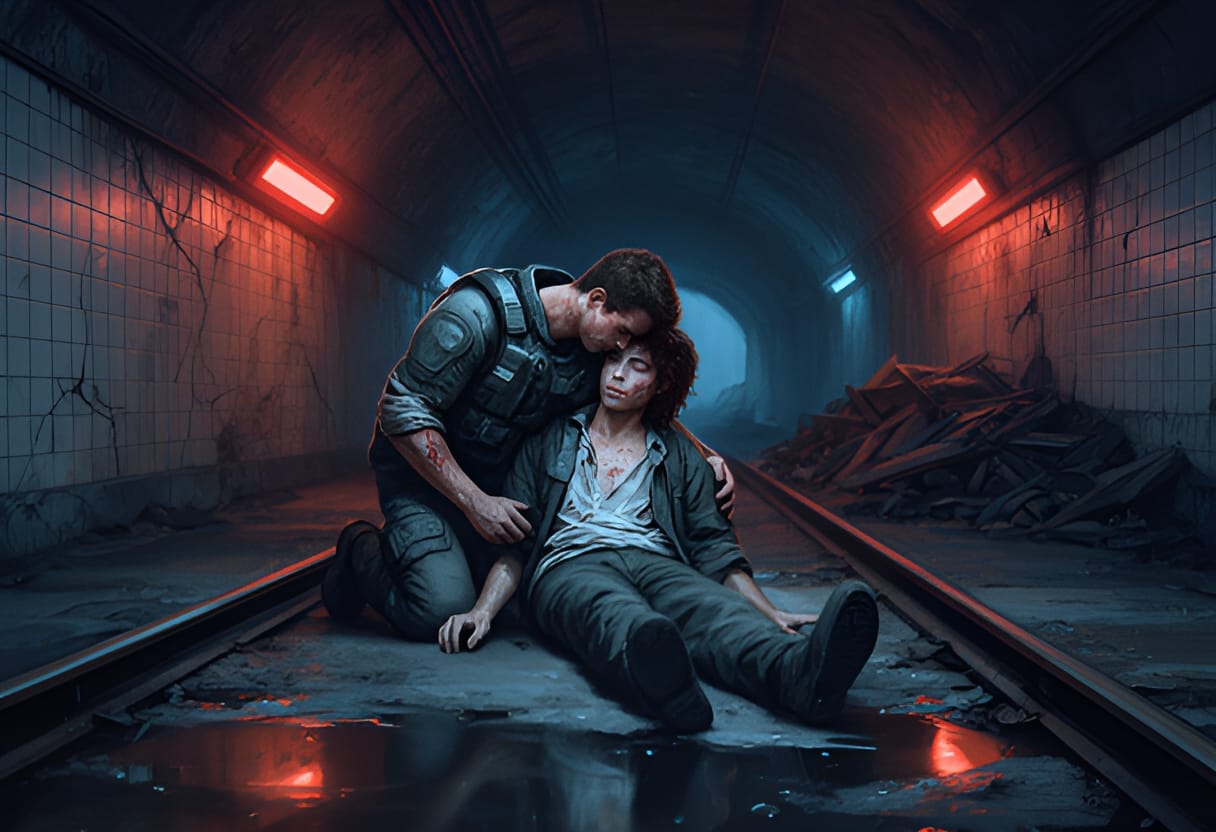
Chapter 18
The Weight of a Name
Zay’s breath came in ragged pulls, each one tasting of cordite and something metallic, like licking a battery. The Lancer fire had stopped. The Boomer was down. Smoke curled in lazy eddies from the wreckage, carrying the sharp tang of burnt polymer and Locust ichor. His ears rang, not just from the gunfire but from the sheer, hollow silence that followed—the absence of Alex’s breath against his neck, the missing weight of his brother slumped where he’d been holding him.
Sergeant Velez was there, her face smeared with soot and blood, her eyes locked on his. Behind her, two other Gears moved cautiously, Lancers at the ready, scanning the smoke for any sign of more Drones or a lurking Boomer. The tunnel mouth was a chaos of debris—twisted metal, shattered concrete, the carcass of the Boomer half-buried in rubble. Flickering emergency lights cast long, jerky shadows that made the dark seem to breathe.
“Lopez,” Velez said, her voice low but cutting through the haze. “You hit?”
Zay didn’t answer right away. He was still on his knees, one hand braced on the cold stone floor, the other clutching Alex’s rifle—his brother’s rifle—like a lifeline. The weapon felt alien in his grip, too light, too familiar. He looked down at Alex. His brother lay on his side, face turned away, one arm flung out, the other curled slightly beneath him. The deep wound in his side had soaked through the field dressing Alex had applied earlier, darkening the fabric into a stiff, almost black patch. There was no rise and fall of the chest. No twitch of the eyelids. Just stillness.
“He’s not—” Zay began, his voice raw.
“I see him,” Velez said, stepping closer. She knelt beside Alex, not touching him yet, her gaze flicking over the wound, then to Zay’s face. “You took a Boomshot to the ribs. That gash on your collarbone’s weeping again. You’re shaking like a leaf in a storm.”
“I’m fine,” Zay said, too loud. His voice cracked. He cleared his throat. “He’s not dead. He can’t be.”
Velez didn’t flinch. She reached out, two fingers pressed lightly to Alex’s carotid artery. Her brow furrowed. After a long moment, she exhaled through her nose.
“Pulse,” she said. “Faint. Thready. But it’s there.”
Zay’s vision blurred. He sucked in a breath that tasted of ozone and old blood. “He’s… he’s still here.”
“He’s hanging on,” Velez said. “But not by much. We need to get him out. Now.”
“I’m not leaving him,” Zay said, shifting slightly to shield Alex’s body with his own. His left side flared with pain—a deep, grinding ache where the Boomshot had caught him—but he ignored it. He reached out, trembling, and brushed a strand of sweat-damp hair from Alex’s forehead. The skin was clammy, burning hot. “He promised. We promised.”
Velez studied him for a second, then nodded. “Alright. Lopez, you stay with him. I’ll get the medic.”
She barked an order to the other two Gears. “You two, cover the flanks. Watch for stragglers. We’re not out of the woods yet.”
As Velez moved away, Zay lowered himself fully beside Alex, pressing his forehead to his brother’s temple just as he had before. The contact was barely there—skin to skin, forehead to temple—but it grounded him. He could feel the frantic flutter of Alex’s pulse against his own skin, thin and rapid like a trapped bird’s wings.
“I’m here,” Zay whispered, the same words from before, but softer now, meant only for Alex’s ears. “I’m not letting go. You hear me? You promised you’d always find your way back. So come back. Please.”
He didn’t know if Alex could hear him. Didn’t know if the words reached past the pain, past the darkness closing in behind his brother’s eyes. But he had to say them. Had to believe them.
A medic arrived—a young private with a red cross on her helmet, her hands steady despite the chaos. She checked Alex’s breathing, lifted the dressing just enough to see the wound, then shook her head.
“Internal bleeding’s bad,” she murmured. “Shrapnel or a fragment, maybe. Lost a lot of blood. We need to get him to a field station—fast.”
Zay watched her work, his jaw tight. She applied a fresh dressing, pressed a plasma pouch to the wound to slow the bleeding, then slipped an IV line into Alex’s arm. The fluid began to drip, slow but steady.
“Can he walk?” Zay asked.
The medic hesitated. “Not on his own. Not yet. But we can stabilize him enough for evac.”
Zay nodded. He didn’t let go of Alex’s hand. His fingers laced through his brother’s, thumb rubbing slow circles over the knuckles—a gesture from childhood, when they’d sneak out to the old mill and pretend they were pirates guarding treasure. Alex had always hated holding hands then, pretending it was babyish, but he’d never pulled away.
Now, Zay wouldn’t let go for anything.
“Ready to move?” Velez asked, returning with a folded stretcher.
Zay looked at Alex’s pale face, at the way his breath hitched—shallow, uneven, each inhale a struggle. “Yeah,” he said. “Let’s get him out.”
They lifted Alex onto the stretcher with practiced care, minimizing jostling. Zay walked beside him the whole way, one hand on the stretcher’s rail, the other still clasped in his brother’s. The pain in his ribs flared with every step, a white-hot spike that made his vision swim, but he bit down on his lip and kept moving. He tasted copper.
At the tunnel mouth, a Mule waited—its engine idling, exhaust puffing faintly in the cool air. Two more Gears stood guard, rifles scanning the ruins. Beyond them, the city of Ephyra lay in tatters—buildings collapsed like broken teeth, fires burning in the distance, the sky a bruised purple-gray streaked with smoke.
Velez helped lift the stretcher into the Mule’s rear compartment. Zay climbed in after, settling himself against the wall and pulling Alex’s upper body onto his lap. He cradled his brother’s head against his shoulder, feeling the faint rise and fall of his chest, the warmth of his skin despite the sweat and blood.
Alex’s head lolled slightly, unresponsive. His lips were parted, his breathing uneven but present. One hand lay limp on Zay’s thigh; the other still clung to Zay’s fingers, their grip weak but unbroken.
“Hold on,” Zay whispered, his lips near Alex’s ear. “We’re getting you home. Just like we said. Always.”
The Mule’s engine growled to life. The vehicle lurched forward, jolting them both. Zay gasped as the motion sent a shock of pain through his ribs, but he tightened his hold on Alex, anchoring them both with his grip.
Through the open rear of the Mule, the tunnel mouth receded—dark, silent, the Boomer’s carcass half-hidden in shadow. The ruins of Ephyra rushed past: overturned cars, shattered storefronts, the skeletal remains of a billboard advertising some long-forgotten product. Fires glowed like wounds in the earth. In the distance, the low thrum of Locust artillery echoed, a reminder that the war was far from over.
But inside the Mule, there was only this: the sound of Alex’s shallow breath, the press of his brother’s body against him, the quiet promise whispered into the dark.
Zay closed his eyes. He tasted light—sharp, citrusy, like biting into a lemon rind— a symptom of the Imulsion poisoning worsening in his blood. He felt the rumble of the engine not just as sound, but as pressure in his molars, a low vibration that made his teeth ache.
He didn’t care.
He held on.
And he whispered again, softer this time, as if the words could stitch his brother’s soul back into his flesh:
“I’ve got you. Always.”
The Mule lurched over a pothole, jarring Zay’s wounded ribs. He gasped, sucking air through clenched teeth, and tasted iron—bright, sharp, like licking a nail. The sensation bloomed behind his eyes, not pain this time, but a sudden, vivid flash: the kitchen at their mother’s house in Tyrus, sunlight cutting through the blinds in golden strips, the smell of frying plantains and strong coffee. Alex, barefoot and grinning, had just flipped a tortilla so high it stuck to the ceiling, laughing as he tried to peel it off with a fork. Their mother had yelled from the doorway, threatening to make them eat cold beans for a week if they didn’t clean it up.
Zay blinked. The vision faded, leaving only the grim reality of the Mule’s interior—the smell of sweat, cordite, and antiseptic, the dim red glow of the dashboard lights, the rhythmic thump of tires over rubble. But the memory lingered, warm and aching, a ghost of what had been.
He tightened his grip on Alex’s hand. “You see that?” he murmured, though he knew his brother couldn’t hear. “You always did flip ’em too high. Show-off.”
A soft chuckle escaped him, broken and raw. It surprised him. He hadn’t laughed since before the birthing chamber. Since before the Kryll took the sky.
Outside, the city groaned. Distant explosions shuddered through the frame of the Mule. Somewhere nearby, a building collapsed with a sound like a bone snapping. Smoke thickened ahead, turning the street ahead into a yellow-brown fog. The driver—Private Cole, Zay recognized him now from supply detail at Mercer Street—swerved sharply to avoid a overturned fuel truck, its cab crushed like a beer can.
“Hold on!” Cole called over his shoulder. “We’re hitting the main artery. It’s a mess, but it’s the fastest way to the evac point.”
Zay nodded, though Cole couldn’t see him. He shifted slightly, trying to ease the pressure on his ribs without jostling Alex. The medic—Private Essa, her name tag barely visible under grime—had checked his dressing earlier. “You’re lucky,” she’d said. “That gash missed the lung. But you’ve got internal bruising, maybe a hairline fracture. Don’t take another hit like that, or you’ll be the one needing evac.”
He hadn’t told her about the synesthesia—the way sounds pressed against his teeth like clenched fists, the way flashes of light left traces of citrus or burnt sugar on his tongue. He didn’t have the breath to explain. Besides, what did it matter? They were still alive. For now.
Alex shuddered against him, a small, involuntary twitch. His breathing hitched, then stalled for a terrifying second—just a pause, too long—before resuming, shallower than before.
Zay’s heart lurched. He pressed his forehead to Alex’s temple again, feeling the heat of his skin, the faint tremor beneath.
“Hey,” he whispered. “Don’t you dare check out on me now. We got a promise to keep. Remember? Always find our way back.”
He thought of the night they’d sworn it—sixteen years old, sitting on the roof of their uncle’s garage in Pelusa, legs dangling over the edge, sharing a bottle of cheap whiskey and dreams of getting off-world. The war had felt distant then, a rumor, a problem for other people. They’d talked about joining the COG, not because they believed in the cause, but because it meant staying together. No matter what.
“You said we’d watch each other’s backs,” Zay breathed. “So don’t you go leaving me to do it alone.”
A fresh wave of dizziness hit him. The Imulsion in his blood was acting up again—he could feel it, a slow poison curling through his veins. The light from the dashboard flared, and for a split second, he tasted something sweet and floral, like honeysuckle after rain. Then it was gone, replaced by the copper tang of blood.
He forced his eyes open. Alex’s face was pale, almost gray in the dim light. A sheen of sweat coated his forehead. His lips were cracked. Zay reached slowly for the canteen clipped to his vest, unscrewed the cap, and tilted it just enough to let a few drops fall onto Alex’s tongue.
His brother swallowed reflexively. A flicker of movement in the eyelids—then stillness again.
“That’s it,” Zay encouraged. “Just like when you were sick as a kid and Ma made you drink ginger tea. You hated it, but you swallowed it ’cause you knew it’d help.”
He remembered. Alex had been seven, burning with fever after swimming in the forbidden creek behind their house. Their mother had sat up with him all night, wiping his brow with a cool cloth, feeding him spoonfuls of bitter tea. Alex had complained the whole time, but he’d never refused it. “Tastes like dirt and sadness,” he’d muttered. “But if it makes me better, I’ll choke it down.”
Zay smiled despite himself. “You still hate ginger.”
The Mule hit another rut. This time, Zay braced himself, planting his feet against the wall and locking his arms around Alex’s upper body. The jolt sent a lance of fire through his ribs, but he didn’t cry out. He gritted his teeth and held on.
Outside, the ruins closed in. Buildings leaned at impossible angles, their facades peeled back like rotting fruit, exposing interiors stripped bare or burned to skeletons. A child’s shoe lay in the gutter, half-melted from heat. A doll with no eyes stared up from a pile of ash. The air smelled of burnt plastic, melted asphalt, and something sour and organic—Locust bile, maybe, or worse.
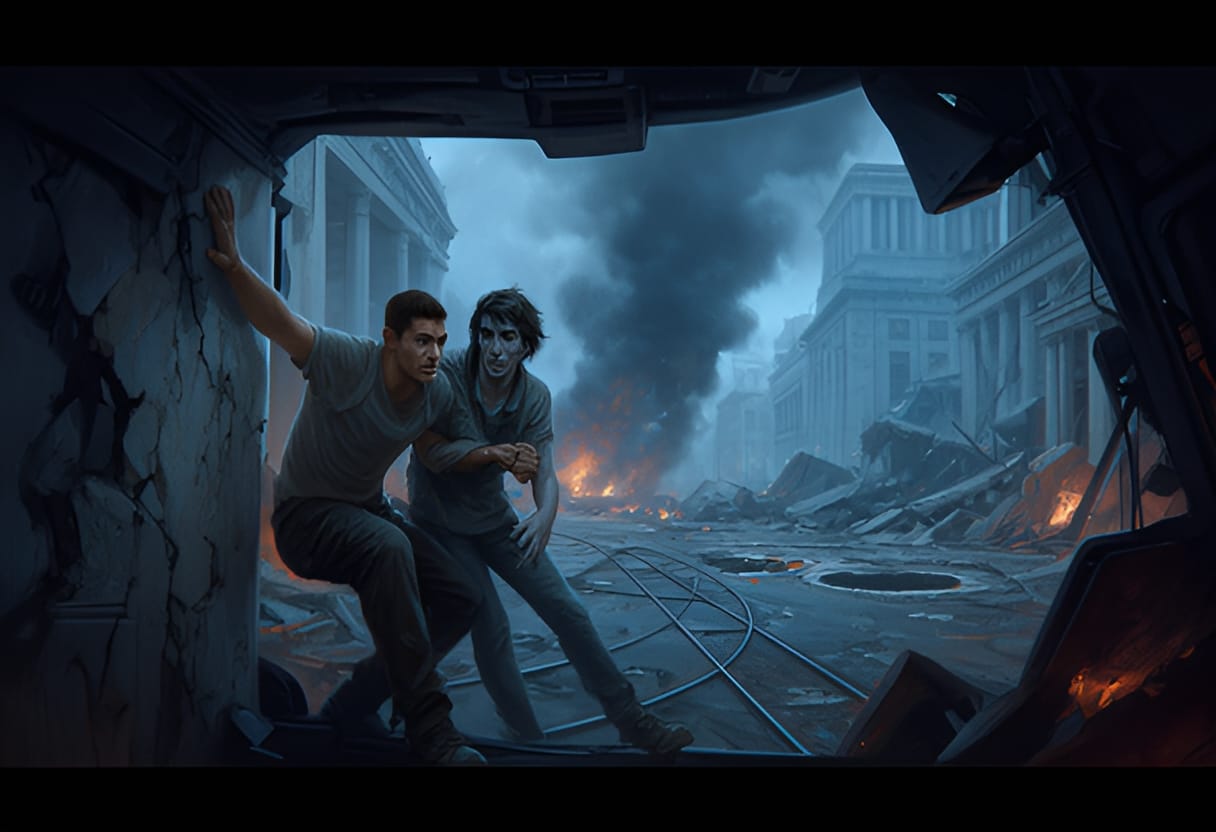
They passed a squad of Gears making a last stand behind a barricade of sandbags and overturned cars. Lancers chattered, muzzle flashes blinking like fireflies in the gloom. A Seeder hovered in the distance, its wings beating the air with a deep, throbbing hum that Zay felt in his molars—a low, vibrating pressure that made his jaw ache. Tracers arced toward it, streaks of green and red, but the creature hovered just out of range, dropping ink bombs that exploded in plumes of black smoke.
Cole swore under his breath. “We’re drawing too much attention. If they send a Corpser down this street—”
“We won’t let them,” Essa said, her voice calm despite the chaos. She checked Alex’s IV line, then his pulse at the wrist. “His thready, but it’s holding. Keep talking to him. It helps.”
Zay didn’t need to be told. He turned his head, brushing his lips against Alex’s ear.
“You know what I keep thinking about?” he said, his voice low and rough. “That fishin’ trip we took when we were twelve. Up at Blackwater Lake. You fell in trying to net a catfish and came out screaming like a banshee ’cause you thought a leech was on your neck.”
Alex’s fingers twitched in his grip—just a twitch, but it was something.
“You were covered in mud,” Zay went on, smiling despite the tears burning his eyes. “And you still tried to act like it was no big deal. ‘Just a little swim,’ you said, shivering like a leaf. Ma made us sit in the tub for an hour while she scrubbed us down. You complained the whole time, but you didn’t stop laughing once you got warm.”
A soft sound escaped Alex—not quite a sigh, not quite a moan. His breathing hitched again, then smoothed slightly, becoming a little more regular.
“See?” Zay whispered. “You’re listenin’. I knew you were.”
The Mule turned onto a wider boulevard, flanked by the skeletal remains of office towers. Glass crunched under the tires. Somewhere ahead, sirens wailed—not the wail of Locust horns, but the rising, falling cry of COG evacuation signals. Hope, fragile and desperate.
They passed a group of civilians huddled in the lobby of a collapsed bank—men, women, children, wrapped in blankets, eyes wide and hollow. A woman pressed a small boy to her chest, rocking back and forth. An old man clutched a faded photograph of a woman in a COG uniform—his wife, maybe, or his daughter. Zay’s throat tightened. He thought of Lily’s drawings, safe in his vest over his heart. He wondered if she’d made it out. If she was safe.
The thought made him hold Alex tighter.
“Almost there,” Cole said, his voice tight with concentration. “Just past the transit hub. The field station’s set up in the old mercantile building. Got surgeons, plasma, the works.”
Zay nodded. He didn’t dare hope. Not yet. Hope was a luxury he couldn’t afford—not when Alex’s breath was so thin, so fragile, like a candle in a storm.
But he let himself imagine it, just for a second: the mercantile building, its stone façade scarred but standing. Doctors in white coats moving with purpose. A stretcher wheeled into a bright room. The smell of antiseptic, clean and sharp. Alex on a table, not dying, but being fixed—stitches pulled tight, blood replaced, breath steadying under monitors that beeped with calm, regular rhythm.
He opened his eyes. The Mule slowed, weaving through debris-choked streets. A Locust Drone stumbled into the intersection ahead, rifle raised—but Essa popped up in the gunner’s hatch and fired a burst from her Snub pistol. The Drone jerked backward, hit in the chest, and fell without a sound.
“Clear!” she called.
Cole accelerated. The Mule surged forward, bouncing over rubble, kicking up dust and grit.
Zay leaned his forehead against Alex’s again, feeling the faint rise and fall of his brother’s chest. The breath was still shallow, but it was there. Steadier. Stronger.
“I’m not letting go,” he murmured. “Not now. Not ever.”
The buildings began to thin. Ahead, the mercantile building loomed—three stories of limestone and steel, its windows blown out, its doors barred with sandbags and concertina wire. COG insignia had been spray-painted over the entrance. Medics moved in and out, stretchers in hand. A field tent had been erected beside it, its flaps snapping in the wind.
Cole brought the Mule to a halt beside the tent. Two stretcher-bearers rushed forward, their faces grim but efficient.
“We’ve got him,” one said, taking Alex’s feet.
Zay hesitated. His fingers were still locked in his brother’s. He didn’t want to let go.
“Go on,” Essa said softly, placing a hand on his shoulder. “We’ll take good care of him. You need to get seen too. That rib’s not right.”
Zay looked down at Alex’s face—so still, so pale. But there was color returning to his cheeks, faint but real. A hint of warmth.
“I’m not leaving,” he said.
“We’re not asking you to,” the bearer said. “We’re putting you in the same tent. Side by side. You can hold his hand all you want.”
Relief, sudden and fierce, washed over him. He nodded.
They lifted Alex onto a stretcher. Zay climbed onto the one beside it, gritting his teeth as the movement sent fire through his side. But he didn’t let go of Alex’s hand—not until the bearers adjusted the stretcher and slid a foam block under his brother’s wounded leg to keep it still. Then, with infinite care, he slipped his fingers free just long enough to settle his own body onto the stretcher, then reached out and took Alex’s hand again.
Their fingers laced. Thumb over thumb. Gripping tight.
A medic—older, with a calm face and steady eyes—bent over Alex. “We’re gonna get you fixed up, son,” he said. “You’re a tough one. I can tell.”
Alex didn’t respond. But his breathing—Zay watched it—had smoothed out. The hitches were gone. It was still shallow, but even. Rhythmic. Like the tide pulling back from shore.
The medic checked the IV line, then the plasma pouch. “Good flow. We’ll get you typed and crossed soon. Surgery’s prepped. You’re gonna make it.”
Zay didn’t dare believe it. Not yet. But he let himself feel the first true spark of hope since the tunnel—small, fragile, but undeniable.
They wheeled the stretchers into the tent. The air inside was cooler, scented with clean linen and antiseptic. Overhead lights buzzed softly. Medics moved with quiet efficiency—checking vitals, starting fluids, preparing instruments.
A surgeon—a woman with dark hair tied back and sleeves rolled to her elbows—approached. She glanced at Alex’s chart, then at Zay’s vitals on the monitor clipped to his vest.
“You’re the Lopez twins,” she said. “Corporal Alex and Private Isaiah. Heard about your stand at the tunnel mouth. Impressive work.”
Zay swallowed. “Thank you, ma’am.”
She nodded. “We’ll take care of him. But you need to lie still. That rib’s fractured—posterior, left side. You’ve got a small hemothorax building. We’re gonna put in a chest tube, drain the blood, give you a transfusion. You’ve lost quite a bit yourself.”
Zay nodded. He didn’t mention the synesthesia—the way the lights above them made his tongue tingle with mint, the way the hum of the refrigerator in the corner pressed against his molars like a dull ache. He just focused on Alex.
The surgeon turned to her team. “Prep for OR. Two units O-neg, stat. And get me a chest tube tray—now.”
As they moved, Zay leaned close to Alex again, his voice barely audible over the low murmur of voices and machines.
“I’m right here,” he whispered. “You’re not alone. I promise.”
Alex’s eyelids fluttered. Not opening. Just a flicker. Like a moth tapping against glass.
Zay held his breath.
Then, so soft he wasn’t sure he’d heard it, Alex’s lips moved.
“…Zay…?”
It was barely a breath. A vibration against Zay’s ear where their foreheads nearly touched.
But it was there.
A voice.
His brother’s voice.
Zay’s vision blurred. He swallowed hard, tasting salt and something sweet—like burnt sugar, or caramelizing onions.
“I’m here,” he said, his voice thick. “I’m right here. You’re safe now.”
Alex’s fingers tightened in his—just a little, but it was a grip. A hold.
His breathing stayed even. Steady.
The surgeon returned, holding a tray with sterile instruments. She glanced at Zay. “You gonna be okay holding on like that?”
Zay met her eyes. “I’m not letting go.”
She studied him for a moment—his grimy face, the sweat and blood, the way he clung to his brother like a lifeline. Then she nodded.
“Alright. But try not to squeeze too tight. We need to get lines in.”
“I’ll be careful.”
She turned to her team. “Let’s move.”
They lifted Alex’s stretcher first, wheels whispering over the floor. Zay’s followed a moment later. As they rolled toward the OR doors, he caught a glimpse of the tent flap opening—outside, the sky was beginning to lighten. Not dawn yet, but the dark was less absolute. A faint blue-gray bled into the black, like a bruise fading.
The OR lights blazed above them as they entered—white, clinical, merciless.
But Zay didn’t flinch.
He kept his eyes on Alex’s face. On the rise and fall of his chest. On the faint color returning to his lips.
And he held on.
His brother’s hand in his.
His breath in the air.
His name, whispered like a prayer on the edge of silence.
Always.
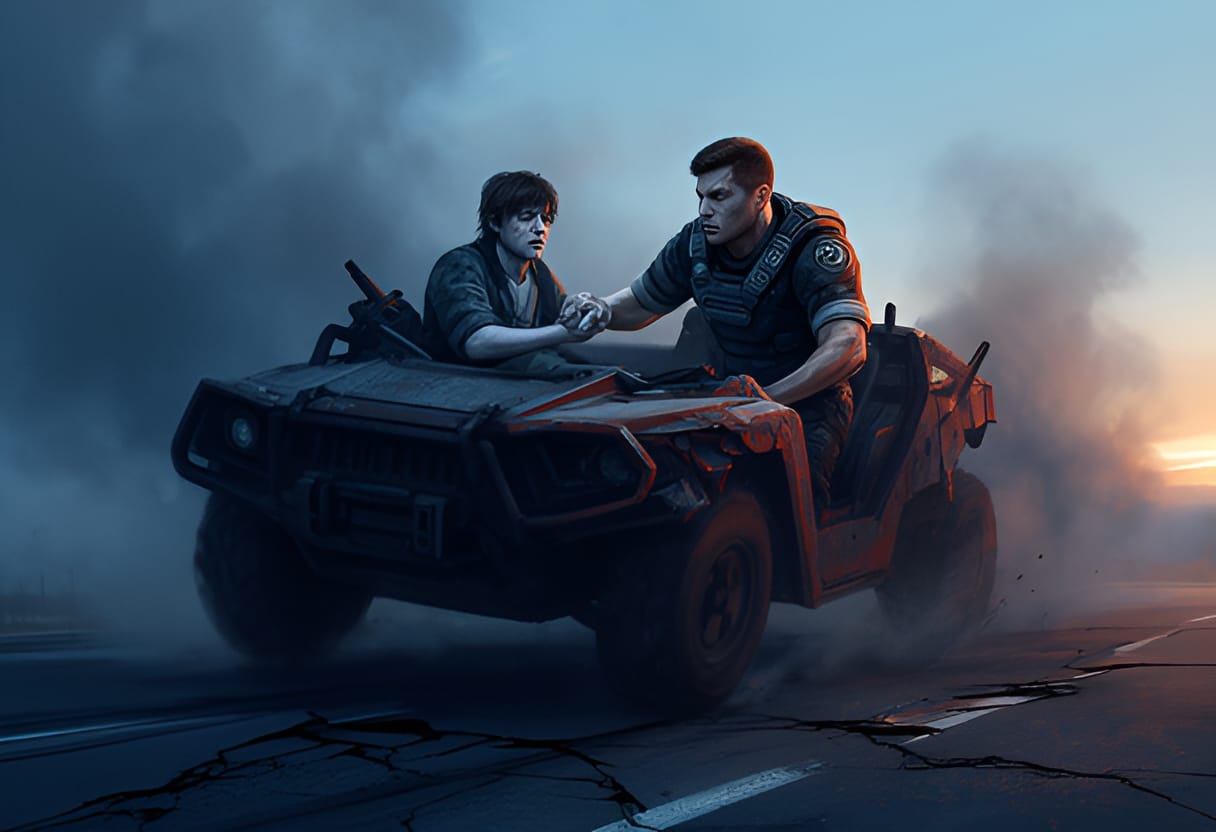
Chapter 19
Ashes and Promises
The Mule shuddered over broken pavement, its suspension groaning as it lurched from crater to crater. Dust and ash hung thick in the air, filtering the wan light of a dying sun into a sickly amber. Zay braced himself against the rail, one hand locked around Alex’s wrist, the other pressed flat against his brother’s chest, feeling the faint, irregular thump of a heart still fighting. Alex’s head lolled against his shoulder, dark hair matted with sweat and grime, lips slightly parted, breath shallow and uneven. The medic had said it was Imulsion—creeping into the blood, poisoning the lungs, turning each inhalation into a labor. But Zay didn’t care about the name of it. He only knew that if he stopped feeling that pulse, even for a second, he might forget why he was still moving.
They were moving north, toward Northern Command, where the surgeons waited. Or so they hoped. The convoy had been cobbled together from whatever vehicles still ran—two Mules, a battered King Raven with a sputtering engine, and a fuel truck dragging a torn tarp over its cab. Gears walked beside them, rifles at the ready, eyes darting to every shadow. Civilians huddled in the backs of the trucks, silent, hollow-eyed. A woman rocked back and forth, murmuring a prayer over a swaddled infant. A boy no older than ten clutched a stuffed lizard, its one eye missing.
No one spoke much. Words felt like wasted breath.
But Zay talked. Not for them. For Alex.
He kept his voice low, rough from disuse and smoke, but steady. “Remember that creek behind the old mill? The one with the bend where the water pooled deep enough to dive? You dared me to jump in wearing my boots. Said I’d sink like a stone. I came up sputtering, but you were laughing so hard you fell into the mud. Ma made us wash our clothes in the tub that night, and you still wouldn’t admit you’d pushed me.”
A beat. The Mule hit a pothole. Alex’s fingers twitched in Zay’s grip.
“You were eight. I was seven. And you still owed me a dessert for that.”
He swallowed. The ash tasted metallic on his tongue—synesthesia, the medics had called it. Light had a flavor now. Sound pressed against his skin like weight. But he pushed it aside. Focused on the memory.
“You stole those peaches from Old Man Hale’s tree. Climbed right over the fence like it was nothing. I was the lookout. Saw him coming with his shotgun, yelling about ‘trespassing little vermin.’ You dropped half the fruit trying to get away, but you saved the biggest one. Split it right there in the alley, juice running down your chin. Said it was the sweetest thing you’d ever tasted. I believed you. Still do.”
Alex’s eyelids fluttered. Not opening. Just a spasm. Zay squeezed his hand.
“You swore that night, after Ma tucked us in and Da was on the porch cleaning his rifle. You said, ‘If anything ever happens, I’ve got your back. No matter what.’ I said the same. We pinkie-promised. Right there on the bunk, whispering so she wouldn’t hear. You said it wasn’t just a promise. It was a vow. Like the ones Da made before he shipped out to Pendulum.”
A distant crack split the air—too sharp to be settling debris. A rifle shot. Somewhere ahead.
Zay didn’t flinch. Kept talking.
“We used to fish off the jetty at Harbor’s End. You’d bring that stupid net Mom made from an old curtain, swear you could catch a glidfish with it. Never did. But you kept trying. Said it wasn’t about the fish. Was about the quiet. The way the water slapped the pilings when the tide was out. I didn’t get it then. I do now.”
The convoy slowed. Brakes hissed. Voices rose ahead—urgent, strained.
“Contact left! Drones in the ruins!”
Zay fell silent. Listened. The rat-tat of Lancer fire. A grenade’s dull thump. Then the whine of engines—low, wrong. Not a King Raven. Too slow. Too heavy.
“Reaver!” someone yelled.
The Mule lurched sideways as the driver wrenched the wheel. Metal screamed. The vehicle tilted, tires skidding on ash-slicked stone. Zay threw his weight over Alex, pressing his brother’s body into the bench, shielding him with his own. Shrapnel pinged against the armor plates above them—hot, jagged fragments tearing through the canvas side. One struck Zay’s left shoulder, spinning him sideways. He gasped, teeth clenched, but didn’t release Alex’s hand. Held on even as his vision blurred at the edges, the world tilting into red and gray.
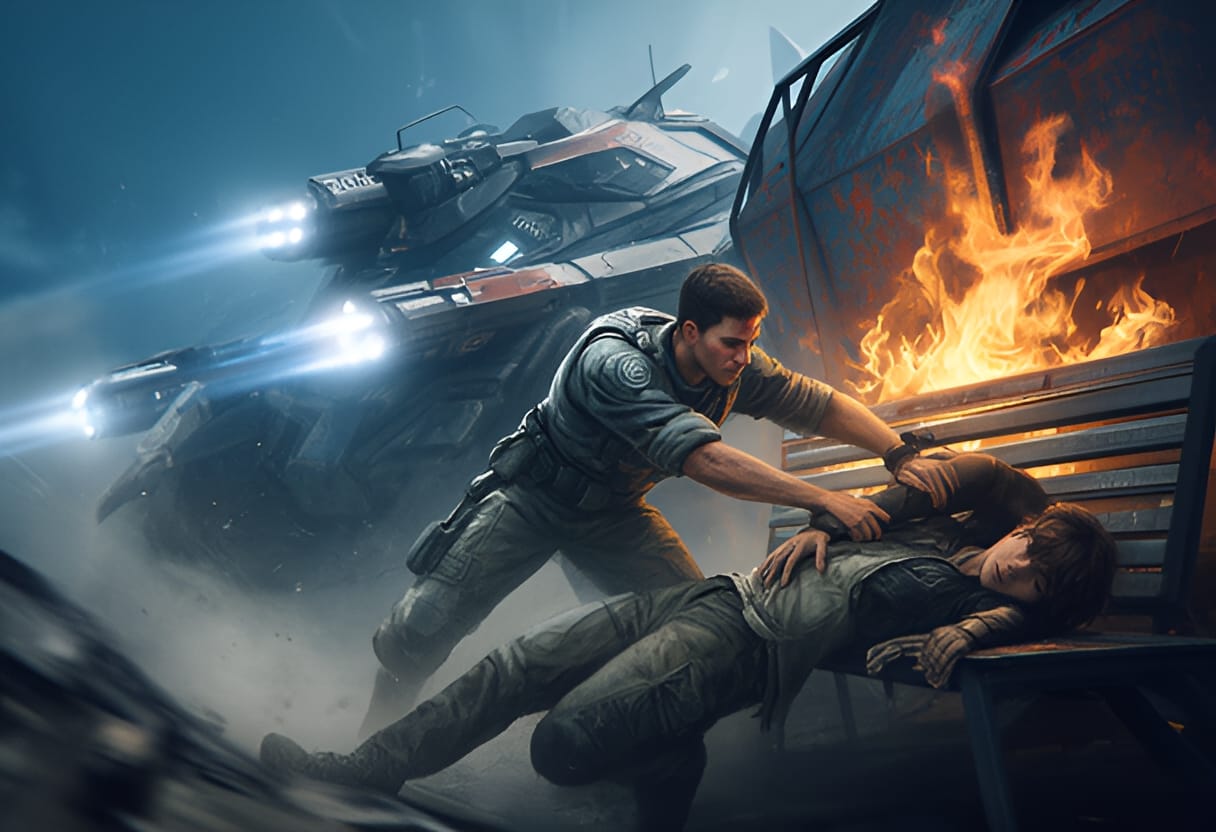
The Mule lurched forward again, accelerating. The Reaver banked for another pass, its twin cannons glowing orange at the muzzle.
“Hold on!” the driver bellowed.
Zay gritted his teeth against the pain in his shoulder, breath coming in short bursts. He kept his head down, one arm locked over Alex’s torso, the other still clutching his brother’s hand. The world was noise and motion—the roar of the Reaver’s engines, the crack of explosive rounds impacting nearby, the shouts of Gears returning fire, the groan of strained metal.
Then, as suddenly as it had come, the sound faded. The Reaver screamed overhead, climbing hard to avoid the King Raven’s return fire—a streak of tracers lancing up from the Raven’s turret. The convoy straightened. Tires found grip.
Silence, save for the ragged breathing of the wounded and the hiss of cooling engines.
Zay slowly eased up, sweat dripping from his temple onto Alex’s collarbone. His shoulder burned—a deep, throbbing ache, hot and wet beneath his armor. He probed gently with his fingers. Came away with blood. Not arterial. Not life-threatening. But it would slow him. Make every movement a calculation.
He looked down.
Alex was still unconscious. Still breathing. Still here.
Zay leaned forward, forehead resting against his brother’s, just as they had in the tunnel. He didn’t whisper a promise this time. Didn’t need to.
He just breathed with him—for as long as he could.
The pain in Zay’s shoulder flared with every jolt of the Mule as it tore through the outskirts of the city, trading the choked alleys of Ephyra’s industrial district for the skeletal remains of the outer residential blocks. Houses stood half-collapsed, their roofs caved in, walls peeled back like rotten timber to expose frayed wiring and shattered drywall. A child’s shoe lay half-buried in the ash near a overturned pram, its tiny lace still tied in a neat bow. Zay glanced at it, then looked away. He couldn’t afford to let his mind wander there. Not now. Not while Alex still breathed.
He shifted slightly, testing his weight on the injured shoulder. A sharp spike of pain shot up his neck, but he gritted his teeth and held firm. He wouldn’t let go of Alex’s hand. Not for a second. Not until they reached the medics at Northern Command—or until there was nothing left to hold.
The convoy slowed again as they approached a fractured overpass, its concrete spine split down the middle, rebar jutting like broken bones. A King Raven hovered low ahead, its rotors kicking up a vortex of ash and debris. Two Gears in reinforced armor waved them forward from the edge of the road, their Lancers scanning the ruined storefronts on either flank.
“Clear left!” one shouted.
“Right’s hot! Watch the second-story windows!”
Zay tensed. He’d seen this before—Locust using civilian structures as cover, popping up from windows and rooftops to spray fire into passing convoys. But the fire wasn’t coming from the Locust. Not this time. The muzzle flashes were too sporadic, too undisciplined. Human. Panicked.
A woman screamed from a shattered apartment above—a high, raw sound cut short by a choked gag. Then silence.
Zay’s jaw tightened. He didn’t look up. He kept his eyes on Alex’s face, watching for any sign—any flicker—that the poison was loosening its grip. But the twins’ breathing remained uneven, shallow, each inhalation a struggle. The Imulsion was spreading. He could feel it in his own body now—a pressure behind his eyes, a metallic tang on his tongue whenever a flash of lightning lit the distant sky. The synesthesia was worsening. Sound pressed against his skull like a physical weight. The rumble of the Mule’s engine tasted like copper and burnt sugar.
He swallowed hard and spoke again, voice low, meant only for Alex’s ears.
“You remember that storm the summer we turned twelve? The one that knocked out the power for three days? We slept on the roof because it was too hot inside. Dad brought up a blanket and two cans of cold beans. We ate them straight from the tin, fingers sticky, laughing when you dropped yours and it rolled into the gutter. Then you dared me to spit over the edge. Said if I could hit the puddle below, you’d owe me a week of chores. I missed. You laughed so hard you snorted bean juice out your nose.”
A faint sound escaped Alex’s lips—not a word, not a moan, just a breath shaped like a sigh. Zay froze, heart leaping. He leaned in, breath held.
Nothing. Just the same uneven rise and fall of his chest.
But Zay didn’t stop.
“We used to sneak into the old quarry after curfew. You said it was haunted because the foreman had fallen into the crusher years back and they never found all of him. I didn’t believe you. Not until we heard the echo. Sounded like someone dragging a chain down the pit wall. We hauled ass out of there, didn’t stop running until we hit the bus stop. You tripped on the curb and scraped your palm raw. I bandaged it with my shirt. You didn’t say thank you. Just grinned and said, ‘We’re even now.’ I still have that shirt. Buried at the bottom of my pack. Smells like dirt and old sweat.”
The Mule hit another rut. Alex’s head rolled slightly against Zay’s shoulder. Zay adjusted his grip, cradling his brother’s skull with his free hand, fingers brushing the sweat-damp hair at his temple. He could feel the heat of fever radiating from him—too high, too fast. Infection, maybe. Or the Imulsion eating at his organs from the inside. Either way, time was bleeding away.
A sharp crack echoed from the left—too close. A sniper’s round. It struck the fuel truck ahead, detonating a spark in the line. Flames licked up the side of the cab, orange and hungry.
“Fire in the hole!” someone yelled.
The driver swore and jerked the wheel. The Mule fishtailed, skidding sideways before correcting. The convoy lurched forward, leaving the burning truck behind. No one stopped. No one could. They had to keep moving.
Zay pressed his forehead harder against Alex’s, whispering now, voice raw.
“I’m scared, Alex. I won’t lie to you. Not anymore. Every time I close my eyes, I see the birthing chamber. Those pods. The way they pulsed—like hearts. Like something alive and wrong. You went pale when you saw them. Said it felt like watching your soul get unmade. I didn’t know what to say then. I just held you. And you leaned into me. Like you always do when the world gets too loud.”
He paused, swallowing against the dryness in his throat. His shoulder throbbed in time with his pulse. The blood had soaked through his undershirt, warm and sticky.
“But I know this: you’re stronger than you think. Stronger than I am. You’ve always been the one to keep me grounded when I start to drift. You’re the one who notices when I’m quiet too long. Who throws a rock at my head just to see if I’m still there. You’re the reason I haven’t walked into the dark and not come back.”
A distant boom rolled across the horizon—artillery. Or something worse. The ground trembled faintly beneath the Mule’s tires.
“We made a promise, you and me. Not just to watch each other’s backs. To find our way back. No matter how far we get turned around. No matter how dark it gets. You said it wasn’t about surviving. It was about coming home to each other. Even if home’s just a memory. Even if it’s just… this.” He lifted their joined hands slightly, pressing Alex’s palm flat against his chest, over the spot where he kept the photograph and the recipe tin and Lily’s drawings. “As long as I can feel this… as long as I can feel you… I haven’t lost you.”
Alex’s fingers twitched again. Stronger this time. A faint pressure, like a test.
Zay froze. Held his breath.
Then, so faint he wasn’t sure he’d heard it, a whisper—barely more than air moving through cracked lips.
“…Zay…?”
His vision blurred. Not from pain. Not from ash.
He pressed his forehead to his brother’s, voice breaking.
“Yeah. I’m here. I’m right here.”
Alex’s eyelids fluttered. Opened just a slit. Glassy. Unfocused. But open.
“…cold…” he murmured.
Zay didn’t hesitate. He pulled his thermal undershirt over his head in one swift motion, wincing as the fabric tugged at his wound, then wrapped it around Alex’s shoulders and chest, tucking the edges snugly under his arms. He rubbed his hands up and down his brother’s arms, trying to generate warmth. “You’re gonna be warm in a minute. Just hold on.”
Alex’s breathing hitched. A wet rattle in his chest. He tried to speak again, but only a groan came out, followed by a shudder that ran through his whole body.
“Easy,” Zay said, voice steady despite the tremor in his own hands. “Just breathe with me. In… and out. Like we used to when we were kids and Ma made us lie still after a nightmare. In… and out. You’ve got me. I’m not going anywhere.”
He began to count softly, rhythmically, matching his breaths to Alex’s—slowing them, guiding them. One… two… three… four… One… two… three… four…
Gradually, the ragged gasps began to smooth. Not much. But enough. The shuddering lessened. The grip in Zay’s hand tightened—not painfully, but deliberately. A response.
Alex’s lips moved again. Faint. Fragile.
“…beach…” he breathed.
Zay frowned. “What?”
“The… beach…” Alex repeated, voice weaker now, but clearer. “…Da took us… when we were six… you buried me in the sand… up to my neck… I screamed… you laughed… then a wave came… and you panicked… dug me out with your hands… said you were sorry… I said it was okay… because you got me out…”
Tears burned Zay’s cheeks. He didn’t wipe them away. Let them mix with the ash and sweat on his skin.
“I remember,” he whispered. “You had a crab in your hand. You wouldn’t let go of it, even when you were scared. Said it was your pet. Named it… Sergeant Pinchers.”
A ghost of a smile touched Alex’s lips. Then faded.
The convoy slowed again. Ahead, the road forked—one path leading toward the damaged outskirts of Northern Command’s outer perimeter, the other cutting toward an old transit hub that had been turned into a makeshift triage zone. Flares burned in the distance, casting long, dancing shadows. The thrum of distant guns grew louder—closer. The Locust were pressing in.
A Gear jogged up to the Mule’s window, face smeared with soot, left arm in a makeshift sling.
“Medic’s waiting at the hub,” he said, breathless. “They’ve got a trauma tent set up. Surgeons are working nonstop. But… it’s bad, Lopez. Real bad. Internal bleeding. Shock. They’re not giving good odds.”
Zay didn’t look at him. Kept his eyes on Alex.
“Is he gonna make it?”
The Gear hesitated. “I don’t know. But they’re trying. And you… you need to get seen too. That shoulder’s gonna get infected if you don’t clean it.”
Zay shook his head. “I’m not leaving him.”
The Gear glanced at Alex’s pale face, then back at Zay. “You ain’t helping him by bleeding out on the floor. Let one of us sit with him. Just for ten minutes. Get that wound dressed. You’ll be no good to him if you pass out.”
Zay looked down at his brother. Alex’s breathing was steadier now. Not strong. But present. Real.
He made a decision.
“Five minutes,” he said. “That’s all. And if his vitals drop, I’m coming back—whether you like it or not.”
The Gear nodded. “Understood.”
Zay carefully eased himself out of the Mule, every movement sending fire through his shoulder. He braced himself on the rail, took a breath, then lowered himself to the ground. His boots sank slightly into the ash. He looked back at the vehicle.
Alex’s eyes were open again. Tracking him.
Zay pressed his palm flat against the Mule’s side, right where Alex could see it. Then he lifted his hand, spread his fingers wide, and brought them slowly together—over his heart.
A signal. A promise. A vow.
Always.
Alex’s lips moved. No sound. But Zay saw it—the faintest twitch at the corner of his mouth. An answer.
He turned and limped toward the triage tent, each step a battle. The medic—a young woman with braids tied tight behind her head and a stained bandana over her forehead—met him halfway.
“Let’s get you patched up,” she said, already reaching for her kit.
Zay sat on a folded cot, gritting his teeth as she cut away the ruined fabric around his shoulder. The wound was deep—a jagged tear just below the clavicle, dark with dried blood and flecks of ash. She flushed it with antiseptic, and he gasped, back arching off the cot.
“Sorry,” she murmured. “Gotta get the dirt out.”
He nodded, jaw clenched. Sweat beaded on his upper lip. When she began to suture, he focused on Alex’s face in his mind—the way his brow furrowed when he was concentrating, the way he tapped his thumb against his lips when he was thinking of a joke, the way he always slept with one arm flung out, like he was reaching for something even in dreams.
“You’re lucky,” the medic said, tying off the last stitch. “Missed the lung. Grazed the scapula. You’ll be sore as hell, but you’ll live.”
Zay didn’t answer. He was already standing, testing his range of motion. It hurt. Badly. But he could move. He could fight.
“Thanks,” he said. He started back toward the Mule.
“Hey,” the medic called. “You gonna be okay?”
He paused. Looked back at her. At the tent. At the wounded and dying laid out on cots, some moaning, some silent. At the Gears standing watch, rifles ready, eyes haunted.
He thought of Alex’s voice, faint but clear, calling his name.
He thought of the beach. The crab. The promise made in the dark, years ago, on a bunk that no longer existed.
“I will be,” he said. “Because I have to be.”
He turned and walked back to the convoy.
As he approached, he saw Alex’s eyes were closed again. But his hand—still resting on the bench—was open, palm up, waiting.
Zay didn’t hesitate. He climbed back in, settled himself beside his brother, and took that hand in both of his.
He didn’t speak this time.
He just held on.
And waited.
For the next breath.
For the next word.
For the next chance to keep the promise.
The engine’s whine rose as the Mule lurched forward again, throwing them both sideways against the rail. Alex’s head lolled against Zay’s chest, his breathing shallow but steady—each inhale a small victory. Zay kept his forehead resting against his brother’s temple, feeling the faint tremor of pulse beneath the skin, the ghost of warmth fighting through the chill of shock.
Outside, the city groaned. Columns of smoke spiraled into the bruised twilight sky, merging with the haze of ash and Locust incendiaries. The distant crack of rifles popped like fireflies in the dark—brief, urgent, gone. Somewhere ahead, a building collapsed in a thunderous groan, sending a plume of dust rolling across the road like a slow-moving wave.
Ahead, the lead vehicle braked hard. The convoy shuddered to a halt.
Zay tensed, hand tightening on Alex’s. “What is it?”
Before anyone could answer, a sound split the air—not the pop of small arms, but a deep, shuddering roar, like metal tearing under immense pressure. It came from above and behind, low and vibrating, felt in the teeth before it was heard.
Then the sky exploded.
A Reaver screamed overhead, its wings beating the air with a sound like thunder trapped in canvas. It banked hard, belly glowing with the angry orange of its ventral cannons charging. Twin lances of plasma fire lanced down—not at the convoy, but ahead, hammering the road into a crater of molten slag. Shrapnel rained like hail—white-hot fragments of alloy and stone, screaming past with a sound like angry wasps.
The driver yelled and threw the wheel hard left. The Mule fishtailed, tires screaming on ash-slick pavement as it veered off the road and into the ditch, jolting violently over a buried conduit. Alex cried out—a sharp, broken sound—and went rigid in Zay’s arms, his back arching as pain lanced through his wounded side.
“Easy,” Zay gasped, locking his arms around his brother’s torso, cradling him against his chest as the vehicle bucked. “I’ve got you. I’ve got you.”
The Reaver banked again, turning for another pass. Its shadow swept over them like a dark wing. The gunners in the returning vehicles opened up—Lancer fire spitting tracers into the dusk, arcs of bright green chasing the beast as it wheeled, dodging, its wings flared to catch the thermals rising from the fires below.
One round connected. A spark bloomed on the Reaver’s flank. It shrieked—not in pain, but rage—and rolled inverted, dumping a cluster of spike grenades from its underbelly.
They fell like black seeds.
Zay saw them coming.
Time stretched.
He twisted hard, throwing his weight over Alex as the first grenade struck the Mule’s rear flank with a muffled thump—not explosive, but incendiary. A jet of white flame burst from the impact point, licking upward, seeking oxygen.
The second grenade bounced off the roof and rolled beneath the vehicle.
Zay didn’t think. He shoved Alex hard sideways across the bench, then flung himself on top of him, pressing his brother’s head into the cushion, his own body forming a shield over Alex’s chest and legs. He tucked his chin, covered his ears with his hands, and braced.
The grenade detonated.
Not a blast—but a whoosh, like a furnace door flung open. A wave of searing heat washed over them, rolling up from the undercarriage. The floorplate grew scorching beneath Zay’s palms. The smell of burning insulation and molten rubber flooded his nose. His vest smoked where it touched the hot metal. His back screamed—fabric fusing to skin in places, the wound on his shoulder igniting with fresh fire.
He gritted his teeth against the roar in his ears, the white flash behind his eyelids. He didn’t move. Didn’t breathe. Just held on, feeling Alex’s shallow breaths against his neck, the frantic hammering of his brother’s heart against his own.
Then—silence. Not quiet. But the absence of the Reaver’s scream. The fading hiss of flame.
The Mule rolled to a stop, engine dead, tilted at a dangerous angle in the ditch.
Zay stayed where he was for three long seconds. Then, slowly, he pushed himself up.
Smoke curled from the Mule’s underbelly. The rear tire was gone—melted into a twisted puddle of rubber and rim. The fuel line had ruptured, spraying a fine mist that caught and died in sparks before it could pool. Alex lay half-on his side, dazed, one arm flung out, his face streaked with soot and tears. His breathing had returned to its ragged, uneven rhythm—but he was alive. His eyes were open. Focused.
Zay swallowed blood that had welled at the corner of his mouth from biting his tongue. He reached out, brushed ash from Alex’s cheek.
“You still with me?”
Alex blinked. Slowly. Then managed a weak, crooked grin. “Told you… I’d hold onto the crab.”
Zay laughed—a short, broken sound that turned into a cough as smoke scraped his throat. “You damn idiot. You held onto that thing like it was your rifle.”
Alex’s eyes drifted past him, to the smoking ruin of the Mule’s rear. “We… gonna walk now?”
Zay looked ahead. The rest of the convoy had pulled up short, vehicles forming a ragged crescent, guns sweeping the sky. Gears were already jumping down, taking cover, shouting status reports. Medics moved toward them. Sergeant Velez stood near the lead vehicle, binoculars in hand, her face grim beneath the soot streaking her temples.
He looked back at Alex. At the rise and fall of his chest. At the way his fingers curled slightly, instinctively, when Zay’s hand hovered near his.
“We’ll walk if we have to,” Zay said. “But first… we get you patched up. Then we find another ride. And we keep moving.”
Alex’s eyelids fluttered. He was fading again—exhaustion, blood loss, the toxin spreading. But his grip on Zay’s wrist was firm. Not strong. But there.
“Promise?” he whispered.
Zay leaned in, forehead touching his, just like before. He could taste the copper on his brother’s lips. Feel the tremor in his breath.
“I promise,” he whispered back. “I’ll get you home. No matter what it takes.”
He didn’t let go.
And as the medics approached, as the Gears formed a defensive perimeter, as the Reaver circled like a vulture waiting for another strike, Zay held on—not just to his brother’s hand, but to the vow that had carried them this far.
The one made in the dark, on a bunk that no longer existed.
The one that still meant everything.
Zay’s legs trembled as he lowered himself to the ground beside the Mule, the metal still radiating residual heat from the Reaver’s assault. Alex lay on a stretcher now, flanked by two medics—one a young woman with braids tucked beneath a bandana, the other an older man whose face was lined with exhaustion and soot. They worked quickly, efficiently, cutting away the charred remnants of Alex’s vest and shirt to assess the burns along his flank and the worsening wound Zay had noticed earlier—a deep, jagged tear just below the ribs, slick with fresh blood that soaked through the banding despite the pressure applied.
“Internal bleeding’s likely,” the older medic muttered, more to himself than anyone else, as he peeled back the dressing. “Shrapnel from the ambush. Could’ve nicked the liver or spleen. We’re losing him fast.”
Zay dropped to his knees beside the stretcher, ignoring the protest of his own wounded ribs and the throbbing in his left leg—the old injury from the Hollows flaring with every movement. He took Alex’s hand again, cold and slick with sweat, and pressed it between both of his own.
“Stay with me,” Zay whispered, voice raw. “Just stay with me.”
The young medic glanced at him, eyes wide but sympathetic. “We’re gonna do everything we can, Lopez. But we need to get him to a real med tent. Northern Command’s only a few klicks out—if we can make it there, they’ve got plasma, surgeons, the works.”
Zay nodded, jaw tight. “Then let’s move.”
The convoy lurched back to life—engines coughing, tires spinning for traction in the ash-choked ditch. The Mule, now missing a rear tire and leaking fuel in dying sputters, was left behind. Alex was transferred to a second vehicle, a hardened ambulance Mule with its canvas top rolled back to allow medics access. Zay climbed in beside him, refusing to let go of his hand, even as the medics urged him to make space.
“I’m not leaving his side,” Zay said, voice leaving no room for argument.
The medic with the braids hesitated, then nodded. “Alright. But you gotta stay out of the way. We gotta work.”
Zay squeezed Alex’s fingers. “I’m not going anywhere.”
The ambulance lurched forward, joining the convoy as it pulled back onto the fractured road. Smoke hung thick in the air, obscuring the stars, but the first pale hints of dawn were beginning to bleed through the eastern horizon— a sickly grey that promised light but brought no warmth.
Inside the ambulance, the medics worked in grim silence. The older one inserted a large-bore IV into Alex’s forearm, blood already beginning to pool in the drip chamber. The young woman attached a plasma pouch to the line, the fluid cool and golden as it flowed into Alex’s veins.
“Pressure’s dropping,” she said, watching the monitor. “Systolic’s at eighty and falling. Heart rate’s one twenty and thready.”
“We’re giving him plasma and O-neg,” the older medic replied. “But if he’s bleeding internally, we’re just pouring it onto the floor. We need to get him to surgery—now.”
Zay leaned closer, brushing sweat-damp hair from Alex’s forehead. Alex’s eyes were half-lidded, unfocused, but when Zay spoke, they flickered toward him.
“Hey,” Zay said softly. “You hear that? That’s the plasma singing in your veins. Tastes like mint, doesn’t it? Weird, huh? Synesthesia’s kicking in again.”
Alex managed a weak twitch of his lips. “Tastes… like regret.”
Zay let out a breath that was half-laugh, half-sob. “You’re impossible.”
But his smile faded as Alex’s breathing hitched—a sudden, shallow gasp, followed by a prolonged wheeze. The monitor emitted a soft, intermittent beep, then flatlined for three agonizing seconds before a weak pulse registered again.
“Shit,” the older medic cursed. “He’s coding.”
The young medic slammed her palm on Alex’s chest, once, twice. “Come on, Lopez! Breathe!”
On the third compression, Alex gasped—a ragged, shuddering inhale—and the monitor blipped back to life, erratic but present.
“He’s back,” the young medic whispered, relief and exhaustion warring in her voice. “But barely.”
Zay didn’t release his grip. He couldn’t. Alex’s hand was limp in his, fingers barely curling around his own, but there— a thread, frayed but unbroken.
The convoy surged forward, weaving through the outskirts of Ephyra’s northern districts. Fires still burned in shattered storefronts, their orange glow painting the clouds above in hellish hues. Locust corpses littered the streets—some twisted and broken, others eerily intact, as if they’d simply collapsed where they stood. Occasionally, a distant crack of gunfire echoed—human or Locust, Zay couldn’t tell—but the convoy pressed on, driven by sheer will and the dwindling hope of reaching Northern Command before night fully claimed them.
Then, the silhouette of the mercantile building loomed ahead—a squat, fortress-like structure that had been hastily converted into a field station. Its windows were boarded or shattered, sandbags stacked high at the entrances, and the air thrummed with the low murmur of voices, the clink of metal, the occasional groan of pain.
The ambulance screeched to a halt at the side entrance, where a team of stretcher-bearers waited. Medics swarmed, transferring Alex to a gurney with practiced urgency. Zay moved to follow, but a pair of strong hands gripped his shoulders.
“You can’t go in there,” said a voice he recognized—Corporal Dom Santiago, though it couldn’t be. Dom was dead. He’d seen it himself, remembered the way the boy’s breath had fogged the air before going still. But the voice was real, urgent, familiar.
Zay turned, blinking. It wasn’t Dom. It was a young private—barely out of training—his face smudged with dirt, his eyes wide.
“Sorry, sir,” the private said. “Only medics allowed in the trauma tent. Surgeons are working. You gotta wait out here.”
Zay shoved the hand away, fury and fear warring in his chest. “I’m not leaving him.”
“The surgeons need space,” the private said, stepping forward but not making contact. “If you crowd them, you could get in the way. Alex needs every second they’ve got.”
Zay’s breath came hard. He looked past the private, toward the tent flap where shadows moved behind the thin fabric—silhouettes bending over a stretcher, hands moving fast, voices raised in clipped, urgent tones.
He could hear it now—through the fabric, muffled but distinct.
“—BP’s sixty over forty! He’s crashing again!”
“Give him another unit of plasma—now!”
“His lactate’s through the roof. He’s septic. We’ve got endotoxins flooding his system.”
“Internal bleeding’s worse than we thought. Likely a grade IV liver laceration. He’s losing blood faster than we can replace it.”
Zay’s vision narrowed. The world reduced to the flap of the tent, the sound of Alex’s breath—shallow, uneven—caught in the rhythm of the monitors, the frantic voices trying to pull him back from the edge.
He dropped to his knees in the dirt, ignoring the cold seeping through his trousers, and pressed his ear to the canvas.
“—…not responding to vasopressors…”
“—…need to prep for possible thoracotomy if he arrests again…”
“—…chances are slim. If he makes it through the night, there’s a real risk of permanent damage—nerve damage, muscle necrosis. He may never walk again.”
The words hit like a physical blow. Zay’s hands clenched into fists in the dirt, nails biting into his palms until he felt the warm trickle of blood.
Never walk again.
The thought was unbearable. Alex—who had laughed as they scaled the rusted hull of a derelict train car just to see who could spit the farthest, who had challenged Zay to a footrace through the training yards and won by cheating, who had once climbed a fruit tree in their grandmother’s orchard and fallen into a bush of thorns, laughing all the while— Alex, whose very identity was bound to motion, to action, to being there, beside Zay, step for step.
He couldn’t lose that. He wouldn’t.
A medic approached— the young woman with the braids. She crouched beside him, her expression soft but firm.
“You need to step back, Lopez,” she said quietly. “You’re in shock yourself. Your vitals are off— tachycardia, low-grade fever. You’ve got a hemothorax building. You need attention too.”
Zay didn’t look at her. His eyes were fixed on the tent flap, on the movement within.
“I’m not leaving,” he said, voice low but absolute. “Not until I know he’s going to be okay.”
The medic sighed, then glanced toward the tent. “You can stay. But you stay here. No closer. And if they need you— if they call for blood or a hand— you answer. Understood?”
Zay gave a single, sharp nod.
She hesitated, then placed a hand on his shoulder— light, brief. “He’s fighting. So are you. That counts for something.”
Then she rose and went back inside.
Zay remained where he was, ear pressed to the flap, drinking in every syllable, every groan, every beep of the monitors. The surgeons’ voices rose and fell— urgent, professional, threaded with strain.
“—…hemoglobin’s at six and dropping. We’re giving O-neg as fast as the warmer can push it.”
“—…acidosis is severe. Bicarb’s crashing. We need to correct, but we can’t give too much too fast— risk of pulmonary edema.”
“—…his kidneys are starting to shut down. Urine output’s negligible. We’re looking at multi-organ failure if we don’t get this bleeding under control.”
Zay’s breath hitched. He could feel it—the slow, inexorable slide toward loss. But he refused to let it take root in his mind. Instead, he focused on the sound beneath the voices— Alex’s breathing.
It was faint. Fragile. But it was there.
Each inhale a struggle. Each exhale a whisper. But it continued.
And as long as it did, so did hope.
Time blurred. The cold of the night seeped into his bones, but he didn’t feel it—not really. What he felt was the weight of the promise he’d made, over and over, in childhood and in war: I’ve got you. I’ll get you home.
The first true light of dawn began to creep through the tent seams, painting the dirt in front of him with pale gold. The air grew slightly less thick, the scent of smoke and blood mingling with the damp earth and distant woodsmoke from cooking fires.
Zay finally pulled his head back from the tent. He sat back on his heels, blood-caked hands resting in his lap— his own from the chest wound, Alex’s from the grip he hadn’t released, the dirt from kneeling in the wreckage of the world.
He looked at his hands. Really looked.
They were trembling. Not just from exhaustion or cold, but from the sheer, vibrating tension of holding on— to his brother, to his vow, to the fragile thread of life still trembling in Alex’s chest.
He opened his mouth. No sound came at first. His throat was tight, raw from smoke and shouting and unshed tears.
Then, softly, so softly the wind might have stolen it if it had been listening:
“I won’t lose you.”
The words hung in the air, quiet but final. A vow renewed. A promise reforged in the darkest hour.
He didn’t wipe the blood from his hands. Didn’t move to seek treatment for his own wounds. Didn’t look toward the growing light.
He just sat there, hands in lap, eyes fixed on the tent flap, waiting— listening— for the sound of his brother’s breath.
And when it came— faint, uneven, but present— he let out a breath he hadn’t realized he’d been holding.
And waited again.
The first true light of dawn had barely touched the horizon when the tent flap stirred. A surgeon emerged, face pale beneath the grime, sleeves rolled to the elbows, blood darkening the fabric at his cuffs. He didn’t look at Zay at first, instead scrubbing his hands with a rag soaked in antiseptic, the sharp scent cutting through the morning chill.
Zay rose slowly, every muscle protesting—the ache in his ribs, the fire in his shoulder, the deep, marrow-deep weariness that had settled into his bones. But he stood, blocking neither the surgeon’s path nor his gaze when the man finally lifted his eyes.
“How is he?” Zay asked, voice rough from disuse and smoke.
The surgeon exhaled, a sound like air escaping a punctured lung. “We’ve stabilized him—for now. The bleeding’s been contained. We packed the liver laceration, tied off a bleeding branch of the hepatic artery. He lost nearly six liters. We’ve replaced it with plasma, O-neg, and a whole blood transfusion from a donor we screened on the fly. It’s not ideal, but it bought us time.”
Zay’s grip tightened on the strap of his vest, where Lily’s drawings and his father’s photograph pressed against his sternum. “And the sepsis?”
“It’s still there,” the surgeon said, not sugarcoating it. “Endotoxins are still in his system. We’ve started him on broad-spectrum antibiotics—ciprofloxacin and metronidazole, best we’ve got in the field. His lactate’s coming down, but slowly. His kidneys are still struggling. We’ve got him on dopamine to keep perfusion up, but we’re watching for signs of fluid overload.”
He paused, eyes flicking to the tent flap where Alex lay behind it, then back to Zay. “The real concern now is the hypoxia. The Imulsion poisoning’s worsening. His lungs are filling with fluid—pulmonary edema, likely from a combination of the toxin, the sepsis, and the fluid resuscitation. We’re giving him oxygen via non-rebreather mask, but his saturation’s hovering at eighty-two percent on room air. It’s not enough.”
Zay’s breath hitched. “You mean he’s not getting enough oxygen?”
“Exactly,” the surgeon said. “And that’s going to affect everything—his brain, his heart, his ability to heal. If we don’t get him to a proper facility with a ventilator, we’re just buying hours.”
Zay swallowed hard. “Is he… aware?”
The surgeon hesitated. “He’s been fluctuating. Briefly lucid when we first got him in—whispered your name, asked if you were hurt. But since then, he’s drifted in and out. The sepsis, the toxin, the blood loss—it’s all taking a toll on his cognition. When he’s awake, he’s disoriented. Sometimes agitated. Sometimes… peaceful. Like he’s somewhere else.”
Zay’s chest tightened. He pictured Alex—sharp-tongued, quick-witted, always ready with a joke or a jab—now lost in a fog of pain and poison, his mind unraveling thread by thread.
“Can I see him?” Zay asked, voice barely above a whisper.
The surgeon studied him for a moment, then gave a single nod. “Five minutes. No talking if he’s not responsive. Just… be there. And if he starts to seize or stop breathing, you get us. Immediately.”
Zay didn’t answer. He just stepped past the surgeon and pushed aside the tent flap.
Inside, the air was thick with the smell of antiseptic, blood, and sweat. The tent was lit by a single hanging bulb, its light harsh and clinical, casting sharp shadows across the field cots and medical equipment. Monitors beeped in a steady, if uneven, rhythm beside the gurney where Alex lay.
He looked smaller than he should have. Pale as grave wax, his dark hair damp with sweat, plastered to his temples and forehead. A nasal cannula curled beneath his nose, delivering a steady stream of oxygen. An IV line snaked into each arm—one carrying fluids, the other antibiotics. A catheter tube disappeared beneath the sheet, connected to a bag that held only a few dark drops of urine. A chest tube protruded from his right side, draining a small amount of bloody fluid into a collection chamber.
And his breathing—oh, his breathing.
It was labored. Each inhale a heave, his ribs lifting with visible strain. Each exhale a wet, rattling sigh, as if his lungs were full of sludge. The monitor showed his heart rate at one eighteen, blood pressure ninety over fifty, SpO2 at eighty-four. Not good. But better than the flatlines of the night before.
Zay moved to the side of the gurney and gently took Alex’s hand—the same hand he’d held through the Reaver attack, through the convoy’s crawl, through the long, dark hours outside this very tent.
Alex’s skin was cold, his fingers limp. But when Zay squeezed, there was the faintest pressure in return—a twitch, barely there, but real.
“Hey,” Zay murmured, voice thick. “It’s me. Zay.”
Alex’s eyelids fluttered. Not opened. Just… moved. Beneath the lids, his eyes shifted rapidly—dreaming, or tormented by whatever flames licked at the edges of his consciousness.
Zay leaned closer, brushing sweat-damp hair from Alex’s forehead. “You’re gonna be okay. You hear me? You’re gonna be okay. We’re gonna get you home. Back to the orchard. Climb that dumb apple tree again. Fall into the thorns. Laugh your ass off while I pull the needles out.”
A faint sound escaped Alex’s lips—not a word, but a vibration. A hum. Or maybe it was just the air moving through his throat.
Zay smiled through the sting in his eyes. “Yeah. That’s the spirit. You always were the stubborn one.”
He stayed like that for a long time—maybe two minutes, maybe five—just holding Alex’s hand, watching the rise and fall of his chest, listening to the ragged rhythm of his breath. The monitors continued their quiet chant: beep… beep… beep… a little too fast, a little too weak, but persistent.
Then, abruptly, Alex’s body tensed. His back arched slightly off the gurney, a low moan escaping his lips. His eyes flew open—wide, unfocused, pupils blown. He gasped, sucking in air like a man drowning.
“Zay—” he choked out, voice raw. “It’s… it’s in my lungs. I can’t— I can’t breathe—”
Zay’s heart lurched. “Shhh. I’ve got you. Easy. Just breathe with me. In… and out. Like we used to when we were kids, pretending we were divers holding our breath under the quarry lake.”
Alex’s gaze locked onto him, frantic, searching. Then, slowly, his breathing began to sync—shallow at first, then deepening slightly with each coached inhale. The rattling in his lungs didn’t vanish, but it lessened, just a fraction.
“Good,” Zay whispered. “That’s it. You’re doing great. Just keep fighting. I’m not going anywhere.”
Alex’s grip tightened—just a little—on Zay’s hand. Then his eyes began to drift shut again, his body going slack as exhaustion pulled him under.
Zay didn’t let go. He stayed until he was sure Alex was stable again—until the breathing, while still labored, had found a rhythm, however fragile.
When he finally stepped back, the surgeon was waiting just outside the tent, arms crossed, face unreadable.
“How is he?” the surgeon asked.
Zay met his gaze. “He’s fighting. But he’s scared. He said he couldn’t breathe. Felt like it was in his lungs.”
The surgeon nodded grimly. “That’s the edema. And the Imulsion. It’s not just in his blood—it’s in his tissues. It’s causing inflammation, capillary leak. That’s why the lungs are filling. We’re giving him furosemide to try to pull the fluid off, but we’ve got to be careful—we don’t want to crash his pressure again.”
Zay rubbed a hand over his face, leaving a streak of dirt and dried blood. “Is there anything else we can do? Anything at all?”
The surgeon looked toward the tent, then back. “We’re doing everything we can with what we’ve got. But the truth is, Alex needs a higher level of care—ICU, ventilator, maybe even dialysis if his kidneys keep failing. We don’t have that here. We’re a stabilizer, not a savior.”
Zay’s jaw tightened. “Then we get him to one. Even if we have to carry him ourselves.”
The surgeon studied him. “You’re not thinking of walking him out of here, are you? He’s not in any condition to move.”
“I’ll carry him if I have to,” Zay said. “I’ll crawl through hell on my belly if that’s what it takes.”
A ghost of a smile touched the surgeon’s lips. “I believe you. But let’s not make it come to that. We’ve got a medevac bird on standby—Huey, coming in from the east. Should be here in ninety minutes, weather permitting. If we can hold him steady until then, we’ve got a shot.”
Zay’s shoulders eased, just a fraction. “Then we hold him steady.”
The surgeon nodded. “Keep talking to him. Keep him oriented when he’s awake. Reassure him. It helps more than you think. And if his breathing gets worse— if he starts using his accessory muscles, if his lips or nail beds turn blue— you get me. No hesitation.”
“I won’t,” Zay said.
The surgeon gave him one last look, then turned and disappeared into the tent, returning to the fight.
Zay stepped back into the cold morning air and stood beside the tent, staring at the flap where his brother lay. The sky was lightening now—true dawn at last—painting the clouds in streaks of lavender and peach. Birds called in the distance, their songs thin and fragile against the quiet hum of the generator and the occasional distant thump of artillery.
He thought of the orchard again—the way the morning light used to filter through the leaves, dappling the grass in gold. How Alex would dare him to climb the tallest tree, how they’d split the fruit with their thumbs, juice running down their chins, how they’d lie on their backs afterward and watch the clouds, making up shapes and stories.
He pressed his palm to his vest, feeling the faint ridge of the photograph beneath the fabric—Alex’s father, smiling in his old COG uniform, arm around a woman Zay barely remembered. And beneath it, the edge of Lily’s drawings—two small sketches: one of a house with a smoking chimney, the other of two boys holding hands under a sun with a smiling face.
He hadn’t looked at them in days. Not since before the ambush. Not since before he’d whispered Always into Alex’s forehead amid the smoke and fire.
He reached inside his vest now, fingers brushing the paper. He didn’t pull them out. Didn’t need to. Just knowing they were there—close to his heart, where they belonged—was enough.
A medic approached with a steaming cup. “Here,” she said, handing it to him. “Sweet tea. Not much, but it’s hot. And it’s got lemon. Helps with the taste thing.”
Zay took it. The ceramic was warm in his palms. He brought it to his nose and inhaled—steam, citrus, earth. And then, faintly, impossibly, he tasted it—sweet, bright, tingling on his tongue like crushed mint leaves.
Synesthesia. Again.
He almost laughed. Even now, even here, his body betraying him in strange ways. Tasting light. Feeling sound as pressure. Now, tasting tea as mint.
He took a slow sip. The liquid scorched his throat, but it warmed him from the inside out.
“Thanks,” he said to the medic. She nodded and went back to her duties.
Zay lifted the cup again, took another sip, and stared at the tent flap.
He thought of the promise he’d made the night before—I won’t lose you—and how it had felt like a lifeline thrown into the dark.
Now, in the pale light of dawn, it felt less like a promise and more like a plea.
But he would keep making it. Every day. Every hour. Every breath.
As long as Alex was still breathing, Zay would be right here—holding on, speaking up, refusing to let go.
He finished the tea, set the cup gently on the ground beside him, and returned his hands to his lap—blood-caked, scarred, but steady.
And he waited.
Not for news.
Not for orders.
But for the next breath.
The next beat.
The next chance to say, I’m still here.
And when the monitor inside the tent gave its next steady beep, Zay closed his eyes for just a moment—and whispered into the cold air:
“I’m still here.”
Zay remained where he was, back against the cool metal of the medical tent’s frame, eyes fixed on the flap where his brother lay. The tea had gone cold in the cup beside him, but he didn’t reach for it. He was waiting—not for the beep of the monitor, not for the rustle inside the tent, but for something quieter: a shift in the air, a tightening of fingers, the faintest sign that Alex was still fighting his way back.
The sky had lightened further since the surgeon left. Lavender had softened to pale blue, the peach streaks in the clouds now washed out like watercolor left in the rain. The generator’s hum was steady, a low thrum beneath the silence. Somewhere in the distance, a lone bird called again—short, sharp, then gone. The world was holding its breath.
Zay let his head fall back against the tent pole. His neck ached, his ribs screamed with every shallow breath, but he ignored it. He had slept in snatches since they’d brought Alex in—twenty minutes here, ten there—never deep, always half-alert, ears straining for a change in the rhythm of the beeping, for a moan, for a word. But the night had passed without change. Only the steady, mechanical pulse of the monitor, and Alex’s breathing—shallow, uneven, but persistent.
Now, as true dawn settled over the northern districts of Ephyra, Zay decided to try something else.
He reached slowly into his vest, fingers finding the familiar crease of paper beneath the fabric. He didn’t pull it out right away. Just let his thumb trace the edge, feel the slight resistance of the fold, the way the paper had softened at the corners from being carried so close to his body, from sweat and dirt and the steady thump of his heart against it.
Then, gently, he drew it out.
The letter was folded into a small square, the kind their mother used to tuck into their lunchboxes when they were boys—before the war, before the Locust, before the world ended. He remembered her hands, flour-dusted, tying the string around the paper with a double knot, humming off-key as she worked. He remembered the smell of cinnamon and brown sugar clinging to her apron.
He unfolded it slowly, carefully, as if the paper might disintegrate in his hands. The ink had faded in places, the blue lines of the notebook paper softened by time and touch, but the words were still legible. Her handwriting—looped and sure, the way she wrote when she was trying to be cheerful, even when she wasn’t.
My dearest boys,
If you’re reading this, I hope it means you’re safe. I hope it means you’ve found each other, and that you’re warm, and that you’ve had something good to eat today. I know it’s been hard. I know the news is bad, and the fear is real. But I also know you. I know how you look out for each other. How you’ve always looked out for each other. That’s what gives me hope.
I’ve packed a few things in your bags—your father’s old compass, the one he used on the fishing trips to the Jelena Peninsula. And I’ve slipped in a recipe card for my peach cobbler. Not the one from the box—this one’s the real one, the one I make when the peaches are just ripe enough to give a little when you press them. I want you to remember what it tastes like. I want you to remember Sunday mornings, when the sun would come through the kitchen window and hit the table just right, and we’d sit there in our pajamas, waiting for the cobbler to come out of the oven. How the crust would crackle when you broke it with your spoon. How the juice would bubble up at the edges, thick and golden. How we’d let it cool just enough so it wouldn’t burn our tongues, but not so long that the ice cream melted too fast.
I want you to know that I’m proud of you. Not because you’re soldiers. Not because you’re strong. But because you’re kind. Because you still laugh at stupid jokes. Because you still save the last bite for each other. Because, no matter how dark it gets, you still try to find your way back to each other.
Wherever you are, whatever you’re facing—know that I’m with you. In the quiet moments. In the breath between heartbeats. In the taste of something sweet on your tongue.
Always, Mom
Zay’s voice was low when he began, rough from disuse and the cold air, but it steadied as he went on. He read slowly, letting each sentence hang, letting the memory of her voice fill the space between the words. He could almost hear her—soft, warm, a little breathless from laughing at something Alex had said.
When he got to the part about the peach cobbler, his throat tightened. He could see it so clearly: the chipped yellow bowl on the counter, the sugar crystals catching the light, the way Alex would always sneak a piece of raw peach when he thought no one was looking, juice dripping down his chin. He could smell it—the ripe fruit, the butter in the crust, the hint of nutmeg she always added.
His voice cracked on the line: I want you to remember what it tastes like.
He swallowed hard, blinked fast against the sting in his eyes, and kept going. When he finished, he didn’t speak right away. Just held the letter in his hands, feeling the weight of it, the warmth of it, the ghost of her touch in the curves of her letters.
He looked up at the tent flap. Alex was still. The monitor beeped—steady, but slow. One beat. Then another. Then another.
Zay exhaled through his nose. “She always did make the best cobbler,” he murmured. “Used to say the secret was in the crust—had to be flaky enough to shatter, but strong enough to hold the filling. Said it was like holding onto hope—you needed both.”
He paused. Listened. Nothing but the monitor, the generator, the distant, indifferent hum of a world that had forgotten how to be gentle.
He smiled, just a little. “You know what she’d say if she saw us now? She’d scold us for getting our uniforms dirty. Then she’d make us sit down and eat, even if we didn’t want to. Said a full belly was the first line of defense against despair.”
He lowered the letter slowly, carefully refolded it along the original creases, and slipped it back into his vest, over his heart, where it belonged.
The medic who’d brought the tea earlier passed by again, carrying a tray of supplies. She glanced at him, saw the letter was gone, and gave a small, understanding nod. She didn’t say anything. Just adjusted the IV line by the tent flap and moved on.
Zay leaned forward, elbows on his knees, and stared at the tent. He didn’t know if Alex could hear him. The doctors had said there were moments—brief windows—when the sedatives wore off and the painkillers dipped, when awareness flickered back, even if the body couldn’t respond. He had to believe those moments were real. Had to believe that somewhere beneath the swelling, the poison, the exhaustion, Alex was still in there. Listening. Waiting.
So he talked.
He told Alex about the time they’d tried to bake cookies using their mother’s recipe and had burned them black because they’d forgotten to set the timer. How they’d sat on the back steps afterward, eating the charred bits anyway, laughing until they cried. How their mother had found them there, hands sticky with soot and sugar, and instead of yelling, she’d pulled out two glasses of milk and said, “Well, at least you tried.”
He told him about the stray dog they’d fed behind the old mill when they were twelve—how it had followed them home for three days, how their dad had made them take it back, how Alex had cried all the way to the edge of the woods, and how Zay had promised to sneak it food every night, a promise he’d kept until the dog vanished one morning, presumably off to find a better life.
He told him about the cloud that morning—the one that looked like a dragon curled around the sun, wings spread, tail flicking. How he’d pointed it out, half-expecting Alex to make a joke about it coming to eat them, but Alex had just been quiet, staring up, and then said, “It’s not a dragon. It’s a ship. Sailing through the sky.”
Zay had laughed. “Yeah? Where’s it headed?”
“Home,” Alex had said. “It’s headed home.”
Zay’s voice dropped. He didn’t know if Alex could hear him. But he needed to say it anyway.
“You were always better at seeing the good in things,” he whispered. “Even when it wasn’t there. Especially then.”
He fell silent for a long time. The minutes stretched. The monitor beeped. The generator droned. The tent flap stayed still.
And then—
A shift.
Not in the sound. Not in the light. But in the air.
Zay felt it before he saw it—a subtle change in the pressure, like the moment before a storm breaks. He leaned in, heart suddenly hammering in his throat, and watched.
Alex’s eyelids twitched.
Once. Twice.
Then, slowly, impossibly, they began to flutter.
Zay froze. His breath caught. His hands, resting on his knees, went still.
The fluttering grew stronger. The lids lifted—just a fraction—revealing the dark, glassy surface beneath. Not focused. Not seeing. But open.
Alex’s lips parted. A soft, wet sound escaped—barely a whisper, more air than voice—but it was there. An attempt. A effort.
Zay’s eyes burned. He didn’t move. Didn’t breathe.
“Hey,” he breathed, voice so low it was almost not there. “Hey, Alex. You in there?”
Alex’s eyes blinked—slow, heavy, but deliberate. They flicked toward the source of the sound. Toward Zay.
Zay’s chest tightened. He raised a hand slowly, hesitantly, and pressed a fingertip to Alex’s lips—just enough to still them, to say without words: Don’t try. Not yet. Just… be here.
Alex’s gaze held his. Glassy. Unfocused. But present.
And then—
A tremor.
Starting deep in the chest, moving through the shoulder, down the arm, to the hand resting limp on the blanket.
Zay watched, breath held, as Alex’s fingers curled—just slightly—then uncurled. Then curled again. Slower this time. More deliberate.
And then, with all the strength he could muster, Alex squeezed.
Zay’s breath shattered.
It was weak. Fragile. Like the grip of a leaf in the wind. But it was there. It was his. It was Alex’s hand, moving of its own will, finding his, holding on.
Zay didn’t speak. Didn’t dare. He just covered Alex’s hand with both of his, holding it tight, anchoring it, as if his own grip could somehow give back what had been lost.
Alex’s eyes stayed open. Still unfocused. Still struggling. But they didn’t close. They stayed locked on Zay’s face, as if trying to memorize it, to hold it in the dark.
A tear escaped—hot, sudden—trailing down Zay’s temple, disappearing into the hair above his ear. He didn’t wipe it away. He just held on.
The monitor beeped.
Then beeped again.
Steady.
Strong.
Alex’s breathing hitched—just once—then smoothed into something deeper, something slower, something that sounded less like drowning and more like rest.
Zay lowered his forehead to the edge of the cot, resting it gently against the blanket near Alex’s wrist, his brother’s hand still clasped between his own. He closed his eyes.
He didn’t pray. Didn’t beg. Didn’t make promises.
He just held on.
And when Alex’s thumb gave the faintest, most tentative stroke across his knuckle—a silent, wordless I’m here—Zay pressed his lips to the back of his hand and whispered, so low even the tent couldn’t carry it:
“I know.”
He stayed like that for a long time. Long after the sun had climbed higher. Long after the generator had shifted pitch. Long after the distant thump of artillery had faded into the background hum of a world still breaking, still fighting, still trying to endure.
He stayed until the light had turned gold, until the shadows had shortened, until the air had begun to warm.
And when he finally opened his eyes, Alex’s were still open. Still unfocused. Still trying.
But they were open.
And Zay was still holding on.
He didn’t let go.
…The sun had climbed just high enough to catch the edge of the tent flap, turning the thin fabric into a glowing seam of gold. Dust motes drifted in the slanting light, slow and lazy, like they had all the time in the world. Zay didn’t move. Didn’t dare. He stayed curled over the cot, his forehead pressed to the blanket, Alex’s hand still locked in both of his, the grip now less a reflex and more a quiet insistence—fingers threaded through his, thumb brushing back and forth over his pulse point in a rhythm so faint it might have been imagined, if not for the warmth of skin against skin, the undeniable proof of life.
He hadn’t slept. Not really. Not since before the ambush. Not since before he’d whispered Always into Alex’s forehead amid smoke and fire. Sleep felt like a betrayal—like closing his eyes meant risking the moment Alex might slip away again, unnoticed, unclaimed. So he stayed awake. Held on. Listened. Watched for the rise and fall of the chest, the flicker beneath the eyelids, the ghost of a squeeze.
And now, here it was. Not a miracle. Not a cure. But a sign. A thread. A reason to keep pulling.
The medic with the braids returned, carrying a small basin and a clean cloth. She moved quietly, aware of the stillness, the fragility of the moment. She set the basin down beside the cot, dipped the cloth in warm water, and wrung it out until it was just damp. Without a word, she began to wipe Alex’s face—slow, gentle strokes across the forehead, the cheeks, the chin. She cleaned the dried blood from the corner of his mouth, the smear of sweat and grime along his jaw. She avoided the bandage on his flank, the one that had soaked through overnight, the one the surgeons had warned was worsening, spreading, a silent thief dragging heat and poison deeper into his flesh.
Zay watched her hands. Steady. Sure. Not rushed. Not impatient. She worked like she had all the time in the world, too.
When she finished, she folded the cloth neatly and placed it back in the basin. She looked at Zay, her eyes soft but clear. “He’s fighting,” she said. Not a question. A statement. As if she’d seen it before—in the eyes of men who shouldn’t have made it past the first hour, who’d clung to life not because their bodies were strong, but because something deeper refused to let go.
Zay swallowed. “Yeah,” he rasped. His voice was raw, unused beyond whispers and half-sentences. “He is.”
She nodded. “Then keep talking. Even if he doesn’t answer. Especially if he doesn’t. The sound of a familiar voice—it’s like an anchor. Keeps them from drifting too far.”
She glanced at the IV bag, then at the monitor. “Fluids are holding. Pressure’s up a little. Not enough to celebrate, but enough to keep pushing. If we can keep the edema from climbing, keep the kidneys from giving out… we might just make it to the Huey.”
She hesitated. “You should eat something. Drink more tea. You’re running on fumes, and he needs you sharp.”
Zay didn’t answer right away. He looked down at Alex’s face—so pale, so still, yet undeniably there. The lips were cracked, but there was color returning, faint as a bruise fading. The eyelids were heavy, but they hadn’t closed. Not fully. Not since they’d opened.
“I’m not leaving,” Zay said finally. His voice was thicker now, but clear. “Not for food. Not for sleep. Not unless they drag me away.”
The medic studied him for a long moment. Then she gave a small, sharp nod. “Alright. But I’m bringing you something anyway. Whether you like it or not.”
She turned and left the tent flap open just a crack as she stepped out, letting in a rush of cooler air scented with damp earth and distant smoke.
Zay didn’t move. Didn’t speak. He just kept holding Alex’s hand, feeling the slow, steady thrum of blood beneath the skin, the quiet pulse of resistance.
A few minutes later, she returned with a mug and a wrapped packet. She set the mug down beside him—sweet tea again, steaming, lemon bright in the steam. The packet she placed in his lap. A ration bar. The kind with the dense, oaty texture and the fake chocolate coating that always melted too fast in the heat.
“Eat half,” she said. “I’ll be back in twenty. If it’s not gone, I’m shoving it in your mouth myself.”
She gave him a look that left no room for argument, then stepped back out, letting the flap fall shut behind her.
Zay looked down at the bar. His stomach clenched at the thought of food—nothing had sounded appealing since before the tunnel, since before he’d carried Alex through the ruins, since before he’d held him as his breath faltered and his eyes slipped shut. But he knew she was right. He couldn’t give out. Not now. Not when Alex was finally, fragilely, here.
He unwrapped the bar slowly, the crinkle of the wrapper loud in the quiet tent. He broke off a piece—just half—and put it in his mouth. It was dry. Sweet. Almost too much so. He chewed slowly, forcing himself to swallow, to feel the fuel hit his belly, to let it spread warmth through his limbs.
He washed it down with tea—slow sips, letting the citrus and the impossible hint of mint bloom on his tongue again. Synesthesia. Still there. Still strange. Still a reminder that even in the midst of ruin, his body could still surprise him. Could still find moments of weird, quiet beauty in the broken.
He finished the half-bar. Took another sip of tea. Set the mug down carefully.
And then he leaned back in, close enough to feel the warmth of Alex’s breath on his skin, close enough to see the faintest rise and fall of the blanket over his chest.
He didn’t read another letter. Didn’t tell another joke. Didn’t need to.
Instead, he began to talk—not for Alex’s benefit, not really, but because the silence was too loud, too full of all the things that hadn’t been said, all the moments that had been lost, all the promises that had been tested and bent but not broken.
He talked about the orchard again—not the peaches this time, but the apples. The tart ones that grew on the old tree by the fence, the ones that made your mouth pucker if you bit into them too soon. How they’d wait until after the first frost, when the sugar had settled in, when the fruit was crisp and sweet-tart and bursting. How they’d fill their pockets and sneak off to the hill behind the barn, where they’d sit and eat until their stomachs ached, cores piling up at their feet like evidence of a crime.
He talked about the time they’d built a raft out of scrap wood and inner tubes and tried to float it down the Jelena, how it had sunk almost immediately, how they’d ended up waist-deep in the cold, muddy water, laughing as they tried to push it back to shore, how Alex had lost one of his boots and had to hop home on one foot, yelling at Zay to go back and get it, how Zay had refused, saying, “You made your bed, now hop in it,” how they’d both ended up howling with laughter, Alex balancing on the porch rail, one foot bare, the other in a sock, shouting insults that dissolved into giggles.
He talked about the night their mother had let them stay up late to watch the meteor shower, how they’d lain on blankets in the backyard, hot chocolate in mugs that kept tipping over, how they’d made wishes on every streak of light—Zay for a new fishing rod, Alex for a dog that wouldn’t run away, both of them, without saying it, for the war to stay far away, for their father to come home safe from whatever distant outpost he was stationed at that month.
He talked until his voice grew rough again, until the words came slower, until he had to pause and catch his breath, until he realized he wasn’t just speaking to fill the quiet—he was speaking to keep himself from falling apart.
And all the while, Alex lay still, but not empty. Not gone. His eyes remained open, unfocused but present. His breathing stayed even, shallow but steady. And every now and then—just often enough to keep Zay going—his fingers would twitch. Not a full squeeze. Not yet. But a flex. A curl. A slow, deliberate closing of the hand, as if testing the connection, as if saying, I’m still here too.
Zay would catch it, feel it, and his chest would tighten—not with fear, not anymore, but with something fiercer, something quieter: gratitude. Awe. A love that had no words left, so it lived in the press of palm to palm, in the shared warmth of two bodies refusing to let the dark win.
The medic returned at the edge of the twenty-minute mark. She saw the wrapper folded neatly beside the mug, the bar gone. She didn’t comment. Just checked the IV line, adjusted the flow slightly, glanced at the monitor.
“Pressure’s up to 98/55,” she murmured. “Heart rate’s at 102. Still tachycardic, but better. SpO2’s at 88—up four points. Not great, but moving.”
She looked at Zay. “You’re doing good. Keep it up.”
She stepped back out, leaving the flap open just enough to let in a breath of air that carried the smell of rain—real rain, not the acrid tang of burning or the metallic sting of Imulsion, but clean, wet earth, the kind that fell on Mercy in the spring and made the soil smell like life.
Zay closed his eyes for just a moment. Let the scent fill his lungs. Let it remind him of mornings like this one—before the sirens, before the ground split open, before the sky filled with wings and fire.
When he opened them again, Alex’s eyes were still open. Still unfocused. But they had shifted—just slightly—toward the tent wall, where the morning sun now struck the fabric and turned it into a stained-glass glow of amber and rose.
Zay followed his gaze. Saw the light. Saw how it painted the inside of the tent in colors that felt like memory.
He turned back to Alex. “You see that?” he whispered. “That’s the same light that used to hit the kitchen window on Sunday mornings. The one that made the dust dance like it was alive.”
Alex’s eyes didn’t move. But his lips twitched—just once. The barest upward curve at the corner.
Zay’s breath caught. He didn’t dare hope. Didn’t dare believe it was more than a spasm, a reflex. But then it happened again. A slower, softer lift. A shadow of a smile.
And this time, when it came, Alex’s eyes flicked—not to the light, not to the ceiling, but to him. Just for a second. Just long enough to lock gazes.
Zay felt something break inside him. Not sadness. Not fear. Something older. Something deeper. The tight, coiled knot of dread that had lived in his chest since the moment he’d seen Alex go still in the tunnel, since the moment he’d thought he’d lost him forever—it loosened. Not gone. Never gone. But shifted. Transformed. Into something that could breathe.
He didn’t speak. Didn’t move. Just kept holding on, kept watching, kept letting the light wash over them both.
And then, as if answering a question no one had asked, Alex’s fingers tightened—slow, deliberate, sure—around Zay’s.
Not a twitch. Not a flutter.
A squeeze.
Firm. Weak. But real.
Zay’s eyes burned. He swallowed hard, blinked fast, and brought their joined hands up to rest between them, over Alex’s heart, where he could feel it—slow, steady, stubbornly beating.
He pressed his thumb to Alex’s knuckle. Once. Twice.
A silent answer.
I’m here.
I know.
I’m not letting go.
The tent flap stirred. Someone stepped into the light—a young medic, maybe nineteen, face smudged with dirt, eyes wide and wary. She carried a clipboard and a look of urgent hesitation.
“Corporal?” she said, voice low but tight. “Surgeon’s asking for you. He says there’s been a change in the labs. Kidney function’s dropping faster than we hoped. He thinks we might need to start prepping for dialysis—if we can get him stable enough to survive the transfer.”
Zay didn’t look away from Alex. Didn’t loosen his grip. Didn’t break the gaze that held them both in this quiet, fierce bubble of now.
“I’m not leaving,” he said. His voice was low, rough, but absolute. “Not unless you’re taking me with him.”
The medic hesitated. She glanced at the chart, then back at Zay’s face—at the tear tracks, the exhaustion, the unyielding set of his jaw.
She swallowed. Then she nodded. “Alright. But you’ve got to come now. If we’re going to do this, we’ve got to do it right. And we can’t wait.”
Zay finally looked at her. His eyes were red-rimmed, bright with unshed tears, but clear. Focused.
“Give me a minute,” he said.
She nodded again and stepped back out, letting the flap fall.
Zay turned back to Alex. Leant in until his forehead rested against the blanket near his brother’s wrist, until he could feel the heat of his skin, the faint rise and fall of breath beneath his palm.
He didn’t kiss him. Didn’t whisper a promise. Didn’t need to.
Instead, he breathed—slow, deep, deliberate—into the space between them, letting his exhale stir the fine hairs on Alex’s arm, letting his presence be known not in words, but in warmth, in weight, in the simple, unshakable fact of here.
Then he lifted his head. Looked down at Alex’s face—pale, bruised, swollen in places, but undeniably his. The eyes were still open. Still unfocused. Still trying.
Zay smiled. Not big. Not loud. Just a small, quiet lifting of the corners of his mouth—the kind that came when you’d walked through hell and found, against all odds, that the person you’d come for was still standing.
“I’ll be right back,” he murmured. “Just going to talk to the docs. Then I’m coming straight back. I promise.”
He didn’t wait for a response. Didn’t need one.
He gave Alex’s hand one last squeeze—tight, firm, grounding—then slowly, reluctantly, unfurled his fingers and let go.
He stood. His legs protested—stiff, sore, trembling from hours of immobility—but he ignored it. He shoved his fists into his pockets, feeling the familiar ridges of the photograph, the letters, the recipe tin—all still there, all still close to his heart.
He stepped toward the tent flap, paused, and looked back one last time.
Alex was still watching him. Still trying.
Zay lifted his hand—not in salute, not in farewell—but in a slow, lazy wave, the kind they’d used as kids when they were too far apart to shout, when a simple motion had to carry everything.
Alex’s fingers twitched. Then, slowly, he lifted his own hand—just an inch off the blanket—and waved back.
It was weak. It was wobbly. It was barely there.
But it was his.
And it was enough.
Zay gave one last nod. Then he turned and stepped out into the morning light.
The air was cool. Clean. Smelled of rain and wet stone and something green—crushed grass, maybe, or bruised leaves. The sky was wide and pale blue, streaked with high, thin clouds that caught the sun like spun silver.
He walked a few steps toward the command tent, where the surgeon waited, where the hard decisions lived, where the fight for Alex’s life would continue in needles and machines and whispered prognoses.
But he didn’t hurry.
He walked slowly.
Because for the first time in what felt like a lifetime, he wasn’t walking toward dread.
He was walking toward hope.
And he knew—deep in his bones, in the quiet space between heartbeats—that no matter what came next, no matter how hard the road, how steep the climb, how dark the night might fall again…
He would find his way back.
Because he always did.
And so would Alex.
Zay stepped into the recovery ward with the tin of stew balanced in one hand and a mug of steaming tea in the other. The air smelled of antiseptic and boiled cabbage, beneath it the faint, sour tang of sweat and Imulsion that seemed to cling to everything in Ephyra now. Fluorescent lights hummed overhead, casting a flat, even glow over rows of beds separated by thin curtains. Most were occupied—soldiers with missing limbs, civilians with shrapnel wounds, a girl no older than ten with her arm in a sling, staring blankly at the ceiling.
Alex’s bed was near the window, where the morning light came in slanted and soft, gilding the dust motes in the air. He was propped up slightly on pillows, his face still pale but the worst of the swelling gone. His breathing was easier, less frantic, though Zay could still see the tension in his shoulders when he drew a deep breath—the old reflex of pain, even if it was fading.
“Hey,” Zay said, setting the tin and mug down on the rolling table beside the bed. He pulled the chair closer, the one he’d claimed as his own over the past days, its legs squeaking faintly on the linoleum. “Brought you something warm. Not the slop they’ve been serving in the mess. Actual meat. And tea. Real leaves, not that instant swill.”
Alex turned his head slowly, eyes focusing on Zay’s face. A ghost of a smile touched his lips. “You didn’t have to,” he murmured, voice dry but clearer than it had been in days. “I can eat the slop.”
“Yeah, but you shouldn’t have to,” Zay replied, unwrapping the tin’s lid. The scent of beef and root vegetables rose, rich and comforting. He scooped a portion onto a chipped plate and pushed it toward Alex. “Eat. You need the strength.”
Alex picked up the spoon, his hand trembling slightly. He managed a few bites, chewing slowly, his brow furrowed in concentration. Zay watched him, not pushing, just present—waiting for the moment when the effort would become too much.
After a minute, Alex lowered the spoon. “Tastes… good,” he said, voice trailing off. He swallowed hard, then pressed a palm flat against his chest, just below the collarbone. “Lungs… feel… like…”
Zay leaned forward, elbows on his knees. “Hey. Don’t push it. You don’t have to talk. Just eat. Rest is what you need now.”
Alex looked at him, eyes bright with something between frustration and gratitude. “I just… wanted to tell you… it’s not… the glass feeling anymore. It’s… deeper. Like…”
He trailed off, head tilting to the side as exhaustion pulled at him. His eyelids drooped, then snapped open with a jerk. He swallowed hard, trying to regain focus.
“Shhh,” Zay said softly, reaching over to cover Alex’s hand with his own where it lay on the blanket. “You don’t owe me explanations. You don’t owe anyone anything but rest. That’s an order, Lopez.”
A weak chuckle escaped Alex. “Yes, sir.” His grip tightened, just for a second, then loosened.
Zay kept his hand there, feeling the faint pulse in Alex’s wrist, the warmth of his skin. The steady beep of the monitor beside the bed was a comfort now—not the frantic, erratic rhythm of crisis, but a slow, dependable cadence. Like a heartbeat finding its way back.
He leaned back in the chair, the tin forgotten between them. The ward was quiet except for the occasional murmur of a nurse, the distant clang of a tray being set down, the soft hiss of the oxygen concentrator in the corner. Outside, the city still bore the scars of the first days—broken facades, smoke staining the horizon, the ever-present threat of Locust patrols in the outskirts—but here, in this room, there was a fragile peace.
Alex shifted slightly, turning his head toward the window. “Jace’s squad… made it to Jacinto?” he asked, voice barely above a whisper.
Zay nodded. “Yeah. Radio came through this morning. They held the eastern checkpoint long enough for the civvies to get through. Lost two, but the rest are in. Stratton’s leading a mortar team now. Said they’re digging in for the long haul.”
A slow smile spread across Alex’s face, genuine and tired. “Good. He always… was stubborn enough… to make it.”
Zay squeezed his hand. “Yeah. He is.”
Silence settled again, but it was different now—not the silence of waiting, not the silence of fear, but the silence of two people who had survived the worst and were finally allowed to just be. No orders. No urgency. No need to scan the shadows for movement. Just the rhythm of breath, the quiet creak of the bed, the distant pulse of a city still fighting to stand.
Alex’s eyes drifted shut. His mouth moved, forming words that never made it past his lips. Zay leaned in, just enough to catch them if they came.
“…feels… like… the creek…” Alex breathed. “…Targas… mud… and… chocolate…”
His hand, resting on the blanket, twitched once—then went still.
Zay didn’t move. Didn’t speak. He simply watched his brother’s chest rise and fall, slow and steady, the rise just a little deeper now, the fall a little longer. The color in Alex’s cheeks had returned—not the unhealthy flush of fever, but the warm, natural tone of someone healing. The bruises were fading to yellow and green. The sweat on his forehead was cool, not clammy.
Gently, so as not to startle him, Zay pulled the wool blanket up to Alex’s chin, tucking the edges under his arms. Then, with the back of his fingers, he brushed the damp strands of hair from his forehead, lingering for a moment at the temple, feeling the steady thrum of life beneath the skin.
Alex breathed on, unaware, lost in the quiet pull of sleep. Zay stayed where he was, hand resting near his brother’s, eyes fixed on the peaceful line of his jaw, the soft rise and fall beneath the blanket.
Outside, the war raged on. The Locust still came. The city still burned. But here, in this quiet corner of the recovery ward, with the morning light painting stripes across the floor and the sound of his brother’s breath filling the space between them, Zay felt something he hadn’t allowed himself to feel in days.
Not hope.
Not exactly.
Something deeper.
Certainty.
Not that everything would be alright.
But that, no matter what came, they would face it together.
And that, for now, was enough.
The morning light shifted, crawling across the linoleum like a slow, patient thing. It caught the edge of Alex’s blanket, turned the wool into something almost luminous, and for a moment, Zay forgot where he was. He wasn’t in a recovery ward in a wounded city. He was back in the orchard behind their parents’ house in Mercy, the one with the gnarled sycamores and the low stone wall they weren’t supposed to climb. The air smelled of damp earth and ripe fruit, and somewhere nearby, a creek laughed over smooth stones.
He blinked, and the illusion fractured. The ward came back—the antiseptic smell, the hum of the monitor, the distant cry of a nurse calling for supplies. But the feeling lingered, soft and warm behind his ribs. Not a memory. A promise.
Alex stirred, a faint groan escaping his lips as he shifted his weight. His eyelids fluttered, then opened—slow, heavy, but focused. He turned his head toward Zay, squinting slightly against the light.
“Hey,” he said, voice rough with sleep but clearer than before. “You still here?”
Zay smiled, the kind that didn’t reach his eyes quite yet, but was honest. “Never left.” He picked up the mug of tea, now lukewarm, and offered it. “Want more? Or should I get you something fresh?”
Alex shook his head, a small, tired motion. “No. This is fine. Thanks.” He took the mug with both hands, cradling it like it was something fragile. He took a slow sip, then set it down carefully. “Tastes… like home.”
Zay’s chest tightened. He didn’t answer. He couldn’t trust his voice not to break.
Outside, a siren wailed—low, urgent, cutting through the morning calm. Not the all-clear. Not the retreat. This was the incoming tone. The one that meant Locust movement detected. The one that sent medics scrambling, orderlies locking down wards, and patients gripping the edges of their beds like lifelines.
Alex’s head snapped toward the sound. His fingers tightened on the mug. “They’re coming again,” he murmured, not a question.
Zay didn’t lie. “Looks like it.”
For a long moment, neither of them spoke. The siren faded, replaced by the rhythmic thump of boots on pavement outside—the sound of a mobilizing unit, maybe a reserve squad rushing to reinforce the northern perimeter. The ward lights flickered once, then steadied. Somewhere, a generator kicked in with a deep, resonant hum.
Alex exhaled, a slow release of breath that seemed to carry tension with it. He looked down at his hands resting in his lap—pale, still a little swollen at the knuckles, but clean. No more molasses stains. No more dried blood under the nails. Just skin. Just his.
“I keep thinking,” he began, voice low, “about that night we swore it. By the creek. After the mudslide.”
Zay nodded, though Alex wasn’t looking at him. He remembered it too—the way the water had sucked at their boots, how Alex had gone under for a second that felt like an eternity, how Zay had hauled him out by the collar of his shirt, coughing and sputtering, chocolate bar clutched in his fist like a trophy.
“We were ten,” Alex continued. “You were yelling at me for being stupid. I was yelling back that you weren’t any better for jumping in after me. And then… we just sat there. Shivering. Sharing that stupid Hershey bar you’d stolen from the supply tent. And you said… you said if anything ever happened, we’d find each other. No matter what. Even if we had to crawl through the Hollows to do it.”
A dry, humorless laugh escaped him. “Guess we kept the promise. Even if it took the end of the world to prove it.”
Zay reached over, slowly, and placed his hand over Alex’s where it lay on the blanket. Their fingers didn’t intertwine—not yet—but the contact was there, warm and solid. “We didn’t crawl through the Hollows,” he said. “We fought our way out. Side by side.”
Alex turned his head, just enough to meet his brother’s eyes. There was no fear in them now. Not the raw, animal terror of Emergence Day. Not the dazed shock of the tunnel ambush. Just a quiet, weary resolve. “Yeah,” he said. “We did.”
A nurse appeared at the curtain’s edge—a woman with tight braids and kind eyes, her scrubs stained at the cuffs. She carried a clipboard and a small tray with a fresh water cup and a pill cup. “Corporal?” she said softly. “Time for your antibiotics and the lung treatment. If you’re up for it.”
Alex glanced at the tray, then back at Zay. “I can do it,” he said, though his voice lacked conviction.
The nurse smiled, sympathetic but firm. “You don’t have to prove anything today. Just try to rest. We’ll get you through this.”
She stepped in, adjusted the IV line, and helped Alex sit up a little higher, propping him with pillows until he was nearly upright. The movement cost him—his face went tight, his breath came in short, sharp gasps—but he didn’t complain. He took the pills with a swallow of water, then allowed her to place the oxygen cannula gently beneath his nostrils. The flow was low, just enough to take the edge off.
“How’s the pain?” she asked, checking the chart.
Alex hesitated. “Better,” he admitted. “Still… there. When I breathe deep. But it’s… manageable.”
She nodded, making a note. “That’s the healing talking. The lung’s still irritated from the Imulsion, but the edema’s down, the leak’s sealed. You’re on the mend. Slow, but sure.”
She glanced at Zay, then lowered her voice. “You’ve been good for him. Really good. He fights harder when he knows you’re here.”
Zay didn’t look away from Alex. “I’m not going anywhere.”
She gave him a small, approving nod. “I know. Just… don’t forget to eat something yourself. You look like you’ve been running on fumes and spite.”
She stepped back, pulling the curtain partially shut, leaving a sliver of light and the sound of her footsteps fading down the hall.
Alex let his head fall back against the pillow. “She’s right,” he murmured. “You look like hell.”
Zay let out a short, humorless breath. “Thanks. I’ll take that as a compliment.”
A beat of silence. Then, softer: “You scared me, you know. When you stopped breathing. When I thought…”
He couldn’t finish. His throat closed up. He looked down at their joined hands, at the way Alex’s thumb was now brushing absently over his knuckle—a gesture so small, so familiar, it undid him.
Alex squeezed his hand in return. “I know,” he whispered. “I felt it. The dark. The quiet. But then… I felt you. Like a line. Pulling me back.”
Zay swallowed hard. “I’m not letting go of that line. Ever.”
Alex’s eyes drifted to the window again. The sky was clearing now, the blue deepening as the sun climbed higher. A few birds wheeled in the distance—sparrows, maybe, or swallows. Life, insisting on continuing.
“I keep thinking about Ma,” Alex said suddenly. “About how she used to hum when she peeled peaches. Off-key. Always off-key. Said it kept the bugs away.”
Zay let out a real laugh this time—short, warm, surprised. “She sounded like a cat stuck in a drainpipe.”
“Exactly,” Alex said, smiling. “And we’d beg her to stop. But she never did. Said if the peaches weren’t singing, they weren’t ripe.”
A pause. Then, quieter: “I miss her voice.”
Zay reached up, slowly, and brushed a strand of hair from Alex’s forehead—just as he had before. His fingers lingered, feeling the warmth, the faint dampness of sweat. “I know,” he said. “I miss it too.”
Alex’s eyelids drooped again. Not from exhaustion this time, but from peace. The kind that comes when the weight lifts, just a little, and you’re allowed to remember what you’re fighting for.
“Hey,” Zay said, keeping his voice low. “You want to hear something?”
Alex hummed in assent, eyes still closed.
“Stratton’s squad didn’t just make it to Jacinto. They’re holding the line at the eastern ridge. Took out a Seeder yesterday—blew it to pieces with a well-placed mortar round. Jace sent word: he says if you ever need a Boltok round to the forehead, he’s got your back.”
Alex’s lips twitched. “Tell him… I owe him one. For the pistol. And for… coming back.”
“I will.”
Another silence. But this one was light. Comfortable. Like the space between heartbeats when you know you’re safe.
Alex’s breathing slowed even further. His hand, still in Zay’s, went lax—not limp, but trusting. His breathing was even, shallow, peaceful.
Zay didn’t move. Didn’t speak. He just watched—watched the way the light caught the gold in Alex’s lashes, the way his chest rose and fell like a tide returning to shore, the way his lips parted slightly on each exhale, as if he were dreaming of something sweet.
And then, softly, as if speaking to himself or to a memory only he could hear, Alex murmured:
“I’m tired, Zay… but… I’m not… afraid… anymore.”
His hand gave one last, almost imperceptible press.
Then he was gone—not lost, not slipping away—but surrendered to sleep, deep and natural, the kind that heals.
Zay didn’t pull his hand away. Didn’t adjust the blanket. Didn’t reach for the call button.
He simply stayed.
Held the warmth.
Watched the rise and fall.
Listened to the quiet, steady rhythm of his brother’s breath—no longer a sign of struggle, but a testament to survival.
And in that stillness, with the sun high in the sky and the ward hushed around them, Zay felt something settle in his bones—not peace, not yet, but the first true resting place it had found since the ground split open and the Horde came screaming up.
He was here.
Alex was here.
And for now, that was all the world needed to be.
Zay stayed until the light began to shift—until the direct sun had slipped past the window and angled across the floor, painting a long, golden bar that crept slowly toward Alex’s bare foot. He didn’t move. Didn’t dare. The rise and fall of his brother’s chest had become a kind of prayer, each breath a syllable in a language older than words.
A nurse peeked in again—different this time, older, with silver threading her braid and a calm that seemed to absorb the chaos outside. She saw them: Zay slumped slightly in the chair, head bowed, one hand still cradling Alex’s, the other resting on his knee like an anchor. She didn’t speak. Didn’t disturb. Just placed a small paper cup of water on the bedside table, tucked a fresh blanket more securely around Alex’s shoulders, and slipped out as quietly as she’d come.
The minutes stretched. The monitor ticked softly, a steady counterpoint to the silence. Somewhere down the hall, a door slammed. A radio crackled with fragmented orders. But in this space, time had thinned, become porous. Zay let himself drift—not into sleep, but into the space between waking and remembering, where the past didn’t feel past at all.
He was ten again, barefoot in the creek behind their house in Mercy, the water cold and sharp against his skin. Alex was ahead of him, laughing, chasing a minnow he’d cupped in his hands. “You’ll scare it!” Zay had shouted, splashing after him. Alex had turned, grinning, water dripping from his nose, and said, “Nah. He knows I’m just saying hello.” Then he’d opened his palms—and the fish had darted free, silver as a coin, vanishing into the current.
They’d sat on the bank afterward, sharing a chocolate bar Zay had stolen from his father’s desk drawer—stolen, Alex had teased, you’re gonna get us both whipped. But Zay had just shrugged, grinning. “Worth it.” And when Alex had slipped on the mossy rock and gone under, Zay had plunged in without thinking, hauled him up by the collar, and held him tight until the coughing stopped and Alex gasped, “You idiot… you could’ve drowned too.”
“I know,” Zay had said, water streaming from his chin. “But I wasn’t gonna let you go under alone.”
He hadn’t known then that those words would become a creed. A lifeline. A vow whispered in blood and dirt and Imulsion-choked air.
Now, decades later, here they were—still in the water, still fighting to keep each other afloat.
Alex stirred. A soft sigh. His fingers twitched in Zay’s grip—not random, not reflexive. Purposeful. He was coming back.
Zay lifted his head. Blinked against the dull ache behind his eyes. Met his brother’s gaze—still heavy-lidded, but clear. Present.
“Hey,” Alex murmured, voice thick but warm. “You still here?”
“Never left,” Zay said, his own voice rough from disuse. He shifted slightly, easing the stiffness from his shoulders, but kept his hand locked in Alex’s. “How you feel?”
Alex considered it. Took a slow, deliberate breath—deeper than before, though it still hitched slightly at the top. “Like I’ve been run over by a Brumak… then put back together with duct tape and hope.” He managed a weak smile. “But… better. The lung… it’s still there. Still aches when I laugh. But I can… I can actually feel it healing. Like… like something’s stitching itself shut from the inside.”
Zay nodded. “The medics said the edema’s down. The leak’s sealed. You’re on the upswing.”
Alex let out a slow breath. “Good. ‘Cause I’m tired of feeling like I’m breathing through a straw made of glass.”
A beat. Then, quieter: “I had a dream. While I was under.”
Zay waited. Didn’t prompt. Just held on.
“I was back in the orchard,” Alex said. “The one behind the old mill. The one Ma used to warn us about—said the groundhogs’d bite if we got too close.” He let out a quiet, humorless chuckle. “Like we ever listened.” His eyes drifted, unfocused, seeing something only he could see. “I was up in the biggest sycamore—the one with the split trunk. You were down below, yelling at me to come down before I broke my neck. And I… I threw a peach at you. Hit you right in the chest. Juice everywhere.” He smiled, genuine this time. “You looked so mad. But you weren’t really. You were laughing. I could tell.”
His voice dropped. “And then… I looked down. And the ground… it wasn’t dirt. It was… moving. Like it was breathing. And there were shapes down there—things with too many legs, eyes like burnt coins. And they were… waiting.”
He swallowed. “I started to panic. Tried to climb down faster. But the branches… they weren’t holding. They felt… weak. Rotten. And then I slipped.”
His breath hitched—not from pain, but from memory. “And I was falling. But instead of hitting the ground… I felt your hands. On my arms. Holding me. Not letting go.”
He turned his head fully toward Zay, eyes glistening but dry. “I knew, even half-asleep, that it wasn’t real. But it felt real. More real than the pain. More real than the fear.”
Zay swallowed hard. His throat tight. “You weren’t falling,” he said quietly. “You were coming back.”
Alex studied him for a long moment. Then, slowly, he lifted his free hand—not to Zay’s face, not to his chest—but to the space between them, just above their joined hands. As if measuring the air. As if testing the weight of something unseen.
“I think,” he said, voice low, “that’s what kept me here. Not the meds. Not the oxygen. Not even the will to fight.” He paused, searching. “It was the knowing. That you were holding on. That you weren’t letting go. Even when I couldn’t feel it… I knew you were there.”
Zay didn’t trust himself to speak. So he squeezed Alex’s hand. Once. Firm. Then again.
Alex’s eyes closed. A tear escaped, tracing a slow path down his temple into his hairline. He didn’t wipe it away.
When he opened them again, there was no fear. No despair. Just a quiet, unshakable certainty.
“I’m scared,” he admitted, so softly Zay almost missed it. “Not of dying. Not anymore. But… of waking up and finding this gone. Finding you gone. Like it was all a dream the Hollows gave us to make the dark easier to bear.”
Zay leaned forward, until his forehead rested lightly against the blanket near Alex’s wrist—just as he had before. He could feel the pulse there, steady and strong. Feel the warmth of his brother’s skin. Hear the soft, rhythmic hiss of the oxygen.
“This isn’t a dream,” he said, voice low and raw, but certain. “This is real. You’re real. And I’m not going anywhere. Not now. Not ever.”
Alex didn’t answer with words. Instead, he turned his hand in Zay’s grip—just enough—to press their palms together, fingers interlacing, thumbs brushing. A grip born of childhood, reinforced in fire, sealed in silence.
They stayed like that for a long time. No words. No need for them. Just the shared warmth, the shared breath, the shared pulse of two hearts that had beaten in rhythm since the first cry they’d ever shared in the delivery room.
Outside, the world still burned. The Locust still advanced. The sirens still wailed. But in this ward, in this slant of afternoon light, there was only this: two brothers, holding on, not because they had to, but because they chose to—again and again and again.
The nurse returned—older, braid silver, eyes kind. She saw them and paused, just for a breath, a soft smile touching her lips. She didn’t speak. Didn’t break the spell. Just adjusted the IV flow, checked the monitor, and left a small bowl of cool water and a cloth on the tray—knowing, without being told, that someone would need to wipe a brow soon.
Alex’s eyelids began to droop again—not from exhaustion, but from surrender. From the deep, bone-deep relief of being seen, of being held, of being known.
“Hey,” Zay whispered, brushing his thumb over Alex’s knuckle. “You gonna make it through the night?”
Alex’s lips curved—just a hint. “If you’re still here when I wake up… I think I can manage it.”
Zay leaned in, until his lips were near his brother’s ear—close enough to feel the warmth of his breath, close enough to whisper like they used to when they were kids sharing secrets under the blankets.
“I’ll be here,” he said. “I’ll be right here. When you wake up. When you eat. When you walk again. When you steal another peach from the orchard and get juice all over your shirt.”
A soft, breathless laugh escaped Alex—real, unguarded. “You’ll be mad.”
“I’ll be furious,” Zay said. “But I’ll still hug you. Even if you smell like fruit and trouble.”
Alex’s breathing slowed. His grip loosened—not in release, but in trust. In the surety that the hold would not be broken.
His eyes drifted shut. His chest rose. Fell. Rose again.
Zay didn’t move. Didn’t speak. Didn’t reach for the blanket.
He just stayed.
Held the hand.
Watched the light.
Listened to the breath.
And in the quiet, with the war raging beyond the walls and the future still unwritten, he let himself believe—truly, deeply, in his marrow—that this, this quiet clasp of fingers in the golden light, was not a moment stolen from the dark.
It was a promise kept.
And as long as it held, so did they.
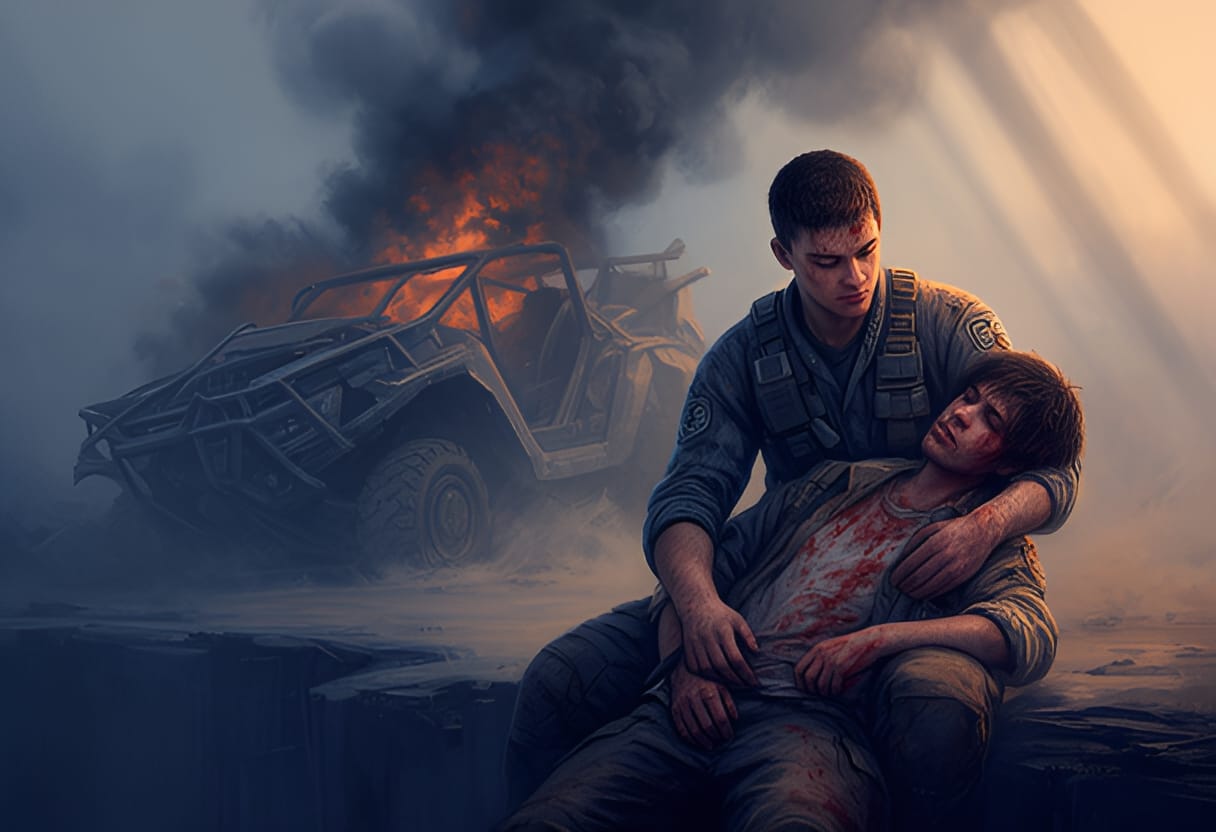
Chapter 20
The Long Night
The Reaver’s wing clipped the side of the Mule, sending it into a violent lurch that threw Zay hard against the interior bulkhead. Glass shattered. Metal screamed. For a heartbeat, everything was noise and motion—the groan of twisting frame, the hiss of ruptured fuel lines, the distant crack of small arms fire from the ruins beyond. Then, silence. Thick. Suffocating.
Zay sucked in a breath that tasted of smoke and copper. His shoulder burned where the impact had driven him into the frame. Beside him, Alex lay still, face pressed into the crook of Zay’s neck, his breath shallow and uneven against Zay’s skin. Zay’s arms were locked around him, one hand cradling the back of Alex’s head, the other pressed hard against the worsening wound on his flank—the bandage soaked through, dark and slick.
“Alex?” Zay whispered, voice raw. “Alex, talk to me.”
No answer. Only the faint rise and fall of his brother’s chest. Too slow. Too shallow.
Outside, the Mule had skidded to a halt at the edge of the Northern Command perimeter. Sandbags and hastily erected barriers lined the approach, their surfaces pitted with fresh impacts. Smoke curled from the bunker’s ventilation shafts. Gears moved with urgent purpose—loading wounded onto stretchers, barking orders, dragging ammo crates under the weak morning light.
Medics swarmed the vehicle the moment it stopped. Hands grabbed Alex’s arms, his legs. Zay resisted, instinctively pulling back.
“Let go of me!” he snarled, shrugging off a medic’s grip. “He’s my brother!”
“Sir, we need to clear him!” the medic shouted over the din. “Internal bleeding—suspected ruptured spleen! We’ve got to get him to trauma, now!”
Zay’s vision narrowed. The world dropped away to the weight of Alex in his arms, the warmth bleeding out of him, the terrifying fragility of his breath. He swallowed hard, forced his fingers to unclench.
“Go,” he said, voice low but firm. “But don’t you dare lose him.”
They lifted Alex onto a stretcher. Zay followed, matching their pace, refusing to fall behind. His Lancer hung useless at his side—empty, save for one round in the chamber and a spare clip in his vest. He hadn’t fired it since the Reaver strike. Hadn’t needed to. The fight had followed them here, to the very gates of sanctuary.
They burst through the tent flaps into a chaos of light and sound. Overhead fluorescents buzzed. Monitors beeped in urgent, uneven rhythms. Surgeons moved like shadows—coated in blood, faces grim, voices sharp with command.
“BP’s dropping! 80 over 50!”
“Give him two units O-negative, stat! Prep for thoracotomy if he codes!”
“Suction! I need suction—blood’s in the pleural cavity!”
Zay skidded to a halt at the edge of the tent, chest heaving. A nurse shoved a clipboard into his hands. “Sir, you need to wait outside. We can’t have civilians in the trauma zone.”
“I’m not a civilian,” Zay snapped, voice cracking. “I’m his brother. I’m COG.”
“I don’t care if you’re the damn Chairman,” she said, already turning away. “Flap’s closed. No exceptions.”
They pulled the tent shut behind them. The thick olive-drab fabric fell with a muffled thud, sealing out the light, the voices, the frantic energy. All that remained was the dull thrum of the generators beyond, the distant pop of small arms, and the frantic hammering of Zay’s own pulse in his ears.
He pressed his back to the cold steel of the tent frame, eyes locked on the flap. His hands trembled—not from exhaustion, not from adrenaline, but from the sheer, animal need to do something. To fix this. To be there.
A medic jogged past, wiping her gloves on her thighs. Zay grabbed her arm.
“How is he?” he demanded. “Tell me the truth.”
She looked at him—really looked—and saw the raw fear in his eyes, the way his knuckles whitened around her wrist. She hesitated, then sighed.
“He’s lost a lot of blood. Internal bleeding’s worse than we thought. Probably a lacerated liver, maybe the kidney. And now… sepsis setting in. Toxins are flooding his system. We’re fighting it with broad-spectrum, but if his organs start shutting down…”
She trailed off, shaking her head. “Survival’s uncertain. Hour to hour. And even if he pulls through… the damage to his lower spine and pelvic region—it may never heal right. He might not walk again.”
Zay felt the words like blows to the sternum. His breath hitched. The world tilted.
“He… he can’t…” His voice failed him. He swallowed hard, forcing air into lungs that felt full of glass. “He has to. He has to.”
The medic patted his arm once, briefly. “We’re doing everything we can. But you need to step back. Let us work.”
She pulled free and disappeared inside the tent.
Zay didn’t move. Instead, he dropped to his knees in the dirt outside, pressing his forehead to the cool fabric of the flap. He closed his eyes. Listened.
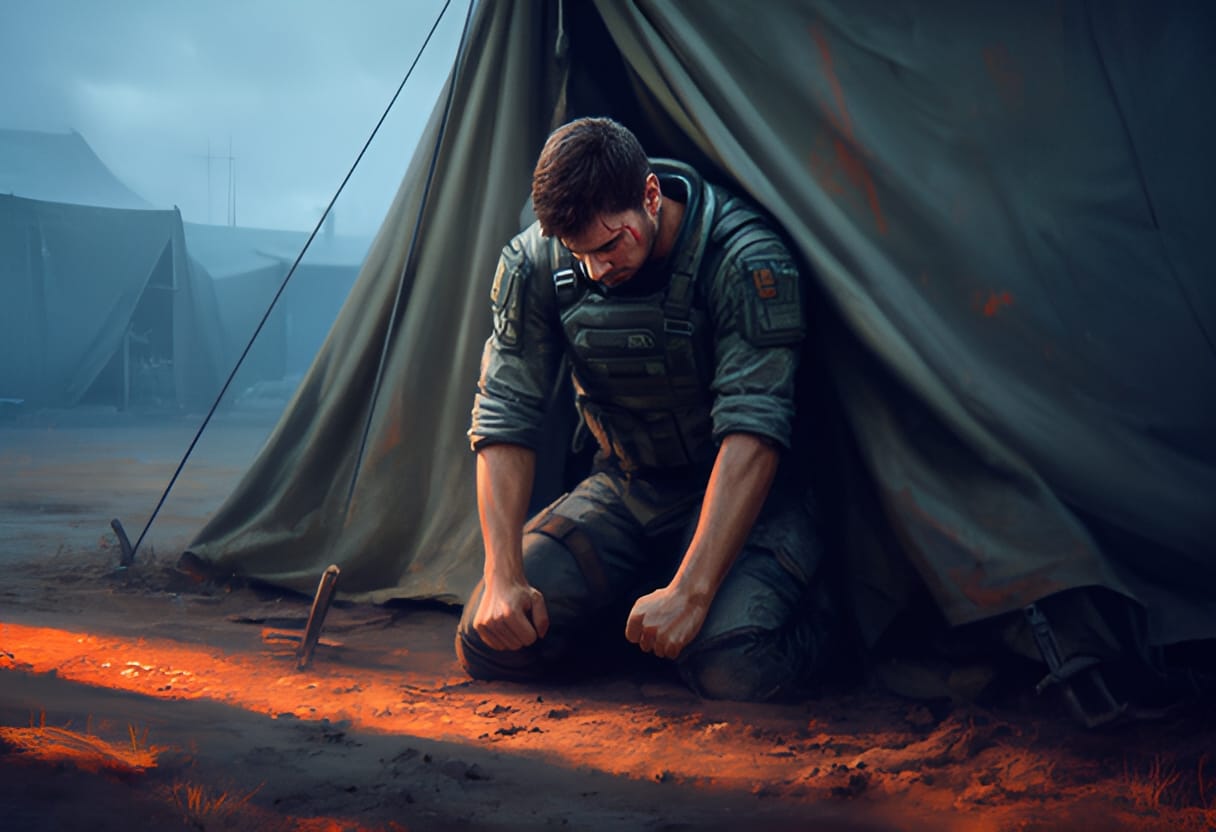
Through the thick canvas, voices came—muffled, distorted, but clear enough.
“Clamp the hepatic artery! I need control!”
“Pressure’s dropping again—administer epinephrine!”
“His respirations… they’re thinning. Prepare for intubation.”
A monitor screamed—a long, flat, electronic wail that curled through the fabric like ice.
Zay’s eyes snapped open. His stomach dropped. He shoved his ear harder against the tent, breath held.
Then—beep. Slow. Faint. But there.
A relieved exhale hissed from somewhere inside. “Sinus rhythm returning. Weak, but present.”
Zay slumped against the tent, eyes burning. He didn’t wipe them. Didn’t move. Just stayed there, ear pressed to the cloth, drinking in every sound—the hiss of the IV lines, the murmur of voices, the fragile, stubborn beat of his brother’s heart.
Time lost meaning. The battle outside faded to a murmur. The sun climbed higher, its light filtering weakly through the tent walls, painting the dirt in front of him with shifting bands of gold and gray.
A corpsman approached with a cup of water. Zay didn’t take it. Didn’t acknowledge him.
Another hour passed. The voices inside grew quieter—more focused, less frantic. The monitors settled into a steady, if slow, rhythm.
Then, a shift. A surgeon’s voice, low and weary.
“We’ve stabilized him for now. But he’s critical. Septic shock’s still active. We’ve got him on pressors, antibiotics, blood products… but his body’s fighting a losing battle. If the infection spreads…”
A pause. A sigh.
“Even if he makes it through the night… we may be looking at permanent disability. Paralysis from the waist down isn’t out of the question. Nerve damage, vascular compromise—it’s all on the table.”
Zay went cold. His hands, still pressed into the dirt, curled into fists. He looked down at them—caked in dried blood, Alex’s and his own, mingled from the Reaver strike, from dragging his brother through the rubble, from holding on too tight.
He hadn’t noticed. Hadn’t cared.
Now, he saw them. Really saw them. And all he could think was: This is what it costs. This is what we’ve earned.
A sob tore from his throat—quiet, raw, helpless. He buried his face in his arms, shoulders shaking. Not from fear. Not from anger. From the crushing, absolute weight of almost losing him.
When he could breathe again, he pushed himself back onto his heels. Sat upright. Blood-caked hands rested in his lap, trembling slightly.
He looked at the tent flap. At the thin barrier between him and his brother.
And he whispered—so low the wind might have stolen it, if there had been any wind at all.
“I won’t lose you.”
The words hung in the still air. Not a promise. A vow.
And somewhere behind the fabric, Alex Lopez breathed on.
Zay stayed where he was, back against the cold steel of the trauma tent, eyes fixed on the flap as if his stare alone could pull Alex through. The dirt beneath him had soaked through the knees of his pants, cold and damp, but he didn’t notice. His world had narrowed to the rhythm of the monitors beyond the canvas—the slow, uneven beep of the heart monitor, the hiss of the ventilator, the occasional sharp intake of breath that sounded like Alex was fighting to pull air through a clenched fist.
He had stopped trying to listen to the words. Too much of it was jargon—pressors, lactate levels, base deficit—words that meant nothing when all he needed to know was whether his brother was still fighting. And as long as that monitor kept its stubborn, fading beat, Alex was still in the fight.
A medic appeared at the edge of the tent flap, holding out a steaming cup. Zay didn’t look at him. Didn’t move.
“You need to drink something, Lopez,” the medic said quietly. “You’re shaking. It’s not just the cold.”
Zay finally glanced at the cup. Black coffee, bitter and strong. He took it without thanks, wrapped both hands around the paper cup, and let the heat seep into his palms. It didn’t help. The shaking wasn’t from cold. It was from the slow, grinding terror of waiting—of knowing that every second Alex clung to life was a second wrenched from the jaws of something far worse than death.
He sipped the coffee. Burned his tongue. Didn’t flinch.
Time blurred. The sun climbed higher, casting long, sharp shadows across the compound. Gears moved with purpose—loading ammo onto trucks, reinforcing the perimeter, dragging the fallen under cover. Somewhere nearby, a Boltok fired—a sharp, echoing crack that made Zay’s jaw tighten. He didn’t flinch at the sound. Not anymore. Sounds didn’t scare him the way they used to. Now, they just reminded him that the world was still trying to end, and they were still standing in the way.
A shadow fell over him. He looked up.
Sergeant Mara Velez stood there, her armor scuffed and streaked with grime, her face lined with exhaustion. She held a folded piece of cloth in her gloved hand—Alex’s Lancer, cleaned and cleared, the magazine removed, the chamber checked twice over. She placed it gently in Zay’s lap, atop his bloody hands.
“He’d want you to have it,” she said. Her voice was rough, but not unkind. “Says he’s got a spare in his vest anyway. Told me himself, before… before all this.”
Zay looked down at the weapon. The weight of it felt alien. He hadn’t fired it since the Reaver. Hadn’t needed to. But now, seeing it there—clean, ready, his—it was like seeing a piece of Alex handed back to him in pieces.
“I can’t… I can’t leave him,” Zay whispered. “Not now.”
Velez didn’t argue. She didn’t tell him to eat, to rest, to let the doctors work. She knew better. She’d seen brothers fall apart over less. Instead, she sat down beside him on the dirt, shoulder nearly touching his, and stared out at the compound with him.
“You know,” she said after a while, “when I first met you two, I thought you were just another pair of green kids fresh from the academy. Thought you’d crack under pressure. Break when the bullets started flying.”
Zay didn’t answer. He just kept staring at the Lancer in his lap.
“We held the line at Halvo Bay,” Velez continued. “You were barely out of boot. Alex took a shard to the cheek from a mortar burst—didn’t even flinch. Just wiped the blood off, grinned, and said, ‘Looks like I finally got my war wound.’ You… you just nodded and kept feeding the belt. Didn’t say a word. But I saw it. The way you looked at him. Like you were already counting the ways you’d die for him.”
She paused. Swallowed.
“I was wrong about you two. You don’t crack. You bend. And even when you’re bent double, you still hold the line.”
Zay finally looked at her. His eyes were red-rimmed, but dry. “I can’t lose him,” he said. Not a question. A statement carved into bone.
Velez reached over, squeezed his shoulder once—hard, grounding. “You won’t. Not today. Not if I’ve got anything to say about it.”
She stood, brushed the dirt from her knees, and gave him a final look—steady, unwavering—before turning and walking back toward the command bunker, her rifle cradled in her arms like a promise.
Zay was alone again.
But not really.
He still had the Lancer. Still had the weight of it in his lap. Still had the sound of Alex’s breath—faint, but there—coming through the tent wall.
He shifted slightly, tucking the weapon more securely against his thigh. Then, slowly, deliberately, he reached inside his vest. His fingers brushed the corner of the photograph—Lily’s drawing of them holding hands, the burning house behind them. Beneath it, the recipe tin, dented and worn, held together with tape and hope. And deeper still, pressed against his sternum, Alex’s father’s photograph—the man in his old COG uniform, smiling like he knew nothing of the hell to come.
Zay closed his fingers around them. Held them tight. Not for luck. Not for prayer. But because they were proof. Proof that they had been more than soldiers. Proof that they had been sons. Brothers. Men who had once fished in quiet lakes and stolen fruit from orchards and sworn, under a sky full of stars, to always find their way back to each other.
He pressed the bundle harder against his chest, until it ached.
Inside the tent, the monitor beeped again—slow, but steady.
Zay exhaled. Let the air out through his nose. Let it carry the tension from his shoulders.
He wasn’t going anywhere.
Not until Alex opened his eyes.
Not until he heard his brother’s voice, even if it was just a whisper.
Not until he could say, with absolute certainty, that they had made it through the night.
The sun climbed higher. The compound buzzed with the quiet industry of survival. Somewhere, a radio crackled with a sitrep. Somewhere else, a medic shouted for more plasma.
But here, outside the flap of the trauma tent, time had stopped.
Zay sat back on his heels, the Lancer across his thighs, his bloody hands resting atop it like an offering. His head was bowed. His breath was slow. His ears were straining—not for shouts, not for orders, but for the soft, uneven rhythm of his brother’s breathing.
And when it came—faint, but unmistakable—he let himself believe, just for a moment, that they were going to be okay.
The light had shifted. Longer shadows now. Cooler air. The sun was sinking toward the western ridges, painting the sky in bruised purples and faded gold. The day had bled into evening without Zay noticing. He hadn’t moved. Hadn’t eaten. Hadn’t slept. Just sat, waist-deep in his own thoughts, the Lancer across his lap, his ears pressed to the tent flap whenever the voices inside grew loud enough to decipher.
A corpsman had brought him a second cup of coffee hours ago. It sat cold beside him, untouched.
He had watched medics come and go. Seen stretchers enter and leave. Seen the faces of those who made it—and those who didn’t. He hadn’t looked away. Not once. He owed them that much. He owed Alex that much.
Inside, the chaos had eased. The shouts were gone. The monitors now sang a low, steady song—occasional blips, regular and soft. The ventilator hissed in a slow, mechanical rhythm. Someone—maybe a nurse, maybe a resident—spoke in low tones, updating a chart.
Zay didn’t understand the words. But he understood the tone. Calmer. Less urgent. Not hopeful. Not yet. But not defeated.
He pressed his forehead to the flap again. Closed his eyes.
And listened.
Not to the machines. Not to the voices.
To the silence between the beeps.
That’s where he heard him.
Not in sound. In presence.
A shift in the air. A change in the pressure against the fabric. A faint, almost imperceptible tug—like someone shifting in their sleep, testing the weight of their limbs.
Zay’s eyes snapped open.
He didn’t move. Didn’t breathe.
He just waited.
And then—there it was again. A deeper exhale. Longer. More deliberate. Like Alex was surfacing from deep water.
Zay’s chest tightened. His throat closed.
He pressed his palm flat against the tent, right over where he knew Alex’s chest would be.
Thump.
Faint. Slow. But there.
A heartbeat.
Not the machine’s. Not the monitor’s.
His.
Zay gasped—quiet, broken. His vision blurred. He didn’t wipe it away. Let it hot and silent down his cheeks.
His brother was still in there.
Still fighting.
Still his.
He didn’t dare hope. Not yet. Hope was a luxury they couldn’t afford. But he could feel it—the stubborn, infuriating, Lopez refusal to quit. The same thing that had gotten them through the Hollows, through the Kryll ambush, through the Birthing Chamber and the tunnel mouth and the Reaver’s strike.
Alex wasn’t done.
And neither was he.
Zay pushed himself up onto his knees. Didn’t wipe his face. Didn’t straighten his uniform. Just stood, stiff and sore, and took one step closer to the tent.
He didn’t speak. Didn’t knock. Didn’t beg for entry.
He just lifted his hand—slow, deliberate—and pressed his forehead to the cool fabric of the flap, right over where he knew Alex’s heart was beating.
And he whispered, not to the tent, not to the doctors, not even to God—but to the man on the other side, the one who had shared his bunk, his rations, his silence, his swear:
“I’m still here.”
He stayed like that for a long time. Forehead pressed to the cloth. Eyes closed. Breathing in time with the faint, fragile rhythm on the other side.
A long minute passed.
Then, from inside the tent—a sound so soft he wasn’t sure he’d heard it.
A whisper. Frayed at the edges. Barely louder than a breath.
“...Zay…?”
His name. Alex’s voice. Raw. Torn. But his.
Zay’s knees nearly buckled. He didn’t answer. Couldn’t. If he spoke, he’d break. If he moved, he’d shatter.
So he just pressed harder against the tent. Let his tears soak into the fabric. Let his brother know, without words, that he had heard him.
That he was listening.
That he hadn’t left.
That he wouldn’t.
Inside, there was a pause. Then, a softer sound—Alex shifting, maybe. A quiet, pain-filled sigh. Then, another whisper, even weaker this time:
“...Told you… I’d… make it… back…”
Zay swallowed hard. Nodded, even though Alex couldn’t see him.
“Yeah,” he murmured, voice rough as gravel. “Yeah, you did.”
Another long silence. Then, so faint he almost missed it:
“...Love you…”
Zay closed his eyes. Let the words wash over him like cold water on burning skin.
He didn’t say it back. Not yet. Not here, where the tent walls swallowed sound and hope alike.
But he pressed his lips to the flap. Right over his brother’s heart.
And held them there.
Night had fully settled. The compound was dim now—only the flicker of generator lights and the occasional sweep of a searchlight breaking the darkness. The air was cold. Zay’s breath came in small, visible puffs. His uniform was stiff with dried blood and sweat. His throat was raw. His eyes burned. But he hadn’t moved.
He still stood with his forehead pressed to the trauma tent flap. Still listening. Still holding on.
Inside, the voices had dropped to murmurs. The ventilator hissed in its steady rhythm. The monitor beeped—slow, but persistent. Every now and then, a soft groan or a shift of fabric suggested Alex was still wrestling with consciousness, still caught between the pull of the dark and the stubborn need to return.
Zay didn’t dare hope. Didn’t dare pray. But he waited. And in that waiting, he remembered.
He remembered the first time they’d fired a Lancer together—on the range outside Ephyra, Alex joking that the recoil would knock Zay’s hat off, Zay deadpanning that if it did, he’d make Alex buy him a new one. He remembered the night they’d gotten caught in a thunderstorm during a patrol, soaked to the skin, laughing as they tried to light a cigarette with a damp match. He remembered the way Alex had looked at him after the Birthing Chamber—not with fear, not with anger, but with that quiet, devastating understanding: We’re not getting out of this unchanged.
And he remembered the promise. Not the one they’d made as kids, sworn under a sky full of stars. But the one they’d made hours ago, foreheads pressed together, fingers laced, blood and sweat and dirt on their faces:
Always.
He hadn’t broken it. Not yet.
And he wouldn’t.
A corpsman approached quietly, holding out a thermal blanket. Zay didn’t take it. Didn’t acknowledge him.
The corpsman hesitated, then draped it over Zay’s shoulders anyway. The warmth was welcome, but it didn’t reach the hollow inside him.
Hours passed. Maybe one. Maybe two. The compound grew quieter. The searchlights swept less often. The generators hummed lower, as if the whole world was holding its breath.
Inside the tent, the monitor’s rhythm faltered.
Just for a second.
A hiccup. A skipped beat.
Then—nothing.
Flatline.
A long, thin, electronic scream filled the air—cutting through the night like a knife.
Zay’s body went rigid. His breath stopped. His vision whited out at the edges.
No.
No, no, no—
He slammed his fist against the tent flap—not in anger, but in desperation. Let me in. Let me see him. Let me hold him.
Inside, voices exploded—shouted, urgent, frantic.
“Code blue! Code blue in Trauma One!”
“Charging to 200! Clear!”
“Give him epi! Push! Push!”
Zay dropped to his knees. His forehead hit the dirt. His hands clawed at the ground, fingers scrabbling for purchase, for something to hold onto as the world tilted.
He couldn’t hear the shocks. Couldn’t hear the shouts over the roar in his ears. But he could feel it—the sudden, violent silence where the monitor’s beep had been. The absence. The void.
He gasped for air that wouldn’t come. His chest burned. His eyes streamed. He wanted to scream. To tear the tent down with his bare hands. To rush in and shake his brother until he breathed again.
But he couldn’t move. Couldn’t breathe. Could only kneel there, trembling, as the frantic efforts inside continued—shouts, compressions, the sharp crack of the defibrillator charging again.
Then—
A sound.
Not a shout. Not a machine.
A breath.
Soft. Shallow. But there.
A beat.
Then another.
And then—
Beep.
Faint. Irregular. But present.
The room exploded in relieved shouts. “We’ve got him! We’ve got him! Sinus rhythm returning!”
Zay didn’t hear them. He was still on his knees, forehead pressed to the dirt, gasping like he’d been the one who’d stopped.
His hands were shaking. His shirt was soaked with sweat and dirt and tears. He didn’t wipe his face. Didn’t move.
He just stayed there, breathing in ragged, broken gasps, waiting for the sound to come again.
Beep.
Faint. Uneven. But there.
Beep.
A little stronger.
Beep.
Steadier.
He wasn’t losing him.
Not tonight.
Not like this.
Zay slowly pushed himself up onto his heels. His legs shook. His vision swam. But he stayed upright. He wiped his face with the back of his hand—came away streaked with dirt and blood and salt.
He looked at the tent flap.
And whispered, voice raw but clear:
“I told you. I won’t lose you.”
He didn’t wait for an answer.
He didn’t need one.
Because somewhere behind that fabric, his brother was still breathing.
And as long as that was true, Zay Lopez would stand right here—bloodied, broken, unbowed—waiting for the day Alex Lopez opened his eyes and saw him still standing watch.
He settled back into his stance. Forehead to the fabric. Hands clenched at his sides. Eyes fixed on the dark.
And he waited.
Not for dawn.
Not for orders.
Just for the next breath.
And the one after that.
And the one after that.
As long as it took.
As long as they both drew air.
He would be here.
Always.
Zay pressed his forehead harder against the cold, damp canvas of the trauma tent flap. The fabric rasped against his skin, rough with dried sweat and dirt. Inside, the ventilator’s hiss had softened to a whisper, its rhythm uneven but persistent. The monitor’s beep—slow, irregular, but there—threaded through the silence like a lifeline pulled taut over an abyss.
He hadn’t moved in hours. Not since the code blue. Not since the world had tilted and then, impossibly, righted itself again with that first fragile beep after the flatline. His knees ached from the dirt, his back screamed from the wound in his flank, and his left leg throbbed with a deep, pulsing ache that radiated up from the Hollows. But none of it mattered. Not when Alex was still breathing. Not when that breath, however shallow, however uneven, was proof that the promise hadn’t been broken.
Always.
The word echoed in his skull, not as a vow this time, but as an observation. A fact. As certain as the beat of his own heart.
He shifted his weight, wincing as pressure flared in his ribs. The corpsman’s thermal blanket still lay draped over his shoulders, unused. He hadn’t the strength to shrug it off, nor the will to seek comfort. Comfort felt like betrayal. If he let himself warm, if he let himself rest, then what did that say about the boy behind the flap—the boy who lay broken and silent, fighting his way back from the dark?
He closed his eyes. Not to sleep. To remember.
The letter was in his vest pocket. He’d found it days ago, tucked inside Alex’s pack when they’d been sorting supplies after the initial barrage. Their mother’s handwriting—looped, warm, a little smudged at the edges, as if she’d cried while writing it. He’d meant to give it to Alex then. But the day had swallowed them whole, and the letter had stayed hidden, a secret weight against his sternum.
Now, in the quiet dark of the pre-dawn, he pulled it out.
The paper was soft at the folds, thin from being handled. He smoothed it against his thigh, feeling the familiar creases where she’d folded it into thirds. He didn’t need to read it to know the words. He’d heard them a hundred times, spoken in her voice over crackling comms or read aloud during lazy Sundays on the porch. But tonight, he needed to hear them again. Needed Alex to hear them.
He cleared his throat. The sound scraped raw in his throat, like sandpaper over wood.
“Hey, Alex,” he murmured, voice low so it wouldn’t carry past the flap. “Ma wrote this the week before you shipped out to Fort Reval. Said she was ‘feeling nostalgic’ and wanted to remind us what home smelled like.”
He unfolded the letter slowly, careful not to tear it. The ink had faded in places, but the words were still legible.
My dearest boys, If you’re reading this, I hope you’re both safe and eating something that isn’t from a can. I know the rations are supposed to be ‘nutritionally complete,’ but I doubt they’ve figured out how to can the joy of a warm peach cobbler fresh from the oven. I made one last Sunday—just for you two, though I ended up eating half of it myself while waiting for your call. The peaches were from Farmer Hale’s stand down the road. Juicy as sin, and the crust? Flaky enough to break your heart. I wish you could’ve tasted it. I wish I could’ve sent you a piece. But since I can’t, I’ll tell you about it instead. Imagine this: golden-brown edges, bubbling at the sides where the syrup carved little canyons through the crust. You break off a piece with your fork, and the steam rises up, smelling like cinnamon and sunshine. The first bite—oh, the first bite—is hot enough to make your eyes water, but the peaches inside are cool and sweet, bursting like little jewels. And the crust? It shatters just right, not too hard, not too soft. Just… perfect. I used to make it every Sunday after church. You two would come tearing in from the yard, all scraped knees and grass stains, and I’d have to yell at you to wash your hands before you even got near the table. But you never listened. Not really. You’d just grin at me, hands still dirty, and say, ‘It’ll wash off, Ma.’ And you were right. It always did. I hope you’re still finding moments like that out there. Not the cobbler, obviously—though if you find a field kitchen with a working oven, tell them I said to add extra cinnamon. But the feeling. The warmth. The knowing that someone’s thinking of you, waiting for you, loving you no matter how far you’ve gone. Eat well. Write often. And for the love of all that’s holy, watch each other’s backs. All my love, Ma
Zay’s voice wavered on the last line. He swallowed hard, feeling the familiar burn behind his eyes. He didn’t wipe them away. Let them fall. Let them mix with the dirt on his cheeks.
He remembered that cobbler. Remembered how Alex had burned his tongue the first bite, howling and dancing around the kitchen while Zay laughed and handed him a glass of milk. Remembered how their mother had scolded them both, then slipped Alex an extra spoonful when she thought Zay wasn’t looking.
“She always knew you liked the crust best,” Zay whispered, his voice thick. “Said you’d pick at the edges like a bird picking at seeds. Said it was because you liked to make things last.”
He paused. The monitor beeped—beep… beep-beep… beep—steadying, just a little.
“She’d be pissed if she saw what we’re eating now,” he went on, trying to lighten the tone, though his voice still shook. “MREs. Tastes like cardboard soaked in regret. I tried to trade mine for a packet of jellybeans the other day. Got laughed out of the mess line. Figuratively, of course. Literally would’ve gotten me a butt-chewing from Velez.”
He waited for a twitch. A sigh. Anything.
Nothing.
But then—just as he was about to continue—he saw it.
A flicker.
At the corner of Alex’s mouth. So slight he almost missed it. A tightening. A release. The ghost of a smile.
Zay’s breath hitched.
He didn’t move. Didn’t dare breathe too loud. But inside, something unfurled—a tight, coiled thing, loosening just enough to let in a sliver of light.
He smiled back, though he knew Alex couldn’t see it. “Still got it, huh? That dumbass grin. Even half-dead, you’re still mocking me.”
He shifted again, adjusting his weight onto his heels. The pain in his leg flared, sharp and bright, but he ignored it. He reached into his vest pocket again, not for the letter this time, but for the small, dented tin he kept pressed over his heart. Their father’s photograph was inside—him in his old COG uniform, grinning like he knew something the rest of the world didn’t. Zay had carried it since the first day of basic. Had pressed it to his chest during every firefight, every loss, every moment he’d feared he wouldn’t make it home.
He pulled the tin free, flipped it open with his thumb, and held it up so the faint pre-dawn light caught the image.
“Remember this guy?” he said, voice softer now. “Tried to teach us how to fish down at the old jetty. Spent three hours showing us how to tie a clinch knot, then caught nothing but a boot and a sore shoulder. Alex, you laughed so hard you fell off the dock. Ma had to fish you out before you swallowed half the river.”
He chuckled, a dry, broken sound. “Zay, meanwhile, sat there like a stone, muttering about how fishing was ‘a waste of good ammunition.’ Bet you five bucks he’d still say the same thing today.”
He waited. Held his breath.
And then—another twitch. Stronger this time. The corner of Alex’s mouth lifted, just a fraction. His eyelids fluttered.
Zay froze.
The monitor beeped—beep… beep-beep… beep—a little stronger, a little more insistent.
“Alex?” he whispered, voice raw. “Can you hear me?”
Alex’s eyelids lifted further. Not fully. Just enough. A slit of hazel peered out—glassy, unfocused, but there. Fixed on the tent ceiling, or maybe on nothing at all. But his eyes were open.
Zay’s heart hammered against his ribs, threatening to crack them anew.
Alex’s lips parted. A dry, cracked sound escaped—more air than word. A whisper, lost before it could form.
Zay reacted without thinking. He shot a finger to his lips, pressing it hard enough to leave a white mark. “Shh,” he breathed. “Save it. I already know what you’re gonna say.”
He didn’t wait for a reply. Didn’t need one. He could see it in the way Alex’s brow furrowed, in the faint tension in his jaw—the effort to speak, to reach back through the fog and find his brother’s voice.
Instead, Zay lowered his hand. Slowly. Carefully. He reached out, not to grab, not to shake, but to offer his palm—upward, open, waiting.
Alex’s gaze dropped. Followed the movement. Lingering on Zay’s hand for a long, trembling second.
Then—slowly, agonizingly slow—his fingers twitched.
Not a spasm. Not a reflex.
A reach.
His hand lifted from the stretcher. Shook slightly, as if the muscles had forgotten how to move. But it came. Inch by inch. Until his fingertips brushed Zay’s palm.
Zay didn’t close his fingers. Didn’t squeeze. Just let the contact happen—skin to skin, calloused and rough, damp with sweat and something else—something warm.
And then—Alex squeezed.
Faint. Fragile. But deliberate.
A pulse of pressure. A answer.
Zay’s breath caught. His throat tightened. He felt it—not just in his hand, but in his chest, in his bones, in the hollow behind his ribs where fear had lived for so long.
His eyes burned. He blinked hard, refusing to let the tears fall. Not now. Not when Alex was finally, finally here.
He turned his hand over, just enough, and laced their fingers together—thumb over thumb, fingers intertwined the way they had when they were kids, the way they had in the tunnel, the way they had when they’d pressed foreheads together and whispered Always.
Alex’s grip didn’t strengthen. Didn’t need to. It was enough. It was everything.
Zay bowed his head, resting his forehead against the tent flap again, but this time not to listen for breath or beat. To feel the warmth of his brother’s hand in his own. To feel the faint, uneven rise and fall of Alex’s chest through the fabric—the breath that had come back, that was still coming, that would keep coming as long as Zay stood watch.
He didn’t speak. Didn’t need to.
The monitor beeped—beep… beep-beep… beep—steady now. Stronger.
The first light of dawn crept over the Northern Command perimeter, pale and hesitant, spilling over the sandbags and the wrecked hulks of Mules, catching the edge of the trauma tent in a soft gold.
Somewhere in the distance, a bird called.
Inside, Alex breathed.
Outside, Zay held on.
And for the first time in what felt like a lifetime, he didn’t feel like he was waiting for the end.
He felt like he was waiting for the beginning.
The first true light of day had not yet broken over the horizon, but the dark was thinning—shifting from absolute black to a deep, bruised indigo along the eastern rim. Zay could feel it more than see it, a subtle pressure behind his eyelids even as they remained closed, pressed against the rough fabric of the trauma tent flap. His forehead still rested there, the coarse weave scraping slightly against his skin, but he didn’t move. Didn’t dare. Not with Alex’s hand still laced in his, fingers curled gently but firmly around his own, as if afraid that if he let go, even for a second, the connection would fray like old thread under tension.
He focused on the points of contact: the press of Alex’s thumb against his knuckle, the warmth seeping up from where their palms met, the faint tremor in Alex’s grip that came and went with each shallow breath. He could feel the rise and fall of his brother’s chest through the tent wall—a slow, uneven rhythm, like tide pulling at a shore strewn with debris. Each inhale was a struggle; each exhale, a quiet victory. Zay matched his own breathing to it, slowing his inhales, holding just a beat longer than felt natural, then releasing in a soft, controlled sigh. He didn’t know if it helped. But it gave him something to do. Something to be.
Behind him, the compound was waking.
Not with the sharp crack of gunfire or the roar of engines, but with the slow, reluctant stir of survival. A medic yawned loudly as he stretched his arms overhead, the sound carrying on the cool air. Somewhere to the west, a generator coughed back to life after a brief sputter, its rhythm falling into a steady, mechanical thrum. A canteen clinked against metal. A voice, low and rough, muttered a curse in what sounded like Tyran. The war hadn’t paused. It had only drawn a ragged breath.
But here, just beyond the flap of the tent, time had folded in on itself. Minutes had become breaths. Hours had become heartbeats. And in this suspended space, Zay held onto the one thing that still made sense: the weight of his brother’s hand in his.
He didn’t know how long they’d lain like that—him kneeling in the dirt, forehead to fabric, their fingers intertwined—when the first real shift came.
It started with a twitch.
Not in Alex’s hand. Not in his face.
In his foot.
Zay felt it through the ground—a faint, almost imperceptible jerk of the heel, like a muscle testing its connection to the body after a long numbness. He froze, breath catching. Had he imagined it? He held perfectly still, waiting.
Then it came again.
A stronger flex. The toes curling slightly, then releasing. A slow roll of the ankle, as if testing range of motion long dormant.
Zay’s eyes snapped open.
He didn’t lift his head. Didn’t risk breaking the moment. But he shifted his gaze downward, just enough to catch the bottom edge of the tent flap—and there, just visible beneath the lowered edge, was the toe of Alex’s boot. It had moved. Barely. But it had moved.
A sound escaped him—soft, disbelieving. A laugh? A sob? He couldn’t tell. It came out raw and wet, half-choked, and he bit the inside of his cheek to stifle it, tasting copper.
Inside the tent, there was a shift in the murmurs. Voices that had been low and routine—checking IVs, adjusting monitors—rose slightly in pitch. Not alarm. Not yet. But attention.
Zay didn’t dare look up. Didn’t dare risk breaking the spell by moving too fast. Instead, he focused on the hand in his own, giving it the faintest squeeze—just enough to say I’m here. I see you.
Alex’s fingers responded. Not with a grip, not yet. But with a press. A return of pressure, slow and deliberate, like someone pushing back against a weight they’d forgotten they were carrying.
Zay swallowed hard. His throat felt lined with sand.
“Easy,” he murmured, voice low and rough, more to himself than to Alex. “You don’t gotta prove anything. Not today. Not to me.”
But Alex kept trying.
Another flex of the foot. Then a slow slide of the heel sideways, scraping faintly against the dirt floor of the stretcher. His toes curled again—this time, holding the curl for a full two seconds before releasing.
Zay’s vision blurred. He blinked rapidly, refusing to let the tears fall. Not from sadness. Not anymore. From the sheer, staggering weight of it—that after all the silence, all the flatline, all the hours spent begging the universe for just one more breath, his brother was fighting to come back. Not because he had to. Not because he was told to. But because he chose to. Because he’d made a promise, too. And because, somehow, in the dark, he’d heard Zay’s voice—or felt his presence—or known, deep in his bones, that his brother was still out there, waiting.
He didn’t know how long they stayed like that—Zay kneeling, Alex making these tiny, monumental reclamations of movement—when the flap of the tent stirred.
Not opened. Not ripped back. Just… shifted.
A shadow fell across the fabric, blocking the pale light that had begun to seep through the weave.
Zay tensed, muscles coiling instinctively. His free hand drifted toward the grip of his Lancer, though he didn’t draw it. Not yet. He waited, coiled, ready to explode into motion if this was a threat—if the Locust had found a way inside the wire, if some nightmare had slipped past the sentries.
But then came the voice.
Soft. Familiar. Hesitant.
“Corporal Lopez?”
It was the nurse. The one who’d barred him from entering hours ago. The one who’d draped the thermal blanket over his shoulders when he’d refused to take it. She sounded… different. Softer. Less like a gatekeeper, more like someone who had been keeping watch.
Zay didn’t move. Didn’t speak. Just kept his forehead pressed to the tent, his hand locked with Alex’s, his eyes fixed on the boot toe visible beneath the flap.
“I… I just wanted to let you know,” she continued, her voice quieter now, almost reverent, “his sats are up. Ninety-two on room air. That’s… that’s better than it’s been in hours. And his BP’s holding. Ninety over sixty. Still low, but stable.” A pause. A breath. “He’s fighting, corporal. He’s really fighting.”
Zay didn’t trust his voice. Not yet. So he nodded once—just a sharp dip of his chin against the fabric—and whispered, “Tell him… tell him I’m not going anywhere.”
There was a soft sound on the other side of the flap—a rustle of fabric, maybe a gloved hand touching the tent wall in acknowledgment.
“I will,” she said. Then, after a hesitation: “And… corporal? He squeezed my finger when I checked his pulse. Just now. When I said your name.”
Zay’s breath hitched. His chest tightened. He didn’t dare speak. Didn’t dare move. But inside, something shattered and reformed—stronger, more brittle, more real.
The nurse didn’t say anything else. Didn’t offer platitudes. Didn’t tell him to rest or eat or let the medics do their job. She just… left. The shadow shifted away. The light returned, thin but growing, painting the dirt in front of him in shades of gray and silver.
And then—movement.
Not in the foot this time.
In the face.
Zay saw it first as a tension—a tightening around Alex’s eyes, visible even through the limited gap beneath the tent flap. Then the lips parted again, not in a gasp, not in a sound, but in the faintest shape of a word. His jaw worked. His tongue pressed against his teeth. He was trying to speak. Really trying. Not just air. Not just reflex. Language.
Zay didn’t move. Didn’t breathe. Didn’t blink.
He just waited.
And then—
A sound.
So quiet he wasn’t sure he’d heard it.
But then it came again.
A whisper. Fragile. Broken. But clear.
“…Zay…?”
It wasn’t loud. It wasn’t strong. It was barely more than air shaped by memory and will. But it was his name. Spoken by his brother’s lips. For the first time since the Birthing Chamber. Since the tunnel. Since the world had ended and begun again in blood and fire.
Zay’s eyes burned. His throat closed. He wanted to shout. To laugh. To pull Alex into his arms and never let go.
But he didn’t.
Instead, he turned his head just enough so his lips were near the tent fabric, close to where he knew Alex’s ear would be on the other side.
“I’m here,” he whispered, voice raw but steady. “Right here. I ain’t going nowhere.”
He felt it then—the faintest press of fingers against his own. Not a squeeze. Not a grip. A caress. Alex’s thumb, brushing slowly over the ridge of Zay’s knuckle. Once. Twice. A question. An answer. A thank you.
Zay turned his face back to the flap, resting his forehead against it again, but this time he didn’t close his eyes. He kept them open, watching the dirt, watching for any sign, any twitch, any flicker that said I’m still here. I’m still fighting.
And then—another movement.
Alex’s hand shifted in his. Not pulling away. Not weakening. But turning. Rotating slightly, so that their palms pressed flat together, fingers interlaced not just loosely, but fully—thumb to thumb, index to index, all the way down to the pinkies. A full clasp. A lock. A vow made in silence.
Zay’s breath came in a sharp, shuddering gasp. He didn’t try to stop it. Let it come. Let it shake his shoulders. Let it wet the dirt beneath him.
He didn’t know how long they stayed like that—foreheads near, hands locked, the world outside holding its breath as dawn finally, finally broke over the horizon.
But when the first true ray of sunlight struck the edge of the trauma tent, it caught the fabric just above Zay’s head and turned it to translucent gold. And in that light, he saw it—not through the fabric, not in a dream, but real—the faintest shadow of Alex’s profile, visible where the tent strained slightly over the frame of the stretcher.
His brother’s eyes were open.
Not wide. Not alert. But open. Fixed on the ceiling. Unfocused, yes. Glassy from pain and medication and the weight of what he’d endured. But seeing. Present. There.
And in that moment, Zay didn’t need to hear another word. Didn’t need to see a smile or a gesture or a sign.
He knew.
Alex was back.
Not all the way. Not yet. Maybe not ever fully. But he was here. And he was fighting. And he remembered.
Zay lowered his gaze from the tent to their joined hands. He studied them—his own, scarred and grimy, nails broken and caked with dried blood; Alex’s, paler, thinner, veins standing out like blue threads beneath the skin, but strong. Alive.
He lifted their joined hands just enough to press a kiss to the back of Alex’s—dry, chapped, tasting of salt and dirt and something deeper—something like home.
Then he lowered them back to his lap, keeping their fingers locked, and rested his own forehead once more against the tent flap.
The sun climbed higher.
The compound stirred.
Medics moved with purpose. A corpsman checked an IV line. A sergeant barked an order for ammo resupply. Somewhere, a radio crackled with a sitrep.
But here, just beyond the flap of the tent, in the quiet space between breaths and heartbeats and the press of two palms holding fast, time had stopped.
And for the first time since the sky had burned and the earth had opened, Zay Lopez did not feel alone.
He felt found.
And as the light washed over them—golden, quiet, relentless—he whispered, not to Alex, not to God, not to the universe, but to the simple, unbreakable truth of the moment:
“I’ve got you.”
And somewhere, just beyond the fabric, in the space between one breath and the next, his brother answered—not in words, but in the slow, steady press of a hand that refused to let go.
The trauma tent was a hive of muted urgency by mid-morning. The flap rustled as a corpsman ducked inside, voice low but urgent: “BP’s holding. O2 sat’s up to ninety-four. He’s responding to stimuli.” Zay didn’t move from his sentinel post, forehead still pressed to the canvas, fingers threaded through Alex’s. He felt the shift in pressure—a subtle tightening, then release—as if Alex were testing the connection, reassuring himself it was real.
A nurse appeared at the tent’s entrance, her expression unreadable behind her mask. She didn’t speak, merely nodded once toward the interior before stepping aside. Zay didn’t hesitate. He ducked under the flap, blinking against the sudden shift in light—sterile white, the sharp tang of antiseptic, the rhythmic beep of monitors.
Alex lay still beneath a thin sheet, his chest rising with mechanical assistance. Tubes snaked from his arms and nose. A ventilator hissed softly, pushing air into lungs that had once screamed his laughter across the courtyards of Mercy. Zay approached the stretcher slowly, as if the floor might give way beneath him. He didn’t release Alex’s hand. Instead, he pulled a folding chair close and sat, lowering himself until their joined hands rested between his knees.
“Hey,” Zay murmured, voice rough from disuse and emotion. “You scared the hell out of me, you know that?”
Alex’s eyelids fluttered. Not open, but reacting—beneath the lids, his eyes moved beneath the skin, searching. A faint sound escaped his throat, not a word, but a vibration. Zay leaned in.
“I’m right here,” he said. “I ain’t leaving.”
The monitor pulsed. A soft, steady tone. Alex’s fingers twitched in Zay’s grip—once, twice—then stilled. But the pressure remained. A reply.
Zay stayed until the corpsman returned, clearing his throat. “Sir, we need to assess the wound site. You’ll have to step out for a minute.”
Zay’s jaw tightened. He didn’t look up. “I’m not leaving him.”
“It’s protocol, Lopez. Just for five minutes. We’ll be quick.”
He finally glanced up, meeting the corpsman’s eyes. There was no anger in them—only exhaustion, and something deeper: a quiet, unyielding resolve. “I’ve been gone from his side too many times already,” Zay said, voice low but firm. “I’m not doing it again.”
The corpsman hesitated, then nodded slowly. “Alright. But you stay clear of the field. No touching the dressings.”
Zay didn’t answer. He just shifted his grip slightly, bracing his elbow on the mattress, thumb stroking slow circles over Alex’s knuckle. The corpsman worked efficiently, voice murmuring to a colleague about granulation tissue and fluid output. Zay watched the rise and fall of Alex’s chest, the way his breath hitched slightly with each ventilator cycle. He noticed the faintest tremor in Alex’s eyelid—dreaming, perhaps, or returning.
When the corpsman stepped back, he gave a tight nod. “Looks good. Clean. He’s fighting.”
Zay didn’t speak. He just squeezed Alex’s hand once—short, sharp—and let go long enough to pull the chair closer, then reclaimed his hold. His thumb found the familiar ridge again, and this time, Alex turned his palm upward, lacing their fingers together without prompting.
The transfer to the recovery ward came two days later. The ventilator was gone, replaced by a nasal cannula delivering low-flow oxygen. Alex’s color had improved—no longer the grayish pallor of shock, but a faint warmth returning to his cheeks. He was still weak, his movements sluggish, but when Zay entered the ward, Alex turned his head toward the sound of his footsteps, a ghost of a smile touching his lips.
“Took you long enough,” Alex rasped, voice raw as scraped stone.
Zay set down the tin tray he carried—warm stew in a divided container, a wedge of cornbread, a cup of sweet tea steeped with mint from the supply locker. “Had to wrestle the corpsman for the good rations. He tried to give you the nutrient paste again.”
Alex managed a weak chuckle, which dissolved into a cough. Zay was at his side in an instant, adjusting the pillow behind his shoulders, helping him sit up just enough to swallow without choking.
“Easy,” Zay murmured, handing him the spoon. “Slow. You ain’t in a race.”
Alex took a tentative sip of the stew, his eyes closing as the flavor hit him. “Tastes… like Mercy,” he whispered. “Ma’s kitchen. The way she’d simmer it low, with the thyme from the window box.”
Zay’s throat tightened. He reached into his vest and pulled out the small, dented tin—their mother’s gingerbread recipe, stained with molasses and time. He placed it gently on the bedside table, within Alex’s line of sight.
“She’d be proud,” Zay said quietly. “Seeing you eat real food again.”
Alex didn’t answer right away. He finished the spoonful, then looked at Zay, his gaze heavy but clear. “Stratton’s squad,” he began, voice dropping. “They made it to Jacinto?”
Zay nodded, pouring the sweet tea into Alex’s cup. “Yeah. Jace got them through the eastern passes. Lost two along the way—Privates Hale and Renn—but the rest held the line long enough for the evac. They’re setting up a forward aid station near the old rail yard. Brass says they’re holding.”
A flicker of something—hope, or the memory of it—passed across Alex’s face. He took a sip of tea, his fingers trembling slightly around the cup. “Good. Jace… he was a hot-headed son of a bitch, but he had heart.”
Zay smiled, the first real one in days. “Yeah. He did.”
They ate in silence for a while, the only sounds the clink of spoon against tin, the distant hum of the generator, the occasional shout from outside as medics moved patients between tents. Alex ate slowly, but he ate. Zay watched him, memorizing the way his brother’s shoulders relaxed with each bite, the way the color crept back into his lips.
When the tray was half-empty, Alex set the spoon down with a soft click. He leaned back, eyes closing. “Lungs… feel… heavy,” he murmured. “Like… breathing through wet cloth.”
Zay was there instantly, setting the tray aside. “You don’t gotta talk about it. Not now. Rest is what you need.”
Alex opened his eyes, searching Zay’s face. “But I gotta—”
“No,” Zay said, softer but firm. “You don’t gotta do anything but breathe. I’ll handle the rest. I’ll tell the squad you’re doing better. I’ll keep the rations coming. You just… get strong.”
Alex studied him for a long moment. Then, slowly, he nodded. “Okay.” His voice dropped again, drifting. “Feels… like… the first time we… snuck into the orchard… after curfew… Ma was gonna kill us…”
Zay leaned in, brushing a stray strand of damp hair from Alex’s forehead. “Yeah. You ate three peaches before she caught us. Threw the cores at her like they were grenades.”
Alex’s lips twitched. “She made us peel the next bushel. By hand.”
“Worth it,” Zay said. “Every sticky finger.”
Alex’s eyes drifted shut again. His breathing slowed, deepening. The words came softer now, half-formed, drifting on the edge of sleep: “Remember… how we… promised… always… to find our way… back…”
Zay didn’t let him finish. He shifted closer, pulling the thin hospital blanket up to Alex’s chin, tucking the edges snugly around his shoulders. His fingers lingered, brushing the sweat-damp hair from his brother’s forehead, tracing the faint scar above his eyebrow from the Boomshot fragment.
“I know,” Zay whispered. “I remember. And I’ve got you. Always.”
Alex’s breathing evened. His hand, resting on the blanket, gave one final, faint twitch—then stilled. His face, still pale but calmer, surrendered to sleep.
Zay didn’t move. He sat on the edge of the bed, one hand resting lightly on the blanket near Alex’s shoulder, the other curled in his lap. He watched the rise and fall of his brother’s chest—the steady, shallow rhythm of air moving in and out. He listened to the soft hiss of the oxygen cannula, the distant murmur of voices in the ward, the occasional cry of a child in the distance.
Outside, the war raged on. Locust shells fell in the distance. Gears shouted orders. Civilians begged for space on the last transports.
But here, in this narrow strip of canvas and steel, in the quiet between two heartbeats, there was only this: the warmth of a brother’s breath, the weight of a hand near his own, and the unspoken promise that had carried them through fire and dark.
Zay stayed until the light began to slant gold across the ward floor, until the shadows stretched long and thin. He didn’t wake Alex. Didn’t need to. He just watched. And waited. And held the silence like something sacred.
Three days passed. Then five.
Alex remained in the recovery ward, his progress slow but steady. The oxygen cannula was reduced to intermittent use. He could sit up for longer stretches, though fatigue still claimed him quickly. His voice returned in fragments—dry, hoarse, but recognizable. He asked about the squad. About the civilians they’d escorted. About whether the girl with the braids had made it to the settlement ladder.
Zay answered what he could. He brought news: the convoy that had carried them north had regrouped at the Northern Command bunker. Sergeant Velez had taken charge of a mixed unit of Gears and civilians, holding a blocking position west of the river. Corporal Stratton, miraculously, had survived the Reaver strike and was now helping train replacements at Jacinto’s eastern outpost. The girl—Lily, they’d learned her name—had reached the maintenance ladder and was last seen heading toward the old mill settlement with a group of refugees.
Each update brought a flicker of life to Alex’s eyes. He’d nod, sometimes manage a weak “good,” sometimes just close his lips and squeeze Zay’s hand when it lay near his on the blanket.
Zay visited every day, rain or shine. He brought whatever he could scrounge—extra rations when the supply line got lucky, a clean rag for wiping his face, once a chipped mug filled with sweet tea steeped strong with mint. He never stayed long; the medics needed space, and Alex tired easily. But he always made sure to touch him—forehead to forehead, palm to palm, fingers laced—before he left.
They didn’t talk much. Not about the Birthing Chamber. Not about the tunnel. Not about the moment Alex had gone still in his arms, the world narrowing to the sound of his own ragged breath.
They didn’t need to.
Sometimes they sat side by side on the narrow cot, shoulders nearly touching, hands resting palms-up on their thighs, not quite holding on—just close enough to feel the heat of each other’s skin. The silence wasn’t empty. It was full—of all the things they hadn’t said, all the fears they’d buried, all the miles they’d crawled through mud and blood to get here.
One afternoon, as Zay sat sharpening his knife on a whetstone he’d kept from basic training, Alex spoke without turning his head.
“You ever think… we’ll get to go back?” His voice was quiet, frayed at the edges. “To Mercy? Before… all this?”
Zay didn’t look up. He kept the stone moving along the blade, slow, deliberate. “Yeah,” he said. “I think about it every damn day. The orchard. The creek behind the old mill. The way Ma’d yell when we tracked mud into the kitchen.”
Alex was silent for a long breath. Then, so low Zay almost missed it: “I miss the way the light looked… late afternoon. Through the sycamores. Like honey.”
Zay finally looked over. Alex was staring at the ceiling, eyes unfocused but peaceful. A faint smile touched his lips.
“Me too,” Zay said. He set the whetstone aside. “Me too.”
They sat like that until the call for medics came—a shout down the ward, a stretcher wheeled past with a civilian clutching a bleeding side. Alex flinched at the sudden noise, his breath catching. Zay was there in an instant, turning slightly to shield him with his body, one hand resting on Alex’s shoulder, the other flat on the mattress near his hip.
“It’s okay,” Zay murmured, low and steady. “Just the wind. Or a gear dropping a crate. You’re safe here.”
Alex’s breathing shuddered, then slowed. He turned his head toward Zay, eyes searching. When he found him, he gave the tiniest nod.
Zay didn’t move until the commotion faded. Then he eased back, but didn’t withdraw his hand. Let it rest, palm up, near Alex’s. Let their pinkies brush.
On the seventh day, the chief medical officer came by during rounds. A woman with silver-streaked hair and eyes that had seen too much. She paused at the foot of Alex’s bed, chart in hand.
“Lopez,” she said, addressing Zay, who had risen to stand at attention. “Your brother’s doing better than we hoped. The pulmonary edema’s resolving. Capillary leak’s slowing. Kidney function’s holding. He’s still at risk for infection, and the lung scarring… well, we won’t know the full extent till he’s up and moving. But he’s responding.”
She glanced at Alex, who was propped up on pillows, eyes open, listening.
“He’ll need time,” she continued. “Months, maybe. Therapy. Maybe assistive devices. But he’s alive. And he’s fighting.”
Zay swallowed. “Thank you, ma’am.”
She nodded. “Keep doing what you’re doing. Your presence… it’s helping. More than you know.”
She moved on, but Zay stayed rooted. He looked down at Alex, who was watching him, expression unreadable.
Zay forced a smile. “Told you I’d bring the good news.”
Alex’s lips moved. Formed words. Then faded.
Zay leaned in. “What was that?”
Alex tried again. His voice was a rasp, barely audible. “Tired.”
Zay didn’t hesitate. He pulled the blanket up, smoothed it over Alex’s shoulders. “Then sleep. I’ll be right here.”
Alex’s eyes began to drift shut. His mouth opened—just slightly—as if to say more. But the words didn’t come. Instead, a soft sigh escaped him, and his body sank deeper into the pillow.
Zay didn’t speak. He just pulled the blanket a little higher, tucking it under Alex’s chin. Then, slowly, he lifted his hand and brushed the sweat-damp hair from his brother’s forehead, his fingertips tracing the faintest ridge of scar tissue, the curve of his brow, the softness of his temple.
Alex’s breathing deepened. Even. Steady. The rise and fall of his chest a quiet tide beneath the sheets.
Zay stayed. He didn’t check his watch. Didn’t think about duty or orders or the next mission. He just sat on the edge of the cot, one hand resting lightly on the blanket near Alex’s hip, the other curled in his lap, and watched.
Watched the play of light and shadow across Alex’s face as the sun shifted outside. Watched the faintest flutter of his eyelids in dreams. Watched the way his lips parted slightly with each exhale, as if whispering words only his brother could hear.
And in that quiet, with the war still burning beyond the ward’s thin walls, Zay Lopez didn’t feel like a soldier.
He felt like a brother.
And that was enough.
He stayed until the light began to fade, until the first stars pricked the violet-dark sky beyond the tent flaps. He didn’t wake Alex. Didn’t need to.
He just watched him breathe.
And held the silence like a promise.
The stars had long since faded, and the first light of dawn was creeping over the horizon when Zay finally stood, stretching his arms over his head. Alex was still asleep, his chest rising and falling in a slow, steady rhythm. Zay smiled, feeling a sense of peace wash over him. He glanced around the ward, taking in the rows of cots, the medics moving quietly from patient to patient. It was a moment of stillness, a moment of calm, before the chaos of the day began.
As he turned to leave, his eyes caught on the chief medical officer, standing by the ward entrance, watching him. She nodded, a small smile on her face. "Lopez," she said, her voice low. "Your brother's going to be okay. He's got a long road ahead of him, but he's going to make it."
Zay nodded, feeling a lump form in his throat. He swallowed, trying to clear it. "Thank you, ma'am," he said, his voice rough.
The officer nodded again. "Just take care of him, Lopez. That's the best medicine he can get."
Zay nodded, feeling a sense of determination wash over him. He would take care of Alex, no matter what. He would be there for him, every step of the way.
Months passed, a blur of therapy and training, of long days and endless nights. Alex struggled to regain his strength, his lung scarred but functional. He walked with a cane, his gait slow and deliberate. Zay was always there, watching over him, supporting him.
One day, they were stationed at a forward outpost near Jacinto, training new recruits. Alex was determined to keep up, to prove to himself and everyone else that he was still a gear, still a soldier. But as they ran through a training drill, Alex's breath grew short, his cane slipping on the rocky ground. Zay slowed to match him, offering his shoulder without a word. Alex leaned into the support, grateful but silent.
"I've got you," Zay said, his voice low and steady.
Alex nodded, not looking up. He didn't need to. He knew Zay was there, knew he would always be there.
Later that day, Alex was working with a group of rookies, teaching them how to check their sectors. He moved slowly, his cane thumping against the ground, but his eyes were sharp, his voice firm. "You don't just watch the horizon," he told them. "You watch your buddy, too. You watch each other's backs, because that's what gears do."
One of the rookies, a young kid with a messy mop of hair, looked confused. "But what if I'm watching my buddy and I miss something?" he asked.
Alex's expression was stern. "You don't miss anything," he said. "You watch your sector, and you watch your buddy. That's how you stay alive."
The kid nodded, looking determined. Alex smiled, a small, tight smile. "That's right," he said. "You take care of each other, and you get the job done."
As the sun began to set, casting a golden glow over the plateau, Alex and Zay walked to the edge of the outpost, looking out over the landscape. The air was cool and quiet, the only sound the distant hum of machinery. Alex leaned on Zay's shoulder, his weight heavy but welcome.
Zay wrapped his arm around Alex's waist, holding him close. "You're doing good," he said, his voice low. "You're getting stronger every day."
Alex nodded, his eyes fixed on the horizon. "I know," he said. "I can feel it."
They stood there in silence for a long moment, watching the sun dip below the plateau. Then, in a voice barely above a whisper, Alex said, "We made it back."
Zay's eyes welled up with tears, but he didn't look away. He didn't need to. He knew what Alex meant. They had made it back, back to each other, back to themselves. They had kept their promise, and they had survived.
Zay nodded, his throat tight. "We did," he said, his voice rough. "We made it back."
And as the stars began to twinkle in the night sky, Alex rested his head on Zay's shoulder, his eyes closed, a small smile on his face. Zay held him close, feeling a sense of peace, of closure, wash over him. They had made it back, and they would face whatever came next, together.
The night air was sharp with the scent of dry earth and distant woodsmoke, the kind that clung to your clothes and reminded you of home even when you were far from it. Above them, the first stars had begun to blink awake, sharp and cold against the deepening blue. Zay could feel Alex’s breath against his neck, slow and uneven but there—steady in a way it hadn’t been for a long time. His brother’s weight leaned into him, not just physical but emotional, a silent testament to how far they’d come. The cane rested between them, tapped occasionally against a loose stone as they stood shoulder to shoulder, not moving, not speaking, just being.
Zay’s hand, resting low on Alex’s back, felt the rise and fall of his ribs beneath the thin fabric of the shirt. He remembered how it used to be—how Alex would laugh after a hard drill, how he’d clap Zay on the shoulder and say, “You move like a damn gearbox, Lopez,” teasing but proud. Now, the laughter came quieter, rarer, but when it did, it landed like sunlight through broken clouds—precious, hard-won.
A breeze stirred, lifting the edge of Alex’s sleeve. He shivered slightly, not from cold but from the memory of it—how the wind used to carry the smell of rain over the sycamores in Mercy, how it would rustle the leaves just before dusk, turning the light to honey. Zay had heard him say it once, voice frayed at the edges, and he’d carried it ever since like a prayer.
“We should head back,” Zay murmured, not wanting to break the spell but knowing the medics would come looking if they stayed too long. Night patrols were lax this close to Jacinto’s outer rim, but not nonexistent. And Alex needed his rest—more than he let on.
Alex didn’t answer right away. His fingers, resting on Zay’s forearm, tightened just a fraction. Then he exhaled, a soft puff of air that stirred the hairs on Zay’s neck. “Yeah,” he said. “Yeah, let’s go.”
They turned slowly, the movement deliberate. Alex’s cane clicked against the packed dirt, each step a small victory. Zay matched his pace, shoulder brushing Alex’s with every other stride—not to support, not unless needed, but to remind him he wasn’t alone. It had become a rhythm, unspoken but deep as bone: I’m here. You’re not carrying this alone.
The outpost lights came into view—low, shielded bulbs strung along the perimeter, casting long shadows that danced like ghosts. Medics moved between tents, their voices low, efficient. Somewhere, a generator hummed. Life, fragile and persistent, thrummed beneath the surface of war.
As they neared the infirmary tent, a figure stepped out from the shadows—Corporal Jace Stratton, though Zay knew better than to trust the eyes alone. It was Luther Hiss, a rookie from Tyrus, barely nineteen, with a nervous twitch in his jaw and a habit of checking his Lancer’s safety three times before loading. He snapped to attention, clumsy but earnest.
“Evening, Lopez,” Hiss said, voice cracking slightly. “Sir.” He glanced at Alex, then back at Zay. “Just… making sure the perimeter’s clear. Heard you boys were out training the new meat today.”
Zay inclined his head. “Appreciate it, Hiss. Everything quiet?”
“Quiet as a tomb,” Hiss replied, forcing a grin that didn’t reach his eyes. He glanced again at Alex, hesitation flickering across his face. “You… you doing okay, man? Heard you took a rough one back in Ephyra.”
Alex didn’t look at him. His gaze was fixed on the tent flap, his jaw set. But his hand, resting on Zay’s arm, gave a nearly imperceptible squeeze—I’m here. I’m okay. Or maybe it was for himself.
“We’re managing,” Zay said, keeping his tone even. “Thanks for the watch.”
Hiss nodded, relieved to be dismissed. He gave a sharp, awkward salute and melted back into the darkness, his boots whispering over the gravel.
Inside the tent, the air was warm and antiseptic, thick with the smell of alcohol and healing flesh. Beds were arranged in neat rows, curtains drawn for privacy. Alex’s cot was near the back, where the light was softer. Zay helped him lower onto it, easing the cane aside before settling onto the edge of the mattress.
Alex winced slightly as he shifted, his hand drifting to his ribs—old pain, deep and familiar. Zay noticed. He always noticed.
“Lungs acting up?” he asked, voice low.
Alex shook his head, though his breath hitched just a little. “Nah. Just… the scar tissue. Feels like I’m breathing through a straw sometimes.”
Zay didn’t say anything. He knew better than to offer false hope. Instead, he reached for the small tin on the bedside table—the molasses-stained one Alex had clung to since Ephyra, the one with their father’s recipe for spiced peach preserves tucked inside. He turned it in his fingers, feeling the dents and scratches, the way the lid didn’t quite sit right anymore after being dropped in the mud during the tunnel ambush.
Alex watched him, eyes soft. “You still keep it close,” he murmured.
Zay looked up. “It’s not just the tin,” he said. “It’s what’s inside. The recipe. The memory. The fact that Ma made us peel those peaches by hand after we stole them—like it was some kind of penance.”
A ghost of a smile touched Alex’s lips. “She was pissed. Said we’d rot our teeth out before we turned twelve.”
“We did,” Zay said. “And she still made us cobbler every Sunday.”
Alex’s eyes drifted to the ceiling, unfocused but peaceful. “I miss that,” he whispered. “Not just the cobbler. The… the normalcy of it. Knowing that no matter how fucked up the day got, there was always Sunday. Always Ma’s voice yelling at us to wash up.”
Zay didn’t speak. He just laid the tin back down, careful not to jostle it. Then he reached out, slowly, and took Alex’s hand. It was warm, calloused, alive. He laced their fingers together, thumb brushing over the knuckles where the Kryll scars had faded but not disappeared.
Alex turned his head toward him, eyes open, searching. In the dim light, Zay saw not just his brother, but the boy who’d once chased fireflies in the creek behind the mill, the one who’d shared his last chocolate bar after getting lost in the Targas hills, the one who’d whispered “Always” in the dark when they thought no one was listening.
“I’m sorry,” Alex said suddenly, voice rough. “For being… slow. For being a burden.”
Zay’s grip tightened. “Don’t you dare,” he said, low and fierce. “You think I don’t know what it cost you to get here? To sit up? To breathe without gasping? You think I don’t see how hard you fight every damn second?”
Alex’s breath shuddered. His eyes glistened, but he didn’t look away.
“You’re not a burden,” Zay continued. “You’re my brother. You’re the reason I didn’t lose myself in the Hollows. You’re the reason I still believe in… in us.” He swallowed. “If anyone’s the burden here, it’s me. For needing you this much.”
Alex let out a watery laugh, wet and broken. “You’re an idiot.”
“Maybe,” Zay agreed. “But I’m your idiot.”
They held each other’s gaze for a long moment, the world outside the tent fading—the war, the Locust, the hollow promises of command—until all that remained was this: two brothers, hands clasped, breathing in sync, alive.
Later, after the medics had come and gone, after Alex had drifted into a light doze, Zay stayed. He sat in the chair beside the cot, one hand resting on the mattress near Alex’s hip, the other holding the peach tin. He opened it slowly, the lid creaking. Inside, the recipe was faded but legible—Ma’s looping script, the measurements in pinches and handfuls, the note at the bottom: “For when you need a taste of home.”
He traced the words with his fingertip, then closed the tin again. He didn’t need to eat it. He just needed to know it was there.
Outside, the wind picked up, rattling the tent flaps. Somewhere in the distance, a mortar fired—low, muffled, like a heartbeat beneath the earth. But inside, it was quiet. Safe.
Zay leaned back, closing his eyes. He didn’t sleep. He didn’t need to. He just listened—to Alex’s breath, to the rhythm of his own heart, to the quiet, enduring truth that had carried them through fire and blood and darkness:
They had made it back.
And as long as they breathed the same air, as long as their hearts beat in the same rhythm, they would never truly be apart.
Weeks bled into months. The outpost near Jacinto grew—tents replaced with hardened shelters, sandbags stacked higher, watchtowers erected with salvaged metal. The twins were assigned to train a new squad of replacements, kids barely out of boot camp, wide-eyed and trembling at the sound of distant gunfire. Zay took charge of drills—weapons handling, squad tactics, movement under fire. Alex, though limited by his lung and his cane, took on the role of mentor. He taught them not just how to shoot, but how to see—how to read the ground, how to trust their instincts, how to watch not just for enemies but for each other.
It was during one such session, late in the afternoon, that Zay noticed the change.
They were running a low-crawl exercise through a trench system dug into the rocky hillside. The sun hung low, gilding the dust in the air. The rookies moved in pairs, rifles cradled, faces set with concentration. Zay walked the line, correcting stances, calling out errors.
Then he saw Alex.
He was off to the side, near a sandbag emplacement, watching a pair of rookies practice their sector checks. One kid—wide-eyed, jaw tight—was scanning the horizon with fierce intensity, his rifle sweeping left to right in sharp, jerky motions. But he kept glancing over his shoulder, as if expecting a threat from behind.
Alex called out, voice calm but firm. “Hey! Eyes front, Lopez! Your sector’s out there, not over your shoulder!”
The rookie jumped, nearly dropping his rifle. “But—what if something comes from behind? What if we get flanked?”
Alex stepped forward, his cane tapping against the packed earth. He didn’t raise his voice, but there was steel in it. “Then your buddy watches your six. That’s how it works. You cover your front, he covers his, and you trust him to cover yours. If you’re both looking behind you, who’s watching the damn road?”
The rookie opened his mouth, then closed it, cheeks flushing.
Alex softened just a fraction. “Look,” he said. “I get it. You’re scared. We all were. But fear doesn’t make you a bad gear—it makes you human. What makes you a good gear is learning to trust the person next to you. To know that when you’re looking forward, they’ve got your back. And when it’s their turn, you’ve got theirs.”
He paused, letting it sink in. Then, quieter: “That’s how we survived Ephyra. Not because we were the strongest. Not because we had the most ammo. But because we watched each other. Because when I couldn’t breathe, Zay was there. When he got knocked silly by that Boomshot, I was the one dragging him to cover. We didn’t win because we were fearless. We won because we refused to let each other go.”
The rookie stared at him, eyes wide. Then, slowly, he nodded. “Yeah. Yeah, I get it.”
Alex gave a sharp nod of his own. “Good. Now reset. And this time—trust your buddy.”
Zay watched from a few paces away, a lump in his throat. He hadn’t realized how much Alex had changed—not just in body, but in spirit. The sharp-tongued, joke-cracking kid who’d once hid his fear behind sarcasm had become something else: a teacher. A anchor. A man who didn’t just survive the war but tried to make sure others did, too.
Later, as they packed up for the day, Zay fell into step beside Alex. The younger recruits lagged behind, laughing and shoving, already beginning to bond.
“You were good out there,” Zay said. “Really good.”
Alex shrugged, though his cheeks were flushed. “Just telling them what you taught me.”
“Nah,” Zay said. “You made it your own. You didn’t just repeat it—you lived it. And that’s what made it stick.”
Alex didn’t answer right away. He stared at his cane, then at his hands—strong, capable, still marked by the war but no longer defined by it. “I used to think,” he said quietly, “that if I couldn’t fight like I used to, I wasn’t worth anything. That if I couldn’t carry my weight, I was just… dead weight.”
Zay stopped walking. He turned to face his brother, placing both hands on Alex’s shoulders. “Listen to me,” he said, voice low and urgent. “You are not dead weight. You never were. You’re the reason half these kids aren’t shaking in their boots right now. You’re the reason they’ll trust each other when the shit hits the fan. You’re not just a gear, Alex. You’re a leader. And if anyone tells you different, they don’t know what the hell they’re talking about.”
Alex’s eyes glistened. He swallowed hard. “Thanks, Zay.”
Zay squeezed his shoulders once, then let go. “Anytime. Now come on—Ma’s recipe’s waiting, and I swear if we don’t get back before dark, you’re gonna hear about it from the tin itself.”
Alex let out a real laugh this time—short, bright, genuine. He shoved Zay lightly with his shoulder. “You’re impossible.”
“And you’re stuck with me,” Zay said, grinning. “So deal with it.”
They walked back to the outpost in silence, but it was a comfortable silence—one built on years of shared silence, of glances that said more than words ever could. The sun was sinking now, painting the sky in streaks of apricot and rose. The air smelled of dust and sage, and somewhere in the distance, a bird called—clear and sharp, like a note held too long.
They reached the edge of the plateau, where the land dropped away into a valley of shadow and stone. Zay paused, looking out. Alex leaned on his cane, then, without a word, shifted his weight and leaned into Zay’s side.
Zay wrapped his arm around him, pulling him close. They stood like that for a long time, watching the sun sink below the horizon, watching the light fade from gold to gray to deep violet.
The war was still out there. The Locust still stirred in the dark. The Hollows still whispered beneath their feet. But here, on this ridge, with his brother breathing beside him, Zay felt something he hadn’t felt in years: peace.
Not the absence of fear. Not the end of pain. But the presence of something stronger—of love, of loyalty, of a promise kept not in grand gestures, but in the quiet, daily choice to show up, to stay, to be there.
Alex shifted slightly, his head resting more fully on Zay’s shoulder. His breath was warm against Zay’s neck. “You know,” he murmured, so low Zay almost missed it, “I used to think ‘making it back’ meant getting to Mercy. Getting to the orchard. Getting to the creek.”
Zay didn’t speak. He just held him tighter.
Alex continued, voice soft but clear. “But it’s not about the place, is it? It’s about the person you’re with when you get there.”
Zay’s throat tightened. He couldn’t trust himself to speak, so he just nodded, pressing his cheek to the top of Alex’s head.
Alex sighed, a soft, contented sound. “We made it back,” he whispered again. “We really did.”
And as the first star appeared above them, sharp and bright in the darkening sky, Zay closed his eyes and let the words wash over him—not as a conclusion, but as a continuation. A promise renewed. A breath shared. A heartbeat, steady and sure, echoing in the dark.
They didn’t move. They didn’t need to.
They were home.
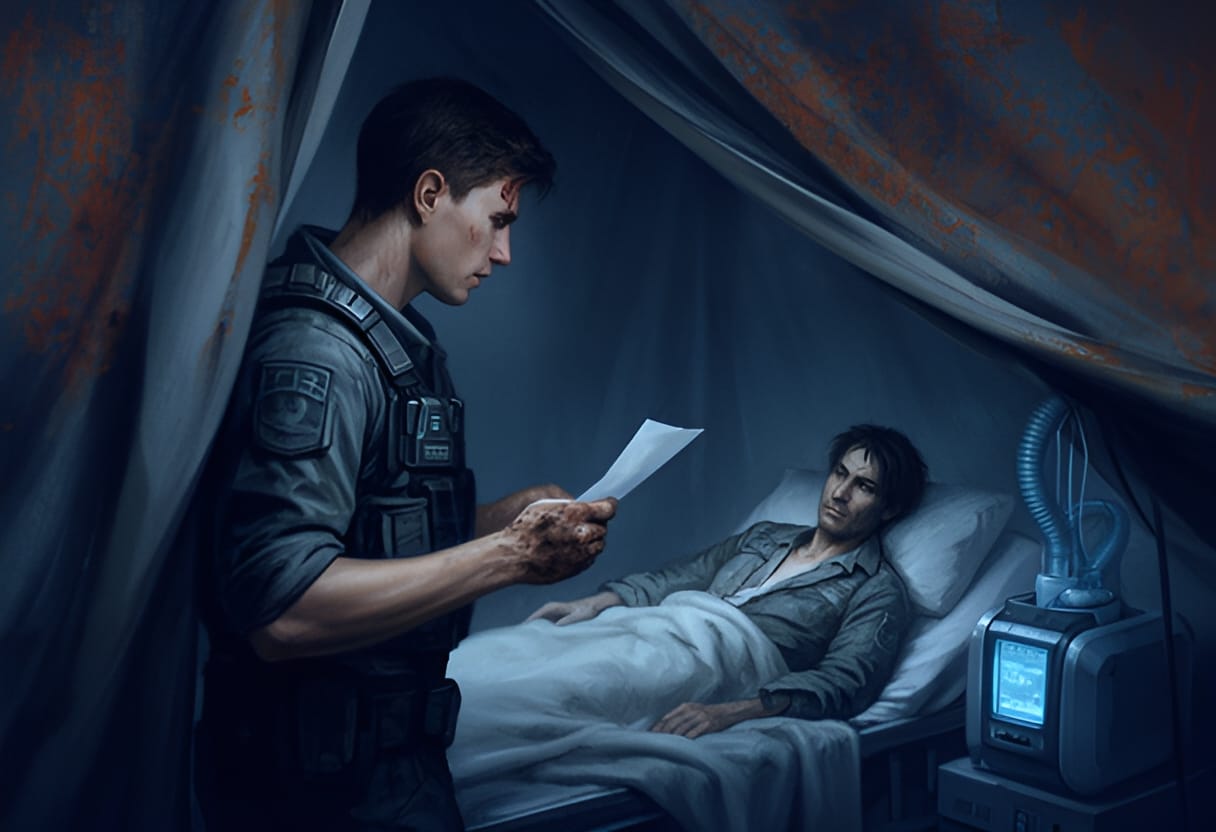
Chapter 21
Threshold
The dirt clung to Zay’s palms, gritty with dried blood and the chill of pre-dawn. He sat back on his heels outside the flap of the med tent, spine stiff from hours of leaning forward, elbows on knees, forehead nearly touching the canvas. Inside, the murmur of voices had softened to a low, rhythmic thrum—the hiss of the ventilator, the distant beep of a monitor, the muffled urgency of surgeons speaking in clipped tones. He hadn’t moved since the last update: septic shock, internal bleeding, lungs filling with fluid. May not walk again. May not make it through the night.
He hadn’t slept. Couldn’t. Every time his eyes drifted shut, he saw Alex’s face—pale, slick with sweat, lips parted in that shallow, uneven gasp that had worsened since the birthing chamber. The wound on his flank, angry and weeping through the bandage, pulsed in time with Zay’s own heartbeat. Synesthesia flared then—a deep, resonant hum in his sternum, like a cello string plucked beneath his ribs. He tasted copper and ozone, felt the weight of the silence as pressure behind his eyes.
I won’t lose you.
The whisper had escaped him raw, scraped from a throat gone dry from talking into the void. He’d said it again and again since they’d hauled Alex inside, voice dropping to a rasp as the hours bled into one another. Now, with the first bruise of light bleeding through the tent’s olive-drab fabric, he reached into his vest—not for ammunition, not for a knife—but for the folded square of paper tucked beside his father’s photograph and Lily’s two crayon drawings.
He unfolded it slowly, the creases soft from being carried close to his skin. His mother’s handwriting, looping and sure, filled the page. He’d read it a hundred times since leaving home, but never aloud. Never to Alex.
“Hey,” he began, voice low, rough but steady. He cleared his throat, swallowed the taste of iron. “Ma wrote this the week before we shipped out to Fort Hoffman. Said she was ‘cleaning out the pantry and found your old report card from third grade.’ Can you believe she kept that?”
He paused, listening. Inside, the ventilator sighed. No shift in the rhythm. Alex hadn’t moved—not a flicker of fingers, not a twitch of the eyelids—since they’d laid him on the stretcher. But Zay kept talking. Not for the doctors. Not for himself. For the brother who’d once stayed up all night teaching him how to skip stones on the reservoir, who’d shared his last ration bar during the Siege of Aspho Fields, who’d pressed a bloody med-pouch into Zay’s hands and muttered, You take the lead, I’ve got your six.
“She says,” Zay continued, unfolding the letter further, “that you always burned the toast but somehow made the peach cobbler sing. ‘Golden-brown and bubbling at the edges,’ she writes. ‘Like it was holding back sunshine.’ I remember—she’d let us lick the spoon, even though we weren’t supposed to. You’d always get the first bite, ‘cause you were older. Even by two minutes.”
A humorless smile touched his lips. He could see it so clearly: the yellow kitchen, the sun through the gingham curtains, the way their mother’s apron would flare when she spun to scold them for tracking mud inside. Alex, elbows on the table, chin in his hands, waiting not for the cobbler but for the story that came with it—about the time their father tried to can peaches and ended up with jam on the ceiling.
Zay’s voice wavered on the next line. He blinked fast, jaw tightening. “She says… she hopes we’re eating well. That someone’s making sure you don’t skip meals when you’re stressed. And Zay—she wrote my name like she was reminding herself I’m still here. That I haven’t vanished into the mud.”
He lowered the letter, stared at the ink-smudged words. The hum in his bones had softened to a thrum, steady as a drumbeat. He tucked the letter back into his vest, over his heart, where it rested against the photograph and the drawings—Lily’s stick-figure family, the burning house, the sun in the corner of the safe house.
Then, quieter: “You remember that joke I told you last winter? When we were stuck in that outpost outside Tyrus? The one about the cook who burned the rations so bad, even the rats refused to nibble?”
He waited. Nothing. But he began anyway, voice dropping to a conspiratorial murmur, like they were sharing a secret under a blanket fort.
“I told him, ‘Sir, I think this stew’s trying to crawl out of the pot.’ And the cook—poor bastard, sweating over a stove that hadn’t worked right since ’—he looks up, all offended, and says, ‘Well, if it’s trying to escape, it’s got better taste than half the platoon.’”
A beat. Then—there. The faintest lift at the corner of Alex’s mouth. Not a smile, not quite. A twitch. A ghost of the smirk he’d worn when Zay had tried to fry eggs on the exhaust manifold of a warthog and set off the smoke alarm.
Zay’s chest loosened, just a fraction. He let out a breath he hadn’t realized he’d been holding. “See? Still got it. Even half-dead, you’re judging my cooking.”
He fell silent after that, letting the rhythm of the tent wash over him—the steady whoosh… whoosh… of the ventilator, the occasional rustle of a medic shifting weight, the far-off crack of a rifle bolt somewhere in the compound. He told Alex about the clouds that morning over Ephyra—how they’d been streaked with peach and lavender, like the inside of a seashell, how the light had caught the dust in the air and made it look like the city was breathing. He talked about the way the wind had smelled before the first tremor—rain on hot stone, distant diesel, the faint sweetness of jasmine from the old botanical gardens. He told him about the cricket he’d heard chirping near the drainage ditch last night, how it had stopped the moment the Locust mortar hit the east wall, and how he’d waited, listening, for it to start again.
He didn’t know if Alex heard any of it. Didn’t know if the words sank in past the fog of pain and poison and shock. But he kept talking. Because the alternative—silence—felt like surrender. Like letting the dark win.
Time lost its shape. Minutes stretched into hours, or maybe it was the other way around. The tent flap remained closed, the surgeons’ voices a muffled undertone. Zay stayed where he was, shoulder blades pressed to the cool earth, back straight, eyes fixed on the flap as if his gaze alone could hold Alex to this world.
Then—light.
Not the gray, uncertain glow of pre-dawn, but the first true slant of sun, gold and sharp, slicing through the weave of the canvas. It painted a bar of brightness across the dirt, crawled up Zay’s boot, glinted off the buckle of his belt.
And inside—movement.
A flutter. So slight he almost missed it. The lift of an eyelid. Then another. Alex’s lashes, dark and wet with unshed sweat, blinked—slow, heavy, like wings dragging through water.
Zay froze. Breath stopped. His hand, resting limp on his knee, twitched toward the tent.
Alex’s eyes were open. Glassy, unfocused, but open. They swept the ceiling of the tent, unfocused, searching. His lips parted. A sound tried to form—a whisper, a breath, maybe his name—but it came out as a dry click, a rasp of air through a throat raw from intubation and shouting and smoke.
Zay moved before he thought. He crawled forward on his knees, palm flat against the ground, and reached through the flap. Not to shake him, not to jostle him—just to steady. His fingers hovered near Alex’s wrist, then, seeing the tension in his jaw, the effort in his gaze, he lifted a hand instead—slow, deliberate—and pressed a fingertip to his brother’s lips.
“Shh,” he murmured, voice thick, raw. “Save it. I already know.”
Alex’s eyes found his. Not focused, not quite—but there. Recognition, faint as a spark in ash, flickered in the depths. His brow furrowed, not in pain this time, but in effort. In trying.
And then—it happened.
The corner of his mouth lifted. Not a twitch. Not a reflex. A smile. Fragile. Flickering. Like a candle in a storm.
And his hand—his left hand, the one not pinned beneath the weight of blankets and monitors—lifted. Trembled. Shook with the effort of it. Fingers curled, slow, stiff, as if remembering how to move. Then, with a pressure so light it was almost imaginary, they closed around Zay’s thumb.
A squeeze. Brief. Weak. But his.
Zay’s breath shattered. He didn’t speak. Couldn’t. He just leaned forward, forehead resting against the edge of the cot, eyes locked on Alex’s, and let his own hand close over his brother’s—fingers lacing, thumb brushing the pulse point at his wrist.
The hum in his bones didn’t fade. It deepened. Resonated. Not as pain. Not as fear.
As connection.
Outside, the sun climbed higher. Inside the tent, the ventilator sighed on.
And for the first time since the earth had cracked open and the sky had filled with teeth, Zay Lopez did not let go.
The grip was fleeting—more a tremor than a hold—but it had happened. Alex’s fingers had closed around his, however weakly, and in that instant, the world had narrowed to the press of skin, the shared warmth, the silent vow renewed not in words but in pulse and pressure.
Zay didn’t move. Didn’t dare to breathe too deep, lest he shatter the moment. He stayed curled beside the cot, one hand still laced with Alex’s, the other braced against the mattress for balance. The sun had climbed higher now, its light spilling in wider bars across the tent floor, catching the dust motes in slow, lazy spirals. Somewhere beyond the canvas, a bird called—sharp, clear, a sound so ordinary it felt like a miracle.
Inside, the ventilator continued its steady rhythm: whoosh… whoosh… like tide against a pier. Alex’s chest rose and fell in time, shallow but unforced. The color had returned, faintly, to his cheeks—not the healthy flush of before, but the dull pink of healing, of blood moving where it had stagnated. The wound on his flank still showed through the loosened bandage, a dark stain spreading slow as ink in water, but the bleeding had eased. The surgeons’ voices had dropped to murmurs now, less urgent, more focused. Zay caught fragments: “…stabilizing…” “…fluid levels improving…” “…risk of sepsis still present, but responding…”
He didn’t dare hope. Not yet. But he allowed himself, for the first time in hours, to stop bracing for the worst.
Alex’s eyelids fluttered again. Not the frantic, desperate blinks of before, but slow, deliberate—like he was testing the weight of them, checking if the world still held its shape when he opened his eyes. When they lifted, they found Zay’s immediately. No confusion this time. No glassy distance. Just… him. Awake. Present.
Zay managed a whisper, raw but steady: “Hey.”
Alex’s lips parted. He tried to speak again. This time, it wasn’t a click or a rasp. It was a sound—low, rough, shaped by a throat still raw but trying. “…Zay…?”
His voice was barely audible, a thread of sound lost in the hum of the machine. But Zay heard it. He leaned in, ear near Alex’s mouth, not missing a syllable.
“Yeah,” he breathed. “I’m here.”
Alex swallowed. Worked his jaw. Tried again, stronger this time. “…how long…?”
Zay glanced at the sky through the tent weave—pale blue now, washed clean of night. “Since last night. You’ve been out most of it. But you’re back. That’s what matters.”
A pause. Alex’s gaze drifted, unfocused for a second, then snapped back. “…the others…?”
Zay hesitated. He didn’t want to lie. Didn’t want to fill his brother’s head with false hope when the truth was still being carved from smoke and rubble. But he couldn’t say we don’t know, not when Alex was fighting to stay with him, when every syllable cost him dear.
“Velez’s holding the evacuation point,” he said, choosing his words like stones across a river. “Last I heard, she’d got the convoy moving toward Northern Command before the Reaver hit. Jace—he covered the rear. Took a Seeder blast trying to buy us time.” He paused, throat tight. “He didn’t make it.”
Alex’s fingers tightened, just slightly, around his. A flinch. Not surprise—he’d always known Jace was reckless, brave to a fault—but the loss of it, the finality. Zay saw it in the way his brother’s jaw clenched, in the faint crease between his brows.
“I’m sorry,” Zay said quietly.
Alex shook his head, a tiny, almost imperceptible motion. “…not your fault…”
“No,” Zay agreed. “But I wish I’d been there. To watch your six.”
A ghost of a smile touched Alex’s lips. “…you were. Always.”
The words hit Zay like a blow—not painful, but deep, resonant, like a bell struck in the chest. He squeezed Alex’s hand in return, harder this time, anchoring them both.
Outside, a vehicle rumbled past—engine low, tires crunching over gravel. Voices drifted on the wind: a medic calling for supplies, a sergeant issuing curt orders. The war hadn’t stopped. It never would. But here, in this tent, in this slant of morning light, time had bent. For now, it was just them. Just breath. Just the slow, stubborn return of warmth to a hand that had nearly gone cold.
Zay shifted slightly, easing his weight off his heels and sitting back on his haunches, still holding on. He glanced at the IV line snaking into Alex’s arm, the clear fluid dripping steady into the tubing. The antibiotics. The blood expanders. The things keeping him here.
“I’ve been reading you Ma’s letter,” he said, voice low, like they were sharing a secret again. “About the peach cobbler. Said it tasted like sunshine.”
Alex’s eyes flickered. A memory, maybe. Or just the image forming in his mind’s eye. “…she always… let us lick the spoon…”
“Yeah.” Zay let out a soft breath. “You always got the first bite. Said it was your right as the older brother.”
A pause. Then, quieter: “…even by two minutes…”
Alex managed a nod. “…told you… once… you’d eat the proof… if I didn’t watch…”
Zay laughed—short, surprised, genuine. It came out rough, scraped from disuse, but it was laughter all the same. “You little shit. You were eight. I was six. You still made me eat the burnt toast.”
Alex’s eyes drifted to the ceiling again, but this time, there was no effort in it. Just thought. Reflection. The ghost of a smirk played at his mouth. “…you cried… said it tasted like regret…”
“I was six!” Zay protested, but he was smiling now, really smiling—eyes crinkling at the corners, shoulders loose. “It did taste like regret. And maybe a little bit of charcoal.”
They fell silent again, but it was different now. Not the silence of waiting, of dread. This was companionable. Easy. The kind that came after years of sharing bunks, of splitting rations, of knowing when to speak and when to let the quiet do the work.
Zay reached, slow, for the edge of the blanket near Alex’s hip. Not to adjust it, not to check the wound—just to feel the fabric, the weave of it, the faint rise and fall beneath. He kept his eyes on his brother’s face, watching for any sign of strain.
Alex’s breathing was still shallow, uneven in places, but it was his. Owned. Not the ragged gasp of shock, not the machine-assisted pull of the ventilator—though that still helped—but something deeper. Something returning.
“You scared me,” Zay said suddenly, voice dropping. Not accusatory. Just true.
Alex turned his head slightly toward him. The movement cost him—Zay saw the tension in his neck, the way his shoulder lifted a fraction—but he did it anyway.
“…could say the same… about you…” he whispered. “…standing there… covered in blood… whispering to dirt…”
Zay’s smile faded. He looked down at his hands—still streaked with dried blood, cracked at the knuckles, dirt ground into the lines. He hadn’t washed. Couldn’t bring himself to. It felt like washing away the proof that he’d been there, that he’d fought, that he hadn’t left his brother’s side.
“I wasn’t going to,” he said quietly. “Not without you.”
Alex’s gaze held his. Steady. Unwavering. “…knew you wouldn’t…”
A beat. Then, softer: “…you always… come back…”
Zay’s throat closed. He swallowed hard, blinked fast against the sting behind his eyes. He didn’t trust his voice, so he just nodded—once, sharp—and squeezed Alex’s hand again.
The ventilator sighed. A bird called again, closer this time. Somewhere in the distance, a Locust screech tore through the air—sharp, inhuman, a reminder that the world beyond this tent was still burning. But here, in this pocket of light and breath and shared silence, it felt distant. Like a dream half-remembered upon waking.
Zay let his gaze drift, taking in the details he’d missed in the rush of fear and fatigue. The way Alex’s dark hair clung to his forehead in damp strands. The faint scar along his jawline from a shrapnel nick weeks ago. The callus on his right thumb from years of gripping a Lancer too tight. The small, faded tattoo just below his collarbone—a lightning bolt, done in secret during leave, something Ma would’ve killed them for if she’d found out.
He remembered the night they’d gotten it. Fifteen years old, drunk on stolen cider and bravedom, huddled in a back-alley tattoo parlor in Targas. Alex had grinned through the pain, joking that if they ever got separated in battle, at least their corpses would match. Zay had rolled his eyes but let his brother talk him into it—matching bolts, he’d said, so we know it’s really us if we ever come back wrong.
Now, watching Alex fight to stay with him, to speak, to be—Zay understood what he’d really meant that night. Not just identification. Continuation. A promise written in ink: No matter how far we drift, no matter how much we change, we’ll still know each other. We’ll still find our way back.
A nurse appeared at the tent flap—young, face smudged with fatigue, hair escaping her braid. She glanced in, saw them awake, and gave a small, tight nod. “Vitals are improving,” she murmured, voice low so as not to startle. “If he keeps this up, we might try extubation later today. But he needs to rest. No talking. No strain.”
Zay nodded, still holding on. “We’ll be quiet.”
She hesitated, then stepped fully inside, adjusting the IV bag, checking the monitor. Her fingers were gentle, efficient. When she stepped back, she met Zay’s eyes. “He’s fighting. That’s more than half the battle.”
Then she was gone, the flap falling shut behind her with a soft whuff.
Alex turned his head again, slower this time, and fixed Zay with a look that was equal parts exhaustion and amusement. “…she thinks… we’re quiet…”
Zay couldn’t help it. He laughed again—softer this time, but real. “Yeah. She does.”
Alex’s eyes closed for a moment. When they opened, they were clearer. Focused. “…tell me… about the clouds… again…”
Zay hesitated only a second. Then he began, voice low, steady, painting the scene with words as if he could brush the image onto the inside of Alex’s eyelids.
“They were streaked,” he said. “Peach near the horizon, bleeding into lavender up high. Like someone had poured diluted wine across the sky and let it settle. The sun hadn’t fully cleared the buildings yet, so the light was soft—golden, but not harsh. It caught the dust in the air over Mercer Street, made it look like the whole city was glowing from within.”
He paused, listening to Alex’s breathing—still uneven, but smoother now, less jagged. “And the smell,” he continued. “After the rain last night, the stone was still warm. It smelled like… like wet pavement and old books. And underneath it—jasmine. From the botanical gardens. Ma used to say it was the only thing that grew right in Ephyra’s soil.”
Alex’s fingers tightened, just a fraction, around his. “…you noticed… that…”
“I notice everything,” Zay murmured. “Especially when it’s you I’m watching for.”
A long silence followed. Not empty. Full. Full of the weight of years, of promises made in childhood forts and whispered on battlefields, of all the times they’d leaned on each other without saying a word.
Then, softly: “…you ever think… we’ll see the sky like that again…?”
Zay didn’t answer right away. He looked up through the tent weave—at the blue, at the sun, at the way the light played across the fabric like water. He thought of the birthing chamber, of the Kryll dark, of the Boomer’s blast that had thrown him sideways and left his face ringing. He thought of all the things they’d lost—their innocence, their sense of safety, the belief that the world made sense.
But he also thought of the photo in his vest—Lily’s drawing of them walking hand in hand toward the safe house, the sun smiling in the corner. Of the recipe tin, dented but intact, holding the scorched edges of Ma’s peach cobbler recipe. Of the way Alex had looked at him just now—not as a casualty, not as a burden, but as his brother. His twin. The one who’d always known him, even when he’d forgotten himself.
“Yeah,” he said at last. “I think we will.”
Alex’s lips curved. Not a full smile. Not yet. But close enough.
And when his eyes drifted shut again, it wasn’t from slipping away. It was rest. Trust. The kind that only comes when you know someone’s watching your back.
Zay didn’t let go. He didn’t need to. He stayed right there—shoulder to shoulder, hand in hand, forehead nearly touching the edge of the cot—watching the light shift, listening to the breath, feeling the slow, steady return of a brother who had come back from the edge.
And when the sun climbed higher, painting the tent in warmer gold, he whispered—not to Alex, but to the quiet, to the morning, to whatever had brought them this far:
“We’re still here.”
Zay unfolded the foil wrapper slowly, the crinkle sharp in the quiet of the recovery ward. Steam curled upward, carrying the rich, fatty scent of stewed beans and salted pork—a luxury these days, doled out in measured portions to those deemed stable enough to digest it. He balanced the tray on his knees, careful not to jostle the IV stand beside Alex’s cot. The plastic cup of water sweated in his grip.
Alex’s eyes were open, tracking the movement. His face was pale, but the grayish tinge had faded from his cheeks. The hollows beneath his eyes remained, deep as scars, but there was a focus there now, a presence that hadn’t been there in the trauma tent. He licked his lips, swallowed.
“Smells… like Ma’s,” he murmured, voice rough from disuse.
Zay smiled, just a fraction. “Close enough. Cooks added extra cumin. Said it helps with the… congestion.”
Alex managed a nod, his gaze drifting to the steam rising from the tray. “Thanks.”
Zay lifted the spoon, blew gently on the stew, and brought it to his brother’s lips. Alex opened his mouth, accepted the first bite. He chewed slowly, deliberately, as if each movement cost him something. Zay watched his throat work, the way his Adam’s apple bobbed, the faint tension in his jaw. When Alex finished the mouthful, he didn’t reach for the spoon again. Instead, he turned his head slightly, eyes fixed on the window.
Outside, the ward’s view was limited—a sliver of sky over the northern outskirts of Jacinto, where the city’s stone and steel gave way to scrubland and the distant, hazy outline of the Imulsion fields. Smoke still curled in threads from the eastern sectors, but the air smelled less of ash today. More of ozone and dry earth.
“Stratton’s squad made it,” Zay said, keeping his voice low, steady. He waited until Alex turned back to him before continuing. “Jace and three others. Took a hit near the Old Rail Yards, but they breached the outer perimeter yesterday afternoon. Radio check-in came through just before dawn. They’re holding a forward position near the aqueduct. Setting up a triage point.”
Alex’s brows knit, not in disbelief, but in effort—like he was trying to recall a name, a face, a moment from the chaos of those first days. Then his expression cleared, and a ghost of his old smirk touched his lips. “Told you he’d make it. Loudmouth bastard’s got a horseshoe where his heart should be.”
Zay let out a breath he hadn’t realized he’d been holding. “Yeah. Loudmouth and lucky.”
They ate in silence for a few minutes. Zay fed Alex spoonful by spoonful, pausing when his brother’s breathing hitched or his grip on the blanket tightened. The stew was gone before Alex seemed to notice—just the bottom of the tray, glistening with fat.
Alex shifted, wincing as he adjusted his position. His left hand drifted to his side, fingers hovering over the bandaged wound just below his ribs. It was still angry-looking—red at the edges, seeping faintly through the gauze—but the fever had broken. The surgeons had said the laceration was contained, the infection responding to antibiotics. But the lung damage… that was trickier.
“I feel it,” Alex said suddenly, voice dropping. “In my chest. When I breathe deep… it’s like… glass.”
Zay stilled, spoon halfway to his lips. He set it down slowly, carefully, on the edge of the tray. “Where?”
Alex lifted his hand, pressed it flat against his sternum, then dragged it slowly to the left, stopping just below his nipple. “Here. And… under the shoulder blade. Like something’s stuck. Can’t… can’t get a full breath.”
Zay leaned in, lowering his voice even further. “You don’t have to talk about it. Not now. Just… rest. Let the medics worry about the rest.”
Alex opened his mouth to protest, but Zay shook his head, just a fraction. “No. You’ve done enough fighting for today. Your job right now is to breathe. To heal. To… be here.”
Alex’s eyes flicked to Zay’s face, searching. Then, slowly, he nodded. His hand fell back to the blanket, fingers curling slightly against the rough weave.
Zay reached over, not to take his hand—not yet—but to rest his own palm flat on the mattress between them, close enough that their pinkies nearly touched. The cotton of Alex’s hospital gown was thin, worn soft at the elbows. Zay could feel the faint tremor in his brother’s pulse through the fabric, steady but fragile.
Outside, a bird called—a sharp, clear note that cut through the morning stillness. Somewhere down the ward, a monitor beeped. A nurse’s shoes squeaked on linoleum. But here, beside this cot, time had thinned. The weight of the last days—the ambush in the tunnel, the flatline, the whispered apologies and promises—hadn’t vanished. But it had changed shape. It was no longer a blade pressed to the throat. It was a stone in the chest: heavy, familiar, but no longer crushing.
Alex shifted again, this time turning his head toward Zay. His eyes were half-lidded, but focused. “You ever… think about what we’d be doing… if none of this had happened?”
Zay considered the question. Not the hypothetical—he’d asked himself that a hundred times in the dark—but the intent behind it. The need to touch something normal, something untouched by fire and fang.
“Probably still hauling freight out of Targas,” he said. “You’d be bitching about the overtime. I’d be saving up for a new set of tires. We’d have gone fishing last weekend—remember? That stupid little creek near the old mill? You caught nothing but trash and sunburn, and I had to carry your gear back because you were too busy trying to teach that damn catfish to bite on a hook.”
Alex let out a quiet laugh—short, breathless, but real. “You always were the responsible one. I’d have talked you into skipping work. Said we were ‘testing new bait.’”
“And I’d have let you,” Zay said softly. “Because you’re my brother. And I’d rather be wrong with you than right without you.”
Alex’s gaze dropped to their nearly touching hands. He swallowed. “I’m scared… that I won’t be… the same.”
Zay turned his hand over, palm up, and let his fingers brush Alex’s knuckles. Just a whisper of contact. “You don’t have to be the same. You just have to be you. However that looks now.”
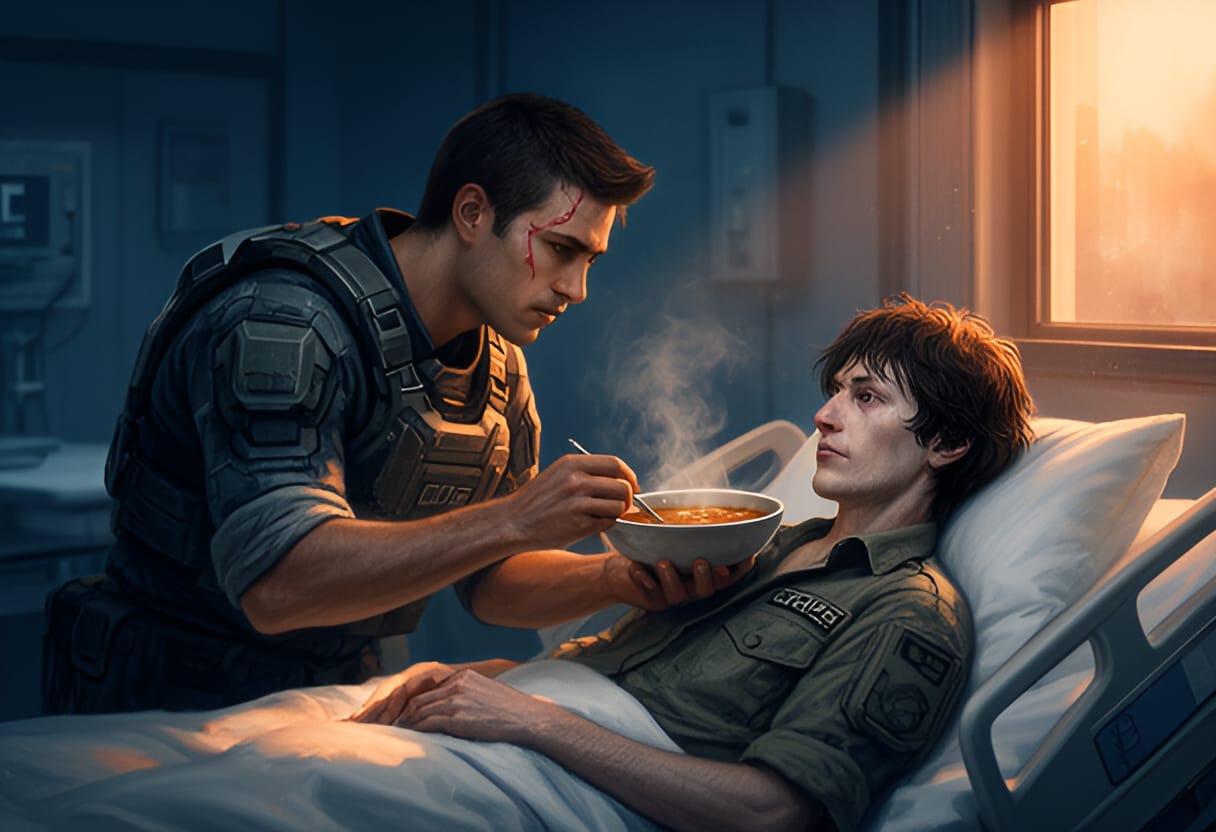
Alex didn’t pull away. Instead, he let his hand lie open, waiting. After a beat, Zay laced their fingers together—light, cautious, as if afraid the connection might break if he gripped too hard. Their thumbs rubbed slow circles over each other’s skin. No words. Just the press of flesh, the shared warmth.
The sun climbed higher, pouring gold through the window. It caught the dust in the air, turned it to drifting motes. It gilded the edge of Alex’s ear, the curve of his jaw, the faint stubble along his chin. Zay watched him—not with the hypervigilance of a soldier scanning for threats, but with the quiet absorption of someone memorizing a face he thought he’d lost.
Alex’s eyelids began to droop. His breath slowed, deepened. His grip on Zay’s hand loosened, not from letting go, but from surrender—into rest, into safety.
“Zay…” he whispered, voice thick with sleep. “I just… wanted to say… that… the clouds… this morning… they looked… like…”
His voice trailed off. Not from weakness alone, but from the pull of unconsciousness—soft, inevitable. His fingers went slack in Zay’s hold, then tightened again, just once, as if anchoring himself.
Zay didn’t call him back. Didn’t urge him to finish. He simply shifted, slid off the edge of the chair, and pulled the thin wool blanket from the foot of the cot. He drew it up over Alex’s shoulders, tucked it gently under his arms, then smoothed it down over his chest. He brushed the sweat-damp hair from Alex’s forehead with the back of his hand, lingering a moment at the temple, feeling the steady thrum of pulse beneath the skin.
Alex’s breathing was even now. Slow. Deep. Unburdened.
Zay stayed where he was, seated on the edge of the cot, one hand still resting near his brother’s, the other braced on the mattress. He watched the rise and fall of Alex’s chest, the way the blanket shifted with each inhale. The monitor beside them whispered a quiet, steady rhythm—no longer a warning, but a lullaby.
Outside, the war continued. The Locust advanced. The city bled. But here, in this narrow slice of morning, there was only this: the sound of breath, the warmth of skin, the quiet certainty that, for now, they were still here.
And that was enough.
Zay stayed until the light began to slant, gold turning to honey, then to the softer amber of late afternoon. The ward had quieted around them—voices lowered, footsteps muffled by rubber soles, the occasional hiss of a ventilator or the distant call of a name over a cracked intercom. Alex slept deeply now, his breathing even, his features relaxed in a way Zay hadn’t seen since before the tunnels, since before the Kryll had taken the sky and the Boomers had turned streets into slaughterhouses. A faint crease remained between his brows, but it was less the tight knot of pain and more the lingering echo of a dream.
Zay didn’t move. He couldn’t bring himself to. Not yet.
He watched the way the light caught the fine hairs on Alex’s temple, the way his eyelids fluttered once—just a twitch—before settling again. He thought about how easily this could have been the last time he saw his brother like this: peaceful, present, his. Not a casualty report. Not a name on a list. Not a body wrapped in a tarp and carried off to some nameless pit beyond the city walls. But this—Alex, warm and breathing, his hand loose near Zay’s, his chest rising with the quiet insistence of life refusing to be snuffed out.
A nurse appeared in the doorway—a different one, older, her hair pulled back into a tight bun streaked with gray. She carried a clipboard, her expression professional but softening as she took in the scene. She paused, just inside the room, and gave a small, almost imperceptible nod. Not a word. Just acknowledgment. Then she checked the IV line, adjusted the flow with a twist of the clamp, glanced at the monitor, and scribbled something down before slipping back out, the door clicking shut behind her with a sound so quiet it seemed to belong to another world.
Zay didn’t relax. Not fully. But he let his shoulders drop a fraction. Let his breath slow in time with Alex’s.
He thought about the letter he’d read aloud in the trauma tent—the one from their mother, the one about wet pavement and jasmine. He wondered if Alex had dreamed of it. If, in whatever depths his mind had wandered during those hours of unconsciousness, he’d smelled the rain on stone, felt the warmth of the sun through closed eyelids. Zay hoped so. He hoped Alex had carried something gentle back with him.
The silence stretched. Not empty. Full. Full of the hum of the refrigerator in the corner, the occasional creak of the ward’s old settling frame, the distant murmur of a radio playing a pre-war ballad somewhere down the hall—something slow, something with a violin. Zay found himself listening to it, not as background noise, but as a thread tying this moment to all the others: the kitchen radio in their childhood apartment, crackling over the smell of frying plantains; the truck stereo on their first run out to the fermentation fields, Alex singing off-key to a song about a girl and her tractor; the hum of the dropship engine the day they’d shipped out to Pelruan, both of them too wired to sleep, joking about who’d get the first kill.
He realized, with a quiet kind of awe, that he had been holding his breath for so long—since the tunnel mouth, since the flatline, since the moment Alex’s fingers had stopped twitching in his grip—that he had forgotten what it felt like to just… be. To not be braced for the next scream, the next explosion, the next worst-case scenario. To simply sit. To watch. To be with his brother, not as a protector, not as a survivor, but as a sibling. As a twin.
A soft sigh escaped him—almost a laugh. He hadn’t realized how much of himself he’d been keeping coiled, ready to snap. Now, the tension was bleeding out of him, slow and warm, like water finding its level.
Alex stirred.
Not a full waking. Just a shift. His head turned slightly into the pillow, his fingers curling inward, then slowly unfurling again. His breath hitched—once—and then smoothed. His eyelids fluttered, heavy but not resisting. When they opened, it was slow, dazed, the blue of his eyes clouded with sleep but clearing fast.
He looked at Zay.
Not through him. Not past him. At him.
And for a long moment, neither of them spoke. No need. The connection was there—thrumming, quiet, absolute—like a live wire buried deep in the earth, humming with current.
Then Alex’s lips parted. His voice was a rasp, but clear. “You… stayed.”
Zay nodded. Didn’t try to smile. Didn’t need to. “Yeah. I stayed.”
Alex’s gaze dropped to their hands—still near, not quite touching. He swallowed. “You didn’t have to.”
“I know.” Zay kept his voice low, even. “But I wanted to.”
Alex’s eyes flicked up, searching. “Even when… I wasn’t… here?”
“Especially then.” Zay let his hand move, just a few inches, until his pinky brushed Alex’s. Just contact. Just to say: I’m here. I’m not leaving.
Alex’s breath caught. Not from pain. From something deeper. Something Zay recognized instantly—the same quiet shock he’d felt when Alex had whispered “...Told you… I’d… make it… back…” in the trauma tent, as if the very act of returning had surprised him.
“I thought… maybe I’d lost you,” Alex whispered. “In the dark. When I couldn’t… couldn’t feel anything but the cold and the pressure… I thought… maybe you’d given up on me.”
Zay’s throat tightened. He shook his head. “Never. Not for a second. Even when you were gone… I knew you were fighting to come back. I could feel it. Like a pulse. Through the dark.”
Alex closed his eyes. A single tear escaped, traced a slow path down his temple into his hair. Zay didn’t reach to wipe it away. Let it be. Let it mean what it meant.
When Alex opened his eyes again, they were clearer. Sharper. “I’m sorry,” he said. “For scaring you. For… for leaving you to wonder.”
Zay squeezed his pinky once, then let go. “Don’t be. You’re here. That’s what matters.”
Alex nodded. Slow. Deliberate. Like he was relearning how to move through the world. “It’s… weird,” he admitted. “Being still. Not… not waiting for the next thing. Not… listening for the boots or the wings or the… the click of a safety disengaging.”
Zay understood. For days, his nervous system had been wired to threat—every shadow a drone, every silence a prelude to scream. Now, the absence of danger felt… strange. Unmoored. Like standing on ground that had stopped shaking, but still feeling the tremor in your bones.
“It’ll take time,” Zay said. “To remember you’re safe. Not… all the time. But… sometimes. In places like this.”
Alex let out a breath that sounded like a sigh and a laugh combined. “Safe. Feels like a foreign word.”
“It’s not,” Zay said firmly. “It’s real. It’s just… been buried.”
A beat of silence. Then Alex shifted again, wincing slightly as he adjusted his weight. His hand went to his side, fingers hovering over the bandage. Not in pain, exactly. More like… checking in. Making sure it was still there. Still real.
“How’s the lung?” Zay asked, keeping his tone light, but his eyes sharp.
Alex made a face. “Like I’ve got a sack of wet sand in there. And someone’s been kicking it.” He paused, then added, quieter, “But… it’s better. Than it was. Yesterday, I couldn’t… I couldn’t lie flat without feeling like I was drowning. Today… I can. For a little while.”
Zay nodded. That was progress. Real, measurable progress. The kind you could hold in your hands like a warm stone.
“They’re talking about getting you up tomorrow,” he said. “Just to sit. For five minutes. See how you handle it.”
Alex’s eyebrows rose. “Sitting up? Like… for real?”
“Like for real.” Zay let a small, genuine smile touch his lips. “They want to check your lungs, your circulation. Make sure you’re not going to crash the second you vertical.”
Alex considered this. Then, slowly, a spark returned to his eyes—the old spark, the one that had always lit up when he was faced with a challenge, even a stupid one. “Bet I can do it longer than five minutes.”
Zay laughed—soft, but unrestrained this time. “Oh, you’re on. I’ll time you.”
Alex’s grin widened, just a fraction. “You’re on.”
The moment hung. Not charged. Not tense. Just… full. Full of the quiet joy of two brothers who had stared into the abyss and, against all odds, found their way back to each other—not unscathed, not unchanged, but together.
Zay reached for the tray again—empty now, but he picked it up anyway, as if the motion itself was comforting. He set it gently on the bedside table, then reached for the plastic cup of water. He lifted it, brought it to Alex’s lips. Alex drank, slow, deliberate, swallowing with visible effort. When he lowered the cup, Zay set it down and wiped his brother’s mouth with the corner of the blanket—just a quick, tender swipe.
Alex’s eyes drifted half-closed again. “Tired,” he murmured.
“I know.” Zay kept his voice soft. “Sleep. I’ll be right here.”
Alex didn’t argue. Didn’t protest. Just let his head sink back into the pillow, his hand falling open near Zay’s. His breathing began to deepen again, the rhythm smoothing out, the tension draining from his jaw, his shoulders, his fingers.
Zay stayed. He didn’t move. Didn’t reach for his radio, didn’t check his weapon, didn’t scan the door or the windows for threats. He simply sat, shoulder nearly touching the cot, hand resting palm-up on his thigh, waiting—not for danger, but for the next breath. The next blink. The next sign that his brother was still here, still fighting, still his.
The light continued to shift. The amber deepened, then began to fade toward the cool blue of evening. The ward lights clicked on one by one—soft, fluorescent glows that didn’t harsh, didn’t glare, just… filled the space. A nurse passed in the hall, her shoes squeaking, her voice low as she spoke to someone else. A cart rattled somewhere down the corridor. Life. Ordinary, fragile, persistent life.
Alex’s eyelids twitched. Then, suddenly, he spoke—voice thick with sleep, but clear.
“Zay…?”
“Yeah?”
“I had a dream…”
Zay leaned in, just a fraction. “Yeah?”
“We were… kids. Back in Targas. That stupid creek… you remember? The one with the mudslide?”
Zay’s chest tightened. “Yeah. I remember. You dared me to jump across after the rains. I slipped. Landed on my ass. You laughed so hard you snorted.”
Alex’s lips twitched. “You were red. From the waist down. Like you’d been boiled.”
“We both were.” Zay let out a quiet laugh. “You pushed me in after. Said I needed to ‘cool off.’”
Alex’s breathing hitched—not from pain, but from laughter, soft and breathless. “You… you yelled at me for ten minutes. Then… you shared your last bar of chocolate. Said it was ‘hazard pay.’”
Zay’s eyes burned. He blinked fast, refusing to let the moisture fall. “You were such a pain in the ass.”
“And you loved it.” Alex’s voice was barely a whisper now. “Even when I was… a pain.”
“I still do.” Zay’s voice cracked, just a little. He didn’t try to hide it. “Even now.”
Alex’s hand twitched. Then, slowly, deliberately, he lifted it—just a few inches—and let his fingers find Zay’s again. Not a grip. Not a hold. Just a touch. Fingertips to knuckles. Light. Fleeting. But there.
His eyes were half-closed, but focused. Fixed on Zay’s face. “You… you always… knew how to find me.”
Zay swallowed. “Always will.”
Alex’s lips curved. Not a smile. Not yet. But the beginning of one. The promise of one.
Then his eyelids began to fall. His breath deepened. His hand went slack in Zay’s—still touching, still connected, but no longer active. No longer him. Just… resting.
Zay didn’t move. Didn’t try to hold on. Didn’t try to pull him back. He simply let his own hand lie open, palm up, waiting—not for Alex to grasp it, but to remind himself that the connection was still there. Still real. Still theirs.
He watched his brother’s face—the smoothness of his forehead, the faint curve of his lips, the way his lashes cast tiny shadows on his cheeks. He listened to the rhythm of his breath—the soft inhale, the slightly longer exhale, the pause between. He felt the warmth radiating from Alex’s body through the thin cotton of the gown, the blanket, the air between them.
And he thought—not of the war, not of the Locust, not of the scars yet to come, the therapy, the nights haunted by screams and the days shadowed by fear—but of this: the weight of a hand near his own. The sound of breath in the quiet. The fact that, after everything, they were still here. Still them.
The light had gone now. The ward was lit only by the soft glow of the overheads and the faint, steady pulse of the monitor. Somewhere, a clock ticked. Somewhere else, a door closed. But here, beside this cot, time had stopped—not frozen, not suspended, but fulfilled. As if, for this moment, the universe had narrowed to the space between two brothers, and that space was enough.
Alex’s breathing remained steady. Deep. Unburdened.
Zay didn’t move. Didn’t speak. Didn’t reach for anything.
He simply stayed.
Hand open.
Heart open.
Waiting.
Watching.
Here.
Zay didn’t move. Didn’t speak. Didn’t reach for anything.
He simply stayed.
Hand open.
Heart open.
Waiting.
Watching.
Here.
The first light of morning bled through the high windows of the recovery ward, thin and pale as old gauze. It caught the dust motes drifting above Alex’s still form, turning them into slow-spinning galaxies. The monitor beside the cot emitted its quiet, rhythmic beep—steady, unhurried. A sound that had become, over the long night, the only prayer Zay needed.
He hadn’t slept. Not really. His eyes burned, his neck ached from the angle he’d held, but he didn’t dare shift. Not when Alex’s breathing had finally, finally smoothed into something that resembled peace. Not when the ghost of that mudslide dream still lingered in the air between them, sweet and sharp as creek water and chocolate.
A nurse appeared in the doorway, her scrubs faded from too many washes, her hair tucked under a cloth cap. She paused, seeing Zay there, hand open on his thigh, eyes locked on his brother’s face. She didn’t speak. Didn’t need to. She gave the faintest nod—acknowledgment, respect—and slipped silently down the hall, her shoes whispering on the linoleum.
Zay didn’t watch her go. He kept his gaze on Alex—the rise and fall of the blanket over his chest, the way his lips parted just slightly on the exhale, the faint shadow of stubble along his jaw. He thought of the creek in Targas. The mudslide. The way Alex had shoved him under the water, laughing, insisting he needed to cool off. The chocolate bar, snapped in half, shared like a treaty.
He thought of the promise they’d made that night, barefoot and shivering on the bank, sticky-fingered and grinning: No matter what. We find our way back.
The war had tried to break them. Had come close. Had taken so much. But here, in this quiet room, with the morning light painting stripes across the floor and Alex’s breath warm and even beneath the thin gown—Zay felt it. Not as a thought. As a truth, deep in his bones.
They had found their way back.
The world outside the ward had not waited for them to heal.
Weeks bled into months. The Locust advance had stalled—not stopped, never that—but slowed, ground down by the sheer, bloody cost of pushing into Jacinto’s inner defenses. The COG had regrouped, fortified, turned the city’s ruins into a fortress of steel and stubbornness. New recruits poured in—kids barely out of training, faces tight with fear or false bravado—and the twins, against all odds, had been pulled from the front lines to help shape them.
Zay stood at the edge of the training plateau, arms crossed, watching the latest drill unfold below. The wind off the plateau carried the scent of dry earth and distant smoke, sharp and clean. Below, a squad of recruits staggered through a simulated urban course—low walls, barricades, smoke canisters popping to mimic ambush points. Their Lancer rifles were unloaded, weighted with sandbags to mimic real combat load. Their movements were stiff, overeager, eyes darting too wide, fingers twitching on triggers.
And there, in the middle of it, moving with a stiffness that wasn’t just fatigue, was Alex.
He walked with a cane now—black, aluminum, fitted with a rubber grip Zay had wrapped in friction tape after the third time it had slipped in sweat. His left leg swung stiffly, the joint still aching from the shrapnel that had torn through his calf during the tunnel ambush. His breath came short, shallow, each step a calculation. The lung scar from the Imulsion poisoning and the ventilator tubes had left him prone to spasms, especially under exertion. He’d been told, more than once, to take it easy. To let the medics decide when he was ready.
But Alex had never been one to sit out a fight.
He moved through the course with grim determination, calling out sector checks, correcting stances, his voice sharp despite the rasp in his throat. When a recruit fumbled a magazine reload, Alex barked, “Eyes on your weapon, not your feet! Muscle memory, dammit!” When another hesitated at a smoke barrier, Alex shoved him forward—gently, but firm—“Go! Trust your buddy to cover you!”
Zay watched, pride and worry twisting in his gut like frayed wire.
Then, on the third pass through the smoke-filled corridor, Alex stumbled.
His cane slipped on a patch of loose gravel near the exit ramp. He lurched sideways, arms windmilling, face tightening—not with panic, but with the effort of staying upright. His breath hitched, a sharp, wet sound, and he sucked air through his teeth, eyes squeezing shut for just a second.
Zay was already moving.
He didn’t call out. Didn’t wait for permission. He stepped off the embankment, boots crunching on gravel, and closed the distance in three long strides. Before Alex could regain his balance, Zay slipped his shoulder under his brother’s elbow, firm and quiet, bearing just enough weight to steady him.
Alex stiffened at first—habit, pride, the instinct to refuse help—but then he leaned. Just a fraction. His shoulder pressed into Zay’s, warm through the fabric of his shirt. His cane tapped the ground again, this time finding purchase. His breathing eased, just a little, as he found his rhythm again.
They walked the rest of the course in silence.
No words were needed.
Zay felt the tremble in Alex’s grip on his arm—not fear, not weakness, but the aftershock of exertion, the body reminding them both of what had been lost, what had been mended. He matched his pace, step for step, keeping his shoulder firm, his gaze forward, scanning the horizon for threats that weren’t there—yet.
When they reached the end of the line, Alex didn’t pull away right away. He stood there for a breath, two, letting the support linger. Then, slowly, he straightened, tapped his cane once against the boot, and gave Zay a nod—short, sharp, grateful.
Zay nodded back. No words. Just the press of his shoulder, still there, still ready.
Later, after the drill had broken and the recruits were sent to hydration and debrief, Zay found Alex near the supply tent, showing a pair of rookies how to clear a room using hand signals only.
The younger boy—couldn’t have been more than seventeen, cheeks still soft, eyes too wide—had just finished a mock sweep. He’d checked his corners, cleared his doorway, but when Alex asked him, “Who’s watching your six?” the boy blinked, glanced over his shoulder, and said, “Uh… I dunno. Nobody?”
Alex’s expression didn’t change. Not angry. Not disappointed. Just… deliberate.
He stepped closer, lowered his voice so only the boy could hear. “Listen. Your sector ain’t just the dirt in front of your face. It’s the space beside you. Behind you. Above you. If you’re not watching your buddy’s back, you’re not watching your own. You got me?”
The boy swallowed. “Yeah. Yeah, I got it.”
Alex nodded. “Good. Now try it again. And this time—look left. Look right. Look at your partner. See if he’s breathing. See if he’s ready. That’s how you stay alive.”
The boy reset, took a breath, and went through the drill again. This time, as he moved through the doorway, he paused—just for a second—to catch the eye of his partner, gave a sharp chin-nod, and moved on.
Alex watched, then gave a slow, approving blink.
Zay leaned against the tent pole nearby, arms crossed, watching his brother teach. He saw the way Alex’s eyes flicked—not just to the boy’s hands, but to his face, his posture, the tension in his shoulders. He saw the way Alex’s voice dropped when he spoke, not to intimidate, but to reach. To connect.
He remembered another time, another boy, another lesson—creek banks and muddy knees, Alex showing him how to skip stones, saying, “It ain’t about strength. It’s about touch. Feel the water. Let the stone tell you when it’s ready.”
Same lesson. Different war.
The sun began its slow descent behind the plateau, painting the sky in streaks of tangerine and rose. The air cooled, carrying the scent of sage and distant rain. The training field emptied, recruits trudging off to barracks or mess, laughter and shouts fading into the wind.
Zay and Alex lingered.
They didn’t head for the barracks. Instead, they walked the perimeter of the outpost—low sandbag walls, watchtowers half-built, coils of concertina wire glinting in the fading light. Alex moved with his cane, but his pace was steadier now, his breath easier. The exertion of the drill had passed, leaving behind a quiet fatigue, the kind that settles in the bones after honest work.
They didn’t speak at first. Just walked, side by side, shoulders occasionally brushing.
Zay kept glancing at his brother—the way the light caught the silver at his temples, the way his hand gripped the cane, not in pain, but in purpose. He thought of the long nights in the med tent, the whispered dreams, the way Alex’s fingers had found his in the dark. He thought of how close they’d come to losing this—this quiet, this ordinary, this them.
Alex finally broke the silence, voice low, rough from the day’s use but warm. “You ever think… we’d be doing this? Back when we were kids? Teaching kids how to shoot?”
Zay let out a short breath, half-laugh. “Hell no. I thought we’d be fishing in Targas till we were old and gray. Maybe running a bait shop. You’d steal the good worms, I’d yell at you, we’d split a six-pack and watch the sunset.”
Alex smirked, eyes on the horizon. “You’d still be lecturing me about patience.”
“And you’d still be ignoring me.”
They walked a few more steps. The sun dipped lower, touching the edge of the plateau, turning the clouds to molten gold.
Then Alex stopped.
He didn’t sit. Didn’t lean on the wall. He just… stopped. Turned his head slightly, as if listening to something far away.
Zay stopped with him. Waited.
Alex lifted his free hand—not to his face, not to his chest—but slowly, deliberately, reached across the small space between them, and rested his palm flat on Zay’s upper arm, just above the elbow. Not a grip. Not a plea. Just contact. Warm. Solid.
His breath came soft, a little uneven, but steady. He leaned in, just enough, and let his forehead come to rest against Zay’s shoulder.
The fabric of Zay’s shirt brushed against his brother’s temple. He could feel the faint tremor in Alex’s exhale, the way his body surrendered, just for a moment, into the support.
Zay didn’t move. Didn’t speak. Just lifted his own hand—slow, careful—and placed it over Alex’s where it lay on his arm. Fingers to fingers. Palm to palm. A silent acknowledgment.
The wind stirred. Somewhere, a distant bird called. The light faded, turning the sky to deep violet, then indigo.
And then, so quiet Zay almost missed it, Alex whispered—voice frayed at the edges, but clear:
“We made it back.”
Zay’s throat tightened. He swallowed hard, felt the prickle behind his eyes, the old, familiar sting he hadn’t allowed himself in months.
He didn’t try to hide it. Didn’t need to.
He turned his head just enough to press his lips to Alex’s temple—a brief, rough press, like a promise sealed.
“I know,” he murmured. “We did.”
Alex’s fingers curled, just slightly, against his arm. His breathing deepened, slow and sure. The tension in his shoulders eased, not gone, but softened—like a wound that had finally stopped bleeding.
They stayed like that until the last light left the sky, until the first stars pricked through the dark, until the world narrowed to the space between two brothers, standing on the edge of the earth, having walked through fire and come out the other side—still standing. Still together.
Still them.
The last light had fully surrendered to night, leaving only the faint glow of the outpost’s perimeter lamps and the distant, intermittent blink of a comms tower on the ridge. The air had grown crisp, carrying the sharp tang of stone dust and the faint, metallic hint of ozone from the generators humming low in the supply tents. Somewhere, a generator coughed, then steadied. A night bird cried once, sharp and brief, then fell silent.
Alex had not moved from his shoulder. His forehead still rested against the fabric of Zay’s shirt, his breathing slow and even, the warmth of his skin seeping through the thin cotton. His hand remained where Zay had placed it—over his own, fingers loosely interlaced, not gripping, just there. A tether. Not of need, but of knowing.
Zay didn’t dare shift. Didn’t dare breathe too deep. He let the moment stretch—let it be what it was: not a victory, not a celebration, but a quiet confirmation. After all the blood, the mud, the screams and the silence, the near-losses and the clawing back—here they were. Still standing. Still side by side. Still them.
He thought of the creek in Targas again—not the mudslide, not the chocolate, but the stillness after. How they’d sat on the bank, dripping and laughing, legs stretched out in the cool water, watching the stars come out one by one. How Alex had said, quiet and sudden, “Promise me something?” And how Zay, wary but trusting, had said, “What?” And how Alex had answered, “No matter what… you come find me. Even if I’m dumb enough to get lost.”
He had promised. He had kept it. Through fire and flood and flesh torn open, he had kept it.
A soft shift against him—Alex exhaling, a slow release of air—pulled Zay back. His brother lifted his head just slightly, not pulling away, but turning his face toward the dark, eyes open, catching the starlight.
“You’re quiet,” Alex murmured. His voice was low, rough from disuse, but steady. “Thinking too loud.”
Zay let out a breath he hadn’t realized he’d been holding. “Sorry. Just… listening.”
“To what?”
“To the quiet.” He paused. “It’s different now. Not empty. Not waiting for the next scream. Just… quiet.”
Alex was silent for a beat. Then, softly: “Yeah. I know what you mean.”
He shifted again, this time lifting his hand from Zay’s arm. Not to pull away, but to rub at his eyes with the heel of his palm—a gesture so familiar, so him, that Zay felt a pang deep in his chest, sweet and sharp. When Alex lowered his hand, he didn’t return it to Zay’s arm. Instead, he let it hang loose at his side, fingers slightly curled, as if still feeling the echo of contact.
“I used to hate the quiet,” Alex said. “Before all this. Before E-Day. Back in the barracks, when we were first shipped out. Too much time to think. Too much space for the ‘what ifs’ to creep in.”
Zay turned his head slightly, just enough to see his brother’s profile in the starlight—the strong line of his jaw, the faint scar along his cheekbone from a shard of glass during the tunnel collapse, the way his lips were slightly parted, not in tension, but in thought.
“Yeah?” he prompted.
Alex nodded. “Yeah. Used to fill it with noise. Jokes. Stories. Anything to keep the dark from crawling in.” He let out a short, humorless laugh. “Turns out, the dark was already inside. Just waiting for the lights to go out.”
Zay didn’t answer right away. He looked out over the plateau—now swallowed in shadow, the contours of the land softened, the distant silhouettes of Jacinto’s spires barely visible against the glow of the city’s emergency lights. The war hadn’t ended. The Locust still pushed. The Hollows still breathed beneath them. But here, now, in this moment, the immediate threat had receded. The line had held. The convoy had made it. The twins had made it together.
“I used to think,” Zay said slowly, “that if I could just keep you safe—keep you breathing, keep you walking—then I’d done enough. That survival was the win.”
Alex didn’t look at him. Just kept his gaze fixed on the dark horizon. “And now?”
Zay hesitated. Then: “Now I think… survival was just the first part. The real thing—the thing that matters—is what we do with the time after. How we show up. For each other. For the ones still fighting. For the ones who didn’t make it.”
Alex was quiet so long Zay thought he might have drifted off again. Then, softly: “You sound like Stratton.”
Zay almost smiled. “Yeah? In what way?”
“Always talking about purpose. About why we fight. He used to say… if you don’t know why you’re holding the line, you’ll break when it counts.” Alex paused. “I used to roll my eyes at him. Thought it was just sergeant talk. Stuff they fed you to keep you from deserting.”
“And now?”
Alex turned his head then, just enough to meet Zay’s eyes. The starlight caught in them—dark, deep, but clear. Not haunted. Not hollow. Just aware.
“I get it now,” he said. “It’s not about the big speeches. It’s not about the medals or the citations or even making it home. It’s about… showing up. Even when your leg shakes. Even when your lungs burn. Even when all you want to do is lie down and let the world go on without you.” He swallowed. “It’s about getting up anyway. And making sure the person next to you gets up too.”
Zay felt something loosen in his chest—a knot he hadn’t known was still there. He reached out, not to touch, but to let his hand hover near Alex’s, palm up, inviting.
Alex didn’t hesitate. He turned his hand over, let his fingers slide into Zay’s—loose, easy, the way they had as kids when they walked home from the creek, dirt on their knees and chocolate on their chins. Their fingers didn’t lock. Didn’t need to. Just rested, palm to palm, thumbs brushing.
“I’m scared,” Alex said, quiet as a breath. “Not of dying. Not really. I’ve seen enough to know it comes for us all. I’m scared of… waking up one day and realizing I’m not here. That I’m just… going through the motions. That I’ve become a ghost in my own life.”
Zay squeezed his hand—just once. “You’re not a ghost. You’re right here. Breathing. Talking. Standing. Even with the cane. Even with the scars. You’re here.”
Alex’s thumb stroked slowly over Zay’s knuckle. “It’s hard to believe sometimes. Feels like I’m still in that tent. Like I’m still floating between the beeps and the whispers and the smell of antiseptic. Like part of me didn’t make it back.”
“You made it back,” Zay said, firmer now. “You opened your eyes. You held my hand. You made it to the ward. You ate the stew. You walked the drill. You taught those kids how to watch each other’s backs. You didn’t just survive, Alex. You came back.”
Alex was silent. His grip tightened—just a fraction. Then he said, “I keep thinking about that dream. The one I had in the tent. The creek. The mudslide. You laughing at me, red as a lobster.”
Zay let out a quiet chuckle. “You laughed so hard you snorted chocolate out your nose.”
Alex’s lips twitched. “And you still shared your bar. Said it was ‘hazard pay.’”
“I’d do it again,” Zay said. “Every damn time.”
Alex leaned his head back against Zay’s shoulder, not heavily, but with trust. “I know you would.”
They stood like that for a long time—hand in hand, shoulders touching, eyes on the dark. The outpost slept around them: the sentries’ boots on sandbags, the low murmur of a radio check, the occasional clink of a canteen being screwed shut. Life. Fragile. Persistent. Theirs.
Zay thought of the letters he’d read in the med tent—the ones from their mother, the ones from old friends in Mercy, the ones he’d never sent, tucked inside his vest beside the photograph and the drawings. He thought of how he’d read them aloud, not because he thought Alex could hear, but because he needed to say them. Needed to voice the past so the future could have a foundation.
He thought of the way Alex’s fingers had twitched at the mention of chocolate. The way his breath had hitched at the memory of the mudslide. How, even unconscious, he had still been there—still listening, still them.
Now, awake, Alex leaned into him—not as a burden, not as a weight, but as a brother. As an equal. As someone who had stared into the dark and chosen, again and again, to step back into the light.
Zay pressed his lips to the top of Alex’s head—just a brush, a benediction. “We made it back,” he whispered, echoing the words from earlier, but meaning them deeper now. “Not just the body. The us. We brought us back.”
Alex didn’t answer with words. Instead, he turned his hand in Zay’s grip, lacing their fingers together—tight this time, deliberate, thumb locking over thumb, fingers interlaced all the way to the pinky. A clasp. A vow. A return.
And then, quietly, so quietly Zay almost missed it against the night: “Never letting go again.”
Zay held on. Let his brother’s strength flow into him. Let his own be the anchor. Let the night be dark, let the war rage beyond the wire—here, in this small space of touch and breath and shared silence, they were not soldiers. Not survivors. Not heroes.
They were brothers.
And that was enough.
The next morning came pale and quiet, the sun rising over the plateau in a wash of peach and gold. The air was still cool, but the bite had softened. Birds called from the scrub—real ones, not the distorted cries of Kryll-haunted skies. The outpost stirred to life: the clatter of trays, the hiss of the water pump, the low murmur of men checking weapons, tightening straps, sharing cigarettes before inspection.
Zay found Alex near the armory, sitting on a low bench, cleaning his Lancer. Not because he had to—his weapon was already clean, inspected, ready—but because the motion centered him. The rhythm of the brush, the smell of oil, the weight of the metal in his hands—it was a kind of prayer.
He wore his gear, but the cane leaned against the bench beside him, not hidden, not a source of shame, just… there. Part of him now, like the scar, like the limp, like the way his breath hitched sometimes when he laughed too hard.
Zay didn’t speak at first. He sat down on the bench’s far end, not too close, not too far, and watched. The morning light caught the silver in Alex’s hair, the faint lines at the corners of his eyes—not just from age, but from what they’d seen, what they’d carried.
After a while, Alex spoke without looking up. “Heard Stratton’s squad made contact with the northern outpost. Held the line through the night. Lost two, but they kept the flare active.”
Zay nodded. “Yeah. Heard the same. They’re setting up a listening post near the old aqueduct. Trying to get early warning on any SEEDER movement.”
Alex gave a single, sharp nod. “Good. Let them eat dirt before they get close.”
A pause. Then, quieter: “You ever think… we’ll ever not be waiting for the next bad thing?”
Zay considered it. The war wasn’t over. The Locust still tunneled. The Kryll still swarmed in the dark places. The Hollows still whispered beneath Sera’s crust. But he also thought of the way the recruits had checked their sectors that morning—not just with their eyes, but with their nods, their taps on the shoulder, their quiet “I got you” before moving into a room. He thought of the medic who had paused to share her water with a civilian boy. He thought of the cook who had saved extra stew for the night shift, just in case.
“I think,” he said slowly, “that we’ll always be ready. But I don’t think we’ll always be afraid.”
Alex finally looked at him. His eyes were clear. Not untroubled, but not drowned in fear. “Yeah. I think… we’ll still check our corners. We’ll still watch our buddy’s back. But maybe… we won’t jump at every shadow. Maybe we’ll let ourselves believe, just for a second, that the quiet can stay.”
Zay smiled. “Like we used to, down by the creek?”
Alex let out a soft, genuine laugh—low, warm, unguarded. “Yeah. Like we used to. Before the world ended.”
He went back to cleaning his Lancer, but not before tapping the bench beside him. An invitation.
Zay didn’t hesitate. He moved closer, shoulder brushing shoulder, close enough to feel the heat of his brother’s body, the rise and fall of his breath. Not leaning. Not relying. Just… present.
They worked in silence for a while—Zay checking the charge on his Boltok, Alex running a patch through the Lancer’s barrel. The only sounds were the soft rasp of fabric, the occasional click of a mechanism, the distant calls of birds waking the world.
Then, without warning, Alex said, “Hey. You ever think about what we’d be doing if none of this had happened?”
Zay paused, patch halfway through the barrel. “All the time.”
“Me too.” Alex didn’t look up. “I think… I’d still be in Mercy. Helping Mom at the clinic. Maybe met a girl. Got stupid over her. Made a mess of asking her out.”
Zay snorted. “You? Stupid? Never.”
Alex flashed him a grin. “Hey, I’ve got range. You just never saw me use it.”
“Yeah, ’cause you were always too busy stealing my fries at the mess hall.”
“And you were always too slow to catch me.”
They laughed—short, bright, real. The kind of laugh that hadn’t come often in the last year. The kind that started in the belly and rose up, unbidden, unafraid.
When it faded, Alex went back to his weapon. But not before saying, quiet but firm: “We made it back, Zay.”
Zay looked at him—not at the weapon, not at the cane, but at his brother’s face, open and unafraid in the morning light.
“I know,” he said. “We did.”
And for the first time in a long time, it didn’t feel like a promise kept against the odds.
It felt like a beginning.
Zay shifted his weight on the cold metal bench, the flask passing from his numb fingers to Alex’s. Steam curled weakly in the frigid air, vanishing before it could rise more than a hand’s breadth. The coffee inside was thin, bitter, more habit than sustenance, but the ritual of sharing it—of passing the dented cup back and forth without words—had become its own kind of warmth.
Above them, the sky was a dome of impossible black, streaked with stars so bright they seemed to prick the flesh of the night. No moon hung low; the tundra lay in silver shadow, the bunker’s low profile a mere wrinkle in the frozen plain. Somewhere beyond the wire, the wind had died, leaving the world suspended in a hush that felt less like peace and more like the world holding its breath.
Alex took a slow sip, then handed the flask back. His breath came in small, white plumes, each one a fleeting ghost. He didn’t look at Zay when he spoke, his gaze fixed on the horizon where the earth and sky bled together in a gradient of indigo and ash.
“I dreamed of the orchard again,” he said, voice low, rough at the edges like stone worn smooth by water. “Mom’s peach trees. Not the ones by the clinic—those were too young, too straight. The old ones, past the creek bend. The gnarled ones. Branches low enough to climb without scraping your knees.”
Zay didn’t answer right away. He turned the flask in his hands, feeling the dents where it had been dropped, the faint stickiness near the cap from sugar long since crystallized. He remembered those trees. Remembered how the fruit would swell in late summer, blush red at the cheeks, how the juice would run down your chin and stain your shirt if you weren’t careful. How Alex, always the quicker climber, would toss him the ripest ones even when he protested, saying Zay deserved the best bite.
“You could smell the earth before the rain,” Alex continued, quieter now. “That dry, cracked smell… then the first drop hits, and it’s like the ground wakes up. Releases everything it’s been holding. Petrichor. Ma used to say it was the smell of the world remembering how to breathe.”
A beat. The wind stirred, just enough to lift a loose thread from Alex’s sleeve and send it dancing over his knee. He didn’t brush it away.
“I haven’t thought about that since… since I woke up,” he said. “Not really. Not in words. Just… flashes. Like someone showing you a picture and snatching it back before you can see the whole thing.”
Zay finally looked at him. In the starlight, Alex’s profile was sharp, softened only by the faintest shadow under his eyes—not exhaustion, not anymore, but the quiet residue of having seen too much and lived to name it. His voice hadn’t wavered, but Zay knew the cost of those words. The orchard wasn’t just a memory. It was a place they’d left behind, a version of themselves that had ceased to exist the day the ground split open and the sky filled with screaming things.
“I used to think,” Zay began, then stopped. The words felt too big for the night, too dangerous to speak aloud lest they shatter the fragile thing growing between them—hope, uninvited and tender as a shoot through frozen soil.
Alex waited. Not impatiently. Just… waiting. Like he knew some truths needed time to find their shape.
“I’ve started imagining it,” Zay said at last. “Not the fighting. Not the watching corners or listening for the whisper of boots in the dark. Just… after. A farm, maybe. Not big. Just enough land to grow something that doesn’t need constant watching. A few goats. A dog that barks at squirrels instead of shadows. A roof that doesn’t leak when the rains come.”
He paused, swallowing against the sudden tightness in his throat. “Or just a town. Quiet. Where the loudest thing is the bell at the schoolhouse, and the only thing people run from is being late for supper.”
Alex was silent for a long time. When he finally spoke, his voice was barely above a whisper, as if afraid the night might steal it.
“I don’t know how to get there,” he said. “I don’t even know if it’s still there. The orchard. Mercy. The clinic. Maybe it’s all dust now. Maybe the Hollows reached further than we thought.”
Zay shook his head, though Alex wasn’t looking at him. “Doesn’t matter if it’s still there. What matters is that we can still see it. That we can still want it.”
Alex turned his head then, just enough to meet Zay’s eyes. In the starlight, they were startlingly clear—no haze of pain, no film of fear. Just two brothers, adrift in a world that had tried to erase them, still capable of imagining a future that didn’t end in smoke and silence.
“We don’t have to make plans,” Alex said. “Not yet. Not here. But… it’s nice to sit and let it be real for a minute. Not a fantasy. Not a prayer. Just… a possibility.”
Zay nodded. He didn’t trust his voice, so he lifted the flask instead and took a small sip. The coffee was cold now, bitter on his tongue. He didn’t care.
They sat like that for a long time—shoulders not quite touching, but close enough to share the same pocket of air. The wind had returned, low and steady, stirring the scrub into soft whispers. Somewhere, a fox barked, sharp and sudden, then fell silent. The stars wheeled overhead, indifferent and eternal.
No one spoke. No need to.
For the first time since the sky had burned and the earth had screamed, they weren’t waiting for the next order, the next ambush, the next breath that might be their last. They weren’t soldiers. They weren’t survivors. They weren’t even brothers bound by oath or blood alone.
They were two men, side by side in the cold, daring to believe that the world could still hold something gentle.
And in that silence, in the space between breaths, it didn’t feel like denial.
It felt like the first true thing they’d felt in a long time.
Months had bled into one another since that night on the tundra. The listening post had been decommissioned after the Locust shifted their thrust westward, the threat to the northern sectors diminishing to sporadic probes rather than full-scale assaults. The twins had been reassigned—not to the front, not anymore, but to a training cadre stationed in the high valleys near Jacinto’s eastern rim, where the air was thin and the recruits learned to move like ghosts through rock and pine.
It was late autumn now, the kind of day where the sun hung low and pale, gilding the edges of the world in honeyed light while the shadows stayed sharp and blue. Zay stood at the edge of the drill field, arms crossed, watching Alex oversee a squad of new gears through a low-crawl exercise under concertina wire.
Alex moved with a cane now, but his weight was evenly distributed, his gait deliberate rather than favoring one side. His lungs still complained in the cold, a tightness that bloomed behind his ribs when he pushed too hard, but he’d learned to pace himself, to listen to the body’s whispers before they became shouts. His face was lined, not just with scars but with the quiet map of endurance—laughter lines deeper now, but softer, earned in moments like the one on the tundra, when the world had allowed them to simply be.
A trainee slipped, his elbow catching on the wire, a sharp hiss of pain escaping his lips. Alex was there in two steps, cane planted firm, voice low and steady as he talked the boy through it, his hand hovering near the recruit’s shoulder—not touching, not yet, but ready.
“Breathe,” Alex said. “Just breathe. You’re not stuck. You’re moving.”
Zay smiled. Not because the boy had recovered, but because he’d heard that tone before—years ago, in a creek bed in Targas, when Alex had pulled him from the mud after a slide, laughing even as he wiped Zay’s face clean with the hem of his shirt.
A whistle blew. The drill ended. The recruits pushed to their feet, some grinning, some grimacing, all of them moving with a little more purpose than they had weeks ago.
Alex waited until the last of them had fallen in before turning to Zay, who had stepped forward to meet him halfway.
“Not bad,” Alex said, nodding at the dispersing squad. “They’re learning to trust the mud. Not fear it.”
Zay snorted. “Yeah. Well. Mud’s honest. Doesn’t pretend to be anything else.”
Alex gave him a look—half exasperation, half affection—then nodded toward the mess tent, where steam curled from the vent and the smell of stew and woodsmoke hung in the air.
“You buying?” he asked. “I’m telling Mom’s peach cobbler story again. This time with details.”
Zay clapped him on the shoulder, just briefly, firm and warm. “Only if you promise not to steal my fries this time.”
Alex gasped, mock offended. “I never stole your fries. I borrowed them. With interest.”
“Yeah? And what was the interest? A black eye and a week of KP?”
“The best kind,” Alex said, already turning toward the tent, his cane tapping a steady rhythm on the frozen ground. “The kind that comes with a side of dignity.”
Zay followed, the cold air biting at his cheeks, but his chest felt light. Not unburdened—never that. The war had left its marks, deep and true. But for the first time since the ground had opened and the sky had fallen, he wasn’t carrying the weight like a stone in his gut. He was carrying it like a pack on his back—heavy, yes, but one he knew how to shoulder.
And beside him, his brother walked—not ahead, not behind, but beside—his voice already rising, painting a picture of orchards and open skies and a future that wasn’t promised, but possible.
They didn’t speak of guarantees. Didn’t make vows. Didn’t need to.
The quiet between them wasn’t empty anymore.
It was full.
Full of breath.
Full of blood.
Full of the quiet, unbreakable truth that some bonds aren’t forged in fire alone—but in the choosing, again and again, to stand together in the cold and dare to imagine the sun.
The mess tent was already half-full when they pushed through the flap, the air thick with the scent of simmering root vegetables, smoked pork, and the sharp tang of black pepper. A low hum of conversation filled the space—gears swapping stories, medics checking bandages, a couple of privates arguing over whether the new issue ration packs tasted better cold or heated. Steam fogged the windows in patches, leaving clear ovals where someone had breathed or wiped a sleeve across the glass.
Zay and Alex found a corner table near the stove, its metal surface warm to the touch. Alex set his cane against the leg of the bench and eased himself down with a familiar, slight grimace—nothing alarming, just the body reminding him of its limits. Zay slid in beside him, not touching, but close enough to feel the shift of his brother’s weight, the minute tension in his shoulders as he settled.
A lanky private with flour smudged on his cheek set down two chipped bowls and a pot of stew without being asked. “Double portion, as requested,” he said, nodding at Alex. “Extra carrots. The cook said you’ve been eyeing them like they owe you money.”
Alex gave a small, genuine smile. “Tell her they’re a debt of honor. My Ma used to say carrots were for eyesight and stubbornness. I need both.”
The private grinned. “Then eat up. You’ll be spotting Snipers at a klick by week’s end.”
When he’d moved on, Zay lifted the lid of the pot and inhaled. The stew was rich—beef and barley, carrots and parsnips, a hint of thyme cutting through the earthiness. It smelled like home, not the one they’d lost, but the one they were still trying to stitch together from memory and muscle and the quiet insistence of habit.
He ladled stew into both bowls, handed one to Alex, then took his own. They ate in silence for a few minutes, the only sounds the clink of spoons, the occasional sigh of satisfaction, the distant crackle of the stove’s fire. The stew was good—better than good. It had depth, a soulfulness that came not just from the ingredients but from the care in its making. Zay could taste the rosemary, the slow caramelization of the onions, the way the broth clung to the spoon before slipping down, warm and sustaining.
Alex took a slow sip, then another. “Tastes like the stew Ma made when the first frost hit,” he said, voice low. “She’d let it bubble all day. Said the cold made the flavors dig in deeper. Like the pot was holding its breath until it was ready to give everything up.”
Zay nodded, stirring his own bowl. “She used to make extra. Always said there’d be someone showing up late—lost traveler, hungry kin, a stray dog with too much hope.”
Alex glanced at him, eyes soft. “You still believe in that version of her?”
Zay thought about it. Not the naive, childish version—the one that thought kindness was a shield against all harm—but the deeper one. The one that knew the world was sharp and cruel, and chose to ladle out warmth anyway. “I believe in the choice,” he said. “Not the outcome. She didn’t do it because she thought it would fix everything. She did it because not doing it would’ve broken something in her.”
Alex was quiet for a moment, then gave a single nod. “Yeah. That tracks.”
They finished the stew in companionable silence, the warmth spreading through their chests, loosening the knots of tension that had lived in their bodies for so long. When the bowls were empty, Zay pushed his back slightly and wiped his mouth with the back of his hand. Alex did the same, then reached into his vest pocket and pulled out the small, dented tin—the one that had held his mother’s molasses recipe, the one he’d carried through the drain, the tunnel, the long nights in the med tent, the months of rehab and retraining.
He set it on the table between them, lid slightly askew, as if it had been opened recently and not yet closed proper.
“I still have this,” he said, not looking at it, but at Zay. “Not because I think I’ll ever need to make the recipe. But because… it’s hers. And it’s mine. And it’s the one thing I didn’t lose when everything else went up in flames.”
Zay reached out, not to take it, but to rest his fingers lightly on the cool metal beside his brother’s hand. The tin was scratched, one corner dented from when Alex had shoved it into his vest during the Kryll ambush—had it been that long? Felt like another lifetime.
“You kept it close,” Zay said quietly.
Alex finally looked down at it, then back up. “Like you kept the photo.”
Zay touched the inside pocket of his jacket, where the faded photograph of their father lived—creased at the corners, the edges softened from years of being folded and unfolded, carried close to the heart. He hadn’t looked at it in weeks. Not because he didn’t want to, but because he didn’t need to. It was there. Like a heartbeat under skin.
“Yeah,” he said. “I did.”
A pause. The mess tent buzzed around them—laughter from a table nearby, the clang of a tray being set down, a sergeant’s voice calling out a reminder about evening muster. But here, at this small table, with the stew pot still warm and the recipe tin between them, time felt different. Slower. Deeper. Like the world had paused, just for them, to let them remember what they were fighting to protect—not just land or lives, but the quiet, ordinary things that made life worth living.
Alex picked up the tin, turned it slowly in his hands. “You ever think about what we’d tell people, if they asked? About what it was really like?”
Zay considered it. Not the propaganda. Not the official reports or the polished speeches. But the truth—the messy, contradictory, human truth.
“I’d tell them it was loud,” he said. “Not just the guns and the screams. But the silence after. The way your ears would ring, and your head would feel stuffed with cotton, and all you could hear was your own heartbeat trying to catch up.”
Alex nodded. “And the smell. Not just smoke and blood. But the wet stone of the drains. The oil on a Lancer barrel. The way your boots would suck at the mud like it didn’t want to let you go.”
“And the food,” Zay added. “How you’d forget what real hunger felt like—until you got a hot meal, and then you’d realize you’d been starving for more than just food. You’d been starving for normal.”
Alex let out a short, humorless laugh. “Yeah. And how the smallest things would wreck you. A kid’s laugh. A song on a broken radio. The way the light hit the water in the creek behind Ma’s house—like it was on fire, but gentle.”
They looked at each other then, and for a moment, the years fell away. Not erased. Not forgotten. But placed in their proper context—not as the whole story, but as part of it. The war had been a chapter. A long, brutal, defining chapter. But not the whole book.
Alex set the tin down gently, lid now properly closed. “We didn’t just survive,” he said. “We carried things. Not just gear and ammo. But memories. Promises. The way Ma hummed when she peeled peaches. The sound of Da’s whistle when he called us in for supper. The weight of a brother’s hand on your shoulder when you thought you couldn’t take another step.”
Zay swallowed. His throat felt tight, but not with sorrow. With something warmer. Something harder to name.
“We didn’t just carry them,” he said. “We kept them alive. By remembering. By telling the stories. By still wanting the orchard, even when we knew it might be gone.”
Alex reached out then—not for the tin, not for the stew pot—but for Zay’s hand. His grip was firm, calloused from years of weapon maintenance and rope climbs and the simple act of holding on. His skin was warm, his pulse steady beneath Zay’s fingers.
“We’re still here,” Alex said. “And so are they. In the way I still check the sky at dusk. In the way you still save the last bite for someone who might need it more. In the way we still look out for each other, even when we don’t have to.”
Zay squeezed back. “We didn’t just make it through,” he said. “We made it to something. Not the end. Not a victory parade. But… a place where we can still feel the sun on our faces and not flinch.”
Alex’s eyes glistened—not with tears, not exactly, but with something deeper. Recognition. Gratitude. The quiet awe of a man who had stared into the abyss and found, not monsters, but the echo of his own voice calling him back.
“I never thought I’d hear myself say this,” he said, voice rough, “but… I’m glad we’re still here to see it.”
Zay didn’t answer with words. Instead, he lifted his hand from Alex’s grip and, after a moment’s hesitation, pressed his palm flat against his brother’s chest—just over the heart. Felt the steady beat beneath the fabric of the shirt, the rise and fall of his breath, the quiet, persistent thrum of life.
Alex covered Zay’s hand with his own, lacing their fingers together briefly, then gave a soft squeeze before letting go.
Outside, the wind had picked up, rattling the tent’s canvas in a low, steady rhythm. Somewhere, a gear whistled a fragment of an old tune—off-key, but earnest. The sun had dipped lower now, painting the snow-dusted ridges in the distance with rose and gold.
They didn’t move right away. Just sat, two brothers in a crowded tent, sharing silence that didn’t need to be filled. Not because there was nothing to say, but because what mattered had already been said—not in grand declarations, but in the press of a hand, the sharing of a stew, the safekeeping of a tin and a photograph and a thousand small, unspoken things.
And when they finally rose, it wasn’t to return to duty or to prepare for the next drill. It was simply to refill their bowls, to get another helping of stew, to linger a little longer in the warmth and the light and the quiet, unshakable knowledge that they were not alone.
They never had been.
And they wouldn’t be— not as long as they still remembered how to listen for the heartbeat beside their own.
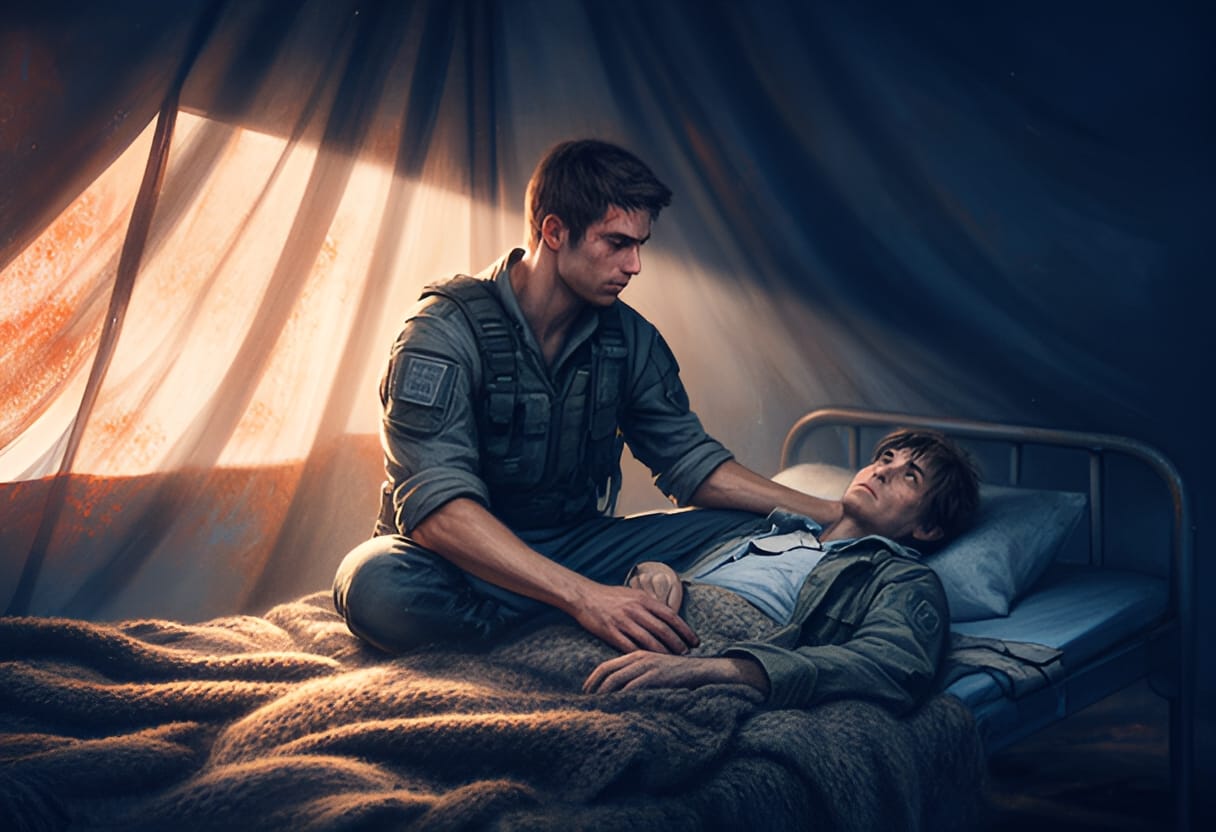
Chapter 22
What Remains
Through the long night, Zay remains at the med tent, talking to Alex even when he’s unresponsive—reading him old letters, recounting jokes, telling him about the clouds over Ephyra that morning. At dawn, Alex’s eyes flutter open. He tries to speak, but Zay hushes him, saying, 'Save it. I already know.' The chapter ends with Alex managing a weak smile and squeezing Zay’s hand—the first conscious sign of connection since the wound.
Zay wakes to the smell of antiseptic and damp wool. His neck is stiff from sleeping curled against the cot, one hand still resting where Alex’s had been. The dawn light is thin and gray, filtering through the canvas flaps of the med tent. Outside, the world feels suspended—no distant artillery, no scuttling of Kryll in the eaves. Just the slow drip of water from a broken pipe and the murmur of voices low and urgent.
He shifts, and Alex stirs.
His brother’s eyes are open, unfocused at first, then finding Zay’s face. A faint color has returned to his lips, though his cheeks remain drawn, the skin stretched tight over cheekbones that seem too sharp. The bandage around his torso is clean, white against the pallor of his skin. He tries to shift his shoulder, winces, and goes still.
"Hey," Zay says, voice rough from disuse. He doesn’t move his hand, lets it lie palm-up on the blanket between them.
Alex’s fingers twitch. Then, slowly, he closes the distance, lacing his fingers through Zay’s. His grip is weak, but it’s there. Real.
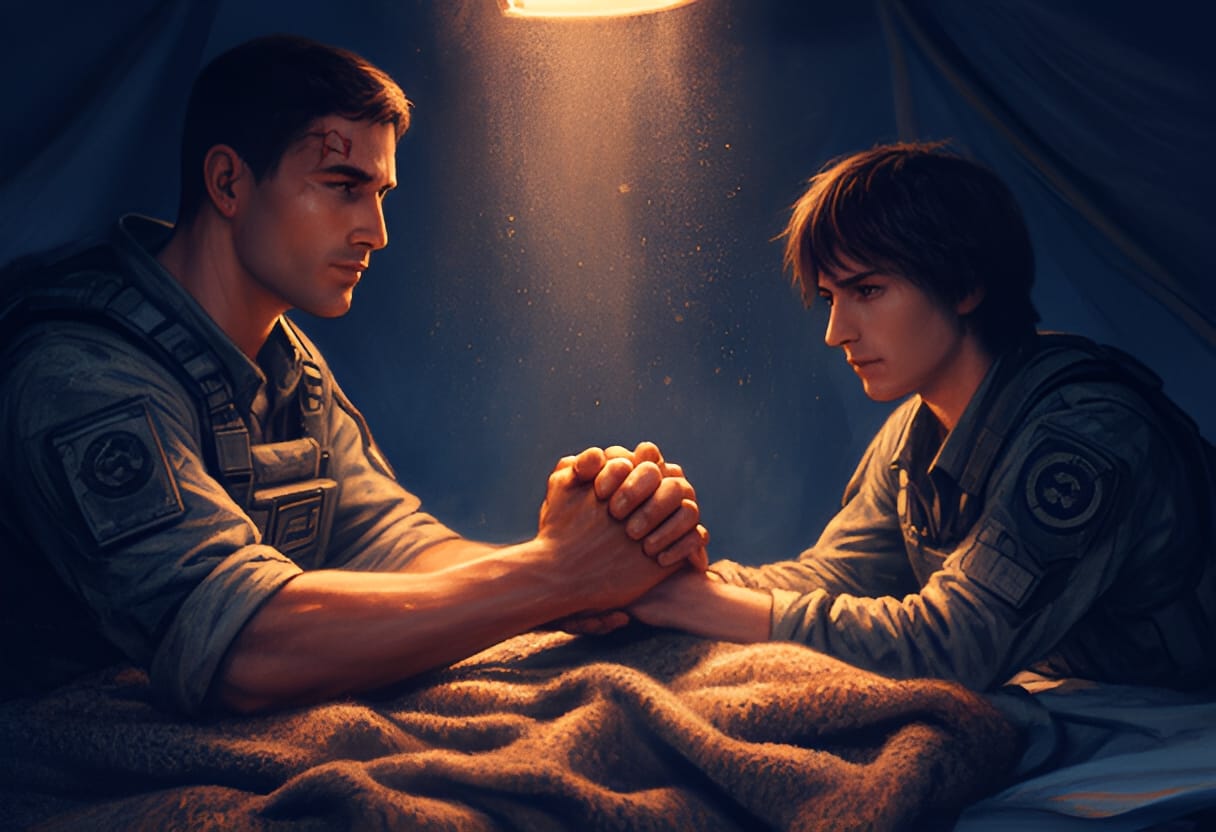
"Thought you’d left," Alex whispers. His voice is a rasp, like stone scraping stone.
"Never," Zay says. He means it. He’s said it a hundred times in the dark, when Alex couldn’t hear him. Now he says it where it can be taken as truth.
A medic flaps past the tent entrance, calling out vitals. Zay doesn’t look. He keeps his eyes on Alex’s face—the way his brow unfurrows just a fraction when their hands are joined, the way his breathing, though shallow, no longer hitches with pain.
"How long?" Alex asks.
"Since you opened your eyes? Ten minutes. Since they moved you out of trauma? About thirty-six hours."
Alex nods, slow. His gaze drifts past Zay’s shoulder to the flap of the tent, where the light is brighter. "Outside?"
"Still holding. Jacinto’s got boots on the ground. They’re pushing the line north."
Alex’s fingers tighten. Not pain—recognition. "Stratton’s lot?"
"Corporal Stratton’s squad. Made it to the eastern checkpoint with a full platoon of civvies. Took three Seeders down with a mortar team from Fenix’s outfit. They’re setting up a perimeter now."
A ghost of a smile touches Alex’s mouth. It doesn’t reach his eyes, but it’s there. "Told you he’d make a good sergeant."
Zay lets out a breath he didn’t know he’d been holding. "He followed your orders to the letter. Said you were the reason he didn’t freeze when the Boomers came."
Alex’s gaze drops to their joined hands. He swallows. "I… I remember the tunnel. The smell. The way the light went green."
Zay doesn’t ask if he means the Imulsion or the Kryll. He knows. Some things don’t need words to be understood.
"I remember you pulling me up when I slipped on the moss," Zay says. "Said I owed you a beer for it."
Alex manages a chuckle. It turns into a cough, dry and rattling. He doubles slightly, hand flying to his side where the bandage is thickest. Zay shifts, ready to call for help, but Alex waves him off with a trembling finger.
"Just… air," he gasps. "Lungs feel… full of wool."
Zay’s jaw tightens. He’s heard the surgeons mutter about fibrosis, about scarring that won’t fade. He’s felt the way Alex’s breath catches when he thinks no one’s listening. But he won’t name it. Not here. Not now.
"Rest," Zay says, voice low and firm. He shifts on the cot, turning slightly to face his brother more fully. "You don’t have to talk. Not yet. Just… breathe. I’ve got you."
Alex opens his mouth, as if to protest, to insist he’s fine, to make a joke about Zay turning into a nursemaid. But the effort is too much. His eyelids flutter. His shoulders slacken. The words die on his lips.
Zay doesn’t pull his hand away. Instead, he shifts closer, shoulder brushing Alex’s through the thin hospital gown. He rests his free hand lightly on the blanket near Alex’s hip—not to hold him down, but to anchor himself to the fact that his brother is here, warm, alive.
The silence settles, not empty, but full. Full of the near-lost, the almost-gone, the breaths they nearly didn’t get to take together. Full of the weight of every name they’ve whispered over graves, every promise made in the dark that now, impossibly, feels like it might be kept.
Alex’s breathing evens. Not perfect, but steadier. The rise and fall of his chest becomes a rhythm Zay can match to his own heartbeat. His lips part slightly. He’s trying to say something—Zay can see the tension in his jaw, the faint movement of his tongue—but the words won’t come. Not yet. Maybe not today.
And that’s alright.
Alex’s head tilts slightly toward Zay’s shoulder. His breathing deepens, evens into the slow, uneven pull of sleep. His fingers loosen in Zay’s grip, but don’t let go.
Zay waits until he’s sure—until the tension leaves Alex’s face, until his breath comes in soft, regular puffs—then, with infinite care, he slips his hand free. He pulls the blanket, worn thin at the edges but still warm from their shared space, up to his brother’s chin. He tucks the corner under Alex’s shoulder, smoothing the fabric where it’s bunched near his ribs.
Then, slowly, he reaches up. His fingertips brush the sweat-damp hair from Alex’s forehead. It sticks slightly to his skin, and Zay lingers, feeling the warmth, the faint tremor of muscle beneath.
He doesn’t kiss him. Doesn’t whisper a vow. He just stays there, watching.
The rise. The fall.
The quiet, stubborn fact of his brother breathing.
Outside, the war continues. Locust shells fall somewhere to the east. Scouts report movement in the marshes. The surgeons will come back with more reports, more warnings, more grim prognoses.
But here, in this tent, with the dawn light painting stripes across the blanket and the sound of his brother’s breath like a tide returning to shore, Zay allows himself, just for this moment, to believe that some things endure.
That some bonds are not broken by fire, or flood, or the roar of things rising from below.
That some promises, whispered in the dark and sealed with blood and sweat, are not so easily forgotten.
And that, for now, it is enough to sit. To watch. To be near.
Zay settles back on the cot, one arm resting on his knee, the other loose in his lap. He keeps his eyes on Alex’s face—the slight furrow of his brow, the way his lips move as if dreaming of words he’ll speak when he’s stronger.
He doesn’t know what the day will bring.
But for the first time since the ground opened beneath Ephyra, he doesn’t need to know it all.
He just needs to be here.
And he is.
The med tent grows warmer as the morning advances. Sunlight, now higher and sharper, slants through the canvas, painting alternating bars of light and shadow across the cot, the floor, the folded uniform draped over a nearby chair. Dust motes drift in the beams, slow and lazy, like they have all the time in the world. Outside, the muffled cadence of boots on packed earth and the occasional shout of a medic calling for supplies form a distant rhythm—life continuing, not in spite of the war, but because they refuse to let it stop.
Alex’s breathing remains steady. Not deep, not strong, but unbroken. Zay watches the way the blanket rises and falls, the faintest indentation forming near his brother’s sternum with each inhale. He doesn’t dare to hope it means recovery—not yet—but it means presence. And for now, that is enough.
A flap stirs. A face appears—young, freckled, eyes wide with the kind of exhaustion that comes not from lack of sleep, but from too much of it spent watching others suffer. Private Hale. She’s barely nineteen, assigned to the med unit two days ago after her transport convoy got routed through the old rail yards. She holds a chipped metal tray with two bowls, a cup of steaming liquid, and a wedge of flatbread wrapped in wax paper.
"Corporal Lopez?" she says, voice hushed, as if afraid the sound might shatter the quiet. "They said you might want something warm. The cook made extra barley stew. And… there’s chicory in the tea. Not much, but it’s real."
Zay doesn’t look away from Alex, but he gives the faintest nod. "Thank you, Hale. Tell the cook it’s appreciated."
She hesitates, glancing at Alex’s still form. "He’s… better, isn’t he? The color’s back. A little."
"He’s fighting," Zay says. His voice is low, rough from disuse, but steady. "That’s what matters."
She gives a small, tight smile. "Yeah. Yeah, he is." She shifts her weight, as if wanting to say more, but thinks better of it. Instead, she places the tray quietly on the folding table near the tent’s edge, where a battered thermos and a half-used packet of morphine syringes sit beside a clipboard filled with looping script. She doesn’t linger. Just gives another nod and slips back out, the flap falling softly behind her.
Zay waits until the sound of her footsteps fades, then reaches for the tray. The stew smells earthy and rich—barley, dried beans, a hint of smoked pork from the last of the field rations. He lifts the lid. Steam curls upward, carrying the scent of thyme and garlic. He tests a spoonful. It’s hot, but not scalding. He blows on it gently, then brings it to Alex’s lips.
"Easy now," he murmurs. "Just a taste."
Alex’s lips part on instinct. He chews slowly, jaw working with visible effort. A few swallows. Then he turns his face away, breath hitching—not from pain, but from the effort of consuming something real after days of IV fluids and nutrient paste. His eyes flutter open, glazed but aware.
"Tastes… like home," he whispers.
Zay freezes, spoon halfway to his own mouth. Home. Not the apartment in Tyrus they shared before enlisting. Not the barracks at Fort Reval. Something older. The kitchen in their mother’s house in Mercy, the one with the chipped blue tiles and the window that fogged when she boiled potatoes. The smell of onions frying in butter. The way their father would hum off-key while fixing the sink.
He doesn’t answer. Can’t. The lump in his throat is too thick.
Instead, he eats his own spoonful slowly, deliberately, letting the warmth spread through his chest. He offers another bite. Alex takes it. Then another. He manages half the bowl before shaking his head, lips pressed tight.
"Full," he murmurs. Or tries to. It comes out more like a sigh.
Zay sets the bowl aside. He picks up the tea cup—ceramic, chipped at the rim, the kind they used in the mess before the bombing shattered the supply lines. He blows across the surface, watches the tiny ripples. Then he brings it to Alex’s lips.
Alex drinks. Small sips. The liquid is bitter, smoky, with a sweetness underneath—maybe honey, maybe just the illusion of it after so long without anything real. His shoulders drop a fraction with each swallow. The tension in his jaw eases.
When the cup is empty, Zay sets it down. He doesn’t speak. Doesn’t need to.
Alex’s eyes drift shut again. Not sleep, not yet. Just rest. The kind that comes when the body finally believes, for a moment, that it is safe.
Zay leans back. Lets his head rest against the cot’s wooden frame. The canvas above him is stained in places—water, maybe old blood, maybe something worse. He doesn’t dwell on it. He focuses on the sound: the soft inhale, the slightly longer exhale, the quiet click in Alex’s throat when he breathes too deep.
His thoughts drift, unbidden.
He remembers the first time he saw Alex laugh after E-Day. Not a smirk. Not a grimace masquerading as humor. A real, belly-deep laugh. It had been three days after the ambush at Mercer Street, when they’d holed up in a collapsed subway station with a handful of civilians and two other Gears. Alex had found a can of spoiled peaches in a flooded locker. Instead of tossing it, he’d peeled back the lid, taken a whiff, and made a face so disgusted it had set off a chain reaction—Zay snorting, then Hale (then just a civilian kid with a broken arm) giggling, then the old librarian who’d been teaching the kids to read by candlelight snorting into her scarf. They’d laughed until they cried, tears cutting tracks through the dirt on their faces, the sound echoing off the concrete like a rebellion.
Alex had wiped his eyes, grinning. "Told you we’d find something sweet down here."
Zay had looked at him then—really looked—and seen not just his brother, but the boy who used to chase fireflies in the backyard, who used to trade his dessert for extra vegetables at dinner because he said they made him strong. The boy who still believed, even then, that kindness wasn’t weakness.
He wonders if that boy is still in there. Buried under the weight of bandages and antibiotics and the quiet terror of waking up to find your lungs full of something that shouldn’t be there. But he thinks—hopes—yes. Because Alex just smiled at the taste of stew. Because he remembered home. Because he’s still here, breathing, holding on.
A sudden shift in the light makes Zay blink. The sun has moved. The bars of shadow have crept forward, now brushing Alex’s bare foot where the blanket has slipped. Zay reaches over, slow, and tugs the fabric back into place. His fingers linger on the anklebone—sharp, but warm. He rubs his thumb once, gently, over the prominence of bone. A gesture so small it’s almost not there. But it’s his. It’s theirs.
He thinks about the photograph in his vest. The one of their father, grinning in his old COG dress uniform, cap tilted back, holding a fishing rod twice his size. The one Alex pressed into his hand the night before they went into the tunnel, voice low: "If anything happens to me… keep this. Tell Mom I didn’t scream."
Zay hadn’t cried then. He’d just nodded, stuffed the photo into his vest, and sworn silently that he’d carry it until he could hand it back himself.
Now, he feels the edge of it pressing against his sternum through the thin fabric of his shirt. Not a burden. A tether.
He wonders if Alex knows he carries it. If he knows he carries the recipe tin too—the one with their mother’s gingerbread formula, the edges stained with molasses and time. If he knows that every night, when Zay finally allows himself to lie down, he presses his palm to that spot over his heart and feels the ridges of the tin, the smoothness of the photo, and thinks: I’m still here. We’re still here.
A soft whimper escapes Alex’s lips. Not pain. A dream, maybe. Or the body’s way of releasing tension. His fingers twitch. Then, slowly, they curl inward, seeking.
Zay doesn’t hesitate. He slides his hand back under the blanket, finds Alex’s, and laces their fingers together again. This time, Alex’s grip answers—weak, but deliberate. His thumb rubs once over Zay’s knuckle. A question. An answer.
Zay squeezes back. Once. Twice.
Outside, a horn sounds—low, mournful. Not a call to arms. A signal. The all-clear for a sector. Or maybe just the end of a shift.
Alex’s breath hitches. His eyes flutter open. Not panic. Just awareness. He turns his head slightly, toward the sound, then back to Zay.
"Still out there," he murmurs.
"Yeah," Zay says. "But not here. Not right now."
Alex studies him. Really studies him. The way he did when they were kids and one of them had gotten hurt climbing the old oak by the creek—Zay would be silent, jaw clenched, eyes fixed on the horizon like he was waiting for the next blow, and Alex would say, Look at me. I’m here. I’m okay. And somehow, that was enough to make the pain recede.
Now, Alex does the same. His gaze holds Zay’s—not pleading, not afraid. Just seeing him. Really seeing him.
"You look like hell," Alex says, voice barely above a whisper.
Zay almost laughs. Instead, he lets his shoulders drop. "So do you."
Alex manages a ghost of a smile. "At least we match."
They don’t speak for a long time after that. Just breathe. Just be.
Zay notices the way Alex’s eyelids grow heavy again—not from exhaustion this time, but from peace. The kind that doesn’t come often in war. The kind that feels like a gift, fragile and fleeting, but real.
He doesn’t want to break it. Doesn’t want to speak and risk pulling his brother back into the ache, the fear, the weight of what’s been lost and what’s still coming.
So he stays quiet. Lets the silence deepen. Lets the sun move across the tent, warming the fabric, warming their skin.
He thinks about the others. Stratton’s squad making it to Jacinto. The civilians who found the old maintenance ladder and climbed into the settlement’s upper levels. The medics who worked through the night with trembling hands and empty sutures. The ones who didn’t make it—whose names he still whispers when he thinks no one’s listening.
He thinks about the road ahead. The surgeries still to come. The therapy Alex will need if he ever walks again. The scars—visible and not—that will stay.
But he doesn’t let those thoughts settle. Not now. Not here.
Instead, he focuses on the rise and fall of his brother’s chest. On the warmth of their joined hands. On the way Alex’s breath ghosts over his knuckles when he exhales too deep.
He thinks about the promise they made long ago—before the war, before the uniforms, before the weight of the world settled on their shoulders. Not a vow spoken in ceremony. Just a look, across the dinner table, after one of their father’s long lectures about duty and honor. A look that said: No matter what happens, we find our way back.
They’ve kept it. Through fire and flood and dark. Through screams and silence and the slow erosion of hope.
And now, here, in the quiet, they’re still keeping it.
Alex’s breathing evens. His grip loosens, not from letting go, but from surrender—to rest, to trust, to the quiet certainty that he is not alone.
Zay watches his brother’s face—the smoothness of his forehead now, the faintest hint of a smile playing at the corner of his mouth, the way his lashes cast small shadows on his cheeks.
He doesn’t move. Doesn’t dare to breathe too loud.
He just stays.
Watching.
Waiting.
Holding the space where his brother can be safe.
Outside, the war turns.
Inside, for now, there is only this: two brothers, side by side, breathing in the same air, sharing the same silence, and for the first time in a very long time, not afraid to simply be.
Zay watches Alex’s chest rise and fall in the dim light of the med tent, the rhythm steady now, the fear that once clung to each inhalation gone. The war outside has not ceased—it has only changed shape—but here, in this canvas-walled space, time has softened its edges. He does not move. Does not dare to breathe too loud. He simply holds the space where his brother can be safe.
The first light of morning finds Zay already awake, sitting cross-legged on the cot beside Alex’s, one hand resting lightly on the blanket near his brother’s hip. Alex is still asleep, his breathing even, the color in his lips deeper than it has been in weeks. The bandage around his torso is clean and white, the edges tucked neatly beneath the hem of his shirt. Zay traces the rise and fall of the fabric with his eyes, feeling the quiet hum of relief settle in his bones—not the frantic, brittle kind that comes after a narrow escape, but something deeper, slower. Earned.
He shifts slightly, careful not to disturb him, and reaches for the canteen at his belt. He takes a small sip of water, then replaces it, his gaze drifting to the flap of the tent where the morning light begins to seep in, gold and hesitant. Outside, the world is still broken. But in here, for now, there is only this: the warmth of shared air, the weight of a hand nearly lost and now found again, the quiet certainty that they are still here—together.
Alex stirs. A soft sigh escapes him, his fingers twitching once against the blanket before settling. His eyelids flutter, then open—slow, heavy, but clear. He turns his head toward Zay, and for a moment, there is only the quiet exchange of gazes, the unspoken language they have refined over a lifetime: the flicker of recognition, the silent I’m here, the answering I know.
“Morning,” Alex whispers, his voice rough but present.
Zay offers a small smile. “Morning. You gave us a scare back there.”
Alex’s eyes drop to their joined hands, still laced together beneath the blanket. He gives Zay’s fingers a faint squeeze. “Told you,” he murmurs, voice dropping even lower, “I’d make it back.”
Zay’s throat tightens. He doesn’t trust himself to speak, so he simply nods, pressing their foreheads together for just a second—brief, but deliberate—before settling back. Alex’s breath ghosts over his skin, warm and steady. The moment lingers, not needing words.
When Alex finally shifts to sit up, Zay helps him, sliding his arm beneath his brother’s shoulders with practiced ease. Alex winces slightly as he moves, but hides it quickly, straightening his spine with a stubbornness that makes Zay’s chest ache—not with worry, but with pride. He hands him the canteen, and Alex drinks slowly, his eyes scanning the tent as if taking stock of the world beyond the flaps.
“How long?” he asks, voice still low.
“Two days,” Zay says. “You were out for most of it. Fever broke last night. They’re moving you to the recovery ward this afternoon.”
Alex nods, absorbing the information. Then, after a pause: “Stratton’s squad?”
Zay hesitates only a fraction of a second before answering. “They made it to Jacinto. Eastern checkpoint. Full platoon of civilians with them. Took down three Seeders with a mortar team from Fenix’s outfit. Held the line long enough for the convoys to get through.”
A ghost of a smile touches Alex’s lips. “Good. Told you they had it in them.”
Zay chuckles softly. “Yeah. You did too.”
They sit in silence for a while, the only sound the distant hum of the camp—voices, the clatter of equipment, the occasional shout of a drill sergeant in the distance. The war is still here, still grinding forward, but it feels… distant. Like a storm that has passed over the hills, leaving the air clear and the light sharper.
When Alex finally swings his legs over the side of the cot, Zay is there to steady him, his hand firm on his brother’s elbow. Alex’s legs tremble slightly under his weight, but he pushes through, gripping the edge of the cot until he finds his balance. He leans on Zay heavily for a moment, then straightens, testing his stance.
“I’ll make it to the ward,” he says, voice firmer now. “Just… give me a sec.”
Zay doesn’t let go until Alex gives a small nod, signaling he’s ready. Then, slowly, they begin to move—Zay matching his brother’s pace, his shoulder brushing Alex’s with each step as they shuffle toward the flap of the tent. The canvas parts for them, and the morning light spills in, bright and clean, washing over the dusty ground of the med camp.
They walk in silence, the rhythm of their steps falling into sync—uneven, but deliberate. Alex’s cane taps softly against the rocky soil, his breath coming in short bursts, but he does not complain. Does not slow. Zay walks beside him, close enough to catch him if he stumbles, but far enough to give him the space to find his own strength.
Later, after Alex has been settled in the recovery ward—a quieter corner of the med tent where the light is softer and the traffic lighter—Zay returns with a tray: two bowls of stew, thick and steaming, the scent of root vegetables and salted meat curling into the air. He sets one down on the small table beside Alex’s cot, the other in his lap.
Alex looks up as he approaches, his eyes tired but alert. He manages a weak smile when he sees the stew. “Smells like home,” he says.
Zay sits down on the edge of the cot, careful not to jostle him. “Your mother’s gingerbread recipe tin’s still in my vest. Molasses and all.”
Alex’s gaze drops to Zay’s chest, where the faint outline of the tin presses against the fabric beneath his shirt. He doesn’t ask if he’s carrying the photo too. He already knows.
They eat in silence for a while, the stew rich and hearty, warming them from the inside out. Alex eats slowly, his movements deliberate, but he finishes his bowl. When he’s done, he leans back, exhaling deeply.
“Feels… real,” he says, almost to himself. “Not like a dream.”
Zay nods. “It’s real.”
Outside, the camp stirs. Voices rise and fall. Somewhere, a whistle blows—the call to muster. Zay tenses slightly, instinctively, but Alex doesn’t react. He just watches his brother, his expression thoughtful.
After a moment, he says, “You still hear it, don’t you? The whistle. The shouting. The… the silence after.”
Zay looks at him. “Yeah. Sometimes.”
Alex sets his spoon down. “Me too. But less now. And when I do… I don’t jump. Not like I used to. I… I breathe first. Then I look.”
Zay studies him. Sees the tension in his jaw ease, the way his shoulders drop just a fraction. “You’re learning to trust the quiet again.”
Alex meets his eyes. “Only because you never stopped believing it was there.”
Zay reaches out, his fingers brushing Alex’s knuckle where it rests on the blanket. “We made it this far. We’ll make it further.”
Alex’s smile returns, quieter this time, but deeper. He doesn’t speak. He doesn’t need to. Instead, he turns his hand over, palm up, and Zay laces their fingers together again—just as they did in the tent, just as they have done a thousand times before, in trenches and tunnels and the dark hours before dawn.
Weeks later, the med tents have given way to a more permanent structure—a cluster of prefabricated huts and sandbagged positions on the rocky outskirts of Jacinto, where the earth rises in a series of low plateaus overlooking the valley. The air is thinner here, cooler, carrying the scent of stone and distant rain. The Locust still press at the edges, their movements shadowed and furtive, but the line holds. For now.
Zay and Alex are stationed at a forward outpost—one of several scattered along the ridge—tasked with training the new recruits. Fresh-faced Gears, barely out of boot camp, their uniforms still stiff, their eyes wide with a mix of fear and determination. They come in squads, rotating through drills: weapons handling, sector checks, buddy watches, mock ambushes. Zay oversees the firearms training, his Lancer steady in his hands as he corrects grips, stances, trigger discipline. Alex, though still limited by his wound and the scar tissue in his lung, takes the tactical drills—teaching them how to move, how to communicate, how to trust the person beside them more than the weapon in their hands.
It is during one such drill that Zay notices it again—the hitch in Alex’s step, the way his breath catches just slightly as he moves across the uneven ground. They are running a low-crawl exercise under simulated fire, the recruits scrambling through a trench lined with sandbags and concertina wire, their rifles held low, their eyes scanning left and right. Alex walks the line beside them, his cane tapped rhythmically against the rocky soil as he offers corrections, his voice calm but firm.
“Eyes up, Lopez! Sector’s not just what’s in front of you—it’s what’s to your flank, your six! You clear your buddy before you clear the dirt!”
A recruit—young, no older than seventeen, his face smudged with dirt and sweat—hesitates as he clears his sector, his gaze darting nervously from the trench wall to the empty sky above. Alex stops him with a hand on his shoulder.
“Hey,” he says, voice low. “Look at me.”
The recruit does, eyes wide.
“You see me?” Alex asks.
“Y-yeah,” the recruit stammers.
“Good. Now, when you’re out there—really out there—you don’t just look for the enemy. You look for the person next to you. Because if they go down, and you didn’t see it coming… that’s on you. Not the Locust. Not the dark. You. So you check. You see. You make sure they’re breathing. You make sure they’re still in the fight. That’s not weakness. That’s how we stay alive.”
The recruit nods, swallowing hard. “Yes, sir.”
Alex gives him a firm nod in return. “Now try again. And this time—breathe.”
The recruit resumes the crawl, slower this time, more deliberate. His head turns—not just to scan for threats, but to check his buddy’s position, to see if he’s still moving, if he’s still there. Alex watches him go, a quiet satisfaction in his eyes. When the recruit reaches the end of the trench, he turns and gives a thumbs-up. Alex returns it, his lips twitching into the ghost of a smile.
Zay, who has been watching from a few paces away, feels something loosen in his chest. He had feared, in the long nights after the trauma tent, that Alex’s spirit might be broken—that the pain, the fear, the near-loss would have carved something hard and distant into him. But this—this quiet authority, this deliberate teaching—it is not the absence of trauma. It is its transformation.
Later, after the drill ends and the recruits are dismissed to clean their weapons and hydrate, Zay finds Alex sitting on a low stone wall at the edge of the outpost, his cane resting across his knees, his head tilted back as he watches the clouds drift across the sky. The sun is low now, painting the stone and sand in hues of amber and rose. A breeze stirs the loose fabric of Alex’s shirt, lifting the hairs at his temple.
Zay approaches slowly, stopping beside him. He doesn’t sit. Not yet. He just stands, shoulder nearly touching his brother’s, and follows his gaze outward—past the wire, past the listening posts, to where the land drops away into the valley below, where smoke still rises in thin columns from distant skirmishes.
Alex shifts slightly, his breath catching—not from pain, but from the effort of turning his head. He looks at Zay, his expression unreadable for a moment, then softens.
“You ever think we’d end up here?” he asks, voice quiet. “Me, limping around like an old man. You, still carrying that damn recipe tin like it’s a holy relic.”
Zay lets out a short breath—half laugh, half sigh. “I thought we’d be dead by now. Or worse—separated. Scattered to the winds, never knowing if the other made it.”
Alex turns his head fully toward him now, his eyes locking onto Zay’s. “We made a promise.”
“We did,” Zay says. “And we kept it.”
Alex studies him for a long moment. Then, slowly, he reaches out—not for Zay’s hand, but for the edge of his vest, where the recipe tin lies hidden beneath the fabric. His fingers brush the molasses-stained edge, just as Zay had done a thousand times before in the quiet dark.
“I can still taste it,” Alex says, so softly Zay almost misses it. “Mom’s gingerbread. Warm. Spicy. Like she was right there in the kitchen, humming that off-key tune she always sang when she thought no one was listening.”
Zay’s vision blurs for a second. He swallows hard. “I still smell it sometimes. When I open the vest. When the sun hits it just right.”
Alex’s hand drops to his lap. He looks out at the valley again, his jaw working slightly as he fights against whatever emotion threatens to rise. Then, after a long silence, he speaks again—quieter than before, but clear.
“We made it back.”
Zay turns to him fully now. Alex’s eyes are wet, but his gaze is steady. He is not asking for reassurance. He is stating a fact. A hard-won, bloody, miracle of a fact.
Zay reaches out then, not for his hand, but for his shoulder. He gives it a firm, brotherly squeeze—once, twice—and Alex leans into the touch, just slightly, his weight shifting onto Zay’s frame as if drawing strength from it.
“I know,” Zay says, his voice thick but clear. “We made it back.”
Alex rests his head against Zay’s shoulder, just for a moment. The sun dips lower, painting the sky in streaks of crimson and gold. Somewhere in the distance, a lone whistle blows—not a call to arms, but a signal. The end of a shift. The quiet before nightfall.
They stay like that for a long time—two brothers, side by side, breathing the same air, watching the same light fade. The war is not over. It may never be. But here, on this ridge, with the stone warm beneath them and the sky burning above, there is only this: the weight of a promise kept, the quiet hum of survival, and the unshakable knowledge that, no matter what comes next, they will face it—not as soldiers, not as survivors, but as brothers.
And that, for now, is enough.
The wind shifts, carrying the faint, acrid tang of burnt powder from the eastern ridge—where a patrol had clashed with a Locust scouting party just hours before. Alex tenses at the scent, his grip on Zay’s shoulder tightening for half a second before he forces himself to relax. Zay feels it—the micro-flinch, the held breath—and doesn’t comment. He knows better than to point it out. Instead, he shifts his weight slightly, turning his body to shield Alex’s flank from the open ground, his own eyes scanning the tree line where the shadows are beginning to pool like spilled ink.
Alex doesn’t push him away. He just leans harder into the support, his temple brushing Zay’s jaw as he exhales—a long, slow release that seems to pull the tension from his shoulders. His breath ghosts over Zay’s collarbone, warm and uneven, but steadier than it was months ago. The scar tissue in his lung still pulls when he laughs too hard or climbs too fast, but the worst of the sepsis is gone. The doctors had called it a near thing—twice. Once when his heart stopped in the trauma tent, once when the infection spiked in the recovery ward. But he’d pulled through. Not unscathed. Not unchanged. But here.
Zay’s hand, still resting on Alex’s shoulder, feels the faint tremor in the muscle beneath the fabric—not fear, not pain, but the aftershock of adrenaline, the body remembering what it had survived. He remembers too. Remembers the smell of cordite and burnt flesh in the tunnel mouth. Remembers the weight of Alex going limp in his arms, the way his breath had stuttered like a broken bellows. Remembers the silence after the defibrillator’s shock—the long, terrifying flatline—and then, against all odds, the slow, stubborn return of the rhythm.
He doesn’t dwell on it now. Not here, not with the sun warm on his neck and his brother breathing against him. But he carries it. Like the photo. Like the tin. Like the promise.
A recruit jogs past them—a girl, maybe nineteen, her dark hair braided tight against her neck, her Lancer slick with sweat. She gives them a sharp salute as she passes, her eyes flicking to Alex’s cane, then to Zay’s face, searching for approval. Zay nods, just once. She returns it and moves on, her steps light but purposeful.
Alex watches her go. When she’s out of earshot, he speaks, his voice low.
“She’s got good instincts. Saw the flicker in the wire before most would’ve. But she hesitated when she saluted. Looked for permission instead of trusting what she saw.”
Zay keeps his gaze forward, but his mind turns over the observation. “She’s new. Wants to do right.”
“Yeah,” Alex says. “And that’ll get her killed if she doesn’t learn to act first, ask later. In the dark, hesitation isn’t respect—it’s hesitation. And the Locust don’t wait for salutes.”
Zay finally turns his head. “You taught her that today. When you stopped her in the trench.”
Alex’s lips twitch. “I didn’t teach her. I reminded her. She already knew. She just needed someone to say it out loud so she could believe it.”
A pause. Then, quieter: “Like you did for me.”
Zay doesn’t look at him. He stares at the horizon, where the sun is now a molten coin sinking behind the farthest ridge. “I didn’t remind you of anything you didn’t already know.”
“Maybe not,” Alex says. “But you said it when I couldn’t hear myself think. You said it when I was drowning in the dark and all I had was the sound of my own pulse in my ears. You said: Look at me. I’m here. And somehow… that was the thing that pulled me back.”
Zay’s throat tightens. He swallows. “You pulled yourself back. I just… held the line.”
Alex shifts slightly, turning his face into Zay’s neck for a breath before speaking again. His voice is muffled, rough with emotion, but clear.
“No. You didn’t just hold the line. You were the line. For me. For all of us. Even when you thought no one was watching.”
Zay finally looks at him. Alex’s eyes are bright—not with tears, not quite, but with something deeper. Something that has been forged in fire and cooled in silence. He sees it then—not just the brother who woke in the med tent, weak and trembling, but the one who has spent months relearning how to stand, how to speak, how to lead—not despite what he’s been through, but because of it.
“I’m still scared sometimes,” Alex admits, so low Zay almost misses it. “Not of the Locust. Not really. Of… forgetting. Of waking up one day and realizing I’ve started to flinch at shadows again. Of losing the quiet. Of becoming just another gear who checks his sector because he’s told to, not because he sees the person beside him.”
Zay turns fully toward him now, his shoulder braced against Alex’s, his voice low and firm.
“Then don’t let yourself forget. Not the fear. Not the loss. But don’t let it erase what you’ve learned either. You don’t just check your buddy because you have to. You do it because you remember what it felt like to wake up and find him gone. You do it because you know what it costs when you don’t. And if you ever start to doubt that—if you ever feel yourself slipping—you look for me. You find my hand. You find my eyes. And you remember: we’re still here. We’re still us.”
Alex studies him for a long moment. Then, slowly, he lifts his hand—not to Zay’s shoulder, but to his chest, where the recipe tin lies beneath the fabric. His fingers press against the molasses-stained edge, just as they had in the med tent, just as they have a hundred times since.
“I can still feel it,” he says. “The tin. The photo. The way it presses against your sternum when you’re standing still. Like a heartbeat. Like a vow.”
Zay covers Alex’s hand with his own, lacing their fingers together over the spot where the tin rests. The fabric is thin, the metal cool beneath their palms. He feels the faint ridge of the engraving—their mother’s initials, worn smooth by years of use.
“Yeah,” he says. “It’s still there.”
Alex leans his head back against Zay’s shoulder again, but this time, he doesn’t close his eyes. He watches the sky—the last streaks of lavender fading to deep blue, the first stars pricking through like distant signals. A night bird calls from the ravine below, its cry echoing off the stone. Somewhere, a generator hums to life. The camp stirs—not with alarm, but with the quiet rhythm of endurance.
Alex’s breath evens. His grip on Zay’s hand loosens, not from letting go, but from trust. From the quiet certainty that he is not alone. That the man beside him is not just his brother, but his anchor. His compass. His home.
Zay doesn’t speak. He doesn’t need to. He just holds on—hand in hand, shoulder to shoulder—and lets the silence settle between them, thick and warm and full of all the things they never had to say.
The war continues beyond the ridge. The Locust still come. The wounded still heal. The dead are still mourned. But here, on this rocky outpost, with the wind cooling their skin and the stars watching overhead, there is only this moment: two brothers, breathing the same air, sharing the same silence, and knowing—truly, deeply knowing—that no matter how far they wander, no matter how dark it gets, they will always find their way back.
Not because they have to.
But because they choose to.
Again and again and again.
And as the last light fades from the sky, Alex shifts just enough to rest his forehead against Zay’s temple—a gesture they had shared in the tent, in the trench, in the darkest hours of their lives.
His voice, when it comes, is barely a whisper.
“Always.”
Zay presses his lips to his brother’s forehead—just once—and holds him there, breathing together, standing together, being together, as the night deepens and the world turns.
And for now, that is enough.
The night air bites at their cheeks, sharp and clean, carrying the faint scent of snow and stone. Zay shifts his weight on the cold metal step outside the bunker, the flask warm between his palms. He takes a slow sip—bitter, weak coffee, stretched thin with snowmelt—and passes it to Alex without a word.
Alex accepts it, fingers brushing Zay’s. His breath plumes in the dark, a ghost that vanishes before it fully forms. He stares out over the tundra, where the land rolls away in frozen waves under a sky thick with stars. No moon tonight. Just the cold, ancient light of distant suns, indifferent and bright.
They’ve been out here twenty minutes. Maybe thirty. Time doesn’t matter much anymore. Not like it did in the tunnels, when every second was a calculation of breath and blood. Now, it’s just… this. The silence. The weight of each other beside him.
Alex finally speaks, voice low, rough from disuse and the cold.
“I dreamed of the orchard again.”
Zay doesn’t look at him. He keeps his eyes on the horizon, where the black of earth meets the black of sky, and waits.
“Mom’s orchard,” Alex continues. “Down near the creek bend. The one with the crooked pear tree that always bore fruit late, even when the frost came early.”
A pause. The coffee sloshes slightly in the flask as Alex shifts.
“I could smell it. Not just the blossoms—though God, they were thick that year, like pink smoke—but the dirt. After rain. That first hot day when the ground finally drinks and lets go… that petrichor. You remember?”
Zay nods, though Alex isn’t looking. He remembers. The way the earth would sigh. The way Alex would kick off his boots and stand barefoot in the mud, grinning like he’d stolen something sacred.
“I haven’t thought of it in months,” Alex says. “Not since I woke up in the tent and my lungs felt like they were full of shrapnel. Not since I realized I couldn’t take a deep breath without tasting metal.”
He takes another sip of coffee, hands it back. His fingers linger a second on Zay’s before pulling away.
“I used to hate that smell,” he admits. “Thought it was just wet dirt. But Mom would stop whatever she was doing—shelling peas, mending nets—and just… breathe. Said it was the world remembering how to live.”
Zay finally turns his head. Alex’s profile is sharp in the starlight, jaw tight, eyes distant but not sad. Remembering, not mourning.
“I never told you this,” Alex says, quieter now, “but when I was in the dark—after the Kryll, before I heard your voice—I didn’t dream of fire or screams. I dreamed of that smell. Rain on dry earth. And your hand on my shoulder, telling me to breathe with it.”
Zay swallows. His throat feels tight, not from cold, but from the quiet weight of being known like this. Seen, not as a soldier, not as a shield, but as the boy who stood barefoot in the mud with his brother, laughing at nothing.
“I didn’t know you remembered that,” he says.
Alex manages a half-smile. “I didn’t either. Not until last night. Felt like… like a piece of me I’d locked away finally turned the key in the lock.”
He falls silent again. The wind picks up, tugging at the frayed edge of Zay’s coat, sending a shiver through both of them. They pull their shoulders in, but neither moves to go inside.
After a long while, Zay speaks.
“I’ve been thinking about the farm.”
Alex turns to him now, eyebrows lifted in quiet inquiry.
“Not the one Mom and Dad had,” Zay clarifies. “Too much memory there. Too much… weight. But somewhere south. Near the coast. Where the soil’s loose and the winters don’t bite quite so hard. I’ve been looking at old survey maps when I’m on watch. Plots near the old rail line. Abandoned farms. Places where the Locust never dug.”
Alex watches him, waiting.
“I don’t know if I could do it alone,” Zay admits. “But… I could learn. Fix fences. Turn soil. Plant something that doesn’t need to be watched every second for signs of ambush. Something that just… grows.”
He hesitates. This is the first time he’s said it out loud. The first time he’s let the thought take shape in the air between them, vulnerable and raw.
Alex doesn’t answer right away. He takes the flask again, takes a slow drink, then hands it back. When he speaks, his voice is softer than before.
“I used to think the war would end with a bang. A big push. A final battle where we’d break the Horde’s back and march home to parades and medals.”
A humorless chuckle escapes him. “Turns out, it just… stopped. Or slowed. Like a wound that stops bleeding but never really closes.”
He looks down at his hands—calloused, scarred, the knuckles thick from gripping a Lancer too long.
“I don’t know how to be anything else,” he says. “Not really. I know how to check a sector. How to clear a room. How to move silent and shoot true. But I don’t know how to plant a seed and wait for it. How to trust that the ground won’t spit it back out.”
Zay doesn’t offer platitudes. He doesn’t say you’ll learn. Instead, he shifts closer, until their shoulders press together, solid and warm through the layers of fabric.
“You don’t have to know yet,” he says. “You just have to want to try.”
Alex is quiet for so long Zay thinks he might have fallen asleep standing up. Then:
“I dreamt of peach trees last night.”
Zay turns his head. Alex’s eyes are open, fixed on some point above the ridge, where the Milky Way spills like spilled salt across the dark.
“Not the orchard,” he clarifies. “Just… peaches. Low branches. Fruit so ripe it almost falls if you breathe too hard. And the sky—God, Zay, the sky was blue. Not the gray-green of dawn over Jacinto. Not the orange-black of fires on the horizon. Just… blue. Like it was washed clean.”
He exhales, a plume of vapor vanishing into the night.
“I haven’t seen a sky like that since before E-Day. Not really. Even on the clearest days now, there’s always that haze. Smoke. Dust. The weight of what’s coming.”
He turns to Zay then, eyes bright in the starlight.
“But in the dream… it was just sky. And fruit. And the quiet hum of bees. No sirens. No radio chatter. No boots on gravel.”
A long silence. Not empty. Full. Full of all the things they haven’t said in months—the fear, the grief, the quiet, persistent hope that maybe, just maybe, there’s something ahead that isn’t just survival.
Zay doesn’t speak. He just lifts the flask, takes the last dregs of coffee, and passes it back. Alex doesn’t take it. Instead, he covers Zay’s hand where it rests on his knee, fingers lacing gently, naturally, as if they’ve always belonged there.
“I don’t know if we’ll ever get there,” Alex murmurs. “The farm. The peaches. The blue sky.”
Zay shakes his head, just slightly.
“We don’t have to know,” he says. “We just have to keep wanting it. That’s enough for now.”
Alex leans into him, just a little. His breath warms Zay’s neck.
“I want it,” he whispers. “I want the peaches. I want the dirt under my nails that isn’t mud from a foxhole. I want to wake up and not check the perimeter first. I want to hear my brother laugh and not flinch, waiting for the scream that follows.”
Zay turns his head, presses his lips to Alex’s temple—just once, brief, a benediction.
“I know,” he says. “Me too.”
They stay like that for a long time. Shoulder to shoulder. Hand in hand. The flask empty between them. The stars wheeling slowly overhead. The tundra breathing beneath their feet, cold and ancient and patient.
Somewhere, a generator hums. A sentinel shifts his weight on watch. The war grinds on, miles away, in the dark.
But here, on this ridge, with the cold in their bones and the quiet in their chests, they are not soldiers.
They are brothers.
And for the first time in a long, long while, that is enough.
The bunker door creaks open behind them. Private Hale steps out, cheeks red from the cold, eyes scanning the perimeter out of habit before he sees them. He hesitates, then gives a small nod—respect, not intrusion—and steps back inside, pulling the door shut with a soft click.
Zay doesn’t react. He doesn’t need to. He knows Hale saw them. Knows he understood, without being told, that this moment wasn’t for interference.
Alex stirs slightly, shifting his weight. His breath is easier now, less ragged. The lung pain still flares sometimes—glass in the ribs, the medics called it—but tonight, it’s just a dull ache, background noise to the quiet.
“I should get some rest,” Alex says, not moving yet. “Big day tomorrow. Lieutenant wants us to run comms check on the eastern array. Said the ice might’ve cracked the housing.”
Zay nods. “I’ll go with you. Help you lug the gear.”
Alex manages a smile. “Yeah. You always do.”
He finally pushes off the step, stiff at first, then finding his rhythm. Zay falls into step beside him, not leading, not following—just alongside.
The bunker door opens again. Warm light spills onto the snow, golden and soft. They pause on the threshold, looking back at the tundra one last time.
The stars are still there. Unmoving. Unfazed.
Alex turns to Zay, voice low.
“Thanks for staying out here with me.”
Zay shakes his head. “Nowhere else I’d rather be.”
Alex hesitates, then reaches up. Not for a handshake. Not for a clasp on the shoulder.
He pulls Zay into a brief, fierce hug—face buried in Zay’s shoulder, arms tight around his back. Zay returns it instantly, one hand cradling the back of Alex’s head, the other pressed firm between his shoulder blades.
No words. Just the pressure of arms, the rhythm of breathing, the shared heat of two bodies holding fast against the cold.
When they part, Alex’s eyes are a little brighter. His grip on Zay’s forearm lingers a second longer than necessary.
“See you at dawn,” he says.
Zay nods. “Don’t be late.”
Alex manages a chuckle, soft and real. “Wouldn’t dream of it.”
He turns and steps inside. The door clicks shut behind him.
Zay stands there a moment longer, hand on the wood, listening to the muffled shift of boots, the quiet rustle of fabric as Alex settles onto his bunk. Then, softly, the sound of a breath evening into sleep.
Zay turns away from the door. Walks a few paces out into the snow, stops, and looks up.
The sky is endless. The stars, relentless in their light.
He pulls his coat tighter, draws a deep breath of icy air, and lets it out slow.
Somewhere, far below the ice and stone, roots are waiting. Branches are dreaming. Soil is remembering how to hold life.
And up here, on the edge of the world, two brothers breathe the same air, walk the same ground, and carry, not the weight of war, but the quiet, stubborn hope of what might come after.
He doesn’t make a promise. Doesn’t need to.
He just stands there, a silent witness to the night, and lets the cold remind him he’s still alive.
And for now, that is enough.
Zay stands still for a long moment, the cold seeping through the soles of his boots, numbing his toes but sharpening his mind. The silence of the tundra is not empty—it hums with the faint pulse of the planet beneath him, the slow shift of ice over stone, the distant groan of a glacier settling in its sleep. He pulls his gloves tighter, flexes his fingers inside them to keep the blood moving, and begins to walk—not toward the bunker, not yet, but along the ridge, parallel to the fence line of concertina wire that marks the outer perimeter of their listening post.
The wire is old, rusted in places, sagging where the frost heaves have lifted the posts. Somewhere along it, a rag tied by one of the privates flaps in the wind—a makeshift marker for a weak spot they’ve yet to repair. Zay doesn’t stop to fix it tonight. He just walks, letting the rhythm of his steps fall into the same pattern he used to march in basic training: left, right, left, right. A cadence that once meant discipline, now means something quieter—presence.
He passes the old observation scope mounted on a tripod near the northern blind. It’s covered with a tarp now, lenses capped, unused since the last Seeder sighting three weeks ago. The Locust haven’t come this far north in months. The cold, the ice, the sheer emptiness of this stretch of Sera—it seems to deter even them. Or maybe they’re just elsewhere, digging, breeding, waiting. Zay doesn’t dwell on it. Not tonight.
Instead, he thinks about the scope. About how, in another life, he might have used it to watch birds. To track the migration of snow geese across the tundra, or to spot a fox den tucked into a rocky outcrop. He remembers Alex once joking, back in Targas, that if the war ever ended, he’d buy a pair of binoculars and spend his days birdwatching in the marshes near the coast. “See something that flies,” he’d said, “and doesn’t try to kill you.”
Zay lets out a breath he didn’t realize he was holding. The air cracks slightly in the cold, like thin ice underfoot.
He keeps walking.
The ridge curves westward, dropping slightly into a sheltered hollow where the wind doesn’t bite as hard. Snow has drifted here, soft and deep, untouched except for the occasional trail of a ptarmigan or the drag of a fox’s tail. Zay slows, instinctively scanning—not for threat, but for movement. For life.
A sudden flutter catches his eye—a bird, small and brown, bursting from the snow near a cluster of dwarf willows. It arcs low over the drift, wings beating fast, then vanishes into the darker scrub beyond. Zay watches it go, then crouches, brushing aside a loose flap of snow with his gloved hand.
Beneath it, the ground is not frozen solid. There’s a sponginess to it, a hint of thaw where the earth retains the day’s weak sun. He presses his palm flat against it, feeling the slow, steady pulse of warmth rising from below. Not much. Just enough to suggest that, even here, even now, the world is not dead. It is only resting.
He thinks of Alex’s dream—the peaches, the blue sky, the hum of bees. He wonders if bees could survive this far north. If flowers could push through this soil and bloom. He pictures it: a single crocus, purple and defiant, pushing up through the snow near the edge of a thawing stream. A bee, fuzzy and slow, landing on its petal. The quiet tick of wings.
He stays like that for a while—crouched in the snow, hand on the earth, eyes on the horizon where the sky begins to lighten, not with dawn yet, but with the promise of it. The stars are fading, one by one, not vanishing, but retreating, as if making room.
When he finally stands, his knees protest softly. He rubs them through his pants, then continues his walk, now heading back toward the bunker, but taking a longer route, following the contour of the land.
He passes the comms array Alex mentioned—a cluster of dishes and antennae mounted on a reinforced platform, half-buried in snowdrift. The housing is cracked in one place, a hairline fracture spidering from the base where ice has expanded and contracted too many times. Zay stops, runs a gloved finger along the fissure. It’s not deep. Not dangerous yet. But it needs sealing before the next storm, or moisture will get in, freeze, and shatter the casing entirely.
He makes a mental note to mention it at morning brief. Then, because he’s already here, he pulls a small tube of silicone sealant from his pack—standard issue for field repairs—and begins to work.
It’s slow going. The cold makes the compound stiff, resistant. He has to warm it in his palm first, then work it into the crack with the tip of a knife, pressing it in smooth, making sure it bonds to both sides. He thinks of Alex doing this—how he’d mutter under his breath, how he’d hum that off-key tune from their childhood, the one about the riverboat captain who lost his hat. Zay almost smiles. He doesn’t hum. But he works carefully, thoroughly, the way Alex would want him to.
When he’s done, he wipes the excess on a rag, caps the tube, and steps back. The seal is neat, discreet. It’ll hold. At least until spring.
He looks up. The sky is lighter now—indigo bleeding into a pale, washed-out blue along the eastern horizon. The first true light of day is coming. Not the harsh glare of noon, but the soft, silver light of dawn on snow, the kind that makes the world look washed clean, if only for an hour.
He starts walking again.
Halfway back to the bunker, he hears it—the creak of the door opening again. Not Alex. Too light on the feet. Too hesitant.
It’s Reyes.
She steps out, wrapping her frayed scarf tighter around her neck. She’s been on first watch, and her relief should have come ten minutes ago. But she didn’t wake him. She let him stay out here.
Zay stops. Reyes hesitates, then walks toward him, hands shoved deep into her coat pockets, shoulders hunched against the chill.
“Thought I’d find you out here,” she says, voice low, rough from disuse. “You’ve been doing this a lot lately. Walking the ridge at night.”
Zay shrugs. “Couldn’t sleep.”
She studies him for a moment. Not with pity. Not with concern, exactly. But with the quiet understanding of someone who’s seen too much, who knows that some silences aren’t empty—they’re full.
“Alex sleeping?” she asks.
“Yeah. Deep. First time in a while he’s looked… rested.”
Reyes nods. “Good. He needs it. We all do.”
A pause. The wind lifts a strand of hair from her face. She tucks it back, glances at the bunker door, then back at him.
“You know,” she says, “when we first got here, I thought this place was a punishment. The middle of nowhere. Freezing our asses off, listening for signals that might never come. Felt like we were being forgotten.”
She kicks at a loose stone buried in the snow. It doesn’t budge.
“But lately… I don’t know. It’s starting to feel like a gift. Not because it’s safe—though it is, relatively—but because it’s quiet. No sirens. No screams. Just wind. Snow. The occasional bird. And… time. Time to think. To remember. To just… be.”
Zay looks at her. Really looks. He sees the exhaustion in the lines around her eyes, the way her knuckles are white from gripping her pockets too tight. But he also sees something else—a softening. A release.
“I used to dream of getting back to Jacinto,” she continues. “Of being in the thick of it. Of proving I still had it. But now… I’m not so sure. I think I’m scared of going back. Not of the Locust. Of the noise. Of forgetting how to be still.”
Zay doesn’t answer right away. He thinks of Alex’s fear—forgetting the quiet. Of becoming just another gear who checks his sector because he’s told to, not because he sees the person beside him.
“I get that,” he says finally. “I think… we’re all scared of losing what we’ve found in the silence.”
Reyes looks at him, then lets out a breath that turns to vapor in the air.
“Funny, huh? We spent years training to be ready for war. And now… we’re scared of what peace might ask of us.”
She pushes off the bunker wall, stretches her arms overhead, wincing as her spine pops.
“I should get back in. Relief’s due. And you… you should get some rest too. Dawn’s coming. Big day.”
Zay nods. “Yeah. I’ll be in soon.”
She gives him a small, genuine smile—one that doesn’t reach her eyes quite yet, but is on its way. Then she turns and walks back to the bunker, disappearing inside with a soft click of the door.
Zay stands there a moment longer, watching the light grow. The horizon is now a thin band of peach-gray, the stars faded to ghosts. The air is still, the wind dropped for now. The world holds its breath.
He turns and walks the last few steps to the bunker, pulls open the door, and steps inside.
The interior is dim—just the glow of a banked heater in the corner and the dim red indicator lights on the comms console. The space smells of wool, damp boots, and the faint, sharp tang of antiseptic from the med kit tucked under the bunk.
Alex is lying on his side, facing the wall, one arm tucked under his pillow, the other resting lightly on his hip. His breathing is even, shallow but steady. The color in his cheeks is better than it’s been in months—not the flush of health, but the return of warmth, of circulation, of life refusing to fully retreat.
Zay closes the door softly, hangs his coat on the hook by the entrance, and moves quietly to his own bunk on the opposite side. He doesn’t turn on the light. He doesn’t need to. He knows the space by feel—the sag of the mattress, the rough weave of the blanket, the way the frame creaks when you shift your weight just so.
He sits down, pulls off his boots one at a time, sets them neatly side by side. Then he peels off his gloves, flexes his hands, rubs them together to restore feeling. His fingers are stiff, a little red from the cold, but intact.
He lies down, pulls the blanket up to his chest, and lies there for a while, eyes open, listening.
To the heater’s soft tick as it cools.
To the distant drip of meltwater from the eaves.
To Alex’s breath—slow, deep, untroubled.
He doesn’t think about tomorrow’s comms check. Doesn’t think about the fracture in the array housing, or the supply convoy due in three days, or the rumor of a Locust patrol spotted two hundred klicks east. He doesn’t think about the war at all.
Instead, he thinks about the feel of snow under his palm. The weight of a bird’s wings beating the air. The way the earth breathed back at him when he pressed his hand to it.
He thinks about peaches.
Not the fruit itself, exactly—but the idea of it. The weight of it in his palm. The give of the skin under his thumb. The burst of sweetness, tart and thick, flooding his mouth. The juice running down his chin, sticky and warm, something to be licked away, not wiped.
He thinks about Alex laughing—not the sharp, nervous laugh he uses to deflect fear, but the deep, loose one he used to have before the war, the one that came from the belly and made his eyes crinkle at the corners.
He thinks about Reyes walking back inside, her shoulders a little less hunched.
He thinks about the silence—not as absence, but as presence. As something you can hold in your hands, like a stone warmed by the sun.
And then, without realizing it, he lets go.
Not of vigilance. Not of care. Not of the bond that has kept them alive this long.
But of the need to do. To fix. To prepare. To guard against the next threat.
He lets himself simply be.
Here. Now. Brother beside brother. Breath in the dark. Warmth in the cold.
Sleep comes not as a surrender, but as a return—like a river finding its bed after a long flood.
He doesn’t dream of battle. Doesn’t dream of fire or screams or the dark, whispering tunnels beneath Ephyra.
He dreams of an orchard.
Not vast. Not grand. Just a few rows of trees, low and spreading, their branches heavy with fruit. The ground between them is soft with fallen leaves and windfall peaches, some split open, their flesh glowing amber in the sun. A stream murmurs nearby, clear and cold, its banks lined with smooth stones. A fox watches from the tree line, not afraid, just curious.
And there, sitting on a fallen log, peeling a peach with a pocketknife, is Alex.
He looks up when he hears Zay approach. Doesn’t speak. Just holds out the knife, blade clean, handle worn smooth.
Zay takes it. Sits beside him. Doesn’t speak either.
They eat in silence. The juice runs down their wrists. The sun is warm. The sky is blue.
And for the first time in a long time, there is no need to speak.
Because some things are known without words.
And some silences are not empty.
They are full.
Full of peace.
Full of possibility.
Full of the quiet, unshakable knowledge that, no matter how long the night, no matter how deep the cold, the dawn always comes.
And with it, the chance to begin again.
Zay stands in the doorway a moment longer, listening to the quiet rhythm of Alex’s breathing, the soft creak of the bunk springs as he shifts in his sleep. The first true light of dawn bleeds through the grimy window, painting stripes of gold and rose across the floor, catching dust motes in slow dance. He doesn’t move. Doesn’t speak. Just watches the rise and fall of his brother’s chest—the steady, unforced rhythm of air moving in and out, no longer shallow, no longer hitched with pain. It’s the sound of return. Not just of breath, but of presence. Of Alex, still here.
He pushes himself up slowly, joints protesting from the night spent on the hard bunk, muscles stiff from cold and inaction. His boots are still by the door, laces loose, soles caked with dried mud from the perimeter walk. He slips them on without tying them, the leather supple now from weeks of wear, and steps barefoot across the cold floor to the narrow cot where Alex lies.
Alex’s eyes are open. Not wide, not alert, but open—pupils dilated in the low light, focused on the ceiling, then slowly turning toward the sound of movement. His lips part, just slightly, as if to speak, but no sound comes. Only the faintest exhale, warm against the chill air.
Zay kneels beside the bunk, one hand resting on the edge of the mattress, the other hovering near Alex’s shoulder, not quite touching. He sees the faint scar along the jawline from the shrapnel that grazed him in the tunnel, the hollow beneath the cheekbone where weight has been lost and not yet fully regained. But the color is there—rose in the cheeks, a hint of warmth in the lips. Life, threading back in.
“Hey,” Zay says, voice low, rough with disuse. “You’re awake.”
Alex’s eyelids flutter. A twitch at the corner of his mouth. Not quite a smile, but the beginning of one. He tries again, throat working, and this time a sound escapes—a dry, rasping whisper, like stones tumbling in a dry creek bed.
“Zay…”
“Yeah. I’m here.” Zay shifts his weight, brings his hand down to rest lightly on Alex’s forearm, just below the elbow where the skin is thin and taut over tendon. He feels the faint tremor there, the residual weakness, but also the pulse—strong, steady under his fingers. “You gave us a scare.”
Alex’s gaze locks onto his. Not searching. Not questioning. Just seeing. And in that look, Zay sees it all—the fear, the exhaustion, the slow creep of doubt that had curled in his gut during those long, silent hours when the monitors flatlined and the doctors spoke in hushed, grim tones. But also something else. Something quieter, deeper. Recognition. Trust. The unspoken I know you didn’t leave.
Alex’s lips move again. Forming a word. Zay leans in, ear near his mouth.
“Always,” Alex breathes. Not a question. A vow. Or a reminder.
Zay doesn’t answer with words. Instead, he turns his hand, palm up, and guides Alex’s fingers to lace through his own. Their hands fit—always have. Same length, same breadth, same callouses from years of gripping Lancers, hauling ammo, peeling potatoes in the mess hall. He squeezes once. Firm. Alex returns it, weaker but deliberate, thumb brushing over Zay’s knuckles.
A beat of silence. Then, softly, Alex says, “What… what time is it?”
“Just past dawn.” Zay nods toward the window. “Sky’s clearing. Reyes said she’d be back with the medics in an hour. Wants to check your lungs, see how the edema’s settling.”
Alex exhales through his nose. A sound that’s almost a laugh. “Told you I didn’t need the cannon.”
“I know.” Zay smiles, small and tight. “But they worry. It’s what they do.”
Alex turns his head slightly toward the window, eyes tracking the pale light spreading across the sky. “Feels… different today. The air. Lighter.”
Zay follows his gaze. Outside, the world is washed in the soft gold of early morning. The frost on the grass glints like crushed quartz. A single crow calls from the treeline, sharp and clear. No wind. Just stillness. The kind that settles in your bones after a long storm.
“Yeah,” Zay says. “It is.”
They don’t speak again for a while. Just breathe. Side by side. Twin rhythms falling into sync.
Later, after the medics come and go—after Reyes checks Alex’s oxygen saturation, nods in approval, and adjusts the cannula to a lower flow—Zay helps his brother sit up. It takes effort. Alex’s arms tremble as he pushes himself upright, his core weak from disuse, his ribs still tender from the old fracture. But he makes it. Sits on the edge of the bunk, feet dangling, toes brushing the floor. Zay stands behind him, one hand on his shoulder, ready to steady him if he sways.
Alex looks down at his hands. Open palms, then closed into fists, then open again. “They still feel… strange. Numb in places. Like they’re not quite mine.”
“Nerve damage,” Zay says. “From the Kryll. The medics said it might take time. Or it might not all come back.”
Alex flexes his fingers slowly. Watches the tendons move beneath the skin. “I miss… being able to feel the trigger. The weight of the gun. The way the Lancer vibrated when it spun up.”
Zay doesn’t answer right away. He knows what Alex is really saying. It’s not about the weapon. It’s about the man who held it. The one who could react without thinking, who could move into fire without hesitation. The one who was a gear, down to the marrow.
Instead, he says, “You’ll shoot again. When you’re ready. Not because you have to. Because you choose to.”
Alex looks at him then, really looks. And for the first time since he woke, there’s no hesitation in his eyes. Just quiet resolve. “Yeah,” he says. “I’d like that.”
The bunker is quiet now. The medics have packed up and left, leaving only the soft hiss of the heater and the occasional creak of settling timber. Reyes stopped by on her way out, touched Alex’s shoulder in silent farewell, and gave Zay a look that said more than words—I see you. I see how you hold him. Don’t let go.
Zay helped Alex wash up—warm water from the basin, a rough towel, the slow, deliberate motions of cleaning face and hands, combing fingers through hair that’s grown too long, fallen forward in damp strands over his forehead. Alex did most of it himself, though his arms tired quickly, and Zay took over when the shaking started, wiping his neck, behind his ears, the places he couldn’t reach.
Now, Alex sits in the chair by the heater, wrapped in the thick wool blanket from his bunk, a chipped mug of weak tea cradled in both hands. Zay leans against the wall nearby, arms crossed, watching him. The color in Alex’s cheeks has deepened. His breathing is easier, less labored. The rasping quality to his voice remains, but it’s softer now—less like gravel, more like wind through dry reeds.
“You ever think about going back?” Alex asks suddenly, voice low. Not looking up. Staring into the mug, at the swirling dregs of tea.
Zay pushes off the wall. “Back where?”
“Ephyra. The ruins. The… the school. The tunnel mouth.”
Zay stills. He’s thought about it. In the quiet hours, when the night is deep and the dreams come—of orchards and peaches and the weight of a brother’s hand on his shoulder—he’s imagined it. Walking those broken streets again. Not to fight. Not to survive. But to see. To remember.
“Sometimes,” he admits. “When the dreams get loud.”
Alex finally looks up. His eyes are clear, bright despite the haze in his lungs. “I dreamt of it last night. Not the fighting. Not the dark. Just… walking. With you. Like we used to. Before.”
Zay swallows. His throat feels tight. “Yeah?”
Alex nods. “We were older. Not kids. But not… broken, either. Just… us. Walking. Talking about stupid shit. Like whether the peaches were ripe yet, or if the stream was safe to drink from.”
A ghost of a smile touches his lips. “You always said we should boil it first.”
“I did,” Zay says, voice thick. “You never listened.”
Alex lets out a soft breath—almost a laugh. “Stupid, huh?”
“Yeah.” Zay pushes off the wall, walks over, and stops in front of the chair. He doesn’t touch him. Not yet. Just looks down at his brother’s face—the faint shadow of stubble, the line of the jaw, the way his eyes crinkle when he’s holding back laughter. “You want to go? For real? Not just in dreams?”
Alex hesitates. Then, slowly, he sets the mug down on the side table. Places his hands on the arms of the chair. Takes a breath—deep, slow, deliberate—and pushes himself up.
It’s not easy. His legs shake. His grip whitens on the wood. But he rises. Stands. Sways for a moment, hand outstretched to brace against the chairback. Zay moves instantly, one hand under his elbow, the other ready at his back. But Alex shakes his head—just a slight jerk of the chin—and straightens.
“I can do it,” he says, voice firmer now. “Just… give me a second.”
Zay stays close, but doesn’t touch. Lets him find his balance. Lets him feel the weight on his own legs, the burn in his lungs, the way his body answers—or doesn’t.
After a few breaths, Alex nods. “Okay. I’m good.”
They don’t speak as they move through the bunker. Reyes is at her post by the comms array, headset on, eyes scanning the faint blips on the screen. She looks up as they pass, gives a small nod—acknowledgment, not surprise. Zay returns it. Alex just meets her gaze for a second, then looks away, focus inward.
They step outside into the thin, cold air. The world is quiet. No wind. No birdsong yet. Just the hush of a world holding its breath between night and day. The bunker sits half-buried in the rise of a low hill, camouflaged with netting and brush, the entrance concealed behind a fallen log and a pile of rocks. Only those who know where to look would see it.
Zay leads the way down the slope, boots crunching on frost-hardened grass. Alex follows, steps uneven at first, then finding a rhythm. He leans slightly into Zay’s arm when the ground slopes, but doesn’t rely on it. Just lets the contact be there—steady, silent.
They walk for a long time. No destination in mind. Just moving. Through the skeletal remains of what was once a suburb—row houses with collapsed roofs, walls blown out, windows gaping like empty eye sockets. Ivy creeps over broken brick and twisted rebar. Trees have pushed through buckled pavement, roots splitting concrete like bone. The air smells of damp earth, decaying wood, and the faint, sweet rot of fallen leaves.
They pass a playground. A swing hangs by one chain, seat tilted at a drunken angle. The other chain dangles loose, end kissing the mud. A child’s rubber boot lies half-buried nearby, cracked and faded. Zay stops. Doesn’t speak. Just looks. Alex stops beside him, follows his gaze.
After a moment, Alex says, “We used to come here. When we were little. Ma would let us stay out till dark if we promised to be home for supper.”
Zay nods. “You always dared me to jump from the top bar. I never did. You did. Every time.”
Alex lets out a short, humorless laugh. “Yeah. And I always landed on my ass. You laughed so hard you snorted.”
Zay feels the ghost of that laugh in his chest. Warm. Real. Not the brittle, nervous sound he’s heard too often since E-Day. This one’s different. This one’s them.
They keep walking.
The city opens up ahead—wider streets, broader avenues, the bones of a once-proud capital. Skyscrapers lie on their sides like fallen giants, glass shattered, steel frames twisted. Some buildings still stand, hollowed-out shells, facades peeled away to reveal the warped floors within. Kryll staining mars the stone in places—dark, organic smears that no amount of weather has fully erased. It looks less like blood now, more like a bruise fading into the grain of the world.
They cross what’s left of the plaza where the monument to the Pendulum Wars once stood. Only the base remains—rough-hewn stone, pitted and cracked. The statue itself is gone, melted or hauled off for scrap. In its place, a sapling has taken root, no taller than a man’s waist, its leaves small and tough, reaching for the weak sun.
Alex stops. Places a hand on the cold stone. “We swore our oath here,” he says, voice quiet. “The day we enlisted. Right after Ma’s funeral.”
Zay remembers. The day the recruiters came to Targas. The way Ma had hugged them both, fierce and silent, pressing something into each of their palms—a smooth river stone, warm from her pocket. “For luck,” she’d whispered. “And to remember where you came from.”
They hadn’t talked about it much after. Not until the dark came.
Alex turns his hand over, palm up, as if expecting to find something there. Nothing but faint lines and old scars. He closes his fingers slowly. “I still have mine,” he murmurs. “In my vest. With the photo and the tin.”
Zay doesn’t ask to see it. He knows it’s there. He’s felt it, pressed against his brother’s back in the dark, during those long nights in the tunnel when the world narrowed to breath and heartbeat and the promise whispered between them: Always.
They move on.
The school comes into view ahead—a low, squat building of red brick, now half-collapsed. The roof is gone in places, rafters exposed like broken bones. Walls are blown outward in sections, windows shattered, frames twisted. Vines snake through the gaps, green and insistent, reclaiming what was taken.
They stop at the edge of what was once the courtyard. Here, the ground is littered with debris—chunks of concrete, shards of glass, twisted playground equipment. A slide lies on its side, one end buried in rubble. A teeter-totter is snapped clean through, the fulcrum rusted and bent.
But in the center, where the flagpole once stood, there’s a clearing. A space kept clear—not by nature, but by hands. Stones have been piled in a low cairn. Not many. Just enough to mark a point. A place.
Zay steps forward. Alex follows, moving slower now, breath a little shorter. He leans on Zay’s arm when they reach the curb of what was once the sidewalk, but doesn’t let go until he’s steady.
They stand before the cairn. It’s not fancy. Just river stones and chunks of basalt, worn smooth by water and time. Some are painted—faint traces of white, blue, red. Others bear scratches that might be initials, or numbers, or nothing at all.
Zay reaches into his coat pocket. Pulls out the small, waterlogged notebook he’s carried for years. The cover is stained, the edges swollen and warped from moisture. He opens it carefully, pages sticking slightly, then releasing with a soft shhk.
Inside, in faded ink and pencil, are names. Dozens of them. Written in different hands. Some neat, some hurried, some trembling. Dates beside them. Locations. Sometimes a note—mother of three, shared his last ration, laughed when the mortar hit.
Alex takes the notebook without being asked. His hands shake slightly as he holds it, but he steadies it against his thighs, thumbs brushing the cover. He clears his throat—once, twice—and begins to read.
His voice is thin at first, rough from disuse and damage. But it gains strength as he goes. Not loud. Not for show. Just clear. Steady. Each name spoken like a prayer.
“Private Elias Rook. Fifteenth Infantry. Fell holding the east stairwell, April 2nd. Shared his last water with a civilian girl.”
Zay bends. Picks up a stone from the pile nearby—flat, palm-sized, cool and smooth. He places it gently on the top of the cairn. One for Elias.
“Civilian: Marta Voss. Age forty-two. Seamstress. Sheltered twelve in her basement. Took shrapnel sealing the hatch.”
Another stone. Zay places it beside the first. His movements are slow, deliberate. Not ritual. Not performance. Just acknowledgment.
Alex reads on. His voice wavers on the longer entries, catches on the names of those he might have known—faces from the mess hall, voices over the comms, boys who’d joked about girls back home or complained about the rations.
“Corporal Leta Meyers. Signal Corps. Kept the array alive past override. Died repairing the main line under fire.”
Stone.
“Child: Jonah Pace. Age eight. Gave his blanket to a shivering woman. Found clutching a stuffed rabbit.”
Stone.
“Sergeant Mara Velez. Squad Leader. Held the ammo locker till the last round. Last words: ‘Tell them we didn’t break.’”
Zay’s hand stops mid-reach for the next stone. His breath catches. He looks up at Alex, who’s staring at the page, jaw tight, eyes glistening but dry.
Alex sees him looking. Doesn’t look away. Just gives the tiniest nod—I know. I remember.
Zay picks up the stone. Places it with extra care. Not heavier. Just… more.
They continue.
“Private Dominik Santiago. Took a round shielding a family at the market. Died praying in Spanish.”
Stone.
“Civilian: Elihu Tate. Age sixty-eight. Librarian. Read to the kids in the shelter till the power went out.”
Stone.
“Isaiah ‘Zay’ Lopez. Presumed KIA. Tunnel mouth, Emergence Day +1. Last seen laying down suppressing fire to allow civilian evacuation.”
Zay freezes. The stone hovers in his palm. His fingers go numb. The world narrows to the sound of Alex’s voice, low and rough, reading his own brother’s name as if he were already gone.
“Alex Lopez. Presumed KIA. Same time, same place. Took shrapnel to the lung and side during the Kryll ambush. Last seen crawling toward the rally point, weapon empty.”
Silence.
Not empty. Full.
The air feels thick. Heavy. The wind picks up for a moment—a sudden gust that sends a scrap of plastic skittering across the courtyard, makes the loose pages of the notebook flutter. Alex holds it steady with both hands, eyes fixed on the words. His chest rises and falls. Slow. Steady. Alive.
Then—something shifts.
A twitch at the corner of his mouth. Then another. And then, softly, he begins to laugh.
Not a harsh bark. Not a nervous giggle. But a deep, warm, real laugh—like the one Zay dreamed of in the bunker, the one that used to come from the belly and make his eyes crinkle. It starts low, builds, then tapers off into quiet chuckles, shoulders shaking, breath hitching.
Zay stares. Then, slowly, he starts to laugh too. Not because it’s funny. But because it’s true. Because here they are. Standing in the ruins of the world they thought they’d lost. Speaking the names of the dead. And yet—here.
Alex wipes his eyes with the back of his hand, still smiling. “Look at us,” he says, voice thick but clear. “Presumed dead. And yet…”
He looks down at the notebook, then at the stone in Zay’s hand—the one meant for him. He reaches out, not to take it, but to touch it. His fingertip brushes the cool surface, lingers.
“We’re still here,” he says. Quiet. Firm. Not a question. A declaration.
Zay looks at him—really looks. At the color in his cheeks. The steadiness in his breath. The way his hand doesn’t shake anymore when he reaches out. The laughter still lingering in his voice, like an echo that refuses to fade.
He places the stone on the cairn. Right beside the others. Then, without a word, he pulls Alex into a brief, fierce hug—chin on shoulder, cheek against temple, feeling the rapid beat of his heart, the rise and fall of his ribs, the warmth of his breath against Zay’s neck.
When they pull back, Alex meets his eyes. No need for words.
Zay nods once. “Yeah,” he says. “We made it back.”
Alex gives a small, tired smile. Then, taking a breath that’s deeper than the last, he tucks the notebook under his arm and turns toward the broken archway of what was once the school’s main entrance.
Zay follows.
They don’t look back at the cairn. They don’t need to.
The stones will stay. The names will remain. But so will they.
And as they walk away—side by side, step falling into step, the sun climbing higher, warming their backs, the wind carrying the faint, green scent of growing things—they are not walking from the past.
They are walking into it.
Carrying it.
Not as a wound.
But as a way home.
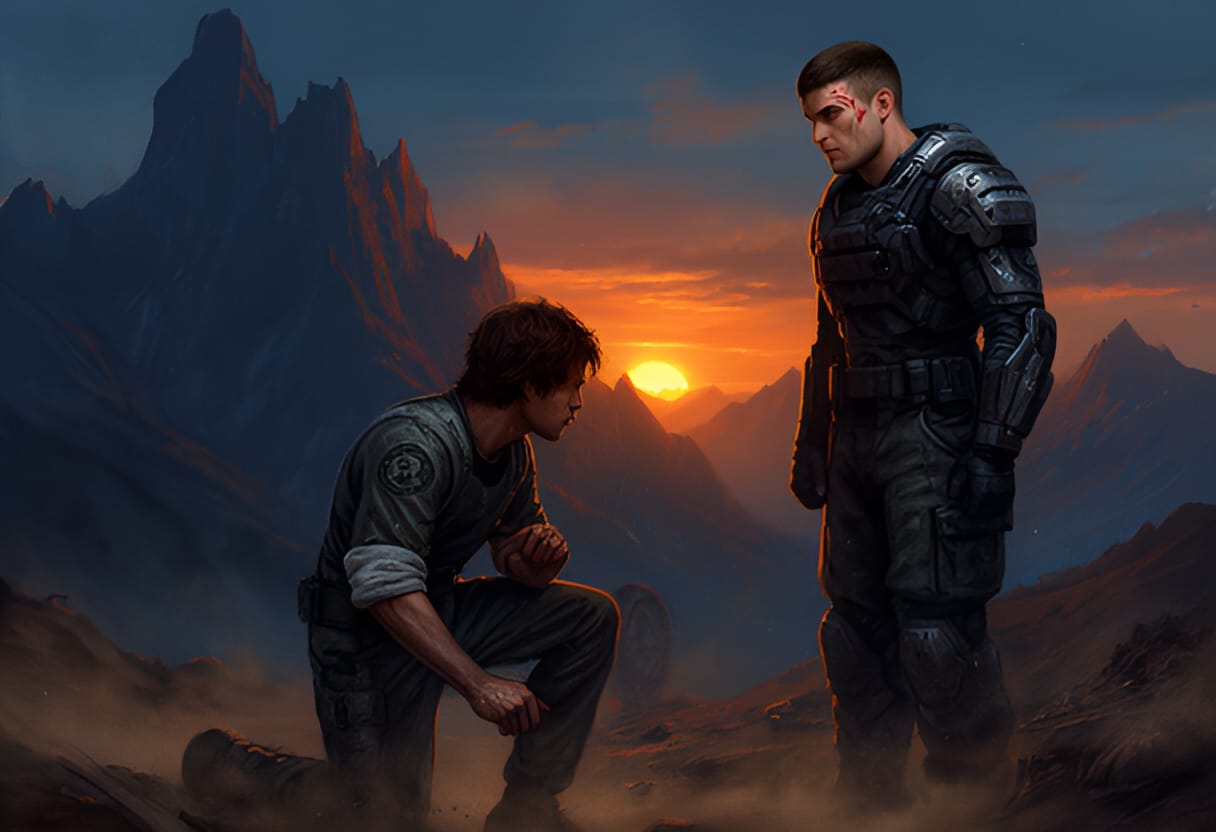
Chapter 23
The Thread
Alex’s breath hitched as his cane skittered on the loose shale, sending a jolt up his scarred ribs. He gripped it tighter, knuckles white, and forced his weight onto the bad leg. Sweat beaded at his temples despite the chill wind slicing across the plateau. Around him, the rookies stumbled through the drill—low crawls, weapon checks, sector sweeps—but their movements were sharp, fueled by adrenaline and the blunt instruction of sergeants who hadn’t seen the Hollows breathe.
Zay matched his pace without breaking stride. He didn’t look over. Just shifted his own weight slightly, letting his left shoulder brush Alex’s right as they moved. The contact was brief, but Alex leaned into it, letting the tension in his shoulders ease a fraction. His breathing slowed, not because the exertion lessened, but because the weight was shared.
Later, behind the sandbagged line of the outpost’s perimeter, Alex knelt in the dust, correcting a rookie who’d swept his sector too fast, eyes darting like a startled bird.
“You’re looking for movement,” Alex said, voice rough but clear, “but you’re not seeing what’s already there.” He tapped the rookie’s chest plate. “Your buddy’s six. If he’s down, you’re blind. If he’s scared, you’re deaf. Check him first. Then the horizon. Then him again. It’s not procedure. It’s how you stay alive.”
The rookie nodded, eyes wide, and mimicked the motion—slow, deliberate, hand dropping to check his imaginary partner’s shoulder before scanning outward. Alex watched him a beat longer, then rose, his cane tapping a soft rhythm against the stone. He didn’t smile. But his posture loosened, just a little, as he fell into step beside Zay again.
The sun hung low, a molten coin sinking behind the jagged teeth of the Jacinto plateau. Long shadows stretched across the training field, swallowing the discarded ammo cans, the frayed ropes, the scorch marks from weeks of live drills. The air smelled of gun oil, dust, and the faint, metallic tang of old blood soaked into the earth.
They stopped at the western ridge, where the wind dropped and the light turned honey-gold, the same shade Alex had once described peeking through the sycamores in Mercy. Zay didn’t speak. He simply shifted his weight, turning his body into a shield against the breeze, and waited.
Alex leaned into him without hesitation, his head finding the familiar hollow of Zay’s shoulder. His breath warmed the fabric of Zay’s jacket, shallow but steady. The cane rested between them, forgotten.
“We made it back,” Alex whispered, so low Zay almost missed it over the wind’s sigh.
Zay’s throat tightened. He didn’t trust his voice. Instead, he turned his face into the wind, letting it carry the moisture from his eyes, and gave the smallest nod—chin down, eyes forward—acknowledging the words, the silence between them, the years compressed into this single breath.
Alex’s fingers curled lightly against Zay’s arm, not gripping, just holding. Like a promise kept. Like a thread, frayed but never broken, pulled taut through fire and dark, now resting in the light.
The wind shifted, carrying the scent of burning scrub from the eastern ridges where a patrol had engaged a splinter group of Locust stragglers earlier that morning. Alex shuddered—not from cold, but from the sudden, sharp memory of Kryll wings tearing through dusk, the sound like wet silk snapped over bone. His grip on Zay’s arm tightened, just for a second, before he forced himself to breathe slow, to feel the rise and fall of Zay’s chest beneath his cheek, the steady thump of a heart that had never stopped beating for him.
Zay didn’t move. Didn’t speak. Just let his brother anchor himself in the rhythm of his presence, the way he had in the med tent, the way he had in the dark tunnels when the world had narrowed to the space between two sets of boots on damp stone. He remembered how Alex had clung to him then—not with words, but with the press of a forehead against his shoulder, the ghost of a whisper lost to the roar of engines and distant screams. Back then, it had been survival. Now, it was something quieter. Something earned.
A whistle cut through the air—sharp, three short blasts. Recall. The rookies snapped to attention, snapping salutes that were still a little stiff, a little overeager, but genuine. Zay straightened, shifting his weight onto both legs, the old ache in his left knee flaring as he bore his full weight. Alex pushed off gently, using the cane to lever himself upright, his face already smoothing into the mask of command—eyes alert, jaw set, voice ready.
“Fall in!” he called, his voice hoarse but carrying. “After-action in five. Hydrate, check your gear, and for the love of all that’s holy, actually look at your buddy’s face when you talk to him.”
A few chuckles rippled through the ranks. Not mocking. Recognizing. They’d heard the line before. Knew it wasn’t just about sector checks. Knew it was about seeing the flinch, the swallowed fear, the silence that came before a breakdown. Alex had drilled it into them—not as doctrine, but as desperation turned into discipline. He’d seen what happened when you didn’t look. When you assumed the person next to you was fine because they weren’t screaming. He’d seen it in the eyes of kids who hadn’t even shaved yet, staring blankly at walls after their first real contact. He’d seen it in his own reflection, in the weeks after Ephyra, when he couldn’t look at Zay without wondering if the hands holding him were real or just another trick of the Hollows.
Zay fell into step beside him as they walked back toward the command tent, the rookies falling into formation behind them. The platoon sergeant, a grizzled gear named Hale with a missing fingertip and a permanent scowl, fell in on Alex’s other side, nodding in silent acknowledgment. No words were needed. Hale had seen what the Lopez twins carried. He didn’t pry. He just made sure the line held.
Inside the tent, the air was thick with the smell of sweat, rubber, and the sharp tang of disinfectant wipes pulled from loose crates. A map of the Jacinto corridor was pinned to the center table, weighted down by spent shells and a chipped mug that still bore the faded insignia of the 26th RTI. Alex set his cane against the leg of the table and began to speak, his voice low but clear, cutting through the fatigue in the room.
“Today wasn’t perfect,” he said. “Rossi, you dropped your mag during the reload drill. Hale’s already on you about it. But I saw you check Dorner’s seal before you even looked for the next target. That’s the habit we’re building. Not because it looks good on a report. Because when the shit hits the fan—and it will—you won’t be thinking about your ammo count. You’ll be thinking about whether the person next to you is still breathing.”
He paused, letting it sink in. His eyes swept the room, meeting each rookie’s gaze in turn. Some looked down. Some met his stare, unblinking. He saw the ones who were still carrying the weight of what they’d seen—even here, so far from the front, the war hadn’t left them. It lived in the way they jumped at loud noises, in the way they checked their corners twice, in the way they hesitated before speaking to a superior, as if expecting a blow.
“And Torres,” Alex continued, pointing to a young woman with a braid tucked inside her helmet strap, “you held your sector like a wall. Good. But when Hale called for fire, you didn’t shift your weight to absorb the recoil. You braced like you were holding a shield, not a rifle. That’s gonna hurt your shoulder—and worse, it’s gonna cost you time. Next time, bend with it. Let the gun move through you, not against you.”
Torres nodded, her face flushing slightly. “Yes, Corporal.”
Alex turned to Zay then, just for a second. “You good on the flank drill tomorrow?”
Zay gave a single nod. “Always.”
The word hung between them—not a promise, not yet. Just an acknowledgment. A constant. Like the sun rising, like breath in the lungs, like the weight of a brother’s shoulder when the world tilted.
After the briefing, the rookies filtered out, still buzzing with nervous energy. Hale stayed behind, wiping his hands on a rag that had once been white.
“They’re listening,” he said. “Not all of them yet. But enough. You’re getting through.”
Alex leaned against the table, the cane tucked under his arm. “I just don’t want them to learn the hard way. Like we did.”
Hale snorted, a short, sharp sound that lacked humor. “Nobody learns it any other way. You just hope they live long enough to forget what it felt like to learn it.”
Alex didn’t answer. He was staring at his hands—calloused, scarred, the knuckles on his right hand still stiff from the Kryll encounter months ago. He’d lost sensation in the tip of his index finger. Sometimes, when it was cold, he couldn’t feel the trigger at all. He’d started wrapping the grip with tape, building it up so he could still find the sweet spot by feel alone. Zay had noticed. Had said nothing. Just started leaving a roll of friction tape on Alex’s bunk every morning.
“You still dreaming?” Hale asked, nodding toward Alex’s hands.
Alex looked up. “Not like before. Not the falling. Not the dark.”
“Then what?”
Alex hesitated. The memory came unbidden—a sycamore tree, its leaves gold in the late afternoon light, the bark warm under his palms as he climbed. The sound of laughter—his own, Zay’s, faint and distant, like it was coming from underwater. The weight of a peach in his palm, fuzzy and heavy, the juice running down his wrist as he bit into it. And then—nothing. Just the sudden, sickening lurch of air vanishing beneath his feet.
“I dreamt of the orchard again,” he said quietly. “But this time… I didn’t fall.”
Hale waited. When Alex didn’t go on, he prompted gently. “And?”
“I was standing under the tree. Zay was there. He handed me a peach. Didn’t say a word. Just… pointed up. At the branches. Like he wanted me to see how full they were.”
Hale nodded slowly. “That’s not a bad dream.”
“No,” Alex said. “It’s not. But it’s not real, either. Not anymore.”
“Maybe not,” Hale said. “But it’s true. And sometimes, that’s enough.”
Alex looked at him, really looked—past the scars, the fatigue, the weight of command. He saw the man who had held the line at the tunnel mouth, who had shoved a Boltok into his hands when his own had jammed, who had roared defiance at a Boomer twice his size. He saw the gear who hadn’t hesitated, even when the odds were insane.
“Thanks, Sergeant,” Alex said.
Hale waved it off. “Just doing my job. Now go on—get off that leg before you wreck it proper. And tell your brother… tell him I said to stop carrying the whole damn war on his back. He’s not invincible. Even if he acts like he is.”
Alex managed a ghost of a smile. “I’ll tell him.”
As Hale ducked out of the tent, Alex pushed himself upright, testing his weight on the bad leg. It throbbed—a deep, dull ache that had settled in the bone since the Boomshot fragment had lodged near his hip. Surgeons had left it in. Said removing it risked more damage than it was worth. He’d learned to live with it. To work around it. Some days, it was just a reminder. Others, it felt like a countdown.
He found Zay outside, leaning against the supply crate, cleaning his Lancer with methodical care. The chainsaw was disengaged, the barrel wiped down, the magazine seated and tapped twice—ritual, not necessity. Zay moved like he was checking in with an old friend. Making sure everything was still there. Still working.
Alex approached slowly, the cane tapping a soft counterpoint to the wind. “Hale says you’re carrying too much.”
Zay didn’t look up. Just gave the chainsaw a final tug, making sure it was seated right. “He’s wrong. I’m carrying what needs carrying.”
Alex stopped beside him, resting his weight on the cane and his good leg. “You don’t have to do it alone, you know.”
“I know.” Zay finally looked at him, his eyes dark and steady. “But I choose to. Not because I have to. Because I want to. Because when I’m holding the line, I know you’re safe behind it.”
Alex swallowed. The words hit him like a physical thing—warm, heavy, real. He thought of the tunnel mouth, of the Locust swarming over the rim, of Zay standing alone after he’d gone down, the Lancer spinning in his grip like a scythe. He thought of the weight of Alex’s body in his arms when they’d pulled him from the processing chamber, the way his breath had come in wet, shuddering gasps. He thought of the promise they’d made as kids, sprawled in the orchard grass, sticky with peach juice, swearing they’d always find their way back to each other.
“I know,” Alex said, his voice thick. “And I’m not gonna make you choose. Not anymore.”
Zay studied him for a long moment. Then, slowly, he reached out—not to touch, not yet—but to let his hand hover near Alex’s elbow, as if measuring the distance between them, the space that had once been filled with fear and silence and the awful, widening gap of almost-lost.
Then he closed it. His palm settled on Alex’s forearm, warm and firm, the calluses rough against the skin. Not a grip. Not a hold. Just contact. A point of connection.
Alex leaned into it, just slightly. Let the pressure ground him. Let the warmth seep into the chill that had been creeping in since the sun dipped below the ridge.
“I had the dream again,” he said, quieter now. “The orchard. But this time… I didn’t need the peach to know it was real.”
Zay’s thumb brushed once, slowly, over the tendon in Alex’s arm. “Then it is.”
They stood like that for a long while—two brothers, two gears, two survivors—standing on the edge of the world as the last light bled out of the sky. The wind had died. The air was still. Somewhere, a night bird called. The first stars pricked through the violet dark.
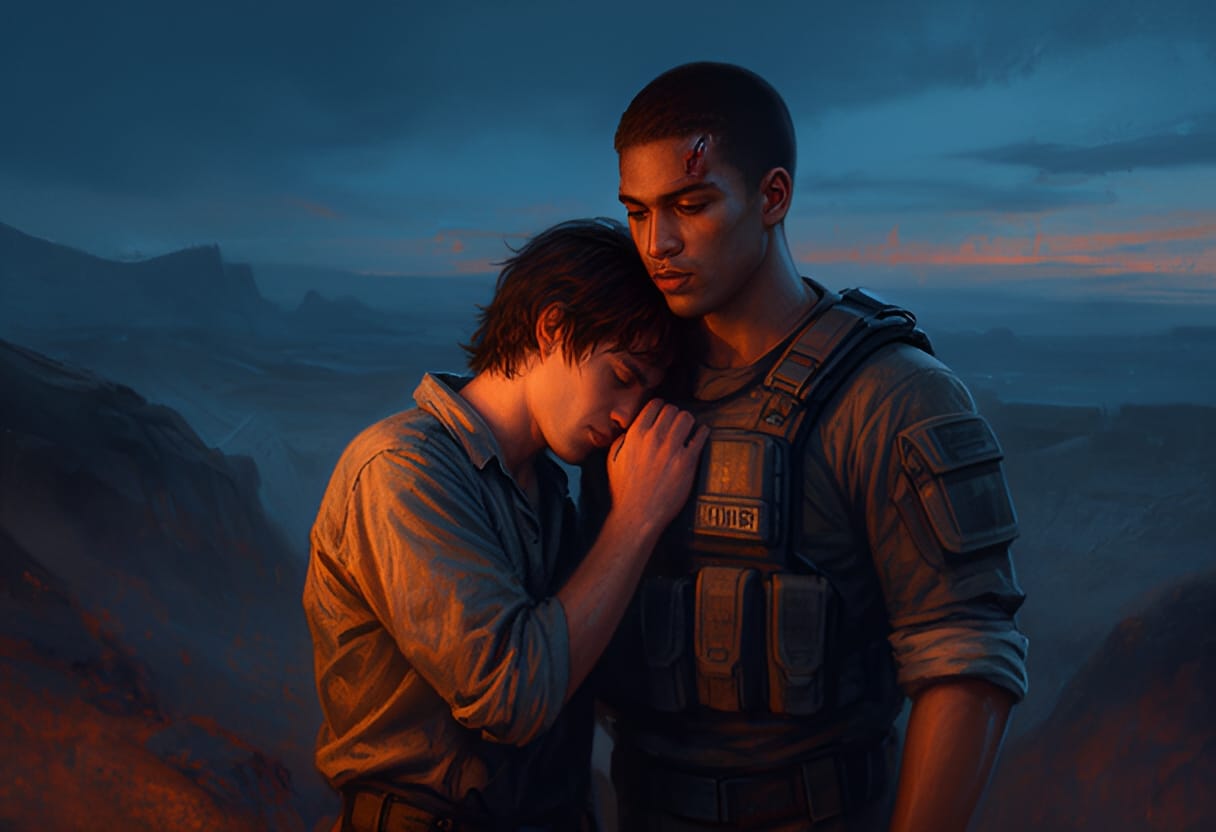
Inside the tent, the lanterns were being lit. Outside, the perimeter guards shifted their weight, eyes scanning the dark. The war wasn’t over. It never really would be. The Locust still pushed. The Hollows still whispered. The scars—inside and out—would always be there.
But here, now, on this ridge, with the earth solid beneath their boots and the weight of a brother’s hand on his arm, Alex felt something he hadn’t felt in a long time.
Not safety. Not peace.
But home.
Zay finally pulled his hand back, not abruptly, but gently, as if laying down a tool after a long day’s work. He picked up his Lancer, cradling it against his chest like it was something precious. Something worth protecting.
“Ready to head in?” he asked.
Alex nodded. He didn’t reach for the cane right away. First, he pushed off from the crate, testing his balance on his own two feet. It wobbled. He stumbled slightly, but didn’t fall. He caught himself, laughing softly—a short, breathless sound that surprised even him.
“Still got it,” he muttered.
Zay smirked. “Just barely.”
They walked back to the tent together, side by side, the cane swinging loose in Alex’s hand. Not a crutch. Not yet. Just… there. Like the past. Like the promise. Like the thread that had pulled them through the dark and into the light—frayed, yes, but never broken.
And as they stepped through the flap into the warm glow of the lanterns, the sound of low voices, the shuffle of boots, the quiet camaraderie of soldiers who had seen too much but were still standing—Alex didn’t look back at the ridge.
He didn’t need to.
He could still feel it.
The wind.
The light.
The weight of his brother beside him.
And the quiet, unshakable knowing that, no matter what came next, they would always find their way back.
The air inside the recovery tent was thick with the scent of antiseptic and damp wool, the low murmur of voices a familiar lullaby after months of silence. Alex eased himself onto the edge of his cot, the springs groaning in protest. He didn’t bother with the blanket yet—just sat, letting his weight settle into his bones, feeling the familiar ache in his ribs and the deep, hollow throb in his leg where the Boomshot fragment still lived. It wasn’t sharp anymore. Not like the first weeks, when every step felt like walking on glass. Now it was a constant, low-grade reminder: you were here. You almost didn’t make it.
Zay moved to the foot of the cot, setting his Lancer down with care against the frame. He didn’t ask if Alex wanted help. He never did anymore. Instead, he began untying the laces of his own boots, slow and deliberate, the rhythm of it a quiet language between them—I’m here. I’m not going anywhere.
Alex watched his hands for a moment—strong, scarred, the nails bitten quick from stress. He remembered those same hands, years ago, pressing a half-ripe peach into his palm after they’d snuck into the orchard behind the mill. The juice had run down his wrist, sticky and sweet, and Alex had laughed, trying to lick it off before their ma caught them. Zay had just shaken his head, smiling, and wiped Alex’s chin with his thumb.
“You still taste it sometimes, don’t you?” Alex said softly.
Zay paused, lace halfway loose. He looked up, eyes searching Alex’s face—not probing, not pushing, just seeing. “The peach?”
“Yeah. The taste. The smell of the bark. The way the light hit the leaves late in the day.”
A ghost of a smile touched Zay’s mouth. “All the time. Especially when the wind shifts just right. Smells like earth and sugar.”
Alex nodded, letting his head fall back against the cot’s thin pillow. He closed his eyes. For a moment, he wasn’t in the tent. He was ten years old again, barefoot in the grass, the sun warm on his neck, Zay ahead of him, already halfway up the sycamore, calling down to toss him another peach before he’d even finished the first.
“You ever think we dreamed it all up?” Alex asked, voice low. “The orchard. The peace. The… the before.”
Zay finished with his boot, setting it neatly beside the cot. He didn’t answer right away. He pulled off the other, then stood and walked to the flap, pulling it closed just enough to dull the outside noise but not shut it out completely. The sound of distant laughter—a rookie telling a joke, flat and forced—drifted in. Somewhere, a medic sighed, shifting in their chair.
“No,” Zay said finally. “I don’t think we dreamed it. I think we remembered it. And that’s the difference.”
Alex opened his eyes. “How so?”
Zay leaned against the frame, arms crossed, the firelight from the lantern catching the edge of his jaw, the faint silver at his temples. “A dream fades when you wake. A memory… you carry it. Even when it hurts. Especially then.”
Alex thought of the Kryll—the way they’d swallowed the light, how the dark had felt alive, hungry. How in that blackness, he’d had the dream again—not of falling, but of being caught. Of Zay’s hands on his arms, steady, saying nothing, just holding. He’d woken gasping, not from fear, but from the sudden, shocking certainty that he wasn’t alone. That even in the dark, even when he couldn’t see or breathe, Zay was there.
“I felt you,” he said quietly. “In the dark. When I couldn’t breathe. I felt your hands.”
Zay pushed off the frame and came to sit on the edge of the cot, not touching, just near enough that Alex could feel the heat of him. “I was there,” he said. “Not in the way you think. Not literally. But… I was thinking of you. All the time. Every second I could, I was holding you in my mind. Like… like I was keeping a space open for you to come back to.”
Alex swallowed. His throat felt tight. He reached out, not thinking, and found Zay’s hand. It was warm. Calloused. Alive.
“I kept thinking,” Alex continued, voice rough, “that if I let go… if I stopped fighting to stay conscious… I’d lose you. Not just you. Us. Like we’d never been real at all.”
Zay turned his hand over, lacing their fingers together—not tight, not desperate, just… connected. The way they had as kids, when they’d cross the street or walk through the market, fingers threaded like it was the most natural thing in the world.
“You didn’t lose me,” Zay said. “You never could. Even when you were gone, you were still you. And I was still looking for you.”
Alex squeezed his hand. Just once. Then he let his head fall to the side, resting his temple against Zay’s shoulder. The fabric of his shirt was worn thin at the elbow, soft from washing. He could feel the steady beat of Zay’s pulse through the cloth—strong, sure, a rhythm older than fear.
Outside, the wind picked up, rattling the loose panel on the supply tent. A laugh rose from the barracks—brief, abrupt, cut off like someone had remembered where they were. The war hadn’t left them. It never would. But here, in this small space, with the lantern light throwing long shadows and the sound of their breathing syncing—slow, deep, steady—it felt, for the first time in a long time, like they were not just surviving.
They were living.
Alex didn’t know how long they stayed like that—just two brothers, hands clasped, foreheads nearly touching, the world reduced to the space between their breaths. Time didn’t matter here. It never had, not really. What mattered was the weight of a hand in yours. The sound of a voice saying your name without saying it. The quiet certainty that, no matter how far you fell, how deep the dark, how long the night—you would be met.
Eventually, Zay shifted slightly, lifting his head. “You should lie down. Get some rest.”
Alex didn’t want to move. But he knew Zay was right. The day had been long. The drill had taken more out of him than he’d admitted. His leg was aching in earnest now, a deep, dull pulse that matched the throb behind his eyes.
He eased back onto the cot, pulling the blanket up to his waist. Zay tucked the corner under his heel, just like he used to when they were kids sharing a narrow bunk back home—always making sure the other’s feet were covered, even if his own stuck out.
“You good?” Alex asked, voice already sliding toward sleep.
Zay adjusted the lantern, turning the wick down until the light softened to a ember-glow. “Yeah. I’m good.”
“Promise?”
Zay smiled—just a twitch at the corner of his mouth. “Always.”
Alex let his eyes close. The last thing he felt was Zay’s hand, still resting lightly on his ankle, the pressure warm and grounding. The last thing he heard was the quiet creak of the cot as Zay shifted, settling in for the long watch—not because he had to, but because he chose to.
And as the darkness took him, Alex didn’t dream of falling.
He dreamed of walking.
Sun-warmed stone under his boots. The scent of rain on dry earth. The sound of his brother’s voice, close behind him, saying nothing at all—just there.
And when he opened his eyes again, whether in sleep or waking, he knew he wouldn’t be alone.
The lantern’s ember-glow had long since faded to nothing, and the cot creaked only when Zay shifted his weight, a slow, deliberate roll onto his back. Alex’s breathing had deepened, even, the kind of sleep that came not from exhaustion alone, but from safety—a rarity they had learned to cherish like dry socks and a full belly. Zay kept his hand resting on Alex’s ankle, thumb tracing slow circles over the wool of the sock, a habit formed in the dark hours after the tunnel, when the only thing keeping him from unraveling was the proof that his brother was still there, still warm.
Outside, the wind had died. The supply tent stood still against the night, its canvas no longer rattling, the distant laugh from the barracks swallowed by the quiet. Somewhere, a sentry’s boots crunched on frozen gravel, a sound so regular it became part of the dark, like the slow blink of a distant star.
Zay did not sleep. He watched the rise and fall of Alex’s chest beneath the blanket, the way the scar tissue along his ribs pulled tight with each inhale, then softened. The Imulsion poisoning had left its mark—not just in the lungs, but in the way Alex now moved, more carefully, as if measuring each breath against a hidden cost. But he was here. He was warm. He was alive.
And for the first time in months, Zay allowed himself to believe it might last.
He did not know how long he lay there, listening to the quiet, to the soft hiss of Alex’s breath, to the distant, irregular pop of the stove in the med tent as it cycled off. The lantern was stone-cold now, but the residual warmth of the metal lingered under his palm when he shifted to adjust the blanket higher on Alex’s shoulder. His own body ached—a deep, dull throb in his left ribs where the Boomshot fragment had lodged, a stiff ache in his jaw from the night he’d clenched his teeth against the pain—but it was distant, background noise. His mind, usually a scroll of threats and tactics, was blank. Or nearly so. It clung only to the sensation of Alex’s sock under his thumb, the smell of stew and lanolin on the blanket, the steady pressure of his brother’s presence beside him.
He thought of the dream Alex had described—not the falling, but the being caught. Of Zay’s hands on his arms, steady, saying nothing. He had dreamed it too, in fragments, during the brief, stolen moments of sleep between watches. Not as a vision, but as a feeling: the weight of a hand on his shoulder, the echo of a voice saying breathe, not in his ear, but in his blood. He had woken from those not with terror, but with a fierce, aching tenderness, as if his soul had been bruised by kindness.
He had not told Alex that. Not yet.
The first true light of dawn came not with a burst, but a slow seep—gray at the edges of the tent, then a faint gold along the seam where the flap met the ground. It crept across the floor, crawled up the cot’s frame, and finally touched the blanket near Alex’s face, turning the wool to silver.
Alex stirred. Not a waking, not yet, but a shift—his brow unfurrowed, his lips parting just enough for a quiet exhale. His fingers, loose at his sides, twitched once, then stilled.
Zay did not move. He let the light come, let it paint his brother’s face in soft relief—the sharp line of his jaw, the faint shadow under his eyes, the way his lashes caught the light like threads of frost. He looked… younger. Not the boy who had slipped in the creek at Targas, not quite, but the version of himself that had existed before the dark had learned his name.
A sound came from Alex’s throat—low, rough, like stone dragged over stone. Then, so quiet Zay almost missed it: “Mmm… peaches.”
Zay froze. Not because it was unexpected—he had heard Alex mumble about food in his sleep before—but because it was specific. Peaches. Not stew. Not tea. Not the bland, reconstituted rations they choked down by the dozen. Peaches. Juicy. Sun-warmed. The kind that dripped down your chin and made your fingers sticky.
He remembered. The orchard behind the old mill. The one with the crooked sycamore that leaned over the wall like it was trying to climb back into the sky. The one where they’d stolen fruit after chores, their mother pretending not to see, their father grumbling about wasted harvest but always saving them the ripest two, wrapped in a cloth and tucked into their lunch pails.
Alex had dreamed of that tree. Not just once. He’d mentioned it, voice thick with sleep, during the long nights in the med tent: I was in the orchard… Zay, you were laughing… I fell…
And then, later, when he’d been stronger: You caught me. Your hands… like rain on dry earth.
Zay had not spoken of it. He had not dared. To name it felt like inviting the dark back in—to say, Yes, I remember that too, and risk unraveling the fragile thread of now.
But Alex had said it again. In his sleep. Peaches.
Zay’s throat tightened. He swallowed, the motion rough, as if he’d swallowed sand. He did not wake him. He did not speak. He only turned his hand, palm up, and let his fingers rest lightly on the blanket near Alex’s hip—close, but not touching. A signal, if he dreamed of falling again. An anchor.
He lay there until the light grew stronger, until the tent’s fabric glowed amber, until Alex’s breathing hitched—not in distress, but in the slow, soft ascent toward waking.
Then, at last, Alex’s eyes opened.
They were glassy at first, unfocused, the blue dulled by sleep. But they cleared, slowly, as if surfacing from deep water. He blinked. Once. Twice. Then turned his head, just enough to meet Zay’s gaze.
“Morning,” Alex said. His voice was dry, hoarse from disuse, but recognizable. Steadier than it had been weeks ago. Stronger.
Zay managed a smile. “Morning.”
Alex licked his lips. “You still here?”
Zay’s smile widened, just a fraction. “Never left.”
Alex nodded, slow, as if confirming a fact long in doubt. He shifted, wincing slightly as his weight came onto his left hip—the side where the shrapnel had torn through muscle and tissue, where the scar now ran thick and pale. He pushed himself up onto his elbows, grimacing, then paused, one hand braced on the cot, the other pressed to his ribs.
“Easy,” Zay said, already moving to help, but Alex shook his head.
“I got it.” He grunted, lifted himself further, swung his legs over the side. His feet touched the floor—bare, calloused, instantly chilled by the stone. He inhaled sharply, not from pain, but from the cold. “Shit. Forgot how cold it gets before the stove kicks in.”
Zay chuckled, soft. “Yeah. Forgot.”
Alex sat there for a moment, bare feet on the floor, hands on his knees, head bowed. Then he lifted his head, looked at Zay, and said, quiet but clear: “I dreamed of the orchard again.”
Zay’s breath caught. Not surprise—he had expected it—but the sheer, quiet courage of it. To say it aloud, after all this time, after the dark had tried to steal even the memory of sweetness.
“Yeah?” he prompted, keeping his voice low, even.
Alex nodded. He looked down at his hands—calloused, scarred at the knuckles from weeks of gripping a Lancer too tight, from pulling triggers, from hauling ammo, from holding onto his brother when the world had tried to pull them apart. “Same as before. The sycamore… leaning over the wall. The light through the leaves… like honey. You remember?”
“I remember,” Zay said. His voice was rough. He cleared his throat. “You were in the tree. I was on the ground.”
Alex let out a short, humorless laugh. “Yeah. And I fell. Again. But this time… you didn’t just catch me. You held me. After. You didn’t let go.”
Zay’s eyes burned. He looked down at his own hands—larger, scarred, the nails bitten quick from stress, the knuckles split and healed a dozen times. These hands had thrown grenades, dragged wounded, choked the life from a Drone with his bare fingers when his knife had snapped. And yet, in Alex’s memory, they were gentle. They were safe.
“I didn’t let go,” Zay said. His voice dropped, dropping into the space between them, intimate as a secret. “I won’t. Not again.”
Alex looked up then, and his eyes were bright—not with tears, not quite, but with something deeper. Something that had been buried under coughs and pain and the constant, grinding fear that the next breath might be the last. “Good,” he whispered. “’Cause I don’t wanna fall without you there to catch me.”
Zay reached out then—not for his ankle, not for his shoulder, but for his hand. Alex turned his palm up without hesitation, and their fingers laced, just as they had in the med tent, just as they had as boys crossing the street in Mercy, just as they had in the dark, endless hours after the Kryll had taken the light.
They sat like that for a long time—brothers, fingers threaded, shoulders nearly touching, the cold stone floor seeping into their bare feet, the tent filling with the first true light of day. No words were needed. The silence was not empty. It was full—of orchards and rain on dry earth, of stolen fruit and shared chocolate, of a promise made in childhood and remade in the wreckage of war.
Always will.
Eventually, Alex shifted, pulling his hand free just enough to rub at his eyes with the heel of his palm. “My leg’s stiff,” he muttered. “And my lungs feel… full. Like I breathed in cotton.”
Zay nodded. “We’ll get you up slow. Stretch first. Then we’ll see how far you can make it to the latrine without the cane.”
Alex made a face. “You sound like a damn medic.”
“I am, when you’re being stubborn.” Zay stood, offering a hand. Alex took it, hauled himself up, and swayed slightly—just a fraction—but caught himself on Zay’s forearm, his grip tight, his breath shallow for a moment before evening out.
“Thanks,” Alex said. Not just for the steadying. For the seeing. For not letting him pretend he was fine when he wasn’t.
Zay squeezed his forearm. “Anytime.”
They moved slowly to the small bench by the tent’s entrance, where Zay had left Alex’s cane the night before—a simple length of reinforced polymer, wrapped in grip tape at the top, the tip worn smooth from use. Alex took it, tested his weight, then nodded. “Good. Holding.”
They stepped outside.
The air was sharp—icy, clean, smelling of stone and distant snow. The sky was a vast, pale bowl, the stars gone, the sun just cresting the horizon in a ribbon of peach and gold. It lit the edge of the plateau, turned the scrub grass to flame, made the distant spires of Jacinto glow like embers.
They did not head toward the drill field. Not yet.
Instead, Zay led Alex a few paces off the path, to a low rise where the wind had scoured the ground bare of snow, leaving only frozen earth and tufts of tough, gray grass. They sat side by side on the cold stone, not speaking, just breathing—Alex’s slow and deliberate, Zay’s easier, but matched in rhythm all the same.
Alex leaned his cane against his shoulder, stared out at the waking world, and said, so quiet Zay had to lean in to hear: “I keep thinking… about the smell. After rain. On dry earth. You remember that?”
Zay closed his eyes. Yes. He remembered. The orchard behind the mill, the day they’d climbed the sycamore to get the highest peaches, the sudden downpour that had sent them laughing into the mud, the way the steam had risen from the sun-warmed stone as the rain hit, carrying the scent of wet soil and crushed wormwood and something sweet, like overripe fruit.
“I remember,” he said. “It smelled… alive.”
Alex nodded. “Yeah. Alive. Not… not hungry. Not waiting. Just… there. Like the world was breathing with us.”
A long pause. The wind stirred, lifting a few dry leaves and sending them skittering across the stone. Somewhere in the distance, a Reaver cried—a harsh, guttural sound that made both of them twitch, just slightly, before forcing themselves to relax. The war was not gone. It would never be gone. But here, on this ridge, with the sun warming their faces and the silence between them thick with understanding, it felt… distant. Like a dream they had both survived.
Zay turned his head. Alex’s profile was sharp in the morning light—the line of his nose, the curve of his jaw, the faint scar above his eyebrow from a shrapnel graze weeks ago. He looked tired. But he looked present. And that, Zay realized with a sudden, fierce clarity, was its own kind of victory.
“I’ve been thinking,” Zay said, his voice low, rough from disuse, “about after.”
Alex turned his head slightly, eyes narrowing—not in suspicion, but in curiosity. “After what?”
“After this.” Zay gestured vaguely at the plateau, at the distant city, at the sky. “After the Locust are gone. After the war… if it ever really ends.”
Alex was silent for a long time. Then, softly: “You wanna talk about it?”
Zay hesitated. He had not allowed himself to think this way in months. Not since the med tent, not since Alex had first opened his eyes and said, I felt you in the dark. To hope felt dangerous. Like lighting a match in a room full of gas. But Alex was here. Alex was speaking. And if anyone deserved to imagine a future, it was him.
“I don’t know,” Zay admitted. “I’ve been so focused on… keeping us alive. Keeping you breathing. I haven’t let myself picture… anything else.”
Alex nodded, as if he understood exactly what that meant. “Yeah. Me neither. Too much to lose if you let yourself hope and then it gets taken.”
Zay turned fully toward him, resting his elbows on his knees, hands dangling between them. “But… what if it doesn’t? What if we… make it?”
Alex considered this. He looked out at the horizon again, where the sun now sat higher, painting the clouds in streaks of rose and amber. Then he said, quiet but firm: “I dream of the orchard. Not just the tree. The whole place. The mill. The creek behind it. The way the water sounded over the rocks—like laughter, almost.”
Zay smiled. “You used to skip stones there. Never could get more than two skips.”
Alex let out a soft laugh. “Yeah. You were always better. Said it was in the wrist. I just threw like I was mad at the rock.”
“I remember,” Zay said. His voice thickened. He cleared his throat. “You’d get frustrated, kick the dirt, then sit down and watch me try. Said you were studying my form.”
Alex looked at him, eyes soft. “I was. You made it look easy.”
A beat. Then Alex said, quieter: “I don’t know if we’ll ever get back there. If the mill’s still standing. If the trees survived.”
Zay shook his head. “Doesn’t matter. Not really.”
Alex frowned. “How doesn’t it matter? It’s home.”
“Because home isn’t the place,” Zay said. He turned to look at his brother, really look at him—the faint silver at his temples, the way his breath hitched slightly on the inhale, the calluses on his fingers from gripping weapons and tools and his brother’s hand. “Home is the person you’re with when you’re there. You said that yourself, remember? Under the first star. Making it back means being with the person you’re with, not reaching a place.”
Alex stared at him. Then, slowly, his expression softened. He looked down at his hands, then back up. “You really believe that?”
Zay met his gaze. “I believe you. And if you believe it… then I do too.”
Alex was silent for a long moment. Then he reached out, not for Zay’s hand this time, but for his forearm—just below the elbow, where the sleeve of his shirt was worn thin. He squeezed, once, firm and warm.
“Okay,” he said. “Okay. I believe it too.”
They sat like that for a while longer—brothers on a cold ridge at the edge of the world, the sun climbing higher, the air beginning to warm, the distant hum of the outpost stirring to life. No promises were made. No plans laid. No maps drawn. But for the first time since Emergence Day, they were not just enduring. They were imagining. And in that imagining, there was a kind of peace—not the absence of fear, but the presence of something stronger.
When they finally stood, it was not to return to duty, but to walk—slowly, side by side—back toward the bunker. Alex leaned on his cane, but less heavily than before. Zay walked close enough to catch him if he stumbled, but far enough to let him walk on his own.
They did not speak. They did not need to.
The orchard might be gone. The mill might be rubble. The sycamore might have fallen in some forgotten storm. But the scent of rain on dry earth lived in Alex’s breath. The weight of a brother’s hand lived in Zay’s grip. And as they crossed the threshold of the bunker, the flap falling shut behind them with a soft whuff, the cold outside did not touch them.
They were warm.
They were together.
And for now, that was enough.
The interior of the bunker was dim, the lanterns low, the air still and warm from their shared breath and the faint hum of the environmental recycler. Alex eased himself onto the cot, his movements slower now, each motion deliberate as if he were measuring the cost of every muscle twitch. Zay stood nearby, watching—not hovering, not overbearing, just present—his hands resting on his thighs, his weight balanced on the balls of his feet, ready to move if needed but not intruding.
Alex shifted, pulling the blanket higher, then let out a slow breath that fogged slightly in the cool air. “You ever think,” he began, voice low and rough from disuse, “about what we’d do if we weren’t… this? If we didn’t have to watch sectors or check buddies or flinch at loud noises?”
Zay considered it. He had thought of it, in fragments—during watch, in the quiet between heartbeats, when the weight of the rifle in his hands felt less like duty and more like a burden he was tired of carrying. But he had never let the thought fully form. Too dangerous. Too much like surrender.
“I think,” he said finally, “I’d miss it. Not the fighting. Not the fear. But… the purpose. Knowing every day exactly what you’re supposed to do. Even if it’s hard. Even if it hurts.”
Alex let out a humorless chuckle. “Yeah. Purpose. Like it’s some kind of gift. Feels more like a cage sometimes.”
“Maybe both,” Zay said. He sat on the edge of the cot, careful not to jostle him. “Maybe purpose is the cage that keeps you from falling apart when the world does.”
Alex turned his head to look at him, eyes searching. “You really think we’d fall apart without it?”
Zay met his gaze. He thought of the first weeks after E-Day—the way the twins had moved through the wreckage like sleepwalkers, numb, reacting, surviving on instinct and adrenaline and the fierce, unspoken agreement that they would not let go of each other. He thought of the nights Alex had screamed in his sleep, not from pain but from the dream of falling, of darkness swallowing him whole, of reaching out and finding only air. He thought of how, even now, Alex still woke sometimes with his hands clenched, his breath short, his eyes wide with a terror that had no name but knew its shape all too well.
“I think,” Zay said slowly, “that without something to focus on—something outside ourselves—we’d drown in the quiet. Not because we’re weak. Because we’ve seen too much. Done too much. Carried too much.”
Alex was silent for a long time. Then he said, so quietly Zay almost missed it: “I don’t wanna drown. I just… I wanna breathe without counting the breaths.”
Zay reached out then—not to touch, not yet—but to gesture toward the small window high on the wall, where a sliver of pale sky showed through. “You know,” he said, “when we were kids, Ma used to say the air after rain was the cleanest. Like the world had rinsed itself clean. Said if you stood still enough, you could feel it washing over you—taking the dust, the sweat, the bad thoughts.”
Alex’s lips twitched. “She also said if you stood still too long, you’d catch your death of cold.”
Zay smiled. “Yeah. She did. But she also said that was worth it, if it meant you remembered what clean felt like.”
Alex looked out the window, at the brightening sky, at the faint trail of vapor left by a distant King Raven heading north. His breath came easier now—not deep, not full, but steady. The ache in his lungs was still there, a dull pressure behind his ribs, but it no longer screamed. It merely was, like an old injury that ached when the weather changed.
“I think,” Alex said, “I’d like to stand in the rain someday. Just… stand. Let it hit my face. Not worry if it’s acid or if it’s carrying something worse. Just feel it.”
Zay nodded. “I’d stand with you.”
Alex turned to him then, really looked at him—his brother’s face, the faint lines at the corners of his eyes from squinting into sun and smoke, the way his jaw tightened when he was holding something back. “You know,” he said, “I used to be mad at you. Back in the tent. When you wouldn’t let me sleep. When you kept talking, kept making me answer, kept dragging me back when I wanted to just… let go.”
Zay’s breath caught. He remembered. The fever, the delirium, the way Alex had slipped toward the edge, his voice fading, his grip weakening. He had talked—not just to keep him awake, but to keep him there. To remind him of peaches and creeks and the way Ma’s stew smelled when it was just about ready to boil over.
“I wasn’t mad at you for keeping me alive,” Alex continued, voice thick. “I was mad because I thought… if I let go, maybe it would prove we weren’t real. That we were just… two halves of the same dream. That if I slept, I’d wake up and you’d be gone. Or worse—I’d wake up and realize I was the one who’d been gone all along.”
Zay swallowed. He had never known Alex felt that. Not in those words. Not with that kind of naked fear.
He reached out then, slowly, and took Alex’s hand. It was warm. Calloused. Alive.
“I’m real,” Zay said. His voice was rough, but steady. “You’re real. This”—he lifted their joined hands slightly, let them fall back to the blanket—“this is real. Not a dream. Not a trick. Not a Hollows-induced hallucination or a fever vision or whatever the hell your scared mind cooked up in the dark. This is us. Right here. Right now.”
Alex looked at their hands, then back up. His eyes were shiny, but he didn’t blink. Didn’t pull away.
“I know,” he whispered. “I know now. But it took a long time to believe it.”
Zay squeezed his hand. “Believe it. Not because I said so. Not because you dreamed it. But because you felt it. In the dark. When you couldn’t breathe. When you thought you were alone. You felt me. And that wasn’t imagination. That was… us. The thing that’s been true since before we could walk.”
Alex let out a shuddering breath—half laugh, half sob—and leaned his forehead against Zay’s shoulder, just for a moment. His breath warmed the fabric of Zay’s shirt, damp and soft.
“Thanks,” he murmured. “For not letting me float away.”
Zay rested his cheek against the top of Alex’s head, breathing in the faint scent of antiseptic and sweat and something deeper—something that smelled like home, like the orchard, like rain on stone. “Never,” he said. “I’d follow you into the dark a thousand times. And I’d pull you back every single one.”
They stayed like that for a long while—brother to brother, forehead to shoulder, hands locked, the world outside the bunker fading to a murmur. The tent did not shake. The wind did not howl. The distant thump of artillery was gone, if it had ever been there at all. There was only the sound of their breathing—slow, syncing, steady—and the quiet, persistent beat of two hearts that had refused to stop.
Eventually, Alex shifted, pulling back just enough to look at Zay’s face. “We should get up,” he said. “Drill starts in twenty. Rookies won’t watch themselves.”
Zay let go slowly, reluctantly. “Yeah. Guess we’d better.”
Alex swung his legs over the side of the cot, testing his weight. He wobbled once, just a fraction, and Zay was there—hand on his elbow, not lifting, not carrying, just there—until Alex found his balance again.
“Thanks,” Alex muttered, not looking at him.
Zay smiled. “Anytime.”
They moved to the small basin in the corner, where a kettle sat on a simmering stove. Zay poured two cups of weak coffee—more water than grounds, but warm, and it smelled like something familiar, something safe. He handed one to Alex, who wrapped both hands around the mug, drawing in the steam.
They drank in silence for a moment, the heat spreading through their chests, loosening the tightness in their shoulders.
Then Alex said, “You know… I’ve been thinking. About that farm you mentioned. Not tomorrow. Not next year. But… someday. If we get there.”
Zay looked at him. “Yeah?”
Alex nodded into his cup. “I don’t need much. Just… a patch of ground. A few trees. Maybe a creek nearby. Somewhere I can sit in the shade and not worry about what’s coming over the ridge.”
Zay felt something loosen in his chest—something tight and coiled that had been there since the first Boomshot blast, since the first time he’d seen his brother go down and not get back up right away.
“I think,” he said, “I could live with that.”
Alex glanced at him, eyes soft. “Me too.”
They finished their coffee. They cleaned the mugs. They checked their gear—not because they expected trouble, but because it was habit, and habit was the last tether to the world they had known. Then, side by side, they stepped back into the cold, bright air of the plateau.
The sun was higher now, sharp and clear, throwing long, clean shadows across the frozen earth. In the distance, the first recruits were assembling on the drill field, their voices sharp with nervous energy, their movements stiff but eager. Jace Stratton’s name was not spoken, but his presence was felt—in the way Zay checked his rifle’s chamber twice, in the way Alex paused to adjust a rookie’s grip on his Lancer, in the way both brothers moved with a quiet precision that had been forged in fire and sealed in blood.
They did not speak as they walked. They did not need to.
Alex leaned on his cane, but his step was steadier. Zay walked close, not to support, but to share the space—the brush of shoulders, the alignment of stride, the unspoken rhythm of two bodies that had learned, over years of war and worse, how to move as one.
They reached the edge of the drill field and stopped. Zay turned to Alex, opened his mouth to say something—be careful, watch your sector, I’ve got you—but Alex lifted a hand, just slightly, cutting him off.
“I know,” he said. His voice was quiet, but clear. “You don’t have to say it.”
Zay nodded. He didn’t say it. Instead, he lifted his own hand—not in salute, not in farewell, but in the old gesture, the one from childhood: palm open, fingers slightly spread, held just between them, not touching, but there.
Alex mirrored it. Their palms faced each other, a few inches apart, the space between them charged not with tension, but with something deeper—recognition. Trust. The quiet certainty that, no matter what came, they would meet in it.
Then Alex turned and walked onto the field, his cane tapping a steady rhythm on the frozen ground. Zay followed a half-step behind, his eyes scanning—not for threats, not yet, but for his brother’s back, for the way his shoulders held, for the rise and fall of his breath.
And as they moved into the drill, as the whistle blew and the recruits snapped to attention, as Alex began to speak—his voice hoarse but strong, teaching the rookies to check their sectors, to watch their buddies, to see each other—Zay felt it again, not as a thought, but as a truth settled deep in his bones:
They had made it back.
Not to a place.
Not to a time.
But to each other.
And that, in the end, was the only home they would ever need.
Zay adjusted the strap of his pack, the worn canvas familiar against his shoulder. The morning air was cool, carrying the damp scent of earth and something green—moss, maybe, or the sharp tang of crushed ivy underfoot. They had been walking for nearly an hour since leaving the outpost’s perimeter, the road behind them fading into the overgrown embrace of Ephyra’s ruins. No vehicles came this way anymore. No patrols. Just the wind through broken glass and the occasional shift of settling stone, like the city itself was exhaling after years of holding its breath.
Alex walked beside him, cane tapped in a slow, deliberate rhythm—left, right, pause—his breath audible but even, the old rasp softened by time and care. He didn’t lean on Zay now, not unless the ground pitched unexpectedly, but Zay still walked half a step behind, as he had on the drill field, as he had for years. It wasn’t about support anymore. It was about presence. About knowing, without needing to see, that his brother was there, steady, moving forward.
The ruins stretched ahead—neoclassical façades sagging into themselves, columns cracked like old bones, pediments half-swallowed by creeping vines. Ivy draped fire escapes and choked window frames, turning offices into green caves. Somewhere, a bird called—a sharp, bright note that cut through the silence and made Alex flinch, just slightly, his shoulders lifting before he forced them down. Zay saw it. He always saw it. But he didn’t speak. Not unless Alex did first.
They passed what had once been a mercantile district—shoppes with bowed signs and shattered display glass, now homes for nesting birds and fat, slow lizards that sunned themselves on warm stone. A fountain stood dry in a small plaza, its cherubic figures moss-covered and missing limbs, water long gone but the basin still holding rain, dark and still as a mirror. Alex paused at the edge, peered down, then smiled faintly.
“Used to toss pennies in here,” he said. “Make wishes.”
Zay stopped beside him. “What’d you wish for?”
Alex looked at him, eyes pale in the morning light. “Same thing every time. That we’d stay together.”
Zay felt the familiar warmth spread behind his ribs—not heat, not exactly, but something quieter, deeper. He nodded. “Me too.”
They moved on.
The school came into view ahead—a low, broad building with a flat roof and tall windows now darkened by grime and vegetation. The front steps were gone, collapsed inward, and the walls bulged in places where the roof had given way. Blackened scars marred the stone near the entrance—scorch marks from plasma fire, still visible after all these years, like the building remembered the heat. Vines had begun to creep over them, but not enough to hide the truth of what had happened here.
They stepped cautiously over the rubble, boots crunching on broken tile and twisted rebar. Inside, the air was cooler, shaded, smelling of damp plaster and rotting wood. Sunlight came in slants through the broken windows, catching dust in the air. The gymnasium—if it could still be called that—was open to the sky in one corner, where the wall had blown out. Bleachers lay on their sides, twisted metal like broken ribs. In the center of the floor, a few concrete pillars remained standing, scarred and pitted, their bases surrounded by debris.
Alex stopped near one of them, his hand outstretched, not touching, just hovering above the scorched surface. His breath hitched—just once—and Zay saw the flicker in his eyes, the brief return to smoke and screaming, to the smell of ozone and burning hair, to the weight of a child’s hand in his as they shoved her behind the pillar and prayed the Drones wouldn’t see them.
“You okay?” Zay asked, quiet.
Alex didn’t look at him. He swallowed, then let his hand fall to his side. “Yeah. Just… remembering how loud it was. How we thought we’d never get them all out.”
“We did,” Zay said. “Most of them.”
Alex gave a small, tight nod. “Yeah. We did.”
They moved through the rest of the building in silence—past classrooms where desks were overturned and books long since dissolved into pulp, past the cafeteria where the serving line was a twisted wreck of metal, past the principal’s office where a single frame still clung to the wall, its glass shattered but the image inside—a faded photograph of a woman in a floral dress—still discernible, smiling toward nothing.
Outside again, they stood for a moment on what remained of the sidewalk, looking down the street. The buildings leaned toward each other, roofs collapsed, streets buckled and split by roots. No signs of recent passage. No boot prints. No disturbed debris. Just the quiet of reclamation.
Zay glanced at Alex. “Ready?”
Alex nodded. He reached into his jacket and pulled out the notebook—small, battered, the cover worn soft at the corners, the spine taped with fraying black tape. He opened it carefully, as if afraid it might disintegrate in his hands. The pages were stained in places—water damage, maybe, or something darker. The handwriting was familiar: Alex’s slant, precise when he was focused, loosening when he was tired or hurt. But legible. Always legible.
They began walking again, toward the tunnel mouth.
It took them longer than it should have. The route was familiar, but the city had changed—streets rerouted by subsidence, alleys blocked by fallen façades, what had once been a main thoroughfare now a maze of debris and overgrowth. They paused twice to pick their way around collapsed structures, Alex testing his weight on uncertain footing before committing, Zay always there—not leading, not following, just alongside.
When they finally saw it—the yawning mouth of the tunnel, half-collapsed, concrete ribs exposed like broken bones—they both stopped.
The air here was different. Cooler. Damp. It carried a mineral tang, the smell of deep stone and old water. Ivy curled over the entrance like a green veil, but the shape was unmistakable—the arch, the rusted rails half-buried in silt, the warning signs faded but still legible if you knew where to look: DANGER – AUTHORIZED PERSONNEL ONLY. Below that, in smaller letters, the old COG emblem, peeling but present.
Alex took a slow breath. His fingers tightened slightly on the notebook.
“Ready?” Zay asked again.
Alex looked at him. Then, slowly, he nodded.
They stepped inside.
The tunnel was low in places, forcing them to duck, the concrete rough under their palms as they steadied themselves. The floor was slick in spots—seepage from above, or maybe just condensation. Their boots echoed, soft but distinct, in the hollow dark. Zay kept his hand near his pistol grip, not because he expected trouble, but because the habit was bone-deep. Alex did the same, his cane tucked under one arm, his free hand hovering near his Lancer’s grip—though the weapon wasn’t there. He hadn’t carried one in years. But the motion remained.
After a few minutes, the tunnel opened slightly, and they could see ahead—a larger chamber, where the main line had once split toward the processing yards and the eastern transit hub. The ceiling was higher here, though still fractured in places, rebar jutting from the concrete like exposed veins. And on the far wall, half-hidden by a curtain of hanging moss, was the mark they’d been looking for: a faint, uneven outline in the soot, like a handprint made by someone pressing hard against the wall.
Alex stopped before it. He reached out, fingertips grazing the stone. His breath came a little faster.
“This is where we held,” he said, voice low. “After the whistle. Before the lights went out.”
Zay nodded. He remembered—the sudden dark, the scuttle of Kryll in the vents, the weight of Alex going limp in his arms, the awful, sinking certainty as he checked for breath and found none. He remembered the rage that followed, the way he’d picked up Alex’s Lancer and fired until the barrel glowed, until his arms shook and his vision tunneled, until the bodies piled so high he had to climb them just to keep firing.
He hadn’t cried then. Not then. Not until much later, when the adrenaline had burned off and the quiet had rushed in, and he’d realized he was alone in the dark with his brother’s corpse—and then, impossibly, a flutter beneath his fingers, a whisper of air against his cheek.
He pushed the memory aside. Not now. Not here.
Alex turned from the wall and moved toward the far end of the chamber, where a low wall of rubble marked the edge of the old platform—where they’d stood back-to-back, where they’d fired until their arms burned, where they’d believed they were buying time for the refugees to escape.
He sat carefully on a flat stone, wincing slightly as he settled. Zay sat beside him, shoulder nearly touching, not quite.
Alex opened the notebook to a page near the middle. The paper was thin there, weakened by moisture, but the ink had held. He cleared his throat—just once—and began to read.
His voice was soft at first, rough from disuse and scar tissue, but it steadied as he went. Not strong, not yet, but clear. Each syllable shaped with care.
“Private Elias Trent. Age nineteen. From Tyrus. Loved hydrangeas. Said they reminded him of his grandmother’s porch.”
Zay reached into his pack and pulled out the small pouch he’d carried for this—stones, gathered from the riverbed near the outpost, smooth from water and time, each about the size of a thumb. He took one, turned it over in his palm, then placed it gently on the rubble at Alex’s feet.
Alex didn’t look down. He kept reading.
“Corporal Liesl Voight. Twenty-three. Medic. Played the accordion. Said it kept her sane during the long watches.”
Another stone. Zay placed it beside the first.
“Civilian: Marta Ruiz. Forty-two. Baker. Had twin boys, seven and seven. Told us to tell them she loved them more than sugar.”
Stone.
“Private Jonah Bell. Twenty-six. From Char. Wrote poetry in the dirt with a stick. Last piece: ‘We are not afraid of the dark. We are afraid of what the dark becomes.’”
Stone.
“Civilian: Tomas Ortega. Fifty-eight. Fisherman. Kept humming ‘Old Man River’ even when his legs gave out. Said it reminded him he was still moving.”
Stone.
“Sergeant Mara Velez. Thirty-four. Squad leader. Told us to keep our heads down and our hearts open. Died covering the last group into the maintenance shaft.”
Stone.
Zay’s hand paused over the next one. He didn’t need to look at the page to know what it said. He could feel Alex’s breath hitch beside him, feel the slight tension in his brother’s shoulder, the way his grip on the notebook tightened—just for a second—before he forced himself to continue.
“Isaiah ‘Zay’ Lopez. Twenty-eight. Assumed KIA. Last seen defending tunnel mouth with brother Alex. Presumed deceased after Kryll ambush.”
Zay closed his eyes. He felt the stone in his palm—warm from his grip, solid, real. He thought of the dark, the sound of Alex’s breath stopping, the way the world had narrowed to the weight of a brother in his arms and the roar of something vast and hungry closing in. He thought of waking hours later, not in death, but in pain, in darkness, in the crushing certainty that he had failed—until he’d felt it: a pulse, faint but there, under his fingers. A breath. A whisper.
He opened his eyes. Placed the stone on the rubble.
Then he waited.
Alex was silent for a long moment. The only sound was the distant drip of water from somewhere above, the slow shift of settling stone, the quiet scrape of a beetle on concrete.
Then—softly, almost hesitantly—he began again.
“Alex Lopez. Twenty-eight. Presumed KIA. Last seen unconscious after Kryll ambush. Vital signs undetectable. Presumed deceased.”
He stopped. The notebook trembled slightly in his hands.
Zay didn’t speak. He just watched his brother’s face—the way his jaw worked, the way his eyes glistened not with tears, but with something harder, brighter. The way his free hand lifted, slowly, and touched the stone Zay had just placed—fingertips brushing the cool, smooth surface.
Then Alex laughed.
It wasn’t loud. Not a burst. But a soft, startled sound, like a bird taking flight from a branch—unexpected, light, full of surprise. And beneath it, something else: relief. Wonder. A quiet, dawning joy.
He looked at Zay, eyes bright, voice thick but clear.
“We’re still here.”
Zay felt something in his chest loosen—like a knot he hadn’t known was there finally giving way. He smiled, not wide, but deep, and reached over to squeeze Alex’s forearm—brief, firm.
“Yeah,” he said. “We made it back.”
Alex nodded. He closed the notebook slowly, carefully, as if putting away something precious. Then he leaned forward, braced his hands on his knees, and pushed himself up—slowly, but without help. Zay rose beside him, staying close, ready if needed, but not reaching unless asked.
They stood for a moment in the dim chamber, the tunnel mouth behind them, the ruins of the city beyond. The air was still. The light, filtering in through the cracks and vents above, had shifted—longer now, softer, gold at the edges.
Alex tucked the notebook back into his jacket. He tapped his cane once against the stone—thoughtful, deliberate—then turned toward the entrance.
Zay fell into place beside him, half a step behind.
They walked out into the light.
The ruins of Ephyra stretched ahead—silent, scarred, but alive in their own way: green where there had been gray, quiet where there had been noise, enduring where there had been destruction. Birds called from the broken towers. Wind moved through the ivy. Somewhere, far off, a lizard skittered over warm stone.
They didn’t speak. They didn’t need to.
Alex adjusted his grip on the cane, his breath steady, his step sure. Zay watched his brother’s back—the way his shoulders held, the way he moved not with defiance, but with peace. The way he carried the past not as a wound, but as a witness.
And as they walked away from the tunnel, away from the names, away from the stone markers placed in silence and memory, Zay thought not of what they had lost, but of what they had carried forward—not just survived, but lived.
They had made it back.
Not to a place.
Not to a time.
But to each other.
And that, he knew, would be enough.
They moved through the outer rim of the school’s remains, where the roof had caved in long ago and only the skeletal frame of the gymnasium remained—twisted steel beams like the ribs of some great beast, half-swallowed by creeping fig and blackberry vines. The floor was gone in places, replaced by rubble and packed earth, but in one corner, near where the stage had once stood, a section of wooden flooring still clung to the joists, warped and bleached by sun and rain. Alex paused there, his cane tapping once against a loose board.
“This is where we laid them down,” he said, voice low. “The ones we couldn’t get out. The ones we couldn’t save.”
Zay stepped beside him. He remembered—the smell of dust and sweat and something sharper, metallic, under the antiseptic they’d tried to use. The way the children had clung to their mothers, silent-eyed, while the older ones whispered prayers or clutched stuffed animals missing limbs. The way Mara had pressed a bandage into his hand and said, “Keep going. We’re not done yet.”
He hadn’t thought of that moment in years. Not like this.
Alex reached out, not to touch the wood, but to hover his palm above it, as if feeling for warmth. His breath came a little quicker, but he didn’t pull back.
“I used to dream about this place,” he said. “Not the fighting. Not the dark. Just… this floor. The way the light came through the high windows in the late afternoon. Striped. Like a zebra.”
Zay glanced at him. “You never told me that.”
Alex gave a small, wry smile. “Didn’t think it mattered. Seemed silly, after.”
“Nothing about what we held onto was silly,” Zay said. “Not then. Not now.”
Alex looked at him then, really looked—eyes searching, not for reassurance, but for confirmation. As if he needed to know Zay saw it too: that these fragments, these tiny, seemingly useless memories, weren’t escapes from the truth, but affirmations of it. That to remember the light on the floor was not to forget the dark, but to insist that both had been real.
He nodded, once. “Yeah. I guess not.”
They moved on.
The school gave way to the residential district—rows of townhouses whose facades had collapsed inward, leaving only jagged outlines against the sky, like broken teeth. Ivy and kudzu had claimed what was left, draping doorways and windows in thick green curtains. In places, the mortar had dissolved entirely, and the bricks lay in soft, mossy heaps, as if the buildings had simply decided to lie down and rest.
They passed a playground half-buried near what had once been a street corner. The slide was gone, twisted into scrap by some falling wall, but the frame of the swings remained—two chains still hanging from the top bar, though the seats were long since rotted away. One chain swayed faintly in the breeze, creaking like a sigh.
Alex stopped. He didn’t speak. Just stood there, staring at that single moving chain, his reflection dark in the visor of his helmet—though he wasn’t wearing it. He hadn’t worn a helmet in years, not since the last time they’d checked the armory for supplies and found it full of mold and useless gear. But the memory of it was there, in the way his posture straightened, in the way his hand drifted, almost unconsciously, to the side of his head—where the edge of a helmet would have sat.
Zay didn’t interrupt. He let his brother have the moment. Let him see what he needed to see.
After a while, Alex turned away. His jaw was set, but his eyes were dry. He gave the swing chain one last look, then nodded—more to himself than to Zay—and stepped forward.
They came to the edge of what had been Mercer Street, the broad avenue that had once led straight to the Imulsion refinery on the outskirts. Now it was a ravine of broken concrete and twisted rebar, the street itself gone, swallowed by subsidence or blast or time. Only the curb remained in fragments, and the occasional fire hydrant, tilted and rusted, like a sentinel abandoned mid-post.
But it was the sycamores that stopped them.
Three of them. Or what was left of them.
They’d been planted in a staggered line along the sidewalk, young when the war came, now massive—though two were split clean through by falling debris, their trunks shattered, their great limbs flung sideways like broken wings. But the third—the one closest to where the old mill had stood—still stood. Its trunk was scarred, blackened in places from fire, but the bark had grown over the wounds in thick, calloused rings. Its branches reached high, full and green, leaves trembling in the wind.
Alex went very still.
He didn’t move toward it. Didn’t reach out. Just stood, hands loose at his sides, cane vertical beside him, and looked up.
Zay watched his face—the way his nostrils flared slightly on the inhale, the way his lips parted, not to speak, but to drink in the air. He knew what his brother was smelling. Not the leaves, not the wood, but the ghost of something else—the damp earth after rain, the distant sweetness of rotting fruit, the sharp, clean tang of crushed stems. The smell that had clung to their clothes the day they’d climbed those trees as boys, daring each other to go higher, laughing when one slipped and landed in a bush, coming away with leaves in their hair and stains on their knees.
Alex’s breath hitched. Just once. Then he exhaled, slow and long.
“I can still smell it,” he murmured. Not a question. Not a statement. Just an observation, soft as dust.
Zay didn’t say I know. He didn’t have to.
Instead, he reached into his pocket and pulled out the small tin they’d carried since the war’s end—not the original, of course. That had rusted through years ago, the label peeled away, the contents spilled. But this one was a replica, made by a machinist in Jacinto who’d heard the story and offered to forge a copy. Same size. Same dents. Same faint engraving on the lid: a pair of intertwined loops, like a knot that had no beginning and no end.
He opened it.
Inside, wrapped in oilcloth to keep out the moisture, were two things: a dried peach slice, leathery and brown as old parchment, and a small, smooth stone from the creek bed near Targas—pale gray, veined with quartz, warm from his pocket.
He held it out.
Alex didn’t take it right away. He kept his eyes on the tree, on the way the light filtered through the leaves—honey-gold, just as he’d said. Then, slowly, he turned his head. Looked at the tin. Looked at Zay.
His voice, when it came, was barely above a whisper.
“You kept it.”
“I kept both of them,” Zay said. “For when you needed to remember it wasn’t all dark.”
Alex’s eyes glistened. He reached out, not for the tin, but for Zay’s hand—squeezed it once, firm, then let go. He took the tin with his other hand, lifted the lid just enough to peek inside. A faint, sweet scent rose—not strong, not fresh, but unmistakable. Peach. Sun-warmed skin and juice and the faintest hint of pit.
He closed the lid slowly. Pressed the tin to his chest for a moment, over his heart, then slipped it into his own jacket pocket—right over the spot where the notebook lived.
“Thanks,” he said.
Zay nodded. “Anytime.”
They stood there a little longer, not speaking, just sharing the shade, the quiet, the way the wind moved through the leaves like a breath held and then released.
Then Alex shifted his weight, tested his balance on the cane, and said, “We should keep going. There’s more to see.”
Zay nodded. “Yeah. There is.”
They left the sycamore behind—not with sadness, not with closure, but with the quiet understanding that some things aren’t meant to be left behind. They’re meant to be carried.
The walk back to the outpost was longer than the way in, not because of distance, but because they weren’t hurrying. They took the long route, looping around the old rail yards, where the tracks had buckled and sunk into the earth, ties rotted, rails rusted into orange threads. They passed the shell of a fuel depot, its tanks collapsed like fallen dominoes, the concrete berms now home to burrowing animals and nesting birds. A red-tailed hawk circled overhead, riding the thermals, its cry sharp and clear.
They didn’t speak much. Didn’t need to.
But when Alex stumbled slightly on a loose stone near the edge of a collapsed culvert, Zay was there—hand on his elbow, not lifting, not guiding, just there, until Alex found his footing again.
“Thanks,” Alex muttered, not looking at him.
Zay smiled. “Anytime.”
They passed the old water tower, its tank gone, its legs splayed like those of a dead insect, but the ladder still clinging to one side, rungs missing in places, the whole thing leaning like it had given up trying to stand straight. Alex pointed at it without stopping.
“We used to dare each other to climb it,” he said. “Before. When we were stupid enough to think heights were the worst thing that could happen to us.”
Zay laughed—a soft, surprised sound. “I made it halfway. You went all the way. Then you dared me to jump onto the awning of the print shop below.”
Alex grinned. “And you did it. Landed in a pile of wet newsprint. Came out smelling like ink and regret.”
“I still have the scar on my knuckle,” Zay said, turning his hand over. “From scraping the brick edge.”
Alex looked at it. “Yeah. I remember. You were pissed for a week.”
“I was not.”
“You were. You wouldn’t let me touch your hand for three days. Said I’d ‘contaminate your victory.’”
Zay snorted. “I was twelve. Give me a break.”
Alex shook his head, smiling. “You’ve always been ridiculous.”
They reached the edge of the outpost just as the sun began its final descent, painting the sky in streaks of apricot and lavender. The perimeter was quiet—no patrols, no alarms, just the occasional clink of tools from the maintenance shed, the distant low of a herd animal grazing in the fallow fields beyond the wire. The air was cool now, carrying the scent of dry grass and distant woodsmoke—someone, maybe, lighting a fire for dinner.
They walked to the edge of the plateau, where the ground dropped away in a gentle slope toward the valley below. No fortifications here, no watchtowers—just open ground, short grass, and the slow roll of the land disappearing into haze.
They stopped where the earth leveled again, where a pair of worn stones marked an informal overlook—nothing official, just a place they’d come to sit sometimes, when the night was still and the stars were bright.
Alex sat with a soft grunt, easing himself down onto the rock, cane laid across his knees. Zay sat beside him, shoulder brushing, not quite touching.
They didn’t speak at first. Just watched the light fade.
The sun dipped below the ridge, and for a moment, the sky burned—intense, pure, like molten metal poured over the horizon. Then it softened, the colors bleeding into one another: tangerine to rose, rose to violet, violet to deepening blue. The first star appeared—a pinprick of white, steady and sure.
Alex shifted slightly, pulling the notebook from his jacket. He didn’t open it. Just held it in his lap, one hand resting on the cover, the other curled loosely around the peach tin beside it.
Zay watched him. Not with concern, not with vigilance, but with the quiet awe of someone who had spent years watching his brother fight his way back from the edge—and had, against all odds, won.
After a while, Alex spoke.
“You ever wonder,” he said, voice low, “if we’d have made it here if we hadn’t had each other?”
Zay thought about it. Not the battles, not the close calls, not the luck or the splits-second decisions—but the quiet things. The way Alex had jabbed him in the ribs when he’d started to shut down after Mercer Street. The way he’d hummed that off-key tune from the radio when they’d been trapped in the sewer, just to keep Zay from falling asleep on watch. The way he’d pressed his forehead to Zay’s shoulder in the med tent and whispered, “Don’t you dare leave me,” not as a plea, but as a promise.
He thought of the way he’d followed Alex’s breath in the dark, counting each rise and fall like a prayer. The way he’d held him when the nightmares came, not trying to wake him, just saying, “I’m here. I’m here. I’m here.”
He thought of the promise they’d made as boys, pinkies linked in the creek bed, whispering into the rushing water: No matter what. No matter where. We find our way back.
He looked at his brother—the scar on his temple from the Boomshot fragment, the way his shirt stretched slightly over his ribs where the lung had healed unevenly, the quiet strength in his grip on the cane—and knew, with a certainty that felt like bone-deep truth, that none of it would have been possible without the other.
“No,” he said. “I don’t wonder that. Because I know the answer.”
Alex turned his head. “Yeah?”
“We wouldn’t have made it five minutes.”
Alex let out a breath that was half-laugh, half-sigh. Then he leaned his head sideways, just until his temple touched Zay’s shoulder.
Zay didn’t move. Didn’t shift. Just let him rest there, his brother’s weight warm and real against him, the rise and fall of his breath steady against the fabric of his shirt.
They stayed like that as the light died, as the stars came out one by one, as the night settled over the ruins and the fields and the quiet, healing earth.
Somewhere in the distance, a nightjar called. The wind stirred the grass. And between them, in the space where shoulder met shoulder, where past met present, where breath met breath—there was only this: the quiet certainty of having come through.
Not unscathed.
Not unchanged.
But together.
And that, as the darkness deepened and the world held its breath, was more than enough.
The wind had a way of finding the cracks in stone, of slipping through the seams of memory like smoke through a broken shutter. It carried the scent of damp earth and crushed thyme, of iron rust and old leather, and for a moment, standing at the lip of the tunnel mouth, Zay swore he could still hear the distant echo of a Lancer’s whine, the crack of a Boltok, the ragged gasp of a brother’s breath just before silence.
He hadn’t come back in twenty-three years.
Not since the day they lowered the first plaque—plain granite, no rank, no unit, just a name carved deep enough to outlast the wind. Alex Lopez. Below it, in smaller letters: Beloved Brother. Gear. Son. Friend. They’d added more names since. Dozens. Hundreds. The wall had grown like a scar, spreading outward in concentric rings, each stone a life swallowed by the dark.
But this place—the mouth—had stayed untouched. Sacred, somehow. Not by decree, but by silence. No one came here to pray. No one left flowers. The vines had taken it instead—thick, green-fingered things that curled over the lintel like living lace, swallowing the concrete whole. Only the central plaque remained clear, kept clean by the occasional boot of a veteran who’d lost his way and found it again, or a curious recruit who’d heard the story and needed to see where it began.
Zay moved slowly. His left knee protested with every step, a deep, aching grind that had settled in after the shrapnel took a chunk from the joint during the Siege of Jacinto. He carried no cane now—not because he didn’t need it, but because he refused to. Let the body remember what the mind tried to forget. Let it ache. Let it remind him.
He stopped at the edge of the moss, where the stone gave way to earth softened by decades of rain and root. The tunnel yawned before him—a dark maw in the hillside, half-collapsed, its mouth choked with rubble and tangled vine. No lights. No guards. No signs. Just the quiet, and the weight of what had walked in—and what hadn’t come out.
He opened his hands.
In his right palm lay Alex’s dog tags. The metal was worn smooth at the edges, the engraving faint but legible: LOPEZ, ALEXANDER. BLOOD TYPE O-. RELIGION: NONE. He’d polished them once a year, on the anniversary, using nothing but a soft cloth and the spit on his thumb. He hadn’t done it this year. Didn’t need to. The tags were clean enough.
In his left, the letter.
It was folded small, the paper brittle at the creases, the ink faded to a soft sepia. He’d written it the night after they pulled Alex from the processing chamber—after the medics had said not likely, after Zay had sat by his cot all night, holding his hand and counting breaths like beads on a rosary. He’d meant to give it to him. To say what he couldn’t say aloud. But Alex had woken the next morning, hoarse but smiling, and said, “You talk too much when you’re nervous, Zay. Just… be here.” And so he had. And the letter had stayed in his pocket, then his footlocker, then the false bottom of his duffel, then the drawer beside his bed, then the box beneath the floorboard of his study—where it had rested, untouched, for two decades.
He didn’t open it now. Didn’t need to. He knew every word by heart.
He knelt—not with difficulty, but with deliberation— and placed the wooden box gently on the moss beside the central plaque. It was small, no bigger than his palm, carved from black walnut by a carpenter in Port Farrall who’d once fixed Zay’s rifle stock and asked no questions when he said, “It’s for something important.” The lid fit snug, sealed with beeswax. Inside, the tags. The letter. And a single smooth stone from the creek bed near Targas—the one Alex had skipped the summer they were ten, the one that had flown three bounces before sinking.
Zay sat back on his heels, wrists resting on his knees, and let the wind take him.
It came from the west, cool and steady, lifting the fine hairs on his forearms, tugging at the collar of his shirt. It stirred the grass in waves, like green silk. It whispered through the vines draped over the tunnel mouth—a dry, papery rustling, like pages turning in a book no one read anymore.
He looked at the plaque. At Alex’s name.
“I made it to eighty-two,” he said, voice low, rough from disuse. “Not that you’d care. You always hated it when I talked about age. Said it made me sound like a preacher at a funeral.”
He paused. Let the wind fill the space.
“I planted a peach tree in the backyard. Took three tries. First frost killed the sapling. Second one got blight. Third… third took. It’s got fruit now. Big ones. Yellow-red, fuzzy as a kitten’s ear. Sweet as sin. I made jam last week. Took me all day. Your great-granddaughter—Lily, she’s twelve now—stood on a stool and stirred the pot while I skimmed the foam. She said it smelled like ‘sunshine and memory.’ I didn’t correct her. Let her think it was magic.”
He smiled then. Not wide. Not loud. Just a quiet lifting at the corners of his mouth, the kind that came when the ache in his chest wasn’t pain, but presence.
“I’ve got four grandkids now. Three boys, one girl. Mateo’s got your nose—wide at the bridge, like you got punched in the face as a kid and never noticed. Sofia’s got your laugh. Loud. Sudden. Like she’s surprised she’s allowed to make that much noise. They all know the stories. Not the bad ones. Not the ones with the screaming and the dark and the things that crawled out of the walls. But the others. The creek. The chocolate bar you shared when you were mad at me for telling Ma you’d eaten her pie. The way you used to hum off-key when you were fixing the bike chain, like you thought no one could hear you.”
He looked down at his hands. Open. Empty. Then he curled them slightly, as if holding something small and warm.
“I still set two cups at dawn. Just in case. Old habit. Hard to break. I pour the coffee, let it steam, and I sit there for ten minutes—just long enough for the first sip to go cold. Then I pour it out. Doesn’t feel like wasting it. Feels like… keeping a place warm.”
He tilted his head back, let the wind brush his forehead. The first stars were coming out—faint, but steady. Venus hung low in the west, a silver coin dropped in the dusk.
“I kept my promise, Alex,” he whispered. Not to the wind. Not to the stone. To the space beside him, where the air still bent slightly, as if something had just risen from it.
“I kept my promise.”
He didn’t wait for an answer. Didn’t look for a sign. He just rose—slowly, stiffly—and brushed the moss from his trousers. He didn’t dust off his hands. Let the earth stay where it belonged.
He walked away without looking back.
The wind followed him for a few steps, then let go.
And somewhere, deep in the dark beneath the stone, a single peach pit—tucked long ago into the seam of a forgotten coat—split open in the damp, and sent its first quiet root toward the light.
The path down from the overlook was narrower than he remembered, or perhaps his steps were shorter now, each one measured, each joint announcing its passage with a quiet creak or groan. He moved slowly, deliberately, not because he feared falling—though the thought had crossed his mind more than once in recent years—but because he wanted to feel the earth beneath his boots, to remember what it meant to move through the world without hurry. The outpost had long since been decommissioned, the wire rolled up, the watchtowers dismantled, the barracks repurposed into storage sheds and then, eventually, left to rot. Nature, patient and relentless, had begun its work: ivy snaked up the rusted frames of old supply crates, wildflowers pushed through the cracks in the concrete pads where vehicles once idled, and the air, once thick with the tang of oil and cordite, now carried the clean, green smell of growing things.
He passed the old maintenance shed—the one where they’d once joked about fixing the coffee maker with duct tape and hope—and paused. The door hung open on one hinge, swaying slightly in the breeze. Inside, shadows pooled in the corners, but near the window, a smear of faded blue paint still clung to the wall—a remnant of the squad’s insignia, half-scrubbed away during a routine inspection years ago. He hadn’t noticed it before. Or perhaps he had, and chosen not to see it.
He stepped inside, just far enough to let the door swing shut behind him. The interior was cool, smelling of damp wood and old oil. On the far wall, a single nail remained, bent slightly from weight. He’d hung his helmet there once, the night before the ambush at the tunnel mouth. He hadn’t worn it that day. Had left it on the bunk, figuring he wouldn’t need it for a short run. He’d been wrong. So wrong.
He didn’t touch the nail. Didn’t speak. Just stood there for a moment, letting the silence press in— not the silence of absence, but the silence of presence, the kind that settles in a room after someone has left and you know, without doubt, they were just there.
Then he turned and walked on.
The trail wound down through a stand of sycamores—young ones, planted thirty years ago by a group of veterans who’d wanted to create something lasting, something that would outlive them. He’d helped plant the third one from the east. Remembered how Alex had teased him for digging too deep, said he was trying to bury something instead of grow it. “You always overthink the simple stuff, Zay,” he’d said, wiping sweat from his brow with the back of his glove. “Sometimes you just gotta put the stick in the dirt and hope.”
The trees were tall now, their trunks pale and smooth, their leaves just beginning to turn at the edges—gold along the veins, like light trapped in amber. When the wind stirred them, the sound was soft, almost musical—a susurrus that reminded him, impossibly, of the radio static Alex used to hum along to when they were stuck in the sewer, trying to stay awake. He stopped beneath the central tree, the one with the split trunk where lightning had struck a decade ago. It had survived. Grew crooked, but strong.
He reached up, fingertips brushing the bark. Not to carve anything. Not to leave a mark. Just to feel the life in it—the pulse beneath the rough surface, the slow, steady rise of sap. He thought of how Alex used to press his palm to trees like this, claiming he could feel their heartbeat. “Not literally, you idiot,” he’d said once, when Zay had frowned. “But close enough. It’s like… they’re breathing. And if you’re quiet, you can breathe with them.”
Zay closed his eyes. Let the wind move through the leaves above him. Let it ruffle the thin white hair at his temples. Let it carry the scent of earth and leaf and distant woodsmoke—someone, somewhere, lighting a fire for evening.
He didn’t know how long he stood there. Long enough for the light to shift, for the shadows to lengthen, for the first true star to appear—not Venus this time, but a fixed point in the northwest, steady and unblinking.
When he opened his eyes, he saw it: a small, smooth stone resting on a root at the base of the tree. Not placed there by him. Not natural. Someone had put it there. A visitor. A pilgrim. Maybe a grandchild of someone who’d served. Maybe a stranger who’d heard the story and come to see.
He didn’t take it. Didn’t move it. Just nodded, once, and continued on.
The valley opened below him now, patchwork fields of wheat and barley, their stalks bowed under the weight of ripening grain. In the distance, the glint of metal— not weapons, not armor, but the curved roofs of greenhouses, the silos of a cooperative farm that had grown up where the outer defenses once stood. Smoke curled from a chimney near the tree line—probably the community kitchen, preparing the evening meal. Laughter drifted up on the breeze, faint but clear: a child’s voice, raised in song, then cut off by a giggle.
He kept walking.
The ground leveled out near the old wire perimeter, where the posts had been pulled and the rolls of concertina stored away. Here, the earth was softer, richer—turned over year after year, fed by compost and care. A vegetable garden stretched to his left, rows of tomatoes, peppers, squash, and beans climbing trellises made from salvaged rebar. A scarecrow stood guard near the center, dressed in an old COG flannel shirt and a straw hat that had seen better days. One button eye was missing. The other winked in the fading light.
He paused at the edge, watching. A woman knelt near the bean rows, her back to him, pulling weeds with steady, practiced motions. Her hair was silver, braided thickly down her back. She wore a faded apron over a simple dress, and though he couldn’t see her face, he knew the way she moved—the slight favor of her left hip, the way she paused every few minutes to stretch her spine, hand pressing into the small of her back.
His breath caught.
It was her. Elena. From Port Farrall. The nurse who’d tended Alex in the med tent after the tunnel, who’d pressed a cup of weak tea into Zay’s hands and said, “He’s fighting. You just keep showing up.” She’d left the service not long after, married a mechanic from Halvo Bay, and moved south to help rebuild. He hadn’t seen her in fifteen years. Not since the funeral for her husband.
He didn’t call out. Didn’t wave. Just watched as she rose, brushed the dirt from her knees, and wiped her hands on her apron. She turned then, scanning the horizon— not looking for him, just checking the sky, judging the light. Her eyes swept past him, over the garden, to the hills beyond. And for a heartbeat, he thought she’d seen him. That her gaze had lingered, just a fraction too long on the spot where he stood.
But she turned away, shouldered her basket, and walked toward the shed at the far end, where the tools were kept.
He let her go.
He didn’t need to speak to her. Didn’t need to explain. She knew, as well as anyone, what this place had cost. What it had given.
He turned and followed the path as it curved toward the river—a slow, silvery thread winding through the valley, catching the last of the light like a strand of spun mercury. The old footbridge was still there, though the planks had been replaced twice, and the ropes renewed with synthetic fiber that didn’t rot. He crossed it slowly, feeling the slight sway beneath his weight, the way it protested, then settled.
On the far bank, the trail became a dirt track, worn smooth by decades of boots, paws, and wheels. It led past the apiary—white hives stacked in tiers under a shaded overhang, where bees drifted lazily between the lavender and rosemary bushes planted to keep them calm. He could hear them now, a low, contented hum, like the world itself was exhaling.
Beyond the hives, the land rose gently into a series of low hills, their shoulders rounded and soft, covered in grasses that waved in the wind like a sea of green fire. Somewhere in the distance, a cow lowed. A tractor coughed to life, then settled into a steady rhythm.
He followed the track until it ended at a simple wooden gate, painted white but faded to gray in places, the wood cracked and checked from sun and rain. Beyond it, a field stretched upward, planted not with crops, but with flowers—wildflowers, mostly, but interplanted with rows of something taller, something cultivated: peach trees. Young ones, mostly, but a few older, their branches heavy with fruit that glowed like embers in the fading light.
He stopped at the gate, rested his hands on the top rail, and looked in.
This was the place. The one he’d planted the year Alex passed— not the one in the backyard, but this one, here, where the land faced west and caught the sun like a cupped hand. He’d started with twelve saplings. Lost three to blight, two to a late freeze. The rest had held. Now, there were twenty-seven. Not an orchard, not really. More like a grove. A quiet place.
He opened the gate and walked in.
The grass between the rows was kept short, not for show, but to keep the roots cool, to let the water sink in. He walked slowly, pausing at each tree, not to inspect, but to greet. He placed a hand on the trunk of the third tree from the north—the one that had borne fruit the first year, small and tart, but sweet all the same. He remembered how he’d brought the first peach to Alex in the hospital, how he’d sat by the bed and peeled it slowly, slice by slice, feeding him when he could barely lift his head. “Tastes like summer,” Alex had whispered, eyes closed. “Like we’re not here.”
Zay touched the bark again. Felt the ridge where a branch had broken in a storm two years ago and been bound with wire and hope. The tree had healed around it, grown stronger.
He moved on.
At the seventh tree, he stopped. This one was older, gnarled at the base, its limbs twisted like old arms raised in surrender—or in blessing. He’d planted it the same day he’d buried the box beneath the tunnel plaque. Not as a memorial. Not exactly. But as a promise. A living thing that would grow, that would bear fruit, that would say, without words: I am still here. I am still trying.
He reached up, plucked a peach from the lowest branch. It was warm from the sun, the skin slightly fuzzy, giving just a little under his thumb. He brought it to his nose. Inhaled.
It smelled exactly as he remembered— not just sweet, but deep, almost wine-like, with a hint of something green and sharp beneath, like the memory of rain on dry earth.
He didn’t eat it. Didn’t need to. He turned it in his hand, feeling its weight, its vitality, and then, with care, placed it gently in the hollow at the base of the tree— where the roots curled upward, forming a natural cup. A small offering. Not for the tree. For him.
He walked on.
At the twelfth tree, he saw it: a small wooden bench, backless, placed under the shade of the limbs. It wasn’t fancy—just planed pine, smoothed by use, the legs worn where they touched the ground. He hadn’t put it there. Someone else had. Maybe one of the boys. Maybe Sofia, who liked to sit and draw in her sketchbook when she came out to help pick fruit.
He sat.
The wood was warm from the sun, still holding the day’s heat. He settled slowly, letting his weight settle into the bones of his hips and spine. He didn’t cross his legs. Let them hang, heels brushing the grass. He held the peach in his lap, cradled like something fragile.
He didn’t open his eyes at first. Just listened.
The bees hummed in the lavender. A breeze moved through the peach leaves, lifting the scent of fruit and sun-warmed skin. Somewhere nearby, a bird called— a clear, two-note phrase, repeated, then answered from another direction. The wind stirred the grass beyond the rows, making it ripple like water.
And then, quieter than thought, he felt it.
Not a touch. Not a sound. But a shift in the air— a presence, not beside him, but with him. Not a ghost. Not a hallucination. Something deeper. Something that lived in the space between breath and memory, between what was lost and what was kept.
He didn’t speak. Didn’t need to.
He just opened his hand and let the peach roll gently into his palm. Then, slowly, he brought it to his lips and bit.
The juice exploded— sweet, tart, rich, bursting across his tongue, down his chin. He didn’t wipe it away. Let it run. Let it stain his skin.
He chewed slowly. Thought of Alex’s hands— how they’d looked, calloused and strong, peeling fruit for him when he was sick, how they’d trembled the day they’d carried him out of the tunnel, how they’d rested, finally still, on the blanket in the med tent, fingers curled slightly, as if still holding on to something.
He thought of the way Alex had looked at him that last morning before the ambush— not with fear, not with resignation, but with that quiet, stubborn certainty, the kind that said, No matter what happens, I know you’ll keep going.
He thought of the promise. Not the one made in the creek, though that had been the first. But the one made later, in the dark, after the medics had said we’ve done all we can, when Alex had turned his head on the pillow and whispered, “Don’t you dare stop looking for me.”
He hadn’t. Not for a second.
He finished the peach. Licked the juice from his thumb. Let the pit fall to the grass beside him.
He sat for a long time after that. Let the light fade. Let the stars come out— not all at once, but one by one, like candles being lit in a vast, dark chapel. The Milky Way arched overhead, a river of light too bright to stare at directly, but beautiful all the same in its periphery.
He thought of the letter again. Not the words, but the act of writing it—the way his hand had shaken, the way he’d had to stop and breathe, the way he’d whispered Alex’s name without meaning to, over and over, like a charm against the dark.
He thought of how, years later, he’d finally sat down and written another. And another. Not to send. Not to give. Just to say what he couldn’t say aloud. To keep the conversation going.
He thought of the peach tree in the backyard, the one Lily had helped him tend. How, last spring, she’d brought him a cutting from it— a small branch, wrapped in damp cloth— and said, “I want to plant one where I live. So I’ll always have a piece of you.” He’d refused at first. Said it wasn’t the same. That the tree needed the soil, the sun, the history. But she’d looked at him— really looked— and said, “It’s not about the tree, Abuelo. It’s about what grows from it.” And he’d understood. Not with his mind, but with his bones.
He thought of the grandchildren. Of how Mateo had asked, last winter, “Did you really fight monsters?” and how he’d answered, “Not monsters. People who’d lost their way. And we helped them find it again.” How Sofia had brought him a drawing once— a stick-figure version of them, standing back-to-back, swords in hand, with a sun above them and the words “We made it back” written in wobbly letters at the bottom.
He thought of how, every morning, without fail, he set two cups on the table by the window. One for him. One for the space beside him. How he’d pour the coffee, watch the steam rise, and say, quietly, “Morning, brother.” How he’d wait— not for an answer, but for the feeling that he wasn’t alone.
He thought of how, on the hardest nights— when the pain in his knee flared, when the dreams came too vivid, when the world felt too heavy— he’d reach out, not to wake anyone, but to brush his fingers against the empty space beside him in the bed, and whisper, “I’m still here. I haven’t forgotten.”
And how, more often than not, he’d feel it— not a touch, not a voice, but a shift in the air, a warmth, a quiet pressure, like a hand settling just above the covers, like a breath exhaled in sync with his own.
He didn’t know if it was real. Didn’t care. It was enough that he believed it.
He opened his eyes.
The sky was deep indigo now, the stars sharp and clear. Venus had risen again, not as the evening star, but as the morning one— already climbing in the east, a promise of light to come.
He stood slowly, stiffly, using his thighs to push himself up. His knee protested, but he ignored it. Let it ache. Let it remind him.
He looked at the grove one last time— at the trees, the grass, the bench, the peach pit nestled in the roots like a secret.
Then he turned and walked back to the gate.
He didn’t look back as he closed it. Didn’t need to.
The path rose gently as he left the field behind, passing the hives, the garden, the scarecrow with its one good eye. He passed the maintenance shed again— didn’t go in this time. Just let the door hang open, let the shadows stay where they were.
He crossed the bridge, felt it sway, felt it hold.
He climbed the rise toward the overlook, his breath coming a little harder now, his pace slower. But he didn’t stop. Didn’t rest. He kept moving, one foot in front of the other, as he had for so many years— not because he had to, but because he chose to.
When he reached the stones, he didn’t sit. Didn’t linger. He stood for a moment, just long enough to let the night settle into his bones— the cool air, the silence, the weight of the stars above.
Then he turned and walked away from the memorial, not toward the outpost, not toward any building or road, but toward the open ground beyond— where the land rolled gently into the valley, where the grass grew long and wild, where no one came unless they were looking for something they couldn’t name.
He walked until the lights of the farm were gone, until the only illumination came from the sky and the faint, eternal glow of the stars.
And then he stopped.
He didn’t sit. Didn’t kneel. He just stood, feet apart, hands loose at his sides, head tilted back.
He didn’t speak. Didn’t pray. Didn’t ask for anything.
He just breathed.
In.
Out.
In.
Out.
And in the space between, he felt it again— not a presence, not a vision, but a knowing, deep and quiet, like the roots of a tree gripping the dark earth: You are not alone. You never were.
He stayed like that for a long time. Let the night wrap around him. Let the wind comb through what little hair he had left. Let the stars watch.
When he finally turned to go, he didn’t look back at the memorial. Didn’t look at the trees. Didn’t look at the valley.
He looked at his hands.
Open. Empty. Then, slowly, he brought them up— not to touch, not to grasp, but to hold them a few inches apart, palms facing, just as they had when they were boys, just as they had in the med tent, just as they had in the quiet hours before dawn.
He held them there.
Let the space between them fill with whatever it needed to fill with.
And then, softly, so softly the wind might have carried it away if it had been any weaker, he whispered:
“I kept my promise.”
He dropped his hands to his sides.
And walked on.
Not toward anything.
Not away from anything.
Just forward.
Into the dark.
Into the quiet.
Into the peace of having kept his word.